• About

doubtfulsea

~ adventure fantasy

Tag Archives: The Lord of the Rings

Making Money

27 Wednesday May 2026

Posted by Ollamh in Uncategorized

≈ Leave a comment

Tags

Athens, Augustus, Brutus, cattle, Celtic tribes, Charlemagne, coins, deniers, Diocletian, Lydia, Philip II, Queen Victoria, The Lord of the Rings, Tolkien, weregild, William the Conqueror

As always, welcome, dear readers.

In my last posting, “Blood Money” (20 May, 2026), I mentioned that, in early Western history, weregild, that is, compensation for a killing, might be paid in cattle,

or in money, more specifically, in the Merovingian/Carolingian kingdom, for which we have reparation lists, in a coin called a “denar” (more modern “denier”).

I think that we can assume that cattle might have been used before money, suggesting just how old such a custom must have been.

Money, in the Western world had first appeared in the 7th century BC, in Lydia, in western Asia Minor.

(you can read more about Lydian coinage here:  https://www.worldhistory.org/article/797/the-importance-of-the-lydian-stater-as-the-worlds/ )

This is a rather crude coin, but, picked up by the Greeks, coins became more sophisticated, commonly produced by city-states with emblems of that state and of its divine patron stamped on them, as in this Athenian coin, with Athena and her owl.

The first Western ruler to put his own head on a coin appears to have been Philip II of Macedon, the father of Alexander the Great, in the 4th century BC.

Philip has also put his name on the reverse, in the possessive case, saying “of Philip”, next to the horseman.  This is a big claim:  does he mean the horseman or the coin or maybe the silver of which the coin is made?   In fact, I think that it’s a greater claim:  that, because of the silver—and probably the horseman, as well—Philip has the backing—and therefore the right—to produce such coins, giving them their worth.

And this is an important claim:  anyone might produce a piece of metal with a decoration of some sort on it, but what is its worth unless there’s something—or someone—substantial behind it to guarantee that worth?

The reverse is true, as well:  if you can produce such coins, then you must have a certain worth, as well.

A perfect example of this thinking may be seen in this well-known coin from the last century, BC.

It is a coin issued by one of Caesar’s assassins, Brutus, and, on the reverse (the back), he’s stating his claim to be believed:  2 daggers, a liberty cap, and the date:  the Ides of March.  This implies that, on the Ides (the 15th–of March, in this case), with a knife, Brutus participated in the freeing of the enslaved Roman state (the cap was worn by a slave in a liberation ceremony)—when he was involved in Caesar’s murder. 

On the obverse (the front) is his family name, his portrait, his claim to be an official of the state (“IMP”—short for “Imperator”—that is, the holder of “imperium”, the state’s power of life and death over citizens,  given to magistrates, governors, and generals when they were sent out of Rome on a mission), and the name of the master of the government mint which issued the coin, Lucius Plaetorius Cestianus. 

Putting all of this together, it asserts both the claim that the coin has value and that the person under whom it was issued has the state’s backing to have done so—with the added claim that the person depicted on the coin had that authority because he was involved in the liberation of the state from a tyrant:  the coin, then, of a (self-appointed) hero of the Republic.

This is an unusual approach as, mostly, governments simply assert their power by issuing currency—often, in the later West, by modeling their coins on those of their illustrious predecessors, as Charlemagne clearly did on this coin, depicting himself as if he were a Roman emperor (that wreath on his head even goes as far back at Philip II) and making a Roman-style claim—

that he holds the imperium, as well as the title which the Roman Senate had awarded Octavian, “Aug”, “Augustus”, which, after Diocletian

had divided the Roman empire in 293AD, had been the title for the two senior rulers.

(“co-emperor” = Augustus and “Caesar” = each Augustus’ assistant)

In the Gallo-Celtic world, coins were first issued by tribes (probably through their kings)—this is a coin of the Lingones, a tribe from east central Gaul.

It would appear that the practice was extended to their Celtic cousins, in Britain, as we see here, in this coin from the Atrebates, who lived in the Thames valley.

(You can read more about British Celtic tribal coins here:  https://coinweek.com/the-ancient-celtic-coinage-of-britain/ )

When the Romans arrived after 43AD, these coins disappeared, to be replaced by standard Roman issues, but, through the centuries which followed, it was still a mark of authority that a ruler would issue coins, as in this of Alfred the Great, king of the Anglo-Saxons, 886-899AD,

or this of William the Conqueror (ruled England 1066-1087),

or this of Queen Victoria (ruled 1837-1901).

(Notice the rather grandiose contrast in what’s being told you on the obverse of this coin vs that of Charlemagne–not only is she Queen of Britain—by the grace of God—“Dei Gra-tia”—but Defender of the Faith”—”Fid-em Def—ensor” and, post-1877, Empress of India—“Ind-iae Imp-eratrix”)

Interestingly, the British government still used the ancient Germanic system of coin value (perhaps inherited from those same Merovingian/Carolingians who produced the “denar” from the beginning of this posting) until 1971, when it shifted to the decimal system used in much of the rest of the world.  (Here’s a really useful article on pre-decimal coinage:  https://www.royalmintmuseum.org.uk/journal/history/pounds-shillings-and-pence/   And I can’t resist this wonderful skit from Horrible History on Tudor money:  https://www.youtube.com/watch?v=j0Qv9uSNWCk )

And this brings us to the point (at last) of this posting:  a new coin in the UK:  a 50p (that’s 50 pence or half a pound in post-1971 money)

with a special reference for those of us who read and enjoy Tolkien:  it’s a coin commemorating the 25th anniversary of the premier of the Lord of the Rings films (You can read more about it here:  https://www.bbc.co.uk/newsround/articles/cgmpneen13mo )–a fine gesture, but, note that, even as it has images from the Tolkien world on the reverse, on the obverse there’s all of this—

the King’s profile—just like Philip II’s from the 4th century BC–with the same D[ei] G[ratia] and even F[idem] D[efensor] you can see on Victoria’s coin, lacking only the claim to be IND[iae] IMP[erator].  Perhaps some things never change?

Thanks, as always, for reading.

Stay well,

Be glad that you don’t have to do arithmetic problems in pre-decimal coinage,

(This chart is from that Royal Mint Museum site listed above)

And remember that, as always, there’s

MTCIDC,

O

PS

In case, looking at them, you’ve wondered why those early coins seem so random and lumpy, see:  https://www.numisdon.com/ancient-coin-minting-techniques/

PPS

For more on coins and Mordor, see: “In Mint Condition”, 4 August, 2021.

Blood Money

20 Wednesday May 2026

Posted by Ollamh in Uncategorized

≈ Leave a comment

Tags

Aeschylus, Beowulf, cattle culture, Grendel, Isildur, Oresteia, Salic Law, The Lord of the Rings, The Ring, Tolkien, weregild

As ever, welcome, dear readers.

The Greek tragedian, Aeschylus, c.525-456BC,

was interested in murder—and revenge, and, in fact, wrote an entire trilogy of tragedies based upon the topic, the Oresteia.

In the three plays, Aeschylus gives us the initial murder of Agamemnon, high king of Greece, by his wife, Clytemnestra, and her boyfriend, Aegisthus, in Agamemnon,

Agamemnon’s son, Orestes’, revenge upon his mother and that boyfriend in The Libation Bearers,

which includes, at its conclusion, Orestes’ pursuit by the Furies, the supernatural avengers of kin-murder, and his final salvation, with the aid of Athena, in The Furies,

which includes both the pacification of the Furies and the first trial in Athens for murder, and also signals the beginning of the rule of law and the end of revenge as the way of dealing with murder—the old idea of “eye for an eye” justice being meted out by the family of the victim.

Other early societies lacked the Furies, but definitely had law and it’s interesting to see that their view of what to do about violent crime was decidedly different from ours, in which a murderer can be sentenced to a long term in prison or even executed, depending upon the country and the circumstances. 

A major difference lies both in the lack of prison or execution and in providing compensation for the victim’s family.

What is a person worth?  In modern terms, we probably think of life insurance and death compensation—

Early societies might have a kind of value scale.  Early Ireland, for instance, was an agricultural world, and so everyone’s worth could be based upon cattle.

(for more on this, see:  https://brehonacademy.org/cows-as-currency-in-early-ireland/ )

In the Germanic world, we see monetary compensation.  The Frankish “Salic Law” had, basically, tables which showed the worth of different levels of society and what would be owed in compensation for a murder.  Here is one portion so that you can see just how specific it is—

“Title XLI. Concerning the Murder of Free Men.

1. If any one shall have killed a free Frank, or a barbarian living under the Salic law, and it have been proved on him, he shall be sentenced to 8000 denars.

2. But if he shall have thrown him into a well or into the water, or shall have covered him with branches or anything else, to conceal him, he shall be sentenced to 24000 denars, which make 600 shillings.

3. But if any one has slain a man who is in the service of the king, he shall be sentenced to 24000 denars, which make 600 shillings.

4. But if he have put him in the water or in a well, and covered him with anything to conceal him, he shall be sentenced to 72000 denars, which make 1800 shillings.

5. If any one have slain a Roman who eats in the king’s palace, and it have been proved on him, he shall be sentenced to 12000 denars, which make 300 shillings.

6. But if the Roman shall not have been a landed proprietor and table companion of the king, he who killed him shall be sentenced to 4000 denars, which make 100 shillings.

7. But if he shall have killed a Roman who was obliged to pay tribute, he shall be sentenced to shillings.

9. If any one have thrown a free man into a well, and he have escaped alive, he (the criminal) shall be sentenced to 4000 denars, which make 100 shillings.”

(quoted from the Yale Law School “Avalon Project” and you could read more here:  https://avalon.law.yale.edu/medieval/salic.asp  A “Roman” is a citizen.  A “denar” is a penny in the Merovingian/Carolingian monetary system of what we might think of as Roman Gaul +.  Here’s an example—

12 of these made a shilling and 20 shillings made a pound.  For more on this system, see:  https://en.wikipedia.org/wiki/Carolingian_monetary_system )

Payment for a death in this system was called “weregild”, or, depending where and when you lived, “mangaeld” or “leodardi”.  (for more, see:  https://en.wikipedia.org/wiki/Weregild  For another valuation list, see:   https://en.wikipedia.org/wiki/Nor%C3%B0leoda_laga )

We don’t know when or where Tolkien first encountered the term.  It is interesting, however, to see the concept used in one of his favorite medieval works, Beowulf,

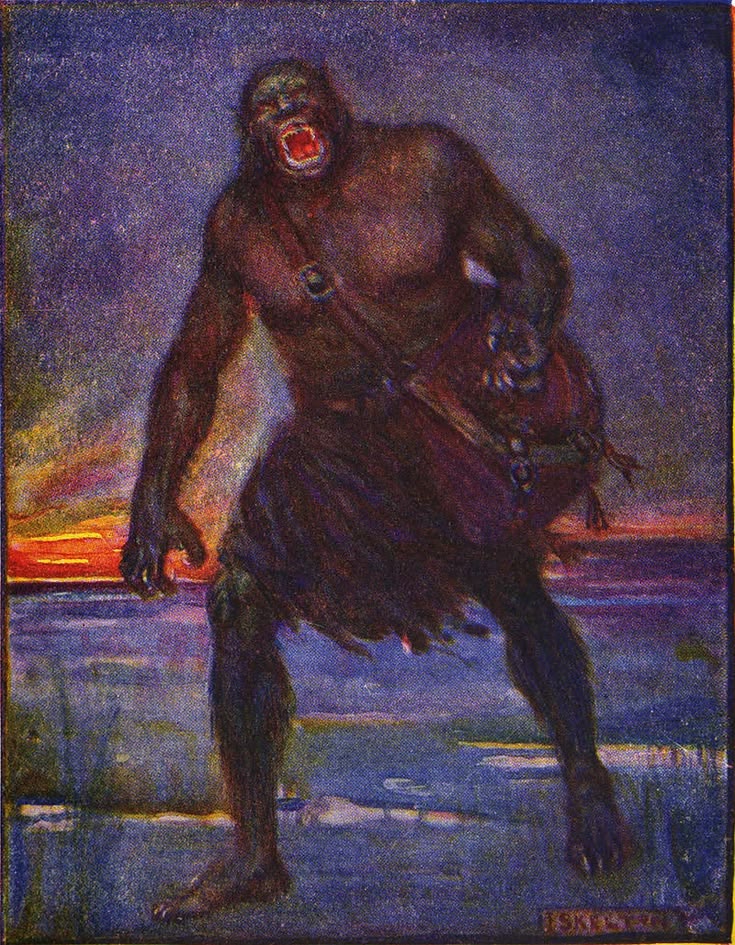
where it suggests that the monster, Grendel,

(Alan Lee)

is uncivilized, seeming not to understand that, in Danish society, killing requires rebalancing through financial compensation—

“feorhbealo feorran, fea thingian             to desist in life-destruction,  to settle it with payment,

ne thear naenig witena   wenan thorfte    none of the counsellors   had any need to hope for

beorhtre bote  to banan folmum               noble recompense   from the slayer’s hands.”

(lines 156-158, text and translation from the Heorot site, which contains helpful notes, as well as the Old English text and a modern English translation.  Here it is:  https://heorot.dk/beowulf-rede-text.html  There’s a later mention of the Danish king, Hrothgar, paying weregild for a killing by Beowulf’s father, Ecgtheow, 456-472, and here the word used is “fee”—“feo”—which comes from a Germanic word for “cattle”, implying that, like the early Irish, the Germanic peoples were also once a cattle culture.  For more on “fee”, see:  https://www.etymonline.com/word/fee )

JRRT employs the term in a bit of ancient history about the Ring—

“ …and Isildur cut the Ring from [Sauron’s] hand with the hilt-shard of his father’s sword and took it for his own…

‘This I will have as weregild for my father, and my brother,’ he said…” (The Fellowship of the Ring, Book Two, Chapter 2, “The Council of Elrond”)

Isildur is aware that this isn’t a bit of costume jewelry, writing:

“The Great Ring shall go now to be an heirloom of the North Kingdom; but records of it shall be left in Gondor, where also dwell the heirs of Elendil, lest a time come when the memory of these great matters shall grow dim.”

In the same note, however, we see the signs that the Ring has already begun to exert its power over him:

“But for my part I will risk no hurt to this thing:  of all the works of Sauron the only fair.  It is precious to me, though I buy it with great pain.”  (The Fellowship of the Ring, Book Two, Chapter 2, “The Council of Elrond”)

It will bring about his death, riddled with Orc arrows in the Anduin, and I wonder if, even as he obviously valued it, at the moment it slipped from his finger, he realized that his “weregild” wasn’t just an expensive equivalent of coins or cattle?

Thanks, as always, for reading.

Stay well,

Perhaps best to leave anything you see glittering on the ground,

But know that, as ever, there’s

MTCIDC

O

Planting

29 Wednesday Apr 2026

Posted by Ollamh in Uncategorized

≈ Leave a comment

Tags

Bag End, Eavesdropping, Fantasy, Gardening, Guy Fawkes, lotr, plotting, Sam Gamgee, the Gaffer, The Ivy Bush, The Lord of the Rings, Tolkien

Welcome, as always, dear readers.

Recently, I’ve been thinking about plotting—not as in conspiracies, like Guy Fawkes,

who planned to blow up Parliament and James I with it,

but in the construction of fictional plots.  The worse kind is what I would call examples of “fiat” writing—from the Latin subjunctive “let it be”, as in “fiat lux”—“let there be light”.  In plots like this, things happen because the author wants them to and is too lazy or inept to work the details out in a systematic, believable way.  (As I avoid harsh criticism in this blog, I won’t mention any examples, but I suspect that, if you are a reader of this blog, you know exactly what I mean and can supply your own.)

So let me show you an example of good, if not downright elegant, plotting, instead.

It’s about to be spring here, with things reluctantly beginning to flower and bud and spread, and that makes me think of gardens—which, I hope logically, makes me think of gardeners and that makes me think of the Gamgees, who have been gardeners for the Baggins for at least two generations—

“No one had a more attentive audience than old Ham Gamgee, commonly known as the Gaffer [a dialect form of “grandfather”]. 

(my favorite image—there don’t appear to be many—of the Gaffer, by Denis Gordeev)

He held forth at The Ivy Bush,

(I imagine it—minus the modern road—as looking something like this, which is the White Lion Inn in Bartholmley, Cheshire—about which you can read a little here:  https://en.wikipedia.org/wiki/White_Lion,_Barthomley )

a small inn on the Bywater road; and he spoke with some authority, for he had tended the garden at Bag End for forty years, and had helped old Holman in the same job before that.  Now that he was himself growing old and stiff in the joints, the job was mainly carried on by his youngest son, Sam Gamgee.”  (The Fellowship of the Ring, Book One, Chapter 1, “An Unexpected-party”)

And here the plotting begins, which will end with Sam incorporated into Frodo’s adventure with the Ring—not by “fiat”, but by a careful planting (sorry!) of details.

So, we know that the Gamgees are long-established at Bag End, not only the Gaffer, but his son, Sam.

Now we’re given another detail—and a very important one:

“ ‘But my lad Sam will know more about that.  He’s in and out of Bag End.  Crazy about stories of the old days, he is, and he listens to all of Mr. Bilbo’s tales…

‘Elves and Dragons!’ I says to him.  ‘Cabbages and potatoes are better for me and you.  Don’t go getting mixed up in the business of your betters, and you’ll land in trouble too big for you.’ “

So now we know that Sam already has a taste for adventure, cultivated (sorry), if inadvertently, by Bilbo.

This is further developed in the next chapter—

“[Sam] believed that he had once seen an Elf in the woods, and still hoped to see more one day.  Of all the legends that he had heard in his early years such fragments of tales and half-remembered stories about the Elves as the hobbits knew, had always moved him most deeply.” (The Fellowship of the Ring, Book One, Chapter 2, “The Shadow of the Past”)

And now the scene is set:

“Sam sat silent and said no more.  He had a good deal to think about.  For one thing, there was a lot to do up in the Bag End garden, and he would have a busy day tomorrow, if the weather cleared.  The grass was growing fast.  But Sam had more on his mind than gardening.  After a while he sighed, and got up and went out.

…He walked home under the early stars through Hobbiton and up the Hill, whistling softly and thoughtfully.”

And here we even get the suggestion of a sound effect to come.

But there’s even more scene-setting:

“…It was over nine years since Frodo had seen or heard of [Gandalf]…But that evening, as Sam was walking home and twilight was fading, there came a once familiar tap on the study window.

…Next morning after a late breakfast, the wizard was sitting with Frodo by the open window of the study.

…There was another long silence.  The sound of Sam Gamgee cutting the lawn came in from the garden.”

There is a puzzle here.  Where were the lawn and garden of Bag End?  Here are two images by Tolkien—the first from a distance,

the second close up,

but I can’t make out where those items are supposed to be.  In the first, the road appears to run just below the house, with perhaps lawn and garden on the far side and down the hill?  In the second image, there appears to be a bench (where Bilbo would have sat, smoking and reading his mail when Gandalf turned up in the first chapter of The Hobbit) and, to the right, some garden? 

Let’s put this aside, however, to continue the action.

Gandalf has begun to talk about the Ring, and even closes the shutters and the curtains when he does so, but now the narrative inside and the action outside are about to be linked—as Gandalf begins to describe the search for Gollum—

“A heavy silence fell in the room.  Frodo could hear his heart beating.  Even outside everything seemed still.  No sound of Sam’s shears could be heard.”

Sam is still at work, however, as—

“[Gandalf] went to the window and drew aside the curtains and the shutters.  Sunlight streamed back into the room.  Sam passed along the path outside whistling.”

But is Sam really occupied with grass-cutting?

“Suddenly [Gandalf] stopped as if listening.  Frodo became aware that all was very quiet, inside and outside.  Gandalf crept to one side of the window.  Then with a dart he sprang to the sill, and thrust a long arm out and downwards.  There was a squawk, and up came Sam Gamgee’s curly head hauled by one ear.”

(Robert Chronister—I can find a few paintings by him, but no website or further biographic material than that he was born in 1933.)

Sam tries to defend himself—

“ ‘…I was just trimming the grass-border under the window, if you follow me.’ He picked up his shears and exhibited them as evidence.”

When pressed, however, he confesses that he had been listening:

“…I heard a deal that I didn’t rightly understand, about and enemy, and rings, and Mr. Bilbo, sir, and dragons, and a fiery mountain, and—and Elves, sir.  I listened because I couldn’t help myself, if you know what I mean.  Lor bless me, sir, but I do love tales of that sort…Elves, sir!  I would dearly love to see them.  Couldn’t you take me to see Elves, sir, when you go?”

And here we see how all of this has been patiently laid out:  the Gamgees and the Bagginses, the gardening, Sam and his interest—through Bilbo—in Elves and stories of adventure, Gandalf’s appearance and his narrative, which Sam overhears while gardening—and listening–only to be apprehended in his eavesdropping, with only one detail still needed and now mentioned:

“ ‘Get up, Sam!’ said Gandalf.  ‘I have thought of something better than that.  Something to shut your mouth, and punish you properly for listening.  You shall go away with Mr. Frodo!’ “

After all of the careful plotting, Sam’s reaction is no wonder, then—

“ ‘Me go and see Elves and all!  Hooray!’ he shouted and then burst into tears.” 

Elegant, and yet practical and completely convincing.

Thanks, as always, for reading.

Stay well,

How is your garden doing?

And remember that, as ever, there’s

MTCIDC,

O

PS

While working on this posting, I came across this very interesting and thoughtful piece:  https://thoughtsontolkien.wordpress.com/2024/04/14/gardens-in-the-lord-of-the-rings/

Subterranean

22 Wednesday Apr 2026

Posted by Ollamh in Uncategorized

≈ Leave a comment

Tags

Bag End, Balrog, Bilbo, Chamber of Mazarbul, Cirith Ungol, clowns, enclosed-spaces, Erebor, Fantasy, Frodo, Goblins, Gollum, heights, Helm's Deep, Indiana Jones, Misty Mountains, Moria, Mt. Doom, needles, phobias, Smaug, spiders, Star Wars, Star Wars IV, The Hobbit, The Lord of the Rings, The Paths of the Dead, the-misty-mountains, Tolkien, trolls

As ever, dear readers, welcome.

I’m always amazed at how many kinds of phobias there are.

There’s the classic acrophobia—

and nyctophobia—

and trypanophobia

(of which George Lucas takes advantage in Star Wars IV

that needle is positively dripping!)

and one of my favorites, coulrophobia–

(and who wouldn’t be afraid of that?)

as well as the seemingly common arachnophobia,

of which Steven Spielberg took advantage in the first Indiana Jones movie—

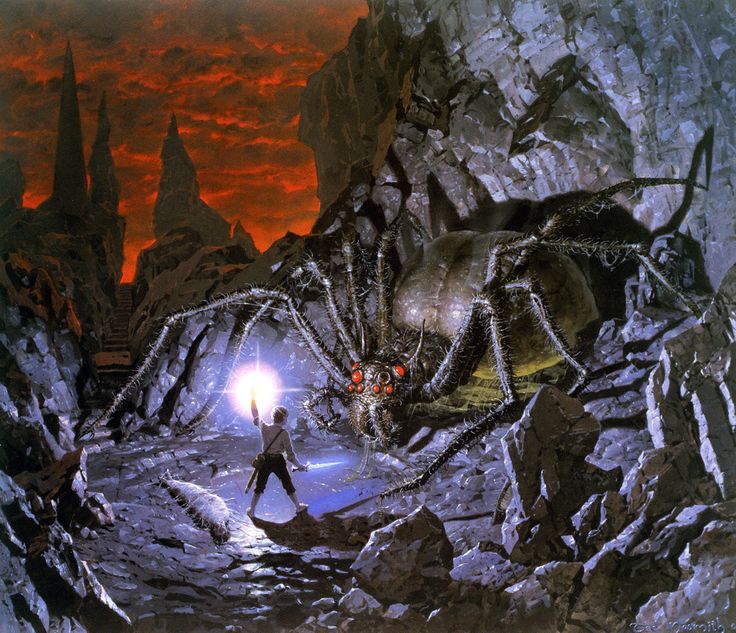
Because of Shelob in The Lord of the Rings,

(Ted Nasmith)

Tolkien, perhaps suspected of this—after all, there are also those large spiders in The Hobbit—

(Alan Lee)

wrote to W.H. Auden in 1955:

“But I did know more or less all about Gollum and his part, and Sam, and I knew that the way was guarded by a Spider.  And if that has anything to do with my being stung by a tarantula when a small child,

people are welcome to the notion (supposing the improbable, that any one is interested).  I can only say that I remember nothing about it, should not know it if I had not been told; and I do not dislike spiders particularly, and have no urge to kill them.  I usually rescue those whom I find in the bath!”  (letter to W.H. Auden, 7 June, 1955, Letters, 316.  For more on this, see:   “Phobe” 24 May, 2023 here:  https://doubtfulsea.com//?s=phobe&search=Go )

So, as far as we know, then, JRRT makes no mention of any other fears and insists that he had no dread of arachnids, even if they make two major appearances in his works.  There is another possible phobia which he doesn’t discuss, however—claustrophobia—

and I’ve wondered:  could we perhaps see a mild form in his case?

I suppose that one might immediately point out that Bilbo, in effect, lives in a cave—

(JRRT)

but Tolkien’s illustration suggests that this isn’t a place for spelunking—

and his description of Bag End underlines this:

“Not a nasty, dirty, wet hole, filled with the ends of worms and an oozy smell, nor yet a dry, bare, sandy hole with nothing in it to sit down on or to eat:  it was a hobbit-hole, and that means comfort.

…The door opened on to a tube-shaped hall like a tunnel:  a very comfortable tunnel without smoke, with panelled walls, and floors tiled and carpeted, provided with polished chairs, and lots and lots of pegs for hats and coats…”  (The Hobbit, Chapter One, “An Unexpected Party”)

But consider all of his adventures in the novel:  how many of them take place in adverse conditions under ground?

First, there’s the mention of the cave where the trolls

(JRRT)

kept their loot:

“There were bones on the floor and a nasty smell in the air; but there was a good deal of food jumbled carelessly on shelves and on the ground among an untidy litter of plunder, of all sorts from buttons to pots full of gold coins standing in a corner.  There were lots of clothes, too, hanging on the walls—too small for trolls, I am afraid they belonged to victims…” (The Hobbit, Chapter Two, “Roast Mutton”—there was also “bacon to toast in the embers of the fire”—but, considering a major troll protein source and remembering William’s remark—“Yer can’t expect folk to stop here for ever just to be et by you and Bert.  You’ve et a village and a half between yer since we come down from the mountains.”  I wonder that Bilbo and the dwarves would touch it!)

Then there was the network of caves cut by the goblins under the Misty Mountains,

(JRRT—but looking from the east westwards)

where Bilbo and the dwarves were briefly held prisoner by the goblins

(Alan Lee)

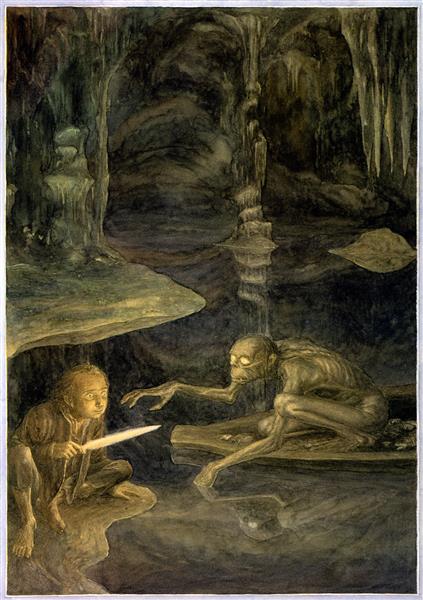
and where Bilbo had his encounter with Gollum.

(Alan Lee again)

Later, we have the halls of Thranduil, where the dwarves are again held prisoner,

(JRRT)

before the final underground nightmare, the Lonely Mountain.

IJRRT)

And those are just the subterranean terrors in The Hobbit.

Continuing to The Lord of the Rings, we have Moria,

(Alan Lee)

where, besides being temporarily trapped by orcs in the Chamber of Mazarbul,

(Angus McBride)

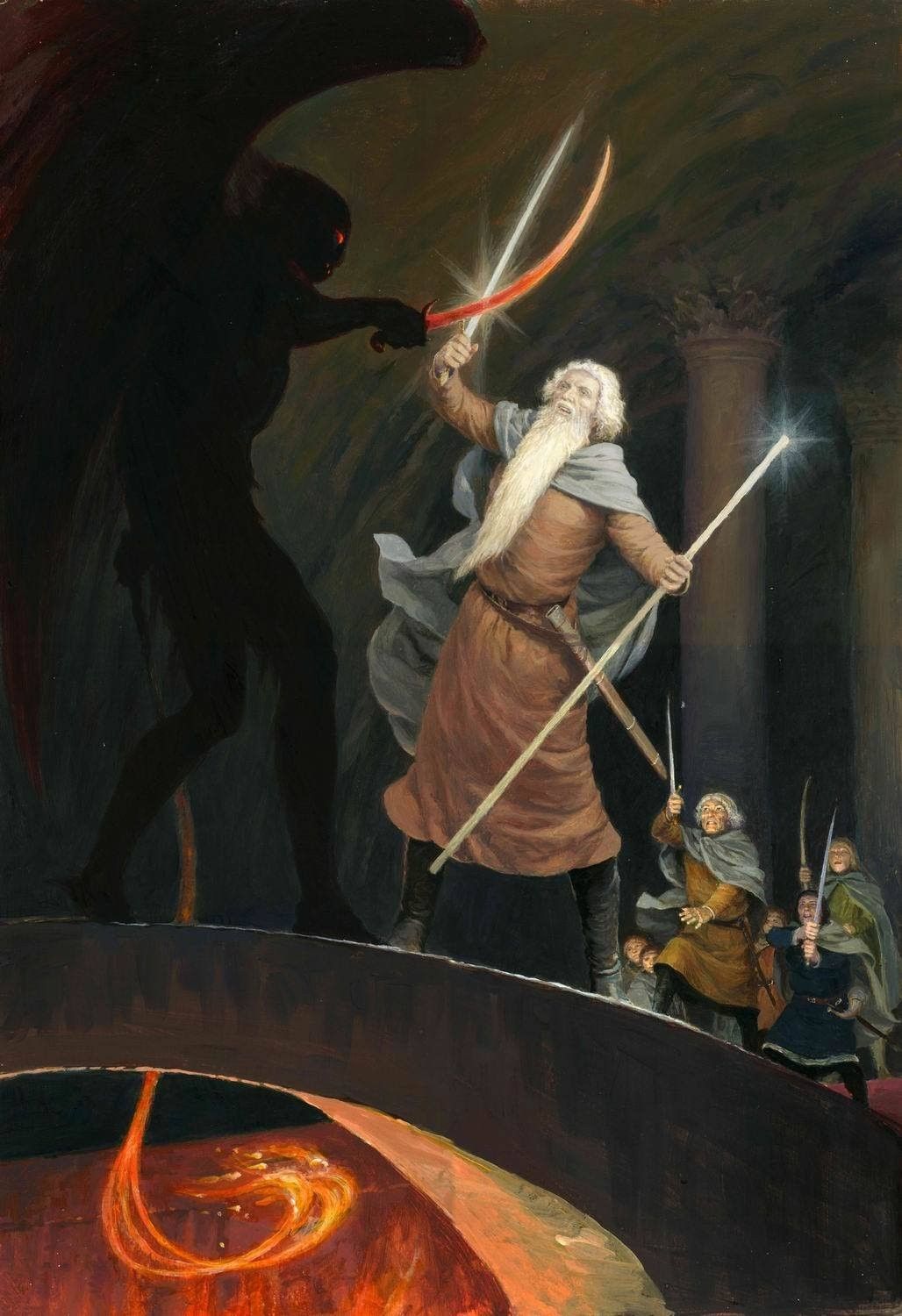
the Fellowship loses Gandalf to the Balrog.

(Angus McBride)

There are the caves at Helm’s Deep, about which Gimli is enthusiastic, but Legolas is not.

(JRRT)

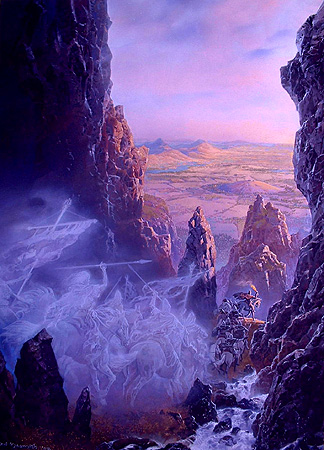
Then there are the Paths of the Dead,

(Darrell Sweet—you can read about him here:  https://blackgate.com/2022/04/17/andventure-to-be-had-a-journey-through-the-art-of-darrell-k-sweet/ )

then the tunnels of Cirith Ungol, where Frodo and Sam encounter Shelob,

(Ted Nasmith)

and, finally, the cavern under Mount Doom, where Frodo almost changes the plot, before Gollum appears.

(Ted Nasmith)

All evidence of a deep-seated fear of being trapped underground? 

Bag End may mean comfort, but what about:

“a nasty, dirty, wet hole, filled with the ends of worms and an oozy smell” and who knows what else?

As always, thanks for reading.

Stay well,

When possible, stick to the sunlight,

And remember that, as always, there’s

MTCIDC

O

Serendipity

08 Wednesday Apr 2026

Posted by Ollamh in Uncategorized

≈ Leave a comment

Tags

book-review, books, Fiction, reading, The Goldsmith and the Master Thief, The Hobbit, The Letter for the King, The Lord of the Rings, The Robot from the Flea Market, The Secrets of the Wild Wood, The Song of Seven, Tolkien, Tonke Dragt.

 Welcome, as ever, dear readers.

I am always glad for recommendations—for films, YouTube videos, and books.  Usually, these come to me in the form of conversations and e-mails, but this recommendation didn’t come from a person—well, directly—but from an image on YouTube.

I daily follow a number of language videos, both to increase my knowledge of old friends and to add new friends, and I was watching Easy Dutch on verbs of position (you can see it here:  https://www.youtube.com/watch?v=f5xEkwOo5Go ) when a Dutch children’s classic was mentioned and shown and I was immediately interested.

Tonke Dragt (TAWN-keh Dracht—with the g/ch in the back of the throat, like “Bach”, plus a T after it) is Antonia Dragt, 1930-2024, the author of a number of YA books in Dutch.

Her early life was a harrowing one:  born in 1930, she lived as a child in Indonesia and, along with her family, was held in a prisoner of war camp from 1942 to 1945, but, while a prisoner, she began a writing career which would continue till at least 2017, when she published Als de sterren zingen (“If/Supposing That/In the Event That/Whenever the Stars Sing”—as far as I know, this hasn’t been translated into English and my Dutch is limited, so, Dutch readers, please forgive the translation!)

It appears that, when she published her first novel, in 1961, Verhalen van der tweelingbroers “To Tell of the Twin Brothers”—published in English in 2021 as The Goldsmith and the Master Thief),

YA (that’s “Young Adult”) fantasy was not popular in the Netherlands, but she persisted, and her 1962 book, De brief voor de koning (“The Letter for the King”)

was a great success—and even became, in time, a Dutch film–

(It’s available on DVD in Dutch, but there are English subtitles.)

For more on the author, see:  https://www.theguardian.com/books/2015/sep/19/tonke-dragt-interview-i-was-born-a-fairytale-teller-letter-for-the-king as well as https://en.wikipedia.org/wiki/Tonke_Dragt, so I’ll let you read about her there—although I can’t resist one story from an interview done by the English Guardian some years before her death in 2024:

“I once tried to write a very realistic story, so I wrote about a class of children who went somewhere on a bus and within two chapters they were flying in the air—it’s the way my mind works!  I’m a fairytale teller…I was born like that and I cannot do anything else.” 

But now to her books—that is, to the ones currently available in English—of which I’ve read four, a fifth, De torens van februari (“The Towers of February”)—published in Dutch in 1973 and in English in 1975—

is available only at a price beyond my current book budget, alas. 

Because I was originally drawn to her work by that image on Easy Dutch, I didn’t begin with the first of her books, but De Seven Sprong, 1966,

“The Seven Leap”, published in English in 2018 as The Song of Seven.

The fantasy element appears almost at the beginning, when we learn that a teacher, Frans Van der Steg, to keep an unruly class amused, has been telling outrageous adventure stories—about himself–and, in today’s episode, says that he’s expecting an important letter.  And, when he arrives at his landlady’s, that letter arrives, bringing the teacher into a complex adventure, including, among other things, a house so large and complicated as to be a kind of puzzle (which makes me wonder if Ms Dragt had read Mervyn Peake’s Titus Groan, 1946,

the scene of which is a gigantic, ruined castle, Gormenghast) a lost treasure, and—how not?—an evil uncle. 

It was set, surprisingly, knowing the author’s bent for fairytale-telling, in the present, but, even though there’s a motorbike, there’s also a carriage and coachman, a muzzle-loading cannon, a practicing magician, an orphan-heir, and that vast labyrinth of a house.  (The Dutch title, by the way, refers to a famous Dutch folkdance, which you can read about here:  ,https://www.lookandlearn.com/blog/26053/the-traditional-dutch-jumping-dance-may-come-from-a-pagan-crop-ritual/    Seven is also a magic number which keeps appearing and reappearing in the novel.)

Having read and enjoyed the book, I went backwards in time to Dragt’s first book, the one entitled, in English, The Goldsmith and the Master Thief.

Unlike The Song of Seven, which was a novel, this was really a collection of short stories skillfully stitched together, being about twin brothers and their adventures, including, as seems almost inevitable, the use of identical twins to puzzle and confuse and even to pose a riddle, as well as to complicate a plot or two.

One thing I much enjoy, when I have the chance to work my way through an author’s writing, is to watch the author develop—just think, for example, of the difference between The Hobbit and The Lord of the Rings, completed about 20 years apart.  In reading The Letter for the King,

published only a year after The Goldsmith and the Master Thief, the author has made the leap (only 1, not 7), from what was, in a way, a short-story collection to a full-scale and long—506 pages, in the  English translation—adventure novel.  It’s the story of a squire, Tiuri, who, spending the night before the knighting service supposedly in prayer in a chapel, answers a knock at the door, is given the letter of the title, which he is supposed to deliver to a knight, only to discover the knight ambushed and dying, and then spends most of the rest of the book attempting to deliver it to the king of the kingdom to the west.

As one would expect, along the way he meets friends and enemies, acquires a squire of his own, as well as a potential sweetheart, and, because the book is a fairy tale, it has a happy ending—but with some things—like the sweetheart—in doubt.  (There’s a long plot summary here:  https://en.wikipedia.org/wiki/The_Letter_for_the_King  I would be wary, I might add, of the British NetFlix version, which has changed the story completely in the way in which The Hobbit was changed—as was Philip Pullman’s His Dark Materials, the latter also by NetFlix.  I’m reminded, as I always am, of Tolkien’s letter to Forrest J. Ackerman about a proposal in 1958, to make films of The Lord of the Rings, in which he says of the adapter and others interested in the project:  “But I would ask them to make an effort of imagination sufficient to understand the irritation (and on occasion the resentment) of an author who finds, increasingly as he proceeds, his work treated as it would seem carelessly in general, in places recklessly, and with no evident signs of any appreciation of what it is all about…”  “from a letter to Forrest J. Ackerman”, June, 1958, Letters, 389)

This then sets the scene for the sequel, Geheimen van het Wilde Woud, 1965, translated as The Secrets of the Wild Wood, published in 2015.

In this sequel, we see now Sir Tiuri, and his squire, Piak (his would-be squire of the previous book) on a quest first to find a missing knight, but then become tangled in a complex plot which includes two princely brothers, one the next king-to-be in his own land, the other now king of the land to the south and planning to invade his own land and overthrow his father, the king, and his brother.  As well, there are the mysterious forest folk and a potential new sweetheart who is not quite what she seems to be.  Here’s a longer summary:  https://en.wikipedia.org/wiki/The_Secrets_of_the_Wild_Wood  For me, this is the best book yet—not only for the twists and turns, but for the grownup feel to it:  so much is not neat, characters are more complex, and there is a sort of happy ending, but not for everyone (although Tiuri does return to his first sweetheart from the previous book). 

Sometimes one does something for a reason only to benefit in a way unexpected while doing it.  I had no idea that Tonke Dragt and her engaging novels existed until Easy Dutch handed her to me.  Now I only wish that someone would translate her other novels—what might De robot van de rommelmarkt (“The Robot from the Flea Market”) be about, I wonder?

As always, thanks for reading.

Stay well,

When purchasing robots in flea markets, consider previous owners,

And remember that, as always, there’s

MTCIDC

O

Verisimilitude

01 Wednesday Apr 2026

Posted by Ollamh in Uncategorized

≈ Leave a comment

Tags

Alexandre Dumas, books, D'Artagnan, Gilbert and Sullivan, Musketeers, Pooh-Bah, Sir Walter Scott, The Lord of the Rings, The Mikado, The Three Musketeers, Tolkien, Waverley

Dear readers, welcome, as always.

What makes The Lord of the Rings so convincing?  One might argue that it was simply good story-telling—convincing characters, fast-moving plot, surprises along the way, sad, but satisfying conclusion—and I would certainly agree.  For me, however, there is something more and I’ve come to think about it through what might seem a rather remote back door…

Several of the characters in Gilbert and Sullivan’s The Mikado (1885),

are in trouble.  They have told a lie—in a song, of course–and were so convincing that they’re now about to be executed for it.  Inevitably, this leads to recriminations and one character, Pooh-Bah,

defends himself, saying that his part in the lie, was

“Merely corroborative detail, intended to give artistic verisimilitude to an otherwise bald and unconvincing narrative.”

 I thought of this line when an old friend sent me a piece from the BBC with the headline “Musketeer D’Artagnan’s remains believed found under Dutch church” (see the article here:  https://www.bbc.com/news/articles/cm2rew2dgzzo   )

“Musketeer D’Artagnan” is the protagonist of Alexandre Dumas’ (1802-1870) historical adventure novel The Three Musketeers (1844),

as well as being a major character in two more, Twenty Years After (1845) and The Viconte of Bragelonne (1847).

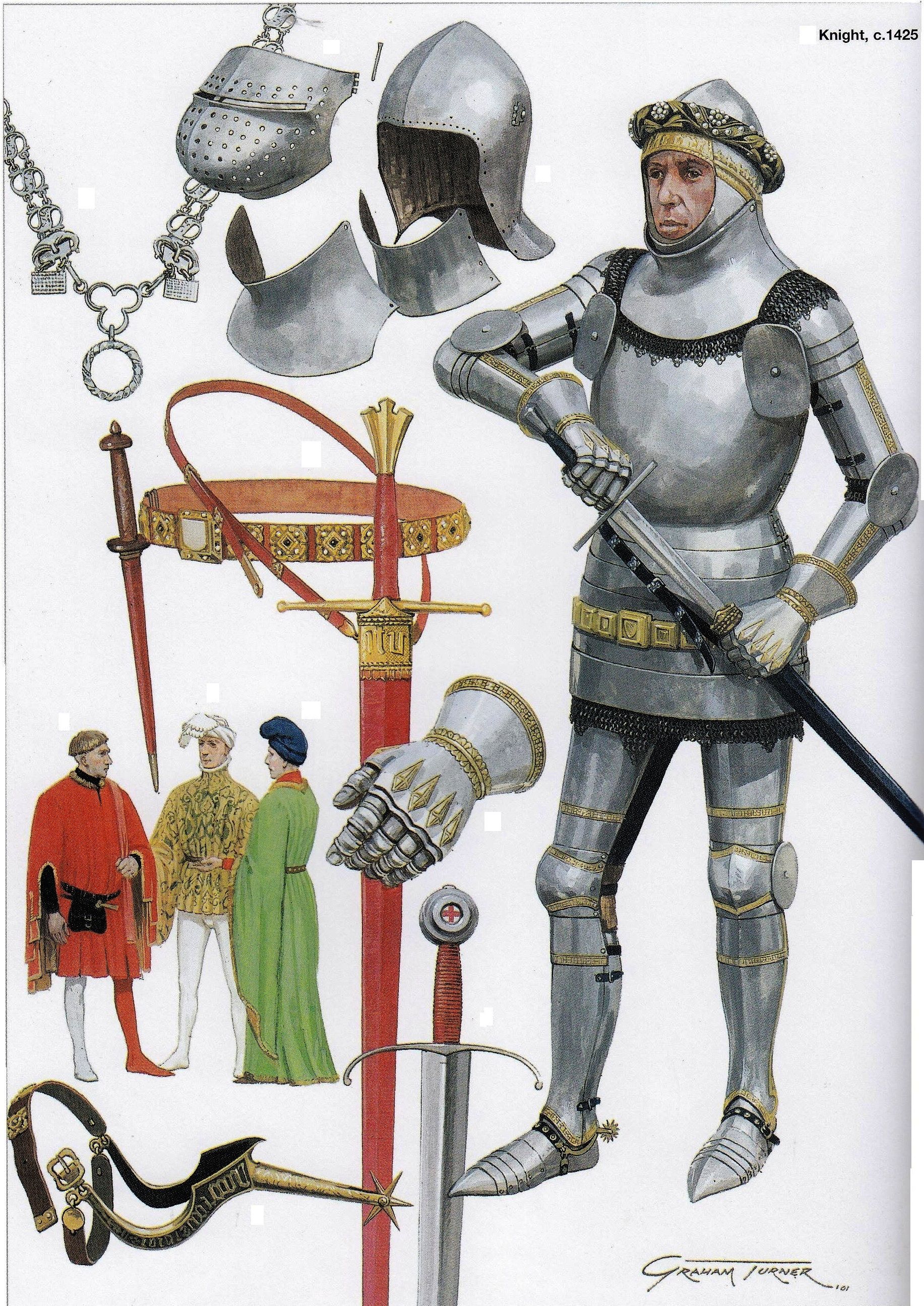
He also happens to have been a real person, Charles de Batz de Castelmore (1611-1673), who had once been a member of Louis XIII’s Musketeers,

(Graham Turner)

one of the units of Louis’ bodyguard.

In 1673, he had been at the siege of the Dutch town of Maastricht,

during Louis XIV’s (son of Louis XIII—surprised?) interminable wars, where he was killed, perhaps by a sniper’s bullet—and may have been buried under the floor of this church—

(You can read about the real musketeer here:  https://en.wikipedia.org/wiki/Charles_de_Batz_de_Castelmore_d%27Artagnan )

d’Artagnan had already appeared in a somewhat fictionalized form in an earlier book, Memoires de Monsieur d’Artagnan, (1700) by Gatien de Courtilz de Sandras (1644-1712). 

(A 1704 printing.  You can read about Gatien here:    https://en.wikipedia.org/wiki/Gatien_de_Courtilz_de_Sandras and read the first English translation of his fictionalized work here:  https://archive.org/details/memoirsofmonsieu01couruoft/page/n7/mode/2up  This is Volume 1 of 3, all being available at the Internet Archive, where you’ll find this volume.)

Dumas claimed, in fact, that he was only working from de Courtilz de Sandras’ account, along with a manuscript (which he himself had actually created), Memoire de M. le conte de la Fere (who is, in fact, Athos one of the three musketeers), implying, therefore, that the work isn’t really a novel, but a true story based upon documents from the 17th century. 

Why do this, rather than simply write an original novel and let it go at that?

This is where “artistic verisimilitude” comes in:  a novel is fun, but what if this weren’t really a completely-manufactured story, but real history—though much more exciting than simply dry accounts of political decisions and battles (“a bald and unconvincing narrative”)?

Dumas may have been inspired by Sir Walter Scott (1771-1832), whose first novel, Waverley (1814),

had done the opposite of Hugo, attaching a fictional character—the Waverley of the title—to actual events—the last Jacobite uprising of 1745-46,

in which a group of Scots (plus some English to the south) attempted to restore the Stuart family to the throne of the UK (if you’re a fan of the Outlander novels or tv series, you’ll be aware of this).  Scott’s novel was so successful that he kept using the method all the way to the end of his creative life, taking different periods in UK history as the basis.

(Here’s a copy of the novel for you, in case you haven’t read it:  https://www.gutenberg.org/files/5998/5998-h/5998-h.htm  You’ll notice that the notes are by Andrew Lang, whom, if you read this blog regularly, you will remember as the editor of the “Fairy” books, some of which Tolkien read or had read to him as a child.)

But what if you don’t have an historical period into which to place a character?  One answer would be to create the period, then add the character, and that’s exactly what we see Tolkien doing.  Much has been written about JRRT writing to “create a mythology for England” and he himself seems to have had an early plan for something like this, as he writes to a “Mr. Thompson”:

“Having set myself a task, the arrogance of which I fully recognized and trembled at; being precisely to restore to the English an epic tradition and present them with a mythology of their own…” (letter to “Mr. Thompson, 14 January, 1956, Letters, 335)

In time, Tolkien appears to have abandoned this goal (see this piece for more:  https://en.wikipedia.org/wiki/A_mythology_for_England ), but all of the material which JRRT had created, however, remained in the form of the “Prologue” and the “Appendices” to The Lord of the Rings and here we see Pooh-Bah’s “corroborative detail” with essays on Hobbits, Pipe-weed, the ordering of the Shire, and “Note on the Shire Records”, as well as “Annals of the Kings and Rulers”, “The Tale of Years”, and even a section on Middle-earth calendars, all created by Tolkien, but written as if he’s merely an editor, filling in background to actual events.  Frodo and those around him, including the antagonists, have thus become 3-dimensional, their actions given an imaginary historical context, just as Waverley and d’Artagnan, one fictional character, one fictionalized actual person, when attached to history, are deepened and, potentially, more convincing, which, in turn, makes the whole story, for me, that much more believable.   In fact, it gains verisimilitude, at least while I’m reading it.

All of which makes that news story of the potential discovery of d’Artagnan’s tomb seem so much odder to me.  He was a real man turned into fiction in a real historical period.  Tolkien created a rich imaginary historical world and placed his characters in it:  now I’m wondering when archaeologists will announce that they’ve found the tomb—not of Frodo, who went off to Valinor—

(Ted Nasmith)

but perhaps of Aragorn, in Rath Dinen?

Thanks for reading.

Stay well,

Remember that great literary figures are, in fact, immortal,

And remember, as well, that there’s

MTCIDC

O

PS

Pooh-Bah survives, in case you were worried.

PPS

Here’s an English translation of Dumas’ novel, in case you haven’t read it (it’s fun in itself and, if you would like to see an ancestor of modern adventure novels and films, I would certainly recommend it): https://www.gutenberg.org/cache/epub/1257/pg1257-images.html For an introduction to the Musketeers, I would also recommend the old Richard Lester films, which mostly stick to the plot and have some of the liveliest dueling scenes after the Errol Flynn era.

Goblins and Goblin

25 Wednesday Mar 2026

Posted by Ollamh in Uncategorized

≈ Leave a comment

Tags

Book Goblin, books, Despicable Me, Droids, Elizabeth Wheatley, Emperor Palpatine, Fantasy, George Macdonald, Goblins, Gru, Minions, Orcs, Order 66, Sauron, Star Wars, The Lord of the Rings, Tolkien

Welcome, dear readers, as always.

Villains with ambitious plans for world conquest need armies.

Emperor Palpatine

initially employs droids by the million to face the Republic’s clone armies, and not just ordinary foot soldier droids—

but super battle droids

and even commando battle droids

before, in his complex plan, he turns the Republic’s clones against his real target, the Jedi, in Order 66.

On a lighter level, Gru,

of Despicable Me, has masses of Minions to work his will (sort of)—

It’s clear that Sauron has similar plans—and similar armies—orcs—along with masses of humans.

(Alan Lee)

Orcs, we’re told, are a kind of distortion of actual living creatures—

“But Trolls are only counterfeits, made by the Enemy in the Great Darkness, in mockery of Ents, as Orcs were of Elves.”  (The Two Towers, Book Three, Chapter 4, “Treebeard”)

Orcs began, however, as something more traditional and, for Tolkien, begin with the works of George MacDonald (1824-1905),

and, in particular, with one of his fantasy novels, The Princess and the Goblin, 1870-2.

(First US edition, 1871)

For our purposes, the princess, although an heroic figure, can be removed, as we’re interested in those goblins.

(Arthur Hughes)

Later in life, Tolkien became disenchanted with MacDonald’s work, failing to complete a proposed preface for his The Golden Key, a short story from MacDonald’s Dealings with the Fairies, 1867—you can read it here:  https://archive.org/details/dealingswithfair00macd_0/page/n5/mode/2up

and you can read about his disenchantment in Carpenter’s J.R.R. Tolkien, page 244.).  Earlier, however, he had acknowledged MacDonald’s influence, writing to the editor of The Observer about The Hobbit:

“As for the rest of the tale it is, as the Habit [the pen name of a commentator on the book] suggests, derived from (previously digested) epic, mythology, and fairy-story—not, however, Victorian in authorship, as a rule to which George Macdonald [sic] is the chief exception.” (letter to the editior, February, 1938, Letters, 40-41)

Tolkien refers to this influence again in a much later letter to Hugh Brogan:

“Your preference of goblins to orcs involves a large question and a matter of taste, and perhaps historical pedantry on my part.  I personally prefer Orcs (since these creatures are not ‘goblins’, not even the goblins of George MacDonald, which they do to some extent resemble).”  (letter to Hugh Brogan, 18 September, 1954, Letters, 278)

And a little earlier, in a letter to Naomi Mitchison:

“They are not based on direct experience of mine [an interesting remark—did JRRT have supernatural experiences which he doesn’t discuss?]; but owe, I suppose, a good deal to the goblin tradition (goblin is used as a translation in The Hobbit, where orc only occurs once, I think), especially as it appears in George MacDonald, except for the soft feet which I never believed in.”  (letter to Naomi Mitchison, 25 April, 1954, Letters, 267)

Those soft feet turn out to be the Achilles’ heel (sorry!) of the goblins as we overhear in a conversation between a goblin father and son:

” ‘You say so, dad. I think myself I’m all right. But I could carry ten times as much if it wasn’t for my feet.’

‘That is your weak point, I confess, my boy.’

 ‘Ain’t it yours, too, father?’

‘Well, to be honest, it is a goblin-weakness. Why they come so soft, I declare I haven’t an idea.’  (The Princess and the Goblin, Chapter VIII, “The Goblins”  You can read more here:   https://archive.org/details/princessgoblin00macd/mode/2up  And you can read more about the author here:   https://en.wikipedia.org/wiki/George_MacDonald )

Recently, however, I’ve met another goblin, to whom I was introduced by a dear friend.  This is Book Goblin.

Unlike the clones and droids and Minions and orcs, who only exist to do their master’s bidding, Book Goblin lives for books, stacking shelves full, longing for the mailman to bring more, even believing in “Bookhalla”, which is, basically, an immense library, where those who are gathered there read books all day and hold book clubs all night.  You can see and hear Book Goblin describing it here:  https://www.youtube.com/shorts/vkjErlwUA2A   Only brave readers are allowed to go there, including those who read “without bookmarks”!

Book Goblin is, in fact, the creation of the fantasy author Elizabeth Wheatley

and you can read more about her and her work here:  https://www.bookseriesinorder.com/elisabeth-wheatley/   And YouTube has many short features in which Book Goblin discusses likes and dislikes and often seems like the Id of all passionate readers, which is why I bring her to your attention.  Unlike droids, clones, Minions, and orcs, however, she is one of kind and, as for world conquest—I suspect that it would interfere with her reading.

Thanks for your reading, as always,

Stay well,

If you’re like me, you probably aren’t brave enough to read without a bookmark, so I guess no Bookhalla, sadly,

But remember that, as always, there’s

MTCIDC

O

Crowing and Raven

18 Wednesday Mar 2026

Posted by Ollamh in Uncategorized

≈ Leave a comment

Tags

crow, Cuchulain, Fantasy, Gandalf, Grima, Huginn, Muninn, nursery rhyme, nursery-rhymes, Odin, Poe, raven, Sing a Song of Six Pence, Sleipnir, The Hobbit, The Lord of the Rings, Theoden

Welcome, as always, dear readers.

“ ‘I greet you…and maybe you look for welcome.  But truth to tell your welcome is doubtful here, Master Gandalf.  You have ever been a herald of woe.  Troubles follow you like crows, and ever the oftener the worse….Here you come again!  And with you come evils worse than before, as might be expected.  Why should I welcome you, Gandalf Stormcrow?’ “  (The Two Towers, Book Three, Chapter 6, “The King of the Golden Hall”)

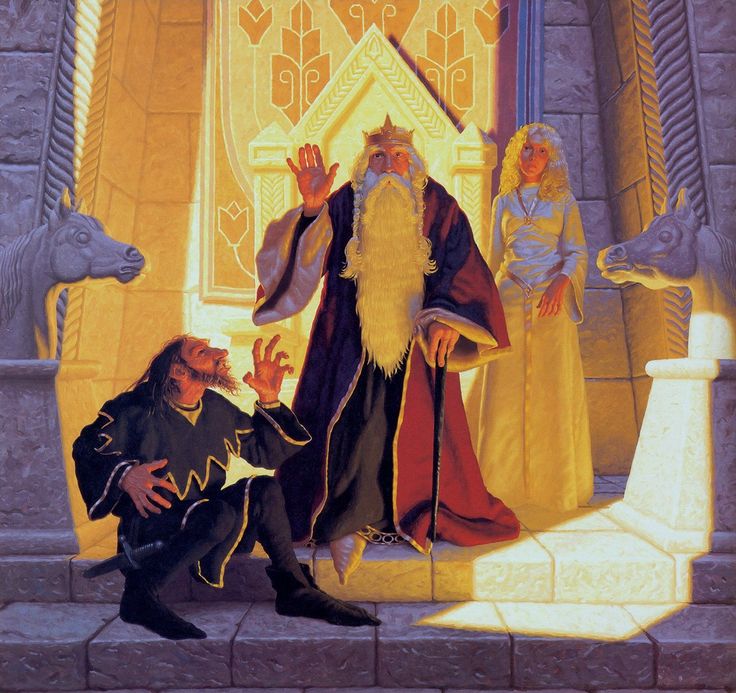
Theoden is being less than hospitable, although we soon learn that he’s being manipulated by Grima to be so,

(Alan Lee)

but his insulting name seems odd:  “Stormcrow”? 

If we were southerners in the US, we might imagine that Theoden is actually calling Gandalf a cuckoo, as the yellow-billed cuckoo, native there, is sometimes called that,

because, as the Wiki article says, the nickname perhaps comes from the fact of “the bird’s habit of calling on hot days, often presaging rain or thunderstorms”.  (For more, see: https://en.wikipedia.org/wiki/Yellow-billed_cuckoo )

Although we don’t hear of cuckoos in Middle-earth, certainly Gandalf appears in Meduseld in the middle of another kind of tempest, as Grima continues Theoden’s line of reasoning:

“ ‘It is not yet five days since the bitter tidings came that Theodred your son was slain upon the West Marches:  your right-hand, Second Marshal of the Mark.  In Eomer there is little trust…And even now we learn from Gondor that the Dark Lord is stirring in the East…Why indeed should we welcome you, Master Stormcrow?’ “

And there that word is again.  What does Tolkien have against crows?

There might be a clue in that line “troubles follow you like crows”, which reminds me of something which happened earlier in The Lord of the Rings when “Flocks of birds, flying at great speed”, appeared over the Fellowship.  Aragorn wakes and reports to Gandalf:

“ ‘Regiments of black crows are flying over all the land between the Mountains and the Greyflood…and they have passed over Hollin.  They are not natives here; they are crebain out of Fangorn and Dunland.  I do not know what they are about…but I think they are spying out the land.’ “  (The Fellowship of the Ring, Book Two, Chapter 3, “The Ring Goes South”)

It’s clear that, in Tolkien’s mind, crows do not get good press.  Here they are in The Hobbit, as well, as Balin says to Bilbo:

“ ‘Those were crows!  And nasty suspicious-looking creatures at that, and rude as well.  You must have heard the ugly names they were calling after us.’ “ (The Hobbit, Chapter 15, “The Gathering of the Clouds”)

So, crows are “nasty suspicious-looking creatures”, “rude”, and even possibly spies. 

They are also in contrast to another large black bird—

(I apologize to my non-North American readers for using North American birds in this chart, but this seemed the best choice and the European varieties are similar.)

“ ‘I only wish he was a raven!’ said Balin.

‘I thought that you did not like them!  You seemed very shy of them, when we came this way before.’

‘Those were crows!…But the ravens are different.  There used to be great friendship between them and the people of Thror; and they often brought us secret news…

‘They live many a year, and their memories are long, and they hand on their wisdom to their children.’ “  (The Hobbit, Chapter 15, “The Gathering of the Clouds”)

(Alan Lee)

Why the preference for ravens?

Possibly, as a small child, Tolkien was upset by this nursery rhyme—

“Sing a song of sixpence,
A pocket full of rye.
Four and twenty blackbirds
Baked in a pie.

When the pie was opened,
The birds began to sing.
Wasn’t that a dainty (or dandy) dish
To set before the king?

The king was in his counting house,
Counting out his money.
The queen was in the parlour,
Eating bread and honey.

The maid was in the garden,
Hanging out the clothes,
When down came a blackbird
And pecked off her nose.”

(This is by Winifred Smith from her 1895 collection of nursery rhymes—all of which you can read here:  https://archive.org/details/nurserysongsrhym00smit/page/n7/mode/2up )

and he associated blackbirds with crows?  (For more on this rather mysterious rhyme, see:  https://en.wikipedia.org/wiki/Sing_a_Song_of_Sixpence )

Crows are also linked to the death of the Irish hero, Cuchulain,

the Morrigan, 3-formed battle goddess, who brings about the hero’s end , sometimes employing that form as “the Badb” (“Bath-v”, where the  “a” is that in “father” and “th” is like the “th” in “either”, the name meaning “crow”).  And Tolkien was not fond of Old Irish literature, writing:

“I do know Celtic things (many in their original languages Irish and Welsh), and feel for them a certain distaste:  largely for their fundamental unreason.  They have bright colour, but are like a broken stained glass window reassembled without design.”  (letter to Stanley Unwin, 16 December, 1937, Letters, 35— I would strongly disagree with JRRT.  Raised in Classics and fond of medieval chivalry, Tolkien, I suspect, found the Irish stories in particular full of an earlier, more chaotic, world-view, as well as sometimes wild violence, which, to him, meant “unreason”.   But this is one of those times when I wish that we could e-mail him and ask him to say more!  For the death of Cuchulain, see:   The Cuchullin Saga in Irish Literature here:   https://archive.org/details/cu31924026824940  beginning on page 251)

The real reason for his choice of ravens might actually be completely different:  an association with Gandalf.

In a letter to Stanley Unwin in which he discusses potential illustrations by Horus Engels for a German translation of The Hobbit, he says:

“He has sent me some illustrations (of the Trolls and Gollum) which despite certain merits, such as one would expect of a German, are I fear too ‘Disnified’ for my taste:  Bilbo with a dribbling nose, and Gandalf as a figure of vulgar fun rather than the Odinic wanderer that I think of…”  (letter to Stanley Unwin, 7 December, 1946, Letters, 172)

Odin is the Germanic high god and has not only a many-legged horse, Sleipnir,

(from the Tjaegnvide Image Stone—about which see:  https://en.wikipedia.org/wiki/Tj%C3%A4ngvide_image_stone )

but also two ravens, Huginn and Muninn,

(bronze helmet plate from one of the Vendel period helmets—550-800AD–see for more:  http://early-med.archeurope.com/iron-age-scandinavia/the-late-iron-age-in-scandinavia/helmets-from-the-vendel-period/ )

whom he sends around the world every day to seek information about world events.  (You can learn more about Odin here:  https://en.wikipedia.org/wiki/Odin  and about his ravens here:  https://en.wikipedia.org/wiki/Huginn_and_Muninn )

If Tolkien sees Gandalf as “Odinic”, then we can imagine that his preference for ravens over crows may not come from dread of a nursery rhyme or dislike of a Celtic warrior, but from his strong attachment to things northern Germanic and, if so, then Theoden and his puppeteer, Grima, were right in picking a bird to label Gandalf, but wrong in choosing which one—although “stormraven” sounds a little clunky in comparison with “stormcrow”.

Thanks, as ever, for reading.

Stay well,

Avoid birds with a one-word vocabulary,

And remember that there’s always

MTCIDC

O

Do You Speak Villain? (Part 3)

18 Wednesday Feb 2026

Posted by Ollamh in Uncategorized

≈ Leave a comment

Tags

books, Fantasy, Gorbag, Grishnakh, lotr, Orcs, Saruman, Sauron, sergeant, sergeants, Shagrat, soldiers, speech, The Lord of the Rings, Tolkien, Ugluk

As always, welcome, dear readers.

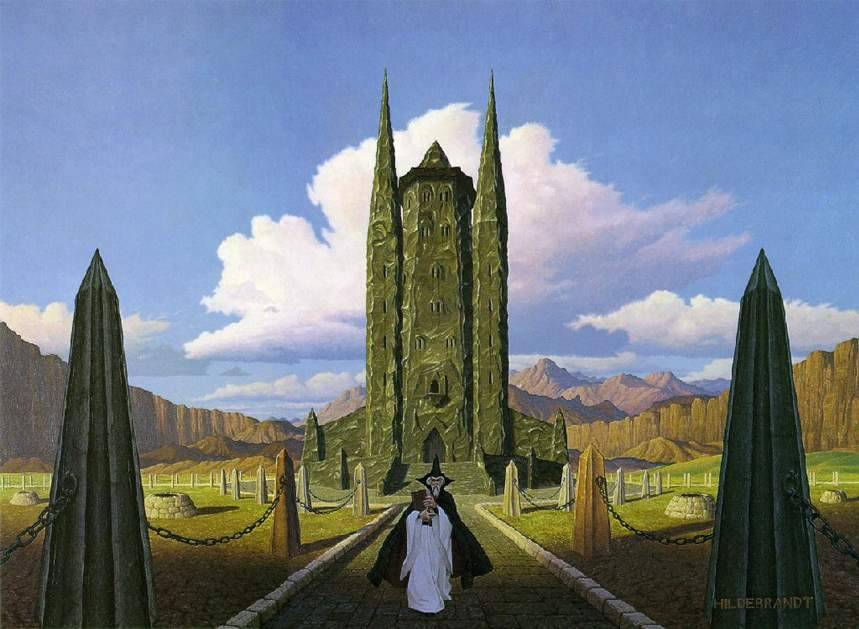
In Parts 1 and 2 of this short series, I’ve looked at Tolkien’s use of speech to characterize—and bring to life—the antagonists of The Lord of the Rings, leaving out Sauron, as having little to say for himself, but observing Saruman,

(the Hildebrandts)

the chief of the Nazgul,

(the Hildebrandts)

and the Mouth of Sauron.

(Douglas Beekman)

I’ve been doing this as a descent down the social ladder and now we’ve reached the foot with the Orcs.

(Alan Lee)

JRRT had very complex thoughts and feelings about them, as his letters show us (see, for instance, some of his thoughts in his unfinished, unsent letter to Peter Hastings, September, 1954, Letters, 285 and 291)  but then the Orcs themselves seem more complex than mere (in more modern terms) “cannon-fodder”—that is, a simple mass of undifferentiated infantry.

(Alan Lee)

Something which has always struck me about them is Tolkien’s choices for their speech.  At one level, as I pointed out in “Tolkien Among the Indians”, (21 January, 2026), one of their leaders, Ugluk, can sound like a figure out of James Fenimore Cooper’s The Last of the Mohicans—

“ ‘We are the fighting Uruk-hai!  We slew the great warrior.  We took the prisoners.  We are the servants of Saruman the Wise, the White Hand:  the Hand that gives us man’s-flesh to eat.  We came out of Isengard, and led you here, and we shall lead you back by the way we choose.  I am Ugluk.  I have spoken.’ ”

On another level—but here I want to quote another of Tolkien’s letters, one often cited when referring to Sam Gamgee:

“My ‘Sam Gamgee’ is indeed, as you say, a reflexion of the English Soldier, of the privates and batmen [officers’ servants, not denizens of Gotham] I knew in the 1914 war, and recognized as so far superior to myself.”  (draft of a letter to H. Cotton Minchin, April, 1956, Letters, 358)

and obviously Tolkien knew what he intended, but I’ve always seen those “privates and batmen” as something more:  as models for the Orcs—

and their commanders, Ugluk and Grishnakh—and later Shagrat and Gorbag—not as of the officer class, to which Tolkien belonged—

but as sergeants, the tough, experienced men who ran the infantry on a day-to-day basis.

Here they are, talking—

“ ‘Orders,’ said a third voice in a deep growl.  ‘Kill all but NOT the Halflings; they are to be brought back ALIVE as quickly as possible.  That’s my orders.’

“ ‘What are they wanted for?’ asked several voices.  ‘Why alive?  Do they give good sport?’

‘No!  I heard that one of them has got something, something that’s wanted for the War, some Elvish plot or other.  Anyway they’ll both be questioned.’

‘Is that all you know?  Why don’t we search them and find out?  We might find something that we could use ourselves.’

‘That is a very interesting remark,’ sneered a voice, softer than the others but more evil.  ‘I may have to report that.  The prisoners are NOT to be searched or plundered:  those are my orders.’

‘And mine too,’ said the deep voice.  ‘Alive and as captured, no spoiling.  That’s my orders.’ “

So far, those two main voices—the “deep growl” and the “softer…but more evil”–are just that:  voices.  And we can tell immediately that they, being the ones given orders and threatening to make reports, are in charge.  Shortly, we’ll find that the deep voice belongs to ”a large black Orc, probably Ugluk” and the softer to Grishnakh, “a short, crook-legged creature, very broad and with long arms that hung almost to the ground.” 

Why sergeants, not officers?  It’s the tone, I think.  When Grishnakh proposes taking the prisoners to the east bank of the Anduin, where a Nazgul is waiting, Ugluk replies

“ ‘Maybe, maybe!  Then you’ll fly off with our prisoners, and get the pay and praise in Lugburz, and leave us to foot it as best we can through the Horse-country.’ “ 

“pay and praise” and “footing it” sound to me more like the language of soldiers than those of higher ranks, but there’s something more to their talk.  Ugluk sneers at the Nazgul and Grishnakh replies:

“ ‘Nazgul, Nazgul,’ said Grishnakh, shivering and licking his lips, as if the word had a foul taste that he savoured painfully.  ‘You speak of what is deep beyond the reach of your muddy dreams, Ugluk.’ “

There is a fear in this that’s a little surprising:  aren’t the Nazgul on the same side as Grishnakh, at least? 

There is a rivalry between the two groups as well—and clearly even between their two masters, as Grishnakh reveals:

“ ‘You have spoken more than enough, Ugluk,’ sneered the evil voice.  ‘I wonder how they would like it in Lugburz…They might ask where his strange ideas came from.  Did they come from Saruman, perhaps?  Who does he think he is, setting up on his own with his filthy white badges?  They might agree with me, with Grishnakh their trusted messenger; and I Grishnakh say this:  Saruman is a fool, and a dirty treacherous fool.’ “  (all of the text here is from The Two Towers, Book Three, Chapter 3, “The Uruk-hai”)

All of this shows a level of internal tension which would not bode well for an alliance between Sauron and Saruman and, when we reach Shagrat and Gorbag, later in the story, there’s even something more and we’ve already seen it in that “We might find something that we can use ourselves.”

So far, the speech of the two Orc leaders has suggested creatures who clearly don’t trust each other, and one is fearful of something on his own side, revealing, as well, that his master, Sauron, is less than impressed by Saruman and his efforts. 

And now we find that such sergeants may not even trust their men, as when Shagrat says to Gorbag:

“ ‘…but they’ve got eyes and ears everywhere; some among my lot, as like as not.’ “

But why such wariness?  First, because these Orcs are aware that knowledge of the progress of the war in which they’re a part is being kept from them, and it’s not good news:

“ ‘…they’re troubled about something.  The Nazgul down below are, by your account; and Lugburz is too.  Something nearly slipped…As I said, the Big Bosses, ay,’ his voice sank almost to a whisper, ‘ay, even the Biggest, can make mistakes.  Something nearly slipped, you say.  I say, something has slipped.’ “

And second because these Orcs, not trusting their masters and perhaps even fearful of them, may have plans of their own—

“ ‘What d’you say?—if we get a chance, you and me’ll slip off and set up somewhere on our own with a few trusty lads, somwhere where there’s good loot nice and handy, and no big bosses.’

‘Ah!’ said Shagrat.  ‘Like old times!’ “  (The Two Towers, Book Four,  Chapter 10, “The Choices of Master Samwise”)

As we’ll see, however, later in the story, Shagrat and Gorbag don’t even trust each other—

“Quick as a snake, Shagrat slipped aside, twisted round, and drove his knife into his enemy’s throat.

‘Got you, Gorbag!’ he cried.  ‘Not quite dead, eh?  Well, I’ll finish my job now.’  He sprang on to the fallen body, and stamped and trampled it in his fury, stooping now and again to stab and slash it with his knife.“  (The Return of the King, Book Six, Chapter 1, “The Tower of Cirith Ungol”)

So much for “old times”!  But a fitting ending for this posting.  Here, on the lowest rung of the social ladder, we see how JRRT shows both the threat of the enemies’ soldiers and, at the same time, undercuts that threat, as we hear the Orcs doing everything from threatening each other, dissing their own leaders and those of their own side, mistrusting each other and their own men, and even plotting to desert and set up their own little kingdoms before cheerfully knifing each other.  We might wonder—even if Sauron had won, how long would his empire have lasted, with such allies and underlings?

Thanks, as ever, for reading.

Stay well,

I guess that I don’t have to tell you now:  watch your back,

And remember that there’s

MTCIDC

O

PS

For more on Orcs and their language, see “Lingua Orca”, 16 April, 2025.

Do You Speak Villain? (2)

11 Wednesday Feb 2026

Posted by Ollamh in Uncategorized

≈ Leave a comment

Tags

dialogue, Fantasy, lotr, Mouth of Sauron, Nazgul, Saruman, The Lord of the Rings, thou-vs-you, Tolkien, villain, Witch-King of Angmar

Welcome, dear readers, as always.

It is sometimes surprising to see how social class can influence vocabulary.  For instance–

this is a Roman villa—

in Pompeii, where wealthy city people might live.

And this is a country villa—

(Billl Donohoe)

which, in its more elaborate form, might offer some of the comforts of a city dwelling, but would often also be a working farm and here are a couple

of Roman farm workers (probably slaves), each of whom, as someone attached to a villa, could be called a villanus—and I’m sure that you see where this is going:  rural people could be uncultivated (no pun, there) and therefore crude and, by a snobbish leap of imagination from 12th-century Old French to mid-16th century English, people who could be expected to be involved in the worst antisocial behavior:  crime.  (For more on this, see:  https://www.etymonline.com/word/villain )

In the previous posting, we began examining Tolkien’s villains in The Lord of the Rings, and how Tolkien, with his wonderful ear for language (and a great dramatic gift), used speech to depict their characters, as well as their behavior.

Since Sauron provides such a small sample of speech, we began with Saruman,

(the Hildebrandts)

who, as reported by Gandalf in Book One, could be by turns, sarcastic, conspiratorial, falsely chummy, and coldly imperious, all the while, though only at first obliquely, attempting to persuade Gandalf to reveal to him the location of The Ring and, in doing so, revealing to Gandalf not only his corrupt ambition, but also his lack of awareness of how much that corruption came from his communication with Mordor.

(the Hildebrandts)

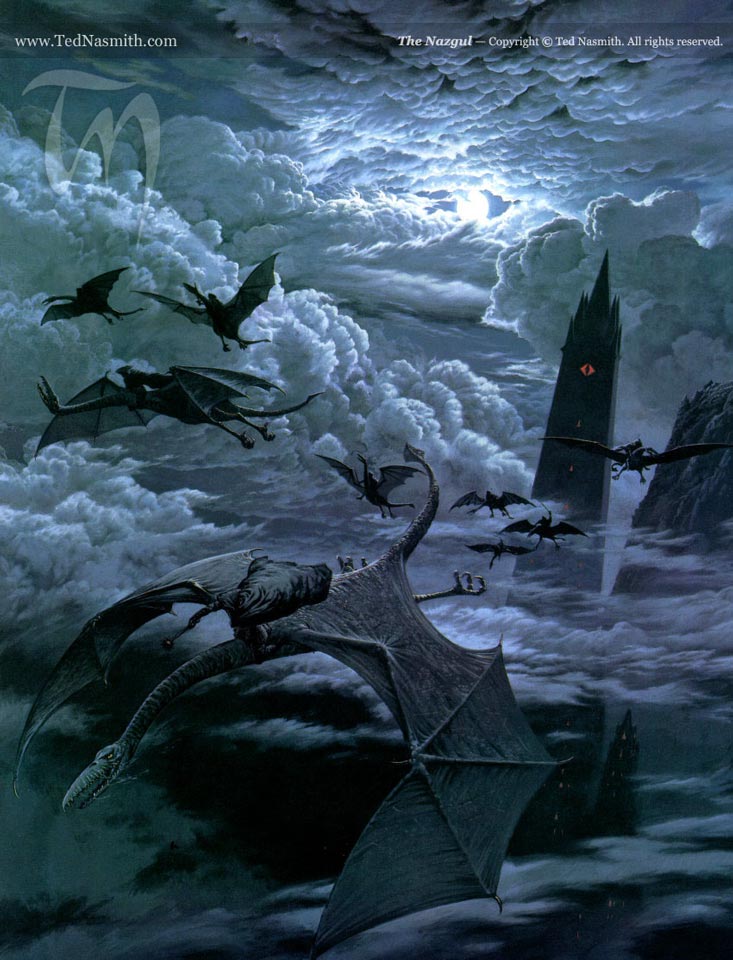
In this posting, I want to continue that examination by extending it down the social scale of villains, beginning with the Nazgul, who, as former kings, might be thought of as next after Saruman.

(Mark Ferrari—new to me, but I like the energy of this and you can see more at:  https://www.markferrari.com/image-archives )

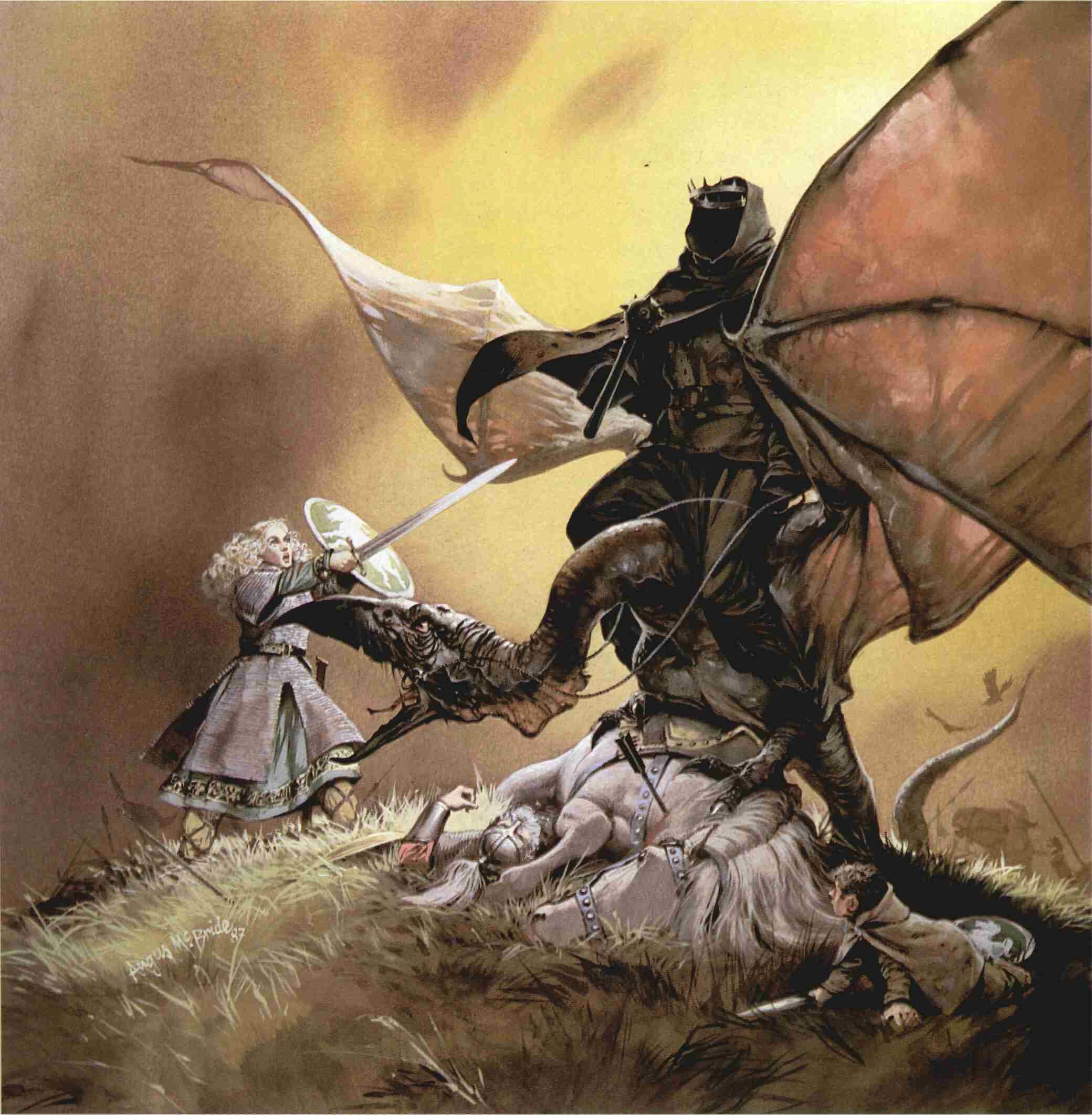
On the whole, unlike Saruman, who gives away so much in his speech, they don’t have much to say for themselves, but their leader, the Witch-king of Angmar,

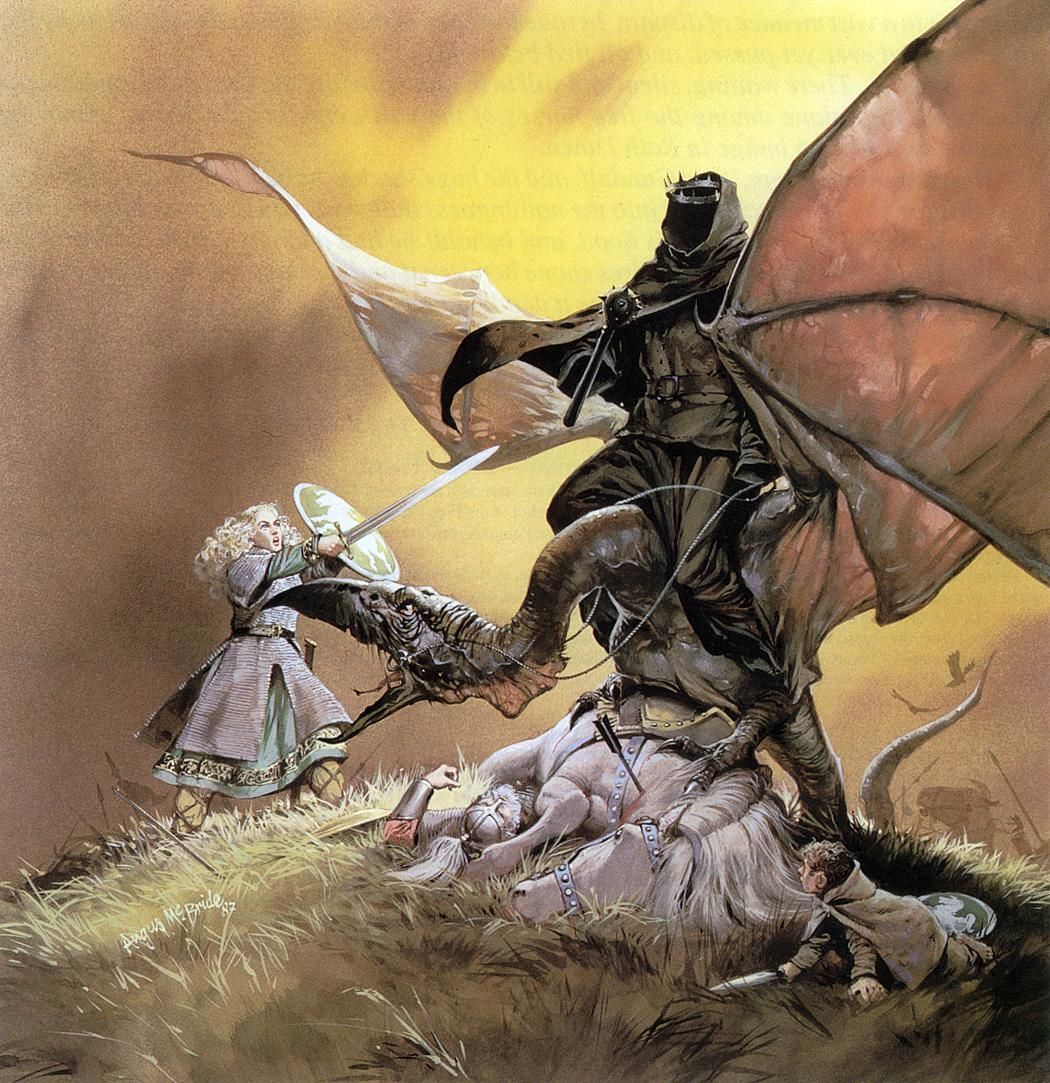
(Angus McBride)

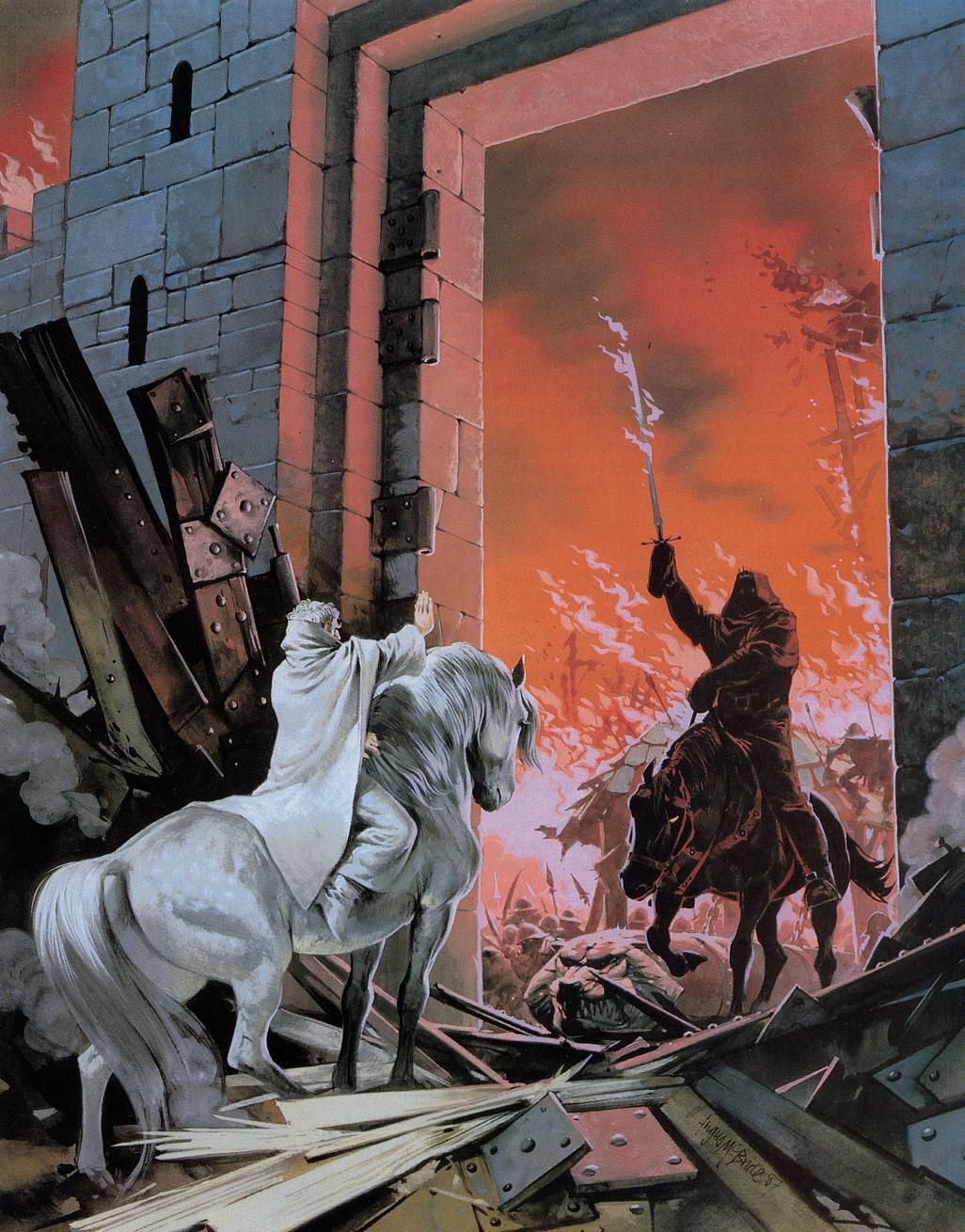
has two bits of dialogue:  first, when he encounters Gandalf at the broken gate of Minas Tirith,

(Ted Nasmith)

where he speaks briefly in a threat:

“ ‘Old fool!’ he said.  ‘Old fool!  This is my hour.  Do you not know Death when you see it?  Die now and curse in vain!’”  (The Return of the King, Book Five, Chapter 4, “The Siege of Gondor”)

This only shows his (misplaced) contempt for Gandalf, but he addresses Gandalf as an equal in using “you”, rather than as an inferior, as when he confronts Eowyn:

“ ‘Come not between the Nazgul and his prey!’ “

The Witch-king is ancient—being from the Second Age of Middle-earth—and therefore we might expect his speech to sound archaic, even if here he uses the Common Speech of everyone else we see in The Lord of the Rings, and we see it here with this inverted construction.  If it were a person from the present, we might expect “Don’t come” or perhaps “Don’t you come”, but “Come not” immediately suggests a speaker from an earlier time.

He continues:

“ ‘Or he will not slay thee in thy turn.’ “

And note here the archaic “thee” (the accusative/dative/ablative of “thou”), which serves a double purpose:  on the one hand, suggesting the Witch-king’s great age and, on the other, this is how a superior would speak to an inferior (as in the case of the Romance languages—where French even has verbs for using “you” vs “thou”—vouvoyer vs tutoyer).

And continues:

“He will bear thee away to the houses of lamentation, beyond all darkness, where thy flesh shall be devoured, and thy shrivelled mind be left naked to the Lidless Eye.’ “ (The Return of the King, Book Five, Chapter 6, “The Battle of the Pelennor Fields”)

The Witch-king persists in his use of “thou”, but then becomes what I feel is quite Biblical in “the houses of lamentation”—where is this place?  My immediate thought was that it was the same place where Gollum was tortured (we get a hint of this in Gandalf’s long explanation in The Fellowship of the Ring, Book One, Chapter 2, “The Shadow of the Past”) and where the Mouth of Sauron suggests that Frodo was taken (The Return of the King, Book Five, Chapter 10, “The Black Gate Opens”).  As to its name, I was reminded of “The Book of Lamentations” in the Judeo-Christian Bible, a collection of laments over the fall of Jerusalem to the Babylonians in 587/6BC.

(James Tissot, 1836-1902—actually Jacques Joseph Tissot, a very interesting late-Victorian French artist who did much of his later work in England, where he—or his name, at least—became Anglicized.  You can read about him and his art here:  https://en.wikipedia.org/wiki/James_Tissot )

Sections of “Lamentations” are read during Lent, in Christian services, and we can assume that JRRT, as a practicing Catholic, was well aware of the book.  (You can read more about it here:  https://en.wikipedia.org/wiki/Book_of_Lamentations )

Wherever the idea came from, the Witch-king continues it in an extremely graphic manner, repeating his use of  “thou” to the end of his threat, at the same time.

We see this use of “thou” once more from another on that social scale, the Mouth of Sauron.

(Douglas Beekman—you can read a little more about him here:  https://www.askart.com/bio/Doug_L_Beekman/122294/Doug_L_Beekman )

This is, again, an ancient figure, as we’re told that “…he was a renegade, who came of the race of those that are named the Black Numenoreans”—that is, followers of Sauron in the Second Age—and he begins as Saruman began, with contempt—

“ ‘Is there anyone in this rout with authority to treat with me?’ “

“Rout” is an archaic word for “rabble”, so the Mouth is already suggesting that, in comparison with him, there is no one of stature with whom he could speak.  And he goes on—

“ ‘Or indeed with wit to understand me?’ “

He’s establishing his bargaining position here:  he’s of higher social standing and smarter than anyone he faces and he continues, addressing Aragorn:

“ ‘It needs more to make a king than a piece of Elvish glass, or a rabble such as this,  Why, another brigand of the hills can show as good a following!’ “

So far, then, the Mouth shows arrogance—but his next behavior shows that, underneath that arrogance is cowardice—

“Aragorn said naught in answer, but he took the other’s eye and held it, and for a moment they strove thus; but soon, though Aragorn did not stir or move hand to weapon, the other quailed and gave back as if menaced by a blow.  ‘I am a herald and ambassador, and may not be assailed!’ he cried.”

(And this is where Jackson’s portrayal in the film version of the scene fails completely, as Aragorn then cuts him down, which no respectable king—or even knight—would do, as the Mouth is correct in that heralds and ambassadors, traditionally, could claim immunity.)

Gandalf reassures him, although he also cautions him that that immunity might not last forever, before the Mouth continues:

“ ‘So!’ said the Messenger.  ‘Then thou art the spokesman, old grey-beard?’ “

This is insulting in several ways:  first, that use of “thou”, as though to an inferior; second, as the Mouth clearly recognizes Aragorn, so he would recognize Gandalf, and calling him “old grey-beard” has the same effect as when the Witch-king earlier called him “old fool”.

He then indirectly admits that he does, indeed, recognize Gandalf:

“ ‘Have we not heard of thee at whiles, and of thy wanderings, ever hatching plots and mischief at a safe distance?  But this time thou hast stuck out thy nose too far, Master Gandalf, and thou shalt see what comes to him who sets his foolish webs before the feet of Sauron the Great.’ “

Vocabulary is key here:  “wanderings”, “hatching plots and mischief”, sticking out “thy nose”, “foolish webs”, all suggest denigration, keeping with the Mouth’s original address, which painted the Gondorians and their allies as a mob of bandits, with no legitimacy to address the Messenger of Sauron, or even the IQ to do so.

Pippin recognizing Frodo’s mithril coat gives the Mouth the chance to continue that denigration, calling Pippin “imp” and “brat” and calling the Shire “little rat-land”, before going on to name the conditions Sauron demands, both for the return of Frodo and for “peace” between him and the allies, conditions which are simply surrender in other terms. 

So far, by his very language, the Mouth has attempted to dictate the scenario, using “we” as if it were Sauron himself speaking, attempting to suggest that Sauron is the master of the situation and that he, as Sauron’s spokesman, is in sole charge of the parley, but it’s interesting to see how he responds when spoken to in the same way by Gandalf, who has revealed his own power, pulling the mithril coat and others of Frodo’s possessions from the Mouth’s hands. 

“ ‘…Get you gone, for your embassy is over and death is near to you.  We did not come here to waste words in treating with Sauron, faithless and accursed; still less with one of his slaves.  Begone!’ “

The Mouth’s reaction is the very opposite of his original self-depiction at the beginning of the parley:  instead of mocking and presenting himself as above the level of those on the other side, he is literally speechless—and more than mute, being likened to a beast with no ability to communicate at all:

“Then the Messenger laughed no more.  His face was twisted with amazement and anger to the likeness of some wild beast that, as it crouches on its prey, is smitten on the muzzle with a stinging rod.  Rage filled him and his mouth slavered, and shapeless sounds of fury came strangling from his throat.” (The Return of the King, Book Six, Chapter 10, “The Black Gate Opens”)

So, the Mouth is dropped into the Animal Kingdom by Gandalf’s words (and notice that archaic “Get you gone!”—the archaism we hear from the Witch-king seems to be catching) and, in the third part of the posting, we’ll drop lower in the social scale, as well.

Stay well,

Imagine how useful “thou” and “thee” might be in English today,

And remember that, as ever, there’s

MTCIDC

O
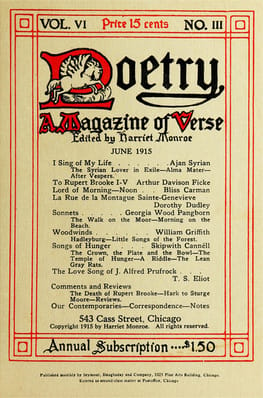
PS I recently happened upon a very useful article on illustrating Tolkien which I want to pass on to you here:  https://en.wikipedia.org/wiki/Illustrating_Middle-earth   I love looking at all of the different ways in which artists, all the way back to the 1960s, imagine Tolkien’s work.

← Older posts

The Doubtful Sea Series Facebook Page

The Doubtful Sea Series Facebook Page

  • Ollamh

Categories

  • Artists and Illustrators
  • Economics in Middle-earth
  • Fairy Tales and Myths
  • Films and Music
  • Games
  • Heroes
  • Imaginary History
  • J.R.R. Tolkien
  • Language
  • Literary History
  • Maps
  • Medieval Russia
  • Military History
  • Military History of Middle-earth
  • Narnia
  • Narrative Methods
  • Poetry
  • Research
  • Star Wars
  • Terra Australis
  • The Rohirrim
  • Theatre and Performance
  • Tolkien
  • Uncategorized
  • Villains
  • Writing as Collaborators
Follow doubtfulsea on WordPress.com

Across the Doubtful Sea

Recent Postings

  • 1002? June 3, 2026
  • Making Money May 27, 2026
  • Blood Money May 20, 2026
  • Saruman’s Sigh May 13, 2026
  • Silents Are Golden May 7, 2026
  • Planting April 29, 2026
  • Subterranean April 22, 2026
  • Serendipity? April 15, 2026
  • Serendipity April 8, 2026

Blog Statistics

  • 114,406 Views

Posting Archive

  • June 2026 (1)
  • May 2026 (4)
  • April 2026 (5)
  • March 2026 (4)
  • February 2026 (4)
  • January 2026 (4)
  • December 2025 (5)
  • November 2025 (4)
  • October 2025 (5)
  • September 2025 (4)
  • August 2025 (4)
  • July 2025 (5)
  • June 2025 (4)
  • May 2025 (4)
  • April 2025 (5)
  • March 2025 (4)
  • February 2025 (4)
  • January 2025 (5)
  • December 2024 (4)
  • November 2024 (4)
  • October 2024 (5)
  • September 2024 (4)
  • August 2024 (4)
  • July 2024 (5)
  • June 2024 (4)
  • May 2024 (5)
  • April 2024 (4)
  • March 2024 (4)
  • February 2024 (4)
  • January 2024 (5)
  • December 2023 (4)
  • November 2023 (5)
  • October 2023 (4)
  • September 2023 (4)
  • August 2023 (5)
  • July 2023 (4)
  • June 2023 (4)
  • May 2023 (5)
  • April 2023 (4)
  • March 2023 (5)
  • February 2023 (4)
  • January 2023 (4)
  • December 2022 (4)
  • November 2022 (5)
  • October 2022 (4)
  • September 2022 (4)
  • August 2022 (5)
  • July 2022 (4)
  • June 2022 (5)
  • May 2022 (4)
  • April 2022 (4)
  • March 2022 (5)
  • February 2022 (4)
  • January 2022 (4)
  • December 2021 (5)
  • November 2021 (4)
  • October 2021 (4)
  • September 2021 (5)
  • August 2021 (4)
  • July 2021 (4)
  • June 2021 (5)
  • May 2021 (4)
  • April 2021 (4)
  • March 2021 (5)
  • February 2021 (4)
  • January 2021 (4)
  • December 2020 (5)
  • November 2020 (4)
  • October 2020 (4)
  • September 2020 (5)
  • August 2020 (4)
  • July 2020 (5)
  • June 2020 (4)
  • May 2020 (4)
  • April 2020 (5)
  • March 2020 (4)
  • February 2020 (4)
  • January 2020 (6)
  • December 2019 (4)
  • November 2019 (4)
  • October 2019 (5)
  • September 2019 (4)
  • August 2019 (4)
  • July 2019 (5)
  • June 2019 (4)
  • May 2019 (5)
  • April 2019 (4)
  • March 2019 (4)
  • February 2019 (4)
  • January 2019 (5)
  • December 2018 (4)
  • November 2018 (4)
  • October 2018 (5)
  • September 2018 (4)
  • August 2018 (5)
  • July 2018 (4)
  • June 2018 (4)
  • May 2018 (5)
  • April 2018 (4)
  • March 2018 (4)
  • February 2018 (4)
  • January 2018 (5)
  • December 2017 (4)
  • November 2017 (4)
  • October 2017 (4)
  • September 2017 (4)
  • August 2017 (5)
  • July 2017 (4)
  • June 2017 (4)
  • May 2017 (5)
  • April 2017 (4)
  • March 2017 (5)
  • February 2017 (4)
  • January 2017 (4)
  • December 2016 (4)
  • November 2016 (5)
  • October 2016 (6)
  • September 2016 (5)
  • August 2016 (5)
  • July 2016 (5)
  • June 2016 (5)
  • May 2016 (4)
  • April 2016 (4)
  • March 2016 (5)
  • February 2016 (4)
  • January 2016 (4)
  • December 2015 (5)
  • November 2015 (5)
  • October 2015 (4)
  • September 2015 (5)
  • August 2015 (4)
  • July 2015 (5)
  • June 2015 (5)
  • May 2015 (4)
  • April 2015 (3)
  • March 2015 (4)
  • February 2015 (4)
  • January 2015 (4)
  • December 2014 (5)
  • November 2014 (4)
  • October 2014 (6)
  • September 2014 (1)

Blog at WordPress.com.

  • Subscribe Subscribed
    • doubtfulsea
    • Join 75 other subscribers
    • Already have a WordPress.com account? Log in now.
    • doubtfulsea
    • Subscribe Subscribed
    • Sign up
    • Log in
    • Report this content
    • View site in Reader
    • Manage subscriptions
    • Collapse this bar

Loading Comments...