• About

doubtfulsea

~ adventure fantasy

Tag Archives: The Ivy Bush

Planting

29 Wednesday Apr 2026

Posted by Ollamh in Uncategorized

≈ Leave a comment

Tags

Bag End, Eavesdropping, Fantasy, Gardening, Guy Fawkes, lotr, plotting, Sam Gamgee, the Gaffer, The Ivy Bush, The Lord of the Rings, Tolkien

Welcome, as always, dear readers.

Recently, I’ve been thinking about plotting—not as in conspiracies, like Guy Fawkes,
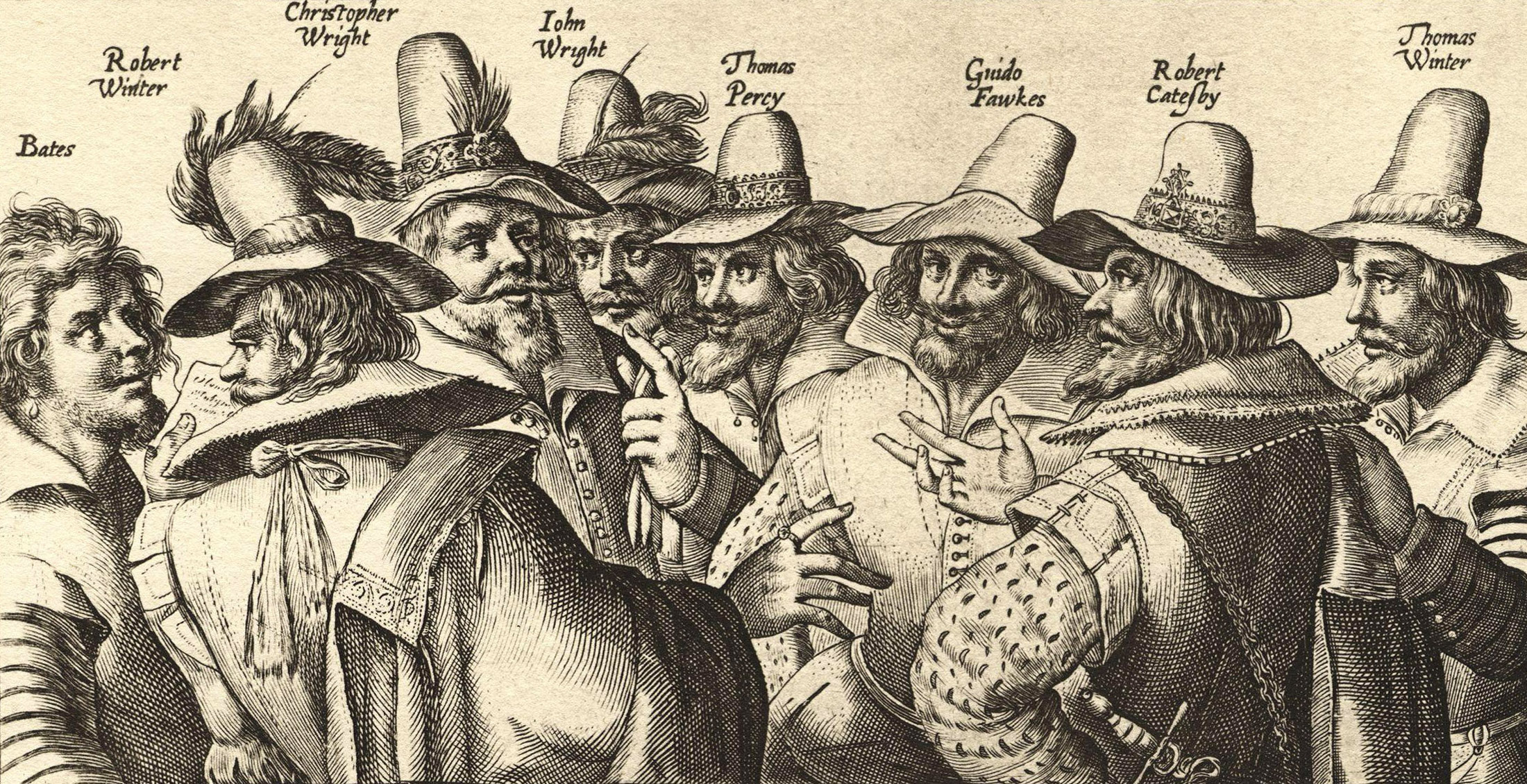
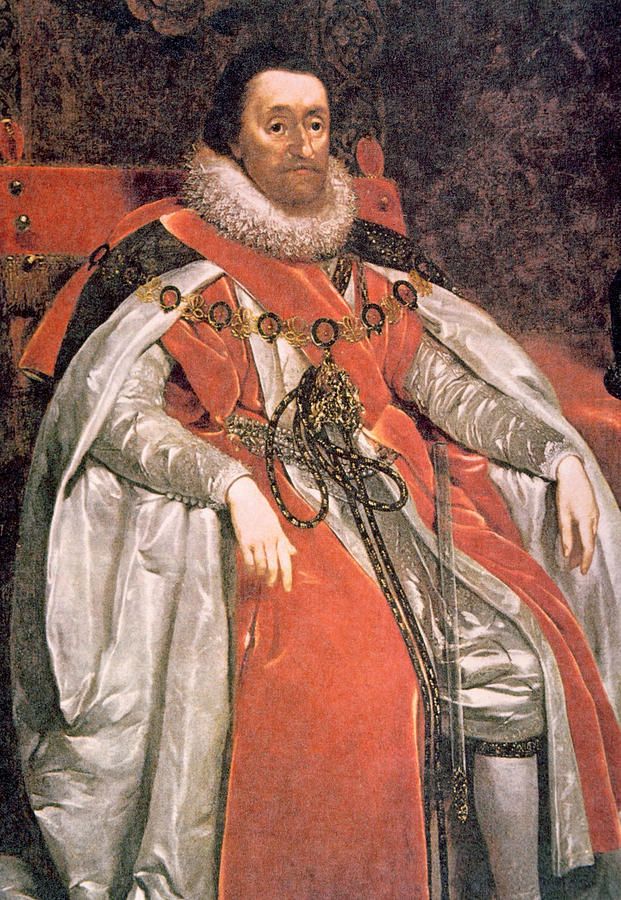
who planned to blow up Parliament and James I with it,
but in the construction of fictional plots.  The worse kind is what I would call examples of “fiat” writing—from the Latin subjunctive “let it be”, as in “fiat lux”—“let there be light”.  In plots like this, things happen because the author wants them to and is too lazy or inept to work the details out in a systematic, believable way.  (As I avoid harsh criticism in this blog, I won’t mention any examples, but I suspect that, if you are a reader of this blog, you know exactly what I mean and can supply your own.)

So let me show you an example of good, if not downright elegant, plotting, instead.

It’s about to be spring here, with things reluctantly beginning to flower and bud and spread, and that makes me think of gardens—which, I hope logically, makes me think of gardeners and that makes me think of the Gamgees, who have been gardeners for the Baggins for at least two generations—

“No one had a more attentive audience than old Ham Gamgee, commonly known as the Gaffer [a dialect form of “grandfather”]. 
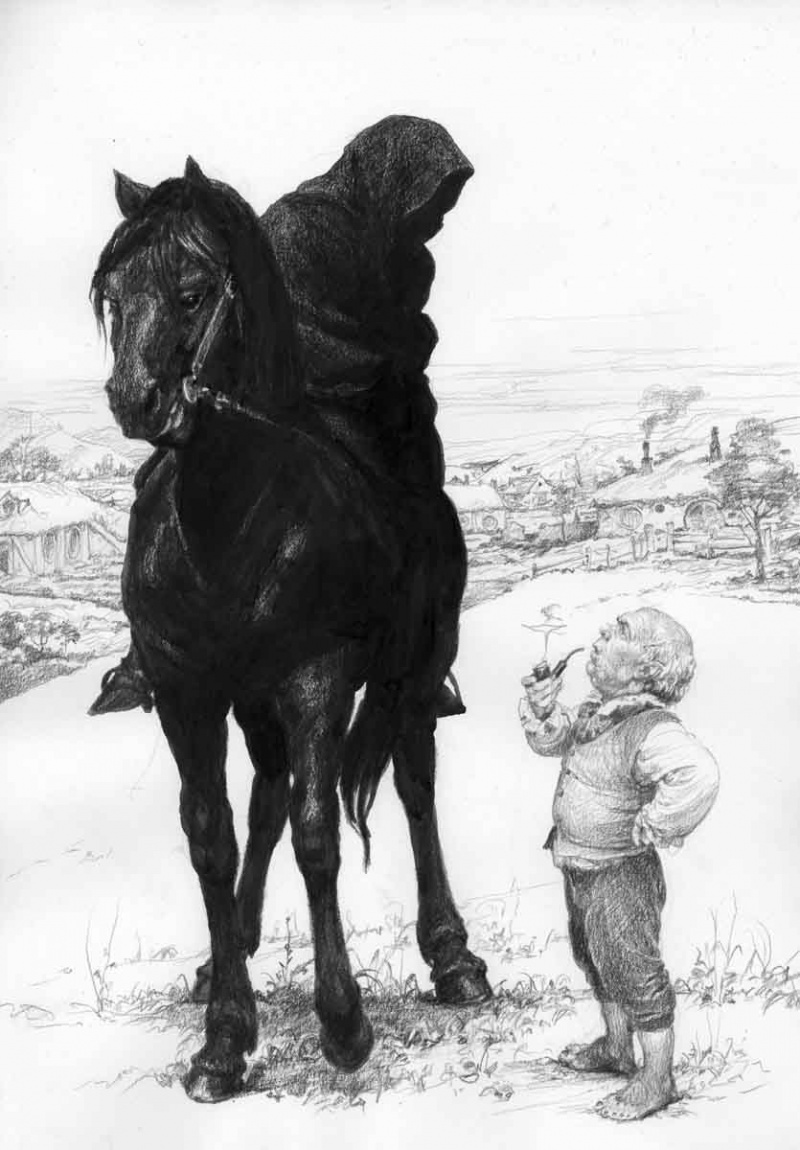
(my favorite image—there don’t appear to be many—of the Gaffer, by Denis Gordeev)

He held forth at The Ivy Bush,
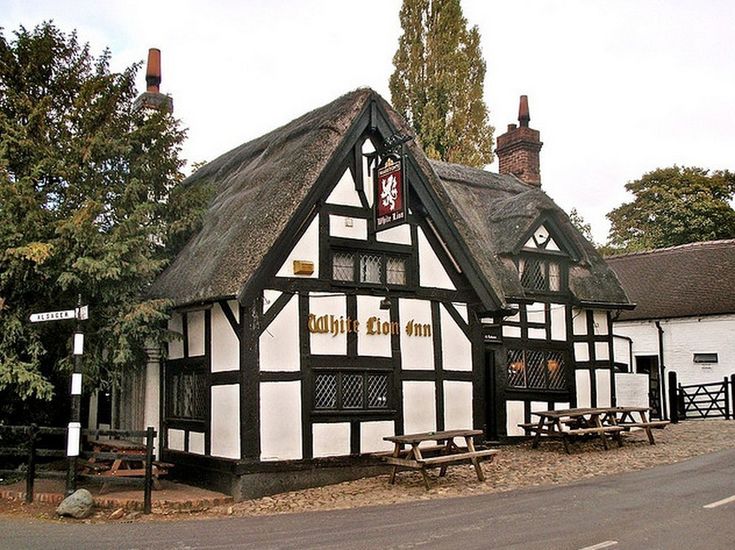
(I imagine it—minus the modern road—as looking something like this, which is the White Lion Inn in Bartholmley, Cheshire—about which you can read a little here:  https://en.wikipedia.org/wiki/White_Lion,_Barthomley )

a small inn on the Bywater road; and he spoke with some authority, for he had tended the garden at Bag End for forty years, and had helped old Holman in the same job before that.  Now that he was himself growing old and stiff in the joints, the job was mainly carried on by his youngest son, Sam Gamgee.”  (The Fellowship of the Ring, Book One, Chapter 1, “An Unexpected-party”)

And here the plotting begins, which will end with Sam incorporated into Frodo’s adventure with the Ring—not by “fiat”, but by a careful planting (sorry!) of details.

So, we know that the Gamgees are long-established at Bag End, not only the Gaffer, but his son, Sam.

Now we’re given another detail—and a very important one:

“ ‘But my lad Sam will know more about that.  He’s in and out of Bag End.  Crazy about stories of the old days, he is, and he listens to all of Mr. Bilbo’s tales…

‘Elves and Dragons!’ I says to him.  ‘Cabbages and potatoes are better for me and you.  Don’t go getting mixed up in the business of your betters, and you’ll land in trouble too big for you.’ “

So now we know that Sam already has a taste for adventure, cultivated (sorry), if inadvertently, by Bilbo.

This is further developed in the next chapter—

“[Sam] believed that he had once seen an Elf in the woods, and still hoped to see more one day.  Of all the legends that he had heard in his early years such fragments of tales and half-remembered stories about the Elves as the hobbits knew, had always moved him most deeply.” (The Fellowship of the Ring, Book One, Chapter 2, “The Shadow of the Past”)

And now the scene is set:

“Sam sat silent and said no more.  He had a good deal to think about.  For one thing, there was a lot to do up in the Bag End garden, and he would have a busy day tomorrow, if the weather cleared.  The grass was growing fast.  But Sam had more on his mind than gardening.  After a while he sighed, and got up and went out.

…He walked home under the early stars through Hobbiton and up the Hill, whistling softly and thoughtfully.”

And here we even get the suggestion of a sound effect to come.

But there’s even more scene-setting:

“…It was over nine years since Frodo had seen or heard of [Gandalf]…But that evening, as Sam was walking home and twilight was fading, there came a once familiar tap on the study window.

…Next morning after a late breakfast, the wizard was sitting with Frodo by the open window of the study.

…There was another long silence.  The sound of Sam Gamgee cutting the lawn came in from the garden.”

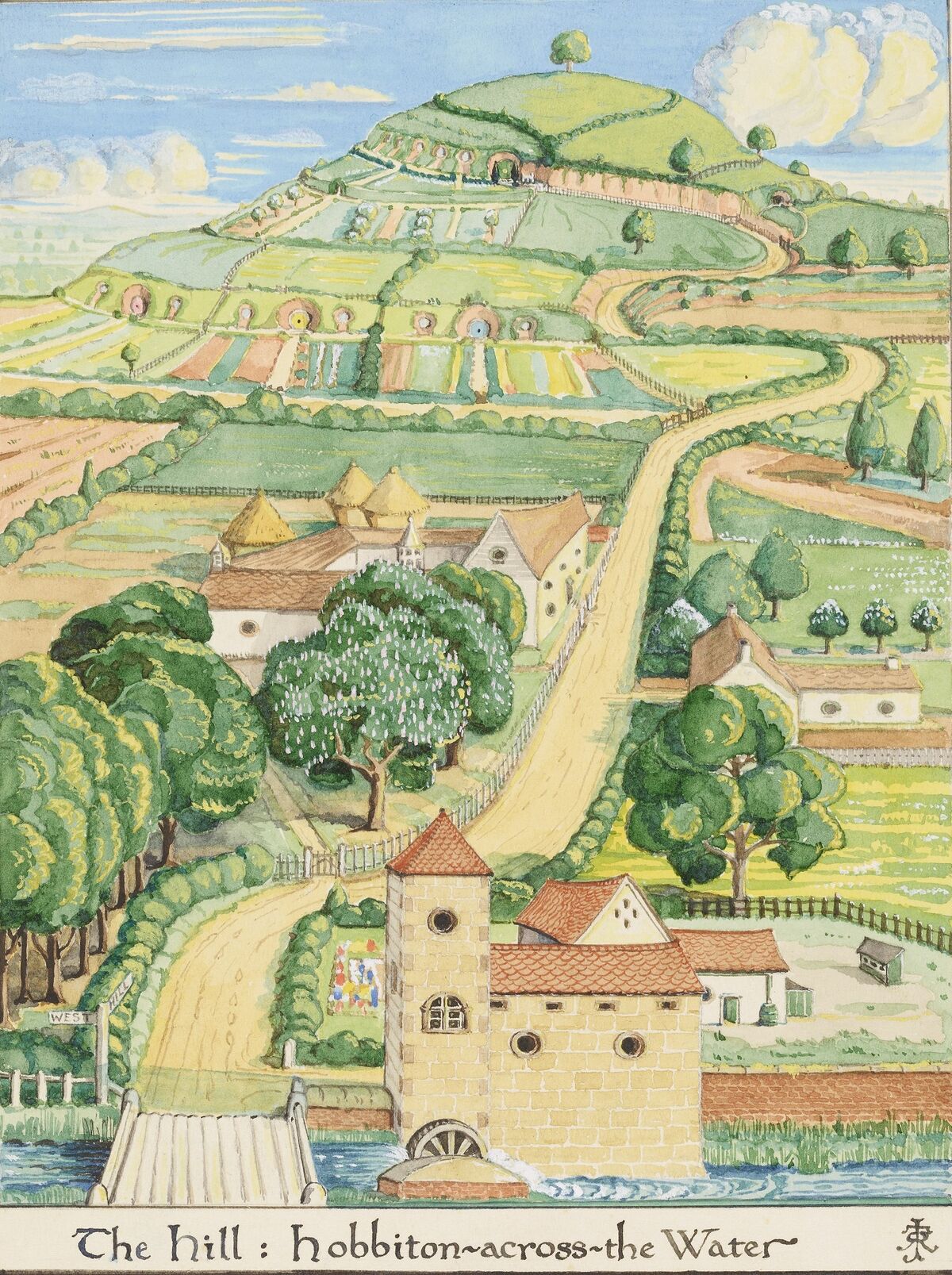
There is a puzzle here.  Where were the lawn and garden of Bag End?  Here are two images by Tolkien—the first from a distance,
the second close up,
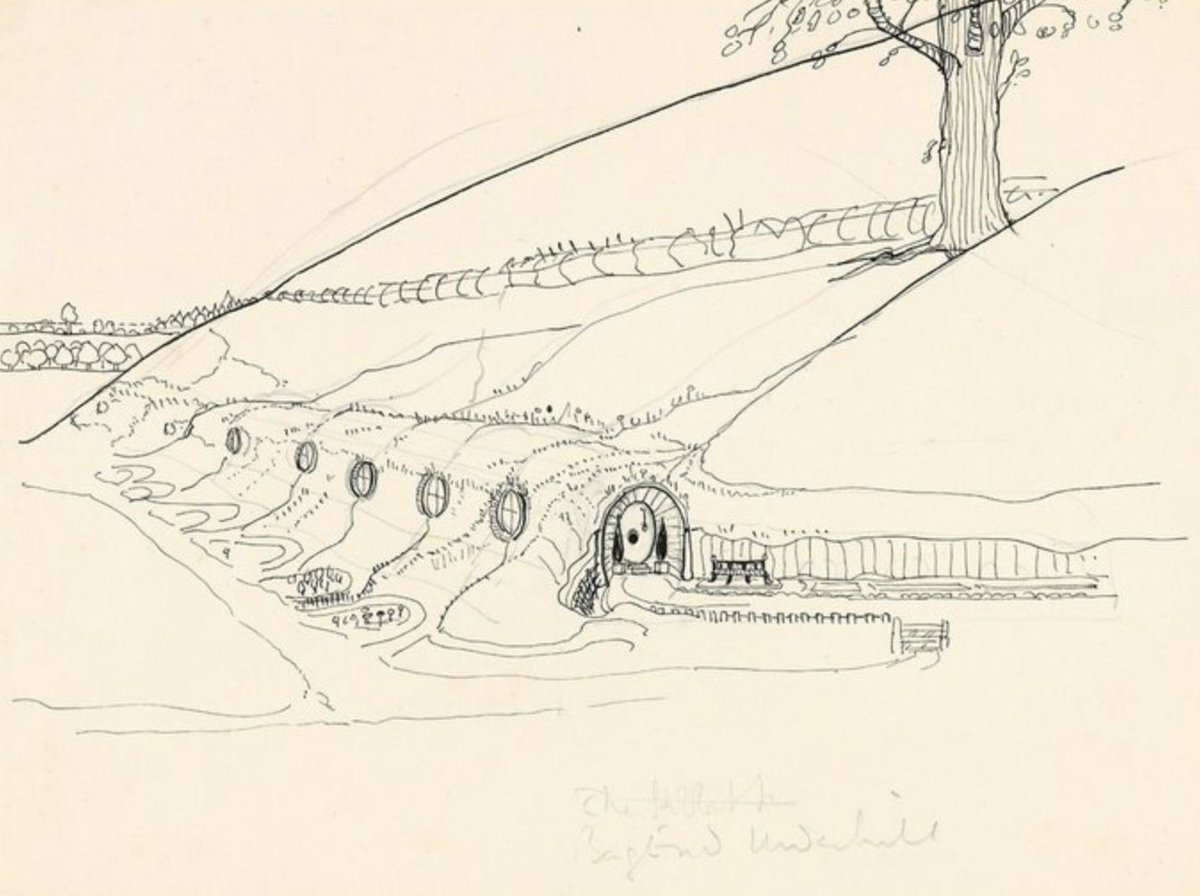
but I can’t make out where those items are supposed to be.  In the first, the road appears to run just below the house, with perhaps lawn and garden on the far side and down the hill?  In the second image, there appears to be a bench (where Bilbo would have sat, smoking and reading his mail when Gandalf turned up in the first chapter of The Hobbit) and, to the right, some garden? 

Let’s put this aside, however, to continue the action.

Gandalf has begun to talk about the Ring, and even closes the shutters and the curtains when he does so, but now the narrative inside and the action outside are about to be linked—as Gandalf begins to describe the search for Gollum—

“A heavy silence fell in the room.  Frodo could hear his heart beating.  Even outside everything seemed still.  No sound of Sam’s shears could be heard.”

Sam is still at work, however, as—

“[Gandalf] went to the window and drew aside the curtains and the shutters.  Sunlight streamed back into the room.  Sam passed along the path outside whistling.”

But is Sam really occupied with grass-cutting?

“Suddenly [Gandalf] stopped as if listening.  Frodo became aware that all was very quiet, inside and outside.  Gandalf crept to one side of the window.  Then with a dart he sprang to the sill, and thrust a long arm out and downwards.  There was a squawk, and up came Sam Gamgee’s curly head hauled by one ear.”
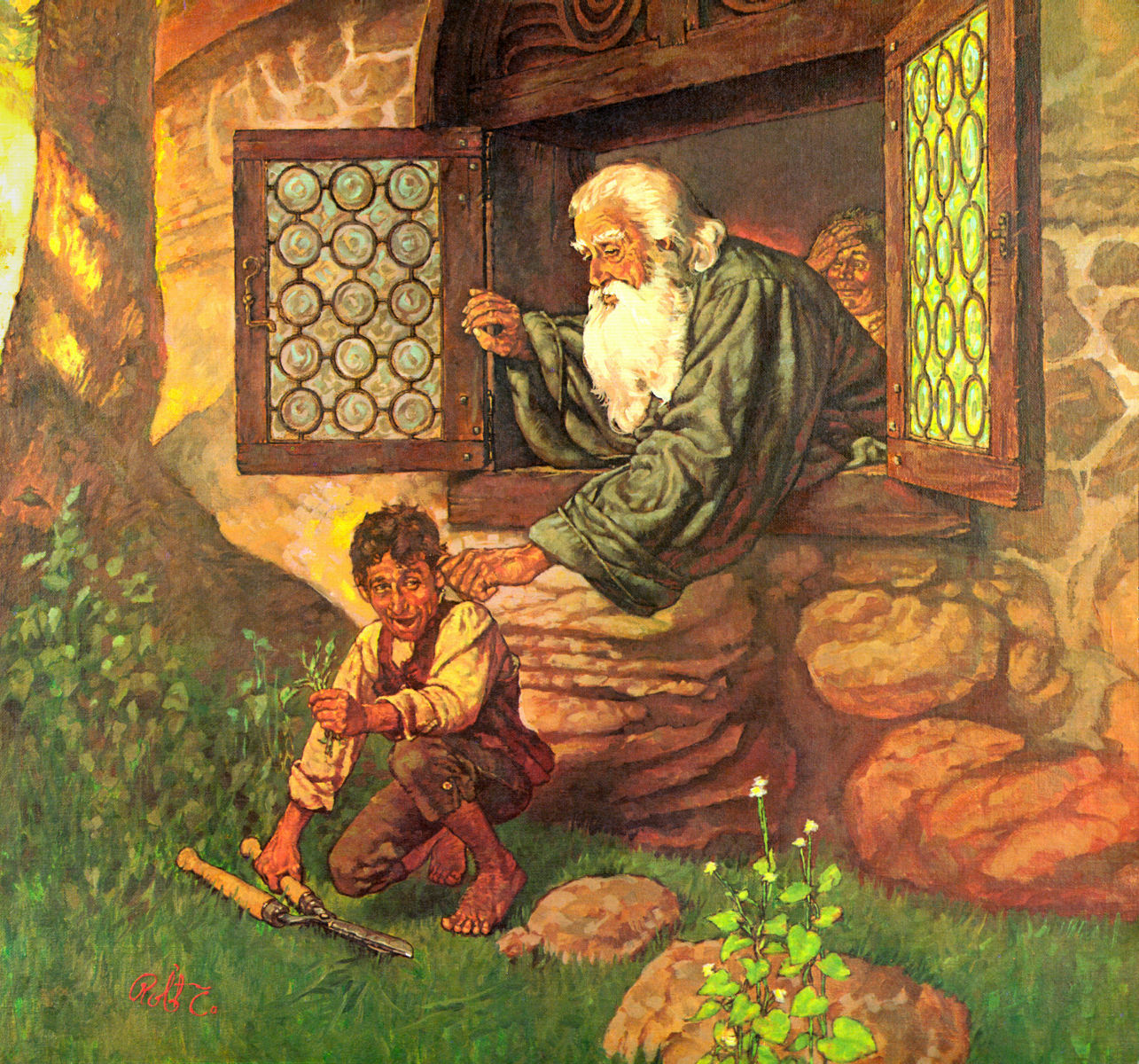
(Robert Chronister—I can find a few paintings by him, but no website or further biographic material than that he was born in 1933.)

Sam tries to defend himself—

“ ‘…I was just trimming the grass-border under the window, if you follow me.’ He picked up his shears and exhibited them as evidence.”

When pressed, however, he confesses that he had been listening:

“…I heard a deal that I didn’t rightly understand, about and enemy, and rings, and Mr. Bilbo, sir, and dragons, and a fiery mountain, and—and Elves, sir.  I listened because I couldn’t help myself, if you know what I mean.  Lor bless me, sir, but I do love tales of that sort…Elves, sir!  I would dearly love to see them.  Couldn’t you take me to see Elves, sir, when you go?”

And here we see how all of this has been patiently laid out:  the Gamgees and the Bagginses, the gardening, Sam and his interest—through Bilbo—in Elves and stories of adventure, Gandalf’s appearance and his narrative, which Sam overhears while gardening—and listening–only to be apprehended in his eavesdropping, with only one detail still needed and now mentioned:

“ ‘Get up, Sam!’ said Gandalf.  ‘I have thought of something better than that.  Something to shut your mouth, and punish you properly for listening.  You shall go away with Mr. Frodo!’ “

After all of the careful plotting, Sam’s reaction is no wonder, then—

“ ‘Me go and see Elves and all!  Hooray!’ he shouted and then burst into tears.” 

Elegant, and yet practical and completely convincing.

Thanks, as always, for reading.

Stay well,

How is your garden doing?
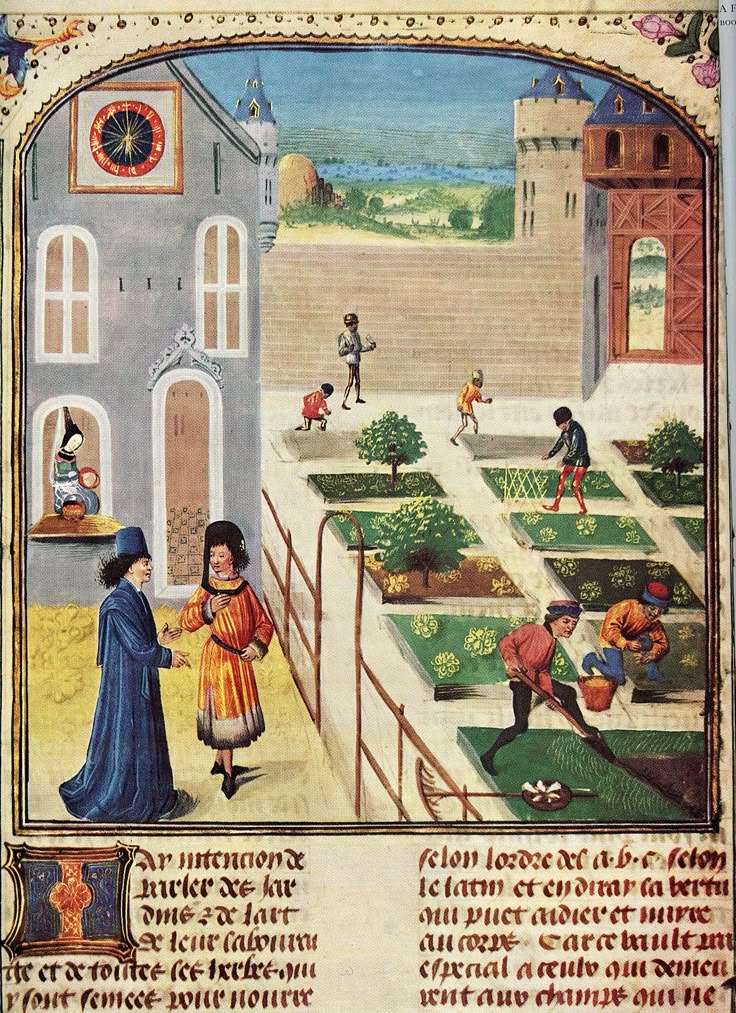
And remember that, as ever, there’s

MTCIDC,

O

PS

While working on this posting, I came across this very interesting and thoughtful piece:  https://thoughtsontolkien.wordpress.com/2024/04/14/gardens-in-the-lord-of-the-rings/

Pub Crawl

17 Wednesday Jul 2019

Posted by Ollamh in Economics in Middle-earth, J.R.R. Tolkien, Literary History

≈ Leave a comment

Tags

CS Lewis, Dorothy Sayers, Eagles, Green Dragon Inn, Hutchinson Family Singers, inn, pub, Smaug, The Eagle and Child, The Green Dragon, The Hobbit, The Inklings, The Ivy Bush, The King's Arms, The Lord of the Rings, The Mitre, The Prancing Pony, The Vulture of the Alps, The White Horse, Tolkien

As ever, dear readers, welcome.

After a very disturbing evening with a group of vengeful and determined dwarves,

image1banddwarves.jpg

Bilbo wakes to a wreck of breakfast dishes and, soon after, the appearance of Gandalf, who prompts him to see that he has a note from Thorin (& Co.).  It makes an appointment for 11am that morning at the Green Dragon Inn, in Bywater.

image2bywatermap.jpg

With Gandalf harrying him, Bilbo barely makes it, but, a moment later, the journey eastward of The Hobbit begins.

It is ironic, of course, that a trip which focuses upon removing a dragon

image3smaug.jpeg

should commence with a place named after one, but, judging by the number of Green Dragon pubs in Britain one might find by googling right now, it may be nothing more than a common name—

image4pubsign.jpg

image5greendragsign.jpg

image6greendrag.jpg

image7greendrag.jpg

although, as Douglas Anderson points out in The Annotated Hobbit, 61, we know that JRRT had been interested in dragons, especially green ones, from childhood, as he wrote to WH Auden:

“I first tried to write a story when I was about seven.  It was about a dragon.  I remember nothing about it except a philological fact.  My mother said nothing about the dragon, but pointed out out one could not say ‘a green great dragon,’ but had to say, ‘a great green dragon.’  I wondered why, and still do.” (Letters, 214, 7 June, 1955)

The countryside east of the Shire and the story itself are empty of pubs (short for “public houses”, originally meaning simply a place open to the general public, but, in time, it came to mean a place licensed by the government to sell alcoholic beverages) after this, but, until we reach Bree, there are a certain number mentioned in The Lord of the Rings.  We meet the first, The Ivy Bush, in The Fellowship of the Ring, Book One, Chapter 1, “An Unexpected Party”, where we see a group of hobbits gossiping about Bilbo and Frodo.  In the next chapter,  “The Shadow of the Past”, The Green Dragon makes its second appearance in Tolkien when Sam Gamgee has a verbal tussle with Ted Sandyman on the subject of things seen and unseen, as well as on the sanity, or lack of it, of Bilbo and Frodo, there.

The Ivy Bush will only appear once more, linked with The Green Dragon, in the succeeding chapter, “Three Is Company”, but we will see The Green Dragon (mentioned by Sam in hopes that The Prancing Pony in Bree will measure up to it in Chapter 8, “Fog on the Barrow-Downs”) close to the end of The Lord of the Rings.  In The Return of the King, Book Six, Chapter 8, “The Scouring of the Shire”, it appears as an emblem of the endless ruin by Sharkey and gang of the old ways of the Shire:  “When they reached The Green Dragon, the last house on the Hobbiton side [of the Water], now lifeless and with broken windows…”

This is in great contrast to The Prancing Pony Sam worried about earlier

image8prancingpony.jpg

as we see it in The Fellowship of the Ring, Book One, Chapter 9, “At the Sign of the Prancing Pony”.  At first, the place seems menacing, especially to Sam, who:

“…stared up at the inn with its three storeys and many windows, and felt his heart sink.”

But then—

“As they [the hobbits] hesitated outside in the gloom, someone began singing a merry song inside, and many cheerful voices joined loudly in the chorus.  They listened to this encouraging sound for a moment and then got off their ponies.  The song ended and there was a burst of laughter and clapping.”

Pubs, and their upscale cousins, inns, would have been vital to people traveling before motels, hotels, and b&bs, as we can see in Book One of The Fellowship, and, for most of the rest of the novel, with the exceptions of Rivendell, Lorien, Edoras, and Minas Tirith, accommodation for the night would have meant a blanket on the ground.  For Tolkien and his friends in the writers’ group called The Inklings,

image9inklings.jpg

they were vital meeting points—not for the reading of new work, which appears to have been done in one member, C.S. Lewis’, rooms at Oxford,

image10csl.jpg

but for socializing and discussion, which was equally important for such a group of intelligent, educated, and highly-creative men.  (No women, alas!  One of our favorite mystery novelists and Dante-translator, Dorothy Sayers, 1893-1957, was friends with several members but, with the short-sightedness of the 1930s-50s, was never invited to join.)

image11dls.jpg

They met during the week not only at the best-known of their watering holes, the Eagle and Child,

image12bird.jpg

but at The Mitre,

image13mitre.jpg

The King’s Arms,

image14kingsarms.JPG

and at The White Horse.

image15whitehorse

The one which caught our eye in particular is the first, which, as we said, is probably the one most closely associated with Tolkien and his friends.  Here’s its sign—

image16bird.jpg

The explanation of the pub’s name is, to us, a bit murky, supposedly coming from an element of the crest of the Stanley family which portrays an infant stolen by an eagle,

image17crest.jpg

but found alive and unharmed.  (Here’s a LINK so that you can judge for yourself.)

For ourselves, the idea of a child stolen by a raptor makes us think of a really awful 19th-century song, “The Vulture of the Alps”, a poem set to music about 1842 by a famous American vocal group of the 1840s-1870s, the Hutchinson Family Singers.  The title pretty much says it all.

image18hutch.jpg

If you’d like to know more, here’s a LINK.

When we think of eagles and Tolkien, however, we remember them as rescuers—of Gandalf, the dwarves, and Bilbo from the goblins and Wargs

image19rescue.jpg

and as providers of air assault in The Hobbit.

image20battle.jpg

And, in The Lord of the Rings, rescuer of Gandalf from Saruman,

image21rescue


as allies of the West at the battle at the Morannon,

image22black.jpg

and as saviors of Frodo and Sam on Mt Doom.

image23savior.jpg

And it may be a crazy idea, but it makes us wonder—although Tolkien had abandoned The Hobbit unfinished in the early 1930s, he had picked it up again in 1936, just about the time the Inklings were meeting regularly (the first documented mention of them, apparently, is in a 1936 letter from CS Lewis to the novelist, Charles Williams, inviting him to join—see The Collected Letters of CS Lewis, Vol.2, 183—in a letter to William Luther White 9/11/67, JRRT dates the origins of the Inklings as “probably mid-thirties”—Letters, 387).  Could he have found his inspiration for these heroic birds and their habit of picking people up from the name of his pub?

As ever, thanks for reading.

MTCIDC

CD

ps

If you haven’t read CS Lewis’ wonderful essay, “On Three Ways of Writing for Children”, here’s a LINK.

pps

We have no illustration of Tolkien’s Green Dragon, but here’s a Tudor example from Wymondham in Norfolk which we think would do quite well.

image24green.jpg

The Doubtful Sea Series Facebook Page

The Doubtful Sea Series Facebook Page

  • Ollamh

Categories

  • Artists and Illustrators
  • Economics in Middle-earth
  • Fairy Tales and Myths
  • Films and Music
  • Games
  • Heroes
  • Imaginary History
  • J.R.R. Tolkien
  • Language
  • Literary History
  • Maps
  • Medieval Russia
  • Military History
  • Military History of Middle-earth
  • Narnia
  • Narrative Methods
  • Poetry
  • Research
  • Star Wars
  • Terra Australis
  • The Rohirrim
  • Theatre and Performance
  • Tolkien
  • Uncategorized
  • Villains
  • Writing as Collaborators
Follow doubtfulsea on WordPress.com

Across the Doubtful Sea

Recent Postings

  • Saruman’s Sigh May 13, 2026
  • Silents Are Golden May 7, 2026
  • Planting April 29, 2026
  • Subterranean April 22, 2026
  • Serendipity? April 15, 2026
  • Serendipity April 8, 2026
  • Verisimilitude April 1, 2026
  • Goblins and Goblin March 25, 2026
  • Crowing and Raven March 18, 2026

Blog Statistics

  • 113,274 Views

Posting Archive

  • May 2026 (2)
  • April 2026 (5)
  • March 2026 (4)
  • February 2026 (4)
  • January 2026 (4)
  • December 2025 (5)
  • November 2025 (4)
  • October 2025 (5)
  • September 2025 (4)
  • August 2025 (4)
  • July 2025 (5)
  • June 2025 (4)
  • May 2025 (4)
  • April 2025 (5)
  • March 2025 (4)
  • February 2025 (4)
  • January 2025 (5)
  • December 2024 (4)
  • November 2024 (4)
  • October 2024 (5)
  • September 2024 (4)
  • August 2024 (4)
  • July 2024 (5)
  • June 2024 (4)
  • May 2024 (5)
  • April 2024 (4)
  • March 2024 (4)
  • February 2024 (4)
  • January 2024 (5)
  • December 2023 (4)
  • November 2023 (5)
  • October 2023 (4)
  • September 2023 (4)
  • August 2023 (5)
  • July 2023 (4)
  • June 2023 (4)
  • May 2023 (5)
  • April 2023 (4)
  • March 2023 (5)
  • February 2023 (4)
  • January 2023 (4)
  • December 2022 (4)
  • November 2022 (5)
  • October 2022 (4)
  • September 2022 (4)
  • August 2022 (5)
  • July 2022 (4)
  • June 2022 (5)
  • May 2022 (4)
  • April 2022 (4)
  • March 2022 (5)
  • February 2022 (4)
  • January 2022 (4)
  • December 2021 (5)
  • November 2021 (4)
  • October 2021 (4)
  • September 2021 (5)
  • August 2021 (4)
  • July 2021 (4)
  • June 2021 (5)
  • May 2021 (4)
  • April 2021 (4)
  • March 2021 (5)
  • February 2021 (4)
  • January 2021 (4)
  • December 2020 (5)
  • November 2020 (4)
  • October 2020 (4)
  • September 2020 (5)
  • August 2020 (4)
  • July 2020 (5)
  • June 2020 (4)
  • May 2020 (4)
  • April 2020 (5)
  • March 2020 (4)
  • February 2020 (4)
  • January 2020 (6)
  • December 2019 (4)
  • November 2019 (4)
  • October 2019 (5)
  • September 2019 (4)
  • August 2019 (4)
  • July 2019 (5)
  • June 2019 (4)
  • May 2019 (5)
  • April 2019 (4)
  • March 2019 (4)
  • February 2019 (4)
  • January 2019 (5)
  • December 2018 (4)
  • November 2018 (4)
  • October 2018 (5)
  • September 2018 (4)
  • August 2018 (5)
  • July 2018 (4)
  • June 2018 (4)
  • May 2018 (5)
  • April 2018 (4)
  • March 2018 (4)
  • February 2018 (4)
  • January 2018 (5)
  • December 2017 (4)
  • November 2017 (4)
  • October 2017 (4)
  • September 2017 (4)
  • August 2017 (5)
  • July 2017 (4)
  • June 2017 (4)
  • May 2017 (5)
  • April 2017 (4)
  • March 2017 (5)
  • February 2017 (4)
  • January 2017 (4)
  • December 2016 (4)
  • November 2016 (5)
  • October 2016 (6)
  • September 2016 (5)
  • August 2016 (5)
  • July 2016 (5)
  • June 2016 (5)
  • May 2016 (4)
  • April 2016 (4)
  • March 2016 (5)
  • February 2016 (4)
  • January 2016 (4)
  • December 2015 (5)
  • November 2015 (5)
  • October 2015 (4)
  • September 2015 (5)
  • August 2015 (4)
  • July 2015 (5)
  • June 2015 (5)
  • May 2015 (4)
  • April 2015 (3)
  • March 2015 (4)
  • February 2015 (4)
  • January 2015 (4)
  • December 2014 (5)
  • November 2014 (4)
  • October 2014 (6)
  • September 2014 (1)

Blog at WordPress.com.

  • Subscribe Subscribed
    • doubtfulsea
    • Join 75 other subscribers
    • Already have a WordPress.com account? Log in now.
    • doubtfulsea
    • Subscribe Subscribed
    • Sign up
    • Log in
    • Report this content
    • View site in Reader
    • Manage subscriptions
    • Collapse this bar

Loading Comments...