• About

doubtfulsea

~ adventure fantasy

Tag Archives: Minas Morgul

Towering.3

08 Wednesday Jul 2026

Posted by Ollamh in Uncategorized

≈ Leave a comment

Tags

Aucassin et Nicolette, Barad-Dur, chantefable, Childe Roland, dark-tower, English Fairy Tales, Fantasy, Illustrations of Northern Antiquities, King Lear, lotr, Men and Women, Minas Morgul, Robert Browning, Shakespeare, the Dark Tower, The Lord of the Rings, the Morannon, Tolkien, towers

As ever, welcome, dear readers.

In our last, we began a tour and catalogue of towers as we see them in The Lord of the Rings.

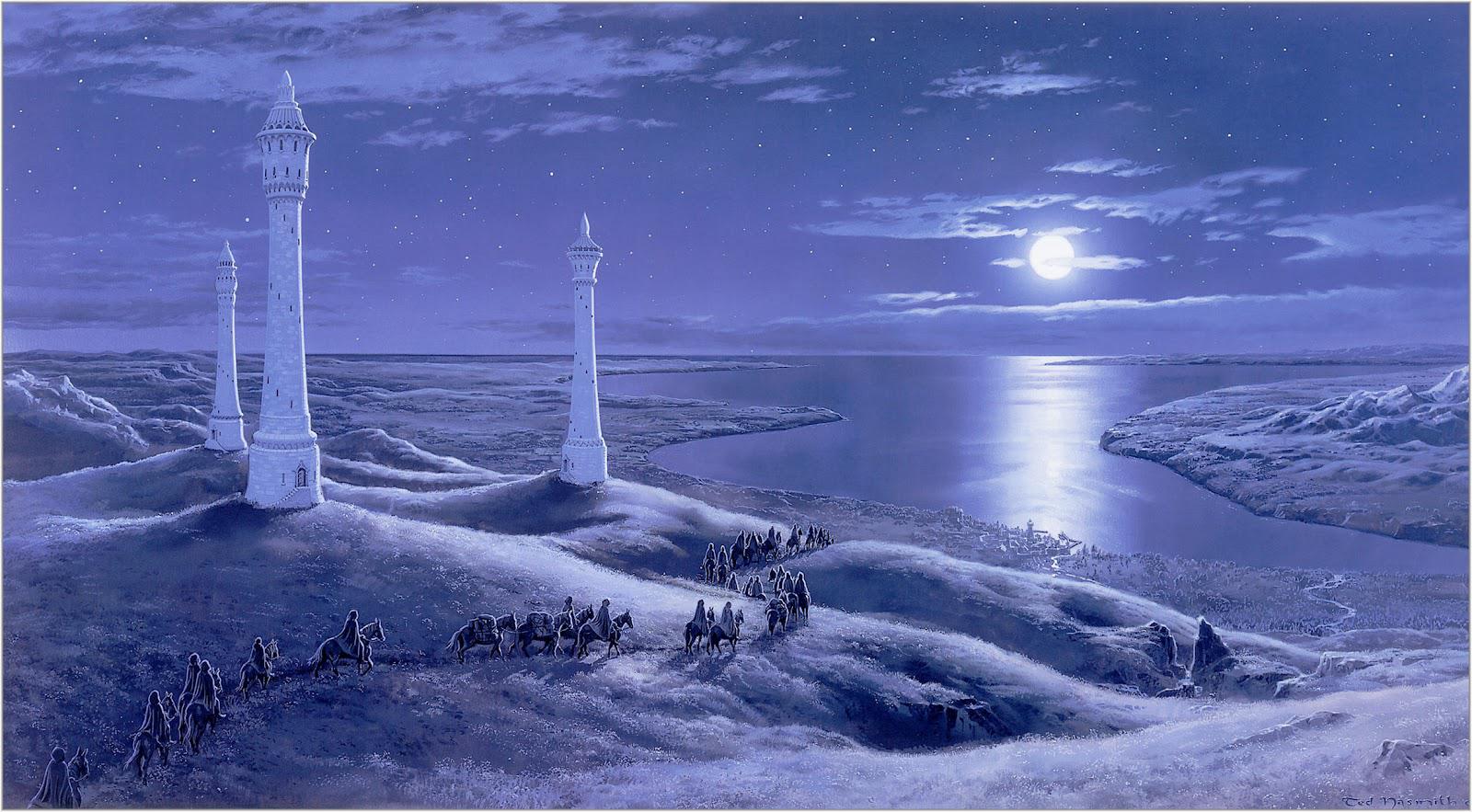
We set off from the Elvish towers in the far west of Middle-earth.

(Ted Nasmith)

From there, we traveled east and south to Amon Sul, aka Weathertop.
(Alan Lee)

Unlike the Fellowship, we then went all the way down along the western side of the Misty Mountains
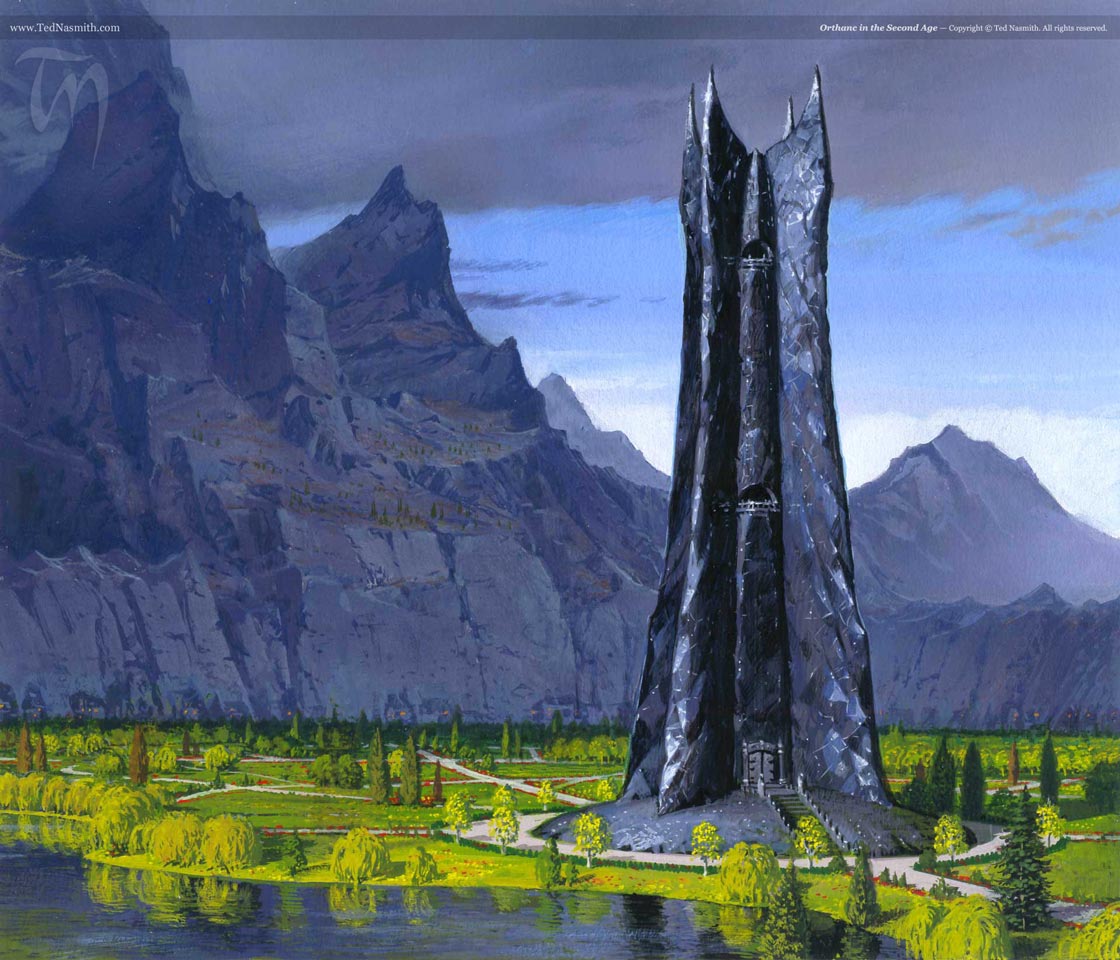
until we reached Isengard and the tower of Orthanc.

(Ted Nasmith)

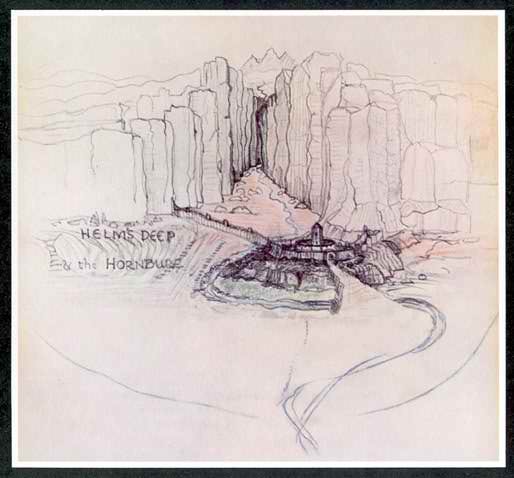
Leaving Isengard, we journeyed farther south yet to Helm’s Deep and its tower
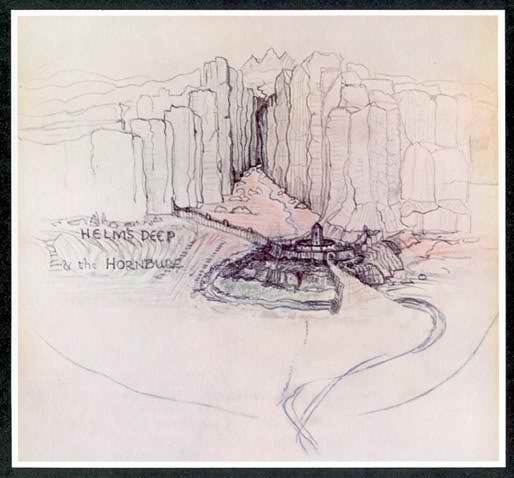
(JRRT)

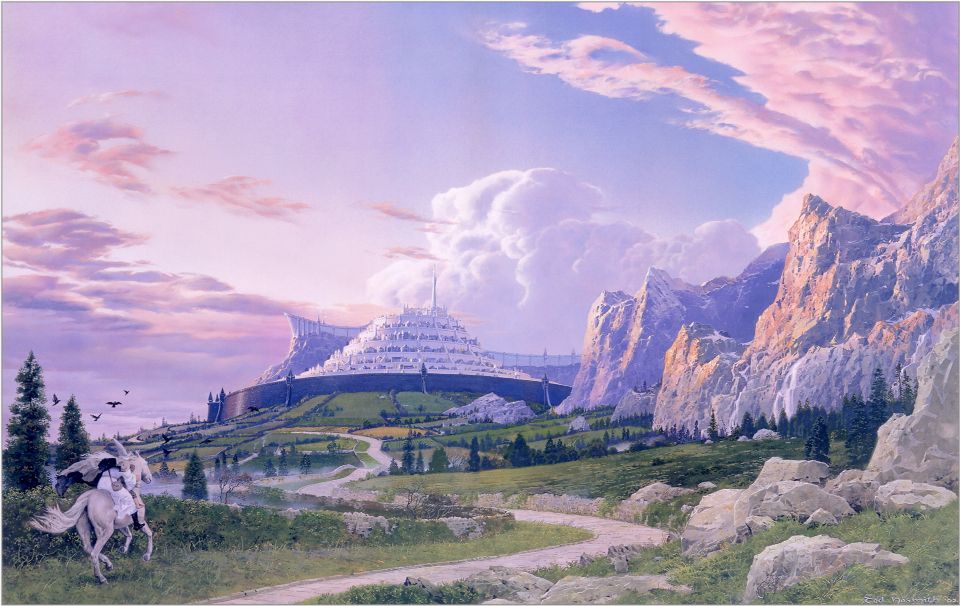
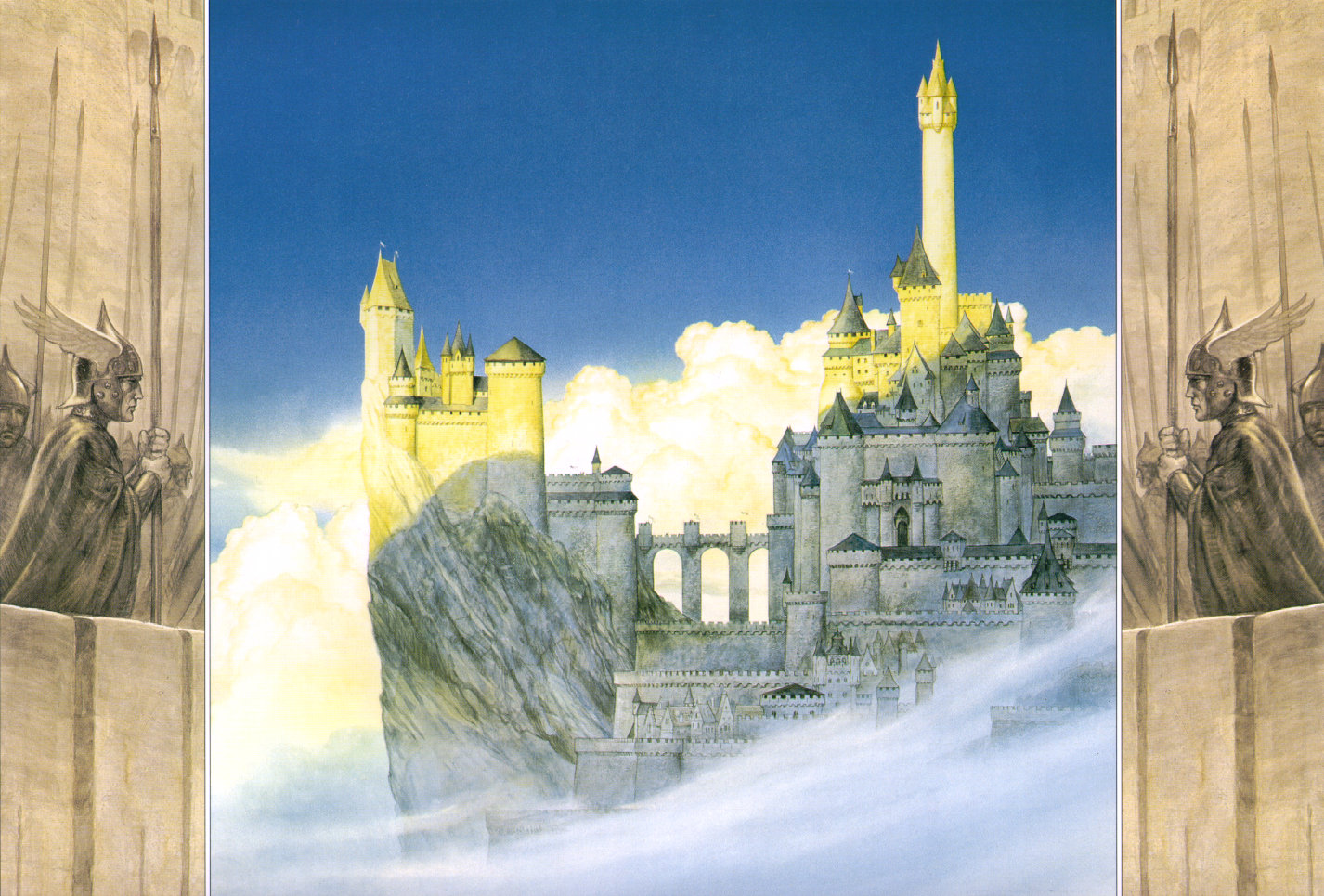
and then farther yet to Minas Tirith and the tower of Echthelion
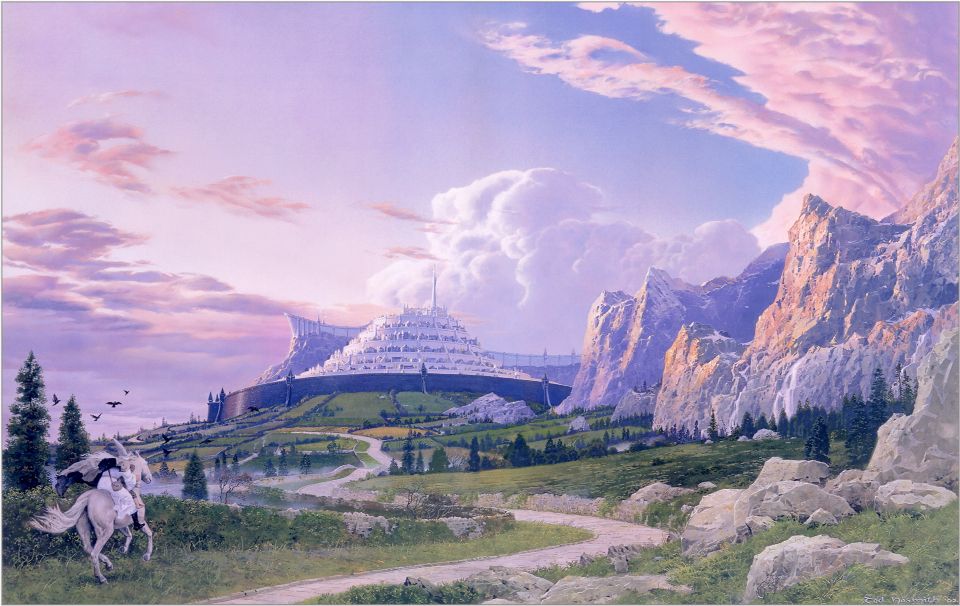
(Ted Nasmith)

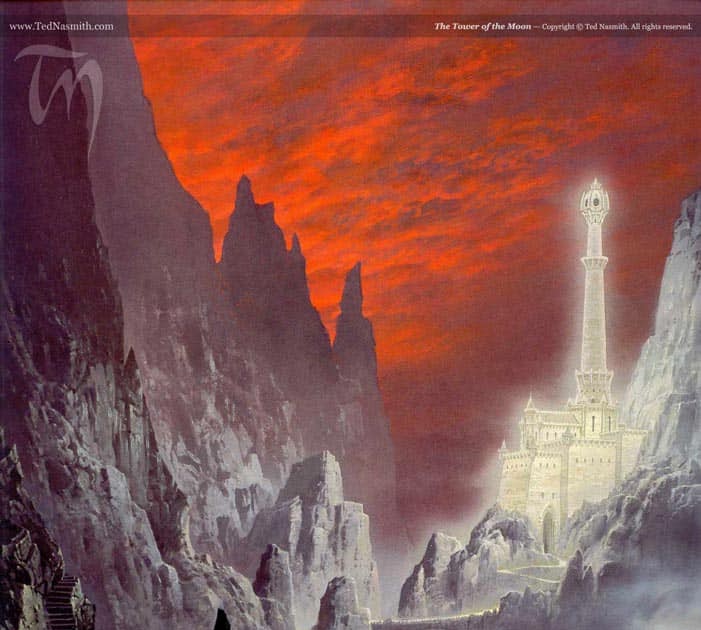
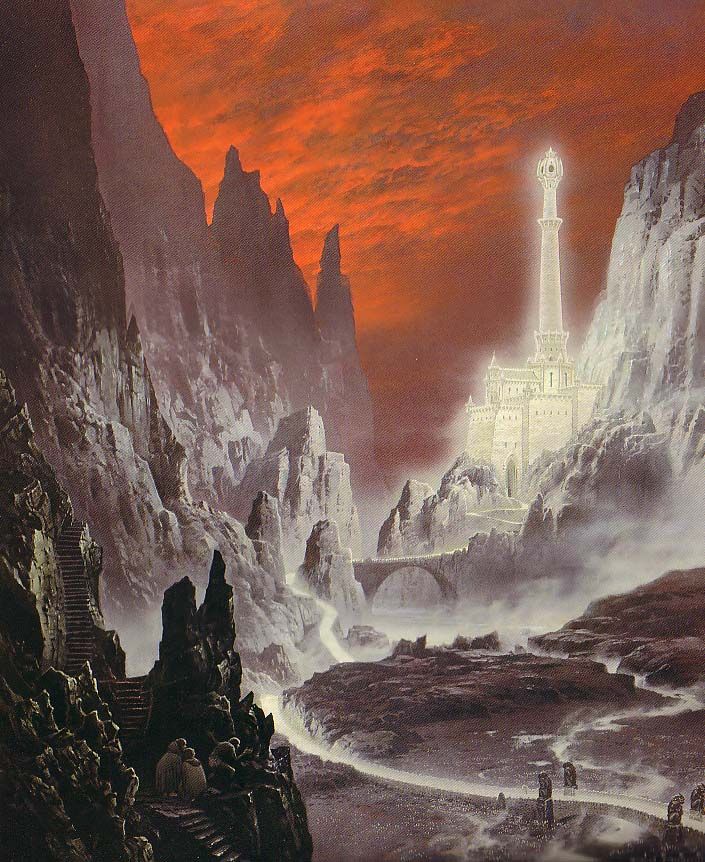
before turning eastwards, crossing the Anduin, to finish part 1 at Minas Morgul—formerly Minas Ithil.

(Ted Nasmith)

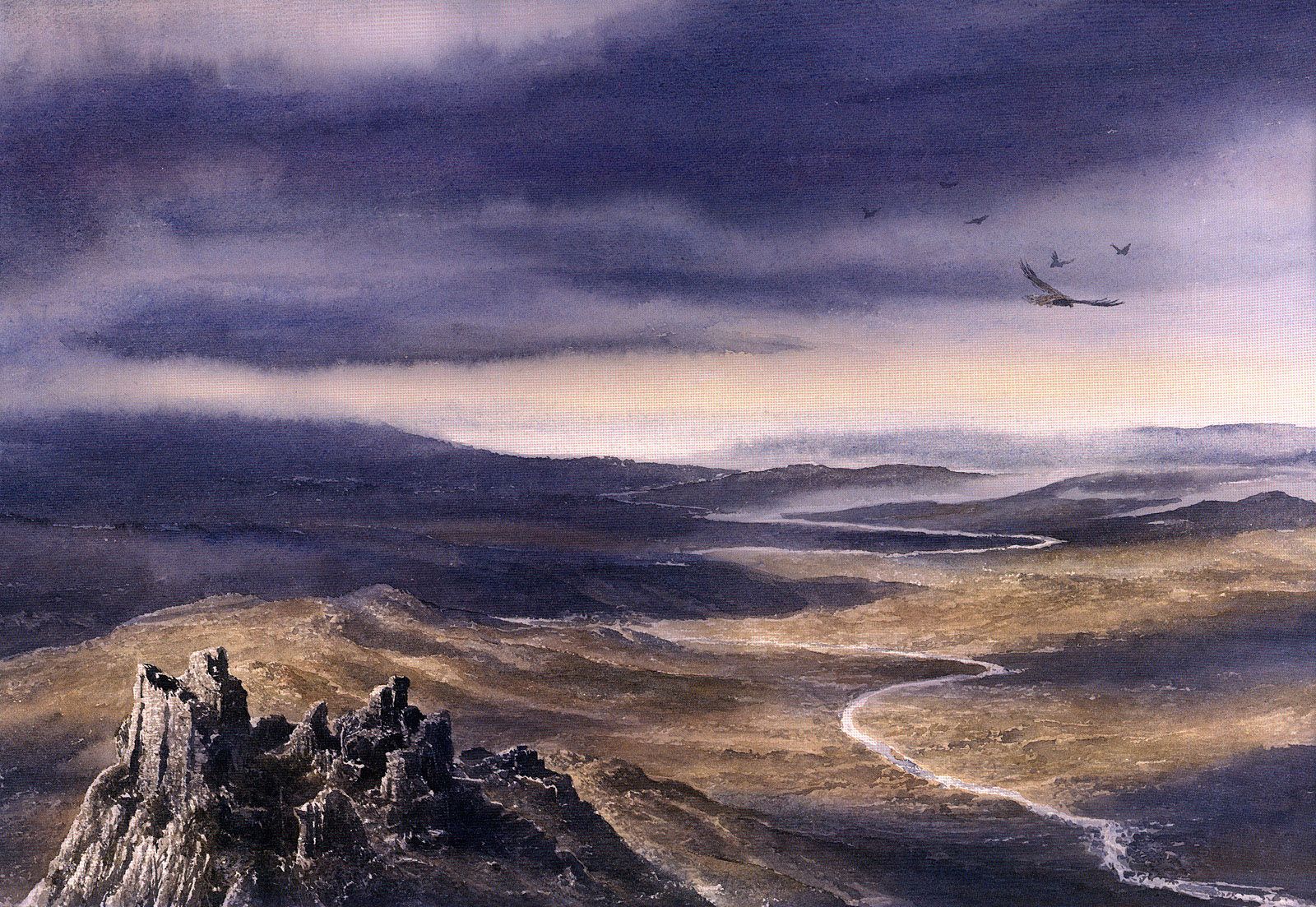
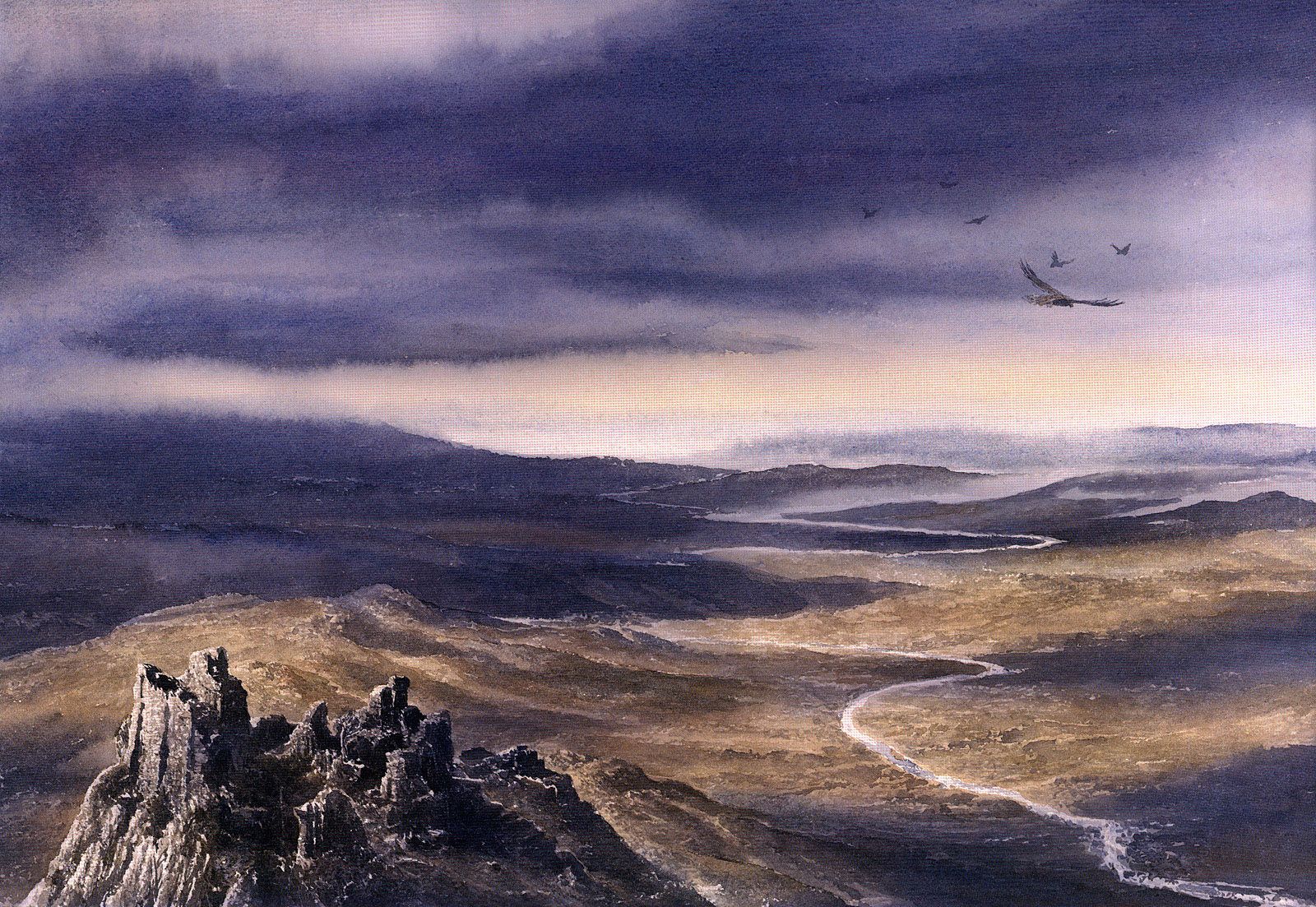
This marks the beginning of Frodo and Sam’s final leg, into Mordor, where we paused for the moment—but now we pick up the journey again and step into Mordor itself—but, as we’ll finish with Sauron’s hangout, let’s first grab an eagle
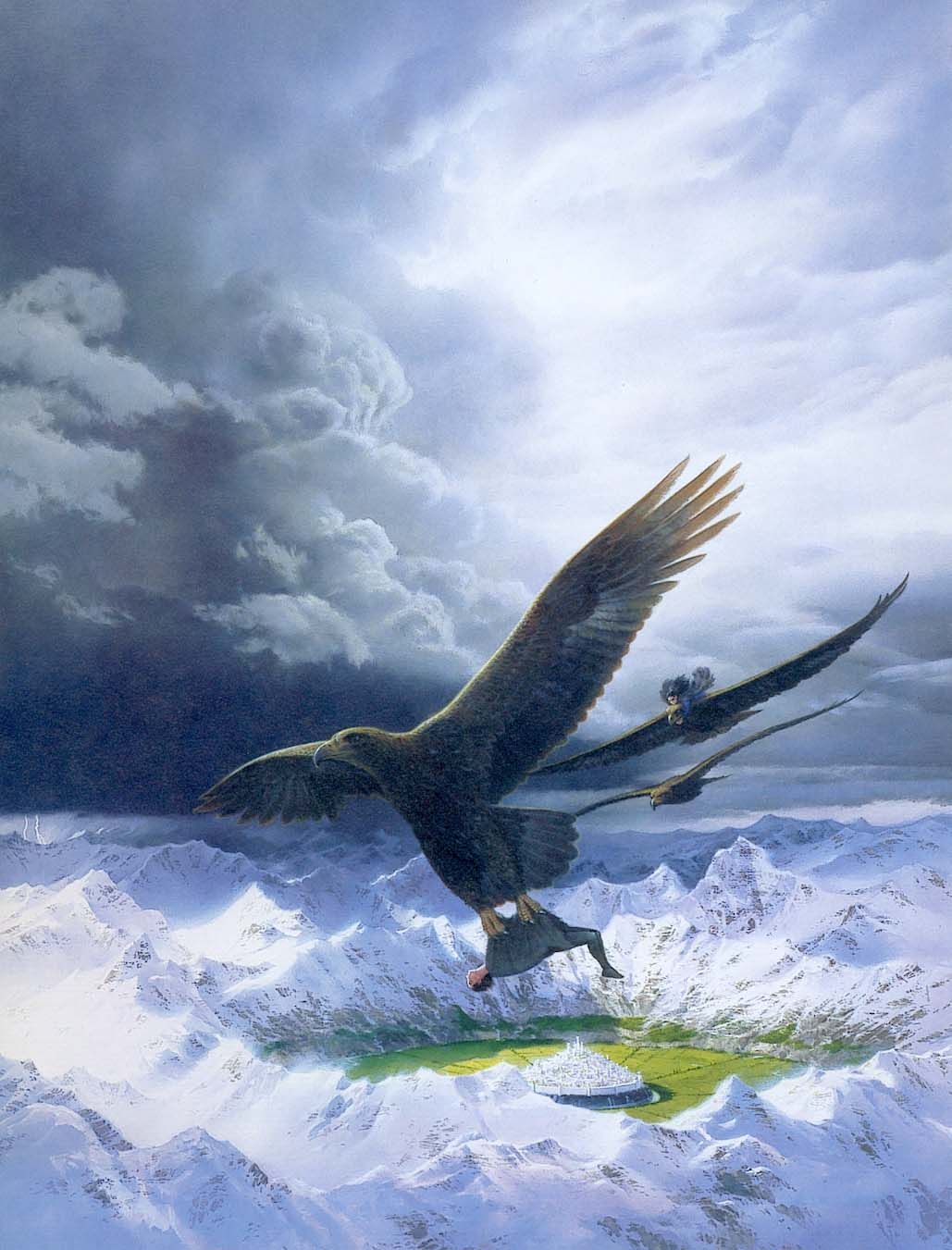
(Ted Nasmith—and I want to point out that this wonderful artist has illustrated things from Tolkien beyond The Hobbit and The Lord of the Rings—this image, for instance is an illustration from the history of the Elvish city of Gondolin.  For more on Gondolin, see:  https://en.wikipedia.org/wiki/Gondolin )

and fly north to the other entrance to Mordor, at the Morannon—the Black Gate.
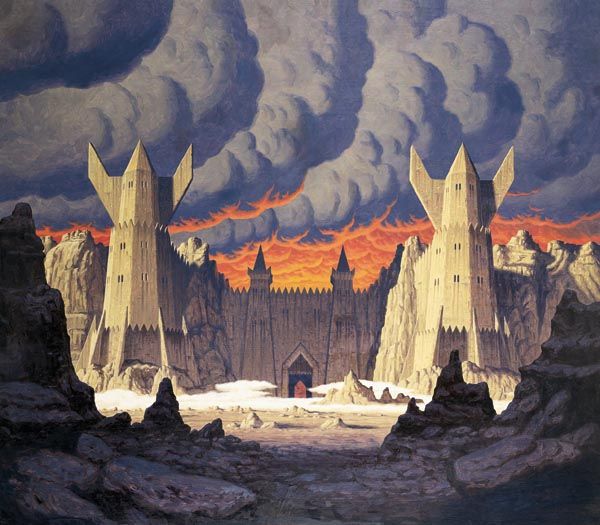
(an early illustration by the Hildebrandts)
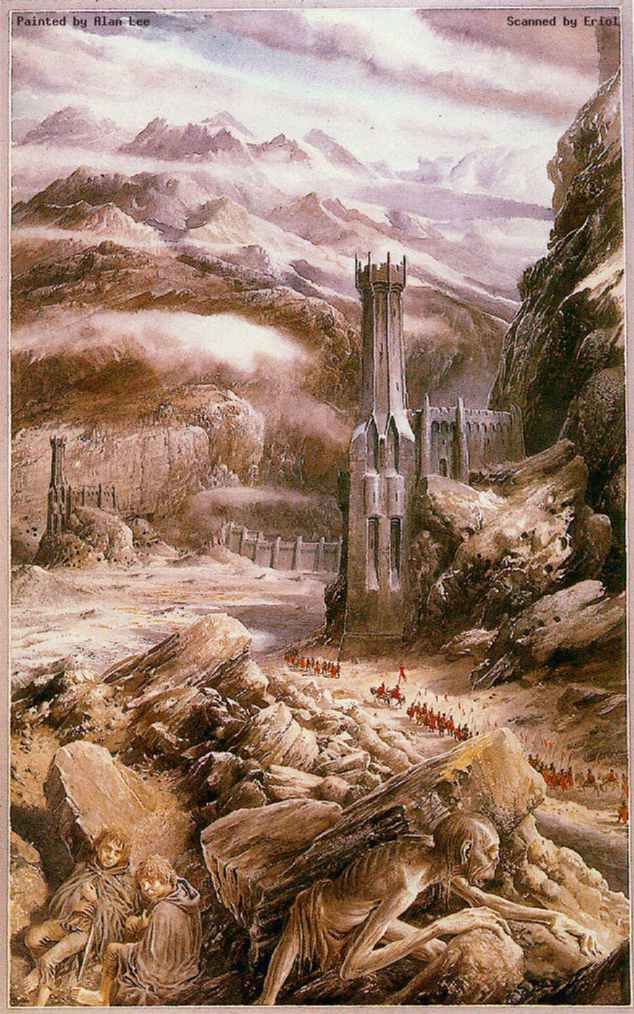
(a later illustration by Alan Lee—I thought the contrast in conceptions of the Gate was interesting.  The Hildebrandts were pioneers in Tolkien illustration and certain of their images—like Gandalf’s original appearance to Bilbo—have always been favorites.)

Our narrator gives us a description—and history–of the place:

“But as the ranges [of Ephel Duath and Ered Lithui] approached one another, being but parts of one great wall about the mournful plains of Lithlad and of Gorgoroth, and the bitter inland sea of Nurnen amidmost, they swung out long arms northward; and between these arms there was a deep defile.  This was Cirith Gorgor, the Haunted Pass, the entrance to the land of the Enemy.  High cliffs lowered upon either side, and thrust forward from its mouth were two sheer hills, black-boned and bare.  Upon them stood the Teeth of Mordor, two towers strong and tall.  In days long past they were built by the Men of Gondor in their pride and power, after the overthrow of Sauron and his flight, lest he should seek to return to his old realm.  But the strength of Gondor failed, and men slept, and for long years the towers stood empty.  Then Sauron returned.  Now the watch-towers, which had fallen into decay, were repaired and filled with arms, and garrisoned with ceaseless vigilance.  Stony-faced they were, with dark window-holes staring north and east and west, and each window was filled with sleepless eyes.

Across the mouth of the pass, from cliff to cliff, the Dark Lord had built a rampart of stone.  In it there was a single gate of iron, and upon its battlements sentinels paced unceasingly.  Beneath the hills on either side the rock was bored into a hundred caves and maggot-holes…”  (The Two Towers, Book Four, Chapter 3, “The Black Gate is closed”)

As always, we see in The Lord of the Rings a Middle-earth which has a history which stretches back far from the present moment.  Sauron had been defeated by the Last Alliance in SA 3441.  While traveling with Frodo and Sam, we set off in TA 3018—over 3000 (!) years later.  (Frodo is astonished to hear from Elrond an eye-witness account of that event—see The Fellowship of the Ring, Book Two, Chapter 2, “The Council of Elrond”)  Thus, the two original towers—ironically constructed to keep Sauron out—must have been built somewhere at the end of the Second Age or at the beginning of the Third, and the wall between constructed after c.TA 2942, when  Sauron had been driven by the White Council from Dol Goldur,
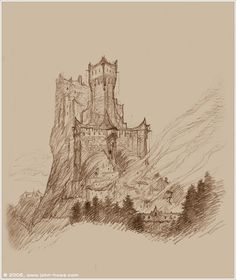
(John Howe—if we had more information about this place, I might have included it in our tour, but it appears to be more mentioned than explained in detail.)

and returned to Mordor.

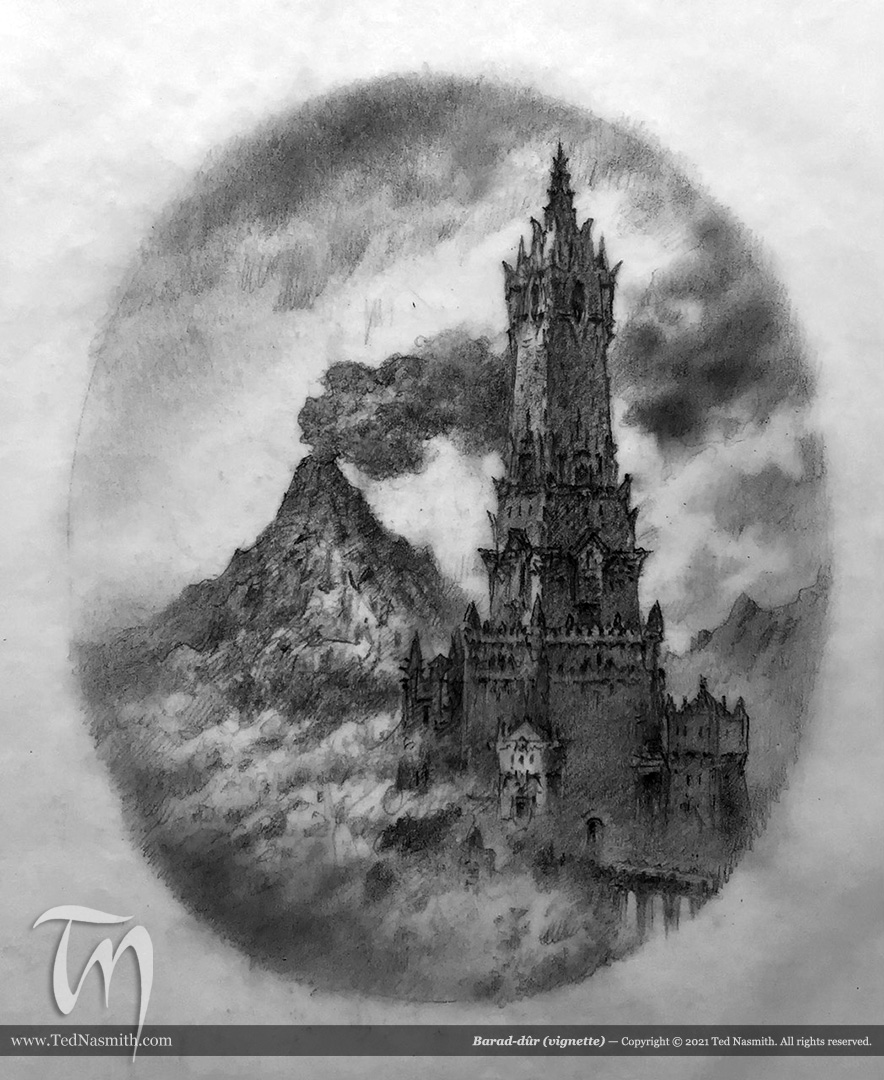
And now we come to the end of our tower tour at the most fearsome of those towers:  the Barad-dur.
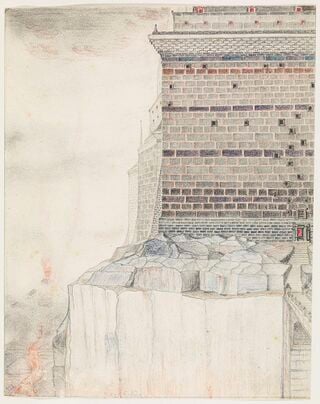
(JRRT—a shame that this is only a fragment)
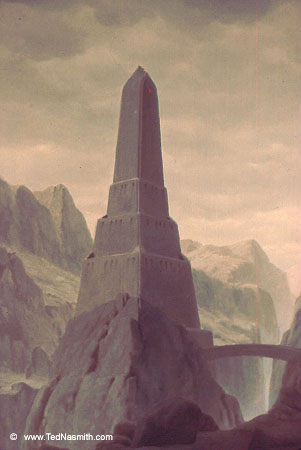
(both by Ted Nasmith—the first strikes me as more menacing in its monumentality, the second, more elaborate and baroque, suggesting a Sauron with a taste for the ornamental, rather than simply the grimly practical.)

Frodo first sees it at Amon Hen,
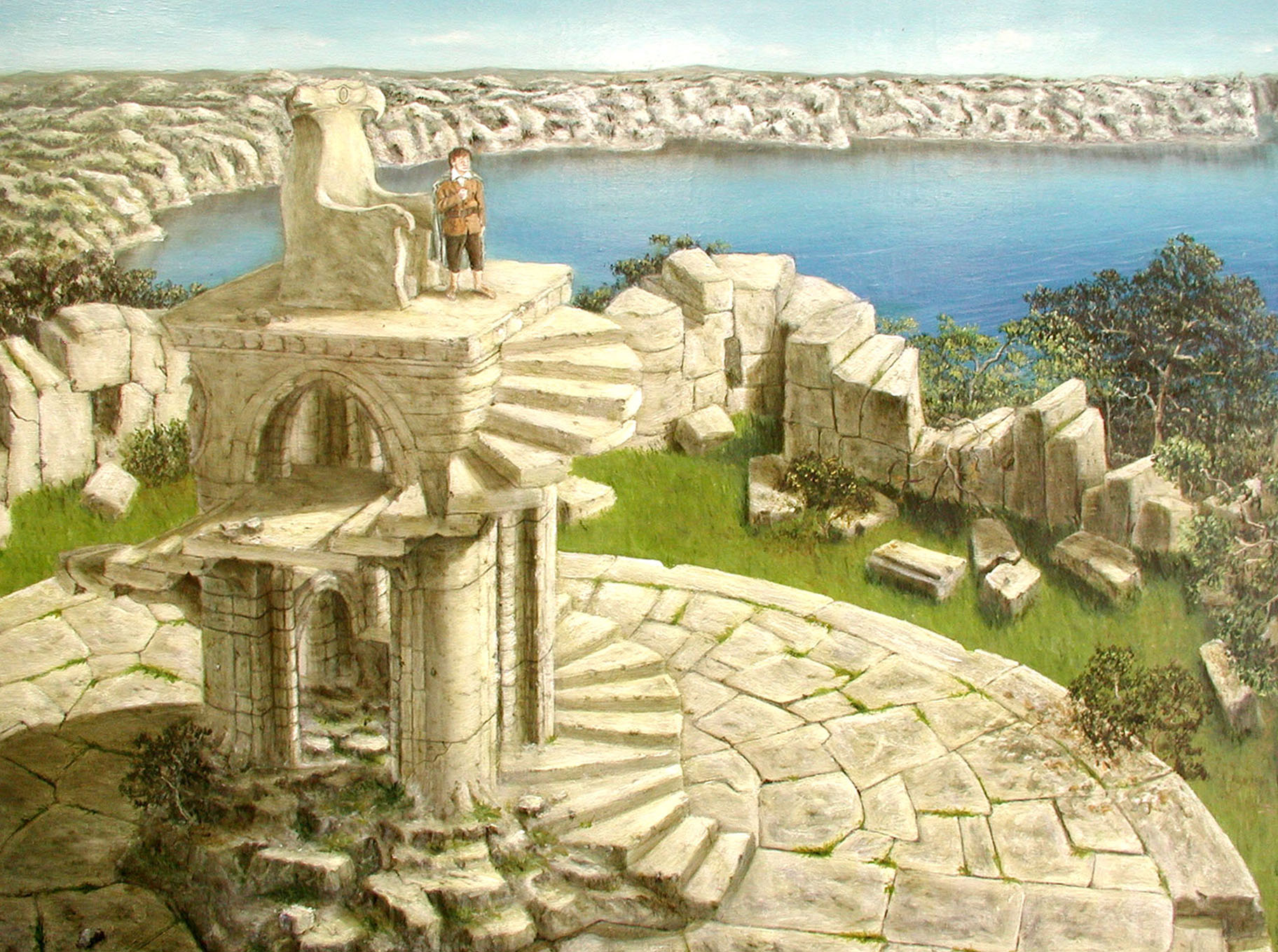
(Scott Peery—for more images see:  https://tolkiengateway.net/wiki/Category:Images_by_Scott_Peery )

when he puts on the Ring and first Minas Tirith appears, but then—

“But against Minas Tirith was set another fortress, greater and more strong.  Thither, eastward, unwilling his eyes were drawn…Then at last his gaze was held:  wall upon wall, battlement upon battlement, black, immeasurably strong, mountain of iron, gate of steel, tower of adamant, he saw it:  Barad-dur, Fortress of Sauron.”  (The Fellowship of the Ring, Book Two, Chapter 10, “The Breaking of the Fellowship”)

Sauron had begun the construction of this menacing place in SA 1000, completing it 600 years KinAlliance, returns to rebuild it in TA 2951 (Appendix B, “The Third Age”), its final destruction coming with the destruction of the Ring in TA 3019.
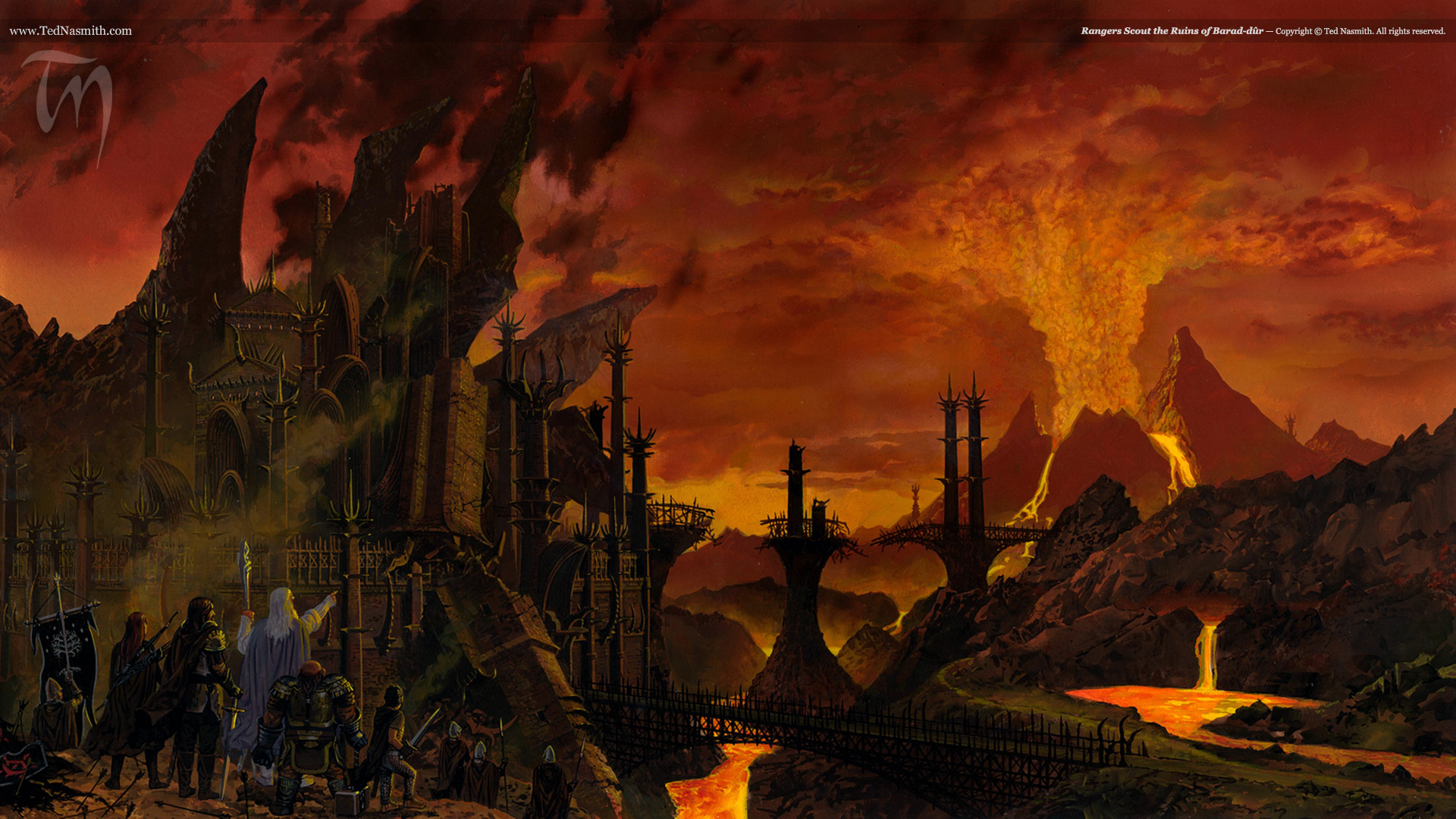
(Ted Nasmith—with the very interesting label “Rangers scout the ruins of Barad-dur”)

As we know, “Barad-dur” means “Dark Tower” and that name made me wonder about where it might have come from, apart from JRRT’s amazingly fertile imagination.

One possibility could be a poem by Robert Browning (1812-1889), entitled “Childe Roland to the Dark Tower Came”, which is in his 1855 collection Men and Women. 

It’s a rather creepy poem about a knight on an unknown mission—except that it seems to end at that Dark Tower.  You can read it here:  https://www.poetryfoundation.org/poems/1597010/childe-roland-to-the-dark-tower-came

The only reference in Letters is to another Browning poem, “The Pied Piper of Hamelin”, which Tolkien said he loathed, but the medieval setting and the popularity of Browning in the later 19th century might suggest that Tolkien had read it—with perhaps less distaste than he did “The Pied Piper”—but the Browning poem is actually his recreation of what might have been a much earlier ballad, only a fragment of which appears to survive, in Shakespeare’s King Lear, where, at the end of Act 3, Scene 4,  a major character, Edgar, pretending to be “Poor Tom”, a madman, recites:

“Childe Rowland to the darke Tower came,

His word was still, fie, foh, and fumme,

I smell the blood of a Brittish man.”

(This is from the “First Folio” of 1623—I always prefer using early versions of Shakespeare’s texts as their spelling echoes earlier English pronunciation—so-called “Shakespearean”, which you can hear here:  https://www.youtube.com/watch?v=y2QYGEwM1Sk  You can read the whole play in this older spelling here:  https://internetshakespeare.uvic.ca/doc/Lr_F1/scene/1.1/index.html )

You probably know two of these lines from the English fairy tale “Jack and the Beanstalk”—sometimes called “Jack the Giant-Killer”–which you can read here, if you don’t know it, or would like to refresh your memory (start on page 99):  https://archive.org/details/englishfairytal00jacogoog/page/n8/mode/2up  You’ll also notice, facing the title page of this volume, an illustration entitled “Childe Rowland”,
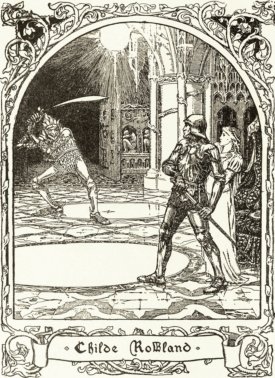
a story which you can find beginning on page 117.  The editor of this text (English Fairy Tales, 1890), Joseph Jacobs, has provided a long note (pages 238-245) about his major source, citing Jamieson’s 1814 collection, Illustrations of Northern Antiquities where Jamieson reconstructs something which combines verse and prose—as JRRT sometimes does—in what is called a “chantefable”, in which a character called “Burd Ellen” is rescued from Elfland by “Child Rowland”, (“Child/e” is a title for a young nobleman pre-knighthood.) a familiar theme in a number of ballads and which Jamieson links to a Danish balled, “Rosmer Hafmand”.  You can read Jamieson’s account here:  https://archive.org/details/cu31924027097868/page/396/mode/2up

(For more on the one known surviving example of the “chantefable”, the 12th-13th century “Aucassin et Nicolette”, see:  https://en.wikipedia.org/wiki/Aucassin_and_Nicolette ) 

So, did at least the name “Dark Tower” come from a literary source—Browning’s poem, say?

Or, can we turn to Browning’s source:  King Lear?

For all that Tolkien was not, initially a Shakespeare fan (see his letter to W.H. Auden, 7 June, 1955, Letters, 312), he later came to appreciate him—at least in performance—(see letter to Christopher Tolkien, 28 July, 1944, Letters, 126), and we know that he had been exposed to Shakespeare’s works at an early age, so perhaps Shakespeare was a—if not the—inspiration?

In any event, that tower was doomed to ultimate destruction with that of the Ring, as we read:

“The earth groaned and quaked.  The Towers of the Teeth swayed, tottered,  and fell down; the mighty rampart crumbled; the Black Gate was hurled in ruin; and from far away, now dim, now growing, now mounting to the clouds, there came a drumming rumble, a roar, a long echoing roll of ruinous noise.”  (The Return of the King, Book Six, Chapter 4, “The Field of Cormallen”)

A Tolkien illustration by Ted Nasmith

(Ted Nasmith)

And with the end of the Dark Tower, this tour of towers ends, as well.

Thanks for reading, as always.

Stay well,

If you are trapped underground and find a simple ring, consider, before you pick it up, that there may be consequences,

And expect

MTCIDC

O
Towering.2

01 Wednesday Jul 2026

Posted by Ollamh in Uncategorized

≈ Leave a comment

Tags

Fantasy, Helm's Deep, Isengard, Minas Ithil, Minas Morgul, Minas Tirith, Orthanc, The Lord of the Rings, Tolkien, Tower Hills, Tower of Echthelion, towers, towers in The Lord of the Rings, Weathertop

Welcome, dear readers, as always.

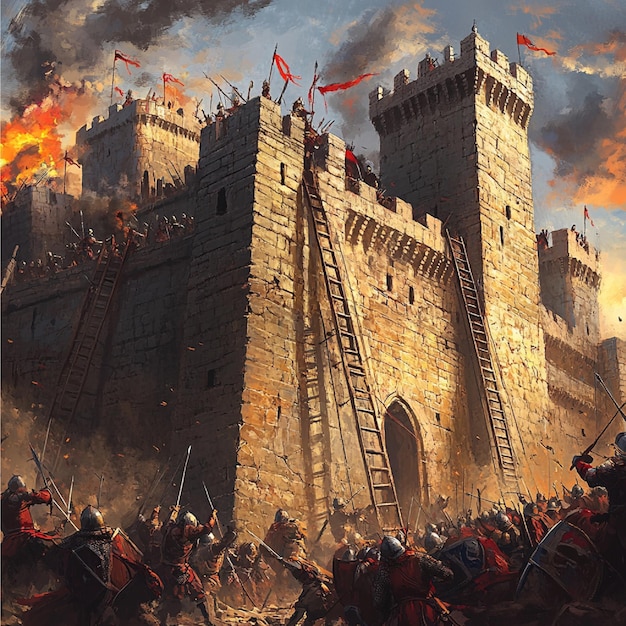
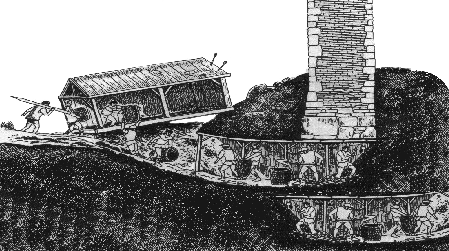
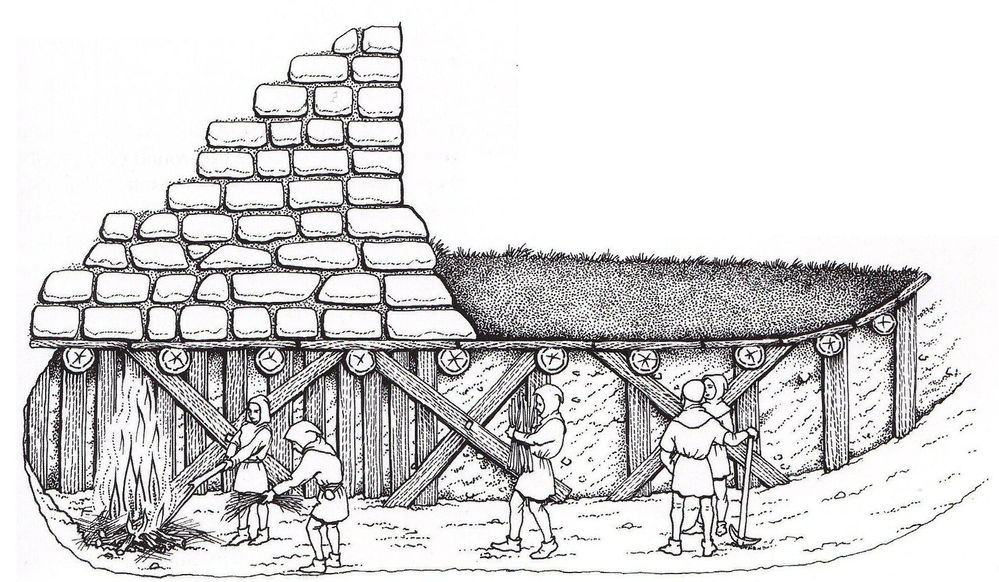
Walls have always been a problem for attackers, as they’re clearly meant to be.  There have always been several possibilities of how to deal with them:

1. attack its fabric

2. go over with a ladder (this is called an “escalade” and is, as you can imagine, an iffy method of assault)

3. dig under (tunneling)

(This is from the very good “War History Online” site:  https://www.warhistoryonline.com/

4. dig under to destroy (undermining)

(And this is from another very interesting site, “Classroom Adventures”, which has an educational agenda with which I agree:  https://www.classroomadventures.co.uk/ )

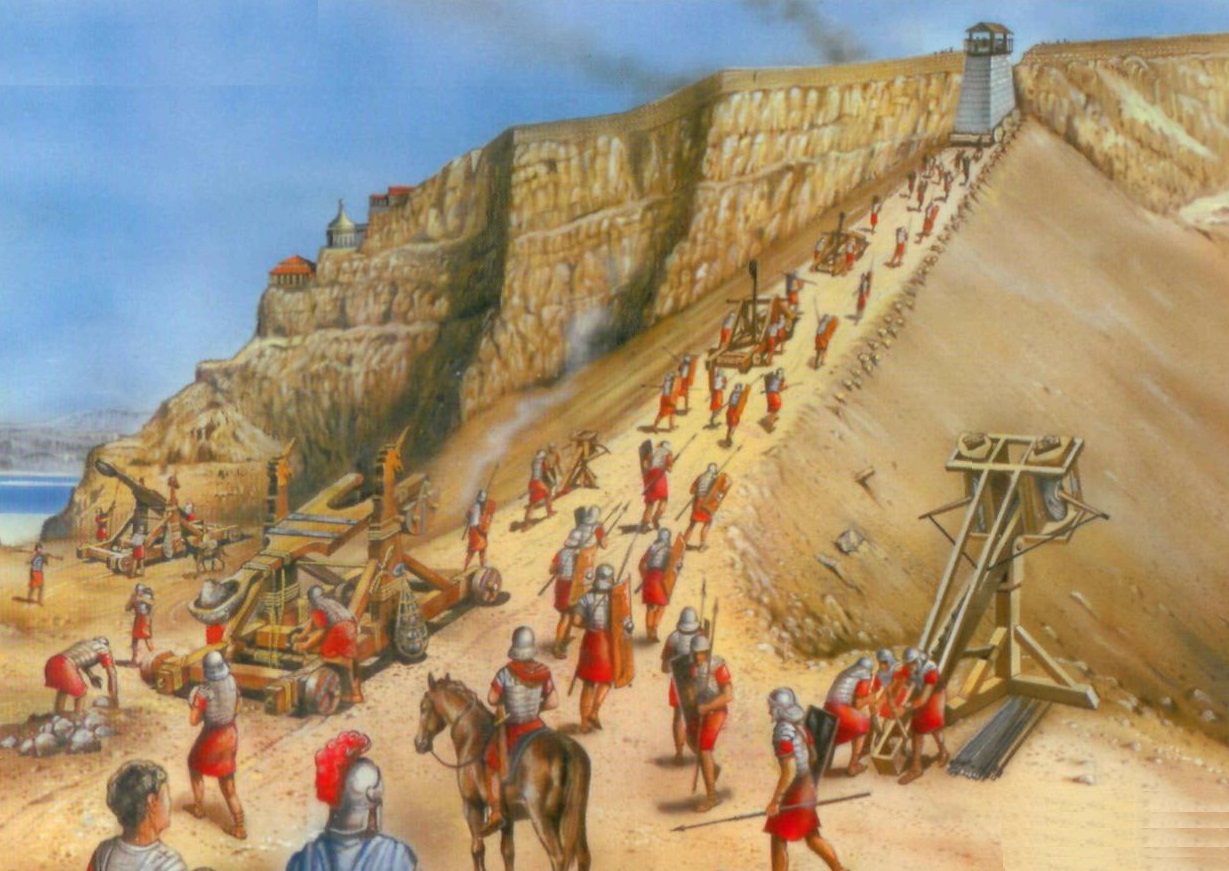
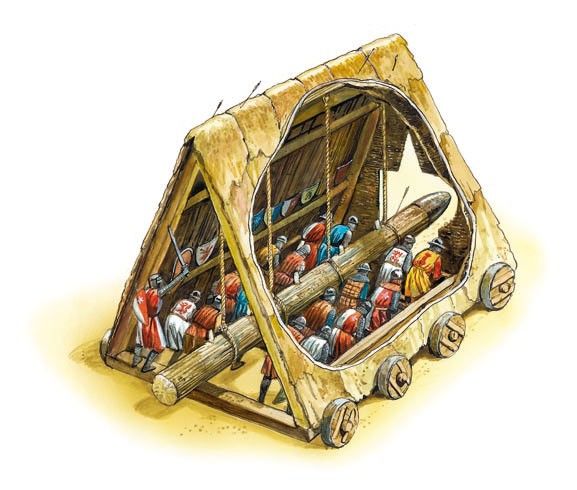
5. if you’re the Romans, you might build an enormous ramp to lead up to the top of the wall

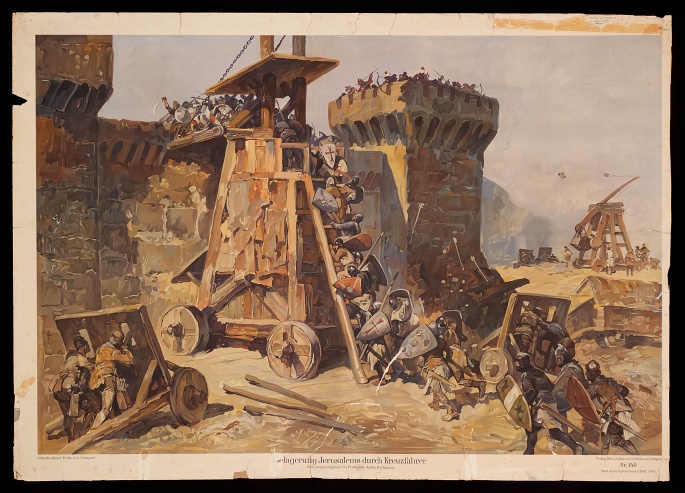
6. or you might build a tower a little higher than the wall, roll it up to the wall, and climb from it onto the wall

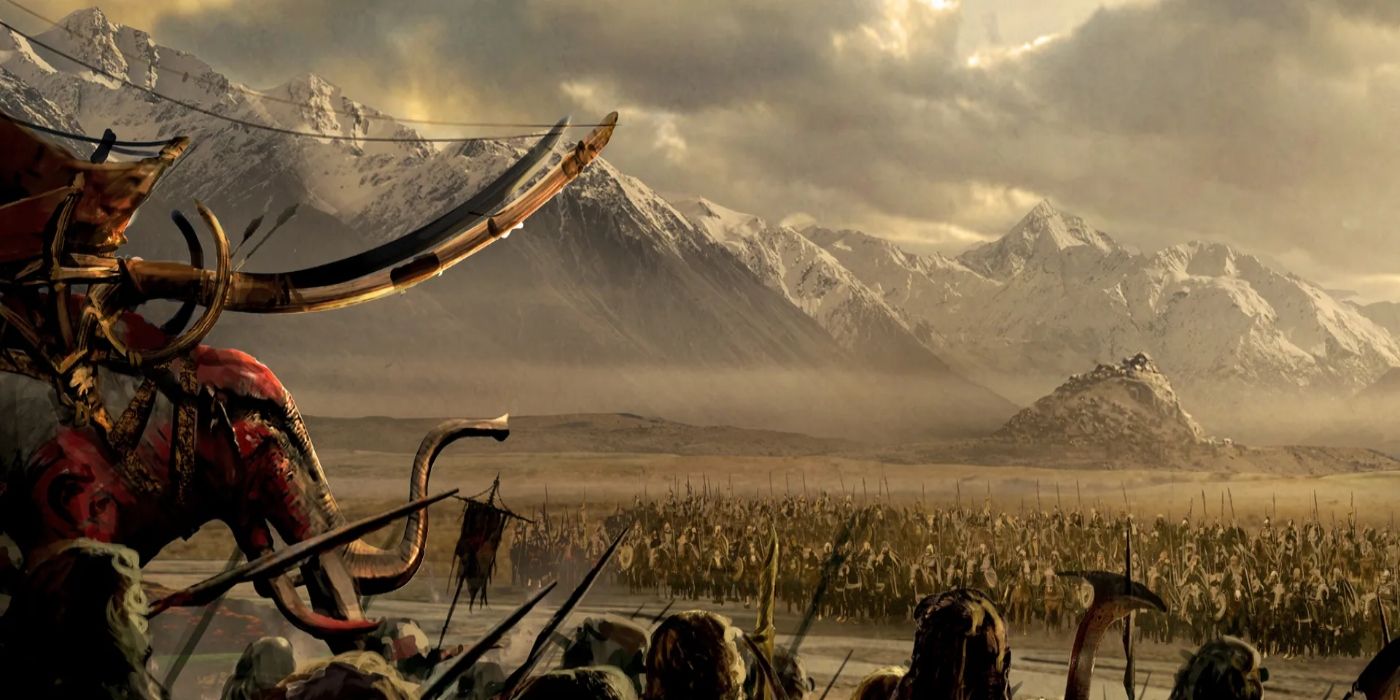
In an earlier posting, I examined this last in a review of the recent The War of the Rohrrim

for which, see “Towering”, 28 January, 2026.                                       

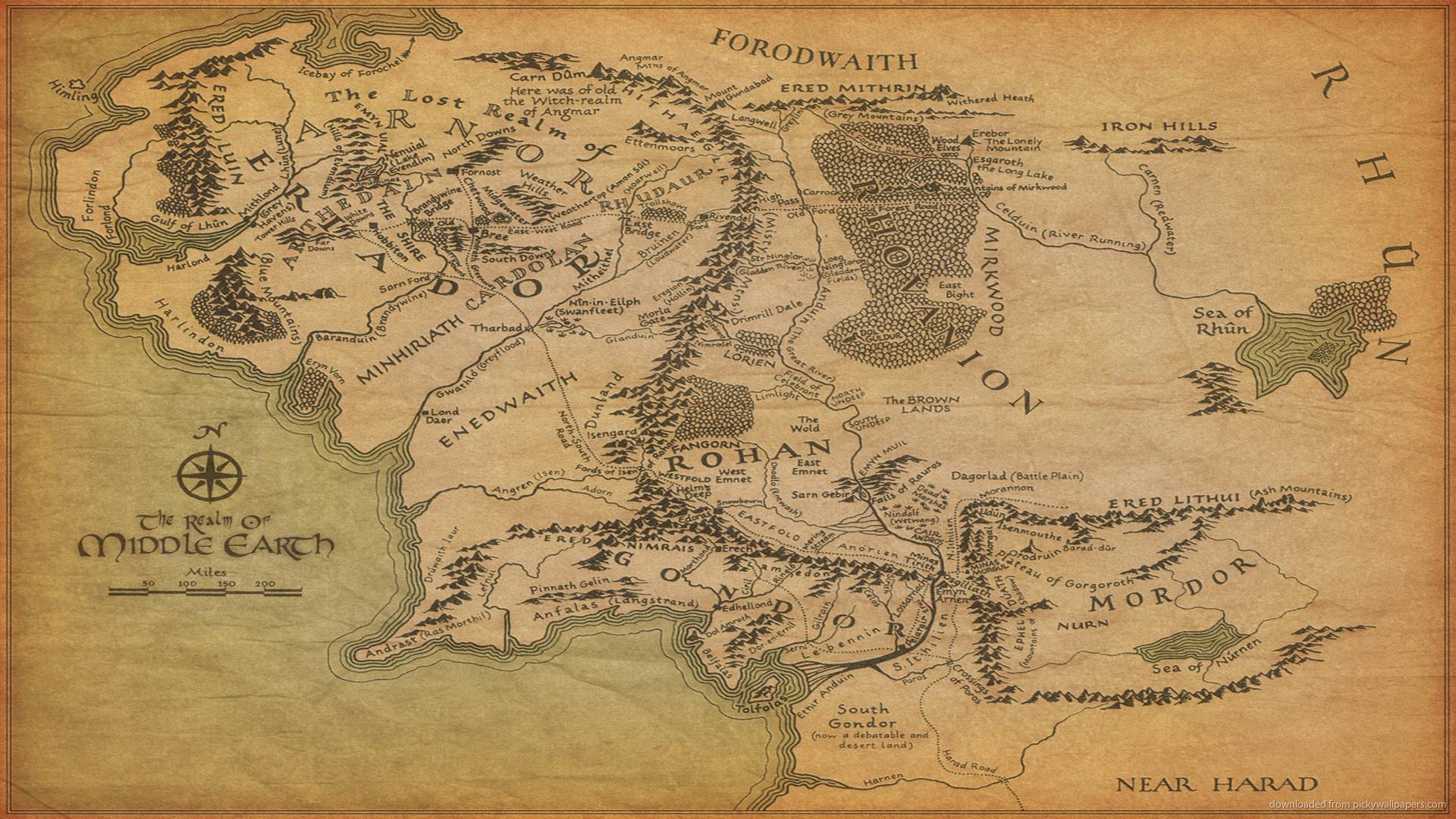
I have titled this “Towering.2”, but it’s not about walls and getting over them using a tower, however, but about towers themselves, specifically towers in The Lord of the Rings, in which there are a surprising number, of which I thought it might be fun to make a sort of catalogue, visiting them more or less geographically.

To do so, we begin to the far west of the Shire, just this side of the Grey Havens, where we see the Tower Hills.

(Ted Nasmith)

As Tolkien describes them:

“Three Elf-towers of immemorial age were still to be seen on the Tower Hills beyond the western marches.  They shone far off in the moonlight.  The tallest was furthest away, standing alone upon a green mound.”  (“Prologue”, The Lord of the Rings) 

Walking eastward towards the Misty Mountains, crossing the Shire, but veering south from Bree, we reach Weathertop,

(Alan Lee)

of which Aragorn says:

“The Men of the West did not live here; though in their latter days they defended the hills for a while against the evil that came out of Angmar.  This path was made to serve the forts along the walls.  But long before, in the first days of the North Kingdom, they built a great watch-tower on Weathertop, Amon Sul they called it…once it was tall and fair.”  (The Fellowship of the Ring, Book One, Chapter 11, “A Knife in the Dark”)

Even with just two towers, we can begin to understand what JRRT was at such pains to suggest:  settlement in Middle-earth is very old and, as we’ll see, no one has built in such an elaborate fashion for many centuries—the Elf towers are of “immemorial age” and Amon Sul was built during the later reign of Argaleb I (ruled TA 1349-1356—just to give you a sense of time, Frodo was born in TA 2968).

From Weathertop, heading south and around the southern end of the Misty Mountains, we reach Isengard and the tower of Orthanc,

(Ted Nasmith)            

built sometime during the Second Age (Tolkien never appears to have provided a founding date—the Tolkien Gateway offers:  “it must have been built between S.A. 3320, the year in which the realms of Gondor and Arnor were established, and S.A. 3430, the year in which the Last Alliance of Elves and Men was formed to resist Sauron‘s tyranny”).

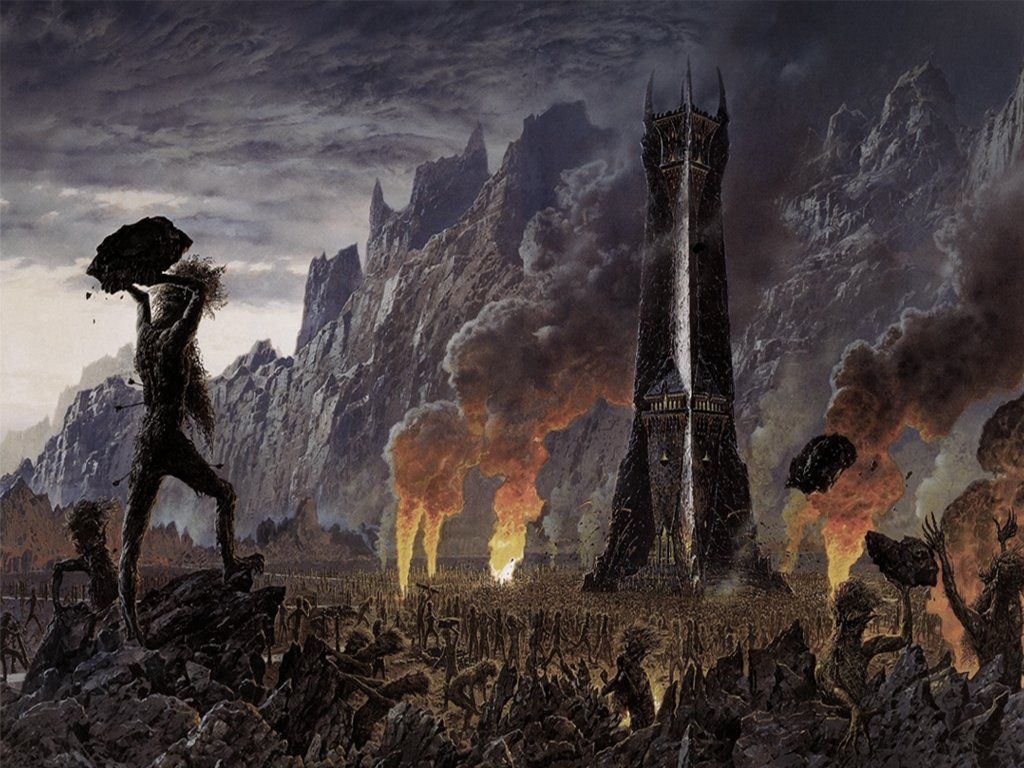
We can say, however, that Saruman began his occupation of the site in TA 2759, so, at the time of The Lord of the Rings and the Ents’ attack upon it (TA 3019)

(Ted Nasmith)

he had been in possession of it for over 250 years—one more example of how aged everything in Middle-earth is.  It’s described as something of a technological wonder—but also quite menacing—especially when we remember that Saruman attempted to keep Gandalf captive at the top, among those pinnacles:

“There stood a tower of marvellous shape.  It was fashioned by the builders of old, who smoothed the Ring of Isengard, and yet it seemed a thing not made by the craft of Men, but riven from the bones of the earth in the ancient torment of the hills.  A peak and isle of rock it was, black and gleaming hard; four mighty piers of many-sided stone were welded into one, but near the summit they opened into gaping horns, their pinnacles sharp as the points of spears, keen-edged as knives.”  (The Two Towers, Book Three, Chapter 8, “The Road to Isengard”)

From here, we travel farther south, along the eastern side of the Ered Nimrais, the White Mountains, until we reach Helm’s Deep and its fortification with its tower, the Hornburg.

(JRRT)

As to foundation date, like Isengard, it seems vague:

“At Helm’s Gate, before the mouth of the Deep, there was a heel of rock thrust outwards by the northern cliff.  There upon its spur stood high walls of ancient stone, and within was a lofty tower.  Men said that in the far-off days of the glory of Gondor the sea-kings had built this fastness with the hands of giants.”  (The Two Towers, Book Three, Chapter 7, “Helm’s Deep”—that phrase “with the hands of giants” may have echoed in Tolkien’s memory from the Old English poem named “The Ruin”, which possibly describes the remains of Roman Aquae Sulis (modern Bath) and which has the phrase “brosnað enta geweorc”, “ruined is the work of giants”—with that “enta”, from which the Ents came—along with a similar phrase in “Maxims II”.  For more on this very poignant poem see:  https://en.wikipedia.org/wiki/The_Ruin )

Southeast now, along those same White Mountains, will bring us in the direction of the first of the two towers of the title of the second volume (but which towers?  Tolkien wrote to Rayner Unwin:  “The Two Towers gets as near as possible to finding a title to cover the widely divergent Books 3 and 4; and can be left ambiguous—it might refer to Isengard and Barad-dur, or to Minas Tirth and B; or Isengard and Cirith Ungol.”  Letter to Rayner Unwin, 17 August, 1953, Letters, 250)

We now see ahead of us Minas Tirith,

(Ted Nasmith)

constructed in SA 3300’s, by Anarion, son of Elendil, and called initially Minas Anor, “the tower of the sun”, with its Tower of Echthelion, as one of the Fellowship first views it:

“…the Tower of Echthelion, standing high within the topmost wall, shone out against the sky, glimmering like a spike of pearl and silver, tall and fair and shapely, and its pinnacle glittered as if wrought of crystals; and white banners broke and fluttered from the battlements in the morning breeze, and high and far [Pippin] heard a clear ringing as of silver trumpets.”  (The Return of the King, Book Five, Chapter 1, “Minas Tirith”)

(I couldn’t resist adding this John Howe illustration, done in the style of Maxfield Parrish)

But now, on our tour, we turn eastwards, to the land of shadow and, first, to that other tower, that of Minas Ithil, “the tower of the moon”, built about the same time as Minas Anor, by Elendil’s other son, Isildur.

(Ted Nasmith)

Elrond gives us a small picture of it in its earlier days:

“And Minas Ithil they built, Tower of the Rising Moon, eastward upon a shoulder of the Mountains of Shadow…”

But then he goes on to add:

“And on a time evil things came forth, and they took Minas Ithil and abode in it, and they made it a place of dread; and it is called Minas Morgul, the Tower of Sorcery.”  (The Fellowship of the Ring, Book Two, Chapter 2, “The Council of Elrond”)

The forces of Mordor besieged and captured Minas Ithil in TA 2002 and, with their occupation, this is what it began to look like:

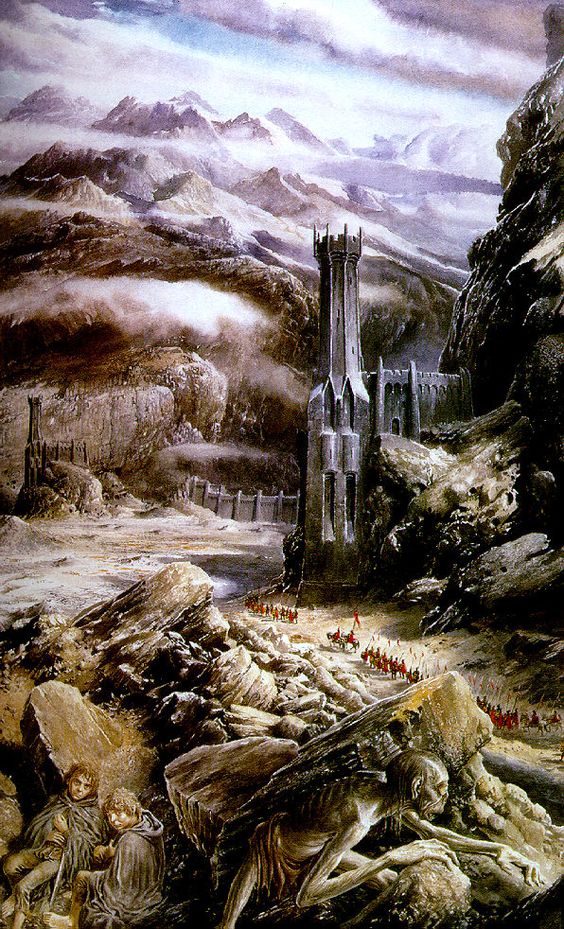
“Upon the further side, a deep gulf of shadow, ran back far into the mountains.  Upon the farther side, some way within the valley’s arms, high on a rocky seat upon the black knees of the Ephel Duath, stood the walls and tower of Minas Morgul.  All was dark about it, earth and sky, but it was lit with light.  Not the imprisoned moonlight welling through the marble walls of Minas Ithil long ago, Tower of the Moon, fair and radiant in the hollow of the hills.  Paler indeed than the moon ailing in some slow eclipse was the light now, wavering and blowing like a noisesome exhalation of decay, a corpse-light, a light that illuminated nothing.  In the walls and tower windows showed, like countless black holes looking inward into emptiness; but the topmost course of the tower revolved slowly, first one way and then another, a huge ghostly head leering into the night.”  (The Two Towers, Book Four, Chapter 8, “The Stairs of Cirith Ungol”)

I find that topmost course, “revolving slowly, first one way and then another”, as if always on watch, the most disturbing part of this description so we’ll stop here for now before Frodo and Sam take the next and near fatal step on our tower tour.

Thanks, as always, for reading.

Stay well,

Remember that your slippery guide may have other plans for you,

(Ted Nasmith)

And remember, as well, that, as always, there’s

MTCIDC

O

A Moon disfigured

17 Wednesday Dec 2025

Posted by Ollamh in Uncategorized

≈ Leave a comment

Tags

Elizabeth I, herald, Heraldry, livery, Middle-earth, Minas Ithil, Minas Morgul, Orcs, puzzle, Sam, Saruman, Sauron, Sir Roger de Trumpington, The Great War, The Lord of the Rings, Tolkien, uniforms

As always, dear readers, welcome.  And perhaps welcome to a little Tolkien puzzle.

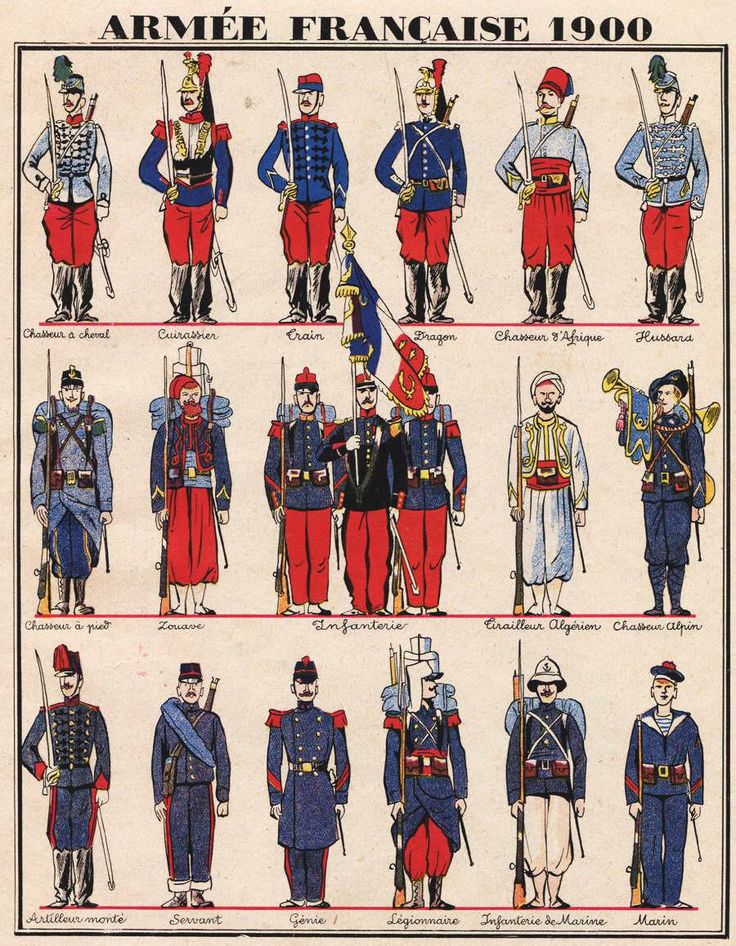
On parade, soldiers of the early 20th century could be peacocks for finery.

But then they met the new technological reality of heavy machine guns

and increasingly heavy artillery

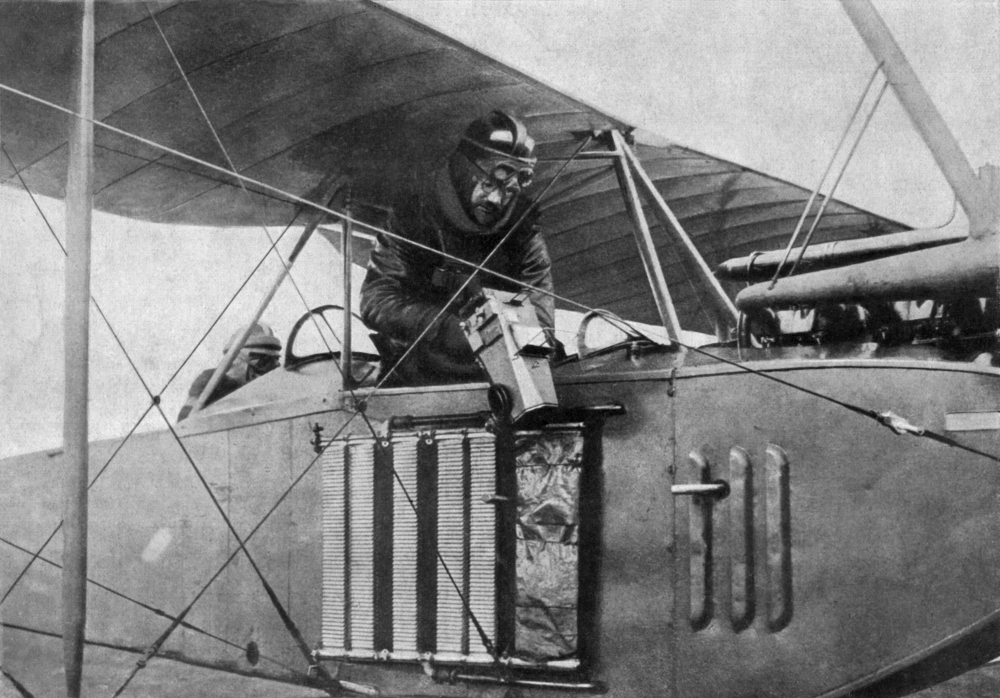
and, in time, even the danger of being spotted from the air,

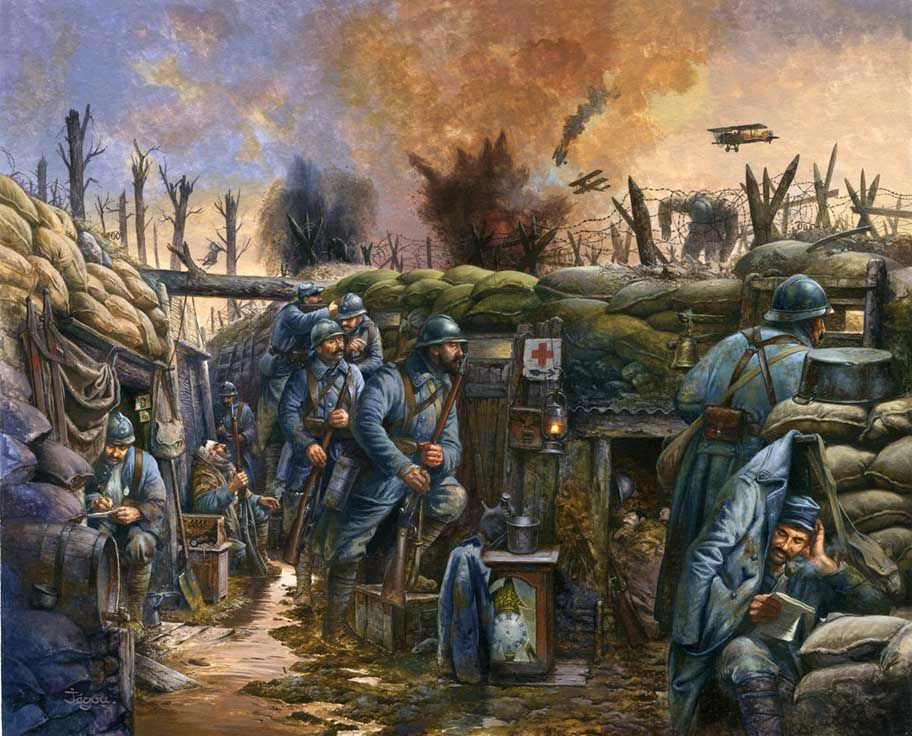
so soldiers not only dug in,

but modified their uniforms, making themselves less visible.

(Gerry Embleton)

After the war, most armies, except for special guard units,

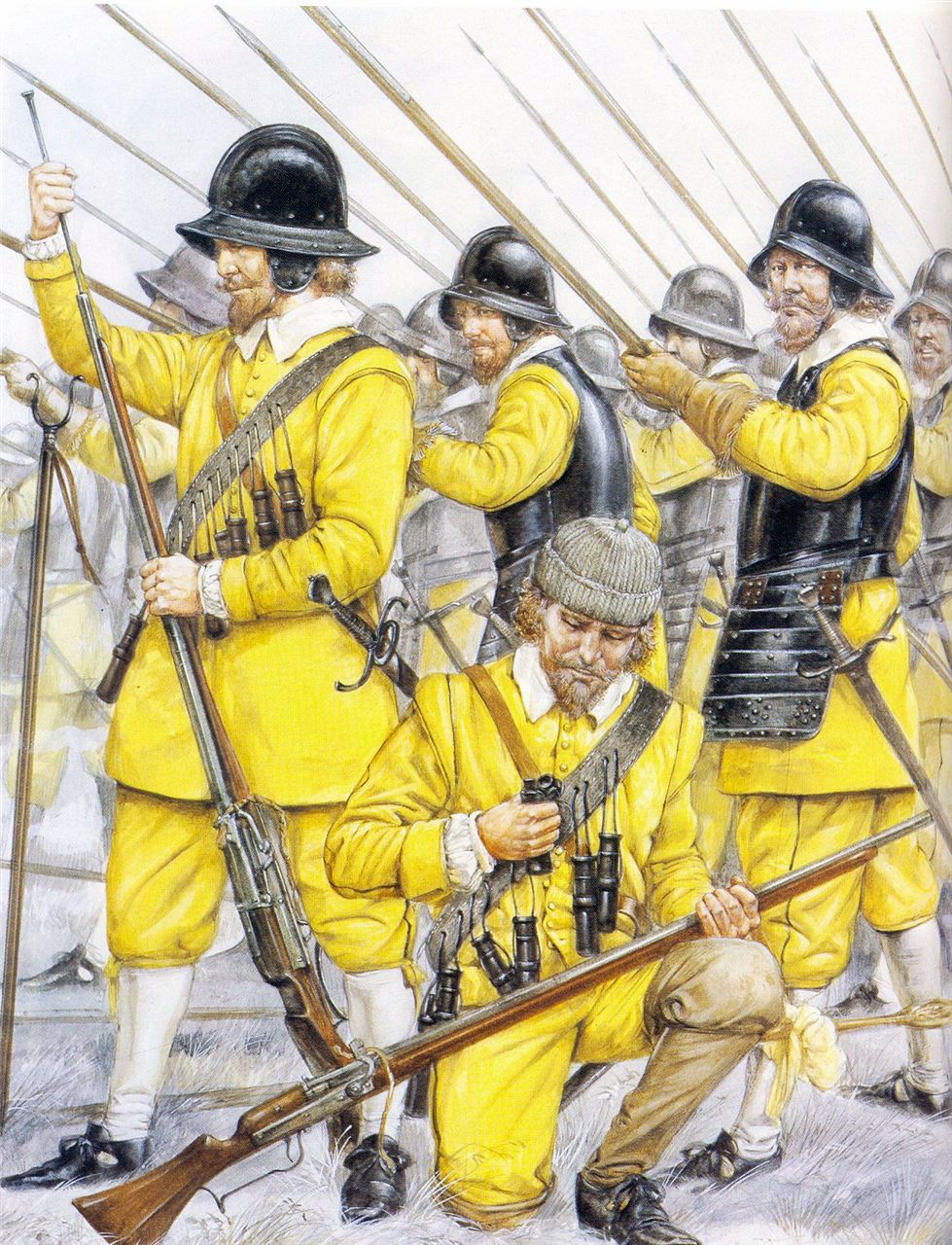
 never went back to being peacocks, abandoning a bright tradition which went back to the 17th century.

(Richard Hook)

Even in the 17th century, soldiers not wearing the same-colored clothing might distinguish themselves from their enemies by what would be called “field signs”, like wearing a strip of cloth on one arm, or sticking a particular piece of a plant or even a scrap of paper in your hatband.

(Henri IV, 1553-1610, king of France, was famous for the white plume he always wore in his hat.)

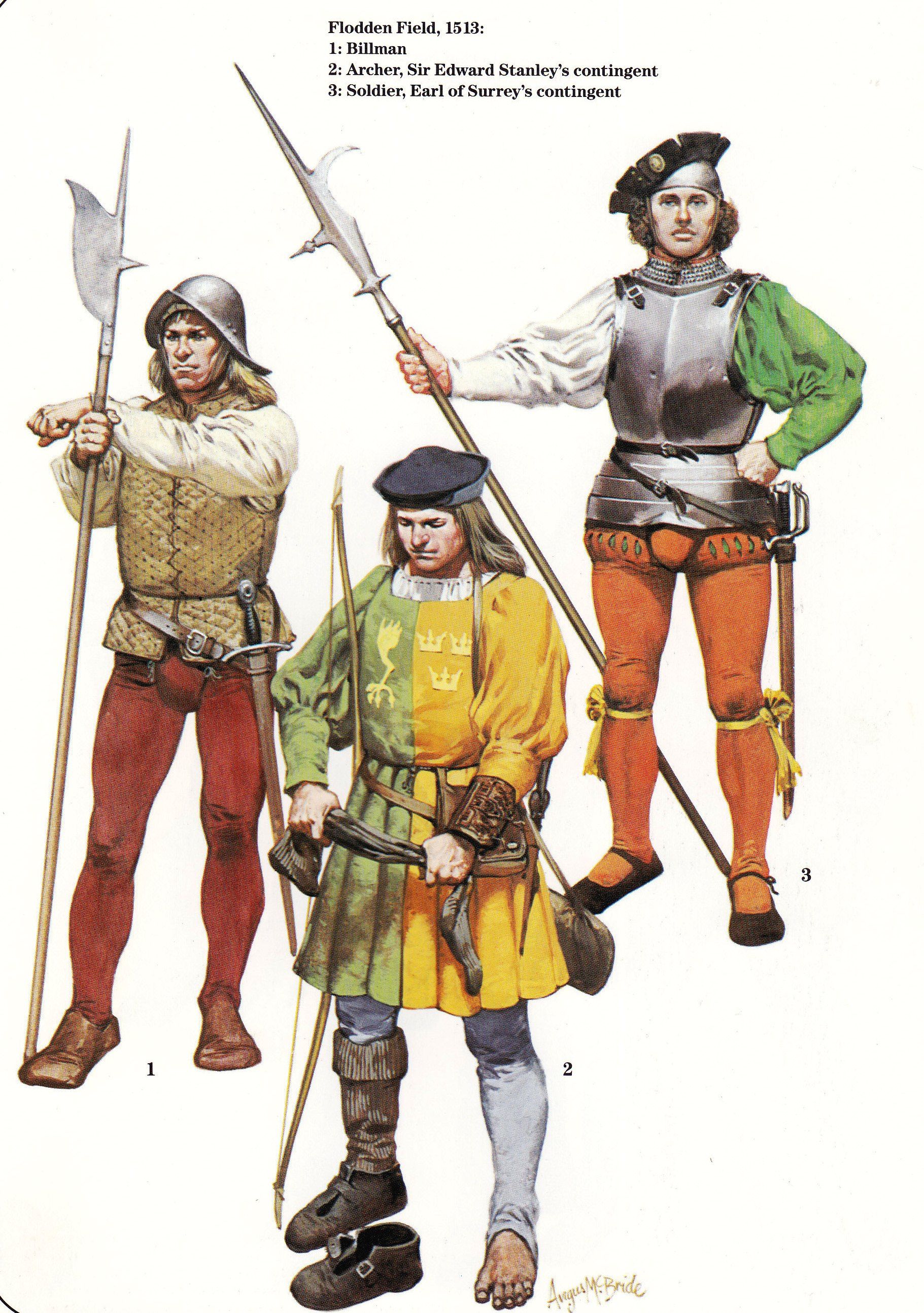
Before this, soldiers might wear the distinctive colors of their commanders (usually noblemen), called “livery”—

(Angus McBride)

Here we can see that Sir Edward Stanley has given this archer clothing in his colors of green and mustard-yellow, while the Earl of Surrey provided his soldiers with his colors of green and white.  You’ll also notice that the archer has some distinctive badges on the front of his coat—an eagle’s claw and crowns.  These are personal indicators of Sir Edward, heraldic markers to indicate to whom the archer belonged.

In the days before distinctive military dress, heraldry—the use of emblems to mark out one knight, and perhaps his followers, from another—had been developed to a high level.  When everyone was covered in metal,

such emblems were a way to identify a knight—and if he had issued similar emblems to his soldiers, a way to identify the troops he had brought and commanded at a battle.

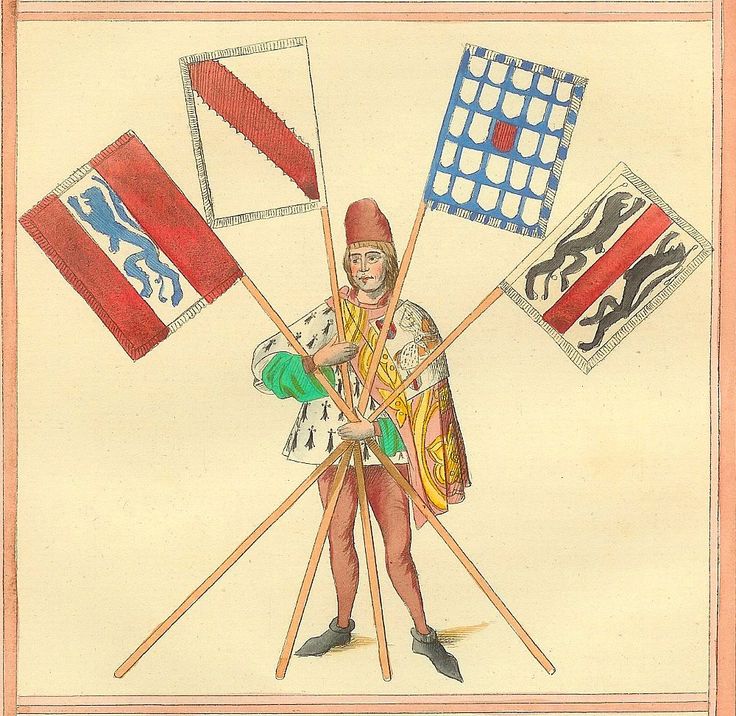
As emblems developed, there also developed a person with a specialized skill to identify them—a herald.

He himself, as you can see, wore distinctive clothing, which also helped him in his other role as messenger between military opponents—he was considered as a neutral and could therefore pass freely.  (For more on heralds, see “Herald-ry in Middle-Earth”, 30 March, 2016 here:  https://doubtfulsea.com//?s=herald&search=Go )

Tolkien himself belonged to the age of drab—

(Here’s what that uniform would have looked like in color—although this is a much higher level officer—looks to be a major—JRRT was commissioned as a second lieutenant and eventually promoted to first lieutenant )

but was well aware of earlier flashiness and we can see it in his description of the guards at Denethor’s gate—even though he sees their outfits as a throwback, just like British soldiers ever returning to bright red uniforms—except for the monarch’s guards:

“The Guards of the gate were robed in black, and their helmets were of strange shape, high-crowned, with long cheek-guards close-fitting to the face, and above the cheek-guards were set the white wings of sea-birds; but the helms gleamed with a flame of silver, for they were indeed wrought of mithril, heirlooms from the glory of old days.  Upon the black surcoats were embroidered in white a tree blossoming like snow beneath a silver crown and many-pointed stars.  This was the livery of the heirs of Elendil, and none wore it now in all Gondor, save the Guards of the Citadel before the Court of the Fountain where the White Tree had grown.”  (The Return of the King, Book Five, Chapter 1, “Minas Tirith”)

(from the Jackson films—as you can see, the helmet fits the description, but the surcoat has disappeared and, instead, the Tree, stars, and crown have been shifted to the breastplate, removing the dramatic contrast between the black cloth and white embroidered emblems which JRRT intended)

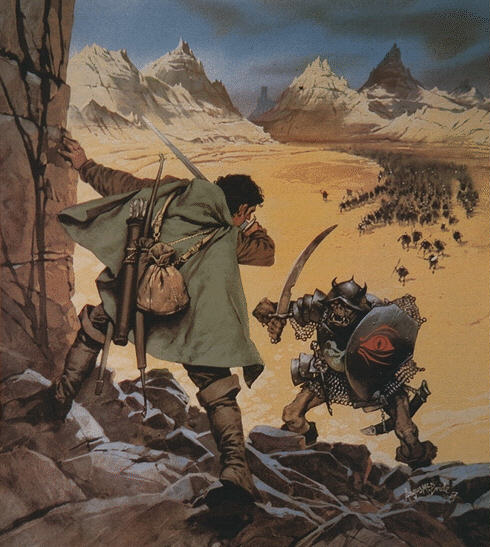
As well, although the orcs wear no livery—no uniforms or even part-colored clothing—they do have badges—the white hand of Saruman

(perhaps suggesting that he has his hand over everything?  I think of the “Armada Portrait” of Queen Elizabeth the First here—just look at the quiet statement in her hand)

and the red eye of Sauron,

(Angus McBride—perhaps implying that, like Big Brother, Sauron has his eye on you?)

but then there’s a new one, only mentioned once, which provided the title for this posting and the puzzle—

“Two liveries Sam noticed, one marked by the Red Eye, the other by a Moon disfigured with a ghastly face of death…” (The Return of the King, Book Six, Chapter 1, “The Tower of Cirith Ungol”)

What is JRRT up to here?  Minas Morgul,  the “Tower of Black Sorcery”, the center of this gateway into Mordor,

(Ted Nasmith)

had been built as Minas Ithil, “the Tower of the Moon” and it’s clear that those having that badge must come specifically from that place, and a mockery of its previous Gondorian name, which is interesting because the rest of Sauron’s forces appear to wear only the Red Eye.  Yet, if we can trust an orc, we may have the sense that Sauron doesn’t appreciate deviation, as Grishnakh asks rhetorically of Ugluk:

“They might ask where his strange ideas came from.  Did they come from Saruman, perhaps?  Who does he think he is, setting up on his own with his filthy white badges?  They might agree with me, with Grishnakh their trusted messenger; and I Grishnakh say this:  Saruman is a fool, and a dirty treacherous fool.  But the Great Eye is on him.”  (The Two Towers, Book Three, Chapter 3, “The Uruk-hai”)

So what’s going on here?  Certainly there’s rivalry between Saruman’s orcs and Sauron’s, but just how deep does orc rivalry go?  When Sam arrives at the Tower of Cirith Ungol, he finds it a battleground and, climbing into the tower itself he hears two orcs arguing, Shagrat, the captain of the Tower, and Snaga, one of his men.  Snaga says:

“You won’t be a captain long when They hear about all these goings-on.  I’ve fought for the Tower against those stinking Morgul-rats, but a nice mess you two precious captains have made of things, fighting over the swag.” (The Return of the King, Book Six, Chapter 1, “The Tower of Cirith Ungol”)

So, seeing that emblem on a shield, with “a Moon disfigured with a ghastly face of death”, just whose face is that?  And whose death?

As ever, thanks for reading.

Stay well,

If you were to come up with your own livery, what would it be?—sometimes knights made visual puns—like Sir Roger de Trumpington—

Think about that, pencil in hand, and remember that there’s always

MTCIDC

O

PS

For more on livery, see:  https://en.wikipedia.org/wiki/Livery

There has been some wonderfully imaginative work done on heraldry in Tolkien.  Here’s a link to get you started:  https://en.wikipedia.org/wiki/Heraldry_of_Middle-earth   

On the Roads Again—Once More

10 Wednesday Dec 2025

Posted by Ollamh in Uncategorized

≈ Leave a comment

Tags

Bilbo, Fantasy, Frodo, lotr, Minas Morgul, Mordor, Mt Doom, Orcs, Orodruin, Osgiliath, Roads, Sam, The Lord of the Rings, Tolkien, Udun

As always, dear readers, welcome.

“The Road goes ever on and on
Down from the door where it began.
Now far ahead the Road has gone,
And I must follow, if I can,
Pursuing it with eager feet,
Until it joins some larger way
Where many paths and errands meet.
And whither then? I cannot say.”

as Bilbo sings, on his way away from the Shire to Rivendell.

(JRRT)

We, however, are currently standing at the broken bridge

at Osgiliath,

(from The Encyclopedia of Arda)

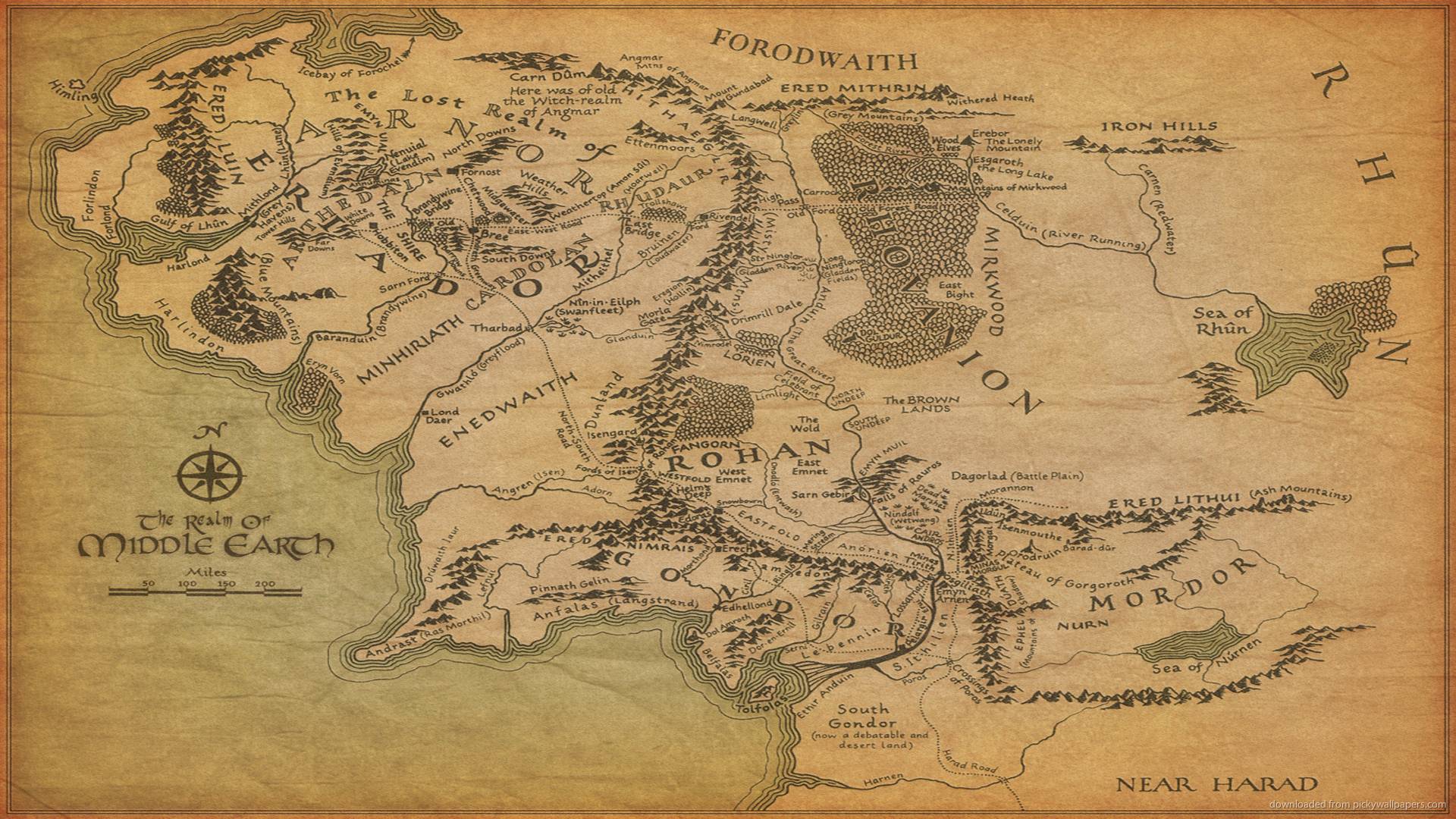
but, through the magic of the internet, we’ll hop over the Anduin and continue our journey along the roads of Middle-earth, this time to the worst possible place (unless you’re an orc)—

(Alan Lee)

Mordor.

To get there, we walk the old road which, in the days before Sauron’s previous invasion attempt, ran from Minas Anor (the “ Tower of the Sun”—now Minas Tirith, “Tower of Guard”),

(Ted Nasmith)

to Minas Ithil (the “Tower of the Moon”)—now Minas Morgul  (the “Tower of Black Sorcery”).

(another Ted Nasmith)

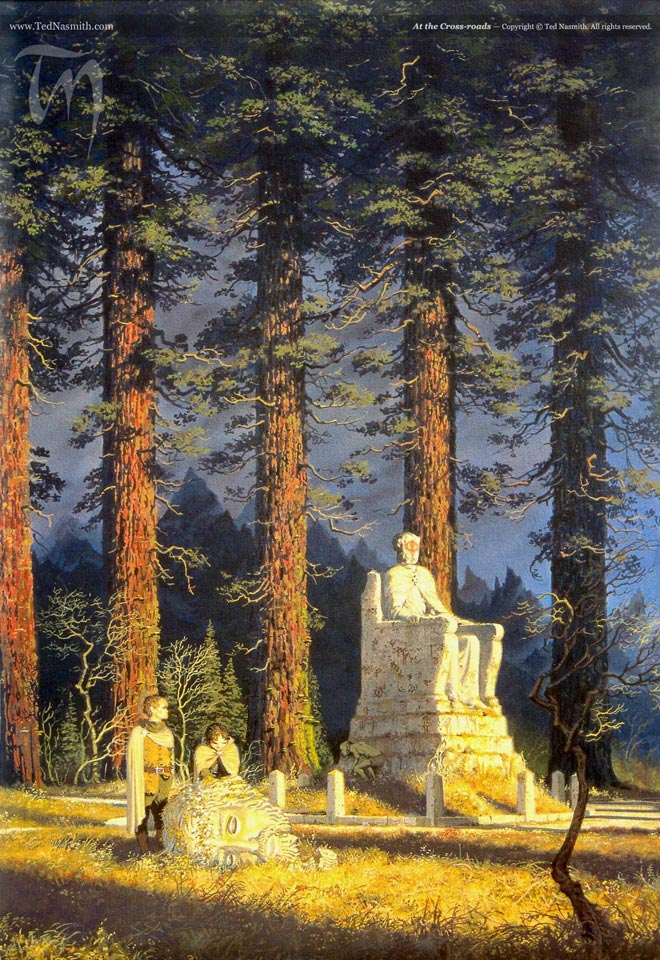
This will lead us eastwards to the crossing of the Ithilien north/south road, where there is a much- abused seated figure—

“The brief glow fell upon a huge sitting figure, still and solemn as the great stone kings of Argonath.  The years had gnawed it, and violent hands had maimed it.  Its head was gone, and in its place was set in mockery a round rough-hewn stone, rudely painted  by savage hands in the likeness of a grinning face with one large red eye in the midst of its forehead.  Upon its knees and mighty chair, and all about the pedestal, were idle scrawls mixed with the foul symbols that the maggot-folk of Mordor used.”  (The Two Towers, Book Four, Chapter 7, “Journey to the Cross-roads”)

(and one more Ted Nasmith.  Notice—except for the figure’s size, perhaps, which here wouldn’t be called “huge” nor its chair “mighty”—how carefully the artist has paid attention to the text—typical of Nasmith’s always fine work.)

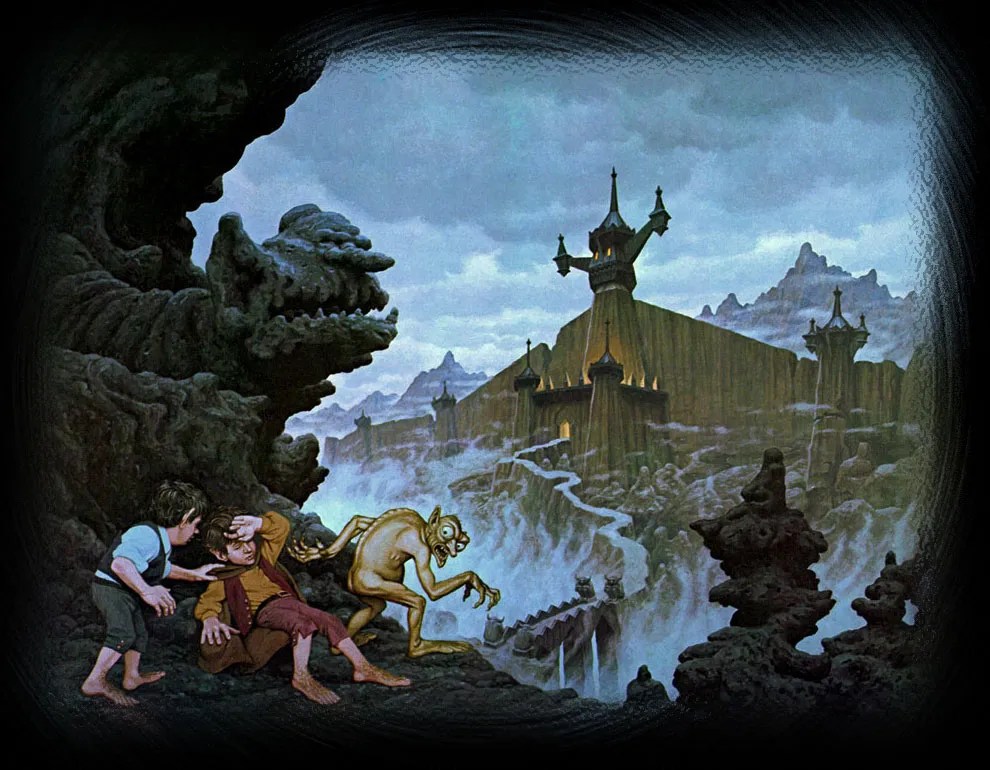
Frodo and Sam pause here, but we’ll keep moving eastwards on the road towards Minas Morgul.

(the Hildebrandts, with a very different view of it and of Gollum)

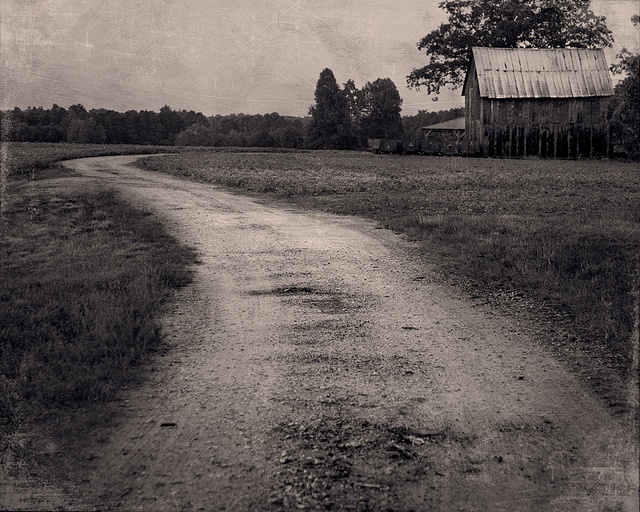
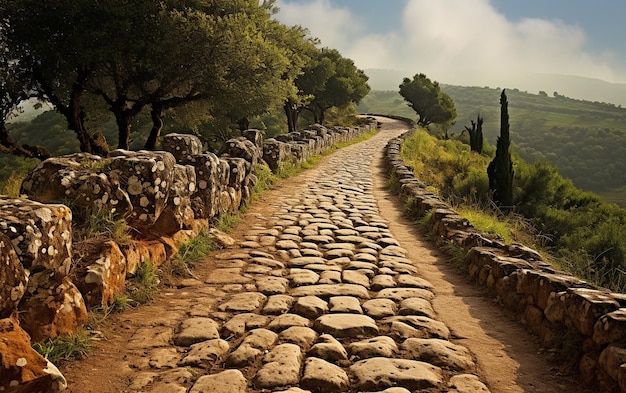
We don’t appear to have a description of this road, but, if you’ve read the previous postings on roads, you’ll know that I would like to imagine that it’s not just a worn dirt track,

but the sort of thing which the Romans built all over their empire,

but now grassgrown and abandoned, like the figure at the crossroads.

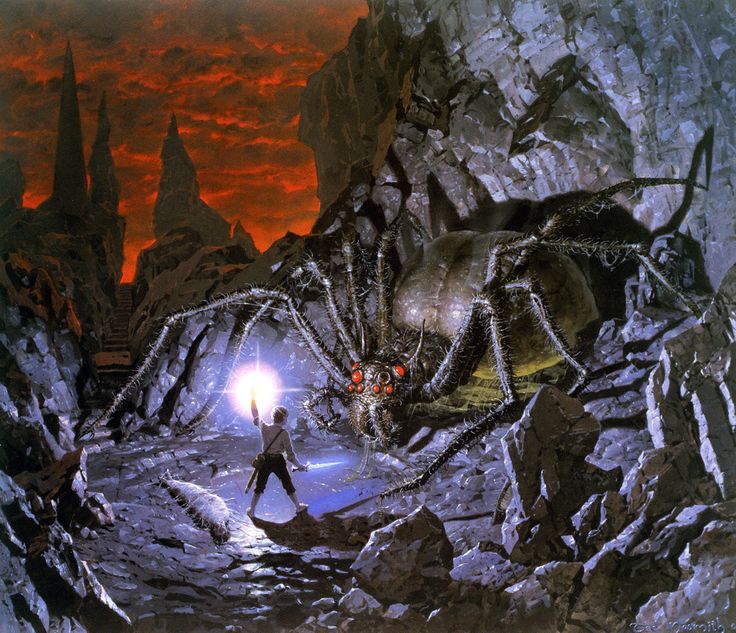
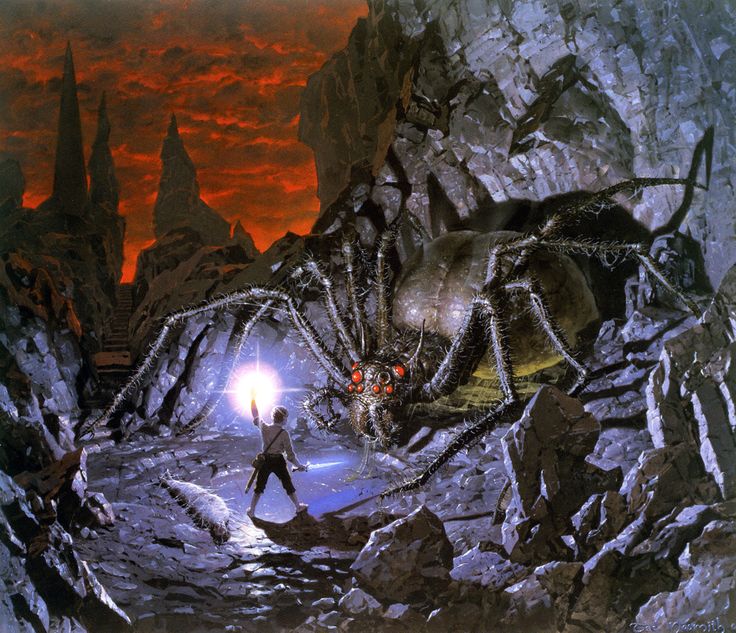
Frodo, Sam, and Gollum skirt Minas Morgul, climbing around it, and we’ll join them, although we’ll avoid the tunnel in which Shelob lives,

(and one more Ted Nasmith)

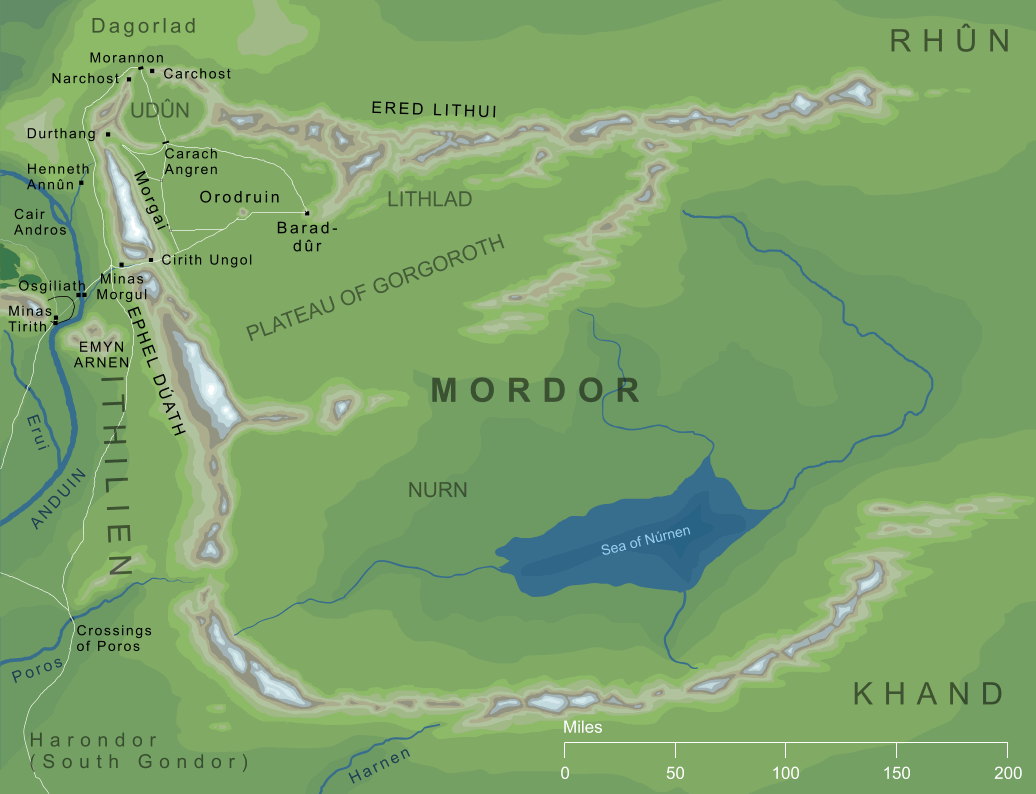
to come down into Mordor itself.

(Christopher Tolkien)

This is, to say the least, a very bleak place,

(in reality, this is Mt Haleakala National Park, on the island of Maui)

but it seems heavily populated with camps of orcs and Sauron’s allies.

“As far as their eyes could reach, along the skirts of the Morgai and away southward, there were camps, some of tents, some ordered like small towns.  One of the largest of these was right below them.  Barely a mile out into the plain it clustered like some huge nest of insects, with straight dreary streets of huts and long low drab buildings.”  (The Return of the King, Book Six, Chapter 2, “The Land of Shadow”)

(Alan Lee)

There are clearly roads, at least in the northern area—

(from the Encyclopedia of Arda)

and when Frodo and Sam disguise themselves as orcs,

(Denis Gordeev)

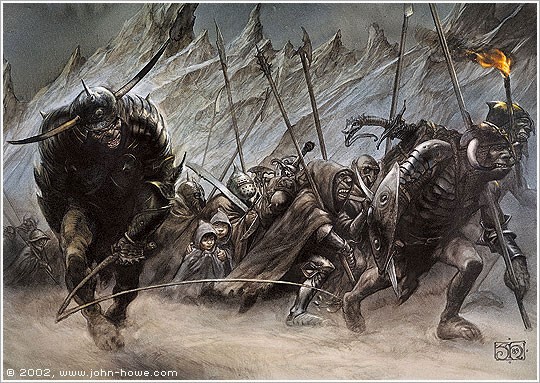
they make their way along a major one, only to be taken for potential deserters and driven into an orc marching column.

(Denis Gordeev)

Before they reach such a road, however,

“…they saw a beaten path that wound its way under the feet of the westward cliffs.  Had they known, they could have reached it quicker, for it was a track that left the main Morgul-road at the western bridge-end and went down by a long stair cut in the rock to the valley’s bottom.” (The Return of the King, Book Six, Chapter 2, “The Land of Shadow”)

We’ll follow them down this path and eventually reach a road:

“…at the point where it swung east towards the Isenmouthe  twenty miles away.  It was not a broad road, and it had no wall or parapet along the edge, and as it ran on the sheer drop from its brink became deeper and deeper.”  (The Return of the King, Book Six, Chapter 2, “The Land of Shadow”)

When Frodo and Sam are picked up and driven along in the column,

(John Howe)

we can now see that the column is headed for Isenmouthe and the entrance to the northernmost part of Mordor, Udun,

(from Karen Wynn Fonstad, The Atlas of Middle-Earth)

but the two manage to escape just before the entrance, dropping

“…over the further edge of the road.  It had a high kerb by which troop-leaders could guide themselves in black night or fog, and it was banked up some feet above the level of the open land.”  (The Return of the King, Book Six, Chapter 2, “The Land of  Shadow”)

(perhaps something like this on the right?)

Frodo and Sam now try cutting across open country, which, although full of places to hide, is hard going—

“As the light grew a little [Sam] saw to his surprise that what from a distance had seemed wide and featureless flats were in fact all broken and tumbled. “  (The Return of the King, Book Six, Chapter 3, “Mount Doom”)

The going, however, is simply too rough for them in their current condition, and they return to the road, as will we, approaching Orodruin (Mt. Doom), where, for the first time since finding a spring on the eastern slope of the Mountains of Shadow, they find water—

“All long ago would have been spent, if they had not dared to follow the orc-road.  For at long intervals on that highway cisterns had been built for the use of troops sent in haste through the waterless regions. 

In one Sam found some water left, stale, muddied by the orcs, but still sufficient for their desperate case.”   (The Return of King, Book Six, Chapter 3, “Mount Doom”)

Struggling to the foot of Mt. Doom (Orodruin), Sam discovers a path—our last road in this series of postings—which is actually part of Sauron’s road from the Barad-dur to the volcano.

(from the Encyclopedia of Arda)

“…for amid the rugged humps and shoulders above him he saw plainly a path or road.  It climbed like a rising girdle from the west and wound snakelike about the Mountain, until before it went round out of view it reached the foot of the cone on the eastern side.”  (The Return of King, Book Six, Chapter 3, “Mount Doom”)

Finally coming to the path, they find

“…that it was broad, paved with broken rubble and beaten ash” The Return of King, Book Six, Chapter 3, “Mount Doom”)

But, before the eagles come to rescue Frodo and Sam, we’ll take our own eagle back to the door where our roads began.

(the Hildebrandts)

As always, thanks for reading.

Stay well,

Remember how perilous it may be to step out your front door,

And remember, as well, that there’s always

MTCIDC

O

PS

For a bit more on the roads of Middle-earth, see:  https://thainsbook.minastirith.cz/roads.html

When One Door Closes.4

30 Wednesday Nov 2016

Posted by Ollamh in Imaginary History, J.R.R. Tolkien, Literary History, Maps, Uncategorized

≈ Leave a comment

Tags

Alfred Lord Tennyson, Cirith Ungol, doors, Gilbert and Sullivan, Gondor, Grond, Hobbit door, James Fennimore Cooper, Minas Morgul, Minas Tirith, Morannon, Mordor, N.C. Wyeth, Nazgul, Orodruin, Princess Ida, Shelob's Lair, The Last of the Mohicans, The Lord of the Rings, The Princess, The Siege of Gondor, Tolkien

Welcome, as always, dear readers. In this posting, we’ll complete our survey of doors and entryways and what happens at them in The Lord of the Rings.

We began this series a little while ago when we got to thinking about Bilbo’s remark to Frodo that: “It’s a dangerous business, Frodo, going out your door.”

Bilbo had learned this the hard way when Gandalf had come to his door and he had embarked upon an adventure he, originally, had no desire to be part of.

gandalfvisitsbilbo

In three postings, we’ve followed the story through doors and entryways from that moment all the way to the moment when Gandalf blocks the Lord of the Nazgul from entering Minas Tirith through its ruined main gate.

mcbridegandalflordofnazgul.gif

In the process, we have come to see that doors and entryways seem to come in two forms: first, there are doors which lead to safety; second, there are doors which lead to danger. We’ve added other elements, natural entryways, like fords and bridges, and the fact that many of the entryways have challenges and challengers barring the way.

In a moment of cheerful intellectual cruelty, we ended the last posting at that crucial moment in “The Siege of Gondor”, in which Grond, the battering ram of the armies of Mordor, has, with the magical aid of the Lord of the Nazgul, broken down the gate and that Lord is about to enter the city, when he meets Gandalf as the challenger:

“ ‘You cannot enter here,’ said Gandalf, and the huge shadow halted. ‘Go back to the abyss prepared for you! Go back! Fall into the nothingness that awaits you and your Master. Go!’ ”

And, just at that moment, “Great horns of the North wildly blowing. Rohan had come at last.”

rohirrim.jpg

[We wondered, by the way, if that “Great horns of the North wildly blowing” was an accidental or deliberate allusion to a lyric from Alfred Lord Tennyson’s

tennysonyoung.jpg

poetic criticism of the idea of women’s education, The Princess (1847),

prncss.jpg

in which we find the line “The horns of Elfland faintly blowing”—here’s the whole poem:

from The Princess: The Splendour Falls on Castle Walls
By Alfred, Lord Tennyson
The splendour falls on castle walls
                And snowy summits old in story:
         The long light shakes across the lakes,
                And the wild cataract leaps in glory.
Blow, bugle, blow, set the wild echoes flying,
Blow, bugle; answer, echoes, dying, dying, dying.
         O hark, O hear! how thin and clear,
                And thinner, clearer, farther going!
         O sweet and far from cliff and scar
                The horns of Elfland faintly blowing!
Blow, let us hear the purple glens replying:
Blow, bugle; answer, echoes, dying, dying, dying.
         O love, they die in yon rich sky,
                They faint on hill or field or river:
         Our echoes roll from soul to soul,
                And grow for ever and for ever.
Blow, bugle, blow, set the wild echoes flying,
And answer, echoes, answer, dying, dying, dying.


This then formed the basis of an 1870 play by W.S. Gilbert, which he converted, with his collaborator, Arthur Sullivan, into an operetta, in 1884.]


Gilbert and Sullivan Cartoon.jpg

Princess-Ida-1884.jpg

For the Aragorn and company half of the story, we see the arrival of the army of Gondor and its allies at the Morannon as the last door.

morannon.1.gif

Here, there are, in fact, two challengers/challenges. First,

“When all was ordered, the Captains rode forth towards the Black Gate with a great guard of horsemen and the banner and heralds and trumpeters…They came within cry of the Morannon, and unfurled the banner, and blew upon their trumpets; and the heralds stood out and sent their voices up over the battlement of Mordor.” (The Return of the King, Book 5, Chapter 10, “The Black Gate Opens”)

In return,

“There came a long rolling of great drums like thunder in the mountains, and then a braying of horns that shook the very stones and stunned men’s ears. And thereupon the door of the Black Gate was thrown open with a great clang, and out of it there came an embassy from the Dark Tower.”

In both cases, it goes without saying that this is a door to danger, the difference being that those from Gondor want those within to come out so that, by defeating them (though they have little hope of this), those from Gondor can enter, while those within the gate want to prevent their entry (except, perhaps, as prisoners).

As we turn to the other half of the narrative, we begin at the same gate, where Gollum has brought Frodo and Sam.

alanleemorannon.jpg

Here, there is no easily visible challenger, just the forbidding nature of the gate, but it is still not an entryway to safety, as, on the other side is an inhospitable landscape, populated by Sauron’s vast armies, constantly on the move, as we see in later chapters. As well, from those later chapters, we gain the sense that Frodo doesn’t believe he’s going to return from Mordor anyway.

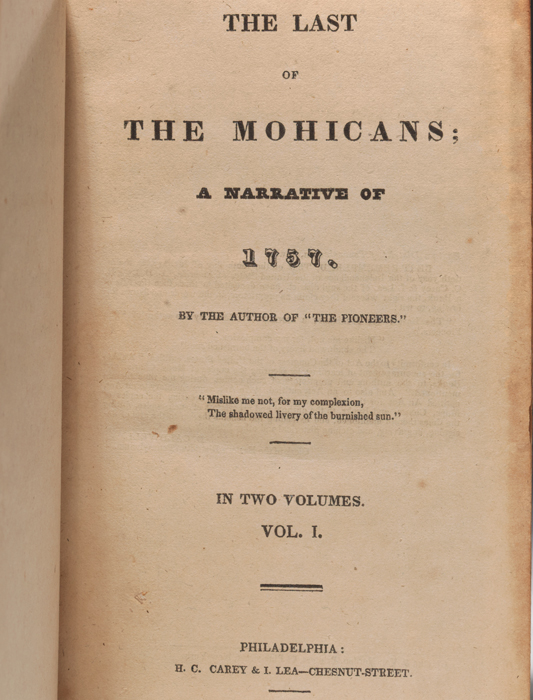
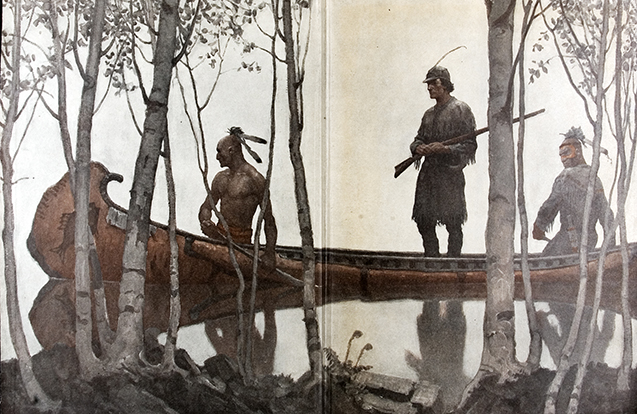
Seeing no way to enter, Frodo pushes Gollum to lead them south and, with a diversion to Faramir’s base behind a waterfall (which, to us, is reminiscent of a similar hide-out in James Fennimore Cooper’s The Last of the Mohicans (1826)

mohicansfirstedition.jpg

—and how can we resist mentioning that, in 1919, N.C. Wyeth illustrated an edition?)

05_lastofthemohicans_wyeth_glenfalls.jpg

wyethlast.jpg

they arrive at the southern entryway to Mordor, the pass with Minas Morgul at its western end and Cirith Ungol at its eastern.

Morgul2.jpg

WATCHERS.jpg

The challengers of Minas Morgul are the Lord of the Nazgul and a vast army, on their way to attack Minas Tirith, but these are skirted, as Gollum guides the two hobbits around the site and up on a perilous climb—and into Torech Ungol, Shelob’s Lair. Safety? Gollum wants the hobbits to think so. Danger? With Shelob as a challenger, what else?

shelob.jpg

Even as Sam drives Shelob off, however, he loses Frodo, paralyzed and cocooned, and is faced with an inner door closed by the orcs as they withdraw. Climbing over it, he moves forward, cloaked by the ring, to look out towards Orodruin and the Tower of Cirith Ungol.

cirith-ungol2

And, with this, we have finished our survey.

Unless, of course, we consider two more events.

First, there is what happens at Mount Doom, where Gollum is the challenger, and the door, such as it is, leads to safety for Middle-earth, but not for Sam and Frodo.

gollum__s_dance_by_01gus01-d4rmt18.jpg

And, finally, at the edge of the Shire, in “The Scouring of the Shire”, where the returning hobbits meet with the followers of “Sharkey” at the bridge. Those followers, brain-washed by fear of “The Chief” and his “big man” followers, attempt to deny what should be a door to safety to Frodo, Merry, and Pippin, as the three had expected, but which leads, in fact, to conflict and open violence before their return home is safely accomplished.

scouringoftheshire.jpg

With that, we complete the pattern and here is our chart:


Entryway Source Challenger Challenged Outcome
Bilbo’s door The Hobbit Bilbo Dwarves Bilbo is tricked into hospitality
Beorn’s house The Hobbit Beorn Gandalf Beorn tricked into hospitality
Goblin cave The Hobbit Goblins Bilbo Escapes by use of the Ring
Mirkwood The Hobbit Elves Dwarves/Bilbo Bilbo rescues dwarves with Ring and barrels
Lonely Mountain (Back door) The Hobbit Smaug Dwarves/Bilbo Understanding the inscription, Dwarves open the door
Lonely Mountain (Front door) The Hobbit Dwarves Men, Elves, Goblins Battle of the Five Armies—eventual settlement
Bilbo’s door The Hobbit Hobbits Bilbo Bilbo’s things are up for auctions—Bilbo gets most things back
Ford of Bruinen The Lord of the Rings Wraiths Frodo/Elves After Frodo’s challenge, elf magic overwhelms wraiths
Moria (west gate) The Lord of the Rings Elves of Hollin Fellowship Gandalf discovers password—the group enters
Lothlorien (western side) The Lord of the Rings Elves Fellowship Challenged by elves, but allowed to enter
Edoras The Lord of the Rings Rohirrim Gandalf et al. Challenged by gate guards, but allowed to enter
Meduseld The Lord of the Rings Hama Gandalf et al. Challenged, but allowed to enter
Helms Deep The Lord of the Rings Aragorn Orcs/Wildings Aragorn warns them of their danger
Isengard The Lord of the Rings Merry/Pippin Gandalf et al. Greeted and offered food, drink, and smoke
Paths of the Dead The Lord of the Rings Oath-breakers Aragorn at al. Allowed to enter, but followed—leave safely
Morannon The Lord of the Rings Sauron King Elessar et al. Sauron’s army appears for battle
Morannon The Lord of the Rings Sauron Frodo/Sam/Gollum No way of entry—the three head south
Minas Morgul The Lord of the Rings Lord of Nazgul Frodo/Sam/Gollum Entry blocked by Lord’s Army
Torech Ungol The Lord of the Rings Shelob Frodo/Sam Gollum escapes, Frodo paralyzed by Shelob
Cirith Ungol The Lord of the Rings Orcs Sam With Ring as aid, Sam enters
Mt. Doom The Lord of the Rings Gollum Frodo Gollum gains Ring, but perishes in fire
Shire bridge The Lord of the Rings Hobbits Frodo et al. Hobbits climb over gate, guards run


Because this material becomes increasingly complex, there is always the possibility that, as thorough as we try to be and as inclusive, we’ve missed something. If so, we’d be glad to hear from our readers!

Thanks, as always, for reading!

MTCIDC

CD


The Doubtful Sea Series Facebook Page

The Doubtful Sea Series Facebook Page

  • Ollamh

Categories

  • Artists and Illustrators
  • Economics in Middle-earth
  • Fairy Tales and Myths
  • Films and Music
  • Games
  • Heroes
  • Imaginary History
  • J.R.R. Tolkien
  • Language
  • Literary History
  • Maps
  • Medieval Russia
  • Military History
  • Military History of Middle-earth
  • Narnia
  • Narrative Methods
  • Poetry
  • Research
  • Star Wars
  • Terra Australis
  • The Rohirrim
  • Theatre and Performance
  • Tolkien
  • Uncategorized
  • Villains
  • Writing as Collaborators
Follow doubtfulsea on WordPress.com

Across the Doubtful Sea

Recent Postings

  • Towering.3 July 8, 2026
  • Towering.2 July 1, 2026
  • Gundulf June 24, 2026
  • Homeric? June 17, 2026
  • Tennis, Anyone? June 10, 2026
  • 1002? June 3, 2026
  • Making Money May 27, 2026
  • Blood Money May 20, 2026
  • Saruman’s Sigh May 13, 2026

Blog Statistics

  • 116,486 Views

Posting Archive

  • July 2026 (2)
  • June 2026 (4)
  • May 2026 (4)
  • April 2026 (5)
  • March 2026 (4)
  • February 2026 (4)
  • January 2026 (4)
  • December 2025 (5)
  • November 2025 (4)
  • October 2025 (5)
  • September 2025 (4)
  • August 2025 (4)
  • July 2025 (5)
  • June 2025 (4)
  • May 2025 (4)
  • April 2025 (5)
  • March 2025 (4)
  • February 2025 (4)
  • January 2025 (5)
  • December 2024 (4)
  • November 2024 (4)
  • October 2024 (5)
  • September 2024 (4)
  • August 2024 (4)
  • July 2024 (5)
  • June 2024 (4)
  • May 2024 (5)
  • April 2024 (4)
  • March 2024 (4)
  • February 2024 (4)
  • January 2024 (5)
  • December 2023 (4)
  • November 2023 (5)
  • October 2023 (4)
  • September 2023 (4)
  • August 2023 (5)
  • July 2023 (4)
  • June 2023 (4)
  • May 2023 (5)
  • April 2023 (4)
  • March 2023 (5)
  • February 2023 (4)
  • January 2023 (4)
  • December 2022 (4)
  • November 2022 (5)
  • October 2022 (4)
  • September 2022 (4)
  • August 2022 (5)
  • July 2022 (4)
  • June 2022 (5)
  • May 2022 (4)
  • April 2022 (4)
  • March 2022 (5)
  • February 2022 (4)
  • January 2022 (4)
  • December 2021 (5)
  • November 2021 (4)
  • October 2021 (4)
  • September 2021 (5)
  • August 2021 (4)
  • July 2021 (4)
  • June 2021 (5)
  • May 2021 (4)
  • April 2021 (4)
  • March 2021 (5)
  • February 2021 (4)
  • January 2021 (4)
  • December 2020 (5)
  • November 2020 (4)
  • October 2020 (4)
  • September 2020 (5)
  • August 2020 (4)
  • July 2020 (5)
  • June 2020 (4)
  • May 2020 (4)
  • April 2020 (5)
  • March 2020 (4)
  • February 2020 (4)
  • January 2020 (6)
  • December 2019 (4)
  • November 2019 (4)
  • October 2019 (5)
  • September 2019 (4)
  • August 2019 (4)
  • July 2019 (5)
  • June 2019 (4)
  • May 2019 (5)
  • April 2019 (4)
  • March 2019 (4)
  • February 2019 (4)
  • January 2019 (5)
  • December 2018 (4)
  • November 2018 (4)
  • October 2018 (5)
  • September 2018 (4)
  • August 2018 (5)
  • July 2018 (4)
  • June 2018 (4)
  • May 2018 (5)
  • April 2018 (4)
  • March 2018 (4)
  • February 2018 (4)
  • January 2018 (5)
  • December 2017 (4)
  • November 2017 (4)
  • October 2017 (4)
  • September 2017 (4)
  • August 2017 (5)
  • July 2017 (4)
  • June 2017 (4)
  • May 2017 (5)
  • April 2017 (4)
  • March 2017 (5)
  • February 2017 (4)
  • January 2017 (4)
  • December 2016 (4)
  • November 2016 (5)
  • October 2016 (6)
  • September 2016 (5)
  • August 2016 (5)
  • July 2016 (5)
  • June 2016 (5)
  • May 2016 (4)
  • April 2016 (4)
  • March 2016 (5)
  • February 2016 (4)
  • January 2016 (4)
  • December 2015 (5)
  • November 2015 (5)
  • October 2015 (4)
  • September 2015 (5)
  • August 2015 (4)
  • July 2015 (5)
  • June 2015 (5)
  • May 2015 (4)
  • April 2015 (3)
  • March 2015 (4)
  • February 2015 (4)
  • January 2015 (4)
  • December 2014 (5)
  • November 2014 (4)
  • October 2014 (6)
  • September 2014 (1)

Blog at WordPress.com.

  • Subscribe Subscribed
    • doubtfulsea
    • Join 75 other subscribers
    • Already have a WordPress.com account? Log in now.
    • doubtfulsea
    • Subscribe Subscribed
    • Sign up
    • Log in
    • Report this content
    • View site in Reader
    • Manage subscriptions
    • Collapse this bar

Loading Comments...