Tags
Aucassin et Nicolette, Barad-Dur, chantefable, Childe Roland, dark-tower, English Fairy Tales, Fantasy, Illustrations of Northern Antiquities, King Lear, lotr, Men and Women, Minas Morgul, Robert Browning, Shakespeare, the Dark Tower, The Lord of the Rings, the Morannon, Tolkien, towers
As ever, welcome, dear readers.
In our last, we began a tour and catalogue of towers as we see them in The Lord of the Rings.
We set off from the Elvish towers in the far west of Middle-earth.

(Ted Nasmith)
From there, we traveled east and south to Amon Sul, aka Weathertop.
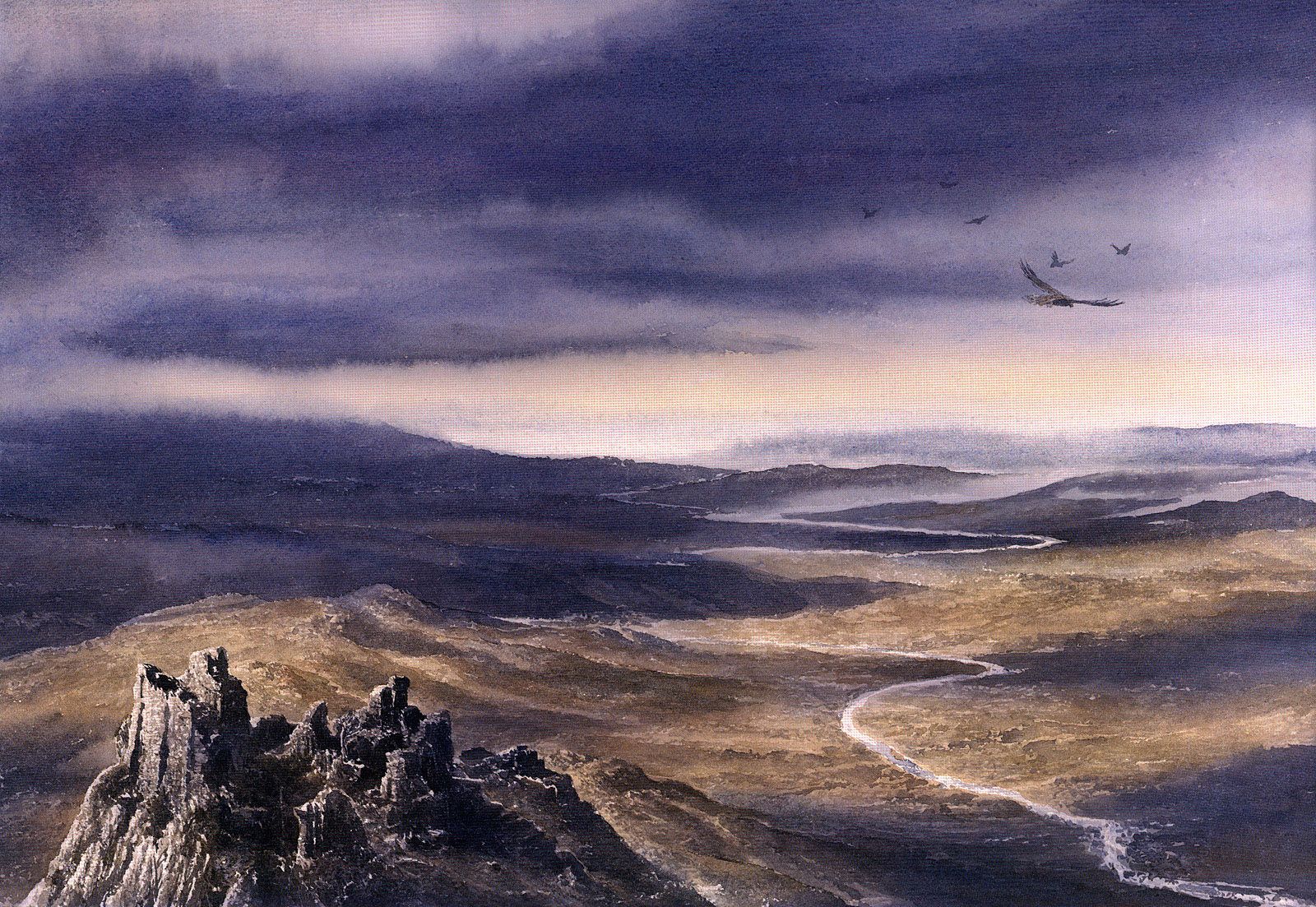
(Alan Lee)
Unlike the Fellowship, we then went all the way down along the western side of the Misty Mountains
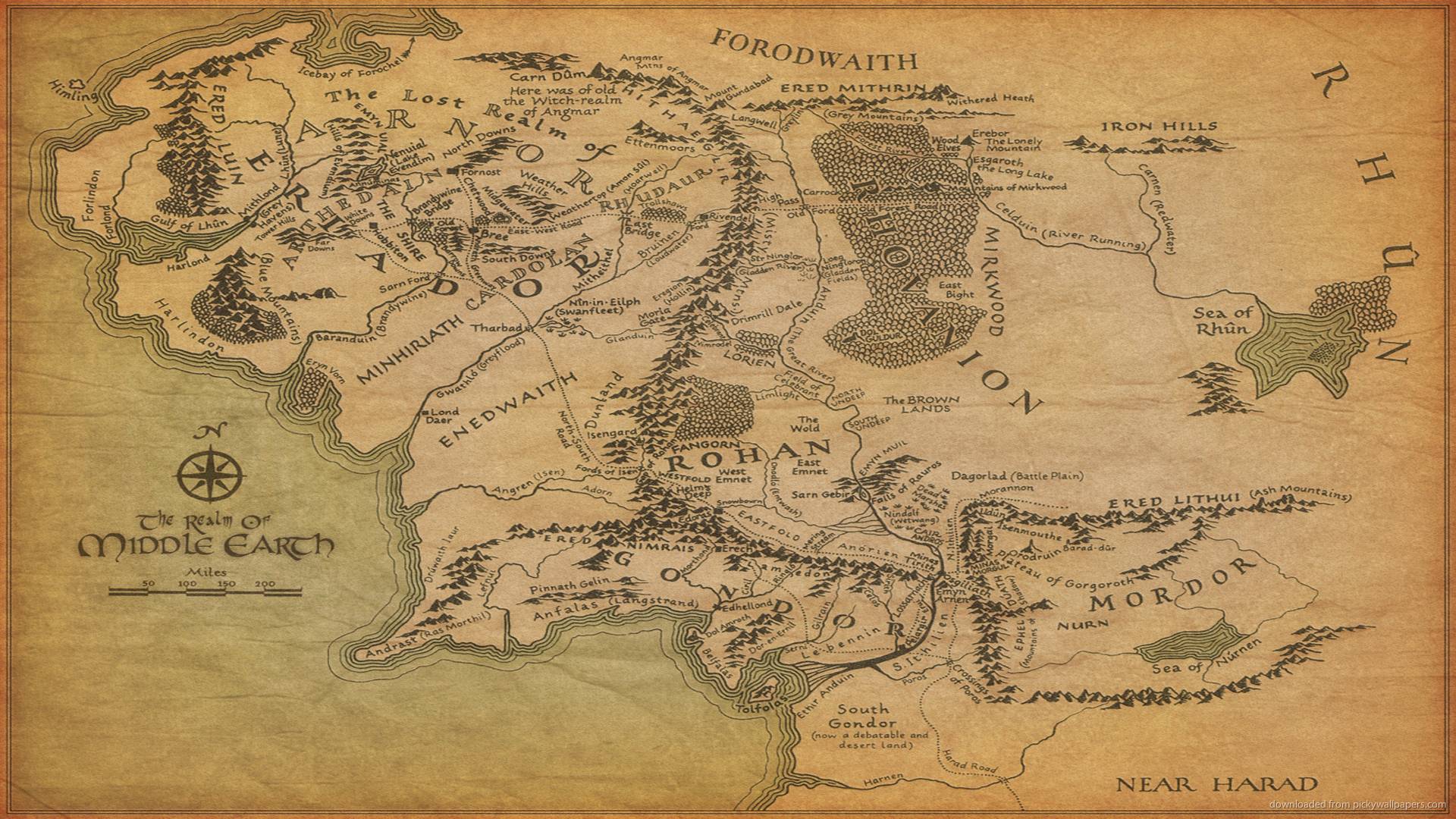
until we reached Isengard and the tower of Orthanc.

Leaving Isengard, we journeyed farther south yet to Helm’s Deep and its tower
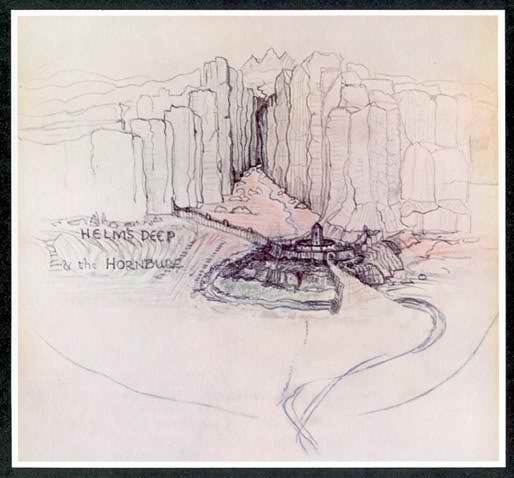
(JRRT)
and then farther yet to Minas Tirith and the tower of Echthelion
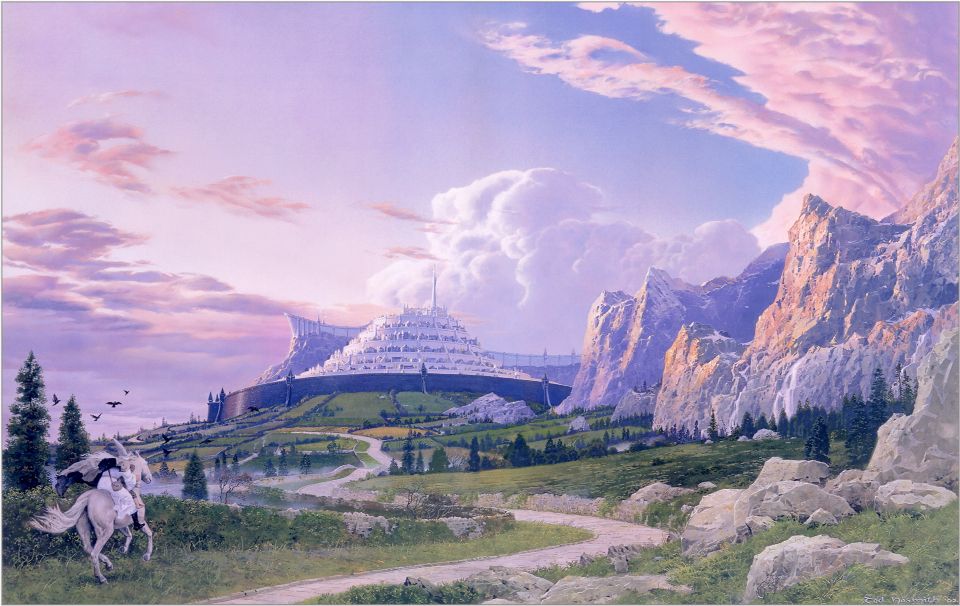
(Ted Nasmith)
before turning eastwards, crossing the Anduin, to finish part 1 at Minas Morgul—formerly Minas Ithil.

(Ted Nasmith)
This marks the beginning of Frodo and Sam’s final leg, into Mordor, where we paused for the moment—but now we pick up the journey again and step into Mordor itself—but, as we’ll finish with Sauron’s hangout, let’s first grab an eagle
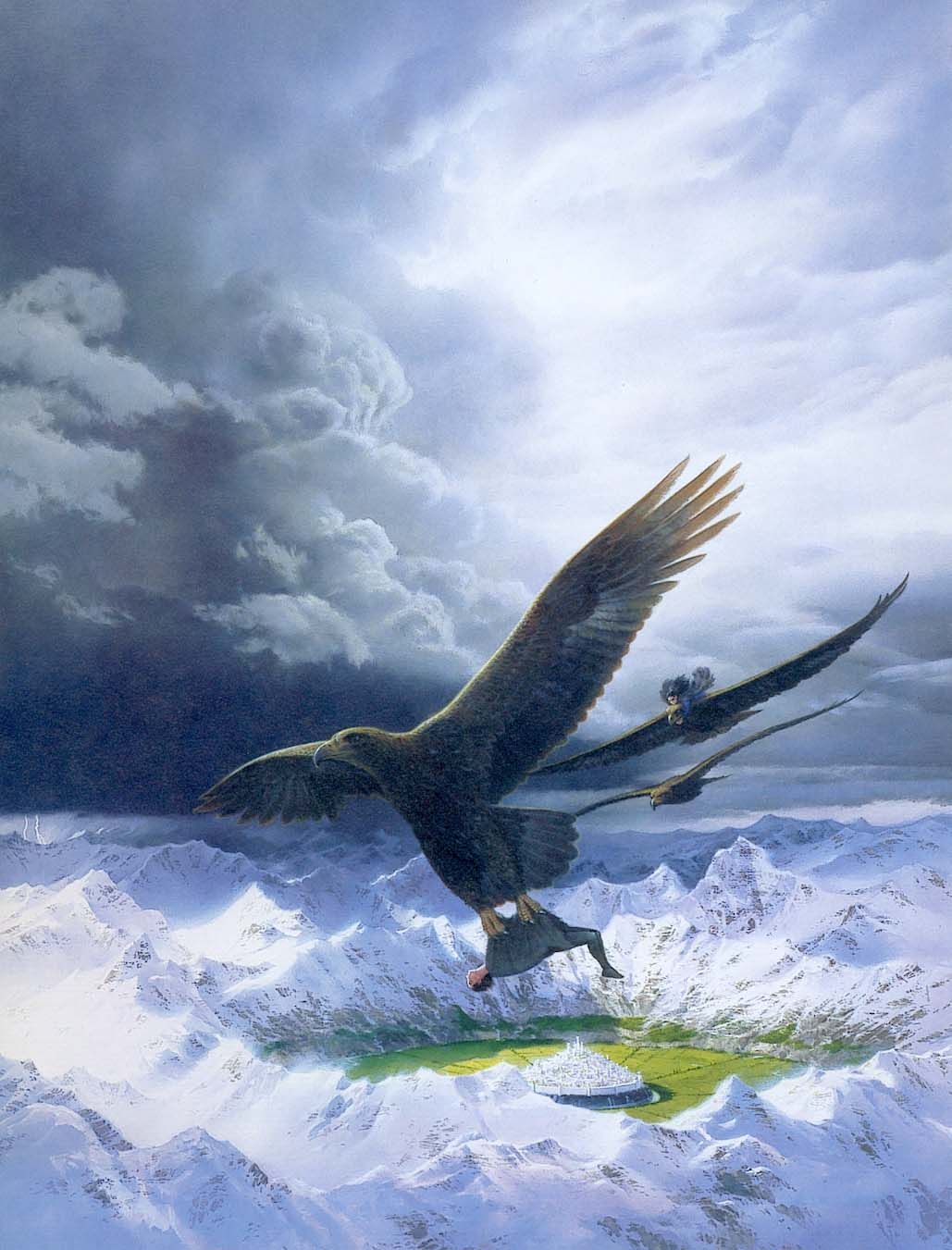
(Ted Nasmith—and I want to point out that this wonderful artist has illustrated things from Tolkien beyond The Hobbit and The Lord of the Rings—this image, for instance is an illustration from the history of the Elvish city of Gondolin. For more on Gondolin, see: https://en.wikipedia.org/wiki/Gondolin )
and fly north to the other entrance to Mordor, at the Morannon—the Black Gate.
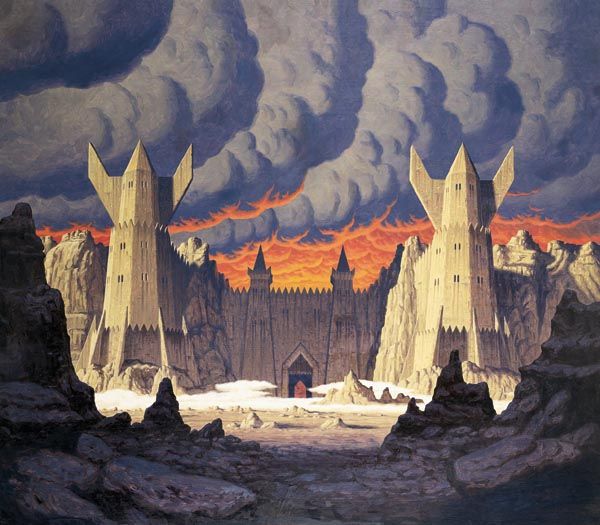
(an early illustration by the Hildebrandts)
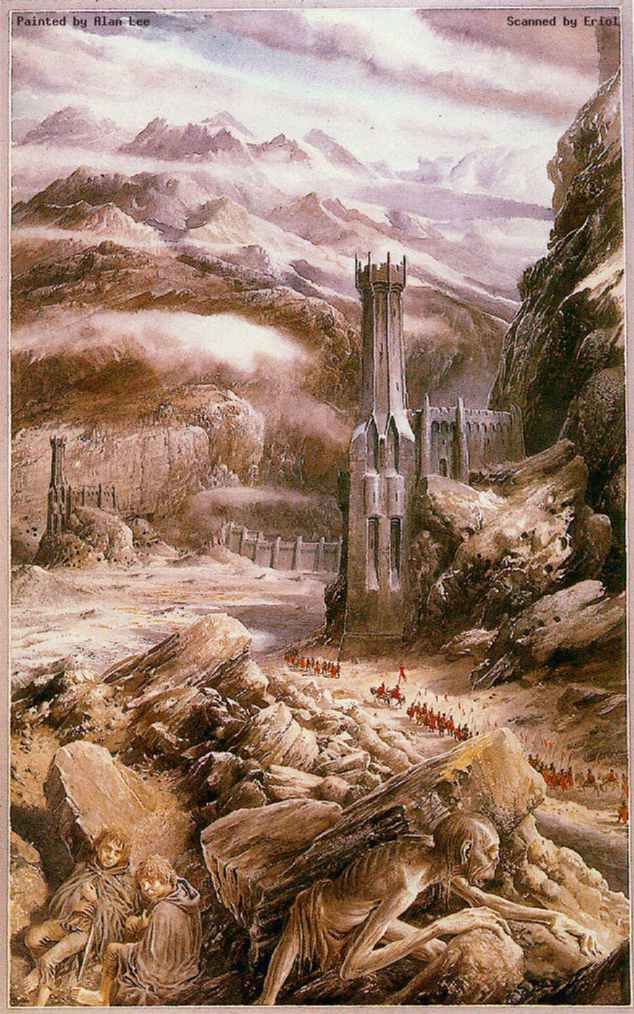
(a later illustration by Alan Lee—I thought the contrast in conceptions of the Gate was interesting. The Hildebrandts were pioneers in Tolkien illustration and certain of their images—like Gandalf’s original appearance to Bilbo—have always been favorites.)
Our narrator gives us a description—and history–of the place:
“But as the ranges [of Ephel Duath and Ered Lithui] approached one another, being but parts of one great wall about the mournful plains of Lithlad and of Gorgoroth, and the bitter inland sea of Nurnen amidmost, they swung out long arms northward; and between these arms there was a deep defile. This was Cirith Gorgor, the Haunted Pass, the entrance to the land of the Enemy. High cliffs lowered upon either side, and thrust forward from its mouth were two sheer hills, black-boned and bare. Upon them stood the Teeth of Mordor, two towers strong and tall. In days long past they were built by the Men of Gondor in their pride and power, after the overthrow of Sauron and his flight, lest he should seek to return to his old realm. But the strength of Gondor failed, and men slept, and for long years the towers stood empty. Then Sauron returned. Now the watch-towers, which had fallen into decay, were repaired and filled with arms, and garrisoned with ceaseless vigilance. Stony-faced they were, with dark window-holes staring north and east and west, and each window was filled with sleepless eyes.
Across the mouth of the pass, from cliff to cliff, the Dark Lord had built a rampart of stone. In it there was a single gate of iron, and upon its battlements sentinels paced unceasingly. Beneath the hills on either side the rock was bored into a hundred caves and maggot-holes…” (The Two Towers, Book Four, Chapter 3, “The Black Gate is closed”)
As always, we see in The Lord of the Rings a Middle-earth which has a history which stretches back far from the present moment. Sauron had been defeated by the Last Alliance in SA 3441. While traveling with Frodo and Sam, we set off in TA 3018—over 3000 (!) years later. (Frodo is astonished to hear from Elrond an eye-witness account of that event—see The Fellowship of the Ring, Book Two, Chapter 2, “The Council of Elrond”) Thus, the two original towers—ironically constructed to keep Sauron out—must have been built somewhere at the end of the Second Age or at the beginning of the Third, and the wall between constructed after c.TA 2942, when Sauron had been driven by the White Council from Dol Goldur,
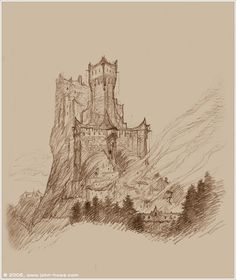
(John Howe—if we had more information about this place, I might have included it in our tour, but it appears to be more mentioned than explained in detail.)
and returned to Mordor.
And now we come to the end of our tower tour at the most fearsome of those towers: the Barad-dur.
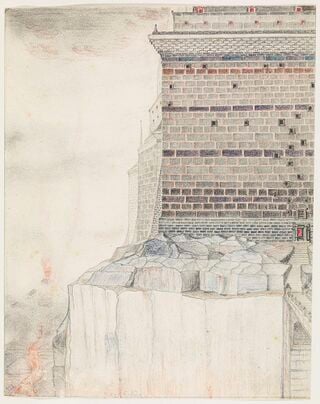
(JRRT—a shame that this is only a fragment)
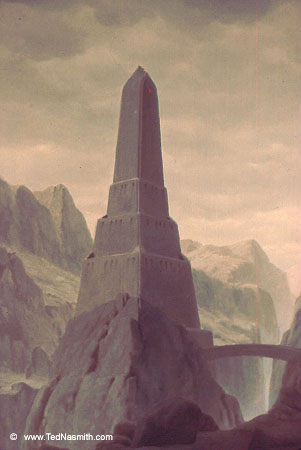
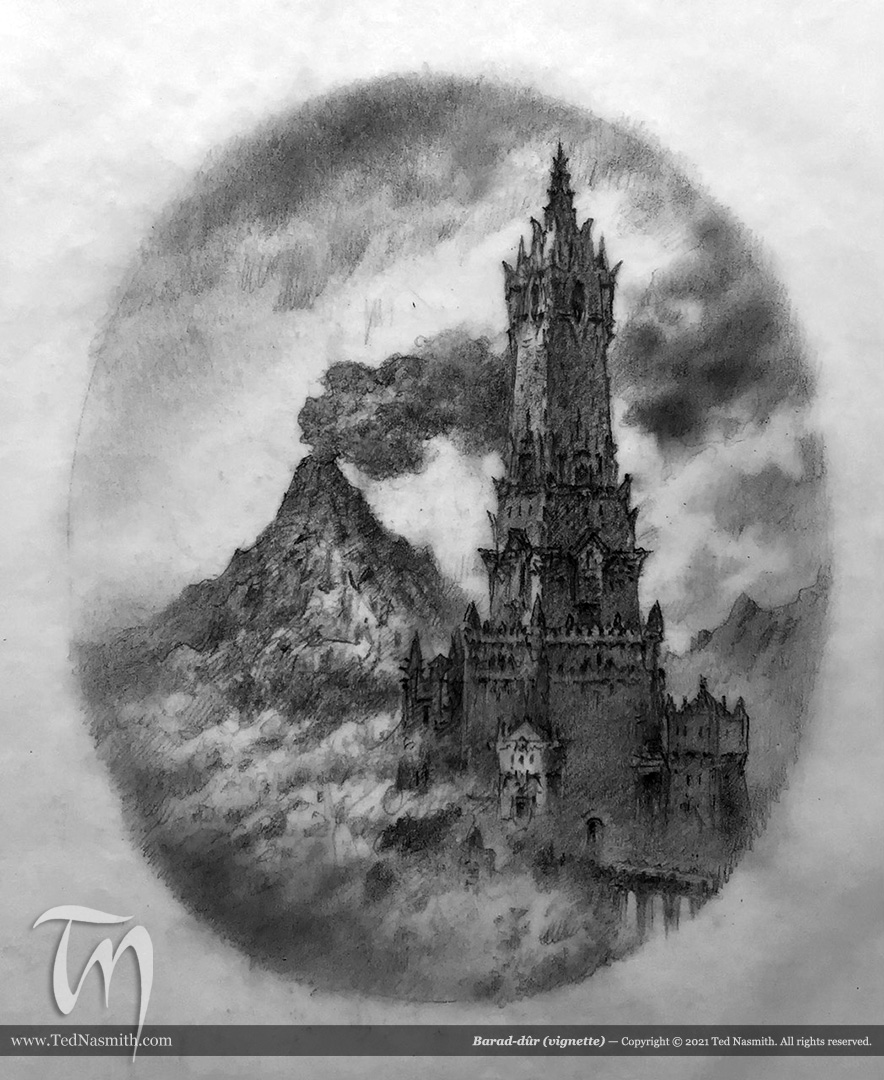
(both by Ted Nasmith—the first strikes me as more menacing in its monumentality, the second, more elaborate and baroque, suggesting a Sauron with a taste for the ornamental, rather than simply the grimly practical.)
Frodo first sees it at Amon Hen,
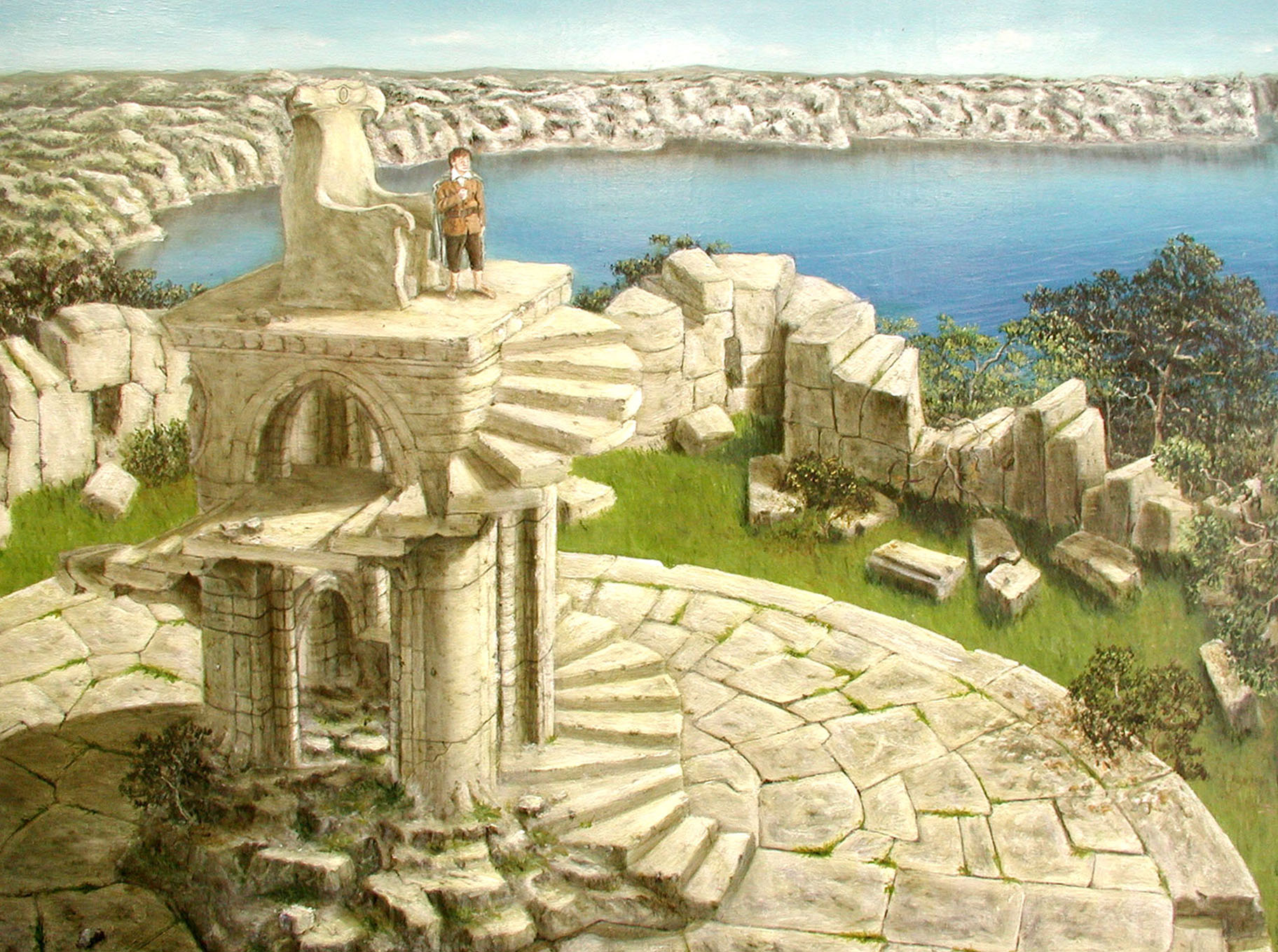
(Scott Peery—for more images see: https://tolkiengateway.net/wiki/Category:Images_by_Scott_Peery )
when he puts on the Ring and first Minas Tirith appears, but then—
“But against Minas Tirith was set another fortress, greater and more strong. Thither, eastward, unwilling his eyes were drawn…Then at last his gaze was held: wall upon wall, battlement upon battlement, black, immeasurably strong, mountain of iron, gate of steel, tower of adamant, he saw it: Barad-dur, Fortress of Sauron.” (The Fellowship of the Ring, Book Two, Chapter 10, “The Breaking of the Fellowship”)
Sauron had begun the construction of this menacing place in SA 1000, completing it 600 years KinAlliance, returns to rebuild it in TA 2951 (Appendix B, “The Third Age”), its final destruction coming with the destruction of the Ring in TA 3019.
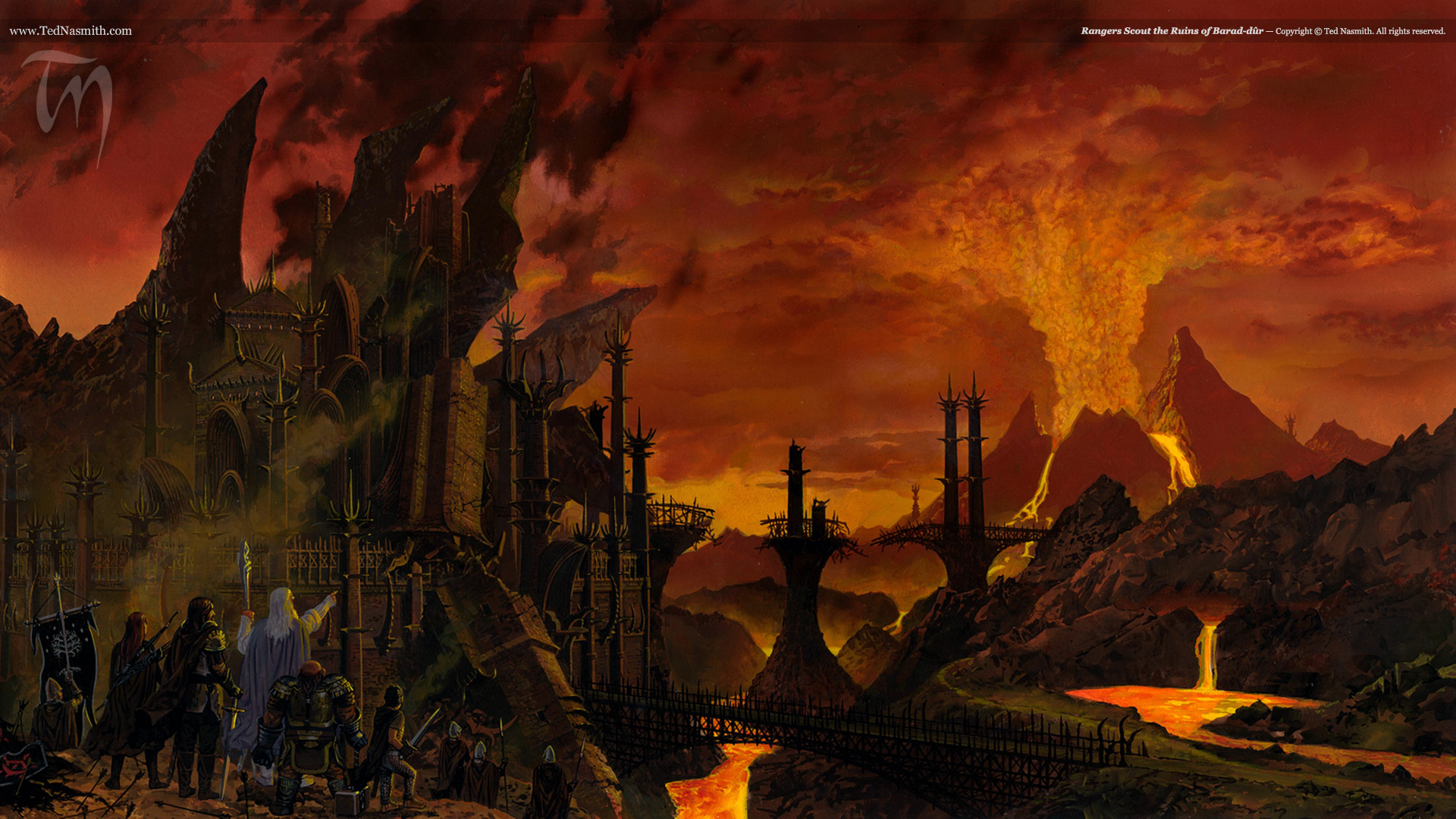
(Ted Nasmith—with the very interesting label “Rangers scout the ruins of Barad-dur”)
As we know, “Barad-dur” means “Dark Tower” and that name made me wonder about where it might have come from, apart from JRRT’s amazingly fertile imagination.
One possibility could be a poem by Robert Browning (1812-1889), entitled “Childe Roland to the Dark Tower Came”, which is in his 1855 collection Men and Women.

It’s a rather creepy poem about a knight on an unknown mission—except that it seems to end at that Dark Tower. You can read it here: https://www.poetryfoundation.org/poems/1597010/childe-roland-to-the-dark-tower-came
The only reference in Letters is to another Browning poem, “The Pied Piper of Hamelin”, which Tolkien said he loathed, but the medieval setting and the popularity of Browning in the later 19th century might suggest that Tolkien had read it—with perhaps less distaste than he did “The Pied Piper”—but the Browning poem is actually his recreation of what might have been a much earlier ballad, only a fragment of which appears to survive, in Shakespeare’s King Lear, where, at the end of Act 3, Scene 4, a major character, Edgar, pretending to be “Poor Tom”, a madman, recites:
“Childe Rowland to the darke Tower came,
His word was still, fie, foh, and fumme,
I smell the blood of a Brittish man.”
(This is from the “First Folio” of 1623—I always prefer using early versions of Shakespeare’s texts as their spelling echoes earlier English pronunciation—so-called “Shakespearean”, which you can hear here: https://www.youtube.com/watch?v=y2QYGEwM1Sk You can read the whole play in this older spelling here: https://internetshakespeare.uvic.ca/doc/Lr_F1/scene/1.1/index.html )
You probably know two of these lines from the English fairy tale “Jack and the Beanstalk”—sometimes called “Jack the Giant-Killer”–which you can read here, if you don’t know it, or would like to refresh your memory (start on page 99): https://archive.org/details/englishfairytal00jacogoog/page/n8/mode/2up You’ll also notice, facing the title page of this volume, an illustration entitled “Childe Rowland”,
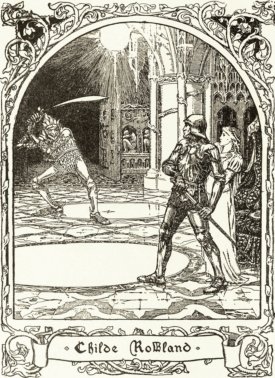
a story which you can find beginning on page 117. The editor of this text (English Fairy Tales, 1890), Joseph Jacobs, has provided a long note (pages 238-245) about his major source, citing Jamieson’s 1814 collection, Illustrations of Northern Antiquities where Jamieson reconstructs something which combines verse and prose—as JRRT sometimes does—in what is called a “chantefable”, in which a character called “Burd Ellen” is rescued from Elfland by “Child Rowland”, (“Child/e” is a title for a young nobleman pre-knighthood.) a familiar theme in a number of ballads and which Jamieson links to a Danish balled, “Rosmer Hafmand”. You can read Jamieson’s account here: https://archive.org/details/cu31924027097868/page/396/mode/2up
(For more on the one known surviving example of the “chantefable”, the 12th-13th century “Aucassin et Nicolette”, see: https://en.wikipedia.org/wiki/Aucassin_and_Nicolette )
So, did at least the name “Dark Tower” come from a literary source—Browning’s poem, say?
Or, can we turn to Browning’s source: King Lear?
For all that Tolkien was not, initially a Shakespeare fan (see his letter to W.H. Auden, 7 June, 1955, Letters, 312), he later came to appreciate him—at least in performance—(see letter to Christopher Tolkien, 28 July, 1944, Letters, 126), and we know that he had been exposed to Shakespeare’s works at an early age, so perhaps Shakespeare was a—if not the—inspiration?
In any event, that tower was doomed to ultimate destruction with that of the Ring, as we read:
“The earth groaned and quaked. The Towers of the Teeth swayed, tottered, and fell down; the mighty rampart crumbled; the Black Gate was hurled in ruin; and from far away, now dim, now growing, now mounting to the clouds, there came a drumming rumble, a roar, a long echoing roll of ruinous noise.” (The Return of the King, Book Six, Chapter 4, “The Field of Cormallen”)

(Ted Nasmith)
And with the end of the Dark Tower, this tour of towers ends, as well.
Thanks for reading, as always.
Stay well,
If you are trapped underground and find a simple ring, consider, before you pick it up, that there may be consequences,

And expect
MTCIDC
O

