Further Crime

Tags

, , , , , , , , , , , , , , , , , ,

After our last posting, where we were in southeast England with 18th-century smugglers, we’ve found ourselves traveling inland, but still on the same theme:  interesting evil-doers.

Dr. Syn, aka “The Scarecrow”

image1scarecrow.jpg

was a fictional character created in 1915 by Russell Thorndike,

image2drsyn.jpg

but based upon actual smuggling gangs who worked along the coast of the area called Kent.

image3smugglers.jpg

image4map.jpg

Such people robbed the government of revenue, removing goods which would have been taxed, sometimes heavily, at legitimate ports of entry.  Our next 17th-18th-century evil-doers use the more personal approach, behaving in the tradition of Robin Hood,

image5rhood.jpg

the difference being that, rather robbing the rich and giving to the poor, highwaymen robbed from the rich—or almost anyone they caught on the public roads—and kept it.  This could mean an individual on foot,

image6foot

or on horseback,

image7horse.jpg

or in a carriage,

image8carriage.png

or in a coach.

image9coach.jpg

These men could become quite well-known in life, like Dick Turpin, who had biographies written about him.

image10dtbiog.jpg

image11biog.jpg

Turpin, and a few others, like Claude Duval,

image12cd.jpg

even entered contemporary folklore.  This painting, by William Powell Frith (1819-1909), depicts a piece of what appears to be that very folklore.  The story goes that, once, when he had stopped a coach, Duval offered to reduce the amount taken from the gentleman inside if his pretty wife would dance with him.  She did so, and Duval did as he offered.

Such behavior, real or no, may have impressed ordinary people, but the law saw highwaymen as a menace and one to be dealt with severely.  Any one caught was tried and quickly sentenced to be hanged.  If taken in the London area, the execution was done at a standard execution place, Tyburn.

image13tyburn.png

This engraving is by William Hogarth (1697-1764), a famous artist and caricaturist of the first half of the 18th-century.  It’s from a series entitled, “Industry and Idleness” (1747) and you can see who is about to suffer from the sheet of paper held in the hand of the woman in the foreground.  It reads:  “The Last Dying Speech and Confession of the Idle [Apprentice]”.

People in other times, from Roman gladiatorial combat to Elizabethan bear-baiting, had very different ideas from most contemporary folk when it came to open violence as spectacle.  Here, we see, as was common in England at this time, a huge crowd all gathered to witness the Idle Apprentice’s death.  (Public executions were only abolished in Great Britain in 1868.)

One can see part of the entertainment in what that woman is holding.  A common souvenir of the event was a printed broadsheet, with a title like “Trial, Last Words, and True Confession of…”, which purported to be the dying statement of the person about to be executed.

image14statement.jpg

Often these began with a generic woodcut of a hanging and might also contain other illustrations, like the one below, from 1835.

image15broadsheet

Once the execution was over, the punishment was not.  The executed person’s corpse (we think that this was only males) might be displayed publicly in a kind of iron cage on a frame, called a gibbet, sometimes till the body had crumbled away.

image16gibbet

Or, worse, it might be turned over to a medical school and used for instructional purposes.

image17dissection.JPG

(This is from another Hogarth series, “The Four Stages of Cruelty”, 1751.  The skeleton in the background, on the right, is labeled, “MacLeane”, who was a highwayman hanged in 1750.)

We had first learned about highwaymen from a famous poem, “The Highwayman”, by Alfred Noyes (1880-1958).

image18noyes.jpg

The Highwayman

Here’s a LINK so that you can read it for yourself.

But, because we can’t end on a grim note, there’s one more highwayman we want to mention.  This is Monty Python’s John Cleese, playing the highwayman Dennis Moore.  Moore doesn’t take money from his victims in the sketch.  Instead, he robs the “Lupine Express”.

image20dennismoore.jpg

Lupines are an edible flower and, as you can see, at least the dwarf variety comes in multiple colo(u)rs.

image21lupines.jpg

We can’t show you the sketch, unfortunately, but we can give you the LINK to the audio recording, in which there is not only the robbery, but also a good deal of discussion about tree identification, with argument over a willow…

image22willow.jpg

Considering penal laws in 18th-century England, where over 200 crimes were punishable by death, we don’t imagine that even a flower thief would have escaped the gallows, even if he did give the lupines to the deserving poor

image23lupines.jpg

Thanks, as ever, for reading—and, if attacked by highwaymen, try to be as well-armed as these people clearly were—

image24defense.jpg

And thanks, as ever, for reading.

MTCIDC

CD

ps

And how about a highwayman music video featuring Dick Turpin, brought to you courtesy of Horrible Histories?  Here’s the LINK.


Smugglers, or Pub Crawl 2

Tags

, , , , , , , , , , , , , , , , , , , , , , , , , , , , , , ,

Welcome, as always, dear readers.

In our last, we were talking about inns and pubs, both in Middle-earth and in 1930s Oxford and we thought we had finished with the subject until there arrived in the mail/post a book from our good friend, Michael, in England.

image1kent.jpg

Pubs anywhere are, we believe, immediately understandable, but why Kent and smugglers?

Since the royal government, under King John at the beginning of the 1200s, had begun to tax exports and imports, the best way around those taxes was either to smuggle or to deal, at some level, with smugglers.

Although such dealings had gone on for centuries, it appears that things intensified by the late 17th century and France was the reason.

From the late 17th-century, throughout the 18th century, and into the early 19th, England was at war with France, on land and sea.  In governmental terms, this meant that this warfare went through the reigns of Louis XIV,

image2louie14.jpg

Louis XV,

image3louie15


Louis XVI,

image4louie16


the French Revolution and its multiple governments,

image5deadlouie.jpg

and Napoleon.

image6nappy.PNG

In English terms, this meant William and Mary, Anne, and Georges I, II, and III, basically from 1690 to 1815.

During each one of those wars, there were laws in England about the importation of goods from the enemy.  That being the case, if those with the money to pay for such things wanted prohibited goods, they would have to rely upon the same smuggling used in peacetime, which they did.

Although the south coast of England in general had its smugglers, a map will show us why Kent would have been a very good place for such smuggling to go on.

image7map.gif

As you can see, Dover, here, is only about 25 miles from the coast of France—a very easy trip and one not requiring large merchant ships to do it.

image8merchant.jpg

Smaller local boats, called luggers, could do the job and were also handy for offloading goods from larger English or foreign vessels, as well.

image9lugger.jpg

The government, seeing not only its laws violated, but revenue lost to the treasury from all the taxes not collected, tried to stop smuggling, using the navy

image10raid.jpg

and occasional army units.

image11dragoons.jpg

Success was very uncertain, however, as the officers of the law and their assistants were usually vastly outnumbered by the locals, whether smugglers or the many people in the area somehow complicit in smuggling operations.  Because pubs were social meeting places, they were obviously useful as headquarters for smugglers.

In 1915, Russell Thorndike (1885-1972),

image12rt


an English actor and writer, published the first of a series of books about the adventures of a leader of one gang of smugglers, “Dr Syn”, in Doctor Syn, A Smuggling Tale of the Romney March.

image13firsted.jpg

(If you’d like to read a first edition, here’s a LINK.)

“Dr. Syn” looks like an easy joke on “sin”, but it may also be inspired by a figure from early-19th-century English comic literature, “Dr. Syntax”, a clergyman whose rhymed adventures, began with The Tour of Dr. Syntax:  In Search of the Picturesque, published in 1812 and written by William Combe.


image14drsyntax

The smuggler, “Dr. Syn” is actually a retired pirate, named Clegg, who masquerades as an Anglican priest, which is what “Dr. Syntax” actually is.  As well, we might imagine that “Dr. Syn” the smuggler, finds it a sin to pay the import taxes the government charges and has therefore joined the local smugglers.

If Clegg is masquerading as a clergyman by day, by night he takes on another mask:  as the leader of the gang which is based in Dymchurch, he becomes “The Scarecrow”.  Dymchurch is at the edge of Romney Marsh.  Here’s a map of the Marsh to give you an idea of its location and extent.

image15romney

And, to give you an idea of the Marsh itself, here’s an image of a church on the Marsh, St. Thomas a Becket, which was originally in the village of Fairfield.  The village has disappeared, but the church remains.  (You can see it depicted on the left-hand side of the map of the Marsh.)

image16stt.jpg

Thorndike’s character has appeared several times in films, the first time in 1937, where Dr. Syn was played by a famous character actor of the time, George Arliss.

image17poster


If you would like to see this film, here are two links.  The first LINK is to the Internet Archive version.

The second LINK is to that on YouTube.

In 1963, the Walt Disney studio released their own version, Dr. Syn,

image18drsdisney.jpg

starring Patrick McGoohan as “The Scarecrow of Romney Marsh” and we think he’s pretty creepy in his mask.

image19pm

image20scarecrow.jpg

Both movies are worth seeing, the Disney, in color, is full of Marsh and red coated dragoons, but the earlier film has a Dr. Syn who has the original pirate just below the surface—not so much hero, perhaps, as trickster.

But, you may be asking by this point, what about the pub?  To which we answer, here it is—the Ship Inn, in Dymchurch, headquarters for “The Scarecrow” and his gang.

image21ship.jpg

And, right across the way, is the Church of St Peter and St Paul, where, in his other disguise, the ex-pirate, Clegg, appeared each Sunday as “Dr. Syn”.

image22stspandp.jpg

Thanks, as ever, for reading and

MTCIDC

CD


Pub Crawl

Tags

, , , , , , , , , , , , , , , , , , ,

As ever, dear readers, welcome.

After a very disturbing evening with a group of vengeful and determined dwarves,

image1banddwarves.jpg

Bilbo wakes to a wreck of breakfast dishes and, soon after, the appearance of Gandalf, who prompts him to see that he has a note from Thorin (& Co.).  It makes an appointment for 11am that morning at the Green Dragon Inn, in Bywater.

image2bywatermap.jpg

With Gandalf harrying him, Bilbo barely makes it, but, a moment later, the journey eastward of The Hobbit begins.

It is ironic, of course, that a trip which focuses upon removing a dragon

image3smaug.jpeg

should commence with a place named after one, but, judging by the number of Green Dragon pubs in Britain one might find by googling right now, it may be nothing more than a common name—

image4pubsign.jpg

image5greendragsign.jpg

image6greendrag.jpg

image7greendrag.jpg

although, as Douglas Anderson points out in The Annotated Hobbit, 61, we know that JRRT had been interested in dragons, especially green ones, from childhood, as he wrote to WH Auden:

“I first tried to write a story when I was about seven.  It was about a dragon.  I remember nothing about it except a philological fact.  My mother said nothing about the dragon, but pointed out out one could not say ‘a green great dragon,’ but had to say, ‘a great green dragon.’  I wondered why, and still do.” (Letters, 214, 7 June, 1955)

The countryside east of the Shire and the story itself are empty of pubs (short for “public houses”, originally meaning simply a place open to the general public, but, in time, it came to mean a place licensed by the government to sell alcoholic beverages) after this, but, until we reach Bree, there are a certain number mentioned in The Lord of the Rings.  We meet the first, The Ivy Bush, in The Fellowship of the Ring, Book One, Chapter 1, “An Unexpected Party”, where we see a group of hobbits gossiping about Bilbo and Frodo.  In the next chapter,  “The Shadow of the Past”, The Green Dragon makes its second appearance in Tolkien when Sam Gamgee has a verbal tussle with Ted Sandyman on the subject of things seen and unseen, as well as on the sanity, or lack of it, of Bilbo and Frodo, there.

The Ivy Bush will only appear once more, linked with The Green Dragon, in the succeeding chapter, “Three Is Company”, but we will see The Green Dragon (mentioned by Sam in hopes that The Prancing Pony in Bree will measure up to it in Chapter 8, “Fog on the Barrow-Downs”) close to the end of The Lord of the Rings.  In The Return of the King, Book Six, Chapter 8, “The Scouring of the Shire”, it appears as an emblem of the endless ruin by Sharkey and gang of the old ways of the Shire:  “When they reached The Green Dragon, the last house on the Hobbiton side [of the Water], now lifeless and with broken windows…”

This is in great contrast to The Prancing Pony Sam worried about earlier

image8prancingpony.jpg

as we see it in The Fellowship of the Ring, Book One, Chapter 9, “At the Sign of the Prancing Pony”.  At first, the place seems menacing, especially to Sam, who:

“…stared up at the inn with its three storeys and many windows, and felt his heart sink.”

But then—

“As they [the hobbits] hesitated outside in the gloom, someone began singing a merry song inside, and many cheerful voices joined loudly in the chorus.  They listened to this encouraging sound for a moment and then got off their ponies.  The song ended and there was a burst of laughter and clapping.”

Pubs, and their upscale cousins, inns, would have been vital to people traveling before motels, hotels, and b&bs, as we can see in Book One of The Fellowship, and, for most of the rest of the novel, with the exceptions of Rivendell, Lorien, Edoras, and Minas Tirith, accommodation for the night would have meant a blanket on the ground.  For Tolkien and his friends in the writers’ group called The Inklings,

image9inklings.jpg

they were vital meeting points—not for the reading of new work, which appears to have been done in one member, C.S. Lewis’, rooms at Oxford,

image10csl.jpg

but for socializing and discussion, which was equally important for such a group of intelligent, educated, and highly-creative men.  (No women, alas!  One of our favorite mystery novelists and Dante-translator, Dorothy Sayers, 1893-1957, was friends with several members but, with the short-sightedness of the 1930s-50s, was never invited to join.)

image11dls.jpg

They met during the week not only at the best-known of their watering holes, the Eagle and Child,

image12bird.jpg

but at The Mitre,

image13mitre.jpg

The King’s Arms,

image14kingsarms.JPG

and at The White Horse.

image15whitehorse

The one which caught our eye in particular is the first, which, as we said, is probably the one most closely associated with Tolkien and his friends.  Here’s its sign—

image16bird.jpg

The explanation of the pub’s name is, to us, a bit murky, supposedly coming from an element of the crest of the Stanley family which portrays an infant stolen by an eagle,

image17crest.jpg

but found alive and unharmed.  (Here’s a LINK so that you can judge for yourself.)

For ourselves, the idea of a child stolen by a raptor makes us think of a really awful 19th-century song, “The Vulture of the Alps”, a poem set to music about 1842 by a famous American vocal group of the 1840s-1870s, the Hutchinson Family Singers.  The title pretty much says it all.

image18hutch.jpg

If you’d like to know more, here’s a LINK.

When we think of eagles and Tolkien, however, we remember them as rescuers—of Gandalf, the dwarves, and Bilbo from the goblins and Wargs

image19rescue.jpg

and as providers of air assault in The Hobbit.

image20battle.jpg

And, in The Lord of the Rings, rescuer of Gandalf from Saruman,

image21rescue


as allies of the West at the battle at the Morannon,

image22black.jpg

and as saviors of Frodo and Sam on Mt Doom.

image23savior.jpg

And it may be a crazy idea, but it makes us wonder—although Tolkien had abandoned The Hobbit unfinished in the early 1930s, he had picked it up again in 1936, just about the time the Inklings were meeting regularly (the first documented mention of them, apparently, is in a 1936 letter from CS Lewis to the novelist, Charles Williams, inviting him to join—see The Collected Letters of CS Lewis, Vol.2, 183—in a letter to William Luther White 9/11/67, JRRT dates the origins of the Inklings as “probably mid-thirties”—Letters, 387).  Could he have found his inspiration for these heroic birds and their habit of picking people up from the name of his pub?

As ever, thanks for reading.

MTCIDC

CD

ps

If you haven’t read CS Lewis’ wonderful essay, “On Three Ways of Writing for Children”, here’s a LINK.

pps

We have no illustration of Tolkien’s Green Dragon, but here’s a Tudor example from Wymondham in Norfolk which we think would do quite well.

image24green.jpg

Orc Logistics

Tags

, , , , , , , , , , , , , , , , , , , , , , , ,

Welcome, as always, dear readers.

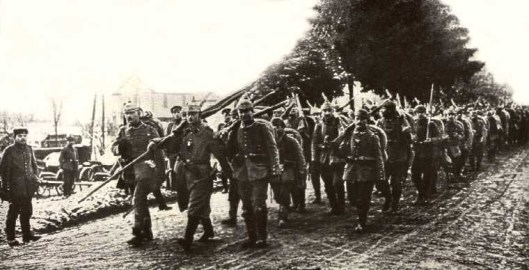
In August, 1914, as the German army was pushing through Belgium

image1germanarmy.jpg

in its attempt to sweep to the west of Paris and drive the French armies

image2french.jpg

eastwards towards the Germans waiting for them there (the so-called Schlieffen Plan),

image3schlieffen.jpg

they were met by the small (70,000 man) BEF, British Expeditionary Force,

image4tommy.jpg

a few miles north of the Franco-Belgian border, near the town of Mons, where the British fought a delaying action.

image5mons.jpg

The Germans were in such strength that the British were forced to pull back, retreating southward with the Germans pursuing so closely that the commander of one half of the British army (2nd Corps), Horace Smith-Dorrien,

image6hsd.jpg

decided that it was necessary to fight a second delaying action, at Le Cateau.

image7lecateau.jpg

A major reason to do so was not just that the German pursuit was so close, but that it was necessary to protect the trains.  This doesn’t mean the railways, but the endless lines of wagons

image8gswagon.jpg

which carried all the food and ammunition for the soldiers and stretched for miles behind them..

image9marching.jpg

It was also primarily horse-drawn and, on narrow roads, mostly unpaved, the trains moved very slowly, which was a major reason why armies in earlier centuries rarely ever campaigned during winter.

image10turenne.jpg

This was a problem, all the way back to the Romans.  In the 2nd century BC, the Roman general, Marius, in an attempt to do away with as much of a baggage train as he could,

image11romanwagon.JPG

ordered his men to carry as much of their equipment as possible, thus cutting down on baggage wagons and pack animals.  His men were less than pleased at being so loaded down and began to call themselves “Marius’ mules”.

image12mule.jpg

In the late 18th to early 19th century, when French revolutionary armies swelled beyond the ability to pay to supply them, the order was to travel lightly and to live off the land.  This may have reduced baggage—and even, perhaps, speeded up movement—but it made local people very hostile to the French and, in Spain, the response was to ambush the French whenever possible, which is where the word “guerilla” (originally meaning “little war”) comes from.

image13spguerillas.jpg

image14spguerillas.jpg

This could happen, particularly to Union supply trains,

image15wagons.jpg

during the American Civil War.

image16ambush.jpg

So, such trains were utterly necessary—if a large army had to cross miles of territory and perhaps fight on the way, they would need everything a train could carry.  At the same time, trains could be both vulnerable and thus draw off numbers of soldiers to protect them when such soldiers might be better employed on the battlefield, as well as cumbersome, because they were slow-moving, forcing armies to march at their speed (and in dry summer weather, the dust they raised could give away the direction of an army’s movements).

image17wagontrain.jpg

In The Lord of the Rings, we see two invasions:  that which attacks Helm’s Deep

image18helms.jpg

and that which attacks Minas Tirith.

image19mt.jpg

The mass of invaders is vividly described:

“For a staring moment the watchers on the walls saw all the space between them and Dike lit with white light:  it was boiling and crawling with black shapes, some squat and broad, some tall and grim, with high helms and sable shields.  Hundreds and hundreds more were pouring over the Dike and through the breach.”  (The Two Towers, Book Three, Chapter 7, “Helm’s Deep”)

“The numbers that had already passed over the River could not be guessed in the darkness, but when morning, or its dim shadow, stole over the plain, it was seen that even fear by night had scarcely over-counted them.  The plain was dark with their marching companies, and as far as eyes could strain in the mirk there sprouted, like a foul fungus-growth, all about the beleaguered city great camps of tents, blac or somber red.” (The Return of the King, Book Five, Chapter 4, “The Siege of Gondor”)

And yet there is no hint of what will supply them in their assaults and beyond.  We could argue, of course, that, as in so many things, JRRT is interested in the movement of his narrative and its effects:  masses of orcs are much more menacing than long lines of wagons, and we’re sure that this is actually the case, but there is another possibility.  The Great War began in Belgium as a war of movement, huge armies attempting to outflank and block each other like chess players.  For better or worse, those armies needed such baggage trains, as we’ve said.  By the time Tolkien had arrived at the Western Front, in mid-1916, the war had become static, as if both sides had dug trenches and were besieging each other.

image20atrench.jpg

image20trench.jpg

Supply was clearly still necessary, but it was a complex combination of ports and ships and railway lines and wagons and mules and even human mules, close to the front.

image21.jpg

In a way, the whole business of supply had begun to look like just that:  a business, like importing bananas from the Caribbean, having them arrive in London, then passing them on by train to cities and towns across Britain.

image22bananas.jpg

So, instead of being part of long marching columns,image23marching.jpg

their even longer lines of wagons lagging behind, Second Lieutenant Tolkien would have seen long lines of men and animals, lugging endless boxes and cans and bundles—
image24carrying.jpg

image25carrying.jpg

necessary for war, but hardly dramatic, and so best left to the imagination of certain readers, those who can never see a battle without wondering, “When it’s time for lunch, who feeds all of those soldiers—or orcs (and never mind what certain people might eat)?”

image26lunch.jpg

As always, thanks for reading and

MTCIDC

CD

Dragon Economics 101

Tags

, , , , , , , , , , , , , , , ,

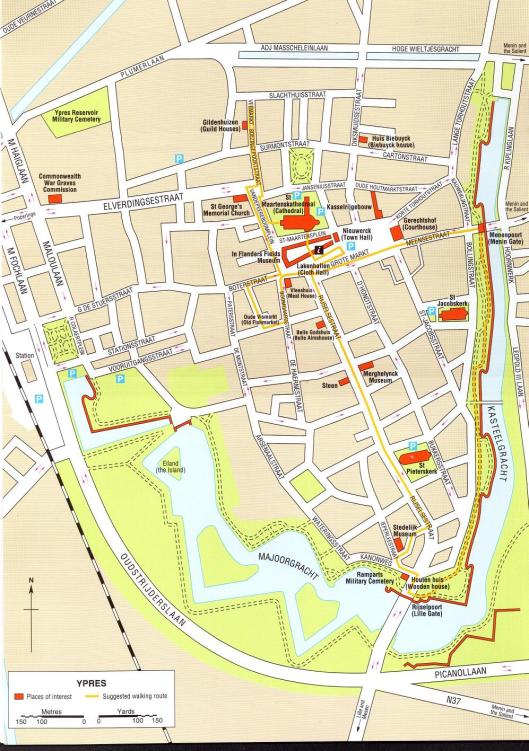
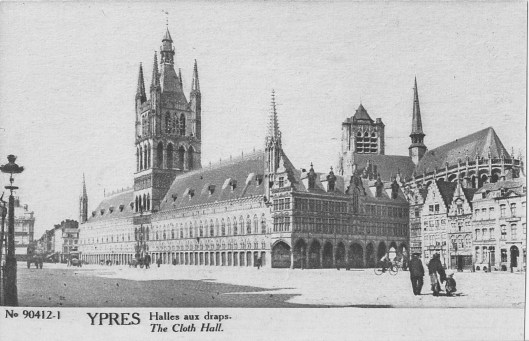
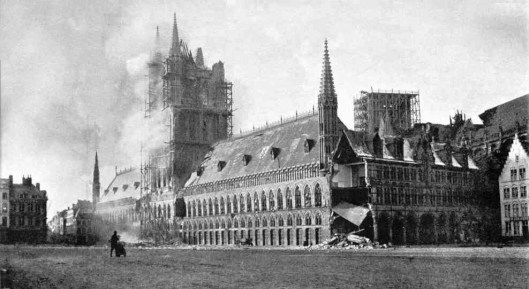
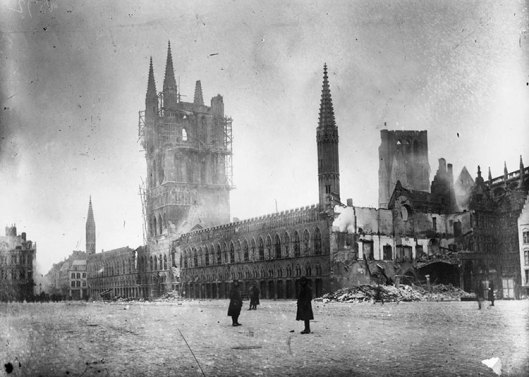
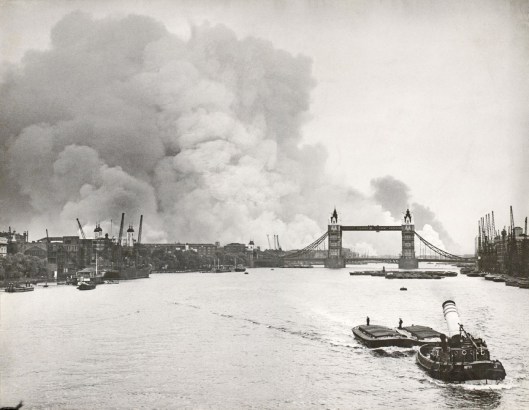
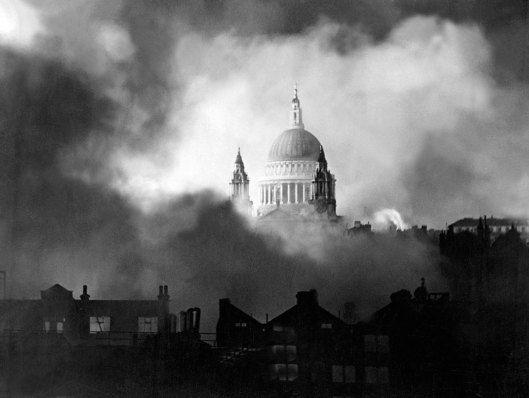
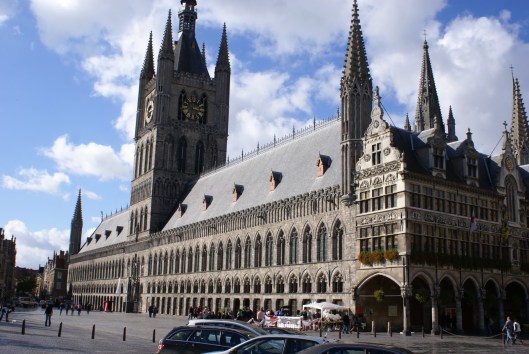
Here is a postcard of the town of Ypres, in southern Belgium, in the years before the Great War, with its famous Cloth Hall and cathedral.

image1clothhallcath.jpg

The Cloth Hall was begun in 1200 and finished in 1304, being a center of the woolen trade in the region.

image2clothhall.jpg

The cathedral was begun in 1230 and finished in 1370.

image3cathedral.jpg

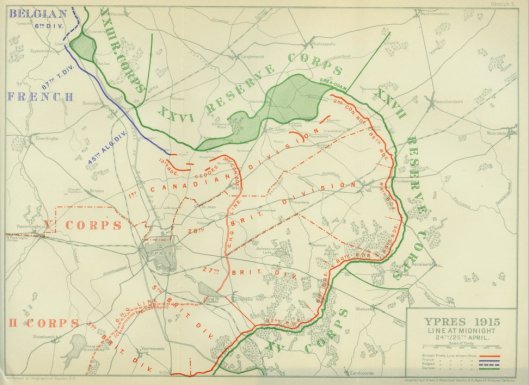
Then the Great War began and Ypres was just behind Allied lines.

image4map.jpg

Artillery had begun in the Middle Ages, as something which looks like a high school science experiment (plus armor).

image5millemete.jpg

By 1914, it was much bigger and much more efficient.

image6howitzer.jpg

(The German says, “Our Growlers!”—perhaps a soldier’s slang word for heavy howitzers like these?)

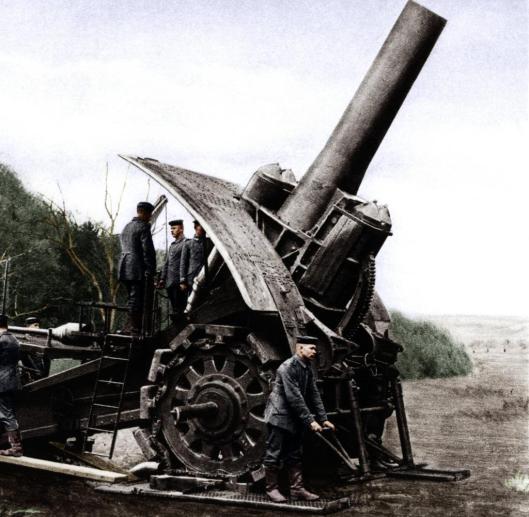
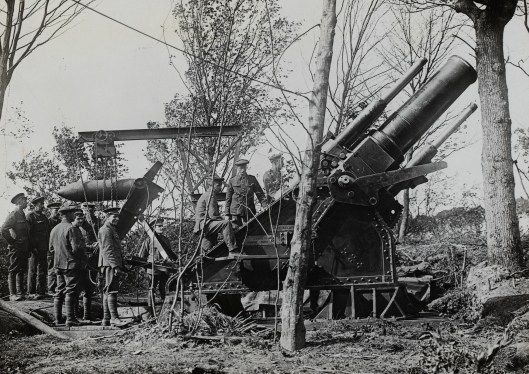
And, as the war progressed, bigger and more efficient yet.

image7biggergun.jpg

And even more so—to the point where some guns became so big and heavy that only railways could move them around.

image8railwaygun.jpg

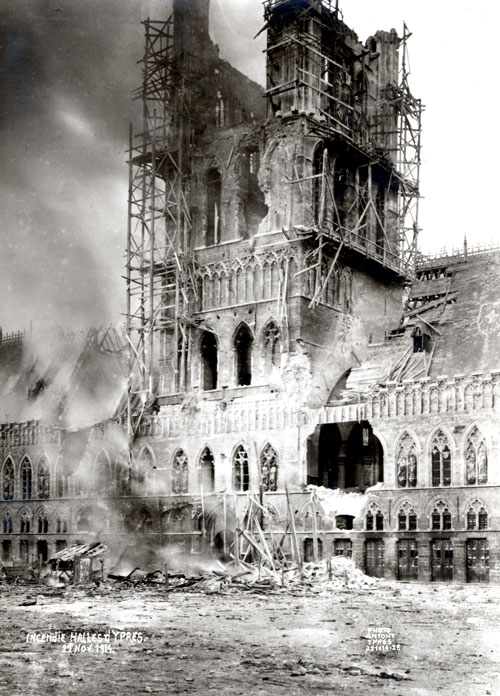
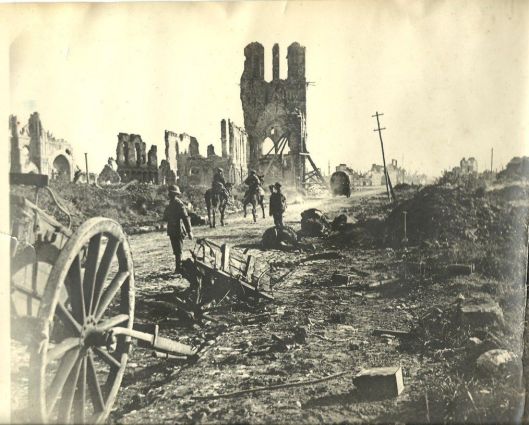
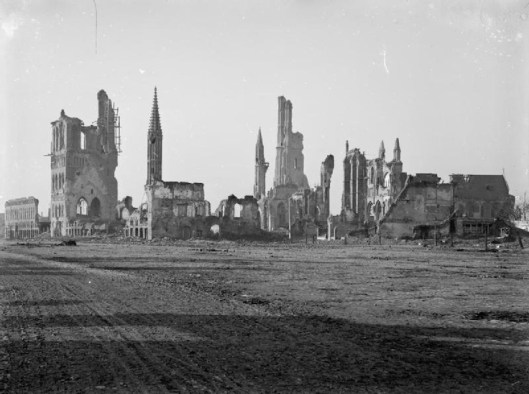
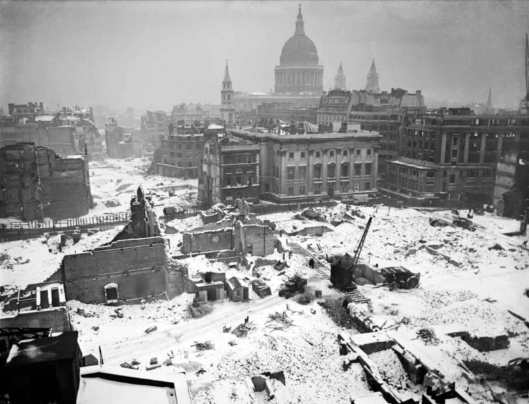
Needless to say, when shells from such guns hit Ypres, the damage they caused was enormous.

image9ypres


image10ruins.jpg

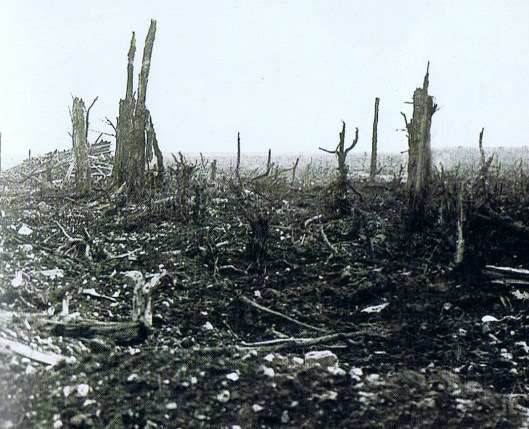
And not only to Ypres, but to the whole region—entire villages disappeared, as did forests, landscapes became moonscapes.

image11nomansland.jpg

For some months in 1916, Second Lieutenant Tolkien walked through, lived through, this devastated world,

image12jrrt

which took many years to be repaired.

image13ypres.jpg

And, in the meantime, the economies of Europe suffered, with so much damaged or shifted to war work, and governments left with enormous debts, both the victors and the vanquished.

This devastation made us think about another devastation, first described by Thorin in Chapter One of The Hobbit, and, of course we wondered if JRRT thought of the damage caused by the endless, pitiless bombardments as he wrote about the ruin brought by a dragon.

Thorin begins, as we did at the opening of this posting, showing a peaceful, prosperous world:

“Altogether those were good days for us, and the poorest of us had money to spend and to lend, and leisure to make beautiful things just for the fun of it, not to speak of the most marvellous and magical toys, the like of which is not to be found in the world now-a-days.  So my grandfather’s halls became full of armour and jewels and carvings and cups, and the toy market of Dale was the wonder of the North.”

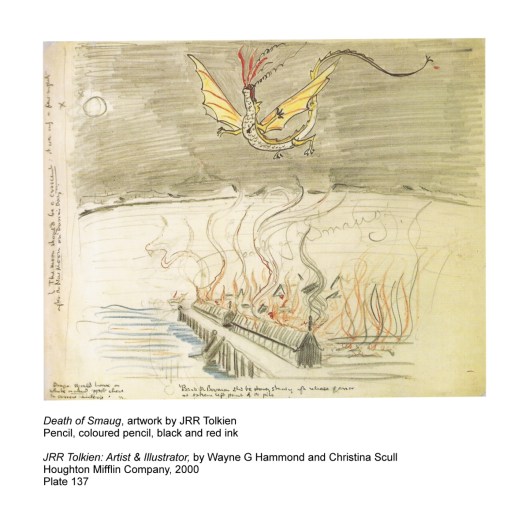
But, just as the Great War came to the ridges north of Ypres, so Smaug came down upon the town of Dale just below the Lonely Mountain and to the Mountain, as well:

“Then he came down the slopes and when he reached the woods they all went up in fire.  By that time all the bells were ringing in Dale and the warriors were arming.  The dwarves rushed out of their great gate; but there was the dragon waiting for them.  None escaped that way.  The river rushed up in steam and a fog fell on Dale, and in the fog the dragon came on them and destroyed most of the warriors…Then he went back and crept in through the Front Gate and routed out all the halls, and lanes, and tunnels, alleys, cellars, mansions and passages…Later he used to crawl out of the great gate and come by night to Dale, and carry away people, especially maidens, to eat, until Dale was ruined and all the people dead or gone.  What goes on there now I don’t know for certain, but I don’t suppose any one lives nearer the Mountain than the far edge of the Long Lake now-a-days.”

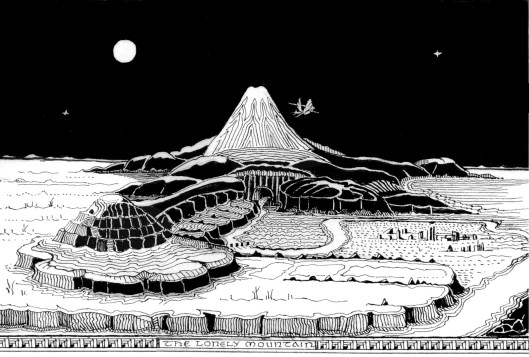
image14erebor.jpg

Thorin is correct about this:  Dale is ruined and abandoned (you can see the remains of the town on the right hand side of this illustration) and the Mountain has only one inhabitant.

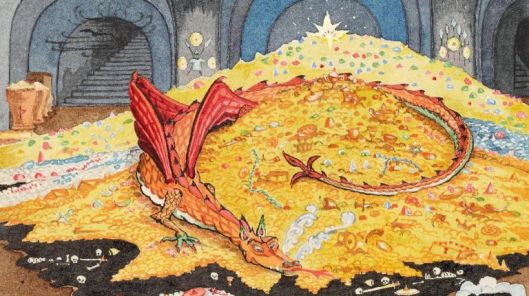
image15smaug.jpg

When Bilbo disturbs him and steals a cup, Smaug goes on a second rampage, flying as far south as Lake-town:

“Fire leaped from the dragon’s jaws.  He circled for a while high in the air above them lighting all the lake…Fire leaped from the thatched roofs and wooden beam-ends as he hurtled down and past and round again…Flames unquenchable sprang high into the night. “  (The Hobbit, Chapter Fourteen, “Fire and Water”)

image16laketown.jpg

And, even when Bard’s arrow brings him down, Smaug causes a final wave of destruction:

“Full on the town he fell.  His last throes splintered it to sparks and gledes.  The lake roared in.  A vast steam leaped up, white in the sudden dark under the moon.  There was a hiss, a gushing whirl, and then silence.  And that was the end of Smaug and Esgaroth…”

Just as certain parts of Europe were destroyed and their economies stunted by the Great War, we can hear, in Thorin’s words, that the same has happened to Dale and the Lonely Mountain:  with no dwarves and no men to make the “armour and jewels and carvings and cups”, not to mention the “most marvellous and magical toys”, the whole economy of the area to the north of the Long Lake was completely destroyed.  Survivors built up Lake-town, but no one dared to revive the trade which had once enriched an entire region.

image17laketown.jpg

And, as for the few remaining dwarves:

“After that we went away, and we have had to earn our livings as best we could up and down the lands, often sinking as low as black-smith-work or even coal-mining.” says Thorin.

Although Thorin dies in the struggle to regain what was lost, there is a happy ending of sorts for the dwarves.  With Smaug dead, they can finally return, as can men, and rebuild, just as Europe began to rebuild—Ypres restored both Cloth Hall and cathedral in time.


image18ypres


But the dragon would return and all too soon…

Thanks, as always, for reading and

MTCIDC

CD

Out of Touch

Tags

, , , , , , , , , , , , , , , , , , , , , , , , , , ,

Welcome, as always, dear readers.

Recently, we were charging our cell/mobile phone and completely forgot it when we walked out of the house.

image1cell


We were down the road when we realized it and the thought came to us:  how times have changed!  Before people could carry their little, flat phones in their pockets, away from home, if you had an emergency, you looked for a pay phone/call box.

image2payphone.jpg

image3callbox.jpg

When JRRT was born, in 1893, the main forms of long-distance communication were the post

image4post.jpg

and the telegram—brought to your house by a specially-uniformed messenger.

image5telegraph.jpg

The telephone had been invented in 1875, but was still far from common–

image6earlyphone.jpg

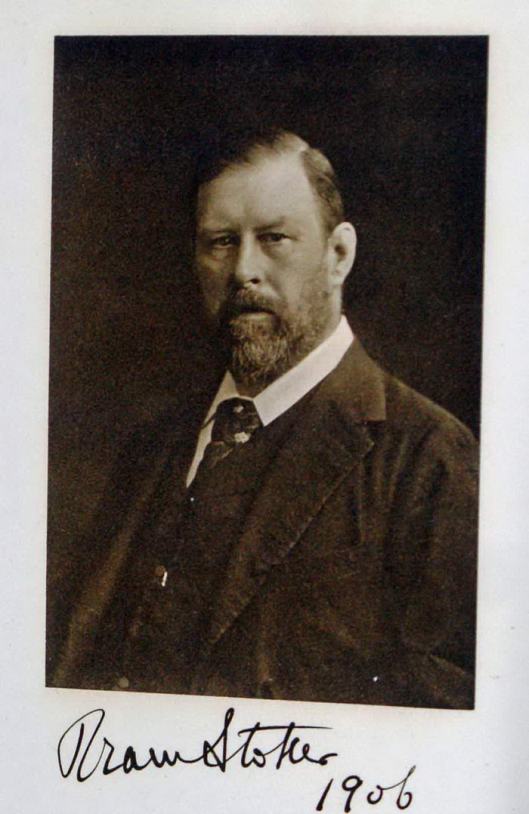
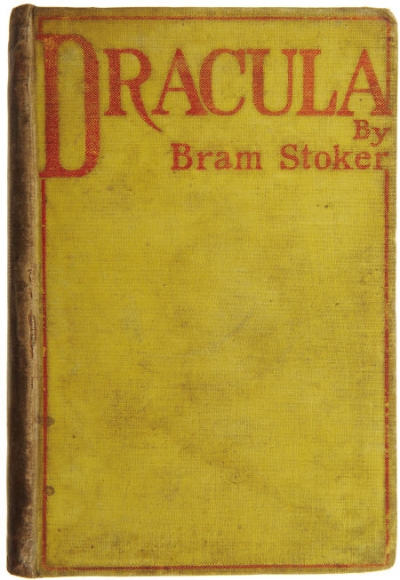
London’s first telephone directory, issued in 1880, listed about 300 customers in a city of 5,000,000 and, when the first actual phone book arrived, in 1896, it had 81,000 numbers for the whole of Britain, with a population of perhaps 30,000,000.  (To give you a literary example, Bram Stoker’s Dracula was published in 1896 and, although telegrams are common in the book, no one ever mentions or uses a telephone.)

When Second Lieutenant Tolkien

image7ltjrrt.jpg

became his battalion’s signals officer in 1916, there were, in fact, a surprising number of forms of communication available, although most of them would not have ever appeared in civilian form.

There was the telephone, which, with its miles of wire, could be extremely vulnerable to enemy shellfire.


image8telephone

There was what would be called “wireless telegraphy”, an early form of radio, but not very dependable.

image9radio


There was actual telegraphy which, again, used miles of wire.

image10telegraph.jpg

There was the military post—mostly used not to transmit orders, but to maintain contact with home.

image11militarypost


And then there were the more specifically military methods.  At the most basic, there was the runner.

image12runner

Then there was the motorcycle messenger,

image13motorcycle

the signal lamp,

image14lamp

and even the semaphore.

image15semaphore

Beyond the human, there were the messenger dog,

image16dog.jpg

and the messenger pigeon.

image17pigeon.jpg

So, we asked ourselves, what were Tolkien’s Middle-earth equivalents?  First of all, we see Bilbo in Chapter One of The Hobbit, reading his morning’s mail when Gandalf appears.

image18bandg.jpg

This is expanded upon in the Prologue to The Lord of the Rings, where we hear about the post as being one of the few actual public services in the Shire.  (Here’s someone’s wonderful creation of a postal map of the Shire, complete with regional divisions.)

image19postalmap.jpg

This service clearly doesn’t extend beyond the Shire as Gandalf is forced to leave a letter for Frodo at The Prancing Pony

image20pony.jpg

in Bree, to be given to the first person going westwards.  The innkeeper, Butterbur, completely forgets it, with serious consequences.

Because this is a pre-industrial world, none of the electronic means would be available, of course.  Gondor used mounted messengers, as two are discovered ambushed by the Rohirrim on the road to the Rammas Echor (The Return of the King, Book Five, Chapter 5,“The Ride of the Rohirrim”).

image21nuntii.jpg

(This image is, of course, from the Bayeux Tapestry, the caption saying “Nuntii Wilielmi”, “William’s Messengers”, but the only illustrations of Gondorian mounted men we’ve found are all heavily-armored, something you wouldn’t expect a courier to be, so we’re suggesting this possibility, instead.)

A second method is by the chain of beacon fires along the mountains to the west of Gondor.

image22beacon.jpg

As for their opponents, we suppose that one might imagine the Nazgul as the airborne equivalent of mounted messengers, since they seem, when not pursuing Frodo and leading attacks on Gondor, to be couriers for Sauron.

image23naz.jpg

Sauron’s main communication device, however, appears to be the palantir, whereby he controls the actions of Saruman and, to a degree, of Denethor, the Steward.

image24sar.jpg

image25den.jpg

It’s rather surprising, we suppose, that Gandalf, who is powerful enough to deal with a palantir (although it’s Aragorn who is its rightful owner), can be so easily trapped by Saruman and left on top of Orthanc, completely isolated when he is so needed in the north.

image26orthanc.jpg

In P. Jackson’s film, he uses what looks like a fancy moth to call for help,

image27moth.jpg

which appears in the form of one of those eagles, so conveniently available when someone really gets into trouble (Bilbo, Gandalf, and the dwarves in The Hobbit, as well as dwarves, elves, and men vs goblins and Wargs, Frodo and Sam on the edge of Mt Doom in The Return of the King).  Suppose, instead, if Gandalf had reached into this robe and pulled out his cell phone–

image28cell.jpg

which he would never have left behind after charging it…

Thanks for reading and

MTCIDC

CD


A Tale of Two Swords

Tags

, , , , , , , , , , , , , , , , , , , , , , , , , ,

So we were reading this really interesting book, Christopher Tyerman’sngcce How to Plan a Crusade, when, on pages 244-5, we came across this:  “While Louis prayed to the relics of the Passion, Richard had carried the sword Excalibur.”  And we said, “What?  Excalibur?”

Welcome, as always, dear readers.  In this post, we want to talk a bit about two historic—or mythical– swords, inspired, as we were, by that reference and by two kings involved with them.

The “Louis” in the passage above is Louis IX (1214-1270) of France,

image1sealoflouisix.jpg

aka St Louis, a saint of both the Catholic and Anglican churches, who led several crusades in the mid-13th century, but not very successfully, being taken prisoner during the first (1250) and dying of a fever during the second (1270).

The “Richard” is Richard I of England (1157-1199), also called “Lionheart”.

image2rich.jpg

He was also a crusader, having been one of the dominant figures in the earlier Third Crusade (1189-1192).

image3crus.jpg

But how do we know that Richard had “Excalibur”?  And how did he acquire it?

We begin with the passage from a contemporary of Richard’s, Roger of Howden (?-1201?), who has left us a history known as Gesta Henrici II et Gesta Regis Ricardi, “The Deeds/Acts of Henry II and the Deeds/Acts of King Richard”.  This begins in the 8th century and covers the period up to 1201, which is presumed to be the year of Roger’s death.  Roger went on the Third Crusade with Richard, although he left it early.  He either observed or heard about this event, which took place in 1191:

“Et contra rex Angliae dedit regi Tancredo gladium illum optimum quem Britones Caliburne[m?] vocant qui fuerat gladius Arthuri quondam nobilis regis Angliae.”

“And, in return, the King of England gave to King Tancred that best of swords, which the Britons call ‘Calibern’, which had been the sword of Arthur, the one-time noble king of England.”

(The Latin text comes from page 392 of a collection of earlier English historians, entitled “Rerum Anglicarum Scriptores Post Bedam Praecipui”,–something like, “Writers of/on English Affairs in Particular After Bede”–which was published in London in 1596).

“King Tancred” (1138-1194) was the Norman ruler of Sicily from 1189-1194, just when Richard and his fellow Crusaders had reached that part of the world on their way eastward.

image4tanc.jpg

Tancred gave Richard a number of ships to help with transport and we might suppose that this was part of a reciprocal process.  Remarkably for this early time, we have what appears to be concrete evidence not only that King Arthur was a well-known figure in southern Italy, but perhaps known to Tancred himself.

Tancred had been born in 1138 in Lecce (on the right-hand side of the map, just inland)

image5map.jpg

and just a few miles south is Otranto, with its cathedral (below Lecce on the map).

image6otrantocathedral.jpg

The main floor of that cathedral is covered by an enormous mosaic, installed between 1163 and 1165.

image7mosaic.jpg

image8mosaic.jpg

In that mosaic is a figure labeled “Rex Arturus”.

image9rexarturus.jpg

We’ve answered our first question, sort of:  “How do we know that Richard had Excalibur?”  But, again, how did he acquire it?  Unfortunately, the only reference to Richard and the sword is the one we’ve quoted.

One thought, however.  About 1191, the monks of Glastonbury Abbey

image10glastonbury.jpg

excavated a grave which

image11tombsite.jpg

supposedly included a lead cross which read:

“Hic jacet sepultus inclytus rex Arthurius in insula avallonia cum Wennevereia uxore sua secunda”

“Here lies buried the renowned king Arthurius on the Avalonian island with Guinevere his second wife”

(Latin text from Giraldus Cambrensis, Speculum Ecclesiae, Chapter IX.)

Giraldus himself had been shown this cross by the Abbot, as he tells us.  (For a more complete version of this story, in an English translation, please see this LINK.)

Modern research suggests that this was a fake, intended to boost the fortunes of a fading religious site, badly damaged by fire in 1184, but suppose that, to increase their patronage, the monks had added another level to their sham and “found” a sword, which they had then sent to Richard, who carried it off on his journey to the East.

(For more on the fakery, see, for example, this LINK.)

Louis IX, as we mentioned, died on campaign in 1270.  His son, Philip, was with him at the time, but sailed back to France after his father’s death and was crowned Philip III in 1271.  Our sources are vague here (they don’t always get the year right, for example), but all report that, for the first time, a special sword was used in the coronation ceremony.  This was the so-called “sword of Charlemagne”, named “Joyeuse” (the “happy one”), which is mentioned in the 11th-century Chanson de Roland:

Si ad vestut sun blanc osberc sasfret,
Laciet sun elme, ki est a or gemmet,
Ceinte Joiuse, unches ne fut sa per,
Ki cascun jur muet.XXX. clartez.”

“[Charlemagne] was wearing his fine white coat of mail and his helmet with gold-studded stones; by his side hung Joyeuse, and never was there a sword to match it; its colour changed thirty times a day.”

(The translator for this was not identified at the site and we would make one small change—“clartez” might be better as “sheen/brightness” instead of “colour”.)

image12sword.jpg

This, one of the few remaining pieces of the royal regalia, is, in fact, a mixture of a number of different periods, all the way up to Charles X (reigned 1824-1830), and experts argue over whether it is actually possible to date any part of it as early as Charlemagne’s time (see this LINK for more).

What isn’t questioned is that some version of this sword, at least, was used as part of the crowning ritual of French kings for centuries and its association with Charlemagne was as important for French history as linking something to King Arthur for English.

We haven’t managed to locate any medieval manuscript illustration which depicts a French coronation with the sword in place, but, when it comes to “The Sun King”, that is, Louis XIV, you can see that’s its hanging from his left side.

image13louisxiv.jpg

The same is true for Louis XV

image14louisxv.jpeg

and for that most unwarlike monarch, Louis XVI.

imagexvlouisxvi.jpg

The French Revolution brought the crowning of kings to a halt, of course,

image16execution.jpg

but Napoleon, all too aware both of the past and of his need to establish himself as the legitimate heir to the previous kings, brought it back, as you can see in this really over the top portrait.

image17nappy.jpg

When the younger brothers of the executed Louis XVI, Louis XVIII (1755-1824)

image18louisxviii.jpg

and Charles X (1757-1836)

image19chas.jpg

became king successively in 1814 and 1824, one can still see the sword—although apparently Napoleon’s craftsmen had fiddled with it, as did those of Charles.   His successor, Louis Philipe (1773-1850), who belonged to a cousin branch of the royal family, broke the tradition for good and the sword disappeared into history—and the Louvre, where it’s now on display.

And this brings us back to Excalibur.  The tradition is a little murky, but the medieval sources are pretty clear that Excalibur had come from “The Lady of the Lake” and, as Arthur lay, gravely, perhaps fatally wounded, he commanded one of his knights, Griflet or Bedivere, according to the tradition, to return it to the Lady, which he finally, and very reluctantly, did.

image20lake.jpg

With this, Excalibur disappears from the story—until Richard is reported giving it to the king of Sicily and our story—briefly—begins again.

Thanks, as always, for reading and

MTCIDC

CD

Water Which?

Tags

, , , , , , , , , , , , , , , , , , , , , , , , , , , , , , , ,

Welcome, as ever, dear readers.

Just today, our English friend, Michael, sent us an interesting CD set, “Old English Poems, Prose & Lessons”.  We turned the jewel box over and our eye was immediately caught by #12 of the listings on the back, “Charm Against Waterelf Sickness”.

In Old English, “waterelf sickness” is a compound which can be read two ways:  “waeteraelf-adl” (“water-elf sickness”) or “waeter-aelfadl” (something like “watery elf-sickness”).  Alaric Hall, in his extremely informative dissertation, “The Meaning of Elf, and Elves, in Medieval England” (2005), 116, leans towards the second possibility, but, with our western classical background, we immediately imagined a “water elf” and, from there, we thought of naiads—female water spirits–in fresh water, like streams and pools.  (If you would like a comprehensive listing of all the subvarieties of such spirits, here’s a LINK to an article on the subject.)

Probably the most famous story about such creatures appears in Apollonius of Rhodes’ 3rd-c. BC, Argonautica, the story of Jason’s quest for the Golden Fleece.

image1gf.jpg

Two of Jason’s crew on the Argo are Heracles (seen here dealing with the Nemean Lion)

image2herc

and his companion, Hylas (seen here about to get into trouble).

image3hy.jpg

Ancient travel in the Mediterranean often meant coasting, with frequent stops for water, and, in Apollonius’ story, Hylas had gone ashore and found a pool, but was ambushed by a group of naiads, who pulled him under.

image4water.jpg

(This is John William Waterhouse’s famous 1896 painting of the scene.)

We meet woman waterfolk in much of western folk tradition—and this is excluding those on salt water, including mermaids,

image6merm.jpg

selkies/silkies (who are shape-changers, between seals and humans),

image7selkie.jpg

and even sirens.

image5sirens.jpg

For fresh water, we had those naiads, but also swan-maidens, often enchanted into water bird forms.

image8swanmaidens.jpg

(Here’s a LINK to a whole little collection of stories about such creatures.)

As well, we have the Rhine Maidens,

image9rhine.jpg

who, in Wagner’s “Ring” cycle, guard the Rhine gold, deep under the river, but who lose it to the craftsman dwarf, Alberich, with whom they flirted—with evil consequences.

image10alb.jpg

We mentioned mermaids as salt water creatures and, in Hans Christian Andersen’s (1805-1875)

image11dulac.jpg

“The Little Mermaid” (1837), we have the story of the mermaid who falls in love with a handsome prince and trades her voice for human form.

image11hca.jpg

image12ms.jpg

(This is the first page of Andersen’s original manuscript.)

There had been an earlier Romantic version of the water spirit and the human (in this case, a knight) in Friedrich de la Motte Fouque’s (1777-1843) novella, Undine (1811).

image13fred.jpg

image14undine.jpg

This, in turn, became an early Romantic opera, Undine (1816), the text by the author, the music by another famous Romantic author, E.T.A. Hoffmann (1776-1822).

image15etah.jpg

image16oveerture.jpg

The theme which runs through all of these meetings of water spirit and human is the uneasy relationship which seems the only possibility for them, virtually always leading to unhappiness, and this is true of our last water spirit, Rusalka, the subject of an opera, Rusalka, (1901) by the Czech composer, Antonin Dvorak (1841-1904)

image17ad.jpg

Like Andersen’s Little Mermaid, the water spirit (“rusalka” can mean “water spirit” in Czech) falls in love with a prince, trading her immortality for human love.

image18orig.jpg

(This is an image of the original Rusalka, Ruzena Maturova.)

If we said “leading to unhappiness” is the usual conclusion to such romances, Rusalka is even worse.  When she is betrayed by the prince, Rusalka becomes a water demon, luring people to their deaths in her pool—a far cry from the happy ending of the Disney movie!

image19lm.jpg

So, what about our charm against waeteraelfadl?  Here’s a translation:

“If a man is in the water elf disease [waeter aelfadle], then the nails of his hand are dark and the eyes teary, and he will look down. Give him this as medicine [laecedome]: everthroat, hassock, the lower part of fane, yewberry, lupin, helenium, marshmallow head, fen mint, dill, lily, attorlathe, pulegium, marrubium, dock, elder, fel terre, wormwood, strawberry leaves, consolde. Soak with ale; add holy water to it. Sing this gealdor over it thrice:

I have bound on the wounds the best of war bandages, so the wounds neither burn nor burst, nor go further, nor spread, nor jump, nor the wounds increase [waco sian?], nor sores deepen. But may he himself keep in a healthy way [halewaege?]. May it not ache you more than it aches earth in ear [eare?].

Sing this many times, “May earth bear on you with all her might and main.” These galdor a man may sing over a wound.”

(translation from Karen Louise Jolly, Popular Religion in Late Saxon England: Elf Charms in Context (Chapel Hill: University of North Carolina Press, 1996)

Unfortunately, this looks more like a cure for a skin disease than for an ill-fated affair between water spirit and human!

Thanks, as always, for reading and, also as always,

MTCIDC

CD

ps

You can find Alaric Hall’s dissertation (now a book) at:  http://www.alarichall.org.uk/phd.php.

pps

Child Ballad 113, “The Great Silkie of Sul Skerry” is about the male version of such a creature.  For a haunting performance of this, with a modern tune, sung by Judy Collins (with Tommy Makem on pennywhistle), here’s a LINK.

ppps

The most famous aria from Dvorak’s opera is a song sung to the moon by Rusalka, “Měsíčku na nebi hlubokém“, and we find it one of the most beautiful arias we know.  Here’s a LINK so that you can hear it, too.

pppps (we think that this is a record, even for us)

In 1909, the publisher Heinemann released a translation of de la Motte Fouque’s Undine with illustrations by Arthur Rackham.  Here’s a LINK so that you can download it and add it to your library.

image20rack.jpg

Tamsin

Tags

, , , , , , , , , , , , , , , , , , , , , , , , , , ,

If you had never seen a ghost and probably didn’t believe in them, what would convince you?  How about a ghost cat?

image1ghostcat.jpg

In Peter Beagle’s

image2pb.jpg

Tamsin (1999),

image3tamsin.jpg

13-year-old Jenny Gluckstein encounters one and it’s only the beginning of a wonderfully rich and, this being a novel by Peter Beagle, a little melancholy, ghost story.

We don’t do spoilers, but what we’d like to do—oh, and, by the way, Welcome, dear readers, as ever!—is, first, to recommend this novel, which begins in New York City, but is mainly set in Dorset,

image4dorset.jpg

in the southwest of England.  If you’re interested in spooks and spirits of all kinds, England is a wonderful place to explore, and the southwest is especially haunted (if you believe in such things—we’re neutral, ourselves, but love a good ghost story).  Just look at this massive Iron Age hill fort near Dorchester, called locally, “Maiden Castle”—what lives there at night?

image5maidencastle.jpg

[And speaking of good ghost stories, some of our favorites are by M.R. James (1862-1936) and Algernon Blackwood (1869-1951).  Click on the names to access the links so that you can sample their work for yourself, if you don’t know them already.]

Jenny is transplanted from New York to Dorset because her mother’s second husband is an English agricultural specialist who is hired to rebuild a 350-year-old farm in Dorset.  Jenny is, initially, very unhappy with the move—especially when her closest friend, Mr. Cat, must spend 6 months quarantined before being allowed into England.  Things slowly begin to change, however, as she makes friends with her two new stepbrothers and finds that the ancient house holds more than her new family, including a boggart, the billyblind, and four ghosts (including that cat).

The ghosts are ectoplasmic survivors of a tragic period in the history of southwest England which all begins with Charles II (1630-1685).

image6chas2.jpg

After his father, Charles I, had been executed in London in January, 1649,

image7chas1.jpg

his son, Charles, had led an exile’s life until, in 1660, he was invited to return to Britain and reign as Charles II.

image8chas2.jpg

Unfortunately for the country, although Charles was married to the Portuguese princess, Catherine of Braganza (1638-1705),

image9catty.jpg

they produced no heirs.  Charles also had a long string of mistresses, including the most famous, Nell Gwynn (1650-1687),

image10nell.jpg

and one of them, Lucy Walter (c1630-1658)

image11lucywalter.jpg

gave him a son, James (1649-1685),

image12monmouthboy.jpg

whom Charles not only acknowledged, but made, among other things, the Duke of Monmouth.

image13jimmy.jpg

This James had somehow come to believe that his father, Charles, had secretly married his mother, thereby making him the legitimate heir to the throne of England.  His uncle, also named James (1633-1701),

image14jas.jpg

asserting that his older brother, Charles, appeared to have no legitimate heir, claimed the throne for himself upon his brother’s death.  This did not please the Duke of Monmouth, who, believing that he had support in the southwest of England, raised a rebellion there against his uncle.  He had only very limited resources, and much of his little army was armed with improvised weapons, many of them repurposed farm equipment.

image15scythemen.jpg

Opposing these was a detachment of the Royal Army,

image16redcoats.jpg

trained professional soldiers.  The only battle of this brief campaign occurred not in Dorset, but in the shire to the northwest, Somerset,

image17somerset.jpg

which, in itself is a rather spooky place.  After all, in the 12th century, the monks of Glastonbury Abbey claimed that they had happened upon the grave of King Arthur

image18arthur.jpg

and they had a lead cross (from the coffin) to prove it.

image19cross.jpg

Even if it’s not spooky, Glastonbury is an impressive place—just look at Glastonbury Tor, with the remains of the 14th-century church of St Michael atop it.

image20tor.jpg

Monmouth knew that, to have any chance of raising more support, he would have to deal with that detachment of redcoats sent to stop him, but, with his own army’s limitations, the best way to even the odds was to attempt a night attack, one of the most difficult maneuvers possible.  Unfortunately, although the Royal Army was initially surprised, the mist which covered the battlefield, along with an uncertain knowledge of the terrain, and the lack of discipline among Monmouth’s troops,

image21troops.jpg

as well as the steadiness of the King’s soldiers,

image22redcoats.jpg

led to a complete defeat of Monmouth’s army, which immediately disintegrated, while Monmouth and his chief followers fled for their lives.

Monmouth was soon captured and brought before his uncle, James, who was less than avuncular in his reaction

image23jasandjas.jpg

and, very soon afterward, Monmouth was beheaded.

image24exec.jpeg

Not content with ending the rebellion, James sent a five-man commission of judges to the region to rout out all opposition to his reign.  This commission was headed by the Lord Chief Justice, George Jeffreys, First Baron Jeffreys (1645-1689).

image25jeffreys.jpg

Jeffreys, from the records, was a very thorough man, but a very biased one, as well, and several hundred people across the region were executed after brief trials,

image26.png

others being shipped as virtual slaves to the Caribbean.  (The swashbuckling adventure film, Captain Blood (1935), with Errol Flynn, is about one of the latter—a doctor who helps a wounded escapee from Sedgemoor and suffers for it.)

image27blood.jpg

Jeffreys then becomes the villain of Tamsin, having developed a passion for Tamsin Willoughby, whose family farm is the one which Jenny’s stepfather is hired to restore, during the period now known as the “Bloody Assizes”.  Tamsin and Jeffreys and Tamsin’s lover, Edric, are trapped in a kind of terrible time warp and it’s Jenny who—but wait—we said no spoilers, and we mean it!

This is a book to read and reread and now, with a little historical background from us, we hope you enjoy it as much as we have.

MTCIDC

CD

ps

If you would like to know more about the Battle of Sedgemoor, the Two Men in a Trench team of Tony Pollard and Neil Oliver have a fun battlefield archaeology program on it.  Here’s the LINK.


Pieces of Eight!

Tags

, , , , , , , , , , , , , , , , , , , , , , , , ,

As ever, dear readers, welcome.

In 1881-1882, a new serial appeared in the British children’s newspaper, Young Folks.  Its author was Captain George North and the story was entitled, “Treasure Island or, the Mutiny of the Hispaniola”.  In 1883, Cassell and Company published this in book form

image1first

as Treasure Island, and its author’s name was right below the title:  Robert Louis Stevenson.

image2rls

The story had come about because Stevenson had seen his stepson, Lloyd, drawing a map.  Stevenson joined him and that map became the map.

image3map.jpg

The book became a number of movies over the years, including one by the Muppets (1996),

image4mup

but our favorite is that made by the Disney studio in 1950.

00000tmp

This version has Robert Newton as Long John Silver, the man whose twitches and vocal mannerisms have been passed down now as “the way pirates talk” (including—and especially on—“International Talk Like a Pirate Day”, September 19).

MBDTRIS EC018

image6newton

You’ll notice that parrot (as far as we know, there’s no “International Talk Like a Parrot Day”, unfortunately) on his shoulder.  We can trace this back to the original novel and identify him as “Captain Flint”, Silver’s pet.  Here he is in a picture from our favorite illustrated version, that of NC Wyeth, from 1911.

image7newton.jpg

(If you’d like your own early edition, with Wyeth’s illustrations—not his only pirate pictures, by the way—here’s a LINK to the 1913 printing.)

Among other parrotings, Captain Flint is given to calling “pieces of eight!” and, when we were little, we wondered “pieces of eight what?” and perhaps you did, too.  The story begins much earlier than the novel—about 1500.  It starts with this early Spanish silver coin called a “real” (14th century).

image8real

About 1500, a new coin appeared, worth 8 reales,

image9piece

and this is a “piece of eight”.

It shouldn’t be confused with another coin Captain Flint might have exclaimed over, the doubloon.

10adoubloon

The doubloon (from Spanish  “doblon”—“double”) was gold, rather than silver, and was probably called “double” because it was worth two of the coins below, an escudo.

image10bescudo

Spanish silver supplies mushroomed after 1519, when a small expedition, led by Hernan Cortez (1485-1547)

image10cortez

landed on the coast of Mexico.  The expedition was armed with European weapons and armor of the period.

image11conq

As they marched inland, they found an empire, with a capital set in the middle of a lake, with public buildings made of stone blocks.

image12tenoch

image13tenoch

They also found that the local warriors were still living in the Neolithic Era and, though they were fierce, were no match for modern (early 16th-century) weapons.

image14aztecs

Farther south, other Spanish invaders found the same thing along the west coast of South America,

image15incas

image16aincas

and soon, they had enslaved the local populations and turned them to work in the silver mines, like that at San Luis Potosi, in Mexico.

image16bmap

image16abslaves

image17san

Their labor then produced vast quantities of precious metal, which was left in bars, or turned into coins—pieces of eight and others.  This was loaded on ships and sent back to Spain.

image18galleon

Such riches didn’t escape the attention of Spain’s enemies, however, and soon such ships had to travel in convoys, with merchant ships being shepherded by warships.

image19fleet

This didn’t prevent attacks completely, a famous leader of those attacks being Sir Francis Drake, from the days of Elizabeth I.

image20drake

Although the Spanish referred to Drake as a “pirate”, while England was at war with Spain (as it was for much of Drake’s later lifetime), to the English he was a “privateer”—a private naval commander holding a kind of license from Elizabeth I, which permitted him to attack enemy shipping at will (and to share the profits with the Queen’s government).  Because he wasn’t one of the government’s official officers, this created a kind of grey area, one which many sailors from western nations, as late as the Napoleonic wars, would take advantage of, slipping between government service and something which, even with that license, could look like piracy.  Such men included the notorious, like Captain Kidd

image21kidd

(of whom there is no portrait—we inserted this just for fun)

and Edward Teach, “Blackbeard”.

image22blackbeard

(His beard isn’t really on fire, by the way.  He wove bits of matchcord—used to fire ships’ guns and touch off handgrenades—into it to give himself a fiendish aspect.)

image23gun

image24grenado

Rather than sharing it with governments, both men were said to have taken much of their loot ashore and buried it in now-lost locations—

image25treasure

which brings us back to the map and Captain Flint squawking, “Pieces of eight!”

image26map

D31MWE Long John Silver. Image shot 1954. Exact date unknown.

Thanks, as always, for reading, and definitely

MTCIDC (matey!)

CD

ps

The most famous of Blackbeard’s ships, the Queen Anne’s Revenge, has been located off the coast of North Carolina, here in the US.  Here’s a LINK to the site which talks all about the discovery and the ongoing archaeology.