• About

doubtfulsea

~ adventure fantasy

Tag Archives: Into the Woods

Solution (2)

19 Wednesday Aug 2026

Posted by Ollamh in Uncategorized

≈ Leave a comment

Tags

Aragorn, Arwen, Boromir, Eowyn, Fantasy, Faramir, Into the Woods, lotr, Merry, Palantir, Rangers, riddles, Saruman, Sauron, Stephen Sondheim, The Lord of the Rings, the Mouth of Sauron, the Oath-breakers, the Sceptre of Annuminas, the Stone of Erech, the White Tree of Gondor, Tolkien

As ever, dear readers, welcome.

In my next-to-last, we were given two riddles:  one, in a dream sent to Faramir and Boromir, the other posed by Bilbo, both appearing in the council of Elrond—

“Seek for the Sword that was broken:

In Imladris it dwells;

There shall be counsels taken

Stronger than Morgul-spells.

There shall be shown a token

That Doom is near at hand,

For Isildur’s Bane shall waken,

And the Halfling forth shall stand.” 

The second is presented by Bilbo:

“All that is gold does not glitter,

Not all those who wander are lost;

The old that is strong does not wither,

Deep roots are not reached by the frost.

From the ashes a fire shall be woken,

A light from the shadows shall spring;

Renewed shall be blade that was broken:

The crownless again shall be king.”

(The Fellowship of the Ring, Book Two, Chapter 2, “The Council of Elrond”)

As Aragorn displays the sword—originally belonging to Elendil, the founder of Gondor—and Frodo, the Halfling, at Gandalf’s bidding, brings out the Ring (Isildur’s Bane), we might think that both riddles have been solved—but Boromir, for one, has doubts:

“ ‘Isildur’s Bane is found, you say…I have seen a bright ring in the Halfling’s hand, but Isildur perished ere this age of the world began, they say.  How do the Wise know that this ring is his?  And how has it passed down the years, until it is brought hither by so strange a messenger?’ “

And there are greater doubts—as voiced by the Mouth of Sauron:

“ ‘Is there anyone in this rout [“mob”] to treat with me?…Or indeed the wit to understand me?  Not thou at least!’ he mocked, turning to Aragorn with scorn.  ‘It needs more to make a king than a piece of Elvish glass, or a rabble such as this.  Why, any brigand of the hills can show as good a following!’ “ (The Return of the King, Book Five, Chapter 10, “The Black Gate Opens”)

(Douglas Beekman—for more on him and his work, see:  https://sf-encyclopedia.com/entry/beekman_doug )

How, beyond the broken sword
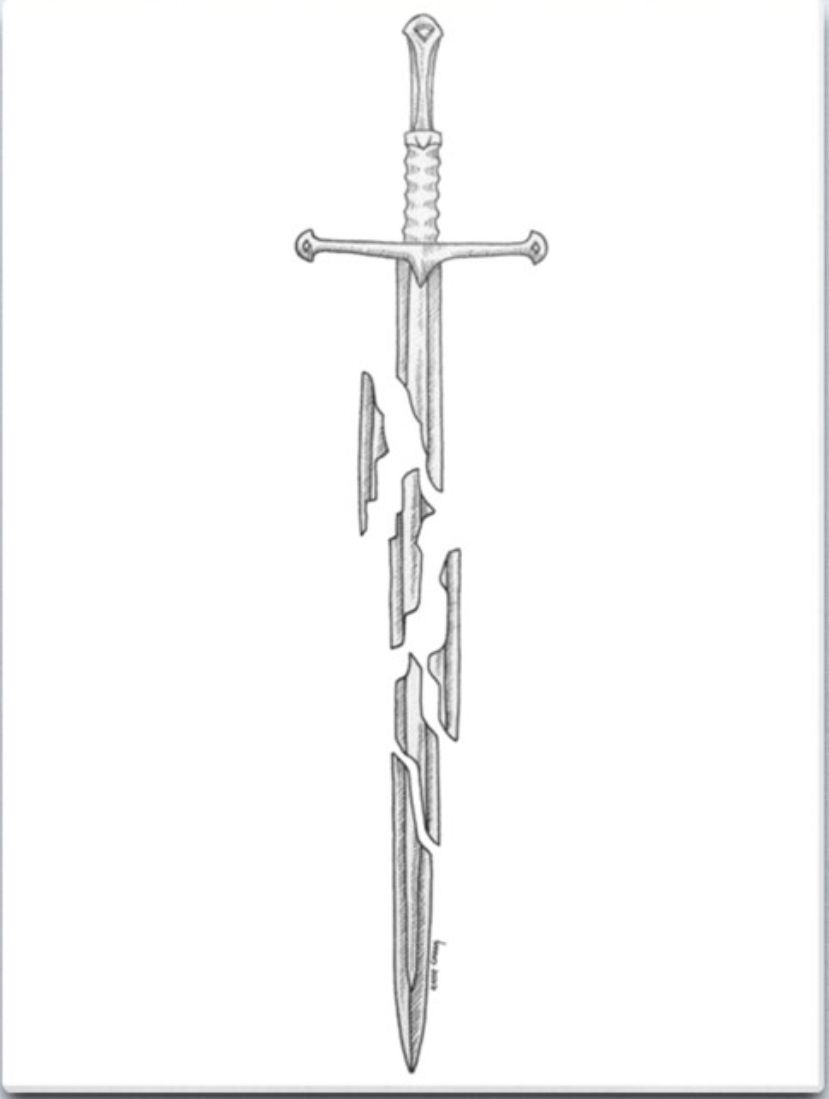
and his claim, can Aragorn prove that he is the wanderer, the light, the crownless?

The wanderer part is perhaps the easiest, because it’s self-evident:  Aragorn

(the Hildebrandts)

 is a ranger, one of those few survivors of the lost north kingdom of Arnor,

(Stephen Raw—you can learn a little more about him here:  https://tolkiengateway.net/wiki/Stephen_Raw )

of whom the narrator of The Lord of the Rings says:

“In those days no other Men had settled dwellings so far west, or within a hundred leagues of the Shire.  But in the wild lands beyond Bree there were mysterious wanderers.  The Bree-folk called them Rangers, and knew nothing of their origin…They roamed at will southwards, and eastwards even as far as the Misty Mountains; but they were few now and rarely seen.”  (The Fellowship of the Ring, Book One, Chapter 9, “At the Sign of the Prancing Pony”)

For further proofs, I’m reminded of Stephen Sondheim’s wonderful musical Into the Woods, 1987,
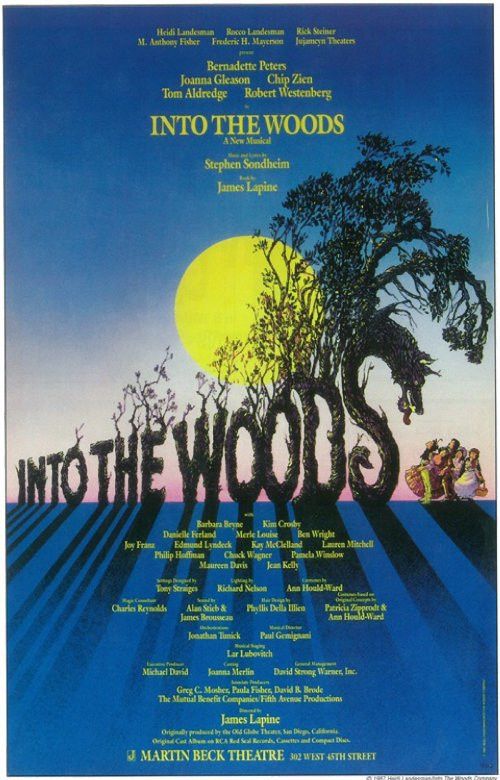
in which two characters, the Baker and his Wife, to have a witch’s curse removed, must bring her:  “the cow as white as milk, the cape as red as blood, the hair as yellow as corn, and the slipper as pure as gold” and much of the plot concerns their journey in the Woods to try to obtain these things—just the sort of objects one might obtain on a quest.  (For more on quests, see:  https://en.wikipedia.org/wiki/Quest )

In Aragorn’s case, although he’s not on a deliberate quest, one piece of his evidence is acquired as he and the Fellowship travel southwards:  the Palantir, inadvertently provided by Saruman.

(the Hildebrandts)

Pippin learns, to his unhappiness, that this isn’t something which one can casually pick up, but Aragorn, having used it, says to Gimli:

“I am the lawful master of the Stone, and I had both the right and the strength to use it…”

and here we see JRRT, in a brilliant bit of plotting, adding the reforged sword to the Palantir:

“…but Sauron has not forgotten Isildur and the sword of Elendil.  Now in the very hour of his great designs the heir of Isildur and the Sword are revealed; for I showed the blade re-forged to him.”  (The Return of the King, Book Five, Chapter 2, “The Passing of the Grey Company”)

So, now we have the shattered Sword and a display of Aragorn’s control of a Palantir, the next proof isn’t an object, but an event. 

Aragorn and his company follow the Paths of the Dead under the mountains, coming out at last to the Hill of Erech and its large, round, black stone.

(from Lotro-Wiki—where you can find more details:  https://lotro-wiki.com/wiki/The_Stone_of_Erech_(King’s_Gondor) and here:  https://lotro-wiki.com/wiki/Vandassar )

Behind them have come the “Oathbreakers”, men of long ago, who had pledged to help Isildur against Sauron, but then refused to join him.  In response, Isildur cursed them and they retreated to the hills and gradually faded, becoming uneasy spirits which troubled the land.   (For more, see:  https://tolkiengateway.net/wiki/Oathbreakers )  Aragorn has summoned them and here we see another proof:

“ ‘The hour is come at last.  Now I go to Pelargir upon Anduin, and ye shall come with me.  And when all this land is clean of the servants of Sauron, I will hold the oath fulfilled, and ye shall have peace and depart for ever.  For I am Elessar, Isildur’s heir of Gondor.’ “  (The Return of the King, Book Five, Chapter 2, “The Passing of the Grey Company”)
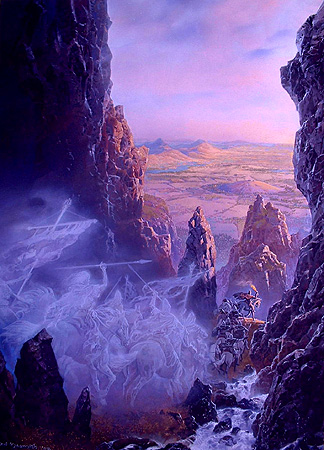
(Ted Nasmith)

To this, we can add a skill.

In the battles before Minas Tirith, Faramir has been struck down—seemingly by both a Southron arrow and by a Nazgul’s Black Breath—
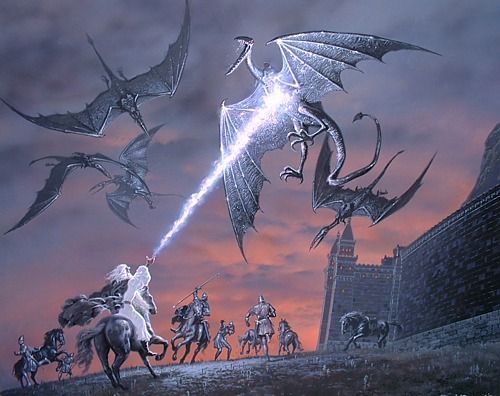
(Angus McBride)

and both Eowyn and Merry have suffered from their fight with the chief of the Nazgul.
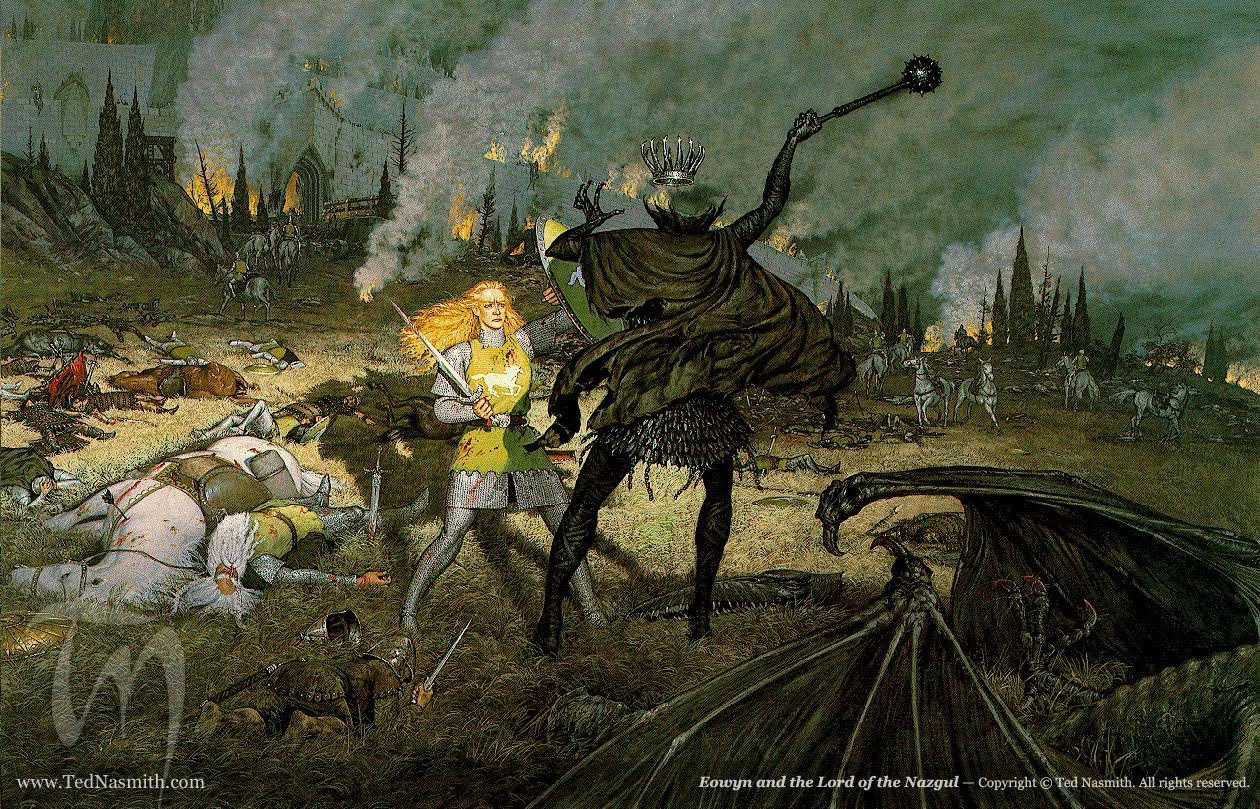
(Ted Nasmith)

They are brought to the Houses of Healing and there Ioreth, “the eldest of the women who served in that house”, looking at Faramir, said:

“ ‘Alas!  If he should die.  Would that there were kings in Gondor, as there were once upon a time, they say!  For it is said in the old lore:  The hands of the king are the hands of a healer.  And so the rightful king could ever be known.’ “

Using the herb athelas/kingsfoil, as well as some unspoken power, Aragorn restores all three, at which Ioreth says:

“ ‘King!  Did you hear that?  What did I say?  The hands of a healer, I said.’ “
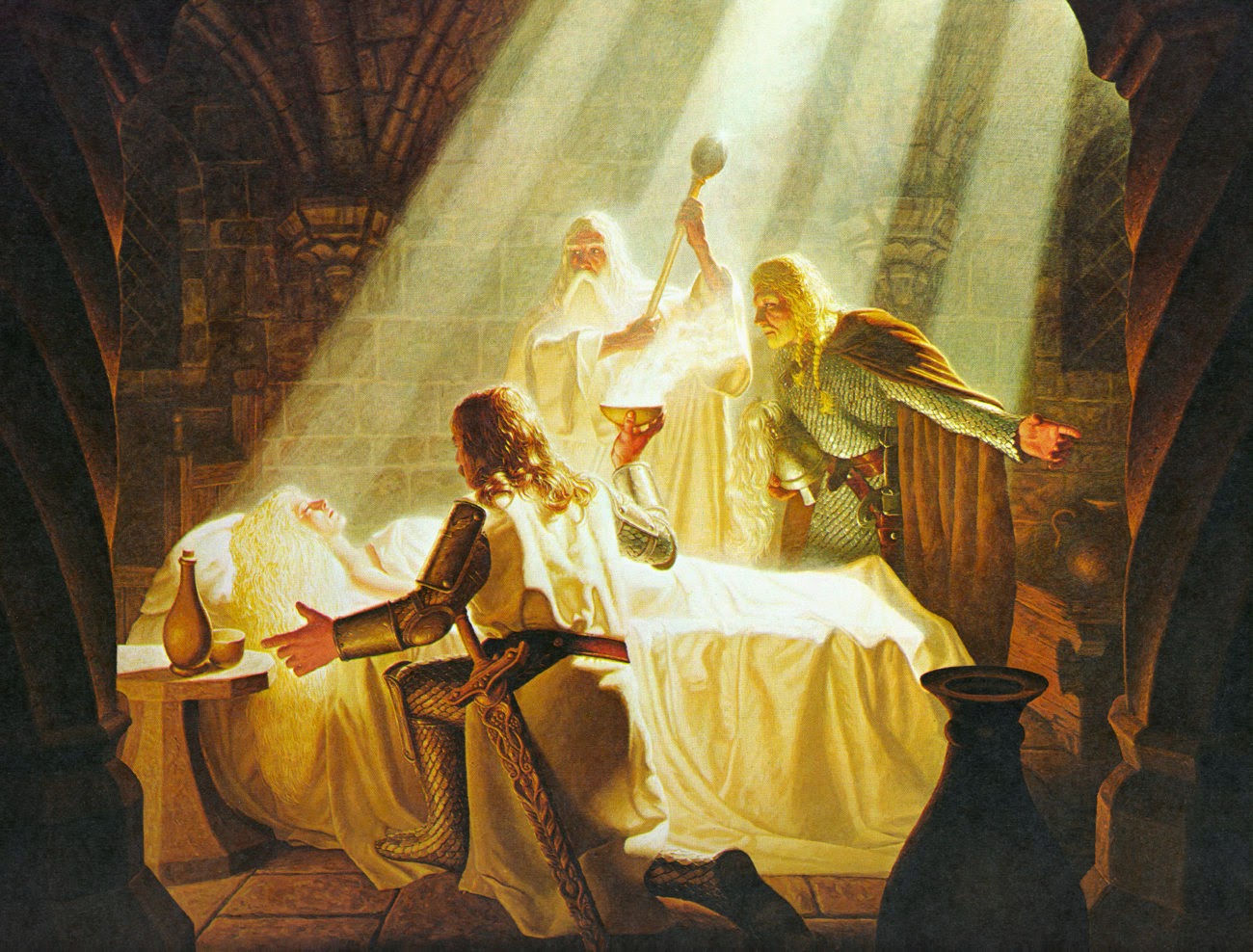
(the Hildebrandts)

Her words spread:

“And soon the word had gone out from the House that the king was indeed come among them, and after the war he brought healing, and the news ran through the city.”  (The Return of the King, Book Five, Chapter 8, “The Houses of Healing”)

And, finally, a sign.  The White Tree, symbol of Gondor—

“ ‘There in the courts of the King grew a white tree, from the seed of that tree which Isildur brought over the deep waters, and the seed of that tree came from Eressea, and before that out of the Uttermost West in the Day before days when the world was young.’ “  (The Fellowship of the Ring, Book Two, Chapter 2, “The Council of Elrond”)
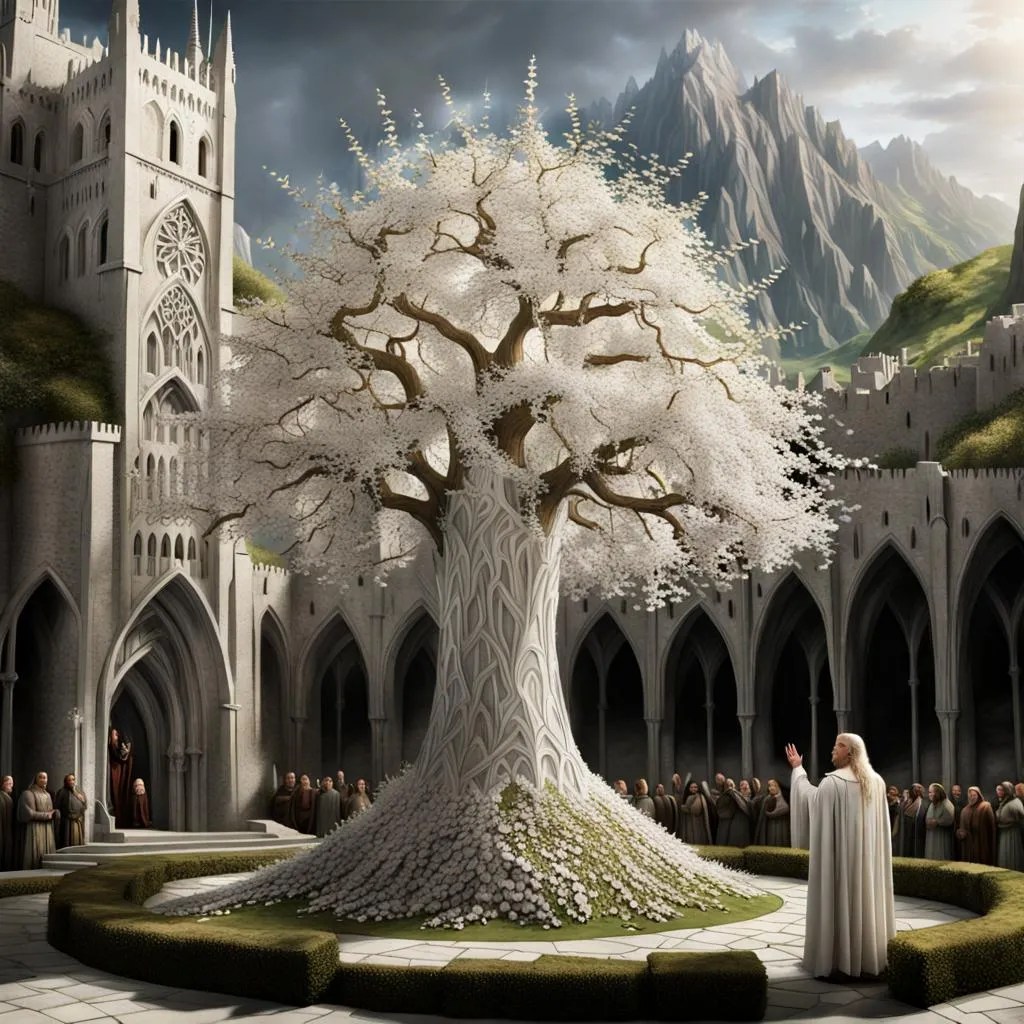
(artist?  So far, no luck in finding one, but I would be glad to credit someone for this impressive image.)

but now—

“A sweet fountain played there in the morning sun, and a sward of bright green lay about it, but in the midst, drooping over the pool, stood a dead tree, and the falling drops dripped sadly from its barren and broken branches back into the clear water.”  (The Return of the King, Book Five, Chapter 1, “Minas Tirith”)

(from Jackson’s film)

As this is the emblem of Gondor itself,

a replacement would certainly be a sign of renewal, which even after the defeat of Sauron seems doubtful to Aragorn:

“ ‘The tree in the Court of the Fountain is still withered and barren.  When shall I see a sign that it will ever be otherwise?’ “

Gandalf leads him to a place high on Mount Mindolluin and reveals to him:

“…a sapling tree no more than three foot high.  Already it had put forth young leaves long and shapely, dark above and silver beneath, and upon its slender crown it bore one small cluster of flowers whose petals shone like the sunlit snow.”

“Then Aragorn cried:  ‘Ye!  Utuvienyes! I have found it!  Lo!  Here is a scion of the Eldest of Trees!’  “

Gandalf is vague about its origins there, but says to Aragorn:

“ ‘Here it has lain hidden on the mountain, even as the race of Elendil lay hidden in the wastes of the North.’ “

Aragorn transplants it to the Court of the Fountain and sees its growth as a kind of prophecy—

“ ‘The sign has been given…’ “

On “the day before Midsummer”, the whole of the household of Elrond then appears at Minas Tirith, Elrond himself “bearing the sceptre of Annuminas”.  (The Return of the King, Book Six, Chapter 5, “The Steward and the King”)

In Appendix A, this object is explained:

“The sceptre was the chief mark of royalty in Numenor…and that was also so in Arnor, whose kings wore no crown, but bore a single white gem, the Elendilmir, Star of Elendil, bound on their brows with a silver fillet.”  (The Lord of the Rings, Appendix A, “The North-kingdom and the Dunedain”)

(not the sceptre of Annuminas, described as a simple silver rod, but it will give you the idea)

Then—

“…the King welcomed his guests, and they alighted; and Elrond surrendered the sceptre…”

And here we have a final proof:  the shattered sword, the ranger, the Palantir, the healing hands, the White Tree, and now the sceptre of Numenor—just as the acquisition by the Baker and his Wife of  “the cow as white as milk, the cape as red as blood, the hair as yellow as corn, and the slipper as pure as gold” will allow them to break the curse, with the sceptre the confirmation that Aragorn is the rightful king is complete—although we should also add:

“And Aragorn the King Elessar wedded Arwen Undomiel in the City of the Kings upon the day of Midsummer, and the tale of their long waiting and labours was come to fulfillment.” 

(the Hildebrandts)

Thanks, as always, for reading.

Stay well,

And remember, as always, that there’s

MTCIDC

O
Nodding Off

18 Wednesday Sep 2019

Posted by Ollamh in Artists and Illustrators, Fairy Tales and Myths, Literary History

≈ Leave a comment

Tags

A Child's Garden of Verses, Charles Robinson, Child Ballad, Eugene Field, Fairy Tale, Into the Woods, Little Red Riding Hood, Maxfield Parrish, Poems of Childhood, Port na bPucai, Robert Burns, Robert Louis Stevenson, Song of the Pooka, Steven Sondheim, The Land of Nod, The Scots Musical Museum

Welcome, dear readers, as ever.

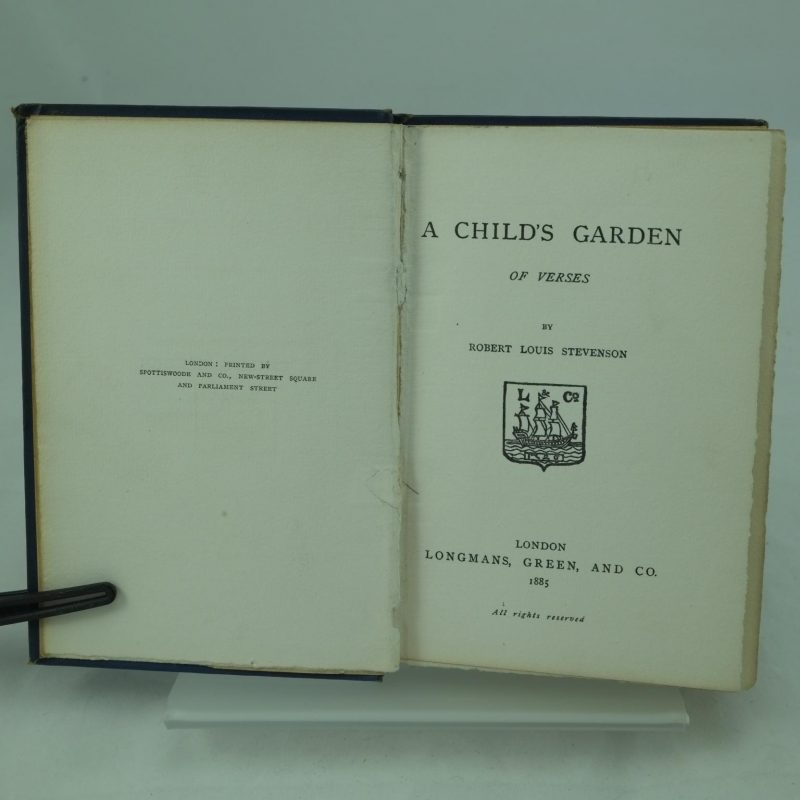
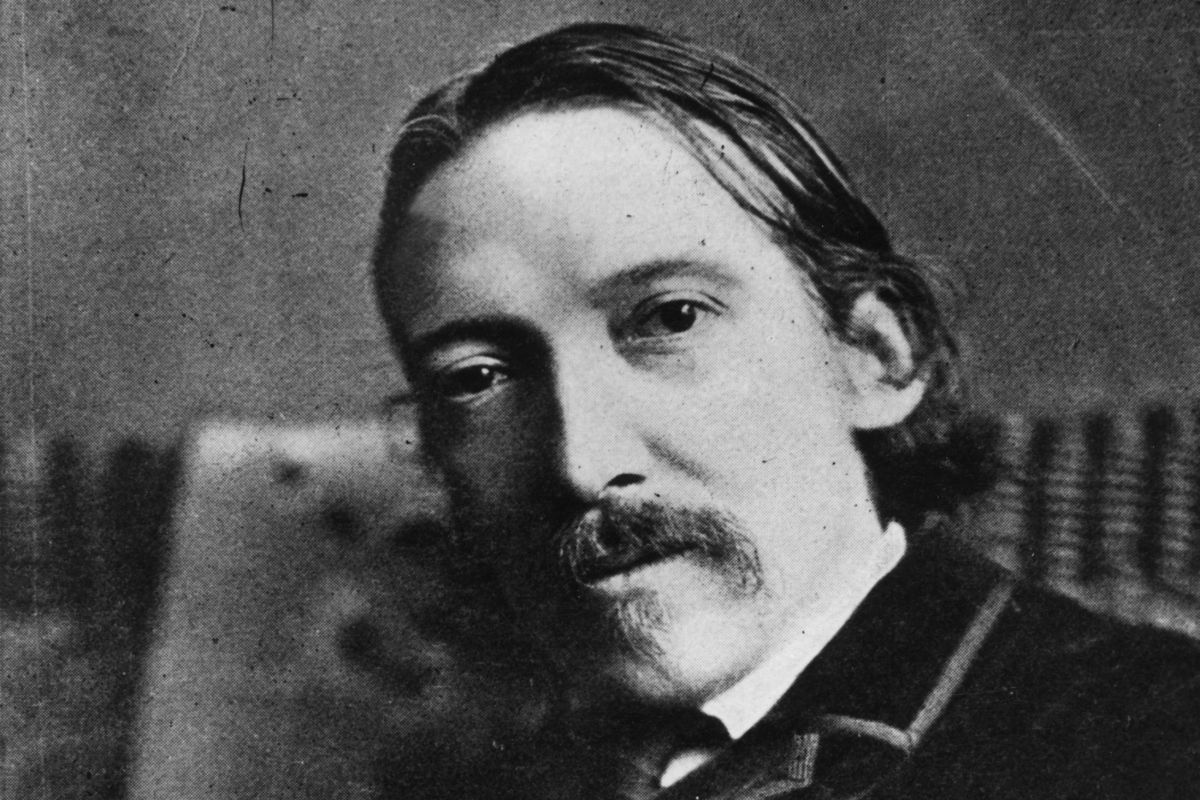
In our last, we began with a poem by Robert Louis Stevenson

image1rls.jpg

from his 1885 collection, A Child’s Garden of Verses.

image2garden.jpg

There’s another poem from that collection which has haunted us for years—here it is:

THE LAND OF NOD

From breakfast on through all the day

At home among my friends I stay,

But every night I go abroad

Afar into the Land of Nod.


All by myself I have to go,

With none to tell me what to do—

All alone beside the streams

And up the mountain-side of dreams.


The strangest things are there for me,

Both things to eat and things to see,

And many frightening sights abroad

Till morning in the Land of Nod.


Try as I like to find the way,

I never can get back by day,

Nor can remember plain and clear

The curious music that I hear.

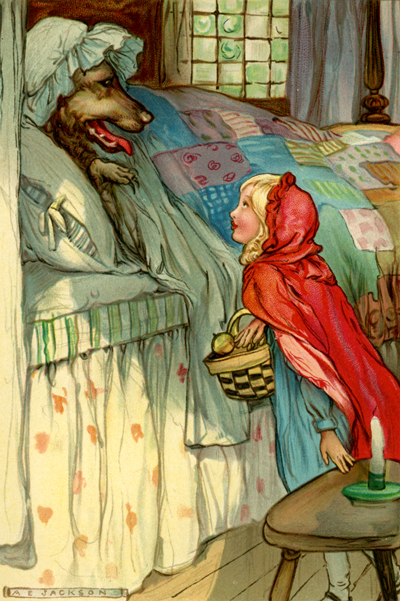
As a poem for children, it seems to contain a certain amount of menace:  “All by myself I have to go”, “many frightening sights”.  At the same time, there is a certain fascination—after all, the speaker seems to want to return there.  In other words, it’s a weird, but somehow interesting place, which reminds us of Little Red Riding Hood’s song from Stephen Sondheim’s modern fairy tale musical, Into the Woods (1987), in which she describes her experience with the wolf:

Mother said,
“Straight ahead,
Not to delay
or be misled.”
I should have heeded
Her advice…
But he seemed so nice.
And he showed me things
Many beautiful things,
That I hadn’t thought to explore.
They were off my path,
So I never had dared.
I had been so careful,
I never had cared
And he made me feel excited-
Well, excited and scared.
When he said, “Come in!”
With that sickening grin,
How could I know what was in store?
Once his teeth were bared,
Though, I really got scared-
Well, excited and scared-
But he drew me close
And he swallowed me down,
Down a dark slimy path
Where lie secrets that I never want to know
And when everything familiar seems to disappear forever
At the end of the path was granny once again
So we lay in the dark till you came and set us free
And you brought us to the light
And we’re back at the start

And I know things now,
Many valuable things,
That I hadn’t known before:
Do not put your faith
In a cape and a hood,
They will not protect you
The way that they should.
And take extra care with strangers,
Even flowers have their dangers.
And though scary is exciting,
Nice is different than good.
Now I know:
Don’t be scared.
Granny is right,
Just be prepared.
Isn’t it nice to know a lot!
And a little bit…not.”

image3lrrh.png

Perhaps it’s that “curious music that I hear” which lures the speaker back?  For us, we’re immediately reminded of the Otherworld music which calls mortals into Faerie in Celtic folk literature.  Here’s a well-known tune with a lyric in Irish and English, which is the lament of a mortal woman who has been pulled into that world against her will, entitled Port na bPucai, “Song of the Pooka” (a kind of Otherworld spirit who plays malevolent tricks on mortals), which can illustrate the kind of music humans believed the Otherworlders used:

Is bean ón slua sí mé, do tháinig thar toinn

I am a woman from the fairy host who traveled over the seas

Is do goideadh san oíche me tamall thar lear

I was stolen in the night and taken beyond the sea

Is go bhfuilim as ríocht seo fé gheas’ mná sídhe

And I am held hostage in the kingdom by the fairy women

Is ní bheidh ar an saol seo ach go nglaofaidh an coileach

And I can only be in this world until the moment the cock crows

Is caitheadsa féin tabhairt fá’n deis isteach

I know I have tasks to do here

Ni thaithneamh liom é ach caithfead tabhairt fé

Which I do not like but must comply with

Is caitheadsa féin tabhairt fén lios isteach

I must return to the fort and do not have anything to do

Is ná déinig aon ní leis an dream thíos sa leas

With this body of fairy people down in the fairy mound.


And here’s a LINK so that you can hear that music sung.

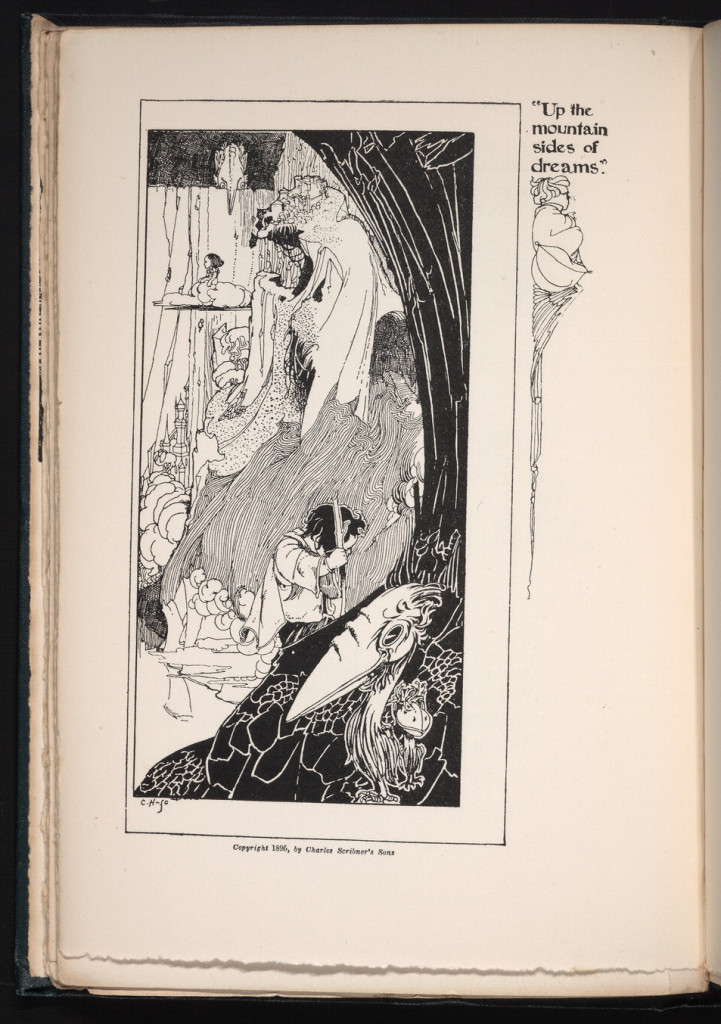
On one level, then, this Land of Nod is simply the land of dreams—and here that land is, disturbingly illustrated by Charles Robinson for an 1895 edition of A Child’s Garden of Verses.

image4robinson.jpg

And we see this again in another late-19th-century poem, by the American poet, Eugene Field (1850-1895), where Nod has become a character who, along with two boating friends (Wynken and Blynken), personifies a child going to sleep:

Dutch Lullabye

Wynken, Blynken, and Nod one night
sailed off in a wooden shoe —
Sailed on a river of crystal light,
into a sea of dew.
“Where are you going, and what do you wish?”
the old moon asked the three.
“We have come to fish for the herring fish
that live in this beautiful sea;
Nets of silver and gold have we!”
said Wynken, Blynken, and Nod.

The old moon laughed and sang a song,
as they rocked in the wooden shoe,
And the wind that sped them all night long
ruffled the waves of dew.
The little stars were the herring fish
that lived in that beautiful sea —
“Now cast your nets wherever you wish —
never afraid are we”;
So cried the stars to the fishermen three:
Wynken, Blynken, and Nod.

All night long their nets they threw
to the stars in the twinkling foam —
Then down from the skies came the wooden shoe,
bringing the fishermen home;
‘Twas all so pretty a sail, it seemed
as if it could not be,
And some folks thought ’twas a dream they’d dreamed
of sailing that beautiful sea —
But I shall name you the fishermen three:
Wynken, Blynken, and Nod.

Wynken and Blynken are two little eyes,
and Nod is a little head,
And the wooden shoe that sailed the skies
is a wee one’s trundle-bed.
So shut your eyes while Mother sings
of wonderful sights that be,
And you shall see the beautiful things
as you rock in the misty sea,
Where the old shoe rocked the fishermen three:
Wynken, Blynken, and Nod.

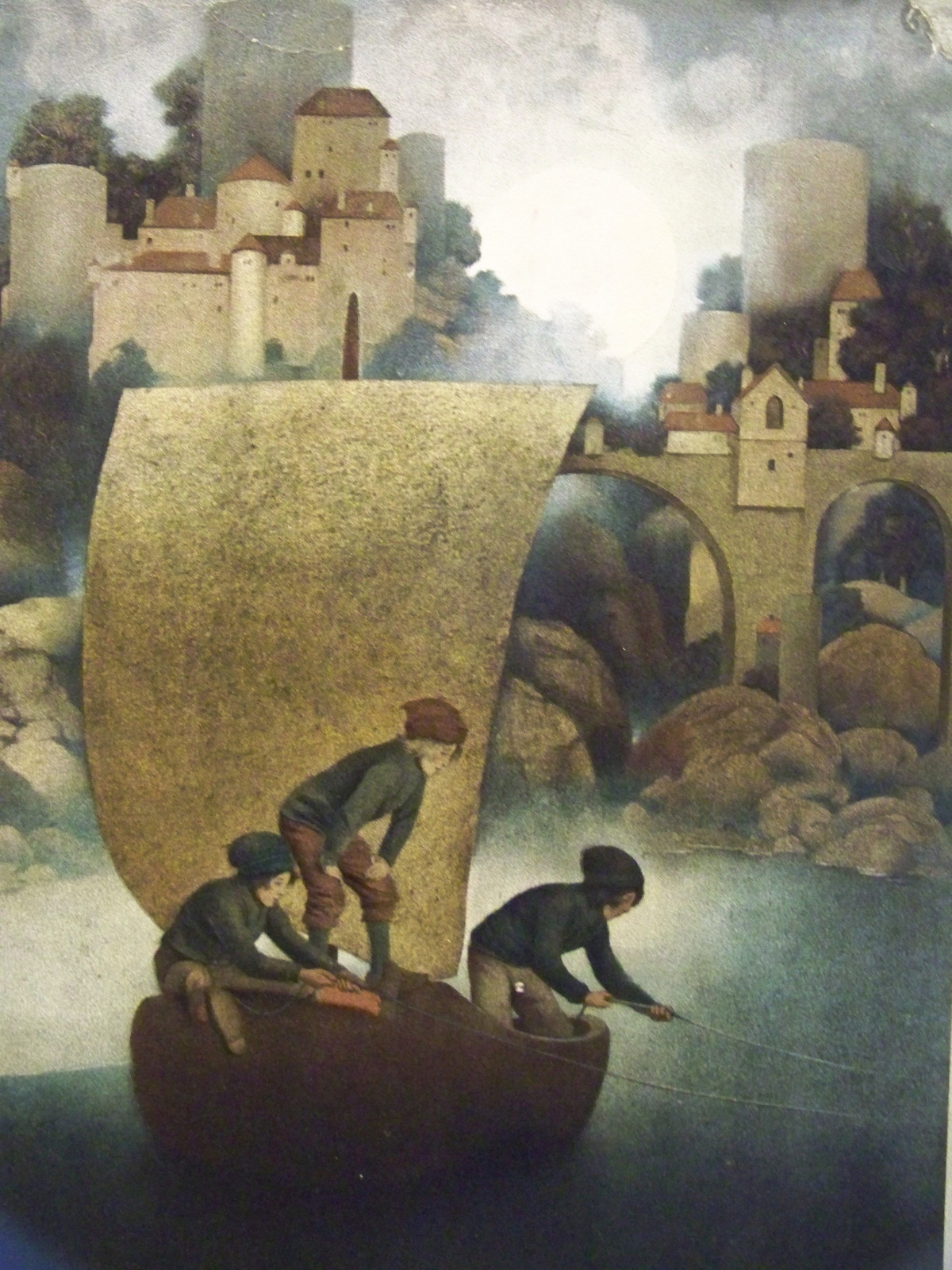
For a 1904 edition of a selection of Field’s poems, Poems of Childhood, Maxfield Parrish provided the following illustration—

image5parrish.jpg

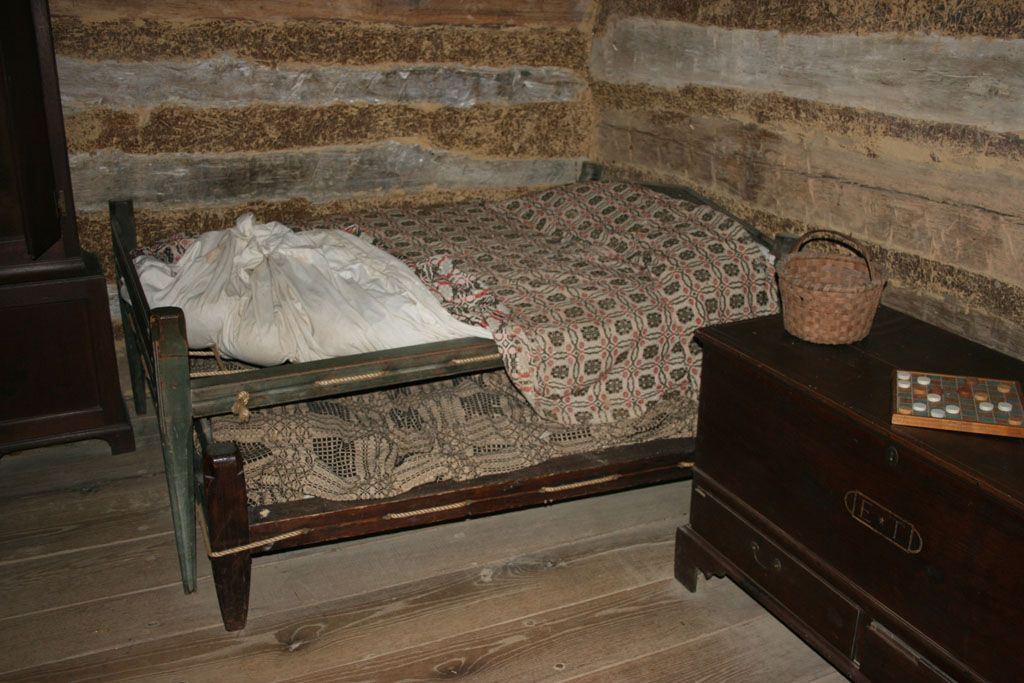
(A “trundle bed”, by the way, is a low bed built to slide out from under a taller one and commonly was used in the past to accommodate children.  Here’s an image of one.)

image6trundle.jpg


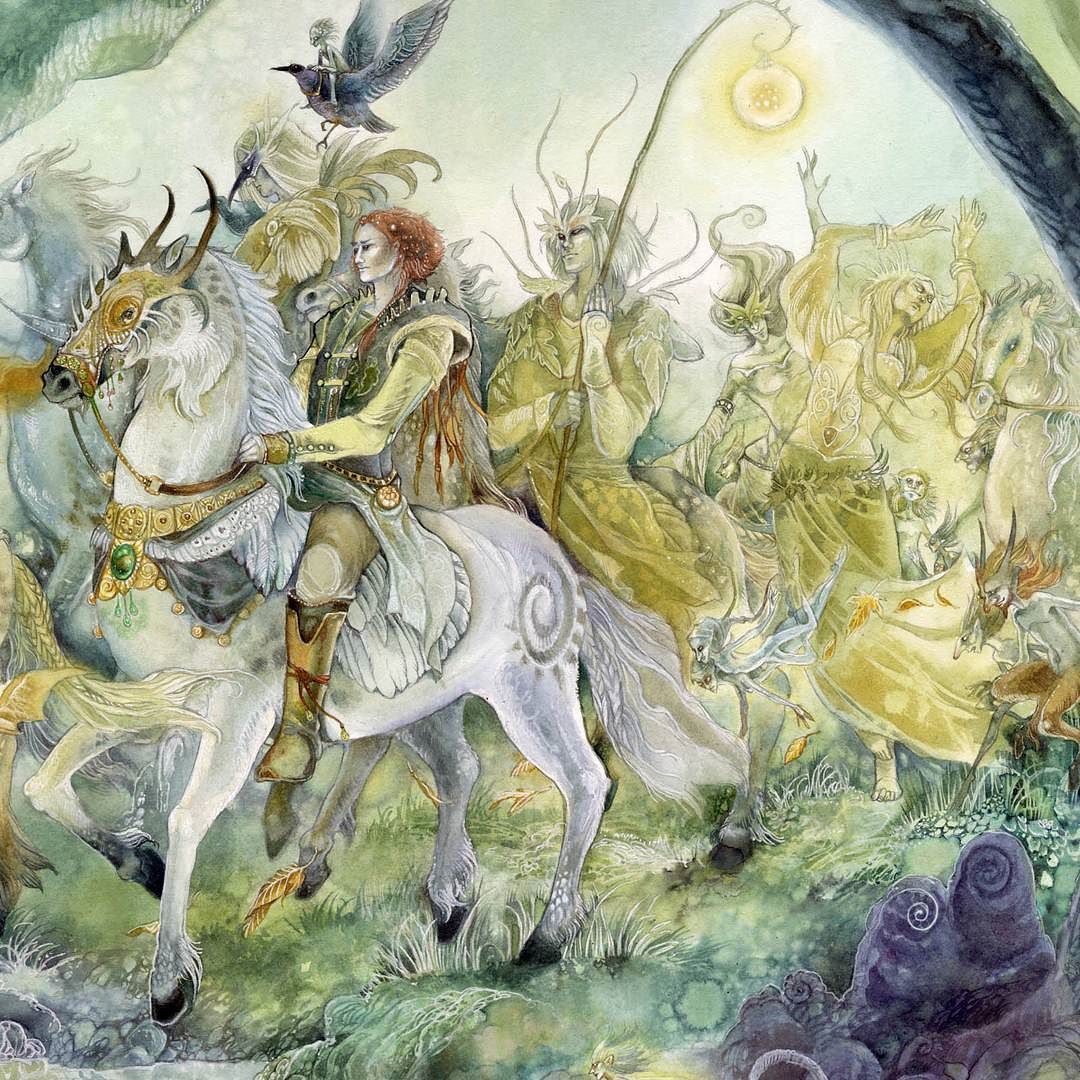
On another level, the reference to music might remind us of the Celtic Otherworld, to which unsuspecting humans are lured away.

image7tl.jpg

This is an illustration of Child Ballad 39A, “Tam Lin”.  Tam (Tom) is a mortal who has been taken by the elves (another name here for fairies) and is eventually rescued by a mortal woman.  Here’s a LINK to more on the ballad.

We have one more possibility for the Land of Nod—perhaps that which inspired Stevenson initially.  “To nod off” is an expression meaning “to fall asleep”, as we see in a traditional Scots song, “We’re a’ nodding”.  Here’s the first verse and the chorus as edited by Robert Burns and published in Volume 6 of The Scots Musical Museum (1803):

Gudeen to you kimmer
And how do you do?
Hiccup, quo’ kimmer,
The better that I’m fou.

Chorus:
We’re a’ noddin, nid nid nodding,
We’re a’ nodding at our house at hame,
We’re a’ noddin, nid nid nodding,
We’re a’ nodding at our house at hame.

(Translation:

“Good evening to you, old gossip,

And how are you?

Hiccup! Said the old gossip,

Much better because I’m full. [a local usage, meaning “drunk”]

Chorus:

We’re all nodding, nid, nid, nodding,

We’re all nodding at our house at home.

We’re all nodding, nid, nid, nodding,

We’re all nodding at our house at home.”)

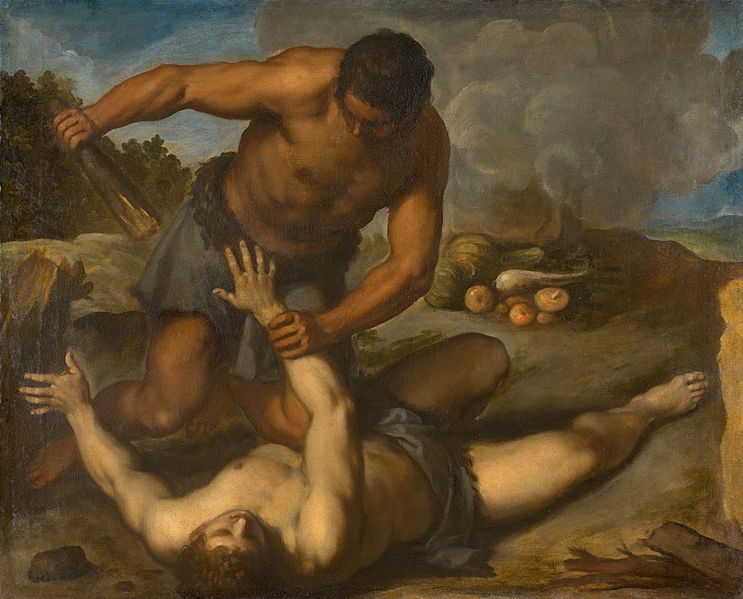
But, besides this meaning, there is also, from “Genesis” in the Hebrew Bible, the story of the twin sons of Adam and Eve, Cain and Able.  After Cain murders Able:

“And Cain went out from the presence of the LORD, and dwelt in the land of Nod, on the east of Eden.” (“Genesis”, Chapter 4, Verse 16)

image8canda.jpg

A little research suggests that the name “Nod” comes from a Hebrew root for the verb “to wander”, so Cain, we may be being told, was a wanderer.  That brings us back to our original Stevenson poem, where the speaker tells us that

“…every night I go abroad

Afar into the Land of Nod.


All by myself I have to go,

With none to tell me what to do—

All alone beside the streams

And up the mountain-side of dreams.”


Pleasant—or pleasanter—dreams, dear readers, and


MTCIDC


CD


ps

Our information on the Hebrew Land of Nod comes from this LINK.

Into Those Woods

17 Wednesday May 2017

Posted by Ollamh in Fairy Tales and Myths, J.R.R. Tolkien, Literary History, Narrative Methods

≈ Leave a comment

Tags

A Midsummer Night's Dream, Athens, Burnham Wood, Caspar David Friedrich, Circe, Der Blonde Eckbert, Edmund Burke, Fangorn, forest, Gespensterwald, Grimm Brothers, Haensel and Gretel, Horace Walpole, Into the Woods, Ithilien, Jacob Grimm, John Bauer, John Walter Bratton, Lorien, Ludwig Tieck, Macbeth, Mirkwood, Misty Mountains, N.C. Wyeth, Nienhagen, Odysseus, Old Forest, Philosophical Inquiry Into the Origin of Our Ideas, Robert Frost, Robin Hood, Romanticism, Sir Walter Scott, Snow White, Steven Sondheim, Straparola, Teddy Bears' Picnic, The Castle of Otranto, The Fire Swamp, The Hobbit, The Lord of the Rings, The Princess Bride, Tolkien, Treebeard, Waldeinsamkeit, Waverly, Wilhelm Grimm, Woses

Welcome, dear readers, as always.

There is an early-twentieth-century American popular song called “Teddy Bears’ Picnic”, by John Walter Bratton. This was first published, in 1907, as “The Teddy Bears Picnic: A Characteristic Two-Step”,

image1tbears.jpeg

but in 1932, it acquired both its current title and lyrics, beginning,

“If you go down to the woods today,

You’re sure of a big surprise…”

Here’s a link, if you’d like to read more. And here’s a link to the first recording of the version with its lyrics, from 1932. WARNING: it has a catchy little tune!

This song came to us because we’ve been thinking about forests and their frequency and importance in The Hobbit and The Lord of the Rings.

Woods have always been spooky places in folktales. Think of Haensel and Gretel, for example,

image2handg.jpg

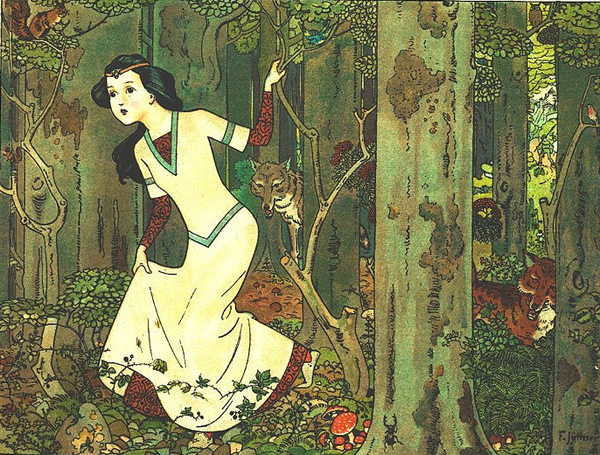
or Snow White,

image3snowwhite.jpg

or even the story of Odysseus and Circe, as Circe’s house is set deep in a forest.

image3acirce.jpg

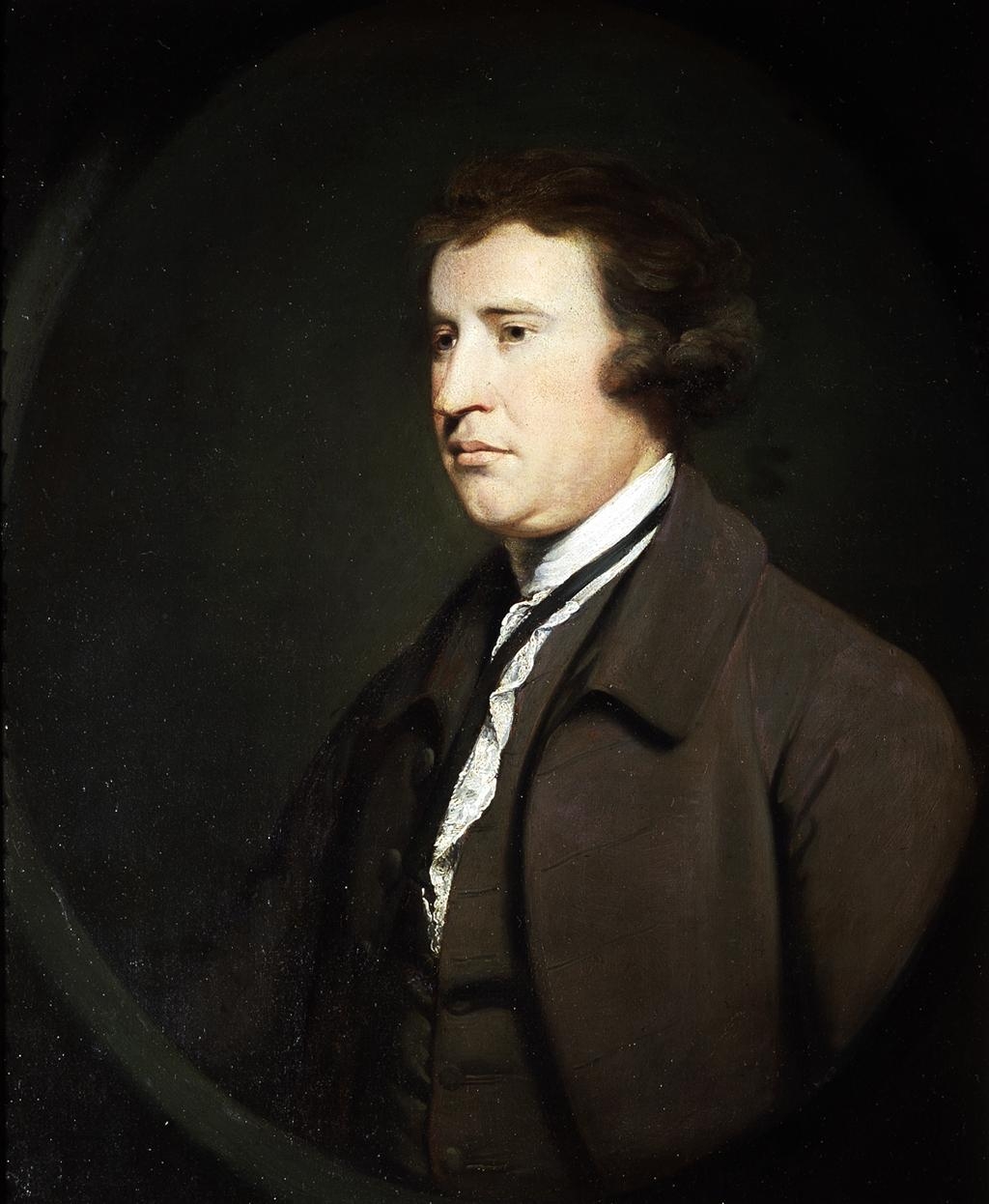
Among our interests is Romanticism–both in itself because it’s in Romanticism that modern adventure stories really take off (for the supernatural, think Horace Walpole, The Castle of Otranto, 1764; for historical, Sir Walter Scott, Waverly, 1814). The early Romantics were fascinated by the forest, both as a place of beauty and of fear. This is not surprising, for several reasons. First, they were influenced by the writings of Edmund Burke (1729-1797),

image4burke.jpg

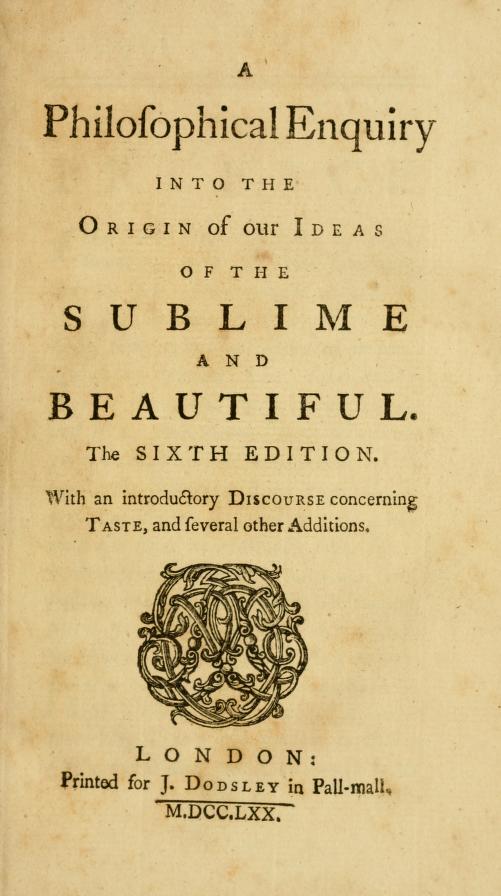
who published a famous essay, “Philosophical Inquiry Into the Origin of Our Ideas of the Sublime and Beautiful” in 1757 (this is a 1770s reprint).

image5inquiry.jpg

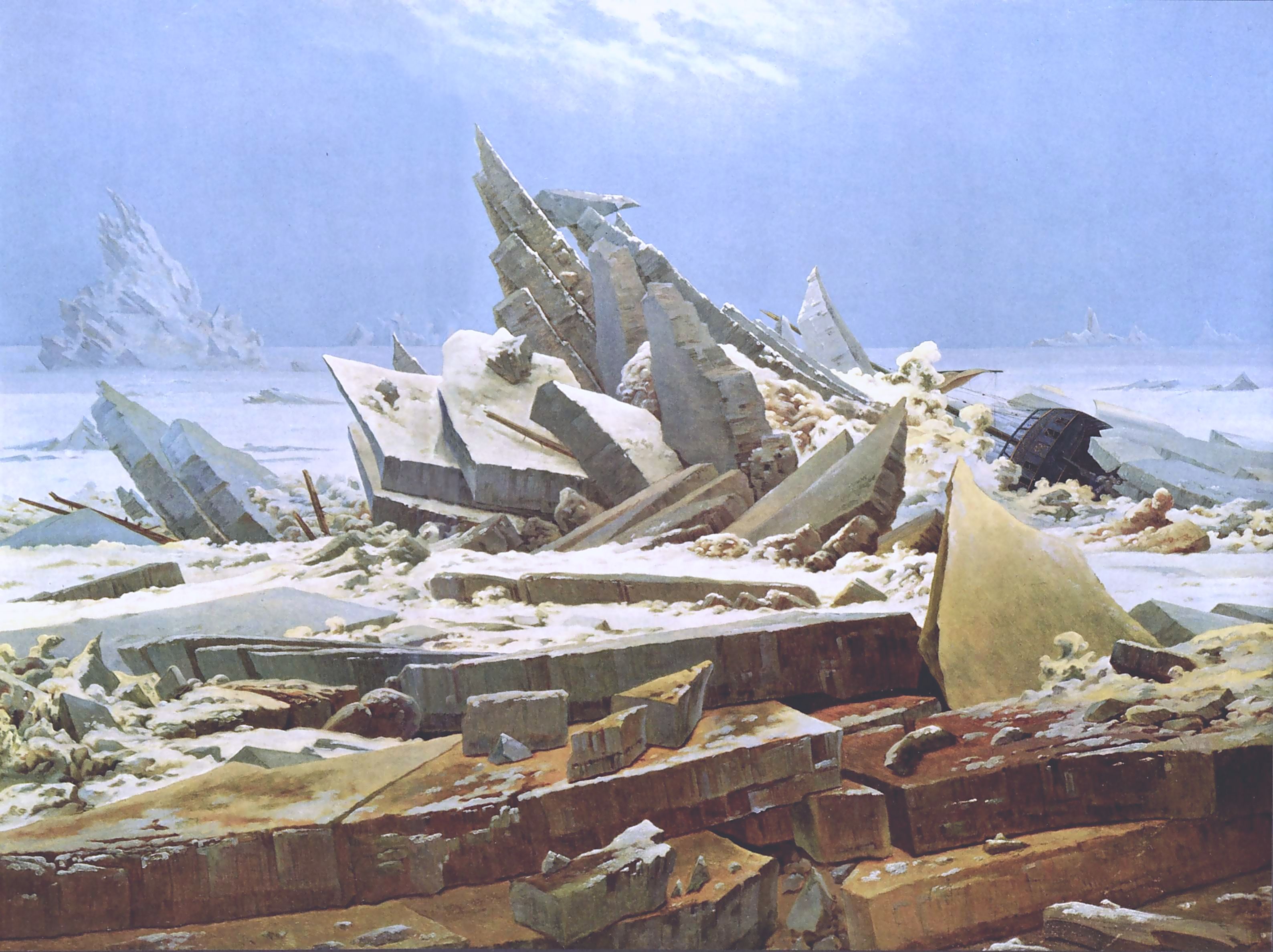
Burke was interested in human reactions to things which, basically, are either awe-inspiring (how about this?)

image6eismeer.jpg

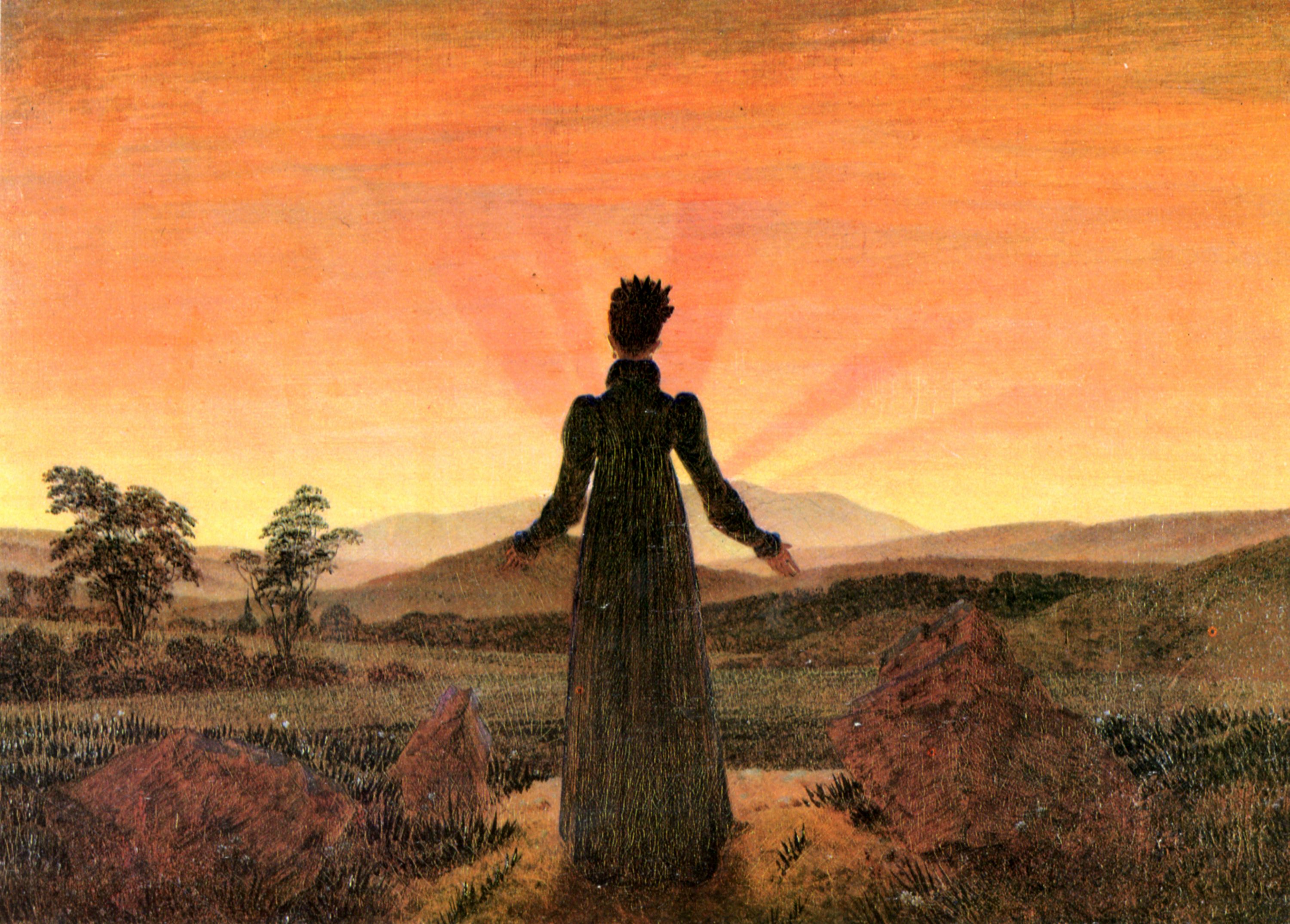
or beautiful

image7beautiful.jpg

Awe-inspiring (to which may even be added a little terror– you, sharp-eyed readers have probably already noticed that there are the remains of a crushed ship in the ice in the first picture) is a sort of opposite of the beautiful– we say “sort of” because they can be related, which is why we chose two pictures by the same artist– our favorite early Romantic artist, in fact, Caspar David Friedrich (1774-1840).

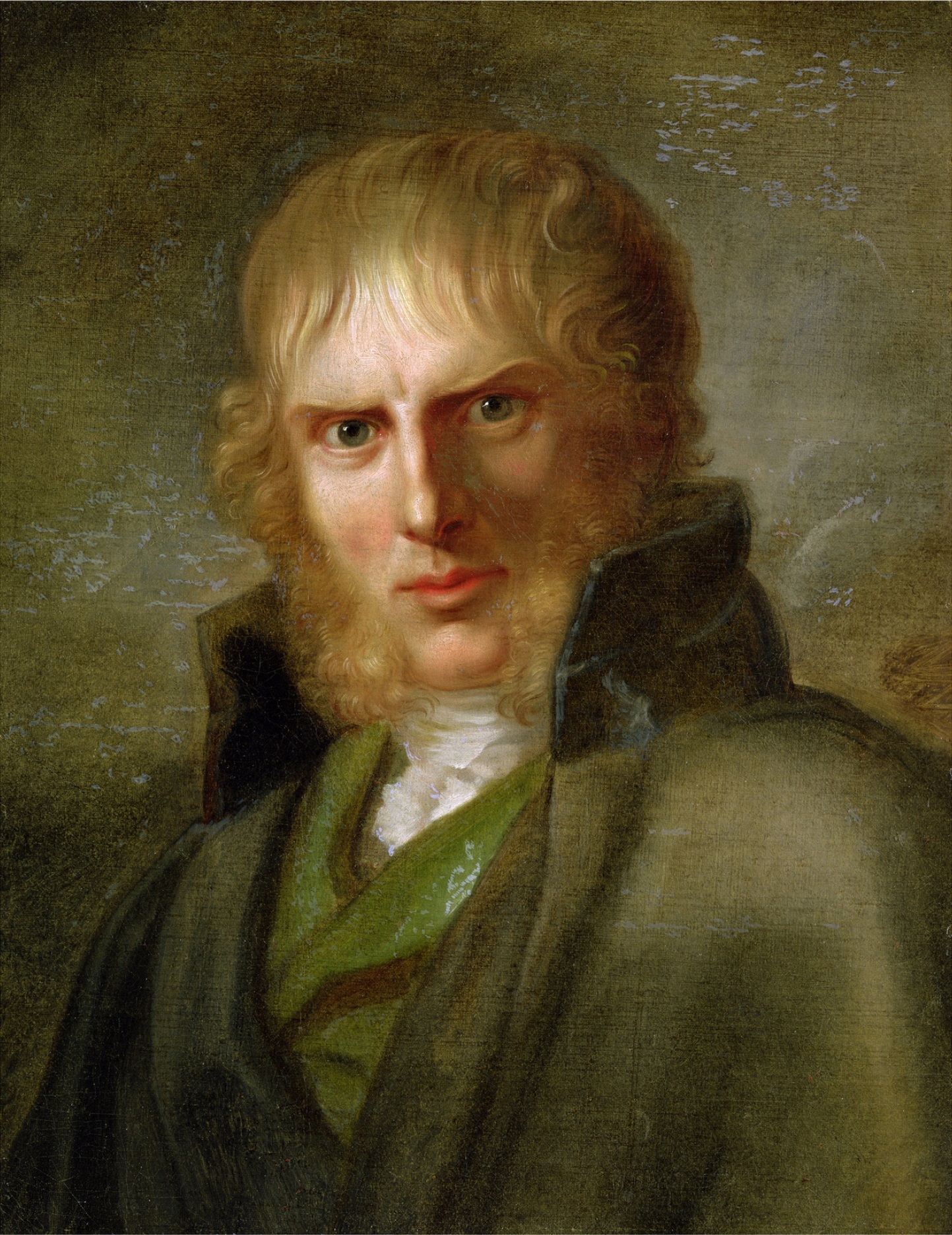
image8cdf.jpg

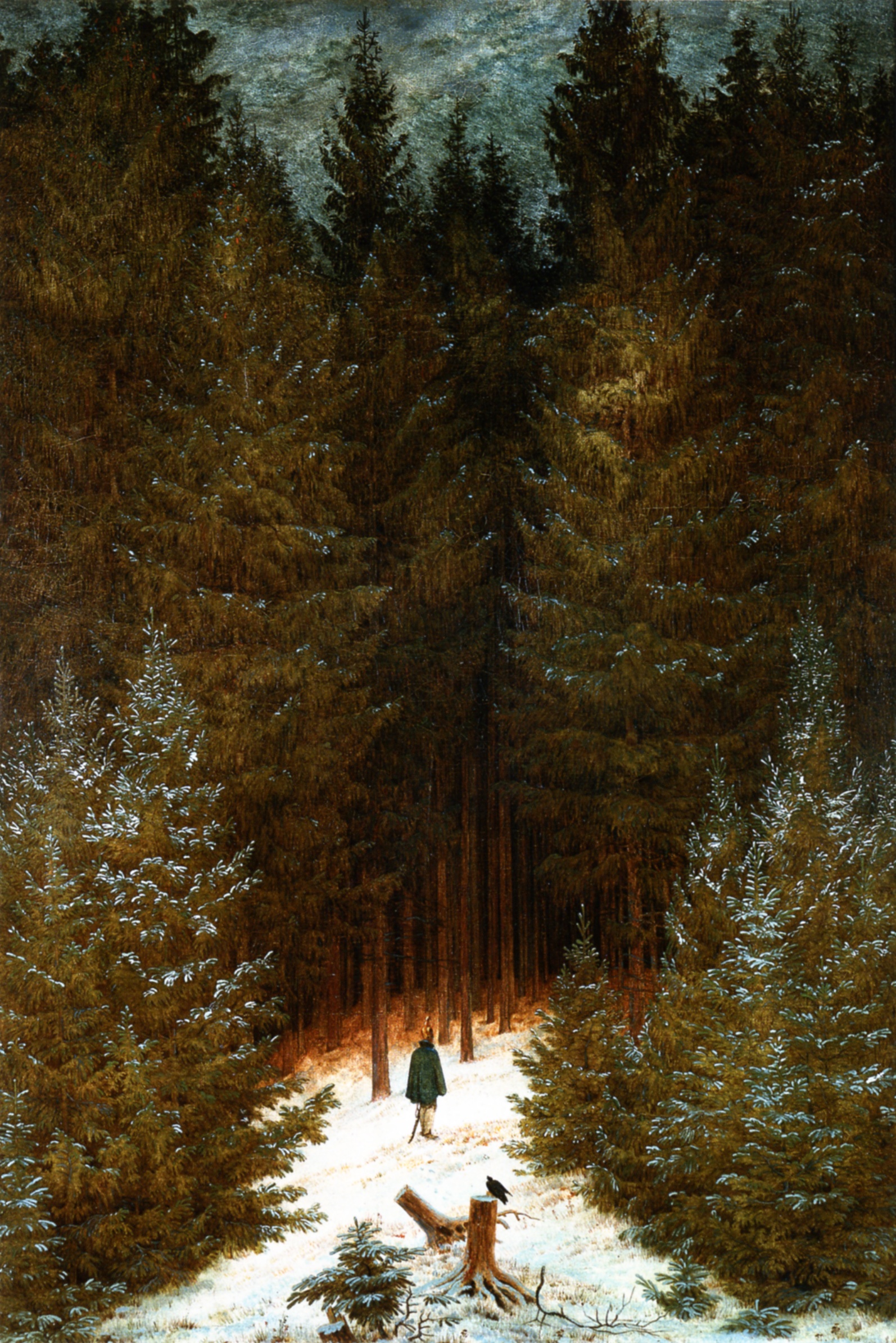
This brings us to this Friedrich painting:

image9chass.jpg

There are lots of his paintings in which we are standing behind someone who is looking off into the distance– as in the one we chose for “the beautiful”. As you can see in the above, here we have a man contemplating a path into a snowy wood. (Which reminds us of a poem by the American poet Robert Frost, 1874-1963, and we can’t resist adding it here, just for the pleasure of it:)

Stopping by Woods on a Snowy Evening

Whose woods these are I think I know.
His house is in the village though;
He will not see me stopping here
To watch his woods fill up with snow.
My little horse must think it queer
To stop without a farmhouse near
Between the woods and frozen lake
The darkest evening of the year.
He gives his harness bells a shake
To ask if there is some mistake.
The only other sound’s the sweep
Of easy wind and downy flake.
The woods are lovely, dark and deep,
But I have promises to keep,
And miles to go before I sleep,
And miles to go before I sleep.

There is menace here (note the crow on the stump in the foreground…), and yet it’s beautiful. And tempting– and that’s part of the sublime, as well.

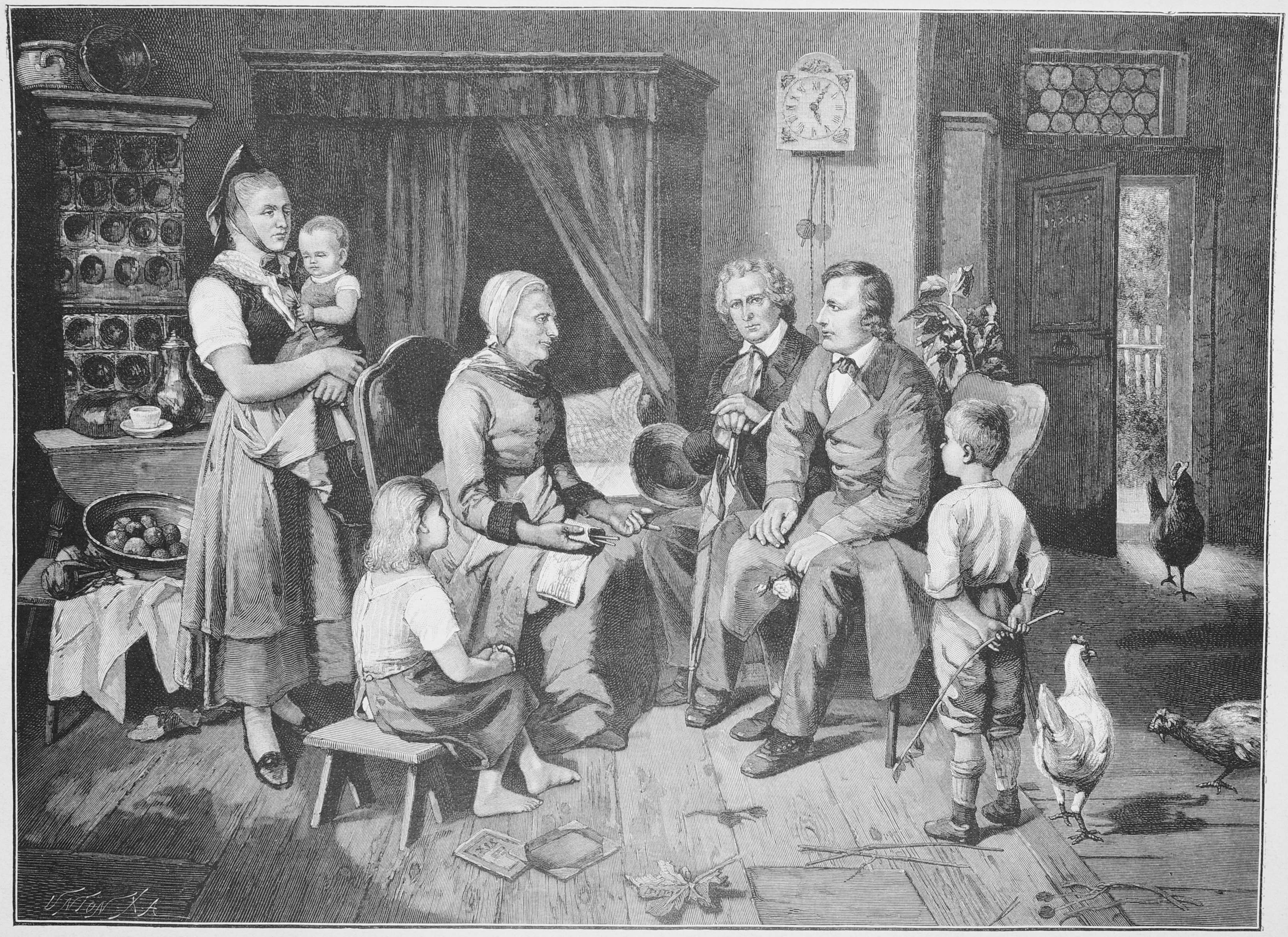
Besides their interest in Burke, the early Romantics were also deeply interested in folktales. People had been collecting and publishing such things in early modern Europe since at least Straparola in the 16th century, but, from the Romantics, we have the work of these two men, highly-intelligent brother-scholars, the Grimms, Jacob (1785-1863) and Wilhelm (1786-1859), whose work, either in itself on in adaptation, is known throughout the whole western world.

image10grimms.jpg

The story of Haensel and Gretel comes from them, in fact (as does Snow White). Because of a famous short story by Ludwig Tieck (1773-1853),

image11tieck.jpg

“Der Blonde Eckbert” (maybe “Fair-haired Eckbert” in English?), there is a word in German for this fascination for the woods, Waldeinsamkeit, meaning something like “The Sense of Being Alone in the Forest”. Like “sublime”, this word has a wide range of feeling to it, including that sense of aloneness/being alone/loneliness/ mixed with the pleasure of being alone in the forest. In the story, the word is contained in a little poem sung by a strange bird, which begins:

“Waldeinsamkeit

Die mich erfreut

So morgen wie heut

In ewger Zeit

O wie mich freut

Waldeinsamkeit.”

“Aloneness in the forest–

That delights me,

As today so tomorrow

In eternal time

Oh how it delights me

Aloneness in the forest!”

In the case of JRRT, however, although he was well known to be quite passionate in his love for trees, forests in his work do not always appear to be places for pleasure. (And how can we not be reminded of that moment in the film, The Princess Bride, when the hero and heroine are at the edge of the Fire Swamp, a kind of haunted wood,

image12fireswamp.jpg

and the hero, Westley, says, “It’s not that bad. I’m not saying that I’d like to build a summer home here, but the trees are actually quite lovely”– and only a moment later the heroine, Buttercup, is attacked by a spurt of flame from the ground itself?)

Out first wood in The Hobbit is the one into which several of the dwarves disappear, captured by three rather dimwitted trolls.

image12atrolls.jpg

When we look at this and at other JRRT illustrations, we are reminded of the world of the Swedish illustrator, John Bauer (1882-1918), some of whose fairy tale forests bear a certain strong similarity in their regularity.

image12bbaueer.jpg

image13bauer.jpg

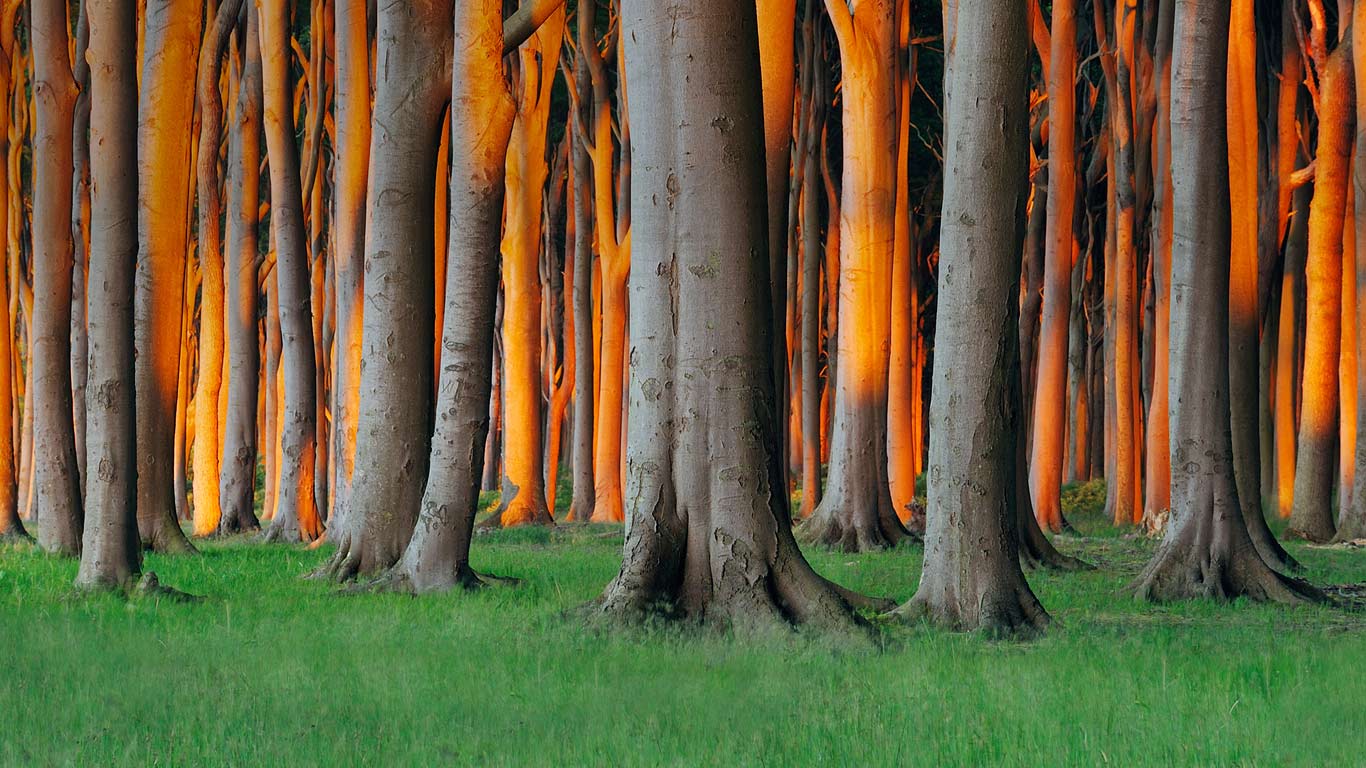
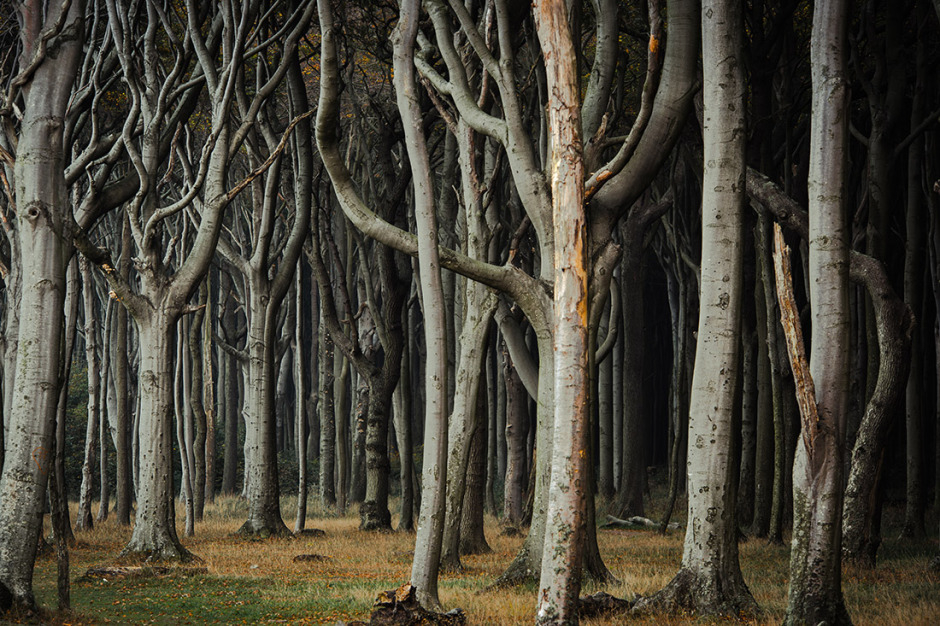
What’s surprising is that, in northern Europe, there actually appear to be stands of wood which actually look very like this. Here’s Nienhagen, in northern Germany.

image14nienhagen.jpg

It’s a beechwood (one of JRRT’s favorite trees and ours, too– remember this big beech from N.C. Wyeth’s Robin Hood illustrations?

image15robin.jpg

Nienhagen has another name, however, Gespensterwald, “Ghostwood”, and, seeing this next picture and comparing it to Bauer’s paintings, we imagine that you’d agree with us that this is an appropriate nickname.

image16gespensterwald.jpg

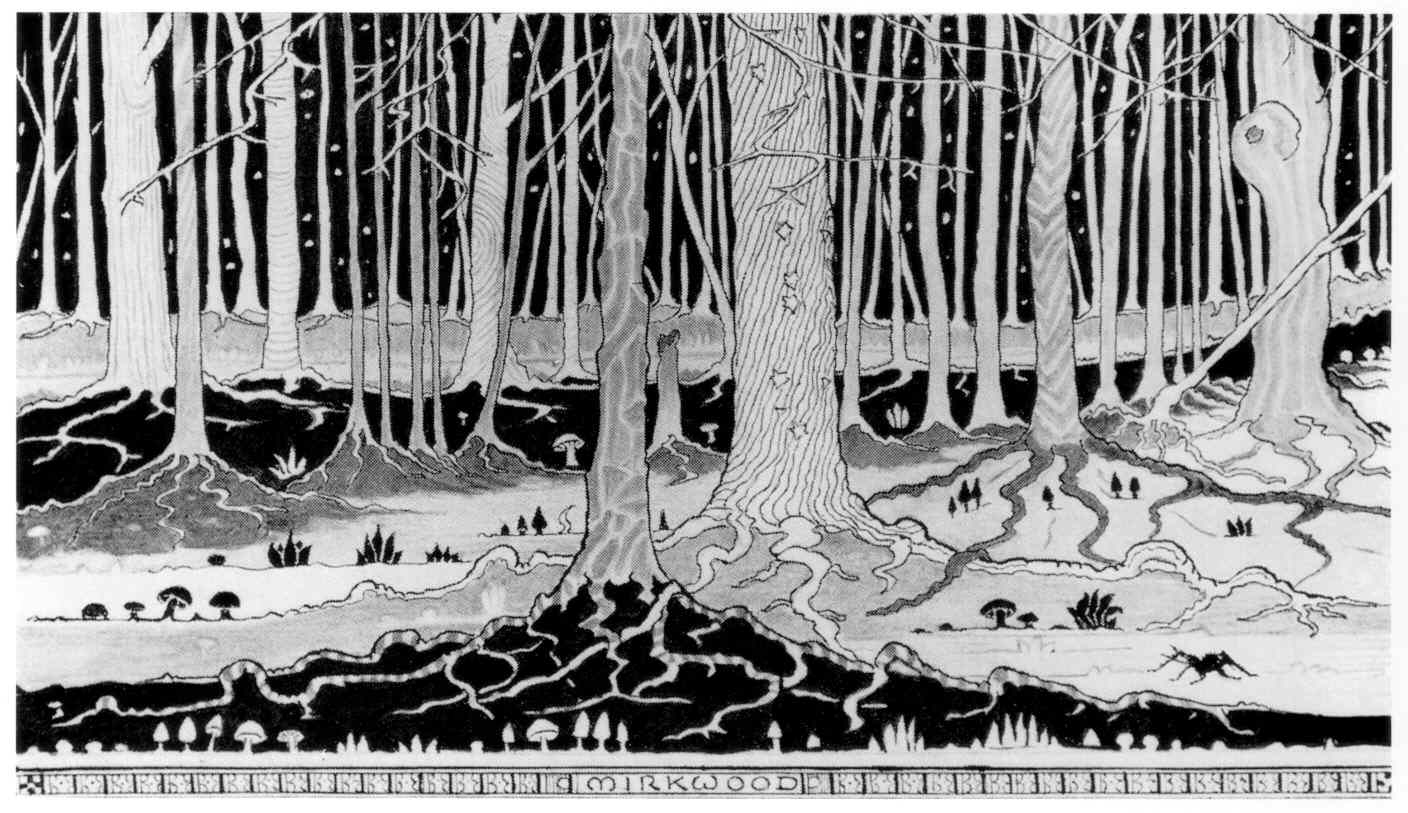
Across the Misty Mountains, we come to Mirkwood, with its disappearing Elves, sleepy stream, and giant spiders– hardly an inviting place.

image17mirkwood.jpg

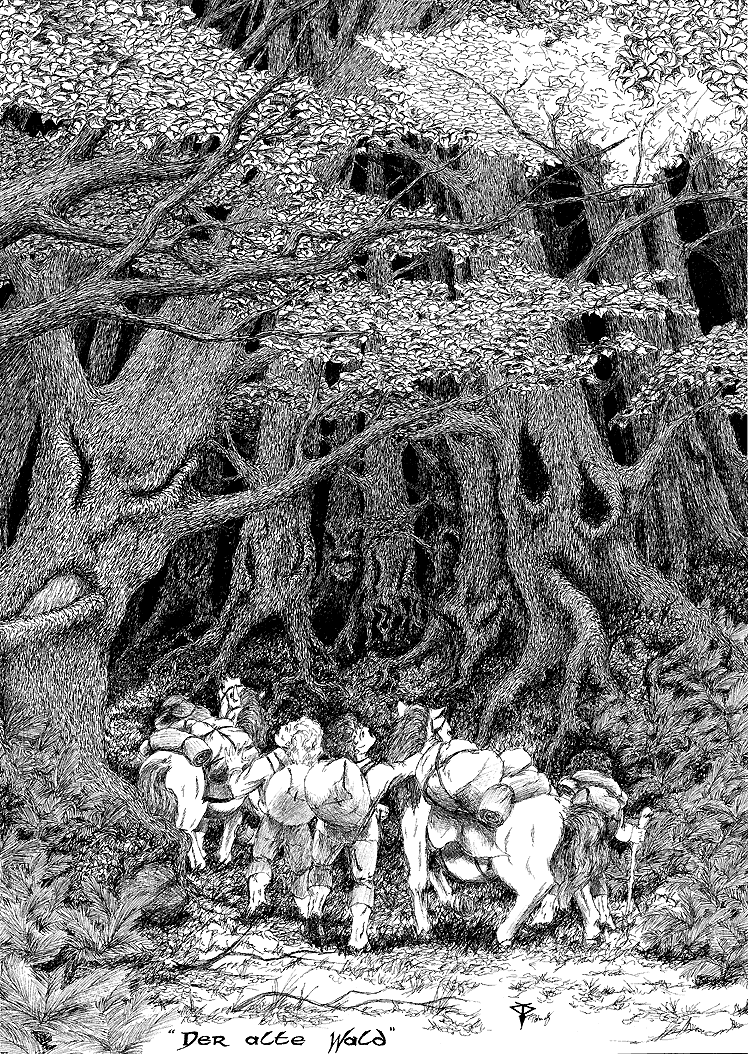
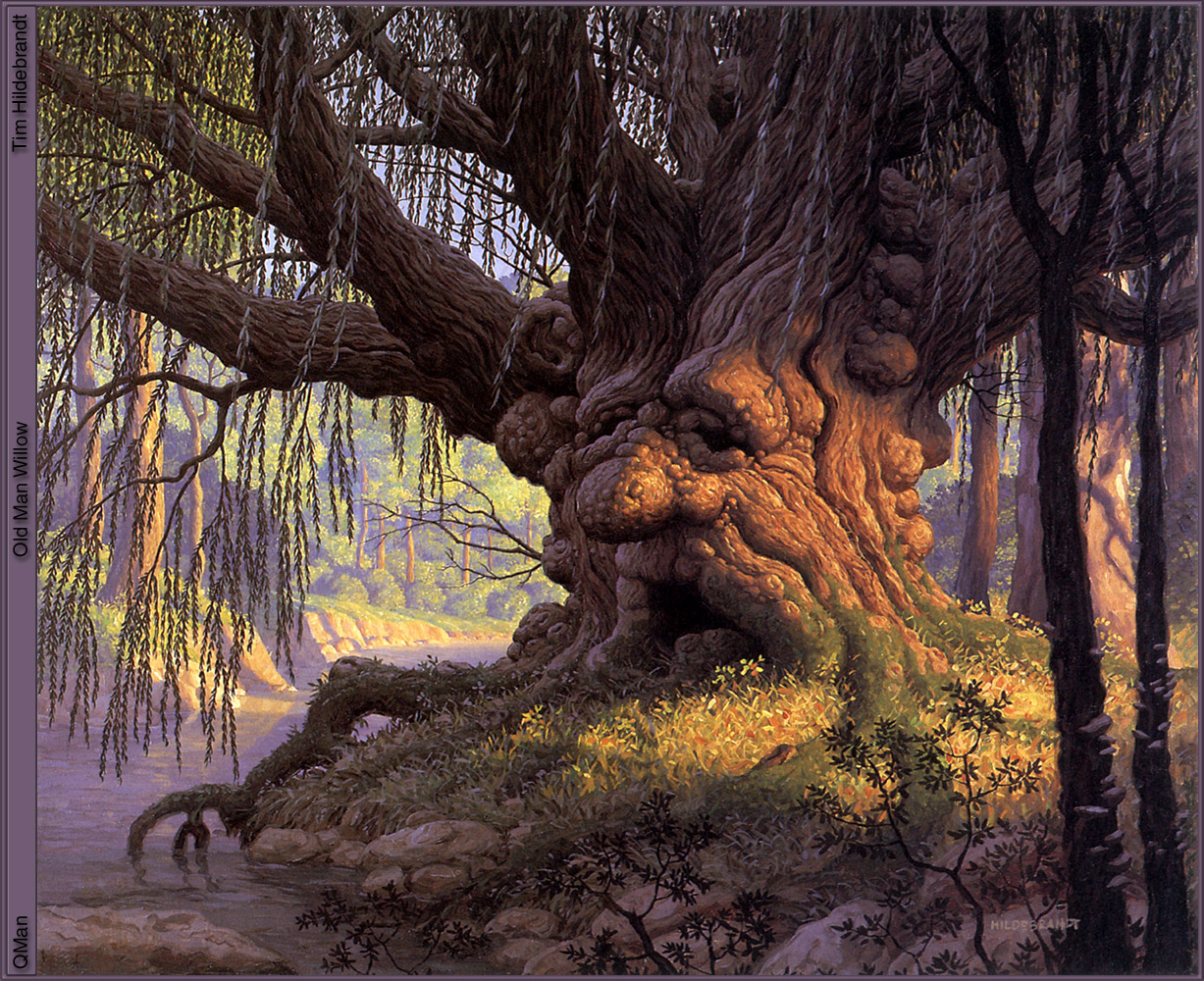
The forests of The Lord of the Rings are a bit mixed. There is the Old Forest, which is so hostile that is has to be kept off with cutting, burning, and a hedge and, in its depths, there is Old Man Willow, who almost swallows several unwary hobbits.

image18oldforest.gif

image19oldmanwillow.jpg

Then there is Lorien, a place of safety and healing for the Fellowship.

image20lorien.jpg

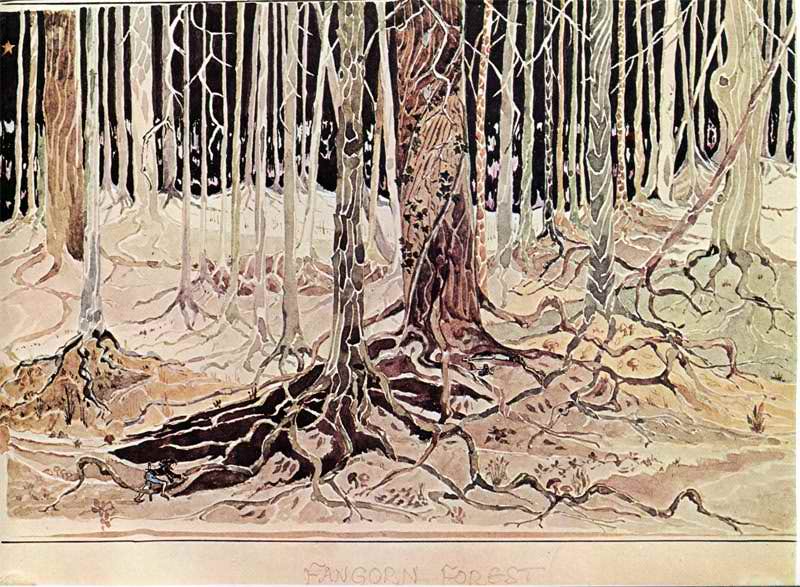
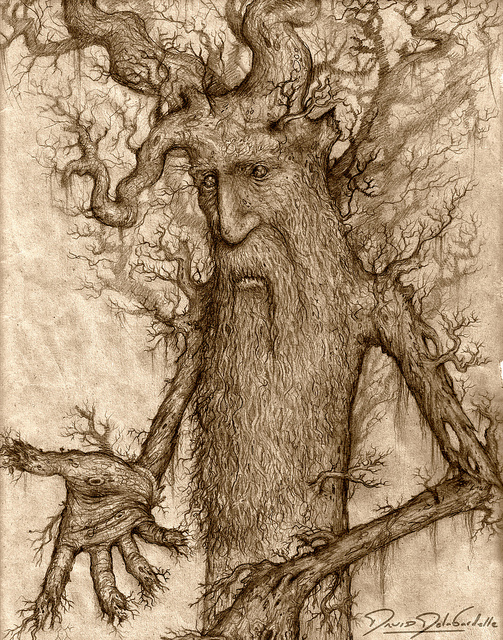
And, last, there is Fangorn, with its Ents, especially the thoughtful and ultimately sympathetic Treebeard.

image21fangorn.jpg

image22treebeard.jpg

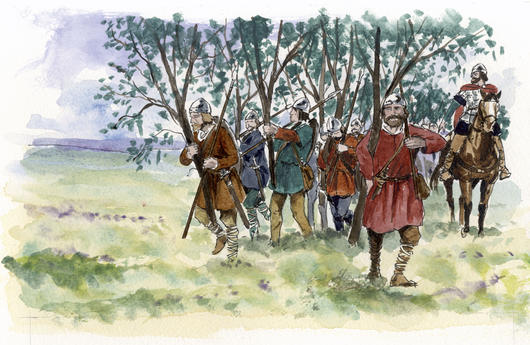
These are principal woods– there are also the woodlands of South Ithilien, there Faramir

image23faramir.jpg

image23woses.jpg

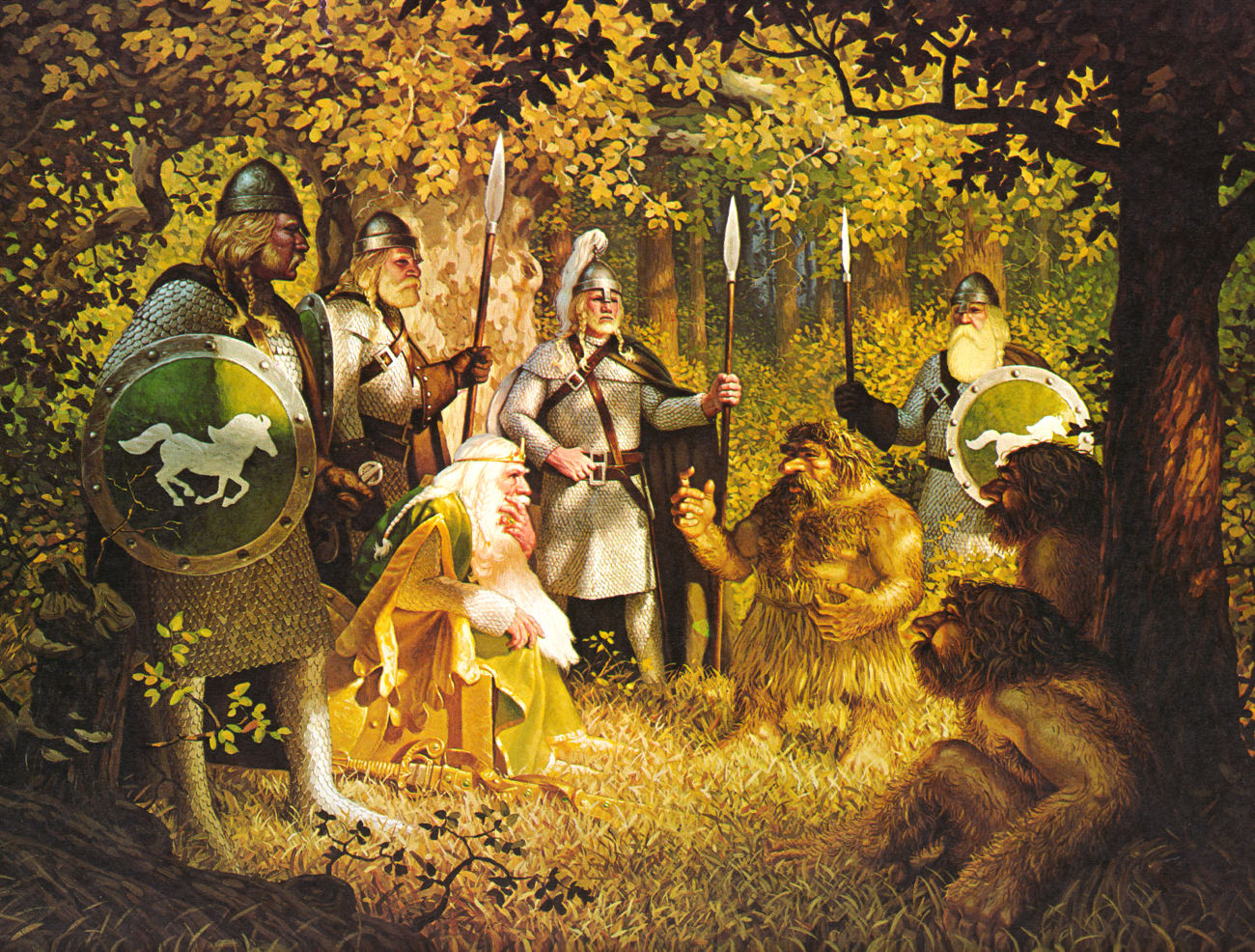
and his rangers lurk, as well as the unnamed wood where the Woses live, but it’s the people there who are the focus of the story, not the forests.

This sense of a wood being dangerous goes far beyond fairy tales and even JRRT, of course. Shakespeare has several puzzling forests– as in the wood outside Athens in A Midsummer Night’s Dream

image25mnd.JPG

or the traveling Burnham Wood in Macbeth

image26burnham.jpg

And there is even the wonderful Steven Sondheim musical, Into the Woods (1986), in which going into the woods has a magical/metaphorical side.

image27intothewoods.jpg

But we’ll leave you where we started– with JRRT– and a single tree…

image28jrrt.jpg

Thanks, as always, for reading.

MTCIDC,

CD

The Doubtful Sea Series Facebook Page

The Doubtful Sea Series Facebook Page

  • Ollamh

Categories

  • Artists and Illustrators
  • Economics in Middle-earth
  • Fairy Tales and Myths
  • Films and Music
  • Games
  • Heroes
  • Imaginary History
  • J.R.R. Tolkien
  • Language
  • Literary History
  • Maps
  • Medieval Russia
  • Military History
  • Military History of Middle-earth
  • Narnia
  • Narrative Methods
  • Poetry
  • Research
  • Star Wars
  • Terra Australis
  • The Rohirrim
  • Theatre and Performance
  • Tolkien
  • Uncategorized
  • Villains
  • Writing as Collaborators
Follow doubtfulsea on WordPress.com

Across the Doubtful Sea

Recent Postings

  • Demons on the Big Screen August 26, 2026
  • Solution (2) August 19, 2026
  • Out of Work Athena August 12, 2026
  • Solution (1) August 5, 2026
  • More Troy? July 29, 2026
  • Prismatic July 20, 2026
  • Arboricidal July 15, 2026
  • Towering.3 July 8, 2026
  • Towering.2 July 1, 2026

Blog Statistics

  • 120,015 Views

Posting Archive

  • August 2026 (4)
  • July 2026 (5)
  • June 2026 (4)
  • May 2026 (4)
  • April 2026 (5)
  • March 2026 (4)
  • February 2026 (4)
  • January 2026 (4)
  • December 2025 (5)
  • November 2025 (4)
  • October 2025 (5)
  • September 2025 (4)
  • August 2025 (4)
  • July 2025 (5)
  • June 2025 (4)
  • May 2025 (4)
  • April 2025 (5)
  • March 2025 (4)
  • February 2025 (4)
  • January 2025 (5)
  • December 2024 (4)
  • November 2024 (4)
  • October 2024 (5)
  • September 2024 (4)
  • August 2024 (4)
  • July 2024 (5)
  • June 2024 (4)
  • May 2024 (5)
  • April 2024 (4)
  • March 2024 (4)
  • February 2024 (4)
  • January 2024 (5)
  • December 2023 (4)
  • November 2023 (5)
  • October 2023 (4)
  • September 2023 (4)
  • August 2023 (5)
  • July 2023 (4)
  • June 2023 (4)
  • May 2023 (5)
  • April 2023 (4)
  • March 2023 (5)
  • February 2023 (4)
  • January 2023 (4)
  • December 2022 (4)
  • November 2022 (5)
  • October 2022 (4)
  • September 2022 (4)
  • August 2022 (5)
  • July 2022 (4)
  • June 2022 (5)
  • May 2022 (4)
  • April 2022 (4)
  • March 2022 (5)
  • February 2022 (4)
  • January 2022 (4)
  • December 2021 (5)
  • November 2021 (4)
  • October 2021 (4)
  • September 2021 (5)
  • August 2021 (4)
  • July 2021 (4)
  • June 2021 (5)
  • May 2021 (4)
  • April 2021 (4)
  • March 2021 (5)
  • February 2021 (4)
  • January 2021 (4)
  • December 2020 (5)
  • November 2020 (4)
  • October 2020 (4)
  • September 2020 (5)
  • August 2020 (4)
  • July 2020 (5)
  • June 2020 (4)
  • May 2020 (4)
  • April 2020 (5)
  • March 2020 (4)
  • February 2020 (4)
  • January 2020 (6)
  • December 2019 (4)
  • November 2019 (4)
  • October 2019 (5)
  • September 2019 (4)
  • August 2019 (4)
  • July 2019 (5)
  • June 2019 (4)
  • May 2019 (5)
  • April 2019 (4)
  • March 2019 (4)
  • February 2019 (4)
  • January 2019 (5)
  • December 2018 (4)
  • November 2018 (4)
  • October 2018 (5)
  • September 2018 (4)
  • August 2018 (5)
  • July 2018 (4)
  • June 2018 (4)
  • May 2018 (5)
  • April 2018 (4)
  • March 2018 (4)
  • February 2018 (4)
  • January 2018 (5)
  • December 2017 (4)
  • November 2017 (4)
  • October 2017 (4)
  • September 2017 (4)
  • August 2017 (5)
  • July 2017 (4)
  • June 2017 (4)
  • May 2017 (5)
  • April 2017 (4)
  • March 2017 (5)
  • February 2017 (4)
  • January 2017 (4)
  • December 2016 (4)
  • November 2016 (5)
  • October 2016 (6)
  • September 2016 (5)
  • August 2016 (5)
  • July 2016 (5)
  • June 2016 (5)
  • May 2016 (4)
  • April 2016 (4)
  • March 2016 (5)
  • February 2016 (4)
  • January 2016 (4)
  • December 2015 (5)
  • November 2015 (5)
  • October 2015 (4)
  • September 2015 (5)
  • August 2015 (4)
  • July 2015 (5)
  • June 2015 (5)
  • May 2015 (4)
  • April 2015 (3)
  • March 2015 (4)
  • February 2015 (4)
  • January 2015 (4)
  • December 2014 (5)
  • November 2014 (4)
  • October 2014 (6)
  • September 2014 (1)

Blog at WordPress.com.

  • Subscribe Subscribed
    • doubtfulsea
    • Join 75 other subscribers
    • Already have a WordPress.com account? Log in now.
    • doubtfulsea
    • Subscribe Subscribed
    • Sign up
    • Log in
    • Report this content
    • View site in Reader
    • Manage subscriptions
    • Collapse this bar
Loading Comments...