Welcome, as always, dear readers.
When it comes to The Lord of the Rings, I’m sure that everyone has favorite characters. I suppose that mine, if I had to pin it down to one, would be Sam. At the same time, I would also say that, for me, if you asked for other favorites, I might say Saruman—and, perhaps surprisingly, this might have been true for Tolkien, I would suggest, as well.
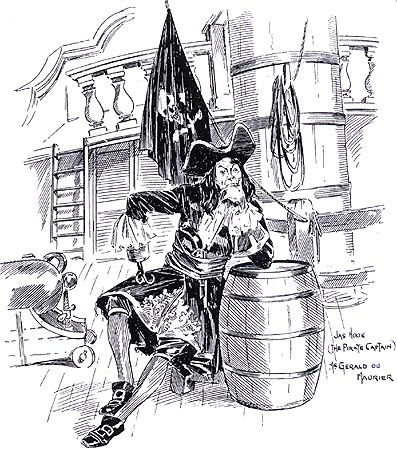
Saruman? Maybe I just have a perverse taste for villains—after all, I’ve always secretly liked Captain Hook,
and have a sneaking fondness for the Orcs,
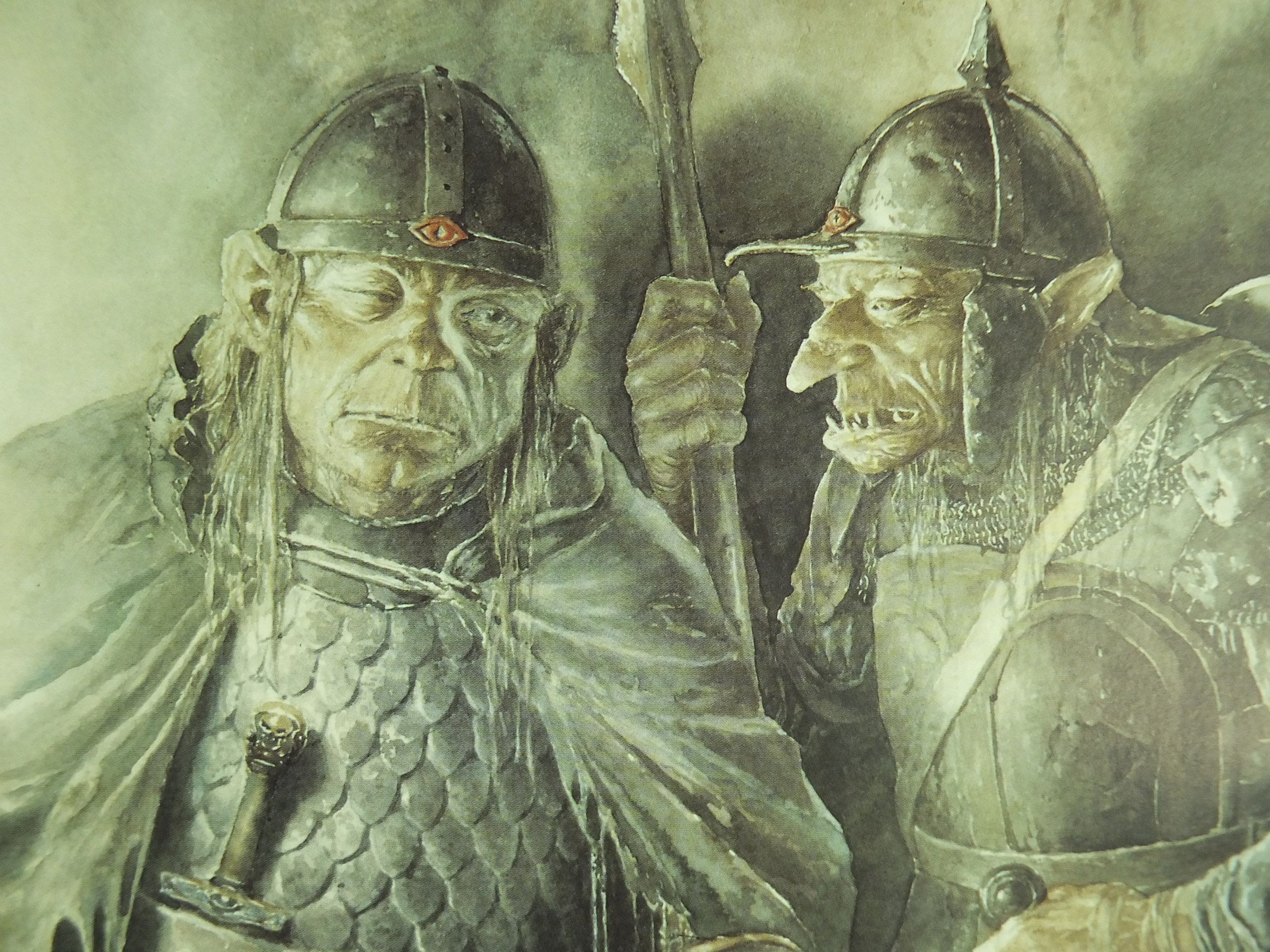
(Alan Lee)
but I think that there’s, ultimately, a poignancy about Saruman—not in his behavior in the earlier parts of The Lord of the Rings, but in his end–which Tolkien, who could simply have painted him as a villain, clearly chose to add to his depiction, which says to me that he, too, found something more to say about the character.
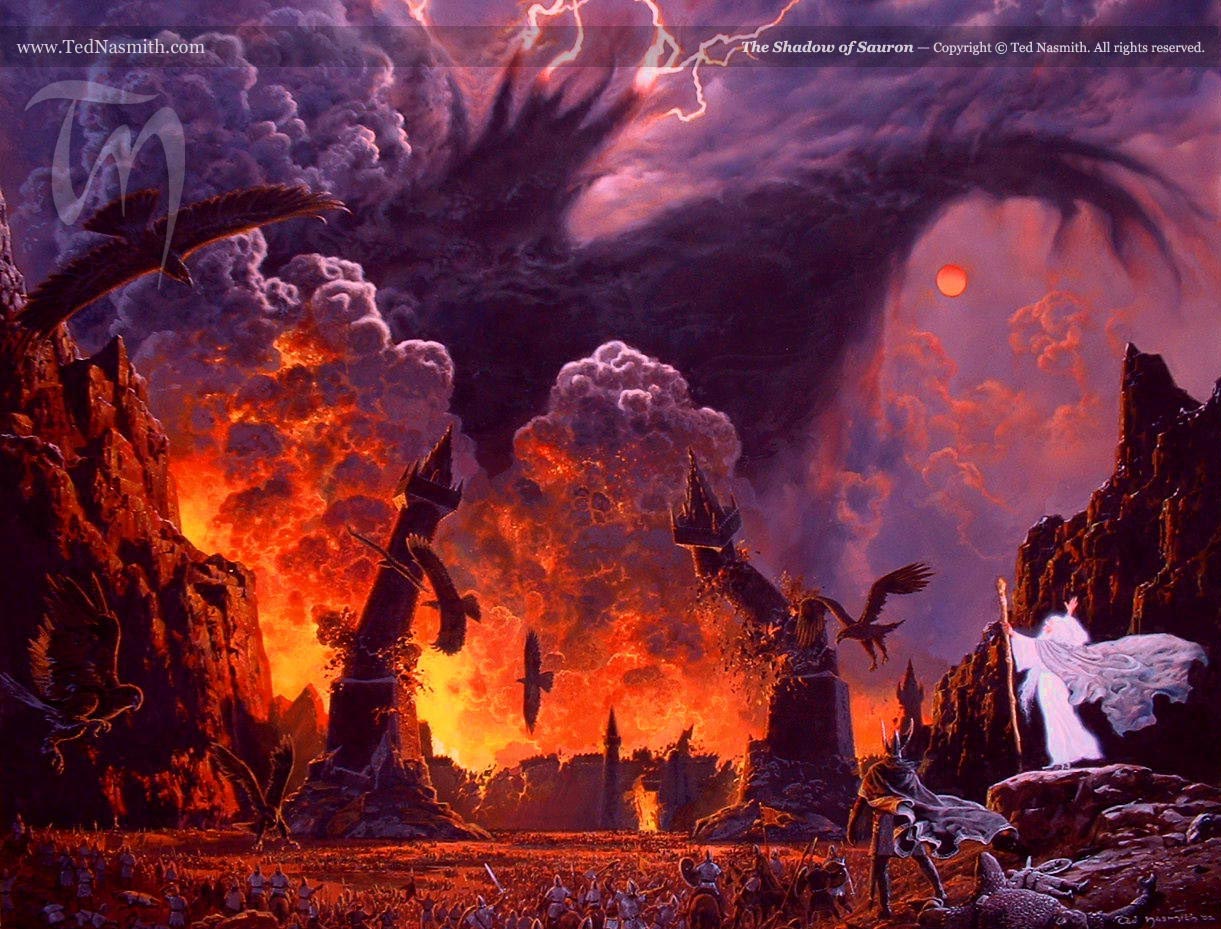
Consider the end of Sauron, which is quite dramatic, if not downright apocalyptic—
(Ted Nasmith)
“And even as he spoke the earth rocked beneath their feet. Then rising swiftly up, far above the Towers of the Black Gate, high above the mountains, a vast soaring darkness sprang into the sky, flickering with fire. The earth groaned and quaked. The Towers of the Teeth swayed, tottered, and fell down; the mighty ramparts crumbled; the Black Gate was hurled in ruin; and from far away, now dim, now growing, now mounting to the clouds, there came a drumming rumble, a roar, a long echoing roll of ruinous noise…
And as the Captains gazed south to the Land of Mordor, it seemed to them that, black against the pall of cloud, there rose a huge shape of shadow, impenetrable, lightning-crowned, filling all the sky. Enormous it reared above the world, and stretched out towards them a vast, threatening hand, terrible but impotent; for even as it leaned over them, a great wind took it, and it was all blown away, and passed; and then a hush fell.” (The Return of the King, Book Six, Chapter 4, “The Field of Cormallen”)
In contrast, there is the death of Saruman—
“To the dismay of those that stood by, about the body of Saruman a grey mist gathered, and rising slowly to a great height like smoke from a fire, as a pale shrouded figure it loomed over the Hill For a moment it wavered, looking to the West; but out of the West came a cold wind, and it bent away, and with a sigh dissolved into nothing.
Frodo looked down at the body with pity and horror, for as he looked it seemed that long years of death were suddenly revealed in it, and it shrank, and the shrivelled face became rags of skin upon a hideous skull. Lifting up the skirt of the dirty cloak that sprawled beside it, he covered it over, and turned away.” (The Return of the King, Book Six, Chapter 8, “The Scouring of the Shire”)
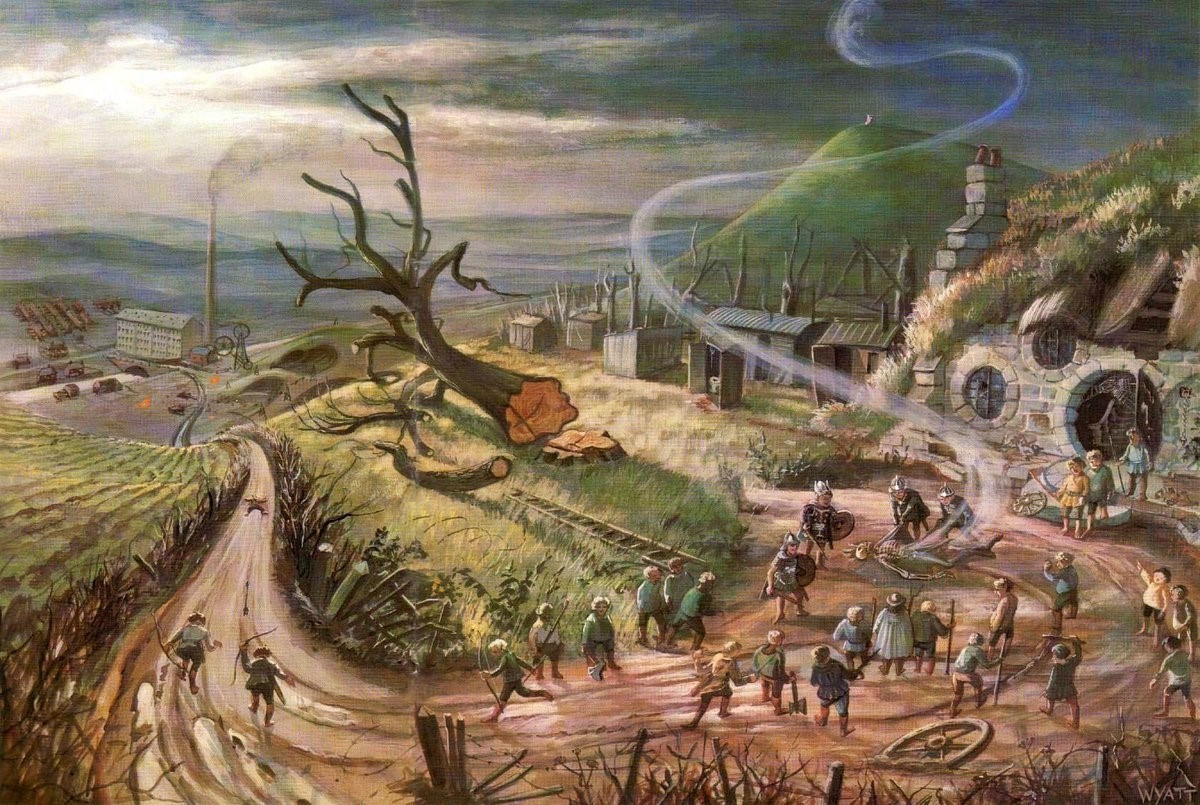
(Joan Wyatt—you can see more of her work here: https://gallerix.org/storeroom/1692737256/ )
And yet both were powerful beings, Sauron being the more powerful, but both Maiar, the equivalent, we might say, of angels, in our Middle-earth.
As if it were only an expression of his personality, when Sauron was destroyed, all Mordor came crashing down, although all that we see of Sauron himself is that one “vast, threatening hand, terrible but impotent…”
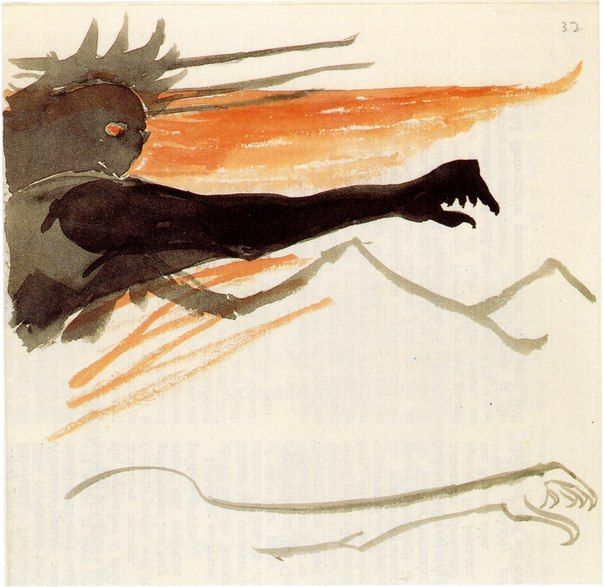
(JRRT)
So what is the purpose, the meaning, of that simple sigh?
For all that they might attempt to control it in their various ways and scales, these two were not natives of Middle-earth. Rather, they were once inhabitants of Valinor, to the far west.
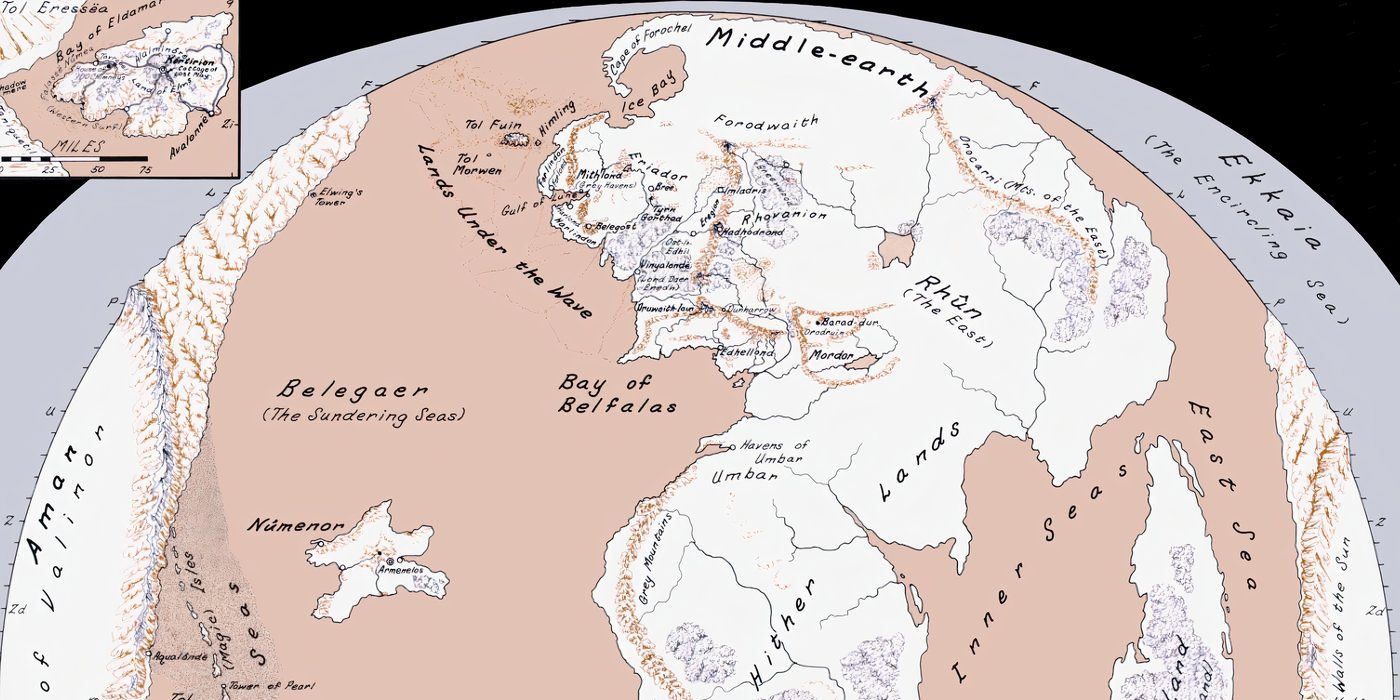
(Karen Wynn Fonstad)
Sauron had come in an earlier age of his own accord, intent upon conquest, whereas Saruman had been sent as one of the five Istari, as a counterbalance to Sauron, once servant to the fallen Vala, Melkor, and now a would-be Melkor himself, until something began to go wrong and, instead of countering Sauron, Saruman began to become like him.
This had happened, I think, in stages.
To begin with, there is the question of how the Istari were to act as a balance. It’s interesting that the two others of whom we know anything, Gandalf and Radagast, appear to have been sent as wanderers, as if their role was to counter Sauron’s influence over a wide area and perhaps in different ways, depending upon that influence.
In contrast, Saruman has not just a fixed home, but a fortress, Isengard,
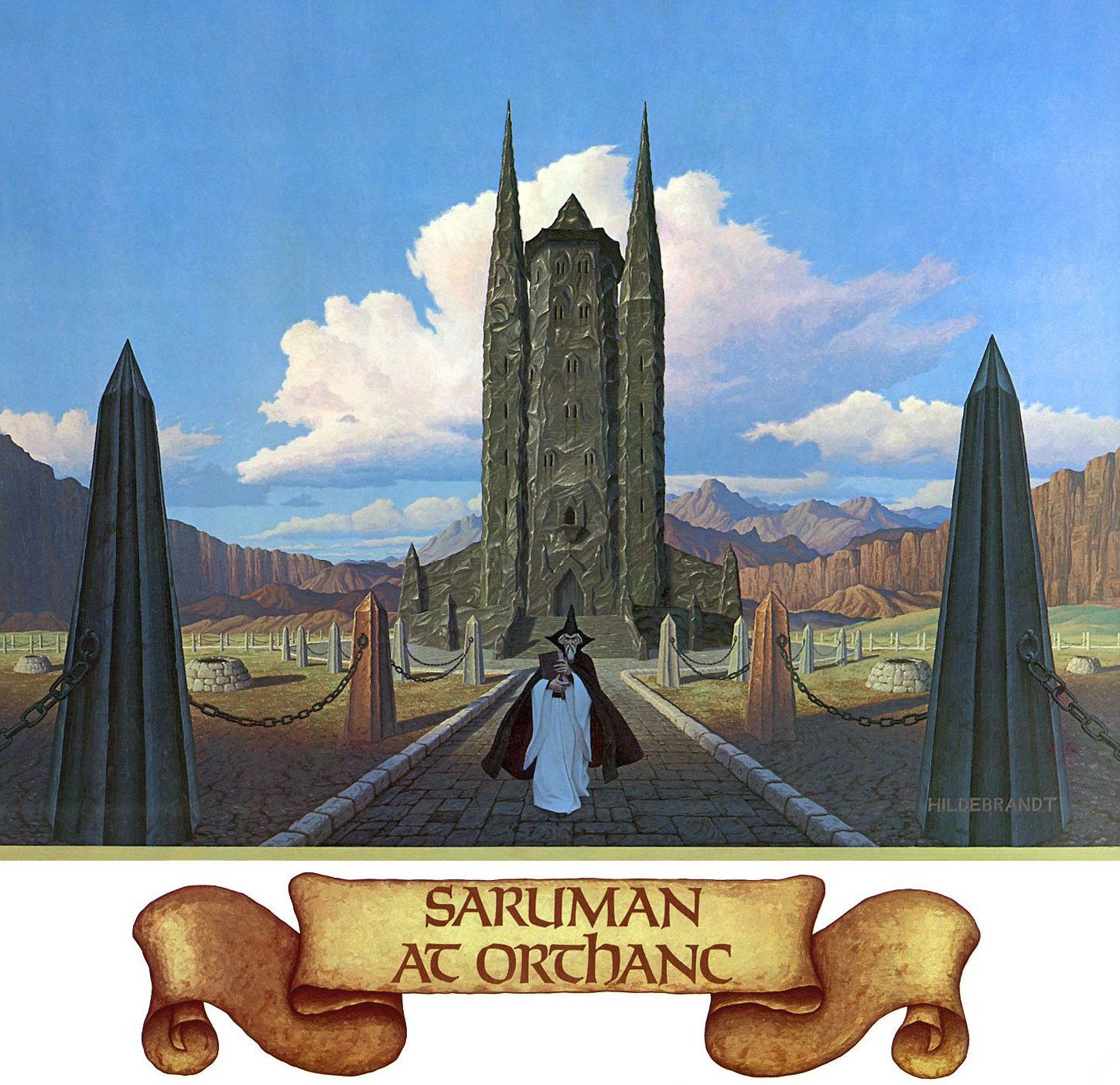
(the Hildebrandts)
where he has found one of the seeing-stones, the Palantiri,
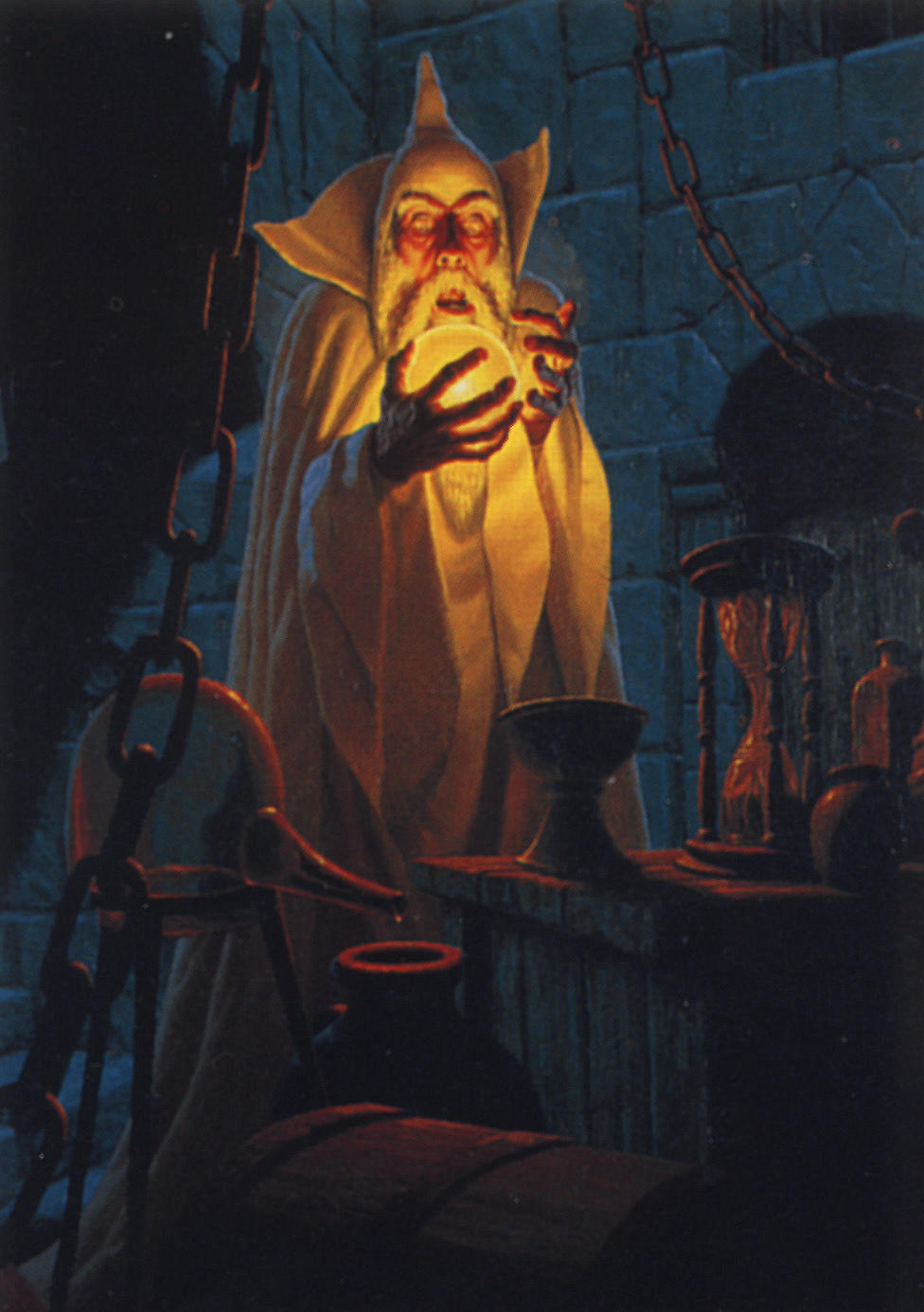
(the Hildebrandts)
although he has kept this discovery secret, only to be revealed after his defeat—a disturbing sign: why not let the other Istari know–unless its use was in itself suspect?
At the very beginning of The Lord of the Rings, Gandalf identifies Saruman to Frodo as “…great among the Wise…chief of my order…” and yet adds something very interesting, and perhaps another disturbing sign: “His knowledge is deep, but his pride has grown with it, and he takes ill any meddling.” (The Fellowship of the Ring, Book One, Chapter 2, “The Shadow of the Past”)
We can’t know whether that pride which Gandalf mentions was already displaying itself then, but it’s clear that that discovery was fatal, the second stage in his corruption, pushing Saruman away from his role as a defender of Middle-earth into, in his own mind, the role of a potential conqueror and perhaps even rival to Sauron, although Saruman was
“…being deceived—for all of those arts and subtle devices, for which he forsook his former wisdom, and which fondly he imagined were his own, came but from Mordor; so that what he had made was naught, only a little copy, a child’s model or a slave’s flattery, of that vast fortress, armoury, prison, furnace of great power, Barad-dur, the Dark Tower, which suffered no rival, and laughed at flattery, biding its time, secure in its pride and its immeasurable strength.” (The Two Towers, Book Three, Chapter 8, “The Road to Isengard”)
In his description of Saruman to Frodo, Gandalf had been specific about Saruman’s knowledge:
“The lore of the Elven-rings, great and small, is his province. He has long studied it, seeking the lost secrets of their making…”
And here perhaps is revealed another stage in Saruman’s corruption:
“…but when the Rings were debated in the Council, all that he would reveal to us of his ring-lore told against my fears…”
That is, just as in the case of the Palantir, Saruman has kept things back. Was Saruman acting on his own in this, or had the seeing-stone and its real controller already been working at his mind?
Certainly, when he makes his pompous and revelatory speech to Gandalf, hoping to persuade him to join him (which Gandalf immediately not only sees through, but sees how much of it isn’t even Saruman’s thinking, but the words of someone else), we have the sense that, whoever Saruman had been when he came to Middle-earth, that person had been twisted away from protecting Middle-earth from Sauron and was stating, instead, completely alien goals, as Gandalf recognized:
“We can bide our time, we can keep our thoughts in our hearts, deploring maybe evils done by the way, but approving the high and ultimate purpose: Knowledge, Rule, Order; all the things that we have so far striven in vain to accomplish, hindered rather than helped by our weak or idle friends. There need not be, there would not be, any real change in our designs, only in our means.” (The Fellowship of the Ring, Book Two, Chapter 2, “The Council of Elrond”)
To Gandalf, this is Sauron talking:
“ ‘Saruman…I have heard speeches of this kind before, but only in the mouths of emissaries from Mordor to deceive the ignorant.’ “
and it’s clear to him that Saruman, seemingly unknowingly, has become a puppet of someone more powerful and devious than he.
The immediate instrument for this was, as I would suggest, that seeing-stone, but, beyond that, there was a vulnerability inherent in Saruman’s very being in Middle-earth, as Tolkien describes in a letter:
“But since in this tale & mythology Power—when it dominates or seeks to dominate other wills and minds (except by the assent of their reason)—is evil, these ‘wizards’ were incarnated in the life-forms of Middle-earth, and so suffered the pains both of mind and body. They were also, for the same reason, thus involved in the peril of the incarnate: the possibility of ‘fall’, of sin, if you will. The chief form this would take with them would be impatience, leading to the desire to force others to their own good ends, and so inevitably at last to mere desire to make their own wills effective by any means. To this evil Saruman succumbed.” (drafts to Michael Straight, “probably January or February 1956”, Letters, 342-343)
And here is where that “pride”, which Gandalf had mentioned to Frodo had appeared, added to which was his losing sight of the Valar’s purpose in sending him and acquiring a fortress, where Sauron was able to turn him to his own purposes—although we might imagine that, under Sauron’s domination, Saruman might still believe that he could escape Sauron’s notice, when he suggests to Gandalf
“As the Power grows, its proved friends will also grow; and the Wise, such as you and I, may with patience come at last to direct its courses, to control it.”
And even that he might imagine that he himself might employ the Ring—
“ ‘Why not? The Ruling Ring? If we should command that, then the Power would pass to us.’ “
Gandalf’s reply to this: “ ‘Saruman…only one hand at a time can wield the One, and you know that well, so do not trouble to say we…You were head of the Council, but you have unmasked yourself at last.” shows that Saruman has failed completely, both in his immediate quest to persuade Gandalf to tell him where the Ring currently is, and in his attempt to bring a fellow Istar to his side, having dismissed Radagast completely (“Radagast the Bird-tamer! Radagast the Simple! Radagast the Fool!”).
This, however, is only Saruman’s first failure. His attempt to out-Sauron Sauron by a war of conquest not only fails at Helm’s Deep, but brings about the destruction of his fortress at Isengard.
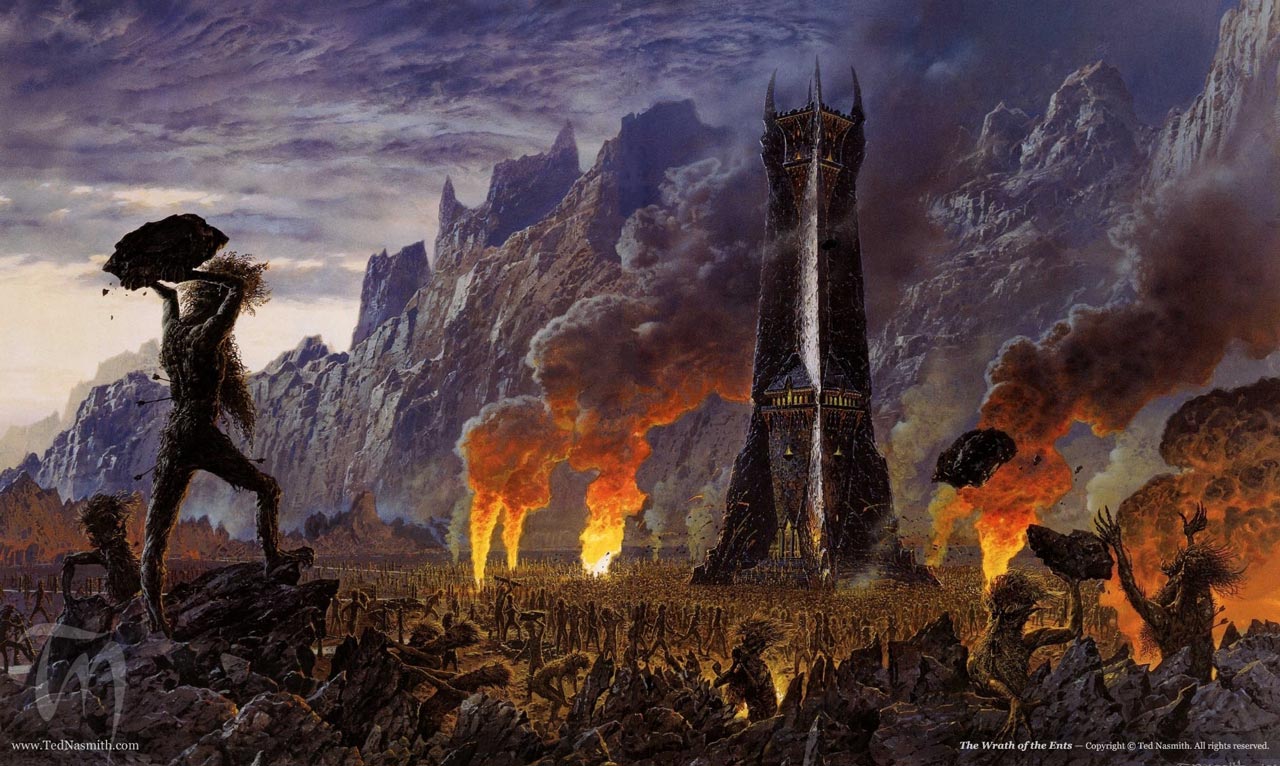
(Ted Nasmith)
He then loses the Palantir,
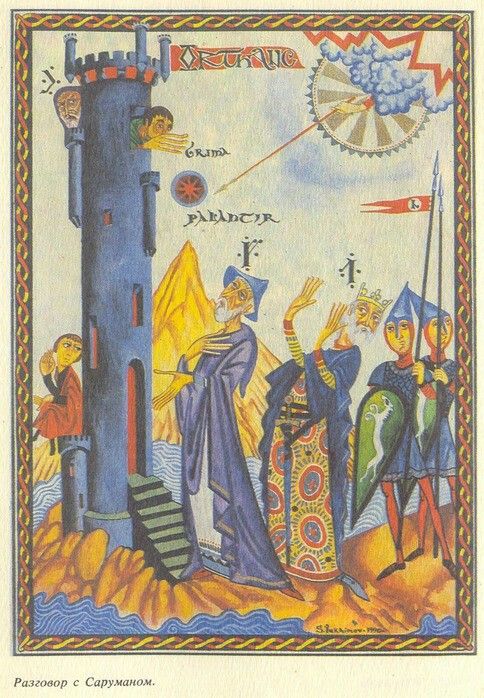
(Sergei Lukhimov—you can see a little more of his work here: https://imgur.com/gallery/1993-ukranian-artist-sergei-lukhimov-created-32-illustrations-first-ever-russian-edition-of-lord-of-rings-eastern-orthodox-iconography-meets-anglo-saxon-modern-mythology-Ct7ojT5 )
and is even exiled from his one-time place of power,
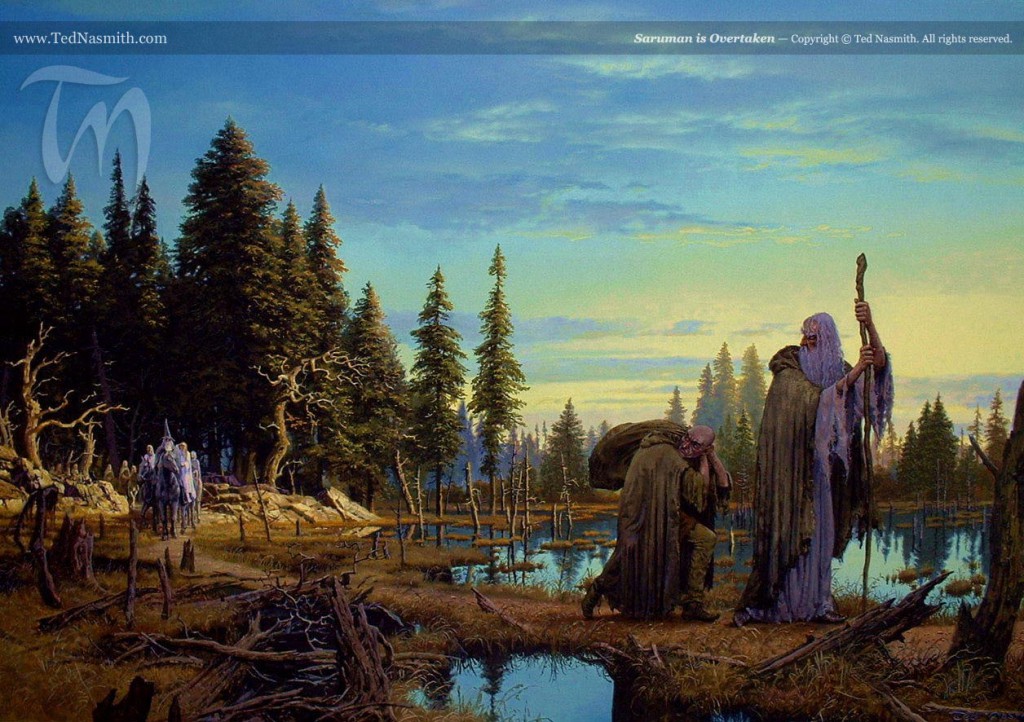
(Ted Nasmith)
before his attempt to ruin the Shire is stopped by the return of Frodo and his friends
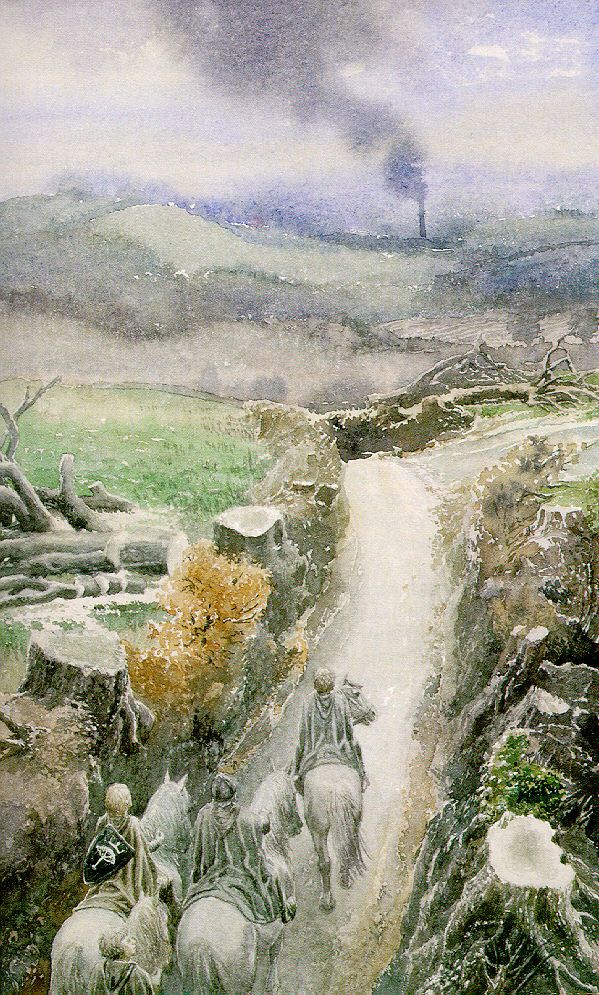
(Alan Lee)
and his final confrontation with Frodo
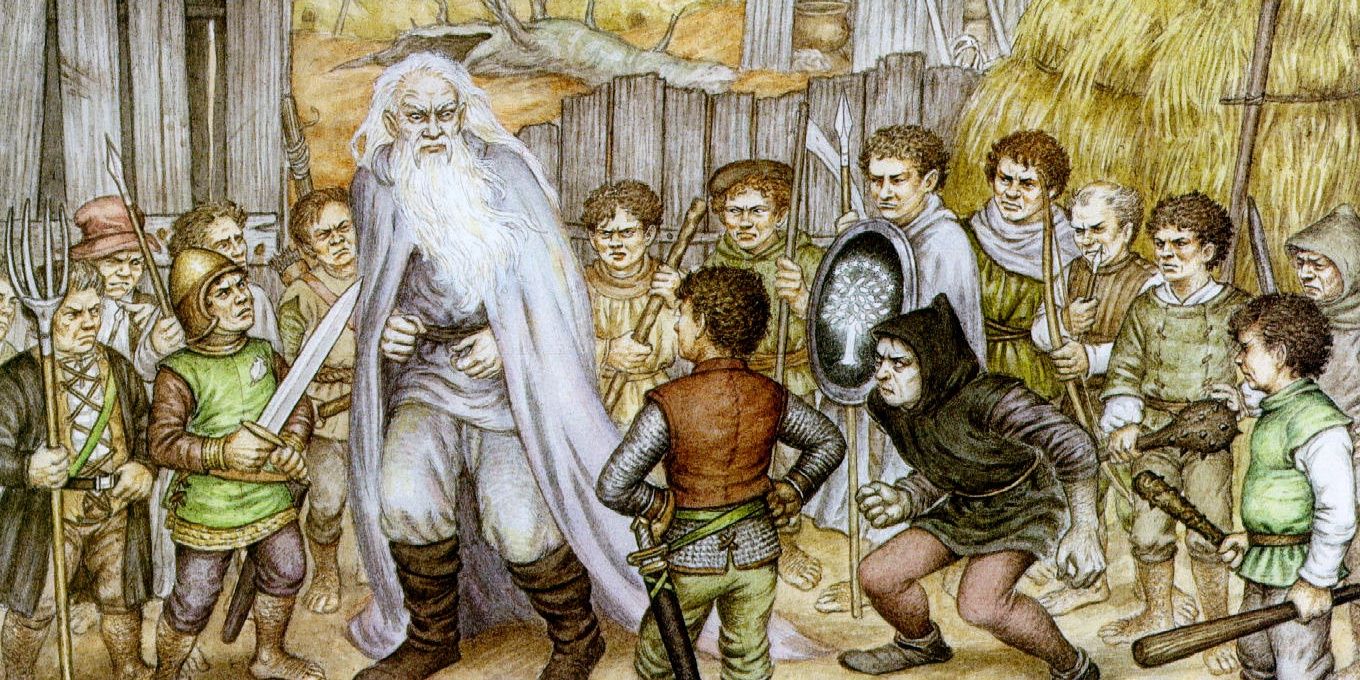
(Inger Edelfeldt—you can read about her here: https://en.wikipedia.org/wiki/Inger_Edelfeldt )
ends in his death—or the closest thing like it to someone from Valinor in the West—his rejection by it–
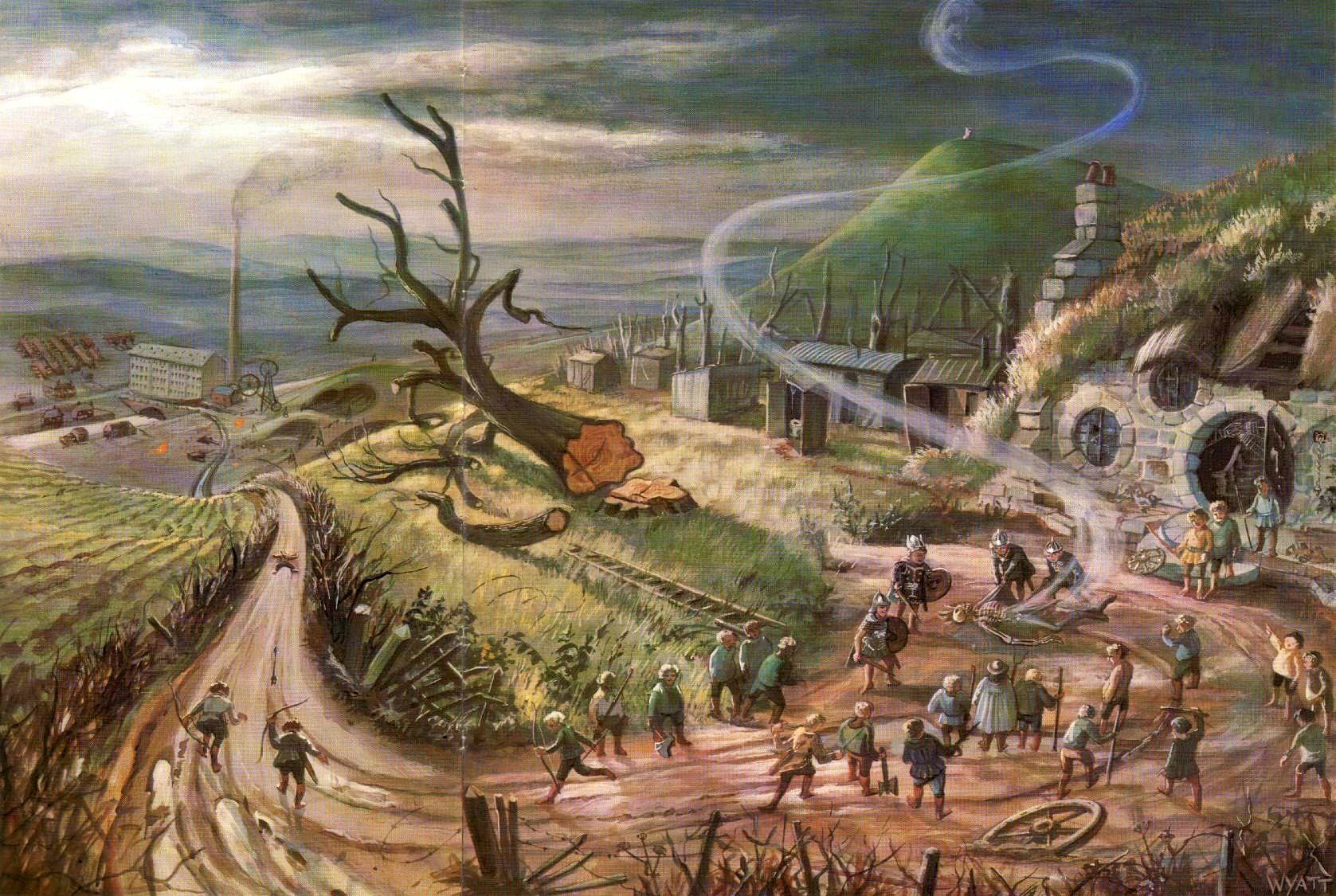
(Joan Wyatt)
“To the dismay of those that stood by, about the body of Saruman a grey mist gathered, and rising slowly to a great height like smoke from a fire, as a pale shrouded figure it loomed over the Hill For a moment it wavered, looking to the West; but out of the West came a cold wind, and it bent away, and with a sigh dissolved into nothing.”
One has only to remember the beautiful, melancholy farewells at the Grey Havens to see what Saruman might have been part of—
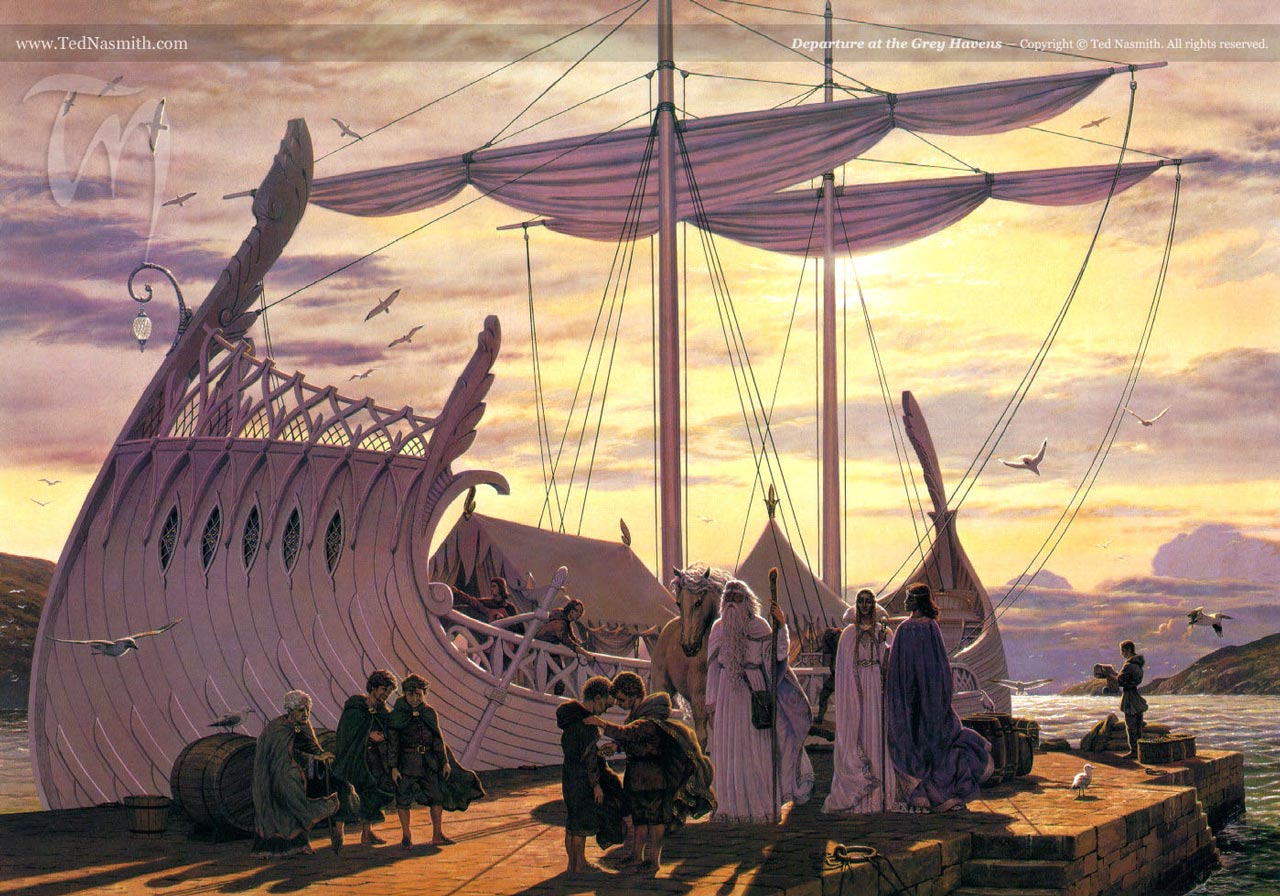
(Ted Nasmith)
Gandalf, with Sauron defeated, returns whence he came, his task complete. Saruman, failing in that task, has no home to which to return and “dissolved into nothing”, but that sigh—so important here—says that he knows that he has failed and, in depicting that recognition, I believe we see JRRT show some deeper feeling for him than he might ever have expressed for Sauron, even as he had written that Sauron had not begun as evil (see draft to Peter Hastings, September, 1954, Letters, 284).
Thanks, as always, for reading.
Stay well,
As well, consider the deep feeling which can rest even in a sigh,
And remember that, as always, there’s
MTCIDC
O

