Red Books, Black Books, Yellow Books

Tags

, , , , , , , , , , , , , , , , , , , , ,

Dear Readers,

Welcome back! This posting is devoted to a look at what lies behind that famous imaginary document The Red Book of Westmarch.

     As Tolkien says of The Lord of the Rings in the section of the prologue entitled “Note on the Shire Records”:

“This account of the end of the Third Age is drawn mainly from the Red Book of Westmarch. That most important source for the history of the War of the Ring was so called because it was long preserved at Undertowers, the home of the Fairbairns, Wardens of the Westmarch. It was in origin Bilbo’s private diary, which he took with him to Rivendell. Frodo brought it back to the Shire, together with many loose leaves of notes, and during S.R. 1420-1 he nearly filled its pages with his account of the War. But annexed to it and preserved with it, probably in a single red case, were the three large volumes, bound in red leather, that Bilbo gave to him as a parting gift. To these four volumes there was added in Westmarch a fifth containing commentaries, genealogies, and various other matter concerning the hobbit members of the Fellowship.” 14

redbookfacsimile

     This is not the end of the material on the Red Book, of course,—that takes up another paragraph and then is continued in several more paragraphs about copies and about other pertinent written sources. This is JRRT having fun, of course: after all, for him, what is more satisfying after creating languages than building contexts for them?

     This particular context is based upon material from his own specialty, medieval literature, and it’s always been said that The Red Book of Westmarch was inspired by the late 14th-century Welsh Red Book of Hergest. This famous manuscript contains one of the major texts of the cycle of legendary material called the Mabinogion, but for Tolkien its importance may have been simply that

  1. it’s a medieval manuscript familiar to him and a model-ready-to-hand for what he created in what he thought of as his own medieval world
  2. as the Wiki entry says, “The manuscript derives its name from the colour of its leather binding and from its association with Hergest Court between the late 15th and early 17th century.”

redbookofhergest

     This manuscript and others like it, both Welsh (Black Book of Carmarthen,White Book of Rhydderch, Book of Taliesin) and Irish (Book of the Dun Cow, Yellow Book of Lecan, Book of Leinster, Book of Ballymote, Book of Lismore)

blackbookofcarmarthen

Book_of_Taliesin_facsimile

whitebookof rhydderch

lebornauidre

Book_of_Lecan_p2

Book_of_Leinster,_folio_53

were created in the scriptoriums (Latin plural: scriptoria), the medieval equivalent of a copy center, in various monasteries. The following images will give you an idea of how they worked.

scriptorium

 BL_Royal_Vincent_of_Beauvais

gregory

In the world before Gutenberg

792px-Pressing-16th_century%20copy

everything was written—and then copied—by hand, a fact which Tolkien faithfully reproduces in his world when he writes that:

“The most important copy, however, has a different history. It was kept at Great Smials, but it was written in Gondor, probably at the request of the great-grandson of Peregrin, and completed in S.R. 1592 (F.A. 172). Its southern scribe appended this note: Findegil, King’s Writer, finished this work in IV 172.” 14

     There are, of course, no monasteries in Middle Earth, but, in our world, there were clerks, educated in monasteries, who worked as secretaries and copyists for kings and their nobility, so it’s quite logical that a copy of the Red Book in Middle Earth was the work of a so-called “King’s Writer”.

     Comparing an actual manuscript with the Red Book of Westmarch, we find several other differences. For one, the RBW’s four main volumes appear to contain nothing but material relating to the events surrounding Bilbo, Frodo, and the Ring. In contrast, the actual medieval manuscripts are more like compilations. The Red Book of Hergest, for example, has not only the Mabinogion, but also unrelated poetry, and a Welsh translation of Geoffrey of Monmouth’s History of the Kings of Britain, among other works. The Irish Book of the Dun Cow has religious texts and secular, all mixed together, and this appears to be common. The closest the RBW comes to this is volume 5, with its “commentaries, genealogies, and various other matter concerning the hobbit members of the Fellowship” and this is still material pertaining to the main subject, not something as removed as the method for determining the correct date for Easter to be found in the Book of Leinster.

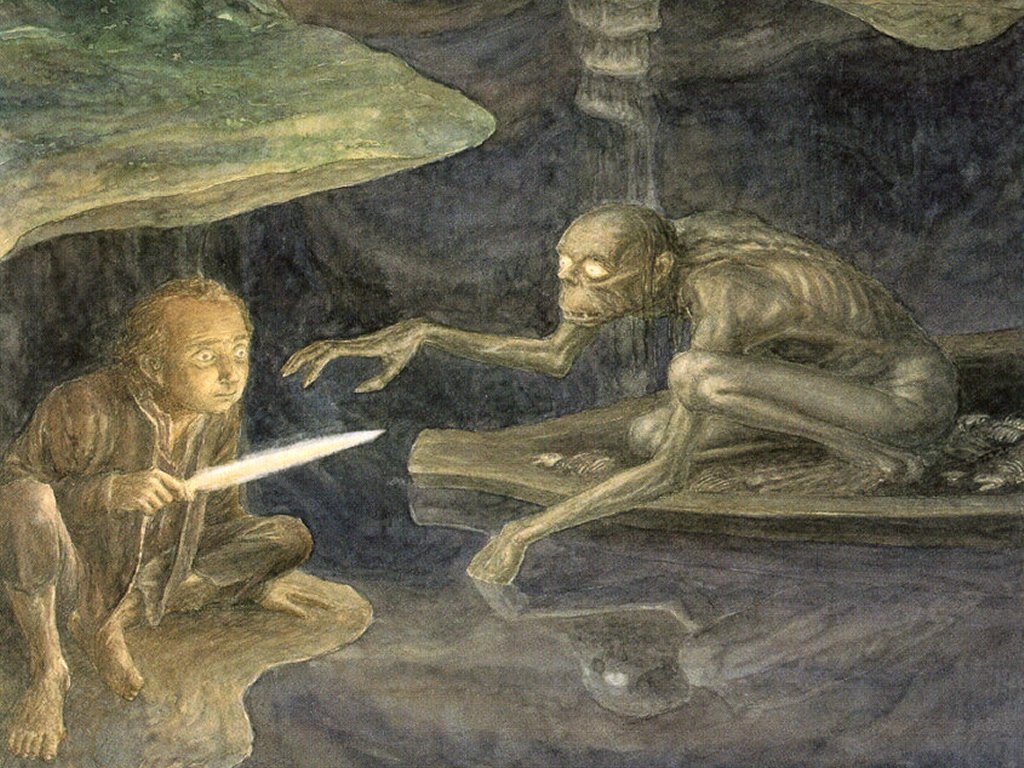
     Another difference brings us to a puzzle and the conclusion of this posting.  Tolkien has told us that the core of the RBW is Bilbo’s diary. The Welsh and Irish manuscripts discussed above are collections of literary and religious texts, with nothing personal in them at all, as he would have been well aware.  As well, we might wonder when and where and how Bilbo kept that diary. There’s no mention of it in The Hobbit—after all, Bilbo ran out of his house to join the dwarves without even a pocket handkerchief. And, even if the dwarves had provided one (along with the handkerchief–although that does not seem terrifically likely–the dwarves who visit Bilbo seem more attuned to orality than literacy), surely it would have been lost with all of the other baggage when the company fell into the goblin world and Bilbo met Gollum.

Alan Lee - The Hobbit - 19 - Riddles in the dark

Other than assuming that Bilbo, although he had forgotten his handkerchief, had remembered his Blackberry and was constantly dictating to the Cloud for later transcription, what do we have here?  (And, while we’re wondering, if The Hobbit was based upon that mysterious diary, what do we know of the adapter/narrator who turned it from a diary into a continuous narrative–another “King’s Writer”?)

Obviously, MTCIDC!

Thanks, as always, for reading.

CD

Where Did It Go– And Why?

Tags

, , , , , , , , , , , , , , , , , , , , ,

Dear Readers,

Welcome, as always!

     In this post, we want to consider the Rammas Echor, which, in the original, had holes blown in it by the invading army of Sauron, but was demolished completely by the script writers for Peter Jackson’s LOTR.

The%20Siege%20of%20Minas%20Tirith

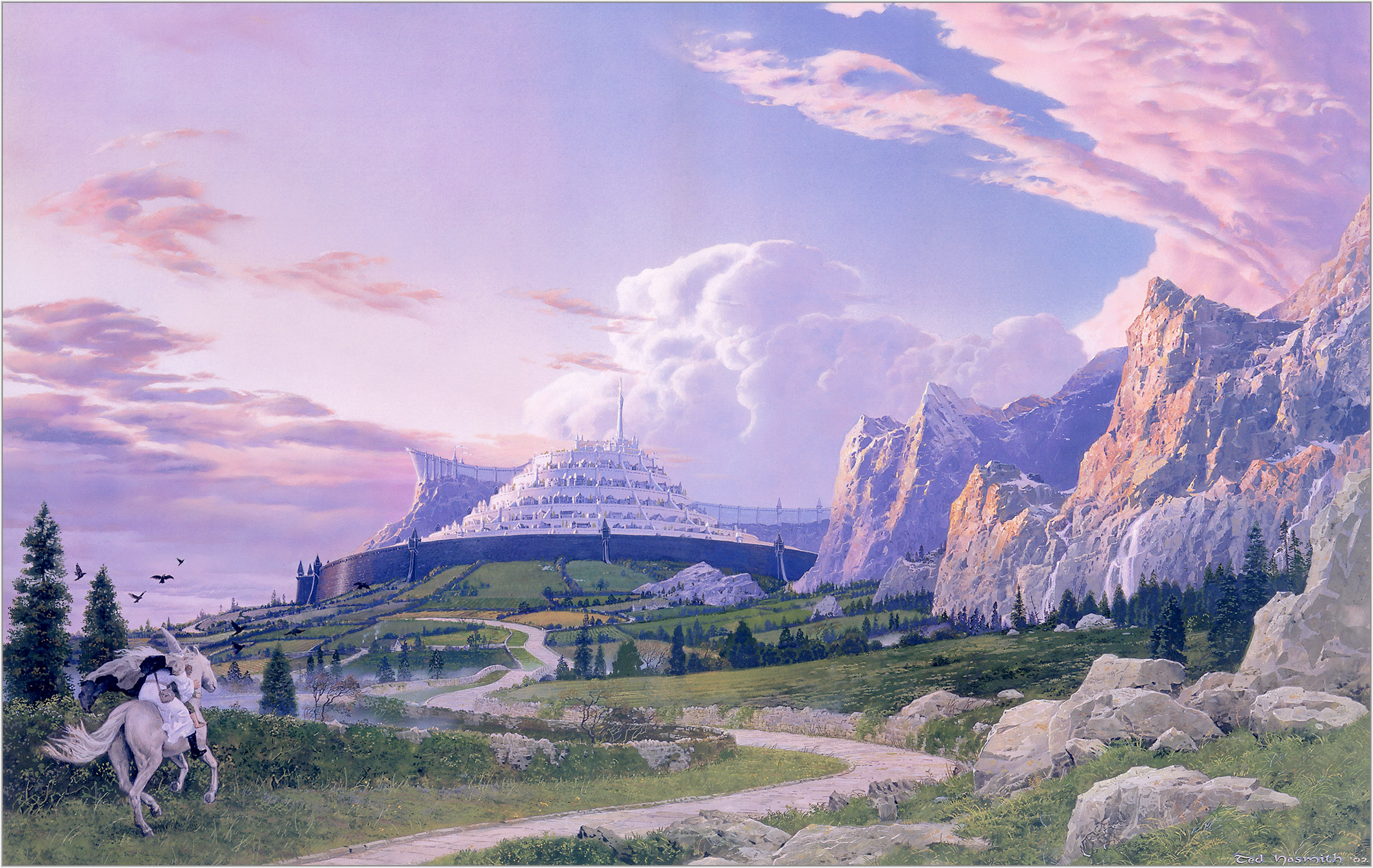
     We first meet it when Gandalf and Pippin, in their rapid journey to Minas Tirith, are briefly stopped at what appears to be a sally port in it (rather than a major gate, as Shadowfax is said to have “passed through a narrow gate in the wall” 749). Gandalf briefly trades remarks with an officer named Ingold (who appears briefly later in the story to report that the northern section has fallen, 821) before he and Pippin continue their journey.

     It is described thus:

   “Gandalf passed now into the wide land beyond the Rammas Echor. So the men of Gondor called the out-wall that they had built with great labour, after Ithilien fell under the shadow of their Enemy. For ten leagues [about 30 miles in the English system—about 48 km in the metric] or more it ran from the mountains’ feet and so back again, enclosing in its fence the fields of the Pelennor: fair and fertile townlands on the long slopes and terraces falling to the deep levels of the Anduin. At its furthest point from the Great Gate of the City, north-eastward, the wall was four leagues [12 miles—about 19 km] distant, and there from a frowning bank it overlooked the long flats beside the river, and men had made it high and strong; for at that point, upon a walled causeway, the road came in from the fords and bridges of Osgiliath and passed through a guarded gate between embattled towers… “ 750.

     With so much of Tolkien, one can find illustrations from the usual artists—the Hildebrandts, Howe, Nasmith, and Lee—but for this particular—and important—architectural feature, we haven’t discovered—so far—a single illustration.

     It’s made of stone and has evidently not been well-maintained: “Many tall men heavily cloaked stood beside him [Shadowfax], and behind them in the mist loomed a wall of stone. Partly ruinous it seemed, but already before the night was passed the sound of hurried labour clould be heard: beat of hammers, clink of trowels, and the creak of wheels.” 748 And, as mentioned above, it has gates, but, beyond that, what does it look like?

     England has a long history of long walls. There are the surviving earthen walls and ditches of the Dark Ages or early medieval Offa’s Dyke

Offa's_Dyke_near_Yew_Tree_Farm_-_geograph_org_uk_-_450420

1990s, Near Knighton, Wales, UK --- Offa's Dyke near Knighton in Wales. The dyke was created by Offa the King of Mercia from 757 to 796 AD and roughly formed the boundary between England and Wales. --- Image by © Homer Sykes/CORBIS

and Wansdyke

wansdyke

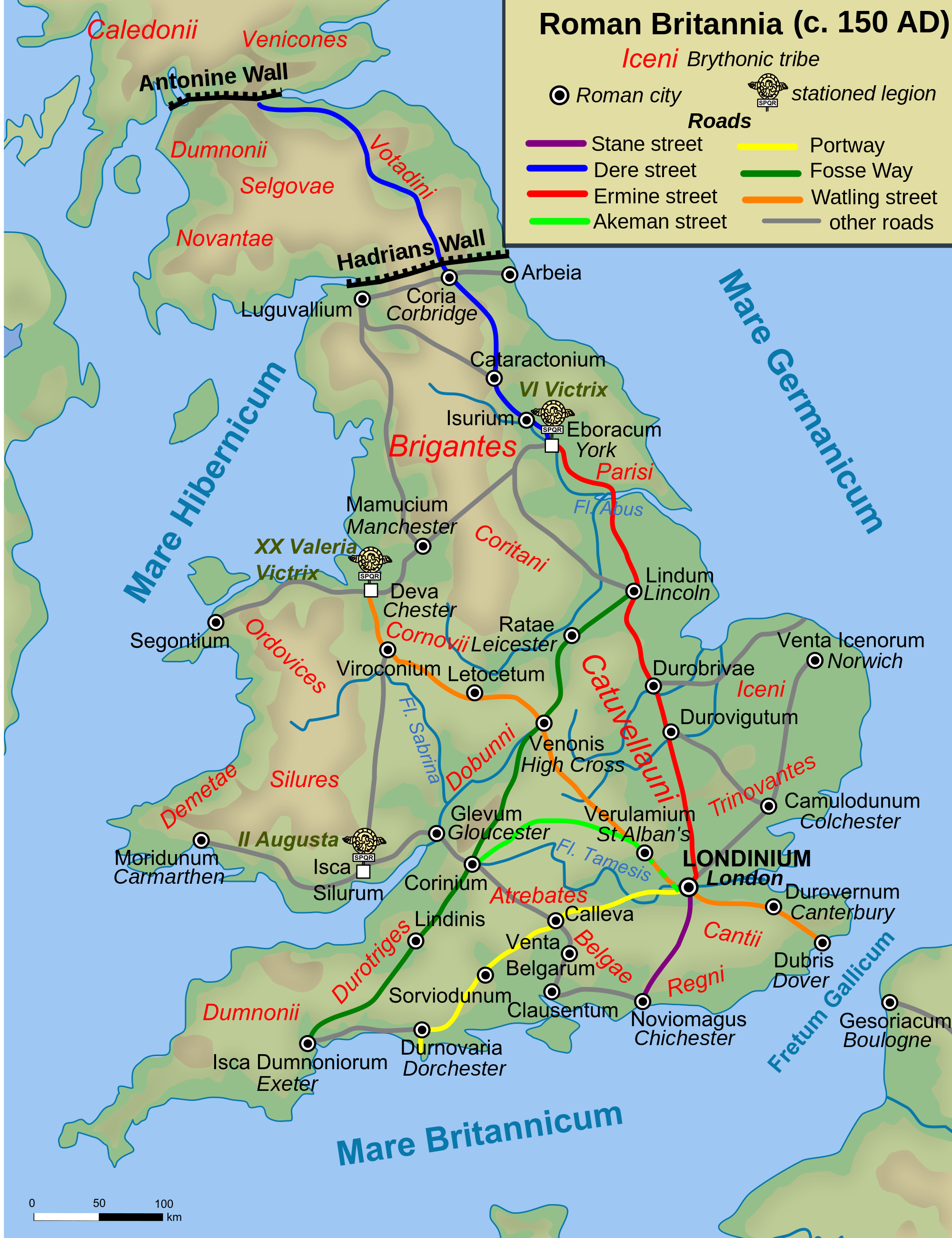
and, of course, the well-known 2nd –century AD work, Hadrian’s Wall, with its surviving stone work and its elaborate series of mile castles, gates, and supporting forts and camps.

Hadrians_Wall Hadrian's Wall phase 1 Central sector

   We might also cast further afield and in time. In Book 7 of the Iliad, the Greeks dig a ditch, fill it with sharpened stakes, and build a stone wall behind it to protect their ships from Trojan attack.

[We can’t find an image of that, but here’s a picture of one of our favorite features of today’s Truva/Hisalik, just to remind you of a later feature of the Trojan War—along with a still from the 2004 Brad Pitt film, known to those of us who love Homer for its rather casual attitude towards the traditional story.]

617-5-horse1

trojan-horse%20troy%20the%20movie

And how can we fail to mention the Great Wall of China?

thegreatwall_rcv

     For us, Hadrian’s Wall might do, with its stretch of stonework across the entire width of England (73 miles, 117.5 kilometres).

map-hadrians-wall

It even has the requisite main gate, which will be defended by Faramir.

This is actually from the Roman fort of Arbeia, South Shields—a great site—but it gives you an idea of what something a little grander—after all, it connected the Pelennor with Osgiliath—might look like.

F00638REW

     That event, however, is in The Lord of the Rings, where Faramir maintains his reputation as a brave and far-sighted commander, as Beregond says to Pippin:

     “But things may change when Faramir returns. He is bold, more bold than many deem; for in these days men are slow to believe that a captain can be wise and learned in the scrolls of lore and song, as he is, and yet a man of hardihood and swift judgement in the field.” 766

FaramirCaptainGondor

     In the film, it is quite a different matter. There is no Rammas Echor and Faramir, in contrast, is badly wounded in a cavalry charge against the walls of Osgiliath while his father, Denethor, has a rather messy and all-too-symbolic lunch.

maxresdefault

gondorianerritt-cb182208

gifdenethoreating

     What has happened here? First, no intelligent—maybe even foolish—commander would attack a stone wall with cavalry, and we know that Faramir is, indeed, intelligent. Second, what has happened to the Rammas, where Faramir actually had been just before he fell, commanding the rearguard?

     First, we would suggest that the script writers took their cue from the final scene between father and son, in which Faramir, already told by his father that his father had preferred his elder son, Boromir, volunteers to direct the defense of Osgiliath:

“But at length Faramir said: ‘I do not oppose your wil, sire. Since you are robbed of Boromir, I will go and do what I can in his stead—if you command it.’

     ‘I do so,’ said Denethor.

     “Then farewell!’ said Faramir. ‘But if I should return, think better of me!’

     ‘That depends upon the manner of your return,’ said Denethor.

     Gandalf it was that last spoke to Faramir ere he rode east. ‘Do not throw your life away rashly or in bitterness,’ he said. ‘You will be needed here, for other things than war. Your father loves you, Faramir, and will remember it ere the end. Farewell!’” 816-817

     To them, this might have indicated that Faramir—who had clearly been Gandalf’s pupil, as his father has said:

“See, you have spoken skillfully, as ever; but I, have I not seen your eyes fixed on Mithrandir, seeking whether you said well or too much? He has long had your heart in his keeping.” 812

does not listen to his tutor and deliberately sets out to get himself killed. In the text, however, Faramir is actually acting responsibly, fighting in the rearguard of the retreating detachment driven from the Rammas:

“Even as the Nazgul had swerved aside from the onset of the White Rider, there came flying a deadly dart, and Faramir, as he held at bay a mounted champion of Harad, had fallen to the earth.” 821

     (And we might add that Prince Imrahil, who brings the wounded Faramir back, says, “Your son has returned, lord, after great deeds…” 821, which, of course, could easily be understood to be ironic and is perhaps meant to be so on the part of Imrahil, considering Fararmir’s last words to his father and Denethor’s reply.)

     Thus, we see Faramir’s wounding completely changed, but what about the wall he had been defending?

     When one reads through the various chat sights, there was once a considerable amount of discussion about the Rammas Echor, but all was speculation, it seems, as we were unable to find anything said by the writers themselves. In the text, instead of concentrating on the main gate, Sauron’s engineers detonate explosions to each side and the troops then pour through the breaches to take the defenders in flank. This could be seen as a repetition of a similar earlier event at Helm’s Deep, in which Saruman’s forces blew a hole in the defenses.

blowingupthewallathelmsdeep

     As well, we think that, for the director, the big visual attraction was the attack on Minas Tirith. This means that it could simply have been a matter of where to spend time—and/or possibly money—and so the Rammas was sacrificed. If the decision had already been made to change—we will say misinterpret– the story of Faramir, simplifying it drastically and shifting the focus (just think of that dripping mouth!), then the choice to discard this defense would have been an easy one.

     So, suppose you were script writer or director, what would you have done, dear readers?

     Thanks, as always, for reading (and, we hope, speculating).

     MTCIDC

     CD

Powerplay

Tags

, , , , , , , , , , , , , , , , , , , , , , , , , , , , , , , , , ,

Welcome, as always, dear readers!

We’ve discussed the nearly-invisible Sauron in an earlier posting, but now we’d like to think out loud about the all-too-visible Saruman. And, as we’ve just heard that we’ve lost our own Saruman, Christopher Lee, we would like to dedicate it to his memory.

McBrideTreebeard

Pippin and Merry have been filling Fangorn in about all of their adventures up to the moment when he found them in his forest.

Saruman, in particular, has caught his attention, being his neighbor and, it seems, an increasingly distant one—

“There was a time when he was always walking about my woods. He was polite in those days, always asking my leave (at least when he met me); and always eager to listen. I told him many things that he would never have found out by himself; but he never repaid me in like kind. I cannot remember that he ever told me anything. And he got more and more like that; his face, as I remember it—became like windows in a stone wall: windows with shutters inside.” 473

At that moment, everything comes together for the Ent.

“I think that I now understand what he is up to. He is plotting to become a Power.” 473

And not a friendly power, as Gandalf, during his last visit to Isengard, has learned to his dismay, having heard Saruman alternately wheedle and threaten him. Saruman’s initial words, however, were not about himself, but about someone else, to the east:

“A new Power is rising. Against it the old allies and policies will not avail us at all. There is no hope left in Elves or dying Numenor. This then is one choice before you, before us. We may join with that Power.” 259

So far, this must sound like the Sauron party line—and Saruman is actually described “as if he were making a speech long rehearsed”, (259), the tone of which Gandalf recognized immediately, replying:

“I have heard speeches of this kind before, but only in the mouths of emissaries sent from Morder to deceive the ignorant.” 259

If we pause for a moment and consider the era in which this was written, we might catch a glimpse of something from the history of our world in this, something from the period beginning in 1922 and extending at least through 1945, when Tolkien was beginning to write The Lord of the Rings.

JRRT always denied that his work was allegorical, although, sophisticated man that he was, he was well aware that the world around him would impinge upon his consciousness. Thus, when we see numerous sinister figures rising in power in our world, it would be difficult to imagine that they might not, even if only very distantly, exert some small influence on his work.

The lesser figures include Franco, in Spain,

d950ed6b46c3317df212938ada08510f

Eoin O’Duffy in Ireland,

eoin-oduffy-blueshirts

Sir Oswald Mosley in England, (mocked as “the amateur dictator “ by P.G.Wodehouse in the persona of Sir Roderick Spode—brilliantly played by John Turner in the 1990s Wodehouse “Jeeves and Wooster” television series)

mosley03

0

and the most menacing of all, Mussolini and Hitler.

hitler-mussolini

Mussolini had begun his rise to power just after World War One, achieving his position of Il Duce in 1922,

Il%20Duce

while Hitler, after a false start in 1923, in emulation of Mussolini,

beerhallputsch

finally reached the ultimate position of authority in 1933.

hitler_hind

Although Hitler was a relative late-comer in comparison with Mussolini, it seems that Mussolini looked up to Hitler, even taking German lessons (although there is no mention of Hitler reciprocating) so that they could talk more easily (and, doubtless, securely).

Thus, it might be possible to see Saruman, in his position as lesser of two evils, looking up to and wanting to imitate Sauron, the greater of two evils, as Mussolini attempting to emulate Hitler. (And this odd partnership is sharply satirized in Charley Chaplin’s The Great Dictator, 1940.)

chaplinoakey

So, as Sauron has the Barad-dur,

hildebrandtsbaraddur

so Saruman has Orthanc.

greg-hildebrandt-isengard-orthanc-saruman-607429-1300x962.1

As Sauron has Orcs

morderorcs

so Saruman has Orcs.

uruk

Worst of all, just as Sauron has the vast wasteland of Mordor

L1003926

Saruman takes the once-green and beautiful Isengard

greg-hildebrandt-isengard-orthanc-saruman-607429-1300x962

and turns it into a mini-Mordor.

isengard_by_nagzuku

All of this is swept away by Fangorn and his fellow Ents, of course,

The Wrath of the Ents, by Ted Nasmith

and it appears that Saruman will remain within the tower, but we know that he slips away, taking the former counselor of Theoden, Grima, with him.

Or, at least, that’s what Tolkien intended. Unfortunately, the makers of The Lord of the Rings films simply dropped this theme here, with the deaths both of Saruman and Grima on Orthanc. We say unfortunately because, although we have portrayed Saruman as a wanna-be Sauron (even to the point of thinking that he might gain control of the Ring), which is certainly one of his roles, his is a greater role as he was once a greater figure. He is the eldest of the Maiar in Middle Earth, those spirits whom Tolkien once described as “near equivalent in the mode of these tales of Angels, guardian Angels”, LTR 159. That he can be corrupted by Sauron (as Sauron himself had been corrupted by Morgoth), shows just how great Sauron’s power (and the lure of the Ring) really is. As well, in his fall, we see that that corruption, like Sauron’s, is complete. Offered the chance to return to the good, he spurns it and slips away—but not out of the story, and it’s here that we feel that the writers of the films missed a great opportunity.

In what might, at first, seem like an act of petty revenge, Saruman goes to the Shire, that green and so-far-safe land far west of all of evil of Middle Earth,.

The-Hill-Hobbiton-across-the-Water

TN-The_Shire_A_View_of_Hobbiton_From_The_Hill

and industrializes it. After all, Fangorn has said of Saruman that “He has a mind of metal and wheels; and he does not care for growing things, except as far as they serve him for the moment.” 473

So, just as at Isengard, trees must go, if only to feed his industrial plans. When we think of Saruman’s ultimate vision for the Shire, we imagine that it would look like the work of Edwin Butler Bayliss (1874-1950) who painted the industrial landscapes of England’s West Midlands, the “Black Country”, an area Tolkien himself thought of as his home region.

 op6301

(c) Dr Christopher R. Bayliss; Supplied by The Public Catalogue Foundation

(c) Dr Christopher R. Bayliss; Supplied by The Public Catalogue Foundation

The end comes quickly, however, when the Hobbits return and we see, in “The Scouring of the Shire”, on the one hand, the new maturity of Merry and Pippin, and, on the other, the deep humanity of Frodo.

storming_the_ban scouring

And Saruman would have been allowed to go free again—but there is an irony here in what happens. He had sought to overturn Theoden and Rohan through having subverted Grima and, instead, he himself is killed by that very agent—

scouringshire

61%20-%20The%20scouring%20of%20the%20shire

and we have wondered about that. If Saruman is of the same substance as the Valar, merely inhabiting a human body, can he, in fact, be killed, any more than Sauron? We assume that Sauron, who had poured so much of his spiritual power into the Ring, would be seriously weakened by its loss, enough so that his empire collapses on him. In Saruman’s case, the end is less dramatic, but at the same time, poignant:

“To the dismay of those that stood by, about the body of Saruman a grey mist gathered, and rising slowly to a great height like smoke from a fire, as a pale shrouded figure it loomed over the Hill. For a moment it wavered, looking to the West; but out of the West came a cold wind, and it bent away, and with a sigh dissolved into nothing.” 1020

Although the withered remains are then described, they seem unnecessary. That was only the borrowed flesh. The tragedy lies in that wavering look, the bending away, the sigh. In the final chapter, “The Grey Havens”, we see Gandalf departing towards that very West which was denied to Saruman and here we see, as well, what it was that the spirit of Saruman had lost: the reward of being allowed, at last, to return home, to go back towards Valinor. Instead, the Valar have rejected one of their own and, though his spirit may not have been destroyed, something seems to have left him forever.

By leaving the final chapters out of the film, then, the script writers lost the chance not only to show us Merry and Pippin, at the end of their long adventure, grown into figures to rival the Old Took, both in deeds and in stature. As well, they denied us the potential contrast with the end of such figures as Hitler—a suicide—and Mussolini—executed by his own people, and that of Saruman the White, murdered by his own follower and, at the end, nothing but sadness and grey smoke.

_SARUMAN__by_SilentDeath007

Thanks, as always, for reading. And thank you, Christopher Lee, for acting.

MTCIDC

CD

Where From the Rohirrim?

Tags

, , , , , , , , , , , , , , , , , , , , , ,

Dear Readers, welcome!

In this post, we want to think out loud a bit about the Rohirrim.

ghan Rohirrim-by-Angus-McBride-kacik-rohanskiej-adoracji-36841491-473-477 maxresdefault

Everyone knows where their language is from, as Tolkien says in a letter to “one Mr. Rang”:

“…’Anglo-Saxon’…is the sole field in which to look for the origins and meaning of words and names belonging to the speech of the Mark.” LT 381

And yet they are horse people (their own name for themselves, in fact, is Eotheod, “horse people”), which the Angles and Saxons who went to make up the Anglo-Saxons, were not.   Tolkien was well aware of this difference, saying in Appendix F of The Lord of the Rings:

“…this linguistic procedure does not imply that the Rohirrim closely resembled the ancient English otherwise, in culture or art, in weapons or modes of warfare, except in a general way due to their circumstances…” L1136

Tom Shippey, in The Road to Middle Earth, suggests that

“The Rohirrim are nothing if not cavalry. By contrast the Anglo-Saxons’ reluctance to have anything militarily to do with horses is notorious…How then can Anglo-Saxons and Rohirrim ever, culturally, be equated? A part of the answer is that the Rohirrim are not to be equated with the Anglo-Saxons of history, but with those of poetry, or legend.” (112)

Or, could there have been other models?

Tolkien may have been suggesting one when, in a letter to Rhona Beare of 14 October, 1958:

“The Rohirrim were not ‘mediaeval’ in our sense. The styles of the Bayeux Taptestry (made in England) fit them well enough, if one remembers that the kind of tennis-nets [the] soldiers seem to have on are only a clumsy conventional sign for chain-mail of small rings.” Ltr 280-281.

The Bayeux Tapestry depicts both Normans and their allies, on the one hand, and the Anglo-Saxons, on the other, but Tolkien doesn’t appear to distinguish between them. The Normans themselves are mounted, the Anglo-Saxons on foot, as was their custom (they did use horses to move rapidly from place to place, as in the race north to Stamford Bridge and then back south to face the Normans).

5191623_orig

Here, to the left, we see those mounted Normans and, to the right, the Anglo-Saxons behind their shield wall. The “tennis-nets” are clearly visible and would actually have looked like this:

huscarl

In this further illustration, by the way, it’s easy to see the consequences of having the shield wall crumble: men on horseback can have a significant advantage when their opponents lose cohesion.

34small-1000

This, however, is only their look . What about those horses and an entire culture based around them?

For a clue, we look to another element in the culture of the Rohirrim, the use of burial mounds. Here they are at Edoras.

Simbelmyne_Mounds

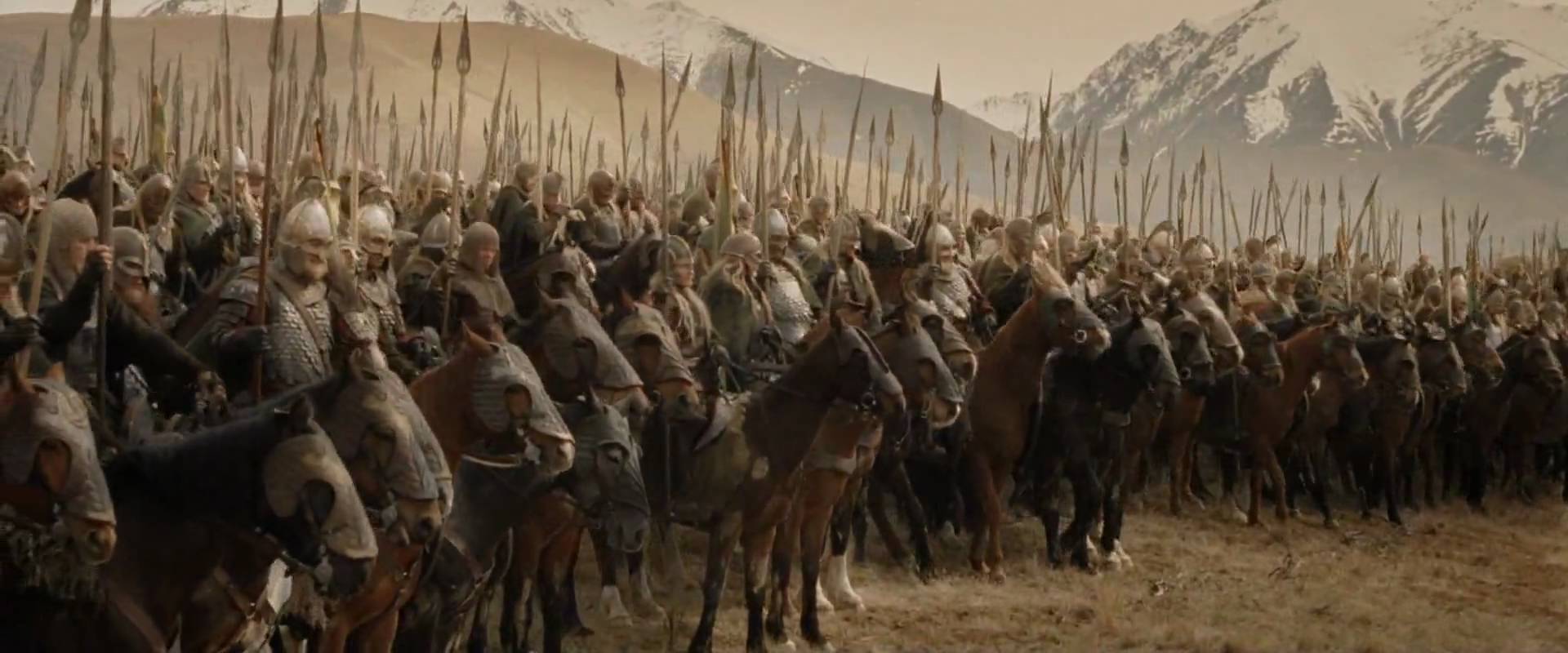
(We can’t resist, by the way, saying that our absolute favorite part of the Jackson movies is anything to do with the Rohirrim—to us, absolutely inspired and we see the depiction of the charge of the Rohirrim against the army besieging Minas Tirith as being right up there with the Charge of the Light Brigade at Balaclava in 1854 and the charge of the Australian Light Horse at Beersheba in 1917–

Rohancharge

(c) National Trust, Tredegar House; Supplied by The Public Catalogue Foundation

beersheba lambert

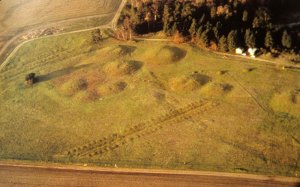
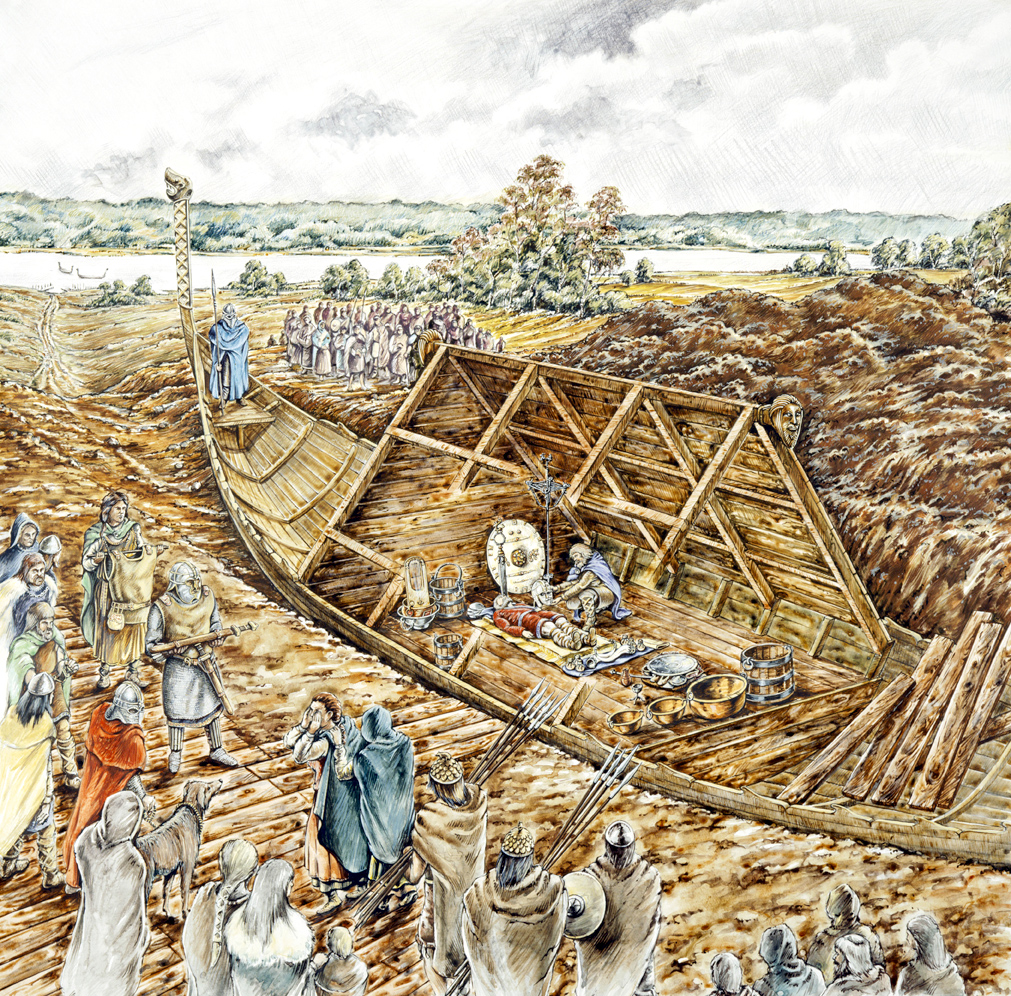
One might say, in reply, that there are Anglo-Saxon mounds—like the famous Sutton Hoo ship burial.

c52a1bf535

But that leaves us where we started, in the land of foot soldiers.

huscarl1

So, let’s go farther afield, to the north of the Black Sea.  

WRLH034-H

Here, we see the so-called “Kurgan Culture”, with its burial mounds

02161200-1 02161200

[This, by the way, is not to be confused with The Kurgan from the first Highlander movie

The Kurgan]

movie-villain-kurgan

These were a people who:

  1. are believed by many linguists (and some archeologists) to be the direct ancestors of the Indo-Europeans who gradually invaded Asia Minor and western Europe (including, eventually, the Anglo-Saxons) as well as moving east, to India and beyond
  2. buried their dead (at least what appear to be the high status ones) in mounds
  3. were a horse culture

And, in fact, were seemingly the forerunners of the Scythians, a later well-known Indo-European horse people

Scythia Rod-Scythian-Horseback

angus-mcbride-scythia-1

And the Scythians, in turn, may have been the model for those mythical horse folk, the Amazons.

72303amazon

In the 19th century, when the idea of Indo-Europeans began to circulate, there was a preference for a northern European origin (a theory no longer held), but the idea of an eastern home was also circulating and we would suggest that Tolkien would have known about this, as well as, from his early classical training, Scythians and Amazons, their actual and mythical descendants.

Imagine, then, that what we see in the Rohirrim is, in fact, an interesting mixture of people sprung from an earlier people (as Tolkien tells us, the Rohirrim were descended from the Edain of the First Age—see LOTR, Appendix F 1129), both in our world and in Middle Earth, who based their culture upon horses, and bury their dead in mounds, combined with people who may also bury their dead in mounds, who speak a version of Anglo-Saxon and who dress like the Normans and Anglo-Saxons of the 11th century AD.

What do you think, dear readers?

Thanks for reading, as always.

MTCIDC

CD

Subsubcreations

Tags

, , , , , , , , , , , , , , , , ,

Dear Readers,

Welcome, as always!

     Two posts ago, we talked about how it might be possible to make Sauron –the- nearly-invisible slightly more visible by means of his minions.

Minions-Film

[oh yes—minions—from Middle French, “mignon”, meaning “little/darling” and coming to have a negative meaning in English, “lackey”]

     These included the Nazgul

nazgul

various humans—corsairs, Haradrim, Easterlings—

702343aharadvetcav easterling_hassassin_by_taurus_chaoslord-d5sb6rc

And, the real stars (as Nick and Fetcher, the two rats from Chicken Run, refer to themselves)

Nick_and_Fetcher

the Orcs.

John%20Howe%20-%20Merry%20et%20Pippin%20prisonniers%20des%20orcs 36 - Orcs (MERP)

OrcsOnSentry_Alan_Lee

     Tolkien appears always to have had trouble placing them. We would suppose that this problem arose because Orcs were not the usual run-of-the-mill lackeys one usually sees in adventure, like the sheriff of Nottingham’s men

sjff_03_img1296

the soldiers of the evil commandante in the Zorro adventures

ep23d

or the hordes of faceless stormtroopers in Star Wars

Stormtrooper_Corps

       His first question—where do they come from? was immediately followed by a second—if they are created, do they have free will? That first question, any author might ask himself. The second, however, was pure Tolkien, fitting into the pattern which those who’ve only read The Lord of the Rings and not JRRT’s letters on the subject or the volumes produced by the admirable (a pale adjective!) Christopher Tolkien, would never see: the complex spiritual history which lies behind the creation of Middle Earth.

     Not that the first question was simple. In The Lord of the Rings, Fangorn says of the Orcs:

“But Trolls are only counterfeits, made by the Enemy in the Great Darkness, in mockery of Ents, as Orcs were of Elves.” L486

     The author, however, had a very different opinion:

“Their nature and origin require more thought. They are not easy to work into the theory and system.”

(Morgoth’s  Ring   409)

     Not easy because of that second question. As he wrote in an unpublished essay entitled (not surprisingly) Orcs (Morgoth’s Ring 409-413),

“…only Eru [the central creative deity] could make creatures with independent wills, and with reasoning powers. But the Orcs seem to have both: they can try to cheat Morgoth/ Sauron, rebel against him, or criticize him.”

     Morgoth (Sauron’s former master) made the Orcs in some way, but, because only the central deity, Eru, can give independent wills and reasoning powers—which Orcs display by cheating, rebelling, and criticizing– to created beings, what is to be made of Orcs? Bound by those seemingly contrary facts, the conclusion was obvious to him that “therefore they must be corruptions of something pre-existing.” (409)

But of what?

     “But Men had not yet appeared, when the Orcs already existed. Aule constructed the Dwarves out of his memory of the Music; but Eru would not sanction the work of Melkor [i.e. Morgoth] so as to allow the independence of the Orcs.

     It also seems clear…that though Melkor could utterly corrupt and ruin individuals, it is not possible to contemplate his absolute perversion of a whole people, or group of peoples, and his making that state heritable.

     In that case Elves, as a source, are very unlikely.” (409)

     Thus, logically, if the Orcs are created, not corrupted, and created by a power which hasn’t the ability to give his creations independence, then–

     “The Orcs were beasts of humanized shape (to mock Men and Elves) deliberately perverted/converted into a more close resemblance to Men. Their ‘talking’ was really reeling off ‘records’ set in them by Melkor. Even their rebellious critical words—he knew about them. Melkor taught them speech and as they bred they inherited this; and they had just as much independence as have, say, dogs or horses of their human masters. This talking was largely echoic (cf. parrots). ..Also (n.b.) Morgoth not Sauron is the source of Orc-wills. Sauron is just another (if greater) agent. Orcs can rebel against him without losing their own irremediable allegiance to evil (Morgoth).” (410-411)

     We don’t know about you, dear Readers, but we confess to a certain disappointment at the idea that the Orcs are only more complex puppets. Consider this piece of villainous dialogue between Gorbag and Shagrat:

Unknown%20-%20Bilbo%20le%20Hobbit%20(01)%20-%20Les%20orcs

     “I’d like to try somewhere where there’s none of ‘em. But the war’s on now, and when that’s over things may be easier.”

     “It’s going well, they say.”

     “They would,” grunted Gorbag. “We’ll see. But anyway, if it does go well, there should be a lot more room. What d’you say?—if we get a chance, you and me’ll slip off and set up somewhere on our own with a few trusty lads, where there’s good loot nice and handy, and no big bosses.”

     “Ah!” said Shagrat. “Like old times.” (LOTR 738)

     The plans and reminiscences of demons—how wonderful! And what an interesting sidelight into their world and even their past: they used to be masterless marauders, in the “old times”—could this suggest that perhaps they weren’t such puppets after all? We would like to imagine so!

And what is your opinion, dear readers?

Thanks, as ever, for reading.

MTCIDC

CD

The Sadness of a Second Reading

Tags

, , , , , , , , , , , , , , , , , , , , ,

Welcome again, dear readers!

We’re sure to return to villains—Orcs first, we think—but, as we reread material for the last posting, we came across a passage which so struck us that we had to sit down and write a posting about it…

   Isengard is ruined. So much of what Tolkien described in such vivid detail in “The Road to Isengard”, both before Saruman decided to be a rival to Sauron and after, has been destroyed—here is the Hildebrandts’ version of it in Saruman’s early days

greg-hildebrandt-isengard-orthanc-saruman-607429-1300x962

And here it is when Saruman’s ambition overcame his sense of mission as one of the Istari and he could tell Gandalf that their job was to strive for “Knowledge, Rule, Order”—

Isengard_by_Nagzuku

But Fangorn and his Ents have changed all of that—

The Wrath of the Ents, by Ted Nasmith

So that, when Gandalf and his company appear, they see

“…And all about, stone, cracked and splintered into countless jagged shards, was scattered far and wide, or piled in ruinous heaps.” 

On top of one of those heaps                  

ruins 

“…two small figures…at their ease. One seemed asleep; the other, with crossed legs and arms behind his head leaned back against a broken rock and sent from his mouth long wisps and little rings of thin blue smoke.”

     Not tiny Smaugs sunning, it is, of course Merry and Pippin making themselves comfortable in the wreckage of Saruman’s palace/fortress/factory. That comfort is an affront to Gimli—or, at least, he pretends that it is—but it is a source of amusement to the rest of the company and the Hobbits themselves are a source of amazement to Theoden:

     “The days are fated to be filled with marvels. Already I have seen many since I left my house; and now here before my eyes stand yet another of the folk of legend. Are these not the Halflings, that some among us call the Holbytlan?” 

     But Theoden’s wonder is greater: not only are these figures from distant legend, but, “I had not heard that they spouted smoke from their mouths.”

     This sets Merry off on a lecture, which prefigures, of course, his later treatise, Herblore of the Shire, but which Gandalf stops in its tracks, saying,

“You do not know your danger, Theoden…These hobbits will sit on the edge of ruin [ironic here, as they are, in fact, doing so—it’s Saruman’s ruin] and discuss the pleasures of the table, or the small doings of their fathers, grandfathers, and great-grandfathers and remoter cousins to the ninth degree, if you encourage them with undue patience.” 

     Theoden, however, shows that, in the future, at least, he will encourage them with that patience—

“Farewell, my hobbits! May we meet again in my house! There you shall sit beside me and tell me all that your hearts desire: the deeds of your grandsires, as far as you can reckon them; and we will speak also of Tobold the Old and his herb-lore. Farewell!”

     Merry and Pippin, usually less-than-respectful, are quite charmed by this and behave better than usual:

     “The Hobbits bowed low. ‘So that is the King of Rohan!’ said Pippin in an undertone. ‘A fine old fellow. Very polite.’”

      If this is your first reading, there is something to look forward to—or, if you are Gandalf, to dread. For the more experienced, we already see the splitting up of Merry and Pippin, Pippin’s whirlwind ride with Gandalf to Minas Tirith, and Merry’s equally grueling ride to the Pelennor and his part in the last heroic moments of Theoden’s life and his final words on the subject of that earlier promise:

“Live now in blessedness; and when you sit in peace with your pipe, think of me! For never now shall I sit with you in Meduseld, as I promised, or listen to your herb-lore.” 

deathoftheoden

   And this brings us to the point: if you know what’s going to happen—in detail—why read this again?

     The answers are many and here are only a few from an entire spectrum: it’s such a rich story that you can easily read it again and find something new every time; you’d like to escape to Middle Earth because, even troubled as it is with Sauron, it makes more sense than Here and Now; you don’t read it all, but there are scenes and/or characters you like to revisit; it has become a kind of happy yearly ritual, as Chaucer fans reread The Canterbury Tales every spring. For us, among all of the other reasons (and we would say that probably every one makes sense, in its way) there is another reason and it has to do with that knowing.

     Wherever the sun shines directly on an object, a person, there is a shadow. Shadows can be knife-edge precise or vague, still or moving, smaller than that which casts them or greater. Knowing what’s to come in Tolkien is like seeing each event with its outcome, its shadow, all at the same moment and, as so often in The Lord of the Rings, what’s to come is compromised—if there’s happiness, it’s happiness of the moment: Sauron is defeated, but the Elves fade; Arwen marries Aragorn at last, but, he being mortal, even if a long-lived one, she is left a widow for many years; Frodo survives the Ring quest, but somehow is never healed. Events cast shadows in our current life, but we only see the shadows in retrospect in this world. In Middle Earth, on second and subsequent readings, events cast their shadows before as well as after themselves. And there is a pleasure in this. One might say, “Hmph. Adolescent thinking. Really self-pity in literary disguise.” We would disagree.

     One of the most powerful enhancers of emotion is contrast, beginning with the very idea of human mortality. As so many religions and philosophical systems advise: live now, in the moment, because there are just so many moments and then…?

     Thus, to read Theoden’s affectionate promise to the hobbits and to know, at that same moment, that it will be broken, and very dramatically, with Theoden’s death, is, potentially, to see that shadow, which is the contrast between what is said now and what will happen then.

     So, dear readers, what do you think? We imagine that you’re like us, with favorite books about which it doesn’t matter in the least that you know them practically by heart—surprise is only the first sensation—like opening a wonderful present which, once opened, you’ll use and love again and again, always grateful to the giver.

MTCIDC

CD

Food for Thought

Tags

, , , , , , , , , , , , , , ,

Dear Readers,

Welcome!

In this posting, we’re continuing our discussion of villains, specifically in Tolkien, but, for a change, we mention the good guys, as well.

We begin with a wail by Gollum, when assured by Frodo that, if there’s no other way to go, he will enter Mordor by the Morannon, the Black Gate.

morannon_(black_gate)

“No use that way! No use! Don’t take the Precious to Him! He’ll eat us all, if he gets it, eat all the world!” L637

It’s not surprising that Gollum would express his fear in such terms—after all, in his first appearance in The Hobbit, his first words were

“Bless us and splash us, my precioussss! I guess it’s a choice feast, at least a tasty morsel it’d make us, gollum!” 

And this from a creature who appears ready to consume anything living, as the narrator says of him:

“He was looking out of his pale lamp-like eyes for blind fish, which he grabbed with his long fingers as quick as thinking. He liked meat too. Goblin he thought good, when he could get it…”

Alan Lee - The Hobbit - Riddles in the dark

What were goblins in The Hobbit have become the Orcs in The Lord of the Rings and Gollum would still be interested in them, but now we’re told what they eat—and drink.

Orque-Terre_du_Milieu

“Ugluk thrust a flask between his teeth and poured some burning liquid down his throat: he felt a hot fierce glow flow through him. The pain in his legs and ankles vanished. He could stand.” 

red-bull-3

“An Orc stooped over him, and flung him some bread and a strip of raw dried flesh. He ate the stale grey bread hungrily, but not the meat. He was famished, but not yet so famished as to eat flesh flung to him by an Orc, the flesh of he dared not guess what creature.”

SAMSUNG

“”We are the servants of Saruman the Wise, the White Hand: the Hand which gives us man’s –flesh to eat.” 

saruman

     To judge by what Merry and Pippin find when they come to Isengard, Saruman certainly didn’t stint himself, including casks of Longbottom Leaf from the Shire. 

And here is a glaring contrast between the two sides in The Lord of the Rings, and it has to do with plenty and enjoyment. Saruman seems to have all the wealth in the world, but always wants more, and what he has does not appear to be shared out equally. Sauron, Gollum says, wants to eat the world, but would he ever be full?

Contrast the traveling supplies of the orcs as you see them above in our text with lembas

leaf-lembas

As the elves describe it, “…it is more strengthening than any food made by Men, and it is more pleasant than cram, by all accounts.” To which Gimli agrees enthusiastically, “Why, it is better than the honey-cakes of the Beornings, and that is great praise, for the Beornings are the best bakers that I know of…” 

Only contrast the look of West and East to see the difference. Here is what the plains of Rohan must look like:

Grassy_Plains_717200735815PM691

And here is an artist’s rendering of Mordor:

sams_first_view_of_mordor

It’s a striking difference topographically, but the difference is even greater in terms of behavior. Isengard is a fortress and a factory, a little Mordor set against the greater Mordor to the east. It can also be a prison, as Gandalf finds out. In contrast, think of the welcome in Rivendell

rivjrrt2

and Lorien

Lothlorien

The West doesn’t plan to eat the world, instead, it lives in a fruitful land, which it makes more fruitful, and it offers this in hospitality to those who come in peace.

This is what is really at stake in The Lord of the Rings, that sense of bounty, generosity, and pleasure, which it must defend from what would eat all the world.

And, as always, we ask what you think, dear readers?

Thanks for reading, 

MTCIDC,

CD

Personae

Tags

, , , , , , , , , , , , , , , ,

A man is known by the company he keeps.

                                                           Old Proverb

Who Has Seen the Wind?

Who has seen the wind?

Neither I nor you:

But when the leaves hang trembling,

The wind is passing through.


Who has seen the wind?

Neither you nor I:

But when the trees bow down their heads,

The wind is passing by.

                                             Christina Rossetti from Sing-Song: A Nursery Rhyme Book (1872)

wind


Dear Readers,

Welcome, as always!

     In our last posting, we talked about villains visible and invisible and suggested that, in the case of Sauron, rather than showing him as a searchlight eye,

sauronbulb2png

(This is from the LOTR Project— a great site, much recommended). 

there were other and more potentially convincing ways to depict such a menacing figure.

One was seeing his reflection in his minions.

minions_2015-wide

(Can you wait for this?)

Imagine that seeing him this way is like seeing the effect a strong wind has on trees.

Palm Tree Nassau Winslow Homer

     Sauron’s minions fall into three main categories: the Nazgul, various humans, most from what appear to be the less-civilized peoples of the south—Corsairs of Umbar, Easterlings, and the Haradrim.

     The Nazgul

eowyn_nazgul

are the most daunting, but we’re told only a limited amount about them, we see them very selectively, and their speech is recorded mainly as threats. We see the humans even less and we really don’t hear them at all. It’s the Orcs of whom we’re shown the most.

     Sauron is described as once being “comely”, but his present condition (except perhaps for his eyes—make that eye) is hard to determine. Tolkien could never quite settle on the origin of the Orcs, but, they are definitely less than attractive.

     Illustrators of Orcs tend, we think, to be strongly influenced by early-Renaissance northern German painters, like Bosch, who depicted devils and demons as hybrids between humans and birds and animals.

Bosch_LJ_Vienna_Music bosch-devil Bosch,_Hieronymus_-_The_Garden_of_Earthly_Delights,_right_panel_-_man_riding_on_dotted_fish_and_bird_creature grunewald_400x478 the-devil-throughout-history-photos-3-horned_pig_devil

     This does not, however, seem to be in line with Tolkien’s thinking. If as Fangorn says, they were created as a mockery of elves, one would presume that they would be much more human in look, but perhaps with exaggerated features, and this seems to be closer to what Tolkien had in mind, although physical description tends to be less detailed.

     Here’s an Alan Lee which we think is more like what Tolkien imagined.

Unknown%20-%20Bilbo%20le%20Hobbit%20(01)%20-%20Les%20orcs

     If they are northern Orcs—those whom Sauron employs—they tend to be smaller and paler. If Uruk-hai, primarily used by Saruman, larger and black. (Although a tracker for Sauron is described as small and black.) Here’s the contrast of the two types in the confrontation between Ugluk and Grishnakh:

“…a large black Orc, probably Ugluk, standing facing Grishnakh, a short crook-legged creature very broad and with long arms that hung almost to the ground.”

     As Orcs may be a mockery of Elves, their speech sounds like it’s derived from the conversations Tolkien heard among his nco’s in the trenches—foul-mouthed (in a modified form), cheerfully abusive, and full of casual threats.

     It’s also instructive to note that there appear to be no Orcs in command positions beyond captain—the rank of Ugluk and Grishnakh, Gorbag and Shagrat. Beyond are the Nazgul, whom the Orcs both dread and envy. (“Those Nazgul give me the creeps…But He likes ‘em; they’re His favorites nowadays, so it’s no use grumbling.”) When we hear these Orcs talk, then, we are being given the mass of Sauron’s soldiery, as below them there is only a babel of cries, cheers, and curses, like a translation of the baying of a pack of hounds.

     Throughout all of the Orc conversation, there runs a joint theme: criticism of superiors (no names—but even up to Sauron himself) and fear of being heard doing so, as when Gorbag says:

     “They don’t tell us all they know, do they? Not by half. But they can make mistakes, even the Top Ones can.” “Sh, Gorbag!” Shagrat’s voice was lowered, so that even with his strangely sharpened hearing could only just catch what was said. “They may, but they’ve got eyes and ears everywhere; some among my lot, as like as not…”

     This suggestion of internal spies reflects a basic uneasiness to be found everywhere under Sauron’s rule: no one trusts anyone else at any level in what Frodo calls “the spirit of Mordor”, leading to murder between rival bands of Orcs and even between individuals, as Sam and Frodo witness, when soldier and tracker trade threats and insults before tracker kills soldier with an arrow.

     So what do Sauron’s minions mirror, which would provide us with any clearer image of the nearly-invisible villain?

   Certainly, we might see that he is incapable of gaining any kind of following at all among the dominant peoples of western Middle Earth.  First, his armies are led by the ancient undead, who frighten their own side as much as they do the enemy. Second, his human recruits are half-civilized people from the far south, plunderers, with no stake in things beyond gain. Third, the bulk of his armies are made up of creatures who are, in a sense, not genuine, but simply mockeries of actual living beings and whose loyalty to their maker is, at best, questionable, even as they fear him.

     Thus, we might imagine that, for all that he is powerful enough to command magic ghosts and armies of primitive men and mutants, Sauron is, ultimately, fearful, suspicious, and divisive and so transparently a source of instability that he can neither convince nor menace any of the free peoples of Middle Earth into having anything to do with him.

     So, as always, we end by asking you, dear readers, what you think? And, as always, we thank you for reading.

MTCIDC

CD
Now You Don’t See Me, Now You Don’t

Tags

, , , , , , , , , , , , , , ,

Invisible-Man

Dear Readers,

Welcome, as always.

     Imagine this—and we’re sure it’s happened to you. You’re working, somewhere by yourself, maybe downstairs. It’s late. Very. Everyone else is long asleep. And you suddenly, for no easy reason, look up. It’s nothing. Nothing…visible. Is it something you heard, then? But what? Is it even a sound—and certainly not something distinctive, like things in old horror movies—chains, groans, thumping footsteps from overhead—but maybe something very quiet—almost nothing more than the disturbance of familiar patterns like appliance hums. In fact, maybe it’s the silence under the familiar patterns which magnifies it. No matter what it is, it’s there. And, at the moment you actively take notice, the creepy feeling catches hold, and you sit, listening ever more intently. (Holding your breath is optional, but a popular choice for times like this.)

     Recently, we wrote about two kinds of villains, those we called “open-ended” and those we called “terminal”. Another classification which might spring from that eerie feeling described above: villains visible and villains invisible.

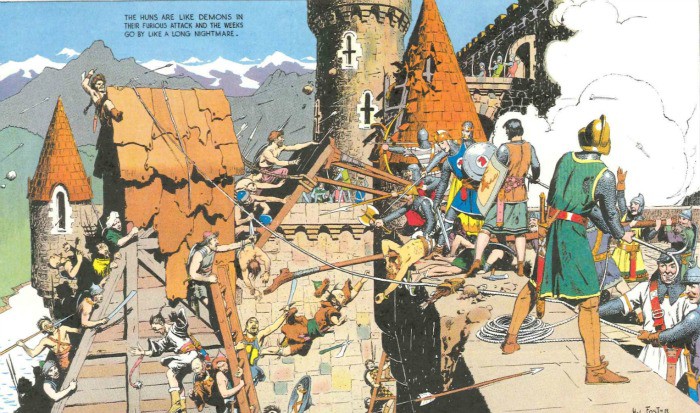
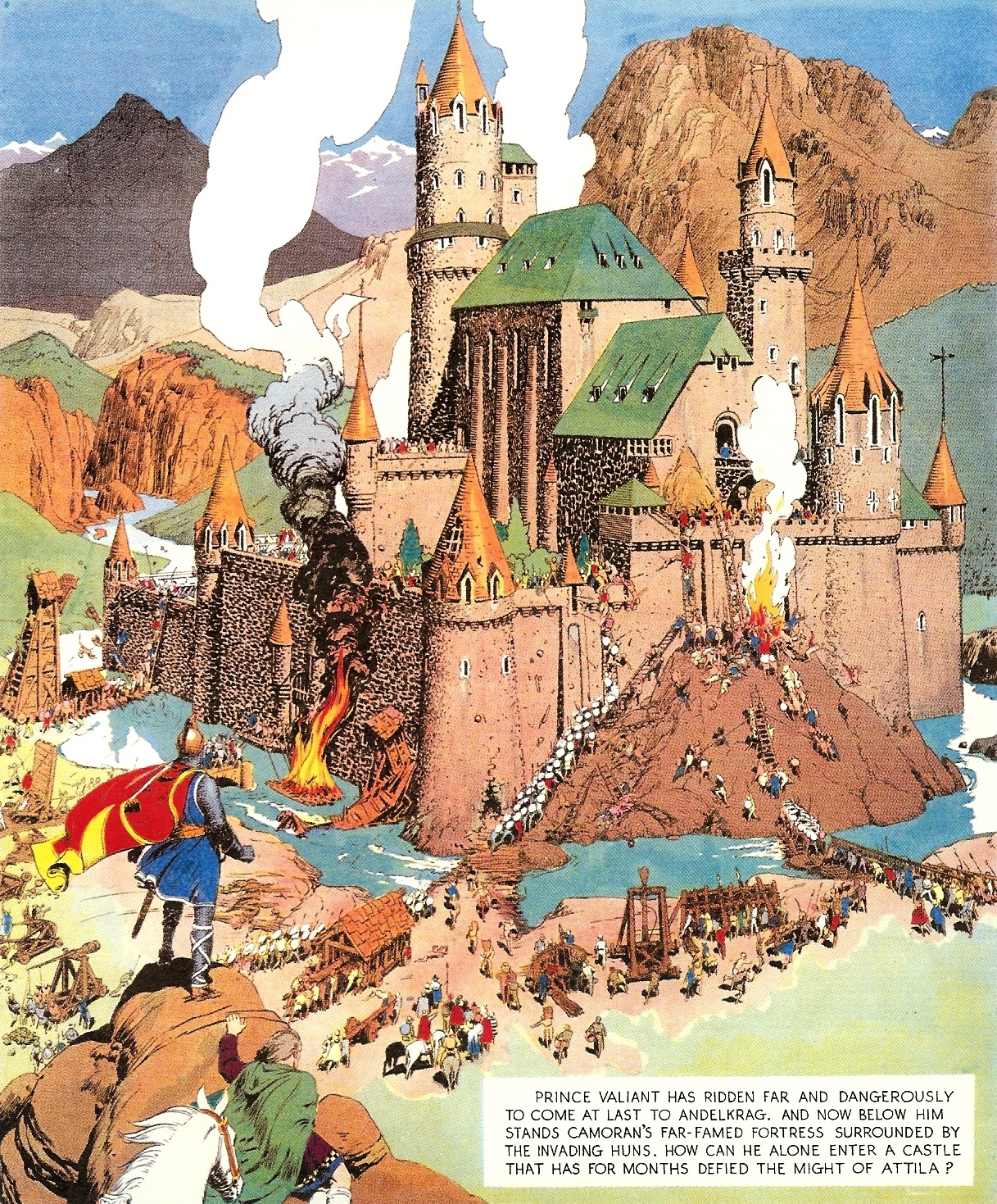
     Let’s return for a moment to that not-so-quiet place where your work was disturbed by…what? If you were a small child, perhaps it would be easy to give it shape from a fairy tale book you’d read, or a movie you’d seen. One of us, for example, was haunted in far childhood by a Hal Foster Prince Valiant illustration in which Prince Valiant has been drugged by Morgan le Fay. Every night, creatures like those in the picture would creep out of the eaves doors at the far end of the room and clutch at the bottom of the bed…

PV-3-19-38

 As we’re adults (sort of), however, do we necessarily embody whatever it is at such moments? And there’s that second question: do we want to? For all that we may be creeped out, is there some odd, perverse pleasure in being creeped out? Certainly those who make horror movies think so! But is there a difference between seeing what scares you and only feeling it?

     With that in mind, suppose that you’re not you, spooking yourself (yes, pun intended) late at night in your living room, but Tolkien constructing a long and complex combination of myth and adventure. You’ve got a wide assortment of protagonists, beginning with some of those beings you created in an earlier story, Hobbits.

fellowship

     What about villains, antagonists? As we’ve discussed in a previous posting, they are necessary to provide friction, that resistance which pushes against the heroes and creates the motion which is a plot.

     Commonly, such a figure is visible, like Lucifer, in Paradise Lost.

GustaveDoreParadiseLostSatanProfile

     Or he’s very visible, like Ravana in the Ramayana, with his ten heads.

page12_1

     For us, however, this is to risk circumscribing the villain, his visible body suggesting his visible limits. After all, it was a Sauron with hands who lost the Ring to a sword blade. To have a body, then, is to be vulnerable (literally, in the case above) and, more perhaps more important, in terms of story, more predictable, more bound by conventions.

     You (as JRRT) create Sauron, then, who once had a body, but now you make him nearly disembodied, being represented physically as a single, fiery eye.

Eye_of_Sauron

     This gives the effect of a brooding, ever-watchful presence, a bit like all of those posters in 1984’s London of Big Brother.

big-brother-is-watching

     This presence can be captured in the text in all sorts of ways, both direct and indirect. You have only to look up “Sauron” in the index to The Lord of the Rings to understand this: “Dark Lord, Enemy, Black One, Black Hand, Black Master, Base Master of Treachery, Dark Power, dark hands of the East, Nameless One, etc.”

     A brooding presence, however, is a real challenge for anyone trying to transfer The Lord of the Rings to the screen, which is why, after the previous defeat of Sauron, in which he appears as a huge being in black armor, he is reduced to that eye, sometimes captured in a palantir

palantir

Or Galadriel’s mirror, though, more often, as Sam and Frodo come closer to their goal, as the equivalent of a tower-mounted searchlight.

Mordor

     Film and fiction are different media, with different needs and tools to satisfy those needs, as the script writers never tire of explaining to us. In our opinion, however, this extremely literal depiction so strongly smacks of old black-and-white prison escape films,

C_71_article_1408592_image_list_image_list_item_1_image%20(1)

that we wish that those script writers could have left the Dark Lord offstage entirely, if this is the best they could do.

     With our feeling that an bodyless villain might be more powerful here than an incarnated one—remember feeling spooked at night by a subtle change in the ambience?—we would wish that the writers had been a bit more imaginative—and had read their author a little more closely. After all, he had plenty of good ideas about how to depict villains. And it is perhaps a sad commentary on their work that, increasingly, in their years of using JRRT, they abandoned him, choosing, instead, to bloat his story and turn it in directions he clearly never intended. Why not, for example, do as Tolkien did and mirror the villain not only in that long list of titles, but also in the actions and words both of his subordinates and his opponents? Would this have worked? Perhaps a reference to the amount of time “You Know Who” appears on-screen in the first Harry Potter movie in contrast to how often he is mentioned would suggest how this might have worked.

     As for villainous subordinates and their actions, we’ll have more to say about them in our next.

lee34

Thanks, as always, for reading. Remember: we want to encourage discussion and debate. If you agree with us, say so. If you don’t, say so and we can have fun working through our views.

MTCIDC

CD

JRRT: Editorial Comment

Tags

, , , , , , , ,

Dear Readers,

Welcome, as always. We had intended to go on with our discussion of villains, which looks like it will form a series, but we were distracted for a moment by the following– so more on villains to come. 

“This book is largely concerned with Hobbits, and from its pages, a reader may discover much of their character and a little of their history. Further information will also be found in the selection from The Red Book of Westmarch, that has already been published, under the title of The Hobbit.” 

So begins The Lord of the Rings, a novel. But a novel which pretends not to be a novel at all, but, rather, an edited version of a true history of someplace and sometime else: Middle-earth, the Third Age.

It’s hardly a new ploy, to pretend to be only presenting something already written by others. Often, it’s done to deflect attention from the sensitive matter within the novel: de Montesquieu’s criticism of France in Persian Letters or Hawthorne’s use of the theme of adultery in The Scarlet Letter

The adventures in The Lord of the Rings, or, for that matter, The Hobbit, are hardly controversial, however, so why go through this pretense, we wondered?

As we thought about and discussed this, we came up with a whole series of possible reasons– and none of them necessarily excludes any of the others. 

First, and perhaps most obvious, was that being an editor and translator formed a major part of what JRRT did in his academic life. What would seem more natural? 

Second, he lived in the academic world of Oxford, among academic friends, who formed a large part of his initial readership, and who themselves could be editors and translators. 

Third, based in part on one and two above, it fits into Tolkien’s and the Inklings’ desire to produce more of what they liked to read: an adventure, but in the guise of a “scholarly” work, yet one wholly invented.

Fourth, unlike real scholarly work, this one was not bound– and never would be– by the limits of available knowledge. There is only one Beowulf manuscript, after all. Because the only bounds placed upon the “research” for The Hobbit and The Lord of the Rings were the limits of the author’s imagination, this material was, potentially, endless, and every point within could be infinitely expanded, as we see in the twelve volume edited by Christopher Tolkien. One might imagine that JRRT, frustrated at how little Old English verse there was, felt enormously freed– and, should there be criticism, well, at one level at least, he had no need to respond, not being the author. 

This leads, in turn, to a less comfortable idea: suppose JRRT wasn’t completely at ease with his own creation. After all, he was a professor who was spending a great deal of his time and energy fabricating a fictional world rather than doing research and writing about literary/linguistic activities in the actual world of academia. Could this have been a kind of subconscious defense– I am doing scholarship– see? 

And then there’s reason five, which one might see as informing, at some level, all of the others. JRRT had been drawn, from childhood, towards stories from Lang’s Fairy Books through the prose and poetry of William Morris. He was also an active literary scholar. By playing editor and creating a second scholarly shell around the primary adventure, he could neatly combine the two halves of his life into one and, in the process, produce works which please reader and scholar alike– and combined. 

As always, we ask for your opinion. 

Thanks for reading!

MTCIDC,

CD