• About

doubtfulsea

~ adventure fantasy

Monthly Archives: November 2026

Unseen

18 Wednesday Nov 2026

Posted by Ollamh in Uncategorized

≈ Leave a comment

Tags

Bab Ballads, Fantasy, Gollum, invisibility, lotr, Nazgul, The Lord of the Rings, The Ring, Tolkien, W.S.Gilbert

As always, dear readers, welcome.

In my last post, I was writing about the Ring
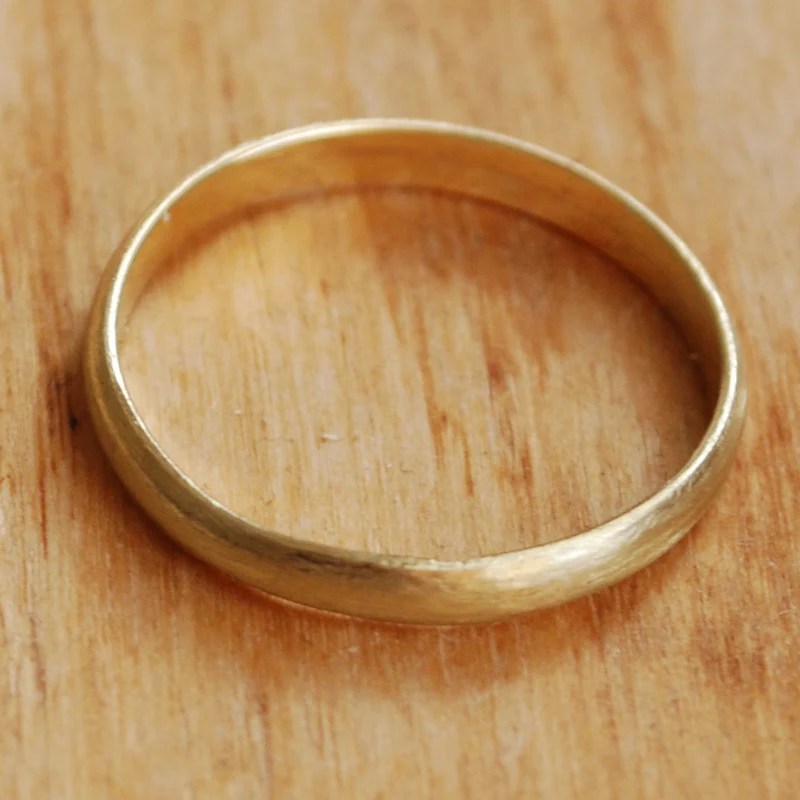
and its effects and that made me think of this—

“The Perils of Invisibility

Old PETER led a wretched life –
Old PETER had a furious wife;
Old PETER too was truly stout,
He measured several yards about.

The little fairy PICKLEKIN
One summer afternoon looked in,
And said, ‘Old PETER, how de do?
Can I do anything for you?

I have three gifts – the first will give
Unbounded riches while you live;
The second health where’er you be;
The third, invisibility.’

‘O little fairy PICKLEKIN,’
Old PETER answered with a grin,
‘To hesitate would be absurd, –
Undoubtedly I choose the third.’ “

(This is the beginning of one of the “Bab Ballads” of W.S. Gilbert (1836-1911), whom you may know from his work with Arthur Sullivan (1842-1900), eternally making half of a partnership often referred to as “G&S”.)

Bilbo, before his terrible contest with Gollum,
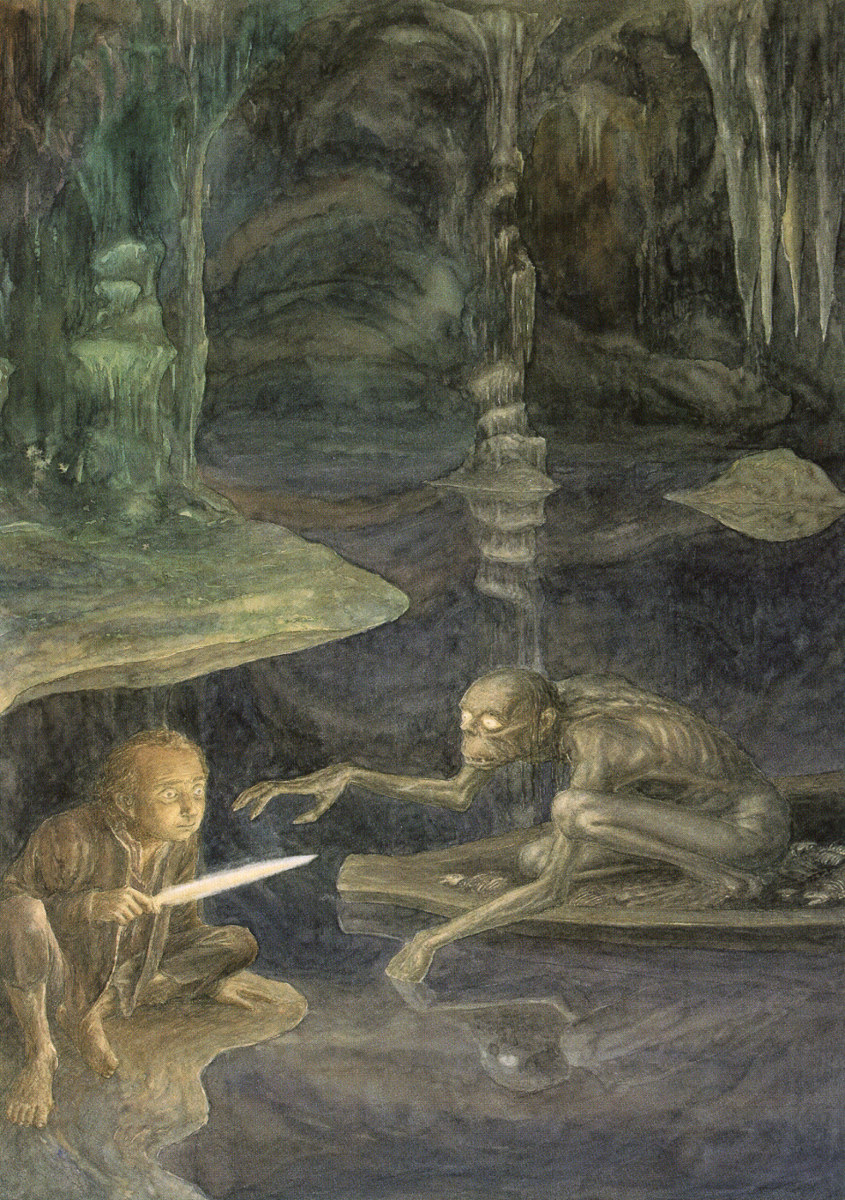
(Alan Lee)

had literally stumbled on the Ring in a goblin tunnel and it was entirely by accident that he discovered one of its properties as Gollum pursued him and he tripped and fell—

“In a moment Gollum was on him.  But before Bilbo could do anything, recover his breath, pick himself up or wave his sword, Gollum passed by, taking no notice of him, cursing and whispering as he ran.”

Bilbo is puzzled, but, inadvertently, Gollum later explains as Bilbo follows him—

“…Goblinses!  Yes, but if it’s got the present, our precious present, then goblinses will get it, gollum!  They’ll find it, they’ll find out what it does.  We shan’t ever be safe again, never, gollum!  One of the goblinses will put it on, and then no one will ever see him.  He’ll be there but not seen….”

We readers have been told earlier by the narrator about this—

“[Gollum] wanted it because it was a ring of power, and if you slipped that ring on your finger, you were invisible; only in the full sunlight could you be seen, and then only by your shadow, and that would be shaky and faint.”  (The Hobbit, Chapter 5, “Riddles in the Dark”)

This is the only power of the Ring about which we’re told in The Hobbit because, at the time he had written it, Tolkien himself knew no more—but, as we saw in the last posting, he clearly learned more in time and he could later add that the Ring seemed to have the ability to stop time for its wearer, so that wearer didn’t age—

“The chief power…was the prevention of slowing of decay (i.e. ‘change’ viewed as a regrettable thing), the preservation of what is desired or loved, or its semblance—”

And there’s more—

“…other powers, more directly derived from Sauron…making things of the invisible world visible.” (letter to Milton Waldman, “probably written late in 1951”, Letters, 212)

Old Peter in Gilbert’s poem, can disappear at will—but his clothes are left behind
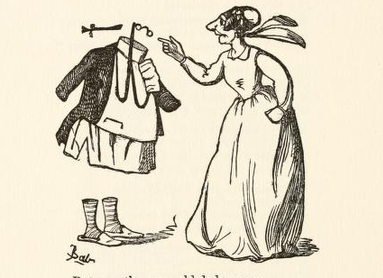
and Old Peter’s wife sabotages his invisibility by stealing his trousers so that, in his Victorian world, he can’t reappear, as, trouserless, he will offend public decency, forcing him, at least temporarily, to remain unseen.

(You can find out about the consequences of Old Peter’s choice here:  https://allpoetry.com/The-Perils-of-Invisibility )

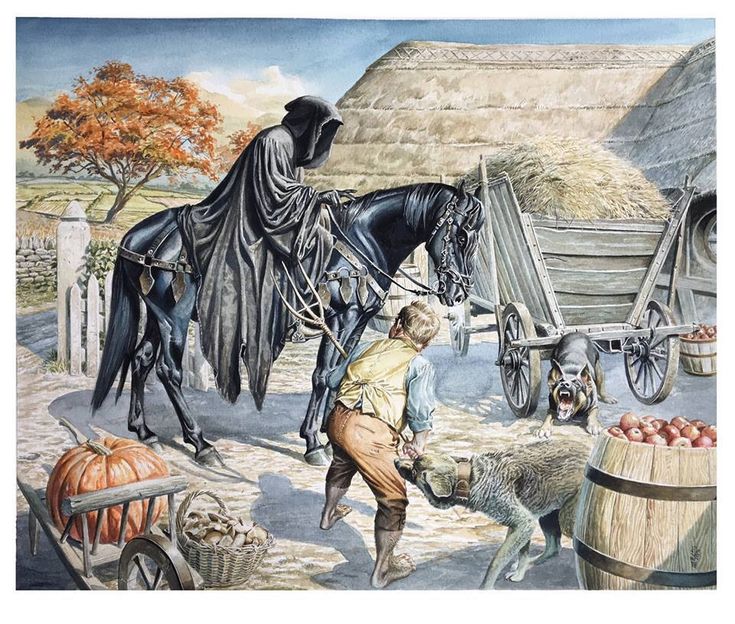
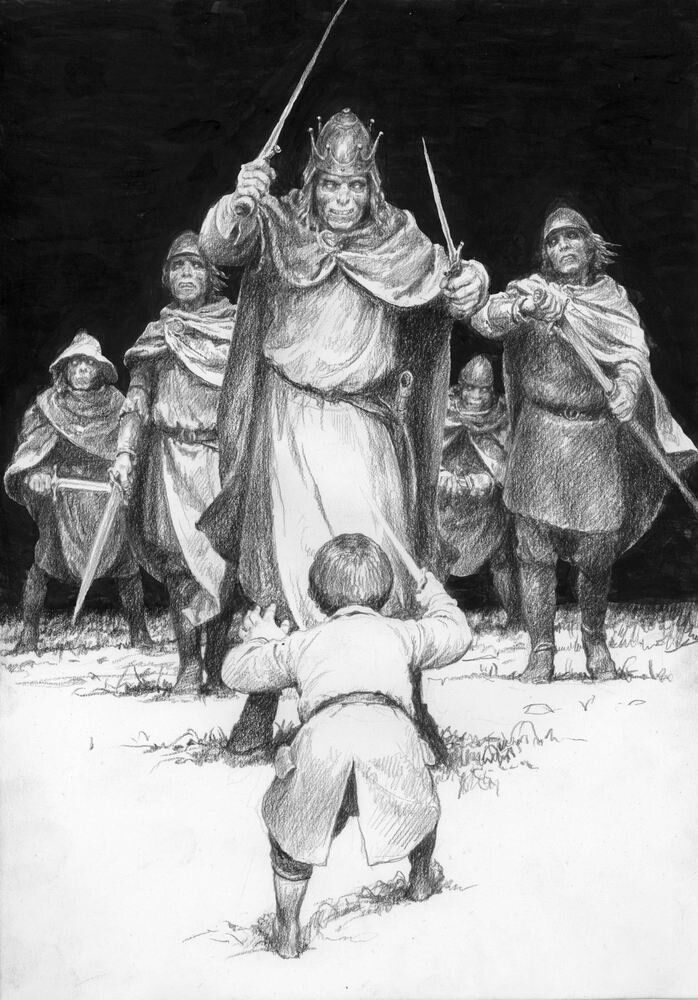
And this, in turn, made me think of the Nazgul, who, although still alive through the power of their rings, need cloaks and other items of dress—including armor–to be visible
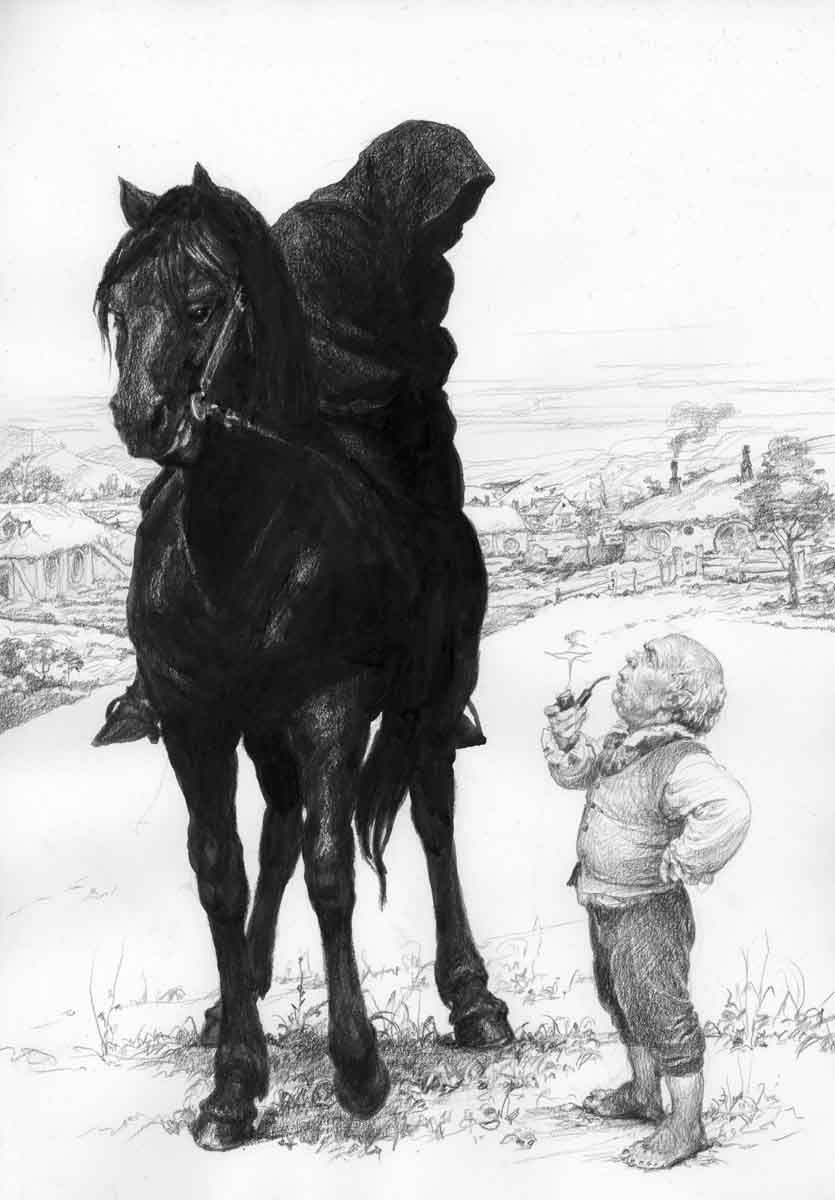
(Denis Gordeev)

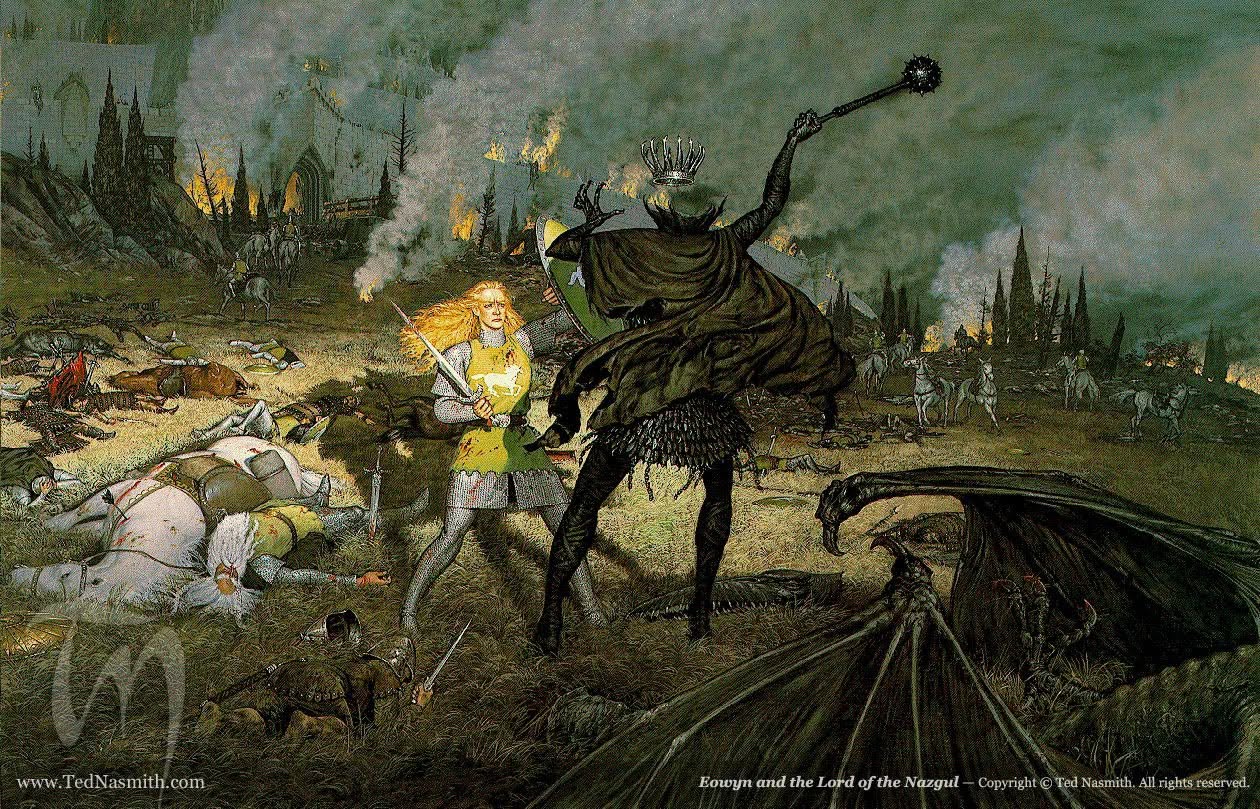
and, even with, still remain only half-seen, like the chief of them, facing Theoden and then Eowyn—

“Upon [the beast which he rode]…sat a shape, black-mantled, huge and threatening.  A crown of steel he bore, but between rim and robe naught was there to see, save only a deadly gleam of eyes…” (The Return of the King, Book Five, Chapter 6, “The Battle of the Pelennor Fields”)
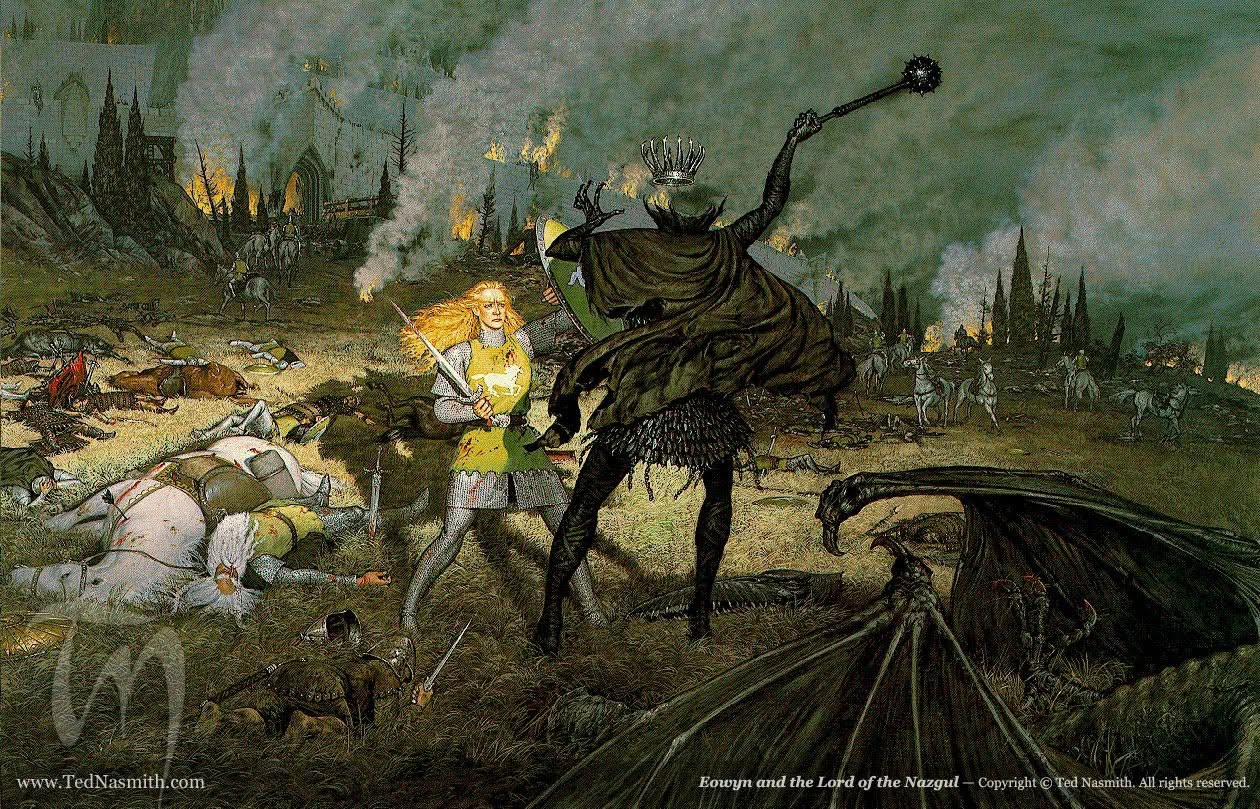
(Ted Nasmith)

Frodo, however, putting on the Ring, sees the Nazgul quite vividly on Weathertop—

“Immediately, though everything else remained as before, dim and dark, the shapes became terribly clear.  He was able to see beneath their black wrappings.  There were five tall figures:  two standing on the lip of the dell, three advancing.  In their white faces burned keen and merciless eyes; under their mantles were long grey robes; upon their grey hairs were helms of silver; in their haggard hands were swords of steel…” 
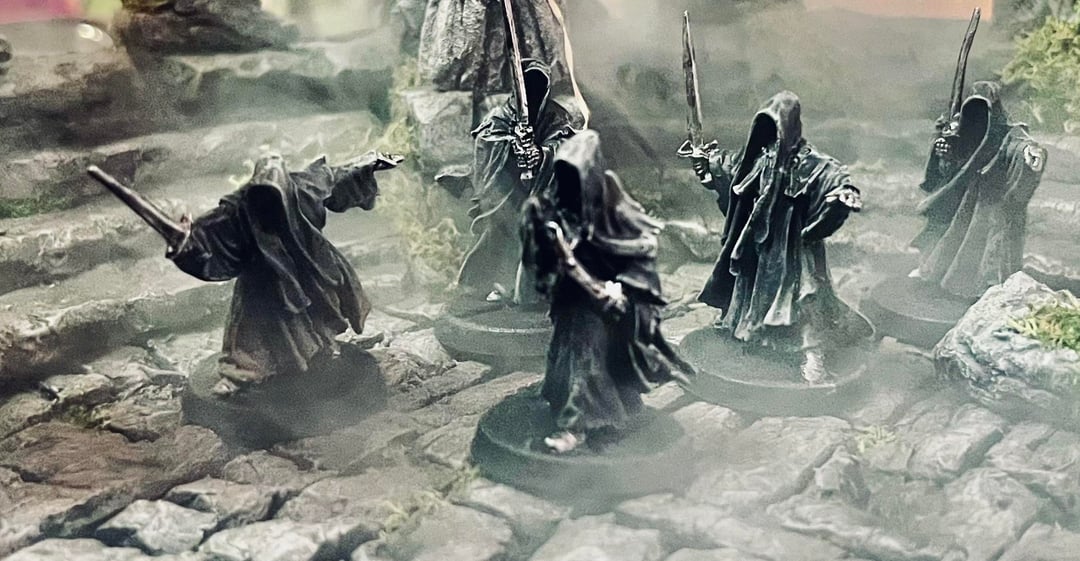
(Middle-earth Miniatures)

And, by putting on the Ring, Frodo has become more than visible to the Nazgul, as Strider has earlier explained:

“ ‘They themselves do not see the world of light as we do, but our shapes cast shadows in their minds, which only the noon sun destroys; and in the dark they perceive many signs and forms that are hidden from us; then they are most to be feared.  And at all times they smell the blood of living things, desiring and hating it…Also…the Ring draws them.’ “  (The Fellowship of the Ring, Book One, Chapter 11, “A Knife in the Dark”)

Their ability to pierce the dark almost ends the life of Frodo, but it also reveals something else about the Ring.  We know that Sauron, possessing it, can eavesdrop on wearers of lesser rings—

“But secretly in the subterranean Fire, in his own Black Land, Sauron made One Ring, the Ruling Ring that contained the powers of all the others, and controlled them, so that its wearer could see the thoughts of all those that used the lesser rings, could govern all that they did, and in the end could utterly enslave them.”  (letter to Milton Waldman, “probably written late in 1951”, Letters, 212-213)

At the same time, even without the Ring, Sauron has a bond with it which allows him to be aware of someone else wearing it—the Ring draws him–as Frodo learns, almost to his destruction, on Amon Hen.
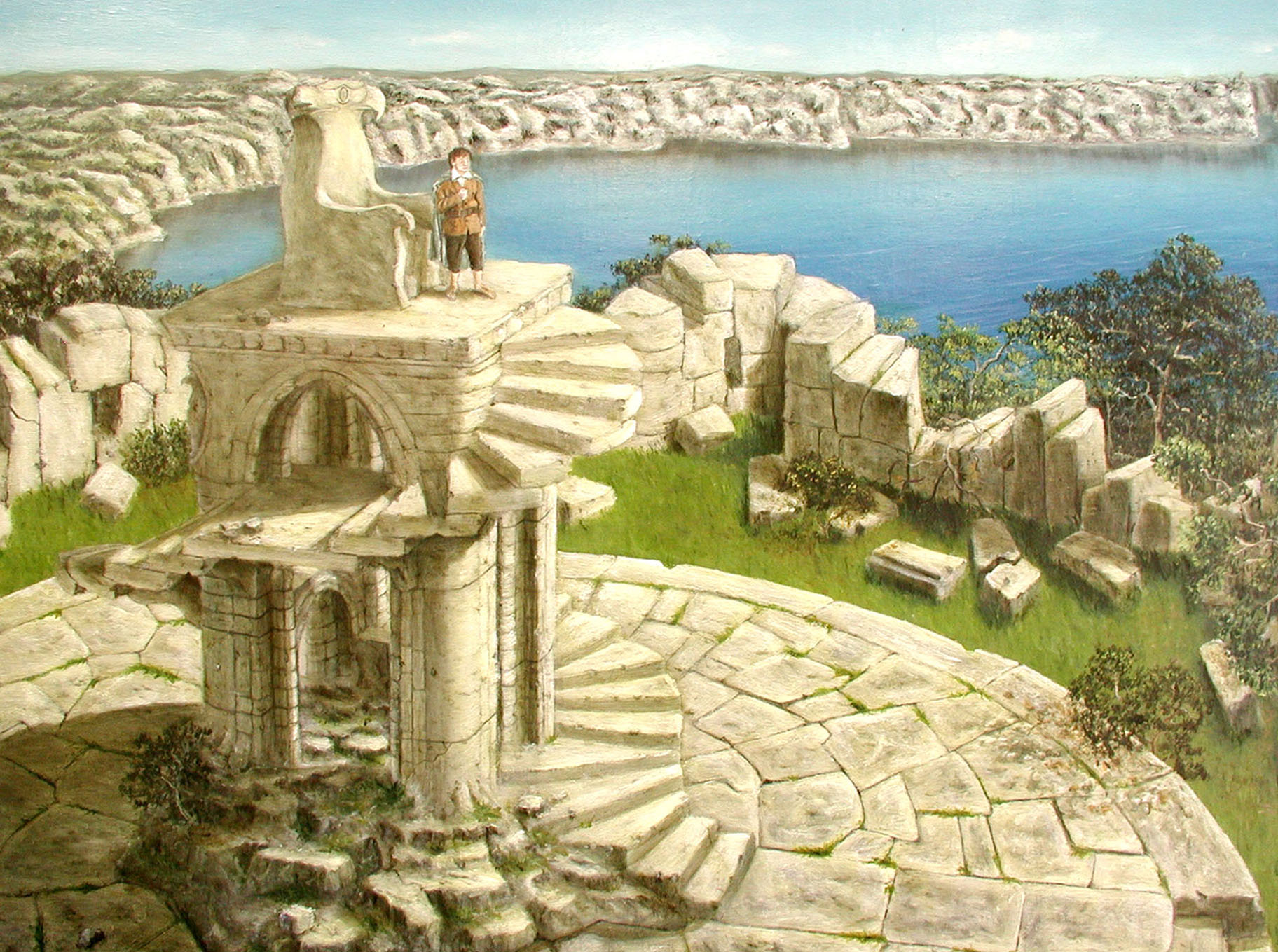
(Scott Peery)

Escaping from the importunate Boromir, he has climbed the ruined site and, putting on the Ring, he begins to see the world as Sauron might, but then—

“And suddenly he felt the Eye.  There was an eye in the Dark Tower that did not sleep.  He knew that it had become aware of his gaze.  A fierce eager will was there.  It leaped towards him; almost like a finger he felt it, searching for him.  Very soon it would nail him down, know just exactly where he was.”  (The Fellowship of the Ring, Book Two, Chapter 10, “The Breaking of the Fellowship”)

Frodo escapes by taking off the Ring, but, in what happens both on Weathertop and on Amon Hen illustrates another peril of invisibility:  although, wearing the Ring, one may be invisible to ordinary people, to its Master and his minions, he is all-to-visible and all-too-vulnerable, as well.

Thanks, as always, for reading.

Stay well,

When it comes to such Rings, better to be like Faramir:  “I would not take this thing, if it lay by the highway”,

And remember that, as always, there’s

MTCIDC

O

PS

Another person with visibility issues is the title character of H.G. Wells The Invisible Man, which you might enjoy here:  https://archive.org/details/invisibleman0000hgwe_u0b9/page/n5/mode/2up
Capital R, Ring

11 Wednesday Nov 2026

Posted by Ollamh in Uncategorized

≈ Leave a comment

Tags

Andrew Lang, Bilbo, fairy tales, fairy-tales, Fantasy, George Dasent, Gollum, lotr, Saruman, Sauron, The Lord of the Rings, The Ring, Tolkien

Welcome, as ever, dear readers.

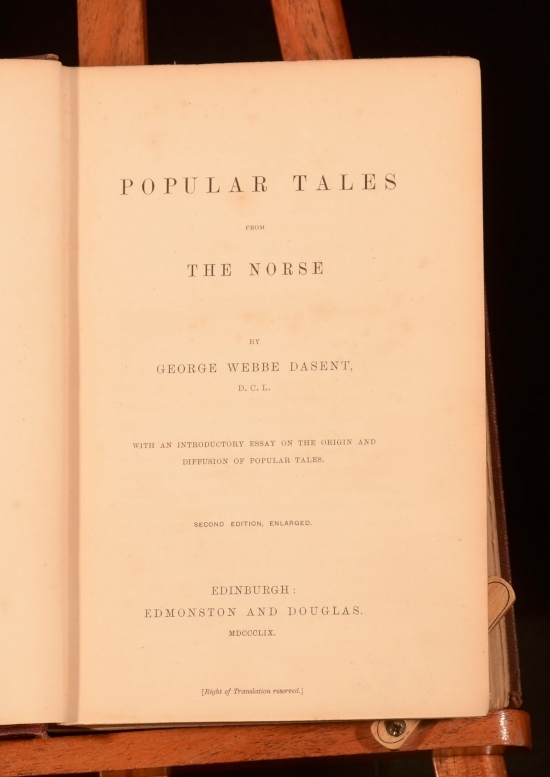
Having grown up reading or being read to from fairy tale books like that by George Dasent (Popular Tales from the Norse, 1859—and here’s a copy for you:    https://archive.org/details/populartalesfr00asbj/page/n3/mode/2up     )
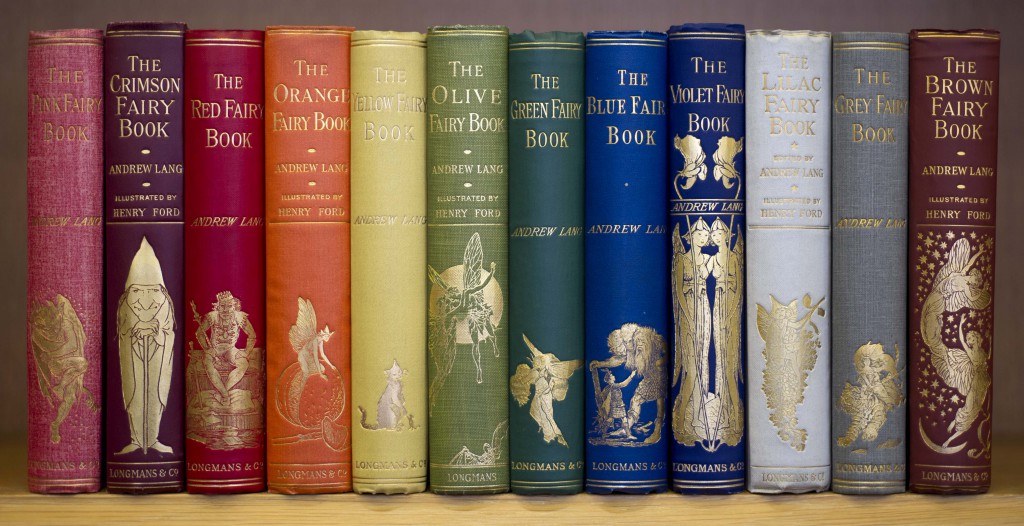
and Andrew Lang’s Fairy Books,

(You can start with the first here:  https://dn760108.eu.archive.org/0/items/bluefairybook00langiala/bluefairybook00langiala.pdf )

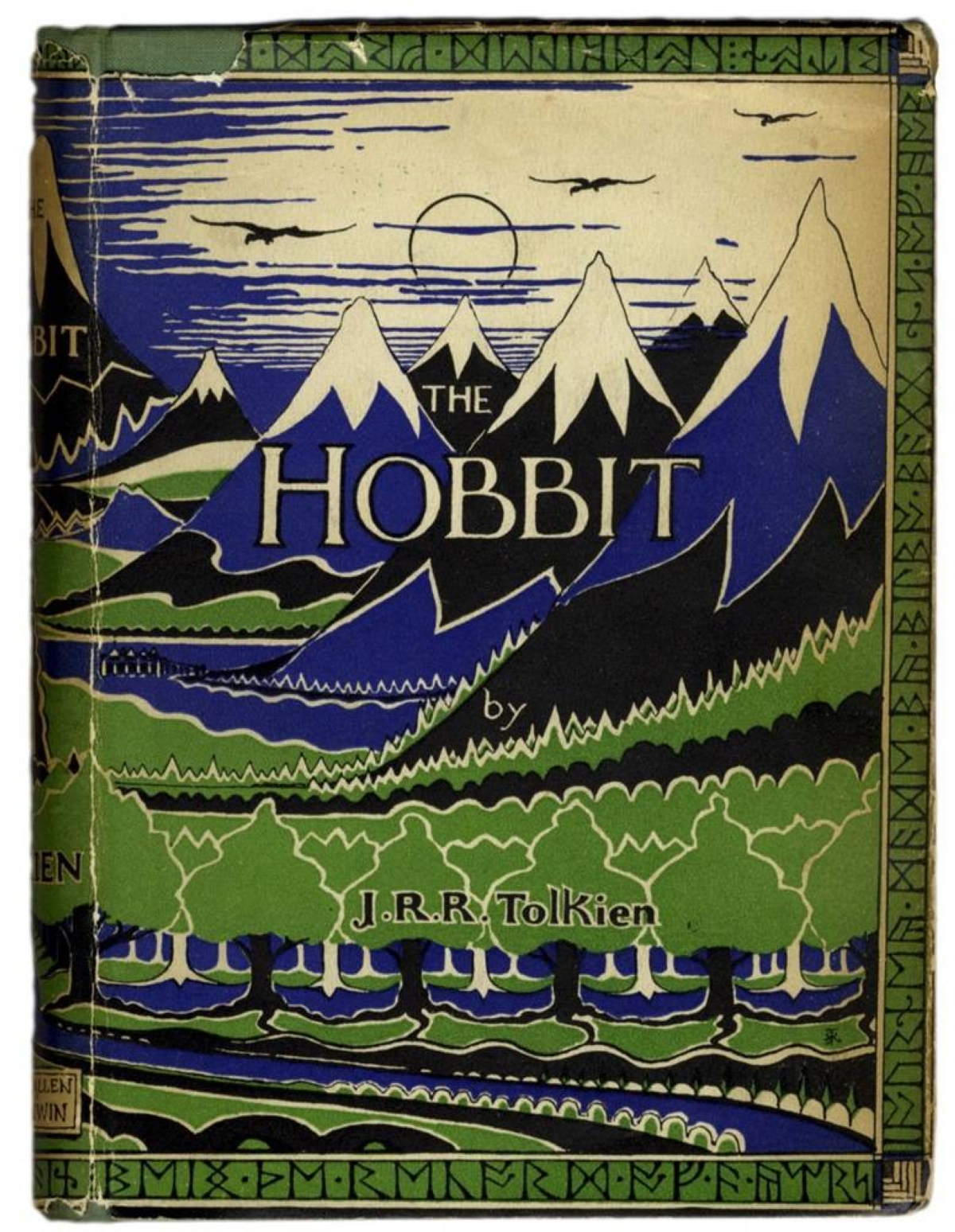
it’s not surprising that Tolkien’s first adventure book, The Hobbit,

should, in many ways, resemble such books.

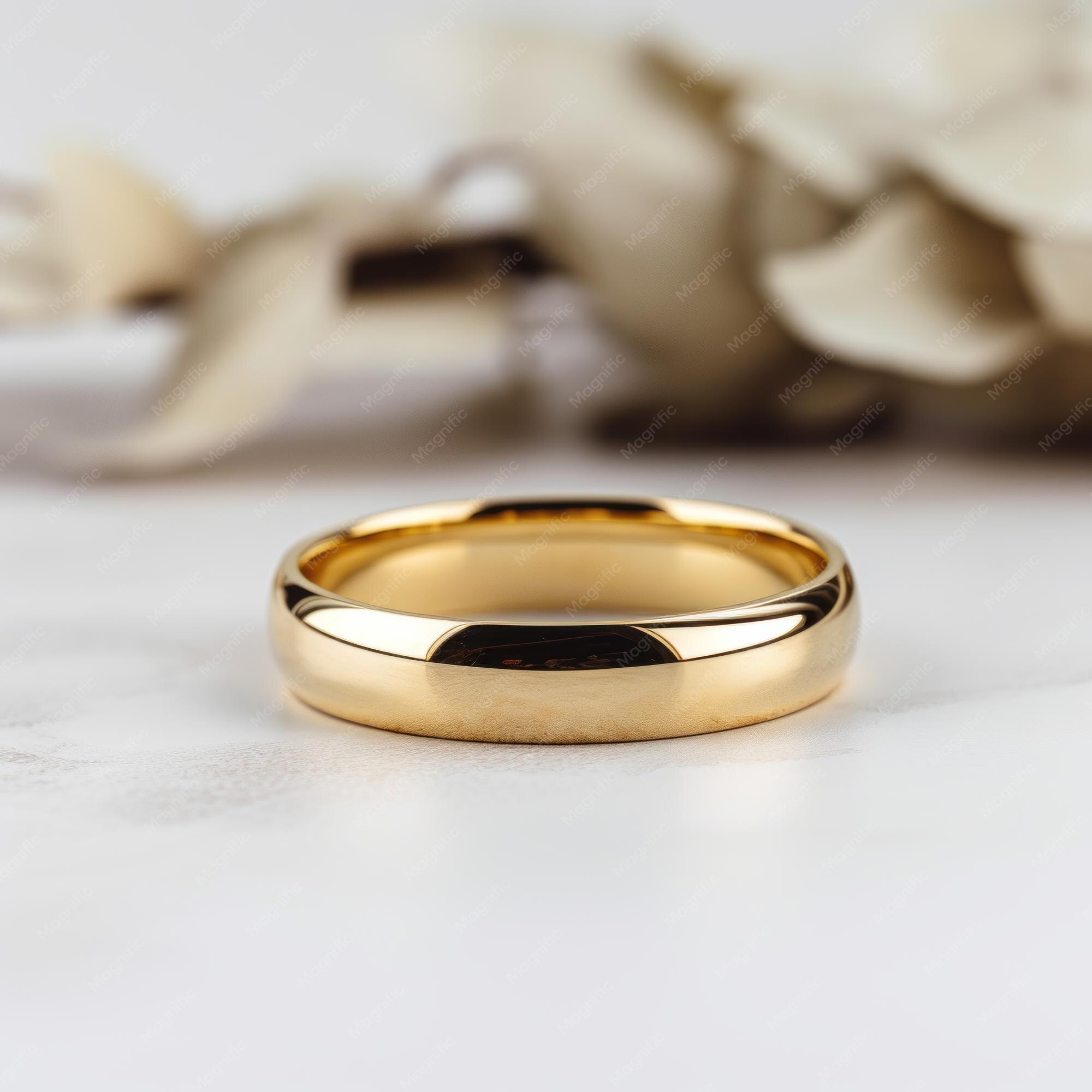
One of the features of fairy tales is the use of magic, including magic objects, like rings,

(You can read more about such rings here:  https://en.wikipedia.org/wiki/Magic_ring )

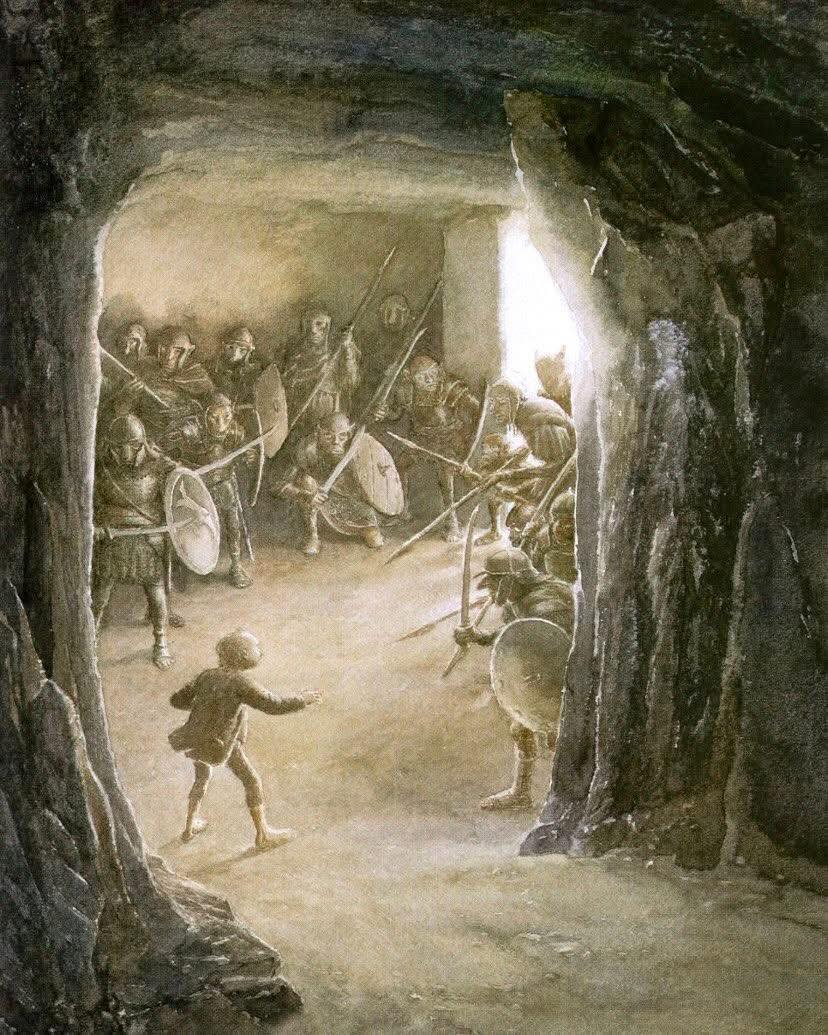
and, of course, such a ring appears in The Hobbit, the magic being that it allows a person wearing it to become invisible, which then allows the hero, Bilbo, to escape from goblins,

(Alan Lee)

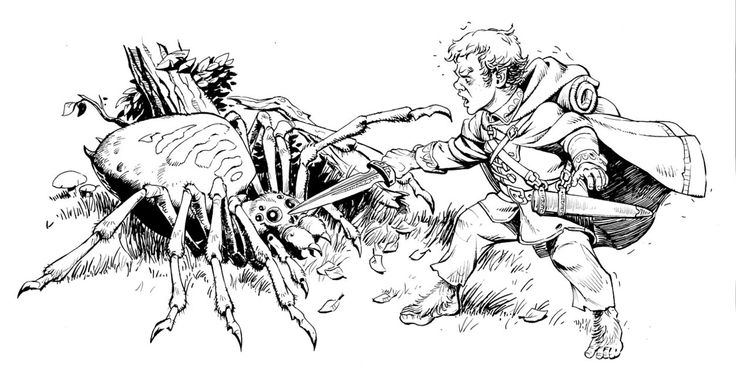
fight giant spiders,

(Oleksiy Lipatov—you can see more of his work here:  https://www.artstation.com/oleksiylipatov8 )

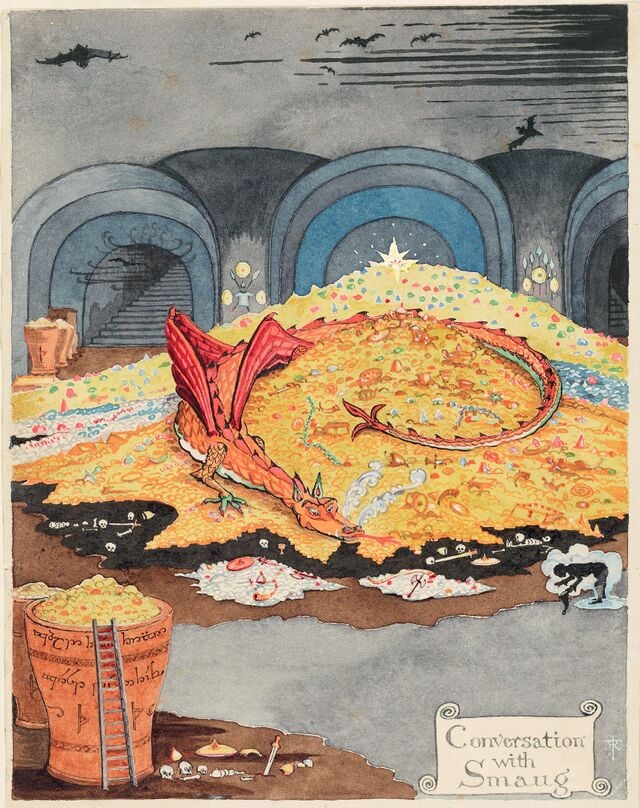
and even chat with a fearsome dragon.

(JRRT)

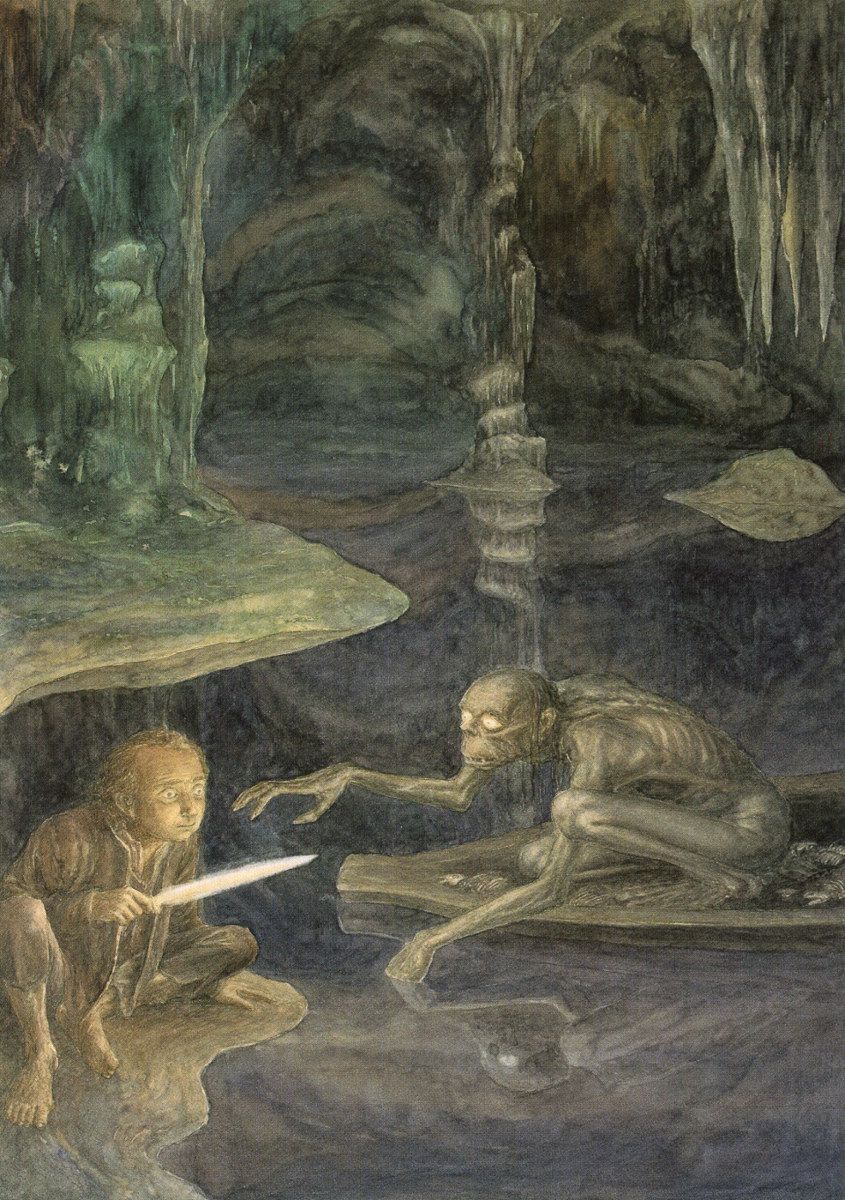
Where it came from and what other powers it might have are not explained, only that Bilbo picked it up on the floor of a goblin tunnel and that it was clearly the property—the “precious” –of the creepy Gollum, from whom Bilbo escaped after a riddling contest, using that same ring.

(Alan Lee)

But then the book was so successful that the publisher asked for a sequel and, as Tolkien wrote to W. H. Auden:

“But if you wanted to go on from the end of The Hobbit I think that the ring would be your inevitable choice as the link.  If then you wanted a large tale, the Ring would at once acquire a capital letter; and the Dark Lord would immediately appear.”  (letter to W.H.Auden, 7 June, 1955, Letters, 315)

Thinking about the Ring recently, I wondered about both its original purpose, and the effect that it had upon other wearers or potential wearers.   In an earlier letter, Tolkien had explained that original purpose:

“The Elves of Eregion made Three supremely beautiful and powerful rings…But secretly in the subterranean Fire, in his own Black Land, Sauron made One Ring, the Ruling Ring that contained the powers of all the others, and controlled them, so that its wearer could see the thoughts of all those that used the lesser rings, could govern all that they did, and in the end could utterly enslave them.”  (letter to Milton Waldman, late 1951, Letters 212-213)

Along with that controlling force, the Ring—and, as JRRT writes, the other rings– had another potential:

“The chief power (of all the rings alike) was the prevention or slowing of decay (i.e. ‘change’ viewed as a regrettable thing), the preservation of what is desired or loved, or its resemblance—this is more or less an Elvish motive.”

And there is something more:

“But also they enhanced the natural powers of a possessor—thus approaching ‘magic’, a motive easily corruptible into evil, a lust for domination.  And finally they had other powers, more directly derived from Sauron…such as rendering invisible the material body, and making things of the invisible world visible.”   (letter to Milton Waldman, “probably late 1951”, Letters 212-213)

That invisibility appeared in The Hobbit, but that “prevention or slowing of decay” was something new and we see that first in Gollum, who had taken the Ring from its finder, his cousin, Deagol.

Isildur had lost the Ring in the Anduin—or, rather, the Ring had abandoned him–in SA 3436.  Deagol had brought it to the surface in TA2463, Bilbo had found it in TA 2940, and Gollum is still alive at the time of The Lord of the Rings, in TA3018, making him over 550 years old. 

This slowing of age is then a give-away to Gandalf about Bilbo and his Ring, as Bilbo, among long-lived Hobbits, seems even longer-lived (eventually going off to the Grey Havens at 131).  As Gandalf said of Gollum:

“ ‘And I learned also that he had possessed it long.  Many lives of his small kind.  The power of the ring had lengthened his years far beyond their span; but that power only the Great Rings wield.’ “  (The Fellowship of the Ring, Book Two, Chapter 2, “The Council of Elrond”)

But here we see another effect of possessing the Ring:  it may lengthen life, but Bilbo says of himself:

“ ‘I am old, Gandalf.  I don’t look it, but I am beginning to feel it in my heart of hearts.  Well-preserved indeed!…Why, I feel all thin, sort of stretched, if you know what I mean:  like butter that has been scraped over too much bread.  That can’t be right…”  (The Fellowship of the Ring, Book One, Chapter 1, “A Long-Expected Party”)

We can wonder, then, if Bilbo had possessed the Ring for about 60 years and felt odd, what must Gollum have felt like at 550+?  Gandalf gives us something of that:

“ ‘He is thin and tough still.  But the thing was eating up his mind, of course, and the torment had become almost unbearable.’ “  (The Fellowship of the Ring, Book One, Chapter 2, “The Shadow of the Past”)

What is this torment?  I would guess that it’s a combination of things:  first, that the Ring, as we know from Gandalf, always wants to return to its maker/master, even to falling off a wearer’s finger:

“ ‘The Ring was trying to get back to its master.  It had slipped off Isildur’s hand and betrayed him; then when a chance came it caught poor Deagol, and he was murdered; and after that Gollum, and it had devoured him.  It could make no further use of him:  he was too small and mean; and as long as it stayed with him he would never leave his deep pool again.  So now, when its master was awake once more and sending out his dark thought from Mirkwood, it abandoned Gollum.”  (The Fellowship of the Ring, Book One, Chapter 2, “The Shadow of the Past”)

Thus, the Ring could combine a pressure to release it with its terrible attraction and fear of losing it, which could drive even decent people to shocking behavior, as it had many years ago with Smeagol, and as Frodo feels, when, in Rivendell, Bilbo asks to see it:

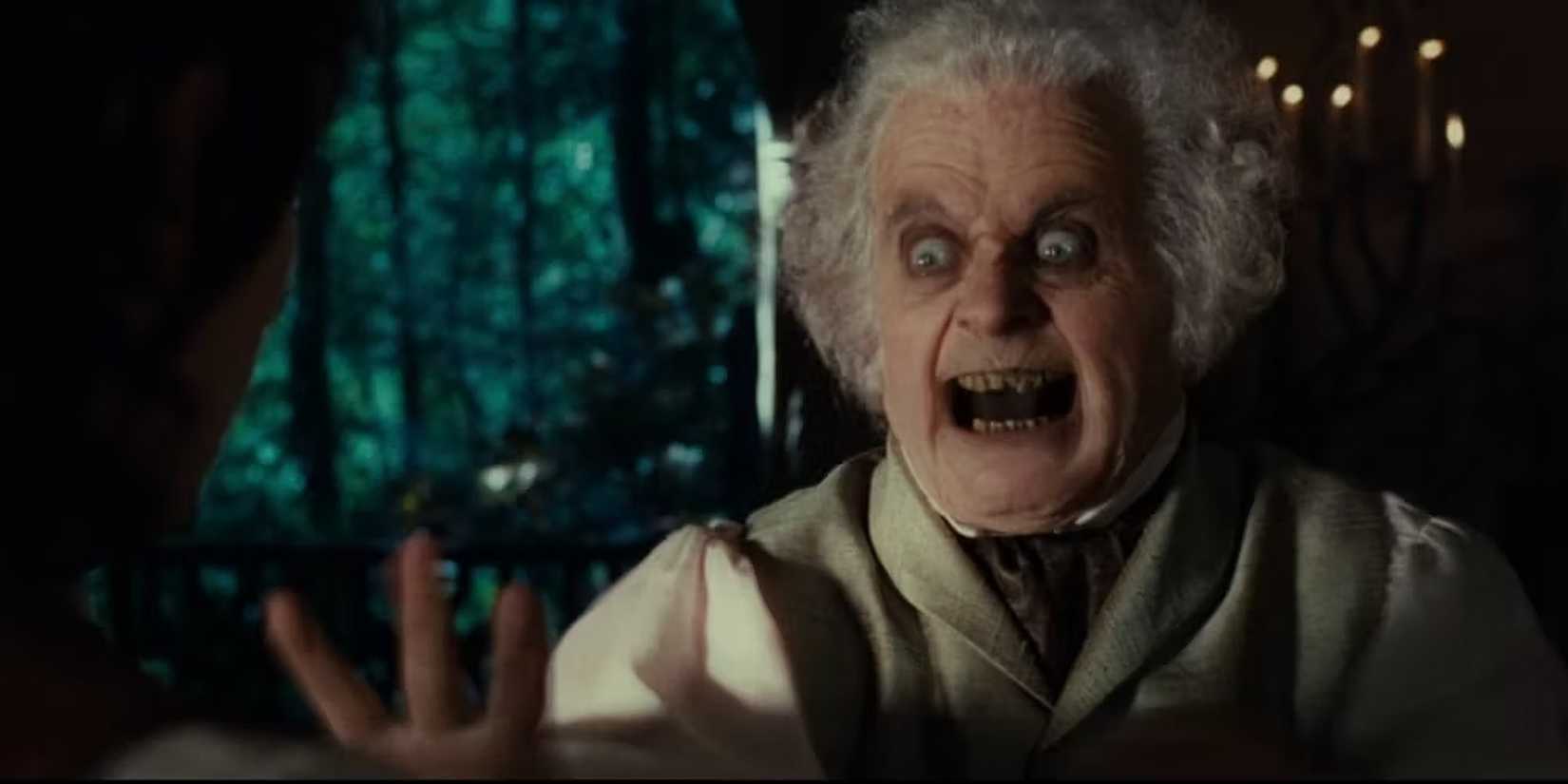
“Slowly he drew it out.  Bilbo put out his hand.  But Frodo quickly drew back the Ring.  To his distress and amazement he found that he was no longer looking at Bilbo; a shadow seemed to have fallen between them, and through it he found himself eyeing a little wrinkled creature with a hungry face and bony groping hands.  He felt a desire to strike him,”  (The Fellowship of the Ring, Book Two, Chapter 1, “Many Meetings”)

(from the Jackson film, although more fiendlike, I think, than Tolkien intended)

It may also be that, for someone unequipped to wear it, the power enclosed within the Ring would simply overwhelm that person, as Elrond says:

“ ‘We cannot use the Ruling Ring.  That we now know too well.  It belongs to Sauron and was made by him alone, and is altogether evil.  Its strength, Boromir, is too great for anyone to wield at will, save only those who have already a great power of their own.  But for them it holds an even deadlier peril.  The very desire of it corrupts the heart.  Consider Saruman.  If any of the Wise should with this Ring overthrow the Lord of Mordor, using his own arts, he would then set himself up on Sauron’s throne, and yet another Dark Lord would appear.’ “ (The Fellowship of the Ring, Book Two, Chapter 2, “The Council of Elrond”)

If even someone as powerful as Saruman would be overwhelmed by that power—and perhaps by that pressure to return it to its rightful owner, as well—then it’s not surprising that Gollum, and Bilbo, would be worn down under it, as he tells Gandalf:

“ ‘I am sorry…But I felt so queer.  And yet it would be a relief in a way not to be bothered with it any more.  It has been so growing on my mind lately.  Sometimes I have felt it was like an eye looking at me.  And I am always wanting to put it on and disappear, don’t you know; or wondering if it is safe, and pulling it out to make sure.  I tried locking it up, but I found that I couldn’t rest without it in my pocket…’ ”  (The Fellowship of the Ring, Book One, Chapter 1, “A Long-Expected Party”)

Such power delays decay, can make a holder invisible, and corrupts, as Elrond has said, but there’s another side to this as well:  such power can also weaken.  Sauron:

“rules a growing empire from the great dark tower of Barad-dur in Mordor, near to the Mountain of Fire, wielding the One Ring.

But to achieve this he had been obliged to let a great part of his own inherent power (a frequent and very significant motive in myth and fairy-story) pass into the One Ring.  While he wore it, his power on earth was actually enhanced.  But even if he did not wear it, that power existed and was in ‘rapport’ with himself:  he was not ‘diminished’.  Unless some other seized it and became possessed of it.  If that happened, the new possessor could (if sufficiently strong and heroic by nature) challenge Sauron, become master of all he had learned and done since the making of the One Ring, and so overthrow him and usurp his place.  This was the essential weakness he had introduced into his situation in his effort (largely unsuccessful) to enslave the Elves, and in his desire to establish a control over the minds and wills of his servants.  There was another weakness:  if the One Ring was actually unmade, annihilated, then its power would be dissolved, Sauron’s own being would be diminished to vanishing point, and he would be reduced to a shadow, a mere memory of malicious will.”  (Letter to Milton Waldman, “probably written late in 1951”, Letters, 214)

Even Sauron, in fact, deceived himself about the Ring:

“It was indissoluble in any fire, save the undying subterranean fire where it was made—and that was unapproachable, in Mordor.  Also so great was the Ring’s power of lust, that anyone who used it became mastered by it; it was beyond the strength of any will (even his own) to injure it, cast it away, or neglect it.  So he thought.  It was in any case on his finger.”  (Letter to Milton Waldman, “probably written late in 1951”, Letters, 214)

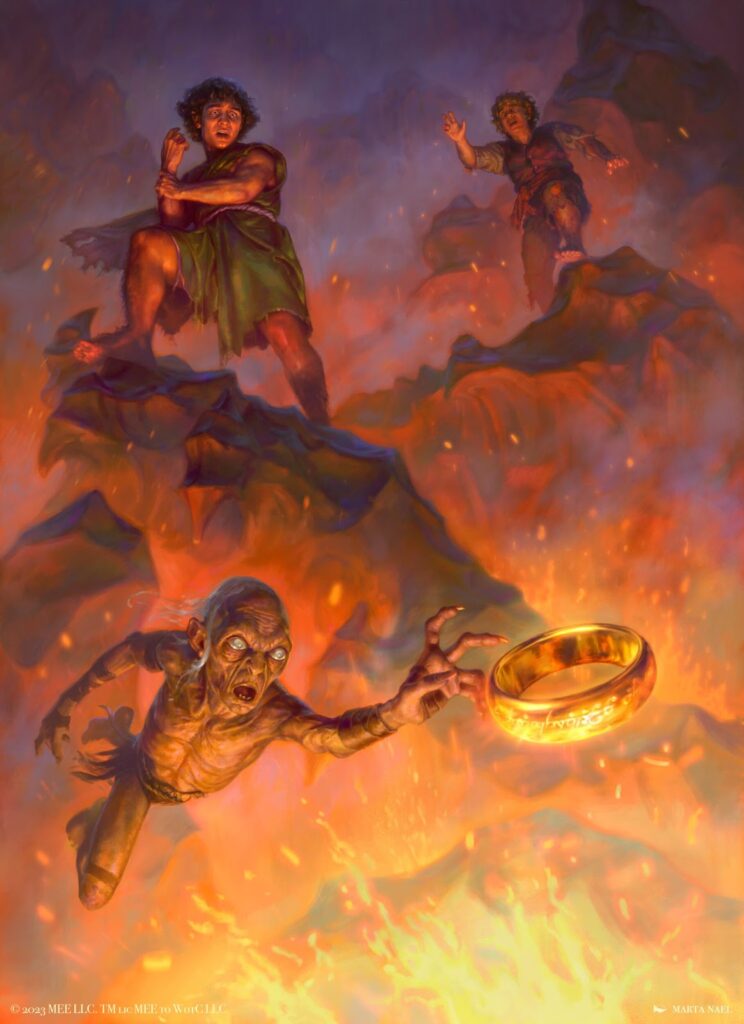
And then it wasn’t on his finger, passing through a number of hands until, on the last, it—and its wearer—were “unmade”—

(Marta Nael—visit her spectacular gallery here:  https://martanael.com/projects )

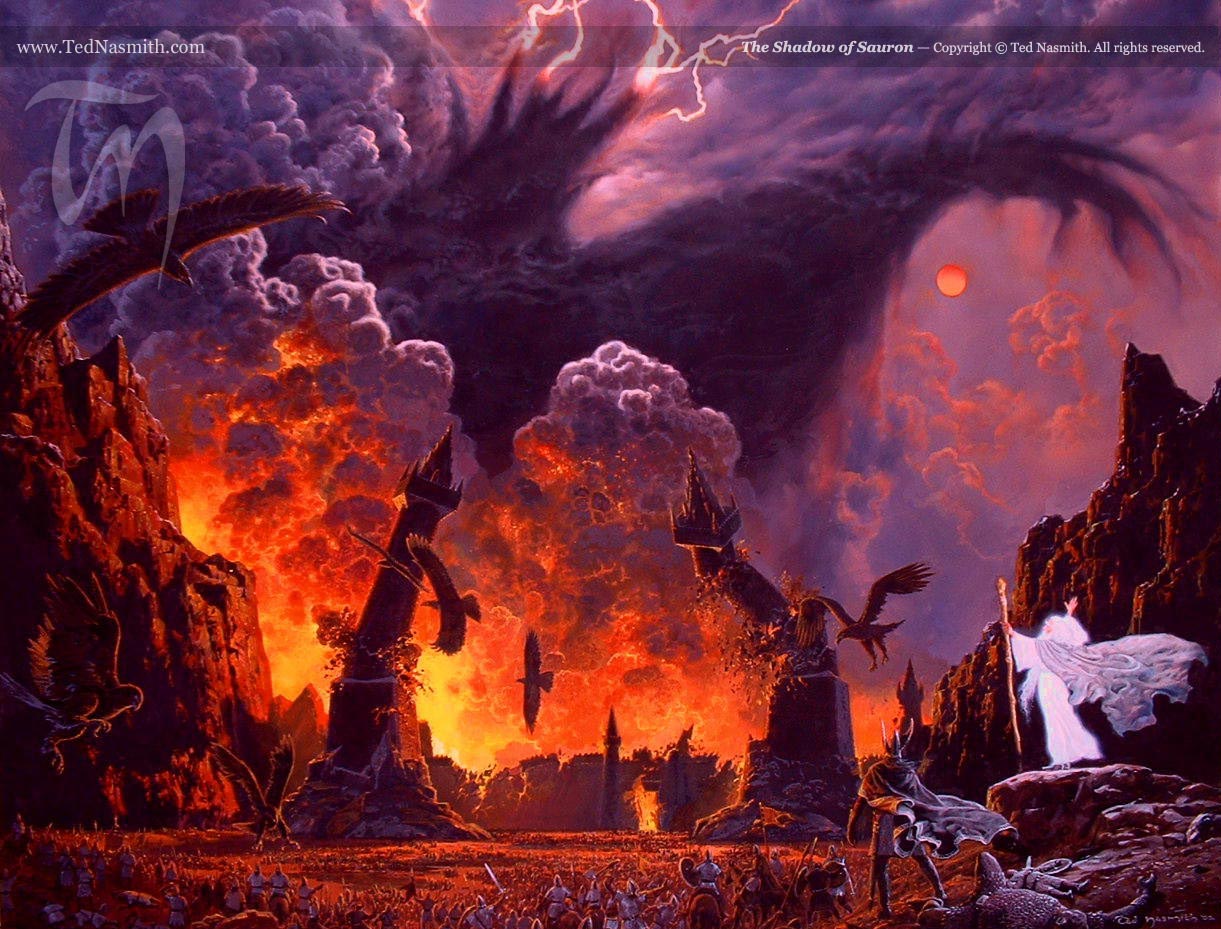
and, with it, so was Sauron.

(Ted Nasmith)

Thanks, as always, for reading.

Stay well,

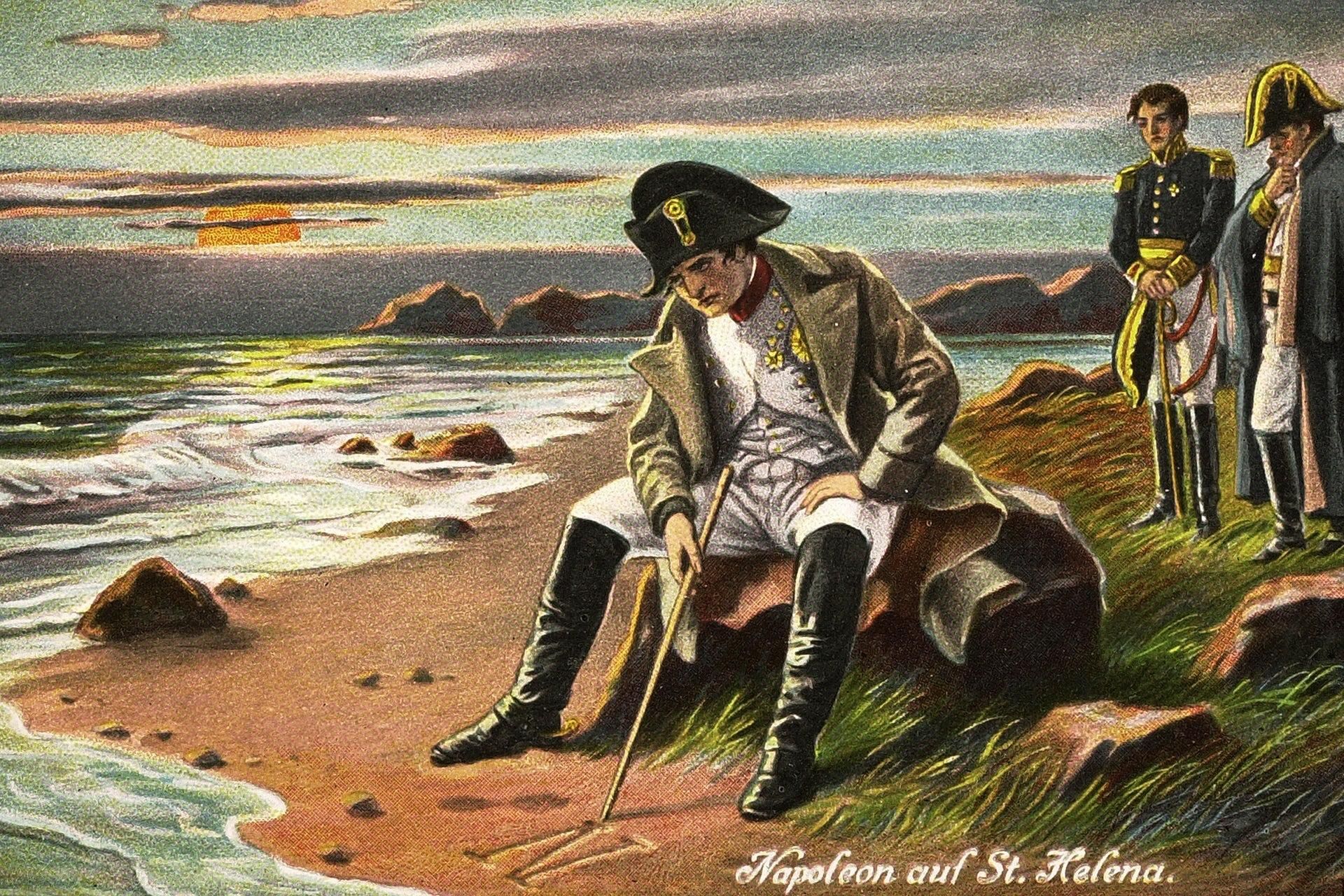
Avoid the temptation to try to dominate the world—even Napoleon ended up an aging exile on a tiny volcanic island—

And remember that, as always, there’s

MTCIDC

O

Cap-a-Pie (2)

04 Wednesday Nov 2026

Posted by Ollamh in Uncategorized

≈ Leave a comment

Tags

armor, easterners, Eowyn, Fantasy, Frodo, Haradrim, jacksons-lord-of-the-rings, lotr, Merry, Nazgul, Orcs, Sam, Sauron, Tolkien

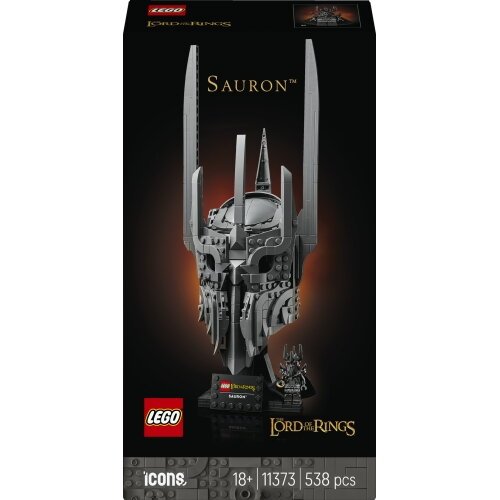
Part 1 of this posting came about after I had seen this in a toy catalogue—

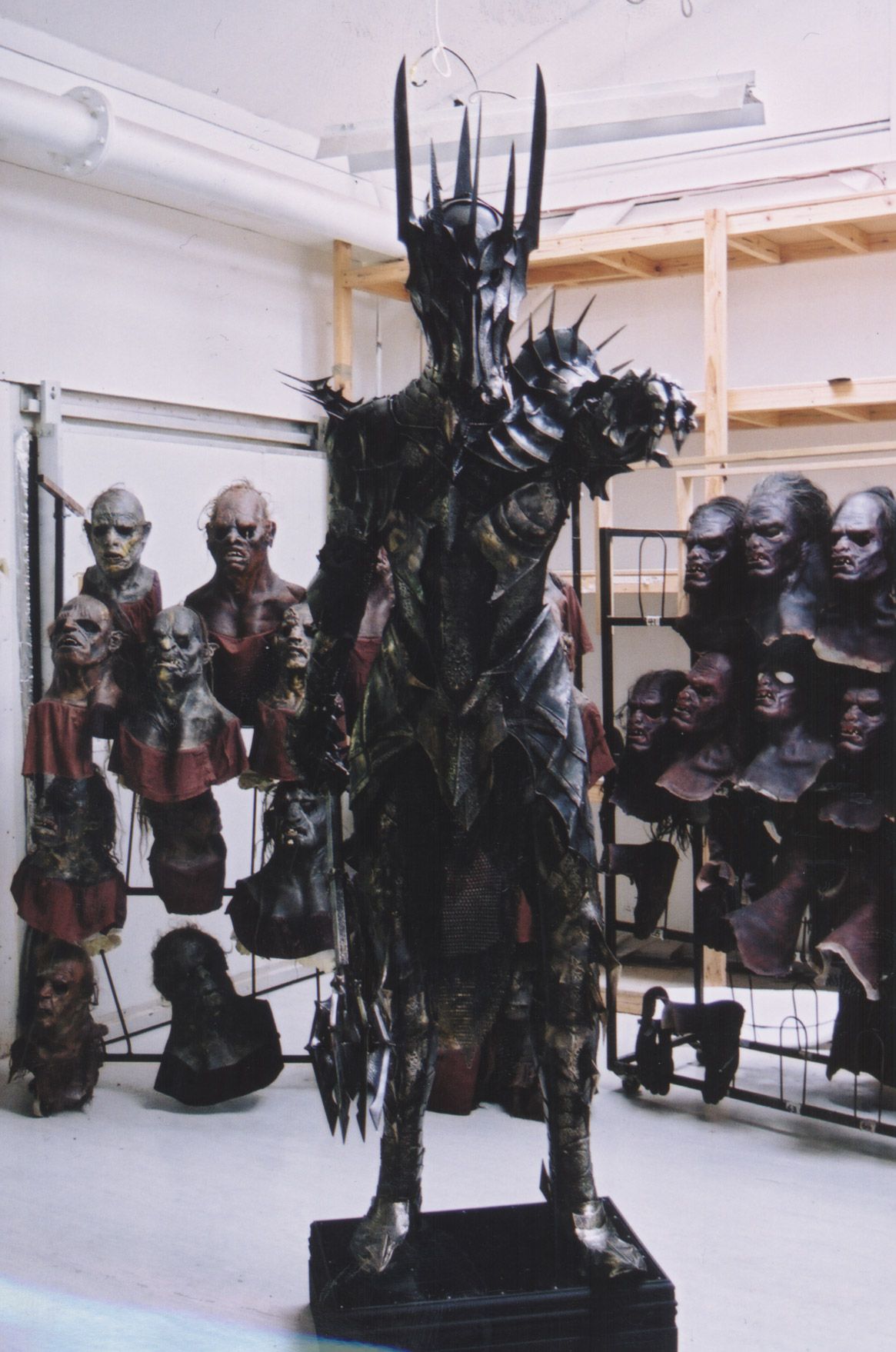
It’s clearly based on Jackson’s Sauron

as seen at the moment when Isildur cuts the Ring from Sauron’s hand, as Elrond tells the council:

“ ‘I beheld the last combat on the slopes of Orodruin, where Gil-galad died, and Elendil fell, and Narsil broke beneath him; but Sauron himself was overthrown, and Isildur cut the Ring from his hand with the hilt-shard of his father’s sword, and took it for his own.’ “  (The Fellowship of the Ring, Book Two, Chapter 2, “The Council of Elrond”)

There is no description of how Sauron was dressed or armed, so it was up to the film’s designers to create their own image of him and it’s clear that their idea was all about spikiness—perhaps also, by his helmet, suggesting kingly aspirations?—but it made me wonder what JRRT had in mind, if not for Sauron, for his minions–

no, not those—that is, for his various followers—as well as for his opponents, and, in the first part of this posting, I had a look at those opponents, using evidence from Tolkien’s letters and The Lord of the Rings as my basis.

Now, I want to see what those same sources might tell us about his view of Sauron—and Saruman’s—forces.

Beginning at the top, there are the Nazgul.  When we first see them and hear about them, they are cloaked—

(J.G. Jones—you can read about him here)

but, on Weathertop, Frodo puts on the Ring and sees

“…upon their grey hairs were helms of silver; in their haggard hands swords of steel…The third was taller than the others:  his hair was long and gleaming and on his helm was a crown…” (The Fellowship of the Ring, Book One, Chapter 11, “A Knife in the Dark”)

Because, wearing the Ring, Frodo can see

“In their white faces burned keen and merciless eyes…”

presumably, the Lord of the Nazgul—and perhaps the others—wore open-faced helmets, like this one—

(Denis Gordeev)

And we can learn a little more about this last, the Lord of the Nazgul, when Eowyn and Merry destroy him—

“A crown of steel he bore…Merry had stabbed him from behind, shearing through the black mantle, and passing up beneath the hauberk…”  (The Return of the King, Book Five, Chapter 6, “The Battle of the Pelennor Fields”)

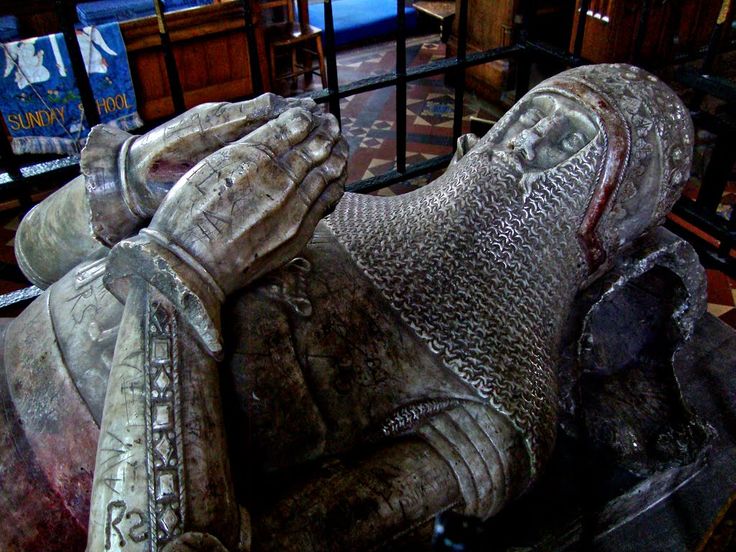
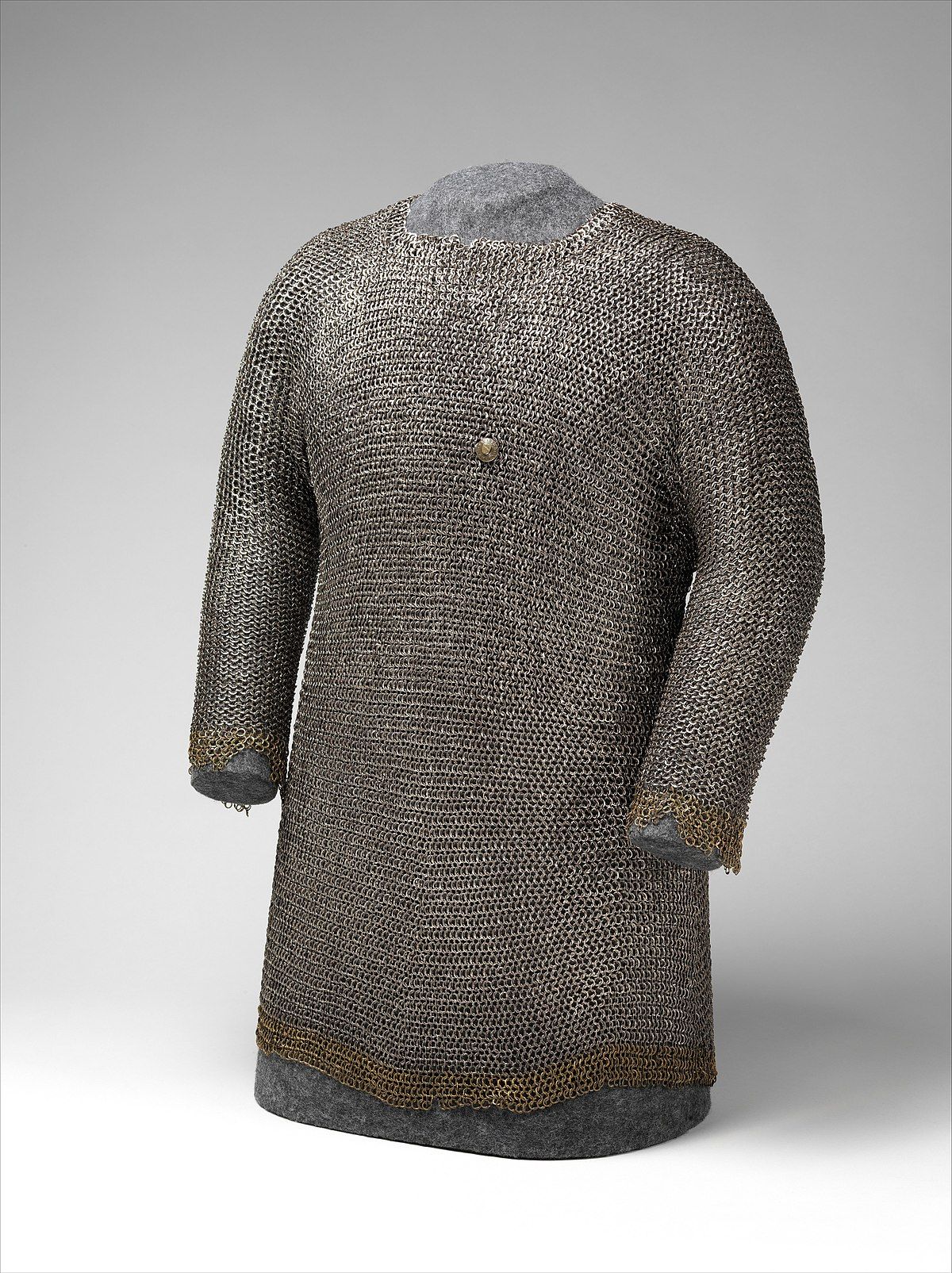
He doesn’t appear to be wearing his helmet here, but he is wearing a long chain mail garment, a hauberk

and perhaps we can assume that his fellow Nazgul wore the same?  He’s clearly not wearing armor on his legs, which is how Merry can attack the back of his knee

(Ted Nasmith)

and, with no helmet, Eowyn

“…drove her sword between crown and mantle, as the great shoulders bowed before her.”

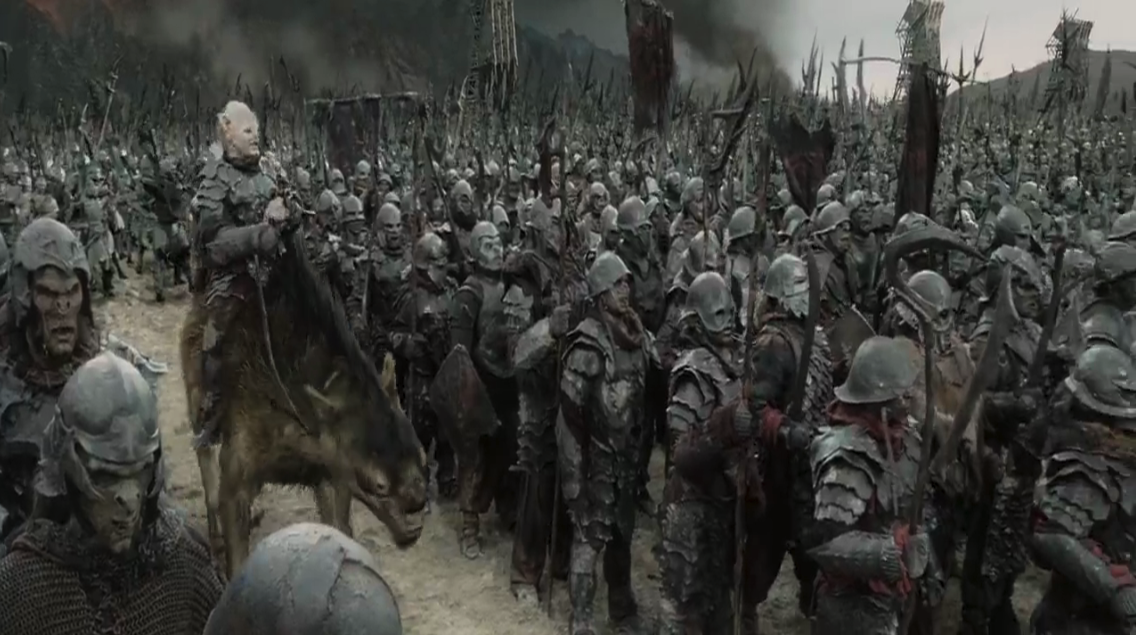
As for the Orcs, the film designers have them in what look like a combination of medieval and Renaissance and maybe Samurai odds and ends—

so, what does JRRT have to say about them?

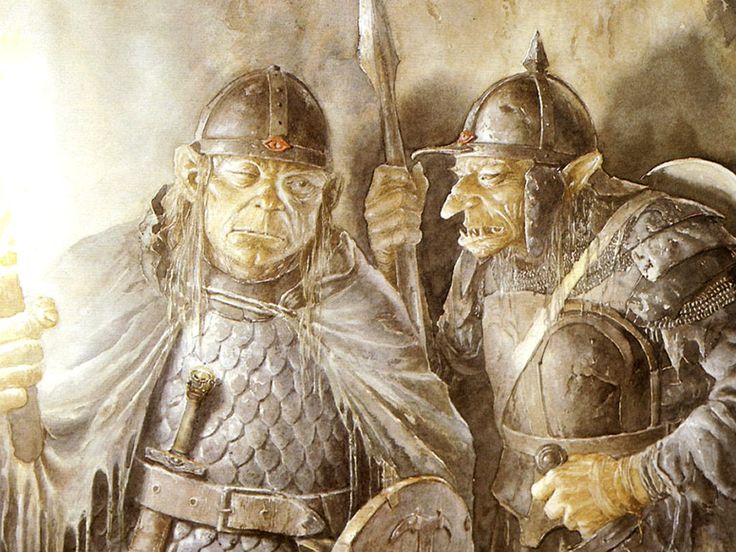
They carry swords and have some armor—as are described when Aragorn, Legolas, and Gimli are preparing to send Boromir off—

“Quickly they searched the bodies of the Orcs, gathering their swords and cloven helmets and shields into a heap.”

Aragorn, however, is quick to recognize that all of the Orcs are not the same—

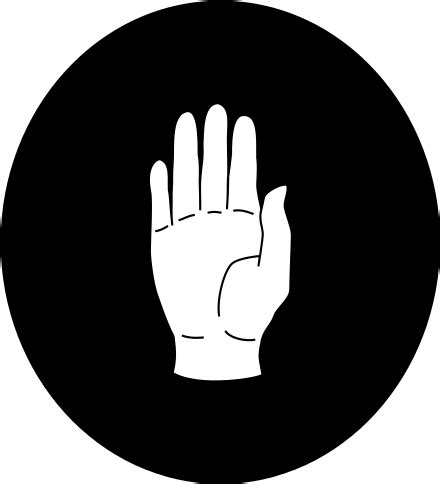
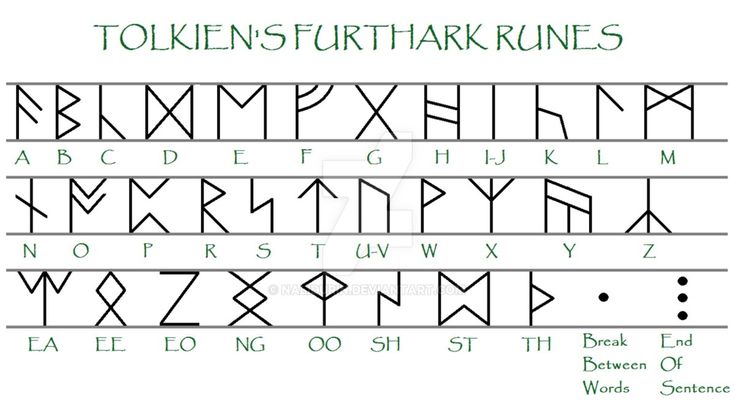
“There were four goblin-soldiers of greater stature, swart, slant-eyed, with thick legs and large hands.  They were armed with short broad-bladed swords, not with the curved scimitars usual with Orcs; and they had bows of yew, in length and shape like the bows of Men.  Upon their shields they bore a strange device:  a small white hand in the centre of a black field; and on the front of their iron helms was set an S-rune, wrought of some white metal.”  (The Two Towers, Book Three, Chapter 1, “The Departure of Boromir”)

As well, at least some wear mail—as we learn from the moment when Aragorn, Legolas, and Gimli come upon the pyre of Orcs slain by the Rohirrim—

“Beside it was a great pile of helms and mail, cloven shields , and broken swords, bows and darts and other gear of war.”  (The Two Towers, Book Three, Chapter 2, “The Riders of Rohan”)

We know from the text that these would have been the “gear of war” of both Sauron’s and Saruman’s Orcs, as the two troops were uneasily combined, but we can confirm the gear of Sauron’s orcs from a later description, when, in the Tower of Cirith Ungol, Sam and Frodo are dressing up as Orcs—

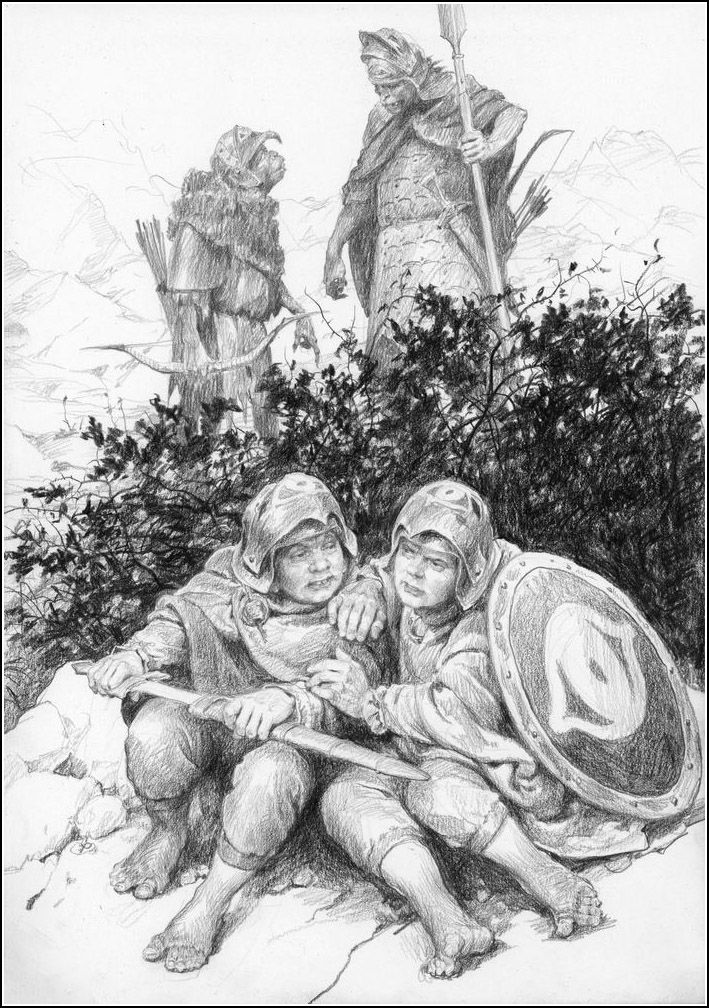
“There were long hairy breeches of some unclean beast-fell, and a tunic of dirty leather….Over the tunic went a coat of stout ring-mail, short for a full-sized orc, too long for Frodo and heavy.  About it he clasped a belt, at which there hung a short sheath holding a broad-bladed stabbing-sword.  Sam had brought several orc-helmets.  One of them fitted Frodo well enough, a black cap with iron rim, and iron hoops covered with leather upon which the Evil Eye was painted in red above the beaklike nose-guard.”  (The Return of the King, Book Six, Chapter 1, “The Tower of Cirith Ungol”)

(Alan Lee)

(Denis Gordeev)

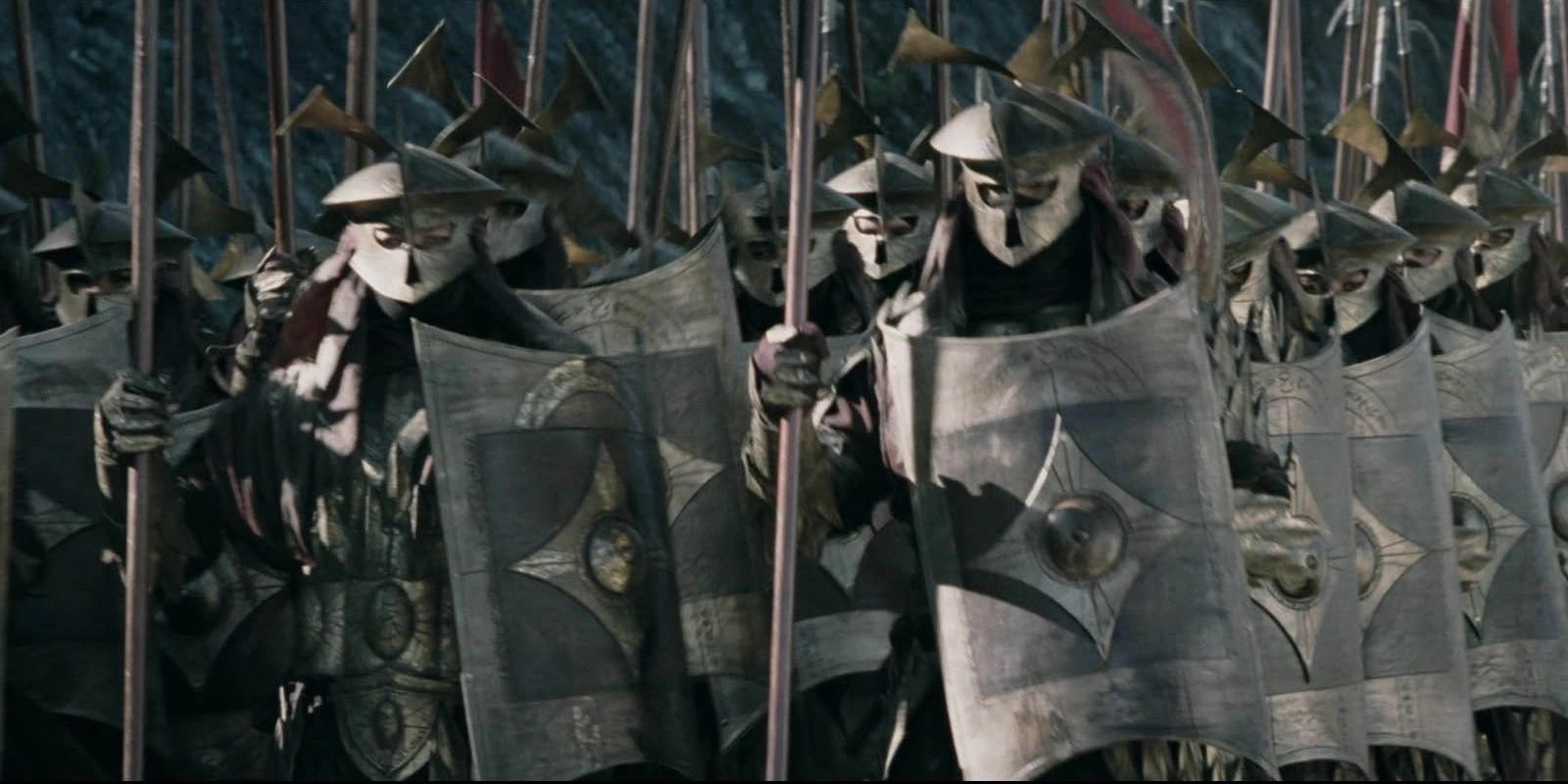
And, finally, there are Sauron’s allies from the east and from the south.  In the Jackson film, the easterners look like this—

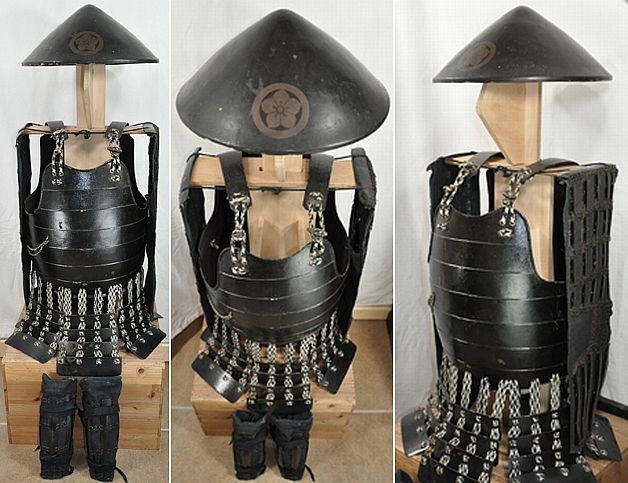
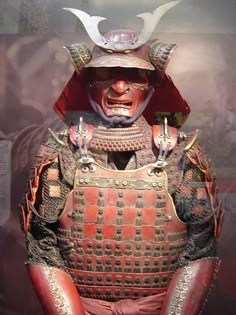
whose helmets vaguely remind me of a combination of elements of certain Japanese foot soldier and Samurai helmets—

JRRT doesn’t appear to have given us a very clear description of the Easterners, other than to write:

“But here and there [Frodo] caught the gleam of spears and helmets…” (The Two Towers. Book Four, Chapter 3, “The Black Gate is Closed”)

About those from the south, however, he gives us a more detailed description and a pathetic one, about a warrior killed by Faramir’s men in ambush:

“Then suddenly straight over the rim of their sheltering bank, a man fell, crashing through the slender trees, nearly on top of [Frodo and Sam].  He came to rest in the fern a few feet away, face downward, green arrow-feathers sticking from his neck below a golden collar.  His scarlet robes were tattered, his corselet of overlapping brazen plates was rent and hewn, his black plaits of hair braided with gold were drenched in blood.  His brown hand still clutched the hilt of a broken sword…

…[Sam] wondered what the man’s name was and where he came from; and if he was really evil of heart, or what lies or threats had led him on the long march from his home and if he would not really rather have stayed there in peace.”  (The Two Towers, Book Four, Chapter 4, “Of Herbs and Stewed Rabbit”)

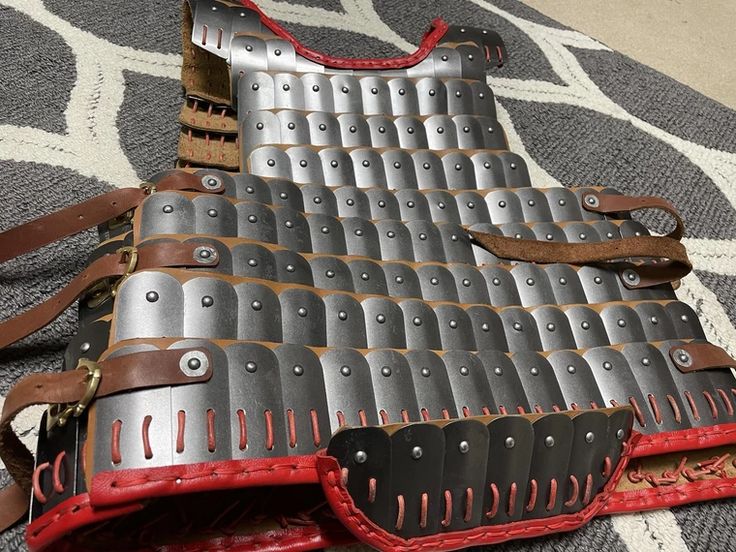
We don’t know if this man was wearing a helmet or carrying a shield, but he is wearing armor—this “corselet” is what is called “lamellar armor”, and looks rather like fish scales—

In this description, I’ll conclude this brief look at how Tolkien might have imagined his various warriors dressed, but, at the same time, that last bit of description makes me wonder—was this how JRRT thought, when he saw his first battlefield casualty? 

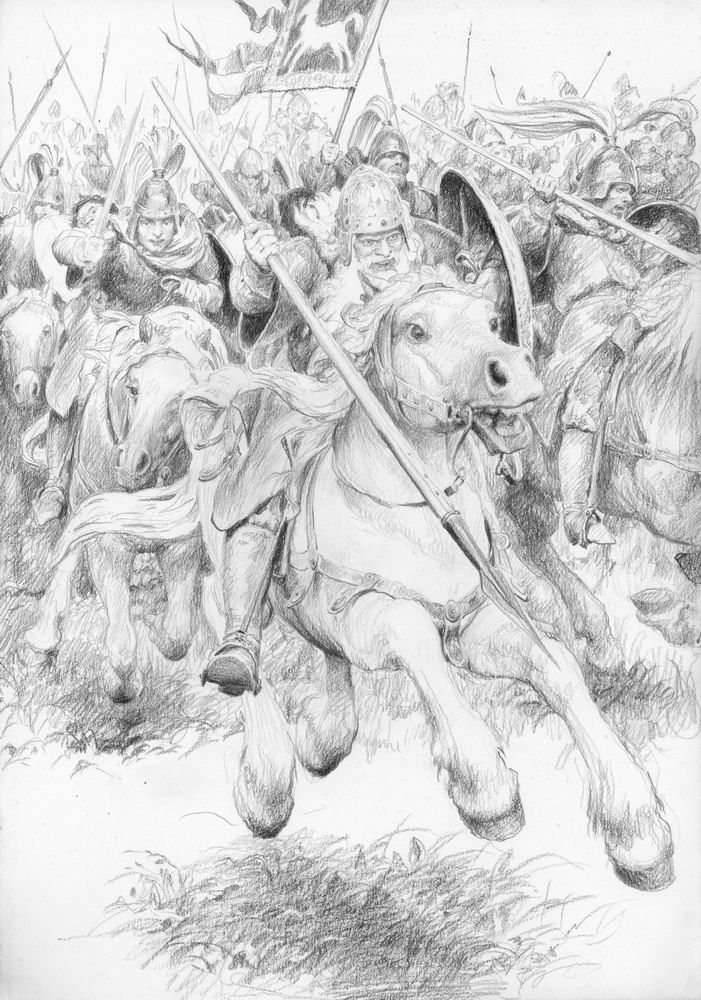
If so, it shows his emotional complexity in that he can write about glorious cavalry charges on the one hand,

(Denis Gordeev)

but have Sam express a melancholy, compassionate thought, on the other.

As always, thanks for reading.

Stay well,

Remember that November 11th is the 108th anniversary of the Armistice which brought the Great War (World War One) and its monstrous slaughter close to its close—

And remember, as well, that, as ever, there’s

MTCIDC

O

The Doubtful Sea Series Facebook Page

The Doubtful Sea Series Facebook Page

  • Ollamh

Categories

  • Artists and Illustrators
  • Economics in Middle-earth
  • Fairy Tales and Myths
  • Films and Music
  • Games
  • Heroes
  • Imaginary History
  • J.R.R. Tolkien
  • Language
  • Literary History
  • Maps
  • Medieval Russia
  • Military History
  • Military History of Middle-earth
  • Narnia
  • Narrative Methods
  • Poetry
  • Research
  • Star Wars
  • Terra Australis
  • The Rohirrim
  • Theatre and Performance
  • Tolkien
  • Uncategorized
  • Villains
  • Writing as Collaborators
Follow doubtfulsea on WordPress.com

Across the Doubtful Sea

Recent Postings

  • Unseen November 18, 2026
  • Capital R, Ring November 11, 2026
  • Cap-a-Pie (2) November 4, 2026
  • Cockcrow October 28, 2026
  • Cap-a-Pie (1) October 21, 2026
  • Now You See Him, Now… October 14, 2026
  • Stand and Deliver, or, Pick a Pocket or Two October 7, 2026
  • Death and the Rohirrim September 30, 2026
  • Minor? September 23, 2026

Blog Statistics

  • 129,211 Views

Posting Archive

  • November 2026 (3)
  • October 2026 (4)
  • September 2026 (5)
  • August 2026 (4)
  • July 2026 (5)
  • June 2026 (4)
  • May 2026 (4)
  • April 2026 (5)
  • March 2026 (4)
  • February 2026 (4)
  • January 2026 (4)
  • December 2025 (5)
  • November 2025 (4)
  • October 2025 (5)
  • September 2025 (4)
  • August 2025 (4)
  • July 2025 (5)
  • June 2025 (4)
  • May 2025 (4)
  • April 2025 (5)
  • March 2025 (4)
  • February 2025 (4)
  • January 2025 (5)
  • December 2024 (4)
  • November 2024 (4)
  • October 2024 (5)
  • September 2024 (4)
  • August 2024 (4)
  • July 2024 (5)
  • June 2024 (4)
  • May 2024 (5)
  • April 2024 (4)
  • March 2024 (4)
  • February 2024 (4)
  • January 2024 (5)
  • December 2023 (4)
  • November 2023 (5)
  • October 2023 (4)
  • September 2023 (4)
  • August 2023 (5)
  • July 2023 (4)
  • June 2023 (4)
  • May 2023 (5)
  • April 2023 (4)
  • March 2023 (5)
  • February 2023 (4)
  • January 2023 (4)
  • December 2022 (4)
  • November 2022 (5)
  • October 2022 (4)
  • September 2022 (4)
  • August 2022 (5)
  • July 2022 (4)
  • June 2022 (5)
  • May 2022 (4)
  • April 2022 (4)
  • March 2022 (5)
  • February 2022 (4)
  • January 2022 (4)
  • December 2021 (5)
  • November 2021 (4)
  • October 2021 (4)
  • September 2021 (5)
  • August 2021 (4)
  • July 2021 (4)
  • June 2021 (5)
  • May 2021 (4)
  • April 2021 (4)
  • March 2021 (5)
  • February 2021 (4)
  • January 2021 (4)
  • December 2020 (5)
  • November 2020 (4)
  • October 2020 (4)
  • September 2020 (5)
  • August 2020 (4)
  • July 2020 (5)
  • June 2020 (4)
  • May 2020 (4)
  • April 2020 (5)
  • March 2020 (4)
  • February 2020 (4)
  • January 2020 (6)
  • December 2019 (4)
  • November 2019 (4)
  • October 2019 (5)
  • September 2019 (4)
  • August 2019 (4)
  • July 2019 (5)
  • June 2019 (4)
  • May 2019 (5)
  • April 2019 (4)
  • March 2019 (4)
  • February 2019 (4)
  • January 2019 (5)
  • December 2018 (4)
  • November 2018 (4)
  • October 2018 (5)
  • September 2018 (4)
  • August 2018 (5)
  • July 2018 (4)
  • June 2018 (4)
  • May 2018 (5)
  • April 2018 (4)
  • March 2018 (4)
  • February 2018 (4)
  • January 2018 (5)
  • December 2017 (4)
  • November 2017 (4)
  • October 2017 (4)
  • September 2017 (4)
  • August 2017 (5)
  • July 2017 (4)
  • June 2017 (4)
  • May 2017 (5)
  • April 2017 (4)
  • March 2017 (5)
  • February 2017 (4)
  • January 2017 (4)
  • December 2016 (4)
  • November 2016 (5)
  • October 2016 (6)
  • September 2016 (5)
  • August 2016 (5)
  • July 2016 (5)
  • June 2016 (5)
  • May 2016 (4)
  • April 2016 (4)
  • March 2016 (5)
  • February 2016 (4)
  • January 2016 (4)
  • December 2015 (5)
  • November 2015 (5)
  • October 2015 (4)
  • September 2015 (5)
  • August 2015 (4)
  • July 2015 (5)
  • June 2015 (5)
  • May 2015 (4)
  • April 2015 (3)
  • March 2015 (4)
  • February 2015 (4)
  • January 2015 (4)
  • December 2014 (5)
  • November 2014 (4)
  • October 2014 (6)
  • September 2014 (1)

Blog at WordPress.com.

  • Subscribe Subscribed
    doubtfulsea
    Join 77 other subscribers

    Have a WordPress.com account? Log in now.

  • doubtfulsea
    View site in Reader
    Manage subscriptionsSign upLog in
    Report this content
    Collapse this bar
Loading Comments...