• About

doubtfulsea

~ adventure fantasy

Tag Archives: Saruman

Smoke (No Mirrors)

22 Wednesday Mar 2017

Posted by Ollamh in Economics in Middle-earth, J.R.R. Tolkien, Literary History, Narrative Methods

≈ Leave a comment

Tags

Algonquian, Aragorn, Bag End, Baggins, Daemonologie, domestic, Gandalf, Gimli, Hernandez de Boncalo, hogsheads, Isengard, James I, Jamestown, John Rolfe, Longbottom Leaf, Matoaka, Merry and Pippin, Native Americans, Nictotiana, Philip II of Spain, pipe, plantations, Pocahontas, Popeye the Sailor, Saruman, Scouring of the Shire, Sharkey, Sherlock Holmes, Shire, smoking, Southfarthing, The First Part of Ayres of the Musicall Humours, The Hobbit, The Illiad, The Lord of the Rings, The Odyssey, Tobacco, Tobias Hume, Tolkien

As always, welcome, dear readers.

This posting takes us away from the Shire and back to it, all in a couple of pages, as well as linking itself with a recent one on Sharkey and his attempt at revenge on the Hobbits who have helped in his downfall.

We begin just after Helm’s Deep, at the moment when Gandalf and all of the major characters involved have followed the invasion route back to Isengard, only to find it in ruins and:

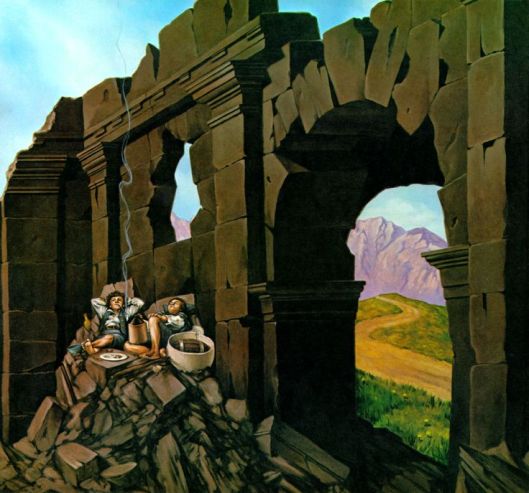
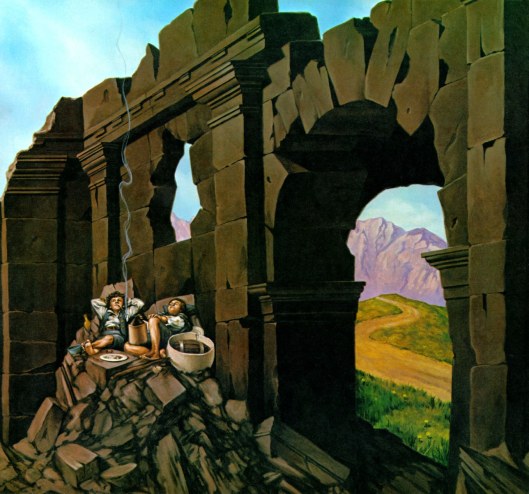
“And now they turned their eyes towards the archway and the ruined gates. There they saw close beside them a great rubble-heap; and suddenly they were aware of two small figures lying on it at their ease…One seemed asleep; the other, with crossed legs and arms behind his head, leaned back against a broken rock and sent from his mouth long whisps and little rings of thin blue smoke.” The Two Towers, Book Three, Chapter 8, “The Road to Isengard”

image1ruins.jpg

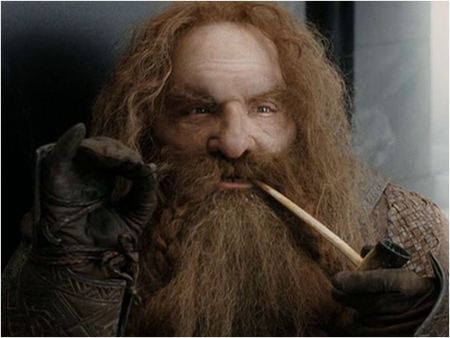
For Gimli, himself a smoker, that latter sight is not a surprising. For Theoden, however, not only are the Hobbits a surprise, but: “I had not heard that they spouted smoke from their mouths.”

Merry’s reply then leads us into today’s posting.

“That is not surprising…for it is an art which we have not practised for more than a few generations. It was Tobold Hornblower, of Longbottom in the Southfarthing, who first grew the true pipe-weed in his gardens, about the year 1070 according to our reckoning. How old Toby came by the plant…”

Gandalf interrupts Merry here, concluding with “Some other time would be more fitting for the history of smoking.”

But not for us.

For us, smoking, in the The Lord of the Rings, as in The Hobbit, belongs to a whole category of what we call the “domestication of the heroic”, a distinctive and important feature of JRRT’s narrative style. Earlier epics, like the Iliad and the Odyssey, certainly have their moments where combat and travel and dealing with monsters and enchantresses are not the only features of the stories. People sometimes pause to eat and drink and even sleep. JRRT goes beyond this, however, to provide what he himself might call the “homely” in his texts. By this term, we mean the ordinary and familiar, including such things as a brief inventory of the contents of Bag End, food more detailed than the “endless meat and sweet dark wine” of Homer–such as the mushrooms and bacon which Farmer Maggot offers–and Bilbo reading his letters and forgetting his pocket handkerchief. Such seemingly-trivial things give the stories—and certain of the characters within them—an extra depth and thus a deeper believability, as well as anchoring the story in something more ordinary than kings and wizards.

In fact, the center of this domestication are the Hobbits: think of Sam wanting a bit of rope or explaining taters to Gollum or that heart-breaking moment when Sam discards his pots and pans and “The clatter of his precious pans as they fell down into the dark was like a death-knell to his heart.” (The Return of the King, Book Six, Chapter 3, “Mount Doom”) And, along with things like rope and conies, there is what once was called “the pleasures of the pipe”.

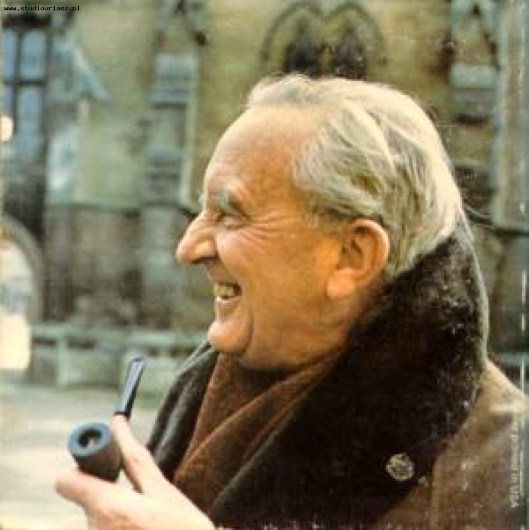
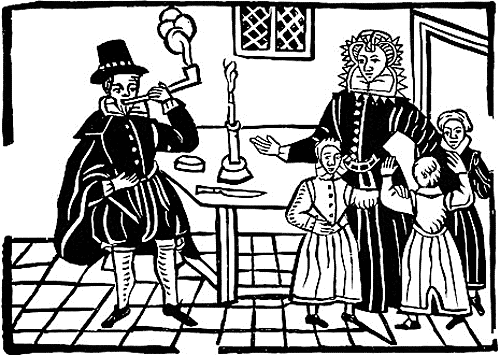
We live in a different world from JRRT. When he took up the pipe, in the early 20th century, no one knew the dangers of smoking.

image2jrrt.jpg

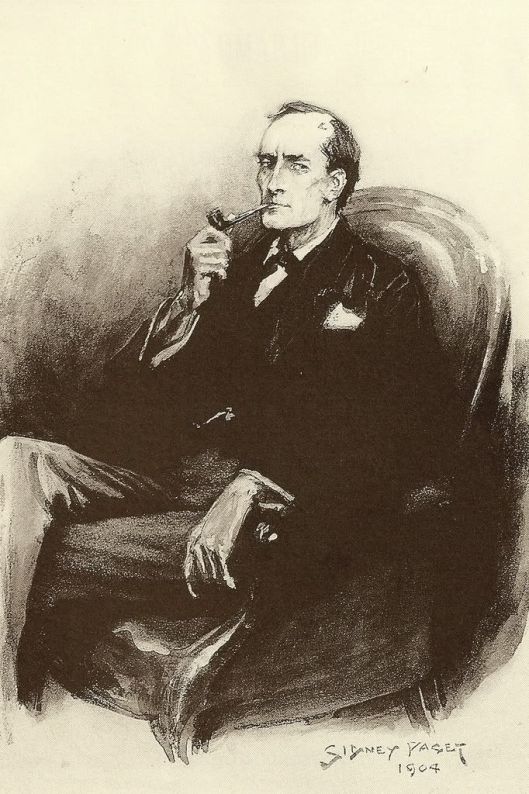
It was simply something men, in particular, did. After all, there was Sherlock Holmes, with his famous “three-pipe problem” (“The Red-Headed League”, The Strand Magazine, August, 1891) as a perfect model.

image3holmessmoking.jpg

Thus, smoking was acceptable and, potentially, domestic: after all, although the ancient comic book and cartoon character, Popeye the Sailor (1929-1957), may hold a pipe in his mouth while battling,

image3apopeye.jpg

it is generally something done in quiet and contemplation. Perhaps, then, for the times in which JRRT was writing, a perfect symbol of the domestic. (Hence the old expression for household comfort that someone—typically his wife–brings the owner “his pipe and slippers” when he comes home from work?)

And it appears very early in our experience of Hobbits. After all, the first time we see Bilbo, he is “standing at his door after breakfast smoking an enormous long wooden pipe that reached nearly down to his woolly toes”. (The Hobbit, Chapter 1, “An Unexpected Party”)

image4bilbo.jpg

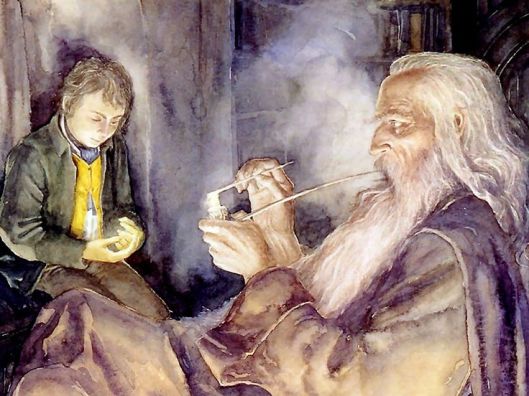
In time, we’ll see Gandalf smoking

image5gandalfsmoking.jpg

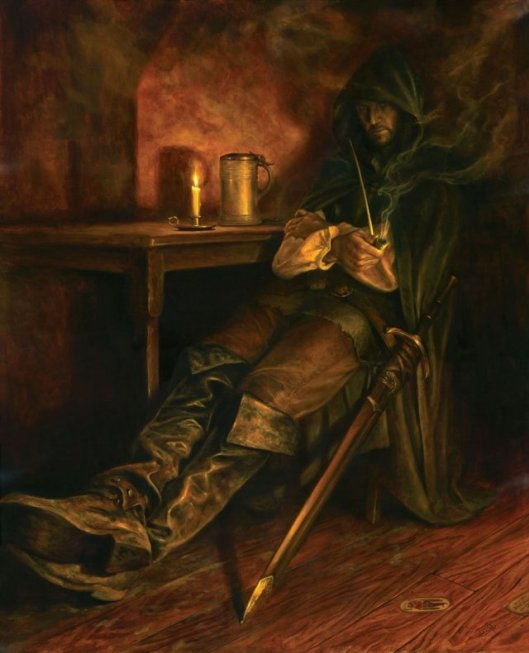
and Strider/Aragorn, too.

image6strider.jpg

In fact, we wonder if it isn’t a kind of unconscious sign that someone is a positive character—after all, as we said, Gimli smokes, too.

image7gimli.jpg

There is one exception, of course—and we’ll come back to that!

It should be no surprise, then, that one more positive character, Merry, is a smoker. Knowing, from the Prologue to The Lord of the Rings, that he is also the author of Herblore of the Shire, among other works, it is also not surprising that he appears to be the main authority on “pipe-weed”, claiming that the Hobbits were the inventors of its consumption:   “Hobbits first put it into pipes. Not even the Wizards first thought of that before we did.”

This, of course, made us think about who invented tobacco-smoking in our world—or, at least, in the English-speaking Western Hemisphere. (Although we are glad to point out that, as early as 1559, Philip II of Spain ordered Hernandez de Boncalo to bring back tobacco seeds from the New World to plant in Spain.)

Merry says of the plant (which he correctly identifies with our genus Nicotiana):

“…observations that I have made on my own many journeys south have convinced me that the weed itself is not native to our parts of the world, but came northward from the lower Anduin, whither it was, I suspect, originally brought over Sea by the Men of Westernesse. It grows abundantly in Gondor, and there is richer and larger than in the North, where it is never found wild, and flourishes only in warm sheltered places like Longbottom.”

In our world—that is, in the Americas– Native Americans first cultivated tobacco—as can be seen in this engraved version of John White’s 1580s drawing of the Algonquian village of Secoton by Theodor de Bry for the 1590 second edition of Thomas Harriot’s A Briefe and True Report of the New Found Land of Virginia.

image8secoton.jpg

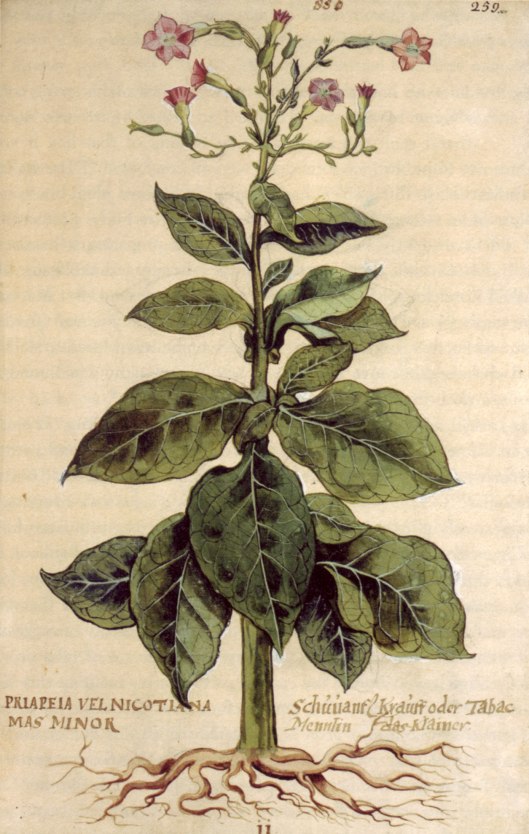
At the top, center, is a tobacco field, with stylized plants, which, up close, might look like this:

image9tobacco.jpg

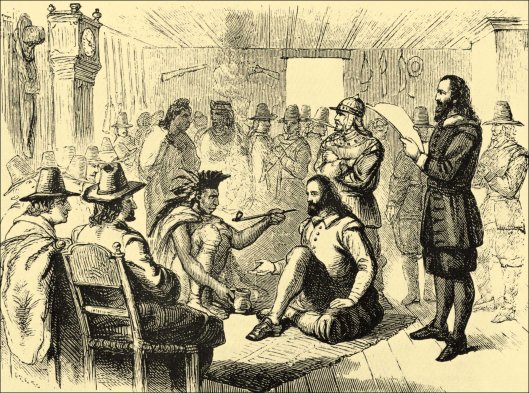
Native Americans appear to have used tobacco—and its smoke—primarily for religious and political ceremonies, rather than for recreation.

image10pipeceremony.jpg

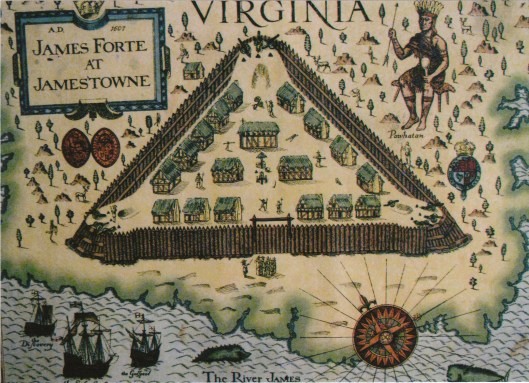
This soon changed, however, when a member of the newly-established (1607) colony of Jamestown, John Rolfe, in what would become the US state of Virginia,

image11jamestown.jpg

saw the commercial possibilities and began to cultivate tobacco for export.

image12growingtobacco.jpg

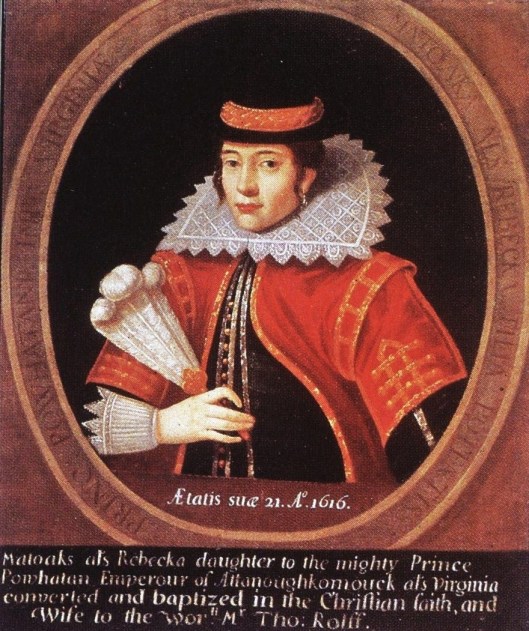
Although John Rolfe is known to those interested in early English colonization, his wife is much more famous. She was Matoaka, called Pocahontas as a nickname (it means something like “playful/lively”), the 400th anniversary of whose funeral is the day of this writing, 21 March (although it will be posted tomorrow, the 22nd).

image13pocahontas.jpg

Tobacco was already known in England,

image14drinker.jpg

had become a sort of craze,

image15tobaccosmoking.gif

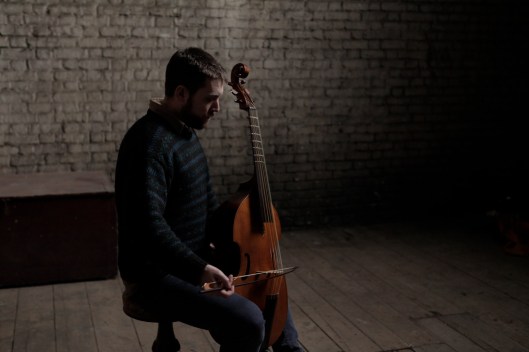
and even inspired at least one pop song, Tobias Hume’s “Tobacco”, from his The First Part of Ayres of the Musicall Humours (1605). Hume was a big fan of the lyra viol (a member of the string bass family).

image16lyraviol

(We include here a link so that you can hear the song sung and accompanied by his favorite instrument.  Oh—and it’s sung in the pronunciation of the early 17th century, so be prepared for some differences in sound.)

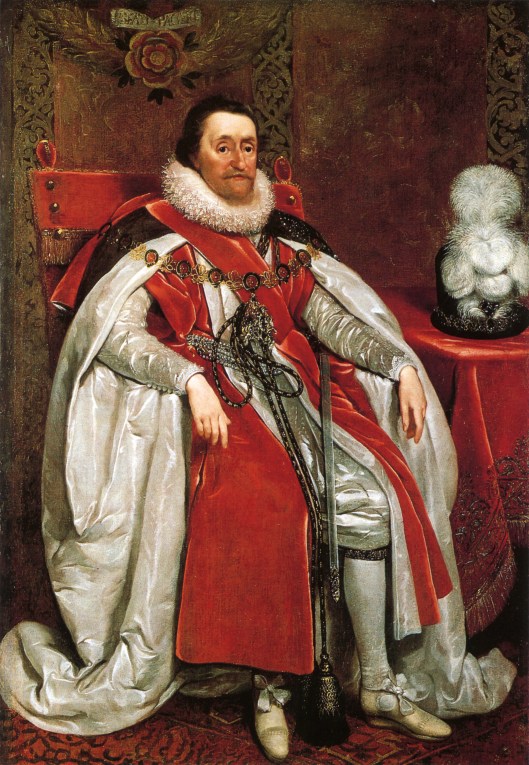
Thus, Rolfe’s exploitation was a good business investment, even though tobacco quickly ran afoul of the British government, in the form of the new king, James I,

image17james1

who had already published an attack on smoking in 1604.

image18counterblast

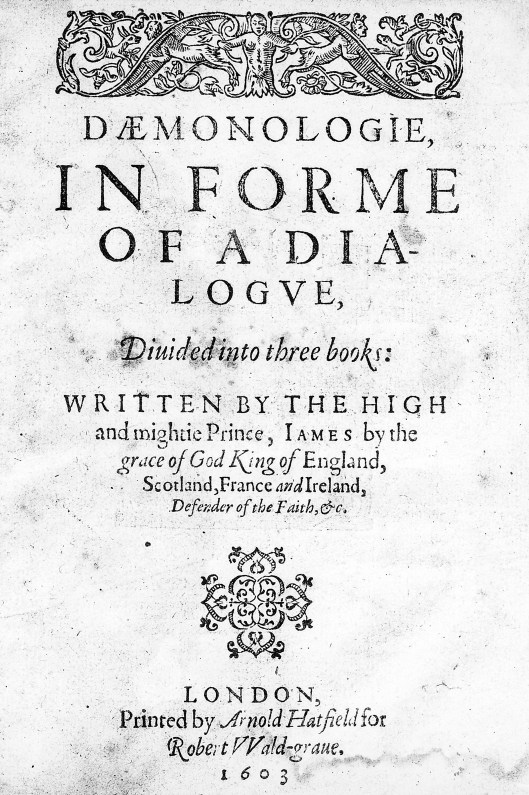
James I had opinions on numerous subjects, including witches, about whom he had published a book, Daemonologie, in 1597.

M0014280 James I: Daemonologie, in forme of a dialogue. Title page.

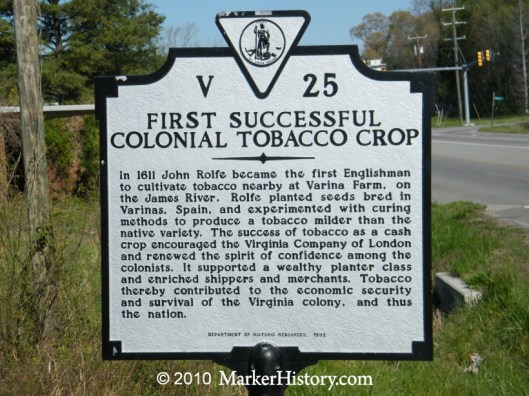
His attack on tobacco—although more sensible than believing in witches—didn’t stop it from becoming the major Virginia crop, however—as this roadside sign points out.

image20sign.jpg

Virginia farmers planted huge fields of tobacco,

image21tobaccofield.jpg

cultivated it (a major use of slave labor, like the sugar plantations of the Caribbean),

image22cultivation.jpg

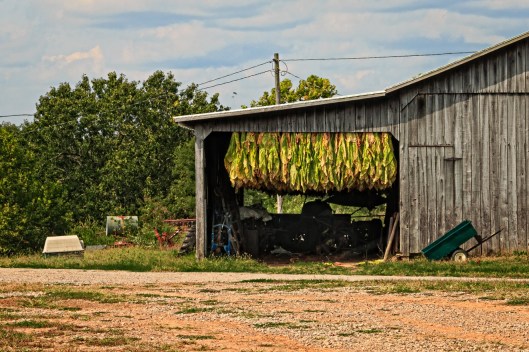
cut and dried it,

image23drying.jpg

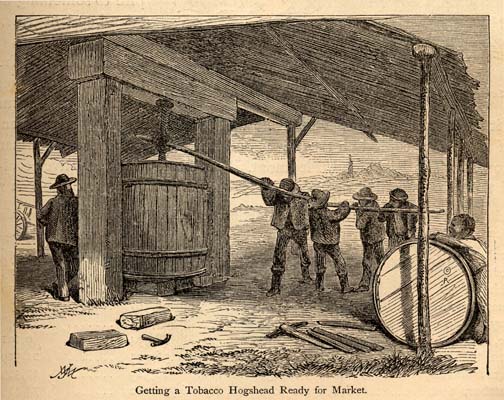
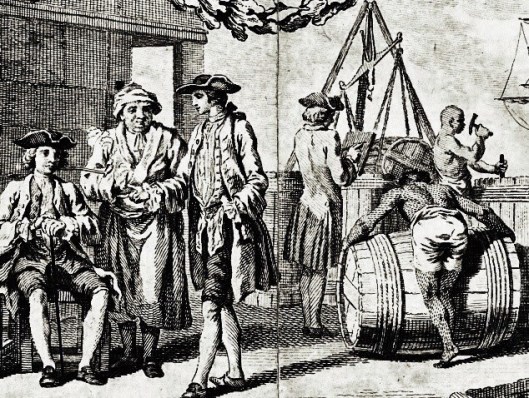
packed it into huge barrels, called hogsheads,

image24hogsheadpacking.jpg

dragged those hogsheads to a port,

image25dragging.jpg

and shipped those hogsheads to England

image26shipping.jpg

where smokers enjoyed it.

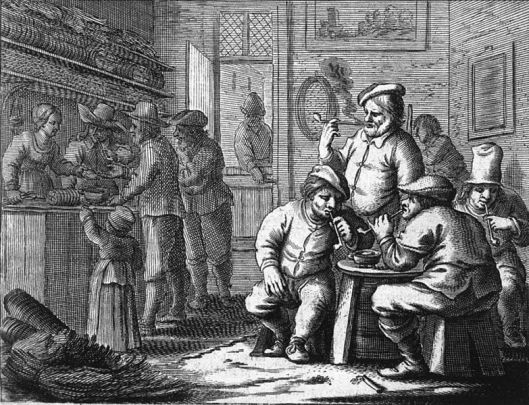
image27smoking.jpg

We don’t know the methods used in the Southfarthing, but, looking at tobacco around the world in our world, the main difference seems to be in the curing (drying) technique used. We can imagine, then, that, when Merry talks about “pipe-weed” and its cultivation, if we visited the southern part of the Shire, we would see familiar sights—except, perhaps, for those hogheads. The stuff which Merry is smoking came from “two small barrels, washed up out of some cellar or store-house…When we opened them, we found they were filled with this: as fine a pipe-weed as you could wish for, and quite unspoilt.” (The Two Towers, Chapter Nine, “Flotsam and Jetsam”)

Gimli admires the quality and Merry says, “My dear Gimli, it is Longbottom Leaf! There were the Hornblower brandmarks on the barrels, as plain as plain. How it came here, I can’t imagine. For Saruman’s private use, I fancy.”

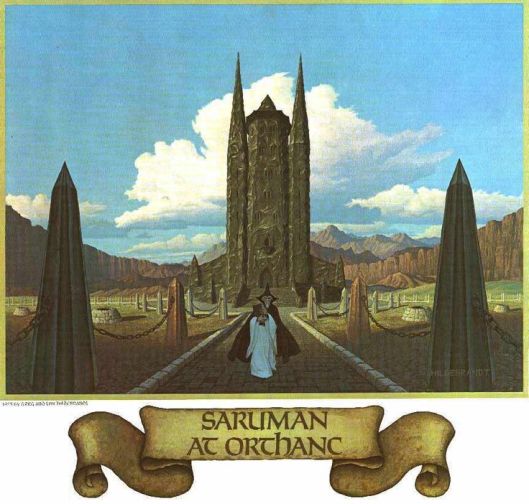
This brings us back to the final smoker and one exception to our fanciful rule that, in Tolkien, if you smoke, you’re a positive character: Saruman.

image28saruman.jpg

It’s hard to think of Saruman as indulging in the domestic. As Treebeard says of him: “He has a mind of metal and wheels” (The Two Towers, Book Three, Chapter 4, “Treebeard”). And yet, although he has lost his position as head of the White Council, and has lost Isengard, as well, as Gandalf says of him, “I fancy he could do some mischief still in a small mean way.” (The Return of the King, Book Six, Chapter 6, “Many Partings”). Thus, what better small, mean way than to attack that very domesticity which is embodied in the Hobbits and their Shire? As Sharkey, he does so, destroying the Shire by cutting down trees, knocking or burning down houses, replacing water mills with steam, and turning a nearly a-political place into a little fascist state. And, perhaps, as a last straw, he attacks one last small comfort, saying to Merry, as he keeps his tobacco pouch:

“Well, it will serve you right when you come home, if you find things less good in the Southfarthing than you would like. Long may your land be short of leaf!” (The Return of the King, Book Six, Chapter 6, “Many Partings”)

If so, perhaps there is a certain horrible irony, then, that, when Saruman is murdered, he is last seen as “a grey mist…rising slowly to a great height like smoke from a fire”. (The Return of the King, Book Six, Chapter 8, “The Scouring of the Shire”)

Thanks, as always, for reading.

MTCIDC

CD

Shire Portrait (5b): Hostile Takeover

15 Wednesday Mar 2017

Posted by Ollamh in Economics in Middle-earth, Imaginary History, J.R.R. Tolkien, Military History, Military History of Middle-earth, Narrative Methods, Villains

≈ Leave a comment

Tags

Baggins, Chief, Der Fuehrer, Gestapo, Hitler, Lotho, SA, Sackville-Bagginses, Saruman, Sharkey, Shire, Shirriffs, Southfarthing, The Hobbit, The Lord of the Rings, The Scouring of the Shire, Tolkien

Welcome, dear readers, to the second part of our last (for the moment?) posting on the Shire. This is actually a two-part posting and is devoted to the takeover of the Shire by “Sharkey” and his followers and how it might have happened, based upon evidence from the texts of The Hobbit and The Lord of the Rings.

We decided upon a two-part posting because we saw the takeover as a two-step process. Initially, we believe that Saruman looked for someone within the Shire to act as his agent there and, as a local agent, both to foment the kind of discontent which would provoke a demand for change, and to act as the leader of that change.

Because the Shire had so little government and most problems were dealt with within families, we wondered if that discontent wouldn’t begin as something Shire-wide, but be found within one or more families, instead.

With this in mind, we immediately thought of the Sackville-Bagginses. From the final chapter of The Hobbit, it was clear that the S-Bs (as they’re called) had grievances against their cousins, the Bagginses, mostly because they wanted Bag End and its contents.

How this led to leaguing with Saruman is not explained, but merely suggested, by Pippin, who says, of reported disturbance in the Southfarthing:

“ ‘Whatever it is…Lotho will be at the bottom of it:   you can be sure of that.” The Return of the King, Book Six, Chapter 7, “Homeward Bound”

This is then confirmed when the hobbits reach the bridge over the Brandywine and one of the hobbit guards (Hob Hayward), mentions “the Chief…up at Bag End.”

Frodo, who has sold his house at Bag End (see The Fellowship of the Ring, Book One, Chapter 3, “Three is Company”) to the S-Bs, immediately asks Hob, “ ‘Chief? Chief? Do you mean Mr. Lotho?’ said Frodo.” The Return of the King, Book Six, Chapter 8, “The Scouring of the Shire”

Otho and Lobelia had been Bilbo’s enemies long ago, but, whereas Lobelia is still alive, Otho is long dead and Lotho (and yes, the word “loathe” must lie just below the surface here, though this is probably not his name in the Common Tongue, just as Pippin’s name isn’t Pippin), his son, has somehow become not the Mayor of the Shire (who is actually Will Whitfoot), but the much vaguer (and more menacing) “the Chief”. (We also note that “Mr. Lotho” is a courtesy title and one for established land-owners, really, and not for Lotho.)

The family theme is underlined when Hob replies that “we have to say ‘the Chief’ nowadays” and Frodo says, in turn:

“ ‘Do you indeed!’ said Frodo. ‘Well, I am glad he has dropped the Baggins at any rate. But it is evidently high time that the family dealt with him and put him in his place.’ ”

If Frodo’s remark suggests the familial aspect of justice in the Shire, the reply of an anonymous hobbit to it suggests the second or external step of the takeover:

“A hush fell on the hobbits beyond the gate. ‘It won’t do no good talking that way,’ said one. ‘He’ll get to hear of it. And if you make so much noise, you’ll wake the Chief’s Big Man.’ ”

As JRRT began The Lord of the Rings in 1937, just four years after the Nazis took control of Germany, “The Chief” surely has echoes of “Der Fuehrer”, which simply means “The Leader”.

adolf-hitler-34.jpg

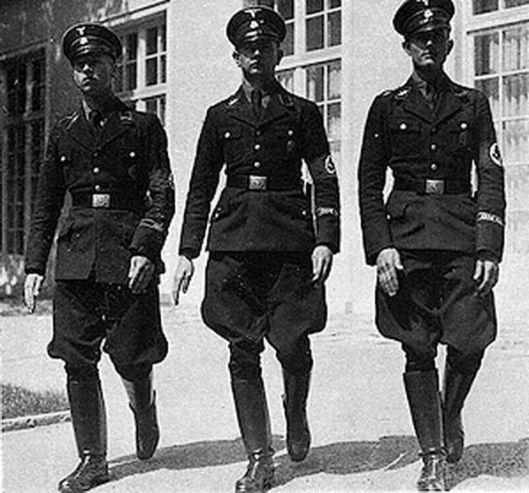
In which case, should we associate the threat of “the Chief’s Big Man” with everything from the SA

0001.jpg

to the Gestapo?

0e24494b5019c1007e9214e03d77c2d8.jpg

Merry, at least, certainly makes a connection with something which Butterbur had said earlier:

“It all comes of those newcomers and gangrels that began coming up the Greenway last year, as you may remember; but more came later. Some were just poor bodies running away from trouble; but most were bad men, full o’ thievery and mischief.” The Return of the King, Book Six, Chapter 7, “Homeward Bound”

Answering the anonymous voice, Merry says:

“If you mean that your precious Chief has been hiring ruffians out of the wild, then we’ve not come back too soon!”

When the Big Man appears, Merry’s conclusion is confirmed: it’s Bill Ferny, who, Butterbur believes, who had been involved in a minor battle in Bree, in which five hobbits had been killed:

“ ‘And Harry Goatleaf that used to be on the West-gate, and that Bill Ferny, they came in on the strangers’ side, and they’ve gone off with them; and it’s my belief they let them in. On the night of the fight I mean.’ “

If some of these “Big Men” were criminal drifters from the east, almost randomly recruited, there were others who were sent.

“ ‘It all began with Pimple, as we call him,’ said Farmer Cotton; ‘and it began as soon as you’d gone off, Mr. Frodo.   He’d funny ideas, had Pimple. Seems he wanted to own everything himself, and then order other folk about. It soon came out that he already did own a sight more than was good for him; and he was always grabbing more, though where he got the money was a mystery: mills and malt-houses and inns, and farms, and leaf-plantations. He’d already bought Sandyman’s mill before he came to Bag End, seemingly.

Of course he started with a lot of property in the Southfarthing which he had from his dad; and it seems he’d been selling a lot o’ the best leaf, and sending it away quietly for a year or two. But at the end o’ last year he began sending away loads of stuff, not only leaf. Things began to get short, and winter coming on, too.   Folk got angry, but he had an answer. A lot of Men, ruffians mostly, came with great wagons, some to carry off the goods south-away, and others to stay. And more came. And before we knew where we were they were planted here and there all over the Shire, and were felling trees and digging and building themselves sheds and houses just as they liked…”

There is a bit more to add to this. The “Big Men” were not alone. As in our own historical world of Nazi occupiers, there were those willing to collaborate, as Robin Smallburrow tells Sam:

“There’s hundreds of Shirriffs all told, and they want more, with all these new rules. Most of them are in it against their will, but not all. Even in the Shire there are some as like minding other folk’s business and talking big. And there’s worse than that: there’s a few as do spy-work for the Chief and his Men.”

With Farmer Cotton’s narrative, however, the two steps come together: the local was, indeed, as Pippin has suspected, Lotho. The external was a combination of opportunists, like Bill Ferny, and agents dispatched from an unnamed southern source, but we know that it was “Sharkey” who sent them, just as we know that “Sharkey” was Saruman, who was still capable of mischief—but not “in a small mean way”.

Thanks, as always, for reading.

MTCIDC

CD

Shire Portrait (5a): Hostile Takeover

08 Wednesday Mar 2017

Posted by Ollamh in Economics in Middle-earth, Imaginary History, J.R.R. Tolkien, Literary History, Narrative Methods

≈ Leave a comment

Tags

A Long-Expected Party, auction, Bag End, Baggins, Barliman Butterbur, Galadriel, Government, Isengard, Longbottom Leaf, Luke Skywalker, Merry and Pippin, Mirror of Galadriel, Pipeweed, Sackville-Bagginses, Sam Gamgee, Saruman, Star Wars, The Empire Strikes Back, The Lord of the Rings, The Return of the King, The Scouring of the Shire, The Shire, Tolkien, Yoda

As always, dear readers, welcome!

This is, we think, the last in our Shire Portrait series (although a 2-parter)—at least for the moment. In it, we intend to consider just how the Shire fell into the hands of “Sharkey” and his “boys”.

The Ring destroyed and the King returned, Gandalf, the Hobbits, and a party of Elves are traveling back toward Rivendell and beyond when they come upon Saruman and Grima, now no more than Saruman’s slave.

Ted_Nasmith_-_Saruman_is_Overtaken.jpg

It is not a happy meeting, as can be imagined. When offered help, Saruman replies:

“All my hopes are ruined, but I would not share yours. If you have any…You have doomed yourselves, and you know it. And it will afford me some comfort as I wander to think that you pulled down your own house when you destroyed mine.” The Return of the King, Book 6, Chapter 6, “Many Partings”

In such a mood, it can be imagined how he treats the Hobbits—even when Merry offers him pipe-weed, which he does while commenting, less than tactfully, on its origin:

“ ‘You are welcome to it; it came from the flotsam of Isengard.’

‘Mine, mine, yes and dearly bought!’ cried Saruman, clutching at the pouch. ‘This is only a repayment in token; for you took more, I’ll be bound. Still, a beggar must be grateful, if a thief returns him even a morsel of his own. Well, it will serve you right when you come home, if you find things less good in the Southfarthing than you would like. Long may your land be short of leaf!’”

Saruman’s remark—a curse, really—resonates especially with Sam.

“’Ah!’ said Sam. ‘And bought he said. How, I wonder? And I didn’t like the sound of what he said about the Southfarthing. It’s time we got back.’” The Return of the King, Book 6, Chapter 6, “Many Partings”

This is a natural reaction on Sam’s part because of what he had seen in Galadriel’s mirror, we presume.

1gmirror.jpg

“’Hi!’ cried Sam in an outraged voice. ‘There’s that Ted Sandyman a-cutting down trees as he shouldn’t. They didn’t ought to be felled: it’s that avenue beyond the Mill that shades the road to Bywater…

But now Sam noticed that the Old Mill had vanished, and a large red-brick building was being put up where it stood. Lots of folk were busily at work. There was a tall red chimney nearby. Black smoke seemed to cloud the surface of the Mirror…

‘I can’t stay here,’ he said wildly. ‘I must go home. They’ve dug up Bagshot Row, and there’s the poor old Gaffer going down the Hill with his bits of things on a barrow…” The Fellowship of the Ring, Book 2, Chapter VII, “The Mirror of Galadriel”

At the time, Galadriel had told him

“’You cannot go home alone,’ said the Lady. ‘You did not wish to go home without your master before you looked in the Mirror, and yet you knew that evil things might well be happening in the Shire. Remember that the Mirror shows many things, and not all have yet come to pass. Some never come to be, unless those that behold the visions turn aside from their path to prevent them. The Mirror is dangerous as a guide to deeds.” The Fellowship of the Ring, Book 2, Chapter VII, “The Mirror of Galadriel”

[A footnote: suddenly, we are reminded of that scene on Dagobah in Star Wars V, when Luke has had a vision and immediately wants to rush off to Bespin.

2lukedagobah.jpeg

“Luke: I saw—I saw a city in the clouds.

Yoda: [nods] Friends you have there.

Luke: They were in pain…

Yoda: It is the future you see.

Luke: The future?

[pause]

Luke: Will they die?

Yoda: [closes his eyes for a moment] Difficult to see. Always in motion is the future.

Luke: I’ve got to go to them.

Yoda: Decide you must, how to serve them best. If you leave now, help them you could; but you would destroy all for which they have fought, and suffered.” The Empire Strikes Back (1980)

As—using various websites—we provide links here—we can see that an imitation of the opening of the Hobbit—Bilbo and Gandalf meeting—appears in an early script of Star Wars IV, I think that the scene at Galadriel’s Mirror was somewhere back in G. Lucas’ wonderfully fertile brain—and, yes, we are big fans.]

“Secrets of the ‘Star Wars’ Drafts”

Was George Lucas Inspired by Tolkien?

Star Wars Origins: The Lord of the Rings

At this point, we know from two sources that Saruman has had commercial dealings with the Southfarthing.

First, of course, we’ve just seen it confirmed by Saruman’s response to Merry. Second is that scene at Isengard, where Gandalf, Theoden, Eomer, and Aragorn, travel with an escort and find there Merry and Pippin, who tell them of their discovery of two small casks:

“ ‘My dear Gimli, it is Longbottom Leaf! There were the Hornblower brandmarks on the barrels, as plain as plain. How it came here, I can’t imagine.” The Two Towers, Book Three, Chapter 9, “Flotsam and Jetsam”

Michael-Herring-Restos-y-despojos-Calendario-Tolkien-1980

Knowing, however, of Saruman’s increasing interest in the Shire, we can imagine that one of his agents, active in the Southfarthing, had acquired it for him. As the Appendix B, “The Tale of Years” tells us, under TA2953:

[Saruman] notes his [Gandalf’s] interest in the Shire. He soon begins to keep agents in Bree and the Southfarthing.” (page 1089 in Appendix B)

Spying was clearly only the beginning for Saruman, however. The actual evidence for his eventual take-over is scattered throughout The Lord of the Rings, but we believe that it can be pieced together to provide a picture of how it must have been done. It was a two-step process.

First, he appears to have gained knowledge of internal dissatisfaction within the Shire. Because there is really nothing political in the Shire–as readers will know from the first posting in this series, there is virtually no government—this unrest was domestic—as is said in the Prologue, “Families for the most part managed their own affairs.”

In the case of Bilbo and Frodo, the dissatisfied were the Sackville-Bagginses. We first met them in the last chapter of The Hobbit, where they were described as “Bilbo’s cousins” and were shown as being actively involved in the auction of the “effects of the late Bilbo Baggins Esquire”—as well as in the disappearance of some merchandise not auctioned off:

“Many of his silver spoons mysteriously disappeared and were never accounted for. Personally he suspected the Sackville-Bagginses. On their side they never admitted that the returned Baggins was genuine and they were not on friendly terms with Bilbo ever after.” The Hobbit, Chapter 19, “The Last Stage”

It was one more blow to the Sackville-Bagginses when Bilbo rescued the now-orphaned Frodo from “those queer Bucklanders” and brought him to live at Bag End, as Gaffer Gamgee related in The Ivy Bush:

“ ‘But I reckon it was a nasty knock for those Sackville-Bagginses. They thought they were going to get Bag End, that time he went off and was thought to be dead. And then he comes back and orders them off; and he goes on living and living, and never looking a day older, bless him! And suddenly he produces an heir, and has all the papers made out proper. The Sackville-Bagginses won’t never see the inside of Bag End now, or it is to be hoped not.’ “ The Fellowship of the Ring, Book One, Chapter 1, “A Long-Expected Party”

Bad blood, then, on several counts—and, for Saruman, looking for a way in, a great opportunity.

Bilbo might have suspected them of spoon-pilfering, but his was a more generous nature, however, and he even invited them to his and Frodo’s joint birthday party.

“The Sackville-Bagginses were not forgotten. Otho and his wife Lobelia were present. They disliked Bilbo and detested Frodo, but so magnificent was the invitation card, written in golden ink, that they had felt it impossible to refuse…” The Fellowship of the Ring, Book One, Chapter 1, “A Long-Expected Party”

On the other hand, Bilbo does not please them when he announces that Frodo is coming into “his inheritance”—

“The Sackville-Bagginses scowled, and wondered what was meant by ‘coming into his inheritance’ “ and, when Bilbo makes his startling disappearance, they “departed in wrath”. (quotations from Chapter One).

And yet they didn’t quite depart. It seems they have only stepped away from the party, only to return to cause trouble, demanding to see Bilbo’s will.

“Otho would have been Bilbo’s heir, but for the adoption of Frodo. He read the will carefully and snorted. It was, unfortunately, very clear and correct…” The Fellowship of the Ring, Book One, Chapter 1, “A Long-Expected Party”

Otho “snapped his fingers under Frodo’s nose and stumped off”, but Lobelia, his wife, remained, and Frodo later found her “still about the place, investigating nooks and corners, and tapping the floors. He escorted her firmly off the premises, after he had relieved her of several small (but rather valuable) articles that had somehow fallen inside her umbrella.” And she leaves with a kind of threat and what she believes is an insult:

“ ‘You’ll live to regret it, young fellow! Why didn’t you go too? You don’t belong here; you’re no Baggins—you—you’re a Brandybuck!’ ”

It’s never said why there is such an animus held by the Sackville-Bagginses against the Bagginses, but there is clearly something wrong with the S-Bs, from their covetousness to Lobelia’s open theft, and whatever is wrong is just what Saruman will find and exploit. Our next mention of them is oblique and it has to do with that pipe-weed. Merry and Pippin have been explaining how they had come to discover it at Isengard and all seems clear—

“ ‘All except one thing,’ said Aragorn: ‘leaf from the Southfarthing in Isengard. The more I consider it, the more curious I find it. I have never been in Isengard, but I have journeyed in this land, and I know well the empty countries that lie between Rohan and the Shire. Neither goods nor folk have passed that way for many a long year, not openly. Saruman had secret dealings with someone in the Shire, I guess. Wormtongues may be found in other houses than King Theoden’s…” The Two Towers, Book Three, Chapter 9, “Flotsam and Jetsam

With that faint foreboding, we hear no more until Gandalf and the Hobbits are once more leaving Bree and Butterbur says, almost in passing:

“ ‘I should have warned you before that all’s not well in the Shire neither, if what we hear is true. Funny goings on, they say.’ “ The Return of the King, Book Six, Chapter 7, “Homeward Bound”

With Butterbur’s words in their ears, the Hobbits ride out and conversation begins:

“ ‘I wonder what old Barliman was hinting at,’ said Frodo.

‘I can guess some of it,’ said Sam gloomily. ‘What I saw in the Mirror: trees cut down and all, and my old gaffer turned out of the Row. I ought to have hurried back quicker.’

‘And something’s wrong with the Southfarthing evidently,’ said Merry. ‘There’s a general shortage of pipe-weed.’

‘Whatever it is,’ said Pippin, ‘Lotho will be at the bottom of it: you can be sure of that.’”

Here again, after Aragorn’s remark long before, we see that pipe-weed turn up—and associated somehow with a Sackville-Baggins. Butterbur has already replied to Gandalf’s request for it that “That’s the one thing that we’re short of, seeing how we’ve only got what we grow ourselves, and that’s not enough. There’s none to be had from the Shire these days.”

It’s never explained why Pippin makes the connection with Lotho at this point—was the bad blood between the Bagginses and the Sackville-Bagginses part of a darker picture of the S-Bs? This seems more than possible when Gandalf adds to Pippin’s remark:

“ ‘Deep in, but not at the bottom,’ said Gandalf. ‘You have forgotten Saruman. He began to take an interest in the Shire before Mordor did.’”

And now we begin to see a potential bigger pattern: Saruman-an S-B-Shire and, with it, the second step in the take-over of the Shire, that from outside. But that’s for Shire Portrait 5b: “Hostile Take-Over.2”, next time.

Until then, thanks, as ever, for reading!

MTCIDC

CD

Shire Portrait (2)

08 Wednesday Feb 2017

Posted by Ollamh in Economics in Middle-earth, Imaginary History, J.R.R. Tolkien, Maps, Narrative Methods

≈ 2 Comments

Tags

An Unexpected Party, Bad End, Baggins, ceramics, clay bank, coal, coins, cork, crafts, cutlery, Dwarves, Esther Forbes, Gondorian money, Hobbits, Isengard, Johnny Tremain, lead, Lloyd Alexander, Longbottom Leaf, Mayor, Michel Delving, mines, Postal Service, pottery, realien, Renaissance, Robert II of Scotland, Saruman, Shirriffs, silica, Silver, Taran Wanderer, Thain, The Green Dragon, The Hobbit, The Lord of the Rings, The Shire, Tolkien

Welcome, dear readers, as always.

In our last post, we began a series responding to the question:   what makes the Shire the Shire?

1theshire

We began with the government, which turned out to be very rudimentary: a Thain (hereditary), a Mayor (elected), a postal service (not known how chosen), Shirriffs (a kind of border patrol—volunteer). Since the Thain and Mayor were principally honorary positions, there was perhaps no salary attached. As for the postal service (called “Messengers”) and the Shirriffs, we presume that there must have been some sort of payment, although we are not told so. Since, in our world, we pay for the police and the post office through taxes, we wondered how the same services in the Shire were paid. This led us to the question of the Shire economy in general.

In a letter of 25 September, 1954, JRRT wrote to Naomi Mitchison:

“I am more conscious of my sketchiness in the archaeology and realien [“physical facts/things of real life”] than in the economics: clothes, agricultural implements, metal-working, pottery, architecture and the like…I am not incapable of or unaware of economic thought; and I think as far as the ‘mortals’ go, Men, Hobbits, and Dwarfs, that the situations are so devised that economic likelihood is there and could be worked out…” (Letters, 196)

The Shire would appear to be an agriculturally-based economy:

“The Shire is placed in a water and mountain situation and a distance from the sea and a latitude that would give it a natural fertility, quite apart from the stated fact that it was a well-tended region when they [hobbits] took it over.” (Letters, 196)

He adds to this that, when the hobbits took control of the Shire, that included “a good deal of older arts and crafts”, suggesting that the solution to the problem of the production of “clothes, agricultural implements, metal-working, pottery”—all the Realien, as he calls them, is assumed. How and from whom such things were taken over is not explained and such production, in any community, is not a small matter: “things of real life” are many and complicated.

Consider, for example, just one moment at Bag End. The Baggins appear to have been well-to-do, even without the treasure Bilbo brought back from his trip. His house is extremely well-furnished and the Baggins certainly don’t want for provisions, as we know from descriptions both in The Hobbit and The Lord of the Rings, as well as Realien, as the Dwarves’ clean-up song reminds us:

Chip the glasses and crack the plates!

Blunt the knives and bend the forks!

That’s what Bilbo Baggins hates—

Smash the bottles and burn the corks!

(The Hobbit, Chapter 1, “An Unexpected Party”)

1bilbodwarves.jpg

If we take this line by line, we come up with the following: glasses, plates, knives, forks, bottles, corks.

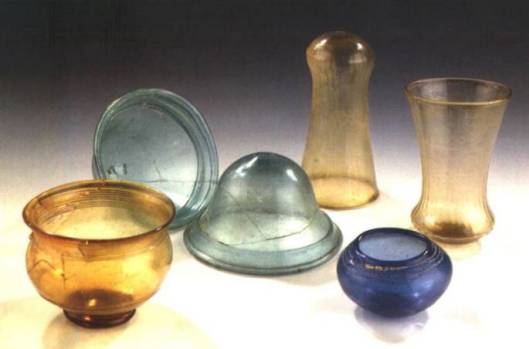
Glasses and bottles (as well as the window panes at Bag End) require a glassblower and perhaps a glazier.

2latemedglass.jpg

Plates require a potter.

3potter.JPG

Knives and forks were once made by cutlers (and forks are very advanced for a Middle-earth which is mostly medieval—although classical people used them in food preparation, it was only during the Renaissance that they began to appear as an eating utensil—western Medieval people ate with knives, spoons, and fingers).

4feast.jpg

5renfork.jpg

(And next is a Renaissance fork, found in the foundations of the Rose Theatre)

Corks come from vintners and brewers (in our world, vintners only began using cork as a sealant in the 17th century, we have read).

6awinebottles.jpg

Take those objects a step farther back and you find:

  1. glasswear, bottles, and window panes require silica and something to make it more stable, like lime (from limestone) or lead, which leads us to the question of where the ingredients come from. Silica is sand and can be found in many places—perhaps it might come from the west coast of Middle-earth? If all of the Shire is like the White Downs, where Michel Delving is located, it may be situated upon a vast deposit of chalk (more about Shire geography in our next posting). Lime would then have to be imported. As we have no record of mines in the Shire, the same would be true for lead.

6medievalglass.jpeg

7silica.jpg

8chalk.jpg

9limestone.jpg

10leadmine.jpg

  1. ceramics, like plates, are made of clay and all sorts of clay are used to make pottery, but all need to be dug out, usually from beds found near streams, rivers, or places like canyons or ravines. The Shire seems fairly well-watered, so we presume that the clay used to make Bilbo’s dishes was local.

11claybank.jpg

  1. knives and forks would be made of iron, early steel, or silver (with silver, plus an alloy to make them stronger)—here, again, we would need mines, for the iron ore and silver

12ironmine.jpg

  1. cork in our world is actually tree bark from the cork trees which grow in hot, dry southwest Europe (Spain/Portugal) and northwest Africa

13corkharvest.jpg

1, 2, 4 (and possibly 3) require raw materials of which no mention is made in the Shire and 1, 2, and 3 all need especially hot fires to make them, possibly using charcoal (made locally?) or coal (again, no mines discussed). And this is just, basically, four items.

14coalmine.jpg

So many import possibilities: what about export? We have solid evidence for one, which Merry and Pippin have discovered at Isengard:

“My dear Gimli, it is Longbottom Leaf! There were the Hornblower brandmarks on the barrels, as plain as plain. How it came here, I can’t imagine. For Saruman’s private use, I fancy. I never knew that it went so far abroad.” (The Two Towers, Book 3, Chapter 9, “Flotsam and Jetsam”)

It should always be remembered that these are works of fantasy, of course, and, unless there is some novelistic purpose which employs a potter as a character (in Taran Wanderer,15taranwanderer.JPG

by Lloyd Alexander, book 4 of The Chronicles of Prydain, for example, the hero, Taran, spends a little time as an apprentice potter, among other trades) or the making of silverware (something one might read about in Esther Forbes’ Johnny Tremain,16johnnytremain.jpg

where Johnny is an apprentice to a silversmith), it would seem completely unnecessary to spend narrative time discussing raw materials, imports, exports, or the manufacture of day-to-day items. We have taken the time, however, because, where, sometimes, we write about the parallels between Middle-earth and something here in our world, here the complexity of ordinary things in our world is completely forgotten in Middle-earth, or simply taken for granted, as JRRT implies in the letter cited above. If we are to examine Shire economics, however, we must, at least, consider them. As well, although we may keep saying, “No evidence for”, we think that, even if there is no potter or tin mine in the text, prompting readers to remember that, in the real world, there would have been one is a useful exercise and, for us, at least, makes the story that much more real.

But now we come to the subject of paying for Realien, or for anything else in the Shire, be it for the Shirriffs or for a pint at The Green Dragon.

In a totally rural economy many things might be obtained through barter: in return, for payment, please take 10 chickens, or a sack of grain. (And perhaps we see something like this in “The Scouring of the Shire”, when Hob Hayward tells Merry that, “We grows a lot of food, but we don’t rightly know what becomes of it. It’s all these ‘gatherers’ and ‘sharers’, I reckon, going round counting and measuring and taking off to storage.”—this looks like taxes, “paid in kind”).  Such might work for, say, trading a hen for a bowl, but would certainly not do for that pint—or for the bill at The Prancing Pony. Coins and their values are not mentioned in Tolkien, but their effect is felt, all the same: when Frodo buys a house in Crickhollow, we doubt he does it with cows!

17aeastfarthingmap.png

(We discussed Middle-earth money in an earlier posting and it seems to us that it would be fun to create, say, Gondorian money—here’s one possibility

17robert21316-1390.jpg

It’s actually a coin of Robert II of Scotland—1316-1390—but, changing the crown, could you imagine this as something issued earlier in the Third Age, say?)

This has been perhaps a rather long-winded and prosy posting (perhaps not for nothing did Thomas Carlyle, in 1849, call economics “the dismal science”?), for which we ask our readers’ pardon, but, if it helps to flesh out our portrait of the Shire, it was worth it, we feel. Our next, we hope will be a bit lighter, being on the physical “look” of the Shire, from its geography to its geology to its architecture.

Thanks, as ever, for reading.

MTCIDC

CD

The Return of the King (Ludd)

19 Wednesday Oct 2016

Posted by Ollamh in Economics in Middle-earth, J.R.R. Tolkien, Literary History

≈ Leave a comment

Tags

allegory, anarchy, Boer War, bombing, Cold War, factories, Hitler, Labour Movement, Luddites, Monty Python and the Holy Grail, power-stations, Royal Air Force, Saruman, Second World War, Stalin, The Great War, The Lord of the Rings, The Scouring of the Shire, Theyocracy, Tolkien

Dear Readers, welcome, as always.

JRRT always actively denied that his work was allegorical, that somehow, for example, he meant Sauron to stand for Hitler (and why not Stalin?) and the Ring was the atomic bomb. In a draft of a letter from April, 1959, he wrote:

“I have no didactic purpose, and no allegorical intent. (I do not like allegory properly so called: most readers appear to confuse it with significance or applicability…” (Letters, 297-298)

And yet—

Well, someone born in 1892, who lived through everything from the Boer War (1899-1902) to the Great War (1914-1918) to the Second World War (1939-1945) and into the middle of the Cold War, with all of the proxy wars and wars for independence during the 1940s to 1970s, could not help being somehow at least affected by such large and dreadful events, particularly a man as sensitive and thoughtful as JRRT, and as historically-minded. Like it or not, Tolkien was entangled in contemporary history.

One way that this has struck us recently is rereading Letters and coming across this:

“There is only one bright spot and that is the growing habit of disgruntled men of dynamiting factories and power-stations; I hope that, encouraged now as ‘patriotism’, may remain a habit! But it won’t do any good, if it is not universal.” (JRRT to Christopher, 29 Nov 1943, Letters, 64)

Looking at that date, it is clear that what he is referring to is, in fact, the Allied bombing campaigns against the Reich (and as his son was training in the RAF—Royal Air Force—at the time, perhaps some part of him was also dreading that Christopher might be part of future bombing runs. After all, a general consensus is that the RAF lost over 50,000 killed in its war against Germany. This is, of course, small in contrast to the 60,000 casualties incurred by the British Army on the first day of the Somme, 1 July, 1916, alone, but, with warfare having become much more mobile again in 1939-1945, these were significant losses.)

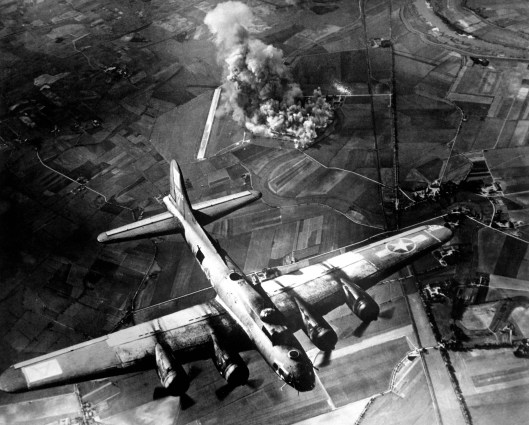
Here are, in fact, photos of the bombing of a German factory and a power station—the very sort of thing Tolkien is describing.

WAR & CONFLICT BOOK
ERA:  WORLD WAR II/WAR IN THE WEST/GERMANYCopy of RAF Blenheim V6391 After Bombing Goldenburg Power Station, Cologne

(Although, for the sake of our posting, we feel that it’s necessary to show illustrations like these, it’s hard for us to do so. In those smoke clouds are the lives of men, women, and children, with all of the loss and misery which war always brings. Yoda says, “Wars not make one great” and, when we think of the human cost, it’s hard for us to disagree. We only wish that all the violence in history was confined to adventure stories and that, in real life, people got along and there was no need ever for such awful behavior against fellow human beings.)

But why does Tolkien describe current events in such an odd way, in which the pilots of the British and US Air Forces are “disgruntled men” and their bombing raids are depicted as “the growing habit…of dynamiting factories and power-stations”? We would say that it’s because he is, in a way, turning current history around and looking at the past through it metaphorically.

The letter begins:

“My political opinions lean more and more to Anarchy (philosophically understood, meaning abolition of control not whiskered men with bombs…” (Letters, 63)

Anarchy, being about resistance to organized state control, has a very long history, both east and west. What JRRT is alluding to here is, rather, the late-19th, early 20th-century cartoon version of it—

bomb-throwing-cartoon

The real anarchists were deadly (pun intended) serious people, whose goal it was to criticize what they saw as the increasingly-intrusive top-down rule of the state and to suggest (and sometimes fight for) alternatives based upon loose associations of equals. If you know Monty Python’s Holy Grail, you’ll remember the scene in which King Arthur confronts someone who sounds at least like a Marxist, if not a full-fledged anarchist. (King Arthur and the Annoying Peasant from “Monty Python and the Holy Grail”) A central portion of the text includes this:

“WOMAN: I didn’t know we had a king. I thought that we were an autonomous collective.”

DENNIS: You’re fooling yourself. We’re living in a dictatorship…A self-perpetuating autocracy in which the working classes…”

Tolkien goes on to complain of what he believed was the growth and increasing facelessness of government, what he called the “Theyocracy” (63), but it’s clear from the later remark quoted above that what particularly disturbed him was the way in which he believed the state was involved in the ongoing Industrial Revolution, hence the focus upon “dynamiting factories and power-stations”.

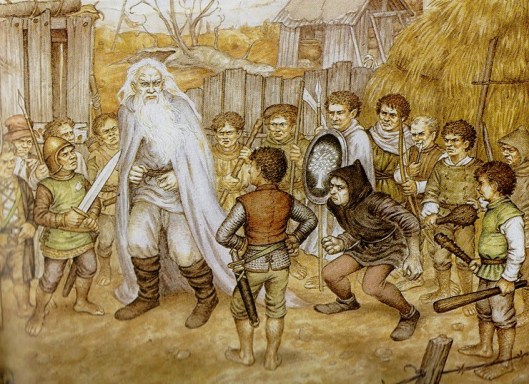
JRRT’s objections to the ruination, as he saw it, of the world of his childhood run through all of his writings, but what we always think of first is its proxy version in “The Scouring of the Shire”, with its Saruman/Sharkey boss and everything from the wanton destruction of trees and the collectivization of the population to the building of what appear to be proto-factories.

scouring_the_shire.ingeredelfeldt

And his reaction reminds us immediately of an earlier reaction to industrialization, not for aesthetic or political reasons, but for economic, that movement in early 19th-century England called “the Luddites”. The name comes from, well, there are a number of explanations, none of them being particularly believable. We know, however, that it was a secret movement of very loosely-organized groups of cloth workers, but not one large body with complex plans to overthrow the system. Perhaps as a mockery of the perception that they were such a large body, they, over time, created a mysterious “General Ludd” or even “King Ludd” to suggest that that body not only existed, but had a sinister leader.

Luddite

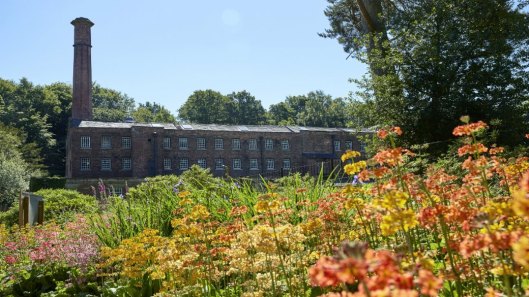
The Luddites were made up of various segments of the traditional cloth-making industries who saw their livelihoods—and even their relative freedom—being destroyed by the introduction of large, water-powered mills filled with machinery which could do their jobs not only faster, but, as machines have no need for rest, also at a production level no human could ever match. Even if the workers kept to their trades, then, the mills and their output would simply swamp them.

quarrybanktextile-mill-cotton-1834-granger

This was also the time of the beginning of the Labo(u)r Movement in Britain and the government (not surprisingly, considering where the economic influences upon it might come from) had already begun to try to block it with the Combination Acts of 1799 and 1800, which placed severe penalties on workers attempting to form unions, or “combinations”.

When people tried simply to hold peaceful public meetings, the local authorities felt so threatened that they turned soldiers on the demonstrators, as here in Manchester, in August, 1819. 11 demonstrators were killed and several hundred were injured.

peterloo1

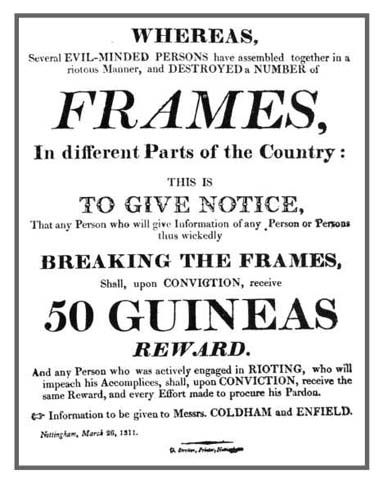
So much for peaceful demonstrations. The Luddites, seeing the attitude of the government, began to attack the mills and warehouses, as these posters show—

Radcliffe Arson Reward Poster, 21st March 1812 copyOates Wood Smithson & Dickinson Carr reward poster, 25th March 1812Cttee to Supress Outrages reward poster copyawsomne

as well as the machines themselves.

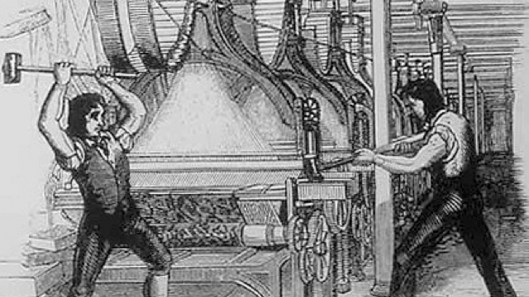
luddites1

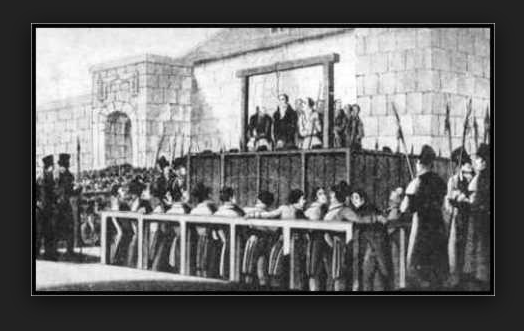
Faced with the government, its laws, and its enforcement—which could even mean executing people, as was done at York in 1813—

executionofludditesatyork1813

the Luddites were a short-lived movement and had disappeared by about 1816.

Their idea about turning back the effects of the Industrial Revolution by violent means—at least in fantasy—however, clearly was still available, at least to JRRT in 1943.

Thanks, as always, for reading.

MTCIDC

CD

Stepping Westward

10 Wednesday Aug 2016

Posted by Ollamh in Artists and Illustrators, Fairy Tales and Myths, Imaginary History, J.R.R. Tolkien, Literary History, Narnia, Narrative Methods

≈ Leave a comment

Tags

Aman, Beliefs, Bran, cult statues, heroa, immrama, Istari, Ithaka, Mael Duin, Middle-earth, monotheistic, N.C. Wyeth, Odysseus, religion, Rip Van Winkle, Saint Brendan, Saruman, shrines, Stone Table, temples, The Grey Havens, The Lord of the Rings, The Odyssey, Tireisias, Tolkien, Valar, Valinor, ziggurats

Dear readers, welcome as always.

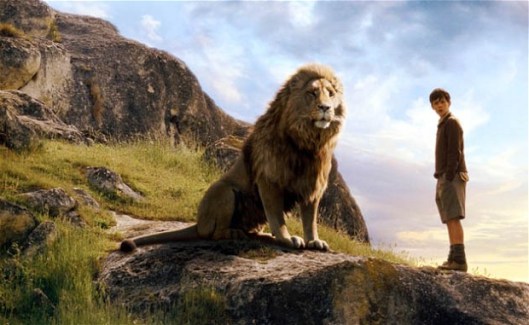
Although there are no temples or shrines to him (the closest thing is perhaps the Stone Table),

narnia stone table

Aslan

1653963a

is clearly someone with divine powers and his influence is felt directly and indirectly throughout all of the Narnia books.

JRRT once said that Middle-earth had a monotheistic religion, but the traces, as has been written about more than once, are almost invisible.

There are no ziggurats,

Ancient_ziggurat_at_Ali_Air_Base_Iraq_2005

no temples,

templeofheraselinus

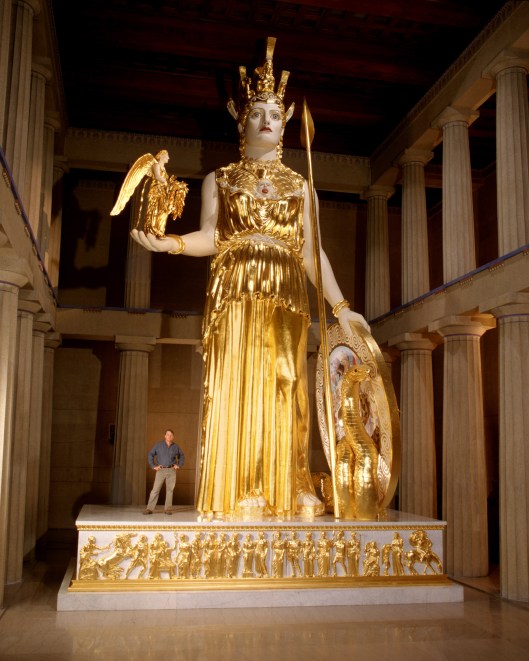
no cult statues

Athena_Parthenos_LeQuire

no shrines

97_full

no heroa (shrines for demi-gods or heroes).

heroon

The Valar are mentioned once (some of Faramir’s men call on them to protect them from a mumak), of course, and there is that ceremony of standing and looking west before a meal.

That idea of looking west has long interested us, mainly because, in much of western tradition before the Age of Exploration, the west was looked upon as a place of uncertainty, if not outright fear.

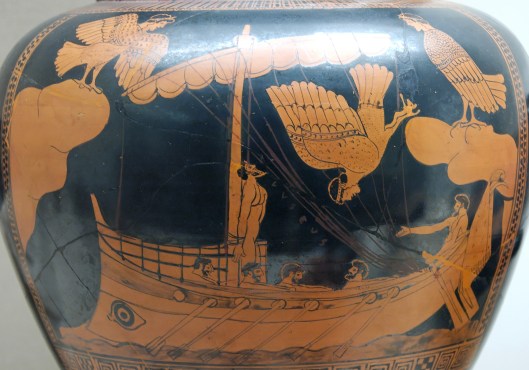
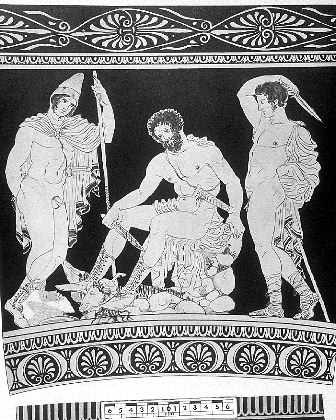
Although Odysseus, in Odyssey 9, is careful to point out that his home island, Ithaka, lies farthest towards dusk in its island group, in Odyssey 11, in the far west lies the Land of the Dead,

lykaon-painter-odysseus-and-elpenor

to which Odysseus sails

Odysseus_Sirens_BM_E440_n2

to consult the seer, Tireisias,

Teir.1993.01.0348

on the way to get home. This is, then, hardly a choice direction in which to sail, for all that Tireisias does provide some guidance.

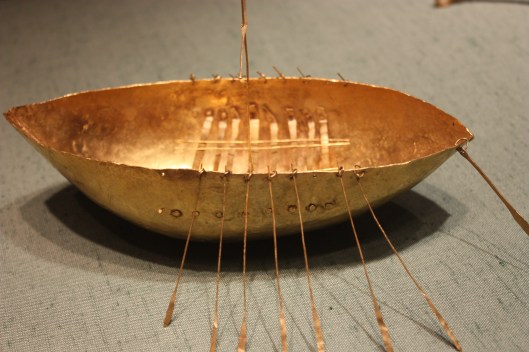
The same is true for a series of stories about immrama, “voyages” (literally “rowings around”) in Old Irish, not only secular stories, like those of Mael Duin

mailduin

and Bran,

Broighter_Gold,_Dublin,_October_2010_(03)

but a famous religious one about Saint Brendan.

brendan

In each of these stories, sailing westward commonly means sailing rather haphazardly among sea monsters and islands with strange people or creatures. There is also the possibility of time distortion: the voyager believes himself gone in terms of a few years, at most, when, instead, he may have been gone for much longer (as in Washington Irving’s short story, “Rip Van Winkle”, in which Rip, falling asleep in the Catskill Mountains after drinking with the ghosts of the crew of the explorer Henrik Hudson’s ship The Half Moon, thinks that he has been gone only overnight when, instead, he’s been gone for twenty years.)

rip-van-winkle.wyeth

(by one of our all-time favorite illustrators, N.C. Wyeth, from his Rip Van Winkle, 1921—the whole work is available, with all of its wonderful illustrations, to download for free at the Internet Archive, may their beards grow long!)

“To go west”, probably based upon the idea of the sinking sun, as an older English expression has the meaning of “to die/to fail catastrophically” (now people in the US seem to be replacing it with “to go south”, which has none of the older resonance, unfortunately), but it ties in very nicely with these older beliefs about what lies west of Europe, so full of danger and mystery.

But then we come back to that looking west.

In the belief system of Middle-earth, westward across the sea lies the continent of Aman, and on that continent is Valinor, home of the Valar, those powerful and immortal beings who are perhaps to be likened to the archangels of Christian belief—with a bit of patron saint and even Norse and Greco-Roman pantheons thrown in. (We admit to having a very shallow knowledge of Arda theology, being less interested in the finer points of belief than in the adventures and the cultures and the languages of Middle-earth.)

The Istari, the five wizards are from there and it’s for us one of the most melancholy moments when, after his murder by Grima, it is clear that Saruman is denied a return.

jwyatt-sarumande

Gandalf, however, is permitted to return, as are Bilbo and Frodo (and, in time, Sam, apparently), all part of the defeat and disembodiment of Sauron.

greyhavens

The elves are also allowed to make the voyage to Aman, although they have their own separate place there, and, when Gandalf leaves, so do Galadriel, Celeborn, and Elrond, part of a slow general leave-taking of the Elves.

No human is admitted however, to the Undying Lands, as they are called, and it occurred to us that perhaps, in that fact, the mortals of Middle-earth are closer to Saruman than to Gandalf or the Elves:

“To the dismay of those that stood by, about the body of Saruman a grey mist gathered, and rising slowly to a great height like smoke from a fire, as a pale, shrouded figure it loomed over the Hill. For a moment it wavered, looking to the West; but out of the West came a cold wind, and it bent away, and with a sigh dissolved into nothing.” (The Return of the King, Book 6, Chapter 8, “The Scouring of the Shire”)

Could that ceremony of looking westward also be done with a sigh, an acknowledgement that there are no undying lands for them?

What do you think, dear readers?

Thanks, as ever, for reading.

MTCIDC

CD

Ps

This, for us, is a rather historical posting, being our Number 100. By earlier September, we will have reached 104, making exactly two years since we began our blog. We thank you for reading, hope that you will continue to do so, that you will share our work among your friends and that, in the future, you will be willing to share your thoughts with us, as we always encourage you to do.


Nought’s had, all’s spent

03 Wednesday Aug 2016

Posted by Ollamh in J.R.R. Tolkien, Literary History, Narrative Methods, Theatre and Performance, Villains

≈ Leave a comment

Tags

A Shadow of the Past, Birnam Wood, Eowyn, Fangorn Forest, Gandalf, Gondor, Isengard, Istari, King Duncan, Lady Macbeth, Macbeth, Macduff, Orthanc, Palantir, Saruman, Sauron, Shakespeare, The Lord of the Rings, The Weird Sisters, The Witch-King, Tolkien

4acce62d6b1154ae5fdb5272434de3be.jpg

In “The Shadow of the Past,” Gandalf, giving Frodo backstory of the Ring, makes a confession:

“I might perhaps have consulted Saruman the White, but something always held me back.”

“Who is he?” asked Frodo. “I have never heard of him before.”

“Maybe not,” answered Gandalf. “Hobbits are, or were, no concern of his. Yet he is great among the Wise. He is the chief of my order and the head of the Council. His knowledge is deep, but his pride had grown with it, and he takes ill any meddling. The lore of the Elven-rings, great and small, is his province. He has long studied it, seeking the lost secrets of their making; but when the Rings were debated in the Council, all that he would reveal  to us of his ring-lore told against my fears. So my doubt slept– but uneasily. Still I watched and I waited.” (The Lord of the Rings, The Fellowship of the Ring, Book 1, Chapter 2, “The Shadow of the Past”)

In terms of the spiritual life and safety of Middle-earth, Gandalf’s confession foreshadows much evil to come. Both Gandalf and Saruman are Istari, one of a group of five divine beings sent specifically to counteract the activities of Sauron.

istari.jpg

Gandalf suspects that “the chief of my order and the head of the Council” is false, and his suspicion will prove to be true, but what has happened to Saruman? Gandalf suggests that it has something to do with the ring, but, in fact, the ring is only emblematic of the real problem: the lure of control.

Here is Saruman attempting to seduce Gandalf into joining him:

“I said we, for we it may be, if you will join with me. A new Power is rising. Against it the old allies and policies will not avail us at all. There is no hope left in Elves or dying Numenor. This then is one choice before you, before us. We may join with that Power. It would be wise, Gandalf. There is hope that way. Its victory is at hand; and there will be rich reward for those that aided it. As the Power grows, its proved friends will also grow; and the Wise, such as you and I may with patience come at last to direct its courses, to control it.” (The Lord of the Rings, The Fellowship of the Ring, Book 2, Chapter 2, “The Council of Elrond”)

Instead of fulfilling his role as a counter-balance to Sauron, Saruman proposes first to control Sauron, and then even to become Sauron. As Saruman says, “Why not? The Ruling Ring? If we could command that, then the Power would pass to us.” (The Lord of the Rings, The Fellowship of the Ring, Book 2, Chapter 2, “The Council of Elrond”)  This use of the first person plural pronoun is not convincing:

“Saruman,” I said, standing away from him, “only one hand at a time can wield the One, and you know that well, so do not trouble to say we.” (The Lord of the Rings, The Fellowship of the Ring, Book 2, Chapter 2, “The Council of Elrond”)

But what is it which Saruman wants to do with that ring?

“We can bide our time, we can keep our thoughts in our hearts, deploring maybe evils done by the way, but approving the high and ultimate purpose:  Knowledge, Rule, Order; all the things that we have so far striven in vain to accomplish, hindered rather than helped by our weak or idle friends.  There need not be, there would not be, any real change in our designs, only in our means.”  (The Lord of the Rings, The Fellowship of the Ring, Book 2, Chapter 2, “The Council of Elrond”)

Knowledge, rule, order?  We immediately want to know, knowledge of what, and who is ruling whom, with what order?   And the answers are all the same:  Saruman’s knowledge,  Saruman’s rule, Saruman’s order.  But what has happened to Saruman to so turn him away from the purpose for which he was sent?

Saruman’s headquarters are at Orthanc, a tower set in a stone circle at Isengard.

orthanc.jpgOriginally, this had been the site of a Gondorian strongpoint, but, as Gondor waned, it fell into disuse until taken over by Saruman with the permission of the Steward of Gondor, Beren. When we think of wizards, we imagine them as wanderers, like Gandalf and Radagast, and even more so, the two Blue wizards who have wandered so far as to have disappeared almost entirely from the history of Middle-earth. Could the very fact that Saruman would want a permanent base have been a hint that his plans went beyond the directive he had received in Valinor?

And there is worse to come. Within Orthanc, Saruman has discovered a Palantir, a far-seeing stone of Numenor.

saruman_palantir.jpg

Who else might have one of these stones? Unfortunately, one of them is in the hands of Sauron.

palantir1.jpg

And the seduction of Gandalf began with the seduction of Saruman, as Gandalf says:

“Saruman…I have heard speeches of this kind before, but only in the mouths of emissaries sent from Mordor to deceive the ignorant.” (The Lord of the Rings, The Fellowship of the Ring, Book 2, Chapter 2, “The Council of Elrond”)

This figure for good being drawn away from the proper path reminded us of a similar situation in Shakespeare. Macbeth has been a successful general for Duncan, the king of Scotland. For his latest victory, he has been well-rewarded by the king, but just as in the case of Saruman, there is some part of him which wants more. Thus, when, after the battle, he and a companion meet three strange women on the edge of the battlefield, their prophetic words touch him in a place perhaps untouched before, but there.

MacbethAndBanquo-Witches

They first hail him by titles King Duncan has yet to give him–but will.  Then they hail him as King of Scotland itself, and his corruption begins.  It may have gone no farther than unquiet dreams had there not be a second element in his seduction:  his wife.

Ellen-Terry-as-Lady-Macbeth-by-John-Singer-Sargent-1889

It is she who completes what these three strange women began, not only nurturing Macbeth’s ambition, but even planning the murder of King Duncan.

Lady_Macbeth_CattermoleLike Saruman, Macbeth is overcome, gives in, murders Duncan, seizes power, but, also like Saruman, can not retain it and, interestingly, an element in his defeat closely resembles an element in Saruman’s defeat:  trees.

As his reign suffers resistance and becomes bloodier and more confused, Macbeth sees a series of apparitions, including one which reassures him–or so he thinks–that

“Be lion-mettled, proud, and take no care
Who chafes, who frets, or where conspirers are.
Macbeth shall never vanquished be until
Great Birnam Wood to high Dunsinane Hill
Shall come against him.” (Macbeth, 4.1.94-98)
But his enemies, to disguise their numbers and movements, camouflage themselves with foliage from Birnam Wood,
 Scan-100518-0011
Macbeth’s fortress is successfully taken, and Macbeth is killed in battle, his head taken by an avenging enemy, Macduff.
 macduff-wit-macbeth-head-jpg

Where Macbeth has had Birnam Wood, Saruman suffers from the Forest of Fangorn–

Tolkien, Nasmith, painting, illustration, Lord of the Rings, Silmarillion, Hobbit, Middle-earth

The Wrath of the Ents, by Ted Nasmith

(We would add one more Macbeth parallel for The Lord of the Rings.  Another seemingly reassuring apparition has told Macbeth that he can only be killed by a very special person:

“Be bloody, bold, and resolute. Laugh to scorn
The power of man, for none of woman born
Shall harm Macbeth.” (Macbeth, 4.1.81-83)
That person turns out to be Macduff, born from a Caesarian section.
Do we need to remind our readers of what Eowyn says in reply to the Witch-king’s “Hinder me?  Thou fool.  No living man may hinder me!”)
eowyn.nazgul

After the fall of Isengard, Saruman is imprisoned in his own tower.  During his imprisonment, he is deprived of the Palantir, but Sauron’s seduction has been thorough and, even when offered another chance, there will be nothing left for him in the future but being a petty spoiler and then the victim of his own slave, someone he had once seduced.

jwyatt-sarumande

Thanks, as always, for reading.

MTCIDC

CD

A Country for Old Men—and Old Men for a Country

11 Wednesday May 2016

Posted by Ollamh in Fairy Tales and Myths, J.R.R. Tolkien, Literary History

≈ Leave a comment

Tags

Apollonius, Aragorn, Argo, Blue Wizards, Denethor, Faramir, Gandalf and the Balrog, Grey Havens, Heracles, Hildebrandts, Hylas, Istari, Jason and the Golden Fleece, Merlin, Radaghast, sage, Saint Nicholas, Saruman, Sharkey, The Argonautica, The Fantastic Four, The Lord of the Rings, Theoden, Tiresias, Tolkien, Valar, W.B.Yeats

Dear readers, welcome, as always.

Recently, we wrote a posting about Saruman and his fate. It was fun to think about, but it made us think further about why Saruman, in the Shire, is called “Sharkey” by his thugs—supposedly from Orcish sharku, “Old Man”. If we had never read a description of Saruman, but only the nickname, we might think of “the old man” either as an older Anglo-American expression either for a father—“my old man keeps nagging me about cutting the grass, if I want my allowance” (note the use of the possessive “my”)—a naval/military term for commander—“the old man said that, on his ship, smoking would never be allowed again” (always without the possessive)—or older English for husband—“her old man is fooling around behind her back—I hope she turns around!” (again, with a possessive).

In fact, Saruman is, literally, an old man

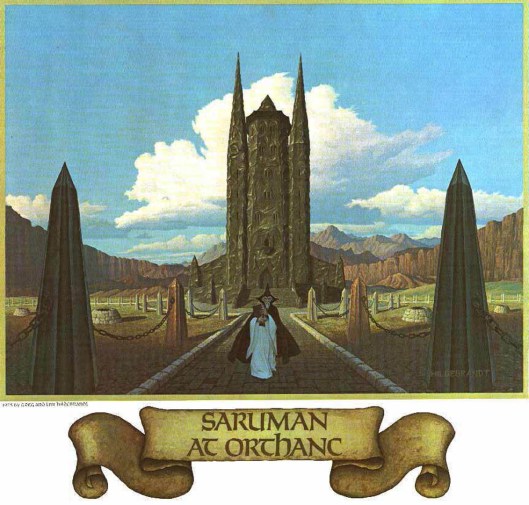
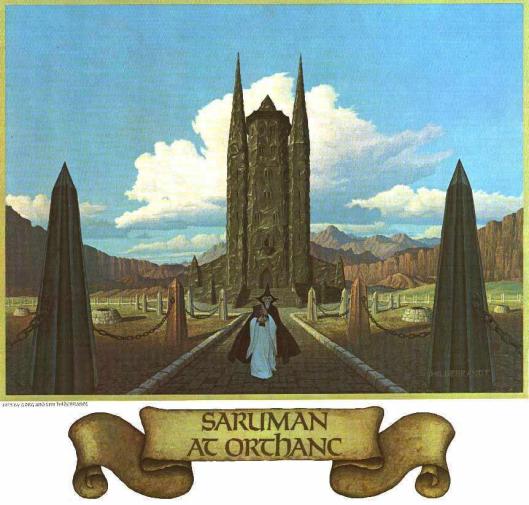
greg-hildebrandt-isengard-orthanc-saruman-607429-1300x962.jpg

—as are all five of the Istari, the wizards sent to Middle-earth by the Valar about the year 1000 of the Third Age. As JRRT says in a letter to Robert Murray, S.J. (there’s a surviving draft on pages 200-207 of The Letters of J.R.R. Tolkien):

“They are actually emissaries from the True West, and so mediately from God, sent precisely to strengthen the resistance of the ‘good’, when the Valar become aware that the shadow of Sauron is taking shape again.” Letters, 207

He further explains their role:

“At this point in the fabulous history the purpose was precisely to limit and hinder their exhibition of ‘power’ on the physical plane, and so that they should do what they were primarily sent for: train, advise, instruct, arouse the hearts and minds of those threatened by Sauron to a resistance with their own strengths; and not just to do the job for them.” 202

JRRT could have chosen a different path, of course, and created a plot in which there was constant, open war between the wizards and Sauron, and there is mention of war of some sort, as, during the time of The Hobbit, the White Council drives “the Necromancer” out of Dol Goldur in the southern part of Mirkwood. It’s not said how, but no army is mentioned, so we presume that it was done by magic against magic (on the subject of magic, see JRRT in the letter previous to the one to Murray, Letters, 199-200).

We wonder if, in choosing to limit the wizards’ power, Tolkien made the same choice which Apollonius of Rhodes (3rd century BC) made in his version of the story of Jason and the Golden Fleece, The Argonautica. If you don’t know this story, the shortest way to explain it is to say that Jason’s wicked uncle has stolen the throne which rightfully belongs to Jason and, in an effort to make Jason disappear, his uncle has sent him off on what he hoped was a suicide mission. That mission was to bring back a magical golden fleece from the far side of the Black Sea (at the time, this would have been like a mission to Mars). To help him, Jason summons heroes from across the Greek world.

Unfortunately for Apollonius, the traditional story on which his epic is based had, over time, gradually come to include every hero from ancient Greece on Argo,

The_Argo.jpg

This means that Heracles had to be asked to join, but there is a big difficulty in including Heracles: he’s so powerful that he could do the job all by himself.

Krater_Niobid_Painter_A_Louvre_G341.jpg

Apollonius was extremely scrupulous, as far as we can tell, in following tradition, so he finds a way out. He puts Heracles’ bff, Hylas, on board the ship, then, at a watering spot, has the boy lured away by some randy water nymphs.

hylas_and_the_nymphs.waterhouse1896.jpg

When Heracles goes off to find the boy, the ship leaves without him and the problem is solved. (Although Apollonius chooses to ignore the fact that the ship is still absolutely crammed with the ancient equivalent of The Fantastic Four. We suppose that, for him, Heracles was the only really major hero.)

fantasticfour.png

Thus, we can imagine that Tolkien, believing that he could create a more interesting (and longer?) story without too much magic, has, in general, limited the wizards not in their power, but in the use of it. (There are exceptions, of course—we immediately think of Gandalf and the Balrog, for instance.)

balroggandalf.jpg

The wizards do not just have the shape of men, however, but old men—“Thus they appeared as ‘old’ sage figures” (Letters, 202).

The word “sage” here is definitely one element in Tolkien’s choice for his characters. There is a world-wide tradition that old men are wise men—think of the ancient Greek seer Tiresias, for example—

Johann_Heinrich_Füssli_tiresias.jpg

or the Arthurian Merlin

vivien-and-merlin-by-gustave-dore-cc.jpg

or Father Christmas/Santa Claus.

FatherChristmas.JPG

We wonder whether there might also be the idea that, dramatically, older rulers, like Theoden

theoden.jpg

And Denethor

hildebrandtdenethor.jpg

might be more inclined to listen to such a person (although we notice that the corrupted Denethor is less than willing).

And, that younger men like Aragorn

Image result for hildebrandts aragorn

and Faramir

Tim Hildebrandt - Faramir rencontre Frodon et Sam (2).jpg

would see them as mentors.

kingreturn.jpg

And, as the Istari have been sent by the Valar, the last act on Gandalf’s part, as depicted in this Hildebrandt twins’ painting, has special significance, suggesting that, Aragorn has been given the throne with divine approval and, with his crowning, Sauron has been completely defeated and balance has been restored, even if only temporarily, to Middle-earth.

When this has been accomplished, Gandalf is then allowed to “retire”, as we seem to expect old men to do in our world (and as Tolkien himself did, in 1959), going to the Grey Havens and a final journey back to the West.

greg_tim_hildebrandt_at_the_grey_havens.jpg

We hear nothing more of Radagast and the two so-called “Blue Wizards”, but, Saruman also leaves Middle-earth—though not in Gandalf’s gentle way. And perhaps his end, shabby and disgraced, also shows a kind of divine approval: those given power must not abuse it, for the consequences not only to the world around them, but to them, can be fatal.

Thanks, as always, for reading.

MTCIDC

CD


PS

Our title is an adaptation of the first line of W.B. Yeats’ gorgeous poem, Sailing to Byzantium (first published in 1928). Although it has nothing to do with Middle-earth, it does depict a strange, magical place.

wby.jpg

Beaux Gestes? (2)

27 Wednesday Apr 2016

Posted by Ollamh in Artists and Illustrators, Fairy Tales and Myths, J.R.R. Tolkien, Villains

≈ 1 Comment

Tags

19th-century tombs, Cicero, Galadriel, Gandalf, Grey Havens, Hildebrandts, Istari, Mourning, Queen Victoria, Quintilian, Saruman, Scouring of the Shire, The Lord of the Rings, The Mirror of Galadriel, Theatrical gesture, Tolkien, Valar

Welcome, as always, dear readers.

In our last, we commenced a small examination of gesture in The Lord of the Rings, relating specifically to Galadriel and Saruman. We began with Galadriel

galadriel.jpg

and her rejection of Sauron. JRRT describes it in this way: “She lifted up her white arms, and spread out her hands towards the East in a gesture of rejection and denial.” In that post, we said that her gesture seemed theatrical, almost melodramatic, and we suggested that JRRT had been influenced by what we imagined he had seen on stage and on screen late in the 19th and into the 20th centuries, a time when such broad gestures were still considered the best way to convey strong emotion. This mode was, we proposed, ultimately based upon the writings of two ancient Romans, Cicero and Quintilian, who lived between the years 100BC and 100AD. In their day and up to the 20th century, the only magnification available to allow speakers to be heard over crowds was the human voice. Thus, a range of gestures emphatic enough to be seen and clear enough to be understood at a distance was an important component of effective speaking and such gestures were adopted and adapted by actors and used and reused for many centuries to come.

Because none of the illustrations based upon “The Mirror of Galadriel” depicts this gesture, we used a photograph from an 1898 book on public speaking to provide the sense of what we believe we were meant to see.

Repulsion.jpg

In our last, we also suggested that Galadriel’s gesture was linked to one of Saruman’s—in fact, his last gesture on Middle Earth, as far as we know.

In sudden resentment at the contemptuous treatment consistently dealt him by Saruman, Grima Wormtongue has drawn a hidden knife and cut the wizard’s throat.

“To the dismay of those that stood by, about the body of Saruman a grey mist gathered, and rising slowly to a great height like smoke from a fire, as a pale shrouded figure it loomed over the Hill. For a moment it wavered, looking to the West; but out of the West came a cold wind, and it bent away, and with a sigh dissolved into nothing.” The Lord of the Rings, Book 6, Chapter viii.

jwyatt-sarumande.jpg

Saruman had been one of the Istari, as Tolkien describes them all in describing Gandalf:

“There are naturally no precise modern terms to say what he was. I wd. venture to say that he was an incarnate ‘angel’—strictly an angelos: that is, with the other Istari, wizards, ‘those who know’, an emissary from the Lords of the West, sent to Middle-earth, as the great crisis of Sauron loomed on the horizon. By ‘incarnate’ I mean they were embodied in physical bodies capable of pain, and weariness, and of afflicting the spirit with physical fear, and of being ‘killed’, though supported by the angelic spirit they might endure long, and only show slowly the wearing of care and labour.” Letter to Robert Murray, S.J. (draft), 4 November, 1954.

Saruman, then, as another of the Istari, can be killed—and is, but what then? In his battle with the Balrog, it appears that Gandalf has met his end. He returns, however, suggesting that his physical body might be capable of the repair which Galadriel administers in Lorien.  As JRRT says in the same letter, “He was sent by a mere prudent plan of the angelic Valar or governors; but Authority had taken up this plan and enlarged it, at the moment of its failure.”—that is, Gandalf’s apparent death.

As Gandalf puts it, “I was the enemy of Sauron”, and, with Sauron defeated, apparently conclusively, Gandalf is allowed to return to the West, to do or be what, is never explained.   It is a privilege, clearly, since it is granted only to High Elves and, with special dispensation, to Bilbo and Frodo.

This brings us back to Saruman’s gesture: “For a moment it wavered, looking to the West; but out of the West came a cold wind, and it bent away, and with a sigh dissolved into nothing.”

In a way, what we see here is actually a lack of gesture—it is a wavering, with a sense of hope, perhaps? Almost as if Saruman is appealing for pardon? As in the case, of Galadriel, we have no artist’s depiction of this, but we’ve used the clue of “a pale shrouded figure”, as well as that wavering, to imagine that this is someone in mourning and so we can offer several figures from later 19th-century tombs as a possible image.

d5717eeaa95186cd2e3d95447d215e2f.jpgp1140386.jpg

Statue-to-Mourning-Zentralfriedhof-Vienna.jpg

It’s interesting that these all are female, as if this is one of the expected jobs of 19th-century women, to be the Mourners in Chief. We suppose that, since Queen Victoria mourned for her husband Albert from his death in 1861 to her own death in 1901, this shouldn’t be surprising, but we are planning a later posting about mourning in The Lord of the Rings which will examine the subject within certain western traditions in more depth.

Queen-Victoria-Her-Latest-Portrait-1900_tr_4643_566.jpg

In the meantime, we return to Galadriel to match these two gestures. Saruman had failed because he had accepted the East and the deceptive words of Sauron. His fate, then, is to be met with a cold wind and to dissolve, with a sigh, into nothing, rejected by the West from which he had been sent, several thousand years before. Galadriel, on the other hand, by protecting her people and rejecting Sauron, had been accepted back into the West and the last we see of her is aboard a ship at the Grey Havens, bound for her reward.

ghavens.jpg

Thanks for reading, as always.

MTCIDC

CD

PS

We couldn’t resist this final image: the Hildebrandts with the painting.

haven-c.jpg

For all of the wonderful paintings he and his brother have given us, may Tim Hildebrandt (1939-2006) have been given a safe passage to the West, as well.


Knowledge, Rule, Order

06 Wednesday Jan 2016

Posted by Ollamh in Fairy Tales and Myths, Imaginary History, J.R.R. Tolkien, Military History, Military History of Middle-earth, Narrative Methods

≈ 2 Comments

Tags

Adolf Hitler, Anduin, Benedict Cumberbatch, Benito Mussolini, British Government, Charlie Chaplin, dictatorships, England, Gandalf, George V, Germany, Gondor, gothic script, Government, History, India, Isengard, Kaiser Willhelm II, Lenin, Mehmed VI, Middle-earth, monarchs, Mordor, Nazis, newsreel, Numenor, Ottoman Empire, Oz, Peter Jackson, Queen Mary, Queen Victoria, Rohan, Saruman, Sauron, Scott, Smaug, Stalin, Stock Market Crash of 1929, Sultan, The Great Dictator, The Lord of the Rings, Tolkien, Treaty of Versailles, Valar, Victoria Louise, Weimar Republic, William Morris, Writing

Dear Readers,

Welcome, as always.

Have you ever wondered what Middle Earth would have been like if the Fourth Age had begun on a calendar written by Sauron?

That of the Third Age was hardly a democratic paradise: a king rules Rohan, a stand-in for king rules Gondor. Elrond and Celeborn/Galadriel behave and are treated like royalty and Thranduil, as we learn from The Hobbit, is the king of Mirkwood. The dwarves have hereditary rulers.   Only the outliers—communities like Bree and the Shire and the earlier inhabitants like Tom Bombadil and Fangorn—appear to be completely independent. (The Shire even has elections and a mayor, although the actual government, except for the shire reeves, appears to bemostly token—you wonder who’s running their seemingly-efficient postal service.)

This is not surprising, not only for an author born during the later years of Victoria,

queenvic.jpg

but also for someone powerfully influenced by the medievalist interests of everyone from Scott

Sir_William_Allan_-_Sir_Walter_Scott,_1771_-_1832._Novelist_and_poet_-_Google_Art_Project.jpg

to William Morris.

William_Morris_age_53.jpg

(We might add that the world of fairy tales, full of princes and princesses, queens and kings, was also a powerful influence at the time—and not only on story-tellers born in monarchies—after all, even Oz is ruled by a queen—

OzmaOz.jpg

Yet, after Smaug—who could better be a medieval fantasy villain (especially with the voice of the incomparable Benedict Cumberbatch attached)?

p8204516_n279079_cc_v4_aa.jpg

—something changed in Tolkien’s world. In fact, something changed in the whole outside world. With the end of World War One, monarchs toppled all over Europe and beyond, from:

Kaiser Wilhelm II of Germany

KAISER-WILHELM_2994889b.jpg

to Mehmed VI, last Sultan of the Ottoman Empire.

mehmed6.jpg

In place of the former, there appeared the always-troubled Weimar Republic, full of good intentions, but badly crippled, not only by the war which had sapped its manpower and resources, but by all kinds of social unrest and then by the Crash of 1929, which notoriously destroyed the value of its currency.

weimar currency.jpg

As early as 1919, there had been clashes among the forces of different ideologies—

CombatesEnBerlín19190903.jpg

And, amidst all of the unrest, there was a failed coup attempt in 1923 by the man in the overcoat in this picture.

Bundesarchiv_Bild_102-00344A,_München,_nach_Hitler-Ludendorff_Prozess.jpg

He, of course, was only following the footsteps of this man, who had pushed his way into power the year before—

March_on_Rome.jpg

to be followed, in turn, by the man on the left, from the mid-1920s.

stalinandfriends.jpg

That first man, having failed at obvious violence, tried again through more complicated means (although still employing violence, if it suited his purposes) and succeeded in 1933.

Hitler-Papen-First-Reichstag-1933.jpg

He was, so we are told, a riveting public speaker, but, if the newsreels we’ve seen are evidence, we guess you would have had to have been there.

hitlerspeaking.jpg

Some people thought the style exaggerated in the 1930s and caricatured it even then.

chaplin2.jpg

He had a definite social agenda, which he outlined at length and often, although concealing certain of the most horrible aspects. And he liked big words and big concepts, like:

einfolk.jpg

It would have been impossible for someone as intelligent and generally well-informed as Tolkien not to have been very much aware of this man and all of the other like men, busy oppressing as much of the world as they could. And this would have been especially true in a time when radio and film were changing how people received news—and how those interested in influencing others might shape what people saw. As early as 1911, the British government was using newsreel film to show the might and reach of its empire (2/5 of the globe was in their hands) when the king, George V, and his wife, Queen Mary, visited India.

Delhi_Durbar,_1911.jpg

Not to be outdone, Kaiser Wilhelm II encouraged a grand—and filmed–event in 1913, for the wedding of his daughter, Victoria Louise—and some of the film was even in color.

vlouisekaiser.jpg

The Marriage of Victoria Louise Color Film

It would be easy to imagine, then, that the weight of such public figures might have influenced Tolkien in his depiction of late-3rd-Age villains. We can see it in Saruman’s unsuccessful attempt to persuade Gandalf to join him:

“ ‘He drew himself up then and began to declaim, as if he were making a speech long rehearsed. ‘The Elder Days are gone. The Middle Days are passing. The Younger Days are beginning. The time of the Elves is over, but our time is at hand: the world of Men, which we must rule. But we must have power, power to order all things as we will, for that good which only the Wise can see.” (The Fellowship of the Ring, Chapter 2, “The Council of Elrond”)

Thus, unlike the script of Jackson’s version, there is no plan to wipe out men and replace them with orcs. Instead, men are to survive: to be ruled—perhaps under what definitely sounds like it should be a translation from something written in Fraktur—the fake Gothic script favored by the Nazis–

die-schöne-deutsche-Schrift-detail1.jpg

“ ‘We can bide our time,’” says Saruman, “ ‘we can keep our thoughts in our hearts, deploring maybe evils done by the way, but approving the high and ultimate purpose: Knowledge, Rule, Order; all the things that we have so far striven in vain to accomplish…’ ”

Such abstract, but somehow menacing, words sound like a translation of something from Hitler’s Germany: Kenntnisse, Herrschaft, Ordnung. They do not sound in the least like Gandalf’s goals, ever, and he, in fact, replies by implying that not only are they not really Saruman’s words, but that Saruman is foolish for believing them:

“ ‘Saruman,’ I said, ‘I have heard speeches of this kind before, but only in the mouths of emissaries sent from Mordor to deceive the ignorant.’ “

As really the words of Sauron, however, they give us an idea of what to expect in a world under his control. Knowledge would be for Sauron alone, we suppose, perhaps after regaining his lost ring? Certainly he wouldn’t share it with Saruman, whom, it will become clear, he never trusted. As for Rule and Order, the world would be a place full of rules and those watching that they be obeyed. And here we can remember Sharkey’s Shire, with its “by order of the Chief” signs—and its gangs of human enforcers. As well, we can think of its grey, industrial character, as we’ve discussed in a previous post, a universal Mordor, devoted to production. To this, we can add the Mouth of Sauron’s recitation of surrender conditions, delivered to the allies before the Morannon:

“ ‘These are the terms…The rabble of Gondor and its deluded allies shall withdraw at once beyond the Anduin, first taking oaths never again to assail Sauron the Great in arms, open or secret. All lands east of the Anduin shall be Sauron’s for ever, solely. West of the Anduin as far as the Gap of Rohan shall be tributary to Mordor, and men there shall bear no weapons, but shall have leave to govern their own affairs. But they shall help to rebuild Isengard which they have wantonly destroyed, and that shall be Sauron’s, and there his lieutenant shall dwell: not Saruman, but one more worthy of trust.’ “ (The Return of the King, Chapter 10, “The Black Gate Opens”)

In keeping with the influence of current events in this world, we might see this as being a parallel with the 1919 Versailles Treaty, in which Germany was to be forced to make huge territorial concessions, to disarm almost entirely, and to pay massive amounts in reparation to the victorious allies.

Treaty_of_Versailles,_English_version.jpg

The Treaty of Versailles– Wiki Article

Such terms as Sauron offers would also destroy Rohan as an ally and set up a permanent garrison between it and the north. We might also expect the restored Isengard to be a staging area for an assault upon Fangorn and the ents, to their ultimate destruction. As well, “west of the Anduin” is a very vague expression—does it include Gondor, as well as Rohan?

Religion in The Lord of the Rings has always been the subject of debate: how much or how little? Of what kind? Tolkien is quoted as saying that it was monotheistic, although, when attacked by the Mumak, Faramir’s men called on the (plural) Valar. There is no mention, in what is often extremely detailed landscape description, of any kind of temple or shrine, however. Nevertheless, we would like to conclude with an eerie thought about religion in this alternative Fourth Age. The Mouth of Sauron, aka, The Lieutenant of the Tower of Barad-dur, is described as:

“…a renegade, who came of the race of those that are named the Black Numenoreans; for they established their dwellings in Middle-earth during the years of Sauron’s domination, and they worshipped him, being enamoured of evil knowledge.”

Could we imagine that, in this other Fourth Age, a new and horrible religion might have appeared, one dedicated to the worship of Sauron—and to that Knowledge which Saruman finds so important? What do you think, dear readers?

As always, thanks for reading.

MTCIDC

CD

← Older posts
Newer posts →

The Doubtful Sea Series Facebook Page

The Doubtful Sea Series Facebook Page

  • Ollamh

Categories

  • Artists and Illustrators
  • Economics in Middle-earth
  • Fairy Tales and Myths
  • Films and Music
  • Games
  • Heroes
  • Imaginary History
  • J.R.R. Tolkien
  • Language
  • Literary History
  • Maps
  • Medieval Russia
  • Military History
  • Military History of Middle-earth
  • Narnia
  • Narrative Methods
  • Poetry
  • Research
  • Star Wars
  • Terra Australis
  • The Rohirrim
  • Theatre and Performance
  • Tolkien
  • Uncategorized
  • Villains
  • Writing as Collaborators
Follow doubtfulsea on WordPress.com

Across the Doubtful Sea

Recent Postings

  • Towering January 28, 2026
  • Tolkien Among the Indians January 21, 2026
  • Thin and Stretched January 14, 2026
  • Through a glass… January 7, 2026
  • Heffalumps? December 31, 2025
  • We Three Kings December 24, 2025
  • A Moon disfigured December 17, 2025
  • On the Roads Again—Once More December 10, 2025
  • (Not) Crossing Bridges December 3, 2025

Blog Statistics

  • 105,543 Views

Posting Archive

  • January 2026 (4)
  • December 2025 (5)
  • November 2025 (4)
  • October 2025 (5)
  • September 2025 (4)
  • August 2025 (4)
  • July 2025 (5)
  • June 2025 (4)
  • May 2025 (4)
  • April 2025 (5)
  • March 2025 (4)
  • February 2025 (4)
  • January 2025 (5)
  • December 2024 (4)
  • November 2024 (4)
  • October 2024 (5)
  • September 2024 (4)
  • August 2024 (4)
  • July 2024 (5)
  • June 2024 (4)
  • May 2024 (5)
  • April 2024 (4)
  • March 2024 (4)
  • February 2024 (4)
  • January 2024 (5)
  • December 2023 (4)
  • November 2023 (5)
  • October 2023 (4)
  • September 2023 (4)
  • August 2023 (5)
  • July 2023 (4)
  • June 2023 (4)
  • May 2023 (5)
  • April 2023 (4)
  • March 2023 (5)
  • February 2023 (4)
  • January 2023 (4)
  • December 2022 (4)
  • November 2022 (5)
  • October 2022 (4)
  • September 2022 (4)
  • August 2022 (5)
  • July 2022 (4)
  • June 2022 (5)
  • May 2022 (4)
  • April 2022 (4)
  • March 2022 (5)
  • February 2022 (4)
  • January 2022 (4)
  • December 2021 (5)
  • November 2021 (4)
  • October 2021 (4)
  • September 2021 (5)
  • August 2021 (4)
  • July 2021 (4)
  • June 2021 (5)
  • May 2021 (4)
  • April 2021 (4)
  • March 2021 (5)
  • February 2021 (4)
  • January 2021 (4)
  • December 2020 (5)
  • November 2020 (4)
  • October 2020 (4)
  • September 2020 (5)
  • August 2020 (4)
  • July 2020 (5)
  • June 2020 (4)
  • May 2020 (4)
  • April 2020 (5)
  • March 2020 (4)
  • February 2020 (4)
  • January 2020 (6)
  • December 2019 (4)
  • November 2019 (4)
  • October 2019 (5)
  • September 2019 (4)
  • August 2019 (4)
  • July 2019 (5)
  • June 2019 (4)
  • May 2019 (5)
  • April 2019 (4)
  • March 2019 (4)
  • February 2019 (4)
  • January 2019 (5)
  • December 2018 (4)
  • November 2018 (4)
  • October 2018 (5)
  • September 2018 (4)
  • August 2018 (5)
  • July 2018 (4)
  • June 2018 (4)
  • May 2018 (5)
  • April 2018 (4)
  • March 2018 (4)
  • February 2018 (4)
  • January 2018 (5)
  • December 2017 (4)
  • November 2017 (4)
  • October 2017 (4)
  • September 2017 (4)
  • August 2017 (5)
  • July 2017 (4)
  • June 2017 (4)
  • May 2017 (5)
  • April 2017 (4)
  • March 2017 (5)
  • February 2017 (4)
  • January 2017 (4)
  • December 2016 (4)
  • November 2016 (5)
  • October 2016 (6)
  • September 2016 (5)
  • August 2016 (5)
  • July 2016 (5)
  • June 2016 (5)
  • May 2016 (4)
  • April 2016 (4)
  • March 2016 (5)
  • February 2016 (4)
  • January 2016 (4)
  • December 2015 (5)
  • November 2015 (5)
  • October 2015 (4)
  • September 2015 (5)
  • August 2015 (4)
  • July 2015 (5)
  • June 2015 (5)
  • May 2015 (4)
  • April 2015 (3)
  • March 2015 (4)
  • February 2015 (4)
  • January 2015 (4)
  • December 2014 (5)
  • November 2014 (4)
  • October 2014 (6)
  • September 2014 (1)

Blog at WordPress.com.

  • Subscribe Subscribed
    • doubtfulsea
    • Join 78 other subscribers
    • Already have a WordPress.com account? Log in now.
    • doubtfulsea
    • Subscribe Subscribed
    • Sign up
    • Log in
    • Report this content
    • View site in Reader
    • Manage subscriptions
    • Collapse this bar
 

Loading Comments...