• About

doubtfulsea

~ adventure fantasy

Tag Archives: Tireisias

An Homeric PS

16 Wednesday Sep 2026

Posted by Ollamh in Uncategorized

≈ Leave a comment

Tags

agriculture, Christopher Nolan, christopher-nolan, cyclops, Film, Homer, kleos, movies, Polyphemus, Poseidon, review, The Odyssey, Tireisias

As always, dear readers, welcome.

I earlier posted a review of Christopher Nolan’s Odyssey (see “Out of Work Athena”, 12 August, 2026),
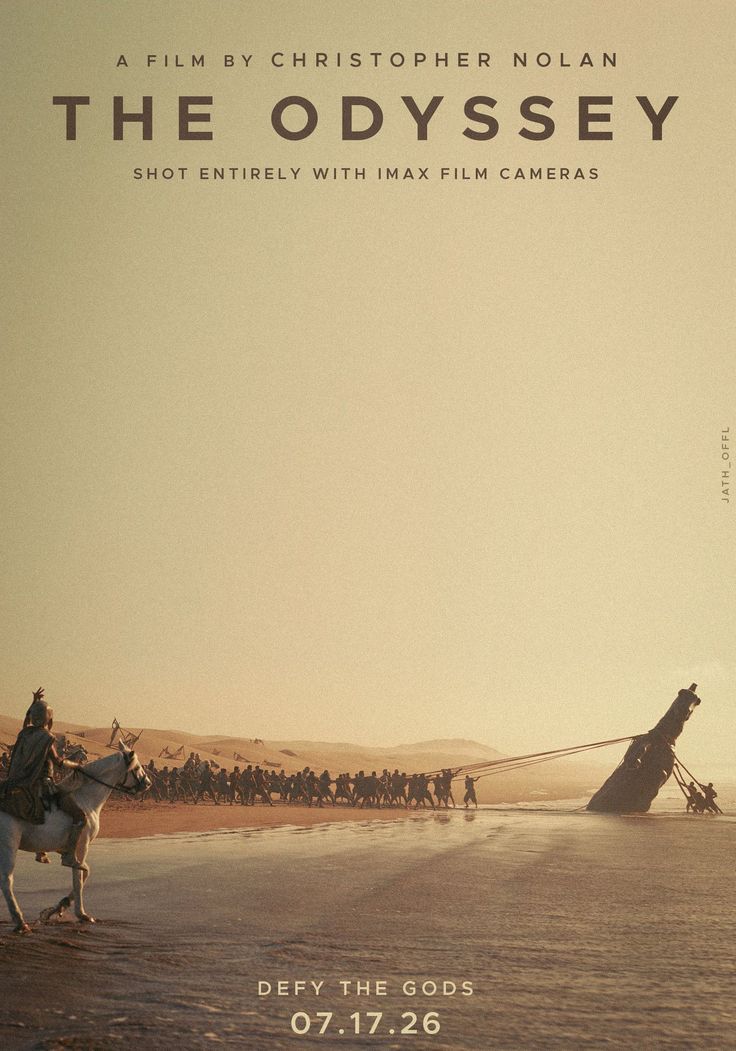
but I’ve thought a lot about the film since and I felt that it might be helpful to add a second note on the subject–about the film’s ending, in particular.

Here’s what the Wiki article has to say:

“After the meal, Odysseus, still disguised, confesses to Penelope his guilt for violating Zeus’ law during the sacking of Troy, desecrating Athena‘s statue after killing her priestess (whose form Athena assumed in visions), and initiating the collapse of the Bronze Age… After the remaining suitors surrender, Odysseus cedes his throne to Telemachus and leaves with Penelope to seek peace in exile. Sailing west to honor his fallen soldiers, the couple expect civilization’s renewal and muse that time will forget Odysseus’ mistakes.”

I was surprised when I read this and even more surprised when I saw it acted out on the screen.  This may be “Christopher Nolan’s Odyssey”, but it’s not “Homer’s”.  And that subtitle on the poster, “Defy the Gods” shows the major difference, as I began to demonstrate in my earlier posting.  Athena is Odysseus’ patron and therefore the last god he would “defy”, but it’s because of another god that Odysseus will perform the action which is first laid out for him in the Otherworld by the seer Tireisias.
Odysseus’ trouble began in Book Nine, where Odysseus tells his Phaeacian audience (an important part of the story left out of the film) that, previously trapped by Polyphemus, the Cyclops, in the Cyclops’ cave, he has escaped after blinding him.
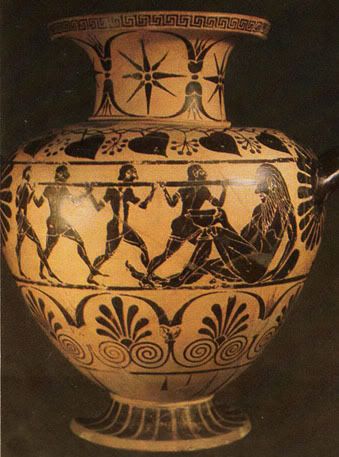
Groping his way to the shore in pursuit of the fleeing Odysseus, Polyphemus attempts to destroy him and his men by heaving the equivalent of a mountain top at them.
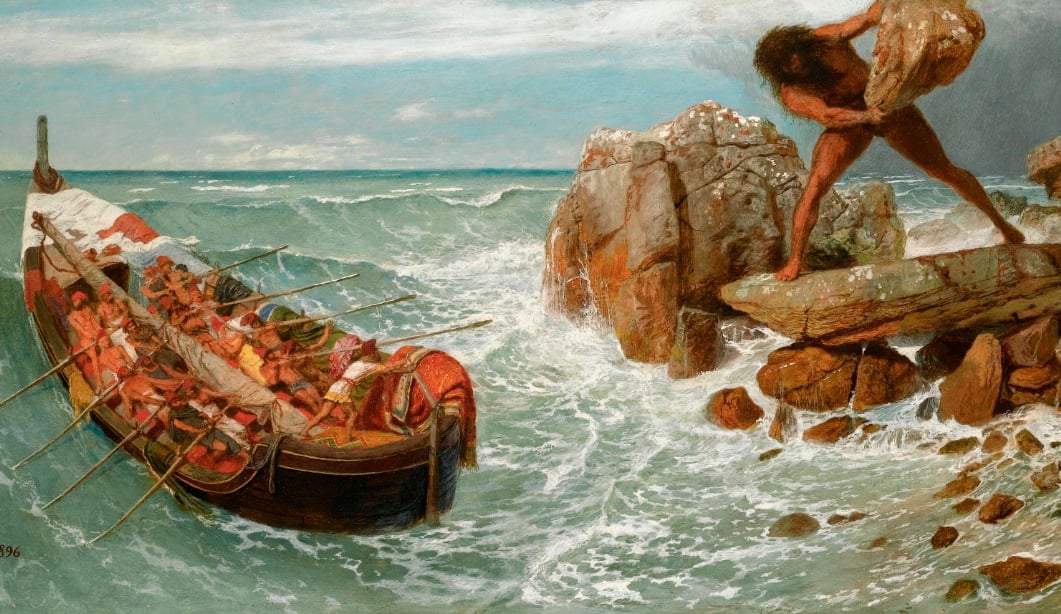
In the process of escaping, Odysseus does something which may seem rash, if not downright crazy, to us (and Odysseus’ crew would agree).  He shouts to the Cyclops:

“Κύκλωψ, αἴ κέν τίς σε καταθνητῶν ἀνθρώπων

ὀφθαλμοῦ εἴρηται ἀεικελίην ἀλαωτύν,

φάσθαι Ὀδυσσῆα πτολιπόρθιον ἐξαλαῶσαι,

υἱὸν Λαέρτεω, Ἰθάκῃ ἔνι οἰκίʼ ἔχοντα.”

(Od. 9.502–9.505—my translation)

“Cyclops, if any one of mortal men

Should ask [you] about the shameful blinding of [your] eye,

Say that city-destroying Odysseus blinded [it],

The son of Laertes, having his home on Ithaka.”

Doing so, Odysseus seems to have just handed over his name and address to his victim, even though the story makes it clear that Polyphemus’, by killing and eating a number of Odysseus’ men, deserved what he got.  (Polyphemus also violated the Greek custom of xenia, hospitality/guest-friendship, which, as Odysseus earlier had pointed out to him, was overseen by Zeus—unlike the completely imaginary “Zeus’ law”, which is mentioned more than once in the film.  Odysseus, by the way, when speaking to Polyphemus, is obeying another actual early Greek custom, if not “law”:  that of kleos.  This is a hard word to translate, meaning something like “reputation/fame”, and Odysseus, to add the escape of the Cyclops to it, must let his enemy know who tricked him, even though, in this case, it brings him and his men into mortal danger.)

Polyphemus, thwarted in destroying Odysseus there and then, prays to his father, Poseidon,
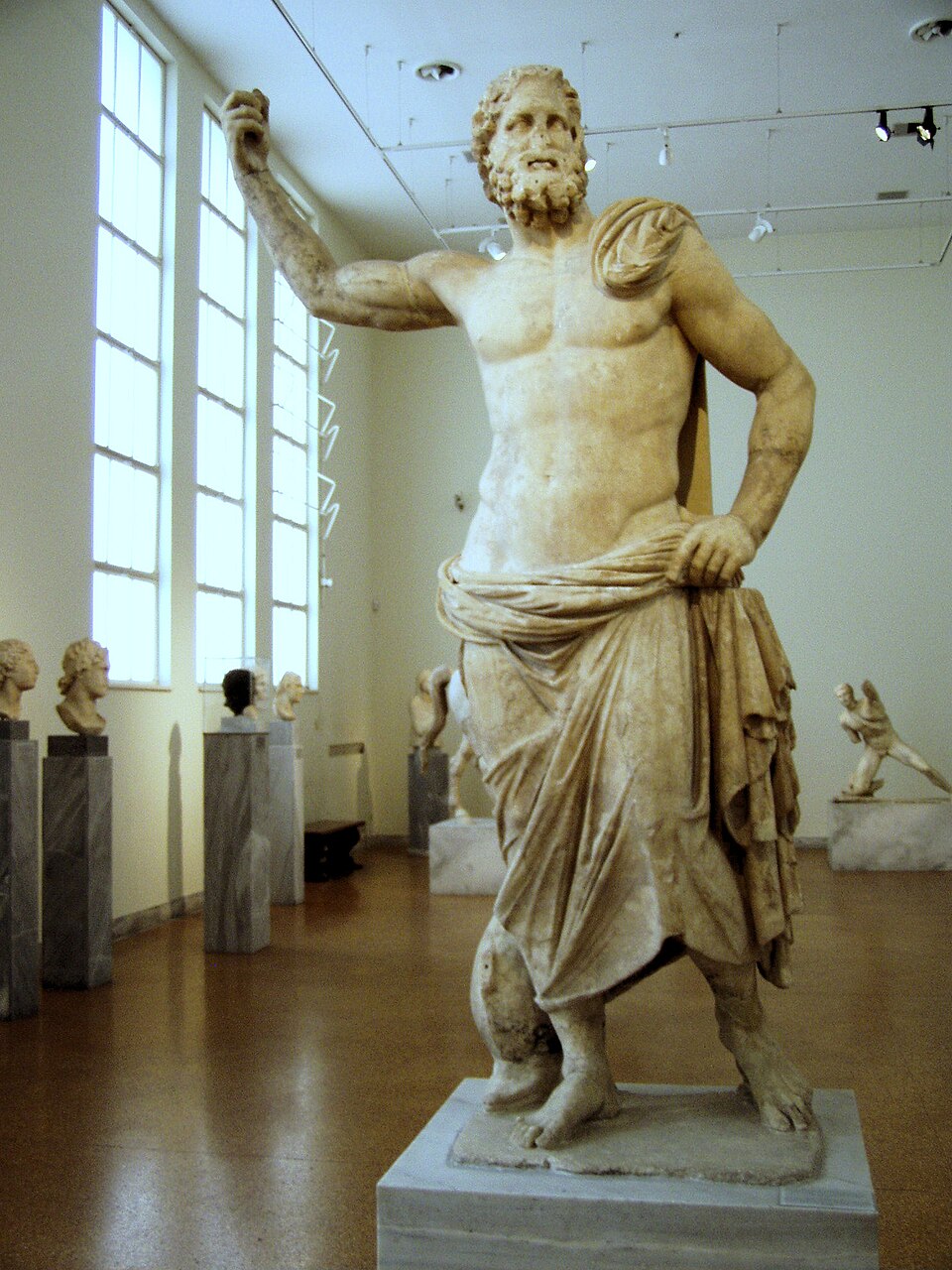
for revenge, something which is mentioned by Zeus at the beginning of Book One of the Odyssey (lines 68-75) when Athena approaches him for help in getting Odysseus out of the clutches of Calypso on the island of Ogygia and sent on his way home.  (Odysseus, by the way, hasn’t, as in the film, forgotten about home, stoked up on lotos, but, instead, grieves for it every day—see Book One, lines 55-59.) 

We then see Poseidon’s revenge told by Odysseus in Book Five, as Odysseus, aided by Calypso (through Zeus’ prompting via his messenger, Hermes), is attempting to get home via a homemade raft.  Poseidon spots the raft, with Odysseus on it, and works up a violent storm which partially destroys the raft and drops Odysseus into the sea before he can regain the wreckage, now at the mercy of the waves. (see Book Five, lines 282-332)

Odysseus survives, saved by the mysterious Phaeacians (whom I’ve mentioned earlier) and sent home by them, although Poseidon, annoyed by their helping Odysseus, turns the ship which carried Odysseus to stone as a punishment (see Book Thirteen, lines 125-165)

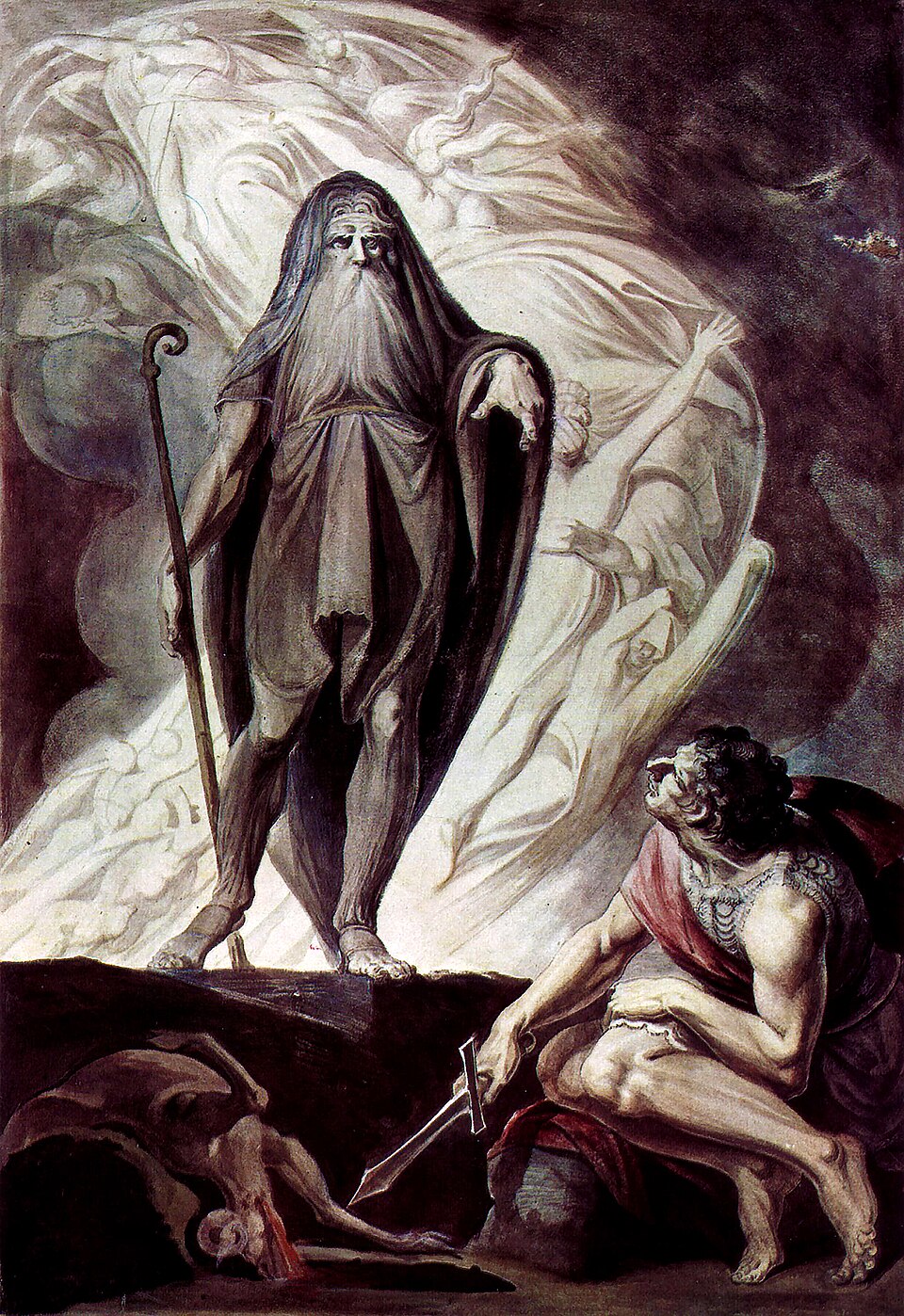
Odysseus is left with a very serious problem, however:  he lives on an island, among sea-faring people:  how will he ever be safe from Poseidon?  The answer lies in the directions which Tireisias gave him in their Otherworld meeting.  Once Odysseus has killed the suitors (all the suitors—unlike the film, Odysseus shows no mercy in the poem), Tireisias says:

“ἔρχεσθαι δὴ ἔπειτα λαβὼν ἐυῆρες ἐρετμόν,

εἰς ὅ κε τοὺς ἀφίκηαι οἳ οὐκ ἴσασι θάλασσαν

ἀνέρες, οὐδέ θʼ ἅλεσσι μεμιγμένον εἶδαρ ἔδουσιν·

οὐδʼ ἄρα τοί γʼ ἴσασι νέας φοινικοπαρῄους

οὐδʼ ἐυήρεʼ ἐρετμά, τά τε πτερὰ νηυσὶ πέλονται.

σῆμα δέ τοι ἐρέω μάλʼ ἀριφραδές, οὐδέ σε λήσει·

ὁππότε κεν δή τοι συμβλήμενος ἄλλος ὁδίτης

φήῃ ἀθηρηλοιγὸν ἔχειν ἀνὰ φαιδίμῳ ὤμῳ,

καὶ τότε δὴ γαίῃ πήξας ἐυῆρες ἐρετμόν,

ῥέξας ἱερὰ καλὰ Ποσειδάωνι ἄνακτι…”

(Od. 11.115–11.130—my translation)

“Go, then, having taken a broad[bladed] oar,

Until you reach those men who don’t know the sea,

[and] neither do they eat food mixed with salt

Nor yet do they know ships with painted bows [literally “purple cheeks”],

Nor broad[bladed] oars, [which] are the wings of ships.

And I will tell you a very clear sign [which] you won’t miss:

Whenever some traveler, meeting you,

Should say that you have a winnowing fan on your splendid shoulder,

Then, having stuck the broad[bladed] oar in the earth,

Having made fine sacrifices to the lord Poseidon…”

go home and continue making sacrifices to the gods.  And, having done so, Odysseus will have an easy death in old age and his people will be blessed.  Although Odysseus later relates this to Penelope (see Book Twenty-three, lines 248-284), we don’t see him do it in the poem, but he certainly doesn’t “sail west to honor his fallen soldiers” (why west?  And how does that “honor his fallen soldiers”?)

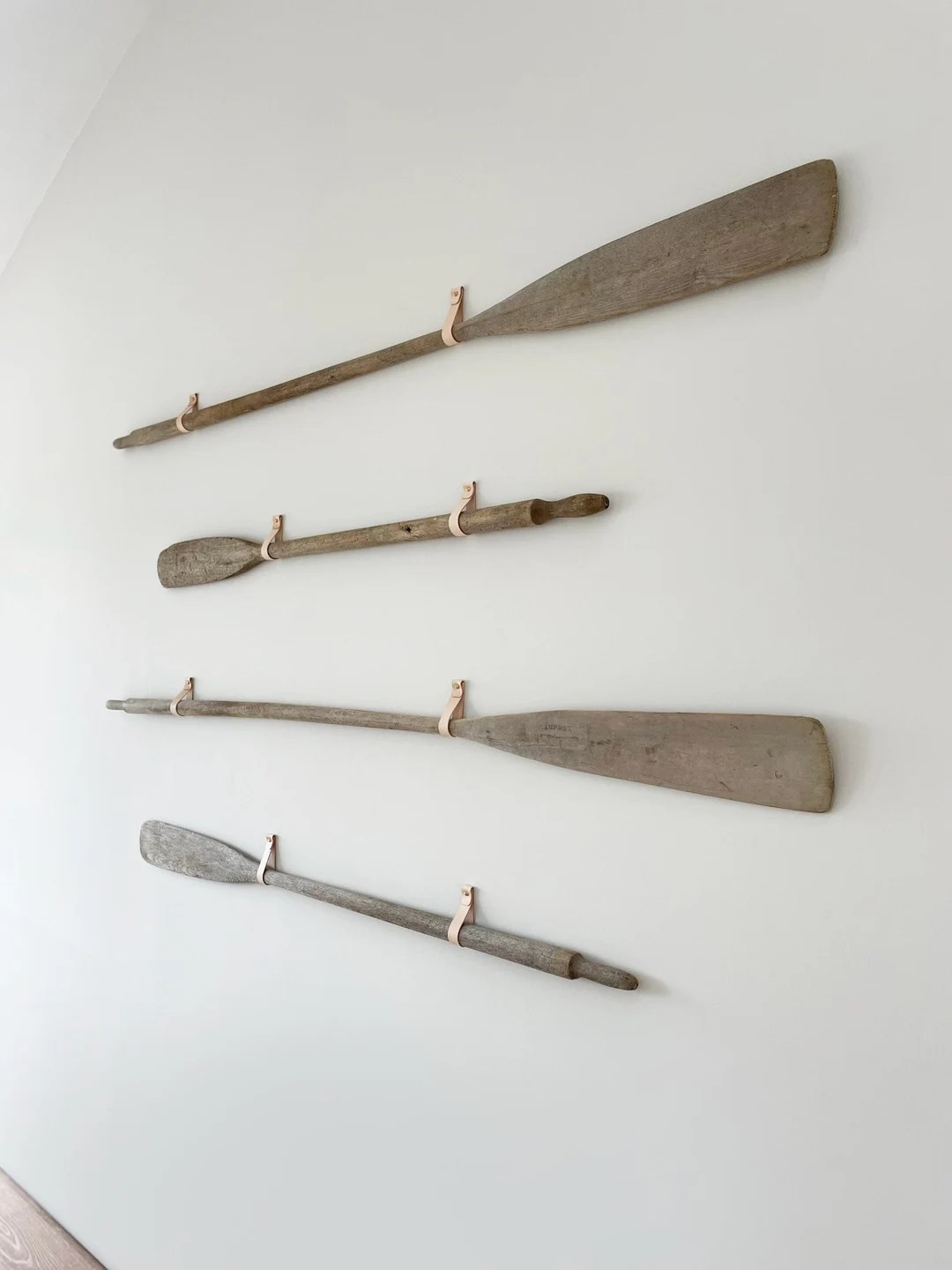
It’s clear, from Tireisias’ directions, that what Odysseus is meant to do to placate Poseidon includes getting as far away from the sea as he can—but what’s this business with the oar and a “winnowing fan”?
In earlier times, the process of producing flour was complex.  One had to:

1. harvest the grain,
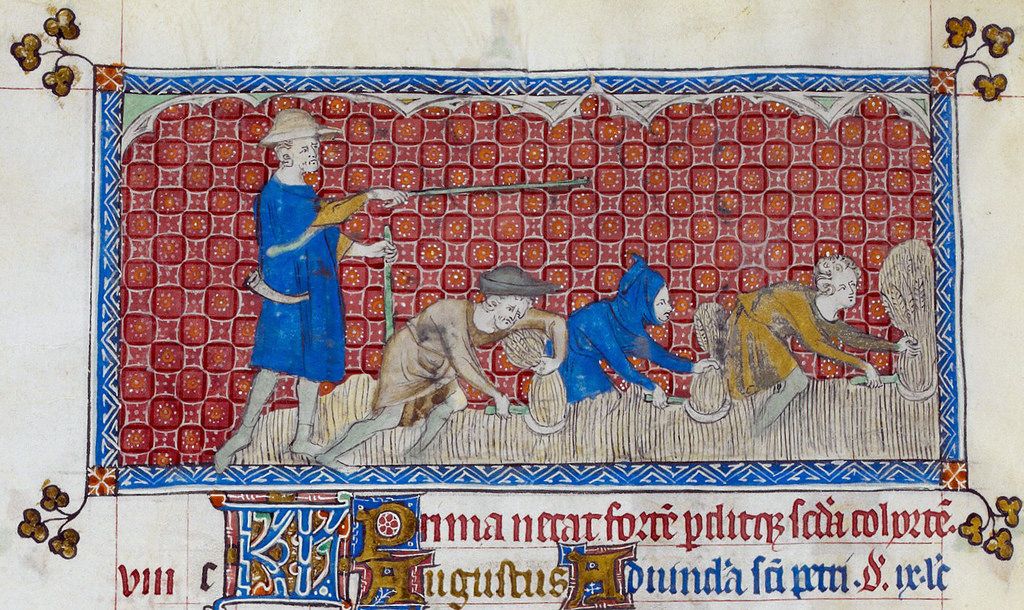
2. break the beards of grain off the stalks, called “threshing”,
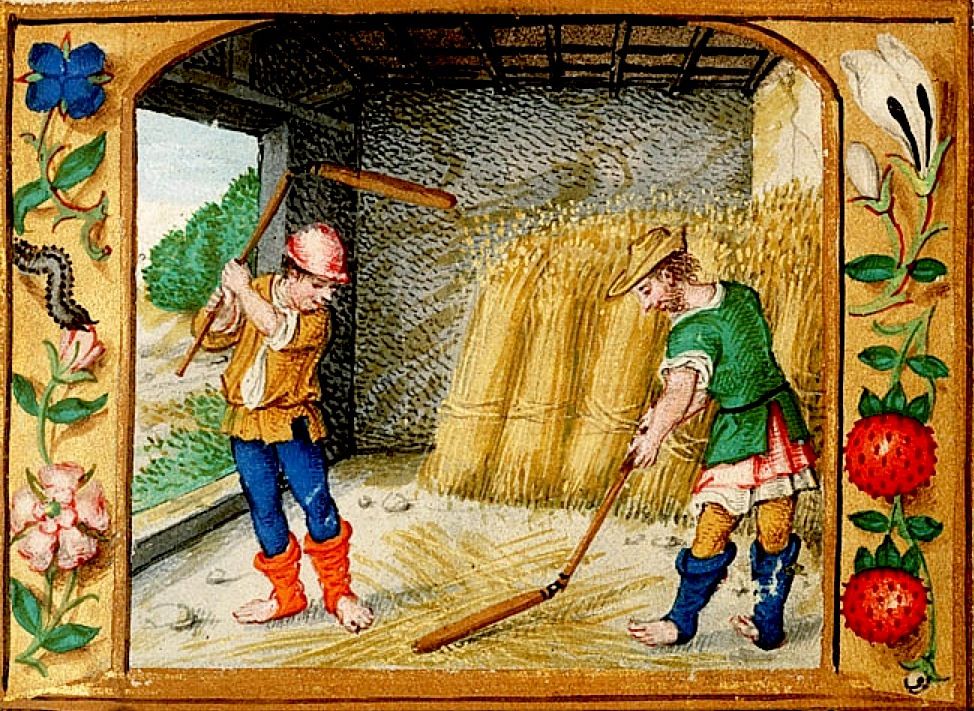
3. then, often by tossing it up, using the air to free the grain from the husks which cover it, called “winnowing”,
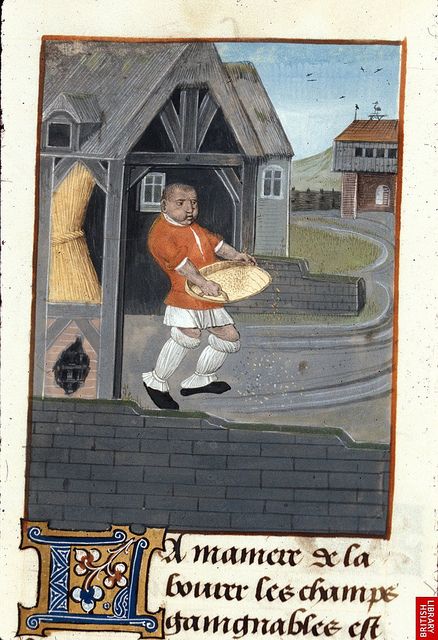
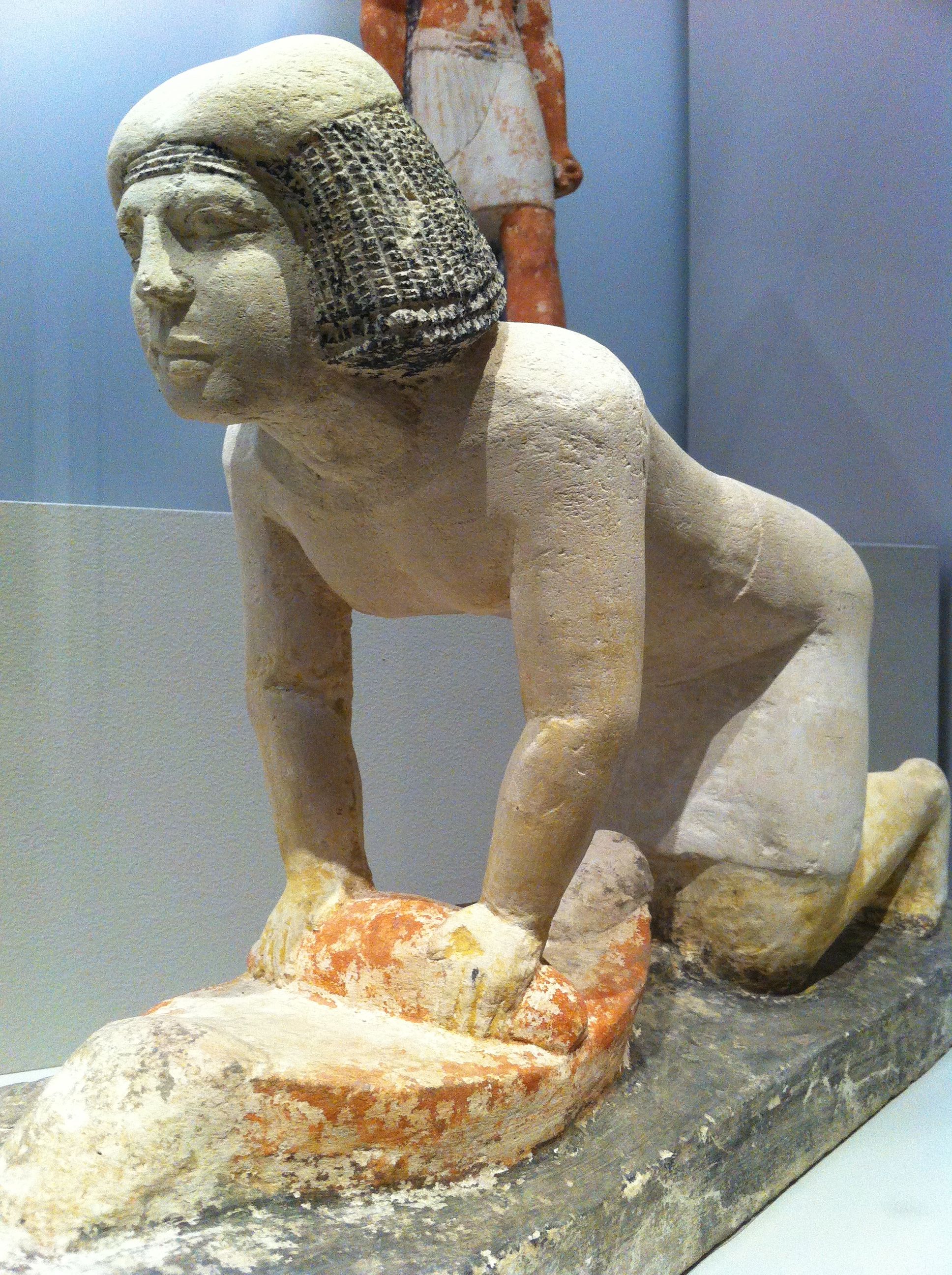
before grinding the final product into powder—flour.
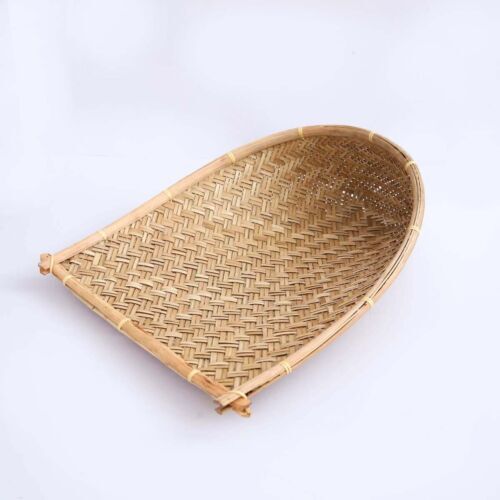
Winnowing could be done by tossing the grain in its husks into the air from a basket,
or by forking it into the air by a “winnowing fan”.

Probably because the fork had a long shaft, like an oar, Tireisias was suggesting that, meeting someone so far inland as to be ignorant of boats that he would confuse an oar with an agricultural tool, Odysseus would be safe from Poseidon’s natural element and could make his sacrifice to placate the god.

So—no abdication, no sailing west, nor restoration of civilization, but a godly man, so long protected by a goddess, now seeking peace by appeasing a god he has angered:  a very different and reverent story—and ending of the story–from Christopher Nolan’s, with its totally manufactured “defiance”.

Thanks for reading, as always,

Stay well,

Always check before assaulting someone—he might be related to a vengeful god,

And remember, as well, that there’s always

MTCIDC

O

Stepping Westward

10 Wednesday Aug 2016

Posted by Ollamh in Artists and Illustrators, Fairy Tales and Myths, Imaginary History, J.R.R. Tolkien, Literary History, Narnia, Narrative Methods

≈ Leave a comment

Tags

Aman, Beliefs, Bran, cult statues, heroa, immrama, Istari, Ithaka, Mael Duin, Middle-earth, monotheistic, N.C. Wyeth, Odysseus, religion, Rip Van Winkle, Saint Brendan, Saruman, shrines, Stone Table, temples, The Grey Havens, The Lord of the Rings, The Odyssey, Tireisias, Tolkien, Valar, Valinor, ziggurats

Dear readers, welcome as always.

Although there are no temples or shrines to him (the closest thing is perhaps the Stone Table),

narnia stone table

Aslan

1653963a

is clearly someone with divine powers and his influence is felt directly and indirectly throughout all of the Narnia books.

JRRT once said that Middle-earth had a monotheistic religion, but the traces, as has been written about more than once, are almost invisible.

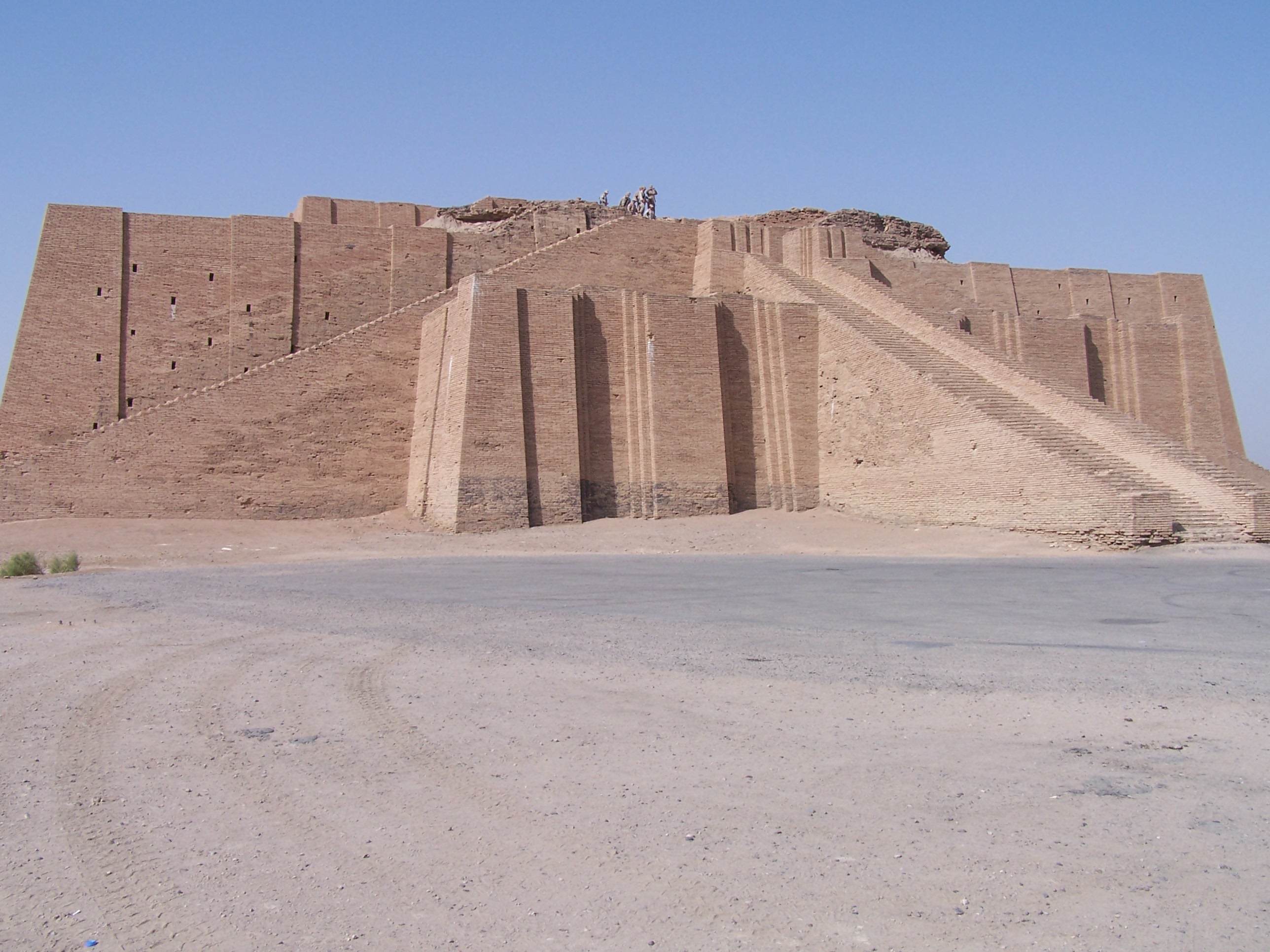
There are no ziggurats,

Ancient_ziggurat_at_Ali_Air_Base_Iraq_2005

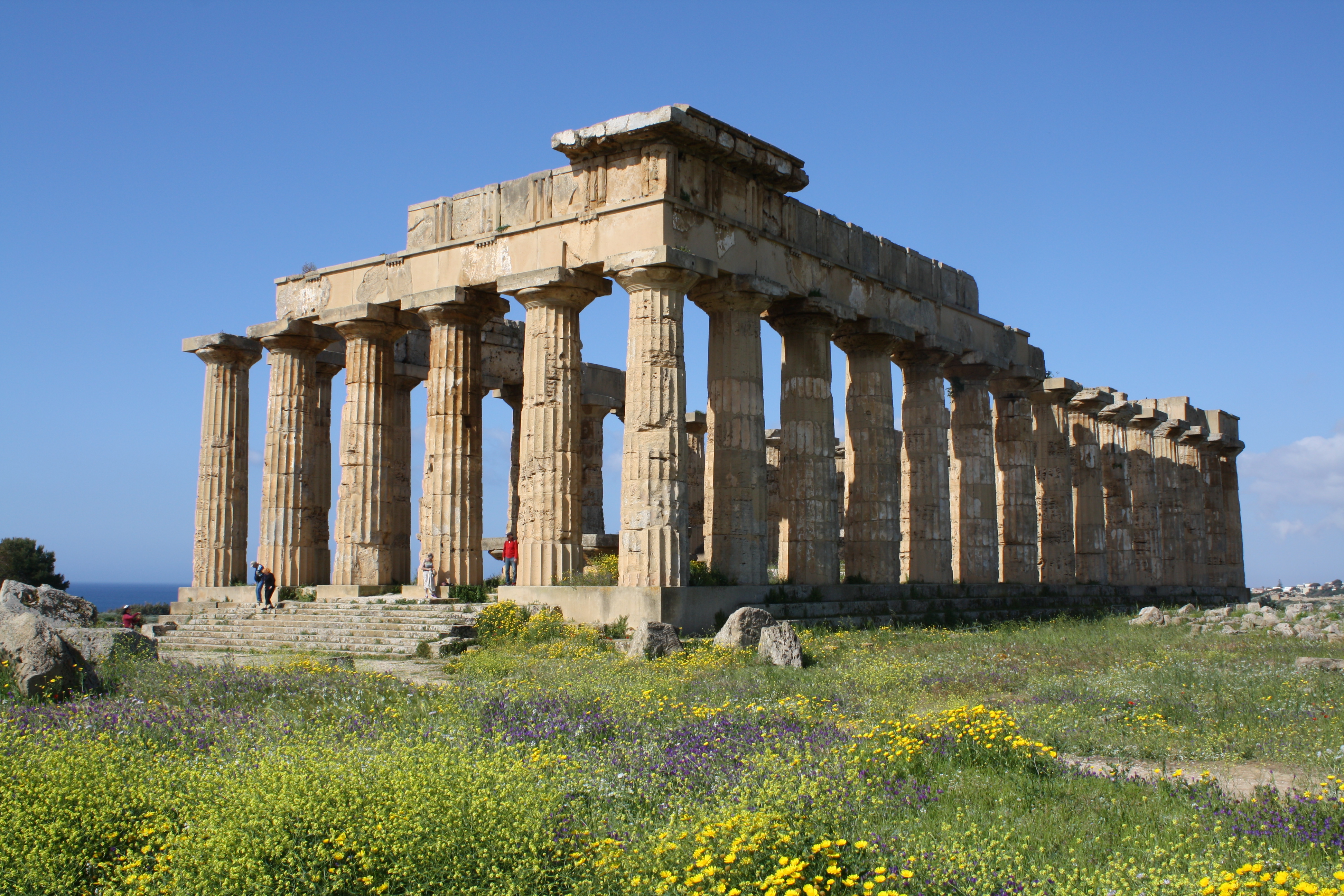
no temples,

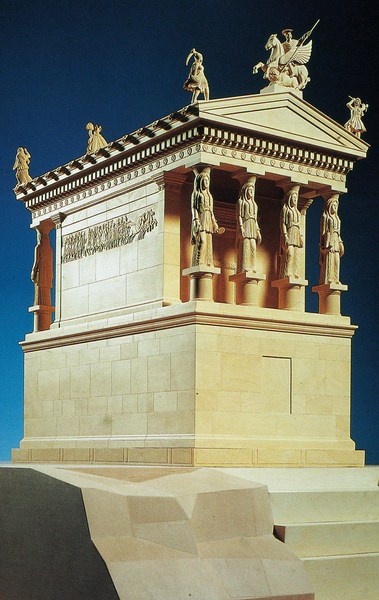
templeofheraselinus

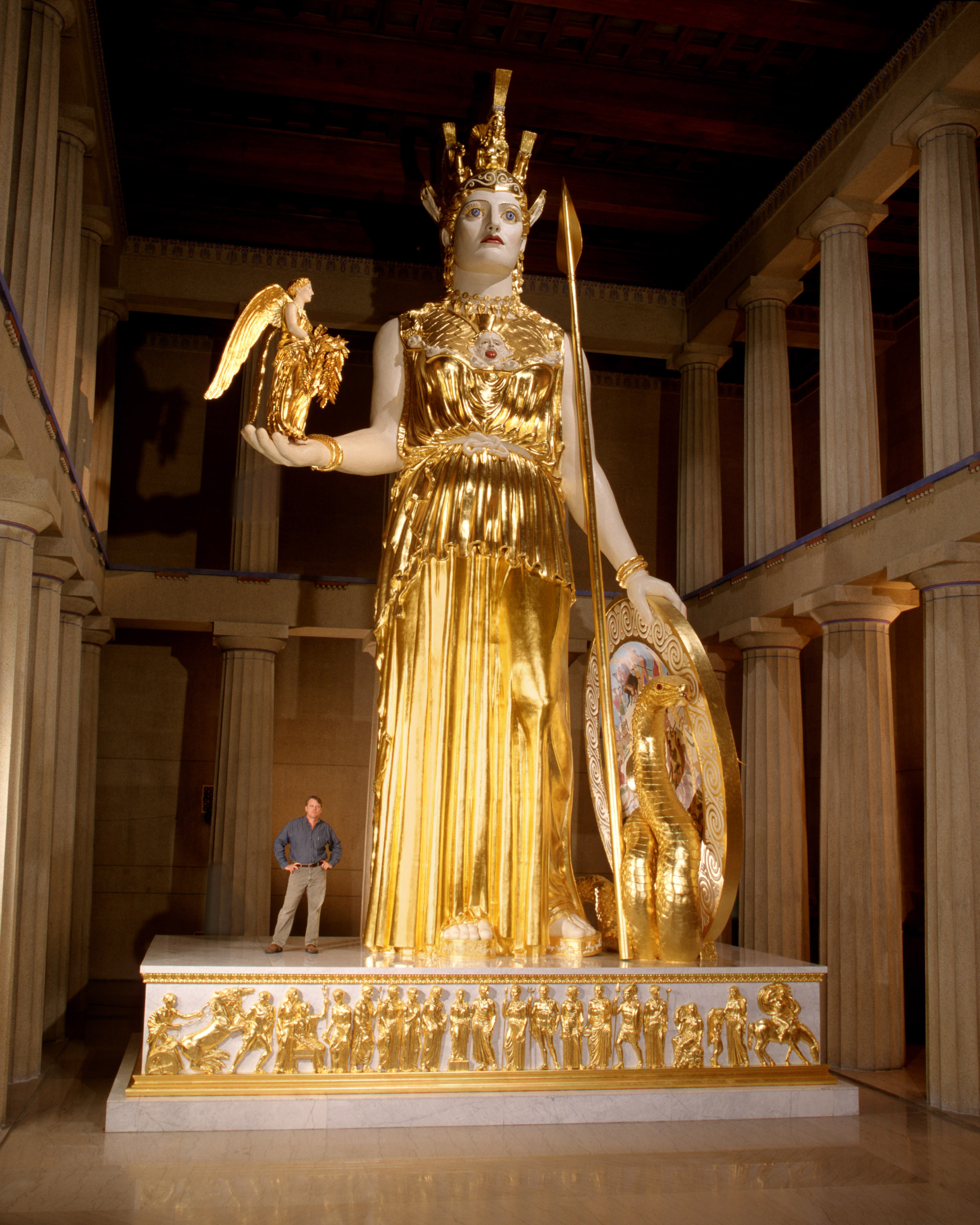
no cult statues

Athena_Parthenos_LeQuire

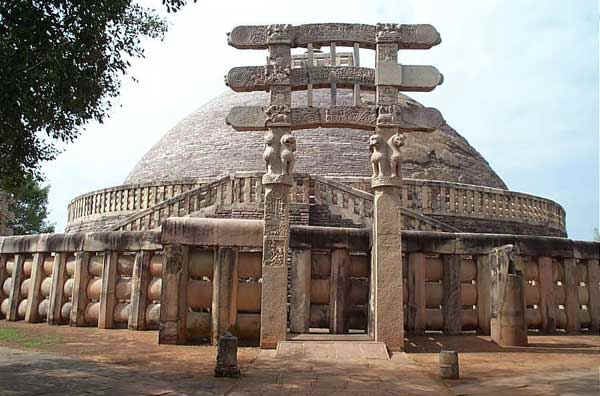
no shrines

97_full

no heroa (shrines for demi-gods or heroes).

heroon

The Valar are mentioned once (some of Faramir’s men call on them to protect them from a mumak), of course, and there is that ceremony of standing and looking west before a meal.

That idea of looking west has long interested us, mainly because, in much of western tradition before the Age of Exploration, the west was looked upon as a place of uncertainty, if not outright fear.

Although Odysseus, in Odyssey 9, is careful to point out that his home island, Ithaka, lies farthest towards dusk in its island group, in Odyssey 11, in the far west lies the Land of the Dead,

lykaon-painter-odysseus-and-elpenor

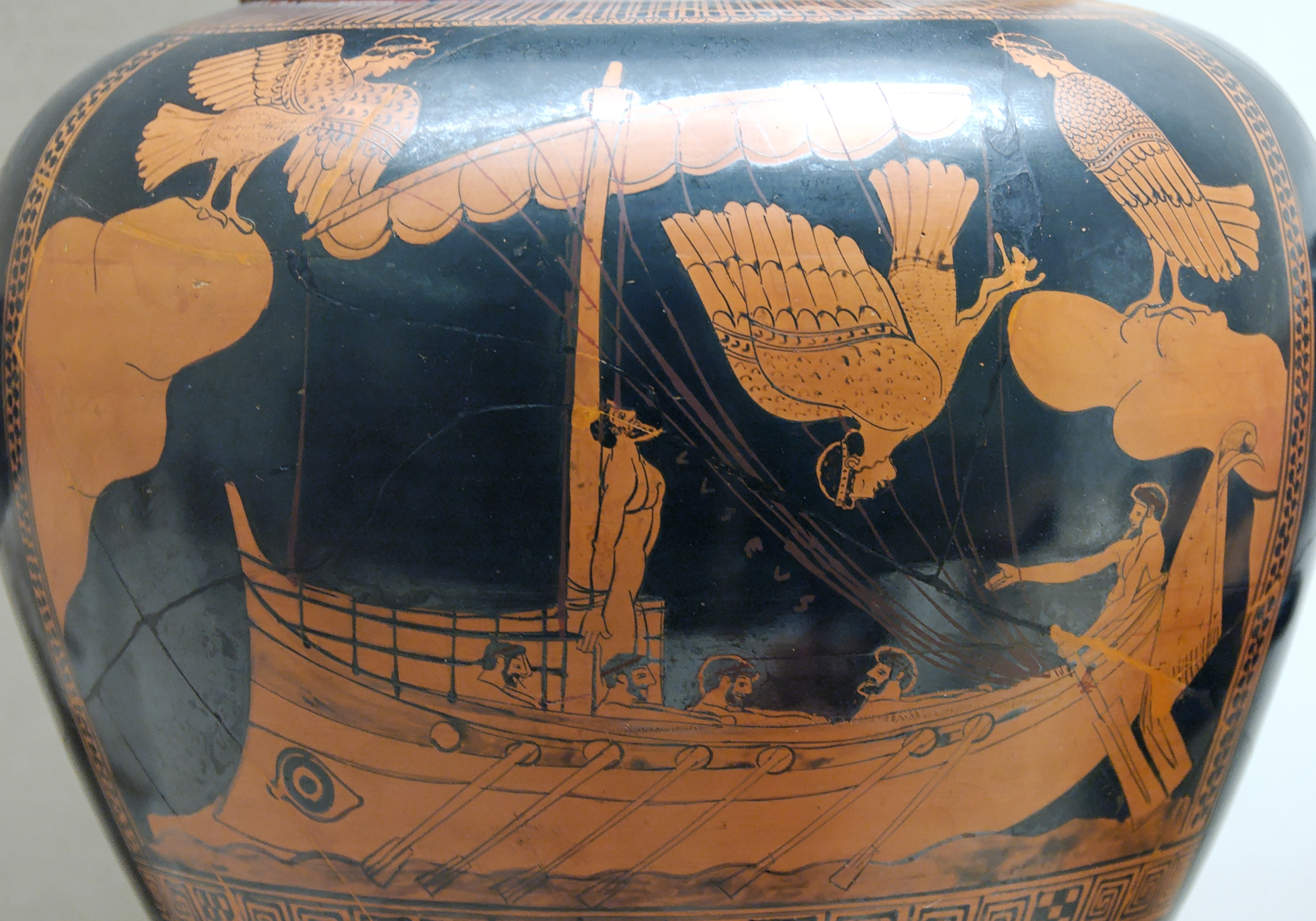
to which Odysseus sails

Odysseus_Sirens_BM_E440_n2

to consult the seer, Tireisias,

Teir.1993.01.0348

on the way to get home. This is, then, hardly a choice direction in which to sail, for all that Tireisias does provide some guidance.

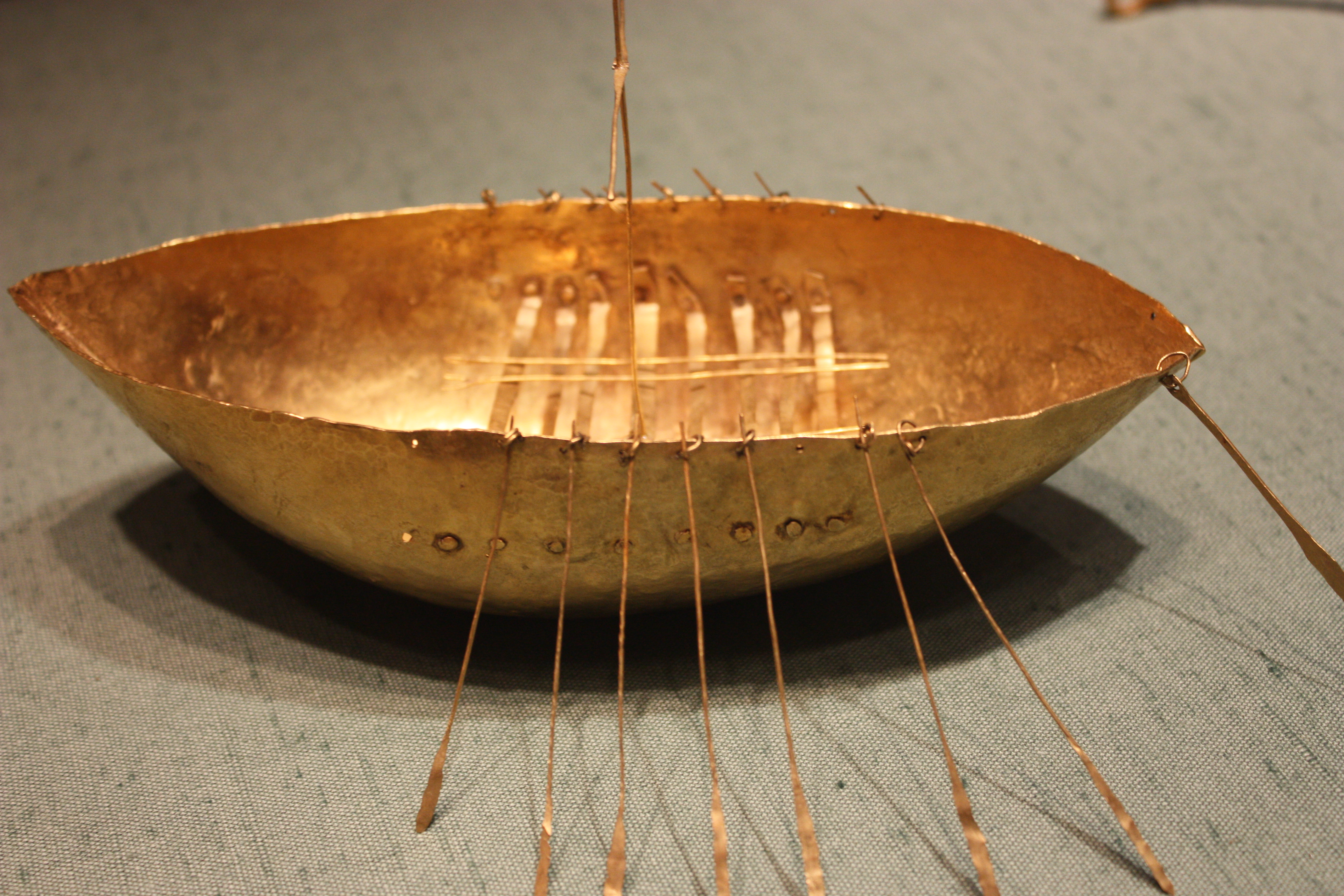
The same is true for a series of stories about immrama, “voyages” (literally “rowings around”) in Old Irish, not only secular stories, like those of Mael Duin

mailduin

and Bran,

Broighter_Gold,_Dublin,_October_2010_(03)

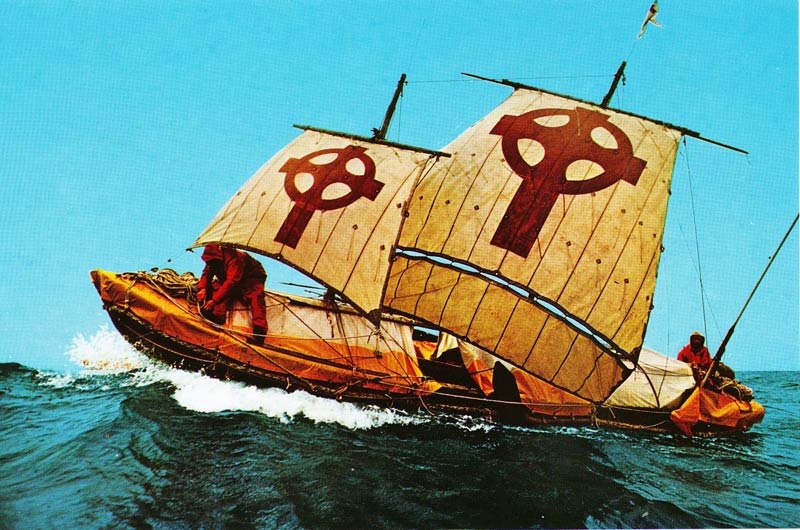
but a famous religious one about Saint Brendan.

brendan

In each of these stories, sailing westward commonly means sailing rather haphazardly among sea monsters and islands with strange people or creatures. There is also the possibility of time distortion: the voyager believes himself gone in terms of a few years, at most, when, instead, he may have been gone for much longer (as in Washington Irving’s short story, “Rip Van Winkle”, in which Rip, falling asleep in the Catskill Mountains after drinking with the ghosts of the crew of the explorer Henrik Hudson’s ship The Half Moon, thinks that he has been gone only overnight when, instead, he’s been gone for twenty years.)

rip-van-winkle.wyeth

(by one of our all-time favorite illustrators, N.C. Wyeth, from his Rip Van Winkle, 1921—the whole work is available, with all of its wonderful illustrations, to download for free at the Internet Archive, may their beards grow long!)

“To go west”, probably based upon the idea of the sinking sun, as an older English expression has the meaning of “to die/to fail catastrophically” (now people in the US seem to be replacing it with “to go south”, which has none of the older resonance, unfortunately), but it ties in very nicely with these older beliefs about what lies west of Europe, so full of danger and mystery.

But then we come back to that looking west.

In the belief system of Middle-earth, westward across the sea lies the continent of Aman, and on that continent is Valinor, home of the Valar, those powerful and immortal beings who are perhaps to be likened to the archangels of Christian belief—with a bit of patron saint and even Norse and Greco-Roman pantheons thrown in. (We admit to having a very shallow knowledge of Arda theology, being less interested in the finer points of belief than in the adventures and the cultures and the languages of Middle-earth.)

The Istari, the five wizards are from there and it’s for us one of the most melancholy moments when, after his murder by Grima, it is clear that Saruman is denied a return.

jwyatt-sarumande

Gandalf, however, is permitted to return, as are Bilbo and Frodo (and, in time, Sam, apparently), all part of the defeat and disembodiment of Sauron.

greyhavens

The elves are also allowed to make the voyage to Aman, although they have their own separate place there, and, when Gandalf leaves, so do Galadriel, Celeborn, and Elrond, part of a slow general leave-taking of the Elves.

No human is admitted however, to the Undying Lands, as they are called, and it occurred to us that perhaps, in that fact, the mortals of Middle-earth are closer to Saruman than to Gandalf or the Elves:

“To the dismay of those that stood by, about the body of Saruman a grey mist gathered, and rising slowly to a great height like smoke from a fire, as a pale, shrouded figure it loomed over the Hill. For a moment it wavered, looking to the West; but out of the West came a cold wind, and it bent away, and with a sigh dissolved into nothing.” (The Return of the King, Book 6, Chapter 8, “The Scouring of the Shire”)

Could that ceremony of looking westward also be done with a sigh, an acknowledgement that there are no undying lands for them?

What do you think, dear readers?

Thanks, as ever, for reading.

MTCIDC

CD

Ps

This, for us, is a rather historical posting, being our Number 100. By earlier September, we will have reached 104, making exactly two years since we began our blog. We thank you for reading, hope that you will continue to do so, that you will share our work among your friends and that, in the future, you will be willing to share your thoughts with us, as we always encourage you to do.


The Doubtful Sea Series Facebook Page

The Doubtful Sea Series Facebook Page

  • Ollamh

Categories

  • Artists and Illustrators
  • Economics in Middle-earth
  • Fairy Tales and Myths
  • Films and Music
  • Games
  • Heroes
  • Imaginary History
  • J.R.R. Tolkien
  • Language
  • Literary History
  • Maps
  • Medieval Russia
  • Military History
  • Military History of Middle-earth
  • Narnia
  • Narrative Methods
  • Poetry
  • Research
  • Star Wars
  • Terra Australis
  • The Rohirrim
  • Theatre and Performance
  • Tolkien
  • Uncategorized
  • Villains
  • Writing as Collaborators
Follow doubtfulsea on WordPress.com

Across the Doubtful Sea

Recent Postings

  • Death and the Rohirrim September 30, 2026
  • Minor? September 23, 2026
  • An Homeric PS September 16, 2026
  • December in September September 9, 2026
  • Fan/Finn Fiction September 2, 2026
  • Demons on the Big Screen August 26, 2026
  • Solution (2) August 19, 2026
  • Out of Work Athena August 12, 2026
  • Solution (1) August 5, 2026

Blog Statistics

  • 122,747 Views

Posting Archive

  • September 2026 (5)
  • August 2026 (4)
  • July 2026 (5)
  • June 2026 (4)
  • May 2026 (4)
  • April 2026 (5)
  • March 2026 (4)
  • February 2026 (4)
  • January 2026 (4)
  • December 2025 (5)
  • November 2025 (4)
  • October 2025 (5)
  • September 2025 (4)
  • August 2025 (4)
  • July 2025 (5)
  • June 2025 (4)
  • May 2025 (4)
  • April 2025 (5)
  • March 2025 (4)
  • February 2025 (4)
  • January 2025 (5)
  • December 2024 (4)
  • November 2024 (4)
  • October 2024 (5)
  • September 2024 (4)
  • August 2024 (4)
  • July 2024 (5)
  • June 2024 (4)
  • May 2024 (5)
  • April 2024 (4)
  • March 2024 (4)
  • February 2024 (4)
  • January 2024 (5)
  • December 2023 (4)
  • November 2023 (5)
  • October 2023 (4)
  • September 2023 (4)
  • August 2023 (5)
  • July 2023 (4)
  • June 2023 (4)
  • May 2023 (5)
  • April 2023 (4)
  • March 2023 (5)
  • February 2023 (4)
  • January 2023 (4)
  • December 2022 (4)
  • November 2022 (5)
  • October 2022 (4)
  • September 2022 (4)
  • August 2022 (5)
  • July 2022 (4)
  • June 2022 (5)
  • May 2022 (4)
  • April 2022 (4)
  • March 2022 (5)
  • February 2022 (4)
  • January 2022 (4)
  • December 2021 (5)
  • November 2021 (4)
  • October 2021 (4)
  • September 2021 (5)
  • August 2021 (4)
  • July 2021 (4)
  • June 2021 (5)
  • May 2021 (4)
  • April 2021 (4)
  • March 2021 (5)
  • February 2021 (4)
  • January 2021 (4)
  • December 2020 (5)
  • November 2020 (4)
  • October 2020 (4)
  • September 2020 (5)
  • August 2020 (4)
  • July 2020 (5)
  • June 2020 (4)
  • May 2020 (4)
  • April 2020 (5)
  • March 2020 (4)
  • February 2020 (4)
  • January 2020 (6)
  • December 2019 (4)
  • November 2019 (4)
  • October 2019 (5)
  • September 2019 (4)
  • August 2019 (4)
  • July 2019 (5)
  • June 2019 (4)
  • May 2019 (5)
  • April 2019 (4)
  • March 2019 (4)
  • February 2019 (4)
  • January 2019 (5)
  • December 2018 (4)
  • November 2018 (4)
  • October 2018 (5)
  • September 2018 (4)
  • August 2018 (5)
  • July 2018 (4)
  • June 2018 (4)
  • May 2018 (5)
  • April 2018 (4)
  • March 2018 (4)
  • February 2018 (4)
  • January 2018 (5)
  • December 2017 (4)
  • November 2017 (4)
  • October 2017 (4)
  • September 2017 (4)
  • August 2017 (5)
  • July 2017 (4)
  • June 2017 (4)
  • May 2017 (5)
  • April 2017 (4)
  • March 2017 (5)
  • February 2017 (4)
  • January 2017 (4)
  • December 2016 (4)
  • November 2016 (5)
  • October 2016 (6)
  • September 2016 (5)
  • August 2016 (5)
  • July 2016 (5)
  • June 2016 (5)
  • May 2016 (4)
  • April 2016 (4)
  • March 2016 (5)
  • February 2016 (4)
  • January 2016 (4)
  • December 2015 (5)
  • November 2015 (5)
  • October 2015 (4)
  • September 2015 (5)
  • August 2015 (4)
  • July 2015 (5)
  • June 2015 (5)
  • May 2015 (4)
  • April 2015 (3)
  • March 2015 (4)
  • February 2015 (4)
  • January 2015 (4)
  • December 2014 (5)
  • November 2014 (4)
  • October 2014 (6)
  • September 2014 (1)

Blog at WordPress.com.

  • Subscribe Subscribed
    doubtfulsea
    Join 75 other subscribers

    Have a WordPress.com account? Log in now.

  • doubtfulsea
    View site in Reader
    Manage subscriptionsSign upLog in
    Report this content
    Collapse this bar
Loading Comments...