• About

doubtfulsea

~ adventure fantasy

Tag Archives: Dwarves

Shire Portrait (2)

08 Wednesday Feb 2017

Posted by Ollamh in Economics in Middle-earth, Imaginary History, J.R.R. Tolkien, Maps, Narrative Methods

≈ 2 Comments

Tags

An Unexpected Party, Bad End, Baggins, ceramics, clay bank, coal, coins, cork, crafts, cutlery, Dwarves, Esther Forbes, Gondorian money, Hobbits, Isengard, Johnny Tremain, lead, Lloyd Alexander, Longbottom Leaf, Mayor, Michel Delving, mines, Postal Service, pottery, realien, Renaissance, Robert II of Scotland, Saruman, Shirriffs, silica, Silver, Taran Wanderer, Thain, The Green Dragon, The Hobbit, The Lord of the Rings, The Shire, Tolkien

Welcome, dear readers, as always.

In our last post, we began a series responding to the question:   what makes the Shire the Shire?

1theshire

We began with the government, which turned out to be very rudimentary: a Thain (hereditary), a Mayor (elected), a postal service (not known how chosen), Shirriffs (a kind of border patrol—volunteer). Since the Thain and Mayor were principally honorary positions, there was perhaps no salary attached. As for the postal service (called “Messengers”) and the Shirriffs, we presume that there must have been some sort of payment, although we are not told so. Since, in our world, we pay for the police and the post office through taxes, we wondered how the same services in the Shire were paid. This led us to the question of the Shire economy in general.

In a letter of 25 September, 1954, JRRT wrote to Naomi Mitchison:

“I am more conscious of my sketchiness in the archaeology and realien [“physical facts/things of real life”] than in the economics: clothes, agricultural implements, metal-working, pottery, architecture and the like…I am not incapable of or unaware of economic thought; and I think as far as the ‘mortals’ go, Men, Hobbits, and Dwarfs, that the situations are so devised that economic likelihood is there and could be worked out…” (Letters, 196)

The Shire would appear to be an agriculturally-based economy:

“The Shire is placed in a water and mountain situation and a distance from the sea and a latitude that would give it a natural fertility, quite apart from the stated fact that it was a well-tended region when they [hobbits] took it over.” (Letters, 196)

He adds to this that, when the hobbits took control of the Shire, that included “a good deal of older arts and crafts”, suggesting that the solution to the problem of the production of “clothes, agricultural implements, metal-working, pottery”—all the Realien, as he calls them, is assumed. How and from whom such things were taken over is not explained and such production, in any community, is not a small matter: “things of real life” are many and complicated.

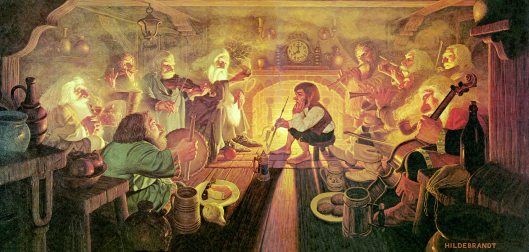
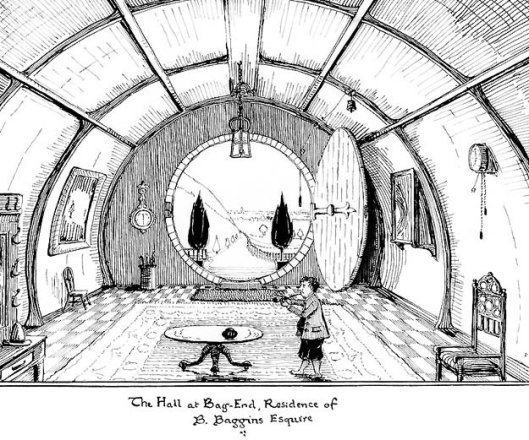
Consider, for example, just one moment at Bag End. The Baggins appear to have been well-to-do, even without the treasure Bilbo brought back from his trip. His house is extremely well-furnished and the Baggins certainly don’t want for provisions, as we know from descriptions both in The Hobbit and The Lord of the Rings, as well as Realien, as the Dwarves’ clean-up song reminds us:

Chip the glasses and crack the plates!

Blunt the knives and bend the forks!

That’s what Bilbo Baggins hates—

Smash the bottles and burn the corks!

(The Hobbit, Chapter 1, “An Unexpected Party”)

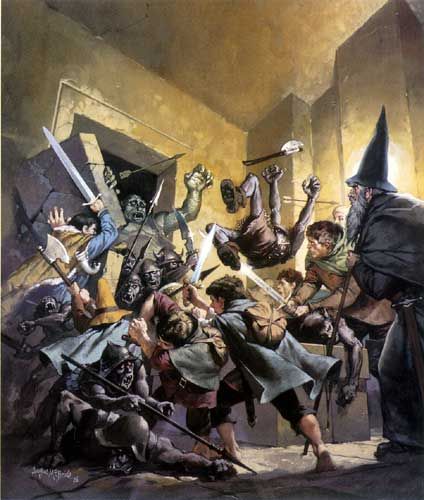
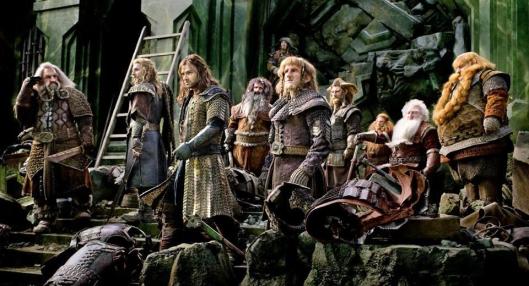
1bilbodwarves.jpg

If we take this line by line, we come up with the following: glasses, plates, knives, forks, bottles, corks.

Glasses and bottles (as well as the window panes at Bag End) require a glassblower and perhaps a glazier.

2latemedglass.jpg

Plates require a potter.

3potter.JPG

Knives and forks were once made by cutlers (and forks are very advanced for a Middle-earth which is mostly medieval—although classical people used them in food preparation, it was only during the Renaissance that they began to appear as an eating utensil—western Medieval people ate with knives, spoons, and fingers).

4feast.jpg

5renfork.jpg

(And next is a Renaissance fork, found in the foundations of the Rose Theatre)

Corks come from vintners and brewers (in our world, vintners only began using cork as a sealant in the 17th century, we have read).

6awinebottles.jpg

Take those objects a step farther back and you find:

  1. glasswear, bottles, and window panes require silica and something to make it more stable, like lime (from limestone) or lead, which leads us to the question of where the ingredients come from. Silica is sand and can be found in many places—perhaps it might come from the west coast of Middle-earth? If all of the Shire is like the White Downs, where Michel Delving is located, it may be situated upon a vast deposit of chalk (more about Shire geography in our next posting). Lime would then have to be imported. As we have no record of mines in the Shire, the same would be true for lead.
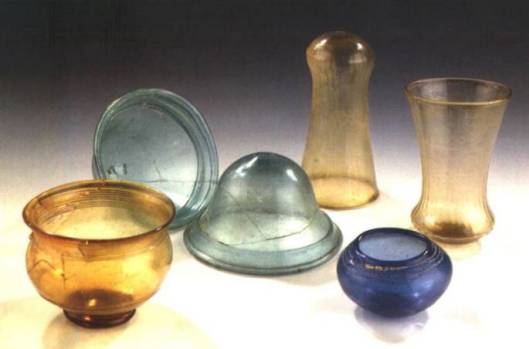
6medievalglass.jpeg

7silica.jpg

8chalk.jpg

9limestone.jpg

10leadmine.jpg

  1. ceramics, like plates, are made of clay and all sorts of clay are used to make pottery, but all need to be dug out, usually from beds found near streams, rivers, or places like canyons or ravines. The Shire seems fairly well-watered, so we presume that the clay used to make Bilbo’s dishes was local.

11claybank.jpg

  1. knives and forks would be made of iron, early steel, or silver (with silver, plus an alloy to make them stronger)—here, again, we would need mines, for the iron ore and silver

12ironmine.jpg

  1. cork in our world is actually tree bark from the cork trees which grow in hot, dry southwest Europe (Spain/Portugal) and northwest Africa

13corkharvest.jpg

1, 2, 4 (and possibly 3) require raw materials of which no mention is made in the Shire and 1, 2, and 3 all need especially hot fires to make them, possibly using charcoal (made locally?) or coal (again, no mines discussed). And this is just, basically, four items.

14coalmine.jpg

So many import possibilities: what about export? We have solid evidence for one, which Merry and Pippin have discovered at Isengard:

“My dear Gimli, it is Longbottom Leaf! There were the Hornblower brandmarks on the barrels, as plain as plain. How it came here, I can’t imagine. For Saruman’s private use, I fancy. I never knew that it went so far abroad.” (The Two Towers, Book 3, Chapter 9, “Flotsam and Jetsam”)

It should always be remembered that these are works of fantasy, of course, and, unless there is some novelistic purpose which employs a potter as a character (in Taran Wanderer,15taranwanderer.JPG

by Lloyd Alexander, book 4 of The Chronicles of Prydain, for example, the hero, Taran, spends a little time as an apprentice potter, among other trades) or the making of silverware (something one might read about in Esther Forbes’ Johnny Tremain,16johnnytremain.jpg

where Johnny is an apprentice to a silversmith), it would seem completely unnecessary to spend narrative time discussing raw materials, imports, exports, or the manufacture of day-to-day items. We have taken the time, however, because, where, sometimes, we write about the parallels between Middle-earth and something here in our world, here the complexity of ordinary things in our world is completely forgotten in Middle-earth, or simply taken for granted, as JRRT implies in the letter cited above. If we are to examine Shire economics, however, we must, at least, consider them. As well, although we may keep saying, “No evidence for”, we think that, even if there is no potter or tin mine in the text, prompting readers to remember that, in the real world, there would have been one is a useful exercise and, for us, at least, makes the story that much more real.

But now we come to the subject of paying for Realien, or for anything else in the Shire, be it for the Shirriffs or for a pint at The Green Dragon.

In a totally rural economy many things might be obtained through barter: in return, for payment, please take 10 chickens, or a sack of grain. (And perhaps we see something like this in “The Scouring of the Shire”, when Hob Hayward tells Merry that, “We grows a lot of food, but we don’t rightly know what becomes of it. It’s all these ‘gatherers’ and ‘sharers’, I reckon, going round counting and measuring and taking off to storage.”—this looks like taxes, “paid in kind”).  Such might work for, say, trading a hen for a bowl, but would certainly not do for that pint—or for the bill at The Prancing Pony. Coins and their values are not mentioned in Tolkien, but their effect is felt, all the same: when Frodo buys a house in Crickhollow, we doubt he does it with cows!

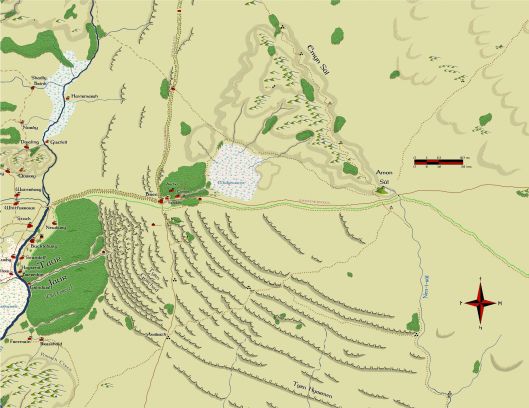
17aeastfarthingmap.png

(We discussed Middle-earth money in an earlier posting and it seems to us that it would be fun to create, say, Gondorian money—here’s one possibility

17robert21316-1390.jpg

It’s actually a coin of Robert II of Scotland—1316-1390—but, changing the crown, could you imagine this as something issued earlier in the Third Age, say?)

This has been perhaps a rather long-winded and prosy posting (perhaps not for nothing did Thomas Carlyle, in 1849, call economics “the dismal science”?), for which we ask our readers’ pardon, but, if it helps to flesh out our portrait of the Shire, it was worth it, we feel. Our next, we hope will be a bit lighter, being on the physical “look” of the Shire, from its geography to its geology to its architecture.

Thanks, as ever, for reading.

MTCIDC

CD
One More River (2)

28 Wednesday Dec 2016

Posted by Ollamh in Heroes, Imaginary History, J.R.R. Tolkien, Literary History, Maps, Military History of Middle-earth, Narrative Methods

≈ 2 Comments

Tags

Amon Hen, Anduin, Bilbo, Blondin, Bombur, Boromir, Brandywine, bridges, Bruinen, Bucklebury Ferry, Celebrant, Dwarves, Elrond, Elves, Enchanted river, Esgaroth, Fangorn, ferry, flight to the ford, Frodo, Gandalf, Gondorians, Hoarwell, Hobbiton, Isen, Khazad-dum, Niagara Falls, Nimrodel, Old Forest, Old Man Willow, Orcs, Prince Valiant, Rivendell, Rivers, Rohirrim, Sam, Tharbad, The Hobbit, The Long Lake, The Lord of the Rings, Theodred, Tolkien, Tom Bombadil, Weathertop, Withywindle, Wraiths

Welcome, dear readers, as always. In our last post, we had turned our attention to water-crossings in The Hobbit. In this, we want to continue our study with The Lord of the Rings.

We were first prompted to look at such crossings by something Boromir said, almost in passing:

“Four hundred leagues I reckoned it, and it took me many months, for I lost my horse at Tharbad, at the fording of the Greyflood.” (The Fellowship of the Ring, Book 2, Chapter 8, “Farewell to Lorien”)

Tharbad had once been famous for its elaborate defenses and bridge, but, symbolic of so much of Middle-earth at the end of the Third Age, it had fallen into decay and was abandoned, the water of the Gwathlo, the Greyflood, spreading wide—an easy place to lose a horse—or a man.

And perhaps Boromir’s loss is also symbolic of the higher level of stress involved in crossing water in the later work. The most Bilbo and the dwarves had to deal with was a water of forgetfulness, whose effect wore off in a relatively short time. There is much worse to come.

The first crossing (after The Water in Hobbiton)

1hobbiton.jpg

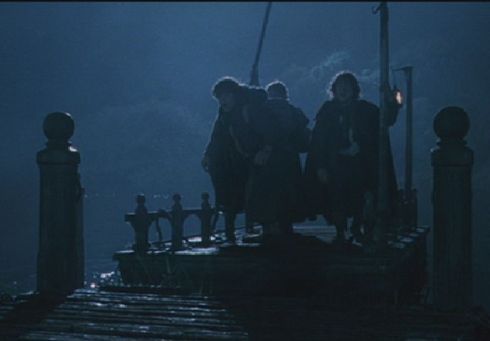
has danger attached, but it’s a danger which pursues the hobbits at the Bucklebury ferry. Here, pursued by one—or more—wraiths,

2wraithatferry.jpg

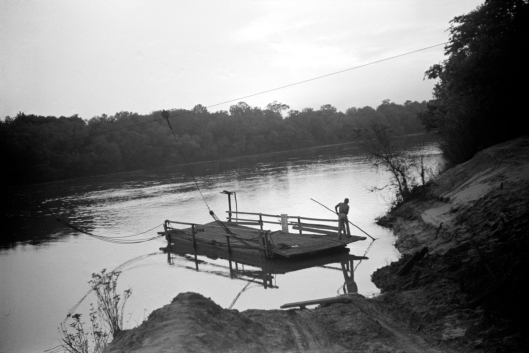
they cross over by what is a kind of do-it-yourself ferry, where the ferry runs on a cable, which keeps it available and on course, while the passengers pole to add propulsion.

3cableferry.jpg

4ferry.jpg

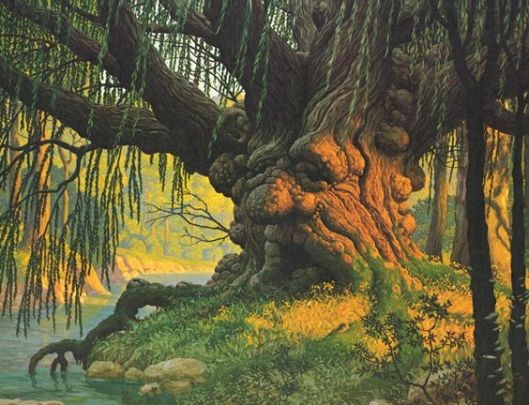
There is a puzzle at their next crossing—because the hobbits don’t appear to have crossed at all! This is the River Withywindle, on whose bank the hobbits meet up with Old Man Willow (not as in the film, where he’s been pulled violently out of context and replanted, for no good reason we can see, in Fangorn’s forest).

5oldmanwillow.jpg

Until we began to study water-crossings, we had never really thought about what happens then. The hobbits come to the river, having become lost in the Old Forest. Pippin and Merry are swallowed by the tree. Tom Bombadil comes to the rescue: but how do they cross the Withywindle? We just couldn’t remember! So we went back to the text, saw Tom lead the four hobbits through the forest, where they almost lose him, then they hear: “Hop along, my little friends, up the Withywindle!” (The Fellowship of the Ring, Book 1, Chapter 6, “The Old Forest”)

And so they never actually ford across or are ferried across. Instead, they walk up its course to Tom’s house, which seems to be near the source.

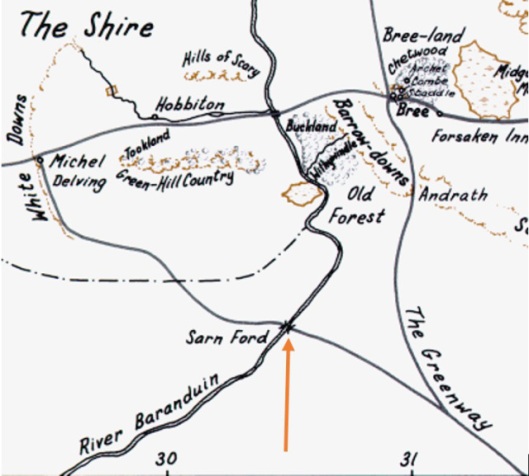
6withywindlemap.jpg

The next crossing is many miles away—over the Barrow Downs, through Bree, past Weathertop, to the Last Bridge, over the Hoarwell. Although Aragorn is anxious that the Wraiths will have gotten there before them, they pass safely and keep moving southwards, towards Rivendell, until, near the ford over the Bruinen, the Nazgul catch up with them at last.

7bruinen.jpg

There is a bridge, of course, at Khazad-Dum, although, as far as we can tell, there is no water even in the depths far below it.

8khazaddum.jpg

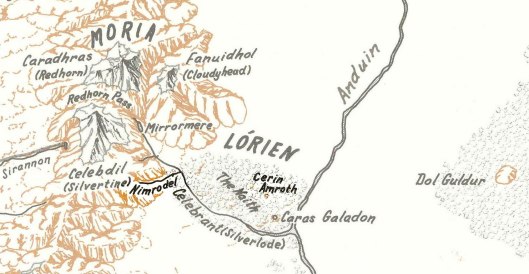
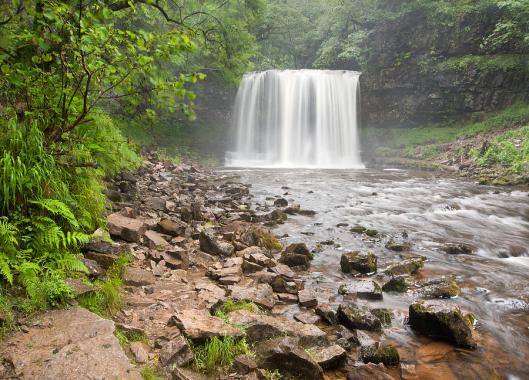
Escaping from Moria, the Fellowship reaches two streams in a row and, as far as we know, none of the prominent illustrators has given us pictures, either of the tributary Nimrodel or the main river, the Celebrant, so we provide a rather generic picture to offer a rather general idea.

9nimrodel.jpg

10nimrodel.jpg

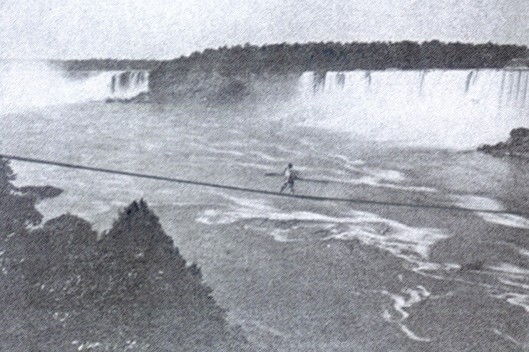
The Nimrodel is shallow enough to wade across, but the Celebrant is wider and deeper and the Elves provide a rather iffy method of transport: a single line of rope to balance on, making us imagine something like the famous Blondin crossing Niagara Falls in 1859—well, a little!

11blondin.jpg

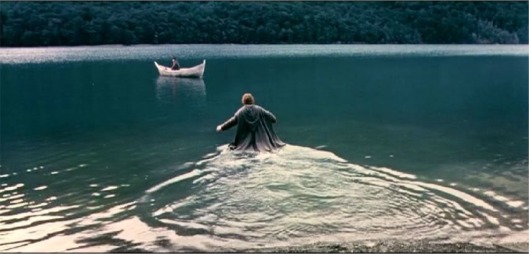
The next crossing is almost inadvertent, or, at least happens sooner than expected: the Fellowship has been paddling down the Anduin, but, putting in at Amon Hen, things go disastrously wrong. Boromir tries to take the Ring, the orcs appear, Boromir is mortally wounded, and Merry and Pippin are carried off (in our edition—the 50th Anniversary, One Volume Edition—this takes all of 12 pages—quite a narrative feat for JRRT!), before Frodo (and Sam) cross the river to the east and story begins its major split.

12samandfrodo.jpg

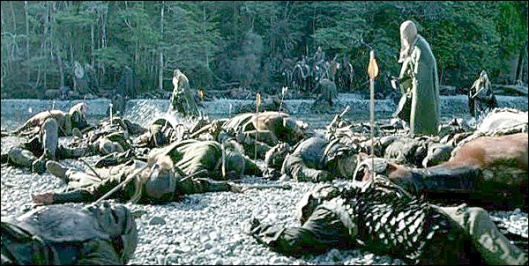
[We might insert here, although, in The Lord of the Rings, it’s only a footnote that at the crossing of the Isen, during this time, Theodred, son of Theoden, is killed.]

12aTTTIsenFord2.jpg

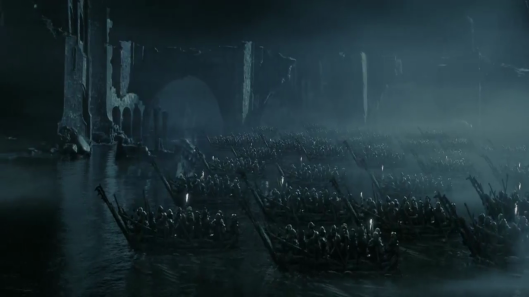
After this, there is only one more crossing of any significance, but it’s not by the main characters: rather, it’s by the orcs, who use boats to assault and capture west Osgiliath, which is the subject of one of our earlier postings.

13orcsosgiliath.png

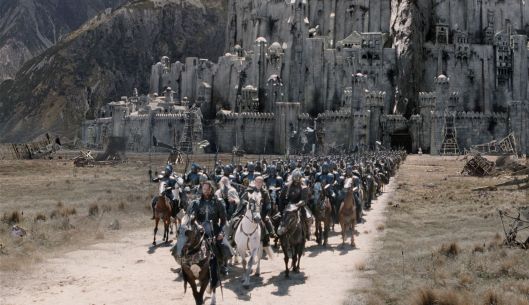
To which we would add the return crossing, days later, of the Forlorn Hope of Gondor and Rohan, on their way to challenge Sauron (and to distract him from Frodo and Sam).

14marchonmordor.jpg

To finish up this posting, we provide a chart below (clearly now one of a series, after the earlier one on doorways and passages) of the water-crossings found in the two books.

Crossing Characters Outcome Source
Tharbad Boromir Loses horse The Lord of the Rings
The Water Bilbo Joins Dwarves The Hobbit
 An unnamed river Bilbo, Dwarves, and Gandalf Lose baggage The Hobbit
Rivendell Bilbo Dwarves, and Gandalf Helped by Elves The Hobbit
Anduin Bilbo, Dwarves, and Gandalf Transported by eagles The Hobbit
Enchanted River Bilbo and Dwarves Bombur drugged The Hobbit
Underground river Bilbo and Dwarves Using barrels, Bilbo and Dwarves escape The Hobbit
The Long Lake Bilbo and Dwarves Gain help from Esgaroth The Hobbit
The Brandywine (Bucklebury Ferry) Frodo, Sam, Merry, Pippin Escape Wraith The Lord of the Rings
Withywindle Frodo, Sam, Merry, Pippin Reach Tom Bombadil’s house (never actually cross river) The Lord of the Rings
The Bruinen Frodo and Wraiths Elrond causes river surge, Nazgul driven off The Lord of the Rings
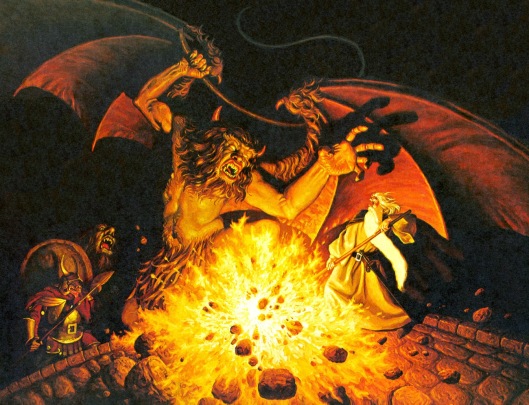
Khazad-Dum Balrog and Gandalf Gandalf defeats Balrog, but falls down with him The Lord of the Rings
Nimrodel/

Celebrant

Fellowship and Elves Fellowship brought into Lorien The Lord of the Rings
Anduin Frodo and Sam Set out on journey to the east The Lord of the Rings
Isen Rohirrim and Orcs Rohirrim driven back, Theodred, son of Theoden, killed The Lord of the Rings
Anduin Gondorians vs Orcs Gondorians driven back from West Ogsiliath The Lord of the Rings


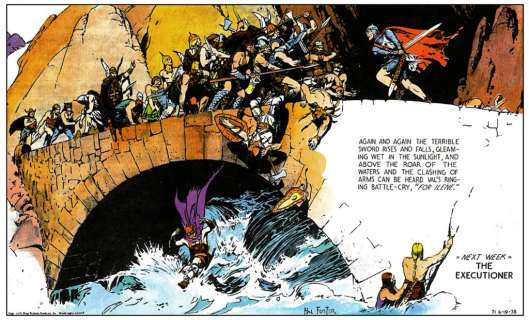
This is our last posting for the year 2016 and we close the year with thanks to all who follow our blog or simply stop in for a visit. In 2017, we plan to continue our Tolkien travels, sometimes employing the Sortes Tolkienses, as well as to use Tolkien’s world to visit others, beginning with a posting on “Famous Bridge Battles”, from Boromir and Faramir jumping off one to escape the orcs, to Napoleon at Arcola, and beyond. Here’s a taste…

15princeval.jpg

We also plan to explore other worlds and perhaps to add a review section for books and films we think you might enjoy.

In the meantime, thanks, as ever, for reading. Happy New Year!

MTCIDC

CD

ps

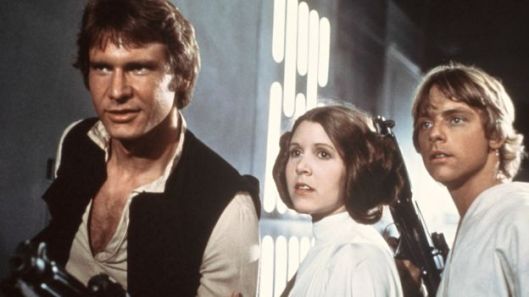
What sad and surprising news! Princess Leia is no more– but no– Princess Leia will always be with us, just like the Force.

_87060782_starwarsap3

One More River (1)

21 Wednesday Dec 2016

Posted by Ollamh in Artists and Illustrators, Imaginary History, J.R.R. Tolkien, Maps, Narrative Methods

≈ Leave a comment

Tags

Alan Lee, Beorn, Bilbo, bog people, Bombur, Boromir, bridges, causeways, drowsiness, Dwarves, Esgaroth, Great East Road, Greyflood, Gwathlo, Hobbiton-across-the-water, Lethe, Middle-earth, Mirkwood, Rammas Echor, Rivendell, river-crossing puzzle, Roman Roads, Tharbad, The Atlas of Middle-Earth, The Hobbit, The Lord of the Rings, Tolkien, Tollund Man

Welcome, dear readers. Here we are again in Middle-earth, as so often we’ve been over the last couple of years, but, as we said in our last post, one reason why we revere JRRT and his work is that it’s so rich—it seems like one can open it to any page and there is something new to explore. In this post, we began with an odd little detail, just something said almost in passing by Boromir:

“A long and wearisome journey. Four hundred leagues I reckoned it, and it took me many months, for I lost my horse at Tharbad, at the fording of the Greyflood.” (The Fellowship of the Ring, Book 2, Chapter VIII, “Farewell to Lorien”)

Tharbad, we knew from the Companion, was once a river port on the Gwathlo, Boromir’s “Greyflood”. Here’s a description from the extremely helpful introductory section of the Companion called “The Maps of The Lord of the Rings”:

“…with long labour a port capable of receiving seagoing vessels had been made at Tharbad, and a fort raised there on great earthworks on both sides of the river, to guard the once famed Bridge of Tharbad” (lxv)

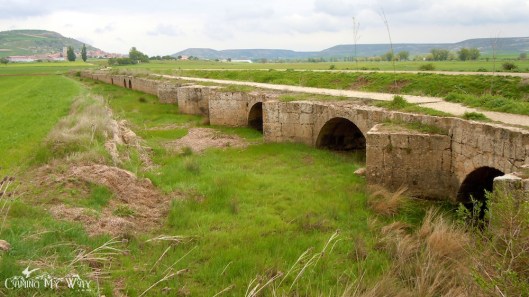
This “once-famed” bridge was clearly long-gone by the time, at the end of the Third Age, when Boromir reached the river it had once offered passage over, for all of the work done once upon a time, including long causeways—raised approach roads above boggy ground—here’s a Roman example from northern Spain with causeway and bridge—

1bridgewithcauseway.jpg

“But in the days of The Lord of the Rings the region had become ruinous and lapsed into its primitive state: a slow wide river running through a network of swamps, pools and eyots [little islands]: the haunt of hosts of swans and other water-birds.” (from a letter of 30 June, 1969, to Paul Bibire, quoted in Companion, 650)

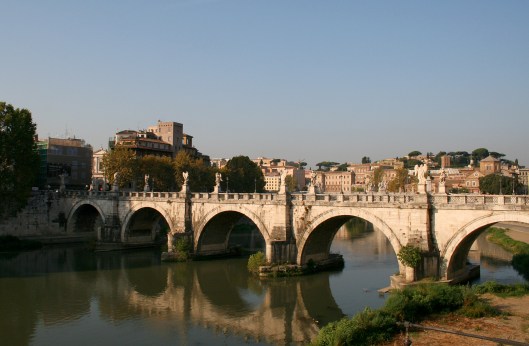
JRRT appears to have left no description of the bridge itself, but we imagine it as looking rather like a Roman one (as JRRT could have seen pictures of surviving ones like this in Portugal

2ponte.jpg

or this in Rome.

3ponteadriano.JPG

Unlike much of the rest of the Roman world, no Roman bridge survives in Britain—only the remains of piers, ramps, and approaches–so we’re assuming that, if he were at all influenced by Roman architecture—and that’s an absolute assumption on our part, we admit, but certainly things like Hadrian’s Wall seem to have been an inspiration—see our earlier posting on the Rammas Echor—it was through photographs.)

This mention, however, sparked us to think about the crossing of bodies of water, both in The Hobbit and in The Lord of the Rings, just how many there were, and the kinds of events which happened at them.

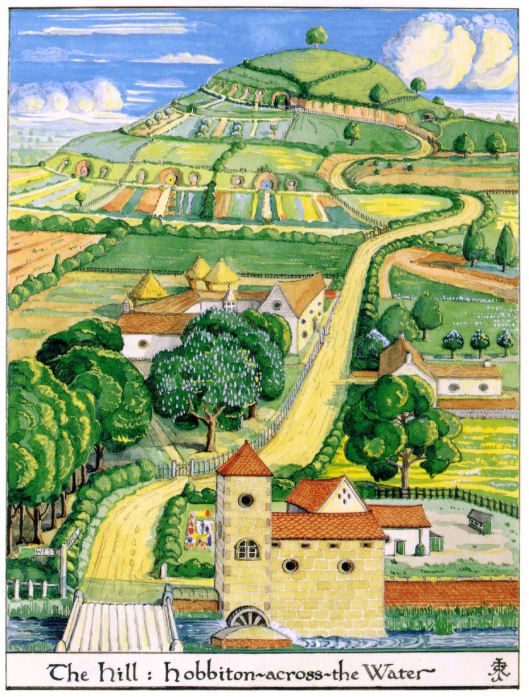
Bilbo’s Bag End, of course, is just down the road from The Water and its mill, as depicted by Tolkien himself.

4imghillandmill.jpg

When he sets off with the dwarves, however, there is little incident involved in running water at first. The party has to cross a river, “swollen with the rains, [which] came rushing down from the hills and mountains in the north.” (The Hobbit, Chapter 2, “Roast Mutton”) They cross this by “an ancient stone bridge” (perhaps like this one at Carrbridge, in Scotland?)

5imagecarbridge.jpeg

but, somehow, they can’t escape the river, as, during the night, “…one of the ponies took fright at nothing and bolted. He got into the river before they could catch him; and before they could get him out again, Fili and Kili were nearly drowned, and all the baggage that he carried was washed away off him.” (The Hobbit, Chapter 2, “Roast Mutton”). So far, when it comes to running water, for all that there was a bridge, it seems difficult for the dwarves to stay out of it.

Their second adventure with water is more successful, when they cross the bridge at Rivendell, which we have discussed in a posting on Rivendell architecture, so, for this one, we’ll simply add Tolkien’s illustration of Rivendell, plus a real favorite, Alan Lee’s of the bridge.

6imagerivendelljrrt.jpg

7imagerivendellbridgealanlee.jpg

Beyond Rivendell, it’s into the mountains (literally, when they are pulled into the world of the goblins by a secret door) and, when they come out, their next water barrier is surmounted for them when they’re rescued by eagles and flown to the other side of the northern Anduin.

8eaglerescue.jpg

If they had simply taken the Great East Road (as we presume Bilbo and Gandalf did on the way back), they would have found a ford where the road runs eastward into the Old Forest Road. (see Karen Wynn Fonstad, The Atlas of Middle-earth, 80-81, for a larger view).

9mistymtnsmap.gif

The real problem with a crossing comes at the next water course. They had plunged into Mirkwood

9ajrrtmirkwood.png

and come up across a stream (in fact, the Enchanted River, although they didn’t know it). During their leave-taking at Beorn’s, he had warned them about it:

“There is one stream there, I know, black and strong which crosses the path. That you should neither drink of, nor bathe in; for I have heard that it carries enchantment and a great drowsiness and forgetfulness.” (The Hobbit, Chapter 7, “Queer Lodgings”)

As people with a background in Greek and Roman mythology, we immediately thought of Lethe, the name of which comes from a Greek verb which means “to escape notice/be hidden—therefore, to forget”.

It was one of the rivers of the Underworld and, if you drank from it, you lost all memory of your past. In that part of classical religion which believed in reincarnation, it was one step on the way to returning to earth.

10imagelethe.jpg

Here in Mirkwood, however, the point is to avoid drinking, or even touching, it. The difficulty, of course, is that, if you can’t touch it, how do you get across it, especially when:

“There had been a bridge of wood across, but it had rotted and fallen leaving only the broken posts near the bank.” (The Hobbit, Chapter 8, “Flies and Spiders”)

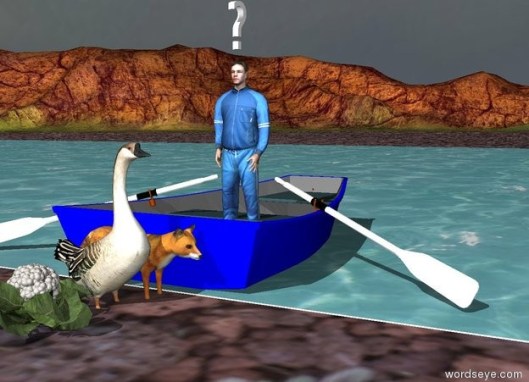
Providentially, there is a boat drawn up on the opposite shore and we’ve always been reminded here of what is called a “river-crossing puzzle”. There are many variations, but the earliest currently known dates from the 9th century AD, and is found in Propositiones ad Acuendos Juvenes (maybe something like “Puzzles for Sharpening [the Minds of] Young Folk”—which makes it sound rather Victorian). We provide links here for: River crossing puzzle, Fox, goose and bag of beans puzzle, and Propositiones ad Acuendos Juvenes, for anyone interested to learn more.

11imagefoxgoose.jpg

In the case of the dwarves, the math goes awry when the largest of them, Bombur, accidentally falls into the water and becomes comatose.

12imageleebombur.jpg

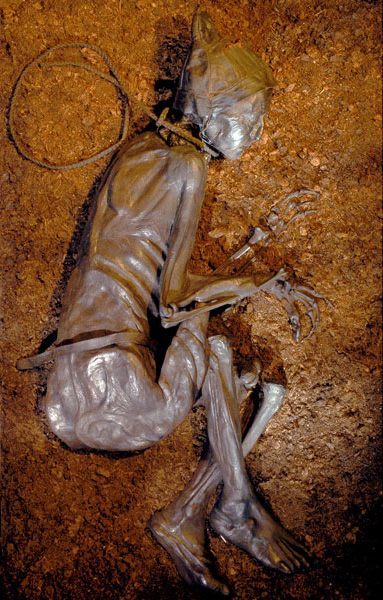
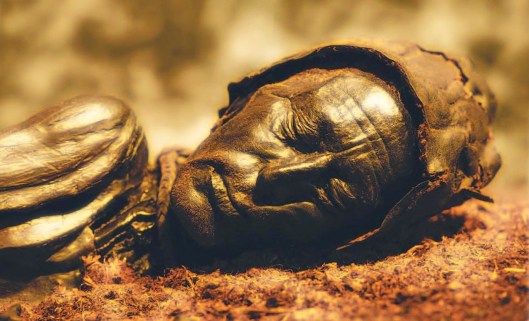
(And this Alan Lee drawing oddly reminds us of “bog people”—that is, the bodies of people, the earliest being from 8000BC, a majority being Iron Age, found in peat bogs throughout northern Europe. Because of the conditions in bogs, some have been amazingly preserved, such as “Tollund Man”—here

13imagetollund.jpg

14imagetollund.jpg)

He eventually awakes, long before the party’s next river, which acts as a moat to the caves of the Elf king of Mirkwood.

15imagethranduilsgate.jpg

This has a bridge, across which, at various times, Thorin, the dwarves, and Bilbo (wearing the Ring) go.

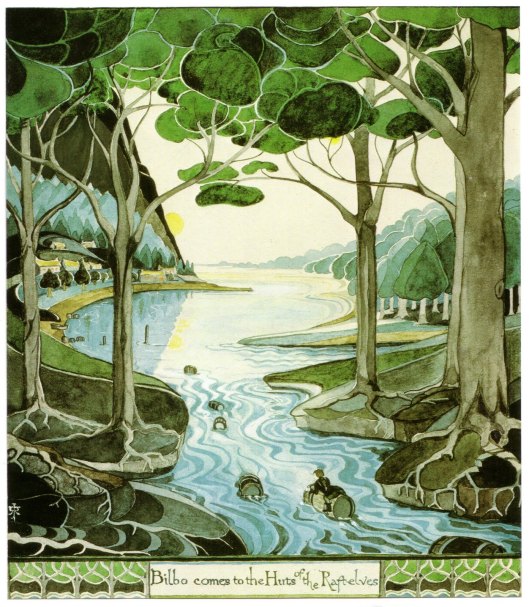
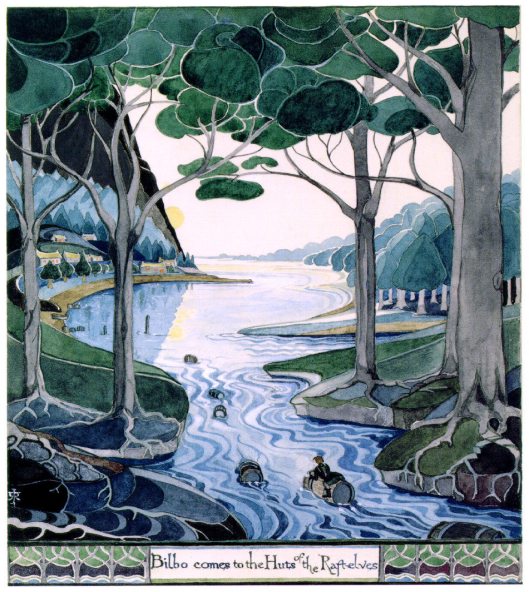
It is the next bit of water, however, which bears the greater interest. This is the underground stream which comes up in the cave where the elves store empty wine barrels to return to the men of Esgaroth. And this, the dwarves and Bilbo don’t cross, but ride down, packed in (or perched on) those empty barrels.

16imagebarrelriding.jpg

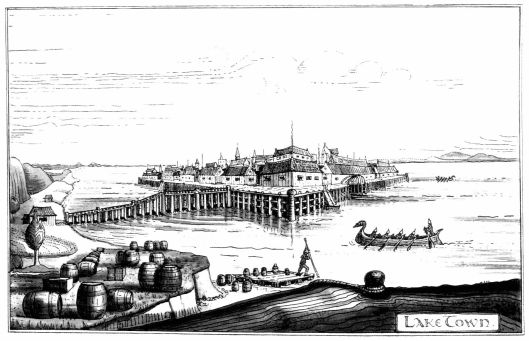
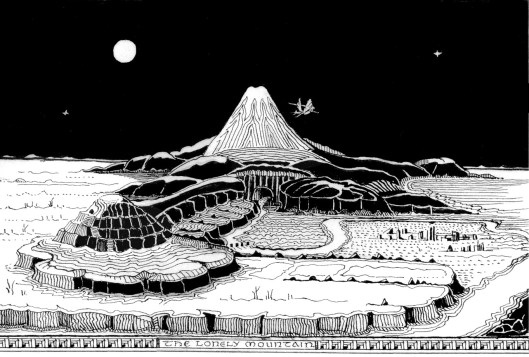
This leads us to the last body of water: the Long Lake, on which Esgaroth stands. From here, the people of Lake Town convey them back north to a landing place from which they will start out for the Lonely Mountain and the climax of their quest.17imageesgaroth.jpg

18lonelymountain.jpg

And here we’ll end our quest for water-crossings for this posting, to be continued with one on The Lord of the Rings in our next—along with all of those extras which we can’t help adding, from medieval puzzles to peat bog people.

Thanks, as always, for reading!

MTCIDC

CD

ps

If you celebrate this time of year for any reason, may your celebration be a happy one! We mostly dream of toys…

19imagetoytownsoldiers.JPG

When One Door Closes (2)

16 Wednesday Nov 2016

Posted by Ollamh in J.R.R. Tolkien, Literary History, Narrative Methods

≈ Leave a comment

Tags

Balin, Barrows, Bree, Bridge of Khazad-Dum, Chamber of Mazarbul, Crickhollow, doors, Dwarves, Elven-way, Farmer Maggot, Gandalf, Greenway, Hobbit door, Hollin, Lothlorien, Moria, Nazgul, picaresque, Rivendell, Robert Burns, Tam O'Shanter, The Fellowship of the Ring, The Ford of Bruinen, The Hobbit, The Legend of Sleepy Hollow, The Lord of the Rings, The Prancing Pony, Tolkien, Washington Irving, Watcher in the Water, Weathertop, West-door, West-gate

Welcome, dear reader, as always. It’s a rather gloomy late autumn day here as we write this, fitting, perhaps, for the gloomier The Lord of the Rings after the cheerier (well, sometimes) The Hobbit, as we continue our look at the functions of doors and their equivalents in JRRT.

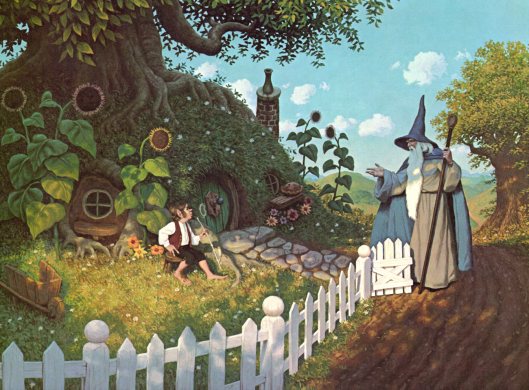
If you’ve read our previous posting, you’ll know that, in it, we examined doors and gates in The Hobbit, dividing them into two basic categories: doors which might lead to safety and doors which led to danger, all based upon Bilbo’s remark about how dangerous it can be, just stepping outside your door.

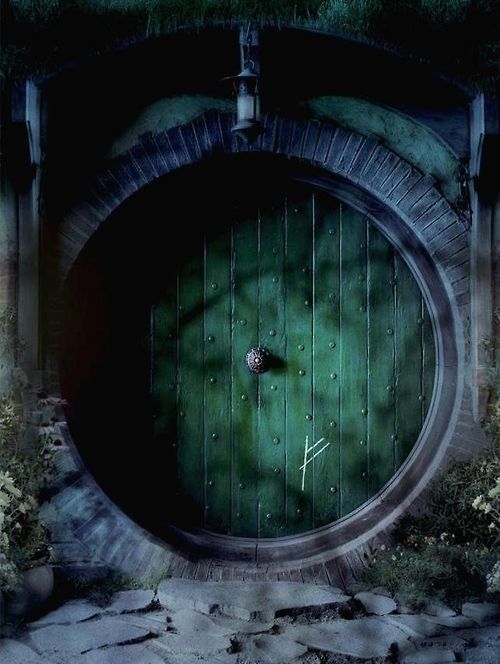
Bilbo’s door adventures had begun with his own.

gandalfvisitsbilbo.jpg

doorwithrune.jpg

When comparing the two books, we get a strong sense of the episodic nature of The Hobbit:  we can almost break it down into movement between doors, from the arrival of the dwarves to the knock of Gandalf and Balin, giving it more the feel of a picaresque novel: that is, a novel with an goal, but with much of its focus upon the adventures along the way, adventures which don’t always necessarily lead to that goal.   This gives it a lighter tone, as well—after all, it was meant as a children’s book in a time (1937) when such books were understood in general never to be too solemn. The Lord of the Rings, in contrast, develops an almost grimly-focused forward motion, which impels it even when the Fellowship breaks into two after the death of Boromir, and much of the action spreads from Frodo and Sam on the way to Mordor to the separate adventures of Merry and Pippin in Rohan and Gondor.

So what might we see as the first door—in either sense—in The Lord of the Rings? we asked ourselves. And we supposed that we might see minor doors of safety at Farmer Maggot’s and Frodo’s new home in Crickhollow, in both cases brief refuges from the Nazgul, but, as we said in our last posting, doors commonly have some sort of challenge to them—and challenger—and the first one of those appears briefly at the hedge in Bree:

“They came to the West-gate and found it shut; but at the door of the lodge beyond it, there was a man sitting. He jumped up and fetched a lantern and looked over the gate at them in surprise.”   (The Fellowship of the Ring, Book 1, Chapter 9, “At the Sign of the Prancing Pony”)

bree.jpg

The watchman, when his challenges (and maybe a little too-inquisitive challenges) are turned aside, lets them in and they reach The Prancing Pony, only to escape murder in their beds and the loss of their ponies.

prancingpony.jpg

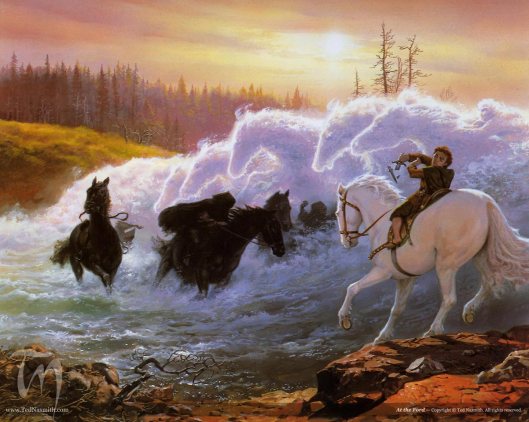
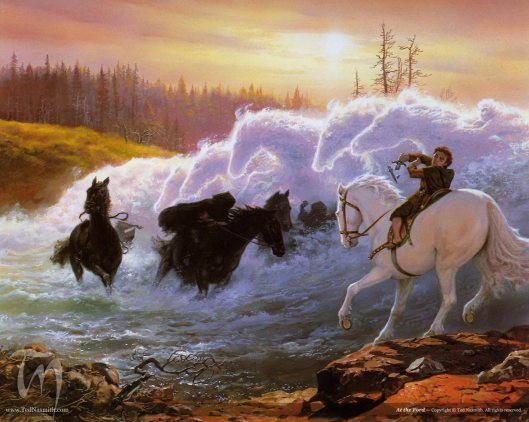
The first gateway which leads to real safety, however, isn’t a door or gate at all, but a natural barrier (with some magical help): the Ford of Bruinen. Here, the role of traveler and challenger is reversed, as the challenged are the Wraiths and the challenger is Frodo, but it is the power of the Elves which closes the door.

At the Ford, by Ted Nasmith

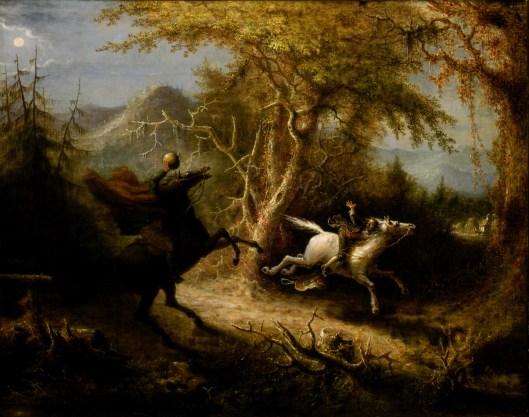
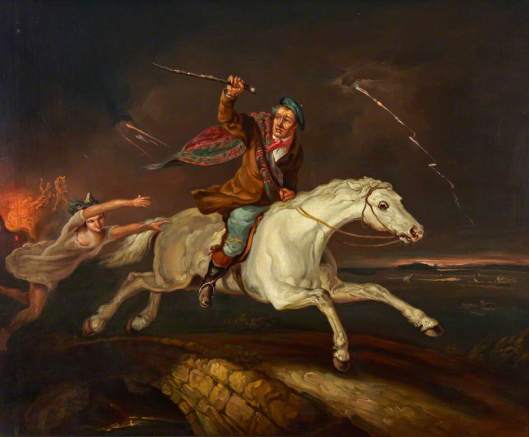
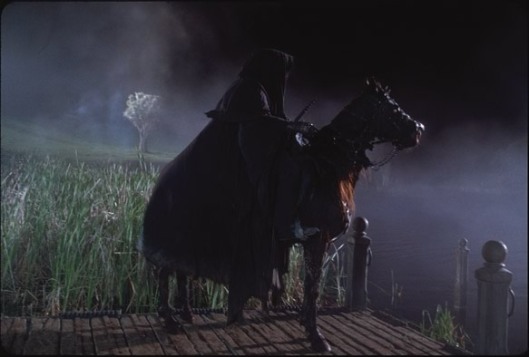
(It is interesting here that Tolkien has chosen not to take advantage of the folk belief—if you know “The Legend of Sleepy Hollow” by Washington Irving, or its inspiration, the poet Robert Burn’s “Tam O’Shanter”, this will be readily familiar to you—that evil spirits are unable to cross running water, even at a bridge.

John_Quidor_-_The_Headless_Horseman_Pursuing_Ichabod_Crane_-_Google_Art_Project.jpg

tamoshanter.jpg

To reach the Shire, the Wraiths have had to cross several bodies of water and now their hesitation to traverse another appears to be derived from their confidence that they can now control Frodo—either by the influence of the Ring, or perhaps from his wound—and call him back across the stream to them.)

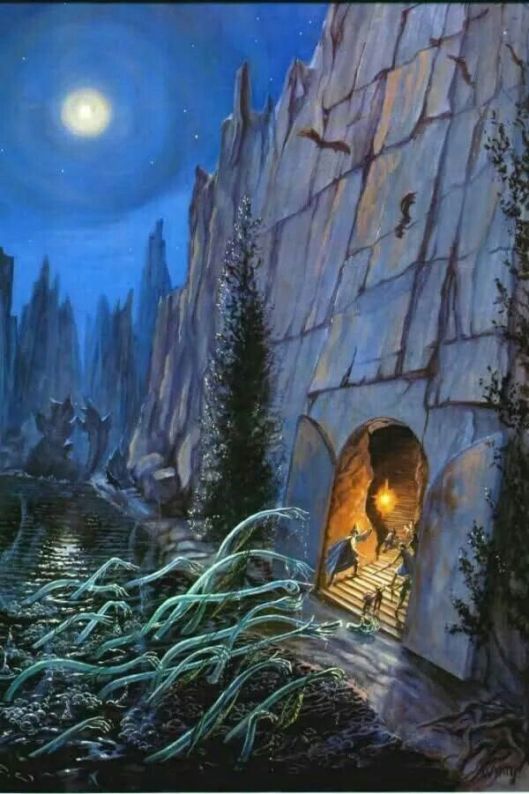
From Rivendell, the next such door is that at the western side of Moria.

moriagate.jpg

Here, there is no living challenger. Rather, it is a kind of riddle—or, at least, it is initially understood as such—which bars the way. Its answer is simple, which led us to wonder, what is the purpose of this door scene in the story? As the creature in the pool

watcher.jpg

barricades the door behind them, it adds to the tension: the Fellowship has been watched and, from the hostile mountains to the wolves to the tentacle thing, it has been forced into darker and narrower ways, those ways seemingly chosen by the malevolent force observing their journey. As well, it suggests the gradual decay of what was once a vibrant, active culture, as Gandalf explains:

“Here the Elven-way from Hollin ended. Holly was the token of the people of that land, and they planted it here to mark the end of their domain; for the West-door was made chiefly for their use in their traffic with the Lords of Moria. Those were happier days, when there was still close friendship at times between folk of different race, even between Dwarves and Elves.” (The Fellowship of the Ring, Book 2, Chapter 4, “A Journey in the Dark”)

This is a theme throughout The Lord of the Rings and one which, we believe, adds to its power: the events of the close of the Third Age are set against a background of other times and other events and the landscape still bears traces of those times, from the Barrows to the Greenway and Weathertop and far beyond. As well, so many of those traces suggest that violence and the dark spirit of Sauron, sometimes through his agents, sometimes in person, have had much to do with their end.

Now that the Fellowship is within Moria, it encounters its next door: that of the Chamber of Mazarbul.

marzabul.jpg

Here, they are the challengers, when forced to defend themselves from a horde of “Orcs, very many of them…And some are large and evil: black Uruks of Mordor.” (The Fellowship of the Ring, Book 2, Chapter 5, “The Bridge of Khazad-Dum”). There is a second door, however, and, when they have beaten back their attackers, they escape by it—but only so that Gandalf may be the challenger at a crossing—as Frodo was at the ford—at the Bridge of Khazad-Dum, although here magic apparently cannot save him, as it had Frodo.

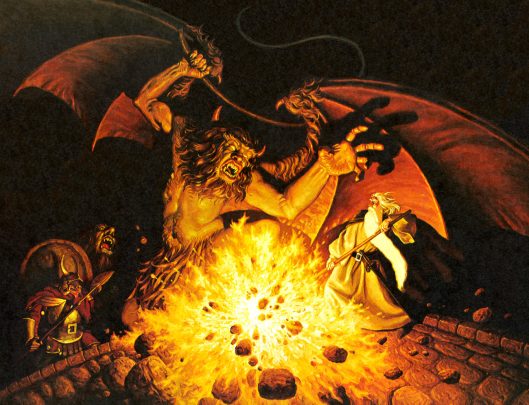
balrog.jpg

With Gandalf gone, we see the repetition of a scene from The Hobbit—the escape through a crowd to the outside world:

“…and suddenly before them the Great Gates opened, an arch of blazing light.

There was a guard of orcs crouching in the shadows behind the great door-posts towering on either side, but the gates were shattered and cast down. Aragorn smote to the ground the captain that stood in his path, and the rest fled in terror at his wrath.” (The Fellowship of the Ring, Book 2, Chapter 5, “The Bridge of Khazad-Dum”)

At this moment in The Hobbit, Bilbo had used his newly-discovered ring to escape (albeit with the loss of a few buttons), but Aragorn’s sword clearly does just as well.

It is easy to see just how prevalent the pattern is: even after that harrowing moment of being chased through the mines and losing Gandalf, where there is a door, there is someone at it to make a challenge, and this holds true even without an actual door, as the remaining members of the Fellowship seek to enter Lothlorien and are stopped by Elven sentries in a tree. (The Fellowship of the Ring, Book 2, Chapter 6, “Lothlorien”)

And the pattern continues, even as the Fellowship breaks up, but let’s take a moment to see what we’ve found so far. On the side of doors to safety, we have: Bree (although it’s not so safe as it looks), the Ford of Bruinen, the main door of Moria, and the entrance to Lorien. As for doors to danger, there are: the western doors of Moria and the door to the Chamber of Mazarbul.

In the third installment, we shall see just how many more doors/gates/entryways we find which continue to fit the pattern—and there are a fair number of them.

Thanks, as ever, for reading.

MTCIDC

CD
When One Door Closes (I)

09 Wednesday Nov 2016

Posted by Ollamh in J.R.R. Tolkien, Literary History, Narrative Methods

≈ Leave a comment

Tags

And Unexpected Party, Baggins, Beorn, Bilbo, Bilbo and Gollum, Chico Marx, doors, Dwarves, Gandalf, Goblins, Groucho Marx, hidden door, Hobbit door, Horse Feathers, Into the Fire, Lake Town, Lonely Mountain, Mirkwood, Out of the Frying-Pan, password, Smaug, speakeasy, Swordfish, The Hobbit, The Lord of the Rings, The Marx Brothers, Thranduil, Tolkien, Took, wargs

Welcome, dear readers, as always.

Recently, we’ve been thinking about Bilbo’s remark to Frodo:

“It’s a dangerous business, Frodo, going out your door.” (The Fellowship of the Ring, Book 1, Chapter 3, “Three is Company”)

What makes this true in Tolkien, we wondered? As an experiment, we began to list all of the significant doors in The Hobbit and The Lord of the Rings and what happened at each of them and we believed that we could see that they fell, roughly, into two categories: doors (and we include gates here) which are the approach to danger, as Bilbo says, and doors which at least seem to offer safety. There are so many, in fact, that we have decided to break them down (no pun intended) and, in this posting, we’ll examine those we found in The Hobbit.

Our first door is Bilbo’s own, in front of which he is sitting when Gandalf first appears

bilbogandalf.jpg

and which he dodges behind, to escape Gandalf—or so he thinks:

“With that the hobbit turned and scuttled inside his round green door, and shut it as quickly as he dared, not to seem rude.” (The Hobbit, Chapter 1, “An Unexpected Party”)

This door, of course, is hardly a barrier to Gandalf, who scratches a rune on it, turning it from what Bilbo hopes is a “no trespassing” sign to a “welcome” mat.

bilbosdoor.jpg

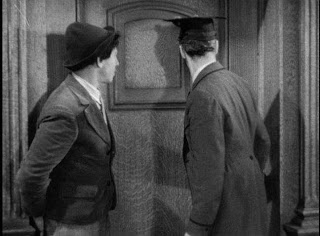
We then get a scene which reminds us of one in the Marx Brothers’ movie, Horsefeathers (1932)

horsefeatherposter.jpg

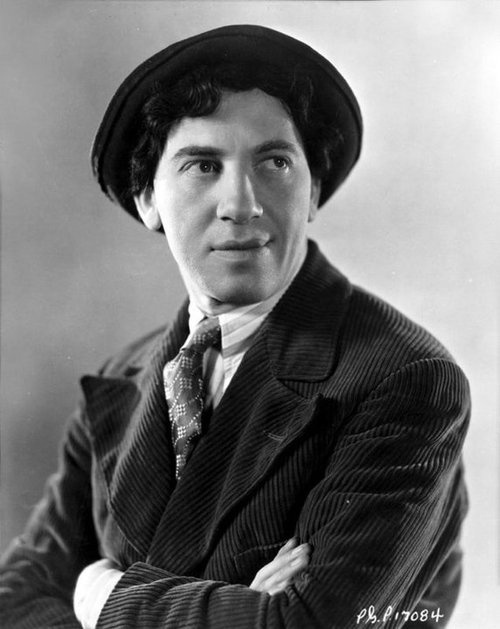
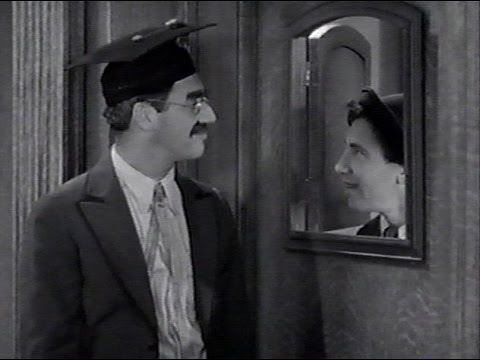
—or maybe it’s just an excuse on our part to bring up the Marx Brothers, who, in our opinion, are never brought up often enough. It’s a scene from the days of Prohibition, when hard liquor had been outlawed in the U.S. by an amendment to the Constitution (1920-1933). It was clearly a batty idea and, very soon, many people (some of whom must even have voted for the amendment), were looking for ways to skirt the federal law. One way to do so was to visit an illegal bar, called a “Speakeasy”, presumably because you could say what you wanted there, including criticizing a stupid law. These were secret places, with guards at the door and a need for passwords, so that people on the inside could detect attempts by the police to raid them. In the movie, Chico (pronounced “chick-o’’—as he was said to be an avid pursuer of girls)

chico.jpg

is the guard on the inside and Groucho

groucho_marx_in_duck_soup.jpg

is a potential customer.

speakeasy.jpg

As is typical with the Marx Brothers, the scheme collapses and they both end up on the outside of the door, but, before that happens, there is a lot of knocking and attempts (full of bad puns) to guess the proper password.

horsefeathersbothshutout.jpg

The door, then, is really only a prop, a site where Chico and Groucho can practice one-liners on each other and not much else (as if that matters with the Marx Brothers!). In the next door scene from The Hobbit, however, JRRT uses Bilbo’s door for larger purposes: to show Gandalf’s subtle understanding of Bilbo’s psychological make-up, as well as the beginning of his plan to turn Bilbo from a staid Baggins to a much freer Took, as Bilbo is forced to confront a gang of dwarves and their mission.

unexpected.jpg

Gandalf’s method, as readers will remember, was to send the dwarves to Bilbo’s door one or two at a time. Gandalf repeats this trick when he and the dwarves (and Bilbo, of course) take refuge at Beorn’s,

beorn.jpg

after their escape from the pursuing wargs and goblins.

warg_rest.jpg

Whereas we might say that the second door scene at Bilbo’s led to danger, this scene leads to safety, although only temporary security, as Bilbo and the dwarves must set out again, even if refreshed and refitted.

(Readers note: this second time has been replaced in the second Hobbit film with a scene which misses both the quiet comedy of the original and its use in the story as a way to provide us with a more rounded picture of Beorn, as well as JRRT’s use of a repeated folk motif perhaps to reinforce the fairy tale-like structure of what was originally an oral tale turned children’s book.)

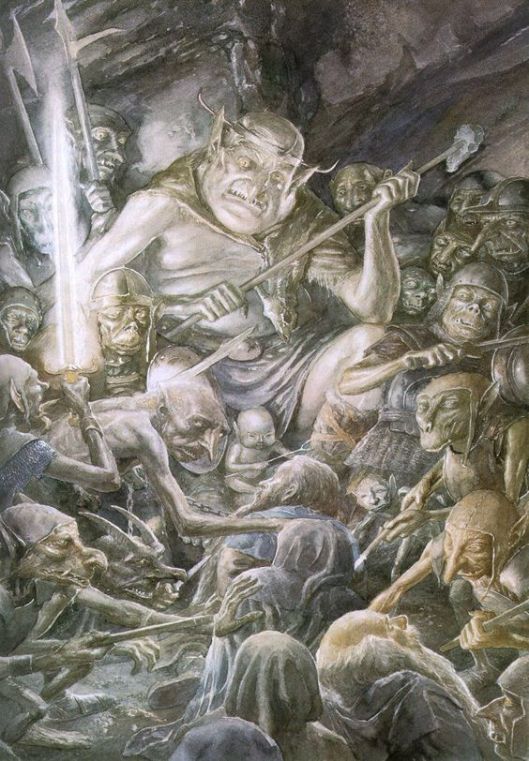
The dwarves had encountered the goblins through a hidden door (clearly a “danger door”), outside of which they had taken shelter. They are made prisoner

goblinking.jpg

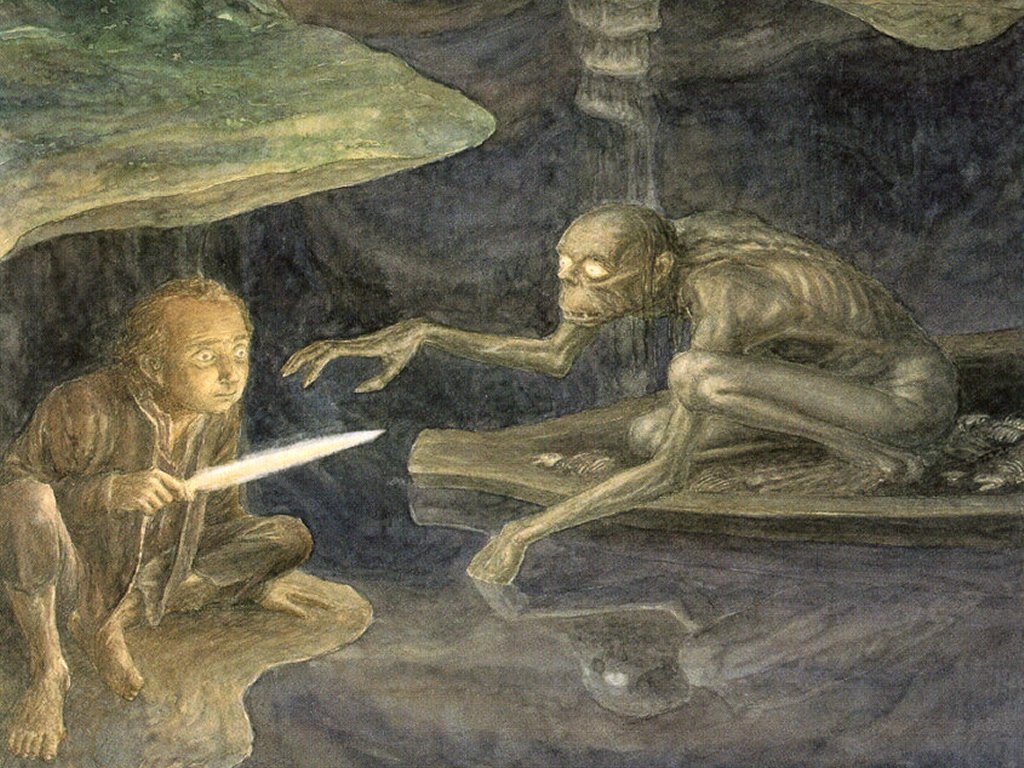
but Bilbo, being lost, finds the Ring, meets Gollum,

Bilbo and Gollum.JPG

and escapes by a door which certainly offers safety. (Although, as the title of the next chapter puts it, not for long, being “Out of the Frying-Pan, Into the Fire”.)

goblinsbackdoor.jpg

This, of course, not only leads us back to Beorn, but also on to Mirkwood and our next door, that of the Mirkwood Elves and their king, Thranduil (who does not ride an elk, as the movies would have it—and really silly-looking that is, in our opinion). This is one of a number of versions by JRRT himself.

palazzo di thranduil 2.jpg

Although this door leads to the dwarves’ imprisonment, the danger appears to be minimal. Thranduil threatens them, but, except for locking them up and putting them on short rations, he does them no harm. (And there is another backdoor escape—this time in barrels—one of JRRT’s own favorite illustrations—and ours, too).

barrel-riding.jpg

The barrels led us to the lake and to Lake Town (a colored version of another JRRT illustration),

Laketown4.jpg

through the gate of which the dwarves had to pass. A strong theme in so many of these entryways is that they are a form of challenge: those who would get in (or out) must deal with a guardian—Bilbo, goblins, elves–and Lake Town is no different. Here, there is a squad of lax gate guards, who are rather easily impressed when Thorin announces who he is and that he wants to see the Master. As the dwarves persuade the Lake Town people to supply their expedition, we would label this one of the doors to safety—the last thing we would say for the final two: the back door and the front gate of the Lonely Mountain.

136TheLonelyMountain.jpg

So far, we have had two front doors (Bilbo’s and Beorn’s), one hidden door (goblins), two sets of gates (elves, Lake Town), and two back doors (goblins and elves). Now we have a door with a spell cast upon it and the riddle of the spell acts as the guardian. It is, of course, the door most desired by the dwarves, but it’s hardly a door to safety as, at its bottom lies the reason they abandoned the mountain to begin with: Smaug.

bilbowithsmaug.jpg

The front gate is hardly better, as it soon becomes a defensive work for the dwarves as they prepare to fend off those who either try to seek recompense or are simply goblin attackers.

the-hobbit-the-battle-of-the-five-armies3.jpg

But wait—we’ve left out a final door, haven’t we? “the door where it began”—and, in front of it, Bilbo experiences one more trial:   finding that he’s been declared dead and his property is up for auction—and just when he believes he is “back again”. But there is a happy ending and The Hobbit itself ends with Bilbo, some years later, answering that same door

tolkien_drawing1.jpg

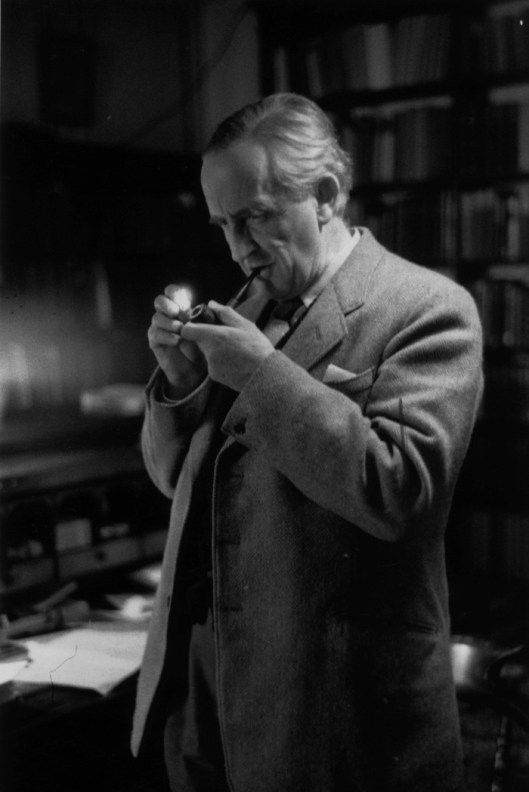
and entertaining Gandalf and Balin. (Although in the drawing above, Bilbo bears a certain resemblance to someone else…)

j_r_r_tolkien_-_smoking_pipe-700x1049.jpg

In our next post, we’ll continue by looking at doors and gates in The Lord of the Rings.

Thanks, as always, for reading!

MTCIDC

CD

Strange as News from Bree

03 Wednesday Feb 2016

Posted by Ollamh in Fairy Tales and Myths, J.R.R. Tolkien, Language, Literary History, Narrative Methods

≈ Leave a comment

Tags

acta, Barad-Dur, Barliman Butterbur, Bree, Bronte, copyists, Dwarves, English coaching inn, Forum Romanum, Frodo Baggins, Gandalf, Gondor, Gutenberg, Haworth, Johann Carolus, Literacy, manuscripts, Medieval, Minas Tirith, Orality, Peter Jackson, pre-print, press, printing press, Romans, royal archives, Sauron, scriptoria, Story, The Lord of the Rings, The Prancing Pony, The Red Book of Westmarch, The Shire, Tolkien, War of the Ring, word-of-mouth, Yorkshire

Welcome, dear readers, as always.

After the last couple of postings, full of war, this is a rather peaceful one. We want to put forward a scheme for a larger project, all about orality versus literacy in Middle Earth, of which this is one small step, our initial question for the project being, “What is written and how and what is only spoken and remembered?”

Early in Chapter 9 of The Fellowship of the Ring (“At the Sign of the Prancing Pony”), we encounter this passage:

“For Bree stood at an old meeting of ways; another ancient road crossed the East Road just outside the dike at the western end of the village, and in former days Men and other folk of various sorts had travelled much on it. Strange as News from Bree was still a saying in the East Farthing, descending from those days, when news from North, South, and East could be heard in the inn, and when the Shire-hobbits used to go more often to hear it.”

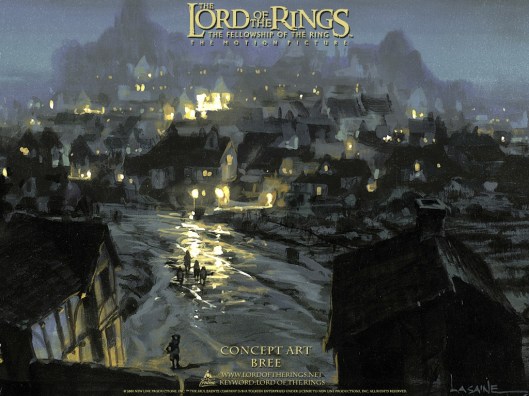
Bree, of course, is the little town to which Frodo and his companions travel once they have gotten free of the Barrow Downs.

ICE Bree and the Barrow-downs (Late Third Age) v1.3.jpg

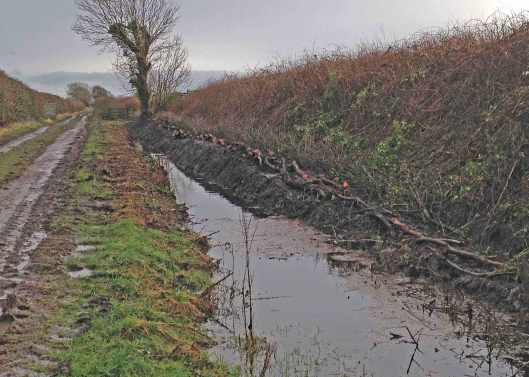
The little town is described as being surrounded by a dike—a wide ditch, the inner side topped with a thick hedge—perhaps something like this—

D21-15-2-14-More-hedging-activity_0670.jpg

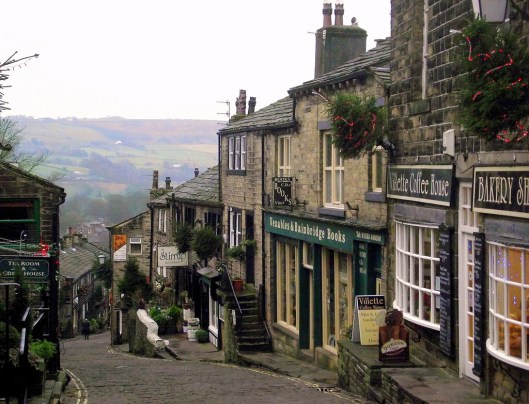
And consisting of “some hundred stone houses of the Big Folk, mostly above the Road…”. Without knowing the kind of stone, we have imagined it as looking rather like Haworth, in Yorkshire, the home of the Bronte family (without the modern touristy stuff, of course).

haworth.jpg

(And we note, by the way, that its depiction in the Jackson films doesn’t appear to reflect JRRT’s description that the houses were made of stone: rather, it appears to be filled with half-timbered, plaster and lath constructions.)

LOTR Bree.JPG


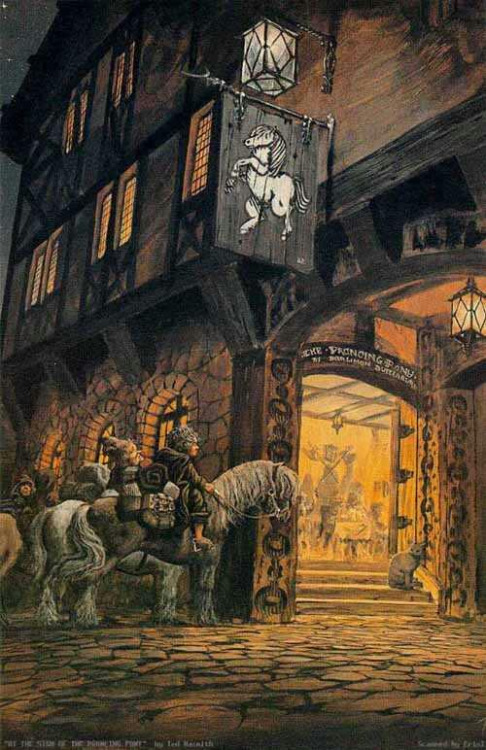
Here, the Hobbits stay at the Prancing Pony.

naismithprancingpony.jpg

Tolkien describes it as

“a meeting place for the idle, talkative, and inquisitive among the inhabitants, large and small…”

To our minds, it probably looked like one of those very old English coaching inns.

111-1000011im.jpg


And we begin our research inside.

Before we do, let’s spend a moment thinking about that word “news”, as in “Strange as news from Bree”.

In pre-print days, for most people in most places, information about events was circulated only by word-of-mouth. There were a few exceptions: the government in Rome produced hand-written circulars, called acta which were put up in the Forum Romanum from the middle of the last century BC through to the 3rd century AD. These would obviously have had a very limited circulation, however, and we can imagine that the contents would still have been passed on mouth-to-mouth for most people in Rome.

To gain greater circulation really demanded print. Although Gutenberg produced the first press and movable lead type by 1440,

gutenberg.jpg

the earliest surviving printed newspaper known at present dates from 1609, produced in Germany. (It appears that the publisher, Johann Carolus, had actually begun printing, rather than hand-copying, in 1605.)

Relation_Aller_Fuernemmen_und_gedenckwuerdigen_Historien_(1609).jpg

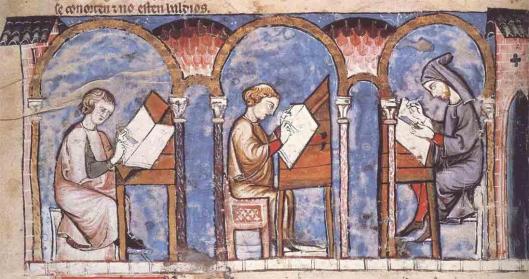
As far as we can tell, true to the general image of Middle Earth as a medieval world, printing presses have yet to appear (unless Sauron is producing very limited editions at the Barad-dur Press and circulation consists of exactly one copy). This means that we are still in the preprint world of hand-copying, when it comes to documents. In the western European world, on which places like Gondor are modeled, this means scriptoria—copy centers—mainly in monasteries and in royal courts where the copyists had probably been trained in monastic scriptoria.

scriptorium.jpg

Because there are no religious foundations or even schools of any sort mentioned in Middle Earth, we don’t know how or where documents were written or copied or even how and where anyone learned to read and write (except Sam, who was taught his letters by Frodo), but literacy turns up all over the place, from the Red Book of Westmarch to the runes of the dwarves to the writings Gandalf says he searched through in the archives of Minas Tirith.

All of this is, in a sense, commemorative—it’s history, really, whether a dwarvish map or tomb inscription, or an account of the War of the Ring. What about other things, however—word of daily events, or even entertainment forms, like songs and poems, things which may some day become part of history but, at the present, seem much more ephemeral? That’s what we’ve come to Bree to find out—and we’re quickly helped in our investigation by the host of the Prancing Pony, Barliman Butterbur, who says to Frodo and the others:

“ ‘I don’t know whether you would care to join the company…Perhaps you would rather go to your beds. Still the company would be very pleased to welcome you, if you had a mind. We don’t get Outsiders—travelers from the Shire, I should say, begging your pardon—often; and we like to hear a bit of news, or any story or song you may have in mind…’ “

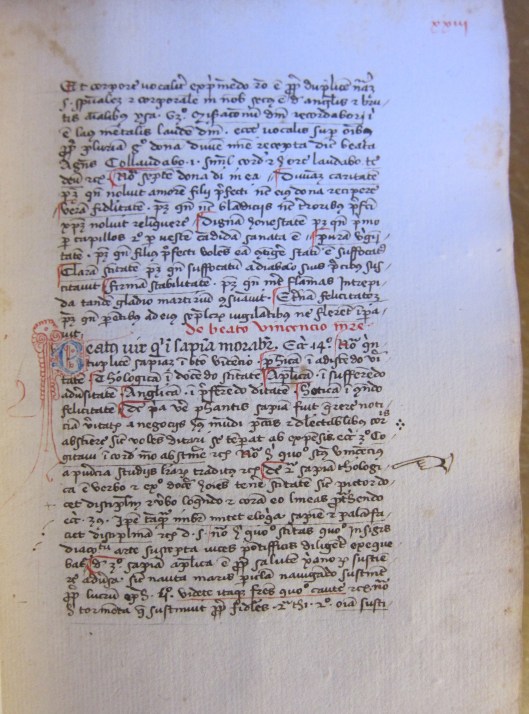
And there’s that emphasis on the oral: “we like to hear”. You, readers, have a world of electronic devices to turn to for “a bit of news, or any story or song”, as well as, in the case of news, actual newspapers, not to mention bookstores, libraries, and the wonderful resources of Gutenberg and the Internet Archive. None of that in any form is available to carry or preserve information in Middle Earth. What books there are—and they are manuscripts, remember, things which look like this—

MS-Italian.jpg

or, if you are rich, this—

frms.png

are either in royal archives, as in the case of those which Gandalf consults in Minas Tirith, or in the hands of families, as is the fate of The Red Book of Westmarch and other such items in the Shire. And so people are, on the one hand, eager for news and entertainment, but, on the other, forced either to make it for themselves or to wait for willing strangers to add to their meager store.

It’s natural, then, that “As soon as the Shire-hobbits entered, there was a chorus of welcome from the Bree-landers.” The first local reaction to Frodo’s attempts to create an explanation for why he and his companions are traveling is also natural:

“He gave out that he was interested in history and geography (at which there was much wagging of heads, although neither of these words were [sic] much used in the Bree-dialect). He said he was thinking of writing a book (at which there was silent astonishment), and that he and his friends wanted to collect information about hobbits living outside the Shire, especially in the eastern lands.”

In the nearly-oral world of Bree (there must be some literacy—the Prancing Pony has a sign with an inscription and Barliman seems to know what a letter is), the next reaction is also natural:

“At this a chorus of voices broke out. If Frodo had really wanted to write a book, and had had many ears, he would have learned enough for several chapters in a few minutes. And if that was not enough, he was given a whole list of names, beginning with ‘Old Barliman here’, to whom he could go for further information.”

These would all be so-called “oral informants”—not one mention of manuscripts or documents to suggest that information is conveyed and recorded in writing—and so the Breelanders’ third and final reaction is also natural:

“But after a time, as Frodo did not show any sign of writing a book on the spot, the hobbits returned to their questions about doings in the Shire.”

It’s obvious then, that books, like the words “history” and “geography”, are almost alien to these people and so their interest is in the spoken—or sung—word, which is why, when Frodo breaks into Bilbo’s “There is an inn…” to distract the audience from Pippin’s indiscreet recounting of the birthday party, his stratagem almost works—until he overdoes it and—

But even in the aftermath, although it leads to more trouble for Frodo and his companions, Butterbur can imagine that, in time, that surprising event, like all of the others in this near-oral world, will subside into word-of-mouth.

“He reckoned, very probably, that his house would be full again on many future nights, until the present mystery had been thoroughly discussed.”

And then it would become just another piece of strange news from Bree.

Thanks, as always, for reading.

MTCIDC

CD

Fairy Tale to Bill of Sale

19 Wednesday Aug 2015

Posted by Ollamh in Economics in Middle-earth, Fairy Tales and Myths, J.R.R. Tolkien

≈ Leave a comment

Tags

Alice in Wonderland, Baggins, Bilbo, Contract, Dragon, Dwarves, Economics, Elves, Fairy Tale, Fantasy, Goblins, Hoard, Laketown, Middle-earth, Mirkwood, Odysseus, On Fairy Stories, Smaug, The Hobbit, The Odyssey, Tolkien

Dear Readers,

Welcome, as always!

Recently, when we discussed the economics of Middle-earth, Tolkien told us that he was not entirely ignorant about such matters, saying “…the situations are so devised that economic likelihood is there and could be worked out”. LT, 296

So that’s what we’ve set out to do in this posting, working out something of those economics in a modest way.

The Hobbit, as everyone knows, began as a story for his children, set in a fairytale world of elves, goblins, dwarves, and a dragon—the sorts of things which, in Tolkien’s essay “On Fairy Stories”, are derived from fantasy, which is “a natural human activity. It certainly does not destroy or even insult Reason,” but enhances it, lest fantasy become mere “Morbid Delusion” (which, later in the essay, Tolkien links with a work like Alice in Wonderland).

But something begins to happen, even early on, when Bilbo signs a contract before setting out for his adventure—an odd start for a fairytale hero who, traditionally, has to prove himself.  The story proceeds for some time in fairy tale mode, but then, when the party loses everything in Mirkwood, it’s necessary for Bilbo and Company to resupply and here the story moves seriously from a fairytale world to capitalism, as the fairy tale quest evolves into a commercial venture.

To replace lost materiel, the company turns to the people of Laketown,

Laketown

who provide it–and clearly do so on speculation, since the Dwarves have nothing to offer but promises.

The fairytale then seems to resume.  The party reaches the mountain, gets in, the dragon wakes–but then things go very wrong, at least for the investors, as Smaug, easily putting together that two and two equal Laketown, sets off to destroy it and is destroyed himself, in the process.  And then the fairy tale comes apart completely in a potential war over economic resources and compensation for damage caused during the investment:  Laketowners versus Dwarves, which escalates when Elves stake a claim and then Dwarves come to reenforce Dwarves and then, just to keep things in flux, a goblin army arrives. One almost wonders whether the Eagles, when they arrived, have invested in Laketown bonds and are expecting to cash them in, with interest!

When all of this is resolved, we might think that we’ve returned to the fairy tale world once more:  Bilbo, with his share of the hoard, sets off for home, where happily ever after lies–or does it?

OdysseusSuitors

In The Odyssey, Odysseus comes home to find his house in the hands of suitors, and must deal with them with the help of a goddess—very much a folktale. Bilbo comes home to find that his house and goods have just been auctioned off, and has to retrieve his happy ending by buying back his own things. That initial contract seems to have haunted the story, even to this moment.

Fantasy for Tolkien was, “founded on the harsh recognition that things are so in the world as they appear under the sun”—one of those things was economics, something which Bilbo may have found almost as unavoidable as a vengeful dragon.

What do you think, dear readers?

As always, thank you for reading,

MTCIDC,

CD

Ringed In

05 Wednesday Aug 2015

Posted by Ollamh in J.R.R. Tolkien

≈ Leave a comment

Tags

Anglo-Saxon, Bilbo, Deagol, Dwarves, Elves, Faramir, Frodo, Gandalf, Gollum, Gondor, Isildur, Kenning, Lorien, Men, Nazgul, Ring, Ring-bearer, Roman senator, Romans, Sam, Sauron, Silmaril, The Hobbit, The Lord of the Rings, Tolkien, Tom Bombadil

Dear Readers, as always, welcome!

permcol5tn

Everyone at all interested in the works of Tolkien knows this passage (and many could recite it by heart, we’re sure):

“Three Rings for the Elven-kings under the sky,

     Seven for the Dwarf-lords in their halls of stone,

Nine for Mortal Men doomed to die,

     One for the Dark Lord on his dark throne

In the Land of Mordor where the Shadows lie.

     One Ring to rule them all, One Ring to find them,

     One Ring to bring them all and in the darkness bind them

In the Land of Mordor where the Shadows lie.” LoTR 50.

But why a ring? Since the Ring is about power, why not something which looks like power:

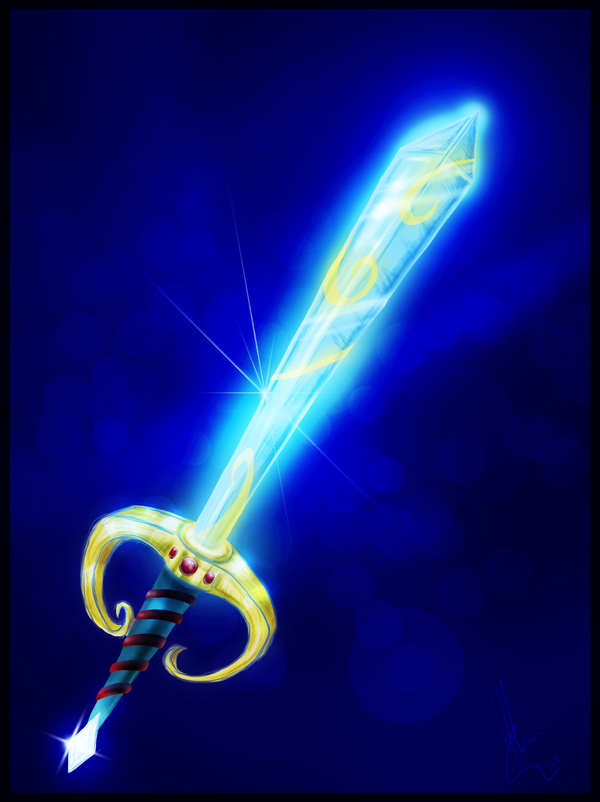
a sword, for example

ferb__s_magic_sword_by_kicsterash-d4clz45

or a crown

WingedAphroditeCrown_front

or even, considering Tolkien’s own mythology, a silmaril.

Beren_silmaril

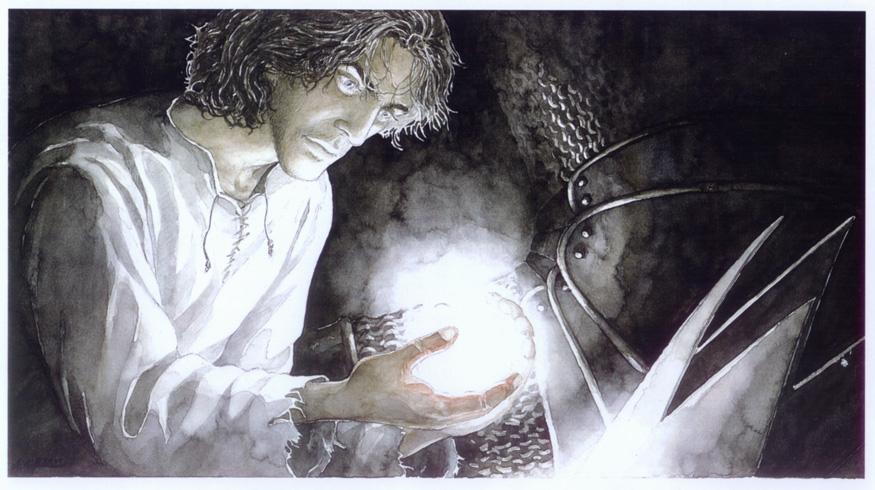
In The Hobbit of 1937, the Ring was originally simply a magic ring right out of folk and fairy tales, with apparently one gift, invisibility, for which Gollum treasures it.

Alan%20Lee%20-%20The%20Hobbit%20-%2019%20-%20Riddles%20in%20the%20dark

As is well known, Tolkien reconsidered its powers and, as The Lord of the Rings grew, the ring became the Ring, and the central focus of the sequel to the earlier book. By the beginning of the 1950s, he states (in a letter to Milton Waldman dated by Carpenter/C. Tolkien as “probably written late in 1951” LTR 143):

“the primary symbolism of the Ring, as the will to mere power, seeking to make itself objective by physical force and mechanism, and so also inevitably by lies…” LTR 160.

(by “mere” we imagine that Tolkien is using the word here in its original Latin—merus –a –um— sense of “pure/unmixed”)

Although this tells us something about the force within the Ring, it doesn’t really explain why a ring.

Rings are an ancient status symbol, certainly. The Romans used them as one of the ways to show the class of a person: senators wore gold ones (although there is an old story that, originally, Roman senators wore rings made of iron)

RomeSenators2romanring

and the other free classes wore any metal they chose.   Tolkien would have had a vivid idea of the inherent status in a ring from Old English, as one of the kennings (poetic metaphorical phrases) for a great lord was “ring-giver”

asring

—just as Sauron gives rings to the ancient kings and so holds their allegiance long after their natural lives should have ended.    

bwnazgul

This is echoed in “and in the darkness bind them” , which brings us back to those verses with which we began.

In them, the Ring’s powers are clearly laid out (rather like Saruman’s claimed goals, “Knowledge, rule, order”): rule, find, bring, bind.

As Gandalf tells us, the primary reason for the creation of the Ring was, in fact, to rule, both the other rings and, through them, Middle-earth and its peoples: Elves, Dwarves, Men. To do so, Sauron endowed the Ring with much of his own power, a perfect example of his arrogance, depriving himself of power he might need, clearly convinced that he would suffer no harm from its lack.

As he endows the Ring, it seems that he—intentionally?—passed on to it a small bit of his self-will. Unlike inanimate objects in our world (and we presume in Middle-earth, too), the Ring not only shows purpose, but can act upon it.

As Gandalf tells Frodo:

“A Ring of Power looks after itself…It was not Gollum, Frodo, but the Ring itself decided things. The Ring left him…The Ring was trying to get back to its master.” LotR 55.

To do so, it uses another of its powers, it brings people to use as vehicles, discarding them when they have served its purpose.

“It had slipped from Isildur’s hand,” says Gandalf (a hand already under the Ring’s control, as it couldn’t force itself to destroy the Ring when it had the chance) and betrayed him; then when a chance came it caught poor Deagol, and he was murdered and after that Gollum, and it had devoured him. It could make no further use of him: he was too small and mean…So now, when its master was awake once more…it abandoned Gollum, only to be picked up by…Bilbo.” LotR 55-56.

To acquire such vehicles, the Ring uses a third power, finding. Gandalf’s list suggests that that power entails some innate ability to sense who will be most attracted to it. They appear to be rather a wide assortment, from the heir to the throne of Gondor to two proto-hobbits. And there are also those not on Gandalf’s list: Saruman and even, to some degree, Galadriel. As for Gandalf himself, he, like the Lady of Lorien, is wise enough to avoid the ultimate temptation, as is Faramir, perhaps because, as his father accuses him, he has been Gandalf’s pupil and has acquired some of his awareness both of events and of himself.

Our list would not be complete, however, without Frodo and Sam. It is hard to imagine that the Ring has picked them: Frodo, after all, has inherited it. This doesn’t mean that he is not influenced by it, even, at the end, sounding more like Isildur than himself in his refusing to destroy it, suggesting that, even by inheritance, someone can be found, brought, and ruled. And Sam? He holds it only briefly, but surrenders it so easily that it appears to have little ultimate power over him, something which he shares with Tom Bombadil, perhaps because both are grounded—quite literally—in Middle-earth. It is no surprise that Galadriel gives him a gift for growing things and that, in his consolation of Sam, Frodo says that he will be “the most famous gardener in history” (LoTR 1029). As for Bombadil, it would appear that the same sort of protection which keeps Sam from being found, brought, and ruled keeps him safe. When he holds up the Ring and looks through it, for a moment we might see that, for him, the symbolism of the “will to mere power” means nothing and, instead, he sees it only as an empty metal band.

For others, from the Nazgul to Frodo, who never feels whole again, the fourth power, binding, has done its job and also perhaps, in doing so, answers the question, why a ring?

Heavy-6mm-D-Shape-18k-Yellow-Gold-Wedding-Ring

What better binder than a perfect circle, seemingly blank, but with a hidden message, almost a spell, and which, when put on, pulls you from the daylight world and, which, worn too long, can keep you there forever?

Thanks, as ever, for reading.

MTCIDC

CD
Slings and Arrows

29 Wednesday Jul 2015

Posted by Ollamh in J.R.R. Tolkien, Military History of Middle-earth

≈ Leave a comment

Tags

Charles Goodyear, Civil War soldiers, Dwarves, Gandalf, Goliath, Industrial Revolution, Isengard, Mr. Baggins, Ori, Pipeweed, Potatoes, Sling, Slingshot, The Hobbit, Tolkien, Tomatoes, Vulcanized

Dear Readers,

“Cold chicken and tomatoes!” shouted Gandalf in 1937 to a flummoxed Mr. Baggins.

“Cold chicken and pickles!” shouted Gandalf in 1966 to a still-flummoxed Mr. Baggins.

Something has happened in those 30 years– and it isn’t just a change in the Hobbit menu.

It’s about anachronism– what is appropriate within a time period and its place– and how Tolkien, in retrospect, came to believe that tomatoes didn’t grow in Middle-earth.

This is odd, one might think, because potatoes and tobacco (only called such in The Hobbit and always “pipeweed” in The Lord of the Rings) do grow there. (Although perhaps only in the Shire? Gollum, a one-time resident of the banks of the Anduin, certainly doesn’t recognize potatoes.)
We’ll never know why the tomatoes disappeared, while the other two remained, they all, being products of New World exploration and importation. After all, all three are agricultural produce and, depending on climate and soil, equally possible.

But then, there’s that slingshot. 

It’s not in The Hobbit, but in P. Jackson’s The Hobbit. Ori the Dwarf is armed with it, we suppose in an attempt to differentiate him from the other Dwarves, and to suggest his age in relation to them (although he appears to be perhaps 150 years old, more or less– see the Tolkien Gateway citation for “Ori” for further information).

OriSlingshot

Consider, however, what gives a slingshot its zing: a big rubber band.

Slingshot_(weapon)

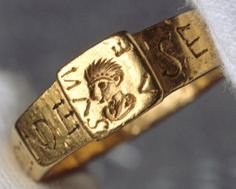
This rubber band is a strip of vulcanized rubber, the process for making such rubber only being patented in our world in 1844 by Charles Goodyear.

Goodyear

(A process which allowed Civil War soldiers to wear rain ponchos.)

Poncho

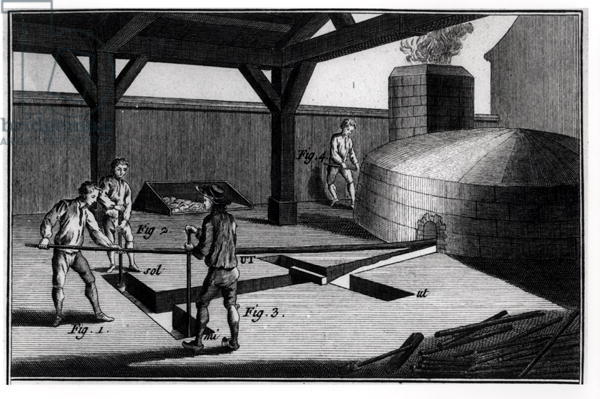
Unlike tomatoes, vulcanization represents a further idea in the ongoing Industrial Revolution– an event which did not take place in the Third Age of Middle-earth. (We might see events at Isengard as perhaps signaling pre-industrialization, of the sort one saw in the earlier 18th century in western Europe and particularly in Great Britain.)

Bell Making, from the 'Encyclopedia' by Denis Diderot (1713-84) 1751-72 (engraving) (b/w photo)

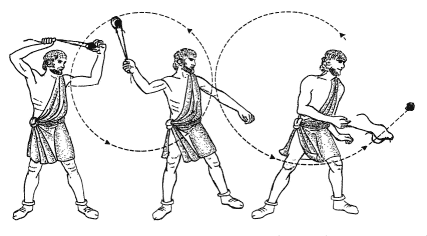
Instead of a comparatively recent slingshot, why not use a well-known missile weapon of the ancient world, the sling?

Slingweapon

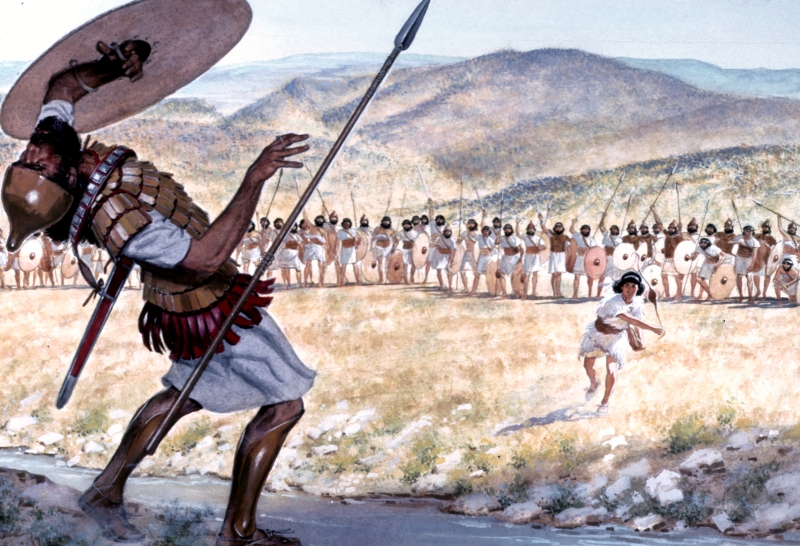
Instead of the tension of vulcanized rubber, this uses arm muscle and physics to propel its deadly ammunition– just ask Goliath. 

David-and-Goliath-vba

(For any number of examples of the sling in action, just google ‘sling” on YouTube.)

For us, then, this seems to be a choice. And maybe a significant one. Either, like Tolkien, to consider and reconsider carefully each item and to decide for or against, or simply to grab something convenient and use it, apparently not caring if it were appropriate for Middle-earth or not.

It’s easy to see where we stand on this, so we leave it to you, dear readers: which would you choose?

Thanks, as ever, for reading,

MTCIDC,

CD

Red Books, Black Books, Yellow Books

24 Wednesday Jun 2015

Posted by Ollamh in J.R.R. Tolkien, Language, Narrative Methods

≈ Leave a comment

Tags

Bilbo, Black Book of Carmarthen, Book of Ballymote, Book of Leinster, Book of Lismore, Book of Taliesin, Book of the Dun Cow, Dwarves, Geoffrey of Monmouth, Gollum, Mabinogion, Manuscript, Medieval books, Red Book of Hergest, Red Book of Westmarch, Scriptorium, The Hobbit, The Lord of the Rings, The Shire, Tolkien, White Book of Rhydderch, Yellow Book of Lecan

Dear Readers,

Welcome back! This posting is devoted to a look at what lies behind that famous imaginary document The Red Book of Westmarch.

     As Tolkien says of The Lord of the Rings in the section of the prologue entitled “Note on the Shire Records”:

“This account of the end of the Third Age is drawn mainly from the Red Book of Westmarch. That most important source for the history of the War of the Ring was so called because it was long preserved at Undertowers, the home of the Fairbairns, Wardens of the Westmarch. It was in origin Bilbo’s private diary, which he took with him to Rivendell. Frodo brought it back to the Shire, together with many loose leaves of notes, and during S.R. 1420-1 he nearly filled its pages with his account of the War. But annexed to it and preserved with it, probably in a single red case, were the three large volumes, bound in red leather, that Bilbo gave to him as a parting gift. To these four volumes there was added in Westmarch a fifth containing commentaries, genealogies, and various other matter concerning the hobbit members of the Fellowship.” 14

redbookfacsimile

     This is not the end of the material on the Red Book, of course,—that takes up another paragraph and then is continued in several more paragraphs about copies and about other pertinent written sources. This is JRRT having fun, of course: after all, for him, what is more satisfying after creating languages than building contexts for them?

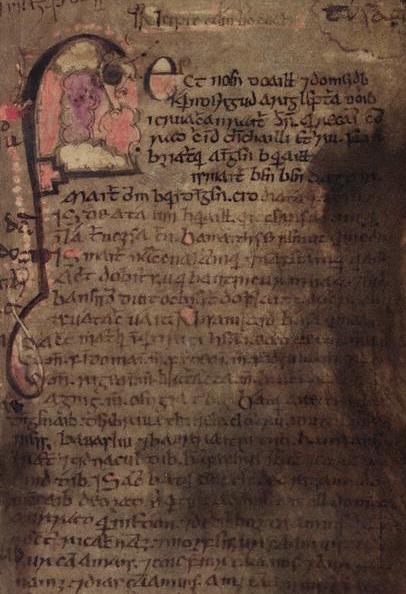
     This particular context is based upon material from his own specialty, medieval literature, and it’s always been said that The Red Book of Westmarch was inspired by the late 14th-century Welsh Red Book of Hergest. This famous manuscript contains one of the major texts of the cycle of legendary material called the Mabinogion, but for Tolkien its importance may have been simply that

  1. it’s a medieval manuscript familiar to him and a model-ready-to-hand for what he created in what he thought of as his own medieval world
  2. as the Wiki entry says, “The manuscript derives its name from the colour of its leather binding and from its association with Hergest Court between the late 15th and early 17th century.”

redbookofhergest

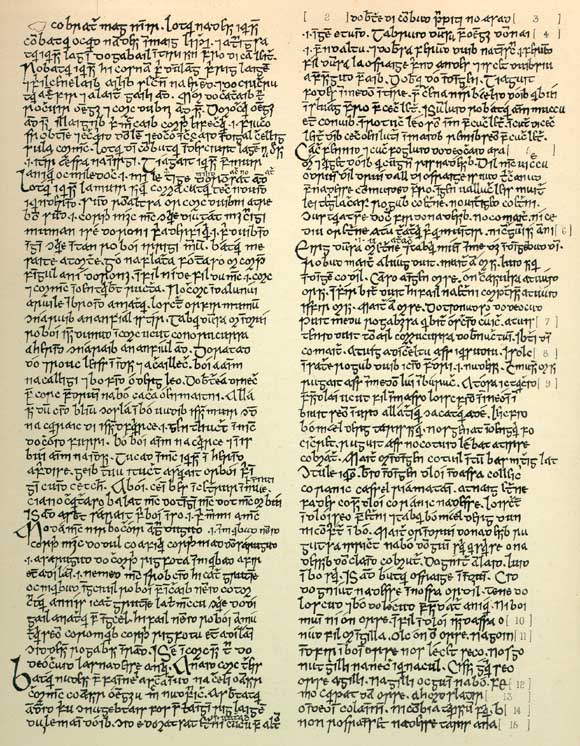
     This manuscript and others like it, both Welsh (Black Book of Carmarthen,White Book of Rhydderch, Book of Taliesin) and Irish (Book of the Dun Cow, Yellow Book of Lecan, Book of Leinster, Book of Ballymote, Book of Lismore)

blackbookofcarmarthen

Book_of_Taliesin_facsimile

whitebookof rhydderch

lebornauidre

Book_of_Lecan_p2

Book_of_Leinster,_folio_53

were created in the scriptoriums (Latin plural: scriptoria), the medieval equivalent of a copy center, in various monasteries. The following images will give you an idea of how they worked.

scriptorium

 BL_Royal_Vincent_of_Beauvais

gregory

In the world before Gutenberg

792px-Pressing-16th_century%20copy

everything was written—and then copied—by hand, a fact which Tolkien faithfully reproduces in his world when he writes that:

“The most important copy, however, has a different history. It was kept at Great Smials, but it was written in Gondor, probably at the request of the great-grandson of Peregrin, and completed in S.R. 1592 (F.A. 172). Its southern scribe appended this note: Findegil, King’s Writer, finished this work in IV 172.” 14

     There are, of course, no monasteries in Middle Earth, but, in our world, there were clerks, educated in monasteries, who worked as secretaries and copyists for kings and their nobility, so it’s quite logical that a copy of the Red Book in Middle Earth was the work of a so-called “King’s Writer”.

     Comparing an actual manuscript with the Red Book of Westmarch, we find several other differences. For one, the RBW’s four main volumes appear to contain nothing but material relating to the events surrounding Bilbo, Frodo, and the Ring. In contrast, the actual medieval manuscripts are more like compilations. The Red Book of Hergest, for example, has not only the Mabinogion, but also unrelated poetry, and a Welsh translation of Geoffrey of Monmouth’s History of the Kings of Britain, among other works. The Irish Book of the Dun Cow has religious texts and secular, all mixed together, and this appears to be common. The closest the RBW comes to this is volume 5, with its “commentaries, genealogies, and various other matter concerning the hobbit members of the Fellowship” and this is still material pertaining to the main subject, not something as removed as the method for determining the correct date for Easter to be found in the Book of Leinster.

     Another difference brings us to a puzzle and the conclusion of this posting.  Tolkien has told us that the core of the RBW is Bilbo’s diary. The Welsh and Irish manuscripts discussed above are collections of literary and religious texts, with nothing personal in them at all, as he would have been well aware.  As well, we might wonder when and where and how Bilbo kept that diary. There’s no mention of it in The Hobbit—after all, Bilbo ran out of his house to join the dwarves without even a pocket handkerchief. And, even if the dwarves had provided one (along with the handkerchief–although that does not seem terrifically likely–the dwarves who visit Bilbo seem more attuned to orality than literacy), surely it would have been lost with all of the other baggage when the company fell into the goblin world and Bilbo met Gollum.

Alan Lee - The Hobbit - 19 - Riddles in the dark

Other than assuming that Bilbo, although he had forgotten his handkerchief, had remembered his Blackberry and was constantly dictating to the Cloud for later transcription, what do we have here?  (And, while we’re wondering, if The Hobbit was based upon that mysterious diary, what do we know of the adapter/narrator who turned it from a diary into a continuous narrative–another “King’s Writer”?)

Obviously, MTCIDC!

Thanks, as always, for reading.

CD

Newer posts →

The Doubtful Sea Series Facebook Page

The Doubtful Sea Series Facebook Page

  • Ollamh

Categories

  • Artists and Illustrators
  • Economics in Middle-earth
  • Fairy Tales and Myths
  • Films and Music
  • Games
  • Heroes
  • Imaginary History
  • J.R.R. Tolkien
  • Language
  • Literary History
  • Maps
  • Medieval Russia
  • Military History
  • Military History of Middle-earth
  • Narnia
  • Narrative Methods
  • Poetry
  • Research
  • Star Wars
  • Terra Australis
  • The Rohirrim
  • Theatre and Performance
  • Tolkien
  • Uncategorized
  • Villains
  • Writing as Collaborators
Follow doubtfulsea on WordPress.com

Across the Doubtful Sea

Recent Postings

  • Through a glass… January 7, 2026
  • Heffalumps? December 31, 2025
  • We Three Kings December 24, 2025
  • A Moon disfigured December 17, 2025
  • On the Roads Again—Once More December 10, 2025
  • (Not) Crossing Bridges December 3, 2025
  • On the Road(s) Again—Again November 26, 2025
  • On the Road(s) Again November 19, 2025
  • To Bree (Part 2) November 12, 2025

Blog Statistics

  • 104,128 Views

Posting Archive

  • January 2026 (1)
  • December 2025 (5)
  • November 2025 (4)
  • October 2025 (5)
  • September 2025 (4)
  • August 2025 (4)
  • July 2025 (5)
  • June 2025 (4)
  • May 2025 (4)
  • April 2025 (5)
  • March 2025 (4)
  • February 2025 (4)
  • January 2025 (5)
  • December 2024 (4)
  • November 2024 (4)
  • October 2024 (5)
  • September 2024 (4)
  • August 2024 (4)
  • July 2024 (5)
  • June 2024 (4)
  • May 2024 (5)
  • April 2024 (4)
  • March 2024 (4)
  • February 2024 (4)
  • January 2024 (5)
  • December 2023 (4)
  • November 2023 (5)
  • October 2023 (4)
  • September 2023 (4)
  • August 2023 (5)
  • July 2023 (4)
  • June 2023 (4)
  • May 2023 (5)
  • April 2023 (4)
  • March 2023 (5)
  • February 2023 (4)
  • January 2023 (4)
  • December 2022 (4)
  • November 2022 (5)
  • October 2022 (4)
  • September 2022 (4)
  • August 2022 (5)
  • July 2022 (4)
  • June 2022 (5)
  • May 2022 (4)
  • April 2022 (4)
  • March 2022 (5)
  • February 2022 (4)
  • January 2022 (4)
  • December 2021 (5)
  • November 2021 (4)
  • October 2021 (4)
  • September 2021 (5)
  • August 2021 (4)
  • July 2021 (4)
  • June 2021 (5)
  • May 2021 (4)
  • April 2021 (4)
  • March 2021 (5)
  • February 2021 (4)
  • January 2021 (4)
  • December 2020 (5)
  • November 2020 (4)
  • October 2020 (4)
  • September 2020 (5)
  • August 2020 (4)
  • July 2020 (5)
  • June 2020 (4)
  • May 2020 (4)
  • April 2020 (5)
  • March 2020 (4)
  • February 2020 (4)
  • January 2020 (6)
  • December 2019 (4)
  • November 2019 (4)
  • October 2019 (5)
  • September 2019 (4)
  • August 2019 (4)
  • July 2019 (5)
  • June 2019 (4)
  • May 2019 (5)
  • April 2019 (4)
  • March 2019 (4)
  • February 2019 (4)
  • January 2019 (5)
  • December 2018 (4)
  • November 2018 (4)
  • October 2018 (5)
  • September 2018 (4)
  • August 2018 (5)
  • July 2018 (4)
  • June 2018 (4)
  • May 2018 (5)
  • April 2018 (4)
  • March 2018 (4)
  • February 2018 (4)
  • January 2018 (5)
  • December 2017 (4)
  • November 2017 (4)
  • October 2017 (4)
  • September 2017 (4)
  • August 2017 (5)
  • July 2017 (4)
  • June 2017 (4)
  • May 2017 (5)
  • April 2017 (4)
  • March 2017 (5)
  • February 2017 (4)
  • January 2017 (4)
  • December 2016 (4)
  • November 2016 (5)
  • October 2016 (6)
  • September 2016 (5)
  • August 2016 (5)
  • July 2016 (5)
  • June 2016 (5)
  • May 2016 (4)
  • April 2016 (4)
  • March 2016 (5)
  • February 2016 (4)
  • January 2016 (4)
  • December 2015 (5)
  • November 2015 (5)
  • October 2015 (4)
  • September 2015 (5)
  • August 2015 (4)
  • July 2015 (5)
  • June 2015 (5)
  • May 2015 (4)
  • April 2015 (3)
  • March 2015 (4)
  • February 2015 (4)
  • January 2015 (4)
  • December 2014 (5)
  • November 2014 (4)
  • October 2014 (6)
  • September 2014 (1)

Blog at WordPress.com.

  • Subscribe Subscribed
    • doubtfulsea
    • Join 78 other subscribers
    • Already have a WordPress.com account? Log in now.
    • doubtfulsea
    • Subscribe Subscribed
    • Sign up
    • Log in
    • Report this content
    • View site in Reader
    • Manage subscriptions
    • Collapse this bar
 

Loading Comments...