• About

doubtfulsea

~ adventure fantasy

Category Archives: Narrative Methods

Theme and Variations.3

04 Wednesday Jul 2018

Posted by Ollamh in Fairy Tales and Myths, Films and Music, Literary History, Narrative Methods

≈ Leave a comment

Tags

Cendrill, Charles Perrault, Cinderella, Edmund Dulac, Fairy Godmother, Four and Twenty Fairy Tales, Frederic Chopin, Georges Melies, Giacomo Rossini, Histoires ou Contes du Temps Passe, James Robinson Planche, Jules Massenet, La Cenerentola, Nicolo Isouard, Opera, Pauline Viardot, Sleeping Beauty, William Henry Margetson

As always, dear readers, welcome!

In this posting, we’re continuing the little series we began on the fairy tales of Charles Perrault and what other creators have done with those stories over the centuries.

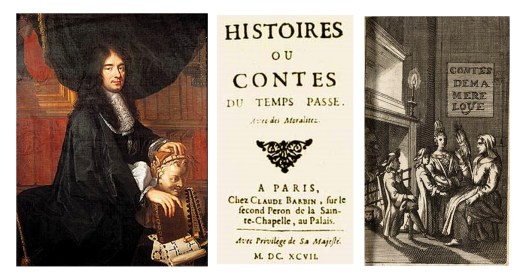
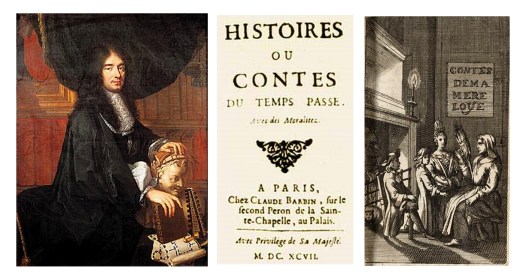
In 1697, Perrault (1628-1703) published Histoires ou Contes du Temps Passe (“Stories or Tales of Past Time”).

image1perrault.jpg

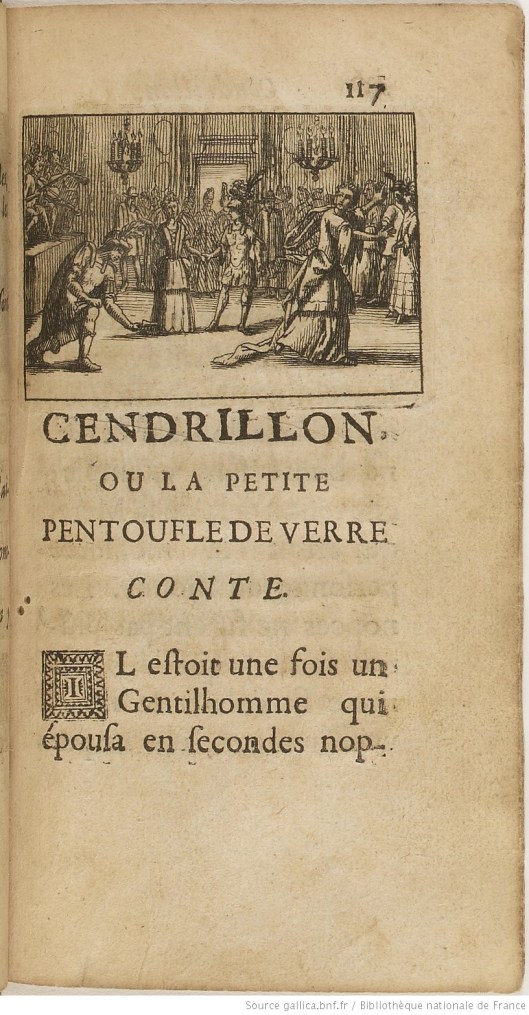
This little collection (which also came to be known by a secondary title as Contes de Ma Mere L’Oye–“Tales of My Mother Goose”)–contained, among other stories, “Sleeping Beauty”—which we’ve discussed in the first two posts of this series—and “Cinderella”.  (The original 1697 version is available from the BnF—the Bibliotheque nationale de France—here’s a LINK.)

image2cend.JPEG

If you’d like to read the closest one might get to Perrault’s late-17th-century French, you might try the translation by James Robinson Planche, the dramatist/costume-designer/etcetc, whom we mentioned in the first post in this series.  He had conscientiously searched for a first edition of Perrault’s collection, but had to make do with a second, as he tells us, but he strove to recreate in his English the feel of the French original.  Here’s a LINK to Planche’s 1858 Four and Twenty Fairy Tales.  Selected from Those of Perrault, and Other Popular Artists.

image3afourandtwenty.jpg

image3cind.jpg

This is an illustration for that story by Edmund Dulac (1882-1953)

image4dulac

from Edmund Dulac’s Picture-Book for the French Red Cross (1916)—with a LINK to it here.  (It’s an especially interesting book, not only for the beautiful illustrations, but also for the wide range of stories, including a version of the famous Persian/Arabic story of “Majnun and Layla”.)

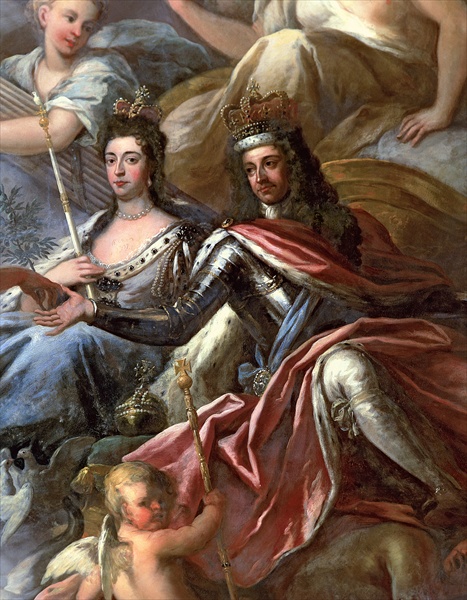
“Cinderella” has been a favorite subject for opera composers, at least back to 1810, when Nicolo Isouard’s (1773-1818)

image5isouard.jpg

version, Cendrillon, was a  hit in Paris—and then internationally.  Here’s a LINK to a recording of its overture so you can see what pleased Europe in the middle of the Napoleonic Wars.

Isouard’s opera’s popularity was quickly overtaken by Giacomo Rossini’s (1792-1868)

image6rossini.jpg

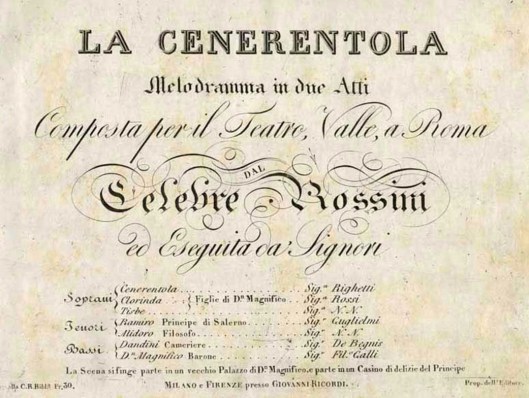
version in 1817, La Cenerentola.  Here’s an early Italian playbill for it.

image7playbill

And here’s a LINK to the overture. (If you like it, there is at least one complete performance available on YouTube—you can easily find it when you follow this link.)

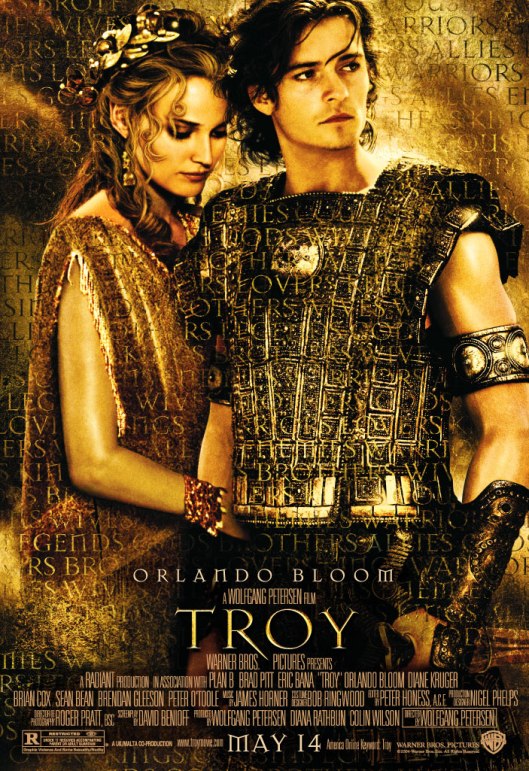
What’s interesting about these versions is that the Fairy Godmother of the original story has been replaced by a human—in Isouard’s version, with some magical powers, in Rossini’s, with native wit.  There’s no explanation for this—it’s simply the case and, for us, it somehow diminishes the story.  It’s like the Troy movie of 2004, from which the gods had been removed.

image8troy.jpg

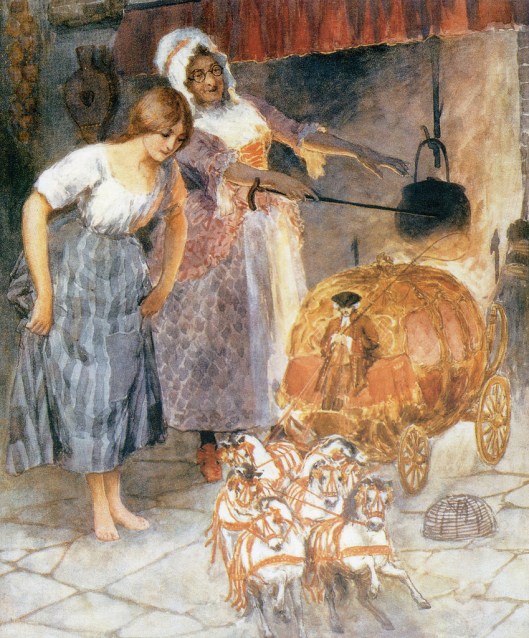
Perhaps we’ve always wanted a fairy godmother?

image9fg.jpg

(An image by William Henry Margetson, 1861-1940.)

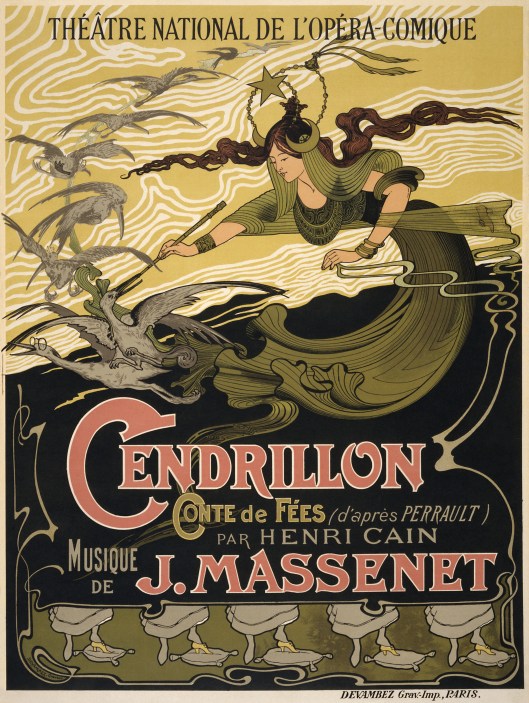
Our third opera comes from the very end of the 19th century:  Jules Massenet’s (1842-1912)

image10massenet

Cendrillon.

image11cendrillon

Unlike Isouard and Rossini, the fairy godmother, plus assorted fairies, are present and active in this very elaborate telling.  Here’s a LINK to some of the ballet music to give you an idea of the sound of the opera.

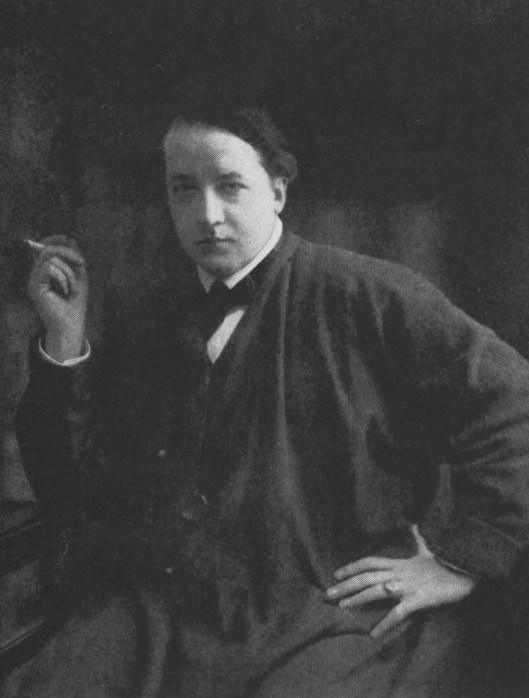
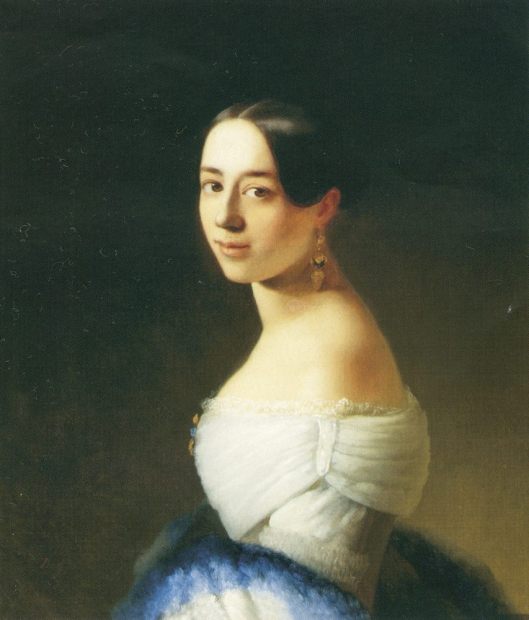
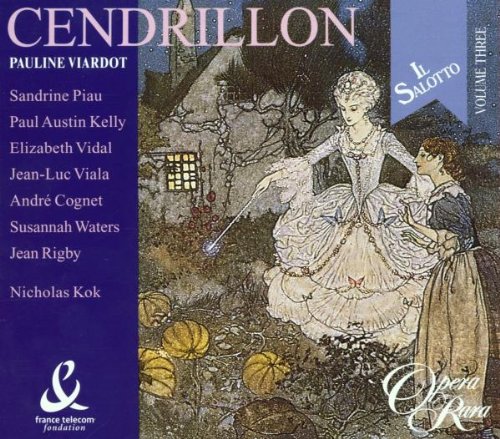
Our last opera is the very opposite of Massenet’s, being a chamber opera with only a piano for an orchestra.  It is by a woman composer who began her career as a famous mezzo-soprano, Pauline Viardot (1821-1910).

image12pv.jpg

Not only was she a brilliant singer, with an enormous range, but she was also a pianist so good that she regularly played duets with her friend, Frederic Chopin,

image13fc

as well as speaking half-a-dozen languages fluently.  When her voice began to fail her, she moved to teaching and composition, as well as keeping a salon in which many of the most famous and influential creators of the second half of the 19th century spent their evenings.

Her version of the Cinderella story, Cendrillon, was first performed in 1904.

image14score

As we suggested, it’s the very opposite of the very sumptuous Massenet opera:  7 singers, no chorus, piano for accompaniment, but it’s musically very rich—and includes the fairy godmother—and the pumpkin, etc., although these are all off-stage.  It is not often performed—there’s one recording—

image15pvcend

which we heartily recommend, as it’s beautifully sung.  And here’s a LINK to a production on YouTube, if you’d like to see it.

We’re going to close this posting, take a deep breath, and start writing the last in this little series:  Cinderella on film, beginning, in a surprisingly-early (if brief) version by Georges Melies—from 1899.

But thanks, as always, for reading and definitely

MTCIDC

CD

ps

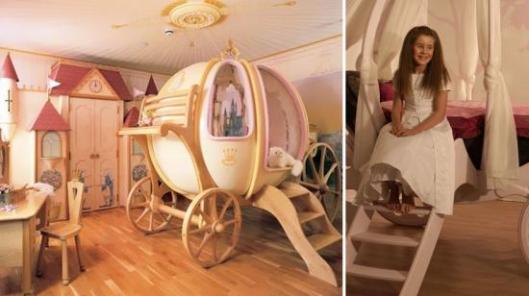
If you read us, you know us—we can never resist a PS—and this is just a visual.  In our survey of Cinderella images, we found this.  Need we say more?

image16bedroom.jpg

Theme and Variations.1

20 Wednesday Jun 2018

Posted by Ollamh in Artists and Illustrators, Fairy Tales and Myths, Literary History, Narrative Methods, Theatre and Performance

≈ Leave a comment

Tags

Bibliotheque nationale Francaise, Charles Kemble, Charles Perrault, costuming, David Garrick, Edward Burne-Jones, Extravaganzas, Faulconbridge, Folger Library, Giambattista Basile, Gianfrancesco Straparola, Histoires ou Contes du Temps Passe, Histories or Tales of Past Times, James Robinson Planche, King John, La Belle au Bois Dormant, Les Contes Des Fees, Madame d'Aulnoy, Mercure Galant, Mother Goose, Punch Magazine, Richard "Dicky" Doyle, Shakespeare, Sleeping Beauty, Sur La Lune

Welcome, as always, dear readers.

For a current writing project, we’ve gone back into our fairy tale collection (we recommend, by the way, the wonderful Sur La Lune site to help you to build yours—here’s a LINK) to reread the fairy tales of Charles Perrault (1628-1703)–

image1perrault.jpg

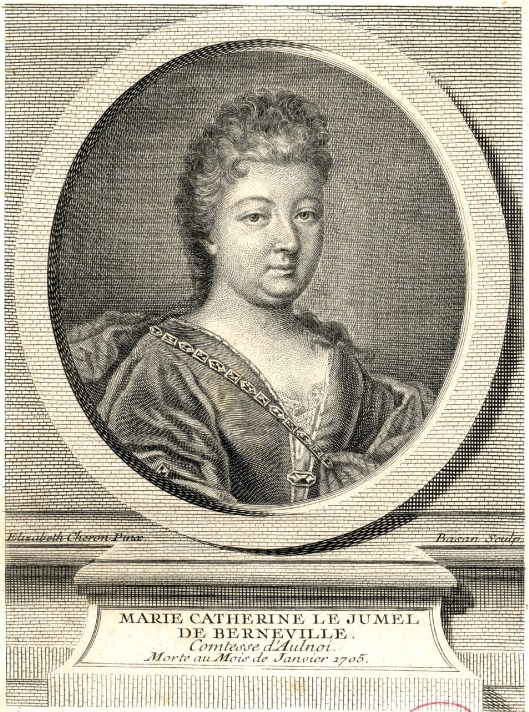
although he wasn’t the person who first called them that—that was his contemporary, Madame d’Aulnoy (1650/1-1705),

image2daulnoy.jpg

who called her stories contes des fees—“stories of fairies”.

image5histoires.jpg

In 1695, Perrault had circulated an illustrated manuscript of such tales, calling it Contes de ma Mere l’Oye—“Tales of My Mother Goose”.

image3ms.jpg

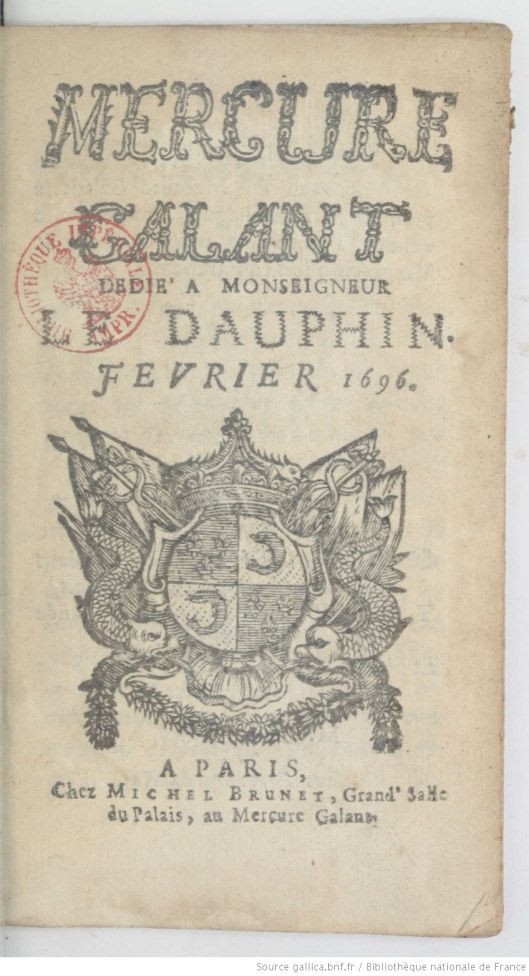
In  February, 1696, he published one of them, “La Belle au Bois Dormant”—“The Beautiful Girl in the Sleeping Wood” in an early magazine, the Mercure Galant (maybe in English something like “The Courier of Style”).

image4mercure.JPEG

(If you’d like to read the story in French as it was first published, here’s a LINK to the BnF, the Bibliotheque nationale Francaise, where it is available on-line, which we think is just magical.)

Then, the following year, the collection was published under the title Histoires ou Contes du Temps Passe (“Stories or Tales from the Past”).

perrault.jpg

The term “contes de ma mere l’Oye” appears to have been known in literary circles from at least the 1650s and indicated rustic/countryside stories—in a sense, folktales—and Perrault had used traditional material, some of which had first appeared in print in Italian in the 16th century and could be found in the folktale collections of people like Gianfrancesco Straparola (1485?—1558) and Giambattista Basile (1566-1632).

Perrault’s stories, which include what we call “Sleeping Beauty” (you can see that that’s a mistranslation) and “Cinderella”, first appeared in English in London in 1729, translated by Robert Samber, its title being identical with the 1697 French.

image6samber.jpg

In this post and (at least) two following, we thought that we would choose two of these fairy tales and see in what different forms they’ve been presented since first appearing in 1697.

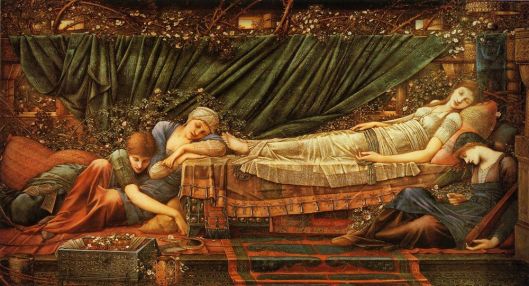
Because it was the first to be published, we’ll begin with “Sleeping Beauty.  (This is a Pre-Raphaelite version by Edward Burne-Jones, 1833-1898.  It is one of a set of four and has a very interesting history—here’s a LINK so that you may found out more, if you wish.)

image7sleepbeautjones.jpg

Our first work, entitled surprisingly enough, The Sleeping Beauty, is what its author, James Robinson Planche (plahn-SHAY), 1796-1880,

image8planche.jpg

would call an “extravaganza”, meaning, in this case, something like a modern musical comedy.  First produced in 1840, it combined dialogue in rhyming iambic (more or less) couplets with songs set to already existing tunes.   Based upon Perrault, it used spectacle, everyday references which a London audience would have immediately picked up on, and gentle political/cultural satire to entertain.  Unfortunately we don’t have any images of this production, but here’s a LINK to volume 2 of Planche’s “extravaganzas” so that you can form your own impression.  If you know the works of the Victorian dramatist/composer team of WS Gilbert and Arthur Sullivan, you will see that Planche is their direct ancestor.

For many years, beginning in the early 1800s and continuing into the 1860s, Planche was Mr Theatre, in London, writing or co-writing at least 175 shows of various sorts.  These works, like Planche himself, have faded away, but he did leave one mark.  In 1823, Planche had had a conversation with a famous actor, Charles Kemble (1775-1854),

image9kemble.jpg

in which he suggested that, whereas money was always being spent in the theatre on spectacles, almost nothing was done for the plays of Shakespeare.   In fact, Shakespeare’s plays had always been costumed in the clothing of the period of the actors, rather than the dress of the time of the events.  Here’s a print of the well-known 18th-century actor, David Garrick (1717-1779) in four of the roles for which he was famous:  Lear, Macbeth, Richard III, and Hamlet—by dress and props alone, perhaps we could guess that the actor with the two daggers was someone playing Macbeth (or perhaps an assassin from the 1760 version of Game of Thrones), but otherwise?

image10garrick.jpg

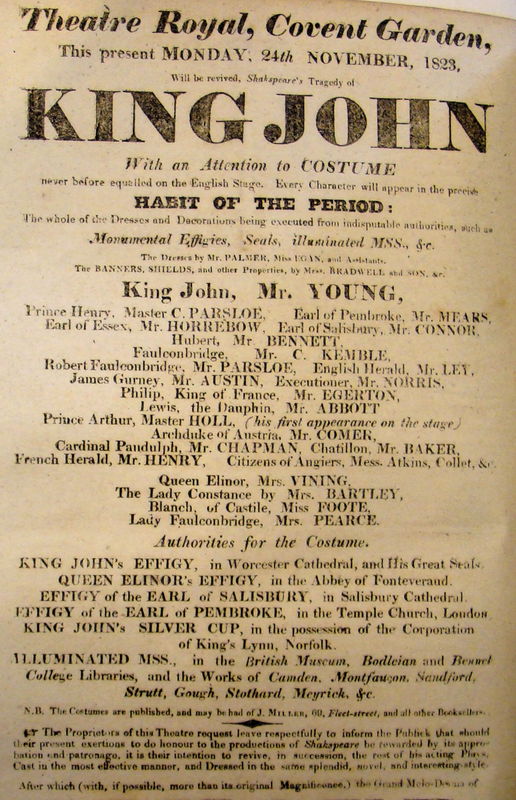
Kemble, in turn, told Planche that he would willingly put on an historically-accurate production of several Shakespeare plays, beginning with King John, if Planche would do the necessary research and design.  Planche agreed and here’s a playbill of the result.

image11playbill.jpg

Reading the fine print, it’s even possible to see that Planche cited at least some of his sources—everything from funerary statuary to manuscript illustrations.  Whereas we don’t, unfortunately, have any illustrations to show for The Sleeping Beauty, we can show you what a difference Planche made to attempting to make Shakespeare appear in period dress.  Here’s Kemble playing Faulconbridge, a major character in King John, in 1819.

image12kemble1819.jpg

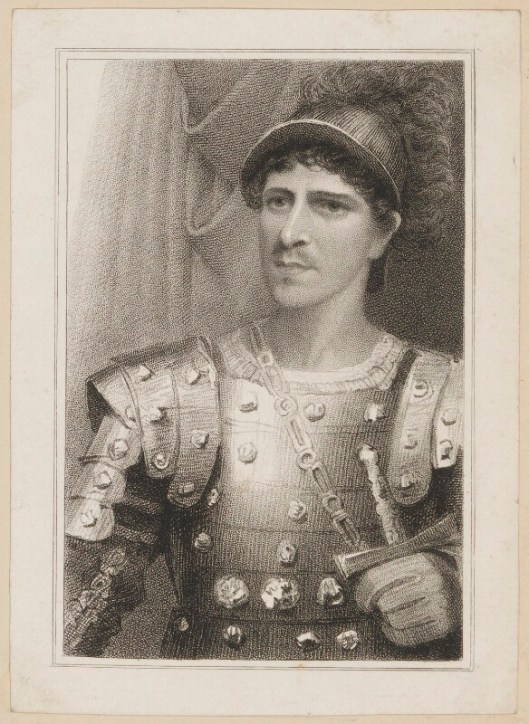
The historical John lived from 1166 to 1216—why would he be dressed as a sort of cosplay Roman legionnaire?  And here is an engraving made from Planche’s 1823 design, with Kemble again in the role of Faulconbridge.

image13kemble1823.jpg

The Kemble/Planche look caught on—and is with us, in some form, to this day.   (The Folger Shakespeare Library in Washington, DC, owns a set of the 1823 colored engravings—here’s a LINK so that you can see other costumes for the production.)

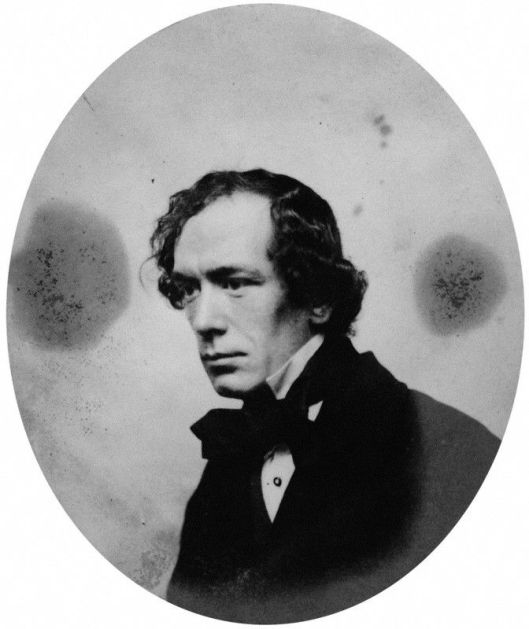
Even as his life in the dramatic world was fading, Planche continued to be a literary figure—as well as a literary recycler.  In 1868, he collaborated with a prominent British illustrator, Richard “Dicky” Doyle (1824-1883),

image14rdoyle.jpg

on a verse version of “Sleeping Beauty”:  An Old Fairy Tale The Sleeping Beauty.

image15sleepcover.jpg

Doyle was, in fact, a very versatile artist, having, for instance, worked for the satirical magazine Punch,  but his lasting fame lies in his fairy/fairy tale illustrations.

image16fairies.jpg

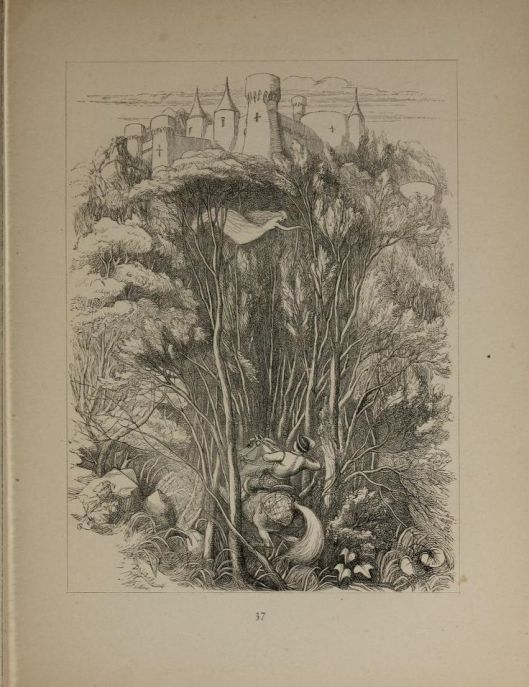
Doyle’s work was prized, but his work ethic was, apparently not:  commissions came and went, sometimes filled, sometimes not, and it seems that he never quite completed the illustrations to the Planche, (perhaps why Planche’s introduction is dated 1865 and the publication date is 1868?), but here’s a sample to show what he could do, when focused.  (And here’s a LINK to the book, so that you can see all of the illustrations for yourself, as well as read Planche’s text.)

image17prince.jpg

So as not to overwhelm you, dear readers, we’re going to pause here, but we’ll continue in our next by looking at other forms—opera, ballet, and animated feature—which Perrault’s story has inspired, taking our story from 1890 to 1959.

In the meantime, thanks, as ever, for reading.

MTCIDC

CD

Do What I Say, Not What I Speak

13 Wednesday Jun 2018

Posted by Ollamh in Fairy Tales and Myths, Films and Music, J.R.R. Tolkien, Literary History, Narrative Methods

≈ Leave a comment

Tags

Ali Baba and the Forty Thieves, Captain Nemo, Door, Doors of Durin, Franklin Delano Roosevelt, Great War, Horse Feathers, Jules Verne, L. Frank Baum, Marx Brothers, Moria, Nautilus, passwords, Prohibition, Speak Friend and Enter, speakeasy, Swordfish, The Lord of the Rings, The Wizard of Oz, Tolkien, Twenty Thousand Leagues Under the Sea

Welcome, dear readers, as always.

Ever since we heard the story of “Ali Baba and the Forty Thieves” in childhood, we’ve been interested in doors and passwords.

Near the story’s beginning, Ali Baba, a poor woodcutter, happens to observe a group of bandits returning to their cave from a raid.  As he watches, the head of the bandits uses a secret phrase, “Open, sesame!” which opens the cave’s secret door.

[We include a LINK here to the whole story, if you don’t know it.]

Since then, we believe that we’ve had three major examples of the pattern:  door as barrier passed with difficulty.

The first was on a very different level altogether from “Ali Baba”.

After the US passed a law against alcohol just after the Great War, the tumultuous era called Prohibition began.

(The date is 1919 on the newspaper, but the law came into force in 1920.)

For all that the legislatures of various states approved it (“ratified” is the formal word), there were many who did not approve of it.

Because it was national law, however, police everywhere were required to enforce it.

To get around the law, secret bars began to appear.  These received the nickname “speakeasy” because it was a place to relax and drink in (what was hoped would be) safety and privacy.

Such places were made anonymous as possible:  a blank door—with a peephole.

To get in, a potential drinker had to be known—or know the secret password.

This went on until 1933, when the new president, Franklin Delano Roosevelt, worked to have the law repealed.

In 1932, the comedy team of the Marx Brothers

included a speakeasy scene in their latest film, Horse Feathers.

This is an almost indescribable scene in which one of the Marx Brothers (Chico—said “CHIK-o”) is on the inside and another (Groucho) is on the outside and then the fun begins—here’s a LINK so you can watch it for yourself.

The upshot (sorry for the spoiler!)—as you’ll see—is that both end up on the outside.  (We told you that this was on a different level!)

Our next example had no secret password, but, instead, it had a door guard and a very silly one, too!

In 1939, MGM released The Wizard of Oz,

based upon L. Frank Baum’s 1900 The Wonderful Wizard of Oz.

We doubt that we have to explain the plot to anyone who would read our blog, so we’ll just remind you of the moment when Dorothy and her friends—Scarecrow, Tin Woodsman, Lion—and Toto, too—have reached the Emerald City and have come to the door of the Wizard.

The guard (who bears a suspicious resemblance to certain other characters in the film) at first refuses them entry, saying the now-famous line that the Wizard won’t see:  “Not nobody!  Not nohow!” but eventually crumbles when Dorothy explains her quest and he begins to sympathize with her, finally allowing her and her friends to enter—although what they learn there is not the best news.

Finally, there is this door.

And, with this door, we are back to “Ali Baba”, it seems (if not to Horse Feathers).  When Gandalf and the Fellowship arrive, however, there appears to be no door there at all, just a pair of immense holly trees (probably English holly, ilex aquifolium), overshadowing a blank wall.

As the narrator describes them:

“But close under the cliff there stood, still strong and living, two tall trees, larger than any trees of hilly that Frodo had ever seen or imagined.  Their great roots spread from the wall to the water.  Under the looming cliffs they had looked like mere bushes, when seen far off from the top of the Stair; but now they towered overhead, stiff, dark, and silent, throwing deep night-shadows about their feet, standing like sentinel pillars at the end of the road.”  (The Fellowship of the Ring, Book One, Chapter 4, “A Journey in the Dark”)

It is only when Gandalf puts his hands on the rock face and murmurs what appears to be some sort of summoning spell that the doors appear:

“The Moon now shone upon the grey face of the rock; but they could see nothing else for a while.  Then slowly on the surface, where the wizard’s hands had passed, faint lines appeared, like slender veins of silver running in the stone.  At first, they were no more than pale gossamer-threads, so fine that they only twinkled fitfully where the Moon caught them, but steadily they grew broader and clearer, until their design could be guessed.”

As the pattern becomes more visible, so, too, becomes an inscription which reads, in part:

“The Doors of Durin, Lord of Moria.  Speak, friend, and enter.”

And trying to make sense of what it means now turns into a very awkward scene in which Gandalf struggles to find the password he believes is requested in that inscription, while the rest of the company gradually becomes more and more impatient (and it doesn’t help that wolves begin to howl in the distance and that there is something about a pool standing opposite the gate which makes them increasingly uneasy).

Finally, Gandalf realizes that what has stopped him depends upon his understanding of a single word in Elvish, a word which clearly has two meanings—and a little more punctuation might have helped!

As it’s inscribed, the vital part of the wording is:

Pedo Mellon a Minno.

As Gandalf originally translated this, it was “Speak, friend, and enter.”  After a good deal of frustration, Gandalf realizes that he has not only mistranslated—slightly—but mispunctuated—or, rather, overpunctuated– as well.  “Speak” and “say” in English are closely related, but there is a difference—for instance, one can “speak English”, but, idiomatically, one would never “say English”.  Thus, no one would ever give the command to someone else, “Say English”, but, rather would say to someone “Speak English”.  The same must be true in Elvish, where, in fact, it appears that “speak/say” is potentially one verb, whose singular imperative (command) is pedo. At first, Gandalf thought that he was being directed to “speak”—but what he was being told to speak he thought was somehow lost or forgotten.  This caused him to overpunctuate:  “Speak, friend, and enter”, where what he was actually being told was “Say [the word] ‘friend’ and enter”.  He finally does so, and the gates open.

In the case of Ali Baba, inside the thieves’ cave are riches, with some of which he quietly makes off.  Groucho and Chico eventually get into the speakeasy and Dorothy and her friends see the Wizard, all of them leaving the problematic entryway behind.  In the case of the doors to Moria, however, what is left behind refuses to stay that way:

“Frodo felt something seize him by the ankle, and he fell with a cry…Out from the water a long, sinuous tentacle had crawled; it was pale-green and luminous and wet…Twenty other arms came rippling out.  The dark water boiled, and there was a hideous stench.”

And this reminded us of something and made us wonder if JRRT had once read the same book we had (there’s nothing in the Letters, unfortunately).  In 1873, the first English translation of a novel by the French science fiction author, Jules Verne (1828-1905),

appeared, slightly mistitled Twenty Thousand Leagues Under the Sea.

Like the title, the rest of the book was filled with mistranslations (it should be Seas) and big cuts.  We hope, in fact, that, if Tolkien read the book (and we would be surprised if he hadn’t, it being the typical Victorian “boys’ adventure tale” of the period), we hope that he read the 1892 version, which cleaned up the errors.

If you haven’t read it, it’s the story of a French scientist who is invited by the US government to investigate a sea monster who is attacking world shipping in the later 1860s.  As the professor discovers, this isn’t a monster at all, but an early submarine, the Nautilus, invented and piloted by a man who calls himself “Captain Nemo” (nemo being Latin for “no one”) and who has a grudge against the imperialist nations of the world, against which he uses his submarine.  The professor, his assistant, and a third man, a harpooner, Ned Land, are taken aboard the Nautilus and, at one point, are involved in a combat against a pack of giant squid—each with 8 arms and two longer tentacles, one of which almost drags Nemo to his death until he’s saved by Ned.  Sounds a little familiar, doesn’t it?

Our favorite version of the story is that done by Disney in 1954.

There is only one squid here, but, as the poster shows, that seems plenty!  It’s a well-told version (simplified, but not too much so) and has a really splendid Nautilus in a high-Victorian design (steampunk long before steampunk?).

As we began this post with an opening, it seems appropriate to end with a closing:

“Gandalf turned and paused.  If he was considering what word would close the gate again from within, there was no need.  Many coiling arms seized the doors on either side, and with horrible strength, swung them round.  With a shattering echo they slammed, and all light was lost.  A noise of rending and crashing came dully through the ponderous stone.”

Thanks, as ever, for reading.

MTCIDC

CD

ps

Can you, our readers, think of other doors and passwords?  We’ve intentionally left one out here, although, when the thrush knocks…

A Celtic Chill Up the Spine

23 Wednesday May 2018

Posted by Ollamh in Fairy Tales and Myths, Films and Music, Heroes, Literary History, Military History, Narrative Methods

≈ Leave a comment

Tags

Banshee, Bean Nighe, Bloody Clavers, Bodbh, Bonnie Dundee, Coiste bodhar, Cuchulain, Darby O'Gill and the Little People, Dragoons, Dullahan, Gan Ceann, Greco-Roman, Hera, Highlanders, Hugh Herriot, Hugh Mackay, James II, Jason, Johm Graham, Morrigan, Old Mortality, Pass of Killecrankie, Picts, Pikemen, Rosemary Sutcliff, Sir Walter Scott, tumuli, William of Orange, Williamite, Woman of the Sidh

Welcome, as ever, dear readers.

As we just finished a novel, Bonnie Dundee (1983),

image1abonnie.jpg

by one of our favorite YA historical authors, Rosemary Sutcliff (1920-1992), we were snagged by what, at first, seems just an odd little detail—but we’ll come to that.  First, let’s talk about the book in general.

image1rs.jpg

The title refers to a 17th-century Scots nobleman, John Graham, 7th Laird of Claverhouse, 1st Viscount Dundee (1648-1689), also known as “Bloody Clavers” for his zeal in observing the law in a complicated religious situation (the subject of a Sir Walter Scott novel, Old Mortality, 1816),

image3oldmort.jpg

and “Bonnie Dundee” from his noble title (and, we presume, his good looks).
image3jasgraham.jpg

In 1689, Dundee was a royal cavalry officer, leading a regiment of mounted infantry, called, at that time, dragoons.

image5dragoon.jpg

In that same year, a combination of elements of Parliament, the army and navy, and the forces of William, Prince of Orange, Stadtholder of the other provinces of the Netherlands,
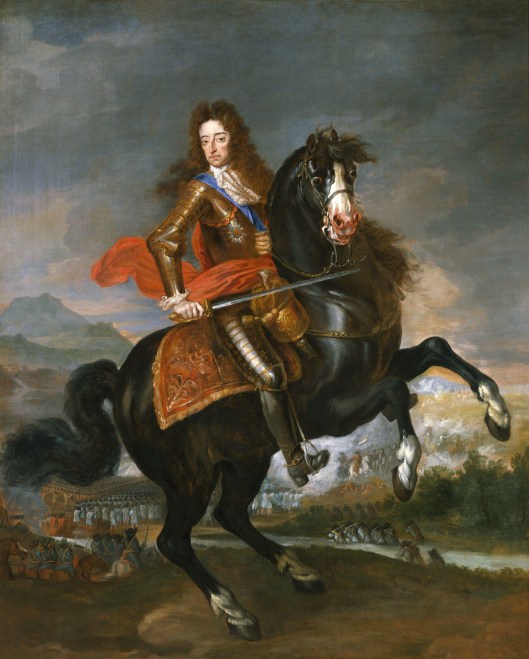
image6wmoforange.jpg

and husband of Mary,

image7wmandmary.jpg

the daughter of the King of England, James II, had overthrown James.
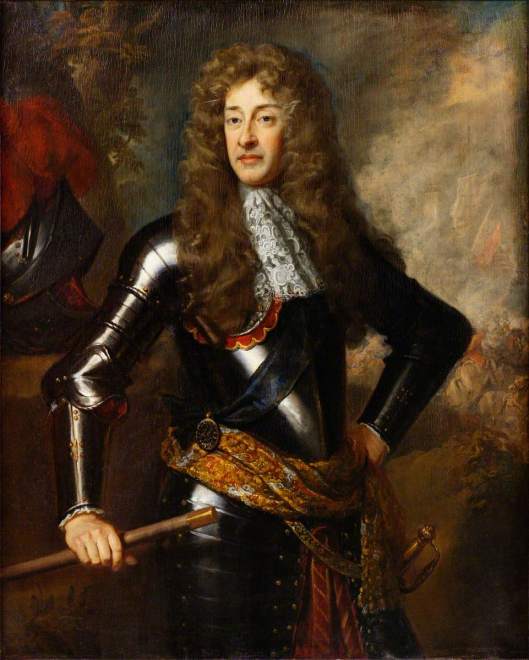
image8jas2.jpg

William was the son of James’ sister, and so James was both his uncle and his father-in-law—a very tricky situation!

Rather than fight, James had fled, but elements in Ireland and Scotland were still loyal.  One of the main leaders of resistance in Scotland was Bonnie Dundee.

image9bonniedundee.jpg

Against him was a Williamite army, led by Hugh Mackay.
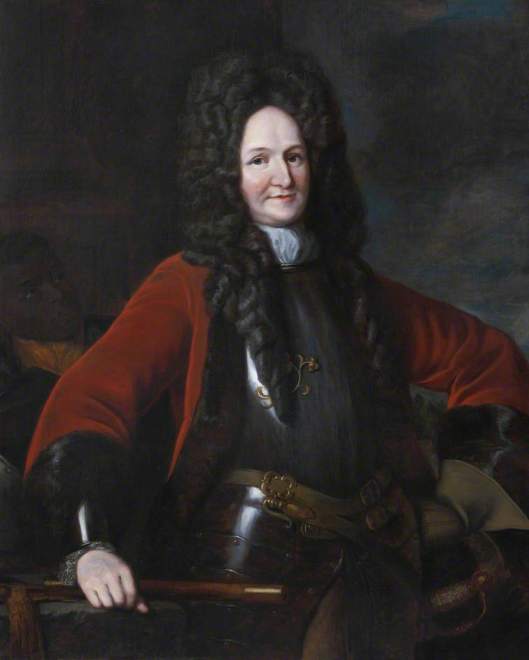
image10mackay.jpg

The major battle happened at the Pass of Killiecrankie, 27 July, 1689.

image11killiecrankie.jpg

The government’s side consisted almost entirely of regular infantry regiments, but a real mixture of raw and experienced soldiers, it seems.

image12redcoats.jpg

Dundee’s men were primarily Highlanders, untrained in modern battlefield discipline and tactics.
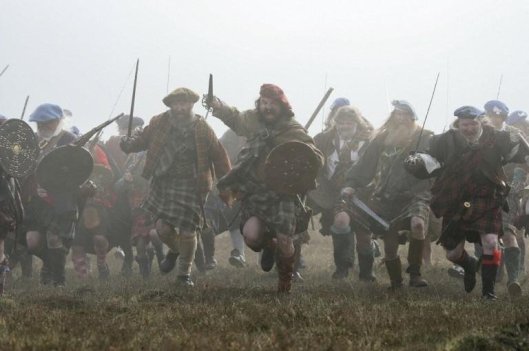
image13highlanders.jpg

The usual method in period battles was to begin by softening up the enemy with artillery fire in hopes that you could goad him into attacking you or at least you might shake his organization.
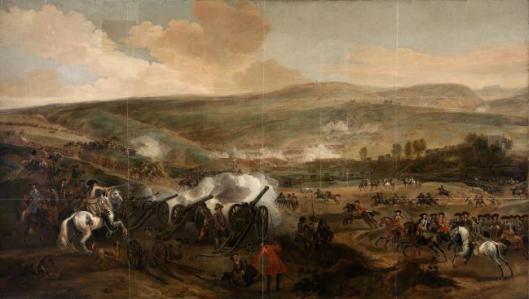
image14boyne.jpg

Then, if the enemy advanced, you used your firepower to break up his formations

image15musketry.jpg

and, if you were lucky, to drive him back, whereupon you might loose your cavalry to drive him off the battlefield.

image16cavalry.jpg

1689 was a time of transition in European armies, in which the Renaissance weapon, the pike,
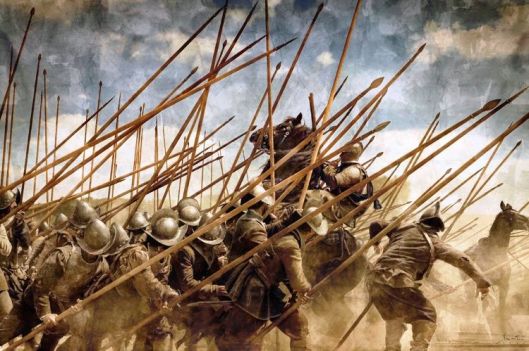
image17pikes.jpg

which had been increasingly flanked by men with firearms,
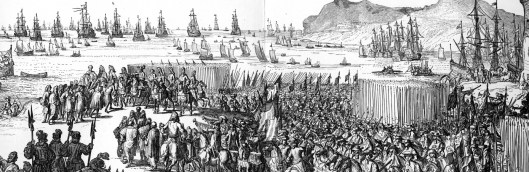
image18pikes.jpeg

was being replaced by the bayonet, turning a musket into a short pike and thus removing the need for pikemen.  The earliest bayonets, however, were simply knives stuck into the muzzle of the musket.
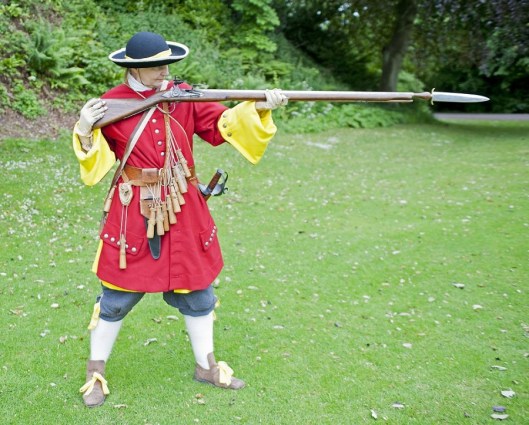
image19plug.jpg

Of course, if you stick a knife into the muzzle, it means that you lose the ability to keep up your volleys and this seems to have been part of the difficulty for MacKay, the Williamite general.  The Highlanders had, as their main weapon, the charge, the goal being to get close to the enemy before he could do much damage with firearms, and cut him to pieces with swords and axes.
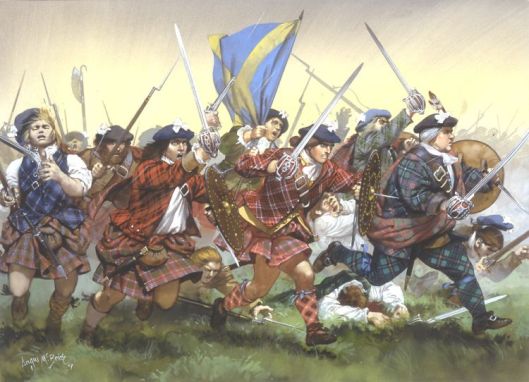
image20charge.jpg

Somehow, the Highlanders managed to break up the Williamite regiments—possibly because they were caught between firing and fixing bayonets?—and drive them off—although at the cost of losing Dundee, mortally wounded while attempting to direct the attack.
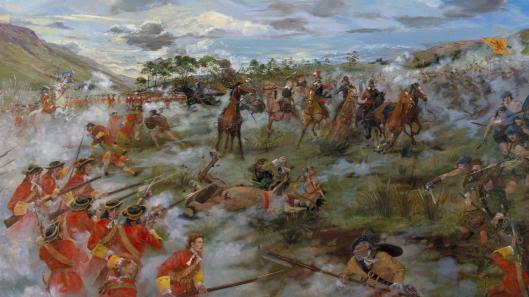
image21dundee.jpg

Sutcliff’s hero, a Scots Lowlander named Hugh Herriot, is first a groom in Dundee’s household and then a trooper in his dragoons, eventually following Dundee to Killiecrankie and his death.  (Dundee was buried nearby just after the battle.)
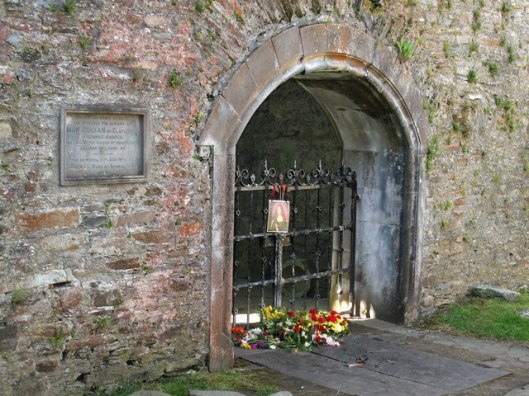
image22dundeegrave.jpg

It is on the march to the battlefield that Hugh sees something which briefly captures his attention at the time, but nothing more, and it was this description which has haunted us, ever since we put the book down:

“Once we came to the place where a cattle-track dipped down from the north, to cross the river by a made ford.  And on the far side, tucked in among the roots of overshadowing hazel and alder trees, looking as twisted and as rooted into the bank as themselves, an old woman in an earth-coloured gown knelt washing a pile of household clothes and linen.

I mind thinking it was late in the year for that; mostly the crofter women fling everything out-of-doors and deal with the bed-bugs and wash all things washable in May.  I mind also noticing that there was something of a dark brownish-red colour among the grey pallor of the unbleached linen; a shawl, maybe; you could not see, in the cave of shadows under the alder branches.

She took no more notice of our passing than if we had not been there at all.  And we marched on, and I thought no more of the thing, for the time being.”  (Bonnie Dundee, Chapter 21, “The Old Woman by the Ford”)

It’s only when later, in camp, Hugh senses that something appears to be worrying the Highlanders that it comes clear that they, too, saw the old woman—and something more, as his Highland friend, Alisdair, explains:

“Did ye see anything—any one, by the cattle ford an hour’s march up-river, as we came by?”

To which Hugh answers:

“An old woman doing her household wash…”

And Alisdair says in return:

“Aye, and you a Lowlander, ye would not be knowing.”

Continuing:

“The Woman of the Sidh—the Washer by the Ford.”

Although a Lowlander, Hugh does know:

“The Washer by the Ford, and she was washing the blood-stained linen, who comes before the death of chiefs and heroes…”

image23abean.jpg

For us, who grew up in the Greco-Roman world, an old woman at a ford has a completely different meaning:  in the story of Jason, his patron-to-be, Hera, disguises herself as an old woman and sits by a ford, testing men by asking to be carried across.  Jason agrees to and loses a sandal in the process, thus fulfilling a divine warning sent to the king of Iolcus about his eventual overthrow (by Jason):  beware the man with one sandal.

image23jasonandhera.jpg

This story in the Sutcliff—really, as we said, only a little detail in a much larger story—struck us as not only extremely well told (which we expect from Sutcliff, a very gifted story-teller—we’ll talk more about her in a future post), but well-told because, initially, it does just seem like nothing at all—something idly noticed and nothing more.  Its creepiness comes not from the description, which might be ordinary, but from its Celtic heritage—the Highlanders belong to a world made long before 1689, being a combination of the prehistoric settlers of the north, the Picts,
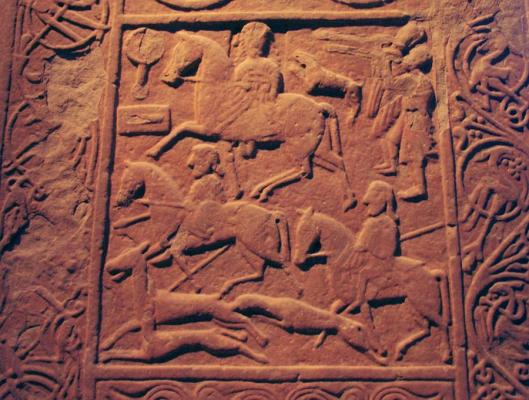
image24picts.jpg

and the Irish, who began arriving in Scotland in the 5th century AD.

image25irish.jpg

Although the Irish had converted to Christianity early, there were certain older beliefs which lasted throughout many centuries.  The Old Woman at the Ford is clearly one.  In Gaelic, the Irish-based language of Scotland, she is the Bean Nighe, (ben NEE-yeh, “the washer-woman”), or as Alisdair calls her, “the Woman of the Sidh” (sheethe).

“Sidh” has, in fact, several possible translations:  it can mean “peace”, but, as well, it signifies the Neolithic tumuli (like the barrows to the east of the Old Forest in Middle-earth), as well as the People of the Other World (who may either live in tumuli, or use them as doorways into that Other World).
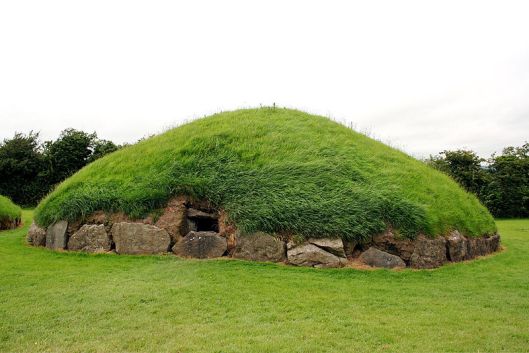
image26sidh.jpg

Our English word “banshee” is simply the Irish ben side (ben SHEE-thyeh), “woman of the Sidh” which, as we’ve seen, is just what Alisdair calls the Old Woman at the Ford.

Banshees—who do not necessarily always appear as old women, sometimes visit as young–are a kind of messenger from the Other World, sent to warn family members of an impending death.  Their manner of communicating this can vary—in some parts of tradition, they fulfil the task of old women at traditional funerals, wailing in grief, with a sound which has come into English as “keening”.

image27keening.jpg

To give you an idea of this, here’s a LINK to a clip from the 1959 Disney movie, Darby O’Gill and the Little People, in which we see not only a banshee, but also the next step, the coiste bodhar, [KOH-shte BOW-er] the “silent coach” with its headless coachman, the Dullahan, called in Irish, Gan Ceann,(gan KENN) “Headless”, who carries the dead person…somewhere… [Be warned, by the way:  one of us saw this only once, many years ago, on a Disney program, and has spent many further years trying not to remember it!]

In other parts of the tradition, the banshee stands outside the doomed person’s window and simply says her/his name (which impresses us as especially creepy), or calls out “My wife!” “My husband!” or “My child!”

In Ireland, the banshee is restricted to the pre-Norman-invasion population (pre-the-year 1169, more or less), suggesting that this is a purely Celtic belief, which would make sense of Hugh’s Highland friend, Alisdair’s, fear of the Washer.

It has been suggested that perhaps this figure is descended from a fearful Irish goddess, the Bodbh (BAH-thv),

image29bodbh.jpg

who has a possible three-part persona and appears before battles and on battlefields, with a raven as her totemic animal.
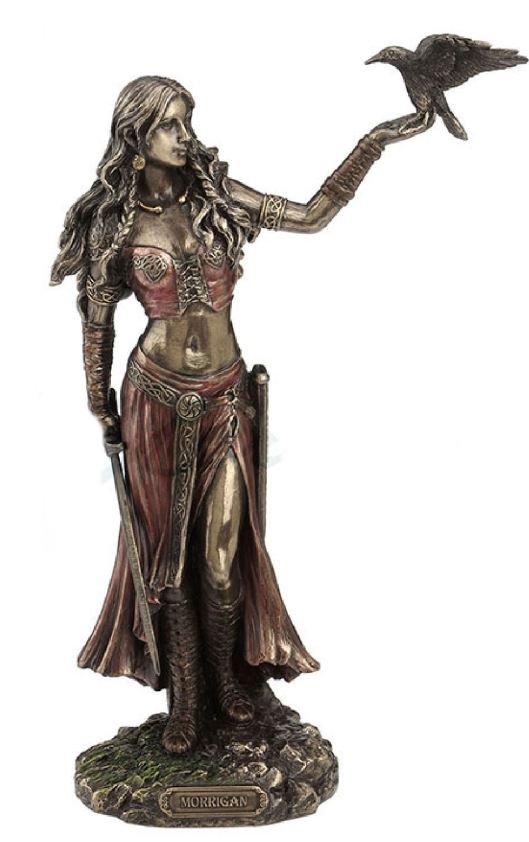
image30bodbh.jpg

She is also called Morrigan, meaning “great queen”, which sounds rather like a euphemism.  In Old Irish stories, she is the enemy of the boy hero Cuchulain (Koo HOO lun), and brings about his death through tricking him into destroying his own protective spells (he eats dog, his own totemic animal—his name means “hound of Culann”).  There’s a famous bronze statue of him, with her raven on his shoulder, in the old main Dublin post office.
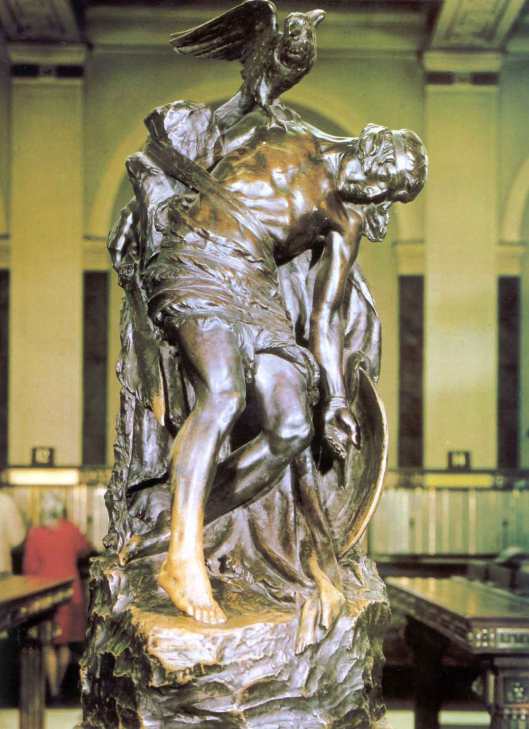
image31cu.jpg

And here Sutcliff now helps us to complete a kind of grim mythological circle.  Hugh Herriot not only knows who the Washer is, but this further fact:

“The Washer by the Ford, and she was washing the blood-stained linen, who comes before the death of chiefs and heroes—aye, before the death of Cuchulain himself.”

Who is the chief and hero of the novel—and is riding to battle the Williamites?  It’s clear, if one accepts this portent, what is to happen, and yet Hugh tries to deny what he knows to Alisdair—

“Och, away!  Dinna be sae daft!…She was real enough; just an old hen-wife, a wee thing late with her spring washing.  Aye, she was real enough.”

Alisdair’s reply still chills us—as it does Hugh—and explains why what was originally only a passing observation in this novel has stayed with us:

“ ‘She seemed real enough,’ he said, ‘she always does.’ “

Thanks, as always, for reading.

MTCIDC

CD
First Make a Map

16 Wednesday May 2018

Posted by Ollamh in Artists and Illustrators, J.R.R. Tolkien, Literary History, Maps, Narrative Methods

≈ Leave a comment

Tags

Braemar, Cherna, geography, Lloyd Osbourne, Maps, plot, Robert Louis Stevenson, Story, The Idler, The Lord of the Rings, Tolkien, topography, Treasure Island, Young Folks Magazine

As always, welcome, dear readers.

We have just said goodbye to an old friend, E, who stayed all too briefly with us on his way to and from a conference.  E, like us, is a big fan of maps and we had a lot of conversation on the topographical charting of Middle-earth, particularly as seen in The Lord of the Rings.

A map forms the basis of the plot of The Hobbit, of course.

image1throrsmap.jpg

And the need for an accurate depiction of (fictional) geography haunted its author as he expanded his story, as he says in a letter to Rayner Unwin, 11 April, 1953:

“Maps are worrying me.  One at least (which would then have to be rather large) is absolutely essential.  I think three are needed:  1. Of the Shire; 2. Of Gondor; and 3. A general small-scale map of the whole field of action.  They exist, of course; though not in any form fit for reproduction—for of course in such a story one cannot make a map for the narrative, but must first make a map and make the narrative agree.”  (Letters, 168)

(If you would like to see an interesting selection of Tolkien maps, here’s a LINK to the Tolkien Estate website, which has a number of them, including the first map of the Shire.)

The idea of making a map, rather than a story, first reminded us of an earlier author, who once said much the same thing.

In the summer of 1881, Robert Louis Stevenson

image2rls.jpg

was on an extended tour of central and eastern Scotland with his parents, his wife, and his stepson, Lloyd Osbourne.

image3l0.jpg

From early August to late September, they stayed in Braemar

image4map.png

in this cottage.

image5cottage.JPG

Then the weather intervened:

“There it blew a good deal and rained in a proportion…and I must consent to pass a good deal of my time between four walls…There was a schoolboy [his stepson, Lloyd]…home from the holidays…He had no thought of literature; it was the art of Raphael that received his fleeing suffrages; and with the aid of pen and ink and a shilling box of water colours, he had soon turned one of the rooms into a picture gallery.  My more immediate duty towards the gallery was to be showman; but I would sometimes unbend a little, join the artist (so to speak) at the easel, and pass the afternoon with him in a generous emulation, making coloured drawings.  On one of these occasions, I made the map of an island; it was elaborately and (I thought) beautifully coloured; the shape of it took my fancy beyond expression; it contained harbours that pleased me like sonnets; and with the unconsciousness of the predestined, I ticketed my performance ‘Treasure Island’.”  (RL Stevenson, “My First Book:  ‘Treasure Island’”, The Idler, August, 1894)

In fact, as Stevenson writes earlier in this essay, it was not, in fact, his first book, or even his first novel, but it was his first published novel.  After its inspired beginning as a map, it first saw publication not as a novel, but as a serial in 17 installments in a magazine called Young Folks, from 1 Oct, 1881 to 28 Jan, 1882, under a pen name, “Captain George North”.  Its first appearance as a novel was in November, 1883, with the title, Treasure Island, or, The Mutiny of the Hispaniola.

image6tifirst.png

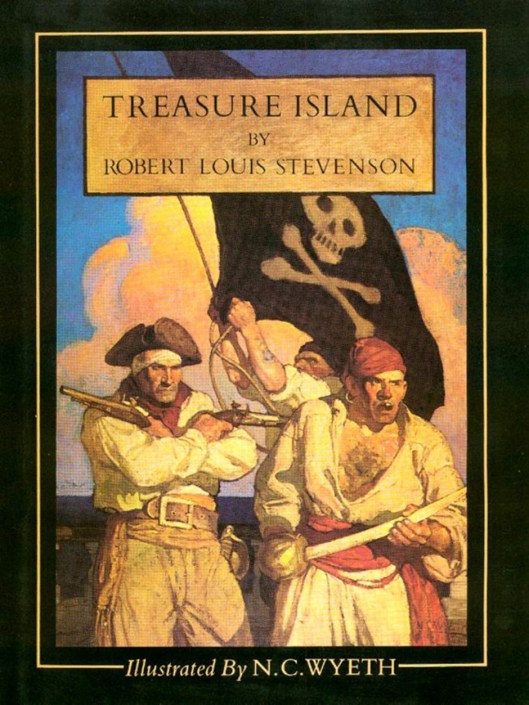
This has produced many subsequent republications over the years, our favorite being the 1911 edition,

image7wyeth.jpg

with its wonderful, atmospheric illustrations by NC Wyeth.

image8ncw.jpg

But what about the map which started it all?

“But the adventures of Treasure Island are not yet quite at an end.  I had written it up to the map.  The map was the chief part of my plot.  For instance, I had called an islet ‘Skeleton Island,’ not knowing what I meant, seeking only for the immediate picturesque, and it was to justify this name that I broke into the gallery of Mr. Poe and stole Flint’s pointer [a sprawled skeleton, if you don’t know the book].  And in the same way, it was because I had made two harbours that the Hispaniola was sent on her wanderings with Israel Hands.  The time came when it was decided to republish [that is, from magazine to book form], and I sent in my manuscript, and the map along with it, to Messrs. Cassell.  The proofs came, they were corrected, but I heard nothing of the map.  I wrote and asked; was told it had never been received, and sat aghast.  It is one thing to draw a map at random, set a scale in one corner of it at a venture, and write up a story to the measurements.  It is quite another to have to examine a whole book, make an inventory of all the allusions contained in it, and with a pair of compasses, painfully design a map to suit the date.  I did it; and the map was drawn again in my father’s office, with embellishments of blowing whales and sailing ships, and my father himself brought into service a knack he had of various writing, and elaborately FORGED the signature of Captain Flint, and the sailing directions of Billy Bones.  But somehow it was never Treasure Island to me.”

So here is that second version.

image9timap.jpg

From his experience, Stevenson drew the same conclusion as JRRT would nearly 60 years later:

“I have said the map was the most of the plot.  I might almost say it was the whole…It is, perhaps, not often that a map figures so largely in a tale, yet it is always important.  The author must know his countryside, whether real or imaginary, like his hand; the distances, the points of the compass, the place of the sun’s rising, the behavior of the moon, should all be beyond cavil…But it is my contention—my superstition, if you like—that who is faithful to his map, and consults it, and draws from it his inspiration, daily and hourly, gains positive support, and not mere negative immunity from accident.  The tale has a root there; it grows in that soil; it has a spine of its own behind the words.  Better if the country be real, and he has walked every foot of it and knows every milestone.  But even with imaginary places, he will do well in the beginning to provide a map; as he studies it, relations will appear that he had not thought upon; he will discover obvious, though unsuspected, short-cuts and footprints for his messengers; and even when a map is not all the plot, as it was in Treasure Island, it will be found to be a mine of suggestion.”

(If you would like to read this little essay in full—and we recommend it—here’s a LINK.)

We will end here as, inspired, we’re off to redo the map for our imaginary medieval Russia, Cherna.

MTCIDC

CD

Small Talk

02 Wednesday May 2018

Posted by Ollamh in Fairy Tales and Myths, Films and Music, Heroes, J.R.R. Tolkien, Narrative Methods, Villains

≈ Leave a comment

Tags

Assyrians, Charles Goodyear, cyclops, David and Goliath, Death Star, Egypt, Ewoks, Greeks, Hetep Senworset, Hobbits, Jack and the Beanstalk, Kelandry of Mindelan, Lachish, Medieval, Odysseus, Polyphemus, Protector of the Small, Romans, Sling, slingers, Slingshot, Smaug, Star Wars, Tamora Pierce, thrush, Tortall, Vulcanized, Woses, Yoda

Welcome, dear readers, as always.

Sometimes, ideas for posts come from something we’ve seen in a movie theatre or something we’re reading or even from something we’re teaching or studying.  Sometimes we employ the Sortes Tolkienses.  And sometimes things just seem to fall into our hands.  And that’s where this post comes from.

We were moving a bookshelf and something literally dropped into our hands, a boxed set of books by one of our favorite YA authors, Tamora Pierce.

image1protector.jpg

As you can see from our image, the series is called “Protector of the Small” and is about the life of Keladry of Mindelan, who lives in Pierce’s imaginary Tortall, where it is possible—just possible—for a girl to become a knight.  Through the four volumes, Kel gradually works her way from pre-page to knighthood and, is always the case with TP’s books, there are both surprises and interesting and not always predictable difficulties along the way, as well as an ultimate humanity which makes her books such satisfying reading.

It wasn’t the actual books, however, which got us to thinking, but the word “small” in the series title.  How often, in our favorite adventure stories, it’s a case of small versus big

image2mouseelephant.jpg

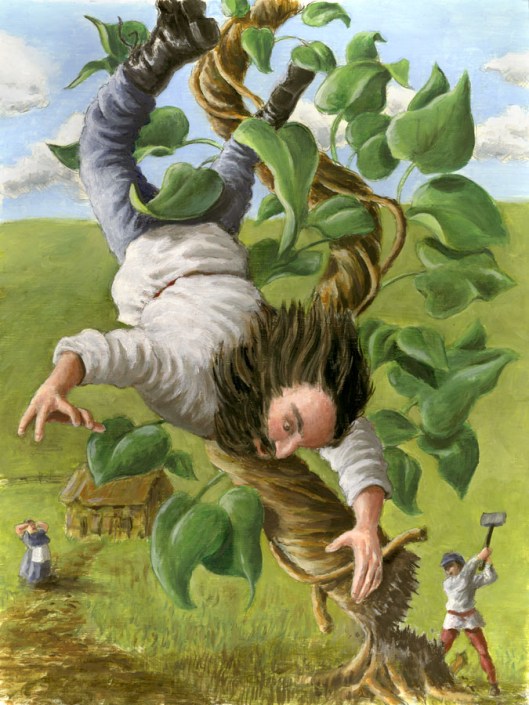
and, very often, the big thinks that that’s all which counts—think of the fairy tale “Jack and the Beanstalk” for example.image3ajackgiant.jpg

For all that the giant is huge and menacing in the story, he’s vulnerable as he climbs down the beanstalk and Jack’s quick thought–to cut down the stalk even as the giant descends–makes quick work of the oversized (but perhaps overconfident—and underbrained?) creature.

image3bdeathofgiant.jpg

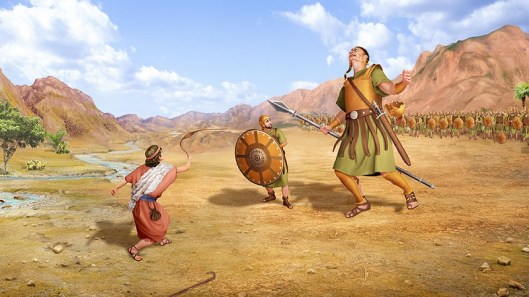
In the Judeo-Christian tradition, we have the Biblical story of David and Goliath.

image3dandg.jpg

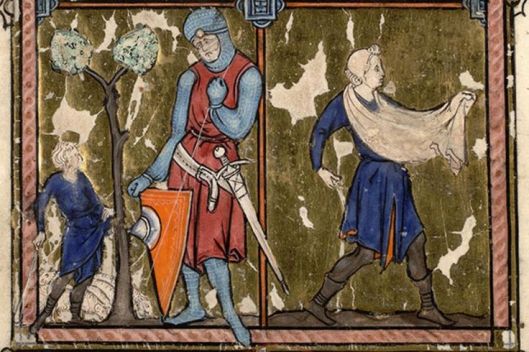
Goliath is not only huge, but armored, and David is a boy who has only his shepherd’s staff, a sling, and five stones from a river bed, but it’s all he needs.

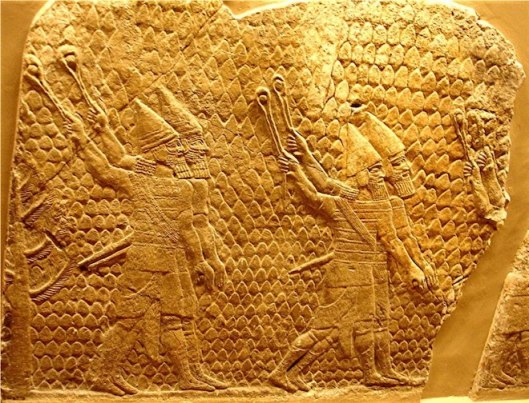
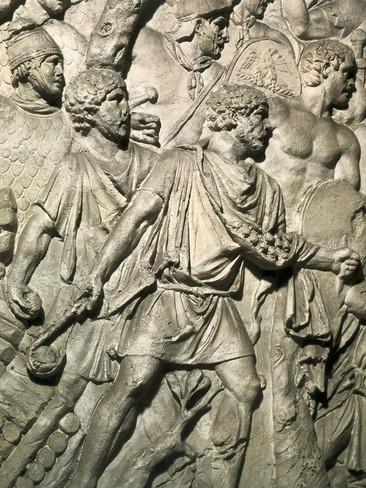
A sling is an ancient weapon

image4sling

This is from the Egyptian Middle Kingdom town of Hetep Senwosret, c. 1895BC.  The Assyrians were still using the weapon more than a thousand years later, as this scene from one of the Lachish reliefs (c.700BC) shows.

image5assyrians.jpg

The Greeks had slingers

image6aspendosslinger.jpg

as did the Romans

image7roman.jpg

as did medieval westerners.

image8medieval.jpg

Slings shouldn’t be confused with slingshots, by the way.  (Or “catapult” if you’re one of our British friends.)

image9slingshot.jpg

This is the weapon of choice of the cartoon character, Dennis the Menace.

image10dmenace.jpg

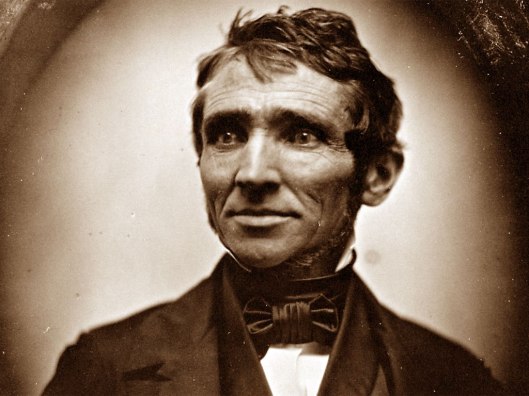
These are a modern invention which requires a large rubber band (an “elastic”) to propel the missile and such rubber bands can only come from the 1840s and beyond, when the process of heat-hardening rubber (“vulcanization”) was patented by Charles Goodyear.

image11chasgoodyear.jpg

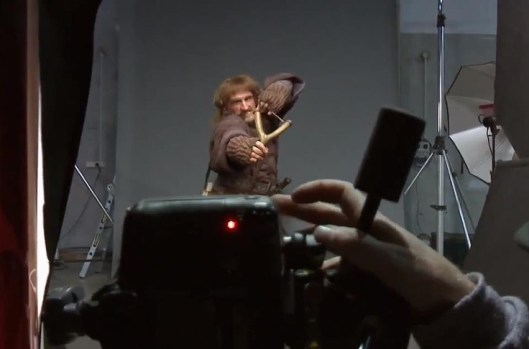
For us, then, the image of Ori in P Jackson’s film armed with a slingshot

image12oriwithslingshot.jpg

goes into our catalogue of anachronisms, like the steam engine whistle, the popgun, and the tomatoes in The Hobbit.

But, as we were saying, small David has no fear of big Goliath, as one of those stones from the riverbed stuns the giant warrior, allowing David to use Goliath’s own sword to cut off his head.

image13dandg.jpg

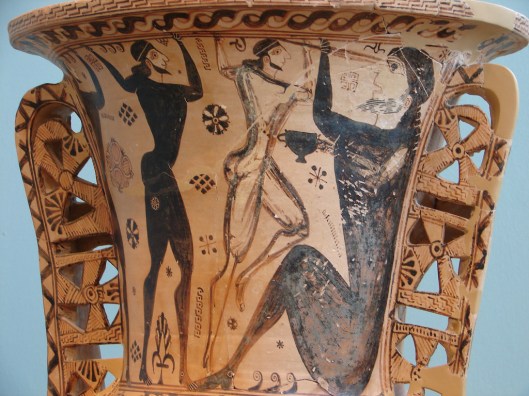
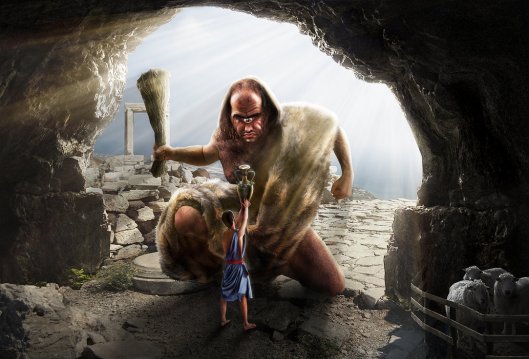
In ancient Greek tradition, Polyphemus the Cyclops obviously thinks his size will allow him to consume all of Odysseus’ men—and then Odysseus, too, saving him for last as a “guest gift”.

image14poly.jpg

Big body, however, doesn’t necessarily mean big brain as Odysseus gets the Cyclops drunk and then blinds him with his own staff.

image15blinding.jpg

Then, he uses the Cyclops’ own sheep as escape vehicles for himself and his men.

image16escaping.jpg

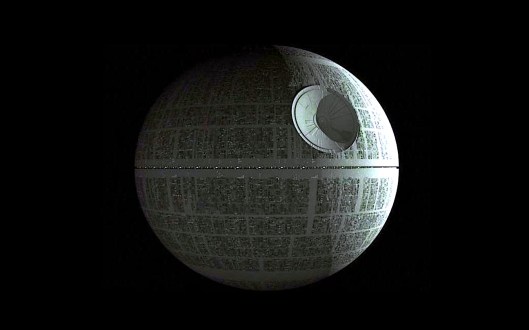
Small versus big is a major theme in Star Wars, from the fact that the gigantic Death Star has a single ventilator duct which makes it vulnerable

image17deathstar.jpeg

to attack by a single fighter,

image18xwing.jpg

to the ferocious Ewoks,

image19ewoks.jpg

and, of course, Yoda, with his famous question.

image20yoda.jpg

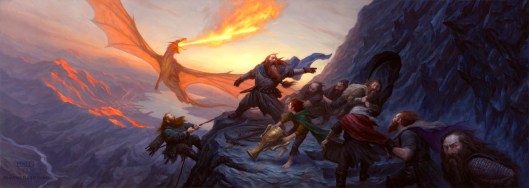
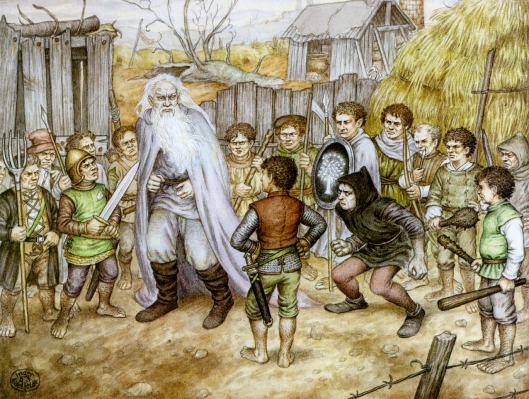
And then there are The Hobbit and The Lord of the Rings, where the world of the small and tough seems to be everywhere, from the hobbits

image21hobbit.jpg

to the dwarves

image22dwarves.jpg

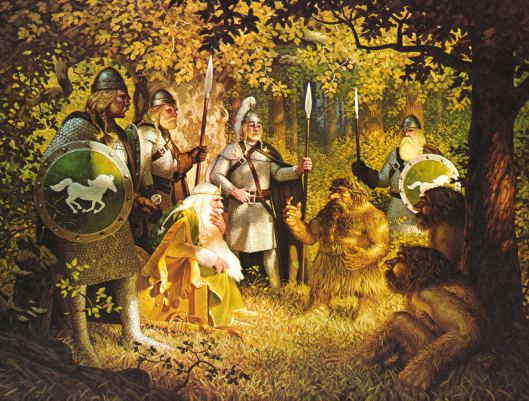
and even to the Woses.

image23woses.jpg

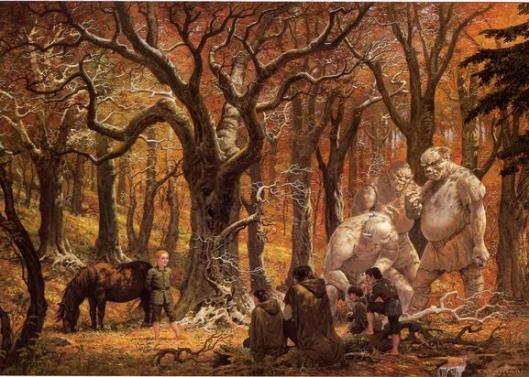
Their opponents are suitably large—trolls,

image24trolls.jpg

dragons

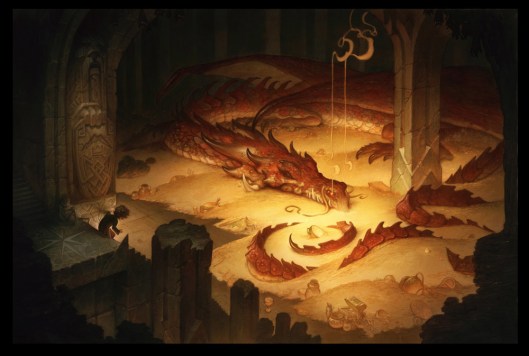
image25smaug.jpg

wizards

image26saruman.jpg

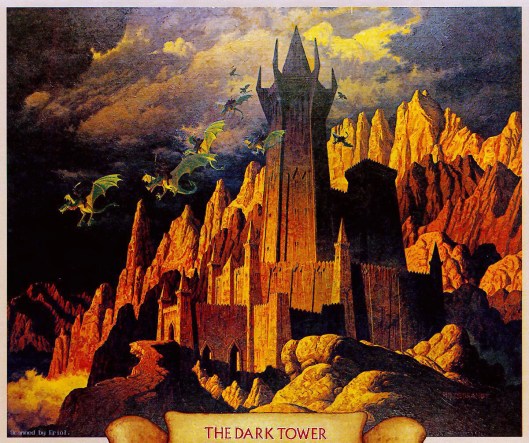
to the biggest evil in Middle-earth (although it’s not clear, really, how big he is, physically).

image27baraddur.jpg

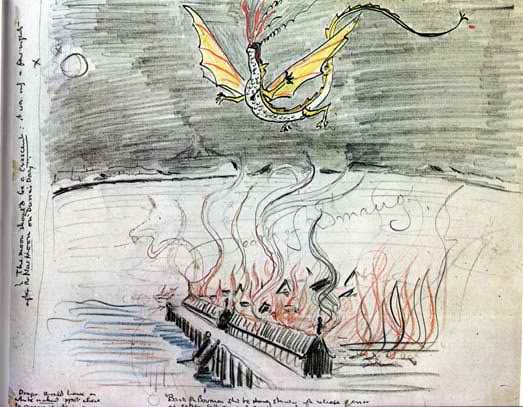
But there’s someone even smaller in The Hobbit who, because of that size, perhaps, is left behind, but is crucial to the story:  the elderly thrush

image28thrush.jpg

who informs Bard the Bowman just where to fire that black arrow which never fails him—and doesn’t this time, thanks to the bird.

image29deathofsmaug.jpg

We were sorry that his part was completely removed from The Battle of the Five Armies, but perhaps this was, in fact, one of the few times when the small hero lost to the big–studio.

Thanks, as ever, for reading.

MTCIDC

CD
 

PS

Here’s a LINK to an amazing demonstration of just how accurate the sling can be.

A Power

25 Wednesday Apr 2018

Posted by Ollamh in J.R.R. Tolkien, Narrative Methods, Villains

≈ Leave a comment

Tags

Gandalf, Grima, Harry Potter, Isengard, Istari, Mini-Me, Mirkwood, Necromancer, Ornthanc, Palantir, power, Rings of Power, Rohan, Saruman, Sauron, The Council of Elrond, The Hobbit, The Lord of the Rings, Theoden, Tolkien, Voldemort, White Council, Wormtongue

Welcome, dear readers, as ever.

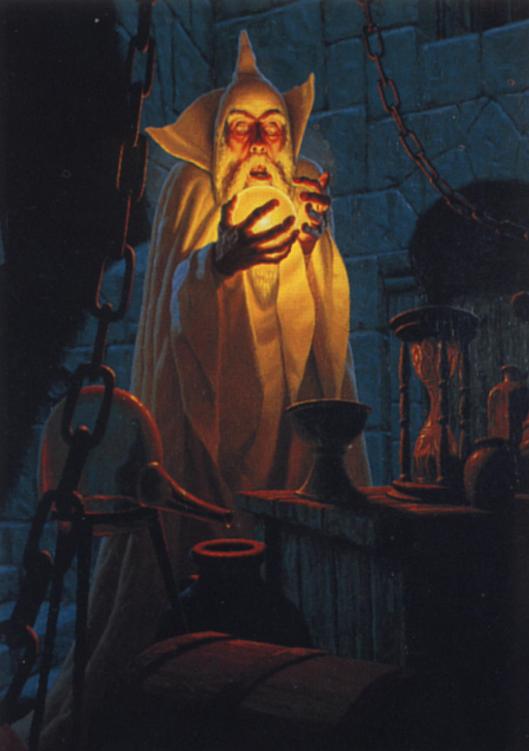
Some time ago, we did a post on Saruman as a “Mini-Me” version of Sauron

image1minime.jpg

but, since that time, one of us has used The Hobbit in a class.  Mirkwood

image2mirkwood.jpg

and the Necromancer

image3necromancer.jpg

came up and we began to think about him again, this time to consider his strategy:  how long has he been planning something and what might be the elements within that plan?

image4saruman.jpg

Although there is no hard evidence for just how long Saruman has been at work, it seems like his scheme has been under construction for at least 80 years.  We base that upon Gandalf’s description of the White Council’s meeting on the subject of Sauron and what to do when it’s discovered that he is in Dol Guldur, calling himself the Necromancer:

“Some, too, will remember also that Saruman dissuaded us from open deeds against him, and for long we watched him only.  Yet at last, as his shadow grew, Saruman yielded and the Council put forth its strength and drove the evil out of Mirkwood and that was in the very year of finding this Ring…”

(The Fellowship of the Ring, Book One, Chapter 2, “The Council of Elrond”)

Almost 80 years before the story of Bilbo and the Ring, then, it appears that one element in Saruman’s plot was shielding Sauron—a fact clearly not lost on Treebeard:

“He was chosen to be the head of the White Council, they say; but that did not turn out too well.  I wonder now if even then Saruman was not turning to evil ways.”

(The Two Towers, Book Three, Chapter 4, “Treebeard”)

From something Saruman says to Gandalf we might guess the obvious reason for helping Sauron to escape action by the White Council:

“A new Power is rising.  Against it the old allies and policies will not avail us at all.  There is no hope left in Elves and dying Numenor.  This then is one choice before you, before us.  We may join with that Power.  It would be wise, Gandalf.  There is hope that way.  Its victory is at hand; and there will be rich reward for those that aided it.”

(The Fellowship of the Ring, Book One, Chapter 2, “The Council of Elrond”)

But being a lackey to that Power is not quite his ultimate design, as we see:

“As the Power grows, its proved friends will also grow; and the Wise, such as you and I, may with patience come at last to direct its courses, to control it.  We can bide our time, we can keep our thoughts in our hearts, deploring maybe evils done by the way, but approving the high and ultimate purpose:  Knowledge, Rule, Order; all the things that we have so far striven in vain to accomplish…”

As is well-known, Saruman, as one of the Istari, was sent into Middle-earth as a counter to Sauron, not as an ally, and their purpose was:

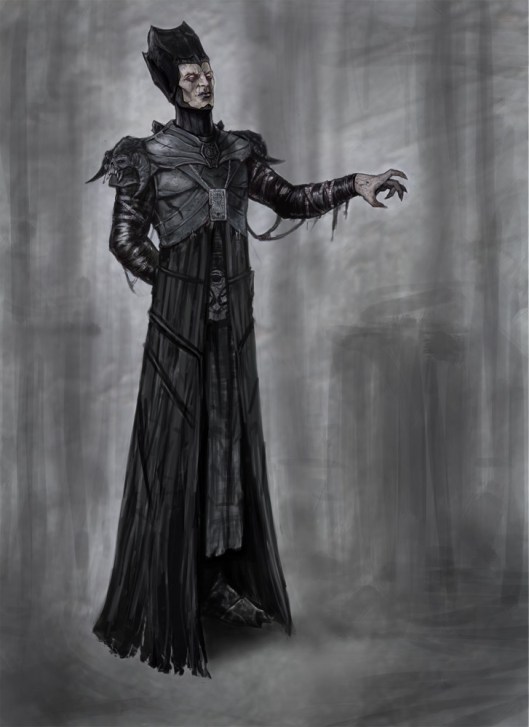
“…coming in shapes weak and humble were bidden to advise and persuade Men and Elves to good and to seek to unite in love and understanding all those whom Sauron, should he come again, would endeavor to dominate and corrupt.”

(Unfinished Tales, 406)

Knowledge, yes, but Rule and Order?  Emphatically not!  But if that Power (and we note that even Saruman won’t just come out and say “Sauron” at this point, rather like the use of “He Who Must Not Be Named” in the Harry Potter books)

image5voldemort


can be used as a tool in Saruman’s hands—which may show us one element in his grand design.

First, however, it would seem that he needed a base.  As Treebeard tells Merry and Pippin:

“He gave up wandering about and minding the affairs of Men and Elves, some time ago—you would call it a very long time ago; and he settled down at Angrenost, or Isengard as the Men of Rohan call it.”

(The Two Towers, Book Three, Chapter 4, “Treebeard”)

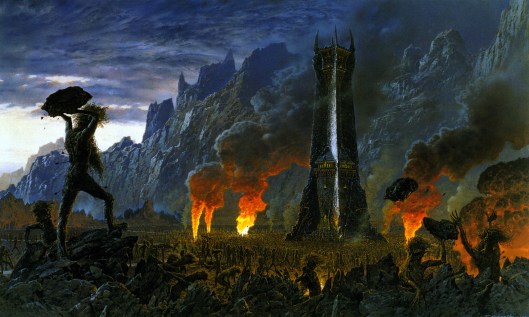
image6orthanc


Saruman even then was already thinking of something, though the purpose was intentionally shrouded:

“There was a time when he was always walking about in my woods.  He was polite in those days, always asking my leave…and always eager to listen.  I told him many things that he would never have found out by himself; but he never repaid me in like kind.  I cannot remember that he ever told me anything.  And he got more like that; his face, as I remember it…became like windows in a stone wall:  windows with shutters inside.”

Although he was powerful, Saruman needed allies—or, rather, servants—and he wasn’t too particular who or what they were:

“He has taken up with foul folk, with the Orcs…Worse than that:  he has been doing something to them; something dangerous.  For these Isengarders are more like wicked Men.  It is a mark of evil things that came in the Great Darkness that they cannot abide the Sun; but Saruman’s Orcs can endure it, even if they hate it.  I wonder what he has done?  Are they Men he has ruined, or has he blended the races of Orcs and Men?  That would be a black evil!”

With the help of these servants, Saruman has turned his base into a factory and storehouse for his scheme, as Gandalf says:

“…it had once been green and fair, it was now filled with pits and forges.  Wolves and orcs were housed in Isengard, for Saruman was mustering a great force on his own account, in rivalry of Sauron and not in his service, yet.”

(The Fellowship of the Ring, Book One, Chapter 2, “The Council of Elrond”)

In fact, it would appear from what Saruman has told Gandalf, that he actually never intends to offer his service to Sauron.

From his base, he has been extending his own power into Rohan, in the south.  In his encounter with Aragon and his companions, Eomer says:

“But at this time our chief concern is with Saruman.  He has claimed lordship over all this land, and there has been war between us for many months.  He has taken Orcs into his service, and Wolf-riders, and evil Men, and he has closed the Gap against us, so that we are likely to be beset both east and west.”

(The Two Towers, Book Three, Chapter 2, “The Riders of Rohan”)

His attacks aren’t always military and Eomer hints at another possibility:

“His spies slip through every net, and his birds of ill omen are abroad in the sky.  I do not know how it will all end, and my heart misgives me; for it seems to me that his friends do not all dwell in Isengard.  But if you come to the king’s house, you shall see for yourself.”

We know that this is “fifth-column” work—Grima Worm-tongue, who has been slowly poisoning King Theoden with defeatism.

image7grima.png

And now we can see, in broad outline, what Saruman is up to:

  1. establish a base
  2. recruit an army
  3. build up an intelligence network (birds, spies, even wandering himself to pick up information)
  4. use your strength to expand power into the next land, Rohan
  5. at the same time undercut the King of Rohan’s ability to resist by subversive methods

So far, so good, as long as all that Saruman wants is to be the ruler of the land south of the Gap of Rohan and north of Gondor, but we’ve already seen that he’s more ambitious yet, suggesting to Gandalf that they—really he, as Gandalf knows—can take over that unnamed Power and use it for their—his– purposes, Knowledge, Rule, Order.  When he sees that Gandalf is unconvinced, Saruman lets slip the capstone of his scheme:

“Well, I see that this wise course does not commend itself to you…Not yet?  Not if some better way can be contrived?…And why not, Gandalf?  Why not?  The Ruling Ring?  It we could command that, then the Power would pass to us.”

And here is the real heart of Saruman’s design:  to obtain the One Ring.

He has been searching for it for a long time, even traveling to Minas Tirith to examine ancient records.

“In former days the members of my order had been well received there,” says Gandalf to the Council of Elrond, “but Saruman most of all.  Often he had been for long the guest of the Lords of the City.”

His purpose is now easy to guess.

Gandalf had been aware that Saruman had seemed to know a great deal about the Ring, even to its appearance, as Saruman had said to the White Council:

“The Nine, the Seven, and the Three had each their proper gem.  Not so the One.  It was round and unadorned, as it were one of the lesser rings; but the maker set marks upon it that the skilled, maybe, could still see and read.”

How had Saruman known that since, as Gandalf says, “What those marks were he had not said.  Who now would know?  The maker.  And Saruman?  But great though his lore may be, it must have a source.  What hand save Sauron’s ever held this thing, ere it was lost?  The hand of Isildur alone.”

Gandalf discovers the truth of this in the dusty records of Gondor:

“…there lies in Minas Tirith still, unread, I guess, by any save Saruman and myself since the kings failed, a scroll that Isildur made himself.”

And, with the discovery and reading of that scroll, Gandalf knows not only about much more about the Ring, but how Saruman knew about its appearance and now, in Orthanc, pressed by Saruman to join him, he understands the last element in Saruman’s design—and also why Saruman has summoned him:

“That is in truth why I brought you here.  For I have many eyes in my service, and I believe you know where this precious thing now lies.  Is it not so?  Or why do the Nine ask for the Shire, and what is your business there?”

So here, lacking only one element, the real element under all, is Saruman’s long plan—but lacking “this precious thing” (a telling phrase!), we will see how successful the rest will be.  Treebeard has said of him,

“He has a mind of metal and wheels; and he does not care for growing things, except as far as they serve him for the moment.”

What will happen when, without the Ring, Saruman will find that growing things, instead of serving him for the moment, might unseat him forever?

image8destruction.jpg

As always, thanks for reading!

MTCIDC

CD

Middle-under-earth

04 Wednesday Apr 2018

Posted by Ollamh in Artists and Illustrators, Heroes, J.R.R. Tolkien, Literary History, Narrative Methods

≈ Leave a comment

Tags

Alan Lee, Andrew Lang, Barrow-downs, Beowulf, cyclops, Dragons, George Macdonald, Goblin Feet, Goblins, Great War, Grendel, Grendel's Mother, John Howe, monsters, Polyphemus, Sir Gawain and the Green Knight, Smaug, Storia Moria Castle, Tales of Troy and Greece, The Hobbit, The Lord of the Rings, The Princess and the Goblin, The Red Book of Animal Stories, The Red Fairy Book, Tolkien, trenches, tumulus

As always, dear readers, welcome!

One of us is currently teaching The Hobbit and, is always seems to be the case when we are teaching an old friend, we are struck by something new.  In this case, it’s the idea of “what lurks beneath” and where it might come from.

What occurred to us now was that, virtually every time there is trouble for Bilbo and the dwarves, it is strongly linked with caves and hollowed-out places:  trolls who came out of a cave (“Roast Mutton”), goblins who live in caves (“Over Hill and Under Hill”), Gollum (“Riddles in the Dark”), hostile elves (“Flies and Spiders” and “Barrels Out of Bond”), and, of course, Smaug (“On the Doorstep”, “Inside Information”, and “Not At Home”).  Only the wargs, the overgrown spiders, and the men of Lake-town in the Battle of the Five Armies have above-ground origins, as, after all, the other forces—goblins, elves, and even Iron Hills dwarves (we assume), have subterranean dwellings.

We knew that JRRT thought to become a classicist early in his academic career and we can imagine right away that one influence upon him for this underground menace would have been Polyphemus the Cyclops, who, after all, lives in a cave.

image1cyclops.jpg

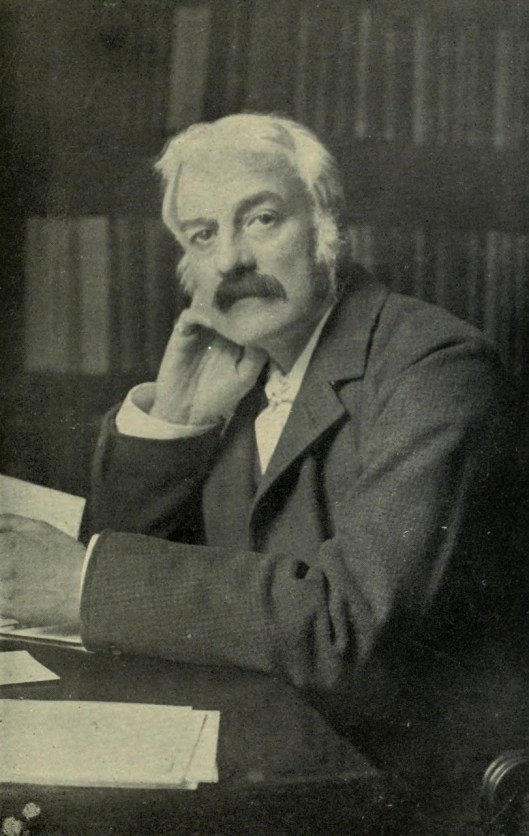
Before he read that part of Odysseus’ story in Greek, he might have seen it in Andrew Lang’s 1907 Tales of Troy and Greece—

image2alang.jpg

image3lang.jpg

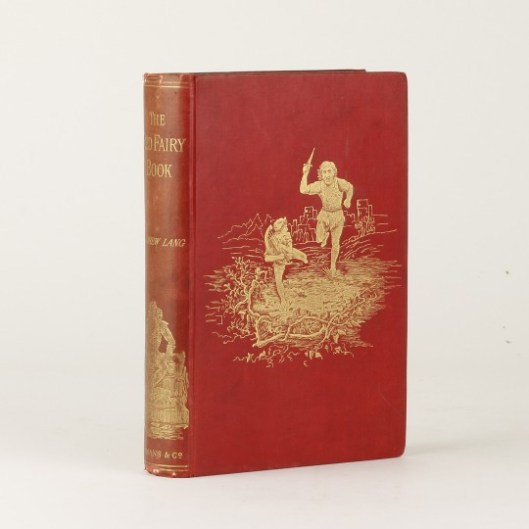
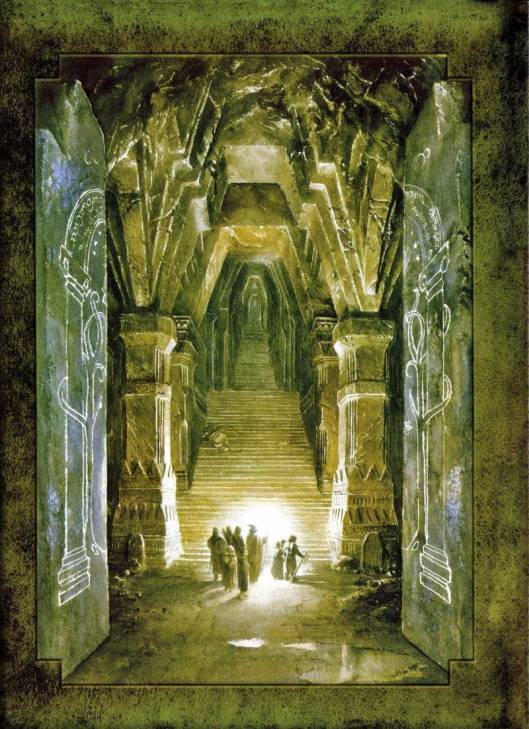
Tolkien tells us that, as a child, he had read other Lang works and a story in one, The Red Fairy Book (1890), might even have influenced some Middle-earth geography, from “Storia Moria Castle”.

image4redfairybook.jpeg

image5leemoria.jpg

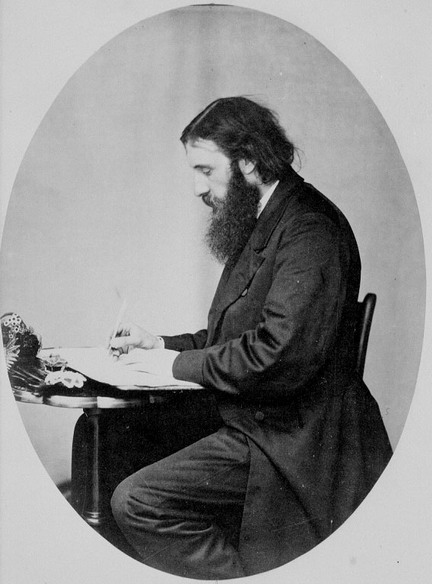
Another childhood favorite (although he appears to have changed his mind later in life) were the fantasy novels of George Macdonald

image6gmacd.jpg

and his The Princess and the Goblin (1872),

image7princess.jpg

as its title suggests, is full of goblins and their underground world.  These goblins are powerful, but have one fatal flaw—tender feet—which JRRT said that he never believed (see Letters, 178)—although Tolkien’s first published poem was entitled “Goblin Feet” (Oxford Poetry 1915).

Beyond possible childhood reading, there is his career focus, which includes two other potential underground influences.

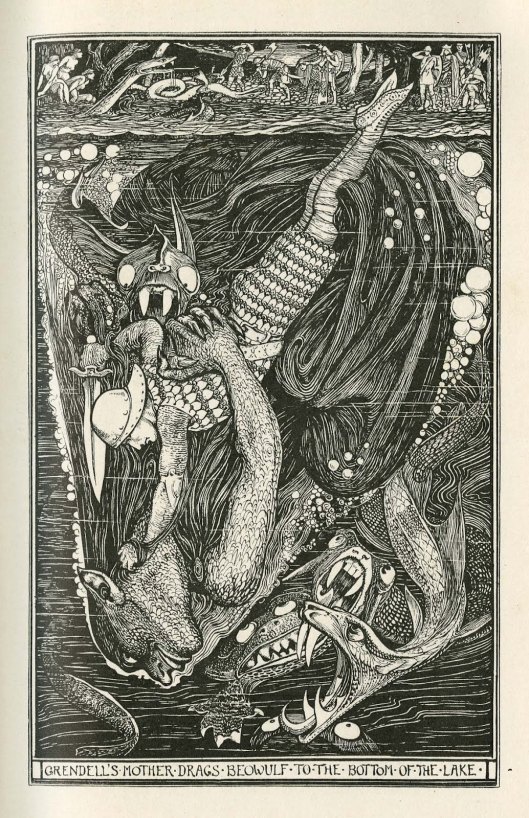
First, there is Beowulf.  Grendel, the monster in this poem,

image8grendel.jpg

lives in a cave at the bottom of a pool with his mother and, in the second part of his monster-slaying, Beowulf has to dive into that pool to deal with her.image9beowulfandmama.jpg

This illustration comes from another Andrew Lang book, The Red Book of Animal Stories (1899).

image10redbook.jpg

(The picture of Grendel is by Brian Froud.  We found it on the website of K.T.Katzmann, I Write Monsters.  Here’s a LINK.)

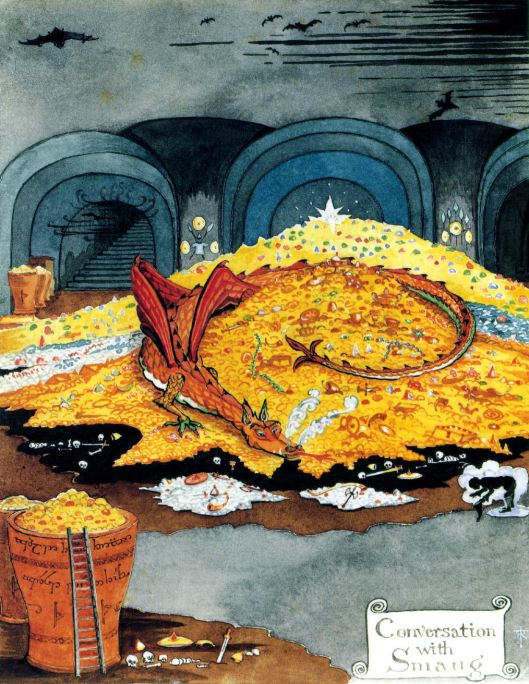
Then, of course, there’s that dragon, against whom Beowulf fights and dies—and which is the direct ancestor of another famous and familiar dragon…

image11dragonandhoard.jpg

We are told that it lives in an abandoned tumulus—that is, an ancient grave mound, like this one.

image12tumulus.png

(This is, in fact, a famous Neolithic burial at Gavrinis, in Brittany.)

JRRT worked in Middle English, as well as Old English, and here we find one more possible source in his own edition (with E.V. Gordon) of the 14th-century poem Sir Gawain and the Green Knight.

image13tolkgord.JPG

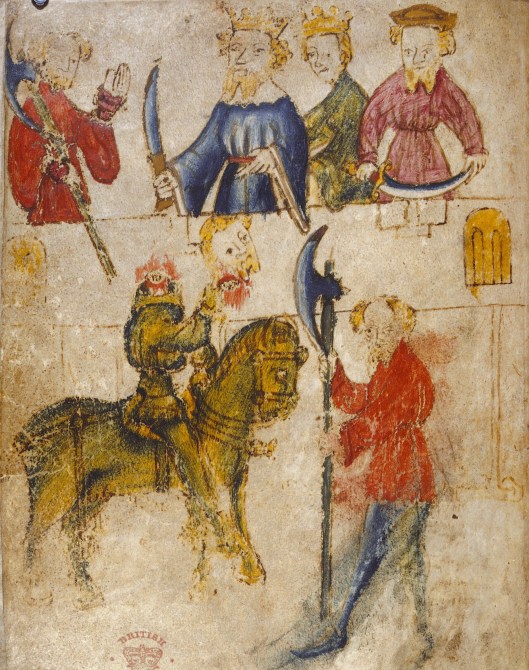
The Green Knight who challenges King Arthur’s court to a mutual head-chopping contest, is said, in the fourth part of the poem,  to inhabit a “green chapel” and to appear out of a hole when Sir Gawain, who has accepted the challenge and cut off the Green Knight’s head, makes his appearance there to fulfill his half of the contest.

image14sirg.jpg

This chapel has sounded like a tumulus to generations of scholars and here’s John Howe’s 2003 illustration, complete with chapel as tumulus (not to mention a very large green man).

image15johnhowe.png

Tumuli also make their appearance, of course, in The Lord of the Rings, when Frodo and his party go astray on the Barrow Downs.

image16barrowwight.jpg

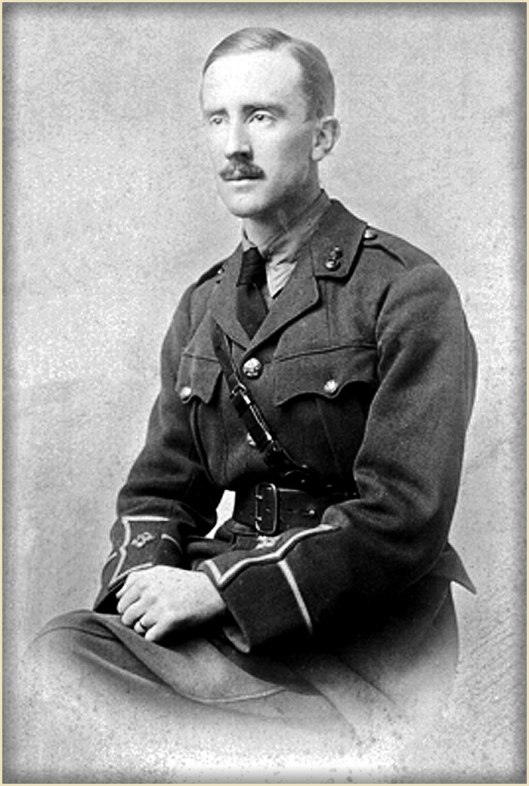
We can’t finish this posting without at least suggesting one more source, something even more personal than JRRT’s scholarly work:  his experiences in the Great War.

image17lt.jpg

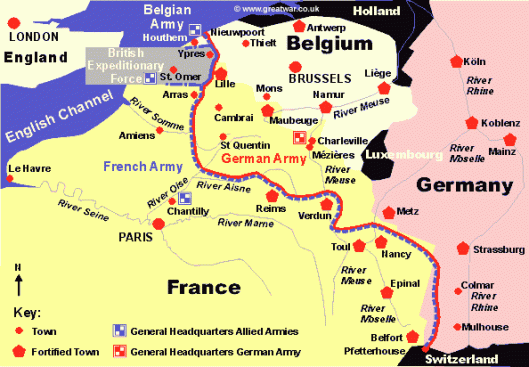
By the time Tolkien entered the service in France, the Western Front was, basically, a 500-mile trench, from Switzerland to the North Sea.

image18trenches.gif

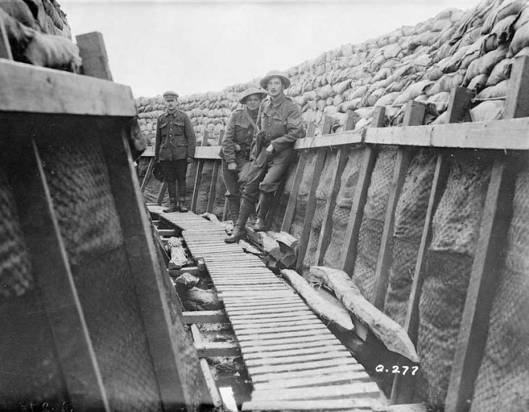
Much of the entrenching was simply deep, reinforced ditching.

image19trenches.jpg

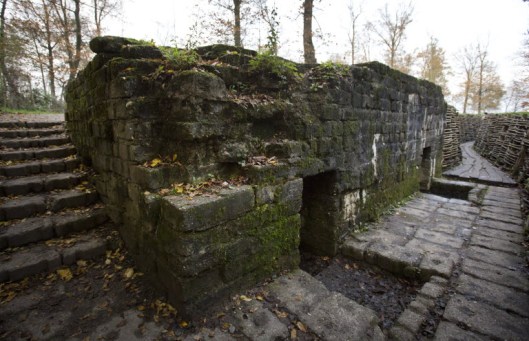
But some—particularly on the German side—could be elaborate, even built with stone or concrete, and set far enough into the ground as to be almost impervious to bombardment.

image21bunker.jpg

And we imagine that, with all of that earlier literary work in his mind, JRRT might have faced such defenses wondering whether what was inside them would be Germans

image22trenchclearing.jpg

or something much worse.

image23smaug.jpg

And did this haunt his later writing as much as the Great War haunted the minds of soldiers all over the world?

Thanks, as ever, for reading!

MTCIDC

CD

Many Woven Cloths

14 Wednesday Mar 2018

Posted by Ollamh in Artists and Illustrators, Fairy Tales and Myths, J.R.R. Tolkien, Military History, Military History of Middle-earth, Narrative Methods

≈ Leave a comment

Tags

Alexander Mosaic, Ancient Egypt, Assyrians, Battle of Pavia, Battle of the Issus, Bayeux Tapestry, Cloisters, Darius III, Embroidery, Eorl, Hause of the Faun, Hunt of the Unicorn, Middle Ages, Museo Nazionale di Capodimonte, Nubians, Persian, Pompeii, Rameses II, reliefs, Renaissance, story-telling, tapestry, tesserae, The Lord of the Rings, Tolkien, triptych, Trojan War

Welcome, as ever, dear readers.

Not long ago, we visited Meduseld for a look at Grima, the fifth-columnist.  Today, we’re back, but, instead of scrutinizing the staff, we’re examining the décor—

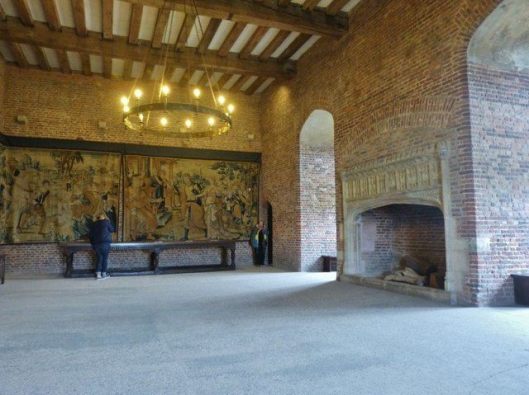
“Many woven cloths were hung upon the walls, and over their wide spaces marched figures of ancient legend, some dim with years, some darkling in the shade.  But upon one form the sunlight fell:  a young man upon a white horse.  He was blowing a great horn, and his yellow hair was flying in the wind.  The horse’s head was lifted, and its nostrils were wide and red as it neighed, smelling battle afar.  Foaming water, green and white, rushed and curled about its knees.

‘Behold Eorl the Young!’ said Aragorn.  ‘Thus he rode out of the North to the Battle of the Field of Celebrant!’” (The Two Towers, Book Three, Chapter 6, “The King of the Golden Hall”)

By “woven cloth”, we presume that JRRT means a tapestry, a decorative wall-hanging, like these—

image1medtapwall.jpg

In the western Middle Ages and Renaissance, even wealthy walls—like those in castles—could simply be stone and such tapestries could act both to decorate and to act as a barrier between cold wall and (potentially) shivering inhabitants.

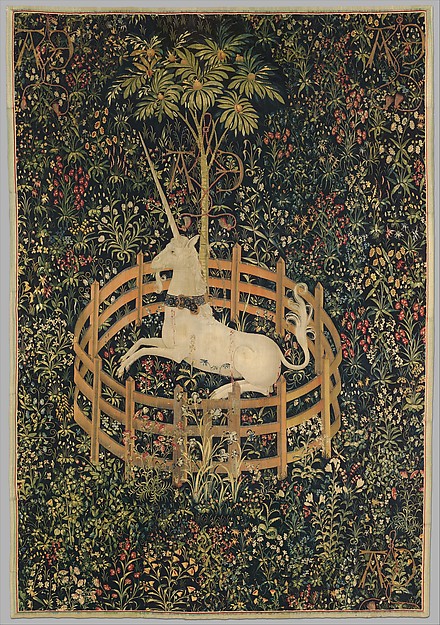
For those making such things, the possibilities for using them as story-telling spaces inspired such works as the famous “Hunt of the Unicorn” series of tapestries, now housed in the Cloisters, a museum in New York City.

image2hunt.jpg

image3cloisters.jpg

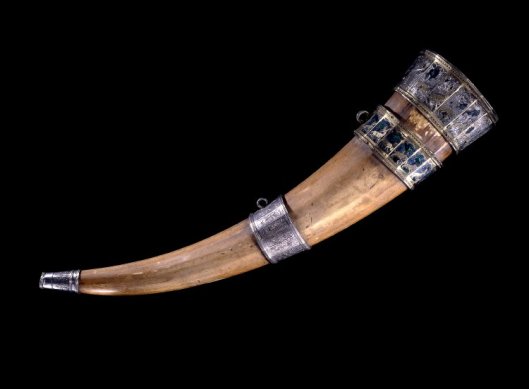
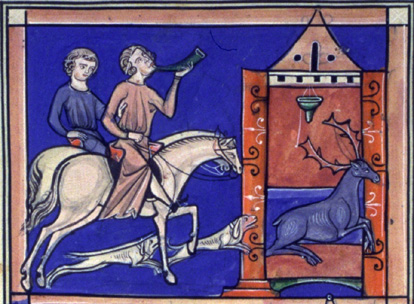
The description of Eorl makes us think of medieval stag hunt illustrations, where hunters may be seen blowing horns—like this one.

image4savernakehorn.jpg

image5dagobert.jpg

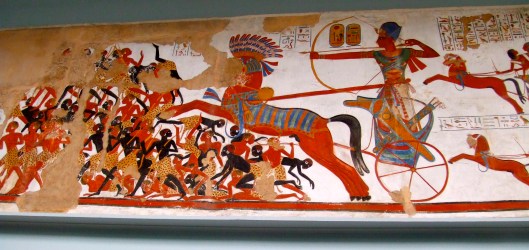
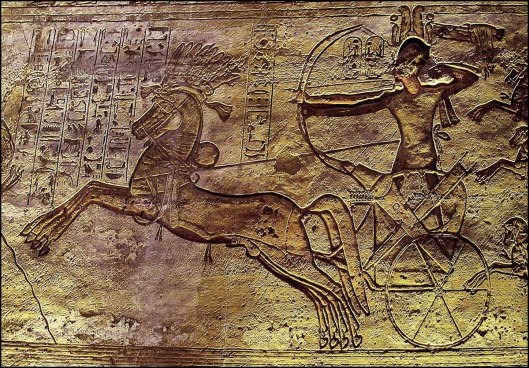
But the fact that he was riding to battle also made us think of wall decorations of a military/historical nature through the centuries, starting with ancient Egypt, where Rameses II (1303-1213BC) had himself depicted on walls in various military actions—

image6ramnubians.jpg

image7ramkadesh.jpg

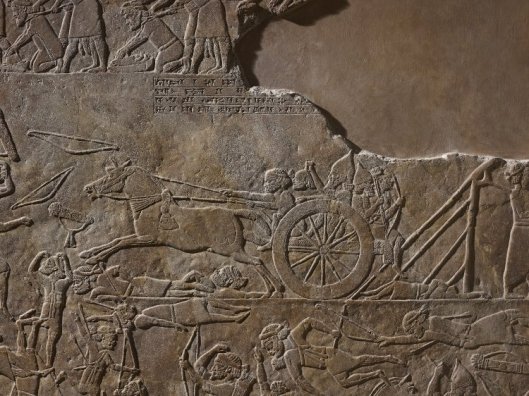
Or the Assyrians, who were not only enthusiastic (gross understatement) about war, but also about depicting themselves engaged in it.

image8assyrians.jpg

As you can see, although these appear on walls, they are not hangings, but reliefs—that is, shallow carvings.  The Egyptian reliefs could be brightly painted, as is that reconstruction of Rameses and the Nubians, the first of the two Rameses illustrations.  It appears that some of the Assyrian reliefs were also colored—here’s a PDF: BMTRB 3 Verri et al, of an interesting article from the Technical Research Bulletin of the British Museum on the subject.

From colored reliefs, we can jump to colored tiles (called tesserae), with the famous Alexander Mosaic.

image9alexandermosaic.jpg

This depicts Alexander the Great nearly confronting the Persian king, Darius III, at the Battle of the Issus (333BC) and what amazes us is that this was originally not on a wall, but on a floor, in the so-called “House of the Faun” in Pompeii.


It is believed that this was based upon an early 3rd-century BC painting and, to our eye, it still looks very much like the painting it may have come from (which was, presumably, on a wall, not a floor).

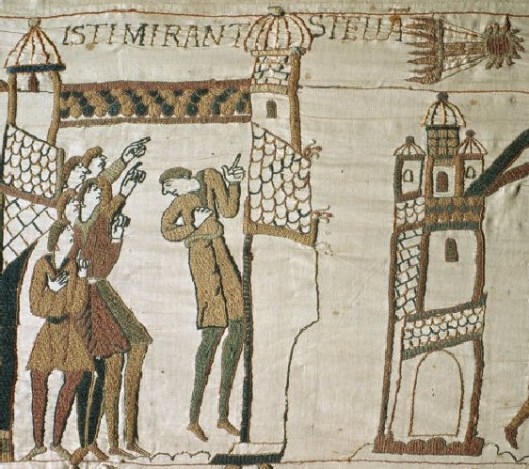
For battle scenes on cloth, we return to the medieval world and something we’ve mentioned before, the so-called “Bayeux Tapestry”.

image11a.jpg

We say so-called because it’s not really a tapestry—which would have been woven on a loom—but, instead, a giant (230ft/70metres) embroidery.  Here’s a detail so that you can see how an embroidery is made up of stitching on a (in this case) plain linen strip.

image11closeup.jpg


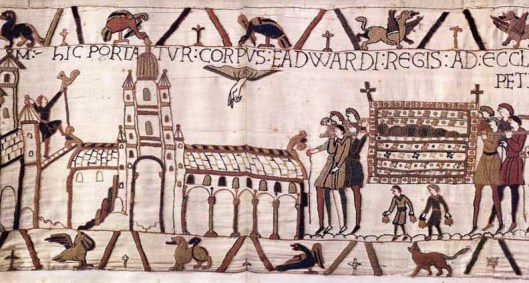
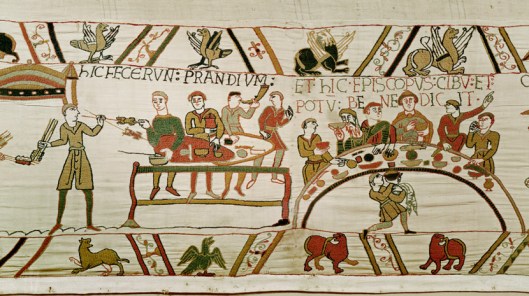
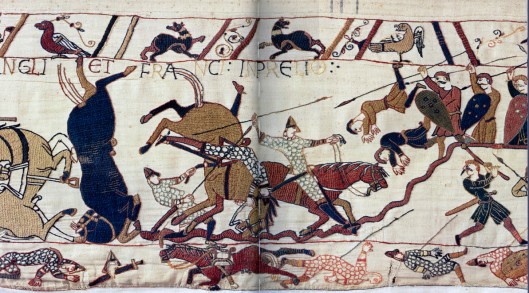
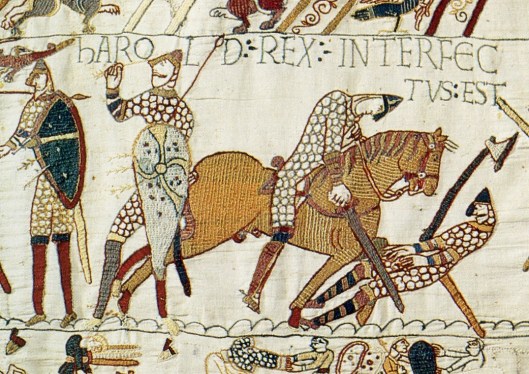
This is really an astonishing piece of work—so far as we know, nothing else like it has survived from medieval western Europe:  a massive history of the invasion of England in 1066, including events leading up to it, in 50+ scenes.  We see everything from architecture

image12westminster.jpg


to ship-building

image13shipbuilding.jpg


to feasting

image14bayeux.jpg


to battle

image15battle.jpg

at its grainiest

image16deathofharold.jpg

and even includes Halley’s Comet.

image17hscomet.jpg

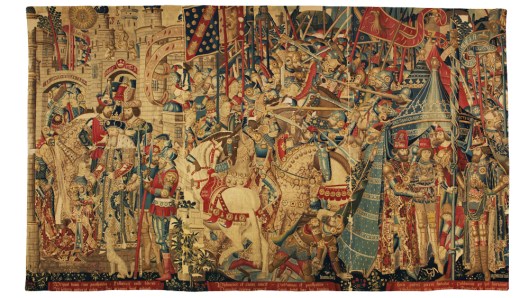
JRRT certainly knew about the Bayeux piece—he mentions it in his letters—but the richness of his description doesn’t really match the relative spareness (for all its detail) of that embroidery, so we wonder what he might have had in mind?   Late medieval tapestries would have had the lush look—

image18troy.jpg

This is one of a set of 15th-century tapestries illustrating the Trojan War.  You’ll notice that, like the Bayeux Tapestry 3 centuries earlier, there are labels (tituli, they’re called).  In the case of the Eorl tapestry, it’s Aragorn who provides the explanation, suggesting that there is no caption and Aragorn, being Aragorn, simply knows the story.

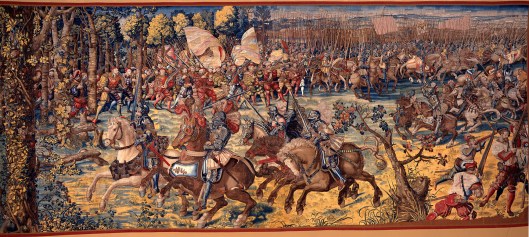
For an eye-popping battle scene, however, we would point to the set of 7 tapestries of the Battle of Pavia (1525) woven in Brussels between 1528 and 1531 and now in the Museo Nazionale di Capodimonte in Naples.  Here’s just one example—can you imagine the same having been woven for the assaults on Minas Tirith or Helm’s Deep?  (Here’s a LINK, by the way, to a very detailed article on the subject of these wonderful works.)

image19pavia.JPG

But such pieces as these are so elaborate that, for all of their great art, they don’t provide quite the parallel we’re looking for, perhaps because all of the larger ones seem to be filled with people and movement and what JRRT describes is a single figure—almost like a standard, rather than a tapestry—something like this one (although we imagine the original to be facing to the right and the field to be green—oh, and of course he has that horn, but you get the idea).


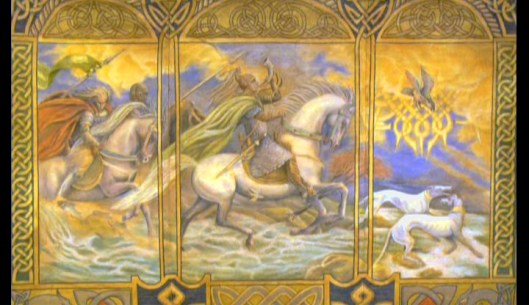
And we do have this example.  It comes from a site called “Elvenesse”.

image21eorl.jpg

It looks more like a religious triptych than a tapestry to us,

image22triptych.jpg

but it certainly is going in the right direction.  What do you think, dear readers?

And thanks, as always, for reading!

MTCIDC

CD

Lent to a Museum (Mathom.2)

07 Wednesday Mar 2018

Posted by Ollamh in Artists and Illustrators, Heroes, J.R.R. Tolkien, Literary History, Military History, Narrative Methods

≈ Leave a comment

Tags

Abbotsford, armor, Ashestiel, Cartley Hole, Castle, Craigievar, cuirassier, czapska, Edinburgh, Gothic, Henry Fox Talbot, Horace Walpole, Marquis de Montrose, Mathom-house, Melrose Abbey, Napoleon's Hair, Prince Albert, Queen Victoria, Rob Roy MacGregor, Scottish, Scottish Baronial, Sir Walter Scott, Strawberry Hill, The Lay of the Last Minstrel, The Lord of the Rings, Tolkien, Waterloo, Waverly

Welcome, as always, dear readers.

In a posting from January, 2017, we discussed the idea of a “mathom house” at Michel Delving in the Shire.  We know about this place from the Prologue to The Lord of the Rings:

“So, though there was still some store of weapons in the Shire, these were used mostly as trophies, hanging above hearths or on walls, or gathered into the museum at Michel Delving.  The Mathom-house it was called:  for anything that Hobbits had no immediate use for, but were unwilling to throw away, they called a mathom.  Their dwellings were apt to become rather crowded with mathoms, and many of the presents that passed from hand to hand were of that sort.”  (Prologue, The Lord of the Rings)

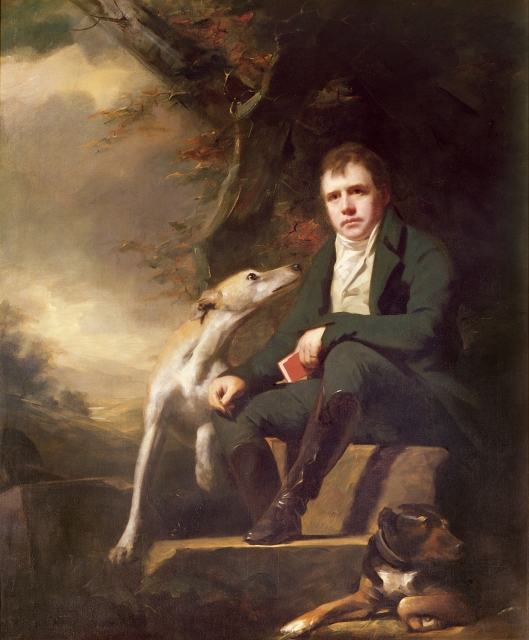
Rereading this passage this time, we were caught by two things:  “some store of weapons” and “Their dwellings were apt to become rather crowded with mathoms” because, put together, they sound like part of the description of the personal Mathom-house of the original inspirer (we would say) of adventure-writing in English, Sir Walter Scott.

image1raeburnscott.jpg

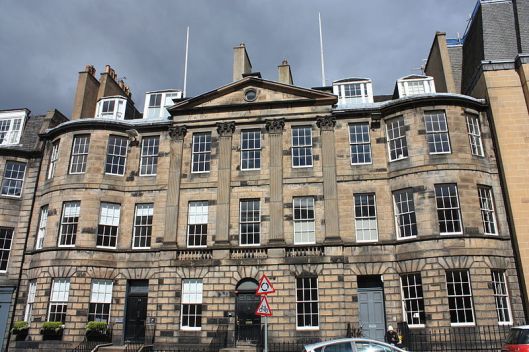
Trained to become a lawyer, Scott had lived for some years in several houses in Edinburgh, for much of his later life at Number 39, North Castle Street–

image2ncastlestreet.jpg

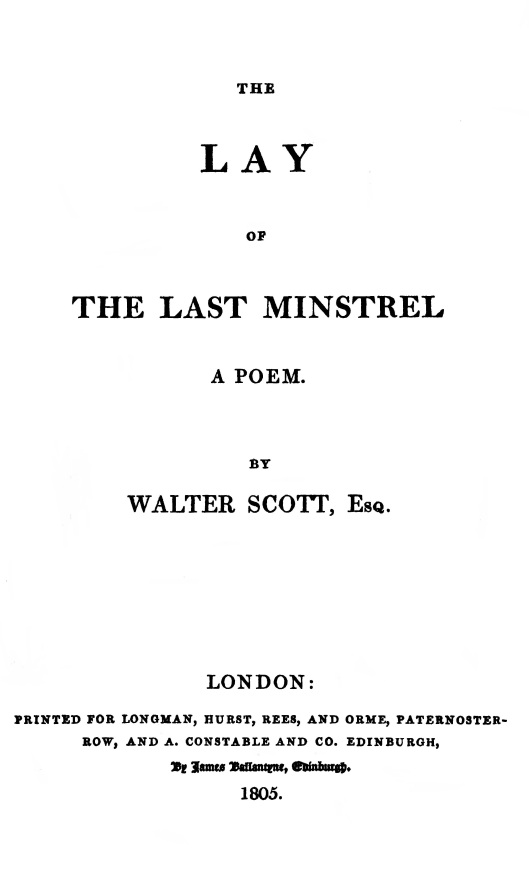
Although he began his rise to literary fame with the publication of The Lay of the Last Minstrel, a long poem, in 1805,

image3layfirstedition.jpg

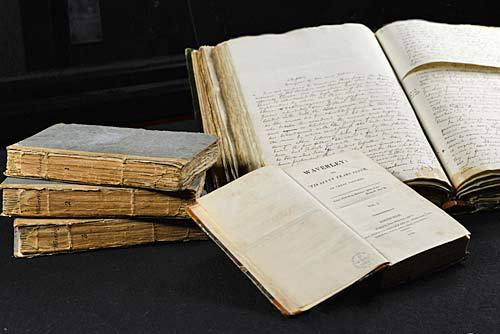
money began to pour in with his first novel, Waverley, published anonymously, in 1814.

image4waverley.jpg

(What a great illustration, by the way—both the first edition and the manuscript.)

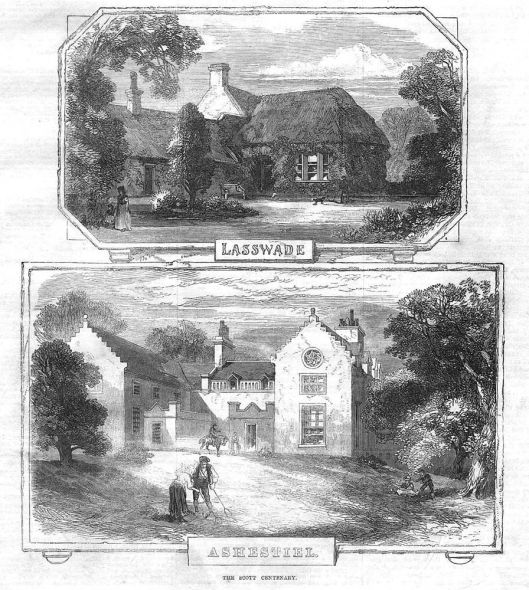
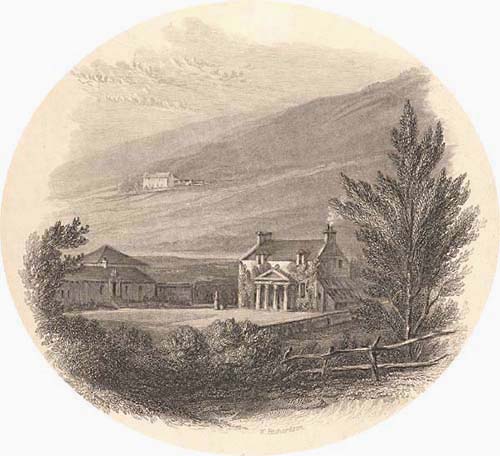
Because his legal work required him to have a residence outside Edinburgh, Scott had rented this, at Ashestiel, from 1804-1811.

image5ashestiel.jpg

When the lease was up, he then invested in this rather modest farm house at what was called “Cartley Hole”, which locals called “Clarty Hole”, “clarty” being a Scots word for “mucky”, suggesting that our illustration is prettier than the actual place.

image6cartleyholefarm.jpg

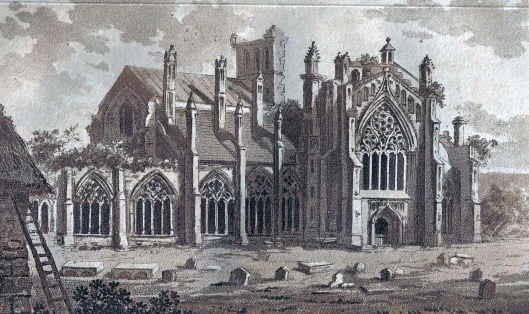
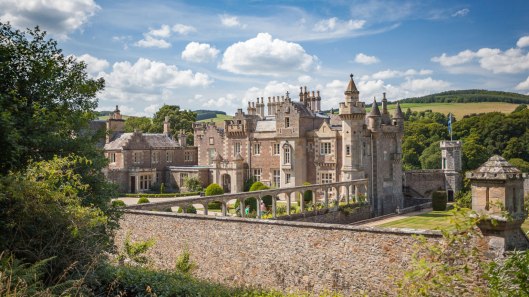
More commercially successful novels and an eventual baronetcy gave Scott grander ideas and he began to rebuild—and rebuild—the house, as well as changing its name to the more dignified “Abbotsford”, as it was near the ruins of the 12th-century Melrose Abbey.

image7melroseabbey.jpg

“Bigger” at this time might have meant something Georgian, like this—

image8nostellpriory.jpg

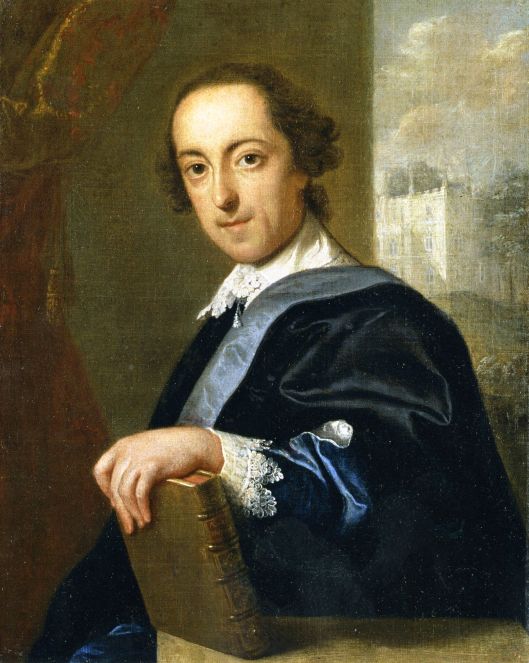
but Scott, no doubt influenced by the Gothic ideas of people like Horace Walpole

image9hw


and his Strawberry Hill

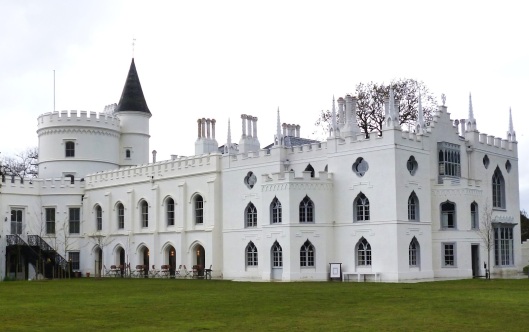
image10strawberryhill.JPG

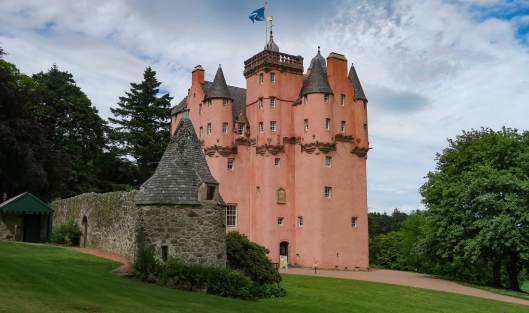
fixed upon a design which, in time, was not only bigger, but Gothic—and Scottish, in the style called “Scottish Baronial”, like this castle at Craigievar, completed in 1626.

image11craigievar.jpg

In a way, such a choice makes sense:  many of his novels have Scots locations and they made him wealthy enough to build such a place.

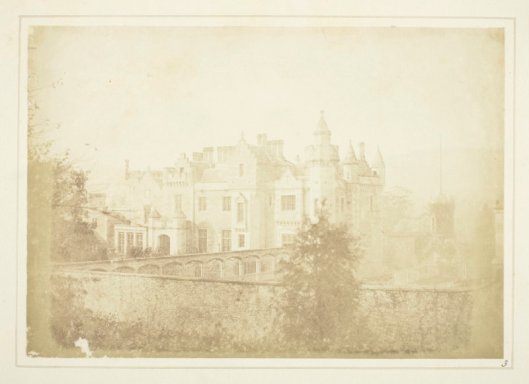
image12hftabbotsford.jpg

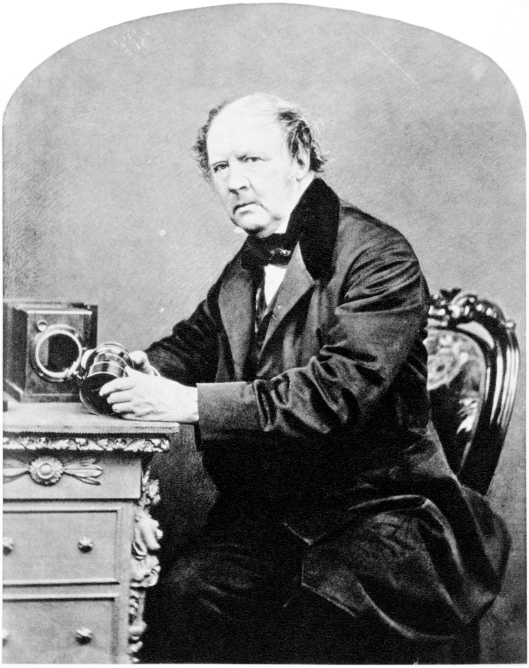
This is perhaps the first photographic image of Abbotsford.  It dates from 1844 and is by the English inventor, as far as we currently know, of photography, Henry Fox Talbot.

image13talbot.jpg

And here is a modern image.

image14abbotsford.jpg

The outside of Abbotsford is striking enough, but it’s what’s inside which made us think of a Mathom-house.

There is seemingly an endless “store of weapons”.

image15armory.JPG

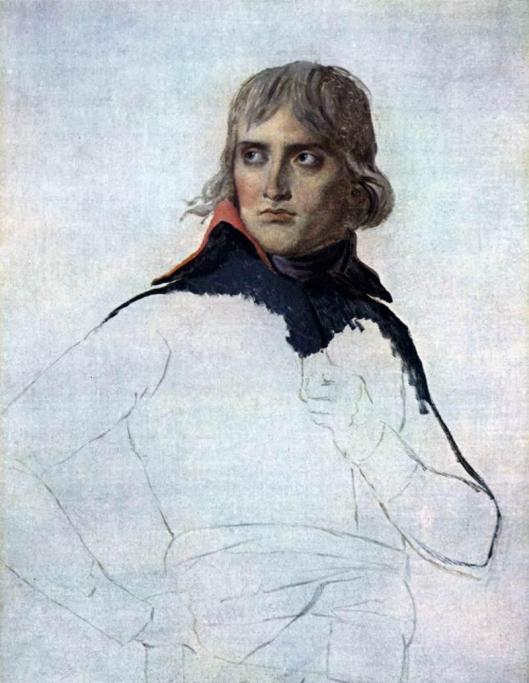
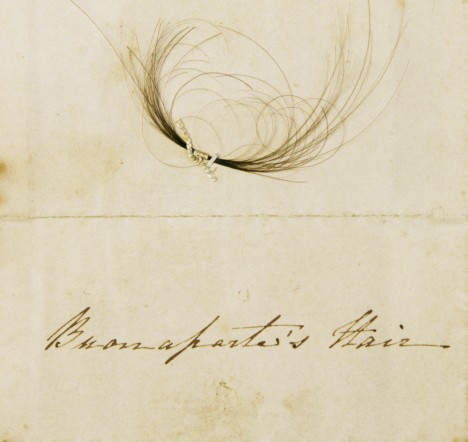
And then there are all of those other things.  A lock of Napoleon’s hair.

image16nappy.jpg

image17nappy'shair.jpg

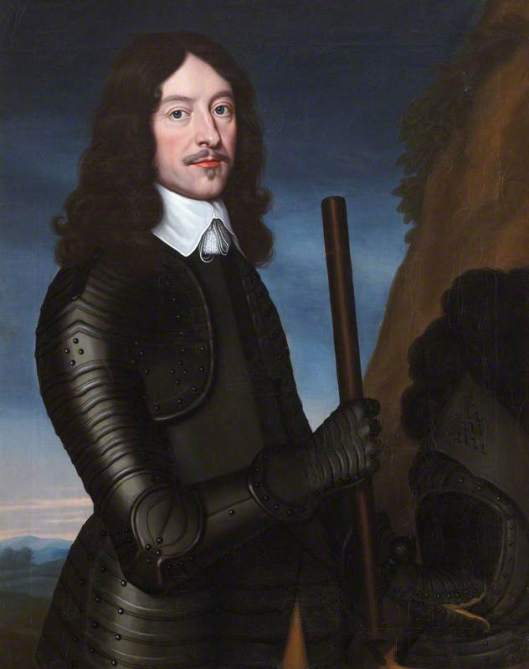
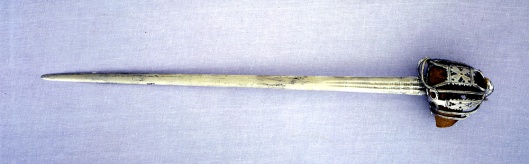
The sword of a 17th-century Scottish hero, the Marquis of Montrose.

image18montrose.jpg

image19montrosesword.jpg

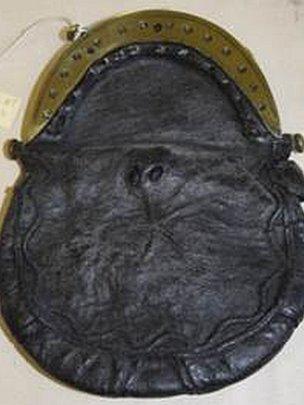
The sporran (purse) of that early-18th century Highland legend, Rob Roy MacGregor.

image20sporran.jpg

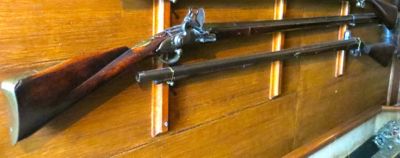
(Scot also believed he had Rob Roy’s musket.)image21rrsmusket.jpg

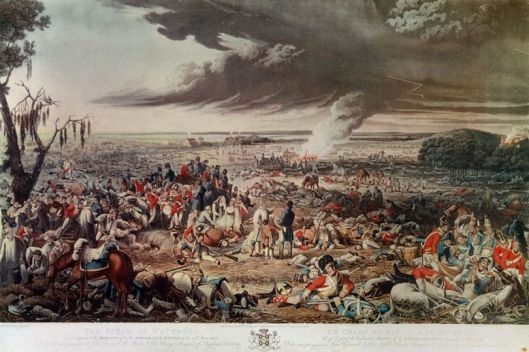
And even souvenirs he had picked up from the battlefield of Waterloo, which he had visited only a short time after the battle.

image22waterloo.jpg

image23cuirass.jpg

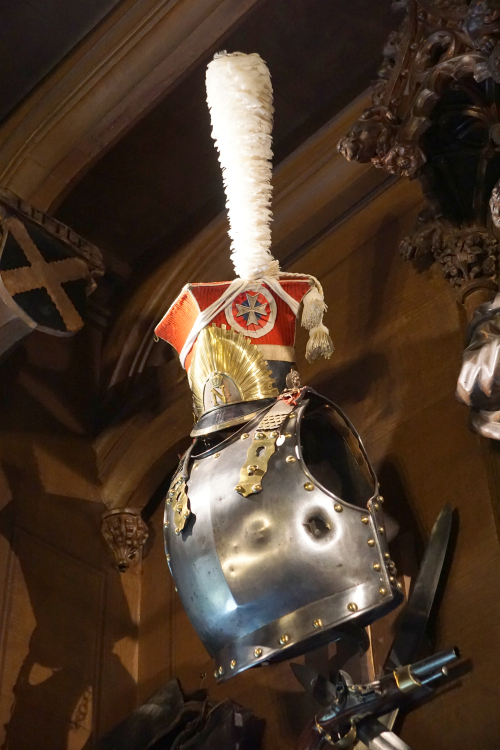
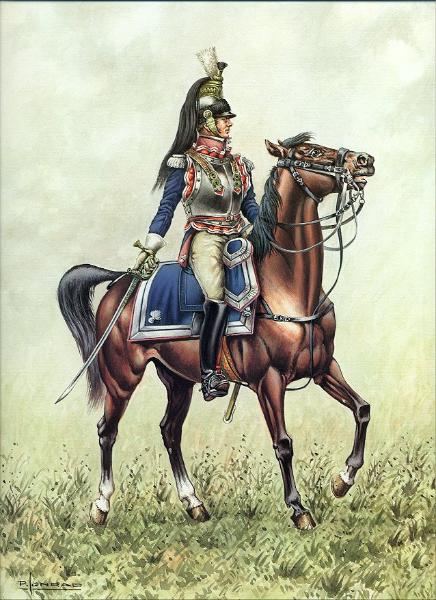
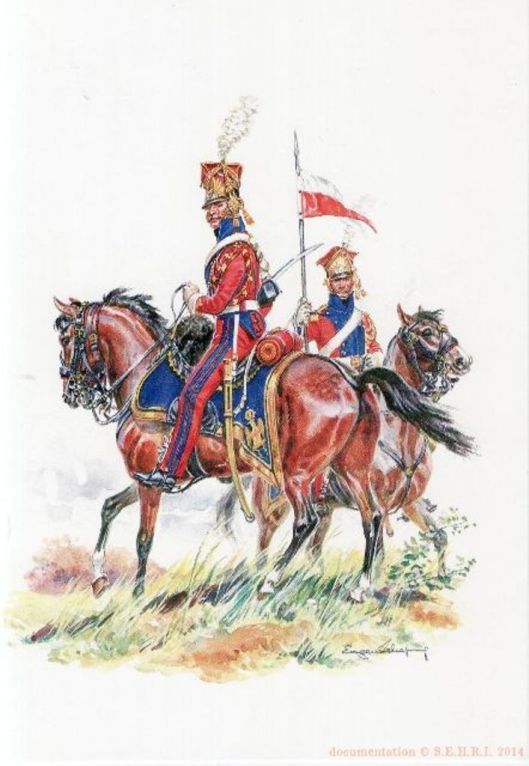
Note the hole in the breastplate—and also that the  headgear with it (a czapska) belongs not to the man who would have worn the breastplate, a cuirassier,

image24cuirassier.jpg

but to a French/Polish lancer

image25lancer.jpg

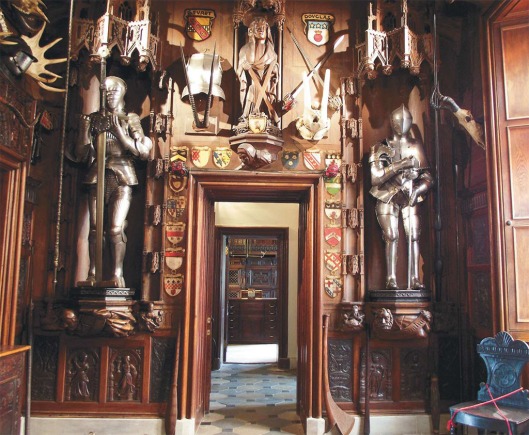
With all of these trophies tacked onto every possible surface—including full suits of armor–

image26armor.jpg

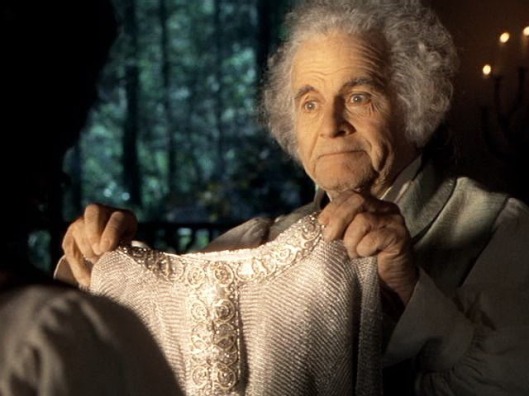
we wouldn’t be surprised to see a rather familiar object, ancient, famous, which we are told “was arranged on a stand in the hall (until he lent it to a Museum)”—would you?

image27mithril.jpg

Thanks, as ever, for reading.

MTCIDC

CD
PS

Abbotsford was opened to visitors within a few months of Scott’s death.  Among those tourists were Queen Victoria and Prince Albert.

image28avicandalbie.jpeg

They liked the place so much that, when they decided that they needed a little place in the country, Abbotsford would be one of their models.

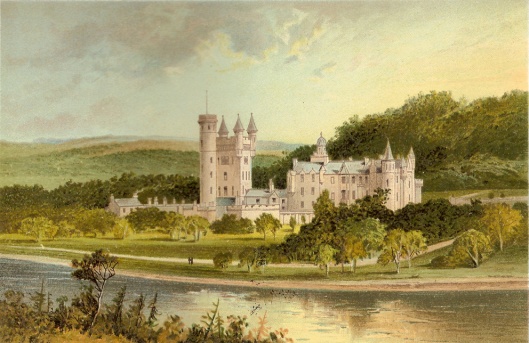
image28balmoral.JPG

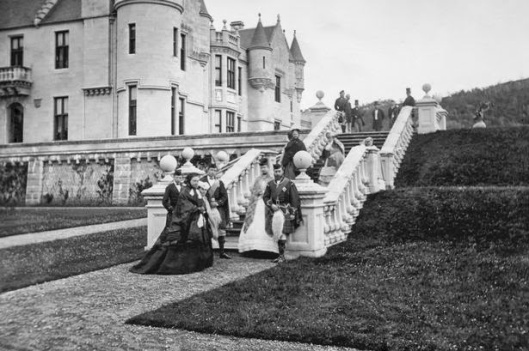
Long after Albert’s death in 1861, the Queen continued to pay a yearly visit to Balmoral.

image29vicatbalmoral.jpg

PPS

If you’d be interested in seeing Abbotsford as an early 20th-century tourist might have seen it, here’s a LINK to Beautiful Britain:  Abbotsford (1912).


← Older posts
Newer posts →

The Doubtful Sea Series Facebook Page

The Doubtful Sea Series Facebook Page

  • Ollamh

Categories

  • Artists and Illustrators
  • Economics in Middle-earth
  • Fairy Tales and Myths
  • Films and Music
  • Games
  • Heroes
  • Imaginary History
  • J.R.R. Tolkien
  • Language
  • Literary History
  • Maps
  • Medieval Russia
  • Military History
  • Military History of Middle-earth
  • Narnia
  • Narrative Methods
  • Poetry
  • Research
  • Star Wars
  • Terra Australis
  • The Rohirrim
  • Theatre and Performance
  • Tolkien
  • Uncategorized
  • Villains
  • Writing as Collaborators
Follow doubtfulsea on WordPress.com

Across the Doubtful Sea

Recent Postings

  • On the Road(s) Again—Again November 26, 2025
  • On the Road(s) Again November 19, 2025
  • To Bree (Part 2) November 12, 2025
  • To Bree (Part 1) November 5, 2025
  • A Plague o’ Both—No, o’ All Your Houses! October 29, 2025
  • It’s in Writing (2:  I’st a Prologue, or a Poesie for a Ring?) October 22, 2025
  • It’s in Writing (1) October 15, 2025
  • King Trotter? October 8, 2025
  • The Voices in His Head  October 2, 2025

Blog Statistics

  • 102,064 Views

Posting Archive

  • November 2025 (4)
  • October 2025 (5)
  • September 2025 (4)
  • August 2025 (4)
  • July 2025 (5)
  • June 2025 (4)
  • May 2025 (4)
  • April 2025 (5)
  • March 2025 (4)
  • February 2025 (4)
  • January 2025 (5)
  • December 2024 (4)
  • November 2024 (4)
  • October 2024 (5)
  • September 2024 (4)
  • August 2024 (4)
  • July 2024 (5)
  • June 2024 (4)
  • May 2024 (5)
  • April 2024 (4)
  • March 2024 (4)
  • February 2024 (4)
  • January 2024 (5)
  • December 2023 (4)
  • November 2023 (5)
  • October 2023 (4)
  • September 2023 (4)
  • August 2023 (5)
  • July 2023 (4)
  • June 2023 (4)
  • May 2023 (5)
  • April 2023 (4)
  • March 2023 (5)
  • February 2023 (4)
  • January 2023 (4)
  • December 2022 (4)
  • November 2022 (5)
  • October 2022 (4)
  • September 2022 (4)
  • August 2022 (5)
  • July 2022 (4)
  • June 2022 (5)
  • May 2022 (4)
  • April 2022 (4)
  • March 2022 (5)
  • February 2022 (4)
  • January 2022 (4)
  • December 2021 (5)
  • November 2021 (4)
  • October 2021 (4)
  • September 2021 (5)
  • August 2021 (4)
  • July 2021 (4)
  • June 2021 (5)
  • May 2021 (4)
  • April 2021 (4)
  • March 2021 (5)
  • February 2021 (4)
  • January 2021 (4)
  • December 2020 (5)
  • November 2020 (4)
  • October 2020 (4)
  • September 2020 (5)
  • August 2020 (4)
  • July 2020 (5)
  • June 2020 (4)
  • May 2020 (4)
  • April 2020 (5)
  • March 2020 (4)
  • February 2020 (4)
  • January 2020 (6)
  • December 2019 (4)
  • November 2019 (4)
  • October 2019 (5)
  • September 2019 (4)
  • August 2019 (4)
  • July 2019 (5)
  • June 2019 (4)
  • May 2019 (5)
  • April 2019 (4)
  • March 2019 (4)
  • February 2019 (4)
  • January 2019 (5)
  • December 2018 (4)
  • November 2018 (4)
  • October 2018 (5)
  • September 2018 (4)
  • August 2018 (5)
  • July 2018 (4)
  • June 2018 (4)
  • May 2018 (5)
  • April 2018 (4)
  • March 2018 (4)
  • February 2018 (4)
  • January 2018 (5)
  • December 2017 (4)
  • November 2017 (4)
  • October 2017 (4)
  • September 2017 (4)
  • August 2017 (5)
  • July 2017 (4)
  • June 2017 (4)
  • May 2017 (5)
  • April 2017 (4)
  • March 2017 (5)
  • February 2017 (4)
  • January 2017 (4)
  • December 2016 (4)
  • November 2016 (5)
  • October 2016 (6)
  • September 2016 (5)
  • August 2016 (5)
  • July 2016 (5)
  • June 2016 (5)
  • May 2016 (4)
  • April 2016 (4)
  • March 2016 (5)
  • February 2016 (4)
  • January 2016 (4)
  • December 2015 (5)
  • November 2015 (5)
  • October 2015 (4)
  • September 2015 (5)
  • August 2015 (4)
  • July 2015 (5)
  • June 2015 (5)
  • May 2015 (4)
  • April 2015 (3)
  • March 2015 (4)
  • February 2015 (4)
  • January 2015 (4)
  • December 2014 (5)
  • November 2014 (4)
  • October 2014 (6)
  • September 2014 (1)

Blog at WordPress.com.

  • Subscribe Subscribed
    • doubtfulsea
    • Join 78 other subscribers
    • Already have a WordPress.com account? Log in now.
    • doubtfulsea
    • Subscribe Subscribed
    • Sign up
    • Log in
    • Report this content
    • View site in Reader
    • Manage subscriptions
    • Collapse this bar
 

Loading Comments...