• About

doubtfulsea

~ adventure fantasy

Tag Archives: Peter Jackson

Feudal Array 1

20 Wednesday Jan 2016

Posted by Ollamh in Artists and Illustrators, Economics in Middle-earth, Fairy Tales and Myths, Imaginary History, J.R.R. Tolkien, Literary History, Military History, Military History of Middle-earth, Narrative Methods

≈ Leave a comment

Tags

Anglo-Saxon, Bayeux Tapestry, Embroidery, feudalism, Medieval, Middle-earth, Normandy, Peter Jackson, Rohirrim, tapestry, The Lord of the Rings, Tolkien

Welcome, as always, dear readers.

In this posting, we would like to continue what we began in “Behind the Rammas Echor”. In that posting, we talked about using the illustrations from medieval English psalters (the wonderful 14th-century Luttrell Psalter in particular) to try to visualize the feudal world suggested by certain aspects of Tolkien’s The Lord of the Rings.

In that posting, we said that feudalism could be broken down into two big categories, land and troops, and there we spent time looking at basic agricultural life, to imagine the look of the feudal world of Middle Earth.

Now we move on to troops. And, as much as we can, we would like to continue to use medieval images to help us.

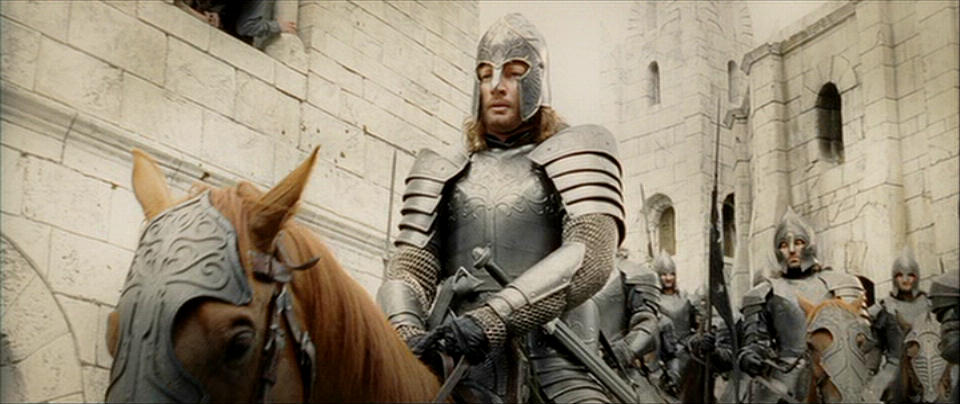
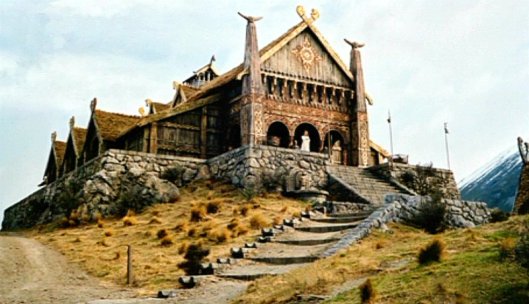
In previous posts, we’ve praised Jackson’s depiction of the Rohirrim, both the architecture and the people. Edoras and Meduseld within it just look right—and, when you watch the material on constructing them in the extended version box set, we can only be absolutely bowled over by the care taken there, for all that we have difficulties with certain other parts of the films, both in look and in the changes to the text.
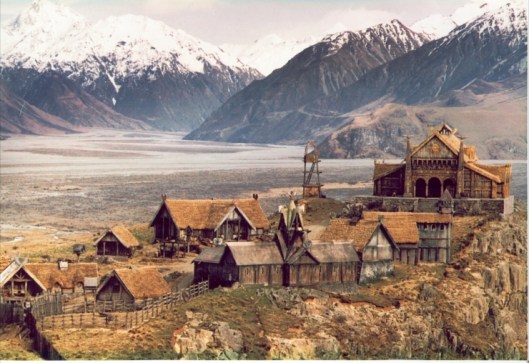
Edoras-MtSunday.jpg

meduseld.jpg

rohirrimmassed.jpg

In one previous post, we suggested the kinds of models we both know and imagine Tolkien used to create the Rohirrim. These were primarily Anglo-Saxon, but combined with a horse people (which the Anglo-Saxons were not) of some sort, possibly Scythian (an Indo-European-speaking horse folk from north of the Black Sea).

ScythianCavalry.jpg

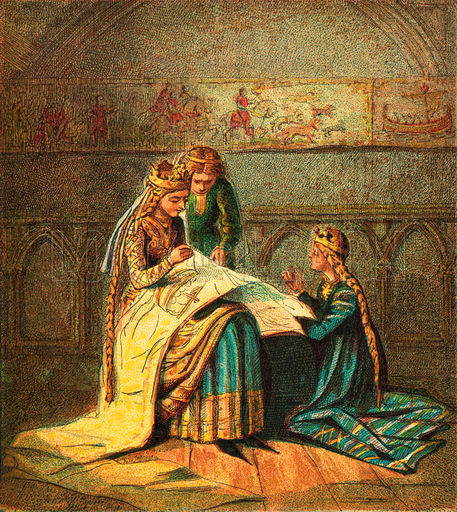
As we’ve thought more about it (one, for us, of the great pleasures of solid adventure literature, new and old—is that you not only want to think more about it, but, as you do, you find more in it), we began to imagine that Tolkien might have had another visual source, based upon another famous set of medieval illustrations, the Bayeux Tapestry.

This is a roll of linen, some 230 feet (that’s about 70 metres) long and 20 inches (50 centimetres) high, into which are woven three bands of designs. The center is a long (very long!) series of adjoining panels covered in human figures, which have been stitched on with various colored woolen threads. Above and below the central band are two narrower ones which combine abstract figures (commonly on the upper panel) with human activities (on the lower one). Across the top of the central band are a series of captions in very simple Latin, describing what is happening below.

haroldkilled.jpg

The caption here reads: “Here Harold the king has been killed.”

As it’s not through-woven, like this—
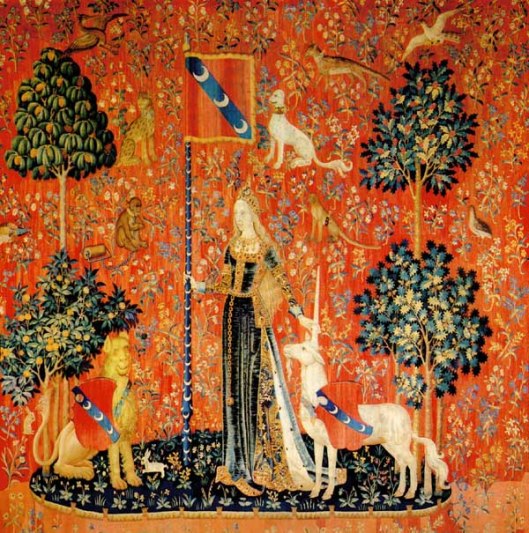
unicorn3.jpg

this isn’t really a tapestry, but an embroidery, in fact.
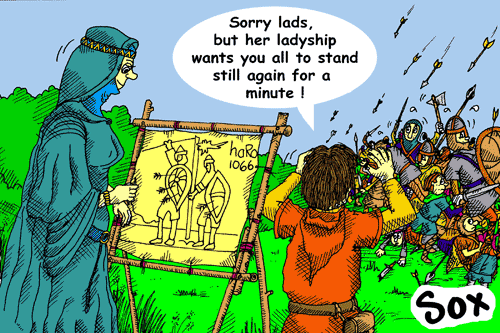
106604.gif

makingthebt.jpg

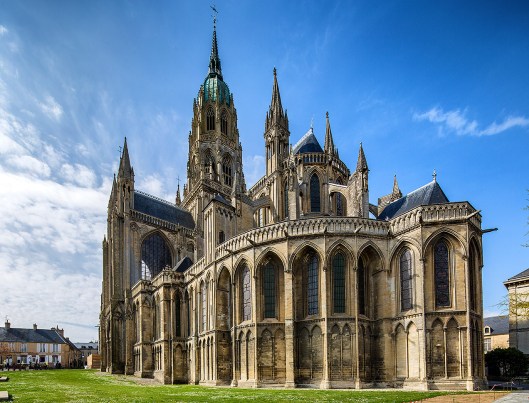
It’s linked to the cathedral at Bayeux, in Normandy, where it has been for at least 6 centuries. On the map, find Le Havre and look left and you’ll see Bayeux.
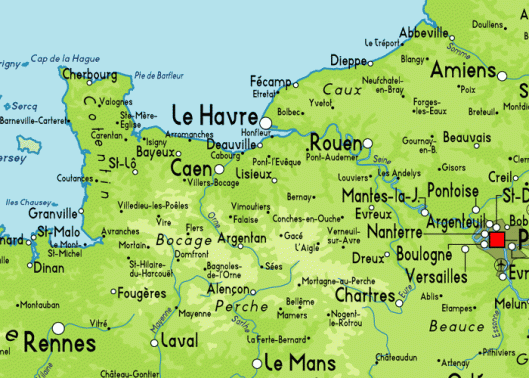
normandy_map_phys.gif

bayeux_cathedral.jpg

Where it really came from and who made it are two of those mysteries that it’s been fun to follow the scholarship of, but, as of 2015, there are lots of theories, some of them more convincing than others, but that’s all there are: theories. If you’d like to know more about them, go to: www.bayeux-tapestry.org.uk/whomadethetapestry.htm.

The tapestry is housed in an impressive museum in Bayeux, where its entire length is ingeniously displayed in a sort of wrap-around way.

The-Bayeux-Tapestry-Museum-1019.jpg

Bayeux-Tapestry-1_131941101594170.jpg

We’ve given you lots of facts, but the one thing we haven’t mentioned is the subject of such an immense work. It is, in fact, a lengthy piece of propaganda justifying the Norman invasion and conquest of England in 1066AD. We know, then, one definite thing about it: it certainly wasn’t embroidered for the Anglo-Saxons! (Although there is at least one theory that it was made by them.)

As much as we are interested in the subject, what has caught our attention now is the look—here are soldiers from the same period as the Anglo-Saxon model for the Rohirrim, after all, but, although archers are depicted on the Norman side, and a few infantry, the Normans are mainly shown as horsemen.
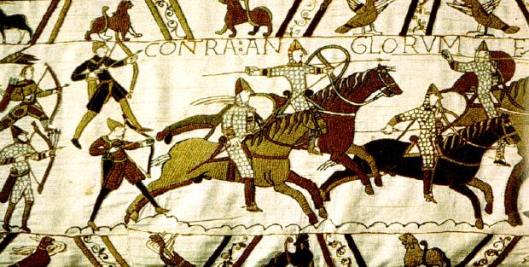
WebPage-ImageF.00070.jpeg

Here is our first sight of the Rohirrim in The Two Towers, Chapter 2, “The Riders of Rohan”:

“Their horses were of great stature, strong and clean-limbed; their grey coats glistened, their long tails flowed in the wind, their manes were braided on their proud necks. The Men that rode them matched them well: tall and long-limbed; their hair, flaxen-pale, flowed under their light helms, and streamed in long braids behind them; their faces were stern and keen. In their hands were tall spears of ash, painted shields were slung at their backs, long swords were at their belts, their burnished shirts of mail hung down upon their knees.”
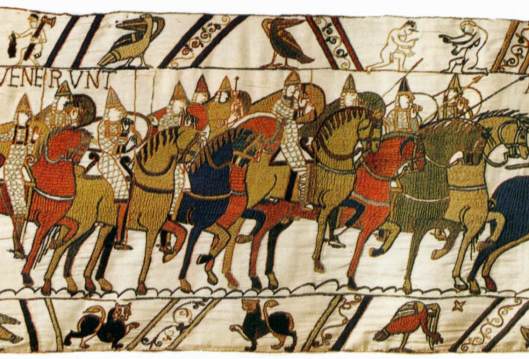
05bayeux.jpg

Minus the grey horses and the braids, what do you think, dear readers?


As ever, thanks for reading.

CD

MTCIDC


PS

That MTC will be Feudal Array.2, in which we consider the other forces opposing Mordor…


Knowledge, Rule, Order

06 Wednesday Jan 2016

Posted by Ollamh in Fairy Tales and Myths, Imaginary History, J.R.R. Tolkien, Military History, Military History of Middle-earth, Narrative Methods

≈ 2 Comments

Tags

Adolf Hitler, Anduin, Benedict Cumberbatch, Benito Mussolini, British Government, Charlie Chaplin, dictatorships, England, Gandalf, George V, Germany, Gondor, gothic script, Government, History, India, Isengard, Kaiser Willhelm II, Lenin, Mehmed VI, Middle-earth, monarchs, Mordor, Nazis, newsreel, Numenor, Ottoman Empire, Oz, Peter Jackson, Queen Mary, Queen Victoria, Rohan, Saruman, Sauron, Scott, Smaug, Stalin, Stock Market Crash of 1929, Sultan, The Great Dictator, The Lord of the Rings, Tolkien, Treaty of Versailles, Valar, Victoria Louise, Weimar Republic, William Morris, Writing

Dear Readers,

Welcome, as always.

Have you ever wondered what Middle Earth would have been like if the Fourth Age had begun on a calendar written by Sauron?

That of the Third Age was hardly a democratic paradise: a king rules Rohan, a stand-in for king rules Gondor. Elrond and Celeborn/Galadriel behave and are treated like royalty and Thranduil, as we learn from The Hobbit, is the king of Mirkwood. The dwarves have hereditary rulers.   Only the outliers—communities like Bree and the Shire and the earlier inhabitants like Tom Bombadil and Fangorn—appear to be completely independent. (The Shire even has elections and a mayor, although the actual government, except for the shire reeves, appears to bemostly token—you wonder who’s running their seemingly-efficient postal service.)

This is not surprising, not only for an author born during the later years of Victoria,

queenvic.jpg

but also for someone powerfully influenced by the medievalist interests of everyone from Scott

Sir_William_Allan_-_Sir_Walter_Scott,_1771_-_1832._Novelist_and_poet_-_Google_Art_Project.jpg

to William Morris.

William_Morris_age_53.jpg

(We might add that the world of fairy tales, full of princes and princesses, queens and kings, was also a powerful influence at the time—and not only on story-tellers born in monarchies—after all, even Oz is ruled by a queen—

OzmaOz.jpg

Yet, after Smaug—who could better be a medieval fantasy villain (especially with the voice of the incomparable Benedict Cumberbatch attached)?

p8204516_n279079_cc_v4_aa.jpg

—something changed in Tolkien’s world. In fact, something changed in the whole outside world. With the end of World War One, monarchs toppled all over Europe and beyond, from:

Kaiser Wilhelm II of Germany

KAISER-WILHELM_2994889b.jpg

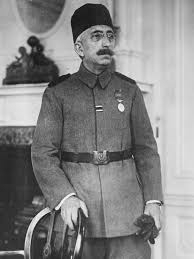
to Mehmed VI, last Sultan of the Ottoman Empire.

mehmed6.jpg

In place of the former, there appeared the always-troubled Weimar Republic, full of good intentions, but badly crippled, not only by the war which had sapped its manpower and resources, but by all kinds of social unrest and then by the Crash of 1929, which notoriously destroyed the value of its currency.

weimar currency.jpg

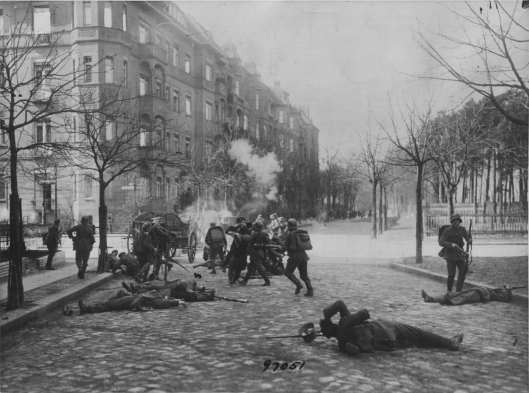
As early as 1919, there had been clashes among the forces of different ideologies—

CombatesEnBerlín19190903.jpg

And, amidst all of the unrest, there was a failed coup attempt in 1923 by the man in the overcoat in this picture.

Bundesarchiv_Bild_102-00344A,_München,_nach_Hitler-Ludendorff_Prozess.jpg

He, of course, was only following the footsteps of this man, who had pushed his way into power the year before—

March_on_Rome.jpg

to be followed, in turn, by the man on the left, from the mid-1920s.

stalinandfriends.jpg

That first man, having failed at obvious violence, tried again through more complicated means (although still employing violence, if it suited his purposes) and succeeded in 1933.

Hitler-Papen-First-Reichstag-1933.jpg

He was, so we are told, a riveting public speaker, but, if the newsreels we’ve seen are evidence, we guess you would have had to have been there.

hitlerspeaking.jpg

Some people thought the style exaggerated in the 1930s and caricatured it even then.

chaplin2.jpg

He had a definite social agenda, which he outlined at length and often, although concealing certain of the most horrible aspects. And he liked big words and big concepts, like:

einfolk.jpg

It would have been impossible for someone as intelligent and generally well-informed as Tolkien not to have been very much aware of this man and all of the other like men, busy oppressing as much of the world as they could. And this would have been especially true in a time when radio and film were changing how people received news—and how those interested in influencing others might shape what people saw. As early as 1911, the British government was using newsreel film to show the might and reach of its empire (2/5 of the globe was in their hands) when the king, George V, and his wife, Queen Mary, visited India.

Delhi_Durbar,_1911.jpg

Not to be outdone, Kaiser Wilhelm II encouraged a grand—and filmed–event in 1913, for the wedding of his daughter, Victoria Louise—and some of the film was even in color.

vlouisekaiser.jpg

The Marriage of Victoria Louise Color Film

It would be easy to imagine, then, that the weight of such public figures might have influenced Tolkien in his depiction of late-3rd-Age villains. We can see it in Saruman’s unsuccessful attempt to persuade Gandalf to join him:

“ ‘He drew himself up then and began to declaim, as if he were making a speech long rehearsed. ‘The Elder Days are gone. The Middle Days are passing. The Younger Days are beginning. The time of the Elves is over, but our time is at hand: the world of Men, which we must rule. But we must have power, power to order all things as we will, for that good which only the Wise can see.” (The Fellowship of the Ring, Chapter 2, “The Council of Elrond”)

Thus, unlike the script of Jackson’s version, there is no plan to wipe out men and replace them with orcs. Instead, men are to survive: to be ruled—perhaps under what definitely sounds like it should be a translation from something written in Fraktur—the fake Gothic script favored by the Nazis–

die-schöne-deutsche-Schrift-detail1.jpg

“ ‘We can bide our time,’” says Saruman, “ ‘we can keep our thoughts in our hearts, deploring maybe evils done by the way, but approving the high and ultimate purpose: Knowledge, Rule, Order; all the things that we have so far striven in vain to accomplish…’ ”

Such abstract, but somehow menacing, words sound like a translation of something from Hitler’s Germany: Kenntnisse, Herrschaft, Ordnung. They do not sound in the least like Gandalf’s goals, ever, and he, in fact, replies by implying that not only are they not really Saruman’s words, but that Saruman is foolish for believing them:

“ ‘Saruman,’ I said, ‘I have heard speeches of this kind before, but only in the mouths of emissaries sent from Mordor to deceive the ignorant.’ “

As really the words of Sauron, however, they give us an idea of what to expect in a world under his control. Knowledge would be for Sauron alone, we suppose, perhaps after regaining his lost ring? Certainly he wouldn’t share it with Saruman, whom, it will become clear, he never trusted. As for Rule and Order, the world would be a place full of rules and those watching that they be obeyed. And here we can remember Sharkey’s Shire, with its “by order of the Chief” signs—and its gangs of human enforcers. As well, we can think of its grey, industrial character, as we’ve discussed in a previous post, a universal Mordor, devoted to production. To this, we can add the Mouth of Sauron’s recitation of surrender conditions, delivered to the allies before the Morannon:

“ ‘These are the terms…The rabble of Gondor and its deluded allies shall withdraw at once beyond the Anduin, first taking oaths never again to assail Sauron the Great in arms, open or secret. All lands east of the Anduin shall be Sauron’s for ever, solely. West of the Anduin as far as the Gap of Rohan shall be tributary to Mordor, and men there shall bear no weapons, but shall have leave to govern their own affairs. But they shall help to rebuild Isengard which they have wantonly destroyed, and that shall be Sauron’s, and there his lieutenant shall dwell: not Saruman, but one more worthy of trust.’ “ (The Return of the King, Chapter 10, “The Black Gate Opens”)

In keeping with the influence of current events in this world, we might see this as being a parallel with the 1919 Versailles Treaty, in which Germany was to be forced to make huge territorial concessions, to disarm almost entirely, and to pay massive amounts in reparation to the victorious allies.

Treaty_of_Versailles,_English_version.jpg

The Treaty of Versailles– Wiki Article

Such terms as Sauron offers would also destroy Rohan as an ally and set up a permanent garrison between it and the north. We might also expect the restored Isengard to be a staging area for an assault upon Fangorn and the ents, to their ultimate destruction. As well, “west of the Anduin” is a very vague expression—does it include Gondor, as well as Rohan?

Religion in The Lord of the Rings has always been the subject of debate: how much or how little? Of what kind? Tolkien is quoted as saying that it was monotheistic, although, when attacked by the Mumak, Faramir’s men called on the (plural) Valar. There is no mention, in what is often extremely detailed landscape description, of any kind of temple or shrine, however. Nevertheless, we would like to conclude with an eerie thought about religion in this alternative Fourth Age. The Mouth of Sauron, aka, The Lieutenant of the Tower of Barad-dur, is described as:

“…a renegade, who came of the race of those that are named the Black Numenoreans; for they established their dwellings in Middle-earth during the years of Sauron’s domination, and they worshipped him, being enamoured of evil knowledge.”

Could we imagine that, in this other Fourth Age, a new and horrible religion might have appeared, one dedicated to the worship of Sauron—and to that Knowledge which Saruman finds so important? What do you think, dear readers?

As always, thanks for reading.

MTCIDC

CD

Plot or Blot?

23 Wednesday Dec 2015

Posted by Ollamh in Fairy Tales and Myths, Films and Music, J.R.R. Tolkien, Narrative Methods, Uncategorized

≈ Leave a comment

Tags

Adventure, An Unexpected Journey, Eagles, Gandalf, Gwaihir, His Dark Materials, Iofur Rakinson, Isengard, Manwe, Middle-earth, Mirkwood, Moth, Ornthanc, Peter Jackson, Philip Pullman, Radagast, Rohirrim, Saruman, Svalbard, The Battle of the Five Armies, The Council of Elrond, The eagles are coming, The Fellowship of the Ring, The Golden Compass, The Hobbit, The Lord of the Rings, The Return of the King, Tolkien, Wizard

Dear Readers,

Welcome, as always.

This posting is about a puzzle. Recently, while visiting Orthanc to write about Saruman, we bumped into the problem of how Gandalf escaped from there. Our memory was a little unclear about this—we knew that Gwaihir swooped down to rescue him, but why was Gwaihir there in the first place?

Eagles had appeared twice before in our experience of Gandalf, first when they rescued him and his companions from the goblins and Wargs in Chapter 6 of The Hobbit, “Out of the Frying-Pan into the Fire”. Here, the Lord of the Eagles hears the commotion as the Wargs struggle to overcome Gandalf’s fire magic and, gathering up some of his people, flies down to investigate.

6a00d8341dd88553ef015436529d30970c-pi.jpg

Something similar happens at the Battle of the Five Armies, explained in Chapter 18, “The Return Journey”:

“The Eagles had long had suspicion of the goblins’ mustering; from their watchfulness the movements in the mountains could not be altogether hid.” Thus, they appear self-bid, but, as they are ancient creatures, first made by Manwe and given the role of watchers from the time of the First Age, it’s not surprising that they would act as they did.

Battle of the Five Armies_Final Complete.jpg

In Jackson’s An Unexpected Journey and, again, in his The Fellowship of the Ring, an eagle appears after Gandalf has had a heart-to-heart with a moth.

gandmothhob.pngGandalf+moth.png

With a moth? We asked ourselves. We scratched our heads and wondered: does JRRT use a moth? And, if so, where did the moth come from?

In fact, what really happens is a very neatly constructed piece of plotting on the part of the author, all of which is very nicely laid out in a couple of pages of “The Council of Elrond” during Gandalf’s long narrative.

  1. Gandalf meets Radagast—who is identified, among other talents, as one for whom “birds are especially his friends”—and who says that, if Gandalf needs help with the Black Riders, he needs to apply to Saruman immediately.
  2. In return, Gandalf says to Radagast, “We shall need your help, and the help of all things that will give it. Send out messages to all the beasts and birds that are your friends. Tell them to bring news of anything that bears on this matter to Saruman and Gandalf. Let messages be sent to Orthanc.”
  3. Gandalf goes to Orthanc and, rejecting Saruman’s offer, is imprisoned at its top.
  4. Then, that which was set up in 1 and 2 comes to fruition:

“That was the undoing of Saruman’s plot. For Radagast knew no reason why he should not do as I asked; and he rode away towards Mirkwood where he had many friends of old. And the Eagles of the Mountains went far and wide, and they saw many things…And they sent a messenger to bring these tidings to me.

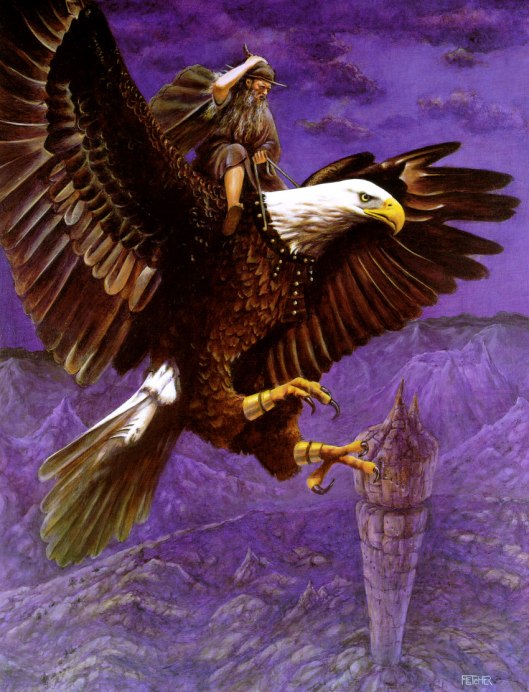
So it was that when summer waned, there came a night of moon, and Gwaihir the Windlord, swiftest of the Great Eagles, came unlooked-for to Orthanc; and he found me standing on the pinnacle. Then I spoke to him and he bore me away, before Saruman was aware.”

escape.jpg

Although we have solved the puzzle of Gandalf’s escape, we have no answer to why this natural and even elegant piece of plotting wasn’t used in the film any more than we understand why Radagast is turned into the horrible, clownish figure he is in the Hobbit films, having been described in “The Council of Elrond” simply as “a worthy Wizard, a master of shapes and changes of hue; and he has much lore of herbs and beasts, and birds are especially his friends.” And someone who could never be corrupted by Saruman, which is really, we think, why Saruman calls him a fool.

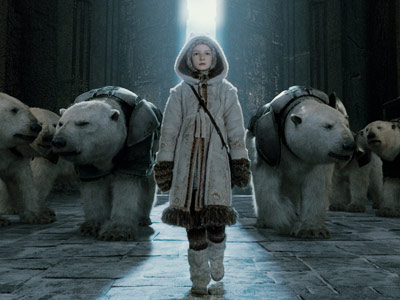
In an earlier posting, we suggested that Saruman, in his desire to ape Sauron, had created, in Isenguard, a mini-Mordor, just as Iofur Raknison, in Philip Pullman’s The Golden Compass, has turned Svalbard into a shabby ursine mockery of a human palace.

lyrasvalbard.jpg

We also suggested that the creators of the Tolkien-derived films, when they began to veer as far from the text as they appeared increasingly to do in the Hobbit films, had become a bit like Saruman themselves, and, like his master, “cannot make real new things of [their] own…” We hesitate to add this, but, could it be that, as in the case of the orcs, they “only ruined them and twisted them…”? (The Return of the King, “The Stairs of Cirith Ungol”). After all, instead of easy plot lines, we have moths, and, in place of worthy, incorruptible wizards, we have gross clowns.

We are reluctant to end on a negative note, however. After all, just as there are the Rohirrim in The Lord of the Rings films, there are those wonderful eagles at the end of An Unexpected Journey, so why not end with them?

taking-fan-theories-to-a-next-level-the-eagles-are-coming-434375.jpg

Thanks, as ever, for reading.

MTCIDC

CD

PS

If you don’t know Pullman’s His Dark Materials series, we very much recommend them—but with this proviso: in the first and second volumes (The Golden Compass, The Subtle Knife), Pullman’s antagonism towards organized religion is channeled into the “Magisterium”, a believable villainous organization in the world which he has so meticulously and powerfully created. In the third volume (The Amber Spyglass), we feel that that antagonism becomes all-too-apparent and it causes that volume—in our opinion—to lack the more human element and focus of the first two volumes. The first volume can certainly be read on its own and perhaps it says something about the trilogy as a whole that a planned project for filming all three books was eventually cut to a single film of the first book. We recommend this film, as well, but suggest that you read The Golden Compass before you see it.

Seeing the Elephant– Oliphaunt

30 Wednesday Sep 2015

Posted by Ollamh in Films and Music, Heroes, J.R.R. Tolkien, Military History, Military History of Middle-earth

≈ 2 Comments

Tags

Adventure, Alps, ATAT, Elephants, Greeks, Hannibal, Hoth, Mammoth, Mumak of Harad, Napoleon, Oliphaunt, Peter Jackson, Pyrrhus of Epirus, Romans, Sam Gamgee, Star Wars, The Lord of the Rings, Tolkien, war

Grey as a mouse,
Big as a house,
Nose like a snake,
I make the earth shake,
As I tramp through the grass;
Trees crack as I pass.
With horns in my mouth
I walk in the South,
Flapping big ears.
Beyond count of years
I stump round and round,
Never lie on the ground,
Not even to die.
Oliphaunt am I,
Biggest of all,
Huge, old, and tall.
If ever you’d met me
You wouldn’t forget me.
If you never do,
You won’t think I’m true;
But old Oliphaunt am I,
And I never lie.

(“The Black Gate is Closed”, LOTR 646)

Dear Readers,

Welcome, as always.

Sam dearly wants to see an oliphaunt– and he will get his chance. Were he able to see the third part of Peter Jackson’s The Lord of the Rings, he would see many more than one.

Screen_Shot_2013-03-12_at_6.17.47_PM

Sam does see one, however:

To his astonishment and terror, and lasting delight, Sam saw a vast shape crash out of the trees and come careering down the slope. Big as a house, much bigger than a house, it looked to him, a grey-clad moving hill” (“Of Herbs and Stewed Rabbit”, LOTR 661).

Here’s how the film shows two of them:

oliphaunts_small

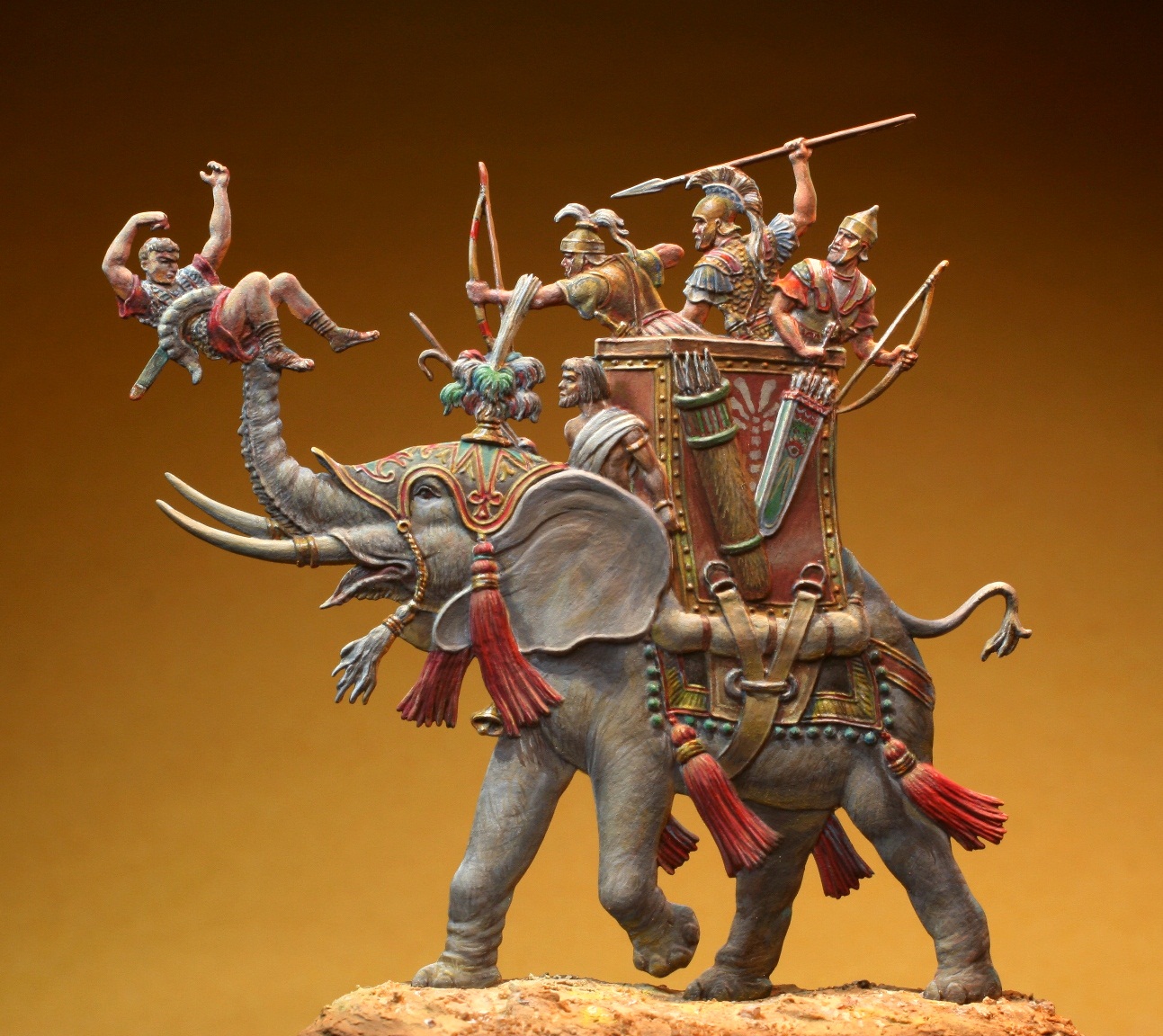
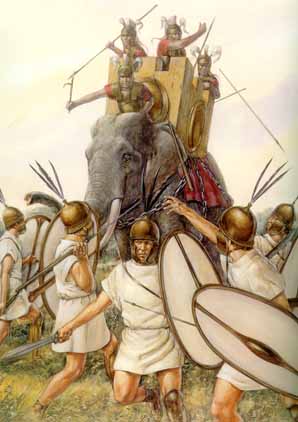
These are, of course, based upon real war elephants.

Carthaginian-War-Elephant-yellow-shrink

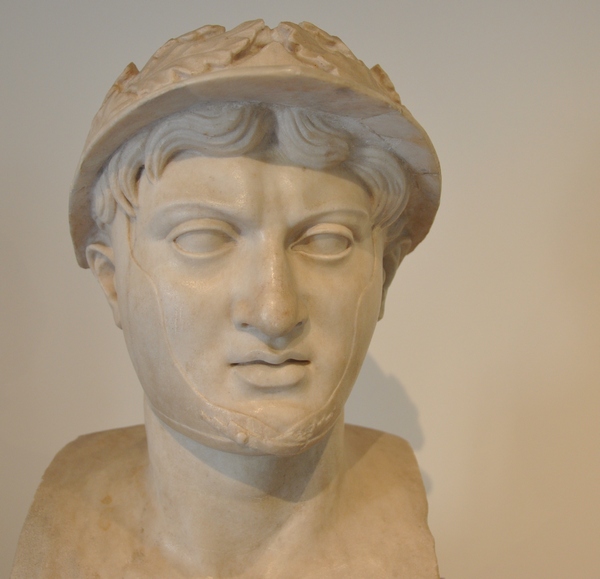
The west– our west– first saw such elephants in the 280s BC, in the army which Pyrrhus of Epirus brought from Greece to fight the Romans.

herculaneum_villa_papiri_pyrrhus_naples4elephant_dish

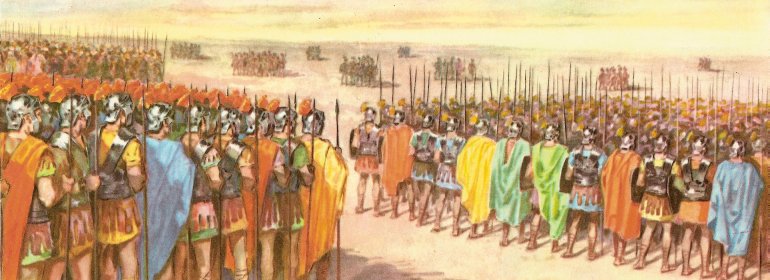
Such elephants were thought to be useful against great blocks of infantry.

phalanx phalanx1legion_in_battle_formation

They could be used like tanks to knock holes in the formations.

Pyrhus_elephants2

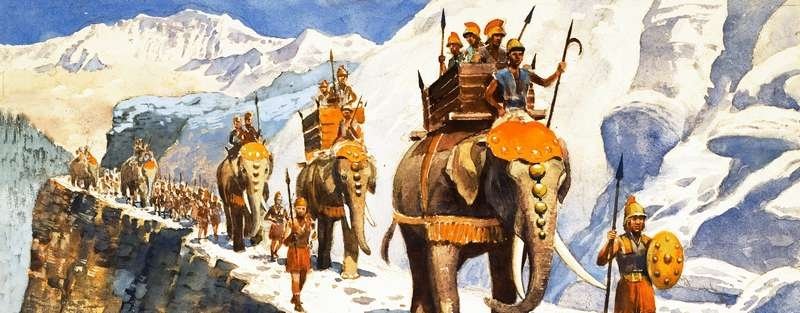
To most people, the most familiar images, however, would be from Hannibal’s invasion of Italy in 218 BC.

Hannibal-2

And, most famous of all, is his taking of the elephants across the Alps.

lal299613 lal319314

In fact, this did not end well for the elephants. Ancient accounts suggest that out of forty elephants, only one survived.

Crossing the Alps reminded us of Napoleon doing this in 1800. Here’s the heroic version:

Napoleon_at_the_Great_St._Bernard_-_Jacques-Louis_David_-_Google_Cultural_Institute

And this is what really happened (a little like Hannibal’s elephants):

Paul_Delaroche_-_Napoleon_Crossing_the_Alps_-_Google_Art_Project_2

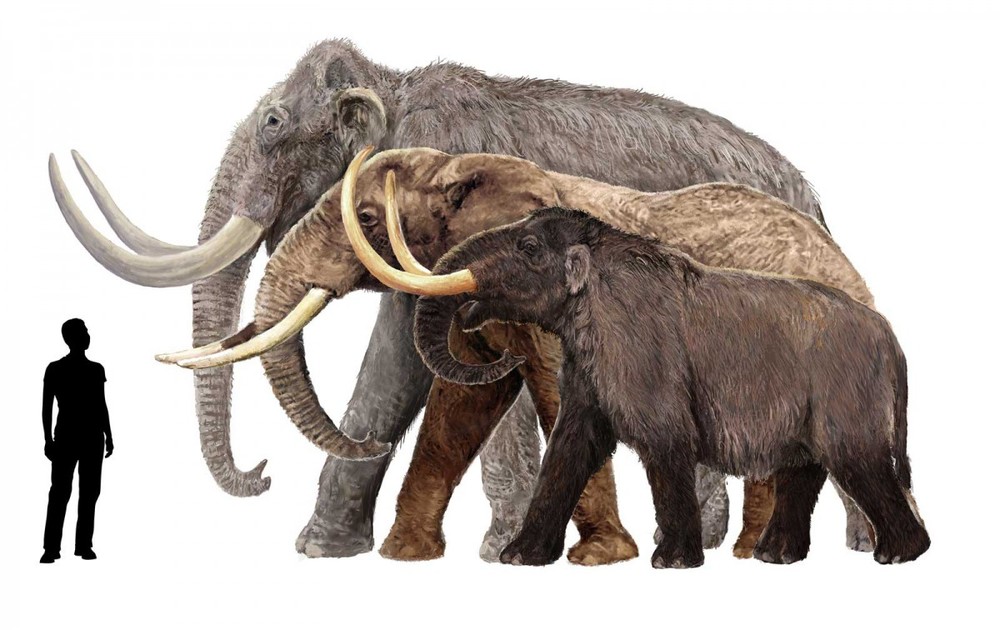
JRRT says of the oliphaunt Sam saw that “…the Mûmak of Harad was indeed a beast of vast bulk, and the like of him does not walk now in Middle-earth” (“Of Herbs and Stewed Rabbit”, LOTR 661).

It’s unclear what he means by this, except perhaps that an oliphaunt was more like a mammoth

Mammoths_Man-1200x756.jpg format=1500w

Even so, we can only contrast an ancient war elephant (reconstructed)

dced00480c58b85786bee4bf212eb30d

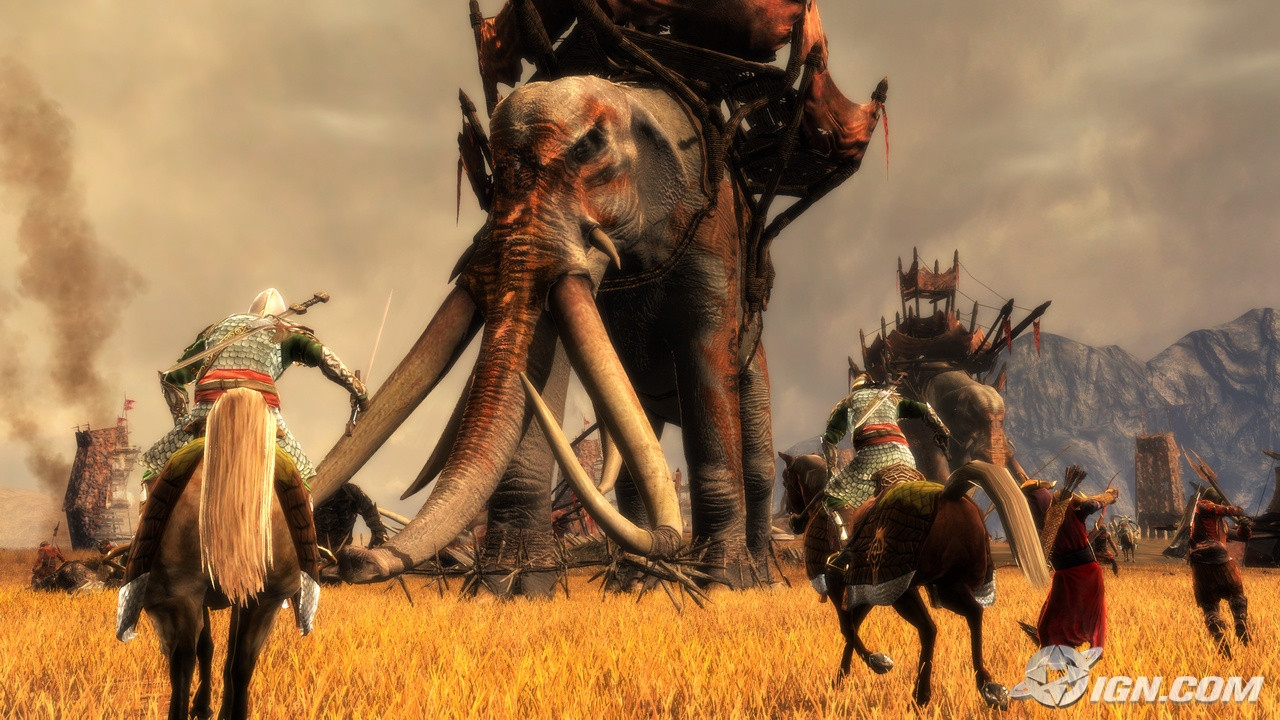
with those in the film

01IYPfe

and which reminded us strongly of ATATs from the assault upon Hoth,

atat

and think how disappointed Sam would be in what he would see in our world versus his!

Thanks, as always, for reading!

MTCIDC

CD

Jolly Tom.2

16 Wednesday Sep 2015

Posted by Ollamh in Fairy Tales and Myths, Imaginary History, J.R.R. Tolkien, Narrative Methods

≈ Leave a comment

Tags

Barrow-downs, Barrow-wights, Bree, Dagger, Dorset, Eowyn, Fangorn, Frodo, Gandalf, Middle-earth, Nazgul, Neolithic, Old Forest, Old Man Willow, Peter Jackson, Sauron, The Hobbit, The Lord of the Rings, The Ring, Tolkien, Tom Bombadil, Weaponry, Westernesse, Witch-King of Angmar

Dear Readers,

Welcome, as always!

As you can see from the title, this is a continuation of the previous posting, in which we began a discussion of a two-part question: 1. What would be the advantage of keeping Tom Bombadil in a recorded (audio or film) version of The Lord of the Rings? 2. What would you need to keep?

To summarize the previous posting, we suggested that:

  1. he, along with Fangorn/Treebeard, represents the great age of Middle Earth—something very important to the author–and a continuity of living things, which leads us to
  2. he might also be seen as a form of hope: the Ring has no effect upon him and he remembers a time before the arrival of Sauron, suggesting that there might be a time after him, as well, and that the Ring has limits
  3. as it seems out of place even in the current text, the bulk of Tom’s verse and the sometimes rhythmicized prose could be removed, leaving only the character himself and his part in the plot

We believe, however, that there is a more pressing reason for keeping him in the text, and it has to do with something Gandalf says to Frodo when Frodo, panicked at the prospect of having to deal with the Ring, demands, “Why did it come to me? Why was I chosen?” LotR 61.

“’Such questions cannot be answered,’ said Gandalf, ‘You may be sure that it was not for any merit that others do not possess: not for power or wisdom, at any rate. But you have been chosen, and you must therefore use such strength and heart and wits as you have.’” LotR 61.

This is a continuation of Gandalf’s earlier statement that:

“Behind that there was something else at work, beyond any design of the Ring-maker. I can put it no plainer than by saying that Bilbo was meant to find the Ring, and not by its maker. In which case you also were meant to have it.” LotR 56.

Thus, there is a level of intentionality at work in Middle-earth, something beyond Sauron. And, when we see Bombadil next, he will prove to be an instrument of the intention.

The Hobbits have left his house and, following his directions, have passed onto the Barrow-downs.

Breeland_breetobarrowdowns

A down is a piece of rolling countryside, often bare at the top, with trees in its folds—as here in Dorset.

dorset_3287278k

The Dorset Downs have lots of Neolithic remains, including numbers of barrows or tumuli, grave mounds commonly covering an interior structure, not uncommonly made of stone—

OLYMPUS DIGITAL CAMERA

image4

Wakeman_Newgrange_tumulus_chamber_cross_section

Such tumuli once contained the body or bodies usually of high-status persons

Unknown

and all sorts of grave goods, either as a display of wealth or perhaps for some sort of afterlife use.

gordion1957

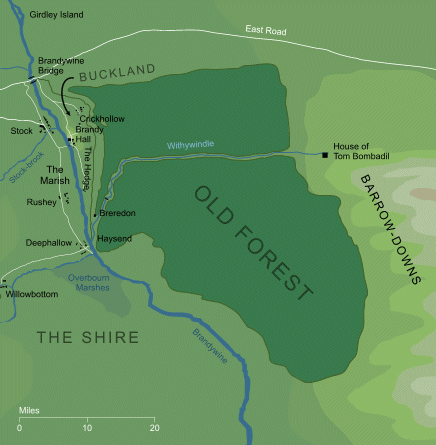
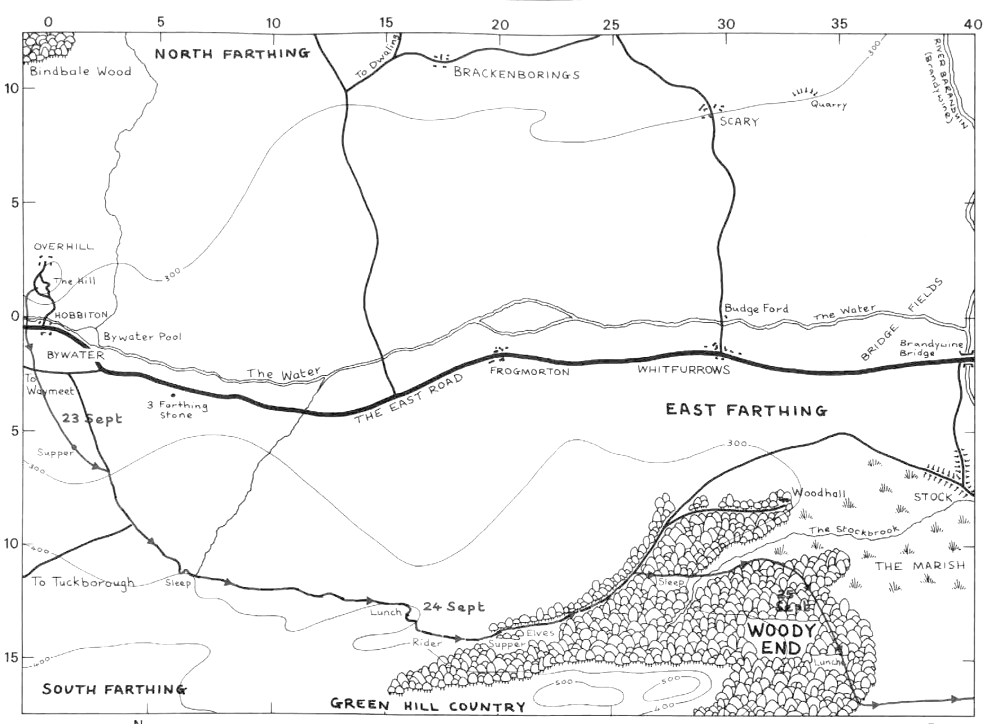
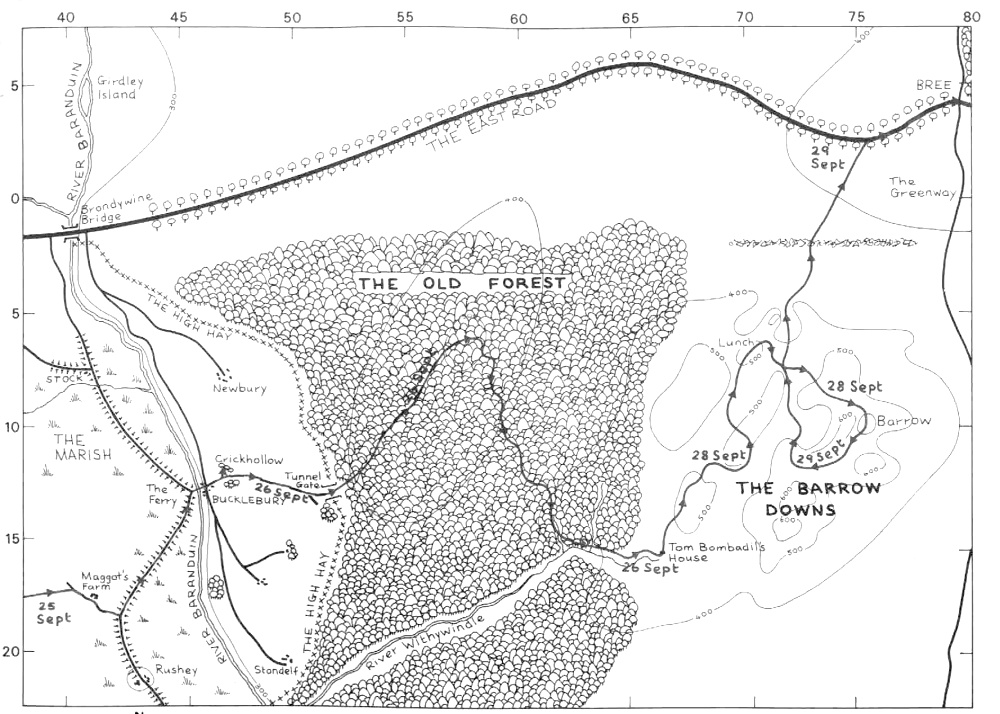
Bombadil has been careful, however, to say “more than once” (LotR 134) that the Hobbits are to avoid the barrows themselves, telling them not to meddle with them or “cold Wights” (LotR 133). (He also says that they should pass them “on the west-side”—there have been lots of guesses about this—we would add our guess that it might have to do with the orientation—literally—of the entry. If entries faced east and the rising sun, it would be wise of the Hobbits to skirt the barrows’ potential blind side, on the west. And there is also the rather obvious point, once you’ve looked at a map of the area, that, if they kept the barrows to the right and the Old Forest to the left, they would be heading north towards the road to Bree, as they intended.)

il_570xN.743473219_bxv9

Those Barrow-wights are not the original inhabitants of the mounds, but agents of the Witch-king of Angmar, who sends them to take possession (The Lord of the Rings Companion, 144-145), long after their original occupation—but, what’s interesting is that, at least one of these tumuli appears not to have been plundered and this leads us to our next point about Tom Bombadil. After he rescues the Hobbits (showing again his mastery over at least the minor forces of evil), he does a little plundering of his own, including:

“For each of the hobbits he chose a dagger, long, leaf-shaped, and keen, of marvellous workmanship, damasked in serpent forms in red and gold…Then he told them that these blades were forged many long years ago by Men of Westernesse: they were foes of the Dark Lord, but they were overcome by the evil king of Carn Dum in the Land of Angmar.” LotR 146.

damascene-sword

Here are a few ideas of what, at least, the leaf shape might have looked like:

leaf.2bronzeageblades leaf.1

And we include this third one just because it looks so cool—

leaf.3

Bombadil, of course, has actually seen all of this happen, and here we see that theme of great age appear again. And there’s the pedigree of those blades. Unlike the sack ‘o swords slung without any more explanation than “These are for you. Keep them close.” to the Hobbits in the film, these were weapons made by heroic men of the past, doomed men, but who fought evil until they were overcome (a strong theme throughout the history of Middle-earth).

Late in the story, one of those blades seems to be the instrument of intentionality once more. When Eowyn faces the Witch-king of Angmar, now the chief of the Nazgul—

lord_of_the_nazgul_2

and he is about to kill her with his mace, Merry strikes him from behind, stabbing him in what, on a living man, would have been a vulnerable spot, the back of the knee. (LotR 842.)

eowyn_vs_the_nazgul_by_arteche-d3ggm8g

Distracted and, surprisingly, in pain, the Nazgul stumbles and Eowyn destroys him and here, once more, we may see intentionality, and all because of Tom Bombadil. Merry’s sword, from its contact with the undead flesh of the Nazgul, withers away, but—

“So passed the sword of the Barrow-downs, work of Westernesse. But glad would he have been to know its fate who wrought it slowly long ago in the North-kingdom when the Dunedain were young, and chief among their foes was the dread realm of Angmar and its sorcerer king. No other blade, not though mightier hands had wielded it, would have dealt that foe a wound so bitter, cleaving the undead flesh, breaking the spell that knit his unseen sinews together.” LotR 844.

So, for everything from Old Man Willow (whom the script writers couldn’t resist completely, transposing him to an improbable scene with Fangorn/Treebeard) to showing the great age of Middle-earth to suggesting other powers untouched by the Ring to offering possible hope to showing something of the intentionality behind certain actions in the story to providing the ancient and magical weapon which could finally bring down the Witch-king of Angmar and save Eowyn at the same time, might we suggest that, next production—audio or visual—of The Lord of the Rings, Jolly Tom might have a place in the cast?

Thanks, as always, for reading.

MTCIDC

CD

PS

If you would like to read more about Tom, see, for example, Dorathea Thomas, “He Is: Tom Bombadil and His Function in The Lord of the Rings” at Academia.edu.

Jolly Tom.1

09 Wednesday Sep 2015

Posted by Ollamh in Narrative Methods, Poetry, Tolkien

≈ Leave a comment

Tags

Barrow-wights, Elrond, Gandalf, Hildebrandts, Nazgul, Old Man Willow, Peter Jackson, Ralph Bakshi, Sauron, Tales from the Perilous Realm, The Lord of the Rings, The Old Forest, Tolkien, Tom Bombadil

Dear Readers,

Welcome, as always!

There has been lots of discussion, if not downright argument, about Tom Bombadil and The Lord of the Rings. Although he appears in the first BBC radio adaptation in 1955 (which Tolkien disliked, saying in a letter of the period that “I thought Tom Bombadil dreadful”) and in the 1979 American radio drama, he was excised from Ralph Bakshi’s 1978 animated feature and from the 1981 BBC radio production, although reappearing in the radio adaptation of the relevant material from The Lord of the Rings in Tales from the Perilous Realm (BBC 1992).

Then we come to Peter Jackson’s The Fellowship of the Ring (2001). As anyone who has read our past postings knows, we have very mixed feelings about this and the subsequent films, but, in this posting, we want to take a completely different tack, not asking, as has always been the subject “why was Tom left out?” but, rather, “why might you keep him in?”

This is two questions, really, the first being “what would be his effect upon the story?” and, second, “just what of him would you keep?”

Lost in the Old Forest

oldforest

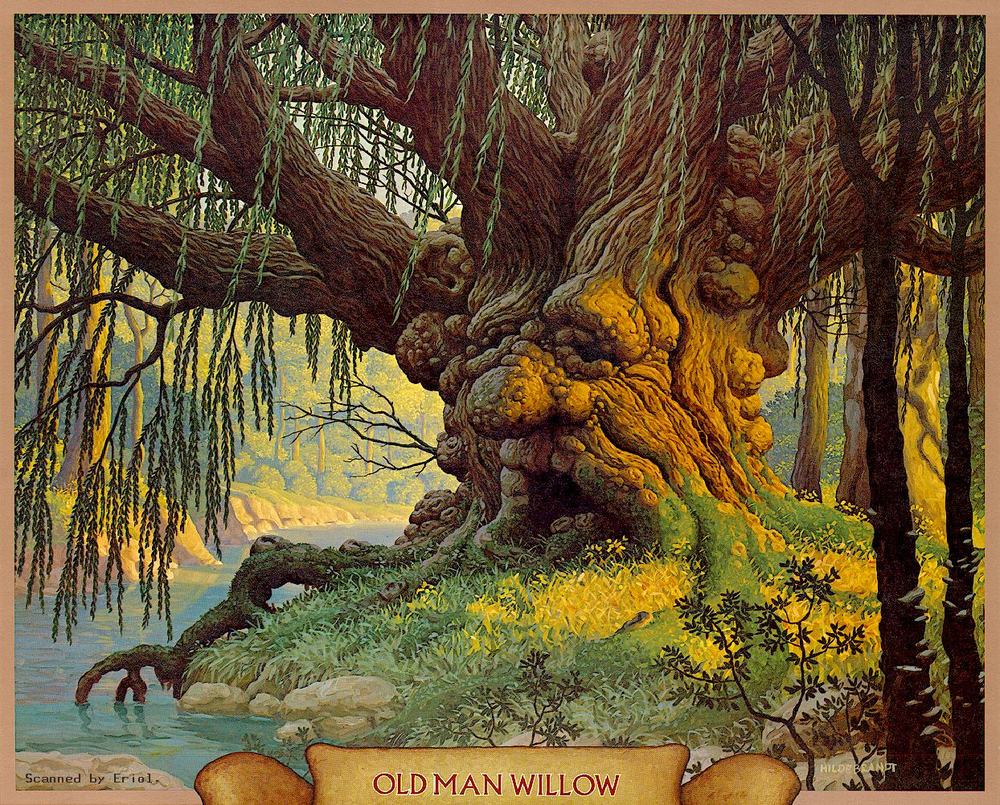
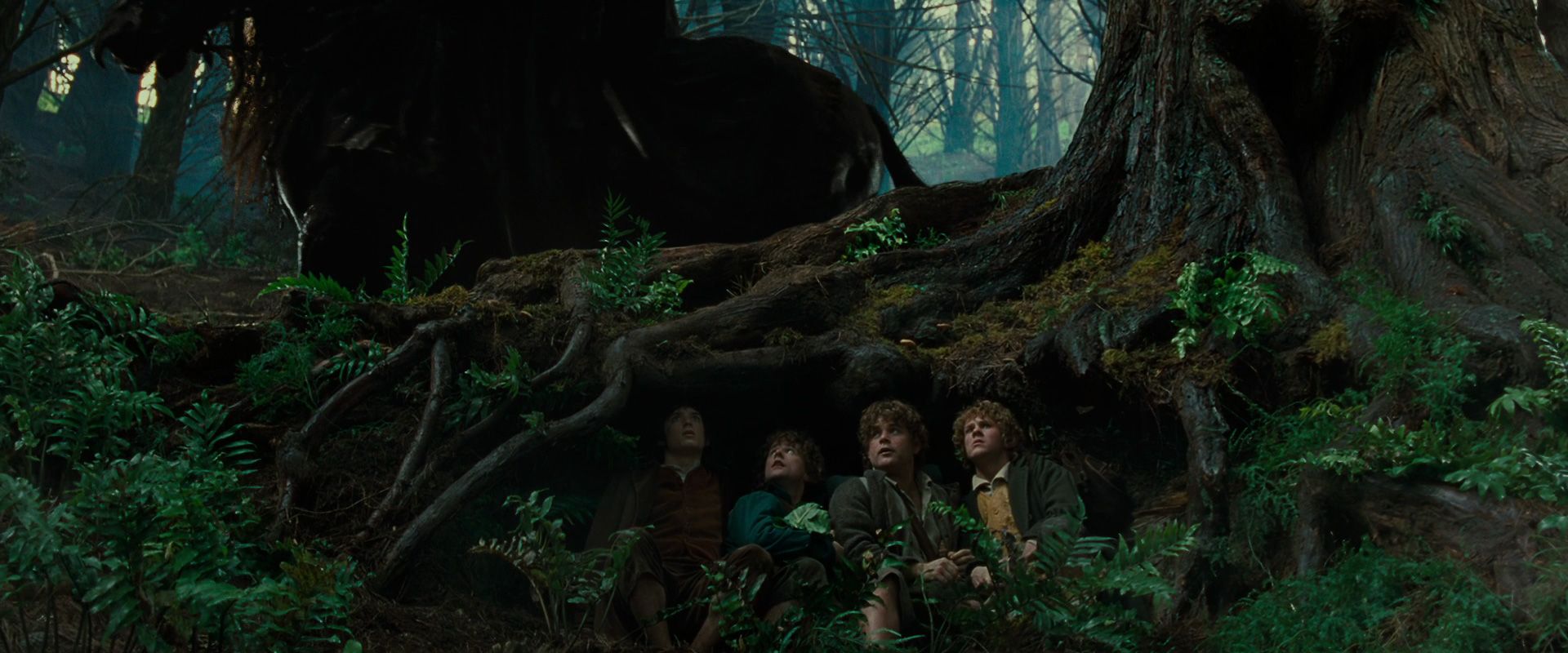
the Hobbits run afoul of Old Man Willow

TomOldManWillow

only to be rescued by Tom Bombadil

bombadil010607a

As much as we love the Hildebrandts’ work, this is not one of our favorites—this illustration really makes us wonder what kind of magic mushrooms Tom has been trading with Farmer Maggot and which Grateful Dead album is running in his head. As an antidote, here’s one of our favorites:

visite_inattendue_hildebrandt

One could say that this is part of the pattern of increasingly-dangerous encounters the Hobbits are having as they try to leave the Shire—

the first encounter was with the Nazgul

hobbits-hiding-from-nazgul

This doesn’t justify including him, though, if he’s thought to be just one more in a series—and this is clearly an opinion held by a Jackson scriptwriter, who once said:

“Tom Bombadil is part of several false starts to Frodo’s journey, and you cannot have things happening quite so episodically; that’s not what storytelling is all about.” (quoted from The One Ring, “complete list of film changes”—see the link here)

If he’s not just a “false start”, what is his function—and may he have more than one?

One of those elements of The Lord of the Rings which runs always just below the surface is the great age of Middle Earth. This is an ancient place and that fact was clearly very important, to the author, who spent years building up that narrative infrastructure, and to the story. This is clearly not a quick, little, one-time adventure, but, rather, one more part of a very old tale, of the “long defeat” as Galadriel calls the struggle with Sauron.

As a living token of that antiquity—and the first, but hardly the last, they meet—on their journey, there is Tom Bombadil. As Elrond says of him:

“But I had forgotten Bombadil, if indeed this is still the same that walked the woods and hills long ago, and even then was older than the old. That was not then his name. Iarwain Ben-adar we called him, [“Old-young, fatherless”? see The Lord of the Rings Companion, 128 for more on his names) oldest and fatherless.” LotR 265.

Thus, one of his functions is to represent a distant past, though now as shrunken as the Old Forest, “but an outlier of its northern march. Time was when a squirrel could go from tree to tree from what is now the Shire to Dunland west of Isengard.” (Elrond—LotR 265) In this, he is akin to Fangorn/Treebeard, described by Gandalf (himself so old that he was created by Iluvatar before the Music of the Ainur) as “the oldest living thing that still walks beneath the Sun upon this Middle-earth.” LotR 499.

He also, in a curious way, might be understood to represent one possible—perhaps hopeful—form of the future. When Frodo asks him, “Who are you, Master?” he replies (and it strikes us as sounding like both a Middle-earth riddle and its solution):

“Eldest, that’s what I am. Mark my words, my friends: Tom was here before the river and the trees; Tom remembers the first raindrop and the first acorn. He made paths before the Big People, and saw the little People arriving. He was here before the Kings and the graves and the Barrow-wights. When the Elves passed westward, Tom was here already, before the seas were bent. He knew the dark under the stars when it was fearless—before the Dark Lord came from Outside.” LotR 131.

Tom represents continuity, unchanging stability, then, although he is not all-powerful. As Glorfindel says:

“I think that in the end, if all else is conquered, Bombadil will fall, Last as he was First; and then Night will come.” LotR 266.

And yet he also, because of his immense age and ability to endure, might represent the unspoken possibility that, though Sauron is powerful, because he is not the creator nor rightful owner of Middle-earth, but rather an invader, he can be defeated: as there was a time before Sauron, could there not be a time after him?

(As an afterthought here, might we also add Tom’s complete immunity to the Ring? In a story full of people, from Gollum to Sauron, from Bilbo to Galadriel, so affected, in one way or another by it, is this another form of hope? That not everyone in the whole of Middle-earth wants the Ring or has to deny it strenuously lest the temptation overcome them?)

We want to continue this discussion in our next posting, but we want to end this one by considering the second part of this question, “Just what of him would you keep?”

Although the usual explanation for excising him has to do with his being a supposed “false start”, which has to do with the mechanics of plot, we believe that a real reason has to do with the large quantity of verse which appears when he appears. These verses signal that appearance:

“Hey dol! merry dol! ring a dong dillo!

Ring a dong! hop along! fal lal the willow!

Tom Bom, jolly Tom, Tom Bombadillo!” LotR 119

Although there has been verse earlier in the book, it has been scattered, not concentrated, and has seemed more apropos to what has been going on in the text. Much of this verse appears to come from nowhere, rather like Tom himself (and there’s more on 121, 122, 124, 126, and a final bit on 134—although, as a cry for help, it somehow fits better). In a story primarily in prose, with the occasional song, how would you present such a character believably on film or on tape? (Especially when one notices that even his speech is sometimes cadenced—“What be you a-thinking of? You should not be waking. Eat earth! Dig deep! Drink water! Go to sleep! Bombadil is talking!” LotR 120)

In fact, the character of Bombadil is not organic to the development of the plot of The Lord of the Rings. Tom Bombadil made his first appearance in The Oxford Magazine in 1934, when The Hobbit was being written, but three years before its initial publication. (See The Lord of the Rings Companion 124-129 for the poem and further information).

The basic plot of chapters 6 and 7 is simple: Tom frees the Hobbits from Old Man Willow, leads them to his house, the Hobbits eat and drink there and converse with Tom, but there’s little more to the two scenes. Thus, except for the distress call which Tom teaches the Hobbits on 134, does any of this verse do more than show us the poetic/almost manic side of Bombadil? If we wished to retain the character, might it be possible to cut away the verse (including a certain amount of rhythmicized prose), leaving only those elements which further the plot?

To us, this is a more pressing issue than it might at first appear—but see our next post, Jolly Tom.2, to understand our interest.

Thanks, as always, for reading.

MTCIDC

CD

The Two Sieges

22 Wednesday Jul 2015

Posted by Ollamh in Heroes, J.R.R. Tolkien, Military History

≈ Leave a comment

Tags

Agincourt, Aragorn, English Longbowmen, Faramir, French Knights, Gondor, Grond, Hoth, Jan Sobieski, Lithuania, Minas Tirith, Mumakil, Nazgul, Orcs, Ottoman, Peter Jackson, Poland, Rammas Echor, Rohan, Rohirrim, Siege Towers, Stone Throwers, The Lord of the Rings, Tolkien, Vienna, Winged Hussars

Welcome, as always, dear readers!

In this posting, we’re going to make another suggestion about a model for something in Tolkien’s work.

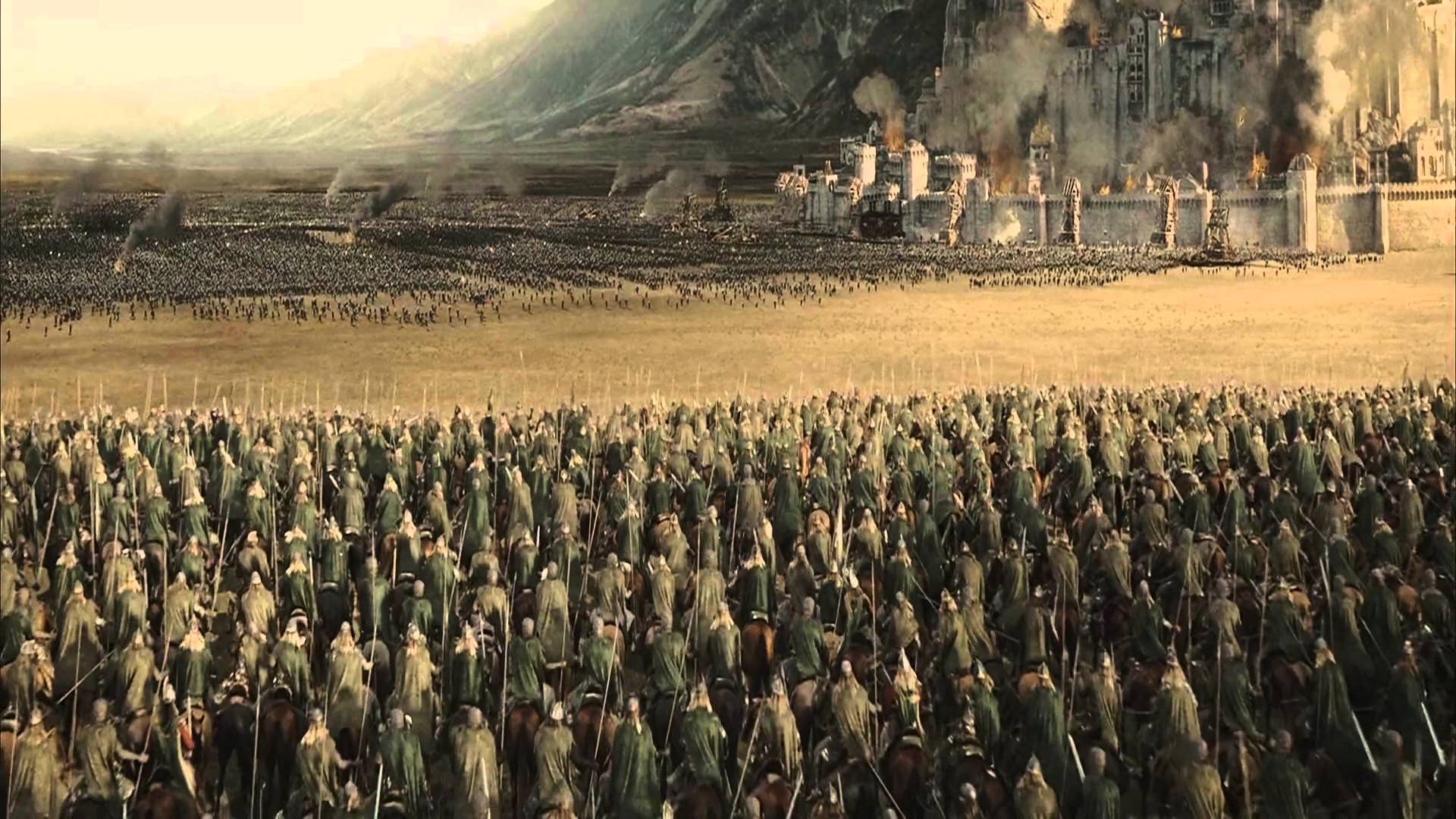
If you read us regularly, you know that our favorite part of P. Jackson’s The Lord of the Rings is anything to do with the Rohirrim. When we rewatch favorite scenes, the charge against the Orcs outside Minas Tirith is always first on our list (and high on our general list of cavalry charges—more on those in a future posting).

First, we see that massive Orc army marching up to the walls. (In the book, this is more dramatic: the Orcs blow two holes in the Rammas Echor, outflank the defenders, and drive them into retreat, which is where Faramir is badly wounded by an arrow.)

minas-tirith

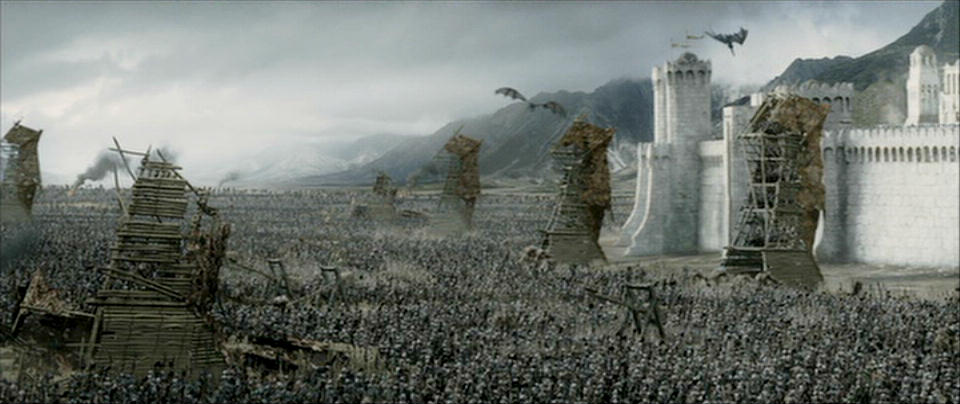
Then they begin to attack with stone-throwers,

siege1

siege towers,

lotr-siege-towers

and, eventually a giant, flame-filled battering ram.

grond1

Things look increasingly desperate for Gondor as the Orcs press their attack, led by the Chief Nazgul.

witch_king_of_angmar_ii_by_dudeskindasketchy-d4d6uvd

And that’s when the Rohirrim appear.

rohirrimabouttocharge

And move to strike the Orcs from behind.

Charge_rohirrim

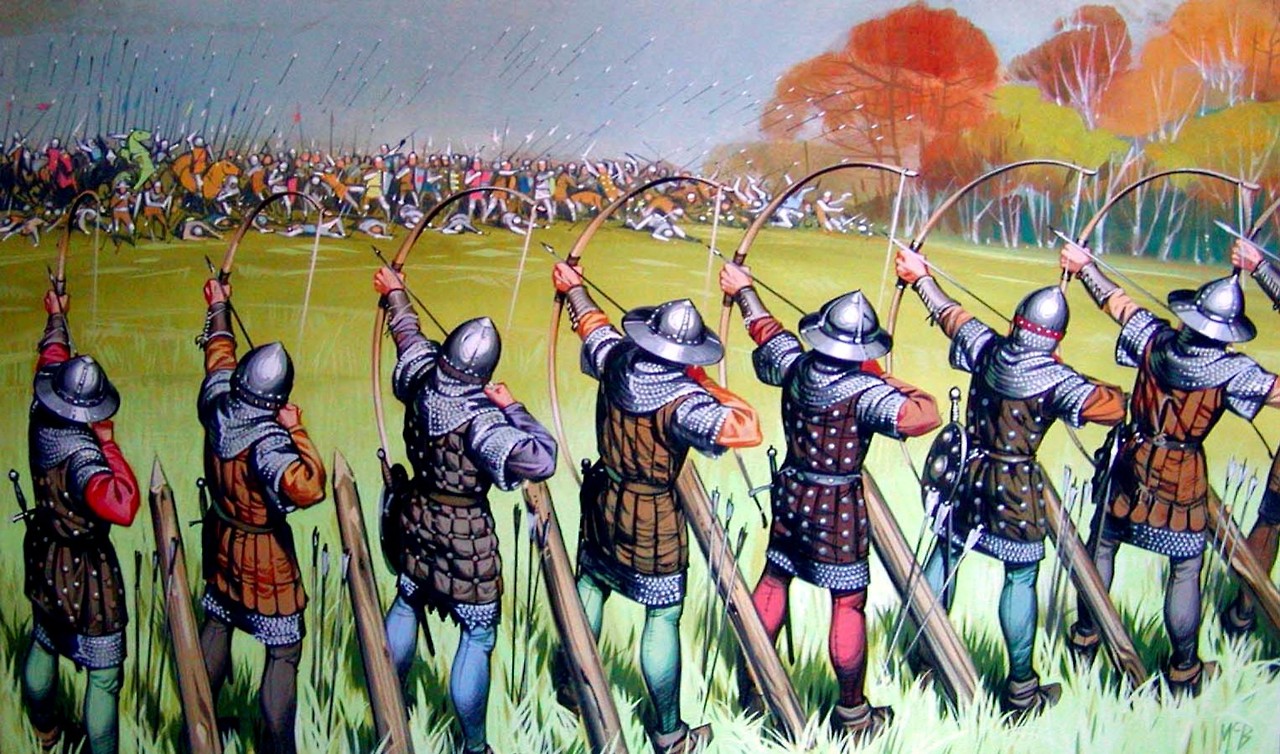
When the Orcs realize what’s happening, they try to stop the attack with bows.

archery

This immediately reminded us of the 1415 battle in which English longbowmen and their clever use defeated an army of brave French knights, Agincourt.

OLYMPUS DIGITAL CAMERA

Unlike Agincourt, however, arrows didn’t stop the Rohirrim, who sweep through the enemy—but are brought up short by the sight of a row of mumakil—giant war elephants—bearing down on them.

img-2845793-1-charge-1024x425

Seeing this scenario made us think of another attack by huge, lumbering things in a galaxy long ago and far away—

Battle_of_Hoth

The film goes on from there, including an attack by a ghost army, instead of by the actual forces brought from southern Gondor by Aragorn, but we want to back up a bit to the actual siege and another one which bears a strong resemblance to it.

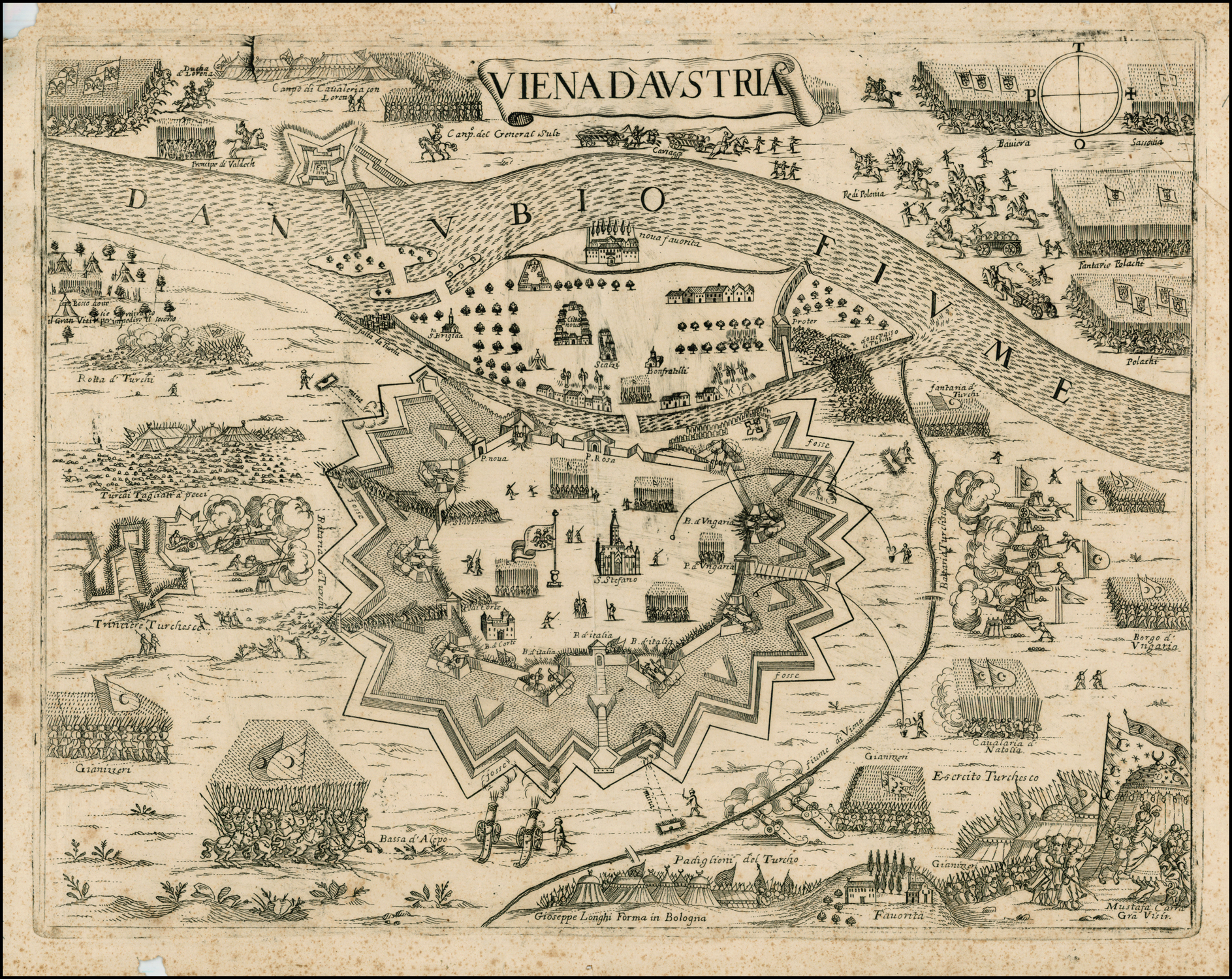
For centuries, the Ottoman Turks had been expanding their dominions.

Ottoman_Empire_Map_1359-1856

They had first reached Vienna in 1529,

Siegeofvienna1529

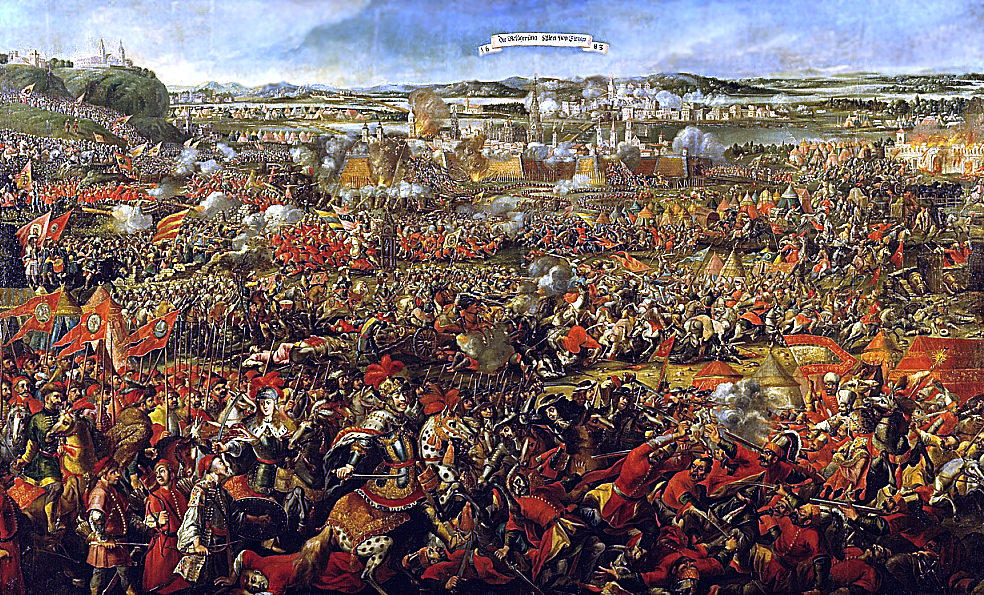
but had given up the siege. Now, however, in 1683, they were back.

Battle_of_Vienna_1683_map

Their attacks against a dwindling number of defenders in a crumbling town

1-vienna-1683

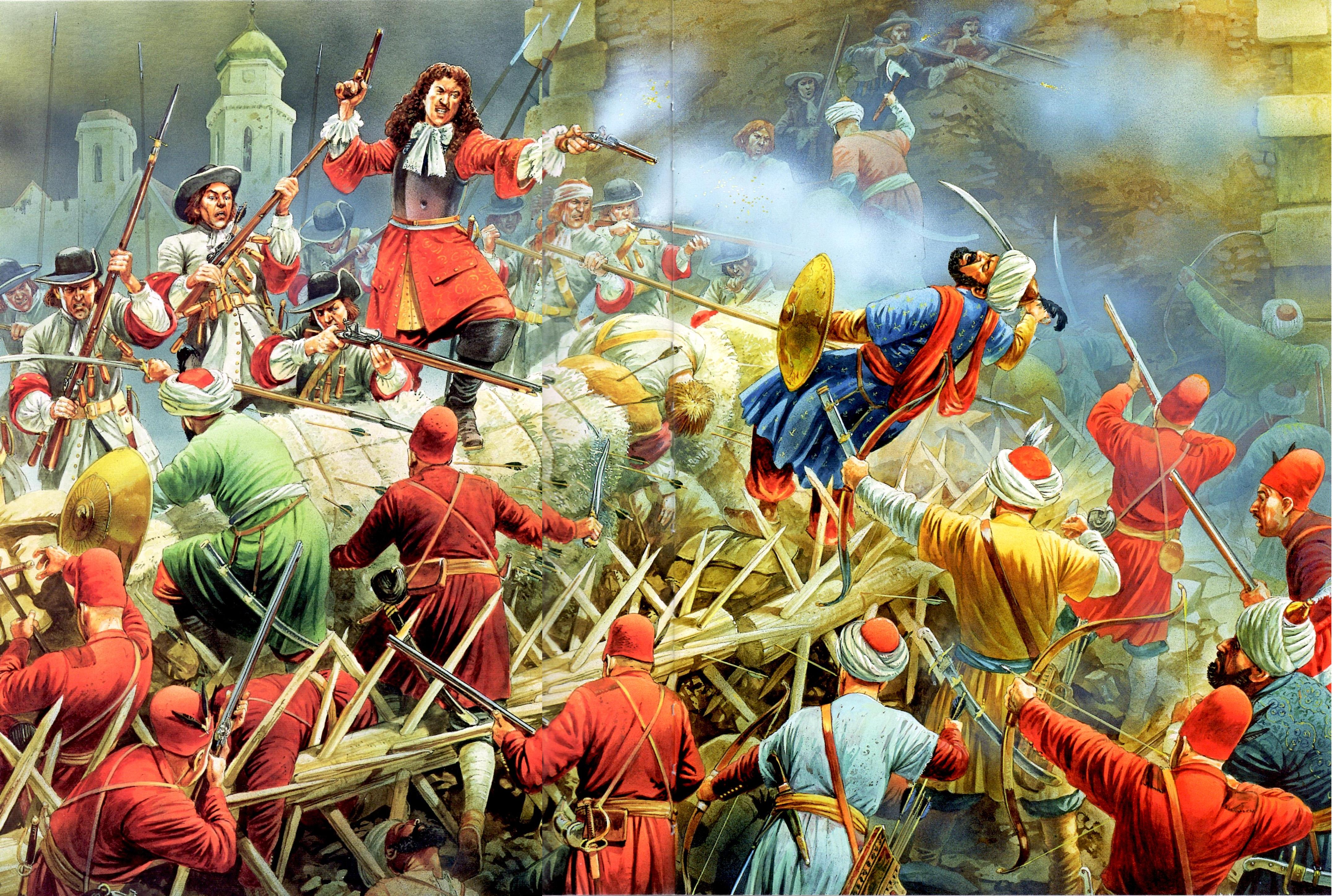
had brought them to the edge of conquest when an army of reenforcements, including cavalry from the army of the combined state of Lithuania/Poland, had appeared. Some of the cavalry were the famous Polish winged hussars.

Battle_of_Vienna_1

Just as the Rohirrim are led by their king, Theoden, so are the Poles led by their king Jan Sobieski—

bitwa-pod-wiedniem-obraz

The reenforcements, Poles in the lead, rush upon the Turks and drive them back through their camps and out of the siege entirely.

Atak_husarii

Battle_of_Vienna_1683_11

So similar, isn’t it? No giant war elephants, ghost armies, or Nazgul, but the basic elements of siege, relieving army with cavalry led by a king attacking an unprepared enemy, and chasing off the besiegers, is nearly identical.

Tolkien was an extremely well-read man, with a strong interest in history. Was the siege and relief of Vienna somewhere in the back of his mind when he began to plan the siege of Minas Tirith?

Thanks for reading!

MTCIDC

CD

Trading with the Enemy

15 Wednesday Jul 2015

Posted by Ollamh in Economics in Middle-earth, J.R.R. Tolkien, Maps

≈ 2 Comments

Tags

Bree, Cross-Roads, Gandalf, Gimli, Great East Road, Greenway, Isengard, Laketown, Legolas, Marxist Critics, Merry and Pippin, Middle-earth, Mirkwood, North-South Road, Peter Jackson, Pipeweed, Roads, Roman Roads, Rome, Saruman, Sauron, South Farthing, Swanfleet, The Lord of the Rings, The Shire, Theoden, Tolkien, Trade, Transport

Dear Readers,

In a recent posting, we opened with the image of Merry and Pippin happily feasting among the ruins of Isengard as Gandalf, Theoden, and company ride up to meet them.

“…suddenly they were aware of two small figures lying…at their ease…there were bottles and bowls and platters laid beside them, as if they had just eaten well, and now rested from their labour. One seemed asleep; the other, with crossed legs and arms behind his head, and little rings of thin blue smoke.” L543

MandPIsengard

We, as the readers, may be just as taken aback as the company; we’re joining the Hobbits again for the first time since Isengard’s demise, and it’s natural to ask: where, in the midst of all of this ruin, did they find this stuff? Gimli doesn’t hesitate to ask for us.

“’Where did you come by the weed, you villains?’” L544

Of course, he’s talking about pipeweed, something common, yet treasured, in the Shire. It is not native to a place like Isengard, so far south, but here we have the Hobbits smoking it and even enjoying a surplus. Legolas is just as impressed,

“’You speak for me, Gimli,’ laughed Legolas, ‘though I would sooner learn how they came by the wine.’” L544

Pippin only teases, answering that

“’Here you find us sitting on a field of victory…and you wonder how we came by a few well earned comforts.” L544

And so we’re left with this mystery of supplies, but we can be sure that, in Tolkien’s mind, there was an answer. He was, after all, diligent about even minute details concerning Middle-earth, and was also the same man who once said that

“I am not incapable or unaware of economic thought; and I think as far as the ‘mortals’ go, Men, Hobbits, and Dwarfs, that the situations are so devised that economic likelihood is there and can be worked out…” LT, L.154 P.196.

In this quotation, Tolkien can almost be echoing, in an ironic way, the argument of Marxist critics that economic systems, even those appearing in literature, hide their true nature. Tolkien seems to be telling us that he was well aware of trade systems, and, we would suggest, this would include a basic foundation: transport. And, using what we are given in the texts, we can see that there were two main methods. One is by water–as in the flourishing wine trade between Mirkwood and Laketown.

hobbit-raft-elves

This pair of places is naturally connected by river and lake. Such is not the case with the South Farthing and Isengard, of course. Instead, water bodies like the Swanfleet lie between them. And yet there is that pipeweed. The Hobbits are smoking it and, in the extended edition of the film version, Peter Jackson even shows us two large barrels of pipeweed labeled “South Farthing”.

This brings us to our second method of transport, by road.

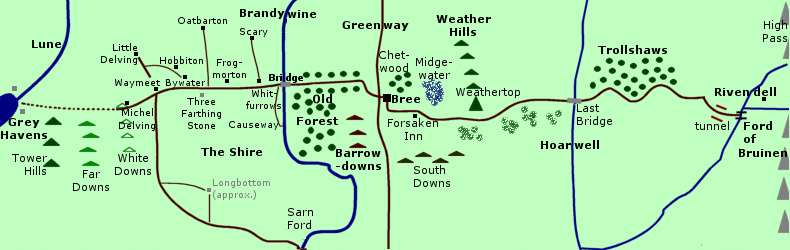
ShireRoads

Like all educated men of his time, Tolkien had been raised on the world of the Greeks and Romans and, among the longest-lasting monuments of the Roman world was the extensive system of roads, some of which are still in existence in our own time and are even (asphalted over) the basis of certain modern English roads. In Middle-earth, there appear to be a number of such ancient roads, such as the Cross-Roads:

CrossRoads

The Great East road:

greateastrd-map

The North-South road:

north-south-road

Other possibilities would include once-active, but now abandoned routes, like the Greenway, running north from Bree and the Stone Road which the Woodwoses know and point out to Theoden.

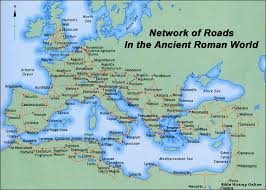
As you can see, we can easily imagine Tolkien thinking out the economics of Middle Earth through a road network similar to that of the Roman Empire, with its own intricate road systems

RomanRoadNetwork


Along these roads came much of Rome’s wealth and the case would have been the same for Middle-earth, so here’s a clue to Saruman’s pipeweed trade with the Shire. Looking at a map, we see that The Great East Road, which, traveling east from the Shire, would lead to Bree, and to the Cross-Roads, reaching The North-South Road.

fonstad01 fonstad02

Such trade would seem natural, not only to the Romans, but to us. In the wreckage of Isengard, however, for all that Merry and Pippin are so casual about it, there is another implication: Saruman, who wants to be another Sauron, must know much more about the Shire than anyone, even Gandalf has understood, and, thinking of the “Scouring of the Shire”, that could easily bode ill for the future of that place which the Hobbits think so safe and removed…

Thanks, as ever, for reading.

MTCIDC,

CD

Where Did It Go– And Why?

17 Wednesday Jun 2015

Posted by Ollamh in J.R.R. Tolkien, Military History, Military History of Middle-earth

≈ Leave a comment

Tags

Arbeia, Boromir, Cavalry, Denethor, England, Faramir, Film, Gondor, Hadrian's Wall, Helm's Deep, Iliad, Minas Tirith, Offa's Dyke, Osgiliath, Pelennor, Peter Jackson, Rammas Echor, Script, The Great Wall, The Lord of the Rings, Tolkien, Wansdyke

Dear Readers,

Welcome, as always!

     In this post, we want to consider the Rammas Echor, which, in the original, had holes blown in it by the invading army of Sauron, but was demolished completely by the script writers for Peter Jackson’s LOTR.

The%20Siege%20of%20Minas%20Tirith

     We first meet it when Gandalf and Pippin, in their rapid journey to Minas Tirith, are briefly stopped at what appears to be a sally port in it (rather than a major gate, as Shadowfax is said to have “passed through a narrow gate in the wall” 749). Gandalf briefly trades remarks with an officer named Ingold (who appears briefly later in the story to report that the northern section has fallen, 821) before he and Pippin continue their journey.

     It is described thus:

   “Gandalf passed now into the wide land beyond the Rammas Echor. So the men of Gondor called the out-wall that they had built with great labour, after Ithilien fell under the shadow of their Enemy. For ten leagues [about 30 miles in the English system—about 48 km in the metric] or more it ran from the mountains’ feet and so back again, enclosing in its fence the fields of the Pelennor: fair and fertile townlands on the long slopes and terraces falling to the deep levels of the Anduin. At its furthest point from the Great Gate of the City, north-eastward, the wall was four leagues [12 miles—about 19 km] distant, and there from a frowning bank it overlooked the long flats beside the river, and men had made it high and strong; for at that point, upon a walled causeway, the road came in from the fords and bridges of Osgiliath and passed through a guarded gate between embattled towers… “ 750.
     With so much of Tolkien, one can find illustrations from the usual artists—the Hildebrandts, Howe, Nasmith, and Lee—but for this particular—and important—architectural feature, we haven’t discovered—so far—a single illustration.

     It’s made of stone and has evidently not been well-maintained: “Many tall men heavily cloaked stood beside him [Shadowfax], and behind them in the mist loomed a wall of stone. Partly ruinous it seemed, but already before the night was passed the sound of hurried labour clould be heard: beat of hammers, clink of trowels, and the creak of wheels.” 748 And, as mentioned above, it has gates, but, beyond that, what does it look like?

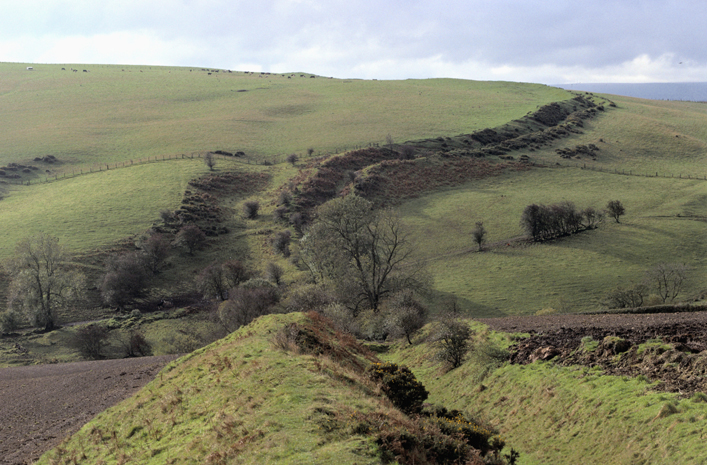
     England has a long history of long walls. There are the surviving earthen walls and ditches of the Dark Ages or early medieval Offa’s Dyke

Offa's_Dyke_near_Yew_Tree_Farm_-_geograph_org_uk_-_450420

1990s, Near Knighton, Wales, UK --- Offa's Dyke near Knighton in Wales. The dyke was created by Offa the King of Mercia from 757 to 796 AD and roughly formed the boundary between England and Wales. --- Image by © Homer Sykes/CORBIS

and Wansdyke

wansdyke

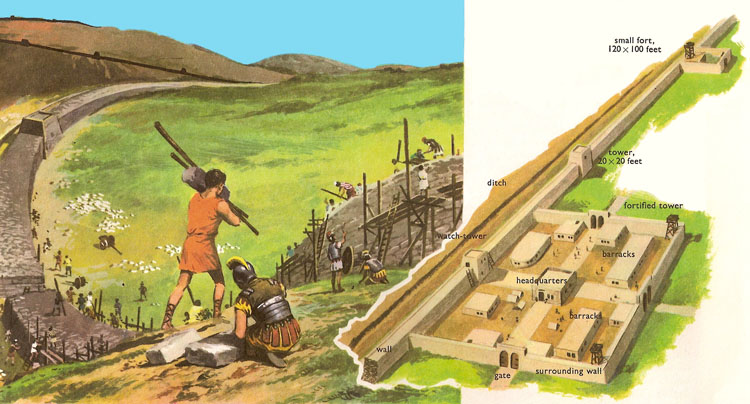
and, of course, the well-known 2nd –century AD work, Hadrian’s Wall, with its surviving stone work and its elaborate series of mile castles, gates, and supporting forts and camps.

Hadrians_Wall Hadrian's Wall phase 1 Central sector

   We might also cast further afield and in time. In Book 7 of the Iliad, the Greeks dig a ditch, fill it with sharpened stakes, and build a stone wall behind it to protect their ships from Trojan attack.

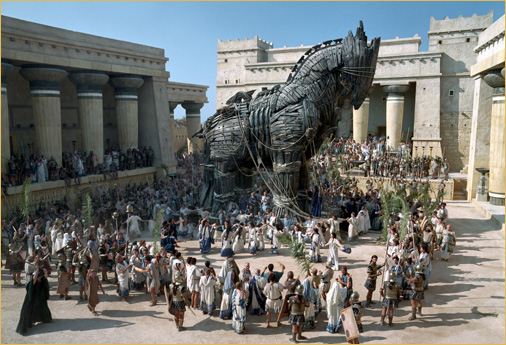
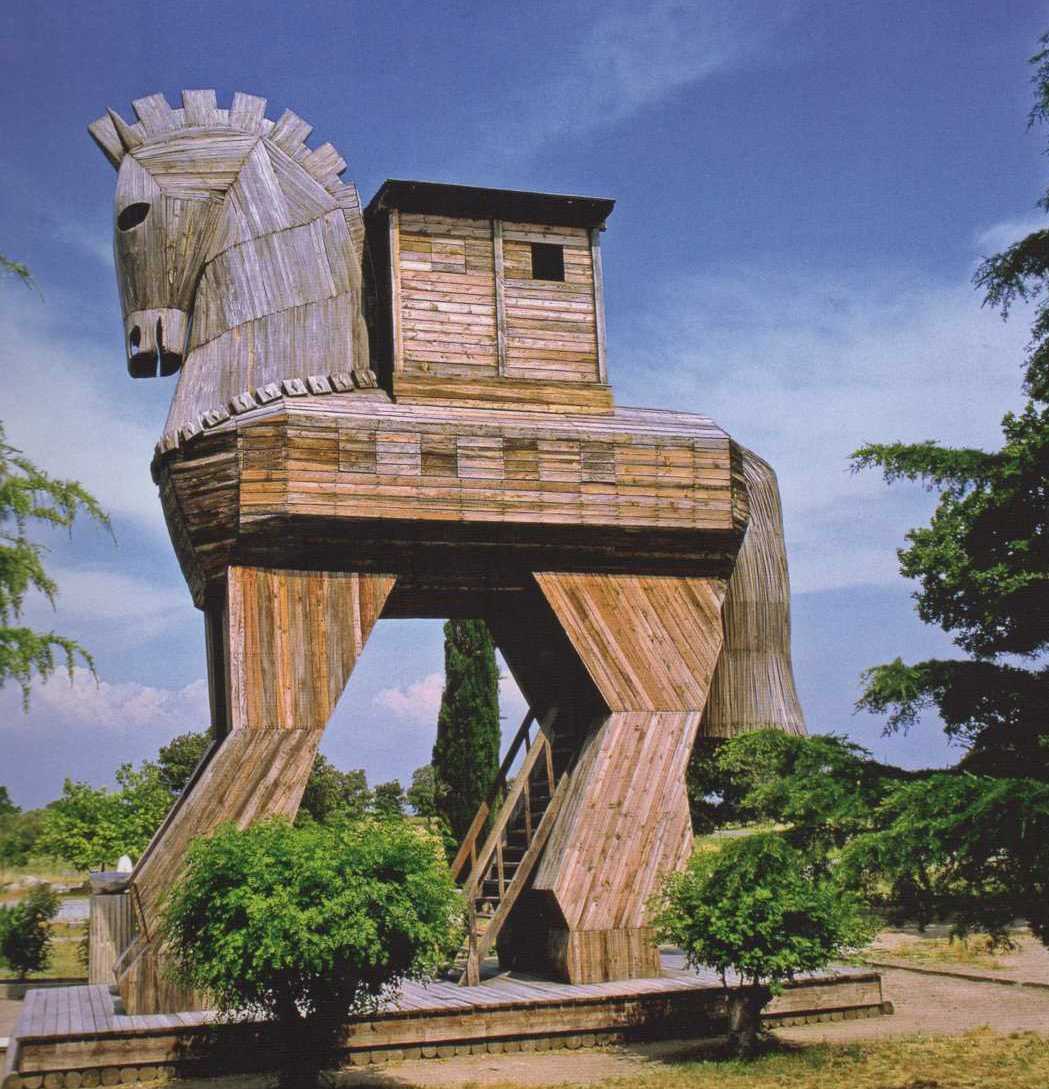
[We can’t find an image of that, but here’s a picture of one of our favorite features of today’s Truva/Hisalik, just to remind you of a later feature of the Trojan War—along with a still from the 2004 Brad Pitt film, known to those of us who love Homer for its rather casual attitude towards the traditional story.]

617-5-horse1

trojan-horse%20troy%20the%20movie

And how can we fail to mention the Great Wall of China?

thegreatwall_rcv

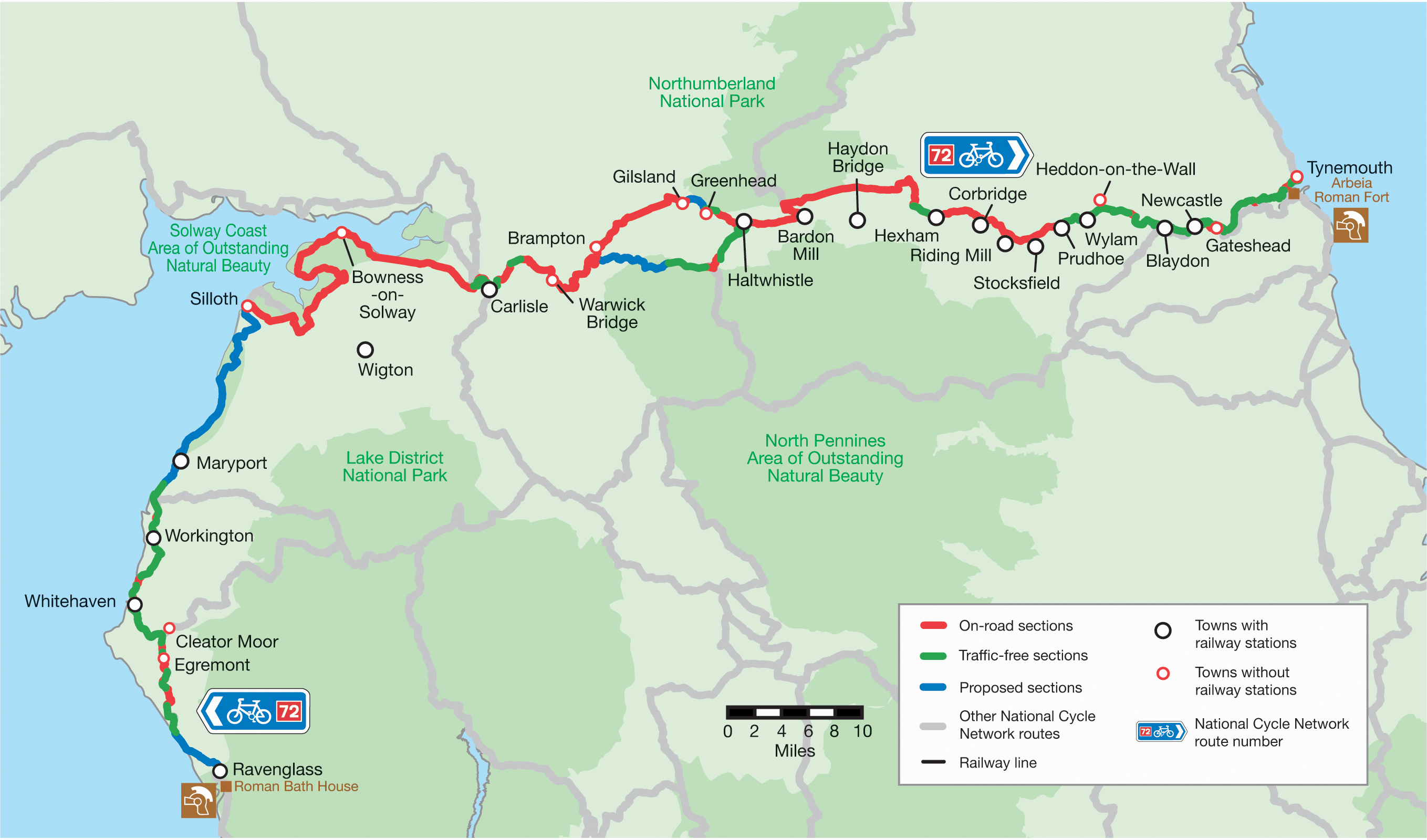
     For us, Hadrian’s Wall might do, with its stretch of stonework across the entire width of England (73 miles, 117.5 kilometres).

map-hadrians-wall

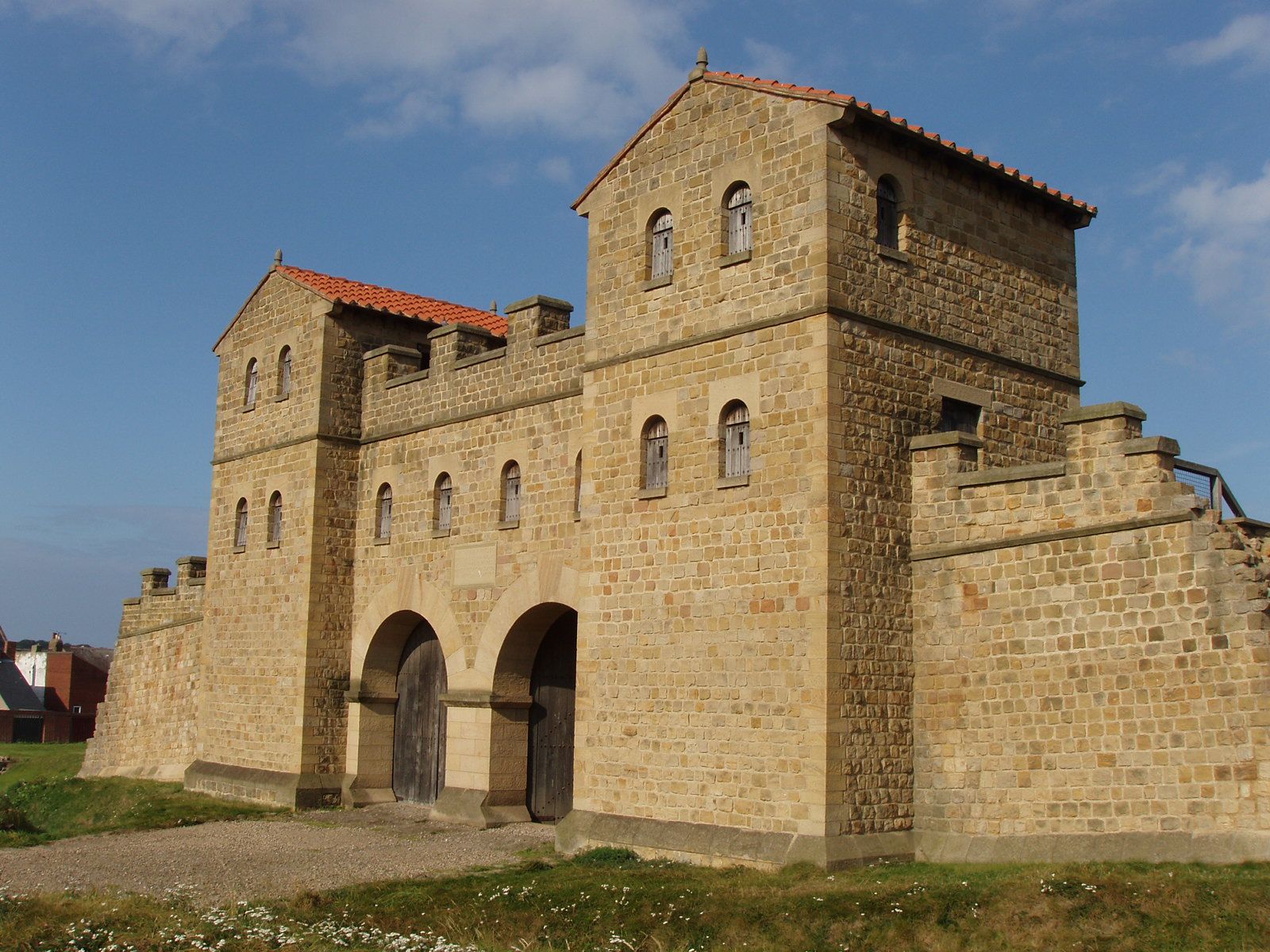
It even has the requisite main gate, which will be defended by Faramir.

This is actually from the Roman fort of Arbeia, South Shields—a great site—but it gives you an idea of what something a little grander—after all, it connected the Pelennor with Osgiliath—might look like.

F00638REW

     That event, however, is in The Lord of the Rings, where Faramir maintains his reputation as a brave and far-sighted commander, as Beregond says to Pippin:

     “But things may change when Faramir returns. He is bold, more bold than many deem; for in these days men are slow to believe that a captain can be wise and learned in the scrolls of lore and song, as he is, and yet a man of hardihood and swift judgement in the field.” 766

FaramirCaptainGondor

     In the film, it is quite a different matter. There is no Rammas Echor and Faramir, in contrast, is badly wounded in a cavalry charge against the walls of Osgiliath while his father, Denethor, has a rather messy and all-too-symbolic lunch.

maxresdefault

gondorianerritt-cb182208

gifdenethoreating

     What has happened here? First, no intelligent—maybe even foolish—commander would attack a stone wall with cavalry, and we know that Faramir is, indeed, intelligent. Second, what has happened to the Rammas, where Faramir actually had been just before he fell, commanding the rearguard?

     First, we would suggest that the script writers took their cue from the final scene between father and son, in which Faramir, already told by his father that his father had preferred his elder son, Boromir, volunteers to direct the defense of Osgiliath:

“But at length Faramir said: ‘I do not oppose your wil, sire. Since you are robbed of Boromir, I will go and do what I can in his stead—if you command it.’

     ‘I do so,’ said Denethor.

     “Then farewell!’ said Faramir. ‘But if I should return, think better of me!’

     ‘That depends upon the manner of your return,’ said Denethor.

     Gandalf it was that last spoke to Faramir ere he rode east. ‘Do not throw your life away rashly or in bitterness,’ he said. ‘You will be needed here, for other things than war. Your father loves you, Faramir, and will remember it ere the end. Farewell!’” 816-817

     To them, this might have indicated that Faramir—who had clearly been Gandalf’s pupil, as his father has said:

“See, you have spoken skillfully, as ever; but I, have I not seen your eyes fixed on Mithrandir, seeking whether you said well or too much? He has long had your heart in his keeping.” 812

does not listen to his tutor and deliberately sets out to get himself killed. In the text, however, Faramir is actually acting responsibly, fighting in the rearguard of the retreating detachment driven from the Rammas:

“Even as the Nazgul had swerved aside from the onset of the White Rider, there came flying a deadly dart, and Faramir, as he held at bay a mounted champion of Harad, had fallen to the earth.” 821

     (And we might add that Prince Imrahil, who brings the wounded Faramir back, says, “Your son has returned, lord, after great deeds…” 821, which, of course, could easily be understood to be ironic and is perhaps meant to be so on the part of Imrahil, considering Fararmir’s last words to his father and Denethor’s reply.)

     Thus, we see Faramir’s wounding completely changed, but what about the wall he had been defending?

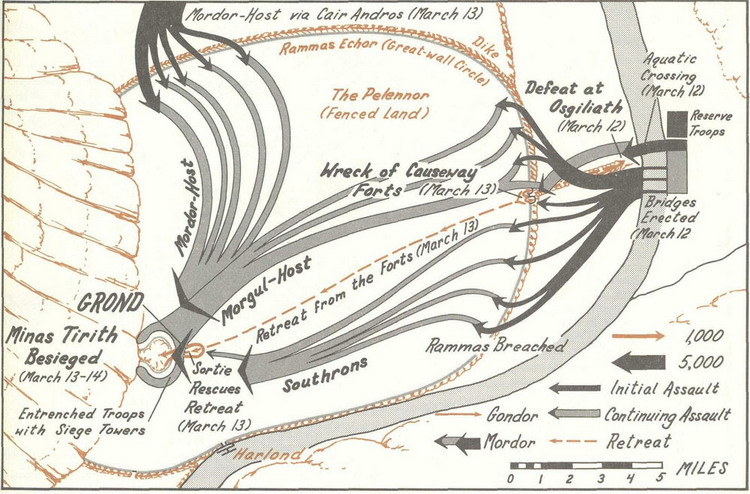
     When one reads through the various chat sights, there was once a considerable amount of discussion about the Rammas Echor, but all was speculation, it seems, as we were unable to find anything said by the writers themselves. In the text, instead of concentrating on the main gate, Sauron’s engineers detonate explosions to each side and the troops then pour through the breaches to take the defenders in flank. This could be seen as a repetition of a similar earlier event at Helm’s Deep, in which Saruman’s forces blew a hole in the defenses.

blowingupthewallathelmsdeep

     As well, we think that, for the director, the big visual attraction was the attack on Minas Tirith. This means that it could simply have been a matter of where to spend time—and/or possibly money—and so the Rammas was sacrificed. If the decision had already been made to change—we will say misinterpret– the story of Faramir, simplifying it drastically and shifting the focus (just think of that dripping mouth!), then the choice to discard this defense would have been an easy one.

     So, suppose you were script writer or director, what would you have done, dear readers?

     Thanks, as always, for reading (and, we hope, speculating).

     MTCIDC

     CD

Newer posts →

The Doubtful Sea Series Facebook Page

The Doubtful Sea Series Facebook Page

  • Ollamh

Categories

  • Artists and Illustrators
  • Economics in Middle-earth
  • Fairy Tales and Myths
  • Films and Music
  • Games
  • Heroes
  • Imaginary History
  • J.R.R. Tolkien
  • Language
  • Literary History
  • Maps
  • Medieval Russia
  • Military History
  • Military History of Middle-earth
  • Narnia
  • Narrative Methods
  • Poetry
  • Research
  • Star Wars
  • Terra Australis
  • The Rohirrim
  • Theatre and Performance
  • Tolkien
  • Uncategorized
  • Villains
  • Writing as Collaborators
Follow doubtfulsea on WordPress.com

Across the Doubtful Sea

Recent Postings

  • Through a glass… January 7, 2026
  • Heffalumps? December 31, 2025
  • We Three Kings December 24, 2025
  • A Moon disfigured December 17, 2025
  • On the Roads Again—Once More December 10, 2025
  • (Not) Crossing Bridges December 3, 2025
  • On the Road(s) Again—Again November 26, 2025
  • On the Road(s) Again November 19, 2025
  • To Bree (Part 2) November 12, 2025

Blog Statistics

  • 104,125 Views

Posting Archive

  • January 2026 (1)
  • December 2025 (5)
  • November 2025 (4)
  • October 2025 (5)
  • September 2025 (4)
  • August 2025 (4)
  • July 2025 (5)
  • June 2025 (4)
  • May 2025 (4)
  • April 2025 (5)
  • March 2025 (4)
  • February 2025 (4)
  • January 2025 (5)
  • December 2024 (4)
  • November 2024 (4)
  • October 2024 (5)
  • September 2024 (4)
  • August 2024 (4)
  • July 2024 (5)
  • June 2024 (4)
  • May 2024 (5)
  • April 2024 (4)
  • March 2024 (4)
  • February 2024 (4)
  • January 2024 (5)
  • December 2023 (4)
  • November 2023 (5)
  • October 2023 (4)
  • September 2023 (4)
  • August 2023 (5)
  • July 2023 (4)
  • June 2023 (4)
  • May 2023 (5)
  • April 2023 (4)
  • March 2023 (5)
  • February 2023 (4)
  • January 2023 (4)
  • December 2022 (4)
  • November 2022 (5)
  • October 2022 (4)
  • September 2022 (4)
  • August 2022 (5)
  • July 2022 (4)
  • June 2022 (5)
  • May 2022 (4)
  • April 2022 (4)
  • March 2022 (5)
  • February 2022 (4)
  • January 2022 (4)
  • December 2021 (5)
  • November 2021 (4)
  • October 2021 (4)
  • September 2021 (5)
  • August 2021 (4)
  • July 2021 (4)
  • June 2021 (5)
  • May 2021 (4)
  • April 2021 (4)
  • March 2021 (5)
  • February 2021 (4)
  • January 2021 (4)
  • December 2020 (5)
  • November 2020 (4)
  • October 2020 (4)
  • September 2020 (5)
  • August 2020 (4)
  • July 2020 (5)
  • June 2020 (4)
  • May 2020 (4)
  • April 2020 (5)
  • March 2020 (4)
  • February 2020 (4)
  • January 2020 (6)
  • December 2019 (4)
  • November 2019 (4)
  • October 2019 (5)
  • September 2019 (4)
  • August 2019 (4)
  • July 2019 (5)
  • June 2019 (4)
  • May 2019 (5)
  • April 2019 (4)
  • March 2019 (4)
  • February 2019 (4)
  • January 2019 (5)
  • December 2018 (4)
  • November 2018 (4)
  • October 2018 (5)
  • September 2018 (4)
  • August 2018 (5)
  • July 2018 (4)
  • June 2018 (4)
  • May 2018 (5)
  • April 2018 (4)
  • March 2018 (4)
  • February 2018 (4)
  • January 2018 (5)
  • December 2017 (4)
  • November 2017 (4)
  • October 2017 (4)
  • September 2017 (4)
  • August 2017 (5)
  • July 2017 (4)
  • June 2017 (4)
  • May 2017 (5)
  • April 2017 (4)
  • March 2017 (5)
  • February 2017 (4)
  • January 2017 (4)
  • December 2016 (4)
  • November 2016 (5)
  • October 2016 (6)
  • September 2016 (5)
  • August 2016 (5)
  • July 2016 (5)
  • June 2016 (5)
  • May 2016 (4)
  • April 2016 (4)
  • March 2016 (5)
  • February 2016 (4)
  • January 2016 (4)
  • December 2015 (5)
  • November 2015 (5)
  • October 2015 (4)
  • September 2015 (5)
  • August 2015 (4)
  • July 2015 (5)
  • June 2015 (5)
  • May 2015 (4)
  • April 2015 (3)
  • March 2015 (4)
  • February 2015 (4)
  • January 2015 (4)
  • December 2014 (5)
  • November 2014 (4)
  • October 2014 (6)
  • September 2014 (1)

Blog at WordPress.com.

  • Subscribe Subscribed
    • doubtfulsea
    • Join 78 other subscribers
    • Already have a WordPress.com account? Log in now.
    • doubtfulsea
    • Subscribe Subscribed
    • Sign up
    • Log in
    • Report this content
    • View site in Reader
    • Manage subscriptions
    • Collapse this bar
 

Loading Comments...