• About

doubtfulsea

~ adventure fantasy

Tag Archives: Gandalf

Treating

26 Wednesday Mar 2025

Posted by Ollamh in Uncategorized

≈ Leave a comment

Tags

diplomatic language, Gandalf, lotr, Mouth of Sauron, Tolkien

Welcome, dear readers, as always.

It’s a grim moment, late in The Lord of the Rings.  Although Sauron’s forces have failed in their attempt to take Minas Tirith,

(John Howe)

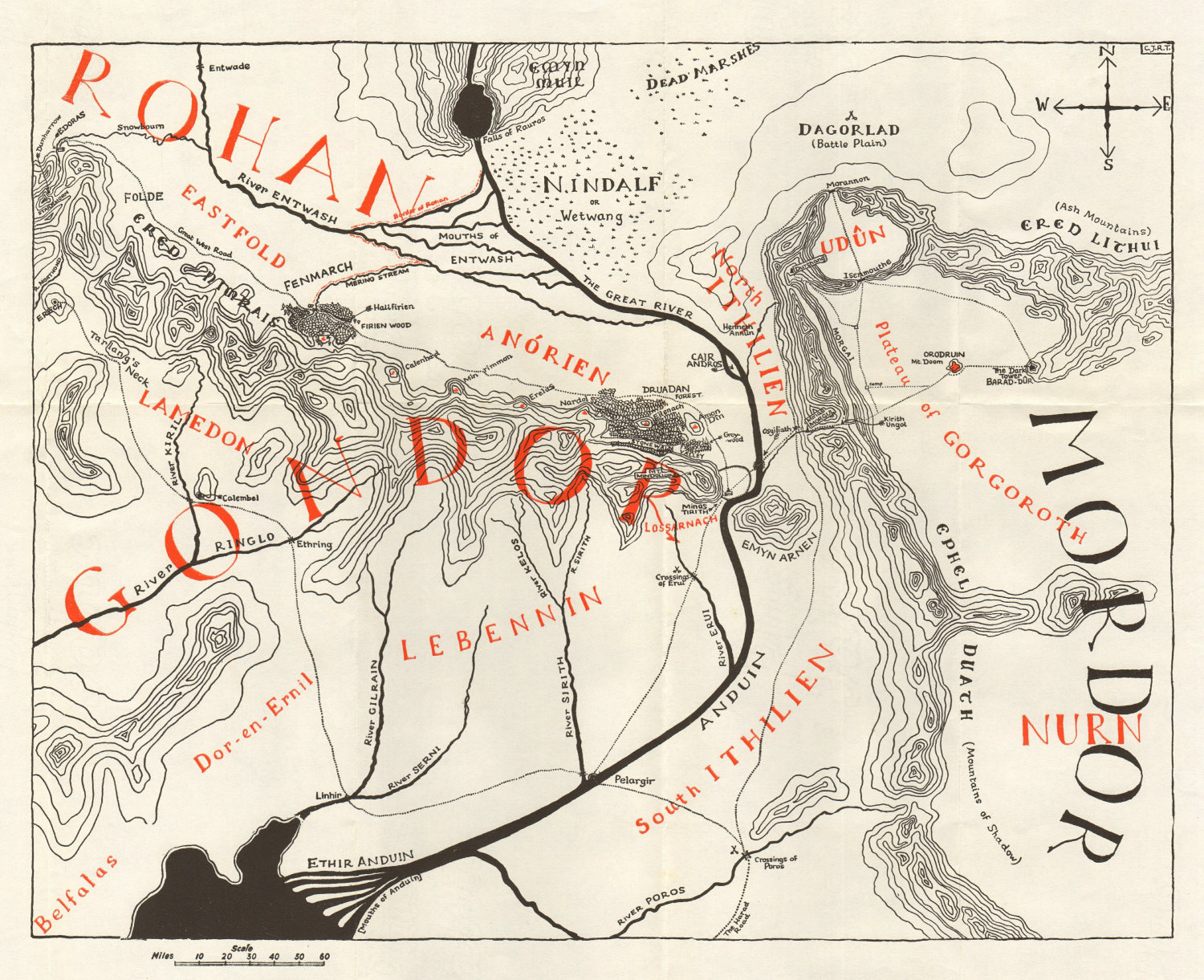
they are still active and numerous, but concealed behind the barrier of the Ephel Duath, the “Mountains of Shadow”, to the east, in Mordor.

(a much-redrawn map, beginning with JRRT. For more details, see: https://tolkiengateway.net/w/index.php?title=Map_of_Rohan,_Gondor,_and_Mordor&section=2 )

Gondor’s pretend embassy rides out, hoping to keep Sauron’s eye upon them.

(from the Jackson film)

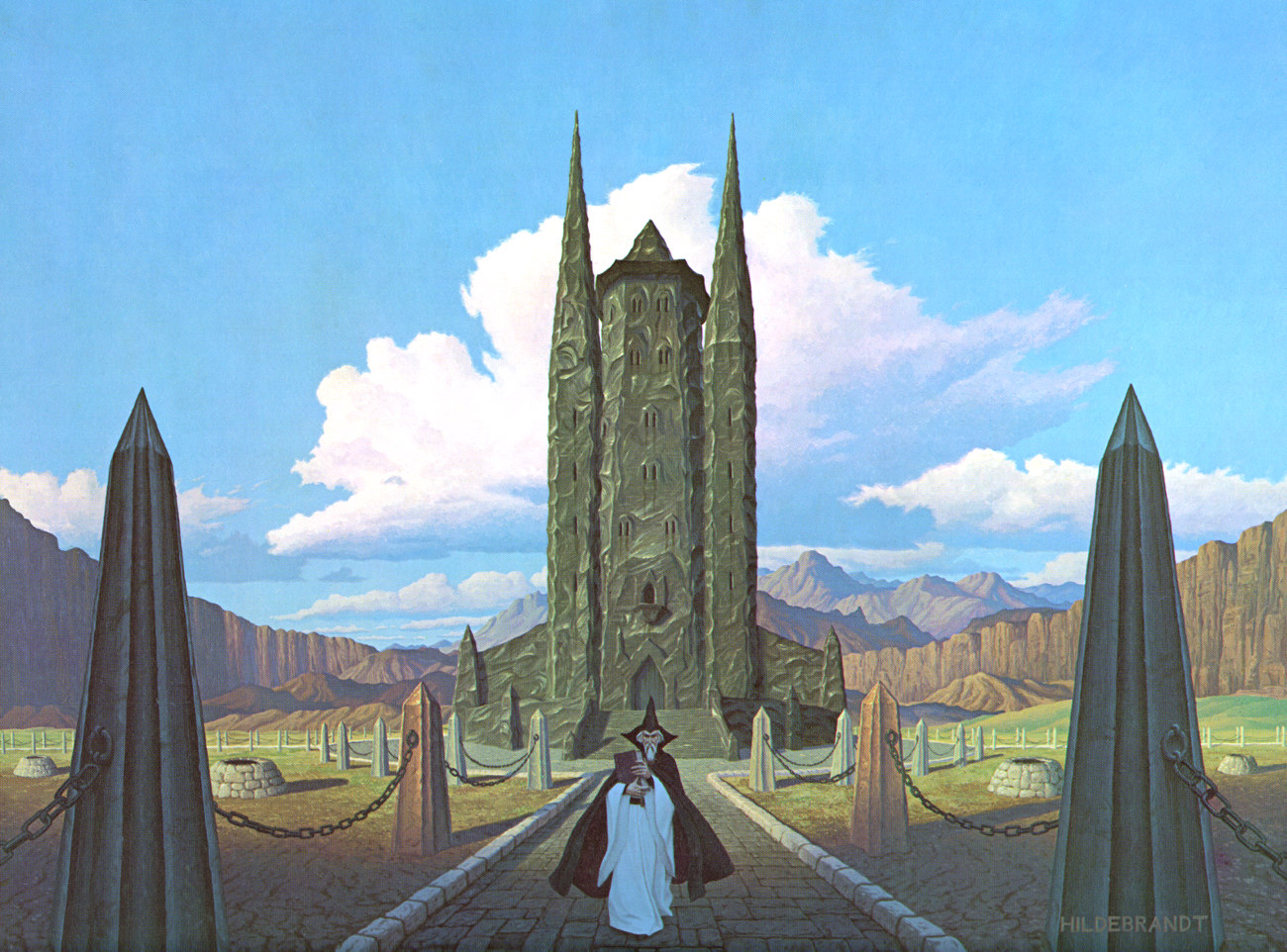
As they approach the Black Gate,

(the Hildebrandts)

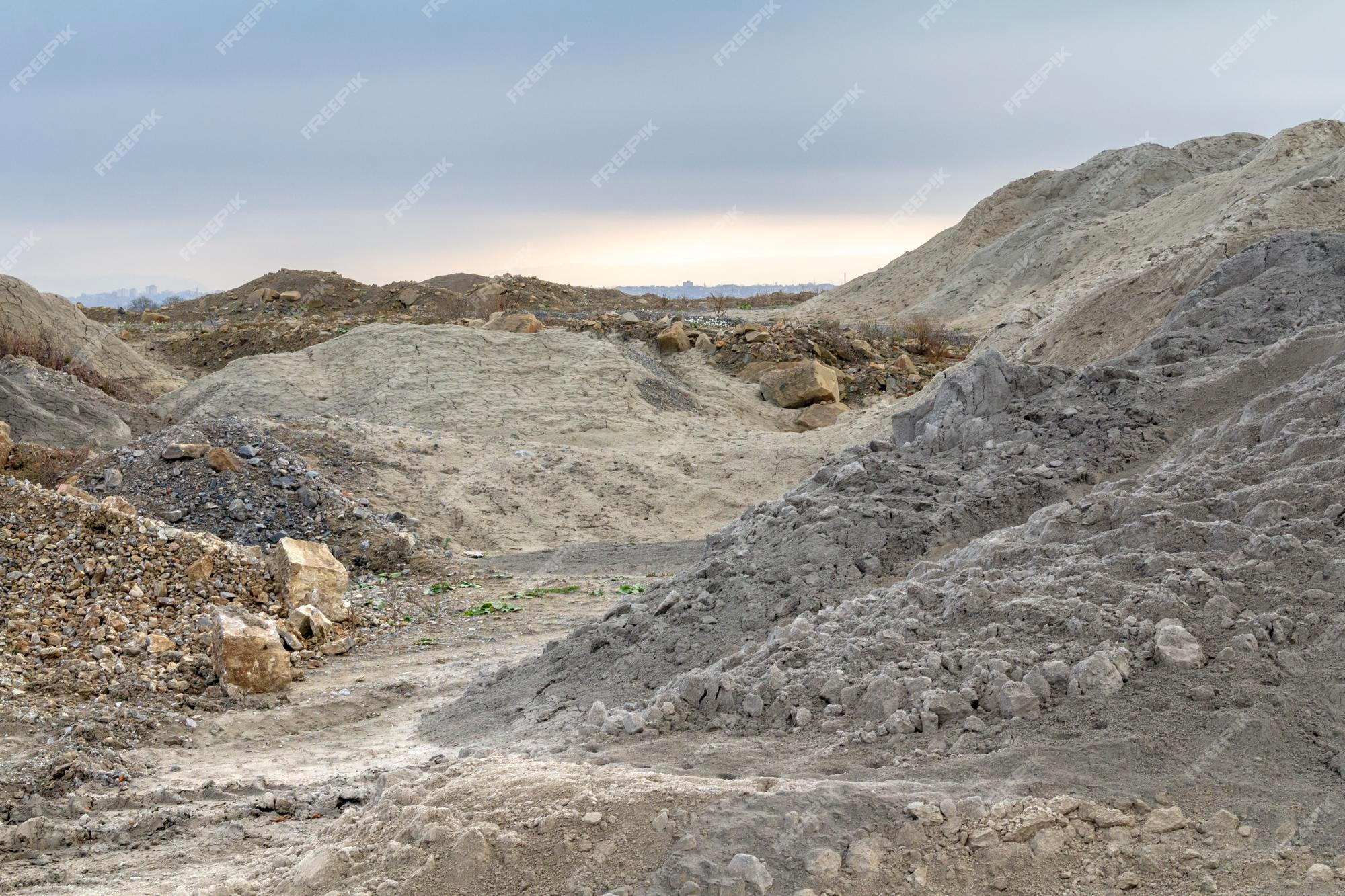
they ride through the effects of the Industrial Revolution which JRRT so disliked:

“North amid their noisome pits lay the first of the great heaps and hills of slag and broken rock and blasted earth, the vomit of the maggot-folk of Mordor…”  (The Return of the King, Book Five, Chapter 10, “The Black Gate Opens”)

If we hadn’t known previously about Tolkien’s opinion of such, language choices like “vomit” and “maggot-folk”, would have told us all we needed to know and, in this posting, I want to talk a little about a particular form of language, that of diplomacy, in the scene which follows.

The embassy waits before the Black Gate in “a great mire of reeking mud and foul-smelling pools”  until, in a carefully-prepared entry, Sauron’s emissary appears:

“There came a long rolling of great drums like thunder in the mountains, and then the braying of horns that shook the very stones and stunned men’s ears.  And thereupon the door of the Black Gate [that is to say a wicket gate:  a smaller gate within a larger one, like this—

although clearly larger than this one] was thrown open with a great clang, and out of it there came an embassy from the Dark Tower.

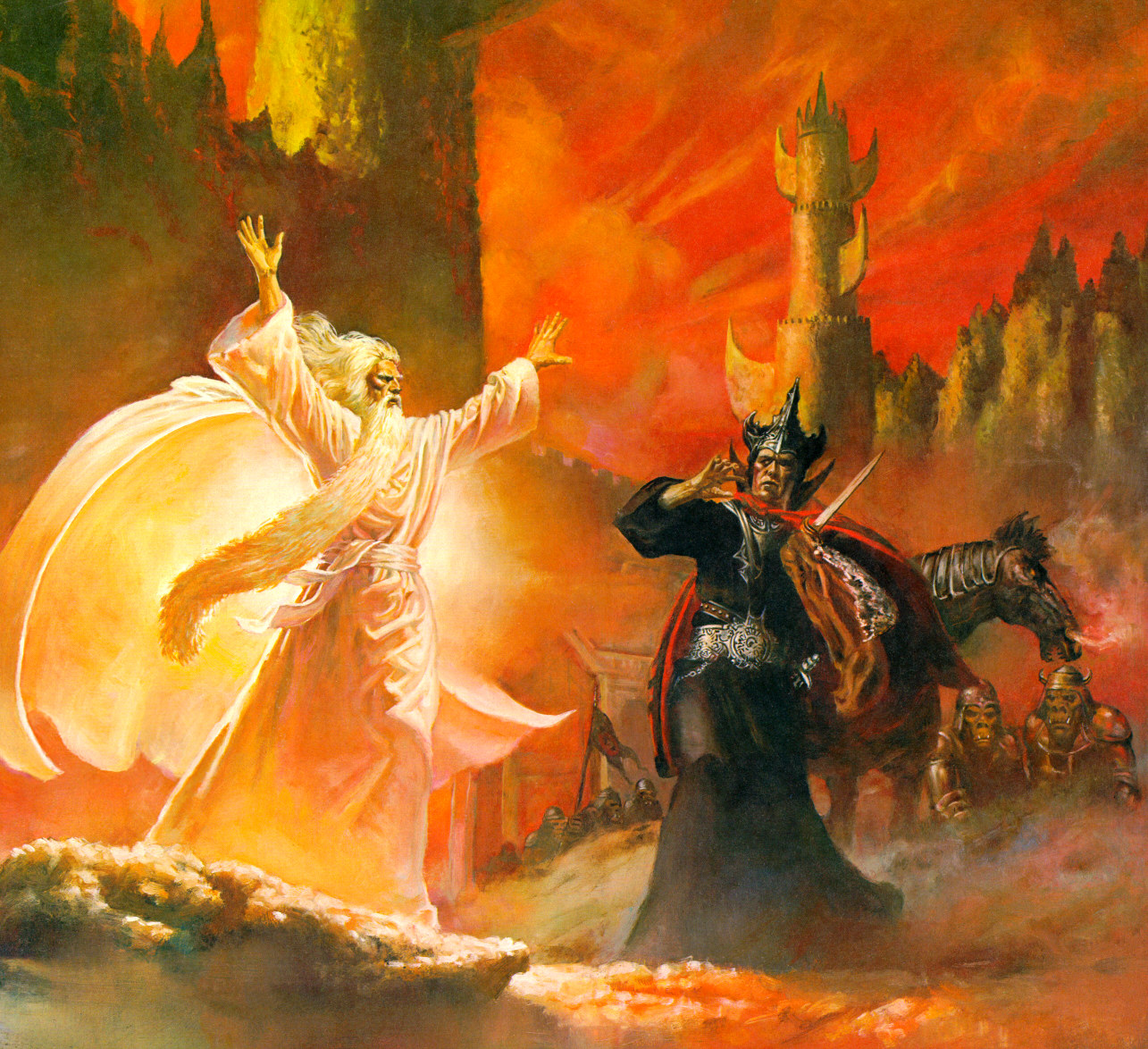
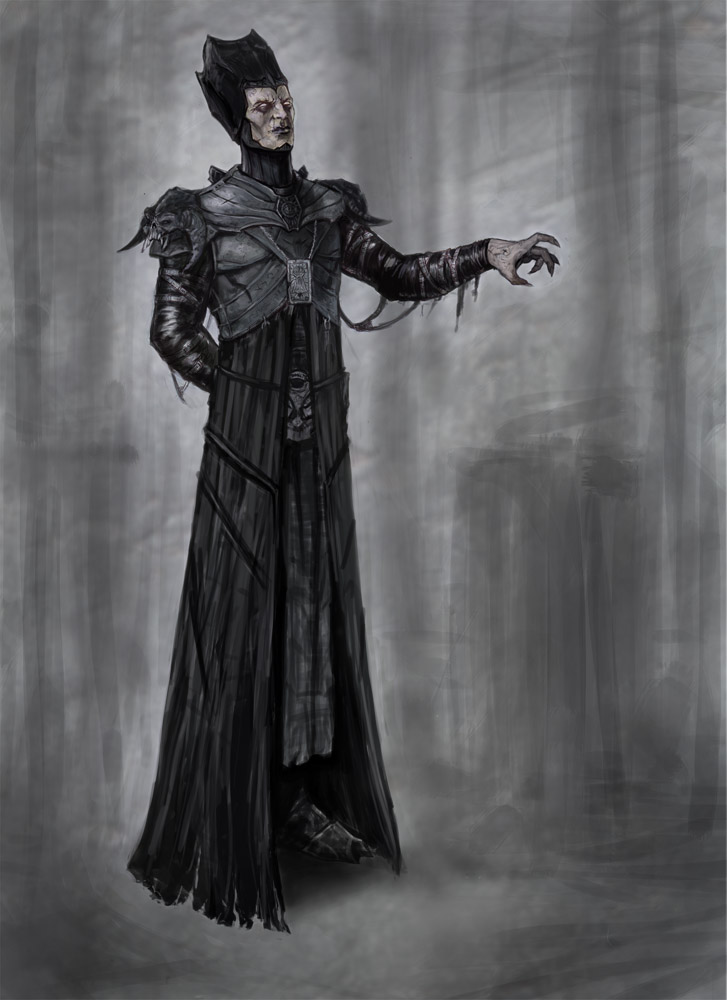
At its head there rode a tall and evil shape…”

(Douglas Beekman—you can read more about this extremely productive sf/fantasy illustrator here:  https://www.askart.com/artist/Doug_L_Beekman/122294/Doug_L_Beekman.aspx )

The emissary—“the Mouth of Sauron”—speaks first and we see already the approach he takes:

“Is there anyone in this rout with authority to treat with me?”

Already he has turned representatives of Gondor into nothing more than an armed mob—a “rout”.

He continues:

“Or indeed with wit to understand me?”

Not only a mob, then, but a stupid one.

Then, turning to Aragorn—

“It needs more to make a king than a piece of Elvish glass, or a rabble such as this.  Why, any brigand of the hills can show as good a following.”

And you can see the general idea—

1. this isn’t an army, but a collection of nobodies—and a small one, at that

2. they are nothing but oafs

3. their leader is nothing more than a bandit chief who has appointed himself king

Gandalf then upbraids him:

“It is also the custom for ambassadors to use less insolence.  But no one has threatened you.”

To which the Mouth replies:

“So…Then thou arr the spokesman, old graybeard?  Have we not heard of thee at whiles, and of thy wanderings, ever hatching plots and mischief at a safe distance?”

First, there’s the implication that Gandalf is a doddering old man, then that he’s a plotter and of no certain abode, and then that he’s a coward.  It’s also important to notice the linguistic difference in his and Gandalf’s speech.  Unlike certain other Indo-European languages, including German, French and Italian, Modern English has abandoned the second person singular of verbs—no “thou/thy/thee”.  It’s “you” for everything.  The use of the second person singular is still preserved in those other languages and, at least in traditional French, is reserved for speaking to children, pets, loved ones, and close friends, (and, in older days, servants), there even being verbs, tutoyer, “to use thou” and vouvoyer, “ to use you”, to indicate which you might employ.  When uncertain, a person might ask, “On peut tutoyer?”—“Can we use thou?”  The advantage it provides, as we can see here, is that, whereas Gandalf is being polite, or at least neutral, the Mouth of Sauron is being  intentionally insulting—the old expression being “too familiar”—or at least downgrading Gandalf from an equal to someone of lower status, or even a child, which goes along with his earlier question as to whether anyone had the understanding (“wit”) to have a discussion with him.

The Mouth then shows Frodo’s gear, taken from him in Minas Morgul, and Pippin, recognizing it, “sprang forward with a cry of grief”, even as Gandalf tries to stop him, which gives the Mouth another opportunity:

“So you have yet another of these imps with you!…What use you find in them I cannot guess; but to send them as spies into Mordor is beyond even your accustomed folly.  Still, I thank him, for it is plain that this brat at least has seen these tokens before, and it would be vain for you to deny them now.”

Not content with downgrading the Gondorians, Aragorn, and Gandalf, hobbits are now either “imps”—that is, small demons, as in “imps of Satan” in our Middle-earth, or children, “brats”.  He then goes on to call the Shire “the little rat-land” as he builds what he claims the so-far successful resistance to Sauron actually is:

“Dwarf-coat, elf-cloak, blade of the downfallen West, and spy from the little rat-land of the Shire—nay, do not start!  We know it well—here are the marks of a conspiracy.”

Now we see where all of this is leading:  to Sauron’s terms—which are not about a cease-fire or a deal between equals, but simply a form of surrender:

“The rabble of Gondor and its deluded allies shall withdraw at once beyond the Anduin, first taking oaths never again to assail Sauron the Great in arms, open or secret.”

This repeats the Mouth’s earlier characterizing of the emissaries from Gondor as a mob—and the suggestion that they are nothing more than a group of plotters against Sauron’s (legitimate) authority.

“All lands east of the Anduin shall be Sauron’s for ever solely.”

His earlier struggles with the West had led to his defeat and loss of control of those lands, so here Sauron is attempting to guarantee that they stay in his hands this time.

“West of the Anduin as far as the Misty Mountains and the Gap of Rohan shall be tributaries to Mordor, and men there shall bear no weapons, but shall have leave to govern their affairs.”

Here we see the Rohirrim being:

a. disarmed

b. forced to pay tribute

“But they shall help to rebuild Isengard which they have wantonly destroyed…”

“wantonly” suggests, of course, that it was done without purpose—and, remembering what Saruman was actually up to, this is actually laughable, but it’s also a piece with the general tone:  we are the legitimate authorities, you have plotted against us and rebelled and with no good reason.

And then we see what the Mouth has in mind for himself:

“…and that shall be Sauron’s and there his lieutenant shall dwell:  not Saruman, but one more worthy of trust.”

(“Looking in the Messenger’s eyes they read his thought:  He was to be that lieutenant, and gather all that remained of the West under his sway; he would be their tyrant and they his slaves.”)

So far, all of this has been demands on Sauron’s part, but what will he give in return?

“It seemed then to Gandalf, intent, watching him as a man engaged in fencing with a deadly foe, that for the taking of a breath, the Messenger was at a loss; yet swiftly he laughed again,

‘Do not bandy words in your insolence with the Mouth of Sauron!…Surety you crave!  Sauron gives none.  If you sue for his clemency, you must first do his bidding.  These are his terms.  Take them or leave them.’ “

Putting all of this together, we see that, unlike the “custom of ambassadors” of Gandalf, this is a carefully-planned verbal attack, first denigrating the other side’s position for negotiating, then suggesting that, unlike an opposing state, the Gondorians are nothing more than illegimate plotters, then making a series of demands for which they are offered nothing in return except possible “clemency”.  

This, then, is not a treaty—none is offered—but the treatment of rebellious slaves and well deserves Gandalf’s rebuke which, you’ll notice, returns some of the Mouth’s medicine to him, even if not using “thou”:

“But as for your terms, we reject them utterly.  Get you gone, for your embassy is over and death is near to you.  We did not come here to waste words in treating with Sauron, faithless and accursed; still less with one of his slaves.  Begone!”

Is the Mouth’s reaction surprising, then?

“Then the Messenger of Mordor laughed no more.  His face was twisted with amazement and anger to the likeness of some wild beast that, as it crouches on its prey, is smitten on the muzzle with a stinging rod.  [How appropriate for the Mouth!]  Rage filled him and his mouth slavered, and shapeless sounds of fury came strangling from his throat.  But he looked at the fell faces of the Captains and their deadly eyes, and fear overcame his wrath.  He gave a great cry, and turned, leaped upon his steed, and with his company galloped madly back to Cirith Gorgor.”

A fitting end—wordless, he flees—undoubtedly with Gandlaf’s last words in his ears:  “…slave.  Begone!”

Thanks, as always, for reading.

Stay well,

Avoid evil emissaries with their own agendas,

And remember that, as always, there’s

MTCIDC

O
Into the Fire

19 Wednesday Feb 2025

Posted by Ollamh in Uncategorized

≈ Leave a comment

Tags

Aetius, Attila, Chalons, Denethor, Faramir, Gandalf, lotr, Middle-earth, Palantir, Pippin, Saruman, Sauron, Tolkien

As ever, welcome, dear readers.

I’ve always admired the way in which JRRT shows the slow descent of Denethor into darkness, from someone who rules Gondor

(Denis Gordeev)

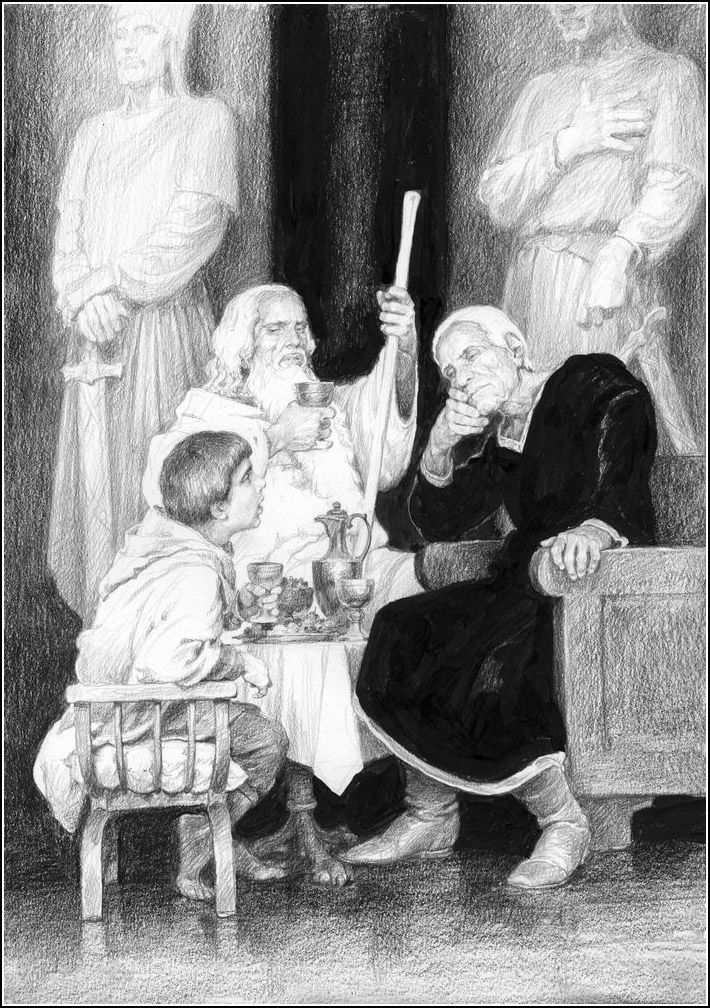
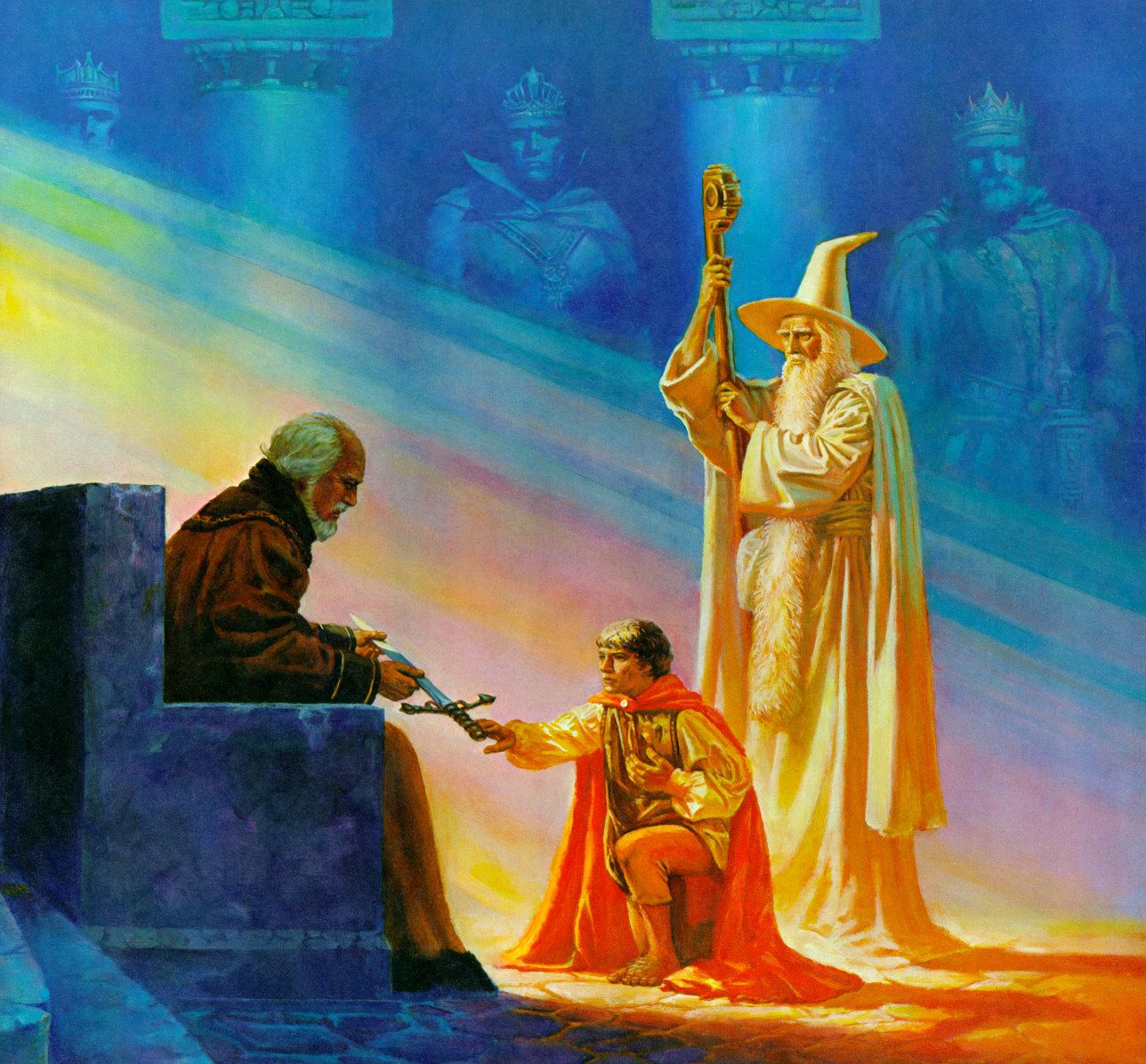
as if he were its rightful king, accepting Pippin’s offer of allegiance,

(Douglas Beekman—a prolific sci-fi fantasy illustrator.  You can see numbers of his illustrations here:  https://www.isfdb.org/cgi-bin/ea.cgi?23068  This catalogue if from the Internet Speculative Fiction Data Base, a wonderfully rich site if you have an interest in sci-fi.)

to the pensive and grieving father,

(an Alan Lee sketch)

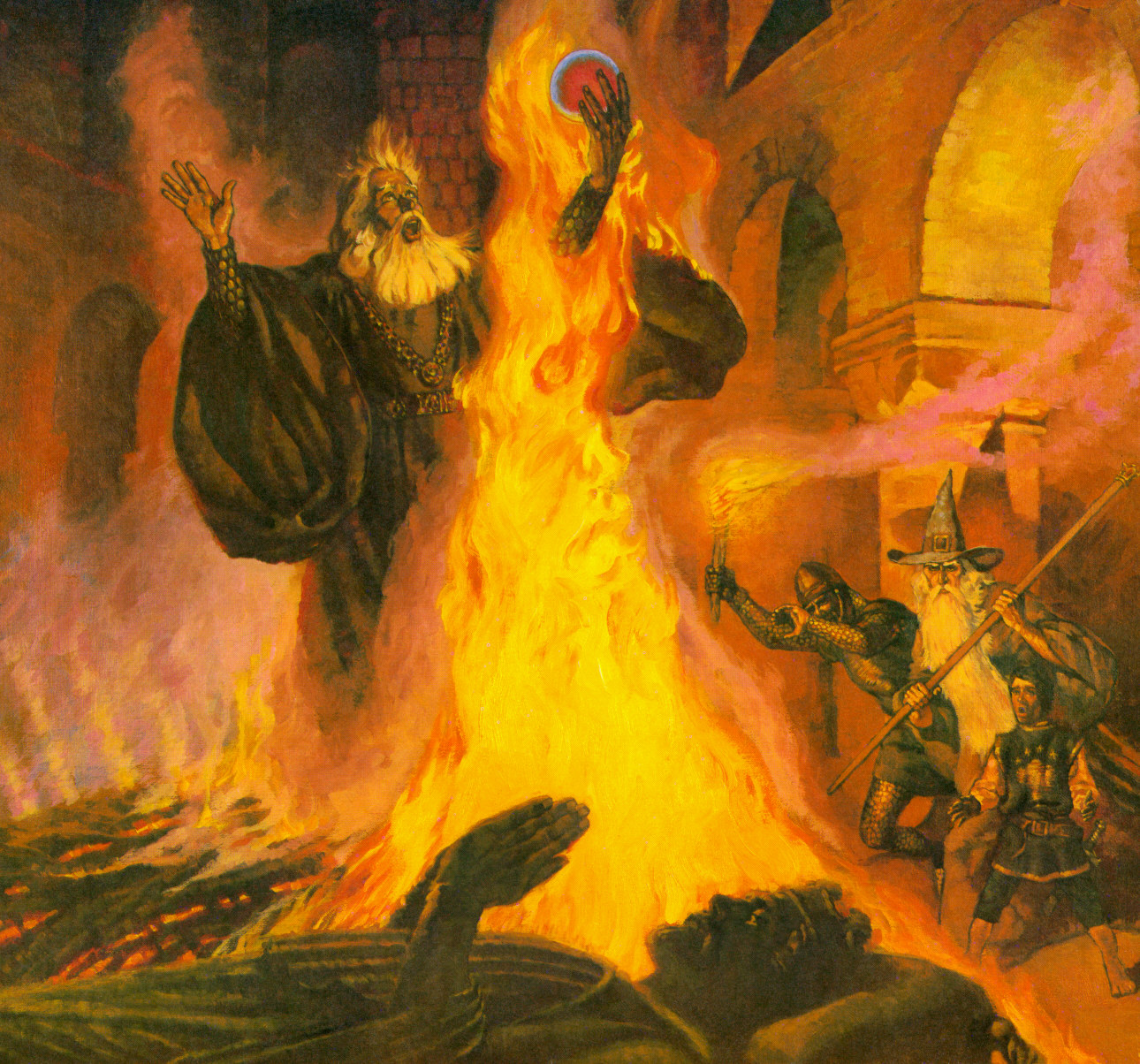
to the desperate madman of his last scene—

(artist? so far, I can’t locate one)

But that last scene has always impressed me as Tolkien at his dramatic best.

It begins with the setting:

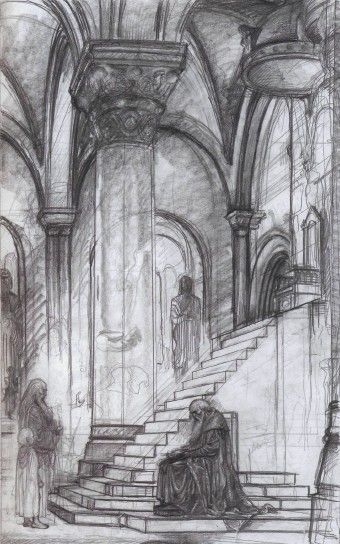
“There Pippin, staring uneasily around him, saw that he was in a wide vaulted chamber, draped as it were with the great shadows that the little lantern threw upon its shrouded walls.  And dimly to be seen were many rows of tables, carved of marble; and upon each table lay a sleeping form, hands folded, head pillowed upon stone.  But one table near at hand stood broad and bare.  Upon it at a sign from Denethor they laid Faramir and his father side by side, and covered them with one covering, and stood then with bowed heads as if mourners beside a bed of death.”

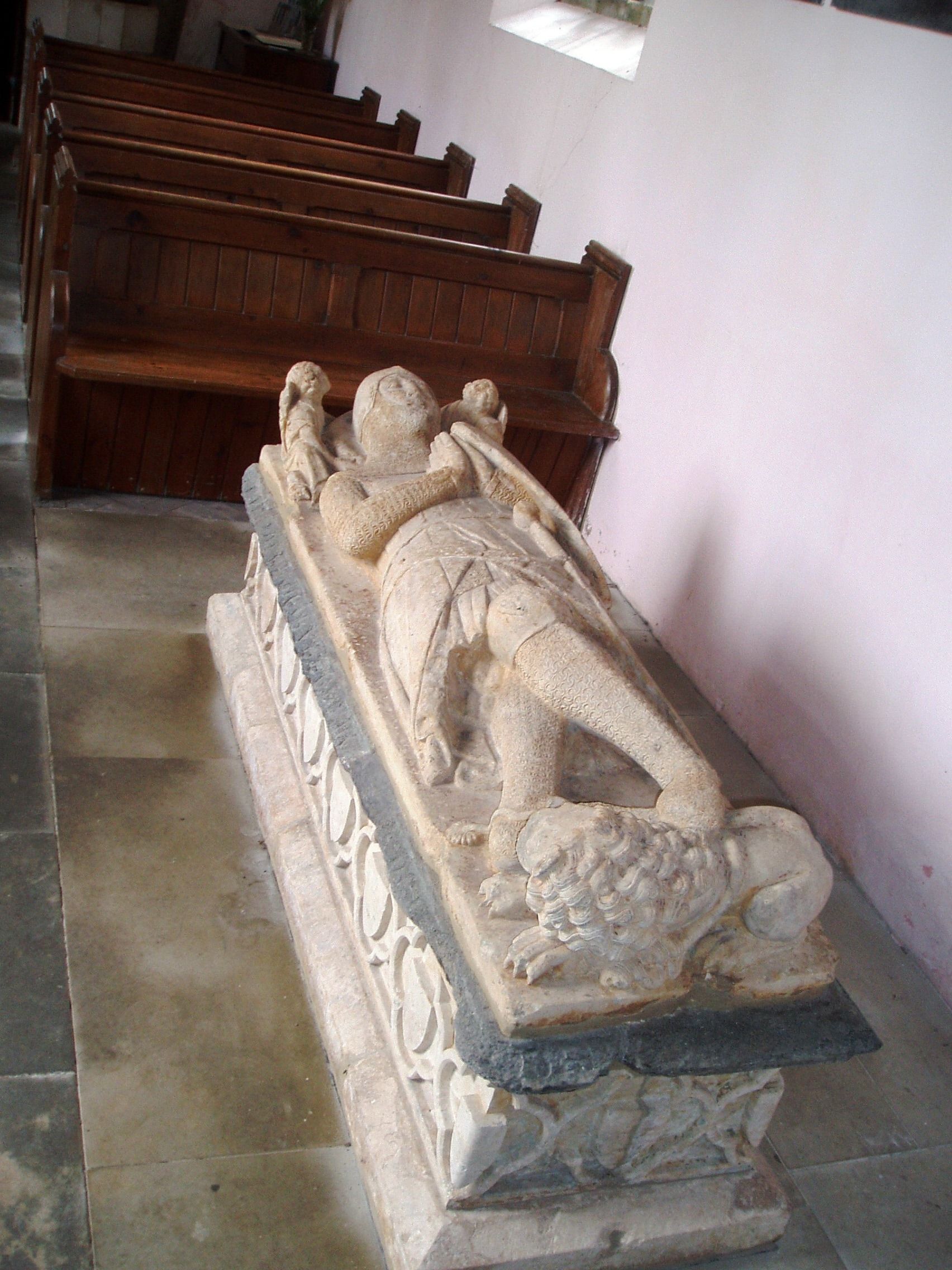
I think that we can imagine that JRRT’s image here is based upon any number of medieval English churches, with their tombs, usually along the walls, or,

more grandly,  the basilica of St Denis, in a northern suburb of Paris,

of which he might have seen a photo.  (As I haven’t found a reference that he had actually visited the place.)

What happens next, however, has a different model—or, rather, perhaps two. 

After having himself and Faramir placed on that empty table, Denethor then makes the terrible command:

“ ‘Here we will wait,’ he said.  ‘But send not for the embalmers.  Bring us wood quick to burn, and lay it all about us, and beneath; and pour oil upon it.  And when I bid you thrust in a torch.’ “ (all of the above from The Return of the King, Book Five, Chapter 4, “The Siege of Gondor”)

What’s going on here?   When Gandalf, summoned by Pippin attempts to stop this, Gandalf says to Denethor:

“ ‘Authority is not given to you, Steward of Gondor, to order the hour of your death,’…And only the heathen kings, under the domination of the Dark Power, did thus, slaying themselves in pride and despair, murdering their kin to ease their own death.’”  (The Return of the King, Book Five, Chapter 7, “The Pyre of Denethor”)

“Heathen”, from Old English haethen, came into English with the meaning “non-believer (in Christianity)” and seems, at first, rather an odd word for Gandalf to have employed, as Tolkien has written himself that “…the ‘Third Age’ was not a Christian world.” (letter to the Houghton Mifflin Co., 30 June, 1955, Letters, 319)

I wonder, however, whether JRRT was remembering something from early medieval history, which he might have read in conjunction with his early avid study of Gothic (which almost ruined his academic career—see his letter to Christopher of 2 January, 1969 (Letters, 558).

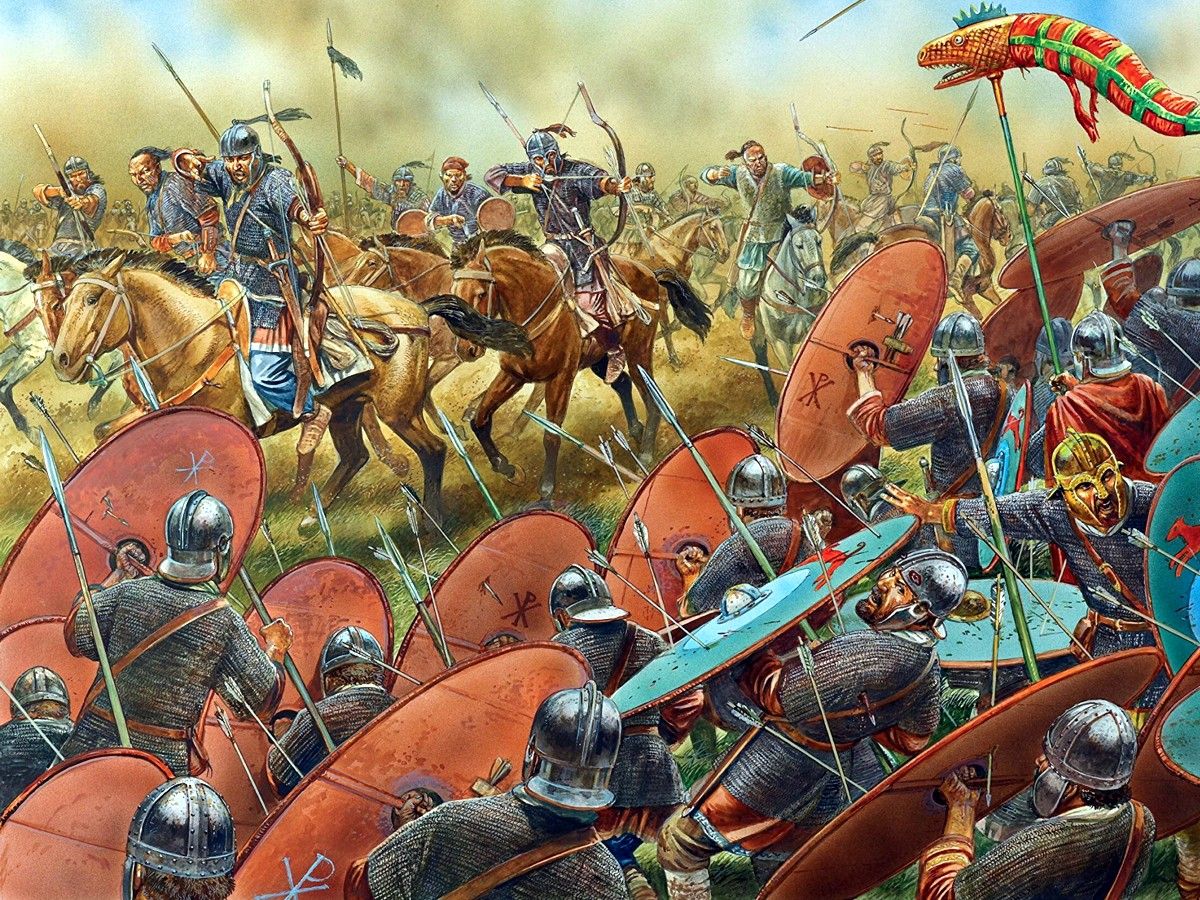
It’s in the account by the 6th-century Gothic historian, Jordanes, of the Battle of the Catalaunian Plains (also known as the Battle of Chalons), between Roman and their Germanic allies, including Visigoths, led by the Roman general, Aetius, and an invading army of Huns and their subject peoples, led by Attila, a battle fought on 20 June, 451.

(by Peter Dennis, one of my favorite contemporary military artists)

The battle was very much a back-and-forth affair, but late in it, the Huns had been driven back to their camp and Attila, usually the soul of confidence, was troubled–and this is where Jordanes’ description comes in:

Fertur autem desperatis rebus praedictum regem adhuc et suppraemo magnanimem equinis sellis construxisse pyram seseque, si adversarii inrumperent, flammis inicere voluisse, ne aut aliquis eius vulnere laetaretur aut in potestate hostium tantarum gentium dominus perveniret.  (Jordanes, De Origine Actibusque Getarum, XL, 213—my translation)

“It is said, moreover, that things were [so] despaired of, that the king [that is, Attila] still supremely brave,  commanded at this point that [they] build a pyre from horse saddles and, should the enemy break in [to his camp], he wished to throw himself into the flames lest either anyone take joy in wounding [him] or lest he, the master of so many peoples come into the power of the enemy.”

None of Attila’s kin is involved in this potential self-immolation, but certainly the pride is there and even despair (as in that “desperatis rebus”) which Gandalf mentions.

But, as I said earlier, there might be another model—and perhaps an even darker one.  Notice that

“But one table near at hand stood broad and bare.”

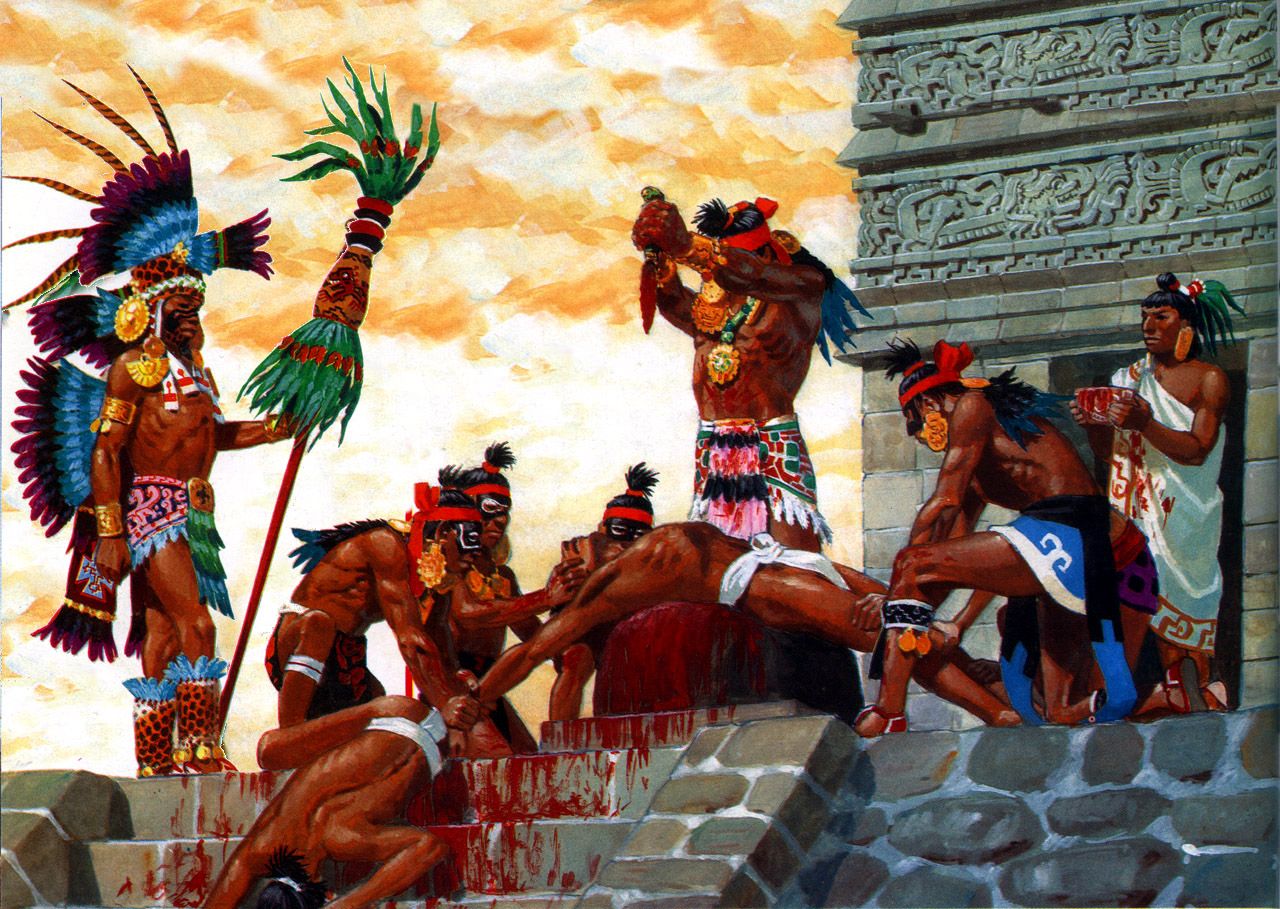
What immediately came to mind was that it resembled an altar—not a Christian one, but something from a different world, in which the symbolic sacrifice of the Christian religion was a real sacrifice—

(artist unknown)

I thought of this because of something which Tolkien had written about Sauron, who has become the prisoner of the Numenorean king Tar-Calion:

“…and seduces the king and most of the lords and people with his lies.  He denies the existence of God, saying that the One is a mere invention of the jealous Valar of the West, the oracle of their own wishes.  The chief of the gods is he that dwells in the Void, who will conquer in the end, and in the void make endless realms for his servants…

A new religion, and worship of the Dark, with its temple under Sauron arises.  The Faithful are persecuted and sacrificed.”  (letter to Milton Waldman, late 9n 1951, Letters, 216)

Why, we might ask, is Denethor so prepared to make a fiery end to himself and his son?

“ ‘Come!’ said Gandalf.  ‘We are needed.  There is much that you can yet do.’

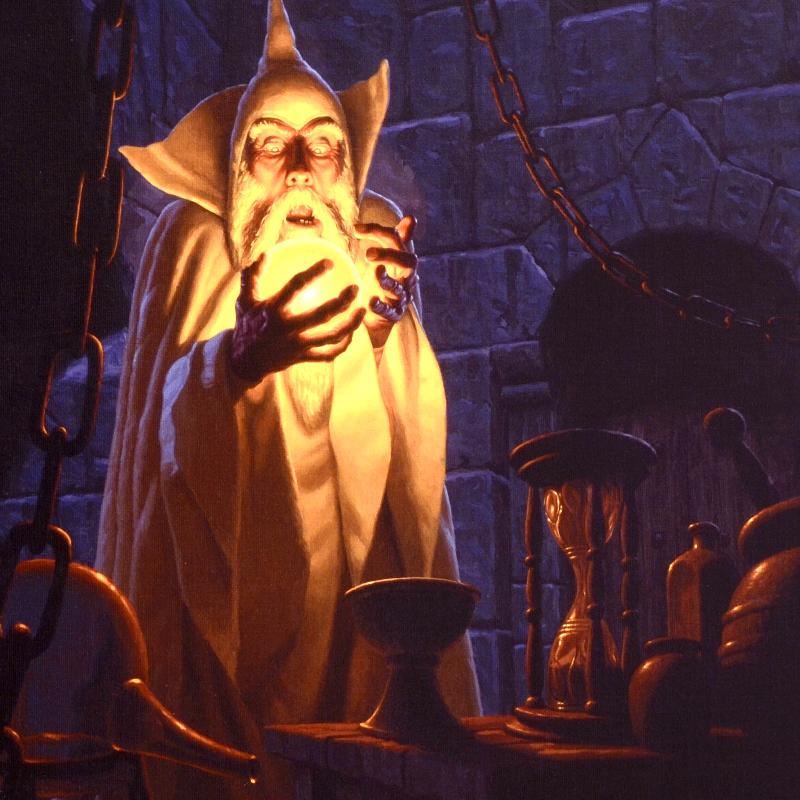
Then suddenly Denethor laughed.  He stood up tall and proud again, and stepping swiftly back to the table he lifted from it the pillow on which his head had lain.  Then coming to the doorway he drew aside the covering, and lo!  he had between his hands a palantir.  And as he held it up, it seemed to those that looked on that the globe began to glow with an inner flame, so that the lean face of the Lord was lit as with a red fire, and it seemed cut out of hard stone, sharp with black shadows, noble, proud, and terrible.  His eyes glittered.

‘Pride and despair!’ he cried.  ‘Didst thou think that the eyes of the White Tower were blind?  Nay, I have seen more than thou knowest, Grey Fool.  For thy hope is but ignorance.  Go then and labour in healing!  Go forth and fight!  Vanity….The West has failed.  It is time for all to depart who would not be slaves.”

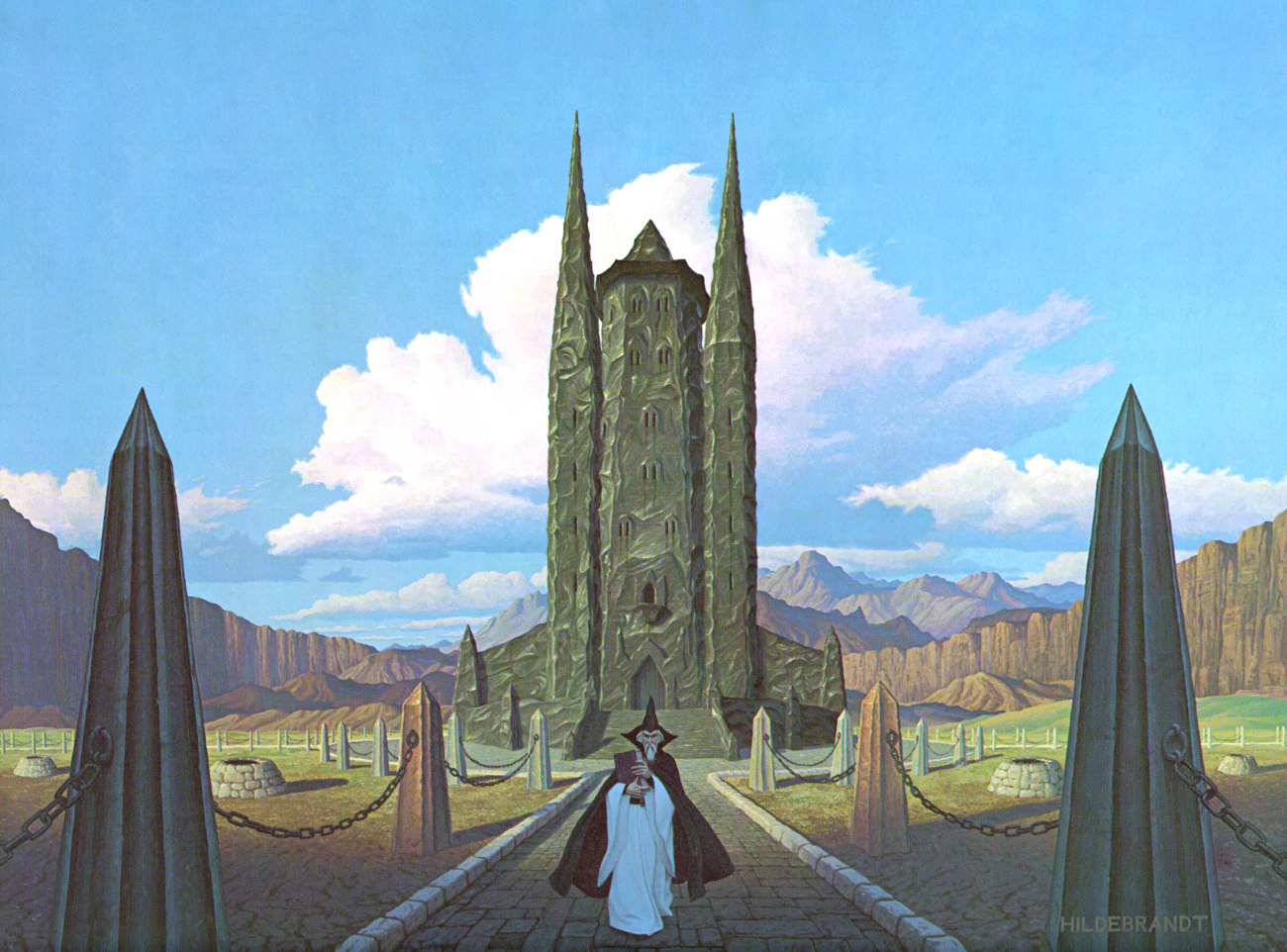
And the answer is in that palantir.  As it had earlier corrupted Saruman,

(the Hildebrandts)

and nearly driven Pippin mad with only one look into it, so it has shown Denethor exactly what Sauron had wanted him to see and, deluded, we might imagine that, in his action, he was not only destroying the current ruler of Gondor and his son, but was also acting like the Numenoreans who were his ancestors, making a sacrifice which Sauron had once demanded of them.

And, although Faramir is rescued, Denethor:

“…leaped upon the table, and standing wreathed in fire and smoke he took up the staff of his stewardship that lay at his feet and broke it on his knee.  Casting the pieces into the blaze he bowed and laid himself on the table, clasping the palantir with both hands upon his breast.  And it was said that ever after, if any man looked in that Stone, unless he had a great strength of will to turn it to other purpose, he saw only two aged hands withering in flame.”

And so Sauron had his sacrifice.

Thanks, as ever, for reading.

Stay well,

And remember that, as always, there’s

MTCIDC

O

Speak Friend, or, Open, Sez Me

22 Wednesday May 2024

Posted by Ollamh in Uncategorized

≈ Leave a comment

Tags

books, Fantasy, Gandalf, The Hobbit

As always, welcome, dear readers.

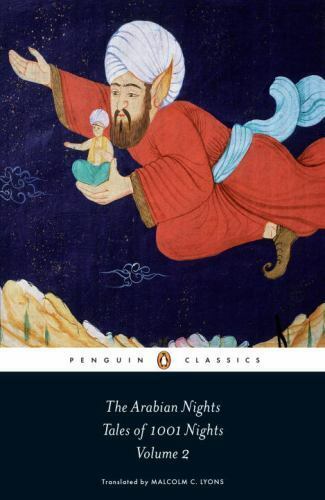
Occasionally, I return to something I’ve already written about, but, this time around, hope to see in a new, or at least newish, light.  The subject of today’s posting first appeared back in “Do What I Say, Not What I Speak”, 13 June, 2018, but, since then, I began my campaign to read all of The Arabian Nights and am now in the second volume of the Penguin edition (for the first volume, see “Arabian Nights for Days”, 31 January, 2024).

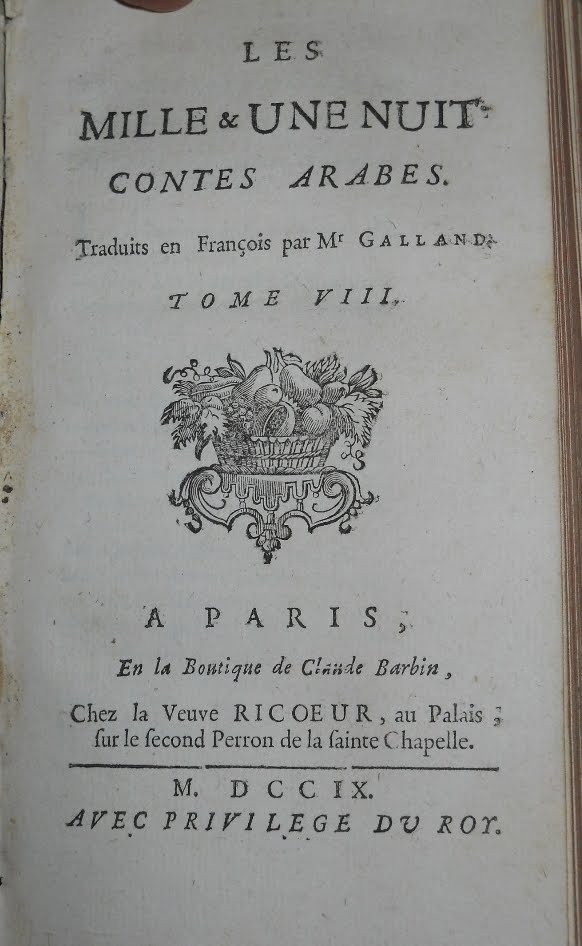
I’ve known some of the stories in this vast collection since childhood, but the first two stories I heard as a child are actually so-called “orphan tales”, being stories which appear to have no early manuscript tradition, first appearing in Antoine Galland’s (1646-1715)

Les Mille et Une Nuits (1704-1717).

and from there into the first edition in English, the anonymous so-called “Grub Street Edition” of 1706-1721.

(This is an image from the earliest edition I can locate—as you can see, it’s from 1781.  Only two copies of the first edition are known to exist, one in the Bodleian Library at Oxford, the other in the rare books collection of Princeton University and clearly they don’t get out much.)

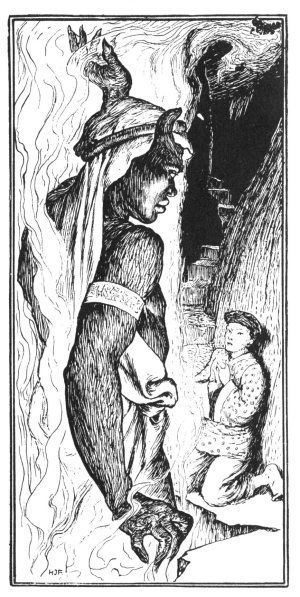
There has been much discussion as to the actual origins of “Aladdin”

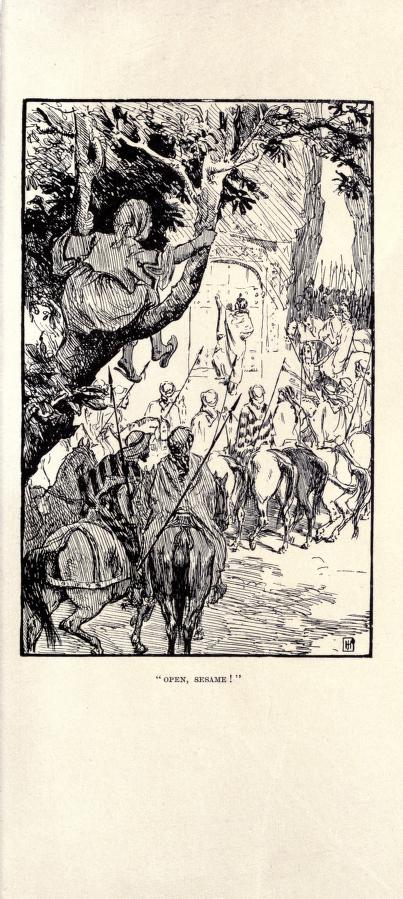
and “Ali Baba and the Forty Thieves”–

in particular, that, although they contain standard folktale motifs, they are actually the work of a Syrian storyteller named Antun Yusuf Hanna Diyab (c.1668-post-1763) and were added by Galland to his translation without attribution.  (For more, see:  https://en.wikipedia.org/wiki/Hanna_Diyab ) 

Whatever is the truth of this, these were the stories I carried in my head for years before I came back to them when commencing my “Arabian Nights” reading campaign. 

When I was small, they were actually quite scary—the magician who pretends to be Aladdin’s long-lost uncle and who only wants to use him long enough to obtain the lamp, then would let him die in the cave where the lamp was kept, and the merciless thieves, who once they found their cave with its secret password was compromised, cut up Ali Baba’s brother who had discovered the secret but, who, forgetting the password, was trapped until the thieves returned, were among the creepier parts of my childhood, and, as may always be the case with creepy things, not easily forgotten.

At the same time, I was always puzzled by the opening to “Ali Baba”:

“IN a town in Persia there dwelt two brothers, one named Cassim,

the other Ali Baba. Cassim was married to a rich wife and lived

in plenty, while Ali Baba had to maintain his wife and children by

cutting wood in a neighbouring forest and selling it in the town.

One day, when Ali Baba was in the forest, he saw a troop of men

on horseback, coming towards him in a cloud of dust. He was

afraid they were robbers, and climbed into a tree for safety.  When

they came up to him and dismounted, he counted forty of them.

They unbridled their horses and tied them to trees. The finest man

among them, whom Ali Baba took to be their captain, went a little

way among some bushes, and said: ‘ Open, Sesame!’ so plainly that

Ali Baba heard him. A door opened in the rocks, and having made

the troop go in, he followed them, and the door shut again of itself.”

Why would a door obey a password?  And why that word, which I knew was a kind of seed.

(For more—much more—see:  https://en.wikipedia.org/wiki/Sesame#Allergy )

This sat somewhere in my memory until I read:

“But close under the cliff there stood, still strong and living, two tall trees, larger than any trees of holly that Frodo had ever seen or imagined…

(JRRT)

‘Well, here we are at last!’ said Gandalf.  ‘Here the Elven-way from Hollin ended.  Holly was the token of the people of that land, and they planted it here to mark the end of their domain; for the West-door was made chiefly for their use in their traffic with the Lords of Moria.’ …

…they turned to watch Gandalf.  He appeared to have done nothing.  He was standing between the two trees gazing at the blank wall of the cliff, as if he would bore a hole into it…

 ‘Dwarf-doors are not made to be seen when shut,’ said Gimli.  ‘They are invisible, and their own makers cannot find them or open them, if their secret is forgotten.’

‘But this Door was not made to be a secret known only to Dwarves,’ said Gandalf…’Unless things are altogether changed, eyes that know what to look for may discover the signs.’

He walked forward to the wall.  Right between the shadow of the trees there was a smooth space, and over this he passed his hands to and fro, muttering words under his breath.  Then he stepped back.

‘Look!’ he said.  ‘Can you see anything now?’

…Then slowly on the surface, where the wizard’s hands had passed, faint lines appeared, like slender veins of silver running in the stone…

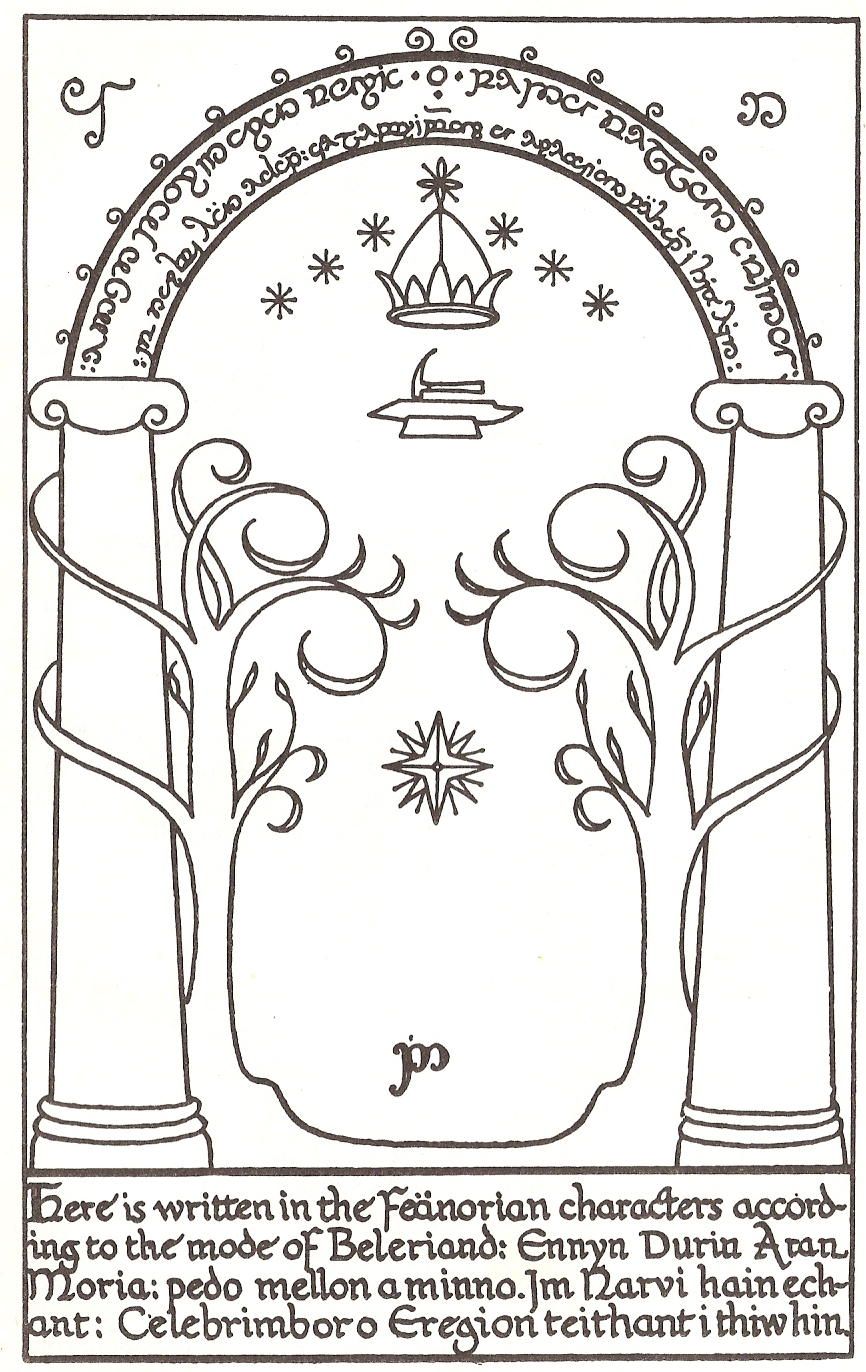
At the top, as high as Gandalf could reach, was an arch of interlacing letters of an Elvish character.

(Ted Nasmith)

Below, though the threads were in places blurred or broken, the outline could be seen…

(JRRT)

‘What does the writing say?’ asked Frodo…

‘…They say only:  The Doors of Durin, Lord of Moria.  Speak, friend, and enter.’

‘What does it mean…?’ asked Merry.

‘That is plain enough,’ said Gimli.  ‘If you are a friend, speak the password, and the doors will open, and you can enter.’ “  (The Fellowship of the Ring, Book Two, Chapter 4, “A Journey in the Dark”)

We know from various clues, like the story title “Storia Moria Castle”, that Tolkien had read—or been read to—from Andrew Lang’s (1844-1912) The Red Fairy Book, 1890,

but, interestingly, “Aladdin” and “Ali Baba” both appear in Lang’s previous The Blue Fairy Book, 1889,

from which both the “Ali Baba” quotation and illustration above, come.  Could Tolkien have been read to from, or read, “Ali Baba” there?  Certainly we see that door, and the need for the password.  But what about that password?

In The Fellowship of the Ring, Gandalf tells us that “ ‘I will tell you that these doors open outwards.  From the inside you may thrust them open with your hands.  From the outside nothing will move them save the spell of command.  They cannot be forced inwards.’   Try as he might, however, Gandalf can’t come up with that word—until he realizes that he’s made a slight mistranslation: 

“ ‘The opening word was inscribed on the archway all the time!  The translation should have been Say “Friend’ and enter.  I had only to speak the Elvish word for friend and the doors opened.’ “

To a linguist with a fine ear, like JRRT’s, the distinction, in English, between the verb “to speak”, as in “to speak a language”, and “to say”, as in “to say the right thing”, can be subtle—in this case, almost too subtle—as Gandalf says:

“ ‘Quite simple.  Too simple for a learned lore-master in these suspicious days.’ “

With the problem solved, the doors swing open—but where they’re about to go is, ultimately, worse than Ali Baba’s thieves’ treasure cave, even as I’m reminded of what happens to Ali Baba’s jealous brother.  Obtaining the password, he easily enters the cave, but, when he tries to leave, he confuses “sesame” with other grains, is trapped, and eventually dismembered by the returning thieves.  (Think Balrog and “Drums in the Dark”…)

And, though “Friend”, says Gandalf, is quite simple, and, adding, “Those were happier times” in which such a pleasant password was all that was necessary,  I’m still puzzled about “sesame” and, in both cases, I wonder about those doors—who or what was doing the opening?  Then again, when I post this,  I’ll need a password and, when I employ it, the site will pop open—who or what is doing the opening there?

Thanks, as always, for reading.

Stay well,

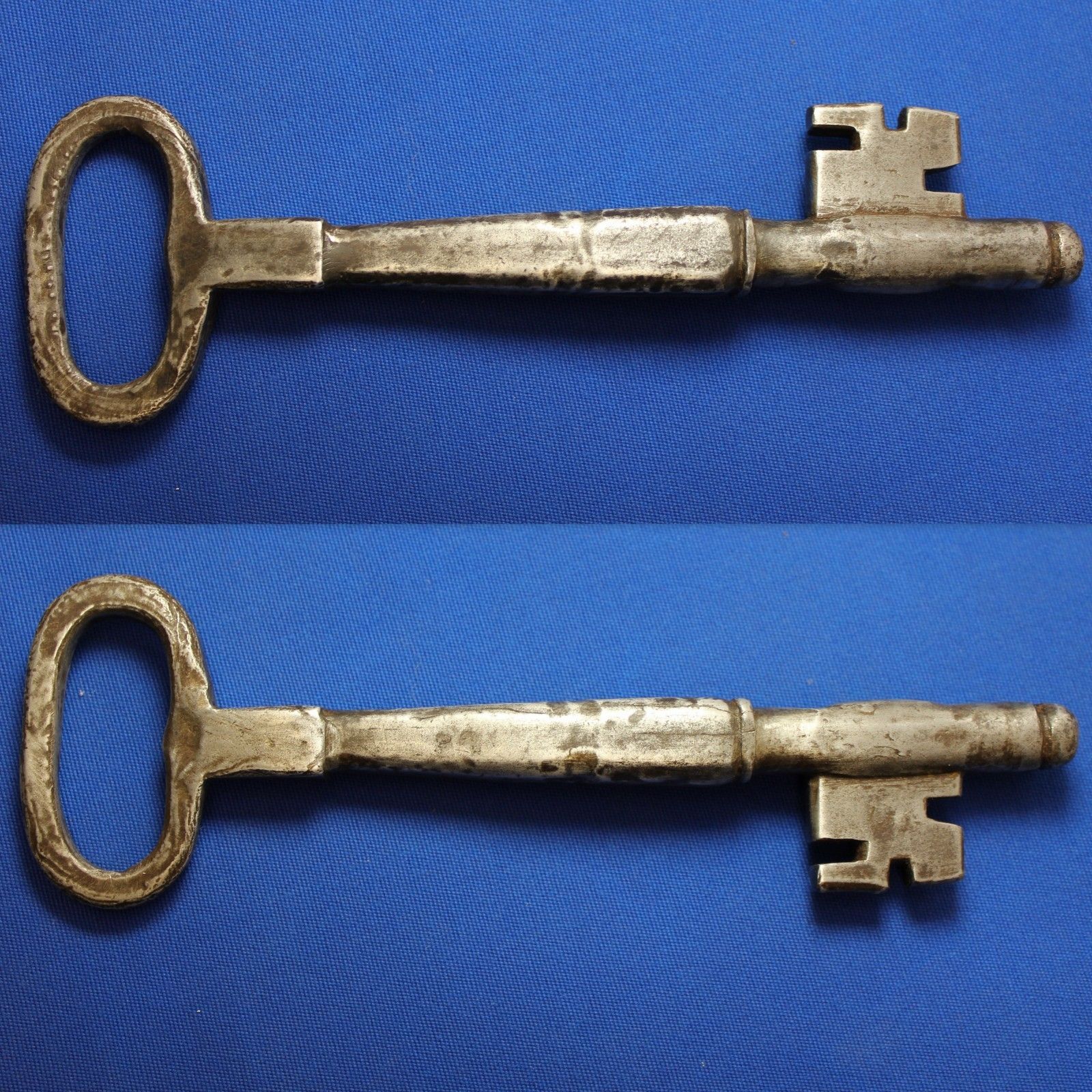
When it comes to locks, I prefer a good, sturdy key,

And remember that, as always, there’s

MTCIDC

O
PS

In case you want to read the two fairy books—and I hope you do—here they are:

The Blue Fairy Book 

https://archive.org/details/bluefairybook00langiala/page/n7/mode/2up

The Red Fairy Book

https://archive.org/details/cu31924084424013/page/n9/mode/2up

Gun Control?

08 Wednesday May 2019

Posted by Ollamh in J.R.R. Tolkien, Military History

≈ Leave a comment

Tags

anachronism, Dettingen, Fireworks, Gandalf, George Frederich Haendel, gunpowder, guns, Helm's Deep, kettle drums, King George II, Millemete Manuscript, petard, Rammas Echor, The Hobbit, The Lord of the Rings, The War of Austrian Succession, Tolkien

Welcome, dear readers, as always—and with our apology if you googled “gun control” and are a bit puzzled as to what has turned up (this often happens with us, making us wonder how googling images of “Saruman” suddenly produces a picture of sardines).

It’s our last posting which got us into this.  We had spotted another anachronism in The Hobbit (clarinets) and had written about it, but then, as a teaser, had concluded with another, referring to Beorn’s joining the Battle of the Five Armies:  “The roar of his voice was like drums and guns…” (Chapter 18, “The Return Journey”)

“Guns” had, of course, stood out.  Some time ago, we had written about Saruman’s use of some sort of explosive at Helm’s Deep

image1hd.jpg

as well as the destruction by a similar force of portions of the causeway forts of the Rammas Echor, of which no one has seemingly produced an illustration.

image2rammas.gif

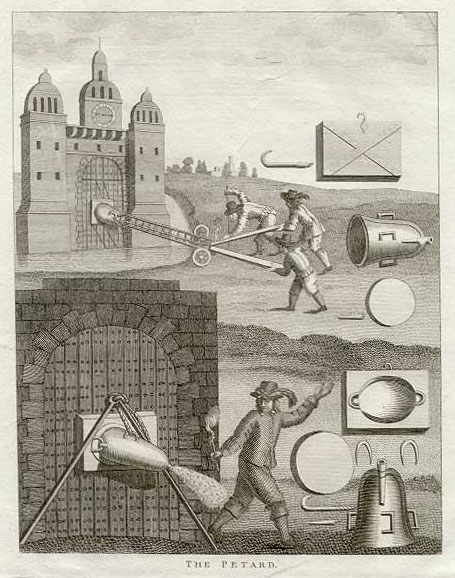
Whatever this force was, it only seems to be used in siegework, suggesting things like a petard

image3petard.jpg

an explosive device used to blow holes in gates and doors.

Guns, however, do not appear in any form in Tolkien’s world—except here.  Of course, when one thinks about it, there isn’t much of a step from using a blast to destroy a door to funneling that force to propel a missile—as we first see in the Millemete Manuscript of 1326-1327.

image4millemete.jpg

This doesn’t appear to be portable, but the basic object is simply a tube on a stick, easy to make, easy to carry

image5handgonne


and certainly late medieval people had them and employed them,

image6handgonnes.jpg

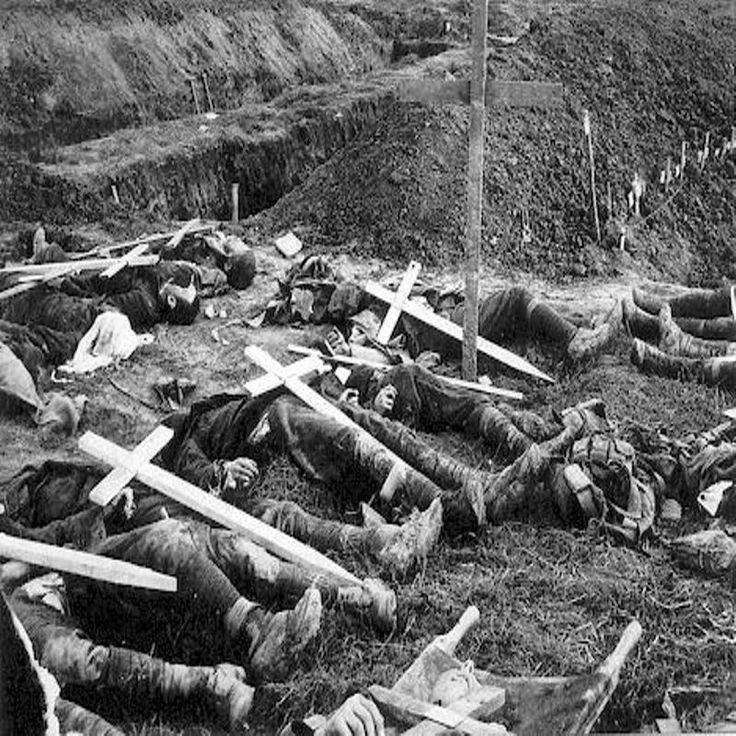
so, presumably, they might have appeared in Middle-earth (we once wrote a “what-if” posting on the subject).  Why not?  As JRRT introduced explosives, that seems to provide an opening, but we wonder if he had seen all too often and all too clearly the effect of thousands upon thousands of gunpowder weapons on real people in 1916 and, somehow, the idea of lances and swords seemed more appealing—or, at least, more “heroic”.

image7dead.jpg

image8knights.jpg

But the quotation was “like drums and guns”.

As we pointed out in our last, drums certainly appear in The Lord of the Rings—there is that disturbing reference to “drums, drums in the deep” in The Fellowship of the Ring, Book Two, Chapter 5, “The Bridge of Khazad-dum”, for example.  But what about “the roar of his voice was like drums and guns”?

When we thought about this, we asked ourselves, what would this actually sound like?  A possible answer appeared from 1749.

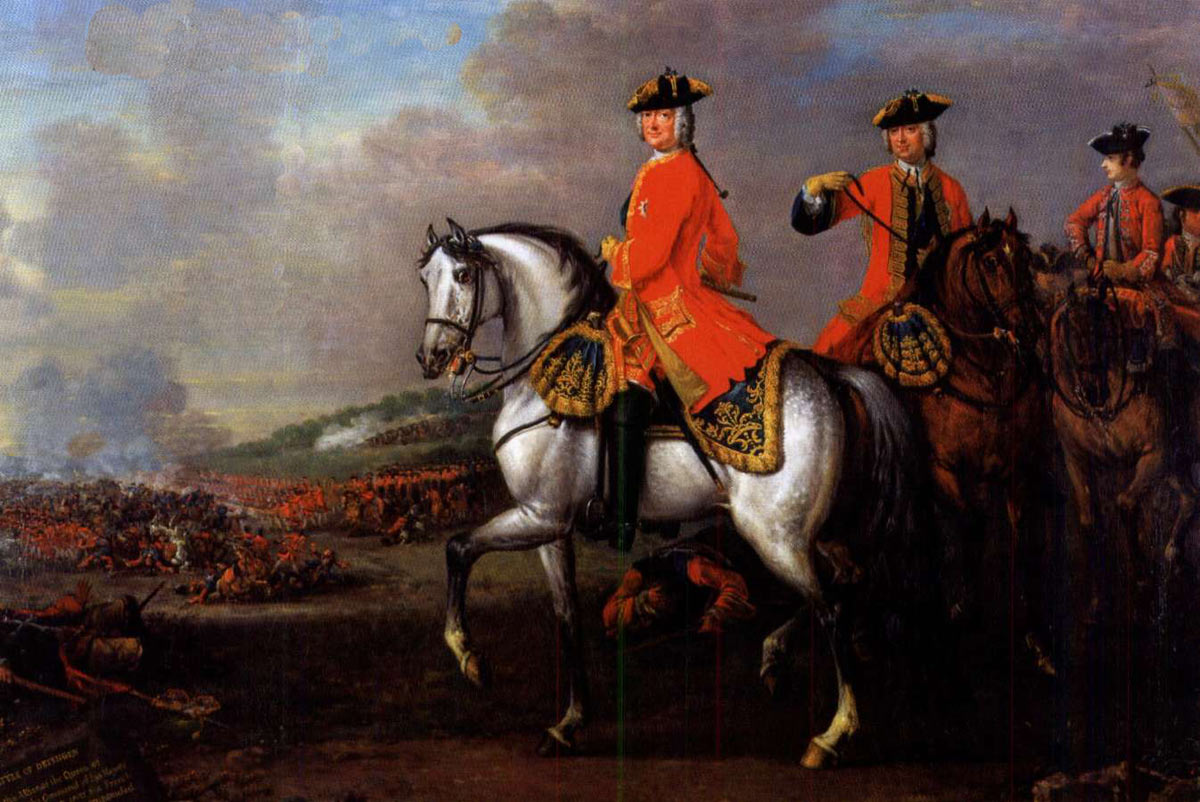
In 1749, George II of England

image9george2.jpg

had been one of the winners of what would become known as “The War of the Austrian Succession” (1740-1748).

image10geo2.jpg

He was definitely in a party mood, so he decided to throw a giant fireworks celebration in London.  To provide the soundtrack, he commissioned George Frederick Haendel (say that “HEN-del”, not as people commonly mispronounce it, “HAHN-del”) (1685-1759).

image11gfh.jpg

George was the last English king actually to see battle, at Dettingen, in 1743,

image12dettingen.jpgimage13dettingen.jpg

and wasn’t interested in anything sweet and soft, with lots of violins.

image14violinist.jpg

Instead, he wanted bangs and booms, starting with kettle drums.

image15kettledrums.jpg

Then he hired someone to design a giant framework for the fireworks,

image16frame.jpg

and threw in 101 cannon, just to make sure that it wasn’t too quiet.

image17guns.jpg

And, on the evening of 27 April, 1749, perhaps as many as 12,000 people (London had perhaps between 600,000 and 700,000 people in 1750) stood around the Green Park to watch.

image18fireworks.jpg

Here’s a LINK, if you’d like to hear the music (you’ll have to supply your own cannon and fireworks).

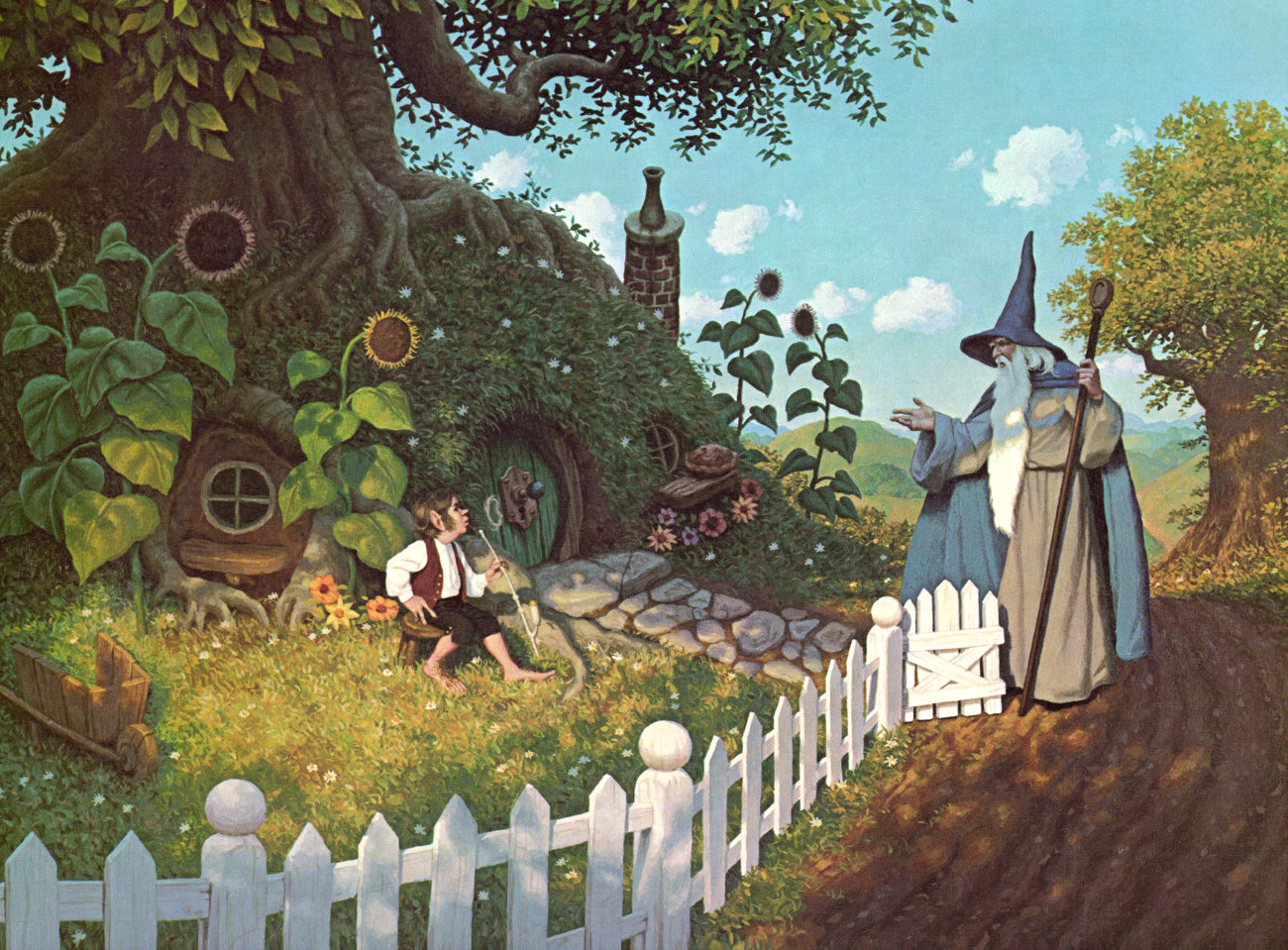
But fireworks brings us back to Tolkien, doesn’t it?  When Gandalf first appears to Bilbo in the first chapter of The Hobbit,

image19bilgan.jpg

it seems that almost all that Bilbo knows about Gandalf is his fireworks:

“Not the man that used to make such particularly excellent fireworks!  I remember those!  Old Took used to have them on Midsummer’s Eve.  Splendid!  They used to go up like great lilies and snapdragons and laburnums of fire and hang in the twilight all evening!”  (Chapter One, “An Unexpected Party”)

And, when Gandalf reappears in the Shire, to celebrate Bilbo and Frodo’s joint birthday, what does he bring?

image20gandalf.jpg

Thanks, as ever, for reading (and listening).

MTCIDC

CD

A Power

25 Wednesday Apr 2018

Posted by Ollamh in J.R.R. Tolkien, Narrative Methods, Villains

≈ Leave a comment

Tags

Gandalf, Grima, Harry Potter, Isengard, Istari, Mini-Me, Mirkwood, Necromancer, Ornthanc, Palantir, power, Rings of Power, Rohan, Saruman, Sauron, The Council of Elrond, The Hobbit, The Lord of the Rings, Theoden, Tolkien, Voldemort, White Council, Wormtongue

Welcome, dear readers, as ever.

Some time ago, we did a post on Saruman as a “Mini-Me” version of Sauron

image1minime.jpg

but, since that time, one of us has used The Hobbit in a class.  Mirkwood

image2mirkwood.jpg

and the Necromancer

image3necromancer.jpg

came up and we began to think about him again, this time to consider his strategy:  how long has he been planning something and what might be the elements within that plan?

image4saruman.jpg

Although there is no hard evidence for just how long Saruman has been at work, it seems like his scheme has been under construction for at least 80 years.  We base that upon Gandalf’s description of the White Council’s meeting on the subject of Sauron and what to do when it’s discovered that he is in Dol Guldur, calling himself the Necromancer:

“Some, too, will remember also that Saruman dissuaded us from open deeds against him, and for long we watched him only.  Yet at last, as his shadow grew, Saruman yielded and the Council put forth its strength and drove the evil out of Mirkwood and that was in the very year of finding this Ring…”

(The Fellowship of the Ring, Book One, Chapter 2, “The Council of Elrond”)

Almost 80 years before the story of Bilbo and the Ring, then, it appears that one element in Saruman’s plot was shielding Sauron—a fact clearly not lost on Treebeard:

“He was chosen to be the head of the White Council, they say; but that did not turn out too well.  I wonder now if even then Saruman was not turning to evil ways.”

(The Two Towers, Book Three, Chapter 4, “Treebeard”)

From something Saruman says to Gandalf we might guess the obvious reason for helping Sauron to escape action by the White Council:

“A new Power is rising.  Against it the old allies and policies will not avail us at all.  There is no hope left in Elves and dying Numenor.  This then is one choice before you, before us.  We may join with that Power.  It would be wise, Gandalf.  There is hope that way.  Its victory is at hand; and there will be rich reward for those that aided it.”

(The Fellowship of the Ring, Book One, Chapter 2, “The Council of Elrond”)

But being a lackey to that Power is not quite his ultimate design, as we see:

“As the Power grows, its proved friends will also grow; and the Wise, such as you and I, may with patience come at last to direct its courses, to control it.  We can bide our time, we can keep our thoughts in our hearts, deploring maybe evils done by the way, but approving the high and ultimate purpose:  Knowledge, Rule, Order; all the things that we have so far striven in vain to accomplish…”

As is well-known, Saruman, as one of the Istari, was sent into Middle-earth as a counter to Sauron, not as an ally, and their purpose was:

“…coming in shapes weak and humble were bidden to advise and persuade Men and Elves to good and to seek to unite in love and understanding all those whom Sauron, should he come again, would endeavor to dominate and corrupt.”

(Unfinished Tales, 406)

Knowledge, yes, but Rule and Order?  Emphatically not!  But if that Power (and we note that even Saruman won’t just come out and say “Sauron” at this point, rather like the use of “He Who Must Not Be Named” in the Harry Potter books)

image5voldemort


can be used as a tool in Saruman’s hands—which may show us one element in his grand design.

First, however, it would seem that he needed a base.  As Treebeard tells Merry and Pippin:

“He gave up wandering about and minding the affairs of Men and Elves, some time ago—you would call it a very long time ago; and he settled down at Angrenost, or Isengard as the Men of Rohan call it.”

(The Two Towers, Book Three, Chapter 4, “Treebeard”)

image6orthanc


Saruman even then was already thinking of something, though the purpose was intentionally shrouded:

“There was a time when he was always walking about in my woods.  He was polite in those days, always asking my leave…and always eager to listen.  I told him many things that he would never have found out by himself; but he never repaid me in like kind.  I cannot remember that he ever told me anything.  And he got more like that; his face, as I remember it…became like windows in a stone wall:  windows with shutters inside.”

Although he was powerful, Saruman needed allies—or, rather, servants—and he wasn’t too particular who or what they were:

“He has taken up with foul folk, with the Orcs…Worse than that:  he has been doing something to them; something dangerous.  For these Isengarders are more like wicked Men.  It is a mark of evil things that came in the Great Darkness that they cannot abide the Sun; but Saruman’s Orcs can endure it, even if they hate it.  I wonder what he has done?  Are they Men he has ruined, or has he blended the races of Orcs and Men?  That would be a black evil!”

With the help of these servants, Saruman has turned his base into a factory and storehouse for his scheme, as Gandalf says:

“…it had once been green and fair, it was now filled with pits and forges.  Wolves and orcs were housed in Isengard, for Saruman was mustering a great force on his own account, in rivalry of Sauron and not in his service, yet.”

(The Fellowship of the Ring, Book One, Chapter 2, “The Council of Elrond”)

In fact, it would appear from what Saruman has told Gandalf, that he actually never intends to offer his service to Sauron.

From his base, he has been extending his own power into Rohan, in the south.  In his encounter with Aragon and his companions, Eomer says:

“But at this time our chief concern is with Saruman.  He has claimed lordship over all this land, and there has been war between us for many months.  He has taken Orcs into his service, and Wolf-riders, and evil Men, and he has closed the Gap against us, so that we are likely to be beset both east and west.”

(The Two Towers, Book Three, Chapter 2, “The Riders of Rohan”)

His attacks aren’t always military and Eomer hints at another possibility:

“His spies slip through every net, and his birds of ill omen are abroad in the sky.  I do not know how it will all end, and my heart misgives me; for it seems to me that his friends do not all dwell in Isengard.  But if you come to the king’s house, you shall see for yourself.”

We know that this is “fifth-column” work—Grima Worm-tongue, who has been slowly poisoning King Theoden with defeatism.

image7grima.png

And now we can see, in broad outline, what Saruman is up to:

  1. establish a base
  2. recruit an army
  3. build up an intelligence network (birds, spies, even wandering himself to pick up information)
  4. use your strength to expand power into the next land, Rohan
  5. at the same time undercut the King of Rohan’s ability to resist by subversive methods

So far, so good, as long as all that Saruman wants is to be the ruler of the land south of the Gap of Rohan and north of Gondor, but we’ve already seen that he’s more ambitious yet, suggesting to Gandalf that they—really he, as Gandalf knows—can take over that unnamed Power and use it for their—his– purposes, Knowledge, Rule, Order.  When he sees that Gandalf is unconvinced, Saruman lets slip the capstone of his scheme:

“Well, I see that this wise course does not commend itself to you…Not yet?  Not if some better way can be contrived?…And why not, Gandalf?  Why not?  The Ruling Ring?  It we could command that, then the Power would pass to us.”

And here is the real heart of Saruman’s design:  to obtain the One Ring.

He has been searching for it for a long time, even traveling to Minas Tirith to examine ancient records.

“In former days the members of my order had been well received there,” says Gandalf to the Council of Elrond, “but Saruman most of all.  Often he had been for long the guest of the Lords of the City.”

His purpose is now easy to guess.

Gandalf had been aware that Saruman had seemed to know a great deal about the Ring, even to its appearance, as Saruman had said to the White Council:

“The Nine, the Seven, and the Three had each their proper gem.  Not so the One.  It was round and unadorned, as it were one of the lesser rings; but the maker set marks upon it that the skilled, maybe, could still see and read.”

How had Saruman known that since, as Gandalf says, “What those marks were he had not said.  Who now would know?  The maker.  And Saruman?  But great though his lore may be, it must have a source.  What hand save Sauron’s ever held this thing, ere it was lost?  The hand of Isildur alone.”

Gandalf discovers the truth of this in the dusty records of Gondor:

“…there lies in Minas Tirith still, unread, I guess, by any save Saruman and myself since the kings failed, a scroll that Isildur made himself.”

And, with the discovery and reading of that scroll, Gandalf knows not only about much more about the Ring, but how Saruman knew about its appearance and now, in Orthanc, pressed by Saruman to join him, he understands the last element in Saruman’s design—and also why Saruman has summoned him:

“That is in truth why I brought you here.  For I have many eyes in my service, and I believe you know where this precious thing now lies.  Is it not so?  Or why do the Nine ask for the Shire, and what is your business there?”

So here, lacking only one element, the real element under all, is Saruman’s long plan—but lacking “this precious thing” (a telling phrase!), we will see how successful the rest will be.  Treebeard has said of him,

“He has a mind of metal and wheels; and he does not care for growing things, except as far as they serve him for the moment.”

What will happen when, without the Ring, Saruman will find that growing things, instead of serving him for the moment, might unseat him forever?

image8destruction.jpg

As always, thanks for reading!

MTCIDC

CD

Boom

18 Wednesday Apr 2018

Posted by Ollamh in J.R.R. Tolkien

≈ Leave a comment

Tags

A Long-Expected Party, A Midsummer Night's Dream, Backarapper, Benwell Fireworks, cracker, Elizabethan entertainment, Fireworks, fountain, Gandalf, Kenilworth Castle, Pain's Imperial Fireworks, Queen Elizabeth, Robert Dudley, Robert Langham, Roman Candles, Shakespeare, Sparkler, squib, The Fellowship of the Ring, The Hobbit, The Lord of the Rings, thunderclap, Tolkien, torch

Welcome, dear readers, as always.

When Gandalf first arrives at Bilbo’s door “in the quiet of the world, when there was less noise and more green”, Bilbo’s memories of him are hardly those of someone aware who Gandalf really is:

“Gandalf, Gandalf!  Good gracious me!  Not the wandering wizard that gave Old Took a pair of magic diamond studs that fastened themselves and never came undone till ordered?  Not the fellow who used to tell such wonderful tales at parties, about dragons and goblins and giants and the rescue of princesses and the unexpected luck of widows’ sons?  Not the man that used to make such particularly excellent fireworks!”  (The Hobbit, Chapter 1, “An Unexpected Party”)

And it’s the fireworks in particular which made a strong impression:

“I remember those!  Old Took used to have them on Midsummer’s Eve.  Splendid!  They used to go up like great lilies and snapdragons and laburnums of fire and hang in the twilight all evening!”

[Here, by the way are the three flowers he mentions, in case, like us, you live in a climate where such things won’t appear for months yet!]

image1lily.jpg

image2snapdragons.JPG

image3laburnums.jpeg

And, although he alludes to an edgier side of Gandalf (“Not the Gandalf who was responsible for so many quiet lads and lasses going off into the Blue for mad adventures?”), he concludes as if Gandalf were merely some sort of superior tradesman:

“I beg your pardon, but I had no idea you were still in business!”

Gandalf is patient, however, only replying:

“Where else should I be?… All the same I am pleased to find that you remember something about me.  You seem to remember my fireworks kindly, at any rate, and that is not without hope…”

Perhaps the idea of linking Gandalf and fireworks is pardonable, however, when we see how, after being associated with them at the beginning of The Hobbit, he appears at the opening of The Lord of the Rings actually bringing fireworks to Hobbiton:

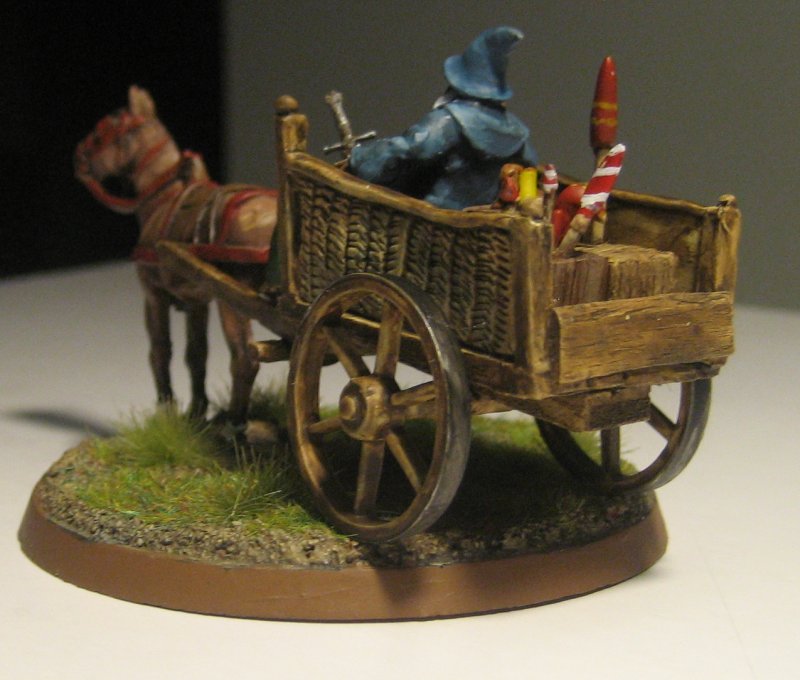
“At the end of the second week in September a cart came in through Bywater from the direction of Brandywine Bridge in broad daylight.  An old man was driving it all alone.  He wore a tall pointed blue hat, a long grey cloak, and a silver scarf.  He had a long white beard and bushy eyebrows that stuck out beyond the brim of his hat.  Small hobbit-children ran after the cart all through Hobbiton and right up the hill.  It had a cargo of fireworks, as they rightly guessed.  At Bilbo’s front door the old man began to unload:  there were great bundles of fireworks of all sorts and shapes, each labeled with a large red G…and the elf-rune…” (The Fellowship of the Ring, Book One, Chapter 1, “A Long-expected Party)

image4cart.jpg

(This is from a site called “Llama’s War of the Ring”, which has all sorts of interesting figures and conversions—here’s a LINK.)

Those great bundles turned into spectacular entertainment at the joint birthday party:

“The fireworks were by Gandalf:  they were not only brought by him, but designed and made by him; and the special effects, set pieces, and flights of rockets were let off by him.  But there was also a generous distribution of squibs, crackers, backarappers, sparklers, torches, dwarf-candles, elf-fountains, goblin-barkers and thunderclaps.  They were all superb.  The art of Gandalf improved with age.”

We ourselves enjoy fireworks, and, for the sake of our readers who might not be familiar with some of the types mentioned, we add here a few images—although some, like “dwarf-candles, elf-fountains, goblin-barkers” no longer seem to be available.

A squib is a small firecracker, like these.

image5squibs.jpg

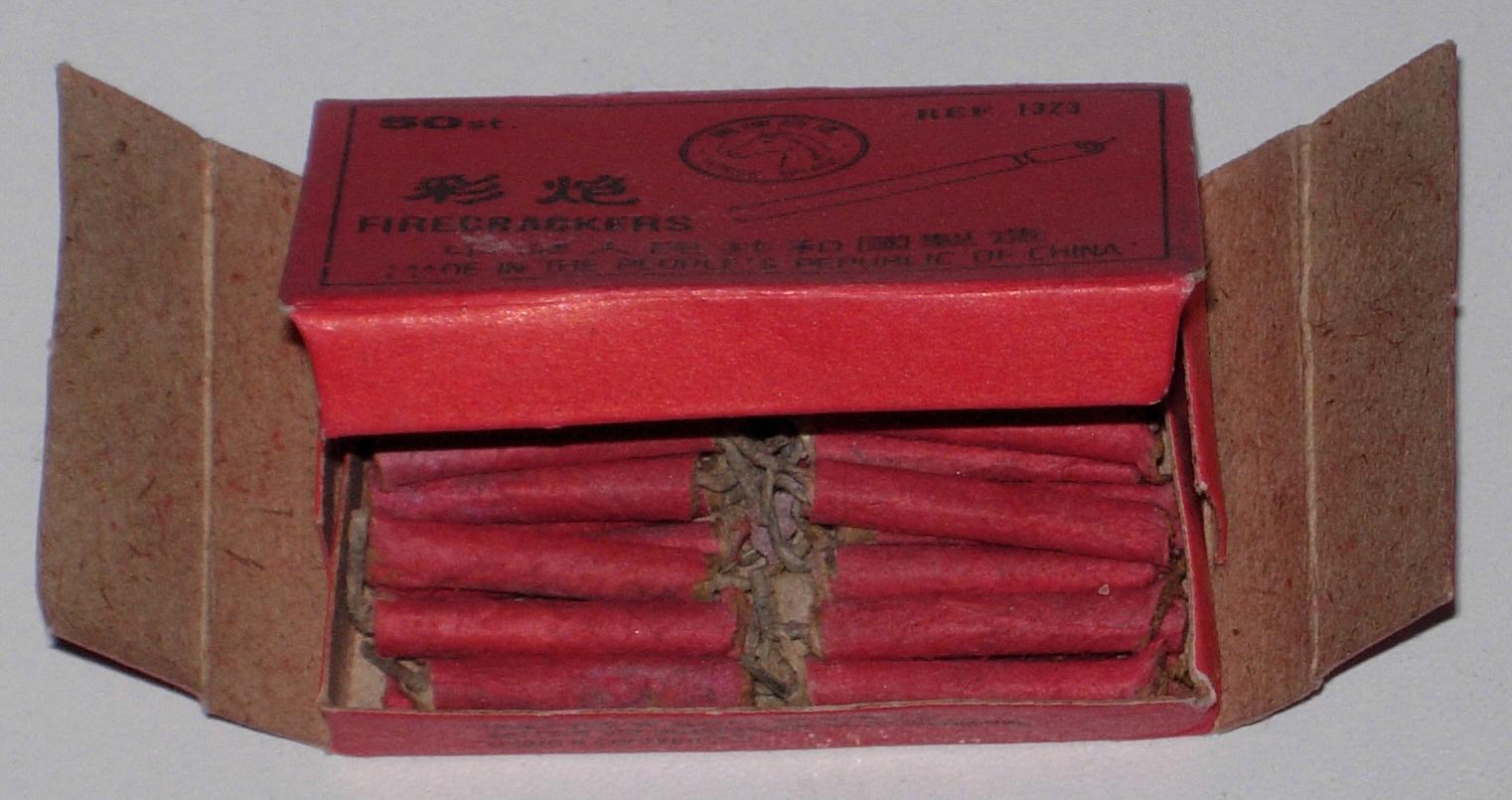
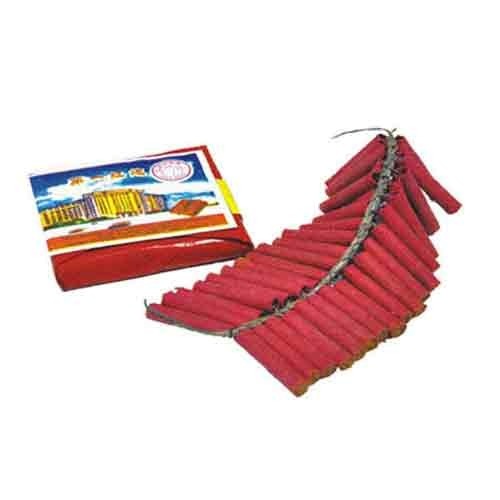
Crackers seem to come in sets.

image6firecrackers.jpg

Backarappers—we don’t have an image, but here’s a definition (and it sounds like the previous image):

“A firework made from multiple firecrackers folded together so that they will explode one after another”.  (from G.F. Northall’s Warwickshire Word-book, 1896)

Sparklers are metal rods or bamboo sticks whose upper part has what is called “pyrotechnic composition”—which means something which shoots out sparks when it’s lit.

image7sparkler.jpeg

Torches may be these—which, when lighted, change color as they burn down (or so the manufacturer’s description says).

image8torch.png

Although there are no “dwarf-candles”, there are Roman Candles.  These are built in stages and, as the fire burns down, they shoot out star-patterns—as you can see.

image9romancandle.jpg

There are no “elf-fountains”, either, but there are fountains and they look like this—

image10fountain.jpeg

Finally, we can date a “thunderclap”, made by Benwell, back to this advertisement from about 1950,

image11benwell.jpg

but we wouldn’t be surprised if Pain’s (not the best name for fireworks, we would say!) carried them, as they have something called “Laburnum Blossoms” in this 1903 listing

image12pains.jpg

Gandalf’s productions were clearly quite spectacular—which was undoubtedly why Bilbo remembers them:

“There were rockets like a flight of scintillating birds singing with sweet voices.  There were green trees with trunks of dark smoke:  their leaves opened like a whole spring unfolding in a moment, and their shining branches dropped glowing flowers down upon the astonished hobbits, disappearing with a sweet scene just before they touched their upturned faces.  There were fountains of butterflies that flew glittering into the trees; there were pillars of coloured fires that rose and turned into eagles, or sailing ships, or a phalanx of flying swans; there was a red thunderstorm and a shower of yellow rain; there was a forest of silver spears that sprang suddenly into the air with a yell like an embattled army, and came down again into the Water with a hiss like a hundred hot snakes.”

And then there was the finale.  Pain’s, in that 1903 listing, could make claims to baskets of elaborate pyrotechnics, but this?

“And there was also one last surprise, in honour of Bilbo, and it startled the hobbits exceedingly, as Gandalf intended.  The lights went out.  A great smoke went up.  It shaped itself like a mountain seen in the distance, and began to glow at the summit.  It spouted green and scarlet flames.  Out flew a red-golden dragon—not life-size, but terribly life-like:  fire came from his jaws, his eyes glared down; there was a roar and he whizzed three times over the heads of the crowd.  They all ducked, and many fell flat on their faces.  The dragon passed like an express train, turned a somersault, and burst over Bywater with a deafening explosion.”

In Shakespeare’s A Midsummer Night’s Dream, the fairy king, Oberon, says to his spirit-servant, Puck, these rather mysterious lines:

“My gentle Puck, come hither.  Thou rememberest

Since once I sat upon a promontory

And heard a mermaid on a dolphin’s back

Uttering such dulcet and harmonious breath

That the rude sea grew civil at her song

And certain stars shot madly from their spheres

To hear the mermaid’s music?”

(Act 2, Scene 1)

In 1575, Queen Elizabeth I

image14queene1.jpg

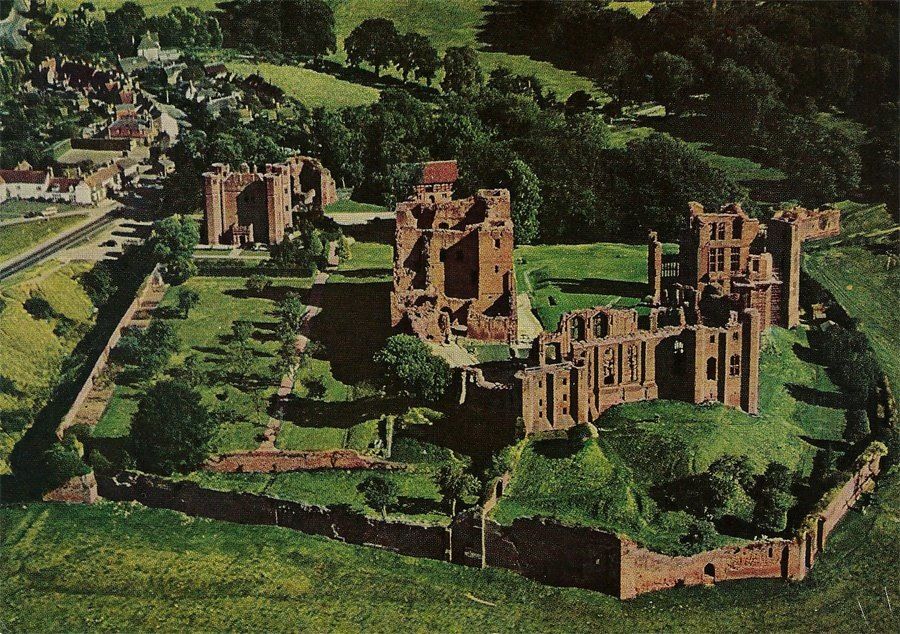
visited Kenilworth Castle,image15kenilworth.jpg

the home of Robert Dudley, the Earl of Leicester,

image16dudley.jpg

and a close friend (and maybe more).  To entertain her, Dudley spent thousands of pounds.

image17sovereign.jpg

(This is actually a gold sovereign—worth 20 shillings—that is, a pound, but there were no actual pound coins till after 1583.)

Among the entertainments was a big fireworks display (as well as at least one mermaid—see the LINK here for Robert Langham/Laneham’s contemporary “letter” in which he describes these entertainments in detail) and some scholars have theorized that those falling stars mentioned by Oberon are, in fact, Shakespeare’s boyhood memory of having seen the fireworks display (and the mermaid).  Kenilworth is only 14 miles from Stratford and Shakespeare was 11 and living at home—we presume—at that time, so we can imagine that this is possibility.  We know that JRRT had seen fireworks shows as a boy—as he tells us in a letter to Donald Swann, 29 February, 1968 (Letters, 390)—but we wonder:  did he ever, in those early years, see Goblin-barkers, or a red-golden dragon?

Thanks, as ever, for reading.

MTCIDC

CD

ps

We almost forgot–in case you’d like to make your own fireworks (definitely not recommended–and definitely illegal in some places!), here’s an 1878 manual on the subject.


Wormy

21 Wednesday Feb 2018

Posted by Ollamh in J.R.R. Tolkien, Military History, Military History of Middle-earth, Villains

≈ Leave a comment

Tags

Adolf Hitler, Bilbo, Dragon, Fifth Column, Gandalf, Germany, Grima, Madrid, Middle-earth, Nazis, Norway, Norwegian facist party, Republican government, Rohan, Saruman, Second World War, Smaug, Spanish Civil War, The Hobbit, The Lord of the Rings, The Scouring of the Shire, Theoden, Tolkien, traitor, Vidkun Quisling, William Blake, worm, Wormtongue

Welcome, as always, dear readers.
In 1936, the Nationalist forces were marching to attack the Republican government in Madrid, during the Spanish Civil War.
image1nationalists.jpg
image2attackonmadrid.jpg
When interviewed, a Nationalist general is reported to have said that, as four military columns were about to assault the city,
image3natattack.jpeg
a fifth column of loyalists would join the attack from inside.
image4natattack.jpg
This phrase “fifth column”, then, was picked up and began to be used world-wide to mean “traitors/betrayers from within” and was popular during the Second World War era.
image5thcol.jpg

When the Nazis attacked Norway in 1940,
image6nazislandinginnorway.jpg
and the Allies failed to defend their positions there successfully and were forced to surrender or flee
image7capturedtroops.jpg
a member of the small Norwegian fascist party, Vidkun Quisling,
image8quisling.jpg
declared himself ruler as the Germans marched in.
image9conqueringgermans.jpg

In time, the Nazis recognized him as the head of Norway and he even had an audience with Hitler.
image10hitandquis.jpg

This time, a specific “fifth columnist” had not only betrayed his country, but also profited greatly from it and, when we looked at the dates—1936 and 1940—we wondered, as we so often do, if the current events of our world may have colored JRRT’s relation of the events in Middle-earth—even as we hasten to say, as we always do, that this is just a suggestion.
In his first meeting with Aragorn, Eomer is troubled and his veiled comments suggest just the same sort of fifth-columnist action:
“But at this time our chief concern is with Saruman. He has claimed lordship over all this land, and there has been war between us for many months…”
His concern, however, as we see, is for more than border security, as he says of Saruman:
“His spies slip through every net, and his birds of ill omen are abroad in the sky. I do not know how it will all end, and my heart misgives me; for it seems to me that his friends do not all dwell in Isengard. But if you come to the king’s house, you shall see for yourself.” (The Two Towers, Book Three, Chapter 2, “The Riders of Rohan”)
So, all is not well, not only in Rohan, but in Meduseld itself. When Gandalf and the other survivors of the Fellowship arrive at the gates of Edoras, they are stopped by guards and by a command from Theoden, king of Rohan—or is it? A guard says:
“It is but two nights ago that Wormtongue came to us and said that by the will of Theoden no stranger should pass these gates.” (The Two Towers, Book Three, Chapter 6, “The King of the Golden Hall”)
“Wormtongue” seems a very odd name—do worms actually have tongues?
image11worm.JPG
But this isn’t a worm, it’s a “worm”—an old term for “dragon”.
image12smaug.jpg
And, if Smaug’s speech and its effect upon Bilbo is anything to go by:
“Bilbo was now beginning to feel really uncomfortable. Whenever Smaug’s roving eye, seeking for him in the shadows, flashed across him, he trembled, and an unaccountable desire seized hold of him to rush out and reveal himself and tell all the truth to Smaug. In fact he was in grievous danger of coming under the dragon-spell.” (The Hobbit, Chapter 12, “Inside Information”)
then a person having a dragon tongue might be a real threat, as Wormtongue, seated at Theoden’s feet,
image13theodenandgrima.jpg
inserts himself between Gandalf and Theoden:
“Why indeed should we welcome you, Master Stormcrow? Lathspell I name you, Ill-news; and ill news is an ill guest they say.”
Gandalf immediately resists this and, in a burst of power, breaks the real “spell”—the dragon’s words which Grima Wormtongue has been pouring into Theoden’s ears, as Theoden says to him of Gandalf’s efforts: “If this is witchcraft…it seems to me more wholesome than your whisperings. Your leechcraft [that is, “medical skill”—obviously ironic here] ere long would have had me walking on all fours like a beast.”
[A footnote here—is JRRT making a quiet reference to the fate of Nebuchadnezzar, king of Babylon, mentioned in the book of Daniel in the Old Testament? In Chapter 4, the king is driven mad and spends seven years as a grazing animal to prove the power of the Hebrew divinity. Here is William Blake’s (1757-1827) striking depiction of the mad king.]
image14blake.jpg

Certainly something Grima has been doing has affected Theoden, as he is initially described as “a man so bent with age that he seemed almost a dwarf…” and this shrinking is suddenly reversed when Gandalf strikes Grima down:
“From the king’s hand the black staff fell clattering on the stones. He drew himself up, slowly, as a man that is stiff from long bending over some dull toil. Now tall and straight he stood, and his eyes were blue as he looked into the opening sky.”
For all that Grima has been blocked and Theoden restored, the fifth columnist tries once more. When he is told that he must ride with the king and his warriors to battle, he makes a countersuggestion:
“One who knows your mind and honours your commands should be left in Edoras. Appoint a faithful steward. Let your counsellor Grima keep all things till your return…”
But he gives himself away by finishing that sentence with “and I pray that we may see it, though no wise man will deem it hopeful.”
And Gandalf sees all too clearly what is behind Grima’s proposal—and who is behind it:
“Down, snake!…Down on your belly! How long is it since Saruman bought you? What was the promised price?…”
image15fallofgrima.jpg

Although it is said that Grima deserves death for his treachery, he is allowed to flee, and, when we next see him, he is with his true master, acting as his “footman” as Gandalf calls him (The Two Towers, Book Three, Chapter 10, “The Voice of Saruman). And here, as Bilbo’s pity has preserved Gollum for an unseen but vital part in the later story of the Ring, so Gandalf’s mercy to Grima preserves him for two final acts: first, his mistaken use of a palantir as a missile, which puts it into Gandalf’s hands and, ultimately into Aragorn’s, who shakes Sauron’s nerve with it; second, Saruman’s ultimate end:
“[Saruman] kicked Wormtongue in the face as he groveled, and turned and made off. But at that something snapped: suddenly Wormtongue rose up, drawing a hidden knife, and then with a snarl like a dog he sprang on Saruman’s back, jerked his head back, cut his throat, and with a yell ran off down the lane.” (The Return of the King, Book Six, Chapter 8, “The Scouring of the Shire”)
image16deathofsaruman.jpg
Grima doesn’t survive this attack, however: “Before Frodo could recover or speak a word, three hobbit-bows twanged and Wormtongue fell dead.”
Merry calls these final acts of violence “the very last end of the War”, but we would suggest a parallel with a specific event in our world: the end of Vidkun Quisling–executed by firing squad in October, 1945, for treason. Could we say that Grima’s death—deserved earlier, but deferred—was also a kind of execution for treason, against Rohan, finally carried out?
And a final thought: after World War 2, Quisling’s name became, for a time, an easy synonym for “fifth columnist/traitor”—could we imagine that, in the Common Speech of Middle-earth after the War of the Ring, the same might have happened to “Grima Wormtongue”?
Thanks, as ever, for reading.
MTCIDC
CD

Wains, Carts, and… (2)

14 Wednesday Feb 2018

Posted by Ollamh in Economics in Middle-earth, J.R.R. Tolkien

≈ Leave a comment

Tags

Boudica, Carts, Cassius Dio, Celts, chariots, Conestoga, Farmer Maggot, Gandalf, gur, Hobbiton, Iceni, Iron Age, Medieval, Mongols, Oregon Trail, Roman History, Romans, The Lord of the Rings, Tolkien, vikings, Wagons, Wainriders, Wains

Welcome, as always, to our blog, dear readers.

In our last, we began discussing wheeled transport in The Lord of the Rings.  We began with Gandalf’s cart, mentioned in Chapter 1.

im1gscart.jpg

The posting took us from the first traces of wheeled vehicles in western Europe, circa 3600BC (literally traces—just a pair of tracks in the clay)

im2tracks.jpg

through chariots

im3chariot.jpg

to Roman carts

im4romcart.jpg

to their descendants, medieval carts,

im5medcart.jpg

which led us back to Gandalf.

im6gcart.jpg

Continuing our discussion, we move from carts (2 wheels) to wagons (4 wheels) with the wagon Farmer Maggot uses to carry the hobbits to Bucklebury Ferry:

“I was going to say:  after a bit of supper, I’ll get out a small wagon, and I’ll drive you all to the Ferry.” (The Fellowship of the Ring, Book One, Chapter 4, “A Short Cut to Mushrooms”)

There is no description beyond that, really, but wagons are pretty generic things.  We have a few examples of early (600-500BC) Iron Age wagons—very fancy ones, too—from burials,

im7celtwag.jpg

im8celtwag.jpg

as well as this later Viking wagon.

im9oseberg.jpg

And, in between, we have Roman wagons

im10romwag.jpg

and their medieval descendants.

im11medwag.jpg

Farmer Maggott’s wagon, would probably have looked something like this (without the arms).

im12amedwag.jpg

Of course, those Roman wagons were meant for paved Roman roads.

im12romroad.jpg

Although some Roman roads remained on the surface and continued to be used, most medieval roads were merely dirt and stones—as JRRT illustrates in that picture of the Hill

im13hobbiton.jpg

and as we see in this picture.

im14medroad.jpg

In which case, medieval people relied upon pack horses to transport many of their goods.

im15sumpter.jpg

(Think of Bill the pony as a modest example.)

An old word for wagon is wain and we would like to end this brief exploration with something about wains and Wainriders.  In Appendix A, we find this:

“The third evil was the invasion of the Wainriders, which sapped the waning strength of Gondor in wars that lasted for almost a hundred years.  The Wainriders were a people, or a confederacy of many peoples, that came from the east; but they were stronger and better armed than any that had appeared before.  They journeyed in great wains, and their chieftains fought in chariots.”

We’ve been puzzled by that combination of “great wains” and “their chieftains fought in chariots”.  The only immediate reference we could think of was to the Iceni, a tribe of ancient Britain, who, led by a female chieftain named Boudica, revolted against Roman occupation in 60-61AD.  At the final battle, where they were defeated by Roman troops, they had parked wagons in a crescent formation to their rear, then advanced with their chariots and infantry against the Romans. (See Cassius Dio, Roman History, LXII.12 for a description of this battle—here’s an easy LINK to that portion of his extensive writing.)

im16boudica.jpg

There is a problem here, however.  The Britons were not migratory and their wagons were probably no more than farm wagons and carts, hardly the great wains of JRRT’s description.  If we removed the chariots, another candidate for the Wainriders might be the Mongols, however, who were migratory and traveled in something even more splendid than a wagon—a gur—like this one—

im17ger.jpg

The Mongols certainly came from the east and, in a short time, swallowed up territory from China all the way to eastern Europe.

im18mongolconquest.jpg

It is more likely, however, that JRRT combined things–it wouldn’t be the first time he synthesized—so much of his so-called legendarium is a mixture of this and that in brilliant profusion.  So, in the same spirit, we asked ourselves what we thought wains might look like and immediately saw the big wagon which was instrumental in colonizing the western part of the US, the Conestoga.

im19conestoga.jpg

Great, long lines of these and other wagons, packed with people and supplies, crossed the plains from the 1840s on.

im20wagtrain.gif

Could we then remove the 19th-century settlers and add Celts and their chariots, say?

im21celtchar.jpg

What do you think, dear readers?

Thanks, as ever, for reading.

MTCIDC

CD

Wains and Carts and… (Part I)

07 Wednesday Feb 2018

Posted by Ollamh in J.R.R. Tolkien, Literary History, Military History

≈ Leave a comment

Tags

Bronze Age, Byzantines, Carts, chariots, delivery carts, Flintbek, Gandalf, Great War, Greece, Iliad, Late-Victorian, Medieval, military, Mycenaean, Neolithic, Roman Roads, Romans, Schleswig-Holstein, The Lord of the Rings, Tolkien, Trundholm Sun Chariot, Wagons, wattle and daub

Welcome, dear readers, once more to our blog.
We’ve just been watching the extended version opening of The Fellowship of the Ring, in which Gandalf appears, driving a cart.
image1gandalfcart.jpg
(Sorry—we couldn’t resist! We love Legos and the older Playmobil—Vikings, pirates, Roman warship, too. Not to forget the Egyptian pyramid! )
Unlike ordinary medieval carts,
image2amedcart.jpg
it is quite elaborate.
image2gandalfcart.jpg
image3gandalfcart.jpg
You can see from our second illustration that both the medieval example and Gandalf’s have wattled sides—that is, the upright spindles below the railing top have pliable sticks (perhaps willow or hazel?) woven between them to make the sides of the cart.
This is also a common method for producing traditional house walls: you just add daub, which is clay plus fibre, as a kind of plaster to fill in around the sticks.
image4wattleanddaub.jpg
Many buildings, from the Neolithic on, were constructed using the technique,
image5technique.jpg
image6house.jpg
as well as, without the daub, miles and miles of useful fencing.
image7fence.jpg
What caught our attention, however, was the general look of the cart and the detailing of the wooden railing,
image8agscart.jpg
image8bgscart.jpg
image8cgscart.jpg
which very much reminded us of this—
image8chariot.jpg
a Celtic chariot of the sort one sees both in chariot burials
image9chariotburial.JPG
and in stirring reconstructions.
image10britchariots.jpg
But that’s not the direction we wanted to take in this post. Rather, we were, as so often, thinking about the medieval world and Middle-earth and, in this case, wheeled vehicles.
The earliest evidence in Europe currently known for such vehicles is not the remains of a vehicle itself, but rather its tracks, found under a burial mound at Flintbek, in Schleswig-Holstein, in northwest Germany.
image11flintbek.jpg
These have been dated to about 3600BC, during the late Neolithic Era. A bit later, we see this odd thing, the so-called “Trundholm Sun Chariot”, from about 1400BC
image12trundholm.jpg
which actually appears to be some sort of wagon, or at least its frame.

Perhaps 50 years later, there are Bronze Age Mycenaean chariots
image13mycen.jpg
but, at least as far as illustrations go, European domestic vehicle depictions are scarce, especially in contrast to those of military—or sport—vehicles. Here’s a 5th-century BC depiction of a wagon being used for a wedding,
image14grkwagon.jpg
but we could then show you heaps of illustrations of chariots, used in very early Greece for warfare. You see them all over the Iliad, for example,
image15achilles.jpg
but chariots in the later Greek world were abandoned for warfare, although retained for racing, which was true for the Romans and for their successors, the Byzantines.
image16byzchar.jpg
We have lots more depictions of domestic vehicles from the Roman world, both carts
image17romancart.jpg
and wagons.
image18romwag.jpg
This shouldn’t be surprising, we suppose, given that the Romans built more than 50,000 miles of roads.
image19romrd
Judging by these depictions, it appears that the medieval world simply continued using Roman vehicle patterns, just as, where available, they continued to use Roman roads.
image19romcrt.jpg
image20medwag.png
For us, then Gandalf’s cart—which is not really described:
“At the end of the second week in September a cart came in through Bywater from the direction of Brandywine Bridge in broad daylight. An old man was driving it all alone…It had a cargo of fireworks…”
(The Fellowship of the Ring, Book One, Chapter 1, “A Long-expected Party”)
would follow what we see in manuscript illustrations.
Tolkien might have been thinking of such illustrations, of course, but there is another possibility. In the late-Victorian world into which JRRT was born, horses still powered vehicles and delivery carts like this one
image21deliverycart.jpg
would have been a common site—even after the Great War. Perhaps he was thinking of something he might still have seen outside his window when he was young?
We’ll stop here for now, but will continue in Part II, where we’ll consider Farmer Maggot’s wagon and wains…

Thanks, as ever, for reading.
MTCIDC
CD

In Bad Hands

30 Wednesday Aug 2017

Posted by Ollamh in Heroes, J.R.R. Tolkien, Literary History, Maps, Military History, Narrative Methods

≈ Leave a comment

Tags

CBS Television News, Denethor, Dunkirk, Early newspapers, early radio, Ecthelion, fake news, Gandalf, Henry IV, Isengard, Lifestyle Magazine, Minas Tirith, Nazi, Nazi Propaganda, news, newspaper, Orthanc, Osgiliath, Palantir, propaganda leaflet, Relation, rumors, Saruman, Shakespeare, texting while driving, The Detroit News, The Illustrated London News, The White Tower, Tolkien

Welcome, dear readers, as ever.
Not so long ago, news came to most people through one—very undependable–source: rumor and gossip. As Shakespeare’s Rumor (depicted as “all painted with tongues” in a stage direction), who appears at the beginning of Henry IV, Part 2, Prologue, 1-5, describes herself:
“Open your ears, for which of you will stop
The vent of hearing when loud Rumour speaks?
I, from the orient to the drooping west,
Making the wind my post-horse, still unfold
The acts commenced on this ball of earth.”
At almost the same time as this play was written and first performed (1596-99), the first printed Western newspaper appeared, the Relation, in Strasbourg in 1605.
image1a1609newspaper.jpg
For the next 300-and-some years, newspapers were then the accepted conveyor of popular information about local, national, and world events. Until 1842, these could only convey that information in words, but, in that year, the first illustrated newspaper appeared, The Illustrated London News.
image1billustratedlondonnews.jpg
And soon other newspapers followed, opening a wider world of information to the reading public. In under a century, however, news appeared in a new form of technology entirely: the first news broadcast by radio believed to have been on August 31, 1920, by a set owned—perhaps not surprisingly by a newspaper— The Detroit News. Considering what radios looked like in the early 1920s, we doubt that many people heard it (this is an image from Lifestyle Magazine from 1923).
image1cearlyradio1923.jpg
Radios soon improved, however, so that, along with newspapers, people could tune in to hear news, news sometimes more up-to-date than even the newspapers could supply. And then came television. Experiments had been made with television broadcasting as early as 1940, but steady broadcasting really only began in 1948, with CBS Television News.
And then the internet appeared, so that, today, more people are believed to get their news from some form of electronic means than any other (or so electronic means tell us). Practically anywhere you go in our world, you see people staring at screens (not always reading the news, of course—with the universe of apps, people can be doing almost anything imaginable), many of them so portable that you can watch people doing it while walking
image1walktext.jpg
eating,
image2eattext.jpg
even while driving (which, frankly, terrifies us!).
image3textdrive.jpg
There is a problem with news, however, in every era. Shakespeare’s Rumor may have been pushed to one side by later technological innovations, but, in the form of so-called “fake news”, it’s still with us. And, in fact, faked news—news distorted—or even manufactured—has become a standard feature in newer technology. One has only to think about Nazi propaganda (certainly not the first, but perhaps, for us, the most extensive and most vivid), where—just as one example out of thousands—the mostly horse-powered German army of 1940
image4awehrmacht.jpg
was publicly depicted as streamlined and gasoline-powered (or, even more high-tech, diesel-powered).
image4bwehrmachttruck.jpg
Some time ago, we talked about literacy in Middle-earth. There was no printed material, of course, and literacy appears to have been limited (we only have to mention Gaffer Gamgee saying of Sam, “Mr. Bilbo has learned him his letters—meaning no harm, mark you, and I hope no harm will come of it.” to imagine that not only was it limited, but there might even be a certain suspicion attached to it.)
And what news there was came by the oldest of methods:
“There were rumours of strange things happening in the world outside; and as Gandalf had not at that time appeared or sent any message for several years, Frodo gathered all the news he could. Elves, who seldom walked in the Shire, could now be seen passing westward through the woods in the evening, passing and not returning; but they were leaving Middle-earth and were no longer concerned with its troubles. There were, however, dwarves on the road in unusual numbers. The ancient East-West Road ran through the Shire to its end at the Grey Havens, and dwarves had always used it on their way to their mines in the Blue Mountains. They were the hobbits’ chief source of news from distant parts—if they wanted any: as a rule dwarves said little and hobbits asked no more. But now Frodo often met strange dwarves of far countries, seeking refuge in the West. They were troubled, and some spoke in whispers of the Enemy and of the Land of Mordor.” (The Fellowship of the Ring, Book One, Chapter 2, “The Shadow of the Past”)
(See also the scene in The Green Dragon a little later in the chapter, where there is discussion, all based on hearsay, about Shire and extra-Shire events, between Sam and Ted Sandyman.)
For two people in Middle-earth, however, news came by a method in a strange way like that of the internet: the palantir, and that news which they received was not to their advantage. Made “from beyond Westernesse, from Eldamar. The Noldor made them…” Gandalf tells Pippin. (The Two Towers, Book Three, Chapter 11, “The Palantir”)

The palantiri were made “to see far off, and to converse in thought with one another.” Although there were seven, one, that at Osgiliath, was the master: “each palantir replied to each, but all those in Gondor were ever open to the view of Osgiliath.” Saruman had one of the others
image4saruman.jpg
—the one under discussion in this chapter, after Pippin had almost come to disaster from looking in it—which Grima flung off Orthanc
image5sarumanorthanc.jpg
in what, although unexplained, must have been an attempt to brain Gandalf.
image6gandalforthanc.jpg
Unfortunately for Saruman, what he presumably thought would benefit his quest for what he speciously tells Gandalf is “Knowledge, Rule, Order; all the things that we have so far striven in vain to accomplish…” (The Fellowship of the Ring, Book Two, Chapter 2, “The Council of Elrond”), becomes a snare, as it seems that the master stone of Osgiliath has fallen into Sauron’s hands and “Easy it is now to guess how quickly the roving eye of Saruman was trapped and held; and how ever since he has been persuaded from afar, and daunted when persuasion would not serve.” (The Two Towers, Book 3, Chapter 11, “The Palantir”)
There is another surviving stone, however, and, though it doesn’t turn its possessor into an unwilling ally of Sauron, its propaganda—faked news—does terrible damage, all the same. In the White Tower of Ecthelion in Minas Tirith,
image7awhitetower.jpg
Denethor
image7denethor.jpg
holds a palantir and he, too, is caught, as Gandalf surmises:
“…I fear that as the peril in his realm grew he looked in the Stone and was deceived: far too often, I guess, since Boromir departed. He was too great to be subdued to the will of the Dark Power, he saw nonetheless only those things which that Power permitted him to see. The knowledge which he obtained was, doubtless, often of service to him; yet the vision of the great might of Mordor that was shown to him fed the despair of his heart until it overthrew his mind.” (The Return of the King, Book Five, Chapter 7, “The Pyre of Denethor”)
This overthrow, brought on by Sauron’s propaganda, results in Denethor accusing Gandalf of plotting “to rule in my stead, to stand behind every throne, north, south, or west” as well as delivering what clearly sounds like the “speech long rehearsed” Gandalf has long ago said that Saruman delivered to him in Orthanc:
“For a little space you may triumph on the field, for a day. But against the Power that now arises there is no victory. To this City only the first finger of its hand has yet been stretched. All the East is moving. And even now the wind of thy hope cheats thee and wafts up the Anduin a fleet with black sails. The West has failed. It is time for all to depart who would not be slaves.”
“to depart” quickly seems a euphemism for something much more radical as Denethor:
“leaped upon the table, and standing there wreathed in fire and smoke he took up the staff of his stewardship that lay at his feet and broke it on his knee. Casting the pieces into the blaze he bowed and laid himself on the table, clasping the palantir with both hands upon his breast.”
image8denethorontable.jpg
Here, we thought of all of those people we see who seemingly can never put down their phones—even in death Denethor still grips the very thing which has brought about his destruction.
image9textdrive.jpg
Was JRRT sending us, here in the future, a warning: beware of your source of news—and sometimes let go of what brings it to you? We can only add his description of Denethor’s palantir when it was retrieved from the pyre:
“And it was said that ever after, if any man looked in that Stone, unless he had a great strength of will to turn it to other purpose, he saw only two aged hands withering into flame.”
image10dshands.jpg
Thanks, as always, for reading!
MTCIDC
CD
PS
The new film, Dunkirk, opens with a British soldier catching a German propaganda leaflet based upon an actual one. Below on the left is the movie version, on the right the original. (Notice, by the way, that, in the one on the right, the English is not quite parallel to the French, including the line, “Your commanders (chefs) are going to flee by airplane.”) If Middle-earth had had a print culture, it’s easy to see such a leaflet being dropped by Nazgul over Minas Tirith!
image11leaflet.jpg

← Older posts
Newer posts →

The Doubtful Sea Series Facebook Page

The Doubtful Sea Series Facebook Page

  • Ollamh

Categories

  • Artists and Illustrators
  • Economics in Middle-earth
  • Fairy Tales and Myths
  • Films and Music
  • Games
  • Heroes
  • Imaginary History
  • J.R.R. Tolkien
  • Language
  • Literary History
  • Maps
  • Medieval Russia
  • Military History
  • Military History of Middle-earth
  • Narnia
  • Narrative Methods
  • Poetry
  • Research
  • Star Wars
  • Terra Australis
  • The Rohirrim
  • Theatre and Performance
  • Tolkien
  • Uncategorized
  • Villains
  • Writing as Collaborators
Follow doubtfulsea on WordPress.com

Across the Doubtful Sea

Recent Postings

  • Verisimilitude April 1, 2026
  • Goblins and Goblin March 25, 2026
  • Crowing and Raven March 18, 2026
  • The Damage of Dragons March 11, 2026
  • Encouragement March 4, 2026
  • Eavesdropping February 25, 2026
  • Do You Speak Villain? (Part 3) February 18, 2026
  • Do You Speak Villain? (2) February 11, 2026
  • Do You Speak Villain? (Part 1) February 4, 2026

Blog Statistics

  • 110,256 Views

Posting Archive

  • April 2026 (1)
  • March 2026 (4)
  • February 2026 (4)
  • January 2026 (4)
  • December 2025 (5)
  • November 2025 (4)
  • October 2025 (5)
  • September 2025 (4)
  • August 2025 (4)
  • July 2025 (5)
  • June 2025 (4)
  • May 2025 (4)
  • April 2025 (5)
  • March 2025 (4)
  • February 2025 (4)
  • January 2025 (5)
  • December 2024 (4)
  • November 2024 (4)
  • October 2024 (5)
  • September 2024 (4)
  • August 2024 (4)
  • July 2024 (5)
  • June 2024 (4)
  • May 2024 (5)
  • April 2024 (4)
  • March 2024 (4)
  • February 2024 (4)
  • January 2024 (5)
  • December 2023 (4)
  • November 2023 (5)
  • October 2023 (4)
  • September 2023 (4)
  • August 2023 (5)
  • July 2023 (4)
  • June 2023 (4)
  • May 2023 (5)
  • April 2023 (4)
  • March 2023 (5)
  • February 2023 (4)
  • January 2023 (4)
  • December 2022 (4)
  • November 2022 (5)
  • October 2022 (4)
  • September 2022 (4)
  • August 2022 (5)
  • July 2022 (4)
  • June 2022 (5)
  • May 2022 (4)
  • April 2022 (4)
  • March 2022 (5)
  • February 2022 (4)
  • January 2022 (4)
  • December 2021 (5)
  • November 2021 (4)
  • October 2021 (4)
  • September 2021 (5)
  • August 2021 (4)
  • July 2021 (4)
  • June 2021 (5)
  • May 2021 (4)
  • April 2021 (4)
  • March 2021 (5)
  • February 2021 (4)
  • January 2021 (4)
  • December 2020 (5)
  • November 2020 (4)
  • October 2020 (4)
  • September 2020 (5)
  • August 2020 (4)
  • July 2020 (5)
  • June 2020 (4)
  • May 2020 (4)
  • April 2020 (5)
  • March 2020 (4)
  • February 2020 (4)
  • January 2020 (6)
  • December 2019 (4)
  • November 2019 (4)
  • October 2019 (5)
  • September 2019 (4)
  • August 2019 (4)
  • July 2019 (5)
  • June 2019 (4)
  • May 2019 (5)
  • April 2019 (4)
  • March 2019 (4)
  • February 2019 (4)
  • January 2019 (5)
  • December 2018 (4)
  • November 2018 (4)
  • October 2018 (5)
  • September 2018 (4)
  • August 2018 (5)
  • July 2018 (4)
  • June 2018 (4)
  • May 2018 (5)
  • April 2018 (4)
  • March 2018 (4)
  • February 2018 (4)
  • January 2018 (5)
  • December 2017 (4)
  • November 2017 (4)
  • October 2017 (4)
  • September 2017 (4)
  • August 2017 (5)
  • July 2017 (4)
  • June 2017 (4)
  • May 2017 (5)
  • April 2017 (4)
  • March 2017 (5)
  • February 2017 (4)
  • January 2017 (4)
  • December 2016 (4)
  • November 2016 (5)
  • October 2016 (6)
  • September 2016 (5)
  • August 2016 (5)
  • July 2016 (5)
  • June 2016 (5)
  • May 2016 (4)
  • April 2016 (4)
  • March 2016 (5)
  • February 2016 (4)
  • January 2016 (4)
  • December 2015 (5)
  • November 2015 (5)
  • October 2015 (4)
  • September 2015 (5)
  • August 2015 (4)
  • July 2015 (5)
  • June 2015 (5)
  • May 2015 (4)
  • April 2015 (3)
  • March 2015 (4)
  • February 2015 (4)
  • January 2015 (4)
  • December 2014 (5)
  • November 2014 (4)
  • October 2014 (6)
  • September 2014 (1)

Blog at WordPress.com.

  • Subscribe Subscribed
    • doubtfulsea
    • Join 78 other subscribers
    • Already have a WordPress.com account? Log in now.
    • doubtfulsea
    • Subscribe Subscribed
    • Sign up
    • Log in
    • Report this content
    • View site in Reader
    • Manage subscriptions
    • Collapse this bar
 

Loading Comments...