• About

doubtfulsea

~ adventure fantasy

Tag Archives: Eowyn

Nought’s had, all’s spent

03 Wednesday Aug 2016

Posted by Ollamh in J.R.R. Tolkien, Literary History, Narrative Methods, Theatre and Performance, Villains

≈ Leave a comment

Tags

A Shadow of the Past, Birnam Wood, Eowyn, Fangorn Forest, Gandalf, Gondor, Isengard, Istari, King Duncan, Lady Macbeth, Macbeth, Macduff, Orthanc, Palantir, Saruman, Sauron, Shakespeare, The Lord of the Rings, The Weird Sisters, The Witch-King, Tolkien

4acce62d6b1154ae5fdb5272434de3be.jpg

In “The Shadow of the Past,” Gandalf, giving Frodo backstory of the Ring, makes a confession:

“I might perhaps have consulted Saruman the White, but something always held me back.”

“Who is he?” asked Frodo. “I have never heard of him before.”

“Maybe not,” answered Gandalf. “Hobbits are, or were, no concern of his. Yet he is great among the Wise. He is the chief of my order and the head of the Council. His knowledge is deep, but his pride had grown with it, and he takes ill any meddling. The lore of the Elven-rings, great and small, is his province. He has long studied it, seeking the lost secrets of their making; but when the Rings were debated in the Council, all that he would reveal  to us of his ring-lore told against my fears. So my doubt slept– but uneasily. Still I watched and I waited.” (The Lord of the Rings, The Fellowship of the Ring, Book 1, Chapter 2, “The Shadow of the Past”)

In terms of the spiritual life and safety of Middle-earth, Gandalf’s confession foreshadows much evil to come. Both Gandalf and Saruman are Istari, one of a group of five divine beings sent specifically to counteract the activities of Sauron.

istari.jpg

Gandalf suspects that “the chief of my order and the head of the Council” is false, and his suspicion will prove to be true, but what has happened to Saruman? Gandalf suggests that it has something to do with the ring, but, in fact, the ring is only emblematic of the real problem: the lure of control.

Here is Saruman attempting to seduce Gandalf into joining him:

“I said we, for we it may be, if you will join with me. A new Power is rising. Against it the old allies and policies will not avail us at all. There is no hope left in Elves or dying Numenor. This then is one choice before you, before us. We may join with that Power. It would be wise, Gandalf. There is hope that way. Its victory is at hand; and there will be rich reward for those that aided it. As the Power grows, its proved friends will also grow; and the Wise, such as you and I may with patience come at last to direct its courses, to control it.” (The Lord of the Rings, The Fellowship of the Ring, Book 2, Chapter 2, “The Council of Elrond”)

Instead of fulfilling his role as a counter-balance to Sauron, Saruman proposes first to control Sauron, and then even to become Sauron. As Saruman says, “Why not? The Ruling Ring? If we could command that, then the Power would pass to us.” (The Lord of the Rings, The Fellowship of the Ring, Book 2, Chapter 2, “The Council of Elrond”)  This use of the first person plural pronoun is not convincing:

“Saruman,” I said, standing away from him, “only one hand at a time can wield the One, and you know that well, so do not trouble to say we.” (The Lord of the Rings, The Fellowship of the Ring, Book 2, Chapter 2, “The Council of Elrond”)

But what is it which Saruman wants to do with that ring?

“We can bide our time, we can keep our thoughts in our hearts, deploring maybe evils done by the way, but approving the high and ultimate purpose:  Knowledge, Rule, Order; all the things that we have so far striven in vain to accomplish, hindered rather than helped by our weak or idle friends.  There need not be, there would not be, any real change in our designs, only in our means.”  (The Lord of the Rings, The Fellowship of the Ring, Book 2, Chapter 2, “The Council of Elrond”)

Knowledge, rule, order?  We immediately want to know, knowledge of what, and who is ruling whom, with what order?   And the answers are all the same:  Saruman’s knowledge,  Saruman’s rule, Saruman’s order.  But what has happened to Saruman to so turn him away from the purpose for which he was sent?

Saruman’s headquarters are at Orthanc, a tower set in a stone circle at Isengard.

orthanc.jpgOriginally, this had been the site of a Gondorian strongpoint, but, as Gondor waned, it fell into disuse until taken over by Saruman with the permission of the Steward of Gondor, Beren. When we think of wizards, we imagine them as wanderers, like Gandalf and Radagast, and even more so, the two Blue wizards who have wandered so far as to have disappeared almost entirely from the history of Middle-earth. Could the very fact that Saruman would want a permanent base have been a hint that his plans went beyond the directive he had received in Valinor?

And there is worse to come. Within Orthanc, Saruman has discovered a Palantir, a far-seeing stone of Numenor.

saruman_palantir.jpg

Who else might have one of these stones? Unfortunately, one of them is in the hands of Sauron.
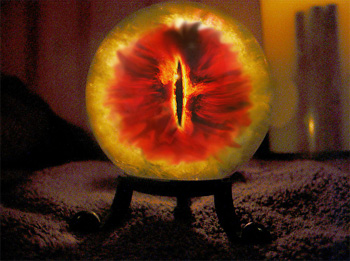
palantir1.jpg

And the seduction of Gandalf began with the seduction of Saruman, as Gandalf says:

“Saruman…I have heard speeches of this kind before, but only in the mouths of emissaries sent from Mordor to deceive the ignorant.” (The Lord of the Rings, The Fellowship of the Ring, Book 2, Chapter 2, “The Council of Elrond”)

This figure for good being drawn away from the proper path reminded us of a similar situation in Shakespeare. Macbeth has been a successful general for Duncan, the king of Scotland. For his latest victory, he has been well-rewarded by the king, but just as in the case of Saruman, there is some part of him which wants more. Thus, when, after the battle, he and a companion meet three strange women on the edge of the battlefield, their prophetic words touch him in a place perhaps untouched before, but there.

MacbethAndBanquo-Witches

They first hail him by titles King Duncan has yet to give him–but will.  Then they hail him as King of Scotland itself, and his corruption begins.  It may have gone no farther than unquiet dreams had there not be a second element in his seduction:  his wife.

Ellen-Terry-as-Lady-Macbeth-by-John-Singer-Sargent-1889

It is she who completes what these three strange women began, not only nurturing Macbeth’s ambition, but even planning the murder of King Duncan.

Lady_Macbeth_CattermoleLike Saruman, Macbeth is overcome, gives in, murders Duncan, seizes power, but, also like Saruman, can not retain it and, interestingly, an element in his defeat closely resembles an element in Saruman’s defeat:  trees.

As his reign suffers resistance and becomes bloodier and more confused, Macbeth sees a series of apparitions, including one which reassures him–or so he thinks–that

“Be lion-mettled, proud, and take no care
Who chafes, who frets, or where conspirers are.
Macbeth shall never vanquished be until
Great Birnam Wood to high Dunsinane Hill
Shall come against him.” (Macbeth, 4.1.94-98)
But his enemies, to disguise their numbers and movements, camouflage themselves with foliage from Birnam Wood,
 Scan-100518-0011
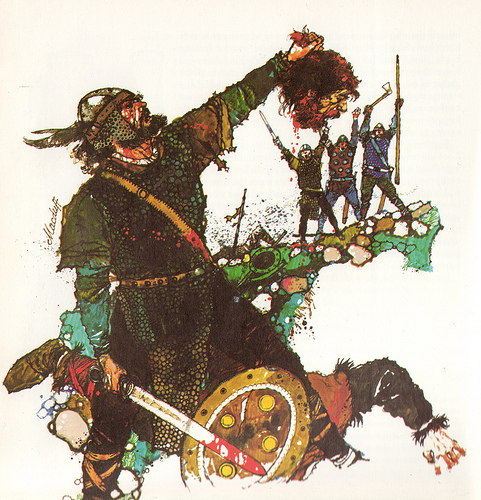
Macbeth’s fortress is successfully taken, and Macbeth is killed in battle, his head taken by an avenging enemy, Macduff.
 macduff-wit-macbeth-head-jpg

Where Macbeth has had Birnam Wood, Saruman suffers from the Forest of Fangorn–

Tolkien, Nasmith, painting, illustration, Lord of the Rings, Silmarillion, Hobbit, Middle-earth

The Wrath of the Ents, by Ted Nasmith

(We would add one more Macbeth parallel for The Lord of the Rings.  Another seemingly reassuring apparition has told Macbeth that he can only be killed by a very special person:

“Be bloody, bold, and resolute. Laugh to scorn
The power of man, for none of woman born
Shall harm Macbeth.” (Macbeth, 4.1.81-83)
That person turns out to be Macduff, born from a Caesarian section.
Do we need to remind our readers of what Eowyn says in reply to the Witch-king’s “Hinder me?  Thou fool.  No living man may hinder me!”)
eowyn.nazgul

After the fall of Isengard, Saruman is imprisoned in his own tower.  During his imprisonment, he is deprived of the Palantir, but Sauron’s seduction has been thorough and, even when offered another chance, there will be nothing left for him in the future but being a petty spoiler and then the victim of his own slave, someone he had once seduced.

jwyatt-sarumande

Thanks, as always, for reading.

MTCIDC

CD
The Fall of Two Cities?

09 Wednesday Mar 2016

Posted by Ollamh in Economics in Middle-earth, Imaginary History, J.R.R. Tolkien, Language, Maps, Military History, Military History of Middle-earth, Narrative Methods

≈ Leave a comment

Tags

Agincourt, Anadoluhisari, Anatolia, Asia Minor, Bayezid I, Bosphorus, Byzantium, Constantine I, Constantinople, Crecy, English Civil Wars, Eowyn, Gondor, map, Mehmet II, Minas Tirith, motte and bailey, Newark, Normans, Osgiliath, Ottoman Empire, Poitiers, Rumelihisari, siege, The Lord of the Rings, Tolkien, Witch-King of Angmar

Dear Readers,

Welcome, as always. A little while ago, we talked about the “siege of Gondor”, which really wasn’t a siege in the formal sense, at all, but rather an assault. (We suspect that JRRT liked the sound of “siege” and so used it, not caring if it were strictly accurate or not.) In this posting, we want to look at a real siege and examine what might be parallels with events in Middle Earth.

Before we do, we want to take a moment to talk about the word “siege”. It comes into English through Old French asegier, which comes from Latin ad + sedeo > adsideo, adsidere , literally, “to sit down at”. The northern French who passed the word on to England must have liked to say what’s called a y-glide when certain consonants came before e, so, though it was spelled asegier, it would have been said “ah-see-YED-jier”. And that’s why English today has what can be a confusing spelling. (In our experience, lots of native speakers have trouble distinguishing between the ie of “siege” and the ei of “seize”). The stress on the word in English would have been away from the initial a, and so that would have disappeared from the word as it moved from being a borrowing.

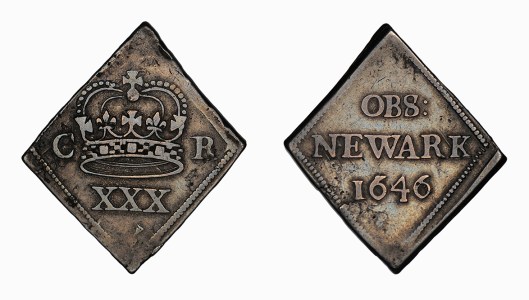
[As what we think is a cool footnote, Latin also has the verb obsideo “to sit down right before=to besiege” and we can see that used in English in the word “obsession”, with the idea that something bothers you so much that it’s like you’re being besieged by it. You can also see it on this wonderful bit of 17th-c. English history.

obsidionalmoney.jpg

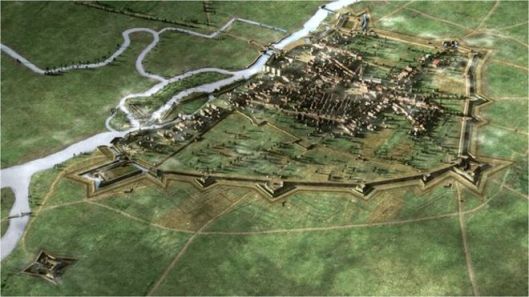
Although it doesn’t look like a modern coin, this is a form which used to be called “half-a-crown”—that is, 30 pennies (that’s what those three xses mean), or two shillings, sixpence.   This coin was struck in the town of Newark-upon-Trent, when it was besieged during the English Civil Wars (1642-1651).

_82601862_newark-1646map.jpg

And that’s where obsideo comes in. The back (the “reverse” in coin language—the front is called the “obverse”) says:

OBS: Newark (with a date, either 1645 or 1646, depending on when the coin was struck)

OBS = Obsessa Newark = “Newark Besieged”

There were a lot of coin-substitutes struck by various besieged towns, but, apparently, those from Newark are the most numerous.]

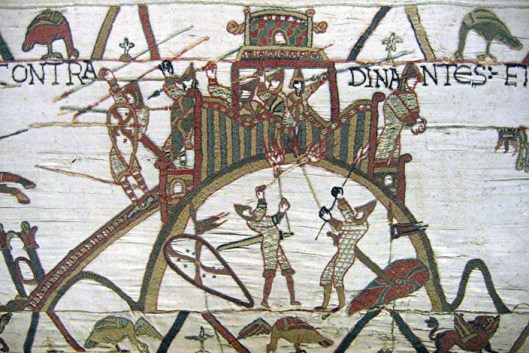
In the medieval western military world, sieges were more common, it seems, than pitched battles. As castles and towns were focal points for the possession and control of land—think of the hundreds of early castles, called “motte and bailey”, which the Normans built all across England in the first years after their conquest–it’s not surprising that they would have been a focus of attack.

motteandbailey.jpg Tapisserie_motte_dinan 704.jpg

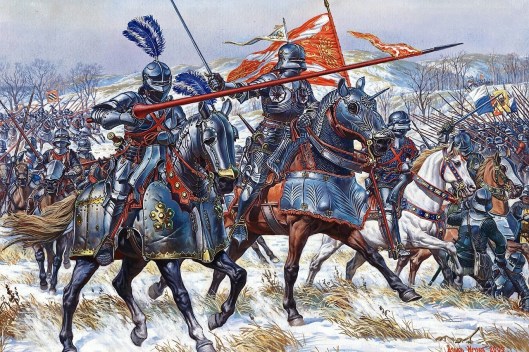
As well, we can imagine that, ultimately, they would have been cheaper, in terms of the most irreplaceable manpower, sparing the highly-trained, hard-to-replace, knights and men-at-arms.

knights.jpg

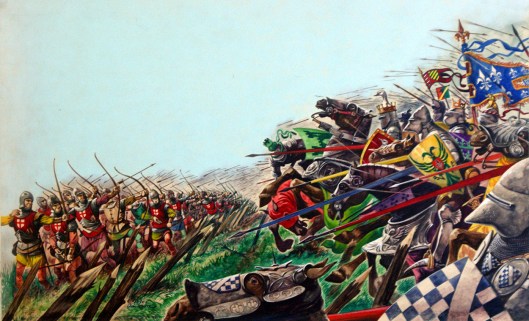
Battles like Crecy (1346), Poitiers (1356), and Agincourt (1415), cost the French dearly as their brave knights threw themselves at their English opponents, whose longbows shot them and their horses down.

agincourt.jpg

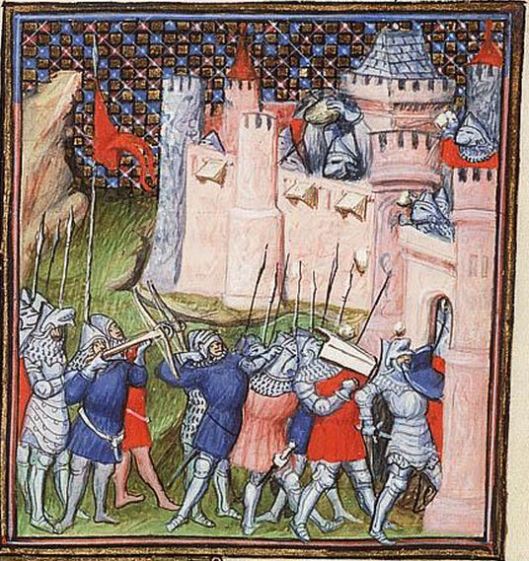
In a siege, although there was the occasional combat, including the exploitation of a break in the enemy’s defenses,

Edward-III-takes-Poix-Castle.jpg

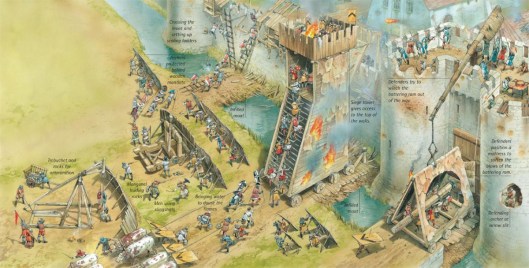
most of a siege would be spent in using machinery of various sorts to aid you in breaking down the walls—and the resistance of the defenders, as well.

castles-and-knights-2-with-labels.jpg

This brings us to the real, historical siege we want to examine: Constantinople, 1453.

Bizansist_touchup.jpg

Constantinople had begun life as a Greek colony, called Byzantium, on the European side of the narrow passageway between the Black Sea and the northeastern Mediterranean.

byzempmap.gif

It had been refounded and greatly expanded by the Roman emperor, Constantine I, to be a new capital in the east.

Constantine-I-Face.jpg

Although it was supposed to be called “New Rome”, everyone in the east called it after its refounder, and so it was “Constantinople”, becoming the capital of an eastern empire which we call “Byzantine”. Even with setbacks and a number of unsuccessful attacks over the centuries, it was, for a long time, a very wealthy and powerful city.

1-reconstruccion-de-bizancio.jpg

But even the wealthiest and most powerful cities will fade—especially when faced with ambitious enemies. Constantinople had had a number of those, but, finally, in its last years, perhaps its most ambitious and most powerful arose in Asia Minor: that of the Ottoman Turks. As you can see from this map, its beginnings were modest: one Turkic-speaking group among many.

Anatolian_Beyliks_in_1300.png

This was a period of instability, however. The Ottoman leaders quickly took advantage of that instability to grab power and territory, so that, by 1400, they had spread beyond the shrinking Byzantine world, into the Balkans, and, soon, Constantinople was surrounded.

trebizond1400

This surrounding took place in an increasingly-methodical way. In 1393-4, the ruler of the Ottomans, the sultan Bayezid I

bayezit1.jpg


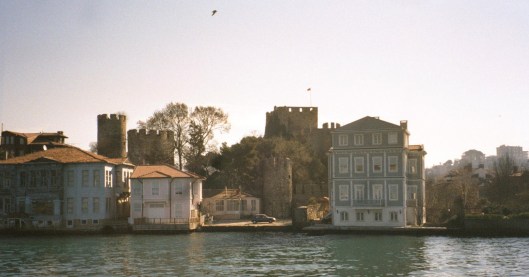
built a small fortress on the Asia Minor side of the Bosphorus, the name for the northern stretch of the passage which led from the Black Sea to the Mediterranean. It was called Anadoluhisari, “the Anatolian fort”.

Anadoluhisari.jpg


You can see from the map that this was the beginning of setting up a choke point upstream from Constantinople.

mapwithanadoluhisari.gif

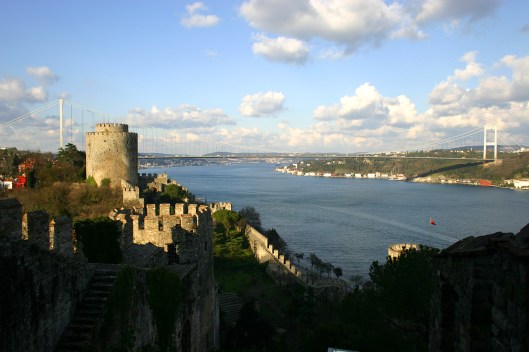
In 1451-2, the sultan Mehmet II finished the job with the Rumelihisari just opposite, on the European side (and that’s what its name means, “the Roman—that is, European—fort”).

Rumeli_hisari.jpg

Guns were mounted

muslim_rocket_technology_06.jpg

and any help which might have come from the Black Sea was blocked.

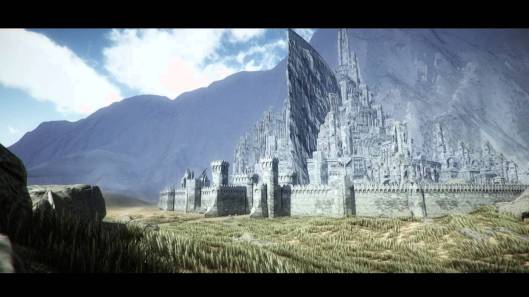
And here we want to take a minute to look at our imaginary city and its danger—because we see some easy parallels here. First, of course, the Ottoman empire was an eastern threat—so was Mordor. Mordor had taken the east bank of the Anduin, just as the Ottomans had taken the Asian side of the Bosphorus. And, in the capture of the European side and the building of Rumelihisari, we might see the taking of Osgiliath and the west bank of the Anduin. Then there is the massive city of Minas Tirith and the attack upon it.

mt.jpg 2381576-zmordorforcesk7.jpg

Constantinople was also a massive city.

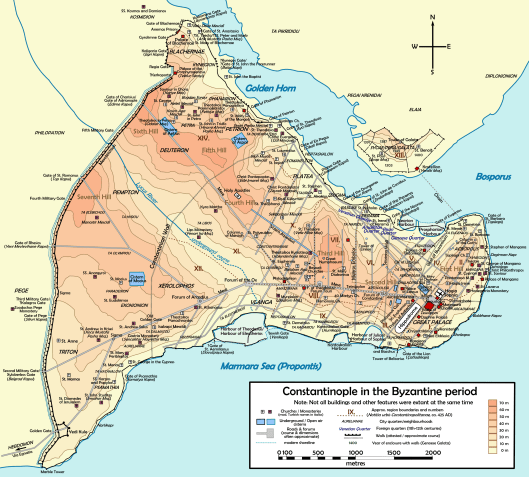
Byzantine_Constantinople-en.png

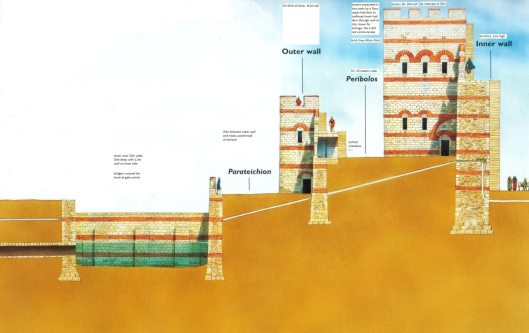
It was, basically, on a triangular piece of land, with two sides protected by water. The original Greek town had had a wall, but it was long gone and almost all of Constantine’s land wall had long disappeared, as well. The latest walls are called the Theodosian, after their originator, the emperor Theodosius II (408-450AD), but the walls included bits of the Constantinian walls and many repairs, over the centuries. The main land defenses included three lines of wall and a moat.

2rh67o0.jpg

This sounds very impressive until one considers two things: first, is there a garrison big enough to defend what are, in fact, a number of miles of wall? And, second, although the walls have withstood previous attacks, including one made by the Ottomans in 1422AD, how will they stand up to the threat of modern artillery?

At the height of its power and prosperity, it is estimated that Constantinople had had a population of anywhere from 500,000 to 750,000 (although scholars argue over this). At the time of the final siege, the population had fallen to as low as 40,000. Thus, large parts of the city were empty—just like Minas Tirith:

“Pippin gazed in growing wonder at the great stone city…Yet it was in truth falling year by year into decay; and already it lacked half the men that could have dwelt at ease there.” (The Return of the King, Book 5, Chapter 1, “Minas Tirith”)

The garrison of Constantinople was perhaps about 9,000, in all, which meant that they were very thinly stretched. We don’t know just how many troops were in Minas Tirith. Some reinforcements had come from South Gondor, as we noted in an earlier posting, but only a few thousand and the defenders were powerfully outnumbered, just as those of Constantinople were, when the forces of Mordor began to arrive. The Ottoman army is thought to have had between 50,000 and 80,000 men, but just how many Orcs and others marched down the causeway from Osgiliath isn’t known–they are just a horde—something which the Jackson film shows very well.

maxresdefault

Then the assault begins, the Orcs having giant stone throwers, siege towers, and, finally, a giant, fire-breathing ram, Grond.

Grond_arrives.png

If you’ve been following our postings (and we hope you have!), then you know that we’ve discussed the use of what appears to be gunpowder, both at Helm’s Deep and at the Rammas Echor. The Orcs who attack the walls of Minas Tirith don’t appear to have such a weapon, but, unfortunately for the defenders of Constantinople in 1453, the Turks do, in the form of plentiful modern artillery.

Illustration-of-angus-mcbride-showing-the-ottoman-cannon-basilica-during-the-siege-of-constantinople-in-1453-ad.jpg

Attacks wear down the small garrison and huge, stone-throwing weapons knock down the walls, so that, finally the city falls, on 29 May, 1453.

84087026.jpg

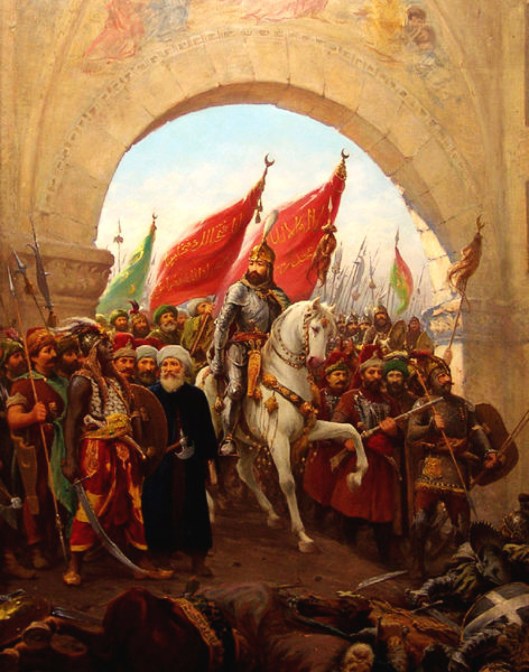
Its conqueror, Mehmet II, rides in—

mehmet2enteringconstantinople.jpg

which is something the witch king of Angmar never gets to do, perishing instead, at the hands of Eowyn and Merry.

Eowyn.jpg


And there the parallels end, as does our posting. Did JRRT have the fall of Constantinople somewhere in the back of his mind? What do you think?

Thanks, as always, for reading.

MTCIDC

CD
Jolly Tom.2

16 Wednesday Sep 2015

Posted by Ollamh in Fairy Tales and Myths, Imaginary History, J.R.R. Tolkien, Narrative Methods

≈ Leave a comment

Tags

Barrow-downs, Barrow-wights, Bree, Dagger, Dorset, Eowyn, Fangorn, Frodo, Gandalf, Middle-earth, Nazgul, Neolithic, Old Forest, Old Man Willow, Peter Jackson, Sauron, The Hobbit, The Lord of the Rings, The Ring, Tolkien, Tom Bombadil, Weaponry, Westernesse, Witch-King of Angmar

Dear Readers,

Welcome, as always!

As you can see from the title, this is a continuation of the previous posting, in which we began a discussion of a two-part question: 1. What would be the advantage of keeping Tom Bombadil in a recorded (audio or film) version of The Lord of the Rings? 2. What would you need to keep?

To summarize the previous posting, we suggested that:

  1. he, along with Fangorn/Treebeard, represents the great age of Middle Earth—something very important to the author–and a continuity of living things, which leads us to
  2. he might also be seen as a form of hope: the Ring has no effect upon him and he remembers a time before the arrival of Sauron, suggesting that there might be a time after him, as well, and that the Ring has limits
  3. as it seems out of place even in the current text, the bulk of Tom’s verse and the sometimes rhythmicized prose could be removed, leaving only the character himself and his part in the plot

We believe, however, that there is a more pressing reason for keeping him in the text, and it has to do with something Gandalf says to Frodo when Frodo, panicked at the prospect of having to deal with the Ring, demands, “Why did it come to me? Why was I chosen?” LotR 61.

“’Such questions cannot be answered,’ said Gandalf, ‘You may be sure that it was not for any merit that others do not possess: not for power or wisdom, at any rate. But you have been chosen, and you must therefore use such strength and heart and wits as you have.’” LotR 61.

This is a continuation of Gandalf’s earlier statement that:

“Behind that there was something else at work, beyond any design of the Ring-maker. I can put it no plainer than by saying that Bilbo was meant to find the Ring, and not by its maker. In which case you also were meant to have it.” LotR 56.

Thus, there is a level of intentionality at work in Middle-earth, something beyond Sauron. And, when we see Bombadil next, he will prove to be an instrument of the intention.

The Hobbits have left his house and, following his directions, have passed onto the Barrow-downs.

Breeland_breetobarrowdowns

A down is a piece of rolling countryside, often bare at the top, with trees in its folds—as here in Dorset.

dorset_3287278k

The Dorset Downs have lots of Neolithic remains, including numbers of barrows or tumuli, grave mounds commonly covering an interior structure, not uncommonly made of stone—

OLYMPUS DIGITAL CAMERA

image4

Wakeman_Newgrange_tumulus_chamber_cross_section

Such tumuli once contained the body or bodies usually of high-status persons

Unknown

and all sorts of grave goods, either as a display of wealth or perhaps for some sort of afterlife use.

gordion1957

Bombadil has been careful, however, to say “more than once” (LotR 134) that the Hobbits are to avoid the barrows themselves, telling them not to meddle with them or “cold Wights” (LotR 133). (He also says that they should pass them “on the west-side”—there have been lots of guesses about this—we would add our guess that it might have to do with the orientation—literally—of the entry. If entries faced east and the rising sun, it would be wise of the Hobbits to skirt the barrows’ potential blind side, on the west. And there is also the rather obvious point, once you’ve looked at a map of the area, that, if they kept the barrows to the right and the Old Forest to the left, they would be heading north towards the road to Bree, as they intended.)

il_570xN.743473219_bxv9

Those Barrow-wights are not the original inhabitants of the mounds, but agents of the Witch-king of Angmar, who sends them to take possession (The Lord of the Rings Companion, 144-145), long after their original occupation—but, what’s interesting is that, at least one of these tumuli appears not to have been plundered and this leads us to our next point about Tom Bombadil. After he rescues the Hobbits (showing again his mastery over at least the minor forces of evil), he does a little plundering of his own, including:

“For each of the hobbits he chose a dagger, long, leaf-shaped, and keen, of marvellous workmanship, damasked in serpent forms in red and gold…Then he told them that these blades were forged many long years ago by Men of Westernesse: they were foes of the Dark Lord, but they were overcome by the evil king of Carn Dum in the Land of Angmar.” LotR 146.

damascene-sword

Here are a few ideas of what, at least, the leaf shape might have looked like:

leaf.2bronzeageblades leaf.1

And we include this third one just because it looks so cool—

leaf.3

Bombadil, of course, has actually seen all of this happen, and here we see that theme of great age appear again. And there’s the pedigree of those blades. Unlike the sack ‘o swords slung without any more explanation than “These are for you. Keep them close.” to the Hobbits in the film, these were weapons made by heroic men of the past, doomed men, but who fought evil until they were overcome (a strong theme throughout the history of Middle-earth).

Late in the story, one of those blades seems to be the instrument of intentionality once more. When Eowyn faces the Witch-king of Angmar, now the chief of the Nazgul—

lord_of_the_nazgul_2

and he is about to kill her with his mace, Merry strikes him from behind, stabbing him in what, on a living man, would have been a vulnerable spot, the back of the knee. (LotR 842.)

eowyn_vs_the_nazgul_by_arteche-d3ggm8g

Distracted and, surprisingly, in pain, the Nazgul stumbles and Eowyn destroys him and here, once more, we may see intentionality, and all because of Tom Bombadil. Merry’s sword, from its contact with the undead flesh of the Nazgul, withers away, but—

“So passed the sword of the Barrow-downs, work of Westernesse. But glad would he have been to know its fate who wrought it slowly long ago in the North-kingdom when the Dunedain were young, and chief among their foes was the dread realm of Angmar and its sorcerer king. No other blade, not though mightier hands had wielded it, would have dealt that foe a wound so bitter, cleaving the undead flesh, breaking the spell that knit his unseen sinews together.” LotR 844.

So, for everything from Old Man Willow (whom the script writers couldn’t resist completely, transposing him to an improbable scene with Fangorn/Treebeard) to showing the great age of Middle-earth to suggesting other powers untouched by the Ring to offering possible hope to showing something of the intentionality behind certain actions in the story to providing the ancient and magical weapon which could finally bring down the Witch-king of Angmar and save Eowyn at the same time, might we suggest that, next production—audio or visual—of The Lord of the Rings, Jolly Tom might have a place in the cast?

Thanks, as always, for reading.

MTCIDC

CD

PS

If you would like to read more about Tom, see, for example, Dorathea Thomas, “He Is: Tom Bombadil and His Function in The Lord of the Rings” at Academia.edu.

Newer posts →

The Doubtful Sea Series Facebook Page

The Doubtful Sea Series Facebook Page

  • Ollamh

Categories

  • Artists and Illustrators
  • Economics in Middle-earth
  • Fairy Tales and Myths
  • Films and Music
  • Games
  • Heroes
  • Imaginary History
  • J.R.R. Tolkien
  • Language
  • Literary History
  • Maps
  • Medieval Russia
  • Military History
  • Military History of Middle-earth
  • Narnia
  • Narrative Methods
  • Poetry
  • Research
  • Star Wars
  • Terra Australis
  • The Rohirrim
  • Theatre and Performance
  • Tolkien
  • Uncategorized
  • Villains
  • Writing as Collaborators
Follow doubtfulsea on WordPress.com

Across the Doubtful Sea

Recent Postings

  • Cap-a-Pie (2) November 4, 2026
  • Cockcrow October 28, 2026
  • Cap-a-Pie (1) October 21, 2026
  • Now You See Him, Now… October 14, 2026
  • Stand and Deliver, or, Pick a Pocket or Two October 7, 2026
  • Death and the Rohirrim September 30, 2026
  • Minor? September 23, 2026
  • An Homeric PS September 16, 2026
  • December in September September 9, 2026

Blog Statistics

  • 127,166 Views

Posting Archive

  • November 2026 (1)
  • October 2026 (4)
  • September 2026 (5)
  • August 2026 (4)
  • July 2026 (5)
  • June 2026 (4)
  • May 2026 (4)
  • April 2026 (5)
  • March 2026 (4)
  • February 2026 (4)
  • January 2026 (4)
  • December 2025 (5)
  • November 2025 (4)
  • October 2025 (5)
  • September 2025 (4)
  • August 2025 (4)
  • July 2025 (5)
  • June 2025 (4)
  • May 2025 (4)
  • April 2025 (5)
  • March 2025 (4)
  • February 2025 (4)
  • January 2025 (5)
  • December 2024 (4)
  • November 2024 (4)
  • October 2024 (5)
  • September 2024 (4)
  • August 2024 (4)
  • July 2024 (5)
  • June 2024 (4)
  • May 2024 (5)
  • April 2024 (4)
  • March 2024 (4)
  • February 2024 (4)
  • January 2024 (5)
  • December 2023 (4)
  • November 2023 (5)
  • October 2023 (4)
  • September 2023 (4)
  • August 2023 (5)
  • July 2023 (4)
  • June 2023 (4)
  • May 2023 (5)
  • April 2023 (4)
  • March 2023 (5)
  • February 2023 (4)
  • January 2023 (4)
  • December 2022 (4)
  • November 2022 (5)
  • October 2022 (4)
  • September 2022 (4)
  • August 2022 (5)
  • July 2022 (4)
  • June 2022 (5)
  • May 2022 (4)
  • April 2022 (4)
  • March 2022 (5)
  • February 2022 (4)
  • January 2022 (4)
  • December 2021 (5)
  • November 2021 (4)
  • October 2021 (4)
  • September 2021 (5)
  • August 2021 (4)
  • July 2021 (4)
  • June 2021 (5)
  • May 2021 (4)
  • April 2021 (4)
  • March 2021 (5)
  • February 2021 (4)
  • January 2021 (4)
  • December 2020 (5)
  • November 2020 (4)
  • October 2020 (4)
  • September 2020 (5)
  • August 2020 (4)
  • July 2020 (5)
  • June 2020 (4)
  • May 2020 (4)
  • April 2020 (5)
  • March 2020 (4)
  • February 2020 (4)
  • January 2020 (6)
  • December 2019 (4)
  • November 2019 (4)
  • October 2019 (5)
  • September 2019 (4)
  • August 2019 (4)
  • July 2019 (5)
  • June 2019 (4)
  • May 2019 (5)
  • April 2019 (4)
  • March 2019 (4)
  • February 2019 (4)
  • January 2019 (5)
  • December 2018 (4)
  • November 2018 (4)
  • October 2018 (5)
  • September 2018 (4)
  • August 2018 (5)
  • July 2018 (4)
  • June 2018 (4)
  • May 2018 (5)
  • April 2018 (4)
  • March 2018 (4)
  • February 2018 (4)
  • January 2018 (5)
  • December 2017 (4)
  • November 2017 (4)
  • October 2017 (4)
  • September 2017 (4)
  • August 2017 (5)
  • July 2017 (4)
  • June 2017 (4)
  • May 2017 (5)
  • April 2017 (4)
  • March 2017 (5)
  • February 2017 (4)
  • January 2017 (4)
  • December 2016 (4)
  • November 2016 (5)
  • October 2016 (6)
  • September 2016 (5)
  • August 2016 (5)
  • July 2016 (5)
  • June 2016 (5)
  • May 2016 (4)
  • April 2016 (4)
  • March 2016 (5)
  • February 2016 (4)
  • January 2016 (4)
  • December 2015 (5)
  • November 2015 (5)
  • October 2015 (4)
  • September 2015 (5)
  • August 2015 (4)
  • July 2015 (5)
  • June 2015 (5)
  • May 2015 (4)
  • April 2015 (3)
  • March 2015 (4)
  • February 2015 (4)
  • January 2015 (4)
  • December 2014 (5)
  • November 2014 (4)
  • October 2014 (6)
  • September 2014 (1)

Blog at WordPress.com.

  • Subscribe Subscribed
    doubtfulsea
    Join 78 other subscribers

    Have a WordPress.com account? Log in now.

  • doubtfulsea
    View site in Reader
    Manage subscriptionsSign upLog in
    Report this content
    Collapse this bar
Loading Comments...