Tags
Bab Ballads, Fantasy, Gollum, invisibility, lotr, Nazgul, The Lord of the Rings, The Ring, Tolkien, W.S.Gilbert
As always, dear readers, welcome.
In my last post, I was writing about the Ring
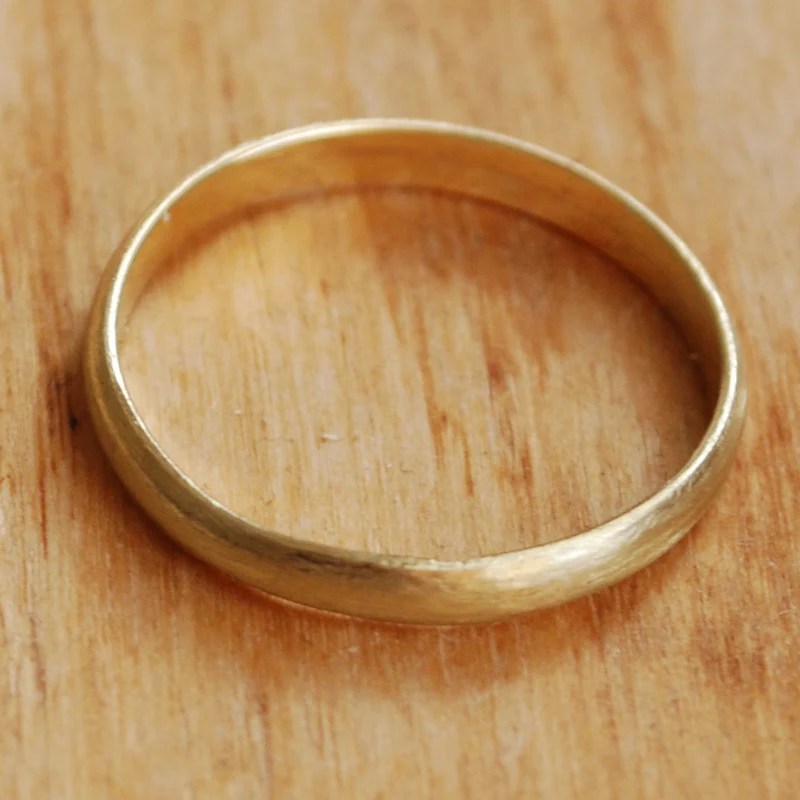
and its effects and that made me think of this—
“The Perils of Invisibility
Old PETER led a wretched life –
Old PETER had a furious wife;
Old PETER too was truly stout,
He measured several yards about.
The little fairy PICKLEKIN
One summer afternoon looked in,
And said, ‘Old PETER, how de do?
Can I do anything for you?
I have three gifts – the first will give
Unbounded riches while you live;
The second health where’er you be;
The third, invisibility.’
‘O little fairy PICKLEKIN,’
Old PETER answered with a grin,
‘To hesitate would be absurd, –
Undoubtedly I choose the third.’ “
(This is the beginning of one of the “Bab Ballads” of W.S. Gilbert (1836-1911), whom you may know from his work with Arthur Sullivan (1842-1900), eternally making half of a partnership often referred to as “G&S”.)
Bilbo, before his terrible contest with Gollum,
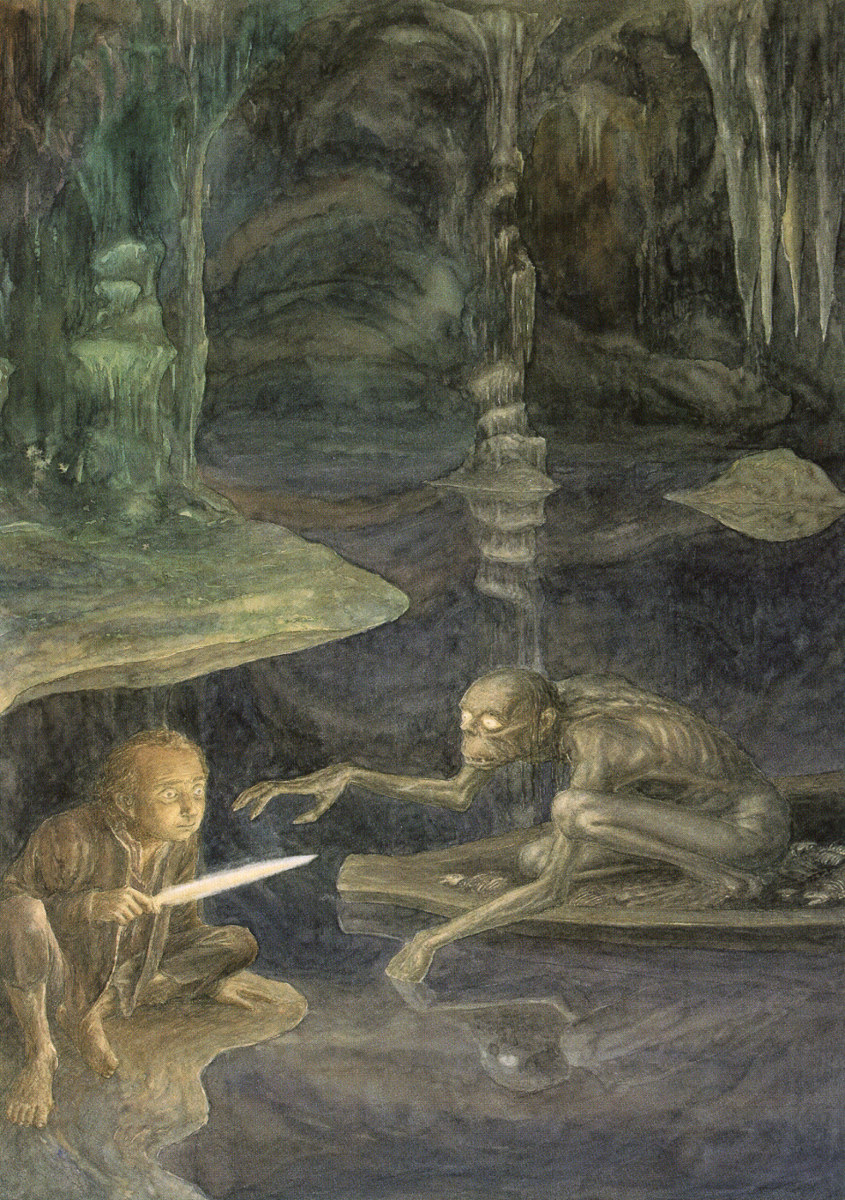
(Alan Lee)
had literally stumbled on the Ring in a goblin tunnel and it was entirely by accident that he discovered one of its properties as Gollum pursued him and he tripped and fell—
“In a moment Gollum was on him. But before Bilbo could do anything, recover his breath, pick himself up or wave his sword, Gollum passed by, taking no notice of him, cursing and whispering as he ran.”
Bilbo is puzzled, but, inadvertently, Gollum later explains as Bilbo follows him—
“…Goblinses! Yes, but if it’s got the present, our precious present, then goblinses will get it, gollum! They’ll find it, they’ll find out what it does. We shan’t ever be safe again, never, gollum! One of the goblinses will put it on, and then no one will ever see him. He’ll be there but not seen….”
We readers have been told earlier by the narrator about this—
“[Gollum] wanted it because it was a ring of power, and if you slipped that ring on your finger, you were invisible; only in the full sunlight could you be seen, and then only by your shadow, and that would be shaky and faint.” (The Hobbit, Chapter 5, “Riddles in the Dark”)
This is the only power of the Ring about which we’re told in The Hobbit because, at the time he had written it, Tolkien himself knew no more—but, as we saw in the last posting, he clearly learned more in time and he could later add that the Ring seemed to have the ability to stop time for its wearer, so that wearer didn’t age—
“The chief power…was the prevention of slowing of decay (i.e. ‘change’ viewed as a regrettable thing), the preservation of what is desired or loved, or its semblance—”
And there’s more—
“…other powers, more directly derived from Sauron…making things of the invisible world visible.” (letter to Milton Waldman, “probably written late in 1951”, Letters, 212)
Old Peter in Gilbert’s poem, can disappear at will—but his clothes are left behind
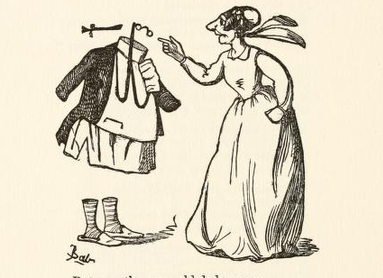
and Old Peter’s wife sabotages his invisibility by stealing his trousers so that, in his Victorian world, he can’t reappear, as, trouserless, he will offend public decency, forcing him, at least temporarily, to remain unseen.
(You can find out about the consequences of Old Peter’s choice here: https://allpoetry.com/The-Perils-of-Invisibility )
And this, in turn, made me think of the Nazgul, who, although still alive through the power of their rings, need cloaks and other items of dress—including armor–to be visible
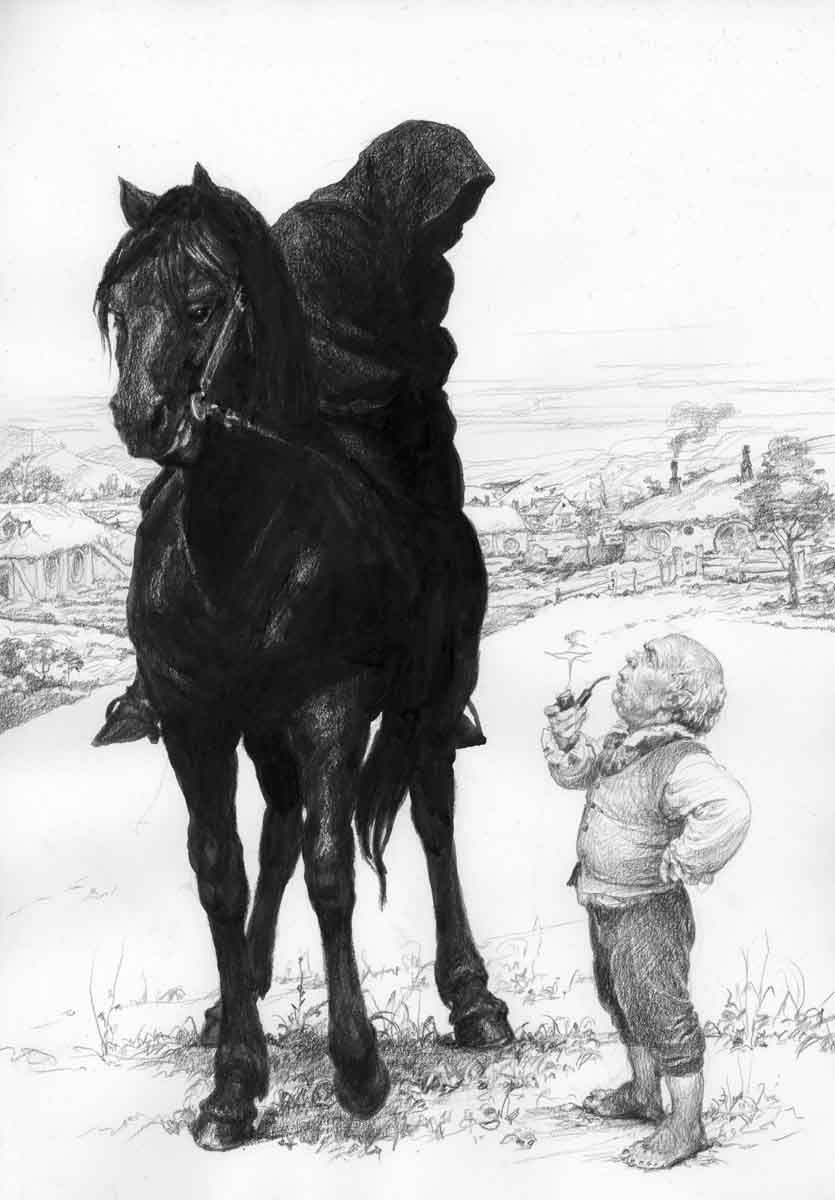
(Denis Gordeev)
and, even with, still remain only half-seen, like the chief of them, facing Theoden and then Eowyn—
“Upon [the beast which he rode]…sat a shape, black-mantled, huge and threatening. A crown of steel he bore, but between rim and robe naught was there to see, save only a deadly gleam of eyes…” (The Return of the King, Book Five, Chapter 6, “The Battle of the Pelennor Fields”)
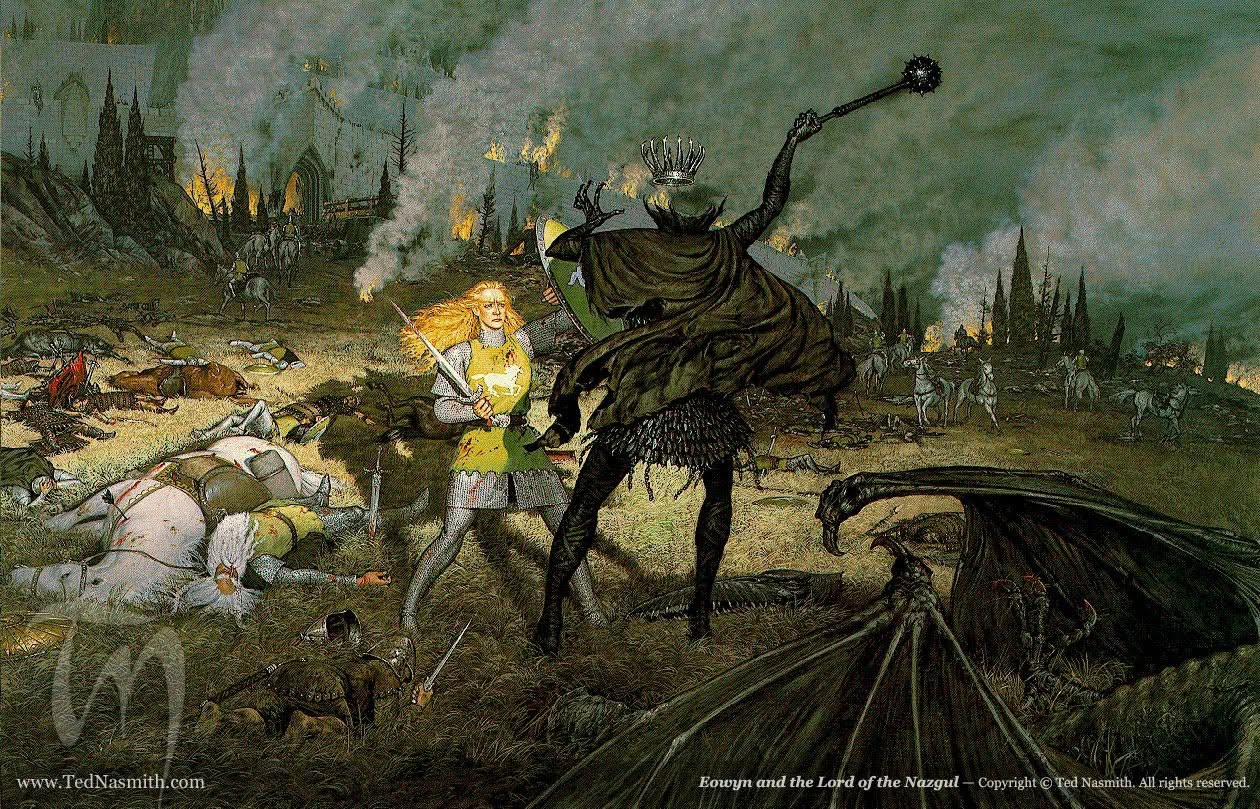
(Ted Nasmith)
Frodo, however, putting on the Ring, sees the Nazgul quite vividly on Weathertop—
“Immediately, though everything else remained as before, dim and dark, the shapes became terribly clear. He was able to see beneath their black wrappings. There were five tall figures: two standing on the lip of the dell, three advancing. In their white faces burned keen and merciless eyes; under their mantles were long grey robes; upon their grey hairs were helms of silver; in their haggard hands were swords of steel…”
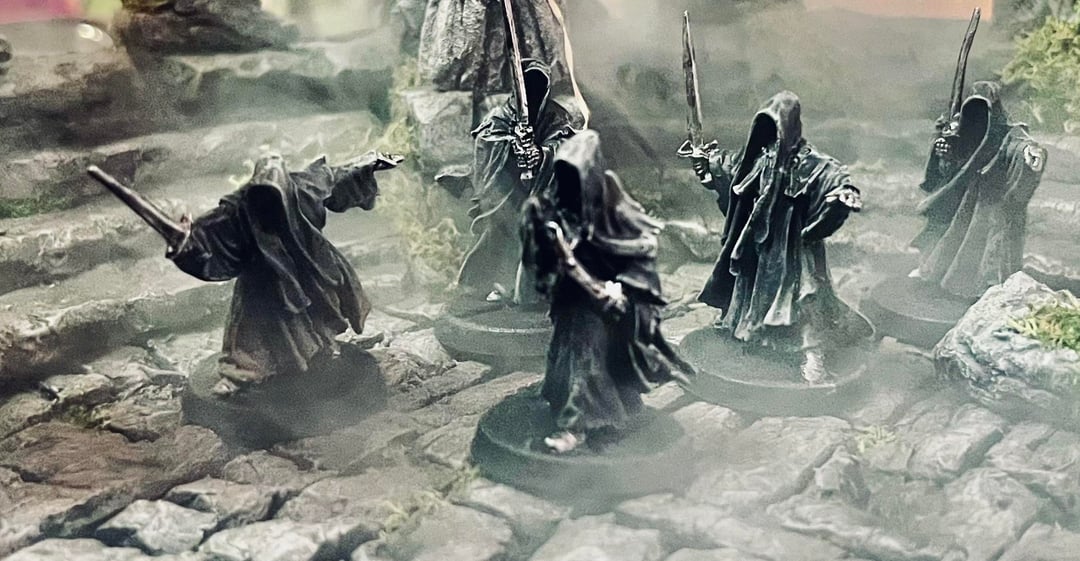
(Middle-earth Miniatures)
And, by putting on the Ring, Frodo has become more than visible to the Nazgul, as Strider has earlier explained:
“ ‘They themselves do not see the world of light as we do, but our shapes cast shadows in their minds, which only the noon sun destroys; and in the dark they perceive many signs and forms that are hidden from us; then they are most to be feared. And at all times they smell the blood of living things, desiring and hating it…Also…the Ring draws them.’ “ (The Fellowship of the Ring, Book One, Chapter 11, “A Knife in the Dark”)
Their ability to pierce the dark almost ends the life of Frodo, but it also reveals something else about the Ring. We know that Sauron, possessing it, can eavesdrop on wearers of lesser rings—
“But secretly in the subterranean Fire, in his own Black Land, Sauron made One Ring, the Ruling Ring that contained the powers of all the others, and controlled them, so that its wearer could see the thoughts of all those that used the lesser rings, could govern all that they did, and in the end could utterly enslave them.” (letter to Milton Waldman, “probably written late in 1951”, Letters, 212-213)
At the same time, even without the Ring, Sauron has a bond with it which allows him to be aware of someone else wearing it—the Ring draws him–as Frodo learns, almost to his destruction, on Amon Hen.
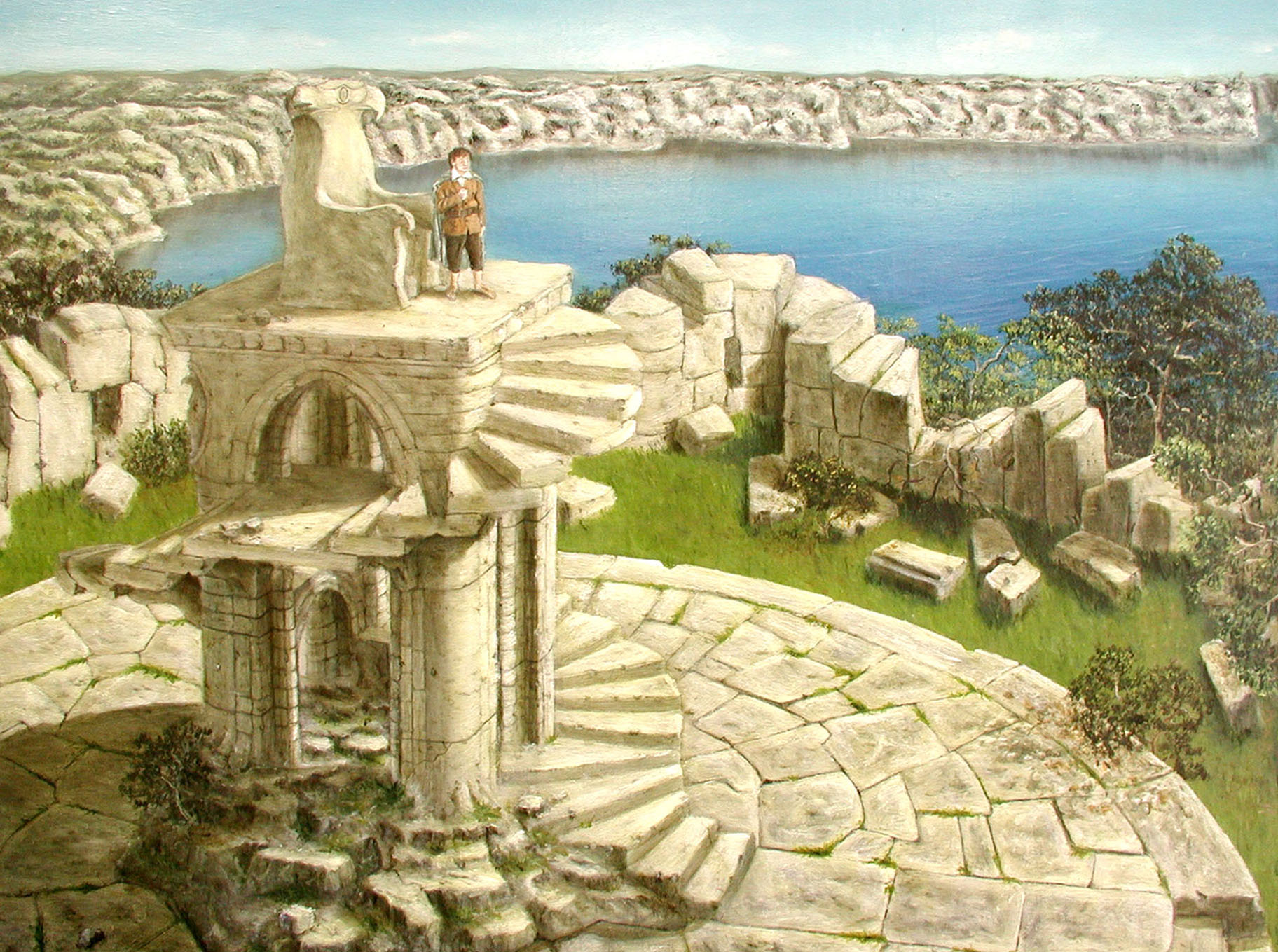
(Scott Peery)
Escaping from the importunate Boromir, he has climbed the ruined site and, putting on the Ring, he begins to see the world as Sauron might, but then—
“And suddenly he felt the Eye. There was an eye in the Dark Tower that did not sleep. He knew that it had become aware of his gaze. A fierce eager will was there. It leaped towards him; almost like a finger he felt it, searching for him. Very soon it would nail him down, know just exactly where he was.” (The Fellowship of the Ring, Book Two, Chapter 10, “The Breaking of the Fellowship”)
Frodo escapes by taking off the Ring, but, in what happens both on Weathertop and on Amon Hen illustrates another peril of invisibility: although, wearing the Ring, one may be invisible to ordinary people, to its Master and his minions, he is all-to-visible and all-too-vulnerable, as well.
Thanks, as always, for reading.
Stay well,
When it comes to such Rings, better to be like Faramir: “I would not take this thing, if it lay by the highway”,
And remember that, as always, there’s
MTCIDC
O
PS
Another person with visibility issues is the title character of H.G. Wells The Invisible Man, which you might enjoy here: https://archive.org/details/invisibleman0000hgwe_u0b9/page/n5/mode/2up

