Magic or Growth?

Tags

, , ,

Dear Readers, 

Welcome! 

As we write the Across series, and the series we’re calling Grey Goose, we think about magic. It’s a tricky business, and we’re reminded of what happened to Apollonius of Rhodes in his Argonautica. The Argonautica is, basically, the story of how Jason assembled a group of heroes and went to find and bring back to Greece the golden fleece. In Apollonius’ time, it was already an old story. Because he was working with traditional material, then, and clearly felt obliged to do so, Apollonius included of all the heroes traditionally said to have been on the Argo. At the same time, this left him with a dilemma: one of those heroes was Heracles. Imagine having such a powerful figure on the ship– was there any need for anybody else? The thought obviously occurred to Apollonius, because he removed Heracles as quickly as he could. 

The thought must also have occurred to JRRT when he was writing The Hobbit. After all, he had a wizard along on the trip to the Lonely Mountain. We presume that the focus of the book is upon Bilbo, however, and his spiritual growth from Baggins to Took, as he is challenged again and again to go beyond what he thinks he knows about himself. With a wizard along, just like Heracles in the Argonautica, what chance is there for Bilbo ever to prove himself? And so, where do we see Gandalf actually do anything magical? He can show the way with a lighted staff, and he can set fire to pinecones, but, for most of the book, he either simply travels along, or he has simply disappeared.

And so, we come to our books. In Across the Doubtful Sea, we have, on the one side, people with strong religious beliefs, the Matan’a’e Amavi’o– the people of the goddess, Matan’a’e. Although they have the power of their goddess and their other gods, they are forced to rely almost entirely on themselves because we feel it is important that our protagonists prove themselves with only minimal divine help. Thus, we follow in the path of JRRT here. 

The principal antagonists, however, are a different matter. These are the Atuk, whose god gives his principal followers tremendous magical powers, but powers which are limited to the forces of winter (rather like the White Witch in The Lion, the Witch, and the Wardrobe). Thus, they can be fought, in a sense, just the way Aslan fights the White Witch with the opposite of cold, heat. 

As our series continues, we will have more to say on the subject of magic and gods. 

Thank you, as always, for reading!

MTCIDC,

CD

More Russian Favorites

Tags

, , , , , , ,

Dear Reader,

Welcome, as always.

We are very visual people. A picture in a museum, an illustration in a book, something in a film, will always catch our eye and sometimes inspire our writing.

This was certainly the case in our first book, Across the Doubtful Sea, where the drawings and paintings from the three Cook expeditions to the South Seas (1768-1779) filled us with a combination of wonder and curiosity. Although they were sometimes strongly influenced by period ideas of the sublime, here were images as close to historical photos as we would ever see.

Hodges,_Resolution_and_Adventure_in_Matavai_Bay

In the case of our second book, The Good King’s Daughter, however, because it was set in a world based loosely upon the medieval Russia of fairy tales, we looked to other sources, particularly those later-19th and 20th-century Russian artists who illustrated moments from the Russian heroic songs (byliny) and from the fairy and folktales themselves.

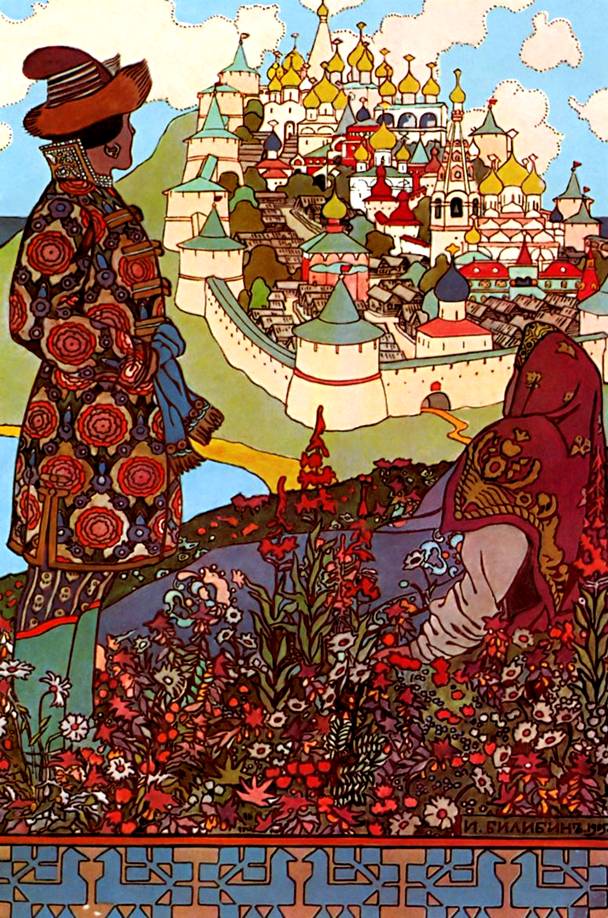
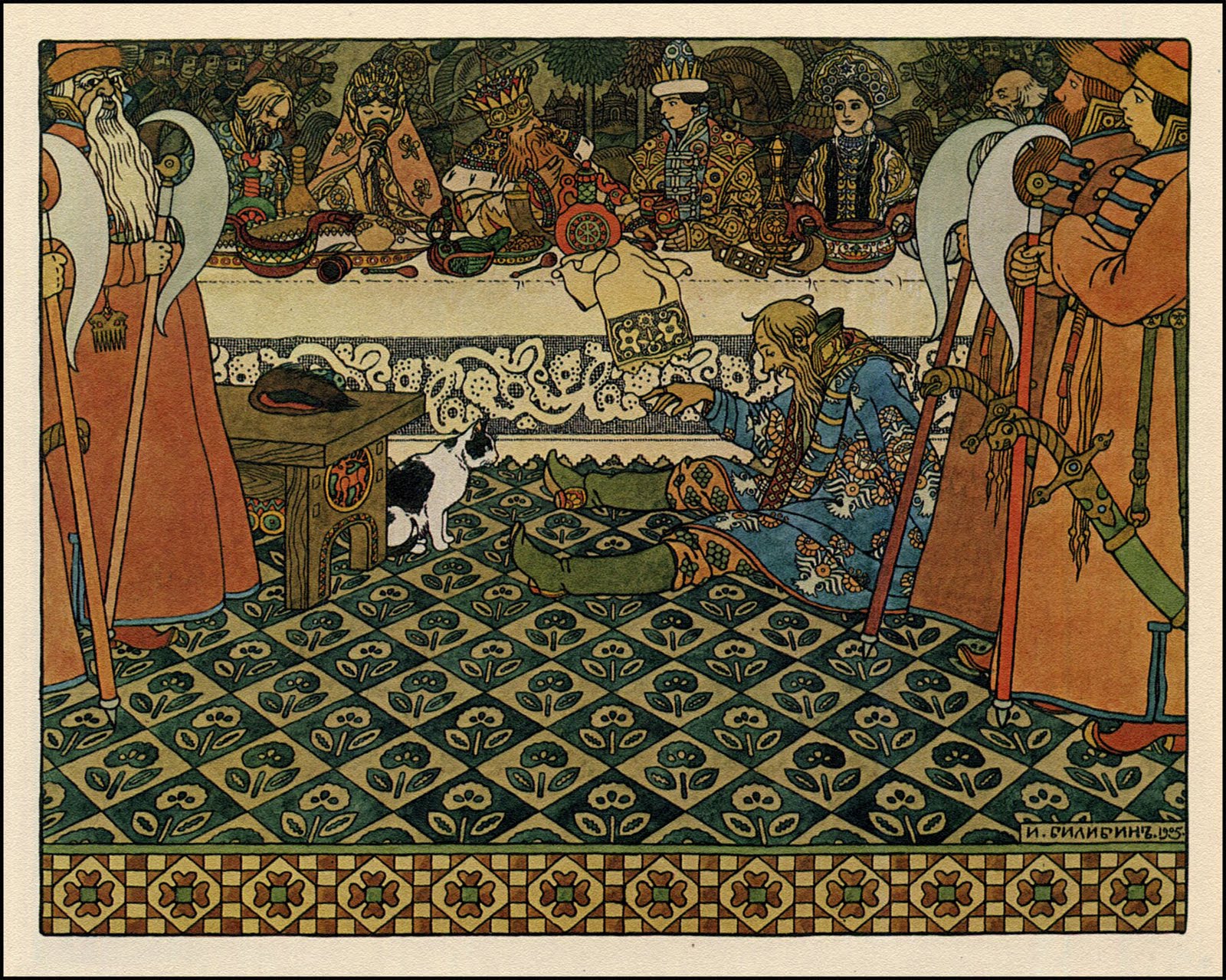
In our last, we showed you a few images from the work of perhaps the most famous (outside Russia, at least) illustrator, Ivan Bilibin (1876-1942). Pictures like “The Island of Buyan” (1905):

Ivanbilibin

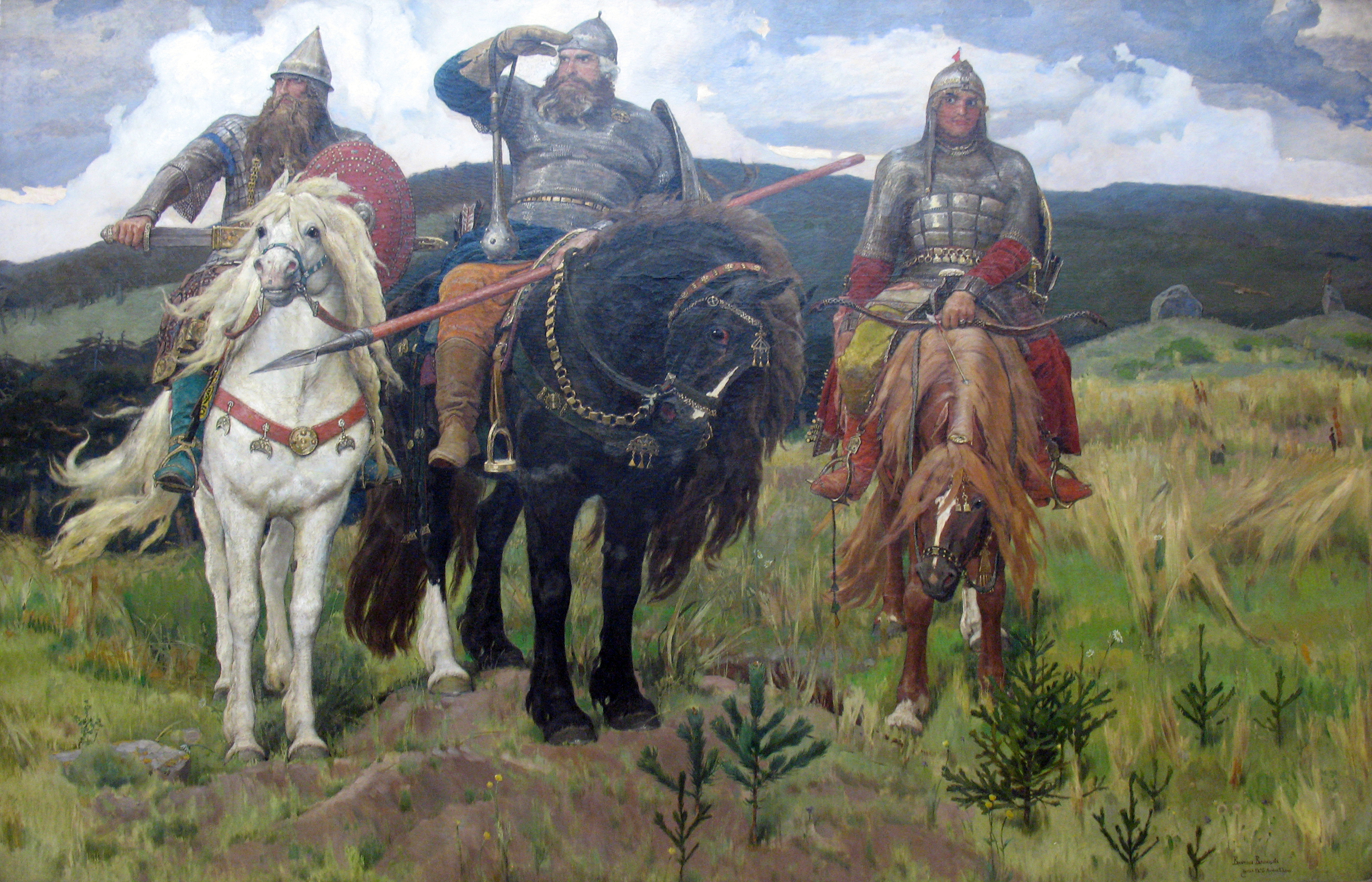
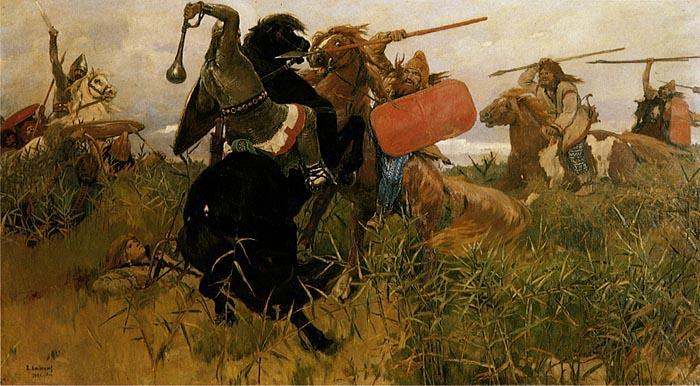
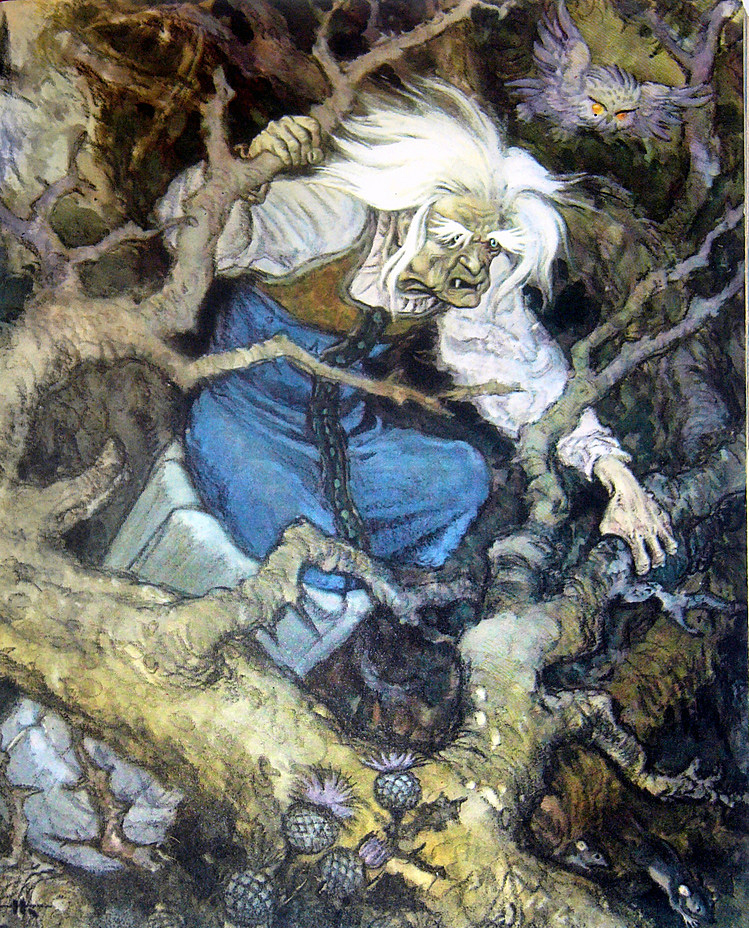
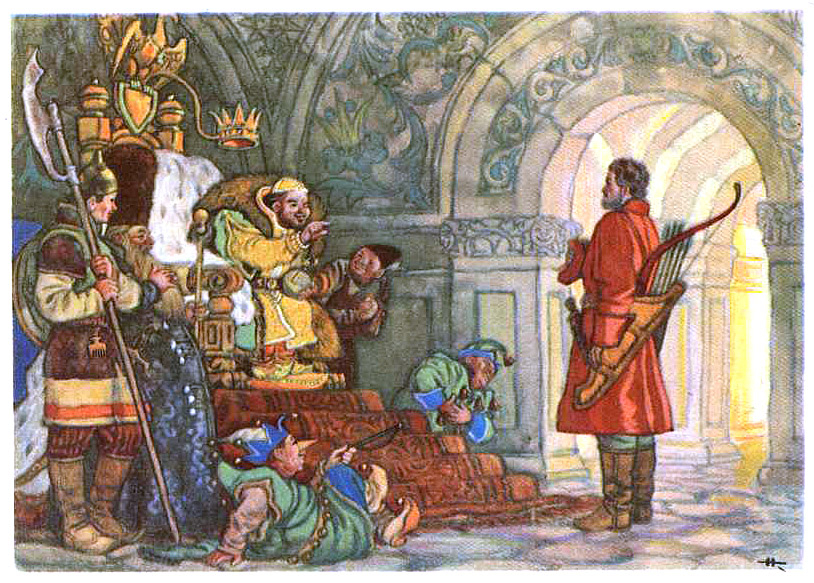
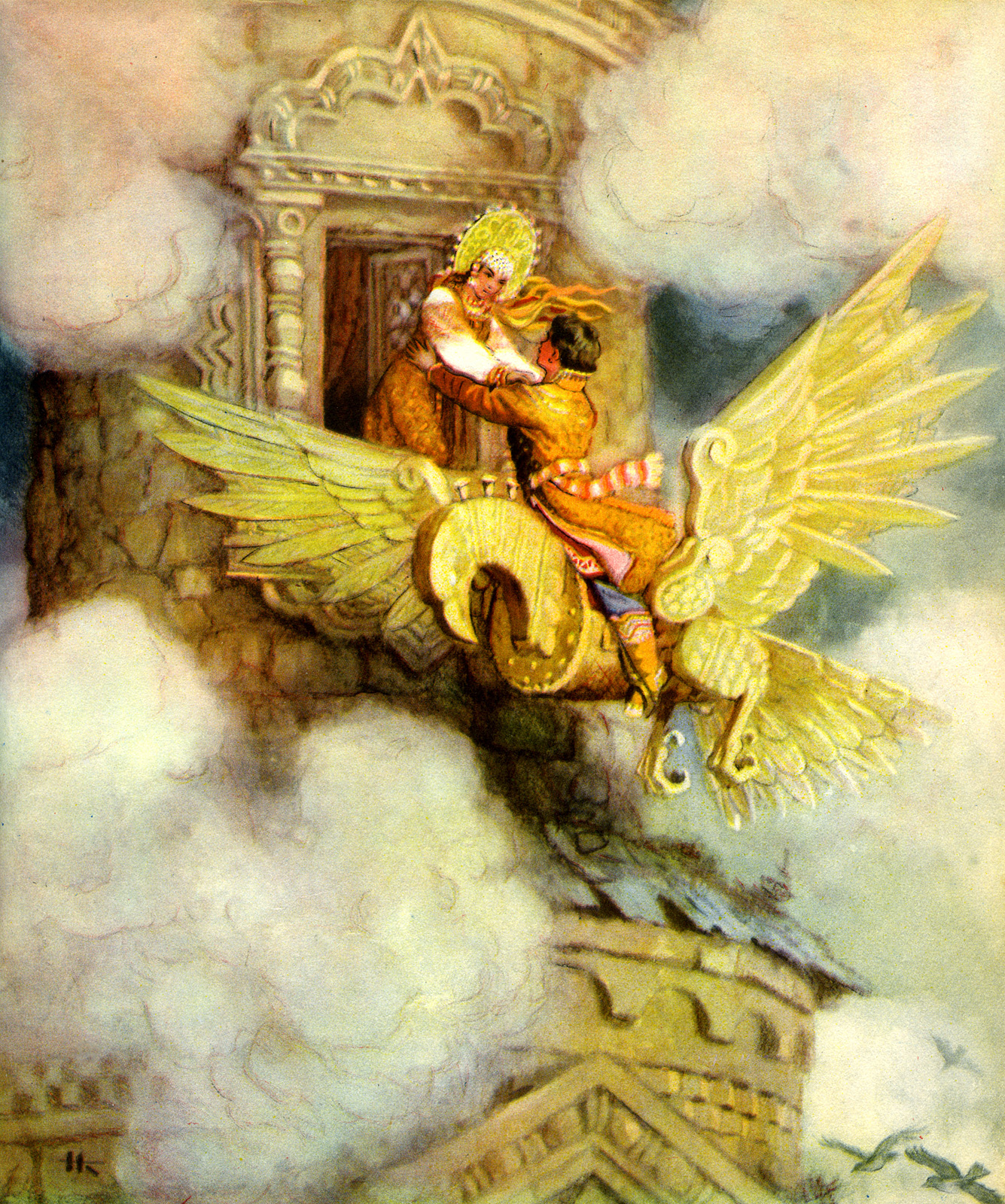
In this posting, we would add two more artists, Victor Vasnetsov (1848-1926—not to be confused with his equally-talented brother, Apollinary 1856-1923) and the more recent Nikolai Kochergin (1897-1974).

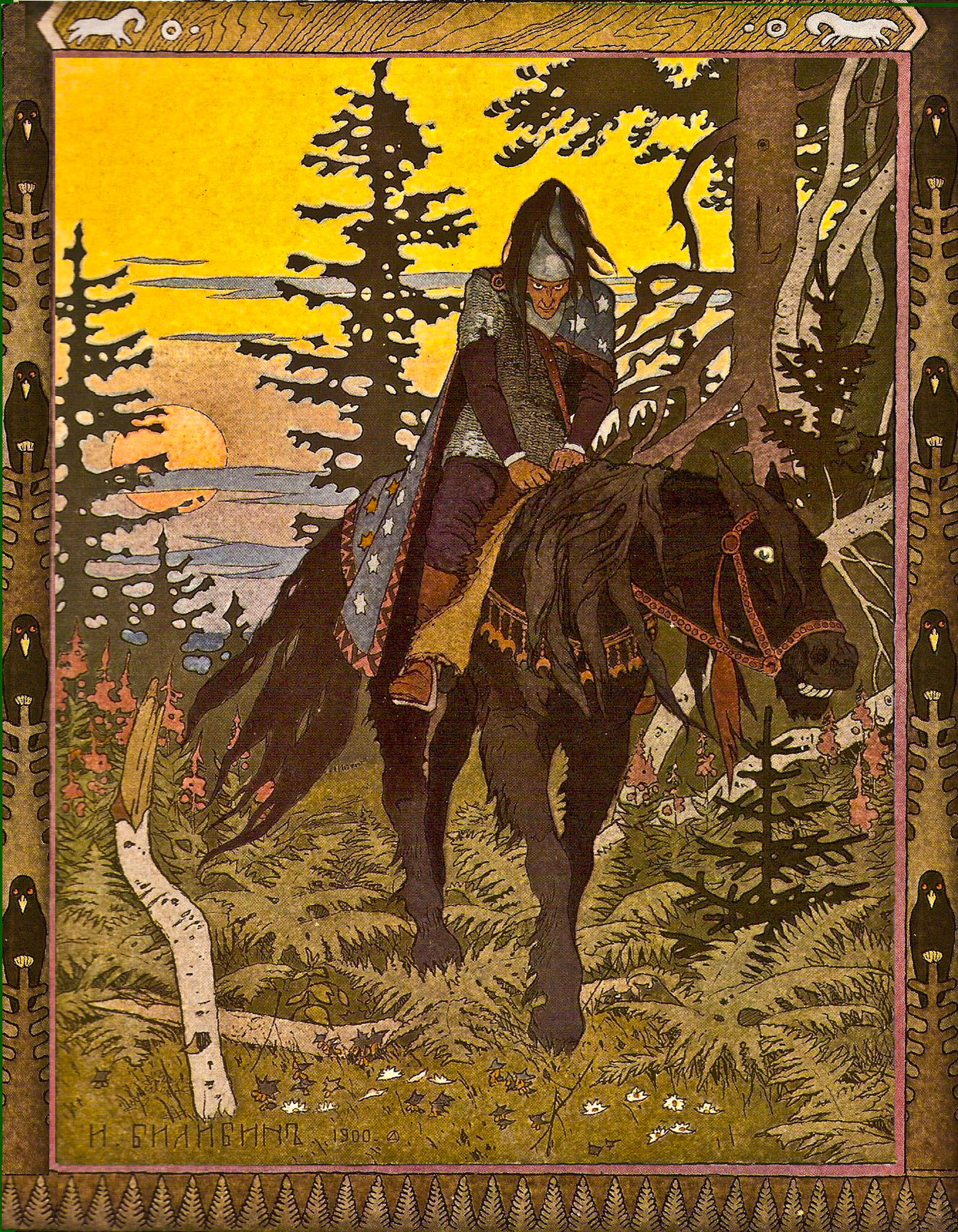
As you can see from the pictures below, Vasnetsov can move from the grandly (and grimly) heroic world of the byliny and its bogatyr (epic hero) to a more fanciful world of fairy tales like The Firebird (but still rather grim and grand).

1898_Vasnetsov_Bogatyrs_anagoria Igorsvyat Vasnetsov_samolet Viktor%20Vasnetsov-526879

hero

a-knight-at-the-crossroads-1878

Kochergin strikes us as more like Bilibin—brightly-colored, folk-influenced.

4f463a868cf7b31a66ad1c87e00 9f97a52394ba8269194a869df52 berendei-palace nicolai-kochergin_the-wooden-eagle

tumblr_mxjgrquVKF1rz5qxqo1_500

nicolai-kochergin_seven-simeons-seven-workers

tumblr_ndw64pRZCk1rgcyvso2_500

What inspires us in these pictures? To a degree, it’s what attracts us to the fairy/folktales: the strange scenes (even when you know the story), the swirl of color, that suggestion of a complex world of patterns from a different time and place, one in which there were yagas and firebirds and heroes who could be helped by wise animals.

And you, reader, do these pictures inspire you?

Thanks for reading!

MTCIDC

CD

PS

If you would like to know more about Russian heroic song—and for free—you might try:

Hapgood, Isabel Florence, The Epic Songs of Russia (1916)

Harrison, Marion Chilton, Byliny Book: Hero Tales of Russia (1915)

at archive.org. They are clearly older books, but, for those on a budget, they can provide a starting place into a rich world worth visiting.

Tracking

Tags

, , , , , , ,

Dear Readers,

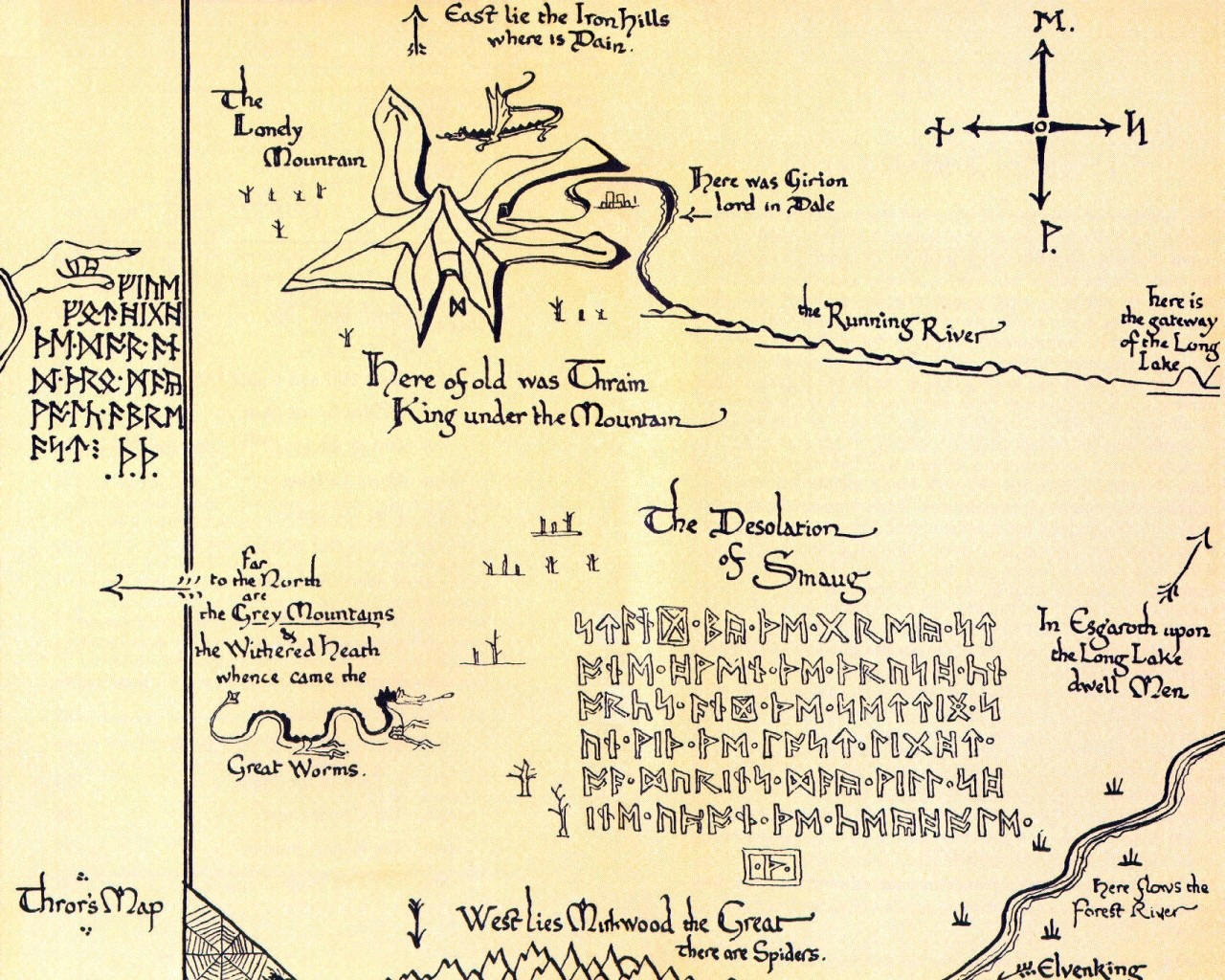
While working on Across the Doubtful Sea, the Doubtful Sea series, and a forthcoming series that takes place in an alternate medieval Russia, we discovered for ourselves what our friend J.R.R. Tolkien worked on meticulously during the course of his work—the importance of maps in a story, whether they are real, fictional, or a mixture of both, in the case of our work. “If you’re going to have a story,” he said, “you must work a map; otherwise, you’ll never have a map of it afterwards.”

This became apparent when we were working on Across, using previously drawn maps of the theoretical Terra Australis: 

image1 Finaeus_antart

To give us a sense of where our characters and we were (and still are) going. 

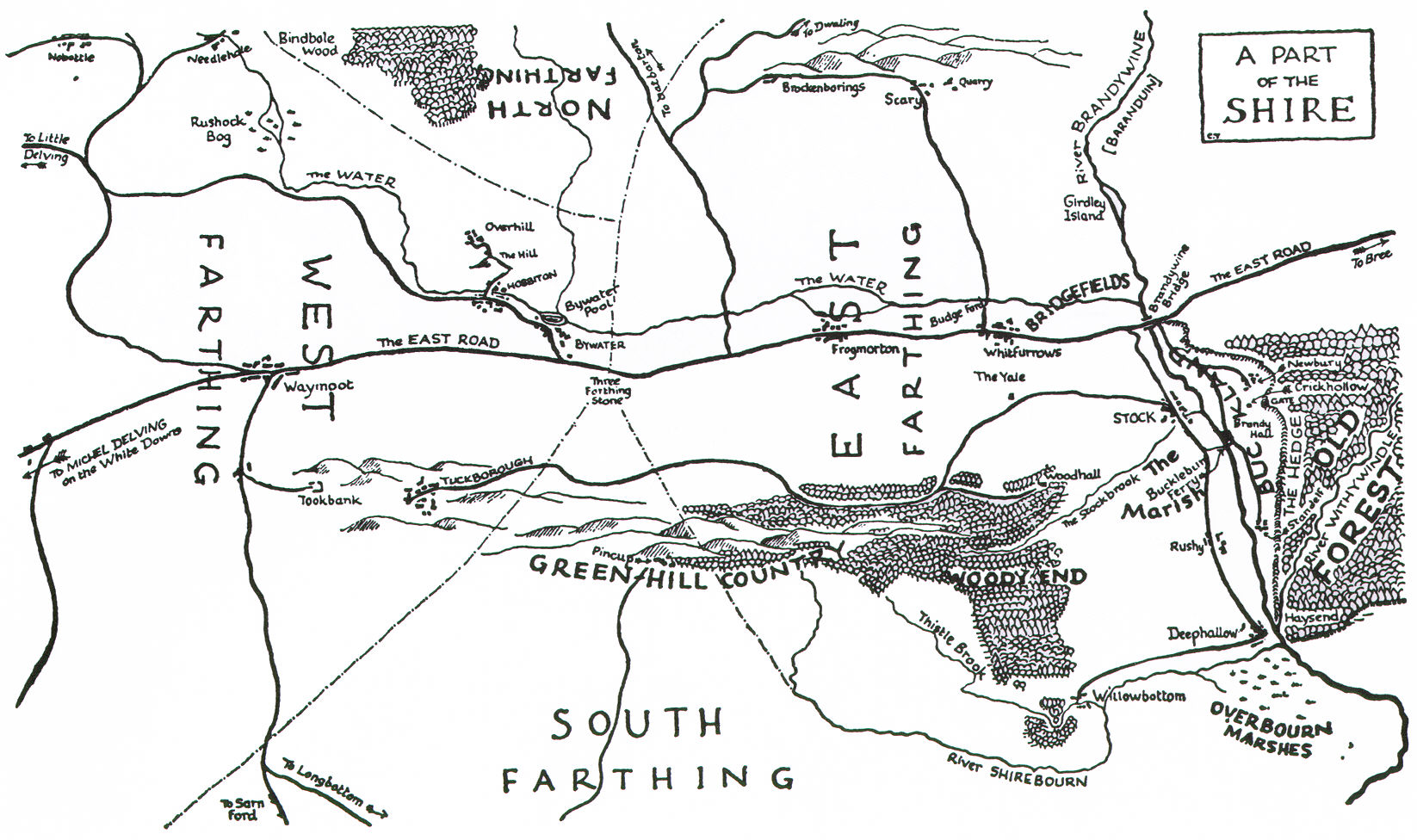
When we began talking about the geography of our alternative Russia, we began to ask ourselves, first, how do you make a map in relation to a story? It was a start to look over the shoulder of JRRT, and to see what was done before us. From there, we go on to ask, what is it that made Middle-earth Middle-earth? It’s clear that Tolkien took a considerable amount of time and care to chart out his elaborate fictional world, from Bilbo’s own maps of the Shire and the world beyond.

imgE1 

Some were detailed enough to follow the day-by-day travels of the Fellowship, while others were used to record specific moments in time, both historically and geographically.

In his letters, Tolkien often addressed the subject of his maps. Much of his enthusiasm in creating maps for his worlds had to do with the pleasure of doing so, and the satisfaction of building the physical structure of such an elaborate story. He was, however, sometimes overwhelmed by them—perhaps as if the more landscape he made, the more he had to carry—and said to his publisher that it was a matter of a “lack of skill combined with being harried” (Tolkien, letter 141). He was fortunate to have, in this aspect of his work, collaboration not unlike ours—his son, Christopher, was a talented cartographer, and after discussing the landscapes with his father, would draw the intricate world in accordance with Bilbo and Frodo’s adventures.

middle_earth_map

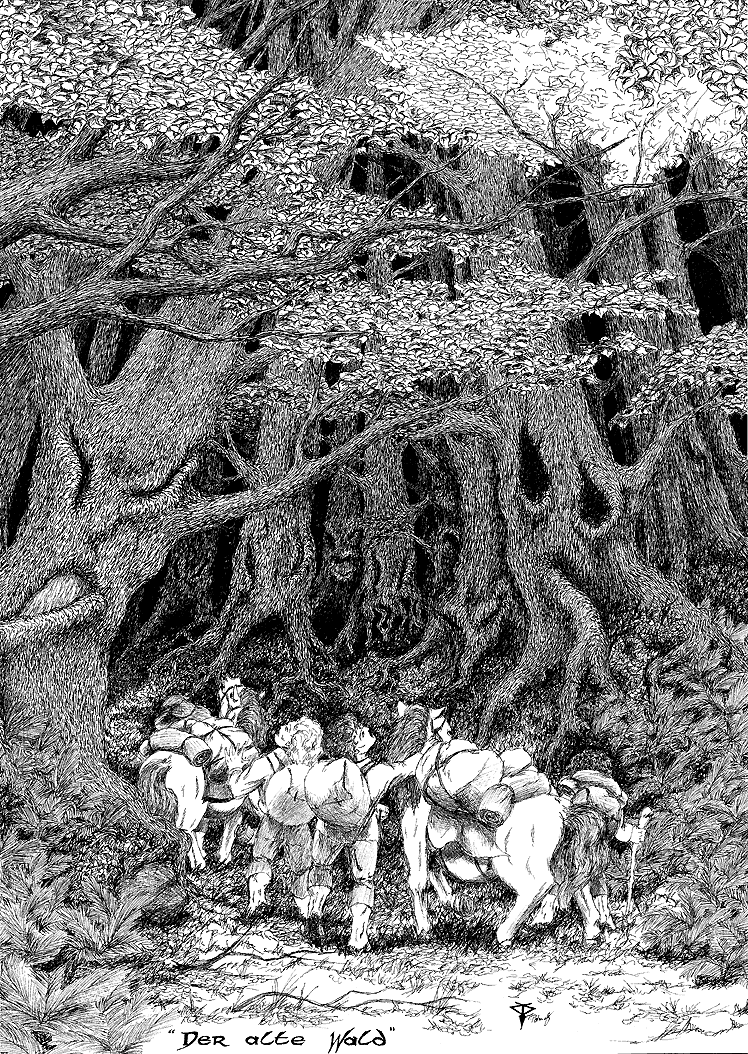
Tolkien, by creating the maps first, created a landscape which seems to exist not only before the story, but is bigger than the story. When Frodo travels eastwards, for example, there is more of the Shire and beyond than that which he actually travels over. In our case, it was rather like someone laying track while driving a train over it. The tracklayer decides where the train will go, but, looking back, can see a landscape left behind as it moves on. In this way, the story and its landscape are written as they progress, and a narrative railroad is left behind on which readers may ride. And so, unlike Tolkien, by constructing a map this way, we appear to be providing primarily a view from the track itself. If there’s more landscape, we can only know it from the map we’ve constructed afterwards.

oldforest 

With the previously-drawn map, we can see the journey, in contrast, from a bird’s eye view.

shire_map

But this leaves us with a question: is it best to construct a bird’s eye view first, then to lay the track, or to lay track and then to look back?

This brings us to a second question: by either method, how does one make a fictional map credible?

MTCIDC,

CD

PS

For an example of simultaneous train-driving and track-laying, see Wallace and Gromit, The Wrong Trousers.

Picturing Wonder

Tags

, ,

Dear Readers,

Welcome!

In our last, we mentioned that we have a second book in the works. It’s part of a series whose titles (and elements) are based upon this mysterious nursery rhyme:

“Grey goose and gander,

Waft your wings together

To carry the good king’s daughter

Over the one-strand river.”

The second book in the series, The Good King’s Daughter, is now a complete draft and is currently being given its first editorial run-through. Then it will be checked, rewritten where necessary, then formatted and published, like Across the Doubtful Sea, on Amazon and Kindle, we hope by early March. In the meantime, work goes on for the first in the series, Grey Goose and Gander, as well as on our sequel to Across, Empire of the Isles.

The Grey Goose series takes place in an imaginary medieval Russia, with yagas, talking animals, warriors, invaders like the historical Mongols, magic, saints, singers, and a young woman warrior, Unegen. The story is original, although there are elements from Russian history, as well as from folk tales.

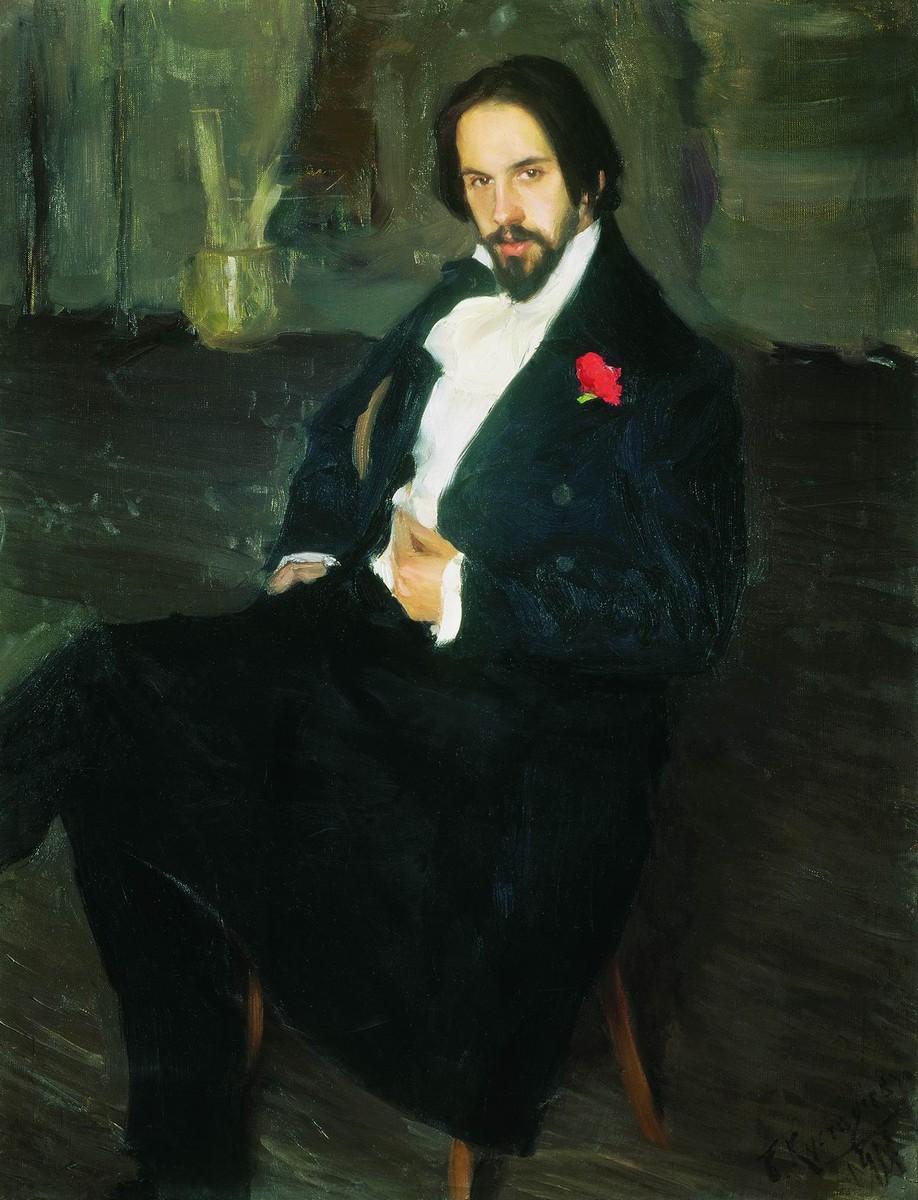
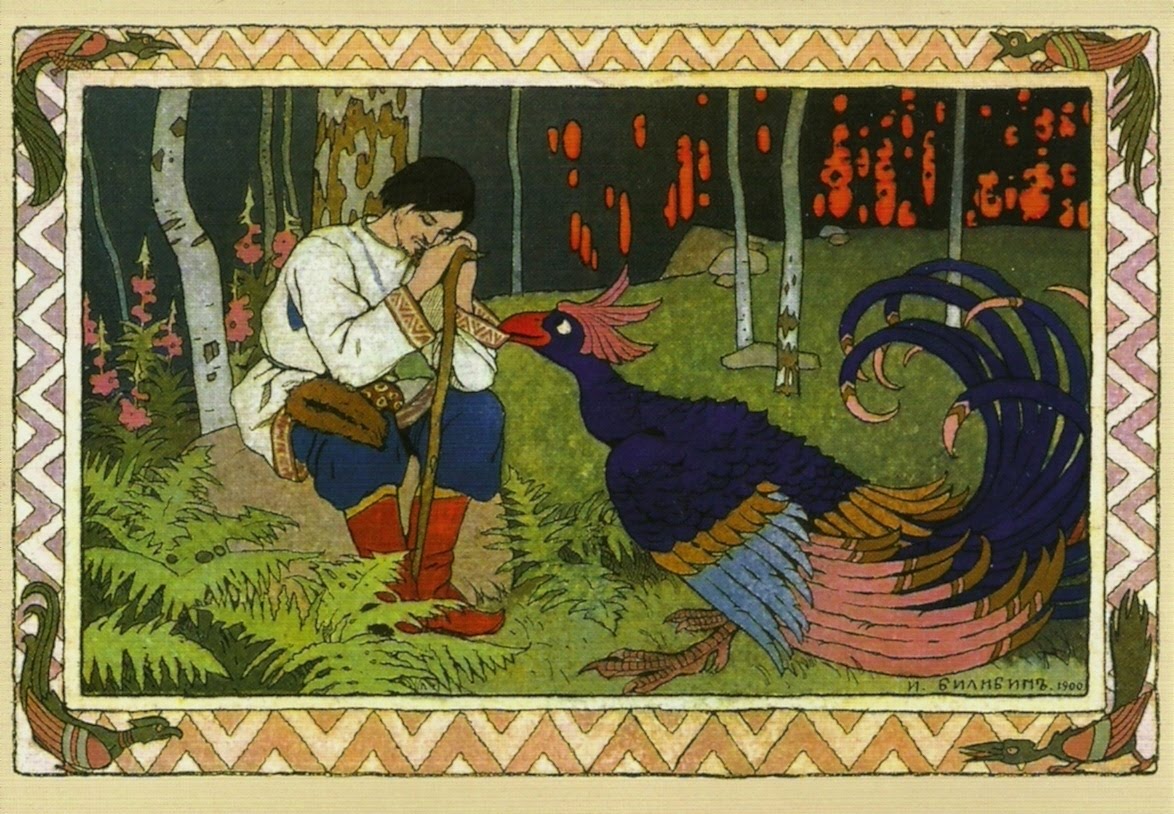
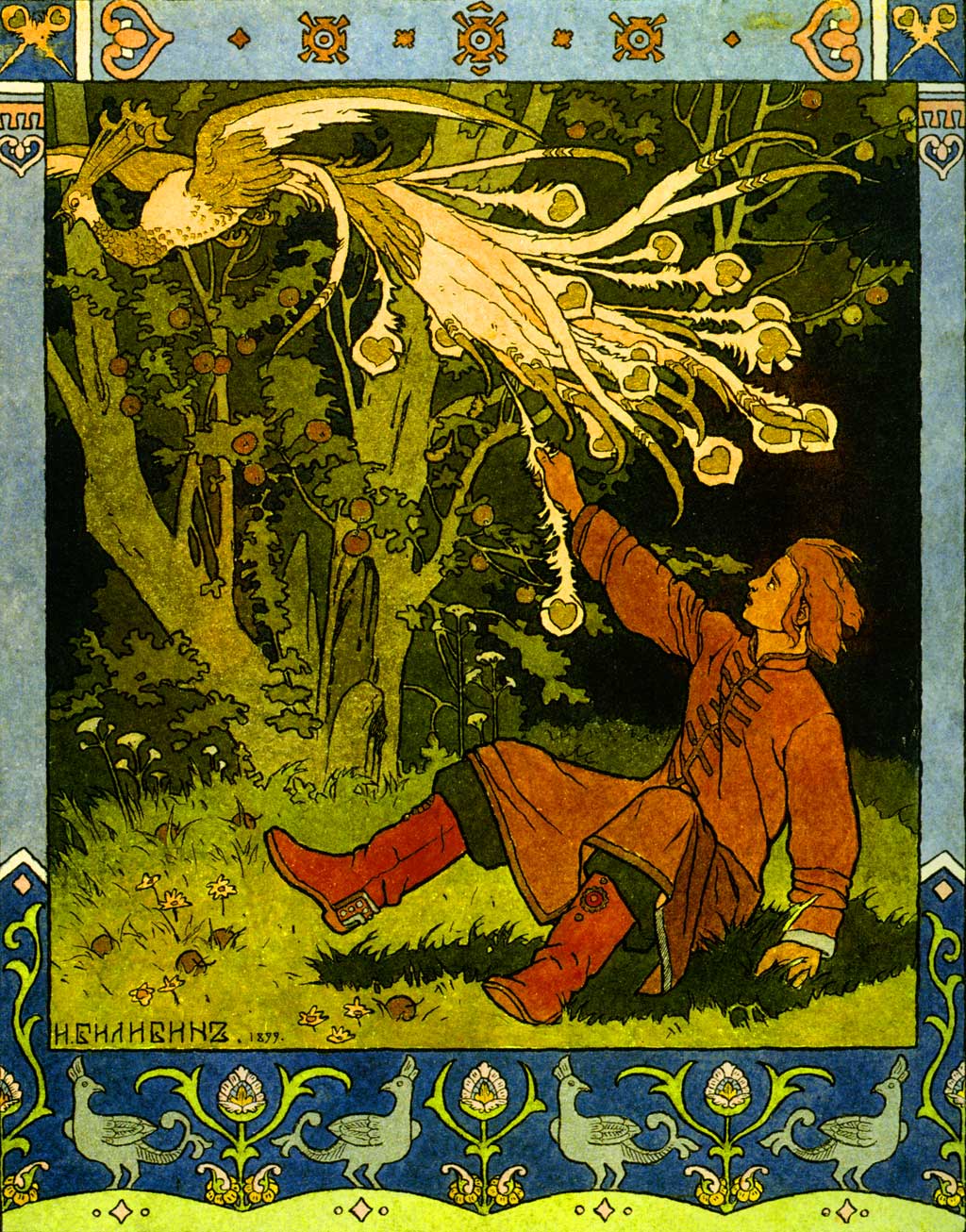
We also mentioned in our last our favorite Russian fairy tale illustrator, Ivan Bilibin (1876-1942).

1901._Portrait_of_Ivan_Bilibin_by_B._Kustodiev

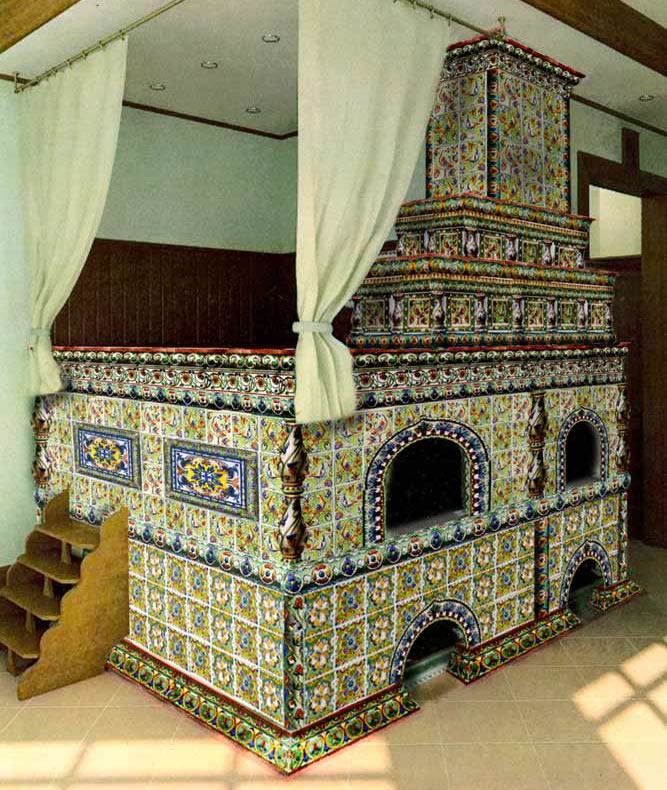
If you look him up on-line, you’ll find out that he was strongly influenced by his exposure to traditional Russian folk art and architecture. Like these:

russianwoodenbuilding TiledStoveCropt 0_10731_92b7363f_L russiancostumescentral

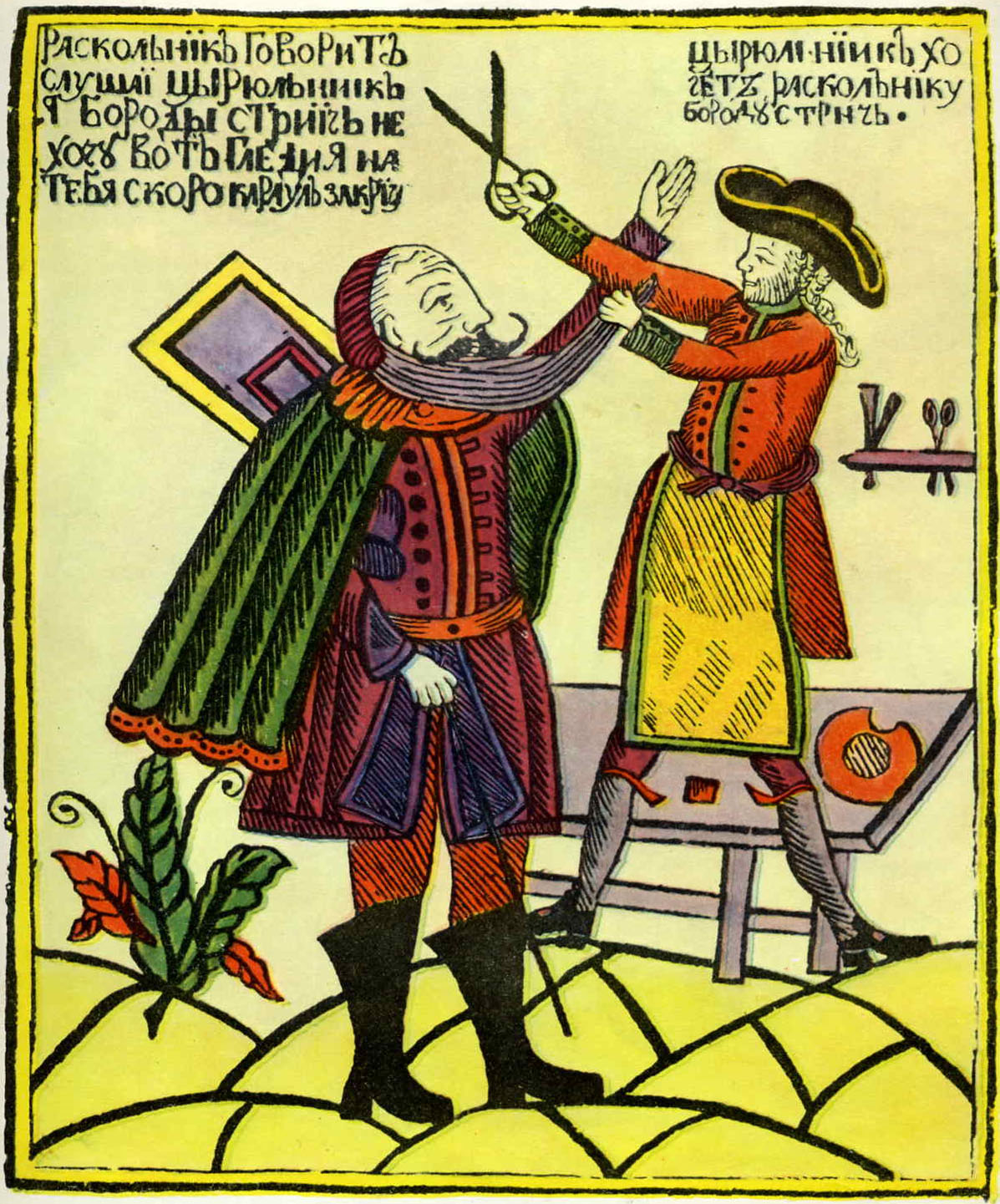
There is scholarly argument over how authentic this sort of thing was by Bilibin’s time: by 1700, Peter the Great was actively westernizing Russia. This lead to everything from laws about dress to regulations about beards (Peter taxed them—but so had Henry VIII, who had one, and Elizabeth I, who did not).

russianbeardcutting

Beard_token

(The second picture is of a government token to show anyone who would ask that you’ve paid the beard tax.)

And here we come to that fork in the road where “strictly accurate” may get in the way of creativity. Anyone who has read The Lord of the Rings knows that Rohan has wide, grassy plains. There are no such plains in New Zealand, so Peter Jackson did what he could to give at least the rolling effect. It’s not grassy, as JRRT described, but we have yet to meet anyone who has complained about the look of Jackson’s Edoras or the Rohirrim (one of our all-time favorite parts of the films, in fact).

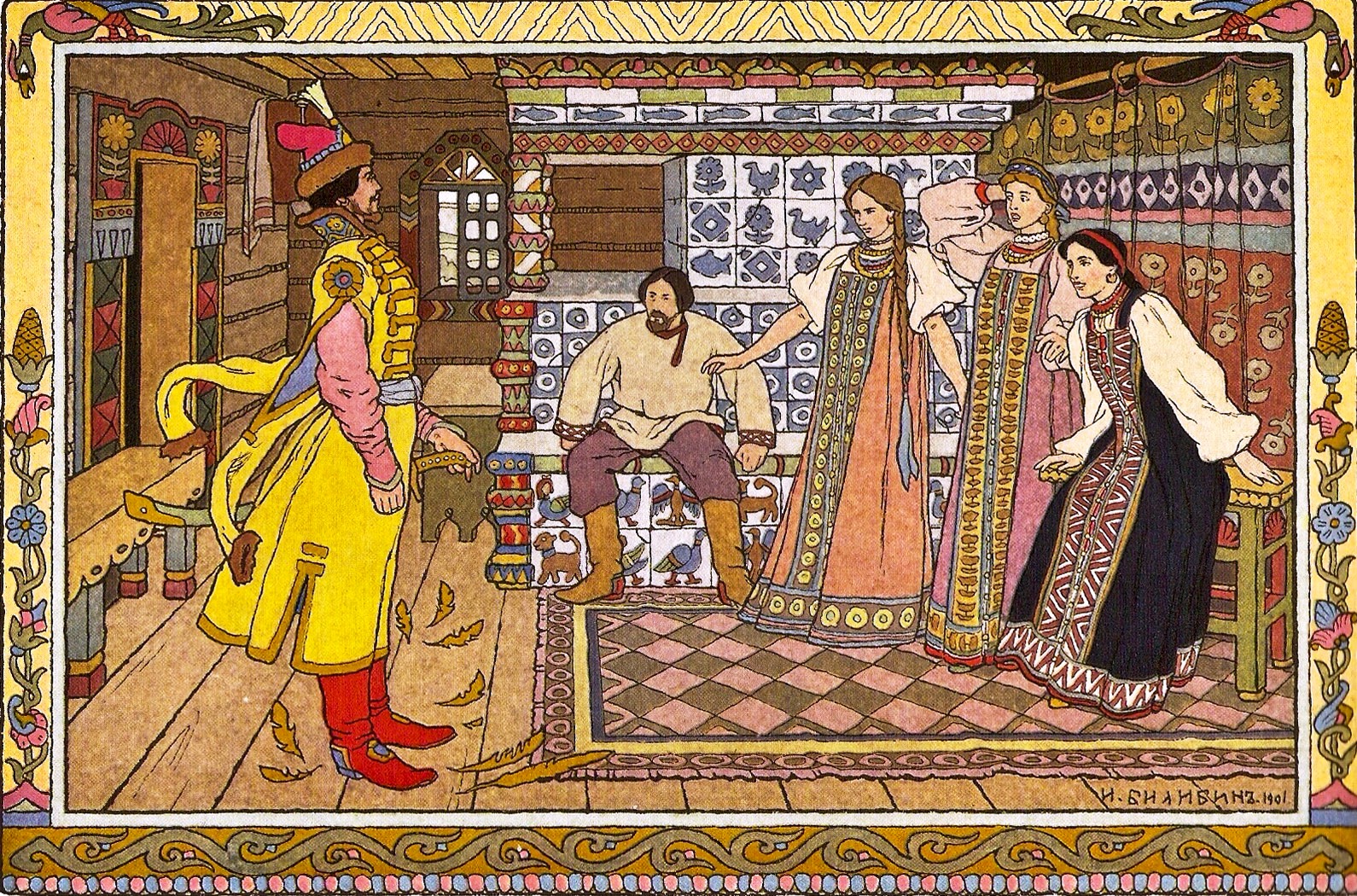
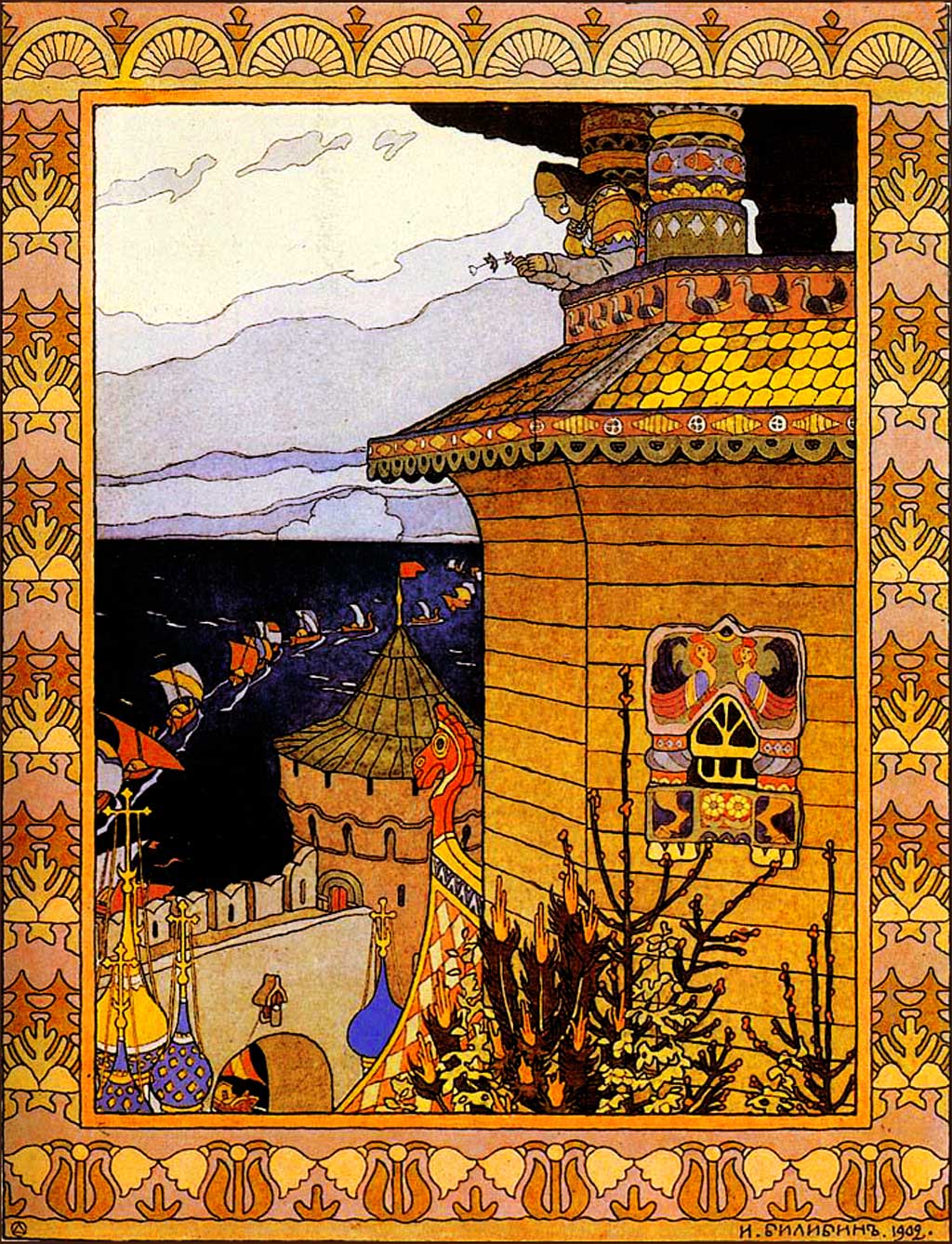
Bilibin was inspired by something, no doubt. He wrote about it in Folk Arts of the Russian North (1904). And he produced illustrations like these—

bilibin3_saltan bilibinbrdrs-1024x710 Ivan_Bilibin_024_variation Ivan_Bilibin_028 Ivan_Bilibin_247 Ivan-Bilibin-Baba-Yaga IvanBilibin11 PR_RU--12--big PR_RU--13--big ruske-bajke-ivan-bilibin-4 ruske-bajke-ivan-bilibin-6 Vasilisa

We hope you enjoy them as much as we do and imagine that, in our world of Grey Goose, Bilibin would feel right at home.

Thanks for reading.

MTCIDC

CD

PS

Amazon carries Golynets’ Ivan Bilibin, but if you would like to see the illustrator in his natural habitat, you can download Wheeler’s 1912 Russian Wonder Tales (in a 1917 reprinting) with Bilibin’s illustrations at Archive.org for free.

PPS

We’ve just discovered a very interesting site at Textualities.net. It’s full of images and interesting ideas.


Terra (Increasingly) Cognita

Tags

, , , , , ,

Dear Readers,

     Welcome, as always. Now that Across the Doubtful Sea is out in print on Amazon, we’ve turned our attention towards two projects:

  1. the “prequel”, Empire of the Isles
  2. editing and publishing the complete draft of the first book in a new series, Grey Goose and Gander, which is set in an imaginary medieval Russia. (Yes—it’s a distance from an alternate 18th-century Pacific, but we love Russian literature, both poetry and novels, and we especially love Russian fairy tales and that outstanding illustrator, Ivan Bilibin.) More on that series in future blogs!

     Among the main characters in Empire is Lucien de St. Valerien, the father of Antoine, from our first book and we follow his adventures in two periods: as a senior cadet 30 years or so before Across and then as a captain, 10 years before. The latter will lead right into Across and explain various things only hinted at in that volume in the series.

As his adventures take place in our imaginary Pacific (called “The Calm Sea”) and on our imaginary Terra Australis, we’ve been busy researching and inventing more geography. In doing so, we’re aware that we are violating a dictum which JRRT once set down about creating and mapping:

“If you’re going to have a complicated story you must work to a map; otherwise you’ll never make a map of it afterwards.”

That we are doing so clearly shows the larky beginnings of this project as well as our desire to allow the Muse to take the story (and the storytellers) where she will.

     Although we follow this ideal of inspiration, we would also agree with the Victorian English novelist, Anthony Trollope, who said of inspiration:

“To me it would not be more absurd if the shoemaker were to wait for inspiration, or the tallow-chandler for the divine moment of melting.” (A particularly apropos statement for a man with the goal of writing 10,000 words a day!)

In our case, however, we are using our research as a substitute Muse. And what particularly strikes us at the moment is the interesting clash of world views of early geographers on the subject of Terra Australis.

     As we’ve mentioned before, Terra Australis, as a concept, dates back at least to Aristotle in the 4th century BC and the concept of the need for a balance of continents. If there’s a big one on the north side of the earth (call it Terra Borealis), it would be necessary, for the equilibrium of the earth to have a second one on the south side (Terra Australis).

     The next step in the thinking, however, can diverge. There are those who imagined that such a place would resemble the continent on the northern side, having as many peoples and cultures. (This idea appears to be associated with Crates of Mallus, who lived in the 2nd century BC.) In our imaginary world, this is the standard belief, just as it was in the real pre-Captain Cook 18th century Europe. (The idea was contested, however, as it is in our books.)

     In our research, however, we’ve also happened upon a second view. This was popularized by a 5th-century AD scholar named Macrobius, who wrote a commentary on the last-century BC Roman author, Cicero’s, “Dream of Scipio”, itself the last part of Cicero’s longer philosophical work, De Re Publica.

     Cicero begins with the theory of more than one inhabited continent, but then shifts to describe an earth divided into five climate zones (reading from top to bottom: cold (and so uninhabitable), temperate, torrid (uninhabitable), temperate, and cold once more. This zonal view if followed by Macrobius and a number of the maps which appear in the earliest surviving manuscripts (which date from the period before 1100 AD) shows this very clearly.

macpre1100

     What impressed us about this idea was how it mixed what we know to be true in the real world—uninhabitable poles (as some of the maps say, terra nobis incognita frigida—“a frozen land unknown to us”)

droppedImage

with temperate regions. It then added, however, a central belt simply too hot for human existence. (Was this derived from early reports of the Sahara?).

     We’re still researching and creating, but our Terra Australis combines the two world views: we have a habitable southern continent, but one which is gradually falling under the control of a god—Atutlaluk—whose power is gradually turning Terra Australis into terra frigida—although it is gradually turning from incognita “unknown” to cognita “known” to us—and will be to you, in our next Across book, Empire of the Isles.

Thanks, as always, for reading.

MTCIDC

CD
PS

For a detailed and very interesting article on Macrobius and maps, see Alfred Hiatt, “The Map of Macrobius before 1100” available as a download at http://dx.org/10.1080/03085690701300626.

A Forward– at the End

Tags

, , , , , , , , , , ,

Dear Readers,

Welcome, as always.

     The Kindle version of our first novel, Across the Doubtful Sea , has just appeared, and the paper version will be available, we believe, in just a couple of days.

     The whole experience, from beginning work in early June to now has been a wonderful one. Neither of us had ever collaborated on such a project before and it was a learning experience every day of our work together. We thought that, in this blog, we would discuss what appear to be the biggest areas of our project: creating together, research, cover design, expenses, making the actual (or virtual) book, and facing the reality that, at least at first, all of this was going to be, in the immortal words of MGM, Ars Gratia Artis. (Cue the lion.)

     First, we had to figure out how we were going to write together. There were models, of course—you could think immediately of people from the musical theatre tradition, from Gilbert and Sullivan to Rodgers and Hammerstein, for example. Or, in terms of novels, you might look to older authors from Erckmann-Chatrian to Nordhoff/Hall, or to all of those fantasy/science fiction couplings you can find on the shelves of your local bookstores.

     In our case, however, we didn’t model ourselves on anyone. Instead, as the plot progressed, one of us might do more of the actual writing, but every line was, ultimately, the work of both: ideas, editing, changes, inspiration—there was nothing the two of us didn’t do at some time and in some way together.

     This changed, however, when it came to the actual self-publishing. One of us, it turns out, has a wonderful (and newly- discovered) talent for the technical side—creating covers, the complex process of formatting the text—and has produced what we feel to be a beautiful and absolutely professional outside for our first book. (Perhaps books can be judged by their covers?) For this later stage of the process, that one of us was completely in charge—and the other looked on, admiringly.

     Research was an important element in our work and one of us kept busy figuring out just what we needed to know and acquiring it, from books on naval warfare to work on Inuit and Polynesian languages and cultures. We’ve discussed some of this in earlier blog postings, but there was much more and it created its own puzzle: this was to be a series of fantasy/adventure novels, after all, so how much would we actually depend upon actual history and how much would we create? As well, we wanted to avoid magic per se, which has always struck us as an easy out—and can look very much like an easy out, too! (JRRT was so right to allow Gandalf to show off his real powers so infrequently.)

     Once we were into a good working routine, we began to consider what our cover should look like. In our research, we had discovered the work of William Hodges, who was the main artist for Captain Cook’s second expedition (1772-1775). Considering elements in the plot (if you read Across, you’ll know at once what we mean), Hodges’ painting, commonly called “The Waterspout”, but actually entitled “A View of Cape Stephens in Cook’s Straits (New Zealand) with Waterspout”, fit perfectly.

 HMS 'Resolution' off Cape Stephens with waterspout, May 1773

     A quick internet search showed us that this painting was not in the public domain, but was the property of the National Maritime Museum, in London. This meant that we had to request permission to use it. We e-mailed the NMM, and with the friendly help of the Image Librarian there, Emma Lefley, we obtained permission.

     There was a contract, however, and a fee, which we gladly paid, but this brings up another step in the process: expenses. As new to all of this as we were, we hadn’t expected that publishing our first book would be free, but it was another step in our education to watch how the expenses could mount. Our internet research cost us nothing, of course. A certain number of the books—mostly on naval warfare—were already in one of our personal libraries, and we could have gradually acquired more through academic and public libraries, although some of the titles we used would have required ILL searching, but we decided to buy some, as we knew that we would need them for the entire series. (And we like building up our libraries anyhow.) The Hodges’ image was our first big expense, however.

     When we began to think about how we might encourage interest in our work, we decided upon a blog and a Facebook page, for starters. The Facebook page was free, but we needed a domain name (that’s “dot.com” )for our blog and there was another expense. (There are lots of other potential expenses with a blog—but we’ll save those for another post.)

     Our last big expense came when we had finished the book and we planning its on-line publication. To sell it effectively, it was necessary to have an ISBN—in fact, we needed two: one for the paper book and a second for the Kindle version. An ISBN is not cheap, but two obviously have been double if Bowker (the chief supplier of ISBNs) wasn’t running a deal: buy a ten-pack and the price for the individual ISBN goes down significantly. So we bought the pack—and have used two already.

     Then, when we felt that we were ready, we went to Create Space and began the process of turning hundreds of pages of manuscript of what we had decided was the final draft into a self-published book—and in two forms. One of us has already written an informative post on our Facebook page (The Doubtful Sea Series) about the challenges in doing this (a euphemism—but that collaborator was very patient—to say the least!—about the various problems which arose), so, perhaps it’s best just to say here to our readers: be prepared for snags!

     And there came at last the moment of truth: how much should we charge for this? And how much would we get in return? (That really was a secondary concern—honest!—but no novelist, at least since Nash turned out The Unfortunate Traveler, has written in the belief that there was no profit motive, at all, no, truly! in the process.) We were torn, of course: a lower price might mean more buyers; a higher price might bring higher profits. Then we hit those buttons at Create Space and received an education in expenses and royalties and realized that we were fortunate to be doing this as an experiment, and not as a new career. This is worth its own post, but, trust us for now when we say that, even if we sell 10,000 copies of Across the Doubtful Sea and even more of its sequels, we will not be banking in the Cayman Islands and thinking about that summer home in New Hampshire. (And now we understand why some of our favorite fantasy/sf novelists are so prolific: volume and more volume is the only way to make enough money to feel that you’re really earning something.)

     We said that every moment was a learning experience, however, and, truly, it has been—and every moment has been beyond price. Like people who teach themselves to repair their own cars, we’ve climbed into the engine of writing and publishing a book and have so much more appreciation not only for the creative process and the editing/publishing process, but for all the talent and heart which each of us has shown the other in producing the first in what we hope to be a long line of novels full of fantasy and adventure.

Thanks, as always, for reading.

MTCIDC

CD
It’s Out! On Kindle!

Tags

, , , , , , , , , , , , , , , ,

Dear Readers,

For us, a very short post.  Our first novel, Across the Doubtful Sea, has just appeared on Kindle.  As of early next week, the book form will be available on Amazon.com.  We hope you’ll be interested!  As of next week, we’ll have one of our regular essays here, but we just wanted our readers to know that, after all of this time giving you information about the book, the book will actually be available.

Now–on to the second in the series–Empire of the Isles!

As ever, thanks for reading.

MTCIDC

CD

Sequels and Prequels

Tags

, , , ,

Dear Readers,

Welcome, as always!

As we put the finishing touches on Across the Doubtful Sea (we’ve just realized that we need to have a title on the spine for the print version—oh, and a bar code on the back–yep, the things we never thought about when we were reading someone else’s book), we’ve already begun work on the second in this series, entitled Empire of the Isles.

So, where are we going in this book? Logically, you might say that we should continue in chronological order, begin the second book where the first concluded. After all, at the end of the second book of The Fellowship of the Ring, JRRT didn’t double back into earlier times to the previous defeat of Sauron in which he lost finger and ring and gradually work up to Gollum, to Bilbo, to Frodo . Elements of the past of Middle Earth, of course, appear everywhere in the text, often in geographical features like barrows, the Greenway, and Weathertop, very much the way the past was always present in JRRT’s England in barrows and stone rings and Hadrian’s Wall and castles and the ruins of monasteries. For us, this is one of the book’s great attractions and strengths . The specific past of the ring itself appears in “The Shadow of the Past” (with its resonant title, suggesting not only that the past casts a shadow upon the present, but that, involved in all, is The Shadow—Sauron) and “The Council of Elrond”, chapter 3 of the first book and chapter 2 of the second.

But is that where we want to go?

And, the answer is, no. Instead, we’ve decided to go into the past, but not just in flashbacks or explanations. As we wrote Across, we found it necessary to make reference to earlier events, but this was always done in bits and pieces, where needed for the present narrative. (No spoiler alert here—although this makes an interesting challenge in essay-writing for us: how can we discuss that narrative without too much specificity? How can we inform but tantalize at the same time?) Suppose, however, that we wrote a second book whose plot was based entirely upon events which had happened before Across.

We knew from Across that our main male protagonist, Antoine de St. Valerien, was in the Calm Sea (our Pacific) in part in search of his father, Lucien de St. Valerien, who had disappeared there on an earlier mission. Instead of fragmentary glimpses of his father and his doings, as was the case in Across, why not make the whole next book about him?

As we have written in an earlier posting, a basic premise of our trilogy is that Terra Australis, the southernmost continent which explorers and cartographers and sometimes corporations and governments once believed existed , is, in fact, real. (For those of our readers who would like to know more about this idea, we recommend: William Eisler, The Furthest Shore: Images of Terra Australis from the Middle Ages to Captain Cook, David Fausett, Writing the New World: Imaginary Voyages and Utopias of the Great Southern Land, Glyndwr Williams, The Great South Sea: English Voyages and Encounters, 1570-1750, among many other interesting works.)   In our contemporary world, this is Antarctica, of course.

antarctic2_624x420

In this alternative world, however, it is not an endless sheet of ice which covers a land mass of rock, but rather the place which those earlier explorers and others believed it to be, a country with a mixed climate, fertile land, and growing seasons. In our imaginary world, however, things are changing, owing to the influence of the people who live at its center, the Atuk, and to their god, Atutlaluk, whose power lies in cold and whose chief followers can mobilize the elements of winter against their enemies. Opposed to the Atuk are the Matan’a’e amavi’o, a Polynesian people who have long inhabited a string of a dozen islands to the north and who have more recently colonized the western fringe of Terra Australis.

Much of this was already in place in Across, but now we could use this second novel to fill in so much more: the history of colonization, the beginnings of the war between the Matan’a’e amavi’o and the Atuk, more about the Atuk, who they are, where they come from, all as a background to the story of Lucien and the part he plays in the greater narrative of the struggle between these peoples.

As we write Empire of the Isles, we’ll do what we’ve done for Across and invite you into the literary equivalent of backstage, in hopes that you’ll enjoy knowing more about where it all comes from and how it all comes about.

Thanks, as always, for reading.

MTCIDC

CD

It’s All About Formatting

Tags

, , , , , , , ,

Dear Readers,


In our previous posting, we spoke about delaying—but not belaying—publishing our final manuscript of Across the Doubtful Sea. We have certainly put a considerable amount of work into our writing, as it was, in part, a learning experience: what works in a collaboration, the topic of 18th century south seas exploration, and, for one of us, it was her first novel. As we are nearing the final publication of Across, we’ve reached yet another important step in the process: formatting.


Our project is an entirely self-published book, meaning that we are not only the authors, editors, and publicists, but designers and formatters of our own book, as well. If we had decided to publish our book traditionally, the formatting would have been done for us by a professional working for the publishing company. Of course, we could have paid a professional anyway, as there are several publishing services for authors who’d rather “keep their sanity”—and we’re glad that they’re there—but, in our case, we were up for the challenge, and prefer completing the entire book ourselves.


An advantage of being authors in this decade is the availability of information through the internet—we are already making use of this by publishing online, and reaching you, our readers, and sharing our research and behind-the-scenes work through our blog, Facebook page, and twitter. As this has been a learning experience for us, the first thing we thought to look to for formatting was how-to book formatting guides. CreateSpace.com, the self-publishing site of Amazon that we will be using to publish Across the Doubtful Sea, has an easy to understand formatting guide for those using their site.


This guide has been incredibly helpful in building a structure for our book—in fact, as important as the research, creating the story, and writing the words. Why? The design and formatting of our book are, in a sense, the equivalent of giving a body to a soul. A book such as ours should have a proper format—a proper physical appearance to match what we believe to be a beautiful story. We read a number of articles on book formatting—some seemed to challenge first-time formatters, with titles such as “The Problem with Amateur Book Interiors,” but all gave solid advice as to how to avoid the common less-than-professional look of an independently published book.


As with any exterior, we need to have a cover that will both attract attention and provide a small taste of the book. As often as it is said that a book should not be judged by its cover, a good cover makes all the difference in the book’s appearance. For Across the Doubtful Sea, we’ve chosen a somewhat dramatic painting by William Hodges, A View of Cape Stephens in Cook’s Straits New Zealand with Waterspout, 1776, with kind permission of the National Maritime Museum, Greenwich, London. The picturesque aesthetics of the painting already set a tone for what the story itself may look and feel like. In a way, the cover for the book is the face, with readable expressions that interpret what is on the inside.


Before we began, we took a quick look at formatting styles of books in the 18th century—the time period in which our story takes place—out of curiosity and to see what inspiration could be drawn from there. This also gave us the ability to pay particular attention to how a book is put together, rather than a printed manuscript directly from Microsoft word, as we are used to seeing. There are many styles of formatting, as well—for our book, we chose to include page numbers and the title at the top of each page.


Pagination for our book was when we realized how long our book really was, as a finalized, complete novel. Page numbering was the first real step in giving the manuscript physical form, along with the 52 chapters—we foolishly presumed earlier in the process that we might have stopped at 24, then 48, and then… And, as with any book with several chapters, it involves tedious, yet rewarding, work—we’re quite close to completing the project we began during the summer—but 52 chapters can promise that it won’t be a process to be rushed through. Meticulously following advice from the formatting guide, as well as the aforementioned articles about self-publishing, we placed after each chapter, and each chapter title was placed with the desired font and size. Correct margins also had to be set, keeping in mind that the pages would be bound as a book.


At this stage—even after reading through and editing the entire manuscript—there was a need for a final check on names and their continuity—after all, we invented or adapted languages for this book. Some things, even at this stage, had either been changed, or still needed to be—which is where we learned an important rule for the future—be careful when changing names! Because of words and terms used by the characters in Across, we’ve included a glossary of terms and names at the beginning. We want to take as much care in making sure that our readers understand words in the languages as we did in creating them.


Even now, there is still some work to do—polishing up, working on final font designs, and, then, dear readers, you will have the chance to take a look for yourselves.


Thank you, as always, for reading!


CD
Delay (not Belay)

Tags

, , , , , , ,

Dear Readers,

We had hoped to publish Across the Doubtful Sea at the beginning of December. It didn’t happen. Why?

We had the manuscript . Its 52 chapters had been through two complete drafts and many little subdrafts, along the way, by mid-November.  

If we had been willing to be part of the older book-writing world, we would now have begun the long and painful process of trying to interest a publisher (through an agent, if we could persuade one to take us on, or not, which was much more likely). Because we decided to publish the book ourselves, however, we entered a new and even more complicated universe, in which we were not only authors, but editors, sub-publishers, and publicists, as well. It has provided a wonderful “behind the scenes” education, but it has taken a good deal more time that we had ever imagined.

We were still in the editing stage when we decided to become publicists. That way, we hoped to begin to build an interested audience some months before the appearance of our first book. “So we need a blog,” we said to each other, “and Facebook. And Twitter. To start.”

WordPress provided the basic blog, for free. (Without sounding like we’re receiving a commission, we can also recommend them enthusiastically: very smart, creative people and very easy to deal with.) The basic blog, however, suggested that, if we were serious, and looked upon our work as part of a greater commercial enterprise (our 19th-century author ancestors, like Scott and Dickens, would certainly have said that it should be and that, while art for the sake of art was nice, profits were nice, too), we would need a “domain name”. This would then allow us to list ourselves as http://www.Doubtfulsea.com.   So we bought—or, rather, rented–one, for a year (renewable).

Then, there was the matter of setting up the blog. Fortunately, one of us has electronic art at her highly-talented fingertips and, after a few tries, produced the beautiful site on which you are currently reading us. (Those tries included picking and replacing an appropriate background image, as well as type face—tricky against the image–and formatting.)

After that, we had to figure just how many posts we could do, balancing them against the rest of our lives. We had read about people who began a blog as a way of talking about a project and eventually found that time for the project was gradually completely consumed by the blog, so we decided that we would do one post per week—but—every week, without fail. So far, we’ve managed to do this from the very beginning: this is post #16 and it will even appear during Christmas week. (Readers who currently struggle to maintain blogs have our permission to roll their eyes and say, “Just wait!” under their breaths, if necessary.)

Then there was Facebook, which came a little later. It was easy to set up, as it was more basic, but it came with the same hunger for posts. The point was exposure, of us and our ideas and thoughts and experiences. This meant, we decided, doing what we were already doing with our blog and so we were committed to two posts per week, one for Doubtfulsea.com and the other for Thedoubtfulseaseries@facebook.com.

So that we didn’t repeat ourselves, we decided that the blog would deal specifically with the Doubtful Sea series (including the other two planned volumes, Empire of the Isles and Beyond the Doubtful Sea) and further books in other series (we already have a complete first draft of one and half of another). We would devote our Facebook page to essays and discussions about reading and writing and creating in general—ours and other authors’.

At the same time, we added Twitter. This was—and is—much trickier. The common wisdom was that you should use it to advertise only 20% of the time and devote the rest to catchy sayings, thoughts, and images from our daily lives. So far, we feel that we haven’t used it enough for anything and, once the book is actually published, we’ve decided to do a lot more research in how to employ it more successfully.

Then we thought the manuscript was ready for the next step.

We are fervent book people, and one of us has even written a scholarly article on a 19th-century Irish poet publishing his first book (a disaster and most copies were eventually recycled for trunk linings), but we had no idea of what we were getting ourselves into.

As modern people, we began with internet research, of course. We typed in “self-publishing”, and quickly discovered that there were multitudes of people eager to help us out there, some for a price, others for free, others for free, but with sales pitches thrown in. We quickly learned, however, that there was a longer process ahead of us than we had ever thought.

First, after surveying the field of self-publishing services, we decided that we would use Amazon, in part because of its access to Kindle, in part because of its liberal profit-sharing policy. (A hint: if you are following our path, be sure to do a little extra research, when you do your googling to pick a publisher, and type in “reviews of ________________________” to try to provide a more balanced view than the self-publishing service is willing to provide.)

Advice from various sites had convinced us that we needed to have an ISBN. Why we—or anyone—might need it would require a separate post, but, in brief, it forever identifies the book as yours, as well as providing potential sellers with a convenient stock number, among other reasons. Only one is needed per book, but, if, as in our case, we wanted to use e-book form, as well, then we needed two—and, if we wanted it available on other media, like phones, we would need more. The main supplier, Bowker, has a deal for a pack of 10, and we decided to use that.

On the actual formatting of the book, we’ll refer you to the upcoming post on our Facebook page, which talks in some detail about everything from proofreading and correcting to number of words on the page to placement of the text on the page. We will say something about the cover, however.

We were doing research on Pacific exploration when we happened upon the work of William Hodges, who was the main artist on Captain Cook’s second Pacific voyage. We quickly realized that one of Hodges’ paintings, often called “The Waterspout”, was absolutely perfect. We traced it to the National Maritime Museum in London, inquired, and found out how to rent the image (dealing with the very kind and helpful Emma Lefley, who is the Image Librarian—what a wonderful job!). It had to be formatted to become the front and back covers, of course—but see our Facebook page for that.

We said, at the beginning of this post, that we had had a “behind the scenes” education. And that it had taken more time and energy than we had ever imagined. It would be more accurate, in fact, to say that we are continuing to have that education. We had known about the back-and-forth aspect of author and publisher and its complications from the experience not only of 19th-century authors, but also from the correspondence of Tolkien and Unwin from 1936 on, but there was so much more. A professional publisher would handle renting the cover image, the actual physical creation of the book, and the advertising, all of which is now in our hands. Sometimes, it has seemed like more work than writing that first novel, but it has, on the whole, been a wonderful experience and we’ll be talking more about it in future blogs.

Thanks, as always, for reading!

MTCIDC

CD