Legionnaire, But No Disease

Tags

, , , , , , , , , , , , , , , , , , , , , , , , ,

As always, dear readers, welcome!

Although we do a lot of Tolkien, we set up this blog for adventure in general and, in this posting, we’ve gone to a completely different world—as you’ll see.

When we think of the Sahara, we immediately see:

a. a satellite map, which shows us just how huge it is

image1sahara.jpg

b. and camels—although they aren’t native, they’ve been there a long time, having been introduced from Arabia perhaps about 300Ad

image2camel.jpg

c. and, of course, desert warriors

image3desertwarrior.jpg

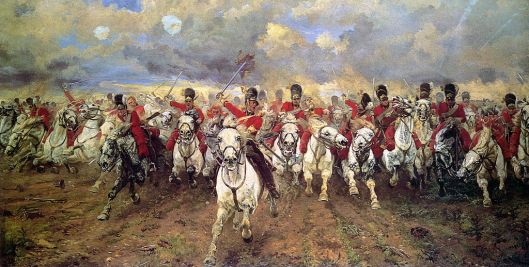
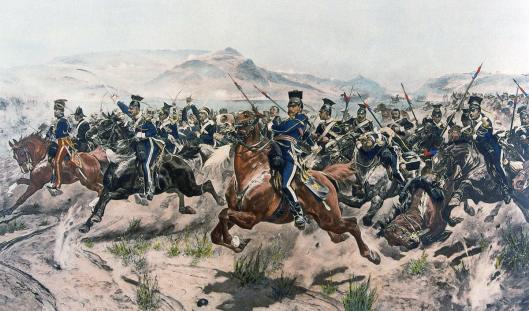
d. and, also, of course, their opponents, the French Foreign Legion

image4ffl.jpeg

e. or, with a bit of a trim—and in color—

image5fflcolor.jpg

The Foreign Legion were hardly the first foreigners in the service of France.  Medieval French kings had used Genoese crossbowmen.

image6genoesecrossbowmen.jpg

And the later kings of France had, as part of their household guards, the Garde Suisse.

image7gardesuisse.jpg

The Foreign Legion was raised in 1831 and used, at first, during the French conquest of Algeria.

image8firstuniform.jpg

image9frinvasionalgeria.jpg

As Algeria was exotic, so were the soldiers there, beginning with the dashing Zouaves, originally locals, but gradually mostly French.

image10zouave.jpg

Along with these were the Chasseurs d’Afrique,

image11chass.jpg

who formed the background for what we think is the first North African adventure novel in English, Ouida (Louisa de Ramee)’s Under Two Flags (1867)

image12louisa.jpg

image13book.jpg

which became a film twice, in 1922

image14nineteentwentytwo.jpg

And in 1936.

image15nineteenthirtysix.jpg

Oddly, the Chasseurs d’Afrique of the novel were replaced, in the 1936 film by the Foreign Legion—perhaps because the script writers thought that the Foreign Legion would have been a more familiar unit to their audience?

If so, it may have been because of P.C. Wren’s 1924 novel, Beau Geste,

image16bg1924.jpg

which has appeared a number of times on the screen, initially in silent form in 1926,

image17bg1926.jpg

and again as a “talkie” in 1939

image18bg1939.jpg

and again in full color in 1966.

image19bg1966.jpg

The book—and the film’s—popularity—the story was all about noble sacrifice—and exotic desert adventure—did not escape satire.  As early as 1931, two of our favorite early film comedy stars, Stan Laurel and Oliver Hardy,

image20laurelandhardy.jpg

appeared in their longest short (37 minutes—but it which sounds like a contradiction in terms), Beau Hunks.

image21hunks.jpg

This title is based upon what appears to be a double ethnic slur, Bo- from “Bohemian” + Hunk- from “Hungarian”, so a disparaging reference to a central European—a lower class one, at that.  (It makes us thankful that it appears to have disappeared entirely as a slang term:  in our current world, we don’t need any more ethnic attacks—we have plenty already.)

This was remade in 1939 as Flying Deuces.

image22flying.jpg

This wasn’t the end of such cheerful assaults, however.  In 1967, there was Follow That Camel (from the British comedy series “Carry On…)

image23follow.jpeg

and, appropriately, in 1977, came The Last Remake of Beau Geste.

image24lastremake.jpg

All the same, we still love the old movie, with its last-ditch defense of Fort Zinderneuf,

image25ftz.jpg

where, borrowing from Dumas’ The Three Musketeers,

image26three.jpg

image27dumas.jpg

in desperation, the defenders prop up dead legionnaires to make their numbers appear greater than they are.

How could people with a passion for adventure not find that appealing?

Thanks, as ever, for reading

and, as always,

MTCIDC

CD


“Dragons, Other”

Tags

, , , , , , , , , , , , , , , , , , , , , , , , , , , , , , ,

As always, readers, welcome.

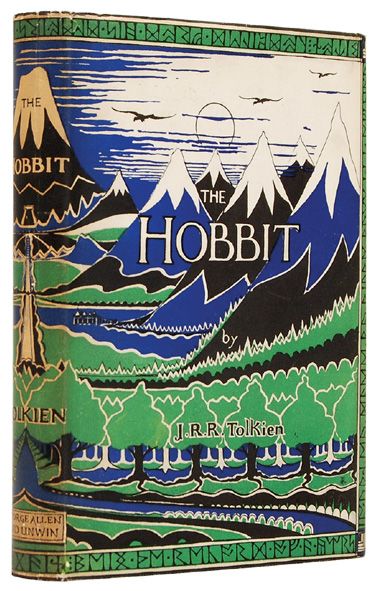
One of us is currently teaching a class where our present focus is upon The Hobbit.

image1hob1st.jpg

At the center of the book is the Lonely Mountain and at the center of that is Smaug.

image2aerebor.jpg

image2smaug.jpg

This got us to thinking about other dragons in our experience, and some of those are not quite of the same breed as the hoard-sitter faced by Bilbo and the dwarves.  That dragon is closely related to the Beowulf variety

image3beowulfdragon.jpg

which, unlike Smaug, has neither a name nor (it seems) human speech, but it certainly has the same suspicious streak:  when an escaped slave steals a cup from its hoard, it’s almost immediately aware that it’s missing and suspects a human.

image4stealingcup.jpg

And they are both vengeful.  As Smaug devastates Esgaroth, even if he dies for it,

image5esgaroth.jpg

image6smaug.jpg

so Beowulf’s dragon scorches the countryside in revenge for the theft.

But what about those other dragons?

First, we thought of Kenneth Grahame’s Dream Days (1898),

image7kg.jpg

image8dreamdays.jpg

a collection of short stories, the next-to-last of which is “The Reluctant Dragon”.

image9reluct.jpg

This is the story of a beast the very opposite of Smaug—no hoard, no suspicion, no flaming violence, and, in fact, a poetry lover.  This story was then converted into a Disney cartoon of 1941.

image10reluct.jpg

Needless to say, although the core of the plot is the same, what makes the Grahame distinctive is the language.  All of the major characters:  the dragon, the little boy who finds him, and St. George, who is brought in as a dragon-slayer, are thoughtful and articulate late Victorians who would rather discuss literature than do battle—a far cry not only from Beowulf’s encounter, but also from every other earlier depiction we could think of.

image11ucellostgeo.jpg

image12stgeo.jpg

image13stgeo.jpg

The sword in this last one looks like it actually belongs in the hands of the jabberwock-slayer

image14jabberwocky.jpg

in Lewis Carroll’s Through the Looking-Glass (1872).

image15through.jpg

Here’s a LINK to Dream Days so that you can enjoy the story for yourselves.

Nearly sixty years later, the comic verse writer, Ogden Nash,

image16nash.jpg

produced not a literary dragon, but a timid one in “Custard the Dragon” (1959).

image17custard.jpg

This is a poem in 15 stanzas and is a story about Belinda and her pets, including a dragon, who is taunted by the other pets as being less than brave.  To underline this, the last line in a number of stanzas is a variation upon the first version of the line, “But Custard cried for a nice safe cage”.  (Here’s a LINK to the poem.)

The surprise is that, when a pirate climbs in through the window (this happens all the time here—possibly they escape from dreams?), Custard promptly eats him—and the cries of “Coward!” disappear immediately.

In contrast to the unnamed dragon in “The Reluctant Dragon” and in “Custard the Dragon”, our next dragon is a talker—like Smaug, but also like Smaug, potentially malevolent.  This is Chrysophylax in JRRT’s 1937/1949 Farmer Giles of Ham.  (JRRT is having a quiet joke here—“Chrysophylax” is Ancient Greek for “Goldguard”.)

image18chrysophylax.jpg

image19afgoh.jpg

The artwork is by Pauline Baynes (1922-2008).

image19pb.jpg

If, like us, you’ve loved the Narnia books, then you know her as their original illustrator.

image20lion.jpg

She was also the artist for an early Middle-earth map.

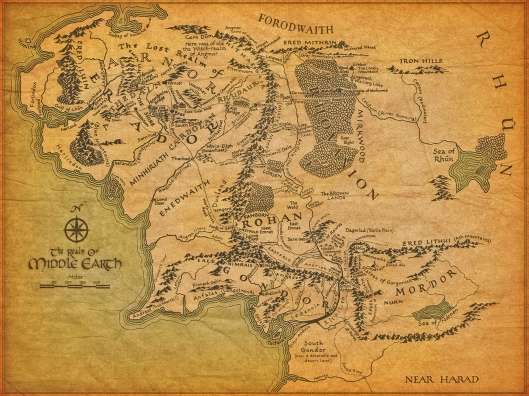
image21memap.gif

Her 2008 obituary in The Daily Telegraph tells of how they came to work together:

“In 1948 Tolkien was visiting his publishers, George Allen & Unwin, to discuss some disappointing artwork that they had commissioned for his novella Farmer Giles of Ham, when he spotted, lying on a desk, some witty reinterpretations of medieval marginalia from the Luttrell Psalter that greatly appealed to him.  These, it turned out, had been sent to the publishers “on spec”by the then unknown Pauline Baynes.”   (The Daily Telegraph, 8 August, 2008)

JRRT was then so impressed with her work that it appeared both in other later publications and his recommendation led to her being engaged by CS Lewis’ publisher for the Narnia books, as well.  (And here’s a LINK to that obituary, which has more on Tolkien and Baynes, as well as Lewis.)

And the Baynes connection leads us to one further dragon, that in Rumer Godden’s  (1902-1998) 1981 The Dragon of Og, for which Baynes provided the cover art.

image22rg.jpg

image23dragog.jpg

It’s not our practice to discuss work we haven’t read, but we’ve just discovered this novel and have already put it on our spring reading list.  The little we know about it comes from a blurb or two, but it looks promising:  this is more of the reluctant dragon, but one who is in danger of being provoked by a new local lord until his wife steps in and cleverly changes the situation.

Before we close, however, we want to look back for a second at the Tolkien/Baynes connection and add two further things.  First off, here’s the first page of JRRT’s graceful letter of thanks and praise to Baynes for her work in illustrating Farmer Giles.

image24letter.jpg

Second, as the Telegraph obituary says, Tolkien was impressed with her versions of the marginalia from the Luttrell Psalter, which is high on our list of favorite medieval manuscripts.

image25luttrellpsalter.jpg

In our next, we want to spend some time looking at that work, thinking about marginalia, and not only there, but also in the work of another favorite illustrator, Arthur Rackham (1867-1939).

Till then, thanks, as always, for reading.

MTCIDC

CD


Many Woven Cloths

Tags

, , , , , , , , , , , , , , , , , , , , , , , , , ,

Welcome, as ever, dear readers.

Not long ago, we visited Meduseld for a look at Grima, the fifth-columnist.  Today, we’re back, but, instead of scrutinizing the staff, we’re examining the décor—

“Many woven cloths were hung upon the walls, and over their wide spaces marched figures of ancient legend, some dim with years, some darkling in the shade.  But upon one form the sunlight fell:  a young man upon a white horse.  He was blowing a great horn, and his yellow hair was flying in the wind.  The horse’s head was lifted, and its nostrils were wide and red as it neighed, smelling battle afar.  Foaming water, green and white, rushed and curled about its knees.

‘Behold Eorl the Young!’ said Aragorn.  ‘Thus he rode out of the North to the Battle of the Field of Celebrant!’” (The Two Towers, Book Three, Chapter 6, “The King of the Golden Hall”)

By “woven cloth”, we presume that JRRT means a tapestry, a decorative wall-hanging, like these—

image1medtapwall.jpg

In the western Middle Ages and Renaissance, even wealthy walls—like those in castles—could simply be stone and such tapestries could act both to decorate and to act as a barrier between cold wall and (potentially) shivering inhabitants.

For those making such things, the possibilities for using them as story-telling spaces inspired such works as the famous “Hunt of the Unicorn” series of tapestries, now housed in the Cloisters, a museum in New York City.

image2hunt.jpg

image3cloisters.jpg

The description of Eorl makes us think of medieval stag hunt illustrations, where hunters may be seen blowing horns—like this one.

image4savernakehorn.jpg

image5dagobert.jpg

But the fact that he was riding to battle also made us think of wall decorations of a military/historical nature through the centuries, starting with ancient Egypt, where Rameses II (1303-1213BC) had himself depicted on walls in various military actions—

image6ramnubians.jpg

image7ramkadesh.jpg

Or the Assyrians, who were not only enthusiastic (gross understatement) about war, but also about depicting themselves engaged in it.

image8assyrians.jpg

As you can see, although these appear on walls, they are not hangings, but reliefs—that is, shallow carvings.  The Egyptian reliefs could be brightly painted, as is that reconstruction of Rameses and the Nubians, the first of the two Rameses illustrations.  It appears that some of the Assyrian reliefs were also colored—here’s a PDF: BMTRB 3 Verri et al, of an interesting article from the Technical Research Bulletin of the British Museum on the subject.

From colored reliefs, we can jump to colored tiles (called tesserae), with the famous Alexander Mosaic.

image9alexandermosaic.jpg

This depicts Alexander the Great nearly confronting the Persian king, Darius III, at the Battle of the Issus (333BC) and what amazes us is that this was originally not on a wall, but on a floor, in the so-called “House of the Faun” in Pompeii.


It is believed that this was based upon an early 3rd-century BC painting and, to our eye, it still looks very much like the painting it may have come from (which was, presumably, on a wall, not a floor).

For battle scenes on cloth, we return to the medieval world and something we’ve mentioned before, the so-called “Bayeux Tapestry”.

image11a.jpg

We say so-called because it’s not really a tapestry—which would have been woven on a loom—but, instead, a giant (230ft/70metres) embroidery.  Here’s a detail so that you can see how an embroidery is made up of stitching on a (in this case) plain linen strip.

image11closeup.jpg


This is really an astonishing piece of work—so far as we know, nothing else like it has survived from medieval western Europe:  a massive history of the invasion of England in 1066, including events leading up to it, in 50+ scenes.  We see everything from architecture

image12westminster.jpg


to ship-building

image13shipbuilding.jpg


to feasting

image14bayeux.jpg


to battle

image15battle.jpg

at its grainiest

image16deathofharold.jpg

and even includes Halley’s Comet.

image17hscomet.jpg

JRRT certainly knew about the Bayeux piece—he mentions it in his letters—but the richness of his description doesn’t really match the relative spareness (for all its detail) of that embroidery, so we wonder what he might have had in mind?   Late medieval tapestries would have had the lush look—

image18troy.jpg

This is one of a set of 15th-century tapestries illustrating the Trojan War.  You’ll notice that, like the Bayeux Tapestry 3 centuries earlier, there are labels (tituli, they’re called).  In the case of the Eorl tapestry, it’s Aragorn who provides the explanation, suggesting that there is no caption and Aragorn, being Aragorn, simply knows the story.

For an eye-popping battle scene, however, we would point to the set of 7 tapestries of the Battle of Pavia (1525) woven in Brussels between 1528 and 1531 and now in the Museo Nazionale di Capodimonte in Naples.  Here’s just one example—can you imagine the same having been woven for the assaults on Minas Tirith or Helm’s Deep?  (Here’s a LINK, by the way, to a very detailed article on the subject of these wonderful works.)

image19pavia.JPG

But such pieces as these are so elaborate that, for all of their great art, they don’t provide quite the parallel we’re looking for, perhaps because all of the larger ones seem to be filled with people and movement and what JRRT describes is a single figure—almost like a standard, rather than a tapestry—something like this one (although we imagine the original to be facing to the right and the field to be green—oh, and of course he has that horn, but you get the idea).


And we do have this example.  It comes from a site called “Elvenesse”.

image21eorl.jpg

It looks more like a religious triptych than a tapestry to us,

image22triptych.jpg

but it certainly is going in the right direction.  What do you think, dear readers?

And thanks, as always, for reading!

MTCIDC

CD

Lent to a Museum (Mathom.2)

Tags

, , , , , , , , , , , , , , , , , , , , , , , , , , ,

Welcome, as always, dear readers.

In a posting from January, 2017, we discussed the idea of a “mathom house” at Michel Delving in the Shire.  We know about this place from the Prologue to The Lord of the Rings:

“So, though there was still some store of weapons in the Shire, these were used mostly as trophies, hanging above hearths or on walls, or gathered into the museum at Michel Delving.  The Mathom-house it was called:  for anything that Hobbits had no immediate use for, but were unwilling to throw away, they called a mathom.  Their dwellings were apt to become rather crowded with mathoms, and many of the presents that passed from hand to hand were of that sort.”  (Prologue, The Lord of the Rings)

Rereading this passage this time, we were caught by two things:  “some store of weapons” and “Their dwellings were apt to become rather crowded with mathoms” because, put together, they sound like part of the description of the personal Mathom-house of the original inspirer (we would say) of adventure-writing in English, Sir Walter Scott.

image1raeburnscott.jpg

Trained to become a lawyer, Scott had lived for some years in several houses in Edinburgh, for much of his later life at Number 39, North Castle Street–

image2ncastlestreet.jpg

Although he began his rise to literary fame with the publication of The Lay of the Last Minstrel, a long poem, in 1805,

image3layfirstedition.jpg

money began to pour in with his first novel, Waverley, published anonymously, in 1814.

image4waverley.jpg

(What a great illustration, by the way—both the first edition and the manuscript.)

Because his legal work required him to have a residence outside Edinburgh, Scott had rented this, at Ashestiel, from 1804-1811.

image5ashestiel.jpg

When the lease was up, he then invested in this rather modest farm house at what was called “Cartley Hole”, which locals called “Clarty Hole”, “clarty” being a Scots word for “mucky”, suggesting that our illustration is prettier than the actual place.

image6cartleyholefarm.jpg

More commercially successful novels and an eventual baronetcy gave Scott grander ideas and he began to rebuild—and rebuild—the house, as well as changing its name to the more dignified “Abbotsford”, as it was near the ruins of the 12th-century Melrose Abbey.

image7melroseabbey.jpg

“Bigger” at this time might have meant something Georgian, like this—

image8nostellpriory.jpg

but Scott, no doubt influenced by the Gothic ideas of people like Horace Walpole

image9hw


and his Strawberry Hill

image10strawberryhill.JPG

fixed upon a design which, in time, was not only bigger, but Gothic—and Scottish, in the style called “Scottish Baronial”, like this castle at Craigievar, completed in 1626.

image11craigievar.jpg

In a way, such a choice makes sense:  many of his novels have Scots locations and they made him wealthy enough to build such a place.

image12hftabbotsford.jpg

This is perhaps the first photographic image of Abbotsford.  It dates from 1844 and is by the English inventor, as far as we currently know, of photography, Henry Fox Talbot.

image13talbot.jpg

And here is a modern image.

image14abbotsford.jpg

The outside of Abbotsford is striking enough, but it’s what’s inside which made us think of a Mathom-house.

There is seemingly an endless “store of weapons”.

image15armory.JPG

And then there are all of those other things.  A lock of Napoleon’s hair.

image16nappy.jpg

image17nappy'shair.jpg

The sword of a 17th-century Scottish hero, the Marquis of Montrose.

image18montrose.jpg

image19montrosesword.jpg

The sporran (purse) of that early-18th century Highland legend, Rob Roy MacGregor.

image20sporran.jpg

(Scot also believed he had Rob Roy’s musket.)image21rrsmusket.jpg

And even souvenirs he had picked up from the battlefield of Waterloo, which he had visited only a short time after the battle.

image22waterloo.jpg

image23cuirass.jpg

Note the hole in the breastplate—and also that the  headgear with it (a czapska) belongs not to the man who would have worn the breastplate, a cuirassier,

image24cuirassier.jpg

but to a French/Polish lancer

image25lancer.jpg

With all of these trophies tacked onto every possible surface—including full suits of armor–

image26armor.jpg

we wouldn’t be surprised to see a rather familiar object, ancient, famous, which we are told “was arranged on a stand in the hall (until he lent it to a Museum)”—would you?

image27mithril.jpg

Thanks, as ever, for reading.

MTCIDC

CD

PS

Abbotsford was opened to visitors within a few months of Scott’s death.  Among those tourists were Queen Victoria and Prince Albert.

image28avicandalbie.jpeg

They liked the place so much that, when they decided that they needed a little place in the country, Abbotsford would be one of their models.

image28balmoral.JPG

Long after Albert’s death in 1861, the Queen continued to pay a yearly visit to Balmoral.

image29vicatbalmoral.jpg

PPS

If you’d be interested in seeing Abbotsford as an early 20th-century tourist might have seen it, here’s a LINK to Beautiful Britain:  Abbotsford (1912).


I Love a Parade

Tags

, , , , , , , , , , , , , , , , , , , , , , , , , ,

“I love a parade, the tramping of feet,

I love every beat I hear of a drum.”

–Koehler/Arlen Rhythmania (1931)


Welcome, dear readers, as always.  In the past, we’ve spent a posting or two discussing military aspects of The Lord of the Rings, from the look of the Rohirrim to the attack on Minas Tirith.  In this posting, we would like to go back one step from that attack to consider what is a rather melancholy moment in the lead up to that assault.

Pippin and his newfound friend, Bergil, have come down to the Great Gate of Minas Tirith.

image1minastirith.jpg

Here’s the gate from the films.
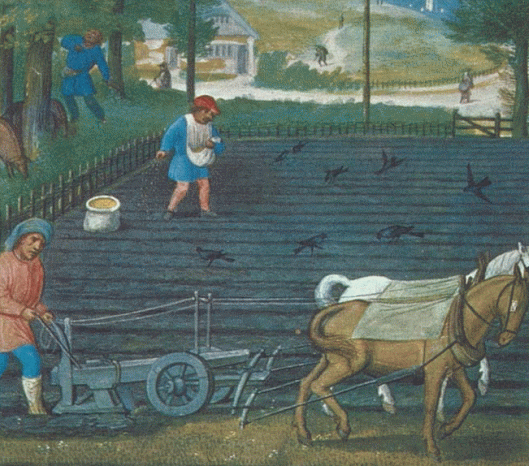
image2mtgate.png

This immediately reminded us of places like the west door of Lincoln Cathedral.

image3linc.jpg

image4door.jpg

Or the main door of the cathedral of Palermo.

image5duomo.jpg

image6porta.JPG

Because he is now a member of the Guard of the Tower of Gondor, Pippin is allowed to pass through the Gate—and to take Bergil with him out to see and hear the following:

“Beyond the Gate there was a crowd of men along the verge of the road and of the great paved space into which all the ways to Minas Tirith ran.  All eyes were turned southwards, and soon a murmur rose:  ‘There is dust away there!  They are coming!’

Pippin and Bergil edged their way forward to the front of the crowd and waited.  Horns sounded at some distance, and the noise of cheering rolled towards them like a gathering wind.  There was a loud trumpet-blast, and all about them people were shouting.” (The Return of the King, Book Five, Chapter 1, “Minas Tirith”)

What happens then is a kind of parade.

When we see the defenders of Minas Tirith in the films, they are all uniformly clad.

image7gondorians.jpg


In our medieval world, this was highly unlikely, the best being that soldiers and servants might wear the colors/crest of the lord they served.  This was called “livery”.  Uniformity in clothing, weapons, and armor would be some time in the future.

image8livery.jpg

What is coming up the road from the south are reinforcements, marching in a long column of units, and those units differ greatly in look.  First are the men of Lossarnach, led by their lord, Forlong:

“Leading the line there came walking a big thick-limbed horse, and on it sat a man of wide shoulders and huge girth, but old and grey-bearded, yet mail-clad and black-helmed and bearing a long heavy spear.  Behind him marched proudly a dusty line of men, well-armed and bearing great battle-axes; grim-faced they were, and shorter and somewhat swarthier than any men Pippin had yet seen in Gondor.”

To us, those axes make the men of Lossarnach sound like the huscarls, the bodyguard of an Anglo-Saxon king, like Harold Godwinson, whom we see depicted on the “Bayeux Tapestry”.

image9huscarl.jpg

image10taphus.gif

Their leader, Forlong, might be similar in appearance, wearing a type of helmet called a spangenhelm,

norman-spangenhelm-2.gif

and protected by an early form of mail shirt called a hauberk.

image12hauberk.jpg

After these, we see more units, but with little description—the men of Ringlo Vale “striding on foot”, so infantry of some sort, five hundred bowmen from Morthond, from the Langstrand, “a long line of men of many sorts, hunters and herdsmen and men of little villages, scantily equipped save for the household of Golasgil their lord”.   After them, “a few grim hillmen without a captain”, and “fisher-folk of the Ethir”, all of which we imagine in their workaday clothes of hunters and shepherds and farmers and sailors, as depicted in medieval English and French manuscripts.
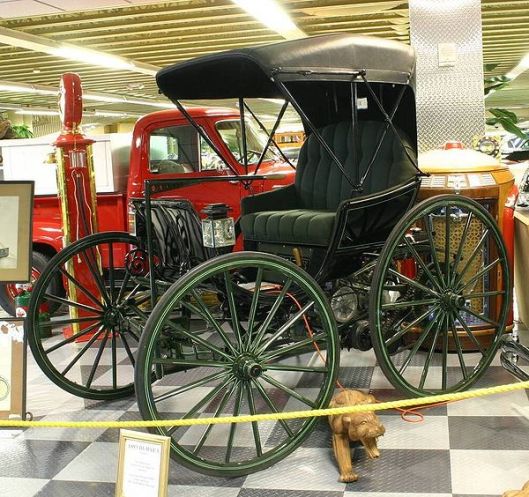
image13medhunter.jpg

image14shepherd.jpg

image15farmer.jpgimage16fishermen.jpg

Next comes a unit which is perhaps wearing livery:  “Hirluin the Fair of the Green Hills from Pinnath Gelin with three hundreds of gallant green-clad men.”  We aren’t told how they’re armed, but that they may be in livery suggests that they may be better armed than some of the earlier contingents.  (In fact, “gallant green-clad men” makes us think of Robin Hood—perhaps more archers?)
image17rhood.jpg

And, finally, folk we’ve discussed before:

“And last and proudest, Imrahil, Prince of Dol Amroth, kinsman of the Lord, with gilded banners bearing his token of the Ship and the Silver Swan, and a company of knights in full harness riding grey horses; and behind them seven hundreds of men at arms, tall as lords, grey-eyed, dark-haired, singing as they came.”

“knight in full harness”, as we talked about in an earlier post, probably meant, to JRRT, something from Howard Pyle or NC Wyeth, like this—

image18knight.JPG

As for those “men at arms”, if they appear to be “tall as lords”, we assume that they’re on foot, which puzzles us a bit.  “Men at arms” usually means “armored soldiers on horseback” in our world—perhaps with less armor than knights, but still cavalry (unless dismounted, to fight on foot, as the French did at Agincourt in 1415, for example).  We see them, then, as looking like those dismounted cavalry, like these—

image19menatarms.jpg

However they are armed and clothed, however, they are thought to be too few by those watching and, considering what Mordor eventually sends against them, they would not have been enough, if the brave Rohirrim and Aragorn’s reinforcement from the south hadn’t arrived in time.  What would have happened if they hadn’t?  A subject for very grim fan-fiction!

Thanks, as ever, for reading!

MTCIDC

CD

Wormy

Tags

, , , , , , , , , , , , , , , , , , , , , , , , , , ,

Welcome, as always, dear readers.
In 1936, the Nationalist forces were marching to attack the Republican government in Madrid, during the Spanish Civil War.
image1nationalists.jpg
image2attackonmadrid.jpg
When interviewed, a Nationalist general is reported to have said that, as four military columns were about to assault the city,
image3natattack.jpeg
a fifth column of loyalists would join the attack from inside.
image4natattack.jpg
This phrase “fifth column”, then, was picked up and began to be used world-wide to mean “traitors/betrayers from within” and was popular during the Second World War era.
image5thcol.jpg

When the Nazis attacked Norway in 1940,
image6nazislandinginnorway.jpg
and the Allies failed to defend their positions there successfully and were forced to surrender or flee
image7capturedtroops.jpg
a member of the small Norwegian fascist party, Vidkun Quisling,
image8quisling.jpg
declared himself ruler as the Germans marched in.
image9conqueringgermans.jpg

In time, the Nazis recognized him as the head of Norway and he even had an audience with Hitler.
image10hitandquis.jpg

This time, a specific “fifth columnist” had not only betrayed his country, but also profited greatly from it and, when we looked at the dates—1936 and 1940—we wondered, as we so often do, if the current events of our world may have colored JRRT’s relation of the events in Middle-earth—even as we hasten to say, as we always do, that this is just a suggestion.
In his first meeting with Aragorn, Eomer is troubled and his veiled comments suggest just the same sort of fifth-columnist action:
“But at this time our chief concern is with Saruman. He has claimed lordship over all this land, and there has been war between us for many months…”
His concern, however, as we see, is for more than border security, as he says of Saruman:
“His spies slip through every net, and his birds of ill omen are abroad in the sky. I do not know how it will all end, and my heart misgives me; for it seems to me that his friends do not all dwell in Isengard. But if you come to the king’s house, you shall see for yourself.” (The Two Towers, Book Three, Chapter 2, “The Riders of Rohan”)
So, all is not well, not only in Rohan, but in Meduseld itself. When Gandalf and the other survivors of the Fellowship arrive at the gates of Edoras, they are stopped by guards and by a command from Theoden, king of Rohan—or is it? A guard says:
“It is but two nights ago that Wormtongue came to us and said that by the will of Theoden no stranger should pass these gates.” (The Two Towers, Book Three, Chapter 6, “The King of the Golden Hall”)
“Wormtongue” seems a very odd name—do worms actually have tongues?
image11worm.JPG
But this isn’t a worm, it’s a “worm”—an old term for “dragon”.
image12smaug.jpg
And, if Smaug’s speech and its effect upon Bilbo is anything to go by:
“Bilbo was now beginning to feel really uncomfortable. Whenever Smaug’s roving eye, seeking for him in the shadows, flashed across him, he trembled, and an unaccountable desire seized hold of him to rush out and reveal himself and tell all the truth to Smaug. In fact he was in grievous danger of coming under the dragon-spell.” (The Hobbit, Chapter 12, “Inside Information”)
then a person having a dragon tongue might be a real threat, as Wormtongue, seated at Theoden’s feet,
image13theodenandgrima.jpg
inserts himself between Gandalf and Theoden:
“Why indeed should we welcome you, Master Stormcrow? Lathspell I name you, Ill-news; and ill news is an ill guest they say.”
Gandalf immediately resists this and, in a burst of power, breaks the real “spell”—the dragon’s words which Grima Wormtongue has been pouring into Theoden’s ears, as Theoden says to him of Gandalf’s efforts: “If this is witchcraft…it seems to me more wholesome than your whisperings. Your leechcraft [that is, “medical skill”—obviously ironic here] ere long would have had me walking on all fours like a beast.”
[A footnote here—is JRRT making a quiet reference to the fate of Nebuchadnezzar, king of Babylon, mentioned in the book of Daniel in the Old Testament? In Chapter 4, the king is driven mad and spends seven years as a grazing animal to prove the power of the Hebrew divinity. Here is William Blake’s (1757-1827) striking depiction of the mad king.]
image14blake.jpg

Certainly something Grima has been doing has affected Theoden, as he is initially described as “a man so bent with age that he seemed almost a dwarf…” and this shrinking is suddenly reversed when Gandalf strikes Grima down:
“From the king’s hand the black staff fell clattering on the stones. He drew himself up, slowly, as a man that is stiff from long bending over some dull toil. Now tall and straight he stood, and his eyes were blue as he looked into the opening sky.”
For all that Grima has been blocked and Theoden restored, the fifth columnist tries once more. When he is told that he must ride with the king and his warriors to battle, he makes a countersuggestion:
“One who knows your mind and honours your commands should be left in Edoras. Appoint a faithful steward. Let your counsellor Grima keep all things till your return…”
But he gives himself away by finishing that sentence with “and I pray that we may see it, though no wise man will deem it hopeful.”
And Gandalf sees all too clearly what is behind Grima’s proposal—and who is behind it:
“Down, snake!…Down on your belly! How long is it since Saruman bought you? What was the promised price?…”
image15fallofgrima.jpg

Although it is said that Grima deserves death for his treachery, he is allowed to flee, and, when we next see him, he is with his true master, acting as his “footman” as Gandalf calls him (The Two Towers, Book Three, Chapter 10, “The Voice of Saruman). And here, as Bilbo’s pity has preserved Gollum for an unseen but vital part in the later story of the Ring, so Gandalf’s mercy to Grima preserves him for two final acts: first, his mistaken use of a palantir as a missile, which puts it into Gandalf’s hands and, ultimately into Aragorn’s, who shakes Sauron’s nerve with it; second, Saruman’s ultimate end:
“[Saruman] kicked Wormtongue in the face as he groveled, and turned and made off. But at that something snapped: suddenly Wormtongue rose up, drawing a hidden knife, and then with a snarl like a dog he sprang on Saruman’s back, jerked his head back, cut his throat, and with a yell ran off down the lane.” (The Return of the King, Book Six, Chapter 8, “The Scouring of the Shire”)
image16deathofsaruman.jpg
Grima doesn’t survive this attack, however: “Before Frodo could recover or speak a word, three hobbit-bows twanged and Wormtongue fell dead.”
Merry calls these final acts of violence “the very last end of the War”, but we would suggest a parallel with a specific event in our world: the end of Vidkun Quisling–executed by firing squad in October, 1945, for treason. Could we say that Grima’s death—deserved earlier, but deferred—was also a kind of execution for treason, against Rohan, finally carried out?
And a final thought: after World War 2, Quisling’s name became, for a time, an easy synonym for “fifth columnist/traitor”—could we imagine that, in the Common Speech of Middle-earth after the War of the Ring, the same might have happened to “Grima Wormtongue”?
Thanks, as ever, for reading.
MTCIDC
CD

Wains, Carts, and… (2)

Tags

, , , , , , , , , , , , , , , , , , , , , ,

Welcome, as always, to our blog, dear readers.

In our last, we began discussing wheeled transport in The Lord of the Rings.  We began with Gandalf’s cart, mentioned in Chapter 1.

im1gscart.jpg

The posting took us from the first traces of wheeled vehicles in western Europe, circa 3600BC (literally traces—just a pair of tracks in the clay)

im2tracks.jpg

through chariots

im3chariot.jpg

to Roman carts

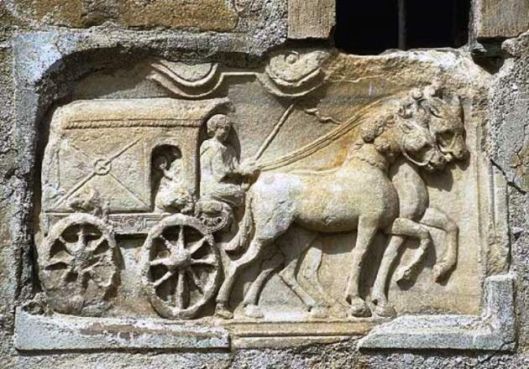
im4romcart.jpg

to their descendants, medieval carts,

im5medcart.jpg

which led us back to Gandalf.

im6gcart.jpg

Continuing our discussion, we move from carts (2 wheels) to wagons (4 wheels) with the wagon Farmer Maggot uses to carry the hobbits to Bucklebury Ferry:

“I was going to say:  after a bit of supper, I’ll get out a small wagon, and I’ll drive you all to the Ferry.” (The Fellowship of the Ring, Book One, Chapter 4, “A Short Cut to Mushrooms”)

There is no description beyond that, really, but wagons are pretty generic things.  We have a few examples of early (600-500BC) Iron Age wagons—very fancy ones, too—from burials,

im7celtwag.jpg

im8celtwag.jpg

as well as this later Viking wagon.

im9oseberg.jpg

And, in between, we have Roman wagons

im10romwag.jpg

and their medieval descendants.

im11medwag.jpg

Farmer Maggott’s wagon, would probably have looked something like this (without the arms).

im12amedwag.jpg

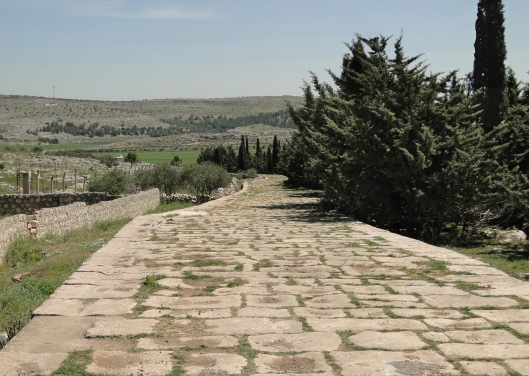
Of course, those Roman wagons were meant for paved Roman roads.

im12romroad.jpg

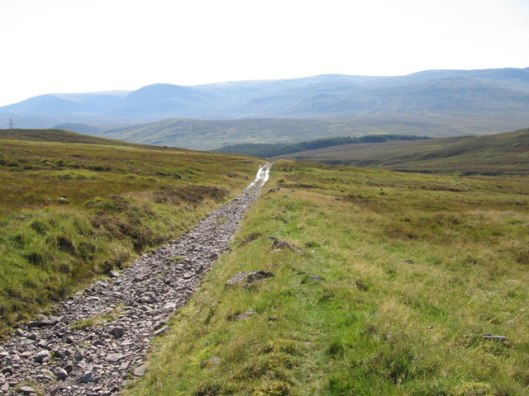
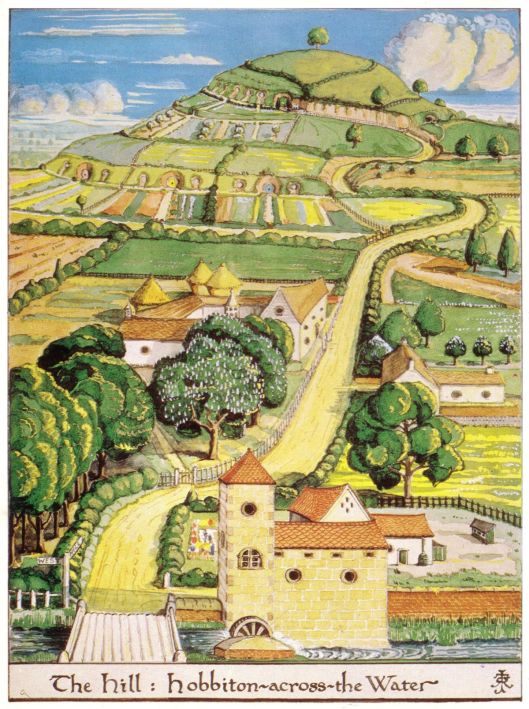
Although some Roman roads remained on the surface and continued to be used, most medieval roads were merely dirt and stones—as JRRT illustrates in that picture of the Hill

im13hobbiton.jpg

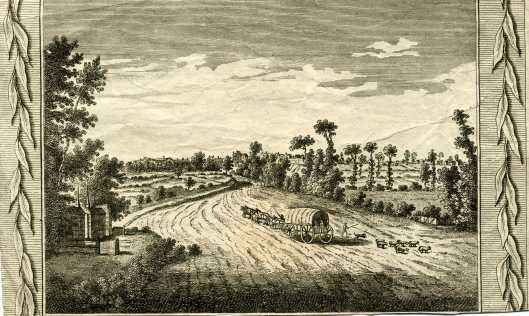
and as we see in this picture.

im14medroad.jpg

In which case, medieval people relied upon pack horses to transport many of their goods.

im15sumpter.jpg

(Think of Bill the pony as a modest example.)

An old word for wagon is wain and we would like to end this brief exploration with something about wains and Wainriders.  In Appendix A, we find this:

“The third evil was the invasion of the Wainriders, which sapped the waning strength of Gondor in wars that lasted for almost a hundred years.  The Wainriders were a people, or a confederacy of many peoples, that came from the east; but they were stronger and better armed than any that had appeared before.  They journeyed in great wains, and their chieftains fought in chariots.”

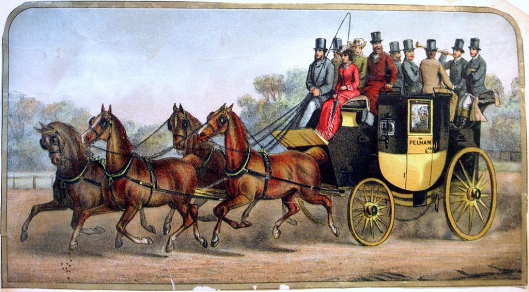
We’ve been puzzled by that combination of “great wains” and “their chieftains fought in chariots”.  The only immediate reference we could think of was to the Iceni, a tribe of ancient Britain, who, led by a female chieftain named Boudica, revolted against Roman occupation in 60-61AD.  At the final battle, where they were defeated by Roman troops, they had parked wagons in a crescent formation to their rear, then advanced with their chariots and infantry against the Romans. (See Cassius Dio, Roman History, LXII.12 for a description of this battle—here’s an easy LINK to that portion of his extensive writing.)

im16boudica.jpg

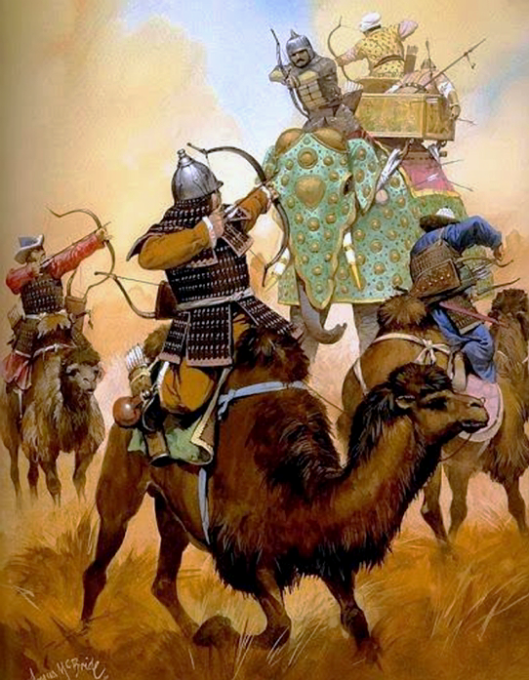
There is a problem here, however.  The Britons were not migratory and their wagons were probably no more than farm wagons and carts, hardly the great wains of JRRT’s description.  If we removed the chariots, another candidate for the Wainriders might be the Mongols, however, who were migratory and traveled in something even more splendid than a wagon—a gur—like this one—

im17ger.jpg

The Mongols certainly came from the east and, in a short time, swallowed up territory from China all the way to eastern Europe.

im18mongolconquest.jpg

It is more likely, however, that JRRT combined things–it wouldn’t be the first time he synthesized—so much of his so-called legendarium is a mixture of this and that in brilliant profusion.  So, in the same spirit, we asked ourselves what we thought wains might look like and immediately saw the big wagon which was instrumental in colonizing the western part of the US, the Conestoga.

im19conestoga.jpg

Great, long lines of these and other wagons, packed with people and supplies, crossed the plains from the 1840s on.

im20wagtrain.gif

Could we then remove the 19th-century settlers and add Celts and their chariots, say?

im21celtchar.jpg

What do you think, dear readers?

Thanks, as ever, for reading.

MTCIDC

CD

Wains and Carts and… (Part I)

Tags

, , , , , , , , , , , , , , , , , , , , , ,

Welcome, dear readers, once more to our blog.
We’ve just been watching the extended version opening of The Fellowship of the Ring, in which Gandalf appears, driving a cart.
image1gandalfcart.jpg
(Sorry—we couldn’t resist! We love Legos and the older Playmobil—Vikings, pirates, Roman warship, too. Not to forget the Egyptian pyramid! )
Unlike ordinary medieval carts,
image2amedcart.jpg
it is quite elaborate.
image2gandalfcart.jpg
image3gandalfcart.jpg
You can see from our second illustration that both the medieval example and Gandalf’s have wattled sides—that is, the upright spindles below the railing top have pliable sticks (perhaps willow or hazel?) woven between them to make the sides of the cart.
This is also a common method for producing traditional house walls: you just add daub, which is clay plus fibre, as a kind of plaster to fill in around the sticks.
image4wattleanddaub.jpg
Many buildings, from the Neolithic on, were constructed using the technique,
image5technique.jpg
image6house.jpg
as well as, without the daub, miles and miles of useful fencing.
image7fence.jpg
What caught our attention, however, was the general look of the cart and the detailing of the wooden railing,
image8agscart.jpg
image8bgscart.jpg
image8cgscart.jpg
which very much reminded us of this—
image8chariot.jpg
a Celtic chariot of the sort one sees both in chariot burials
image9chariotburial.JPG
and in stirring reconstructions.
image10britchariots.jpg
But that’s not the direction we wanted to take in this post. Rather, we were, as so often, thinking about the medieval world and Middle-earth and, in this case, wheeled vehicles.
The earliest evidence in Europe currently known for such vehicles is not the remains of a vehicle itself, but rather its tracks, found under a burial mound at Flintbek, in Schleswig-Holstein, in northwest Germany.
image11flintbek.jpg
These have been dated to about 3600BC, during the late Neolithic Era. A bit later, we see this odd thing, the so-called “Trundholm Sun Chariot”, from about 1400BC
image12trundholm.jpg
which actually appears to be some sort of wagon, or at least its frame.

Perhaps 50 years later, there are Bronze Age Mycenaean chariots
image13mycen.jpg
but, at least as far as illustrations go, European domestic vehicle depictions are scarce, especially in contrast to those of military—or sport—vehicles. Here’s a 5th-century BC depiction of a wagon being used for a wedding,
image14grkwagon.jpg
but we could then show you heaps of illustrations of chariots, used in very early Greece for warfare. You see them all over the Iliad, for example,
image15achilles.jpg
but chariots in the later Greek world were abandoned for warfare, although retained for racing, which was true for the Romans and for their successors, the Byzantines.
image16byzchar.jpg
We have lots more depictions of domestic vehicles from the Roman world, both carts
image17romancart.jpg
and wagons.
image18romwag.jpg
This shouldn’t be surprising, we suppose, given that the Romans built more than 50,000 miles of roads.
image19romrd
Judging by these depictions, it appears that the medieval world simply continued using Roman vehicle patterns, just as, where available, they continued to use Roman roads.
image19romcrt.jpg
image20medwag.png
For us, then Gandalf’s cart—which is not really described:
“At the end of the second week in September a cart came in through Bywater from the direction of Brandywine Bridge in broad daylight. An old man was driving it all alone…It had a cargo of fireworks…”
(The Fellowship of the Ring, Book One, Chapter 1, “A Long-expected Party”)
would follow what we see in manuscript illustrations.
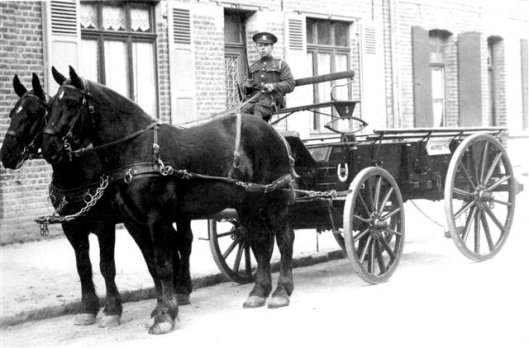
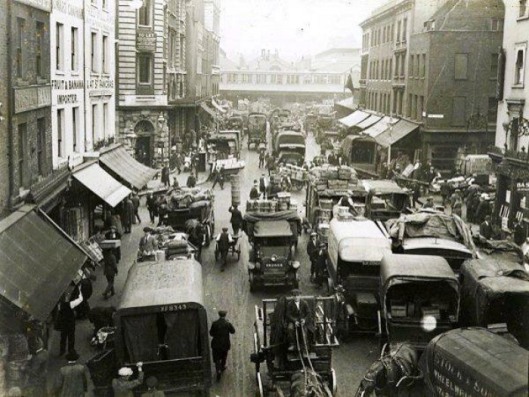
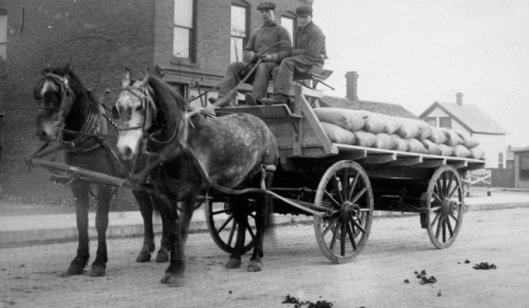
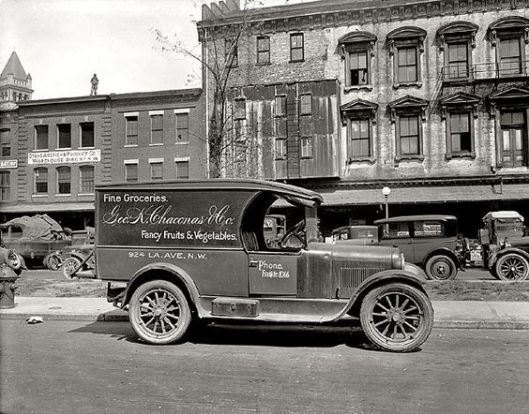
Tolkien might have been thinking of such illustrations, of course, but there is another possibility. In the late-Victorian world into which JRRT was born, horses still powered vehicles and delivery carts like this one
image21deliverycart.jpg
would have been a common site—even after the Great War. Perhaps he was thinking of something he might still have seen outside his window when he was young?
We’ll stop here for now, but will continue in Part II, where we’ll consider Farmer Maggot’s wagon and wains…

Thanks, as ever, for reading.
MTCIDC
CD

Weaving (Not Hugo)

Tags

, , , , , , , , , , , , , , , , , , , , ,

Welcome, dear readers, as ever.

In our last, we quoted JRRT on the subject of the Rohirrim:

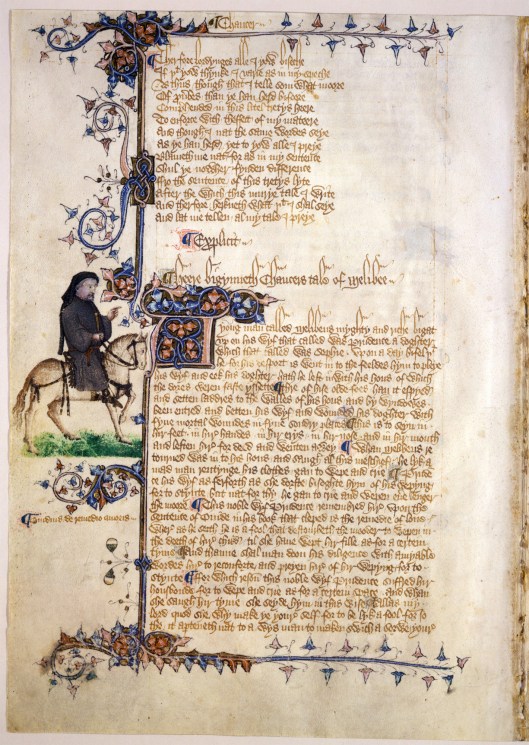
“The styles of the Bayeux Tapestry (made in England) fit them well enough, if one remembers that the kind of tennis-nets [the] soldiers seem to have on are only a clumsy conventional sign for chain-mail of small rings.”  (Letters, 281)

We’ve mentioned the so-called Bayeux Tapestry before and even shown an illustration or two, but we thought that it would be fun to delve a little deeper into the subject—beginning with its name and why Tolkien added “(made in England)” to his sentence.

The first known reference to this approximately 230-foot-long (70.1 meters) by 20 inch high (.5m) piece of fabric dates from the latter part of the 15th century AD, from an inventory at Our Lady of Bayeux Cathedral—commonly known in English as Bayeux Cathedral—in 1476.  There has been much scholarly argument over its site of manufacture, but the evidence appears to us to identify the commissioner of the work as Odo, Bishop of Bayeux, and half-brother to William, Duke of Normandy (where Bayeux is situated), aka, “William the Conqueror”.  Odo is depicted and identified three times on the piece, twice in more peaceful settings—once blessing a meal,

image1odo.jpg

once sitting with William and his half-brother, Robert,

image2odo.jpeg

and once in a decidedly not peaceful setting, encouraging the troops at the Battle of Hastings, wearing a mail shirt and helmet and brandishing a club.  (The Latin inscription—called a titulus—says “Here Bishop Odo, holding a club, puts strength into the lads”.)

image3odo.png

As well, several of the figures on the piece have been identified as vassals (feudal allies) of Odo.  Finally, Odo was not only the Bishop of Bayeux, but also instrumental in rebuilding the cathedral in which the artefact was first known to have been housed, Bayeux Cathedral (elements of which are buried inside this later Gothic version).

image4bayeux.jpg

It seems natural to us, then, that he, at one time William’s right-hand man, would have been responsible for the creation of the work.  (We might also add that the Norman victory made Odo Earl of Kent—one more reason for commissioning a work which shows that victory in detail.)

We said that there was argument as to where the work was made, but we, ourselves, would agree with JRRT and the idea that it was made in England for, among other reasons, the depiction of people and scenery on it remind us strongly of the Anglo-Saxon artistic tradition—especially embodied in the mid-11th-century manuscript of the “Old English Hexateuch”, with its 394 colored illustrations, which is to be found in the British Library (Cotton MS Claudius B. iv.).

image5babel.jpg

This is a depiction of the construction of the Tower of Babel.  Below is a picture of Normans building ships for their invasion of England from the Bayeux work.

image6ship.jpg

The Bayeux work is much sparer, but there’s that same interest in illustrating motion.

But, when we say that the Bayeux work is sparer, that is not to say that it lacks detail, as there are (at least) four visual levels throughout.  If we take just one scene at random

image7levels.jpg

and go from top to bottom we see:

  1. a narrow band of single figures—in this case, animals
  2. a broader band of action—in this case it’s Normans loading their equipment—and other things—for the attack on England (The titulus says: “These are carrying arms to the ships and here they are dragging a cart with wine and arms.”)
  3. the captions—tituli—for every scene
  4. a lower narrow band—again, here, animals, but there are other possibilities, as in this scene, where we see scavengers removing the arms and armor of the dead after the Battle of Hastings

image8scavengers.jpg

The images in the “Old English Hexateuch” illustrate individual Bible stories.  Those in the Bayeux work are scenes, all parts of a long historical narrative, which begins in 1064 (it is thought) with Edward the Confessor, the King of England,

image9eddie.jpg

sending the powerful nobleman, Harold Godwinson, on what appears (from subsequent panels) to be a mission to France.

The last scenes, at the far end, include the death of Harold on the battlefield of Hastings

image10deathofharold.jpg

and the flight of the English from the field, with Normans in hot pursuit in October, 1066.

image11flight.jpg

Throughout our discussion, we have avoided calling this work by its traditional name because, in fact, the “Bayeux Tapestry” is not a tapestry.  A tapestry is a solid piece of fabric, woven on a loom.

image12medloom.jpg

The Bayeux Tapestry is really the Bayeux Embroidery, in which various designs are stitched onto a cloth.

image13making.jpg

In this close-up, you can see how it’s done, with outlines giving the figures shape, as if they were drawn with a needle, then filled in.  (For more on this, and on the work in general, try this LINK.)

image14stitching.jpg

For its size and detail and historical importance, there’s no embroidery like it from early medieval England, and perhaps from Europe, but there was one moment when it almost disappeared for good.  During that period of the French Revolution when the Church (1% of the population which owned 10% of the land), was being nationalized (and plundered),

image15church.jpg

it was destined to be used for military wagon covers.

image16wagon.jpg

It was only saved at the last minute and shipped off to the Musee Napoleon (formerly—and subsequently—the Louvre).

image17louvre.jpg

Eventually, it was returned to Bayeux where, today, it can be seen in a museum there, cleverly displayed in a way which allows the entire length to be viewed.

image18museum.jpg

image19display.jpg

Without a member of Bayeux’ city council, Lambert Leonard-Leforestier, and his quick thinking, however, the last anyone might have seen of it would have been more like this—

image20wagon.jpg

destroyed on wagons lost in Napoleon’s disastrous retreat from Russia.

Thanks, as ever, for reading.

MTCIDC

CD

PS

There is one more detail from the Bayeux Embroidery we’d like to mention.  If you’re a fan of Game of Thrones, you might remember a passing comet.  In fact, a passing comet—Halley’s Comet—appears on the Embroidery and, for people of the time, portended something big to come…

image21halleyscomet.jpg

For more on Halley’s comet, here’s a LINK.

Lost in Space

Tags

, , , , , ,

Welcome, as always, dear readers.
When you think about Sam, what do you know about him and how do you know?
The first mention of the character is almost a footnote. The narrator is actually talking about Ham Gamgee “commonly known as the Gaffer” (a dialect form of “grandfather”):
“Now that he was himself growing old and stiff in the joints, the job was mainly carried on by his youngest son, Sam Gamgee. Both father and son were on very friendly terms with Bilbo and Frodo. They lived on the Hill itself, in Number 3 Bagshot Row just below Bag End.” (The Fellowship of the Ring, Book One, Chapter 1, “A Long-Expected Party”)
The Gaffer has been gossiping in The Ivy Bush, mostly in response to conversation about Bilbo and Frodo and he’s attempting to quell a rumor that Bag End is stuffed with jewels and gold and says of its riches:
“But my lad Sam will know more about that. He’s in and out of Bag End. Crazy about stories of the old days, he is, and he listens to all Mr. Bilbo’s tales. Mr. Bilbo has learned him his letters—meaning no harm, mark you, and I hope no harm will come of it.

‘Elves and Dragons! I says to him. Cabbages and potatoes are better for me and you. Don’t go getting mixed up in the business of your betters or you’ll land in trouble too big for you, I says to him.’ ”
So, in about three pages we know:
1. a little about Sam’s family (he is unmarried and lives with an elderly father)
2. his job (assistant gardener)
3. his social class (lower—Gaffer’s speech pattern and word choices indicate “rustic”, as does his talking to Sam about his “betters”)
4. where he lives (as a servant in this semi-feudal world would be expected to, below his master, but near)
5. his interests (“the old days”)
6. his education (he’s literate—and The Gaffer’s “meaning no harm” suggests that this is unusual, at least among his social class)
7. his character (imaginative: “crazy about stories”; perhaps independent-minded—he continues to be enthusiastic about such things even though his father cautions him against them)
In the many chapters to come, we will learn much more about Sam—his practicality, his inner toughness, his flexibility, his ability to stay grounded in the worst circumstances, and that inner resolve which keeps the two hobbits going, even to what appeared to be a terrible end:
“ ‘So that was the job I felt I had to do when I started,’ thought Sam: ‘to help Mr. Frodo to the last step and then die with him. Well, if that is the job then I must do it.’
But even as hope died in Sam, or seemed to die, it was turned to a new strength. Sam’s plain hobbit-face grew stern, almost grim, as the will hardened in him, and he felt through all his limbs a thrill, as if he was turning into some creature of stone and steel that neither despair nor weariness nor endless barren miles could subdue.” (The Return of the King, Book Six, Chapter 3, “Mount Doom”)
It’s not surprising, then, that Galadriel, with an eerie foresight, has given him the means to help the Shire heal from the terrible industrializing wounds of Sharkey & Co.:
“So Sam planted saplings in all the places where specially beautiful or beloved trees had been destroyed, and he put a grain of the precious dust in the soil at the root of each. He went up and down the Shire in this labour…And at the end he found that he still had a little of the dust left; so he went to the Three-Farthing Stone, which is as near the centre of the Shire as no matter, and cast it in the air with his blessing…” (The Return of the King, Book Six, Chapter 9, “The Grey Havens”)
Recently, we’ve seen Star Wars 8: The Last Jedi. After 7, we were not eager. We are not among those who hold that 4, 5, and 6 are the canon, although we see characters there—particularly Luke and Han—grow over time into people we include in our list of adventure-friends, like Robin Hood and David Balfour and Indiana Jones. We think that George Lucas, having developed the story of Luke and his father, was curious to see if he could reach back in time and show how Anakin Skywalker became Darth Vader, a daring and ambitious project, since, until his attack on the Emperor, Vader seemed less than sympathetic as a character.
For us, the main problem with 7 was that there seemed to be too many characters constantly flying to to too many planets, with no real attempt to develop them. Granted, JRRT had hundreds of pages and as many hours as his readers were willing to grant him to turn out characters like Sam, luxuries a film-maker is denied. At the same time, consider the opening sequence: a mysterious pilot lands on a mysterious planet which is then attacked by people who resemble the storm troopers of 4/5/6. The mysterious pilot is given something by a mysterious elderly man. Then a storm trooper mysteriously deserts his companions after finding one a casualty. And so it goes on. By the end of the film, we had a cast which included (for a short time, at least) old friends: Chewy, Han, and Leia (with minor roles for droids), plus a number of new characters who did not appear to us to be anchored in anything, just there to sustain the action. Who were they? Who knew? And, sadly, for us, who then cared? We had hopes for Rey (although the joke that she is a “Rey/Ray of Hope” is pretty obvious) and still do, but, with nothing to ground them, why, we asked ourselves, should we invest emotionally in FN-2187 and Poe (whose name is just a little too close to “Pooh”—or “Poo” for our taste)?
And then there came 8. It began as 5—evacuation from a newly-discovered base, but without the wampa or those impressive ATATs (even if snow speeders can find weaknesses in them). And then we see the unexplained Poe (the mysterious pilot in 7) once more and soon the unexplained FN-2187 (the mysterious deserter in 7) who, in turn, is soon joined by the unexplained Rose. (In time, we’ll also see the unexplained DJ, although we can’t recall that we were ever given his name, which says something about his development in the story. Why is he in the lock-up? When he betrays FN-2187 and Rose, when did he have the occasion to have set up the betrayal beforehand? And why does he occasionally stutter?) To which we add the unexplained Captain Phasma, who had a brief unexplained appearance in the previous film. (And who in the world is Snoke? And how does he come to fill in for Palpatine? We also wonder, considering the condition of his face, what happens when he eats popcorn—does it get wedged in the cracks or does it all fall out of one cheek?)
We swear by 4/5/6 and, though they are weaker films, we still believe 1/2/3 to be an important part of the story, but what we feel has happened in 7 and even more so in 8, is that character development has been sacrificed for action: instead of seeing more of who they are and why, we are too often shown what they do and this is somehow thought to be the same. Perhaps part of the point of 9 will be to explain at least some of what’s missing from 7 and 8, but imagine seeing Sam through the first five books of The Lord of the Rings simply as somebody who carries the pots and pans (and rope), then, suddenly, in Book Six, becomes the figure we have watched grow through the first five—would you believe in him and would you care?
Thanks, as always, for reading!
MTCIDC
CD
ps
We’ve had so much discussion about this that we plan a second review to follow.