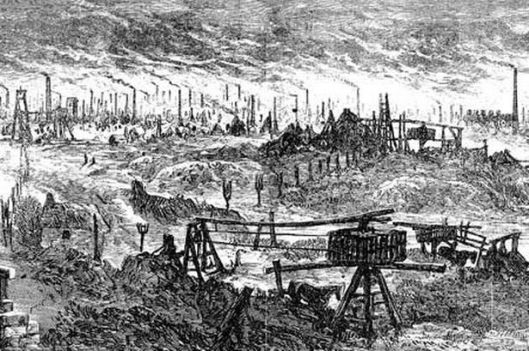
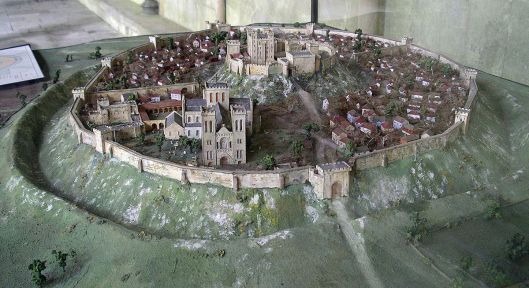
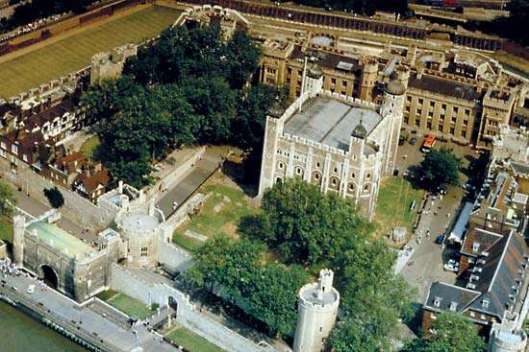
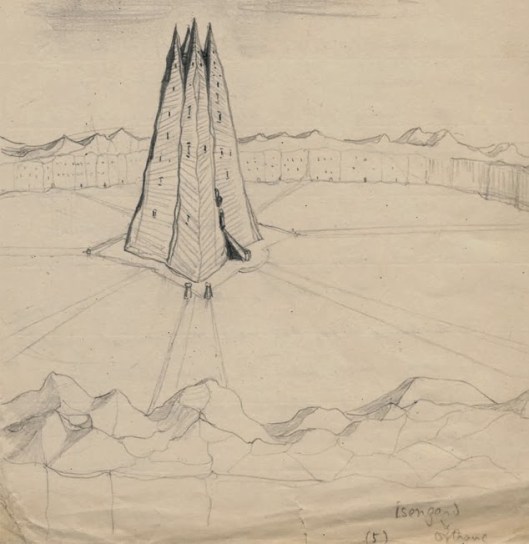
• About

doubtfulsea

~ adventure fantasy

Category Archives: Uncategorized

Desolated

18 Wednesday Dec 2019

Posted by Ollamh in Uncategorized

≈ Leave a comment

As always, dear readers, welcome.

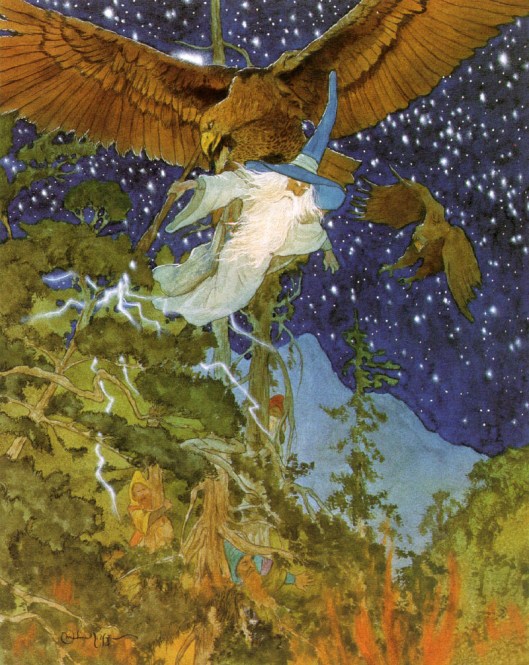
“On the table in the light of a big lamp with a red shade he spread a piece of parchment rather like a map.  ‘This was made by Thror, your grandfather, Thorin,’ he said in answer to the dwarves’ excited questions.  ‘It is a plan of the Mountain.’ “ (The Hobbit, Chapter One, “An Unexpected Party”)

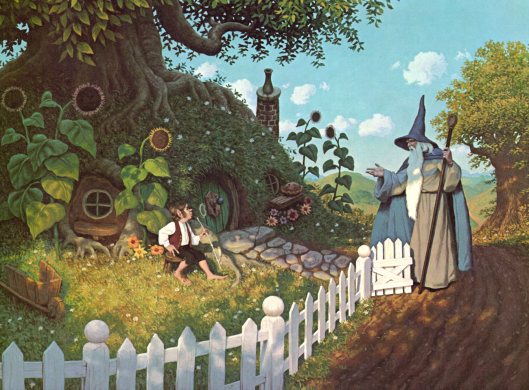
We are teaching The Hobbit again and here is Gandalf, spreading out Thror’s map (by Alan Lee).

image1gwithmap.jpg

And here’s that map.

image2map


What caught our immediate attention this time was that central label:  “The Desolation of Smaug”.

The narrator describes this:

“The land about them grew bleak and barren, though once, as Thorin told them, it had been green and fair.  There was little grass, and before long there was neither bush nor tree, and only broken and blackened stumps to speak of ones long vanished.” (Chapter 11, “On the Doorstep”)

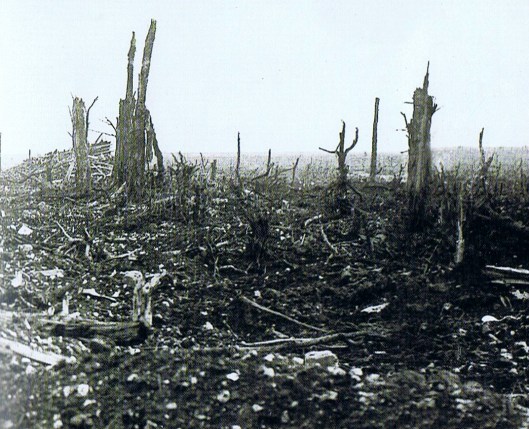
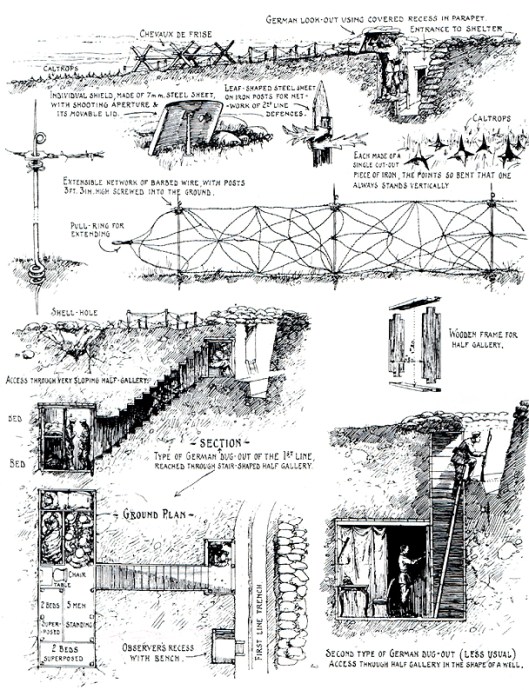
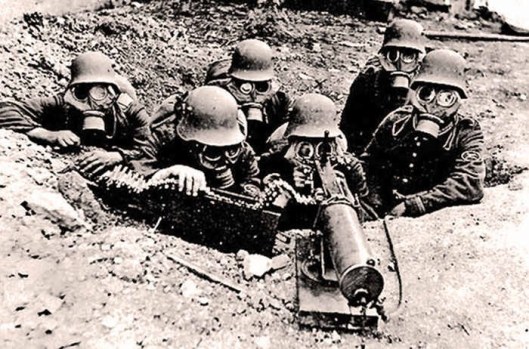
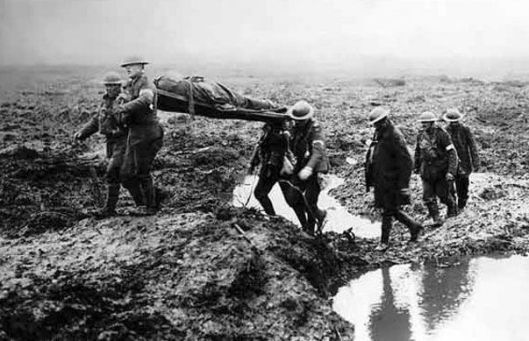
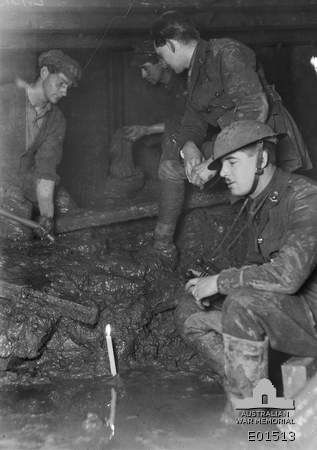
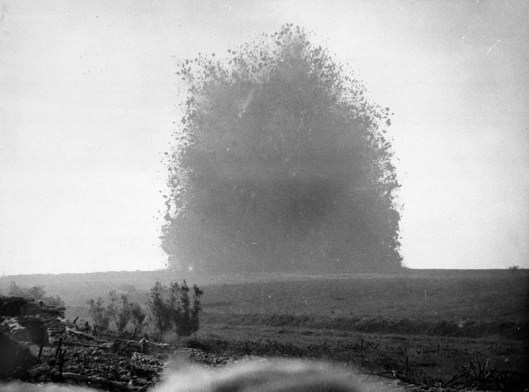
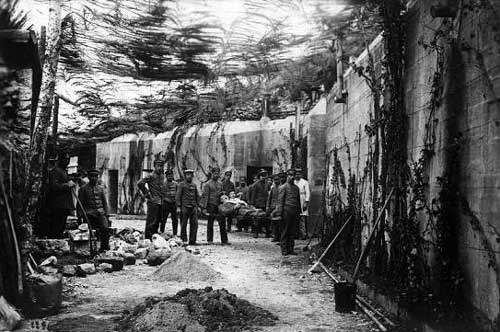
That last detail, about the stumps, reminded us of another place, one with which Tolkien, in 1916, would have been very familiar—No Man’s Land in that area between the Germans and the Allies during the Great War in the West and

image3no.jpg

image4no.jpg

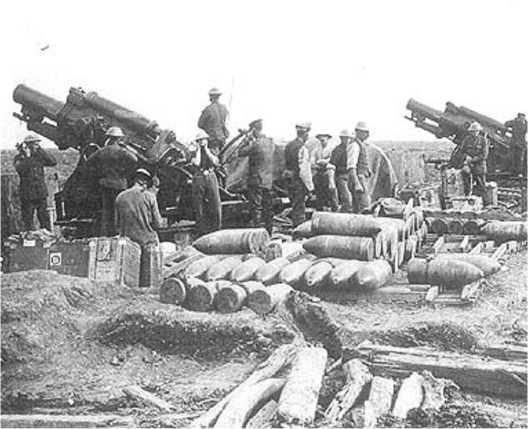
pounded to dust by the heavy artillery of both sides.

image5bertha.jpg

Loading a 15-inch howitzer on the Somme, 7 August 1916.

It wasn’t just the landscape which was pounded:  entire villages disappeared under bombardment and bigger towns suffered severe damage, foreshadowing the destruction of Dale:

“they could see in the wide valley shadowed by the Mountain’s arms the grey ruins of ancient houses, towers, and walls.”

Perhaps the most famous ruin was that of the Cloth Hall in Ypres, in southern Belgium.

image7ypres

image8ypresmap

Here it is in a pre-war image.

image9clothhall.jpg

Ypres had been at the center of the northern European wool and cloth trade,

image10medloom


which had made its makers and dealers so rich that they had this enormous place built for themselves,

image11clothhall.jpg

finished in 1304.

But then, in August, 1914, came the German invasion of Belgium.

image12invasion

The Allies—the British and French—were driven back, but, in time, part of their network of defensive trenches was on the northeast side of Ypres.

image13ypressalient

Unfortunately for the Allies, the Germans held heights above the town and their guns could easily batter their positions and the town of Ypres beyond.  Doubly unfortunate was the fact that the Cloth Hall and the cathedral behind were prominent features on the landscape and therefore excellent targets—which they soon became—and, in a series of photos, the gradual nearly-complete destruction of the Cloth Hall is clearly visible.

image14ypresimage16ypresimage17ypresimage18ypresimage19ypres

It wasn’t just Belgium which suffered, however.  Beginning in January, 1915, the Germans began an air campaign against Britain.  First, airships were employed,

image20zepplin

but, as aircraft technology improved, bombers were added to the attacks,

image21bomber.jpg

which continued until May, 1918.  The raids only killed or wounded about 2,000, and did minimal physical damage,

image22damage

but the psychological damage was enormous.  In the past, as long as the Royal Navy was active, no one had ever successfully threatened England, not even Napoleon.

image23napatboulogne

Airpower changed all that and we wonder about how JRRT’s experience of that—from reading newspaper accounts—

image24newspaper

combined with his first-hand experience of No Man’s Land,

image25nomansland

influenced the way he imagined the land Smaug had invaded and destroyed.

image26erebor

When the Second War came, Tolkien became an Air Raid Warden in Oxford.

image27arp.jpg

German air attacks on England were much more elaborate and intense than in the First War,

image28dornier

causing great loss of life and enormous damage—huge fires could engulf whole sections of cities, as they did in London.

image29docks

Bombers never attacked Oxford, but the newspapers

image30paper

and newsreels of the day

image31newsreel

would have shown him what the rest of the country was experiencing, and we can easily imagine that Smaug’s

image32smaug

attack on Lake-town

image33laketown

would have somehow mirrored the awful destruction England was enduring,

image34london

just as the use of antiaircraft fire

image35aa

which brought down German aircraft

image36crashed

would suggest the fateful arrow which brings down Smaug.

image37smaug

Tolkien himself resisted all attempts to turn his work into allegories which portrayed the political and military events of his time in veiled terms, but it wouldn’t be hard to see that such earth-shaking events as the First and Second World Wars and his own experiences in them and of them, could certainly influence the way he saw and presented events in his own Middle-earth.

Thanks, as always, for reading and

MTCIDC

CD
 

ps

But we couldn’t leave you with that ruin of a cloth hall.  Over many years, the people of Ypres worked to rebuild and here’s that famous building today.

image38ypres

Ashes, Ashes, All Fall…

11 Wednesday Dec 2019

Posted by Ollamh in Uncategorized

≈ Leave a comment

Welcome again, dear readers.

In our last, we were thinking out loud about the Dark Tower, the Barad-dur.  This brought us easily to the White Tower of Minas Tirith

image1mt.jpg

but then, almost by Sauron’s power, we were carried beyond it to a shadowy place, as JRRT describes it:

“A strong citadel it was indeed, and not to be taken by a host of enemies…unless some foe could come up behind and scale the lower skirts of Mindolluin, and so come upon the narrow shoulder that joined the Hill of Guard to the mountain mass.  But that shoulder, which rose to the height of the fifth wall, was hedged with great ramparts right up to the precipice that overhung its western end; and in that space stood the houses and domed tombs of bygone kings and lords, for ever silent between the mountain and the tower.” (The Return of the King, Book Five, Chapter 1, “Minas Tirith”)

image2map.jpg

“domed tombs” was an interesting detail—and made us think of the huge necropolis (literally “dead city/city of the dead”) near El-Minya, in Egypt.

image3friedhof.jpg

(This is from a very interesting blog, “jennyfaraway.com” which we recommend that you might take a look at.  If you google “El Minya”, the major images are all from her site—and, as she seems to have traveled almost everywhere short of Mordor, there’s lots more to see and read about.)

The bigger picture, however, was that there was an entire area of the city which had been set aside as a cemetery for “bygone kings and lords”, along a street called Rath Dinen, “Silent Street”, only to be entered by “a door in the rearward wall of the sixth circle, Fen Hollen it was called”.  (The Return of the King, Book Five, Chapter 4, “The Siege of Gondor”)  Fen Hollen means “Closed Door”, and “it was kept ever shut save at times of funeral, and only the Lord of the City might use that way, or those who bore the token of the tombs and tended the houses of the dead”.

It is to this door that a small procession comes, even as the outer walls of Minas Tirith are being attacked by a vast army from Mordor.

siege3


Denethor, whose mind has actually been completely taken over by Sauron’s power through his use of a palantir, is about to do something terrible beyond that door, where “Beyond it went a winding road that descended in many curves down to the narrow land under the shadow of Mindolluin’s precipice where stood the mansions of the dead Kings and of their Stewards.”

As we know, Denethor is now convinced that Minas Tirith, and Gondor itself, are about to fall to the Dark Lord, even as he believes that Faramir, wounded in the last defense of the causeway across the Pelennor,

image5gandalf.jpg

(by Ted Nasmith, always a favorite of ours)

is dying.  In his despair, Denethor is about to rush the process by cremating Faramir and himself alive although this goes against Gondorian tradition—as Denethor says, “No tomb for Denethor and Faramir.  No tomb! No long slow sleep of death embalmed.  We will burn like heathen kings before ever a ship sailed hither from the West.”

Denethor orders attendants to pick up Faramir’s bed and “Out from the White Tower they walked, as if to a funeral, out into the darkness…”

image6litter.png

To us, two images came immediately to mind and we wondered whether they were models for JRRT:

  1. something Tolkien must have known as a common sight in his time in the trenches in the Great War, the removal of the wounded on stretchersimage7stretchers


  1. all of the funerals of monarchs he would have seen growing up and as an adult writing The Lord of the Rings in photographs in magazines and newspapers and even in newsreels, from Victoria (1901)image8avic


to Edward VII (1910)

image8bed7.jpeg

to George V (1936)

image8cgeo5.jpg

to George VI (1952).

image8dgeo6.jpg

Huge processions wound

image8procession.jpg

through London’s streets where, since the funeral of Edward VII, the casket bearing the monarch would be carried into Westminster to lie in state for a brief time

image9ageo5instate.jpg

before ultimate burial—also since Edward VII—at St George’s Chapel, in Windsor Castle.

image10stgeos.jpg

Here, in fact, is the tomb of George V and his wife, Queen Mary,

image11geo5.jpg

modeled on something much earlier and which might turn up in churches not only in England, but in other parts of western Europe, tomb effigies.

image12effigy.jpg

image13effigy.jpg

image14effigy.jpg

image15effigy.jpg

And JRRT, having seen such, we’re sure, as they’re fairly common in England, has them appear in “the House of the Stewards”—which is a kind of euphemism, as this is clearly the burial vault for the Stewards:

“There Pippin, staring uneasily about him, saw that he was in a wide vaulted chamber, draped as it were with the great shadows that the little lantern threw upon its shrouded walls.  And dimly to be seen were many rows of tables, carved of marble; and upon each table lay a sleeping form, hands folded, head pillowed upon stone.”

These aren’t tables, of course, but the tops of tombs, like this one:

image16effigy.jpg

That Denethor has gone mad is clear to see in his command to his attendants, who have “laid Faramir and his father side by side” on one of these “tables”:

“Here we will wait…But send not for the embalmers.  Bring us wood quick to burn, and lay it all about us, and beneath, and pour oil upon it.  And when I bid you thrust in a torch.”

To the first audience to read this scene, in 1955, just three years after the last state funeral, that of George VI,

image17geo6.jpg

that madness would have been underlined by Denethor’s “No tomb for Denethor and Faramir.  No tomb! No long slow sleep of death embalmed.  We will burn like heathen kings before ever a ship sailed hither from the West.”

The Stewards, though not the kings of Gondor, had ruled like kings for 25 generations, and it’s easy to see in “the House of the Stewards” that they treated themselves like kings, even in their burials.  That Denethor would choose a “heathen” end and in the place of formal entombment could only mean that there was little left of the mind of the man who once had ruled Gondor while waiting, at least symbolically, for the return of the King.  The readers of 1955 would have been well aware of how a real monarch was to be laid to rest and not as the Steward was, when “Denethor gave a great cry, and afterwards spoke no more, nor was ever again seen by mortal men.”  (The Return of the King, Book Five, Chapter 7, “The Pyre of Denethor”)

The attempt at a combination murder and suicide, as well as such a violation of custom, so indicative of the overthrow of Denethor’s mind by Sauron, has a fitting aftermath:

“But the servants of the Lord stood gazing as stricken men at the house of the dead; and even as Gandalf came to the end of Rath Dinen there was a great noise.  Looking back they saw the dome of the house crack and smokes issue forth; and then with a rush and rumble of stone it fell in a flurry of fire…”

Denethor has warned of a catastrophe when he replies to Gandalf:

“But soon all shall be burned.  The West has failed.  It shall all go up in a great fire, and all shall be ended.  Ash!  Ash and smoke blown away on the wind.”

With the (literal) fall of the House of the Steward, it is Denethor himself who must be little but ash.

image18denethor.jpg

Thanks, as ever, for reading, and

MTCIDC

CD

ps

As so often, it might be that something in Tolkien’s own world has either stimulated his imagination or he has borrowed something for his own purposes.  Here’s a domed building at Oxford, the Radcliffe Camera, opened 1749, which JRRT must have passed by perhaps on a daily basis.  Could this be one source for the House of the Stewards on Rath Dinen?

image19radcam.jpg

pps

While researching this posting, we discovered this:

image20lego.jpg

a LEGO version of the pyre of Denethor, by Jackson Williams.  You can see more at:  http://www.moc-pages.com/moc.php/372301/330571

Death, Within 24 Hours

30 Wednesday Jan 2019

Posted by Ollamh in Uncategorized

≈ Leave a comment

Tags

A Tale of Two Cities, All the Year Round, Anthony Andrews, Baroness Orczy, Bastille, British Navy, Charles Dickens, Citizen Chauvelin, Citizen King, Committee of Public Safety, Corvee, Culotte, Declaration of the Rights of Man and the Citizen, French Revolution, Garde Francaise, guillotine, Ian McKellen, Impots, Leslie Howard, liberty cap, Louis XV, Louis XVI, Marie Antoinette, Maximilien Robespierre, Sir Percy Blakeney, Taille, The Reign of Terror, The Scarlet Pimpernel, The Three Estates, Thomas Carlyle, Vernet

As always, dear readers, welcome—and please forgive the rather forbidding title!

It’s just that, recently, we’ve been rereading Charles Dickens’ (1812-1870)

image1cd.jpg

novel of the French Revolution, A Tale of Two Cities (1859), which first appeared in serial form in Dickens’ magazine All the Year Round

image2all.png

before being published in book form the same year.

image3tale.jpg

Dickens was inspired in part by Thomas Carlyle’s (1795-1881)

image4carlyle.jpg

three-volume History of the French Revolution (1837, second edition 1857).

image5french.jpg

What Carlyle wrote about and Dickens novelized was a very complex event.  France, before the beginning of the Revolution in 1789, was in desperate straits, beginning with its social system.  All of French society was divided into three “estates”.  Here’s a “nice” picture of them.

image6estates.jpeg

Here’s a chart to show you what these divisions meant in terms of the economic structure.

image7estates.jpg

And it’s easy to see, from this, why such caricatures as these typified, at the time, the truth of how the estates system worked for the benefit of the top two and very much against that of the third.

image8estates.jpg

image9estates.jpg

(The labeling of the rock in this last image points to some of the elements of the heavy financial burden on the Third Estate.  Taille is a land tax levied upon all land-holding non-nobles.  Impots might be translated as “income tax”, but more complicated (if possible!).  Corvee went back to feudal times and was a system of unpaid labor for a certain number of days per year, to the state and to lords who rented land to tenants.)

This meant that a great deal of the Third Estate, both in towns and in the country, was desperately poor and often on the edge of starvation.

image10peasants.jpg

A major problem was that such a tax base, though broad, was always being squeezed beyond its limits, meaning that the royal government (in 1789, this meant Louis XVI–1754-1793) was always struggling to find the money both to pay off back debts and to keep itself in funds in the present.  Then, when there were added expenses—such as the American War for Independence (1775-1783), in which the French played a major role from 1778 to the end—

image11yorktown.jpg

new loans and new debts were created.

And the expenses didn’t stop there as the French, anxious about the power of the British Navy

image12capestvincent.jpg

and the closeness of many of its ports to Britain,

image13dieppe.jpg

embarked upon a building campaign to further strengthen its harbor defenses.

image14arsenal.jpg

(We’ve cheated a little with this last image—it and the previous one are actually from a series of paintings of the major ports of France by Claude-Joseph Vernet—1714-1789–commissioned by Louis XV, the grandfather of Louis XVI, and done between 1753 and 1765, but it gives you the idea of busy French ports in the 18th century.)

(And an interesting little sidelight—if you read us regularly, you know we can never resist these—this Vernet may be a direct ancestor of Sherlock Holmes, who tells Watson in “The Adventure of the Greek Interpreter”–1893 —“My ancestors were country squires, who appear to have led much the same life as is natural to their class. But, none the less, my turn that way is in my veins, and may have come with my grandmother, who was the sister of Vernet, the French artist. Art in the blood is liable to take the strangest forms.”)

Finally, in the 1780s, the whole system began to collapse.  Louis’ government (meaning the King and its ministers—there was no elected element in the royal government) tried to call a meeting of representatives of the Three Estates, the Estates General, in the late spring/summer, 1789,

image15es.jpg

but it was a flop.  Louis had the Third Estate locked out and, instead of going home, they, with a few members of the First and Second, went down the street to an indoor tennis court and founded their own government, the National Assembly.

image16tennis.jpg

They soon produced a document, entitled “The Declaration of the Rights of Man and the Citizen”,

image17dec.jpg

their second step towards changing the whole government and social structure of France.

Meanwhile, the people of Paris carried out their own form of changing things, assaulting the King’s fortress on the eastern side of Paris’ defenses, the Bastille.

image18bastille.jpg

You can tell that things are really crumbling when you realize that the men in blue coats and fuzzy hats in the center are actually members of the one of the units of the King’s bodyguard, the Garde Francaise.

image19garde.jpg

Events quickly begin to speed up:  the King gradually lost his royal powers and became “Citizen King”,

image20citizenking.jpg

wearing the “liberty cap” patriots wore

image21lib.jpg

and drinking toasts straight out of the bottle—like any good “Sans-culotte”.  Culottes were the knee britches worn by people on the rise—

image22cul.jpg

whereas “honest men” wore workman’s clothes with long trousers and, if they could obtain one, that red cap.

image23sans.jpg

As time roared by, it became clearer and clearer that the previous administration was gone for good and that the Third Estate was now in charge.

image24balance.JPG

Louis, terrified, tried to run away with his family, but was caught,

image25arrest.jpg

brought back to Paris basically under arrest and, before he knew it, on trial for his life.

image26trial.jpg

The trial lasted most of December, 1792, and the King was executed in January, 1793,

image27exec.jpg

followed by his wife, Marie Antoinette

image28marie.jpg

in October.

image29exec.jpg

But this was only the beginning of a wave of government bloodshed, now called “The Reign of Terror”, (“La Terreur” in French), in which a part of the state—the “Committee of Public Safety”, under Maximilien Robespierre,

image30robes.jpg

sent thousands of people to their deaths, mainly but not entirely by guillotine, a medieval invention revived and used across France.

image31exec.jpg

People who had done nothing or, at most, had made a passing remark critical of the Revolution could be swept up into a court

image32acourt.jpg

in which there was little or no defense and the usual sentence, if arrested, was “Death within twenty-four hours”.

image32bexec.jpg

One can see that, in England, with its Parliament and increasing wealth and stability, what went on in France, which many in England originally saw in its first—non-violent—stages as a positive thing, soon became nothing but a hideous cannibal feast.

image32can.jpg

And it’s into this world that Dickens, in the latter part of his novel, moves his main characters, in a story of family revenge entangled in the bloody days of the Terror.

Dickens is not alone in seeing this as a great opportunity for a novelist.  A long time ago, we wrote a post which included the Baroness Orczy (1865-1947)—say that OR-tsee–

image33orczy.png

who, beginning with a short story, and then a play (1903)

image34play.jpg

and then the first of a whole series of novels, beginning in 1905,

image35novel.jpg

created the first wimp-who’s-really-a-superhero in Sir Percy Blakeney, AKA, “The Scarlet Pimpernel”.  In London, Sir Percy is an overdressed, drawling clown, but, in France, he is a daring rescuer of endangered noblefolk.  As early film gradually became more sophisticated, the first Pimpernel version appeared in 1917,

image361917.jpg

followed by what many believe was the classic version in 1934, starring Leslie Howard.

image37lh.png

Although we enjoy that one, our particular favorite may be the 1982 version, with Anthony Andrews as the Pimpernel.

image38aa.jpg

The casting for this film actually takes us back to Tolkien in a funny way.  The villain is an agent of the Terror, named “Citizen Chauvelin”.

image39chauvelin.jpg

Put a long white beard on him and age him many years and who is he?

image40gandalf.jpg

Thanks, as always, for reading!

MTCIDC

CD
 

ps

If you would like to know more about the French Revolution, we can’t recommend highly enough Simon Schama’s Citizens (1990).

image41.jpg

It’s a fat book full of all kinds of histories—cultural, political, social—and, with this volume in hand, you can quickly get a good basic grasp of a very large and complicated—and endlessly fascinating—subject.  (And, if you enjoy history, it’s a page-turner.)

pps

And, if you’d like to know more about the Pimpernel, here’s a LINK to the website.

I Think That I Shall Never See…

10 Wednesday Jan 2018

Posted by Ollamh in Artists and Illustrators, Economics in Middle-earth, Fairy Tales and Myths, J.R.R. Tolkien, Literary History, Military History, Military History of Middle-earth, Narrative Methods, Uncategorized

≈ Leave a comment

Tags

Alan Lee, Alexander Volkov, Battle of the Somme, C.S. Lewis, Caspar David Friedrich, deforestation, Fangorn, Fangorn Forest, German Romantics, Grimm Brothers, Haensel and Gretel, Industrial Revolution, Isengard, Kansas, L. Frank Baum, Leonid Vladimirsky, Mordor, pre-industrial, Saruman, The Lord of the Rings, The Scouring of the Shire, The Wizard of Emerald City, The Wizard of Oz, Tin Woodman, Tolkien, trees

Welcome, dear readers, as always.

In a letter to his aunt, Jane, dated 8-9 September, 1962, JRRT wrote:

“Every tree has its enemy, few have an advocate.” (Letters, 321)

We know, from his letters and from interviews, just how passionate he was about trees,

image1jrrt.jpg

but we were immediately caught by just how very Treebeardish he sounded:

“I am not altogether on anybody’s side, because nobody is altogether on my side, if you understand me…” (The Two Towers, Book Three, Chapter 4, “Treebeard”)

image2tbd.jpg

Trees almost seemed to be people to Tolkien—in fact, we know that Treebeard was based in part upon a person—his friend, CS Lewis—at least his voice and manner of speaking.

image3csl.jpg

As near-people, then, to Tolkien, their destruction would have been a kind of murder.  With that in mind, we thought of our last posting, in which we quoted Farmer Cotton talking about Sharkey’s regime in the Shire, including “They cut down trees and leave ‘em lie.”  (The Return of the King, Book Six, Chapter 8, “The Scouring of the Shire”).  And we wondered whether, behind this, JRRT was talking not only about the orcs’ wanton devastation of trees,

image4treeruin.jpg

but also reliving the Battle of the Somme, in 1916, and seeing once more the acres of unburied dead (60,000 British casualties alone on the first day, 1 July, 1916).

image5dead.jpg

Certainly Treebeard saw this as murder, as he says to Merry and Pippin about Saruman

“He and his foul folk are making havoc now.  Down on the borders they are felling trees—good trees.  Some of the trees they just cut down and left to rot—orc-mischief that; but most are hewn up and carried off to feed the fires of Orthanc…Curse him root and branch!  Many of those trees were my friends, creatures I had known from nut and acorn; many had voices of their own that are lost for ever now.  And there are wastes of stump and bramble where once there were singing groves.”  (The Two Towers, Book Three, Chapter 4, “Treebeard”)

Saruman, a person with “a mind of metal and wheels”, who was “plotting to become a Power”,

image6saruman.jpg

has turned Isengard into a vast factory, where “there is always a smoke rising”.

image7isengard.jpg

Thus, just as JRRT may have been recalling the Battle of the Somme, so perhaps he was also suggesting  the industrialization which had been in full swing when he was born and which he disliked intensely and which was reducing much of the part of England in which he grew up to the smoking wasteland Sharkey tried to make the Shire

image8.jpg

as we see in this Alan Lee depiction.

image9.jpg

Of course the deforestation went back long before the Industrial Revolution began.  Once upon a time, great forests covered much of the northern European world and humans lived in the midst of miles and miles of trees in clearings which they cut for themselves.

image10schwarz.jpg

image11farm.jpg

And we still have a distant memory of these, we would suggest, in some of our fairy tales.  If you think about the Brothers Grimm fairy tale of “Haensel and Gretel”, for example,

image12grimms.jpg

image13kinderund.jpg

image14schatten.jpg

you’ll remember that, not only did the children live in the middle of such forest, as did the witch, but their father was a woodcutter, someone who would have been involved in that very deforestation, if in a very small way.

image15woodcutter.jpg

This memory, collected by the Grimms and others in folktale form in the early 19th century, also provided inspiration for the German Romantics—as you can see in this painting by one of their greatest painters, Caspar David Friedrich (1774-1840).

image16chasseur.jpg

To those Romantics, the forest was scary—but fascinating, as well—and disappearing, as the industrialism which JRRT disliked swallowed it.

image17blackcountry.jpg

Wood was, however, the plastic of the world for many generations, with infinite uses, from home heating to ship-building, and, wherever humans settled, wood was eaten up.  Here is a telling chart for Britain of the contrast between 2000BC and 1990AD.

image18mapofgb.gif

It is no surprise, then, that, during the 17th century colonization of what is called New England in the US, a major attraction was the availability of wood and the colonists took full advantage of that availability, as this chart shows—

image19deforest.jpg

The forest which Treebeard shepherds is, in fact, rather like the forest depicted in that chart of Britain, as Aragorn says:

“Yes, it is old…as old as the forest by the Barrow-downs, and it is far greater.  Elrond says that the two are akin, the last strongholds of the mighty woods of the Elder Days, in which the Firstborn roamed while Men still slept.”  (The Two Towers, Book Three, Chapter 2, “The Riders of Rohan”)

But what would have happened to it had Saruman not lost Isengard to the very trees he was destroying?

image20destructionofisengard.jpg

In thinking about this, we were reminded of another woodcutter in a children’s story.

image21tinwoodsman.png

Or, if you prefer the film—

image22woodsman.jpg

He lives in the still-wooded land of Oz

image23oz.png

where there are even talking trees (although a lot less friendly than Treebeard).

image24talkingtree.jpg

Dorothy, however, lives in a Kansas seemingly blighted by the so-called “Dust Bowl” of the 1930s.

image25kansas.jpg

image26dustbowl.jpg

Would this have been Fangorn’s fate?  We have only to look at Mordor to believe it might have been, when all the trees fell silent.

image27mordor.jpg

As ever, thanks for reading.

MTCIDC

CD
PS

In 1939, a Russian children’s author, Alexander Volkov, published The Wizard of the Emerald City.  When one compares it with a certain American book of about 40 years before, striking similarities appear, starting with the title character.  And the illustrations, by Leonid Vladimirsky, also have something familiar about them…

image28vlad.jpg

There was one very practical change, however:  the Tin Woodman became the “Iron Lumberjack”, which rectifies a mistake in the original.  When Dorothy discovers the Woodman, he has rusted in place, but tin can’t rust!

Mathoms and Fathoms

18 Wednesday Jan 2017

Posted by Ollamh in Economics in Middle-earth, Imaginary History, J.R.R. Tolkien, Literary History, Research, Uncategorized

≈ Leave a comment

Tags

Across the Doubtful Sea, alternate history, anachronisms, Anglo-Saxon, Bertil Thorvaldsen, cabinet of curiosities, Cicero, Elias Ashmole, Gaius Verres, Greeks, Hellenistic, hobbit measurement system, John Tradescant the Younger, Marquette University, mathom, Mathom-house, mathum, Muses, Oxford, Renaissance, Rochester, Romans, sculptor, Shire, Strong Museum of Play, The Lord of the Rings, Tolkien, Victorian Museum

Welcome, dear readers, as always.

A year or two ago, we were visiting the Strong Museum of Play in Rochester, New York, a wonderful place, filled with memorabilia of childhood, as well as up-to-date exhibits and generally just fun things to see and do. (Strong Museum website)

1Strong-back-exterior.jpg

Museums, as public display areas, are rather recent in western history.

The name tells us that it was to be a place devoted to the inspirers of the arts, the ancient Greek Muses.

2a-thorvaldsonmuses.JPG

(This is not ancient, but a 19th-century imitation by Bertil Thorvaldsen, 1770-1844, one of the early Romantic period’s most famous sculptors.)

2bb-bertilthorvaldsen.JPG

Greeks—later ones (in the period called “Hellenistic”)—and the Romans collected artistic things, but they were private collections—although Cicero

2bbcicero.jpg

in his orations attacking the corrupt ex-governor of Sicily, Gaius Verres, mentions that a predecessor had nobly allowed his art to be loaned out to decorate the public streets on festive occasions. (It is a horrible irony that Verres, who had fled Rome when it was clear that Cicero had demolished him and his reputation in his first speech, was eventually murdered in Massilia—present-day Marseilles–over a piece of sculpture.)

The first actual “museums” in modern times were Renaissance collections—often hodgepodge assemblies called things like “cabinet of curiosities”, but in England, by the 17th century, John Tradescant the Younger (1608-1662)

2b-jtradescantjr.jpg

had built upon his father’s collection, which was held in the family house south of the Thames (called “The Ark”).

2ctradescanthouse.png

At his death, that collection passed to Elias Ashmole (1617-1692)

2dashmole.jpg

—and there’s a really strange story about how this happened and the consequences, including the very suspicious death of Tradescant’s second wife, Hester.

2ehestertrad.png

Ashmole bequeathed it to his alma mater, Oxford, on the condition that an appropriate building be constructed for it. That structure was built, in 1678-83, and may have been the first public museum in western Europe.

2eashmolean.JPG

There is, in fact, a museum in the Shire. In the Prologue to The Lord of the Rings, we are told of Bilbo that:

“…his coat of marvellous mail, the gift of the Dwarves from the Dragon-hoard, he lent to a museum, to the Michel Delving Mathom-house, in fact.”

(where Gandalf supposes it is “still gathering dust”—The Fellowship of the Ring, Book 2, Chapter 4, “A Journey in the Dark”).   Its name and function are described in the Prologue:

“The Mathom-house it was called; for anything that Hobbits had no immediate use for, but were unwilling to throw away, they called a mathom.”

Such a description suggests something more like an old-fashioned Victorian museum,

4pittrivers.jpg

or even a “cabinet of curiosities” like Ole Worm’s 17th-century one.

5oleworm.jpg

We suspect that the Mathom-house is JRRT’s quiet joke on such older museums, which, even in his day, could be filled with dusty glass cases in which were a wide variety of objects, from fossils to rusty weapons found in the fields, all described on yellowing, hand-labeled cards. In the Hammond and Scull Companion, they suggest that the joke is even more complex, first quoting Tolkien “mathom is meant to recall ancient English mathm”, to which they add:

“Bosworth and Toller’s Anglo-Saxon Dictionary (1898) notes mathum ‘a precious or valuable thing (often refers to gifts)’. Thus Tolkien uses mathom ironically for things which are not treasured, only for where there was ‘no immediate use’ or which the Hobbits ‘were unwilling to throw away’.”

The Strong Museum, in contrast, is bright-colored and inviting, and, in a section dedicated to children’s authors, there is an entire display case devoted to JRRT, which included this. It’s a beautiful replica from the Marquette University Tolkien archive of a menu (the label gives the date “1937-1955”) on which JRRT has carefully written out the hobbit linear measurement system.

2jjrtmeasure.JPG

You can see that, unlike the rather abstract mechanism of the metric system, with its linear basis being a segment of the distance from the North Pole to the equator, Tolkien has used the Anglo-Saxon tradition, where the “foot” was actually originally based upon body parts, being divided into 4 palms or 12 thumbs (although there is another system based upon barley corns).

3barleycornmeasure.jpg

And, just to confirm this, to the right of his bold numbers, there are fainter numbers which indicate the English equivalents.

This system, as ingenious and carefully-worked out as it is, is never used, either in The Hobbit or in The Lord of the Rings. The measurements we can remember—this was done off the top of our heads—any reader who would like to supply more, please feel free!– actually being used are:

  1. leagues (about 3 miles per league is pretty standard = 4.8km)
  2. ells—30 make the coil of elven rope Sam takes from the boat in The Fellowship of the Ring, Book 2, Chapter 8, “Farewell to Lorien” (one ell = about 45 inches = 114 cm; 30 ells = about 112 feet = about 34 metres)
  3. inches–Sam, in The Return of the King, Book 6, Chapter 4, “The Field of Cormallen”, comments that Merry and Pippin are “three inches taller than you ought to be” (3 inches = 7.6cm)

Why spend so much time and effort on something which never went anywhere farther than a menu card in an archive, then?

It’s possible, of course, that this was written in a moment of boredom: although we don’t actually know the occasion, we can imagine that the menu was for a formal dinner to which JRRT had been obliged to go and he improved upon a dull moment with a little Middle-earth fun. Then again, the dating of the card, “1937-1955” places it between the publication of The Hobbit and that of The Lord of the Rings: was this something worked up to be employed in the latter, but simply never needed—or was it, once produced, abandoned as too obscure and hence the use of the (potentially) more familiar leagues, ells, and inches? Or, again, was this simply a product of the almost-obsessive side of JRRT, where so much was so painstakingly created in fine detail? Here is another item from the Strong Museum which displays that side. It is a working-out of the phases of the moon for The Lord of the Rings (sorry it’s a little blurry—this was taken through plexiglass with an i-phone).

6phases.JPG

In an early posting, we once wrote about achieving authenticity in a fantasy novel. Our first, Across the Doubtful Sea, which was set in an alternate 18th century, in France, in London, in South America, and in the South Pacific, required a great deal of research.

51qpin-2XcL.jpg

To prepare for it, we spent some time reading books on everything from 18th-century navies to South Pacific exploration (and even posted a partial bibliography).   Much of our research went into the finished book, but much never did. What we hoped, however, was that, by having so much background in our heads, that background would be reflected in our text. That meant, even if it were an alternate 18th-century, there wouldn’t be glaring anachronisms, on the one hand, but, on the other, that we would give our work a “feel” for the period which would be convincing to our readers and so increase both their engagement and their enjoyment. We would like to think that JRRT, when scribbling hobbit measures on a menu card, had had the same goals.

Thanks, as always, for reading.

MTCIDC

CD
ps

We’ve had the crazy idea to build our own imaginary Mathom-house for the works of JRRT and we’re having fun thinking what visitors would see hung from the walls or lying in the cases. Readers: what would you like to see on display?

When One Door Closes.4

30 Wednesday Nov 2016

Posted by Ollamh in Imaginary History, J.R.R. Tolkien, Literary History, Maps, Uncategorized

≈ Leave a comment

Tags

Alfred Lord Tennyson, Cirith Ungol, doors, Gilbert and Sullivan, Gondor, Grond, Hobbit door, James Fennimore Cooper, Minas Morgul, Minas Tirith, Morannon, Mordor, N.C. Wyeth, Nazgul, Orodruin, Princess Ida, Shelob's Lair, The Last of the Mohicans, The Lord of the Rings, The Princess, The Siege of Gondor, Tolkien

Welcome, as always, dear readers. In this posting, we’ll complete our survey of doors and entryways and what happens at them in The Lord of the Rings.

We began this series a little while ago when we got to thinking about Bilbo’s remark to Frodo that: “It’s a dangerous business, Frodo, going out your door.”

Bilbo had learned this the hard way when Gandalf had come to his door and he had embarked upon an adventure he, originally, had no desire to be part of.

gandalfvisitsbilbo

In three postings, we’ve followed the story through doors and entryways from that moment all the way to the moment when Gandalf blocks the Lord of the Nazgul from entering Minas Tirith through its ruined main gate.

mcbridegandalflordofnazgul.gif

In the process, we have come to see that doors and entryways seem to come in two forms: first, there are doors which lead to safety; second, there are doors which lead to danger. We’ve added other elements, natural entryways, like fords and bridges, and the fact that many of the entryways have challenges and challengers barring the way.

In a moment of cheerful intellectual cruelty, we ended the last posting at that crucial moment in “The Siege of Gondor”, in which Grond, the battering ram of the armies of Mordor, has, with the magical aid of the Lord of the Nazgul, broken down the gate and that Lord is about to enter the city, when he meets Gandalf as the challenger:

“ ‘You cannot enter here,’ said Gandalf, and the huge shadow halted. ‘Go back to the abyss prepared for you! Go back! Fall into the nothingness that awaits you and your Master. Go!’ ”

And, just at that moment, “Great horns of the North wildly blowing. Rohan had come at last.”

rohirrim.jpg

[We wondered, by the way, if that “Great horns of the North wildly blowing” was an accidental or deliberate allusion to a lyric from Alfred Lord Tennyson’s

tennysonyoung.jpg

poetic criticism of the idea of women’s education, The Princess (1847),

prncss.jpg

in which we find the line “The horns of Elfland faintly blowing”—here’s the whole poem:

from The Princess: The Splendour Falls on Castle Walls
By Alfred, Lord Tennyson
The splendour falls on castle walls
                And snowy summits old in story:
         The long light shakes across the lakes,
                And the wild cataract leaps in glory.
Blow, bugle, blow, set the wild echoes flying,
Blow, bugle; answer, echoes, dying, dying, dying.
         O hark, O hear! how thin and clear,
                And thinner, clearer, farther going!
         O sweet and far from cliff and scar
                The horns of Elfland faintly blowing!
Blow, let us hear the purple glens replying:
Blow, bugle; answer, echoes, dying, dying, dying.
         O love, they die in yon rich sky,
                They faint on hill or field or river:
         Our echoes roll from soul to soul,
                And grow for ever and for ever.
Blow, bugle, blow, set the wild echoes flying,
And answer, echoes, answer, dying, dying, dying.


This then formed the basis of an 1870 play by W.S. Gilbert, which he converted, with his collaborator, Arthur Sullivan, into an operetta, in 1884.]


Gilbert and Sullivan Cartoon.jpg

Princess-Ida-1884.jpg

For the Aragorn and company half of the story, we see the arrival of the army of Gondor and its allies at the Morannon as the last door.

morannon.1.gif

Here, there are, in fact, two challengers/challenges. First,

“When all was ordered, the Captains rode forth towards the Black Gate with a great guard of horsemen and the banner and heralds and trumpeters…They came within cry of the Morannon, and unfurled the banner, and blew upon their trumpets; and the heralds stood out and sent their voices up over the battlement of Mordor.” (The Return of the King, Book 5, Chapter 10, “The Black Gate Opens”)

In return,

“There came a long rolling of great drums like thunder in the mountains, and then a braying of horns that shook the very stones and stunned men’s ears. And thereupon the door of the Black Gate was thrown open with a great clang, and out of it there came an embassy from the Dark Tower.”

In both cases, it goes without saying that this is a door to danger, the difference being that those from Gondor want those within to come out so that, by defeating them (though they have little hope of this), those from Gondor can enter, while those within the gate want to prevent their entry (except, perhaps, as prisoners).

As we turn to the other half of the narrative, we begin at the same gate, where Gollum has brought Frodo and Sam.

alanleemorannon.jpg

Here, there is no easily visible challenger, just the forbidding nature of the gate, but it is still not an entryway to safety, as, on the other side is an inhospitable landscape, populated by Sauron’s vast armies, constantly on the move, as we see in later chapters. As well, from those later chapters, we gain the sense that Frodo doesn’t believe he’s going to return from Mordor anyway.

Seeing no way to enter, Frodo pushes Gollum to lead them south and, with a diversion to Faramir’s base behind a waterfall (which, to us, is reminiscent of a similar hide-out in James Fennimore Cooper’s The Last of the Mohicans (1826)

mohicansfirstedition.jpg

—and how can we resist mentioning that, in 1919, N.C. Wyeth illustrated an edition?)

05_lastofthemohicans_wyeth_glenfalls.jpg

wyethlast.jpg

they arrive at the southern entryway to Mordor, the pass with Minas Morgul at its western end and Cirith Ungol at its eastern.

Morgul2.jpg

WATCHERS.jpg

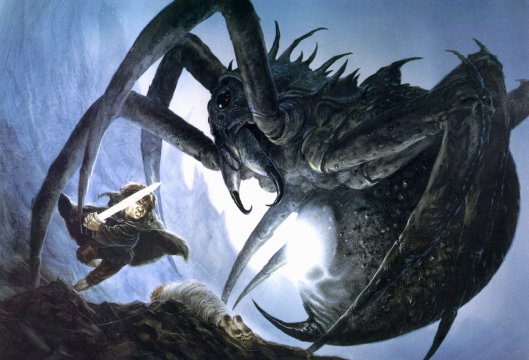
The challengers of Minas Morgul are the Lord of the Nazgul and a vast army, on their way to attack Minas Tirith, but these are skirted, as Gollum guides the two hobbits around the site and up on a perilous climb—and into Torech Ungol, Shelob’s Lair. Safety? Gollum wants the hobbits to think so. Danger? With Shelob as a challenger, what else?

shelob.jpg

Even as Sam drives Shelob off, however, he loses Frodo, paralyzed and cocooned, and is faced with an inner door closed by the orcs as they withdraw. Climbing over it, he moves forward, cloaked by the ring, to look out towards Orodruin and the Tower of Cirith Ungol.

cirith-ungol2

And, with this, we have finished our survey.

Unless, of course, we consider two more events.

First, there is what happens at Mount Doom, where Gollum is the challenger, and the door, such as it is, leads to safety for Middle-earth, but not for Sam and Frodo.

gollum__s_dance_by_01gus01-d4rmt18.jpg

And, finally, at the edge of the Shire, in “The Scouring of the Shire”, where the returning hobbits meet with the followers of “Sharkey” at the bridge. Those followers, brain-washed by fear of “The Chief” and his “big man” followers, attempt to deny what should be a door to safety to Frodo, Merry, and Pippin, as the three had expected, but which leads, in fact, to conflict and open violence before their return home is safely accomplished.

scouringoftheshire.jpg

With that, we complete the pattern and here is our chart:


Entryway Source Challenger Challenged Outcome
Bilbo’s door The Hobbit Bilbo Dwarves Bilbo is tricked into hospitality
Beorn’s house The Hobbit Beorn Gandalf Beorn tricked into hospitality
Goblin cave The Hobbit Goblins Bilbo Escapes by use of the Ring
Mirkwood The Hobbit Elves Dwarves/Bilbo Bilbo rescues dwarves with Ring and barrels
Lonely Mountain (Back door) The Hobbit Smaug Dwarves/Bilbo Understanding the inscription, Dwarves open the door
Lonely Mountain (Front door) The Hobbit Dwarves Men, Elves, Goblins Battle of the Five Armies—eventual settlement
Bilbo’s door The Hobbit Hobbits Bilbo Bilbo’s things are up for auctions—Bilbo gets most things back
Ford of Bruinen The Lord of the Rings Wraiths Frodo/Elves After Frodo’s challenge, elf magic overwhelms wraiths
Moria (west gate) The Lord of the Rings Elves of Hollin Fellowship Gandalf discovers password—the group enters
Lothlorien (western side) The Lord of the Rings Elves Fellowship Challenged by elves, but allowed to enter
Edoras The Lord of the Rings Rohirrim Gandalf et al. Challenged by gate guards, but allowed to enter
Meduseld The Lord of the Rings Hama Gandalf et al. Challenged, but allowed to enter
Helms Deep The Lord of the Rings Aragorn Orcs/Wildings Aragorn warns them of their danger
Isengard The Lord of the Rings Merry/Pippin Gandalf et al. Greeted and offered food, drink, and smoke
Paths of the Dead The Lord of the Rings Oath-breakers Aragorn at al. Allowed to enter, but followed—leave safely
Morannon The Lord of the Rings Sauron King Elessar et al. Sauron’s army appears for battle
Morannon The Lord of the Rings Sauron Frodo/Sam/Gollum No way of entry—the three head south
Minas Morgul The Lord of the Rings Lord of Nazgul Frodo/Sam/Gollum Entry blocked by Lord’s Army
Torech Ungol The Lord of the Rings Shelob Frodo/Sam Gollum escapes, Frodo paralyzed by Shelob
Cirith Ungol The Lord of the Rings Orcs Sam With Ring as aid, Sam enters
Mt. Doom The Lord of the Rings Gollum Frodo Gollum gains Ring, but perishes in fire
Shire bridge The Lord of the Rings Hobbits Frodo et al. Hobbits climb over gate, guards run


Because this material becomes increasingly complex, there is always the possibility that, as thorough as we try to be and as inclusive, we’ve missed something. If so, we’d be glad to hear from our readers!

Thanks, as always, for reading!

MTCIDC

CD
 

Further Thoughts

02 Wednesday Nov 2016

Posted by Ollamh in J.R.R. Tolkien, Literary History, Maps, Military History, Military History of Middle-earth, Uncategorized

≈ Leave a comment

Tags

Alexander of Macedon, Athenian Empire, Babylon, Cleopatra VII, Delian League, Mongol Empire, Mordor, Persians, Plataea, Ptolemy, Sauron, Tolkien, W.H. Auden

Welcome, dear readers, as ever.

It is one of the pleasures—perhaps we should say even blessings—of JRRT that there is such a richness available within his work—and within him—that no subject can ever be discussed to a perfect conclusion. In an earlier posting, we talked about Sauron and his demands, but, as we watch our current world and certain powers who are maneuvering to gain increasing control over land and sea, we have come back once more to wondering about what it is that Sauron has planned to do and what he will have if he succeeds.

In an unpublished reply to a review by W.H. Auden, JRRT wrote:

“The theatre of my tale is this earth, the one in which we now live, but the historical period is imaginary. The essentials of that abiding place are all there (at any rate for inhabitants of N.W. Europe), so naturally it feels familiar, even if a little glorified by the enchantment of distance in time.” (Letters, 239)

Thus, we can feel justified, we think, in looking at a would-be world conqueror from an actual historical period to see if we can better understand the fictional Sauron.

If we consider Alexander of Macedon,

Alexander_the_Great_mosaic.jpg

we see someone who began with a project which, in part, went back for a century and more before his own time: to take back the western shore of northern Asia Minor from its Persian overlords. This had been begun by the Delian League,

The Delian League - map.jpg

a group of Greek city-states who had been participants in the ultimate battle defeat of the invading Persians, at Plataea, in 479bc.

47948_PlateaBattleL.jpg

After he had defeated the southern Greeks at Chaeronea in 338bc with the aid of his son, Alexander, it had been Philip II of Macedon’s plan to do what the League had planned and take back Asia Minor from the Persian empire. Philip was murdered (by a “lone spearman”) in 336, but Alexander, took over the plan and, in 334, invaded the Persian empire and, within three years or so, had conquered it—

macedonianempirelarge.jpg

but then had kept moving eastward, besieging cities, winning battles, all the way into western India, where his army finally revolted and refused to go farther.

Alexander_troops_beg_to_return_home_from_India.jpg

He returned to his new capital, Babylon, to die there in 323bc.

the_death_of_alexander_the_great_after_the_painting_by_karl_von_piloty_1886

Because Alexander had no grown male heirs, his new empire fell apart very quickly, his chief generals seizing big chunks and defending them against other generals. We can presume, we think, that he hadn’t been planning to die young (he was born in 356), so we assume that he was out to do something permanent. His generals—the successful ones—founded dynasties, the longest-lived of them being that of Ptolemy,

Coin (Ptolemy I) (Alexandria 305-285 BC).jpg

who grabbed Egypt, and whose last descendant to rule was Cleopatra VII (yes, that Cleopatra), who committed suicide in 30bc.

Kleopatra-VII.-Altes-Museum-Berlin1.jpg

If Alexander was planning to do something similar, only on a larger scale, how do we understand it? What was all of that conquest for and why was it never enough?

Part of the explanation may lie in the analogy of the folk-tradition about sharks: that they have to keep moving to breathe. This is apparently not true (google Discovery.com/tv-shows/shark-week).

great-white-shark-swimming-blue.jpg.adapt.945.1.jpg

It’s a good image, however, of how an expanding kingdom has to work: the more land you have, the more people you have, the more people you have, the more food you need, therefore you need an increased food supply, which means either buying it or taking it from outside, or making the land itself produce more or simply acquiring more land—and the cycle begins again. This may have been what caused the rapid expansion of the Mongol empire in the 13th century ad, although, in their case, it may not have been expanding population so much as expanding flocks and herds which needed more pasture land.

TitleMongol2.jpg

We might see Sauron in the same light: he needed huge armies to conquer Middle-earth, his huge armies, both humans and orcs, would need feeding (even orcs ate, after all, although as to what they ate…) and therefore would have needed a huge amount of growing land to be fed from, and so on and so on. Certainly Mordor was not the place for gardens and grain fields.

gorgoroth.gif

JRRT says of Sauron:

“Sauron desired to be a God-King, and was held to be this by his servants; if he had been victorious he would have demanded divine honour from all rational creatures and absolute temporal power over the whole world.” (Letters 243-244)

And perhaps this offers another view of Alexander, in turn. As Sauron would have needed land to feed his armies, perhaps Alexander was intent upon collecting worshippers? Certainly he allowed rumors to circulate that he was at least semi-divine—as we see in this coin portrait, where he is portrayed with the horns of Zeus/Ammon, a combination Greek and Egyptian god.

alexaszeusammon.jpg

Alexander succeeded in gaining territory—although not so much as he wished—but died before founding the dynasty which might have given his kingdom stability. Sauron lost, not only his kingdom-in-the-making, but his corporeal form and the bulk of his power. JRRT has given us a hint as to one side of his plans—founding a religion with himself as the god, but perhaps Alexander has given us a clue as to another side, the need to support his means of conquest. In turn, Sauron may supply a clue to another side of Alexander’s plans: inserting himself into the religion of his Greek subjects, then expanding his cult throughout as much of the world as he could conquer.

Thanks, as ever, for reading.

MTCIDC

CD

Tobago to Lothlorien 2

26 Wednesday Oct 2016

Posted by Ollamh in Heroes, J.R.R. Tolkien, Uncategorized

≈ Leave a comment

Tags

Anduin, Barad-Dur, Bree, Caras Galadhon, Cirith Ungol, defense, Edoras, fortification, Galadriel, Helm's Deep, Hildebrandts, John Howe, Lothlorien, Minas Tirith, Morannon, Nenya, Offa's Dyke, Rhodes, Robinson Crusoe, stockades, Swiss Family Robinson, The Lord of the Rings, Tolkien, tree house

Welcome, dear readers, as always. As you can see from the title, this is a continuation of our previous post.

In that previous posting, we began with the novel, Robinson Crusoe (1719),

Robinson_Crusoe_1719_1st_edition.jpg

crusoewyeth.jpg

then on to Swiss Family Robinson (1812),

52062_swiss_rob_md.gif

being especially interested in the stockade of the former

0_8a62b_11562dfa_orig

and the tree house of the latter.

swiss-family-robinson

The connection here was the tree house and Lothlorien, where the elves lived high up in the trees.

lothlorien.jpg

At least, that’s where we began. As we looked more seriously at the architecture of Lothlorien, however, we began to wonder, in a world in which darkness had gradually spread, how it protected itself. After all, Robinson Crusoe, afraid of the cannibals he had seen, had walled himself in. Part of it was the power of Galadriel herself, as she implies to Frodo:

“But do not think that only by singing amid the trees, nor even by the slender arrows of elven-bows, is this land of Lothlorien maintained and defended against its Enemy.” (The Fellowship of the Ring, Book 2, Chapter 7, “The Mirror of Galadriel”)

But was there anything more besides singing, arrows, and Nenya, the Ring of Adamant?

5d7d8ba33f058c6756ab6feed6ca5033.jpg

Far to the south, Minas Tirith had seven concentric (more or less) walls,

minastirithjhowe.jpg

and its opponents across the Anduin had the Morannon

morannonhildebrandt.jpg

and Cirith Ungol

cirithungolhildebrandt.jpg

sam_at_cirith_ungol.jpg

and even the Barad Dur.

HidebrandtTolkienDarkTower.jpg

It is not so clear about Edoras. There is mention that “A dike [that is, a ditch/moat] and mighty wall and thorny fence encircle it”, along with the phrase “wide wind-swept walls and gates” (The Two Towers, Book 3, Chapter 6, “The King of the Golden Hall”), but little else. And you can see that lack of information reflected in the rather scanty look in the Jackson films—

LOTR_twoTowers_edoras_03_940.jpg

Helm’s Deep, is, of course, a different matter—we show you versions by the Hildebrandts and by John Howe

helmsdeephildebrandt.jpg

33171_the_lord_of_the_rings.jpg

Lothlorien is, in fact, not a single site, like any of the above. This map

LothlorienMap.jpg

gives you an idea of its complexity. There is the outer forest, with its camouflaged guard flets in trees, seemingly along its borders, and then the actual center, the city of Caras Galadhon. Here’s JRRT’s description of that center:

“There was a wide treeless space before them, running in a great circle and bending away on either hand. Beyond it was a deep fosse lost in soft shadow, but the grass upon its brink was green, as if it glowed still in memory of the sun that had gone. Upon the further side there rose to a great height a green wall encircling a green hill thronged with mallorn-trees taller than any they had yet seen in all the land.” (The Fellowship of the Ring, Book 2, Chapter 7, “The Mirror of Galadriel”)

We are then told that there is a bridge, on the southern side, which crosses to “the great gates of the city; they faced south-west, set between the ends of the encircling wall that here overlapped, and they were tall and strong, and hung with many lamps.”

A fosse (from the Latin verb, fodio, fodere, fodi, fossum, “to dig”) means that there was a moat—in this case, it would appear to be a dry moat, like this one at the city of Rhodes.

moatrhodes.jpg

(Those stone balls, by the way, are left over from the Turkish artillery and stone-throwers which pounded the walls of Rhodes in 1522–when we have another posting–soon–on the attack on Minas Tirith, we’ll say more about that.)

That “green wall”, however, is a bit of a puzzle. Is it a wall of green stone of some sort? Or is it a “thorny fence”, like that which surrounds Edoras? There are two similar defenses, or at least boundaries, in LOTR. First, there is the border between Buckland and the Old Forest:

“Their land was originally unprotected from the East; but on that side they had built a hedge: the High Hay. It had been planted many generations ago, and it was now thick and tall…” (The Fellowship of the Ring, Book 1, Chapter 5, “A Conspiracy Unmasked”)

The second such construction appears at Bree (which sounds much like Edoras):

“On that side, running in more than half a circle from the hill and back to it, there was a deep dike with a thick hedge on the inner side.” (The Fellowship of the Ring, Book 1, Chapter 9, “At the Sign of the Prancing Pony”)

So what is the green wall?  English hedges can be very dense things, often to mark off fields, as in this photo of Offa’s Dyke–and you can see the fosse/ditch/moat here, as well.

offasdyke2.png

In at least one previous entry, we discussed Offa’s Dike, a (possibly) 8th-century-AD ditch and earthen wall between England and Wales.

664p.jpg

Can we imagine the palisading of this reconstruction replaced with a thorny hedge? Here’s a long shot of Offa’s Dike with a bit of hedging visible.

as_offas_dyke.jpg

When we consider the general look of Caras Galadhon, it is of something organic: the elves loved the trees and, instead of cutting them down, as the hobbits had done outside the High Hay, they climbed up into them. Might we then see that their physical barrier against their enemies was of the same green and growing material as were their dwellings?

What do you think, dear readers?

Thanks, as ever, for reading,

MTCIDC

CD

Dr. Smeagol and Mr. Gollum?

31 Wednesday Aug 2016

Posted by Ollamh in Films and Music, J.R.R. Tolkien, Literary History, Narrative Methods, Uncategorized

≈ Leave a comment

Tags

Deagol, Gollum, John Barrymore, Mark Twain, Robert Louis Stevenson, Sir Stanley Unwin, Smeagol, Stinker and Slinker, Strange Case of Doctor Jekyll and Mr. Hyde, The Eye of Sauron, The Facts Concerning the Recent Carnival of Crime in Connecticut, The Lord of the Rings, The Mirror of Galadriel, Tolkien

Dear readers, welcome, as ever.

In this posting, we are following a hint given us by JRRT. In a letter to Sir Stanley Unwin, 21 Sept, 1947, he says, “Hyde (or Jekyll) has had to have his way, and I have been obliged to devote myself mainly to philology…” (Letters, 124)

“Hyde (or Jekyll)” refers to the main character in Robert Louis Stevenson’s 1886 novella, Strange Case of Doctor Jekyll and Mr. Hyde.

rlsJekyll_and_Hyde_Title

This is often turned into The Strange Case… by editors, but, in fact, as can be seen from the title of the first edition, given above, there is no definite article. It seems clear to us that it has been omitted because Stevenson is imitating the shorthand methods of newspapers: the title is meant to sound like a headline, the sort of thing Sherlock Holmes’ observant eye would catch and he would then read to Watson.

The original story, if you’re not familiar with it, is about a doctor who leads two lives, one of service, the other of sensuality, and who wishes that he could separate them so that he could enjoy each without the influence of the other. He invents a drug, which, when consumed, turns the socially-responsible Dr. Jekyll (said “JEE-kull”, but often mispronounced)

John_Barrymore_as_Dr_Jekyll

into the loathsome Mr. Hyde.

hydejbarrymoor

The doctor runs into horrible difficulty when it gradually becomes clear that the Id-like Mr. Hyde is actually the dominant personality and the good Dr. Jekyll begins to turn into the fiendish Mr. Hyde even without the drug.

In JRRT’s case, it’s hardly sensuality—instead, it’s his academic life versus his creative one and the fact that he offers both as a possibility suggests that the difference between the two is hardly the glaring one we see in the Stevenson story.

The idea of the split personality in one person, however, leads us—well, if you’re a Tolkien fan, you know already, don’t you?

Gollum_Render

“Slinker and Stinker” Sam calls him, but it’s clear that, somewhere inside him, there are two much more distinctive personalities, just like Jekyll and Hyde.

269_gollum

The Dr. Jekyll is what must be almost a ghost of Smeagol, from his pre-Ring (and pre-murder of Deagol) days—ghost because near-constant exposure to the Ring has left him with only:

“…a little corner of his mind that was still his own…” (The Fellowship of the Ring, Book 1, Chapter 2, “The Shadow of the Past”)

But what is the Mr. Hyde?

Instead of a potion to break them apart, it has been the Ring which has caused the split and, in the process, as in the case of Dr. Jekyll, it has been the dark personality which has come to dominate. Unlike Mr. Hyde, however, there seems to be no pleasure to be had from being it:

“But the thing was eating up his mind, of course; and the torment had become almost unendurable.” (The Fellowship of the Ring, Book 1, Chapter 2, “The Shadow of the Past”)

JRRT isn’t any clearer about what was “eating up his mind”, but we imagine that, because Sauron has put so much of himself into the ring, just as Dr. Jekyll/Smeagol has that little corner of his own mind, Mr. Hyde/Gollum has a little corner of Sauron’s, which is a really terrible thought. One has only to remember Frodo’s reaction to Sauron when he looks into Galadriel’s mirror to understand:

“In the black abyss there appeared a single Eye that slowly grew, until it filled nearly all the Mirror. So terrible was it that Frodo stood rooted, unable to cry out or to withdraw his gaze. The Eye was rimmed with fire, but was itself glazed, yellow as a cat’s, watchful and intent, and the black slit of its pupil opened on a pit, a window into nothing.” (The Fellowship of the Ring, Book 2, Chapter 7, “The Mirror of Galadriel”)

10b8f0b7ef05881c193c76dc38bac020the-eye-of-sauron_3133429b

Viewed this way, Mr. Hyde/Gollum is nothing more than a little Sauron.

There is another, more physical connection between Smeagol/Gollum and Jekyll/Hyde. Look at the narrator’s description of Hyde:

“Mr. Hyde was pale and dwarfish; he gave the impression of deformity without any namable malformation; he had a displeasing smile; he had borne himself to the lawyer with a sort of murderous mixture of timidity and boldness, and he spoke with a husky, whispering, and somewhat broken voice…”

(Strange Case of Dr. Jekyll and Mr. Hyde, “The Search for Mr. Hyde”)

Compare that with:

“Deep down here by the dark water lived old Gollum, a small slimy creature…” who often talks in hisses and whispers, like:

“Bless us and splash us, my precioussss!”

(The Hobbit, Chapter 5, “Riddles in the Dark”)

riddles

Is there a physical similarity here? Certainly there is the echo of split personalities, evil, and, maybe, someone caught between what he wants and what he does…

tolkientolkien-mortar-board-7-amazing-real-life-tolkien-facts-that-made-middle-earth-jpeg-77543

Thanks, as always, for reading.

MTCIDC

CD

ps

Our pictures of Jekyll and Hyde come from a famous 1920 film, in which John Barrymore transforms himself into Hyde on camera. Follow this link to the Internet Archive to see a full, free showing (80+ minutes) of that film.

pps

It just occurred to us to mention another story with a shrunken figure of the self– Mark Twain’s conscience in his “The Facts Concerning the Recent Carnival of Crime in Connecticut” (1876).


Bolts and Arrows

06 Wednesday Apr 2016

Posted by Ollamh in Films and Music, Heroes, J.R.R. Tolkien, Military History, Military History of Middle-earth, Narrative Methods, Uncategorized

≈ Leave a comment

Tags

Agincourt, anti-aircraft gun, ballista, Bard the Bowman, Battle of Crecy, Battle of Poitiers, Border Reivers, Boromir, crossbow, Crossbow Bunnies, English Longbowmen, harpoon, Hundred Years War, John Singer Sargent, latch, Maximus, N.C. Wyeth, Peter Jackson, Richard the Lionheart, Robert Louis Stevenson, Robin Hood, Roman d'Alexandre, Siege of Chalus, Smaug, Tangled, The Black Arrow, The Hobbit, The Lord of the Rings, The Mary Rose, Tolkien, Towton

In our review of the third Hobbit film, we questioned the use by Bard of something a little larger in the way of a missile than Tolkien had intended:

“Then Bard drew his bow-string to his ear. The dragon was circling back, flying low, and as he came the moon rose above the eastern shore and silvered his great wings.

‘Arrow!’ said the bowman. ‘Black Arrow! I have saved you to the last. You have never failed me and always I have recovered you. I had you from my father and he from of old. If ever you come from the forges of the true king under the Mountain, go now and speed well!’ ” (TH 307).

As Bard was firing this himself, we always envisioned him as an English longbowman.

englishlongbowman1330-15151.jpg

And this led us to think a bit about Tolkien’s possible sources, not only for Bard and his bow, but for that arrow–the real one, not the monster dart used in the film.

From any children’s history of England, Tolkien would have learned that longbowmen like the one shown above destroyed three brave French armies in the Hundred Years War, at Crecy (1346), Poitiers (1356), and Agincourt (1415).

hf54d67201.jpg

In the film, however, although Bard was depicted as an archer,

Bard-the-Bowman-bard-the-bowman-37670604-1920-1200.jpg

his weapon of choice looks like this.

bardwithharpoon.jpeg

This reminds us of either a Roman ballista

b0370394e429c42631f520182c155a34.jpg

or an anti-aircraft gun

strandgun01.jpg

or, most especially,  a harpoon gun.

WhaleHarpGun1.jpg

Especially when you look at this Bard’s arrow.

bard.jpg

Although we currently have no evidence for Tolkien’s sources, we can imagine that they might have included, among others, Robin Hood,

5616567327_fc899be2f1_b.jpg

the actions of actual Medieval archers like those at Agincourt or Towton (1461),

towton3.jpg

and a book, perhaps from boyhood, Robert Louis Stevenson’s The Black Arrow (1883/1888).  Stevenson (here in an 1880s portrait by John Singer Sargent)

rlsjss2.jpg

had originally published the story serially in a children’s magazine in 1883

ba1.jpg

before its publication in book form in 1888.

Blackarrowcoverscribners1888.jpg

The classic illustrations are by one of our all-time favorite illustrators, NC Wyeth, from 1917.

309642.jpg

We can’t resist showing you a few:

tumblr_l4istbR1JZ1qamjklo1_1280.jpgillus08.jpg09_blackarrow_alittlebeforedawn_wyeth.jpg

Although the bow is the weapon of choice of those who use the black arrow of the title (it’s employed for revenge), the hero  in fact, has a crossbow.

5616566731_49d251a1fc_b.jpg

The longbow requires years of training and great upper-body strength, leaving its mark on bowmen, as can be seen from this skeleton (and its reconstruction) brought up from the English warship, the Mary Rose,

sinking_3.jpg

which sank with most of its crew in 1545 and was brought up from the mud of the ocean floor in 1982.

130530121104-mary-rose-skeleton-horizontal-gallery.jpg

The crossbow is a mechanical weapon, which uses much less strength to draw

the_old_crossbow_archer_by_renum63-d8aaovo.jpg

and, in the more developed versions, even uses a crank to produce the necessary string tension.

8f106fadbe86ed34e5567bc7a90b89e2.jpg

(And, just as in the case of NC Wyeth illustrations, we can’t resist medieval manuscript illustrations. Look at this pair of crossbow… bunnies from a copy of the Roman d’ Alexandre, circa 1340.)

romandalexandrec1340.jpg

This makes it a less romantic weapon, but equally deadly:  Richard the Lionheart was killed with a bolt/quarrel (what one calls a crossbow arrow) at the siege of Chalus in 1199.

Richard1TombFntrvd.jpg

(This creates another aside–about the hand weapon used as late as the 16th century by the Border Reivers of the land between northern England and southern Scotland–called a “latch”, it was the weapon of choice for those who couldn’t afford early hand guns but wanted to fire easily from the saddle.

Reiver-on-Horse.jpg

The soldiers in Disney’s wonderful movie, Tangled, carry them–notice the off-hand side pouch with a handful of bolts  for one on Maximus’ saddle–)

maxtangled.jpg

But we would  like to conclude with one more use of that black arrow.  A flight of them kills Boromir in The Lord of the Rings.

boromirarrows1.jpg

boromirearrows.png

Just as we began by pointing to the text and the actual bow and arrow which kill Smaug, and not the harpoon of the film, so we would criticize this scene.  In our opinion, it is stretched beyond believability, as well as beyond the text, taking away something of Boromir’s valor in combat with dozens of the enemy, in which he is gradually overcome.

boromir_by_deligaris-d5po92u.jpg

This is just as true for the brief scene of Aragorn at Boromir’s death.  What was simple in the text, thus making it more moving–just Boromir’s confession and Aragorn’s comforting him–becomes a soppy scene in which Boromir swears loyalty and calls Aragorn “my brother”, a liberty Aragorn-the-king-t0-be, would hardly have welcomed.  In the theatrical world, this is called “milking the scene” and here, we think it curdled.

Thanks, as always, for reading.

MTCIDC,

CD

← Older posts
Newer posts →

The Doubtful Sea Series Facebook Page

The Doubtful Sea Series Facebook Page

  • Ollamh

Categories

  • Artists and Illustrators
  • Economics in Middle-earth
  • Fairy Tales and Myths
  • Films and Music
  • Games
  • Heroes
  • Imaginary History
  • J.R.R. Tolkien
  • Language
  • Literary History
  • Maps
  • Medieval Russia
  • Military History
  • Military History of Middle-earth
  • Narnia
  • Narrative Methods
  • Poetry
  • Research
  • Star Wars
  • Terra Australis
  • The Rohirrim
  • Theatre and Performance
  • Tolkien
  • Uncategorized
  • Villains
  • Writing as Collaborators
Follow doubtfulsea on WordPress.com

Across the Doubtful Sea

Recent Postings

  • Subterranean April 22, 2026
  • Serendipity? April 15, 2026
  • Serendipity April 8, 2026
  • Verisimilitude April 1, 2026
  • Goblins and Goblin March 25, 2026
  • Crowing and Raven March 18, 2026
  • The Damage of Dragons March 11, 2026
  • Encouragement March 4, 2026
  • Eavesdropping February 25, 2026

Blog Statistics

  • 111,803 Views

Posting Archive

  • April 2026 (4)
  • March 2026 (4)
  • February 2026 (4)
  • January 2026 (4)
  • December 2025 (5)
  • November 2025 (4)
  • October 2025 (5)
  • September 2025 (4)
  • August 2025 (4)
  • July 2025 (5)
  • June 2025 (4)
  • May 2025 (4)
  • April 2025 (5)
  • March 2025 (4)
  • February 2025 (4)
  • January 2025 (5)
  • December 2024 (4)
  • November 2024 (4)
  • October 2024 (5)
  • September 2024 (4)
  • August 2024 (4)
  • July 2024 (5)
  • June 2024 (4)
  • May 2024 (5)
  • April 2024 (4)
  • March 2024 (4)
  • February 2024 (4)
  • January 2024 (5)
  • December 2023 (4)
  • November 2023 (5)
  • October 2023 (4)
  • September 2023 (4)
  • August 2023 (5)
  • July 2023 (4)
  • June 2023 (4)
  • May 2023 (5)
  • April 2023 (4)
  • March 2023 (5)
  • February 2023 (4)
  • January 2023 (4)
  • December 2022 (4)
  • November 2022 (5)
  • October 2022 (4)
  • September 2022 (4)
  • August 2022 (5)
  • July 2022 (4)
  • June 2022 (5)
  • May 2022 (4)
  • April 2022 (4)
  • March 2022 (5)
  • February 2022 (4)
  • January 2022 (4)
  • December 2021 (5)
  • November 2021 (4)
  • October 2021 (4)
  • September 2021 (5)
  • August 2021 (4)
  • July 2021 (4)
  • June 2021 (5)
  • May 2021 (4)
  • April 2021 (4)
  • March 2021 (5)
  • February 2021 (4)
  • January 2021 (4)
  • December 2020 (5)
  • November 2020 (4)
  • October 2020 (4)
  • September 2020 (5)
  • August 2020 (4)
  • July 2020 (5)
  • June 2020 (4)
  • May 2020 (4)
  • April 2020 (5)
  • March 2020 (4)
  • February 2020 (4)
  • January 2020 (6)
  • December 2019 (4)
  • November 2019 (4)
  • October 2019 (5)
  • September 2019 (4)
  • August 2019 (4)
  • July 2019 (5)
  • June 2019 (4)
  • May 2019 (5)
  • April 2019 (4)
  • March 2019 (4)
  • February 2019 (4)
  • January 2019 (5)
  • December 2018 (4)
  • November 2018 (4)
  • October 2018 (5)
  • September 2018 (4)
  • August 2018 (5)
  • July 2018 (4)
  • June 2018 (4)
  • May 2018 (5)
  • April 2018 (4)
  • March 2018 (4)
  • February 2018 (4)
  • January 2018 (5)
  • December 2017 (4)
  • November 2017 (4)
  • October 2017 (4)
  • September 2017 (4)
  • August 2017 (5)
  • July 2017 (4)
  • June 2017 (4)
  • May 2017 (5)
  • April 2017 (4)
  • March 2017 (5)
  • February 2017 (4)
  • January 2017 (4)
  • December 2016 (4)
  • November 2016 (5)
  • October 2016 (6)
  • September 2016 (5)
  • August 2016 (5)
  • July 2016 (5)
  • June 2016 (5)
  • May 2016 (4)
  • April 2016 (4)
  • March 2016 (5)
  • February 2016 (4)
  • January 2016 (4)
  • December 2015 (5)
  • November 2015 (5)
  • October 2015 (4)
  • September 2015 (5)
  • August 2015 (4)
  • July 2015 (5)
  • June 2015 (5)
  • May 2015 (4)
  • April 2015 (3)
  • March 2015 (4)
  • February 2015 (4)
  • January 2015 (4)
  • December 2014 (5)
  • November 2014 (4)
  • October 2014 (6)
  • September 2014 (1)

Blog at WordPress.com.

  • Subscribe Subscribed
    • doubtfulsea
    • Join 75 other subscribers
    • Already have a WordPress.com account? Log in now.
    • doubtfulsea
    • Subscribe Subscribed
    • Sign up
    • Log in
    • Report this content
    • View site in Reader
    • Manage subscriptions
    • Collapse this bar
 

Loading Comments...