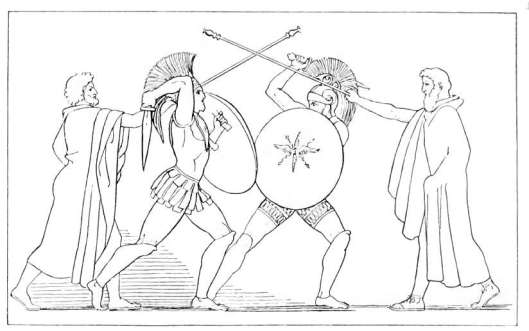
• About

doubtfulsea

~ adventure fantasy

Category Archives: Fairy Tales and Myths

To the Elves for Counsel

07 Wednesday Dec 2016

Posted by Ollamh in Fairy Tales and Myths, J.R.R. Tolkien, Literary History, Narrative Methods

≈ Leave a comment

Tags

advised by elves, Aelfraed, Aethelwulf, Alaric Hall, Alfred, Alfred of Wessex, Alfred the Great, Anglo-Saxon, Aragorn, Boudicca, council, Counseling the Scippigraed, Danish invaders, Elder Days, Elves, Elves in Anglo-Saxon England, Frodo, Galadriel, Gildor Inglorion, Grey Havens, Hamo Thornycroft, Hobbits, Mirror of Galadriel, Morgul Knife, Shire, statue, T. A. Shippey, The Council of Elrond, The Lord of the Rings, Tolkien, Tolkien in the New Century, Tom Shippey, With Faerstice

Welcome, dear readers, as ever. In this posting, our attention was caught by the first paragraph of an article in Tolkien in the New Century: Essays in Honor of Tom Shippey (McFarland, 2014). The article, entitled, “Counseling the Scippigraed: How T.A. Shippey Taught Us to Read”, by John R. Holmes, begins:

“The Christening of Alfred Aetheling of Wessex in 849 may have played a role in his greatness. Alfred’s father, Aethelwulf, had wanted to establish his own name-prefix, Aethel, which means (more or less) “noble,” as the sign of the royal line: he gave it to his first four sons and a daughter. By the time his sixth child came along, however—his fifth son—there didn’t seem to be any point in giving him the Aethel- prefix, since there seemed to be no reasonable chance this infant could ever become king. But wishing the lad wisdom and happiness, Aethelwulf named him Aelfraed, “advised by elves.” While we have no historical proof that Alfred actually received counsel from elves, there is no evidence to the contrary, and the boy certainly prospered as if he had. Alfred, Elf-counsel, not only outlasted four older brothers to become king, but also would be the only English monarch known to history as “The Great”. “ (11)

Alfred, king of Wessex from 871-899, was perhaps the most distinguished ruler of pre-Norman England. Against heavy odds, he eventually stabilized Wessex against a powerful wave of Danish invaders

vikings.jpg

and even forced the second Danish leader both into a treaty and into conversion to Christianity. As well, he was active in promoting Anglo-Saxon intellectuality and the rise of a vernacular literature.

Statue_d'Alfred_le_Grand_à_Winchester.jpg

(this statue, from 1901, by the way, was done by Hamo Thornycroft, the son of the man who did the famous Boudicca plus chariot statue on the Thames embankment—erected 1902, but created much earlier–)
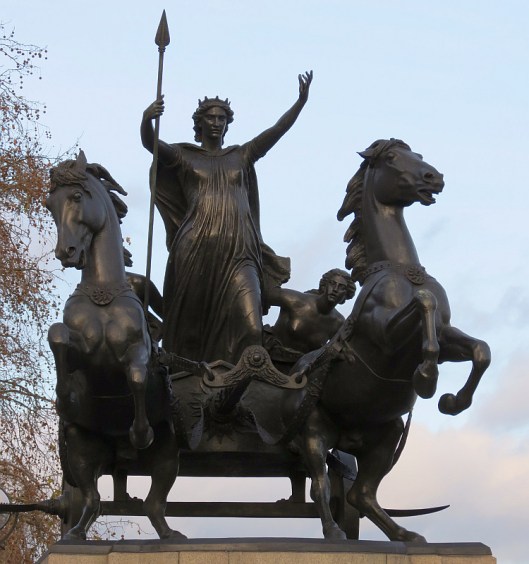
boadicea1.jpg

For us, however, what was interesting was none of this, but rather the idea that it might be possible for someone in the 9th century AD to have the kind of contact with elves we see in The Lord of the Rings.
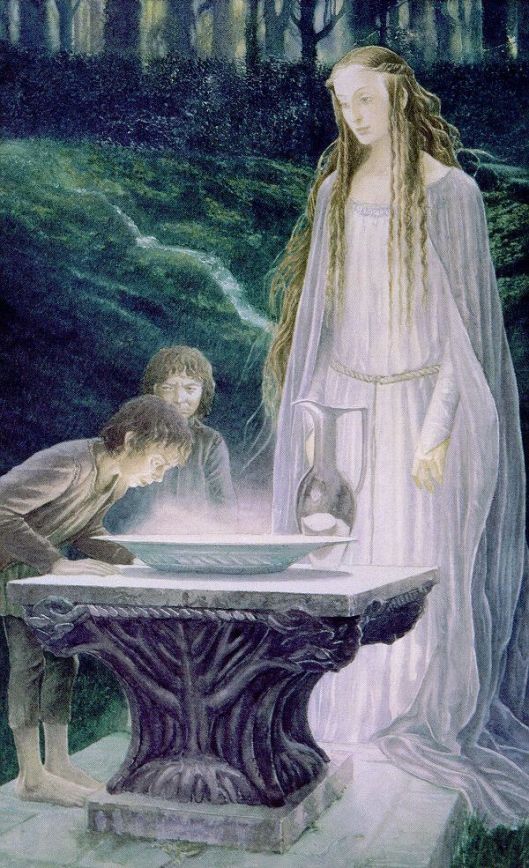
mirrorofgaladriel.jpg

We have always imagined Elves as belonging to the Elder Days and that, eventually, like Elrond and Galadriel, they had all traveled to the Grey Havens and taken ship for the West.
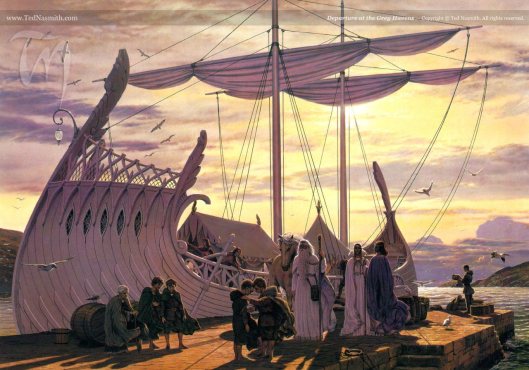
TN-Departure_at_the_Grey_Havens.jpg

Suppose, however, we said to ourselves, that, as JRRT suggests about hobbits, Elves continued to exist, even down into actual historical times:

“Hobbits are an unobtrusive but very ancient people, more numerous formerly than they are today…They do not and did not understand or like machines more complicated that a forge-bellows, a water-mill, or a hand-loom, though they were skillful with tools. Even in ancient days they were, as a rule, shy of ‘the Big Folk’, as they call us, and now they avoid us with dismay and are becoming hard to find. (The Lord of the Rings, “Prologue”)

Of elves, the actual Anglo-Saxon people of the period don’t appear to have much good to say, in fact. The 11th-century recipe, called the With Faerstice (“Against a Stabbing Pain”), suggests that elves were dangerous and, should they attack you, it required serious medical treatment, including what looks like a magic spell, to cure you of the wound, which was made by something which reminded us of the tip of the Morgul Knife broken off in Frodo’s wound.
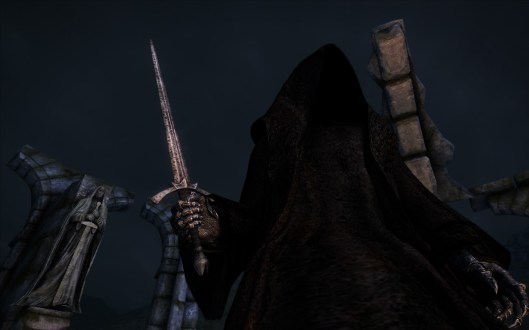
morgulknife.jpg

Even in Middle-earth, Elves aren’t considered to be the most direct of people, however, as Frodo quotes:

“ And it is also said…’Go not to the Elves for counsel, for they will say both no and yes.’ “

And yet, in this scene, from The Fellowship of the Ring, Book 1, Chapter 3, “Three is Company”, in which Frodo, Sam, and Pippin fall into the company of Elves,

Alan_Lee_-_Gildor_and_the_Hobbits.jpg

their leader, Gildor Inglorion, does offer advice and the way he frames it might provide us with a model for how Alfred could have been counseled.

To begin, we might picture the elves as being unimaginably older than the Anglo-Saxons, and, with that age, having a longer view of things. As Gildor says to Frodo, when Frodo says, “I knew that danger lay ahead, of course; but I did not expect to meet it in our own Shire.”:

“But it is not your own Shire…Others dwelt here before hobbits were; and others will dwell here again when hobbits are no more. The wide world is all about you: you can fence yourselves in, but you cannot for ever fence it out.”

Great age, then, can lend great perspective. When you’ve lived as long as the Elves, you have seen much more of change within time, and what concerns them might be very different from what engages humans, as Gildor tells Frodo:

“The Elves have their own labours and their own sorrows, and they are little concerned with the ways of hobbits, or of any other creatures upon earth. Our paths cross theirs seldom, by chance or purpose.”

So what would be the kind of raed (“advice/counsel”) which the elves would have given Alfred? we asked ourselves. It’s easy to imagine his approach: often, particularly in the early years of his kingship, Alfred was faced with defeat. The Danes were numerous, powerful, and unscrupulous, once even killing hostages after swearing to a peace agreement. His question might then have been: how can I beat the Danes and regain my kingdom?

The elves would have been cautious, of course. Gildor says:

“Elves seldom give unguarded advice, for advice is a dangerous gift, even from the wise to the wise, and all courses may run ill.”

This is spoken by someone who has many centuries of experience behind him, as would an elf advising Alfred. Time and its changes had clearly taught the Elves both caution and patience and we imagine that those two elements would have been the basis of a reply—and, in fact, it appears to have been Alfred’s method, as we learn from the first biography, by Bishop Asser, a contemporary, who was asked by Alfred to join his court. Rather than seek victory in one climactic battle, had that been possible, Alfred attacked the problem from multiple angles, doing things which not only contributed to the Danish defeat (and to the defeat of a subsequent invasion), but also strengthened the kingdom in general, changing and improving the tax and military systems, building the first English navy, as well as producing a law code and encouraging education in Anglo-Saxon. This method brought peace and stability to Wessex (much of southern England), but did so over the period of twenty years or more, suggesting to us that the counsel of elves had surely been at work.

When we picture the scene of Alfred receiving the elves’ advice, we think of this Hildebrandt painting of Galadriel and Aragorn.

gift.jpg

And perhaps those elves said the same thing to Alfred which Galadriel said to Frodo before her mirror:

“ ‘Do you advise me to look?’ asked Frodo.

‘No,’ she said, ‘I do not counsel you one way or the other. I am not a counsellor. You may learn something, and whether what you see be fair or evil, that may be profitable, and yet it may not. Seeing is both good and perilous. Yet I think, Frodo, that you have courage and wisdom enough for the venture, or I would not have brought you here. Do as you will!’ “ ( The Fellowship of the Ring, Book 2, Chapter 7, “The Mirror of Galadriel”)

In Alfred’s case, he would have been brave and wise enough, and therefore has come down to us both as “Alfred the Great” and as “Alfred Elf-counsel”.

as_silver_penny_alfred.jpg

Thanks, as always, for reading.

MTCIDC

CD

PS

If you are interested in knowing more about Anglo-Saxon attitudes about elves, we very much recommend Alaric Hall’s Elves in Anglo-Saxon England which is, miraculously, available for free on-line.


Which Witch

31 Monday Oct 2016

Posted by Ollamh in Artists and Illustrators, Fairy Tales and Myths, Films and Music, Literary History, Villains

≈ Leave a comment

Tags

Goya, Halloween, Holinshed's Chronicles, Istari, L. Frank Baum, Macbeth, Mother Goose, The Wizard of Oz, Theodore Chasseriau, W. W. Denslow, Welsh traditional clothing, Wicked Witch, William Shakespeare, Witch-King of Angmar, witches, Witches' Sabbath, wizards

Welcome, dear readers.

This is our annual Guy Fawkes’ Day/Halloween/Samain posting. Last year, we looked at GFD. This year, it’s Halloween—and a little puzzle from JRRT (how not?).

Magic and mystery—centered on witches—is a central theme for Halloween celebrations.   Just look at the variety of commercially-made costumes available.

deluxe-child-witch-costume.jpgwitch-costumes-blue-white-storybook-witch-costume-013639.jpg

1867366.jpg

For many of us, our introduction to witches was probably in the person of the Wicked Witch of the West in the 1939 The Wizard of Oz.

The_Wicked_Witch_of_the_West.jpg

This is not quite what the witch in L. Frank Baum’s original book, The Wonderful Wizard of Oz (1900)

(illustrated by W.W. Denslow) looked like,

wicked_witch_of_the_west

but you can see, in her hat and dress, things which were already symbolic of witchery in popular culture: black cats, crescent moons, toads, some of it echoes from the words of the three Weird Sisters in Shakepeare’s Macbeth (1606), who meet the protagonist on the road after his victory over the enemies of Duncan the king of Scotland. (Theodore Chasseriau)

MacbethAndBanquo-Witches.jpg

A dark Cave. In the middle, a Caldron boiling. Thunder.

Enter the three Witches.

1 WITCH.  Thrice the brinded cat hath mew’d.
2 WITCH.  Thrice and once, the hedge-pig whin’d.
3 WITCH.  Harpier cries:—’tis time! ’tis time!
1 WITCH.  Round about the caldron go;
In the poison’d entrails throw.—
Toad, that under cold stone,
Days and nights has thirty-one;
Swelter’d venom sleeping got,
Boil thou first i’ the charmed pot!
ALL.  Double, double toil and trouble;
Fire burn, and caldron bubble.
2 WITCH.  Fillet of a fenny snake,
In the caldron boil and bake;
Eye of newt, and toe of frog,
Wool of bat, and tongue of dog,
Adder’s fork, and blind-worm’s sting,
Lizard’s leg, and owlet’s wing,—
For a charm of powerful trouble,
Like a hell-broth boil and bubble.
ALL.  Double, double toil and trouble;
Fire burn, and caldron bubble.

Somehow, somewhere, witches acquired those distinctive clothes and hat—especially the hat. The story of Macbeth and the witches comes from Holinshed’s Chronicles (1577/1587) and here is that scene illustrated from that first edition of 1577.

holinshed1575.jpg

As you can see, to the modern eye, there’s nothing “witchy” about these ladies. So where do those clothes and hat come from? We have no firm answer for this, just a guess—and from another literary tradition, Mother Goose.

RealMotherGoose1916.jpg

The first published version of stories (and, in time, rhymes) under that name dates from 1695. Here’s the frontispiece from the first English translation (1729).

Houghton_FC6.P4262.Eg729s_-_Perrault,_frontispiece.jpg

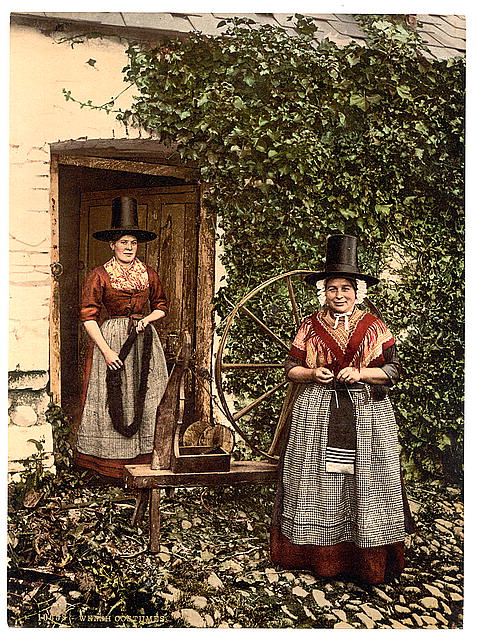
Mother Goose was supposed to be a country woman and, by the latter part of the 19th century, was dressed as one—but we think with a particular look, that of Welsh women in distinctive traditional clothing.

mother-goose.jpg

Welsh_spinnersc1900.jpeg

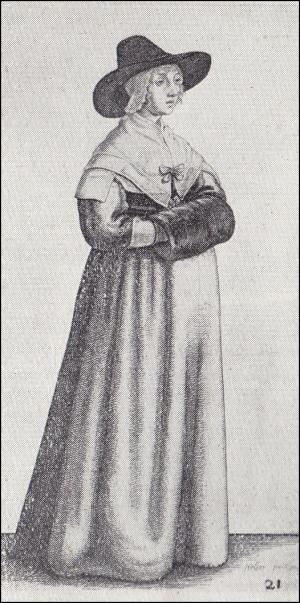
The style of hat is much older—here we have, in succession, three earlier versions from the 17th century—1610, 1640, 1676.

rubens_isabella_brant_c1610

woman21x300hollar1640.jpg

Mrs_Salesbury_-_wright.jpg

Country people tend to be conservative, so something worn in much of the UK in the 17th century appears to have existed, at least in modified form, in the depths of Wales long after then.

copy1-554-78-welsh-national-costume-1911-660x440.jpg

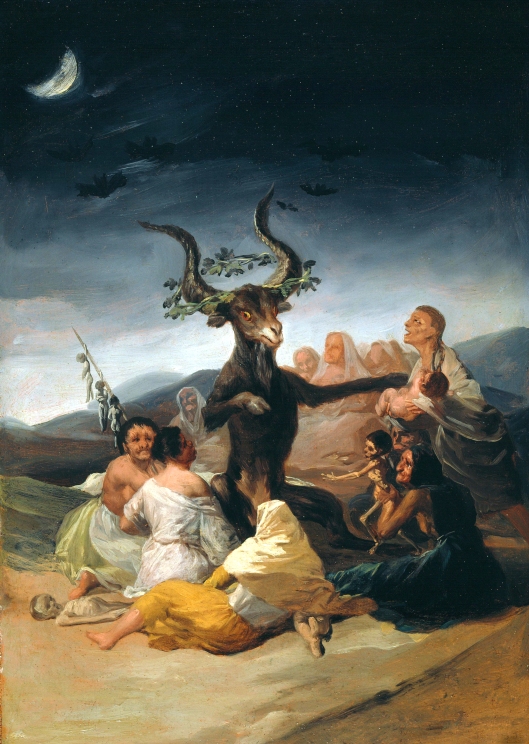
We wonder whether there hasn’t been a kind of cross-over effect: country women to Mother Goose to witches—all conservative dressers. There is also a long tradition in Wales of “wise women”—often mistaken in England for dealers-with-the-devil—those appear in this rather creepy painting by Goya of a witches’ Sabbath (1797-1798). (We note that there are no pointy hats here.) Perhaps the Welsh wise woman was consulted about wardrobe by Mother Goose?

GOYA_-_El_aquelarre_(Museo_Lázaro_Galdiano,_Madrid,_1797-98).jpg

Witches (as the “Harry Potter” books point out) aren’t and weren’t always just women.

hpetal.jpg

Men, too, could take part, sometimes called witches, sometimes warlocks or wizards. When we think wizard, of course, we immediately think of the 5 Istari—

310993_121176884650130_120725101361975_85832_1441609629_n.jpg

When we think of witch, however, in the context of LOTR, we can see that:

  1. In this respect, this is a different kind of culture—for instance, the only equivalent of a “wise woman” is Ioreth, in the “Houses of Healing”
  2. But there is a witch-king, that of Angmar, who is also the head of the Nazgul

eowynvswitchking.jpg

There is a puzzle here, however. In western tradition, witches are the servants of Satan, who spend their time, it seems, troubling humans at the daily level—making cows sick, tormenting babies, holding sabbbaths, casting spells.

witch_john_william_waterhouse_magic_circle_painting_casting_spells.jpg

In that tradition, the only ruler is Satan himself, as depicted in this second Goya painting of a sabbath (and we note here that most of the witches appear to be something between human and other—a great—but horrible—touch—and who is that girl sitting off to the right? This comes from a series of paintings done by Goya in the last years of his life and there is a certain mystery about why he painted them—they’re murals, in fact—and what they might mean.)

francisco_de_goya_y_lucientes_-_witches_sabbath_the_great_he-goat


As there are no other witches in Middle-earth, then, where are the witches for the witch-king to be monarch of?

And that, perhaps, is another mystery for Halloween…

Oh—and Happy Halloween, by the way!


Thanks, as ever, for reading.

MTCIDC

CD

ps

While gathering images for this posting, we happened upon this photograph. Is this a picture from Professor McGonagall’s 50th Hogwarts  reunion?

tumblr_nwrfedgPaR1sdzmuoo1_500.jpg

The Woods for the Trees…

05 Wednesday Oct 2016

Posted by Ollamh in Artists and Illustrators, Fairy Tales and Myths, J.R.R. Tolkien, Literary History

≈ 2 Comments

Tags

A Wonder Book, Arthur Rackham, Enid Blyton, Ent, Fairy Tale, Fairytale Illustrators, Fangorn, Farmer Giles of Ham, Harmsen Van Der Beek, Hawthorne, John Bauer, Middle-earth, Mirkwood, Old Man Willow, Pauline Baynes, Rackham Tree, The Lord of the Rings, The Old Forest, The Wind in the Willows, Tolkien, Treebeard, trees

Dear Readers,

Welcome.

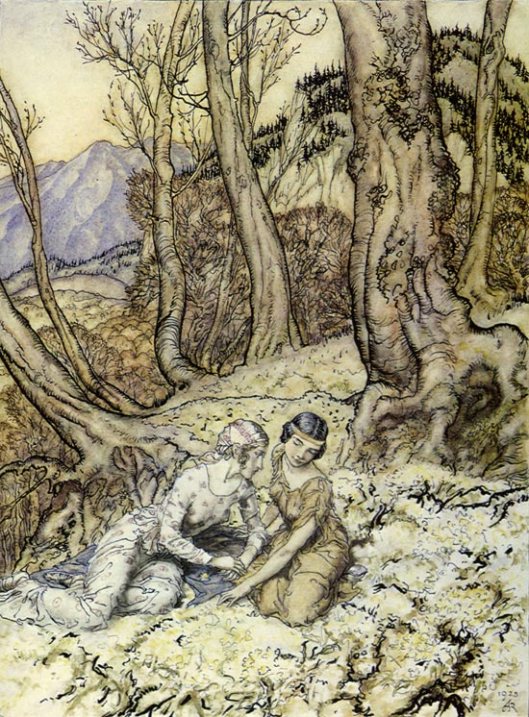
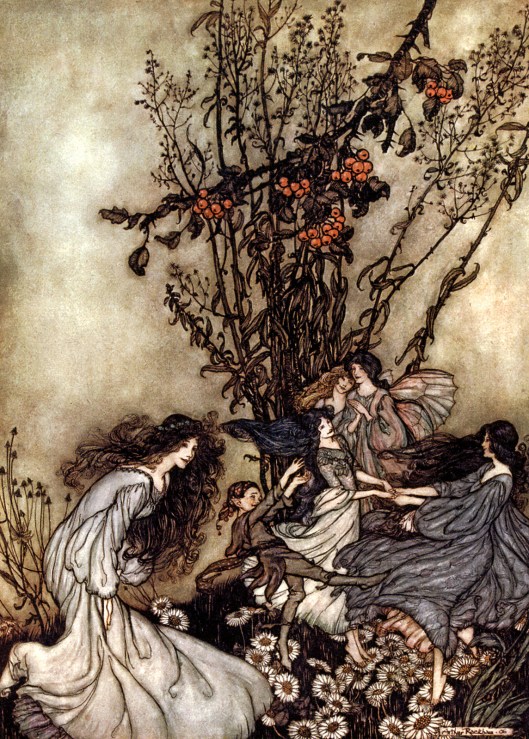
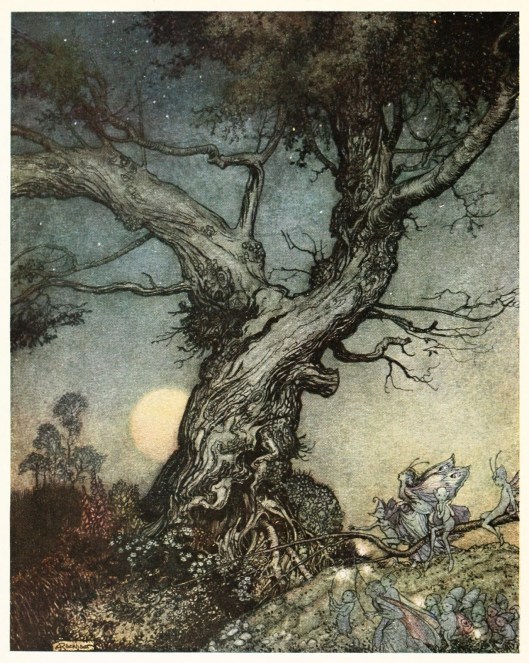
We’ve recently been admiring the illustrations of one of our favorite artists, Arthur Rackham (1867-1939). As a book illustrator, Rackham’s main focus was fairy tales, and for them, he developed a style which was described by E. V. Lucas in a letter to Rackham as his “grace and grotesque”. For us, what may be most striking about his work is the way he depicts landscapes and trees, with their distinctive “Rackhamesque” character.

11a9ca7244bf2060db41e7a5862344ab

From Nathaniel Hawthorne’s A Wonder Book, 1922

39e2b3c42d2341dfc53844a95a32e89d

“Come Now, a Roundel” from William Shakespeare’s A Midsummer Night’s Dream, 1908

429027

From Kenneth Grahame’s The Wind in the Willows, 1940

hermia_and_helena

From William Shakespeare’s A Midsummer Night’s Dream, 1908


As a tree admirer,

12930764_f520

He was certainly not alone.
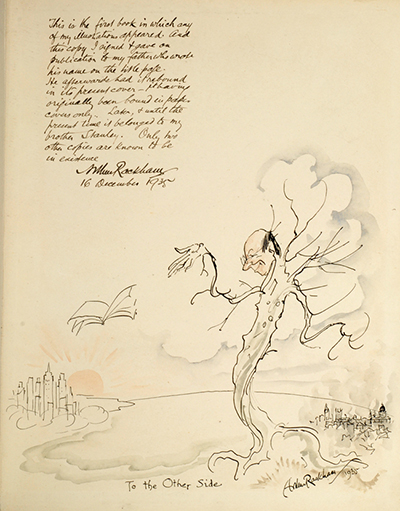
553fada6b6a1f_

Being Tolkien people, this reminded us, of course, of JRRT’s own admiration of trees, of which he wrote in a sort of letter of introduction to Houghton Mifflin Co.: “I am (obviously) much in love with plants and above all trees, and always have been…” (Letters, 220).

JRRT himself was an illustrator of his own stories, and although he never cited Rackham as a direct influence, we know from Tolkien’s letters that he had seen Rackham’s work. He advised his illustrator Pauline Baynes to “avoid the Scylla of Blyton and the Charybdis of Rackham” (L 312).

Here is Pauline Baynes frontispiece for the first book which she illustrated for JRRT in 1949.

000901-3

Enid Blyton was an author of popular children’s books, but she was not an illustrator. We don’t know to what illustrations Tolkien might have been referring, but here is a Blyton book published in the same year, illustrated by the Dutch artist, Harmsen Van Der Beek. (The cover illustration reminds us of various illustrations for early translations of The Hobbit, illustrations which Tolkien hated.)

520wide+8030070

When we look at Tolkien’s forests

4d77f5a589fa1169c84c4fb29b56715b

we are often reminded of the work of the Swedish artist, John Bauer

John-Bauer-Elk-Cotton3

but for all of Tolkien’s warning to Baynes about Rackham’s style, there is a strong influence there, still.  After all, Tolkien did find Rackham’s illustrations “really astonishingly good pictures” (261). Sharing a passion for fairy tales with Rackham, which JRRT called “one of the highest forms of literature”, it’s no wonder to us that he would have found some inspiration in an artist who had similar tastes.

The influence seems strongest when it comes to animate trees.  As we were looking at the same Rackham illustrations which Tolkien would have seen, we found pictures which immediately reminded us, for example, of JRRT’s illustration of Old Man Willow.

ar_rvw2

7a81198748f0619bf839140c5cd4f60b

Just as Rackham’s work seems to have influenced JRRT as an illustrator, he seems to have inspired JRRT’s writing, as well. Being visual people, we can certainly say that, when writing Across the Doubtful Sea, we looked at several images which helped us to imagine the events, places, and characters in our south seas adventure. If you look at Rackham’s The Hawthorne Tree, dear readers, does it remind you of something—or someone?
b84eb67383d938d33e93ae7cfc9c82bd

It’s the wizened, knotted old face of Rackham’s Hawthorne Tree which made us think of this passage:

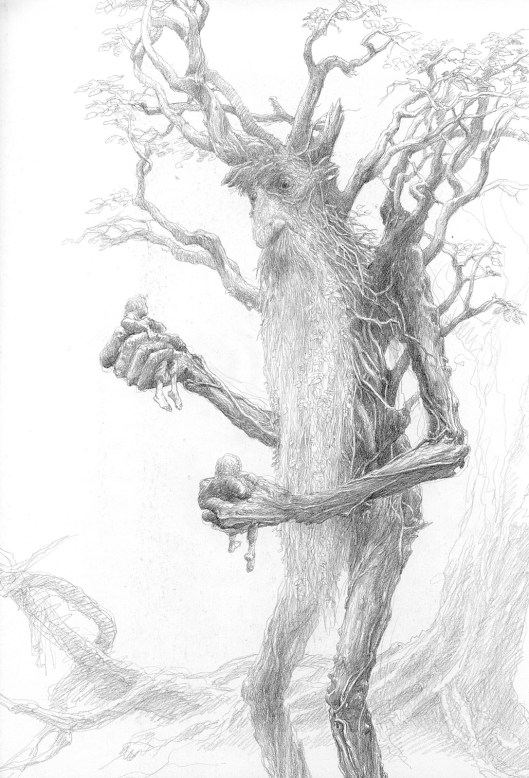
“They found that they were looking at a most extraordinary face. It belonged to a Man-like, almost troll-like, figure, at least fourteen foot high, very sturdy, with a tall head, and hardly any neck. Whether it was clad in stuff like green and grey bark, or whether that was its hide, was difficult to say. At any rate the arms, at a short distance from the trunk, were not wrinkled, but covered with a brown smooth skin… But at the moment, the Hobbits noted little but the eyes. These deep eyes were now surveying them, slow and solemn, but very penetrating.” (The Two Towers, “Treebeard”, 452)

treebeard

Treebeard is, in fact, not a tree, but an Ent. He is an ancient tree-like figure, however, and almost a description of Rackham’s illustration. Looking at Rackham’s paintings and drawings, it’s clear to us that they call out for story, and we wonder– is this how JRRT, with a passion for trees and an eye for illustration, felt about them, too?

Thank you, as always, for reading.

MTCIDC,

CD


STTL

06 Tuesday Sep 2016

Posted by Ollamh in Artists and Illustrators, Fairy Tales and Myths, Literary History

≈ Leave a comment

Tags

A Midsummer Night's Dream, Adventure, Alice's Adventures in Wonderland, Anthony Hope, Arthur Rackham, Cinderella, Fairies, N.C. Wyeth, Nathaniel Hawthorne's Wonder Book, Peter Pan in Kensington Gardens, Rip Van Winkle, Sleeping Beauty, The Dolly Dialogues, The Wind in the Willows, To the Other Side, trees

01573_art.jpg

Welcome, as always, dear readers. This is a special day, so we have added an extra entry this week. 77 years ago today, on 6 September, 1939, 5 days after the beginning of World War 2, Arthur Rackham (1867-1939) died.

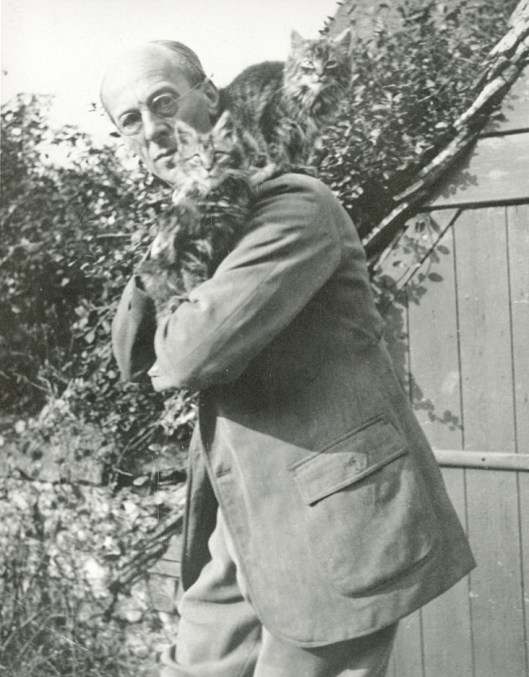
arthurrackhamwithcats.jpg

072038 Detail 2.JPG

Beginning as a clerk for the Westminster Fire Office (an insurance company, founded in 1717) who took art lessons,

Carlton-Hobbs-Westminster3.jpg

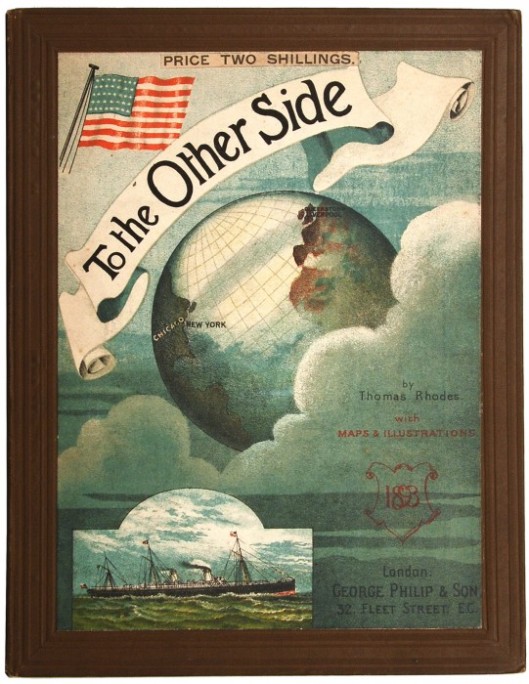
Rackham first shared illustrations with Alfred Bryant for the 1893 To the Other Side,

totheotherside1893.jpg

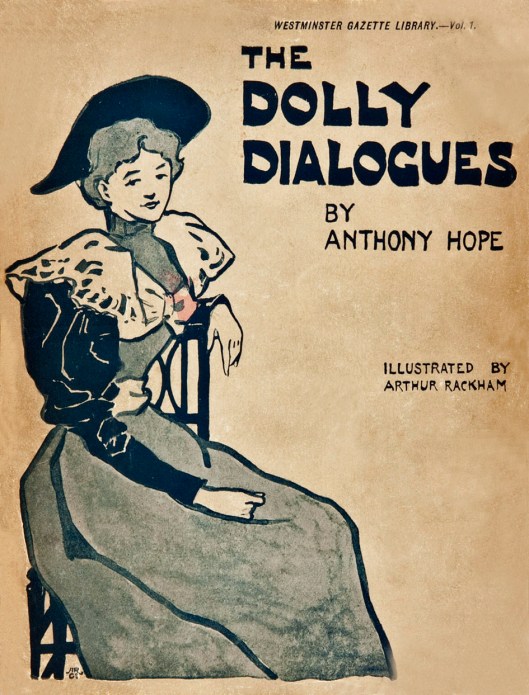
but his biographers tell us that it was his next book project, the illustrations for Anthony Hope’s The Dolly Dialogues,003 The Dolly Dialogues.jpg

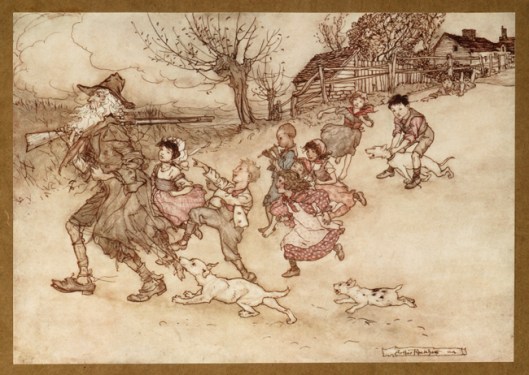
which convinced him to put all of his energy into book illustrations, his focus from then until his death, in 1939.

dollydialogues01hopegoog_0046.jpg

A man dedicated to his art, Rackham turned out multitudes of images for books as varied as Rip Van Winkle (1905—also illustrated by N.C. Wyeth, another favorite of ours, in 1921),

ripvanwinkle1905

Peter Pan in Kensington Gardens (1906),

peterpankensington1906

danceyfairies

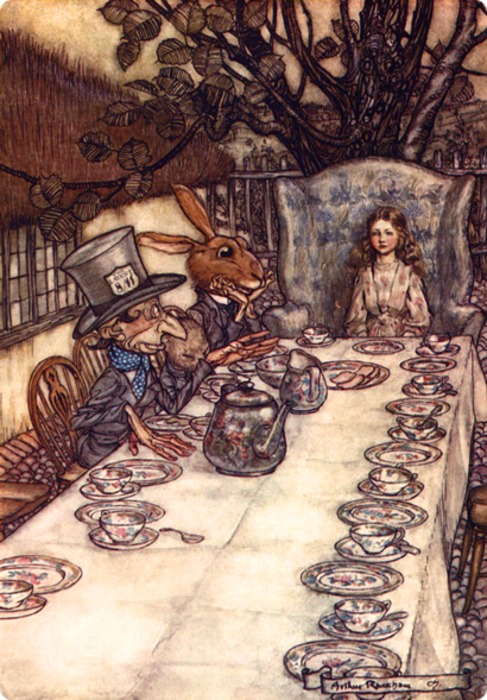
Alice’s Adventures in Wonderland (1907),

rackham5

A Midsummer Night’s Dream (1908),

arthur-rackham-midsummer-nights-dream-titania-sleeping

and The Wind in the Willows (published posthumously in 1940).

k900122-05

And his methods included the absolutely striking Cinderella (1919) and The Sleeping Beauty (1920), in which the illustrations are done almost completely in silhouette, as if the figures and scenes were designed for shadow plays.

Cinderellas-Pumpkin-Rackham-Silhouette.jpg

sleeping-beauty

Throughout, the themes of wonder and the fantastic/grotesque interested him the most and, for us, a major feature is his trees, of many types, but often haunted things with eyes and mouths.

02-arthur-rackham-imagina-1914-frontispiece

From William Shakespeare’s A Midsummer Night’s Dream, 1908

b84eb67383d938d33e93ae7cfc9c82bd

From Nathaniel Hawthorne’s A Wonder Book, 1922

39e2b3c42d2341dfc53844a95a32e89d

“Come Now, a Roundel” from William Shakespeare’s A Midsummer Night’s Dream, 1908

429027

From Kenneth Grahame’s The Wind in the Willows, 1940

hermia_and_helena

From William Shakespeare’s A Midsummer Night’s Dream, 1908

11a9ca7244bf2060db41e7a5862344ab

From Nathaniel Hawthorne’s A Wonder Book, 1922

12930764_f520

Although he was cremated, we still want to offer him a typical Roman farewell, sometimes found inscribed on Roman tombs and the title of this posting: Sit Tibi Terra Levis—“May the earth lie light upon you”. (Literally, “May the earth be light to you”)

Thanks, as ever, for reading.

MTCIDC

CD

Stepping Westward

10 Wednesday Aug 2016

Posted by Ollamh in Artists and Illustrators, Fairy Tales and Myths, Imaginary History, J.R.R. Tolkien, Literary History, Narnia, Narrative Methods

≈ Leave a comment

Tags

Aman, Beliefs, Bran, cult statues, heroa, immrama, Istari, Ithaka, Mael Duin, Middle-earth, monotheistic, N.C. Wyeth, Odysseus, religion, Rip Van Winkle, Saint Brendan, Saruman, shrines, Stone Table, temples, The Grey Havens, The Lord of the Rings, The Odyssey, Tireisias, Tolkien, Valar, Valinor, ziggurats

Dear readers, welcome as always.

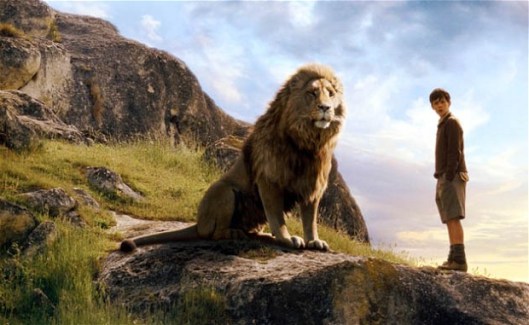
Although there are no temples or shrines to him (the closest thing is perhaps the Stone Table),

narnia stone table

Aslan

1653963a

is clearly someone with divine powers and his influence is felt directly and indirectly throughout all of the Narnia books.

JRRT once said that Middle-earth had a monotheistic religion, but the traces, as has been written about more than once, are almost invisible.
There are no ziggurats,

Ancient_ziggurat_at_Ali_Air_Base_Iraq_2005

no temples,

templeofheraselinus

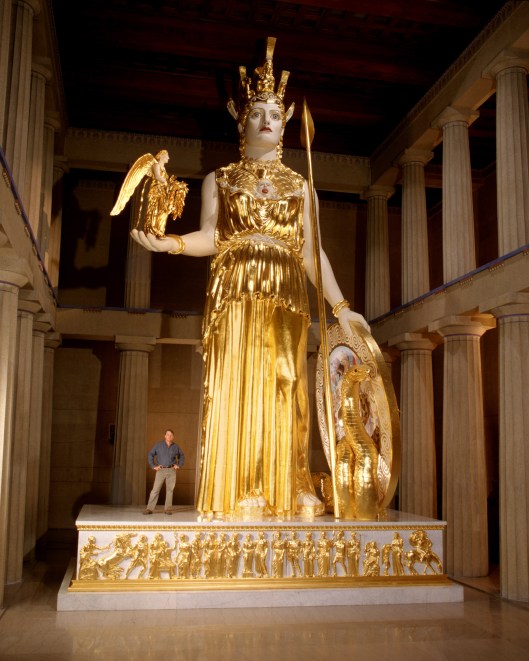
no cult statues

Athena_Parthenos_LeQuire

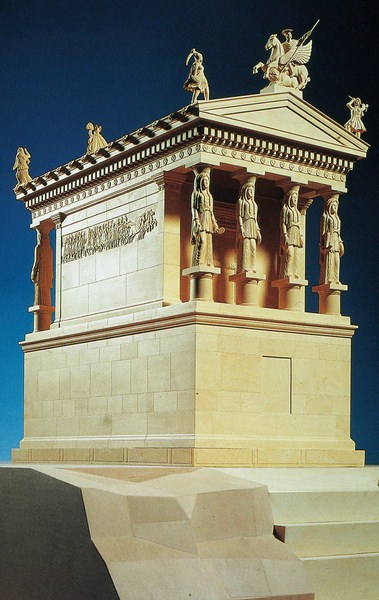
no shrines

97_full

no heroa (shrines for demi-gods or heroes).

heroon

The Valar are mentioned once (some of Faramir’s men call on them to protect them from a mumak), of course, and there is that ceremony of standing and looking west before a meal.

That idea of looking west has long interested us, mainly because, in much of western tradition before the Age of Exploration, the west was looked upon as a place of uncertainty, if not outright fear.

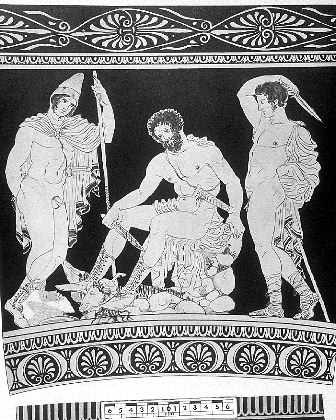
Although Odysseus, in Odyssey 9, is careful to point out that his home island, Ithaka, lies farthest towards dusk in its island group, in Odyssey 11, in the far west lies the Land of the Dead,

lykaon-painter-odysseus-and-elpenor

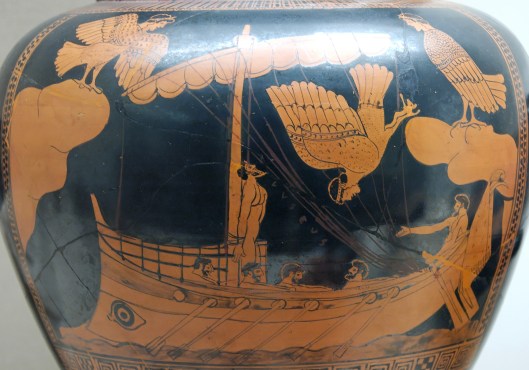
to which Odysseus sails

Odysseus_Sirens_BM_E440_n2

to consult the seer, Tireisias,

Teir.1993.01.0348

on the way to get home. This is, then, hardly a choice direction in which to sail, for all that Tireisias does provide some guidance.

The same is true for a series of stories about immrama, “voyages” (literally “rowings around”) in Old Irish, not only secular stories, like those of Mael Duin

mailduin

and Bran,

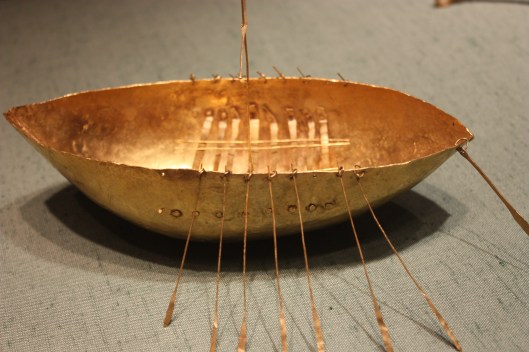
Broighter_Gold,_Dublin,_October_2010_(03)

but a famous religious one about Saint Brendan.

brendan

In each of these stories, sailing westward commonly means sailing rather haphazardly among sea monsters and islands with strange people or creatures. There is also the possibility of time distortion: the voyager believes himself gone in terms of a few years, at most, when, instead, he may have been gone for much longer (as in Washington Irving’s short story, “Rip Van Winkle”, in which Rip, falling asleep in the Catskill Mountains after drinking with the ghosts of the crew of the explorer Henrik Hudson’s ship The Half Moon, thinks that he has been gone only overnight when, instead, he’s been gone for twenty years.)

rip-van-winkle.wyeth

(by one of our all-time favorite illustrators, N.C. Wyeth, from his Rip Van Winkle, 1921—the whole work is available, with all of its wonderful illustrations, to download for free at the Internet Archive, may their beards grow long!)

“To go west”, probably based upon the idea of the sinking sun, as an older English expression has the meaning of “to die/to fail catastrophically” (now people in the US seem to be replacing it with “to go south”, which has none of the older resonance, unfortunately), but it ties in very nicely with these older beliefs about what lies west of Europe, so full of danger and mystery.

But then we come back to that looking west.

In the belief system of Middle-earth, westward across the sea lies the continent of Aman, and on that continent is Valinor, home of the Valar, those powerful and immortal beings who are perhaps to be likened to the archangels of Christian belief—with a bit of patron saint and even Norse and Greco-Roman pantheons thrown in. (We admit to having a very shallow knowledge of Arda theology, being less interested in the finer points of belief than in the adventures and the cultures and the languages of Middle-earth.)

The Istari, the five wizards are from there and it’s for us one of the most melancholy moments when, after his murder by Grima, it is clear that Saruman is denied a return.

jwyatt-sarumande

Gandalf, however, is permitted to return, as are Bilbo and Frodo (and, in time, Sam, apparently), all part of the defeat and disembodiment of Sauron.

greyhavens

The elves are also allowed to make the voyage to Aman, although they have their own separate place there, and, when Gandalf leaves, so do Galadriel, Celeborn, and Elrond, part of a slow general leave-taking of the Elves.

No human is admitted however, to the Undying Lands, as they are called, and it occurred to us that perhaps, in that fact, the mortals of Middle-earth are closer to Saruman than to Gandalf or the Elves:

“To the dismay of those that stood by, about the body of Saruman a grey mist gathered, and rising slowly to a great height like smoke from a fire, as a pale, shrouded figure it loomed over the Hill. For a moment it wavered, looking to the West; but out of the West came a cold wind, and it bent away, and with a sigh dissolved into nothing.” (The Return of the King, Book 6, Chapter 8, “The Scouring of the Shire”)

Could that ceremony of looking westward also be done with a sigh, an acknowledgement that there are no undying lands for them?

What do you think, dear readers?

Thanks, as ever, for reading.

MTCIDC

CD

Ps

This, for us, is a rather historical posting, being our Number 100. By earlier September, we will have reached 104, making exactly two years since we began our blog. We thank you for reading, hope that you will continue to do so, that you will share our work among your friends and that, in the future, you will be willing to share your thoughts with us, as we always encourage you to do.


Terrifyingly Funny? (Part 1)

13 Wednesday Jul 2016

Posted by Ollamh in Artists and Illustrators, Fairy Tales and Myths, Imaginary History, J.R.R. Tolkien, Language, Literary History, Narrative Methods, Villains

≈ 2 Comments

Tags

Adventure, Among Gnomes and Trolls, Bilbo, comic, Gandalf, Gollum, humor, John Bauer, Middle-earth, Pēro & Pōdex, Roast Mutton, Stone Trolls, The Hobbit, The Lord of the Rings, Through the Looking-Glass, Tolkien, Tommies, trolls, Victorian Drawing Room

Dear Readers, welcome, as always.

This is going to be a two-part posting because– well, it began as one thing, and then became another. We were thinking about Gollum, not as the grim and tormented figure we know from The Lord of the Rings, but rather as the muttering, riddling cave-dweller of The Hobbit. We were wondering if we could see Gollum not only as menacing, but as comic, as well.

Gollum_Render.png

Then, however, we began to think about other such figures, and one of us said to the other, “What about the trolls in The Hobbit?”. The other replied, “we see them before we see Gollum. Maybe we should start with them.”

And so we shall.

It’s clear where Tolkien got his trolls– they’re all over the fairy tales he had been reading since childhood, and they form a component of the traditional Scandinavian literature in which he had been interested for nearly as long. They are commonly large, and not terrifically bright, and often possess an anxiety about daylight. One of our favorite illustrators of such creatures is John Bauer (1882-1918), who, among other works, contributed illustrations to an ongoing series of volumes appropriately titled Among Gnomes and Trolls. Here, for example, is one of his depictions of the latter.

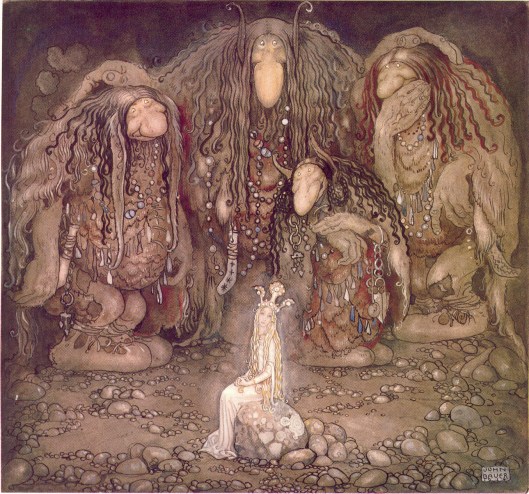
John_Bauer_1915.jpg

And, because we can’t resist– can we ever? Here are a couple more illustrations by Bauer.

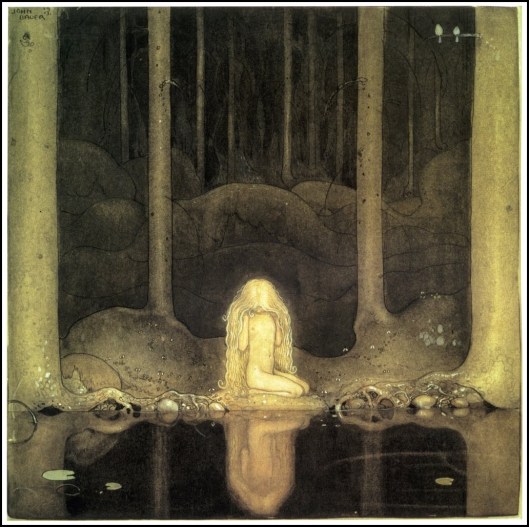
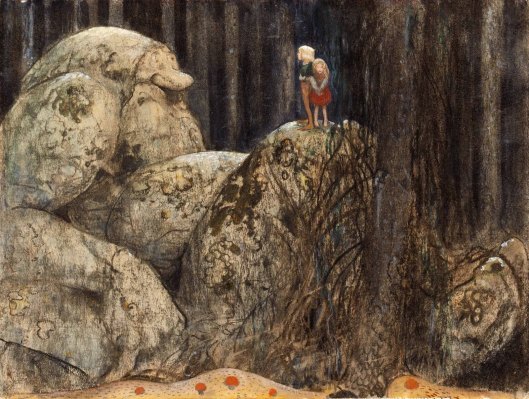
bauer5.jpgJohn_Bauer07.jpg

Even before The Hobbit, however, Tolkien had produced a literary troll. In 1926, he wrote the first version of a poem to be sung to the folk song “The Fox Went Out”, called “Pēro & Pōdex”(“Boot and Bottom”). It survives  in a later version in chapter 12 of Book 1 of The Lord of the Rings, beginning “Troll sat alone on his seat of stone”.

In The Hobbit, the trolls are grouped around a fire, drinking and eating and immediately recognizable:

“But they were trolls.  Obviously trolls.  Even Bilbo, in spite of his sheltered life, could see that:  from the great heavy faces of them, and their size, and the shape of their legs, not to mention their language, which was not drawing-room fashion at all, at all.”  (The Hobbit, Chapter 2, “Roast Mutton”)

tumblr_m6wyygQDLc1ru50yro1_1280.jpg

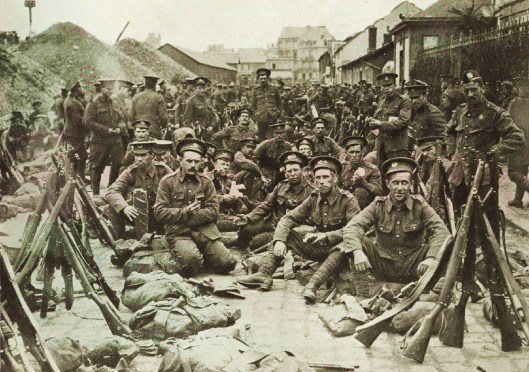
Douglas Anderson, in his invaluable The Annotated Hobbit, says that “Tolkien presents the Trolls’ speech in a comic, lower-class dialect” (70). In fact, we wonder whether, as in the case of the later orcs in The Lord of the Rings, we are not seeing a reflection of the speech of some of the Tommies whom Tolkien had commanded in the Great War.

roads_bef1914.jpg

” ‘Mutton yesterday, mutton today, and blimey, if it don’t look like mutton again tomorrer,’ said one of the trolls.

‘Never a blinking bit of manflesh have we had for long enough,’ said a second. ‘What the ‘ell William was a-thinkin; of to bring us into these parts at all, beats me – and the drink runnin’ short, what’s more,’ he said jogging the elbow of William, who was taking a pull at his jug” (The Hobbit, Chapter 2, “Roast Mutton”).

Besides what sounds like a reference to a line in Through the Looking-Glass (1871), “The rule is, jam to-morrow and jam yesterday – but never jam to-day,” with their “blimey” and “blinking”, the trolls are immediately labeled by their speech as lower-class, potentially thuggish, and certainly not people invited to a formal drawing room like this–

drawingroom1890ssmall.JPG

Of course, we might ask ourselves, why should trolls talk like that anyway? And we might then reply, because Tolkien is mixing language for comic effect. Bilbo, Gandalf, and the dwarves speak in non-dialect standard English. Therefore, there’s an especially strong contrast here. As well, what the trolls are saying can be funny in itself, as when William says to the discontented other trolls,

” ‘Yer can’t expect folk to stop here for ever just to be et by you and Bert. You’ve et a village and a half between yer, since we come down from the mountains. What more d’yer want?’ ” (The Hobbit, Chapter 2, “Roast Mutton”).

Here, we have comic exaggeration combined with the frustrated defensiveness of a leader whose tactics are being questioned by subordinates.

The tension grows as the scene progresses.  Bilbo appears, is nabbed by a purse which sounds like the Trolls, the Trolls fall to fisticuffs while arguing over Bilbo and then over the dwarves whom they capture, and Gandalf, imitating various Troll voices, so stirs the pot that the Trolls never notice when the first beam of sunlight cuts across their clearing and they are petrified.

jrrt_14.jpg

So, if we consider what the Trolls have been doing previously–“Never a blinking bit of manflesh have we had for long enough…” says one, as well as what they discuss doing not only to Bilbo, but to the whole of Thorin & Co., these could seem to be grim figures, indeed.  Then again, they sound like comic cockneys, they have ludicrously-large appetites, and they are dim enough to be taken in very easily by Gandalf’s ventriloquism.   So, grim and funny at the same time.

On the whole, humor is more an element in The Hobbit than in The Lord of the Rings, but we believe that perhaps because of his initial appearance in The Hobbit, Gollum may have both the menace and the humor, at times , of these gormless Trolls, as we hope to show in Part 2.

Thanks, as always, for reading,

MTCIDC,

CD

Winter is Coming

29 Wednesday Jun 2016

Posted by Ollamh in Fairy Tales and Myths, J.R.R. Tolkien, Military History, Narnia, Narrative Methods, Villains

≈ 3 Comments

Tags

C.S. Lewis, Frozen, Game of Thrones, George R.R. Martin, Hadrian's Wall, Hans Christian Andersen, Kay, Middle-earth, Mile castle, Puddleglum, Queen Elsa, Rammas Echor, The Chronicles of Narnia, The Lion The Witch and the Wardrobe, The Lord of the Rings, The Night Watch, the Pevensies, The Snow Queen, The White Witch, Tolkien, Westeros, White Walkers, Winter is Coming

Dear Readers,

Welcome, as ever.

We were playing Sortes Tolkienses yesterday. That’s the game where we close our eyes, open The Lord of the Rings to any page, then put our finger on a line to see if we can write about it.

On page 1042 of our edition, our finger fell upon:

“…you may stay here till the Witch-king goes home. For in the summer his power wanes, but now his breath is deadly, and his cold arm is long.” (The Lord of the Rings, Appendix A)

The Witch-king? Oh, we thought—that Witch-king.

angmar.jpg

He has a very long history in Middle-earth, being “probably (like the Lieutenant of Barad-dur) of Numenorean descent” (from Hammond and Scull, The Lord of the Rings: A Reader’s Companion, 20, Note 5) and, in the quoted context rules Angmar

arnorangmar.jpg

with a command to destroy the northern Numenorean kingdom of Arnor.

What caught our attention, however, was that idea of a “cold arm”. This might be metaphorical—except for that “in summer his power wanes”, suggesting that, if he can’t control the weather, he can at least use it to his advantage.  And this set us thinking about stories in which winter was either controlled by someone or was, itself, the antagonist.

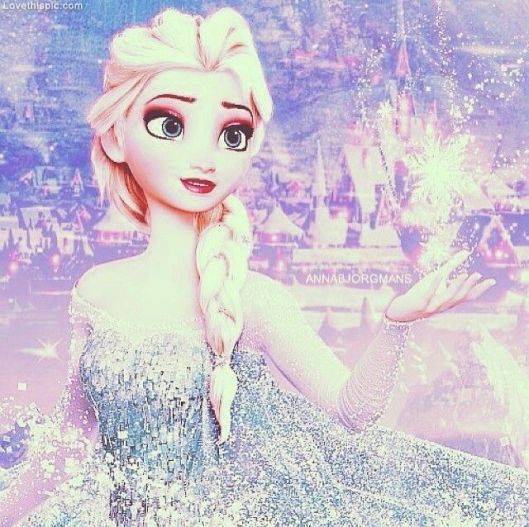
First, there is Hans Christian Andersen’s The Snow Queen (1845).   Although this shares a title with a 2013 Disney film, there is really nothing else to link them. The Disney film has, of course, the Princess Elsa, whose enchanted hands can turn the world into winter (perhaps like the Witch-king?).

69147-Elsa-The-Snow-Queen.jpg

elsasicepalace.jpg

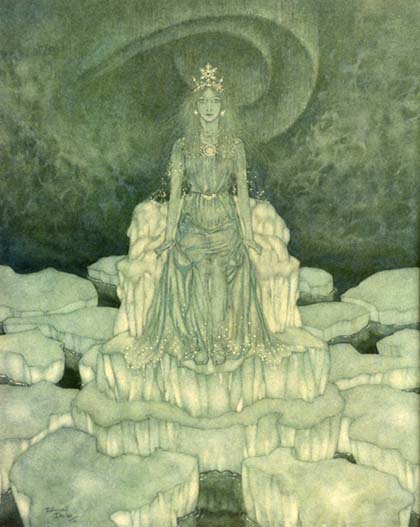
Andersen’s long fairy tale (in seven parts, or “stories”, historier, in Danish) is about the abduction of a boy and his rescue by his friend, a girl. The boy is being held by the Snow Queen, who lives in a far-off palace made of snow, the windows and doors of icy wind, lit by the Northern Lights.

snowqueen.JPEG

northern-lights-large.jpg

What particularly caught our attention here was the manner by which the boy, Kay, was stolen. He hitched his sled to the back of a sleigh, only to find that it was driven by the Snow Queen, who takes him under her robe.

lizbobzinsnowqueen.png

Liz Bobzin, “The Snow Queen and Kay”

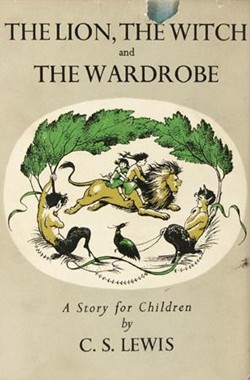
This took us to the White Witch of The Lion, the Witch and the Wardrobe (1950), the first of C.S. Lewis’ Narnia books.

TheLionWitchWardrobe(1stEd).jpg

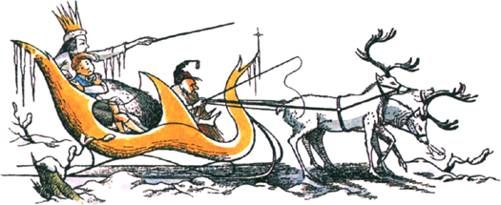
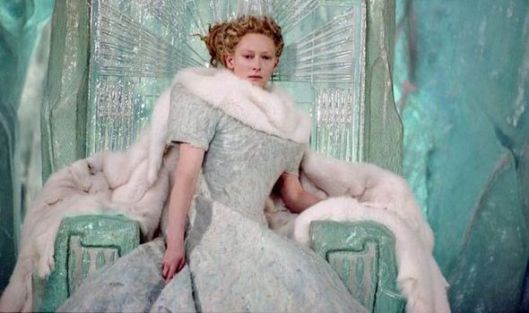
She picks up one of the Pevensie children, Edmund, in her sleigh and, while she doesn’t abduct him physically, she corrupts him by playing upon his greed and vanity.

bayneswhitewitch.jpg

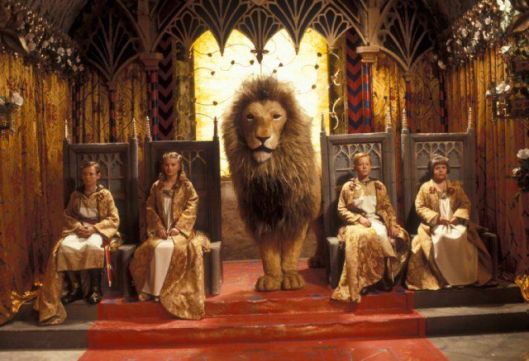
This is an illustration of the Witch from the original 1950 book, and here are two later interpretations—the first is from the 1988 BBC production

whitewitchbbc1.jpg

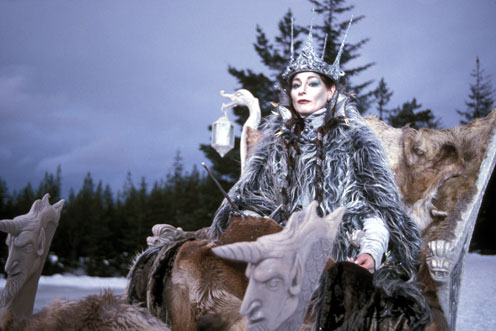
the second from the 2005 film.

tildaswinton.jpg

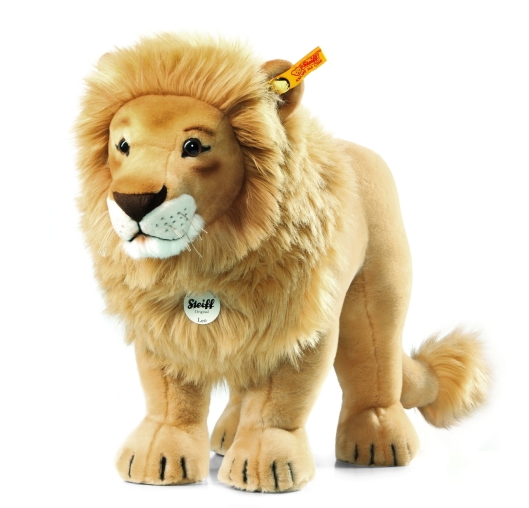
(We like both versions—we don’t mind the Steiff Aslan in the BBC production

bbcaslan.jpg

502613_l__13430.1384493387.1280.1280.jpg

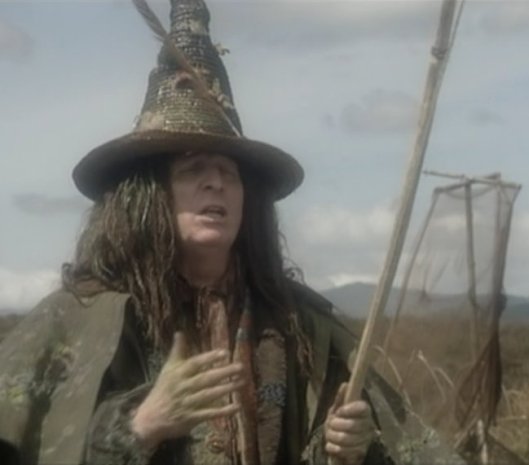
and who could ever be a better Puddleglum than Tom Baker, the fourth incarnation of Dr. Who, in the BBC The Silver Chair, 1990?

bakeraspuddleglum.jpg

We do worry a bit, however, about the changes made to the film versions of Prince Caspian, 2008, and The Voyage of the Dawn Treader, 2010. They’re not so drastic as those we’ve come to expect from P. Jackson’s writers, but, especially in Prince Caspian, there is a tendency to change things for what appear to be marketing reasons…)

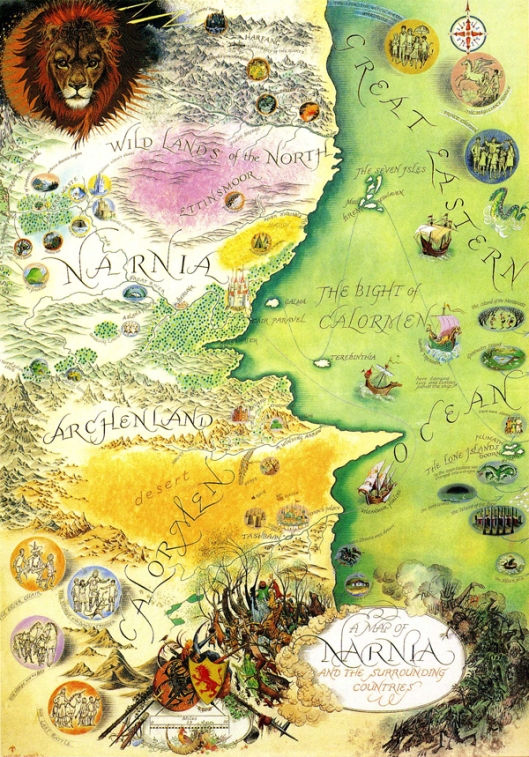
As in what appears to be the case of the Witch-king, the White Witch can control the weather and has imprisoned all of Narnia

baynesmapofnarnia.jpg

in snow and ice for a century—“always winter, never Christmas”.

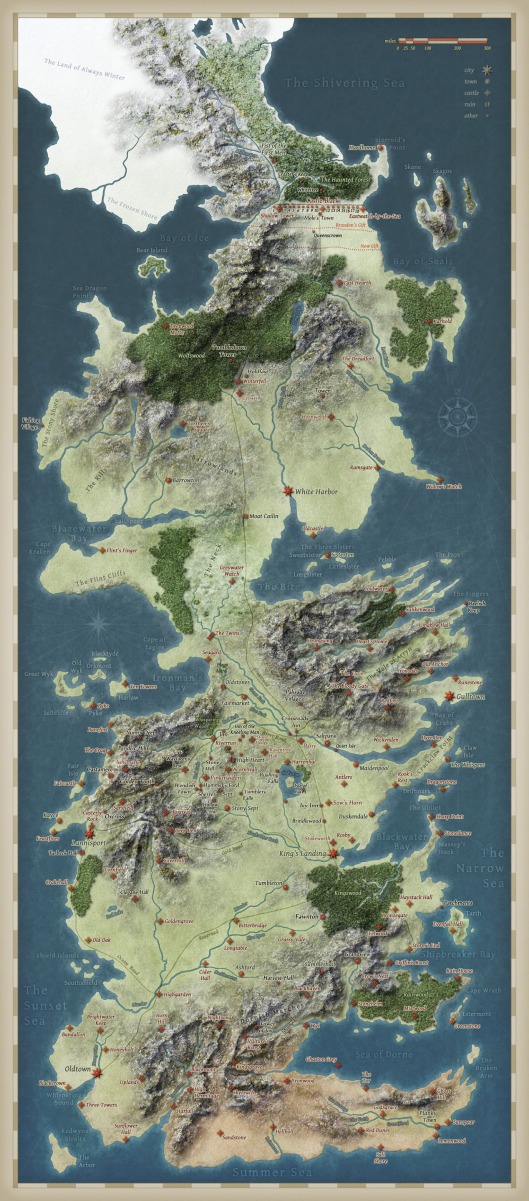
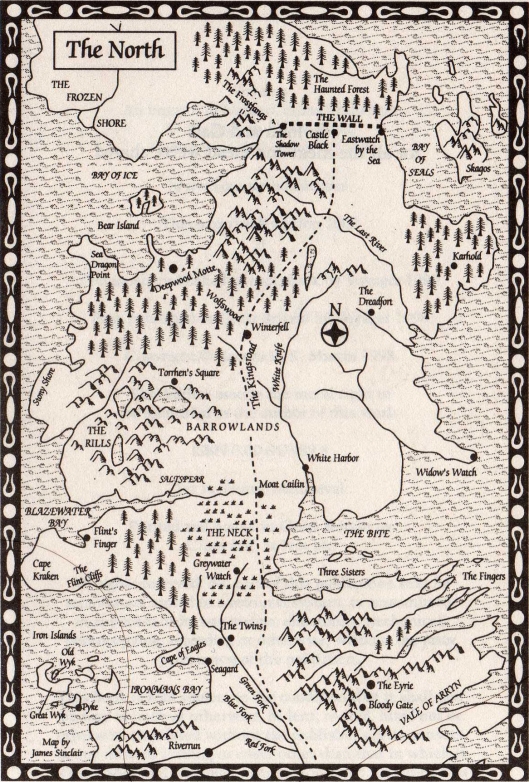
The idea of a world of winter then brought us to George R.R. Martin’s A Game of Thrones, both the novels and the impressive (and addicting) television series. In the world of Thrones, the large island of Westeros—

Map_of_westeros.jpg

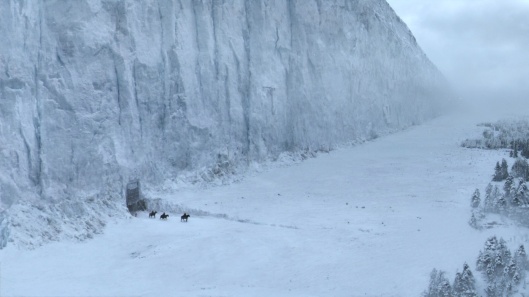
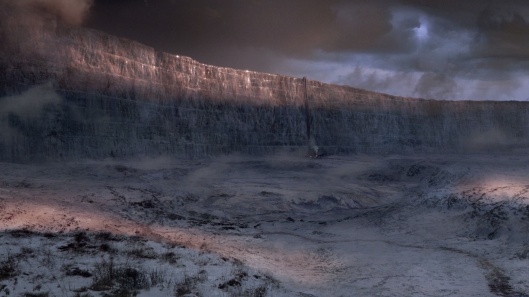
and the whole world, for that matter, has once suffered a winter which lasted for a generation and the fear of its return always casts a shadow over the present. During that time, the creatures known as the White Walkers appeared from the north, with armies of animated dead, and were only driven back at great cost. To prevent their return, the surviving humans built an immense wall, 700 feet high, 300 miles long, which effectively blocks entry to the lower two thirds of Westeros.

Thewallfromthenorth.jpg

The_Wall_from_the_south.jpg

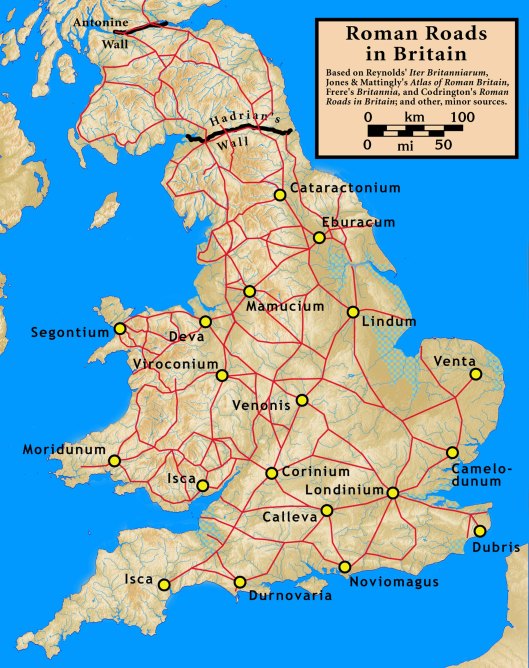
In an earlier posting, we discussed the Rammas Echor, the outer boundary wall which protects the Pelennor and Minas Tirith, and what we believe to be a major influence upon Tolkien’s idea, Hadrian’s Wall, which divides England from the lands to the north.

Roman.Britain.roads.jpg

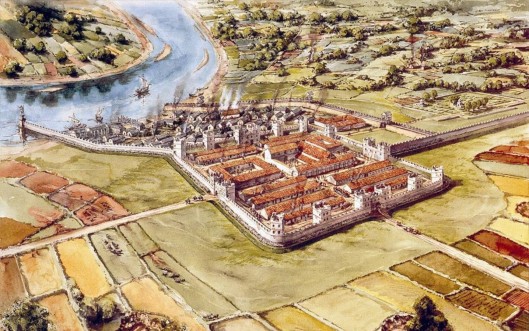
Unlike The Wall in Thrones, it is under a hundred miles long, was never more than 16 to 20 feet high, and was built of turf, timber, and stone, not solid ice. It was, however, a complex construction, with 17 forts behind it

romanfortress.jpg

and a smaller fort (now called a “mile castle”) at the end of each mile,

milecastle.jpg

with small towers set in between the mile castles.

turretonhadrianswall.jpg

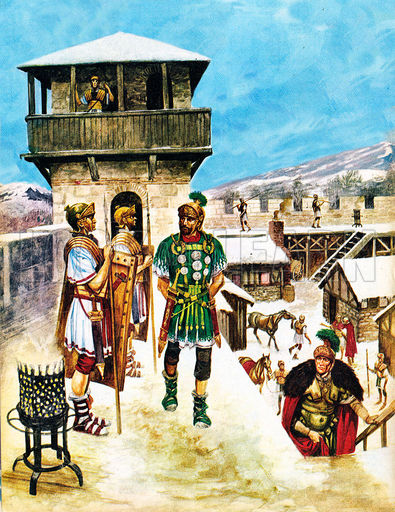
It was garrisoned with thousands of soldiers over its years of occupation (begun 122AD, finally abandoned in the 5th century).

romangarrison.jpg

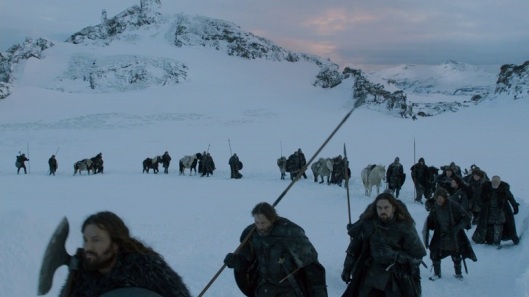
In Thrones, this job has been taken on by The Night Watch, a rather haphazard collection of volunteers and conscripts.

nightwatch.jpg

And, south of them, the lands of the Stark family, Wardens of the North, whose motto—a warning of the dreaded future—forms the title of this posting.

the_north_a_clash_of_kings.jpg

Thanks, as always, for reading.

MTCIDC

CD

A Country for Old Men—and Old Men for a Country

11 Wednesday May 2016

Posted by Ollamh in Fairy Tales and Myths, J.R.R. Tolkien, Literary History

≈ Leave a comment

Tags

Apollonius, Aragorn, Argo, Blue Wizards, Denethor, Faramir, Gandalf and the Balrog, Grey Havens, Heracles, Hildebrandts, Hylas, Istari, Jason and the Golden Fleece, Merlin, Radaghast, sage, Saint Nicholas, Saruman, Sharkey, The Argonautica, The Fantastic Four, The Lord of the Rings, Theoden, Tiresias, Tolkien, Valar, W.B.Yeats

Dear readers, welcome, as always.

Recently, we wrote a posting about Saruman and his fate. It was fun to think about, but it made us think further about why Saruman, in the Shire, is called “Sharkey” by his thugs—supposedly from Orcish sharku, “Old Man”. If we had never read a description of Saruman, but only the nickname, we might think of “the old man” either as an older Anglo-American expression either for a father—“my old man keeps nagging me about cutting the grass, if I want my allowance” (note the use of the possessive “my”)—a naval/military term for commander—“the old man said that, on his ship, smoking would never be allowed again” (always without the possessive)—or older English for husband—“her old man is fooling around behind her back—I hope she turns around!” (again, with a possessive).

In fact, Saruman is, literally, an old man

greg-hildebrandt-isengard-orthanc-saruman-607429-1300x962.jpg

—as are all five of the Istari, the wizards sent to Middle-earth by the Valar about the year 1000 of the Third Age. As JRRT says in a letter to Robert Murray, S.J. (there’s a surviving draft on pages 200-207 of The Letters of J.R.R. Tolkien):

“They are actually emissaries from the True West, and so mediately from God, sent precisely to strengthen the resistance of the ‘good’, when the Valar become aware that the shadow of Sauron is taking shape again.” Letters, 207

He further explains their role:

“At this point in the fabulous history the purpose was precisely to limit and hinder their exhibition of ‘power’ on the physical plane, and so that they should do what they were primarily sent for: train, advise, instruct, arouse the hearts and minds of those threatened by Sauron to a resistance with their own strengths; and not just to do the job for them.” 202

JRRT could have chosen a different path, of course, and created a plot in which there was constant, open war between the wizards and Sauron, and there is mention of war of some sort, as, during the time of The Hobbit, the White Council drives “the Necromancer” out of Dol Goldur in the southern part of Mirkwood. It’s not said how, but no army is mentioned, so we presume that it was done by magic against magic (on the subject of magic, see JRRT in the letter previous to the one to Murray, Letters, 199-200).

We wonder if, in choosing to limit the wizards’ power, Tolkien made the same choice which Apollonius of Rhodes (3rd century BC) made in his version of the story of Jason and the Golden Fleece, The Argonautica. If you don’t know this story, the shortest way to explain it is to say that Jason’s wicked uncle has stolen the throne which rightfully belongs to Jason and, in an effort to make Jason disappear, his uncle has sent him off on what he hoped was a suicide mission. That mission was to bring back a magical golden fleece from the far side of the Black Sea (at the time, this would have been like a mission to Mars). To help him, Jason summons heroes from across the Greek world.

Unfortunately for Apollonius, the traditional story on which his epic is based had, over time, gradually come to include every hero from ancient Greece on Argo,

The_Argo.jpg

This means that Heracles had to be asked to join, but there is a big difficulty in including Heracles: he’s so powerful that he could do the job all by himself.

Krater_Niobid_Painter_A_Louvre_G341.jpg

Apollonius was extremely scrupulous, as far as we can tell, in following tradition, so he finds a way out. He puts Heracles’ bff, Hylas, on board the ship, then, at a watering spot, has the boy lured away by some randy water nymphs.

hylas_and_the_nymphs.waterhouse1896.jpg

When Heracles goes off to find the boy, the ship leaves without him and the problem is solved. (Although Apollonius chooses to ignore the fact that the ship is still absolutely crammed with the ancient equivalent of The Fantastic Four. We suppose that, for him, Heracles was the only really major hero.)

fantasticfour.png

Thus, we can imagine that Tolkien, believing that he could create a more interesting (and longer?) story without too much magic, has, in general, limited the wizards not in their power, but in the use of it. (There are exceptions, of course—we immediately think of Gandalf and the Balrog, for instance.)

balroggandalf.jpg

The wizards do not just have the shape of men, however, but old men—“Thus they appeared as ‘old’ sage figures” (Letters, 202).

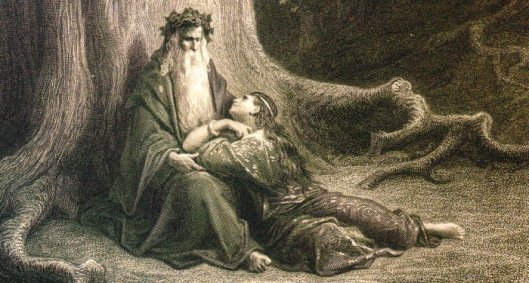
The word “sage” here is definitely one element in Tolkien’s choice for his characters. There is a world-wide tradition that old men are wise men—think of the ancient Greek seer Tiresias, for example—

Johann_Heinrich_Füssli_tiresias.jpg

or the Arthurian Merlin

vivien-and-merlin-by-gustave-dore-cc.jpg

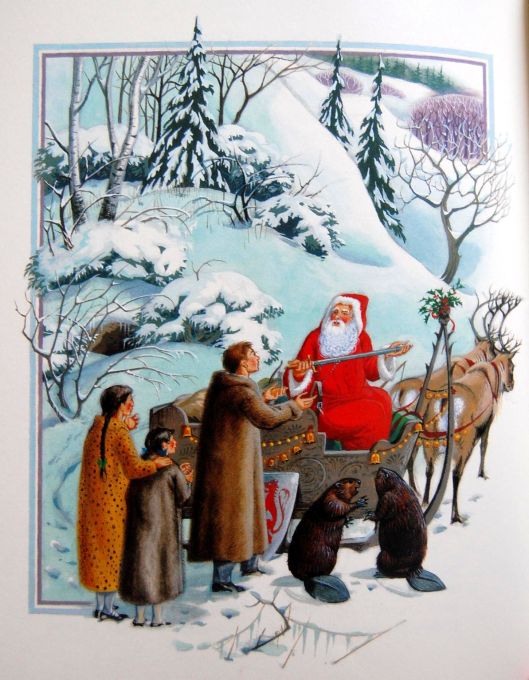
or Father Christmas/Santa Claus.

FatherChristmas.JPG

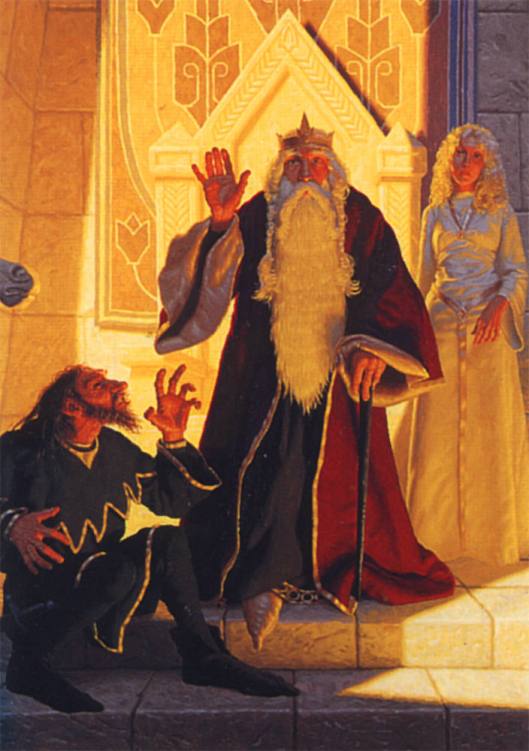
We wonder whether there might also be the idea that, dramatically, older rulers, like Theoden

theoden.jpg

And Denethor

hildebrandtdenethor.jpg

might be more inclined to listen to such a person (although we notice that the corrupted Denethor is less than willing).

And, that younger men like Aragorn

Image result for hildebrandts aragorn

and Faramir

Tim Hildebrandt - Faramir rencontre Frodon et Sam (2).jpg

would see them as mentors.

kingreturn.jpg

And, as the Istari have been sent by the Valar, the last act on Gandalf’s part, as depicted in this Hildebrandt twins’ painting, has special significance, suggesting that, Aragorn has been given the throne with divine approval and, with his crowning, Sauron has been completely defeated and balance has been restored, even if only temporarily, to Middle-earth.

When this has been accomplished, Gandalf is then allowed to “retire”, as we seem to expect old men to do in our world (and as Tolkien himself did, in 1959), going to the Grey Havens and a final journey back to the West.

greg_tim_hildebrandt_at_the_grey_havens.jpg

We hear nothing more of Radagast and the two so-called “Blue Wizards”, but, Saruman also leaves Middle-earth—though not in Gandalf’s gentle way. And perhaps his end, shabby and disgraced, also shows a kind of divine approval: those given power must not abuse it, for the consequences not only to the world around them, but to them, can be fatal.

Thanks, as always, for reading.

MTCIDC

CD


PS

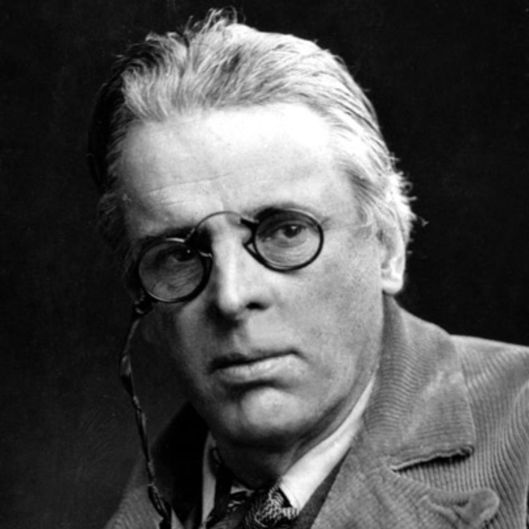
Our title is an adaptation of the first line of W.B. Yeats’ gorgeous poem, Sailing to Byzantium (first published in 1928). Although it has nothing to do with Middle-earth, it does depict a strange, magical place.

wby.jpg

Beaux Gestes? (2)

27 Wednesday Apr 2016

Posted by Ollamh in Artists and Illustrators, Fairy Tales and Myths, J.R.R. Tolkien, Villains

≈ 1 Comment

Tags

19th-century tombs, Cicero, Galadriel, Gandalf, Grey Havens, Hildebrandts, Istari, Mourning, Queen Victoria, Quintilian, Saruman, Scouring of the Shire, The Lord of the Rings, The Mirror of Galadriel, Theatrical gesture, Tolkien, Valar

Welcome, as always, dear readers.

In our last, we commenced a small examination of gesture in The Lord of the Rings, relating specifically to Galadriel and Saruman. We began with Galadriel

galadriel.jpg

and her rejection of Sauron. JRRT describes it in this way: “She lifted up her white arms, and spread out her hands towards the East in a gesture of rejection and denial.” In that post, we said that her gesture seemed theatrical, almost melodramatic, and we suggested that JRRT had been influenced by what we imagined he had seen on stage and on screen late in the 19th and into the 20th centuries, a time when such broad gestures were still considered the best way to convey strong emotion. This mode was, we proposed, ultimately based upon the writings of two ancient Romans, Cicero and Quintilian, who lived between the years 100BC and 100AD. In their day and up to the 20th century, the only magnification available to allow speakers to be heard over crowds was the human voice. Thus, a range of gestures emphatic enough to be seen and clear enough to be understood at a distance was an important component of effective speaking and such gestures were adopted and adapted by actors and used and reused for many centuries to come.

Because none of the illustrations based upon “The Mirror of Galadriel” depicts this gesture, we used a photograph from an 1898 book on public speaking to provide the sense of what we believe we were meant to see.

Repulsion.jpg

In our last, we also suggested that Galadriel’s gesture was linked to one of Saruman’s—in fact, his last gesture on Middle Earth, as far as we know.

In sudden resentment at the contemptuous treatment consistently dealt him by Saruman, Grima Wormtongue has drawn a hidden knife and cut the wizard’s throat.

“To the dismay of those that stood by, about the body of Saruman a grey mist gathered, and rising slowly to a great height like smoke from a fire, as a pale shrouded figure it loomed over the Hill. For a moment it wavered, looking to the West; but out of the West came a cold wind, and it bent away, and with a sigh dissolved into nothing.” The Lord of the Rings, Book 6, Chapter viii.

jwyatt-sarumande.jpg

Saruman had been one of the Istari, as Tolkien describes them all in describing Gandalf:

“There are naturally no precise modern terms to say what he was. I wd. venture to say that he was an incarnate ‘angel’—strictly an angelos: that is, with the other Istari, wizards, ‘those who know’, an emissary from the Lords of the West, sent to Middle-earth, as the great crisis of Sauron loomed on the horizon. By ‘incarnate’ I mean they were embodied in physical bodies capable of pain, and weariness, and of afflicting the spirit with physical fear, and of being ‘killed’, though supported by the angelic spirit they might endure long, and only show slowly the wearing of care and labour.” Letter to Robert Murray, S.J. (draft), 4 November, 1954.

Saruman, then, as another of the Istari, can be killed—and is, but what then? In his battle with the Balrog, it appears that Gandalf has met his end. He returns, however, suggesting that his physical body might be capable of the repair which Galadriel administers in Lorien.  As JRRT says in the same letter, “He was sent by a mere prudent plan of the angelic Valar or governors; but Authority had taken up this plan and enlarged it, at the moment of its failure.”—that is, Gandalf’s apparent death.

As Gandalf puts it, “I was the enemy of Sauron”, and, with Sauron defeated, apparently conclusively, Gandalf is allowed to return to the West, to do or be what, is never explained.   It is a privilege, clearly, since it is granted only to High Elves and, with special dispensation, to Bilbo and Frodo.

This brings us back to Saruman’s gesture: “For a moment it wavered, looking to the West; but out of the West came a cold wind, and it bent away, and with a sigh dissolved into nothing.”

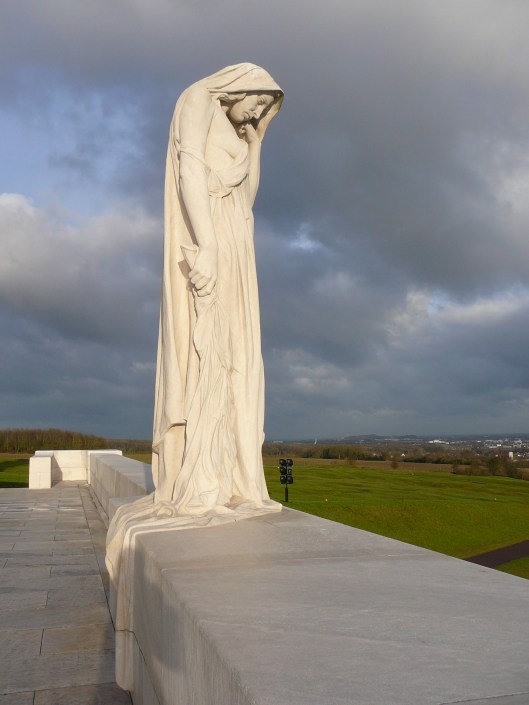
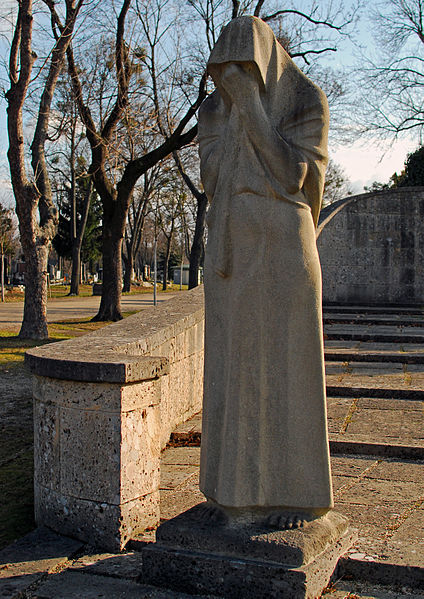
In a way, what we see here is actually a lack of gesture—it is a wavering, with a sense of hope, perhaps? Almost as if Saruman is appealing for pardon? As in the case, of Galadriel, we have no artist’s depiction of this, but we’ve used the clue of “a pale shrouded figure”, as well as that wavering, to imagine that this is someone in mourning and so we can offer several figures from later 19th-century tombs as a possible image.

d5717eeaa95186cd2e3d95447d215e2f.jpgp1140386.jpg

Statue-to-Mourning-Zentralfriedhof-Vienna.jpg

It’s interesting that these all are female, as if this is one of the expected jobs of 19th-century women, to be the Mourners in Chief. We suppose that, since Queen Victoria mourned for her husband Albert from his death in 1861 to her own death in 1901, this shouldn’t be surprising, but we are planning a later posting about mourning in The Lord of the Rings which will examine the subject within certain western traditions in more depth.

Queen-Victoria-Her-Latest-Portrait-1900_tr_4643_566.jpg

In the meantime, we return to Galadriel to match these two gestures. Saruman had failed because he had accepted the East and the deceptive words of Sauron. His fate, then, is to be met with a cold wind and to dissolve, with a sigh, into nothing, rejected by the West from which he had been sent, several thousand years before. Galadriel, on the other hand, by protecting her people and rejecting Sauron, had been accepted back into the West and the last we see of her is aboard a ship at the Grey Havens, bound for her reward.

ghavens.jpg

Thanks for reading, as always.

MTCIDC

CD

PS

We couldn’t resist this final image: the Hildebrandts with the painting.

haven-c.jpg

For all of the wonderful paintings he and his brother have given us, may Tim Hildebrandt (1939-2006) have been given a safe passage to the West, as well.


Herald-ry in Middle Earth

30 Wednesday Mar 2016

Posted by Ollamh in Fairy Tales and Myths, Imaginary History, J.R.R. Tolkien, Literary History, Military History, Military History of Middle-earth, Narrative Methods

≈ 2 Comments

Tags

Achilles, armour, Battle of Bannockburn, Eurybates, flailing and winnowing, Heraldry, Heralds, Hermes, kerykeion, Lakedaimonia, lambda, Medieval, Mouth of Sauron, Robert de Septvans, Robert the Bruce, Roger de Trumpington, Sir Henry de Bohun, Spartans, tabard, Talthybius, The Black Gate, The Illiad, The Lord of the Rings, Tolkien, White Tree of Gondor

Welcome, as always, dear readers.

There is a moment in the film of The Return of the King which has always puzzled us. The Lieutenant of the Tower of Barad-dur has appeared outside the Morannon with taunts and with what appears to be disconcerting news about Frodo.

mouth-of-sauron-1.jpg

In response, Aragorn kills him. Even if you had never seen a movie with knights in it so that you would know that this was a herald or messenger of some sort and that there are rules about such people, there are modern parallels—flags of truce, even the silent protection offered to diplomats—to make you think that this was hardly proper behavior for a king.

If we look at this scene in the chapter entitled “The Black Gate Opens”, we see that this is another of those disturbing—and seemingly arbitrary—changes made by the script writers, showing once more their disregard—or lack of proper understanding—of the author and his wishes.

“Aragorn said naught in answer, but he took the other’s eye and held it, and for a moment they strove thus; but soon, though Aragorn did not stir nor move hand to weapon, the other quailed and gave back as if menaced with a blow. ‘I am a herald and ambassador, and may not be assailed!’ he cried.”

There is a parallel in this, when we are told that Aragorn has used the Palantir and wrestled with Sauron.

“ ‘It was a bitter struggle, and the weariness is slow to pass. I spoke no word to him, and in the end I wrenched the Stone to my own will…Now in the very hour of his great designs the heir of Isildur and the Sword are revealed; for I showed the blade re-forged to him. He is not so mighty yet that he is above fear; nay, doubt ever gnaws him.’ ” (The Return of the King, Book 5, chapter 2, “The Passing of the Grey Company”)

(This is misportrayed in the extended version of the film. For some reason, in return for being shown Anduril, Sauron shows Aragorn a lifeless—perhaps just napping? “she looks like she’s only sleeping!”—Arwen—which, as is so often the case with the clumsy script writers, completely misses the real point of the scene in the book.)

In both of these scenes, what the author clearly meant to show was that Aragorn’s power, now that he has chosen to reveal it, comes from within and is so great that it needs neither words nor violence to assert itself—more signs that he is the true returning king.

Thus, harming a herald, in fact, shows him as the very opposite: not only violent, but, instead of restoring and preserving—his proper task as king—he violates custom.

We note, by the way, that, in the book, he looks to be following custom. Under the direction of Gandalf, the army which marches to challenge Sauron formally declares its ownership of Ithilien with trumpet blasts

Black Trumpeterearly16thc.jpg

and its own heralds.

What is a herald, anyway? The Mouth of Sauron claims to be one and even claims immunity because of it—why?

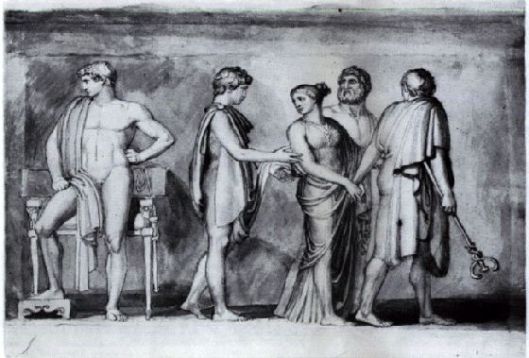
In fact, heralds, in the western world, have an ancient lineage, first appearing in literature in The Iliad, where they act both as messengers

flaxman_Briseis_achil.jpg

and as referees.

hector-and-ajax-fighting.jpg

You’ll notice, in the first of these two pictures, that the two heralds, Talthybius and Eurybates, have the badge of a herald: a special curved wand, called a kerykeion. Hermes carries one, to indicate that he is the patron god of heralds (and therefore their protector).

0408b5884a2ff2a3c2ad0b51ffde7a13.jpg

At some point in their early history, the convention appeared that heralds were considered, in their role as messengers, to be somehow neutral and therefore were not to be harmed. (It’s not clear, however, during their first appearance, in Iliad 1, that this was so then—or at least when dealing with Achilles–but perhaps that’s just Achilles, who is not necessarily always the most balanced individual.)

Heralds in the western medieval world continued with these functions, but added another.

We have a little evidence that some ancient Greek warriors and states may have used specific designs as badges. Spartan shields, for example, sometimes carried a lambda—a tentlike shape which stands for the sound of L in English and was short for “Lakedaimonia”, which is where Sparta was located.

spartanshield.png

A much more elaborate system of designs gradually developed during the Middle Ages, in part because of the increasingly-elaborate armor, which, from a long shirt of chain mail, came to cover the whole knight, making him, potentially unidentifiable.

normanhorseman.jpg

late12thcknight.jpgEnglish_Knight_13thc.jpg

So, both to make himself distinguishable on the battlefield and probably because it was macho, and therefore sexy, a knight would devise a distinctive design for his shield, possibly his clothing, and maybe even his horse, as well.

Knight14thcmid.png

This could be pretty spectacular—just look at Robert the Bruce, king of Scotland in the early 14th century.

heraldic-robert-the-bruce.jpg

[A footnote here– at the site of the Battle of Bannockburn, there is a famous equestrian statue of the Bruce in which the head and facial features have been reconstructed from the Bruce’s actual skull.

bruce-9.jpg

images.jpg

Just before this same battle, the Bruce had shown his knightly skills by splitting, with his battle axe, the helmet and head of the English knight, Sir Henry de Bohun.]

robert-de-bruce-kills-bohun-l.jpg

Sometimes these designs could include puns on their owners’ names. Here’s Roger de Trumpington, with trumpets.

sirrogerdetrumpington.jpg

And Robert de Septvans (Septvans = “seven (winnowing) fans”).

sirrbtde7.jpg

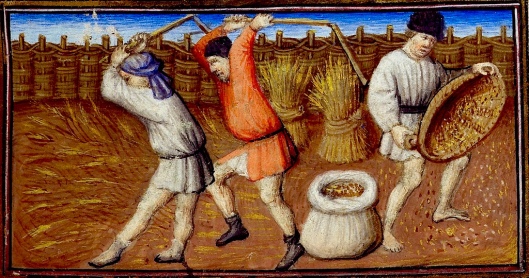
The fan here looks actually like a basket, but was used for helping the wind to carry off the outer husk of the grain ear, a process called winnowing. (To the left is the previous process, flailing, where the beard of grain is being broken off the stalk before it is winnowed.)

threshingwinnowing.jpg

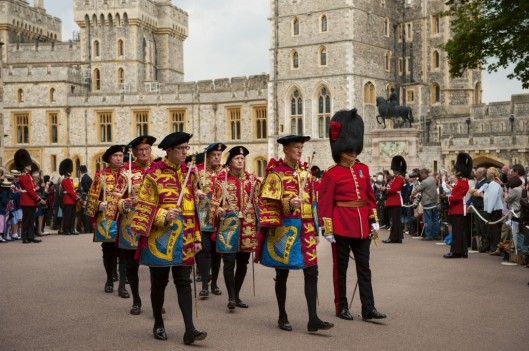
As the number and complexity of patterns on armor developed, it appears that specialists took over the job of identifying them and keeping track of them, the heralds. And, from their name, we get our general name for the designs used on armor and clothing, heraldry. Because they worked in the world of heraldry, they decorated themselves, as well, and, in England, still do.

Heralds-at-the-Garter-Service-Julian-Calder-1024x681.jpg

Thus, we can imagine that, when Aragorn, Gandalf, and their companions reached the crossroads in Ithilien,

crossroads.jpg

after the trumpets sounded, heralds wearing a special coat, called a tabard,

Pursuivant_tabard.jpg

which would have been embroidered with the tree and seven stars,

Flag_of_the_Reunited_Kingdom_of_Arnor_and_Gondor.png

would have stepped forward and reclaimed the land for the king. Specially marked, they would have been very visible, and as the lieutenant of the tower tells us, protected by custom from harm. So why is Aragorn, the one man capable of returning order to Middle Earth, scripted to kill one? What do you think?

Thanks, as ever, for reading!

MTCIDC

CD

ps

And now you know what the White Rabbit is wearing and is supposed to be doing in Alice

De_Alice's_Abenteuer_im_Wunderland_Carroll_pic_37.jpg


← Older posts
Newer posts →

The Doubtful Sea Series Facebook Page

The Doubtful Sea Series Facebook Page

  • Ollamh

Categories

  • Artists and Illustrators
  • Economics in Middle-earth
  • Fairy Tales and Myths
  • Films and Music
  • Games
  • Heroes
  • Imaginary History
  • J.R.R. Tolkien
  • Language
  • Literary History
  • Maps
  • Medieval Russia
  • Military History
  • Military History of Middle-earth
  • Narnia
  • Narrative Methods
  • Poetry
  • Research
  • Star Wars
  • Terra Australis
  • The Rohirrim
  • Theatre and Performance
  • Tolkien
  • Uncategorized
  • Villains
  • Writing as Collaborators
Follow doubtfulsea on WordPress.com

Across the Doubtful Sea

Recent Postings

  • Towering January 28, 2026
  • Tolkien Among the Indians January 21, 2026
  • Thin and Stretched January 14, 2026
  • Through a glass… January 7, 2026
  • Heffalumps? December 31, 2025
  • We Three Kings December 24, 2025
  • A Moon disfigured December 17, 2025
  • On the Roads Again—Once More December 10, 2025
  • (Not) Crossing Bridges December 3, 2025

Blog Statistics

  • 105,549 Views

Posting Archive

  • January 2026 (4)
  • December 2025 (5)
  • November 2025 (4)
  • October 2025 (5)
  • September 2025 (4)
  • August 2025 (4)
  • July 2025 (5)
  • June 2025 (4)
  • May 2025 (4)
  • April 2025 (5)
  • March 2025 (4)
  • February 2025 (4)
  • January 2025 (5)
  • December 2024 (4)
  • November 2024 (4)
  • October 2024 (5)
  • September 2024 (4)
  • August 2024 (4)
  • July 2024 (5)
  • June 2024 (4)
  • May 2024 (5)
  • April 2024 (4)
  • March 2024 (4)
  • February 2024 (4)
  • January 2024 (5)
  • December 2023 (4)
  • November 2023 (5)
  • October 2023 (4)
  • September 2023 (4)
  • August 2023 (5)
  • July 2023 (4)
  • June 2023 (4)
  • May 2023 (5)
  • April 2023 (4)
  • March 2023 (5)
  • February 2023 (4)
  • January 2023 (4)
  • December 2022 (4)
  • November 2022 (5)
  • October 2022 (4)
  • September 2022 (4)
  • August 2022 (5)
  • July 2022 (4)
  • June 2022 (5)
  • May 2022 (4)
  • April 2022 (4)
  • March 2022 (5)
  • February 2022 (4)
  • January 2022 (4)
  • December 2021 (5)
  • November 2021 (4)
  • October 2021 (4)
  • September 2021 (5)
  • August 2021 (4)
  • July 2021 (4)
  • June 2021 (5)
  • May 2021 (4)
  • April 2021 (4)
  • March 2021 (5)
  • February 2021 (4)
  • January 2021 (4)
  • December 2020 (5)
  • November 2020 (4)
  • October 2020 (4)
  • September 2020 (5)
  • August 2020 (4)
  • July 2020 (5)
  • June 2020 (4)
  • May 2020 (4)
  • April 2020 (5)
  • March 2020 (4)
  • February 2020 (4)
  • January 2020 (6)
  • December 2019 (4)
  • November 2019 (4)
  • October 2019 (5)
  • September 2019 (4)
  • August 2019 (4)
  • July 2019 (5)
  • June 2019 (4)
  • May 2019 (5)
  • April 2019 (4)
  • March 2019 (4)
  • February 2019 (4)
  • January 2019 (5)
  • December 2018 (4)
  • November 2018 (4)
  • October 2018 (5)
  • September 2018 (4)
  • August 2018 (5)
  • July 2018 (4)
  • June 2018 (4)
  • May 2018 (5)
  • April 2018 (4)
  • March 2018 (4)
  • February 2018 (4)
  • January 2018 (5)
  • December 2017 (4)
  • November 2017 (4)
  • October 2017 (4)
  • September 2017 (4)
  • August 2017 (5)
  • July 2017 (4)
  • June 2017 (4)
  • May 2017 (5)
  • April 2017 (4)
  • March 2017 (5)
  • February 2017 (4)
  • January 2017 (4)
  • December 2016 (4)
  • November 2016 (5)
  • October 2016 (6)
  • September 2016 (5)
  • August 2016 (5)
  • July 2016 (5)
  • June 2016 (5)
  • May 2016 (4)
  • April 2016 (4)
  • March 2016 (5)
  • February 2016 (4)
  • January 2016 (4)
  • December 2015 (5)
  • November 2015 (5)
  • October 2015 (4)
  • September 2015 (5)
  • August 2015 (4)
  • July 2015 (5)
  • June 2015 (5)
  • May 2015 (4)
  • April 2015 (3)
  • March 2015 (4)
  • February 2015 (4)
  • January 2015 (4)
  • December 2014 (5)
  • November 2014 (4)
  • October 2014 (6)
  • September 2014 (1)

Blog at WordPress.com.

  • Subscribe Subscribed
    • doubtfulsea
    • Join 78 other subscribers
    • Already have a WordPress.com account? Log in now.
    • doubtfulsea
    • Subscribe Subscribed
    • Sign up
    • Log in
    • Report this content
    • View site in Reader
    • Manage subscriptions
    • Collapse this bar
 

Loading Comments...