• About

doubtfulsea

~ adventure fantasy

Tag Archives: Tolkien

Stratigraphy

18 Wednesday Sep 2024

Posted by Ollamh in Uncategorized

≈ Leave a comment

Tags

Fantasy, J.R.R. Tolkien, lord-of-the-rings, The Lord of the Rings, Tolkien

Welcome, as always, dear readers.

If you read this blog regularly, you know that one thing which always interests me is Tolkien’s sources, both direct and indirect.  In my last, for example, you would have read about one which he directly acknowledged, S.R. Crockett’s 1899 historical novel, The Black Douglas.

(See “Wolfing”, 11 September, 2024 for more)

In this posting, however, I want to begin with a source which prompted my writing this.

It is a pair of stanzas from Theophile Gautier’s (1811-1872)   

poem “L’Art”, which I read just the other day (my translation)–

“Toute passe—L’art robuste

Seul a l’eternite;

   Le buste

Survit a la cite.

Et la medaille austere

Que trouve un laboureur

   Sous terre

Revele un empereur.”

“Everything passes–only sturdy art

To eternity;

The bust survives the city

And the austere medallion

Which the workman finds

Under the ground

Reveals an emperor.”

Gautier belonged to the beginnings of a 19th-century movement which was called “Art for Art’s Sake” and this poem is a declaration, directed towards artists themselves, of his belief that art survives—and should survive—the ages. 

What really caught my attention was the second of these two stanzas, first because the medallion reminded me of this medallion, which I use to teach the Germanification of the later western Roman Empire–

It was minted for the first Ostrogothic king, Theoderic (454-526), who controlled Italy and some areas to the east from 493-526AD, ruling as an ostensible agent of the eastern Roman Empire, but actually a kind of smaller version of the former western Roman emperors.  I’ve always found this image useful because it suggests several things at once:

1. although it’s in Latin (“Theodericus Rex Pius Princi[p]s—for “Princeps”—originally “Headman”—primum caput—in Roman Republican terms, the speaker of the Senate—later an imperial honorific—now the basis of our word “prince”), “Theoderic, king, religious, prince”, underneath that name is the Gothic language which, along with Latin and Greek, Theoderic (or the older spelling, Theodoric) spoke, his Gothic name being something like “Thiudareiks”.  The Greco-Roman name would mean “Gift of God (theo- god, originally Zeus, + dor- gift)”, whereas the Gothic name is a compound of thiuda, “people” and reiks, “ruler”, so “ruler of the people”.   And the name, being in two languages at once, would seem to suggest, perhaps inadvertently, that Theoderic is the ruler of both the older Roman population and the newer Gothic.

2. this message is underlined by the portrait of the king himself–although he has the general look of a later Roman ruler—his lamellar armor (armor made of overlapping metal plates) and the little Nike (not sneaker, but the angelic figure in his left hand, symbolizing victory)—his haircut and the mustache are definitely not, being Germanic.

(For more on this medallion, see:  https://pancoins.org/wp-content/uploads/2018/03/Theorodoric-entire-article.pdf and https://cccrh.org/wp-content/uploads/2021/05/the-coins-of-theoderic-the-ostrogoth.pdf )

The second reason that stanza caught my attention was Gautier’s suggestion that the medallion, along with the bust, are archaeological finds which have survived as emblems of a previous age, itself long lost.

Sometimes, as in the case of Gautier’s workman, finds are simply stumbled upon. The famous Rosetta Stone, for example,

was found built into a wall by French engineers from Napoleon’s 1798 invasion of Egypt,

who were, in fact, not looking for antiquities (although Napoleon’s expeditionary force actually had a scientific element attached—here’s an image of one of the volumes which, eventually, they published),

but were improving some fortifications at the time.

As time went on, however, scientific archaeology developed and began very carefully recording discoveries brought from the ground layer by layer, which is called stratigraphy, and is used by geologists and paleontologists, as well.

The thinking behind this is simply logical:  that which you find below something else is older (unless the ground is disturbed, which can and does happen), that which you find above is newer.

Something I’ve always loved about Tolkien’s work (and Tolkien himself) is the careful, patient way he’s built up Middle-earth, which is, in fact, stratigraphically designed.  For an easy example, look at Appendix A of The Lord of the Rings:

“Annals of the Kings and Rulers”,

which is then divided into:

“I  The Numenorean Kings”

which is then subdivided in turn into:

“(i) Numenor

(ii) The Realms in Exile

(iii) Eriador, Arnor, and the Heirs of Isildur

(iv) Gondor and the Heirs of Anarion

The Stewards”

to which is added

(v) Here Follows a Part of the Tale of Aragorn and Arwen”

before we move on to

“II. The House of Eorl”

Layer by layer, JRRT piles on time and its events—and this isn’t just in annalistic form—that is, a date is provided, then an event is briefly recorded (although we see this form at the beginning of Appendix B in“The Tale of Years”)—instead, we find whole short stories, like that of King Arvedui, which occupies about 2 full pages in the 50th anniversary edition which I use in these postings (1041-1043).

The consequence of this is always a sense that Middle-earth is extremely old, inhabited, colonized, with stratum after stratum of human/elvish/dwarfish activity laid on top of each other—and sometimes standing long after those originally involved are long gone.  Consider, for example, the “Pukel-men”:

“At each turn of the road there were great standing stones that had been carved in the likeness of men, huge and clumsy-limbed, squatting cross-legged with their stumpy arms folded on fat bellies.  Some in the wearing of the years had lost all features save the dark holes of their eyes that still stared sadly at the passers-by…

Such was the dark Dunharrow, the work of long-forgotten men.  Their name was lost and no song or legend remembered it.  For what purpose they had made this place, as a town or secret temple or a tomb of kings, none in Rohan could say.  Here they laboured in the Dark Years, before ever ship came to the western shores, or Gondor of the Dunedain was built; and now they had vanished, and only the old Pukel-men were left, still sitting at the turnings of the road.” (The Return of the King, Book Five, Chapter 3, “The Muster of Rohan”)

On its own, this careful, detailed building of the past gives tremendous power to present events:  for ages, other people have struggled, built, fought, and perished in Middle-earth and left behind a long record of their deeds—although sometimes only nearly-forgotten monuments are all that survives.

But I think that we might also see a larger picture here, as well.

Middle-earth was not chosen just because Tolkien, as a medievalist, had it in his vocabulary.  As he tells us:

“I am historically minded.  Middle-earth is not an imaginary world.  The name is the modern form (appearing in the 13th century and still in use) of midden-erd >middel-erd, an ancient word for the ‘oikoumene’, the abiding place of Men, the objectively real world, in use specifically opposed to imaginary worlds (as Fairyland) or unseen worlds (as Heaven and Hell).  The theatre of my tale is this earth, the one in which we now live, but the historical period is imaginary.  The essentials of that abiding place are all there (at any rate for inhabitants of N.W. Europe), so naturally it feels familiar, even if a little glorified by the enchantment of distance in time.” (“Notes on W.H. Auden’s review of The Return of the King, 1956?, Letters,345)

To which we might add:

“May I say that all this is ‘mythical’…As far as I know it is merely an imaginative invention, to express, in the only way I can, some of my (dim) apprehensions of the world.  All I can say is that, if it were ‘history’ it would be difficult to fit the lands and events (or ‘cultures’) into such evidence as we possess, archaeological or geological, concerning the nearer or remoter part of what is now called Europe…I could have fitted things in with greater verisimilitude, if the story had not become too far developed, before the question ever occurred to me.  I doubt if there would have been much gain; and I hope the, evidently long but undefined, gap in time between the Fall of Barad-dur and our Days is sufficient for ‘literary credibility’, even for readers acquainted with what is known or surmised of ‘pre-history’. “

And Tolkien has footnoted this with:

“I imagine the gap to be about 6000 years:  that is we are now at the end of the Fifth Age, if the Ages were about the same length as S.A. and T.A.  But they have, I think, quickened; and I imagine we are actually at the end of the Sixth Age, or in the Seventh.”  (Letter to Rhona Beare, 14 October, 1958, Letters, 404)

In other words, what Tolkien has done for his version of our world is to create a simulacrum of what humans in time have done for our version of our world and, as we read The Lord of the Rings, including its appendices, we are acting as something like literary archaeologists, beginning at the surface of the Third Age in its last years and reading slowly down through its strata, just as archaeologists in our world work their way down through the historical layers, recording the strata as they dig.  Although I’m admirer of good fan fiction, I don’t think that I would ever write it, but I can imagine a story which begins with an archaeologist in our world (6000 years after the Third Age) digging more deeply than ever and coming upon

“…a tall pillar loomed up before them.  It was black; and set upon it was a great stone, carved and painted in the likeness of a long White Hand…” (The Two Towers, Book Three, Chapter 8, “The Road to Isengard”)

Where might the story go from there?

Thanks, as ever, for reading.

Stay well,

When excavating always keep a careful record,

And remember that, as always, there’s

MTCIDC

O
Aging Documents

31 Wednesday Jul 2024

Posted by Ollamh in Uncategorized

≈ Leave a comment

Tags

books, Fantasy, J.R.R. Tolkien, lord-of-the-rings, Tolkien

As ever, dear readers, welcome.

Sometimes, for all of his hard work, something which Tolkien planned simply never appeared, at least in his lifetime.

The biggest and most obvious of these is The Silmarillion,

with which he struggled for years, even flirting with an American publisher, Collins, when his Hobbit publisher, Allen & Unwin, agreeable to The Lord of the Rings, proved unwilling to publish it along with that work, which only appeared, edited by Christopher Tolkien, in 1977.

An earlier disappointment had been a smaller one, but JRRT put the same amount of creative energy and effort into it which he applied to much grander works:

“There were many recesses cut in the rock of the walls, and in them were large iron-bound chests of wood.  All had been broken and plundered; but beside the shattered lid of one there lay the remains of a book.  It had been slashed and stabbed and partly burned, and it was so stained with black and other dark marks like old blood that little of it could be read.  Gandalf lifted it carefully, but the leaves cracked and broke as he laid it on the slab.  He pored over it for some time without speaking.  Frodo and Gimli standing at his side could see, as he gingerly turned the leaves, that they were written by many different hands, in runes, both of Moria and of Dale, and here and there in Elvish script.”  (The Fellowship of the Ring, Book Two, Chapter 5, “The Bridge of Khazad-dum”)

This is the “Book of Mazarbul”, which Gandalf describes as “a record of the fortunes of Balin’s folk”—that is, of the dwarves who followed Balin to repopulate the mines of Moria about 30 years before the beginning of the final adventure of The Ring.  This is a story with an unhappy ending, of course, as Balin and all of his people were eventually killed by orcs who themselves came to repopulate Moria and it ends with those terrible words, “they are coming”.

Had he had the time, I wouldn’t be in the least surprised to find that Tolkien would have reconstructed the entire book, but, in a fit of realism, he confined himself to three pages, including that final page,

hoping to include them among the illustrations (maps, the Hollin gate of Moria, and the lettering on Balin’s tomb).  This page shows his efforts, which including burning the pages with his pipe, punching holes in the margin to indicate where the pages would have been stitched to the binding, and staining them with red (I presume water color) to simulate blood.  For all those efforts, however, the publisher informed him that including them in color would have been too expensive and so, like The Silmarillion, they only appeared after Tolkien’s death.  (For images of all three pages—in color—and more details, see pages 348-9 of the highly informative Catherine McIlwaine Tolkien Maker of Middle-earth, published in 2018 by the Bodleian Library.)

For someone who worked in Early English literature, models for his pages would have been easy to come by.  Here’s the first page of his beloved Beowulf, from the manuscript called “Cotton Vitellius A XV”.

Though not “slashed and stabbed”, it was certainly “partly burned” in a great fire in 1731 which not only damaged this manuscript, but destroyed a number of others.  (For more on the manuscript and on the poem, see:  https://en.wikipedia.org/wiki/Nowell_Codex and         https://en.wikipedia.org/wiki/Beowulf#External_links  This is our only manuscript of the poem and I shake my head at the thought that, had the fire gone a little farther, we would have lost this wonderful piece of English poetry forever.)

So often, these postings are explorations of some of the many various sources which influenced and stimulated Tolkien, but I’ve recently come upon what I suspect might be the opposite.

In 2010, the director of the British Museum, Neil MacGregor, narrated a 100-part series on BBC Radio 4 entitled, A History of the World in 100 Objects, all drawn from the Museum’s vast collections.  That same year, a companion book appeared.

It was a very clever idea (although it takes a moment to imagine how these objects were, initially, unseen, but only described) and soon there were a number of imitations, including this—

which recently came into my hands.  What’s marvelous about this is that, in contrast to the British Museum book, which uses actual historical artifacts, everything in this book, beginning with the idea of Star Wars itself, is something creatively imagined, even if based on things from our own galaxy.  It was, like the MacGregor, a fun read, but my attention was particularly caught by these—

“[Objects Number] 76 Ancient Jedi Texts”. 

With names like “Aionomica” and “Rammahgon” (which immediately reminded me of that magical Indian epic, the Ramayana,

a story of a kidnapping, a demon king, and a rescue–an easy introduction would be this–)

they were, as the book’s text informs us: “Far from those exciting stories of lightsaber adventures…” but, instead, were meant “…to preserve the sacred knowledge of those most in tune with the nature of the galaxy.” 

Interestingly, however, the “Rammahgon”

“…contains four origin stories of the cosmos and the Force…Recovered from the world of Ossus, the pressed red clay cover represents an omniscient eye referenced in a poem within.  But between the wordplay and talk of battling gods, there lies real, indisputable knowledge that saved the galaxy from the Sith Eternal.”

The look of ancient wear and tear of these texts imitates manuscripts the study of which occupied Tolkien’s scholarly work for most of his life

and presented a model for his own imitation of pages from the “Book of Mazarbul”.  Could it, in turn, have provided an inspiration for the creators of the “Jedi Sacred Texts”?  And, considering the kinds of material found in the Silmarillion—foundation and stories of struggles between lesser gods and would-be greater ones and evil as great as the Sith–could we see another bit of earlier Tolkien influencing later Star Wars? 

As always, thanks for reading.

Stay well,

Consider which texts you find sacred,

And remember that, as ever, there’s

MTCIDC

O

PS

If Neil MacGregor’s original series interests you, you can see/hear it here:

https://www.bbc.co.uk/ahistoryoftheworld/about/british-museum-objects/

Troll the Ancient

24 Wednesday Jul 2024

Posted by Ollamh in Uncategorized

≈ Leave a comment

Tags

books, Fantasy, J.R.R. Tolkien, lord-of-the-rings, Tolkien

Welcome, dear readers, as always.

When I was very little, many things puzzled me.  Among them was this from a Christmas carol:

“Don we now our gay apparel.

(assorted tra-la-las)

Troll the ancient Yuletide carol.”

(further fa-la-las, etc)

(“Deck the Halls”—for its interesting and fairly recent—1862—history, see:  https://en.wikipedia.org/wiki/Deck_the_Halls )

I suppose I wondered who “Don” was (which I heard as Don Wenow, possibly a Spanish grandee?), but what really confused me was what trolls had to do with Christmas.

I had first met a troll here—

in a “Little Golden Book”—a small children’s book with, as you can see, a single story.  Although I didn’t understand that word “Gruff”, I liked the story which, if you don’t know it, is a simple folktale:

1. three goats of increasing size lived in a meadow by a stream

2. across the stream was a lusher meadow, the stream being crossed by a bridge

3. under the bridge lived a troll

(from the Rolozo Tolkien site—no artist listed—and be careful if you go looking for trolls on the internet or you might end up with this–)

4. the smallest/youngest goat attempts to cross the bridge but is threatened by the troll.  The goat says wait for my brother—he’s larger and therefore will provide a better meal.  The troll agrees, the second goat appears, says the same thing, and the troll—who has yet to catch on, but that’s trolls for you—agrees again.  And, even if you don’t know this story, you being one of my readers (unless, of course, you’re a troll, in which case, although you’re certainly welcome to join us, take notes!) will guess right away that the third, and largest, goat butts the troll into the stream, where he drowns.

But what is a troll, other than a rather dim creature with a taste for goats and a damp residence?

I’ve always assumed that they were Scandinavian and, consulting my Old Norse dictionary (Cleaseby and Gudbrand Vigfusson, 1874—here’s a copy for you here:  https://cleasby-vigfusson-dictionary.vercel.app/ ), I find “A giant, fiend, demon, a generic term”, along with all sorts of expressions, compounds, and place names associated with them, adding this:  “a werewolf, one possessed by demons”.

Giants, fiends, and demons are found everywhere in old stories (in my long-term reading of the whole of The Thousand and One Nights, I meet them on a regular basis), but the ancestry of this particular tale certainly places at least one troll squarely in Norway, as it first appeared in Asbjornsen and Moe’s Norske Folkeeventyr (1841-44)—“Norwegian Folktales”.

(This is the second edition of 1852.)

In turn, selections from this were translated by George Webbe Dasent (1817-1896) as Popular Tales from the Norse (1859)—here’s a copy for you:  https://www.gutenberg.org/cache/epub/8933/pg8933-images.html

And here, as Number XXXVII, we find the story. 

This is where I first met a troll—could that have been true for Tolkien, as well?  Let’s have a look at the possibility.

When we think of trolls and JRRT, I imagine the first thing which comes into readers’ minds is the near-disaster of Bilbo and the dwarves with William, Bert, and Tom in a glade—

(JRRT)

“But they were trolls.  Obviously trolls.  Even Bilbo, in spite of his sheltered life, could see that:  from the great heavy faces of them, and their size, and the shape of their legs, not to mention their language, which was not drawing-room fashion at all, at all.”  (The Hobbit, Chapter 2, “Roast Mutton”)

That language was described by Douglas Anderson in his The Annotated Hobbit as “comic, lower-class speech”—but, more specifically, it’s the language of music hall comics, commonly lower-class Londoners, cockneys—

(This is Harry Champion, 1865-1942, a well-known performer in music halls, and, with that expression, half-way to becoming a troll himself.)

which is hardly what we’d expect of creatures William describes as “come down from the mountains”, where we might hear them speaking the kind of rural English you hear in Sean Astin’s Sam in Jackson’s The Lord of the Rings,

based upon southwestern speech, but generalized to a degree and called “mummershire” in England.

Tolkien once described himself as having “a very simple sense of humour (which even my appreciative critics find tiresome)” (from a letter to Deborah Webster, 25 October, 1958, Letters, 412), which might be true in general, but I find the juxtaposition of creatures from Norse mythology doing a kind of music hall routine a wonderfully grimly comic combination, particularly as, during that routine, they were about to kill and eat the dwarves—and Bilbo, too.  (I especially like William’s specific detail that “You’ve et a village and a half between yer, since we come down from the mountains.”)

Sometimes it’s clear that Tolkien’s very early experiences with stories has influenced his later writing—as much as he can be prickly on the subject—as in the case of Moria and “Soria Moria Castle”, of which he says:

“It was there, as I remember, a casual ‘echo’ of Soria Moria Castle in one of the Scandinavian tales translated by Dasent.  (The tale had no interest for me:  I had already forgotten it and have never since looked at it.  It was thus merely the source of the sound-sequence moria, which might have been found or composed elsewhere.)  I liked the sound-sequence; it alliterated with ‘mines’, and it connected itself with the MOR element in my linguistic construction.”  (drafts for a letter to ‘Mr. Rang’, August, 1967, Letters, 541)

For us, however, the important phrase here is “one of the Scandinavian tales translated by Dasent”.  And here, as well, we have a small problem.  A volume we know must have formed part of Tolkien’s reading experience was Andrew Lang’s 1890 The Red Fairy Book,

and “Soria Moria Castle” appears there as the third story in the volume.  (Here’s a copy for you of the first edition:  https://archive.org/details/redfairybook00langiala/redfairybook00langiala/page/n15/mode/2up )  Although, in his introduction, Lang credits the translators of other tales, he doesn’t credit Dasent for this story.  Instead, at the story’s end, there’s a footnote citing “P.C. Asbjornsen”, who, along with Moe, was the source for Dasent’s work.   And yet, when one compares the text in Lang with that in Dasent, although the basic story is the same, there are differences, beginning with the first sentence.

In Lang, it reads:

“There was once upon a time a couple of folks who had a son called Halvor.”

And, in Dasent, that reads:

“Once on a time there was a poor couple who had a son whose name was Halvor.”

What’s going on here?  My guess is that there’s been some editing by Lang or by his wife, who, in reality, quietly took over the series, almost from the beginning, as Lang acknowledges in the introduction to The Lilac Fairy Book, 1910 (for more on this see:  https://en.wikipedia.org/wiki/Lang%27s_Fairy_Books ). 

Reading on, we see that Halvor comes face to face (to face to face to face to face, as the troll has three heads) with a troll—in fact, there are several trolls—the next with six heads and a third with 9,

but these are not in the least like William, Bert, and Tom, being more like the giant in “Jack and the Beanstalk” with his “Fee-Fi-Fo-Fum, I smell the blood of an Englishman”, saying, “Hutetu!  It smells of a Christian man’s blood here!”

One form of “Soria Moria Castle”, even with a differing text, occurs both in Dasent and Lang, but “Three Billy Goats Gruff” only appears in Dasent, leaving us with a puzzle:  did Tolkien read (or have read to him by his loving mother) “Soria Moria Castle” in Lang, in which case his trolls may come from that story, or did he have a copy of Dasent available and the trolls appeared, not only from “Soria Moria Castle”, but might also have done so (in a dimmer form) in “Three Billy Goats Gruff”?

And what about that other troll, the one in

“Troll the ancient Yuletide carol.”?

If we can believe the anti-Christian view of trolls in “Soria Moria Castle”, it’s doubtful that they would be associated with Christmas.  Etymonline says (along with a brief discussion of the use of the word in fishing, which doesn’t seem apropos), “sing in a full, rolling voice”, although one can picture very large trolls with large voices, I wonder what they’d sing?  (See the song of the goblins in Chapter 4 of The Hobbit, “Over Hill and Under Hill” for a possible model?) 

Now all I have to wonder about is who Don Wenow was and how he might be related to Christmas.

As ever, thanks for reading.

Stay well,

If you sing carols, you might consider the identity of Round John Virgin,

And remember that, as always, there’s

MTCIDC

PS

As you’ll recall, William, Bert, and Tom soon have an early morning experience with Gandalf which leaves them petrified.  Have a look at this important contribution to what happens to them and why:  https://hatchjs.com/why-do-trolls-turn-to-stone/

Grocer or Burglar?

11 Thursday Jul 2024

Posted by Ollamh in Uncategorized

≈ Leave a comment

Tags

books, Fantasy, J.R.R. Tolkien, The Hobbit, Tolkien

As always, dear readers, welcome.

For Bilbo Baggins, what promised to be an easy morning suddenly turned dark with the arrival of “an unexpected party” (this is a Tolkien pun:  “party” in Victorian English could mean “person” as well as “event”—and it’s still available in legal English, as in “the party of the first part”—which turns up in an hilarious scene from the Marx Brothers’ Night at the Opera, 1935—

in which Groucho, a shyster lawyer named “Otis P. Driftwood”, makes an agreement with the manager, played by Chico (say that “CHICK-oh” as he was supposedly always after girls), of an Italian tenor,

the agreement consists of mock legalese and—well, here, see it for yourselves:  https://www.youtube.com/watch?v=G_Sy6oiJbEk ).

This party is Gandalf

(the Hildebrandts)

and his arrival leads to that second party—the one with all of the dwarves—

(another Hildebrandts)

and the map

(JRRT—with the later addition of the moon letters)

and Bilbo’s reaction to the danger involved in joining the dwarves as a “burglar”:

“At may never return he began to feel a shriek coming up inside, and very soon it burst out like the whistle of an engine coming out of a tunnel…Then he fell flat on the floor, and kept calling out ‘struck by lightning, struck by lightning!’ over and over again…”  (The Hobbit, Chapter One, “An Unexpected Party”)

Needless to say, this did not leave a very good impression upon the dwarves, leading Bilbo to overhearing Gloin say:

“It is all very well for Gandalf to talk about this hobbit being fierce, but one shriek like that in a moment of excitement would be enough to wake the dragon and all his relatives, and kill the lot of us.  I think it sounded more like fright than excitement!  In fact, if it had not been for the sign on the door, I should have been sure we had come to the wrong house.  As soon as I clapped eyes on the little fellow bobbing and puffing on the mat, I had my doubts.  He looks more like a grocer than a burglar!”

But what does a burglar look like?  I’ve always presumed that Tolkien, if not Gloin, had in mind someone like this—

which certainly differs from Bilbo in every way.

If he doesn’t look like that, does he resemble a grocer?  What does a grocer look like?

In Tolkien’s England, except for a big city, like London, which had department stores like Whiteley’s,

people bought their necessities along certain streets (sometimes called “the high”), where there were shops for anything and everything (also true in middle and lower class neighborhoods even in big cities).

Thus, for example, you went to the butcher shop for meat,

the bakery for bread,

the fruiterer for fruit,

and the greengrocer for vegetables.

(This can still be the case today—I’ve certainly walked down such streets in recent years in what are commonly called “market towns”—

even when, just outside town, there are supermarkets with large parking lots—

Sainsbury’s itself began as a single shop in London in 1869—)

Such shops, and many others, including department stores, as they began to appear in the 1870s and beyond, were not self-service, as most stores are now, but were staffed with clerks, whose job was to take orders from customers, acting as in-store middlemen, like this fellow—

or these

and there could be a kind of obsequiousness to their behavior (where “the customer is always right” must have come from) which is, I think, what JRRT had in mind when he has Gloin say “more like a grocer”, “puffing and blowing”.

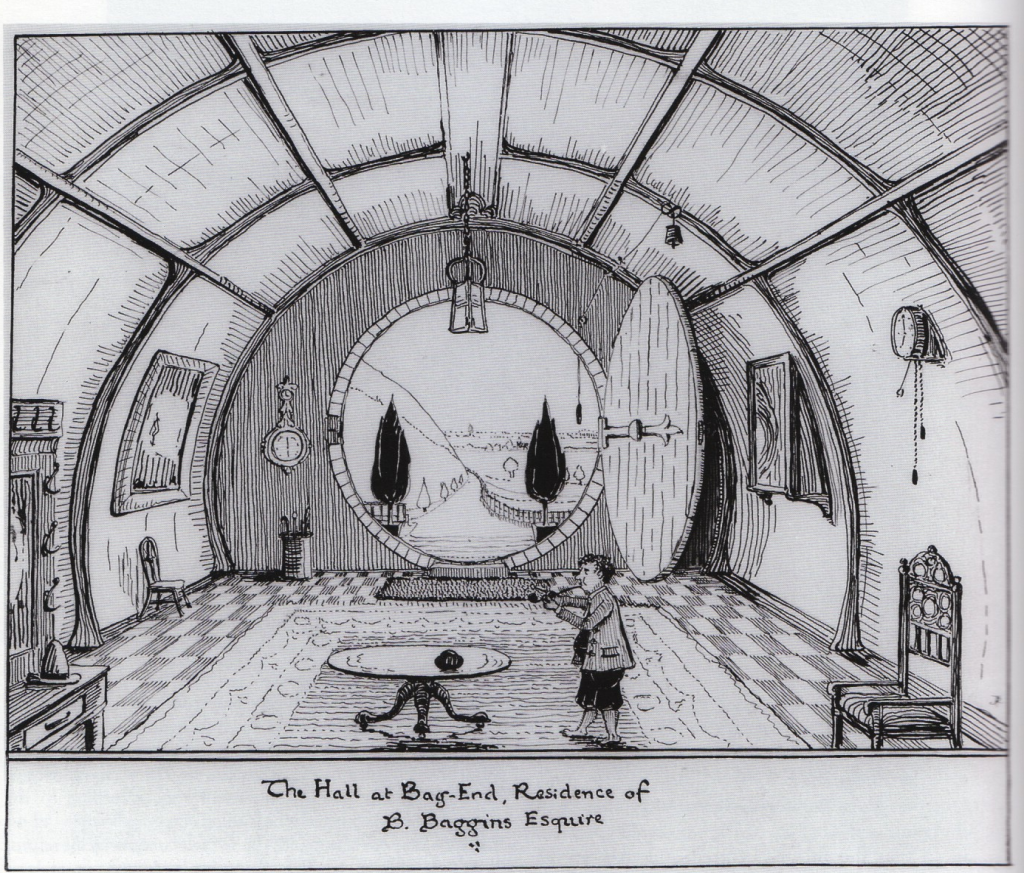
That Bilbo was a well-off individual, living in a rather luxurious dwelling, to begin with,

(JRRT)

and then being called “a shop assistant” or the equivalent, we can see why:

“The Took side had won.  He suddenly felt he would go without bed and breakfast to be thought fierce.  As for little fellow bobbing on the mat it almost made him really fierce.”

And so Bilbo was on his way to becoming the burglar Gandalf had advertized him to be. 

(Alan Lee)

Thanks for reading, as ever.

Stay well,

Be wary of eavesdropping on dwarves,

And remember that, as always, there’s

MTCIDC

O

PS

If you’d like to read about a completely different burglar, (someone Tolkien could easily have read about), you might try A.J. Raffles, an “amateur cracksman”—that is, a gentleman burglar–created by E.W. Hornung (1866-1921), the brother-in-law of Arthur Conan Doyle—with The Amateur Cracksman, 1899, here:  https://archive.org/details/amateurcracksma03horngoog/page/n9/mode/2up

Dos Mackaneeks

26 Wednesday Jun 2024

Posted by Ollamh in Uncategorized

≈ Leave a comment

Tags

Fantasy, lord-of-the-rings, The Lord of the Rings, Tolkien, Writing

Welcome, as always, dear readers.

Star Wars:  the Phantom Menace

certainly begins with a bang:  a Jedi and his padawan, sent on a peace mission to the planet Naboo, are attacked by poisoned gas and droids

(reminding me at once of those lines from Weird Al Jankovic’s song:

“But their response, it didn’t thrill us

They locked the doors and tried to kill us”

If you don’t know “The Saga Begins”, you can watch it here:  https://www.youtube.com/watch?v=hEcjgJSqSRU )

but escape to the surface only to be almost squashed in an invasion of droid armor

before they rescue an unlikely helper (right out of Thompson’s Motif-Index of Folk-Literature B350-B390, “Grateful Animals”),

who takes them to an underwater city where they come before Boss Nass, who blames upperworlders for the invasion

and responds to their warning that, after they finish with the upperworlders, the invaders will be coming for those below the water:

“Dos mackaneeks no comen here.  Dey not know of usen.”

The Gungans (which is what these people call themselves) are sophisticated technologically enough to have an underwater city

and self-propelled transport,

and they even can produce an energy shield,

but faced with the armament of the invading droid army—

and its hordes of infantry,

their use of energy balls (“boomas”)

and shields

which bear a faint resemblance to Celtic shields in some clear material

show them to be really no match for the droids and their technology.  Only luck from the outside saves them.

The Gungans are brave and their weapons can cause some damage, but it’s obvious that they’re outclassed technologically, which makes me think of the Aztecs, the center of whose capital, Tenochtitlan, built in the middle of a lake, was a series of sophisticated and elegant stone buildings (complete with an aqueduct),

but who, unfortunately for them, were a late Neolithic culture who, with no metal with which to work, made their weapons using volcanic glass, obsidian, which was sharp,

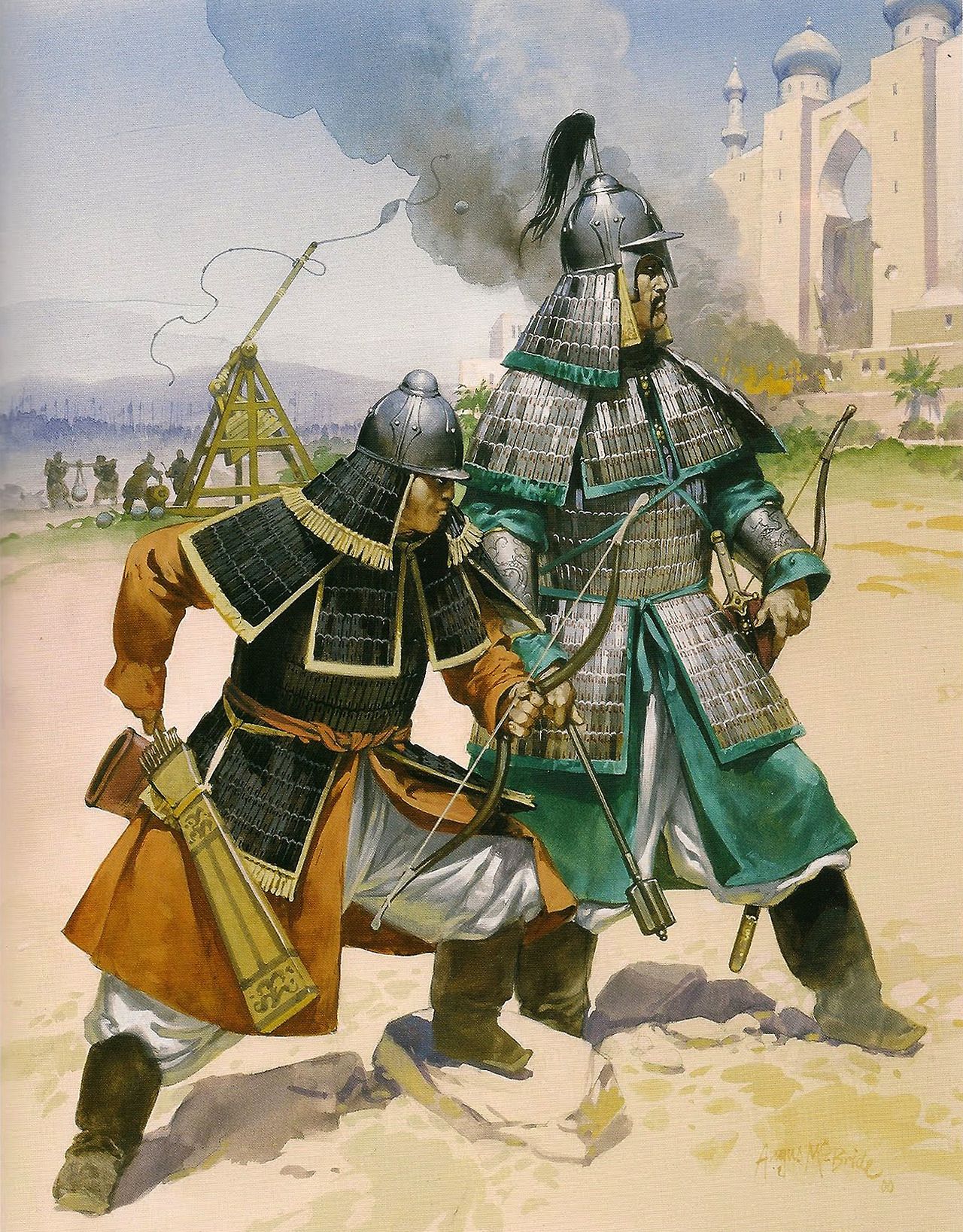
(this and the next by Angus McBride)

but no match for the conquistadores’ steel weapons, armor, and early firearms.

And this brings me to a “what if”.

When Helm’s Deep is attacked,

(JRRT)

the orcs’ original method is perhaps the worst in the repertoire:  escalade—that is, putting ladders up against a wall, then climbing up them.  You can imagine why I call it the worst—

the attackers are visible all the way up the ladders and:

1. they can be pushed off

2. the ladders can be pushed off

3. people can whack you when you reach the top

4. people can shoot you on the way up

5. people can drop things on you on the way up

(In several historical assaults, ladders were found to be too short, adding an extra difficulty.)

Such attacks usually only succeed if:

1. they are a surprise  (this happened at the terrible siege of Badajoz in 1812—the French garrison was too focused in one direction and some of the British attackers climbed up the back of the fortress–)

2. the attackers can pin down enough of the defenders with archery/gunfire to allow the climbers to reach the top—and an attack can still fail if those at the top aren’t supported by others coming up behind them—Alexander the Great almost died when he was isolated after scaling an enemy wall (reinforcements overburdened the ladders and they broke—see Arrian The Anabasis of Alexander, Book VI, Sections 9-10—which you can read in translation here:  https://www.gutenberg.org/cache/epub/46976/pg46976-images.html#Page_329  )

The orcs, however, are concealing a secret weapon—

“Even as they spoke there came a blare of trumpets.  Then there was a crash and a flash of flame and smoke.  The waters of the Deeping-stream poured out hissing and foaming:  they were choked no longer, a gaping hole was blasted in the wall.  A host of dark shapes poured in.

‘Devilry of Saruman!’ cried Aragorn.  ‘They have crept in the culvert again, while we talked, and they have lit the fire of Orthanc beneath our feet.’ “  (The Two Towers, Book Three, Chapter 7, “Helm’s Deep”)

And it’s not just Saruman’s “Devilry”—

“The bells of day had scarcely rung out again, a mockery in the unlightened dark, when far away he saw fires spring up, across in the dim spaces where the walls of the Pelennor stood.  The watchmen cried aloud, and all men in the City stood to arms.  Now ever and anon there was a red flash, and slowly through the heavy air dull rumbles could be heard.

‘They have taken the wall!’ men cried.  ‘They are blasting breaches in it.  They are coming!’ “ (The Return of the King, Book Five, Chapter 4, “The Siege of Gondor”)

I think that we can assume that “the fire of Orthanc” is, in fact, gunpowder.

In our Western world, the first known mention of it was by Friar Roger Bacon in the mid-13th century,

and the first known depiction of a gunpowder weapon dates from the early 14th century.

The only uses in The Lord of the Rings are for what would be called, in later times, “mines”.  In our Middle-earth, medieval technology further developed the use of gunpowder into bigger, deadlier forms—early cannon, called “bombards”

and miniaturized them as “handgonnes”.

(Liliane and Fred Funcken)

What if Saruman—and Sauron—had had time to develop their “fire of Orthanc”?

This is how we usually see orcs and their armament—all medieval—spears, swords, bows.

(Alan Lee)

Suppose, however, that there had been further armament.  Imagine orcs with handgonnes, for example.

And, instead of massive stone-throwers employed to break down the walls of Minas Tirith—also a medieval weapon—

giant bombards.

It was weapons like these, in 1453, which broke holes in the ancient walls of Constantinople,

allowing the Turkish besiegers to enter a place which only once before, in its 1000 year plus history, had been broken into.

And why stop there? 

Leonardo da Vinci (1452-1519)

was born only the year before the fall of Constantinople, just at the very end of the Western Middle Ages.  In 1487, he sketched this—

which, in terms of much of its technology, was possible in 1487, although it would have been more than a little crowded inside with all of those guns, especially when they jerked backwards in the recoil which would have come with firing them.  Fortunately for the West, da Vinci doesn’t appear to have figured out a useful way of propelling his invention

and it was only in the early 20th century that the internal combustion engine could be employed to move such a metal monster.

Consider, however, if the opponents of the West in the later Third Age had developed what clearly they had begun.  Seeing such approaching, on foot or, worse, in an armored vehicle, what could Rohirrim or Gondorians have done beyond believing what Qui Gon had tried to warn Boss Nass about:

Dos Mackaneeks!

Thanks, as always, for reading.

Stay well,

Remember the places where tanks are vulnerable,

and remember, as well, that there’s always

MTCIDC

O

How Stands the Glass Around?

29 Wednesday May 2024

Posted by Ollamh in Uncategorized

≈ Leave a comment

Tags

Fantasy, J.R.R. Tolkien, lord-of-the-rings, The Hobbit, Tolkien

As always, dear readers, welcome.

I admit that the title of this posting, upon further reading, may seem a little deceptive.  It’s the title of a (perhaps) early 18th-century English song, sometimes called “General Wolfe’s Song” because, somehow, a story appeared that General James Wolfe (1727-1759)

(by George Townshend, 1724-1807, one of Wolfe’s senior officers, who disliked him, but did this little watercolor which, to me, looks much more like the real man than the formal portraits we normally see)

sang it before his death (and victory) at Quebec, in 1759.  (This appears to have had no basis in fact, but has been repeated more than once, in various books about English popular song.)

(by Edward Penny, 1763?—this, one of several versions of the picture by the painter, is in the Fort Ligonier museum in Ligonier, Pennsylvania)

The tune, at least, appears to be some years older, the first citation I can find is to a song from Thomas Odell’s (1691-1749) ballad opera The Patron (1729), where the tune for the lyric is given as that of “Why, Soldiers, Why”, which is the beginning of the second verse.  (For the first two verses, see:  https://tunearch.org/wiki/Annotation:Why_Soldiers_Why%3F    The tune may be older yet, as there’s a 1712 broadside entitled “The Duke of Marlborough’s Delight” set “to a new tune” which has similar lyrics—see the text here:  http://ballads.bodleian.ox.ac.uk/static/images/sheets/20000/16153.gif  You can hear the tune to “Why, Soldiers, Why” here:  https://www.youtube.com/watch?v=-VxlkhsOcRI )

The glass I want to talk about is, in fact, both related to the lyric, with its “Let mirth and wine abound”, and another kind of glass entirely.

When the dwarves overwhelm Bilbo’s house, in the first chapter of The Hobbit (“An Unexpected Party”—which is, in fact, a pun—JRRT admits, in a letter to Deborah Webster 25 October, 1958,  Letters,    to having a simple, hobbit sense of humor—not only is a party a festivity—although this one, for Bilbo was far from it—but, in older English, “party” can also mean “a person”—so that “unexpected party/person is presumably Gandalf, as it’s in the singular),

(Alan Lee)                                                                                                                          

they mock his discomfort in a clean-up song which begins:

“Chip the glasses and crack the plates!”

and this made me wonder:  The Hobbit, like The Lord of the Rings, is set in a pre-industrial—really, medieval—world:  what kind of glasses might these be?

Glass, as a material, is much older than the western Middle Ages.  As you might expect from something which may have originated in the middle of the 3rd millennium BC (2500BC?—there’s lots of on-line discussion, but see, for example:  https://www.smithsonianmag.com/science-nature/a-brief-scientific-history-of-glass-180979117/  ), there has been much scholarly debate on the subject, but let’s go with that rough date for the present.

A combination of silica sand,

lime,

(powdered, of course)

and sodium carbonate,

(plus lots of other elements for various additional properties—see for more:  http://www.historyofglass.com/glass-making-process/glass-ingredients/ )

when heated to about 2400 degrees Fahrenheit (about 1315C), produces a moldable, shapeable liquid.

(For an experiment on making early glass, see:  https://www.youtube.com/watch?v=Lg7kZpTVoms This is from a YouTube series called “How to Make Everything” and, if you’re like me, interested in all early technologies, definitely recommended.  There’s an interesting suggestion there, as well, that glass may have been an accidental byproduct of early metal-working.) 

The first surviving glass seems to be beads–

these are Mesopotamian, but found in a grave in Denmark, showing just how extensive early trade networks were.

The Egyptians went into the glass business at some point,

and, eventually, the later Assyrians even produced the first known glass-making manual in the reign of King Ashurbanipal (reigned 669-631BC)—you can read about it here:  https://historyofknowledge.net/2018/12/05/you-us-and-them-glass-and-procedural-knowledge-in-cuneiform-cultures/  and read a translation of the cuneiform tablets on which it was written here:  https://www.nemequ.com/texts )

The Romans produced some rather amazing creations in glass,

as well as the first window glass.

(For how Romans made window glass, see:  http://www.theglassmakers.co.uk/archiveromanglassmakers/articles.htm#No  This is actually a small collection of interesting articles.  Scroll to the last to see the specific piece about window glass.)

Even after the change in the western Roman empire from imperial rule to Germanic kingdoms and their later successors, the art of glass-making was never lost, but it appears that the older method of making larger panes may have been, since medieval domestic windows used smaller pieces of glass framed in metal, called “mullioning”—

and this was only for the very wealthy.  This leads me to wonder about:

“The best rooms were all on the left-hand side (going in), for these were the only ones to have windows, deep-set round windows looking over his garden, and meadows beyond, sloping down to the river.”  (The Hobbit, Chapter One, “An Unexpected Party”)

(JRRT)

Is this hobbit mullioning?  Other buildings in the Shire look to have had ordinary glass windows, as in—

“…some new houses had been built:  two-storeyed with narrow straight-sided windows, bare and dimly lit, all very gloomy and un-Shirelike.”

and

“The Shirriff-house at Frogmorton was as bad as the Bridge-house.  It had only one storey, but it had the same narrow windows…”

I suspect that what Tolkien had in mind was something like these Victorian railway workers’ houses,

as mentioned earlier:

“Worse, there was a whole line of the ugly new houses all along Pool Side…”

(All of these grim quotations are from The Return of the King, Book Six, Chapter 8, “The Scouring of the Shire”)

Clearly, “Shirelike” means windows of an entirely different design—and that means round, as Tolkien’s own view towards Bag End shows us—

(JRRT)

(Although you can see, by the way, in this earlier sketch, that Tolkien had not originally decided upon the window-shape consistency of the later illustration, or on the true meaning of “Shirelike”.)

But, though a window plays an important part in recruiting a crucial member of the Fellowship of the Ring:

“Suddenly he stopped as if listening.  Frodo became aware that all was very quiet, inside and outside.  Gandalf crept to one side of the window.  Then with a dart he sprang to the sill, and thrust a long arm out and downwards.  There was a squawk, and up came Sam Gamgee’s curly head hauled by one ear.”  (The Fellowship of the Ring, Book One, Chapter 2, “The Shadow of the Past”)

(Artist?  I’m always glad to credit one, but I’m stumped here.)

the glasses which the dwarves threaten to chip are clearly of the drinking variety. 

I imagine that the glasses in the Tolkien household looked like this

or, for more formal occasions, like this

and what JRRT drank from at The Eagle and Child (aka “The Bird and Baby”) or The Lamb and Flag would have been something like this–

But that’s the first half of the 20th century. 

Could we see this actual medieval glass as a model?

It seems awfully dainty and, remembering the dwarves’ demands for what seems like endless rounds of food and drink, however, perhaps it wasn’t chipped glasses which Bilbo should worry about at all, but dented tankards!

Thanks, as ever, for reading.

Stay well,

When necessary, sing quietly to yourself, “Ho, ho, ho, To the bottle I go…”,

And remember that, as always, there’s

MTCIDC

O

PS

As you can tell, the history of glass—and windows—is long and complicated.

See this for more on glass:  https://en.wikipedia.org/wiki/History_of_glass

And this on windows:  https://en.wikipedia.org/wiki/Window

Orc Logistics

07 Tuesday May 2024

Posted by Ollamh in Uncategorized

≈ Leave a comment

Tags

Fantasy, J.R.R. Tolkien, lord-of-the-rings, The Lord of the Rings, Tolkien

As always, dear readers, welcome.

Sauron, although he rather rashly placed much of his power (as well as his life force) in what is, basically, a magic ring, has always struck me as rather a practical person when it comes to war and foreign affairs.  In order to conquer the West, he’s:

1. turned his rather bleak realm into a giant military camp

2. brought back the final destroyer of Arnor, the Witch King of Angmar, as his chief lieutenant

3. made treaties with peoples to the east and south to bolster his already extensive armies and cleverly turned pirates loose to raid the southern shores of Gondor to distract his opponents and force them to divide their forces

4. corrupted one of the West’s traditional allies, Saruman, turning him into a kind of “Mini Me”


5. weakened another, Rohan, through a spy in the king’s court, Grima, who has somehow turned that king into a prematurely-aged man

6. worked on the mind of the commander of Gondor, Denethor, using an ancient communications device, making him suspicious of his younger son and promoting a defeatist attitude

As well, he seems quite aware of what we call geo-politics, as we see in his demands at the Black Gate:

“ ‘The rabble of Gondor and its deluded allies shall withdraw at once beyond the Anduin, first taking oaths never again to assail Sauron the Great in arms, open or secret.  All lands east of the Anduin shall be Sauron’s for ever, solely.  West of the Anduin as far as the Misty Mountains and the Gap of Rohan shall be tributary to Mordor, and men there shall bear no weapons, but shall have leave to govern their own affairs.  But they shall help to rebuild Isengard which they have wantonly destroyed, and that shall be Sauron’s and there his lieutenant shall dwell:  not Saruman, but one more worthy of trust.”  (The Return of the King, Book Five, Chapter 10, “The Black Gate Opens”)

Reading this passage, however, I’m puzzled:

“Time passed.  At length watchers on the walls could see the retreat of the out-companies.  Small bands of weary and often wounded men came first with little order; some were running wildly as if pursued.  Away to the eastward the distant fires flickered, and now it seemed that here and there they crept across the plain.  Houses and barns were burning.  Then from many points little rivers of red flame came hurrying on, winding through the gloom, converging towards the line of the broad road that led from the City-gate to Osgiliath.”  (The Return of the King, Book 5, Chapter 4, “The Siege of Gondor”)

As we know, JRRT himself had been a soldier, though perhaps a reluctant one,

and thus would have been well aware of the saying, sometimes attributed to Napoleon, that “an army marches on its stomach”.  In 1916, such an army needed massive supply dumps,

which needed railroads to bring food and ammunition to them.

From there, wagons

and, in time, early trucks,

then mules and horses would have taken supplies farther forward

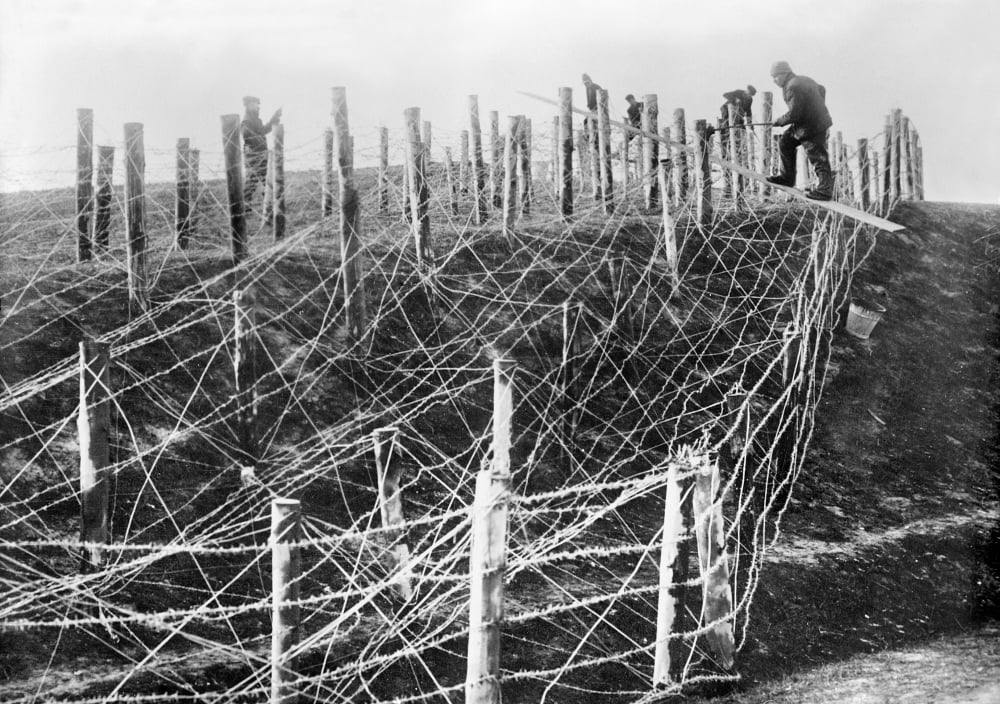
and, from there, the troops themselves might have formed what were called “carrying parties”.

Image7:  carrying

(This is actually a “wiring party”, with its “screw pickets”, which were twisted into the ground and used to hold up the barbed wire, but it can stand in for a “carrying party”.  For more on “wiring parties”, see:  https://en.wikipedia.org/wiki/Wiring_party  )

One fact alone might suggest how big the task of keeping the British Army supplied :  “By 1918, the British were sending over 67 million lbs (30 million kg) of meat to the Western Front each month.”  (This is from an article entitled “The Food That Fuelled the Front” from the Imperial War Museum website, which you can see here:  https://www.iwm.org.uk/history/the-food-that-fuelled-the-front  )

This was a vast, modern army, with all the modern technology available in 1918 to enable resupply (such supplying is called “logistics”).  Sauron’s army is of a much earlier time, its basis seemingly infantry, armed with swords, spears, and bows,

(Alan Lee)

assisted by a certain number of oliphaunts,

(Alan Lee)

horsemen,

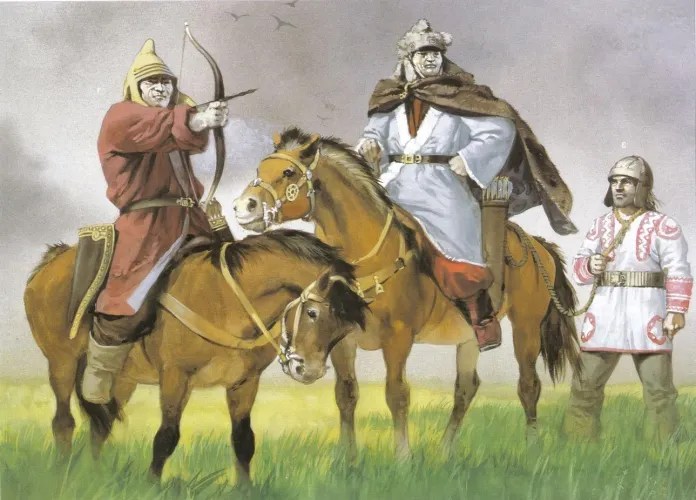
(These are actually Mongols, but all the text says is “Before them went a great cavalry of horsemen moving like ordered shadows…”  The Two Towers, Book Four, Chapter 8, “The Stairs of Cirith Ungol”, leaving it up to us to imagine what they might have looked like.)

and perhaps a warband of wargs,

(Artist?)

yet its basic needs would have been the same as those of the British Army in which Tolkien served.

To provide a parallel a bit closer to The Lord of the Rings, we might imagine an earlier army, like the army of New Kingdom Egypt

as we might have seen it marching to fight the Hittites

(Angus McBride)

at the Battle of Kadesh, in the summer of 1274BC. 

No oliphaunts or cavalry (or wargs) in support, but definitely chariots, maybe 2000 of them.

(Again, Angus McBride, one of my favorite military artists of the 20th century). 

The Egyptian army of Rameses II

may have numbered about 20,000, with as many as 4,000 chariot horses, and here are some potential logistic figures for such an earlier army—

Thinking of water alone, the average modern horse will drink 5-10 gallons (19-38 ltrs) of water a day, depending on working conditions, and that same horse needs to eat 15-20 pounds  (7-9 kg) of hay.  An average present-day American eats about 5.5  pounds (2.5 kg) of food per day and drinks 2 quarts (2 ltrs) of water.  On the one hand, ancient Egyptians were somewhat smaller than we are and probably less well-fed to begin with, but, on the other, that water requirement is an average and doesn’t factor in  marching for miles on dusty summertime roads in the Middle East.

Could Rameses’ army have carried enough supplies with it for the long march (perhaps about 500 miles—about 805km)?  Rameses would have had available to him no trains or trucks, but the ancient Egyptians had carts (probably pulled by oxen, as were their plows)

and certainly used pack mules.

As to possible baggage camels,

there is a lot of scholarly argument about their use.  Although camel remains (a few depictions, bones, rope from camel hair) are there, there doesn’t appear to be any clear evidence for the use of camels as carriers until much later.  Food—the ordinary Egyptian diet was simple, including barley bread

and beer (also made from barley),

so large supplies of barley flour might be carried, but how to carry—and preserve–beer?  Water could be substituted, but could it be carried?  Or would the Egyptians have done as armies have done throughout history and foraged, picking up supplies of food and drink from the locals, willingly or unwillingly?  Both Rameses II’s and Sauron’s armies had horses, but add oliphaunts in Sauron’s, and all in need of fodder, this would include, in season, cutting grass

and, in and out of season, probably looting barns and granaries, as well.

Consider, then, Sauron’s armies and the Pelennor into which they had broken. 

We don’t know their numbers, but it’s clear that they are enormous, far outnumbering the defenders of Minas Tirith.   And this is what puzzles me.  Tolkien was certainly aware of such needs in general—as he once wrote:  “I am not incapable of or unaware of economic thought…” (letter to Naomi Mitchison, 25 September, 1954, Letters, 292).   And yet—

“It drew now to evening by the hour, and the light was so dim that even far-sighted men upon the Citadel could discern little clearly out upon the fields, save only the burnings that ever multiplied, and the lines of fire that grew in length and speed.”

Perhaps the army brought some provisions with it (Saruman and Sauron’s orcs seem to have had something like field rations, as we learn after they carry off Merry and Pippin), but, if the siege of Minas Tirith had proved to be a long one, what would such a vast host and its beasts have eaten, having destroyed the nearest source of food and fodder?  We’ve seen that Sauron was shrewd and showed a great amount of foresight in his pre-war preparations, so my only answer is a question:   did JRRT, who certainly had a taste for the dramatic moment–think of the way in which the Rohirrim appear at the edge of the Rammas Echor–

deliberately sacrifice economics for drama?  We’ll probably never know for certain, but, if you stand for a moment, on the wall of the first circle of Minas Tirith in the darkness, and see those fires spread across the Pelennor…

As always, thanks for reading.

Stay well,

If you have a yen for conquest, remember to pack a lunch (with carrots for your horse, of course),

And remember that, as always, there’s

MTCIDC

O

Setting Boundaries

27 Wednesday Mar 2024

Posted by Ollamh in Uncategorized

≈ Leave a comment

Tags

books, Fantasy, J.R.R. Tolkien, lord-of-the-rings, Tolkien

Welcome, dear readers, as always.

“ ‘Behold the Argonath, the Pillars of the Kings!’ cried Aragorn…

As Frodo was born towards them the great pillars rose like towers to meet him.  Giants they seemed to him, vast grey figures silent but threatening.  Then he saw that they were indeed shaped and fashioned:  the craft and power of old had wrought upon them, and still they preserved through the suns and rains of forgotten years the mighty likenesses in which they had been hewn.  Upon great pedestals founded in the deep waters stood two great kings of stone:  still with blurred eyes and crannied brows they frowned upon the North.  The left hand of each was raised palm outwards in gesture of warning; in each right hand there was an axe; upon each head there was a crumbling helm and crown.  Great power and majesty they still wore, the silent wardens of a long-vanished kingdom…” (The Fellowship of the Ring, Book Two, Chapter 9, “The Great River”)

There are a number of illustrations of this, from the Hildebrandts

to John Howe

to Alan Lee

to J.C. Barquet

and more, including in Jackson’s The Lord of the Rings,

where, in the sometimes perverse method of the films, one figure has a sword, rather than the axe which Tolkien had specifically described (true of the Alan Lee sketch, as well).  Reviewing this short list, however, the first two of these seem to portray the kings with a more peaceably raised left hand, whereas the others more clearly portray what the author wanted:  “The left hand of each was raised outwards in a gesture of warning…”

These figures, in fact, are boundary markers, set up by the Gondorian king Minalcar (later crowned as Romendacil II) some time during his regency (TA1240-1304—see The Lord of the Rings, Appendix A, (ii) “The Southern Line[:] Heirs of Anarion” and (iv) “Gondor and the Heirs of Anarion”) and the gesture is clearly meant as a warning to potential invaders.

More than once, in past postings, I’ve suggested influences upon Tolkien, from The Red Fairy Book of his childhood,

to Mussolini as a possible Saruman model.

In this posting, however, I’m moving forward, perhaps seeing a Tolkien model for something erected long after Tolkien’s death in 1973.

It begins with a bit of history in JRRT’s lifetime.

At the end of the Great War (aka “World War I”), the Middle East, the majority of it the fading Ottoman Empire, was very much in flux, with France and Britain struggling diplomatically to extend their influence over Syria, Lebanon, and the area then known as Palestine, as well as farther inland.  (For more on this, see David Fromkin’s The Peace to End All Peace, 1989,

and Sean McMeekin’s The Ottoman Endgame, 2016)

Farther north, and encouraged by the victorious Allies, Greece had invaded Turkey, hoping to expand Greece beyond its current boundaries.

This led to a number of bloody encounters between the two sides, with the Greeks advancing to within 50 miles (80km) of the capital at Ankara in the late summer of 1921 before being stopped at the climactic battle in the area of the Sakarya River.  When the Greeks finally withdrew, they had suffered 23,000 casualties (plus perhaps as many as 15,000 prisoners) against Turkish totals of 22,000 casualties and 1,000 prisoners.  This withdrawal turned into a scorched earth retreat towards the Aegean coast and ultimate evacuation of the Greek army along with thousands of civilians from Asia Minor.  (For more see:  https://www.historynet.com/the-battle-that-made-kemal-ataturk/ ) 

In 2015, the Turkish government established the Battle of Sakarya National Historic Park, but, in 2008, several private companies had already commemorated the battle by commissioning a statue of a Turkish infantryman to be placed on a height (Karaltepe) looking westward in the direction from which the Greek army had come.

 It’s not a boundary marker, per se, as the Argonath is meant to be, but, by marking the line of Turkish resistance to the Greek invasion, it has somewhat of the same effect.  And, though not gigantic, like the Gondorian figures, it’s over 100 feet (31m) tall on its base and the pose certainly reminds me of what Frodo sees in the river ahead,

even if it doesn’t produce the same emotional reaction as it did members of the Fellowship:

“Awe and fear fell upon Frodo, and he cowered down, shutting his eyes and not daring to look up as the boat drew near.  Even Boromir bowed his head as the boats whirled by, frail and fleeting as little leaves, under the enduring shadow of the sentinels of Numenor.”

Had the designers of the Turkish monument read The Fellowship of the Ring, or perhaps had seen the Jackson movie?

Thanks for reading, as ever.

Stay well,

What ancient monument might awe you?

And remember that, as always, there’s

MTCIDC

O

ps

In answer to my own question, I’ve always loved this—

It’s often called “the mourning Athena”, but I imagine that the goddess isn’t grieving, but reading a boundary stone and, armed with helmet and spear, seems ready to defend her city from any who would violate that boundary.  It’s nowhere near the monumental size of those images discussed above, being only about 1 ½ feet (.48m) high, but, with a goddess, does size matter?

Seem Fairer

06 Wednesday Mar 2024

Posted by Ollamh in Uncategorized

≈ Leave a comment

Tags

books, Fantasy, J.R.R. Tolkien, lord-of-the-rings, Tolkien

As ever, dear readers, welcome.

If you flip to the back of The Letters of J.R.R. Tolkien,

and page through the index to the aitches, you’ll find five references to Adolf Hitler.  The first, to his son, Michael, simply mentions the idea that Hitler must soon attack Britain (letter to Michael Tolkien, 12 January, 1941, Letters, 64).  The third is to another son, Christopher, and makes a brief reference to Stalin and Hitler (letter to Christopher Tolkien, 22 August, 1944, Letters, 131).  Both of these are neutral in tone.  The second, however, has more the tone of a rant:

“Anyway, I have in this War a burning private grudge—which would probably make me a better soldier at 49 than I was at 22:  against that ruddy little ignoramus Adolf Hitler (for the odd thing about demonic inspiration and impetus is that it in no way enhances the purely intellectual stature:  it chiefly affects the mere will).”  (letter to Michael Tolkien, 9 June, 1941, Letters, 77)

And the fourth and fifth (in the same letter) have a similar tone:

“We knew that Hitler was a vulgar and ignorant little cad, in addition to any other defects (or the source of them)…” (letter to Christopher Tolkien, 23-25 September, 1944, Letters, 133)

Both of which are entirely understandable, of course.  In terms of his family, two of his sons were involved in the Second World War, Michael as an anti-aircraft gunner, Christopher as a pilot, and Tolkien worried very much about both, as various letters to them make very plain.

That “burning private grudge”, however, was about something entirely different—and characteristic of JRRT—was his anger at the Nazi perversion of what he thought of as “that noble northern spirit”, as he says in that letter to Michael:

“Ruining, perverting, misapplying, and making for ever accursed, that noble northern spirit, a supreme contribution to Europe, which I have ever loved and tried to present in its true light.”

This being under the direction of:

“…a man inspired by a mad, whirlwind, devil:  a typhoon, a passion:  that makes the poor old Kaiser look like an old woman knitting.”

For all that Tolkien descends to name-calling (not his usual method of dealing with whom or what he doesn’t like), there is a certain—I won’t call it respect—but wary awe of someone he calls a “mad, whirlwind, devil” and, as always when I think about JRRT, his time, and his influences, I wonder about how he his impression of that “vulgar and ignorant little cad”—and “whirlwind devil”—might have influenced his work.

Germany after the Great War was economically and socially in ruins.  The 1919 Treaty of Versailles, blaming Germany for the war and designed to exact severe punishment for that, had done much to put her in that condition.

When Germany was unable to pay the amount demanded on time, parts of western Germany were then occupied by several of the Allies.

Bankruptcy, monetary depreciation,

and ideas of revolution swirled—including a brief attempt at revolution in Munich, in 1923.

The leader of this attempt was an ex-serviceman named Hitler.

With a sympathetic court, instead of being executed for treason, he was given a light sentence and soon was out on the streets again, presenting himself not as a violent revolutionary, but as a reformer, someone who was working to bring his country back from the wreckage it has suffered from war, a brutal treaty, a ruined economy, and social unrest (some of which he himself had inspired—and would continue to inspire).

In time, he was so successful at this that he became his country’s director, under the very neutral title of Fuehrer, “Leader” and the economy did improve, living conditions did improve—

but under all of this improvement was something else and here I’m immediately reminded of Sauron:

“Sauron was of course not ‘evil’ in origin…until he became the main representative of Evil of later ages.  But at the beginning of the Second Age he was still beautiful to look at, or could still assume a beautiful visible shape—and was not indeed wholly evil, not unless all ‘reformers’ who want to hurry up with ‘reconstruction’ and ‘reorganization’ are wholly evil, even before pride and the lust to exert their will eat them up.” (draft of a letter to Peter Hastings, September, 1954, Letters, 284)

“But many of the Elves listened to Sauron.  He was still fair in that early time, and his motives and those of the Elves seemed to go partly together:  the healing of the desolate lands.  Sauron found their weak point, suggesting that, helping one another, they could make Western Middle-earth as beautiful as Valinor.” (to Milton Waldman, typescript, “late 1951”, Letters, 212)

And here are the consequences:

“[Sauron] lingers in Middle-earth.  Very slowly, beginning with fair motives:  the reorganizing and rehabilitation of the ruin of Middle-earth, ‘neglected by the gods’, he becomes a reincarnation of Evil, and a thing lusting for Complete Power—and so consumed ever more fiercely with hate (especially of gods and Elves).  All through the twilight of the Second Age the Shadow is growing in the East of Middle-earth, spreading its sway more and more over Men…” (to Milton Waldman, typescript, “late 1951”, Letters, 211)

The title of this posting, as I’ll bet you all know, is part of a remark which Frodo makes just after Strider has appeared and approached him at The Prancing Pony in Bree:

(the Hildebrandts)

“You have frightened me several times tonight, but never in the way that the servants of the Enemy would, or so I imagine.  I think that one of his spies would—well, seem fairer and feel fouler, if you understand.”

To which Strider makes a reply one would never expect Hitler—or Sauron– to have made—

“ ‘I see,’ laughed Strider.  ‘I look foul and feel fair.  Is that it?’ “

As always, thanks for reading.

Stay well,

When it comes to reformers, it might always be wise to question their ultimate motives,

And remember that, as always, there’s

MTCIDC

O

The Unquiet of the World

29 Thursday Feb 2024

Posted by Ollamh in Uncategorized

≈ Leave a comment

Tags

Fantasy, J.R.R. Tolkien, literature, lord-of-the-rings, Tolkien

As always, dear readers, welcome.

We know that Tolkien had mixed feelings about allegory.  As he wrote in a long, detailed description of his work to Milton Waldman in 1951:

“I dislike Allegory—the conscious and intentional allegory—yet any attempt to explain the purport of myth or fairytale must use allegorical language.  (And, of course, the more ‘life’ a story has the more readily will it be susceptible of allegorical interpretations:  while the better a deliberate allegory is made the more nearly will it be acceptable just as a story.)” (from the typescript of a letter to Milton Waldman, late in 1951, Letters, 204)

This has made me think about Saruman and the Shire.

Defeated at the end of the Second Age, it’s easy to see from a map why Sauron returned to Mordor as his refuge.

It’s clearly a natural fortress, protected on three sides by forbidding mountain ranges pierced by only two gates, the Morannon

(the Hildebrandts)

and Minas Morgul (formerly Minas Ithil).

(another Hildebrandts)

His command center, the Barad-dur, was located there.

(and yet another Hildebrandts)

Sited near an active volcano, Mt. Doom,

(This is actually Villarrica in Chile erupting in March, 2015.)

it was also a blighted land, nearly waterless and bleak.

(This is the Parque Nacional de Timanfaya on the island of Lanzarote in the Canary Islands.  As someone who loves the US Southwest, I find this place absolutely stunning, but, imagining it marched across by companies of orcs and suffered across by Sam and Frodo, it might easily stand in for Mordor.)

Although at the time of The Lord of the Rings it has become a vast camp,

filled with all of the tents and workshops and stables which an army like Sauron’s would require, I have no sense that it was ever anything more than as it must have looked even in the Second Age:  bleak and waterless and dominated to the north by Mt Doom, a vast volcanic plain.  Sauron hadn’t intended to blight it.  Nature had already made it that way and it was useful for what he required:  protection from prying eyes and invading troops and space to spread his growing forces.  (Although I wonder about his water supply—Sam and Frodo are lucky to find the trickle they do—and even “dark pools fed by threads of water trickling down from some source higher up the valley”—by the western mountain wall—The Return of the King, Book Six, Chapter 2, “The Land of Shadow”.  Food seems to have been supplied by slave farms to the south and southeast, also briefly described in this chapter.  Ever-practical Sam wonders about all of this:  “ ‘Pretty hopeless, I call it—saving that where there’s such a lot of folk there must be wells or water, not to mention food.’ “ )

In contrast, there was the Shire—

(JRRT)

As Tolkien imagined it:

“The Shire is placed in a water and mountain situation and a distance from the sea and a latitude that would give it a natural fertility, quite apart from the stated fact that it was a well-tended region when they [the hobbits] took it over…” (letter to Naomi Mitchison, 25 September, 1954, Letters, 292)

It was based, as he stated more than once, on

“…a Warwickshire village of about the period of the Diamond Jubilee [the 60th anniversary of Queen Victoria’s ascension to the throne, 1897]…” (letter to Allen & Unwin, 12 December, 1955, Letters, 334)

which, although the actual village, Sarehole, was just south of the booming manufacturing center of Birmingham, Tolkien describes this world as “…in a pre-mechanical age.”  (letter to Deborah Webster, 25 October, 1958, Letters, 411)

And, to Tolkien, this was

“…in the quiet of the world, when there was less noise and more green…” (The Hobbit, Chapter One, “An Unexpected Party”)

But then Saruman arrives, telling the hobbits:

“ ‘One ill turn deserves another…It would have been a sharper lesson, if only you had given me a little more time and more Men.  Still I have already done much that you will find it hard to mend or undo in your lives.  And it will be pleasant to think of that and set it against my injuries.’ ” (The Return of the King, Book Six, Chapter 8, “The Scouring of the Shire”)

It’s clear from the description given us in “The Scouring of the Shire”, however, that what Saruman intends isn’t just wanton destruction, but something more complex:  a complete reorganization of the Shire.  Part of that is a social restructuring, where a form of communism is forced upon the population.  Monitoring that is the apparatus of a police state, with many rules, a curfew, and a number of the hobbits themselves being recruited to the “Shirriffs”.   But there’s more:

“The pleasant row of old hobbit-holes in the bank on the north side of the Pool were deserted, and their little gardens that used to run down bright to the water’s edge were rank with weeds.  Worse, there was a whole line of the ugly new houses all along Pool Side, where the Hobbiton Road ran close to the bank.  An avenue of trees had stood there.  They were all gone.  And looking with dismay up the road towards Bag End they saw a tall chimney of brick in the distance.  It was pouring out black smoke into the evening air.”

Thus, what Saruman was clearly intending wasn’t just desolation, like Mordor, but rather something more like the imaginary Coketown of Charles Dickens’ Hard Times, 1854:

“It was a town of red brick, or of brick that would have been red if the smoke and ashes had allowed it; town of machinery and tall chimneys, out of which interminable serpents of smoke trailed themselves for ever and ever, and never got uncoiled.  It had a black canal in it, and a river that ran purple with ill-smelling dye, and vast piles of building full of windows where there was a rattling and a trembling all day long, and where the piston of the steam-engine worked monotonously up and down, like the head of an elephant in a state of melancholy madness.  It contained several large streets all very like one another, and many small streets still more like one another, inhabited by people equally like one another, who all went in and out at the same hours, with the same sound upon the same pavements, to do the same work, and to whom every day was the same as yesterday and to-morrow, and every year the counterpart of the last and the next.”   (Hard Times, Chapter 5, “The Keynote” which you can read here:  https://www.gutenberg.org/files/786/786-h/786-h.htm )

Tolkien more than once lamented the passing of the “quiet of the world” and his Shire, which he described in a letter as “where an ordered, civilized, if simple and rural life is maintained” embodied for him that quiet.  (from that same letter to Milton Waldman, late 1951, Letters, 219)

And so, although JRRT wrote, in a letter to the editor of New Republic, Michael Straight, that:

“There is no special reference to England in the ‘Shire’…there is no post-war reference.”

at the same time, he adds:

“…the spirit of ‘Isengard’, if not of Mordor, is of course always cropping up.” (draft of a letter to Michael Straight, “probably January or February 1956, Letters, 340)

We know what that spirit is inspired by, as Treebeard tells us:

“He has a mind of metal and wheels; and he does not care for growing things, except as far as they serve him for the moment.” (The Two Towers, Book Three, Chapter 4, “Treebeard”)

Isengardism—or Sarumanism (a word JRRT himself employs in that same letter to Naomi Mitchison quoted above, saying that he is not a ‘reformer’ (by exercise of power) since it seems doomed to Sarumanism”) to Tolkien meant brutal change—in this case, in the conversion of the Shire into a mini-industrial state, run by a Stalinist tyrant and a cowed population.  Considering Tolkien’s sadness at the conversion of the rural world of his childhood into the industrial world of his present, might we not then see what Saruman does to the Shire as rather like allegory as Tolkien once defined it:

“Of course, Allegory and Story converge, meeting somewhere in Truth.”?  (letter to Sir Stanley Unwin, 31 July, 1947, Letters, 174)

Thanks, as ever, for reading.

Stay well,

Think green thoughts,

And remember that, as always, there’s

MTCIDC

O

← Older posts
Newer posts →

The Doubtful Sea Series Facebook Page

The Doubtful Sea Series Facebook Page

  • Ollamh

Categories

  • Artists and Illustrators
  • Economics in Middle-earth
  • Fairy Tales and Myths
  • Films and Music
  • Games
  • Heroes
  • Imaginary History
  • J.R.R. Tolkien
  • Language
  • Literary History
  • Maps
  • Medieval Russia
  • Military History
  • Military History of Middle-earth
  • Narnia
  • Narrative Methods
  • Poetry
  • Research
  • Star Wars
  • Terra Australis
  • The Rohirrim
  • Theatre and Performance
  • Tolkien
  • Uncategorized
  • Villains
  • Writing as Collaborators
Follow doubtfulsea on WordPress.com

Across the Doubtful Sea

Recent Postings

  • 1002? June 3, 2026
  • Making Money May 27, 2026
  • Blood Money May 20, 2026
  • Saruman’s Sigh May 13, 2026
  • Silents Are Golden May 7, 2026
  • Planting April 29, 2026
  • Subterranean April 22, 2026
  • Serendipity? April 15, 2026
  • Serendipity April 8, 2026

Blog Statistics

  • 114,509 Views

Posting Archive

  • June 2026 (1)
  • May 2026 (4)
  • April 2026 (5)
  • March 2026 (4)
  • February 2026 (4)
  • January 2026 (4)
  • December 2025 (5)
  • November 2025 (4)
  • October 2025 (5)
  • September 2025 (4)
  • August 2025 (4)
  • July 2025 (5)
  • June 2025 (4)
  • May 2025 (4)
  • April 2025 (5)
  • March 2025 (4)
  • February 2025 (4)
  • January 2025 (5)
  • December 2024 (4)
  • November 2024 (4)
  • October 2024 (5)
  • September 2024 (4)
  • August 2024 (4)
  • July 2024 (5)
  • June 2024 (4)
  • May 2024 (5)
  • April 2024 (4)
  • March 2024 (4)
  • February 2024 (4)
  • January 2024 (5)
  • December 2023 (4)
  • November 2023 (5)
  • October 2023 (4)
  • September 2023 (4)
  • August 2023 (5)
  • July 2023 (4)
  • June 2023 (4)
  • May 2023 (5)
  • April 2023 (4)
  • March 2023 (5)
  • February 2023 (4)
  • January 2023 (4)
  • December 2022 (4)
  • November 2022 (5)
  • October 2022 (4)
  • September 2022 (4)
  • August 2022 (5)
  • July 2022 (4)
  • June 2022 (5)
  • May 2022 (4)
  • April 2022 (4)
  • March 2022 (5)
  • February 2022 (4)
  • January 2022 (4)
  • December 2021 (5)
  • November 2021 (4)
  • October 2021 (4)
  • September 2021 (5)
  • August 2021 (4)
  • July 2021 (4)
  • June 2021 (5)
  • May 2021 (4)
  • April 2021 (4)
  • March 2021 (5)
  • February 2021 (4)
  • January 2021 (4)
  • December 2020 (5)
  • November 2020 (4)
  • October 2020 (4)
  • September 2020 (5)
  • August 2020 (4)
  • July 2020 (5)
  • June 2020 (4)
  • May 2020 (4)
  • April 2020 (5)
  • March 2020 (4)
  • February 2020 (4)
  • January 2020 (6)
  • December 2019 (4)
  • November 2019 (4)
  • October 2019 (5)
  • September 2019 (4)
  • August 2019 (4)
  • July 2019 (5)
  • June 2019 (4)
  • May 2019 (5)
  • April 2019 (4)
  • March 2019 (4)
  • February 2019 (4)
  • January 2019 (5)
  • December 2018 (4)
  • November 2018 (4)
  • October 2018 (5)
  • September 2018 (4)
  • August 2018 (5)
  • July 2018 (4)
  • June 2018 (4)
  • May 2018 (5)
  • April 2018 (4)
  • March 2018 (4)
  • February 2018 (4)
  • January 2018 (5)
  • December 2017 (4)
  • November 2017 (4)
  • October 2017 (4)
  • September 2017 (4)
  • August 2017 (5)
  • July 2017 (4)
  • June 2017 (4)
  • May 2017 (5)
  • April 2017 (4)
  • March 2017 (5)
  • February 2017 (4)
  • January 2017 (4)
  • December 2016 (4)
  • November 2016 (5)
  • October 2016 (6)
  • September 2016 (5)
  • August 2016 (5)
  • July 2016 (5)
  • June 2016 (5)
  • May 2016 (4)
  • April 2016 (4)
  • March 2016 (5)
  • February 2016 (4)
  • January 2016 (4)
  • December 2015 (5)
  • November 2015 (5)
  • October 2015 (4)
  • September 2015 (5)
  • August 2015 (4)
  • July 2015 (5)
  • June 2015 (5)
  • May 2015 (4)
  • April 2015 (3)
  • March 2015 (4)
  • February 2015 (4)
  • January 2015 (4)
  • December 2014 (5)
  • November 2014 (4)
  • October 2014 (6)
  • September 2014 (1)

Blog at WordPress.com.

  • Subscribe Subscribed
    • doubtfulsea
    • Join 75 other subscribers
    • Already have a WordPress.com account? Log in now.
    • doubtfulsea
    • Subscribe Subscribed
    • Sign up
    • Log in
    • Report this content
    • View site in Reader
    • Manage subscriptions
    • Collapse this bar

Loading Comments...