• About

doubtfulsea

~ adventure fantasy

Tag Archives: Gondor

Spare Change?

19 Wednesday Apr 2017

Posted by Ollamh in Economics in Middle-earth, J.R.R. Tolkien, Literary History, Narrative Methods

≈ Leave a comment

Tags

1909 penny, Abraham Lincoln, Alexander the Great, Aragorn, Asia Minor, Augustus, bartering, Bilbo's birthday, British Royal Government, Brutus, Charlemagne, Classical Greek coins, Cleopatra VII, Coinage, daggers, Denethor, Domitian, Egypt, federal law, Frankish king, freedman, George Washington, Gondor, Greek Kings, Hanoverian kings, Hellenistic Greeks, Holy Roman Emperor, Ides of March, Julio-Claudian dynasty, Julius Caesar, libertus, Lucius Plaetorius Cestianus, Lydia, manumission, Middle-earth, Pennies, pilleum, Plebeians, portrait, Prince Charles, Ptolemy I, Queen Elizabeth II, Roman Empire, Romans, Seleucus, Senatus Consulto, The Lord of the Rings, Tolkien

Welcome, dear readers, as always.

We are veering a little to the left in this posting inspired by a comment on “Shire Portrait (2)” from our good friend, EMH. It was about currency and coins in Middle-earth and we were a little vague, but E pointed out:

  1. Bilbo giving “a few pennies away” before the party
  2. the price of Bill, the pony: “twelve silver pennies”
  3. Gandalf praising Barliman and saying his news was “worth a gold piece at the least.”

With E in mind, we decided to do another posting on M-e money. Long ago, we did a posting on imagined currency in Middle-earth, but, since then, we’ve thought a bit more about the subject, and, right now, dear readers, we ask you to produce a coin, any coin. As we live in the US, here’s a US coin, a fourth of a dollar, hence, a “quarter”.
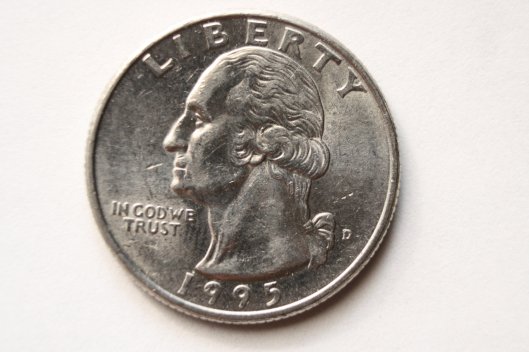
image1quarterobverse.jpg

This is the front, or “obverse” in coin speech, and we’re going to focus on that and not on the back (the “reverse”).  We use coins all day long every day, so we probably don’t look at them more than to note value when we pay for something or receive change, but let’s look at this one a bit more closely.

It seems pretty simple:

  1. at the top a single word, “Liberty”
  2. then a low relief (that is, cut very shallowly) portrait of the first president, General George Washington
  3. then, to the left, a slogan, “In God We Trust”
  4. at the bottom, the date, 1993

Let’s start with that date—1993. In 1993, the president was Bill Clinton.

image2clinton.jpg

Federal law, however, prevents coins—with very special and rare exceptions—to bear the portraits of living people. The first president on a coin was Abraham Lincoln, on a penny first minted to commemorate his 100th birthday, in 1909.
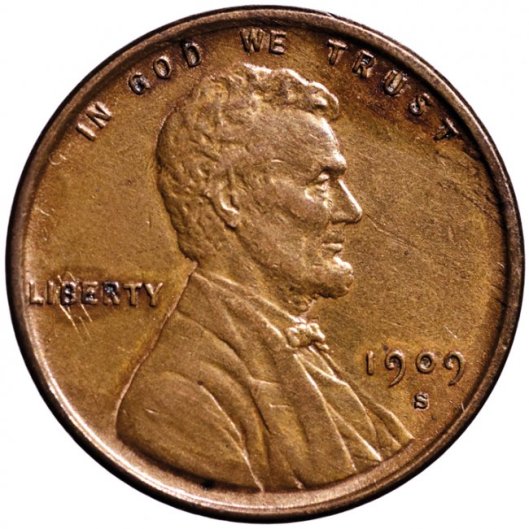
image31909penny.jpg

The previous coin, up to 1909, had the idealized head of a Native American,
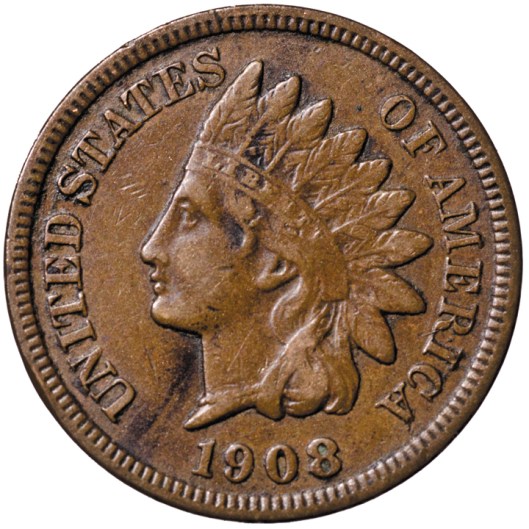
image41908indianhead.JPG

the pattern for which was first introduced in 1859.

image51859indianhead.jpg

The first coin in western European history is from the late 8th century BC, and comes from Lydia, in Asia Minor.
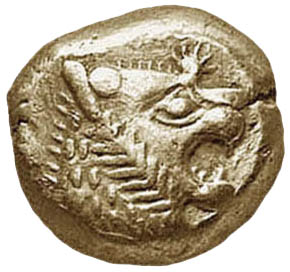
image6lydiancoin.jpg

Classical Greek coins seem to model themselves on Lydian coins like this, having badges–city emblems and religious tokens, like the famous Athenian owl, rather than portraits of humans, like that quarter with George Washington on it.

image7owlcoin.jpg

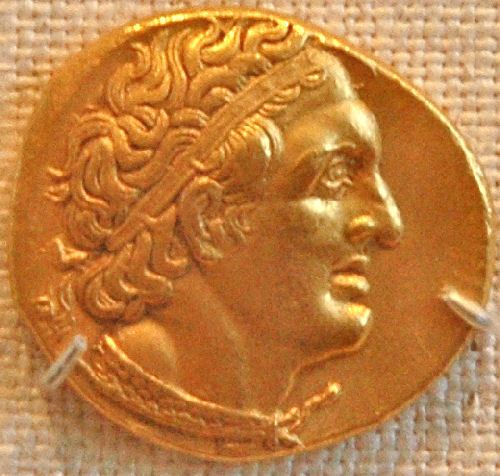
During the Hellenistic Period (post about 300bc and on), however, the Greek kings, from Greece to Asia Minor to Egypt, all began to issue coins with portraits of themselves. These were, initially, the generals of Alexander the Great, who, at Alexander’s death, had grabbed portions of his empire for themselves. We think of Seleucus, who controlled much of Asia Minor
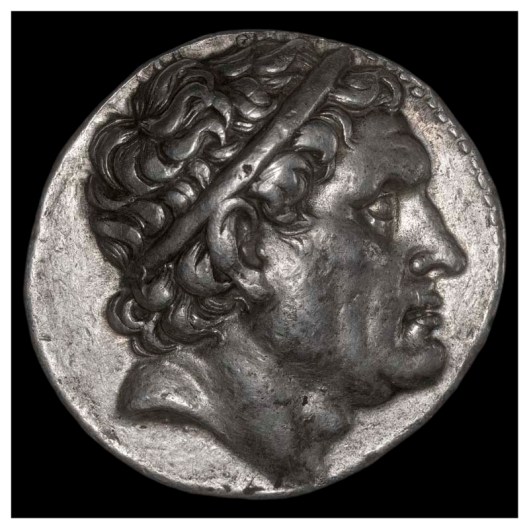
image8seleucus.jpg

Or of Ptolemy I,

image9ptolemy1.JPG

the founder of a dynasty which ruled Egypt for nearly 300 years until their final descendant, Cleopatra VII, was defeated by the Romans.

image10cleopatravii.jpg

Those Romans, we imagine inspired by the Hellenistic Greeks, produced coins by the bushel .(this is an obsolete dry measurement, based upon what you can put into a basket like this:

image11bushelbasket.jpg

which was, in fact, made up of four pecks

image12peck.jpg

which could also be divided into two kennings of two pecks apiece.)

Considering that Rome produced coins from the late 4th century bc to late in the 5th century ad, it’s not surprising that there would be so many—and considering the size of the Roman empire, as well.

image13coins.jpg

Earlier Roman coins had been unlike Hellenistic coins, however, in not depicting living people—that is, until Julius Caesar gained power.
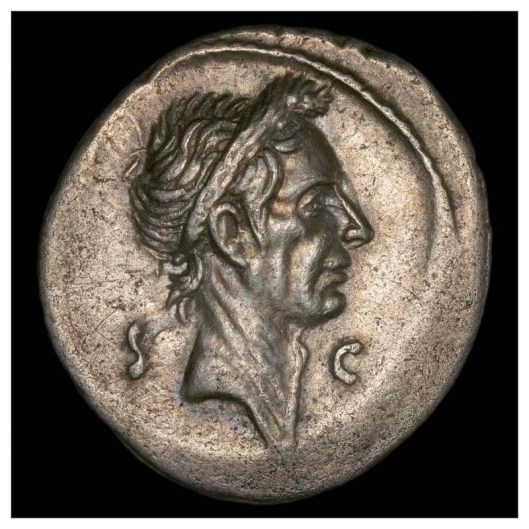
image14jc.jpg

This opened the floodgates and it’s easy to see why.

Coins are short-hand wealth, originally standing in for earlier barter items, like flocks and herds.
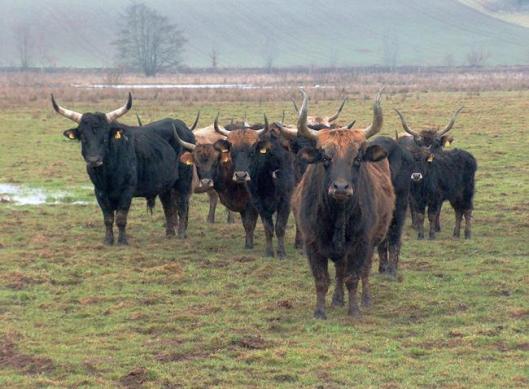
image15cattle.jpg

As Romans spread out beyond farms and local markets, the wealth in animals and agricultural produce, as well as raw materials, was simply not portable enough, as this cartoon shows.

image16barter.jpg

By making tokens which were accepted as a stand- in for that wealth, the agency which did so was asserting its claim to have a strong hand in, if not control of, the economy.

Julius Caesar, who had already forced the Senate to make him “Dictator for Life” (that “S…C” on both sides of his profile stands for “Senatus Consulto”—“by a decree of the Senate”), by putting his face on the currency is implying that he now is the state—and therefore possesses a power which extends to regulating the money economy by which people live and survive or prosper. (There may be a quiet joke here, as well. “SC” was stamped on bronze coins to guarantee their worth—on the back side—to have those letters surrounding Caesar on the front side, the obverse, may suggest a double meaning: he is dictator by Senatorial decree, but his worth is also being guaranteed by that decree.)

It is no surprise, then, that Brutus, one of those who murdered Caesar, would, in turn, issue his own coins—and these are even more heavily symbolic.

image17brutuscoin.png

On the obverse, there is Brutus, his name above, to our right his title “imp[erator]”—a title given to a general by his soldiers with the implication “You rule!” To our left is an abbreviated form of the name of the moneyer, the man who directed the mint, L[ucius] Plaet[orius] Cest[ianus]. Although we said that we would only examine obverses, we can’t resist the reverse here. At the bottom is the inscription, “eid mar”, standing for “eides Martis”, the “Ides of March”, the 15th of March, the day Caesar was murdered. Above that is a “pilleum”, the kind of cap worn by a slave during the ceremony called “manumission”, in which a he was turned into a “libertus”, or “freedman”.
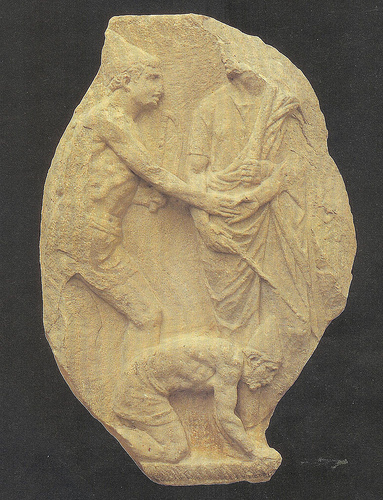
image18manumission.jpg

To both sides of the cap are daggers.

image19pugio.jpg

Put all of this together and we see Brutus’ claim: on the 15th of March, we murdered Caesar and, as a consequence, we freed Rome from its slavery.

Coins like Caesar’s and Brutus’ are simple in their claims. Later emperors were less so. Look at this coin of Domitian (81-96ad).
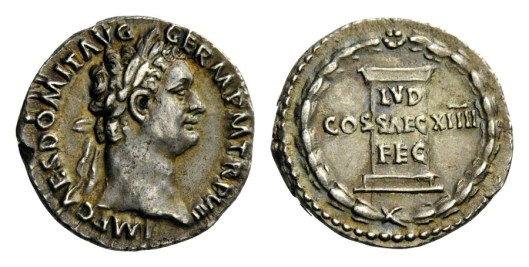
image20domitian.jpg

On the rim of the obverse is a pile of information:

Imp[erator] Caes[ar] Domit[ianus] Aug[ustus] Germ[anicus] P[ontifex] M[aximus] Tr[ibunicia P[otestas] VIII

“Emperor Caesar Domitianus Augustus Germanicus, Chief Priest of Rome, Holding the Power of the Representative of the People 8 Times”

In fact, Domitian was sailing under false colors—Caesar, Augustus, and Germanicus all belong to the earlier Julio-Claudian dynasty, of which his family was not a part. As for “Holding the Power of the Representative of the People”, this was an ancient elective office, which allowed a member of the lower class, the Plebeians, special powers in the legislative process. As emperor and son of an emperor most of a century after elections had been abolished, this looked like an honor, but was just an empty title. “Chief Priest” had once been an extremely important position in the state, but, from the time of the first emperor, Augustus, it had simply become another title emperors claimed.

Later European rulers, eager to suggest that they were as powerful as the ancient Romans, used Roman coins as a model. Here’s one from Charlemagne, Frankish king and first Holy Roman Emperor (768-814).
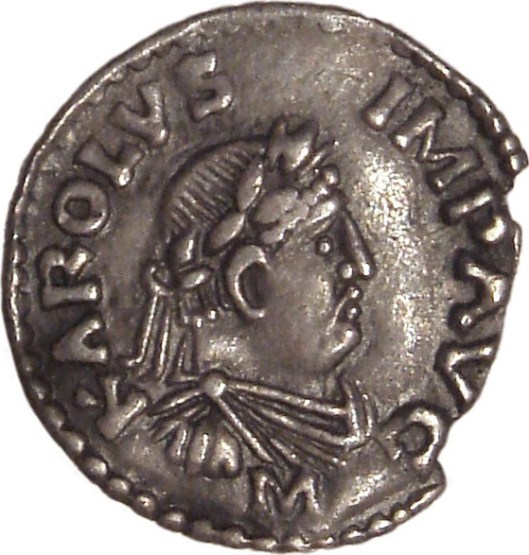
image21charlemagne.jpg

Returning to our George Washington quarter,

image22gw.jpg

let’s look at the comparatively meager inscriptional material. If the coin of Domitian had so much to tell us about how important he was, the inscription on the quarter has a very different message, its focus being upon cultural values: 1.freedom; 2. religion. In our culture, probably everyone would agree with 1, but our ancestor/founders were very adamant on the subject of keeping church and state completely apart, with no influence of either upon the either, so that that 2, “In God We Trust”, shows that there is some confusion about those values. In any case, the plainness might remind us of Caesar’s coin more than Domitian’s, but, in both cases, the point of the artwork and labeling is to put the government’s stamp, whether republic or empire, upon the everyday life of everyone who buys and sells.

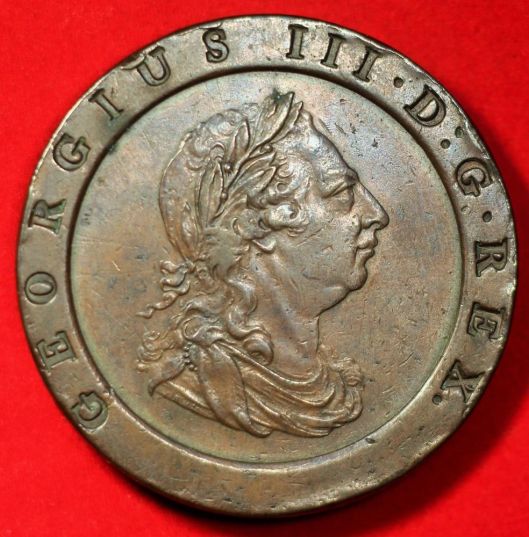
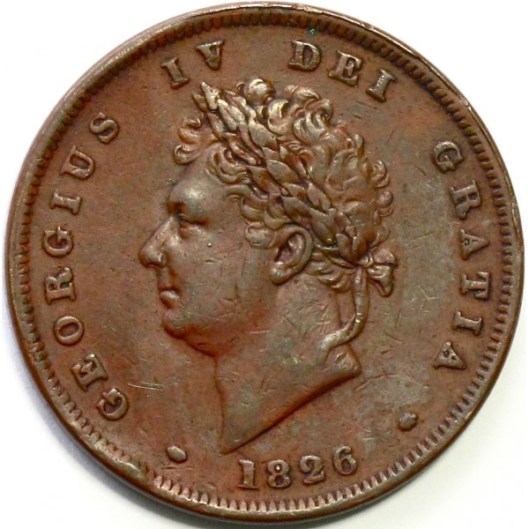
There is another message to be read here, as well. The George Washington quarter was first issued on Washington’s 200th birthday, in 1932, and is still on the obverse of the quarter, suggesting the continuity of what he stood for. In the case of monarchs, however, each new emperor/king/queen demands the issuing of new coinage, with the new ruler’s portrait, suggesting not only royal government continuity, but also, in some cases royal family continuity. Here are the first four Hanoverian kings of England, for example, all sons or grandsons, from 1714 to 1830.
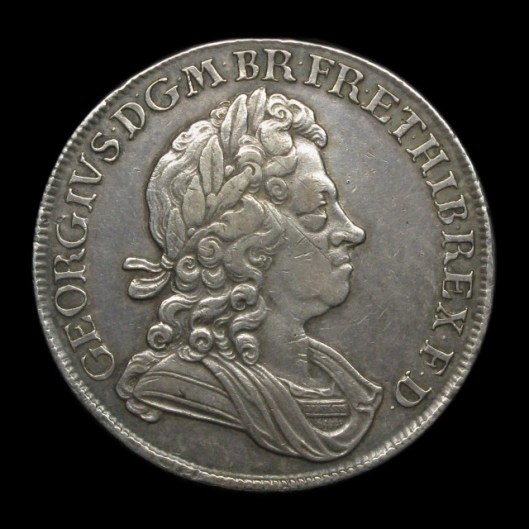
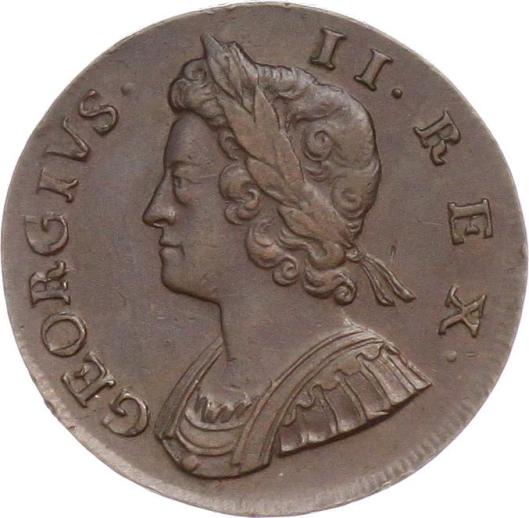
image23geo1.jpg

image24geo2.jpg


image25geo3.jpg

image26geo4.jpgSo, When Prince Charles succeeds his mother, Elizabeth II,
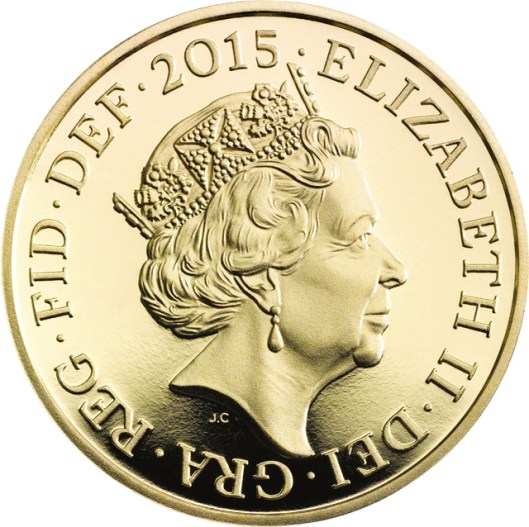
image27liz2.jpg

new coins will have to be minted.

And this brings us back to Middle-earth and to a puzzle about Gondor. There are certainly coins, as our good friend has thoughtfully pointed out. There has been no king on the throne of Gondor for many centuries, however. If Denethor’s behavior is anything to go by, the Stewards have become kings in everything but title, even though Denethor avoids the royal throne. If everyone from the Hellenistic kings to Elizabeth II has his/her portrait on the coinage, are the Stewards on Gondor’s? And what happens when Aragorn becomes King Aragorn II Elessar?

MTCIDC

CD
When One Door Closes.4

30 Wednesday Nov 2016

Posted by Ollamh in Imaginary History, J.R.R. Tolkien, Literary History, Maps, Uncategorized

≈ Leave a comment

Tags

Alfred Lord Tennyson, Cirith Ungol, doors, Gilbert and Sullivan, Gondor, Grond, Hobbit door, James Fennimore Cooper, Minas Morgul, Minas Tirith, Morannon, Mordor, N.C. Wyeth, Nazgul, Orodruin, Princess Ida, Shelob's Lair, The Last of the Mohicans, The Lord of the Rings, The Princess, The Siege of Gondor, Tolkien

Welcome, as always, dear readers. In this posting, we’ll complete our survey of doors and entryways and what happens at them in The Lord of the Rings.

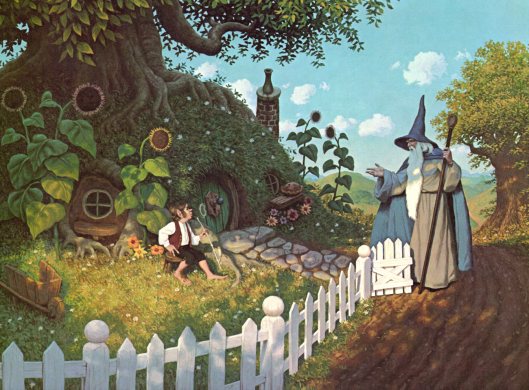
We began this series a little while ago when we got to thinking about Bilbo’s remark to Frodo that: “It’s a dangerous business, Frodo, going out your door.”

Bilbo had learned this the hard way when Gandalf had come to his door and he had embarked upon an adventure he, originally, had no desire to be part of.

gandalfvisitsbilbo

In three postings, we’ve followed the story through doors and entryways from that moment all the way to the moment when Gandalf blocks the Lord of the Nazgul from entering Minas Tirith through its ruined main gate.

mcbridegandalflordofnazgul.gif

In the process, we have come to see that doors and entryways seem to come in two forms: first, there are doors which lead to safety; second, there are doors which lead to danger. We’ve added other elements, natural entryways, like fords and bridges, and the fact that many of the entryways have challenges and challengers barring the way.

In a moment of cheerful intellectual cruelty, we ended the last posting at that crucial moment in “The Siege of Gondor”, in which Grond, the battering ram of the armies of Mordor, has, with the magical aid of the Lord of the Nazgul, broken down the gate and that Lord is about to enter the city, when he meets Gandalf as the challenger:

“ ‘You cannot enter here,’ said Gandalf, and the huge shadow halted. ‘Go back to the abyss prepared for you! Go back! Fall into the nothingness that awaits you and your Master. Go!’ ”

And, just at that moment, “Great horns of the North wildly blowing. Rohan had come at last.”

rohirrim.jpg

[We wondered, by the way, if that “Great horns of the North wildly blowing” was an accidental or deliberate allusion to a lyric from Alfred Lord Tennyson’s

tennysonyoung.jpg

poetic criticism of the idea of women’s education, The Princess (1847),

prncss.jpg

in which we find the line “The horns of Elfland faintly blowing”—here’s the whole poem:

from The Princess: The Splendour Falls on Castle Walls
By Alfred, Lord Tennyson
The splendour falls on castle walls
                And snowy summits old in story:
         The long light shakes across the lakes,
                And the wild cataract leaps in glory.
Blow, bugle, blow, set the wild echoes flying,
Blow, bugle; answer, echoes, dying, dying, dying.
         O hark, O hear! how thin and clear,
                And thinner, clearer, farther going!
         O sweet and far from cliff and scar
                The horns of Elfland faintly blowing!
Blow, let us hear the purple glens replying:
Blow, bugle; answer, echoes, dying, dying, dying.
         O love, they die in yon rich sky,
                They faint on hill or field or river:
         Our echoes roll from soul to soul,
                And grow for ever and for ever.
Blow, bugle, blow, set the wild echoes flying,
And answer, echoes, answer, dying, dying, dying.


This then formed the basis of an 1870 play by W.S. Gilbert, which he converted, with his collaborator, Arthur Sullivan, into an operetta, in 1884.]


Gilbert and Sullivan Cartoon.jpg

Princess-Ida-1884.jpg

For the Aragorn and company half of the story, we see the arrival of the army of Gondor and its allies at the Morannon as the last door.

morannon.1.gif

Here, there are, in fact, two challengers/challenges. First,

“When all was ordered, the Captains rode forth towards the Black Gate with a great guard of horsemen and the banner and heralds and trumpeters…They came within cry of the Morannon, and unfurled the banner, and blew upon their trumpets; and the heralds stood out and sent their voices up over the battlement of Mordor.” (The Return of the King, Book 5, Chapter 10, “The Black Gate Opens”)

In return,

“There came a long rolling of great drums like thunder in the mountains, and then a braying of horns that shook the very stones and stunned men’s ears. And thereupon the door of the Black Gate was thrown open with a great clang, and out of it there came an embassy from the Dark Tower.”

In both cases, it goes without saying that this is a door to danger, the difference being that those from Gondor want those within to come out so that, by defeating them (though they have little hope of this), those from Gondor can enter, while those within the gate want to prevent their entry (except, perhaps, as prisoners).

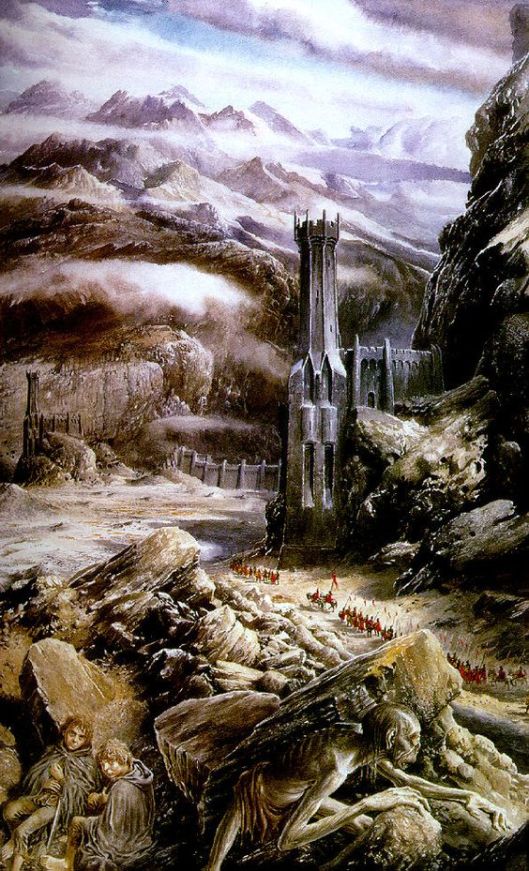
As we turn to the other half of the narrative, we begin at the same gate, where Gollum has brought Frodo and Sam.

alanleemorannon.jpg

Here, there is no easily visible challenger, just the forbidding nature of the gate, but it is still not an entryway to safety, as, on the other side is an inhospitable landscape, populated by Sauron’s vast armies, constantly on the move, as we see in later chapters. As well, from those later chapters, we gain the sense that Frodo doesn’t believe he’s going to return from Mordor anyway.

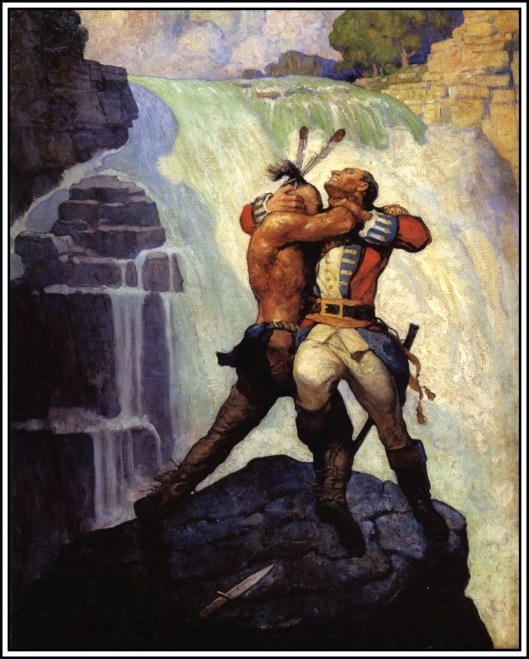
Seeing no way to enter, Frodo pushes Gollum to lead them south and, with a diversion to Faramir’s base behind a waterfall (which, to us, is reminiscent of a similar hide-out in James Fennimore Cooper’s The Last of the Mohicans (1826)

mohicansfirstedition.jpg

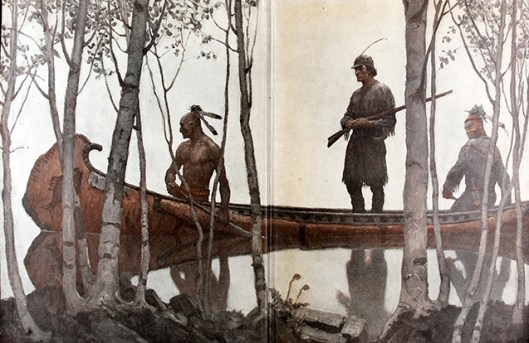
—and how can we resist mentioning that, in 1919, N.C. Wyeth illustrated an edition?)

05_lastofthemohicans_wyeth_glenfalls.jpg

wyethlast.jpg

they arrive at the southern entryway to Mordor, the pass with Minas Morgul at its western end and Cirith Ungol at its eastern.

Morgul2.jpg

WATCHERS.jpg

The challengers of Minas Morgul are the Lord of the Nazgul and a vast army, on their way to attack Minas Tirith, but these are skirted, as Gollum guides the two hobbits around the site and up on a perilous climb—and into Torech Ungol, Shelob’s Lair. Safety? Gollum wants the hobbits to think so. Danger? With Shelob as a challenger, what else?

shelob.jpg

Even as Sam drives Shelob off, however, he loses Frodo, paralyzed and cocooned, and is faced with an inner door closed by the orcs as they withdraw. Climbing over it, he moves forward, cloaked by the ring, to look out towards Orodruin and the Tower of Cirith Ungol.

cirith-ungol2

And, with this, we have finished our survey.

Unless, of course, we consider two more events.

First, there is what happens at Mount Doom, where Gollum is the challenger, and the door, such as it is, leads to safety for Middle-earth, but not for Sam and Frodo.

gollum__s_dance_by_01gus01-d4rmt18.jpg

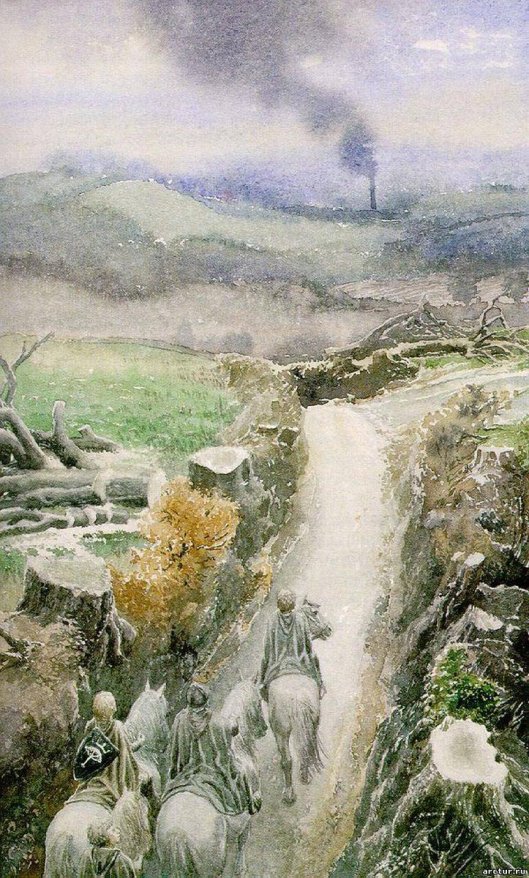
And, finally, at the edge of the Shire, in “The Scouring of the Shire”, where the returning hobbits meet with the followers of “Sharkey” at the bridge. Those followers, brain-washed by fear of “The Chief” and his “big man” followers, attempt to deny what should be a door to safety to Frodo, Merry, and Pippin, as the three had expected, but which leads, in fact, to conflict and open violence before their return home is safely accomplished.

scouringoftheshire.jpg

With that, we complete the pattern and here is our chart:


Entryway Source Challenger Challenged Outcome
Bilbo’s door The Hobbit Bilbo Dwarves Bilbo is tricked into hospitality
Beorn’s house The Hobbit Beorn Gandalf Beorn tricked into hospitality
Goblin cave The Hobbit Goblins Bilbo Escapes by use of the Ring
Mirkwood The Hobbit Elves Dwarves/Bilbo Bilbo rescues dwarves with Ring and barrels
Lonely Mountain (Back door) The Hobbit Smaug Dwarves/Bilbo Understanding the inscription, Dwarves open the door
Lonely Mountain (Front door) The Hobbit Dwarves Men, Elves, Goblins Battle of the Five Armies—eventual settlement
Bilbo’s door The Hobbit Hobbits Bilbo Bilbo’s things are up for auctions—Bilbo gets most things back
Ford of Bruinen The Lord of the Rings Wraiths Frodo/Elves After Frodo’s challenge, elf magic overwhelms wraiths
Moria (west gate) The Lord of the Rings Elves of Hollin Fellowship Gandalf discovers password—the group enters
Lothlorien (western side) The Lord of the Rings Elves Fellowship Challenged by elves, but allowed to enter
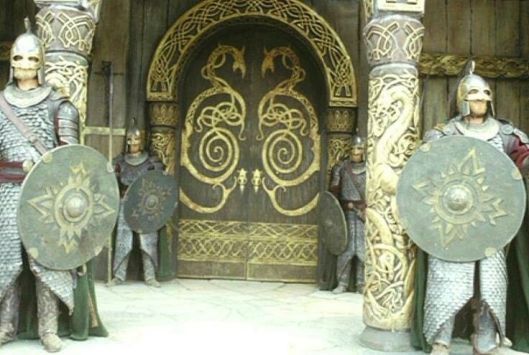
Edoras The Lord of the Rings Rohirrim Gandalf et al. Challenged by gate guards, but allowed to enter
Meduseld The Lord of the Rings Hama Gandalf et al. Challenged, but allowed to enter
Helms Deep The Lord of the Rings Aragorn Orcs/Wildings Aragorn warns them of their danger
Isengard The Lord of the Rings Merry/Pippin Gandalf et al. Greeted and offered food, drink, and smoke
Paths of the Dead The Lord of the Rings Oath-breakers Aragorn at al. Allowed to enter, but followed—leave safely
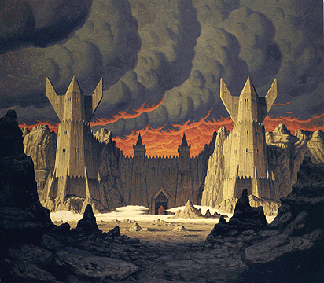
Morannon The Lord of the Rings Sauron King Elessar et al. Sauron’s army appears for battle
Morannon The Lord of the Rings Sauron Frodo/Sam/Gollum No way of entry—the three head south
Minas Morgul The Lord of the Rings Lord of Nazgul Frodo/Sam/Gollum Entry blocked by Lord’s Army
Torech Ungol The Lord of the Rings Shelob Frodo/Sam Gollum escapes, Frodo paralyzed by Shelob
Cirith Ungol The Lord of the Rings Orcs Sam With Ring as aid, Sam enters
Mt. Doom The Lord of the Rings Gollum Frodo Gollum gains Ring, but perishes in fire
Shire bridge The Lord of the Rings Hobbits Frodo et al. Hobbits climb over gate, guards run


Because this material becomes increasingly complex, there is always the possibility that, as thorough as we try to be and as inclusive, we’ve missed something. If so, we’d be glad to hear from our readers!

Thanks, as always, for reading!

MTCIDC

CD


When One Door Closes.3

23 Wednesday Nov 2016

Posted by Ollamh in J.R.R. Tolkien, Language, Literary History, Narrative Methods

≈ Leave a comment

Tags

Common Tongue, doors, Doorward, Edoras, Elvish, Fangorn Forest, Gandalf, Gondor, Hama, Helm's Deep, Isengard, John Ruskin, Meduseld, Minas Tirith, Moria, passages, Paths of the Dead, The Hobbit, The King of the Golden Hall, The King of the Golden River, The Lord of the Rings, Tolkien, Witch-King of Angmar

Welcome, dear readers, to the third part of our series on doors and entryways in JRRT’s The Hobbit and The Lord of the Rings.

We began, several postings ago, by writing that we were intrigued by Bilbo’s statement to Frodo: “It’s a dangerous business, Frodo, going out your door.” (The Fellowship of the Ring, Book 1, Chapter 3, “Three is Company”)

It made us want to look at doors (to which we quickly added entryways of all sorts) in Tolkien and, in doing so, we’ve come up with a very crude classification system, in which there were two kinds of doors, those which seemed to promise safety and those through which you might be in danger. And a major component of such places seems to be a challenge, and a challenger of some sort.

At the end of our second posting, we had come to the breaking up of the Fellowship and now we want to continue, having a look at what could be seen as good examples of what we mean along the way.

Because of the major split in the story, we decided to follow Aragorn, Gimli, and Legolas first.

The first part of their adventure takes place across open country or in Fangorn Forest. It’s only when they, with Gandalf, arrive at Edoras that we see the pattern fall into place.

But here we wondered if we should add an extra subcategory, linguistic challenge. We’ve already seen the western gates of Moria and the need to read Elvish and to know the word for friend, and now we have the gates of Edoras

Edoras.jpg

and a suspicious guard of Rohirrim:

“There sat many men in bright mail, who sprang at once to their feet and barred the way with spears. ‘Stay, strangers here unknown!’ they cried in the tongue of the Riddermark.” (The Two Towers, Book 3, Chapter 6, “The King of the Golden Hall”)

[We wonder, by the way, if the chapter’s title owes something to John Ruskin’s 1841/51 fairy tale “The King of the Golden River”, in which a major figure has been changed through evil magic, but is freed and eventually helps the underdog hero…]

King_of_the_Golden_River_-_Title_page.jpg

As he was (eventually) up to the challenge of the gate of Moria, so is Gandalf up to this and challenges them in return:

“ ‘Well do I understand your speech,’ he answered in the same language; ‘yet few strangers do so. Why then do you not speak in the Common Tongue, as is the custom in the West, if you wish to be answered?’ “

After a little parleying in this manner, Gandalf and his companions are allowed to enter and sent up to Meduseld, where there is a second challenger, the Doorward Hama.

Golden_Hall_of_Meduseld.png

meduseld.jpg

Here, after a brief repetition of the previous language challenge, things relax: “Then one of the guards stepped forward and spoke in the Common Speech.” After a tussle about leaving weapons behind (and Gandalf escapes this with his staff), they are permitted into the hall and the scene continues.

After the battle of Helm’s Deep, Denethor, Gandalf, and the rest of the company ride to Isengard, only to find there:

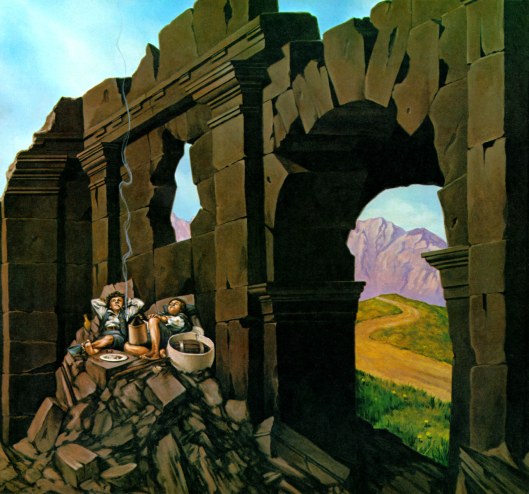
“…ruined gates. There they saw close beside them a great rubble-heap; and suddenly they were aware of two small figures lying on it at their ease, grey-clad, hardly to be seen among the stones. There were bottles and bowls and platters laid beside them…” (The Two Towers, Book 3, Chapter 8, “The Road to Isengard”)

merryandpippinatisengarde.jpg

It’s Merry and Pippin, of course, who describe themselves as “doorwardens”, just as Hama was at Meduseld. The difference is, instead of barring the door and challenging those who would enter, they are welcoming and comical in their lordly self-indulgence. This seems to turn the pattern on its head, and, although it’s the only time such a thing appears, we believe that it is an example of another subcategory, that of parody. It has the elements of other occasions, but, here, the door is a ruin and the guards seem slightly tipsy, rather than menacing, as well as very glad to see those who come to their ward.

In contrast to this merriness, there is stony silence at the next door:   The Paths of the Dead.

EntrancePathsDead-port.jpg

The challenge seems to be in the very air itself:

“And so they came at last deep into the glen; and there stood a sheer wall of rock, and in the wall the Dark Door gaped before them like the mouth of night. Signs and figures were carved above its wide arch too dim to read, and fear flowed from it like a grey vapour.” (The Return of the King, Book 5, Chapter 2, “The Passing of the Grey Company”)

It is Aragorn who accepts the challenge and leads the group through what, in the film, is a kind of funhouse of skulls and greenish figures,

dead.jpg

But, to us readers, what we think is much more disturbing is that there is no more than a restless murmur, which we hear through the dauntless, but quivering Gimli—

“…but if the Company halted, there seemed an endless whisper of voices all about him, a murmur of words in no tongue he had ever heard before.”

And, at the end of their passage, it is Aragorn who is the challenger—not to block those murmurers, but to invite them:

“ ‘Keep your hoards and your secrets hidden in the Accursed Years! Speed only we ask. Let us pass, and then come! I summon you to the Stone of Erech!’ “

We can see in this multiple ends: first, it fits the pattern of confrontations at doors (all feel the sense of Something There and must rise to the challenge, conquering their fear); second, it provides a route for Aragorn’s strategy: to gain supernatural allies on the way to natural ones along the southern seacoast; third, it underlines Aragorn’s right to the kingship: only he has the knowledge and authority to call up the long-dead for his purposes.

Our last challenge of this posting is at what is perhaps the most dramatic moment in the attack upon Minas Tirith. Grond the ram has, with the aid of the Lord of the Nazgul, burst open the great gate and the Wraith is about to enter when he encounters:

“…Gandalf upon Shadowfax…

‘You cannot enter here,’ said Gandalf, and the huge shadow halted. ‘Go back to the abyss prepared for you! Fall into the nothingness that awaits you and your Master. Go!’ ” (The Return of the King, Book 5, Chapter 4, “The Siege of Gondor”)

gandalfgate2.jpg

But—then? We admit it—we shamelessly want a cliffhanger here. And so we’ll stop—till our next, in which we’ll finish the story—we promise!—and provide a breakdown of all of the doors and entryways in a chart, as well.

Thanks, as always, for reading—and we’re sorry that we gave in to temptation, but, as novelists ourselves, we couldn’t resist!

MTCIDC

CD

Nought’s had, all’s spent

03 Wednesday Aug 2016

Posted by Ollamh in J.R.R. Tolkien, Literary History, Narrative Methods, Theatre and Performance, Villains

≈ Leave a comment

Tags

A Shadow of the Past, Birnam Wood, Eowyn, Fangorn Forest, Gandalf, Gondor, Isengard, Istari, King Duncan, Lady Macbeth, Macbeth, Macduff, Orthanc, Palantir, Saruman, Sauron, Shakespeare, The Lord of the Rings, The Weird Sisters, The Witch-King, Tolkien

4acce62d6b1154ae5fdb5272434de3be.jpg

In “The Shadow of the Past,” Gandalf, giving Frodo backstory of the Ring, makes a confession:

“I might perhaps have consulted Saruman the White, but something always held me back.”

“Who is he?” asked Frodo. “I have never heard of him before.”

“Maybe not,” answered Gandalf. “Hobbits are, or were, no concern of his. Yet he is great among the Wise. He is the chief of my order and the head of the Council. His knowledge is deep, but his pride had grown with it, and he takes ill any meddling. The lore of the Elven-rings, great and small, is his province. He has long studied it, seeking the lost secrets of their making; but when the Rings were debated in the Council, all that he would reveal  to us of his ring-lore told against my fears. So my doubt slept– but uneasily. Still I watched and I waited.” (The Lord of the Rings, The Fellowship of the Ring, Book 1, Chapter 2, “The Shadow of the Past”)

In terms of the spiritual life and safety of Middle-earth, Gandalf’s confession foreshadows much evil to come. Both Gandalf and Saruman are Istari, one of a group of five divine beings sent specifically to counteract the activities of Sauron.

istari.jpg

Gandalf suspects that “the chief of my order and the head of the Council” is false, and his suspicion will prove to be true, but what has happened to Saruman? Gandalf suggests that it has something to do with the ring, but, in fact, the ring is only emblematic of the real problem: the lure of control.

Here is Saruman attempting to seduce Gandalf into joining him:

“I said we, for we it may be, if you will join with me. A new Power is rising. Against it the old allies and policies will not avail us at all. There is no hope left in Elves or dying Numenor. This then is one choice before you, before us. We may join with that Power. It would be wise, Gandalf. There is hope that way. Its victory is at hand; and there will be rich reward for those that aided it. As the Power grows, its proved friends will also grow; and the Wise, such as you and I may with patience come at last to direct its courses, to control it.” (The Lord of the Rings, The Fellowship of the Ring, Book 2, Chapter 2, “The Council of Elrond”)

Instead of fulfilling his role as a counter-balance to Sauron, Saruman proposes first to control Sauron, and then even to become Sauron. As Saruman says, “Why not? The Ruling Ring? If we could command that, then the Power would pass to us.” (The Lord of the Rings, The Fellowship of the Ring, Book 2, Chapter 2, “The Council of Elrond”)  This use of the first person plural pronoun is not convincing:

“Saruman,” I said, standing away from him, “only one hand at a time can wield the One, and you know that well, so do not trouble to say we.” (The Lord of the Rings, The Fellowship of the Ring, Book 2, Chapter 2, “The Council of Elrond”)

But what is it which Saruman wants to do with that ring?

“We can bide our time, we can keep our thoughts in our hearts, deploring maybe evils done by the way, but approving the high and ultimate purpose:  Knowledge, Rule, Order; all the things that we have so far striven in vain to accomplish, hindered rather than helped by our weak or idle friends.  There need not be, there would not be, any real change in our designs, only in our means.”  (The Lord of the Rings, The Fellowship of the Ring, Book 2, Chapter 2, “The Council of Elrond”)

Knowledge, rule, order?  We immediately want to know, knowledge of what, and who is ruling whom, with what order?   And the answers are all the same:  Saruman’s knowledge,  Saruman’s rule, Saruman’s order.  But what has happened to Saruman to so turn him away from the purpose for which he was sent?

Saruman’s headquarters are at Orthanc, a tower set in a stone circle at Isengard.

orthanc.jpgOriginally, this had been the site of a Gondorian strongpoint, but, as Gondor waned, it fell into disuse until taken over by Saruman with the permission of the Steward of Gondor, Beren. When we think of wizards, we imagine them as wanderers, like Gandalf and Radagast, and even more so, the two Blue wizards who have wandered so far as to have disappeared almost entirely from the history of Middle-earth. Could the very fact that Saruman would want a permanent base have been a hint that his plans went beyond the directive he had received in Valinor?

And there is worse to come. Within Orthanc, Saruman has discovered a Palantir, a far-seeing stone of Numenor.

saruman_palantir.jpg

Who else might have one of these stones? Unfortunately, one of them is in the hands of Sauron.

palantir1.jpg

And the seduction of Gandalf began with the seduction of Saruman, as Gandalf says:

“Saruman…I have heard speeches of this kind before, but only in the mouths of emissaries sent from Mordor to deceive the ignorant.” (The Lord of the Rings, The Fellowship of the Ring, Book 2, Chapter 2, “The Council of Elrond”)

This figure for good being drawn away from the proper path reminded us of a similar situation in Shakespeare. Macbeth has been a successful general for Duncan, the king of Scotland. For his latest victory, he has been well-rewarded by the king, but just as in the case of Saruman, there is some part of him which wants more. Thus, when, after the battle, he and a companion meet three strange women on the edge of the battlefield, their prophetic words touch him in a place perhaps untouched before, but there.

MacbethAndBanquo-Witches

They first hail him by titles King Duncan has yet to give him–but will.  Then they hail him as King of Scotland itself, and his corruption begins.  It may have gone no farther than unquiet dreams had there not be a second element in his seduction:  his wife.

Ellen-Terry-as-Lady-Macbeth-by-John-Singer-Sargent-1889

It is she who completes what these three strange women began, not only nurturing Macbeth’s ambition, but even planning the murder of King Duncan.

Lady_Macbeth_CattermoleLike Saruman, Macbeth is overcome, gives in, murders Duncan, seizes power, but, also like Saruman, can not retain it and, interestingly, an element in his defeat closely resembles an element in Saruman’s defeat:  trees.
As his reign suffers resistance and becomes bloodier and more confused, Macbeth sees a series of apparitions, including one which reassures him–or so he thinks–that

“Be lion-mettled, proud, and take no care
Who chafes, who frets, or where conspirers are.
Macbeth shall never vanquished be until
Great Birnam Wood to high Dunsinane Hill
Shall come against him.” (Macbeth, 4.1.94-98)
But his enemies, to disguise their numbers and movements, camouflage themselves with foliage from Birnam Wood,
 Scan-100518-0011
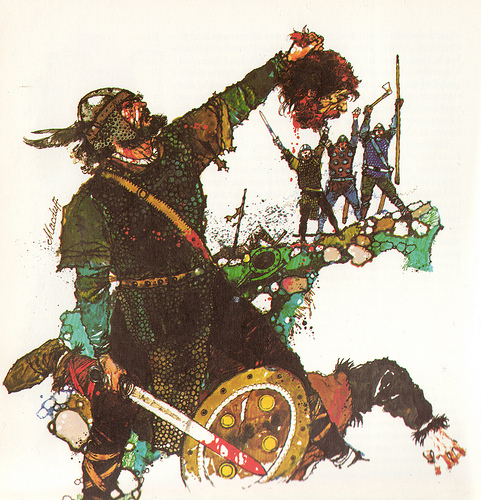
Macbeth’s fortress is successfully taken, and Macbeth is killed in battle, his head taken by an avenging enemy, Macduff.
 macduff-wit-macbeth-head-jpg

Where Macbeth has had Birnam Wood, Saruman suffers from the Forest of Fangorn–

Tolkien, Nasmith, painting, illustration, Lord of the Rings, Silmarillion, Hobbit, Middle-earth

The Wrath of the Ents, by Ted Nasmith

(We would add one more Macbeth parallel for The Lord of the Rings.  Another seemingly reassuring apparition has told Macbeth that he can only be killed by a very special person:

“Be bloody, bold, and resolute. Laugh to scorn
The power of man, for none of woman born
Shall harm Macbeth.” (Macbeth, 4.1.81-83)
That person turns out to be Macduff, born from a Caesarian section.
Do we need to remind our readers of what Eowyn says in reply to the Witch-king’s “Hinder me?  Thou fool.  No living man may hinder me!”)
eowyn.nazgul

After the fall of Isengard, Saruman is imprisoned in his own tower.  During his imprisonment, he is deprived of the Palantir, but Sauron’s seduction has been thorough and, even when offered another chance, there will be nothing left for him in the future but being a petty spoiler and then the victim of his own slave, someone he had once seduced.

jwyatt-sarumande

Thanks, as always, for reading.

MTCIDC

CD

“A kind of proud, venerable, but increasingly impotent Byzantium”

01 Wednesday Jun 2016

Posted by Ollamh in Artists and Illustrators, J.R.R. Tolkien, Literary History, Maps, Military History, Military History of Middle-earth, Narrative Methods

≈ Leave a comment

Tags

Adventure, Byzantine Empire, Byzantium, Constantinople, Gondor, Justinian, Megara, Mehmet II, Milton Waldman, Minas Arnor, Minas Tirith, Mont Saint Michel, Ottoman Empire, Ted Nasmith, The Lord of the Rings, The Tower of Guard, Theodosian walls, Theodosius, Tolkien

Welcome, as always, dear readers.

The title of this posting is taken from a very long letter (10,000 words), written to Milton Waldman probably in 1951 (Letters No.131, 157). Waldman represented the English publisher, Collins, which had expressed an interest in The Lord of the Rings and The Silmarillion when Allen & Unwin had been hesitant. Determined to justify the simultaneous publication of both, Tolkien wrote in great detail about the general narrative, with an emphasis upon the religious aspects.

In the process, he likened Gondor to the Byzantine empire, a comparison which immediately attracted our attention. We ourselves had suggested in an earlier posting that the attack on its capital, Minas Tirith, had been like the siege of the Byzantine capital, Constantinople.

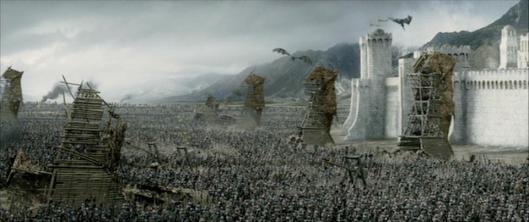
attackongondor.jpg

8da792d4aac58fe51f8ddf1aefa36048.jpg

What was JRRT thinking of when he likened the two?

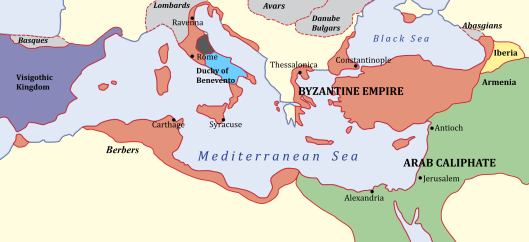
First, they both were—or had been—large kingdoms—in the case of Byzantium, an empire, really, as these maps demonstrate.

gondor1050height.jpg

2000px-Byzantiumby650AD.svg.png

Their capitals were both of great age. Minas Tirith, “The Tower of Guard”, had been built originally as Minas Anor, “Tower of the Sun” in SA 3320 by Anarion, the younger son of Elendil, but only became the capital of Gondor in TA1640, after Osgiliath had been devastated by a plague. If we add its time in the Second Age (121 years) to the whole of the Third Age (3021 years), we reach a total of 3142 years at the defeat of Sauron. (For comparison, we might look at Athens, whose continuous habitation began before 3000BC, giving it a more-than-5000-year history.)

Constantinople, is old, by anyone’s standards, having been founded in 667BC as a Greek colony (there’s a bit of argument over the dating of this, which is typical of such things), and is still inhabited (and an absolutely amazing place!), but a bit younger than Minas Tirith at the time of The Lord of the Rings by some 500 years or so.

Third, there is the matter of the elaborate construction of these capitals.

“For the fashion of Minas Tirith was such that it was built on seven levels, each delved into the hill, and about each was set a wall, and in each wall was a gate. But the gates were not set in a line: the Great Gate in the City Wall was at the east point of the circuit, but the next faced half south, and the third half north, and so to and fro upwards; so that the paved way that climbed towards the Citadel turned first this way and then that across the face of the hill. And each time that it passed the line of the Great Gate it went through an arched tunnel, piercing a vast pier of rock whose huge out-thrust bulk divided in two all of the circles of the City save the first. For partly in the primeval shaping of the hill, partly by the mighty craft and labour of old, there stood up from the rear of the wide court behind the Gate a towering bastion of stone, its edge sharp as a ship-keel facing east. Up it rose, even to the level of the topmost circle, and there was crowned with a battlement; so that those in the Citadel might, like mariners in a monstrous ship, look from its peak sheer down upon the Gate seven hundred feet below.”

The Lord of the Rings, Book 5, Chapter 1, “Minas Tirith”

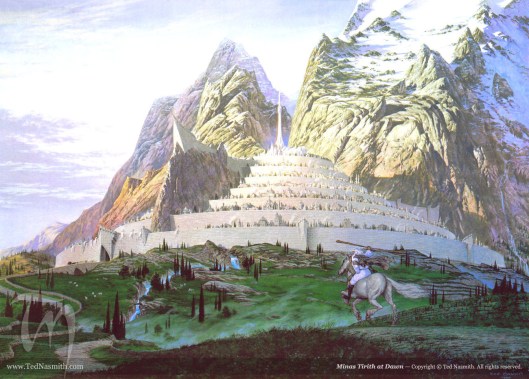
Here’s one of our favorite paintings (by Ted Nasmith—one of our favorite Tolkien artists).

TN-Minas_Tirith_at_Dawn.jpgnaismith.jpg

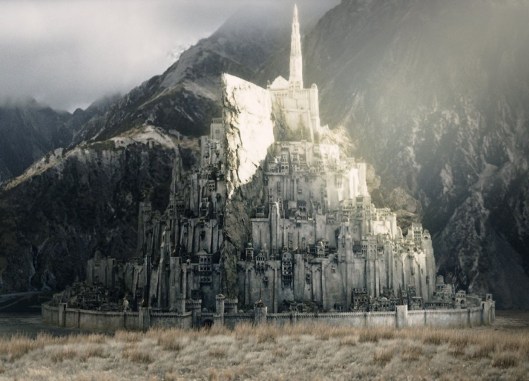
And here’s the film.

ROTK-Minas-Tirith.jpg

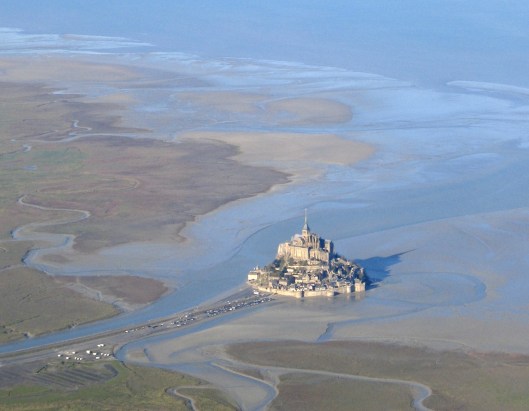
The designers have said that they were influenced by the look of Mont Saint Michel, a medieval monastery just off the coast of Normandy in France.

Mont_St_Michel_3,_Brittany,_France_-_July_2011.jpg

MtStMichel_avion.jpg

The complex nature of the place is captured in this diagram.

minas-tirith-diagram.0.jpg

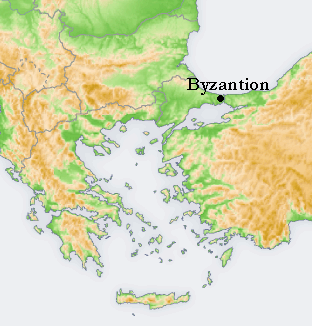
Byzantium (or, Constantinople, its later name) began its life, as we said, as a colony of the Greek mainland city of Megara. In the 4th century AD, the Roman emperor Constantine I, the last survivor in a long civil war, chose the site for his new capital. As much of the weight, both of commerce and defense, lay in the eastern part of the Roman world by this time, he chose very wisely: his new city was placed to control trade with the rich Black Sea region and to provide a strategic jumping-off point for dealing with invaders and emerging kingdoms in Asia Minor.

Locator_map_Byzantion.PNG

The position was also well-chosen for defense, being at the end of a peninsula—the main strategy then being its walling-off from the mainland.

constantin.jpg

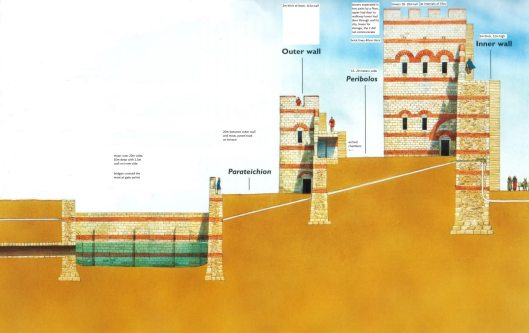
There is, of course, a big difference here between the 7 levels and 7 gates of Minas Tirith and the two walls—the older inner 4th-century one of Constantine and the slightly-later (early 5th century) walls of Theodosius II. Nevertheless, those later walls were well-constructed, in two successive lines, with a moat on the outside.

Theodosian Walls.jpg

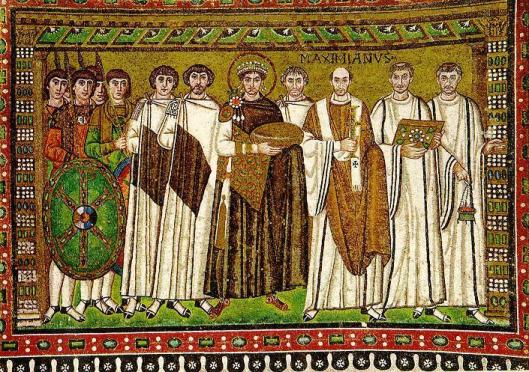
The Theodosian walls were about a mile-and-half from the older, Constantine wall, encompassing a population which, at its height, may have been over 400,000 in number. By the time of its fall to the Ottoman army in 1453, that number had dropped to perhaps only 50,000, which reflected the gradual shrinking of the empire from its greatest size, in the 6th century

Byzantine-empire.6thc.gif

under the emperor Justinian

justinian.jpg

when it encompassed the majority of the Mediterranean basin, to its last, worn-out phase in the early 15th century, when it controlled a few scattered outposts, but mainly the area directly around the capital.

constantinople-world-map.jpg

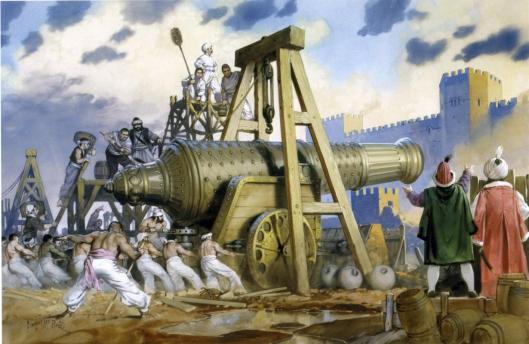
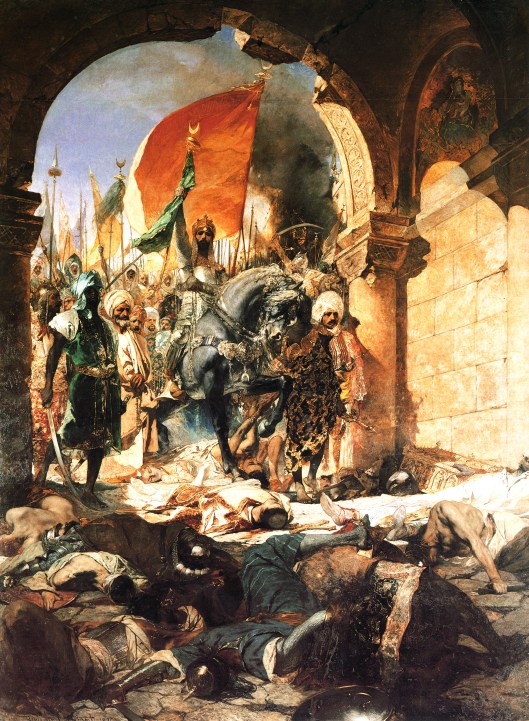
This shrinking of the empire and of its population proved disastrous for the capital. When the Ottoman army, under Mehmet II, arrived outside the walls in the spring of 1453, the imperial government could only provide 7000 defenders, 2000 of whom were foreigners, to defend about 3 and ½ miles of wall (that’s 5 ½ km). Against them were anywhere from 50 to 80,000 attackers, who brought with them (or cast on the spot), massive artillery pieces and, after a 53-day siege, broke into the city and put an end to an empire which had lasted for over 1100 years.

Illustration-of-angus-mcbride-showing-the-ottoman-cannon-basilica-during-the-siege-of-constantinople-in-1453-ad.jpg

Benjamin-Constant-The_Entry_of_Mahomet_II_into_Constantinople-1876.jpg

And this is the last sad similarity with Gondor and its capital, as we see through Pippin’s eyes:

“Pippin gazed in growing wonder at the great stone city, vaster and more splendid than anything that he had dreamed of, greater and stronger than Isengard, and far more beautiful. Yet is was in truth falling year by year into decay, and already it lacked half the men that could have dwelt at ease there. In every street they passed some great house or court over whose doors and arched gates were carved many fair letters of strange and ancient shapes: names Pippin guessed of great men and kindreds that had once dwelt there; and yet now they were silent, and no footsteps rang on their wide pavements, nor voice was heard in their halls, nor any face looked out from door or empty window.”

The Lord of the Rings, Book 5, Chapter 1, “Minas Tirith”

And, just as in the case of Constantinople, the capital of Gondor was hard-pressed to defend itself. Luckily for it, however, there was an uncrowned king with a ghostly army, a brave reinforcement of southern yeomen, a mass of wild horsemen from the north, a wizard, and the fulfillment of an ancient prophecy about a witch king to aid it in its hour of need…

Thanks, as always, for reading.

MTCIDC

CD

The Fall of Two Cities?

09 Wednesday Mar 2016

Posted by Ollamh in Economics in Middle-earth, Imaginary History, J.R.R. Tolkien, Language, Maps, Military History, Military History of Middle-earth, Narrative Methods

≈ Leave a comment

Tags

Agincourt, Anadoluhisari, Anatolia, Asia Minor, Bayezid I, Bosphorus, Byzantium, Constantine I, Constantinople, Crecy, English Civil Wars, Eowyn, Gondor, map, Mehmet II, Minas Tirith, motte and bailey, Newark, Normans, Osgiliath, Ottoman Empire, Poitiers, Rumelihisari, siege, The Lord of the Rings, Tolkien, Witch-King of Angmar

Dear Readers,

Welcome, as always. A little while ago, we talked about the “siege of Gondor”, which really wasn’t a siege in the formal sense, at all, but rather an assault. (We suspect that JRRT liked the sound of “siege” and so used it, not caring if it were strictly accurate or not.) In this posting, we want to look at a real siege and examine what might be parallels with events in Middle Earth.

Before we do, we want to take a moment to talk about the word “siege”. It comes into English through Old French asegier, which comes from Latin ad + sedeo > adsideo, adsidere , literally, “to sit down at”. The northern French who passed the word on to England must have liked to say what’s called a y-glide when certain consonants came before e, so, though it was spelled asegier, it would have been said “ah-see-YED-jier”. And that’s why English today has what can be a confusing spelling. (In our experience, lots of native speakers have trouble distinguishing between the ie of “siege” and the ei of “seize”). The stress on the word in English would have been away from the initial a, and so that would have disappeared from the word as it moved from being a borrowing.

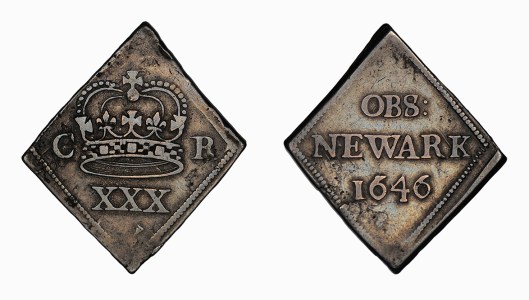
[As what we think is a cool footnote, Latin also has the verb obsideo “to sit down right before=to besiege” and we can see that used in English in the word “obsession”, with the idea that something bothers you so much that it’s like you’re being besieged by it. You can also see it on this wonderful bit of 17th-c. English history.

obsidionalmoney.jpg

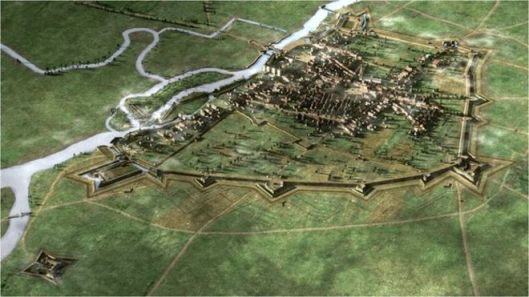
Although it doesn’t look like a modern coin, this is a form which used to be called “half-a-crown”—that is, 30 pennies (that’s what those three xses mean), or two shillings, sixpence.   This coin was struck in the town of Newark-upon-Trent, when it was besieged during the English Civil Wars (1642-1651).

_82601862_newark-1646map.jpg

And that’s where obsideo comes in. The back (the “reverse” in coin language—the front is called the “obverse”) says:

OBS: Newark (with a date, either 1645 or 1646, depending on when the coin was struck)

OBS = Obsessa Newark = “Newark Besieged”

There were a lot of coin-substitutes struck by various besieged towns, but, apparently, those from Newark are the most numerous.]

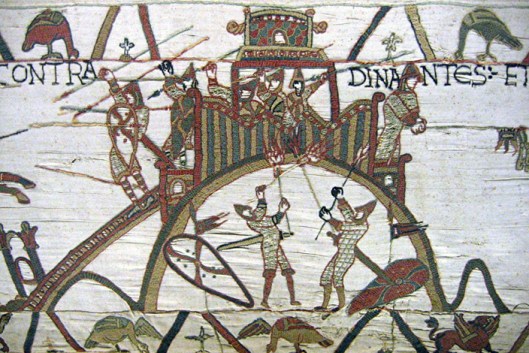
In the medieval western military world, sieges were more common, it seems, than pitched battles. As castles and towns were focal points for the possession and control of land—think of the hundreds of early castles, called “motte and bailey”, which the Normans built all across England in the first years after their conquest–it’s not surprising that they would have been a focus of attack.
motteandbailey.jpg Tapisserie_motte_dinan 704.jpg

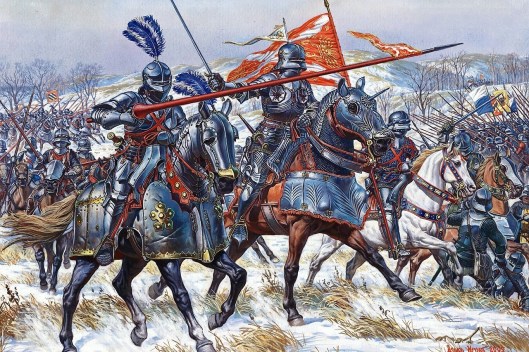
As well, we can imagine that, ultimately, they would have been cheaper, in terms of the most irreplaceable manpower, sparing the highly-trained, hard-to-replace, knights and men-at-arms.

knights.jpg

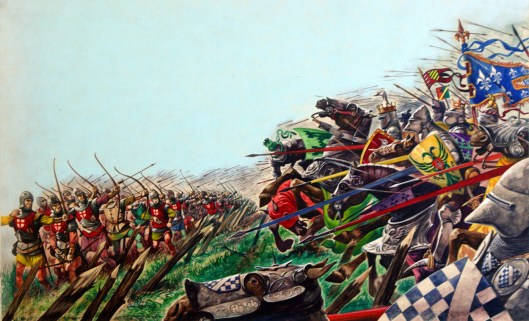
Battles like Crecy (1346), Poitiers (1356), and Agincourt (1415), cost the French dearly as their brave knights threw themselves at their English opponents, whose longbows shot them and their horses down.
agincourt.jpg

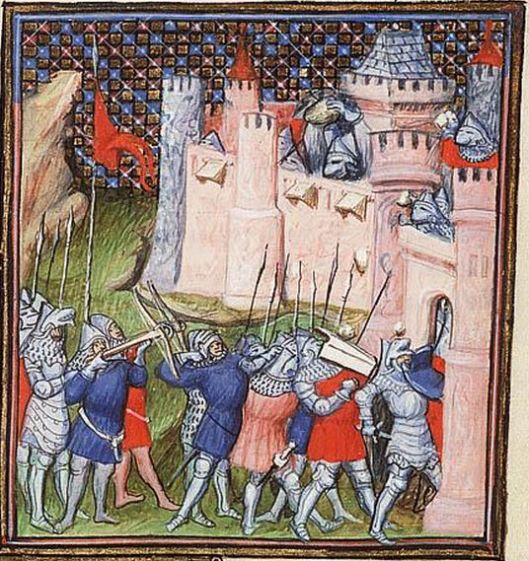
In a siege, although there was the occasional combat, including the exploitation of a break in the enemy’s defenses,

Edward-III-takes-Poix-Castle.jpg

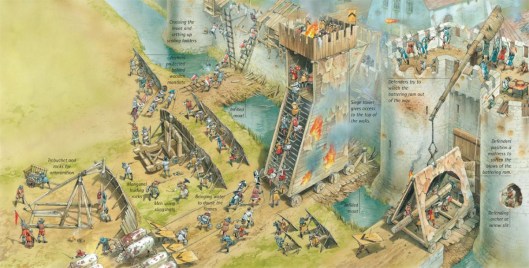
most of a siege would be spent in using machinery of various sorts to aid you in breaking down the walls—and the resistance of the defenders, as well.

castles-and-knights-2-with-labels.jpg

This brings us to the real, historical siege we want to examine: Constantinople, 1453.

Bizansist_touchup.jpg

Constantinople had begun life as a Greek colony, called Byzantium, on the European side of the narrow passageway between the Black Sea and the northeastern Mediterranean.

byzempmap.gif

It had been refounded and greatly expanded by the Roman emperor, Constantine I, to be a new capital in the east.

Constantine-I-Face.jpg

Although it was supposed to be called “New Rome”, everyone in the east called it after its refounder, and so it was “Constantinople”, becoming the capital of an eastern empire which we call “Byzantine”. Even with setbacks and a number of unsuccessful attacks over the centuries, it was, for a long time, a very wealthy and powerful city.

1-reconstruccion-de-bizancio.jpg

But even the wealthiest and most powerful cities will fade—especially when faced with ambitious enemies. Constantinople had had a number of those, but, finally, in its last years, perhaps its most ambitious and most powerful arose in Asia Minor: that of the Ottoman Turks. As you can see from this map, its beginnings were modest: one Turkic-speaking group among many.

Anatolian_Beyliks_in_1300.png

This was a period of instability, however. The Ottoman leaders quickly took advantage of that instability to grab power and territory, so that, by 1400, they had spread beyond the shrinking Byzantine world, into the Balkans, and, soon, Constantinople was surrounded.

trebizond1400

This surrounding took place in an increasingly-methodical way. In 1393-4, the ruler of the Ottomans, the sultan Bayezid I

bayezit1.jpg


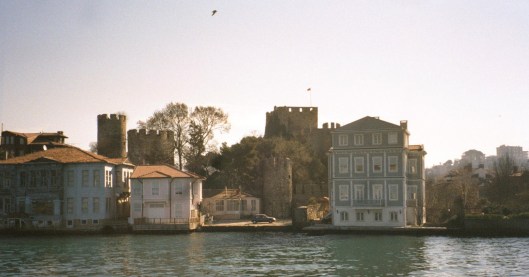
built a small fortress on the Asia Minor side of the Bosphorus, the name for the northern stretch of the passage which led from the Black Sea to the Mediterranean. It was called Anadoluhisari, “the Anatolian fort”.

Anadoluhisari.jpg


You can see from the map that this was the beginning of setting up a choke point upstream from Constantinople.

mapwithanadoluhisari.gif

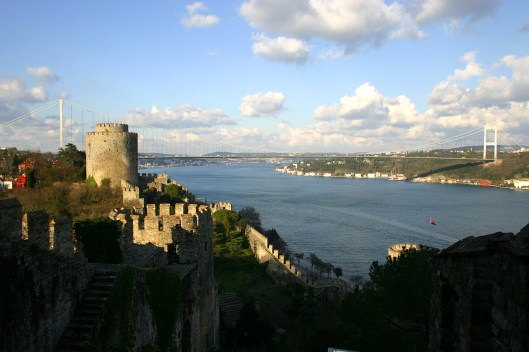
In 1451-2, the sultan Mehmet II finished the job with the Rumelihisari just opposite, on the European side (and that’s what its name means, “the Roman—that is, European—fort”).

Rumeli_hisari.jpg

Guns were mounted

muslim_rocket_technology_06.jpg

and any help which might have come from the Black Sea was blocked.

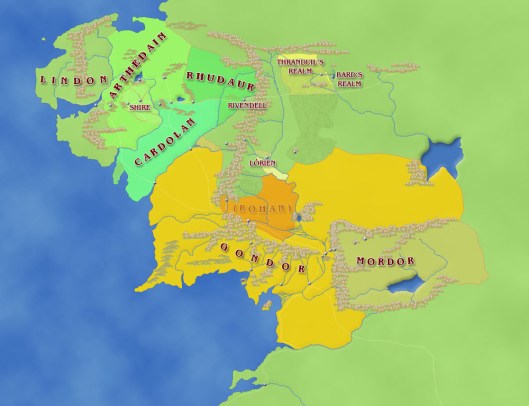
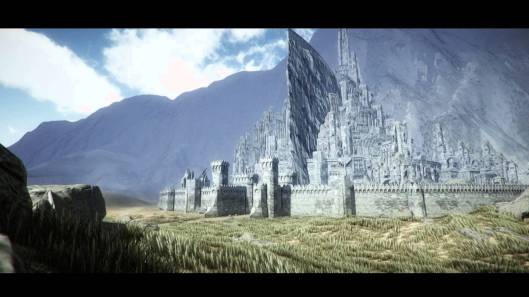
And here we want to take a minute to look at our imaginary city and its danger—because we see some easy parallels here. First, of course, the Ottoman empire was an eastern threat—so was Mordor. Mordor had taken the east bank of the Anduin, just as the Ottomans had taken the Asian side of the Bosphorus. And, in the capture of the European side and the building of Rumelihisari, we might see the taking of Osgiliath and the west bank of the Anduin. Then there is the massive city of Minas Tirith and the attack upon it.

mt.jpg 2381576-zmordorforcesk7.jpg

Constantinople was also a massive city.

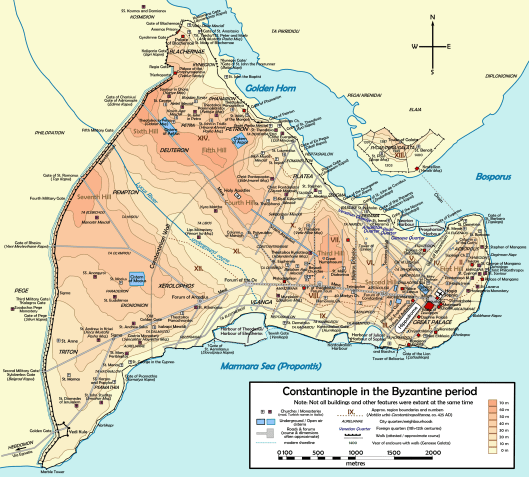
Byzantine_Constantinople-en.png

It was, basically, on a triangular piece of land, with two sides protected by water. The original Greek town had had a wall, but it was long gone and almost all of Constantine’s land wall had long disappeared, as well. The latest walls are called the Theodosian, after their originator, the emperor Theodosius II (408-450AD), but the walls included bits of the Constantinian walls and many repairs, over the centuries. The main land defenses included three lines of wall and a moat.

2rh67o0.jpg

This sounds very impressive until one considers two things: first, is there a garrison big enough to defend what are, in fact, a number of miles of wall? And, second, although the walls have withstood previous attacks, including one made by the Ottomans in 1422AD, how will they stand up to the threat of modern artillery?

At the height of its power and prosperity, it is estimated that Constantinople had had a population of anywhere from 500,000 to 750,000 (although scholars argue over this). At the time of the final siege, the population had fallen to as low as 40,000. Thus, large parts of the city were empty—just like Minas Tirith:

“Pippin gazed in growing wonder at the great stone city…Yet it was in truth falling year by year into decay; and already it lacked half the men that could have dwelt at ease there.” (The Return of the King, Book 5, Chapter 1, “Minas Tirith”)

The garrison of Constantinople was perhaps about 9,000, in all, which meant that they were very thinly stretched. We don’t know just how many troops were in Minas Tirith. Some reinforcements had come from South Gondor, as we noted in an earlier posting, but only a few thousand and the defenders were powerfully outnumbered, just as those of Constantinople were, when the forces of Mordor began to arrive. The Ottoman army is thought to have had between 50,000 and 80,000 men, but just how many Orcs and others marched down the causeway from Osgiliath isn’t known–they are just a horde—something which the Jackson film shows very well.

maxresdefault

Then the assault begins, the Orcs having giant stone throwers, siege towers, and, finally, a giant, fire-breathing ram, Grond.

Grond_arrives.png

If you’ve been following our postings (and we hope you have!), then you know that we’ve discussed the use of what appears to be gunpowder, both at Helm’s Deep and at the Rammas Echor. The Orcs who attack the walls of Minas Tirith don’t appear to have such a weapon, but, unfortunately for the defenders of Constantinople in 1453, the Turks do, in the form of plentiful modern artillery.

Illustration-of-angus-mcbride-showing-the-ottoman-cannon-basilica-during-the-siege-of-constantinople-in-1453-ad.jpg

Attacks wear down the small garrison and huge, stone-throwing weapons knock down the walls, so that, finally the city falls, on 29 May, 1453.

84087026.jpg

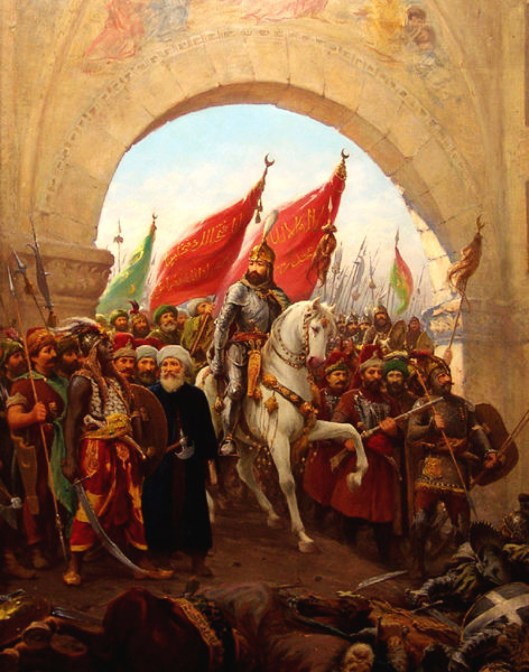
Its conqueror, Mehmet II, rides in—

mehmet2enteringconstantinople.jpg

which is something the witch king of Angmar never gets to do, perishing instead, at the hands of Eowyn and Merry.

Eowyn.jpg


And there the parallels end, as does our posting. Did JRRT have the fall of Constantinople somewhere in the back of his mind? What do you think?

Thanks, as always, for reading.

MTCIDC

CD

Strange as News from Bree

03 Wednesday Feb 2016

Posted by Ollamh in Fairy Tales and Myths, J.R.R. Tolkien, Language, Literary History, Narrative Methods

≈ Leave a comment

Tags

acta, Barad-Dur, Barliman Butterbur, Bree, Bronte, copyists, Dwarves, English coaching inn, Forum Romanum, Frodo Baggins, Gandalf, Gondor, Gutenberg, Haworth, Johann Carolus, Literacy, manuscripts, Medieval, Minas Tirith, Orality, Peter Jackson, pre-print, press, printing press, Romans, royal archives, Sauron, scriptoria, Story, The Lord of the Rings, The Prancing Pony, The Red Book of Westmarch, The Shire, Tolkien, War of the Ring, word-of-mouth, Yorkshire

Welcome, dear readers, as always.

After the last couple of postings, full of war, this is a rather peaceful one. We want to put forward a scheme for a larger project, all about orality versus literacy in Middle Earth, of which this is one small step, our initial question for the project being, “What is written and how and what is only spoken and remembered?”

Early in Chapter 9 of The Fellowship of the Ring (“At the Sign of the Prancing Pony”), we encounter this passage:

“For Bree stood at an old meeting of ways; another ancient road crossed the East Road just outside the dike at the western end of the village, and in former days Men and other folk of various sorts had travelled much on it. Strange as News from Bree was still a saying in the East Farthing, descending from those days, when news from North, South, and East could be heard in the inn, and when the Shire-hobbits used to go more often to hear it.”

Bree, of course, is the little town to which Frodo and his companions travel once they have gotten free of the Barrow Downs.

ICE Bree and the Barrow-downs (Late Third Age) v1.3.jpg

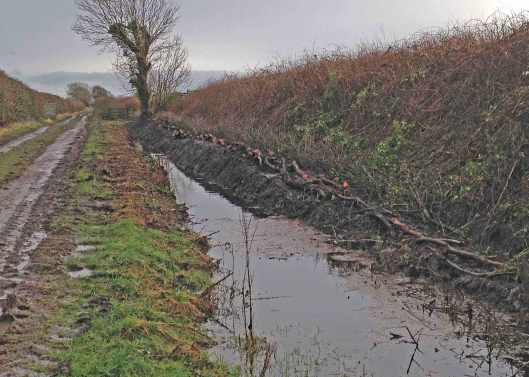
The little town is described as being surrounded by a dike—a wide ditch, the inner side topped with a thick hedge—perhaps something like this—

D21-15-2-14-More-hedging-activity_0670.jpg

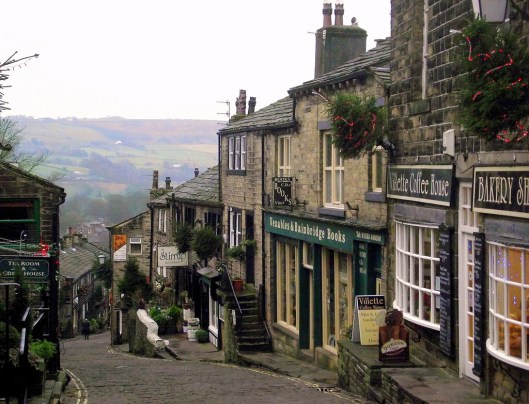
And consisting of “some hundred stone houses of the Big Folk, mostly above the Road…”. Without knowing the kind of stone, we have imagined it as looking rather like Haworth, in Yorkshire, the home of the Bronte family (without the modern touristy stuff, of course).

haworth.jpg

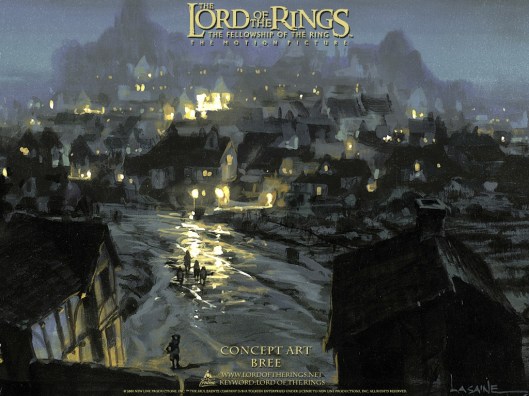
(And we note, by the way, that its depiction in the Jackson films doesn’t appear to reflect JRRT’s description that the houses were made of stone: rather, it appears to be filled with half-timbered, plaster and lath constructions.)

LOTR Bree.JPG


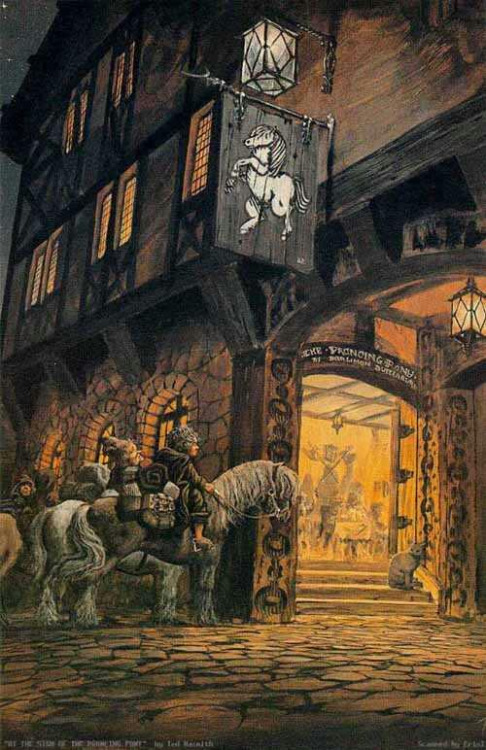
Here, the Hobbits stay at the Prancing Pony.

naismithprancingpony.jpg

Tolkien describes it as

“a meeting place for the idle, talkative, and inquisitive among the inhabitants, large and small…”

To our minds, it probably looked like one of those very old English coaching inns.

111-1000011im.jpg


And we begin our research inside.

Before we do, let’s spend a moment thinking about that word “news”, as in “Strange as news from Bree”.

In pre-print days, for most people in most places, information about events was circulated only by word-of-mouth. There were a few exceptions: the government in Rome produced hand-written circulars, called acta which were put up in the Forum Romanum from the middle of the last century BC through to the 3rd century AD. These would obviously have had a very limited circulation, however, and we can imagine that the contents would still have been passed on mouth-to-mouth for most people in Rome.

To gain greater circulation really demanded print. Although Gutenberg produced the first press and movable lead type by 1440,

gutenberg.jpg

the earliest surviving printed newspaper known at present dates from 1609, produced in Germany. (It appears that the publisher, Johann Carolus, had actually begun printing, rather than hand-copying, in 1605.)

Relation_Aller_Fuernemmen_und_gedenckwuerdigen_Historien_(1609).jpg

As far as we can tell, true to the general image of Middle Earth as a medieval world, printing presses have yet to appear (unless Sauron is producing very limited editions at the Barad-dur Press and circulation consists of exactly one copy). This means that we are still in the preprint world of hand-copying, when it comes to documents. In the western European world, on which places like Gondor are modeled, this means scriptoria—copy centers—mainly in monasteries and in royal courts where the copyists had probably been trained in monastic scriptoria.

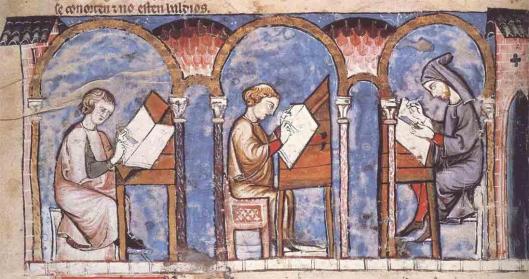
scriptorium.jpg

Because there are no religious foundations or even schools of any sort mentioned in Middle Earth, we don’t know how or where documents were written or copied or even how and where anyone learned to read and write (except Sam, who was taught his letters by Frodo), but literacy turns up all over the place, from the Red Book of Westmarch to the runes of the dwarves to the writings Gandalf says he searched through in the archives of Minas Tirith.

All of this is, in a sense, commemorative—it’s history, really, whether a dwarvish map or tomb inscription, or an account of the War of the Ring. What about other things, however—word of daily events, or even entertainment forms, like songs and poems, things which may some day become part of history but, at the present, seem much more ephemeral? That’s what we’ve come to Bree to find out—and we’re quickly helped in our investigation by the host of the Prancing Pony, Barliman Butterbur, who says to Frodo and the others:

“ ‘I don’t know whether you would care to join the company…Perhaps you would rather go to your beds. Still the company would be very pleased to welcome you, if you had a mind. We don’t get Outsiders—travelers from the Shire, I should say, begging your pardon—often; and we like to hear a bit of news, or any story or song you may have in mind…’ “

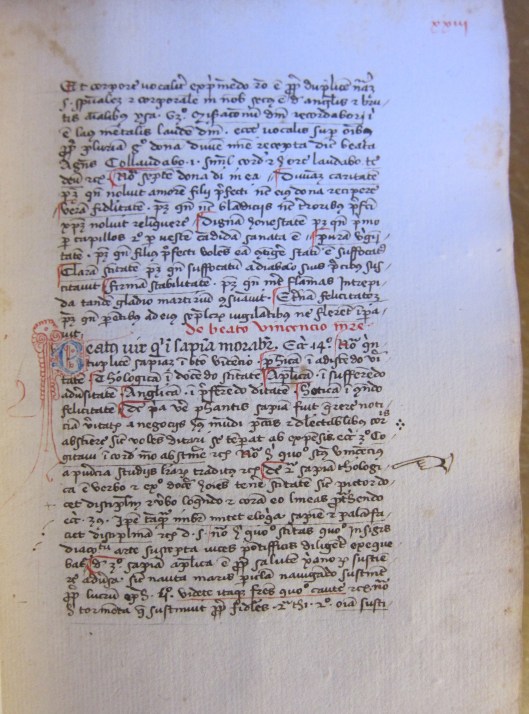
And there’s that emphasis on the oral: “we like to hear”. You, readers, have a world of electronic devices to turn to for “a bit of news, or any story or song”, as well as, in the case of news, actual newspapers, not to mention bookstores, libraries, and the wonderful resources of Gutenberg and the Internet Archive. None of that in any form is available to carry or preserve information in Middle Earth. What books there are—and they are manuscripts, remember, things which look like this—

MS-Italian.jpg

or, if you are rich, this—

frms.png

are either in royal archives, as in the case of those which Gandalf consults in Minas Tirith, or in the hands of families, as is the fate of The Red Book of Westmarch and other such items in the Shire. And so people are, on the one hand, eager for news and entertainment, but, on the other, forced either to make it for themselves or to wait for willing strangers to add to their meager store.

It’s natural, then, that “As soon as the Shire-hobbits entered, there was a chorus of welcome from the Bree-landers.” The first local reaction to Frodo’s attempts to create an explanation for why he and his companions are traveling is also natural:

“He gave out that he was interested in history and geography (at which there was much wagging of heads, although neither of these words were [sic] much used in the Bree-dialect). He said he was thinking of writing a book (at which there was silent astonishment), and that he and his friends wanted to collect information about hobbits living outside the Shire, especially in the eastern lands.”

In the nearly-oral world of Bree (there must be some literacy—the Prancing Pony has a sign with an inscription and Barliman seems to know what a letter is), the next reaction is also natural:

“At this a chorus of voices broke out. If Frodo had really wanted to write a book, and had had many ears, he would have learned enough for several chapters in a few minutes. And if that was not enough, he was given a whole list of names, beginning with ‘Old Barliman here’, to whom he could go for further information.”

These would all be so-called “oral informants”—not one mention of manuscripts or documents to suggest that information is conveyed and recorded in writing—and so the Breelanders’ third and final reaction is also natural:

“But after a time, as Frodo did not show any sign of writing a book on the spot, the hobbits returned to their questions about doings in the Shire.”

It’s obvious then, that books, like the words “history” and “geography”, are almost alien to these people and so their interest is in the spoken—or sung—word, which is why, when Frodo breaks into Bilbo’s “There is an inn…” to distract the audience from Pippin’s indiscreet recounting of the birthday party, his stratagem almost works—until he overdoes it and—

But even in the aftermath, although it leads to more trouble for Frodo and his companions, Butterbur can imagine that, in time, that surprising event, like all of the others in this near-oral world, will subside into word-of-mouth.

“He reckoned, very probably, that his house would be full again on many future nights, until the present mystery had been thoroughly discussed.”

And then it would become just another piece of strange news from Bree.

Thanks, as always, for reading.

MTCIDC

CD

Feudal-Earth?

13 Wednesday Jan 2016

Posted by Ollamh in Artists and Illustrators, Economics in Middle-earth, Fairy Tales and Myths, J.R.R. Tolkien, Literary History, Military History, Military History of Middle-earth, Narrative Methods

≈ 2 Comments

Tags

Bayeux Tapestry, feudalism, Gondor, Medieval, Prince Valiant, The Lord of the Rings, Tolkien

Welcome, dear readers, as always!

In this posting, we want to think out loud about something which has puzzled us for some time. Regular readers must know by this time that, along with literature of various times and places, we’re also very much interested in world history, from its human beginnings all the way up to the present. As those of you who have read past postings know, we have sometimes tried to apply our interest (and, we hope our knowledge) to the works of one of our favorite fantasy authors, JRR Tolkien. In our last posting, for example, we have spent a little time considering the 20th-century world of dictators and how they might have influenced JRRT’s depiction of Sauron and his plans.

In this posting, we want to look at something we’ve touched upon some time in the past, the economic/social structure of Middle Earth (or Middle-earth as it sometimes seems to appear). After all, kingdoms don’t just magically appear and survive: or, in Middle Earth, do they? For fun, we wondered what we might find in The Lord of the Rings which would remind us of our own Middle Ages.

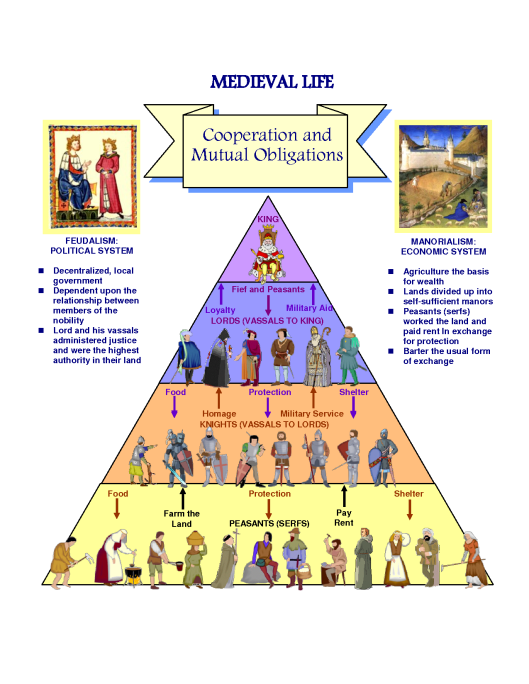
In our world, particularly in western Europe , this is the period which appears physically similar to the end of the Third Age (minus Elves, etc), and, in this period, we find a social/economic structure called feudalism. There has been a great deal of scholarly discussion as to where the base word, feud comes from, but the structure is pretty basic and goes like this (with apologies to all actual medievalists for the gross simplification):

feudalsystemchart.png

At base, it’s all about two things: land and soldiers.

At the top—the very top—is God, who owns everything. He chooses a king (this comes down to us under the heading of “the divine right of kings” and is similar to “the mandate of heaven” in Chinese history). The king then claims that, because of his position as the Chosen One, he owns all of the land in the country. This land, however, he divides, keeping some for himself, but giving large portions to his chief nobles (the Church also owns a large chunk, but, as religion is rather subterranean in Middle Earth, we’ll leave it at that). They, in turn, divide it among lesser nobles (family members and/or those loyal to them), who, in turn, divide it among the lowest level of nobility (often knights). The simplest parcel is a manor and a knight may hold just one or more than one and this is true all the way up the chain.

4186733_orig.jpg

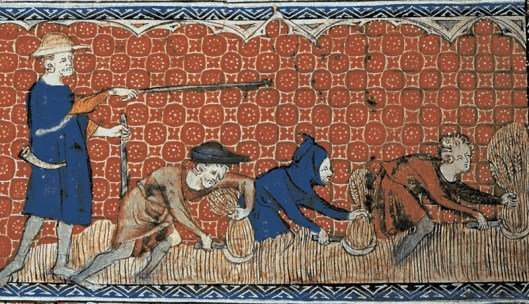
Each manor, in turn, has various grades of inhabitants, from freeholders, who own land but pay taxes on it, to peasants who are free, but are landless and have to work for others, and serfs, who are nothing more than slaves and considered part of the property. Even freemen might still owe an obligation in the form of labor to the lord of the manor.

Reeve_and_Serfs.jpg

In return for a manor or for many manors, the nobles at every level owed the king military service.

Sir_Geoffrey_from_LPsalter.jpg

This was necessary, since, with the exception of a certain number of household troops or bodyguards, kings couldn’t afford to keep standing armies on their own.

When we began wondering if we could find traces of feudalism in Middle Earth, we thought first about titles. As we said, there are kings, so could we add to them “sirs”, “knights”, “lords”, and such? The densest patch of those would seem to be in The Return of the King, Chapter 1, “Minas Tirith”. Almost at the end of the chapter, Pippin and Beregond’s son, Bergil, watch reinforcements march into the city. Here we can list leaders, almost every one seeming to be a major landowner, judging by the number of his military followers, and all but one called “lord” : Forlong, Dervorin (“son of their lord”), Golasgil, and last and most feudal-like, Imrahil, Prince of Dol Amroth, who comes with “a company of knights in full harness”.

This last reminded us of an earlier posting, when we wondered whether JRRT had ever seen the Prince Valiant comic strip, which occasionally had scenes like this:

Prince-Valiant-10-2-38.jpg


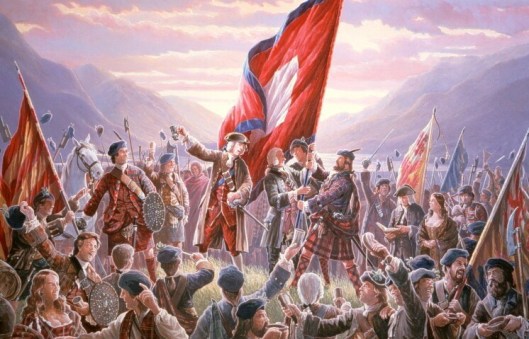
Our other thought was this sounded rather like a combination of men entering the Alamo and a gathering of the clans.

raising-the-standard-at-glenfinnan-1745-jacobite-rebellion.jpg

To gain a portion of land, all levels of nobles swore oaths of loyalty (called fealty, from Latin fidelitas, through Old French, the legal language of England after the Norman conquest) to those who gave them that land and that oath was commonly done publically and was legally binding.

There were different ways of confirming the earnestness of the person swearing. An altar or saint’s reliquary might be used, as seems to be the case from this scene on the “Bayeaux Tapestry”, in which Harold swears a sacramentum (a “sacred oath”, so Norman propaganda would afterwards claim) to be the vassal (sworn man) of Duke William of Normandy.

Bayeux_Tapestry_scene23_Harold_sacramentum_fecit_Willelmo_duci.jpg


Oaths might take the form of the receiver placing his hands between those of the giver and swearing.

1274514-miniature-depicting-a-knight-receiving-his-sword-from-the-king-guillaume-dorange.jpeg


An extremely useful site (www.dragonbear.com) provides a number of examples of the oath, which, while varying greatly through time and place, can be encapsulated in this version, from “The Laws of Alfred, Guthrum, and Edward the Elder”:

“Thus shall a man swear fealty oaths.

By the Lord, before whom this relic is holy, I will be to ____ faithful and true, and love all that he loves, and shun all that he shuns, according to God’s law, and according to the world’s principles, and never, by will nor by force, by word nor by work, do ought of what is loathful to him; on condition that he keep me as I am willing to deserve, and all that fulfil that our agreement was, when I to him submitted and chose his will.”

Compare this with Pippin’s oath to Denethor, after Pippin offers his sword to him:

“Here do I swear fealty and service to Gondor, and to the Lord and Steward of the realm, to speak and to be silent, to do and to let be, to come and to go, in need or plenty, in peace or war, in living or dying, from this hour henceforth, until my lord release me, or death take me, or the world end. So say I, Peregrin son of Paladin of the Shire of the Halflings.” (The Return of the King, Chapter 1, “Minas Tirith”)

There is no transfer of land involved here, but certainly there is military service.

JRRT, for all of the amazing detail which he put into Middle Earth, was content, it would seem, to leave it at that: there are kings to whom oaths are sworn, and that idea comes from feudal oaths. There are knights and lords—who else would be in charge of this quasi-medieval world (except, of course, among the non-men—elves, dwarves, and hobbits)? At the same time, this is a huge and wonderfully entertaining adventure, not a disguised treatise on the economic and social substructure of a mirror of the western Middle Ages, as interesting as, if anyone, Tolkien, could have made even that. It is fun, however, to spend a moment imagining what, given another ten years and several more drafts, Middle Earth might have looked like… As always, we ask: what do you think?

Thanks, as always, for reading.

MTCIDC

CD

Knowledge, Rule, Order

06 Wednesday Jan 2016

Posted by Ollamh in Fairy Tales and Myths, Imaginary History, J.R.R. Tolkien, Military History, Military History of Middle-earth, Narrative Methods

≈ 2 Comments

Tags

Adolf Hitler, Anduin, Benedict Cumberbatch, Benito Mussolini, British Government, Charlie Chaplin, dictatorships, England, Gandalf, George V, Germany, Gondor, gothic script, Government, History, India, Isengard, Kaiser Willhelm II, Lenin, Mehmed VI, Middle-earth, monarchs, Mordor, Nazis, newsreel, Numenor, Ottoman Empire, Oz, Peter Jackson, Queen Mary, Queen Victoria, Rohan, Saruman, Sauron, Scott, Smaug, Stalin, Stock Market Crash of 1929, Sultan, The Great Dictator, The Lord of the Rings, Tolkien, Treaty of Versailles, Valar, Victoria Louise, Weimar Republic, William Morris, Writing

Dear Readers,

Welcome, as always.

Have you ever wondered what Middle Earth would have been like if the Fourth Age had begun on a calendar written by Sauron?

That of the Third Age was hardly a democratic paradise: a king rules Rohan, a stand-in for king rules Gondor. Elrond and Celeborn/Galadriel behave and are treated like royalty and Thranduil, as we learn from The Hobbit, is the king of Mirkwood. The dwarves have hereditary rulers.   Only the outliers—communities like Bree and the Shire and the earlier inhabitants like Tom Bombadil and Fangorn—appear to be completely independent. (The Shire even has elections and a mayor, although the actual government, except for the shire reeves, appears to bemostly token—you wonder who’s running their seemingly-efficient postal service.)

This is not surprising, not only for an author born during the later years of Victoria,

queenvic.jpg

but also for someone powerfully influenced by the medievalist interests of everyone from Scott

Sir_William_Allan_-_Sir_Walter_Scott,_1771_-_1832._Novelist_and_poet_-_Google_Art_Project.jpg

to William Morris.

William_Morris_age_53.jpg

(We might add that the world of fairy tales, full of princes and princesses, queens and kings, was also a powerful influence at the time—and not only on story-tellers born in monarchies—after all, even Oz is ruled by a queen—

OzmaOz.jpg

Yet, after Smaug—who could better be a medieval fantasy villain (especially with the voice of the incomparable Benedict Cumberbatch attached)?

p8204516_n279079_cc_v4_aa.jpg

—something changed in Tolkien’s world. In fact, something changed in the whole outside world. With the end of World War One, monarchs toppled all over Europe and beyond, from:

Kaiser Wilhelm II of Germany

KAISER-WILHELM_2994889b.jpg

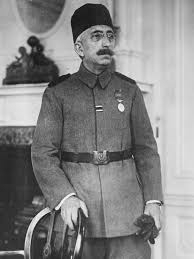
to Mehmed VI, last Sultan of the Ottoman Empire.

mehmed6.jpg

In place of the former, there appeared the always-troubled Weimar Republic, full of good intentions, but badly crippled, not only by the war which had sapped its manpower and resources, but by all kinds of social unrest and then by the Crash of 1929, which notoriously destroyed the value of its currency.

weimar currency.jpg

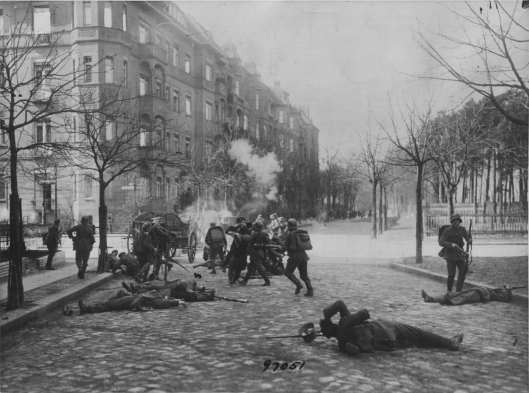
As early as 1919, there had been clashes among the forces of different ideologies—

CombatesEnBerlín19190903.jpg

And, amidst all of the unrest, there was a failed coup attempt in 1923 by the man in the overcoat in this picture.

Bundesarchiv_Bild_102-00344A,_München,_nach_Hitler-Ludendorff_Prozess.jpg

He, of course, was only following the footsteps of this man, who had pushed his way into power the year before—

March_on_Rome.jpg

to be followed, in turn, by the man on the left, from the mid-1920s.

stalinandfriends.jpg

That first man, having failed at obvious violence, tried again through more complicated means (although still employing violence, if it suited his purposes) and succeeded in 1933.

Hitler-Papen-First-Reichstag-1933.jpg

He was, so we are told, a riveting public speaker, but, if the newsreels we’ve seen are evidence, we guess you would have had to have been there.

hitlerspeaking.jpg

Some people thought the style exaggerated in the 1930s and caricatured it even then.

chaplin2.jpg

He had a definite social agenda, which he outlined at length and often, although concealing certain of the most horrible aspects. And he liked big words and big concepts, like:

einfolk.jpg

It would have been impossible for someone as intelligent and generally well-informed as Tolkien not to have been very much aware of this man and all of the other like men, busy oppressing as much of the world as they could. And this would have been especially true in a time when radio and film were changing how people received news—and how those interested in influencing others might shape what people saw. As early as 1911, the British government was using newsreel film to show the might and reach of its empire (2/5 of the globe was in their hands) when the king, George V, and his wife, Queen Mary, visited India.

Delhi_Durbar,_1911.jpg

Not to be outdone, Kaiser Wilhelm II encouraged a grand—and filmed–event in 1913, for the wedding of his daughter, Victoria Louise—and some of the film was even in color.

vlouisekaiser.jpg

The Marriage of Victoria Louise Color Film

It would be easy to imagine, then, that the weight of such public figures might have influenced Tolkien in his depiction of late-3rd-Age villains. We can see it in Saruman’s unsuccessful attempt to persuade Gandalf to join him:

“ ‘He drew himself up then and began to declaim, as if he were making a speech long rehearsed. ‘The Elder Days are gone. The Middle Days are passing. The Younger Days are beginning. The time of the Elves is over, but our time is at hand: the world of Men, which we must rule. But we must have power, power to order all things as we will, for that good which only the Wise can see.” (The Fellowship of the Ring, Chapter 2, “The Council of Elrond”)

Thus, unlike the script of Jackson’s version, there is no plan to wipe out men and replace them with orcs. Instead, men are to survive: to be ruled—perhaps under what definitely sounds like it should be a translation from something written in Fraktur—the fake Gothic script favored by the Nazis–

die-schöne-deutsche-Schrift-detail1.jpg

“ ‘We can bide our time,’” says Saruman, “ ‘we can keep our thoughts in our hearts, deploring maybe evils done by the way, but approving the high and ultimate purpose: Knowledge, Rule, Order; all the things that we have so far striven in vain to accomplish…’ ”

Such abstract, but somehow menacing, words sound like a translation of something from Hitler’s Germany: Kenntnisse, Herrschaft, Ordnung. They do not sound in the least like Gandalf’s goals, ever, and he, in fact, replies by implying that not only are they not really Saruman’s words, but that Saruman is foolish for believing them:

“ ‘Saruman,’ I said, ‘I have heard speeches of this kind before, but only in the mouths of emissaries sent from Mordor to deceive the ignorant.’ “

As really the words of Sauron, however, they give us an idea of what to expect in a world under his control. Knowledge would be for Sauron alone, we suppose, perhaps after regaining his lost ring? Certainly he wouldn’t share it with Saruman, whom, it will become clear, he never trusted. As for Rule and Order, the world would be a place full of rules and those watching that they be obeyed. And here we can remember Sharkey’s Shire, with its “by order of the Chief” signs—and its gangs of human enforcers. As well, we can think of its grey, industrial character, as we’ve discussed in a previous post, a universal Mordor, devoted to production. To this, we can add the Mouth of Sauron’s recitation of surrender conditions, delivered to the allies before the Morannon:

“ ‘These are the terms…The rabble of Gondor and its deluded allies shall withdraw at once beyond the Anduin, first taking oaths never again to assail Sauron the Great in arms, open or secret. All lands east of the Anduin shall be Sauron’s for ever, solely. West of the Anduin as far as the Gap of Rohan shall be tributary to Mordor, and men there shall bear no weapons, but shall have leave to govern their own affairs. But they shall help to rebuild Isengard which they have wantonly destroyed, and that shall be Sauron’s, and there his lieutenant shall dwell: not Saruman, but one more worthy of trust.’ “ (The Return of the King, Chapter 10, “The Black Gate Opens”)

In keeping with the influence of current events in this world, we might see this as being a parallel with the 1919 Versailles Treaty, in which Germany was to be forced to make huge territorial concessions, to disarm almost entirely, and to pay massive amounts in reparation to the victorious allies.

Treaty_of_Versailles,_English_version.jpg

The Treaty of Versailles– Wiki Article

Such terms as Sauron offers would also destroy Rohan as an ally and set up a permanent garrison between it and the north. We might also expect the restored Isengard to be a staging area for an assault upon Fangorn and the ents, to their ultimate destruction. As well, “west of the Anduin” is a very vague expression—does it include Gondor, as well as Rohan?

Religion in The Lord of the Rings has always been the subject of debate: how much or how little? Of what kind? Tolkien is quoted as saying that it was monotheistic, although, when attacked by the Mumak, Faramir’s men called on the (plural) Valar. There is no mention, in what is often extremely detailed landscape description, of any kind of temple or shrine, however. Nevertheless, we would like to conclude with an eerie thought about religion in this alternative Fourth Age. The Mouth of Sauron, aka, The Lieutenant of the Tower of Barad-dur, is described as:

“…a renegade, who came of the race of those that are named the Black Numenoreans; for they established their dwellings in Middle-earth during the years of Sauron’s domination, and they worshipped him, being enamoured of evil knowledge.”

Could we imagine that, in this other Fourth Age, a new and horrible religion might have appeared, one dedicated to the worship of Sauron—and to that Knowledge which Saruman finds so important? What do you think, dear readers?

As always, thanks for reading.

MTCIDC

CD

Mirror, Mirror

09 Wednesday Dec 2015

Posted by Ollamh in Fairy Tales and Myths, J.R.R. Tolkien, Narrative Methods

≈ Leave a comment

Tags

A Christmas Carol, Denethor, Dickens, Disney, Evil Stepmother, Fates, Fiction, Folktale, Frodo, Galadriel, Gandalf, Gondor, Grimm Brothers, Istari, Kinder und Hausmaerchen, Lothlorien, Magic mirror, Maiar, Middle-earth, mirror, Mordor, Muses, Norns, Norse Mythology, Numenor, Ornthanc, Palantir, Saruman, Sauron, Schneewittchen, Scrooge, scrying stone, Snow White, Story, The Lord of the Rings, The Theogony, Tolkien, Urtharbrunnr, Valar, Yggdrasil

Dear Readers,

Welcome, as always.

This is the second of two postings which, as we said in our last, was originally just one. That earlier draft linked the Palantiri with Galadriel’s mirror, but, on reconsideration, we believed—at least at first–that, in fact, they weren’t so close as we thought and so we separated them.

In our last, we discussed the Palantiri and what might have been a possible inspiration for them. In this posting, we propose to look a little more closely at Galadriel’s mirror (but we promise not to touch the water).

When we speak of mirrors—and, in this case, magic ones—the first one which pops into our mind is from childhood—the mirror in Snow White and the particularly creepy mirror in the 1937 Disney animated film.

girmagicmirror.gif

In the original Schneewittchen, first published in the Grimm brothers’ Kinder und Hausmaerchen in the original edition of 1812,

grimm_bruder_1847_klein.jpg firstedkundh.JPG

the mirror belongs to Snow White’s stepmother, of whom the story says (in our translation):

“She was a very beautiful woman, but she was proud and arrogant and couldn’t allow that anyone would surpass her in beauty.”

She monitored her position by means of that mirror:

“She had a wonderful mirror. When she stepped before it and looked at herself within it, she said:

Little mirror, little mirror, on the wall,

Who is the most beautiful in the whole land?

The mirror answered thus:

Madame Queen, you are the most beautiful in the land.”

Franz_Jüttner_Schneewittchen_1.jpg

This makes us wonder about the stepmother. Was she like so many of the people we see around us every day (and not “everyday”, which is a compound adjective, meaning “commonly” as in “everyday usage does not necessarily equal correct usage in language”), compulsively fiddling with their electronic devices? How often did she go to that mirror and ask that question? As it was attached to the wall, she wasn’t carrying it in her back pocket, so, can we picture her making excuses to the king, to the prime minister, to her ladies in waiting, just so that she could go back to visit it? The text only says that she did—it’s a folktale, after all, and therefore old and so before current addictions were available, but she seems so obsessed—and familiar.

But then comes the day when the answer is:

“Madame Queen, you’re the most beautiful here,

But Snow White is a thousand times more beautiful than you.”

And the story goes on from there to places we don’t intend to follow.  It is interesting, however, that the mirror itself appears to do the talking, not a visible spirit within it, as in the Disney movie, and there is a certain logic to this. After all, normally, a mirror is only a reflecting device: it shows the person who is looking into it, as we see the stepmother doing. Then again, having someone—or something—looking out when you look in raises all sorts of interesting questions: who is it? Where is it? How does it know what it knows and how to speak? Does it have limits?

We might imagine, from her single, repeated question that the woman does. She never, for example, asks “Was there anyone as beautiful before me?” or “Will I always be the most beautiful?” She seems trapped in the moment and, without a greater context, the mirror’s last reply will be that much more shocking.

In contrast, Galadriel’s mirror, is neither on a wall, nor portable. In fact, it’s not really a mirror in the conventional sense at all.

“With water from the stream Galadriel filled the basin to the brim, and breathed on it, and when the water was still again she spoke. ‘Here is the Mirror of Galadriel,’ she said. ‘I have brought you here so that you may look in it, if you will.’ “ (The Fellowship of the Ring, Book 2, “The Mirror of Galadriel”)

64b97a1e010e45710323b25705b62626.jpg

When Frodo asks what might be seen therein, Galadriel replies:

‘Many things I can command the Mirror to reveal,’ she answered, ‘and to some I can show what they desire to see. But the Mirror will also show things unbidden, and those are often stranger and more profitable than things which we wish to behold. What you will see if you leave the Mirror free to work, I cannot tell. For it shows things that were, and things that are, and things that yet may be. But which is it that he sees, even the wisest cannot always tell.’ (The Fellowship of the Ring, Book 2, “The Mirror of Galadriel”)

There appear to be several possible influences here. In the ancient Greek poem, The Theogony, the Muses are described as knowing past, present, and future (Theogony 380), as they choose the shepherd, Hesiod, to become a poet.

Muses_sarcophagus_Louvre_MR880.jpg

Others have suggested that an influence upon the author here was the Urtharbrunnr, the well of fate, as it may be translated, from Norse mythology, which lies at the foot of the tree called Yggdrasil. Here the Norns, or Fates in Norse tradition, sit to do their work.

Nornorna_vid_Urdarbrunnen.jpg

Another possibility yet might be the three Christmases who visit Ebenezer Scrooge in Charles Dickens’ A Christmas Carol and an advantage to pointing to them is that Christmas Yet to Come, although mute, shows Scrooge what turn out to be only “things that yet may be”, as Scrooge, by his change in behavior, diverts fate.

The_Last_of_the_Spirits-John_Leech,_1843.jpg

That sense of potentiality about the future is clearly a very important feature of Galadriel’s Mirror. Lorien is not only a haven from Orcish pursuit,

Lothlorien.jpg

but also a testing ground, where the surviving members of the Fellowship are probed by the Lady of the Wood, even as she herself is inadvertently tested when Frodo offers her the Ring. Sam may suffer the most from this, being shown what appears to be the destruction of the Shire and the destitution of his own grandfather.

ruinedshire.png

And yet, as Galadriel says,

‘But the Mirror will also show things unbidden, and those are often stranger and more profitable than things which we wish to behold.’ (The Fellowship of the Ring, Book 2, “The Mirror of Galadriel”)

What Sam sees shakes him for a moment to the point of stepping back from the basin, saying (almost shouting, as the sentence ends with an exclamation point), “I must go home!” (The Fellowship of the Ring, Book 2, “The Mirror of Galadriel”) He recovers immediately, however, resolving, “ ‘No, I’ll go home by the long road with Mr. Frodo, or not at all.’” And thus he, like Galadriel, passes the test and perhaps that’s what the odd word “profitable” means in her explanation. Sam is confronted with what must have been that which he subconsciously dreaded most, but his new resolution ultimately proves the salvation of Middle Earth, on the one hand, and the healing of the Shire by means of Galadriel’s gift of a little Lorien, on the other. And, considering that Sam first appears in the story as an eaves-dropping gardener and hardly a giant elf-warrior, that other adjective, “stranger” may be appropriate, too.

So far, the Mirror has nothing in common with a Palantir, which was clearly designed not as a “scrying stone”, but as a communication device. And yet there is Galadriel’s remark,

“ ‘Many things I can command the Mirror to reveal,’ she answered, ‘and to some I can show what they desire to see.’ “

This strikes us as an ambiguous statement—and probably meant to be. Does Galadriel mean:

  1. people come to ask her, for example, to see their future—implication being that she shows them that, and nothing more
  2. people come, ask, and she shows them what they want to see—implication being that what they see is not necessarily what is real?

When Frodo looks into Mirror, he sees the very last thing he would want to see, however:

“But suddenly the Mirror went altogether dark, as dark as if a hole had opened in the world of sight, and Frodo looked into emptiness. In the black abyss there appeared a single Eye that slowly grew, until it filled nearly all the mirror. So terrible was it that Frodo stood rooted, unable to cry out or to withdraw his gaze. The Eye was rimmed with fire, but was itself glazed, yellow as a cat’s, watchful and intent, and the black slit of its pupil opened on a pit, a window into nothing.” (The Fellowship of the Ring, Book 2, “The Mirror of Galadriel”)

eye-o-sauron-03.jpeg

This is especially true in that:

“Then the Eye began to rove, searching this way and that; and Frodo knew with certainty and horror that among the many things that it sought he himself was one.” (The Fellowship of the Ring, Book 2, “The Mirror of Galadriel”)

This is clearly not the past or the future, as Frodo sees it, but the all-too-realistic present. And this is not just a present to be viewed. Like the figure in the mirror in the old Disney Snow White, this is someone who would respond directly to what he sees, if he could. And Frodo is aware of this:

“But he also knew that it could not see him—not yet, not unless he willed it.” (The Fellowship of the Ring, Book 2, “The Mirror of Galadriel”)

Does the Mirror have more potential, then? Can it be used as a communication device, like a Palantir? If it can combine the functions of “magic mirror” and Palantir, might the Palantir be able to combine functions, as well?

Certainly Sauron does something which ruins Denethor’s ability to resist Sauron’s view of the future to the point where he attempts to commit flaming suicide along with his one surviving son, having abandoned his city to its fate.

pyre.jpg

Denethor, though, is just a human, and rather a vain one, at that.

How would Sauron do the same with one of the Maiar, those beings sent by the Valar to protect Middle Earth from the danger which Sauron represents? Certainly we know that Sauron has communicated with Saruman through the Palantir.

palantir.jpg

There may be a clue in Gandalf’s reply to Saruman, just before he is held captive in Orthanc:

“I have heard speeches of this kind before, but only in the mouths of emissaries sent from Mordor to deceive the ignorant.” (The Fellowship of the Ring, Book 2, “The Council of Elrond”)

What Gandalf is responding to is:

“A new Power is rising. Against it the old allies and policies will not avail us at all. There is no hope left in Elves or dying Numenor. This then is one choice before you, before us. We may join with that Power. It would be wise, Gandalf. There is hope that way. Its victory is at hand; and there will be rich reward for those that aided it. As the Power grows, its proved friends will also grow; and the Wise, such as you and I, may with patience come at last to direct its courses, to control it. We can bide our time, we can keep our thoughts in our hearts, deploring maybe evils done by the way, but approving the high and ultimate purpose: Knowledge, Rule, Order; all the things that we have so far striven in vain to accomplish,,hindered rather than helped by our weak or idle friends. There need not be, there would not be, any real change in our designs, only in our means.” (The Fellowship of the Ring, Book 1, “The Council of Elrond”)

“Knowledge, Rule, Order”? It’s no wonder that Gandalf replies as he does. Such words sound more like the slogan of a totalitarian state—exactly what Mordor has become under its lidless-eyed master–than those of one of the Istari.

And how did Saruman come to have such a distorted vision of the future? Just as Denethor, bitter over his son’s death and the loss to Gandalf—he thinks—of his younger son, has been shown what must have been an increasingly-bleak picture of Gondor and its fate, so can we imagine that Sauron, sensing a latent arrogance and desire for power in Saruman, has given Saruman the second possible understanding of Galadriel’s statement. He has shown Saruman what Saruman secretly wishes for and, in doing so, he cunningly paints for Saruman, who is just wise enough to know that he will never be Sauron, a picture of an alliance which will grant him his wish. Why does Saruman, who is himself an extremely powerful figure, fall for this? Perhaps he’s like Snow White’s stepmother and limited to one question: “Little globe, little globe, who is the (second most) powerful in Middle Earth?”

What do you think, dear readers?

Thanks, as always, for reading.

MTCIDC

CD

← Older posts
Newer posts →

The Doubtful Sea Series Facebook Page

The Doubtful Sea Series Facebook Page

  • Ollamh

Categories

  • Artists and Illustrators
  • Economics in Middle-earth
  • Fairy Tales and Myths
  • Films and Music
  • Games
  • Heroes
  • Imaginary History
  • J.R.R. Tolkien
  • Language
  • Literary History
  • Maps
  • Medieval Russia
  • Military History
  • Military History of Middle-earth
  • Narnia
  • Narrative Methods
  • Poetry
  • Research
  • Star Wars
  • Terra Australis
  • The Rohirrim
  • Theatre and Performance
  • Tolkien
  • Uncategorized
  • Villains
  • Writing as Collaborators
Follow doubtfulsea on WordPress.com

Across the Doubtful Sea

Recent Postings

  • Through a glass… January 7, 2026
  • Heffalumps? December 31, 2025
  • We Three Kings December 24, 2025
  • A Moon disfigured December 17, 2025
  • On the Roads Again—Once More December 10, 2025
  • (Not) Crossing Bridges December 3, 2025
  • On the Road(s) Again—Again November 26, 2025
  • On the Road(s) Again November 19, 2025
  • To Bree (Part 2) November 12, 2025

Blog Statistics

  • 104,052 Views

Posting Archive

  • January 2026 (1)
  • December 2025 (5)
  • November 2025 (4)
  • October 2025 (5)
  • September 2025 (4)
  • August 2025 (4)
  • July 2025 (5)
  • June 2025 (4)
  • May 2025 (4)
  • April 2025 (5)
  • March 2025 (4)
  • February 2025 (4)
  • January 2025 (5)
  • December 2024 (4)
  • November 2024 (4)
  • October 2024 (5)
  • September 2024 (4)
  • August 2024 (4)
  • July 2024 (5)
  • June 2024 (4)
  • May 2024 (5)
  • April 2024 (4)
  • March 2024 (4)
  • February 2024 (4)
  • January 2024 (5)
  • December 2023 (4)
  • November 2023 (5)
  • October 2023 (4)
  • September 2023 (4)
  • August 2023 (5)
  • July 2023 (4)
  • June 2023 (4)
  • May 2023 (5)
  • April 2023 (4)
  • March 2023 (5)
  • February 2023 (4)
  • January 2023 (4)
  • December 2022 (4)
  • November 2022 (5)
  • October 2022 (4)
  • September 2022 (4)
  • August 2022 (5)
  • July 2022 (4)
  • June 2022 (5)
  • May 2022 (4)
  • April 2022 (4)
  • March 2022 (5)
  • February 2022 (4)
  • January 2022 (4)
  • December 2021 (5)
  • November 2021 (4)
  • October 2021 (4)
  • September 2021 (5)
  • August 2021 (4)
  • July 2021 (4)
  • June 2021 (5)
  • May 2021 (4)
  • April 2021 (4)
  • March 2021 (5)
  • February 2021 (4)
  • January 2021 (4)
  • December 2020 (5)
  • November 2020 (4)
  • October 2020 (4)
  • September 2020 (5)
  • August 2020 (4)
  • July 2020 (5)
  • June 2020 (4)
  • May 2020 (4)
  • April 2020 (5)
  • March 2020 (4)
  • February 2020 (4)
  • January 2020 (6)
  • December 2019 (4)
  • November 2019 (4)
  • October 2019 (5)
  • September 2019 (4)
  • August 2019 (4)
  • July 2019 (5)
  • June 2019 (4)
  • May 2019 (5)
  • April 2019 (4)
  • March 2019 (4)
  • February 2019 (4)
  • January 2019 (5)
  • December 2018 (4)
  • November 2018 (4)
  • October 2018 (5)
  • September 2018 (4)
  • August 2018 (5)
  • July 2018 (4)
  • June 2018 (4)
  • May 2018 (5)
  • April 2018 (4)
  • March 2018 (4)
  • February 2018 (4)
  • January 2018 (5)
  • December 2017 (4)
  • November 2017 (4)
  • October 2017 (4)
  • September 2017 (4)
  • August 2017 (5)
  • July 2017 (4)
  • June 2017 (4)
  • May 2017 (5)
  • April 2017 (4)
  • March 2017 (5)
  • February 2017 (4)
  • January 2017 (4)
  • December 2016 (4)
  • November 2016 (5)
  • October 2016 (6)
  • September 2016 (5)
  • August 2016 (5)
  • July 2016 (5)
  • June 2016 (5)
  • May 2016 (4)
  • April 2016 (4)
  • March 2016 (5)
  • February 2016 (4)
  • January 2016 (4)
  • December 2015 (5)
  • November 2015 (5)
  • October 2015 (4)
  • September 2015 (5)
  • August 2015 (4)
  • July 2015 (5)
  • June 2015 (5)
  • May 2015 (4)
  • April 2015 (3)
  • March 2015 (4)
  • February 2015 (4)
  • January 2015 (4)
  • December 2014 (5)
  • November 2014 (4)
  • October 2014 (6)
  • September 2014 (1)

Blog at WordPress.com.

  • Subscribe Subscribed
    • doubtfulsea
    • Join 78 other subscribers
    • Already have a WordPress.com account? Log in now.
    • doubtfulsea
    • Subscribe Subscribed
    • Sign up
    • Log in
    • Report this content
    • View site in Reader
    • Manage subscriptions
    • Collapse this bar
 

Loading Comments...