• About

doubtfulsea

~ adventure fantasy

Tag Archives: Star Wars

In the Future, Use the Past

13 Wednesday Sep 2017

Posted by Ollamh in Artists and Illustrators, Fairy Tales and Myths, Films and Music, Heroes, J.R.R. Tolkien, Literary History, Narrative Methods

≈ Leave a comment

Tags

A New Hope, A Princess of Mars, Ages of Middle-earth, Death Star, Edgar Rice Burroughs, Emperor Palpatine, Frank Schoonover, George Lucas, Hildebrandt, Mos Eisley, Oxford, Percival Lowell, Return of the Jedi, Sauron, science fiction, special effects, Star Wars, Stonehenge, Tatooine, The Empire Strikes Back, The History of Middle-earth, The Last Jedi, The Lord of the Rings, Tolkien, tower of St Michael

Welcome, as always, dear readers.

As The Last Jedi (Star Wars 8) approaches (and Star Wars Rebels, season 3 has appeared via the postman—season 4 premieres in mid-October—sadly the last season, as Disney has canceled season 5), we’ve been thinking about the original Star Wars of 1977.

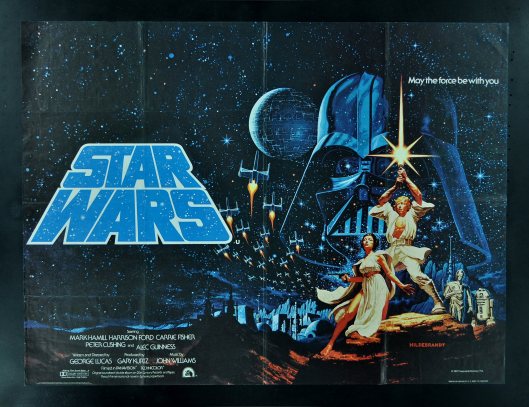
image1poster.jpg

This poster—the second ever Star Wars poster, in fact (used by 20th Century Fox in the UK)– is a great link to JRRT—as if we don’t seem to make such links every time we write!  It’s by two of our favorite Tolkien illustrators, the Hildebrandt brothers.  Here’s a picture of the surviving twin, Greg, with that very poster (his brother, Tim, died in 2006).

image2gh.png

(Clink here for a LINK to an interesting little piece from 2010 about the Hildebrandts and George Lucas.)

We believe, however that there may be a deeper link.

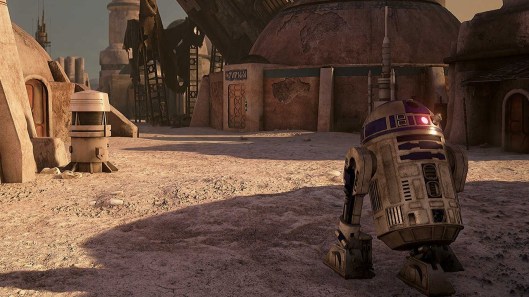
The original reviews (here’s a LINK to summaries of some of them) were a mixture, with some critics enthusiastic about what they saw and others (in our view the stodgier ones) calling the film things like “puerile”.  One element which was occasionally commented upon was the look of the picture—and not just the (for the time) dazzling special effects—but the fact that all the worlds depicted were lived-in, not shiny and new—well, almost.  Consider Mos Eisley, for example,

image3moseisley.jpg

which looks dusty and battered, suggesting the passage of time as well as the effects of the harsh desert climate of Tatooine.

Or the Jawa sandcrawler, old and clearly rusting–

image4jawasandcrawler.jpg

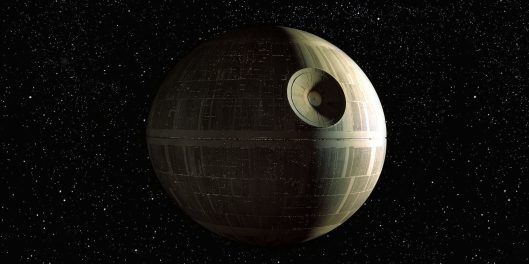
We said “almost” shiny and new because there’s one part of this galaxy with a different look:  the Death Star.

image5insidedeathstar.jpg

It looks like it’s dusted and waxed hourly, doesn’t it?  And the outside appears to be just as neat.

image6falconenteringdeathstar.jpg

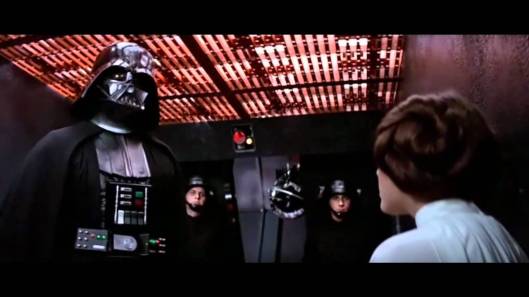
What does this say about the nature of those who inhabit it?  For us, thinking about the spotless Darth Vader,

image7vader.jpg

immediately suggests that the old proverb should be changed to “Cleanliness is next to Un-godliness”!  (Okay—we’re not the neatest and most organized people we know.)

It has been pointed out, more than once and beginning with the director himself, that George Lucas was influenced by Edgar Rice Burroughs’ John Carter series, beginning with A Princess of Mars (first published serially in The All-Story, February to July, 1912).

image8princess.jpg

(And here’s another connection—this cover and the illustrations for its first publication in book form, in 1917, were by Frank Schoonover, 1877-1972, who was the student of another of our favorite illustrators, Howard Pyle, whom we have occasionally mentioned in previous postings.  The convincing detail in this cover painting shows that, just like his teacher, Schoonover did his research—in his case, by very carefully going through the text and taking note of any technical information the author might have mentioned.)

In A Princess of Mars and subsequent books,  Mars has a civilization which is old and in decline (the inspiration for which, in turn, may have come from the work of the amateur astronomer, Percival Lowell, 1855-1916, whose telescopic observations of Mars had convinced him that the planet was—or had been—the home of a dying civilization which had constructed a vast network of canals to supply themselves with water from the polar ice caps—unfortunately, numerous NASA missions have found no evidence of the desperate Martians or their canals).   It would be easy, then, to say that Lucas was just following his source material, but we would suggest that there are two better explanations for showing wear.

The first comes from something Lucas is quoted as having said to his production designers:  “What is required for true credibility is a used future.” In Lucas’ view, then, the story’s believability comes in part from its look:  if things appeared not shiny, but worn, then viewers would be more likely to accept the narrative as somehow “true”, we presume because things in our world so often look used.

There is then, we think a further presumption:  if things look worn, then they have a past, which implies that the here-and-now of the story is a small part of bigger things and, certainly, just looking at the “crawl” at the beginning of the original Star Wars,

star-wars-crawl-163729.jpeg

which leads us to  our second explanation.  This one deals with something deeper, something which we would say might provide another possible link with JRRT and is, in fact, suggested by the titles of the first three Star Wars films made and even in their sequence:  A New Hope, The Empire Strikes Back, The Return of the Jedi.

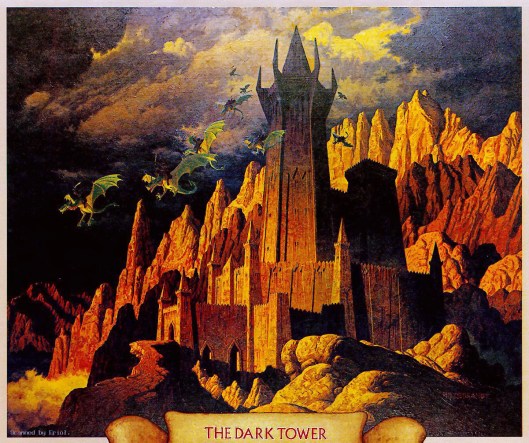
In two earlier postings, we talked about the condition of Middle-earth at the beginning of The Lord of the Rings, in which everything, from the trees to the houses of Minas Tirith, has grown old and weary—and even potentially hostile, in the case of the trees.  Part of this comes from the fact that Middle-earth is old:  one has only to turn to Appendix B, subtitled “The Tale of Years”, in The Lord of the Rings to see that, in the Second and Third Ages alone, nearly 6000 years have passed.   (In terms of our earth, that’s moving from the late Neolithic Era to modern times, 4000bc to 2017ad.)  This also emphasizes the age and depth of evil, as well as its power to corrupt in the present:  Sauron began to build Barad-dur c. SA1000—5000 years before the main narrative of The Lord of the Rings opens and, in the present, the world is crumbling.

Of course, JRRT lived surrounded by the past.  The oldest surviving building in his daily Oxford is the tower of St Michael at the North Gate, dating from 1040ad, nearly a thousand years before his time,

image9stmichaels.jpg

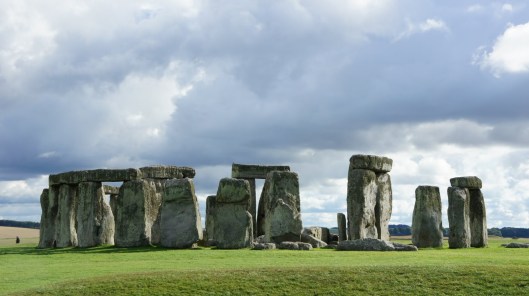
but Neolithic Stonehenge is only 58 miles (93km) southwest of the city and that’s 5000 years old, taking us back to the time when, in Middle-earth, Sauron had begun the Barad-dur.

image10stonehenge.JPG

image11baraddur.jpg

In contrast, Lucas was born in 1944 in Modesto, California, a town only founded in 1870, and grew up in a post-World War II world, where the key was “the future”.  It is a tribute, then, to his story-telling gift that he realized how useful in telling his story the past—even an imagined one—could be and it is interesting to see how he shares that understanding with JRRT and perhaps shares a goal, as well.

We’ve said that our second explanation may be seen in the titles of Lucas’ three films, so let’s consider them in comparison with the general shape of Tolkien’s work to see what that shared goal might be.   (In an interview, Lucas even described the three as being like a three-act play, suggesting the dramatic progress inherent in the movement from one to another.)

At the beginning of the first film, it is a dark time in the galaxy:  the repressive regime of the evil Emperor Palpatine dominates and resistance is confined to “The Rebel Alliance”, which has scraped together a fleet (and, presumably an army—we see elements in Rogue One, which takes place before this film) to resist, but seems to spend most of its time running and hiding.  The past is only implied, but the fact that there is an Empire and a resistance suggests much, just as the run-down condition of places like Tatooine might suggest both age and that the galaxy has become run-down because of that Empire.

image12palpatine.jpg

At the beginning of The Lord of the Rings, we find ourselves in a place with a long history, as we see from the many pages of the “Prologue”.  It has been a quiet place, but the world outside is becoming less so, with sinister forces growing, as Frodo hears from passing dwarves:

“They were troubled, and some spoke in whispers of the Enemy and of the Land of Mordor.” (The Fellowship of the Ring, Book One, Chapter 2, “The Shadow of the Past”)

In time, readers are brought to see that the dwarves are grossly understating the case:  the Enemy is real, Sauron, and that he has not only huge armies, but the Nazgul and a would-be ally in his enemies’ camp, Saruman.  The same may be said for the Empire:  not only do they have huge fleets and armies, but they have the “ultimate weapon”, the Death Star.

image13deathstar.jpeg

We will learn, as well, that, for all his great age and might, Sauron has an Achilles’ heel:  to give the One Ring its power, he has had to pour most of his power into it.  Thus, if he regains the ring, he will be much more powerful than he is at present, but, should the ring be destroyed, Sauron will be virtually destroyed with it.  As this struggle has been going on in Middle-earth for thousands of years, the idea that Sauron is vulnerable could easily be termed “a new hope”, just as Luke, the son of the Enforcer of the Galaxy, Darth Vader/Anakin Skywalker, will provide a new hope for the Rebels (especially when we are told about “the Chosen One”—for whom he can be taken).

For a time, things do not go well for those opposed to Sauron:  he combines psychological/meteorological attacks with the march of huge armies, and even pirate raids on Gondor’s south coast. Gondor is overrun and Minas Tirith is assaulted.  This is clearly The Empire Strikes Back, just as the pursuit of the Rebel fleet to Hoth and the destruction of Echo Base disperses the Rebels and casts a shadow over the hope felt after the destruction of the Death Star.

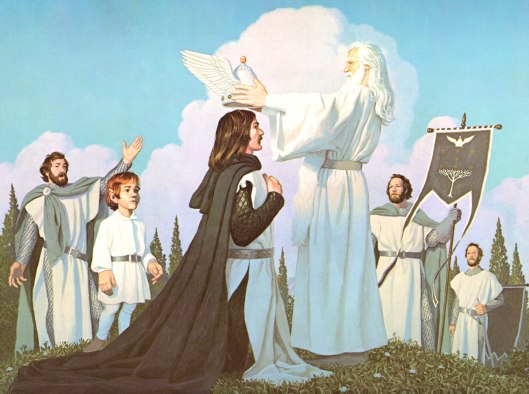
This is not the end, however, for the Rebels or for the good people of Middle-earth.  Not only is the Ring destroyed and Sauron disembodied, but this paves the way for The Return of the King, with all of the reflowering-to-come, as we have suggested in a previous posting.

image14crowning.jpg

And there is a strong echo in the title of Lucas’ third film, The Return of the Jedi, in which the Emperor is destroyed and balance brought back to the Force—and the galaxy.  (Of course, with Star Wars 7, we see that the happy ending is only temporary, but we have hopes that, by the conclusion of 9, there will come a final rebalancing and peace at last.)

image15return.jpg

Lucas’ acknowledges many sources but, so far, we have yet to locate a quotation from an interview or anywhere else in which he says, “Yes, I’ve read Tolkien closely and, indeed, there is a strong affinity between my work and his”, but we believe that we can suggest, at least, that he, like JRRT, is following the same path in creating a world in turmoil, a visibly-aging world.  Into this world, he places his protagonist who provides a new hope, faces the might of a not-easily-defeated enemy, but, by his bravery and determination, finally brings about the destruction of that enemy (interesting in both cases he does not do so himself—Gollum inadvertently destroys the ring, just as Anakin, not his son, kills the Emperor) and the promise of renewal in the return of the Jedi—and the King.

And what do you think, dear readers?

Thanks, as ever, for reading!

MTCIDC

CD

Shire Portrait (5a): Hostile Takeover

08 Wednesday Mar 2017

Posted by Ollamh in Economics in Middle-earth, Imaginary History, J.R.R. Tolkien, Literary History, Narrative Methods

≈ Leave a comment

Tags

A Long-Expected Party, auction, Bag End, Baggins, Barliman Butterbur, Galadriel, Government, Isengard, Longbottom Leaf, Luke Skywalker, Merry and Pippin, Mirror of Galadriel, Pipeweed, Sackville-Bagginses, Sam Gamgee, Saruman, Star Wars, The Empire Strikes Back, The Lord of the Rings, The Return of the King, The Scouring of the Shire, The Shire, Tolkien, Yoda

As always, dear readers, welcome!

This is, we think, the last in our Shire Portrait series (although a 2-parter)—at least for the moment. In it, we intend to consider just how the Shire fell into the hands of “Sharkey” and his “boys”.

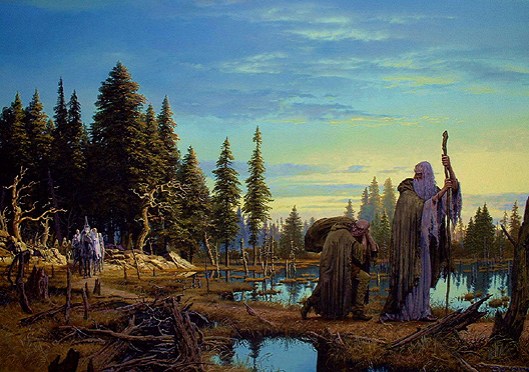
The Ring destroyed and the King returned, Gandalf, the Hobbits, and a party of Elves are traveling back toward Rivendell and beyond when they come upon Saruman and Grima, now no more than Saruman’s slave.

Ted_Nasmith_-_Saruman_is_Overtaken.jpg

It is not a happy meeting, as can be imagined. When offered help, Saruman replies:

“All my hopes are ruined, but I would not share yours. If you have any…You have doomed yourselves, and you know it. And it will afford me some comfort as I wander to think that you pulled down your own house when you destroyed mine.” The Return of the King, Book 6, Chapter 6, “Many Partings”

In such a mood, it can be imagined how he treats the Hobbits—even when Merry offers him pipe-weed, which he does while commenting, less than tactfully, on its origin:

“ ‘You are welcome to it; it came from the flotsam of Isengard.’

‘Mine, mine, yes and dearly bought!’ cried Saruman, clutching at the pouch. ‘This is only a repayment in token; for you took more, I’ll be bound. Still, a beggar must be grateful, if a thief returns him even a morsel of his own. Well, it will serve you right when you come home, if you find things less good in the Southfarthing than you would like. Long may your land be short of leaf!’”

Saruman’s remark—a curse, really—resonates especially with Sam.

“’Ah!’ said Sam. ‘And bought he said. How, I wonder? And I didn’t like the sound of what he said about the Southfarthing. It’s time we got back.’” The Return of the King, Book 6, Chapter 6, “Many Partings”

This is a natural reaction on Sam’s part because of what he had seen in Galadriel’s mirror, we presume.

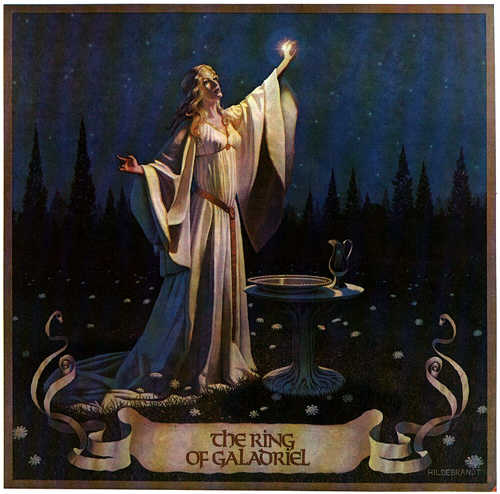
1gmirror.jpg

“’Hi!’ cried Sam in an outraged voice. ‘There’s that Ted Sandyman a-cutting down trees as he shouldn’t. They didn’t ought to be felled: it’s that avenue beyond the Mill that shades the road to Bywater…

But now Sam noticed that the Old Mill had vanished, and a large red-brick building was being put up where it stood. Lots of folk were busily at work. There was a tall red chimney nearby. Black smoke seemed to cloud the surface of the Mirror…

‘I can’t stay here,’ he said wildly. ‘I must go home. They’ve dug up Bagshot Row, and there’s the poor old Gaffer going down the Hill with his bits of things on a barrow…” The Fellowship of the Ring, Book 2, Chapter VII, “The Mirror of Galadriel”

At the time, Galadriel had told him

“’You cannot go home alone,’ said the Lady. ‘You did not wish to go home without your master before you looked in the Mirror, and yet you knew that evil things might well be happening in the Shire. Remember that the Mirror shows many things, and not all have yet come to pass. Some never come to be, unless those that behold the visions turn aside from their path to prevent them. The Mirror is dangerous as a guide to deeds.” The Fellowship of the Ring, Book 2, Chapter VII, “The Mirror of Galadriel”

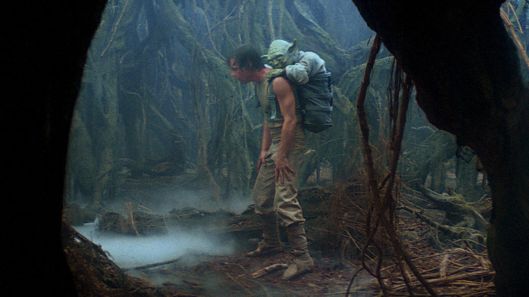
[A footnote: suddenly, we are reminded of that scene on Dagobah in Star Wars V, when Luke has had a vision and immediately wants to rush off to Bespin.

2lukedagobah.jpeg

“Luke: I saw—I saw a city in the clouds.

Yoda: [nods] Friends you have there.

Luke: They were in pain…

Yoda: It is the future you see.

Luke: The future?

[pause]

Luke: Will they die?

Yoda: [closes his eyes for a moment] Difficult to see. Always in motion is the future.

Luke: I’ve got to go to them.

Yoda: Decide you must, how to serve them best. If you leave now, help them you could; but you would destroy all for which they have fought, and suffered.” The Empire Strikes Back (1980)

As—using various websites—we provide links here—we can see that an imitation of the opening of the Hobbit—Bilbo and Gandalf meeting—appears in an early script of Star Wars IV, I think that the scene at Galadriel’s Mirror was somewhere back in G. Lucas’ wonderfully fertile brain—and, yes, we are big fans.]

“Secrets of the ‘Star Wars’ Drafts”

Was George Lucas Inspired by Tolkien?

Star Wars Origins: The Lord of the Rings

At this point, we know from two sources that Saruman has had commercial dealings with the Southfarthing.

First, of course, we’ve just seen it confirmed by Saruman’s response to Merry. Second is that scene at Isengard, where Gandalf, Theoden, Eomer, and Aragorn, travel with an escort and find there Merry and Pippin, who tell them of their discovery of two small casks:

“ ‘My dear Gimli, it is Longbottom Leaf! There were the Hornblower brandmarks on the barrels, as plain as plain. How it came here, I can’t imagine.” The Two Towers, Book Three, Chapter 9, “Flotsam and Jetsam”

Michael-Herring-Restos-y-despojos-Calendario-Tolkien-1980

Knowing, however, of Saruman’s increasing interest in the Shire, we can imagine that one of his agents, active in the Southfarthing, had acquired it for him. As the Appendix B, “The Tale of Years” tells us, under TA2953:

[Saruman] notes his [Gandalf’s] interest in the Shire. He soon begins to keep agents in Bree and the Southfarthing.” (page 1089 in Appendix B)

Spying was clearly only the beginning for Saruman, however. The actual evidence for his eventual take-over is scattered throughout The Lord of the Rings, but we believe that it can be pieced together to provide a picture of how it must have been done. It was a two-step process.

First, he appears to have gained knowledge of internal dissatisfaction within the Shire. Because there is really nothing political in the Shire–as readers will know from the first posting in this series, there is virtually no government—this unrest was domestic—as is said in the Prologue, “Families for the most part managed their own affairs.”

In the case of Bilbo and Frodo, the dissatisfied were the Sackville-Bagginses. We first met them in the last chapter of The Hobbit, where they were described as “Bilbo’s cousins” and were shown as being actively involved in the auction of the “effects of the late Bilbo Baggins Esquire”—as well as in the disappearance of some merchandise not auctioned off:

“Many of his silver spoons mysteriously disappeared and were never accounted for. Personally he suspected the Sackville-Bagginses. On their side they never admitted that the returned Baggins was genuine and they were not on friendly terms with Bilbo ever after.” The Hobbit, Chapter 19, “The Last Stage”

It was one more blow to the Sackville-Bagginses when Bilbo rescued the now-orphaned Frodo from “those queer Bucklanders” and brought him to live at Bag End, as Gaffer Gamgee related in The Ivy Bush:

“ ‘But I reckon it was a nasty knock for those Sackville-Bagginses. They thought they were going to get Bag End, that time he went off and was thought to be dead. And then he comes back and orders them off; and he goes on living and living, and never looking a day older, bless him! And suddenly he produces an heir, and has all the papers made out proper. The Sackville-Bagginses won’t never see the inside of Bag End now, or it is to be hoped not.’ “ The Fellowship of the Ring, Book One, Chapter 1, “A Long-Expected Party”

Bad blood, then, on several counts—and, for Saruman, looking for a way in, a great opportunity.

Bilbo might have suspected them of spoon-pilfering, but his was a more generous nature, however, and he even invited them to his and Frodo’s joint birthday party.

“The Sackville-Bagginses were not forgotten. Otho and his wife Lobelia were present. They disliked Bilbo and detested Frodo, but so magnificent was the invitation card, written in golden ink, that they had felt it impossible to refuse…” The Fellowship of the Ring, Book One, Chapter 1, “A Long-Expected Party”

On the other hand, Bilbo does not please them when he announces that Frodo is coming into “his inheritance”—

“The Sackville-Bagginses scowled, and wondered what was meant by ‘coming into his inheritance’ “ and, when Bilbo makes his startling disappearance, they “departed in wrath”. (quotations from Chapter One).

And yet they didn’t quite depart. It seems they have only stepped away from the party, only to return to cause trouble, demanding to see Bilbo’s will.

“Otho would have been Bilbo’s heir, but for the adoption of Frodo. He read the will carefully and snorted. It was, unfortunately, very clear and correct…” The Fellowship of the Ring, Book One, Chapter 1, “A Long-Expected Party”

Otho “snapped his fingers under Frodo’s nose and stumped off”, but Lobelia, his wife, remained, and Frodo later found her “still about the place, investigating nooks and corners, and tapping the floors. He escorted her firmly off the premises, after he had relieved her of several small (but rather valuable) articles that had somehow fallen inside her umbrella.” And she leaves with a kind of threat and what she believes is an insult:

“ ‘You’ll live to regret it, young fellow! Why didn’t you go too? You don’t belong here; you’re no Baggins—you—you’re a Brandybuck!’ ”

It’s never said why there is such an animus held by the Sackville-Bagginses against the Bagginses, but there is clearly something wrong with the S-Bs, from their covetousness to Lobelia’s open theft, and whatever is wrong is just what Saruman will find and exploit. Our next mention of them is oblique and it has to do with that pipe-weed. Merry and Pippin have been explaining how they had come to discover it at Isengard and all seems clear—

“ ‘All except one thing,’ said Aragorn: ‘leaf from the Southfarthing in Isengard. The more I consider it, the more curious I find it. I have never been in Isengard, but I have journeyed in this land, and I know well the empty countries that lie between Rohan and the Shire. Neither goods nor folk have passed that way for many a long year, not openly. Saruman had secret dealings with someone in the Shire, I guess. Wormtongues may be found in other houses than King Theoden’s…” The Two Towers, Book Three, Chapter 9, “Flotsam and Jetsam

With that faint foreboding, we hear no more until Gandalf and the Hobbits are once more leaving Bree and Butterbur says, almost in passing:

“ ‘I should have warned you before that all’s not well in the Shire neither, if what we hear is true. Funny goings on, they say.’ “ The Return of the King, Book Six, Chapter 7, “Homeward Bound”

With Butterbur’s words in their ears, the Hobbits ride out and conversation begins:

“ ‘I wonder what old Barliman was hinting at,’ said Frodo.

‘I can guess some of it,’ said Sam gloomily. ‘What I saw in the Mirror: trees cut down and all, and my old gaffer turned out of the Row. I ought to have hurried back quicker.’

‘And something’s wrong with the Southfarthing evidently,’ said Merry. ‘There’s a general shortage of pipe-weed.’

‘Whatever it is,’ said Pippin, ‘Lotho will be at the bottom of it: you can be sure of that.’”

Here again, after Aragorn’s remark long before, we see that pipe-weed turn up—and associated somehow with a Sackville-Baggins. Butterbur has already replied to Gandalf’s request for it that “That’s the one thing that we’re short of, seeing how we’ve only got what we grow ourselves, and that’s not enough. There’s none to be had from the Shire these days.”

It’s never explained why Pippin makes the connection with Lotho at this point—was the bad blood between the Bagginses and the Sackville-Bagginses part of a darker picture of the S-Bs? This seems more than possible when Gandalf adds to Pippin’s remark:

“ ‘Deep in, but not at the bottom,’ said Gandalf. ‘You have forgotten Saruman. He began to take an interest in the Shire before Mordor did.’”

And now we begin to see a potential bigger pattern: Saruman-an S-B-Shire and, with it, the second step in the take-over of the Shire, that from outside. But that’s for Shire Portrait 5b: “Hostile Take-Over.2”, next time.

Until then, thanks, as ever, for reading!

MTCIDC

CD

Killer Monks (and Friars)

11 Wednesday Jan 2017

Posted by Ollamh in Artists and Illustrators, Fairy Tales and Myths, Heroes, Literary History, Narrative Methods

≈ Leave a comment

Tags

Baze Malbus, Bo staff, Canterbury Tales, Chirrut Imwe, Cluny, Dauntless, Friar Tuck, Friars, Geoffery Chaucer, Guardians of the Whills, Howard Pyle, Jahng Bong, Jedha, Little John, monastery, monks, N.C. Wyeth, Nijedha, quarter-staff, religion, Robin Hood, Rogue One, Scarif, Star Destroyer, Star Wars, stormtroopers, Tae Kwon-Do, Temple of the Kyber, the Force, The Force Awakens, The Merry Adventures of Robin Hood, Thomas Hughes, Tom Brown's Schooldays

Welcome, dear readers, as always.

Today, for the first time in some time, we are not visiting Middle-earth. Instead, we are visiting our earth, as well as another planet or two.

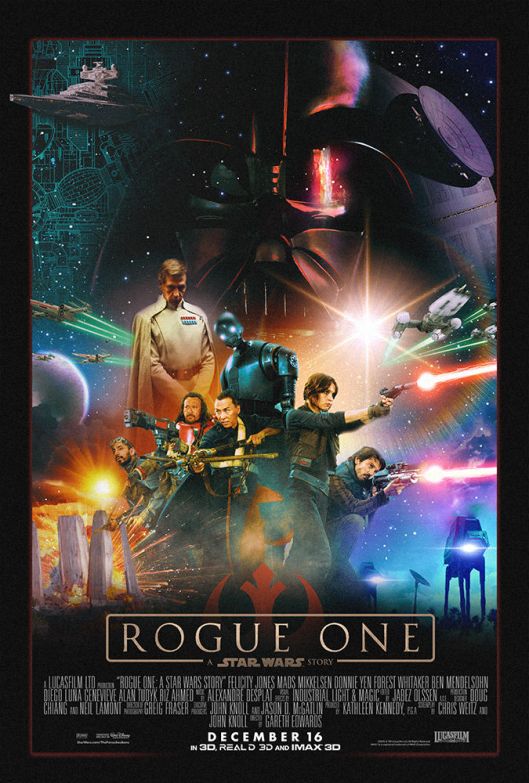
Recently, we saw Rogue One,

1rogueoneposter.jpg

which, in our opinion, was a bit more coherent than The Force Awakens, but which still—again, our opinion—like Force, had too many players and too many planets. For us, this has always been the danger of fantasy fiction, when plot overwhelms character, as—and aren’t we opinionated in this posting?—in the Harry Potter series.

2hp1.jpg

The first volume was a pleasant twist on the traditional school story, a genre which dates at least as far back as Tom Brown’s Schooldays (1857).

3tbsschooldays.png

by Thomas Hughes.

4thughes.jpg

We thought that that first book had a number of potentially interesting characters—Hermione, the Weasley twins, Snape, Hagrid—but, as the books piled up and the plot became more complex and more and more characters appeared, there was less and less, it seemed to us, of those interesting original figures. And many of the characters who were there, seemed much sketchier.

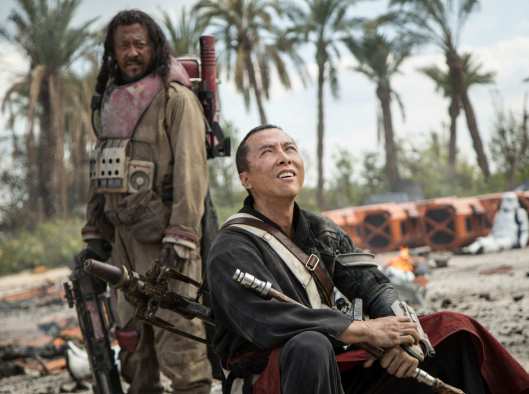
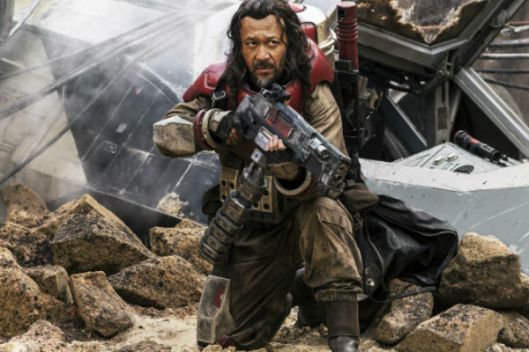
In the case of Rogue One, we thought that two of the most interesting were the two Guardians of the Whills, rather like monks

5romonks.jpg

Chirrut Imwe

6chirrut.jpg

and Baze Malbus.

7baze.jpg

These two had been attached to the Temple of the Kyber in the city of Nijedha on the desert moon Jedha.

8jedha.jpg

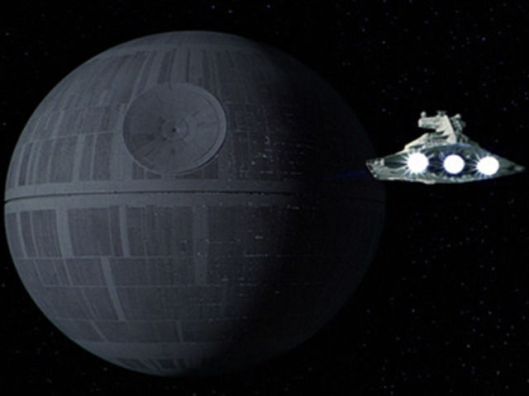
The Empire has arrived, however (hard to miss the Star Destroyer Dauntless in this picture, isn’t it?), to seize all of the kyber crystals on Jedha (used originally to power Jedi light sabers) to fuel the superlaser on the new terror weapon, the Death Star.

9deathstar.jpg

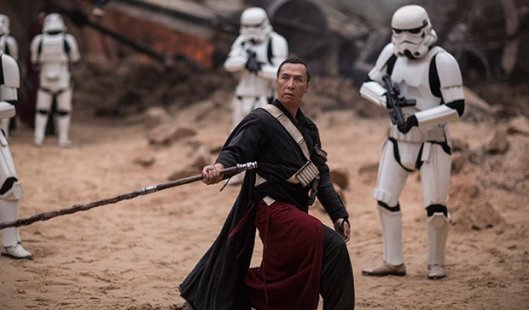
In the process, the two monks have been driven from the Temple, which has been pillaged, and now appear to be living on the street. Chirrut believes in the Force, while Baze seems to believe in his very large gun. Chirrut, who is blind, first shows his skills in an amazing scene where, surrounded by stormtroopers, he makes short work of them with his fighting staff, which resembles the Jahng Bong or Bo Staff used in Tae Kwon-do, among other Eastern weapons and martial arts.

10chirrutstorm.jpg

As everyone who has seen Rogue One (and, by now, many who haven’t, we’d guess) knows, the two don’t survive the attack on Scarif

11bazechirrut.jpg

and this made us wish we had seen more of them, not only in this movie (perhaps them ejected from the Temple—which wouldn’t have been easy!), but in another Star Wars story, in which they were the main characters. So many questions: how did they meet? Why does the one believe so fervently in the Force and the other does not? What did they do before Nijedha? Were they always monks? If not, how did they become so? How and where did they train?

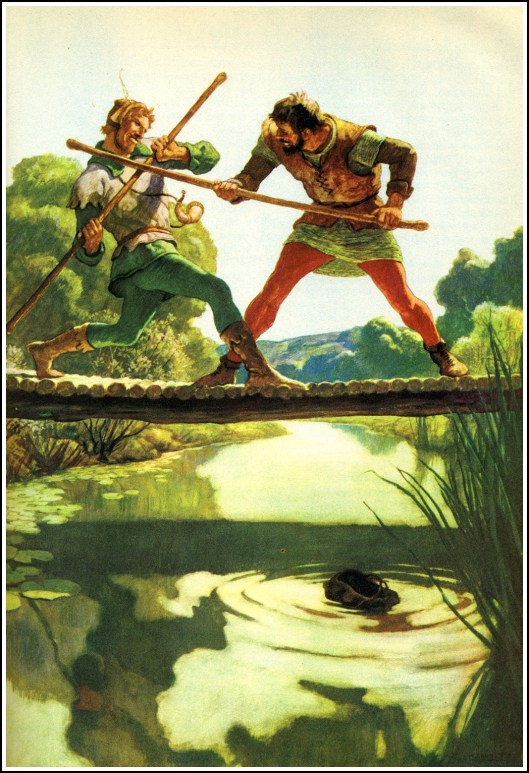
Seeing fighting with that Bo Staff immediately prompted us to think of much earlier figures with a similar weapon: Robin Hood, who fights, on a log over a stream, his soon-to-be-lieutenant, Little John, with quarter-staves.

12roblj.jpg

This is an illustration by N.C. Wyeth from the 1917 Robin Hood,

13robinhood1917.jpg

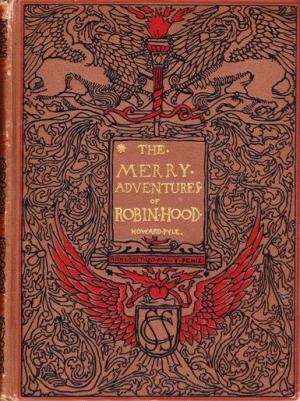
but there is an earlier edition of the stories of Robin Hood by Wyeth’s teacher, Howard Pyle, The Merry Adventures of Robin Hood (1883).

14pylemerryadventures.jpg

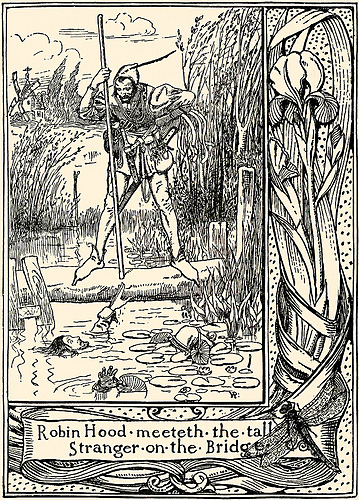
And here is a version of the aftermath of that scene on the log with Little John.

15pylerhlj.jpg

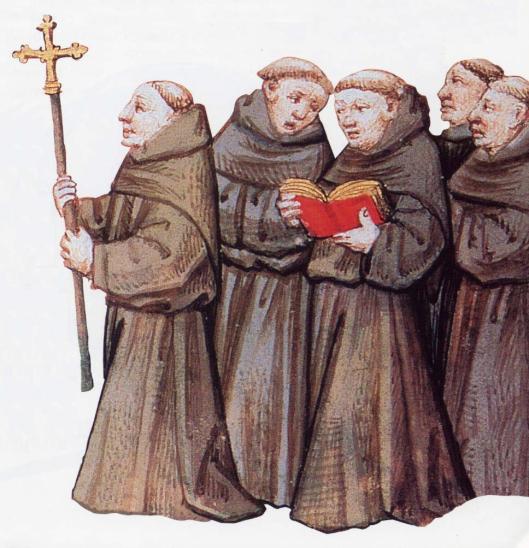
Robin has another encounter with water and a fighter when he meets a friar beside a stream. A monk is a man who enters a religious community called a monastery and spends his life working (and praying) within its walls.

16amonks.jpg

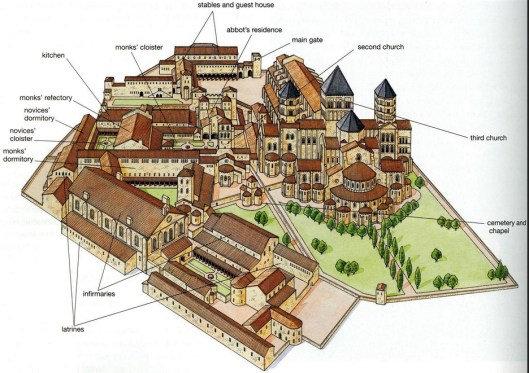
Western medieval Europe was full of monasteries, like this, at Cluny, in France.

17cluny.jpg

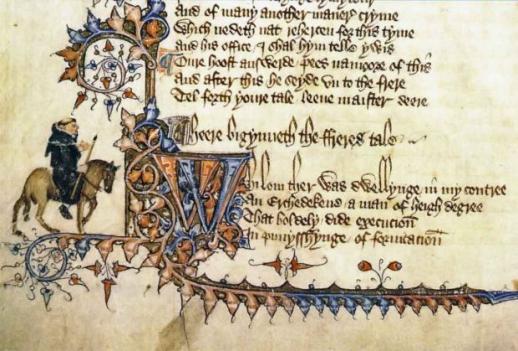
Friars, on the other hand, traveled within their appointed district, called a “province”. Here is a friar from an early (beginning of the 15th century) illustrated version of Geoffrey Chaucer’s Canterbury Tales.

18friar.jpg

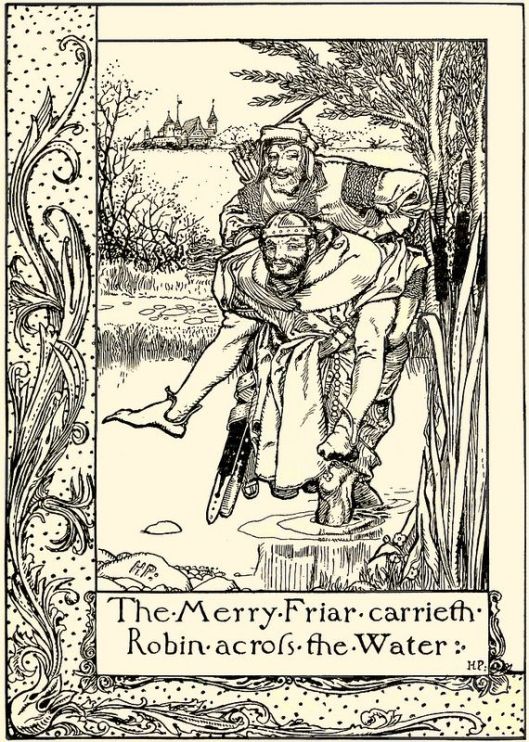
Because friars were much less strictly governed, they gained a folk reputation as tricksters and high-livers, and the trickster shows through when Robin Hood forces a friar (he will become Robin’s friend, Friar Tuck) to carry him across a stream—and the friar dumps him before proving that he’s also an expert swordsman. Here’s an illustration from the 1883 Pyle version.

19pyletuck.jpg

As we thought about it, by combining Little John’s skill with the quarterstaff with Friar Tuck’s wits and courage and holy orders, we could see a possible inspiration for Chirrut Imwe.

20chirrut.png

If you know the old Robin Hood stories and you’re seen Rogue One, what do you think?

Thanks, as ever, for reading.

MTCIDC

CD
Music to Our Ears

07 Wednesday Oct 2015

Posted by Ollamh in Films and Music

≈ Leave a comment

Tags

Alexander Nevsky, Bag End, Birth of a Nation, Darth Vader, Film music, film score, Gilraen's Memorial, Howard Shore, Imperial March, Jaws, John Williams, Journey to the Grey Havens, melodrama, Mendelssohn, Midsumer Night's Dream, Prokofiev, Rivendell, Sergei Eisenstein, silent film, Star Wars, The Lord of the Rings, The Shire, The Tales That Really Matter, theme

Dear Readers,

Welcome, as always. In this posting, we’d like to talk a bit about film music.

We’re interested in all kinds—from classic 30s to more recent scores. We began by asking ourselves why is there film music? Where does it come from?

To begin, we looked back into the 19th century, where we found that music could be used underneath the action in plays—Mendelssohn’s Midsummer Night’s Dream being a good example. Mendelssohn wrote the overture as a teenager, and as a purely orchestral piece. The rest of the music was written for a performance of the play in Berlin in 1842. Some of it consists of settings for the songs from Shakespeare’s play, but other music is meant to be played during a scene to heighten tension or to release it. (This use of music was so common in the 19th century that we get the expression “melodrama” originally from plays with music. “Melos” is an ancient Greek word for “song”, which gets added to “drama”.)

Edwin_Landseer_-_Scene_from_A_Midsummer_Night's_Dream._Titania_and_Bottom_-_Google_Art_Project

When film began to take its place next to drama as a form of popular entertainment—sometimes in the same theatres—film was, of course, silent.

zorro-still

Without spoken dialogue or sound effects, as people were already used to the music played in dramas, it was natural to have music played under films, commonly using a piano or an organ.

3185_2

The music could be classical excerpts or popular music of the period, which would be improvised by the organist or pianist. For some films, music was even specially written. Birth of a Nation (1915) was one of these.

Sheet_music_for_'The_Perfect_Song'_from_The_Birth_of_a_Nation

Such music, as in plays, would underscore the action building or releasing the motion. This was true of early sound films—like Alexander Nevsky (1939).

PROKOFIEV , Sergei - with Sergei Eisenstein ( film director ) at film studios , 1943 working on film Alexander Nevsky . Russian composer , 27 April 1891 - 5 March 1953 .

PROKOFIEV , Sergei – with Sergei Eisenstein ( film director ) at film studios , 1943 working on film Alexander Nevsky . Russian composer , 27 April 1891 – 5 March 1953 .

And of more recent films. Think of the shark theme from Jaws

(Jaws theme)

2806004-jaws

Or, Darth Vader

(Imperial March)

Black-Series-Darth-Vader-47

(And think of how the music change when Luke takes off his father’s helmet.)

(Imperial March– alternate version)

vader1983

A special favorite of ours is the Shire theme from The Lord of the Rings.

jrrt_12

In the theatrical version of the film, we hear this first when Gandalf visits Frodo.

(The Shire theme in “Bag End“, taken from the complete recordings)

gandalf-visiting-frodo

In this scene, we’re being told, just as in a silent movie, about a feeling—and only through music which accompanies the picture.

But when we hear the music return when Frodo and Sam have set out on their journey to Rivendell:

(“Rivendell”)

Leaving Rivendell, as a part of the Fellowship (and the theme here acts as a prelude to the Fellowship theme):

(“Gilraen’s Memorial“)

Sam’s speech, where the theme resides to accepting the journey but reminisces about home:

(“The Tales That Really Matter“)

And saying farewell before departing into the West:

(“Journey to the Grey Havens”)

And so we have an entirely different feeling each time we hear a variant of the theme– the Little People make their mark in the film not only by taking a part in the story, but also in the music, as it shifts through their adventure.

But try this for yourself, dear reader. Pick a favorite film, and try to focus less on the action and more on the music: are there recurring themes, for instance? And, if so, do they change? And if they do change, how does that affect the film and you?

Thanks, as ever, for reading,

MTCIDC,

CD

Seeing the Elephant– Oliphaunt

30 Wednesday Sep 2015

Posted by Ollamh in Films and Music, Heroes, J.R.R. Tolkien, Military History, Military History of Middle-earth

≈ 2 Comments

Tags

Adventure, Alps, ATAT, Elephants, Greeks, Hannibal, Hoth, Mammoth, Mumak of Harad, Napoleon, Oliphaunt, Peter Jackson, Pyrrhus of Epirus, Romans, Sam Gamgee, Star Wars, The Lord of the Rings, Tolkien, war

Grey as a mouse,
Big as a house,
Nose like a snake,
I make the earth shake,
As I tramp through the grass;
Trees crack as I pass.
With horns in my mouth
I walk in the South,
Flapping big ears.
Beyond count of years
I stump round and round,
Never lie on the ground,
Not even to die.
Oliphaunt am I,
Biggest of all,
Huge, old, and tall.
If ever you’d met me
You wouldn’t forget me.
If you never do,
You won’t think I’m true;
But old Oliphaunt am I,
And I never lie.

(“The Black Gate is Closed”, LOTR 646)

Dear Readers,

Welcome, as always.

Sam dearly wants to see an oliphaunt– and he will get his chance. Were he able to see the third part of Peter Jackson’s The Lord of the Rings, he would see many more than one.

Screen_Shot_2013-03-12_at_6.17.47_PM

Sam does see one, however:

To his astonishment and terror, and lasting delight, Sam saw a vast shape crash out of the trees and come careering down the slope. Big as a house, much bigger than a house, it looked to him, a grey-clad moving hill” (“Of Herbs and Stewed Rabbit”, LOTR 661).

Here’s how the film shows two of them:

oliphaunts_small

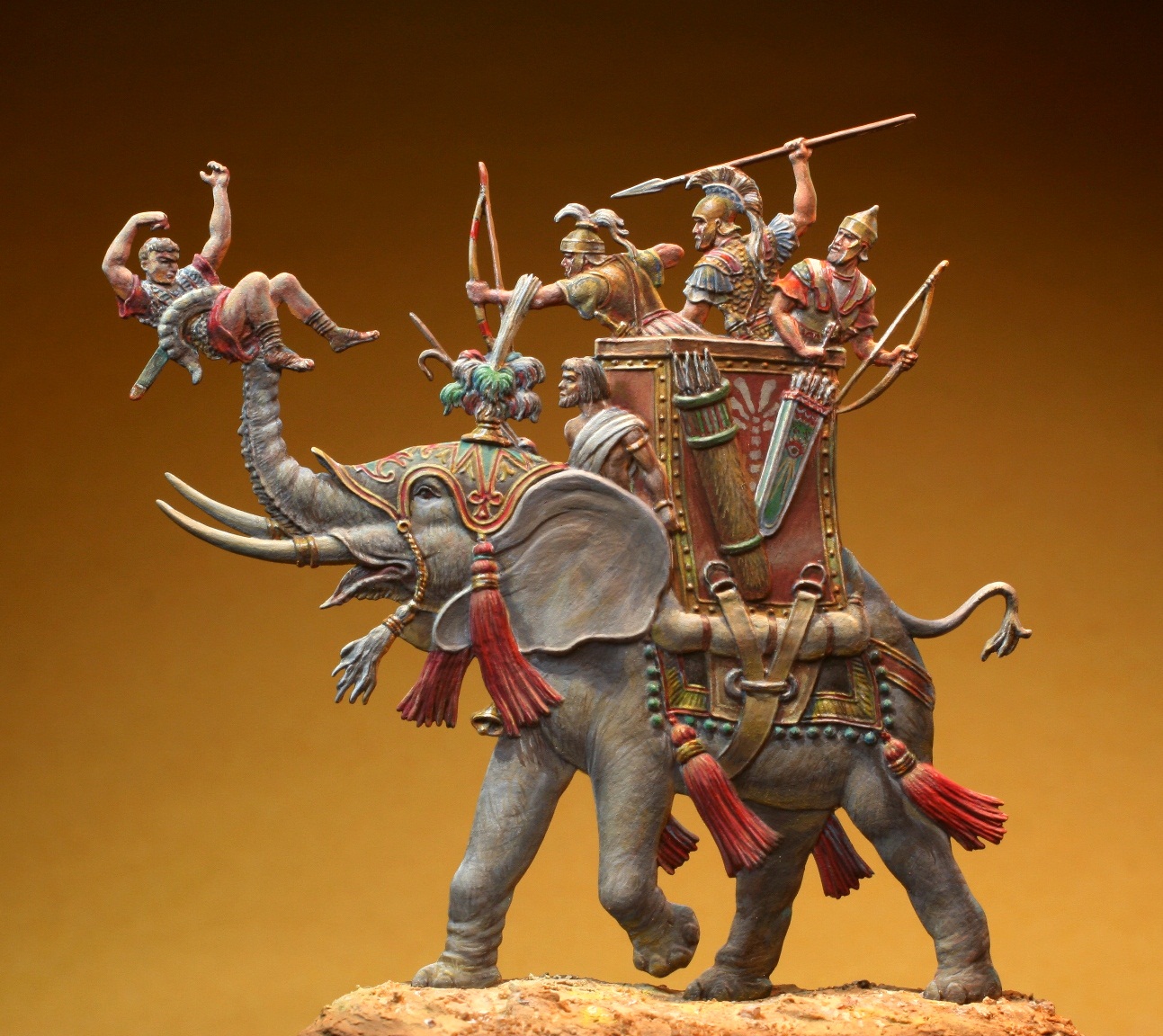
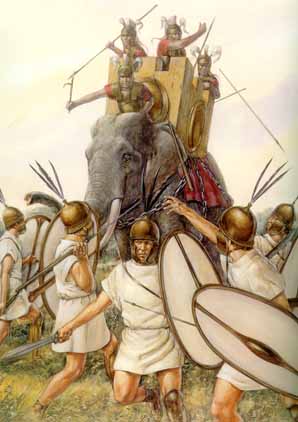
These are, of course, based upon real war elephants.

Carthaginian-War-Elephant-yellow-shrink

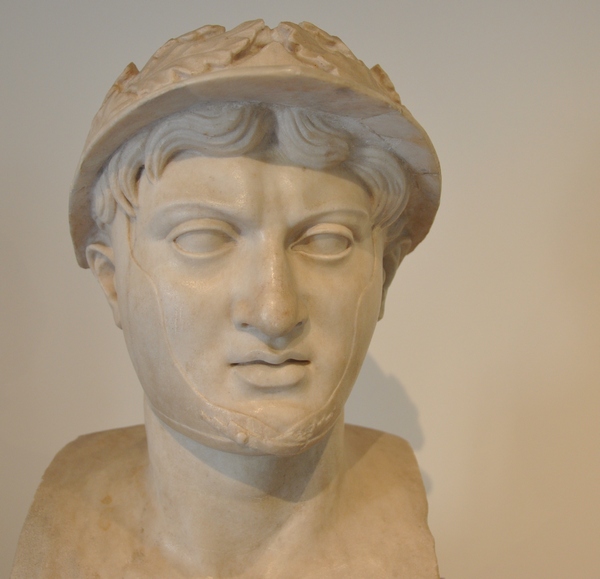
The west– our west– first saw such elephants in the 280s BC, in the army which Pyrrhus of Epirus brought from Greece to fight the Romans.

herculaneum_villa_papiri_pyrrhus_naples4elephant_dish

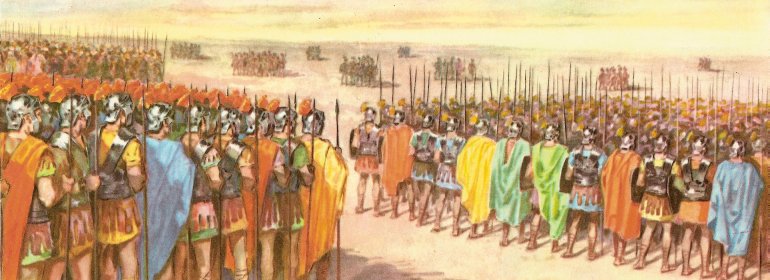
Such elephants were thought to be useful against great blocks of infantry.

phalanx phalanx1legion_in_battle_formation

They could be used like tanks to knock holes in the formations.

Pyrhus_elephants2

To most people, the most familiar images, however, would be from Hannibal’s invasion of Italy in 218 BC.

Hannibal-2

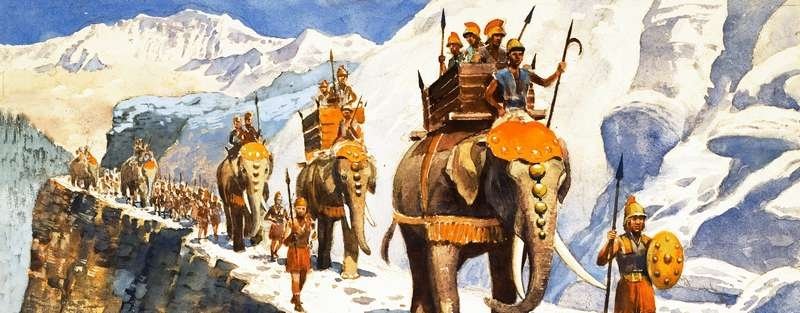
And, most famous of all, is his taking of the elephants across the Alps.

lal299613 lal319314

In fact, this did not end well for the elephants. Ancient accounts suggest that out of forty elephants, only one survived.

Crossing the Alps reminded us of Napoleon doing this in 1800. Here’s the heroic version:

Napoleon_at_the_Great_St._Bernard_-_Jacques-Louis_David_-_Google_Cultural_Institute

And this is what really happened (a little like Hannibal’s elephants):

Paul_Delaroche_-_Napoleon_Crossing_the_Alps_-_Google_Art_Project_2

JRRT says of the oliphaunt Sam saw that “…the Mûmak of Harad was indeed a beast of vast bulk, and the like of him does not walk now in Middle-earth” (“Of Herbs and Stewed Rabbit”, LOTR 661).

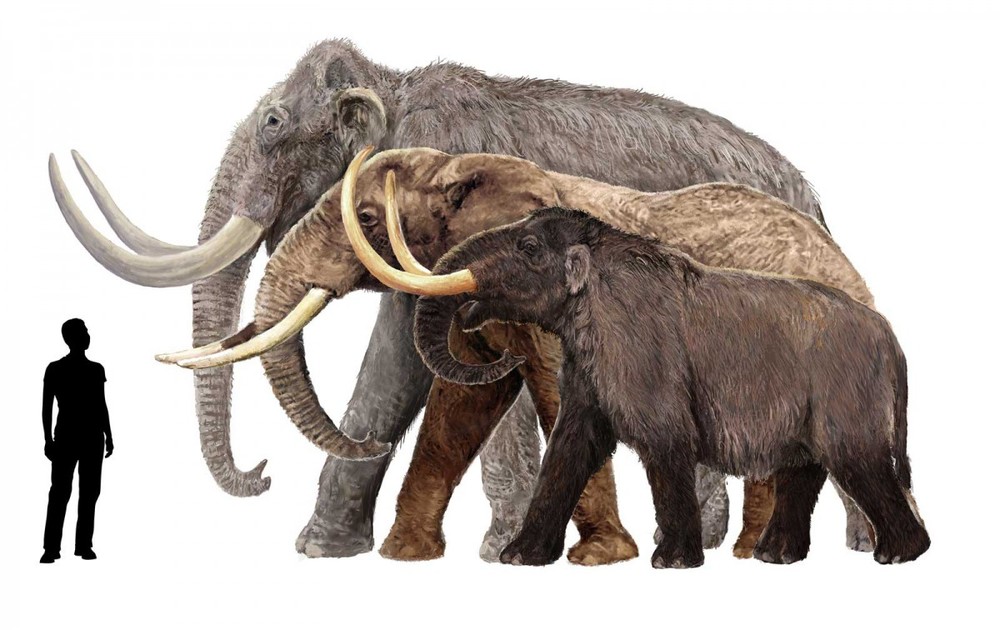
It’s unclear what he means by this, except perhaps that an oliphaunt was more like a mammoth

Mammoths_Man-1200x756.jpg format=1500w

Even so, we can only contrast an ancient war elephant (reconstructed)

dced00480c58b85786bee4bf212eb30d

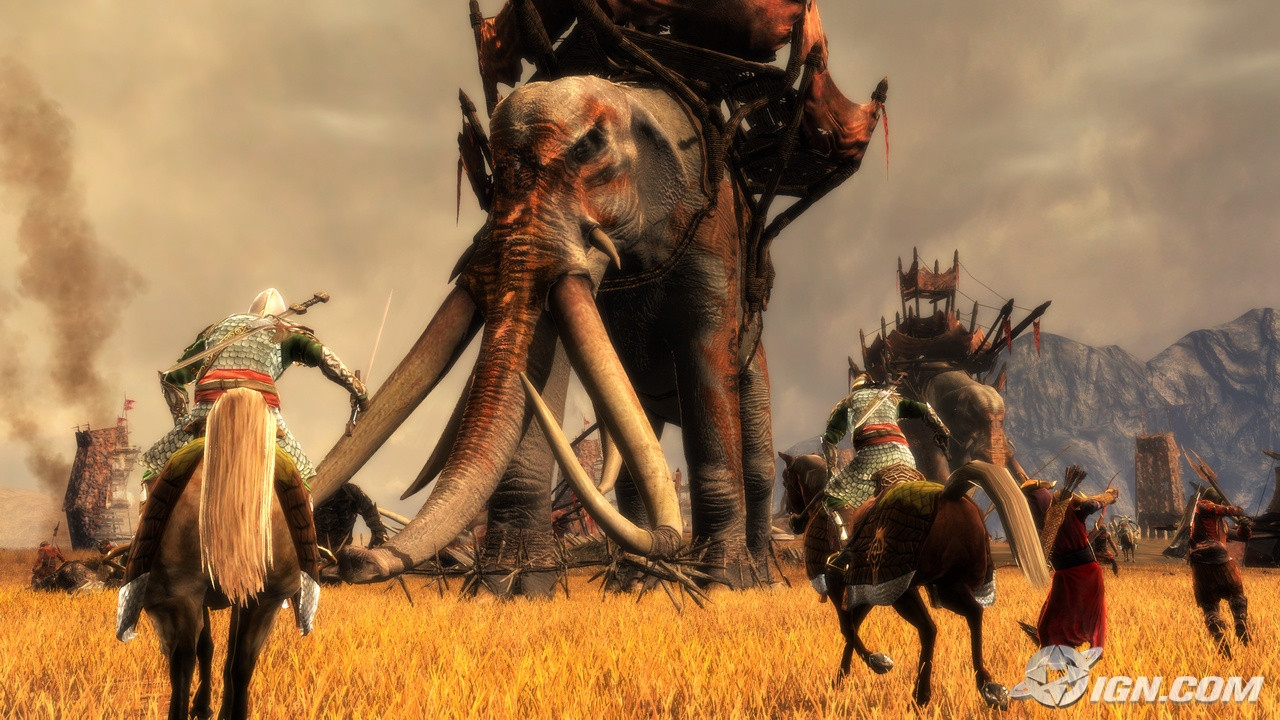
with those in the film

01IYPfe

and which reminded us strongly of ATATs from the assault upon Hoth,

atat

and think how disappointed Sam would be in what he would see in our world versus his!

Thanks, as always, for reading!

MTCIDC

CD

Subsubcreations

03 Wednesday Jun 2015

Posted by Ollamh in Fairy Tales and Myths, J.R.R. Tolkien, Military History of Middle-earth, Narrative Methods, Villains

≈ Leave a comment

Tags

Chicken Run, Corsairs, Easterlings, Gorbag and Shagrat, Haradrim, Melkor, Minions, Morgoth, Nazgul, Nick and Fetcher, Orc, Robin Hood, Sauron, Star Wars, Storm Troopers, The Lord of the Rings, Tolkien, Zorro

Dear Readers,

Welcome, as always!

     Two posts ago, we talked about how it might be possible to make Sauron –the- nearly-invisible slightly more visible by means of his minions.

Minions-Film

[oh yes—minions—from Middle French, “mignon”, meaning “little/darling” and coming to have a negative meaning in English, “lackey”]

     These included the Nazgul

nazgul

various humans—corsairs, Haradrim, Easterlings—

702343aharadvetcav easterling_hassassin_by_taurus_chaoslord-d5sb6rc

And, the real stars (as Nick and Fetcher, the two rats from Chicken Run, refer to themselves)

Nick_and_Fetcher

the Orcs.

John%20Howe%20-%20Merry%20et%20Pippin%20prisonniers%20des%20orcs 36 - Orcs (MERP)

OrcsOnSentry_Alan_Lee

     Tolkien appears always to have had trouble placing them. We would suppose that this problem arose because Orcs were not the usual run-of-the-mill lackeys one usually sees in adventure, like the sheriff of Nottingham’s men

sjff_03_img1296

the soldiers of the evil commandante in the Zorro adventures

ep23d

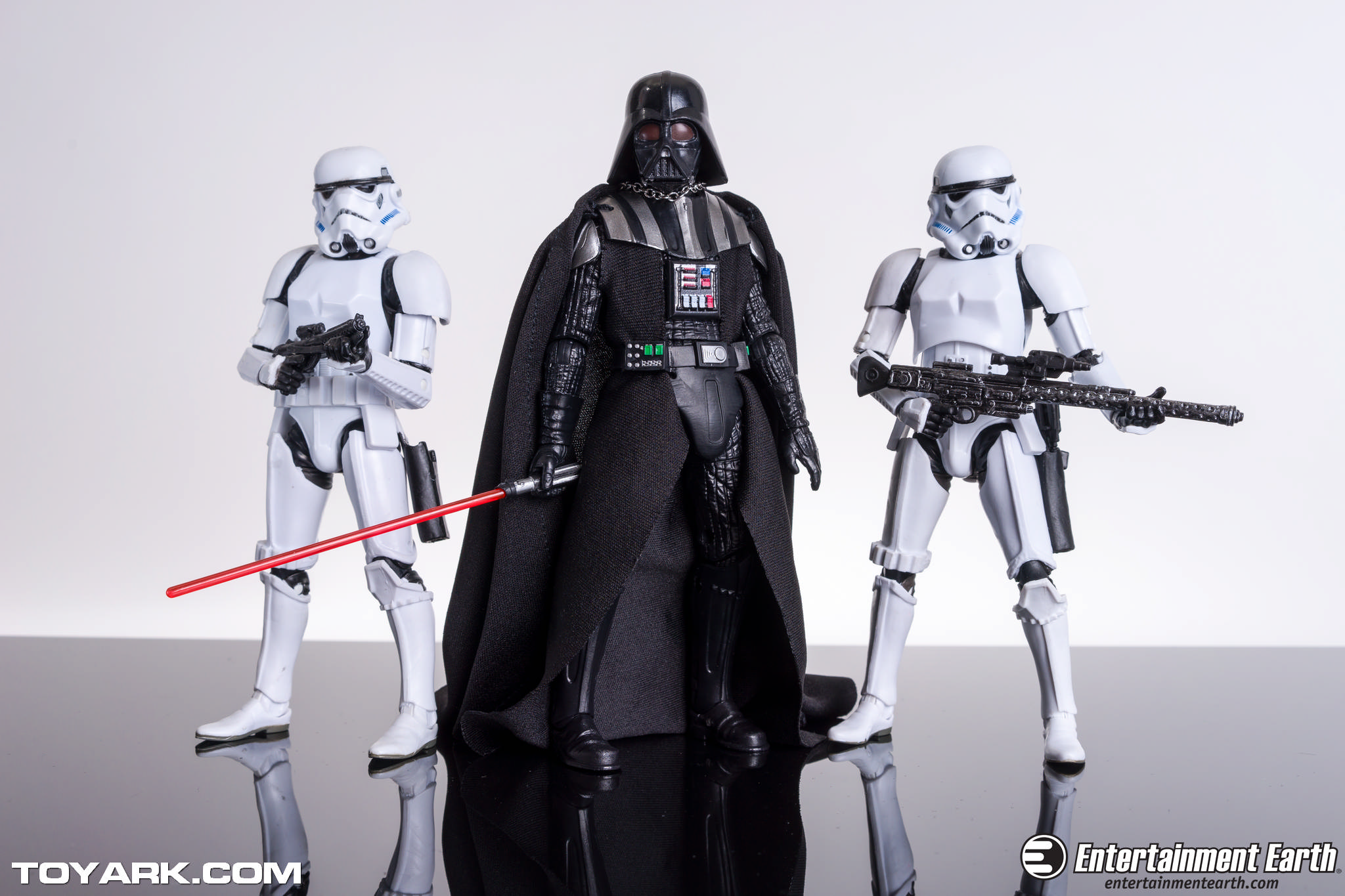
or the hordes of faceless stormtroopers in Star Wars

Stormtrooper_Corps

       His first question—where do they come from? was immediately followed by a second—if they are created, do they have free will? That first question, any author might ask himself. The second, however, was pure Tolkien, fitting into the pattern which those who’ve only read The Lord of the Rings and not JRRT’s letters on the subject or the volumes produced by the admirable (a pale adjective!) Christopher Tolkien, would never see: the complex spiritual history which lies behind the creation of Middle Earth.

     Not that the first question was simple. In The Lord of the Rings, Fangorn says of the Orcs:

“But Trolls are only counterfeits, made by the Enemy in the Great Darkness, in mockery of Ents, as Orcs were of Elves.” L486

     The author, however, had a very different opinion:

“Their nature and origin require more thought. They are not easy to work into the theory and system.”

(Morgoth’s  Ring   409)

     Not easy because of that second question. As he wrote in an unpublished essay entitled (not surprisingly) Orcs (Morgoth’s Ring 409-413),

“…only Eru [the central creative deity] could make creatures with independent wills, and with reasoning powers. But the Orcs seem to have both: they can try to cheat Morgoth/ Sauron, rebel against him, or criticize him.”

     Morgoth (Sauron’s former master) made the Orcs in some way, but, because only the central deity, Eru, can give independent wills and reasoning powers—which Orcs display by cheating, rebelling, and criticizing– to created beings, what is to be made of Orcs? Bound by those seemingly contrary facts, the conclusion was obvious to him that “therefore they must be corruptions of something pre-existing.” (409)

But of what?

     “But Men had not yet appeared, when the Orcs already existed. Aule constructed the Dwarves out of his memory of the Music; but Eru would not sanction the work of Melkor [i.e. Morgoth] so as to allow the independence of the Orcs.

     It also seems clear…that though Melkor could utterly corrupt and ruin individuals, it is not possible to contemplate his absolute perversion of a whole people, or group of peoples, and his making that state heritable.

     In that case Elves, as a source, are very unlikely.” (409)

     Thus, logically, if the Orcs are created, not corrupted, and created by a power which hasn’t the ability to give his creations independence, then–

     “The Orcs were beasts of humanized shape (to mock Men and Elves) deliberately perverted/converted into a more close resemblance to Men. Their ‘talking’ was really reeling off ‘records’ set in them by Melkor. Even their rebellious critical words—he knew about them. Melkor taught them speech and as they bred they inherited this; and they had just as much independence as have, say, dogs or horses of their human masters. This talking was largely echoic (cf. parrots). ..Also (n.b.) Morgoth not Sauron is the source of Orc-wills. Sauron is just another (if greater) agent. Orcs can rebel against him without losing their own irremediable allegiance to evil (Morgoth).” (410-411)

     We don’t know about you, dear Readers, but we confess to a certain disappointment at the idea that the Orcs are only more complex puppets. Consider this piece of villainous dialogue between Gorbag and Shagrat:

Unknown%20-%20Bilbo%20le%20Hobbit%20(01)%20-%20Les%20orcs

     “I’d like to try somewhere where there’s none of ‘em. But the war’s on now, and when that’s over things may be easier.”

     “It’s going well, they say.”

     “They would,” grunted Gorbag. “We’ll see. But anyway, if it does go well, there should be a lot more room. What d’you say?—if we get a chance, you and me’ll slip off and set up somewhere on our own with a few trusty lads, where there’s good loot nice and handy, and no big bosses.”

     “Ah!” said Shagrat. “Like old times.” (LOTR 738)

     The plans and reminiscences of demons—how wonderful! And what an interesting sidelight into their world and even their past: they used to be masterless marauders, in the “old times”—could this suggest that perhaps they weren’t such puppets after all? We would like to imagine so!

And what is your opinion, dear readers?

Thanks, as ever, for reading.

MTCIDC

CD

Newer posts →

The Doubtful Sea Series Facebook Page

The Doubtful Sea Series Facebook Page

  • Ollamh

Categories

  • Artists and Illustrators
  • Economics in Middle-earth
  • Fairy Tales and Myths
  • Films and Music
  • Games
  • Heroes
  • Imaginary History
  • J.R.R. Tolkien
  • Language
  • Literary History
  • Maps
  • Medieval Russia
  • Military History
  • Military History of Middle-earth
  • Narnia
  • Narrative Methods
  • Poetry
  • Research
  • Star Wars
  • Terra Australis
  • The Rohirrim
  • Theatre and Performance
  • Tolkien
  • Uncategorized
  • Villains
  • Writing as Collaborators
Follow doubtfulsea on WordPress.com

Across the Doubtful Sea

Recent Postings

  • Serendipity? April 15, 2026
  • Serendipity April 8, 2026
  • Verisimilitude April 1, 2026
  • Goblins and Goblin March 25, 2026
  • Crowing and Raven March 18, 2026
  • The Damage of Dragons March 11, 2026
  • Encouragement March 4, 2026
  • Eavesdropping February 25, 2026
  • Do You Speak Villain? (Part 3) February 18, 2026

Blog Statistics

  • 111,604 Views

Posting Archive

  • April 2026 (3)
  • March 2026 (4)
  • February 2026 (4)
  • January 2026 (4)
  • December 2025 (5)
  • November 2025 (4)
  • October 2025 (5)
  • September 2025 (4)
  • August 2025 (4)
  • July 2025 (5)
  • June 2025 (4)
  • May 2025 (4)
  • April 2025 (5)
  • March 2025 (4)
  • February 2025 (4)
  • January 2025 (5)
  • December 2024 (4)
  • November 2024 (4)
  • October 2024 (5)
  • September 2024 (4)
  • August 2024 (4)
  • July 2024 (5)
  • June 2024 (4)
  • May 2024 (5)
  • April 2024 (4)
  • March 2024 (4)
  • February 2024 (4)
  • January 2024 (5)
  • December 2023 (4)
  • November 2023 (5)
  • October 2023 (4)
  • September 2023 (4)
  • August 2023 (5)
  • July 2023 (4)
  • June 2023 (4)
  • May 2023 (5)
  • April 2023 (4)
  • March 2023 (5)
  • February 2023 (4)
  • January 2023 (4)
  • December 2022 (4)
  • November 2022 (5)
  • October 2022 (4)
  • September 2022 (4)
  • August 2022 (5)
  • July 2022 (4)
  • June 2022 (5)
  • May 2022 (4)
  • April 2022 (4)
  • March 2022 (5)
  • February 2022 (4)
  • January 2022 (4)
  • December 2021 (5)
  • November 2021 (4)
  • October 2021 (4)
  • September 2021 (5)
  • August 2021 (4)
  • July 2021 (4)
  • June 2021 (5)
  • May 2021 (4)
  • April 2021 (4)
  • March 2021 (5)
  • February 2021 (4)
  • January 2021 (4)
  • December 2020 (5)
  • November 2020 (4)
  • October 2020 (4)
  • September 2020 (5)
  • August 2020 (4)
  • July 2020 (5)
  • June 2020 (4)
  • May 2020 (4)
  • April 2020 (5)
  • March 2020 (4)
  • February 2020 (4)
  • January 2020 (6)
  • December 2019 (4)
  • November 2019 (4)
  • October 2019 (5)
  • September 2019 (4)
  • August 2019 (4)
  • July 2019 (5)
  • June 2019 (4)
  • May 2019 (5)
  • April 2019 (4)
  • March 2019 (4)
  • February 2019 (4)
  • January 2019 (5)
  • December 2018 (4)
  • November 2018 (4)
  • October 2018 (5)
  • September 2018 (4)
  • August 2018 (5)
  • July 2018 (4)
  • June 2018 (4)
  • May 2018 (5)
  • April 2018 (4)
  • March 2018 (4)
  • February 2018 (4)
  • January 2018 (5)
  • December 2017 (4)
  • November 2017 (4)
  • October 2017 (4)
  • September 2017 (4)
  • August 2017 (5)
  • July 2017 (4)
  • June 2017 (4)
  • May 2017 (5)
  • April 2017 (4)
  • March 2017 (5)
  • February 2017 (4)
  • January 2017 (4)
  • December 2016 (4)
  • November 2016 (5)
  • October 2016 (6)
  • September 2016 (5)
  • August 2016 (5)
  • July 2016 (5)
  • June 2016 (5)
  • May 2016 (4)
  • April 2016 (4)
  • March 2016 (5)
  • February 2016 (4)
  • January 2016 (4)
  • December 2015 (5)
  • November 2015 (5)
  • October 2015 (4)
  • September 2015 (5)
  • August 2015 (4)
  • July 2015 (5)
  • June 2015 (5)
  • May 2015 (4)
  • April 2015 (3)
  • March 2015 (4)
  • February 2015 (4)
  • January 2015 (4)
  • December 2014 (5)
  • November 2014 (4)
  • October 2014 (6)
  • September 2014 (1)

Blog at WordPress.com.

  • Subscribe Subscribed
    • doubtfulsea
    • Join 75 other subscribers
    • Already have a WordPress.com account? Log in now.
    • doubtfulsea
    • Subscribe Subscribed
    • Sign up
    • Log in
    • Report this content
    • View site in Reader
    • Manage subscriptions
    • Collapse this bar
 

Loading Comments...