• About

doubtfulsea

~ adventure fantasy

Tag Archives: Shakespeare

A Plague o’ Both—No, o’ All Your Houses!

29 Wednesday Oct 2025

Posted by Ollamh in Uncategorized

≈ Leave a comment

Tags

Black Death, Black Plague, black ship rat, flea, Great Fire of London, great-london-fire, Halloween, History, miasma, plague, plague doctor, plague pits, Roger Bacon, Romeo and Juliet, Shakespeare, Trick or Treat, Yersinia Pestis

As always, dear readers, welcome.

It’s almost Halloween again, one of my favorite holidays, when children dress up in various costumes and wander the streets in groups, demanding treats and threatening tricks,

while older people, themselves in costume, attend parties.

People dress up as monsters, vampires, and superheroes, but, recently, I’ve also seen a few of these—

a costume which you can actually buy on Amazon.
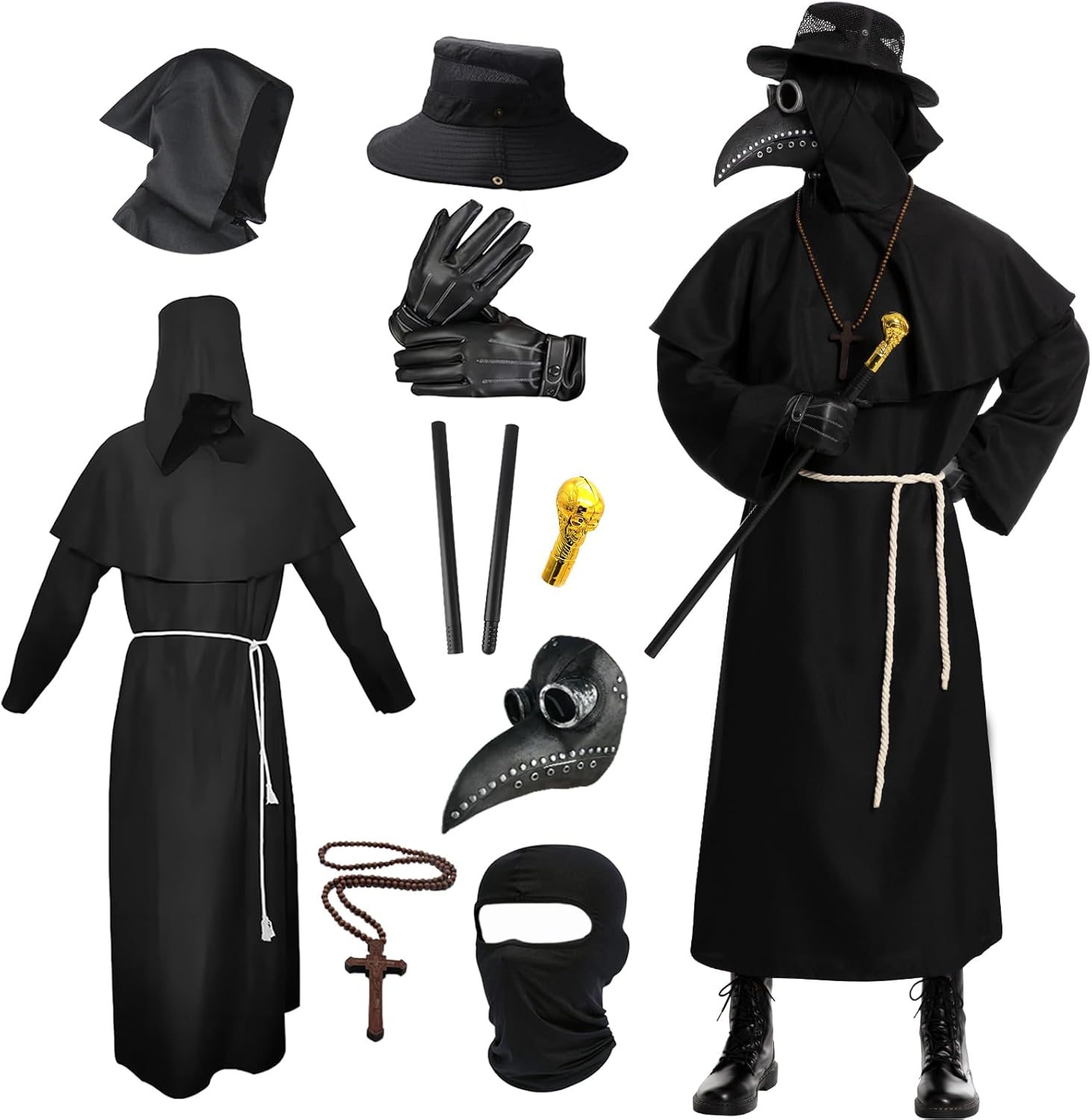
It’s a very haunting image:  crowlike, and yet not, and it struck me as an interesting basis for this year’s Halloween posting.

But what is it?

If you don’t know, I’ve given you a clue in that (modified) quotation I’ve used as a title.

In Act III, Scene 1, of Shakespeare’s The Most Excellent and Lamentable Tragedy of Romeo and Juliet, 1591/95, as the 2nd Quarto (1599) has it,
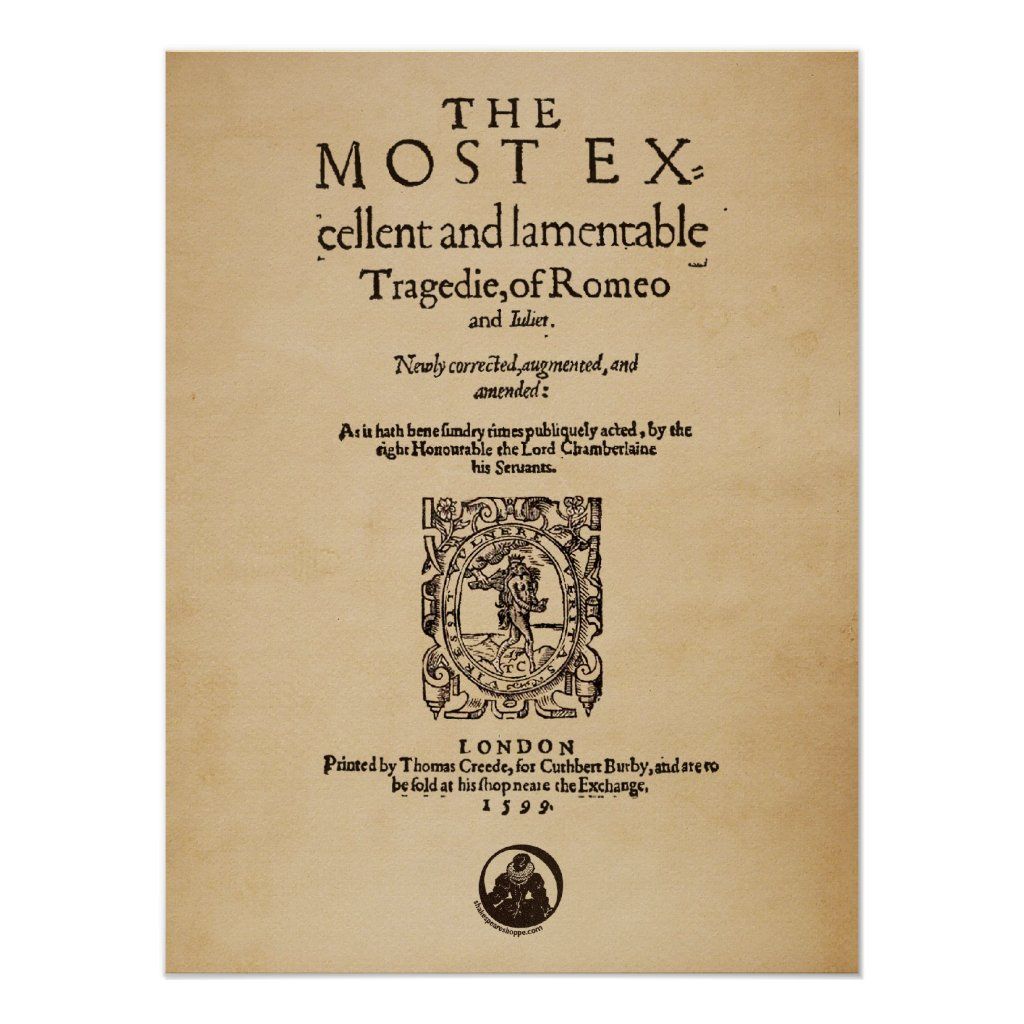
Romeo’s best friend and perhaps the sanest character in the play, Mercutio, has been mortally wounded.  Dying, he curses both of the feuding families, wishing that a plague would take them both.

In Shakespeare’s England, this was not a random remark.  Since its original appearance, in 1348, when it may have killed as many as 40-60% of the population, the Black Plague (aka the Black Death) had

reappeared over the next couple of centuries, killing 30,000 in London, in 1603 alone,
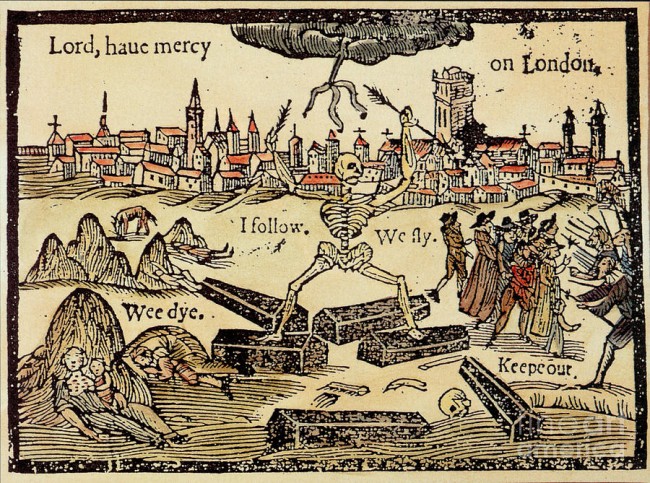
before its grand finale (or nearly), in 1665-6,when it was responsible for perhaps 100,000 deaths there.
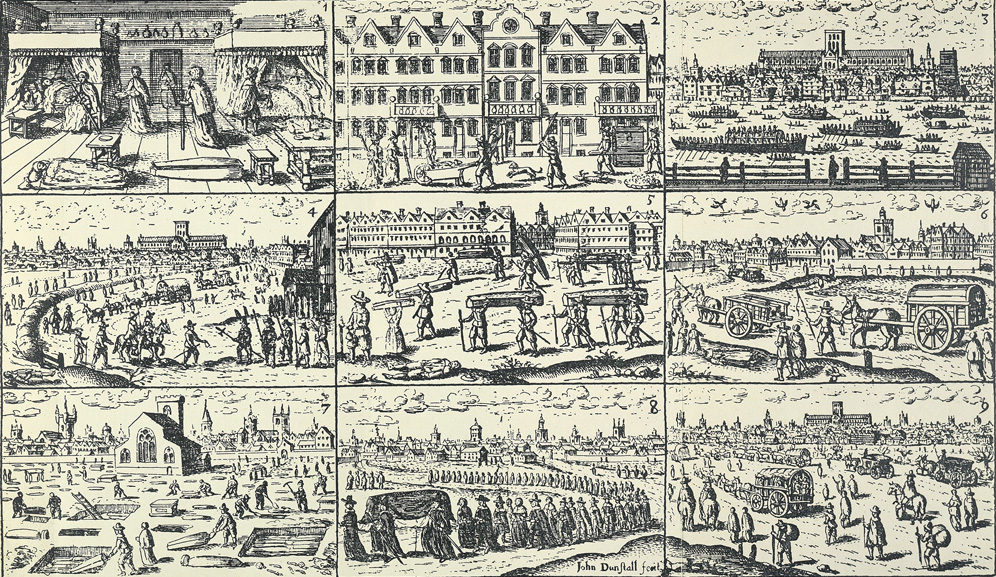
(And, in 1666, came the great fire, which destroyed much of the city—it’s a wonder that everyone surviving didn’t attempt to flee to anywhere as far away as they could.

For the fire, I recommend J. Draper’s short presentation here:  https://www.youtube.com/watch?v=4bvB_gJThYk   with one correction.  She says that the artist/engraver Wenceslaus Hollar was Dutch when, in fact, he was a Czech.  See:  https://en.wikipedia.org/wiki/Wenceslaus_Hollar  Otherwise, I have nothing but praise for Draper, who does proper research and wanders the London area , looking for odd and interesting aspects of London’s—and English—history which she then presents in creative ways.  For her grim and striking view of the Black Death, see:  https://www.youtube.com/watch?v=Ybh1jSZLIKY  )

Medieval science was not really even in its infancy—although there were highly intelligent and thoughtful men struggling to look at the world without superstition or religion, like Friar Roger Bacon, 1214-1294.

(an imaginary image—we have no known portrait)

Medical science, such as existed, followed the classical world and believed that communicable diseases were spread through miasma—that is, through “bad air”,

which isn’t such a far-fetched idea:  rotting things, dead things, stink, so death and bad smells are easily associated.

In fact, the Black Plague was—and is–a bacterium, Yersinia Pestis,

which lives in the gut of fleas,

which inhabited what was called the “black ship rat”,

which traveled on trading vessels from the Far East in the 14th century,

and eventually came, either directly on rats, or indirectly by a human carrier, to England, causing havoc on and off, for several centuries.

Needless to say, in a packed city, like London,

rats and their passengers could easily spread out and, in doing so, would spread the bacterium through the bites of those fleas. 

Medical men of that world, however, could make no such connections.  They only saw the horrible symptoms—including the swelling of the lymph nodes, attempting to defend the body—the buboes of bubonic plague—

(This is such a gross image that I almost didn’t include it, but it’s very helpful in explaining what exactly was going on in the body, so…)

The plague produced fever, chills, vomiting, violent headaches—and all that doctors could do was what they did for almost anything:  try to balance the humors—the basic elements of the body—which included bleeding, a treatment which actually weakened the body.
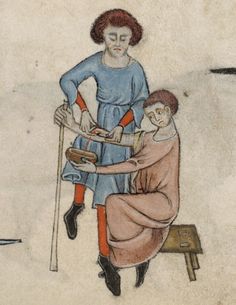
Because the real agent of contagion wasn’t understood, doctors could only be brave and deal with their patients as best they could—and contract the disease themselves—or could attempt to protect themselves, which brings us to this image again—
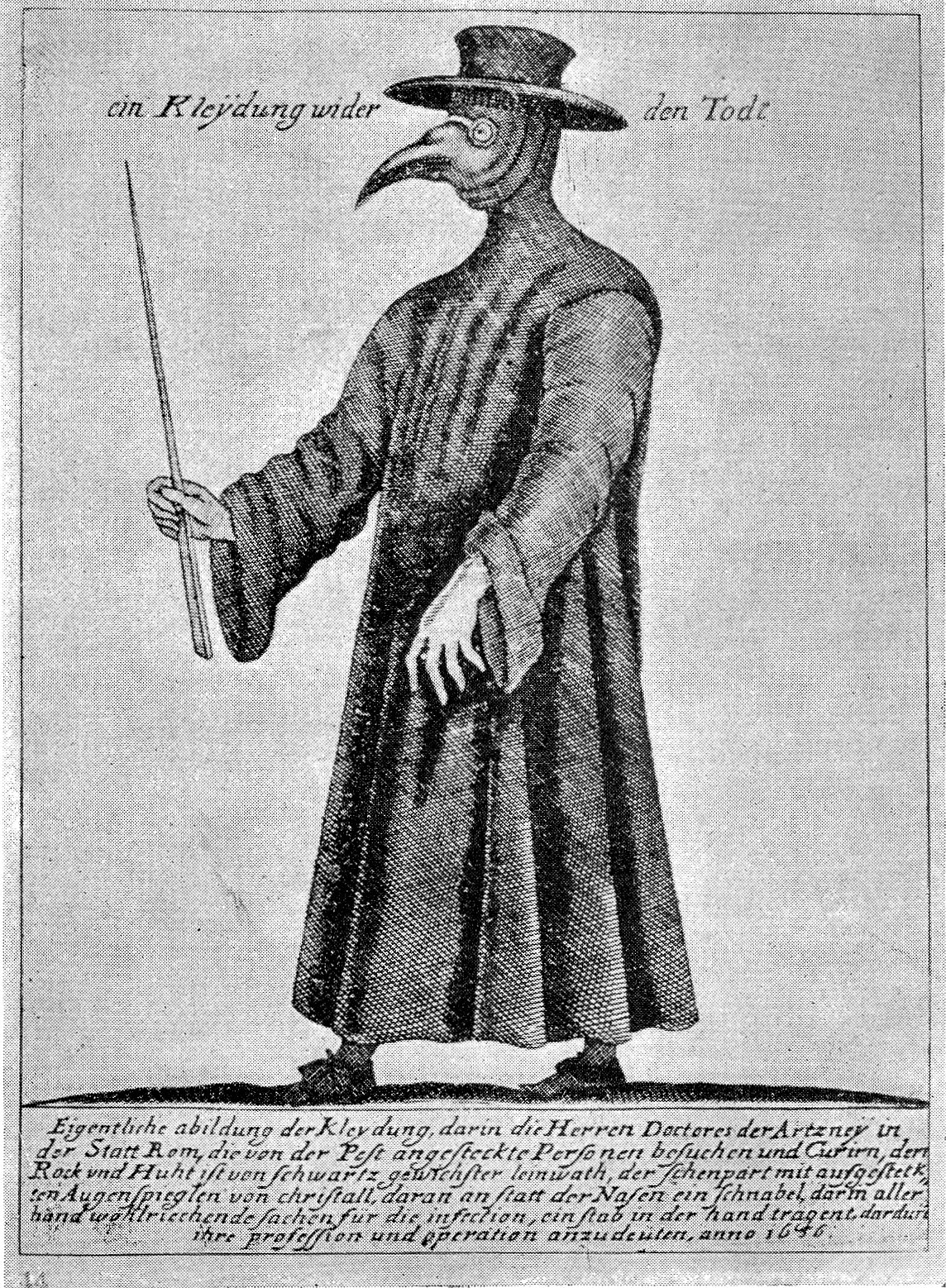
(appropriately titled “the clothing against death”, implying the Black Death)

This diagram

(with some strange English—it appears to be a translation—I’ve seen one copy in which the text is in Russian– gives you a general idea of how a doctor might attempt to ward off infection, including basics which had to do with bad air, like carrying a pomander—a little vessel containing strong-smelling herbs to fend off that air—

which someone might carry simply to ward off the bad smells of a time when streets in cities often had the equivalent of open sewers, as well as might be employ ed as a fashion accessory—for more on pomanders, see:   https://en.wikipedia.org/wiki/Pomander )

as well as that beaky thing—which is really a kind of early surgical mask

combined with a pomander—the beak being stuffed with those protective herbs.  And, as who knows what can get in through the eyes, add crystalline lenses to the beak.

Gloves and a long coat, sometimes waxed, probably as much for water-proofing as against floating miasma, and a broad-brimmed hat to cover the head, complete the outfit.  Oh—and a rod for probing the infected, plus a light source—medieval/Renaissance houses being notoriously dim. 

Note, however, that, whoever designed this modern version hadn’t done quite enough research:  that’s a 19th-century kerosene lantern.  Here’s a lantern of a sort which would be likely—

(This is an Elizabethan image of a city watchman, armed with a spear, followed by a dog, and carrying a bell to sound the hours.)

And so, when you see someone dressed like this at a party, you can confidently ask, “Tell me, doctor, is the plague spreading and should I flee the city?”

although he may respond by offering you not a pomander, but one of these, instead.

Thanks, as always for reading.  Happy Halloween, if you celebrate it.
Stay well,

Avoid miasma like the plague,

And remember that, as always, there’s

MTCIDC

O

PS

There is now some argument about the gear of such doctors.  See:  https://en.wikipedia.org/wiki/Plague_doctor  and https://www.livescience.com/plague-doctors.html   Plague could actually take several forms.  See:  https://www.britannica.com/science/plague   Because cemeteries—and grave-diggers were often overwhelmed, mass graves in unconsecrated ground began to be common—and now are sometimes happened upon unexpectedly.  See recent London plague pit discoveries:  https://www.cityam.com/after-crossrails-gruesome-discovery-weve-mapped-every-one-londons-plague-pits-do-you-work/

It’s in Writing (2:  I’st a Prologue, or a Poesie for a Ring?)

22 Wednesday Oct 2025

Posted by Ollamh in Uncategorized

≈ Leave a comment

Tags

Belshazzar, Bilbo, Daniel, Darius, Frodo, Gandalf, inscription, Isildur, Kilroy, Literacy, Orcs, posy ring, Sam Gamgee, Sauron, Shakespeare, The Black Speech, The Ring

As always, dear readers, welcome.

The first part of this posting began as far from Middle-earth and its history as possible:  the Biblical lands of our Middle-earth and the story of the ancient prophet, Daniel and specifically the event which gained Daniel his position in the court first of Belshazzar, the Babylonian king, and then in that of his conqueror/successor, Darius the Persian.  Uniquely for early prophecy, Belshazzar hadn’t been warned that he would be deposed by any of the accepted means—the reading of the flight of birds

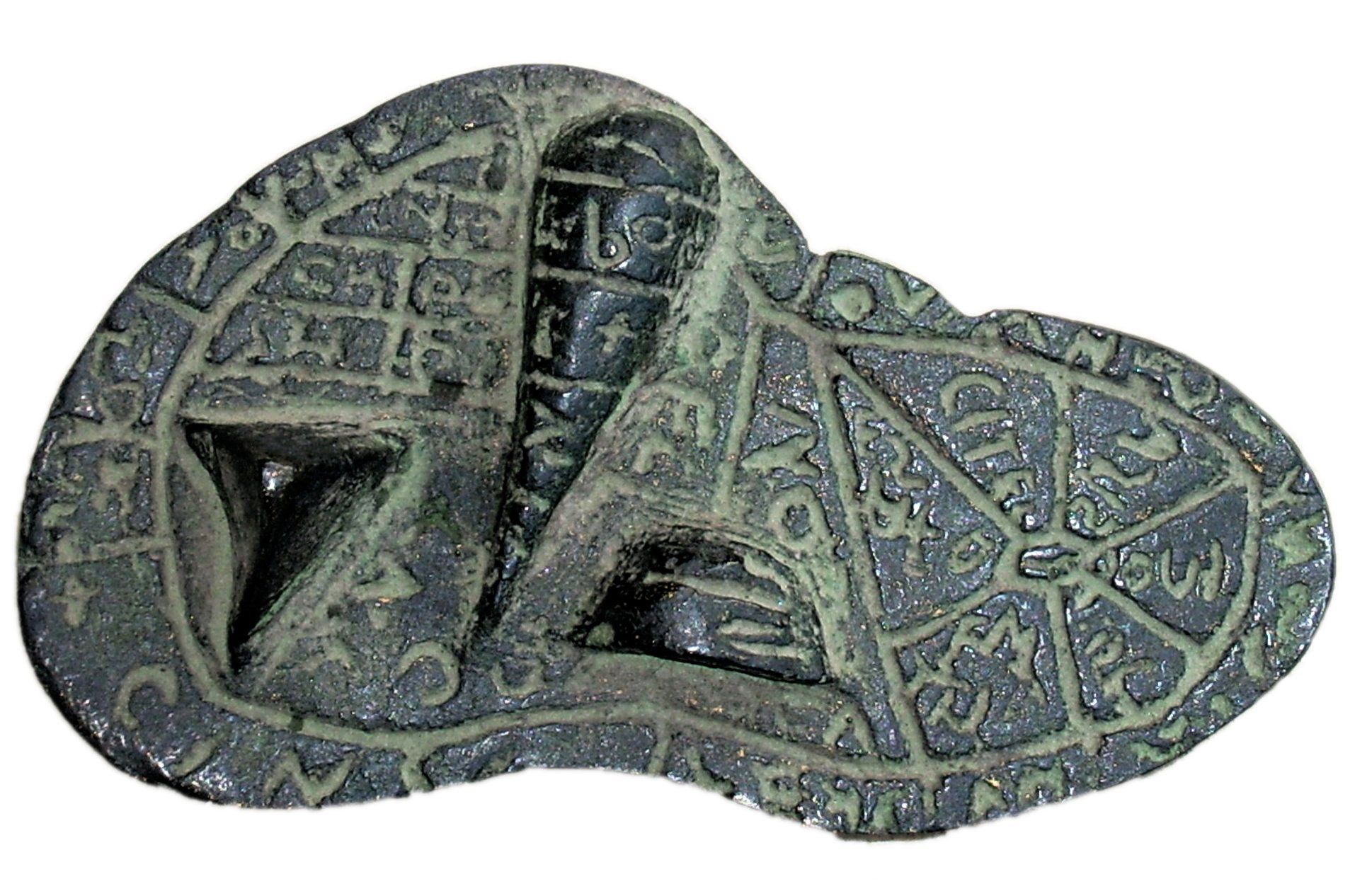
or the reading of animal intestines, for example,

(This is a bit of Etruscology, being a bronze model of a sheep’s liver believed to be used as a guide to interpreting what an Etruscan priest might find on an actual sheep’s liver.  For more, see:  https://en.wikipedia.org/wiki/Haruspex )

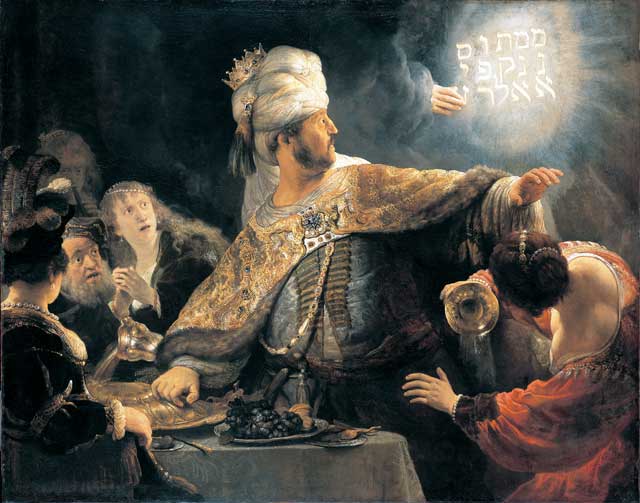
but by a message written by a detached hand on an interior wall of his palace.

(Rembrandt—as I said in the first part of this posting, having no idea of what real Babylonians looked like, the artist went for the Magi look)

When Belshazzar’s own scribes and prophets could make nothing of it, Daniel was brought in as a consultant and delivered the grim message that the words—which were potentially chillingly ambiguous—signalled not only the end of Belshazzar’s reign, but of his kingdom.  (For more on this, see:  https://www.christianitytoday.com/2024/11/andrew-wilson-spirited-life-daniel-writing-on-wall-babylon/   For a wonderful 12th-century version of the story and a little on Daniel’s experience in the court of Darius, see:  https://www.youtube.com/watch?v=Djf0DFkH7mA&list=RDDjf0DFkH7mA&start_radio=1 )
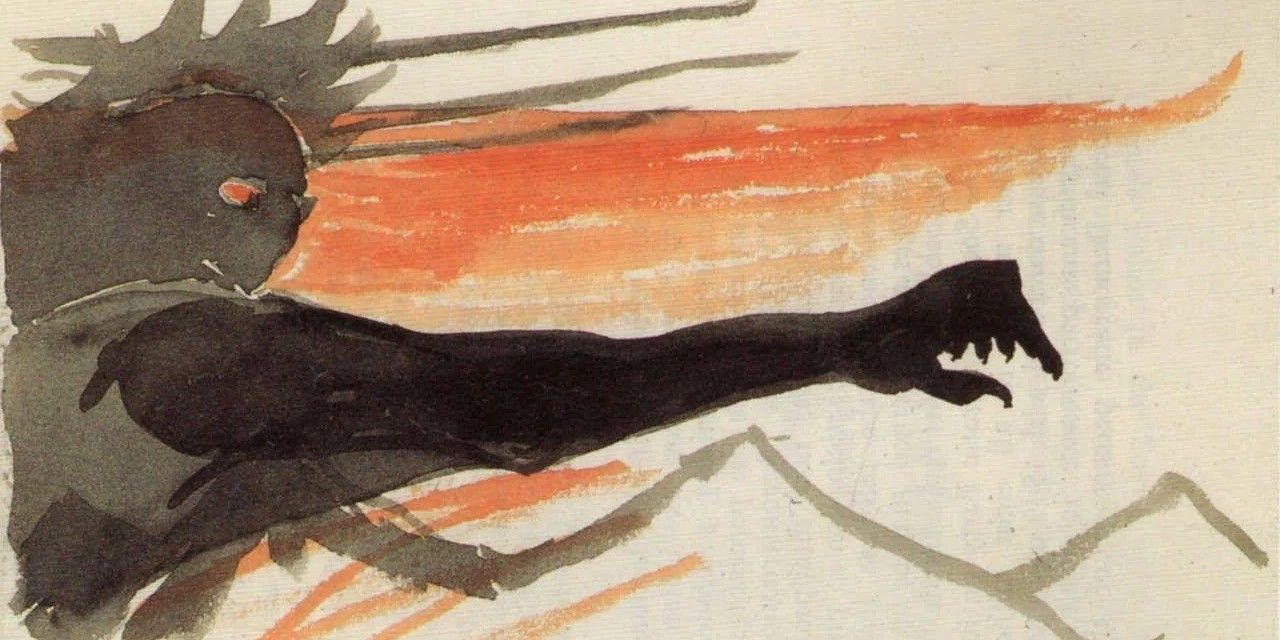
In that posting, I suggested that Daniel’s story not only confirmed his role as prophet, but, for the posting, that he was literate, which would have marked him out in a world in which literacy was a specialized skill, like being a boatwright.

(This is from one of my favorite medieval mosaics, the story of Noah and the Ark from the cathedral of Monreale in Palermo—for more see:  https://www.christianiconography.info/sicily/noahBuildsArkMonreale.html )

This, in turn, had led to considering literacy in Middle-earth, chiefly among hobbits, and, in particular, the literacy of one rather unlikely hobbit, Sam Gamgee.

(Robert Chronister)

For more on this, see that earlier posting, “It’s in Writing (1)” 15 October, 2025, but my conclusion, based upon the final chapter of The Lord of the Rings, “The Grey Havens”, was that, as the story of Daniel makes Daniel literate in order to elevate him to a level of prophetic importance, so JRRT makes Sam literate in order to allow him to be the author who will complete the story of the Ring.  

That posting briefly examined hobbits and even suggested some evidence of literacy among dwarves, but it was never meant to be a full inventory of mentions of literacy in Middle-earth—although I think that that would be a very interesting project and well worth doing—and one thing it omitted entirely was any mention of literacy in Mordor. 

Did Orcs read and write, for example?

(Alan Lee)

Considering the conversation of people like Ugluk and Grishnakh, it would seem that they were mainly oral, as much of their and other talk is based upon what they hear, rather than read. (“ ‘What are they wanted for?’ asked several voices.  ‘Why alive?  Do they give good sport?’ ‘No!  I heard that one of them has got something, something that’s wanted for the war…”  The Two Towers, Book Three, Chapter 3, “The Uruk-hai”—for more on Orcs and gossip, among other things, see “Scuttlebutt”, 27 October, 2021)

And yet there’s this:

“The brief glow fell upon a huge sitting figure, still and solemn like the great stone kings of Argonath.  The years had gnawed it, and violent hands had maimed it..Upon its knees were idle scrawls mixed with the foul symbols that the maggot-folk of Mordor used.”  (The Two Towers, Book Four, Chapter 7, Journey to the Cross-roads”)

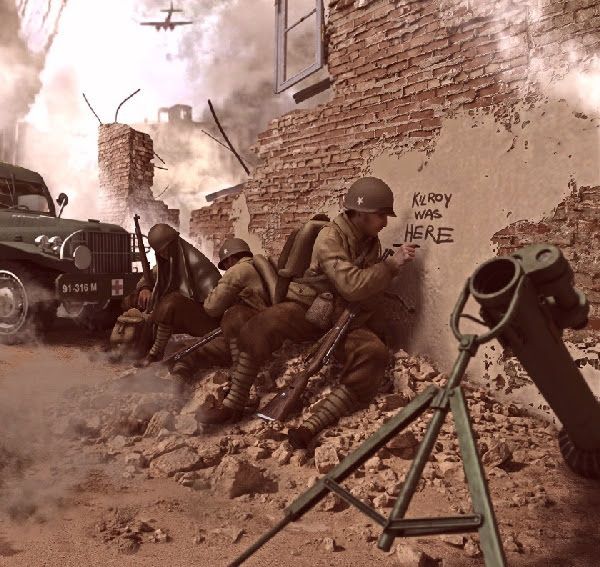
The “maggot-folk of Mordor” must certainly be the Orcs and “idle scrawls” suggests graffiti, like the World War 2-era favorite–

(For more on orcs and graffiti, see “Ugluk was Here”, 14 December, 2016—for more on Kilroy see:  https://en.wikipedia.org/wiki/Kilroy_was_here )

So what did they write in?  Pippin, while a prisoner of the Orcs, notices that they seem to speak different languages—or at least dialects—but employ the Common Speech to understand each other:

“To Pippin’s surprise he found that much of the talk was intelligible; many of the Orcs were using ordinary language.  Apparently the members of two or three quite different tribes were present, and they could not understand one another’s orc-speech.”  (The Two Towers, Book Three, Chapter 3, “The Uruk-hai”)

Can we presume, then, that the “idle scrawls” were in the writing system called the Tengwar, as “[its letters] had spread over much of the same area as that in which the Common Speech was known” (The Lord of the Rings, Appendix E, II, “Writing”)?  Or possibly the runic Cirith, as “[it] became known to many peoples, to Men and Dwarves, and even to Orcs, all of whom altered it to suit their purposes and according to their skill or lack of it.”

But what about the Black Speech?

“It is said that the Black Speech was devised by Sauron in the Dark Years, and that he had desired to make it the language of all those that served him…”

however—

“…after the first overthrow of Sauron this language in its ancient form was forgotten by all but the Nazgul.  When Sauron arose again, it became once more the language of Barad-dur and of the captains of Mordor.”

It was the formal language of the top of the chain of command, then, but, as JRRT had written earlier of Sauron’s first attempt to make it the official language, “he failed in that purpose” and the Orcs picked and chose what they found useful and nothing more.  (See The Lord of the Rings, Appendix F, “Of the Other Races”)

Save for what might be the Black Speech in a curse (“Ugluk u bagronk sha pushdug Saruman-glob bubhosh skai”, says one menacing Orc to Pippin– The Two Towers, Book Three, Chapter 3, “The Uruk-hai”), when we hear it, it’s Gandalf, reciting what he read when he “set the golden thing in the fire a while” (The Fellowship of the Ring, Book Two, Chapter 2, “The Council of Elrond”). 

And this brings us back to reading and writing.  Why was there writing on that particular ring? 

Not being a party to its maker’s mind, this is only my guess, but I think that it may have had several possible purposes.

First—and this seems the most obvious—comes from something Gandalf says, repeating a remark made by Saruman:

“ ‘The Nine, the Seven, and the Three…had each their proper gem.  Not so the One.  It was round and unadorned, as it were one of the lesser rings; but its maker set marks upon it that the skilled, maybe, could still see and read.”  (The Fellowship of the Ring, Book Two, Chapter 2, “The Council of Elrond”). 

Thus, Sauron had written on it to distinguish it from the other rings—and this writing was seemingly to be seen only by Sauron, as Isildur suggests:

“It was hot when I first took it, hot as a glede [a hot coal], and my hand was scorched, so that I doubt if ever again I shall be free of the pain of it.  Yet even as I write it is cooled, and it seemeth to shrink, though it loseth neither its beauty nor its shape.  Already the writing upon it, which at first was as clear as red flames, fadeth and is only barely to be read.”

Isildur’s explanation for this fading was:

“The Ring misseth, maybe, the heat of Sauron’s hand, which was black and yet burned like fire.” (The Fellowship of the Ring, Book Two, Chapter 2, “The Council of Elrond”). 

The second purpose, then, might be that The Ring mirrored, in a way, its master, the inscription legible to him because it took its heat from his hand and, with that removed, it cooled, eventually, into silence.  Isildur had guessed that heat might revive it (“…maybe were the gold made hot again, the writing would be refreshed”) but it was Gandalf, having read Isildur’s suggestion, who did, by placing it into an environment like to its original.  That it would lose that inscription if the Ring were removed from its owner’s hand might also suggest a third purpose, which lies in what the writing actually said:

“One Ring to rule them all, One Ring to find them,

One Ring to bring them all and in the darkness bind them.”  (The Fellowship of the Ring, Book One, Chapter 2, “The Shadow of the Past”)

Although Gandalf says that this formed part of “a verse long known in Elven-lore”, the Ring itself was meant to be the master ring:

“He only needs the One; for he made that Ring himself, it is his, and he let a great part of his own former power pass into it, so that he could rule all the others.”

Thus, though it may have been part of a “verse long known in Elven-lore”, it sounds to me like a kind of spell Sauron would have chanted as he made the Ring, not only putting “a great part of his own former power” into it, but binding the lesser rings to it, as the words written on the Ring may have eventually been part of later tradition, but, logically, must have been his words long before they became part of that tradition.

These might have been Sauron’s purposes, but they also serve the narrative.  As Bilbo’s ring, passed down traumatically to Frodo, is “round and unadorned”, Gandalf has to have some way to prove to himself and to Frodo that this ring is the Ring.

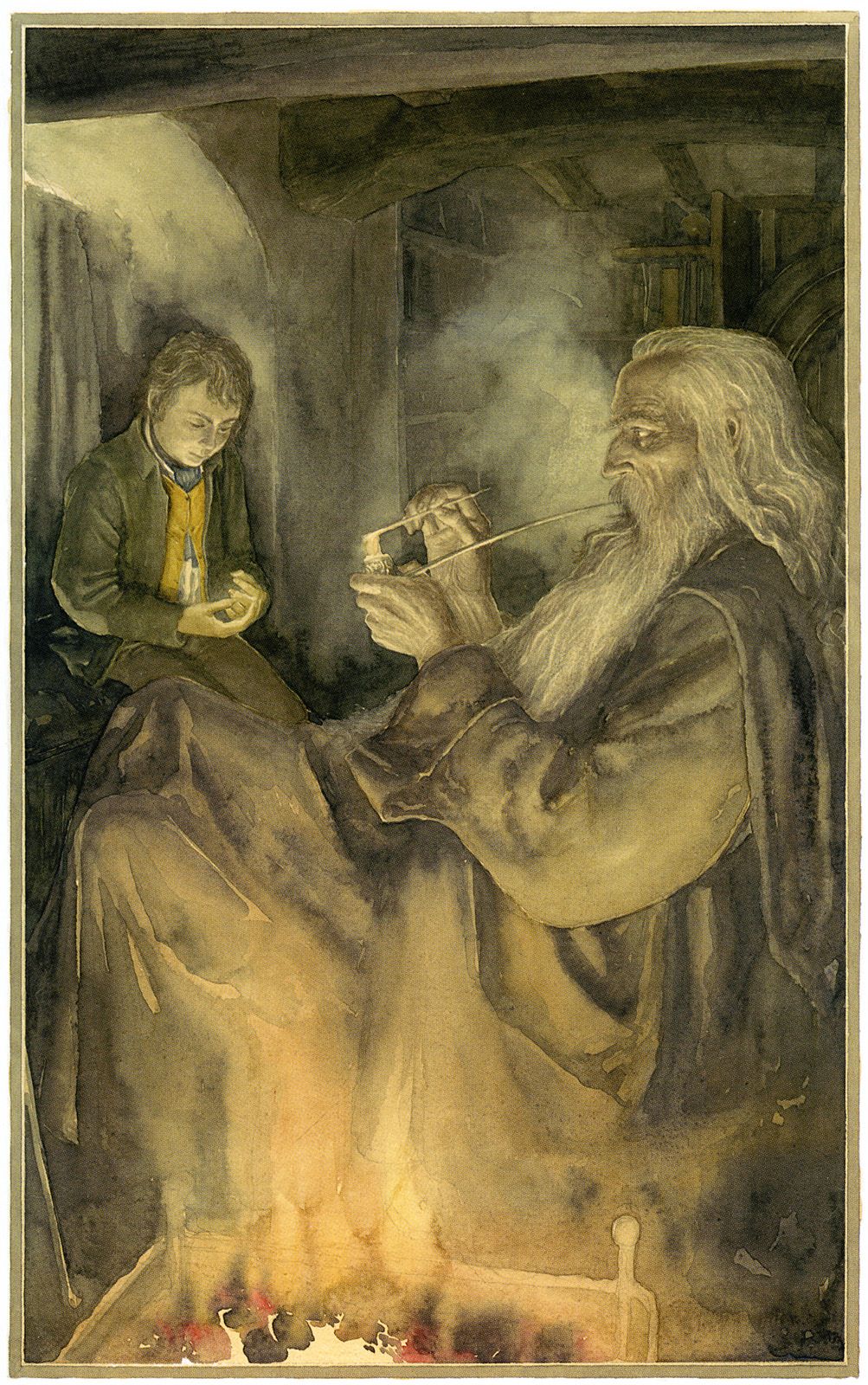
(Alan Lee)

When Gandalf begins explaining to Frodo in detail about it and about Bilbo’s connection to it, he first mentions that

“A mortal…who keeps one of the Great Rings, does not die, but he does not grow or obtain more life, he merely continues, until at last every minute is a weariness.”

and Bilbo, says Gandalf, “…was getting restless and uneasy.  Thin and Stretched, he said.”

He speaks further about his worries about Bilbo and then tells Frodo that “There is a last test to make”, meaning in his confirmation that this is the Ring.

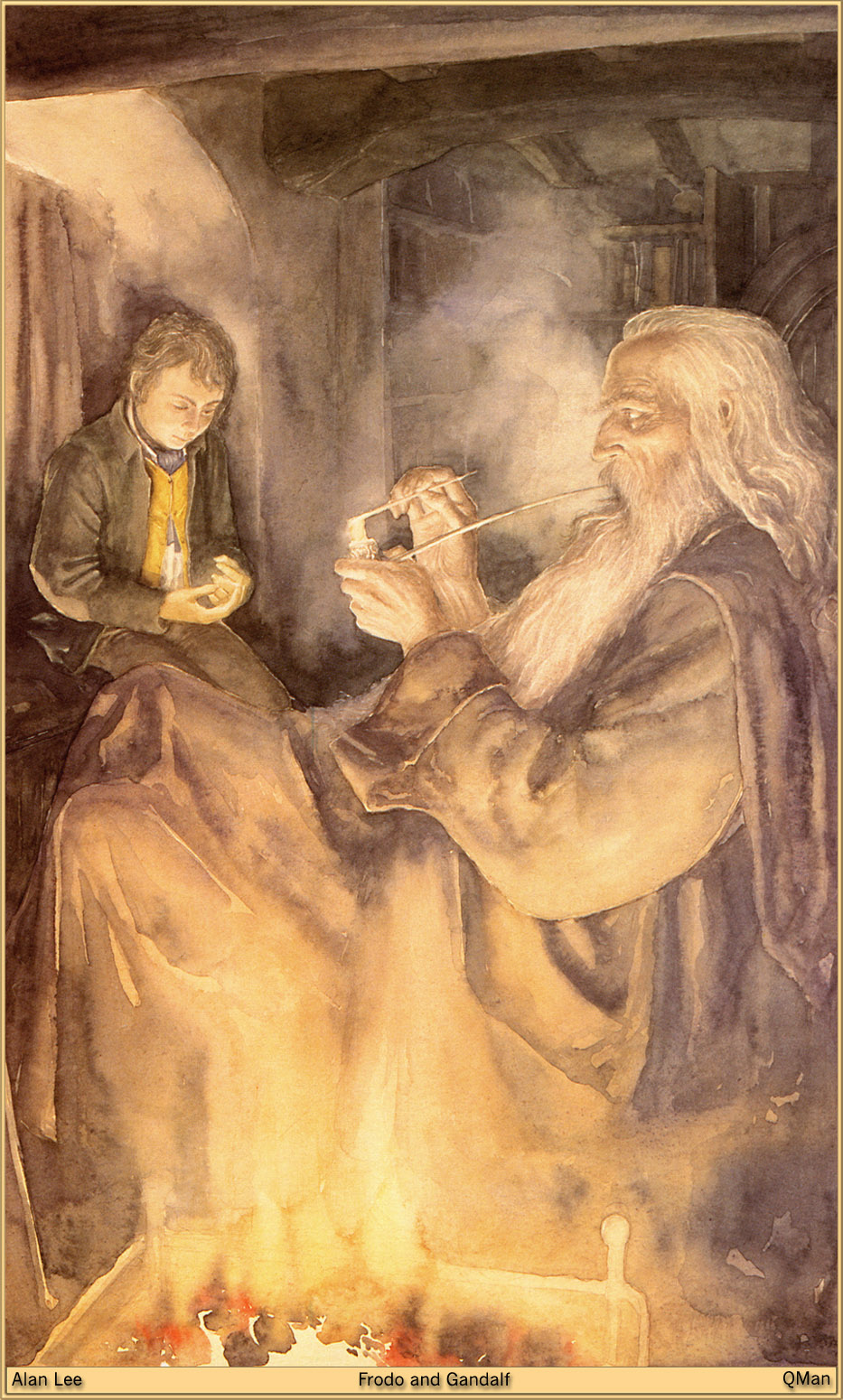
That last test takes place when, reluctantly, Frodo hands the Ring to Gandalf, and Gandalf throws it into the fire on Frodo’s hearth, where, when Frodo picks it up, he spots “fine lines, finer than the finest pen-strokes, running along the ring, outside and inside:  lines of fire that seemed to form the letters of a flowing script” and that script says:

“Ash nazg burbatuluk, ash nasz gimbatul, ash nazg thrakatuk agh burzum-ishi krimpatul.”

“One Ring to rule them all, One Ring to find them, One Ring to bring them all and in the Darkness bind them.”  (translation by Gandalf—earlier quotations from The Fellowship of the Ring, Book One, Chapter 2, “The Shadow of the Past”, the Black Speech from Book Two, Chapter 2, “The Council of Elrond”  For more on the Black Speech, see:  https://en.wikipedia.org/wiki/Black_Speech )

For Gandalf, that inscription is the final element in his understanding of just what, long ago, Bilbo picked up in the tunnels under the Misty Mountains.  He explains that it’s “only two lines of a verse long known in Elven-lore”, but those two lines are apparently all that’s necessary.

But where might the idea for an inscription have come to JRRT from originally?  I have no proof, but, as a medievalist, Tolkien might have been aware of what we find in medieval bling and is later picked up in Hamlet.

If you, like me, are a Shakespeare fan, you may recognize the subtitle of this posting as a sharp little remark by Hamlet in Act III, Scene 2 (you can read it here in the First Quarto of 1603:      https://internetshakespeare.uvic.ca/doc/Ham_Q1/complete/index.html ).  Hamlet is making fun of a very brief prologue before The Murder of Gonzago, the “play within a play” (renamed “The Mousetrap” by Hamlet) by which he hopes to force his uncle, Claudius, to reveal his guilt in the death of Hamlet’s father, but it’s the second half of that line, “a Poesie for a Ring” which provides an answer to my question.

What Hamlet is suggesting is that the prologue is as clumsy as the poetry found within a ring (although occasionally on the outside) usually given by one lover to another in the late medieval era at least into the 18th century, like this one—

where inside is written “When this you see, remember me.”

(For more, see:  https://web.archive.org/web/20080611125813/http://www.wartski.com/Posy%20ring%20messages.htm )

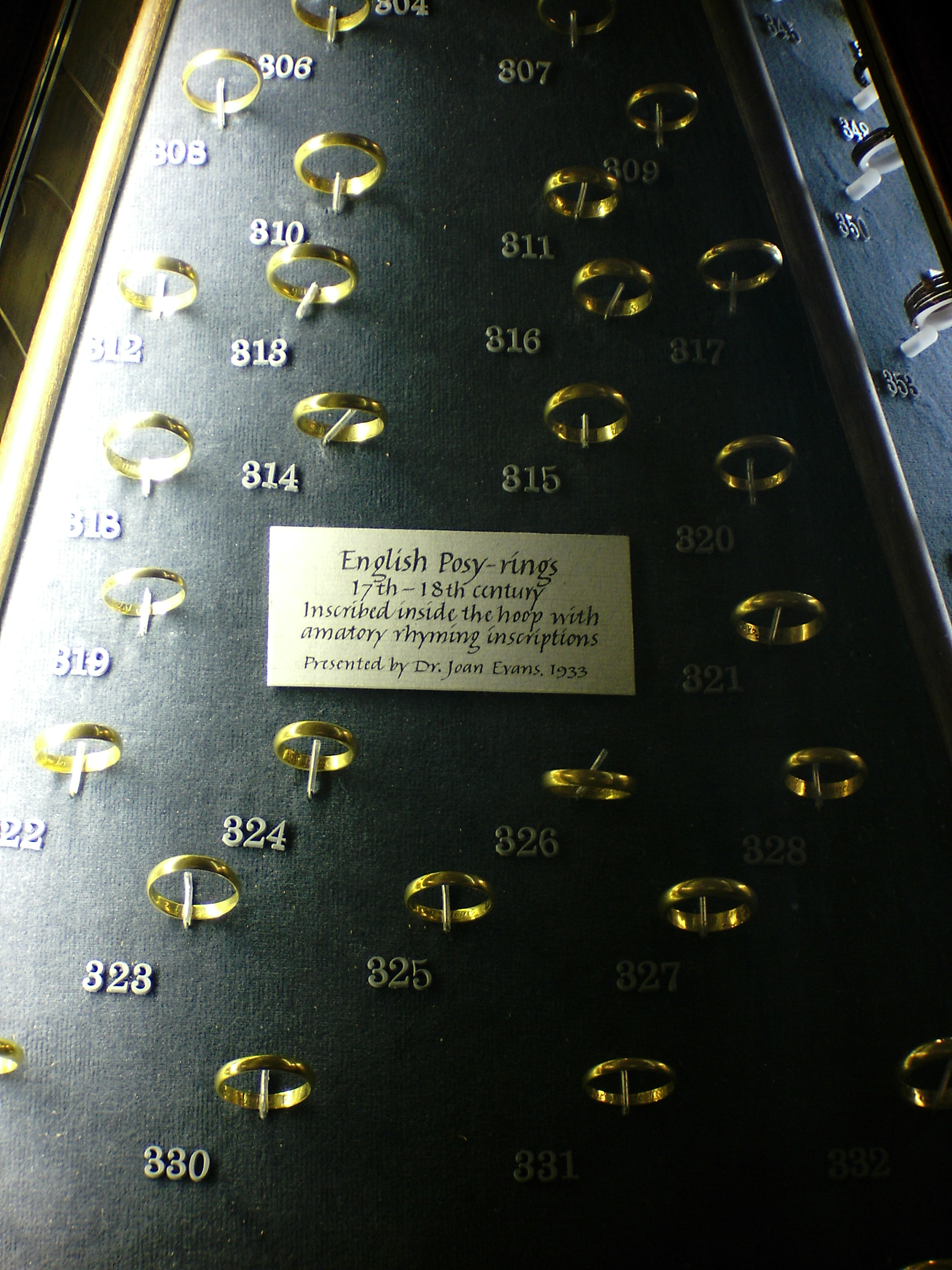
Often called “posy rings” (a contracted form of “poesie”, as in the Shakespeare quotation), there are hundreds of surviving examples—here are only a small number from the Ashmolean Museum in Oxford—

The texts vary, from what appears confident–“In thee my choice I do rejoice”—to the less so:  “I live in Hope”, but the general purpose of these little gifts is clear, if less sinister than Sauron’s.  They are meant to remind someone that someone else is thinking of them.  The difference, however, is that, if there’s one thing you wouldn’t want, it would be to have the Eye of Sauron looking in your direction.

Thanks, as always, for reading.

Stay well,

Consider what Orcs might write on their rings,

(Alan Lee)

And remember that, as ever, there’s

MTCIDC

O

PS

For a little more on posy rings, see the monograph by John Evans, “Posy-Rings” (1892) at https://ia800704.us.archive.org/5/items/PosyRingsEvans/evans-j-posy-1892-00011597.pdf

Horse, Two

03 Wednesday Sep 2025

Posted by Ollamh in Uncategorized

≈ Leave a comment

Tags

Achilles, Alexander the Great, Balios and Xanthus, Bucephalus, Grani, Nazgul, Podarge, Richard III, Shadowfax, Shakespeare, Sleipnir, The Lord of the Rings, the-iliad, Tolkien, Volsunga Saga, Zephyrus

Welcome , dear readers, as always, and, as always, I’m interested in Tolkien’s inspirations…

Enter Richard

King    A horse, a horse, my kingdome for a horse.

Cates   Withdraw my lord, ile helpe you to a horse.

King   Slaue I haue set my life vpon a cast,

And I will stand the hazard of the die,

I thinke there be sixe Richmonds in the field,

Fiue haue I slaine to daie in stead of him,

A horse, a horse, my kingdome for a horse.  (Wm Shakespeare, Richard III, Act V,  Scene 4,  First Quarto, 1597  You can read it here at the excellent Internet Shakespeare site: https://internetshakespeare.uvic.ca/doc/R3_Q1/index.html    )

(artist?)

Richard III is clearly not having a good day:  one of his allies has waited out the battle until a fatal moment, then changed sides.  And Richard has lost his horse, which, as a good horseback soldier, gives him an advantage, in terms of mobility on the battlefield, height over enemy infantry,

(Adam Hook)

and even a better chance of escape.  Without it, surrounded by enemy soldiers, he’s about to be dead.  (In the Shakespeare play, he’s killed by the Earl of Richmond, Henry Tudor, who, in turn, is about to become Henry VII, but, in reality, we don’t know who did him in, but see here for more:  https://le.ac.uk/richard-iii/identification/osteology/injuries/how-richard-iii-died )

Soldiers in the West didn’t begin on horseback.  The Sumerians first had yoked wild asses to their battle cars.

The ancient Egyptians had, by the New Kingdom (1550-1070BC), yoked horses to chariots.

(Rameses II, c.1303-1213BC)

The Assyrians, breeding bigger horses, began to sit soldiers upon their backs.

Greeks in the Iliad went to battle in and sometimes fought from their chariots (sometimes called by classical scholars “battle taxis” under the mistaken impression that they used those chariots only for transportation, which a close reading of the text shows not to be the case), although cavalry, as cavalry, are briefly mentioned, though never shown in action.

But cavalry, when it finally appeared in the Greek world, was meant for scouting and pursuit.

(Angus McBride)

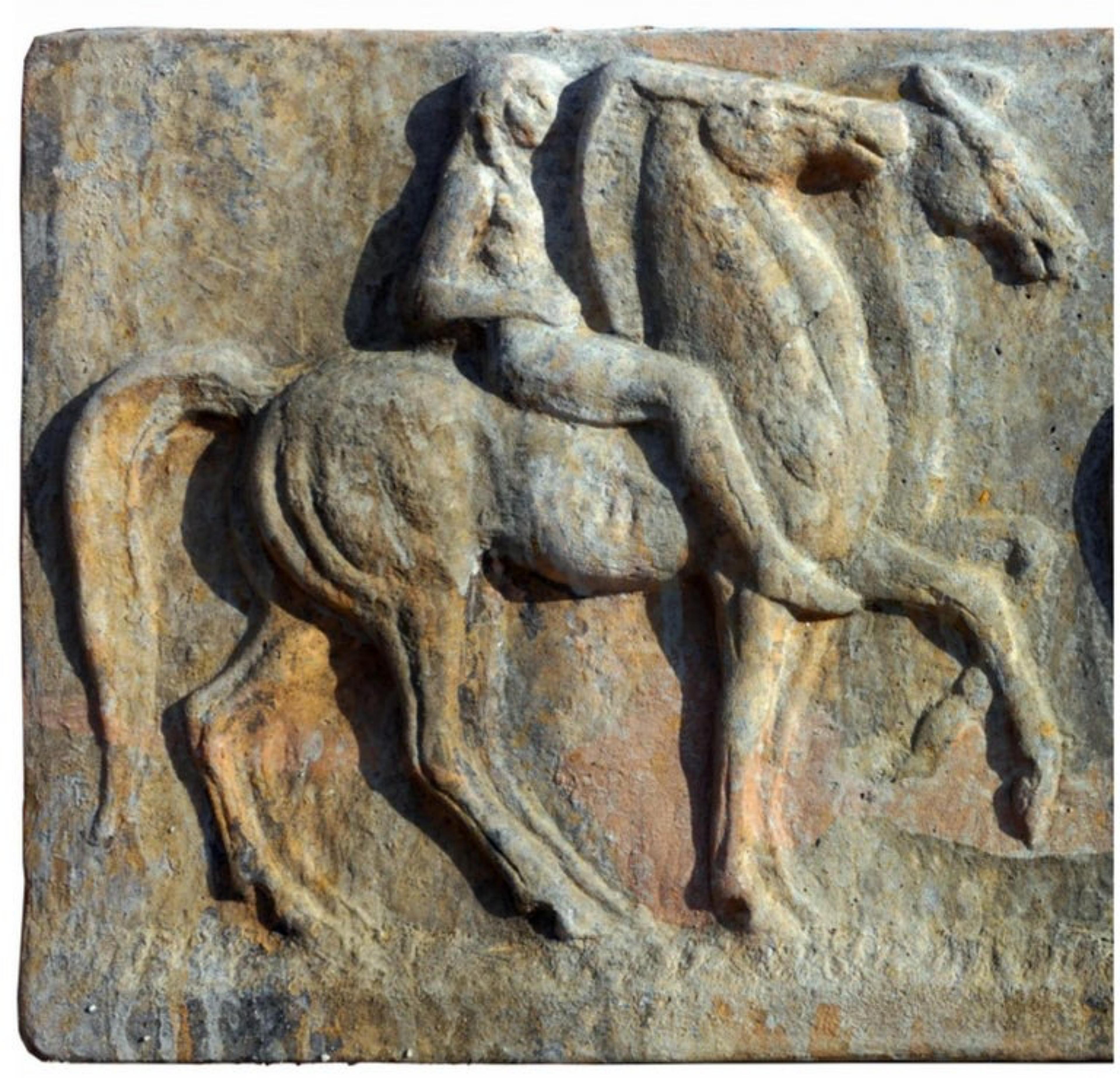
All of this changed with Philip II of Macedon. 382-336BC, and his son, Alexander.  Macedon was prime horse-breeding country and Philip was a military innovator, so, with chariots long gone, Philip trained real battle cavalry, which Alexander then led to victory.

(Peter Connolly)

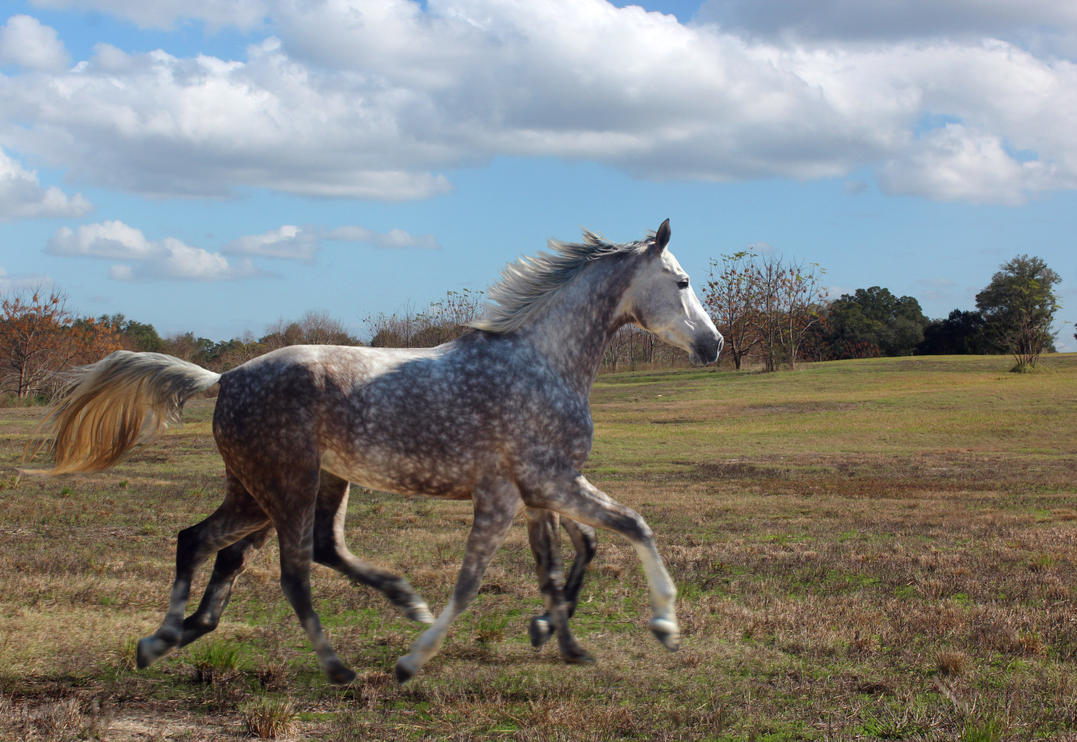
Alexander had a famous horse, Bucephalus (“Ox Head”),

whom he alone could tame. (see Plutarch’s life of Alexander here—section.6:    https://www.lexundria.com/plut_alex/1-77/prr )

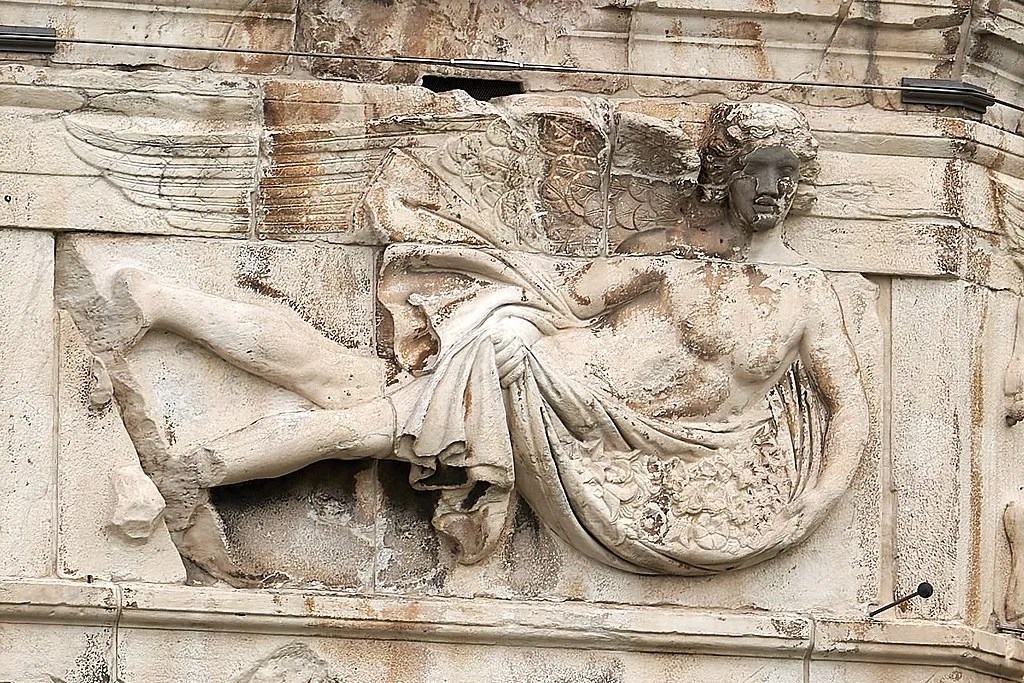
He also fancied himself a kind of descendent of the Trojan War hero Achilles, who had two famous horses, Balios (“Dapple”)  and Xanthus (“Palomino”), born of a Fury, Podarge (“Swiftfoot”), and Zephyrus, the god of the West Wind.

This divine lineage for horses made me think about a famous horse in another adventure story:  Shadowfax.

(Luca Michelucci—you can see more of his work here:  https://www.artnet.com/artists/luca-michelucci/  I like especially his image of Gwaihir rescuing Gandalf from Orthanc)
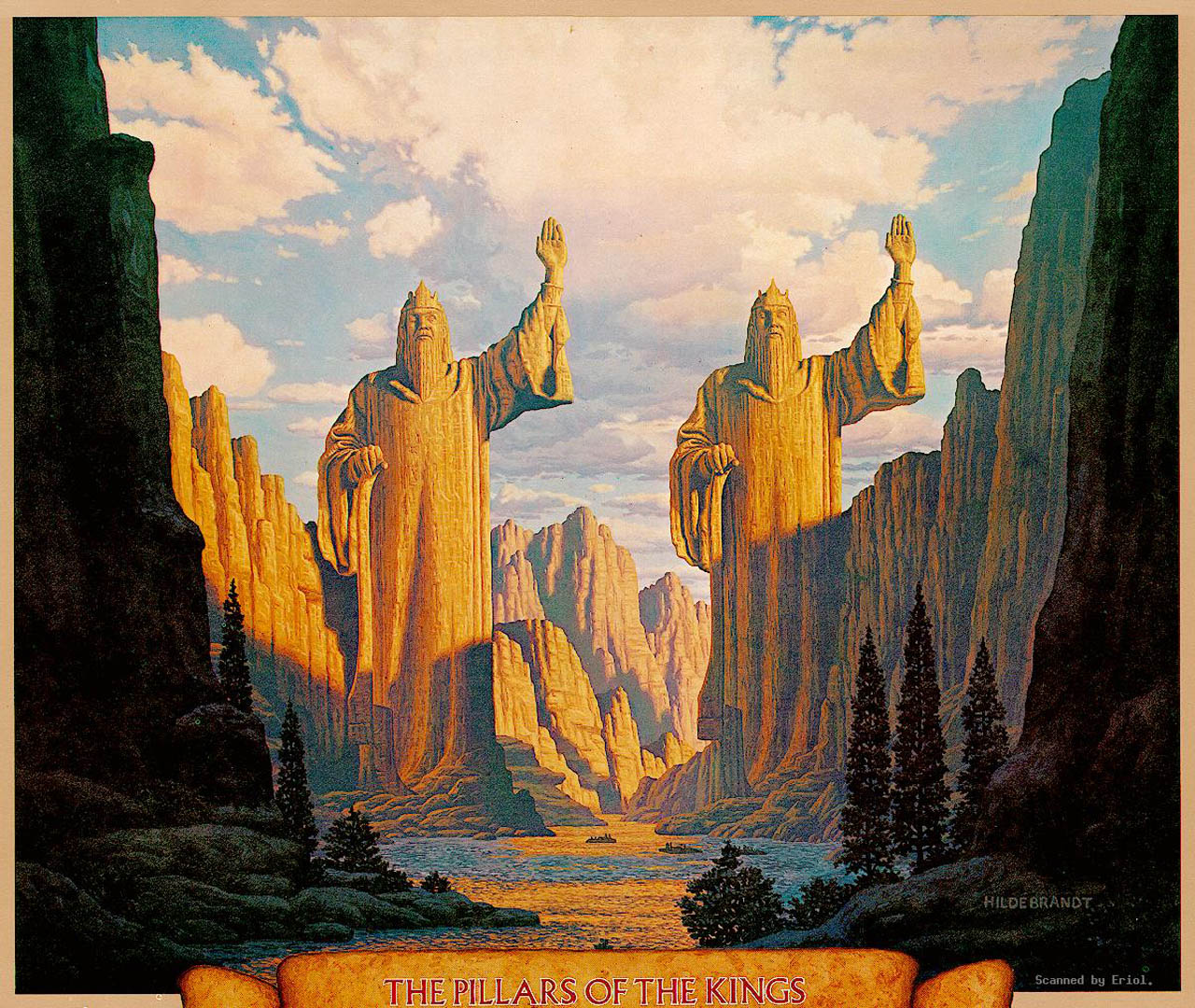
Shadowfax, according to Gandalf, is the chief of the Mearas, horses descended from one Felarof,  the horse of Eorl, the founder of Rohan.  Felarof was said to have understood the speech of men (Rohirric, we can presume) and may have been brought by Orome, the huntsman of the Valar, from across the sea, suggesting a horse of the Valar themselves.  (See The Lord of the Rings, Appendix A, II, “The House of Eorl”)

Mearas is the plural of mearh, one of the Old English words for “horse” and this might suggest that, with his  interest in things early Germanic, we might imagine that Tolkien would have looked towards Grani,

(from the Ramsund Carving—for more:  https://en.wikipedia.org/wiki/Sigurd_stones )

the horse of Sigurd, descended from Odin’s 8-legged steed, Sleipnir

(on the Tjaengvide image stone—you can read more about it here:  https://en.wikipedia.org/wiki/Tj%C3%A4ngvide_image_stone     For the story of how Sigurd found Grani, see the Icelandic Volsunga Saga  in this bilingual edition, pages 23-24:   https://archive.org/details/vo-lsungasaga-text-translation-finch/page/n89/mode/2up

And I can’t resist this very clever way of producing a modern Sleipnir—

Lachlan Templar—his work appears at Deviant Art, but, when I try to find out more, the site is blocked.)

as an inspiration, but, remembering that Tolkien had begun his formal education in the traditional way:   studying Classics at King Edward’s School in Birmingham,

and, initially, continuing  in Classics at Oxford,

I wonder—and return to Balios and Xanthus.  These are horses with as distinguished a lineage as Grani, coming from a Fury

and the god of the West Wind.

As well,  Felarof—and, in turn, Shadowfax–understand human speech and Balios and Xanthus show emotion more human than equine, weeping when their temporary master and charioteer, Patroclus, is killed in battle by the Trojan hero, Hector, refusing to return to battle, but, instead—

“…but as a monument remains firmly in the ground, one set up on a tomb

For a dead man or woman,

So they remained, immobile, holding the very beautiful chariot [still],

Leaning [their] heads to the earth, and their hot tears

Flow down from under [their] eyelids to the ground

In longing for [their] charioteer.”  (Iliad, Book 17.434-439—my translation]

And  there’s more.   Felarof and Shadowfax may understand human speech, and Balios and Xanthus may grieve, in a human way for the death of Achilles’ friend and charioteer, Patroclus, but, in an eerie moment, one of them, Xanthus, actually speaks to Achilles, warning him of his own impending doom:

“We will still keep you safe for now, mighty Achilles,

But a deadly day is near to you.”  (Iliad, Book 19.408-409—my translation)

Could there be another link here?

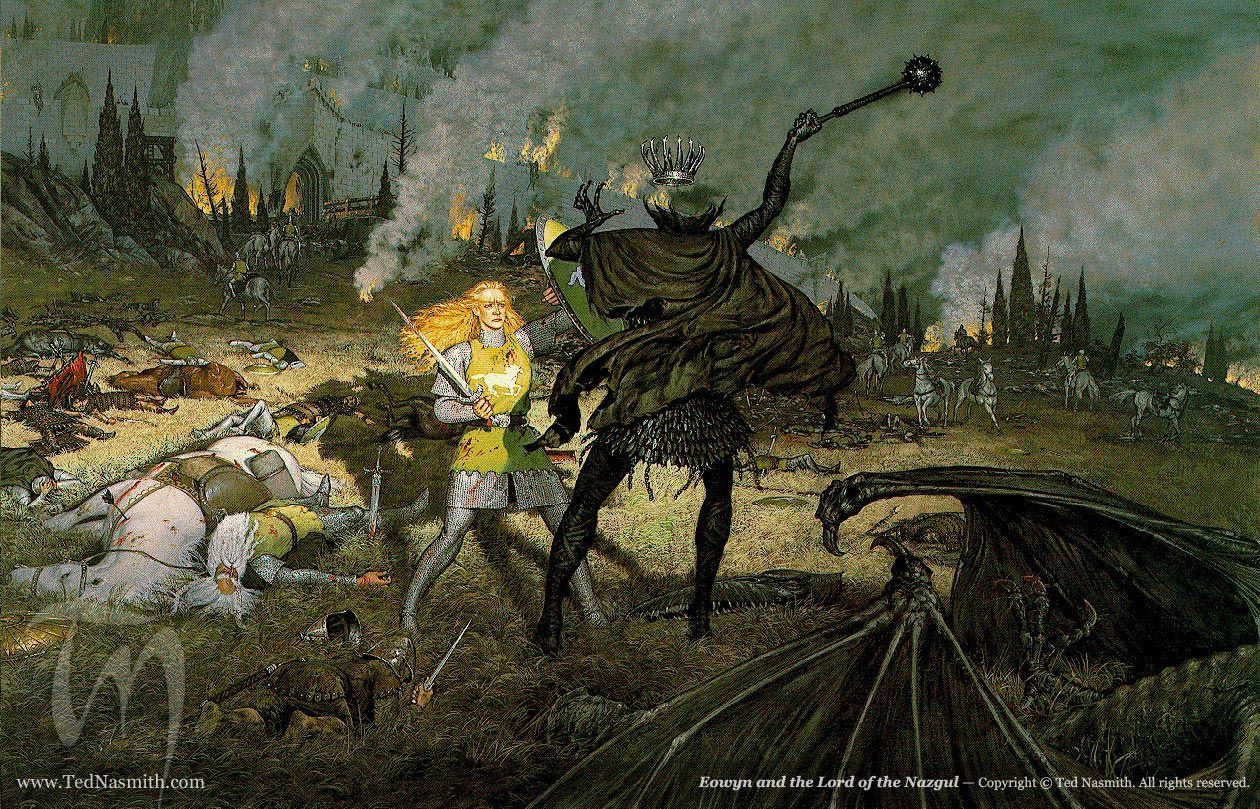
“But lo!  suddenly in the midst of the glory of the king his golden shield was dimmed.  The new morning was blotted from the sky.  Dark fell about him.  Horses reared and screamed.  Men cast from the saddle lay groveling on the ground…Snowmane wild with terror stood up on high, fighting with the air, and then with a great scream he crashed upon his side; a black dart had pierced him.  The king fell beneath him…” 

(Ted Nasmith)

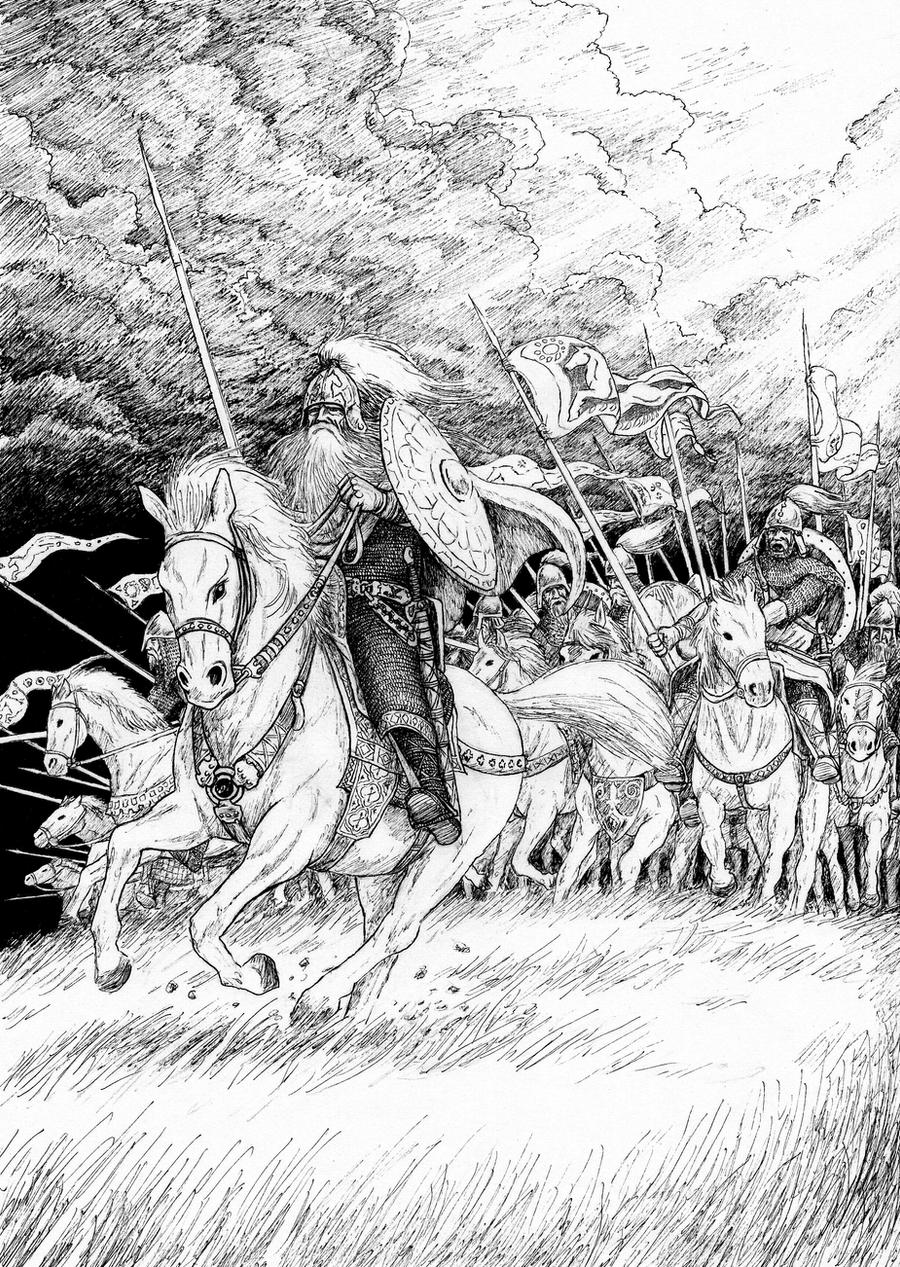
Although we have no idea of Snowmane’s lineage except that he’s “Lightfoot’s foal”, and he never speaks a word, he’s certainly involved in a death and, as Balios and Xanthus might have inspired Shadowfax, could this horse-speech be related to Theoden’s horse, Snowmane?

(Joona  Kujanen, aka Tulikoura, a bit more of whose work you can see here:  https://hole-intheground.blogspot.com/2012/03/fridays-at-mathom-house-joona-kujanen.html )

We have no idea of the fate of Achilles’ horses, though we are told that Achilles himself was buried in a mound—

as Agamemnon says to him in the Underworld, speaking of the cremated remains of Achilles and his friend, Patroclus (over whom Achilles’ horses mourned):

“And over them then we, mighty army of the Argive spearmen,

Heaped up a tumulus…”  (Odyssey, Book 24.81-81—my translation)

Just as Snowmane received a similar grave:

“And afterwards when all was over men returned and made a fire there and burned the carcase of the beast; but for Snowmane they dug a grave and set up a stone upon which was carved in the tongues of Gondor and the Mark:

‘Faithful servant yet master’s bane,

Lightfoot’’s foal, swift Snowbane.’

Green and long grew the grass on Snowmane’s Howe…”  (The Return of the King, Book Five, Chapter 6, “The Battle of the Pelennor Fields”)

All coincidence?   Or were JRRT’s many years of classical training still at work, when he’d long abandoned it for Germanic, Finnish, and Welsh?

As ever, thanks for reading.

Stay well,

Horses are wonderful, but remember that they, like us, have their limits—what would you do if a Nazgul on a frightful thing came down upon you?

(Craig J. Spearing—you can read more about him and his work here:  https://pathfinderwiki.com/wiki/Craig_J_Spearing )

And remember that, as ever, there’s

MTCIDC

O

By Ear (3)

21 Wednesday May 2025

Posted by Ollamh in Uncategorized

≈ Leave a comment

Tags

Brutus, cassius, ears, Fantasy, Gandalf, Hamlet, henbane, Julius Caesar, lotr, Marcus Antonius, Orthanc, Palantir, poison, Saruman, Sauron, Shakespeare, Tolkien

Welcome, dear readers, as always.

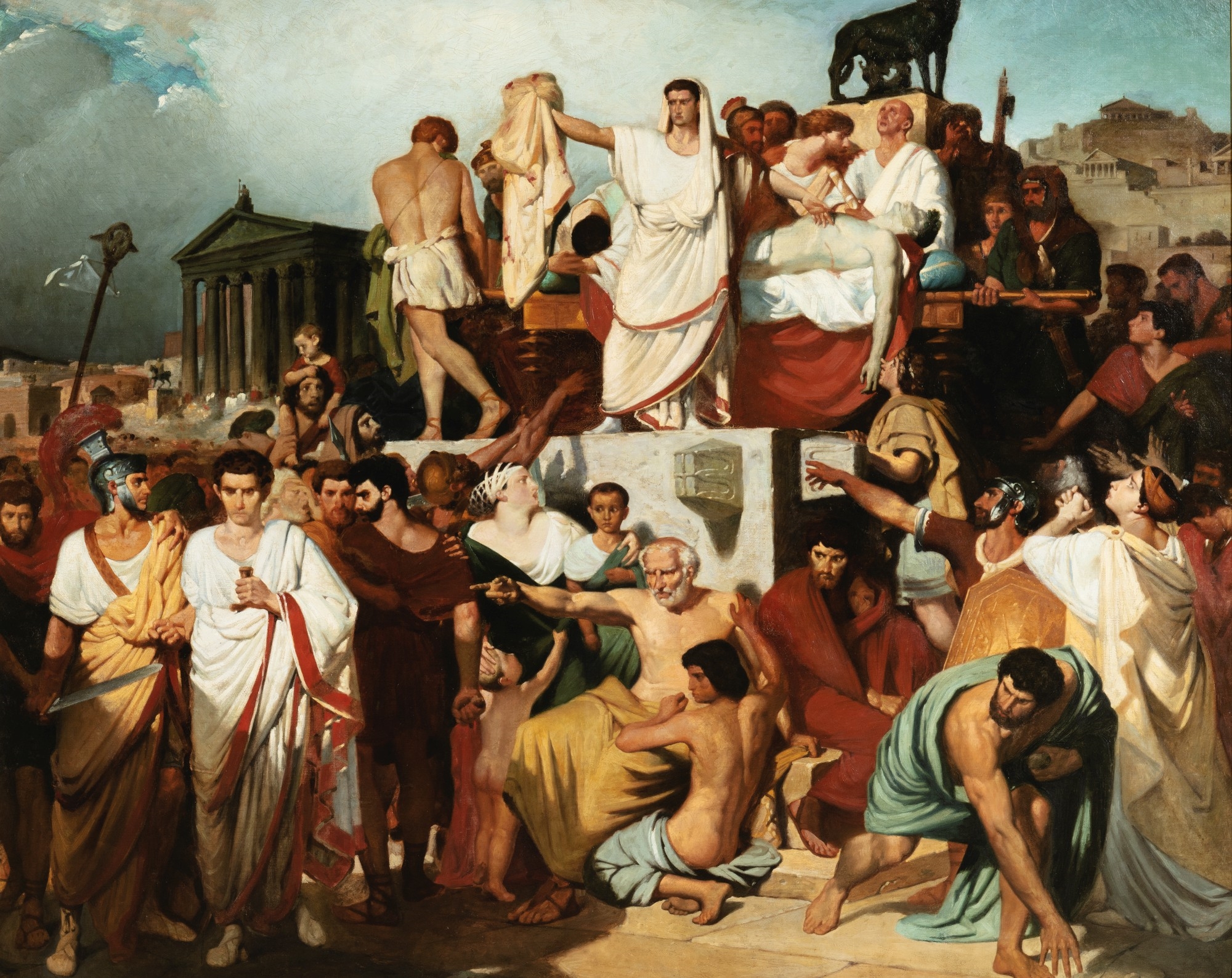
In the closing of the second part of this little series, I quoted Marcus Antonius in his funeral oration upon Julius Caesar in Shakespeare’s play of the same name.

It is a masterpiece, both in its design and in its deception:  saying one thing for the assassins, led by Brutus, to hear, and, on the other, poisoning the common people against the assassins, originally seen as liberators of the Republic.  You probably remember its opening:

“Friends, Romans, Countrymen, lend me your ears:

I come to bury Caesar, not to praise him:

The euill that men do, liues after them,

The good is oft enterred with their bones,

So let it be with Caesar. The Noble Brutus,

Hath told you Caesar was Ambitious:

If it were so, it was a greeuous Fault,

And greeuously hath Caesar answer’d it.

Heere, vnder leaue of Brutus, and the rest

(For Brutus is an Honourable man,

So are they all; all Honourable men)

Come I to speake in Caesars Funerall.”

(Julius Caesar, Act III, Scene 2, from the First Folio, 1623, in the original spelling.  You can see it at my favorite site for the plays:  https://internetshakespeare.uvic.ca/doc/JC_F1/scene/3.2/index.html )

Speech with a deceptive goal is a theme of this series, as, in the first part, were poison–and ears.

In the scene in Shakespeare’s play, Marcus Antonius plays a dangerous game.  In order to be able to speak, he has made a deal with the assassins of Caesar not to say anything inflammatory against them, and so we see those words “Honourable men” repeated, as if Antonius is going to praise them—while only burying Caesar, as he says—just the sort of thing which we can imagine the assassins wanted to hear.  And yet, as he continues, “Honourable men” gradually becomes ironic and, by the end of his speech, he controls the mob and it’s clear that the assassins are no longer considered liberators, but murderers, Antonius having successfully poisoned those lent ears against the very men who foolishly gave him leave to speak.

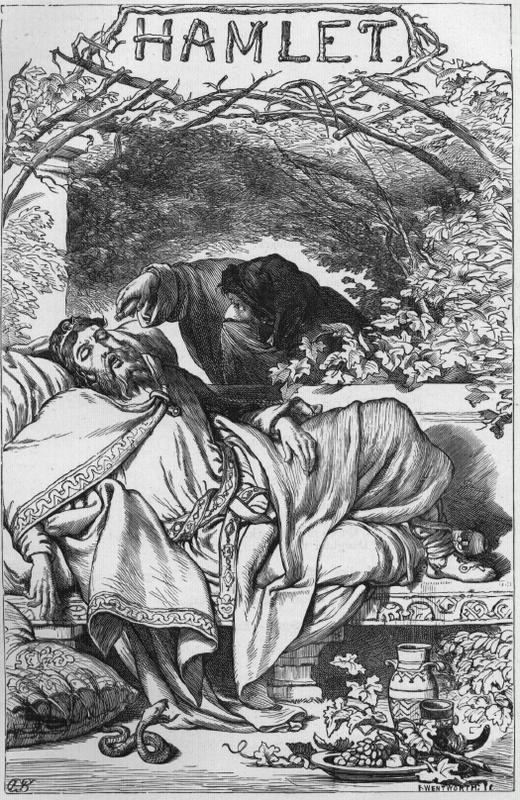
We began the series with poison—and Shakespeare:  literal poison (possibly henbane)

which, as Hamlet’s ghostly father tells Hamlet, had been administered to him through his ear by his own brother, Claudius, while he was napping in his garden

But, as we progressed, we moved from that chemical murder to a different kind of destruction, spiritual, in the case of Saruman in the second installment, and now, in the third and final installment, we move to the instrument of that poisoning, include a second poisoning victim, and find the mind behind it all and that mind’s method of persuasion, which, I would suggest, must be very like Antonius’ initial remarks, seeming to praise the assassins, but, just like his, with another motive underneath.

(JRRT)

When Saruman, failing to succeed with Theoden, has turned to Gandalf, Gandalf has alluded to his previous visit with Saruman, saying:

“What have you to say that you did not say at our last meeting?…Or, perhaps, you have things to unsay?”  (The Two Towers, Book Three, Chapter 10, “The Voice of Saruman”)

That last meeting had ended with Gandalf’s imprisonment in the tower of Orthanc,

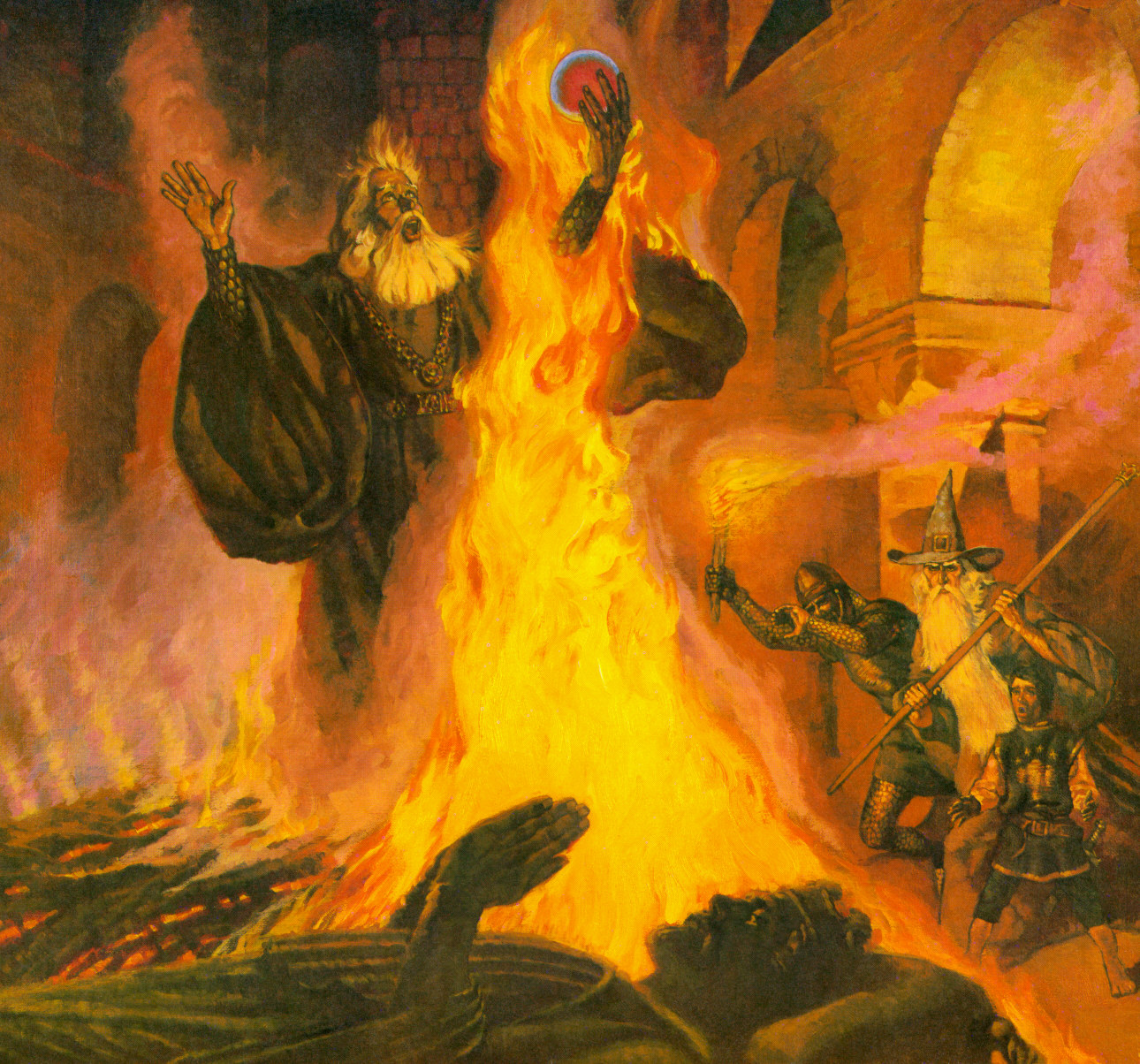
(the Hildebrandts)

but, before that, Saruman had tried to persuade Gandalf to become an ally, and not only of Saruman, but of someone else, his speech including these words:

“We can bide our time, we can keep our thoughts in our hearts, deploring evils done by the way, but approving the high and ultimate purpose:  Knowledge, Rule, Order; all the things we have so far striven in vain to accomplish…”  (The Fellowship of the Ring, Book Two, Chapter 2, “The Council of Elrond”)

Gandalf’s reply then suggests that what Saruman is saying is not really his own argument:

“ ‘I have heard speeches of this kind before, but only in the mouths of emissaries sent from Mordor to deceive the ignorant.’ “

What is it in those words which betrays their original authorship?

In the draft of a letter to Peter Hastings, Tolkien wrote:

“Sauron was of course not ‘evil’ in origin.  He was a ‘spirit’ corrupted by the Prime Dark Lord…Morgoth.  …at the beginning of the Second Age he was still beautiful to look at, or could still assume a beautiful visible shape—and was not indeed wholly evil, not unless all ‘reformers’ who want to hurry up with ‘reconstruction’ and ‘reorganization’ are wholly evil, even before pride and the lust to exert their will eat them up.”  (draft of a letter to Peter Hastings, September, 1954, Letters, 284)

What Gandalf is actually hearing then is the thinking of Sauron and his “high and ultimate purpose”, but wrapped in words which will sound familiar to Saruman and appeal to his increasing arrogance—those words “high and ultimate purpose” echo Saruman’s depiction later in the story of just who the Istari are:

“Are we not both members of a high and ancient order, most excellent in Middle-earth?”  (The Two Towers, Book Three, Chapter 10, “The Voice of Saruman”)

That “order” was not sent to Middle-earth for “Knowledge, Rule, Order”, however, as this entry in the Appendices to The Lord of the Rings tells us:

“When maybe a thousand years had passed, and the first shadow had fallen on Greenwood the Great, the Istari, or Wizards appeared in Middle-earth.  It was afterwards said that they came out of the Far West and were messengers sent to contest the power of Sauron, and to unite all those who had the will to resist him; but they were forbidden to match his power with power, or to seek to dominate Elves or Men by force and fear.”  (The Lord of the Rings, Appendix B: “The Third Age”)

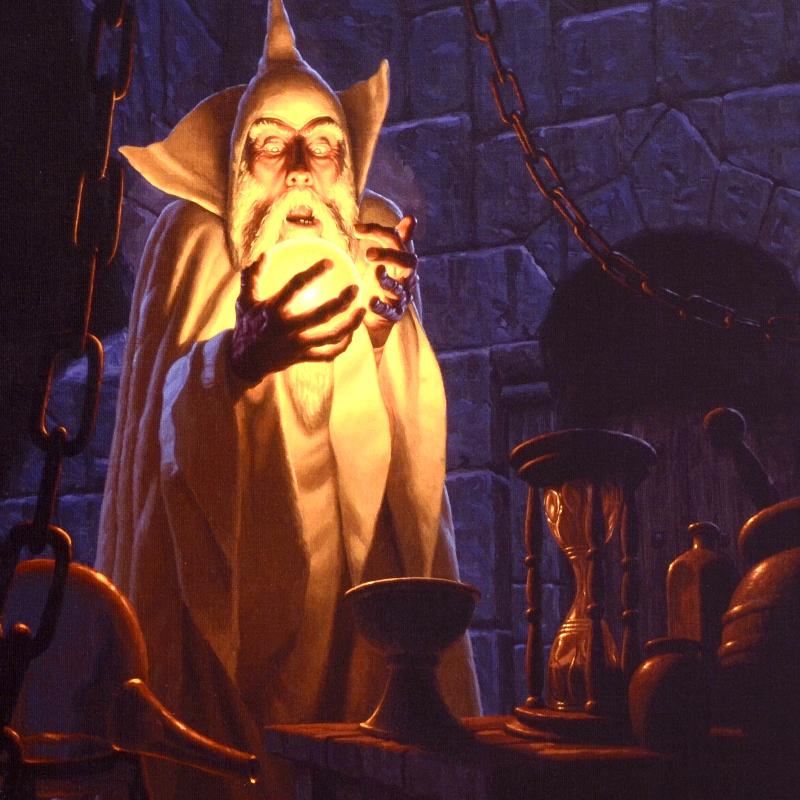
Marcus Antonius has spoken indirectly to the assassins and directly to the mob, both through their ears, but Sauron’s words have reached Saruman through this—

(the Hildebrandts)

which we know that Saruman has had as it is flung through the doorway of Orthanc by Grima and almost brains Gandalf—

“With a cry Saruman fell back and crawled away.  At that moment a heavy shining thing came hurtling down from above.  It glanced off the iron rail, even as Saruman left it, passing close to Gandalf’s head, it smote the stair on which he stood.”

I never think of a palantir without thinking of another device used for conning unsuspecting victims—

Staring into the ball might have a kind of hypnotic effect, but it clearly also has the effect of focusing the will of another upon the victim—as Pippin found out to his grief:

“In a low hesitating voice Pippin began again, and his words grew clearer and stronger.  ‘I saw a dark sky, and tall battlements…And tiny stars.  It seemed very far away and long ago, yet hard and clear…Then he came.  He did not speak so that I could hear words.  He just looked and I understood…He said:  “Who are you?’  I still did not answer, but it hurt me horribly; and he pressed me, so I said:  ‘A hobbit.’  Then suddenly he seemed to see me, and he laughed at me.  It was cruel.  It was like being stabbed with knives…Then he gloated over me.  I felt I was falling to pieces.’ “  (The Two Towers, Book Three, Chapter 11, “The Palantir”)

This isn’t Sauron’s only use of such a device for his poisoning—another palantir lies in Minas Tirith and it’s clear from its possessor, Denethor’s, speech how Sauron has reached him:

“Do I not know thee, Mithrandir?  Thy hope is to rule in my stead, to stand behind every throne, north, south, or west.  I have read thy mind and its policies…So!  With the left hand thou wouldst use me for a little while as a shield against Mordor, and with the right bring up this Ranger of the North to supplant me.”

And here we see how Sauron has distorted the original Istari goals, which Tolkien had described to Naomi Mitchison:

“They were thought to be Emissaries (in the terms of this tale from the Far West beyond the Sea), and their proper function, maintained by Gandalf and perverted by Saruman, was to encourage and bring out the native powers of the Enemies of Sauron.”  (letter to Naomi Mitchison, 25 April, 1954, Letters 269-270)

Denethor is correct in understanding that Gandalf—and supposedly all of the Istari—are meant to stand behind thrones—but to encourage their possessors to oppose Sauron, not to gain power for themselves, as Saruman deceived himself into thinking.  Denethor has not read Gandalf’s mind, but Sauron has definitely read Denethor’s—when Gandalf asks him what he wants, he replies:

“ ‘I would have things as they were in all the days of my life…and in the days of my longfathers before me:  to be the Lord of this City in peace, and leave my chair to a son after me, who would be his own master and no wizard’s pupil.”

The Stewards are not the kings of Gondor.  Although they have ruled for centuries, they are merely the lieutenants of the Numenorean kings, holding Gondor until a rightful king should appear, but it’s clear that Denethor has forgotten that, seeming to assume that he is the king—something surely in which Sauron has encouraged him .  And we see here another sore point:  Faramir.

In the midst of a complex scene in which Faramir reports that he had met Frodo, Denethor turns to him sharply:

“Your bearing is lowly in my presence, yet it is long since you turned from your own way at my counsel.  See, you have spoken skillfully, as ever; but I, have I not seen your eyes fixed on Mithrandir, seeking whether you said well or too much?  He has long had your heart in his keeping.”  (The Return of the King, Book Five, Chapter 4, “The Siege of Gondor”)

So Sauron has spotted two weak points in Denethor:  a mistaken idea about his role in the governing of Gondor and his jealous attitude towards his younger son.  This almost leads to Faramir’s death by burning and certainly does his father’s.

(Robert Chronister—about whom I have so far found nothing, although it’s clear that he’s illustrated more than one scene from The Lord of the Rings.)

Marcus Antonius, one of Julius Caesar’s right-hand men, has tricked Caesar’s assassins into letting him speak,

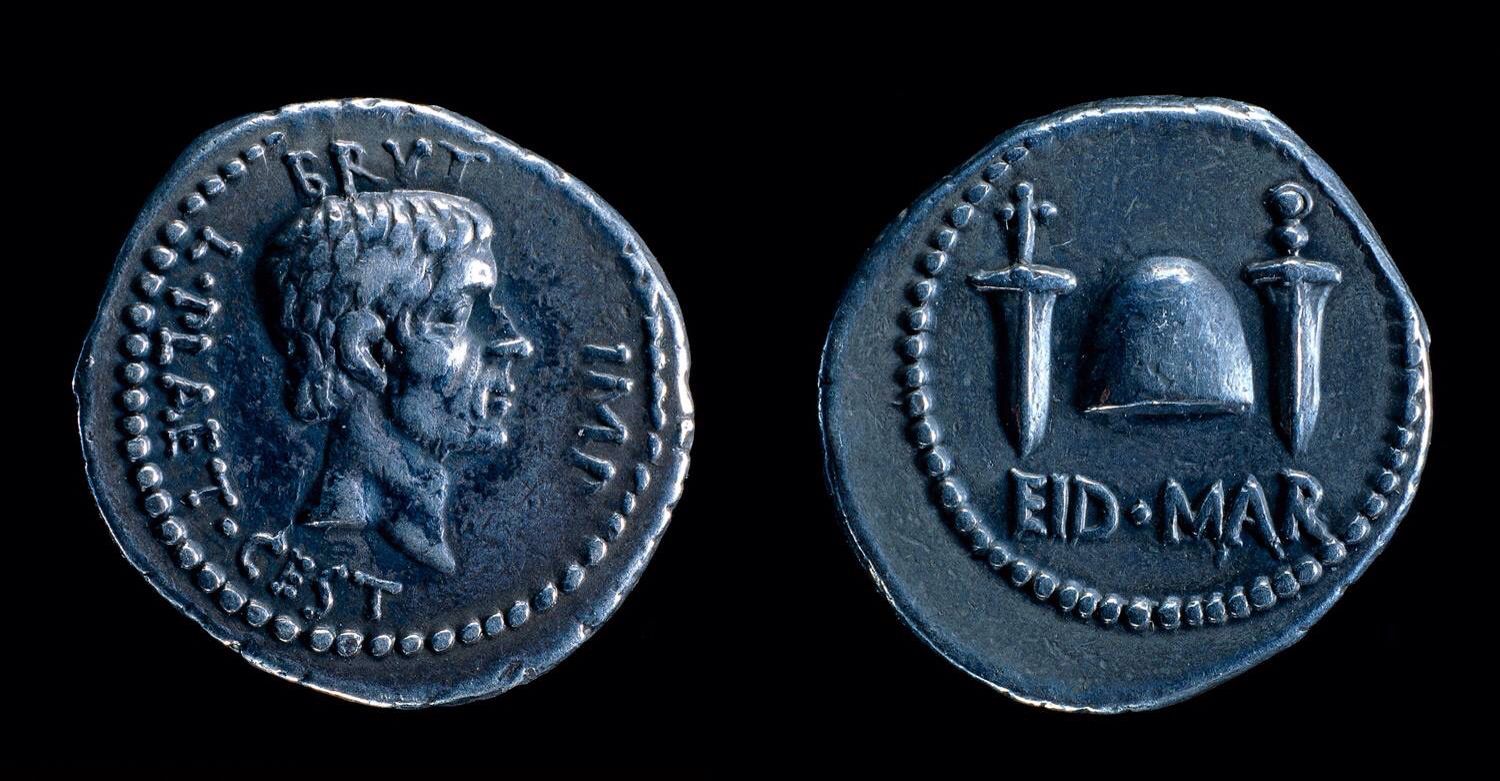
initially using language which they want to hear, but, just below the surface, and increasingly, as he proceeds, his word choice turns the mob listening to those same words into a force which will help to drive the assassins from Rome and, eventually, in the case of two of the main assassins, Brutus,

(This is a very famous coin pattern.  On the obverse—the “heads”—we see what we presume is an image of Brutus, with the caption “Brut[us]” and his assertion that he has the state’s authority:  “Imp[erator]”, along with the name of the mint master, “L[ucius] Plaet[orius] Cest[ianus]”.  On the reverse—the “tails”—we see a shorthand version of the claim of the assassins:  “Eid[ibus] Mar[tis]”—“on the ides of March”, plus two Roman “pugiones”—military daggers—bracketing a “liberty cap”—used in the ceremony of freeing a slave—hence:  “On the Ides of March, I/we, by the use of these daggers, freed Rome from its slavery (to Caesar)” )

and Cassius,

(Unfortunately, we have no definite image of Cassius—this is a coin minted on his authority by his deputy, Marcus Servilius.  The obverse has an image of “Libertas”, along with an abbreviated form of his name, “C[aius] Cassi[us]”, and that claim to have the authority of the state:  “Imp[erator]”.  The reverse has the name of his lieutenant, “M[arcus] Servilius”, his deputy rank “Leg[atus]” and what’s called an “aplustre”, which is the decorative stern of a Roman warship, thought to commemorate Cassius’ defeat of the navy of Rhodes.)

to defeat and suicide—Marcus Antonius’ ear-poison working very effectively.

For Middle-earth, there is a happier ending.  The real goal of sending the Istari succeeds, even with the treachery of Saruman, brought about through the poison introduced and spread by Sauron through the palantiri, which affects Denethor, as well, teaching us that toxicity is just as deadly in word as it is in deed.

Thanks, as always, for reading.

Stay well,

Lend no one your ears unless you’re clear what he/she wants,

And remember that, as ever, there’s

MTCIDC

O

By Ear (2)

14 Wednesday May 2025

Posted by Ollamh in Uncategorized

≈ Leave a comment

Tags

Fantasy, Gandalf, Hamlet, Istari, Orthanc, Palantir, poison, Saruman, Sauron, Shakespeare, Theoden, Tolkien

Welcome, dear readers, as always.

In Part 1 of this posting, I began talking about ear poisons, beginning with the actual poisoning of Hamlet’s father by Hamlet’s uncle, Claudius, who, according to Hamlet’s father’s ghost:

“Sleeping within my orchard,

My custom always of the afternoon,

Upon my secure hour, thy uncle stole

With juice of cursèd hebona in a vial,

And in the porches of my ears did pour

The lep’rous distilment…” (Hamlet, Act 1, Scene 5)

But there are poisons just as potent which come in the form of poisonous words, as we began to see in Saruman’s attempts to win over Theoden,

(Francesco Amadio)

and, failing that, with Gandalf:

“Gandalf stirred, and looked up.  ‘What have you to say that you did not say at our last meeting?’ he asked.  ‘Or, perhaps, you have things to unsay?’ “

In their last meeting, Gandalf became Saruman’s prisoner in Orthanc—

(the Hildebrandts)

but the words which Saruman employed then were revealing, as Gandalf says, having listened to Saruman’s plea:

“A new Power is rising…We may join with that Power.  It would be wise, Gandalf.  There is hope that way.  Its victory is at hand; and there will be rich reward for those that aid it.  As the Power grows, its proved friends will also grow; and the Wise, such as you and I, may with patience come at last to direct its courses, to control it.  We can bide our time, we can keep our thoughts in our hearts, deploring maybe evils done by the way, but approving the high and ultimate purpose:  Knowledge, Rule, Order; all the things that we have so far striven in vain to accomplish, hindered rather than helped by our weak or idle friends.  There need not be, there would not be, any real change in our designs, only in our means.”  (The Fellowship of the Ring, Book Two, Chapter 2, “The Counsel of Elrond”)

When attempting to win over Theoden, Saruman had chosen words which suggested how much Saruman honored and respected him, defending himself from his own aggressive actions by saying that, if he had used violence against Rohan, so had Rohan used violence in the past, and now, together, he and Theoden could make peace—and therefore avoid what Saruman calls “the ruin that draws nigh inevitably”, even implying a bond between them, changing his former address from “you” to “we” and “our”—

“Shall we make our counsels together against evil days, and repair our injuries with such good will that our estates shall both come to fairer flower than ever before?”

When that hadn’t worked, Saruman had turned to Gandalf, at whom he had sneered only moments before, saying now that Gandalf had “a noble mind and eyes that look both deep and far”—in other words, attempting the same flattery which had failed with Theoden.  And he tried the same kind of shift from “you” to “we” here:

“I fear that in my eagerness to persuade you, I lost patience.  And indeed I regret it.  For I bore you no ill-will; and even now I bear none, though you return to me in the company of the violent and the ignorant.  How should I?  Are we not both members of a high and ancient order, most excellent in Middle-earth?”

That word “order” reminds us of something which Gandalf had said to Frodo long before about Saruman:

“He is the chief of my order and the head of the Council…The lore of the Elven-rings, great and small, is his province.”

(Alan Lee)

And yet:

“I might perhaps have consulted [him], but something always held me back.” (The Fellowship of the Ring, Book One, Chapter 2, “The Shadow of the Past”)

Gandalf has, then, long had doubts about Saruman, even though Saruman was head of that “order”. 

But what, actually, was that “order”?

“When maybe a thousand years had passed, and the first shadow had fallen on Greenwood the Great, the Istari, or Wizards appeared in Middle-earth.  It was afterwards said that they came out of the Far West and were messengers sent to contest the power of Sauron, and to unite all those who had the will to resist him; but they were forbidden to match his power with power, or to seek to dominate Elves or Men by force and fear.”  (The Lord of the Rings, Appendix B: “The Third Age”)

Recall, then, what Saruman has so far done:

1. he has turned Isengard into a miniature version of Mordor, ravaging the surrounding landscape

2. roused the Dunlendings to attack Rohan

3. created his own army of orcs—and perhaps done something worse to them than simply create them, if Treebeard’s thoughts are true (“Worse than that:  he has been doing something to them; something dangerous…For these Isengarders are more like wicked men.”  The Two Towers, Book Three, Chapter 4, “Treebeard”)

4. attacked Rohan and, in the process, Theoden’s son, Theodred, has been killed

5. not to mention that, when Gandalf has resisted his proposals, Saruman has imprisoned him

And so, how believable could anything Saruman says be?  And yet he persists:

“Our friendship would profit us both alike.  Much we could still accomplish together, to heal the disorders of the world.  Let us understand one another, and dismiss from thought these lesser folk!  Let them wait on our decisions!  For the common good I am willing to redress the past, and to receive you.  Will you not consult with me?  Will you not come up?”

In other words, of everything which Saruman, as one of the Istari, has been sent to do, he has done the opposite—and persists, even when he has failed in his plans and is now a prisoner in his own domain.

(Carl Lundgren–you can read about him here: https://en.wikipedia.org/wiki/Carl_Lundgren_(illustrator) )

Yet his tone, for the moment, still has the remains of its ability to charm:

“So great was the power that Saruman exerted in this last effort that none that stood within hearing were unmoved.  But now the spell was wholly different.  They heard the gentle remonstrance of a kindly king with an erring but much-loved minister.  But they were shut out, listening at a door to words not meant for them…”

Until—

“Then Gandalf laughed.  The fantasy vanished like a puff of smoke.”

And what follows reveals not only why Gandalf declines the offer, but who Gandalf believes lies behind all of those empty words about “heal[ing] the disorders of the world” and “the common good” and, earlier, “knowledge, rule, order”—poisonous words when coming from the mouth of Saruman:

“I keep a clearer memory of your arguments, [says Gandalf] and deeds, than you suppose.  When last I visited you, you were the jailor of Mordor, and there I was to be sent.”

Saruman’s reaction is predictable:  each time he finds that his magic tones do not lull the listener, he falls into a rage, but, this time, there is something else mixed with it:

“A shadow passed over Saruman’s face; then it went deadly white.  Before he could conceal it, they saw through the mask the anguish of a mind in doubt, loathing to stay and dreading to leave its refuge.  For a second he hesitated, and no one breathed.  Then he spoke, and his voice was shrill and cold.  Pride and hate were conquering him.”

Pride and hate, but there is something more, as Gandalf warns him:

“ ‘Reasons for leaving you can see from your windows…

(Ted Nasmith)

Others will occur to your thought.  Your servants are destroyed and scattered; your neighbors you have made your enemies; and you have cheated your new master, or tried to do so.  When his eye turns hither, it will be the red eye of wrath.’ “

Gandalf snaps Saruman’s staff and, as if on-cue:

“With a cry Saruman fell back and crawled away.  At that moment a heavy shining thing came hurtling down from above.  It glanced off the iron rail, even as Saruman left it, passing close to Gandalf’s head, it smote the stair on which he stood.”

What this can be and how it figures in all of this poison will appear in the final part of this short series—

(the Hildebrandts)

As ever, thanks for reading.

Stay well,

Remember what Marcus Antonius says to the mob in Shakespeare’s Julius Caesar, “The evil that men do lives after them…” when he is supposedly only burying Caesar, not praising him…

And remember, as well, that there’s

MTCIDC,

O

Childe Rowland to the Dark Tower Came

04 Wednesday Dec 2019

Posted by Ollamh in Artists and Illustrators, Fairy Tales and Myths, J.R.R. Tolkien

≈ Leave a comment

Tags

Alan Lee, Barad-Dur, Child Ballads, Fairy Tale, Hildebrandts, Hogwarts, John Howe, Neuschwanstein, Shakespeare, Sunset Crater, The Lord of the Rings, Tolkien, Wukoki

If you are a reader/watcher of Shakespeare, you’ll immediately recognize the title, dear readers, as coming from King Lear, Act 3, Scene 4, where a character named Edgar, pretending to be mad, babbles (among other things):

“Child Roland to the dark tower came.

His word was still ‘Fie, foh, and fum,

I smell the blood of a British man.’ “

“Child Roland” belongs to a Scots ballad, “Burd Helen”, first cited in detail in Robert Jamieson’s Illustrations of Northern Antiquities (1814), page 397 and following. (“Burd” is an old Scots term for a young woman.) [If you’d like your own Jamieson, here’s the LINK to obtain a free copy: https://archive.org/details/illustrationsofn00webe]

That “Fie, foh, and fum” may also be familiar to you from the story of Jack the Giant Killer/Jack and the Bean Stalk, which first appeared in Round about our Coal Fire (1734), in “the story of Jack Spriggins and the Enchanted Bean” on page 45, with the words in a slightly different form:

“Fee-Faw-Fum!————–

I smell the Blood of an English-Man;

Whether he be alive or dead,

I’ll grind his Bones to make my Bread.”

[A copy of the whole pamphlet may be had at this LINK: https://upload.wikimedia.org/wikipedia/commons/9/98/Round_about_our_Coal_Fire%2C_or%2C_Christmas_Entertainments%2C_4th_edn%2C_1734.pdf]

It wasn’t about Jack or his beanstalk, that we began writing this, however, but about that “dark tower”.

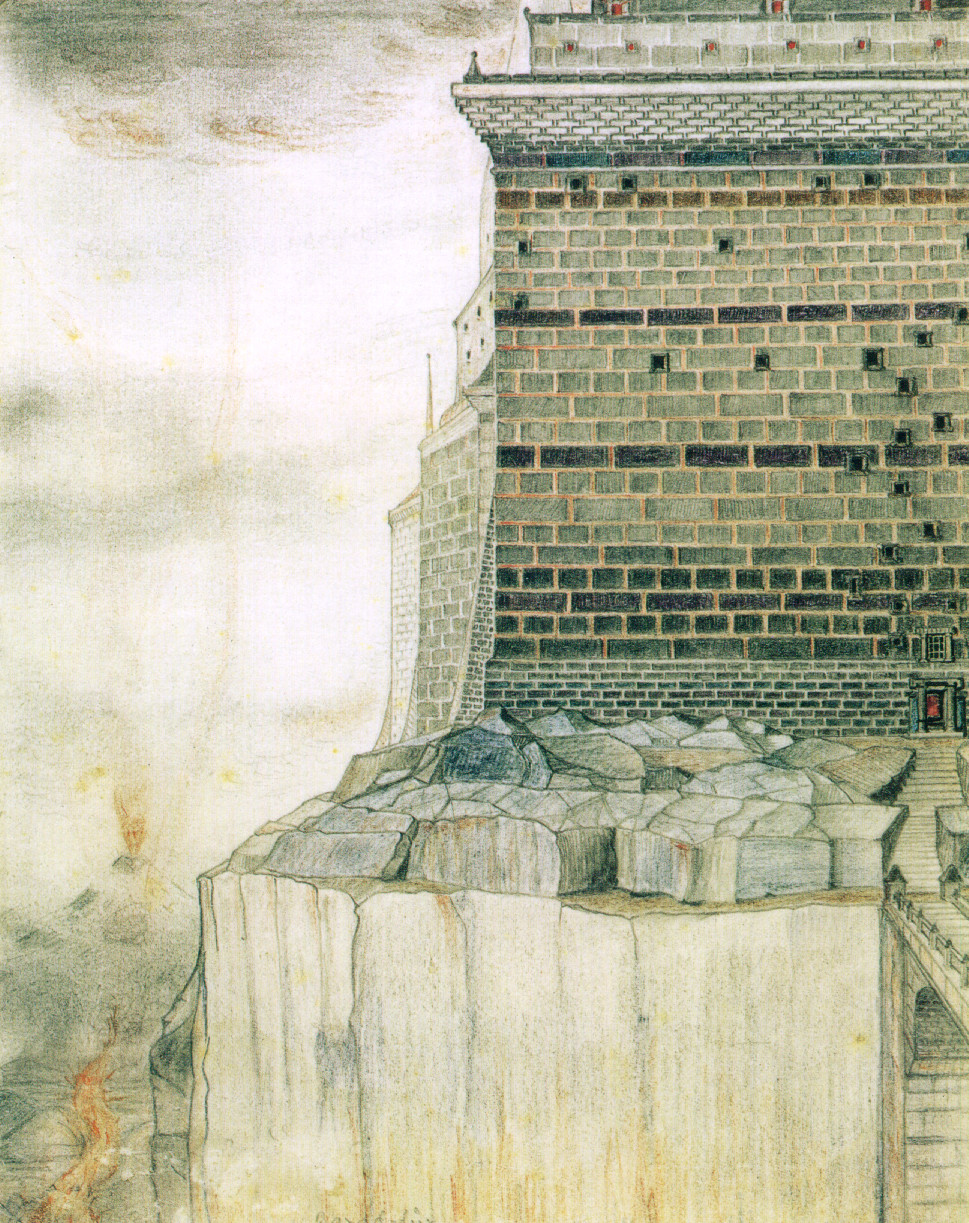
And, when we write that, we think, at once, of the Barad-dur—although not perhaps as the Hildebrandts saw it—image1hild

or Alan Lee

image2lee

or John Howe

image3howe

or Ted Nasmith,

image4ted

as much as we respect their ideas and enjoy their work. It’s interesting to see how Tolkien imagined it.

image5jrrt

Oddly, to us, this doesn’t look like anything western, but rather like a Japanese castle, such as Kumamoto, originally built in the 15th century.

image6kumamoto

There is no long description of Sauron’s fortress in The Lord of the Rings, but there are a few bits here and there–

“The Dark Tower was broken, but its foundations were not removed, for they were made with the power of the Ring, and while it remains they will endure.” (The Fellowship of the Ring, Book Two, Chapter 2, “The Council of Elrond”)

“Then at last his [Sam’s] gaze was held: wall upon wall, battlement upon battlement, black, immeasurably strong, mountain of iron, gate of steel, tower of adamant, he saw it: Barad-dur, Fortress of Sauron.” (The Fellowship of the Ring, Book Two, Chapter 10, “The Breaking of the Fellowship”)

“…that vast fortress, armoury, prison, furnace of great power, Barad-dur, the Dark Tower…” (The Two Towers, Book Three, Chapter 8, “The Road to Isengard”)

“…towers and battlements, tall as hills, founded upon a mighty mountain-throne above immeasurable pits; great courts and dungeons, eyeless prisons sheer as cliffs, and gaping gates of steel and adamant…” (The Return of the King, Book Six, Chapter 3, “Mount Doom”)

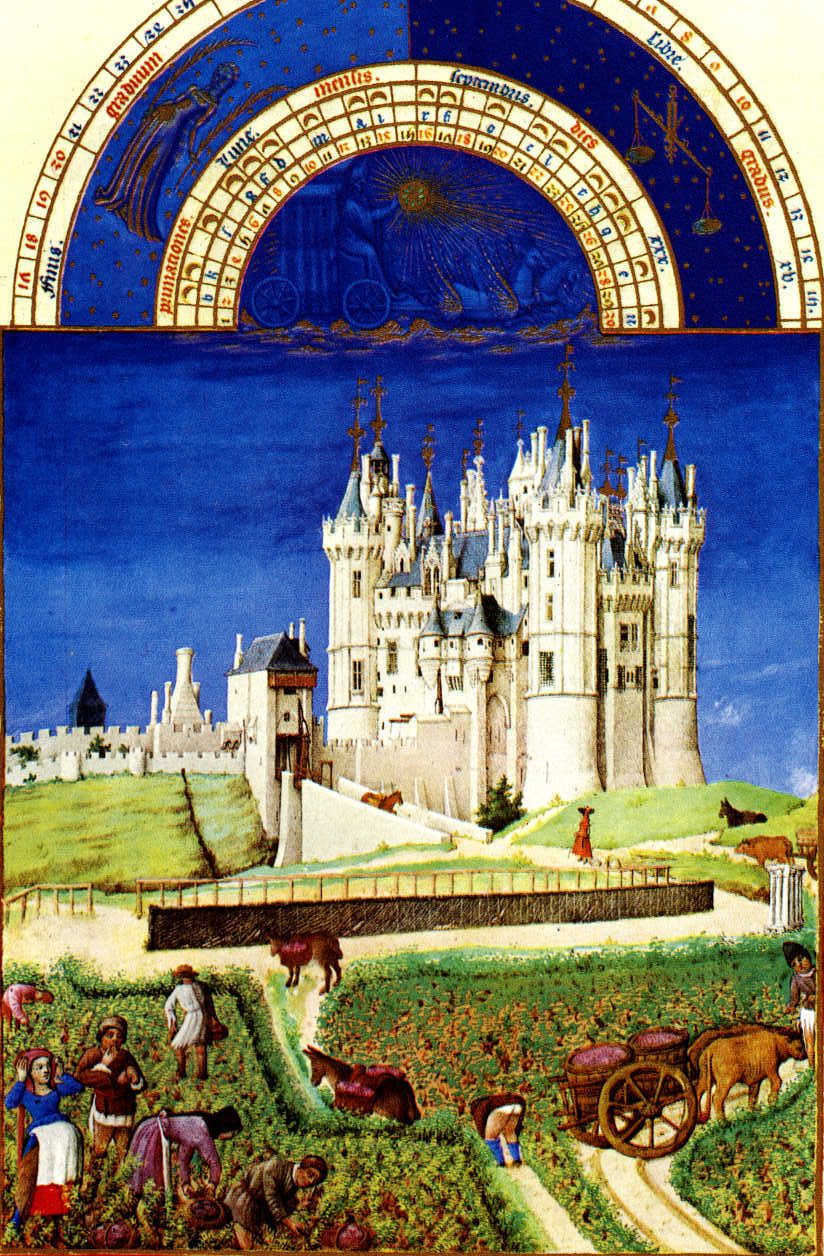
The last description, in particular, with its mention of “towers and battlements, round as hills”, makes us think of medieval fictional castles built on rocks, like Andelkrag, from the stories of Prince Valiant,

image7andelkrag

or historical castles, like “Dracula’s castle”—actually Bran Castle–in Rumania,

image8dracs

or even the mock-medieval Neuschwanstein, built in the 19th century.

image9neu

All of these have the “towers and battlements” necessary, suggesting that the Barad-dur may be called “the dark tower”, but is, in fact, like many medieval castles, a conglomeration of towers

image10ideal

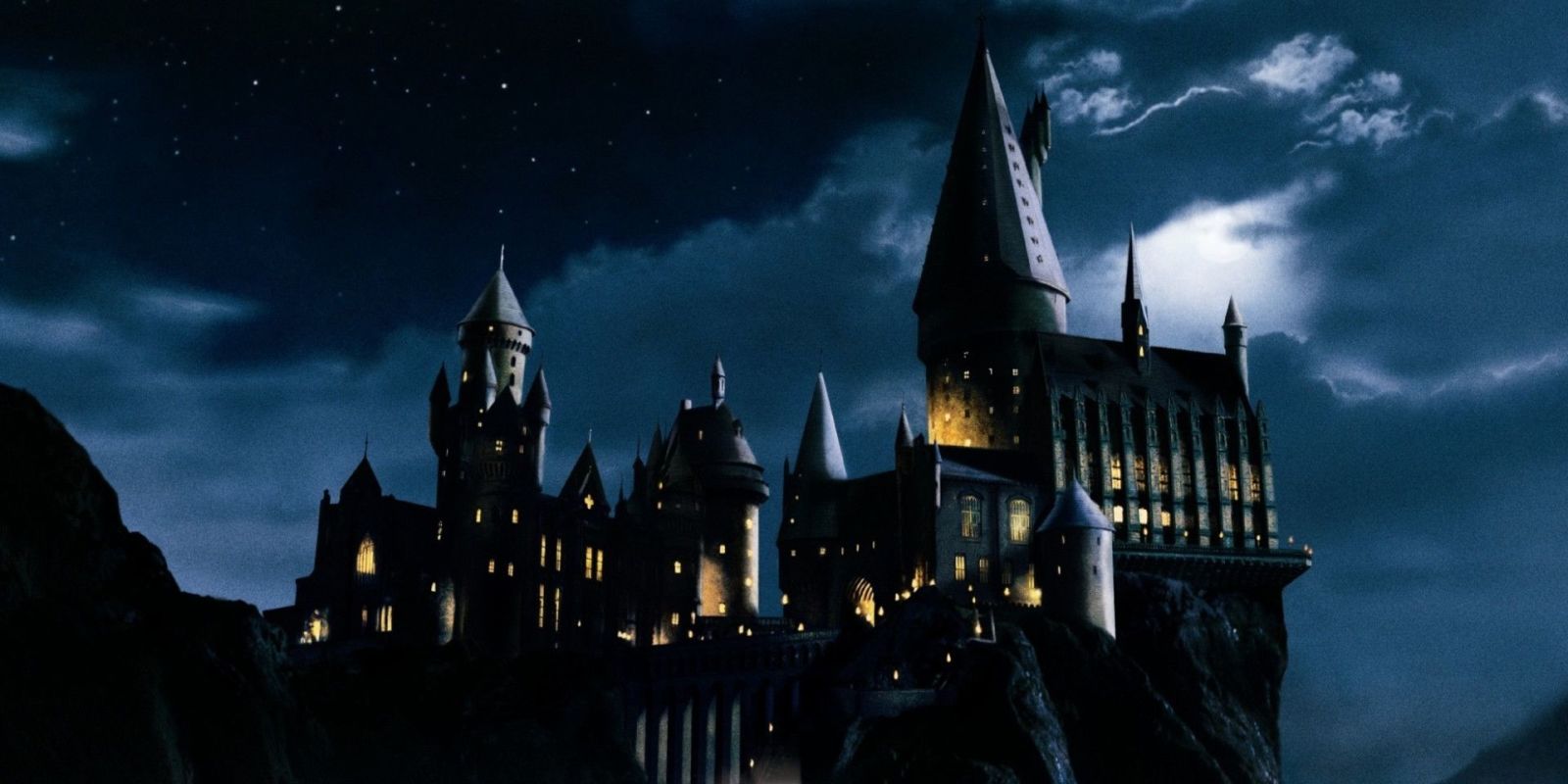
and therefore perhaps even Hogwarts might be a candidate for a model.

image11hogwarts

In one respect, however, we agree with the Hildebrandts’ view.

image12hil

The Barad-dur is built in what is clearly a volcanic world—rather like this—

image31wilderness

so what is it built from? The volcanic area we have some experience of is in northern Arizona, a place called Sunset Crater, the site of a volcanic eruption about 1085AD.

image14sun

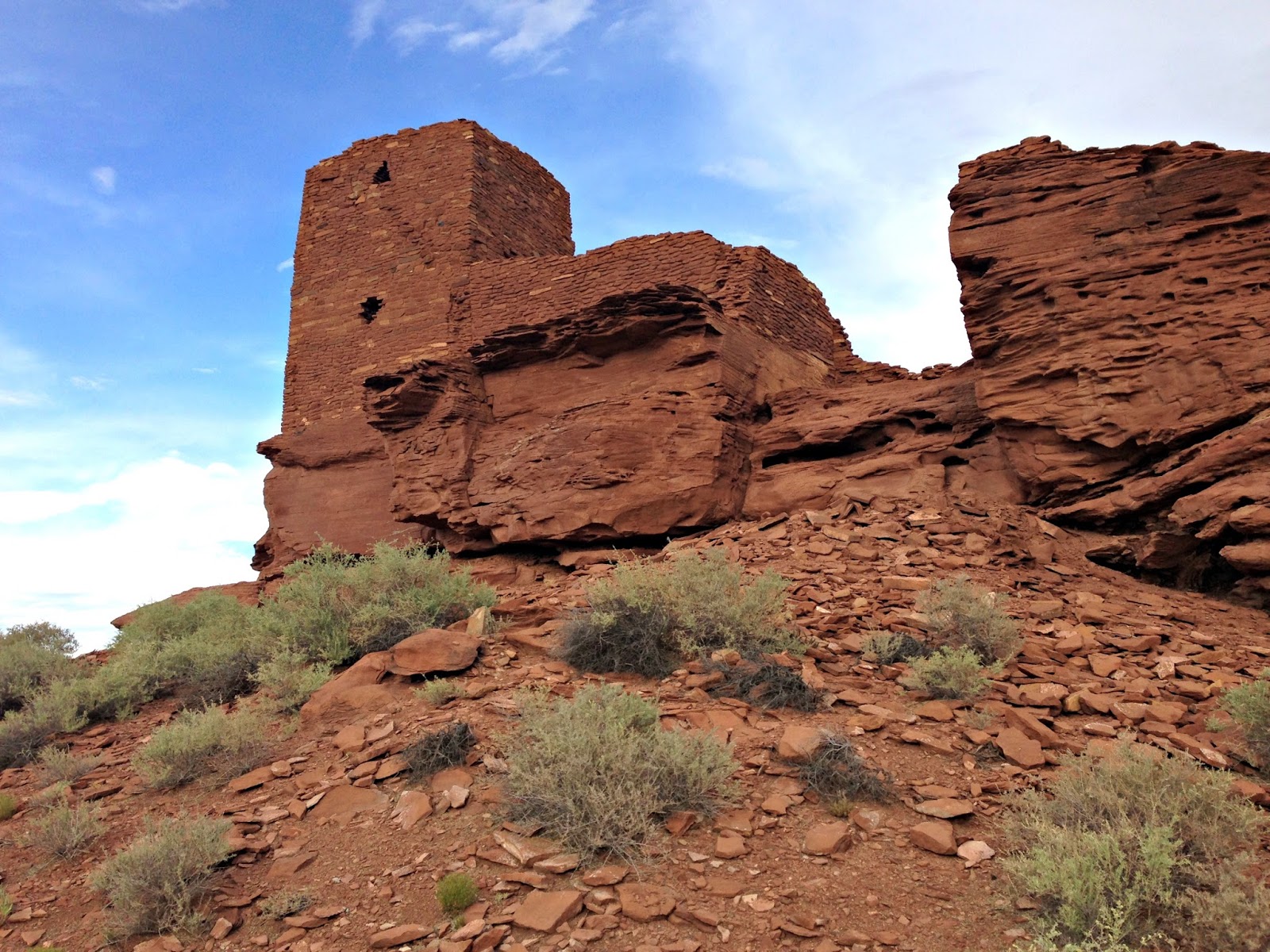
It’s obviously a bit overgrown in comparison with our first image, but in the area are the remains of a number of buildings—ancient buildings from a culture called “Puebloan”—which date from after the eruption and they are made of the local sandstone. The most imposing is this—

image15wukoki

Imagine, then, a many-towered castle, with a central tower (perhaps darker than the others, and taller?), built of a ruddy local stone, set on a rocky outcropping in a wide volcanic valley and you have our idea of the Barad-dur. What do you think, dear readers?

Thanks, as always, for reading and

MTCIDC

CD


ps

While we were thinking and doing a little looking around about this, we happened on two very different views of that 19th-century castle, Neuschwanstein,

image16neu

image17neu

and we suddenly wondered whether it hadn’t been an inspiration for Minas Tirith?

image18mt

pps

By the way, welcome, dear readers!


In Depth

15 Wednesday Aug 2018

Posted by Ollamh in J.R.R. Tolkien, Language, Literary History

≈ Leave a comment

Tags

Beowulf, Canterbury Tales, Chaucer, Christopher Tolkien, conlang, Danian, David J Peterson, Dothraki, Elvish, English, Game of Thrones, Hamlet, Ilkorin, James Joyce, Jane Austen, language, Noldorin, Pride and Prejudice, Qenya, Shakespeare, Star Wars, Telerin, The Art of Language Invention, The Lord of the Rings, Tolkien, Ulysses

Welcome, as always, dear readers.

In 1977, the more observant viewers and critics commented upon the look and feel of a new film.  Instead of a world in which everything appeared newly-produced and sparkling, this was one in which it was clear that people had lived for a long time and many different peoples, at that.

image1moseisley.png

Even their vehicles had a scratched and dusty look.

image2speeder.jpg

We had been told, of course, in the very opening sequence that this was an old place—

image3long.png

but actually seeing its used look was that much more convincing

image4crawler.jpg

as was seeing—and hearing—its peoples,

image5jawas.jpeg

who sometimes even required subtitles, as if the audience were watching a foreign film.

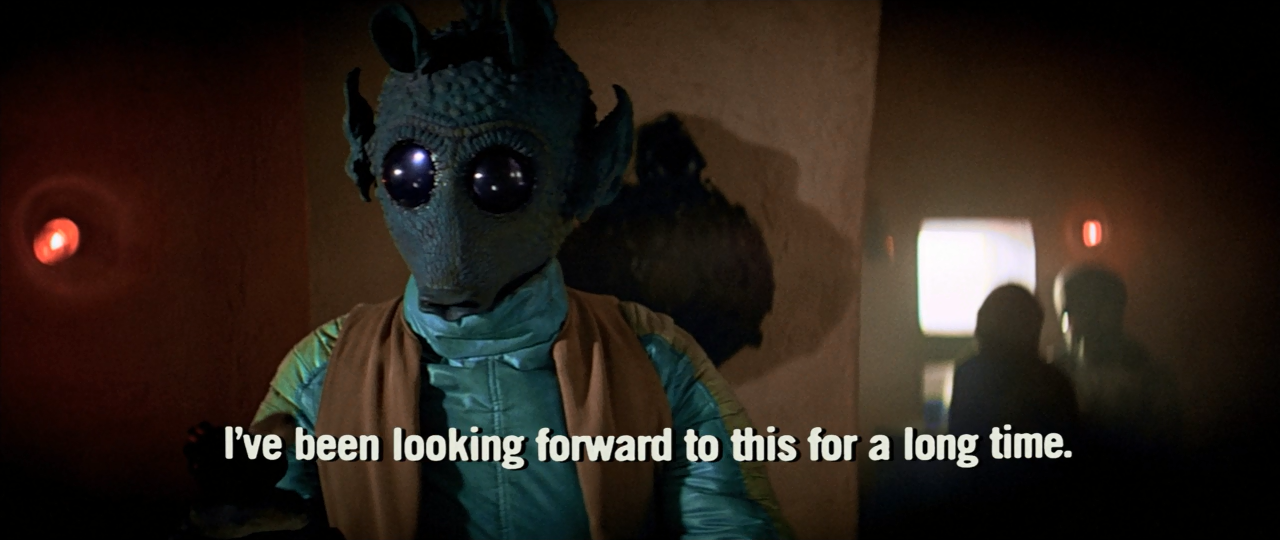
image6greedo.png

In time, as the success of this film produced not only more films, but mountains of other material, from novels to graphic novels to spin-off series to toys and t-shirts and kitchen ware,

image7mugs.jpg

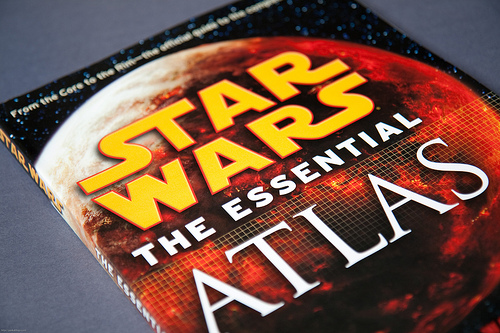
a whole literature appeared about this world—or, we should say, worlds. Its geography and even its extremely-varied animal life.

image8atlas.jpg

image9fauna.jpg

And, along with all of the other material, information about its languages began to appear.

image10aura.png

What prompted this posting, however, was something odd about one of those languages, that spoken by a character in what would, in time, become the sixth in the series.

image11boushh.jpg

This was pointed out to us by David J. Peterson

image12peterson.jpg

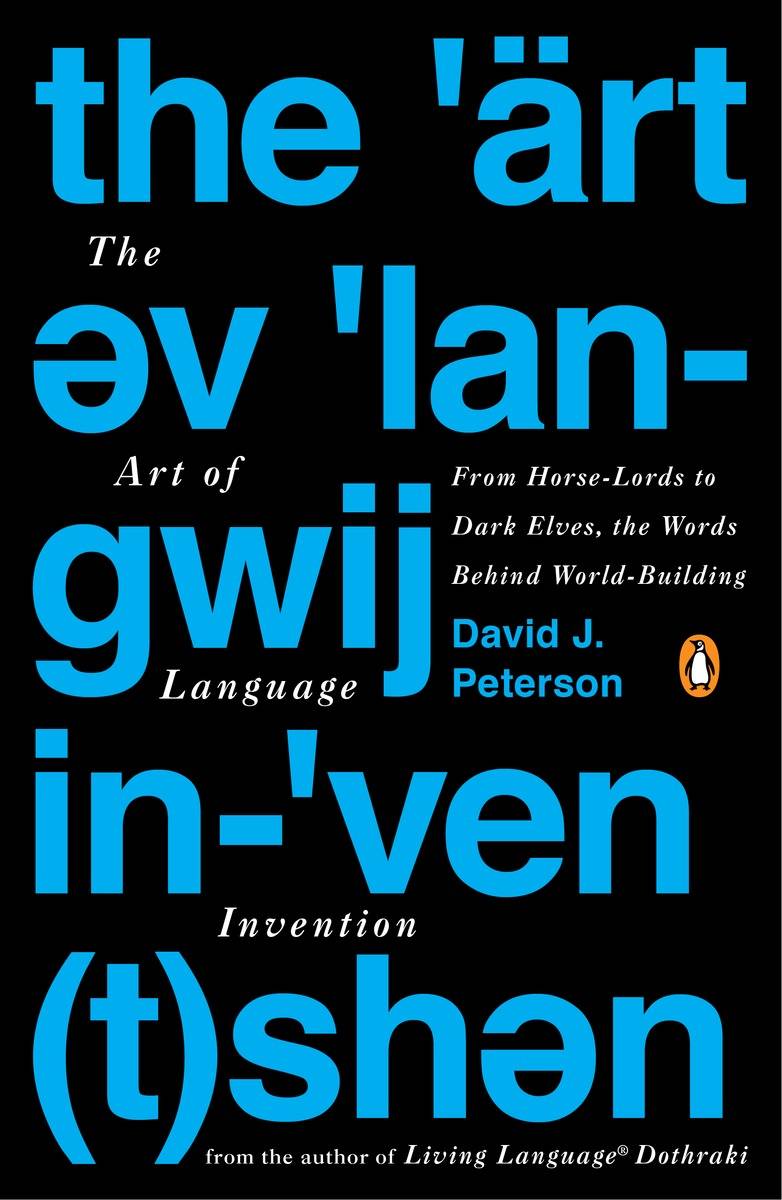
in his 2015 book, The Art of Language Invention.

image13book.jpg

As a child, what had puzzled Peterson was that the character (who is subtitled), says only “Yate, yate, yoto, ei, yato, cha”—in total, only six different words, but they are translated as everything from “I have come for the bounty on this Wookiee” to “50,000, no less”.  (This is quoted and discussed on pages 3 to 5 of Peterson’s book—which is, by the way, one we would recommend, if you’re as interested in languages as we are.)

How could so few words mean so many different things?  As an adult, looking back, Peterson had his doubts and we would agree—especially when reading about the world in which Peterson lives, the world of “conlang”, which is short for “constructed languages”.  Peterson is the creator of Dothraki, the language of the nomadic Dothraki people,

image14dothraki.jpg

one of the numerous races which inhabit the landscape of George R R Martin’s Game of Thrones, first novels, then a huge, elaborate, and engrossing television series.

image15gamebooks.jpg

image16tv.jpeg

The difference between “yate”, etc and Dothraki is that those few words are there to suggest that someone is speaking in a language different from the language spoken by the majority of the characters—which is the method employed throughout not only this film, but its two immediate successors.

image17swset.jpg

What Peterson set out to do was to create the shape of an entire language (something he has done more than once).  Here’s a LINK to the Wiki site, which, as usual, leads to other sites, which lead to other sites, which lead… if you’d like to learn more.

As worn-looking buildings and vehicles, different peoples and flora and fauna, and at least the suggestion of other languages create a bigger, deeper picture of the setting of an adventure, so, too, does the suggestion of great age.  Over time, the huge pile of material for the film series we first mentioned showed, in detail, that what we were seeing was, in fact, only the latest phase in a whole galaxy of civilizations over many centuries—after all, “For over a thousand generations, the Jedi Knights were the guardians of peace and justice in the Old Republic”.

image18obiwan.jpg

Another way to suggest that great age is a much less dramatic one—perhaps even a nearly-invisible one–practiced by one of our favorite authors and the subject of innumerable postings, and here is one of his efforts.

image19chart.jpg

What we’re seeing here is JRRT working out the history of sounds throughout a series of Elf languages, Qenya, Telerin, Noldorin, Ilkorin, and Danian, part of his immense and immensely-detailed work on the tongues of Middle-earth.   All languages change through time, of course—here’s a rough version of the succession of periods of English—

Old English (the opening lines of Beowulf, 700-1000AD,

image20beo.jpg

Middle English (the opening of Chaucer’s Canterbury Tales, c.1400AD),

image21chaucer.jpg

Early Modern English (the beginning of the first scene of Shakepeare’s Hamlet, 1603),

image22hamlet.jpg

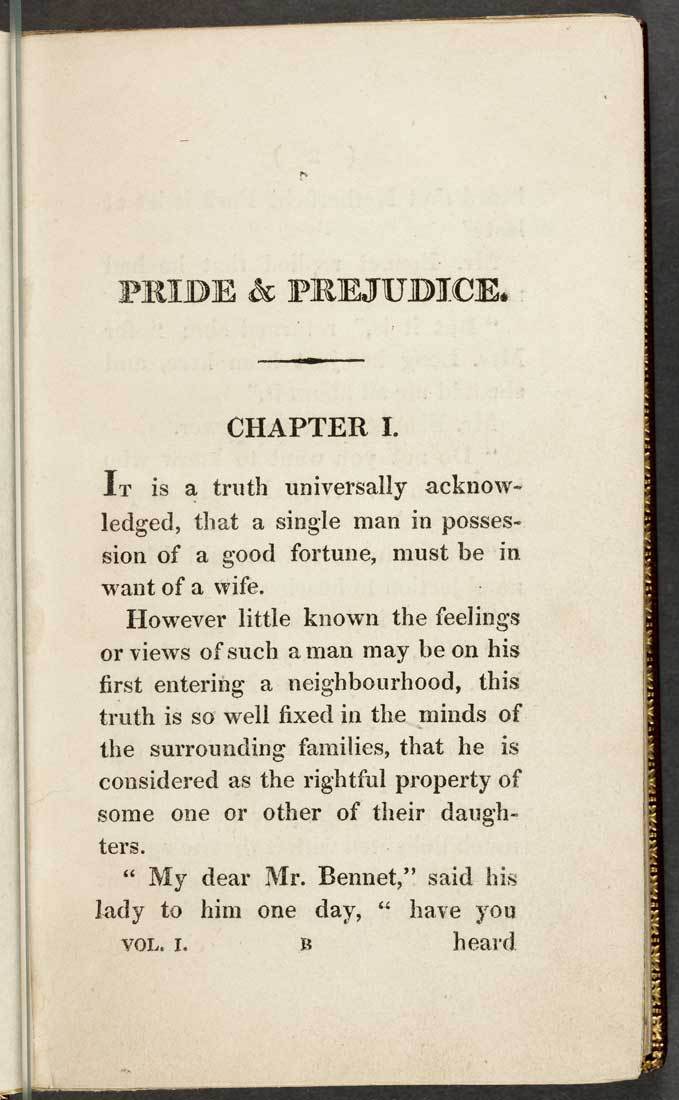
early 19th-century English (the first lines of Jane Austen’s Pride and Prejudice, 1813),

image23pp.jpg

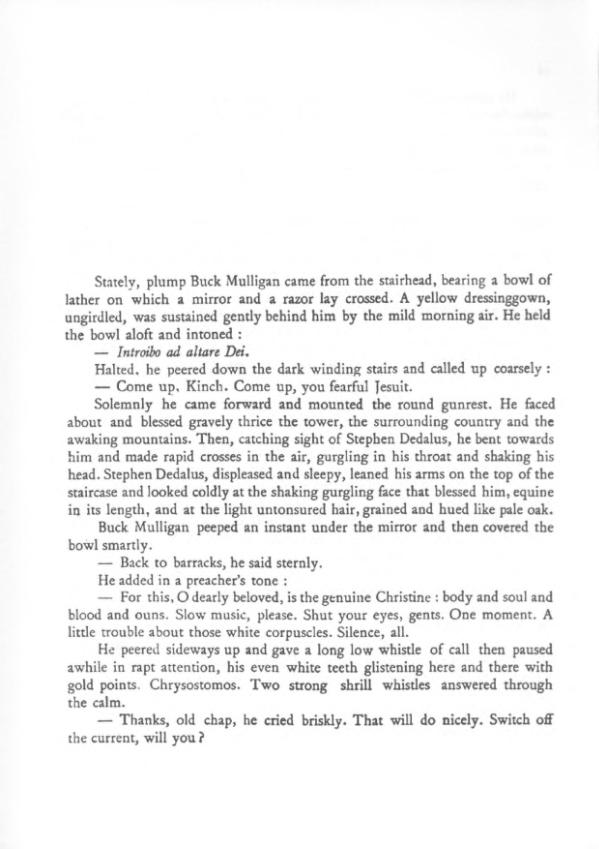
and early 20th-century English (the opening of James Joyce’s Ulysses, 1922).

image24ulysses.jpg

And Joyce even attempted to suggest the procession of those periods in Chapter 14 of Ulysses, “The Oxen of the Sun”, where the story is told through paragraphs which sound like earlier versions of the language gradually moving towards modern English.  (The novelist Nabokov, who played with language constantly, actually found this chapter boring, perhaps because it seemed to him like a one-off, not really in aid of the plot and its characters in general, but rather just a piece of private fun by and for the author?)

JRRT, however, goes one better.  Like other creators of big adventures, he used lots of means to deepen his story, from an extensive and detailed map

image25map.jpg

to describing the remains of earlier times still standing in the landscape of Middle-earth of the present,

image26argonath.jpg

to adding detailed historical appendices and chronologies (and his valiant son, Christopher, has added many volumes more),

image27ct.jpg

but using intricate sound changes and their logical development takes the idea of depth into new regions, especially because it would probably go unnoticed by most readers—there’s an awful lot of detail in those appendices—but whose meticulous creation is not in the least surprising for someone who once wrote, “The ‘stories’ were made rather to provide a world for the languages than the reverse.” (Letters, 219)

Thanks, as ever, for reading.

MTCIDC

CD


ps

Ah yes—the nearly-inevitable post scriptum—if the normal world/s of the films we first mentioned are “scruffy-looking” (to quote a character about another character), we notice that the world of the villains—the soldiers of the Empire and their surroundings—are hard and clean and shiny—which makes us feel a little better when we wonder when we may last have shined our shoes.

image28deathstar.jpg

Theme and Variations.1

20 Wednesday Jun 2018

Posted by Ollamh in Artists and Illustrators, Fairy Tales and Myths, Literary History, Narrative Methods, Theatre and Performance

≈ Leave a comment

Tags

Bibliotheque nationale Francaise, Charles Kemble, Charles Perrault, costuming, David Garrick, Edward Burne-Jones, Extravaganzas, Faulconbridge, Folger Library, Giambattista Basile, Gianfrancesco Straparola, Histoires ou Contes du Temps Passe, Histories or Tales of Past Times, James Robinson Planche, King John, La Belle au Bois Dormant, Les Contes Des Fees, Madame d'Aulnoy, Mercure Galant, Mother Goose, Punch Magazine, Richard "Dicky" Doyle, Shakespeare, Sleeping Beauty, Sur La Lune

Welcome, as always, dear readers.

For a current writing project, we’ve gone back into our fairy tale collection (we recommend, by the way, the wonderful Sur La Lune site to help you to build yours—here’s a LINK) to reread the fairy tales of Charles Perrault (1628-1703)–

image1perrault.jpg

although he wasn’t the person who first called them that—that was his contemporary, Madame d’Aulnoy (1650/1-1705),

image2daulnoy.jpg

who called her stories contes des fees—“stories of fairies”.

image5histoires.jpg

In 1695, Perrault had circulated an illustrated manuscript of such tales, calling it Contes de ma Mere l’Oye—“Tales of My Mother Goose”.

image3ms.jpg

In  February, 1696, he published one of them, “La Belle au Bois Dormant”—“The Beautiful Girl in the Sleeping Wood” in an early magazine, the Mercure Galant (maybe in English something like “The Courier of Style”).

image4mercure.JPEG

(If you’d like to read the story in French as it was first published, here’s a LINK to the BnF, the Bibliotheque nationale Francaise, where it is available on-line, which we think is just magical.)

Then, the following year, the collection was published under the title Histoires ou Contes du Temps Passe (“Stories or Tales from the Past”).

perrault.jpg

The term “contes de ma mere l’Oye” appears to have been known in literary circles from at least the 1650s and indicated rustic/countryside stories—in a sense, folktales—and Perrault had used traditional material, some of which had first appeared in print in Italian in the 16th century and could be found in the folktale collections of people like Gianfrancesco Straparola (1485?—1558) and Giambattista Basile (1566-1632).

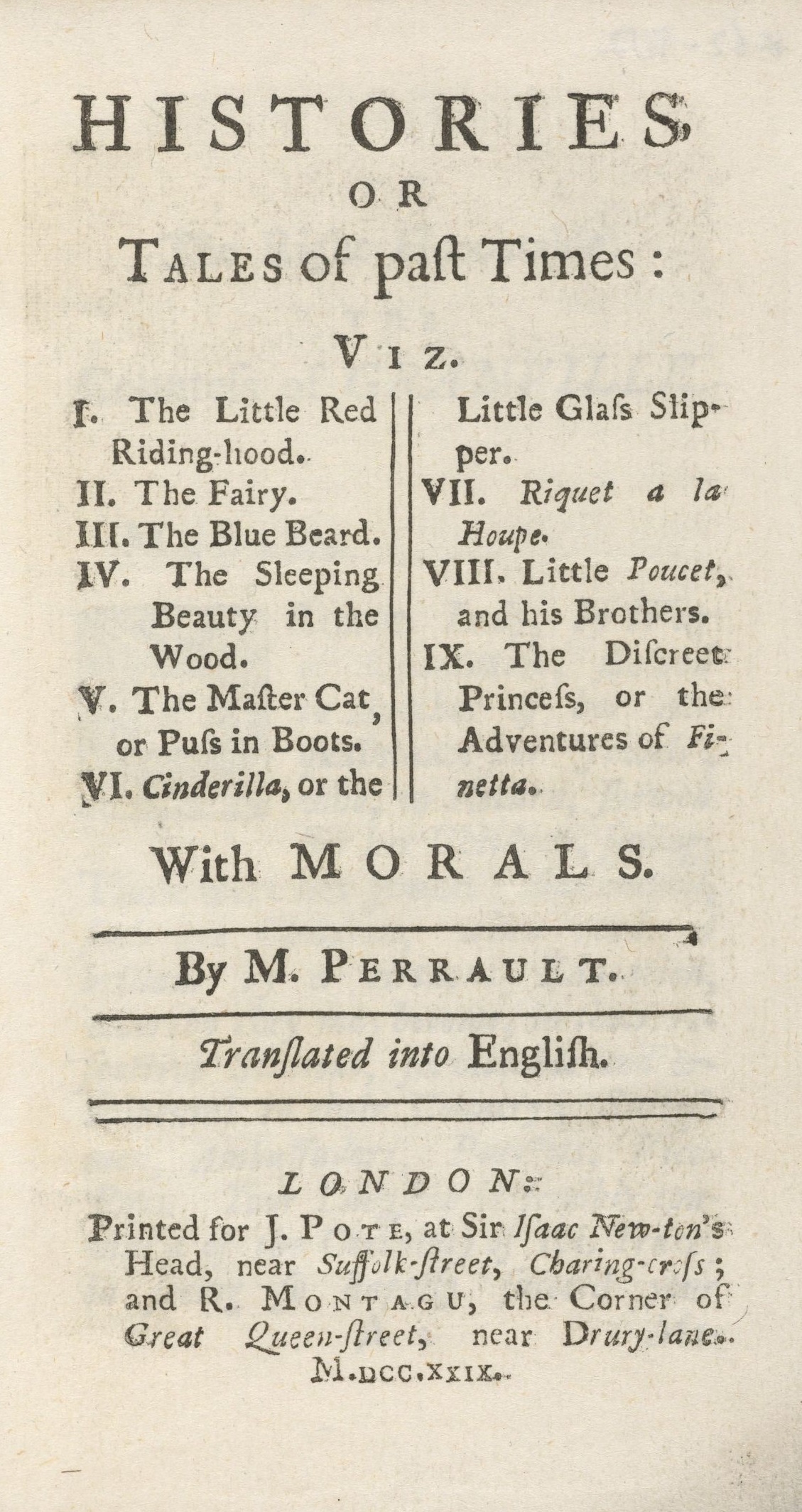
Perrault’s stories, which include what we call “Sleeping Beauty” (you can see that that’s a mistranslation) and “Cinderella”, first appeared in English in London in 1729, translated by Robert Samber, its title being identical with the 1697 French.

image6samber.jpg

In this post and (at least) two following, we thought that we would choose two of these fairy tales and see in what different forms they’ve been presented since first appearing in 1697.

Because it was the first to be published, we’ll begin with “Sleeping Beauty.  (This is a Pre-Raphaelite version by Edward Burne-Jones, 1833-1898.  It is one of a set of four and has a very interesting history—here’s a LINK so that you may found out more, if you wish.)

image7sleepbeautjones.jpg

Our first work, entitled surprisingly enough, The Sleeping Beauty, is what its author, James Robinson Planche (plahn-SHAY), 1796-1880,

image8planche.jpg

would call an “extravaganza”, meaning, in this case, something like a modern musical comedy.  First produced in 1840, it combined dialogue in rhyming iambic (more or less) couplets with songs set to already existing tunes.   Based upon Perrault, it used spectacle, everyday references which a London audience would have immediately picked up on, and gentle political/cultural satire to entertain.  Unfortunately we don’t have any images of this production, but here’s a LINK to volume 2 of Planche’s “extravaganzas” so that you can form your own impression.  If you know the works of the Victorian dramatist/composer team of WS Gilbert and Arthur Sullivan, you will see that Planche is their direct ancestor.

For many years, beginning in the early 1800s and continuing into the 1860s, Planche was Mr Theatre, in London, writing or co-writing at least 175 shows of various sorts.  These works, like Planche himself, have faded away, but he did leave one mark.  In 1823, Planche had had a conversation with a famous actor, Charles Kemble (1775-1854),

image9kemble.jpg

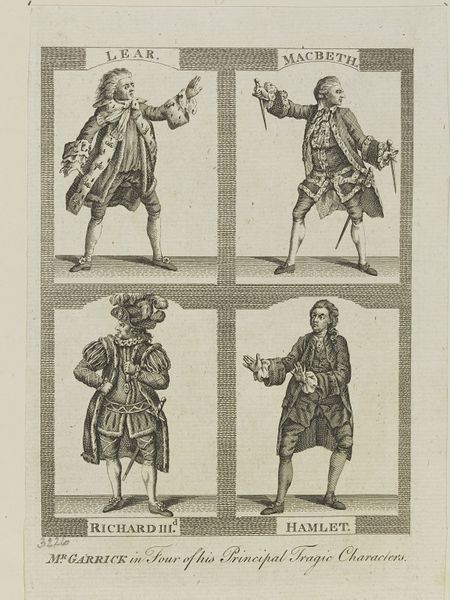
in which he suggested that, whereas money was always being spent in the theatre on spectacles, almost nothing was done for the plays of Shakespeare.   In fact, Shakespeare’s plays had always been costumed in the clothing of the period of the actors, rather than the dress of the time of the events.  Here’s a print of the well-known 18th-century actor, David Garrick (1717-1779) in four of the roles for which he was famous:  Lear, Macbeth, Richard III, and Hamlet—by dress and props alone, perhaps we could guess that the actor with the two daggers was someone playing Macbeth (or perhaps an assassin from the 1760 version of Game of Thrones), but otherwise?

image10garrick.jpg

Kemble, in turn, told Planche that he would willingly put on an historically-accurate production of several Shakespeare plays, beginning with King John, if Planche would do the necessary research and design.  Planche agreed and here’s a playbill of the result.

image11playbill.jpg

Reading the fine print, it’s even possible to see that Planche cited at least some of his sources—everything from funerary statuary to manuscript illustrations.  Whereas we don’t, unfortunately, have any illustrations to show for The Sleeping Beauty, we can show you what a difference Planche made to attempting to make Shakespeare appear in period dress.  Here’s Kemble playing Faulconbridge, a major character in King John, in 1819.

image12kemble1819.jpg

The historical John lived from 1166 to 1216—why would he be dressed as a sort of cosplay Roman legionnaire?  And here is an engraving made from Planche’s 1823 design, with Kemble again in the role of Faulconbridge.

image13kemble1823.jpg

The Kemble/Planche look caught on—and is with us, in some form, to this day.   (The Folger Shakespeare Library in Washington, DC, owns a set of the 1823 colored engravings—here’s a LINK so that you can see other costumes for the production.)

Even as his life in the dramatic world was fading, Planche continued to be a literary figure—as well as a literary recycler.  In 1868, he collaborated with a prominent British illustrator, Richard “Dicky” Doyle (1824-1883),

image14rdoyle.jpg

on a verse version of “Sleeping Beauty”:  An Old Fairy Tale The Sleeping Beauty.

image15sleepcover.jpg

Doyle was, in fact, a very versatile artist, having, for instance, worked for the satirical magazine Punch,  but his lasting fame lies in his fairy/fairy tale illustrations.

image16fairies.jpg

Doyle’s work was prized, but his work ethic was, apparently not:  commissions came and went, sometimes filled, sometimes not, and it seems that he never quite completed the illustrations to the Planche, (perhaps why Planche’s introduction is dated 1865 and the publication date is 1868?), but here’s a sample to show what he could do, when focused.  (And here’s a LINK to the book, so that you can see all of the illustrations for yourself, as well as read Planche’s text.)

image17prince.jpg

So as not to overwhelm you, dear readers, we’re going to pause here, but we’ll continue in our next by looking at other forms—opera, ballet, and animated feature—which Perrault’s story has inspired, taking our story from 1890 to 1959.

In the meantime, thanks, as ever, for reading.

MTCIDC

CD

Boom

18 Wednesday Apr 2018

Posted by Ollamh in J.R.R. Tolkien

≈ Leave a comment

Tags

A Long-Expected Party, A Midsummer Night's Dream, Backarapper, Benwell Fireworks, cracker, Elizabethan entertainment, Fireworks, fountain, Gandalf, Kenilworth Castle, Pain's Imperial Fireworks, Queen Elizabeth, Robert Dudley, Robert Langham, Roman Candles, Shakespeare, Sparkler, squib, The Fellowship of the Ring, The Hobbit, The Lord of the Rings, thunderclap, Tolkien, torch

Welcome, dear readers, as always.

When Gandalf first arrives at Bilbo’s door “in the quiet of the world, when there was less noise and more green”, Bilbo’s memories of him are hardly those of someone aware who Gandalf really is:

“Gandalf, Gandalf!  Good gracious me!  Not the wandering wizard that gave Old Took a pair of magic diamond studs that fastened themselves and never came undone till ordered?  Not the fellow who used to tell such wonderful tales at parties, about dragons and goblins and giants and the rescue of princesses and the unexpected luck of widows’ sons?  Not the man that used to make such particularly excellent fireworks!”  (The Hobbit, Chapter 1, “An Unexpected Party”)

And it’s the fireworks in particular which made a strong impression:

“I remember those!  Old Took used to have them on Midsummer’s Eve.  Splendid!  They used to go up like great lilies and snapdragons and laburnums of fire and hang in the twilight all evening!”

[Here, by the way are the three flowers he mentions, in case, like us, you live in a climate where such things won’t appear for months yet!]

image1lily.jpg

image2snapdragons.JPG

image3laburnums.jpeg

And, although he alludes to an edgier side of Gandalf (“Not the Gandalf who was responsible for so many quiet lads and lasses going off into the Blue for mad adventures?”), he concludes as if Gandalf were merely some sort of superior tradesman:

“I beg your pardon, but I had no idea you were still in business!”

Gandalf is patient, however, only replying:

“Where else should I be?… All the same I am pleased to find that you remember something about me.  You seem to remember my fireworks kindly, at any rate, and that is not without hope…”

Perhaps the idea of linking Gandalf and fireworks is pardonable, however, when we see how, after being associated with them at the beginning of The Hobbit, he appears at the opening of The Lord of the Rings actually bringing fireworks to Hobbiton:

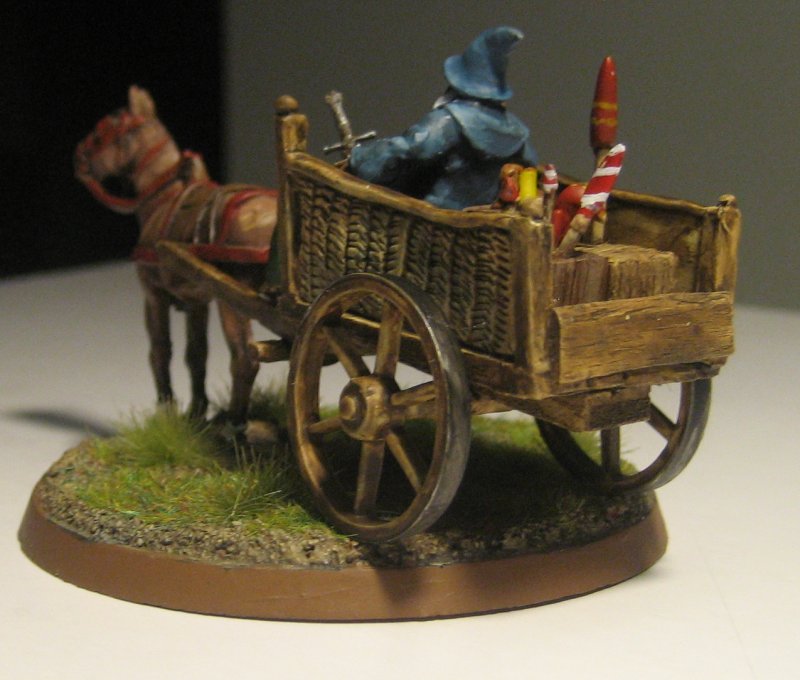
“At the end of the second week in September a cart came in through Bywater from the direction of Brandywine Bridge in broad daylight.  An old man was driving it all alone.  He wore a tall pointed blue hat, a long grey cloak, and a silver scarf.  He had a long white beard and bushy eyebrows that stuck out beyond the brim of his hat.  Small hobbit-children ran after the cart all through Hobbiton and right up the hill.  It had a cargo of fireworks, as they rightly guessed.  At Bilbo’s front door the old man began to unload:  there were great bundles of fireworks of all sorts and shapes, each labeled with a large red G…and the elf-rune…” (The Fellowship of the Ring, Book One, Chapter 1, “A Long-expected Party)

image4cart.jpg

(This is from a site called “Llama’s War of the Ring”, which has all sorts of interesting figures and conversions—here’s a LINK.)

Those great bundles turned into spectacular entertainment at the joint birthday party:

“The fireworks were by Gandalf:  they were not only brought by him, but designed and made by him; and the special effects, set pieces, and flights of rockets were let off by him.  But there was also a generous distribution of squibs, crackers, backarappers, sparklers, torches, dwarf-candles, elf-fountains, goblin-barkers and thunderclaps.  They were all superb.  The art of Gandalf improved with age.”

We ourselves enjoy fireworks, and, for the sake of our readers who might not be familiar with some of the types mentioned, we add here a few images—although some, like “dwarf-candles, elf-fountains, goblin-barkers” no longer seem to be available.

A squib is a small firecracker, like these.

image5squibs.jpg

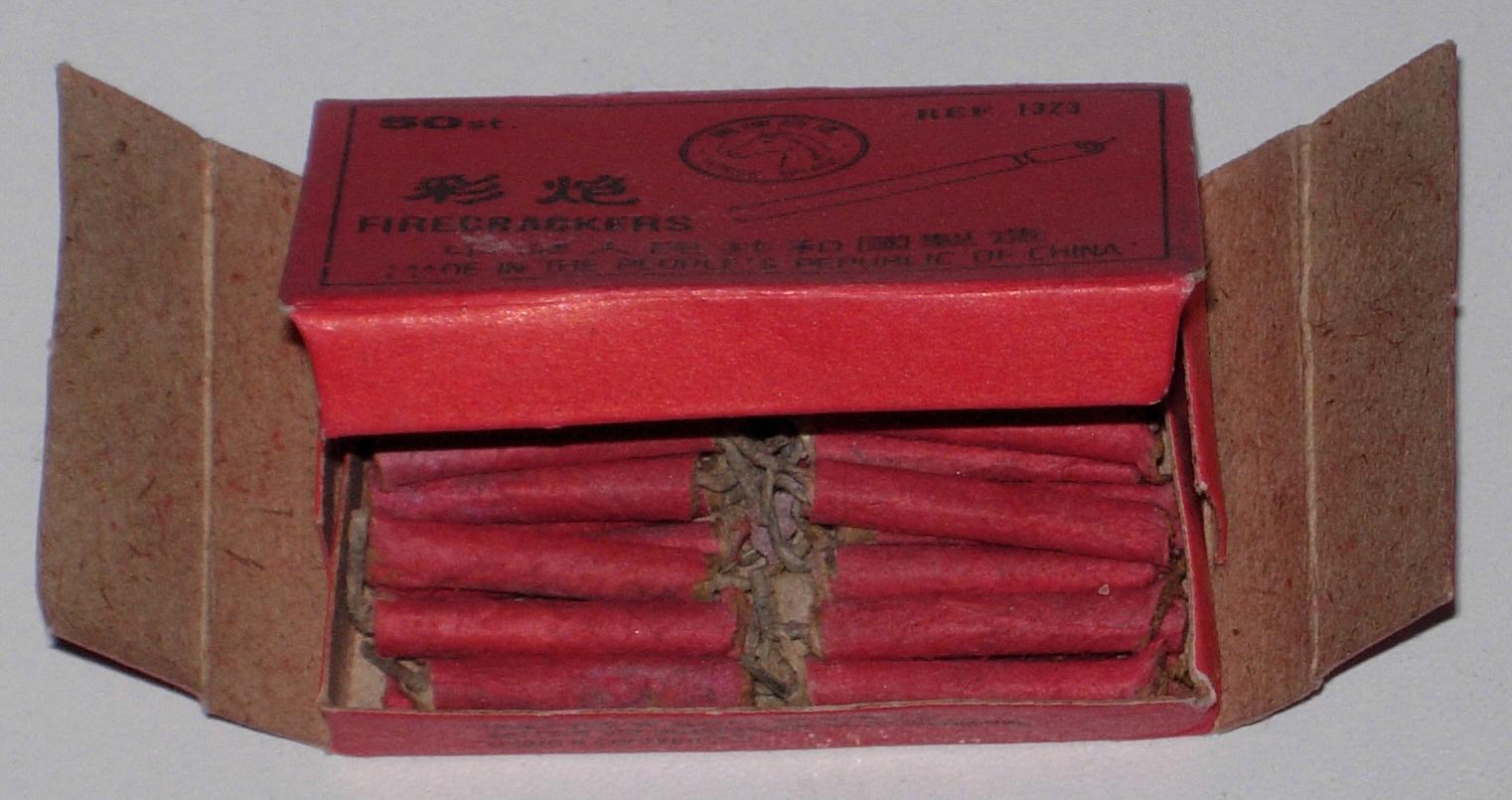
Crackers seem to come in sets.

image6firecrackers.jpg

Backarappers—we don’t have an image, but here’s a definition (and it sounds like the previous image):

“A firework made from multiple firecrackers folded together so that they will explode one after another”.  (from G.F. Northall’s Warwickshire Word-book, 1896)

Sparklers are metal rods or bamboo sticks whose upper part has what is called “pyrotechnic composition”—which means something which shoots out sparks when it’s lit.

image7sparkler.jpeg

Torches may be these—which, when lighted, change color as they burn down (or so the manufacturer’s description says).

image8torch.png

Although there are no “dwarf-candles”, there are Roman Candles.  These are built in stages and, as the fire burns down, they shoot out star-patterns—as you can see.

image9romancandle.jpg

There are no “elf-fountains”, either, but there are fountains and they look like this—

image10fountain.jpeg

Finally, we can date a “thunderclap”, made by Benwell, back to this advertisement from about 1950,

image11benwell.jpg

but we wouldn’t be surprised if Pain’s (not the best name for fireworks, we would say!) carried them, as they have something called “Laburnum Blossoms” in this 1903 listing

image12pains.jpg

Gandalf’s productions were clearly quite spectacular—which was undoubtedly why Bilbo remembers them:

“There were rockets like a flight of scintillating birds singing with sweet voices.  There were green trees with trunks of dark smoke:  their leaves opened like a whole spring unfolding in a moment, and their shining branches dropped glowing flowers down upon the astonished hobbits, disappearing with a sweet scene just before they touched their upturned faces.  There were fountains of butterflies that flew glittering into the trees; there were pillars of coloured fires that rose and turned into eagles, or sailing ships, or a phalanx of flying swans; there was a red thunderstorm and a shower of yellow rain; there was a forest of silver spears that sprang suddenly into the air with a yell like an embattled army, and came down again into the Water with a hiss like a hundred hot snakes.”

And then there was the finale.  Pain’s, in that 1903 listing, could make claims to baskets of elaborate pyrotechnics, but this?

“And there was also one last surprise, in honour of Bilbo, and it startled the hobbits exceedingly, as Gandalf intended.  The lights went out.  A great smoke went up.  It shaped itself like a mountain seen in the distance, and began to glow at the summit.  It spouted green and scarlet flames.  Out flew a red-golden dragon—not life-size, but terribly life-like:  fire came from his jaws, his eyes glared down; there was a roar and he whizzed three times over the heads of the crowd.  They all ducked, and many fell flat on their faces.  The dragon passed like an express train, turned a somersault, and burst over Bywater with a deafening explosion.”

In Shakespeare’s A Midsummer Night’s Dream, the fairy king, Oberon, says to his spirit-servant, Puck, these rather mysterious lines:

“My gentle Puck, come hither.  Thou rememberest

Since once I sat upon a promontory

And heard a mermaid on a dolphin’s back

Uttering such dulcet and harmonious breath

That the rude sea grew civil at her song

And certain stars shot madly from their spheres

To hear the mermaid’s music?”

(Act 2, Scene 1)

In 1575, Queen Elizabeth I

image14queene1.jpg

visited Kenilworth Castle,image15kenilworth.jpg

the home of Robert Dudley, the Earl of Leicester,

image16dudley.jpg

and a close friend (and maybe more).  To entertain her, Dudley spent thousands of pounds.

image17sovereign.jpg

(This is actually a gold sovereign—worth 20 shillings—that is, a pound, but there were no actual pound coins till after 1583.)

Among the entertainments was a big fireworks display (as well as at least one mermaid—see the LINK here for Robert Langham/Laneham’s contemporary “letter” in which he describes these entertainments in detail) and some scholars have theorized that those falling stars mentioned by Oberon are, in fact, Shakespeare’s boyhood memory of having seen the fireworks display (and the mermaid).  Kenilworth is only 14 miles from Stratford and Shakespeare was 11 and living at home—we presume—at that time, so we can imagine that this is possibility.  We know that JRRT had seen fireworks shows as a boy—as he tells us in a letter to Donald Swann, 29 February, 1968 (Letters, 390)—but we wonder:  did he ever, in those early years, see Goblin-barkers, or a red-golden dragon?

Thanks, as ever, for reading.

MTCIDC

CD

ps

We almost forgot–in case you’d like to make your own fireworks (definitely not recommended–and definitely illegal in some places!), here’s an 1878 manual on the subject.


Peace! Count the Clock!

25 Wednesday Oct 2017

Posted by Ollamh in J.R.R. Tolkien, Literary History, Narrative Methods

≈ Leave a comment

Tags

ABC Alphabetical Railway Giude, Agatha Christie, anachronism, Bag End, Bradshaw's Railway Companion, clocks, Egyptian, feudalism, Gros Horloge, hour glases, Liverpool and Manchester Railway, Macbeth, Medieval, Normandy, Pope Sylvester II, railways, Rouen, Salisbury Cathedral clock, Shakespeare, sundial, The Lord of the Rings, Tolkien, Wapping tunnel, water clocks, Wells Cathedral

Welcome, as always, dear readers.

In our last, we puzzled over something in the entryway to Bag End.

image1bagend.png

It’s that thing to the left of the door.   It looks rather like a clock (which is what we thought before examining it more closely), but it is, in fact, a barometer—and a very puzzling thing for Bilbo to have, as we suggested.

On the right hand wall, however, there is another puzzling object:  an actual clock.

In our world, of course, this is no puzzle at all, clocks being so common.  In fact, our major way of indicating time in English is to say, “It’s 11 o’clock”, where “o’clock” is a contracted form of “of the clock”.  Even if, like many in our world, you get your time from your phone, you’ll still say this, won’t you?

image2cell.png

This has been the case since the 16th century, as we can see in Shakespeare’s plays—including moments when characters who live in times before clocks still talk about them, as in Macbeth, Act II, Scene 4, where Macbeth’s cousin, Ross, says to an Old Man, “By th’clock ‘tis day”, when the historical Macbeth lived in the 11th century AD, perhaps 200 and more years before clocks began to appear in western Europe.

Although we’ve seen it regularly cited that Pope Sylvester II

image3sylvester2.jpg

invented the first mechanical clock in the 990s AD, we have yet to see anything in the way of concrete evidence that this is so.  Rather, we see the first clocks to have appeared in the later 14th century, including the Salisbury Cathedral clock, which perhaps dates from 1386.

image4salisbury

Likewise there is the clock of Wells Cathedral, tentatively dated to about the same time

image5wells.jpg

or the Gros Horloge in Rouen, in Normandy, whose internal workings date from 1389.


And the pendulum clock—which is what is visible on the right hand wall of Bag End—is an even later invention, credited to the Dutch scientist of the mid-17th century, Christian Huygens.

image7pendulumimage8huygens


Long before such devices, people marked time by such things as hour glasses (possibly medieval? Lots of discussion about this, but there is documentation that medieval ships’ captains began to use them)

image9hourglass.jpg

and water clocks (used in Athenian court rooms to control speeches—when citations of established law were read in court, the order was to “stop the clock”, as reading law as evidence clearly wasn’t considered to be part of a speech)

image10clepsydra.jpg

and even put the sun to work, using its moving shadow to tell the time.  (This is the earliest sundial we’ve seen—it’s Egyptian, from the 13th century BC)

image11egyptsundial.jpg

(And just a linguistic footnote on “telling time” as a sort of pun.  On the one hand, we read time off a device—and, if asked, aloud—so that we are “telling—that is reciting—the time”.  At the same time, an older usage of the verb “to tell” was “to count”.  This is preserved in the “teller” in a bank, by someone “telling” a rosary, and by “tolling” a bell.  It can also be seen in other Germanic languages, like Danish, which has the verb “taelle”, “to count”, and German, “zaehlen”.  So, when you “tell” time, you’re both deciphering the information from a device—possibly aloud—and doing so by counting.)

All of which leads us back to Bilbo’s clock, on a wall in the Shire.

As far as we can tell, at the end of the Third Age, the Shire was primarily a non-feudal medieval agricultural world.

image12medievalplowing.gif

Such worlds are, considering how much the sun is involved in growing things like grain,

image13medreaping.jpg

governed by daylight, which is, on the whole, easy to mark and measure.  (A difficulty for sundials, of course, is that the sun changes position throughout the year and the hours of daylight can vary greatly.  Perhaps this is why there is a famous sundial motto:  “Horas non numero nisi serenas”—“I count only the fair—that is, sunny—hours”.)

image14sundial.jpg

So why is there a pendulum clock on that wall?

A partial answer might be the same as that for the barometer:  JRRT is recreating something from his own past, or even from his present—the big dial looks later to us than the 1890s.  Just as in the case of that reference to Bilbo shrieking “like the whistle of an engine coming out of a tunnel” (The Hobbit, Chapter One, “An Unexpected Party”), it mirrors Tolkien’s own world—a world in which railways in Britain were a major influence on changes in marking time.

Railways had begun to appear in 1830, with the Liverpool and Manchester Railway.

image15earliestrr.jpg

(And here, by the way, is an engineering marvel of the time—the 1.25-mile long Wapping tunnel, dug to allow the railway’s passage into Liverpool and the first such tunnel to be constructed under a city.  Seeing this 1831 illustration, it’s easy to imagine what kind of shriek Bilbo must have made!)

image16wappingtunnel.jpg

By 1840, building and traffic had increased dramatically and, as the rail lines stretched across England, an awkwardness appeared:  there was no uniform time standard.  Towns close to each other might share the same time, but those between London and Liverpool, say, had their own methods of marking time and so attempting to produce a dependable schedule for a train’s journey was nearly an impossibility along the 178 miles (287km) between the two cities.

image17railwaymap.jpg

Those in charge of the early railways quickly saw the difficulty and began, as early as 1840, to standardize the measurement of time along their routes.  By the late 1850s, standardization had been mainly achieved—although it was only in the 1880s that the government stepped in to complete the progress.

This regularizing of time produced, on the one hand, standard railway timetable books, like Bradshaw’s Railway Companion

image18abradshaw.jpg


(first published in 1839 and often consulted by Watson and Holmes on their extra-London adventures) and The ABC Alphabetical Railway Guide

image18rrguide1924.jpg


(first published in 1853 and the basis of Agatha Christie’s 1936 novel, The ABC Murders).  On the other hand, it also produced standardized time in general, eventually going global, something which the industrial revolution increasingly demanded as part of its production cycle and now so deeply ingrained that virtually everything we do is influenced by it and we even incorporate it into our bodies, either tying it to our wrists

image19earlywatch.jpg

or wear it as part of our clothing.

image20cellinpocket.jpg

Work, school, even fun (movies begin on time schedules, television is one long schedule, as well as certain elements of the internet—although the internet does offer the subversive possibility of doing things “on your own time”), all of it moves to the measured tick of time.   In 1937, the year after Agatha Christie’s novel based upon railway timetables was published, JRRT would have felt it, from his lecture schedule to the evening radio broadcasts of the BBC.

Almost as if it were a gathering force of the MODERN WORLD, then, the measurement and standardization of time has crept up, from the later medieval world on.  We can see that Shakespeare was influenced by it—in Julius Caesar (1599?), Act II, the jumpy Brutus and Cassius listen to the sound of a clock striking three—in a world where there would be no clocks to strike for almost 1400 years (but providing us with the title of this post).  Is it any wonder, then, that clocks could have slipped into Middle-earth?  And, besides, they do have a use for Bilbo—how else could he shout to the dwarves as he left them, “If ever you are passing my way…don’t wait to knock!  Tea is at four…” (The Hobbit, Chapter Eighteen, “The Return Journey”)?

Thanks, as ever, for reading.

MTCIDC

CD

← Older posts

The Doubtful Sea Series Facebook Page

The Doubtful Sea Series Facebook Page

  • Ollamh

Categories

  • Artists and Illustrators
  • Economics in Middle-earth
  • Fairy Tales and Myths
  • Films and Music
  • Games
  • Heroes
  • Imaginary History
  • J.R.R. Tolkien
  • Language
  • Literary History
  • Maps
  • Medieval Russia
  • Military History
  • Military History of Middle-earth
  • Narnia
  • Narrative Methods
  • Poetry
  • Research
  • Star Wars
  • Terra Australis
  • The Rohirrim
  • Theatre and Performance
  • Tolkien
  • Uncategorized
  • Villains
  • Writing as Collaborators
Follow doubtfulsea on WordPress.com

Across the Doubtful Sea

Recent Postings

  • On the Road(s) Again—Again November 26, 2025
  • On the Road(s) Again November 19, 2025
  • To Bree (Part 2) November 12, 2025
  • To Bree (Part 1) November 5, 2025
  • A Plague o’ Both—No, o’ All Your Houses! October 29, 2025
  • It’s in Writing (2:  I’st a Prologue, or a Poesie for a Ring?) October 22, 2025
  • It’s in Writing (1) October 15, 2025
  • King Trotter? October 8, 2025
  • The Voices in His Head  October 2, 2025

Blog Statistics

  • 101,988 Views

Posting Archive

  • November 2025 (4)
  • October 2025 (5)
  • September 2025 (4)
  • August 2025 (4)
  • July 2025 (5)
  • June 2025 (4)
  • May 2025 (4)
  • April 2025 (5)
  • March 2025 (4)
  • February 2025 (4)
  • January 2025 (5)
  • December 2024 (4)
  • November 2024 (4)
  • October 2024 (5)
  • September 2024 (4)
  • August 2024 (4)
  • July 2024 (5)
  • June 2024 (4)
  • May 2024 (5)
  • April 2024 (4)
  • March 2024 (4)
  • February 2024 (4)
  • January 2024 (5)
  • December 2023 (4)
  • November 2023 (5)
  • October 2023 (4)
  • September 2023 (4)
  • August 2023 (5)
  • July 2023 (4)
  • June 2023 (4)
  • May 2023 (5)
  • April 2023 (4)
  • March 2023 (5)
  • February 2023 (4)
  • January 2023 (4)
  • December 2022 (4)
  • November 2022 (5)
  • October 2022 (4)
  • September 2022 (4)
  • August 2022 (5)
  • July 2022 (4)
  • June 2022 (5)
  • May 2022 (4)
  • April 2022 (4)
  • March 2022 (5)
  • February 2022 (4)
  • January 2022 (4)
  • December 2021 (5)
  • November 2021 (4)
  • October 2021 (4)
  • September 2021 (5)
  • August 2021 (4)
  • July 2021 (4)
  • June 2021 (5)
  • May 2021 (4)
  • April 2021 (4)
  • March 2021 (5)
  • February 2021 (4)
  • January 2021 (4)
  • December 2020 (5)
  • November 2020 (4)
  • October 2020 (4)
  • September 2020 (5)
  • August 2020 (4)
  • July 2020 (5)
  • June 2020 (4)
  • May 2020 (4)
  • April 2020 (5)
  • March 2020 (4)
  • February 2020 (4)
  • January 2020 (6)
  • December 2019 (4)
  • November 2019 (4)
  • October 2019 (5)
  • September 2019 (4)
  • August 2019 (4)
  • July 2019 (5)
  • June 2019 (4)
  • May 2019 (5)
  • April 2019 (4)
  • March 2019 (4)
  • February 2019 (4)
  • January 2019 (5)
  • December 2018 (4)
  • November 2018 (4)
  • October 2018 (5)
  • September 2018 (4)
  • August 2018 (5)
  • July 2018 (4)
  • June 2018 (4)
  • May 2018 (5)
  • April 2018 (4)
  • March 2018 (4)
  • February 2018 (4)
  • January 2018 (5)
  • December 2017 (4)
  • November 2017 (4)
  • October 2017 (4)
  • September 2017 (4)
  • August 2017 (5)
  • July 2017 (4)
  • June 2017 (4)
  • May 2017 (5)
  • April 2017 (4)
  • March 2017 (5)
  • February 2017 (4)
  • January 2017 (4)
  • December 2016 (4)
  • November 2016 (5)
  • October 2016 (6)
  • September 2016 (5)
  • August 2016 (5)
  • July 2016 (5)
  • June 2016 (5)
  • May 2016 (4)
  • April 2016 (4)
  • March 2016 (5)
  • February 2016 (4)
  • January 2016 (4)
  • December 2015 (5)
  • November 2015 (5)
  • October 2015 (4)
  • September 2015 (5)
  • August 2015 (4)
  • July 2015 (5)
  • June 2015 (5)
  • May 2015 (4)
  • April 2015 (3)
  • March 2015 (4)
  • February 2015 (4)
  • January 2015 (4)
  • December 2014 (5)
  • November 2014 (4)
  • October 2014 (6)
  • September 2014 (1)

Blog at WordPress.com.

  • Subscribe Subscribed
    • doubtfulsea
    • Join 78 other subscribers
    • Already have a WordPress.com account? Log in now.
    • doubtfulsea
    • Subscribe Subscribed
    • Sign up
    • Log in
    • Report this content
    • View site in Reader
    • Manage subscriptions
    • Collapse this bar
 

Loading Comments...