• About

doubtfulsea

~ adventure fantasy

Category Archives: Narrative Methods

Bordering (.1: The Landscape)

29 Wednesday Mar 2017

Posted by Ollamh in Economics in Middle-earth, J.R.R. Tolkien, Literary History, Maps, Military History, Military History of Middle-earth, Narrative Methods

≈ 2 Comments

Tags

Anglo-Scots border, Black Middens Bastle, blackmail, Border Marches, Border Reivers, Border Wardens, Charlemagne, Debatable Lands, Emyn Beraid, Fairbairns, Hadrian's Wall, Hermitage Castle, hot trod, John Philip Sousa, Marca Hispanica, Marches, Monty Python, Offa's Dyke, Robert Carey, Scots Dike, Smailholm Tower, Ted Nasmith, The Liberty Bell, The Lord of the Rings, The Shire, Tolkien, Tower Hills, West March

Welcome once more, dear readers.

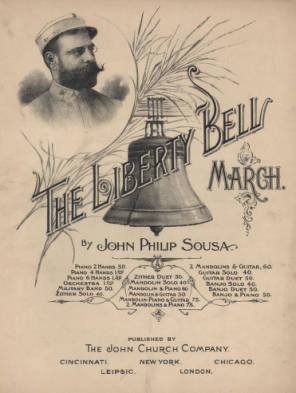
In this posting, we want to return to a recent one about “marches”—that is, not pieces for military bands (although we are partial to those of John Philip Sousa—1854-1932–
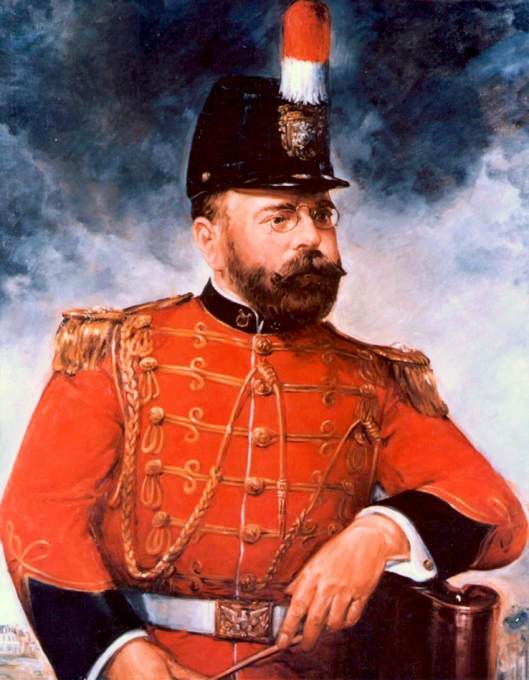
image1jpsousa.jpg

especially “The Liberty Bell”—1893—

digital.gonzaga.edu.jpeg

mostly because it was used by Monty Python. We provide a link here for what might have been its first recording, by the “Edison Grand Concert Band” in 1896. Watch out for the big foot!)

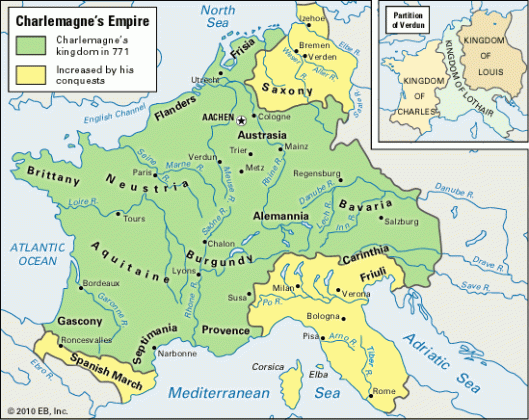
but border areas, usually sensitive ones, which might have been militarized, like that at the southern edge of Charlemagne’s empire.
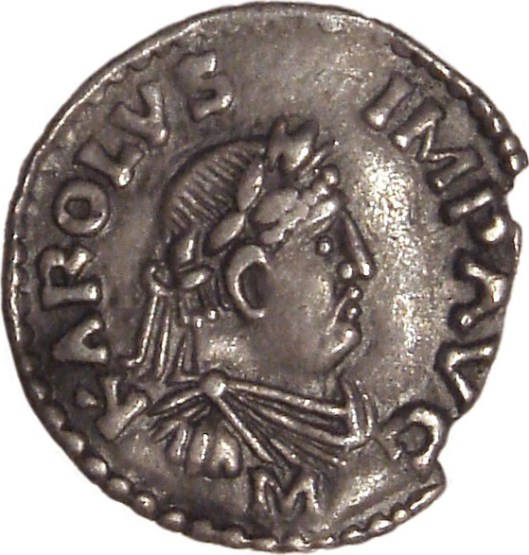
Charlemagne_denier_Mayence_812_814.jpg

charlemagnesempire.gif

This, the Marca Hispanica, existed as a buffer state between the Moorish Caliphate to its south and the Holy Roman Empire to the north.

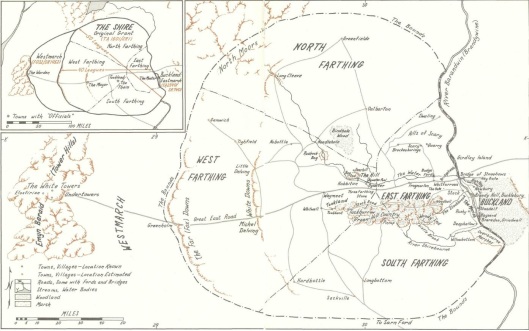
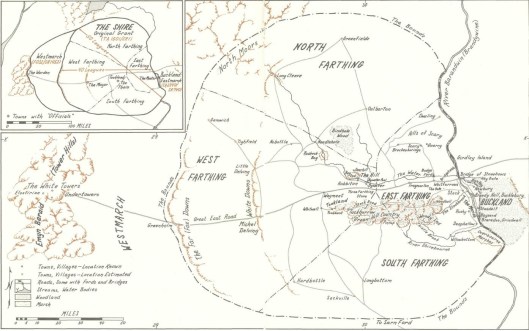
In contrast, we have the West March, to the west of the Shire, as we’ve discussed before.
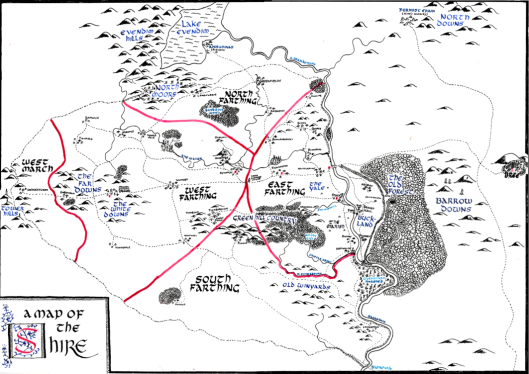
map_of_the_shire_by_astrogator87-d8h3y1k.png

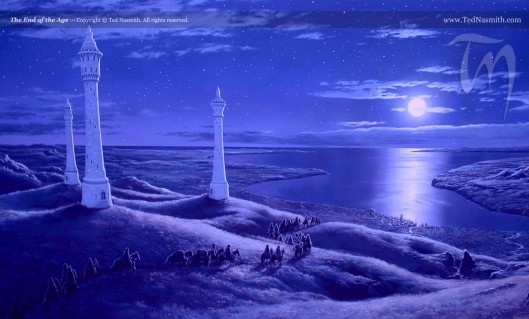
At its far western edge are the Tower Hills (here illustrated by one of our favorite Tolkien artists, Ted Nasmith)
nasmith_elben-meer.jpg

on which are perched three white towers, described in the Prologue to The Lord of the Rings:

“Three Elf-towers of immemorial age were still to be seen on the Tower Hills beyond the western marches. They shone far off in the moonlight. The tallest was furthest away, standing alone upon a green mound. The Hobbits of the Westfarthing said that one could see the Sea from the top of that tower; but no Hobbit had ever been known to climb it.” (Gandalf adds to this that there was a palantir, Elendil’s Stone, located there—The Two Towers, Book Three, Chapter 11, “The Palantir”.)

The difference is, those towers don’t seem defensive and the West March is not a military zone—although it is the site of Hobbit-expansion, as Appendix B tells us:

“1452 The Westmarch, from the Far Downs to the Tower Hills (Emyn Beraid) is added to the Shire by the gift of the King. Many hobbits remove to it.

1462 …the Thain makes Fastred Warden of Westmarch. Fastred and Elanor make their dwelling at Undertowers on the Tower Hills, where their descendants, the Fairbairns of the Towers, dwelt for many generations.”

Talk of marches and wardens and towers, however, immediately brought to mind for us something from our world (doesn’t it always?).

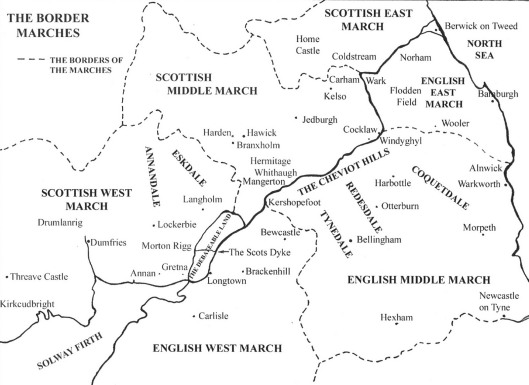
This is the border area between England and Scotland, an area of conflict for several centuries, but culminating in the struggles of the 16th century.
BorderMarches9.jpg

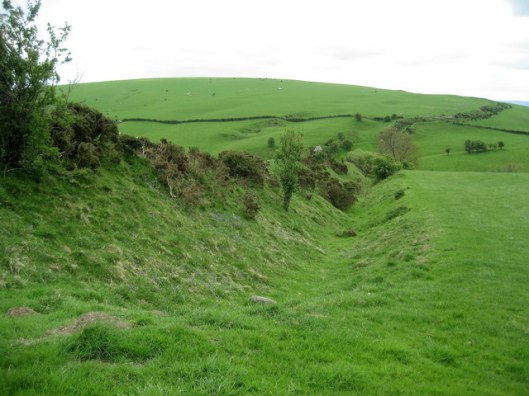
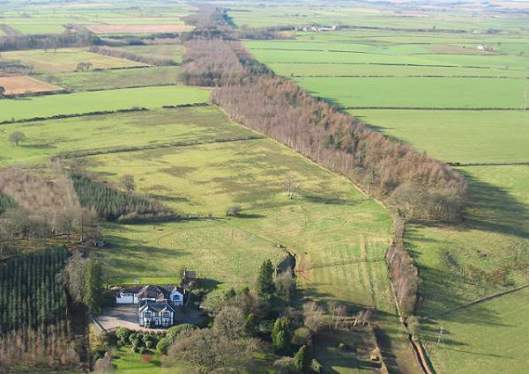
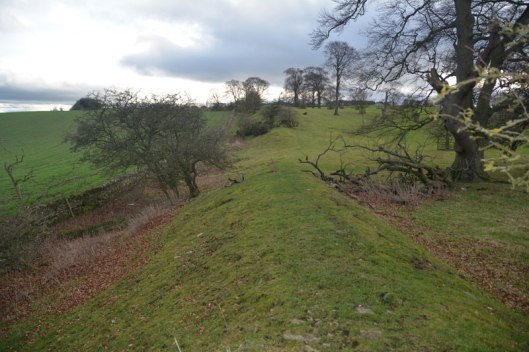
The border area had been divided, on both sides, into three marches, with a subset for that area on the southwest side called the “Debatable Lands”, because both England and Scotland claimed it. In 1552, the decision was mutually made to put up an earthen barrier, the so-called “Scots Dike”, to split it.
scotsdike.jpg

19thFebruary2017ScotsDykeOlliverBankDSC_1238.jpg

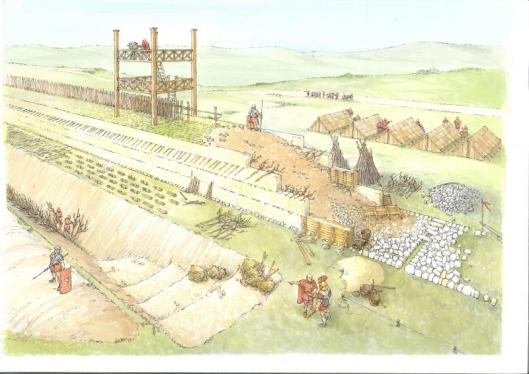
Unlike Hadrian’s Wall, farther to the south, with its system of walls and towers and gates and little forts and big army camps, this was never an elaborate military structure, or even like Offa’s Dike between England and Wales,
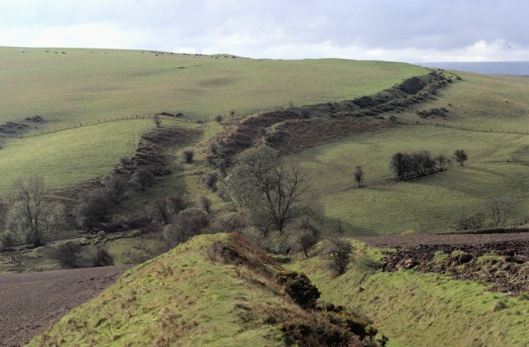
as_offas_dyke.jpg

but simply a boundary marker in low-lying land (and only 3.5 miles long– 5.6km).

When it came to the border towards the east, and the center of the region and beyond, however, the land rises into the characteristic twisty hills with long, narrow valleys.

14.PennineWay-CNN2NJ-1680x1050

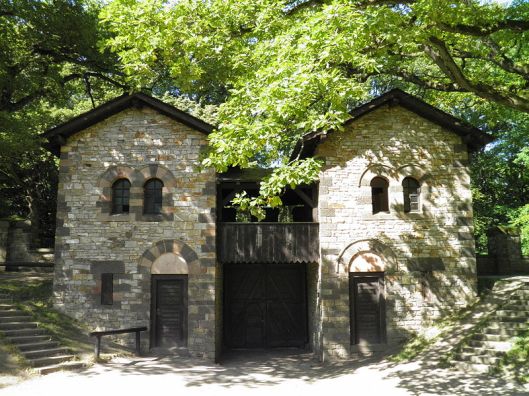
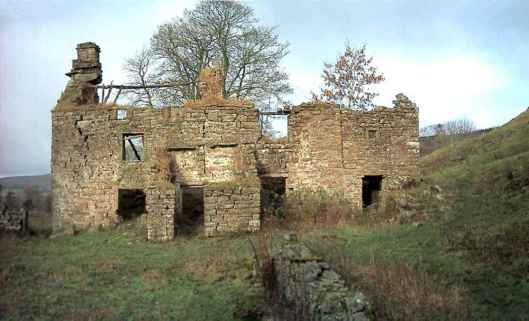
In this wild world, there are no long walls, of stone, wood, or earth to protect anyone, but castles, towers, and fortified farmhouses called bastles (possibly from the same root as “Bastille”?). Here we see Hermitage Castle, Smailholm Tower, and Black Middens Bastle.
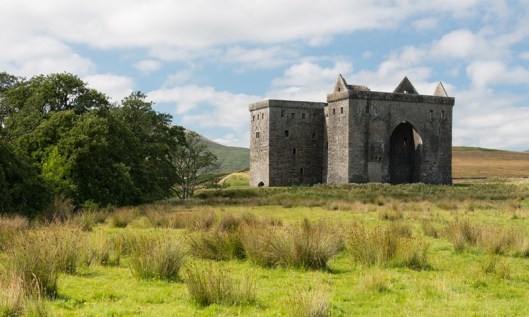
dp_hc270814014

Smailholm-tower1

Black-Middens-Bastle-1024x683.jpg

Although we see these now as gaunt ruins, we should always imagine them—as in this reconstruction of Smailholm—as living spaces, as well as refuges in an often lawless land.
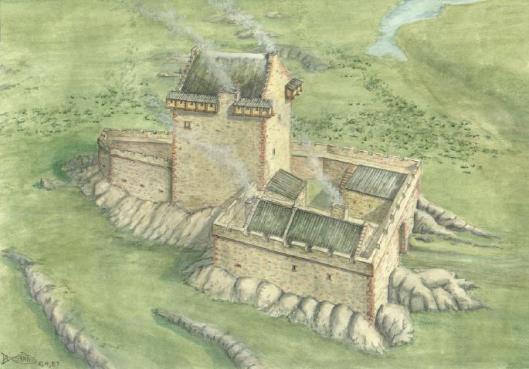
smailholm.jpg

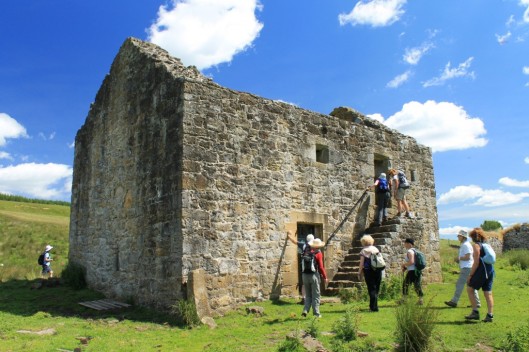
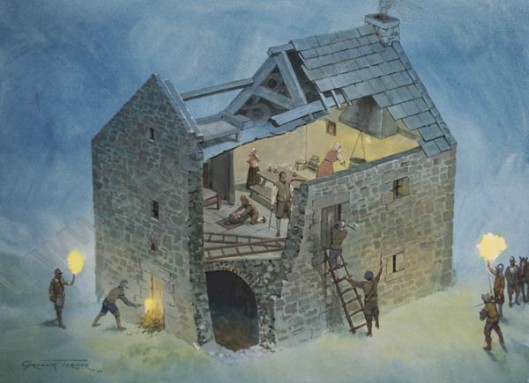
One has only to see the thick walls of a bastle and, originally, no door at ground level (stairs appear to be a later convenience for a more peaceable time), to imagine the danger from reivers, raiders from either side of the Anglo-Scots border and sometimes, as there was a certain amount of intermarriage, from both.
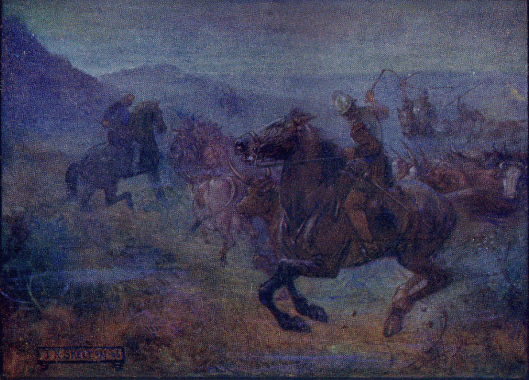
reiversatwork.gif

loveladybastle2.jpg

As can be seen in this reconstruction, these walls might be all that would stand between the inhabitants and destitution or even death, should the reivers come raiding.
large_orig_reivers_g_bastle_attack.jpg

There was also the possibility of buying them off, by paying them blackmail, a word whose origin is contested, but whose purpose is clear: protection money. If you paid them, in coin or cattle, you were safe—at least until the price went up.

Curbing such behavior was the job of the Border Wardens, there being six, one for each March on each side of the border. Theirs was a difficult job: too much territory, too few men, and too few resources to back them up. Wonderfully, one of these Wardens, Robert Carey, has left us a memoir, which is available on-line: memoirsrobertca00orregoog.

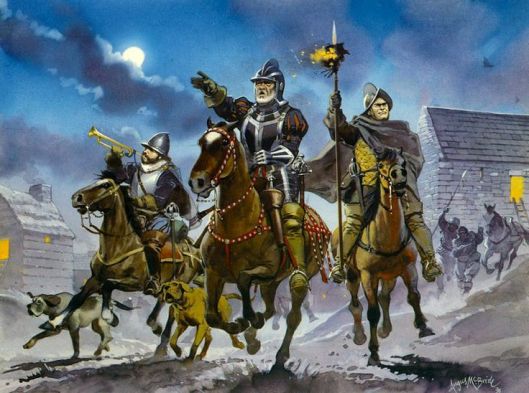
If you were attacked and you survived, you might send word to the Warden or one of his officers, who could organize a posse to pursue the raiders. By law, all able-bodied locals were supposed to turn out to help when the organizer—Warden or officer—rode by with trumpeter and a rider who carried a flaming bit of peat on his “staff” (local word for “lance”).
e7c88732c6aa3165565c64cf094a182c.jpg

This was called the “hot trod” and, under its conditions, the pursuers were allowed to cross the border. Such occasions could be very dangerous, however, as those raiders would be chased back across their own territory, giving them the chance to delay or destroy those in pursuit in an ambush on familiar ground.

We were originally drawn to this part of the world and of Anglo-Scottish history because of our interest in the musical literature of the region, the so-called “border ballads”, and, in our next, “Bordering (.2 Blackmail, Battle, and Song”) we’ll talk a bit about them—and perhaps a bit more about borders and heroic behavior, as well.

Thanks as ever, for reading!

MTCIDC

CD
Smoke (No Mirrors)

22 Wednesday Mar 2017

Posted by Ollamh in Economics in Middle-earth, J.R.R. Tolkien, Literary History, Narrative Methods

≈ Leave a comment

Tags

Algonquian, Aragorn, Bag End, Baggins, Daemonologie, domestic, Gandalf, Gimli, Hernandez de Boncalo, hogsheads, Isengard, James I, Jamestown, John Rolfe, Longbottom Leaf, Matoaka, Merry and Pippin, Native Americans, Nictotiana, Philip II of Spain, pipe, plantations, Pocahontas, Popeye the Sailor, Saruman, Scouring of the Shire, Sharkey, Sherlock Holmes, Shire, smoking, Southfarthing, The First Part of Ayres of the Musicall Humours, The Hobbit, The Illiad, The Lord of the Rings, The Odyssey, Tobacco, Tobias Hume, Tolkien

As always, welcome, dear readers.

This posting takes us away from the Shire and back to it, all in a couple of pages, as well as linking itself with a recent one on Sharkey and his attempt at revenge on the Hobbits who have helped in his downfall.

We begin just after Helm’s Deep, at the moment when Gandalf and all of the major characters involved have followed the invasion route back to Isengard, only to find it in ruins and:

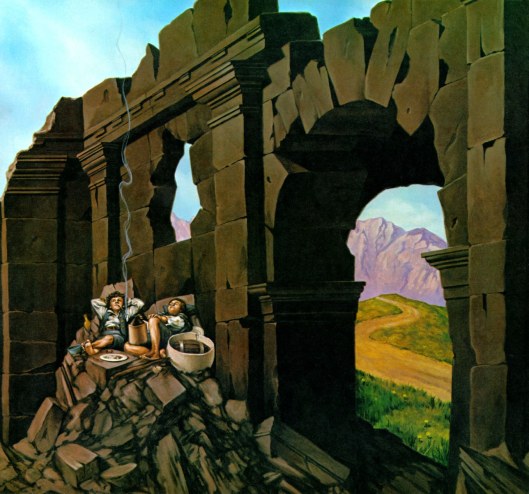
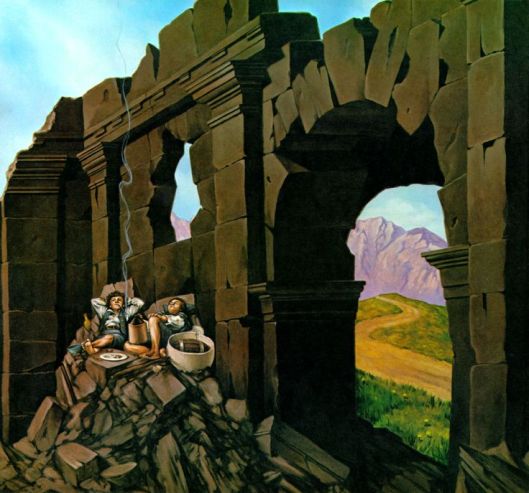
“And now they turned their eyes towards the archway and the ruined gates. There they saw close beside them a great rubble-heap; and suddenly they were aware of two small figures lying on it at their ease…One seemed asleep; the other, with crossed legs and arms behind his head, leaned back against a broken rock and sent from his mouth long whisps and little rings of thin blue smoke.” The Two Towers, Book Three, Chapter 8, “The Road to Isengard”

image1ruins.jpg

For Gimli, himself a smoker, that latter sight is not a surprising. For Theoden, however, not only are the Hobbits a surprise, but: “I had not heard that they spouted smoke from their mouths.”

Merry’s reply then leads us into today’s posting.

“That is not surprising…for it is an art which we have not practised for more than a few generations. It was Tobold Hornblower, of Longbottom in the Southfarthing, who first grew the true pipe-weed in his gardens, about the year 1070 according to our reckoning. How old Toby came by the plant…”

Gandalf interrupts Merry here, concluding with “Some other time would be more fitting for the history of smoking.”

But not for us.

For us, smoking, in the The Lord of the Rings, as in The Hobbit, belongs to a whole category of what we call the “domestication of the heroic”, a distinctive and important feature of JRRT’s narrative style. Earlier epics, like the Iliad and the Odyssey, certainly have their moments where combat and travel and dealing with monsters and enchantresses are not the only features of the stories. People sometimes pause to eat and drink and even sleep. JRRT goes beyond this, however, to provide what he himself might call the “homely” in his texts. By this term, we mean the ordinary and familiar, including such things as a brief inventory of the contents of Bag End, food more detailed than the “endless meat and sweet dark wine” of Homer–such as the mushrooms and bacon which Farmer Maggot offers–and Bilbo reading his letters and forgetting his pocket handkerchief. Such seemingly-trivial things give the stories—and certain of the characters within them—an extra depth and thus a deeper believability, as well as anchoring the story in something more ordinary than kings and wizards.

In fact, the center of this domestication are the Hobbits: think of Sam wanting a bit of rope or explaining taters to Gollum or that heart-breaking moment when Sam discards his pots and pans and “The clatter of his precious pans as they fell down into the dark was like a death-knell to his heart.” (The Return of the King, Book Six, Chapter 3, “Mount Doom”) And, along with things like rope and conies, there is what once was called “the pleasures of the pipe”.

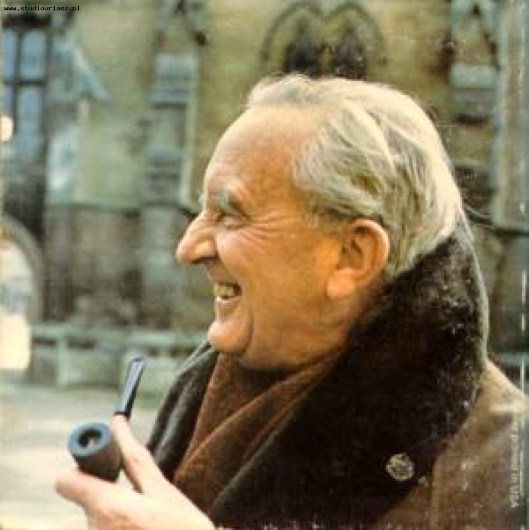
We live in a different world from JRRT. When he took up the pipe, in the early 20th century, no one knew the dangers of smoking.

image2jrrt.jpg

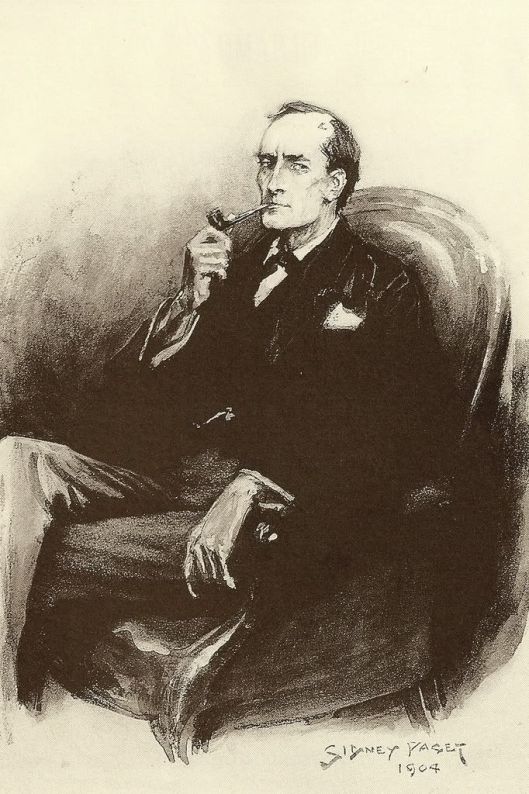
It was simply something men, in particular, did. After all, there was Sherlock Holmes, with his famous “three-pipe problem” (“The Red-Headed League”, The Strand Magazine, August, 1891) as a perfect model.

image3holmessmoking.jpg

Thus, smoking was acceptable and, potentially, domestic: after all, although the ancient comic book and cartoon character, Popeye the Sailor (1929-1957), may hold a pipe in his mouth while battling,

image3apopeye.jpg

it is generally something done in quiet and contemplation. Perhaps, then, for the times in which JRRT was writing, a perfect symbol of the domestic. (Hence the old expression for household comfort that someone—typically his wife–brings the owner “his pipe and slippers” when he comes home from work?)

And it appears very early in our experience of Hobbits. After all, the first time we see Bilbo, he is “standing at his door after breakfast smoking an enormous long wooden pipe that reached nearly down to his woolly toes”. (The Hobbit, Chapter 1, “An Unexpected Party”)

image4bilbo.jpg

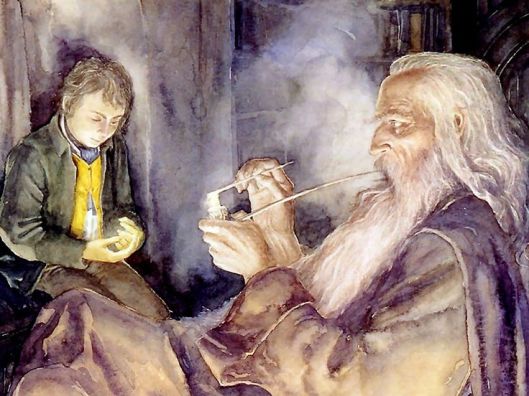
In time, we’ll see Gandalf smoking

image5gandalfsmoking.jpg

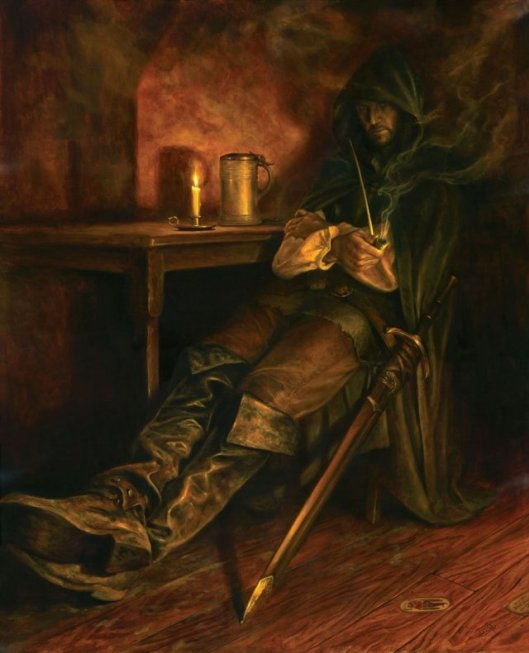
and Strider/Aragorn, too.

image6strider.jpg

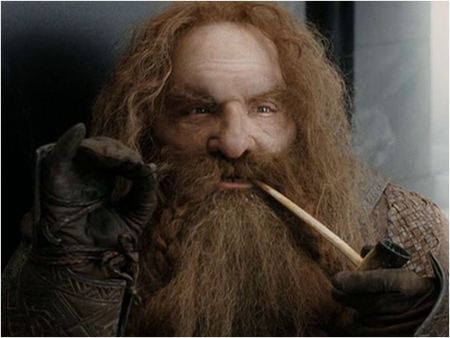
In fact, we wonder if it isn’t a kind of unconscious sign that someone is a positive character—after all, as we said, Gimli smokes, too.

image7gimli.jpg

There is one exception, of course—and we’ll come back to that!

It should be no surprise, then, that one more positive character, Merry, is a smoker. Knowing, from the Prologue to The Lord of the Rings, that he is also the author of Herblore of the Shire, among other works, it is also not surprising that he appears to be the main authority on “pipe-weed”, claiming that the Hobbits were the inventors of its consumption:   “Hobbits first put it into pipes. Not even the Wizards first thought of that before we did.”

This, of course, made us think about who invented tobacco-smoking in our world—or, at least, in the English-speaking Western Hemisphere. (Although we are glad to point out that, as early as 1559, Philip II of Spain ordered Hernandez de Boncalo to bring back tobacco seeds from the New World to plant in Spain.)

Merry says of the plant (which he correctly identifies with our genus Nicotiana):

“…observations that I have made on my own many journeys south have convinced me that the weed itself is not native to our parts of the world, but came northward from the lower Anduin, whither it was, I suspect, originally brought over Sea by the Men of Westernesse. It grows abundantly in Gondor, and there is richer and larger than in the North, where it is never found wild, and flourishes only in warm sheltered places like Longbottom.”

In our world—that is, in the Americas– Native Americans first cultivated tobacco—as can be seen in this engraved version of John White’s 1580s drawing of the Algonquian village of Secoton by Theodor de Bry for the 1590 second edition of Thomas Harriot’s A Briefe and True Report of the New Found Land of Virginia.

image8secoton.jpg

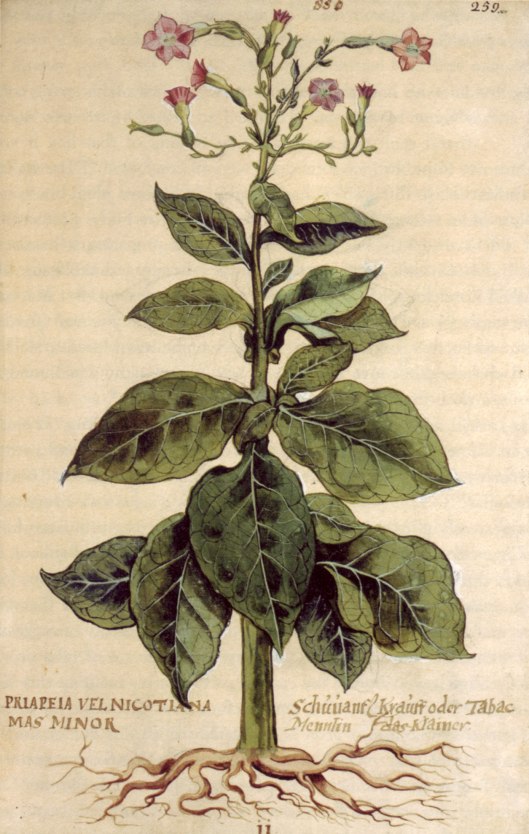
At the top, center, is a tobacco field, with stylized plants, which, up close, might look like this:

image9tobacco.jpg

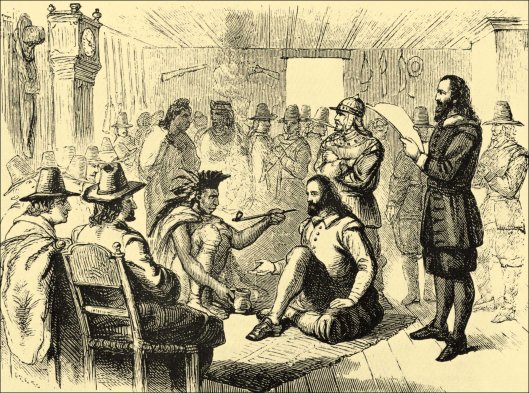
Native Americans appear to have used tobacco—and its smoke—primarily for religious and political ceremonies, rather than for recreation.

image10pipeceremony.jpg

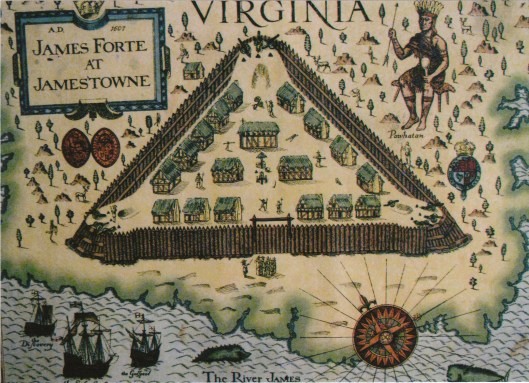
This soon changed, however, when a member of the newly-established (1607) colony of Jamestown, John Rolfe, in what would become the US state of Virginia,

image11jamestown.jpg

saw the commercial possibilities and began to cultivate tobacco for export.

image12growingtobacco.jpg

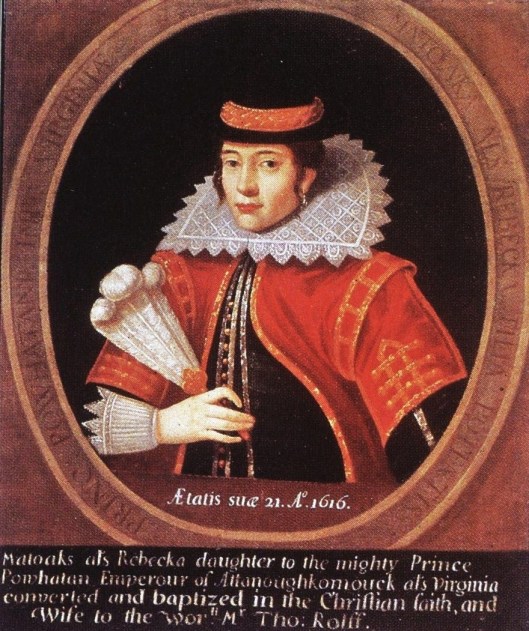
Although John Rolfe is known to those interested in early English colonization, his wife is much more famous. She was Matoaka, called Pocahontas as a nickname (it means something like “playful/lively”), the 400th anniversary of whose funeral is the day of this writing, 21 March (although it will be posted tomorrow, the 22nd).

image13pocahontas.jpg

Tobacco was already known in England,

image14drinker.jpg

had become a sort of craze,

image15tobaccosmoking.gif

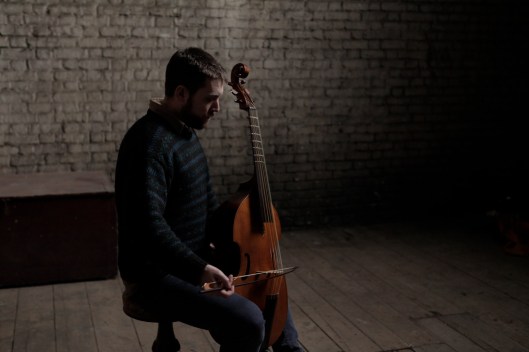
and even inspired at least one pop song, Tobias Hume’s “Tobacco”, from his The First Part of Ayres of the Musicall Humours (1605). Hume was a big fan of the lyra viol (a member of the string bass family).

image16lyraviol

(We include here a link so that you can hear the song sung and accompanied by his favorite instrument.  Oh—and it’s sung in the pronunciation of the early 17th century, so be prepared for some differences in sound.)

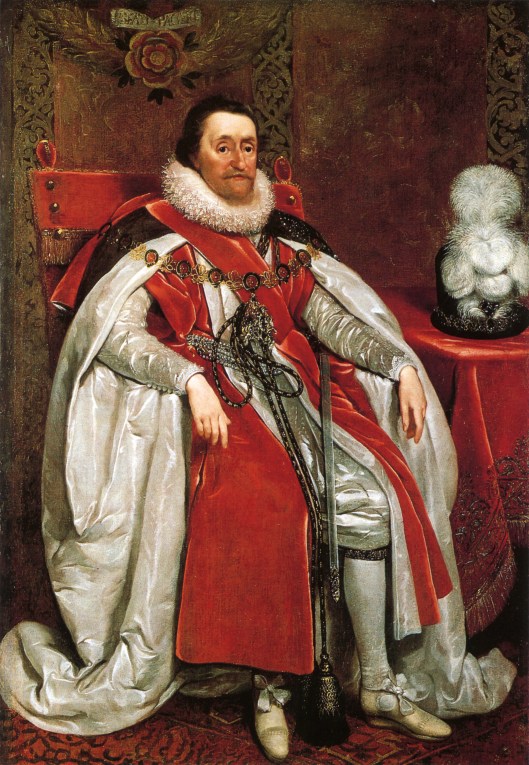
Thus, Rolfe’s exploitation was a good business investment, even though tobacco quickly ran afoul of the British government, in the form of the new king, James I,

image17james1

who had already published an attack on smoking in 1604.

image18counterblast

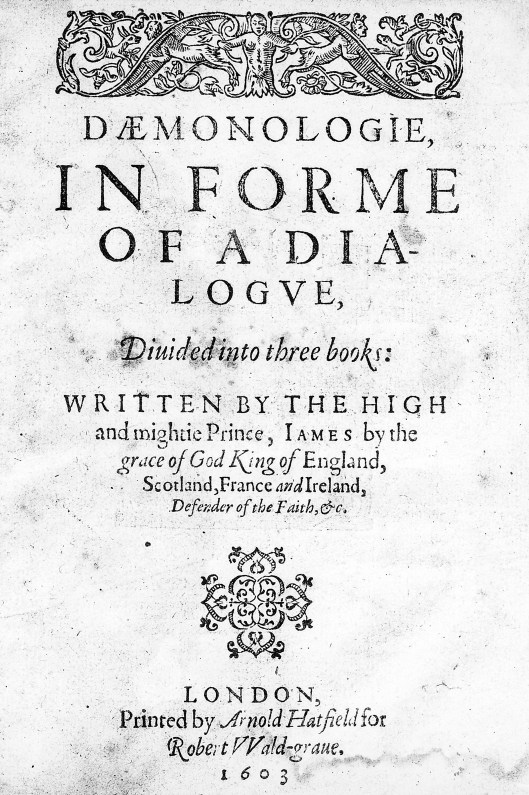
James I had opinions on numerous subjects, including witches, about whom he had published a book, Daemonologie, in 1597.

M0014280 James I: Daemonologie, in forme of a dialogue. Title page.

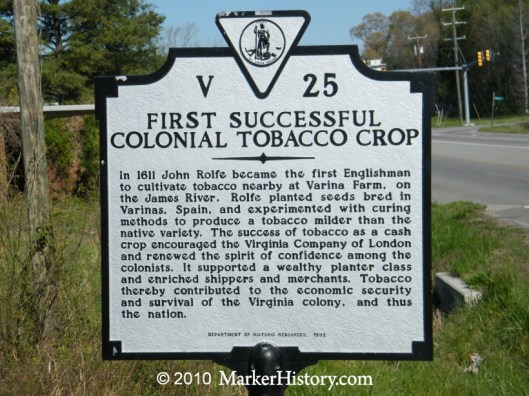
His attack on tobacco—although more sensible than believing in witches—didn’t stop it from becoming the major Virginia crop, however—as this roadside sign points out.

image20sign.jpg

Virginia farmers planted huge fields of tobacco,

image21tobaccofield.jpg

cultivated it (a major use of slave labor, like the sugar plantations of the Caribbean),

image22cultivation.jpg

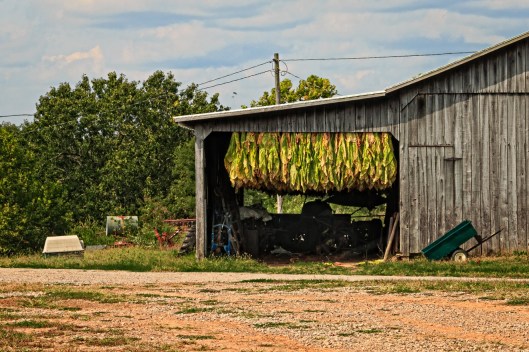
cut and dried it,

image23drying.jpg

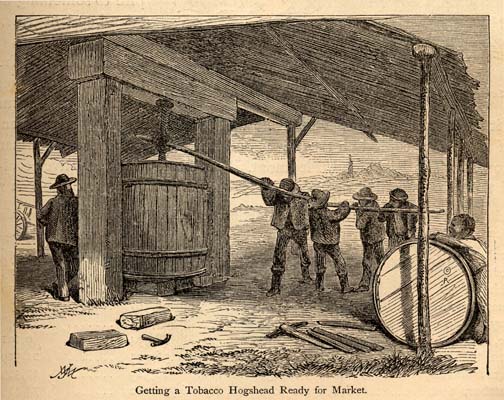
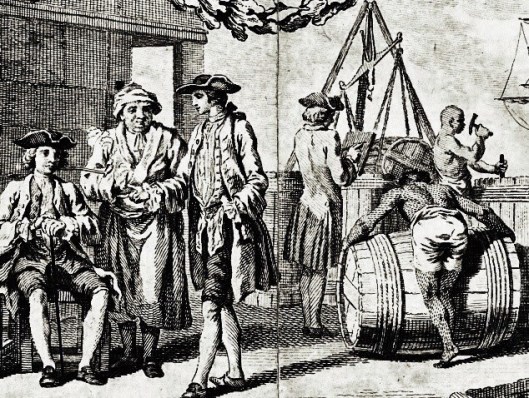
packed it into huge barrels, called hogsheads,

image24hogsheadpacking.jpg

dragged those hogsheads to a port,

image25dragging.jpg

and shipped those hogsheads to England

image26shipping.jpg

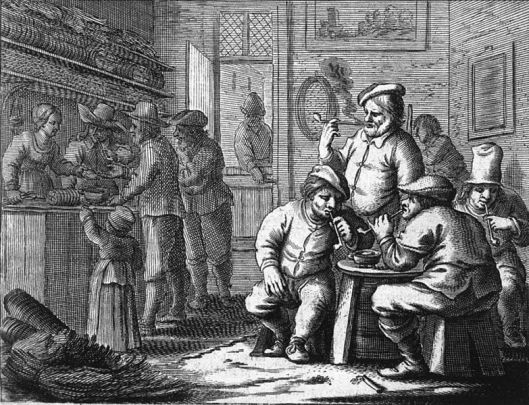
where smokers enjoyed it.

image27smoking.jpg

We don’t know the methods used in the Southfarthing, but, looking at tobacco around the world in our world, the main difference seems to be in the curing (drying) technique used. We can imagine, then, that, when Merry talks about “pipe-weed” and its cultivation, if we visited the southern part of the Shire, we would see familiar sights—except, perhaps, for those hogheads. The stuff which Merry is smoking came from “two small barrels, washed up out of some cellar or store-house…When we opened them, we found they were filled with this: as fine a pipe-weed as you could wish for, and quite unspoilt.” (The Two Towers, Chapter Nine, “Flotsam and Jetsam”)

Gimli admires the quality and Merry says, “My dear Gimli, it is Longbottom Leaf! There were the Hornblower brandmarks on the barrels, as plain as plain. How it came here, I can’t imagine. For Saruman’s private use, I fancy.”

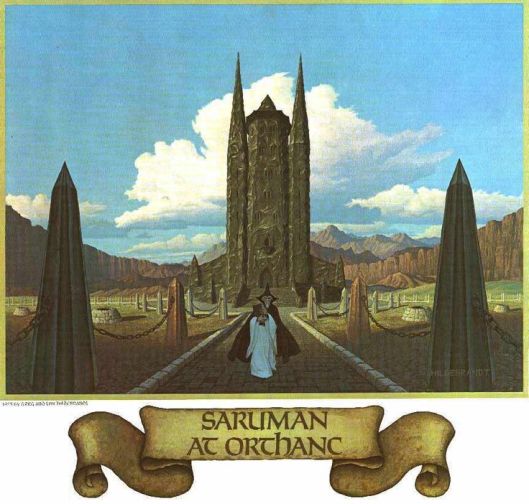
This brings us back to the final smoker and one exception to our fanciful rule that, in Tolkien, if you smoke, you’re a positive character: Saruman.

image28saruman.jpg

It’s hard to think of Saruman as indulging in the domestic. As Treebeard says of him: “He has a mind of metal and wheels” (The Two Towers, Book Three, Chapter 4, “Treebeard”). And yet, although he has lost his position as head of the White Council, and has lost Isengard, as well, as Gandalf says of him, “I fancy he could do some mischief still in a small mean way.” (The Return of the King, Book Six, Chapter 6, “Many Partings”). Thus, what better small, mean way than to attack that very domesticity which is embodied in the Hobbits and their Shire? As Sharkey, he does so, destroying the Shire by cutting down trees, knocking or burning down houses, replacing water mills with steam, and turning a nearly a-political place into a little fascist state. And, perhaps, as a last straw, he attacks one last small comfort, saying to Merry, as he keeps his tobacco pouch:

“Well, it will serve you right when you come home, if you find things less good in the Southfarthing than you would like. Long may your land be short of leaf!” (The Return of the King, Book Six, Chapter 6, “Many Partings”)

If so, perhaps there is a certain horrible irony, then, that, when Saruman is murdered, he is last seen as “a grey mist…rising slowly to a great height like smoke from a fire”. (The Return of the King, Book Six, Chapter 8, “The Scouring of the Shire”)

Thanks, as always, for reading.

MTCIDC

CD

Shire Portrait (5b): Hostile Takeover

15 Wednesday Mar 2017

Posted by Ollamh in Economics in Middle-earth, Imaginary History, J.R.R. Tolkien, Military History, Military History of Middle-earth, Narrative Methods, Villains

≈ Leave a comment

Tags

Baggins, Chief, Der Fuehrer, Gestapo, Hitler, Lotho, SA, Sackville-Bagginses, Saruman, Sharkey, Shire, Shirriffs, Southfarthing, The Hobbit, The Lord of the Rings, The Scouring of the Shire, Tolkien

Welcome, dear readers, to the second part of our last (for the moment?) posting on the Shire. This is actually a two-part posting and is devoted to the takeover of the Shire by “Sharkey” and his followers and how it might have happened, based upon evidence from the texts of The Hobbit and The Lord of the Rings.

We decided upon a two-part posting because we saw the takeover as a two-step process. Initially, we believe that Saruman looked for someone within the Shire to act as his agent there and, as a local agent, both to foment the kind of discontent which would provoke a demand for change, and to act as the leader of that change.

Because the Shire had so little government and most problems were dealt with within families, we wondered if that discontent wouldn’t begin as something Shire-wide, but be found within one or more families, instead.

With this in mind, we immediately thought of the Sackville-Bagginses. From the final chapter of The Hobbit, it was clear that the S-Bs (as they’re called) had grievances against their cousins, the Bagginses, mostly because they wanted Bag End and its contents.

How this led to leaguing with Saruman is not explained, but merely suggested, by Pippin, who says, of reported disturbance in the Southfarthing:

“ ‘Whatever it is…Lotho will be at the bottom of it:   you can be sure of that.” The Return of the King, Book Six, Chapter 7, “Homeward Bound”

This is then confirmed when the hobbits reach the bridge over the Brandywine and one of the hobbit guards (Hob Hayward), mentions “the Chief…up at Bag End.”

Frodo, who has sold his house at Bag End (see The Fellowship of the Ring, Book One, Chapter 3, “Three is Company”) to the S-Bs, immediately asks Hob, “ ‘Chief? Chief? Do you mean Mr. Lotho?’ said Frodo.” The Return of the King, Book Six, Chapter 8, “The Scouring of the Shire”

Otho and Lobelia had been Bilbo’s enemies long ago, but, whereas Lobelia is still alive, Otho is long dead and Lotho (and yes, the word “loathe” must lie just below the surface here, though this is probably not his name in the Common Tongue, just as Pippin’s name isn’t Pippin), his son, has somehow become not the Mayor of the Shire (who is actually Will Whitfoot), but the much vaguer (and more menacing) “the Chief”. (We also note that “Mr. Lotho” is a courtesy title and one for established land-owners, really, and not for Lotho.)

The family theme is underlined when Hob replies that “we have to say ‘the Chief’ nowadays” and Frodo says, in turn:

“ ‘Do you indeed!’ said Frodo. ‘Well, I am glad he has dropped the Baggins at any rate. But it is evidently high time that the family dealt with him and put him in his place.’ ”

If Frodo’s remark suggests the familial aspect of justice in the Shire, the reply of an anonymous hobbit to it suggests the second or external step of the takeover:

“A hush fell on the hobbits beyond the gate. ‘It won’t do no good talking that way,’ said one. ‘He’ll get to hear of it. And if you make so much noise, you’ll wake the Chief’s Big Man.’ ”

As JRRT began The Lord of the Rings in 1937, just four years after the Nazis took control of Germany, “The Chief” surely has echoes of “Der Fuehrer”, which simply means “The Leader”.

adolf-hitler-34.jpg

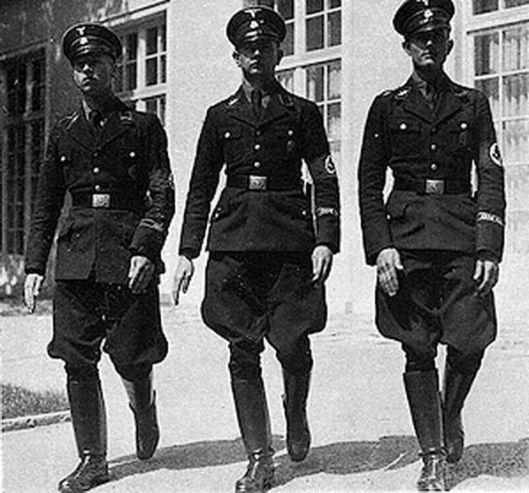
In which case, should we associate the threat of “the Chief’s Big Man” with everything from the SA

0001.jpg

to the Gestapo?

0e24494b5019c1007e9214e03d77c2d8.jpg

Merry, at least, certainly makes a connection with something which Butterbur had said earlier:

“It all comes of those newcomers and gangrels that began coming up the Greenway last year, as you may remember; but more came later. Some were just poor bodies running away from trouble; but most were bad men, full o’ thievery and mischief.” The Return of the King, Book Six, Chapter 7, “Homeward Bound”

Answering the anonymous voice, Merry says:

“If you mean that your precious Chief has been hiring ruffians out of the wild, then we’ve not come back too soon!”

When the Big Man appears, Merry’s conclusion is confirmed: it’s Bill Ferny, who, Butterbur believes, who had been involved in a minor battle in Bree, in which five hobbits had been killed:

“ ‘And Harry Goatleaf that used to be on the West-gate, and that Bill Ferny, they came in on the strangers’ side, and they’ve gone off with them; and it’s my belief they let them in. On the night of the fight I mean.’ “

If some of these “Big Men” were criminal drifters from the east, almost randomly recruited, there were others who were sent.

“ ‘It all began with Pimple, as we call him,’ said Farmer Cotton; ‘and it began as soon as you’d gone off, Mr. Frodo.   He’d funny ideas, had Pimple. Seems he wanted to own everything himself, and then order other folk about. It soon came out that he already did own a sight more than was good for him; and he was always grabbing more, though where he got the money was a mystery: mills and malt-houses and inns, and farms, and leaf-plantations. He’d already bought Sandyman’s mill before he came to Bag End, seemingly.

Of course he started with a lot of property in the Southfarthing which he had from his dad; and it seems he’d been selling a lot o’ the best leaf, and sending it away quietly for a year or two. But at the end o’ last year he began sending away loads of stuff, not only leaf. Things began to get short, and winter coming on, too.   Folk got angry, but he had an answer. A lot of Men, ruffians mostly, came with great wagons, some to carry off the goods south-away, and others to stay. And more came. And before we knew where we were they were planted here and there all over the Shire, and were felling trees and digging and building themselves sheds and houses just as they liked…”

There is a bit more to add to this. The “Big Men” were not alone. As in our own historical world of Nazi occupiers, there were those willing to collaborate, as Robin Smallburrow tells Sam:

“There’s hundreds of Shirriffs all told, and they want more, with all these new rules. Most of them are in it against their will, but not all. Even in the Shire there are some as like minding other folk’s business and talking big. And there’s worse than that: there’s a few as do spy-work for the Chief and his Men.”

With Farmer Cotton’s narrative, however, the two steps come together: the local was, indeed, as Pippin has suspected, Lotho. The external was a combination of opportunists, like Bill Ferny, and agents dispatched from an unnamed southern source, but we know that it was “Sharkey” who sent them, just as we know that “Sharkey” was Saruman, who was still capable of mischief—but not “in a small mean way”.

Thanks, as always, for reading.

MTCIDC

CD

Shire Portrait (5a): Hostile Takeover

08 Wednesday Mar 2017

Posted by Ollamh in Economics in Middle-earth, Imaginary History, J.R.R. Tolkien, Literary History, Narrative Methods

≈ Leave a comment

Tags

A Long-Expected Party, auction, Bag End, Baggins, Barliman Butterbur, Galadriel, Government, Isengard, Longbottom Leaf, Luke Skywalker, Merry and Pippin, Mirror of Galadriel, Pipeweed, Sackville-Bagginses, Sam Gamgee, Saruman, Star Wars, The Empire Strikes Back, The Lord of the Rings, The Return of the King, The Scouring of the Shire, The Shire, Tolkien, Yoda

As always, dear readers, welcome!

This is, we think, the last in our Shire Portrait series (although a 2-parter)—at least for the moment. In it, we intend to consider just how the Shire fell into the hands of “Sharkey” and his “boys”.

The Ring destroyed and the King returned, Gandalf, the Hobbits, and a party of Elves are traveling back toward Rivendell and beyond when they come upon Saruman and Grima, now no more than Saruman’s slave.

Ted_Nasmith_-_Saruman_is_Overtaken.jpg

It is not a happy meeting, as can be imagined. When offered help, Saruman replies:

“All my hopes are ruined, but I would not share yours. If you have any…You have doomed yourselves, and you know it. And it will afford me some comfort as I wander to think that you pulled down your own house when you destroyed mine.” The Return of the King, Book 6, Chapter 6, “Many Partings”

In such a mood, it can be imagined how he treats the Hobbits—even when Merry offers him pipe-weed, which he does while commenting, less than tactfully, on its origin:

“ ‘You are welcome to it; it came from the flotsam of Isengard.’

‘Mine, mine, yes and dearly bought!’ cried Saruman, clutching at the pouch. ‘This is only a repayment in token; for you took more, I’ll be bound. Still, a beggar must be grateful, if a thief returns him even a morsel of his own. Well, it will serve you right when you come home, if you find things less good in the Southfarthing than you would like. Long may your land be short of leaf!’”

Saruman’s remark—a curse, really—resonates especially with Sam.

“’Ah!’ said Sam. ‘And bought he said. How, I wonder? And I didn’t like the sound of what he said about the Southfarthing. It’s time we got back.’” The Return of the King, Book 6, Chapter 6, “Many Partings”

This is a natural reaction on Sam’s part because of what he had seen in Galadriel’s mirror, we presume.

1gmirror.jpg

“’Hi!’ cried Sam in an outraged voice. ‘There’s that Ted Sandyman a-cutting down trees as he shouldn’t. They didn’t ought to be felled: it’s that avenue beyond the Mill that shades the road to Bywater…

But now Sam noticed that the Old Mill had vanished, and a large red-brick building was being put up where it stood. Lots of folk were busily at work. There was a tall red chimney nearby. Black smoke seemed to cloud the surface of the Mirror…

‘I can’t stay here,’ he said wildly. ‘I must go home. They’ve dug up Bagshot Row, and there’s the poor old Gaffer going down the Hill with his bits of things on a barrow…” The Fellowship of the Ring, Book 2, Chapter VII, “The Mirror of Galadriel”

At the time, Galadriel had told him

“’You cannot go home alone,’ said the Lady. ‘You did not wish to go home without your master before you looked in the Mirror, and yet you knew that evil things might well be happening in the Shire. Remember that the Mirror shows many things, and not all have yet come to pass. Some never come to be, unless those that behold the visions turn aside from their path to prevent them. The Mirror is dangerous as a guide to deeds.” The Fellowship of the Ring, Book 2, Chapter VII, “The Mirror of Galadriel”

[A footnote: suddenly, we are reminded of that scene on Dagobah in Star Wars V, when Luke has had a vision and immediately wants to rush off to Bespin.

2lukedagobah.jpeg

“Luke: I saw—I saw a city in the clouds.

Yoda: [nods] Friends you have there.

Luke: They were in pain…

Yoda: It is the future you see.

Luke: The future?

[pause]

Luke: Will they die?

Yoda: [closes his eyes for a moment] Difficult to see. Always in motion is the future.

Luke: I’ve got to go to them.

Yoda: Decide you must, how to serve them best. If you leave now, help them you could; but you would destroy all for which they have fought, and suffered.” The Empire Strikes Back (1980)

As—using various websites—we provide links here—we can see that an imitation of the opening of the Hobbit—Bilbo and Gandalf meeting—appears in an early script of Star Wars IV, I think that the scene at Galadriel’s Mirror was somewhere back in G. Lucas’ wonderfully fertile brain—and, yes, we are big fans.]

“Secrets of the ‘Star Wars’ Drafts”

Was George Lucas Inspired by Tolkien?

Star Wars Origins: The Lord of the Rings

At this point, we know from two sources that Saruman has had commercial dealings with the Southfarthing.

First, of course, we’ve just seen it confirmed by Saruman’s response to Merry. Second is that scene at Isengard, where Gandalf, Theoden, Eomer, and Aragorn, travel with an escort and find there Merry and Pippin, who tell them of their discovery of two small casks:

“ ‘My dear Gimli, it is Longbottom Leaf! There were the Hornblower brandmarks on the barrels, as plain as plain. How it came here, I can’t imagine.” The Two Towers, Book Three, Chapter 9, “Flotsam and Jetsam”

Michael-Herring-Restos-y-despojos-Calendario-Tolkien-1980

Knowing, however, of Saruman’s increasing interest in the Shire, we can imagine that one of his agents, active in the Southfarthing, had acquired it for him. As the Appendix B, “The Tale of Years” tells us, under TA2953:

[Saruman] notes his [Gandalf’s] interest in the Shire. He soon begins to keep agents in Bree and the Southfarthing.” (page 1089 in Appendix B)

Spying was clearly only the beginning for Saruman, however. The actual evidence for his eventual take-over is scattered throughout The Lord of the Rings, but we believe that it can be pieced together to provide a picture of how it must have been done. It was a two-step process.

First, he appears to have gained knowledge of internal dissatisfaction within the Shire. Because there is really nothing political in the Shire–as readers will know from the first posting in this series, there is virtually no government—this unrest was domestic—as is said in the Prologue, “Families for the most part managed their own affairs.”

In the case of Bilbo and Frodo, the dissatisfied were the Sackville-Bagginses. We first met them in the last chapter of The Hobbit, where they were described as “Bilbo’s cousins” and were shown as being actively involved in the auction of the “effects of the late Bilbo Baggins Esquire”—as well as in the disappearance of some merchandise not auctioned off:

“Many of his silver spoons mysteriously disappeared and were never accounted for. Personally he suspected the Sackville-Bagginses. On their side they never admitted that the returned Baggins was genuine and they were not on friendly terms with Bilbo ever after.” The Hobbit, Chapter 19, “The Last Stage”

It was one more blow to the Sackville-Bagginses when Bilbo rescued the now-orphaned Frodo from “those queer Bucklanders” and brought him to live at Bag End, as Gaffer Gamgee related in The Ivy Bush:

“ ‘But I reckon it was a nasty knock for those Sackville-Bagginses. They thought they were going to get Bag End, that time he went off and was thought to be dead. And then he comes back and orders them off; and he goes on living and living, and never looking a day older, bless him! And suddenly he produces an heir, and has all the papers made out proper. The Sackville-Bagginses won’t never see the inside of Bag End now, or it is to be hoped not.’ “ The Fellowship of the Ring, Book One, Chapter 1, “A Long-Expected Party”

Bad blood, then, on several counts—and, for Saruman, looking for a way in, a great opportunity.

Bilbo might have suspected them of spoon-pilfering, but his was a more generous nature, however, and he even invited them to his and Frodo’s joint birthday party.

“The Sackville-Bagginses were not forgotten. Otho and his wife Lobelia were present. They disliked Bilbo and detested Frodo, but so magnificent was the invitation card, written in golden ink, that they had felt it impossible to refuse…” The Fellowship of the Ring, Book One, Chapter 1, “A Long-Expected Party”

On the other hand, Bilbo does not please them when he announces that Frodo is coming into “his inheritance”—

“The Sackville-Bagginses scowled, and wondered what was meant by ‘coming into his inheritance’ “ and, when Bilbo makes his startling disappearance, they “departed in wrath”. (quotations from Chapter One).

And yet they didn’t quite depart. It seems they have only stepped away from the party, only to return to cause trouble, demanding to see Bilbo’s will.

“Otho would have been Bilbo’s heir, but for the adoption of Frodo. He read the will carefully and snorted. It was, unfortunately, very clear and correct…” The Fellowship of the Ring, Book One, Chapter 1, “A Long-Expected Party”

Otho “snapped his fingers under Frodo’s nose and stumped off”, but Lobelia, his wife, remained, and Frodo later found her “still about the place, investigating nooks and corners, and tapping the floors. He escorted her firmly off the premises, after he had relieved her of several small (but rather valuable) articles that had somehow fallen inside her umbrella.” And she leaves with a kind of threat and what she believes is an insult:

“ ‘You’ll live to regret it, young fellow! Why didn’t you go too? You don’t belong here; you’re no Baggins—you—you’re a Brandybuck!’ ”

It’s never said why there is such an animus held by the Sackville-Bagginses against the Bagginses, but there is clearly something wrong with the S-Bs, from their covetousness to Lobelia’s open theft, and whatever is wrong is just what Saruman will find and exploit. Our next mention of them is oblique and it has to do with that pipe-weed. Merry and Pippin have been explaining how they had come to discover it at Isengard and all seems clear—

“ ‘All except one thing,’ said Aragorn: ‘leaf from the Southfarthing in Isengard. The more I consider it, the more curious I find it. I have never been in Isengard, but I have journeyed in this land, and I know well the empty countries that lie between Rohan and the Shire. Neither goods nor folk have passed that way for many a long year, not openly. Saruman had secret dealings with someone in the Shire, I guess. Wormtongues may be found in other houses than King Theoden’s…” The Two Towers, Book Three, Chapter 9, “Flotsam and Jetsam

With that faint foreboding, we hear no more until Gandalf and the Hobbits are once more leaving Bree and Butterbur says, almost in passing:

“ ‘I should have warned you before that all’s not well in the Shire neither, if what we hear is true. Funny goings on, they say.’ “ The Return of the King, Book Six, Chapter 7, “Homeward Bound”

With Butterbur’s words in their ears, the Hobbits ride out and conversation begins:

“ ‘I wonder what old Barliman was hinting at,’ said Frodo.

‘I can guess some of it,’ said Sam gloomily. ‘What I saw in the Mirror: trees cut down and all, and my old gaffer turned out of the Row. I ought to have hurried back quicker.’

‘And something’s wrong with the Southfarthing evidently,’ said Merry. ‘There’s a general shortage of pipe-weed.’

‘Whatever it is,’ said Pippin, ‘Lotho will be at the bottom of it: you can be sure of that.’”

Here again, after Aragorn’s remark long before, we see that pipe-weed turn up—and associated somehow with a Sackville-Baggins. Butterbur has already replied to Gandalf’s request for it that “That’s the one thing that we’re short of, seeing how we’ve only got what we grow ourselves, and that’s not enough. There’s none to be had from the Shire these days.”

It’s never explained why Pippin makes the connection with Lotho at this point—was the bad blood between the Bagginses and the Sackville-Bagginses part of a darker picture of the S-Bs? This seems more than possible when Gandalf adds to Pippin’s remark:

“ ‘Deep in, but not at the bottom,’ said Gandalf. ‘You have forgotten Saruman. He began to take an interest in the Shire before Mordor did.’”

And now we begin to see a potential bigger pattern: Saruman-an S-B-Shire and, with it, the second step in the take-over of the Shire, that from outside. But that’s for Shire Portrait 5b: “Hostile Take-Over.2”, next time.

Until then, thanks, as ever, for reading!

MTCIDC

CD
Shire Portrait (4): On the March

01 Wednesday Mar 2017

Posted by Ollamh in Economics in Middle-earth, Imaginary History, J.R.R. Tolkien, Narrative Methods

≈ Leave a comment

Tags

ancient Chinese, borders, Buckland, Germanic tribes, Great Wall, Hadrian's Wall, hawthorns, High Hay, Hobbits, Marches, Offa's Dyke, Picts, Pyrenees, Rio Grande, Roman Empire, Shire, The Lord of the Rings, Tolkien, US-Canada Border, Westmarch

Welcome once more, dear readers.

Today’s posting continues our writing on the Shire, being the last in the geographic series, as we might call it, of which the earlier are:

Shire Portrait (I)

Shire Portrait (2)

Shire Portrait (3a)

Shire Portrait (3b)

In this posting, we want to look at the East March and the West March of the Shire.

1mapofshire.jpg

JRRT doesn’t give us much to go on, there being only a single reference in the Prologue to The Lord of the Rings to these:

“Outside the Farthings were the East and West Marches: the Buckland…and the Westmarch added to the Shire in S.R. 1452.”

“March” or “mark”, is related, in English, to margin, “the edge of something” and means a borderland. A border can be a natural feature, like the Pyrenees which (now) separate France and Spain.

2pyrenees.jpg

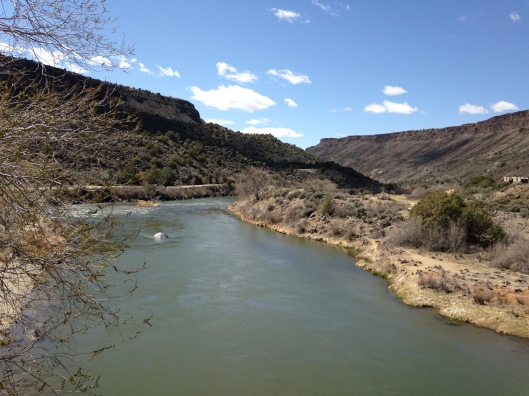
Or a river, such as the Rio Grande, between much of the US and Mexico.

3riogrande.JPG

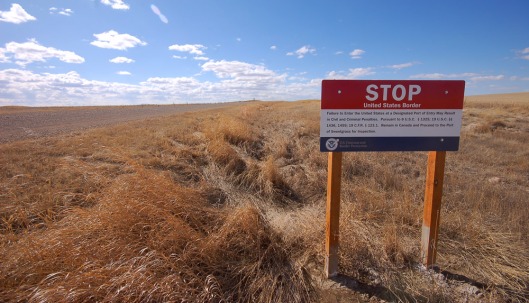
It can be simply a concept, such as much of the border between the US and Canada.

4uscanada.jpg

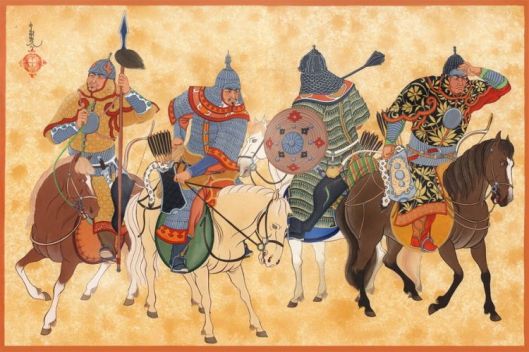
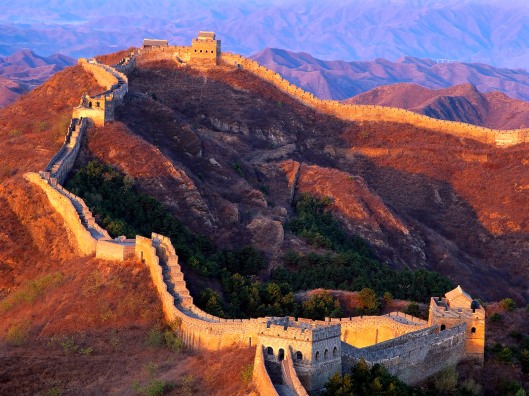
The ancient Chinese marked the border between their world and that of the pastoral nomads to the north

5mongols.jpg

with the Great Wall.

6greatwall.jpg

The Romans set up two walls in Britain, both (in part?—there’s always scholarly argument over such things) to block the northern tribes of Picts from central and southern Britain.

7antonwallcallendar8hadwall9picts

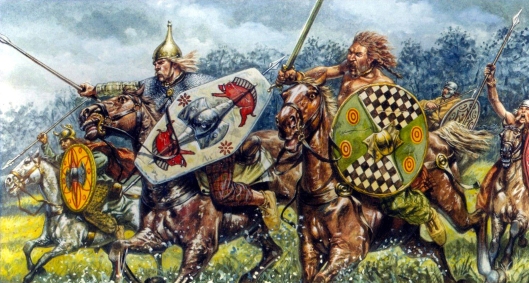
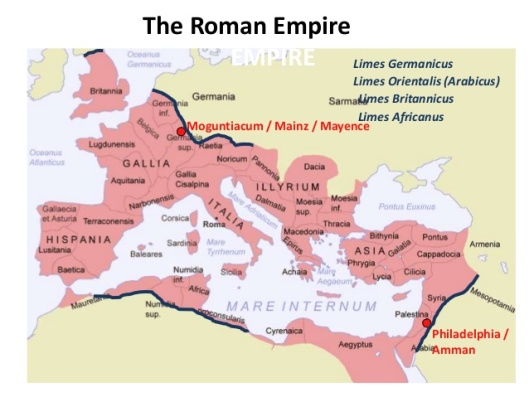
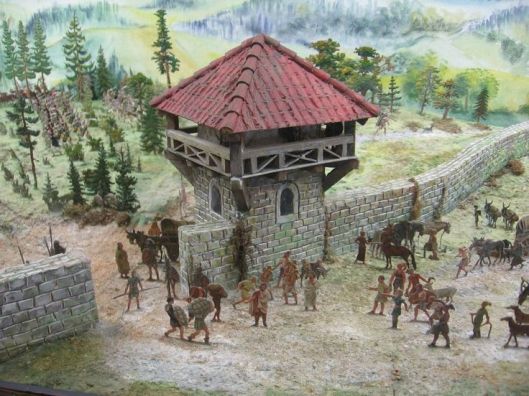
And this was only part of a much bigger defensive system: the Romans also had an extensive network of ditches, walls, watch towers, and forts from the mouth of the Rhine southeast across western Germany and beyond to keep out the Germanic tribes who lived, often, just beyond.

10map11watchtower12fort

In the centuries after the decay of Roman control, the locals in Britain built several ditch and wall barriers, most notably at Offa’s Dyke, which seems to mark a section of the border between England and Wales.

13offasdyke.jpg

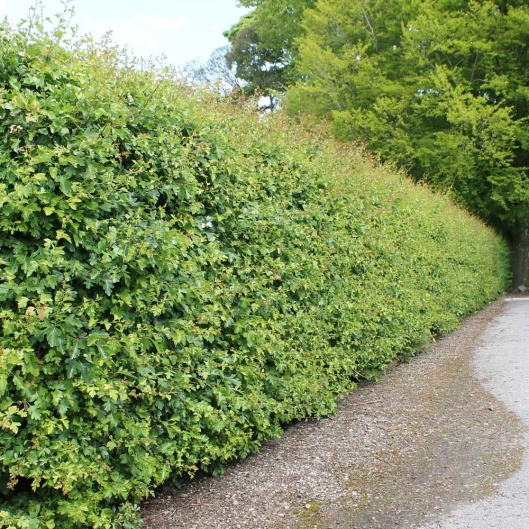
In the case of Tolkien’s marches, however, there are neither walls nor works, except, we suppose, if we include the High Hay, a dense hedge which separates the Old Forest from Buckland:

“Their land was originally unprotected from the East; but on that side they had built a hedge: the High Hay. It had been planted many generations ago, and was now thick and tall, for it was constantly tended. It ran all the way from Brandywine Bridge, in a big loop curving away from the river, to Haysend…well over twenty miles from end to end.” (The Fellowship of the Ring, Book 1, Chapter 5, “A Conspiracy Unmasked”)

So far, we have been unable to discover an illustration of this, but we guess that the Hay may have been a hawthorn hedge, as:

  1. hawthorns—as you might guess—have thorns and can be trained to grow densely
  2. they can grow up to about 50 feet (15 metres) tall

14hawspine15hawhedge

As the old word “hay” means a hedge– as does the “haw” in hawthorn–we offer this to our readers as a possibility.

A hawthorn hedge might keep out marauding beasts, but it’s hardly the equivalent of Hadrian’s Wall or the Great Wall, and the West March doesn’t appear to have any fortification at all, underscoring the nearly-complete defenselessness of the Shire, as well as the generally-peaceable nature of the Hobbits. As JRRT writes in the prologue:

“At no time had Hobbits of any kind been warlike, and they had never fought among themselves…So, though there was some store of weapons in the Shire, these were used mostly as trophies, hanging above hearths or on walls, or gathered into the museum at Michel Delving.”

As a consequence:

“…they heeded less and less the world outside where dark things moved, until they came to think that peace and plenty were the rule in Middle-earth and the right of all sensible folk.”

We shall see in our next posting what happens when some of those “dark things” move—into the Shire.

Thanks, as always, for reading.

MTCIDC

CD

Shire Portrait (3b)

22 Wednesday Feb 2017

Posted by Ollamh in Economics in Middle-earth, Imaginary History, J.R.R. Tolkien, Literary History, Military History, Military History of Middle-earth, Narrative Methods

≈ Leave a comment

Tags

24Hr Trench, Andrew Robertshaw, architecture, Birmingham, Brandywine, crop rotation, Diamond Jubilee, dugouts, Dunedain, feudal system, German lawn chairs, Hornblotton, Inns, Laura Ingalls Wilder, Lavenham, manor, Marish, Medieval, Queen Elizabeth II, Queen Victoria, Sarehole, Sarehole's mill, Somerset, Suffolk, The Hobbit, The Lord of the Rings, The Shire, Tolkien, village, Western Front, WWI Trenches

Welcome, dear readers, as always.

In this post, we’re continuing our series on the Shire. So far, we’ve looked at its government and organization (1), its economy (2), and its geography (3a). Now we want to look at Shire architecture.

Our initial inspiration for this was from a line in a letter from JRRT to Allen & Unwin, 12/12/55. Speaking of the Shire, he says: “It is in fact more or less a Warwickshire village about the period of the Diamond Jubilee… (Letters, 230)

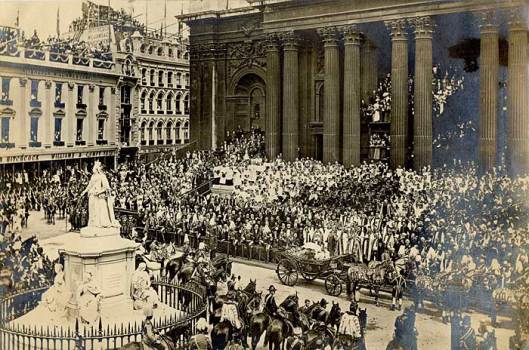
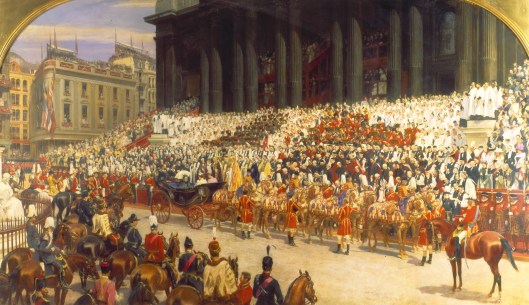
The “Diamond Jubilee” was the 60th anniversary of the reign of Queen Victoria (she came to the throne in 1837–Queen Elizabeth II celebrated her Diamond Jubilee just five years ago).

1vic.jpg

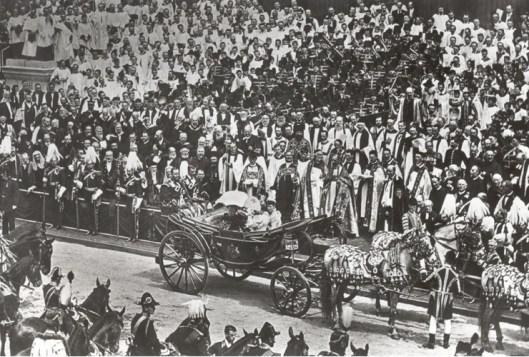
The Jubilee was a huge celebration, bringing in people from all over Britain’s empire, who converged on London in the summer of 1897.

2adiam2bdiam2cdiam

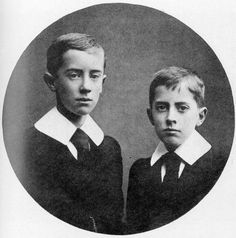
JRRT was born in 1892 and had been brought to England in 1895, for a visit which became permanent when his father died back in South Africa. He and his brother

3atolkandbro.jpg

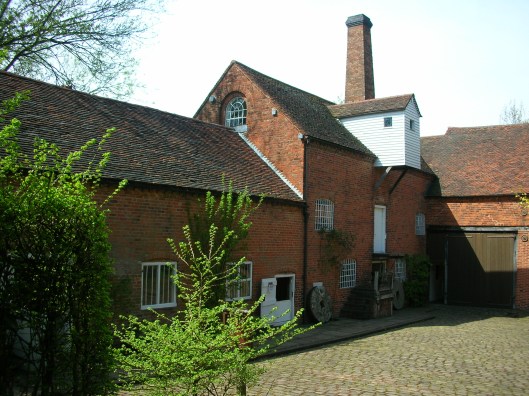
lived with their mother for a time in the village of Sarehole, just south of the huge industrial city of Birmingham. Sarehole’s mill

3sareholemill.jpg

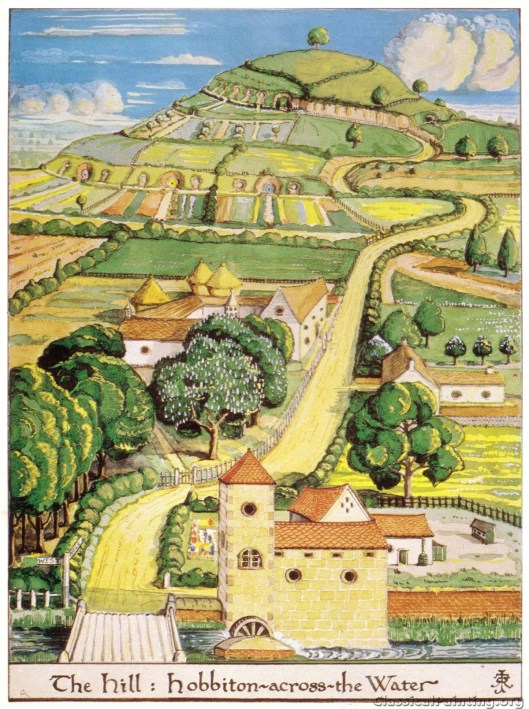
still stands. It has been said that this mill is the model for the one by The Water in The Hobbit, as drawn by JRRT.

4hob.jpg

Thus, when we think about Shire architecture, we can have a double picture:

  1. bits of description in JRRT’s works
  2. actual late Victorian rural villages of the sort in which Tolkien spent part of his childhood

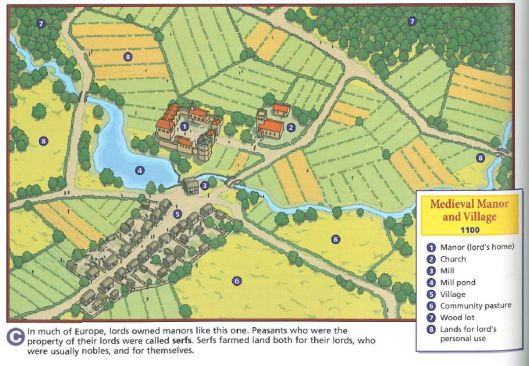
If we begin with historical villages, there isn’t anything to see in the actual Sarehole, except for the mill, which, though built upon the site of a mill which can be dated to 1542, is a building from 1771, just before the industrial revolution, an event with which Tolkien certainly had problems. If we look at other such villages, however, we can get a general picture. Basing our image upon a schematic medieval village plan, we find a double line of houses strung out along a single road.

5medvil.JPG

Spreading back from the houses are the fields, as villages in this world were self-sustaining. You can see these in JRRT’s illustration of the mill and the Hill. You’ll notice that these are in strips. In the feudal world, they illustrated both the use of crop rotation (different plants in different fields, with some fields allowed to rest), plus fields of the lord of the manor, which the tenants were obliged to tend. In Tolkien’s Shire, as there is no feudal system, we presume the stripping is for rotation.

4hob

Missing, however, from Hobbiton, would be two features you can see in the medieval illustration: a manor house and a church.

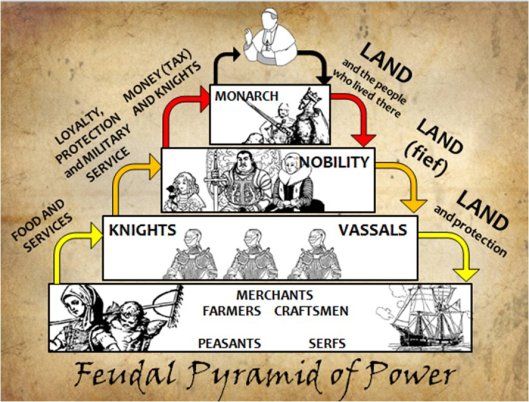
In the feudalism mentioned above, this ideal village is part of the social/governmental system in which it is attached to the smallest unit of that system, the manor.

8feudal.jpg

As the chart explains, in the early medieval world, land was power and kings used their claim to control their lands (supposedly given to them by God) as a way to control the state in general.   They deeded certain sections of land to their nobles, in return for taxes and military service. Those nobles, in turn, deeded out land to lesser nobles, all the way down to individual knights, who might hold no more than one parcel, or manor, with its house, church, and village of freemen (literally, free men, who could own land but paid taxes to the lord for it), peasants (who were also free, but held no land), and serfs (who were landless as well as being the property of the local lord).

Although Tolkien once described the Shire as “granted as a fief” (Letters, 158) and “half republic half aristocracy” (Letters, 241), it is not a feudal property and therefore lacks those marks of that system, those manor houses.

As well, it is also missing churches, or, for that matter, any form of religious shrine. A real English medieval village, depending on its size and wealth, could have had a very modest building, such as this at Hornblotton, in Somerset.

9hornblotton.jpg

Or, if your village had become a prosperous town, like Lavenham, in Suffolk, you could even have a mini-cathedral. (Lavenham’s money had come from the international trade in woolen cloth.)

110lavenham.jpg

Although Tolkien insisted that there was a monotheistic underlay to Middle-earth in the Third Age, he also says of the folk of the Shire: “I do not think Hobbits practiced any form of worship or prayer (unless through exceptional contact with Elves).” (Letters, 193)

Without manors and churches, the Shire consists of private dwellings and inns. Inns seem to be like their parallels in our medieval world.

11medinn.jpg

And, of course, there are the inns of the Shire and the Prancing Pony in Bree.

12prancingpony.jpg

Private houses, including farms, however, fall into two categories: traditional hobbit (that is, built into hillsides) and what we might call outside-influence houses. As Tolkien says in the Prologue to The Lord of the Rings:

“All Hobbits had originally lived in holes in the ground, or so they believed…Actually in the Shire of Bilbo’s days it was, as a rule, only the richest and the poorest Hobbits that maintained the old custom. The poorest went on living in burrows of the most primitive kind…while the well-to-do still constructed more luxurious versions of the simple diggings of old…in the hilly regions and the older villages, such as Hobbiton and Tuckborough, or in the chief township of the Shire, Michel Delving on the White Downs, there were now many houses of wood, brick, or stone…Hobbits had long accustomed to build sheds and workshops…

The habit of building farmhouses and barns was said to have begun among the inhabitants of the Marish down by the Brandywine.

It is probable that the craft of building, as many other crafts beside, was derived from the Dunedain. But the Hobbits may have learned it direct from the Elves… “

Our Tolkien illustration of The Hill

12hob.jpg

shows us both styles. In the background, burrows; in the foreground, outside-influence houses. The traditional style reminds us of something from US western history: the use of “dugouts” as (at least temporary) dwellings as settlers moved west across the plains.

13sodhouse.jpg

As fans of the Laura Ingalls Wilder books will remember, her family lived in one of these along the banks of Plum Creek in the 1870s.

14sod.jpg

15littlehouse.jpg

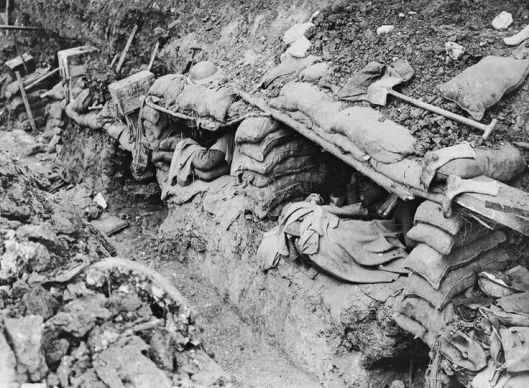
On a more sinister note, we’ve always wondered whether JRRT’s inspiration for hobbit holes may have come from his time on the Western Front, where, from late 1914, soldiers had burrowed into the earth to protect themselves from enemy attack and from the increasingly inclement weather. The shelters could be simply cutouts in the earth

15dugout.jpg

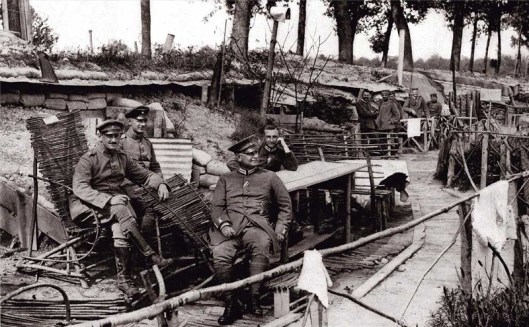
or very elaborate cottages. The Germans were especially admired for their creativity in building the more elaborate ones.

16gmandugout.jpg

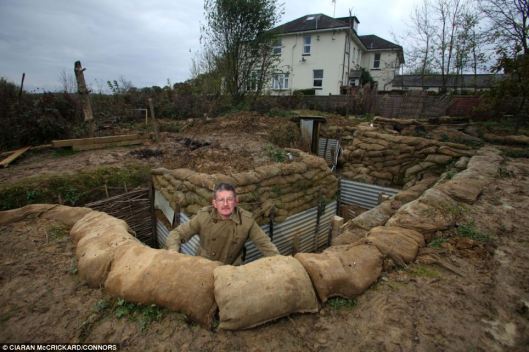
We can’t mention the Great War and trenches without also mentioning the brilliant Andrew Robertshaw, the English military historian, who actually reconstructed sixty feet of a trench line in his backyard.

17androb.jpg

He shares his experience in doing this in his book, 24Hr Trench.

511PnAeovzL._SX342_BO1,204,203,200_.jpg

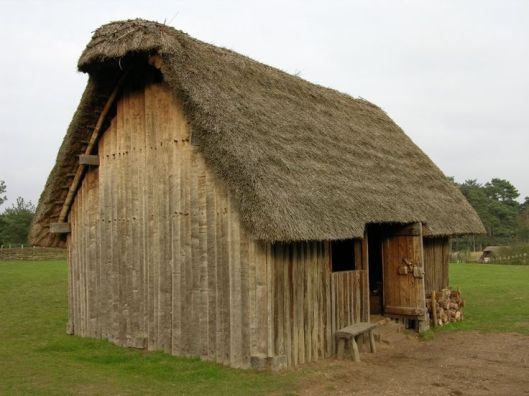
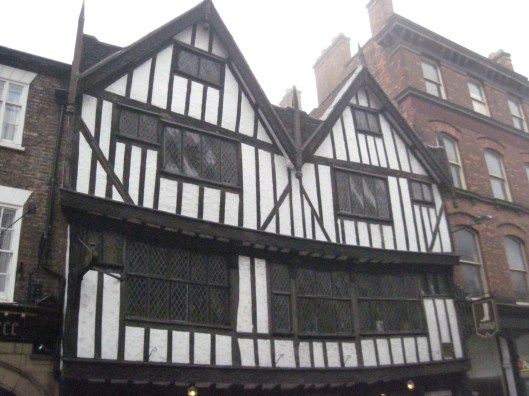
Continuing our medieval parallel, we imagine the outside-influence houses to look something like these:

medhouse1medhouse2

19medhousea.jpg

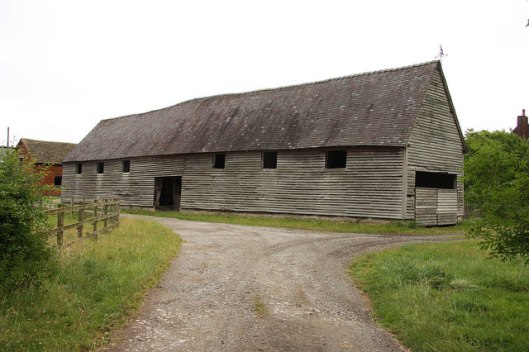
And, for outbuildings, there are a few surviving medieval barns, like this one:

19medbarn.jpg

whose roofs are often held up by the most beautiful woodwork, always reminding us of cathedrals, on the one hand, and sailing ships on the other.

20medbarn.JPG

Imagine that this is what Farmer Cotton’s farm might have looked like.

And, with this image, we conclude this posting. In our next, we’re going to move to the edge of the Shire, to discuss marches—geographical ones, that is.

Thanks, as ever, for reading!

MTCIDC

CD

Shire Portrait (3a)

15 Wednesday Feb 2017

Posted by Ollamh in Economics in Middle-earth, Imaginary History, J.R.R. Tolkien, Literary History, Maps, Narrative Methods

≈ Leave a comment

Tags

Argeleb, Baraduin, Beleriand, Blanco, Bridge of Stonebows, Bronze Age Horse, cable ferry, coins, Dartmoor, Doriath, Dwarves, English South Downs, Fallowhide, Far Downs, Farthings, Fornost Erain, Frodo, Gloucestershire, Government, Great East Road, Green Hill Country, Greenway, Jeremy Brett, Little Delving, Longbottom Leaf, Maps, Marcho, Michel Delving, Middle-earth, Minas Tirith, Misty Mountains, Old Dee Bridge, Oxfordshire, River Baranduin, Roads, Roman Roads, Sherlock Holmes, Sidney Paget, Sir Arthur Conan Doyle, Steven Spielberg, Tharbad, The Hobbit, The Hound of the Baskervilles, The Lord of the Rings, The Shire, Three Farthing Stone, Tobacco, Tolkien, Warwickshire, White Downs, Worcestershire

Welcome, dear readers, to the third installment of our rough portrait of the Shire. We call it a “rough portrait” because, so far, we’ve relied upon only three sources: The Hobbit, The Lord of the Rings, and The Letters of J.R.R. Tolkien. We’ll continue to do so in this installment, but we will add two works of geography, K. W. Fonstad’s The Atlas of Middle-earth and Barbara Strachey’s Journeys of Frodo (although we may take a hint of two from other works).

So far, we’ve discussed the government of the Shire (Shire Portrait 1) and the economy (Shire Portrait 2). In this, we want to move on to the geography of the Shire. We begin with Fonstad’s map.

1mapoftheshire.jpg

Except for Buckland, all of the Shire lies west of the River Baranduin (the “Brandywine”). This river can be broad enough to require a cable ferry

2ferryoncable.jpg

and it is navigable, at least by small boats—after all, it was in such a boat that Frodo’s parents were drowned.

As well, there is the Bridge of Stonebows on the Great East Road. Since it’s wide enough for gates and is reported to have had houses on the far side of it, we might imagine it to look like the Old Dee Bridge, at Chester, in England.

3olddeebridgechester

This bridge dates from Norman times (although there was a bridge there from the days of the Roman occupation—“Chester”, after all, is only a corruption of castra, Latin for “military camp”—founded as Deva Victrix in 79AD), with the present version being more-or-less 14th-century. In the Prologue to The Lord of the Rings, the Bridge of Stonebows is said to have been “built in the days of the power of the North Kingdom”, making us wonder whether the Dwarves, who had cut the Great East Road long before, had only had a ford at that place.

To the west of the river stretches the Shire, most of it to the north and south of the Great East Road, which acts as a kind of spine, there being subsidiary roads leading off it towards the various villages. Originally built by the Dwarves in the First Age, it led from Doriath in Beleriand eastward beyond the Baraduin towards the Misty Mountains. After the destruction of Beleriand, the remaining section ran only from the Grey Havens eastward. When Marcho and Blanco, the Fallowhide brothers, gained permission to colonize the area in TA1601 from Argeleb II, the only payment required was “that they should keep the Great Bridge in repair, and all other bridges and roads, speed the king’s messengers, and acknowledge his lordship”, which would have included the Great East Road.

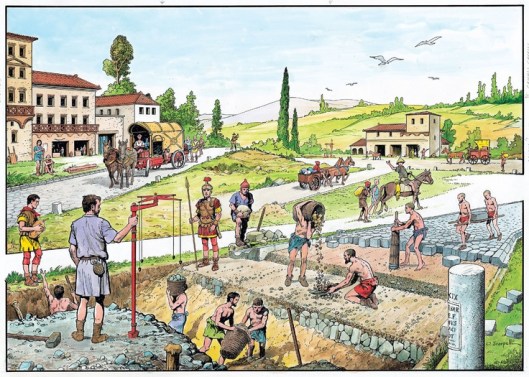
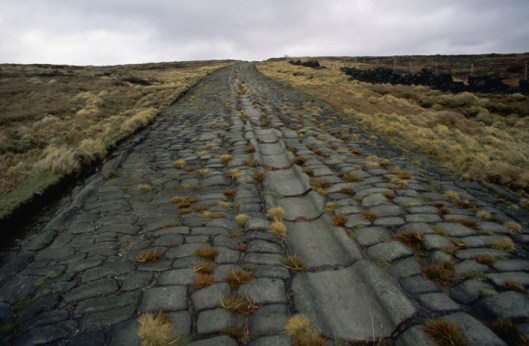
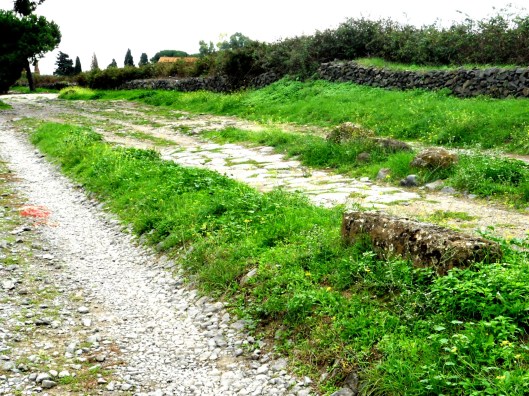
In a previous posting, we talked about the North-South Road (later, the “Greenway”, which once ran from Fornost Erain, in the north, to Minas Tirith, in the south. Because of its ancient importance and places like the causeway and bridge at Tharbad, we imagined it to be like a Roman road—carefully laid out by engineers and paved but, no longer maintained, gone to seed.

4buildingromanroad.jpg

5romanroad.jpg

6overgrownromanroad.JPG

Because of its great age and one-time importance, we’ve always pictured the Great East Road to be similar, especially when it is clear that the kings of Arnor considered its maintenance to be the equivalent of tribute or taxes from the new Shire. Subsidiary roads which split off from the East Road, however, we might see as the usual rutted country roads.

7ruttedroad.jpg

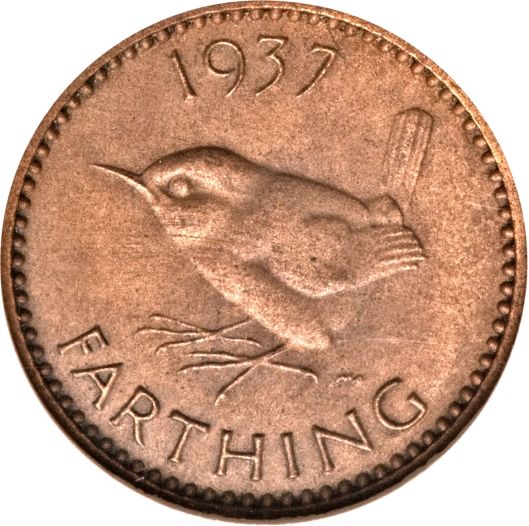
The Shire, besides being bisected by the Great East Road, is also divided into four parts—hence the name “Farthings”—like the pre-decimal English coin, which was a fourth part of a penny (when a penny obviously was worth a lot more!).

8farthingcoin.jpg

We wonder what these divisions were intended to be used for—perhaps for the election of the Mayor? In our previous posting on the government of the Shire, we quoted JRRT as saying in the Prologue to The Lord of the Rings, “The Shire at this time had hardly any ‘government’”, so, for the moment, that’s our best guess.

(We should note here the “Three Farthing Stone”, which marks more or less where the North, East, and South Farthings meet. It has been suggested that it has been based upon the actual English “Four Shires Stone”—

9fourfarthingstone.jpg

which sits at the place where, pre-1931, four shires—Worcestershire, Warwickshire, Oxfordshire, and Gloucestershire — touched. Not only is there a similarity in the names and what the stone may function as, but the Three Farthing Stone is just to the west of Frogmorton, whereas the Four Shire Stone is just east of Moreton-in-Marsh. And is JRRT having a quiet joke in that, after a boundary adjustment in 1931, the Four Shire Stone should really be called the Three Shire Stone?)

Just south of the Great East Road is the Green Hill Country, which appears to be heavily forested.

11gribskov

This is mirrored by a smaller wood north of the road, Bindbole.

Other than these (and, of course, the Old Forest in Buckland), the land seems to be open. To the north are the North Moors. These are windy uplands, mostly grass, with little in the way of trees.

13adartmore

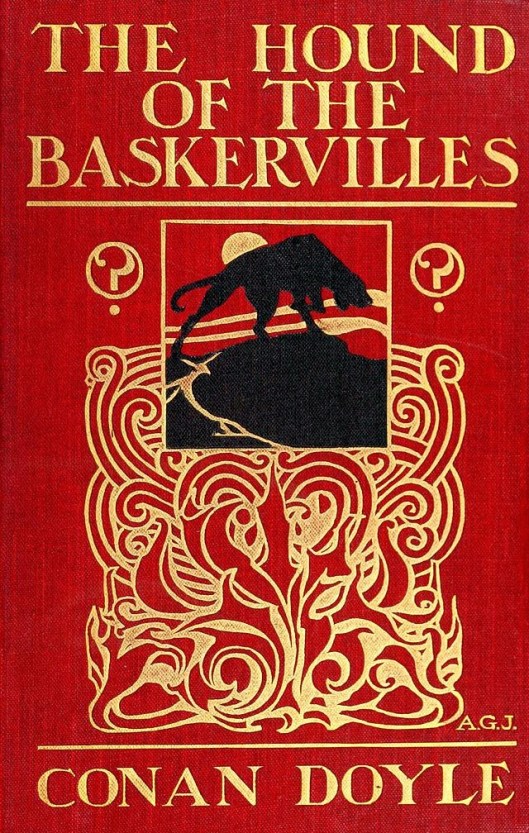
Dartmoor (which is the image above), in southwest England, seems so bare (although it has the fallen remains of earlier cultures on it), that it can seem a little spooky—the perfect setting for Sir Arthur Conan Doyle’s Sherlock Holmes novel The Hound of the Baskervilles (first published in book form in 1902).

13bbaskervilles.jpg

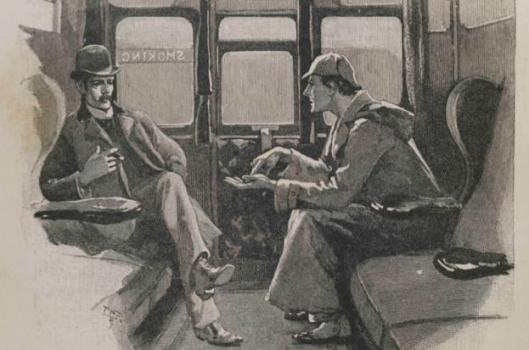
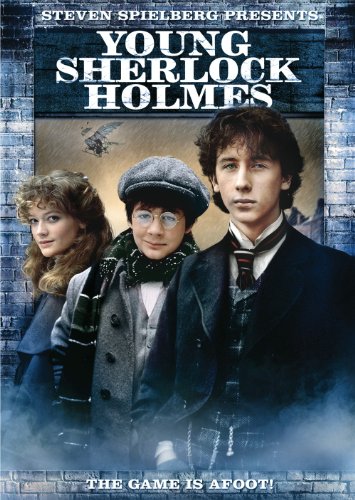
(We love the original Sidney Paget illustrations in The Strand Magazine, but our favorite film version is the one starring Jeremy Brett as Holmes. For pure fun, by the way, we recommend Steven Spielberg’s Young Sherlock Holmes—not for the purist, we hasten to add.)

13cpaget.jpg

13dartmore.jpg

13dbrett.jpg

13eyoungsherlock.jpg

To the west are two lines of downs, the White and the Far (or Fox) Downs. When we think of downs, we think of the chalky rolling hills southeast of the Thames in England. Here’s what the English South Downs look like

14southdowns.jpg

and it’s easy to imagine that the Shire version would look very similar and the chalk would easily be cut into to make Michel Delving (“Big Dig”) and Little Delving (“Little Dig”). The chalk just below the surface is exposed on the south English coast

15chalkcliffs.jpg

making that name “the White Downs” clear. And we can’t resist adding another chalk artifact. In Oxfordshire (but once Berkshire), on the edge of the Berkshire Downs, is a Late Bronze Age horse, cut into the chalk. We wonder why there isn’t one in Rohan…

16uffingtonhorse.jpg

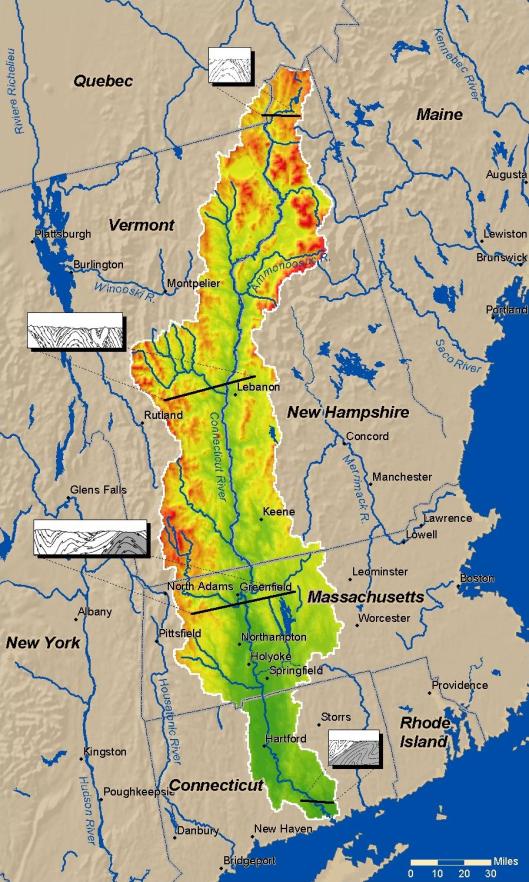
Last of all, there’s the South Farthing, stretching south of The Green Hill Country. As it is a tobacco-growing area, but in a temperate climate (at least, we understand that the Shire is in a temperate zone—they appear to have—or to have had—snowy winters), we visualize it as looking like the Connecticut Valley, which runs south down from Vermont, through western Massachusetts and through central Connecticut, in the US.

17connecticutrvalley.jpg

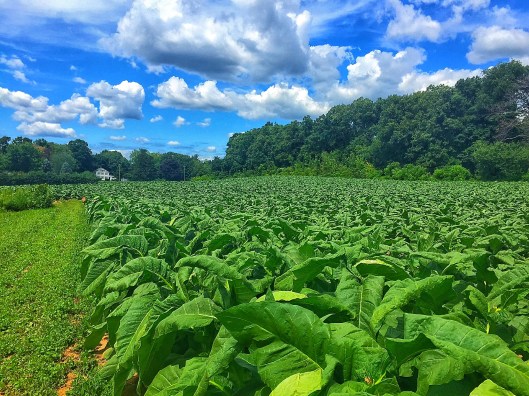
In the central part of the valley are tobacco plantations.

18tobaccofields.jpg

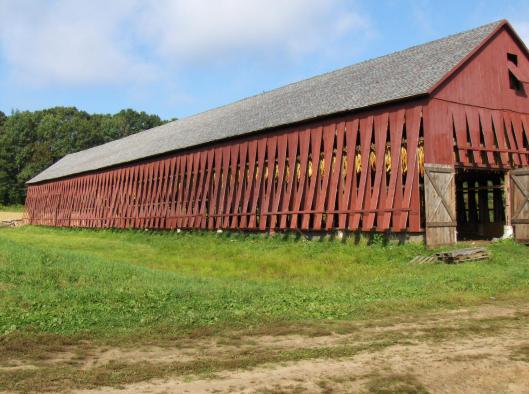
These always include drying barns for the tobacco—which would become the Longbottom Leaf Merry and Pippin discover two casks of in Saruman’s pantry.

19tobaccobarn.jpg

The one farthing we haven’t studied directly is the East Farthing, but, as it contains a continuation of the Green Hill Country, abuts the Brandywine, and has the already-mentioned bridge of Stone Bows, and thus has no main features we haven’t mentioned, we’ll conclude here for the moment. In our next, we want to examine Shire architecture, from hobbit holes to mills.

Thanks, as ever, for reading.

MTCIDC

CD

Shire Portrait (2)

08 Wednesday Feb 2017

Posted by Ollamh in Economics in Middle-earth, Imaginary History, J.R.R. Tolkien, Maps, Narrative Methods

≈ 2 Comments

Tags

An Unexpected Party, Bad End, Baggins, ceramics, clay bank, coal, coins, cork, crafts, cutlery, Dwarves, Esther Forbes, Gondorian money, Hobbits, Isengard, Johnny Tremain, lead, Lloyd Alexander, Longbottom Leaf, Mayor, Michel Delving, mines, Postal Service, pottery, realien, Renaissance, Robert II of Scotland, Saruman, Shirriffs, silica, Silver, Taran Wanderer, Thain, The Green Dragon, The Hobbit, The Lord of the Rings, The Shire, Tolkien

Welcome, dear readers, as always.

In our last post, we began a series responding to the question:   what makes the Shire the Shire?

1theshire

We began with the government, which turned out to be very rudimentary: a Thain (hereditary), a Mayor (elected), a postal service (not known how chosen), Shirriffs (a kind of border patrol—volunteer). Since the Thain and Mayor were principally honorary positions, there was perhaps no salary attached. As for the postal service (called “Messengers”) and the Shirriffs, we presume that there must have been some sort of payment, although we are not told so. Since, in our world, we pay for the police and the post office through taxes, we wondered how the same services in the Shire were paid. This led us to the question of the Shire economy in general.

In a letter of 25 September, 1954, JRRT wrote to Naomi Mitchison:

“I am more conscious of my sketchiness in the archaeology and realien [“physical facts/things of real life”] than in the economics: clothes, agricultural implements, metal-working, pottery, architecture and the like…I am not incapable of or unaware of economic thought; and I think as far as the ‘mortals’ go, Men, Hobbits, and Dwarfs, that the situations are so devised that economic likelihood is there and could be worked out…” (Letters, 196)

The Shire would appear to be an agriculturally-based economy:

“The Shire is placed in a water and mountain situation and a distance from the sea and a latitude that would give it a natural fertility, quite apart from the stated fact that it was a well-tended region when they [hobbits] took it over.” (Letters, 196)

He adds to this that, when the hobbits took control of the Shire, that included “a good deal of older arts and crafts”, suggesting that the solution to the problem of the production of “clothes, agricultural implements, metal-working, pottery”—all the Realien, as he calls them, is assumed. How and from whom such things were taken over is not explained and such production, in any community, is not a small matter: “things of real life” are many and complicated.

Consider, for example, just one moment at Bag End. The Baggins appear to have been well-to-do, even without the treasure Bilbo brought back from his trip. His house is extremely well-furnished and the Baggins certainly don’t want for provisions, as we know from descriptions both in The Hobbit and The Lord of the Rings, as well as Realien, as the Dwarves’ clean-up song reminds us:

Chip the glasses and crack the plates!

Blunt the knives and bend the forks!

That’s what Bilbo Baggins hates—

Smash the bottles and burn the corks!

(The Hobbit, Chapter 1, “An Unexpected Party”)

1bilbodwarves.jpg

If we take this line by line, we come up with the following: glasses, plates, knives, forks, bottles, corks.

Glasses and bottles (as well as the window panes at Bag End) require a glassblower and perhaps a glazier.

2latemedglass.jpg

Plates require a potter.

3potter.JPG

Knives and forks were once made by cutlers (and forks are very advanced for a Middle-earth which is mostly medieval—although classical people used them in food preparation, it was only during the Renaissance that they began to appear as an eating utensil—western Medieval people ate with knives, spoons, and fingers).

4feast.jpg

5renfork.jpg

(And next is a Renaissance fork, found in the foundations of the Rose Theatre)

Corks come from vintners and brewers (in our world, vintners only began using cork as a sealant in the 17th century, we have read).

6awinebottles.jpg

Take those objects a step farther back and you find:

  1. glasswear, bottles, and window panes require silica and something to make it more stable, like lime (from limestone) or lead, which leads us to the question of where the ingredients come from. Silica is sand and can be found in many places—perhaps it might come from the west coast of Middle-earth? If all of the Shire is like the White Downs, where Michel Delving is located, it may be situated upon a vast deposit of chalk (more about Shire geography in our next posting). Lime would then have to be imported. As we have no record of mines in the Shire, the same would be true for lead.

6medievalglass.jpeg

7silica.jpg

8chalk.jpg

9limestone.jpg

10leadmine.jpg

  1. ceramics, like plates, are made of clay and all sorts of clay are used to make pottery, but all need to be dug out, usually from beds found near streams, rivers, or places like canyons or ravines. The Shire seems fairly well-watered, so we presume that the clay used to make Bilbo’s dishes was local.

11claybank.jpg

  1. knives and forks would be made of iron, early steel, or silver (with silver, plus an alloy to make them stronger)—here, again, we would need mines, for the iron ore and silver

12ironmine.jpg

  1. cork in our world is actually tree bark from the cork trees which grow in hot, dry southwest Europe (Spain/Portugal) and northwest Africa

13corkharvest.jpg

1, 2, 4 (and possibly 3) require raw materials of which no mention is made in the Shire and 1, 2, and 3 all need especially hot fires to make them, possibly using charcoal (made locally?) or coal (again, no mines discussed). And this is just, basically, four items.

14coalmine.jpg

So many import possibilities: what about export? We have solid evidence for one, which Merry and Pippin have discovered at Isengard:

“My dear Gimli, it is Longbottom Leaf! There were the Hornblower brandmarks on the barrels, as plain as plain. How it came here, I can’t imagine. For Saruman’s private use, I fancy. I never knew that it went so far abroad.” (The Two Towers, Book 3, Chapter 9, “Flotsam and Jetsam”)

It should always be remembered that these are works of fantasy, of course, and, unless there is some novelistic purpose which employs a potter as a character (in Taran Wanderer,15taranwanderer.JPG

by Lloyd Alexander, book 4 of The Chronicles of Prydain, for example, the hero, Taran, spends a little time as an apprentice potter, among other trades) or the making of silverware (something one might read about in Esther Forbes’ Johnny Tremain,16johnnytremain.jpg

where Johnny is an apprentice to a silversmith), it would seem completely unnecessary to spend narrative time discussing raw materials, imports, exports, or the manufacture of day-to-day items. We have taken the time, however, because, where, sometimes, we write about the parallels between Middle-earth and something here in our world, here the complexity of ordinary things in our world is completely forgotten in Middle-earth, or simply taken for granted, as JRRT implies in the letter cited above. If we are to examine Shire economics, however, we must, at least, consider them. As well, although we may keep saying, “No evidence for”, we think that, even if there is no potter or tin mine in the text, prompting readers to remember that, in the real world, there would have been one is a useful exercise and, for us, at least, makes the story that much more real.

But now we come to the subject of paying for Realien, or for anything else in the Shire, be it for the Shirriffs or for a pint at The Green Dragon.

In a totally rural economy many things might be obtained through barter: in return, for payment, please take 10 chickens, or a sack of grain. (And perhaps we see something like this in “The Scouring of the Shire”, when Hob Hayward tells Merry that, “We grows a lot of food, but we don’t rightly know what becomes of it. It’s all these ‘gatherers’ and ‘sharers’, I reckon, going round counting and measuring and taking off to storage.”—this looks like taxes, “paid in kind”).  Such might work for, say, trading a hen for a bowl, but would certainly not do for that pint—or for the bill at The Prancing Pony. Coins and their values are not mentioned in Tolkien, but their effect is felt, all the same: when Frodo buys a house in Crickhollow, we doubt he does it with cows!

17aeastfarthingmap.png

(We discussed Middle-earth money in an earlier posting and it seems to us that it would be fun to create, say, Gondorian money—here’s one possibility

17robert21316-1390.jpg

It’s actually a coin of Robert II of Scotland—1316-1390—but, changing the crown, could you imagine this as something issued earlier in the Third Age, say?)

This has been perhaps a rather long-winded and prosy posting (perhaps not for nothing did Thomas Carlyle, in 1849, call economics “the dismal science”?), for which we ask our readers’ pardon, but, if it helps to flesh out our portrait of the Shire, it was worth it, we feel. Our next, we hope will be a bit lighter, being on the physical “look” of the Shire, from its geography to its geology to its architecture.

Thanks, as ever, for reading.

MTCIDC

CD

Shire Portrait (I)

01 Wednesday Feb 2017

Posted by Ollamh in Economics in Middle-earth, J.R.R. Tolkien, Literary History, Maps, Military History, Military History of Middle-earth, Narrative Methods

≈ 1 Comment

Tags

British Museum, culture, elections, farthing, feudalism, Government, Hobbitry-in-arms, Hobbits, Louvre, Maps, Mathom-house, Mayor, Michel Delving, Middle-earth, museums, police, Postmen, Sharkey, Shire, Shire-moot, Shire-muster, Shirriffs, Thain, The Hobbit, The Lord of the Rings, The Scouring of the Shire, thegn, Tolkien, vassal, Vatican, voting, White Downs, Witch-King of Angmar

Welcome, dear readers, as always.

In our last post (well, next-to-last–the last was on circuses), we talked about museums and Mathom-houses and, thinking that the Shire had a museum, made us wonder about what we might call “Shire culture” in general. What is it which makes the Shire the Shire?

1theshire.jpg

To go about answering that, we tried to think of a model. Could we imagine ourselves doing a tourist brochure? A wiki article? And where would we begin?

Suppose, we thought, we begin with the outermost shell, rather as in our world: the government.

The first ten pages of the Prologue to The Lord of the Rings contain a good deal of information about hobbits and their homeland, with many other details to be gleaned from the main body of the text and the appendices and some from The Hobbit. There is undoubtedly more yet to be found in several of the subsidiary volumes, but we decided that, to make this a series of readable posts and not a small encyclopedia, we would stick to the two main works.

With all of that material to help us, all we needed was an entry point—and, almost immediately, we decided that we could begin where we left off, with that very museum, which originally attracted us because it stood out as something one would expect from a much more organized state, rather than from what, on the whole, appears to be such a rural and decentralized place.

After all, museums, as we have discussed, are a relatively recent invention in the west and public museums are even newer (the first state-sponsored museum in Britain, for example, only dates from the 1750s). Since our last posting, we’ve done a bit more research and, with one or two possible exceptions, it seems that public museums only begin to appear at all from the second half of the 17th century. (A quick and useful reference may be found at: https://museu.ms) Even so, such places have a good deal to say about a culture:

  1. that it values elements of its past, both historical and artistic, enough that it is willing to collect and preserve them
  2. that it believes that such elements should then be put upon public display (the why of that might include: to use for educational purposes—which assumes that the past has things to teach the present; to provide aesthetic pleasure; even to show the wealth and power of a state which has such a history and such artists)
  3. that it is willing to provide space, at the public expense, to house and display such things

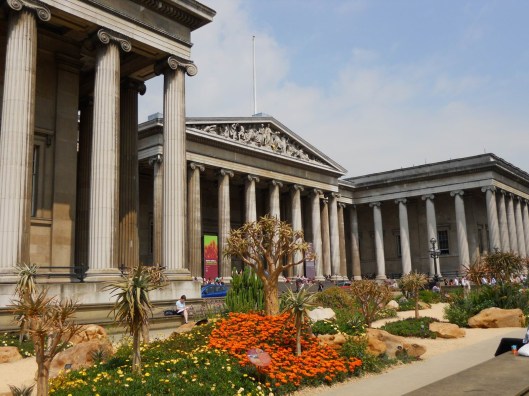
The Mathom-house is hardly, from JRRT’s description, the equivalent of the British Museum

1bm.jpg

or the Louvre

2louvre.jpg

or the Vatican

3vatican.jpg

or any of the other thousand wonderful museums around the world, big or small. And yet it is there and in the closest thing to a capital which the Shire has to offer, Michel Delving. It is only the closest thing because the Shire has almost no formal governing structure.

As the Prologue says:

“The Shire at this time had hardly any ‘government’. Families for the most part managed their own affairs…”

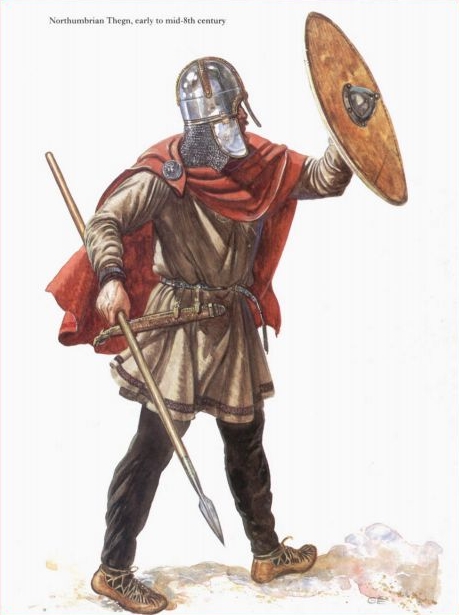
Originally, as the Prologue tells us, the Hobbits had moved into the land which would become the Shire with the permission of the high king of the North Kingdom, at Fornost. When the last king and his kingdom had fallen to the Witch King of Angmar, the Hobbits replaced him with a “Thain” (actually an Old English word for, among other things, a “vassal”—that is, one who acts as a subordinate—in a feudal system, this might imply that the person has received land from someone higher on the social scale in return for taxes and/or military service).  Here’s a thegn (Old English spelling) as a warrior.

5thegn.JPG

By the time of The Hobbit, this office had dwindled, but not quite disappeared:

“The Thain was the master of the Shire-moot, and captain of the Shire-muster and the Hobbitry-in-arms, but as muster and moot were only held in times of emergency, which no longer occurred, the Thainship had ceased to be more than a nominal dignity.”

In fact,

“The only real official in the Shire at this date was the Mayor of Michel Delving (or of the Shire), who was elected every seven years at the Free Fair on the White Downs at the Lithe, that is at Mid-summer. As mayor almost his only duty was to preside at banquets, given on the Shire-holidays, which occurred at frequent intervals. But the offices of Postmaster and First Shirriff were attached to the mayoralty, so that he managed both the Messenger Service and the Watch. These were the only Shire-services, and the Messengers were the most numerous, and much the busier of the two. By no means all Hobbits were lettered, but those who were wrote constantly to all their friends (and a selection of their relations) who lived further off than an afternoon’s walk.

The Shirriffs was the name that the Hobbits gave to their police, or the nearest equivalent that they possessed…they were in practice rather haywards than policemen, more concerned with the strayings of beasts than of people. There were in all the Shire only twelve of them, three in each Farthing, for Inside Work. A rather large body, varying at need, was employed to ‘beat the bounds’, and to see that Outsiders of any kind, great or small, did not make themselves a nuisance.”

This gives us the whole of the top level of Shire culture, the public face: a vestigial Thain (representative of the long-gone King), a figurehead Mayor, a postal service, and a tiny police force/border guard.

And how does any of these hold office?

The Thain, as we know, is hereditary.

The Mayor is, as quoted above, elected—although we have no idea of the process. Does one vote by town? By Farthing? Or is there simply a kind of country-wide method? We also have no idea of suffrage: who has the vote in the Shire? Is it general (England had general suffrage by the time JRRT was writing The Hobbit, all men over 21 by 1918, some women—householders over the age of 30—having been included in elections in 1918, women in general over 21 in 1928)? Or is it the older “only property-holders” method? Or are there “hereditary electors” who do the choosing? (As CD have just gone through an election here in the US, all of these questions, as you can imagine, are fresh in our minds!)

The “postmen” (our word) are, so far as we can tell, a mystery, both as to who they are or how they gain their employment.

Shirriffs appear to be volunteers, as we learn in “The Scouring of the Shire”, when Sam talks to Robin Smallburrow, who says “You know how I went for a Shirriff seven years ago, before any of this began.”

There being so little in the way of government, are there any public buildings except for the Mathom-house? If there are, we have yet to locate them. It’s striking that, when “Sharkey” takes over the Shire, he sets up a number of such places, but neither government buildings nor museums, instead, they are tokens of a police state: barracks and watch houses, dens reminding us of something which JRRT would have seen all too much of in newspapers and magazines, as well as newsreels as he worked on the early stages of The Lord of Rings:

4asentrybox.jpg

4schutzpo.jpg

(More on Sharkey and the takeover in a future posting!)

Considering that there is a small policing force, as well as a kind of postal institution, we looked for another government department: the Internal Revenue Service. After all, we pay for our police and used to pay for postage stamps, back in pre-internet days, and we pay for public museums, too: how does it work in the Shire? The simple answer is, we don’t know. In fact, we don’t really know much about how the economy works in general. And that will be the subject of our next posting.

Thanks, as always, for reading!

MTCIDC

CD
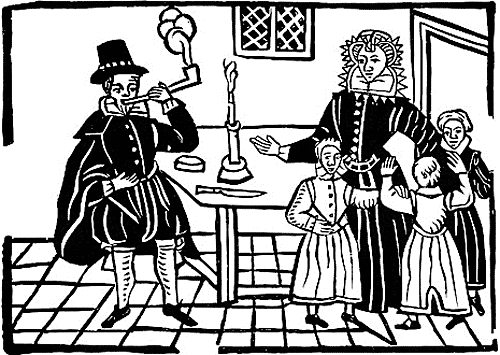
Killer Monks (and Friars)

11 Wednesday Jan 2017

Posted by Ollamh in Artists and Illustrators, Fairy Tales and Myths, Heroes, Literary History, Narrative Methods

≈ Leave a comment

Tags

Baze Malbus, Bo staff, Canterbury Tales, Chirrut Imwe, Cluny, Dauntless, Friar Tuck, Friars, Geoffery Chaucer, Guardians of the Whills, Howard Pyle, Jahng Bong, Jedha, Little John, monastery, monks, N.C. Wyeth, Nijedha, quarter-staff, religion, Robin Hood, Rogue One, Scarif, Star Destroyer, Star Wars, stormtroopers, Tae Kwon-Do, Temple of the Kyber, the Force, The Force Awakens, The Merry Adventures of Robin Hood, Thomas Hughes, Tom Brown's Schooldays

Welcome, dear readers, as always.

Today, for the first time in some time, we are not visiting Middle-earth. Instead, we are visiting our earth, as well as another planet or two.

Recently, we saw Rogue One,

1rogueoneposter.jpg

which, in our opinion, was a bit more coherent than The Force Awakens, but which still—again, our opinion—like Force, had too many players and too many planets. For us, this has always been the danger of fantasy fiction, when plot overwhelms character, as—and aren’t we opinionated in this posting?—in the Harry Potter series.

2hp1.jpg

The first volume was a pleasant twist on the traditional school story, a genre which dates at least as far back as Tom Brown’s Schooldays (1857).

3tbsschooldays.png

by Thomas Hughes.

4thughes.jpg

We thought that that first book had a number of potentially interesting characters—Hermione, the Weasley twins, Snape, Hagrid—but, as the books piled up and the plot became more complex and more and more characters appeared, there was less and less, it seemed to us, of those interesting original figures. And many of the characters who were there, seemed much sketchier.

In the case of Rogue One, we thought that two of the most interesting were the two Guardians of the Whills, rather like monks

5romonks.jpg

Chirrut Imwe

6chirrut.jpg

and Baze Malbus.

7baze.jpg

These two had been attached to the Temple of the Kyber in the city of Nijedha on the desert moon Jedha.

8jedha.jpg

The Empire has arrived, however (hard to miss the Star Destroyer Dauntless in this picture, isn’t it?), to seize all of the kyber crystals on Jedha (used originally to power Jedi light sabers) to fuel the superlaser on the new terror weapon, the Death Star.

9deathstar.jpg

In the process, the two monks have been driven from the Temple, which has been pillaged, and now appear to be living on the street. Chirrut believes in the Force, while Baze seems to believe in his very large gun. Chirrut, who is blind, first shows his skills in an amazing scene where, surrounded by stormtroopers, he makes short work of them with his fighting staff, which resembles the Jahng Bong or Bo Staff used in Tae Kwon-do, among other Eastern weapons and martial arts.

10chirrutstorm.jpg

As everyone who has seen Rogue One (and, by now, many who haven’t, we’d guess) knows, the two don’t survive the attack on Scarif

11bazechirrut.jpg

and this made us wish we had seen more of them, not only in this movie (perhaps them ejected from the Temple—which wouldn’t have been easy!), but in another Star Wars story, in which they were the main characters. So many questions: how did they meet? Why does the one believe so fervently in the Force and the other does not? What did they do before Nijedha? Were they always monks? If not, how did they become so? How and where did they train?

Seeing fighting with that Bo Staff immediately prompted us to think of much earlier figures with a similar weapon: Robin Hood, who fights, on a log over a stream, his soon-to-be-lieutenant, Little John, with quarter-staves.

12roblj.jpg

This is an illustration by N.C. Wyeth from the 1917 Robin Hood,

13robinhood1917.jpg

but there is an earlier edition of the stories of Robin Hood by Wyeth’s teacher, Howard Pyle, The Merry Adventures of Robin Hood (1883).

14pylemerryadventures.jpg

And here is a version of the aftermath of that scene on the log with Little John.

15pylerhlj.jpg

Robin has another encounter with water and a fighter when he meets a friar beside a stream. A monk is a man who enters a religious community called a monastery and spends his life working (and praying) within its walls.

16amonks.jpg

Western medieval Europe was full of monasteries, like this, at Cluny, in France.

17cluny.jpg

Friars, on the other hand, traveled within their appointed district, called a “province”. Here is a friar from an early (beginning of the 15th century) illustrated version of Geoffrey Chaucer’s Canterbury Tales.

18friar.jpg

Because friars were much less strictly governed, they gained a folk reputation as tricksters and high-livers, and the trickster shows through when Robin Hood forces a friar (he will become Robin’s friend, Friar Tuck) to carry him across a stream—and the friar dumps him before proving that he’s also an expert swordsman. Here’s an illustration from the 1883 Pyle version.

19pyletuck.jpg

As we thought about it, by combining Little John’s skill with the quarterstaff with Friar Tuck’s wits and courage and holy orders, we could see a possible inspiration for Chirrut Imwe.

20chirrut.png

If you know the old Robin Hood stories and you’re seen Rogue One, what do you think?

Thanks, as ever, for reading.

MTCIDC

CD

← Older posts
Newer posts →

The Doubtful Sea Series Facebook Page

The Doubtful Sea Series Facebook Page

  • Ollamh

Categories

  • Artists and Illustrators
  • Economics in Middle-earth
  • Fairy Tales and Myths
  • Films and Music
  • Games
  • Heroes
  • Imaginary History
  • J.R.R. Tolkien
  • Language
  • Literary History
  • Maps
  • Medieval Russia
  • Military History
  • Military History of Middle-earth
  • Narnia
  • Narrative Methods
  • Poetry
  • Research
  • Star Wars
  • Terra Australis
  • The Rohirrim
  • Theatre and Performance
  • Tolkien
  • Uncategorized
  • Villains
  • Writing as Collaborators
Follow doubtfulsea on WordPress.com

Across the Doubtful Sea

Recent Postings

  • Through a glass… January 7, 2026
  • Heffalumps? December 31, 2025
  • We Three Kings December 24, 2025
  • A Moon disfigured December 17, 2025
  • On the Roads Again—Once More December 10, 2025
  • (Not) Crossing Bridges December 3, 2025
  • On the Road(s) Again—Again November 26, 2025
  • On the Road(s) Again November 19, 2025
  • To Bree (Part 2) November 12, 2025

Blog Statistics

  • 104,459 Views

Posting Archive

  • January 2026 (1)
  • December 2025 (5)
  • November 2025 (4)
  • October 2025 (5)
  • September 2025 (4)
  • August 2025 (4)
  • July 2025 (5)
  • June 2025 (4)
  • May 2025 (4)
  • April 2025 (5)
  • March 2025 (4)
  • February 2025 (4)
  • January 2025 (5)
  • December 2024 (4)
  • November 2024 (4)
  • October 2024 (5)
  • September 2024 (4)
  • August 2024 (4)
  • July 2024 (5)
  • June 2024 (4)
  • May 2024 (5)
  • April 2024 (4)
  • March 2024 (4)
  • February 2024 (4)
  • January 2024 (5)
  • December 2023 (4)
  • November 2023 (5)
  • October 2023 (4)
  • September 2023 (4)
  • August 2023 (5)
  • July 2023 (4)
  • June 2023 (4)
  • May 2023 (5)
  • April 2023 (4)
  • March 2023 (5)
  • February 2023 (4)
  • January 2023 (4)
  • December 2022 (4)
  • November 2022 (5)
  • October 2022 (4)
  • September 2022 (4)
  • August 2022 (5)
  • July 2022 (4)
  • June 2022 (5)
  • May 2022 (4)
  • April 2022 (4)
  • March 2022 (5)
  • February 2022 (4)
  • January 2022 (4)
  • December 2021 (5)
  • November 2021 (4)
  • October 2021 (4)
  • September 2021 (5)
  • August 2021 (4)
  • July 2021 (4)
  • June 2021 (5)
  • May 2021 (4)
  • April 2021 (4)
  • March 2021 (5)
  • February 2021 (4)
  • January 2021 (4)
  • December 2020 (5)
  • November 2020 (4)
  • October 2020 (4)
  • September 2020 (5)
  • August 2020 (4)
  • July 2020 (5)
  • June 2020 (4)
  • May 2020 (4)
  • April 2020 (5)
  • March 2020 (4)
  • February 2020 (4)
  • January 2020 (6)
  • December 2019 (4)
  • November 2019 (4)
  • October 2019 (5)
  • September 2019 (4)
  • August 2019 (4)
  • July 2019 (5)
  • June 2019 (4)
  • May 2019 (5)
  • April 2019 (4)
  • March 2019 (4)
  • February 2019 (4)
  • January 2019 (5)
  • December 2018 (4)
  • November 2018 (4)
  • October 2018 (5)
  • September 2018 (4)
  • August 2018 (5)
  • July 2018 (4)
  • June 2018 (4)
  • May 2018 (5)
  • April 2018 (4)
  • March 2018 (4)
  • February 2018 (4)
  • January 2018 (5)
  • December 2017 (4)
  • November 2017 (4)
  • October 2017 (4)
  • September 2017 (4)
  • August 2017 (5)
  • July 2017 (4)
  • June 2017 (4)
  • May 2017 (5)
  • April 2017 (4)
  • March 2017 (5)
  • February 2017 (4)
  • January 2017 (4)
  • December 2016 (4)
  • November 2016 (5)
  • October 2016 (6)
  • September 2016 (5)
  • August 2016 (5)
  • July 2016 (5)
  • June 2016 (5)
  • May 2016 (4)
  • April 2016 (4)
  • March 2016 (5)
  • February 2016 (4)
  • January 2016 (4)
  • December 2015 (5)
  • November 2015 (5)
  • October 2015 (4)
  • September 2015 (5)
  • August 2015 (4)
  • July 2015 (5)
  • June 2015 (5)
  • May 2015 (4)
  • April 2015 (3)
  • March 2015 (4)
  • February 2015 (4)
  • January 2015 (4)
  • December 2014 (5)
  • November 2014 (4)
  • October 2014 (6)
  • September 2014 (1)

Blog at WordPress.com.

  • Subscribe Subscribed
    • doubtfulsea
    • Join 78 other subscribers
    • Already have a WordPress.com account? Log in now.
    • doubtfulsea
    • Subscribe Subscribed
    • Sign up
    • Log in
    • Report this content
    • View site in Reader
    • Manage subscriptions
    • Collapse this bar
 

Loading Comments...