• About

doubtfulsea

~ adventure fantasy

Tag Archives: Tolkien

Terrifyingly Funny? (Part 1)

13 Wednesday Jul 2016

Posted by Ollamh in Artists and Illustrators, Fairy Tales and Myths, Imaginary History, J.R.R. Tolkien, Language, Literary History, Narrative Methods, Villains

≈ 2 Comments

Tags

Adventure, Among Gnomes and Trolls, Bilbo, comic, Gandalf, Gollum, humor, John Bauer, Middle-earth, Pēro & Pōdex, Roast Mutton, Stone Trolls, The Hobbit, The Lord of the Rings, Through the Looking-Glass, Tolkien, Tommies, trolls, Victorian Drawing Room

Dear Readers, welcome, as always.

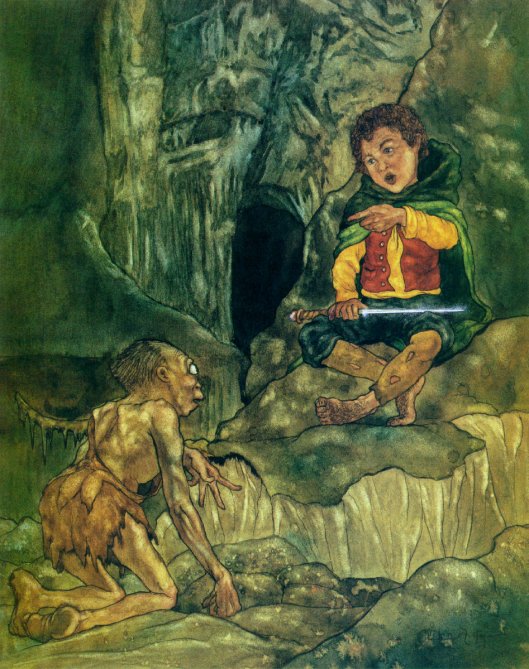
This is going to be a two-part posting because– well, it began as one thing, and then became another. We were thinking about Gollum, not as the grim and tormented figure we know from The Lord of the Rings, but rather as the muttering, riddling cave-dweller of The Hobbit. We were wondering if we could see Gollum not only as menacing, but as comic, as well.

Gollum_Render.png

Then, however, we began to think about other such figures, and one of us said to the other, “What about the trolls in The Hobbit?”. The other replied, “we see them before we see Gollum. Maybe we should start with them.”

And so we shall.

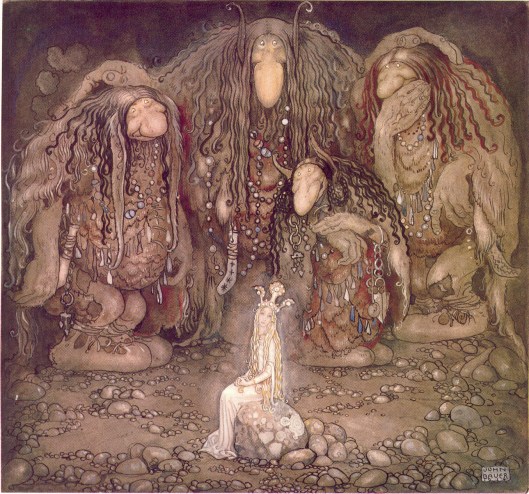
It’s clear where Tolkien got his trolls– they’re all over the fairy tales he had been reading since childhood, and they form a component of the traditional Scandinavian literature in which he had been interested for nearly as long. They are commonly large, and not terrifically bright, and often possess an anxiety about daylight. One of our favorite illustrators of such creatures is John Bauer (1882-1918), who, among other works, contributed illustrations to an ongoing series of volumes appropriately titled Among Gnomes and Trolls. Here, for example, is one of his depictions of the latter.

John_Bauer_1915.jpg

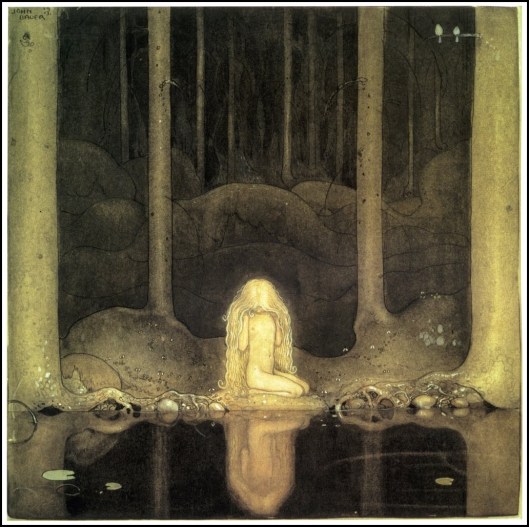
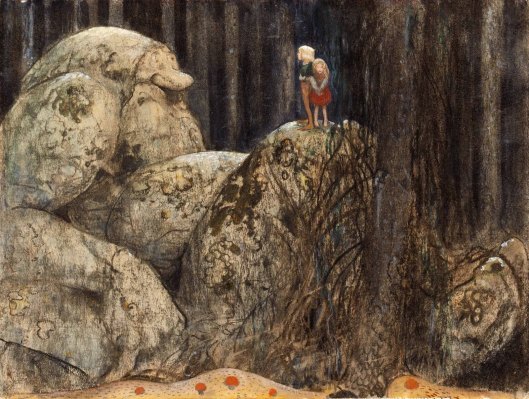
And, because we can’t resist– can we ever? Here are a couple more illustrations by Bauer.

bauer5.jpgJohn_Bauer07.jpg

Even before The Hobbit, however, Tolkien had produced a literary troll. In 1926, he wrote the first version of a poem to be sung to the folk song “The Fox Went Out”, called “Pēro & Pōdex”(“Boot and Bottom”). It survives  in a later version in chapter 12 of Book 1 of The Lord of the Rings, beginning “Troll sat alone on his seat of stone”.

In The Hobbit, the trolls are grouped around a fire, drinking and eating and immediately recognizable:

“But they were trolls.  Obviously trolls.  Even Bilbo, in spite of his sheltered life, could see that:  from the great heavy faces of them, and their size, and the shape of their legs, not to mention their language, which was not drawing-room fashion at all, at all.”  (The Hobbit, Chapter 2, “Roast Mutton”)

tumblr_m6wyygQDLc1ru50yro1_1280.jpg

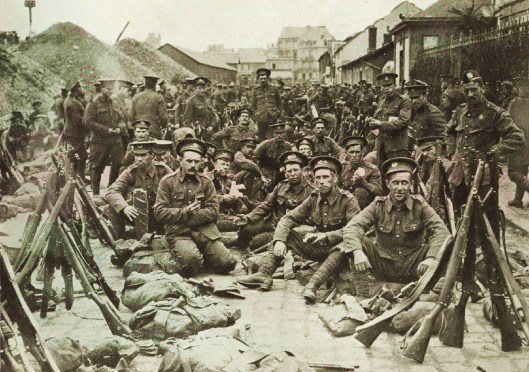
Douglas Anderson, in his invaluable The Annotated Hobbit, says that “Tolkien presents the Trolls’ speech in a comic, lower-class dialect” (70). In fact, we wonder whether, as in the case of the later orcs in The Lord of the Rings, we are not seeing a reflection of the speech of some of the Tommies whom Tolkien had commanded in the Great War.

roads_bef1914.jpg

” ‘Mutton yesterday, mutton today, and blimey, if it don’t look like mutton again tomorrer,’ said one of the trolls.

‘Never a blinking bit of manflesh have we had for long enough,’ said a second. ‘What the ‘ell William was a-thinkin; of to bring us into these parts at all, beats me – and the drink runnin’ short, what’s more,’ he said jogging the elbow of William, who was taking a pull at his jug” (The Hobbit, Chapter 2, “Roast Mutton”).

Besides what sounds like a reference to a line in Through the Looking-Glass (1871), “The rule is, jam to-morrow and jam yesterday – but never jam to-day,” with their “blimey” and “blinking”, the trolls are immediately labeled by their speech as lower-class, potentially thuggish, and certainly not people invited to a formal drawing room like this–

drawingroom1890ssmall.JPG

Of course, we might ask ourselves, why should trolls talk like that anyway? And we might then reply, because Tolkien is mixing language for comic effect. Bilbo, Gandalf, and the dwarves speak in non-dialect standard English. Therefore, there’s an especially strong contrast here. As well, what the trolls are saying can be funny in itself, as when William says to the discontented other trolls,

” ‘Yer can’t expect folk to stop here for ever just to be et by you and Bert. You’ve et a village and a half between yer, since we come down from the mountains. What more d’yer want?’ ” (The Hobbit, Chapter 2, “Roast Mutton”).

Here, we have comic exaggeration combined with the frustrated defensiveness of a leader whose tactics are being questioned by subordinates.

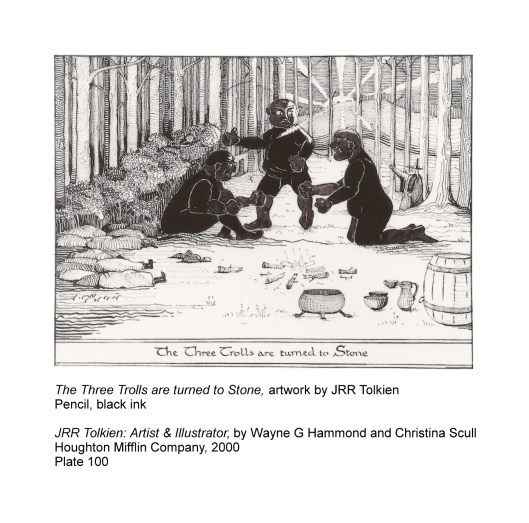
The tension grows as the scene progresses.  Bilbo appears, is nabbed by a purse which sounds like the Trolls, the Trolls fall to fisticuffs while arguing over Bilbo and then over the dwarves whom they capture, and Gandalf, imitating various Troll voices, so stirs the pot that the Trolls never notice when the first beam of sunlight cuts across their clearing and they are petrified.

jrrt_14.jpg

So, if we consider what the Trolls have been doing previously–“Never a blinking bit of manflesh have we had for long enough…” says one, as well as what they discuss doing not only to Bilbo, but to the whole of Thorin & Co., these could seem to be grim figures, indeed.  Then again, they sound like comic cockneys, they have ludicrously-large appetites, and they are dim enough to be taken in very easily by Gandalf’s ventriloquism.   So, grim and funny at the same time.

On the whole, humor is more an element in The Hobbit than in The Lord of the Rings, but we believe that perhaps because of his initial appearance in The Hobbit, Gollum may have both the menace and the humor, at times , of these gormless Trolls, as we hope to show in Part 2.

Thanks, as always, for reading,

MTCIDC,

CD

Winter is Coming

29 Wednesday Jun 2016

Posted by Ollamh in Fairy Tales and Myths, J.R.R. Tolkien, Military History, Narnia, Narrative Methods, Villains

≈ 3 Comments

Tags

C.S. Lewis, Frozen, Game of Thrones, George R.R. Martin, Hadrian's Wall, Hans Christian Andersen, Kay, Middle-earth, Mile castle, Puddleglum, Queen Elsa, Rammas Echor, The Chronicles of Narnia, The Lion The Witch and the Wardrobe, The Lord of the Rings, The Night Watch, the Pevensies, The Snow Queen, The White Witch, Tolkien, Westeros, White Walkers, Winter is Coming

Dear Readers,

Welcome, as ever.

We were playing Sortes Tolkienses yesterday. That’s the game where we close our eyes, open The Lord of the Rings to any page, then put our finger on a line to see if we can write about it.

On page 1042 of our edition, our finger fell upon:

“…you may stay here till the Witch-king goes home. For in the summer his power wanes, but now his breath is deadly, and his cold arm is long.” (The Lord of the Rings, Appendix A)

The Witch-king? Oh, we thought—that Witch-king.

angmar.jpg

He has a very long history in Middle-earth, being “probably (like the Lieutenant of Barad-dur) of Numenorean descent” (from Hammond and Scull, The Lord of the Rings: A Reader’s Companion, 20, Note 5) and, in the quoted context rules Angmar

arnorangmar.jpg

with a command to destroy the northern Numenorean kingdom of Arnor.

What caught our attention, however, was that idea of a “cold arm”. This might be metaphorical—except for that “in summer his power wanes”, suggesting that, if he can’t control the weather, he can at least use it to his advantage.  And this set us thinking about stories in which winter was either controlled by someone or was, itself, the antagonist.

First, there is Hans Christian Andersen’s The Snow Queen (1845).   Although this shares a title with a 2013 Disney film, there is really nothing else to link them. The Disney film has, of course, the Princess Elsa, whose enchanted hands can turn the world into winter (perhaps like the Witch-king?).

69147-Elsa-The-Snow-Queen.jpg

elsasicepalace.jpg

Andersen’s long fairy tale (in seven parts, or “stories”, historier, in Danish) is about the abduction of a boy and his rescue by his friend, a girl. The boy is being held by the Snow Queen, who lives in a far-off palace made of snow, the windows and doors of icy wind, lit by the Northern Lights.

snowqueen.JPEG

northern-lights-large.jpg

What particularly caught our attention here was the manner by which the boy, Kay, was stolen. He hitched his sled to the back of a sleigh, only to find that it was driven by the Snow Queen, who takes him under her robe.

lizbobzinsnowqueen.png

Liz Bobzin, “The Snow Queen and Kay”

This took us to the White Witch of The Lion, the Witch and the Wardrobe (1950), the first of C.S. Lewis’ Narnia books.

TheLionWitchWardrobe(1stEd).jpg

She picks up one of the Pevensie children, Edmund, in her sleigh and, while she doesn’t abduct him physically, she corrupts him by playing upon his greed and vanity.

bayneswhitewitch.jpg

This is an illustration of the Witch from the original 1950 book, and here are two later interpretations—the first is from the 1988 BBC production

whitewitchbbc1.jpg

the second from the 2005 film.

tildaswinton.jpg

(We like both versions—we don’t mind the Steiff Aslan in the BBC production

bbcaslan.jpg

502613_l__13430.1384493387.1280.1280.jpg

and who could ever be a better Puddleglum than Tom Baker, the fourth incarnation of Dr. Who, in the BBC The Silver Chair, 1990?

bakeraspuddleglum.jpg

We do worry a bit, however, about the changes made to the film versions of Prince Caspian, 2008, and The Voyage of the Dawn Treader, 2010. They’re not so drastic as those we’ve come to expect from P. Jackson’s writers, but, especially in Prince Caspian, there is a tendency to change things for what appear to be marketing reasons…)

As in what appears to be the case of the Witch-king, the White Witch can control the weather and has imprisoned all of Narnia

baynesmapofnarnia.jpg

in snow and ice for a century—“always winter, never Christmas”.

The idea of a world of winter then brought us to George R.R. Martin’s A Game of Thrones, both the novels and the impressive (and addicting) television series. In the world of Thrones, the large island of Westeros—

Map_of_westeros.jpg

and the whole world, for that matter, has once suffered a winter which lasted for a generation and the fear of its return always casts a shadow over the present. During that time, the creatures known as the White Walkers appeared from the north, with armies of animated dead, and were only driven back at great cost. To prevent their return, the surviving humans built an immense wall, 700 feet high, 300 miles long, which effectively blocks entry to the lower two thirds of Westeros.

Thewallfromthenorth.jpg

The_Wall_from_the_south.jpg

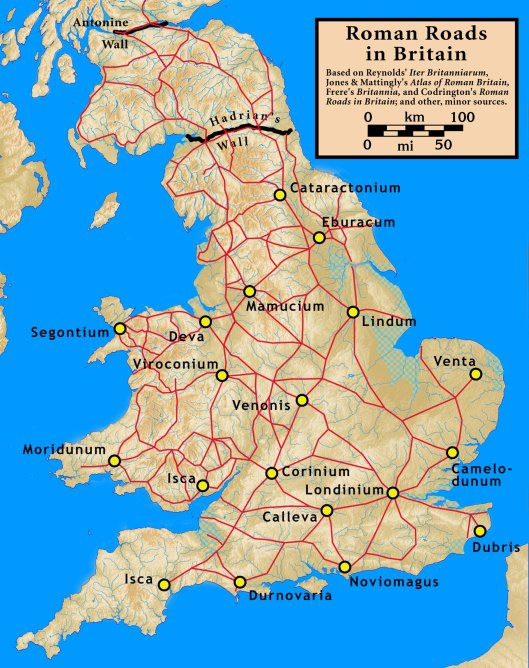
In an earlier posting, we discussed the Rammas Echor, the outer boundary wall which protects the Pelennor and Minas Tirith, and what we believe to be a major influence upon Tolkien’s idea, Hadrian’s Wall, which divides England from the lands to the north.

Roman.Britain.roads.jpg

Unlike The Wall in Thrones, it is under a hundred miles long, was never more than 16 to 20 feet high, and was built of turf, timber, and stone, not solid ice. It was, however, a complex construction, with 17 forts behind it

romanfortress.jpg

and a smaller fort (now called a “mile castle”) at the end of each mile,

milecastle.jpg

with small towers set in between the mile castles.

turretonhadrianswall.jpg

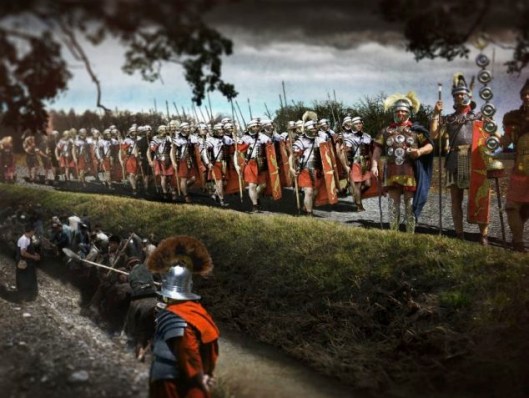
It was garrisoned with thousands of soldiers over its years of occupation (begun 122AD, finally abandoned in the 5th century).

romangarrison.jpg

In Thrones, this job has been taken on by The Night Watch, a rather haphazard collection of volunteers and conscripts.

nightwatch.jpg

And, south of them, the lands of the Stark family, Wardens of the North, whose motto—a warning of the dreaded future—forms the title of this posting.

the_north_a_clash_of_kings.jpg

Thanks, as always, for reading.

MTCIDC

CD
Evil Twin?

22 Wednesday Jun 2016

Posted by Ollamh in Films and Music, J.R.R. Tolkien, Narrative Methods, Villains

≈ Leave a comment

Tags

Bilbo, Deagol, Edgar Allen Poe, Frodo, Gandalf, Gollum, Isildur, Lon Chaney Sr., London After Midnight, Peter Jackson, Pity, Smeagol, The Lord of the Rings, The One Ring, The Phantom of the Opera, The Shadow of the Past, Tolkien, twins, William Wilson

Dear Readers,

Welcome, as always.

In Edgar Allen Poe’s short story, “William Wilson”, (1839) the protagonist is haunted by a double—not a genetic twin, but a kind of look-alike opposite—who acts upon the behavior of the debauched original. (He eventually murders the “twin”, only to discover that, in a sense, he’s murdered himself.)

Edgar_Allan_Poe_daguerreotype_crop.png

In this posting, we want to think about a relationship which, born in The Hobbit, grows over time until it, too, appears almost to be a pair of mirror opposites—who sometimes exchange their roles…

” ‘Gollum!’ cried Frodo. ‘Gollum? Do you mean that this is the very Gollum-creature that Bilbo met? How loathsome!’ ” (The Lord of the Rings, Book 1, The Fellowship of the Ring, Chapter Two, “The Shadow of the Past”).

This is the moment in which Gandalf is beginning to explain the history of the Ring, first to Frodo, and then, in more detail, in the Council of Elrond.

lee-lotr_Frodo_and_Gandalf.jpg

When Gandalf reveals that a major force in that history has been Gollum, Frodo is both surprised and appalled.

Gandalf is not. In fact, he shows a kind of sympathy for Gollum which flickers throughout the whole of The Lord of the Rings and which might be best described as pity. When later in this chapter Frodo exclaims, “What a pity that Bilbo did not stab the creature when he had the chance”, Gandalf replies:

” ‘Pity? It was Pity that stayed his hand. Pity, and Mercy: not to strike without need. And he has been well rewarded, Frodo. Be sure that he took so little hurt from the evil, and escaped in the end, because he began his ownership of the Ring so. With Pity.’ ” (The Lord of the Rings, Book 1, The Fellowship of the Ring, Chapter Two, “The Shadow of the Past”).

This, of course, is in contrast to what happened when Gollum found the Ring– because, in fact, he didn’t, and he murdered his friend Deagol, who did.

Sauron, we are told, has put much of his power—and himself—into the Ring. That power is often talked about in The Lord of the Rings, but it seems abstract—power to do what? One aspect of Sauron’s personality—a deep greed—is easily seen, however, reflected in how the Ring brings out that same feeling in others, even to the point of violence. Yet, as Gandalf says:

” ‘The murder of Deagol haunted Gollum, and he had made up a defence, repeating it to his “Precious” over and over again, as he gnawed bones in the dark, until he almost believed it.’ ” (The Lord of the Rings, Book 1, The Fellowship of the Ring, Chapter Two, “The Shadow of the Past”).

[Is there a hint of cannibalism here? When we first meet Gollum, the narrator says of him: “He liked meat too. Goblin he thought good, when he could get it…” (The Hobbit, “Riddles in the Dark”) Whose bones might Smeagol have gnawed first?

“No one ever found out what had become of Deagol; he was murdered far from home, and his body was cunningly hidden.” ]

We might wonder, thinking of “William Wilson”, if Smeagol and Deagol were, in a sense, twins?

“He had a friend called Deagol, of similar sort, sharper-eyed but not so quick and strong.” (The Lord of the Rings, Book 1, The Fellowship of the Ring, Chapter Two, “The Shadow of the Past”)

And Smeagol’s torment has as much to do with the symbolic killing of the “good” self as it does the murder of a friend?

smeagol_und_deagol_by_williweissfuss-d7053ux.jpg

Smeagol and Deagol by Williweissfuss

There may be a moral element here, as well, and it’s interesting to think that, although infected with Sauron’s greed, this potential for knowing right from wrong remains, at least temporarily, in Gollum, making him lie to himself and to others about how he acquired the ring.  Bilbo must have felt this, too, even if he gained the Ring through non-violent means, this need for self-justification. And so he lies, but, to someone with a deeper knowledge, such behavior is all-too-transparent, as Gandalf says:

“Then I heard Bilbo’s strange story of how he had ‘won’ it, and I could not believe it. When I at last got the truth out of him, I saw at once that he had been trying to put his claim to the ring beyond doubt. Much like Gollum with his ‘birthday-present’. The lies were too much alike for my comfort.” (The Lord of the Rings, Book 1, The Fellowship of the Ring, Chapter Two, “The Shadow of the Past”).

Gandalf has seen the lie, but he has also seen something else, a kind of pattern in that lying and a worrying link between the liars, which he expresses in his response to Frodo’s disgust at the thought of Gollum with the Ring:

“ ‘I think that it is a sad story,’ said the wizard, ‘and it might have happened to others, even to some hobbits that I have known.’ “ (The Lord of the Rings, Book 1, The Fellowship of the Ring, Chapter 2, “The Shadow of the Past”)

Gandalf has also seen a deeper similarity between the two. When Frodo says that he can’t believe that Gollum has any connection with hobbits, Gandalf says:

“ ‘It is true all the same…About their origins, at any rate, I know more than hobbits do themselves. And even Bilbo’s story suggests the kinship. There was a great deal in the background of their minds and memories that was very similar. They understood one another remarkably well, very much better than a hobbit would understand, say, a Dwarf, or an Orc, or even an Elf. Think of the riddles they both knew, for one thing.’ “ (The Lord of the Rings, Book 1, The Fellowship of the Ring, Chapter 2, “The Shadow of the Past”)

Alan Lee - The Hobbit - 19 - Riddles in the dark.jpg

Alan Lee, “Riddles in the Dark”

This connection is not just with Bilbo—Frodo, too, appears to share it, as we see later in the story:

“For a moment it appeared to Sam that his master had grown and Gollum had shrunk: a tall stern shadow, a mighty lord who hid his brightness in grey cloud, and at his feet a little whining dog. Yet the two were in some way akin and not alien: they could reach one another’s minds.” (The Lord of the Rings, Book 4, The Two Towers, Chapter 1, “The Taming of Smeagol”)

But this is the behavior of a hobbit as the “good” twin, when he has the Ring and believes himself in control. Below it always lurks Sauron’s greed, and it can bring the “bad” twin to the surface very easily, as Frodo imagines when Bilbo says:

“ ‘Have you got it here?’ he asked in a whisper. ‘I can’t help feeling curious, you know, after all I’ve heard. I should very much like just to peep at it again.’

‘Yes, I’ve got it,’ answered Frodo, feeling a strange reluctance. ‘It looks just the same as it ever did.’

‘Well, I should just like to see it for a moment,’ said Bilbo.

When he had dressed, Frodo found that while he slept the Ring had been hung about his neck on a new chain, light but strong. Slowly he drew it out. Bilbo put out his hand. But Frodo quickly drew back the Ring. To his distress and amazement he found that he was no longer looking at Bilbo; a shadow seemed to have fallen between them, and through it he found himself eyeing a little wrinkled creature with a hungry face and bony groping hands. He felt a desire to strike him.” (The Lord of the Rings, Book 2, The Fellowship of the Ring, Chapter 1, “Many Meetings”)

846d4cbb658e2420258640c4bda7319b
Lon-Chaney-in-London-After-Midnight-2

[Here we have included a second image which is, to our eyes, strikingly like the first. This is a picture of Lon Chaney, Sr., as Inspector Edward C. Burke of Scotland Yard, in the lost 1927 silent film London After Midnight. Chaney was a remarkable frightening presence on-screen, doing his own make-up, as in the 1925 The Phantom of the Opera, based upon Gaston Leroux’s 1910 novel of the same title—]

ChaneyPhantomoftheOpera

Of course, one might ask here, was this really Bilbo Frodo was seeing through that shadow, or was it Sauron’s greed, distorting Frodo’s vision? Certainly, this happens again, when in “The Tower of Cirith Ungol”, Sam offers to carry the Ring and Frodo thought that:

“Sam had changed before his very eyes into an orc again, leering and pawing at his treasure, a foul little creature with greedy eyes and slobbering mouth.” (The Lord of the Rings, Book 6, The Return of the King, Chapter One, “The Tower of Cirith Ungol”)

And then, just at the moment before the Ring’s final destruction, it’s Frodo who changes before Sam’s eyes:

“Then Frodo stirred and spoke in a clear voice, indeed with a voice clearer and more powerful than Sam had ever heard him use, and it rose above the throb and turmoil of Mount Doom, ringing in the roof and walls.

‘I have come,’ he said. ‘But I do not choose now to do what I came to do. I will not do this deed. The Ring is mine!’ “ (The Lord of the Rings, Book 6, The Return of the King, Chapter Three, “Mount Doom”)

At this moment, it seems horribly appropriate that he put on the Ring and disappear, as the Frodo who has gone through such terrible hardship has disappeared, replaced not by Gollum as twin, but, it seems, by Isildur, who, when urged by Cirdan and Elrond, that the Ring “should have been cast then into Orodruin’s fire nigh at hand where it was made”, refused, saying “This I will have as weregild for my father, and my brother…” (The Lord of the Rings, Book 2, The Fellowship of the Ring, Chapter Two, “The Council of Elrond”)

But Gollum does appear and fulfills Gandalf’s near-prophecy to Frodo of long before:

“…he is bound up with the fate of the Ring. My heart tells me that he has some part to play yet, for good or ill, before the end; and when that comes, the pity of Bilbo may rule the fate of many—yours not least.” (The Lord of the Rings, Book 1, The Fellowship of the Ring, Chapter Two, “The Shadow of the Past”)

Removing the Ring by removing the finger, Gollum continues the image of Isildur, who had done the same to Sauron to gain the Ring, and, at the same time, he releases Frodo from its spell, even as he falls to his death in the fires of Mount Doom. At the same time, Gollum also breaks the image of twins—and, unlike William Wilson, with the Ring gone and the bond, Frodo is maimed, but whole—and alone.

Thanks, as ever, for reading.

MTCIDC

CD
Rare Good Ballast

15 Wednesday Jun 2016

Posted by Ollamh in J.R.R. Tolkien, Narrative Methods

≈ Leave a comment

Tags

Ballast, Chunu, Coney, Cuzco, Fish and Chips, Gollum, Green Eggs and Ham, Inca Empire, King James I, Machu Picchu, Potatoes, Sir Walter Raleigh, Smeagol, Spanish Explorers, Taters, Tea, The Hobbit, The Lord of the Rings, Tobacco, Tobias Hume, Tolkien

Welcome, dear readers, to our latest posting. This one is based upon a word, but that word leads us to an interesting question: when you make a new world, do you intend to include anything from your own? Or do things just sort of slip in?

The word is “taters”, as in “I’d give a lot for a half dozen taters.” (The Lord of the Rings, Book 4, Chapter 4, “Of Herbs and Stewed Rabbit”)

(And a footnote–if you’re an American, you say that “erbs”, but, if you’re from the UK, you say it “Herbs”.)

It’s Sam, of course, trying to create a little domesticity while he and Frodo live rough on the trek south from the Morannon.

Gollum+Frode+Sam.jpg

At Sam’s request, Gollum has gone hunting and has returned with a pair of wild (European) rabbits, or coneys. (“Coney” is a worn-down form of the Latin word cuniculus, “rabbit”, through Old French, the source of so many Latin-based English words.)

rabbit3.jpg

Gollum, who has long forgotten about cooking (although one presumes that, in his distant life among his fellow proto-Hobbits, he wore clothes, lived in a house—or a hobbit hole–and ate bread), is convinced that Sam is going to ruin his catch.

“ ‘Stew the rabbits!’ squealed Gollum in dismay. ‘Spoil beautiful meat Smeagol saved for you, poor hungry Smeagol! What for? What for, silly hobbit? They are young, they are tender, they are nice. Eat them, eat them!’ “

(And here we can hear Sam-I-am from Dr. Seuss’ Green Eggs and Ham, “Would you? Could you/In a car?/Eat them! Eat them!/Here they are.”)

GEH

Along with the coneys, Sam would like something more, “taters”, much to Gollum’s puzzlement:

“Smeagol won’t grub for roots and carrotses and—taters. What’s taters, precious, eh, what’s taters?”

And Sam spells it out:

“Po-ta-toes…The Gaffer’s delight, and rare good ballast for an empty belly. But you won’t find any, so you needn’t look.”

Most readers would know immediately what Sam meant when he said, “Po-ta-toes”, but how about “ballast?”

In a way, it may be odd that Sam would know this word, as it comes from the world of ocean-going ships and Sam has never been closer to bigger water than the Brandywine—and that only near the beginning of The Lord of the Rings.

Ballast is the weight put into the deepest hold of a ship to keep it balanced in the water—especially when it’s empty of cargo. It’s commonly stone and it’s very useful now for underwater archaeologists, since the stone, if it remains in place after a ship sinks, can show the outline of a hull.

ships-stone-ballasts

ballastinsitu

So “rare good ballast for an empty belly” gives us the image of a Gaffer kept upright and balanced, moving with potatoes inside him.

Sam has also said, “But you won’t find any, so you needn’t look”: why not?

In our world, before the 16th century, potatoes were only available in South America, in particular in the Inca empire.

This was an elaborate patchwork of smaller peoples controlled by a military group with a capital at Cuzco.

Inca_MainMap3_sg

A Neolithic civilization, they were master architects, as may be seen in the remains of the Temple of the Sun, in the capital—

qoricancha

and in what is believed to be a summer palace, at Machu Picchu.

fondo-machu-picchu

With a king and an army

incanwarriors

they controlled much of the west coast of South America from 1438 to 1533, when Spanish invaders destroyed them and their world.

conquestofincas

A major food source was potatoes and there were many varieties available—and there still are, more than 1000—

Potatoes_Peruvian_varieties

In fact, the Inca even learned how to freeze-dry them to preserve them, a method called chunu.

Chunu

No one knows for sure when potatoes first came to Europe. It is imagined that Spaniards coming back from the New World would have brought them. In the English tradition, it was Sir Walter Raleigh who introduced them.

SirWalterRaleigh

They were then cultivated and rapidly became a major European food source, but they are not a native species and don’t grow wild—leading us to imagine that that’s what Sam is saying: Sam and Frodo and Gollum are in the wilderness and potatoes only grow where they’re planted—suggesting that, in Middle-earth, they are also an import—but from where?

(This reminds us of that moment in the Jackson film, where Sam and Frodo bump into Merry and Pippin in a corn—that is, maize–field. JRRT never mentions maize which, in European history, is also a New World import. This only makes us further wonder what the script writers thought they were doing in removing Pippin and Merry from their proper place in the story…)

There is more of this sort of thing, of course—Hobbits have teatime—we can suppose that it’s something herbal, but real teatime only appeared in England after the regular importation of tea to England from China in the mid-17th century. (For those familiar with it, there is a funny Horrible Histories episode which shows the introduction of tea in Stuart times when, according to the story, people had been refreshing themselves previously with cups of hot water.)

6a00d8341c84c753ef0147e02eab6c970b-300wi

And then there’s tobacco. It’s called that in The Hobbit, but it’s “pipe weed” in The Lord of the Rings. Tobacco is one more import in our world—brought to Europe in the 16th century. Here’s the first known image of someone actually smoking (from 1595).

Chute_tobacco.1595

It quickly became so popular that controversy over it, ranging from Tobias Hume’s ( 1579?-1645 ) love song to it, “Tobacco, Tobacco, sing sweetly for Tobacco” (from The First Part of Ayres or the Musicall Humours, No. 3, 1605—you can see the text and score if you Google “Tobias Hume” at IMSLP) to James the First’s condemnation of it, A Counterblaste to Tobacco (1604), which you can actually read if you Google “A Counterblaste to Tobacco”.

When JRRT was revising The Hobbit for its republication in 1966, he made a number of changes to the text, but some things remained, such as teatime, and even the image of a railroad train—“At may never return he began to feel a shriek coming up inside, and very soon it burst out like the whistle of an engine coming out of a tunnel.”

Douglas Anderson argues, in Note 35 of Chapter 1 of The Annotated Hobbit, that, in the case of the railroad, “This usage need not be viewed as an anachronism, for Tolkien as narrator was telling this story to his children in the early 1930s, and they lived in a world where railway trains were an important feature of life.” (The Annotated Hobbit, 47-48.) This is never really stated, in fact, in the Hobbit text, but the tone of the narration—which JRRT came to dislike—would suggest something of the sort. As for The Lord of the Rings, we have no explanation. Some items are never explained, they’re just there.

And, of course, there’s this:

“I’ll cook you some taters one of these days. I will: fried fish and chips served by S. Gamgee.”

fish-and-chips

FishAndChips

Perhaps this is in Hobbiton? Bywater? Michel Delving?

Thanks, as always, for reading.

MTCIDC

CD

Paying No Attention to the Man Behind the Curtain

08 Wednesday Jun 2016

Posted by Ollamh in J.R.R. Tolkien, Literary History, Narrative Methods

≈ 1 Comment

Tags

Beowulf, Cloacina, Connacht, Grendel, Heorot, Horatius, King of Leinster, Lembas, Lord Chesterfield, Mac Da Tho, Mordor, Odysseus, Penelope, Tamora Pierce, The Lord of the Rings, The Odyssey, The Wizard of Oz, Tolkien, Ulster

Behind-the-Curtain.jpg

Dear Readers,

Welcome, as always, to our blog. In this posting, we want to consider something usually invisible, but, at the same time, for reader/listeners, always there in adventure stories.

Think for a moment about your day. And how filled it is with requirements of the body, from sleep to washing to eating to—yes, you see where we’re going.

PoplarForestPriviesRob.jpg

(And we can’t see this 18th century outhouse—sometimes called a “necessary” or a “privy” then—without thinking of part of a letter by the famous 18th-century essayist/letter-writer Lord Chesterfield (1694-1773).

Philip_Stanhope,_4th_Earl_of_Chesterfield.PNG

Who wrote a series of affectionate and very worldly-wise letters to his illegitimate son. In one of them he had the following advice—

“I knew a gentleman who was so good a manager of his time that he would not even lose that small portion of it which the calls of nature obliged him to pass in the necessary-house; but gradually went through all the Latin poets in those moments. He bought, for example, a common edition of Horace, of which he tore off gradually a couple of pages, carried them with him to that necessary place, read them first, and then sent them down as a sacrifice to Cloacina: this was so much time fairly gained, and I recommend you to follow his example…. Books of science and of a grave sort must be read with continuity; but there are very many, and even very useful ones, which may be read with advantage by snatches and unconnectedly: such are all the good Latin poets, except Virgil in his Æneid, and such are most of the modern poets, in which you will find many pieces worth reading that will not take up above seven or eight minutes.”

earlyeditionofhorace.jpg

Cloacina was the patron goddess of the ancient main drain of Rome. Here’s an image of her shrine—

Coins-venus-cloacina.jpg

and here’s her drain

Domitian-Cloaca-Forum.jpg

But, as we were starting to say, things of the body, ordinary things, are almost entirely ignored both in traditional adventure and in modern versions. In fact, it’s a bit of a shock to see, in some of Tamora Pierce’s YA novels (a big favorite of ours), that people actually use a latrine.

tpiercebooks.jpg

When we look at JRRT, for example, whose works we’ve often tried to set into a medieval context, we never see what one would have seen in such a context, whether behind a farmhouse

garderobe1.jpg

or in some place grand.

garderobe.jpgGarderobe,_Peveril_Castle,_Derbyshire.jpg

We began with the least common possibility, but this is as true for other functions—usually taken for granted, except for specific reasons. Sleep, for example, is very often employed simply as a way to show the passage of time during an adventure—and, in worlds without googlemaps, Siri, and perhaps even signposts

HauntedForest_sign.jpg

it’s a very natural and easy way to mark time and distance simultaneously.

samandfrodoasleep.jpg

Eating can show the same—think of Sam hoarding lembas as he and Frodo trek towards Mordor—

leaf-lembas.JPG

JRRT then uses it to show urgency, as well—what will they do in Mordor, when it runs out?

602_NASMITH_Across_Gorgoroth_02.jpg

Of course, eating—in the form of feasting, in particular—can provide a major plot element.

Think of Heorot, the feasting hall, in Beowulf, for instance,

heorot.jpg

where feasts are ruined until Beowulf defeats their ruiner, Grendel.

Stories_of_beowulf_head_of_grendel.jpg

Or the endless feasting of the suitors in the Odyssey

greekfeastpaestumdivertomb.jpg

as they eat up everything which makes Odysseus the lord of his lands, besides trying to steal his wife, Penelope.

JohnWilliamWaterhouse-PenelopeandtheSuitors(1912).jpg

Here, eating and drinking take on a greater significance in that they are symbolic of the slow destruction of Odysseus’ household. They also provide a great setting for his reappearance and then, with the help of Athena, his massacre of the suitors in one of the wildest revenge scenes we know. It has quite a number of illustrators, from ancient

Mnesterophonia_Louvre_CA7124.jpg

to Victorian

odysseus-kills-the-suitors1.jpg

to modern—and our favorite, for the way it’s being shown from the angle of Odysseus’ patron, Athena

peterconnollysuitors.jpg

And then there is the feast, held in the rath of the king of Leinster, Mac Da Tho, which has to be one of the zaniest scela in Old Irish literature. Leinster’s most powerful neighbors, Ulster and Connacht, are at dinner, but there is a sudden difficulty over who will carve the pig.

Pictish_symbol_stone_from_Dores Wiki Commons.JPG

Like so many of the stories of the so-called “Ulster Cycle”, it is full of over-the-top violence and grim humor as both powers struggle to gain the honor of carving and therefore having the right to award the curadmir, the “hero’s portion”.

As you think about your favorite heroic or adventure story, consider the above—where can you see body care/body functions? Then, to take it a step farther: where does anyone ever sneeze? (We can think of one special one, but what can you come up with?—Hint: see Odyssey 17…)

Thanks, as ever, for reading.

MTCIDC

CD


“A kind of proud, venerable, but increasingly impotent Byzantium”

01 Wednesday Jun 2016

Posted by Ollamh in Artists and Illustrators, J.R.R. Tolkien, Literary History, Maps, Military History, Military History of Middle-earth, Narrative Methods

≈ Leave a comment

Tags

Adventure, Byzantine Empire, Byzantium, Constantinople, Gondor, Justinian, Megara, Mehmet II, Milton Waldman, Minas Arnor, Minas Tirith, Mont Saint Michel, Ottoman Empire, Ted Nasmith, The Lord of the Rings, The Tower of Guard, Theodosian walls, Theodosius, Tolkien

Welcome, as always, dear readers.

The title of this posting is taken from a very long letter (10,000 words), written to Milton Waldman probably in 1951 (Letters No.131, 157). Waldman represented the English publisher, Collins, which had expressed an interest in The Lord of the Rings and The Silmarillion when Allen & Unwin had been hesitant. Determined to justify the simultaneous publication of both, Tolkien wrote in great detail about the general narrative, with an emphasis upon the religious aspects.

In the process, he likened Gondor to the Byzantine empire, a comparison which immediately attracted our attention. We ourselves had suggested in an earlier posting that the attack on its capital, Minas Tirith, had been like the siege of the Byzantine capital, Constantinople.

attackongondor.jpg

8da792d4aac58fe51f8ddf1aefa36048.jpg

What was JRRT thinking of when he likened the two?

First, they both were—or had been—large kingdoms—in the case of Byzantium, an empire, really, as these maps demonstrate.

gondor1050height.jpg

2000px-Byzantiumby650AD.svg.png

Their capitals were both of great age. Minas Tirith, “The Tower of Guard”, had been built originally as Minas Anor, “Tower of the Sun” in SA 3320 by Anarion, the younger son of Elendil, but only became the capital of Gondor in TA1640, after Osgiliath had been devastated by a plague. If we add its time in the Second Age (121 years) to the whole of the Third Age (3021 years), we reach a total of 3142 years at the defeat of Sauron. (For comparison, we might look at Athens, whose continuous habitation began before 3000BC, giving it a more-than-5000-year history.)

Constantinople, is old, by anyone’s standards, having been founded in 667BC as a Greek colony (there’s a bit of argument over the dating of this, which is typical of such things), and is still inhabited (and an absolutely amazing place!), but a bit younger than Minas Tirith at the time of The Lord of the Rings by some 500 years or so.

Third, there is the matter of the elaborate construction of these capitals.

“For the fashion of Minas Tirith was such that it was built on seven levels, each delved into the hill, and about each was set a wall, and in each wall was a gate. But the gates were not set in a line: the Great Gate in the City Wall was at the east point of the circuit, but the next faced half south, and the third half north, and so to and fro upwards; so that the paved way that climbed towards the Citadel turned first this way and then that across the face of the hill. And each time that it passed the line of the Great Gate it went through an arched tunnel, piercing a vast pier of rock whose huge out-thrust bulk divided in two all of the circles of the City save the first. For partly in the primeval shaping of the hill, partly by the mighty craft and labour of old, there stood up from the rear of the wide court behind the Gate a towering bastion of stone, its edge sharp as a ship-keel facing east. Up it rose, even to the level of the topmost circle, and there was crowned with a battlement; so that those in the Citadel might, like mariners in a monstrous ship, look from its peak sheer down upon the Gate seven hundred feet below.”

The Lord of the Rings, Book 5, Chapter 1, “Minas Tirith”

Here’s one of our favorite paintings (by Ted Nasmith—one of our favorite Tolkien artists).

TN-Minas_Tirith_at_Dawn.jpgnaismith.jpg

And here’s the film.

ROTK-Minas-Tirith.jpg

The designers have said that they were influenced by the look of Mont Saint Michel, a medieval monastery just off the coast of Normandy in France.

Mont_St_Michel_3,_Brittany,_France_-_July_2011.jpg

MtStMichel_avion.jpg

The complex nature of the place is captured in this diagram.

minas-tirith-diagram.0.jpg

Byzantium (or, Constantinople, its later name) began its life, as we said, as a colony of the Greek mainland city of Megara. In the 4th century AD, the Roman emperor Constantine I, the last survivor in a long civil war, chose the site for his new capital. As much of the weight, both of commerce and defense, lay in the eastern part of the Roman world by this time, he chose very wisely: his new city was placed to control trade with the rich Black Sea region and to provide a strategic jumping-off point for dealing with invaders and emerging kingdoms in Asia Minor.

Locator_map_Byzantion.PNG

The position was also well-chosen for defense, being at the end of a peninsula—the main strategy then being its walling-off from the mainland.

constantin.jpg

There is, of course, a big difference here between the 7 levels and 7 gates of Minas Tirith and the two walls—the older inner 4th-century one of Constantine and the slightly-later (early 5th century) walls of Theodosius II. Nevertheless, those later walls were well-constructed, in two successive lines, with a moat on the outside.

Theodosian Walls.jpg

The Theodosian walls were about a mile-and-half from the older, Constantine wall, encompassing a population which, at its height, may have been over 400,000 in number. By the time of its fall to the Ottoman army in 1453, that number had dropped to perhaps only 50,000, which reflected the gradual shrinking of the empire from its greatest size, in the 6th century

Byzantine-empire.6thc.gif

under the emperor Justinian

justinian.jpg

when it encompassed the majority of the Mediterranean basin, to its last, worn-out phase in the early 15th century, when it controlled a few scattered outposts, but mainly the area directly around the capital.

constantinople-world-map.jpg

This shrinking of the empire and of its population proved disastrous for the capital. When the Ottoman army, under Mehmet II, arrived outside the walls in the spring of 1453, the imperial government could only provide 7000 defenders, 2000 of whom were foreigners, to defend about 3 and ½ miles of wall (that’s 5 ½ km). Against them were anywhere from 50 to 80,000 attackers, who brought with them (or cast on the spot), massive artillery pieces and, after a 53-day siege, broke into the city and put an end to an empire which had lasted for over 1100 years.

Illustration-of-angus-mcbride-showing-the-ottoman-cannon-basilica-during-the-siege-of-constantinople-in-1453-ad.jpg

Benjamin-Constant-The_Entry_of_Mahomet_II_into_Constantinople-1876.jpg

And this is the last sad similarity with Gondor and its capital, as we see through Pippin’s eyes:

“Pippin gazed in growing wonder at the great stone city, vaster and more splendid than anything that he had dreamed of, greater and stronger than Isengard, and far more beautiful. Yet is was in truth falling year by year into decay, and already it lacked half the men that could have dwelt at ease there. In every street they passed some great house or court over whose doors and arched gates were carved many fair letters of strange and ancient shapes: names Pippin guessed of great men and kindreds that had once dwelt there; and yet now they were silent, and no footsteps rang on their wide pavements, nor voice was heard in their halls, nor any face looked out from door or empty window.”

The Lord of the Rings, Book 5, Chapter 1, “Minas Tirith”

And, just as in the case of Constantinople, the capital of Gondor was hard-pressed to defend itself. Luckily for it, however, there was an uncrowned king with a ghostly army, a brave reinforcement of southern yeomen, a mass of wild horsemen from the north, a wizard, and the fulfillment of an ancient prophecy about a witch king to aid it in its hour of need…

Thanks, as always, for reading.

MTCIDC

CD

His Letters

25 Wednesday May 2016

Posted by Ollamh in Economics in Middle-earth, J.R.R. Tolkien, Literary History

≈ 1 Comment

Tags

1930s England, A Long-Expected Party, Bellerophon, Governor of the King's Posts, Henry VIII, London, mail coach, Orality, Penny Black, pillar box, Pony Express, Postal Service, Postmen, Rowland Hill, Royal Mail, semata lugra, Shire, Shirriffs, Sir Brian Tuke, stamps, The Illiad, The Lord of the Rings, Tolkien

(For Aunt Cathy—she knows why.)

“Mr. Bilbo has learned him his letters—meaning no harm, mark you, and I hope no harm will come of it.” Gaffer Gamgee, The Fellowship of the Ring, Ch.1, A Long-Expected Party


Welcome, as always, dear readers.

We’ve written a little before about aspects of literacy in Middle-earth and we will probably do so again, since the idea of reading and writing in what is, basically, an heroic world interests us very much.

Ordinarily—with a few exceptions (South Slavic pjesme, “songs” sometimes have examples)—we don’t think of writing as being an important feature of heroic stories, but our interest in such things began some years ago with an odd little reference in The Iliad. In all of the story (or in Homer in general for that matter), this is the only mention of what appears to be writing. We say “appears” because the actual writing is called semata lugra, not, in fact, a clear reference to writing, but often translated as something like “baneful signs”. We won’t get into the long, complex controversy over orality and literacy in Homer (although we have strong opinions on the subject) here, but rather point to what these semata were supposed to do. They were inscribed on tablets.

writingtablets1.jpgwritingtablets2.JPG

The tablets were sealed and given to a carrier—in this case, the hero Bellerophon—

NAMA_Epinetron_Bellérophon.jpg

to take with him to the person who would open the tablets, read them, and then—have him killed! That certainly makes those semata lugra. The fact that the tablets were closed suggests that, whatever those “signs” were, the sender thought that the carrier would be able to read them, too, giving us a wider picture of the use of such signs, whatever they might actually be.

But now we come to the Shire, and to a world which is domestic, long before some of its inhabitants become heroic.

At the beginning of The Hobbit, Bilbo is enjoying a pipe in the morning air when a very disturbing figure appears.

gandalfvisitsbilbo.jpg

His mocking words are soon too much for the Hobbit, who “Then…took out his morning letters, and began to read, pretending to take no more notice of the old man.” (The Hobbit, Ch.1, An Unexpected Party)

As we were once intrigued by the semata lugra, we are now interested in these letters. Douglas Anderson, in his note (15) to this sentence in The Annotated Hobbit supplies the information that “In England in the 1930s there were at least two mail deliveries per day—hence the distinction of morning letters.” (39) If the Shire is like 1930s England, which it sometimes appears to be, even as Tolkien denies that “There is no special reference to England in the ‘Shire’—except of course that of an Englishman brought up in an ‘almost rural’ village of Warwickshire on the edge of the prosperous bourgeoisie of Birmingham…” (draft of a letter to Michael Straight, “probably January or February 1956”, Letters, 235), then Bilbo is in the enviable position of one who is in the care of The Royal Mail—or, in this case, its Shire equivalent. Or is he?

The Royal Mail as a branch of government took off in the time of Henry VIII, with the appointment of Sir Brian Tuke (respell that and where in the Shire might you find him?) as Master of the Posts (1512), then Governor of the King’s Posts (1517).

Holbein,_Hans_-_Sir_Brian_Tuke.jpgmasterkingspost1512.jpg

Much, if not most of the correspondence of that period was literally royal—the government’s business, not private correspondence, but, over time, this gradually changed until, by the late 18th century, postmen had an official uniform

bellman2.JPG

and there were places were letters were received and sorted.

lombardstreetpo1809.jpg

There were problems of corruption in the system, as well as a basic difficulty: the sender didn’t pay for the letter—the receiver did. Thus, there was no assurance that the service would be paid for, beyond whatever government subsidies were allowed to it. All of this began to change in 1837, however, with this privately-printed and circulated pamphlet

Post118_1837_1.jpg

by the education (and, in time more general) reformer, Rowland Hill.

Rowland_Hill_photo_crop.jpg


He proposed to reverse the process: the sender would pay and there would be strict regulation of the charge (and, for ordinary letters a very low charge at that). Initially, the idea was to use an already franked (that is, with a mark showing that it had been paid for) form on which one might write a message, fold it, and send it.

mulready1.jpg


This was not a new idea and had been used since the 17th century, at least.

WallensteinBriefSiegel.jpg

Hill quickly followed this with the idea of a stamp which could be readily attached to a letter—commonly a sheet which, once written upon, could then be folded into its own container.

historicalletter-01.jpg

This could also be attached as we do, to a pre-made envelope, into which the folded letter might be placed. This was the first modern stamp, the so-called “Penny Black”.

Penny_black.jpg

After 1853, there were even special public mail boxes into which you might place your letters for collection.

letterbox.jpg

Delivery in big cities like London would, by the late 19th-century, begin at 7:30 in the morning and go to 7:30 in the evening, so that you could write a note to a friend across the city, drop it into a pillar box (mailbox to people in the US) at 7:30 am

pillarbox_line1.jpg


and expect a reply sometime during the same day.

Behind all of this was an increasingly-complex government backed by a well-established bicameral legislature, with an increasingly-large tax base. But what of the Shire?

The government of the Shire seems to be sketchy, at best. Tolkien gives us the total picture on in the Prologue to The Lord of the Rings.

“The only real official in the Shire at this date was the Mayor of Michel Delving (or of the Shire), who was elected every seven years…As mayor almost his only duty was to preside at banquets…But the offices of Postmaster and First Shirriff were attached to the mayoralty, so that he managed both the Messenger Service and the Watch. These were the only Shire-services, and the Messengers were the most numerous, and much the busier of the two. By no means were all Hobbits lettered, but those who were wrote constantly to all their friends (and a selection of their relations) who lived further off than an afternoon’s walk.

The Shirriffs was the name that the Hobbits gave to their police…There were in the Shire only twelve of them, three in each Farthing, for Inside Work.”

So, in contrast to the elaborate workings of the Royal Mail, we are left with a series of questions: if there is a Postmaster—and clearly there is a post—how does it work? Is it all on foot? Is there the equivalent of the Pony Express? Nob, at the Prancing Pony, is called a “slow-coach”—were there once mail coaches, as in England?

The-Cambridge-Telegraph-a-mail-coach-about-to-depart-English.jpg


(Is this the only mention of such carriages in all The Lord of the Rings and The Hobbit? There are certainly wagons—there was even an invasion of “the Wainriders” once upon a time—see Appendix A of The Lord of the Rings.)

How were letters collected? Distributed? Is there a central post office, perhaps in Michel Delving, the closest thing to a capital in the Shire? And, of course, how was it all paid for? In an earlier posting, we talked a little about coinage in Middle-earth and we tried to imagine what Gondorian currency might have looked like—can we imagine Shire postage stamps?

When you read the following, think of your own postal service and join us in wondering about all of the above:

“Before long the invitations began pouring out, and the Hobbiton post-office was blocked, and the Bywater post-office was snowed under, and voluntary assistant postmen were called for…” The Fellowship of the Ring, Ch.1, A Long-Expected Party

ingeredelfeldt.jpg

Thanks, as ever, for reading.

MTCIDC

CD

Rear Guard

18 Wednesday May 2016

Posted by Ollamh in Films and Music, J.R.R. Tolkien, Literary History, Maps, Military History, Military History of Middle-earth, Narrative Methods

≈ 1 Comment

Tags

66th Regiment, British Infantry, Denethor, Faramir, Gary Zaboly, Le Cateau, Maiwand, Nazgul, Osgiliath, Pelennor, Peter Jackson, Rammas Echor, Richard Caton Woodville, the Alamo, The Lord of the Rings, The Return of the King, The Siege of Gondor, Tolkien

Welcome, dear readers, as always.

In a previous posting, we rolled our eyes verbally at a moment in P. Jackson’s The Return of the King in which Faramir, according to the script, was required to mount a double-rank cavalry charge against the west bank of Osgiliath.

gondorianerritt-cb182208.jpg

To us, this was a clumsy attempt to convey the clash between Faramir and his father Denethor, derived from material in The Lord of the Rings, Book 5, Chapter IV, “The Siege of Gondor”, principally from this:

“ ‘Much must be risked in war,’ said Denethor. ‘Cair Andros is manned, and no more can be sent so far. But I will not yield the River and the Pelennor unfought—not if there is a captain here who has still the courage to do his lord’s will.’

Then all were silent. But at length Faramir said: ‘I do not oppose your will, sire. Since you are robbed of Boromir, I will go and do what I can in his stead—if you command it.’

‘I do so,’ said Denethor.

‘Then farewell!’ said Faramir. ‘But if I should return, think better of me!’

‘That depends on the manner of your return,’ said Denethor.

Gandalf it was that last spoke to Faramir ere he rode east. ‘Do you throw your life away rashly or in bitterness,’ he said. ‘You will be needed here, for other things than war. Your father loves you, Faramir, and will remember it ere the end. Farewell!’ “

In the text, Faramir then goes to Osgiliath, having “taken with him such strength of men as were willing to go or could be spared.” The tone here is hardly encouraging and, the following day, “The passage of Anduin was won by the Enemy. Faramir was retreating to the wall of the Pelennor, rallying his men to the Causeway Forts; but he was ten times outnumbered.”

In an earlier posting, we have discussed the Rammas Echor, the wall which enclosed the farmland outside the walls of Minas Tirith.

causeway.gif

We have also discussed the use by both Saruman and Sauron of what appears to be an early form of explosive—seen here in the following description of the fall of the Rammas:

“The bells of day had scarcely rung out again, a mockery in the unlightened dark, when far away he [Pippin] saw fires spring up, across in the dim spaces where the walls of the Pelennor stood. ..Now ever and anon there was a red flash, and slowly through the heavy air dull rumbles could be heard.

‘They have taken the wall!’ men cried. ‘They are blasting breeches in it. They are coming!’ “

Outnumbered and, with the fall of the wall in different locations, outflanked, the best that Faramir can do is to fall back towards Minas Tirith, as Gandalf says, “Yet he is resolved to stay with the rearguard, lest the retreat over the Pelennor become a rout. He may, perhaps, hold his men together long enough, but I doubt it.”

Unlike the silly—there’s really no other word for it—charge of P. Jackson—Faramir is a professional soldier, after all, much loved by his soldiers—we see what JRRT, having been a soldier himself, would have known was the military solution: a fighting retreat, led by a brave and capable leader.

His task had been an impossible one to begin with and, properly understood and depicted on the screen, would not only have been powerful dramatically, but much more believable. It was an impossible task, however, against the odds of ten to one. (For a comparison, we offer the siege and fall of the Alamo, late February-early March, 1836. The garrison numbered about 180, the besiegers eventually approximately 3000. In the final assault, before dawn on 6 March, 1836, the four assaulting columns had about 1200 men, offering odds of roughly 6 to 1 and the entire garrison died, along with somewhere between 400 and 600 of the attackers.)

ALAMO_FORTRESS.jpg

(This is the work of the amazing Gary Zaboly– as an historical illustrator, he can’t be recommended highly enough. Much of his work concerns the 18th century, especially the 1740s and 50s, but he also has done some wonderful depictions of warfare in the American southwest in the 1830s and 40s.)

There are lots of examples of fighting retreats and we’ve picked two: a failure (Maiwand, Second Afghan War, 1880) and Le Cateau (The Great War, 1914).

At Maiwand, 27 July, 1880, a British-Indian brigade of 3 infantry units plus two cavalry units and a battery (6 guns) of horse artillery, anywhere from 1500 to 2000 soldiers, faced perhaps 12,000 Afghans with 6 batteries of guns.

Action_at_Maiwand_map.jpg

Basically, the British were outflanked and their left-hand units began to buckle under the pressure of the attacks and the number of attackers which they had to face. As they gave way, the right hand end of the line began to move backwards, feeling increasingly in danger of being surrounded, just as Faramir’s men must have.

As the infantry retreated, the artillerymen used their guns to buy time for a general withdrawal, ending by losing a section (2 guns) to the enemy. There’s a famous painting of the withdrawal of the remaining guns by the late-Victorian artist, Richard Caton Woodville.

woodvillesavingtheguns.jpg

At the end of the withdrawal from the battle, a small group of British soldiers of the 66th Regiment took shelter inside an enclosure in a nearby village and fought it out to the end.

66thfootmaiwand.jpg

maiwand-66th.jpeg

Gandalf’s worry had been that Faramir couldn’t hold his men together and you can see here what happens when organized units come apart—they are defeated piecemeal, “in detail” is the military expression.

In contrast to this, we offer an action from Tolkien’s own time, the battle at Le Cateau, fought on 26 August, 1914. The British Expeditionary Force, facing superior numbers and in danger of being outflanked, particularly to the west, was engaged in a long retreat. Miraculously, unit cohesion was mostly maintained, although communications were often poor, causing confusion and, in one case, even in losing a unit, never notified of withdrawal.

The British Army was divided into two larger groupings, First and Second Corps, and it was Second Corps which turned to face its pursuers. During a long morning, the British, in hastily-dug trenches, fended off superior numbers of German infantry.

1st-east-lancs-regiment-s.jpg

LeCateauMAP1.jpg

Having lost heavily, but having given the enemy similar punishment, the British slowed German pursuit and were able to withdraw without being as closely pursued as they had been.

The difference here is in exactly what Gandalf was worried about. At Maiwand, the brigade fell apart and could easily be swept away by the enemy. At Le Cateau, although it was hardly a perfect affair, the British kept enough cohesion not only to withstand and defeat heavy attacks, but then to retreat in units, without ever collapsing into a fleeing mob.

What happens in that struggle in the fields behind the Rammas Echor is, in fact, a mixture of the two retreats described above. We see “Small bands of weary and often wounded men…some were running wildly as if pursued.” Then, “…less than a mile from the City, a more ordered mass of men came into view, marching not running, still holding together.” And then “Out of the gloom behind a small company of horsemen galloped, all that was left of the rearguard.”

So, it looks like Faramir had succeeded in maintaining that sense of order and purpose which is vital for a fighting retreat. It was not to last, however, as a mass of enemy horsemen on the causeway behind, as well as several Nazgul from above, threw all into confusion—which was stemmed, in turn, by the arrival of a rescue party, led by the Prince of Dol Amroth and accompanied by Gandalf arrived to drive back the attackers.

gandalf_to_the_rescue___speed_paint4_by_myworld1-d7wjv97.png

In that flurry, Faramir is struck by an arrow and has to be rescued and brought into the City, badly wounded.

Looking back, it is a very different scene from that preposterous cavalry charge, isn’t it? As our readers are probably also experienced watchers of the films, we wonder: which do you prefer, Jackson/writers or the author?

Thanks, as always, for reading.

MTCIDC

CD

A Country for Old Men—and Old Men for a Country

11 Wednesday May 2016

Posted by Ollamh in Fairy Tales and Myths, J.R.R. Tolkien, Literary History

≈ Leave a comment

Tags

Apollonius, Aragorn, Argo, Blue Wizards, Denethor, Faramir, Gandalf and the Balrog, Grey Havens, Heracles, Hildebrandts, Hylas, Istari, Jason and the Golden Fleece, Merlin, Radaghast, sage, Saint Nicholas, Saruman, Sharkey, The Argonautica, The Fantastic Four, The Lord of the Rings, Theoden, Tiresias, Tolkien, Valar, W.B.Yeats

Dear readers, welcome, as always.

Recently, we wrote a posting about Saruman and his fate. It was fun to think about, but it made us think further about why Saruman, in the Shire, is called “Sharkey” by his thugs—supposedly from Orcish sharku, “Old Man”. If we had never read a description of Saruman, but only the nickname, we might think of “the old man” either as an older Anglo-American expression either for a father—“my old man keeps nagging me about cutting the grass, if I want my allowance” (note the use of the possessive “my”)—a naval/military term for commander—“the old man said that, on his ship, smoking would never be allowed again” (always without the possessive)—or older English for husband—“her old man is fooling around behind her back—I hope she turns around!” (again, with a possessive).

In fact, Saruman is, literally, an old man

greg-hildebrandt-isengard-orthanc-saruman-607429-1300x962.jpg

—as are all five of the Istari, the wizards sent to Middle-earth by the Valar about the year 1000 of the Third Age. As JRRT says in a letter to Robert Murray, S.J. (there’s a surviving draft on pages 200-207 of The Letters of J.R.R. Tolkien):

“They are actually emissaries from the True West, and so mediately from God, sent precisely to strengthen the resistance of the ‘good’, when the Valar become aware that the shadow of Sauron is taking shape again.” Letters, 207

He further explains their role:

“At this point in the fabulous history the purpose was precisely to limit and hinder their exhibition of ‘power’ on the physical plane, and so that they should do what they were primarily sent for: train, advise, instruct, arouse the hearts and minds of those threatened by Sauron to a resistance with their own strengths; and not just to do the job for them.” 202

JRRT could have chosen a different path, of course, and created a plot in which there was constant, open war between the wizards and Sauron, and there is mention of war of some sort, as, during the time of The Hobbit, the White Council drives “the Necromancer” out of Dol Goldur in the southern part of Mirkwood. It’s not said how, but no army is mentioned, so we presume that it was done by magic against magic (on the subject of magic, see JRRT in the letter previous to the one to Murray, Letters, 199-200).

We wonder if, in choosing to limit the wizards’ power, Tolkien made the same choice which Apollonius of Rhodes (3rd century BC) made in his version of the story of Jason and the Golden Fleece, The Argonautica. If you don’t know this story, the shortest way to explain it is to say that Jason’s wicked uncle has stolen the throne which rightfully belongs to Jason and, in an effort to make Jason disappear, his uncle has sent him off on what he hoped was a suicide mission. That mission was to bring back a magical golden fleece from the far side of the Black Sea (at the time, this would have been like a mission to Mars). To help him, Jason summons heroes from across the Greek world.

Unfortunately for Apollonius, the traditional story on which his epic is based had, over time, gradually come to include every hero from ancient Greece on Argo,

The_Argo.jpg

This means that Heracles had to be asked to join, but there is a big difficulty in including Heracles: he’s so powerful that he could do the job all by himself.

Krater_Niobid_Painter_A_Louvre_G341.jpg

Apollonius was extremely scrupulous, as far as we can tell, in following tradition, so he finds a way out. He puts Heracles’ bff, Hylas, on board the ship, then, at a watering spot, has the boy lured away by some randy water nymphs.

hylas_and_the_nymphs.waterhouse1896.jpg

When Heracles goes off to find the boy, the ship leaves without him and the problem is solved. (Although Apollonius chooses to ignore the fact that the ship is still absolutely crammed with the ancient equivalent of The Fantastic Four. We suppose that, for him, Heracles was the only really major hero.)

fantasticfour.png

Thus, we can imagine that Tolkien, believing that he could create a more interesting (and longer?) story without too much magic, has, in general, limited the wizards not in their power, but in the use of it. (There are exceptions, of course—we immediately think of Gandalf and the Balrog, for instance.)

balroggandalf.jpg

The wizards do not just have the shape of men, however, but old men—“Thus they appeared as ‘old’ sage figures” (Letters, 202).

The word “sage” here is definitely one element in Tolkien’s choice for his characters. There is a world-wide tradition that old men are wise men—think of the ancient Greek seer Tiresias, for example—

Johann_Heinrich_Füssli_tiresias.jpg

or the Arthurian Merlin

vivien-and-merlin-by-gustave-dore-cc.jpg

or Father Christmas/Santa Claus.

FatherChristmas.JPG

We wonder whether there might also be the idea that, dramatically, older rulers, like Theoden

theoden.jpg

And Denethor

hildebrandtdenethor.jpg

might be more inclined to listen to such a person (although we notice that the corrupted Denethor is less than willing).

And, that younger men like Aragorn

Image result for hildebrandts aragorn

and Faramir

Tim Hildebrandt - Faramir rencontre Frodon et Sam (2).jpg

would see them as mentors.

kingreturn.jpg

And, as the Istari have been sent by the Valar, the last act on Gandalf’s part, as depicted in this Hildebrandt twins’ painting, has special significance, suggesting that, Aragorn has been given the throne with divine approval and, with his crowning, Sauron has been completely defeated and balance has been restored, even if only temporarily, to Middle-earth.

When this has been accomplished, Gandalf is then allowed to “retire”, as we seem to expect old men to do in our world (and as Tolkien himself did, in 1959), going to the Grey Havens and a final journey back to the West.

greg_tim_hildebrandt_at_the_grey_havens.jpg

We hear nothing more of Radagast and the two so-called “Blue Wizards”, but, Saruman also leaves Middle-earth—though not in Gandalf’s gentle way. And perhaps his end, shabby and disgraced, also shows a kind of divine approval: those given power must not abuse it, for the consequences not only to the world around them, but to them, can be fatal.

Thanks, as always, for reading.

MTCIDC

CD


PS

Our title is an adaptation of the first line of W.B. Yeats’ gorgeous poem, Sailing to Byzantium (first published in 1928). Although it has nothing to do with Middle-earth, it does depict a strange, magical place.

wby.jpg

Beaux Gestes? (2)

27 Wednesday Apr 2016

Posted by Ollamh in Artists and Illustrators, Fairy Tales and Myths, J.R.R. Tolkien, Villains

≈ 1 Comment

Tags

19th-century tombs, Cicero, Galadriel, Gandalf, Grey Havens, Hildebrandts, Istari, Mourning, Queen Victoria, Quintilian, Saruman, Scouring of the Shire, The Lord of the Rings, The Mirror of Galadriel, Theatrical gesture, Tolkien, Valar

Welcome, as always, dear readers.

In our last, we commenced a small examination of gesture in The Lord of the Rings, relating specifically to Galadriel and Saruman. We began with Galadriel

galadriel.jpg

and her rejection of Sauron. JRRT describes it in this way: “She lifted up her white arms, and spread out her hands towards the East in a gesture of rejection and denial.” In that post, we said that her gesture seemed theatrical, almost melodramatic, and we suggested that JRRT had been influenced by what we imagined he had seen on stage and on screen late in the 19th and into the 20th centuries, a time when such broad gestures were still considered the best way to convey strong emotion. This mode was, we proposed, ultimately based upon the writings of two ancient Romans, Cicero and Quintilian, who lived between the years 100BC and 100AD. In their day and up to the 20th century, the only magnification available to allow speakers to be heard over crowds was the human voice. Thus, a range of gestures emphatic enough to be seen and clear enough to be understood at a distance was an important component of effective speaking and such gestures were adopted and adapted by actors and used and reused for many centuries to come.

Because none of the illustrations based upon “The Mirror of Galadriel” depicts this gesture, we used a photograph from an 1898 book on public speaking to provide the sense of what we believe we were meant to see.

Repulsion.jpg

In our last, we also suggested that Galadriel’s gesture was linked to one of Saruman’s—in fact, his last gesture on Middle Earth, as far as we know.

In sudden resentment at the contemptuous treatment consistently dealt him by Saruman, Grima Wormtongue has drawn a hidden knife and cut the wizard’s throat.

“To the dismay of those that stood by, about the body of Saruman a grey mist gathered, and rising slowly to a great height like smoke from a fire, as a pale shrouded figure it loomed over the Hill. For a moment it wavered, looking to the West; but out of the West came a cold wind, and it bent away, and with a sigh dissolved into nothing.” The Lord of the Rings, Book 6, Chapter viii.

jwyatt-sarumande.jpg

Saruman had been one of the Istari, as Tolkien describes them all in describing Gandalf:

“There are naturally no precise modern terms to say what he was. I wd. venture to say that he was an incarnate ‘angel’—strictly an angelos: that is, with the other Istari, wizards, ‘those who know’, an emissary from the Lords of the West, sent to Middle-earth, as the great crisis of Sauron loomed on the horizon. By ‘incarnate’ I mean they were embodied in physical bodies capable of pain, and weariness, and of afflicting the spirit with physical fear, and of being ‘killed’, though supported by the angelic spirit they might endure long, and only show slowly the wearing of care and labour.” Letter to Robert Murray, S.J. (draft), 4 November, 1954.

Saruman, then, as another of the Istari, can be killed—and is, but what then? In his battle with the Balrog, it appears that Gandalf has met his end. He returns, however, suggesting that his physical body might be capable of the repair which Galadriel administers in Lorien.  As JRRT says in the same letter, “He was sent by a mere prudent plan of the angelic Valar or governors; but Authority had taken up this plan and enlarged it, at the moment of its failure.”—that is, Gandalf’s apparent death.

As Gandalf puts it, “I was the enemy of Sauron”, and, with Sauron defeated, apparently conclusively, Gandalf is allowed to return to the West, to do or be what, is never explained.   It is a privilege, clearly, since it is granted only to High Elves and, with special dispensation, to Bilbo and Frodo.

This brings us back to Saruman’s gesture: “For a moment it wavered, looking to the West; but out of the West came a cold wind, and it bent away, and with a sigh dissolved into nothing.”

In a way, what we see here is actually a lack of gesture—it is a wavering, with a sense of hope, perhaps? Almost as if Saruman is appealing for pardon? As in the case, of Galadriel, we have no artist’s depiction of this, but we’ve used the clue of “a pale shrouded figure”, as well as that wavering, to imagine that this is someone in mourning and so we can offer several figures from later 19th-century tombs as a possible image.

d5717eeaa95186cd2e3d95447d215e2f.jpgp1140386.jpg

Statue-to-Mourning-Zentralfriedhof-Vienna.jpg

It’s interesting that these all are female, as if this is one of the expected jobs of 19th-century women, to be the Mourners in Chief. We suppose that, since Queen Victoria mourned for her husband Albert from his death in 1861 to her own death in 1901, this shouldn’t be surprising, but we are planning a later posting about mourning in The Lord of the Rings which will examine the subject within certain western traditions in more depth.

Queen-Victoria-Her-Latest-Portrait-1900_tr_4643_566.jpg

In the meantime, we return to Galadriel to match these two gestures. Saruman had failed because he had accepted the East and the deceptive words of Sauron. His fate, then, is to be met with a cold wind and to dissolve, with a sigh, into nothing, rejected by the West from which he had been sent, several thousand years before. Galadriel, on the other hand, by protecting her people and rejecting Sauron, had been accepted back into the West and the last we see of her is aboard a ship at the Grey Havens, bound for her reward.

ghavens.jpg

Thanks for reading, as always.

MTCIDC

CD

PS

We couldn’t resist this final image: the Hildebrandts with the painting.

haven-c.jpg

For all of the wonderful paintings he and his brother have given us, may Tim Hildebrandt (1939-2006) have been given a safe passage to the West, as well.


← Older posts
Newer posts →

The Doubtful Sea Series Facebook Page

The Doubtful Sea Series Facebook Page

  • Ollamh

Categories

  • Artists and Illustrators
  • Economics in Middle-earth
  • Fairy Tales and Myths
  • Films and Music
  • Games
  • Heroes
  • Imaginary History
  • J.R.R. Tolkien
  • Language
  • Literary History
  • Maps
  • Medieval Russia
  • Military History
  • Military History of Middle-earth
  • Narnia
  • Narrative Methods
  • Poetry
  • Research
  • Star Wars
  • Terra Australis
  • The Rohirrim
  • Theatre and Performance
  • Tolkien
  • Uncategorized
  • Villains
  • Writing as Collaborators
Follow doubtfulsea on WordPress.com

Across the Doubtful Sea

Recent Postings

  • Towering January 28, 2026
  • Tolkien Among the Indians January 21, 2026
  • Thin and Stretched January 14, 2026
  • Through a glass… January 7, 2026
  • Heffalumps? December 31, 2025
  • We Three Kings December 24, 2025
  • A Moon disfigured December 17, 2025
  • On the Roads Again—Once More December 10, 2025
  • (Not) Crossing Bridges December 3, 2025

Blog Statistics

  • 105,644 Views

Posting Archive

  • January 2026 (4)
  • December 2025 (5)
  • November 2025 (4)
  • October 2025 (5)
  • September 2025 (4)
  • August 2025 (4)
  • July 2025 (5)
  • June 2025 (4)
  • May 2025 (4)
  • April 2025 (5)
  • March 2025 (4)
  • February 2025 (4)
  • January 2025 (5)
  • December 2024 (4)
  • November 2024 (4)
  • October 2024 (5)
  • September 2024 (4)
  • August 2024 (4)
  • July 2024 (5)
  • June 2024 (4)
  • May 2024 (5)
  • April 2024 (4)
  • March 2024 (4)
  • February 2024 (4)
  • January 2024 (5)
  • December 2023 (4)
  • November 2023 (5)
  • October 2023 (4)
  • September 2023 (4)
  • August 2023 (5)
  • July 2023 (4)
  • June 2023 (4)
  • May 2023 (5)
  • April 2023 (4)
  • March 2023 (5)
  • February 2023 (4)
  • January 2023 (4)
  • December 2022 (4)
  • November 2022 (5)
  • October 2022 (4)
  • September 2022 (4)
  • August 2022 (5)
  • July 2022 (4)
  • June 2022 (5)
  • May 2022 (4)
  • April 2022 (4)
  • March 2022 (5)
  • February 2022 (4)
  • January 2022 (4)
  • December 2021 (5)
  • November 2021 (4)
  • October 2021 (4)
  • September 2021 (5)
  • August 2021 (4)
  • July 2021 (4)
  • June 2021 (5)
  • May 2021 (4)
  • April 2021 (4)
  • March 2021 (5)
  • February 2021 (4)
  • January 2021 (4)
  • December 2020 (5)
  • November 2020 (4)
  • October 2020 (4)
  • September 2020 (5)
  • August 2020 (4)
  • July 2020 (5)
  • June 2020 (4)
  • May 2020 (4)
  • April 2020 (5)
  • March 2020 (4)
  • February 2020 (4)
  • January 2020 (6)
  • December 2019 (4)
  • November 2019 (4)
  • October 2019 (5)
  • September 2019 (4)
  • August 2019 (4)
  • July 2019 (5)
  • June 2019 (4)
  • May 2019 (5)
  • April 2019 (4)
  • March 2019 (4)
  • February 2019 (4)
  • January 2019 (5)
  • December 2018 (4)
  • November 2018 (4)
  • October 2018 (5)
  • September 2018 (4)
  • August 2018 (5)
  • July 2018 (4)
  • June 2018 (4)
  • May 2018 (5)
  • April 2018 (4)
  • March 2018 (4)
  • February 2018 (4)
  • January 2018 (5)
  • December 2017 (4)
  • November 2017 (4)
  • October 2017 (4)
  • September 2017 (4)
  • August 2017 (5)
  • July 2017 (4)
  • June 2017 (4)
  • May 2017 (5)
  • April 2017 (4)
  • March 2017 (5)
  • February 2017 (4)
  • January 2017 (4)
  • December 2016 (4)
  • November 2016 (5)
  • October 2016 (6)
  • September 2016 (5)
  • August 2016 (5)
  • July 2016 (5)
  • June 2016 (5)
  • May 2016 (4)
  • April 2016 (4)
  • March 2016 (5)
  • February 2016 (4)
  • January 2016 (4)
  • December 2015 (5)
  • November 2015 (5)
  • October 2015 (4)
  • September 2015 (5)
  • August 2015 (4)
  • July 2015 (5)
  • June 2015 (5)
  • May 2015 (4)
  • April 2015 (3)
  • March 2015 (4)
  • February 2015 (4)
  • January 2015 (4)
  • December 2014 (5)
  • November 2014 (4)
  • October 2014 (6)
  • September 2014 (1)

Blog at WordPress.com.

  • Subscribe Subscribed
    • doubtfulsea
    • Join 78 other subscribers
    • Already have a WordPress.com account? Log in now.
    • doubtfulsea
    • Subscribe Subscribed
    • Sign up
    • Log in
    • Report this content
    • View site in Reader
    • Manage subscriptions
    • Collapse this bar
 

Loading Comments...