• About

doubtfulsea

~ adventure fantasy

Tag Archives: The Lord of the Rings

Now You Don’t See Me, Now You Don’t

07 Thursday May 2015

Posted by Ollamh in J.R.R. Tolkien, Narrative Methods, Villains

≈ Leave a comment

Tags

1984, Antagonists, Big Brother, Hobbits, Invisible, Palantir, Paradise Lost, Prince Valiant, Ramayana, Ravana, Saruman, Sauron, The Lord of the Rings, Tolkien, Villains, Visible

Invisible-Man

Dear Readers,

Welcome, as always.

     Imagine this—and we’re sure it’s happened to you. You’re working, somewhere by yourself, maybe downstairs. It’s late. Very. Everyone else is long asleep. And you suddenly, for no easy reason, look up. It’s nothing. Nothing…visible. Is it something you heard, then? But what? Is it even a sound—and certainly not something distinctive, like things in old horror movies—chains, groans, thumping footsteps from overhead—but maybe something very quiet—almost nothing more than the disturbance of familiar patterns like appliance hums. In fact, maybe it’s the silence under the familiar patterns which magnifies it. No matter what it is, it’s there. And, at the moment you actively take notice, the creepy feeling catches hold, and you sit, listening ever more intently. (Holding your breath is optional, but a popular choice for times like this.)

     Recently, we wrote about two kinds of villains, those we called “open-ended” and those we called “terminal”. Another classification which might spring from that eerie feeling described above: villains visible and villains invisible.

     Let’s return for a moment to that not-so-quiet place where your work was disturbed by…what? If you were a small child, perhaps it would be easy to give it shape from a fairy tale book you’d read, or a movie you’d seen. One of us, for example, was haunted in far childhood by a Hal Foster Prince Valiant illustration in which Prince Valiant has been drugged by Morgan le Fay. Every night, creatures like those in the picture would creep out of the eaves doors at the far end of the room and clutch at the bottom of the bed…

PV-3-19-38

 As we’re adults (sort of), however, do we necessarily embody whatever it is at such moments? And there’s that second question: do we want to? For all that we may be creeped out, is there some odd, perverse pleasure in being creeped out? Certainly those who make horror movies think so! But is there a difference between seeing what scares you and only feeling it?

     With that in mind, suppose that you’re not you, spooking yourself (yes, pun intended) late at night in your living room, but Tolkien constructing a long and complex combination of myth and adventure. You’ve got a wide assortment of protagonists, beginning with some of those beings you created in an earlier story, Hobbits.

fellowship

     What about villains, antagonists? As we’ve discussed in a previous posting, they are necessary to provide friction, that resistance which pushes against the heroes and creates the motion which is a plot.

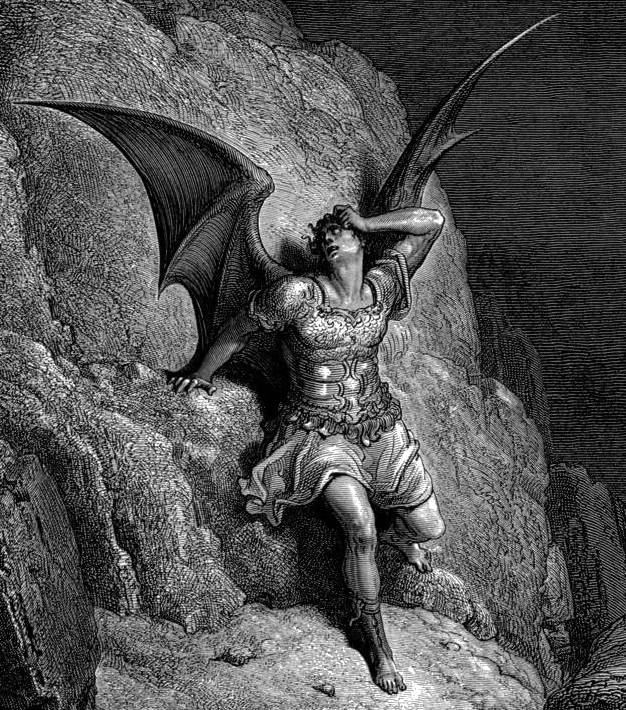
     Commonly, such a figure is visible, like Lucifer, in Paradise Lost.

GustaveDoreParadiseLostSatanProfile

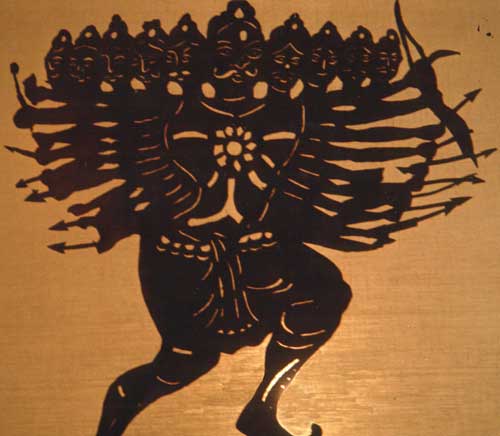
     Or he’s very visible, like Ravana in the Ramayana, with his ten heads.

page12_1

     For us, however, this is to risk circumscribing the villain, his visible body suggesting his visible limits. After all, it was a Sauron with hands who lost the Ring to a sword blade. To have a body, then, is to be vulnerable (literally, in the case above) and, more perhaps more important, in terms of story, more predictable, more bound by conventions.

     You (as JRRT) create Sauron, then, who once had a body, but now you make him nearly disembodied, being represented physically as a single, fiery eye.

Eye_of_Sauron

     This gives the effect of a brooding, ever-watchful presence, a bit like all of those posters in 1984’s London of Big Brother.

big-brother-is-watching

     This presence can be captured in the text in all sorts of ways, both direct and indirect. You have only to look up “Sauron” in the index to The Lord of the Rings to understand this: “Dark Lord, Enemy, Black One, Black Hand, Black Master, Base Master of Treachery, Dark Power, dark hands of the East, Nameless One, etc.”

     A brooding presence, however, is a real challenge for anyone trying to transfer The Lord of the Rings to the screen, which is why, after the previous defeat of Sauron, in which he appears as a huge being in black armor, he is reduced to that eye, sometimes captured in a palantir

palantir

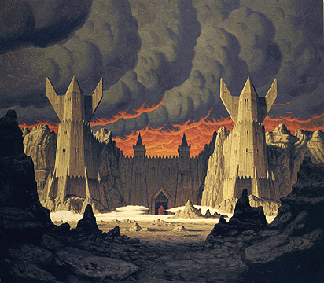
Or Galadriel’s mirror, though, more often, as Sam and Frodo come closer to their goal, as the equivalent of a tower-mounted searchlight.

Mordor

     Film and fiction are different media, with different needs and tools to satisfy those needs, as the script writers never tire of explaining to us. In our opinion, however, this extremely literal depiction so strongly smacks of old black-and-white prison escape films,

C_71_article_1408592_image_list_image_list_item_1_image%20(1)

that we wish that those script writers could have left the Dark Lord offstage entirely, if this is the best they could do.

     With our feeling that an bodyless villain might be more powerful here than an incarnated one—remember feeling spooked at night by a subtle change in the ambience?—we would wish that the writers had been a bit more imaginative—and had read their author a little more closely. After all, he had plenty of good ideas about how to depict villains. And it is perhaps a sad commentary on their work that, increasingly, in their years of using JRRT, they abandoned him, choosing, instead, to bloat his story and turn it in directions he clearly never intended. Why not, for example, do as Tolkien did and mirror the villain not only in that long list of titles, but also in the actions and words both of his subordinates and his opponents? Would this have worked? Perhaps a reference to the amount of time “You Know Who” appears on-screen in the first Harry Potter movie in contrast to how often he is mentioned would suggest how this might have worked.

     As for villainous subordinates and their actions, we’ll have more to say about them in our next.

lee34

Thanks, as always, for reading. Remember: we want to encourage discussion and debate. If you agree with us, say so. If you don’t, say so and we can have fun working through our views.

MTCIDC

CD

JRRT: Editorial Comment

22 Wednesday Apr 2015

Posted by Ollamh in J.R.R. Tolkien, Narrative Methods

≈ 2 Comments

Tags

Andrew Lang, de Montesquieu, Hawthorne, Hobbit, Persian Letters, The Lord of the Rings, The Scarlet Letter, Tolkien, William Morris

Dear Readers,

Welcome, as always. We had intended to go on with our discussion of villains, which looks like it will form a series, but we were distracted for a moment by the following– so more on villains to come. 

“This book is largely concerned with Hobbits, and from its pages, a reader may discover much of their character and a little of their history. Further information will also be found in the selection from The Red Book of Westmarch, that has already been published, under the title of The Hobbit.” 

So begins The Lord of the Rings, a novel. But a novel which pretends not to be a novel at all, but, rather, an edited version of a true history of someplace and sometime else: Middle-earth, the Third Age.

It’s hardly a new ploy, to pretend to be only presenting something already written by others. Often, it’s done to deflect attention from the sensitive matter within the novel: de Montesquieu’s criticism of France in Persian Letters or Hawthorne’s use of the theme of adultery in The Scarlet Letter. 

The adventures in The Lord of the Rings, or, for that matter, The Hobbit, are hardly controversial, however, so why go through this pretense, we wondered?

As we thought about and discussed this, we came up with a whole series of possible reasons– and none of them necessarily excludes any of the others. 

First, and perhaps most obvious, was that being an editor and translator formed a major part of what JRRT did in his academic life. What would seem more natural? 

Second, he lived in the academic world of Oxford, among academic friends, who formed a large part of his initial readership, and who themselves could be editors and translators. 

Third, based in part on one and two above, it fits into Tolkien’s and the Inklings’ desire to produce more of what they liked to read: an adventure, but in the guise of a “scholarly” work, yet one wholly invented.

Fourth, unlike real scholarly work, this one was not bound– and never would be– by the limits of available knowledge. There is only one Beowulf manuscript, after all. Because the only bounds placed upon the “research” for The Hobbit and The Lord of the Rings were the limits of the author’s imagination, this material was, potentially, endless, and every point within could be infinitely expanded, as we see in the twelve volume edited by Christopher Tolkien. One might imagine that JRRT, frustrated at how little Old English verse there was, felt enormously freed– and, should there be criticism, well, at one level at least, he had no need to respond, not being the author. 

This leads, in turn, to a less comfortable idea: suppose JRRT wasn’t completely at ease with his own creation. After all, he was a professor who was spending a great deal of his time and energy fabricating a fictional world rather than doing research and writing about literary/linguistic activities in the actual world of academia. Could this have been a kind of subconscious defense– I am doing scholarship– see? 

And then there’s reason five, which one might see as informing, at some level, all of the others. JRRT had been drawn, from childhood, towards stories from Lang’s Fairy Books through the prose and poetry of William Morris. He was also an active literary scholar. By playing editor and creating a second scholarly shell around the primary adventure, he could neatly combine the two halves of his life into one and, in the process, produce works which please reader and scholar alike– and combined. 

As always, we ask for your opinion. 

Thanks for reading!

MTCIDC,

CD

Where is Adventure?

20 Friday Mar 2015

Posted by Ollamh in Fairy Tales and Myths, J.R.R. Tolkien, Narrative Methods

≈ Leave a comment

Tags

Adventure, Landscape, Sam and Frodo, Story, The Hobbit, The Lord of the Rings, Tolkien

Dear Readers,

Welcome, as always!

In this post, we want to consider the idea of adventure. Usually, we think of this as an event or series of events, things which happen. This is certainly the way Bilbo sees it in the first chapter of The Hobbit, when Gandalf appears and all Bilbo thinks he wants to do is to sit, smoke, and read his mail, saying to the wizard: “nasty, disturbing uncomfortable things. Make you late for dinner! I can’t think what anybody sees in them!”

But what does Bilbo really know of adventure?

Imagine (and what a wonderful word that is), that you live down the hill from Bilbo, in the Shire in the quiet time, long after the wolves had come over the frozen Brandywine and some time before the Black Riders appear. This is a contented backwater of Middle-Earth and Bilbo mirrors this in his strong anti-adventure reactions.

With the world seemingly so safe and day-to-day (not that there aren’t the usual human–or hobbit–tussles—think of the Sackville-Baggins and their plans and jealousies) is there anything to suggest—beyond the idea that they are “nasty, disturbing uncomfortable things”–what real knowledge of adventure might exist in the Shire?

Sam suggests, in the second chapter of The Lord of the Rings, that at least he has some understanding beyond a vague sense that adventure is nasty when he says, “I heard a deal that I didn’t rightly understand, about an enemy, and rings, and Mr. Bilbo, sir, and dragons and a fiery mountain, and—and Elves, sir. I listened because I couldn’t help myself, if you know what I mean. Lor bless me, sir, but I do love tales of that sort. And I believe them too…”

Adventure, to Sam, then, isn’t a thing, but a story, and a believable one, too. It’s a story which he and Frodo talk about much later in the narrative, when they are about to encounter the treachery of Smeagol, Shelob, and the terrible march into Mordor and Sam has now realized that he and his master are in a story, too.

“The brave things in the old tales and songs, Mr. Frodo” Sam says, in one of the most profound moments for us in all of Tolkien, “adventures I used to call them. I used to think that they were things the wonderful folk of the stories went out and looked for, because they wanted them, because they were exciting and life was a bit dull, a kind of sport, as you might say.”

So now we see a kind of equation, which (beginning with Bilbo) might read:

(Nasty, disturbing) thing = adventure = story (Sam’s addition)

But Sam, the second half of his first name now being truer than he knows, continues his definition:

“But that’s not the way of it with the tales that really mattered, or the ones that stay in the mind. Folk seem to have been just landed in them, usually—their paths were laid that way, as you put it. But I expect they had lots of chances, like us, of turning back, only they didn’t.”

And here, with words and expressions like “paths” and “turning back” we can add another step to our equation:

(Nasty, disturbing) thing = adventure = story = going somewhere

There are, of course, folk and fairy tales where adventure comes to the protagonist, but it seems to us that when we began to run through the big stories, stories like the Odyssey, the Ramayana, and Beowulf, the narrative is mostly laid outside the world of home—Odysseus is coming home, but the bulk of the story takes place otherwhere, Rama and his wife and brother are in the forest, far from the palace when their adventure begins, and Beowulf has come from southern Sweden to Denmark to help King Hrothgar with a pest-control problem. And there are, of course, Frodo and Sam, who have traveled, mostly on foot, all the way from home in that safe-seeming Shire.

So, imagine that adventure can mean Somewhere Else, and that that place needs to be traveled through (or at least traveled to) for it to be an adventure, and for it to make the transition from adventure to story. For Sam, the choice to travel to and through adventure seems all-important. As he says of those who turn back:

“And if they had, we shouldn’t know, because they’d have been forgotten. We hear about those as just went on—and not all to a good end, mind you; at least, not to folk inside a story and not outside it call a good end. You know, coming home, and finding things alright, though not quite the same—like old Mr. Bilbo. But those aren’t always the best tales to hear, though they may be the best tales to get landed in.”

These, then, are the possible consequences of going to (and through) Somewhere Else: on the one hand, you may come back and, if you do, you may find things have changed, but are survivable, as Bilbo does when he returns to find himself considered dead and his house and goods up for auction. On the other hand, you may not come back—and yet may still be part of “the tales that really mattered, or the ones that stay in the mind.”

There is, of course, a paradox here: by Sam’s definition, it’s only by not turning back that one is in an adventure and a successful story, but a successful story (meaning, to Sam, a memorable one) may not ultimately be a successful adventure: what’s good for the listener/reader may not be good for those traveling to or in Somewhere Else.

Somewhere Else, itself, can be like any place in fiction: seas, mountains, forests, Middle Earth has them all and much of the story is about the simple act of marching along those many long miles, where the only quality necessary for heroic behavior seems to be persistence and, for Sam, and for us as readers, this becomes an heroic quality in itself—the ability to keep going, no matter what, a quality which is tested to the extreme degree in that last trek through the worst landscape of all, Mordor, half volcanic wilderness, half industrial wasteland. The landscape almost becomes another character here, a geographic Sauron who opposes those who would destroy his ring and through it, him. This, in turn, presents us with the idea that, just as characters good and bad give a story life, so do surroundings and the more complex the surroundings, might we see the greater the power of that life to make the story one that “stays in the mind”?

We’ll end this here, but, at the same time, we’ll add a “teaser” for our next. Sam and Frodo talk about adventures from the viewpoint of people who have read or heard them, all the while being inside an adventure themselves, as they—Sam in particular—acknowledge:

“Still, I wonder if we shall ever be put into songs or tales. We’re in one, of course; but I mean: put into words, you know, told by the fireside, or read out of a great big book with red and black letters, years and years afterwards.”

And yet there is an authorial fiction here: when they talk about being in a story, they mean that, through all the consequences of the Ring, their lives have been significantly altered and they have been “landed” in the current narrative. We know that they are, in fact, completely fictitious characters literally put into the story and that it only exists because the author has chosen to locate them there. All around them is a narrative which they cannot hear, as well as a listener whom they cannot see but who sees them and records every word and act, and this is just as true for Homer as it is for Tolkien. If Sam and Frodo went to Mount Doom without that listener, but didn’t return to set down what happened, as we’re told they did, what story would there be, even though they didn’t turn back and therefore should have been part of a story that “stays in the mind”?

More on that next time.

Thanks as ever for reading!

MTCIDC

CD

Newer posts →

The Doubtful Sea Series Facebook Page

The Doubtful Sea Series Facebook Page

  • Ollamh

Categories

  • Artists and Illustrators
  • Economics in Middle-earth
  • Fairy Tales and Myths
  • Films and Music
  • Games
  • Heroes
  • Imaginary History
  • J.R.R. Tolkien
  • Language
  • Literary History
  • Maps
  • Medieval Russia
  • Military History
  • Military History of Middle-earth
  • Narnia
  • Narrative Methods
  • Poetry
  • Research
  • Star Wars
  • Terra Australis
  • The Rohirrim
  • Theatre and Performance
  • Tolkien
  • Uncategorized
  • Villains
  • Writing as Collaborators
Follow doubtfulsea on WordPress.com

Across the Doubtful Sea

Recent Postings

  • Death and the Rohirrim September 30, 2026
  • Minor? September 23, 2026
  • An Homeric PS September 16, 2026
  • December in September September 9, 2026
  • Fan/Finn Fiction September 2, 2026
  • Demons on the Big Screen August 26, 2026
  • Solution (2) August 19, 2026
  • Out of Work Athena August 12, 2026
  • Solution (1) August 5, 2026

Blog Statistics

  • 123,436 Views

Posting Archive

  • September 2026 (5)
  • August 2026 (4)
  • July 2026 (5)
  • June 2026 (4)
  • May 2026 (4)
  • April 2026 (5)
  • March 2026 (4)
  • February 2026 (4)
  • January 2026 (4)
  • December 2025 (5)
  • November 2025 (4)
  • October 2025 (5)
  • September 2025 (4)
  • August 2025 (4)
  • July 2025 (5)
  • June 2025 (4)
  • May 2025 (4)
  • April 2025 (5)
  • March 2025 (4)
  • February 2025 (4)
  • January 2025 (5)
  • December 2024 (4)
  • November 2024 (4)
  • October 2024 (5)
  • September 2024 (4)
  • August 2024 (4)
  • July 2024 (5)
  • June 2024 (4)
  • May 2024 (5)
  • April 2024 (4)
  • March 2024 (4)
  • February 2024 (4)
  • January 2024 (5)
  • December 2023 (4)
  • November 2023 (5)
  • October 2023 (4)
  • September 2023 (4)
  • August 2023 (5)
  • July 2023 (4)
  • June 2023 (4)
  • May 2023 (5)
  • April 2023 (4)
  • March 2023 (5)
  • February 2023 (4)
  • January 2023 (4)
  • December 2022 (4)
  • November 2022 (5)
  • October 2022 (4)
  • September 2022 (4)
  • August 2022 (5)
  • July 2022 (4)
  • June 2022 (5)
  • May 2022 (4)
  • April 2022 (4)
  • March 2022 (5)
  • February 2022 (4)
  • January 2022 (4)
  • December 2021 (5)
  • November 2021 (4)
  • October 2021 (4)
  • September 2021 (5)
  • August 2021 (4)
  • July 2021 (4)
  • June 2021 (5)
  • May 2021 (4)
  • April 2021 (4)
  • March 2021 (5)
  • February 2021 (4)
  • January 2021 (4)
  • December 2020 (5)
  • November 2020 (4)
  • October 2020 (4)
  • September 2020 (5)
  • August 2020 (4)
  • July 2020 (5)
  • June 2020 (4)
  • May 2020 (4)
  • April 2020 (5)
  • March 2020 (4)
  • February 2020 (4)
  • January 2020 (6)
  • December 2019 (4)
  • November 2019 (4)
  • October 2019 (5)
  • September 2019 (4)
  • August 2019 (4)
  • July 2019 (5)
  • June 2019 (4)
  • May 2019 (5)
  • April 2019 (4)
  • March 2019 (4)
  • February 2019 (4)
  • January 2019 (5)
  • December 2018 (4)
  • November 2018 (4)
  • October 2018 (5)
  • September 2018 (4)
  • August 2018 (5)
  • July 2018 (4)
  • June 2018 (4)
  • May 2018 (5)
  • April 2018 (4)
  • March 2018 (4)
  • February 2018 (4)
  • January 2018 (5)
  • December 2017 (4)
  • November 2017 (4)
  • October 2017 (4)
  • September 2017 (4)
  • August 2017 (5)
  • July 2017 (4)
  • June 2017 (4)
  • May 2017 (5)
  • April 2017 (4)
  • March 2017 (5)
  • February 2017 (4)
  • January 2017 (4)
  • December 2016 (4)
  • November 2016 (5)
  • October 2016 (6)
  • September 2016 (5)
  • August 2016 (5)
  • July 2016 (5)
  • June 2016 (5)
  • May 2016 (4)
  • April 2016 (4)
  • March 2016 (5)
  • February 2016 (4)
  • January 2016 (4)
  • December 2015 (5)
  • November 2015 (5)
  • October 2015 (4)
  • September 2015 (5)
  • August 2015 (4)
  • July 2015 (5)
  • June 2015 (5)
  • May 2015 (4)
  • April 2015 (3)
  • March 2015 (4)
  • February 2015 (4)
  • January 2015 (4)
  • December 2014 (5)
  • November 2014 (4)
  • October 2014 (6)
  • September 2014 (1)

Blog at WordPress.com.

  • Subscribe Subscribed
    doubtfulsea
    Join 75 other subscribers

    Have a WordPress.com account? Log in now.

  • doubtfulsea
    View site in Reader
    Manage subscriptionsSign upLog in
    Report this content
    Collapse this bar
Loading Comments...