• About

doubtfulsea

~ adventure fantasy

Tag Archives: The Hobbit

Pop!

13 Wednesday Dec 2017

Posted by Ollamh in J.R.R. Tolkien, Military History, Military History of Middle-earth, Narrative Methods

≈ Leave a comment

Tags

anachronism, Bag End, gun, gunpowder, hand gonne, Helm's Deep, pop-gun, Professor Moriarity, Reichenbach Falls, Rosenbach Library, Sherlock Holmes, Sir Arthur Conan Doyle, The Adventure of the Empty House, The Hobbit, The Hound of the Baskervilles, The Lord of the Rings, Tolkien, Trev's Air Gun Scrapbook

Welcome, as always, dear reader.

The anachronisms in the 1937 Hobbit are well known:  “cold chicken and tomatoes”, “like the whistle of an engine coming out of a tunnel”, etc.  We ourselves have contributed to the commentary in several past postings and here we are again.

This time, we were caught by something Gandalf says to Bilbo in Chapter 1:

“It is not like you, Bilbo, to keep friends waiting on the mat, and then open the door like a pop-gun” (The Hobbit, Chapter 1, “An Unexpected Party”)

So, “pop-gun”?

Just previously, Bilbo was described as pulling open “the door with a jerk” (and in tumble 4 dwarves), which suggests what the pop-gun sounds like, as well as how sudden the motion.

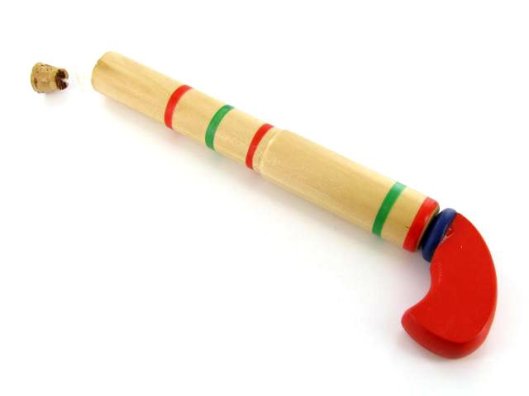
How is that sound made?  Here’s an example of such a gun.

image1popgun.jpg

As you can see, it’s just a tube.  Inside is a kind of plunger—a rod with a flattened end which faces towards the muzzle (the opening at the left).  You pull back the rod and it draws air into the barrel.  If you stick a cork in the muzzle, so that it makes a seal, when the rod is pushed up the barrel, the flattened rod end pushes the air in front of it, compressing it.  The compressed air then forces out the cork, which shoots out with a POP!

For all that it uses air to propel the cork, this is, as its name implies, a kind of gun.  Although there may be gunpowder in Middle-earth (see our earlier posting on the use of explosives at Helm’s Deep and the gate area of the Rammas Echor), it seems to be employed as the equivalent of dynamite,

image2helmsdeep.jpg

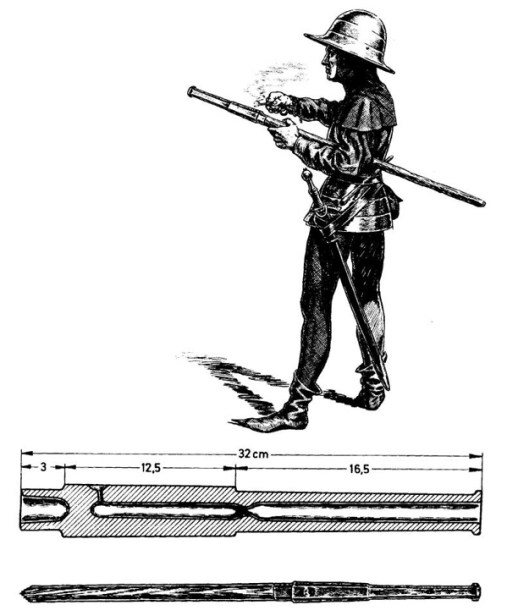
and never as the propulsive force in what medieval people in our world called a “hand gonne”.

image3handgonne.jpg

image4handgonne.jpg

And thus it falls into that category of anachronisms.  The idea of air guns, however, makes us think of the Daisy Air Rifle one of us had as a child.

image5daisy.jpg

The air was pulled in when the lever underneath the trigger was pulled down and then pushed back, to make it ready to fire.  The illustration fires bbs, but ours was more peaceful, firing cork balls.

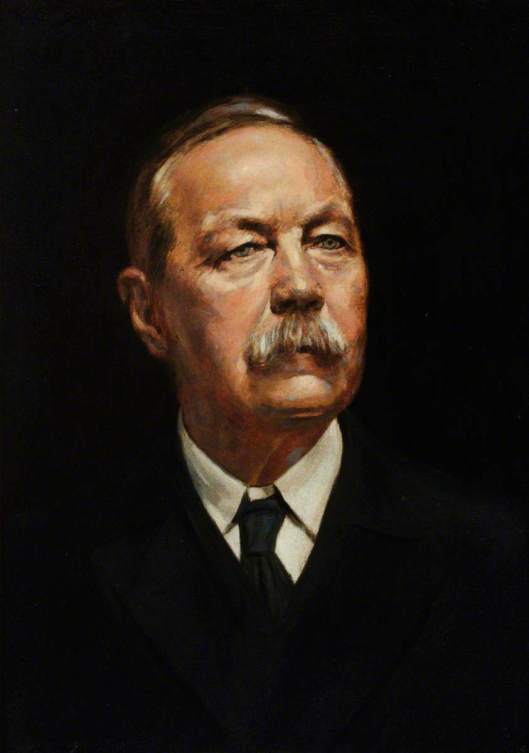
But a very unpeaceful version appears in Sir Arthur Conan Doyle’s

image6conandoyle.jpg

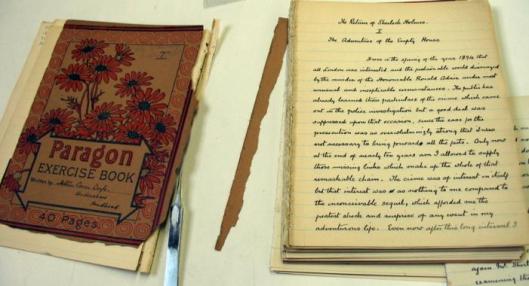
“The Adventure of the Empty House” (1903).  Here’s the first page of the manuscript, housed at the Rosenbach Library, in Philadelphia.  (And here’s a LINK to their excellent on-line magazine.)

image7ms.jpg

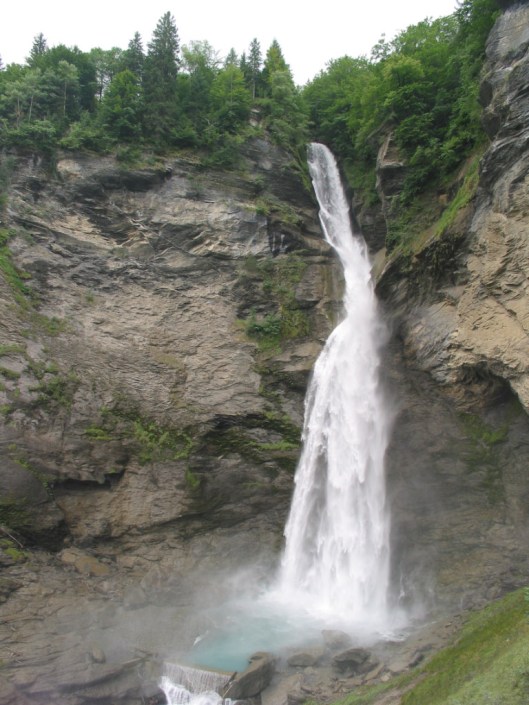
Sherlock Holmes had disappeared after his combat with Professor Moriarity at the Reichenbach Falls

image8reichenbach.jpeg

in Switzerland in 1891 (although the story in which this happens was published in The Strand Magazine in December, 1893).

image9moriarityholmes.jpg

For financial reasons, Conan Doyle brought Holmes back—first in the novel, The Hound of the Baskervilles in 1901,

image10hound.jpg

but this story was supposed to have taken place in 1889, two years before Holmes’ disappearance.  It was only with “The Adventure of the Empty House” that Holmes reappeared in contemporary London.  Here, it was revealed that Holmes had not fallen to his death with Moriarity, but had survived and had lived in disguise for some years, traveling the world and avoiding the vengeance of Moriarity’s men and, in particular, his chief lieutenant, Colonel Sebastian Moran, who had actually seen Holmes escape the clutches (literally) of Moriarity and had tried unsuccessfully to kill him with a fall of rock.

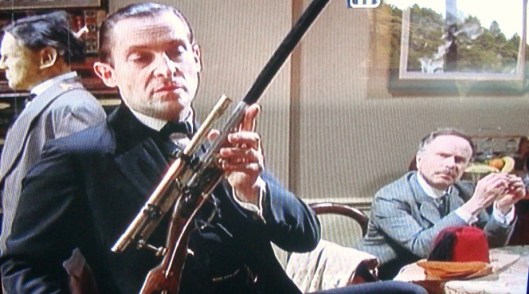
Back in London, Holmes appears to Watson and enlists his aid in trapping Moran, which Holmes does by placing a wax bust of himself in outline in the window of 221B Baker Street as a lure.  Holmes and Watson then wait across the street in an empty house (hence the title of the story), Holmes thinking that Moran will try to assassinate him from the street.  Instead, Moran climbs to the very room where the two are concealed and, opening a window, uses an air rifle to attempt to kill Holmes—before he’s tackled by the pair and subdued, with the aid of several policemen summoned from hiding nearby.

image11moranbroughtdown.jpg

Moran, Holmes explains, was thought to be the best shot in India, where he had been stationed for some years, so it’s not surprising that he would attempt the long-distance murder of Holmes, but why an air gun?  (This is from the Granada television series of the 1980s, with the brilliant Jeremy Brett as Holmes.)

image12airgun.JPG

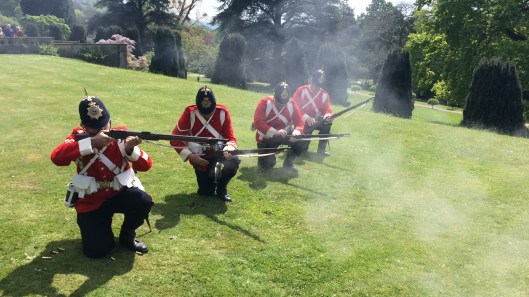
Air guns had first begun to appear in the 16th century, but, by the later 19th century could be either a toy, or a useful weapon for snipers, mainly because of its propulsion method.  Until the 1890s, the main propellant was gunpowder which, when fired, produced a loud bang and a cloud of white smoke.

image13martinihenry.jpg

Imagine, instead, a weapon which made much less noise—or a noise very unlike a gun’s BANG! (Conan Doyle has Watson describe the sound as “a strange loud whiz”)– and no smoke at all.  Perfect for a nighttime assassination, as Colonel Moran has planned it, never realizing that Holmes is well aware of his plan and foils it neatly (as Holmes almost always does).

In the 21st century, smokeless powder is the norm and air guns are now used for target shooting (including an Olympic event), and pop-guns?  Still for sale—just google “toy pop guns” at Amazon.com

image14popgun.jpg

or E-Bay and see what you find—something Bilbo never could!

Thanks, as ever, for reading.

MTCIDC

CD

Ps

If you’d like to know more about air guns, here’s a LINK for a great source, “Trev’s Air Gun Scrapbook”.

Floored

06 Wednesday Dec 2017

Posted by Ollamh in Artists and Illustrators, J.R.R. Tolkien, Narrative Methods

≈ Leave a comment

Tags

Bag End, Baggins, carpet, classical altars, Cosmati, English Ham House, Erasmus, Felicity Irons, floors, Gamgee, John Howe, Lady Chapel, paneling, parquetry, rush door mat, Shire, social levels, stone block, swags, The Hobbit, The Lord of the Rings, tile, Tolkien, Took, Typha, Versailles, Westminster Abbey

Welcome, dear readers, once more to our blog.  In this installment, we are returning to our inspection of Bilbo’s entryway.

image1entryway.jpg

So far, we’ve examined the barometer, the clock, the umbrella stand, and that hat in the left foreground—intentionally misread as a sugar loaf.  Now we want to examine the floor, which looks to be a pretty complicated place, asking ourselves, as we always do, where does this come from and how much of the medieval—so often the foundation of Middle-earth—does it contain?

The Shire clearly has social levels.  Bilbo, Frodo, and Merry and Pippin (contrary to P Jackson—who violated JRRT’s wishes on the subject of the latter two), for example, all speak (in translation, of course)  what is called “Received Standard English”.  In contrast, Sam, the Gaffer, and the Cottons speak what would appear to be a rural dialect and Sam even thinks of Frodo as “Mister Frodo” and even “Master”.   We do not know where these class distinctions came from, but we know of Bilbo that:

  1. he is called “a very well-to-do hobbit “ at the very beginning of The Hobbit (The Hobbit, Chapter 1, “An Unexpected Party”)
  2. he has distinguished forebears in the Tooks—his mother was “the famous Belladonna Took, one of the three remarkable daughters of the Old Took” (The Hobbit, Chapter 1, “An Unexpected Party”)
  3. he lives in an extensive, rambling burrow: “a very comfortable tunnel without smoke, with panelled walls, and floors tiled and carpeted…The tunnel wound on and on, going fairly but not quite straight into the side of the hill…bedrooms, bathrooms, cellars, pantries (lots of these), wardrobes (he had whole rooms devoted to clothes), kitchens, dining-rooms, all were on the same floor, and indeed on the same passage.” (The Hobbit, Chapter 1, “An Unexpected Party”)

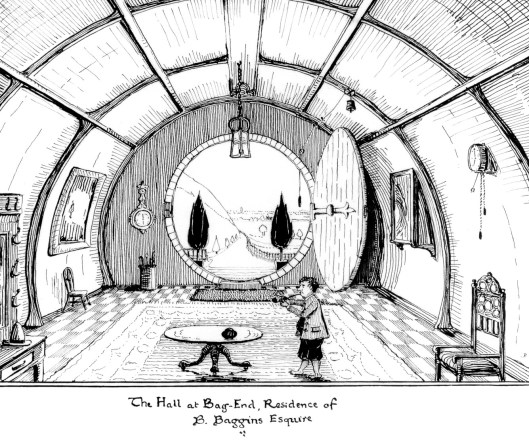
And the entryway certainly shows some elements of a wealthier lifestyle, with its paneled (US spelling) walls—but we intend to devote a later posting to the walls and support structure of Bag End, so let’s turn to what is said next:  “floors tiled and carpeted”.  Looking at JRRT’s drawing, we can see both—and more.

image1entryway

Before we had gone back to this passage, we were a little puzzled as to the basic floor.  As you can see in Tolkien’s illustration, it’s in a checkered pattern and, at first, we wondered if this might be an example of what’s called “parquetry”.  In this method of flooring, different strips or blocks of wood are laid into designs of all sorts.  Here are a couple of fancy examples from the 17th-century English Ham House.

image3hamhouse.jpg

image4hamhouse.jpg

image5parquetry.jpg

Parquetry appears to have been developed in France, as an alternative to marble floors (much less weight to support by the floor beams and equally pretty, we’d guess).  Here’s an example from Louis XIV’s Versailles.

image6versailles.jpg

But the description in The Hobbit says “floors tiled”– here’s an exterior tile pattern from Ham house.

image7exteriortile.jpg

and an indoor one.

image8interiortile.jpg

So, although Bilbo appears well enough off to afford parquetry, there is no mention of it in JRRT’s description and it is a decorative detail from the 17th century and beyond, which rather goes against our usual “Middle-earth is (more or less) medieval” idea.  The text of The Hobbit clinches the fact that it’s tile, of course, but the tile we then see in JRRT’s illustration strikes us as even plainer than the late-19th, early 20th century hallway tile we’ve seen, as in this restoration picture, and with which Tolkien would have been familiar on a daily basis.

image9edwardianrestoration.jpg

Medieval tiles, in fact, can be even more elaborate, first appearing in England in the 13th century, mainly in ecclesiastical buildings.  Here’s one from the Lady Chapel (completed in 1373) in York Minster.

York-Lady-ChapellIV.jpg

Much medieval tiling has disappeared over the centuries and here’s a useful link which explains why.  And to see an amazing example of such work, here’s a link to the restored Cosmati paving in Westminster Abbey.

image12cosmati floor.jpg

Over this tile, Tolkien has laid a carpet (as his description has said, the floors are “carpeted”).

image12hall.jpg

It’s faint, but what one can make out appears to be a solid-colored center with what appear to be wreaths and what are called “swags”—long chains made to imitate garlands of ribbons, fruit, and flowers used to decorate classical altars.

image13swag.jpg

image14romanaltar.jpg

So far, we haven’t located anything which closely resembles the carpet at Bag End, but here’s an 18th-century French example to provide a kind of general idea.image13french.jpg

There are two more items on the floor, both just below the door.

image17hall.jpg

The first looks to be perhaps a stone block, used as a sill. (Our illustration is actually of a mistake—the central block here has fallen out of position, but it gives you the idea of such a block in use.)

image18doorsill.jpg

The other item appears to us to be a rush door mat (dog—“Bo”–optional).

SONY DSC


Rushes (genus Typha) grow all over the world and can be used, it seems, for almost anything.  Here’s the English rush weaver, Felicity Irons, busy harvesting.

image20firons.jpg

Rushes, however, bring us back to the subject of English medieval flooring.  Our research suggests that the houses of farmers and lower-level townspeople would have been of natural substances, like clay pressed to make a hard surface.  Richer people would have had wooden or even, in a few cases, tile floors (more such floors after the commercial business took off in the 15th/16th centuries).  Carpets appear to be much later (most weaving was hung on walls, to keep down drafts, it seems).  Our sources for what people laid on top of their floors are very sketchy and some modern writers have depended upon a quotation from the Dutch scholar, Erasmus (1469-1536),

image21erasmus.jpg

who visited England and spent some years there around 1500.  He tells us that the English covered their floors with rushes, but that they only added more to the top, without cleaning out the lower levels, which became full of refuse and caused bad smells (which to a person of Erasmus’ time represented the danger of “miasma”—bad air which could cause disease—something believed as scientifically true even throughout the first half of the 19th century).  Some modern commentators have questioned this, proposing the difficulty of moving about on a weedy floor in a long gown, as women and, in time, men, wore during the later Middle Ages.  At least one of those questioners even suggests that rushes meant rush mats—see above.

Bilbo’s hall has only one of these, meant, from its position, to be used as a modern would, as a doormat.

Taken altogether, we would suggest that Bilbo’s floor, just like his clock and barometer and umbrella stand, would appear to belong not to the medieval world which lies underneath Middle-earth, but rather to the late 19th-20th century world of the author.  And we’re not alone in our opinion.  Here’s John Howe’s version of that hallway—compare it with JRRT’s and see what’s been erased.

image22howe.jpg

image23jrrthall.jpgAnd here’s the film version–

image24film.jpg

There are more differences, too–for fun, see how many you can find.

And thanks, as always, for reading!

MTCIDC

CD

Orcked

22 Wednesday Nov 2017

Posted by Ollamh in Economics in Middle-earth, Imaginary History, J.R.R. Tolkien, Literary History, Narrative Methods

≈ Leave a comment

Tags

Arthur Rackham, Bosch, Brueghel, counterfeit, creation, Elves, Ents, Fangorn, Goblins, John Bauer, mockery, Orcs, Saruman, Sauron, The Hobbit, The Lord of the Rings, Tolkien, Treebeard, trolls, US Treasury Department, Weimar Republic

Welcome, dear readers, as always.

In our last, we discussed less familiar characters in The Lord of the Rings, the Corsairs of Umbar, and what we imagine they could look like.

In this posting, we want to look at much more familiar characters, Orcs—but from the viewpoint of Fangorn.

image1treebeard.jpg

He says of them:

“Maybe you have heard of Trolls?  They are mighty strong.  But Trolls are only counterfeits, made by the Enemy in the Great Darkness, in mockery of Ents, as Orcs were of Elves.”  (The Two Towers, Book Three, Chapter 4, “Treebeard”)

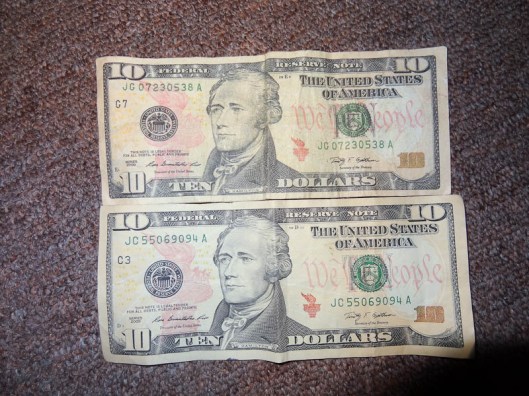
We’ve always been a bit puzzled by this.  “Counterfeit” makes us think, immediately, of counterfeit money.  Here are a pair of US 10-dollar bills:  can you tell the counterfeit (from Old French via a Latin compound, contra, “against” + facere, “make/do”—in Medieval Latin a contrafactio is a thing put against another, something in contrast, thus “imitation”)?

image2hamiltons.jpg

To be a successful counterfeit, normally, it’s necessary that the imitation be as close to the original as possible, as in the case of these two tens.  The US Treasury Department goes to a lot of time and expense to make counterfeiting as difficult as possible

image3anticounterfeit

but, if a counterfeiter is successful, he stands to make (in two senses) a lot of money.  He can also cause a great deal of financial damage, breeding distrust in a government’s ability to coin money and to stand behind it.  The more counterfeit money in the system, the more money the government has to back, which, in time, could lead to what is called hyperinflation and can bring a currency to collapse.  When a government does this itself it can cause havoc with a country’s economy, as happened in the Weimar Republic in 1921-1924.  At that time, for complex reasons having to do with paying off the German Empire’s war debts, the government began producing too much paper money and too rapidly.  This caused the money to lose value very quickly, rendering it almost worthless.

image4weimarmoney

It’s no wonder that the penalty for counterfeiting was usually the most severe possible.

image5tyburn

Treebeard’s use of the word “counterfeit”, then, would suggest that what Sauron was doing was trying to make nearly-exact copies of something, either Ents or Elves, in his creation of Trolls and Orcs.  So what do we find when we first see a description of Orcs?

“There were four goblin-soldiers of greater stature, swart, slant-eyed, with thick legs and large hands.”

(The Two Towers, Book Three, Chapter 1, “The Departure of Boromir”)

That’s not much to go on:

  1. “greater stature” would suggest that most Orcs were short
  2. “swart” means “dark-complexioned” (a term Sam uses to describe men from Harad, whom he calls “Swertings”—The Two Towers, Book Four, Chapter 3, “The Black Gate is Closed”)
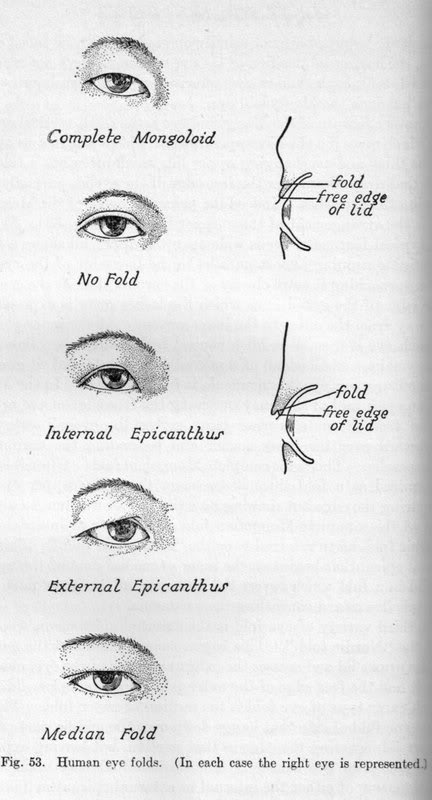
  3. “slant-eyed”—for contemporary people this is a tricky term, even a racial slur, but JRRT probably meant no more than that these Orcs had epicanthic folds to their eyelids, which is not uncommon among many of the world’s peoples.

image6epicanth

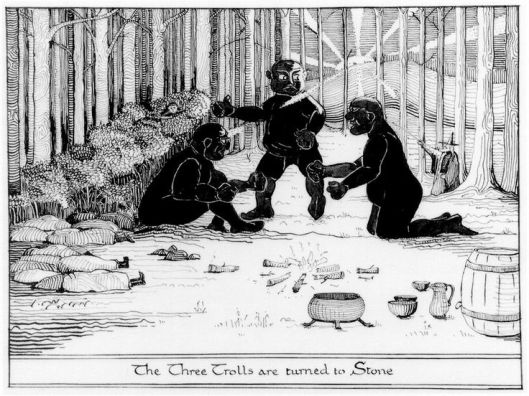
  1. “with thick legs and large hands” suggests very stocky builds—like the “Trolls turned to stone” in JRRT’s illustration of the scene in The Hobbit.

image7stonetrolls

This is a start, but will our next view help?  Pippin and Merry are the prisoners of the Orcs and Pippin is listening to a quarrel between those of Saruman and those of Sauron:

“In the twilight he saw a large black Orc, probably Ugluk, standing facing Grishnakh, a short crook-legged creature, very broad and with long arms that hung almost to the ground.” (The Two Towers, Book Three, Chapter 3. “The Uruk-hai”)

Counterfeit Elves?  Of course we know—also from Fangorn—that perhaps Saruman was up to something more, as Fangorn says of him:

“He has taken up with foul folk, with the Orcs.  Brm, hoom!  Worse than that:  he has been doing something to them; something dangerous.  For these Isengarders are more like wicked Men.  It is a mark of evil things that came in the Great Darkness that they cannot abide the Sun; but Saruman’s Orcs can endure it, even if they hate it.  I wonder what he has done?  Are they Men he has ruined, or has he blended the races of Orcs and Men?  That would be a black evil!” (The Two Towers, Book Three, Chapter 4, “Treebeard”)

This might account for the size of the Uruk-hai, as well as for their ability to endure daylight, but what about the crook-leggedness and “long arms that hung almost to the ground”?

Perhaps here we should remember the end of Fangorn’s description:  “…in mockery of Ents, as Orcs were of Elves.”

Hmm.  Trolls certainly don’t look much like Ents—

image8.jpg

image9leetreebeard.jpg

Is this the “mockery”?  It’s certainly not counterfeiting in the usual sense!

Should we understand the same for Orcs vs Elves?  Here are illustrations of Galadriel and Legolas (both by the Hildebrandts):

image10galadriel.jpg

image11legolas.jpg

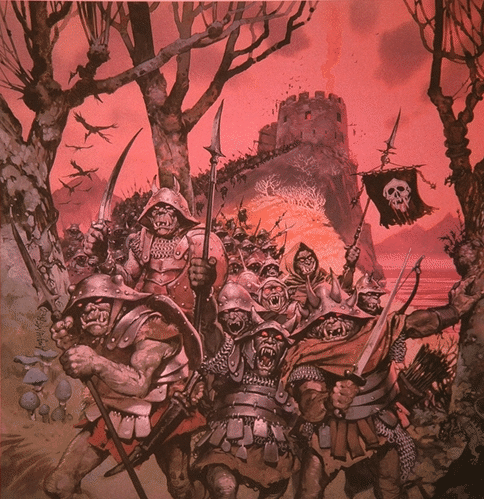
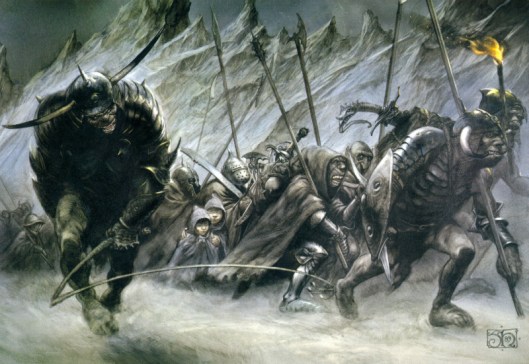
Set those against any modern artist’s view of Orcs and, again, it’s not counterfeiting, in the strictest sense, so we suppose that we have to assume “mockery”—but with the added assumption that Sauron had a very twisted sense of humor.  (There’s also that nasty half-suggestion of Fangorn’s that, since Saruman’s Orcs are behaving more like men, Saruman has been performing genetic experiments, something even Fangorn doesn’t want to think about.)

image12mcbride.gif

image13lee.jpg

image14howe.jpg

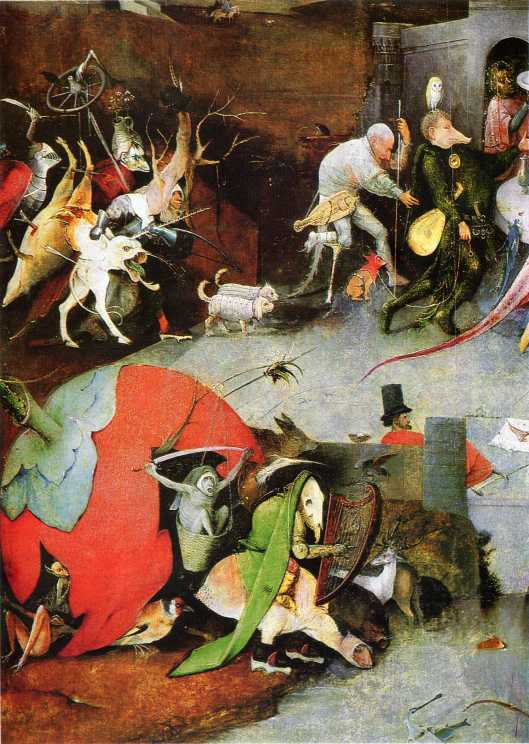
Looking at all of these illustrations, by the way, we were struck by where we’d seen creatures like this before.  Could it be in the works of those strange Flemish/Dutch painters like Brueghel and Bosch?

image15bosch.jpg

Or Arthur Rackham?

image16rackham.jpg

Or the early 20th-century Swedish painter, John Bauer, who, in his depiction of forests was an influence upon JRRT?

image17bauer.jpg

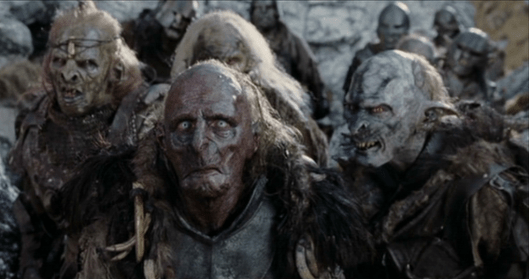
And, more recently, considering P. Jackson’s Orcs,

image18orcs.png

image19orcs.jpg

their skin color and general look:  is there a suggestion here of the so-called “Bog People” (about whom we wrote a posting some time ago)—a whole series of bodies, at least one dating from the 4th century bc

image20tollundman.jpg

who have been discovered buried in peat bogs (a great preservative) in northern Europe?

image21peatbog.jpg

And, in their color and oozy look–not to mention that they seem to move in scuttly groups–is there something cockroachy about them?

image22cockroaches.jpg

But, just as there is a place Fangorn doesn’t want to go, it’s true for us as well!

Thanks, as ever, for reading.

MTCIDC

CD
PS

You probably spotted this (we have very intelligent readers), but it’s the top 10-dollar bill which is the counterfeit.

PPS

It has also occurred to us that JRRT more than once discussed the fact that Sauron, as a lesser deity-figure, could never originate, only copy and “subcreate”—perhaps suggesting another reason for making “mockeries”:  his anger at his inability to do original work?

About That PS

18 Wednesday Oct 2017

Posted by Ollamh in J.R.R. Tolkien, Narrative Methods

≈ Leave a comment

Tags

anachronism, Bag End, banjo clock, barometer, clocks, Edwardian, Evangelista Torricelli, Hobbiton, Lucien Vidie, Middle-earth, Oxford, railway, The Hobbit, The Lord of the Rings, Tolkien, Victorian

Welcome, as always, dear readers.

In a PS to our last posting, we showed this illustration

image1bagend.jpg

and asked you if you saw something peculiar about it.

In fact, there are two peculiar things about it.  Look to the left of the door.  What is that?   At first, we were inclined to imagine that it was a clock of a style known as a “banjo clock”.

image2banjoclock.jpg

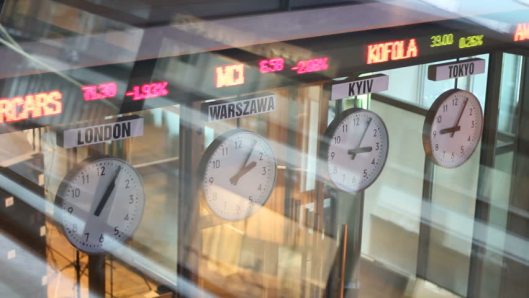
But there was also a clock on the right hand wall, and, unless Bag End was like a stock exchange, with clocks showing various times around the world,

image3stockclocks.jpg

(image the one on the left being “Shire Time”, while the one on the right is “Mordor Time”!)

why would Bilbo have two clocks?

There’s also the technical problem:  banjo clocks—maybe all clocks?—which have pendulums need to use gravity to help in their swing.  If the object on Bilbo’s wall is a clock, it’s upside down and therefore—

and so, after lots of searching to see if we could match it somehow, we were scratching our collective heads when we realized that it wasn’t a clock at all, but a barometer—and a distinctively Victorian one, which fits in with our suggestion in a recent posting that JRRT was using his memories of his Victorian/Edwardian childhood as the basis of Bag End.

image4vicbar.jpg

So, what’s a barometer and why might Bilbo have one?

The simplest answer to the first of those is that a barometer measures atmospheric pressure.  That measurement, in turn, can tell you about changes in weather:  low pressure, it’s more likely to rain, high pressure, not.  Here’s a basic chart to explain.

image5airpressure.jpg

One odd thing about Bilbo’s is that, commonly, barometers are combined with thermometers in patterns of the sort you see on the Bag End wall, whereas this one appears to be by itself.

image6bar.jpg

The really odd thing, however, is that he has one to begin with.  The first barometers date from the 1640s, being an offshoot of trying to understand the concept of a vacuum.

image7aboutvacuums.png

It was only in the 1840s that someone (Lucien Vidie) postulated that air pressure changes—measurable by this device– could signal weather changes.  For Bilbo to have such a thing in a Middle-earth which appears to be almost entirely devoid both of science as we understand it and of mechanical technology, is a puzzle at best.   Who made it?  How did he obtain it?  And last—and hardest—what did he do with it?

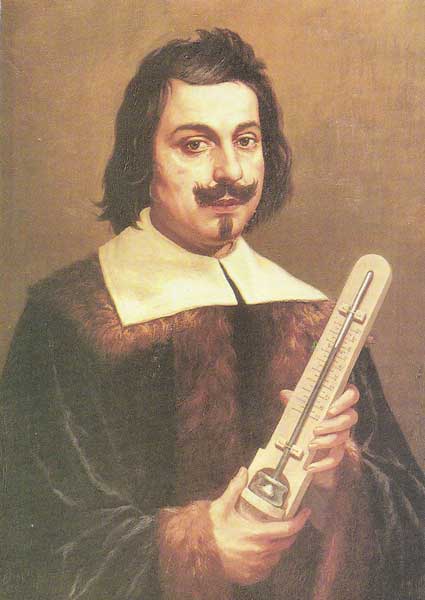
Of course, as we have discussed in past postings, there are whole areas of knowledge about Middle-earth about which we have little or no information and it’s been fun for us to try to reconstruct things using parallels from our own world, combined with the little we do know.  That first barometer was, we presume, handmade by Evangelista Torricelli (1608-1647).

image7atorricelli.jpg


It appears to have been, basically, a long glass tube, attached to a piece of wood by white metal fittings.  The hobbits have glass windows, so the art of glass-blowing exists in their world.  The wood and metal could be used in many other settings.  Once the concept was understood, it would be easy to see someone taking already available techniques and materials and creating the object.

But who made it?  When it came to ingenuity in craft, JRRT suggests the dwarves—with the men of Dale as fellow-workers or perhaps as middlemen.  As Thorin says of the past:

“Altogether those were good days for us, and the poorest of us had money to spend and to lend, and leisure to make beautiful things just for the fun of it, not to speak of the most marvelous and magical toys, the like of which is not to be found in the world now-a-days…the toy market of Dale was the wonder of the North.” (The Hobbit, Chapter One, “An Unexpected Party”)

How did Bilbo acquire it?  He had come to be known in Hobbiton as unlike other hobbits—his mother, after all, was the famous Belladonna Took (for her history—or, rather, her mystery–see The Hobbit, Chapter 1) and, after his travels, “he took to writing poetry and visiting elves”.  Perhaps the barometer came from one of his trips?  Or had it been sent to him?

If we take the preparations for the famous joint-birthday-party at the opening of The Lord of the Rings as a clue, there must have been at least a small degree of commerce between the Shire and the dwarves of the Lonely Mountain and the rebuilt town of Dale:

“On this occasion the presents were unusually good…There were toys the like of which they had never seen before, all beautiful and some obviously magical.  Many of them had indeed been ordered a year before, and had come all the way from the Mountain and from Dale, and were of real dwarf-make.” (The Fellowship of the Ring, Book One, Chapter 1, “A Long-Expected Party).

But then there is that third question:  what did he do with it?  As far as we can currently determine from The Hobbit and The Lord of the Rings, neither Bilbo nor Frodo nor even Gandalf ever mentions a barometric reading, or is concerned that the pressure is dropping.

So what are we to make of this?

For all that JRRT was increasingly careful about this, there a few anachronisms in his work.  In The Hobbit, there is the well-known one of Bilbo’s reaction to Thorin’s explanation of the dangers of future burglary:

“At may never return he began to feel a shriek coming up inside, and very soon it burst out like the whistle of an engine coming out of a tunnel.” (The Hobbit, Chapter One, “An Unexpected Party”)

Although JRRT himself considered changing this for the 1966 revision, Douglas Anderson, in The Annotated Hobbit, 47-48, argues that this doesn’t have to be an anachronism at all:

“…for Tolkien as narrator was telling this story to his children in the early 1930s, and they lived in a world where railway trains were a very important feature of life.”

In fact, built in 1844, the first railway station in Oxford was almost a century old when The Hobbit was published in 1937.

image8grandpointstation.JPG

(And we can’t resist this quotation from Jackson’s Oxford Journal for 15 June, 1844, which describes the arrival of the first train as “one of those rampageous, dragonnading fire-devils”.  Clearly, dragons and railroads have a long history together!)

So, is this just a slip on JRRT’s part?  Perhaps he had a barometer in his past, next to a door, and, in his urge to fill up the wall space of Bag End, he simply filled in what he already knew?  We can only shrug—and, in our next, wonder about that clock on the wall to the right:  what’s it doing in Middle-earth?

Thanks, as ever, for reading.

MTCIDC

CD

Are You Sitting Down?.2 (Some Thrones, but No Games)

11 Wednesday Oct 2017

Posted by Ollamh in Economics in Middle-earth, J.R.R. Tolkien, Literary History, Narrative Methods

≈ Leave a comment

Tags

A Game of Thrones, Bag End, basins, Bree, British monarchs, Buckland, canopy, cart, Cirith Ungol, Coronation Chair, Coronation Throne, Crick Hollow, Edoras, Edward I, Edward VII, Edward VIII, Edwardian, Elizabeth II, Elrond's house, Furniture, George V, George VI, Gondor, high table, Iron Throne of Westros, Lia Fail, Lothlorien, Medieval, Middle-earth, Minas Tirith, monopodium, Moot Hill, parlor, pubs, Rivendell, Rohan, Shire, Stone of Scone, Tara Ireland, The Hobbit, The Lord of the Rings, The Prancing Pony, the Stone of Destiny, throne, Tolkien, Tom Bombadil, UK pubs, Victorian Bedroom, Victorians, washstand

Welcome, dear readers, as always.

In our last, we were talking about furniture in Middle-earth—in that post our subject was The Hobbit.  We continue with The Lord of the Rings and conclude with one specialized piece of furniture.

We begin where we began last time, with Bag End.

image1bagend.jpg

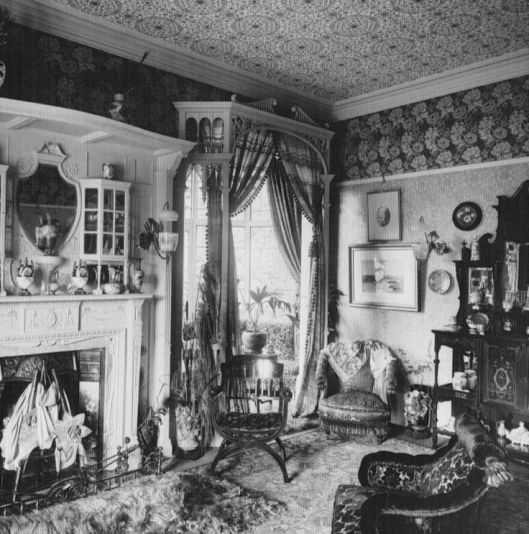
With all of its rooms and the stuff in them, we suggested then that what JRRT was really doing was depicting the kind of overcrowded place later Victorians and Edwardians—the people with whom he, born 1893, would have grown up around—would have preferred.

image2vicparlor.jpg

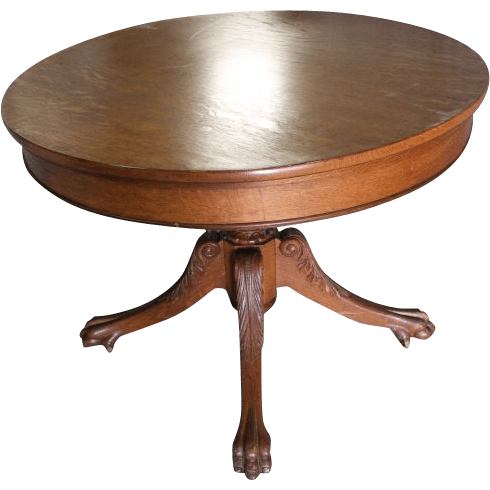
[Note, by the way, the table in the middle of the entryway in Tolkien’s picture of Bag end, and compare it with this “monopodium” table with claw feet, which could be seen in such a parlor.]

image3monopodium.png

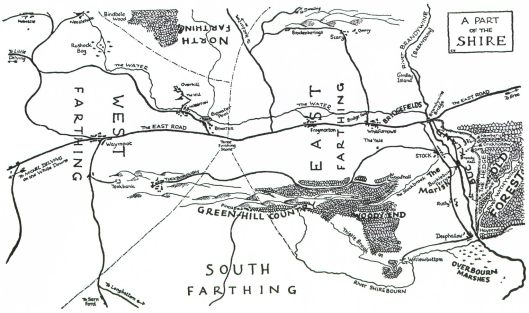
Once the three Hobbits leave Bag End for their journey to Crick Hollow,

image4shiremap.jpg

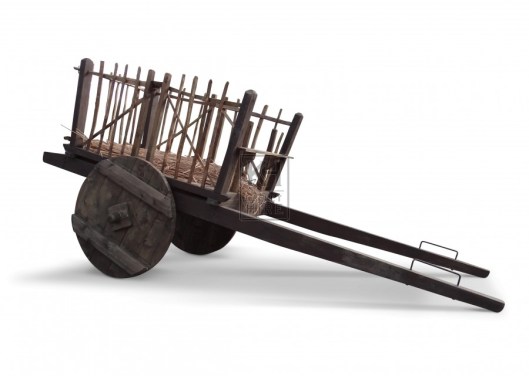
having sent “two covered carts…to Buckland, conveying the goods and furniture…” (and the next day sending off another) (The Fellowship of the Ring, Book One, Chapter 3, “Three is Company), they will spend a great deal of time walking (and paddling and riding), but will enter few buildings.  Here, by the way, is a cart—we imagine “covered” simply means that a blanket of some tough coarse fabric, like canvas, (called a “tilt”) would have been pulled over the load.

image5cart.jpg

Our chances of getting much furniture detail are not high, then, but let’s see what we find.

Beyond Buckland, the first indoors for the hobbits is Tom Bombadil’s house.  As the hobbits enter, they are in:

“…a long low room, filled with the light of lamps swinging from the beams in the roof; and on the table of dark polished wood stood many candles, tall and yellow, burning brightly.

In a chair, at the far side of the room facing the outer door, sat a woman…” (The Fellowship of the Ring, Book One, Chapter 7, “In the House of Tom Bombadil”)

image6agoldberry.jpg

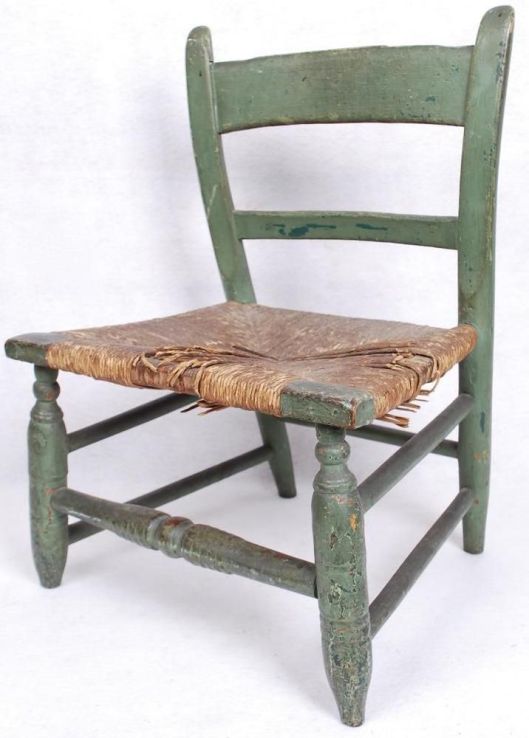
The hobbits are given “low rush-seated chairs”.

image6rushseatchair.jpg

And, shortly, are shown their bedroom:

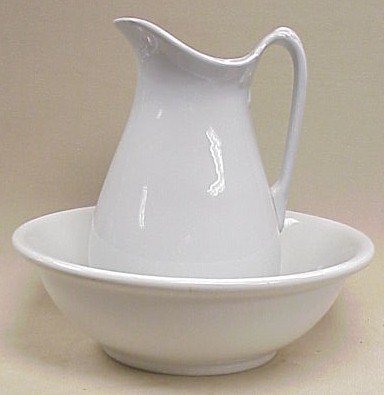
“They came to a low room with a sloping roof…There were four deep mattresses…laid on the floor along one side.  Against the opposite wall was a long bench laden with wide earthenware basins, and beside it stood brown ewers filled with water…”

Not much to go on here.  We’ll presume that the bench is wooden and plain, and the basins and ewers (a big pitcher—ultimately from Latin aquarius, “having to do with water”) are of the kind one would have seen in a Victorian bedroom, when indoor bathrooms were still only a wish—or were only in the homes of the extremely wealthy.

image7ewer.jpg

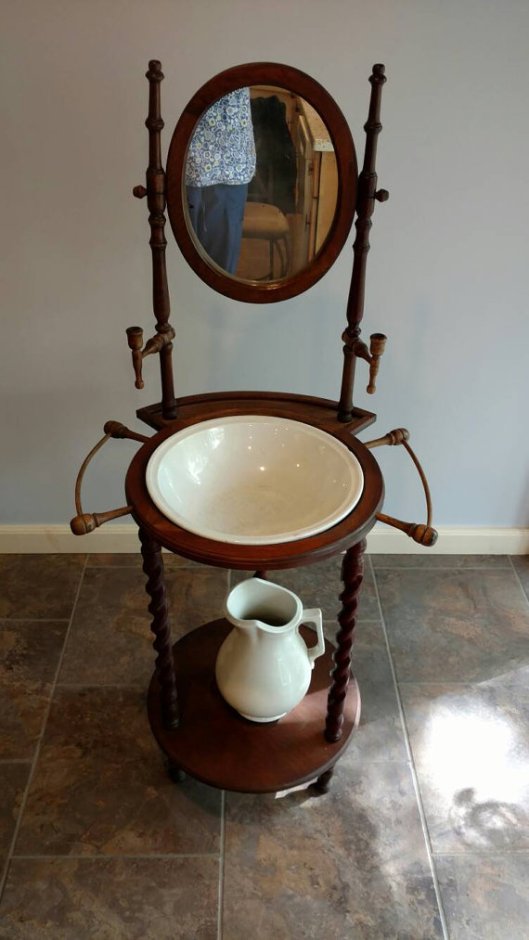
[Victorians, by the way, could have specialized places for such pitcher/basin combinations.  They’re called “washstands” and here’s a simple but functional one.]

image8awashstand.jpg

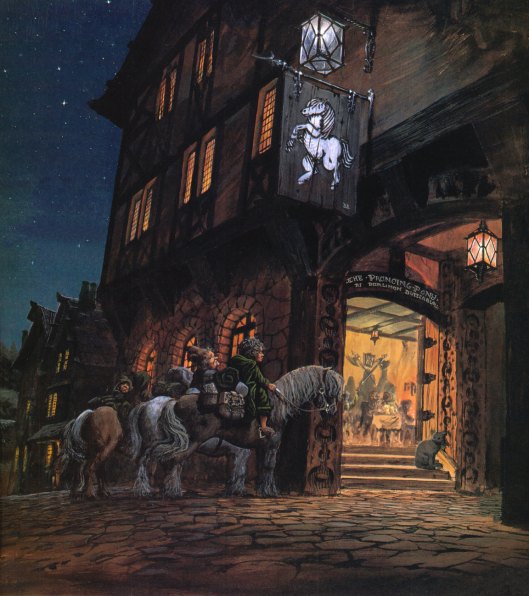
Next on their journey (we won’t count the barrow—although the Wight does mention a “stony bed”) is the Prancing Pony.

image8prancingponey.jpg

Again—what we have is functional.  The hobbits are initially led to what the landlord, Barliman Butterbur, calls “a nice little parlour” where “There was a bit of bright fire burning on the hearth, and in front of it were some low and comfortable chairs” and “a round table, already spread with a white cloth”. (The Fellowship of the Ring, Book One, Chapter 9, “At the Sign of the Prancing Pony”)

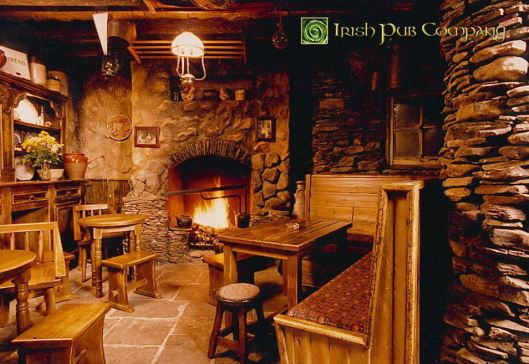
This sounds like a small, private room, found in some UK pubs, and called a “snug” (etymology unclear—but used to mean “comfy” as early as the 1620s).  Here’s one, in fact, from an Irish pub.  (We don’t advertise—this was simply the image which fit best with both our impression and the book.  And “fit best” does a double duty here, as “snug” can also mean “fitting tightly”.)

image9snug.jpg

The same will be true of the bedroom the hobbits don’t use—and just as well!—plain and nondescript.

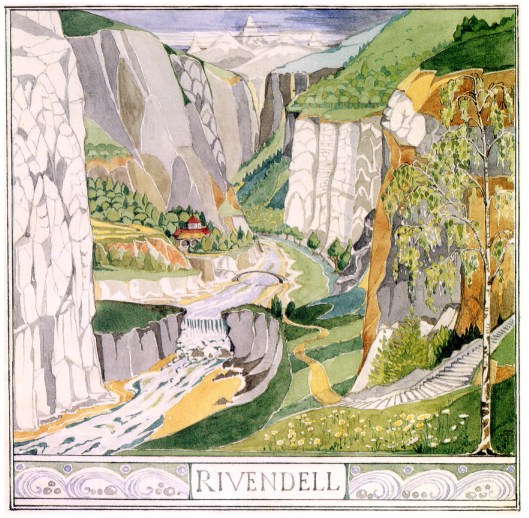
So when, if ever, are we given something with more detail?  If not in Bree, perhaps in Rivendell?

image10rivendell.jpg

Frodo comes to in a generic bed, but the “hall of Elrond’s house” is a bit more promising:

“Elrond, as was his custom, sat in a great chair at the end of a long table upon a dais…In the middle of the table there was a chair under a canopy…” The Fellowship of the Ring, Book Two, Chapter 1, “Many Meetings”)

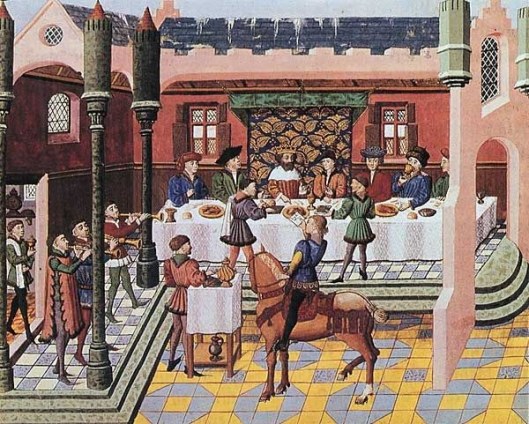
A “dais” is a raised platform.  If you’re a Harry Potter fan, you’ll remember it at “High Table” (as it’s called in English schools), where the students of the four different colleges meet to dine and the faculty sit on such a platform.

image11hightable.jpg

This is a left-over medieval custom, when royalty/nobles sat on a kind of stage, above the lesser folk, for formal meals.

image12feast.jpg

(Oh—and don’t ask about the horse—but it wasn’t required.  Horse and rider do appear at a banquet, of course, in the 14th-century poem “Sir Gawain and the Green Knight”—which JRRT once edited.)

image13agawaingreen.jpg

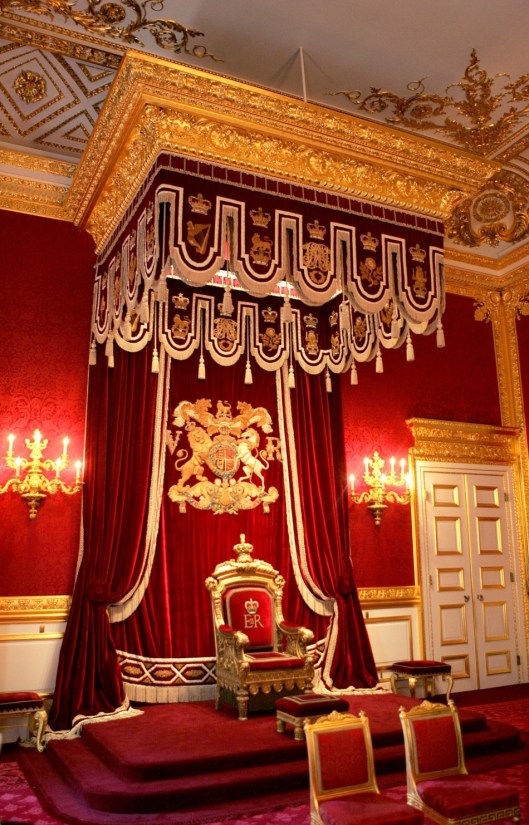
And that “chair under a canopy” reminds us of thrones with canopies, like this at the Palace of St. James, in London.

image13thronecanopy.jpg

Which brings us to the subject of thrones, in general.  After Rivendell, indoors will consist of Lothlorien

image14lorien.jpg

for the fellowship, then nothing for Sam and Frodo till Faramir’s cave hide-out and, beyond, the Tower of Cirith Ungol

image15towercirithungol.jpg

Hardly places to find any furniture beyond the functional!

For the others, we have Edoras

image16edoras.jpg

and Minas Tirith.

image17minastirith.jpg

And here we want to conclude by discussing a similar piece of furnishing in each—those thrones.

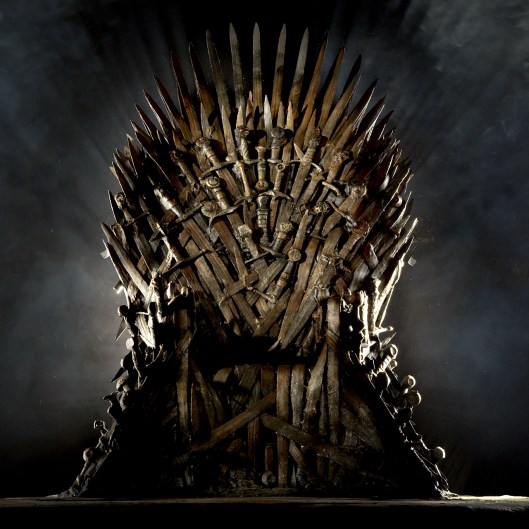
These days, when we say or write “thrones”, well, what comes immediately?  A Game of Thrones and the Iron Throne of Westeros.

image18ironthrone.jpg

The thrones of Rohan and Gondor are a bit less complicated.

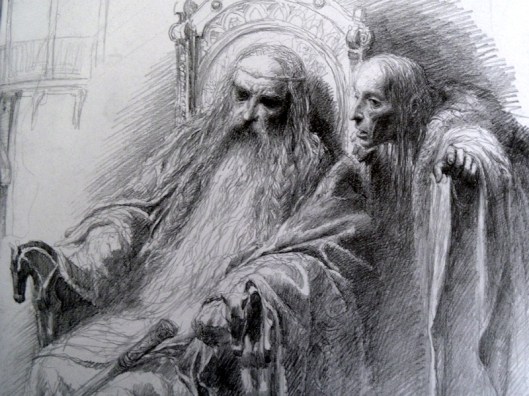
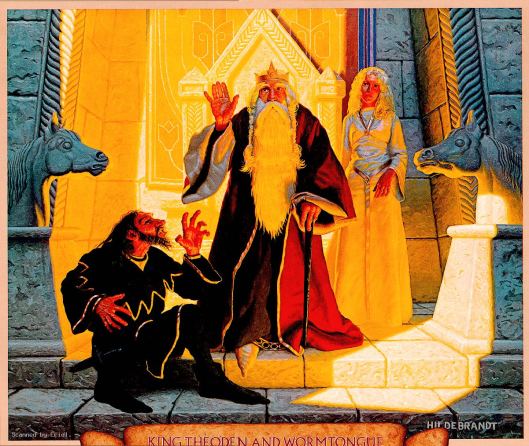
Theoden’s is described simply as “a great gilded chair” on a “dais with three steps”.  (The Two Towers, Book Three, Chapter 6, “The King of the Golden Hall”).

Here’s Allen Lee’s interpretation

image19alee.jpeg

and here is the Hildebrandts’.

image19bhild.jpg

The throne of Gondor is just a tiny bit more elaborate:

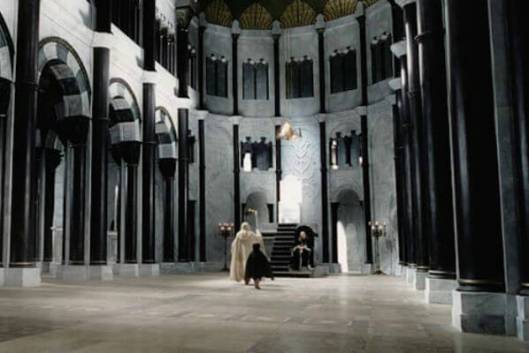
“At the far end upon a dais of many steps was set a high throne under a canopy of marble shaped like a crowned helm…” (The Return of the King, Book Five, Chapter 1, “Minas Tirith”)

Here’s an image from the film.

image19cthroneroom.jpg

But wait—there’s no one on it.  Let’s look lower:

“At the foot of the dais, upon the lowest step which was broad and deep, there was a stone chair, black and unadorned, and on it sat an old man gazing at his lap.”image19ddenethor.jpg

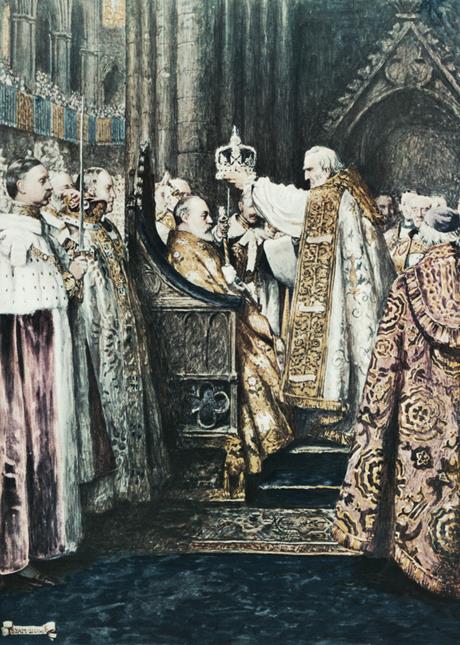
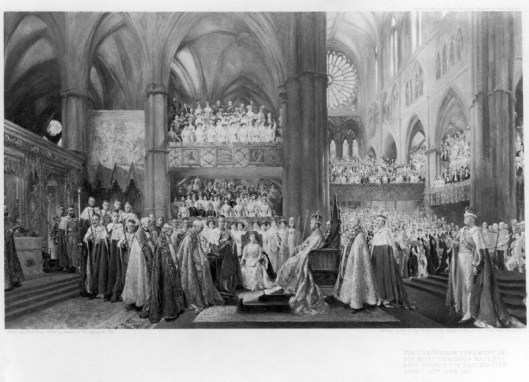
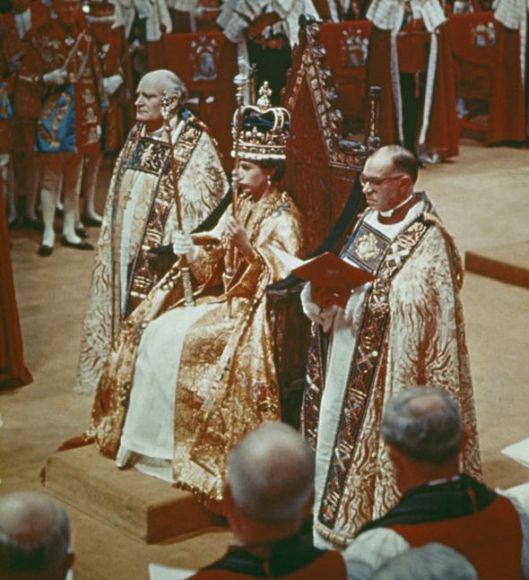
During his lifetime, JRRT would have seen the coronation of five British monarchs:

Edward VII

image19ed7.jpeg

George V

image20geo5.jpg

Edward VIII

image21ed8.jpg

George VI

image22ageo6.jpg

and the current monarch, Elizabeth II.

image22liz2.jpg

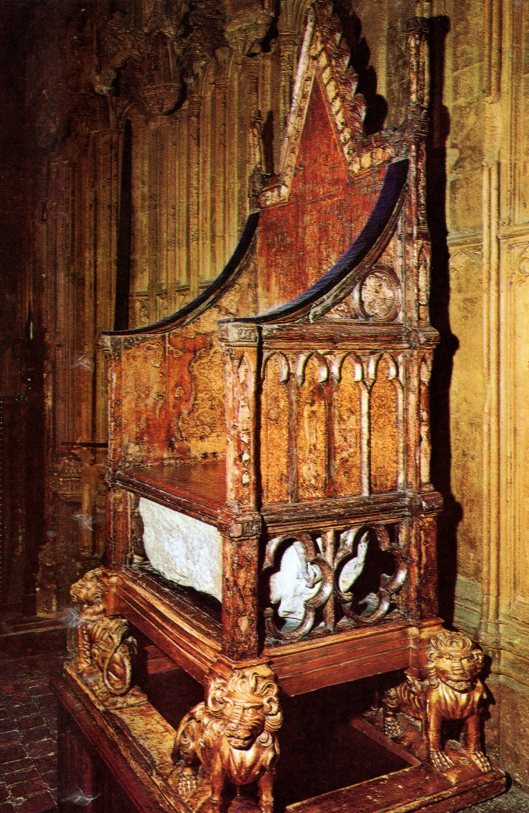
You’ll notice that, in every case, the throne is the same.

image23throne.jpg

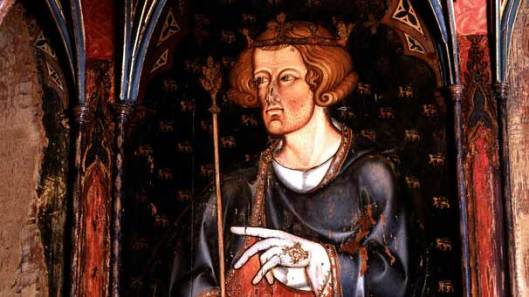
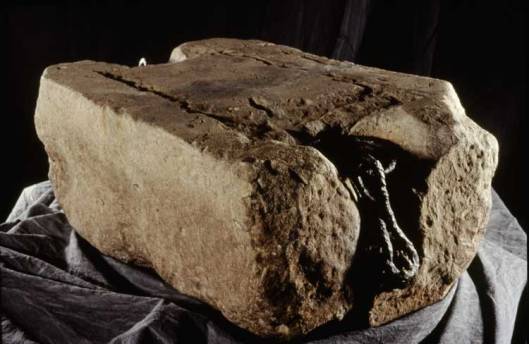
This is the so-called “Coronation Chair”, built between 1297 and 1300 and used since for crowning English monarchs.  It was especially commissioned so that it could hold the “Stone of Scone” (pronounced “skoon”—not like the pastry).  This was an ancient piece of Scottish royal history which Edward I,

image24ed1.jpg

in an effort to control Scotland, had stolen from its place on Moot Hill, near the Abbey of Scone.

image25sconeabbey.jpg

Supposedly, it was a stone used in the crowning of Scottish kings back to the time of the first one, or that it was even older, having been lugged from Tara, in Ireland, where, under the name “Lia Fail”, “the Stone of Destiny” it was used in coronation ceremonies there.  Its purpose was confirmation:  tradition had it that, when the true king bestrode it (a great old verb form), it gave a great shout.

image26liafail.jpg

As far as we know, no shouting has been reported, over the centuries—perhaps because it’s being used for English kings and therefore the stone is holding its tongue till it’s taken back to wear it belongs?

What do you think, dear readers?

Thanks, as ever, for reading.

MTCIDC

CD
PS

And did you notice something(s) out of place in JRRT’s drawing of Bag End?  We’ll talk about it in our next…

image1bagend


Are You Sitting Down.1?

04 Wednesday Oct 2017

Posted by Ollamh in Imaginary History, J.R.R. Tolkien, Narrative Methods

≈ Leave a comment

Tags

19th Century, An Introduction to Old Norse, Bag End, Beorn, Charles Dodgson, E.V. Gordon, Edwardian, Elvenking, Furniture, Goblins, Hildebrandts, House, Iron Age Farmhouse, Lewis Carroll, Listen with Mother, Master of Laketown, Monty Python, Norse house, Sackville-Bagginses, The Hobbit, Through the Looking-Glass, Tolkien, Victorians

Welcome, dear readers, as always.

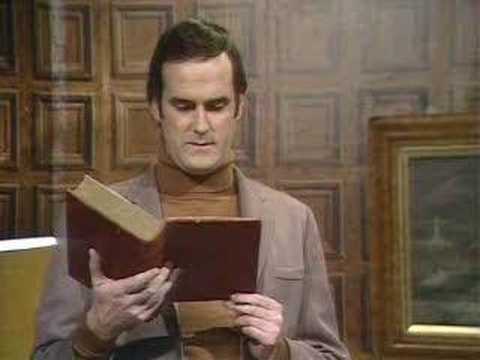
Several times, Monty Python skits included the pattern, “Are you sitting comfortably?  Then I’ll begin.”

image1a.jpg

It was clear, when we first heard it, that, like so much of Python material, it was one of those references which an audience in Britain in the early 1970s would have understood immediately and chuckled at, but it was only with the advent of the all-knowing Wikipedia that the reference came clear to us.  (Here’s a LINK, so that, if you don’t know it already, you, too, can be suitably enlightened.)

But it made us think—not everything does, we promise!—of Tolkien and what must sound like a very odd subject—furniture.

Furniture?

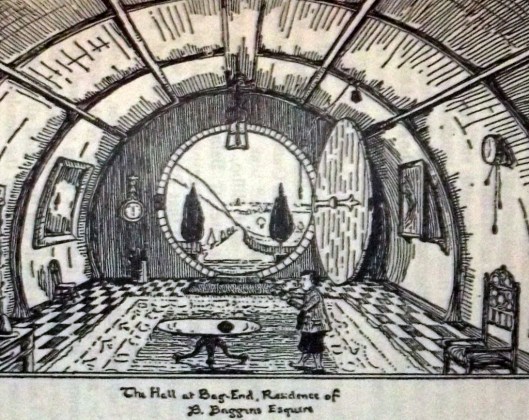
Consider Bilbo’s Bag End:

“The Door opened on to a tube-shape hall like a tunnel:  a very comfortable tunnel without smoke, with paneled walls, and floors tiled and carpeted, provided with polished chairs, and lots and lots of pegs for hats and coats…The tunnel wound on and on, going fairly but not quite straight into the side of the hill—The Hill, as all the people for many miles round called it—and many little round doors opened out of it, first on one side and then on another.  No going upstairs for the hobbit:  bedrooms, bathrooms, cellars, pantries (lots of these), wardrobes (he had whole rooms devoted to clothes), kitchens, dining-rooms, all on the same floor, and indeed on the same passage…” (The Annotated Hobbit, Chapter 1, “An Unexpected Party”)

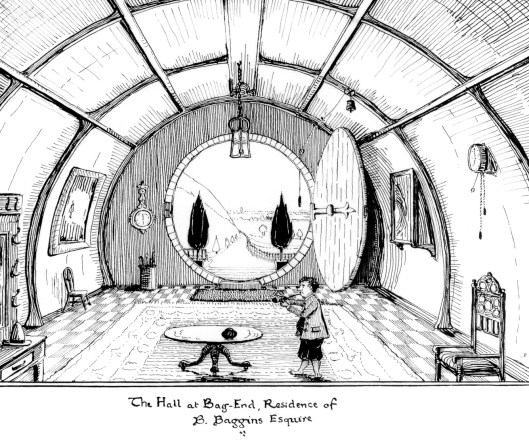
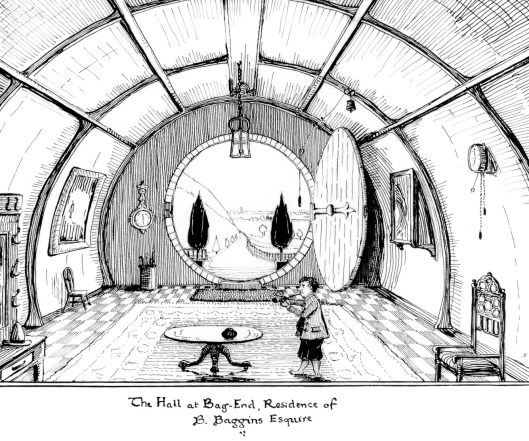
Here is JRRT’s version of the entryway–with Bilbo—or is that JRRT himself?  There appears to be a strong resemblance…

image2a.jpg

image2bilbo.jpg

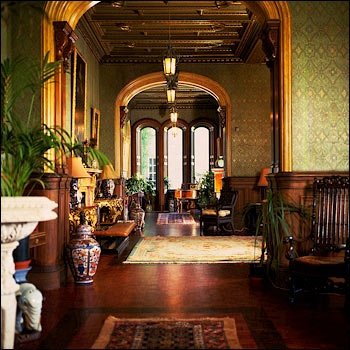
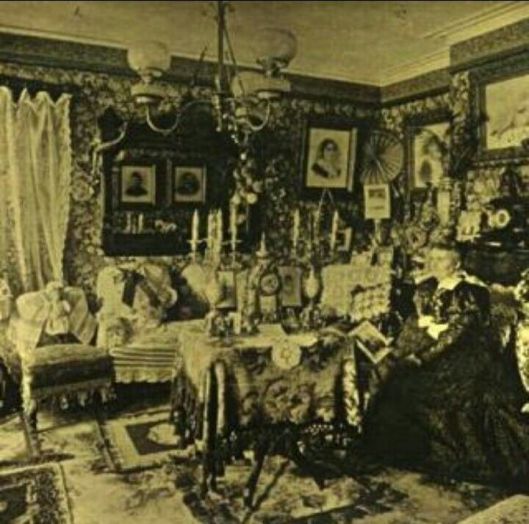
As the narrator tells us, “This hobbit was a very well-to-do hobbit…”, but, at the same time, we could easily see this description (ignoring the fact that it’s about a hole, albeit “not a nasty, dirty, wet hole…nor yet a dry, bare, sandy hole…it was a hobbit-hole, and that means comfort”) applied to the kinds of late-Victorian/Edwardian interiors with which Tolkien was familiar.

image3hall.jpg

People of this world—middle-class England—seem to have loved to live among piles of possessions—heavy furniture, thick carpets, heavy drapes, and knickknacks galore.

image4.jpg

(Oh–and swords, apparently.)

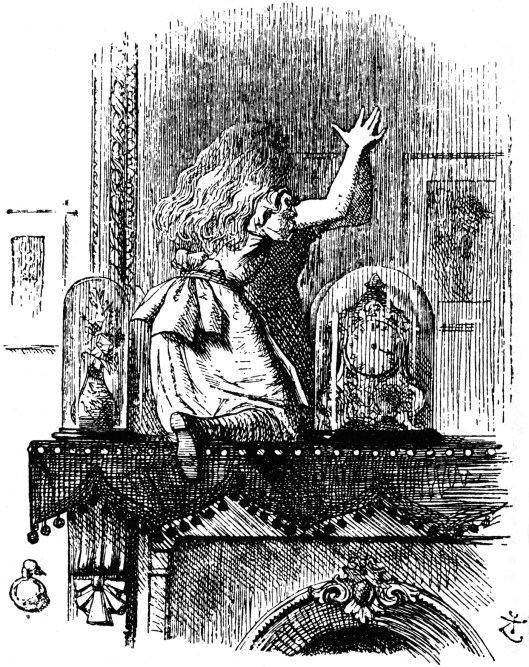
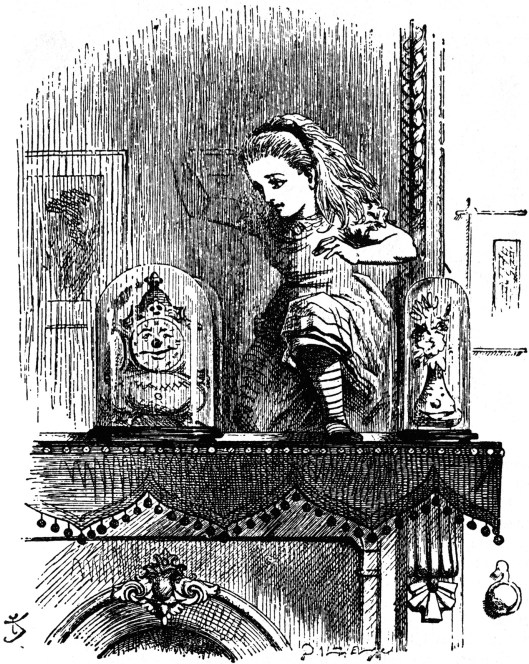
To us, this has a slightly claustrophobic effect—and we imagine that it may be why Alice in Through the Looking-Glass (1871) attempts to escape it–

image5lookingglasshere.jpg

only to find herself in a distorted version of the same room on the other side of the mirror.

image6lookingglassthere.jpg

[Here’s the actual mirror, from the childhood home of the real Alice, which is said to have inspired Charles Dodgson/Lewis Carroll to write a sequel to the first Alice book.]

image7alicemirror.jpg

What about other Middle-earth interiors, beginning in The Hobbit?

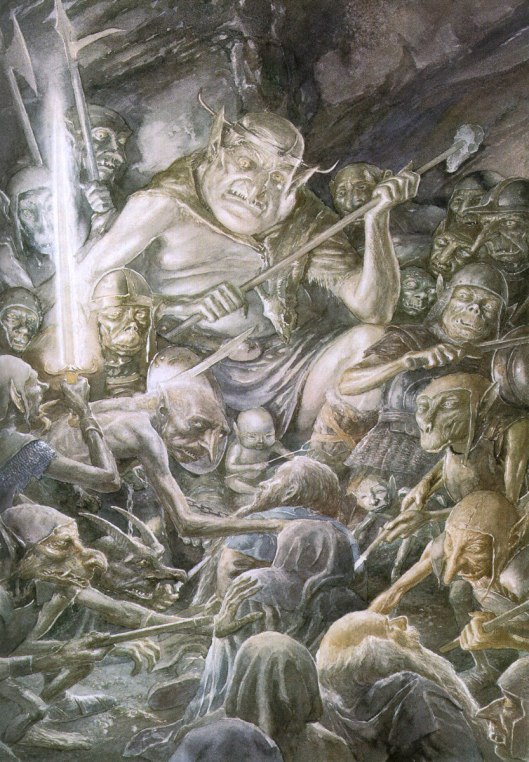
Surprisingly, there is really nothing before the Dwarves and Co. reach Beorn’s house.  There is no description of any inside in Rivendell and, beyond that, the only “indoors” we see before Beorn is the main cave of the goblins and the only “furniture” is this:

“There in the shadows on a large flat stone sat a tremendous goblin…”  (The Hobbit, Chapter 4. “Over Hill and Under Hill”)

image8goblinstone.jpg

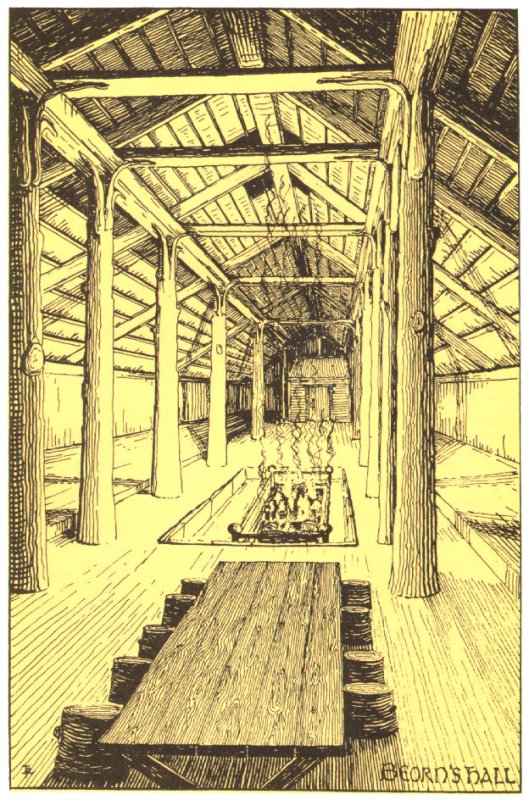
Beorn’s house, as we see in Anderson’s The Annotated Hobbit (170-171), appears to be based upon an illustration to be found in E.V. Gordon’s An Introduction to Old Norse (1927) (with an older history yet—see Anderson, 171).

image9beornshall.jpg

The Hildebrandts saw Beorn’s house as rather like a giant log cabin,

image10aabeornshouse.jpg

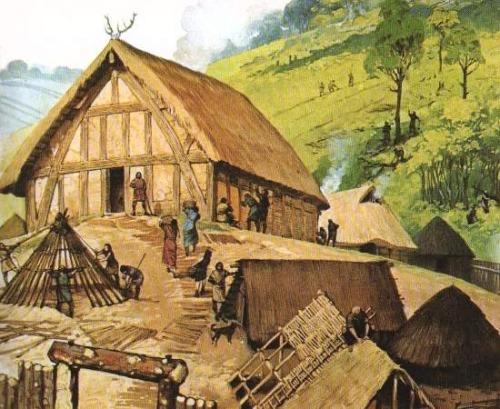
but we imagine the outside of Beorn’s house to look rather more like this view of an Iron Age farmhouse

image10bb.jpg

And here’s a reconstruction of a Norse house interior which is a little more “lived-in”, to give you the idea of what Beorn’s house might look like day-to-day (without the magic animals, unfortunately).

image10bvikinghall.jpg

As Tolkien’s illustration shows, however, this is hardly based upon a Victorian parlor!  As the narrator describes it (with magic animals as the kitchen staff):

“Quickly they got out boards and trestles from the side walls and set them up near the fire…Beside them a pony pushed two low-seated benches with wide rush-bottoms and little short thick legs for Gandalf and Thorin, while at the far end he put Beorn’s big black chair of the same sort…These were all the chairs he had in his hall…What did the rest sit on?…The other ponies came in rolling round drum-shaped sections of logs, smoothed and polished, and low enough even for Bilbo…” (The Hobbit, Chapter 7, “Queer Lodgings”)

Beyond Beorn’s house, there is mention that the Elvenking sat “on a chair of carven wood” (The Hobbit, Chapter 9, “Barrels Out of Bond”) and the Master of Laketown has a “great chair” (The Hobbit, Chapter 10, “A Warm Welcome”), but we have come deeper into the Middle-earth/medieval world, it seems, where furniture (at least in the narrator’s view) is sparse and we will only begin to see more abundance, at least in a general way, when we return to the Shire and the unwelcome event of the auction of Bilbo’s possessions on June 22nd:

“The legal bother, indeed, lasted for years…and in the end to save time Bilbo had to buy back quite a lot of his own furniture.” (The Hobbit, Chapter 19, “The Last Stage”)

“Furniture” is, unfortunately, a vague word, mentioned just previously in relation to the Sackville-Bagginses who were “busy measuring his [Bilbo’s] rooms to see if their own furniture would fit.”  We’ll have to make do here with our original idea of Bilbo the Middle-earth Victorian’s house,

image10vicparlor.jpg

but, in our next, we’ll have a look at households (and palaces) in The Lord of the Rings, to see what we may find (and we have a hunch the inventory will include a quantity of thrones…)

Thanks, as ever, for reading!

MTCIDC

CD
Dancing with the Elves

09 Wednesday Aug 2017

Posted by Ollamh in Fairy Tales and Myths, Imaginary History, J.R.R. Tolkien, Literary History, Narrative Methods

≈ Leave a comment

Tags

19th Century, A Midsummer Night's Dream, Anglo-Saxon, Arthur Rackham, Beren and Luthien, dance, Dicky Doyle, Elbereth Gilthoniel, elf ring, Elves, Fairy, fairy ring, Fairy Tale, Folklore, In Fairyland, Kenneth Grahame, Peter Pan in Kensington Gardens, Song, The Hobbit, The Lord of the Rings, Tolkien, Victorian, William Shakespeare

Dear readers,

Welcome, as always.

In The Lord of the Rings, Elves are powerful, human-like figures– immortal, skilled, and revered as counselors. In Tolkien’s work, however, they have not always been this way– early drafts suggest a sort of Victorian confusion, as if Tolkien’s elves have ancestral ties to both the tall, beautiful elves of the Anglo-Saxons, and to the jovial, delicate elves and fay of the mid- to late- 19th century.

In the beginning of June this year, Christopher Tolkien published an edited version of his father JRRT’s story, “Beren and Luthien”, which was originally published as a part of The Silmarillion, a history of the Elves.

beren-e-luthien-alan-lee.jpg

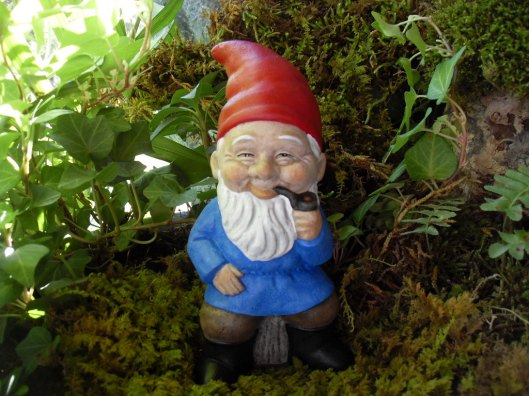
Within this book are previously unpublished earlier drafts and versions of the story, and in the introduction to them, Christopher Tolkien comments upon them: Beren was originally a gnome (which he was quick to explain meant an immortal figure– not what we would find in gardens),

il_fullxfull.1076091410_mapj.jpg

and then an elf, before his final incarnation as a mortal man. Luthien, the immortal Elven princess, is referred to by Tevildo, Prince of Cats, as “Princess of Fairies”. After being ordered to dance before him by the dark lord Melkor, Luthien began

“Such a dance as neither she nor any other sprite or fay or elf danced every before or has done since… magically beautiful as only Tinuviel ever was… and Ainu Melko for all his power and majesty succumbed to the magic of that Elf-maid, and indeed even the eyelids of Lorien had grown heavy had he been there to see” (76).

BL-back.jpg

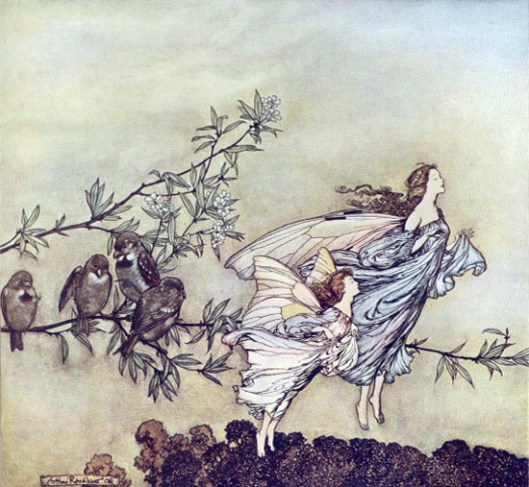
What we found curious here was JRRT’s uses of “Elf” and “Fairy” as seemingly synonymous with each other, when, depending on to which story an Elf or Fairy belongs, they may be quite different. Being people who spend a good deal of time in the Victorian world, when we think of dancing fairies, what is more likely to come to mind are the tiny winged figures who appear in Kenneth Grahame’s Peter Pan in Kensington Gardens (1906), with illustrations by Arthur Rackham.

fairy_tiff.jpg

20245801 Fairies never say we feel happy....jpg

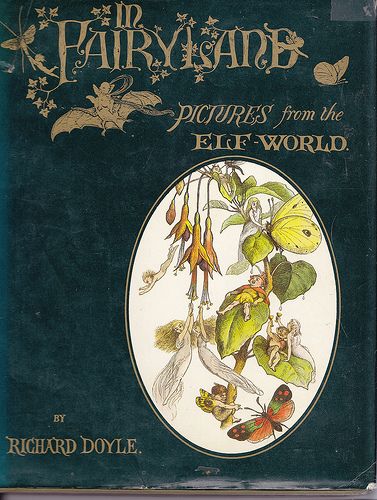
We might also be reminded of the little people who inhabit Dicky Doyle’s In Fairyland (1869)

7c11afdbc1cc79ed7cf88e64e80b8528--richard-doyle-conan.jpg

115cbac12c146d78a0f2753bfae597b9--antique-books-old-books.jpg

What we see in the Victorian sense of fairies and elves in images and stories is a revival of Elizabethan fairy-stories, which focus on little people: much like the fairies of William Shakespeare’s A Midsummer Night’s Dream, for example, the fairies in Kensington are light-footed, winged beings who wear flowing garments, and they fancy calling themselves “dancey” rather than “happy”.

Dicky Doyle’s In Fairyland finds Elves in the “Elf World” to be the same sort of creatures. The picture below gives us an idea of the jovial nature of Victorian Elves, and is captioned, “The little Elves would cross over the border, and come into the King’s fields and gardens.”:

356d133220f9a2875cd80f0ad16cab6c.jpg


J.R.R. Tolkien was born in 1896, at the end of the Victorian period. It would be understood if the Victorian sense was residual in his work– after all, he was a child when Arthur Rackham’s illustrations met the height of their popularity, at the beginning of the 20th century, and he mentions in his letters having seen them.

In his Middle-earth, however, we see a very different kind of Elf.  Tolkien describes how he imagined them in a letter to Naomi Richardson on 25 April 1954:

” ‘Elves’ is a translation, not perhaps now very suitable, but originally good enough, of Quendi. They are represented as a race similar in appearance (and more so further back) to Men, and in former days of the same stature… [they] are in fact in these histories very little akin to the Elves and Fairies of Europe; and if I were pressed to rationalize, I should say that they represent really Men with greatly enhanced aethetic and creative features, greater beauty and longer life, and nobility…” (Letters, 176).

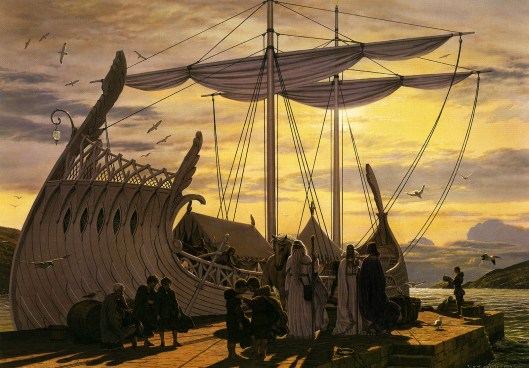
Below are a few artists’ renditions of what these Elves might look like, and they’re very different from the imaginations of Arthur Rackham and Dicky Doyle.

61954a630522d2bbce39220223dc89ef.jpg

galadriel-hildebrant.jpg

aab7b11adf539086efc6762490bc7417.jpg

ted nasmith_the complete guide to middle-earth_departure at the grey havens.jpg

tumblr_n2gwteLx4b1tnpw9xo1_500.jpg

And some images from Peter Jackson’s films, as well:

Haldir_w_elves.jpg

Gli-Galad_y_Elrond.jpg

When JRRT refers to “the former days”, we can assume that he means two things:

  1. The former days of Middle-earth, such as in The Silmarillion
  2. The former days of our world–specifically, Anglo-Saxon Elves, which resemble the Elves of Middle-earth in their stature and beauty. Thus, the “former days” refer to a former rendition of Elves– one which, belonging to the Anglo-Saxons, would be familiar to JRRT.

(Attached here is a very useful book on this subject by Alaric Hall, which provides an in-depth look at pre-Elizabethan and pre-Victorian Elves.)

These Elves are almost the polar opposite of the Elfin and Fay creatures of the Victorians, and we found it curious that they would have anything in common. As demonstrated by Rackham’s “dancey” fairies and Luthien in Beren and Luthien, however, we found one thing: a love for song and dance.

While looking through Jack Zipes’ collected anthology of Victorian Fairy Tales, The Revolt of Fairies and Elves, we came across an example of this in “Charlie Among the Elves”, in which the protagonist, a young boy who finds himself, by some sort of magic or dream, in the world of fairies and elves. The elves invite him in and greet him with a song:

“…they struck up a melody which Charlie thought was the very sweetest music which he had ever heard in the whole course of his life, and thus ran the song of the Elves:

In the waning summer light

Which the hearts of mortals love

’Tis the hour for elfin sprite

Through the flow’ry mead to rove.


Mortal eyes the spot may scan,

Yet our forms they ne’er descry;

Though so near the haunts of man,

Merrily our trade we ply.”

In some folklore, there is also the danger of dance. Fairy rings, also called elf rings, are supernatural places created by the dancing of either fairies, elves, or witches. They have been considered hazardous by much of Western folklore to those outside of the fairy world; in these stories, mortals who have stepped inside have been cursed, trapped, or simply disappear.

fairy-ring.jpg

Plucked-from-the-Fairy-Circle.jpg

Rackham-Come-Now-a-Roundal-L.jpg

Charlie was lucky that he had come across benevolent creatures, and this reminded us of another instance when an adventurer was greeted by Elves through song: in The Hobbit, which is where Tolkien first introduced Elves, before he later understood them. Before The Lord of the Rings and The Silmarillion, Bilbo, Thorin, and Company are greeted by Elf-song in Rivendell:

” ‘Hmmm! it smells like elves!’ thought Bilbo, and he looked up at the stars. They were burning bright and blue. Just then there came a burst of song like laughter in the trees:

‘O! What are you doing,

And where are you going?

Your ponies need shoeing!

The river is flowing!

O! tra-la-la-lally,

here down in the valley!’ ”

As the Elves in both “Charlie Among the Elves” and The Hobbit are jovial and playful in their music, we might think that Tolkien had not completely abandoned the Victorian Elfin world, after all; of course, in The Lord of the Rings and in The Silmarillion, the Elves, just as much as the stories, take a more serious turn. Playful tunes are replaced with much more serious poetry, and in their native tongue, such as the Hymn to Elbereth Gilthoniel:

“A Elbereth Gilthoniel
Silivren penna miriel
A menel aglar elennath
Na chaered palandiriel.
O Galadhremmin ennorath
Fanuilos, le linnathon
Nef aer, si nef aeron!
A Elbereth Gilthoniel!
We still remember,
We who dwell
In the lands beneath the trees
Thy starlight on the western seas.”

pl_elbereth.jpg

When trying to reconcile these sorts of Elves and Fairies, rather than assessing them through their physical and behavioral qualities, we may look at them through something just as important in understanding them: music. The Silmarillion explains that the Elves, as well as the world and everything in it, including good and evil, originated from song.

But just as Elven music changes from The Hobbit to The Lord of the Rings, so the Elves have changed– they are human-sized, but also perhaps more serious and melancholy, as a parallel to the world Tolkien had created, which was much more complex than he originally realized.

The songs in The Lord of the Rings, and the later versions of Luthien, which present her as an Elf princess– a beautiful being which Beren falls in love with as soon as he sees her dance– express that melancholy. As the tale of Beren and Luthien reflects the way Tolkien wishes us to see Elven folklore– romantic, adventurous, and, ultimately, sorrowful– perhaps we can conclude that JRRT’s Elves are really fairies grown up.

And what do you think, dear readers?

MTCIDC,

CD

A Long Stretch

12 Wednesday Jul 2017

Posted by Ollamh in Heroes, J.R.R. Tolkien, Literary History, Military History, Military History of Middle-earth

≈ Leave a comment

Tags

Agincourt, Archery, arrow bag, arrows, Bard the Bowman, Battle of Poitiers, Casula Mellita, Crecy, Edinburgh, English Longbowmen, Esgaroth, Greco-Roman, gunpowder, harpoon, Hundred Years War, Laketown, longbows, Medieval-Renaissance, Napoleonic Wars, Naval Warfare, Pinkie Cleugh, Roman, sailing, Smaug, The Hobbit, The Mary Rose, Tolkien

Welcome, as always, dear readers.

In the past, we had a posting on Bard the bowman

image1jeffchanbard.jpg

who rescued Esgaroth (Laketown)

image2esgaroth.jpg

from the attack by Smaug.

image3smaug.jpg

(We especially like this Jeff Chan Bard not only because Bard is depicted as he is in the book, as an archer, but also because it includes the thrush who tells him where he is to strike.)

In that previous posting, we suggested that JRRT pictured Bard as looking and acting like one of the English longbowmen of the Hundred Years War

image4longbowman.jpg

rather than as a harpooner, as in the film.

image5bard.jpg

image6aharpoongun.jpg

Since that posting, we did a second which included bowmen, just a few weeks ago, about Mogul-knife and arrow wound, and now we would like to add a third.

As we’ve mentioned before, one of us is preparing a new university course to be taught in the autumn on the history of warfare.  As you can imagine, this is a big subject, but, in the process of shaping it, we want to include a week on developments in naval warfare over the centuries.  So far, we’ve divided it into several parts:

a. Greco-Roman

image6agrknavbat.jpg

image6romannavbat.jpg

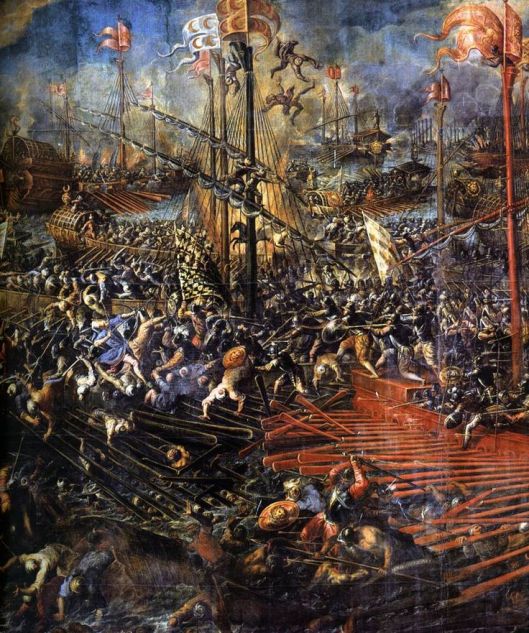
b. medieval-renaissance

image7sluys.jpg

image8lepanto.jpg

c. the age of sail

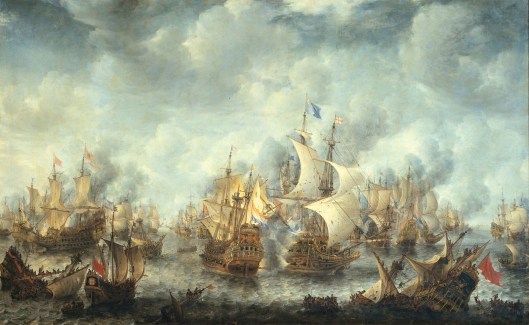
image9glorious.jpg

d. ironclads

image10monitor.jpg

e. dreadnoughts

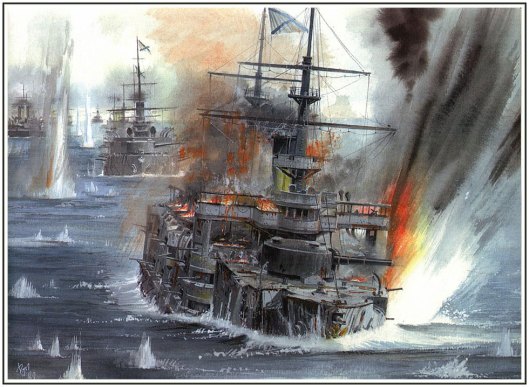
image11tsushima.jpg

While working on the Medieval/Renaissance section, we were reminded of what might be the most famous Renaissance shipwreck:  the sinking of The Mary Rose, 19 July, 1545.

image12mrsinks.jpg

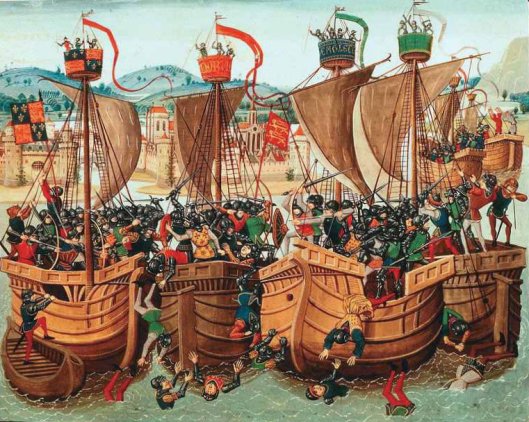
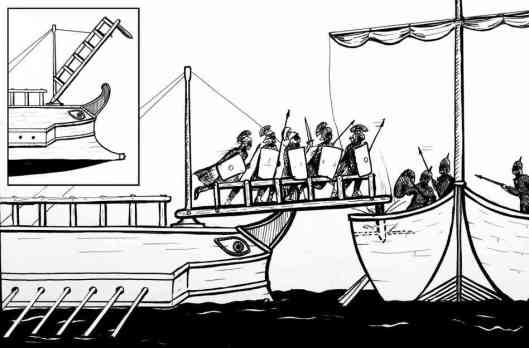
Medieval naval battles had been primarily infantry battles transferred to the sea, as had been Roman practice.  That practice was a story in itself—the traditional Roman explanation was that they were land-fighters and so had invented a device, called a “corvus”–that’s “crow” in English—probably because the point at the enemy’s end was a bit like a pecking beak.  This was a kind of gangplank which, dropped onto the enemy’s ship, stuck in place and allowed Roman marines to rush across and deal with their opposite numbers.

image13corvus.jpg

image14medbat.jpg

Things began to change with the invention of cannon in western Europe.  (The history of gunpowder in the Far East is its own subject—and one we urge those interested to have a look at.  Here’s a LINK to get you started.)  Used first on land perhaps by the 13th century, the first recorded use of cannon on a ship dates from 1338 (and here’s a LINK to naval artillery, in case you want to know more).

With cannon, you could stand off from an enemy ship and—your choice—cripple it by destroying its sails and rigging—or sink it with holes below the waterline.

image15renbat.jpg

Boarding, as the Romans had, was still a possibility, of course, and provided the extra benefit, if the boarding was successful, of allowing for the acquisition of an extra ship.  This could be added to your fleet or sold and the profits shared among the sailors—or, actually, if we go by Napoleonic British standards, the profits went to everybody at the top, including admirals who weren’t even present at the capture, with a teeny amount remaining for the seamen who’d actually taken the prize.

image16renbat1.jpg

To do that boarding, Romans—and medievals—had loaded their ships with soldiers, and the Mary Rose was no exception, its surviving records suggesting that there were about 200 soldiers in a crew of approximately 400-450.

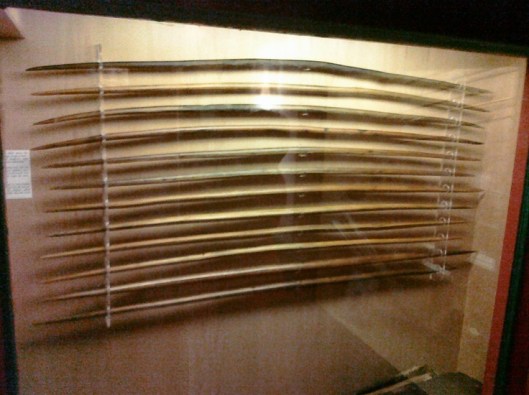
As a number of longbows have been recovered from the wreck,

image17mrlongbows.jpg

this would suggest that many of those soldiers were archers.

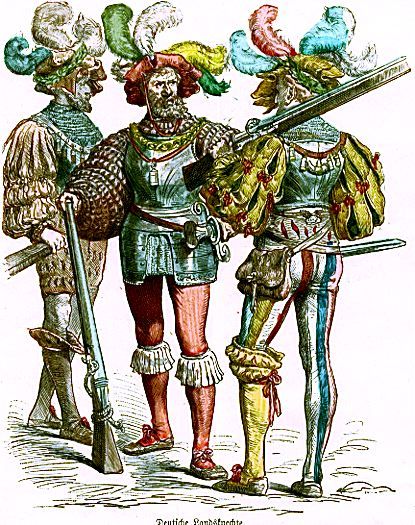
These, along with the artillery (and perhaps a small number of arquebuses?  To our current knowledge, none has been recovered from the ship, but, certainly, by 1545, they were in common use—at the battle of Pinkie Cleugh, east of Edinburgh, in 1547, the English army had several hundred German mercenary arquebusiers),

image18grmarq.jpg

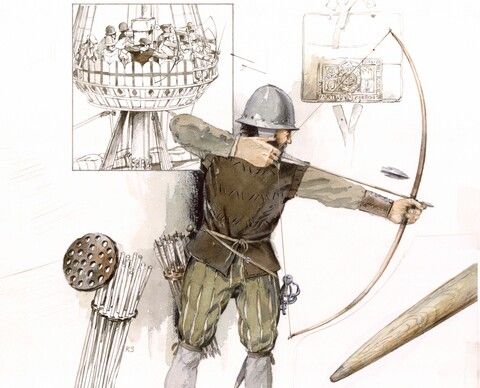
would have supplied the missile weapons of the ship.

image19mrbowman.jpg

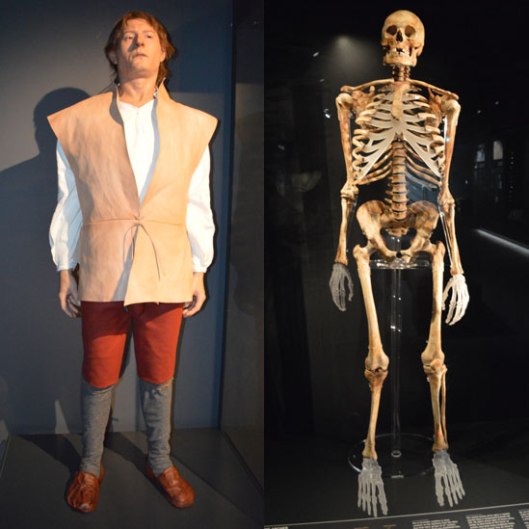
Not only were large numbers of artifacts discovered in the Mary Rose, but the skeletons of perhaps half its crew and about 90 of those were intact enough to warrant further study.  For our purpose, one, in particular is very interesting.

image20mrarcher.jpg

Discovered in the hold, he was a large man for his time, about 6 feet (about 183cm).  As well as revealing that he would have had a powerful build, his skeleton displayed repetitive stress injuries to his upper body.  There is discussion as to the pull-weight (how much muscle power it takes) of the longbow of the medieval/Renaissance period, estimates ranging from 90 to about 150 pounds (we’re sorry that we can’t readily convert this, as it isn’t pounds of weight, but pounds of force—the general idea is that it would have taken huge muscle power in either case), but, for a bow as tall as a bowman, this would have demanded great muscular strength—which would then have, over time, put huge stress upon an archer’s body.  This has then led archaeologists to suggest that he was a bowman.

And this brings us back to Bard, the actual archer, and a suggestion as to what he might have looked like.

JRRT only says:

“But there was still a company of archers that held their ground among the burning houses.  Their captain was Bard, grim-voiced and grim-faced…Now he shot with a great yew bow, till all his arrows but one were spent.”  (The Hobbit, Chapter 14, “Fire and Water”)

“a great yew bow” makes us think of the English bowmen we’ve mentioned before, and those we believe were in Tolkien’s mind, the victors at the battles of Crecy (1346), Poitiers (1356), and Agincourt (1415).

image21agincourt.jpg

To produce archers who could pull such powerful bows (and fire up to 10 arrows a minute, as we’ve mentioned in a previous posting), English archers began training as boys and continued throughout the years—as athletes of the bow, they had to keep in shape.  Such training and exercise would then have produced men like that discovered on the Mary Rose—big-shouldered, strong-armed—and given to the subsequent damage inflicted on the body by archery wear-and-tear.

So, might we then see Bard as not only “grim-voiced and grim-faced”, but “broad-shouldered and imposing”?  To which we can add this from The Hobbit:

“In the very midst of their talk, a tall figure stepped from the shadows.  He was drenched with water, his black hair hung wet over his face and shoulders, and a fierce light was in his eyes.”  (Chapter 14, “Fire and Water”)

All of which gives us:  “tall, black-haired, fierce, grim-voiced and grim-faced”—and, at our suggestion, “broad-shouldered and imposing”—a worthy portrait of Bard the Dragon-slayer.

Thanks, as ever, for reading!

MTCIDC

CD
PS

It’s not known what our Mary Rose archer was doing in the hold at the time the ship went down, but perhaps he was seeking to transfer extra ammunition to the main deck?  That ammunition would probably have been in the form of coarse linen bags carrying 24 arrows each—here’s a modern reconstruction

image22arrowbag.jpg

and here’s the LINK to the site from which it comes.  This belongs to an amazing woman whose website is full of her life on the edge of the Great Plains, in Kansas, USA—home of Dorothy of the OZ books, of course– as well as her photos of things like the reconstructed bag in the photo above.  Below is a picture of the Kansas tall grass prairie.

image23kansas.jpg

Hoards of the Things

28 Wednesday Jun 2017

Posted by Ollamh in Fairy Tales and Myths, Imaginary History, J.R.R. Tolkien, Literary History, Narrative Methods

≈ Leave a comment

Tags

A Christmas Carol, A Visit to William Blake's Inn, Aeetes, Alexander Deruchenko, Alice and Martin Provensen, Argo, Barrow-downs, Barrow-wights, Beowulf, Bilbo, Charles Dickens, Cinderella's Dress, Colchis, Collyer Brothers, David Gwillim, dragon-sickness, Dragons, Dwarves, Ebenezer Scrooge, Eurystheus, Hera, Heracles, Hoard, hordweard, Jack Gwillim, Jane Dyer, Jason and the Argonauts, Jason and the Golden Fleece, Kinder und Hausmaerchen, Ladon, Lonely Mountain, magpie, Nancy Willard, Neolithic, Scrooge McDuck, Scythians, Ted Nasmith, The Hobbit, The Lord of the Rings, Tolkien, Treasure

Welcome, dear readers, as always.

Recently, we’ve had a couple of posts on dragons and hoards, but, having done a certain amount of research and thinking and writing, we’ve come back once again to the subject, with the question: why would a dragon want a hoard to begin with?

The earliest Western European stories we know in which dragons (or serpents—the Greek word can apply to either) are associated with valuables are:

  1. the 11th labor of Heracles, in which his cousin, Eurystheus, demands that Heracles bring him the Golden Apples of the Hesperides (“children of the evening star”)—which are on an island guarded by a 100-headed (in some versions of the story) dragon/serpent called Ladon

image1hesperides.jpeg

  1. the story of Jason and the Argo, in which Jason must bring back to Greece the Golden Fleece, also guarded by a dragon/serpent (a sleepless one this time)

image2jason.png

In both of these stories, the dragon is the agent for someone else—Hera, in the case of the Golden Apples,

image3hera.jpg

and Aeetes, the king of Colchis, in that of the Golden Fleece.

image4aaetes.jpg

(We’ve always loved the curly beard of Jack Gwillim in Jason and the Argonauts—1963. His son, David, by the way, was a perfect Prince Hal and Henry V in BBC productions from 1979—if you can find them, we highly recommend them.)

image5dgwillim.png

After these, we see the dragon of Beowulf.

18lrnlrjcbonijpg.jpg

In his case, although he’s called hordweard, “hoard guardian/watchman”, we are told that he has come upon a treasure in a barrow, piled in for safe-keeping several hundred years before. Europeans in the Neolithic Period and long beyond buried high-status people in such places—like this, in Denmark.

image6barrow.jpg

As it was the custom for high-status people to be buried with at least some of their riches, it’s easy to see how singers might be inspired to create a barrow like that of the Beowulf dragon. Some of our favorite grave goods come from the Scythians, a horse-people who once lived north of the Black Sea, and who had buried them in grave mounds with their dead.

image7ascyth.jpg

(A wonderfully atmospheric picture by Alexander Deruchenko.)

image7bscythia.jpg

image8scyth.jpg

image9scyth.jpg

image10scyth.jpg

The Beowulf dragon is not the proper owner of the hoard: rather, he has taken possession (the poem may even be suggesting that dragons—or this dragon, at least– have a special affection for barrows (2270-2278), rather as the barrow wights have taken over the tumuli on the Barrow Downs, both places being much older and long-abandoned. You may remember this striking image by one of our favorite Tolkien artists, Ted Nasmith–

image11barrowwight.jpg

In contrast, Smaug has taken possession of the Lonely Mountain by force, burning out the rightful owners.

image12smaug.jpeg

In both cases, however, the latest owner is very sensitive about his new property: the removal of one object, as Beowulf and Bilbo find out.

image13cuptheft.jpg

(And we can’t resist this item—it’s copy of a cup used in the 2007 Beowulf film. We don’t see that it would be very useful for drinking from, but it’s certainly fun to look at!)

image14bewulfcup.jpg

It’s one thing if it’s your job to guard gold: you’re like a sheepdog with a flock. (Here’s a Maremma, in fact, with a flock.)

image15maremma.jpg

It’s another if you are occupying, seized or not, someone else’s gold. In the latter case, however, we are still left with our initial question: why is this important to a dragon?

Perhaps they just like the look of it. After all, Smaug seems quite proud of what he sees as a waistcoat of precious things. When Bilbo says: “What a magnificence to possess a waistcoat of fine diamonds!” Smaug replies “Yes, it is rare and wonderful, indeed.” (The Hobbit, Chapter 12, “Inside Information”) Yet there is the darker side:

“To say that Bilbo’s breath was taken away is no description at all. There are no words left to express his staggerment, since Men changed the language that they learned of elves in the days when all the world was wonderful. Bilbo had heard tell and sing of dragon-hoards before, but the splendor, the lust, the glory of such treasure had never yet come home to him. His heart was filled and pierced with enchantment and with the desire of dwarves; and he gazed motionless, almost forgetting the frightful guardian, at the gold beyond price and count.”   (The Hobbit, Chapter 12, “Inside Information”)

Just seeing such wealth brought on “lust” and “the desire of dwarves” and it’s clear that this is what infects Thorin after Smaug’s death and eventually brings on the “dragon-sickness” which leads to the end of the Master of Laketown (The Hobbit, Chapter 19, “The Last Stage”). As this “lust” for beautiful, valuable things seems inherent in the dwarves, it strikes us that we might imagine dragons as somehow enablers or carriers—like anopheles mosquitoes and malaria—

image16anopheles.jpg

rather than originators of the disease and that the name is derived from that combination of acquisitiveness and sensitivity we noted earlier and which so clearly disturbs Thorin’s judgement.

But perhaps there is something in the idea of hoarding itself. In our world, “hoarding” has come to have a different meaning, being a kind of psychological condition in which a person acquires and acquires and has lost the ability to discard anything for complex internal reasons. In literature, one might imagine that misers have something of this—think of Ebenezer Scrooge, in Charles Dickens’ A Christmas Carol (1843).

image17scrooge.jpg

Or, Uncle Scrooge McDuck, from Walt Disney comics. Who, as you can see, takes this to an extreme even Dickens’ Scrooge might find a bit excessive.

image18smcduck.jpg

Underneath this, however, is the sad side: those who become imprisoned by their possessions, a famous case being that of the Collyer brothers in New York, whose apartment, after their joint deaths in 1947, was a subject both of curiosity and of mild horror in the New York newspapers of the time.

image19collyer.jpg

Is it possible that the Beowulf dragon and Smaug both suffer from this condition? Is that why the theft of a single piece from an uncountable hoard seems to mean so much?

We never want to shy away from serious subjects—after all, all of the best fantasy/adventure writers never did—but it’s an early summer day where we live—just after Midsummer’s Day, in fact, and so we’d like to end with another kind of acquisitor—the magpie.

image20magpie.jpg

Traditionally, magpies are famous for being attracted to—and collecting—shiny objects. Our favorite magpie story, however, isn’t about obsession, but about generosity. It’s a beautiful children’s book by Nancy Willard and Jane Dyer, entitled Cinderella’s Dress.

image21cind'sdress.jpg

In this book, told in light, easy verse, we see a magpie couple as fairy godparents for Cinderella, using their cache of shiny things to—but we’ll leave that to you to discover (although the title is a bit of a give-away). Here’s another page to tease you…

image22csdresspage.jpg

Thanks, as ever, for reading.

MTCIDC


PS

Another Nancy Willard book you might enjoy is A Visit to William Blake’s Inn (1981), illustrated by Alice and Martin Provensen.

image23blakesinn.jpg

Oh, Come, Let Us Adore…

21 Wednesday Jun 2017

Posted by Ollamh in Imaginary History, J.R.R. Tolkien, Literary History, Military History, Military History of Middle-earth, Narrative Methods

≈ Leave a comment

Tags

1984, Adolf Hitler, altar, Ar-Pharazon, Armenelos, Artemis, Aulis, Avebury, Aztec, Benito Mussolini, Big Brother, France, Gallic Celts, George Orwell, Germany, Gondor, Greek temple, Hera, Herodotus, human sacrifice, Iphigenia, Melkor, Nazis, nemeton, Numenor, occupation, Olympia, Pantheon, Rome, sacrifice, Sauron, shrine, Soviet Union, Stalin, Stonehenge, Tenochtitlan, The Hobbit, The Lord of the Rings, The Silmarillion, The War of the Ring, Tolkien, Valar, World War II, worship

Welcome, as always, dear readers.

Some time ago, we posted a piece on what Sauron wanted out of the War of the Ring. Our evidence was this, spoken to Aragorn and Gandalf and the allied army which had marched to the Morannon as a distraction, by the Lieutenant of the Tower:

“The rabble of Gondor and its deluded allies shall withdraw at once beyond the Anduin, first taking oaths never again to assail Sauron the Great in arms, open or secret. All lands east of the Anduin shall be Sauron’s for ever, solely. West of the Anduin as far as the Misty Mountains and the Gap of Rohan shall be tributary to Mordor, and men there shall bear no weapons, but shall have leave to govern their own affairs. But they shall help to rebuild Isengard which they have wantonly destroyed, and that shall be Sauron’s, and there his lieutenant shall dwell: not Saruman, but one more worthy of trust.” (The Return of the King, Book Five, Chapter 10, “The Black Gate Opens”)

These are political conditions: Sauron is demanding territory, just as any conqueror in our world would. When France was occupied by the Nazis in 1940–something with which JRRT would have been quite familiar while writing The Lord of the Rings—here’s a map of what Hitler demanded—and got.

France-occupation

The last sentence of Sauron’s conditions even reminds us of the relationship between Hitler and Mussolini—although not how Mussolini would have viewed it.

Hitler-and-Mussolini

Hitler had another dictator-partner for a short time, however, Stalin, whom he distrusted even more than Mussolini.

STALIN-HITLER-2-676x450

And Stalin, unlike Sauron, won his war and swallowed all of central Europe, as well as eastern Germany.

post-war-soviet-influence

It’s clear that George Orwell had this dictator in mind when he was creating his “Big Brother”, in 1984, even to his physical description (from a poster—it appears that no one has actually seen Big Brother in the flesh): “an enormous face, more than a meter wide: the face of a man about forty-five, with a heavy black mustache and ruggedly handsome features…”

stalin

These posters were so constructed that, “It was one of those pictures…which are so contrived that the eyes follow you about when you move.”

Big-Brother-Is-Watching-You-Poster

In fact, as we think about the image, its slogan, “Big Brother is Watching” might be applied to the All-Seeing Eye.

sauron-eye

That all-seeing eye, however, has another meaning, we believe, and it has to do with a goal which the Lieutenant doesn’t mention, but JRRT does:

“Sauron desired to be a God-King, and was held to be this by his servants.  If he had been victorious he would have demanded divine honour from all the rational creatures and absolute temporal power over the whole world.” (Letters, 244)

Thus, like various gods through the history of the world, by showing himself not a full physical form, but only as an eye, we can imagine that Sauron was claiming divine omniscience.

This set us to thinking: there is virtually no trace of religion in the latter part of the Third Age and certainly no religious structures. What might Sauron build as a shrine—to himself? And, as a corollary, what would he demand for worship?

In Western Europe, some the earliest shrines were not actual buildings, but sites claimed to be somehow invested with divinity, such as groves of trees, something which the Gallic Celts called a nemeton, perhaps related to the Old Irish word nemed, meaning, according to the on-line OI/Middle Irish dictionary, “(small) sacred place”.

DollTorWest0801

It’s easy to see how this could lead to the idea of a stone circle (perhaps beginning with a ditch of the sort which could ring settlements?), like that at Avebury.

Avebury

Or its more concentrated version, Stonehenge.

stonehenge-copy1

Another possibility might be to organize that grove into lines of pillars—using the trunks of the trees—and adding a roof—and you get a Greek temple.

templeofhera

Herodotus tells us that, in his time, this temple, devoted to Hera at Olympia, still had a couple of wooden columns, showing just how old it was. (There are also building elements, like pegs—all in stone in later time—which mirror earlier wooden construction.)

In the Greek world (and the Roman, as well), worship was done outside the building, at an altar in front.

snake-altar-from-mausoleum-of-halicarnassus-in-bodrum

That worship would consist of prayers and sacrifices. As the majority of the gods were believed to live in a place above humans (Olympus—an actual mountain, but also, seemingly, an imaginary location in the sky), sacrifices were conveyed in smoke. These could be as simple as incense

elt200810220812093544851-142058F954A638F8693

or as complicated as the barbecue after a multiple animal-slaughter, like the Roman suovetaurilia (“pigsheepbullactivity”). (Guess who got to consume the actual meat?)

multipleanimalsacrifice

Classical people did not practice human sacrifice, considering it abominable, but it may have existed, at least in desperate circumstances in the far past, as has been preserved in the Greek story of Iphigenia, murdered at the altar of Artemis at Aulis to propitiate the goddess, who had blocked the Greeks from sailing to attack Troy.

Black-figured Tyrrhenian amphora (wine-jar) attributed to the Timiades Painter

Of course, when it comes to wholesale, regular human sacrifice, we immediately think of Aztec devotion to their god, Huitzilopochtli, who was fed on the blood of human hearts at the top of his temple in the Aztec capital, Tenochtitlan.

huitzilopochtli

ThinkstockPhotos-98193978

sacrifice-2

And this brings us back to Sauron, his temple, his worship. Because there is so much wonderful material to work from in The Hobbit and The Lord of the Rings, in general, we confine ourselves to those and the Letters, but a little wider research gave us a clue—a horrible but not surprising clue—to answer our original question. In the Silmarillion, we found this:

“But Sauron caused to be built upon the hill in the midst of the city of the Numenoreans, Armenelos the Golden, a mighty temple; and it was in the form of a circle at the base, and there the walls were fifty feet in thickness, and the width of the base was five hundred feet across the center, and the walls rose from the ground five hundred feet, and they were crowned with a mighty dome. And that dome was roofed all with silver, and rose glittering in the sun, so that the light of it could be seen afar off; but soon the light was darkened and the silver became black.” (The Silmarillion, “Akallabeth”, 273)

As people who are much involved with the Greco-Roman world, this description immediately brings to our minds the Pantheon, in Rome, whose dome was sheathed in copper, until that was stolen by the eastern emperor Constans II in 663AD, only to be stolen from him en route by Saracen pirates. It’s not 500 feet by 500 feet (152.4m.), of course, being only about 140 (42.67m.), but it’s certainly large and impressive—and circular, with a mighty dome.

aerial-view-pantheon

26.pantheon

Pantheon_Rome_(1)

But why did the “silver become black”? Do we have a bad feeling about this?

“For there was an altar of fire in the midst of the temple, and in the topmost of the dome there was a louver, whence there issued a great smoke…Thereafter the fire and smoke went up without ceasing; for the power of Sauron daily increased, and in that temple, with the spilling of blood and torment and great wickedness, men made sacrifice to Melkor that he should release them from Death. And most often from among the Faithful they chose their victims…”

Sauron, once Melkor’s servant, had gained great power over the Numenorean king, Ar-Pharazon, using it to persuade the king to attack the Valar—and thus bring about the destruction of Numenor. Sauron’s spirit survived that destruction, and perhaps his memory of Melkor’s temple and its worship would have, as well?

Thanks, as ever, for reading!

MTCIDC

CD

PS

We can’t resist adding this wonderful John Howe impression of the drowning of the city of Armenelos…

John_Howe_-_The_Drowning_of_Numenor


← Older posts
Newer posts →

The Doubtful Sea Series Facebook Page

The Doubtful Sea Series Facebook Page

  • Ollamh

Categories

  • Artists and Illustrators
  • Economics in Middle-earth
  • Fairy Tales and Myths
  • Films and Music
  • Games
  • Heroes
  • Imaginary History
  • J.R.R. Tolkien
  • Language
  • Literary History
  • Maps
  • Medieval Russia
  • Military History
  • Military History of Middle-earth
  • Narnia
  • Narrative Methods
  • Poetry
  • Research
  • Star Wars
  • Terra Australis
  • The Rohirrim
  • Theatre and Performance
  • Tolkien
  • Uncategorized
  • Villains
  • Writing as Collaborators
Follow doubtfulsea on WordPress.com

Across the Doubtful Sea

Recent Postings

  • Towering January 28, 2026
  • Tolkien Among the Indians January 21, 2026
  • Thin and Stretched January 14, 2026
  • Through a glass… January 7, 2026
  • Heffalumps? December 31, 2025
  • We Three Kings December 24, 2025
  • A Moon disfigured December 17, 2025
  • On the Roads Again—Once More December 10, 2025
  • (Not) Crossing Bridges December 3, 2025

Blog Statistics

  • 105,553 Views

Posting Archive

  • January 2026 (4)
  • December 2025 (5)
  • November 2025 (4)
  • October 2025 (5)
  • September 2025 (4)
  • August 2025 (4)
  • July 2025 (5)
  • June 2025 (4)
  • May 2025 (4)
  • April 2025 (5)
  • March 2025 (4)
  • February 2025 (4)
  • January 2025 (5)
  • December 2024 (4)
  • November 2024 (4)
  • October 2024 (5)
  • September 2024 (4)
  • August 2024 (4)
  • July 2024 (5)
  • June 2024 (4)
  • May 2024 (5)
  • April 2024 (4)
  • March 2024 (4)
  • February 2024 (4)
  • January 2024 (5)
  • December 2023 (4)
  • November 2023 (5)
  • October 2023 (4)
  • September 2023 (4)
  • August 2023 (5)
  • July 2023 (4)
  • June 2023 (4)
  • May 2023 (5)
  • April 2023 (4)
  • March 2023 (5)
  • February 2023 (4)
  • January 2023 (4)
  • December 2022 (4)
  • November 2022 (5)
  • October 2022 (4)
  • September 2022 (4)
  • August 2022 (5)
  • July 2022 (4)
  • June 2022 (5)
  • May 2022 (4)
  • April 2022 (4)
  • March 2022 (5)
  • February 2022 (4)
  • January 2022 (4)
  • December 2021 (5)
  • November 2021 (4)
  • October 2021 (4)
  • September 2021 (5)
  • August 2021 (4)
  • July 2021 (4)
  • June 2021 (5)
  • May 2021 (4)
  • April 2021 (4)
  • March 2021 (5)
  • February 2021 (4)
  • January 2021 (4)
  • December 2020 (5)
  • November 2020 (4)
  • October 2020 (4)
  • September 2020 (5)
  • August 2020 (4)
  • July 2020 (5)
  • June 2020 (4)
  • May 2020 (4)
  • April 2020 (5)
  • March 2020 (4)
  • February 2020 (4)
  • January 2020 (6)
  • December 2019 (4)
  • November 2019 (4)
  • October 2019 (5)
  • September 2019 (4)
  • August 2019 (4)
  • July 2019 (5)
  • June 2019 (4)
  • May 2019 (5)
  • April 2019 (4)
  • March 2019 (4)
  • February 2019 (4)
  • January 2019 (5)
  • December 2018 (4)
  • November 2018 (4)
  • October 2018 (5)
  • September 2018 (4)
  • August 2018 (5)
  • July 2018 (4)
  • June 2018 (4)
  • May 2018 (5)
  • April 2018 (4)
  • March 2018 (4)
  • February 2018 (4)
  • January 2018 (5)
  • December 2017 (4)
  • November 2017 (4)
  • October 2017 (4)
  • September 2017 (4)
  • August 2017 (5)
  • July 2017 (4)
  • June 2017 (4)
  • May 2017 (5)
  • April 2017 (4)
  • March 2017 (5)
  • February 2017 (4)
  • January 2017 (4)
  • December 2016 (4)
  • November 2016 (5)
  • October 2016 (6)
  • September 2016 (5)
  • August 2016 (5)
  • July 2016 (5)
  • June 2016 (5)
  • May 2016 (4)
  • April 2016 (4)
  • March 2016 (5)
  • February 2016 (4)
  • January 2016 (4)
  • December 2015 (5)
  • November 2015 (5)
  • October 2015 (4)
  • September 2015 (5)
  • August 2015 (4)
  • July 2015 (5)
  • June 2015 (5)
  • May 2015 (4)
  • April 2015 (3)
  • March 2015 (4)
  • February 2015 (4)
  • January 2015 (4)
  • December 2014 (5)
  • November 2014 (4)
  • October 2014 (6)
  • September 2014 (1)

Blog at WordPress.com.

  • Subscribe Subscribed
    • doubtfulsea
    • Join 78 other subscribers
    • Already have a WordPress.com account? Log in now.
    • doubtfulsea
    • Subscribe Subscribed
    • Sign up
    • Log in
    • Report this content
    • View site in Reader
    • Manage subscriptions
    • Collapse this bar
 

Loading Comments...