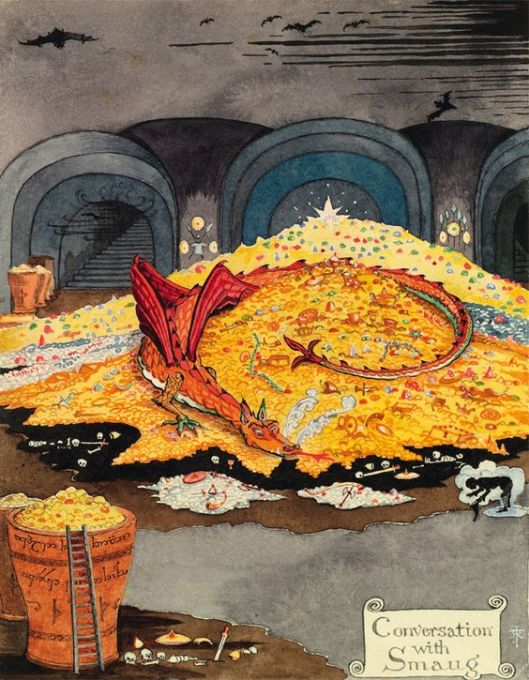
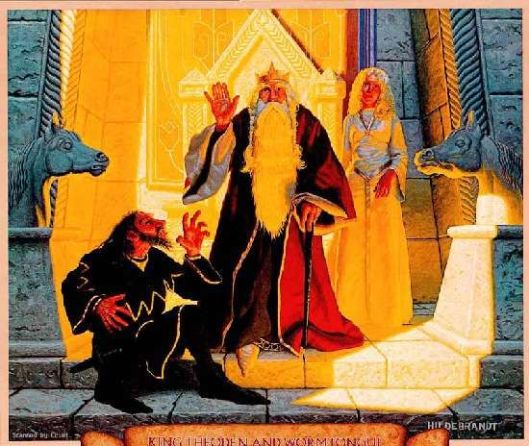
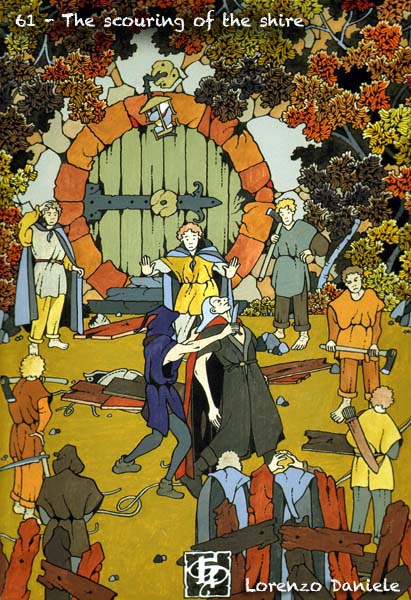
• About

doubtfulsea

~ adventure fantasy

Tag Archives: The Hobbit

Baruk Khazad!

12 Wednesday Dec 2018

Posted by Ollamh in Artists and Illustrators, J.R.R. Tolkien, Military History, Military History of Middle-earth

≈ Leave a comment

Tags

Adze, Alan Lee, Axe, Bayeux Tapestry, Bilbo, Dane Axe, Dwarves, francisca, Gimli, Harold Godwinson, Helm's Deep, Huscarl, mithril, Skylitzis, The Hobbit, The Lord of the Rings, Thorin, Tolkien, Varangian Guard

As always, dear readers, welcome.

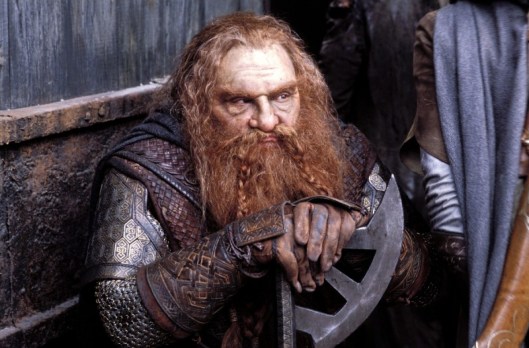
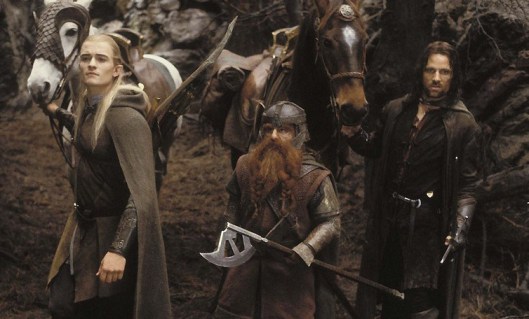
Ever since we saw the original Lord of the Rings films, we’ve been thinking about Gimli and his major weapon.

image1gimli.jpg

In The Hobbit, it would appear that the dwarves had not been armed until they used what was in the Lonely Mountain after Smaug had gone:

“Now the dwarves took down mail and weapons from the walls, and armed themselves.  Royal indeed did Thorin look, clad in a coat of gold-plated rings, with a silver-hafted axe in a belt crusted with scarlet stones.” (The Hobbit, Chapter 13, “Not at Home”)

This is where the mithril coat which eventually protects Frodo in Moria and turns up in the hands of the Mouth of Sauron comes from, when Thorin gives it to Bilbo.

image2mithril.jpg

Not long after we first meet Gimli, at the Council of Elrond, however, we see Gimli already kitted out for war:

“Gimli the dwarf alone wore openly a short shirt of steel rings, for dwarves make light of burdens; and in his belt was a broad-bladed axe.” (The Fellowship of the Ring, Book Two, Chapter 3, “The Ring Goes South”)

Certainly, the axe in Gimli’s right hand in the photo wouldn’t fit through a belt and allow for comfort or freedom of movement and we note that, in that same photo, Gimli appears to have another—but that looks too long for comfort, as well.

image3gimli.jpg

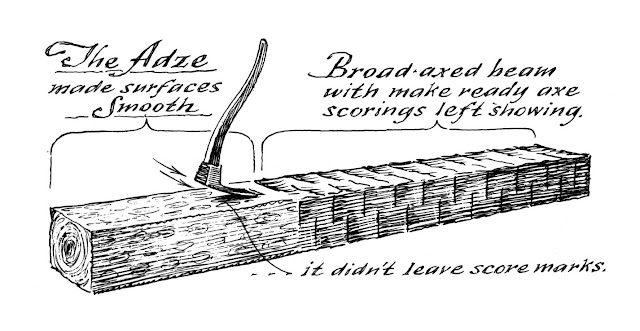
That the two axes fit in with the general persona of dwarves, however, seems to be true—after all, the translation of our title for this post is “Axes of the dwarves!”  (to be followed by Khazad ai-menu!  “the dwarves are upon you!”), which is the dwarves’ rallying cry.  What kind (or kinds) of axes these are doesn’t seem so clear, then.  Alan Lee, for example, shows us a dwarf with something which isn’t really an axe at all, but looks more like an adze, which is a tool used in woodworking to smooth and shape wood.

image4dwarf.jpg

the Broad Axe vs. the Adze - Handmade Houses... with Noah ...


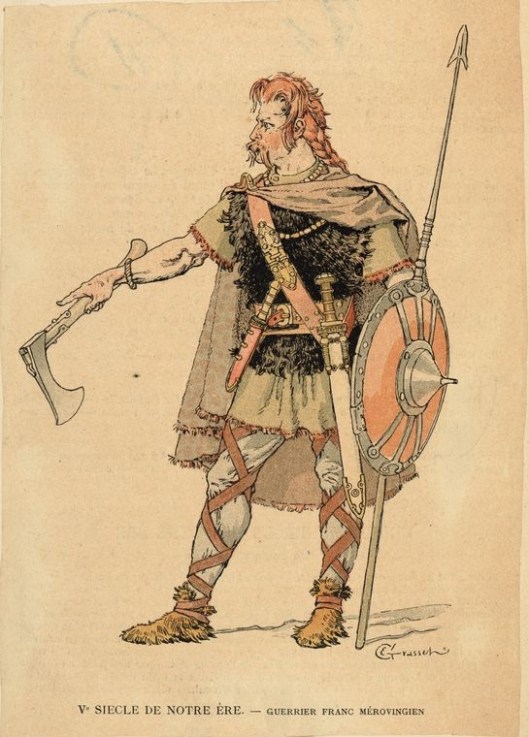
Because JRRT describes Gimli’s axe as being tuckable, we wondered whether he was thinking of the kind of throwing axe, a francisca, used by Frankish warriors (and which gave them their name).

image6francisca.jpg

image7frank.jpg

When we actually see Gimli in battle, however, he isn’t throwing, but swinging his axe.  At Helm’s deep he says to Legolas, “Give me a row of orc-necks and room to swing and all weariness will fall from me!”  And then he swings that axe:  “An axe swung and swept back.  Two Orcs fell headless.” (The Two Towers, Book Three, Chapter 7, “Helm’s Deep”)

This leads us to ask if perhaps JRRT himself wasn’t clear about Gimli’s weapon.  He never throws it, using it always as a chopper, and, when we thinking of axes with a haft—that is, handle–long enough to do that, we don’t think of that odd item in the image above—which doesn’t look substantial enough to cut through cervical vertebrae—

image8gimli.jpg

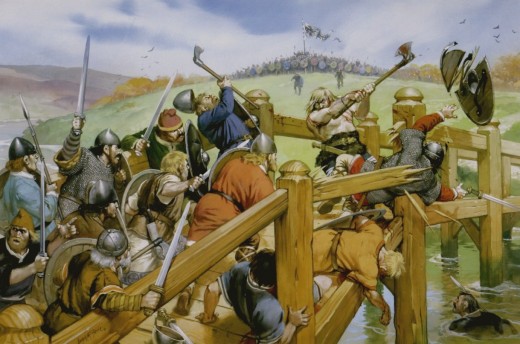
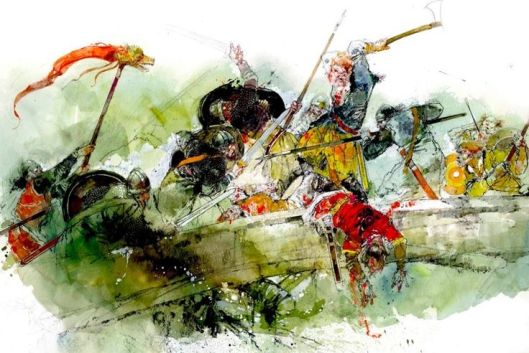
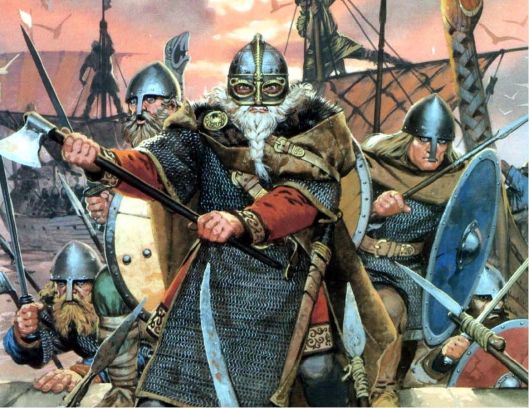
but rather of the long-hafted axe, or “Dane axe”  perhaps carried by the giant Viking who defended Stamford Bridge single-handedly against the Anglo-Saxons on 25 September, 1066,

image9stam.jpg

image10stam.jpg

with its razor-sharp blade.

image11axe.jpg

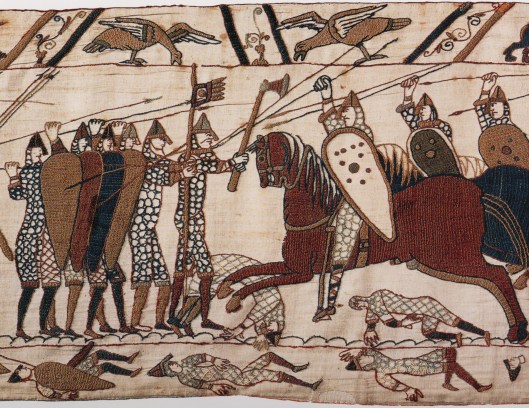
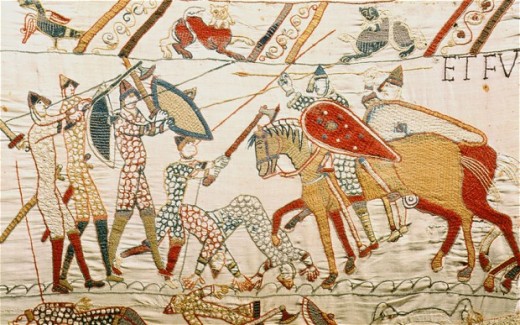
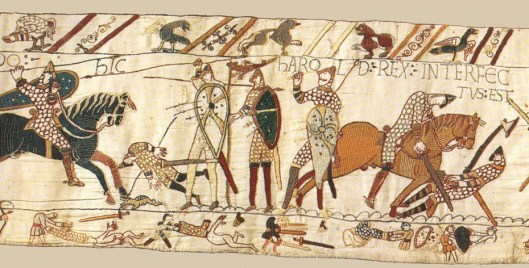
This was the kind of axe that we see carried by the huscarl, the bodyguards, of the English king, Harold Godwinson, in the depiction of the Battle of Hastings, 14 October, 1066, on the so-called Bayeux Tapestry.

image12bay.jpg

image13bay.jpg

One of which Harold may himself been carrying when he was killed, if the caption on the cloth is referring to Harold being cut down by the mounted Norman in this part of the tapestry.

image14harold.jpg

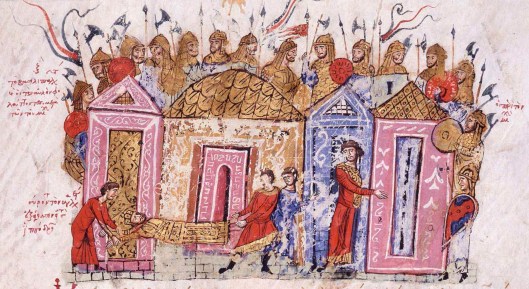
These same axes also appear to turn up as part of the armament of the Varangian Guard, the bodyguard of a number of Byzantine emperors from the 10th to 14th centuries, as depicted in the 11th-century  Skylitzis Chronicle.

image15varang.jpg

Much of this guard was made up of Norsemen and Anglo-Saxons, so the pattern of axe, we imagine, was something which both groups brought with them from their original homes.

image16varang.jpg

This is clearly the sort of thing to whack off heads, even two at a time, and so, if we can quietly detach it from Gimli’s belt and have him stand, perhaps even leaning on it, we have the Gimli who competes with Legolas at Helm’s Deep in the number of orcs each has dispatched.

image17vik.jpg

Thanks, as ever, for reading.

MTCIDC

CD

Who Goes There? (2)

21 Wednesday Nov 2018

Posted by Ollamh in J.R.R. Tolkien

≈ Leave a comment

Tags

Beowulf, Ford of Bruinen, Haldir, Jules Verne, Lorien, Moria, Nautilus, Rivendell, Sentries, The Argonath, The Hobbit, The Lord of the Rings, The Shire, Tolkien, Twenty Thousand Leagues Under the Sea

As ever, dear readers, welcome.

In our last, we had begun discussion of the use of watchmen/sentries in The Lord of the Rings.  In our last, in fact, we had stopped with what is well-known to have been a strong influence—especially in The Hobbit—upon JRRT:  Beowulf, and its two such figures.  Here’s Beowulf with the first.

image8coastguard

What particularly interests us is that, often when such a figure—or figures—is encountered, it slows the action, but, interestingly, may cause further action at the same time:  the protagonist can be challenged, questioned, or even forced to act—all part of what we call “no fiction without friction”—and we’ll see what this does for the characters now as we’re off on our journey through Middle-earth, beginning  where The Lord of the Rings begins, in the Shire.

image2shire

Before we go farther, however, we would like to expand our definition of watchman/sentry just a little to include the mobile equivalent of sentries, patrols:

“The Shirriffs was the name that the Hobbits gave to their police, or the nearest equivalent that they possessed…There were in the Shire only twelve of them, three in each Farthing, for Inside Work.  A rather larger body, varying at need, was employed to ‘beat the bounds’, and to see that Outsiders of any kind, great or small, did not make themselves a nuisance.”  (The Lord of the Rings, Prologue, 3, “Of the Ordering of the Shire”)

Tolkien says of these shirriffs that “they were in practice rather haywards then policemen”, and “hay” here doesn’t  mean horse and cattle feed  but, rather, it’s an old word for “hedge”(from Old English “haga”) and we see our next sentry at the hedge which surrounds Bree.  Initially, this is “old Harry”, who seems, when the hobbits arrive, a bit too inquisitive:

“They came to the West-gate and found it shut; but at the door of the lodge beyond it, there was a man sitting.  He jumped up and fetched a lantern and looked over the gate at them in surprise.” (The Fellowship of the Ring, Book One, Chapter 9, “At the Sign of the Prancing Pony”)

It says, perhaps, something about the confidence of the Elves that, at Rivendell, there are neither sentries nor patrols—although perhaps the River Bruinen might be considered at least a defense, considering that it sweeps away the Nazgul when they try to cross.

At the Ford, by Ted Nasmith

(Image by one of our favorite Tolkien illustrators, Ted Nasmith)

This idea of a natural force as sentry appears again before the Fellowship enters Moria—although, this time, as they climb along the mountains on the way south, it is decidedly not on their side:

“They heard eerie noises in the darkness round them.  It may have been only a trick of the wind in the cracks and gullies of the rocky wall, but the sounds were those of shrill cries, and wild howls of laughter.  Stones began to fall from the mountain-side, whistling over their heads, or crashing on the path beside them.  Every now and again they heard a dull rumble, as a great boulder rolled down from hidden heights above.” (The Fellowship of the Ring, Book Two, Chapter 3, “The Ring Goes South”)

The combination of rock and snow forces the Fellowship to make what seems at the time a fatal decision:  to go not south, but east, into the Mines of Moria, with the disappearance of Gandalf as the consequence.

At the western doors of Moria, however, they encounter another negative force, something in the manmade lake in front of those doors.  It is a watcher, if not an active sentry, although what it really is, even Gandalf doesn’t know:

“Something has crept or has been driven out of dark waters under the mountains.  There are older and fouler things than Orcs in the deep places of the world.”  (The Fellowship of the Ring, Book Two, Chapter 4, “A Journey in the Dark”)

alan-lee-moria-gate-particolare

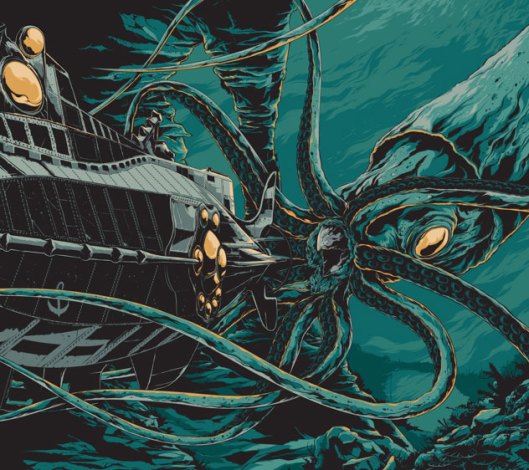
Whatever this creature may be (and it has lots of tentacles, which makes us think immediately of the squid with which the crew of the submarine Nautilus has to contend in Jules Verne’s Twenty Thousand Leagues Under the Sea)

20000detail

their encounter with it insures that their choice of traveling through Moria can’t be revoked:

“Many coiling arms seized the doors on either side, and with horrible strength, swung them round.  With a shattering echo they slammed, and all light was lost.  A noise of rending and crashing came dully through the ponderous stone…They heard Gandalf go back down the steps and thrust his staff against the doors.  There was a quiver in the stone and the stairs trembled, but the doors did not open.”

On the far side of Moria, at the edge of Lorien, the company meets its next watcher—or watchers, rather, a listening post of Elves set on a platform in a tree, where:

“…[Frodo] found Legolas seated with three other Elves.  They were clad in shadowy-grey, and could not be seen among the tree-stems, unless they moved suddenly.”  (The Fellowship of the Ring, Book Two, Chapter 6, “Lothlorien”)

And here we see an interesting development brought on by contact with the Elves at this sentry-post.  Because the Elves are mistrustful of Gimli, there is an awkward moment:  he is to be led blindfolded into the center of Lorien, something he resists until Aragorn proposes that all be blindfolded, to which Gimli makes a counterproposal that only Legolas need be blindfolded, which Legolas resists, and all are back to Aragorn’s proposal, but the leader of the Elves, Haldir, draws a moral from the situation:

“Indeed in nothing is the power of the Dark Lord more clearly shown than in the estrangement that divides all those who still oppose him.”

Our last sentries for this posting are more a symbol in that they are inanimate, but full of warning all the same:

“  ‘Behold the Argonath, the Pillars of the Kings!’ cried Aragorn…

As Frodo was borne towards them the great pillars rose like towers to meet him.  Giants they seemed to him, vast grey figures silent but threatening.  Then he saw that they were indeed shaped and fashioned…Upon great pedestals founded in the deep waters stood two great kings of stone:  still with blurred eyes and crannied brows they frowned upon the North.  The left hand of each was raised palm outwards in gesture of warning; in each right hand there was an axe; upon each head there was a crumbling helm and crown.  Great power and majesty they still wore, the silent wardens of a long-vanished kingdom. “  (The Fellowship of the Ring, Book Two, Chapter 9, “The Great River”)

argonath hildebrandt

But, for all their forbidding look, they spark something in Aragorn—

“ ‘Fear not!’ said a strange voice behind him.  Frodo turned and saw Strider, and yet not Strider; for the weatherworn Ranger was no longer there.  In the stern sat Aragorn son of Arathorn, proud and erect, guiding the boat with skilful strokes; his hood was cast back, and his dark hair was blowing in the wind, a light was in his eyes:  a king returning from exile to his own land.”

And, on that inspiring note, we’ll pause for this posting, saving the rest of the sentries, watchers, and patrols for Part 3.

In the meantime, thanks, as always, for reading.

MTCIDC

CD

Green and Quiet.1

05 Wednesday Sep 2018

Posted by Ollamh in Economics in Middle-earth, J.R.R. Tolkien, Literary History

≈ Leave a comment

Tags

Birmingham, Charles Dickens, Cottage industry, factories, Goblins, Hard Times, Hilary Tolkien, I Can't Find Brummagem, Industrial Revolution, Isengard, James Dobbs, John Ezard, Mabel Tolkien, Mills, Ornthanc, Sarehole, Sharkey, The Hobbit, The Scouring of the Shire, Tolkien, World War I

As always, dear readers, welcome.

We’ve always loved the lines

“By some curious chance one morning long ago in the quiet of the world, when there was less noise and more green…”

which open the paragraph in which Gandalf first appears in The Hobbit and the story actually begins.

For JRRT, green and quiet are the ideal, but things have clearly changed—as this sentence implies, now there is more noise and less quiet.  In our time—and even before Tolkien’s childhood in the late 19th century—the green and quiet were and are going thanks to the Industrial Revolution.  Or so we thought.  Reading Tolkien, however, we begin to believe that it’s goblins:

“Now goblins are cruel, wicked, and bad-hearted.  They make no beautiful things, but they make many clever ones.  They can tunnel and mine as well as any but the most skilled dwarves, when they take the trouble, though they are usually untidy and dirty.  Hammers, axes, swords, daggers, pickaxes, tongs, and also instruments of torture, they make very well, or get other people to do the work to make to their design, prisoners and slaves that have to work till they die for want of air and light.  It is not unlikely that they have invented some of the machines that have since troubled the world, especially the ingenious devices for killing large numbers of people at once, for wheels and engines and explosions always delighted them, and also not working with their own hands more than they could help; but in those days and those wild parts they had not advanced (as it is called) so far.”  (The Hobbit, Chapter Four, “Over Hill and Under Hill”)

In our last posting, we had linked this passage with the invention of poison gases by German scientists and their use first by German soldiers and then by the Allies in the Great War, but we would like to add to that idea that this may be in reality a larger indictment, of the Industrial Revolution and the effects it had had upon the English countryside.

This revolution had begun in the 18th century, in Britain, when the country was first becoming a major mercantile and colonial power and the demand for British goods—especially British wool and cloth—was growing.  A succession of inventions from the 1760s on had turned a (literal) “cottage industry” of clothing-making—

image1weaver.jpg

into something which produced thread and cloth on a massive scale in early factories.

image2powerlooms.jpg

These factories, often called “mills” because of their original use of waterpower,

image3waterpower.jpg

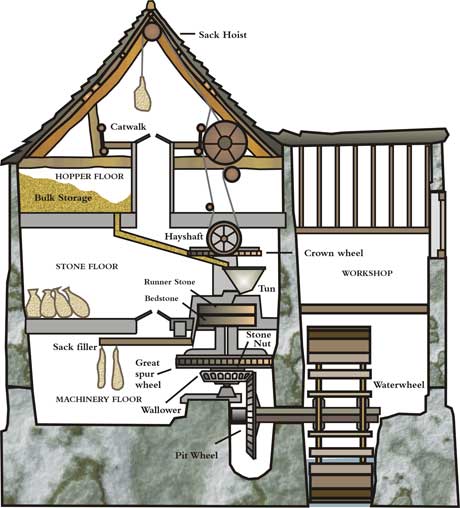
as was done in the small factories which, all the way back to Roman times, had ground grain into flour,

image4agrainmill.jpg

could also, in time, be run by steam power.

image4steammill.jpg

Mills of this sort soon became prototypes for factories built to mass-produce anything

image5factory.jpg

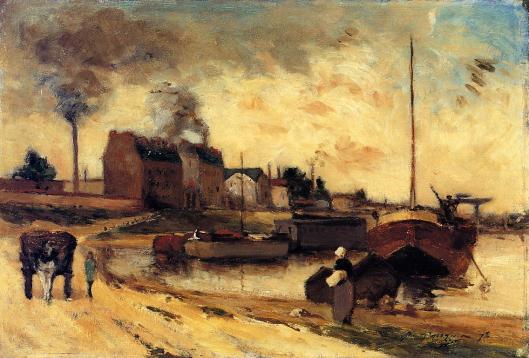
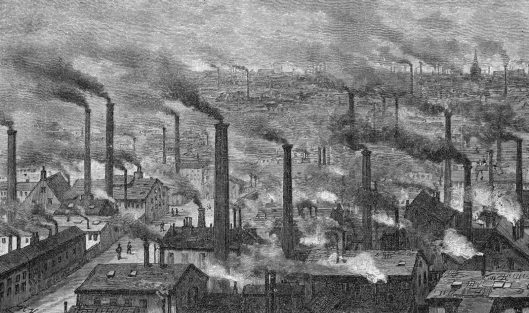
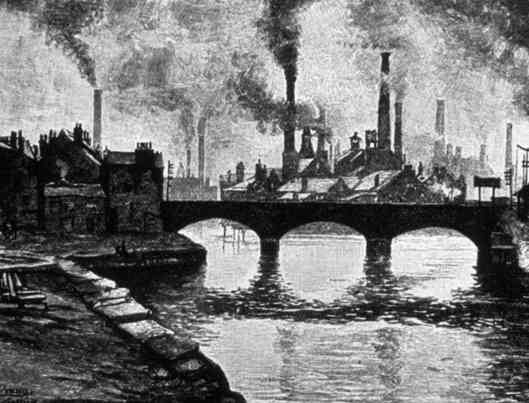
and soon the air around cities was thick with smoke and industrial waste.

image6pollution.jpg

With no laws to stop them, mill/factory owners bought up land, employed people (many of them ex-cottage workers thrown out of work by the very factories they now sought work in) in near-slave conditions—including children–and polluted water and air with no fear of punishment.  Here is Charles Dickens’ description of a town filled such places, from his 1854 novel, Hard Times:

“It was a town of red brick, or of brick that would have been red if the smoke and ashes had allowed it; but as matters stood, it was a town of unnatural red and black like the painted face of a savage. It was a town of machinery and tall chimneys, out of which interminable serpents of smoke trailed themselves for ever and ever, and never got uncoiled. It had a black canal in it, and a river that ran purple with ill-smelling dye, and vast piles of building full of windows where there was a rattling and a trembling all day long, and where the piston of the steam-engine worked monotonously up and down, like the head of an elephant in a state of melancholy madness. It contained several large streets all very like one another, and many small streets still more like one another, inhabited by people equally like one another, who all went in and out at the same hours, with the same sound upon the same pavements, to do the same work, and to whom every day was the same as yesterday and to-morrow, and every year the counterpart of the last and the next.”

Set this next to Gandalf’s description of what had happened to Isengard and you can see what we mean about goblins (here, Saruman and his orcs—but JRRT sometimes uses goblin and orc interchangeably) as what has destroyed the quiet and green:

“I looked on it and saw that, whereas it had once been green and fair, it was now filled with pits and forges…Over all his works a dark smoke hung and wrapped itself about the sides of Orthanc.”  (The Fellowship of the Ring, Book Two, Chapter 3, “The Council of Elrond”)

image7aisengard.jpg

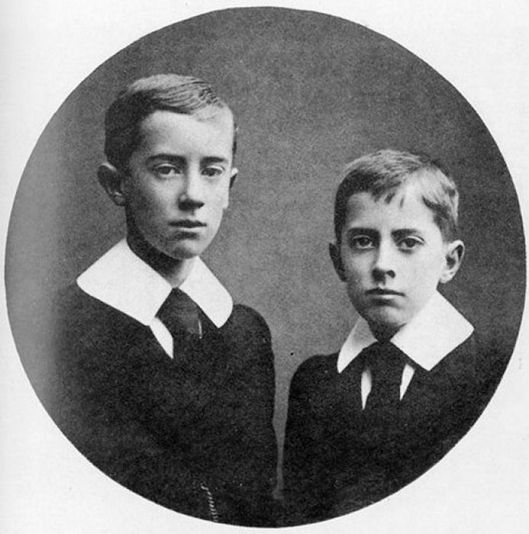
In 1895, Tolkien’s mother, Mabel,

image7mabel.png

who had been living in South Africa with her husband, brought her two sons, JRRT and Hilary, to the Birmingham area of England for a visit to relatives.

image8.jpg

Unfortunately, while they were gone, Tolkien’s father died of rheumatic fever.  Mabel decided to stay in England and found a place for her sons and herself at Sarehole, southeast of Birmingham itself.

image9housesarehole.jpg

Birmingham was a booming product of that Industrial Revolution, which we’re sure is why Mabel chose a tiny village several miles away.

image10brum.jpg

Birmingham was also an ancient settlement, (here’s a LINK to a minitour of the medieval town) but had mushroomed, both in factories and population even at the beginning of the 19th century, as this verse from a music hall song from 1828 by James Dobbs depicts:

‘I remember one John Growse,
Who buckles made in Brummagem,
He built himself a country house,
To be out of the smoke of Brummagem
But though John’s country house stands still,
The town itself has walked up hill,
Now he lives beside a smoky mill,
In the middle of the streets of   Brummagem.”

(James Dobbs (1781-1837), “I Can’t Find Brummagem”.  Brummagem is an old local nickname for Birmingham.  Here’s a LINK so that you can see the whole song and its tune, which we know as “Duncan Grey”.  If you go to the link, you’ll notice we’ve made a few editorial additions, which we knew from another version of the song and which help the words to better fit the tune.)

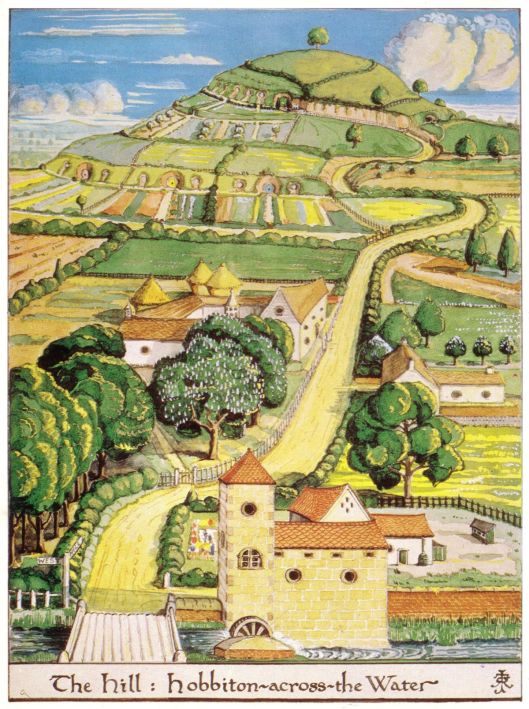
And yet, although Sarehole had an old mill, it was not like those in Birmingham or even in Dickens,

image11mill.jpg

and, in later years, in fact, Tolkien saw the little village beyond it as a kind of paradise, as he said in an interview:

‘It was a kind of lost paradise,’ he said. ‘There was an old mill that really did grind corn with two millers, a great big pond with swans on it, a sandpit, a wonderful dell with flowers, a few old-fashioned village houses and, further away, a stream with another mill. I always knew it would go – and it did.’

(This is taken from an article by John Ezard in The Guardian for 28 December, 1991—here’s a LINK so that you can read all of it.)

This strong contrast between green and quiet and its opposites, as seen in Sarehole versus Birmingham, early in Tolkien’s life, and the two stages of Isengard, will appear again in the Shire as Saruman/Sharkey has planned.  The green and quiet is literally uprooted and even Sandyman’s old mill is a victim of the goblinesque work as Farmer Cotton says:

image12mill.jpg

“But since Sharkey came they don’t grind no more corn at all.  They’re always a-hammering and a-letting out a smoke and stench, and there’s no peace even at night in Hobbiton.  And they pour out filth a purpose; they’ve fouled all the lower Water, and it’s getting down into Brandywine.”

(The Return of the King,  Book Six, Chapter 8, “The Scouring of the Shire”)

image14shire.jpg

Those who work for Sharkey are men, but, as you can see, under his influence, they act very much like those destructive goblins with which we began.   For all that he rode in automobiles and trains and used telephones and typewriters, JRRT was never quite happy in the modern world and, considering that the goblins seemed always poised to ruin more green and produce more noise at the command of a modern-day Saruman, it’s perhaps not surprising.  It’s also not surprising, we would add, that his favorite creatures, trees, are the ones who destroy Saruman’s handiwork at Isengard and return it to a leafy park.

image15isen.jpg

Thanks, as ever, for reading.

MTCIDC

CD


ps

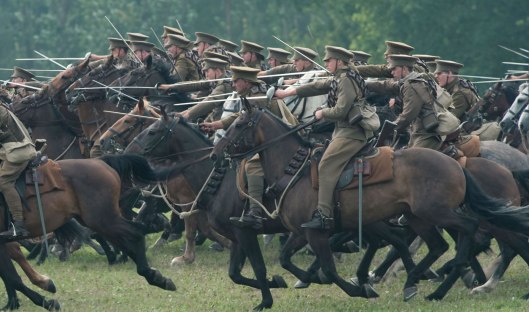
In our next, we want to talk about another aspect of quiet which had changed from Tolkien’s childhood and may be a reason why there are Rohirrim and why JRRT himself enlisted in the volunteer cavalry…

image16yeomanry.jpg

Gobs and Hobs.2

29 Wednesday Aug 2018

Posted by Ollamh in Artists and Illustrators, Fairy Tales and Myths, J.R.R. Tolkien, Language, Literary History

≈ Leave a comment

Tags

A Midsummer Night's Dream, Arthur Rackham, Christina Rossetti, Elf Child, Fairies, Fairy Tale, George Macdonald, Goblin Feet, Goblin Market, Goblins, Historia Ecclesiastica, Hobgoblin, James Whitcomb Riley, John Garth, John Singer Sargent, King Edward's Horse, Little Orphan Annie, Orderic Vitalis, Pat Walsh, Psalm 91, Robin Goodfellow, The Crowfield Curse, The Crowfield Demon, The Hob and the Deerman, The Hobbit, The Lord of the Rings, The Princess and the Goblin, Tolkien, Tolkien and the Great War, Tolkien at Exeter College

As always, dear Readers, welcome!

In our last, we were talking about JRRT’s 1915 poem, “Goblin Feet” its origins, original publication, and context.

In this, we want to think out loud a bit about the idea of goblins in general.

Although the poem was entitled “Goblin Feet”, Tolkien seemed not to focus so much on goblins—there are also other creatures from the Otherworld, including fairies and gnomes and even leprechauns (not to mention bats—called by their old country name “flitter-mice”—and beetles and coneys).

In this posting, however, we’re going to stick to goblins—well, and hobgoblins—but more about those later.

We first encountered goblins as very small children when a teacher read us a poem by the American poet, James Whitcomb Riley (1849-1916).
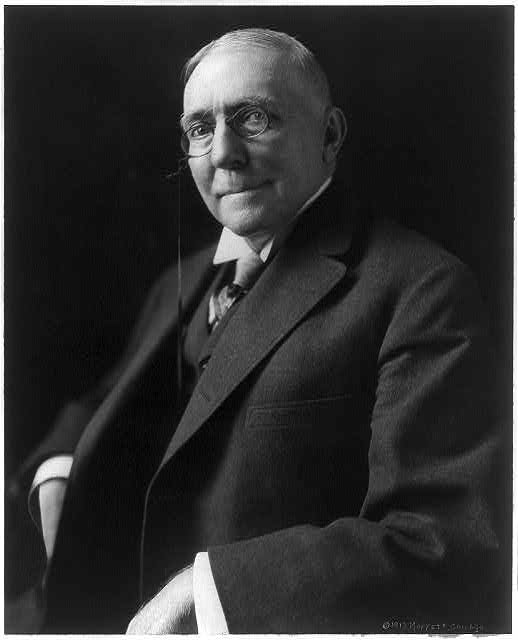
image1riley.jpg

(We can’t resist a second picture.  This is by one of our favorite late-19th-early-20th-c. American Painters, John Singer Sargent—1856-1925.)
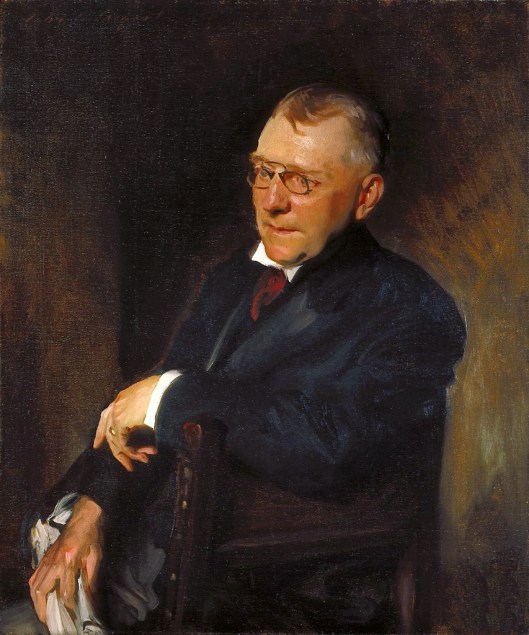
image2riley.jpg

This poem, first entitled “Elf Child”, originally appeared in a newspaper in 1885.  After that, it was meant to be “Little Orphan Allie”, but, owing to a typsetter’s error, it gained its present title, which it’s had ever since.

Little Orphant Annie – Poem by James Whitcomb Riley

To all the little children: — The happy ones; and sad ones;
The sober and the silent ones; the boisterous and glad ones;
The good ones — Yes, the good ones, too; and all the lovely bad ones.

Little Orphant Annie’s come to our house to stay,
An’ wash the cups an’ saucers up, an’ brush the crumbs away,
An’ shoo the chickens off the porch, an’ dust the hearth, an’ sweep,
An’ make the fire, an’ bake the bread, an’ earn her board-an’-keep;
An’ all us other childern, when the supper-things is done,
We set around the kitchen fire an’ has the mostest fun
A-list’nin’ to the witch-tales ‘at Annie tells about,
An’ the Gobble-uns ‘ll git you
Ef you
Don’t
Watch
Out!

Wunst they wuz a little boy wouldn’t say his prayers,–
An’ when he went to bed at night, away up-stairs,
His Mammy heerd him holler, an’ his Daddy heerd him bawl,
An’ when they turn’t the kivvers down, he wuzn’t there at all!
An’ they seeked him in the rafter-room, an’ cubby-hole, an’ press,
An’ seeked him up the chimbly-flue, an’ ever’-wheres, I guess;
But all they ever found wuz jist his pants an’ roundabout:–
An’ the Gobble-uns ‘ll git you
Ef you
Don’t
Watch
Out!

An’ one time a little girl ‘ud allus laugh an’ grin,
An’ make fun of ever’ one, an’ all her blood-an’-kin;
An’ wunst, when they was ‘company,’ an’ ole folks wuz there,
She mocked ’em an’ shocked ’em, an’ said she didn’t care!
An’ jist as she kicked her heels, an’ turn’t to run an’ hide,
They wuz two great big Black Things a-standin’ by her side,
An’ they snatched her through the ceilin’ ‘fore she knowed what she’s about!
An’ the Gobble-uns ‘ll git you
Ef you
Don’t
Watch
Out!

An’ little Orphant Annie says, when the blaze is blue,
An’ the lamp-wick sputters, an’ the wind goes woo-oo!
An’ you hear the crickets quit, an’ the moon is gray,
An’ the lightnin’-bugs in dew is all squenched away,–
You better mind yer parunts, an’ yer teachurs fond an’ dear,
An’ churish them ‘as loves you, an’ dry the orphant’s tear,
An’ he’p the pore an’ needy ones ‘at clusters all about,
Er the Gobble-uns ‘ll git you
Ef you
Don’t
Watch
Out!

In some ways, this is a typical Victorian moral poem:  children better behave, or…  But, instead of being in “proper” English, it’s been told in the dialect of the US state of Indiana and this was something for which Riley was well-known, having written numbers of poems in the so-called “Hoosier” dialect.  (This includes what looks like a misprint for the proper spelling “orphan”.)

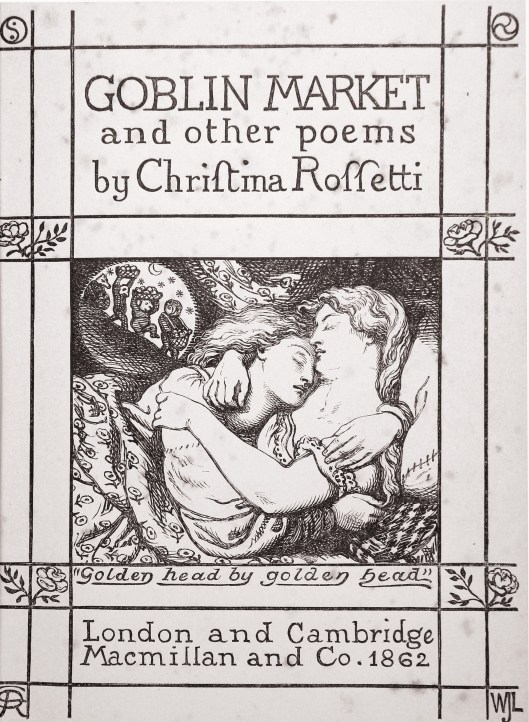
Our acquaintance with goblins has continued to be literary, from Christina Rossetti’s (1830-1894)
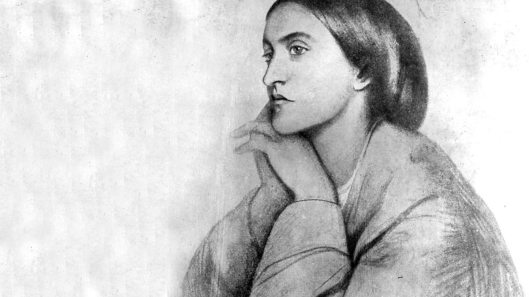
image3acr.jpg

Goblin Market (1862)

image3gobmark.jpg

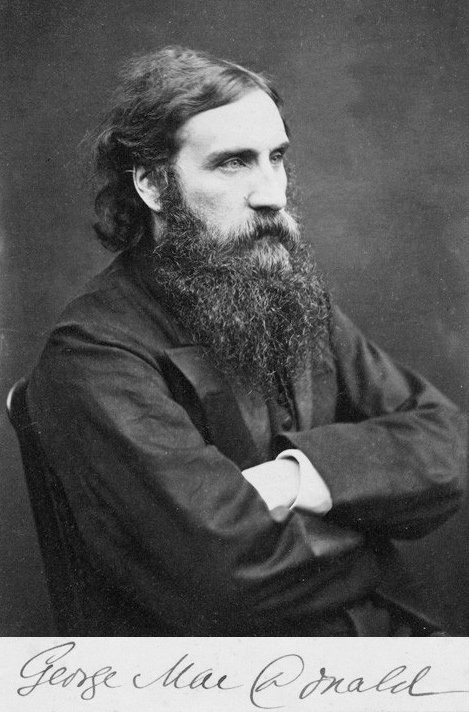
to George Macdonald’s (1824-1905)

image4gmacd.jpg

1872 fantasy novel, The Princess and the Goblin.
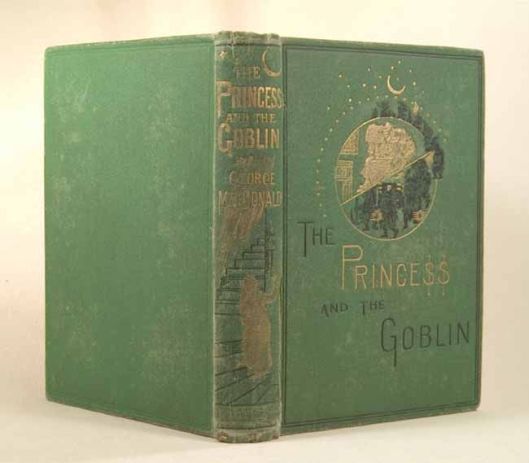
princessandgoblin1872.jpg

Our biggest—and longest—exposure, of course, was in The Hobbit (1937).
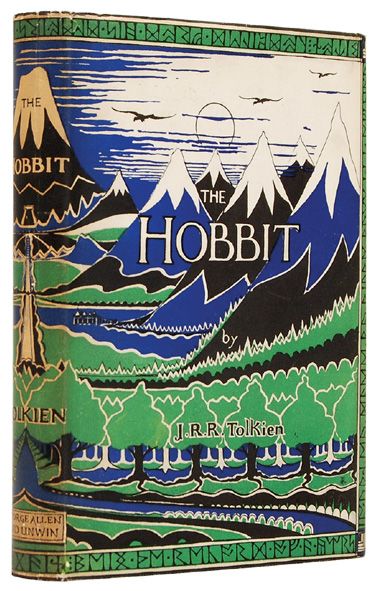
image6hob.jpg

Goblins turn up from the moment Bilbo and the dwarves fall into their hands in Chapter 4, “Over Hill and Under Hill” and we see them again in their pursuit of the party once they’ve escaped the goblin stronghold and finally at the Battle of the Five Armies.  At their first appearance, they are described as “great ugly-looking goblins” and, unlike the nimble-footed creatures of Tolkien’s 1915 poem, these have flat feet and flap them as they move.  They live in a monarchy, ruled (for the moment) by a king described as “a tremendous goblin with a huge head”.

So far, we might see that as traditional nightmarish beings, like the “great big Black Things” in stanza 3 of Riley’s poem, but JRRT does something further and very interesting with them.  This first novel was written in the 1930s, only twenty years after the Great War which had ruined much of western Europe and killed all but one of Tolkien’s oldest friends, and the emotional scar was still fresh, it seems.  He was too humane (and too wise) to blame Germany for what had happened, but it’s clear that he wouldn’t excuse the Industrial Revolution and the goblins become a stand-in for all the worse of it:

“Hammers, axes, swords, daggers, pickaxes, tongs, and also instruments of torture, they make very well, or get other people to make to their designs, prisoners and slaves that have to work till they die for want of air and light.  It is not unlikely that they invented some of the machines that have since troubled the world, especially the ingenious devices for killing large numbers of people at once, for wheels and engines and explosions always delighted them, and also not working with their own hands more than they could help; but in those days and those wild parts they had not advanced (so it is called) so far.”  (The Hobbit, Chapter 4, “Over Hill and Under Hill”)

The word “goblin” has a rather mysterious etymological history and, like so many early words, that history is a murky one, full of guesses and suggestions.  A little research produces the explanation that the word first seems to appear in Latin, in Orderic Vitalis’ (1075-c1142) Historia Ecclesiastica, Book 5, Chapter 7, in which, while reviewing the life of the early French saint, Taurinus, (lived c.400AD), Orderic mentions a demon whom the saint has vanquished, but which still haunted the area around the town of Evreux in Normandy, a demon the locals called “gobelinus”.

A century later, in the long Old French poem on the Third Crusade (1189-1192) of Ambroise of Normandy (who lived at the end of the 12th century), a noted figure in the actual history of the period, Balian d’ Ibelin, is referred to as being “more false than a gobelin” (L’Histoire de la Guerre Sainte, line 8710), with no explanation, suggesting that readers would be aware of what a gobelin was (and that he wasn’t trustworthy).

The word first appears in English in John Wycliffe’s translation of the Bible in the late 14th century, in Psalm 91, in which a God-fearing person will never be afraid of various things, including

“of a gobelyn goyng in derknisses”.

If 14th-century people knew what this creature was, we wonder whether it was still clear to people two centuries later—the older standard English translation (the so-called “King James Bible”, 1611) translates this as

“the pestilence that walks in darkness”

(which actually is close to the Hebrew original, as best as we can make out, as we don’t, unfortunately, read Hebrew—see this LINK to read for yourself.)

In the preface to the 1951 second edition of The Hobbit, Tolkien gives his own gloss, based upon the word he will employ almost entirely in The Lord of the Rings for such creatures:

“Orc is not an English word.  It occurs in one or two places but is usually translated goblin (or hobgoblin for the larger kinds).  Orc is the hobbits’ form of the name given at that time to these creatures…)

thus blending villains from 1937 with those readers would soon see in his new work, The Lord of the Rings (1954-1955).

“Hobgoblin” brings us to our conclusion, however.  As in the case of “goblin”, things get murky here, too, with some stating that, as “Hob” is an old nickname for “Robert” (compare “Hodge” as an old nickname for “Roger”), so a hobgoblin is related to “Robin Goodfellow”, (“Robin” being another nickname for “Robert”) aka the Puck we see in A Midsummer Night’s Dream (1595-96?).

image7puck.jpg

(This image is from Arthur Rackham’s (1865-1939) 1933 version of the play.)
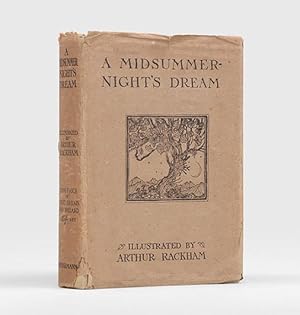
https://pictures.abebooks.com/BLAEU/md/md20625435733.jpg

Hobgoblins sometimes appear as prickly household helpers (rather like Dobby in the Harry Potter books), and those who want to associate the “hob” of “hobgoblin” with the “hob” (earlier “hubbe”), “the side of a fireplace” see that prefix as suggesting that “hobgoblins” might be a subset of “goblins” in general.

For us, however, a “hob” is a character in an on-going series we recommend to our readers.  These are novels set in and around a decaying medieval monastery in 1347 and the haunted world around it, written by Pat Walsh, an archaeologist/fantasy author.

image8pw.jpg

The first two in the series are The Crowfield Curse (2010) and The Crowfield Demon (2011)
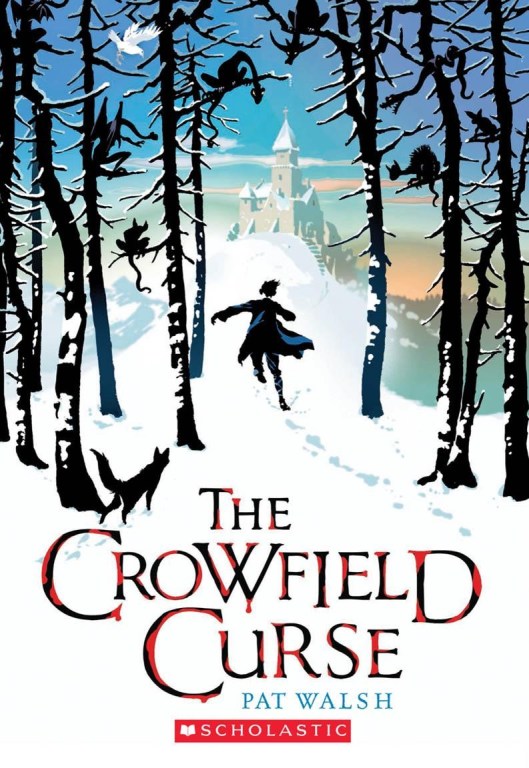
image9crowc.jpg

image10crowd.jpg

In this series, the hero, Will, an orphan, discovers a wounded creature and brings it back to the monastery.  It’s a hob—and will be a major character as the series develops.  In 2014, Walsh began a new series with The Hob and the Deerman.

image11thehob.jpg

Walsh has promised a third book in the Crowfield series, Crowfield Rising, but it has yet to appear—unlike our next posting, which will appear (provided that there is no space alien invasion or implementation of Order 66 or Sauron producing a new ring), next week.

Till then, thanks, as ever, for reading.

MTCIDC

CD

PS

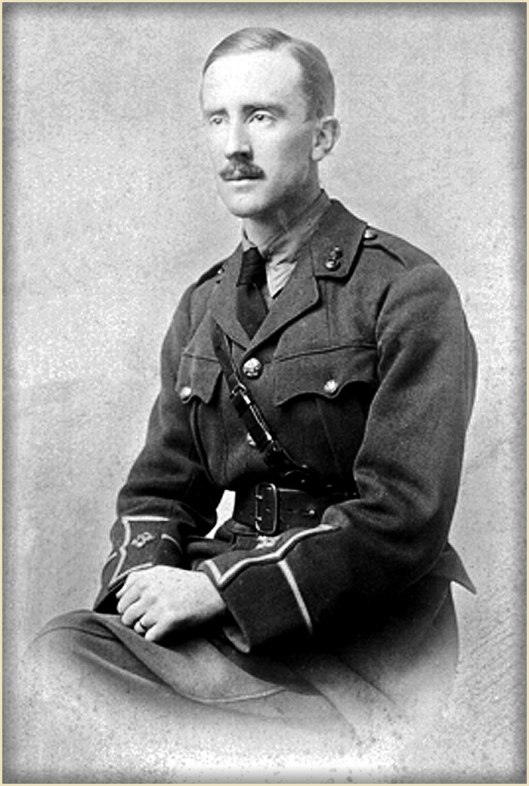
In our last, we mistakenly identified a photo of JRRT in a uniform which we thought belonged to a unit at his alma mater, King Edward’s School, as the caption with it said “1907”.   It seemed odd to us, however, because it had the look of a cavalry unit (the bandoleer across the chest was common during the period for cavalry and for artillerymen) and, for all that he writes admiringly of horses, we had no sense that he himself was ever a horseman.  This nagged at us until we did a little research and realized our mistake:  the uniform was for King Edward’s Horse, the equivalent of a national guard/volunteer unit raised before the Great War.  Tolkien was a member of this at the beginning of his Oxford career in 1911, but later resigned.  John Garth’s two really useful books, Tolkien at Exeter College and Tolkien and the Great War, set us straight.

image12keh.jpg

PPS

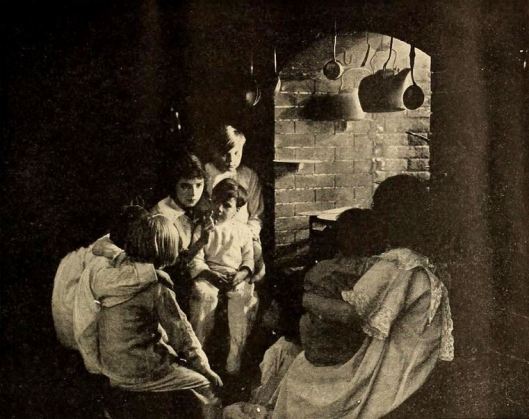
If you read us regularly, you know that we have a special love for early, silent film  While researching this posting, we learned that, in 1918, a film was made based upon “Little Orphant Annie” and that a copy of it has survived for us to see.  Here’s a poster and a still.
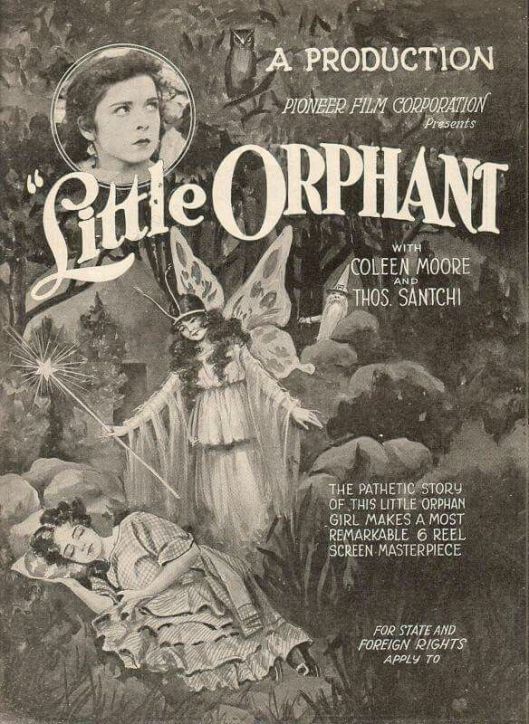
image13littleorphant.jpg

image14still.jpg


A Power

25 Wednesday Apr 2018

Posted by Ollamh in J.R.R. Tolkien, Narrative Methods, Villains

≈ Leave a comment

Tags

Gandalf, Grima, Harry Potter, Isengard, Istari, Mini-Me, Mirkwood, Necromancer, Ornthanc, Palantir, power, Rings of Power, Rohan, Saruman, Sauron, The Council of Elrond, The Hobbit, The Lord of the Rings, Theoden, Tolkien, Voldemort, White Council, Wormtongue

Welcome, dear readers, as ever.

Some time ago, we did a post on Saruman as a “Mini-Me” version of Sauron

image1minime.jpg

but, since that time, one of us has used The Hobbit in a class.  Mirkwood

image2mirkwood.jpg

and the Necromancer

image3necromancer.jpg

came up and we began to think about him again, this time to consider his strategy:  how long has he been planning something and what might be the elements within that plan?

image4saruman.jpg

Although there is no hard evidence for just how long Saruman has been at work, it seems like his scheme has been under construction for at least 80 years.  We base that upon Gandalf’s description of the White Council’s meeting on the subject of Sauron and what to do when it’s discovered that he is in Dol Guldur, calling himself the Necromancer:

“Some, too, will remember also that Saruman dissuaded us from open deeds against him, and for long we watched him only.  Yet at last, as his shadow grew, Saruman yielded and the Council put forth its strength and drove the evil out of Mirkwood and that was in the very year of finding this Ring…”

(The Fellowship of the Ring, Book One, Chapter 2, “The Council of Elrond”)

Almost 80 years before the story of Bilbo and the Ring, then, it appears that one element in Saruman’s plot was shielding Sauron—a fact clearly not lost on Treebeard:

“He was chosen to be the head of the White Council, they say; but that did not turn out too well.  I wonder now if even then Saruman was not turning to evil ways.”

(The Two Towers, Book Three, Chapter 4, “Treebeard”)

From something Saruman says to Gandalf we might guess the obvious reason for helping Sauron to escape action by the White Council:

“A new Power is rising.  Against it the old allies and policies will not avail us at all.  There is no hope left in Elves and dying Numenor.  This then is one choice before you, before us.  We may join with that Power.  It would be wise, Gandalf.  There is hope that way.  Its victory is at hand; and there will be rich reward for those that aided it.”

(The Fellowship of the Ring, Book One, Chapter 2, “The Council of Elrond”)

But being a lackey to that Power is not quite his ultimate design, as we see:

“As the Power grows, its proved friends will also grow; and the Wise, such as you and I, may with patience come at last to direct its courses, to control it.  We can bide our time, we can keep our thoughts in our hearts, deploring maybe evils done by the way, but approving the high and ultimate purpose:  Knowledge, Rule, Order; all the things that we have so far striven in vain to accomplish…”

As is well-known, Saruman, as one of the Istari, was sent into Middle-earth as a counter to Sauron, not as an ally, and their purpose was:

“…coming in shapes weak and humble were bidden to advise and persuade Men and Elves to good and to seek to unite in love and understanding all those whom Sauron, should he come again, would endeavor to dominate and corrupt.”

(Unfinished Tales, 406)

Knowledge, yes, but Rule and Order?  Emphatically not!  But if that Power (and we note that even Saruman won’t just come out and say “Sauron” at this point, rather like the use of “He Who Must Not Be Named” in the Harry Potter books)

image5voldemort


can be used as a tool in Saruman’s hands—which may show us one element in his grand design.

First, however, it would seem that he needed a base.  As Treebeard tells Merry and Pippin:

“He gave up wandering about and minding the affairs of Men and Elves, some time ago—you would call it a very long time ago; and he settled down at Angrenost, or Isengard as the Men of Rohan call it.”

(The Two Towers, Book Three, Chapter 4, “Treebeard”)

image6orthanc


Saruman even then was already thinking of something, though the purpose was intentionally shrouded:

“There was a time when he was always walking about in my woods.  He was polite in those days, always asking my leave…and always eager to listen.  I told him many things that he would never have found out by himself; but he never repaid me in like kind.  I cannot remember that he ever told me anything.  And he got more like that; his face, as I remember it…became like windows in a stone wall:  windows with shutters inside.”

Although he was powerful, Saruman needed allies—or, rather, servants—and he wasn’t too particular who or what they were:

“He has taken up with foul folk, with the Orcs…Worse than that:  he has been doing something to them; something dangerous.  For these Isengarders are more like wicked Men.  It is a mark of evil things that came in the Great Darkness that they cannot abide the Sun; but Saruman’s Orcs can endure it, even if they hate it.  I wonder what he has done?  Are they Men he has ruined, or has he blended the races of Orcs and Men?  That would be a black evil!”

With the help of these servants, Saruman has turned his base into a factory and storehouse for his scheme, as Gandalf says:

“…it had once been green and fair, it was now filled with pits and forges.  Wolves and orcs were housed in Isengard, for Saruman was mustering a great force on his own account, in rivalry of Sauron and not in his service, yet.”

(The Fellowship of the Ring, Book One, Chapter 2, “The Council of Elrond”)

In fact, it would appear from what Saruman has told Gandalf, that he actually never intends to offer his service to Sauron.

From his base, he has been extending his own power into Rohan, in the south.  In his encounter with Aragon and his companions, Eomer says:

“But at this time our chief concern is with Saruman.  He has claimed lordship over all this land, and there has been war between us for many months.  He has taken Orcs into his service, and Wolf-riders, and evil Men, and he has closed the Gap against us, so that we are likely to be beset both east and west.”

(The Two Towers, Book Three, Chapter 2, “The Riders of Rohan”)

His attacks aren’t always military and Eomer hints at another possibility:

“His spies slip through every net, and his birds of ill omen are abroad in the sky.  I do not know how it will all end, and my heart misgives me; for it seems to me that his friends do not all dwell in Isengard.  But if you come to the king’s house, you shall see for yourself.”

We know that this is “fifth-column” work—Grima Worm-tongue, who has been slowly poisoning King Theoden with defeatism.

image7grima.png

And now we can see, in broad outline, what Saruman is up to:

  1. establish a base
  2. recruit an army
  3. build up an intelligence network (birds, spies, even wandering himself to pick up information)
  4. use your strength to expand power into the next land, Rohan
  5. at the same time undercut the King of Rohan’s ability to resist by subversive methods

So far, so good, as long as all that Saruman wants is to be the ruler of the land south of the Gap of Rohan and north of Gondor, but we’ve already seen that he’s more ambitious yet, suggesting to Gandalf that they—really he, as Gandalf knows—can take over that unnamed Power and use it for their—his– purposes, Knowledge, Rule, Order.  When he sees that Gandalf is unconvinced, Saruman lets slip the capstone of his scheme:

“Well, I see that this wise course does not commend itself to you…Not yet?  Not if some better way can be contrived?…And why not, Gandalf?  Why not?  The Ruling Ring?  It we could command that, then the Power would pass to us.”

And here is the real heart of Saruman’s design:  to obtain the One Ring.

He has been searching for it for a long time, even traveling to Minas Tirith to examine ancient records.

“In former days the members of my order had been well received there,” says Gandalf to the Council of Elrond, “but Saruman most of all.  Often he had been for long the guest of the Lords of the City.”

His purpose is now easy to guess.

Gandalf had been aware that Saruman had seemed to know a great deal about the Ring, even to its appearance, as Saruman had said to the White Council:

“The Nine, the Seven, and the Three had each their proper gem.  Not so the One.  It was round and unadorned, as it were one of the lesser rings; but the maker set marks upon it that the skilled, maybe, could still see and read.”

How had Saruman known that since, as Gandalf says, “What those marks were he had not said.  Who now would know?  The maker.  And Saruman?  But great though his lore may be, it must have a source.  What hand save Sauron’s ever held this thing, ere it was lost?  The hand of Isildur alone.”

Gandalf discovers the truth of this in the dusty records of Gondor:

“…there lies in Minas Tirith still, unread, I guess, by any save Saruman and myself since the kings failed, a scroll that Isildur made himself.”

And, with the discovery and reading of that scroll, Gandalf knows not only about much more about the Ring, but how Saruman knew about its appearance and now, in Orthanc, pressed by Saruman to join him, he understands the last element in Saruman’s design—and also why Saruman has summoned him:

“That is in truth why I brought you here.  For I have many eyes in my service, and I believe you know where this precious thing now lies.  Is it not so?  Or why do the Nine ask for the Shire, and what is your business there?”

So here, lacking only one element, the real element under all, is Saruman’s long plan—but lacking “this precious thing” (a telling phrase!), we will see how successful the rest will be.  Treebeard has said of him,

“He has a mind of metal and wheels; and he does not care for growing things, except as far as they serve him for the moment.”

What will happen when, without the Ring, Saruman will find that growing things, instead of serving him for the moment, might unseat him forever?

image8destruction.jpg

As always, thanks for reading!

MTCIDC

CD

Boom

18 Wednesday Apr 2018

Posted by Ollamh in J.R.R. Tolkien

≈ Leave a comment

Tags

A Long-Expected Party, A Midsummer Night's Dream, Backarapper, Benwell Fireworks, cracker, Elizabethan entertainment, Fireworks, fountain, Gandalf, Kenilworth Castle, Pain's Imperial Fireworks, Queen Elizabeth, Robert Dudley, Robert Langham, Roman Candles, Shakespeare, Sparkler, squib, The Fellowship of the Ring, The Hobbit, The Lord of the Rings, thunderclap, Tolkien, torch

Welcome, dear readers, as always.

When Gandalf first arrives at Bilbo’s door “in the quiet of the world, when there was less noise and more green”, Bilbo’s memories of him are hardly those of someone aware who Gandalf really is:

“Gandalf, Gandalf!  Good gracious me!  Not the wandering wizard that gave Old Took a pair of magic diamond studs that fastened themselves and never came undone till ordered?  Not the fellow who used to tell such wonderful tales at parties, about dragons and goblins and giants and the rescue of princesses and the unexpected luck of widows’ sons?  Not the man that used to make such particularly excellent fireworks!”  (The Hobbit, Chapter 1, “An Unexpected Party”)

And it’s the fireworks in particular which made a strong impression:

“I remember those!  Old Took used to have them on Midsummer’s Eve.  Splendid!  They used to go up like great lilies and snapdragons and laburnums of fire and hang in the twilight all evening!”

[Here, by the way are the three flowers he mentions, in case, like us, you live in a climate where such things won’t appear for months yet!]

image1lily.jpg

image2snapdragons.JPG

image3laburnums.jpeg

And, although he alludes to an edgier side of Gandalf (“Not the Gandalf who was responsible for so many quiet lads and lasses going off into the Blue for mad adventures?”), he concludes as if Gandalf were merely some sort of superior tradesman:

“I beg your pardon, but I had no idea you were still in business!”

Gandalf is patient, however, only replying:

“Where else should I be?… All the same I am pleased to find that you remember something about me.  You seem to remember my fireworks kindly, at any rate, and that is not without hope…”

Perhaps the idea of linking Gandalf and fireworks is pardonable, however, when we see how, after being associated with them at the beginning of The Hobbit, he appears at the opening of The Lord of the Rings actually bringing fireworks to Hobbiton:

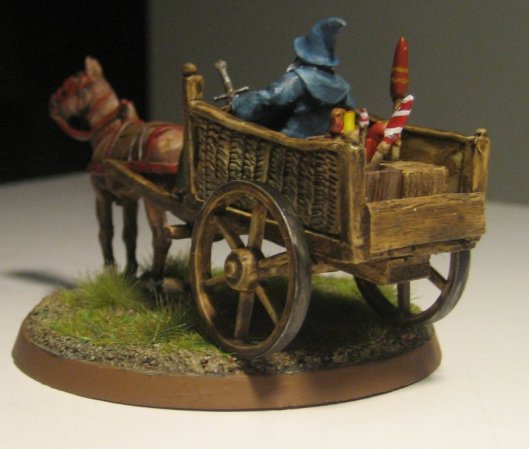
“At the end of the second week in September a cart came in through Bywater from the direction of Brandywine Bridge in broad daylight.  An old man was driving it all alone.  He wore a tall pointed blue hat, a long grey cloak, and a silver scarf.  He had a long white beard and bushy eyebrows that stuck out beyond the brim of his hat.  Small hobbit-children ran after the cart all through Hobbiton and right up the hill.  It had a cargo of fireworks, as they rightly guessed.  At Bilbo’s front door the old man began to unload:  there were great bundles of fireworks of all sorts and shapes, each labeled with a large red G…and the elf-rune…” (The Fellowship of the Ring, Book One, Chapter 1, “A Long-expected Party)
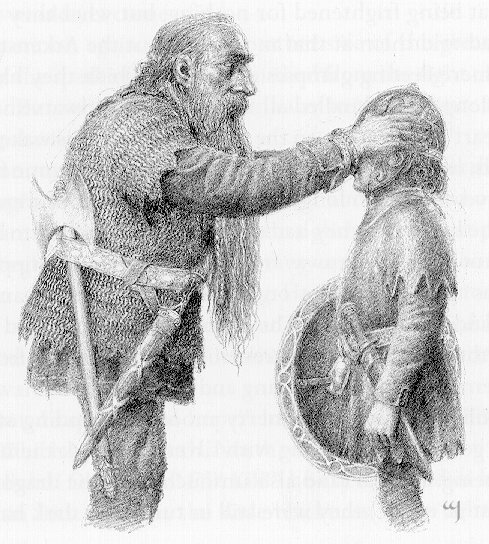
image4cart.jpg

(This is from a site called “Llama’s War of the Ring”, which has all sorts of interesting figures and conversions—here’s a LINK.)

Those great bundles turned into spectacular entertainment at the joint birthday party:

“The fireworks were by Gandalf:  they were not only brought by him, but designed and made by him; and the special effects, set pieces, and flights of rockets were let off by him.  But there was also a generous distribution of squibs, crackers, backarappers, sparklers, torches, dwarf-candles, elf-fountains, goblin-barkers and thunderclaps.  They were all superb.  The art of Gandalf improved with age.”

We ourselves enjoy fireworks, and, for the sake of our readers who might not be familiar with some of the types mentioned, we add here a few images—although some, like “dwarf-candles, elf-fountains, goblin-barkers” no longer seem to be available.

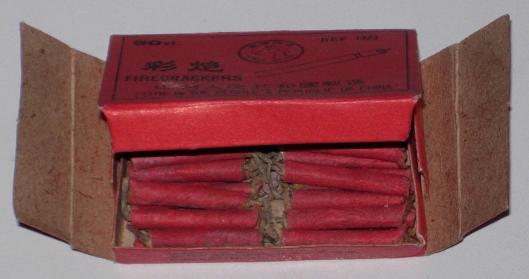
A squib is a small firecracker, like these.

image5squibs.jpg

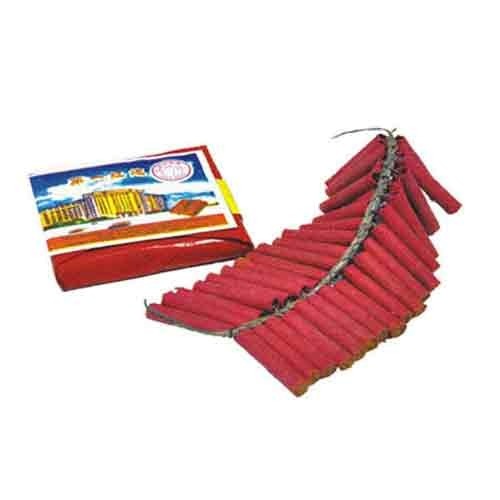
Crackers seem to come in sets.

image6firecrackers.jpg

Backarappers—we don’t have an image, but here’s a definition (and it sounds like the previous image):

“A firework made from multiple firecrackers folded together so that they will explode one after another”.  (from G.F. Northall’s Warwickshire Word-book, 1896)

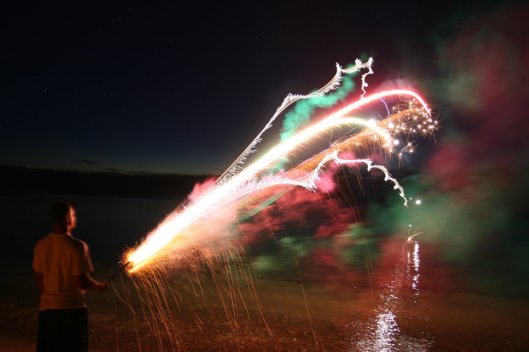
Sparklers are metal rods or bamboo sticks whose upper part has what is called “pyrotechnic composition”—which means something which shoots out sparks when it’s lit.

image7sparkler.jpeg

Torches may be these—which, when lighted, change color as they burn down (or so the manufacturer’s description says).

image8torch.png

Although there are no “dwarf-candles”, there are Roman Candles.  These are built in stages and, as the fire burns down, they shoot out star-patterns—as you can see.

image9romancandle.jpg

There are no “elf-fountains”, either, but there are fountains and they look like this—

image10fountain.jpeg

Finally, we can date a “thunderclap”, made by Benwell, back to this advertisement from about 1950,

image11benwell.jpg

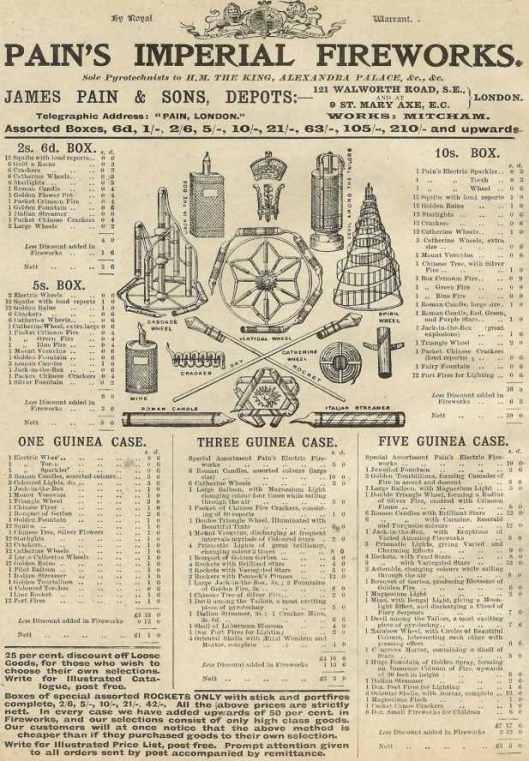
but we wouldn’t be surprised if Pain’s (not the best name for fireworks, we would say!) carried them, as they have something called “Laburnum Blossoms” in this 1903 listing

image12pains.jpg

Gandalf’s productions were clearly quite spectacular—which was undoubtedly why Bilbo remembers them:

“There were rockets like a flight of scintillating birds singing with sweet voices.  There were green trees with trunks of dark smoke:  their leaves opened like a whole spring unfolding in a moment, and their shining branches dropped glowing flowers down upon the astonished hobbits, disappearing with a sweet scene just before they touched their upturned faces.  There were fountains of butterflies that flew glittering into the trees; there were pillars of coloured fires that rose and turned into eagles, or sailing ships, or a phalanx of flying swans; there was a red thunderstorm and a shower of yellow rain; there was a forest of silver spears that sprang suddenly into the air with a yell like an embattled army, and came down again into the Water with a hiss like a hundred hot snakes.”

And then there was the finale.  Pain’s, in that 1903 listing, could make claims to baskets of elaborate pyrotechnics, but this?

“And there was also one last surprise, in honour of Bilbo, and it startled the hobbits exceedingly, as Gandalf intended.  The lights went out.  A great smoke went up.  It shaped itself like a mountain seen in the distance, and began to glow at the summit.  It spouted green and scarlet flames.  Out flew a red-golden dragon—not life-size, but terribly life-like:  fire came from his jaws, his eyes glared down; there was a roar and he whizzed three times over the heads of the crowd.  They all ducked, and many fell flat on their faces.  The dragon passed like an express train, turned a somersault, and burst over Bywater with a deafening explosion.”

In Shakespeare’s A Midsummer Night’s Dream, the fairy king, Oberon, says to his spirit-servant, Puck, these rather mysterious lines:

“My gentle Puck, come hither.  Thou rememberest

Since once I sat upon a promontory

And heard a mermaid on a dolphin’s back

Uttering such dulcet and harmonious breath

That the rude sea grew civil at her song

And certain stars shot madly from their spheres

To hear the mermaid’s music?”

(Act 2, Scene 1)

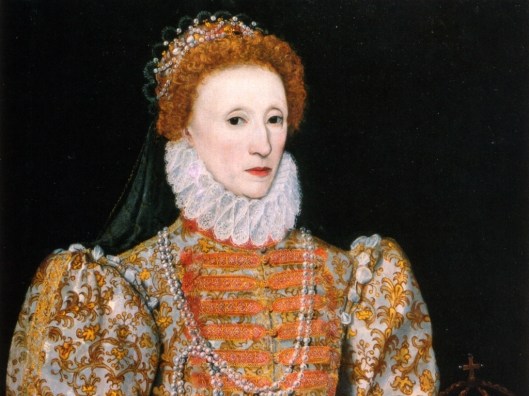
In 1575, Queen Elizabeth I

image14queene1.jpg

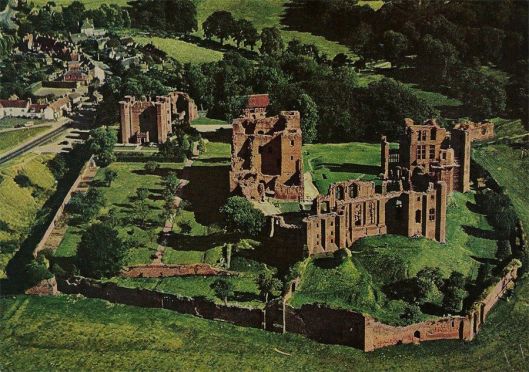
visited Kenilworth Castle,image15kenilworth.jpg

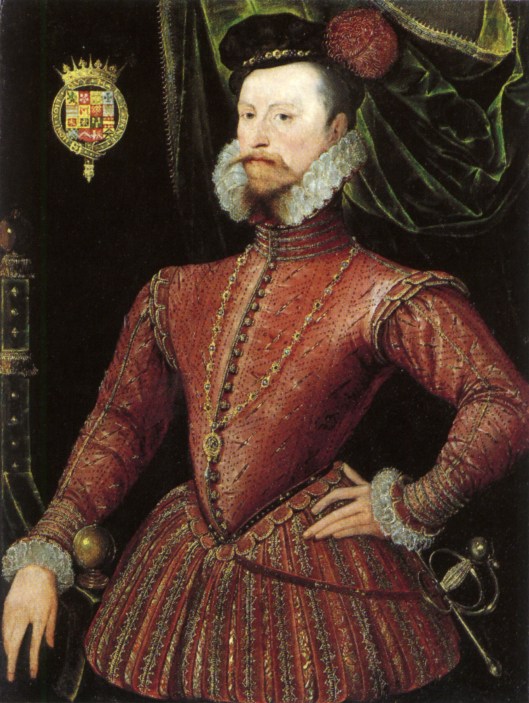
the home of Robert Dudley, the Earl of Leicester,

image16dudley.jpg

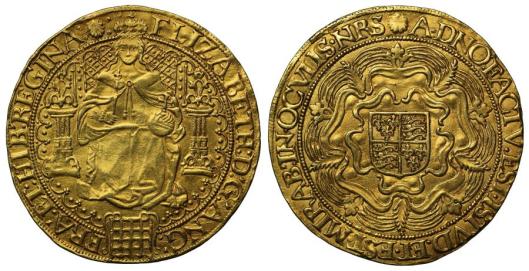
and a close friend (and maybe more).  To entertain her, Dudley spent thousands of pounds.

image17sovereign.jpg

(This is actually a gold sovereign—worth 20 shillings—that is, a pound, but there were no actual pound coins till after 1583.)

Among the entertainments was a big fireworks display (as well as at least one mermaid—see the LINK here for Robert Langham/Laneham’s contemporary “letter” in which he describes these entertainments in detail) and some scholars have theorized that those falling stars mentioned by Oberon are, in fact, Shakespeare’s boyhood memory of having seen the fireworks display (and the mermaid).  Kenilworth is only 14 miles from Stratford and Shakespeare was 11 and living at home—we presume—at that time, so we can imagine that this is possibility.  We know that JRRT had seen fireworks shows as a boy—as he tells us in a letter to Donald Swann, 29 February, 1968 (Letters, 390)—but we wonder:  did he ever, in those early years, see Goblin-barkers, or a red-golden dragon?

Thanks, as ever, for reading.

MTCIDC

CD

ps

We almost forgot–in case you’d like to make your own fireworks (definitely not recommended–and definitely illegal in some places!), here’s an 1878 manual on the subject.


Middle-under-earth

04 Wednesday Apr 2018

Posted by Ollamh in Artists and Illustrators, Heroes, J.R.R. Tolkien, Literary History, Narrative Methods

≈ Leave a comment

Tags

Alan Lee, Andrew Lang, Barrow-downs, Beowulf, cyclops, Dragons, George Macdonald, Goblin Feet, Goblins, Great War, Grendel, Grendel's Mother, John Howe, monsters, Polyphemus, Sir Gawain and the Green Knight, Smaug, Storia Moria Castle, Tales of Troy and Greece, The Hobbit, The Lord of the Rings, The Princess and the Goblin, The Red Book of Animal Stories, The Red Fairy Book, Tolkien, trenches, tumulus

As always, dear readers, welcome!

One of us is currently teaching The Hobbit and, is always seems to be the case when we are teaching an old friend, we are struck by something new.  In this case, it’s the idea of “what lurks beneath” and where it might come from.

What occurred to us now was that, virtually every time there is trouble for Bilbo and the dwarves, it is strongly linked with caves and hollowed-out places:  trolls who came out of a cave (“Roast Mutton”), goblins who live in caves (“Over Hill and Under Hill”), Gollum (“Riddles in the Dark”), hostile elves (“Flies and Spiders” and “Barrels Out of Bond”), and, of course, Smaug (“On the Doorstep”, “Inside Information”, and “Not At Home”).  Only the wargs, the overgrown spiders, and the men of Lake-town in the Battle of the Five Armies have above-ground origins, as, after all, the other forces—goblins, elves, and even Iron Hills dwarves (we assume), have subterranean dwellings.

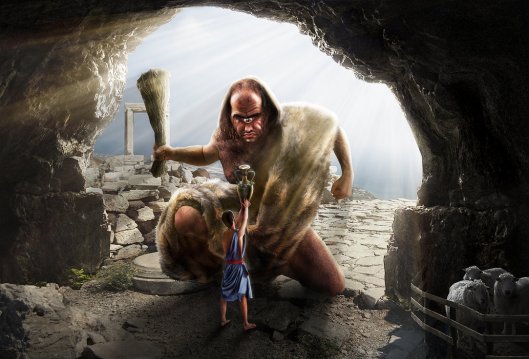
We knew that JRRT thought to become a classicist early in his academic career and we can imagine right away that one influence upon him for this underground menace would have been Polyphemus the Cyclops, who, after all, lives in a cave.

image1cyclops.jpg

Before he read that part of Odysseus’ story in Greek, he might have seen it in Andrew Lang’s 1907 Tales of Troy and Greece—

image2alang.jpg

image3lang.jpg

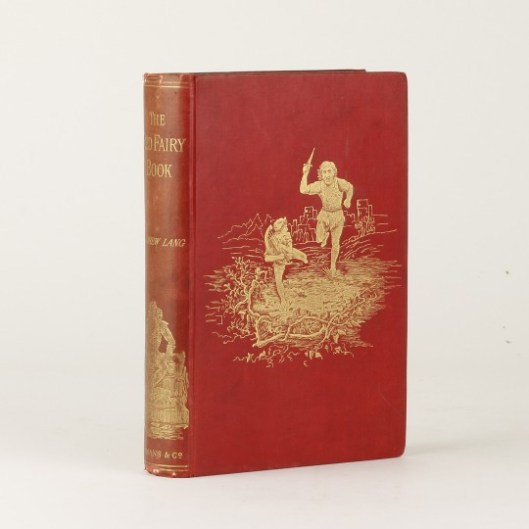
Tolkien tells us that, as a child, he had read other Lang works and a story in one, The Red Fairy Book (1890), might even have influenced some Middle-earth geography, from “Storia Moria Castle”.

image4redfairybook.jpeg

image5leemoria.jpg

Another childhood favorite (although he appears to have changed his mind later in life) were the fantasy novels of George Macdonald

image6gmacd.jpg

and his The Princess and the Goblin (1872),

image7princess.jpg

as its title suggests, is full of goblins and their underground world.  These goblins are powerful, but have one fatal flaw—tender feet—which JRRT said that he never believed (see Letters, 178)—although Tolkien’s first published poem was entitled “Goblin Feet” (Oxford Poetry 1915).

Beyond possible childhood reading, there is his career focus, which includes two other potential underground influences.

First, there is Beowulf.  Grendel, the monster in this poem,

image8grendel.jpg

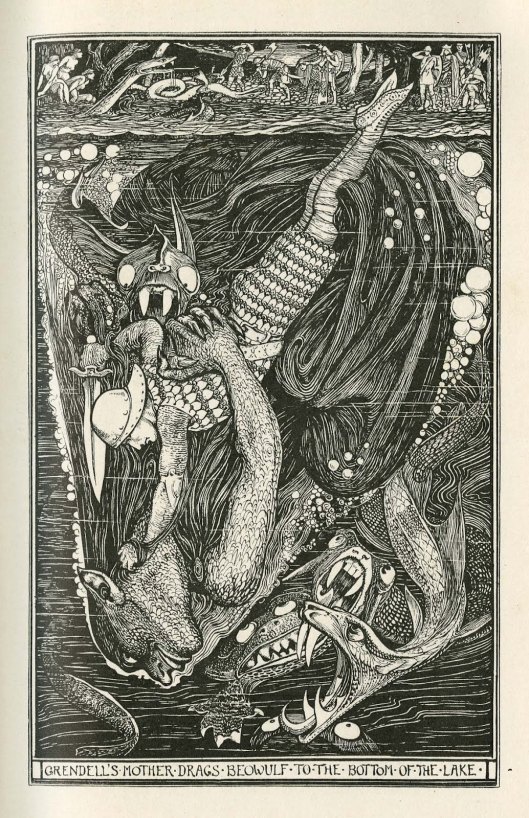
lives in a cave at the bottom of a pool with his mother and, in the second part of his monster-slaying, Beowulf has to dive into that pool to deal with her.image9beowulfandmama.jpg

This illustration comes from another Andrew Lang book, The Red Book of Animal Stories (1899).

image10redbook.jpg

(The picture of Grendel is by Brian Froud.  We found it on the website of K.T.Katzmann, I Write Monsters.  Here’s a LINK.)

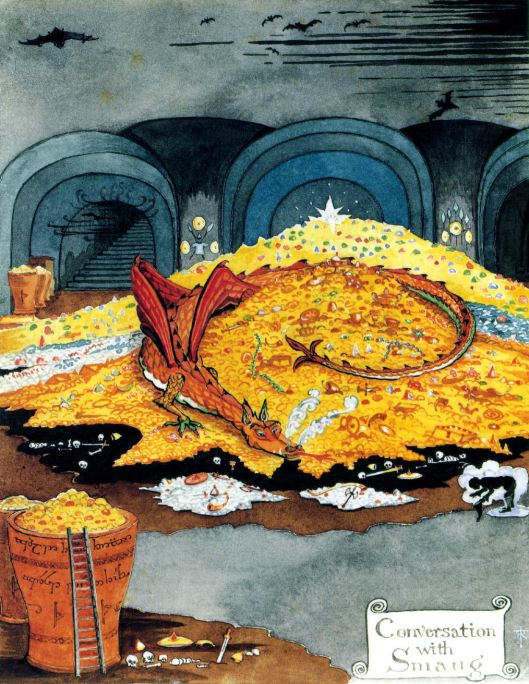
Then, of course, there’s that dragon, against whom Beowulf fights and dies—and which is the direct ancestor of another famous and familiar dragon…

image11dragonandhoard.jpg

We are told that it lives in an abandoned tumulus—that is, an ancient grave mound, like this one.

image12tumulus.png

(This is, in fact, a famous Neolithic burial at Gavrinis, in Brittany.)

JRRT worked in Middle English, as well as Old English, and here we find one more possible source in his own edition (with E.V. Gordon) of the 14th-century poem Sir Gawain and the Green Knight.

image13tolkgord.JPG

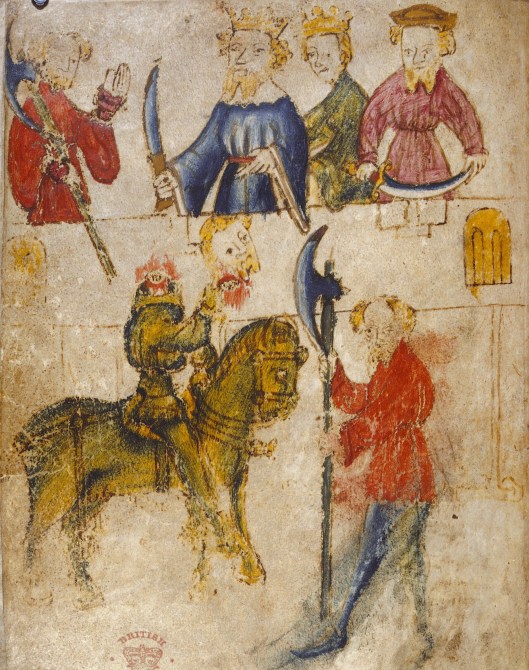
The Green Knight who challenges King Arthur’s court to a mutual head-chopping contest, is said, in the fourth part of the poem,  to inhabit a “green chapel” and to appear out of a hole when Sir Gawain, who has accepted the challenge and cut off the Green Knight’s head, makes his appearance there to fulfill his half of the contest.

image14sirg.jpg

This chapel has sounded like a tumulus to generations of scholars and here’s John Howe’s 2003 illustration, complete with chapel as tumulus (not to mention a very large green man).

image15johnhowe.png

Tumuli also make their appearance, of course, in The Lord of the Rings, when Frodo and his party go astray on the Barrow Downs.

image16barrowwight.jpg

We can’t finish this posting without at least suggesting one more source, something even more personal than JRRT’s scholarly work:  his experiences in the Great War.

image17lt.jpg

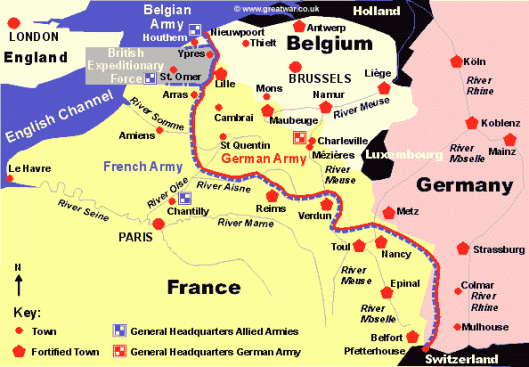
By the time Tolkien entered the service in France, the Western Front was, basically, a 500-mile trench, from Switzerland to the North Sea.

image18trenches.gif

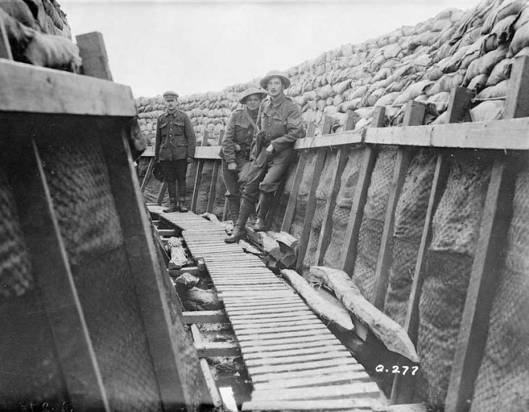
Much of the entrenching was simply deep, reinforced ditching.

image19trenches.jpg

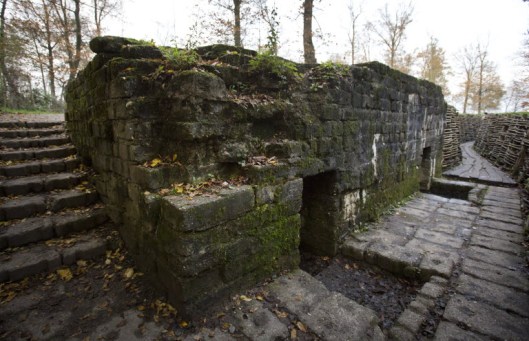
But some—particularly on the German side—could be elaborate, even built with stone or concrete, and set far enough into the ground as to be almost impervious to bombardment.

image21bunker.jpg

And we imagine that, with all of that earlier literary work in his mind, JRRT might have faced such defenses wondering whether what was inside them would be Germans

image22trenchclearing.jpg

or something much worse.

image23smaug.jpg

And did this haunt his later writing as much as the Great War haunted the minds of soldiers all over the world?

Thanks, as ever, for reading!

MTCIDC

CD

“Dragons, Other”

21 Wednesday Mar 2018

Posted by Ollamh in Artists and Illustrators, Fairy Tales and Myths, Heroes, J.R.R. Tolkien, Literary History, Maps

≈ Leave a comment

Tags

Arthur Rackham, Beowulf, C.S. Lewis, Chrysophylax, Custard the Dragon, Dragons, Dream Days, Esgaroth, Farmer Giles of Ham, Jabberwock, Jabberwock-slayer, Kenneth Grahame, Lewis Carroll, Lonely Mountain, Luttrell Psalter, map, Middle-earth, Narnia, Ogden Nash, Pauline Baynes, Rumer Godden, Smaug, St George, The Chronicles of Narnia, The Dragon of Og, The Hobbit, The Lion The Witch and the Wardrobe, The Lord of the Rings, The Reluctant Dragon, Through the Looking-Glass, Tolkien, Walt Disney

As always, readers, welcome.

One of us is currently teaching a class where our present focus is upon The Hobbit.

image1hob1st.jpg

At the center of the book is the Lonely Mountain and at the center of that is Smaug.

image2aerebor.jpg

image2smaug.jpg

This got us to thinking about other dragons in our experience, and some of those are not quite of the same breed as the hoard-sitter faced by Bilbo and the dwarves.  That dragon is closely related to the Beowulf variety

image3beowulfdragon.jpg

which, unlike Smaug, has neither a name nor (it seems) human speech, but it certainly has the same suspicious streak:  when an escaped slave steals a cup from its hoard, it’s almost immediately aware that it’s missing and suspects a human.

image4stealingcup.jpg

And they are both vengeful.  As Smaug devastates Esgaroth, even if he dies for it,

image5esgaroth.jpg

image6smaug.jpg

so Beowulf’s dragon scorches the countryside in revenge for the theft.

But what about those other dragons?

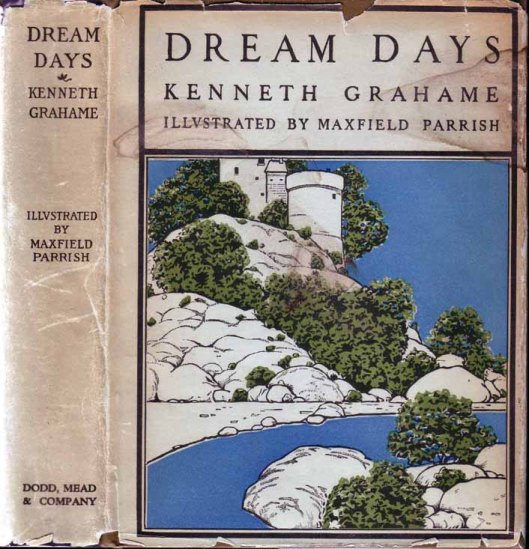
First, we thought of Kenneth Grahame’s Dream Days (1898),

image7kg.jpg

image8dreamdays.jpg

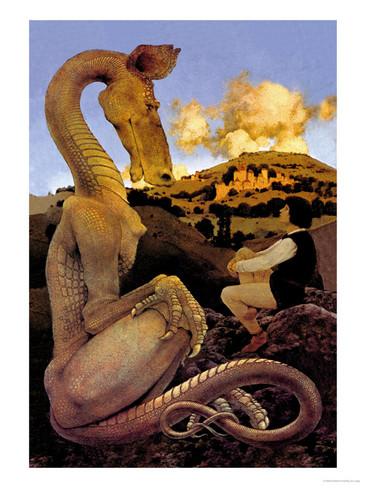
a collection of short stories, the next-to-last of which is “The Reluctant Dragon”.

image9reluct.jpg

This is the story of a beast the very opposite of Smaug—no hoard, no suspicion, no flaming violence, and, in fact, a poetry lover.  This story was then converted into a Disney cartoon of 1941.

image10reluct.jpg

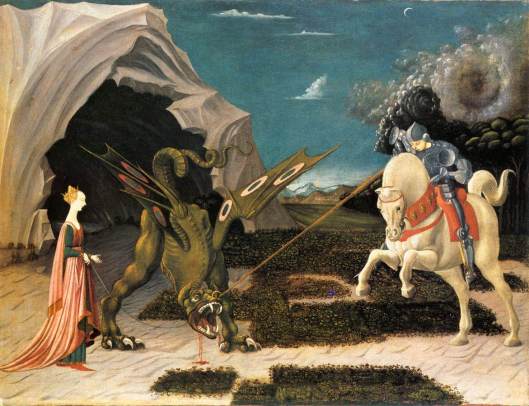
Needless to say, although the core of the plot is the same, what makes the Grahame distinctive is the language.  All of the major characters:  the dragon, the little boy who finds him, and St. George, who is brought in as a dragon-slayer, are thoughtful and articulate late Victorians who would rather discuss literature than do battle—a far cry not only from Beowulf’s encounter, but also from every other earlier depiction we could think of.

image11ucellostgeo.jpg

image12stgeo.jpg

image13stgeo.jpg

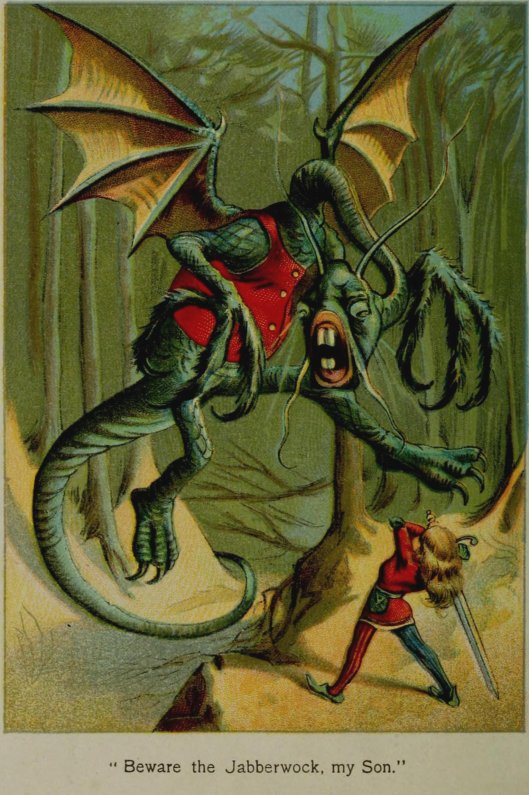
The sword in this last one looks like it actually belongs in the hands of the jabberwock-slayer

image14jabberwocky.jpg

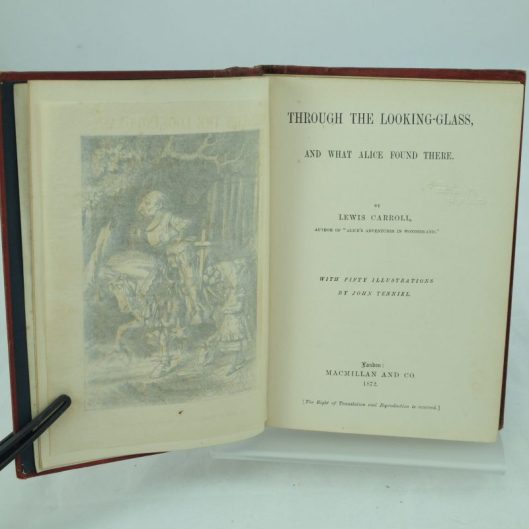
in Lewis Carroll’s Through the Looking-Glass (1872).

image15through.jpg

Here’s a LINK to Dream Days so that you can enjoy the story for yourselves.

Nearly sixty years later, the comic verse writer, Ogden Nash,

image16nash.jpg

produced not a literary dragon, but a timid one in “Custard the Dragon” (1959).

image17custard.jpg

This is a poem in 15 stanzas and is a story about Belinda and her pets, including a dragon, who is taunted by the other pets as being less than brave.  To underline this, the last line in a number of stanzas is a variation upon the first version of the line, “But Custard cried for a nice safe cage”.  (Here’s a LINK to the poem.)

The surprise is that, when a pirate climbs in through the window (this happens all the time here—possibly they escape from dreams?), Custard promptly eats him—and the cries of “Coward!” disappear immediately.

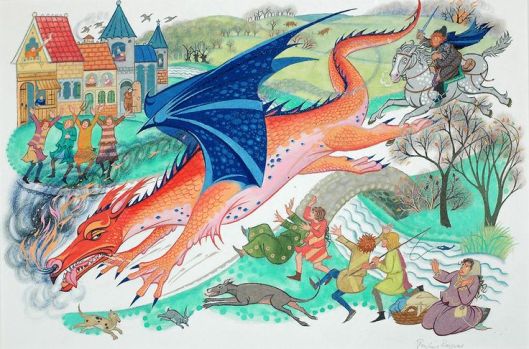
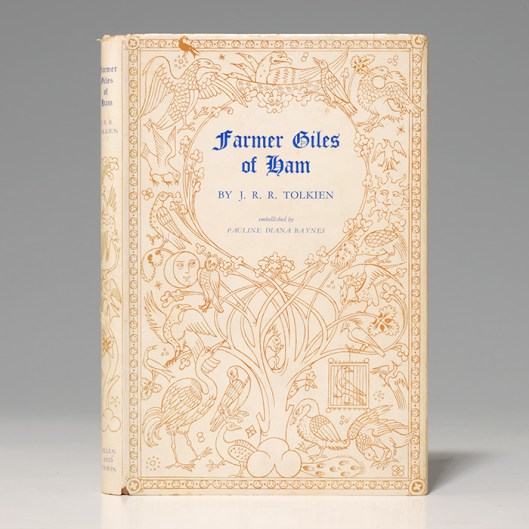
In contrast to the unnamed dragon in “The Reluctant Dragon” and in “Custard the Dragon”, our next dragon is a talker—like Smaug, but also like Smaug, potentially malevolent.  This is Chrysophylax in JRRT’s 1937/1949 Farmer Giles of Ham.  (JRRT is having a quiet joke here—“Chrysophylax” is Ancient Greek for “Goldguard”.)

image18chrysophylax.jpg

image19afgoh.jpg

The artwork is by Pauline Baynes (1922-2008).

image19pb.jpg

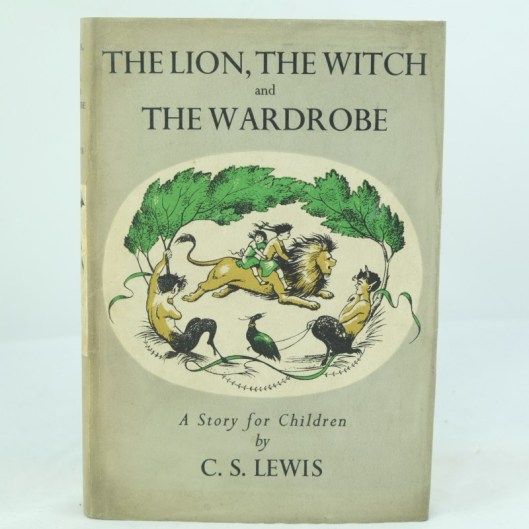
If, like us, you’ve loved the Narnia books, then you know her as their original illustrator.

image20lion.jpg

She was also the artist for an early Middle-earth map.

image21memap.gif

Her 2008 obituary in The Daily Telegraph tells of how they came to work together:

“In 1948 Tolkien was visiting his publishers, George Allen & Unwin, to discuss some disappointing artwork that they had commissioned for his novella Farmer Giles of Ham, when he spotted, lying on a desk, some witty reinterpretations of medieval marginalia from the Luttrell Psalter that greatly appealed to him.  These, it turned out, had been sent to the publishers “on spec”by the then unknown Pauline Baynes.”   (The Daily Telegraph, 8 August, 2008)

JRRT was then so impressed with her work that it appeared both in other later publications and his recommendation led to her being engaged by CS Lewis’ publisher for the Narnia books, as well.  (And here’s a LINK to that obituary, which has more on Tolkien and Baynes, as well as Lewis.)
And the Baynes connection leads us to one further dragon, that in Rumer Godden’s  (1902-1998) 1981 The Dragon of Og, for which Baynes provided the cover art.

image22rg.jpg

image23dragog.jpg

It’s not our practice to discuss work we haven’t read, but we’ve just discovered this novel and have already put it on our spring reading list.  The little we know about it comes from a blurb or two, but it looks promising:  this is more of the reluctant dragon, but one who is in danger of being provoked by a new local lord until his wife steps in and cleverly changes the situation.

Before we close, however, we want to look back for a second at the Tolkien/Baynes connection and add two further things.  First off, here’s the first page of JRRT’s graceful letter of thanks and praise to Baynes for her work in illustrating Farmer Giles.

image24letter.jpg

Second, as the Telegraph obituary says, Tolkien was impressed with her versions of the marginalia from the Luttrell Psalter, which is high on our list of favorite medieval manuscripts.

image25luttrellpsalter.jpg

In our next, we want to spend some time looking at that work, thinking about marginalia, and not only there, but also in the work of another favorite illustrator, Arthur Rackham (1867-1939).

Till then, thanks, as always, for reading.

MTCIDC

CD


Wormy

21 Wednesday Feb 2018

Posted by Ollamh in J.R.R. Tolkien, Military History, Military History of Middle-earth, Villains

≈ Leave a comment

Tags

Adolf Hitler, Bilbo, Dragon, Fifth Column, Gandalf, Germany, Grima, Madrid, Middle-earth, Nazis, Norway, Norwegian facist party, Republican government, Rohan, Saruman, Second World War, Smaug, Spanish Civil War, The Hobbit, The Lord of the Rings, The Scouring of the Shire, Theoden, Tolkien, traitor, Vidkun Quisling, William Blake, worm, Wormtongue

Welcome, as always, dear readers.
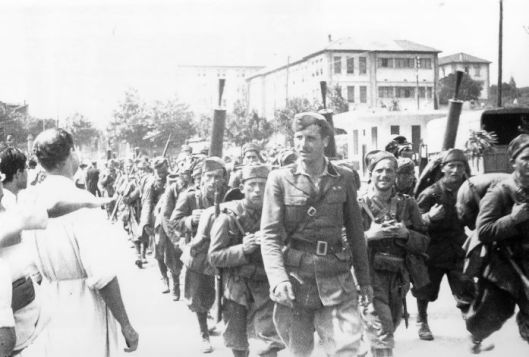
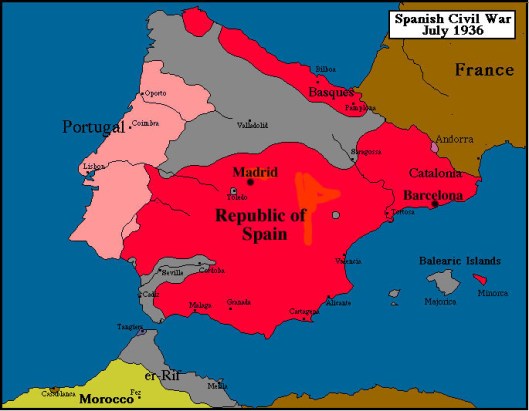
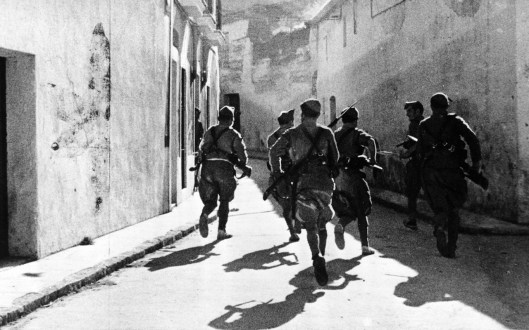
In 1936, the Nationalist forces were marching to attack the Republican government in Madrid, during the Spanish Civil War.
image1nationalists.jpg
image2attackonmadrid.jpg
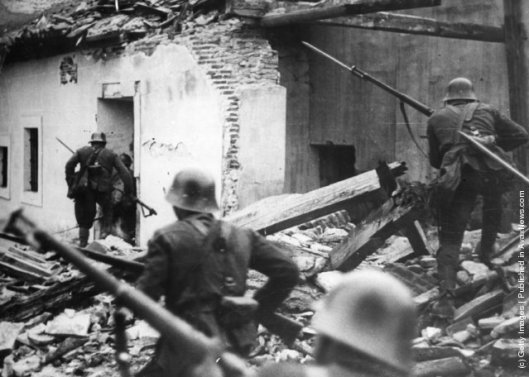
When interviewed, a Nationalist general is reported to have said that, as four military columns were about to assault the city,
image3natattack.jpeg
a fifth column of loyalists would join the attack from inside.
image4natattack.jpg
This phrase “fifth column”, then, was picked up and began to be used world-wide to mean “traitors/betrayers from within” and was popular during the Second World War era.
image5thcol.jpg

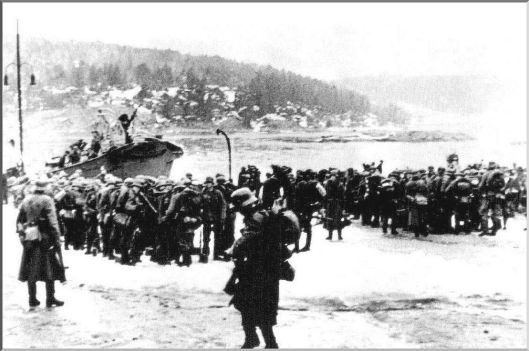
When the Nazis attacked Norway in 1940,
image6nazislandinginnorway.jpg
and the Allies failed to defend their positions there successfully and were forced to surrender or flee
image7capturedtroops.jpg
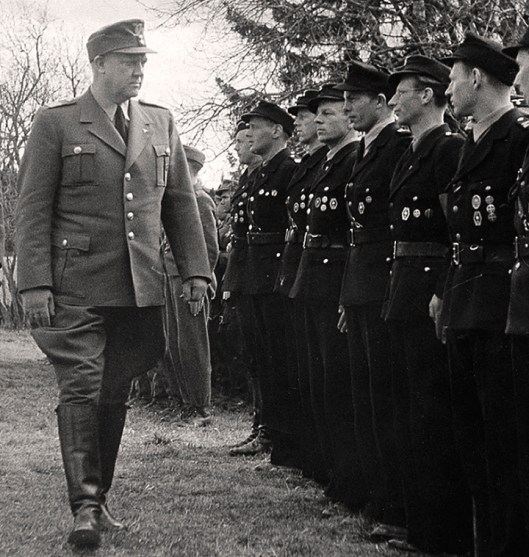
a member of the small Norwegian fascist party, Vidkun Quisling,
image8quisling.jpg
declared himself ruler as the Germans marched in.
image9conqueringgermans.jpg

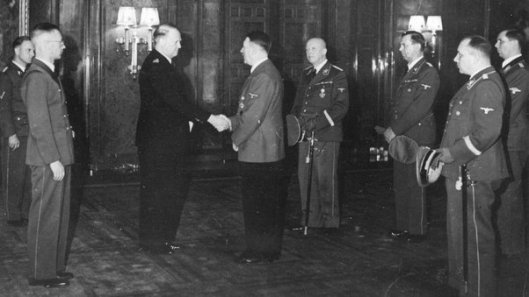
In time, the Nazis recognized him as the head of Norway and he even had an audience with Hitler.
image10hitandquis.jpg

This time, a specific “fifth columnist” had not only betrayed his country, but also profited greatly from it and, when we looked at the dates—1936 and 1940—we wondered, as we so often do, if the current events of our world may have colored JRRT’s relation of the events in Middle-earth—even as we hasten to say, as we always do, that this is just a suggestion.
In his first meeting with Aragorn, Eomer is troubled and his veiled comments suggest just the same sort of fifth-columnist action:
“But at this time our chief concern is with Saruman. He has claimed lordship over all this land, and there has been war between us for many months…”
His concern, however, as we see, is for more than border security, as he says of Saruman:
“His spies slip through every net, and his birds of ill omen are abroad in the sky. I do not know how it will all end, and my heart misgives me; for it seems to me that his friends do not all dwell in Isengard. But if you come to the king’s house, you shall see for yourself.” (The Two Towers, Book Three, Chapter 2, “The Riders of Rohan”)
So, all is not well, not only in Rohan, but in Meduseld itself. When Gandalf and the other survivors of the Fellowship arrive at the gates of Edoras, they are stopped by guards and by a command from Theoden, king of Rohan—or is it? A guard says:
“It is but two nights ago that Wormtongue came to us and said that by the will of Theoden no stranger should pass these gates.” (The Two Towers, Book Three, Chapter 6, “The King of the Golden Hall”)
“Wormtongue” seems a very odd name—do worms actually have tongues?
image11worm.JPG
But this isn’t a worm, it’s a “worm”—an old term for “dragon”.
image12smaug.jpg
And, if Smaug’s speech and its effect upon Bilbo is anything to go by:
“Bilbo was now beginning to feel really uncomfortable. Whenever Smaug’s roving eye, seeking for him in the shadows, flashed across him, he trembled, and an unaccountable desire seized hold of him to rush out and reveal himself and tell all the truth to Smaug. In fact he was in grievous danger of coming under the dragon-spell.” (The Hobbit, Chapter 12, “Inside Information”)
then a person having a dragon tongue might be a real threat, as Wormtongue, seated at Theoden’s feet,
image13theodenandgrima.jpg
inserts himself between Gandalf and Theoden:
“Why indeed should we welcome you, Master Stormcrow? Lathspell I name you, Ill-news; and ill news is an ill guest they say.”
Gandalf immediately resists this and, in a burst of power, breaks the real “spell”—the dragon’s words which Grima Wormtongue has been pouring into Theoden’s ears, as Theoden says to him of Gandalf’s efforts: “If this is witchcraft…it seems to me more wholesome than your whisperings. Your leechcraft [that is, “medical skill”—obviously ironic here] ere long would have had me walking on all fours like a beast.”
[A footnote here—is JRRT making a quiet reference to the fate of Nebuchadnezzar, king of Babylon, mentioned in the book of Daniel in the Old Testament? In Chapter 4, the king is driven mad and spends seven years as a grazing animal to prove the power of the Hebrew divinity. Here is William Blake’s (1757-1827) striking depiction of the mad king.]
image14blake.jpg

Certainly something Grima has been doing has affected Theoden, as he is initially described as “a man so bent with age that he seemed almost a dwarf…” and this shrinking is suddenly reversed when Gandalf strikes Grima down:
“From the king’s hand the black staff fell clattering on the stones. He drew himself up, slowly, as a man that is stiff from long bending over some dull toil. Now tall and straight he stood, and his eyes were blue as he looked into the opening sky.”
For all that Grima has been blocked and Theoden restored, the fifth columnist tries once more. When he is told that he must ride with the king and his warriors to battle, he makes a countersuggestion:
“One who knows your mind and honours your commands should be left in Edoras. Appoint a faithful steward. Let your counsellor Grima keep all things till your return…”
But he gives himself away by finishing that sentence with “and I pray that we may see it, though no wise man will deem it hopeful.”
And Gandalf sees all too clearly what is behind Grima’s proposal—and who is behind it:
“Down, snake!…Down on your belly! How long is it since Saruman bought you? What was the promised price?…”
image15fallofgrima.jpg

Although it is said that Grima deserves death for his treachery, he is allowed to flee, and, when we next see him, he is with his true master, acting as his “footman” as Gandalf calls him (The Two Towers, Book Three, Chapter 10, “The Voice of Saruman). And here, as Bilbo’s pity has preserved Gollum for an unseen but vital part in the later story of the Ring, so Gandalf’s mercy to Grima preserves him for two final acts: first, his mistaken use of a palantir as a missile, which puts it into Gandalf’s hands and, ultimately into Aragorn’s, who shakes Sauron’s nerve with it; second, Saruman’s ultimate end:
“[Saruman] kicked Wormtongue in the face as he groveled, and turned and made off. But at that something snapped: suddenly Wormtongue rose up, drawing a hidden knife, and then with a snarl like a dog he sprang on Saruman’s back, jerked his head back, cut his throat, and with a yell ran off down the lane.” (The Return of the King, Book Six, Chapter 8, “The Scouring of the Shire”)
image16deathofsaruman.jpg
Grima doesn’t survive this attack, however: “Before Frodo could recover or speak a word, three hobbit-bows twanged and Wormtongue fell dead.”
Merry calls these final acts of violence “the very last end of the War”, but we would suggest a parallel with a specific event in our world: the end of Vidkun Quisling–executed by firing squad in October, 1945, for treason. Could we say that Grima’s death—deserved earlier, but deferred—was also a kind of execution for treason, against Rohan, finally carried out?
And a final thought: after World War 2, Quisling’s name became, for a time, an easy synonym for “fifth columnist/traitor”—could we imagine that, in the Common Speech of Middle-earth after the War of the Ring, the same might have happened to “Grima Wormtongue”?
Thanks, as ever, for reading.
MTCIDC
CD

Throwing Shade

20 Wednesday Dec 2017

Posted by Ollamh in Artists and Illustrators, J.R.R. Tolkien, Narrative Methods

≈ Leave a comment

Tags

A Day: Paris In the Rain, Adelard Took, Assyrians, Bag End, Bilbo Baggins, bowler hat, ceramic chariot, China, city gent, CS Lewis, elephant, Emperor Ch'in Shihuang, Greeks, Gustave Caillebotte, Jean Marius, John Howe, Jonas Hanway, Lobelia Sackville-Baggins, Marchesa Elena Grimaldi, Mary Poppins, Monty Python, Palais Galleria, Persians, Romans, Sharkey, The Hobbit, The Lord of the Rings, The Ministry of Silly Walks, Tolkien, umbrella, umbrella stand, Un Jour: Paris sous la Pluie, van Dyck

Welcome, dear readers, as always and, if you’re in the US, we hope you’ve had a happy and not over-stuffed Thanksgiving.

Just when we think we’ve exhausted a topic, we return and, well, here we are.

image1entryway.png

Just to the left of the door and below what we now see as a barometer, there’s a tall tube-like structure, something once common—we wouldn’t be surprised if there was one in every house in which JRRT ever lived:  an umbrella stand.image2aumbrellastand.jpeg

As a child, one of us was fascinated by having once seen an umbrella stand made out of an elephant’s lower leg and foot—or at least the skin.

image2belephant.jpg

The couple we’ve seen are all identified as “Victorian”, so, as we are very fond of pachyderms, we hope that such a use is now long in the past!

Umbrellas, at least as sunshades, appear to have been around since at least before 200BC in China, as this ceramic chariot—with large umbrella—from part of the tomb complex of the Emperor Ch’in Shihuang demonstrates.

image2chin.jpeg

The Assyrians had them.

image3ashurbanipal.jpg

The Persians had them.

image4darius.jpg


The Greeks had them.

image5greek.jpg

As did the Romans.

image6aroman.jpg

And so on for centuries, although it seems that the first modern references to them in England date from the early 17th century and appear, by the latter part of the century and into the 18th as part of “ladies’ apparel”, used as much for sun as rain as this 1623 portrait by van Dyck of the Marchesa Elena Grimaldi shows us.

image6elenagrimaldi.jpg

A center for the manufacture of umbrellas was Paris, and the inventor of the modern collapsible model may have been Jean Marius, who received a 5-year monopoly on his invention in 1710.  Here is a later (1772) advertisement for his business

image7mariusadvert.jpg

and here is a model, identified by the Palais Galleria in Paris as post-1715 because it has no Marius markings.

image8post1715.jpg

If there was a prejudice against men carrying them, being a combination of the association with “feminine things” and perhaps also a long-standing prejudice against the French, how did that so change that, by the 20th century, the umbrella, along with the bowler hat, became the marks of the “city gent” in London,

image9acitygent.jpg

caricatured in the 20th century by Monty Python in skits like “The Ministry of Silly Walks”?

image9minister.jpg

This change is said to stem from the behavior of one rather eccentric man, Jonas Hanway

image10jonashanway.jpg

who, sometime in the 1750s, began to appear on London streets carrying an open umbrella.

image11hanwaywithbrolly.jpg

As you, sharp-eyed reader, can tell from our verbs and constructions like “seems”, “appears” and “is said to”, this, like other items of fashion and its changes, hasn’t the firmest of scholarly foundations, but, considering how many illustrations (often mocking cartoons) begin to appear by the 1770s, something happened to alter men’s behavior. Just look at these three, from 1772, 1782, and 1790.

image12seventeenseventrytwo.jpg

image13seventeeneightytwo.jpg

image14seventeenninety.jpg

All of this is very interesting, you may ask, but what does it have to do with Bilbo, or with JRRT?  There are, in fact, a couple of references in The Lord of the Rings to umbrellas.  First, there is one of Bilbo’s mocking gifts:

“For Adelard Took, for his very own, from Bilbo; on an umbrella.  Adelard had carried off many unlabeled ones”.  (The Fellowship of the Ring, Book One, Chapter 1, “A Long-Expected Party”)

Then there are two to Lobelia Sackville-Baggins.  The first is suggestive of her suspicious behavior at the near-auction of Bilbo’s property at the end of The Hobbit (you’ll remember that some spoons never reappeared):

“He [Bilbo] escorted her [Lobelia] firmly off the premises, after he had relieved her of several small (but rather valuable) articles that had somehow fallen inside her umbrella.” (The Fellowship of the Ring, Book One, Chapter 1, “A Long-Expected Party”)

The second reference is actually rather pathetic.  Once “Sharkey” and his thugs take over the Shire, they evict Lobelia from Bag End and, because she resists, they drag her off to the Lockholes, as young Tom Cotton tells Merry and the others:

“She comes down the lane with her old umbrella…”

When told that “Sharkey” gave the order for her eviction (and the building of sheds at Bag End):

“ ‘I’ll give you Sharkey, you dirty thieving ruffians!’ says she, and ups with her umbrella and goes for the leader, near twice her size.” (The Return of the King, Book Six, Chapter 8, “The Scouring of the Shire”)

Here’s a little illustration of a defiant Lobelia by John Howe.

image15lobelia.jpg

By the later 19th century, men with umbrellas seem quite common—even to the point of providing material for social commentary in the public press—

image16umbrellatypes.jpg

But, in the 20th century, we who love children’s literature see them in a completely different way, either as a mode of transportation

image17mpoppins.jpg

or as part of the origin of a favorite story, when CS Lewis, at 16, had a recurring image of “a Faun carrying an umbrella and parcels in a snowy wood” (from It All Began with/as a Picture). (We’ve seen the title cited both ways.)

image18tumnusandlucy.jpg

But we want to end this posting not with literature, but with pure art.  There are lots of paintings from the 18th and 19th centuries with umbrellas, but here is what may be our favorite, by Gustave Caillebotte (1848-1894).  Although he is grouped with the Impressionists, this painting in particular shows the artist’s interest in the hard-edged world of early photography (“Un Jour:  Paris sous la Pluie”—“A Day:  Paris In the Rain”)

image19caillebotte.jpg

Stay dry, dear readers, and thanks, as ever for reading!

MTCIDC

CD

← Older posts
Newer posts →

The Doubtful Sea Series Facebook Page

The Doubtful Sea Series Facebook Page

  • Ollamh

Categories

  • Artists and Illustrators
  • Economics in Middle-earth
  • Fairy Tales and Myths
  • Films and Music
  • Games
  • Heroes
  • Imaginary History
  • J.R.R. Tolkien
  • Language
  • Literary History
  • Maps
  • Medieval Russia
  • Military History
  • Military History of Middle-earth
  • Narnia
  • Narrative Methods
  • Poetry
  • Research
  • Star Wars
  • Terra Australis
  • The Rohirrim
  • Theatre and Performance
  • Tolkien
  • Uncategorized
  • Villains
  • Writing as Collaborators
Follow doubtfulsea on WordPress.com

Across the Doubtful Sea

Recent Postings

  • Towering January 28, 2026
  • Tolkien Among the Indians January 21, 2026
  • Thin and Stretched January 14, 2026
  • Through a glass… January 7, 2026
  • Heffalumps? December 31, 2025
  • We Three Kings December 24, 2025
  • A Moon disfigured December 17, 2025
  • On the Roads Again—Once More December 10, 2025
  • (Not) Crossing Bridges December 3, 2025

Blog Statistics

  • 105,551 Views

Posting Archive

  • January 2026 (4)
  • December 2025 (5)
  • November 2025 (4)
  • October 2025 (5)
  • September 2025 (4)
  • August 2025 (4)
  • July 2025 (5)
  • June 2025 (4)
  • May 2025 (4)
  • April 2025 (5)
  • March 2025 (4)
  • February 2025 (4)
  • January 2025 (5)
  • December 2024 (4)
  • November 2024 (4)
  • October 2024 (5)
  • September 2024 (4)
  • August 2024 (4)
  • July 2024 (5)
  • June 2024 (4)
  • May 2024 (5)
  • April 2024 (4)
  • March 2024 (4)
  • February 2024 (4)
  • January 2024 (5)
  • December 2023 (4)
  • November 2023 (5)
  • October 2023 (4)
  • September 2023 (4)
  • August 2023 (5)
  • July 2023 (4)
  • June 2023 (4)
  • May 2023 (5)
  • April 2023 (4)
  • March 2023 (5)
  • February 2023 (4)
  • January 2023 (4)
  • December 2022 (4)
  • November 2022 (5)
  • October 2022 (4)
  • September 2022 (4)
  • August 2022 (5)
  • July 2022 (4)
  • June 2022 (5)
  • May 2022 (4)
  • April 2022 (4)
  • March 2022 (5)
  • February 2022 (4)
  • January 2022 (4)
  • December 2021 (5)
  • November 2021 (4)
  • October 2021 (4)
  • September 2021 (5)
  • August 2021 (4)
  • July 2021 (4)
  • June 2021 (5)
  • May 2021 (4)
  • April 2021 (4)
  • March 2021 (5)
  • February 2021 (4)
  • January 2021 (4)
  • December 2020 (5)
  • November 2020 (4)
  • October 2020 (4)
  • September 2020 (5)
  • August 2020 (4)
  • July 2020 (5)
  • June 2020 (4)
  • May 2020 (4)
  • April 2020 (5)
  • March 2020 (4)
  • February 2020 (4)
  • January 2020 (6)
  • December 2019 (4)
  • November 2019 (4)
  • October 2019 (5)
  • September 2019 (4)
  • August 2019 (4)
  • July 2019 (5)
  • June 2019 (4)
  • May 2019 (5)
  • April 2019 (4)
  • March 2019 (4)
  • February 2019 (4)
  • January 2019 (5)
  • December 2018 (4)
  • November 2018 (4)
  • October 2018 (5)
  • September 2018 (4)
  • August 2018 (5)
  • July 2018 (4)
  • June 2018 (4)
  • May 2018 (5)
  • April 2018 (4)
  • March 2018 (4)
  • February 2018 (4)
  • January 2018 (5)
  • December 2017 (4)
  • November 2017 (4)
  • October 2017 (4)
  • September 2017 (4)
  • August 2017 (5)
  • July 2017 (4)
  • June 2017 (4)
  • May 2017 (5)
  • April 2017 (4)
  • March 2017 (5)
  • February 2017 (4)
  • January 2017 (4)
  • December 2016 (4)
  • November 2016 (5)
  • October 2016 (6)
  • September 2016 (5)
  • August 2016 (5)
  • July 2016 (5)
  • June 2016 (5)
  • May 2016 (4)
  • April 2016 (4)
  • March 2016 (5)
  • February 2016 (4)
  • January 2016 (4)
  • December 2015 (5)
  • November 2015 (5)
  • October 2015 (4)
  • September 2015 (5)
  • August 2015 (4)
  • July 2015 (5)
  • June 2015 (5)
  • May 2015 (4)
  • April 2015 (3)
  • March 2015 (4)
  • February 2015 (4)
  • January 2015 (4)
  • December 2014 (5)
  • November 2014 (4)
  • October 2014 (6)
  • September 2014 (1)

Blog at WordPress.com.

  • Subscribe Subscribed
    • doubtfulsea
    • Join 78 other subscribers
    • Already have a WordPress.com account? Log in now.
    • doubtfulsea
    • Subscribe Subscribed
    • Sign up
    • Log in
    • Report this content
    • View site in Reader
    • Manage subscriptions
    • Collapse this bar
 

Loading Comments...