• About

doubtfulsea

~ adventure fantasy

Tag Archives: Middle-earth

A Moon disfigured

17 Wednesday Dec 2025

Posted by Ollamh in Uncategorized

≈ Leave a comment

Tags

Elizabeth I, herald, Heraldry, livery, Middle-earth, Minas Ithil, Minas Morgul, Orcs, puzzle, Sam, Saruman, Sauron, Sir Roger de Trumpington, The Great War, The Lord of the Rings, Tolkien, uniforms

As always, dear readers, welcome.  And perhaps welcome to a little Tolkien puzzle.

On parade, soldiers of the early 20th century could be peacocks for finery.
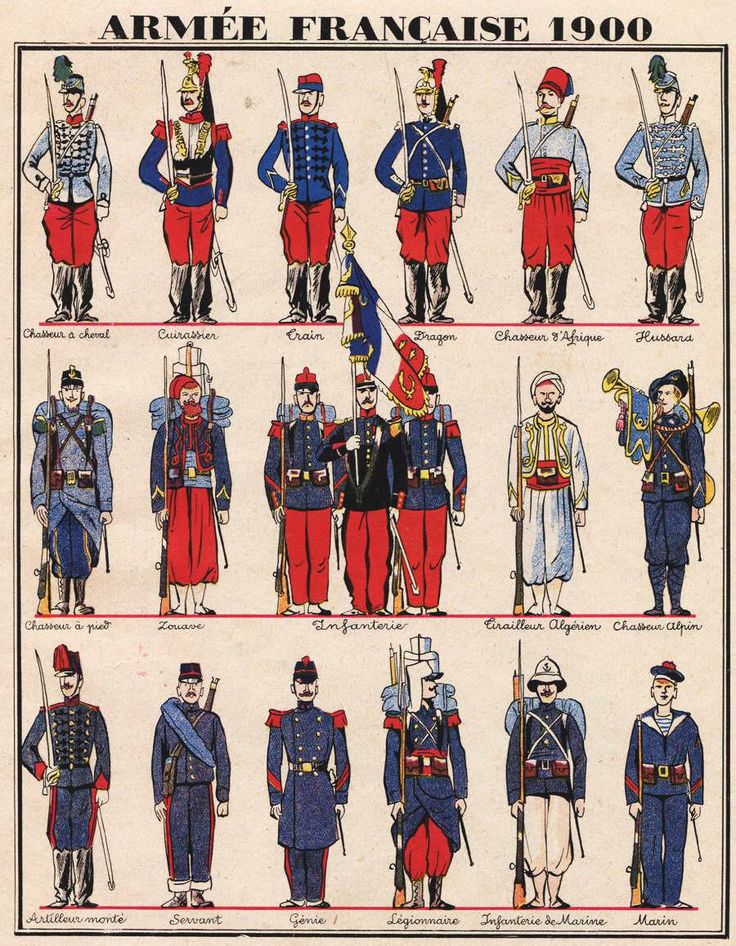
But then they met the new technological reality of heavy machine guns

and increasingly heavy artillery

and, in time, even the danger of being spotted from the air,
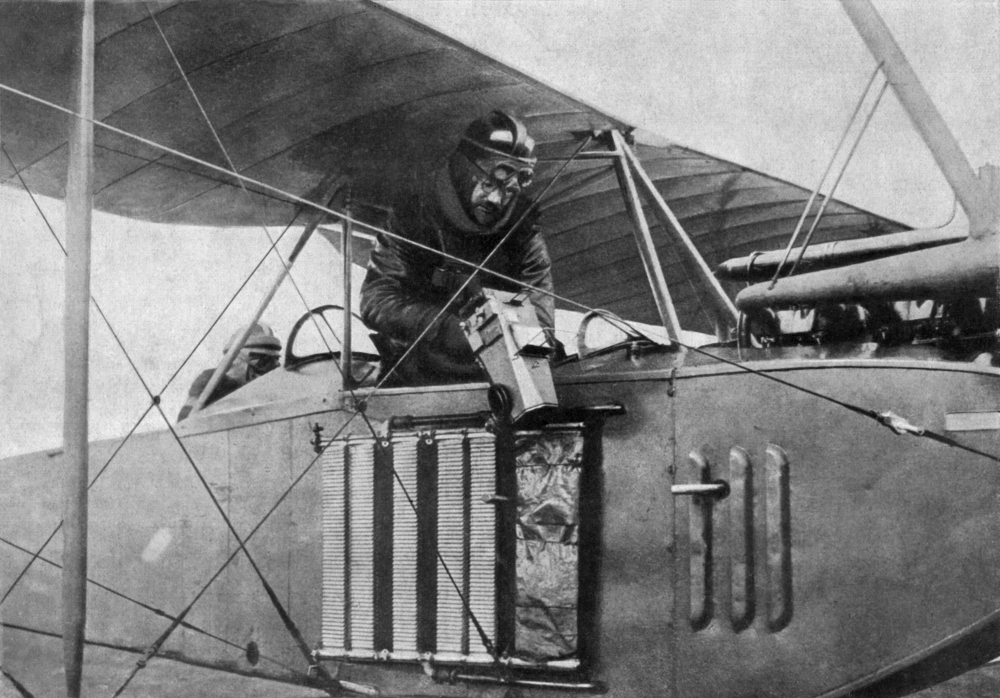
so soldiers not only dug in,
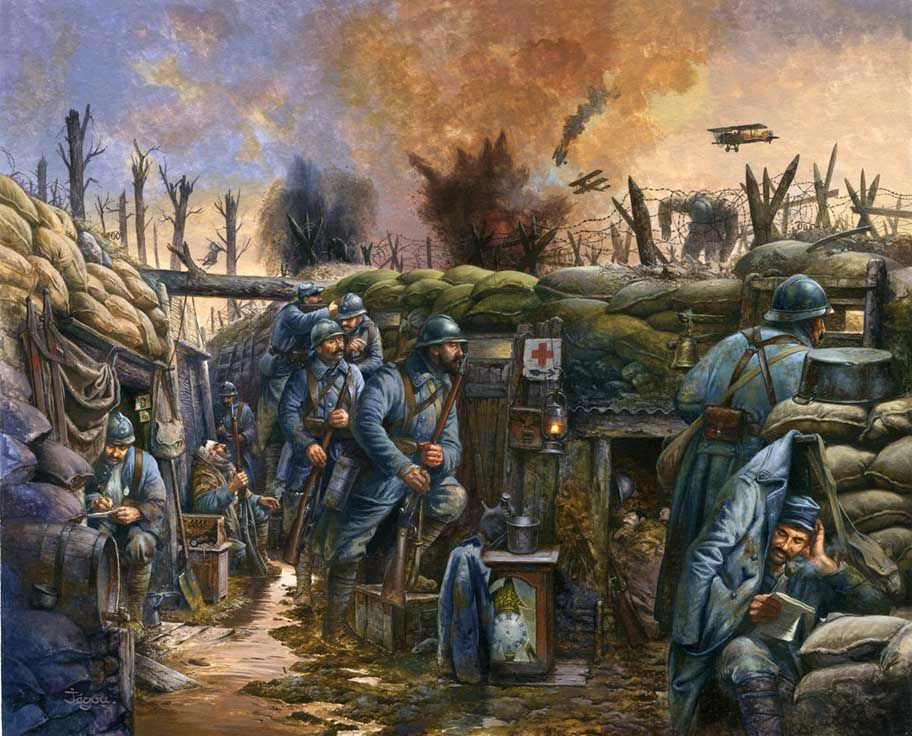
but modified their uniforms, making themselves less visible.

(Gerry Embleton)

After the war, most armies, except for special guard units,

 never went back to being peacocks, abandoning a bright tradition which went back to the 17th century.
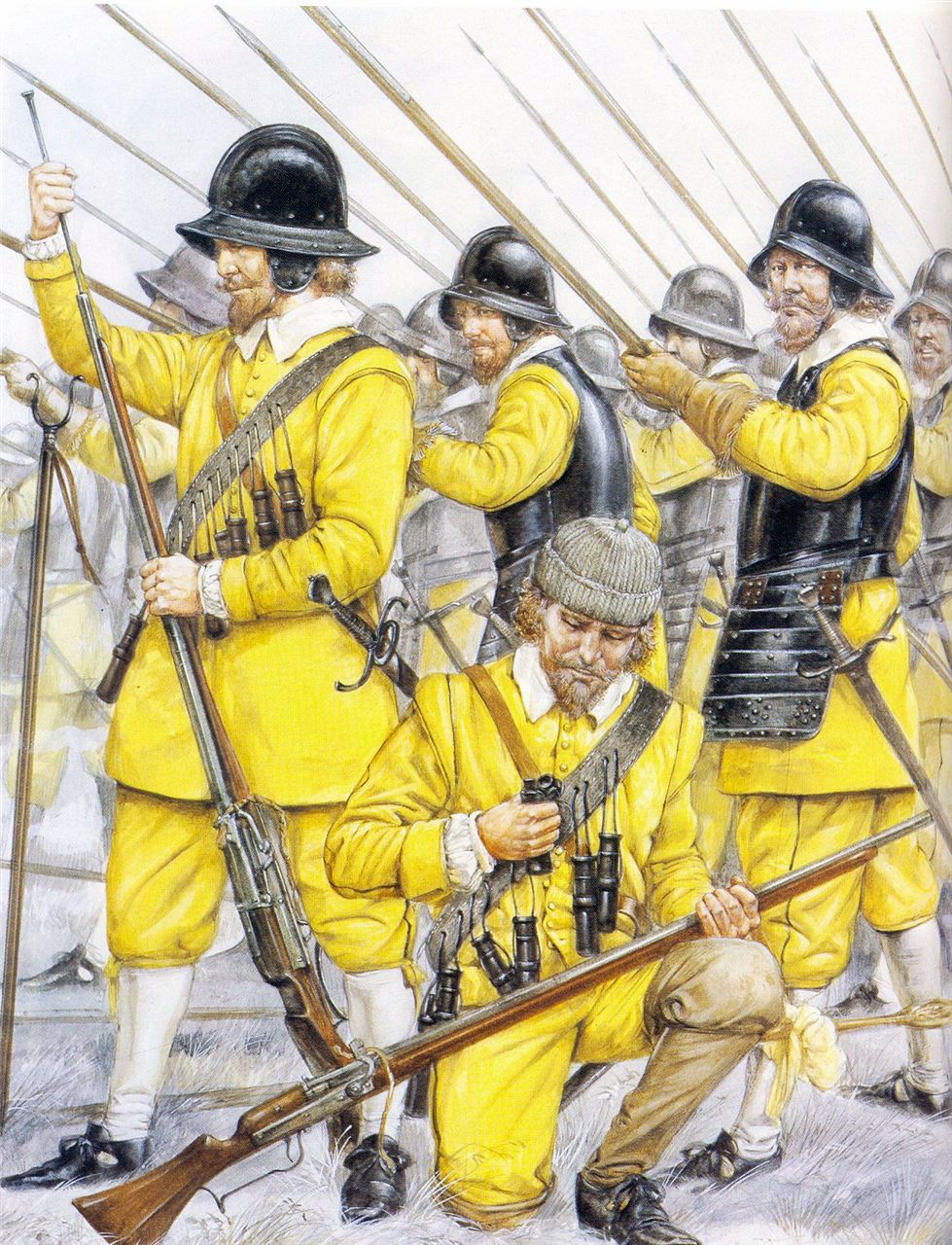
(Richard Hook)

Even in the 17th century, soldiers not wearing the same-colored clothing might distinguish themselves from their enemies by what would be called “field signs”, like wearing a strip of cloth on one arm, or sticking a particular piece of a plant or even a scrap of paper in your hatband.

(Henri IV, 1553-1610, king of France, was famous for the white plume he always wore in his hat.)

Before this, soldiers might wear the distinctive colors of their commanders (usually noblemen), called “livery”—
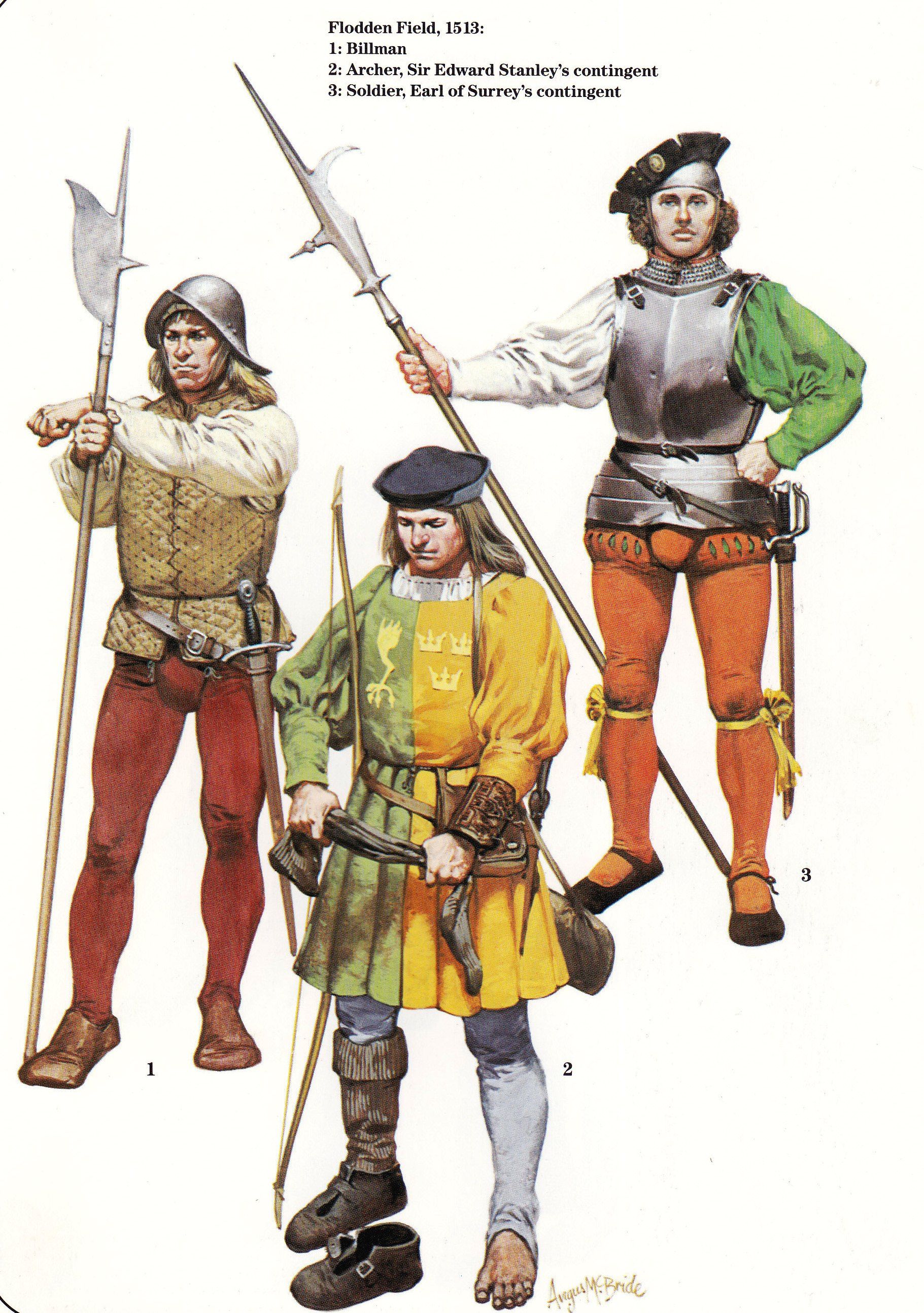
(Angus McBride)

Here we can see that Sir Edward Stanley has given this archer clothing in his colors of green and mustard-yellow, while the Earl of Surrey provided his soldiers with his colors of green and white.  You’ll also notice that the archer has some distinctive badges on the front of his coat—an eagle’s claw and crowns.  These are personal indicators of Sir Edward, heraldic markers to indicate to whom the archer belonged.

In the days before distinctive military dress, heraldry—the use of emblems to mark out one knight, and perhaps his followers, from another—had been developed to a high level.  When everyone was covered in metal,

such emblems were a way to identify a knight—and if he had issued similar emblems to his soldiers, a way to identify the troops he had brought and commanded at a battle.

As emblems developed, there also developed a person with a specialized skill to identify them—a herald.
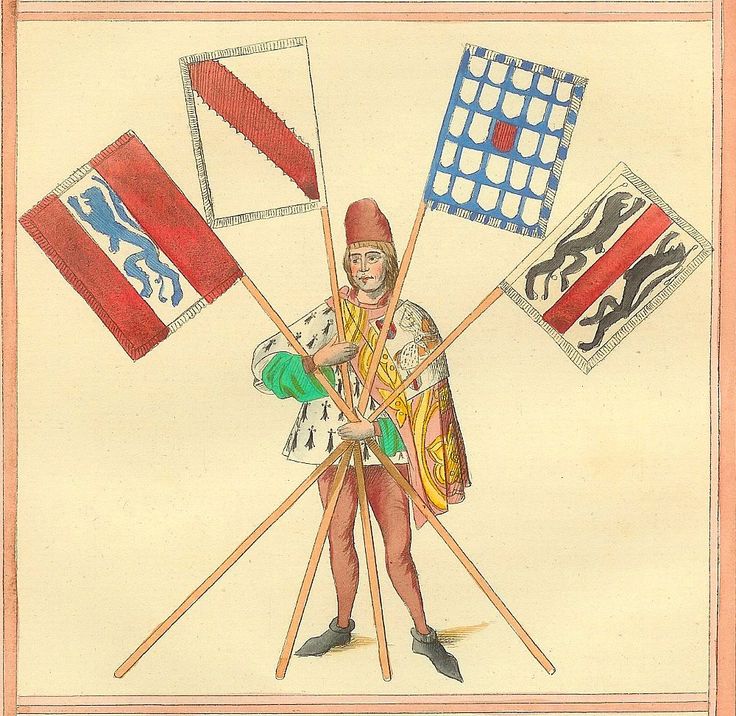
He himself, as you can see, wore distinctive clothing, which also helped him in his other role as messenger between military opponents—he was considered as a neutral and could therefore pass freely.  (For more on heralds, see “Herald-ry in Middle-Earth”, 30 March, 2016 here:  https://doubtfulsea.com//?s=herald&search=Go )

Tolkien himself belonged to the age of drab—

(Here’s what that uniform would have looked like in color—although this is a much higher level officer—looks to be a major—JRRT was commissioned as a second lieutenant and eventually promoted to first lieutenant )

but was well aware of earlier flashiness and we can see it in his description of the guards at Denethor’s gate—even though he sees their outfits as a throwback, just like British soldiers ever returning to bright red uniforms—except for the monarch’s guards:

“The Guards of the gate were robed in black, and their helmets were of strange shape, high-crowned, with long cheek-guards close-fitting to the face, and above the cheek-guards were set the white wings of sea-birds; but the helms gleamed with a flame of silver, for they were indeed wrought of mithril, heirlooms from the glory of old days.  Upon the black surcoats were embroidered in white a tree blossoming like snow beneath a silver crown and many-pointed stars.  This was the livery of the heirs of Elendil, and none wore it now in all Gondor, save the Guards of the Citadel before the Court of the Fountain where the White Tree had grown.”  (The Return of the King, Book Five, Chapter 1, “Minas Tirith”)

(from the Jackson films—as you can see, the helmet fits the description, but the surcoat has disappeared and, instead, the Tree, stars, and crown have been shifted to the breastplate, removing the dramatic contrast between the black cloth and white embroidered emblems which JRRT intended)

As well, although the orcs wear no livery—no uniforms or even part-colored clothing—they do have badges—the white hand of Saruman

(perhaps suggesting that he has his hand over everything?  I think of the “Armada Portrait” of Queen Elizabeth the First here—just look at the quiet statement in her hand)

and the red eye of Sauron,
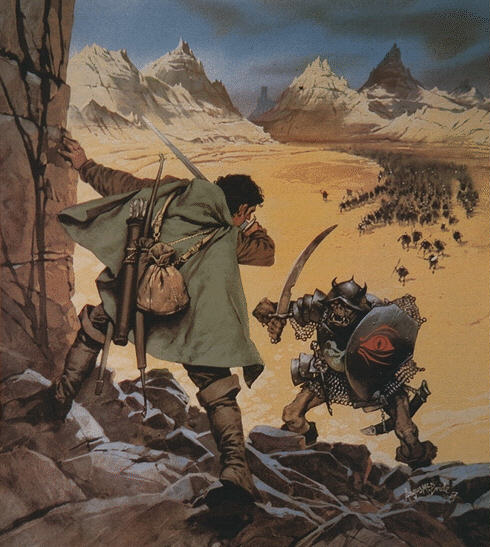
(Angus McBride—perhaps implying that, like Big Brother, Sauron has his eye on you?)

but then there’s a new one, only mentioned once, which provided the title for this posting and the puzzle—

“Two liveries Sam noticed, one marked by the Red Eye, the other by a Moon disfigured with a ghastly face of death…” (The Return of the King, Book Six, Chapter 1, “The Tower of Cirith Ungol”)

What is JRRT up to here?  Minas Morgul,  the “Tower of Black Sorcery”, the center of this gateway into Mordor,
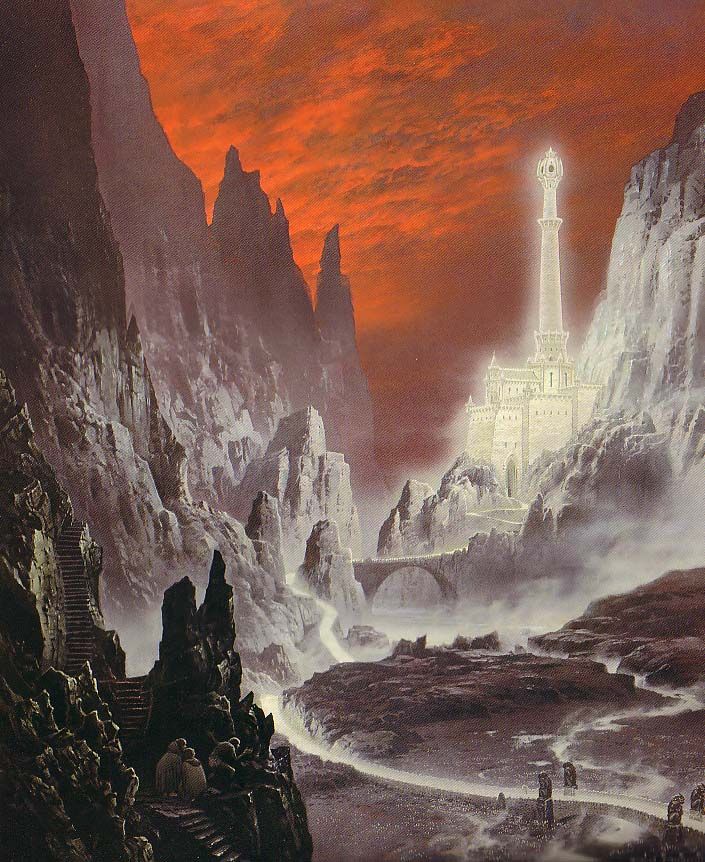
(Ted Nasmith)

had been built as Minas Ithil, “the Tower of the Moon” and it’s clear that those having that badge must come specifically from that place, and a mockery of its previous Gondorian name, which is interesting because the rest of Sauron’s forces appear to wear only the Red Eye.  Yet, if we can trust an orc, we may have the sense that Sauron doesn’t appreciate deviation, as Grishnakh asks rhetorically of Ugluk:

“They might ask where his strange ideas came from.  Did they come from Saruman, perhaps?  Who does he think he is, setting up on his own with his filthy white badges?  They might agree with me, with Grishnakh their trusted messenger; and I Grishnakh say this:  Saruman is a fool, and a dirty treacherous fool.  But the Great Eye is on him.”  (The Two Towers, Book Three, Chapter 3, “The Uruk-hai”)

So what’s going on here?  Certainly there’s rivalry between Saruman’s orcs and Sauron’s, but just how deep does orc rivalry go?  When Sam arrives at the Tower of Cirith Ungol, he finds it a battleground and, climbing into the tower itself he hears two orcs arguing, Shagrat, the captain of the Tower, and Snaga, one of his men.  Snaga says:

“You won’t be a captain long when They hear about all these goings-on.  I’ve fought for the Tower against those stinking Morgul-rats, but a nice mess you two precious captains have made of things, fighting over the swag.” (The Return of the King, Book Six, Chapter 1, “The Tower of Cirith Ungol”)

So, seeing that emblem on a shield, with “a Moon disfigured with a ghastly face of death”, just whose face is that?  And whose death?

As ever, thanks for reading.

Stay well,

If you were to come up with your own livery, what would it be?—sometimes knights made visual puns—like Sir Roger de Trumpington—

Think about that, pencil in hand, and remember that there’s always

MTCIDC

O

PS

For more on livery, see:  https://en.wikipedia.org/wiki/Livery

There has been some wonderfully imaginative work done on heraldry in Tolkien.  Here’s a link to get you started:  https://en.wikipedia.org/wiki/Heraldry_of_Middle-earth   
Into the Fire

19 Wednesday Feb 2025

Posted by Ollamh in Uncategorized

≈ Leave a comment

Tags

Aetius, Attila, Chalons, Denethor, Faramir, Gandalf, lotr, Middle-earth, Palantir, Pippin, Saruman, Sauron, Tolkien

As ever, welcome, dear readers.

I’ve always admired the way in which JRRT shows the slow descent of Denethor into darkness, from someone who rules Gondor

(Denis Gordeev)

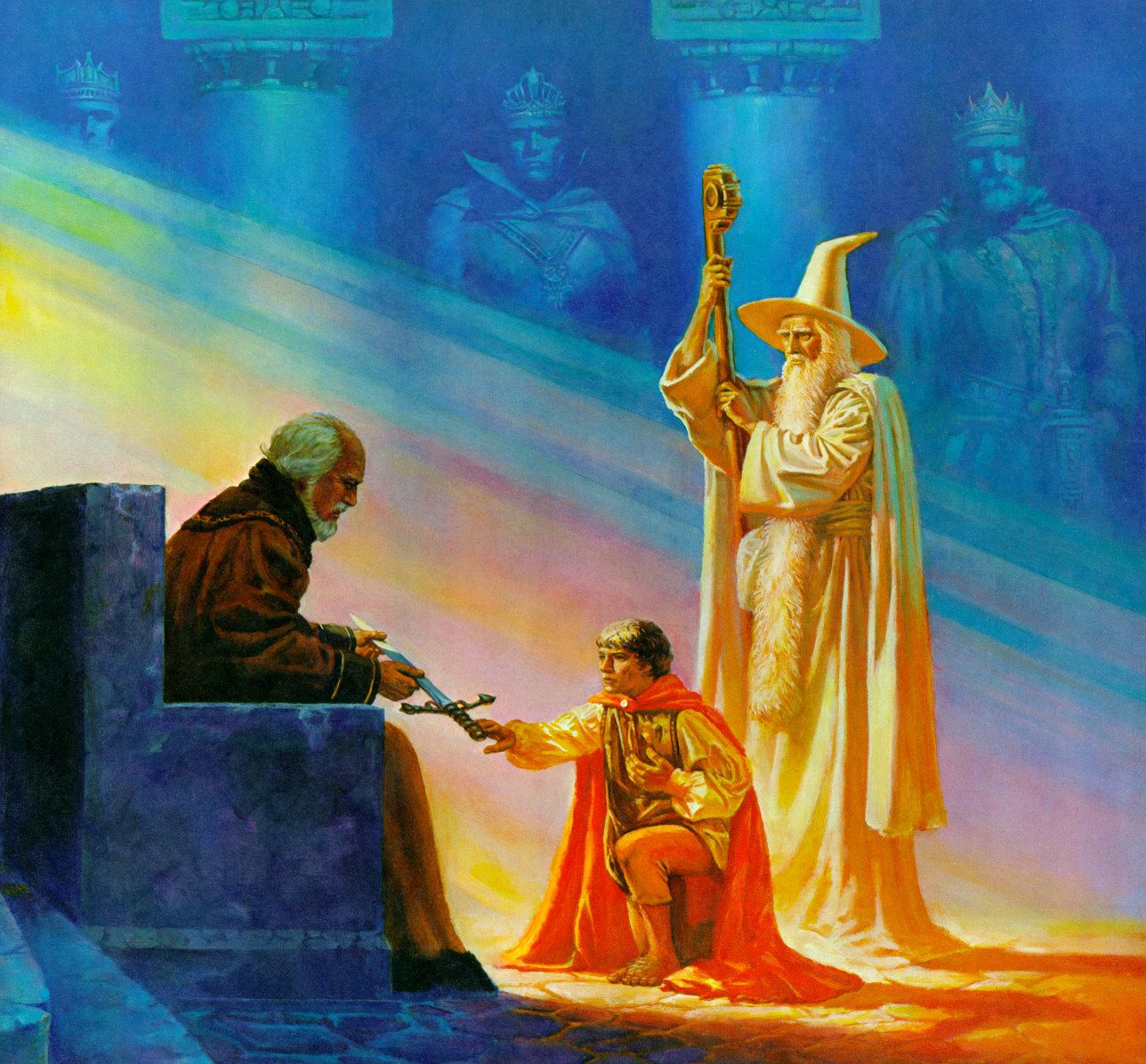
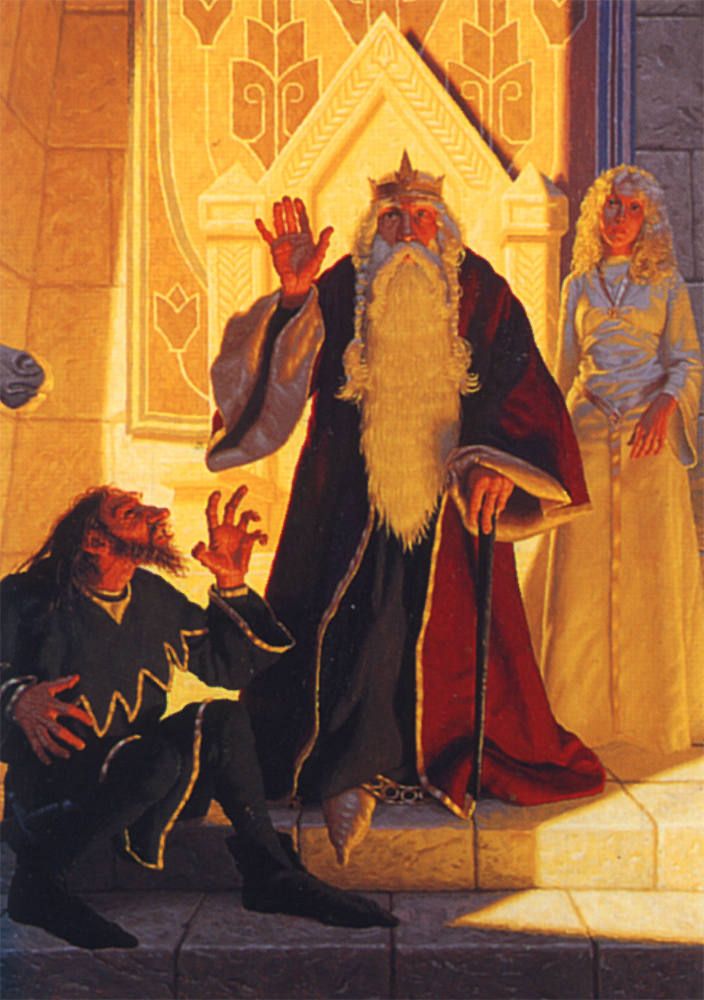
as if he were its rightful king, accepting Pippin’s offer of allegiance,

(Douglas Beekman—a prolific sci-fi fantasy illustrator.  You can see numbers of his illustrations here:  https://www.isfdb.org/cgi-bin/ea.cgi?23068  This catalogue if from the Internet Speculative Fiction Data Base, a wonderfully rich site if you have an interest in sci-fi.)

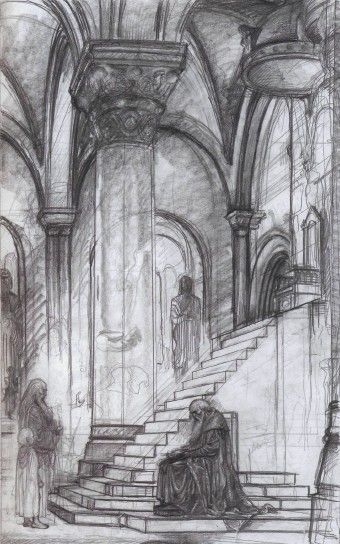
to the pensive and grieving father,

(an Alan Lee sketch)

to the desperate madman of his last scene—

(artist? so far, I can’t locate one)

But that last scene has always impressed me as Tolkien at his dramatic best.

It begins with the setting:

“There Pippin, staring uneasily around him, saw that he was in a wide vaulted chamber, draped as it were with the great shadows that the little lantern threw upon its shrouded walls.  And dimly to be seen were many rows of tables, carved of marble; and upon each table lay a sleeping form, hands folded, head pillowed upon stone.  But one table near at hand stood broad and bare.  Upon it at a sign from Denethor they laid Faramir and his father side by side, and covered them with one covering, and stood then with bowed heads as if mourners beside a bed of death.”

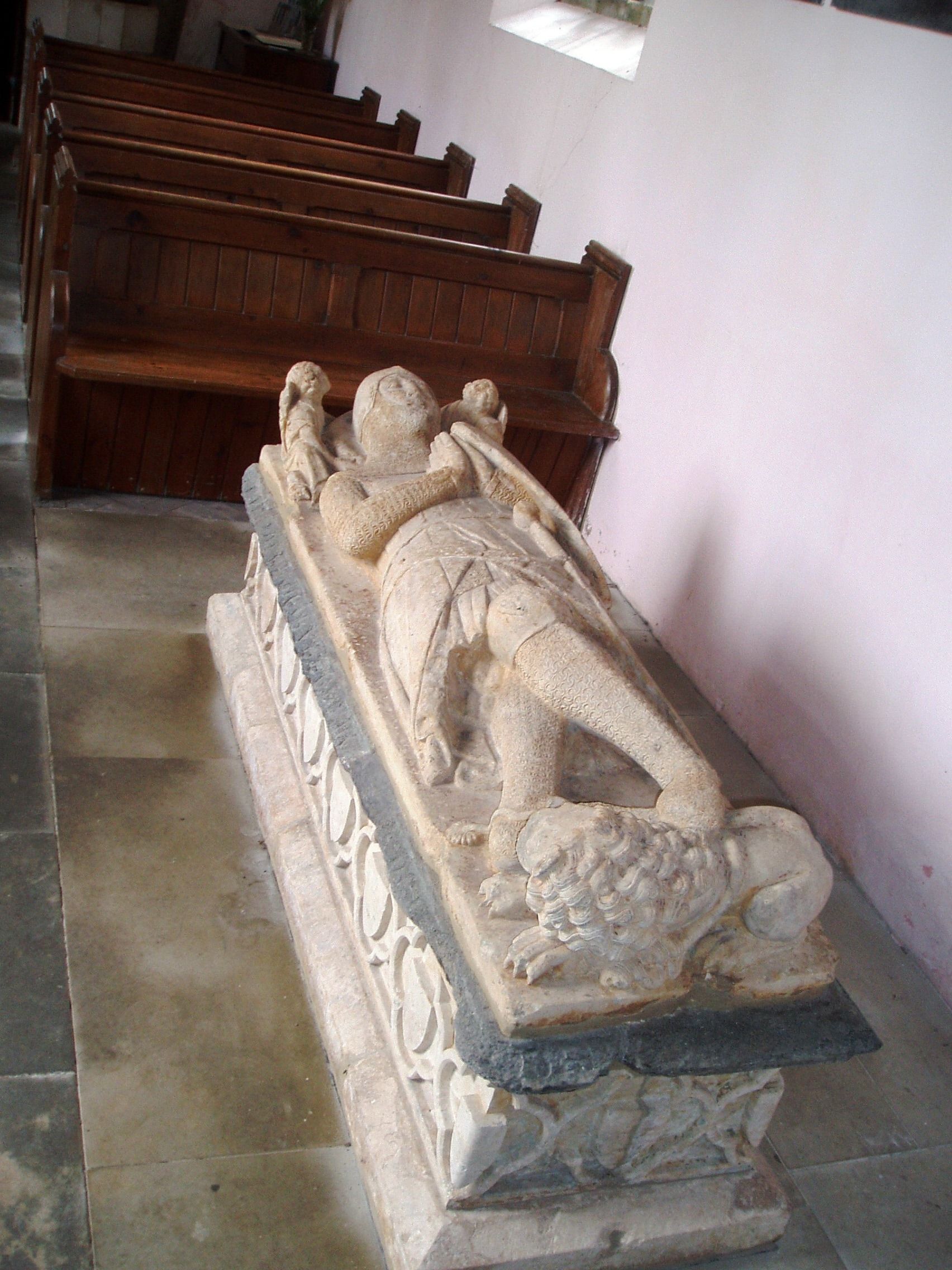
I think that we can imagine that JRRT’s image here is based upon any number of medieval English churches, with their tombs, usually along the walls, or,

more grandly,  the basilica of St Denis, in a northern suburb of Paris,

of which he might have seen a photo.  (As I haven’t found a reference that he had actually visited the place.)

What happens next, however, has a different model—or, rather, perhaps two. 

After having himself and Faramir placed on that empty table, Denethor then makes the terrible command:

“ ‘Here we will wait,’ he said.  ‘But send not for the embalmers.  Bring us wood quick to burn, and lay it all about us, and beneath; and pour oil upon it.  And when I bid you thrust in a torch.’ “ (all of the above from The Return of the King, Book Five, Chapter 4, “The Siege of Gondor”)

What’s going on here?   When Gandalf, summoned by Pippin attempts to stop this, Gandalf says to Denethor:

“ ‘Authority is not given to you, Steward of Gondor, to order the hour of your death,’…And only the heathen kings, under the domination of the Dark Power, did thus, slaying themselves in pride and despair, murdering their kin to ease their own death.’”  (The Return of the King, Book Five, Chapter 7, “The Pyre of Denethor”)

“Heathen”, from Old English haethen, came into English with the meaning “non-believer (in Christianity)” and seems, at first, rather an odd word for Gandalf to have employed, as Tolkien has written himself that “…the ‘Third Age’ was not a Christian world.” (letter to the Houghton Mifflin Co., 30 June, 1955, Letters, 319)

I wonder, however, whether JRRT was remembering something from early medieval history, which he might have read in conjunction with his early avid study of Gothic (which almost ruined his academic career—see his letter to Christopher of 2 January, 1969 (Letters, 558).

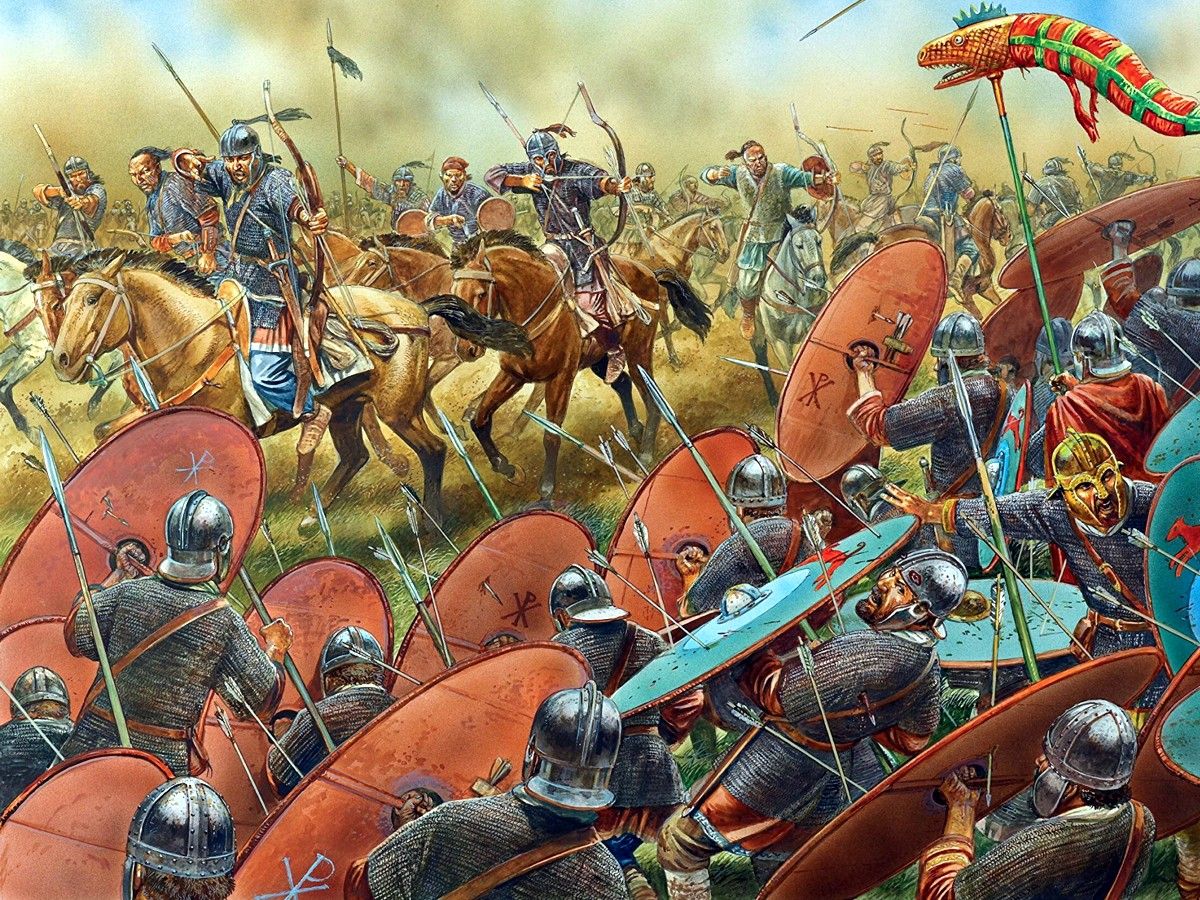
It’s in the account by the 6th-century Gothic historian, Jordanes, of the Battle of the Catalaunian Plains (also known as the Battle of Chalons), between Roman and their Germanic allies, including Visigoths, led by the Roman general, Aetius, and an invading army of Huns and their subject peoples, led by Attila, a battle fought on 20 June, 451.

(by Peter Dennis, one of my favorite contemporary military artists)

The battle was very much a back-and-forth affair, but late in it, the Huns had been driven back to their camp and Attila, usually the soul of confidence, was troubled–and this is where Jordanes’ description comes in:

Fertur autem desperatis rebus praedictum regem adhuc et suppraemo magnanimem equinis sellis construxisse pyram seseque, si adversarii inrumperent, flammis inicere voluisse, ne aut aliquis eius vulnere laetaretur aut in potestate hostium tantarum gentium dominus perveniret.  (Jordanes, De Origine Actibusque Getarum, XL, 213—my translation)

“It is said, moreover, that things were [so] despaired of, that the king [that is, Attila] still supremely brave,  commanded at this point that [they] build a pyre from horse saddles and, should the enemy break in [to his camp], he wished to throw himself into the flames lest either anyone take joy in wounding [him] or lest he, the master of so many peoples come into the power of the enemy.”

None of Attila’s kin is involved in this potential self-immolation, but certainly the pride is there and even despair (as in that “desperatis rebus”) which Gandalf mentions.

But, as I said earlier, there might be another model—and perhaps an even darker one.  Notice that

“But one table near at hand stood broad and bare.”

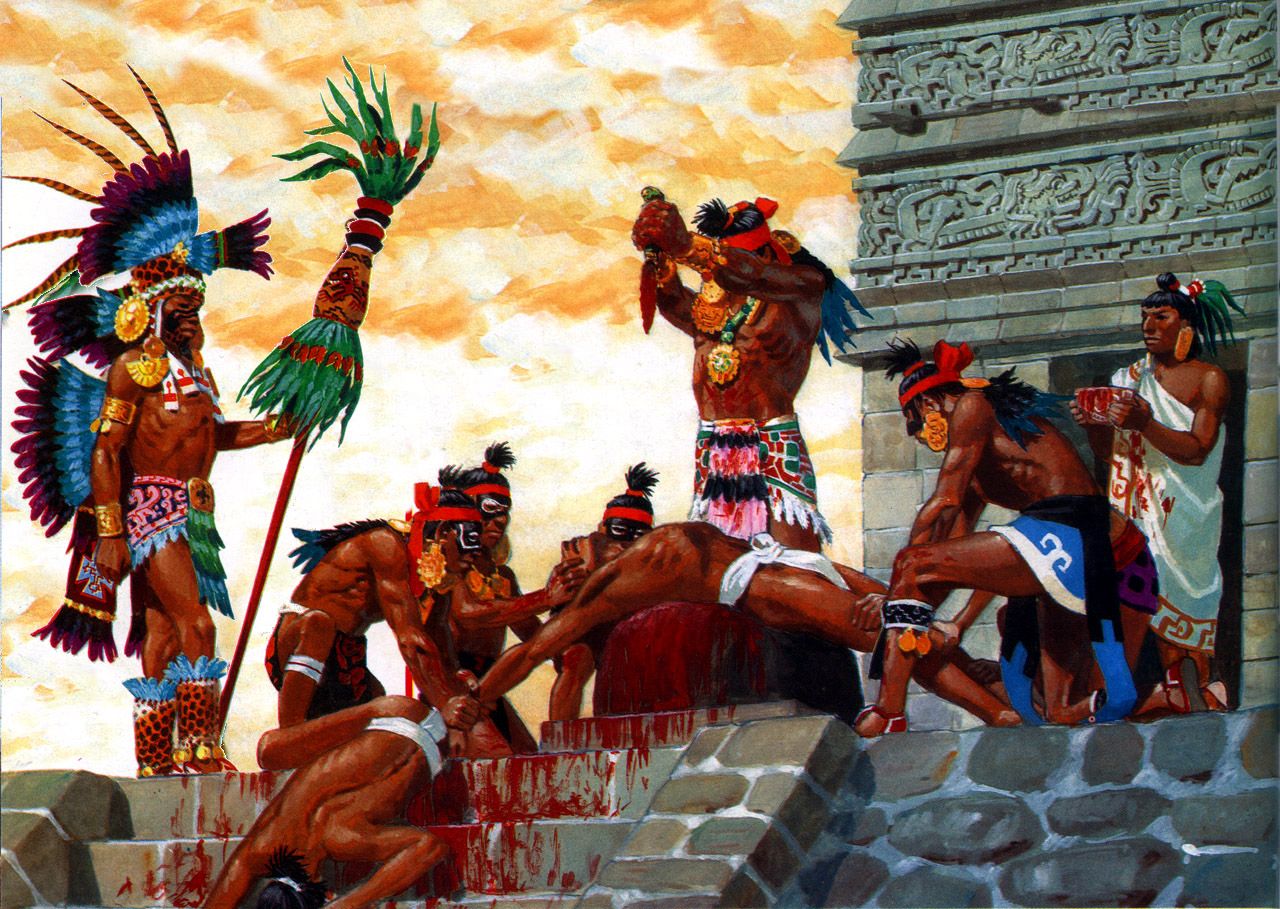
What immediately came to mind was that it resembled an altar—not a Christian one, but something from a different world, in which the symbolic sacrifice of the Christian religion was a real sacrifice—

(artist unknown)

I thought of this because of something which Tolkien had written about Sauron, who has become the prisoner of the Numenorean king Tar-Calion:

“…and seduces the king and most of the lords and people with his lies.  He denies the existence of God, saying that the One is a mere invention of the jealous Valar of the West, the oracle of their own wishes.  The chief of the gods is he that dwells in the Void, who will conquer in the end, and in the void make endless realms for his servants…

A new religion, and worship of the Dark, with its temple under Sauron arises.  The Faithful are persecuted and sacrificed.”  (letter to Milton Waldman, late 9n 1951, Letters, 216)

Why, we might ask, is Denethor so prepared to make a fiery end to himself and his son?

“ ‘Come!’ said Gandalf.  ‘We are needed.  There is much that you can yet do.’

Then suddenly Denethor laughed.  He stood up tall and proud again, and stepping swiftly back to the table he lifted from it the pillow on which his head had lain.  Then coming to the doorway he drew aside the covering, and lo!  he had between his hands a palantir.  And as he held it up, it seemed to those that looked on that the globe began to glow with an inner flame, so that the lean face of the Lord was lit as with a red fire, and it seemed cut out of hard stone, sharp with black shadows, noble, proud, and terrible.  His eyes glittered.

‘Pride and despair!’ he cried.  ‘Didst thou think that the eyes of the White Tower were blind?  Nay, I have seen more than thou knowest, Grey Fool.  For thy hope is but ignorance.  Go then and labour in healing!  Go forth and fight!  Vanity….The West has failed.  It is time for all to depart who would not be slaves.”

And the answer is in that palantir.  As it had earlier corrupted Saruman,

(the Hildebrandts)

and nearly driven Pippin mad with only one look into it, so it has shown Denethor exactly what Sauron had wanted him to see and, deluded, we might imagine that, in his action, he was not only destroying the current ruler of Gondor and his son, but was also acting like the Numenoreans who were his ancestors, making a sacrifice which Sauron had once demanded of them.

And, although Faramir is rescued, Denethor:

“…leaped upon the table, and standing wreathed in fire and smoke he took up the staff of his stewardship that lay at his feet and broke it on his knee.  Casting the pieces into the blaze he bowed and laid himself on the table, clasping the palantir with both hands upon his breast.  And it was said that ever after, if any man looked in that Stone, unless he had a great strength of will to turn it to other purpose, he saw only two aged hands withering in flame.”

And so Sauron had his sacrifice.

Thanks, as ever, for reading.

Stay well,

And remember that, as always, there’s

MTCIDC

O

At Their Pleasure

05 Wednesday Feb 2025

Posted by Ollamh in Uncategorized

≈ Leave a comment

Tags

Boccacio, Elves, Horace Walpole, letters, Middle-earth, pleasaunce, Ranelagh Gardens, Roman de la Rose, Tolkien, Vauxhall Gardens

Dear readers, welcome, as always.

Because I enjoy reading letters from people in the past, I sometimes wonder from whom I would like to receive one—or more.  Certainly from the 18th-century English literary man, Horace Walpole (1717-1797),

who is credited with writing the first “Gothic” novel—1764—and, on the title page of the 2nd edition of 1765 actually calls it one—

and who so loved what he understood to be the medieval past that he built himself a castle in a “Gothic” style, Strawberry Hill, which you can visit today as it’s being lovingly restored.

The letters are gossipy and often quietly humorous and have the sound of a real voice, which is one reason why I enjoy reading them.  Here he is in 1760 complaining about the mail—

“I would give much to be sure those letters had reached you. Then, there is a little somebody of a German prince, through whose acre the post-road lies, and who has quarrelled with the Dutch about a halfpennyworth of postage ; if he has stopped my letters, I shall wish that some frow may have emptied her pail and drowned his dominions !”  (letter to Sir Horace Mann, 14 November, 1760—this is #722 in Volume V of the 16-volume Oxford collection, which you can find here:  https://archive.org/details/lettersofhoracew56walp/page/n7/mode/2up   “frow” is Walpole’s spelling of Dutch huisvrouw, “housewife” and I suspect that the “pail” is more likely a chamberpot, from his tone–)

Certainly I would be glad to receive something from Emily Dickinson, 1830-1886, which might even include a poem, as hers sometimes did.

Like Walpole’s, these are missives full of a living—and like Walpole, sometimes skeptical and humorous—person.  (There are two modern editions of the letters, the more recent just published last year, but you can get a sense of her for free from volume one of the first edition, from 1894, here:  https://archive.org/details/lettersofemilydi00dick )

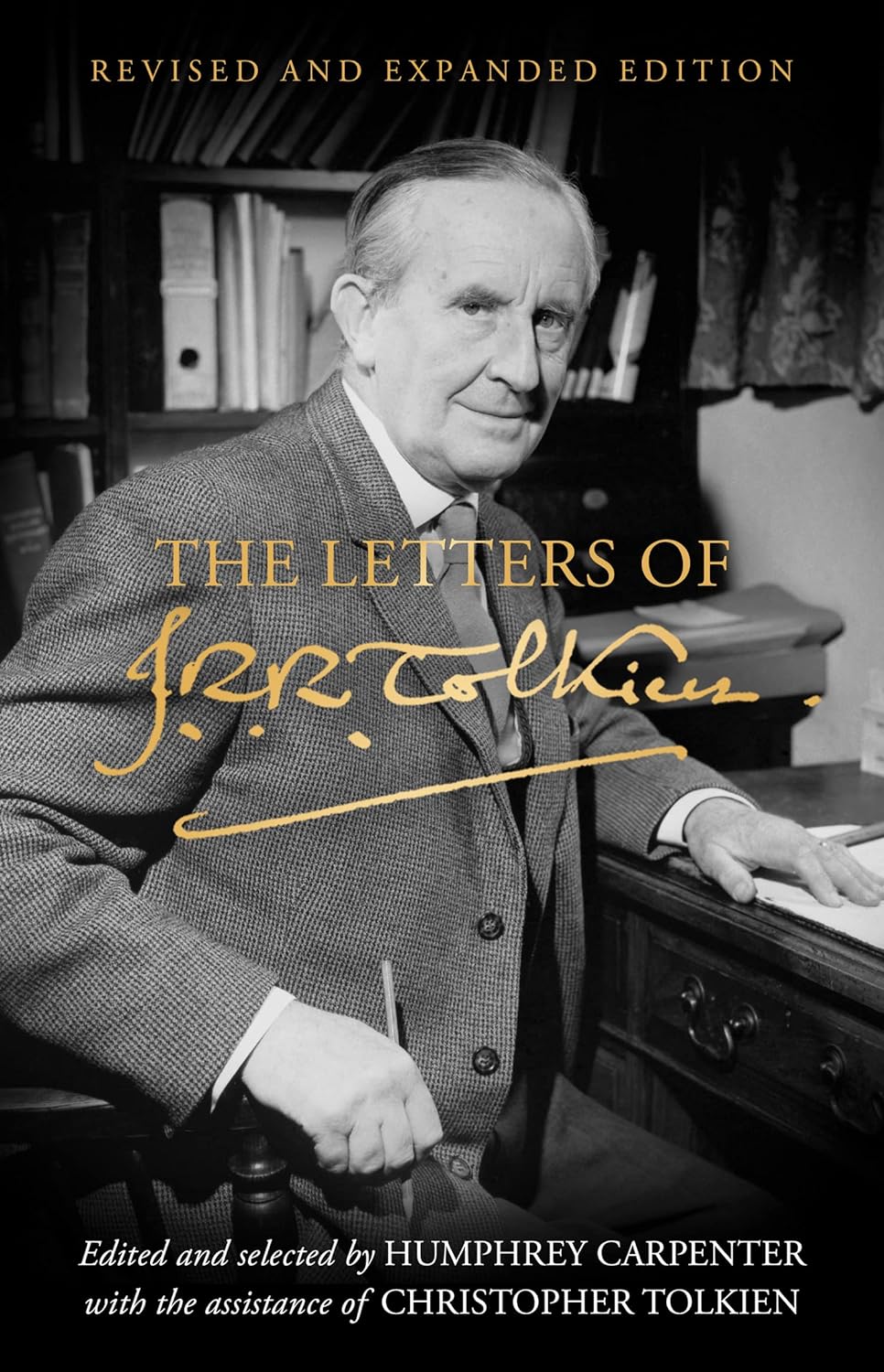
And, of course, letters directly from Tolkien, rather than being forced to read over his shoulder as we do with The Letters of J.R.R. Tolkien,

would be wonderful, not only for their voice, everything from affectionate to outraged, but also because there may be something more, even perhaps something unexpected to be read in them, even if you’ve read the same letters more than once.

Just the other day, for example, I was thumbing through, looking for something else, and I came upon this:

“But the Elves are not wholly good or in the right.  Not so much because they flirted with Sauron; as because with or without his assistance they were ‘embalmers’.  They wanted to have their cake and eat it:  to live in the mortal historical Middle-earth because they had become fond of it (and perhaps because they had there the advantages of a superior caste), and so tried to stop its change and history, stop its growth, keep it as a pleasaunce, even largely a desert, where they could be ‘artists’—and they were overburdened with sadness and nostalgic regret.” (to Naomi Mitchison, 25 September, 1954, Letters, 293)
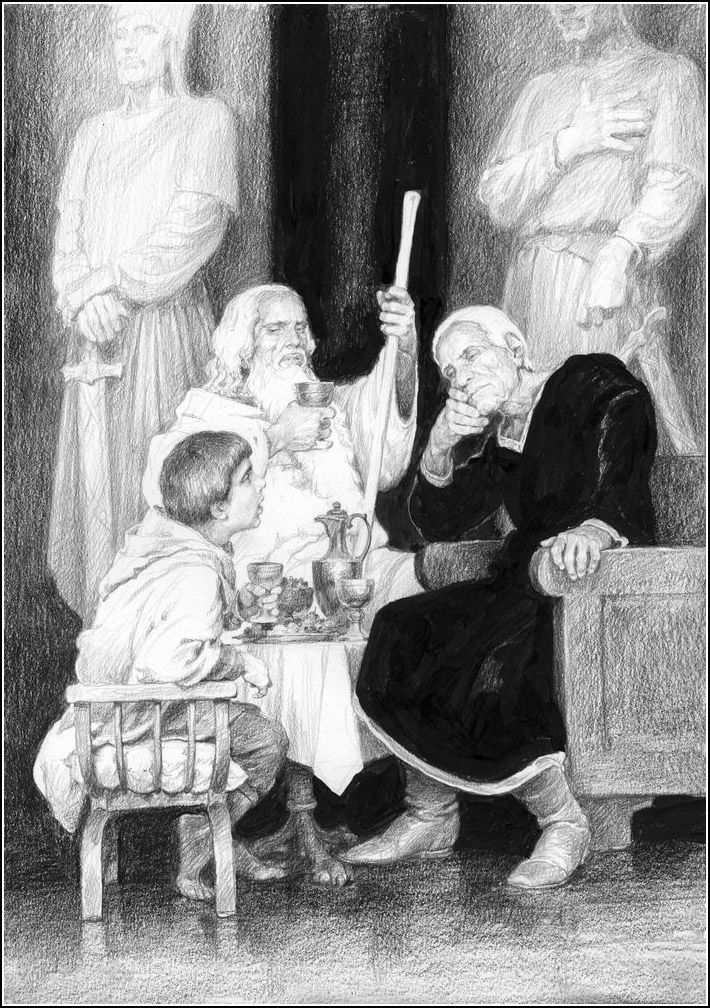
What an interesting view of the Elves!  And that’s another reason to read letters:  you never know what you may learn and what may surprise you.  In this case, we are given a very much more nuanced picture of Middle-earth than, say, The Hobbit or The Lord of the Rings—and, in this case, a darker picture.

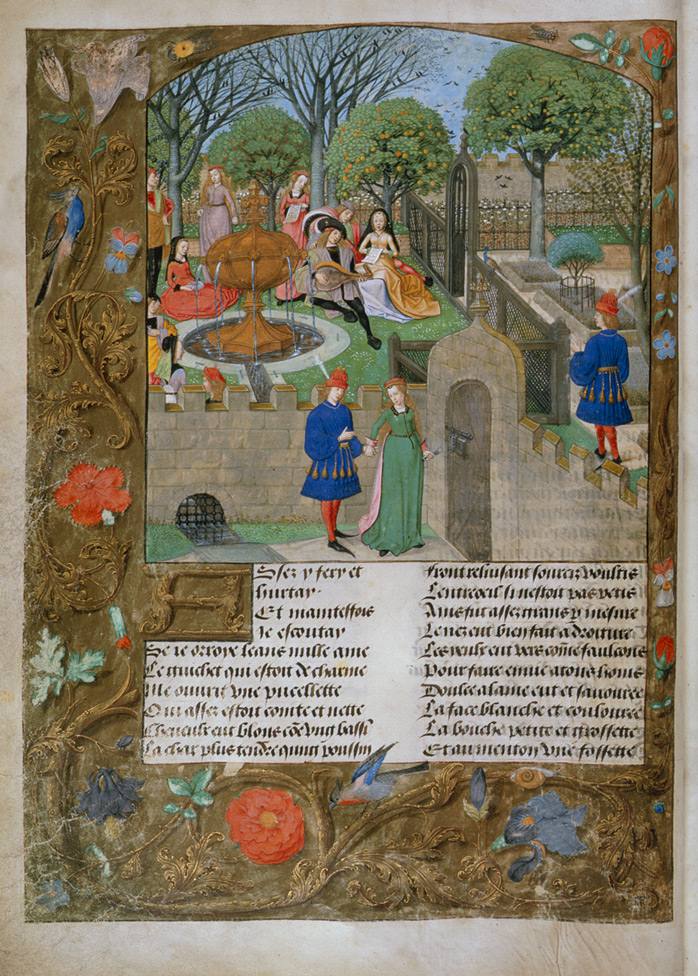
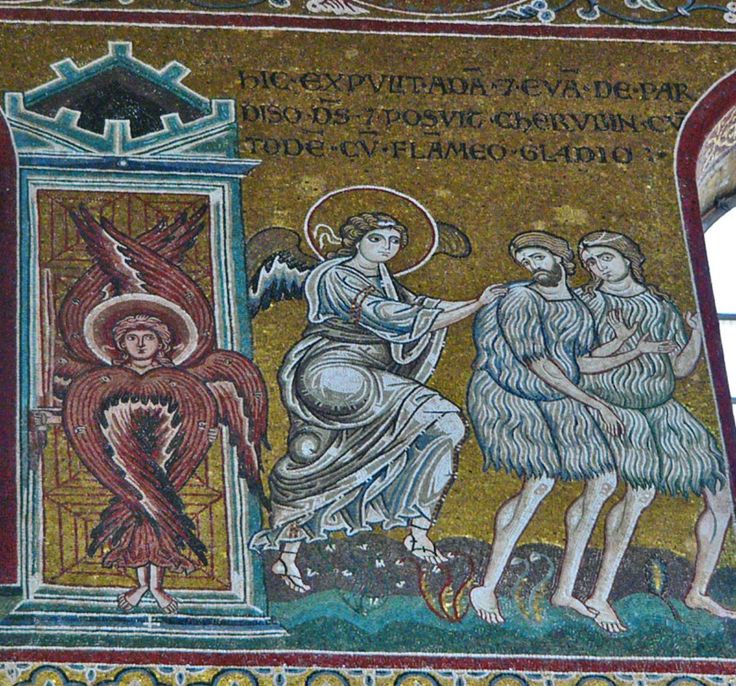
And one word in particular in this letter caught my attention:   “pleasaunce”, which can mean a “pleasure garden”.  Harkening back to Eden,

(Adam and Eve and a scaly friend from my favorite west-Byzantine mosaics in Monreale cathedral)

such places became a feature of medieval settings—both real and in literature—as we see in this depiction of the garden which is the scene of the opening of the 13th-century Roman de la Rose.

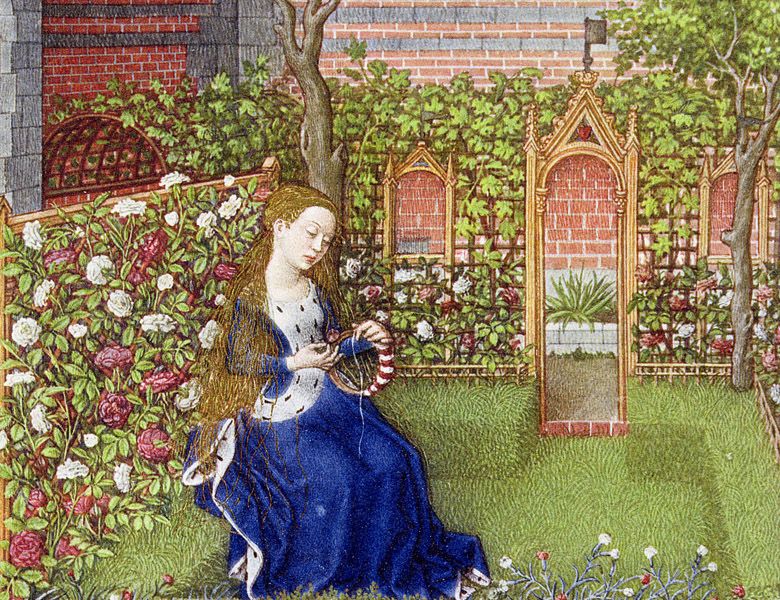
or Emilia in Theseus’ garden from Boccacio’s 14th-century Teseida.

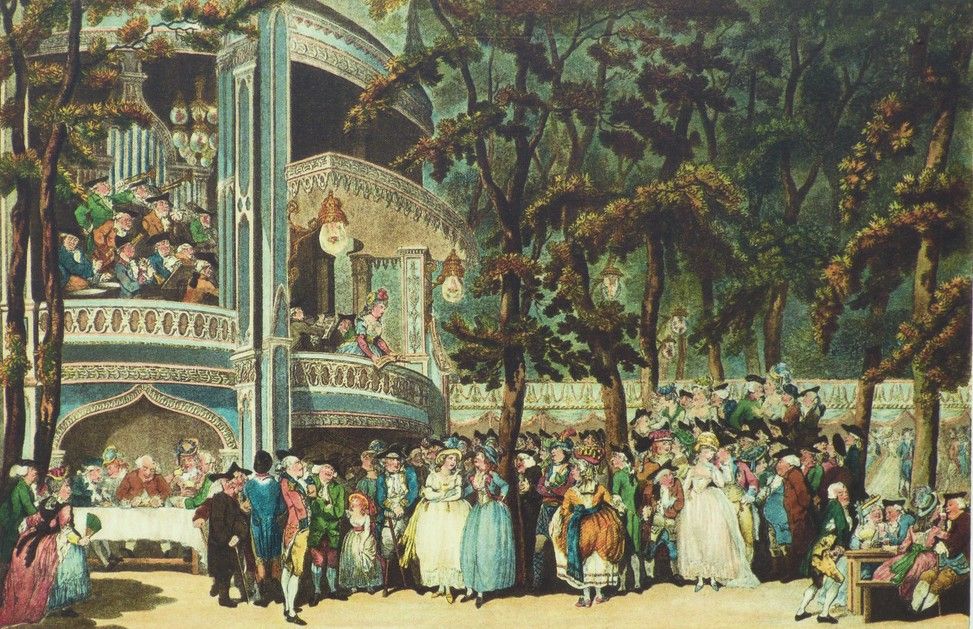
They reached big—commercial—time in 18th-century London, with the very elaborate Ranelagh Gardens

with its large and elegant rotunda, and famous organ (Mozart at 9 played a concert at Ranelagh)

and Vauxhall,

known for its long, green avenues, its music,

and for the suggestion of naughtiness in such a large, but shadowy place.  (Although older, Vauxhall survived longer—its final closing came in 1859.  For more on both Gardens, see:  https://en.wikipedia.org/wiki/Ranelagh_Gardens and https://en.wikipedia.org/wiki/Vauxhall_Gardens )

A key feature of such places is the potential not only for including, but for excluding, as well.  After all, because of their naughtiness, Adam and Eve were eventually barred from their pleasaunce,

(another image from Monreale)

medieval gardens had walls to allow for limited entrance (the protagonist of The Roman of the Rose has to have the help of a character called “Indolence” to get in), and Ranelagh and Vauxhall had gates and entrance fees, so it’s interesting to see what Tolkien means by his choice of word.  As he says, his Elves had become “embalmers’, by which he means that they were like Egyptian mummifiers,

although their body was still alive, and their process was meant to stop history, not decay, and, at the same time, to change Middle-earth from something naturally progressing through time for all its inhabitants into a “pleasaunce”—an artificial walled pleasure garden for themselves, something frozen in time, in which they could enjoy themselves as if they were the sole owners and masters, including and excluding as they wished.

It would be easy to believe that Tolkien means by this to show the Elves as ultimately lordly and selfish and there is the suggestion of this—but there’s something more and I would suggest that this makes clear JRRT’s wish to move beyond the surface of his elaborate creation.  By their desire, the Elves might be thought selfish, but Tolkien reveals for us the price for such behavior:  “they were overburdened with sadness and nostalgic regret.”  By attempting to preserve the past, and yet seeing that it couldn’t be preserved, the Elves had created not a pleasaunce, but a mirror of the passing of time which, powerful as they were, they could never control, and, gazing into that mirror, they could only see that truth, leaving them with nothing more than to feel sadness and regret.

The melancholy of the Elves is always there, but, in this particular letter, Tolkien explains and therefore deepens that haunting feeling, giving us figures who, in some sense, have tried to do the impossible:  to stop time, and, realizing that they can’t, can only grieve—and retreat from the world of their failure. 

I’ll always read letters for the living voice I might find there (the ancient Roman Seneca, c.4BC-65AD, first became real for me from one of his letters), but this one underlines my other point:  reading letters—rereading letters—may bring surprises.

Thanks, as always, for reading.

Stay well,

Beware of staring too long into mirrors (think of Snow White’s stepmother),

And remember that, as always, there’s

MTCIDC

O

Over the River…

06 Wednesday Mar 2019

Posted by Ollamh in J.R.R. Tolkien, Literary History, Maps, Narrative Methods

≈ 2 Comments

Tags

atlas, Maps, Middle-earth, Roman Roads, Ted Nasmith, The Hobbit, The Lord of the Rings, Tolkien

As ever, dear readers, welcome.

Two postings ago, we had been discussing how time is marked in The Hobbit.  After a one-post interlude—a book review—we were intending to extend our discussion (as our original plan was) to The Lord of the Rings, but something caught our attention and, in this posting, we’re still interluding—although it is about The Hobbit.

We had just set off from Bag End with Bilbo and the dwarves and noticed this:

“At first they had passed through hobbit-lands, a wide respectable country inhabited by decent folk, with good roads, an inn or two, and now and then a dwarf or a farmer ambling by on business.  Then they came to lands where people spoke strangely, and sang songs Bilbo had never heard before.  Now they had gone on far into the Lone-lands, where there were no people left, no inns, and the roads grew steadily worse.  Not far ahead were dreary hills, rising higher and higher, dark with trees.  On some of them were old castles with an evil look, as if they had been built by wicked people.” (The Hobbit, Chapter 2, “Roast Mutton”)

The company passes over an ancient bridge:

“Somewhere behind the grey clouds the sun must have gone down, for it began to get dark as they went down into a deep valley with a river at the bottom.  Wind got up, and willows along its banks bent and sighed.  Fortunately the road went over an ancient stone bridge, for the river, swollen with the rains, came rushing down from the hills and mountains in the north.”

They go on till Bilbo and the dwarves reach the trolls.

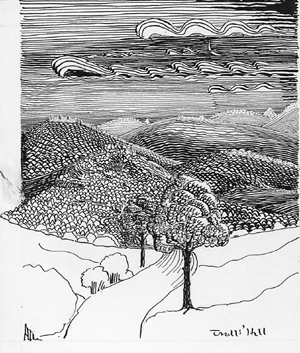
image1trollhill.gif

image2trolls.png

(drawings by JRRT)

Here, though, we want to pause for a moment and look back, and, like any careful—and curious—traveler, consult a map.

image3map.jpg

First—and this is something we noted in that previous post—there is really no hard evidence for just how long this leg of the trip took.  All we are given are  “At first”, “now and then”, “Then”, and “Now”, and the sense of distance comes to us as much through landscape changes as from those vague words:  from “hobbit-lands” to “lands where people spoke strangely…” then “Now they had gone far into the Lone-lands”.

Second, looking at that map, there are certain puzzling words in that description of travel.  The description twice says “roads”, at first “good roads”, then, as the journey goes eastwards, “the roads grew steadily worse”.  Our map, however, shows only one road, the East or East/West Road, the history of which goes far into the history of Middle-earth and which we have always imagined that JRRT modeled on the remains of Roman roads one could still walk in England in his time—and even today.
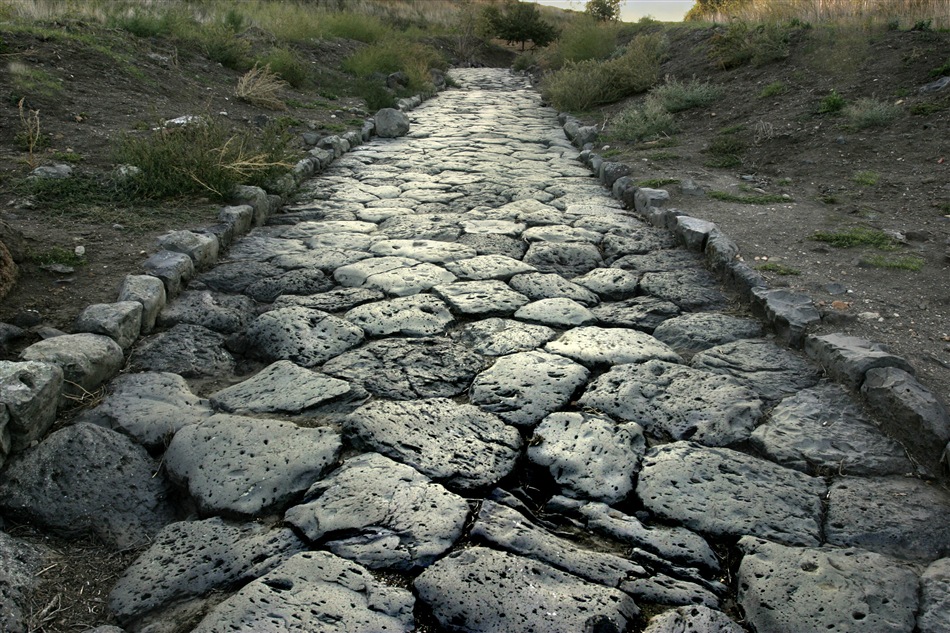
image4romanroad.jpg

(Here’s a LINK to a very good basic article on constructing roads in Roman Britain.)

And then there is this:

“Not far ahead were dreary hills, rising higher and higher, dark with trees.  On some of them were old castles with an evil look, as if they had been built by wicked people.”

As far as we know, there are no “castles” in Middle-earth—the East Road does skirt Weathertop.  As Aragorn says:

“The Old Road, which we have left far away on our right, runs to the south of it and passes not far from its foot.”  (The Fellowship of the Ring, Book One, Chapter 11, “A Knife in the Dark”)

And perhaps his description might—very roughly—fit a (ruined) castle:

“…in the first days of the North Kingdom, they built a great watch-tower on Weathertop, Amon Sul they called it.  It was burned and broken, and nothing remains of it now but a tumbled ring, like a rough crown on the old hill’s head.”

As it was destroyed in the conflict against the Witch King of Angmar, we would certainly agree that “wicked people” had once been involved in its history.

Our puzzlement is not just about what appears in the text, however.  There is also what’s missing (most of it shown on the map):

  1. the bridge over the Brandywine which appears in the first paragraph of “The Scouring of the Shire”
  2. any mention of the Greenway, which crosses the East Road at Bree
  3. and then there is Bree itself

Of course, this is back-reading.  We are looking at a map which is descended from one which JRRT gradually built up over time in the years after The Hobbit, when Middle-earth continued to grow and grow in his imagination and hence in his fiction.  (For an extensive view of his work as a world-creator, see this intelligent and extremely useful volume by Karen Wynn Fonstad,

image5fonstad.jpg

which deals with the whole history of Middle-earth in chronological order.  For The Lord of the Rings, we would recommend this, by Barbara Strachey,

image6strachey.jpg

which has been our guide on a number of trips along Frodo’s route.)

As well, it’s good to remember that, for the most part, the company in The Hobbit is traveling at its own speed, a speed determined primarily by the countryside they cross and their trip seems—if occasionally miserable—almost leisurely, especially in comparison with The Lord of the Rings, in which so much of the first volume in particular lays out a route along which several of the main protagonists are driven by evil pursuers.  The journey itself, in the latter, becomes, day by day, the focus of the narrative as they attempt to escape the Nazgul and that day-by-day quality is intensified after the wounding of Frodo on Weathertop, as he begins to fade and his friends are desperate to reach Rivendell.

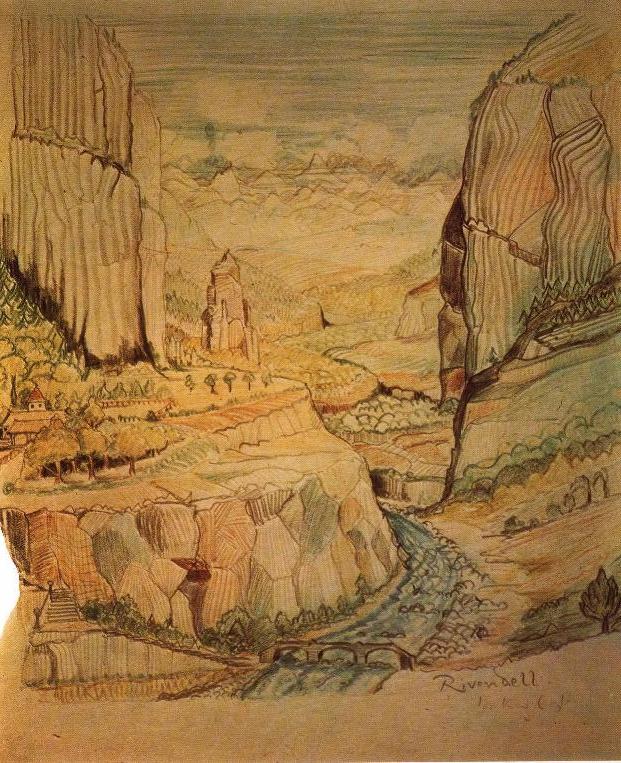
image7rivendell.jpg

The contrast between the two stories is especially striking here, as Bilbo and company are mocked and sung to by invisible elves in The Hobbit (Chapter 3, “A Short Rest”) as they ride down into the valley, whereas, in The Lord of the Rings (The Fellowship of the Ring, Book One, Chapter 12, “Flight to the Ford”), we see this (by the excellent Ted Nasmith)—

image8ford.jpg

This change in the narrative emphasis, from discrete events along a route in The Hobbit, to an emphasis upon the journey itself, will bring us back to our original discussion on the marking of time—moving now from the earlier book to The Lord of the Rings in our next posting.

Thanks, as always, for reading and

MTCIDC

CD


PS

We would guess, by the way, that that “ancient stone bridge” mentioned above is the so-called “Last Bridge”, which Glorifindel  calls “the Bridge of Mitheithel” (The Fellowship of the Ring, Book One, Chapter 12, “Flight to the Ford”) and which crosses the River Hoarwell (“Mitheithel” to the elves) on the East Road.

PPS

If you grew up, as we did, hearing the song we hinted at in our title, you might want to learn more at this LINK…

Thrones or Dominions (2)

07 Wednesday Nov 2018

Posted by Ollamh in Economics in Middle-earth, Imaginary History, J.R.R. Tolkien, Maps, Military History, Military History of Middle-earth
≈ Leave a comment

Tags

1984, Adolf Hitler, Barad-Dur, Benito Mussolini, Big Brother, Denethor, dictatorships, Elf Kingdom, Eye of Sauron, Gondor, Maiar, map, Middle-earth, Minas Tirith, Mouth of Sauron, Nazgul, Ornthanc, Rohan, Saruman, Sauron, Steward of Gondor, The Lord of the Rings, Theoden, Tolkien, Uruk-hai

As always, dear readers, welcome.

In our last, we began to discuss what we called the governments of Middle-earth at the time of the War of the Ring, making a kind of Grand Tour using the plot movement of The Lord of the Rings to loosely shape our itinerary.  (And here we’re borrowing from a witty idea, on a site called brilliantmaps.com, where we found “If Frodo and Sam had Google Maps of Middle-earth”.)

image1memap.png

Our first stop was the Shire, where we proposed that this was a “government by the few”:  that is, an oligarchy, a certain number of old and established families controlling the state.  From there, we moved on to Bree, where there was so little information that our best guess was that it, too, was probably an oligarchy, some sort of loose-knit one among—or perhaps uniting—the four villages which made up the general area.

Next, we grouped together what we suggested were two Elf kingdoms, Rivendell and Lorien, where Elrond and Galadriel (along with the nearly-invisible Celeborn), clearly were in charge, although neither would claim the title of monarch.

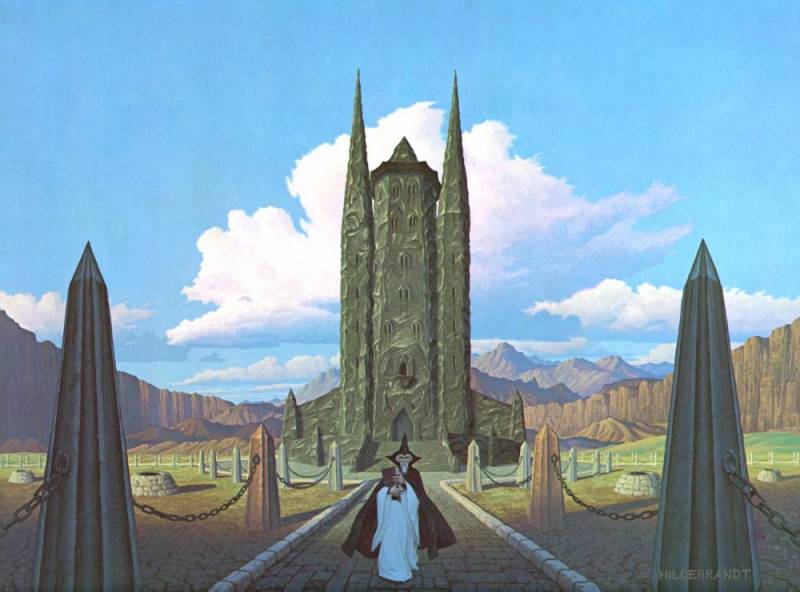
At our next stop, Isengard, Saruman,

image2orthanc.jpg

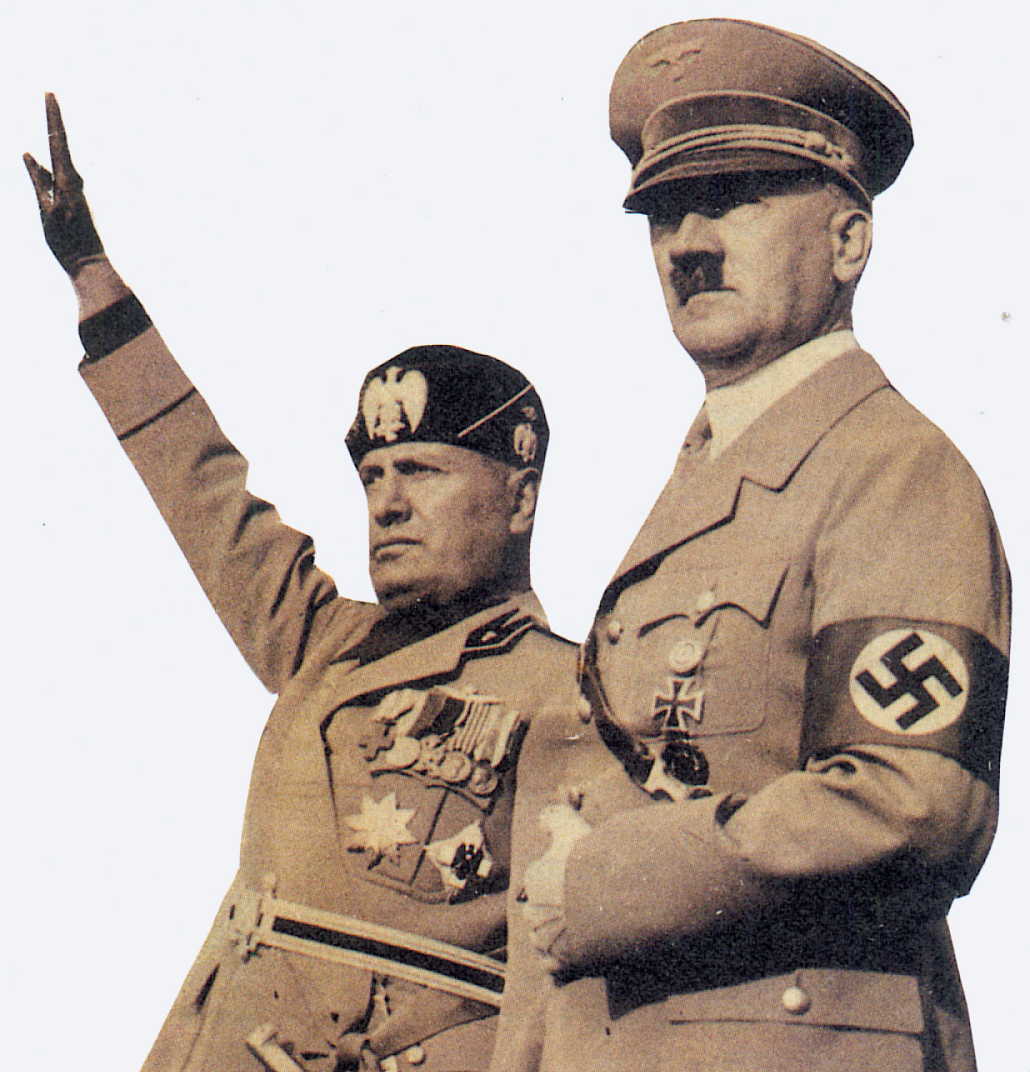
who had begun as one of the five Maiar sent to oppose the annoyingly-persistent Sauron, had moved from being what Gandalf called “the chief of my order” (The Fellowship of the Ring, Book One, Chapter 2, “The Shadow of the Past”), to being a kind of dictator—but one in the shadow of Sauron, just as Mussolini (1883-1945), who, from 1922, had been a model for such figures,

image3march.jpg

had fallen, by the later 1930s, into being the shadow of another, more powerful, dictator.

image4mushit.jpg

Like Elrond and Galadriel, he carries no title, but his captain, Ugluk, calls him “the Wise, the White Hand:  the Hand that gives us man’s-flesh to eat”, which probably tells us more than we want to know about his rule. (The Two Towers, Book Three, Chapter 3, “The Uruk-hai”)

We believe that this shadow may have been created by Saruman’s growing arrogance (which Gandalf points out to Frodo in “The Shadow of the Past”) combined with his overconfidence in using a palantir he has found in Orthanc and which puts him into communication with Sauron—and Sauron’s ability to seduce.

image5palantir.jpg

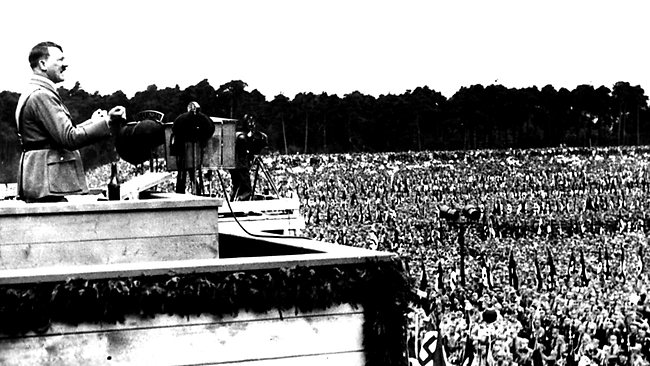
Sauron himself seems like the primal dictator, but a dictator before the 20th century, when dictators began to have a growing media world to employ to make themselves omnipresent in the lives of their citizens.

image6hitradio.jpg

image7hitmovie.jpg

Instead, he’s  remote—sitting in the Barad dur, yet

image8baraddur.jpg

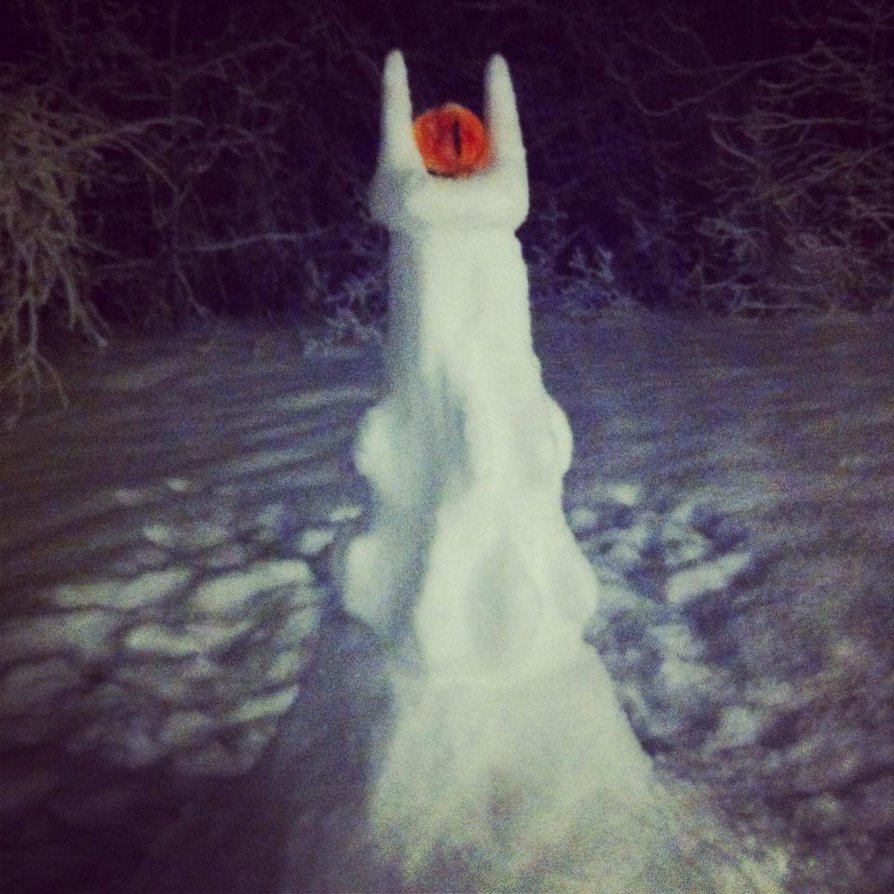
(and we can’t resist this image by “Rackthejipper”)

image9baradsnow.jpg

represented as being like 1984’s Big Brother, always watching.

image10bb.jpg

Or, as it is crudely represented in the Jackson films, literally a giant eye on a tower.

image11jack.jpg

When one thinks of modern dictators, however, one imagines them backed by huge bureaucracies, like the ministries in 1984:

“The Ministry of Truth–Minitrue, in Newspeak [Newspeak was the official

language of Oceania. For an account of its structure and etymology see

Appendix.]–was startlingly different from any other object in sight. It

was an enormous pyramidal structure of glittering white concrete, soaring

up, terrace after terrace, 300 metres into the air. From where Winston

stood it was just possible to read, picked out on its white face in

elegant lettering, the three slogans of the Party:


WAR IS PEACE

FREEDOM IS SLAVERY

IGNORANCE IS STRENGTH


The Ministry of Truth contained, it was said, three thousand rooms above

ground level, and corresponding ramifications below. Scattered about London

there were just three other buildings of similar appearance and size. So

completely did they dwarf the surrounding architecture that from the roof

of Victory Mansions you could see all four of them simultaneously. They

were the homes of the four Ministries between which the entire apparatus

of government was divided. The Ministry of Truth, which concerned itself

with news, entertainment, education, and the fine arts. The Ministry of

Peace, which concerned itself with war. The Ministry of Love, which

maintained law and order. And the Ministry of Plenty, which was responsible

for economic affairs. Their names, in Newspeak: Minitrue, Minipax, Miniluv,

and Miniplenty. (George Orwell, 1984, Chapter 1)


Instead, what we can see of Sauron’s government is much more medieval, beginning with the Nazgul, who were once human kings,

image12nazgul.jpg

who would be like the barons, the chief feudal deputies  of a king in a feudal world of the sort medieval England was and upon which much of Middle-earth, as we’ve suggested in many earlier postings, was based.  The chief of these was then the commander of Sauron’s main attack on Minas Tirith.

image13naz.jpg

To which we would add “the Voice of Sauron” (reminding us, of course, that he is only the spokesperson and Sauron would be presumed to have his eye on him, as well).  If you look for images of him, you will commonly find this:

image14jack.jpg

But, like certain other depictions in the Jackson films (that eye, for example), it is a very literal interpretation for someone JRRT described as:

“The rider was robed all in black, and black was his lofty helm; yet this was no Ringwraith but a living man…it is told that he was a renegade, who came of the race of those that are named the Black Numenoreans…” (The Return of the King, Book Five, Chapter 10, “The Black Gate Opens”)

Here’s an image possibility which comes a bit closer to the text, in our opinion.

image15lieutenant.jpg

From dictators, we make a final stop at two actual feudal  kings, the first, the ruler of Rohan, Theoden,

image16theoden.jpg

is clearly the descendant of earlier kings, as we are told in Appendix A, of The Lord of the Rings, “The Kings of the Mark”, where the line begins with Eorl the Young and continues for about five hundred years.

In the case of our other monarchy, Gondor, the kings who ruled for so many centuries (from SA3320 to TA 2050), have disappeared and, though the fiction is maintained that they will someday return, the actual ruler is their deputy, the Steward, and his role as lieutenant is symbolized literally by his position in the old throne room:

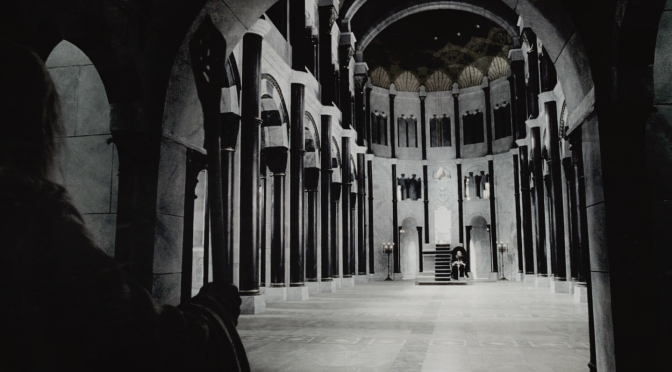
“At the far end, upon a dais [a kind of raised platform] of many steps was set a high throne under a canopy of marble shaped like a crowned helm; behind it was carved upon the wall and set with gems an image of a tree in flower.  But the throne was empty.  At the foot of the dais, upon the lowest step which was broad and deep, there was a stone chair, black and unadorned, and on it sat an old man gazing at his lap.”  (The Return of the King, Book Five, Chapter 1, “Minas Tirith)image17throne.jpg

At the same time, Denethor, and all of the previous Stewards, were kings in all but name, having ruled Gondor for twenty-five generations (see Appendix A, “The Stewards” for details).

So, in sum we have:

  1. 2 possible oligarchies (the Shire, Bree)
  2. 4 kingdoms (or at least sort of, in the case of the Elves—Rivendell, Lorien, plus Rohan and Gondor)
  3. 2 dictatorships (eastern Rohan, extending from Isengard, Mordor)

And, just when we were summarizing, the thought came to us:  what about the dwarves?  We can imagine that, considering Thorin’s family, there have been the equivalent of kings among the dwarves, but that’s a posting for another day!

Thanks, as ever, for reading.

MTCIDC

CD

Psalters and Psalms

11 Wednesday Apr 2018

Posted by Ollamh in Artists and Illustrators, Heroes, Literary History, Military History

≈ Leave a comment

Tags

Easter Sepulchre, Irnham, King David, King John, Lincolnshire, Luttrell Psalter, Magna Carta, Medieval, Middle-earth, Nottingham, psalter, Robin Hood, Scriptorium, Sir Geoffrey Psalter, St Andrew's, Tolkien, Utrecht Psalter, Westminster Psalter

As always, dear readers, welcome.

In past posts, we’ve occasionally used images from a very famous medieval manuscript, the Luttrell Psalter.  One fairly recent one, on carts and wagons in Middle-earth, included this, for example—

image1a.jpg

A medieval psalter is a collection of psalms—religious poems which were traditionally attributed to King David of Israel–

image1david.jpg

(This is, in fact, from the Westminster Psalter, c.1200)

plus other Christian religious material.  It was clearly a place which offered lots of opportunities for illustrations because a number of them have them, some of them very generous in just how many, like the Utrecht Psalter, from the 9th century, which has an illustration for every psalm.

image2utrecht.jpg

The Utrecht Psalter has been digitized—here’s a LINK so that you can see all of this wonderful book.

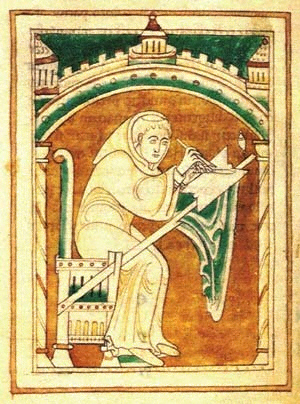
Such books were created in the medieval equivalent of copy-centers, called scriptoria (singular = scriptorium).  For many years, it was said that this was a specific room in a monastery in which teams of monks worked on writing/copying books.  More recently, this view has been challenged (see this LINK for discussion on the subject), but certainly monks made and copied books, as this manuscript illustration of the 12th-century English priest and Latin poet, Lawrence of Durham reminds us.  In fact, this illustration may be more accurate than other medieval illustrations as it shows Lawrence working on a single sheet, which was the standard method.  All sheets were then gathered up and bound into a book—a very different scene from this Spanish medieval illustration, in which at least the monk on the right seems to be writing in a book (the figure on the left looks to be a lay person and may be painting—hence, illustrating).

image3larryofd.jpg

scriptorium-2echternach.jpg

Illustrated books—especially heavily-illustrated books like the Luttrell Psalter—would have been very costly, and so only the wealthy would have commissioned such a work.  We know the name of the person who commissioned this book because that name and a suggestion of a portrait are at Psalm 109 of the manuscript.

image4sirgeoff.jpg

As it says just above the illustration:  “DNS Galfridus Louterrell me fieri fecit” = The Lord Geoffrey Luttrell had me made”.

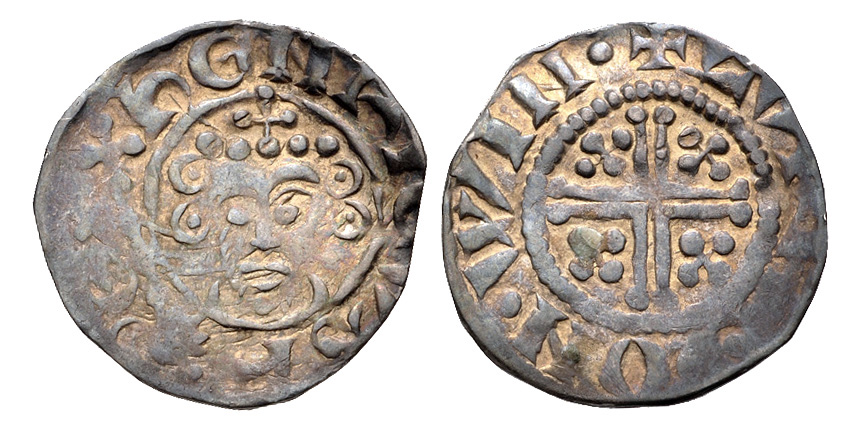
Sir Geoffrey (1276-1345) was descended from an earlier Sir Geoffrey, who had been a supporter of King John (1166-1216), the dodgy character of the Magna Carta and from the Robin Hood story.

image5kingjohn.jpg

image6princej.jpg

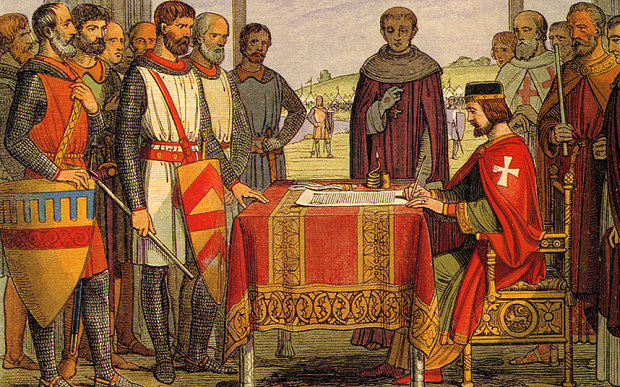
Here’s King John forced to sign the Magna Carta, designed to lessen the king’s power and increase that of the nobles—

image7.jpg

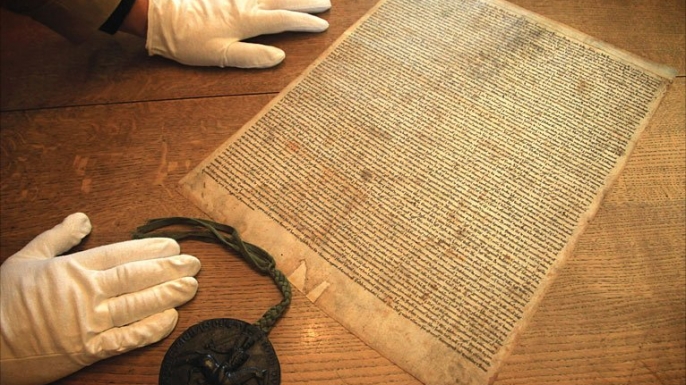
which, of course, he didn’t do, since the sign of royal approval in 1215 wasn’t a name, but an official seal.

image8magnacarta.jpeg

Sir Geoffrey’s descendant, also Geoffrey, held land, among other places, around Irnham (probably from the Old English for “Georna’s settlement”, Geornaham) in Lincolnshire (yes, when it comes to England, we can never quite escape the Shire, can we?).  Here’s where Lincolnshire is on a map of England.  (It’s interesting that Nottingham, notorious for its sheriff and Prince John in the Robin Hood stories, is only about 40 miles west of Irnham.)

image9lincolnshire.png

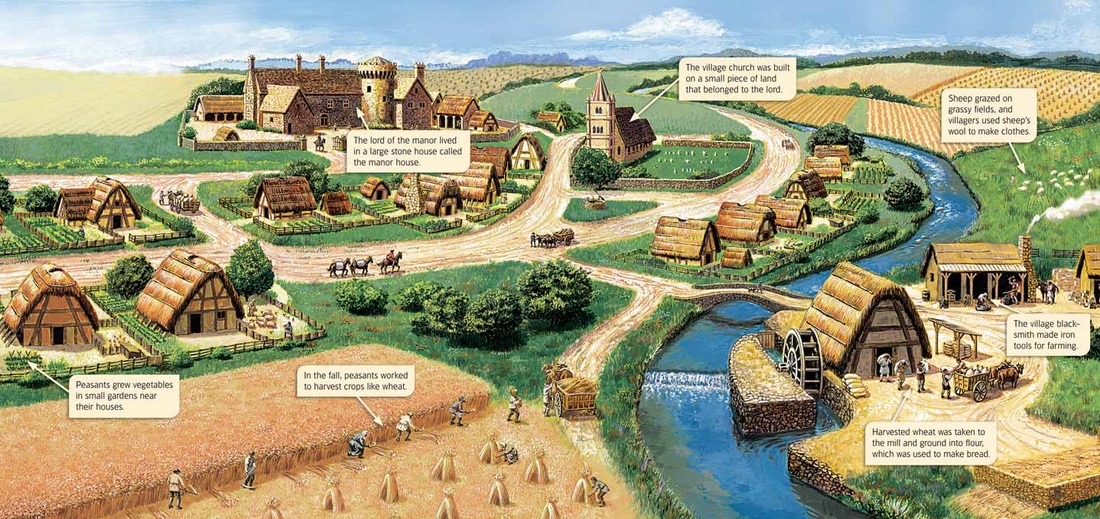
This Sir Geoffrey’s manor house has long disappeared, but we imagine that the area called a manor might have looked something like this.

image10manor.jpg

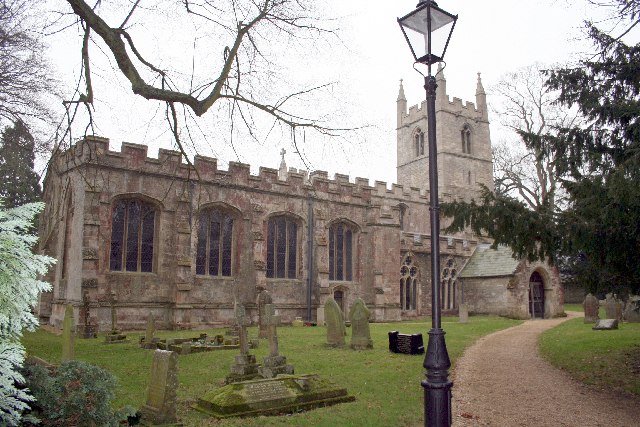
Its church, St Andrew’s, survives, however, and, though rebuilt in 1858, dates from the 12th century.

image11stas.jpg

Inside, is a monumental brass for Sir Geoffrey’s son, Andrew, (died 1390).

image12sirgjr.jpg

There is no tomb for his father, Sir Geoffrey, but there is what’s called an “Easter Sepulchre”, which was commissioned by him and which may have been based upon such a tomb.

image13eastersepulchre.jpg

This piece of architecture was used in an elaborate ceremony connected with the celebration of the Christian Easter in the Middle Ages.

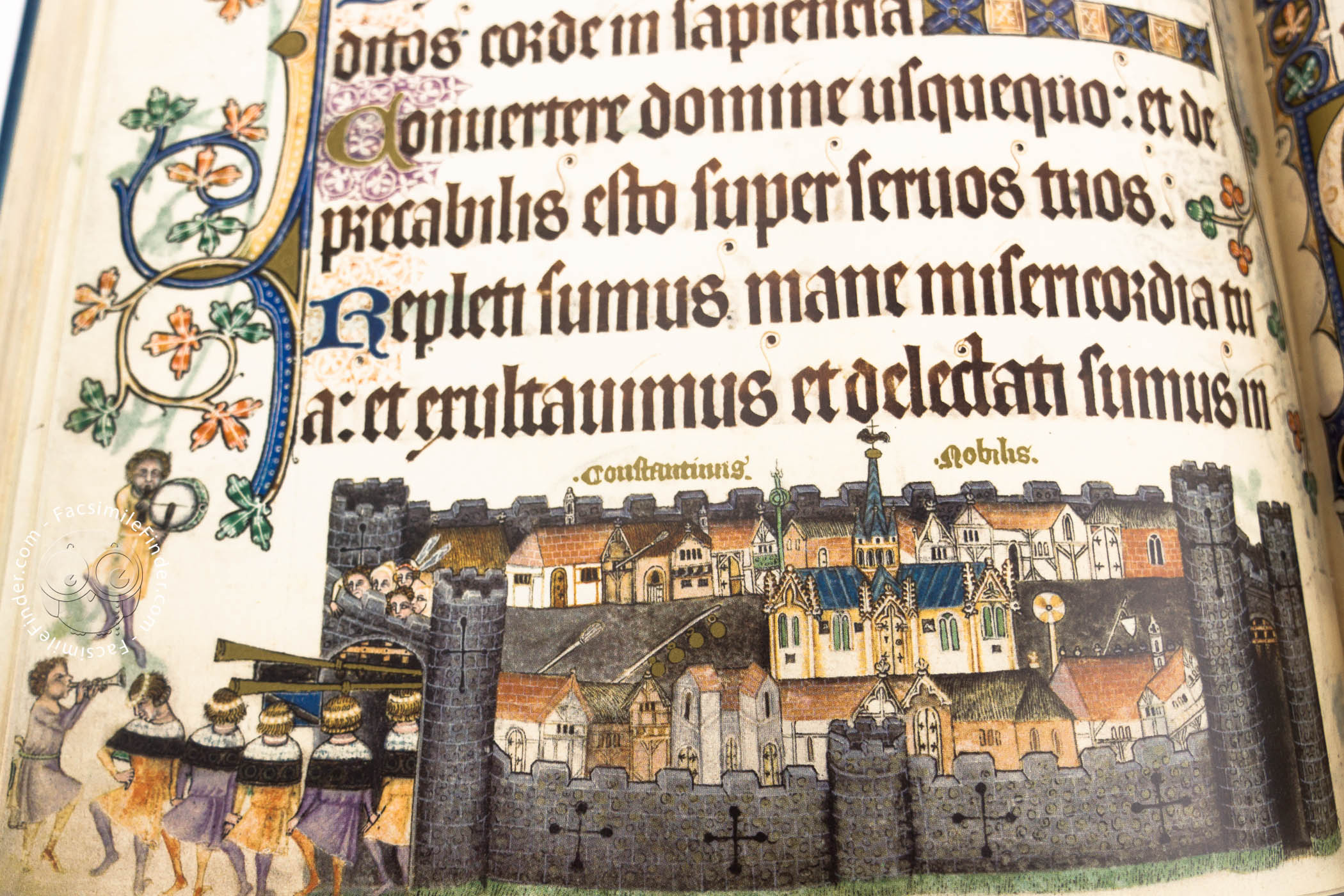
Beyond the church, our monument to Sir Geoffrey is the psalter, over whose date there has been lots of scholarly discussion, so we’ll go with the general area of dating, c.1320-1340.  The book is about 14.5 inches by 10.5 (368.3mm x 266.7mm) and contains 309 pages made of vellum (fine calfskin), with illustrations on more than 200 pages.  The text was written by a single scribe, it is thought, but at least five artists were involved in the illustrating—and what illustrations!

In fact, it seems a crazy variety, and, unlike the Utrecht Psalter, the illustrations don’t match the psalms.  Instead, the scenes depicted vary from the high religious—like the three Wise Men/Kings/Magi following the star to Bethlehem, from the New Testament

image14magi.jpg

to all sorts of grotesque creatures

image15grotesque.jpg

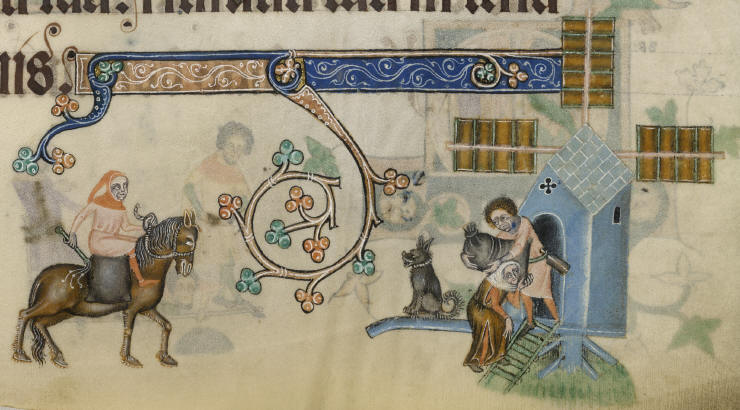
to what we love most, the agricultural and domestic scenes.

These can show a whole town

image16town.jpg

or mills, both water and wind-drivenimage18mill.jpg

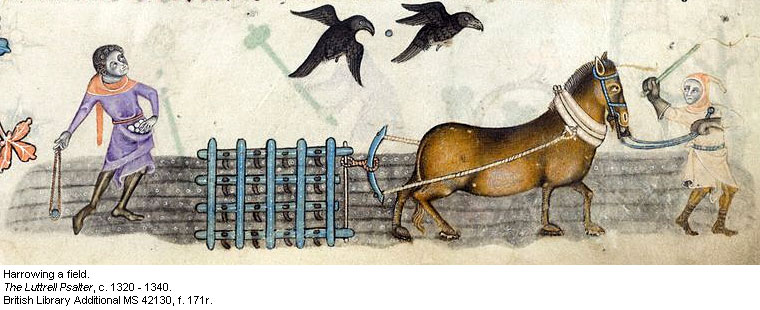
image19windmill.jpgor how the grain is raised and processed to get to the mills

image20aplowing.jpg

image20harrrowing.jpg

image21reaping.jpg

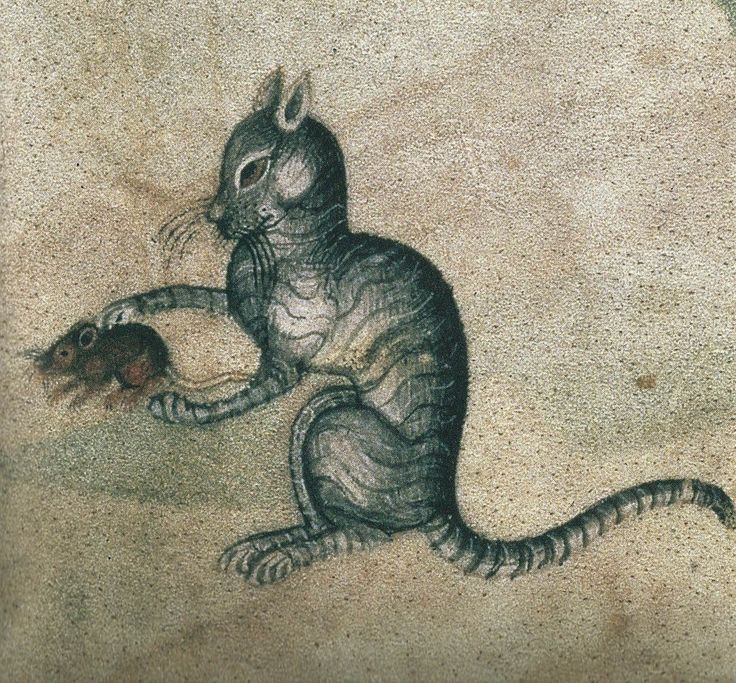
or even controlling the pests who would eat the grain.  (Is this a screencap from the first cat video?)

image23catandmouse.jpg

Here’s a LINK to a selection of images from the British Library, but there are more if you google “Luttrell Psalter”.  See what your favorites might be.

And thanks, as always, for reading!

MTCIDC

CD


ps

Let’s add here a LINK to a short film based upon the psalter, which we think you might enjoy.

“Dragons, Other”

21 Wednesday Mar 2018

Posted by Ollamh in Artists and Illustrators, Fairy Tales and Myths, Heroes, J.R.R. Tolkien, Literary History, Maps

≈ Leave a comment

Tags

Arthur Rackham, Beowulf, C.S. Lewis, Chrysophylax, Custard the Dragon, Dragons, Dream Days, Esgaroth, Farmer Giles of Ham, Jabberwock, Jabberwock-slayer, Kenneth Grahame, Lewis Carroll, Lonely Mountain, Luttrell Psalter, map, Middle-earth, Narnia, Ogden Nash, Pauline Baynes, Rumer Godden, Smaug, St George, The Chronicles of Narnia, The Dragon of Og, The Hobbit, The Lion The Witch and the Wardrobe, The Lord of the Rings, The Reluctant Dragon, Through the Looking-Glass, Tolkien, Walt Disney

As always, readers, welcome.

One of us is currently teaching a class where our present focus is upon The Hobbit.

image1hob1st.jpg

At the center of the book is the Lonely Mountain and at the center of that is Smaug.

image2aerebor.jpg

image2smaug.jpg

This got us to thinking about other dragons in our experience, and some of those are not quite of the same breed as the hoard-sitter faced by Bilbo and the dwarves.  That dragon is closely related to the Beowulf variety

image3beowulfdragon.jpg

which, unlike Smaug, has neither a name nor (it seems) human speech, but it certainly has the same suspicious streak:  when an escaped slave steals a cup from its hoard, it’s almost immediately aware that it’s missing and suspects a human.

image4stealingcup.jpg

And they are both vengeful.  As Smaug devastates Esgaroth, even if he dies for it,

image5esgaroth.jpg

image6smaug.jpg

so Beowulf’s dragon scorches the countryside in revenge for the theft.

But what about those other dragons?

First, we thought of Kenneth Grahame’s Dream Days (1898),

image7kg.jpg

image8dreamdays.jpg

a collection of short stories, the next-to-last of which is “The Reluctant Dragon”.

image9reluct.jpg

This is the story of a beast the very opposite of Smaug—no hoard, no suspicion, no flaming violence, and, in fact, a poetry lover.  This story was then converted into a Disney cartoon of 1941.

image10reluct.jpg

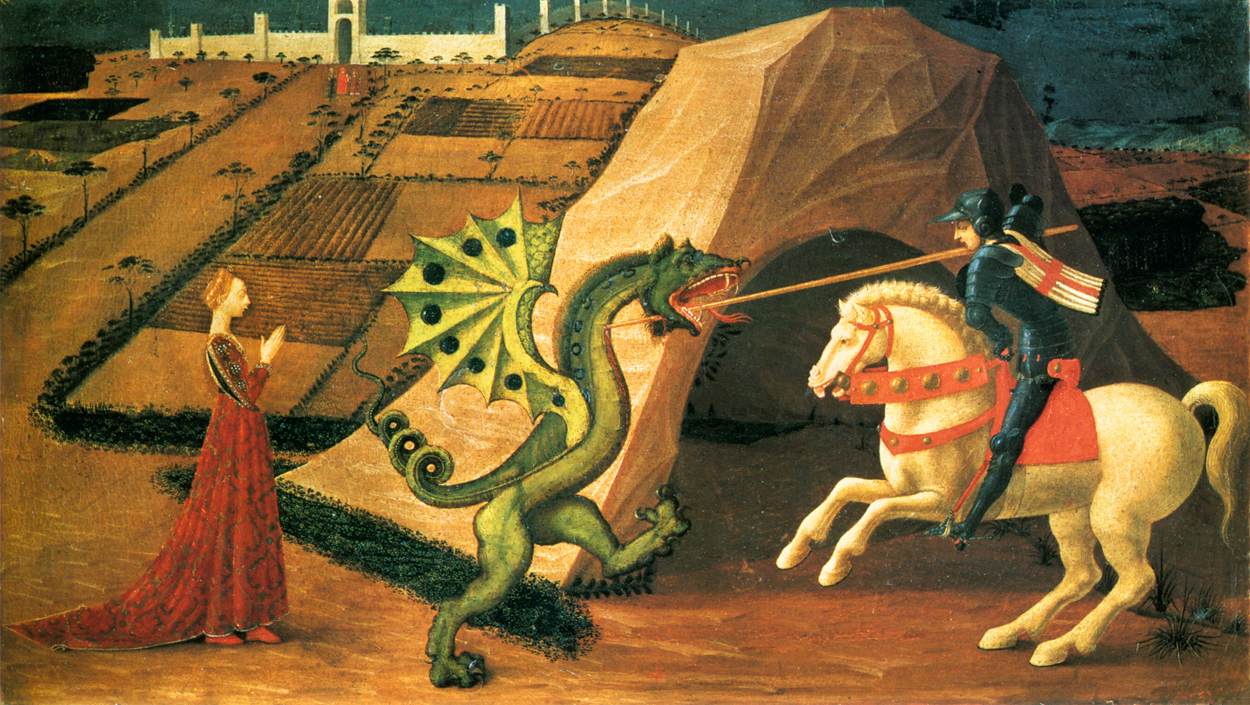
Needless to say, although the core of the plot is the same, what makes the Grahame distinctive is the language.  All of the major characters:  the dragon, the little boy who finds him, and St. George, who is brought in as a dragon-slayer, are thoughtful and articulate late Victorians who would rather discuss literature than do battle—a far cry not only from Beowulf’s encounter, but also from every other earlier depiction we could think of.

image11ucellostgeo.jpg

image12stgeo.jpg

image13stgeo.jpg

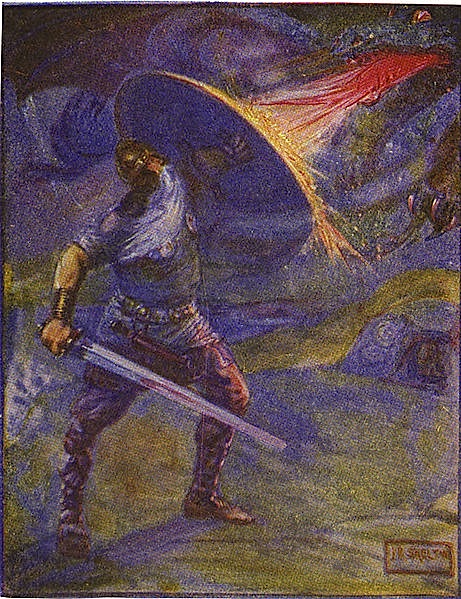
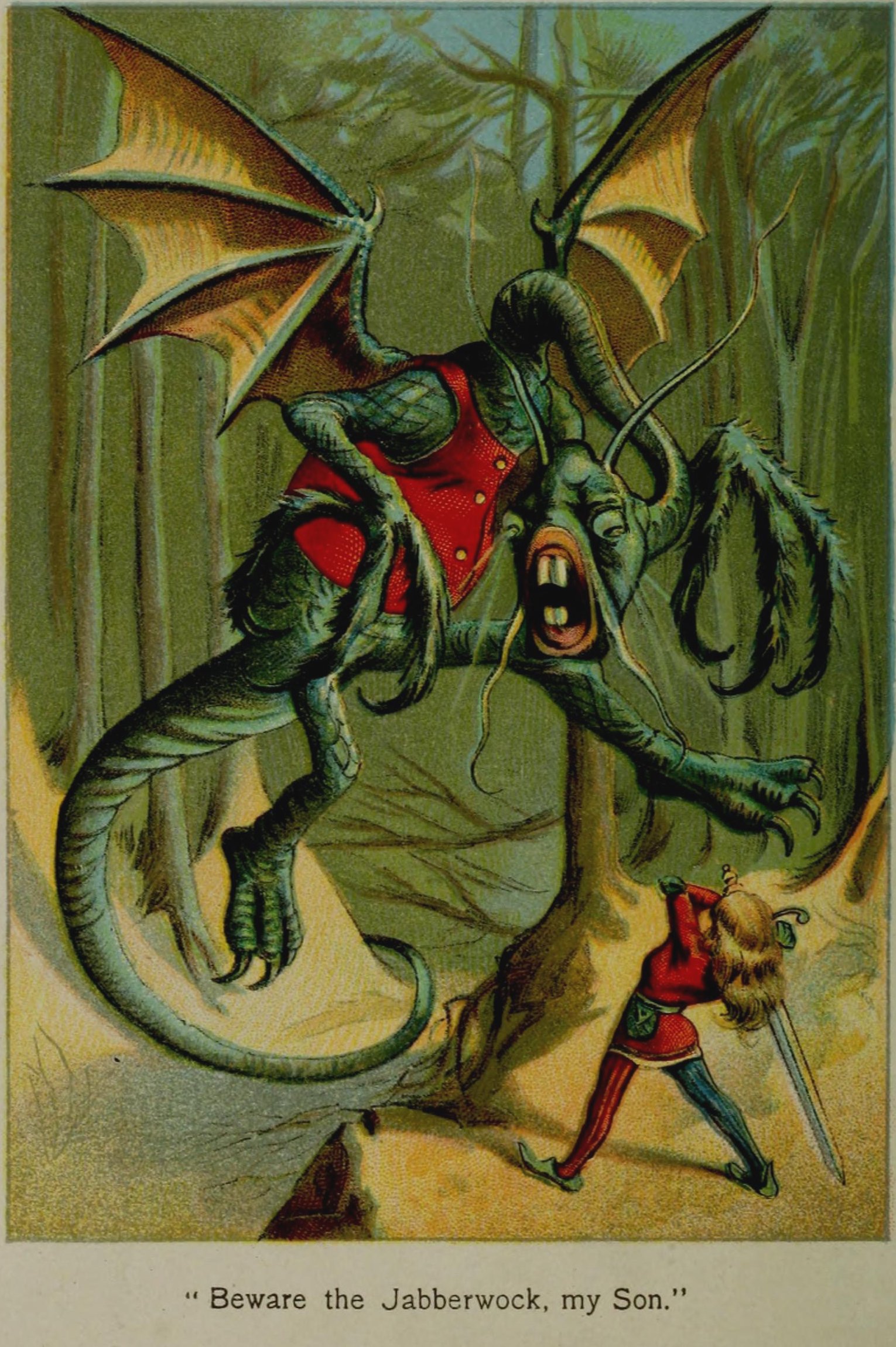
The sword in this last one looks like it actually belongs in the hands of the jabberwock-slayer

image14jabberwocky.jpg

in Lewis Carroll’s Through the Looking-Glass (1872).

image15through.jpg

Here’s a LINK to Dream Days so that you can enjoy the story for yourselves.

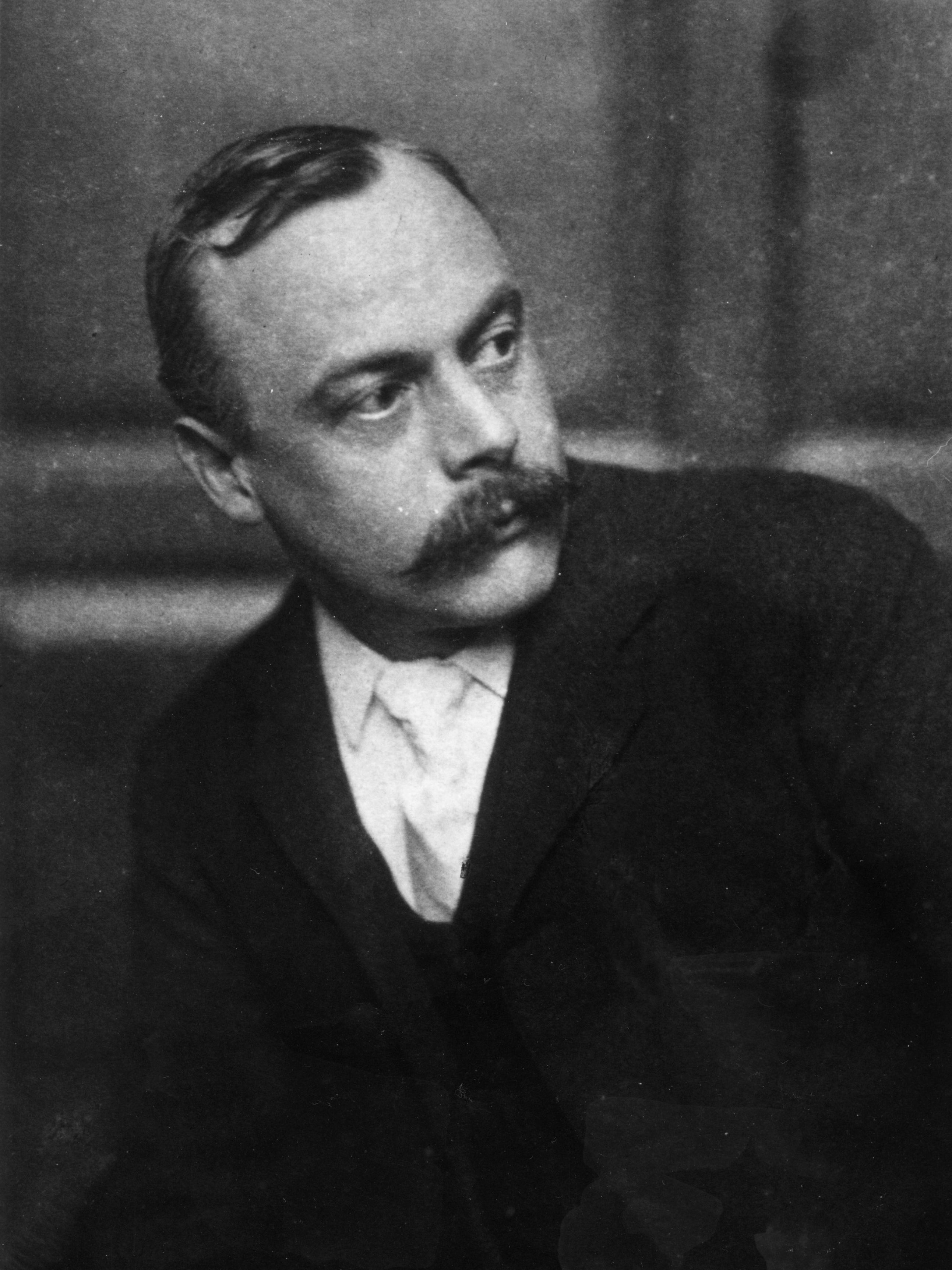
Nearly sixty years later, the comic verse writer, Ogden Nash,

image16nash.jpg

produced not a literary dragon, but a timid one in “Custard the Dragon” (1959).

image17custard.jpg

This is a poem in 15 stanzas and is a story about Belinda and her pets, including a dragon, who is taunted by the other pets as being less than brave.  To underline this, the last line in a number of stanzas is a variation upon the first version of the line, “But Custard cried for a nice safe cage”.  (Here’s a LINK to the poem.)

The surprise is that, when a pirate climbs in through the window (this happens all the time here—possibly they escape from dreams?), Custard promptly eats him—and the cries of “Coward!” disappear immediately.

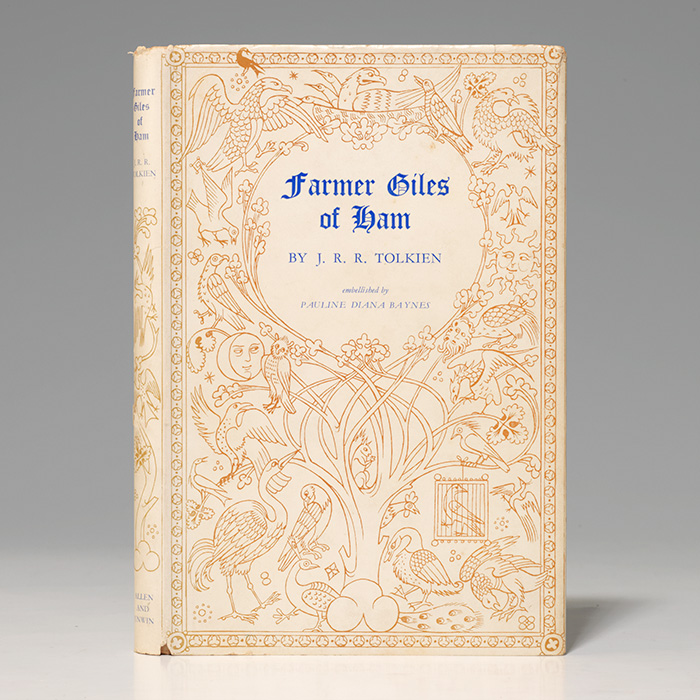
In contrast to the unnamed dragon in “The Reluctant Dragon” and in “Custard the Dragon”, our next dragon is a talker—like Smaug, but also like Smaug, potentially malevolent.  This is Chrysophylax in JRRT’s 1937/1949 Farmer Giles of Ham.  (JRRT is having a quiet joke here—“Chrysophylax” is Ancient Greek for “Goldguard”.)

image18chrysophylax.jpg

image19afgoh.jpg

The artwork is by Pauline Baynes (1922-2008).

image19pb.jpg

If, like us, you’ve loved the Narnia books, then you know her as their original illustrator.

image20lion.jpg

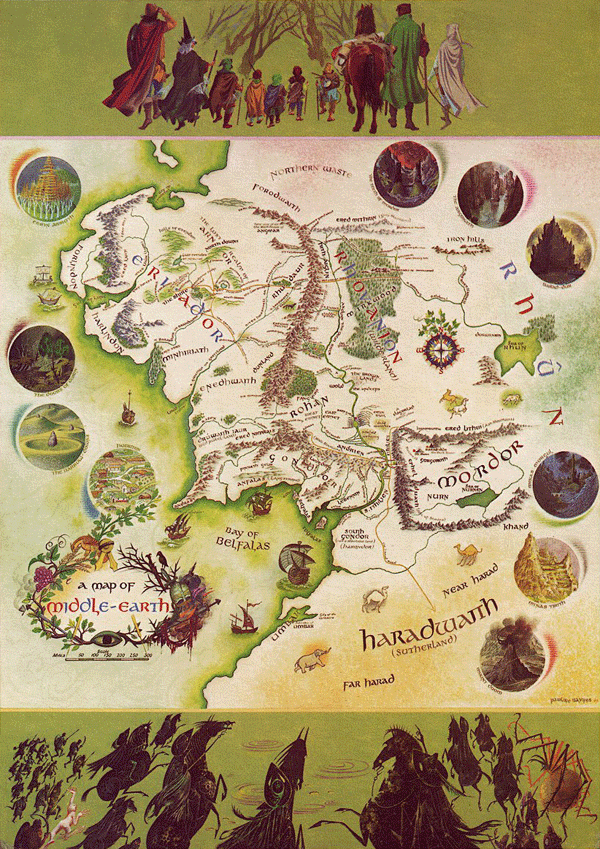
She was also the artist for an early Middle-earth map.
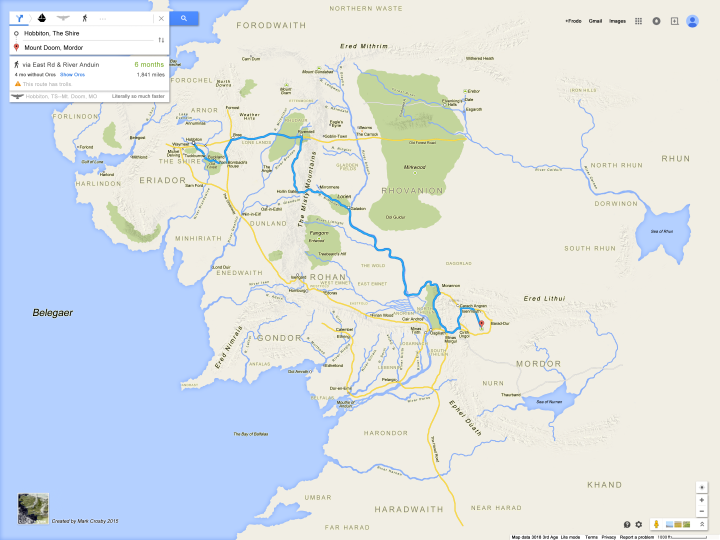
image21memap.gif

Her 2008 obituary in The Daily Telegraph tells of how they came to work together:

“In 1948 Tolkien was visiting his publishers, George Allen & Unwin, to discuss some disappointing artwork that they had commissioned for his novella Farmer Giles of Ham, when he spotted, lying on a desk, some witty reinterpretations of medieval marginalia from the Luttrell Psalter that greatly appealed to him.  These, it turned out, had been sent to the publishers “on spec”by the then unknown Pauline Baynes.”   (The Daily Telegraph, 8 August, 2008)

JRRT was then so impressed with her work that it appeared both in other later publications and his recommendation led to her being engaged by CS Lewis’ publisher for the Narnia books, as well.  (And here’s a LINK to that obituary, which has more on Tolkien and Baynes, as well as Lewis.)

And the Baynes connection leads us to one further dragon, that in Rumer Godden’s  (1902-1998) 1981 The Dragon of Og, for which Baynes provided the cover art.

image22rg.jpg

image23dragog.jpg

It’s not our practice to discuss work we haven’t read, but we’ve just discovered this novel and have already put it on our spring reading list.  The little we know about it comes from a blurb or two, but it looks promising:  this is more of the reluctant dragon, but one who is in danger of being provoked by a new local lord until his wife steps in and cleverly changes the situation.

Before we close, however, we want to look back for a second at the Tolkien/Baynes connection and add two further things.  First off, here’s the first page of JRRT’s graceful letter of thanks and praise to Baynes for her work in illustrating Farmer Giles.

image24letter.jpg

Second, as the Telegraph obituary says, Tolkien was impressed with her versions of the marginalia from the Luttrell Psalter, which is high on our list of favorite medieval manuscripts.

image25luttrellpsalter.jpg

In our next, we want to spend some time looking at that work, thinking about marginalia, and not only there, but also in the work of another favorite illustrator, Arthur Rackham (1867-1939).

Till then, thanks, as always, for reading.

MTCIDC

CD


Wormy

21 Wednesday Feb 2018

Posted by Ollamh in J.R.R. Tolkien, Military History, Military History of Middle-earth, Villains

≈ Leave a comment

Tags

Adolf Hitler, Bilbo, Dragon, Fifth Column, Gandalf, Germany, Grima, Madrid, Middle-earth, Nazis, Norway, Norwegian facist party, Republican government, Rohan, Saruman, Second World War, Smaug, Spanish Civil War, The Hobbit, The Lord of the Rings, The Scouring of the Shire, Theoden, Tolkien, traitor, Vidkun Quisling, William Blake, worm, Wormtongue

Welcome, as always, dear readers.
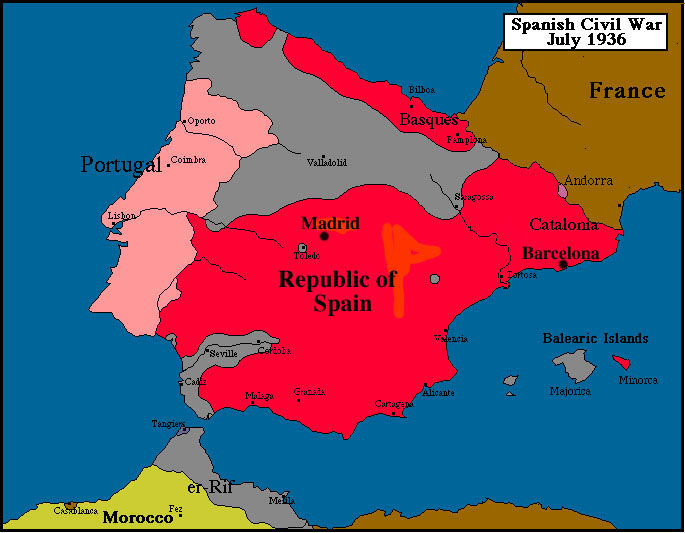
In 1936, the Nationalist forces were marching to attack the Republican government in Madrid, during the Spanish Civil War.
image1nationalists.jpg
image2attackonmadrid.jpg
When interviewed, a Nationalist general is reported to have said that, as four military columns were about to assault the city,
image3natattack.jpeg
a fifth column of loyalists would join the attack from inside.
image4natattack.jpg
This phrase “fifth column”, then, was picked up and began to be used world-wide to mean “traitors/betrayers from within” and was popular during the Second World War era.
image5thcol.jpg

When the Nazis attacked Norway in 1940,
image6nazislandinginnorway.jpg
and the Allies failed to defend their positions there successfully and were forced to surrender or flee
image7capturedtroops.jpg
a member of the small Norwegian fascist party, Vidkun Quisling,
image8quisling.jpg
declared himself ruler as the Germans marched in.
image9conqueringgermans.jpg

In time, the Nazis recognized him as the head of Norway and he even had an audience with Hitler.
image10hitandquis.jpg

This time, a specific “fifth columnist” had not only betrayed his country, but also profited greatly from it and, when we looked at the dates—1936 and 1940—we wondered, as we so often do, if the current events of our world may have colored JRRT’s relation of the events in Middle-earth—even as we hasten to say, as we always do, that this is just a suggestion.
In his first meeting with Aragorn, Eomer is troubled and his veiled comments suggest just the same sort of fifth-columnist action:
“But at this time our chief concern is with Saruman. He has claimed lordship over all this land, and there has been war between us for many months…”
His concern, however, as we see, is for more than border security, as he says of Saruman:
“His spies slip through every net, and his birds of ill omen are abroad in the sky. I do not know how it will all end, and my heart misgives me; for it seems to me that his friends do not all dwell in Isengard. But if you come to the king’s house, you shall see for yourself.” (The Two Towers, Book Three, Chapter 2, “The Riders of Rohan”)
So, all is not well, not only in Rohan, but in Meduseld itself. When Gandalf and the other survivors of the Fellowship arrive at the gates of Edoras, they are stopped by guards and by a command from Theoden, king of Rohan—or is it? A guard says:
“It is but two nights ago that Wormtongue came to us and said that by the will of Theoden no stranger should pass these gates.” (The Two Towers, Book Three, Chapter 6, “The King of the Golden Hall”)
“Wormtongue” seems a very odd name—do worms actually have tongues?
image11worm.JPG
But this isn’t a worm, it’s a “worm”—an old term for “dragon”.
image12smaug.jpg
And, if Smaug’s speech and its effect upon Bilbo is anything to go by:
“Bilbo was now beginning to feel really uncomfortable. Whenever Smaug’s roving eye, seeking for him in the shadows, flashed across him, he trembled, and an unaccountable desire seized hold of him to rush out and reveal himself and tell all the truth to Smaug. In fact he was in grievous danger of coming under the dragon-spell.” (The Hobbit, Chapter 12, “Inside Information”)
then a person having a dragon tongue might be a real threat, as Wormtongue, seated at Theoden’s feet,
image13theodenandgrima.jpg
inserts himself between Gandalf and Theoden:
“Why indeed should we welcome you, Master Stormcrow? Lathspell I name you, Ill-news; and ill news is an ill guest they say.”
Gandalf immediately resists this and, in a burst of power, breaks the real “spell”—the dragon’s words which Grima Wormtongue has been pouring into Theoden’s ears, as Theoden says to him of Gandalf’s efforts: “If this is witchcraft…it seems to me more wholesome than your whisperings. Your leechcraft [that is, “medical skill”—obviously ironic here] ere long would have had me walking on all fours like a beast.”
[A footnote here—is JRRT making a quiet reference to the fate of Nebuchadnezzar, king of Babylon, mentioned in the book of Daniel in the Old Testament? In Chapter 4, the king is driven mad and spends seven years as a grazing animal to prove the power of the Hebrew divinity. Here is William Blake’s (1757-1827) striking depiction of the mad king.]
image14blake.jpg

Certainly something Grima has been doing has affected Theoden, as he is initially described as “a man so bent with age that he seemed almost a dwarf…” and this shrinking is suddenly reversed when Gandalf strikes Grima down:
“From the king’s hand the black staff fell clattering on the stones. He drew himself up, slowly, as a man that is stiff from long bending over some dull toil. Now tall and straight he stood, and his eyes were blue as he looked into the opening sky.”
For all that Grima has been blocked and Theoden restored, the fifth columnist tries once more. When he is told that he must ride with the king and his warriors to battle, he makes a countersuggestion:
“One who knows your mind and honours your commands should be left in Edoras. Appoint a faithful steward. Let your counsellor Grima keep all things till your return…”
But he gives himself away by finishing that sentence with “and I pray that we may see it, though no wise man will deem it hopeful.”
And Gandalf sees all too clearly what is behind Grima’s proposal—and who is behind it:
“Down, snake!…Down on your belly! How long is it since Saruman bought you? What was the promised price?…”
image15fallofgrima.jpg

Although it is said that Grima deserves death for his treachery, he is allowed to flee, and, when we next see him, he is with his true master, acting as his “footman” as Gandalf calls him (The Two Towers, Book Three, Chapter 10, “The Voice of Saruman). And here, as Bilbo’s pity has preserved Gollum for an unseen but vital part in the later story of the Ring, so Gandalf’s mercy to Grima preserves him for two final acts: first, his mistaken use of a palantir as a missile, which puts it into Gandalf’s hands and, ultimately into Aragorn’s, who shakes Sauron’s nerve with it; second, Saruman’s ultimate end:
“[Saruman] kicked Wormtongue in the face as he groveled, and turned and made off. But at that something snapped: suddenly Wormtongue rose up, drawing a hidden knife, and then with a snarl like a dog he sprang on Saruman’s back, jerked his head back, cut his throat, and with a yell ran off down the lane.” (The Return of the King, Book Six, Chapter 8, “The Scouring of the Shire”)
image16deathofsaruman.jpg
Grima doesn’t survive this attack, however: “Before Frodo could recover or speak a word, three hobbit-bows twanged and Wormtongue fell dead.”
Merry calls these final acts of violence “the very last end of the War”, but we would suggest a parallel with a specific event in our world: the end of Vidkun Quisling–executed by firing squad in October, 1945, for treason. Could we say that Grima’s death—deserved earlier, but deferred—was also a kind of execution for treason, against Rohan, finally carried out?
And a final thought: after World War 2, Quisling’s name became, for a time, an easy synonym for “fifth columnist/traitor”—could we imagine that, in the Common Speech of Middle-earth after the War of the Ring, the same might have happened to “Grima Wormtongue”?
Thanks, as ever, for reading.
MTCIDC
CD

Sugar Is Sweet, And…

01 Wednesday Nov 2017

Posted by Ollamh in Artists and Illustrators, J.R.R. Tolkien, Military History, Narrative Methods

≈ Leave a comment

Tags

15th-century hat, 15th-century sallet, Across the Doubtful Sea, Bag End, bevor, Bilbo, British Navy uniforms, Caribbean sugar mill, Christopher Columbus, clone helmet, costuming, Darth Vader, Death Star Gunners, French Navy uniforms, hogsheads, honey, John Mollo, Middle-earth, Samurai, science fiction, Star Wars, sugar, sugar cane, sugar loaf, Taters, Ten Views in the Island of Antigua, The Illiad, Tobacco
Welcome, dear readers, as always.

As we continue to explore Bilbo’s entryway, we feel a little like Bilbo himself watching as all of those dwarves gradually pile in until they almost overwhelm their surprised host.

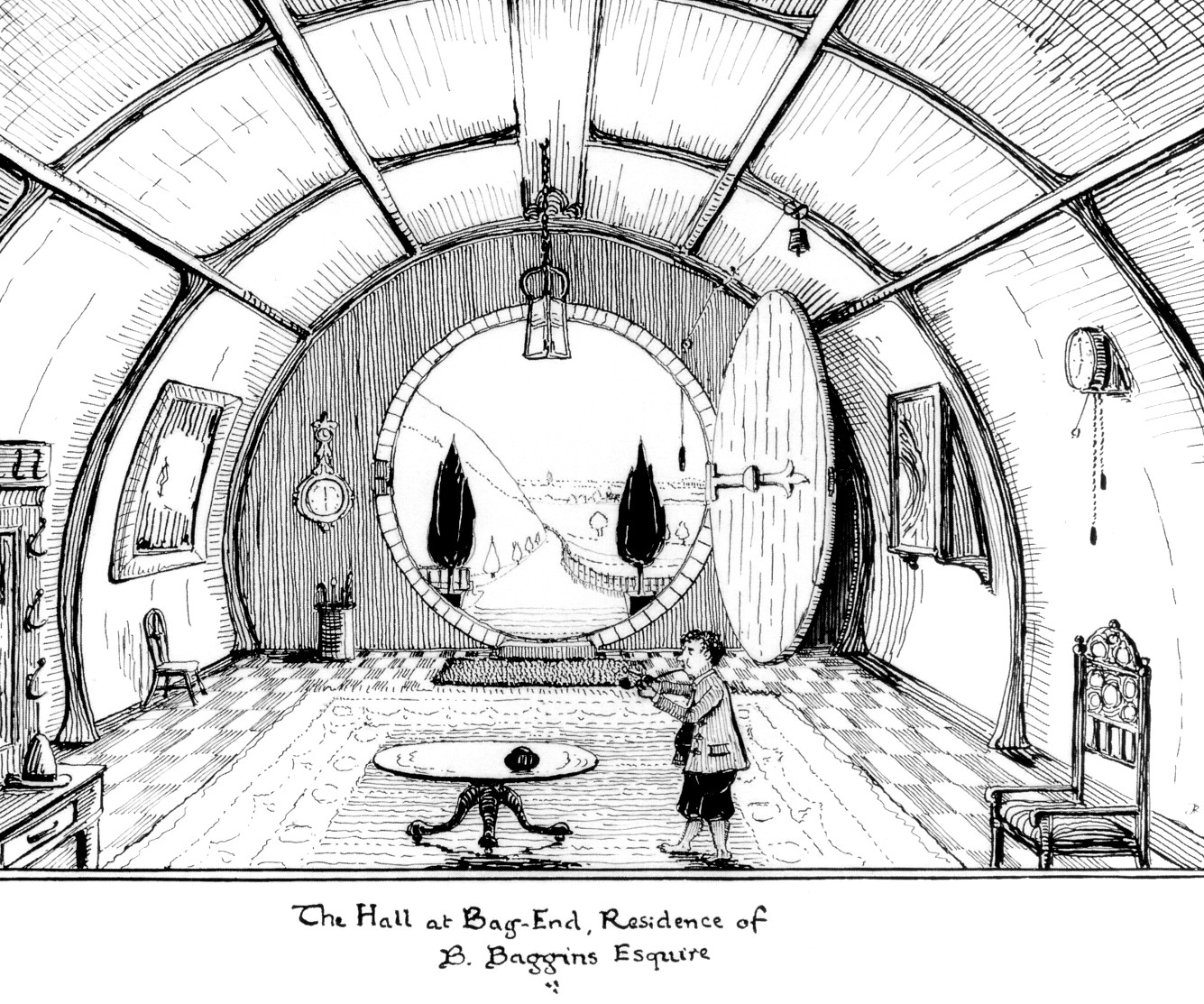
Unlike our earlier postings on barometers and clocks, which are really on the walls, in this posting, we confess to what is called in literary criticism a “creative misread”.  Take a look at the far left of the illustration.

image1bilboshallway.jpg

There is a kind of entryway table, with a mirror and hooks—probably for hats—and those should have tipped us off—but a preconceived notion overwhelmed us, inspired (well, we suppose you could call it that) by how we initially interpreted the object on the right hand corner.

It’s a hat—you can just make out the brim.  It’s a kind of 15th-century hat called a “sugarloaf”, however, because of the crown.

image2sugarloafhat.jpg

(There is a 13th-14th century helmet given that nickname, as well.

image3asugarloafhelm.jpg

In fact, perhaps there’s a certain similarity with the phase 1 clone helmet, if you add a sort of flange to the lower edge—and a ridge piece?

image3b.jpg

If so, it certainly wouldn’t be the only medieval-influenced helmet in Star Wars—just look at the Death Star gunners

image3cdeathstargunner.jpg

and compare it with a 15th-century sallet with its bevor

image3dsalletwbevor.jpg

Although Darth Vader’s helmet is a bit more samurai-ish.

image3edv.jpg

image3fsam.jpeg

All of these came to the screen through the work of uniform historian and costume designer John Mollo,

image3gjohnmollo.jpg

who died on 25 October, 2017, at the age of 86.  His work included not only science fiction costuming

image3himps.png

image3irebs.png

but also the text for works on the history of uniforms.  For our first novel, Across the Doubtful Sea, he and his illustrator for Uniforms of the American Revolution in Color (1975),

image3juniforms.jpg

provided us with an accurate view of the uniforms of the British and French navies of the period.

image3kbrit.jpg

image3lfrench.jpg


But—as we began to say—the crown of that hat bears that nickname because it looks like sugar as it used to be formed, shipped, and sold.

Today, we see sugar in bags

image4sugarbag.jpg

or in little packets in fast food restaurants

image5packet.jpg

or even in cubes.

image6sugarcubes.jpeg

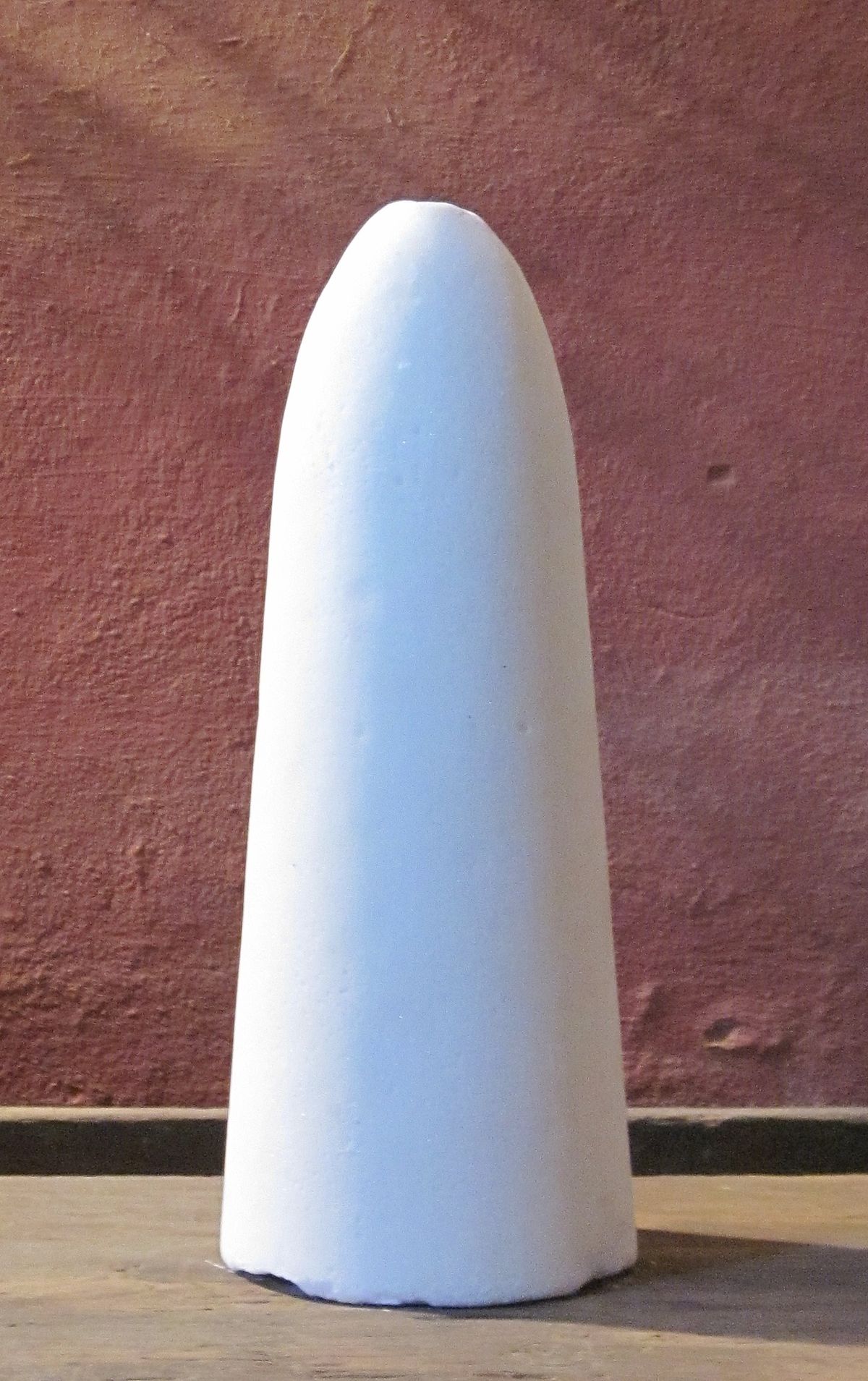
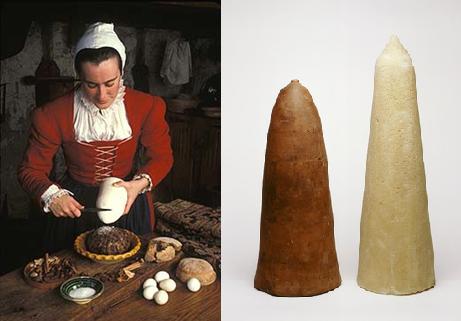
In earlier centuries, sugar came in a very different form:

image7sugarloaf.jpg

and, to use it, you had special tools to snip off or scrape off pieces when you needed them.

image8tongues.jpg

image9sugarwork.jpg

Sugar came like this because of the process by which sugar was extracted from a very tall plant,

image10sugarcanefield.jpg

the sugar being inside the plant.

image11sugarcane.jpg

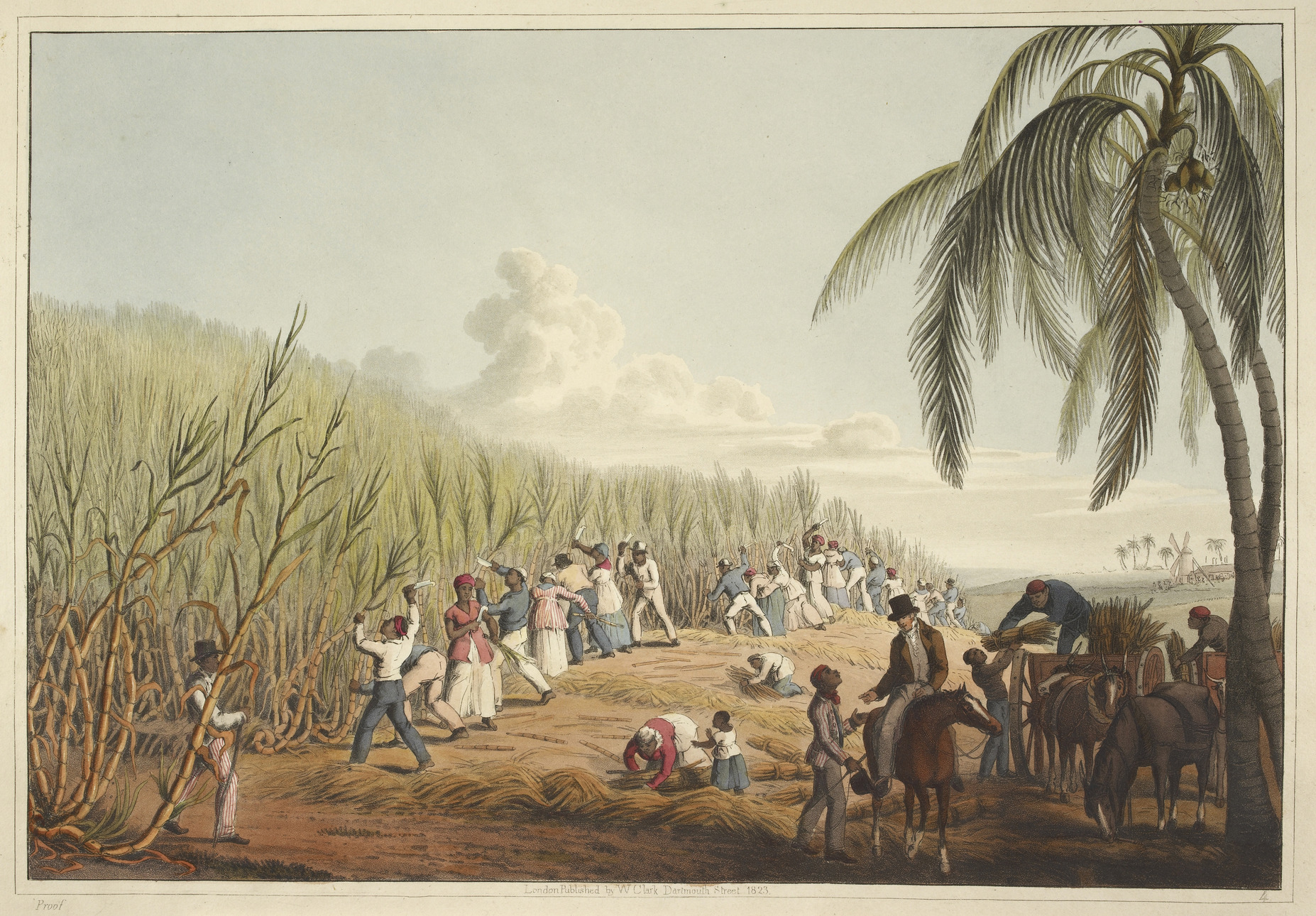
The first step was to cut the plant down.

image12cutting.jpg

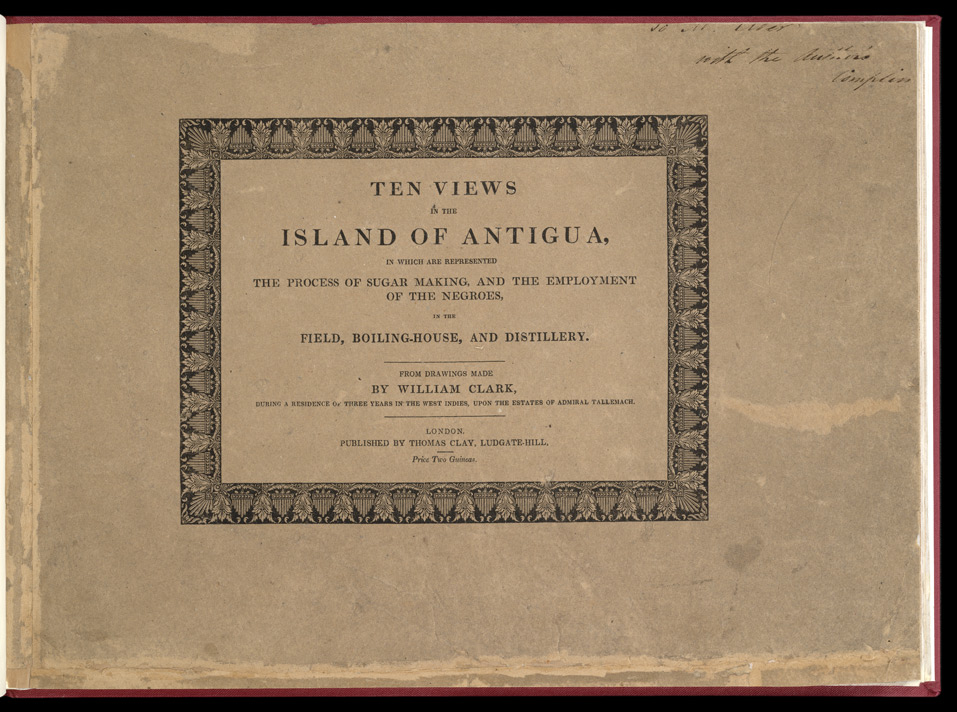
This and some of the following illustrations are drawn from a series of colored engravings published in 1823 and entitled Ten Views in the Island of Antigua.

image13tenviews.jpg

And, as you can see from the subtitle, the collection is devoted to the sugar-production industry, which was an extremely profitable one.  (And it should always be remembered that the great majority of the workers in these images are slaves.)

Cutting, however, is just the first stage in the process.  In the next step, the cane has to be crushed to get the pulp out.

image14crushing.jpg

(We note the mistake in the caption—this isn’t a painting, but a colored engraving.)

The pulp then has to be boiled and sieved until it’s a pure liquid.

image15boiling.jpg

Then—initially—it was dried, forming a coarse brown powder, as you can see on the right hand side of this illustration.

This was then packed into huge barrels, called “hogsheads”,

image16packing.jpg

and shipped.

image17shipping.jpg

When it reached its final destination, it was turned back into a liquid and further refined until poured into molds, which is how it was commonly sold, even into the 20th century, apparently.

image18mold.jpg

It is estimated that the average person consumes 53 pounds (24kg) of sugar a year, partly because sugar is mixed in with a huge variety of products where you would have to read the label before you realized that it was even an ingredient.

But what about Bilbo?  So far, as there is no concordance to the complete works of JRRT, as there is for something like the Iliad.

image19concordance.jpg

(A concordance is a complete collection of all the words, in their various forms, in a work, listed alphabetically, with reference to where they may be found.)

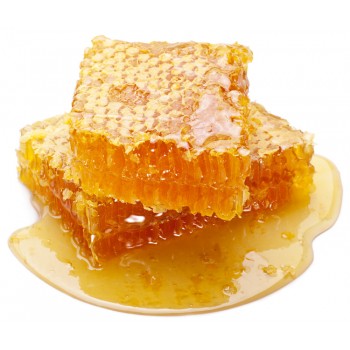
Our research, then, is completely casual—we paged through The Hobbit and, although we found no mention of the word “sugar” per se, we did find, particularly in Chapter One, a number of references to baked goods (“cake”, “seed cake”, and “tarts”).  We might suppose that, as in our medieval times, Bilbo employed honey in his recipes,

image20honeycomb.jpg

but, for the sake of our sugar loaf misread, we’re going to imagine that sugar is the ingredient.  (After all, there are “taters” and tobacco/pipeweed and, in the first edition of The Hobbit, even tomatoes mentioned, so why not?)

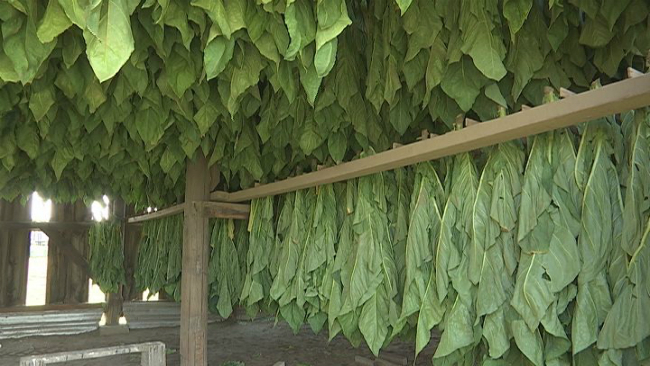
The next question, of course, is where this sugar came from.  Sugar is native to Southeast Asia, growing in tropical regions.  As far as we understand it, the Shire appears to be rather like southern England for climate, which means grains and things like hops, for beer, and perhaps even tobacco (in the United States, tobacco is grown as far north as Massachusetts), but nothing which requires a warmer, moister climate.

image21tobacco.jpg

Europe first began to receive its sugar (after tiny and very expensive exotic imports) in the 16th century from plants descended from cuttings from the Canary Islands and planted in the Caribbean by the agents of Christopher Columbus.  (The Portuguese did something similar in Brazil.)

Looking south on the map of Middle-earth, where would the climate allow for the growth of such plants?

image22map.jpg

Our best guess is to look as far south as we can—which is why, in our next posting, we want visit Harad and chat with those Corsairs of Umbar…

Thanks, as ever, for reading.

MTCIDC

CD

About That PS

18 Wednesday Oct 2017

Posted by Ollamh in J.R.R. Tolkien, Narrative Methods

≈ Leave a comment

Tags

anachronism, Bag End, banjo clock, barometer, clocks, Edwardian, Evangelista Torricelli, Hobbiton, Lucien Vidie, Middle-earth, Oxford, railway, The Hobbit, The Lord of the Rings, Tolkien, Victorian

Welcome, as always, dear readers.

In a PS to our last posting, we showed this illustration

image1bagend.jpg

and asked you if you saw something peculiar about it.

In fact, there are two peculiar things about it.  Look to the left of the door.  What is that?   At first, we were inclined to imagine that it was a clock of a style known as a “banjo clock”.

image2banjoclock.jpg

But there was also a clock on the right hand wall, and, unless Bag End was like a stock exchange, with clocks showing various times around the world,

image3stockclocks.jpg

(image the one on the left being “Shire Time”, while the one on the right is “Mordor Time”!)

why would Bilbo have two clocks?

There’s also the technical problem:  banjo clocks—maybe all clocks?—which have pendulums need to use gravity to help in their swing.  If the object on Bilbo’s wall is a clock, it’s upside down and therefore—

and so, after lots of searching to see if we could match it somehow, we were scratching our collective heads when we realized that it wasn’t a clock at all, but a barometer—and a distinctively Victorian one, which fits in with our suggestion in a recent posting that JRRT was using his memories of his Victorian/Edwardian childhood as the basis of Bag End.

image4vicbar.jpg

So, what’s a barometer and why might Bilbo have one?

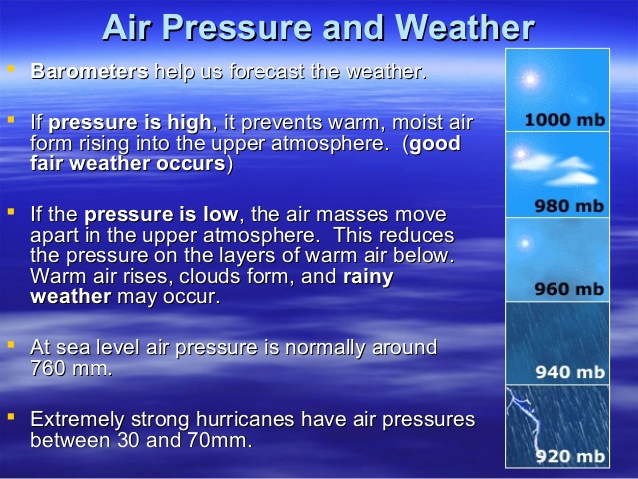
The simplest answer to the first of those is that a barometer measures atmospheric pressure.  That measurement, in turn, can tell you about changes in weather:  low pressure, it’s more likely to rain, high pressure, not.  Here’s a basic chart to explain.

image5airpressure.jpg

One odd thing about Bilbo’s is that, commonly, barometers are combined with thermometers in patterns of the sort you see on the Bag End wall, whereas this one appears to be by itself.

image6bar.jpg

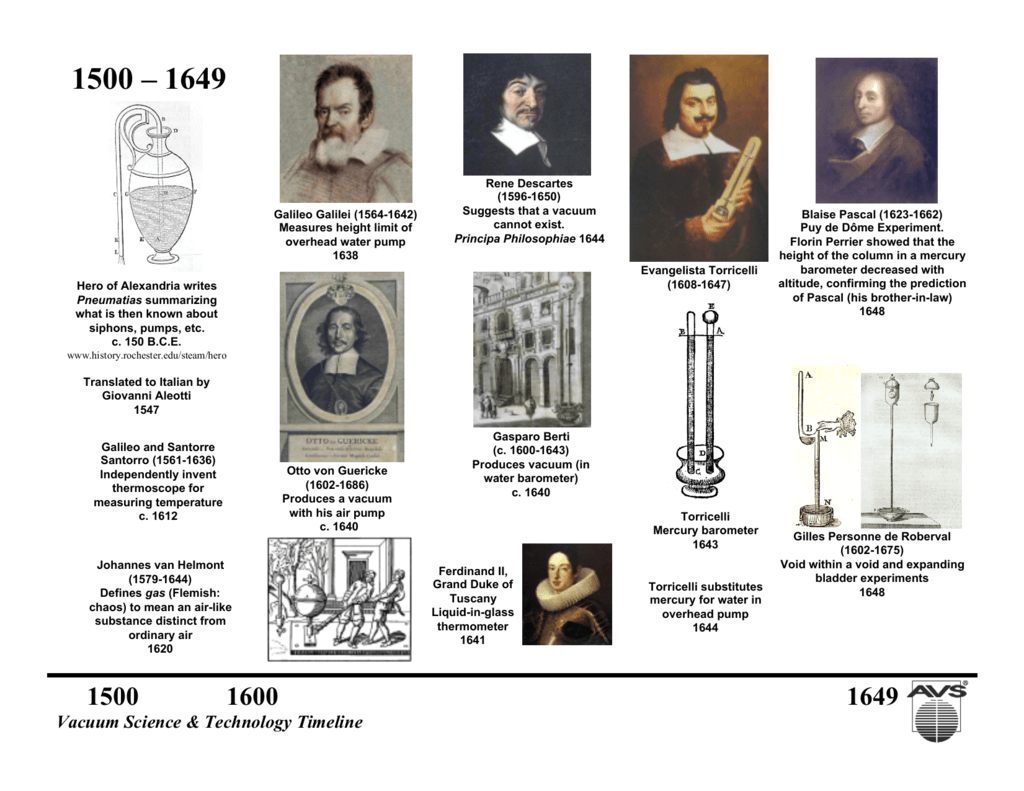
The really odd thing, however, is that he has one to begin with.  The first barometers date from the 1640s, being an offshoot of trying to understand the concept of a vacuum.

image7aboutvacuums.png

It was only in the 1840s that someone (Lucien Vidie) postulated that air pressure changes—measurable by this device– could signal weather changes.  For Bilbo to have such a thing in a Middle-earth which appears to be almost entirely devoid both of science as we understand it and of mechanical technology, is a puzzle at best.   Who made it?  How did he obtain it?  And last—and hardest—what did he do with it?

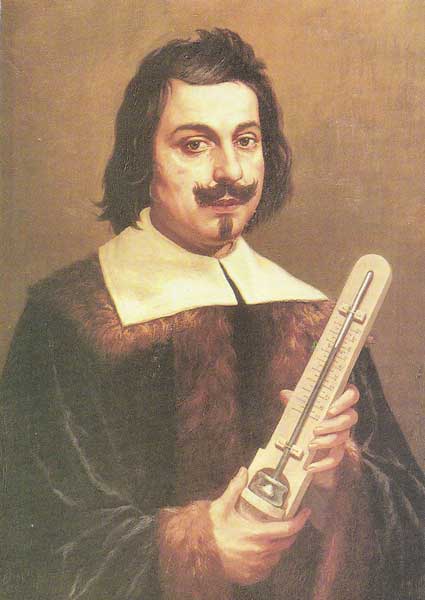
Of course, as we have discussed in past postings, there are whole areas of knowledge about Middle-earth about which we have little or no information and it’s been fun for us to try to reconstruct things using parallels from our own world, combined with the little we do know.  That first barometer was, we presume, handmade by Evangelista Torricelli (1608-1647).

image7atorricelli.jpg


It appears to have been, basically, a long glass tube, attached to a piece of wood by white metal fittings.  The hobbits have glass windows, so the art of glass-blowing exists in their world.  The wood and metal could be used in many other settings.  Once the concept was understood, it would be easy to see someone taking already available techniques and materials and creating the object.

But who made it?  When it came to ingenuity in craft, JRRT suggests the dwarves—with the men of Dale as fellow-workers or perhaps as middlemen.  As Thorin says of the past:

“Altogether those were good days for us, and the poorest of us had money to spend and to lend, and leisure to make beautiful things just for the fun of it, not to speak of the most marvelous and magical toys, the like of which is not to be found in the world now-a-days…the toy market of Dale was the wonder of the North.” (The Hobbit, Chapter One, “An Unexpected Party”)

How did Bilbo acquire it?  He had come to be known in Hobbiton as unlike other hobbits—his mother, after all, was the famous Belladonna Took (for her history—or, rather, her mystery–see The Hobbit, Chapter 1) and, after his travels, “he took to writing poetry and visiting elves”.  Perhaps the barometer came from one of his trips?  Or had it been sent to him?

If we take the preparations for the famous joint-birthday-party at the opening of The Lord of the Rings as a clue, there must have been at least a small degree of commerce between the Shire and the dwarves of the Lonely Mountain and the rebuilt town of Dale:

“On this occasion the presents were unusually good…There were toys the like of which they had never seen before, all beautiful and some obviously magical.  Many of them had indeed been ordered a year before, and had come all the way from the Mountain and from Dale, and were of real dwarf-make.” (The Fellowship of the Ring, Book One, Chapter 1, “A Long-Expected Party).

But then there is that third question:  what did he do with it?  As far as we can currently determine from The Hobbit and The Lord of the Rings, neither Bilbo nor Frodo nor even Gandalf ever mentions a barometric reading, or is concerned that the pressure is dropping.

So what are we to make of this?

For all that JRRT was increasingly careful about this, there a few anachronisms in his work.  In The Hobbit, there is the well-known one of Bilbo’s reaction to Thorin’s explanation of the dangers of future burglary:

“At may never return he began to feel a shriek coming up inside, and very soon it burst out like the whistle of an engine coming out of a tunnel.” (The Hobbit, Chapter One, “An Unexpected Party”)

Although JRRT himself considered changing this for the 1966 revision, Douglas Anderson, in The Annotated Hobbit, 47-48, argues that this doesn’t have to be an anachronism at all:

“…for Tolkien as narrator was telling this story to his children in the early 1930s, and they lived in a world where railway trains were a very important feature of life.”

In fact, built in 1844, the first railway station in Oxford was almost a century old when The Hobbit was published in 1937.

image8grandpointstation.JPG

(And we can’t resist this quotation from Jackson’s Oxford Journal for 15 June, 1844, which describes the arrival of the first train as “one of those rampageous, dragonnading fire-devils”.  Clearly, dragons and railroads have a long history together!)

So, is this just a slip on JRRT’s part?  Perhaps he had a barometer in his past, next to a door, and, in his urge to fill up the wall space of Bag End, he simply filled in what he already knew?  We can only shrug—and, in our next, wonder about that clock on the wall to the right:  what’s it doing in Middle-earth?

Thanks, as ever, for reading.

MTCIDC

CD

← Older posts

The Doubtful Sea Series Facebook Page

The Doubtful Sea Series Facebook Page

  • Ollamh

Categories

  • Artists and Illustrators
  • Economics in Middle-earth
  • Fairy Tales and Myths
  • Films and Music
  • Games
  • Heroes
  • Imaginary History
  • J.R.R. Tolkien
  • Language
  • Literary History
  • Maps
  • Medieval Russia
  • Military History
  • Military History of Middle-earth
  • Narnia
  • Narrative Methods
  • Poetry
  • Research
  • Star Wars
  • Terra Australis
  • The Rohirrim
  • Theatre and Performance
  • Tolkien
  • Uncategorized
  • Villains
  • Writing as Collaborators
Follow doubtfulsea on WordPress.com

Across the Doubtful Sea

Recent Postings

  • Through a glass… January 7, 2026
  • Heffalumps? December 31, 2025
  • We Three Kings December 24, 2025
  • A Moon disfigured December 17, 2025
  • On the Roads Again—Once More December 10, 2025
  • (Not) Crossing Bridges December 3, 2025
  • On the Road(s) Again—Again November 26, 2025
  • On the Road(s) Again November 19, 2025
  • To Bree (Part 2) November 12, 2025

Blog Statistics

  • 104,109 Views

Posting Archive

  • January 2026 (1)
  • December 2025 (5)
  • November 2025 (4)
  • October 2025 (5)
  • September 2025 (4)
  • August 2025 (4)
  • July 2025 (5)
  • June 2025 (4)
  • May 2025 (4)
  • April 2025 (5)
  • March 2025 (4)
  • February 2025 (4)
  • January 2025 (5)
  • December 2024 (4)
  • November 2024 (4)
  • October 2024 (5)
  • September 2024 (4)
  • August 2024 (4)
  • July 2024 (5)
  • June 2024 (4)
  • May 2024 (5)
  • April 2024 (4)
  • March 2024 (4)
  • February 2024 (4)
  • January 2024 (5)
  • December 2023 (4)
  • November 2023 (5)
  • October 2023 (4)
  • September 2023 (4)
  • August 2023 (5)
  • July 2023 (4)
  • June 2023 (4)
  • May 2023 (5)
  • April 2023 (4)
  • March 2023 (5)
  • February 2023 (4)
  • January 2023 (4)
  • December 2022 (4)
  • November 2022 (5)
  • October 2022 (4)
  • September 2022 (4)
  • August 2022 (5)
  • July 2022 (4)
  • June 2022 (5)
  • May 2022 (4)
  • April 2022 (4)
  • March 2022 (5)
  • February 2022 (4)
  • January 2022 (4)
  • December 2021 (5)
  • November 2021 (4)
  • October 2021 (4)
  • September 2021 (5)
  • August 2021 (4)
  • July 2021 (4)
  • June 2021 (5)
  • May 2021 (4)
  • April 2021 (4)
  • March 2021 (5)
  • February 2021 (4)
  • January 2021 (4)
  • December 2020 (5)
  • November 2020 (4)
  • October 2020 (4)
  • September 2020 (5)
  • August 2020 (4)
  • July 2020 (5)
  • June 2020 (4)
  • May 2020 (4)
  • April 2020 (5)
  • March 2020 (4)
  • February 2020 (4)
  • January 2020 (6)
  • December 2019 (4)
  • November 2019 (4)
  • October 2019 (5)
  • September 2019 (4)
  • August 2019 (4)
  • July 2019 (5)
  • June 2019 (4)
  • May 2019 (5)
  • April 2019 (4)
  • March 2019 (4)
  • February 2019 (4)
  • January 2019 (5)
  • December 2018 (4)
  • November 2018 (4)
  • October 2018 (5)
  • September 2018 (4)
  • August 2018 (5)
  • July 2018 (4)
  • June 2018 (4)
  • May 2018 (5)
  • April 2018 (4)
  • March 2018 (4)
  • February 2018 (4)
  • January 2018 (5)
  • December 2017 (4)
  • November 2017 (4)
  • October 2017 (4)
  • September 2017 (4)
  • August 2017 (5)
  • July 2017 (4)
  • June 2017 (4)
  • May 2017 (5)
  • April 2017 (4)
  • March 2017 (5)
  • February 2017 (4)
  • January 2017 (4)
  • December 2016 (4)
  • November 2016 (5)
  • October 2016 (6)
  • September 2016 (5)
  • August 2016 (5)
  • July 2016 (5)
  • June 2016 (5)
  • May 2016 (4)
  • April 2016 (4)
  • March 2016 (5)
  • February 2016 (4)
  • January 2016 (4)
  • December 2015 (5)
  • November 2015 (5)
  • October 2015 (4)
  • September 2015 (5)
  • August 2015 (4)
  • July 2015 (5)
  • June 2015 (5)
  • May 2015 (4)
  • April 2015 (3)
  • March 2015 (4)
  • February 2015 (4)
  • January 2015 (4)
  • December 2014 (5)
  • November 2014 (4)
  • October 2014 (6)
  • September 2014 (1)

Blog at WordPress.com.

  • Subscribe Subscribed
    • doubtfulsea
    • Join 78 other subscribers
    • Already have a WordPress.com account? Log in now.
    • doubtfulsea
    • Subscribe Subscribed
    • Sign up
    • Log in
    • Report this content
    • View site in Reader
    • Manage subscriptions
    • Collapse this bar
 

Loading Comments...