• About

doubtfulsea

~ adventure fantasy

Tag Archives: Bilbo

Terrifyingly Funny? (Part 1)

13 Wednesday Jul 2016

Posted by Ollamh in Artists and Illustrators, Fairy Tales and Myths, Imaginary History, J.R.R. Tolkien, Language, Literary History, Narrative Methods, Villains

≈ 2 Comments

Tags

Adventure, Among Gnomes and Trolls, Bilbo, comic, Gandalf, Gollum, humor, John Bauer, Middle-earth, Pēro & Pōdex, Roast Mutton, Stone Trolls, The Hobbit, The Lord of the Rings, Through the Looking-Glass, Tolkien, Tommies, trolls, Victorian Drawing Room

Dear Readers, welcome, as always.

This is going to be a two-part posting because– well, it began as one thing, and then became another. We were thinking about Gollum, not as the grim and tormented figure we know from The Lord of the Rings, but rather as the muttering, riddling cave-dweller of The Hobbit. We were wondering if we could see Gollum not only as menacing, but as comic, as well.

Gollum_Render.png

Then, however, we began to think about other such figures, and one of us said to the other, “What about the trolls in The Hobbit?”. The other replied, “we see them before we see Gollum. Maybe we should start with them.”

And so we shall.

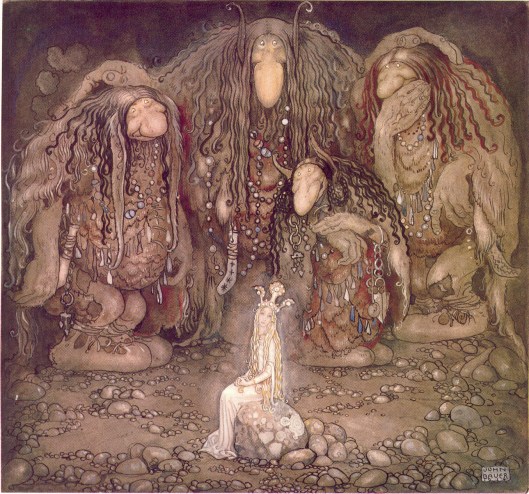
It’s clear where Tolkien got his trolls– they’re all over the fairy tales he had been reading since childhood, and they form a component of the traditional Scandinavian literature in which he had been interested for nearly as long. They are commonly large, and not terrifically bright, and often possess an anxiety about daylight. One of our favorite illustrators of such creatures is John Bauer (1882-1918), who, among other works, contributed illustrations to an ongoing series of volumes appropriately titled Among Gnomes and Trolls. Here, for example, is one of his depictions of the latter.

John_Bauer_1915.jpg

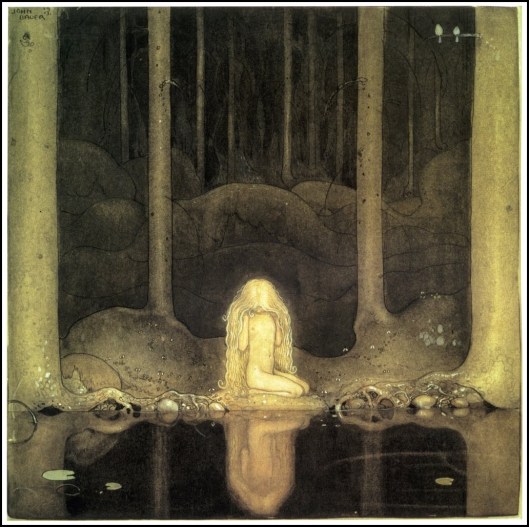
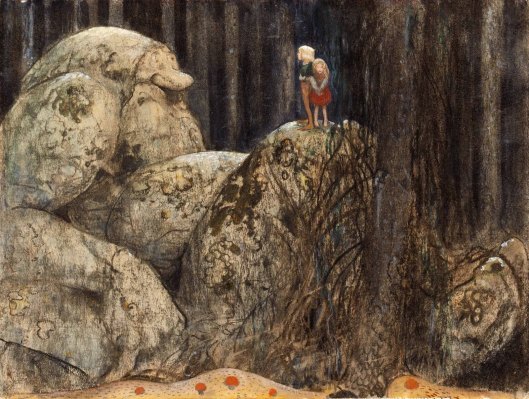
And, because we can’t resist– can we ever? Here are a couple more illustrations by Bauer.

bauer5.jpgJohn_Bauer07.jpg

Even before The Hobbit, however, Tolkien had produced a literary troll. In 1926, he wrote the first version of a poem to be sung to the folk song “The Fox Went Out”, called “Pēro & Pōdex”(“Boot and Bottom”). It survives  in a later version in chapter 12 of Book 1 of The Lord of the Rings, beginning “Troll sat alone on his seat of stone”.

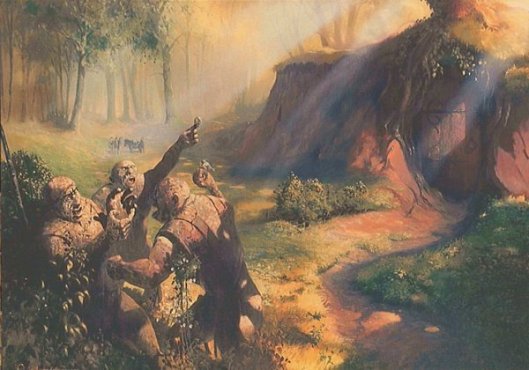
In The Hobbit, the trolls are grouped around a fire, drinking and eating and immediately recognizable:

“But they were trolls.  Obviously trolls.  Even Bilbo, in spite of his sheltered life, could see that:  from the great heavy faces of them, and their size, and the shape of their legs, not to mention their language, which was not drawing-room fashion at all, at all.”  (The Hobbit, Chapter 2, “Roast Mutton”)

tumblr_m6wyygQDLc1ru50yro1_1280.jpg

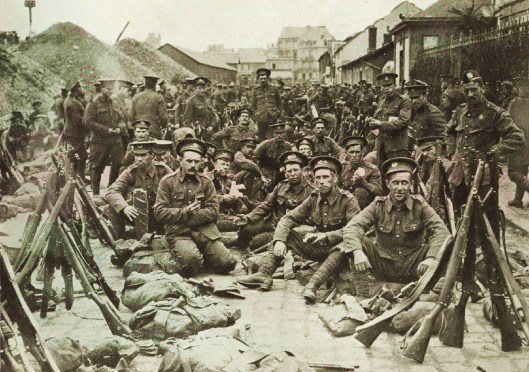
Douglas Anderson, in his invaluable The Annotated Hobbit, says that “Tolkien presents the Trolls’ speech in a comic, lower-class dialect” (70). In fact, we wonder whether, as in the case of the later orcs in The Lord of the Rings, we are not seeing a reflection of the speech of some of the Tommies whom Tolkien had commanded in the Great War.

roads_bef1914.jpg

” ‘Mutton yesterday, mutton today, and blimey, if it don’t look like mutton again tomorrer,’ said one of the trolls.

‘Never a blinking bit of manflesh have we had for long enough,’ said a second. ‘What the ‘ell William was a-thinkin; of to bring us into these parts at all, beats me – and the drink runnin’ short, what’s more,’ he said jogging the elbow of William, who was taking a pull at his jug” (The Hobbit, Chapter 2, “Roast Mutton”).

Besides what sounds like a reference to a line in Through the Looking-Glass (1871), “The rule is, jam to-morrow and jam yesterday – but never jam to-day,” with their “blimey” and “blinking”, the trolls are immediately labeled by their speech as lower-class, potentially thuggish, and certainly not people invited to a formal drawing room like this–

drawingroom1890ssmall.JPG

Of course, we might ask ourselves, why should trolls talk like that anyway? And we might then reply, because Tolkien is mixing language for comic effect. Bilbo, Gandalf, and the dwarves speak in non-dialect standard English. Therefore, there’s an especially strong contrast here. As well, what the trolls are saying can be funny in itself, as when William says to the discontented other trolls,

” ‘Yer can’t expect folk to stop here for ever just to be et by you and Bert. You’ve et a village and a half between yer, since we come down from the mountains. What more d’yer want?’ ” (The Hobbit, Chapter 2, “Roast Mutton”).

Here, we have comic exaggeration combined with the frustrated defensiveness of a leader whose tactics are being questioned by subordinates.

The tension grows as the scene progresses.  Bilbo appears, is nabbed by a purse which sounds like the Trolls, the Trolls fall to fisticuffs while arguing over Bilbo and then over the dwarves whom they capture, and Gandalf, imitating various Troll voices, so stirs the pot that the Trolls never notice when the first beam of sunlight cuts across their clearing and they are petrified.

jrrt_14.jpg

So, if we consider what the Trolls have been doing previously–“Never a blinking bit of manflesh have we had for long enough…” says one, as well as what they discuss doing not only to Bilbo, but to the whole of Thorin & Co., these could seem to be grim figures, indeed.  Then again, they sound like comic cockneys, they have ludicrously-large appetites, and they are dim enough to be taken in very easily by Gandalf’s ventriloquism.   So, grim and funny at the same time.

On the whole, humor is more an element in The Hobbit than in The Lord of the Rings, but we believe that perhaps because of his initial appearance in The Hobbit, Gollum may have both the menace and the humor, at times , of these gormless Trolls, as we hope to show in Part 2.

Thanks, as always, for reading,

MTCIDC,

CD

Evil Twin?

22 Wednesday Jun 2016

Posted by Ollamh in Films and Music, J.R.R. Tolkien, Narrative Methods, Villains

≈ Leave a comment

Tags

Bilbo, Deagol, Edgar Allen Poe, Frodo, Gandalf, Gollum, Isildur, Lon Chaney Sr., London After Midnight, Peter Jackson, Pity, Smeagol, The Lord of the Rings, The One Ring, The Phantom of the Opera, The Shadow of the Past, Tolkien, twins, William Wilson

Dear Readers,

Welcome, as always.

In Edgar Allen Poe’s short story, “William Wilson”, (1839) the protagonist is haunted by a double—not a genetic twin, but a kind of look-alike opposite—who acts upon the behavior of the debauched original. (He eventually murders the “twin”, only to discover that, in a sense, he’s murdered himself.)

Edgar_Allan_Poe_daguerreotype_crop.png

In this posting, we want to think about a relationship which, born in The Hobbit, grows over time until it, too, appears almost to be a pair of mirror opposites—who sometimes exchange their roles…

” ‘Gollum!’ cried Frodo. ‘Gollum? Do you mean that this is the very Gollum-creature that Bilbo met? How loathsome!’ ” (The Lord of the Rings, Book 1, The Fellowship of the Ring, Chapter Two, “The Shadow of the Past”).

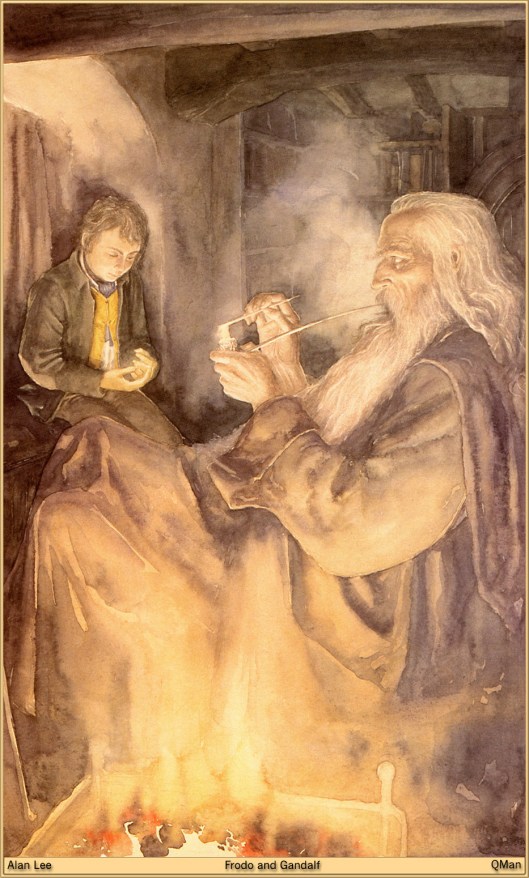
This is the moment in which Gandalf is beginning to explain the history of the Ring, first to Frodo, and then, in more detail, in the Council of Elrond.

lee-lotr_Frodo_and_Gandalf.jpg

When Gandalf reveals that a major force in that history has been Gollum, Frodo is both surprised and appalled.

Gandalf is not. In fact, he shows a kind of sympathy for Gollum which flickers throughout the whole of The Lord of the Rings and which might be best described as pity. When later in this chapter Frodo exclaims, “What a pity that Bilbo did not stab the creature when he had the chance”, Gandalf replies:

” ‘Pity? It was Pity that stayed his hand. Pity, and Mercy: not to strike without need. And he has been well rewarded, Frodo. Be sure that he took so little hurt from the evil, and escaped in the end, because he began his ownership of the Ring so. With Pity.’ ” (The Lord of the Rings, Book 1, The Fellowship of the Ring, Chapter Two, “The Shadow of the Past”).

This, of course, is in contrast to what happened when Gollum found the Ring– because, in fact, he didn’t, and he murdered his friend Deagol, who did.

Sauron, we are told, has put much of his power—and himself—into the Ring. That power is often talked about in The Lord of the Rings, but it seems abstract—power to do what? One aspect of Sauron’s personality—a deep greed—is easily seen, however, reflected in how the Ring brings out that same feeling in others, even to the point of violence. Yet, as Gandalf says:

” ‘The murder of Deagol haunted Gollum, and he had made up a defence, repeating it to his “Precious” over and over again, as he gnawed bones in the dark, until he almost believed it.’ ” (The Lord of the Rings, Book 1, The Fellowship of the Ring, Chapter Two, “The Shadow of the Past”).

[Is there a hint of cannibalism here? When we first meet Gollum, the narrator says of him: “He liked meat too. Goblin he thought good, when he could get it…” (The Hobbit, “Riddles in the Dark”) Whose bones might Smeagol have gnawed first?

“No one ever found out what had become of Deagol; he was murdered far from home, and his body was cunningly hidden.” ]

We might wonder, thinking of “William Wilson”, if Smeagol and Deagol were, in a sense, twins?

“He had a friend called Deagol, of similar sort, sharper-eyed but not so quick and strong.” (The Lord of the Rings, Book 1, The Fellowship of the Ring, Chapter Two, “The Shadow of the Past”)

And Smeagol’s torment has as much to do with the symbolic killing of the “good” self as it does the murder of a friend?

smeagol_und_deagol_by_williweissfuss-d7053ux.jpg

Smeagol and Deagol by Williweissfuss

There may be a moral element here, as well, and it’s interesting to think that, although infected with Sauron’s greed, this potential for knowing right from wrong remains, at least temporarily, in Gollum, making him lie to himself and to others about how he acquired the ring.  Bilbo must have felt this, too, even if he gained the Ring through non-violent means, this need for self-justification. And so he lies, but, to someone with a deeper knowledge, such behavior is all-too-transparent, as Gandalf says:

“Then I heard Bilbo’s strange story of how he had ‘won’ it, and I could not believe it. When I at last got the truth out of him, I saw at once that he had been trying to put his claim to the ring beyond doubt. Much like Gollum with his ‘birthday-present’. The lies were too much alike for my comfort.” (The Lord of the Rings, Book 1, The Fellowship of the Ring, Chapter Two, “The Shadow of the Past”).

Gandalf has seen the lie, but he has also seen something else, a kind of pattern in that lying and a worrying link between the liars, which he expresses in his response to Frodo’s disgust at the thought of Gollum with the Ring:

“ ‘I think that it is a sad story,’ said the wizard, ‘and it might have happened to others, even to some hobbits that I have known.’ “ (The Lord of the Rings, Book 1, The Fellowship of the Ring, Chapter 2, “The Shadow of the Past”)

Gandalf has also seen a deeper similarity between the two. When Frodo says that he can’t believe that Gollum has any connection with hobbits, Gandalf says:

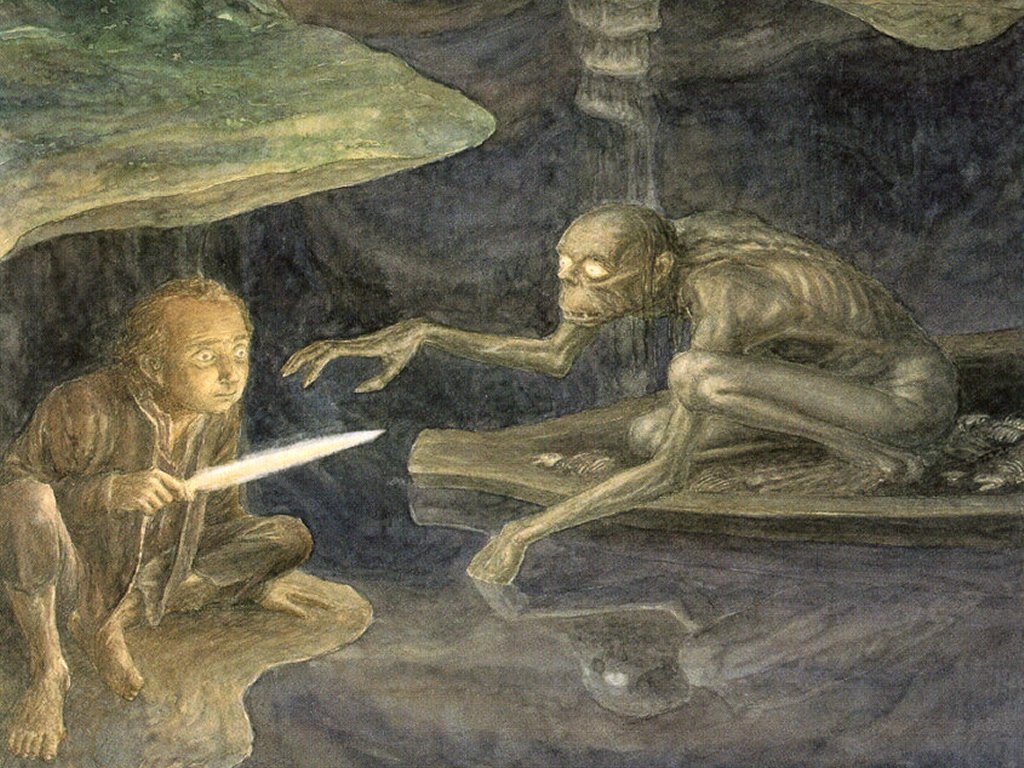
“ ‘It is true all the same…About their origins, at any rate, I know more than hobbits do themselves. And even Bilbo’s story suggests the kinship. There was a great deal in the background of their minds and memories that was very similar. They understood one another remarkably well, very much better than a hobbit would understand, say, a Dwarf, or an Orc, or even an Elf. Think of the riddles they both knew, for one thing.’ “ (The Lord of the Rings, Book 1, The Fellowship of the Ring, Chapter 2, “The Shadow of the Past”)

Alan Lee - The Hobbit - 19 - Riddles in the dark.jpg

Alan Lee, “Riddles in the Dark”

This connection is not just with Bilbo—Frodo, too, appears to share it, as we see later in the story:

“For a moment it appeared to Sam that his master had grown and Gollum had shrunk: a tall stern shadow, a mighty lord who hid his brightness in grey cloud, and at his feet a little whining dog. Yet the two were in some way akin and not alien: they could reach one another’s minds.” (The Lord of the Rings, Book 4, The Two Towers, Chapter 1, “The Taming of Smeagol”)

But this is the behavior of a hobbit as the “good” twin, when he has the Ring and believes himself in control. Below it always lurks Sauron’s greed, and it can bring the “bad” twin to the surface very easily, as Frodo imagines when Bilbo says:

“ ‘Have you got it here?’ he asked in a whisper. ‘I can’t help feeling curious, you know, after all I’ve heard. I should very much like just to peep at it again.’

‘Yes, I’ve got it,’ answered Frodo, feeling a strange reluctance. ‘It looks just the same as it ever did.’

‘Well, I should just like to see it for a moment,’ said Bilbo.

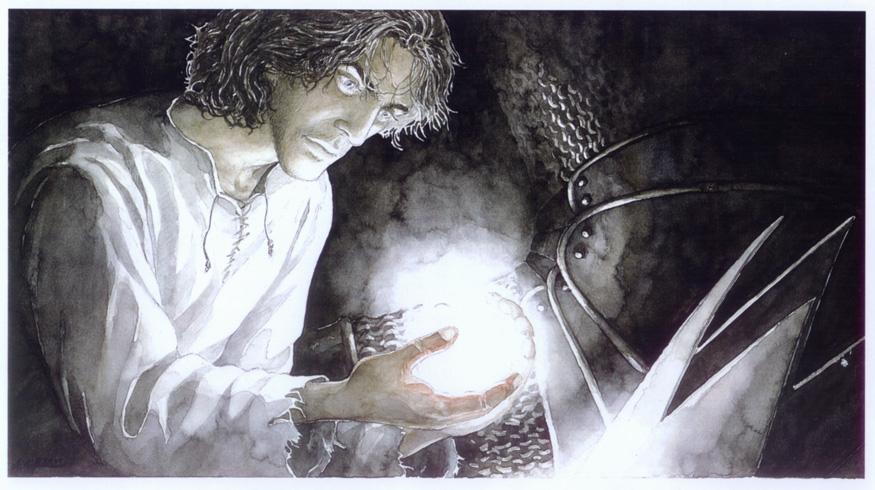
When he had dressed, Frodo found that while he slept the Ring had been hung about his neck on a new chain, light but strong. Slowly he drew it out. Bilbo put out his hand. But Frodo quickly drew back the Ring. To his distress and amazement he found that he was no longer looking at Bilbo; a shadow seemed to have fallen between them, and through it he found himself eyeing a little wrinkled creature with a hungry face and bony groping hands. He felt a desire to strike him.” (The Lord of the Rings, Book 2, The Fellowship of the Ring, Chapter 1, “Many Meetings”)

846d4cbb658e2420258640c4bda7319b
Lon-Chaney-in-London-After-Midnight-2

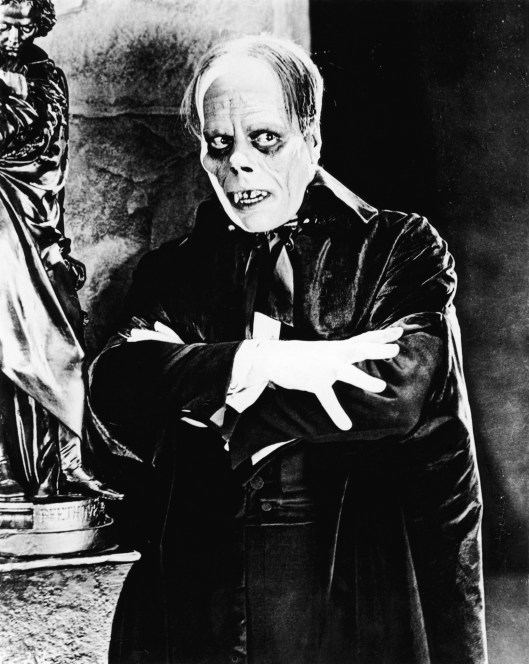
[Here we have included a second image which is, to our eyes, strikingly like the first. This is a picture of Lon Chaney, Sr., as Inspector Edward C. Burke of Scotland Yard, in the lost 1927 silent film London After Midnight. Chaney was a remarkable frightening presence on-screen, doing his own make-up, as in the 1925 The Phantom of the Opera, based upon Gaston Leroux’s 1910 novel of the same title—]

ChaneyPhantomoftheOpera

Of course, one might ask here, was this really Bilbo Frodo was seeing through that shadow, or was it Sauron’s greed, distorting Frodo’s vision? Certainly, this happens again, when in “The Tower of Cirith Ungol”, Sam offers to carry the Ring and Frodo thought that:

“Sam had changed before his very eyes into an orc again, leering and pawing at his treasure, a foul little creature with greedy eyes and slobbering mouth.” (The Lord of the Rings, Book 6, The Return of the King, Chapter One, “The Tower of Cirith Ungol”)

And then, just at the moment before the Ring’s final destruction, it’s Frodo who changes before Sam’s eyes:

“Then Frodo stirred and spoke in a clear voice, indeed with a voice clearer and more powerful than Sam had ever heard him use, and it rose above the throb and turmoil of Mount Doom, ringing in the roof and walls.

‘I have come,’ he said. ‘But I do not choose now to do what I came to do. I will not do this deed. The Ring is mine!’ “ (The Lord of the Rings, Book 6, The Return of the King, Chapter Three, “Mount Doom”)

At this moment, it seems horribly appropriate that he put on the Ring and disappear, as the Frodo who has gone through such terrible hardship has disappeared, replaced not by Gollum as twin, but, it seems, by Isildur, who, when urged by Cirdan and Elrond, that the Ring “should have been cast then into Orodruin’s fire nigh at hand where it was made”, refused, saying “This I will have as weregild for my father, and my brother…” (The Lord of the Rings, Book 2, The Fellowship of the Ring, Chapter Two, “The Council of Elrond”)

But Gollum does appear and fulfills Gandalf’s near-prophecy to Frodo of long before:

“…he is bound up with the fate of the Ring. My heart tells me that he has some part to play yet, for good or ill, before the end; and when that comes, the pity of Bilbo may rule the fate of many—yours not least.” (The Lord of the Rings, Book 1, The Fellowship of the Ring, Chapter Two, “The Shadow of the Past”)

Removing the Ring by removing the finger, Gollum continues the image of Isildur, who had done the same to Sauron to gain the Ring, and, at the same time, he releases Frodo from its spell, even as he falls to his death in the fires of Mount Doom. At the same time, Gollum also breaks the image of twins—and, unlike William Wilson, with the Ring gone and the bond, Frodo is maimed, but whole—and alone.

Thanks, as ever, for reading.

MTCIDC

CD

And Whither Then?

25 Wednesday Nov 2015

Posted by Ollamh in Artists and Illustrators, Fairy Tales and Myths, J.R.R. Tolkien, Narrative Methods

≈ 1 Comment

Tags

Adrien Guignet, Aeneid, art, bibliomancy, Bilbo, Birth of Venus, Bouguereau, chimp painting, Chinese, critics, Cumae, Delphi, Etruscans, Frodo, future, Genesis, Greeks, Homer, Impressionism, It's a dangerous business going out your door, Joseph, Kansas City Royals, Monet, New York Mets, Oedipus, plastrons, prophetic, prophetic books, Pythia, Romans, Scapula, Sibyls, Sortes Tolkienses, Sortes Vergilianae, the Bible, The Lord of the Rings, The New Testament, Tolkien, Vergil, World Series, Zhang Dynasty

“It’s a dangerous business, Frodo, going out your front door. You step onto the Road, and if you don’t keep your feet, there’s no knowing where you might be swept off to.” (The Fellowship of the Ring, Book 1, Chapter 3)

Dear Readers,

Welcome, as always. In this posting, we want to propose an aid for that dangerous business to which Frodo is referring when he quotes Bilbo.

The desire to know what will happen next makes for good novel readers—and writers—but it’s also an ancient human desire.

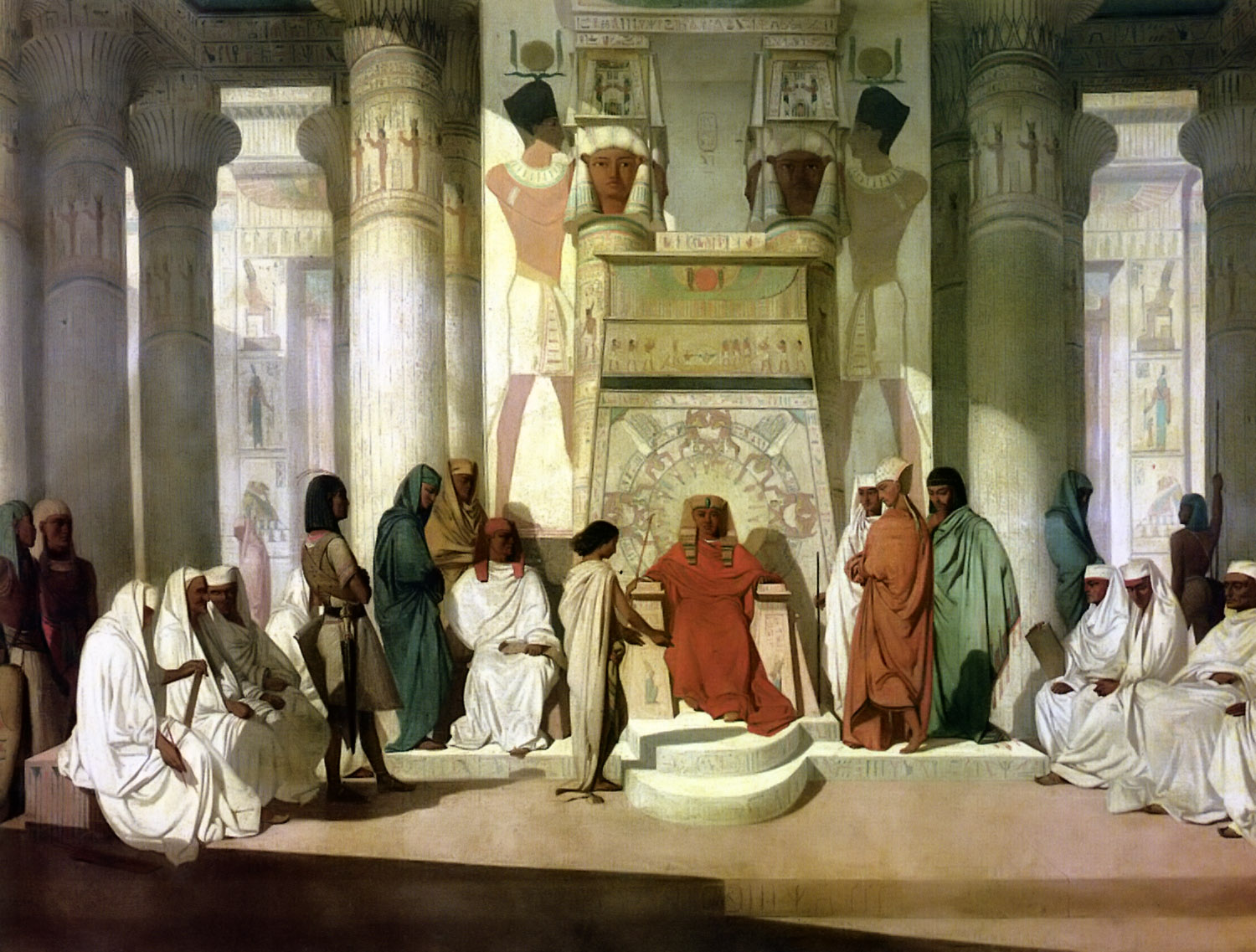
The Old Testament gives us a pharaoh with dreams, which Joseph interprets (Genesis 41-44) and which provides us with this splendid picture by Adrien Guignet (1816-1854).

Joseph Explaining the Dream to Pharoah, Jean Adrien Guignet

(This is an example of a whole world of painting which was devalued and declared stuffy and old-fashioned and pompous once Impressionism—which was originally mocked as just that, “impressions” rather than paintings—gained a foothold among art-buyers and the more progressive art critics. To us, although it may not have the wonderful fragmentations and color-freshness of those later painters, such older works have great importance historically—it’s the yin to the Impressionists’ yang, after all—and the over-the-top quality of some things—like this “Birth of Venus” by Bouguereau—1825-1905—has, we think, its own loopy charm.

The_Birth_of_Venus_by_William-Adolphe_Bouguereau_(1879)

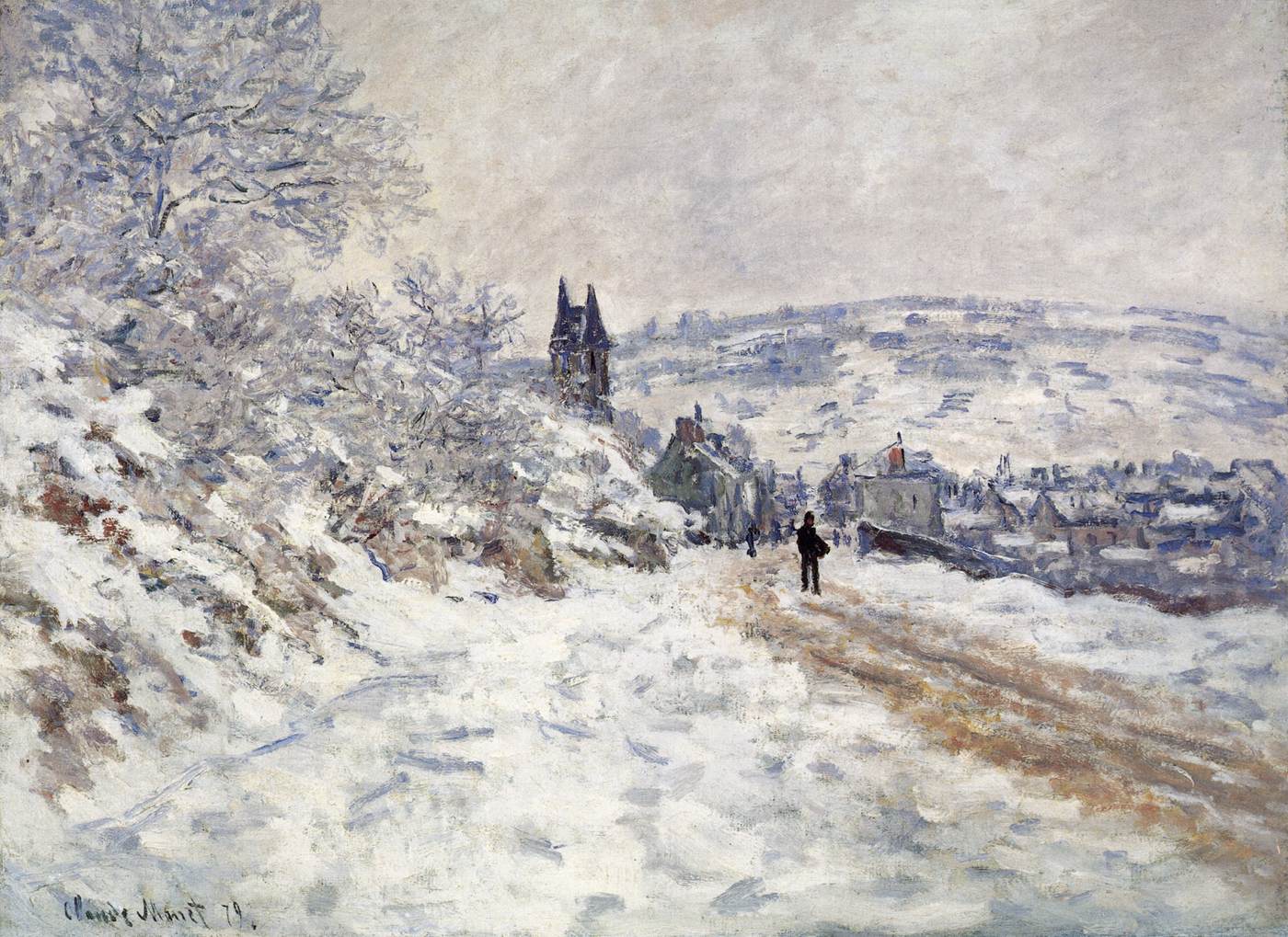
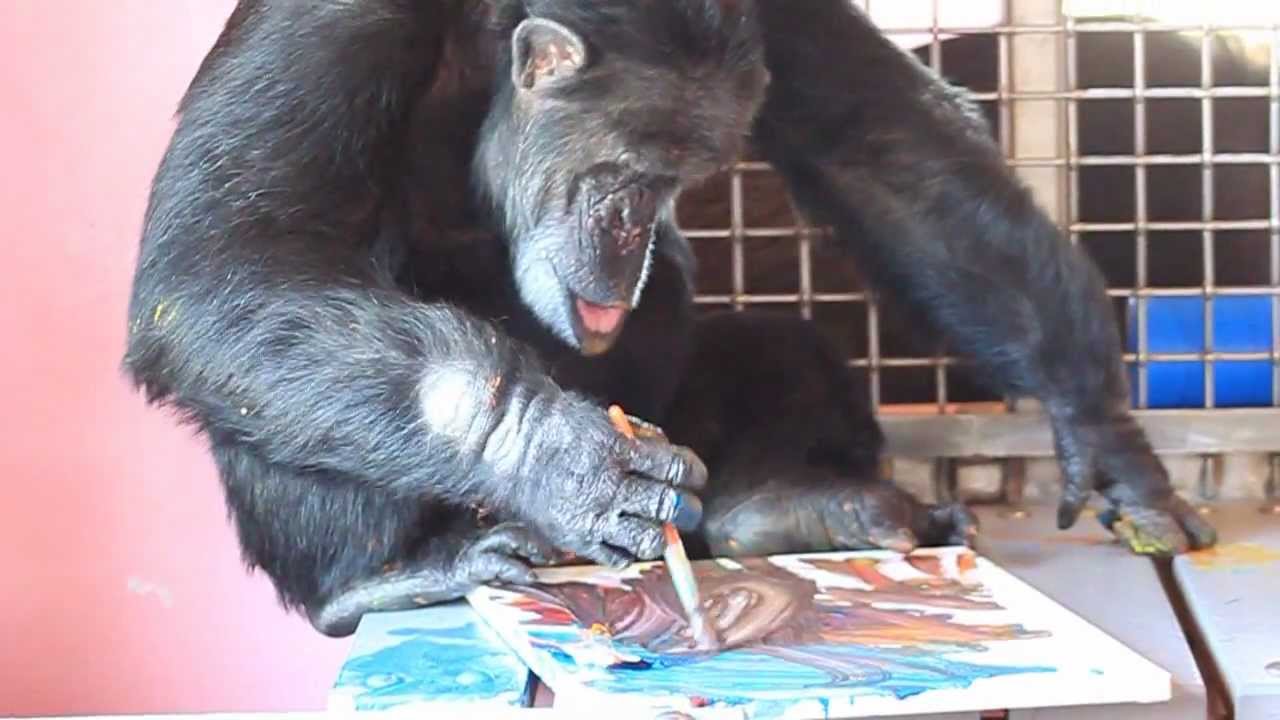
You see what we mean about yin/yang, however, when we compare it with this Monet, painted in the same year—1879. If you were brought up on academic painters like Bouguereau, Monet’s work must have looked like chimp paintings!

1vethe2

maxresdefault)

The Chinese of the Zhang Dynasty (1500-1000BC) used turtle plastrons and cow shoulder blades to consult about the future.

Shang_dynasty_inscribed_tortoise_plastron

Shang_dynasty_inscribed_scapula

The Greeks had a number of prophetic sites, like Delphi, with its Pythia.

Pythia

And the Romans had several methods, beginning with what they inherited from their big brothers to the north, the Etruscans.

liver

And, yes, this is a sheep’s liver, done in bronze. What does it do? Lots of discussion about that! It appears to have gods and perhaps constellations, or at least the sky, involved. (For more and some useful references, google “liver of Piacenza”)

The Romans consulted the insides of selected animals

haruspex

and the flying patterns of birds

romrem

although this could lead to the occasional argument

romrem1

as well as their own counterpart to people like the Pythia at Delphi, the Sibyls. One Sibyl, who was reputed to live at Cumae, even had a collection of prophetic books which talked about the future.

CumaeanSibyl

Later Romans also consulted a particular book, Vergil’s Aeneid, the idea being that you would open the book (a scroll, early on, a book—a codex—in later imperial times), close your eyes, run your finger along the lines and stop—and the line your finger was on would tell you something about the future. This is a form of bibliomancy, or telling the future by using a book. Ancients might choose Homer, or, in this case, Vergil (the Aeneid) or, for the Judeo-Christian tradition, the Bible. If you use Vergil, the practice is called Sortes Vergilianae (“Vergilian lots”—that is to say, not building sites—although one could build an interpretation upon one—but things used to determine the fate of something).

Today, we, as Tolkien fans, propose to add another text, suggesting Sortes Tolkienses (SOR-tes tol-kee-EN-ses). Pick up your copy of The Lord of the Rings, and ask it a question. Then close your eyes, open the book (make sure that it is rightsideup before you do this—although perhaps upsidedown would provide a greater-yet feel of randomness), run your index finger down the page, stop, open eyes, and read.

For our first try, we asked it who would win this year’s World Series, the New York Mets or the Kansas City Royals.

Hmm. Page 351 of the 2004 HarperCollins edition.

“…Frodo felt that he was in a timeless land that did not fade or change or fall into forgetfulness.”

Well, this is the 111th World Series—that would certainly suggest a kind of timelessness, we supposed. Then there was that business about not fading or changing—which team had won the Series last? A quick flick through statistics gave us the Royals in 1985 and the Mets in 1986. Okay. Does that mean that, since the Mets won more recently, that wouldn’t change?

Should we try again? Influenced by the rash Oedipus, asking the Pythia only one question and not pausing for clarification, we decided that it meant the Mets.

But then the Royals won.

So, we leave it to you, dear readers. You consult the Sortes Tolkienses—just make sure that the course of your life—or your team—doesn’t depend upon it!

Thanks, as always, for reading.

MTCIDC

CD

PS

There is a very entertaining experiment with the more established Sortes Vergilianae to be found by googling timesonline.typepad.com/dons_life/2012/03/sortes-virgilianae.html—an essay by the ever-lively Mary Beard.

Ever On?

02 Wednesday Sep 2015

Posted by Ollamh in J.R.R. Tolkien, Narrative Methods, Poetry

≈ Leave a comment

Tags

Bilbo, Frodo, Hobbits, The Hobbit, The Lord of the Rings, Tolkien, Walking Song

Dear Readers,

As always, welcome!

We’ve spent a good amount of postings talking about the narrative methods of The Lord of the Rings, and now we’d like to add to that, song.

Although Bilbo left his pocket-handkerchief behind, along with a good many other things he’d rather have had with him on the unexpected journey, he did bring something that seems to be inherently a part of Hobbits: song. As Mary Quella Kelly wrote in her essay “The Poetry of Fantasy, Verse in The Lord of the Rings”, “reciting or singing verse is for them the most natural way to express their emotions” (172), and we could heartily agree, as the Hobbits sing drinking songs, walking songs, and even bath songs. Kelly also points out that they “reuse old poems from the Shire, altering a word or phrase to fit the occasion” (172), one such strong example being Bilbo’s Walking Song, which, like the other Hobbit songs, accompanies the Hobbits throughout their journeys.

The Walking Song carries Bilbo and Frodo through their adventures, shifting in nature as the journey continues and eventually comes to an end. The first version appears in The Hobbit, when Bilbo is on the return journey home:

Roads go ever ever on,

Over rock and under tree,

By caves where never sun has shone,

By streams that never find the sea;

Over snow by winter sown,

And through the merry flowers of June,

Over grass and over stone,

And under mountains in the moon.

Roads go ever ever on

Under cloud and under star,

Yet feet that wandering have gone

Turn at last to home afar.

Eyes that fire and sword have seen

And horror in the halls of stone

Look at last on meadows green

And trees and hills they long have known.

The song seems to be reminiscing about the things he’s seen and the places he’s been, and appears only after the adventure has been completed. It’s a sort of poetic precursor to what will later become The Red Book of Westmarch.

­The Lord of the Rings, however, introduces a new version of the song, as Bilbo sings it softly in the dark after he’s been the first ring-bearer to willingly give up the Ring, and sets off to find new adventure.

The Road goes ever on and on

            Down from the door where it began.

Now far ahead the Road has gone,

            And I must follow, if I can,

Pursuing it eager feet

            Until it joins some larger way

Where many paths and errands meet.

            And whither then? I cannot say.

What has happened here? Tolkien’s anticipated sequel to The Hobbit has already taken a deeper, more complex turn than his original children’s story. Rather than standing and looking back at the road, Bilbo once again looks forward.

Just as Kelly suggests, he’s not the only one to anticipate the journey. Bilbo’s songs and the Ring being the only inheritance Frodo possesses on the road, Frodo sings his own version of the walking song:

The Road goes ever on and on

            Down from the door where it began.

Now far ahead the Road has gone,

            And I must follow, if I can,

Pursuing it weary feet

            Until it joins some larger way

Where many paths and errands meet.

            And whither then? I cannot say.

This version is identical in form, and the only word has changed—“eager” to “weary”, and this changes the tone entirely.

Bilbo sang cheerfully of the road behind him and of the road ahead, but Frodo’s version suggests that this new adventure in The Lord of the Rings is a much graver quest than Bilbo’s—and, potentially, more tiring. After Frodo sings the song to himself quietly, Pippin remarks,

“ ‘That sounds like a bit of old Bilbo’s writing’, said Pippin, ‘Or is it one of your imitations? It does not sound altogether encouraging.’ “ LOTR 72

And so Frodo’s reprise of the song, even with the variation of just one word, creates a reluctance to adventure, rather than continuing Bilbo’s eagerness. To Bilbo, the song ensures a story-worthy adventure with a return journey, but for Frodo, it’s just the opposite.

The song changes again, however, when there is a return journey for both Bilbo and Frodo, which hints at their voyage across the sea and into the west. Again, quietly to himself, Bilbo sings in Rivendell after Frodo has returned from his quest. Frodo has destroyed the Ring, but has retained the song, and seems to bring it back to Bilbo.

The Road goes ever on and on

Out from the door where it began.

Now far ahead the Road has gone,

Let others follow it who can!

Let them a journey new begin,

But I at last with weary feet

Will turn towards the lighted inn,

My evening-rest and sleep to meet.

And so, Bilbo’s “There and Back Again” journey and Frodo’s quest to destroy the Ring have both come to a conclusion. Bilbo sings this final version, which ends the adventures for both Hobbits, but passes on the adventure. Bilbo is ready to retire from traveling, and Frodo has completed his quest. As Frodo has left the last pages for Sam, however, it’s as if Bilbo has left the rest of the Red Book for those wishing to follow his footsteps down the road and begin anew, adding to or changing the songs to mirror their feelings as they go.

Thanks, as always, for reading,

MTCIDC,

CD

Fairy Tale to Bill of Sale

19 Wednesday Aug 2015

Posted by Ollamh in Economics in Middle-earth, Fairy Tales and Myths, J.R.R. Tolkien

≈ Leave a comment

Tags

Alice in Wonderland, Baggins, Bilbo, Contract, Dragon, Dwarves, Economics, Elves, Fairy Tale, Fantasy, Goblins, Hoard, Laketown, Middle-earth, Mirkwood, Odysseus, On Fairy Stories, Smaug, The Hobbit, The Odyssey, Tolkien

Dear Readers,

Welcome, as always!

Recently, when we discussed the economics of Middle-earth, Tolkien told us that he was not entirely ignorant about such matters, saying “…the situations are so devised that economic likelihood is there and could be worked out”. LT, 296

So that’s what we’ve set out to do in this posting, working out something of those economics in a modest way.

The Hobbit, as everyone knows, began as a story for his children, set in a fairytale world of elves, goblins, dwarves, and a dragon—the sorts of things which, in Tolkien’s essay “On Fairy Stories”, are derived from fantasy, which is “a natural human activity. It certainly does not destroy or even insult Reason,” but enhances it, lest fantasy become mere “Morbid Delusion” (which, later in the essay, Tolkien links with a work like Alice in Wonderland).

But something begins to happen, even early on, when Bilbo signs a contract before setting out for his adventure—an odd start for a fairytale hero who, traditionally, has to prove himself.  The story proceeds for some time in fairy tale mode, but then, when the party loses everything in Mirkwood, it’s necessary for Bilbo and Company to resupply and here the story moves seriously from a fairytale world to capitalism, as the fairy tale quest evolves into a commercial venture.

To replace lost materiel, the company turns to the people of Laketown,

Laketown

who provide it–and clearly do so on speculation, since the Dwarves have nothing to offer but promises.

The fairytale then seems to resume.  The party reaches the mountain, gets in, the dragon wakes–but then things go very wrong, at least for the investors, as Smaug, easily putting together that two and two equal Laketown, sets off to destroy it and is destroyed himself, in the process.  And then the fairy tale comes apart completely in a potential war over economic resources and compensation for damage caused during the investment:  Laketowners versus Dwarves, which escalates when Elves stake a claim and then Dwarves come to reenforce Dwarves and then, just to keep things in flux, a goblin army arrives. One almost wonders whether the Eagles, when they arrived, have invested in Laketown bonds and are expecting to cash them in, with interest!

When all of this is resolved, we might think that we’ve returned to the fairy tale world once more:  Bilbo, with his share of the hoard, sets off for home, where happily ever after lies–or does it?

OdysseusSuitors

In The Odyssey, Odysseus comes home to find his house in the hands of suitors, and must deal with them with the help of a goddess—very much a folktale. Bilbo comes home to find that his house and goods have just been auctioned off, and has to retrieve his happy ending by buying back his own things. That initial contract seems to have haunted the story, even to this moment.

Fantasy for Tolkien was, “founded on the harsh recognition that things are so in the world as they appear under the sun”—one of those things was economics, something which Bilbo may have found almost as unavoidable as a vengeful dragon.

What do you think, dear readers?

As always, thank you for reading,

MTCIDC,

CD

It Will Have To Be Paid For!

12 Wednesday Aug 2015

Posted by Ollamh in Economics in Middle-earth, J.R.R. Tolkien, Maps

≈ Leave a comment

Tags

Asia Minor, Bilbo, Bronze, Chinese, Coinage, Currency, Deagol, Egyptians, Germanic, Gondor, Greeks, Isengard, Italy, Middle-earth, Moria, Pennies, Rohan, Roman Coins, Roman Roads, Romans, Saruman, Shire, Silver, Smeagol, Sumerians, Theodric, Tolkien, Trade, Treasure

Dear Readers,

Welcome, as always!

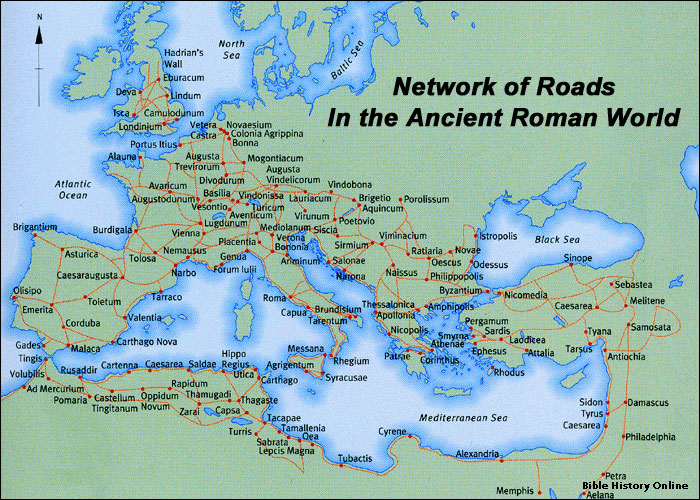
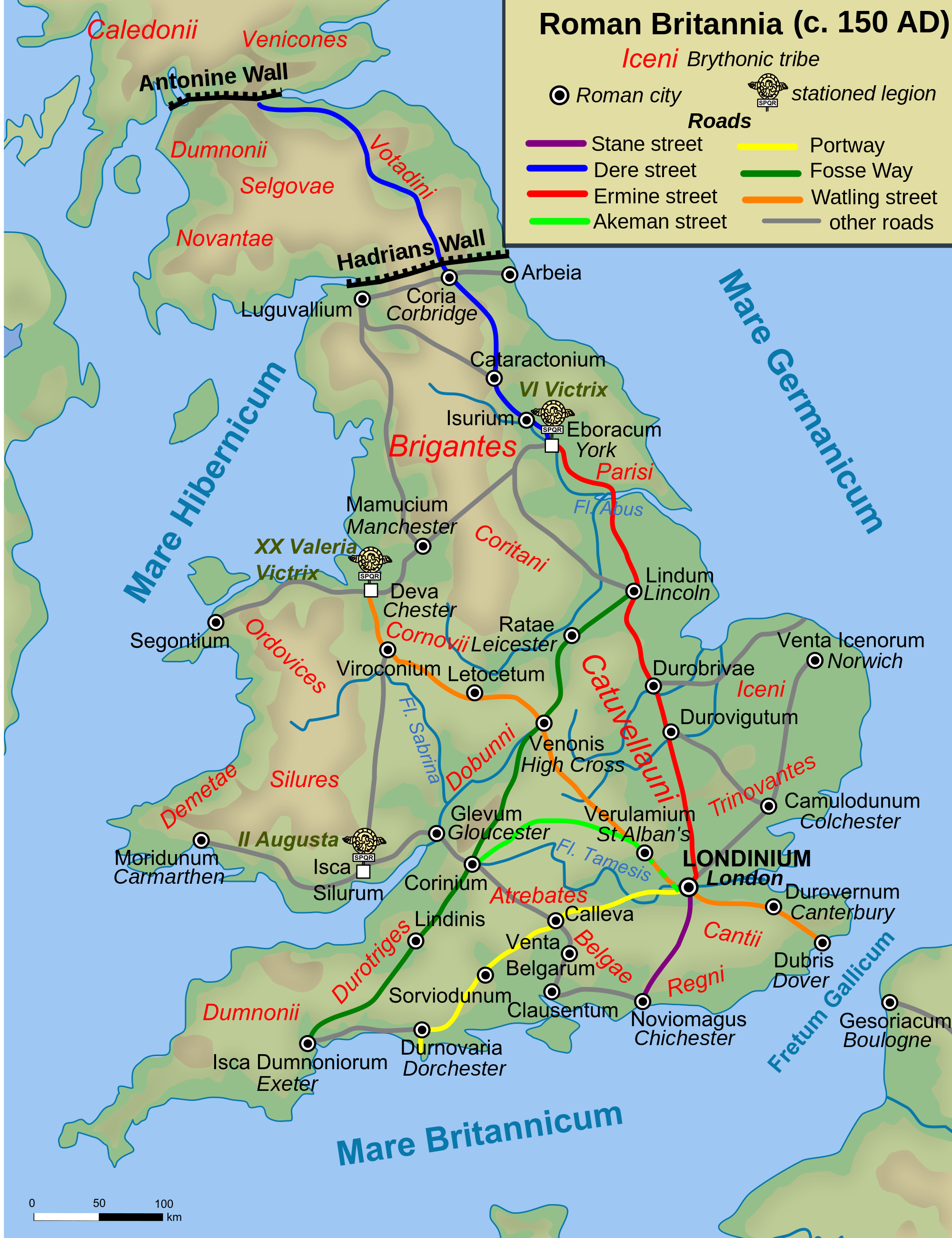
We recently wrote about Saruman and his pipeweed trade along the North-South and Great East Roads, and concluded that those roads reminded us of Roman Roads.  Looking at road networks from both Rome and Middle-earth, we see both as just that, networks, lines of communication which travel to and from central points.

roman-empire-roads-map9

middle-earth-map-roads

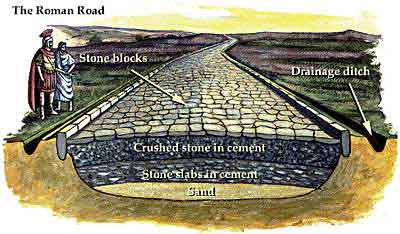
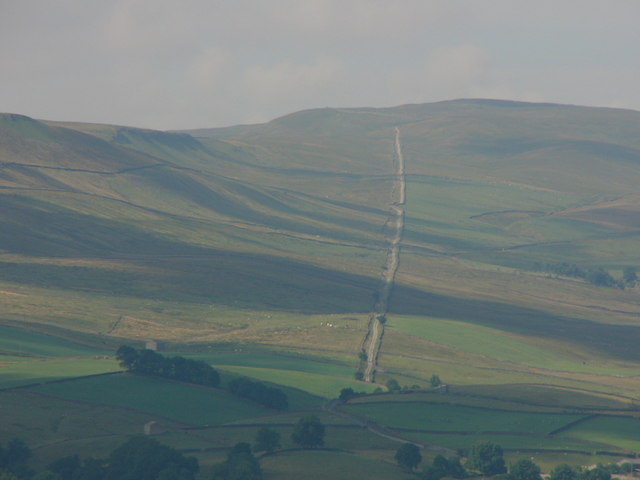
The roads of Middle-earth don’t appear to be so elaborately constructed and paved, of course, but then, at least for many centuries before The Lord of the Rings, there had been no central authority to maintain the system.

Roman Road

Although the idea of a Roman road—especially one that is incomplete or ruinous–

roman-road-bainbridge-geograph-e1400883247896

gives us a similar image.

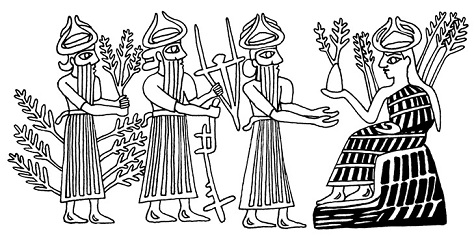
But there’s still something missing—Saruman has roads and connections, but how would he have paid for the pipeweed? He could have used a barter system, although that would mean understanding what it would be that he might use—raw material from the mountains? Some sort of manufactured goods made at Isengard? This could certainly be so, if we’re thinking of Middle-earth as a place set in pre-currency times, such as the Sumerians and the Egyptians, who managed their extensive trade just fine without a single coin.

Grain-Goddess-small MonetaryEgyptian

And we could just leave it at that, but then there’s a clue in the first chapter of The Fellowship of the Ring which suggests that the actual commercial system is based upon currency.

“When the old man, helped by Bilbo and some dwarves, had finished unloading, Bilbo gave a few pennies away…” LOTR 25

Bilbo is rumored to have treasure hidden away in his hobbit-hole, with much speculation from all,

“’There’s a tidy bit of money tucked away up there, I hear tell,’ said a stranger… ‘All the top of your hill is full of tunnels packed with chests of gold and silver…’” LOTR 23

And the Shire isn’t the only place where pennies are used—when Sam wants to purchase Bill the pony in Bree,

“Bill Ferny’s price was twelve silver pennies; and that was indeed at least three times the pony’s value in those parts.” LOTR 175

This indicates a standard value based upon that currency, which one assumes was universal (with a tone in the text which implies that everyone might share that opinion), and old enough that it was the accepted modus for buying and selling. As Tolkien himself once wrote:

“I am not incapable or unaware of economic thought; and I think as far as the ‘mortals’ go, Men, Hobbits, and Dwarfs, that the situations are so devised that economic likelihood is there and can be worked out…” LT, L.154 P.196.

Thus, although he was clearly aware of such economic transactions, he didn’t need them for a plot and Merry and Pippin’s food and drink–and smoke–are simply there–with the implication that Saruman’s reach is longer than anyone has assumed.

In fact, there are very few scenes where money is needed at all—the Prancing Pony is the only inn they come across on the road, and the Fellowship otherwise camps out until they are taken in at Lorien, Edoras, and Gondor, and a guest/host relationship becomes a major part of the story. We’ve actually even seen this sort of thing near the very beginning of the story, when Frodo becomes Elf-friend to Gildor, and is awarded provisions (and a hearty breakfast) for their journey. 

We have only a little knowledge of the commercial world of Middle Earth, as you can see, and no description of “pennies”, except that some are silver.  What might they have looked like?  In our earlier essays, we’ve used parallels from the history of our earth, just as JRRT might used road systems which could easily have been influenced by the Roman roads which once connected so much of Britain, to build the roads in Middle-earth. Some of those Roman roads, even in his time, were still visible–some even still used (although usually paved over).

2000px-Roman_Roads_in_Britannia.svgRomanRoadBritain2

Using our parallel method, we turn to Roman coinage.

RomanSilverPenny

We’re dealing with silver coinage in northwest Middle-earth, where Saruman’s imports come from, and if we’re thinking about Rome, we’d be looking at a time where coinage had already existed. We have no idea when coins were first issued in Middle Earth–considering how complexly organized the North and South Kingdoms had been for many centuries, we would imagine that a thousand years before the events of The Lord of the Rings  probably wouldn’t be too soon.  We have a small piece of evidence from some five hundred years before, when Deagol says to Smeagol:

“’I don’t care,’ said Déagol, ‘I have given you a present already, more than I could afford.’” LOTR, 52

In Rome, silver coinage was introduced in 269 BC, courtesy of the Greeks, after the Romans had been using bronze.

RomanBronzeCoin

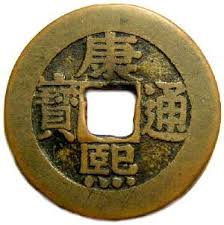
Coins originated in Asia Minor in the 6th c. BC and quickly caught on, being a convenient and highly portable way of transporting wealth—it was much easier to carry and design to designate between currencies, and the Chinese even began to manufacture coins which could be strung together.

ChineseCoin

In Middle-earth, this would make it easier to trade beyond the borders of a local market, or even the Shire–and would certainly have been accepted at The Prancing Pony.

All of this leads, however, to Questions for Further Study, as textbooks often say.  Currency needs backing—the Roman republic and then the empire backed Roman coins.  What backed those pennies in the Shire and beyond?Imagine that, in Middle-earth, the major legitimate government was Gondor—would these pennies have been originally Gondor-issued? If so, perhaps just what happened to Roman currency in late imperial times might have happened in Middle-earth—as Rome began to fall apart, semi-independent governments began to issue coins on their own, such as Theodric, the Germanic ruler of Northeastern Italy:

Theodorictriplesolidus_zps7dc7f768

Visually, they remind us–and they were certainly intended to–of imperial coins, with their images of Roman emperors.  Theodoric, even with his unusual hairstyle, meant to be seen as a new ruler for an old Rome.  Can we imagine dwarf coins, perhaps issued from the Moria mint?  And, when we remember that Mordor has tried to acquire horses from Rohan, what would Mordorian currency have looked like? And, returning to Saruman for a final time—if he paid for pipeweed in coins, did they bear a white hand?

Thanks, as ever, for reading,

MTCIDC,

CD

Ringed In

05 Wednesday Aug 2015

Posted by Ollamh in J.R.R. Tolkien

≈ Leave a comment

Tags

Anglo-Saxon, Bilbo, Deagol, Dwarves, Elves, Faramir, Frodo, Gandalf, Gollum, Gondor, Isildur, Kenning, Lorien, Men, Nazgul, Ring, Ring-bearer, Roman senator, Romans, Sam, Sauron, Silmaril, The Hobbit, The Lord of the Rings, Tolkien, Tom Bombadil

Dear Readers, as always, welcome!

permcol5tn

Everyone at all interested in the works of Tolkien knows this passage (and many could recite it by heart, we’re sure):

“Three Rings for the Elven-kings under the sky,

     Seven for the Dwarf-lords in their halls of stone,

Nine for Mortal Men doomed to die,

     One for the Dark Lord on his dark throne

In the Land of Mordor where the Shadows lie.

     One Ring to rule them all, One Ring to find them,

     One Ring to bring them all and in the darkness bind them

In the Land of Mordor where the Shadows lie.” LoTR 50.

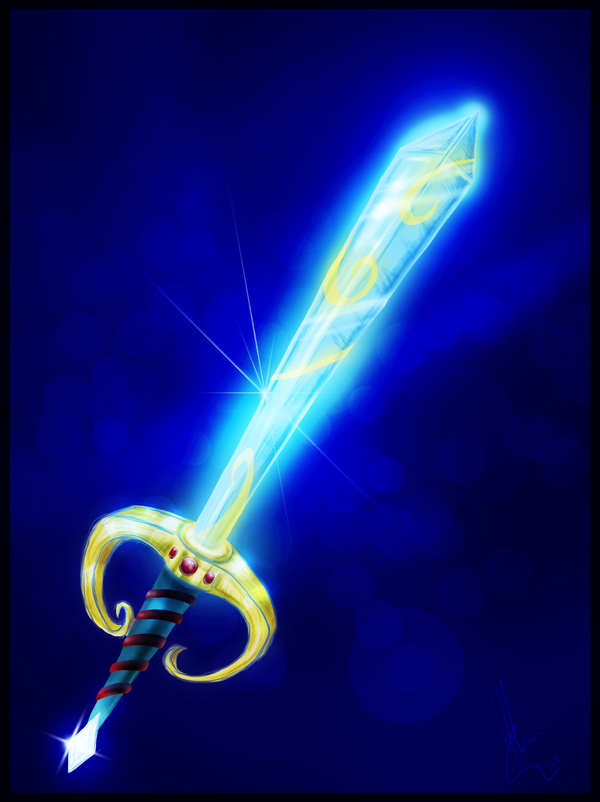
But why a ring? Since the Ring is about power, why not something which looks like power:

a sword, for example

ferb__s_magic_sword_by_kicsterash-d4clz45

or a crown

WingedAphroditeCrown_front

or even, considering Tolkien’s own mythology, a silmaril.

Beren_silmaril

In The Hobbit of 1937, the Ring was originally simply a magic ring right out of folk and fairy tales, with apparently one gift, invisibility, for which Gollum treasures it.

Alan%20Lee%20-%20The%20Hobbit%20-%2019%20-%20Riddles%20in%20the%20dark

As is well known, Tolkien reconsidered its powers and, as The Lord of the Rings grew, the ring became the Ring, and the central focus of the sequel to the earlier book. By the beginning of the 1950s, he states (in a letter to Milton Waldman dated by Carpenter/C. Tolkien as “probably written late in 1951” LTR 143):

“the primary symbolism of the Ring, as the will to mere power, seeking to make itself objective by physical force and mechanism, and so also inevitably by lies…” LTR 160.

(by “mere” we imagine that Tolkien is using the word here in its original Latin—merus –a –um— sense of “pure/unmixed”)

Although this tells us something about the force within the Ring, it doesn’t really explain why a ring.

Rings are an ancient status symbol, certainly. The Romans used them as one of the ways to show the class of a person: senators wore gold ones (although there is an old story that, originally, Roman senators wore rings made of iron)

RomeSenators2romanring

and the other free classes wore any metal they chose.   Tolkien would have had a vivid idea of the inherent status in a ring from Old English, as one of the kennings (poetic metaphorical phrases) for a great lord was “ring-giver”

asring

—just as Sauron gives rings to the ancient kings and so holds their allegiance long after their natural lives should have ended.    

bwnazgul

This is echoed in “and in the darkness bind them” , which brings us back to those verses with which we began.

In them, the Ring’s powers are clearly laid out (rather like Saruman’s claimed goals, “Knowledge, rule, order”): rule, find, bring, bind.

As Gandalf tells us, the primary reason for the creation of the Ring was, in fact, to rule, both the other rings and, through them, Middle-earth and its peoples: Elves, Dwarves, Men. To do so, Sauron endowed the Ring with much of his own power, a perfect example of his arrogance, depriving himself of power he might need, clearly convinced that he would suffer no harm from its lack.

As he endows the Ring, it seems that he—intentionally?—passed on to it a small bit of his self-will. Unlike inanimate objects in our world (and we presume in Middle-earth, too), the Ring not only shows purpose, but can act upon it.

As Gandalf tells Frodo:

“A Ring of Power looks after itself…It was not Gollum, Frodo, but the Ring itself decided things. The Ring left him…The Ring was trying to get back to its master.” LotR 55.

To do so, it uses another of its powers, it brings people to use as vehicles, discarding them when they have served its purpose.

“It had slipped from Isildur’s hand,” says Gandalf (a hand already under the Ring’s control, as it couldn’t force itself to destroy the Ring when it had the chance) and betrayed him; then when a chance came it caught poor Deagol, and he was murdered and after that Gollum, and it had devoured him. It could make no further use of him: he was too small and mean…So now, when its master was awake once more…it abandoned Gollum, only to be picked up by…Bilbo.” LotR 55-56.

To acquire such vehicles, the Ring uses a third power, finding. Gandalf’s list suggests that that power entails some innate ability to sense who will be most attracted to it. They appear to be rather a wide assortment, from the heir to the throne of Gondor to two proto-hobbits. And there are also those not on Gandalf’s list: Saruman and even, to some degree, Galadriel. As for Gandalf himself, he, like the Lady of Lorien, is wise enough to avoid the ultimate temptation, as is Faramir, perhaps because, as his father accuses him, he has been Gandalf’s pupil and has acquired some of his awareness both of events and of himself.

Our list would not be complete, however, without Frodo and Sam. It is hard to imagine that the Ring has picked them: Frodo, after all, has inherited it. This doesn’t mean that he is not influenced by it, even, at the end, sounding more like Isildur than himself in his refusing to destroy it, suggesting that, even by inheritance, someone can be found, brought, and ruled. And Sam? He holds it only briefly, but surrenders it so easily that it appears to have little ultimate power over him, something which he shares with Tom Bombadil, perhaps because both are grounded—quite literally—in Middle-earth. It is no surprise that Galadriel gives him a gift for growing things and that, in his consolation of Sam, Frodo says that he will be “the most famous gardener in history” (LoTR 1029). As for Bombadil, it would appear that the same sort of protection which keeps Sam from being found, brought, and ruled keeps him safe. When he holds up the Ring and looks through it, for a moment we might see that, for him, the symbolism of the “will to mere power” means nothing and, instead, he sees it only as an empty metal band.

For others, from the Nazgul to Frodo, who never feels whole again, the fourth power, binding, has done its job and also perhaps, in doing so, answers the question, why a ring?

Heavy-6mm-D-Shape-18k-Yellow-Gold-Wedding-Ring

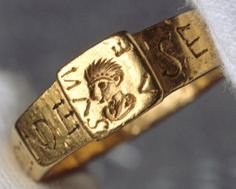
What better binder than a perfect circle, seemingly blank, but with a hidden message, almost a spell, and which, when put on, pulls you from the daylight world and, which, worn too long, can keep you there forever?

Thanks, as ever, for reading.

MTCIDC

CD
Red Books, Black Books, Yellow Books

24 Wednesday Jun 2015

Posted by Ollamh in J.R.R. Tolkien, Language, Narrative Methods

≈ Leave a comment

Tags

Bilbo, Black Book of Carmarthen, Book of Ballymote, Book of Leinster, Book of Lismore, Book of Taliesin, Book of the Dun Cow, Dwarves, Geoffrey of Monmouth, Gollum, Mabinogion, Manuscript, Medieval books, Red Book of Hergest, Red Book of Westmarch, Scriptorium, The Hobbit, The Lord of the Rings, The Shire, Tolkien, White Book of Rhydderch, Yellow Book of Lecan

Dear Readers,

Welcome back! This posting is devoted to a look at what lies behind that famous imaginary document The Red Book of Westmarch.

     As Tolkien says of The Lord of the Rings in the section of the prologue entitled “Note on the Shire Records”:

“This account of the end of the Third Age is drawn mainly from the Red Book of Westmarch. That most important source for the history of the War of the Ring was so called because it was long preserved at Undertowers, the home of the Fairbairns, Wardens of the Westmarch. It was in origin Bilbo’s private diary, which he took with him to Rivendell. Frodo brought it back to the Shire, together with many loose leaves of notes, and during S.R. 1420-1 he nearly filled its pages with his account of the War. But annexed to it and preserved with it, probably in a single red case, were the three large volumes, bound in red leather, that Bilbo gave to him as a parting gift. To these four volumes there was added in Westmarch a fifth containing commentaries, genealogies, and various other matter concerning the hobbit members of the Fellowship.” 14

redbookfacsimile

     This is not the end of the material on the Red Book, of course,—that takes up another paragraph and then is continued in several more paragraphs about copies and about other pertinent written sources. This is JRRT having fun, of course: after all, for him, what is more satisfying after creating languages than building contexts for them?

     This particular context is based upon material from his own specialty, medieval literature, and it’s always been said that The Red Book of Westmarch was inspired by the late 14th-century Welsh Red Book of Hergest. This famous manuscript contains one of the major texts of the cycle of legendary material called the Mabinogion, but for Tolkien its importance may have been simply that

  1. it’s a medieval manuscript familiar to him and a model-ready-to-hand for what he created in what he thought of as his own medieval world
  2. as the Wiki entry says, “The manuscript derives its name from the colour of its leather binding and from its association with Hergest Court between the late 15th and early 17th century.”

redbookofhergest

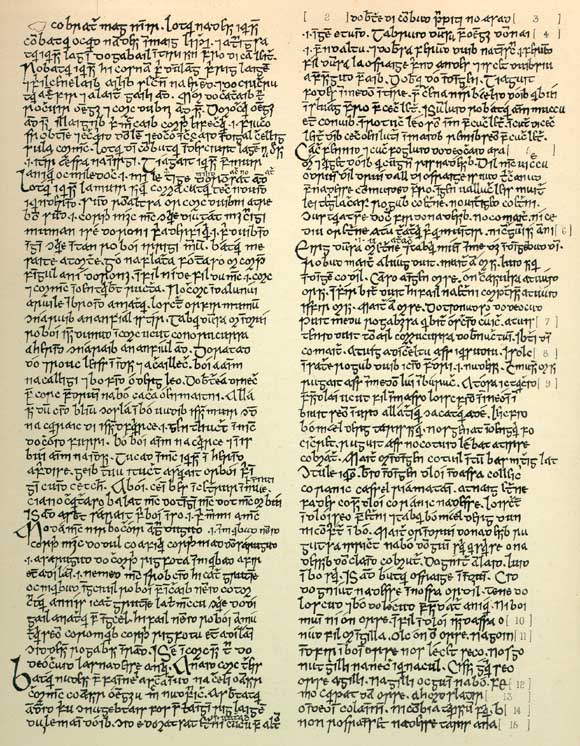
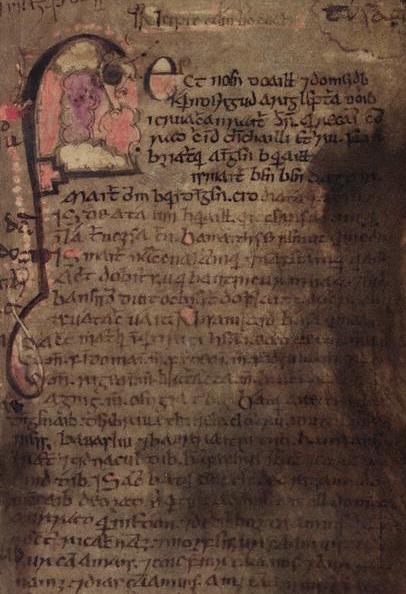
     This manuscript and others like it, both Welsh (Black Book of Carmarthen,White Book of Rhydderch, Book of Taliesin) and Irish (Book of the Dun Cow, Yellow Book of Lecan, Book of Leinster, Book of Ballymote, Book of Lismore)

blackbookofcarmarthen

Book_of_Taliesin_facsimile

whitebookof rhydderch

lebornauidre

Book_of_Lecan_p2

Book_of_Leinster,_folio_53

were created in the scriptoriums (Latin plural: scriptoria), the medieval equivalent of a copy center, in various monasteries. The following images will give you an idea of how they worked.

scriptorium

 BL_Royal_Vincent_of_Beauvais

gregory

In the world before Gutenberg

792px-Pressing-16th_century%20copy

everything was written—and then copied—by hand, a fact which Tolkien faithfully reproduces in his world when he writes that:

“The most important copy, however, has a different history. It was kept at Great Smials, but it was written in Gondor, probably at the request of the great-grandson of Peregrin, and completed in S.R. 1592 (F.A. 172). Its southern scribe appended this note: Findegil, King’s Writer, finished this work in IV 172.” 14

     There are, of course, no monasteries in Middle Earth, but, in our world, there were clerks, educated in monasteries, who worked as secretaries and copyists for kings and their nobility, so it’s quite logical that a copy of the Red Book in Middle Earth was the work of a so-called “King’s Writer”.

     Comparing an actual manuscript with the Red Book of Westmarch, we find several other differences. For one, the RBW’s four main volumes appear to contain nothing but material relating to the events surrounding Bilbo, Frodo, and the Ring. In contrast, the actual medieval manuscripts are more like compilations. The Red Book of Hergest, for example, has not only the Mabinogion, but also unrelated poetry, and a Welsh translation of Geoffrey of Monmouth’s History of the Kings of Britain, among other works. The Irish Book of the Dun Cow has religious texts and secular, all mixed together, and this appears to be common. The closest the RBW comes to this is volume 5, with its “commentaries, genealogies, and various other matter concerning the hobbit members of the Fellowship” and this is still material pertaining to the main subject, not something as removed as the method for determining the correct date for Easter to be found in the Book of Leinster.

     Another difference brings us to a puzzle and the conclusion of this posting.  Tolkien has told us that the core of the RBW is Bilbo’s diary. The Welsh and Irish manuscripts discussed above are collections of literary and religious texts, with nothing personal in them at all, as he would have been well aware.  As well, we might wonder when and where and how Bilbo kept that diary. There’s no mention of it in The Hobbit—after all, Bilbo ran out of his house to join the dwarves without even a pocket handkerchief. And, even if the dwarves had provided one (along with the handkerchief–although that does not seem terrifically likely–the dwarves who visit Bilbo seem more attuned to orality than literacy), surely it would have been lost with all of the other baggage when the company fell into the goblin world and Bilbo met Gollum.

Alan Lee - The Hobbit - 19 - Riddles in the dark

Other than assuming that Bilbo, although he had forgotten his handkerchief, had remembered his Blackberry and was constantly dictating to the Cloud for later transcription, what do we have here?  (And, while we’re wondering, if The Hobbit was based upon that mysterious diary, what do we know of the adapter/narrator who turned it from a diary into a continuous narrative–another “King’s Writer”?)

Obviously, MTCIDC!

Thanks, as always, for reading.

CD
Newer posts →

The Doubtful Sea Series Facebook Page

The Doubtful Sea Series Facebook Page

  • Ollamh

Categories

  • Artists and Illustrators
  • Economics in Middle-earth
  • Fairy Tales and Myths
  • Films and Music
  • Games
  • Heroes
  • Imaginary History
  • J.R.R. Tolkien
  • Language
  • Literary History
  • Maps
  • Medieval Russia
  • Military History
  • Military History of Middle-earth
  • Narnia
  • Narrative Methods
  • Poetry
  • Research
  • Star Wars
  • Terra Australis
  • The Rohirrim
  • Theatre and Performance
  • Tolkien
  • Uncategorized
  • Villains
  • Writing as Collaborators
Follow doubtfulsea on WordPress.com

Across the Doubtful Sea

Recent Postings

  • Through a glass… January 7, 2026
  • Heffalumps? December 31, 2025
  • We Three Kings December 24, 2025
  • A Moon disfigured December 17, 2025
  • On the Roads Again—Once More December 10, 2025
  • (Not) Crossing Bridges December 3, 2025
  • On the Road(s) Again—Again November 26, 2025
  • On the Road(s) Again November 19, 2025
  • To Bree (Part 2) November 12, 2025

Blog Statistics

  • 104,147 Views

Posting Archive

  • January 2026 (1)
  • December 2025 (5)
  • November 2025 (4)
  • October 2025 (5)
  • September 2025 (4)
  • August 2025 (4)
  • July 2025 (5)
  • June 2025 (4)
  • May 2025 (4)
  • April 2025 (5)
  • March 2025 (4)
  • February 2025 (4)
  • January 2025 (5)
  • December 2024 (4)
  • November 2024 (4)
  • October 2024 (5)
  • September 2024 (4)
  • August 2024 (4)
  • July 2024 (5)
  • June 2024 (4)
  • May 2024 (5)
  • April 2024 (4)
  • March 2024 (4)
  • February 2024 (4)
  • January 2024 (5)
  • December 2023 (4)
  • November 2023 (5)
  • October 2023 (4)
  • September 2023 (4)
  • August 2023 (5)
  • July 2023 (4)
  • June 2023 (4)
  • May 2023 (5)
  • April 2023 (4)
  • March 2023 (5)
  • February 2023 (4)
  • January 2023 (4)
  • December 2022 (4)
  • November 2022 (5)
  • October 2022 (4)
  • September 2022 (4)
  • August 2022 (5)
  • July 2022 (4)
  • June 2022 (5)
  • May 2022 (4)
  • April 2022 (4)
  • March 2022 (5)
  • February 2022 (4)
  • January 2022 (4)
  • December 2021 (5)
  • November 2021 (4)
  • October 2021 (4)
  • September 2021 (5)
  • August 2021 (4)
  • July 2021 (4)
  • June 2021 (5)
  • May 2021 (4)
  • April 2021 (4)
  • March 2021 (5)
  • February 2021 (4)
  • January 2021 (4)
  • December 2020 (5)
  • November 2020 (4)
  • October 2020 (4)
  • September 2020 (5)
  • August 2020 (4)
  • July 2020 (5)
  • June 2020 (4)
  • May 2020 (4)
  • April 2020 (5)
  • March 2020 (4)
  • February 2020 (4)
  • January 2020 (6)
  • December 2019 (4)
  • November 2019 (4)
  • October 2019 (5)
  • September 2019 (4)
  • August 2019 (4)
  • July 2019 (5)
  • June 2019 (4)
  • May 2019 (5)
  • April 2019 (4)
  • March 2019 (4)
  • February 2019 (4)
  • January 2019 (5)
  • December 2018 (4)
  • November 2018 (4)
  • October 2018 (5)
  • September 2018 (4)
  • August 2018 (5)
  • July 2018 (4)
  • June 2018 (4)
  • May 2018 (5)
  • April 2018 (4)
  • March 2018 (4)
  • February 2018 (4)
  • January 2018 (5)
  • December 2017 (4)
  • November 2017 (4)
  • October 2017 (4)
  • September 2017 (4)
  • August 2017 (5)
  • July 2017 (4)
  • June 2017 (4)
  • May 2017 (5)
  • April 2017 (4)
  • March 2017 (5)
  • February 2017 (4)
  • January 2017 (4)
  • December 2016 (4)
  • November 2016 (5)
  • October 2016 (6)
  • September 2016 (5)
  • August 2016 (5)
  • July 2016 (5)
  • June 2016 (5)
  • May 2016 (4)
  • April 2016 (4)
  • March 2016 (5)
  • February 2016 (4)
  • January 2016 (4)
  • December 2015 (5)
  • November 2015 (5)
  • October 2015 (4)
  • September 2015 (5)
  • August 2015 (4)
  • July 2015 (5)
  • June 2015 (5)
  • May 2015 (4)
  • April 2015 (3)
  • March 2015 (4)
  • February 2015 (4)
  • January 2015 (4)
  • December 2014 (5)
  • November 2014 (4)
  • October 2014 (6)
  • September 2014 (1)

Blog at WordPress.com.

  • Subscribe Subscribed
    • doubtfulsea
    • Join 78 other subscribers
    • Already have a WordPress.com account? Log in now.
    • doubtfulsea
    • Subscribe Subscribed
    • Sign up
    • Log in
    • Report this content
    • View site in Reader
    • Manage subscriptions
    • Collapse this bar
 

Loading Comments...