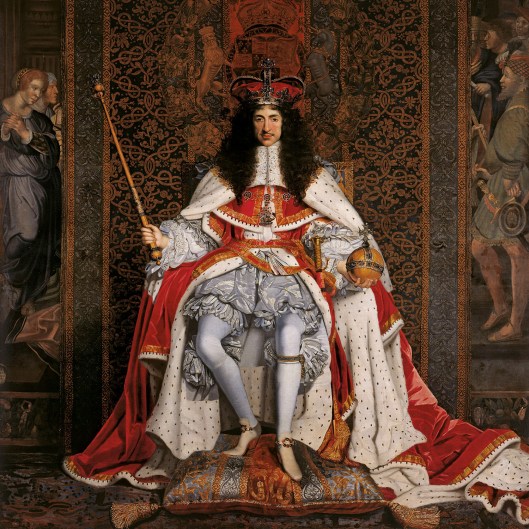
• About

doubtfulsea

~ adventure fantasy

Tag Archives: Nazgul

Crowning Achievement

20 Wednesday Sep 2017

Posted by Ollamh in Artists and Illustrators, J.R.R. Tolkien, Literary History, Narrative Methods

≈ Leave a comment

Tags

Alexander the Great, Alice in Wonderland, Barrow-downs, Barrow-wights, Bayeux Tapestry, Brunhilde, Charlemagne, Cheshire Cat, circlet, Cleopatra VII, diadem, Egypt, Egyptian crowns, Elightenment France, Eowyn, French Revolution, Gondor, Gondorian crown, Greek, Greek coins, Hildebrandts, Imperial Crown of the Holy Roman Empire, Julius Caesar, Lupercalia, Marcus Antonius, Medieval, Napoleon I, Nazgul, Octavian Augustus, Pharoahs, Philip II, Pontifex Maximus, Ptolemy I, Queen Elizabeth I, Queen Elizabeth II, Queen Victoria, Richard Wagner, Rohan, Romans, Tenniel, The Lord of the Rings, Theoden, Tolkien, William Shakespeare, Witch-King of Angmar, wreaths

Welcome, dear readers, as ever.

Recently, one of us was lecturing on ancient Egypt, a country of two lands, in fact, Upper and Lower, and each could be represented in the crown worn by the pharaoh.

image1crownsof-egypt.jpg

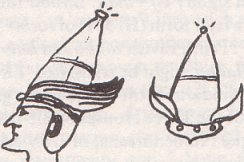
Within in blink, we began to think about JRRT’s illustration of the traditional crown of Gondor,

image2jrrtcrown.jpg

of which Tolkien says:

“I think that the crown of Gondor (the S. Kingdom) was very tall, like that of Egypt, but with wings attached, not set straight back but at an angle.

The N. Kingdom had only a diadem (III 323).  Cf. the difference between the N. and S. kingdoms of Egypt.”

(Letters, letter to Rhona Beare, 10/14/58, 281)

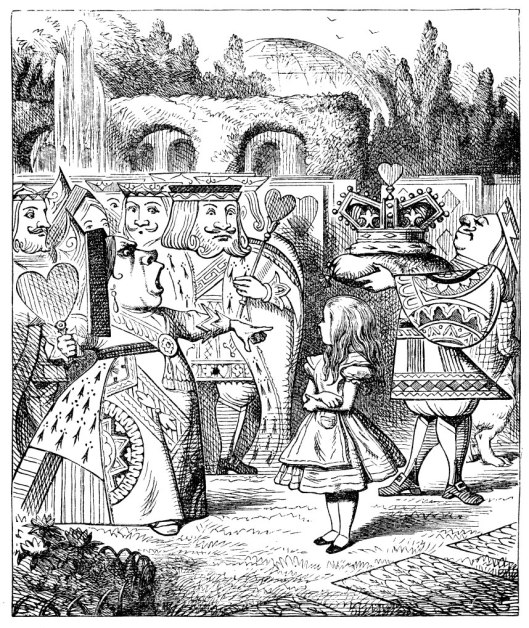
For us, the first crown we believe we ever saw as children was either one in an illustrated fairy tale (here’s a Tenniel illustration from Alice)

image3atenniel.jpg

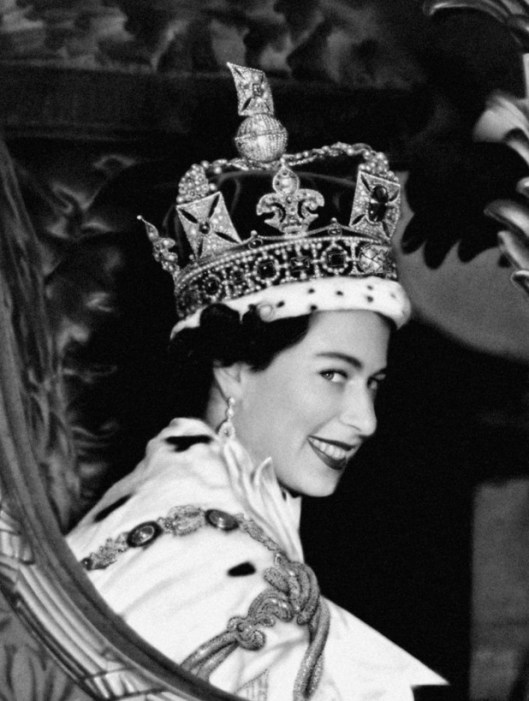
or the actual one of Queen Elizabeth II, and that hardly fits JRRT’s idea about the southern crown—or the northern one

image3er2.jpg

or that of her ancestor, Queen Victoria

imaage4vr.jpg

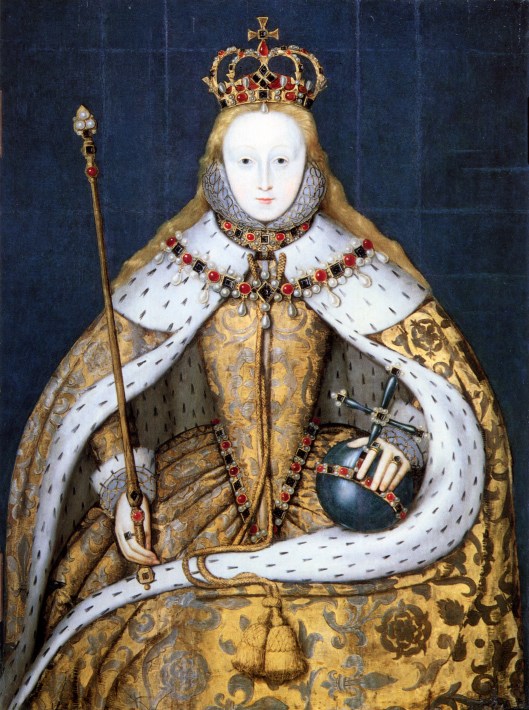
or that of their distant ancestor, Elizabeth I.

image5er1.jpg

When we think of a “diadem”, however, we are reminded of the earliest western European crowns, which, in contrast to Elizabeth’s, is barely there at all.

Here is the first type of crown we know of being depicted—it’s that “diadem” in a Greek form, being on a coin of Philip II, King of Macedon and father of Alexander the Great (the reverse—the back side—the front side is called the “obverse”—shows Philip’s Olympic victory horse and Philip’s name in the genitive—possessive—case, “of Philip”—showing not only possession of the horse, but of the victory, of the coin, and, by implication, the right to issue coins).


This became a regular pattern, both of coin and of crown for those who followed Philip, and, thinking about Philip’s victory, we can imagine that the original of the crown was based upon the wreath athletic game victors wore.


And coins like Philip’s set the pattern for classical coins—and crowns—for centuries.  Here’s the crown pattern on the head of Ptolemy I, one of Alexander’s generals.


At Alexander’s death, Ptolemy seized Egypt, making it a family possession for the next nearly three hundred years, all the way down to his greatgreatgreat etc granddaughter Cleopatra VII.

image9cleo.jpg

The pattern was not confined to Greece or Egypt, however—Julius Caesar wore something similar—

CaesarCoin_Wikipedia_960.jpg

although, unlike Ptolemy and other such rulers, Caesar might have hoped to muddy people’s perceptions of what such a thing symbolized and what position (dictator for life) he’d forced the Senate to give him.   Rome had hated monarchs, after all, since they’d kicked out their last king 450 years before.

(And see Act I, Sc.2 of Shakespeare’s Julius Caesar in which, at the festival of the Lupercalia, Marcus Antonius publically offers him a crown and Caesar rejects it, much to the loud delight of the mob.)

In the Greco-Roman world, wreaths had many purposes:  besides Greek kings and winners at games, people at parties and weddings and other festive occasions wore them, as well as celebrants at religious rites.

image12symposium.jpg

Perhaps Caesar hoped that, appearing in one, he might appear less like a Hellenistic king and more like anything from an Olympic victor or party-goer to a priest (he was Pontifex Maximus, head of religion in Rome, so there was a certain credibility to the latter).

image13pm.jpg

Malicious people in Rome also suggested another reason for the wreath:  Caesar was sensitive about his thinning hair.

image14jc.jpg

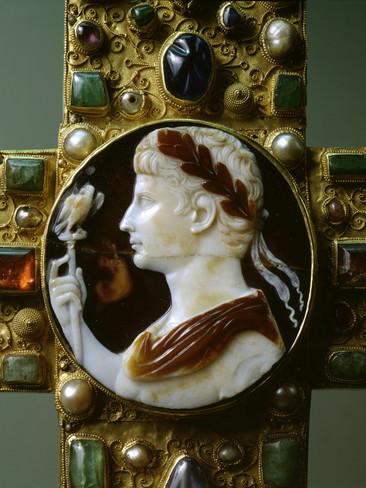
Caesar’s grandnephew and successor, Octavian/Augustus, continued the tradition,

Augusts-in-Ancient-Roman-Cameo.jpg

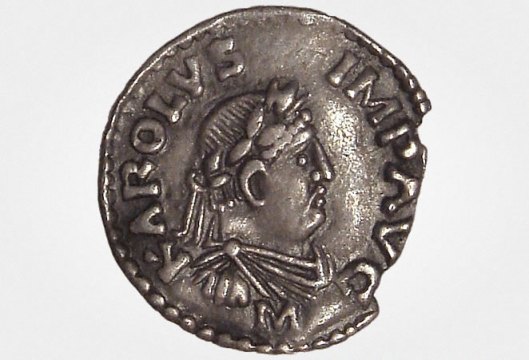
as did following emperors for several centuries—and even Charlemagne, hundreds of years after the last western emperor, revived it.

image16charlemagne.jpg

At some point, just after Charlemagne’s time or thereabout (c1000ad), a new pattern appeared, which you can see in the famous “Imperial Crown of the Holy Roman Empire”.

image17impcrown.jpg

Instead of a wreath, this was a built-up circlet, with lots of “bits and bobs” on top.

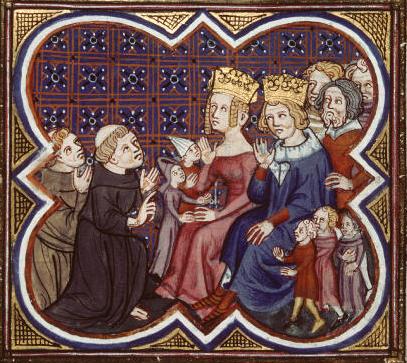
This newer look persisted in various more or less complicated forms in the west for centuries

image18king.jpgimage19king.jpgimage20king.jpgimage21king.jpg

and seems to underlie the crowns seen in more recent times (often with what appears to be a red velvet balloon in the middle).

image22er1.jpgimage23chas2.jpgimage24geov.jpg

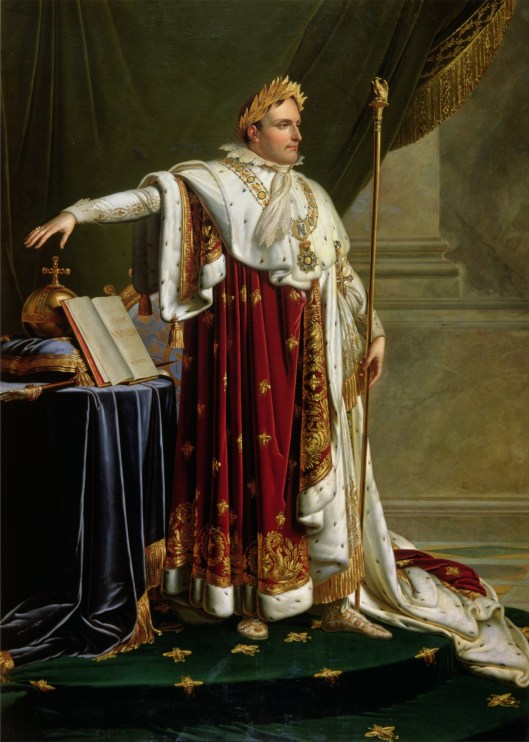
There is a throwback, however:  Napoleon I.  He had grown up in Enlightenment France, in a world which idealized classical learning and art, and so, when he made himself emperor in 1804, his model wasn’t medieval and Germanic, but Augustine.

image25agus.jpg

image25nappy.jpg

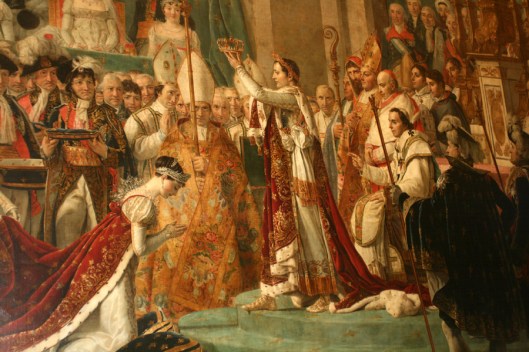
This doesn’t mean that he wasn’t aware of that other model and he would have used it—the so-called “crown of Charlemagne”–at his self-coronation

image26napcoron.jpg

had it not suffered the fate of many medieval treasures and been destroyed during the French Revolution (the famous Bayeux Tapestry was almost converted to wagon covers by revolutionaries).  In fact, a “crown of Charlemagne” did turn up for the ceremony—“recreated” by a clever Paris jeweler.

image27charlcrown.jpg

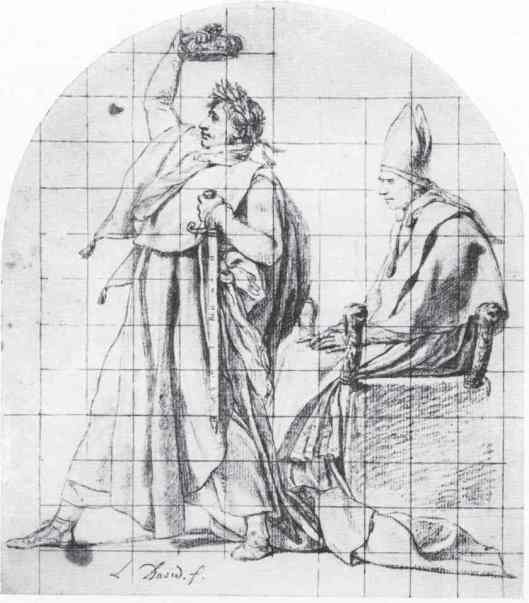
[A footnote about the coronation.  In the painter David’s sketches for it, he shows the pope (Pius VII) with his hands in his lap.

image28pope1.jpg

Napoleon saw the drawing and said to David that the pope should be blessing the occasion—after all, that’s why Napoleon had dragged him all the way from Rome.  David redid his sketch, of course!]

image29pope2.jpg

Beyond the Crowns of Gondor, most of the crowns seen in The Lord of the Rings are described as “circlets”—

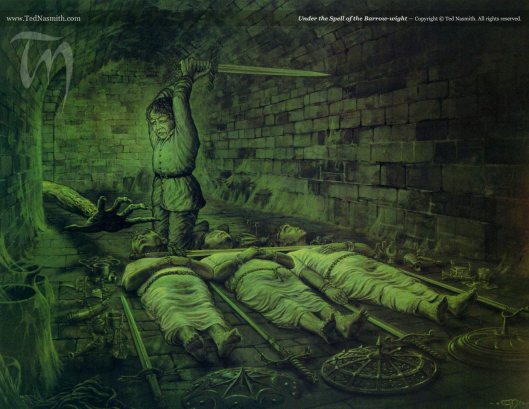
  1. Sam, Merry, and Pippin, laid out in the barrow:

“About them lay many treasures of gold maybe, though in that light they looked cold and unlovely.  On their heads were circlets, gold chains were about their waists, and on their fingers were many rings.”(The Fellowship of the Ring, Book One, Chapter 8, “Fog on the Barrow-Downs”)

image30barrow.jpg

  1. Theoden:

“Upon it sat a man so bent with age that he seemed almost a dwarf; but his white hair was long and thick and fell in great braids from beneath a thin golden circlet set upon his brow.” (The Two Towers, Book Three, Chapter 6, “The King of the Golden Hall”)

image31theoden.jpeg

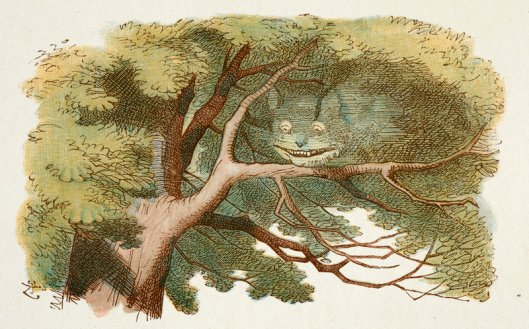
But there is one which, well, looking at the various illustrations of its wearer, reminds us of Alice’s comment upon the Cheshire Cat:

“Well! I’ve often seen a cat without a grin…but a grin without a cat!  It’s the most curious thing I ever saw in my life!” (Alice’s Adventures in Wonderland, Chapter 6, “Pig and Pepper”)

image32cheshirecat.jpg

On the Fields of the Pelennor, a “great shadow descended like a falling cloud.  And behold! It was a winged creature.”

This might be bad enough, but:

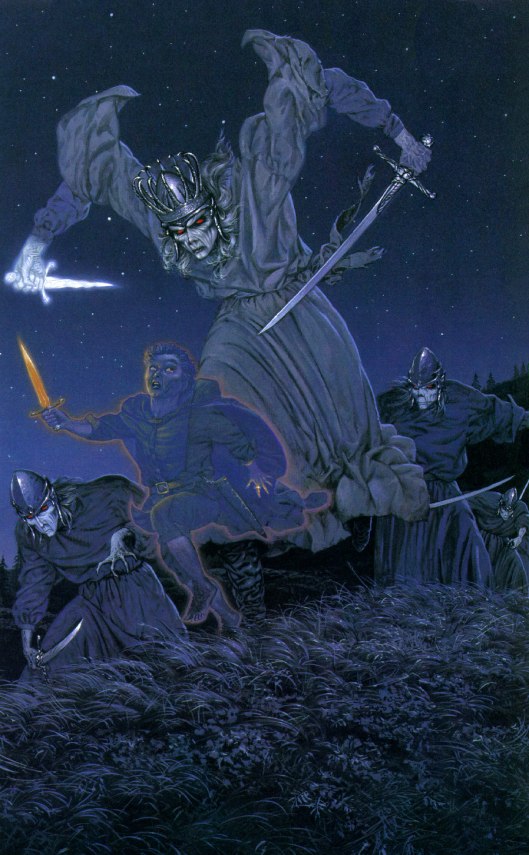
“Upon it sat a shape, black-mantled, huge and threatening.  A crown of steel he bore, but between rim and robe naught was there to see, save only a deadly gleam of eyes:  the Lord of the Nazgul.” (The Return of the King, Book Five, Chapter 6, “The Battle of the Pelennor Fields”)

image33eonaz.jpg

We are aware of at least half-a-dozen professional renderings of this scene (and we plan to discuss them all in a future post), but it seems to us that those eyes, seeming to float in space, make it extremely difficult to illustrate it, no matter what crown—simply described as “steel”—he’s wearing.  And that brings us back to our original crown.  As JRRT described it:

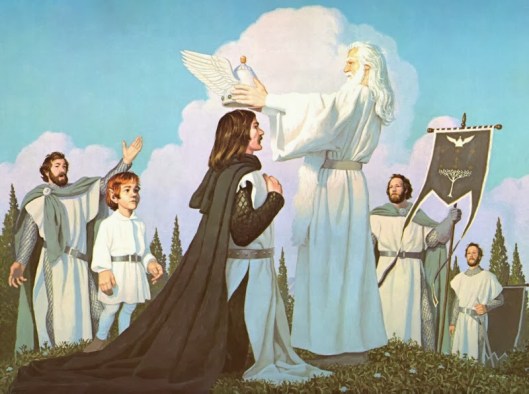
“It was shaped like the helms of the Guards of the Citadel, save that it was loftier, and it was all white, and the wings at either side were wrought of pearl and silver in the likeness of the wings of a sea-bird, for it was the emblem of kings who came over the Sea; and seven gems of adamant were set in the circlet, and upon its summit was set a single jewel the light of which went up like a flame.” (The Return of the King, Book Six, Chapter 5, “The Steward and the King”)

If his drawing (seen at the beginning of this post) is what he had in mind, then the only professional illustration we’ve seen of it, by the Hildebrandts, is only an approximation.

image34coronation.jpg

And, in fact, reminds us all-too-easily of Brunhilde, the Walkuere, from Wagner’s operas.

image35brunhilde.jpg

If illustrators as good as the Hildebrandts struggle, this must be a tough one.  The designers of the P. Jackson films are even farther away from the original, as so often.

image36aragorn.jpg

Here, however, we have some sympathy!  Somehow the medieval world of Middle-earth can not easily assimilate an Egyptian artifact.  And so, we suspect that they thought “circlet” and “wings” and left it there.  What do you think, readers?  How do you imagine the crown?

Thanks, as ever, for reading.

MTCIDC

CD
Healing (II)

16 Wednesday Aug 2017

Posted by Ollamh in Heroes, J.R.R. Tolkien, Literary History, Narrative Methods

≈ Leave a comment

Tags

Akira Kurosawa, Aragorn, athelas, bleeding, Boromir, cinquefoil, Eowyn, Faramir, four humors, Greco-Roman, healers, herbal medicine, Hildebrandts, Japanese block prints, John Bradmore, Kingsfoil, Macbeth, Medieval medicine, Medieval Monastery, Merry, Morgul Knife, Nazgul, Prince Hal, Prince Imrahil, Pyre of Denethor, Rammas Echor, The Battle of the Pelennor Fields, The Grey Havens, The Houses of Healing, The Lord of the Rings, The Return of the King, Throne of Blood, Tolkien, Washizu, Westernesse, Witch-King of Angmar, wounding, Yoshitoshi, Yoshitoshi's Courageous Warriors

Welcome, dear readers, as ever.
Two postings ago, we were talking about woundings in The Lord of the Rings and thinking about the medical care there as compared with that available in what we always think of as the actual parallel medieval world. We had gotten as far as Boromir, who, we imagined, would have been beyond help, pierced as he was by multiple arrows.
image1boromir.jpg
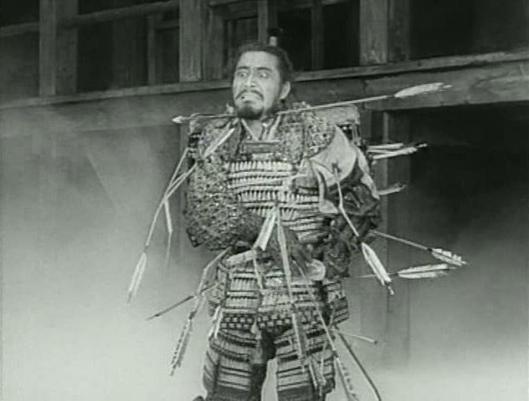
(We had also said that Boromir’s wounding reminded us of the death of the Macbeth figure in Kurosawa’s Throne of Blood, 1957.
image2throne.jpg
To which we would add—just because we love Japanese block prints (ukiyo-e)—this figure from Yoshitoshi’s series Yoshitoshi’s Courageous Warriors—1883-1886—)
image3yoshi.jpg
[Here, by the way, are some great links—one to a massive collection of Yoshitoshi prints, the other is an excellent guide to the world of Japanese block prints in general—both highly recommended!]

http://yoshitoshi.net/

http://www.ukiyo-e.se/
The next wounding is that of Faramir.
After the fall of the Rammas Echor, the long wall which was meant to protect the far side of the Pelennor, Faramir was leading the rear guard, but:
“…there came flying a deadly dart, and Faramir, as he held at bay a mounted champion of Harad, had fallen to the earth.” (The Return of the King, Book Five, Chapter 4, “The Siege of Gondor”)
At this time, we are not told of how the arrow was removed (we later are told that Prince Imrahil did it on the battlefield), but, that which concerned John Bradmore about the wounded Prince Hal in our 1403, after he had suffered an arrow wound,
image4halwitharrow.jpg
now afflicted Faramir: infection.:
“During all this black day Faramir lay upon his bed in the chamber of the White Tower, wandering in a desperate fever…”
In our medieval world, medicine was based upon a combination of beliefs, some of which even dated back to the Greco-Roman world.
One major foundation block was the idea that the body was governed by four elements, called “humors”: black bile, yellow bile, phlegm, and blood.


image5humours.png
They determined personality and behavior, but, although they were natural to the body, they could be thrown out of balance and part of a medieval doctor’s job was to rebalance them.
image6meddocs.jpg
This rebalancing could include doses of all sorts of things—dangerous metals, like mercury, concoctions from various plants, some of which were helpful, some poisonous, and bleeding—based upon the idea that, by removing blood, you were helping rebalance the body’s natural humorous proportions.
image7bleeding.jpg
In Faramir’s case, a doctor might try a number of drugs based upon plants which were believed to bring fever down:
angelica
image8angelica.jpg
chamomile
image9chamomile.JPG
datura
image10datura.jpg
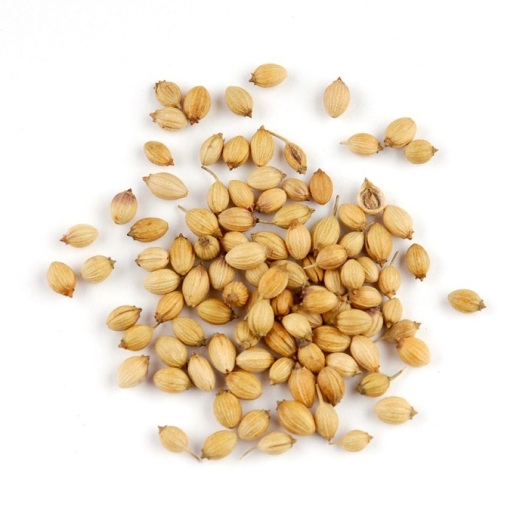
or coriander
image11coriander.jpg
In the text, however, although Pippin suggests that Gandalf be consulted, Denethor dismisses the suggestion and Faramir is left to burn—before almost being literally consumed by fire along with his mad father.
[And here we would suggest that the over-the-top scene of Denethor’s death in the film missed an important point. In the book, it is clear that what drove Denethor to try to set up a kind of Viking funeral for himself and his son was the palantir by which his mind was poisoned by a Sauron whose influence over him he fatally underestimated. And what a wonderfully spooky moment JRRT describes when the orb survives the fire which destroys the Steward:
“And it was said that ever after, if any man looked in that Stone, unless he had a great strength of will to turn it to other purpose, he saw only two aged hands withering in flame.” (The Return of the King, Book Five, Chapter 7, “The Pyre of Denethor”)]
We will return to Faramir, but, first, we want to look at two more woundings, both occurring almost in the same moment: when Eowyn and Merry face the chief of the Nazgul.
image12eowyn.jpg
In confronting the Witch King, Eowyn suffers what might seem a perfectly ordinary battle wound in a world of hand-to-hand combat such as this:
“Out of the wreck rose the Black Rider, tall and threatening, towering above her. With a cry of hatred that stung the very ears like venom he let fall his mace. Her shield was shivered in many pieces and her arm was broken; she stumbled to her knees.” (The Return of the King, Book Five, Chapter 6, “The Battle of the Pelennor Fields”)
image13merrynaz.jpg
Eowyn is saved from the Nazgul by Merry, who “had stabbed him from behind, shearing through the black mantle, and passing up beneath the hauberk had pierced the sinew in his mighty knee.”
Combined with Eowyn’s final blow at the wraith’s face, this destroyed what we presume was an undead being, but, in return, both Merry and Eowyn take an invisible wound, something which the medical people of Minas Tirith can only observe:
“But now their art and knowledge were baffled; for there were many sick of a malady that would not be healed; and they called it the Black Shadow, for it came from the Nazgul. And those who were stricken with it fell slowly into an ever deeper dream, and then passed into silence and a deadly cold, and so died. And it seemed to the tenders of the sick that on the Halfling and on the Lady of Rohan this malady lay heavily.” (The Return of the King, Book Five, Chapter 8, “The Houses of Healing”)
Eowyn and Merry (and Faramir) have been taken to “the Houses of Healing”, which, in our world, would be a hospital, something which, in our Middle Ages, would either have been part of a monastery/cloister, or were a private foundation, supported by charitable donations.
image14medhosp.jpg
Medical people there could certainly have set Eowyn’s broken arm, even sealing it in plaster to keep it immobile, but the Black Shadow would have been as difficult for them as for the healers in Minas Tirith. Comas were recognized in the Middle Ages, but there was little to be done: apparently, comatose people lose the swallowing function, which means that someone in that condition would die of dehydration, probably within a few days (speed of dehydration depends upon many factors, as well as the individual, but the longest we’ve seen is about 10 to 12 days).
To their credit, those in the Houses of Healing tried to do something by observation:
“Still at whiles as the morning wore away they [Eowyn and Merry] would speak, murmuring in their dreams; and the watchers listened to all they said, hoping perhaps to learn something that would help them to understand their hurts.”
But the Shadow spreads quickly as day fades:
“But soon they began to fall down into the darkness, and as the sun turned west a grey shadow crept over their faces.”
And there is the added difficult of Faramir, who “burned with a fever that would not abate.”
At this point, both medieval healers and those in Minas Tirith were stumped—until another factor was added. In fact, two.
Plants have been used since ancient times for medicine world-wide, so it should be no surprise that Middle-earth should have a parallel. In this instance, the plant is called “kingsfoil” or athelas. (The “foil” in the first name is—in English—based upon the Old French foil/foille, “leaf”, which comes, in turn, from a Latin word for leaf, folium—perhaps JRRT was inspired by the plant called “cinquefoil” = “fiveleaf”. Athelas is also a compound, based upon Sindarin athaya, “helpful” and lass, “leaf”.) [There’s a really useful posting on possible our world parallels for this herb and we provide the LINK here.]
When Aragorn tended to Frodo’s Morgul-knife wound earlier in The Lord of the Rings, we would have seen its use then:
“He threw the leaves into boiling water and bathed Frodo’s shoulder. The fragrance of the steam was refreshing, and those that were unhurt felt their minds calmed and cleared. The herb had also some power over the wound, for Frodo felt the pain and also the sense of frozen cold lessen in his side…” (The Fellowship of the Ring, Book One, Chapter 12, “Flight to the Ford”)
This is not all to the treatment, however. Just before he uses the herb, Aragorn appears to employ some sort of counter-spell to that which was on the knife:
“He sat down on the ground, and taking the dagger-hilt laid it on his knees, and he sang over it a slow song in a strange tongue. Then setting it aside, he turned to Frodo and in a soft tone spoke words the others could not catch.”
This pattern of speech and herb is now employed in the healing not only of Eowyn and Merry, but of Faramir, as well, and forms both a part of the movement towards the eventual defeat of Sauron and the return of light to Middle-earth, and of the confirmation of Aragorn as the rightful heir to the throne. As the herb-master, when called upon by Aragorn to produce the herb, recites:
“When the black breath blows
And death’s shadow grows
And all lights pass,
Come athelas! Come athelas!
Life to the dying
In the king’s hand lying!”
Previously, the herb-master says “it has no virtue that we know of, save perhaps to sweeten a fouled air, or to drive away some passing heaviness…old folk still use an infusion of the herb for headaches.” Now, however, Aragorn proceeds to use it three times in quick succession, along with something else, to bring back the three so sunk towards death:
“Now Aragorn knelt beside Faramir, and held a hand upon his brow. And those that watched felt that some great struggle was going on. For Aragorn’s face grew grey with weariness; and ever and anon he called the name of Faramir, but each time more faintly to their hearing, as if Aragorn himself was removed from them, and walked afar in some dark vale, calling for one that was lost.”
Moving to Eowyn, Aragorn uses the athelas again, but summons her, as well:
“Then, whether Aragorn had indeed some forgotten power of Westernesse, or whether it was but his words of the Lady Eowyn that wrought on them, as the sweet influence of the herb stole about the chamber it seemed to those who stood by that a keen wind blew through the window…”
image15aragheal.jpg
And a third time, with Merry: “I came in time, and I have called him back.”
We’ll end the second part of our discussion of woundings here—or almost. There is one more patient whom it appears even the king can’t heal:
“But I have been too deeply hurt, Sam.” Says Frodo. “I tried to save the Shire, and it has been saved, but not for me. It must often be so, Sam, when things are in danger; some one has to give them up, lose them, so that others may keep them.” (The Return of the King, Book 6, Chapter 9, “The Grey Havens”)
image16greyhavens.jpg
And yet, there is perhaps the promise of healing beyond Middle-earth, something which may even bear a faint suggestion of the scent of Athelas:
“And the ship went out into the High Sea and passed on into the West, until at last on a night of rain Frodo smelled a sweet fragrance on the air and heard the sound of singing that came over the water…the grey rain-curtain turned all to silver glass and was rolled back, and he beheld white shores and beyond them a far green country under a swift sunrise.”
Thanks, as ever, for reading.
MTCIDC
CD
Too Narrow Escapes

05 Wednesday Jul 2017

Posted by Ollamh in Fairy Tales and Myths, J.R.R. Tolkien, Literary History, Narrative Methods

≈ Leave a comment

Tags

Abu al-Qasim Khalaf ibn al-Abbas al-Zahrawi, Agincourt, Albucasis, Anglo-Scots, arrow removal, arrows, bascinet, bodkin points, Dagger, David Gwillim, elf shot, Elverskud, English Longbowmen, healing, Henry V, John Bradmore, Kenneth Branagh, Laurence Olivier, Medieval, Morgul Knife, Nazgul, Neolithic, Niels W Gade, Otherworld, Philomena, poignard, Prince Henry, Renaissance, Shrewsbury, St Mary Magdalen, Tolkien, Two Men in a Trench, Weaponry, Weathertop, Wraiths

Welcome, dear readers, as ever.

We had what we thought was a very interesting idea for this posting—about the effect of a Morgul-knife and that of something from western European—perhaps specificially Germanic?—folk tradition, an “elf shot”.

“Elf shot” was once thought to be a condition in humans and animals, caused by an arrow fired by someone from the Otherworld. There was a long tradition of methods of healing, which could be a difficult problem because the entry wound might be nearly—if not completely—invisible and it took special skills to find it and to remove the arrowhead, while, in the meantime, the victim slowly withered away.

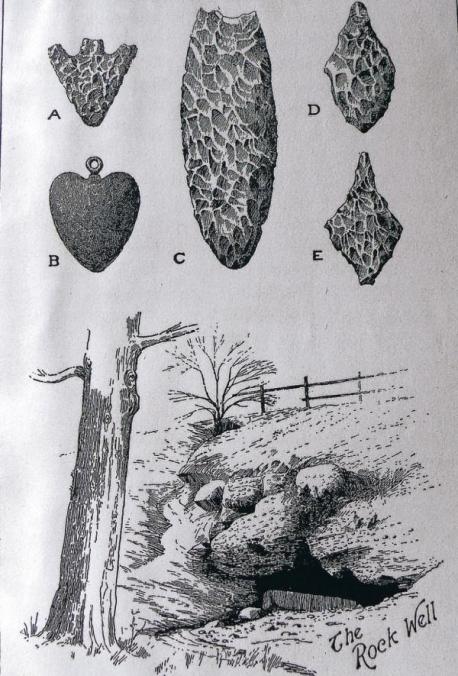
When it was supposedly removed, by someone who was believed to have competence in such matters, the arrowhead was probably actually a Neolithic point, like one of these—

image1elfshot.jpg

picked up from somewhere and whatever had actually caused the withering was a disease brought on in the natural order of things, but all of the stories we’ve read about the belief and cures appear to end with the point removed—and the sufferer in recovery.

Hmm—we thought. Something familiar about this. On Weathertop, Frodo is attacked by Nazgul.

image2weathertop.jpg

“The third was taller than the others: his hair was long and gleaming and on his helm was a crown. In one hand he held a long sword, and in the other a knife; both the knife and the hand that held it glowed with a pale light. He sprang forward and bore down on Frodo.” (The Fellowship of the Ring, Book One, Chapter 11, “ A Knife in the Dark”)

The figure stabs Frodo, but the weapon which did it was no ordinary one, as Strider indicates, lifting

“…up a long thin knife. There was a cold gleam in it. As Strider raised it they saw that near the end its edge was notched and the point was broken off. But even as he held it up in the growing light, they gazed in astonishment, for the blade seemed to melt, and vanished like a smoke in the air, leaving only the hilt in Strider’s hand.” (The Fellowship of the Ring, Book One, Chapter 12, “Flight to the Ford”)

In the film, this is represented by something which looks like a medieval fighting dagger.

image3morgula.jpg

It seems that its purpose was not to act as a secondary weapon in combat, however, but to inflict a fatal stabbing wound. As Gandalf says,

“They tried to pierce your heart with a Morgul-knife which remains in the wound.” (The Fellowship of the Ring, Book Two, Chapter 1, “Many Meetings”)

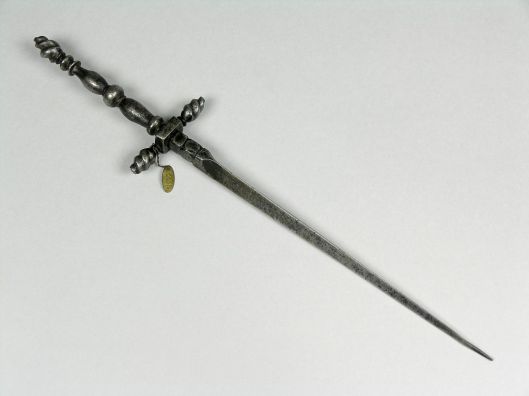
Thus, we could imagine it looking like a Renaissance poignard, like this one—

image4morgulb.jpg

Whatever its look, its point is embedded in Frodo’s shoulder and, like someone elf-shot, Frodo is fading and, also like the victim of elf-shot, the wound has changed.

“ ‘What is the matter with my master?’ asked Sam in a low voice, looking appealingly at Strider. ‘His wound was small, and it is already closed. There’s nothing to be seen but a cold white mark on his shoulder.; “ (The Fellowship of the Ring, Book One, Chapter 12, “The Flight to the Ford”)

Neither Strider nor, in turn, Glorfindel, can heal Frodo and even Gandalf was daunted:

“Elrond is a master of healing, but the weapons of our Enemy are deadly. To tell you the truth, I had very little hope; for I suspected that there was some fragment of the blade still in the closed wound. But it could not be found until last night. Then Elrond removed a splinter. It was deeply buried, and it was working inwards.” (The Fellowship of the Ring, Book Two, Chapter 1, “Many meetings”)

We thought, then, that we could write a very interesting post about the parallels between that knife and elf-shot—and then we found that it had already been done: see “Elf-shot” in Drout, Michael, ed., J.R.R. Tolkien Encyclopedia, London: RKP, 2006.

We are not given to despair, however, and something Gandalf said interested us: “Then Elrond removed the splinter.”

As our regular readers know, we take particular pleasure in linking things of Middle-earth with those of the medieval world in which JRRT spent his scholarly life. In this case, we were reminded of the removal of part of another weapon—the head of an arrow (just like elf-shot) from the head of a real person: Prince Henry of England—the future Henry V (1386-1422) of Shakespeare’s wonderful play. (We grew up on the 1944 Laurence Olivier version, which is full of color and action—the reconstruction of the Globe Theatre at the opening alone is worth watching—although, as we’ve gotten older, we’ve come to prefer both Kenneth Branagh’s 1989 filming and the 1979 David Gwillim version which we mentioned in our last posting.)

image5olivier.jpg

When he was fifteen, Prince Hal commanded the left wing of his father’s army at the battle of Shrewsbury, on 21 July, 1403.

image6shrewsmap.jpg

(Note: this is an old map, based upon the tradition that the church of St. Mary Magdalen was built on the site of the battle.

image7stmarymag.jpg

In 2006, the Anglo-Scots archaeologists, Tony Pollard and Neil Oliver, led a team to probe the churchyard, where it had long been held that there was a burial pit for some of the dead of the battle. After geophysical exploration and the digging of several test trenches, no trace of such a pit was found, leaving the tradition to remain, at least for the moment, just that. If you are interested to learn more, their visit to the site is from their 2-year series, Two Men in a Trench.  Here’s a LINK—you can watch the whole show—and we recommend the entire series for a combination of light-hearted looniness and serious archaeology.)

The battle began with a barrage of arrows from the longbowmen on each side.

image8longbowmen.jpg

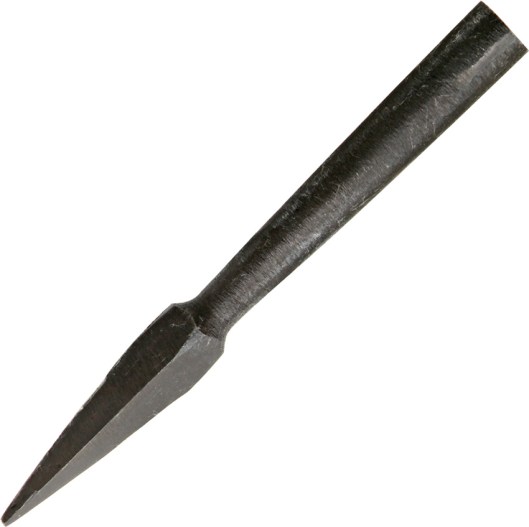
The arrows had what were called bodkin points—

image9bodkin.jpg

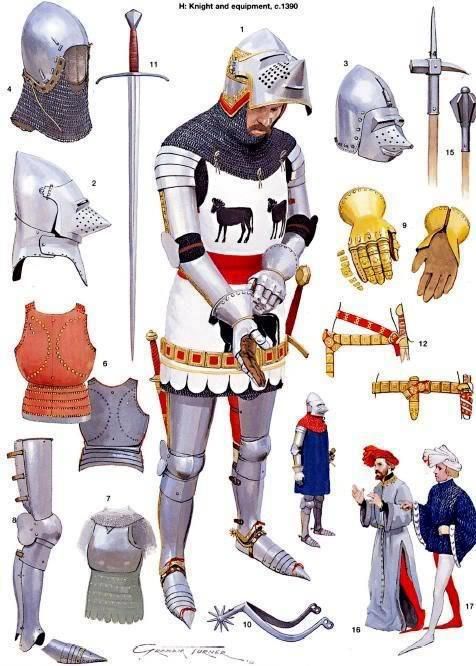
which were specifically designed to penetrate plate armor of the very sort which the prince was wearing.

image10armor.jpg

A practiced longbowman could fire ten arrows a minute and his original battlefield issue would have been two 24-arrow linen bundles. We don’t know how many archers both sides had, but even if each had no more than a thousand, at the end of in a single minute, that would have meant 20,000 arrows in the air.

image11arrowstorm.jpg

If Hal was wearing a bascinet—as you see on the knight above–because of the shape of the helmet, many of the arrows might have glanced off. Perhaps Hal was wearing an open-face bascinet

image12openfacebasc.jpg

or had raised his visor, to give a command, say, but, instead of bouncing off, an arrow hit him in the face, below his eye (there is argument as to which eye) and penetrated his head. Had it gone all the way through, it might have been possible to saw off the arrow head and remove both arrow and shaft, but the arrow head had sunk into the bone at the back of the skull, instead. (Remarkably, it is reported that Hal continued to direct his troops, even in this condition. Tough people, those medievals!) And the first attempt at extraction had broken off the shaft, leaving the arrowhead still embedded. And this, of course, is what made us think of Elrond and the Morgul-knife splinter.

image13halarrow.jpg

We aren’t told how Elrond found or removed it. A medieval tool for removing arrowheads had been invented by the brilliant Arab physician with the splendid name of Abu al-Qasim Khalaf ibn al-Abbas al-Zahrawi, reduced by westerners to “Albucasis” (936-1013). (Here’s a LINK—this is a man of science well worth knowing much more about!)

image14alzahrawispoon.jpg

This might have worked, had the arrow been in a less delicate place, as well as not barbed, but Hal’s wound was just below his brain stem and next to all sorts of delicate blood vessels and the arrowhead was a bodkin point.

At this point, John Bradmore appeared. Interestingly, he had been a goldsmith, as well as a practicing surgeon, and the two seem to have come together as he tackled the problem. First, while he considered the possibilities, he kept the wound open and cleaned. Then he invented this—

image15extractor.jpg

It’s a simple but cunning design: the two outer parts are gradually introduced into the wound and spread it gently open. In the middle is a screw mechanism which could insert itself into the socket of the arrowhead. When it is firmly in place, the outer parts are closed as far as possible and then the whole, with, Bradmore hoped, the arrowhead, could be extracted from the wound. And it was. And then Bradmore washed out the wound with wine and kept it clean during the healing process. A completely remarkable piece of work, from the use of antisepsis to the invention and manufacture of the necessary tool.

Hal not only survived the operation (he had reportedly been dosed with henbane, which would have stupefied him but, given the wrong dose, would have killed him within a couple of days), but lived another 19 years to beat the French at Agincourt, marry the daughter of the king of France, and, for a brief time, imagine seeing his son succeed him on the now-joint thrones.

As for Bradmore, he wrote a medical treatise, Philomena, the title being a learned joke– St. Philomena was an early Christian martyr, part of whose martyrdom included surviving arrow attacks—before dying, a very well-off man, in 1412.

(If you’d like to see a very well-done visual segment on Bradmore and Prince Hal, here’s a LINK for a NOVA program of some years ago.)

In both cases, the patient survived, although it would appear that Prince Hal had a better recovery than Frodo. Then again, Hal, for all that his wound was life-threatening, hadn’t been hit by an elf-shot, but only by a mortal arrow, while the hobbit was almost doomed to the Nazgul world by a Morgul-knife.

Thanks, as ever, for reading.

MTCIDC

CD
PS

One of our favorite Danish composers, Niels W. Gade (1817-1890), has left us a very beautiful dramatic cantata, Elverskud—“Elfshot” (1854). Based upon a Danish ballad, it’s the story of Sir Oluf, who prefers the Elf king’s daughter to his own human bride and the consequences of that preference. If you’d like to hear it—we recommend it and much other music by Gade, as well—here’s a LINK.

PPS

This posting is our 151st! Five more will make exactly three years of weekly postings. Thank you for reading, and we hope to keep you interested for another 150 postings at least.

Tintinnabulations

24 Wednesday May 2017

Posted by Ollamh in Fairy Tales and Myths, J.R.R. Tolkien, Literary History, Narrative Methods

≈ Leave a comment

Tags

Asfaloth, bells, Child Ballad, dance, Edgar Allan Poe, Glorfindel, Headless Horseman, Joan of Arc, John Howe, Medieval, Minas Tirith, Morris Dance, Nazgul, Sir Gawain and the Green Knight, Sortes Tolkienses, Sortes Vergilianae, sun-down bells, The Hobbit, The Legend of Sleepy Hollow, The Lord of the Rings, Thomas the Rymer, tocsin, Tower of Echthelion

Welcome, once more, dear readers.

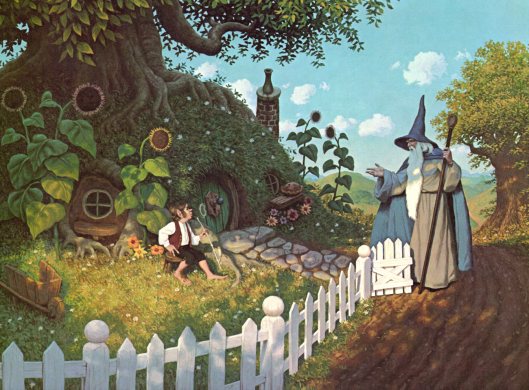
The sources of our postings come from all sorts of places. Sometimes, we are reading something and we have an idea, or we spot an image or see a film. Sometimes, it’s from a friend’s e-mail, or reaction to an earlier posting. Sometimes they come from our sortes tolkienses. If you’ve missed our original posting where we invented this, it’s based upon an ancient fortune-telling method, where one closes one’s eyes, opens an important book, like the Aeneid or the Bible, puts one’s finger on a verse—and hopes that it tells you something about the day or the future. In our case, we use The Lord of the Rings or The Hobbit.

And what did we find today? This, from The Lord of the Rings—

“Hand in hand they went back into the City, the last to pass the Gate before it was shut; and as they reached the Lampwrights’ Street all the bells in the towers tolled solemnly.” (The Return of the King, Book Five, Chapter 1, “Minas Tirith”)

These are the “sun-down bells”, as Pippin learns from Bergil, son of Beregond. Bergil is a boy of Minas Tirith and has just given Pippin a tour of the city.

“Sun-down bells” made us think first about the bells of Minas Tirith, and then about bells in Middle-earth in general, and we could easily pick out three kinds.

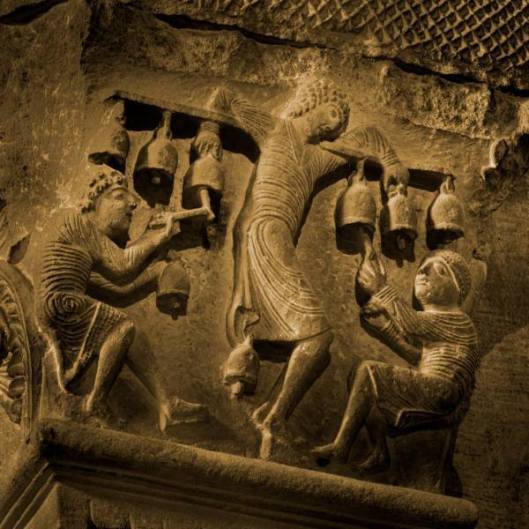
To begin with, there are the city bells. Or, rather, where are the city bells? The text says “in the towers”. In the medieval world in which we so often find illustrations and parallels to Middle-earth, those bells are commonly in church belfries.

image1medievalbell.png

image2ringing.jpg

image3belltower.jpg

Minas Tirith clearly has towers—and, in fact, is a towering place—literally:

“…the Tower of Echthelion, standing high within the topmost wall, shone out against the sky, glimmering like a spike of pearl and silver, tall and fair and shapely, and its pinnacle glittered as if it were wrought of crystals; and white banners broke and fluttered from the battlements in the morning breeze, and high and far he heard a clear ringing as of silver trumpets.” (The Return of the King, Book Five, Chapter 1, “Minas Tirith”)

Because there are no churches—or even temples—in Minas Tirith, by examining some images of the city, from John Howe’s painting to the model used in the films, we can pick out towers here and there and some of those, we might imagine, could hold bells.

image4howe

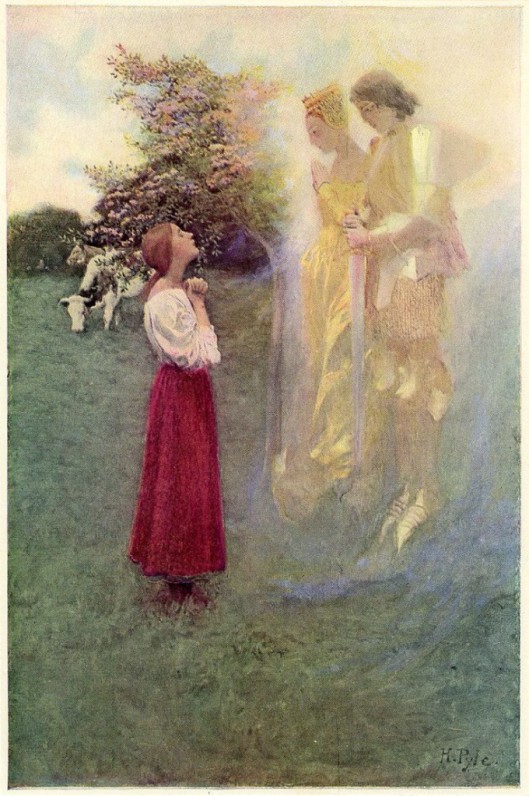
image5mtIn our medieval world, such bells had a number of functions. Not only did they ring the hours of the medieval Christian day, but they could also sound a warning, called the “tocsin”, and signal that the day was over and that fires should be covered for the night, the “curfew”—rather like the “sun-down” bells in Minas Tirith. Joan of Arc (c.1412-1431) said that she could sometimes hear the sound of angelic voices, inspiring her to drive the English out of France, in her village bell.

image6joan.jpg

There are other uses—and places—for bells in Middle-earth, however. In The Fellowship of the Ring, Book One, Chapter 1, “A Long-Expected Party”, they turn up at an impromptu dance:

“Master Everard Took and Miss Melilot Brandybuck got on a table and with bells in their hands began to dance the Springle-ring: a pretty dance, but rather vigorous.”

The wording of this sounds like it came from the “society section” of a newspaper, as not only are the hobbits’ names given, but given with their social titles—“Master” and “Miss”—to show that they are unmarried.

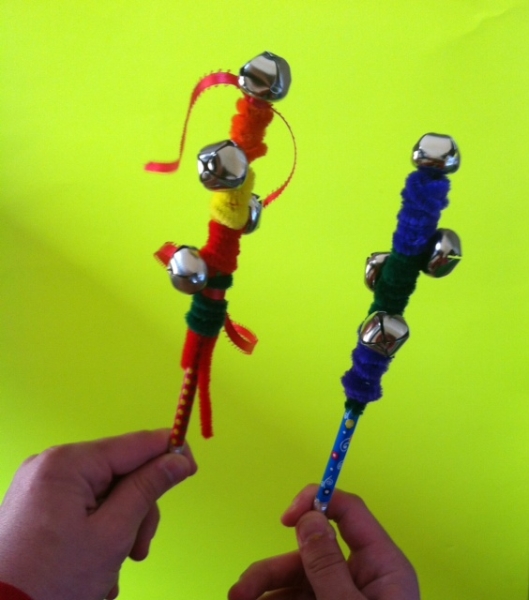
The boisterous dance, being energetic and accompanied by bells, makes us think of traditional English Morris dances, where the dancers not only strap bells to their arms and legs, but occasionally carry sticks with bells attached to them.

image7morrisOLYMPUS DIGITAL CAMERAimage9jinglestick

This also makes us think about medieval music bands, which could include a percussionist who played bells.

image10medbellersimage11bellplayers

A further use is as decoration—and perhaps as something more. When Aragorn is leading the hobbits, with the wounded Frodo, towards Rivendell, they heard “a sound that brought sudden fear back into their hearts: the noise of hoofs behind them.” The fear is, of course, of pursuing Nazgul, depicted here first in an Alan Lee sketch, and then in a painting which we believe is by the Hildebrandts, of one of the Ringwraiths almost riding down Farmer Cotton.

image12nazgulimage13nazgul

[We are always struck, by the way, how the Nazgul bear a certain resemblance to the “Headless Horseman” from Washington Irving’s (1783-1859) story, “The Legend of Sleepy Hollow” (1820). Walt Disney made a musical version of this in 1949, which was shown on Disney tv programs in later years, around Halloween, and the image of the Horseman could always give us nightmares.]

image14headlessh

What Aragorn and the hobbits are actually hearing is the horse of the Elf lord, Glorfindel, Asfaloth—

“The sound of the hoofs drew nearer. They were going fast, with a light clppety-clippety-clip. Then, faintly, as if it was blown away from them by the breeze, they seemed to catch a dim ringing, as of small bells tinkling.” (The Fellowship of the Ring, Book One, Chapter 12, “Flight to the Ford”)

image15glorf

Although Frodo never explains why he says this, he exclaims, “That does not sound like a Black Rider’s horse…” The only difference in sound clearly is coming from the bells, perhaps on Asfaloth’s halter or bridle—or perhaps on his mane, as in the case of what might be a source for those bells, Child ballad 37 (we’re quoting from Variant A). 37 is called “Thomas Rymer” and describes the meeting of the actual 13th-century Thomas of Earlston with the Queen of Elfland. [We include a LINK here to the useful Wiki entry.)

image16tther

In the ballad, her horse is described as having

“At ilke tett [“every tuft/lock”] of her horse’s mane

Hung fifty silver bells and nine.”

We are always careful never to say, without documentary evidence, that such-and-such is “definitely” the source for something in JRRT, but this particular detail seems to line up so well:

  1. Glorfindel is an Elf
  2. so is the unnamed Queen
  3. each has bells on his/her horse

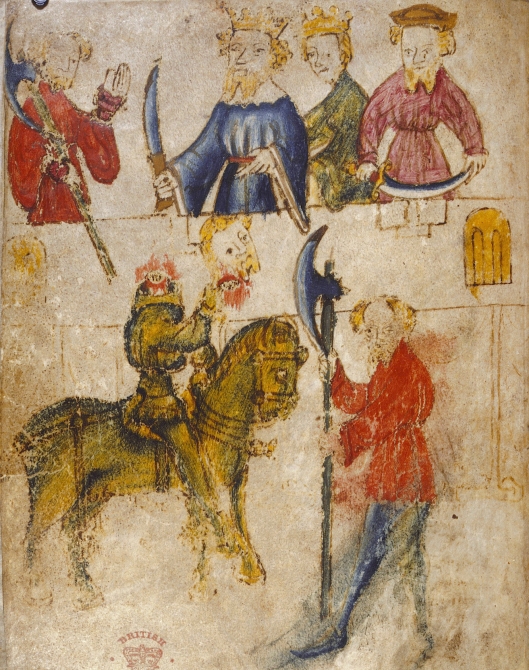
And these bells suggest—at least to Frodo—something unworldly, but, unlike the Nazgul, something positive. We can add to this another—okay, undeniable—source, and our evidence for this is JRRT himself. In 1925, Tolkien (in collaboration with E.V. Gordon) published an edition of the 14th-century Middle English poem, Sir Gawain and the Green Knight.

image17greenknight

The Green Knight is an enchanted being and part of his magic lies in his greenness and in the elaborate decoration of himself and his horse, including

“Ther mony bellez ful bry3t of brende golde rungen” (line 195)

This is only a preliminary investigation—done out of our heads, rather than from a thorough scouring of the text—so, can you, dear readers, think of other bells in The Lord of the Rings? We could think of two references in The Hobbit—but we leave it to you to guess where they are (and to find more?).

And thanks, as always, for reading.

MTCIDC

CD


PS

We include a LINK here to an appropriate poem which uses our title, Edgar Allan Poe’s, “The Bells” (1849).

When One Door Closes.4

30 Wednesday Nov 2016

Posted by Ollamh in Imaginary History, J.R.R. Tolkien, Literary History, Maps, Uncategorized

≈ Leave a comment

Tags

Alfred Lord Tennyson, Cirith Ungol, doors, Gilbert and Sullivan, Gondor, Grond, Hobbit door, James Fennimore Cooper, Minas Morgul, Minas Tirith, Morannon, Mordor, N.C. Wyeth, Nazgul, Orodruin, Princess Ida, Shelob's Lair, The Last of the Mohicans, The Lord of the Rings, The Princess, The Siege of Gondor, Tolkien

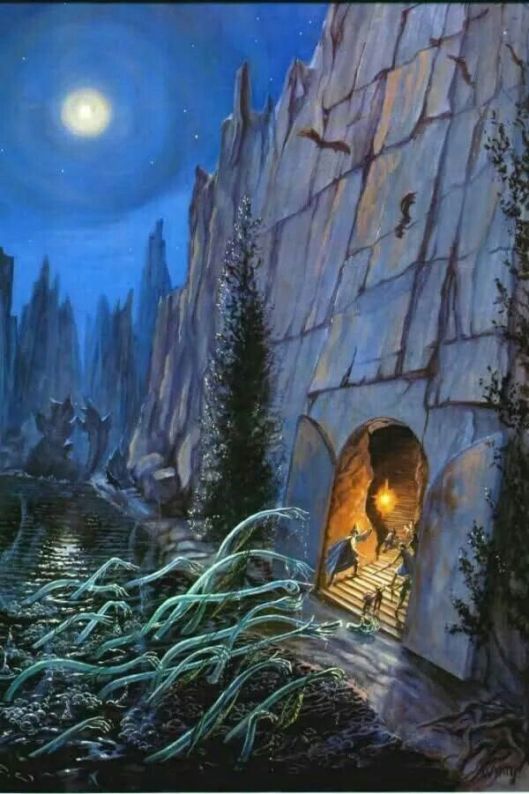
Welcome, as always, dear readers. In this posting, we’ll complete our survey of doors and entryways and what happens at them in The Lord of the Rings.

We began this series a little while ago when we got to thinking about Bilbo’s remark to Frodo that: “It’s a dangerous business, Frodo, going out your door.”

Bilbo had learned this the hard way when Gandalf had come to his door and he had embarked upon an adventure he, originally, had no desire to be part of.

gandalfvisitsbilbo

In three postings, we’ve followed the story through doors and entryways from that moment all the way to the moment when Gandalf blocks the Lord of the Nazgul from entering Minas Tirith through its ruined main gate.

mcbridegandalflordofnazgul.gif

In the process, we have come to see that doors and entryways seem to come in two forms: first, there are doors which lead to safety; second, there are doors which lead to danger. We’ve added other elements, natural entryways, like fords and bridges, and the fact that many of the entryways have challenges and challengers barring the way.

In a moment of cheerful intellectual cruelty, we ended the last posting at that crucial moment in “The Siege of Gondor”, in which Grond, the battering ram of the armies of Mordor, has, with the magical aid of the Lord of the Nazgul, broken down the gate and that Lord is about to enter the city, when he meets Gandalf as the challenger:

“ ‘You cannot enter here,’ said Gandalf, and the huge shadow halted. ‘Go back to the abyss prepared for you! Go back! Fall into the nothingness that awaits you and your Master. Go!’ ”

And, just at that moment, “Great horns of the North wildly blowing. Rohan had come at last.”

rohirrim.jpg

[We wondered, by the way, if that “Great horns of the North wildly blowing” was an accidental or deliberate allusion to a lyric from Alfred Lord Tennyson’s

tennysonyoung.jpg

poetic criticism of the idea of women’s education, The Princess (1847),

prncss.jpg

in which we find the line “The horns of Elfland faintly blowing”—here’s the whole poem:

from The Princess: The Splendour Falls on Castle Walls
By Alfred, Lord Tennyson
The splendour falls on castle walls
                And snowy summits old in story:
         The long light shakes across the lakes,
                And the wild cataract leaps in glory.
Blow, bugle, blow, set the wild echoes flying,
Blow, bugle; answer, echoes, dying, dying, dying.
         O hark, O hear! how thin and clear,
                And thinner, clearer, farther going!
         O sweet and far from cliff and scar
                The horns of Elfland faintly blowing!
Blow, let us hear the purple glens replying:
Blow, bugle; answer, echoes, dying, dying, dying.
         O love, they die in yon rich sky,
                They faint on hill or field or river:
         Our echoes roll from soul to soul,
                And grow for ever and for ever.
Blow, bugle, blow, set the wild echoes flying,
And answer, echoes, answer, dying, dying, dying.


This then formed the basis of an 1870 play by W.S. Gilbert, which he converted, with his collaborator, Arthur Sullivan, into an operetta, in 1884.]


Gilbert and Sullivan Cartoon.jpg

Princess-Ida-1884.jpg

For the Aragorn and company half of the story, we see the arrival of the army of Gondor and its allies at the Morannon as the last door.

morannon.1.gif

Here, there are, in fact, two challengers/challenges. First,

“When all was ordered, the Captains rode forth towards the Black Gate with a great guard of horsemen and the banner and heralds and trumpeters…They came within cry of the Morannon, and unfurled the banner, and blew upon their trumpets; and the heralds stood out and sent their voices up over the battlement of Mordor.” (The Return of the King, Book 5, Chapter 10, “The Black Gate Opens”)

In return,

“There came a long rolling of great drums like thunder in the mountains, and then a braying of horns that shook the very stones and stunned men’s ears. And thereupon the door of the Black Gate was thrown open with a great clang, and out of it there came an embassy from the Dark Tower.”

In both cases, it goes without saying that this is a door to danger, the difference being that those from Gondor want those within to come out so that, by defeating them (though they have little hope of this), those from Gondor can enter, while those within the gate want to prevent their entry (except, perhaps, as prisoners).

As we turn to the other half of the narrative, we begin at the same gate, where Gollum has brought Frodo and Sam.

alanleemorannon.jpg

Here, there is no easily visible challenger, just the forbidding nature of the gate, but it is still not an entryway to safety, as, on the other side is an inhospitable landscape, populated by Sauron’s vast armies, constantly on the move, as we see in later chapters. As well, from those later chapters, we gain the sense that Frodo doesn’t believe he’s going to return from Mordor anyway.

Seeing no way to enter, Frodo pushes Gollum to lead them south and, with a diversion to Faramir’s base behind a waterfall (which, to us, is reminiscent of a similar hide-out in James Fennimore Cooper’s The Last of the Mohicans (1826)

mohicansfirstedition.jpg

—and how can we resist mentioning that, in 1919, N.C. Wyeth illustrated an edition?)

05_lastofthemohicans_wyeth_glenfalls.jpg

wyethlast.jpg

they arrive at the southern entryway to Mordor, the pass with Minas Morgul at its western end and Cirith Ungol at its eastern.

Morgul2.jpg

WATCHERS.jpg

The challengers of Minas Morgul are the Lord of the Nazgul and a vast army, on their way to attack Minas Tirith, but these are skirted, as Gollum guides the two hobbits around the site and up on a perilous climb—and into Torech Ungol, Shelob’s Lair. Safety? Gollum wants the hobbits to think so. Danger? With Shelob as a challenger, what else?

shelob.jpg

Even as Sam drives Shelob off, however, he loses Frodo, paralyzed and cocooned, and is faced with an inner door closed by the orcs as they withdraw. Climbing over it, he moves forward, cloaked by the ring, to look out towards Orodruin and the Tower of Cirith Ungol.

cirith-ungol2

And, with this, we have finished our survey.

Unless, of course, we consider two more events.

First, there is what happens at Mount Doom, where Gollum is the challenger, and the door, such as it is, leads to safety for Middle-earth, but not for Sam and Frodo.

gollum__s_dance_by_01gus01-d4rmt18.jpg

And, finally, at the edge of the Shire, in “The Scouring of the Shire”, where the returning hobbits meet with the followers of “Sharkey” at the bridge. Those followers, brain-washed by fear of “The Chief” and his “big man” followers, attempt to deny what should be a door to safety to Frodo, Merry, and Pippin, as the three had expected, but which leads, in fact, to conflict and open violence before their return home is safely accomplished.

scouringoftheshire.jpg

With that, we complete the pattern and here is our chart:


Entryway Source Challenger Challenged Outcome
Bilbo’s door The Hobbit Bilbo Dwarves Bilbo is tricked into hospitality
Beorn’s house The Hobbit Beorn Gandalf Beorn tricked into hospitality
Goblin cave The Hobbit Goblins Bilbo Escapes by use of the Ring
Mirkwood The Hobbit Elves Dwarves/Bilbo Bilbo rescues dwarves with Ring and barrels
Lonely Mountain (Back door) The Hobbit Smaug Dwarves/Bilbo Understanding the inscription, Dwarves open the door
Lonely Mountain (Front door) The Hobbit Dwarves Men, Elves, Goblins Battle of the Five Armies—eventual settlement
Bilbo’s door The Hobbit Hobbits Bilbo Bilbo’s things are up for auctions—Bilbo gets most things back
Ford of Bruinen The Lord of the Rings Wraiths Frodo/Elves After Frodo’s challenge, elf magic overwhelms wraiths
Moria (west gate) The Lord of the Rings Elves of Hollin Fellowship Gandalf discovers password—the group enters
Lothlorien (western side) The Lord of the Rings Elves Fellowship Challenged by elves, but allowed to enter
Edoras The Lord of the Rings Rohirrim Gandalf et al. Challenged by gate guards, but allowed to enter
Meduseld The Lord of the Rings Hama Gandalf et al. Challenged, but allowed to enter
Helms Deep The Lord of the Rings Aragorn Orcs/Wildings Aragorn warns them of their danger
Isengard The Lord of the Rings Merry/Pippin Gandalf et al. Greeted and offered food, drink, and smoke
Paths of the Dead The Lord of the Rings Oath-breakers Aragorn at al. Allowed to enter, but followed—leave safely
Morannon The Lord of the Rings Sauron King Elessar et al. Sauron’s army appears for battle
Morannon The Lord of the Rings Sauron Frodo/Sam/Gollum No way of entry—the three head south
Minas Morgul The Lord of the Rings Lord of Nazgul Frodo/Sam/Gollum Entry blocked by Lord’s Army
Torech Ungol The Lord of the Rings Shelob Frodo/Sam Gollum escapes, Frodo paralyzed by Shelob
Cirith Ungol The Lord of the Rings Orcs Sam With Ring as aid, Sam enters
Mt. Doom The Lord of the Rings Gollum Frodo Gollum gains Ring, but perishes in fire
Shire bridge The Lord of the Rings Hobbits Frodo et al. Hobbits climb over gate, guards run


Because this material becomes increasingly complex, there is always the possibility that, as thorough as we try to be and as inclusive, we’ve missed something. If so, we’d be glad to hear from our readers!

Thanks, as always, for reading!

MTCIDC

CD


When One Door Closes (2)

16 Wednesday Nov 2016

Posted by Ollamh in J.R.R. Tolkien, Literary History, Narrative Methods

≈ Leave a comment

Tags

Balin, Barrows, Bree, Bridge of Khazad-Dum, Chamber of Mazarbul, Crickhollow, doors, Dwarves, Elven-way, Farmer Maggot, Gandalf, Greenway, Hobbit door, Hollin, Lothlorien, Moria, Nazgul, picaresque, Rivendell, Robert Burns, Tam O'Shanter, The Fellowship of the Ring, The Ford of Bruinen, The Hobbit, The Legend of Sleepy Hollow, The Lord of the Rings, The Prancing Pony, Tolkien, Washington Irving, Watcher in the Water, Weathertop, West-door, West-gate

Welcome, dear reader, as always. It’s a rather gloomy late autumn day here as we write this, fitting, perhaps, for the gloomier The Lord of the Rings after the cheerier (well, sometimes) The Hobbit, as we continue our look at the functions of doors and their equivalents in JRRT.

If you’ve read our previous posting, you’ll know that, in it, we examined doors and gates in The Hobbit, dividing them into two basic categories: doors which might lead to safety and doors which led to danger, all based upon Bilbo’s remark about how dangerous it can be, just stepping outside your door.

Bilbo’s door adventures had begun with his own.

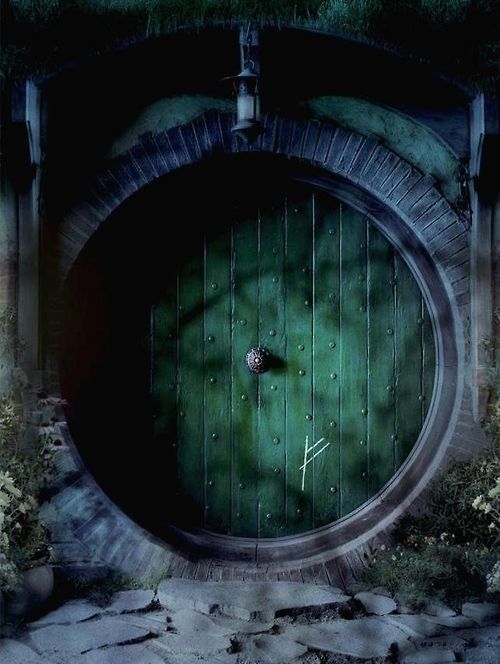
gandalfvisitsbilbo.jpg

doorwithrune.jpg

When comparing the two books, we get a strong sense of the episodic nature of The Hobbit:  we can almost break it down into movement between doors, from the arrival of the dwarves to the knock of Gandalf and Balin, giving it more the feel of a picaresque novel: that is, a novel with an goal, but with much of its focus upon the adventures along the way, adventures which don’t always necessarily lead to that goal.   This gives it a lighter tone, as well—after all, it was meant as a children’s book in a time (1937) when such books were understood in general never to be too solemn. The Lord of the Rings, in contrast, develops an almost grimly-focused forward motion, which impels it even when the Fellowship breaks into two after the death of Boromir, and much of the action spreads from Frodo and Sam on the way to Mordor to the separate adventures of Merry and Pippin in Rohan and Gondor.

So what might we see as the first door—in either sense—in The Lord of the Rings? we asked ourselves. And we supposed that we might see minor doors of safety at Farmer Maggot’s and Frodo’s new home in Crickhollow, in both cases brief refuges from the Nazgul, but, as we said in our last posting, doors commonly have some sort of challenge to them—and challenger—and the first one of those appears briefly at the hedge in Bree:

“They came to the West-gate and found it shut; but at the door of the lodge beyond it, there was a man sitting. He jumped up and fetched a lantern and looked over the gate at them in surprise.”   (The Fellowship of the Ring, Book 1, Chapter 9, “At the Sign of the Prancing Pony”)

bree.jpg

The watchman, when his challenges (and maybe a little too-inquisitive challenges) are turned aside, lets them in and they reach The Prancing Pony, only to escape murder in their beds and the loss of their ponies.

prancingpony.jpg

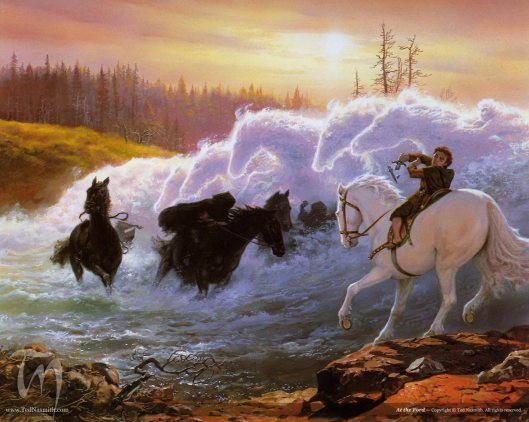
The first gateway which leads to real safety, however, isn’t a door or gate at all, but a natural barrier (with some magical help): the Ford of Bruinen. Here, the role of traveler and challenger is reversed, as the challenged are the Wraiths and the challenger is Frodo, but it is the power of the Elves which closes the door.

At the Ford, by Ted Nasmith

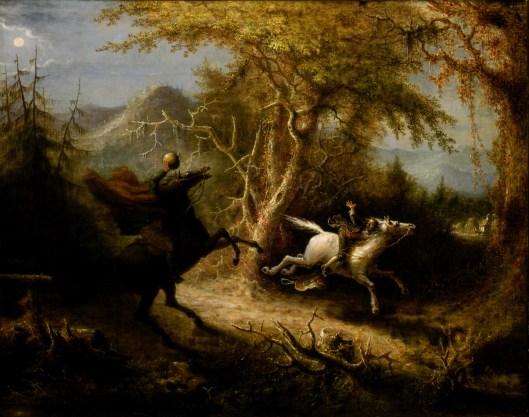
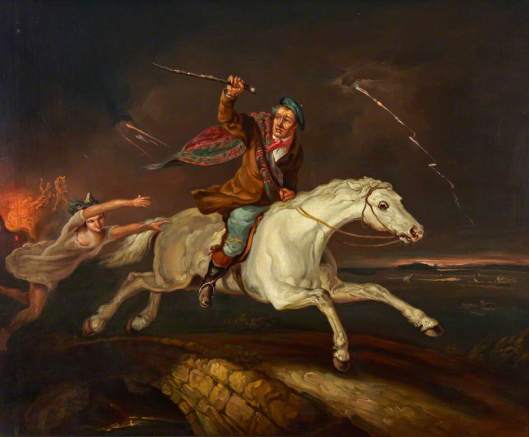
(It is interesting here that Tolkien has chosen not to take advantage of the folk belief—if you know “The Legend of Sleepy Hollow” by Washington Irving, or its inspiration, the poet Robert Burn’s “Tam O’Shanter”, this will be readily familiar to you—that evil spirits are unable to cross running water, even at a bridge.

John_Quidor_-_The_Headless_Horseman_Pursuing_Ichabod_Crane_-_Google_Art_Project.jpg

tamoshanter.jpg

To reach the Shire, the Wraiths have had to cross several bodies of water and now their hesitation to traverse another appears to be derived from their confidence that they can now control Frodo—either by the influence of the Ring, or perhaps from his wound—and call him back across the stream to them.)

From Rivendell, the next such door is that at the western side of Moria.

moriagate.jpg

Here, there is no living challenger. Rather, it is a kind of riddle—or, at least, it is initially understood as such—which bars the way. Its answer is simple, which led us to wonder, what is the purpose of this door scene in the story? As the creature in the pool

watcher.jpg

barricades the door behind them, it adds to the tension: the Fellowship has been watched and, from the hostile mountains to the wolves to the tentacle thing, it has been forced into darker and narrower ways, those ways seemingly chosen by the malevolent force observing their journey. As well, it suggests the gradual decay of what was once a vibrant, active culture, as Gandalf explains:

“Here the Elven-way from Hollin ended. Holly was the token of the people of that land, and they planted it here to mark the end of their domain; for the West-door was made chiefly for their use in their traffic with the Lords of Moria. Those were happier days, when there was still close friendship at times between folk of different race, even between Dwarves and Elves.” (The Fellowship of the Ring, Book 2, Chapter 4, “A Journey in the Dark”)

This is a theme throughout The Lord of the Rings and one which, we believe, adds to its power: the events of the close of the Third Age are set against a background of other times and other events and the landscape still bears traces of those times, from the Barrows to the Greenway and Weathertop and far beyond. As well, so many of those traces suggest that violence and the dark spirit of Sauron, sometimes through his agents, sometimes in person, have had much to do with their end.

Now that the Fellowship is within Moria, it encounters its next door: that of the Chamber of Mazarbul.

marzabul.jpg

Here, they are the challengers, when forced to defend themselves from a horde of “Orcs, very many of them…And some are large and evil: black Uruks of Mordor.” (The Fellowship of the Ring, Book 2, Chapter 5, “The Bridge of Khazad-Dum”). There is a second door, however, and, when they have beaten back their attackers, they escape by it—but only so that Gandalf may be the challenger at a crossing—as Frodo was at the ford—at the Bridge of Khazad-Dum, although here magic apparently cannot save him, as it had Frodo.

balrog.jpg

With Gandalf gone, we see the repetition of a scene from The Hobbit—the escape through a crowd to the outside world:

“…and suddenly before them the Great Gates opened, an arch of blazing light.

There was a guard of orcs crouching in the shadows behind the great door-posts towering on either side, but the gates were shattered and cast down. Aragorn smote to the ground the captain that stood in his path, and the rest fled in terror at his wrath.” (The Fellowship of the Ring, Book 2, Chapter 5, “The Bridge of Khazad-Dum”)

At this moment in The Hobbit, Bilbo had used his newly-discovered ring to escape (albeit with the loss of a few buttons), but Aragorn’s sword clearly does just as well.

It is easy to see just how prevalent the pattern is: even after that harrowing moment of being chased through the mines and losing Gandalf, where there is a door, there is someone at it to make a challenge, and this holds true even without an actual door, as the remaining members of the Fellowship seek to enter Lothlorien and are stopped by Elven sentries in a tree. (The Fellowship of the Ring, Book 2, Chapter 6, “Lothlorien”)

And the pattern continues, even as the Fellowship breaks up, but let’s take a moment to see what we’ve found so far. On the side of doors to safety, we have: Bree (although it’s not so safe as it looks), the Ford of Bruinen, the main door of Moria, and the entrance to Lorien. As for doors to danger, there are: the western doors of Moria and the door to the Chamber of Mazarbul.

In the third installment, we shall see just how many more doors/gates/entryways we find which continue to fit the pattern—and there are a fair number of them.

Thanks, as ever, for reading.

MTCIDC

CD
Rear Guard

18 Wednesday May 2016

Posted by Ollamh in Films and Music, J.R.R. Tolkien, Literary History, Maps, Military History, Military History of Middle-earth, Narrative Methods

≈ 1 Comment

Tags

66th Regiment, British Infantry, Denethor, Faramir, Gary Zaboly, Le Cateau, Maiwand, Nazgul, Osgiliath, Pelennor, Peter Jackson, Rammas Echor, Richard Caton Woodville, the Alamo, The Lord of the Rings, The Return of the King, The Siege of Gondor, Tolkien

Welcome, dear readers, as always.

In a previous posting, we rolled our eyes verbally at a moment in P. Jackson’s The Return of the King in which Faramir, according to the script, was required to mount a double-rank cavalry charge against the west bank of Osgiliath.

gondorianerritt-cb182208.jpg

To us, this was a clumsy attempt to convey the clash between Faramir and his father Denethor, derived from material in The Lord of the Rings, Book 5, Chapter IV, “The Siege of Gondor”, principally from this:

“ ‘Much must be risked in war,’ said Denethor. ‘Cair Andros is manned, and no more can be sent so far. But I will not yield the River and the Pelennor unfought—not if there is a captain here who has still the courage to do his lord’s will.’

Then all were silent. But at length Faramir said: ‘I do not oppose your will, sire. Since you are robbed of Boromir, I will go and do what I can in his stead—if you command it.’

‘I do so,’ said Denethor.

‘Then farewell!’ said Faramir. ‘But if I should return, think better of me!’

‘That depends on the manner of your return,’ said Denethor.

Gandalf it was that last spoke to Faramir ere he rode east. ‘Do you throw your life away rashly or in bitterness,’ he said. ‘You will be needed here, for other things than war. Your father loves you, Faramir, and will remember it ere the end. Farewell!’ “

In the text, Faramir then goes to Osgiliath, having “taken with him such strength of men as were willing to go or could be spared.” The tone here is hardly encouraging and, the following day, “The passage of Anduin was won by the Enemy. Faramir was retreating to the wall of the Pelennor, rallying his men to the Causeway Forts; but he was ten times outnumbered.”

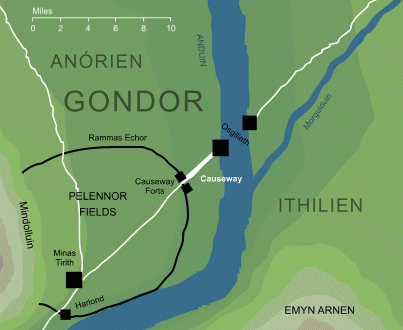
In an earlier posting, we have discussed the Rammas Echor, the wall which enclosed the farmland outside the walls of Minas Tirith.

causeway.gif

We have also discussed the use by both Saruman and Sauron of what appears to be an early form of explosive—seen here in the following description of the fall of the Rammas:

“The bells of day had scarcely rung out again, a mockery in the unlightened dark, when far away he [Pippin] saw fires spring up, across in the dim spaces where the walls of the Pelennor stood. ..Now ever and anon there was a red flash, and slowly through the heavy air dull rumbles could be heard.

‘They have taken the wall!’ men cried. ‘They are blasting breeches in it. They are coming!’ “

Outnumbered and, with the fall of the wall in different locations, outflanked, the best that Faramir can do is to fall back towards Minas Tirith, as Gandalf says, “Yet he is resolved to stay with the rearguard, lest the retreat over the Pelennor become a rout. He may, perhaps, hold his men together long enough, but I doubt it.”

Unlike the silly—there’s really no other word for it—charge of P. Jackson—Faramir is a professional soldier, after all, much loved by his soldiers—we see what JRRT, having been a soldier himself, would have known was the military solution: a fighting retreat, led by a brave and capable leader.

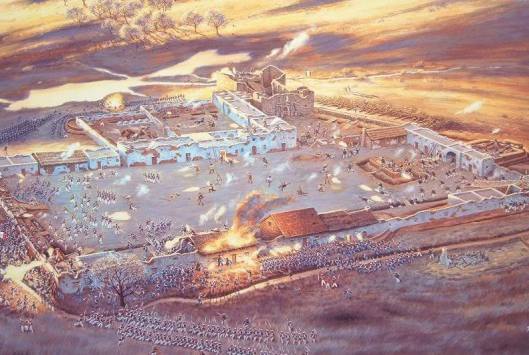
His task had been an impossible one to begin with and, properly understood and depicted on the screen, would not only have been powerful dramatically, but much more believable. It was an impossible task, however, against the odds of ten to one. (For a comparison, we offer the siege and fall of the Alamo, late February-early March, 1836. The garrison numbered about 180, the besiegers eventually approximately 3000. In the final assault, before dawn on 6 March, 1836, the four assaulting columns had about 1200 men, offering odds of roughly 6 to 1 and the entire garrison died, along with somewhere between 400 and 600 of the attackers.)

ALAMO_FORTRESS.jpg

(This is the work of the amazing Gary Zaboly– as an historical illustrator, he can’t be recommended highly enough. Much of his work concerns the 18th century, especially the 1740s and 50s, but he also has done some wonderful depictions of warfare in the American southwest in the 1830s and 40s.)

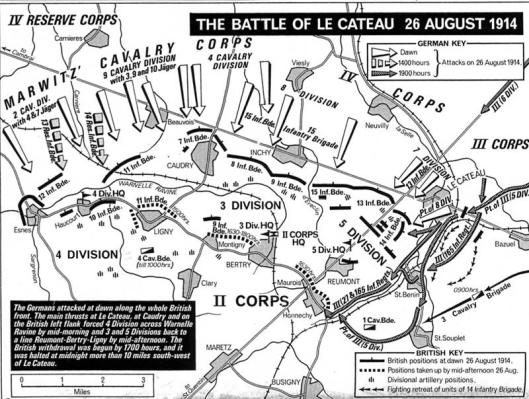
There are lots of examples of fighting retreats and we’ve picked two: a failure (Maiwand, Second Afghan War, 1880) and Le Cateau (The Great War, 1914).

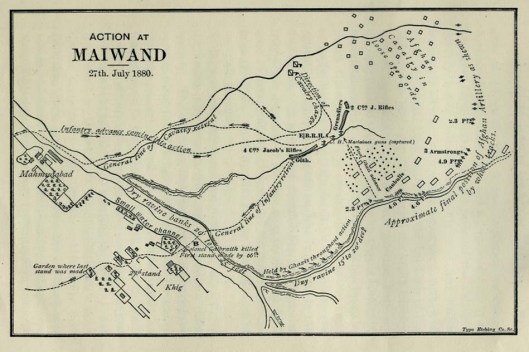
At Maiwand, 27 July, 1880, a British-Indian brigade of 3 infantry units plus two cavalry units and a battery (6 guns) of horse artillery, anywhere from 1500 to 2000 soldiers, faced perhaps 12,000 Afghans with 6 batteries of guns.

Action_at_Maiwand_map.jpg

Basically, the British were outflanked and their left-hand units began to buckle under the pressure of the attacks and the number of attackers which they had to face. As they gave way, the right hand end of the line began to move backwards, feeling increasingly in danger of being surrounded, just as Faramir’s men must have.

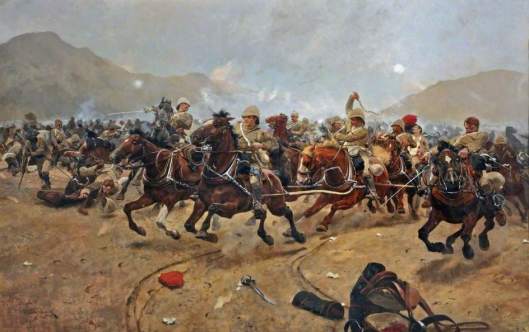
As the infantry retreated, the artillerymen used their guns to buy time for a general withdrawal, ending by losing a section (2 guns) to the enemy. There’s a famous painting of the withdrawal of the remaining guns by the late-Victorian artist, Richard Caton Woodville.

woodvillesavingtheguns.jpg

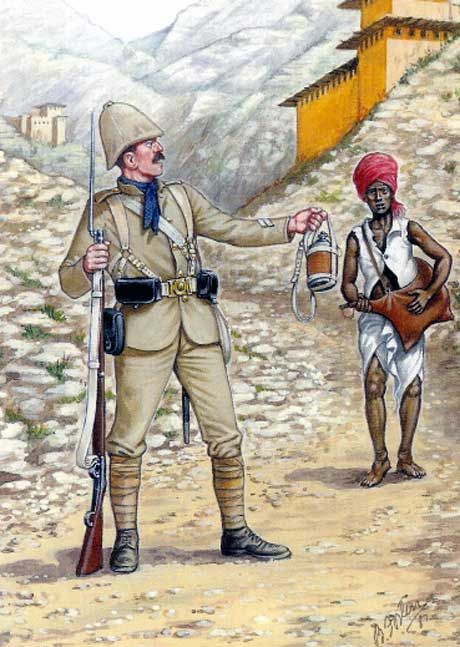
At the end of the withdrawal from the battle, a small group of British soldiers of the 66th Regiment took shelter inside an enclosure in a nearby village and fought it out to the end.

66thfootmaiwand.jpg

maiwand-66th.jpeg

Gandalf’s worry had been that Faramir couldn’t hold his men together and you can see here what happens when organized units come apart—they are defeated piecemeal, “in detail” is the military expression.

In contrast to this, we offer an action from Tolkien’s own time, the battle at Le Cateau, fought on 26 August, 1914. The British Expeditionary Force, facing superior numbers and in danger of being outflanked, particularly to the west, was engaged in a long retreat. Miraculously, unit cohesion was mostly maintained, although communications were often poor, causing confusion and, in one case, even in losing a unit, never notified of withdrawal.

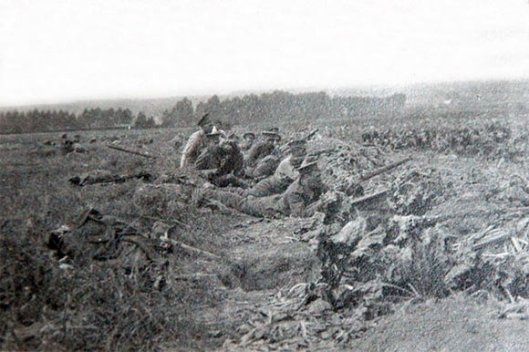
The British Army was divided into two larger groupings, First and Second Corps, and it was Second Corps which turned to face its pursuers. During a long morning, the British, in hastily-dug trenches, fended off superior numbers of German infantry.

1st-east-lancs-regiment-s.jpg

LeCateauMAP1.jpg

Having lost heavily, but having given the enemy similar punishment, the British slowed German pursuit and were able to withdraw without being as closely pursued as they had been.

The difference here is in exactly what Gandalf was worried about. At Maiwand, the brigade fell apart and could easily be swept away by the enemy. At Le Cateau, although it was hardly a perfect affair, the British kept enough cohesion not only to withstand and defeat heavy attacks, but then to retreat in units, without ever collapsing into a fleeing mob.

What happens in that struggle in the fields behind the Rammas Echor is, in fact, a mixture of the two retreats described above. We see “Small bands of weary and often wounded men…some were running wildly as if pursued.” Then, “…less than a mile from the City, a more ordered mass of men came into view, marching not running, still holding together.” And then “Out of the gloom behind a small company of horsemen galloped, all that was left of the rearguard.”

So, it looks like Faramir had succeeded in maintaining that sense of order and purpose which is vital for a fighting retreat. It was not to last, however, as a mass of enemy horsemen on the causeway behind, as well as several Nazgul from above, threw all into confusion—which was stemmed, in turn, by the arrival of a rescue party, led by the Prince of Dol Amroth and accompanied by Gandalf arrived to drive back the attackers.

gandalf_to_the_rescue___speed_paint4_by_myworld1-d7wjv97.png

In that flurry, Faramir is struck by an arrow and has to be rescued and brought into the City, badly wounded.

Looking back, it is a very different scene from that preposterous cavalry charge, isn’t it? As our readers are probably also experienced watchers of the films, we wonder: which do you prefer, Jackson/writers or the author?

Thanks, as always, for reading.

MTCIDC

CD

Jolly Tom.2

16 Wednesday Sep 2015

Posted by Ollamh in Fairy Tales and Myths, Imaginary History, J.R.R. Tolkien, Narrative Methods

≈ Leave a comment

Tags

Barrow-downs, Barrow-wights, Bree, Dagger, Dorset, Eowyn, Fangorn, Frodo, Gandalf, Middle-earth, Nazgul, Neolithic, Old Forest, Old Man Willow, Peter Jackson, Sauron, The Hobbit, The Lord of the Rings, The Ring, Tolkien, Tom Bombadil, Weaponry, Westernesse, Witch-King of Angmar

Dear Readers,

Welcome, as always!

As you can see from the title, this is a continuation of the previous posting, in which we began a discussion of a two-part question: 1. What would be the advantage of keeping Tom Bombadil in a recorded (audio or film) version of The Lord of the Rings? 2. What would you need to keep?

To summarize the previous posting, we suggested that:

  1. he, along with Fangorn/Treebeard, represents the great age of Middle Earth—something very important to the author–and a continuity of living things, which leads us to
  2. he might also be seen as a form of hope: the Ring has no effect upon him and he remembers a time before the arrival of Sauron, suggesting that there might be a time after him, as well, and that the Ring has limits
  3. as it seems out of place even in the current text, the bulk of Tom’s verse and the sometimes rhythmicized prose could be removed, leaving only the character himself and his part in the plot

We believe, however, that there is a more pressing reason for keeping him in the text, and it has to do with something Gandalf says to Frodo when Frodo, panicked at the prospect of having to deal with the Ring, demands, “Why did it come to me? Why was I chosen?” LotR 61.

“’Such questions cannot be answered,’ said Gandalf, ‘You may be sure that it was not for any merit that others do not possess: not for power or wisdom, at any rate. But you have been chosen, and you must therefore use such strength and heart and wits as you have.’” LotR 61.

This is a continuation of Gandalf’s earlier statement that:

“Behind that there was something else at work, beyond any design of the Ring-maker. I can put it no plainer than by saying that Bilbo was meant to find the Ring, and not by its maker. In which case you also were meant to have it.” LotR 56.

Thus, there is a level of intentionality at work in Middle-earth, something beyond Sauron. And, when we see Bombadil next, he will prove to be an instrument of the intention.

The Hobbits have left his house and, following his directions, have passed onto the Barrow-downs.

Breeland_breetobarrowdowns

A down is a piece of rolling countryside, often bare at the top, with trees in its folds—as here in Dorset.

dorset_3287278k

The Dorset Downs have lots of Neolithic remains, including numbers of barrows or tumuli, grave mounds commonly covering an interior structure, not uncommonly made of stone—

OLYMPUS DIGITAL CAMERA

image4

Wakeman_Newgrange_tumulus_chamber_cross_section

Such tumuli once contained the body or bodies usually of high-status persons

Unknown

and all sorts of grave goods, either as a display of wealth or perhaps for some sort of afterlife use.

gordion1957

Bombadil has been careful, however, to say “more than once” (LotR 134) that the Hobbits are to avoid the barrows themselves, telling them not to meddle with them or “cold Wights” (LotR 133). (He also says that they should pass them “on the west-side”—there have been lots of guesses about this—we would add our guess that it might have to do with the orientation—literally—of the entry. If entries faced east and the rising sun, it would be wise of the Hobbits to skirt the barrows’ potential blind side, on the west. And there is also the rather obvious point, once you’ve looked at a map of the area, that, if they kept the barrows to the right and the Old Forest to the left, they would be heading north towards the road to Bree, as they intended.)

il_570xN.743473219_bxv9

Those Barrow-wights are not the original inhabitants of the mounds, but agents of the Witch-king of Angmar, who sends them to take possession (The Lord of the Rings Companion, 144-145), long after their original occupation—but, what’s interesting is that, at least one of these tumuli appears not to have been plundered and this leads us to our next point about Tom Bombadil. After he rescues the Hobbits (showing again his mastery over at least the minor forces of evil), he does a little plundering of his own, including:

“For each of the hobbits he chose a dagger, long, leaf-shaped, and keen, of marvellous workmanship, damasked in serpent forms in red and gold…Then he told them that these blades were forged many long years ago by Men of Westernesse: they were foes of the Dark Lord, but they were overcome by the evil king of Carn Dum in the Land of Angmar.” LotR 146.

damascene-sword

Here are a few ideas of what, at least, the leaf shape might have looked like:

leaf.2bronzeageblades leaf.1

And we include this third one just because it looks so cool—

leaf.3

Bombadil, of course, has actually seen all of this happen, and here we see that theme of great age appear again. And there’s the pedigree of those blades. Unlike the sack ‘o swords slung without any more explanation than “These are for you. Keep them close.” to the Hobbits in the film, these were weapons made by heroic men of the past, doomed men, but who fought evil until they were overcome (a strong theme throughout the history of Middle-earth).

Late in the story, one of those blades seems to be the instrument of intentionality once more. When Eowyn faces the Witch-king of Angmar, now the chief of the Nazgul—

lord_of_the_nazgul_2

and he is about to kill her with his mace, Merry strikes him from behind, stabbing him in what, on a living man, would have been a vulnerable spot, the back of the knee. (LotR 842.)

eowyn_vs_the_nazgul_by_arteche-d3ggm8g

Distracted and, surprisingly, in pain, the Nazgul stumbles and Eowyn destroys him and here, once more, we may see intentionality, and all because of Tom Bombadil. Merry’s sword, from its contact with the undead flesh of the Nazgul, withers away, but—

“So passed the sword of the Barrow-downs, work of Westernesse. But glad would he have been to know its fate who wrought it slowly long ago in the North-kingdom when the Dunedain were young, and chief among their foes was the dread realm of Angmar and its sorcerer king. No other blade, not though mightier hands had wielded it, would have dealt that foe a wound so bitter, cleaving the undead flesh, breaking the spell that knit his unseen sinews together.” LotR 844.

So, for everything from Old Man Willow (whom the script writers couldn’t resist completely, transposing him to an improbable scene with Fangorn/Treebeard) to showing the great age of Middle-earth to suggesting other powers untouched by the Ring to offering possible hope to showing something of the intentionality behind certain actions in the story to providing the ancient and magical weapon which could finally bring down the Witch-king of Angmar and save Eowyn at the same time, might we suggest that, next production—audio or visual—of The Lord of the Rings, Jolly Tom might have a place in the cast?

Thanks, as always, for reading.

MTCIDC

CD

PS

If you would like to read more about Tom, see, for example, Dorathea Thomas, “He Is: Tom Bombadil and His Function in The Lord of the Rings” at Academia.edu.

Jolly Tom.1

09 Wednesday Sep 2015

Posted by Ollamh in Narrative Methods, Poetry, Tolkien

≈ Leave a comment

Tags

Barrow-wights, Elrond, Gandalf, Hildebrandts, Nazgul, Old Man Willow, Peter Jackson, Ralph Bakshi, Sauron, Tales from the Perilous Realm, The Lord of the Rings, The Old Forest, Tolkien, Tom Bombadil

Dear Readers,

Welcome, as always!

There has been lots of discussion, if not downright argument, about Tom Bombadil and The Lord of the Rings. Although he appears in the first BBC radio adaptation in 1955 (which Tolkien disliked, saying in a letter of the period that “I thought Tom Bombadil dreadful”) and in the 1979 American radio drama, he was excised from Ralph Bakshi’s 1978 animated feature and from the 1981 BBC radio production, although reappearing in the radio adaptation of the relevant material from The Lord of the Rings in Tales from the Perilous Realm (BBC 1992).

Then we come to Peter Jackson’s The Fellowship of the Ring (2001). As anyone who has read our past postings knows, we have very mixed feelings about this and the subsequent films, but, in this posting, we want to take a completely different tack, not asking, as has always been the subject “why was Tom left out?” but, rather, “why might you keep him in?”

This is two questions, really, the first being “what would be his effect upon the story?” and, second, “just what of him would you keep?”

Lost in the Old Forest

oldforest

the Hobbits run afoul of Old Man Willow

TomOldManWillow

only to be rescued by Tom Bombadil

bombadil010607a

As much as we love the Hildebrandts’ work, this is not one of our favorites—this illustration really makes us wonder what kind of magic mushrooms Tom has been trading with Farmer Maggot and which Grateful Dead album is running in his head. As an antidote, here’s one of our favorites:

visite_inattendue_hildebrandt

One could say that this is part of the pattern of increasingly-dangerous encounters the Hobbits are having as they try to leave the Shire—

the first encounter was with the Nazgul

hobbits-hiding-from-nazgul

This doesn’t justify including him, though, if he’s thought to be just one more in a series—and this is clearly an opinion held by a Jackson scriptwriter, who once said:

“Tom Bombadil is part of several false starts to Frodo’s journey, and you cannot have things happening quite so episodically; that’s not what storytelling is all about.” (quoted from The One Ring, “complete list of film changes”—see the link here)

If he’s not just a “false start”, what is his function—and may he have more than one?

One of those elements of The Lord of the Rings which runs always just below the surface is the great age of Middle Earth. This is an ancient place and that fact was clearly very important, to the author, who spent years building up that narrative infrastructure, and to the story. This is clearly not a quick, little, one-time adventure, but, rather, one more part of a very old tale, of the “long defeat” as Galadriel calls the struggle with Sauron.

As a living token of that antiquity—and the first, but hardly the last, they meet—on their journey, there is Tom Bombadil. As Elrond says of him:

“But I had forgotten Bombadil, if indeed this is still the same that walked the woods and hills long ago, and even then was older than the old. That was not then his name. Iarwain Ben-adar we called him, [“Old-young, fatherless”? see The Lord of the Rings Companion, 128 for more on his names) oldest and fatherless.” LotR 265.

Thus, one of his functions is to represent a distant past, though now as shrunken as the Old Forest, “but an outlier of its northern march. Time was when a squirrel could go from tree to tree from what is now the Shire to Dunland west of Isengard.” (Elrond—LotR 265) In this, he is akin to Fangorn/Treebeard, described by Gandalf (himself so old that he was created by Iluvatar before the Music of the Ainur) as “the oldest living thing that still walks beneath the Sun upon this Middle-earth.” LotR 499.

He also, in a curious way, might be understood to represent one possible—perhaps hopeful—form of the future. When Frodo asks him, “Who are you, Master?” he replies (and it strikes us as sounding like both a Middle-earth riddle and its solution):

“Eldest, that’s what I am. Mark my words, my friends: Tom was here before the river and the trees; Tom remembers the first raindrop and the first acorn. He made paths before the Big People, and saw the little People arriving. He was here before the Kings and the graves and the Barrow-wights. When the Elves passed westward, Tom was here already, before the seas were bent. He knew the dark under the stars when it was fearless—before the Dark Lord came from Outside.” LotR 131.

Tom represents continuity, unchanging stability, then, although he is not all-powerful. As Glorfindel says:

“I think that in the end, if all else is conquered, Bombadil will fall, Last as he was First; and then Night will come.” LotR 266.

And yet he also, because of his immense age and ability to endure, might represent the unspoken possibility that, though Sauron is powerful, because he is not the creator nor rightful owner of Middle-earth, but rather an invader, he can be defeated: as there was a time before Sauron, could there not be a time after him?

(As an afterthought here, might we also add Tom’s complete immunity to the Ring? In a story full of people, from Gollum to Sauron, from Bilbo to Galadriel, so affected, in one way or another by it, is this another form of hope? That not everyone in the whole of Middle-earth wants the Ring or has to deny it strenuously lest the temptation overcome them?)

We want to continue this discussion in our next posting, but we want to end this one by considering the second part of this question, “Just what of him would you keep?”

Although the usual explanation for excising him has to do with his being a supposed “false start”, which has to do with the mechanics of plot, we believe that a real reason has to do with the large quantity of verse which appears when he appears. These verses signal that appearance:

“Hey dol! merry dol! ring a dong dillo!

Ring a dong! hop along! fal lal the willow!

Tom Bom, jolly Tom, Tom Bombadillo!” LotR 119

Although there has been verse earlier in the book, it has been scattered, not concentrated, and has seemed more apropos to what has been going on in the text. Much of this verse appears to come from nowhere, rather like Tom himself (and there’s more on 121, 122, 124, 126, and a final bit on 134—although, as a cry for help, it somehow fits better). In a story primarily in prose, with the occasional song, how would you present such a character believably on film or on tape? (Especially when one notices that even his speech is sometimes cadenced—“What be you a-thinking of? You should not be waking. Eat earth! Dig deep! Drink water! Go to sleep! Bombadil is talking!” LotR 120)

In fact, the character of Bombadil is not organic to the development of the plot of The Lord of the Rings. Tom Bombadil made his first appearance in The Oxford Magazine in 1934, when The Hobbit was being written, but three years before its initial publication. (See The Lord of the Rings Companion 124-129 for the poem and further information).

The basic plot of chapters 6 and 7 is simple: Tom frees the Hobbits from Old Man Willow, leads them to his house, the Hobbits eat and drink there and converse with Tom, but there’s little more to the two scenes. Thus, except for the distress call which Tom teaches the Hobbits on 134, does any of this verse do more than show us the poetic/almost manic side of Bombadil? If we wished to retain the character, might it be possible to cut away the verse (including a certain amount of rhythmicized prose), leaving only those elements which further the plot?

To us, this is a more pressing issue than it might at first appear—but see our next post, Jolly Tom.2, to understand our interest.

Thanks, as always, for reading.

MTCIDC

CD

Ringed In

05 Wednesday Aug 2015

Posted by Ollamh in J.R.R. Tolkien

≈ Leave a comment

Tags

Anglo-Saxon, Bilbo, Deagol, Dwarves, Elves, Faramir, Frodo, Gandalf, Gollum, Gondor, Isildur, Kenning, Lorien, Men, Nazgul, Ring, Ring-bearer, Roman senator, Romans, Sam, Sauron, Silmaril, The Hobbit, The Lord of the Rings, Tolkien, Tom Bombadil

Dear Readers, as always, welcome!

permcol5tn

Everyone at all interested in the works of Tolkien knows this passage (and many could recite it by heart, we’re sure):

“Three Rings for the Elven-kings under the sky,

     Seven for the Dwarf-lords in their halls of stone,

Nine for Mortal Men doomed to die,

     One for the Dark Lord on his dark throne

In the Land of Mordor where the Shadows lie.

     One Ring to rule them all, One Ring to find them,

     One Ring to bring them all and in the darkness bind them

In the Land of Mordor where the Shadows lie.” LoTR 50.

But why a ring? Since the Ring is about power, why not something which looks like power:

a sword, for example

ferb__s_magic_sword_by_kicsterash-d4clz45

or a crown

WingedAphroditeCrown_front

or even, considering Tolkien’s own mythology, a silmaril.

Beren_silmaril

In The Hobbit of 1937, the Ring was originally simply a magic ring right out of folk and fairy tales, with apparently one gift, invisibility, for which Gollum treasures it.

Alan%20Lee%20-%20The%20Hobbit%20-%2019%20-%20Riddles%20in%20the%20dark

As is well known, Tolkien reconsidered its powers and, as The Lord of the Rings grew, the ring became the Ring, and the central focus of the sequel to the earlier book. By the beginning of the 1950s, he states (in a letter to Milton Waldman dated by Carpenter/C. Tolkien as “probably written late in 1951” LTR 143):

“the primary symbolism of the Ring, as the will to mere power, seeking to make itself objective by physical force and mechanism, and so also inevitably by lies…” LTR 160.

(by “mere” we imagine that Tolkien is using the word here in its original Latin—merus –a –um— sense of “pure/unmixed”)

Although this tells us something about the force within the Ring, it doesn’t really explain why a ring.

Rings are an ancient status symbol, certainly. The Romans used them as one of the ways to show the class of a person: senators wore gold ones (although there is an old story that, originally, Roman senators wore rings made of iron)

RomeSenators2romanring

and the other free classes wore any metal they chose.   Tolkien would have had a vivid idea of the inherent status in a ring from Old English, as one of the kennings (poetic metaphorical phrases) for a great lord was “ring-giver”

asring

—just as Sauron gives rings to the ancient kings and so holds their allegiance long after their natural lives should have ended.    

bwnazgul

This is echoed in “and in the darkness bind them” , which brings us back to those verses with which we began.

In them, the Ring’s powers are clearly laid out (rather like Saruman’s claimed goals, “Knowledge, rule, order”): rule, find, bring, bind.

As Gandalf tells us, the primary reason for the creation of the Ring was, in fact, to rule, both the other rings and, through them, Middle-earth and its peoples: Elves, Dwarves, Men. To do so, Sauron endowed the Ring with much of his own power, a perfect example of his arrogance, depriving himself of power he might need, clearly convinced that he would suffer no harm from its lack.

As he endows the Ring, it seems that he—intentionally?—passed on to it a small bit of his self-will. Unlike inanimate objects in our world (and we presume in Middle-earth, too), the Ring not only shows purpose, but can act upon it.

As Gandalf tells Frodo:

“A Ring of Power looks after itself…It was not Gollum, Frodo, but the Ring itself decided things. The Ring left him…The Ring was trying to get back to its master.” LotR 55.

To do so, it uses another of its powers, it brings people to use as vehicles, discarding them when they have served its purpose.

“It had slipped from Isildur’s hand,” says Gandalf (a hand already under the Ring’s control, as it couldn’t force itself to destroy the Ring when it had the chance) and betrayed him; then when a chance came it caught poor Deagol, and he was murdered and after that Gollum, and it had devoured him. It could make no further use of him: he was too small and mean…So now, when its master was awake once more…it abandoned Gollum, only to be picked up by…Bilbo.” LotR 55-56.

To acquire such vehicles, the Ring uses a third power, finding. Gandalf’s list suggests that that power entails some innate ability to sense who will be most attracted to it. They appear to be rather a wide assortment, from the heir to the throne of Gondor to two proto-hobbits. And there are also those not on Gandalf’s list: Saruman and even, to some degree, Galadriel. As for Gandalf himself, he, like the Lady of Lorien, is wise enough to avoid the ultimate temptation, as is Faramir, perhaps because, as his father accuses him, he has been Gandalf’s pupil and has acquired some of his awareness both of events and of himself.

Our list would not be complete, however, without Frodo and Sam. It is hard to imagine that the Ring has picked them: Frodo, after all, has inherited it. This doesn’t mean that he is not influenced by it, even, at the end, sounding more like Isildur than himself in his refusing to destroy it, suggesting that, even by inheritance, someone can be found, brought, and ruled. And Sam? He holds it only briefly, but surrenders it so easily that it appears to have little ultimate power over him, something which he shares with Tom Bombadil, perhaps because both are grounded—quite literally—in Middle-earth. It is no surprise that Galadriel gives him a gift for growing things and that, in his consolation of Sam, Frodo says that he will be “the most famous gardener in history” (LoTR 1029). As for Bombadil, it would appear that the same sort of protection which keeps Sam from being found, brought, and ruled keeps him safe. When he holds up the Ring and looks through it, for a moment we might see that, for him, the symbolism of the “will to mere power” means nothing and, instead, he sees it only as an empty metal band.

For others, from the Nazgul to Frodo, who never feels whole again, the fourth power, binding, has done its job and also perhaps, in doing so, answers the question, why a ring?

Heavy-6mm-D-Shape-18k-Yellow-Gold-Wedding-Ring

What better binder than a perfect circle, seemingly blank, but with a hidden message, almost a spell, and which, when put on, pulls you from the daylight world and, which, worn too long, can keep you there forever?

Thanks, as ever, for reading.

MTCIDC

CD

← Older posts
Newer posts →

The Doubtful Sea Series Facebook Page

The Doubtful Sea Series Facebook Page

  • Ollamh

Categories

  • Artists and Illustrators
  • Economics in Middle-earth
  • Fairy Tales and Myths
  • Films and Music
  • Games
  • Heroes
  • Imaginary History
  • J.R.R. Tolkien
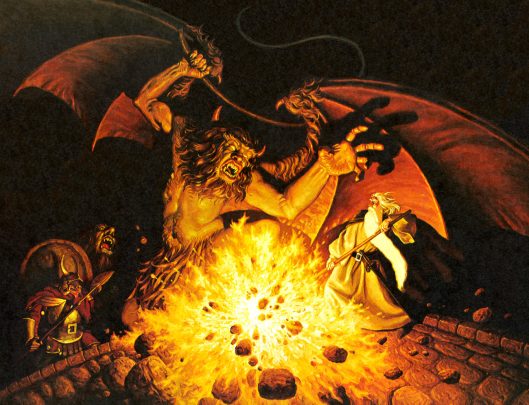
  • Language
  • Literary History
  • Maps
  • Medieval Russia
  • Military History
  • Military History of Middle-earth
  • Narnia
  • Narrative Methods
  • Poetry
  • Research
  • Star Wars
  • Terra Australis
  • The Rohirrim
  • Theatre and Performance
  • Tolkien
  • Uncategorized
  • Villains
  • Writing as Collaborators
Follow doubtfulsea on WordPress.com

Across the Doubtful Sea

Recent Postings

  • Through a glass… January 7, 2026
  • Heffalumps? December 31, 2025
  • We Three Kings December 24, 2025
  • A Moon disfigured December 17, 2025
  • On the Roads Again—Once More December 10, 2025
  • (Not) Crossing Bridges December 3, 2025
  • On the Road(s) Again—Again November 26, 2025
  • On the Road(s) Again November 19, 2025
  • To Bree (Part 2) November 12, 2025

Blog Statistics

  • 104,076 Views

Posting Archive

  • January 2026 (1)
  • December 2025 (5)
  • November 2025 (4)
  • October 2025 (5)
  • September 2025 (4)
  • August 2025 (4)
  • July 2025 (5)
  • June 2025 (4)
  • May 2025 (4)
  • April 2025 (5)
  • March 2025 (4)
  • February 2025 (4)
  • January 2025 (5)
  • December 2024 (4)
  • November 2024 (4)
  • October 2024 (5)
  • September 2024 (4)
  • August 2024 (4)
  • July 2024 (5)
  • June 2024 (4)
  • May 2024 (5)
  • April 2024 (4)
  • March 2024 (4)
  • February 2024 (4)
  • January 2024 (5)
  • December 2023 (4)
  • November 2023 (5)
  • October 2023 (4)
  • September 2023 (4)
  • August 2023 (5)
  • July 2023 (4)
  • June 2023 (4)
  • May 2023 (5)
  • April 2023 (4)
  • March 2023 (5)
  • February 2023 (4)
  • January 2023 (4)
  • December 2022 (4)
  • November 2022 (5)
  • October 2022 (4)
  • September 2022 (4)
  • August 2022 (5)
  • July 2022 (4)
  • June 2022 (5)
  • May 2022 (4)
  • April 2022 (4)
  • March 2022 (5)
  • February 2022 (4)
  • January 2022 (4)
  • December 2021 (5)
  • November 2021 (4)
  • October 2021 (4)
  • September 2021 (5)
  • August 2021 (4)
  • July 2021 (4)
  • June 2021 (5)
  • May 2021 (4)
  • April 2021 (4)
  • March 2021 (5)
  • February 2021 (4)
  • January 2021 (4)
  • December 2020 (5)
  • November 2020 (4)
  • October 2020 (4)
  • September 2020 (5)
  • August 2020 (4)
  • July 2020 (5)
  • June 2020 (4)
  • May 2020 (4)
  • April 2020 (5)
  • March 2020 (4)
  • February 2020 (4)
  • January 2020 (6)
  • December 2019 (4)
  • November 2019 (4)
  • October 2019 (5)
  • September 2019 (4)
  • August 2019 (4)
  • July 2019 (5)
  • June 2019 (4)
  • May 2019 (5)
  • April 2019 (4)
  • March 2019 (4)
  • February 2019 (4)
  • January 2019 (5)
  • December 2018 (4)
  • November 2018 (4)
  • October 2018 (5)
  • September 2018 (4)
  • August 2018 (5)
  • July 2018 (4)
  • June 2018 (4)
  • May 2018 (5)
  • April 2018 (4)
  • March 2018 (4)
  • February 2018 (4)
  • January 2018 (5)
  • December 2017 (4)
  • November 2017 (4)
  • October 2017 (4)
  • September 2017 (4)
  • August 2017 (5)
  • July 2017 (4)
  • June 2017 (4)
  • May 2017 (5)
  • April 2017 (4)
  • March 2017 (5)
  • February 2017 (4)
  • January 2017 (4)
  • December 2016 (4)
  • November 2016 (5)
  • October 2016 (6)
  • September 2016 (5)
  • August 2016 (5)
  • July 2016 (5)
  • June 2016 (5)
  • May 2016 (4)
  • April 2016 (4)
  • March 2016 (5)
  • February 2016 (4)
  • January 2016 (4)
  • December 2015 (5)
  • November 2015 (5)
  • October 2015 (4)
  • September 2015 (5)
  • August 2015 (4)
  • July 2015 (5)
  • June 2015 (5)
  • May 2015 (4)
  • April 2015 (3)
  • March 2015 (4)
  • February 2015 (4)
  • January 2015 (4)
  • December 2014 (5)
  • November 2014 (4)
  • October 2014 (6)
  • September 2014 (1)

Blog at WordPress.com.

  • Subscribe Subscribed
    • doubtfulsea
    • Join 78 other subscribers
    • Already have a WordPress.com account? Log in now.
    • doubtfulsea
    • Subscribe Subscribed
    • Sign up
    • Log in
    • Report this content
    • View site in Reader
    • Manage subscriptions
    • Collapse this bar
 

Loading Comments...