• About

doubtfulsea

~ adventure fantasy

Tag Archives: Mordor

Knowledge, Rule, Order

06 Wednesday Jan 2016

Posted by Ollamh in Fairy Tales and Myths, Imaginary History, J.R.R. Tolkien, Military History, Military History of Middle-earth, Narrative Methods

≈ 2 Comments

Tags

Adolf Hitler, Anduin, Benedict Cumberbatch, Benito Mussolini, British Government, Charlie Chaplin, dictatorships, England, Gandalf, George V, Germany, Gondor, gothic script, Government, History, India, Isengard, Kaiser Willhelm II, Lenin, Mehmed VI, Middle-earth, monarchs, Mordor, Nazis, newsreel, Numenor, Ottoman Empire, Oz, Peter Jackson, Queen Mary, Queen Victoria, Rohan, Saruman, Sauron, Scott, Smaug, Stalin, Stock Market Crash of 1929, Sultan, The Great Dictator, The Lord of the Rings, Tolkien, Treaty of Versailles, Valar, Victoria Louise, Weimar Republic, William Morris, Writing

Dear Readers,

Welcome, as always.

Have you ever wondered what Middle Earth would have been like if the Fourth Age had begun on a calendar written by Sauron?

That of the Third Age was hardly a democratic paradise: a king rules Rohan, a stand-in for king rules Gondor. Elrond and Celeborn/Galadriel behave and are treated like royalty and Thranduil, as we learn from The Hobbit, is the king of Mirkwood. The dwarves have hereditary rulers.   Only the outliers—communities like Bree and the Shire and the earlier inhabitants like Tom Bombadil and Fangorn—appear to be completely independent. (The Shire even has elections and a mayor, although the actual government, except for the shire reeves, appears to bemostly token—you wonder who’s running their seemingly-efficient postal service.)

This is not surprising, not only for an author born during the later years of Victoria,

queenvic.jpg

but also for someone powerfully influenced by the medievalist interests of everyone from Scott

Sir_William_Allan_-_Sir_Walter_Scott,_1771_-_1832._Novelist_and_poet_-_Google_Art_Project.jpg

to William Morris.

William_Morris_age_53.jpg

(We might add that the world of fairy tales, full of princes and princesses, queens and kings, was also a powerful influence at the time—and not only on story-tellers born in monarchies—after all, even Oz is ruled by a queen—

OzmaOz.jpg

Yet, after Smaug—who could better be a medieval fantasy villain (especially with the voice of the incomparable Benedict Cumberbatch attached)?

p8204516_n279079_cc_v4_aa.jpg

—something changed in Tolkien’s world. In fact, something changed in the whole outside world. With the end of World War One, monarchs toppled all over Europe and beyond, from:

Kaiser Wilhelm II of Germany

KAISER-WILHELM_2994889b.jpg

to Mehmed VI, last Sultan of the Ottoman Empire.
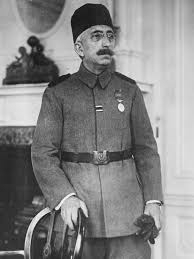
mehmed6.jpg

In place of the former, there appeared the always-troubled Weimar Republic, full of good intentions, but badly crippled, not only by the war which had sapped its manpower and resources, but by all kinds of social unrest and then by the Crash of 1929, which notoriously destroyed the value of its currency.

weimar currency.jpg

As early as 1919, there had been clashes among the forces of different ideologies—
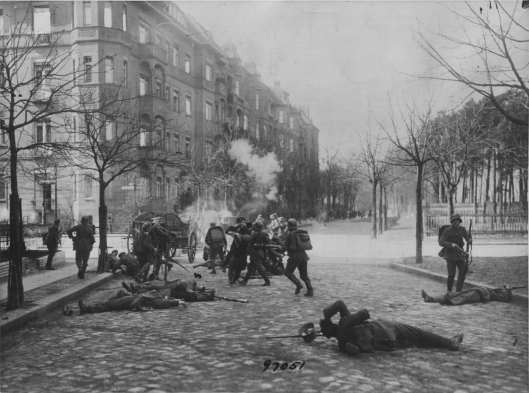
CombatesEnBerlín19190903.jpg

And, amidst all of the unrest, there was a failed coup attempt in 1923 by the man in the overcoat in this picture.

Bundesarchiv_Bild_102-00344A,_München,_nach_Hitler-Ludendorff_Prozess.jpg

He, of course, was only following the footsteps of this man, who had pushed his way into power the year before—

March_on_Rome.jpg

to be followed, in turn, by the man on the left, from the mid-1920s.

stalinandfriends.jpg

That first man, having failed at obvious violence, tried again through more complicated means (although still employing violence, if it suited his purposes) and succeeded in 1933.

Hitler-Papen-First-Reichstag-1933.jpg

He was, so we are told, a riveting public speaker, but, if the newsreels we’ve seen are evidence, we guess you would have had to have been there.

hitlerspeaking.jpg

Some people thought the style exaggerated in the 1930s and caricatured it even then.

chaplin2.jpg

He had a definite social agenda, which he outlined at length and often, although concealing certain of the most horrible aspects. And he liked big words and big concepts, like:

einfolk.jpg

It would have been impossible for someone as intelligent and generally well-informed as Tolkien not to have been very much aware of this man and all of the other like men, busy oppressing as much of the world as they could. And this would have been especially true in a time when radio and film were changing how people received news—and how those interested in influencing others might shape what people saw. As early as 1911, the British government was using newsreel film to show the might and reach of its empire (2/5 of the globe was in their hands) when the king, George V, and his wife, Queen Mary, visited India.

Delhi_Durbar,_1911.jpg

Not to be outdone, Kaiser Wilhelm II encouraged a grand—and filmed–event in 1913, for the wedding of his daughter, Victoria Louise—and some of the film was even in color.

vlouisekaiser.jpg

The Marriage of Victoria Louise Color Film

It would be easy to imagine, then, that the weight of such public figures might have influenced Tolkien in his depiction of late-3rd-Age villains. We can see it in Saruman’s unsuccessful attempt to persuade Gandalf to join him:

“ ‘He drew himself up then and began to declaim, as if he were making a speech long rehearsed. ‘The Elder Days are gone. The Middle Days are passing. The Younger Days are beginning. The time of the Elves is over, but our time is at hand: the world of Men, which we must rule. But we must have power, power to order all things as we will, for that good which only the Wise can see.” (The Fellowship of the Ring, Chapter 2, “The Council of Elrond”)

Thus, unlike the script of Jackson’s version, there is no plan to wipe out men and replace them with orcs. Instead, men are to survive: to be ruled—perhaps under what definitely sounds like it should be a translation from something written in Fraktur—the fake Gothic script favored by the Nazis–

die-schöne-deutsche-Schrift-detail1.jpg

“ ‘We can bide our time,’” says Saruman, “ ‘we can keep our thoughts in our hearts, deploring maybe evils done by the way, but approving the high and ultimate purpose: Knowledge, Rule, Order; all the things that we have so far striven in vain to accomplish…’ ”

Such abstract, but somehow menacing, words sound like a translation of something from Hitler’s Germany: Kenntnisse, Herrschaft, Ordnung. They do not sound in the least like Gandalf’s goals, ever, and he, in fact, replies by implying that not only are they not really Saruman’s words, but that Saruman is foolish for believing them:

“ ‘Saruman,’ I said, ‘I have heard speeches of this kind before, but only in the mouths of emissaries sent from Mordor to deceive the ignorant.’ “

As really the words of Sauron, however, they give us an idea of what to expect in a world under his control. Knowledge would be for Sauron alone, we suppose, perhaps after regaining his lost ring? Certainly he wouldn’t share it with Saruman, whom, it will become clear, he never trusted. As for Rule and Order, the world would be a place full of rules and those watching that they be obeyed. And here we can remember Sharkey’s Shire, with its “by order of the Chief” signs—and its gangs of human enforcers. As well, we can think of its grey, industrial character, as we’ve discussed in a previous post, a universal Mordor, devoted to production. To this, we can add the Mouth of Sauron’s recitation of surrender conditions, delivered to the allies before the Morannon:

“ ‘These are the terms…The rabble of Gondor and its deluded allies shall withdraw at once beyond the Anduin, first taking oaths never again to assail Sauron the Great in arms, open or secret. All lands east of the Anduin shall be Sauron’s for ever, solely. West of the Anduin as far as the Gap of Rohan shall be tributary to Mordor, and men there shall bear no weapons, but shall have leave to govern their own affairs. But they shall help to rebuild Isengard which they have wantonly destroyed, and that shall be Sauron’s, and there his lieutenant shall dwell: not Saruman, but one more worthy of trust.’ “ (The Return of the King, Chapter 10, “The Black Gate Opens”)

In keeping with the influence of current events in this world, we might see this as being a parallel with the 1919 Versailles Treaty, in which Germany was to be forced to make huge territorial concessions, to disarm almost entirely, and to pay massive amounts in reparation to the victorious allies.

Treaty_of_Versailles,_English_version.jpg

The Treaty of Versailles– Wiki Article

Such terms as Sauron offers would also destroy Rohan as an ally and set up a permanent garrison between it and the north. We might also expect the restored Isengard to be a staging area for an assault upon Fangorn and the ents, to their ultimate destruction. As well, “west of the Anduin” is a very vague expression—does it include Gondor, as well as Rohan?

Religion in The Lord of the Rings has always been the subject of debate: how much or how little? Of what kind? Tolkien is quoted as saying that it was monotheistic, although, when attacked by the Mumak, Faramir’s men called on the (plural) Valar. There is no mention, in what is often extremely detailed landscape description, of any kind of temple or shrine, however. Nevertheless, we would like to conclude with an eerie thought about religion in this alternative Fourth Age. The Mouth of Sauron, aka, The Lieutenant of the Tower of Barad-dur, is described as:

“…a renegade, who came of the race of those that are named the Black Numenoreans; for they established their dwellings in Middle-earth during the years of Sauron’s domination, and they worshipped him, being enamoured of evil knowledge.”

Could we imagine that, in this other Fourth Age, a new and horrible religion might have appeared, one dedicated to the worship of Sauron—and to that Knowledge which Saruman finds so important? What do you think, dear readers?

As always, thanks for reading.

MTCIDC

CD

Mirror, Mirror

09 Wednesday Dec 2015

Posted by Ollamh in Fairy Tales and Myths, J.R.R. Tolkien, Narrative Methods

≈ Leave a comment

Tags

A Christmas Carol, Denethor, Dickens, Disney, Evil Stepmother, Fates, Fiction, Folktale, Frodo, Galadriel, Gandalf, Gondor, Grimm Brothers, Istari, Kinder und Hausmaerchen, Lothlorien, Magic mirror, Maiar, Middle-earth, mirror, Mordor, Muses, Norns, Norse Mythology, Numenor, Ornthanc, Palantir, Saruman, Sauron, Schneewittchen, Scrooge, scrying stone, Snow White, Story, The Lord of the Rings, The Theogony, Tolkien, Urtharbrunnr, Valar, Yggdrasil

Dear Readers,

Welcome, as always.

This is the second of two postings which, as we said in our last, was originally just one. That earlier draft linked the Palantiri with Galadriel’s mirror, but, on reconsideration, we believed—at least at first–that, in fact, they weren’t so close as we thought and so we separated them.

In our last, we discussed the Palantiri and what might have been a possible inspiration for them. In this posting, we propose to look a little more closely at Galadriel’s mirror (but we promise not to touch the water).

When we speak of mirrors—and, in this case, magic ones—the first one which pops into our mind is from childhood—the mirror in Snow White and the particularly creepy mirror in the 1937 Disney animated film.

girmagicmirror.gif

In the original Schneewittchen, first published in the Grimm brothers’ Kinder und Hausmaerchen in the original edition of 1812,

grimm_bruder_1847_klein.jpg firstedkundh.JPG

the mirror belongs to Snow White’s stepmother, of whom the story says (in our translation):

“She was a very beautiful woman, but she was proud and arrogant and couldn’t allow that anyone would surpass her in beauty.”

She monitored her position by means of that mirror:

“She had a wonderful mirror. When she stepped before it and looked at herself within it, she said:

Little mirror, little mirror, on the wall,

Who is the most beautiful in the whole land?

The mirror answered thus:

Madame Queen, you are the most beautiful in the land.”

Franz_Jüttner_Schneewittchen_1.jpg

This makes us wonder about the stepmother. Was she like so many of the people we see around us every day (and not “everyday”, which is a compound adjective, meaning “commonly” as in “everyday usage does not necessarily equal correct usage in language”), compulsively fiddling with their electronic devices? How often did she go to that mirror and ask that question? As it was attached to the wall, she wasn’t carrying it in her back pocket, so, can we picture her making excuses to the king, to the prime minister, to her ladies in waiting, just so that she could go back to visit it? The text only says that she did—it’s a folktale, after all, and therefore old and so before current addictions were available, but she seems so obsessed—and familiar.

But then comes the day when the answer is:

“Madame Queen, you’re the most beautiful here,

But Snow White is a thousand times more beautiful than you.”

And the story goes on from there to places we don’t intend to follow.  It is interesting, however, that the mirror itself appears to do the talking, not a visible spirit within it, as in the Disney movie, and there is a certain logic to this. After all, normally, a mirror is only a reflecting device: it shows the person who is looking into it, as we see the stepmother doing. Then again, having someone—or something—looking out when you look in raises all sorts of interesting questions: who is it? Where is it? How does it know what it knows and how to speak? Does it have limits?

We might imagine, from her single, repeated question that the woman does. She never, for example, asks “Was there anyone as beautiful before me?” or “Will I always be the most beautiful?” She seems trapped in the moment and, without a greater context, the mirror’s last reply will be that much more shocking.

In contrast, Galadriel’s mirror, is neither on a wall, nor portable. In fact, it’s not really a mirror in the conventional sense at all.

“With water from the stream Galadriel filled the basin to the brim, and breathed on it, and when the water was still again she spoke. ‘Here is the Mirror of Galadriel,’ she said. ‘I have brought you here so that you may look in it, if you will.’ “ (The Fellowship of the Ring, Book 2, “The Mirror of Galadriel”)

64b97a1e010e45710323b25705b62626.jpg

When Frodo asks what might be seen therein, Galadriel replies:

‘Many things I can command the Mirror to reveal,’ she answered, ‘and to some I can show what they desire to see. But the Mirror will also show things unbidden, and those are often stranger and more profitable than things which we wish to behold. What you will see if you leave the Mirror free to work, I cannot tell. For it shows things that were, and things that are, and things that yet may be. But which is it that he sees, even the wisest cannot always tell.’ (The Fellowship of the Ring, Book 2, “The Mirror of Galadriel”)

There appear to be several possible influences here. In the ancient Greek poem, The Theogony, the Muses are described as knowing past, present, and future (Theogony 380), as they choose the shepherd, Hesiod, to become a poet.

Muses_sarcophagus_Louvre_MR880.jpg

Others have suggested that an influence upon the author here was the Urtharbrunnr, the well of fate, as it may be translated, from Norse mythology, which lies at the foot of the tree called Yggdrasil. Here the Norns, or Fates in Norse tradition, sit to do their work.

Nornorna_vid_Urdarbrunnen.jpg

Another possibility yet might be the three Christmases who visit Ebenezer Scrooge in Charles Dickens’ A Christmas Carol and an advantage to pointing to them is that Christmas Yet to Come, although mute, shows Scrooge what turn out to be only “things that yet may be”, as Scrooge, by his change in behavior, diverts fate.

The_Last_of_the_Spirits-John_Leech,_1843.jpg

That sense of potentiality about the future is clearly a very important feature of Galadriel’s Mirror. Lorien is not only a haven from Orcish pursuit,

Lothlorien.jpg

but also a testing ground, where the surviving members of the Fellowship are probed by the Lady of the Wood, even as she herself is inadvertently tested when Frodo offers her the Ring. Sam may suffer the most from this, being shown what appears to be the destruction of the Shire and the destitution of his own grandfather.

ruinedshire.png

And yet, as Galadriel says,

‘But the Mirror will also show things unbidden, and those are often stranger and more profitable than things which we wish to behold.’ (The Fellowship of the Ring, Book 2, “The Mirror of Galadriel”)

What Sam sees shakes him for a moment to the point of stepping back from the basin, saying (almost shouting, as the sentence ends with an exclamation point), “I must go home!” (The Fellowship of the Ring, Book 2, “The Mirror of Galadriel”) He recovers immediately, however, resolving, “ ‘No, I’ll go home by the long road with Mr. Frodo, or not at all.’” And thus he, like Galadriel, passes the test and perhaps that’s what the odd word “profitable” means in her explanation. Sam is confronted with what must have been that which he subconsciously dreaded most, but his new resolution ultimately proves the salvation of Middle Earth, on the one hand, and the healing of the Shire by means of Galadriel’s gift of a little Lorien, on the other. And, considering that Sam first appears in the story as an eaves-dropping gardener and hardly a giant elf-warrior, that other adjective, “stranger” may be appropriate, too.

So far, the Mirror has nothing in common with a Palantir, which was clearly designed not as a “scrying stone”, but as a communication device. And yet there is Galadriel’s remark,

“ ‘Many things I can command the Mirror to reveal,’ she answered, ‘and to some I can show what they desire to see.’ “

This strikes us as an ambiguous statement—and probably meant to be. Does Galadriel mean:

  1. people come to ask her, for example, to see their future—implication being that she shows them that, and nothing more
  2. people come, ask, and she shows them what they want to see—implication being that what they see is not necessarily what is real?

When Frodo looks into Mirror, he sees the very last thing he would want to see, however:

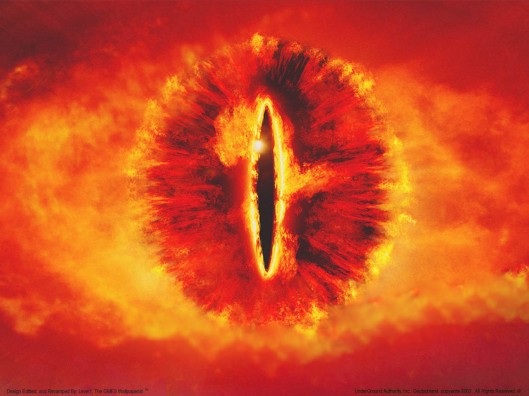
“But suddenly the Mirror went altogether dark, as dark as if a hole had opened in the world of sight, and Frodo looked into emptiness. In the black abyss there appeared a single Eye that slowly grew, until it filled nearly all the mirror. So terrible was it that Frodo stood rooted, unable to cry out or to withdraw his gaze. The Eye was rimmed with fire, but was itself glazed, yellow as a cat’s, watchful and intent, and the black slit of its pupil opened on a pit, a window into nothing.” (The Fellowship of the Ring, Book 2, “The Mirror of Galadriel”)

eye-o-sauron-03.jpeg

This is especially true in that:

“Then the Eye began to rove, searching this way and that; and Frodo knew with certainty and horror that among the many things that it sought he himself was one.” (The Fellowship of the Ring, Book 2, “The Mirror of Galadriel”)

This is clearly not the past or the future, as Frodo sees it, but the all-too-realistic present. And this is not just a present to be viewed. Like the figure in the mirror in the old Disney Snow White, this is someone who would respond directly to what he sees, if he could. And Frodo is aware of this:

“But he also knew that it could not see him—not yet, not unless he willed it.” (The Fellowship of the Ring, Book 2, “The Mirror of Galadriel”)

Does the Mirror have more potential, then? Can it be used as a communication device, like a Palantir? If it can combine the functions of “magic mirror” and Palantir, might the Palantir be able to combine functions, as well?

Certainly Sauron does something which ruins Denethor’s ability to resist Sauron’s view of the future to the point where he attempts to commit flaming suicide along with his one surviving son, having abandoned his city to its fate.

pyre.jpg

Denethor, though, is just a human, and rather a vain one, at that.

How would Sauron do the same with one of the Maiar, those beings sent by the Valar to protect Middle Earth from the danger which Sauron represents? Certainly we know that Sauron has communicated with Saruman through the Palantir.

palantir.jpg

There may be a clue in Gandalf’s reply to Saruman, just before he is held captive in Orthanc:

“I have heard speeches of this kind before, but only in the mouths of emissaries sent from Mordor to deceive the ignorant.” (The Fellowship of the Ring, Book 2, “The Council of Elrond”)

What Gandalf is responding to is:

“A new Power is rising. Against it the old allies and policies will not avail us at all. There is no hope left in Elves or dying Numenor. This then is one choice before you, before us. We may join with that Power. It would be wise, Gandalf. There is hope that way. Its victory is at hand; and there will be rich reward for those that aided it. As the Power grows, its proved friends will also grow; and the Wise, such as you and I, may with patience come at last to direct its courses, to control it. We can bide our time, we can keep our thoughts in our hearts, deploring maybe evils done by the way, but approving the high and ultimate purpose: Knowledge, Rule, Order; all the things that we have so far striven in vain to accomplish,,hindered rather than helped by our weak or idle friends. There need not be, there would not be, any real change in our designs, only in our means.” (The Fellowship of the Ring, Book 1, “The Council of Elrond”)

“Knowledge, Rule, Order”? It’s no wonder that Gandalf replies as he does. Such words sound more like the slogan of a totalitarian state—exactly what Mordor has become under its lidless-eyed master–than those of one of the Istari.

And how did Saruman come to have such a distorted vision of the future? Just as Denethor, bitter over his son’s death and the loss to Gandalf—he thinks—of his younger son, has been shown what must have been an increasingly-bleak picture of Gondor and its fate, so can we imagine that Sauron, sensing a latent arrogance and desire for power in Saruman, has given Saruman the second possible understanding of Galadriel’s statement. He has shown Saruman what Saruman secretly wishes for and, in doing so, he cunningly paints for Saruman, who is just wise enough to know that he will never be Sauron, a picture of an alliance which will grant him his wish. Why does Saruman, who is himself an extremely powerful figure, fall for this? Perhaps he’s like Snow White’s stepmother and limited to one question: “Little globe, little globe, who is the (second most) powerful in Middle Earth?”

What do you think, dear readers?

Thanks, as always, for reading.

MTCIDC

CD

Like Smoke From a Fire: Sharkey’s End

04 Wednesday Nov 2015

Posted by Ollamh in Fairy Tales and Myths, Imaginary History, J.R.R. Tolkien, Maps, Narrative Methods, Research

≈ Leave a comment

Tags

Adventure, Birmingham, Branywine, Bywater, Coketown, Dickens, Dol Amroth, England, Ents, factory, Fangorn, feudalism, Galadriel, Gandalf, Grima, Hard Times, Hobbiton, Idylls, industrial, Industrial Revolution, Isengard, King Edward School, Medieval, Merry, Midlands, Mordor, Morris, Oxford, Palantir, Pippin, poetry, pre-industrial, Saruman, Sauron, Scouring of the Shire, Sharkey, Southfarthing, Tennyson, The Lord of the Rings, The Shire, Tolkien

Dear Readers,

Welcome, as always.

In a previous posting, we talked about Saruman as a kind of imitation Sauron and Isengard as a mini-Mordor.

sarum1

In this posting, we want to consider the implications of Gandalf’s remark about him in “Many Partings”, from The Return of the King: “I fancy he could do some mischief still in a small mean way.”

The mischief, when we see it, is definitely mean, but not small, even though confined to the limits of the Shire.

The world of The Lord of the Rings is a pre-industrial one. The most advanced technology, on the one hand, is the palantir (actually perhaps a magical, rather than mechanical, device)

palantir

and , on the other hand, a watermill.

j-r-r-_tolkien_-_the_hill_-_hobbiton-across-the-water_colored

Beyond that, it’s a medieval world, but without, it seems, feudalism, although there are, for example, castles and knights in the form of the Prince of Dol Amroth.

We can easily see why JRRT wanted this regression. On the one hand, like so many boys of his age, he had grown up reading Tennyson

John_everett_millais_portrait_of_lord_alfred_tennyson firstedition1859idylls

and William Morris

Morris-Portrait1

morris_tapestry

who had created a world of Victorian medievalism, Tennyson in poetry, Morris in many different art forms.

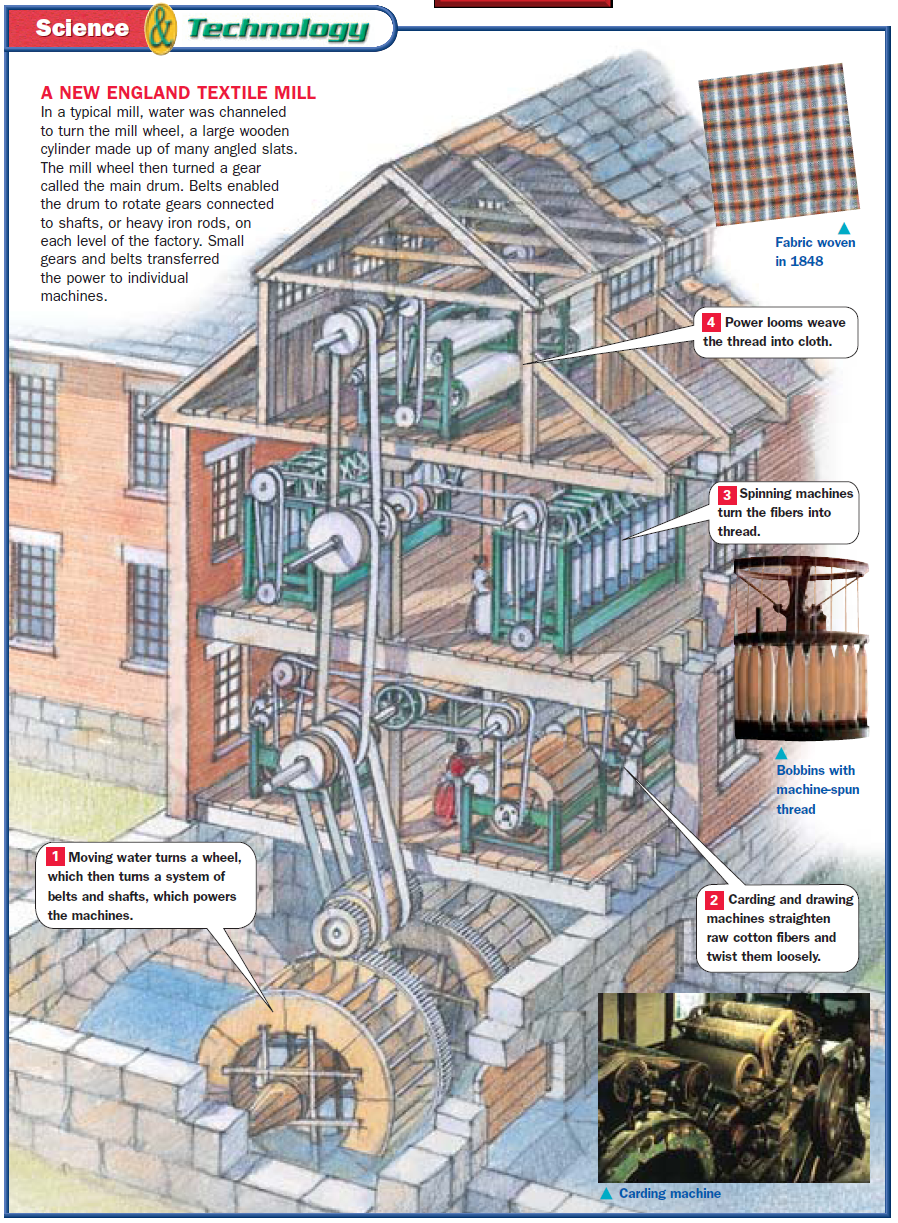
On the other, Tolkien had grown up in Birmingham, in the English Midlands, where there had been massive development throughout the era of the Industrial Revolution.

Textile Mill Diagram McConnel_&_Company_mills,_about_1820

Here’s Charles Dickens’ description of such a place from Hard Times (1856):

(Excerpt Describing Coketown)

Needless to say, although Tolkien kept a strong affection for King Edward School, where he was educated before Oxford,

KingEdwardsSchoolinBirmingham

he was less enthusiastic about the industrial world which surrounded it and this clearly colors his picture of Saruman. Look, for instance, at Fangorn’s description of him:

“He has a mind of metals and wheels; and he does not care for growing things, except as far as they serve him for the moment.” (The Two Towers, Book 1, Chapter 4, “Treebeard”) (It’s revealing, by the way that this is almost a quotation of something which Saruman later says of Gandalf, “When his tools have done their task he drops them.” The Return of the King, Book 2, Chapter 8, “The Scouring of the Shire”)

Saruman, then, with his metal mind, has turned the once-beautiful Isengardgreg-hildebrandt-isengard-orthanc-saruman-607429-1920x1080

into an arms factory

kruppworks

another Midlands,

isengardasfactory

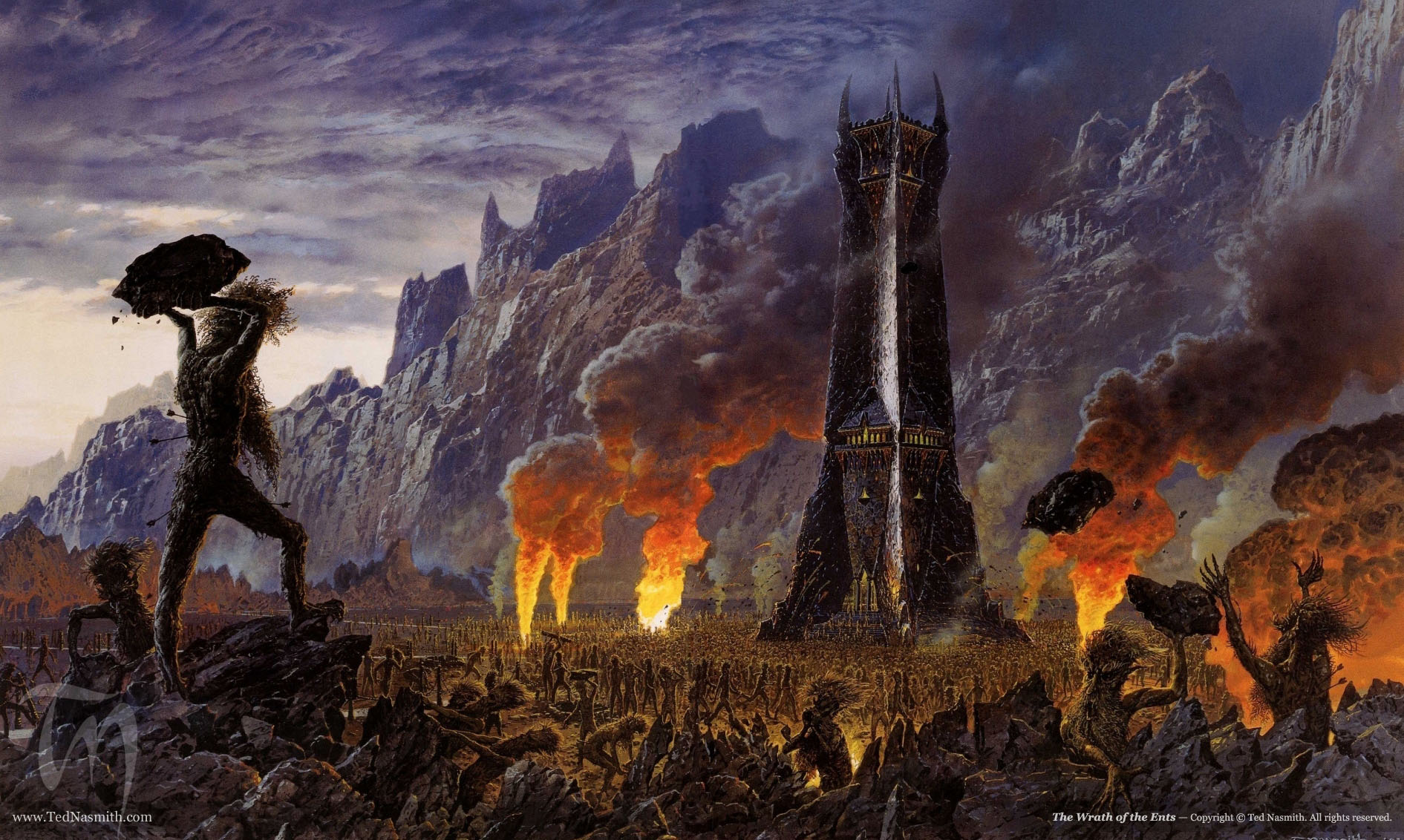
and has angered the Ents, as well, by the wanton destruction of trees, not just for fuel, it appears, but just out of sheer spitefulness.

The Wrath of the Ents, by Ted Nasmith

As we wrote earlier, all of this has remade Isengard into a mini-Mordor—as Frodo says: “Yes, this is Mordor…just one of its works. Saruman was doing its work all the time, even when he thought he was working for himself.” (The Return of the King, Book 2, Chapter 8, “The Scouring of the Shire”)

So, when Saruman, Grima in tow, leaves his ruined factory, one could almost imagine just what he might have in mind when he says to the hobbits:

“Well, it will serve you right when you come home, if you find things less good in the Southfarthing than you would like.” (The Return of the King, Book 2, Chapter 6, “Many Partings”)

We know from Merry and Pippin’s experience at the gate of Isengard that Saruman has been importing pipe-weed, a main export of the Southfarthing.

merrypippinisengard

But when the hobbits, having forced the gate at the Brandywine, are making their way towards Hobbiton, they begin to have a feeling that much more has been damaged than the South Farthing: “Still there seemed an unusual amount of burning going on, and smoke rose from many points round about. A great cloud of it was going up far away in the direction of the Woody End.” (The Return of the King, Book 2, Chapter 8, “The Scouring of the Shire”)

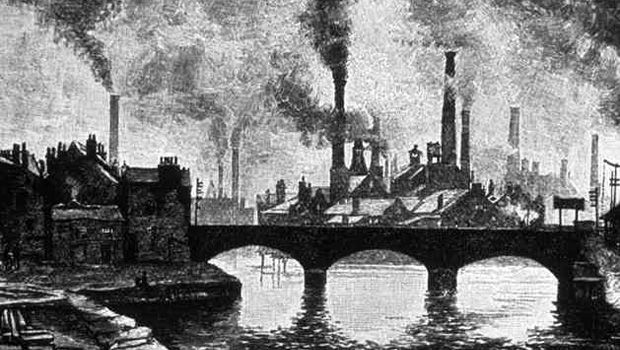
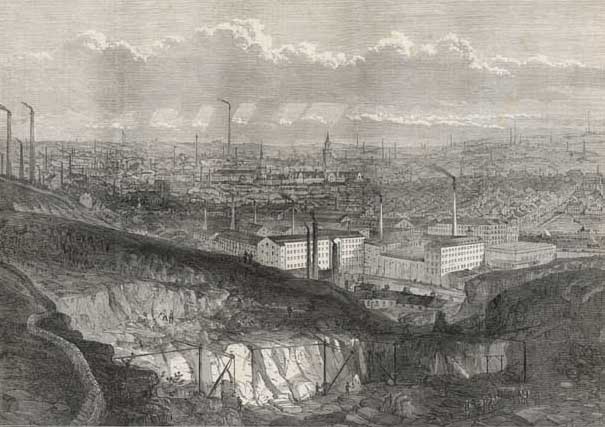
This smoke bears an ominous resemblance to the Midlands (and, in fact, to all of industrial England):

7ad841d6d5852b586a78fc03df7d64259715bddd.jpg__846x0_q80

There is worse to come, however: Bywater. “Many of the houses that they had known were missing. Some seemed to have been burned down. The pleasant row of old hobbit-holes in the bank on the north side of the Pool were deserted, and their little gardens that used to run down bright to the water’s edge were rank with weeds. Worse, there was a whole line of ugly new houses all along the Pool Side, where the Hobbiton Road ran close to the bank. An avenue of trees had stood there. They were all gone. And looking with dismay up the road towards Bag End they saw a tall chimney of brick in the distance. It was pouring out black smoke into the evening air.” (The Return of the King, Book 2, Chapter 8, “The Scouring of the Shire”)

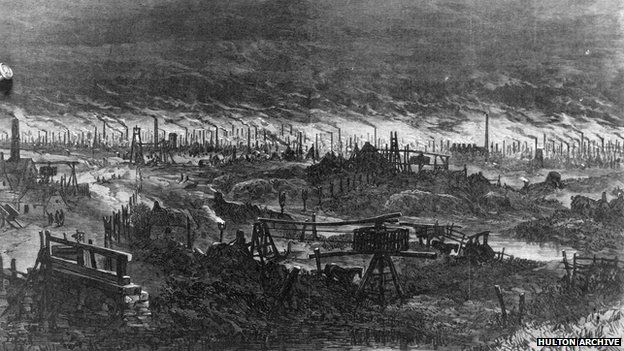
And here, we move from a single smoking mill to a smoking mill town.

BRADFORD/YORKSHIRE/1873

Saruman’s revenge has been more than small and mean, especially in terms of the industrial world which The Lord of the Rings rejects: the Shire is on its way to becoming another Midlands,

_77710962_3322454

even to the workers’ miserable housing.

preston

And the cutting down of trees (including, as we will find out, the Party Tree) insures the truth of Saruman’s sneering statement to the hobbits:

“…I have done much that you will find it hard to mend or undo in your lives.” (The Return of the King, Book 2, Chapter 8, “The Scouring of the Shire”)

But, as we know, Saruman, even in his moment of triumph, has no more than a moment to enjoy it. He is murdered by Grima and here we see the final irony. As Saruman has turned the medieval, bucolic Shire into a smoky horror, so he himself is turned to smoke:

“To the dismay of those that stood by, about the body of Saruman a grey mist gathered, and rising slowly to a great height like smoke from a fire, as a pale shrouded figure it loomed over the Hill. For a moment it wavered, looking to the West; but out of the West came a cold wind, and it bent away, and with a sigh dissolved into nothing.” (The Return of the King, Book 2, Chapter 8, “The Scouring of the Shire”)

61 - The scouring of the shire

A final thought, however. Might we see Saruman’s gesture towards the West, in which he clearly feels that he has been rejected by that which sent him to Middle Earth, as a mirror Galadriel’s gesture of rejection towards the East, when she refuses the Ring?

“She lifted up her hand and from the ring that she wore there issued a great light that illuminated her alone and left all else dark. She stood before Frodo seeming now tall beyond measurement, and beautiful beyond enduring, terrible and worshipful. Then she let her hand fall, and the light faded, and suddenly she laughed again, and lo! she was shrunken: a slender elf-woman, clad in simple white, whose gentle voice was soft and sad.” (The Fellowship of the Ring, Book 2, Chapter 7, “The Mirror of Galadriel”)

galadriel

Thanks, as always, for reading.

MTCIDC

CD

Shall We Gather at the River?

08 Wednesday Jul 2015

Posted by Ollamh in J.R.R. Tolkien, Maps, Military History, Narrative Methods

≈ Leave a comment

Tags

Alexander, Anduin, Burnside, Cair Andros, Celeborn, Confederate, D-Day, Denethor, Douro, Faramir, Fredericksburg, French, Gandalf, Hydaspes, Inchon, Indiana Jones, Isola Tiberina, King Poros, Lee, Minas Tirith, Mordor, Napoleonic, Nazgul, Pelennor, Pontoon, Porto, Quebec, Rappahannock, Roechling, Sauron, Soult, The Lord of the Rings, Tolkien, Union, Wellington, West Osgiliath, Zouaves

Dear Readers,

Welcome, as always. In this posting, we thought we’d do a kind of follow-up to our “What Happened to the Rammas Echor” piece by looking at the Mordorian assault on West Osgiliath, which leads up to it. (Yes, we know—bassackwards, right? We can only claim as Indiana Jones does, that “I’m making this up as I go along.”)

We can begin with a map and a description by a participant.

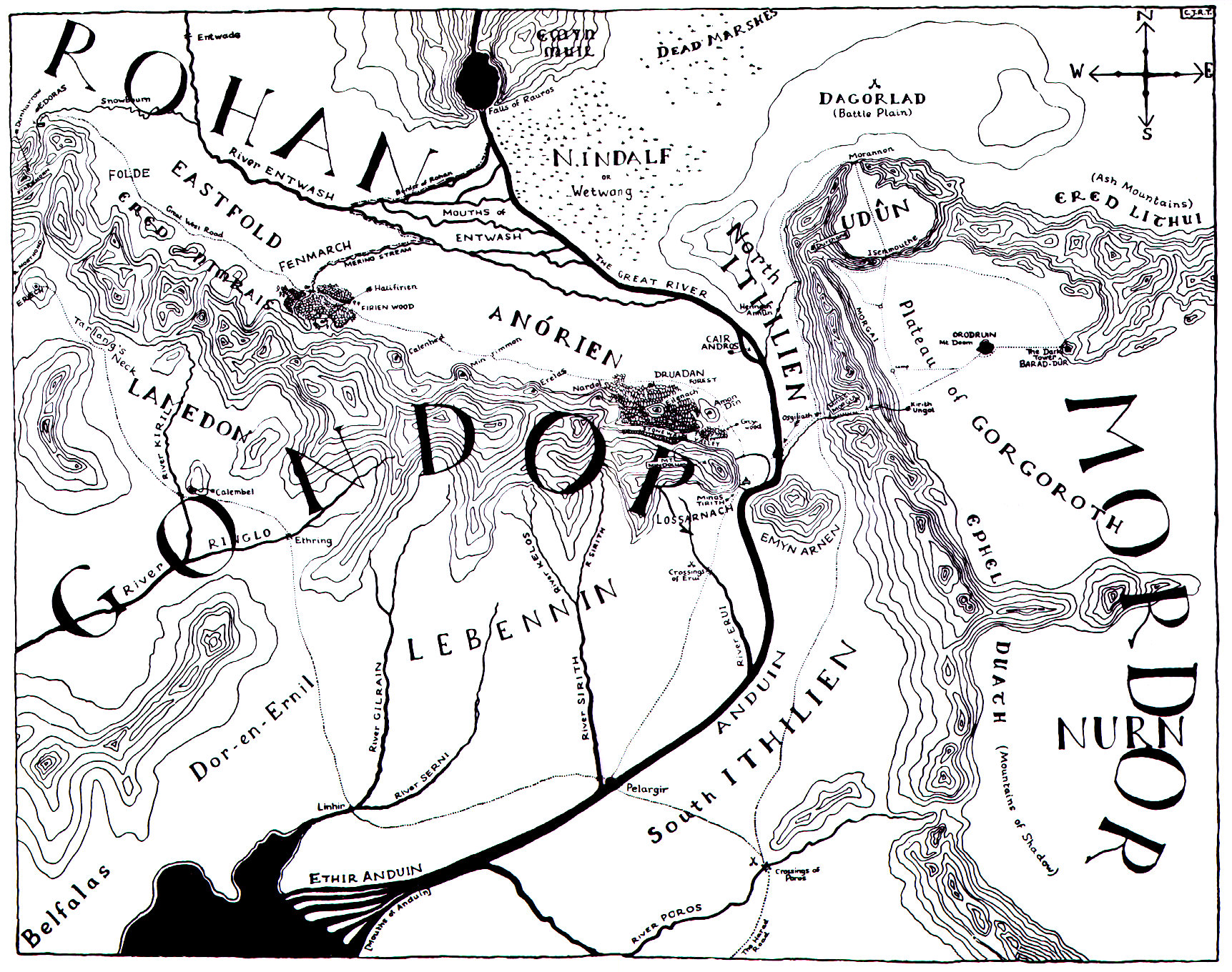
Here’s the Anduin, the major obstacle for Sauron’s forces to cross at a point in easy striking distance of Minas Tirith.

gondor_map

Here’s Denethor’s intelligent assessment of the defensive situation:

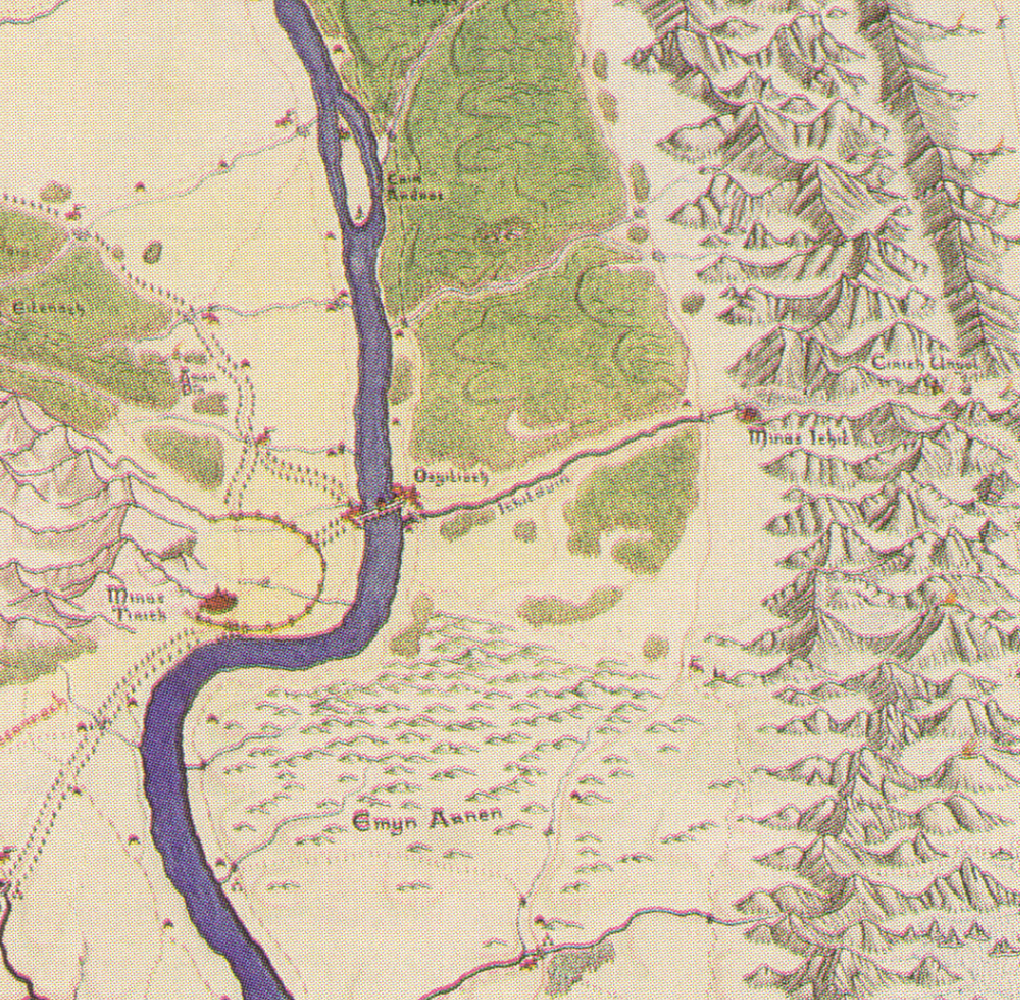
“…And the Enemy must pay dearly for the crossing of the River. That he cannot do, in force to assail the City, either north of Cair Andros because of the marshes, or southwards towards Lebennin because of the breadth of the River, that needs many boats. It is at Osgiliath that he will put his weight, as before when Boromir denied him the passage.” LotR 816

EphelDuath_10x10drape2

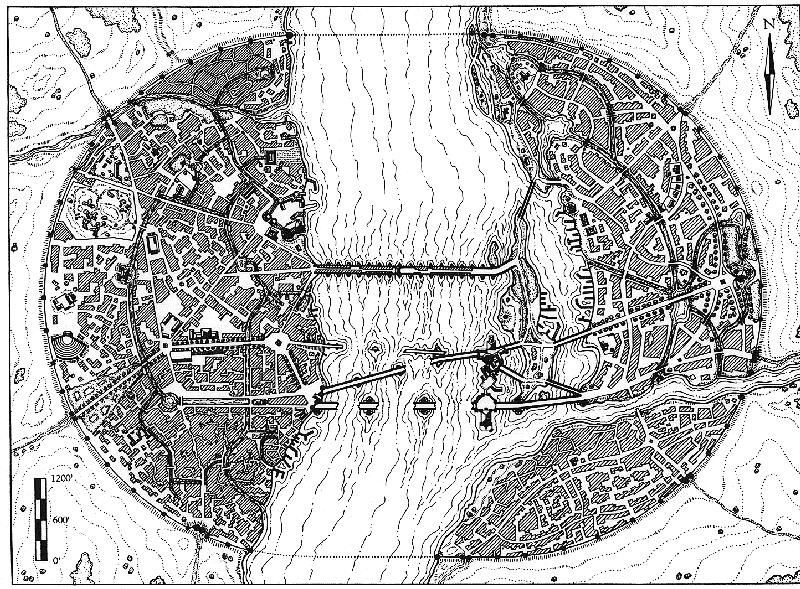
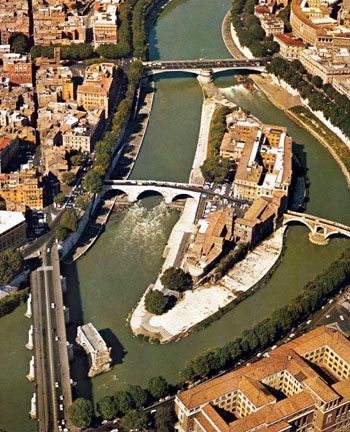
Although there have been very creative attempts to map or depict Cair Andros, for all of its importance in the defense of Gondor, we aren’t given much detail. Its name means “Ship of Long Foam” , called so because of its shape and its action in breaking up the flow of the Anduin. This brought to our minds the Isola Tiberina on the Tiber in Rome,

18-1

which so reminded the Romans of a ship that—well, this 1770s engraving makes their next step obvious—

Piranesi-16059

Cair Andros was fortified and had a garrison, although Denethor refuses to reinforce it, saying “Cair Andros is manned, and no more can be sent so far.” LOtR 816

We also know that the enemy will capture it during their two-proned general assault (Gandalf says to Denethor: “Fugitives from Cair Andros have reached us. The isle has fallen.” LotR 819)

To the south, somewhere between forty and fifty miles, lies Osgiliath.

Anorien

Identified by Denethor as the other major crossing point, it was once a prosperous city, but now lies in ruins, with its bridges destroyed (Celeborn to Aragorn: “And are not the bridges of Osgiliath broken down and all the landings held now by the Enemy?” LotR 367).

The problem, then, for the Enemy is how to cross a river against opposition, a classic problem for generals since there were generals.

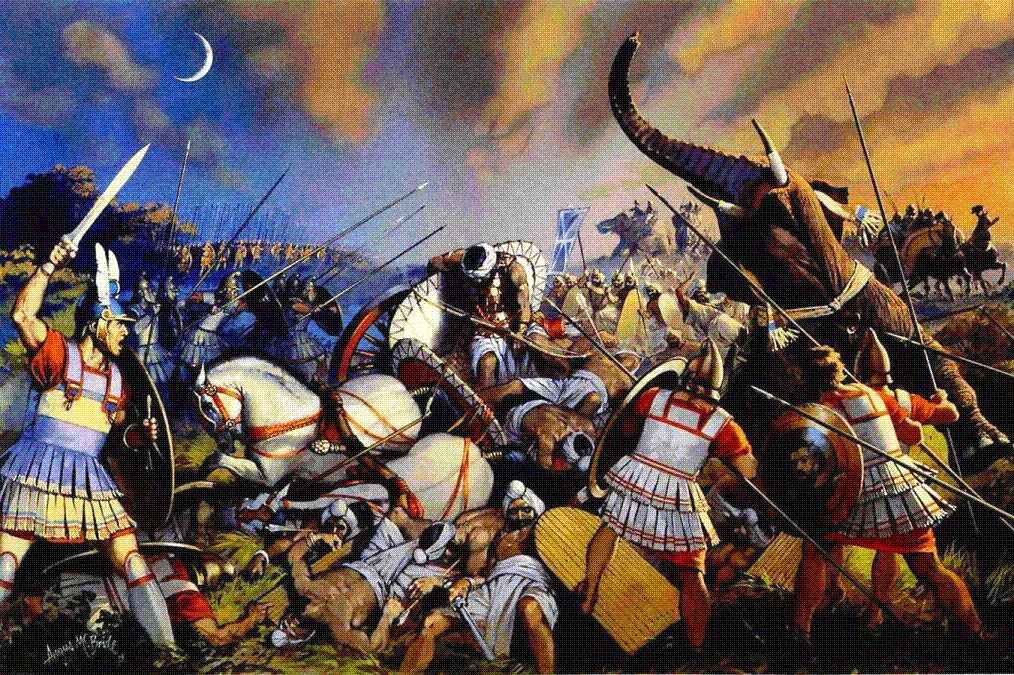
We think, for example, of Alexander at the Hydaspes River in 326BC, defended by King “Poros” (actually Porushattama—Greeks were determined to tame everything—including other cultures’ proper names).

1382499630_Hydaspes

(and we couldn’t resist this second image—Alexander in the center of his pikemen—in what looks like 25-28mm)

VendelMacedonians

As you can see from the map, Alexander crossed upstream, having distracted the king with a demonstration (military for “feint/decoy”).

Battle_hydaspes_crossing

This was through open country, however. In the case of Osgiliath

osgiliath

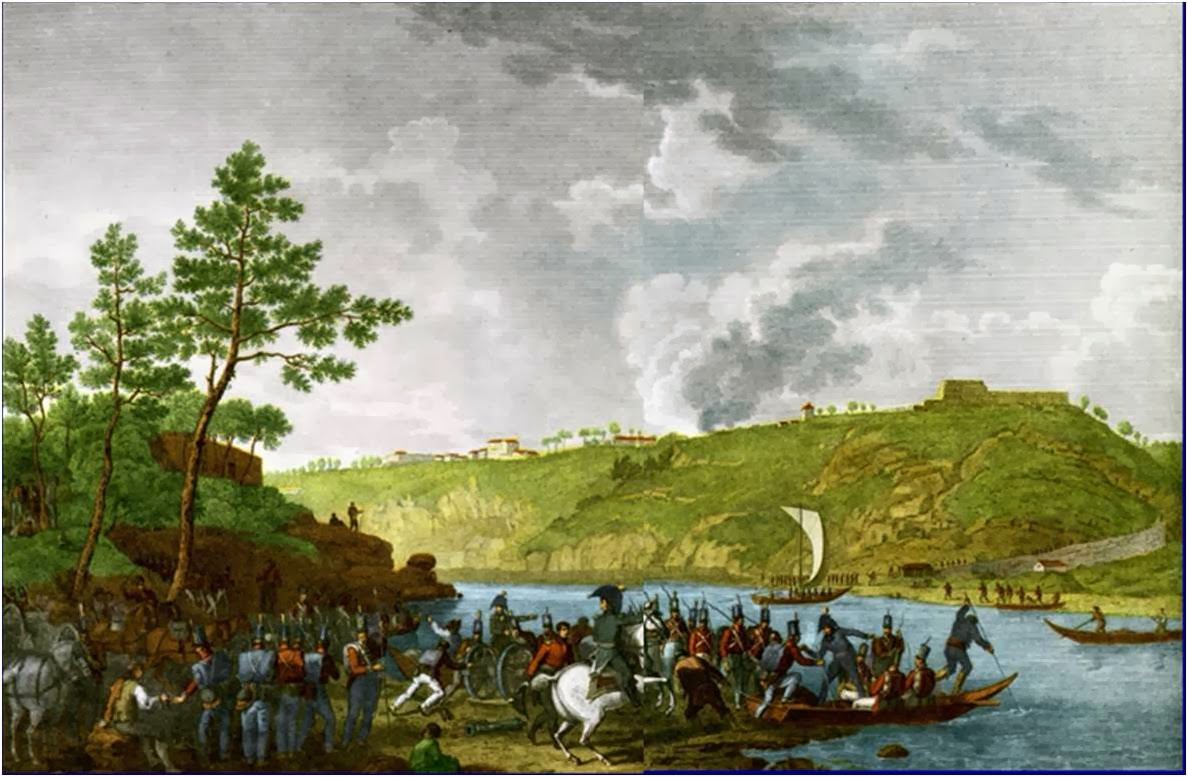
the Enemy would have to cross the river in the face of opposition within a town. Here, we thought of several possibilities: Wellington’s crossing of the river Douro against French resistance in 1809, for example. Here was not only the river, but its steep banks, as well.

Henry Smith Oporto, With The Bridge Of Boats 1809

(The pontoon bridge was set up after the attack.)

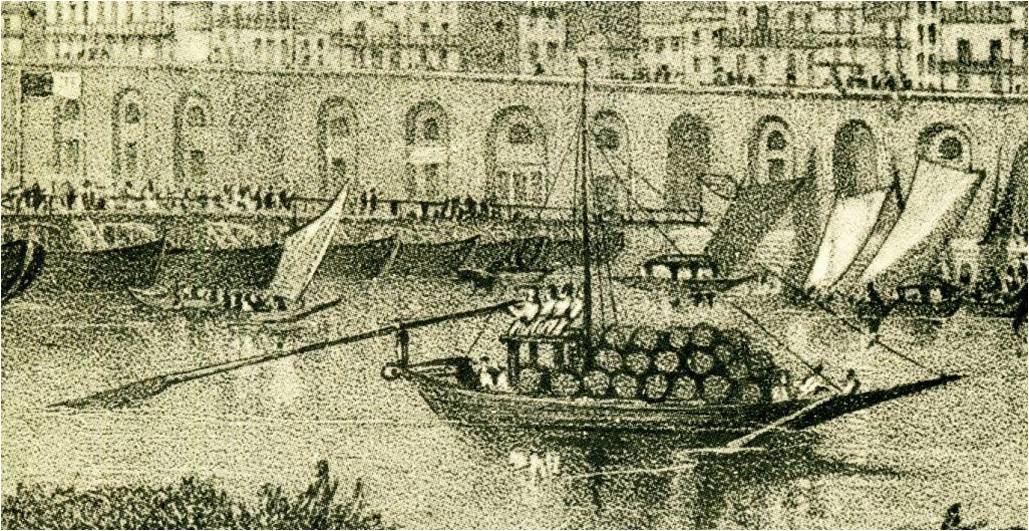
There were no bridges and the French had collected all of the available boats and had either destroyed them or were holding them on the north side of the river. As Porto (the name means what you think it does) was the center of the fortified wine trade (yes , “Pass the port, Wriothsley, will you?”), the major vessel on the river was this—

pb17

Wellington was always a clever and flexible commander and had to be when confronted by the able Marshal Soult across the river. Much of Wellington’s success came from his use of local sources: Portuguese who hated their French occupiers and supplied some of Wellington’s men with a rowboat and crew. On the north side were four wine boats, soon filled with British soldiers—

sec198

and the surprised, but always brave and sturdy, French soldiers were eventually pushed back north, out of the town.

oporto

As you can see, this was really a frontal assault, but, because of their former preparations and their sense of the geography, the French had been lulled into thinking that they were prepared.

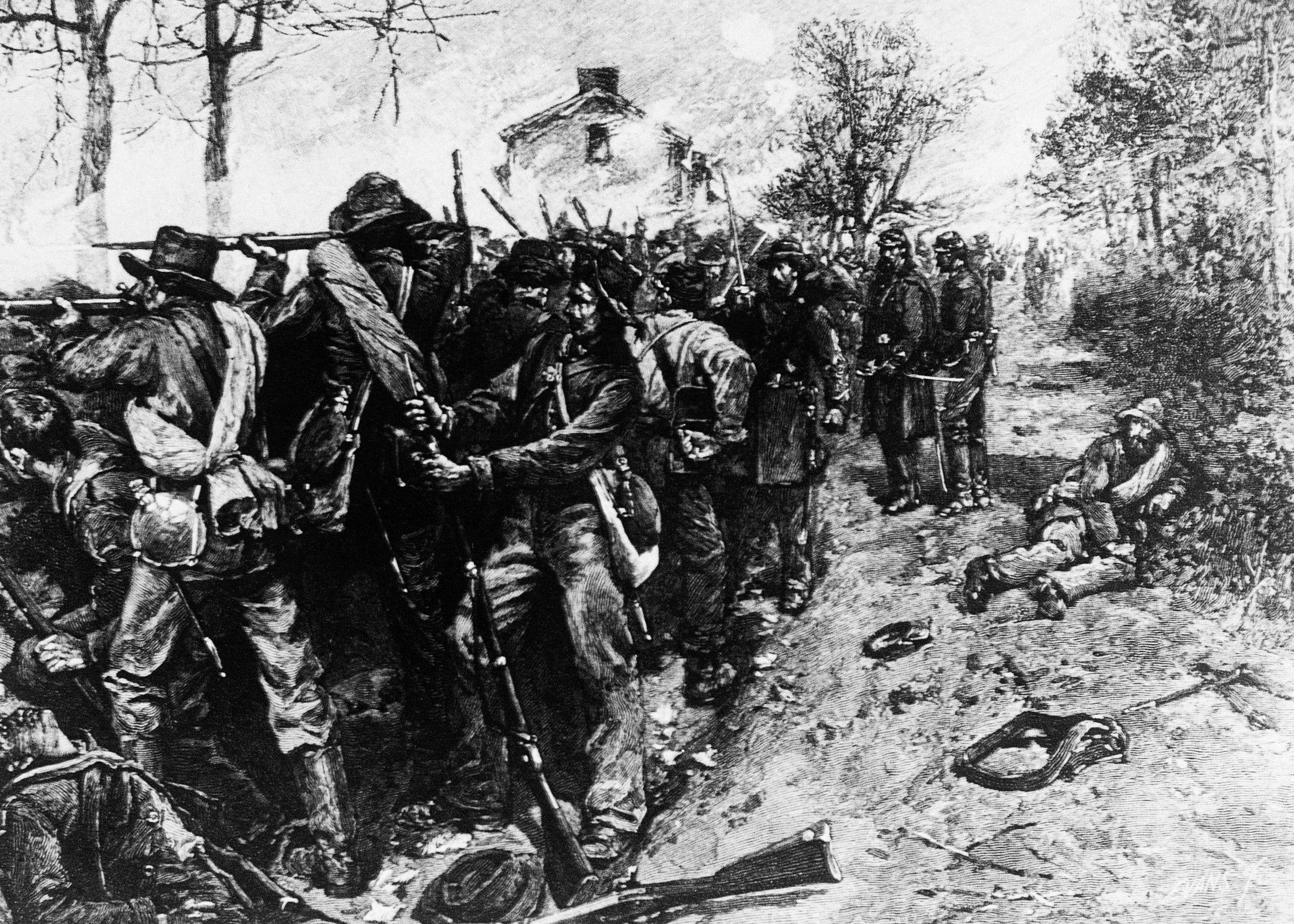
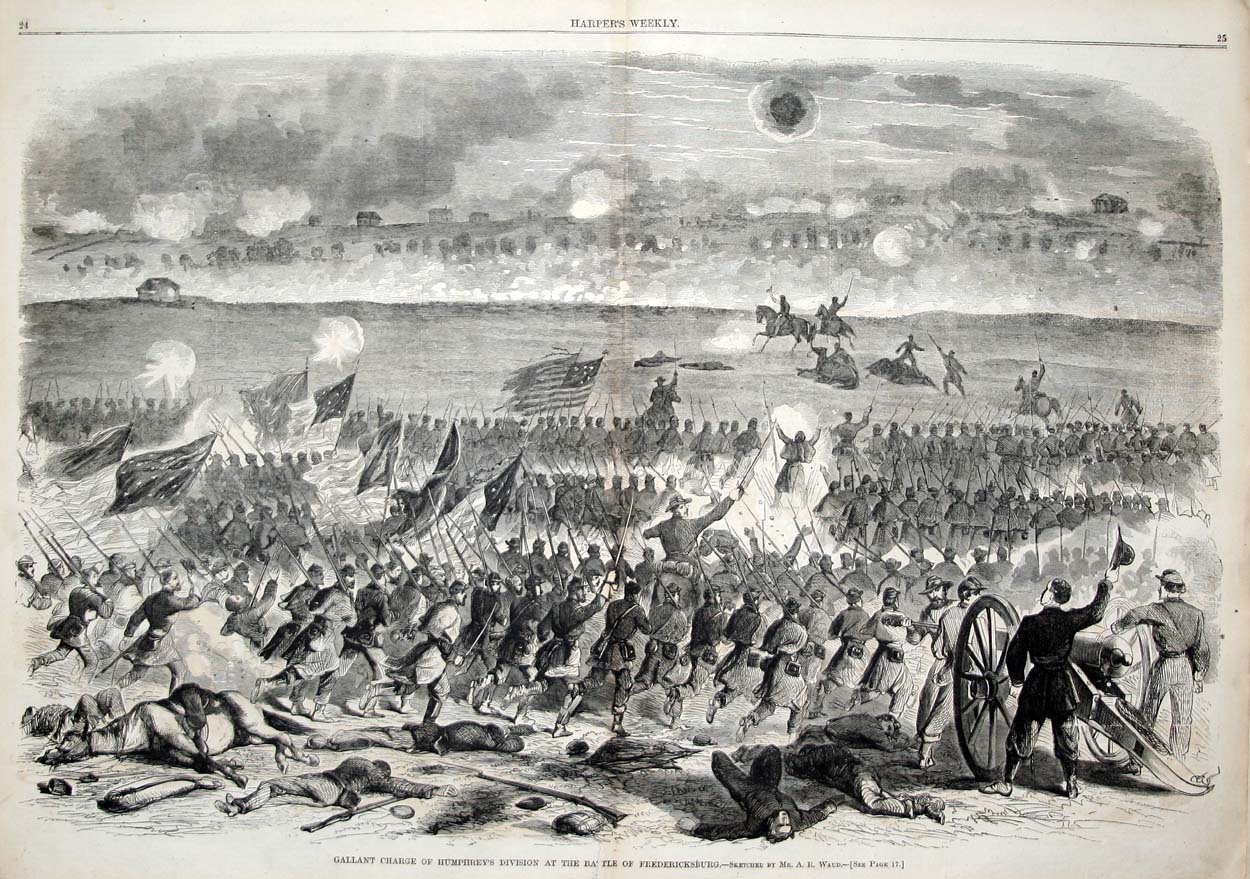
A second battle with a river crossing against a defended town which occurred to us was from the US Civil War, Fredericksburg, fought in mid-December, 1862.

Fredericksburg-Overview

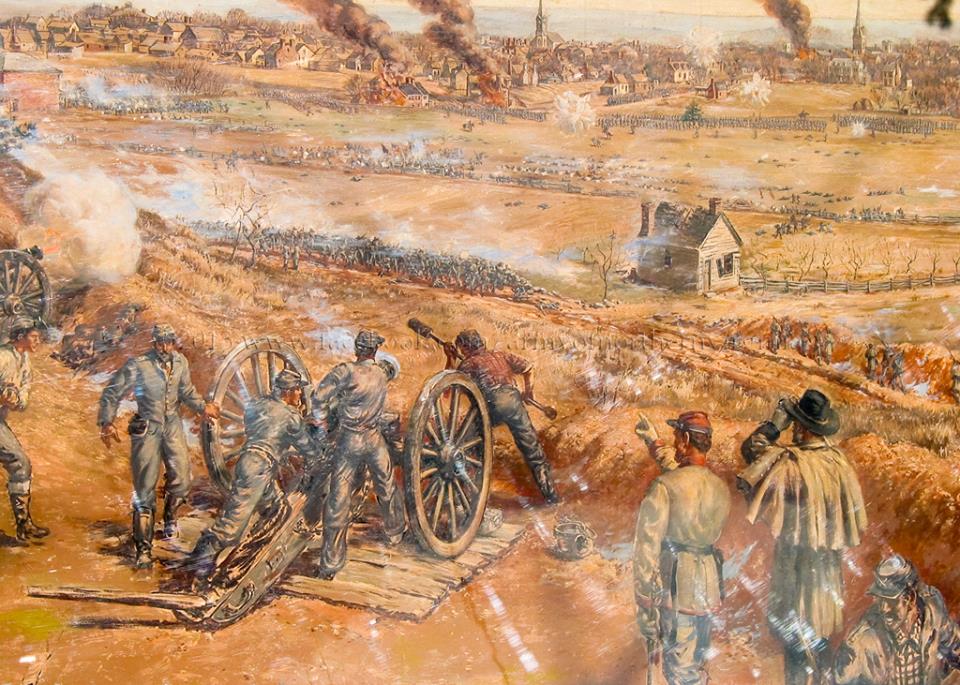
Here, as this extremely useful panorama shows, this was actually a two-step battle: first the Union troops had to cross the Rappahannock River, then they had to drive the Confederate Army from their positions on high ground beyond.

fburg_diorama1

The town of Fredericksburg itself was lightly held: mostly close to the river and relatively few in numbers.

barksdales-men

The main Confederate positions were spread a bit thinly for their numbers (not much in the way of reserves, had there been a breakthrough—Lee had had a similar problem at Antietam), but paid close attention to the ground, including taking advantage of a sunken road with a stone wall at its edge as a makeshift trench.

Confederate soldiers rake the field over which Union troops charged six times, from behind the stone walll at the Sunken Road, in  the blood Battle of Fredericksburg, Va., Dec. 1862.  Confederate Sgt. Richard Kirkland became known as the Angel of Marye's Heights when he brought water to wounded Union soldiers. (AP Photo)

To cross the river itself meant a two-stage process: first, to gain the opposite bank and set up a perimeter; second, to build several pontoon bridges to allow for the rapid deployment of troops and artillery.

19th-century armies commonly traveled with pontoons—boats built specifically to be used as the basis for floating bridges—

ACWpontoonsmobile1862

They were dragged along on wagons wherever and whenever armies went—

mud-march-waud-locgov

and, with the addition of planks and anchors and ropes, created complete roadways across bodies of water.

Fredericksburg_pontoon_model

The first stage was difficult,

Amphibious-assault_1376_2

but using pontoons for assault boats

laying-pontoons-fredericksburg

the Union troops managed to secure a foothold on the opposite bank. When bridges went up, stage one had been successful. But, when the Confederates had withdrawn from the town (which they had never intended to occupy in force), there was still that second stage.

dec13fredericksburgcharge

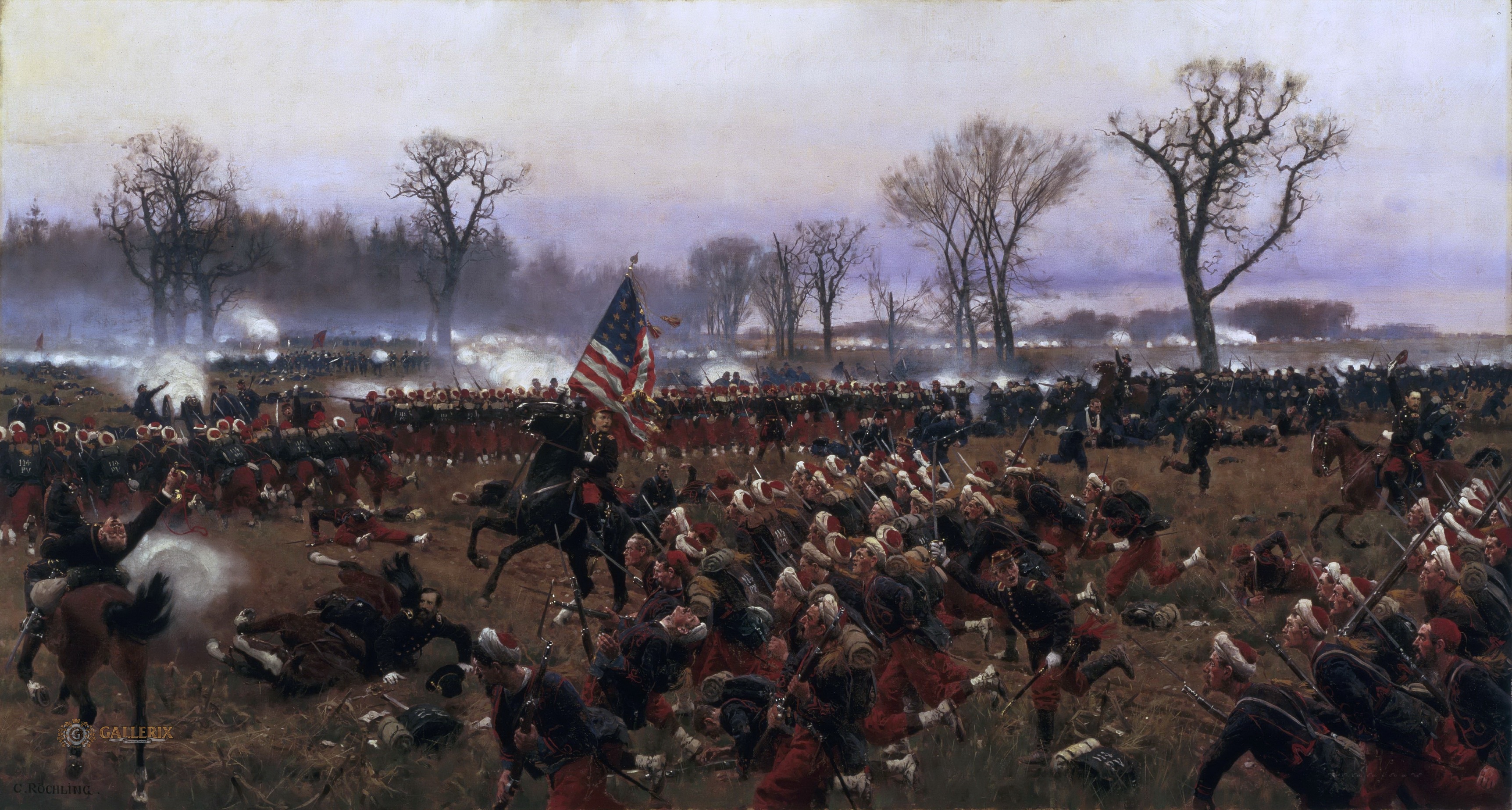
Great courage, but thrown away against resolute Confederate defenders,

1457692_641056089250250_1771492272_n

as you can see in this splendid painting by Carl Roechling, one of our favorite 19th-c. German military-historical painters of the attack of the 114th Pennsylvania (uniformed like French Zouaves, those most admired of French soldiers during this period).

Öèôðîâàÿ ðåïðîäóêöèÿ íàõîäèòñÿ â èíòåðíåò-ìóçåå Gallerix.ru

You can see the kinds of difficulties, then, for the Enemy in their attack on the west bank of the Anduin. How do they succeed? A messenger from Faramir, commanding the defense of West Osgiliath, describes the assault:

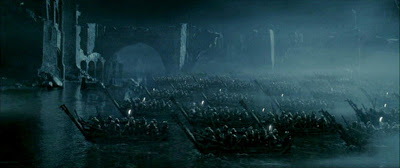
“The plan has been well laid. It is now seen that in secret they have long been building floats and barges in great number in East Osgiliath. They swarmed across like beetles.” LotR 817.

Here is the initial attack in Jackson’s film version—

800px-Orcs_crossing_anduin

When these craft land, they open at the bow and, of course, we immediately thought of D-Day and Pacific island battles and the Inchon landing, and Higgins Boats (LCVPs)

Darke_APA-159_-_LCVP_18 tumblr_n6pop14CrH1s57vgxo3_1280

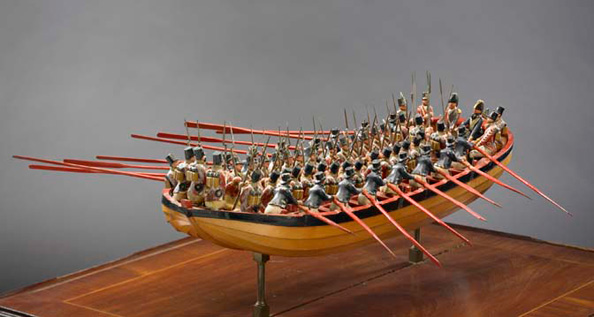
Along with their advanced use of explosives in the attack on the Pelennor to come, these are very sophisticated creatures, especially when one thinks about the landing craft of earlier centuries—the boats designed for the British attack on Quebec in 1759

c-001078

102381

Or the sort of thing you see during the Napoleonic era—

agoid106297-594

These are for amphibious landings. Mostly, when it comes to the era of pontoons, it appears that, when it came to rivers, soldiers simply used them

Voltigeurs_of_a_French_Line_regiment_crossing_the_Danube_before_the_battle_of_Wagram

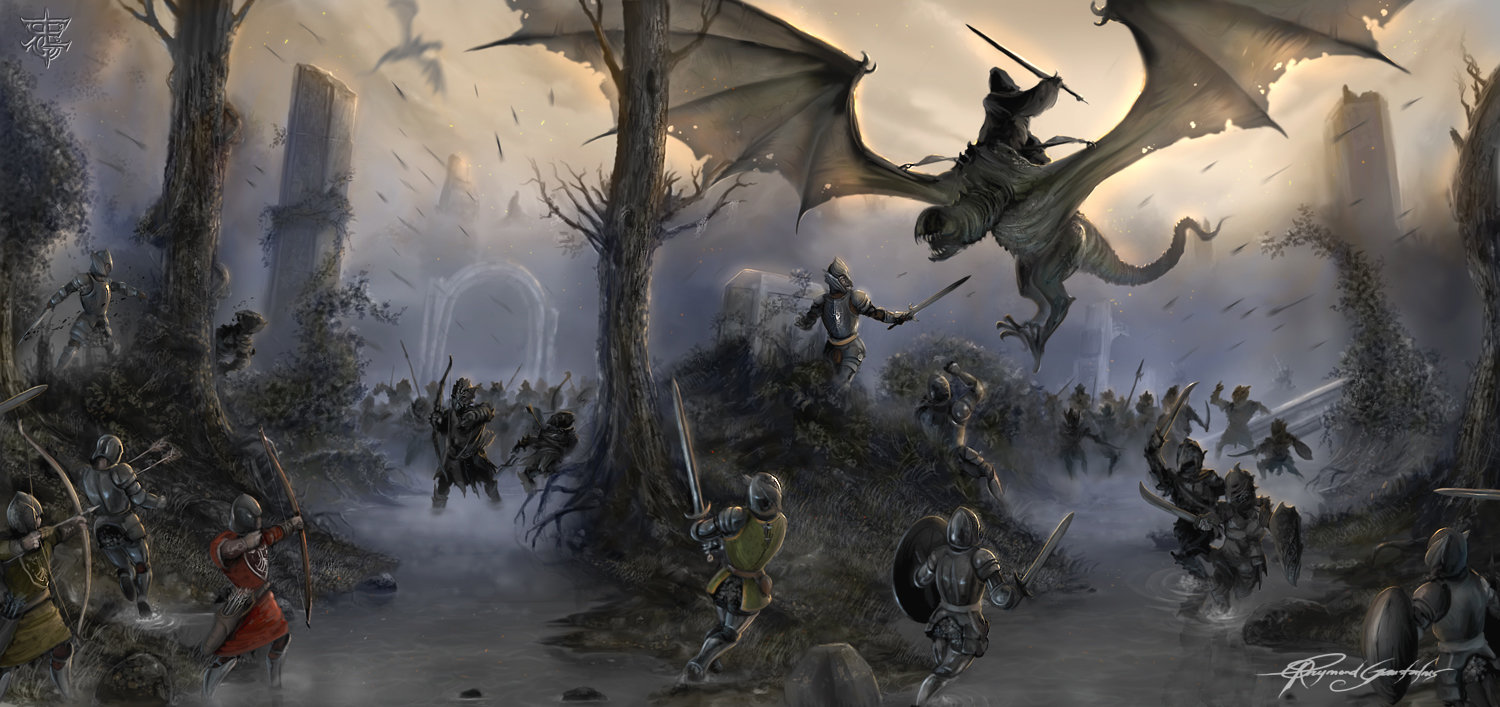
The “beetles” mentioned by Faramir’s messenger swarm over the men of Gondor, so heavily outnumbered that, as Faramir says, “Today we may make the Enemy pay ten times our loss at the passage and yet rue the exchange. For he can afford to lose a host better than we to lose a company.” LotR 816. And then there is their other weapon, the Chief Nazgul.

battle_of_osgiliath_by_shockbolt

“But it is the Black Captain that defeats us. Few will stand and abide even the rumor of his coming. His own folk quail at him, and they would slay themselves at his bidding.” As Faramir’s messenger adds. LotR 817.

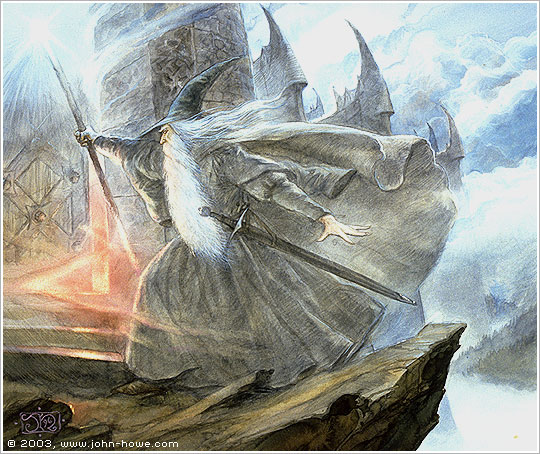
Gandalf goes out to face him

lotr-collectibe_PASSTHED

and we wonder if other commanders—Alexander, Wellington, the Union general Burnside, for example–when faced with the problem of a defended crossing, would wish to have him on their side—or the Black Captain?

As always, thanks for reading.

MTCIDC

CD

Powerplay

12 Friday Jun 2015

Posted by Ollamh in J.R.R. Tolkien, Military History, Military History of Middle-earth, Villains

≈ Leave a comment

Tags

Barad-Dur, Beer Hall Putsch, Black Country, Charlie Chaplin, Christopher Lee, Edwin Butler Bayliss, Ents, Fangorn, Franco, Frodo, Gandalf, Grima, Hitler, Isengard, Maiar, Merry, Middle-earth, Mordor, Mosley, Mussolini, O'Duffy, Orcs, Orthanc, Pippin, Rohan, Saruman, Sauron, Spode, The Great Dictator, The Lord of the Rings, The Shire, Theoden, Tolkien, Treebeard, Valar

Welcome, as always, dear readers!

We’ve discussed the nearly-invisible Sauron in an earlier posting, but now we’d like to think out loud about the all-too-visible Saruman. And, as we’ve just heard that we’ve lost our own Saruman, Christopher Lee, we would like to dedicate it to his memory.

McBrideTreebeard

Pippin and Merry have been filling Fangorn in about all of their adventures up to the moment when he found them in his forest.

Saruman, in particular, has caught his attention, being his neighbor and, it seems, an increasingly distant one—

“There was a time when he was always walking about my woods. He was polite in those days, always asking my leave (at least when he met me); and always eager to listen. I told him many things that he would never have found out by himself; but he never repaid me in like kind. I cannot remember that he ever told me anything. And he got more and more like that; his face, as I remember it—became like windows in a stone wall: windows with shutters inside.” 473

At that moment, everything comes together for the Ent.

“I think that I now understand what he is up to. He is plotting to become a Power.” 473

And not a friendly power, as Gandalf, during his last visit to Isengard, has learned to his dismay, having heard Saruman alternately wheedle and threaten him. Saruman’s initial words, however, were not about himself, but about someone else, to the east:

“A new Power is rising. Against it the old allies and policies will not avail us at all. There is no hope left in Elves or dying Numenor. This then is one choice before you, before us. We may join with that Power.” 259

So far, this must sound like the Sauron party line—and Saruman is actually described “as if he were making a speech long rehearsed”, (259), the tone of which Gandalf recognized immediately, replying:

“I have heard speeches of this kind before, but only in the mouths of emissaries sent from Morder to deceive the ignorant.” 259

If we pause for a moment and consider the era in which this was written, we might catch a glimpse of something from the history of our world in this, something from the period beginning in 1922 and extending at least through 1945, when Tolkien was beginning to write The Lord of the Rings.

JRRT always denied that his work was allegorical, although, sophisticated man that he was, he was well aware that the world around him would impinge upon his consciousness. Thus, when we see numerous sinister figures rising in power in our world, it would be difficult to imagine that they might not, even if only very distantly, exert some small influence on his work.

The lesser figures include Franco, in Spain,

d950ed6b46c3317df212938ada08510f

Eoin O’Duffy in Ireland,

eoin-oduffy-blueshirts

Sir Oswald Mosley in England, (mocked as “the amateur dictator “ by P.G.Wodehouse in the persona of Sir Roderick Spode—brilliantly played by John Turner in the 1990s Wodehouse “Jeeves and Wooster” television series)

mosley03

0

and the most menacing of all, Mussolini and Hitler.

hitler-mussolini

Mussolini had begun his rise to power just after World War One, achieving his position of Il Duce in 1922,

Il%20Duce

while Hitler, after a false start in 1923, in emulation of Mussolini,

beerhallputsch

finally reached the ultimate position of authority in 1933.

hitler_hind

Although Hitler was a relative late-comer in comparison with Mussolini, it seems that Mussolini looked up to Hitler, even taking German lessons (although there is no mention of Hitler reciprocating) so that they could talk more easily (and, doubtless, securely).

Thus, it might be possible to see Saruman, in his position as lesser of two evils, looking up to and wanting to imitate Sauron, the greater of two evils, as Mussolini attempting to emulate Hitler. (And this odd partnership is sharply satirized in Charley Chaplin’s The Great Dictator, 1940.)

chaplinoakey

So, as Sauron has the Barad-dur,

hildebrandtsbaraddur

so Saruman has Orthanc.

greg-hildebrandt-isengard-orthanc-saruman-607429-1300x962.1

As Sauron has Orcs

morderorcs

so Saruman has Orcs.

uruk

Worst of all, just as Sauron has the vast wasteland of Mordor

L1003926

Saruman takes the once-green and beautiful Isengard

greg-hildebrandt-isengard-orthanc-saruman-607429-1300x962

and turns it into a mini-Mordor.

isengard_by_nagzuku

All of this is swept away by Fangorn and his fellow Ents, of course,

The Wrath of the Ents, by Ted Nasmith

and it appears that Saruman will remain within the tower, but we know that he slips away, taking the former counselor of Theoden, Grima, with him.

Or, at least, that’s what Tolkien intended. Unfortunately, the makers of The Lord of the Rings films simply dropped this theme here, with the deaths both of Saruman and Grima on Orthanc. We say unfortunately because, although we have portrayed Saruman as a wanna-be Sauron (even to the point of thinking that he might gain control of the Ring), which is certainly one of his roles, his is a greater role as he was once a greater figure. He is the eldest of the Maiar in Middle Earth, those spirits whom Tolkien once described as “near equivalent in the mode of these tales of Angels, guardian Angels”, LTR 159. That he can be corrupted by Sauron (as Sauron himself had been corrupted by Morgoth), shows just how great Sauron’s power (and the lure of the Ring) really is. As well, in his fall, we see that that corruption, like Sauron’s, is complete. Offered the chance to return to the good, he spurns it and slips away—but not out of the story, and it’s here that we feel that the writers of the films missed a great opportunity.

In what might, at first, seem like an act of petty revenge, Saruman goes to the Shire, that green and so-far-safe land far west of all of evil of Middle Earth,.

The-Hill-Hobbiton-across-the-Water

TN-The_Shire_A_View_of_Hobbiton_From_The_Hill

and industrializes it. After all, Fangorn has said of Saruman that “He has a mind of metal and wheels; and he does not care for growing things, except as far as they serve him for the moment.” 473

So, just as at Isengard, trees must go, if only to feed his industrial plans. When we think of Saruman’s ultimate vision for the Shire, we imagine that it would look like the work of Edwin Butler Bayliss (1874-1950) who painted the industrial landscapes of England’s West Midlands, the “Black Country”, an area Tolkien himself thought of as his home region.

 op6301

(c) Dr Christopher R. Bayliss; Supplied by The Public Catalogue Foundation

(c) Dr Christopher R. Bayliss; Supplied by The Public Catalogue Foundation

The end comes quickly, however, when the Hobbits return and we see, in “The Scouring of the Shire”, on the one hand, the new maturity of Merry and Pippin, and, on the other, the deep humanity of Frodo.

storming_the_ban scouring

And Saruman would have been allowed to go free again—but there is an irony here in what happens. He had sought to overturn Theoden and Rohan through having subverted Grima and, instead, he himself is killed by that very agent—

scouringshire

61%20-%20The%20scouring%20of%20the%20shire

and we have wondered about that. If Saruman is of the same substance as the Valar, merely inhabiting a human body, can he, in fact, be killed, any more than Sauron? We assume that Sauron, who had poured so much of his spiritual power into the Ring, would be seriously weakened by its loss, enough so that his empire collapses on him. In Saruman’s case, the end is less dramatic, but at the same time, poignant:

“To the dismay of those that stood by, about the body of Saruman a grey mist gathered, and rising slowly to a great height like smoke from a fire, as a pale shrouded figure it loomed over the Hill. For a moment it wavered, looking to the West; but out of the West came a cold wind, and it bent away, and with a sigh dissolved into nothing.” 1020

Although the withered remains are then described, they seem unnecessary. That was only the borrowed flesh. The tragedy lies in that wavering look, the bending away, the sigh. In the final chapter, “The Grey Havens”, we see Gandalf departing towards that very West which was denied to Saruman and here we see, as well, what it was that the spirit of Saruman had lost: the reward of being allowed, at last, to return home, to go back towards Valinor. Instead, the Valar have rejected one of their own and, though his spirit may not have been destroyed, something seems to have left him forever.

By leaving the final chapters out of the film, then, the script writers lost the chance not only to show us Merry and Pippin, at the end of their long adventure, grown into figures to rival the Old Took, both in deeds and in stature. As well, they denied us the potential contrast with the end of such figures as Hitler—a suicide—and Mussolini—executed by his own people, and that of Saruman the White, murdered by his own follower and, at the end, nothing but sadness and grey smoke.

_SARUMAN__by_SilentDeath007

Thanks, as always, for reading. And thank you, Christopher Lee, for acting.

MTCIDC

CD

Food for Thought

20 Wednesday May 2015

Posted by Ollamh in J.R.R. Tolkien, Military History of Middle-earth, Narrative Methods, Villains

≈ Leave a comment

Tags

Eating, Gollum, Isengard, Lembas, Longbottom Leaf, Lorien, Man-Meat, Mordor, Orc, Rivendell, Rohan, Saruman, Sauron, The Hobbit, The Lord of the Rings, Tolkien

Dear Readers,

Welcome!

In this posting, we’re continuing our discussion of villains, specifically in Tolkien, but, for a change, we mention the good guys, as well.

We begin with a wail by Gollum, when assured by Frodo that, if there’s no other way to go, he will enter Mordor by the Morannon, the Black Gate.

morannon_(black_gate)

“No use that way! No use! Don’t take the Precious to Him! He’ll eat us all, if he gets it, eat all the world!” L637

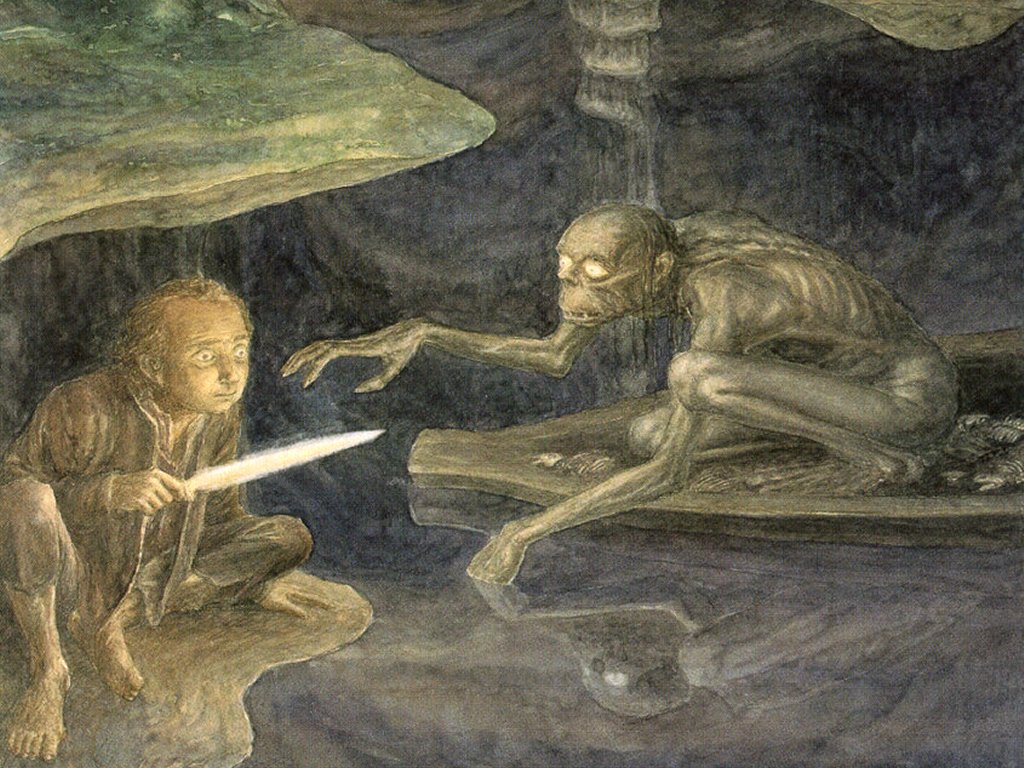
It’s not surprising that Gollum would express his fear in such terms—after all, in his first appearance in The Hobbit, his first words were

“Bless us and splash us, my precioussss! I guess it’s a choice feast, at least a tasty morsel it’d make us, gollum!” 

And this from a creature who appears ready to consume anything living, as the narrator says of him:

“He was looking out of his pale lamp-like eyes for blind fish, which he grabbed with his long fingers as quick as thinking. He liked meat too. Goblin he thought good, when he could get it…”

Alan Lee - The Hobbit - Riddles in the dark

What were goblins in The Hobbit have become the Orcs in The Lord of the Rings and Gollum would still be interested in them, but now we’re told what they eat—and drink.

Orque-Terre_du_Milieu

“Ugluk thrust a flask between his teeth and poured some burning liquid down his throat: he felt a hot fierce glow flow through him. The pain in his legs and ankles vanished. He could stand.” 

red-bull-3

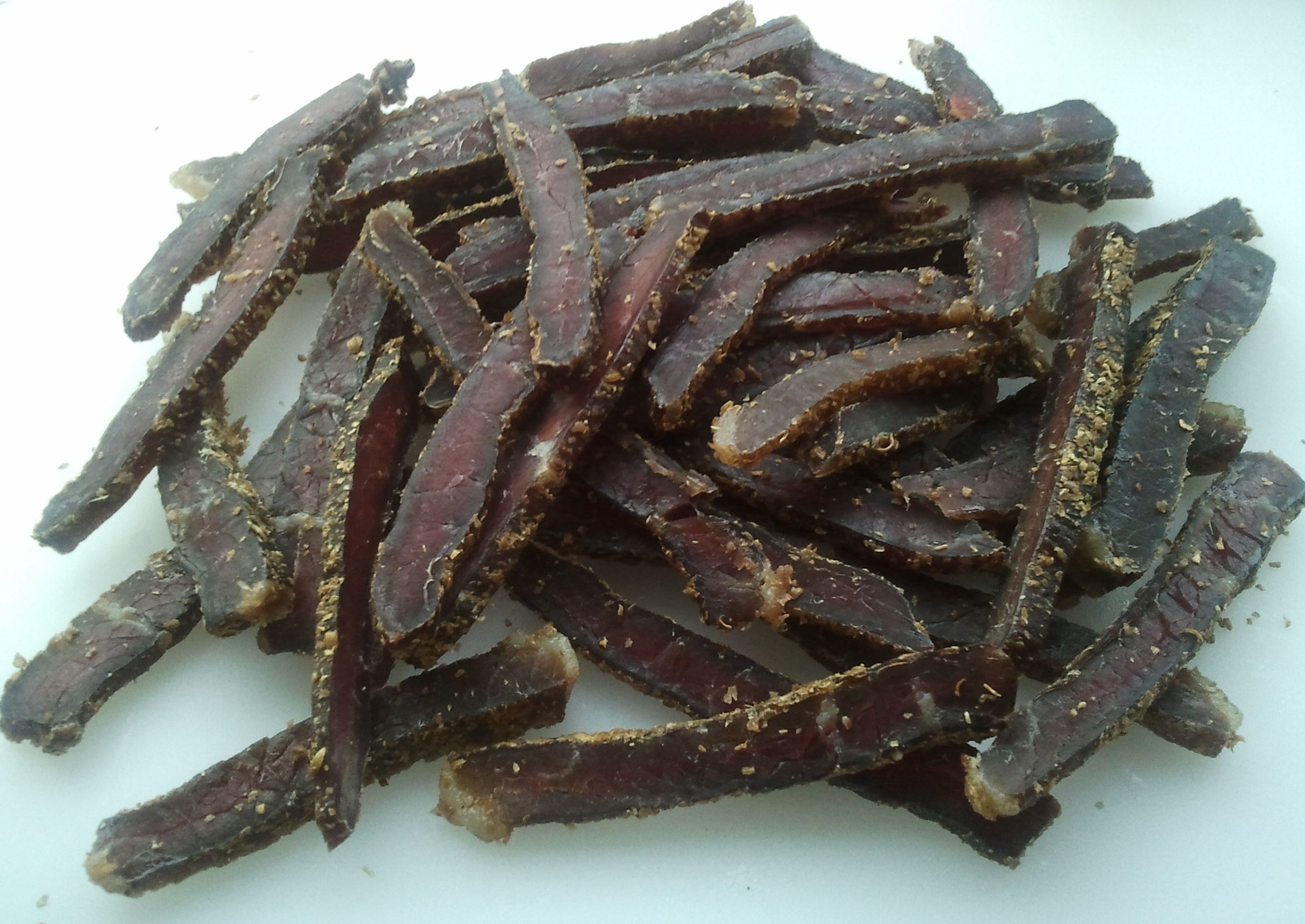
“An Orc stooped over him, and flung him some bread and a strip of raw dried flesh. He ate the stale grey bread hungrily, but not the meat. He was famished, but not yet so famished as to eat flesh flung to him by an Orc, the flesh of he dared not guess what creature.”

SAMSUNG

“”We are the servants of Saruman the Wise, the White Hand: the Hand which gives us man’s –flesh to eat.” 

saruman

     To judge by what Merry and Pippin find when they come to Isengard, Saruman certainly didn’t stint himself, including casks of Longbottom Leaf from the Shire. 

And here is a glaring contrast between the two sides in The Lord of the Rings, and it has to do with plenty and enjoyment. Saruman seems to have all the wealth in the world, but always wants more, and what he has does not appear to be shared out equally. Sauron, Gollum says, wants to eat the world, but would he ever be full?

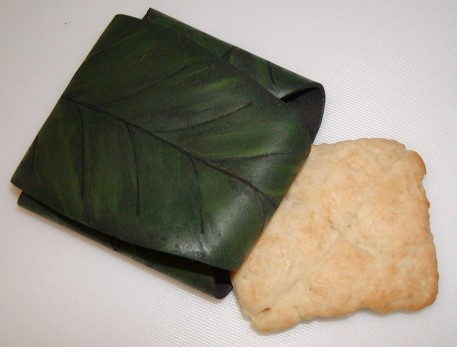
Contrast the traveling supplies of the orcs as you see them above in our text with lembas

leaf-lembas

As the elves describe it, “…it is more strengthening than any food made by Men, and it is more pleasant than cram, by all accounts.” To which Gimli agrees enthusiastically, “Why, it is better than the honey-cakes of the Beornings, and that is great praise, for the Beornings are the best bakers that I know of…” 

Only contrast the look of West and East to see the difference. Here is what the plains of Rohan must look like:

Grassy_Plains_717200735815PM691

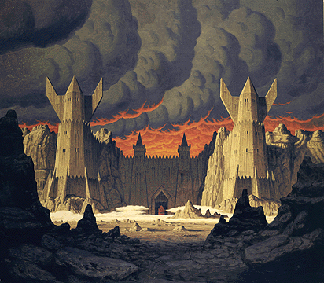
And here is an artist’s rendering of Mordor:

sams_first_view_of_mordor

It’s a striking difference topographically, but the difference is even greater in terms of behavior. Isengard is a fortress and a factory, a little Mordor set against the greater Mordor to the east. It can also be a prison, as Gandalf finds out. In contrast, think of the welcome in Rivendell

rivjrrt2

and Lorien

Lothlorien

The West doesn’t plan to eat the world, instead, it lives in a fruitful land, which it makes more fruitful, and it offers this in hospitality to those who come in peace.

This is what is really at stake in The Lord of the Rings, that sense of bounty, generosity, and pleasure, which it must defend from what would eat all the world.

And, as always, we ask what you think, dear readers?

Thanks for reading, 

MTCIDC,

CD
Newer posts →

The Doubtful Sea Series Facebook Page

The Doubtful Sea Series Facebook Page

  • Ollamh

Categories

  • Artists and Illustrators
  • Economics in Middle-earth
  • Fairy Tales and Myths
  • Films and Music
  • Games
  • Heroes
  • Imaginary History
  • J.R.R. Tolkien
  • Language
  • Literary History
  • Maps
  • Medieval Russia
  • Military History
  • Military History of Middle-earth
  • Narnia
  • Narrative Methods
  • Poetry
  • Research
  • Star Wars
  • Terra Australis
  • The Rohirrim
  • Theatre and Performance
  • Tolkien
  • Uncategorized
  • Villains
  • Writing as Collaborators
Follow doubtfulsea on WordPress.com

Across the Doubtful Sea

Recent Postings

  • Through a glass… January 7, 2026
  • Heffalumps? December 31, 2025
  • We Three Kings December 24, 2025
  • A Moon disfigured December 17, 2025
  • On the Roads Again—Once More December 10, 2025
  • (Not) Crossing Bridges December 3, 2025
  • On the Road(s) Again—Again November 26, 2025
  • On the Road(s) Again November 19, 2025
  • To Bree (Part 2) November 12, 2025

Blog Statistics

  • 104,148 Views

Posting Archive

  • January 2026 (1)
  • December 2025 (5)
  • November 2025 (4)
  • October 2025 (5)
  • September 2025 (4)
  • August 2025 (4)
  • July 2025 (5)
  • June 2025 (4)
  • May 2025 (4)
  • April 2025 (5)
  • March 2025 (4)
  • February 2025 (4)
  • January 2025 (5)
  • December 2024 (4)
  • November 2024 (4)
  • October 2024 (5)
  • September 2024 (4)
  • August 2024 (4)
  • July 2024 (5)
  • June 2024 (4)
  • May 2024 (5)
  • April 2024 (4)
  • March 2024 (4)
  • February 2024 (4)
  • January 2024 (5)
  • December 2023 (4)
  • November 2023 (5)
  • October 2023 (4)
  • September 2023 (4)
  • August 2023 (5)
  • July 2023 (4)
  • June 2023 (4)
  • May 2023 (5)
  • April 2023 (4)
  • March 2023 (5)
  • February 2023 (4)
  • January 2023 (4)
  • December 2022 (4)
  • November 2022 (5)
  • October 2022 (4)
  • September 2022 (4)
  • August 2022 (5)
  • July 2022 (4)
  • June 2022 (5)
  • May 2022 (4)
  • April 2022 (4)
  • March 2022 (5)
  • February 2022 (4)
  • January 2022 (4)
  • December 2021 (5)
  • November 2021 (4)
  • October 2021 (4)
  • September 2021 (5)
  • August 2021 (4)
  • July 2021 (4)
  • June 2021 (5)
  • May 2021 (4)
  • April 2021 (4)
  • March 2021 (5)
  • February 2021 (4)
  • January 2021 (4)
  • December 2020 (5)
  • November 2020 (4)
  • October 2020 (4)
  • September 2020 (5)
  • August 2020 (4)
  • July 2020 (5)
  • June 2020 (4)
  • May 2020 (4)
  • April 2020 (5)
  • March 2020 (4)
  • February 2020 (4)
  • January 2020 (6)
  • December 2019 (4)
  • November 2019 (4)
  • October 2019 (5)
  • September 2019 (4)
  • August 2019 (4)
  • July 2019 (5)
  • June 2019 (4)
  • May 2019 (5)
  • April 2019 (4)
  • March 2019 (4)
  • February 2019 (4)
  • January 2019 (5)
  • December 2018 (4)
  • November 2018 (4)
  • October 2018 (5)
  • September 2018 (4)
  • August 2018 (5)
  • July 2018 (4)
  • June 2018 (4)
  • May 2018 (5)
  • April 2018 (4)
  • March 2018 (4)
  • February 2018 (4)
  • January 2018 (5)
  • December 2017 (4)
  • November 2017 (4)
  • October 2017 (4)
  • September 2017 (4)
  • August 2017 (5)
  • July 2017 (4)
  • June 2017 (4)
  • May 2017 (5)
  • April 2017 (4)
  • March 2017 (5)
  • February 2017 (4)
  • January 2017 (4)
  • December 2016 (4)
  • November 2016 (5)
  • October 2016 (6)
  • September 2016 (5)
  • August 2016 (5)
  • July 2016 (5)
  • June 2016 (5)
  • May 2016 (4)
  • April 2016 (4)
  • March 2016 (5)
  • February 2016 (4)
  • January 2016 (4)
  • December 2015 (5)
  • November 2015 (5)
  • October 2015 (4)
  • September 2015 (5)
  • August 2015 (4)
  • July 2015 (5)
  • June 2015 (5)
  • May 2015 (4)
  • April 2015 (3)
  • March 2015 (4)
  • February 2015 (4)
  • January 2015 (4)
  • December 2014 (5)
  • November 2014 (4)
  • October 2014 (6)
  • September 2014 (1)

Blog at WordPress.com.

  • Subscribe Subscribed
    • doubtfulsea
    • Join 78 other subscribers
    • Already have a WordPress.com account? Log in now.
    • doubtfulsea
    • Subscribe Subscribed
    • Sign up
    • Log in
    • Report this content
    • View site in Reader
    • Manage subscriptions
    • Collapse this bar
 

Loading Comments...