• About

doubtfulsea

~ adventure fantasy

Tag Archives: Boromir

Through a glass…

07 Wednesday Jan 2026

Posted by Ollamh in Uncategorized

≈ Leave a comment

Tags

2nd Corinthians, Apostle Paul, Boromir, Dracula, Fantasy, Frodo, lotr, Mirror of Galadriel, mirrors, Sam, Sauron, Snow White, Through the Looking Glass, Through the Looking-Glass, Tolkien

Dear readers, as always, welcome.

When I was small, I was puzzled about this line:

“Now we see through a glass, darkly…”

which comes from the apostle, Paul’s, first letter to the Corinthians (Chapter 13, Verse 12).

I knew about glasses—I drank from them—
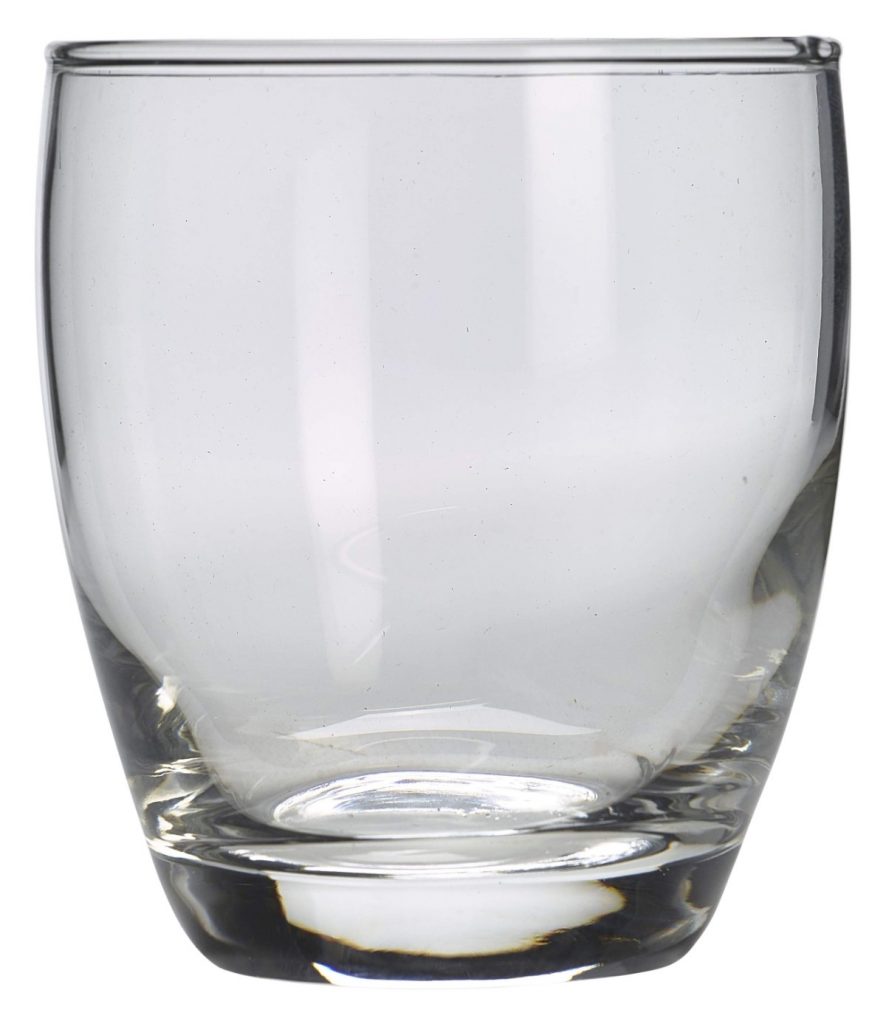
and I looked through them—
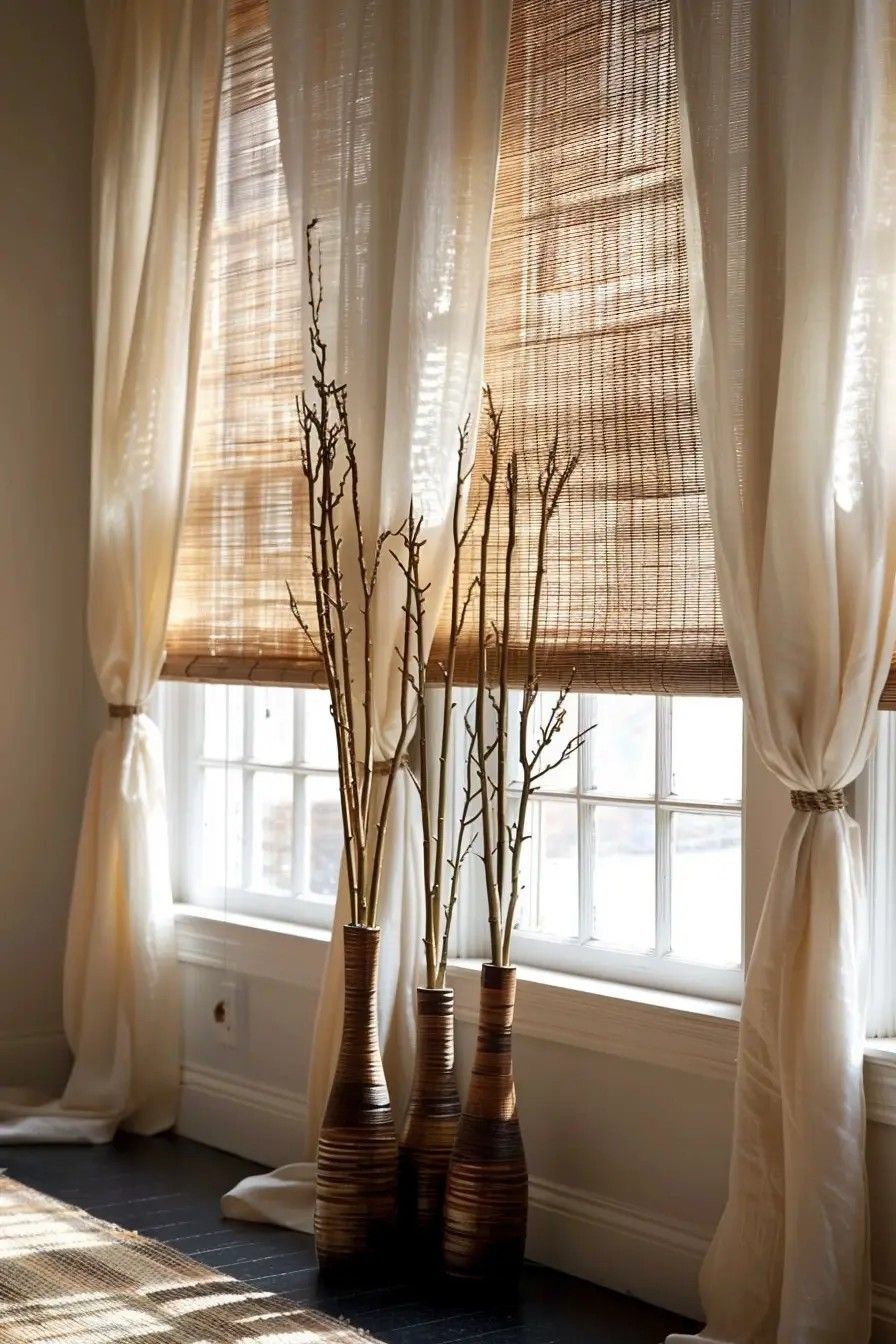
and all I could think of was that maybe the glass was dirty.

It was only as a grownup that I found out that “glass” was Jacobean shorthand (from the “King James Bible” of 1611) for “looking glass” as we can see in Jerome’s (c.342-420AD) Latin translation

“videmus nunc per speculum in enigmate”

of the Greek

“βλέπομεν γὰρ ἄρτι δι’ ἐσόπτρου ἐν αἰνίγματι,”

in which “speculum”, “mirror”, is his version of the Greek εἴσοπτρον (eisoptron), “mirror”. 

Here’s what the Jacobean translators might have thought of as a “glass”,
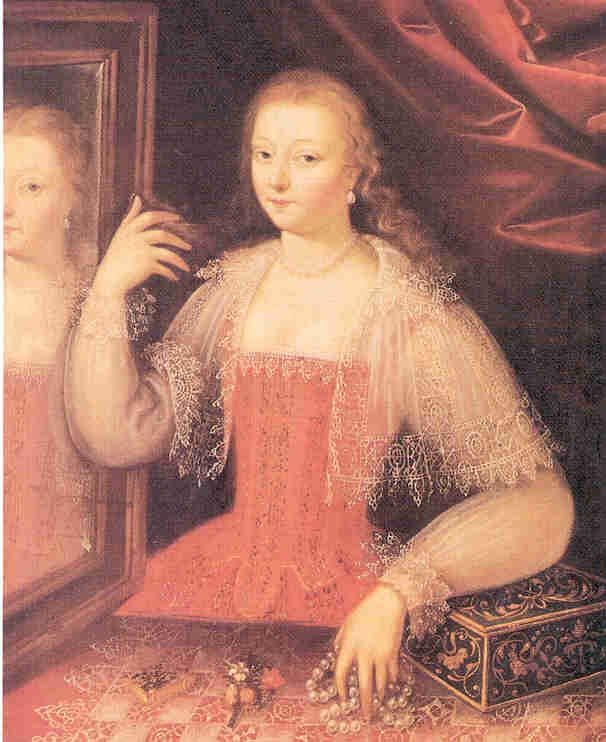
but Paul would have imagined something more like this—
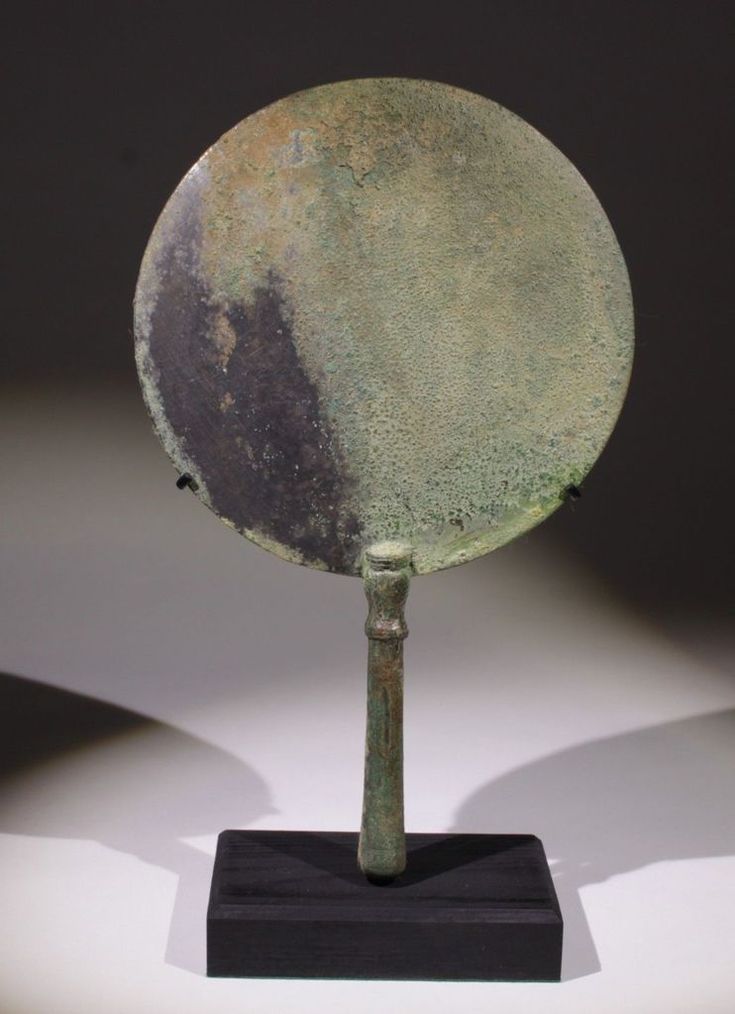
which would have been made of highly-polished metal, commonly bronze, so it’s easier to imagine that “darkly”, if the metal became tarnished.

But that translation of “in enigmate” or the original ἐν αἰνίγματι, might make the mirror even darker, as it comes from αἴνιγμα, which means “riddle” and this isn’t surprising as I, at least, have always found mirrors a little odd—spooky, even—and I’m hardly alone in this—think of the wicked, vain queen in “Snow White”, with her magic mirror—

(from Disney’s 1937 “Snow White”)

or Alice’s adventures in a mirror world—

( You can read a first edition, with the original Tenniel illustrations here:    https://dn710100.ca.archive.org/0/items/throughlooking00carr/throughlooking00carr.pdf  )

or that moment in Chapter 2 of Dracula where Jonathan Harker, in Dracula’s castle, has an unnerving experience—

“I only slept a few hours when I went to bed, and feeling that I could not sleep any more, got up. I had hung my shaving glass by the window, and was just beginning to shave. Suddenly I felt a hand on my shoulder, and heard the Count’s voice saying to me, “Good-morning.” I started, for it amazed me that I had not seen him, since the reflection of the glass covered the whole room behind me. In starting I had cut myself slightly, but did not notice it at the moment. Having answered the Count’s salutation, I turned to the glass again to see how I had been mistaken. This time there could be no error, for the man was close to me, and I could see him over my shoulder. But there was no reflection of him in the mirror! The whole room behind me was displayed; but there was no sign of a man in it, except myself.”  (You can read this—and the whole book—in a first edition here:  https://gutenberg.org/files/345/345-h/345-h.htm#chap02 )

So, what about another mirror, but one not made of bronze, or silvered metal behind glass, like more modern versions—but more like a miniature reflecting pool–
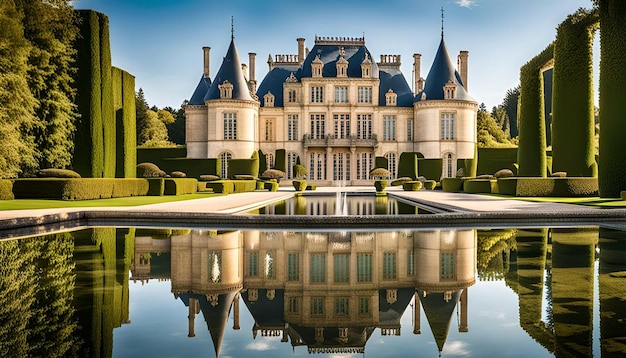
the mirror of Galadriel?
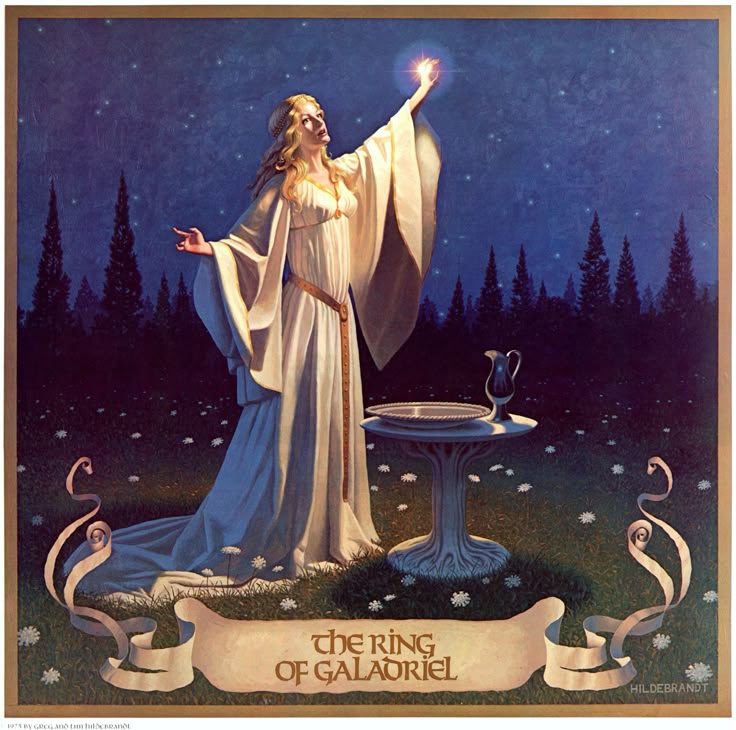
(Greg Hildebrandt)

I’ve written a little about this before  (see:   “Mirror, Mirror”, 9 December, 2015 ), but I’ve come back to this chapter with—I hope—further thoughts.  Why is it there at all?  One reason might be that, after their harrowing adventure in Moria, the Fellowship—and the readers—need a breather and, though they could continue on foot, having already come hundreds of miles that way, perhaps this is a way to vary their travels by adding water and that’s something  with which the elves can and do aid them —

“ ‘I see that you do not yet know what to do,’ said Celeborn.  ‘It is not my part to choose for you; but I will help you as I may.  There are some among you who can handle boats:  Legolas, whose folk know the swift Forest River; and Boromir of Gondor; and Aragorn the traveller.’ “ (The Fellowship of the Ring, Book Two, Chapter 8, “Farewell to Lorien”)

I would add that Lorien, Galadriel’s home, although it seems to be a place of refuge for the Fellowship,is also clearly a place for testing—and not all of that testing appears friendly, at least at first, and the deepest test for the two most important for the fate of the Ring lies in that mirror.

The testing begins, however, when Galadriel says:

“But I will say this to you:  your Quest stands upon the edge of a knife.  Stray but a little and it will fail, to the ruin of all.”

And then she continues:

“Yet hope remains while all the Company is true.”

And, having said this—

“And with that word she held them with her eyes, and in silence looked searchingly at each of them in turn.  None save Legolas and Aragorn could long endure her glance:  Sam quickly blushed and hung his head.”  (The Fellowship of the Ring, Book Two, Chapter 7, “The Mirror of Galadriel”)

Beyond her glance lies, we’re told, a kind of temptation—as Sam reveals:

“ ‘If you want to know, I felt as if I hadn’t got nothing on, and I didn’t like it.  She seemed to be looking inside me and asking me what I would do if she gave me the chance of flying back home to the Shire to a nice little hole with—with a bit of garden of my own.’ “

And, although almost none of the Fellowship reveals what he was offered, there was the same approach:

“All of them, it seemed, had fared alike:  each had felt that he was offered a choice between a shadow full of fear that lay ahead, and something that he greatly desired:  clear before his mind it lay, and to get it he had only to turn aside from the road and leave the Quest and the war against Sauron to others.”

Boromir’s experience might suggest that the test was even more revealing—and perhaps damning—than simply being allowed to leave the Quest, as Gimli says, “ ‘And it seemed to me, too…that my choice would remain secret and known only to myself.’ “  While Boromir explains:

“ ‘To me it seemed exceedingly strange…but almost I should have said that she was tempting us, and offering what she pretended to have the power to give.  It need not be said that I refused to listen.  The Men of Minas Tirith are true to their word.’ “

the narrator reveals the potentially damning part—remembering what Boromir later tried to do:

“But what he thought that the Lady had offered him Boromir did not tell.”

Did she offer him the Ring?

And now we come to the second test, a more selective one, as only Frodo and Sam are involved.
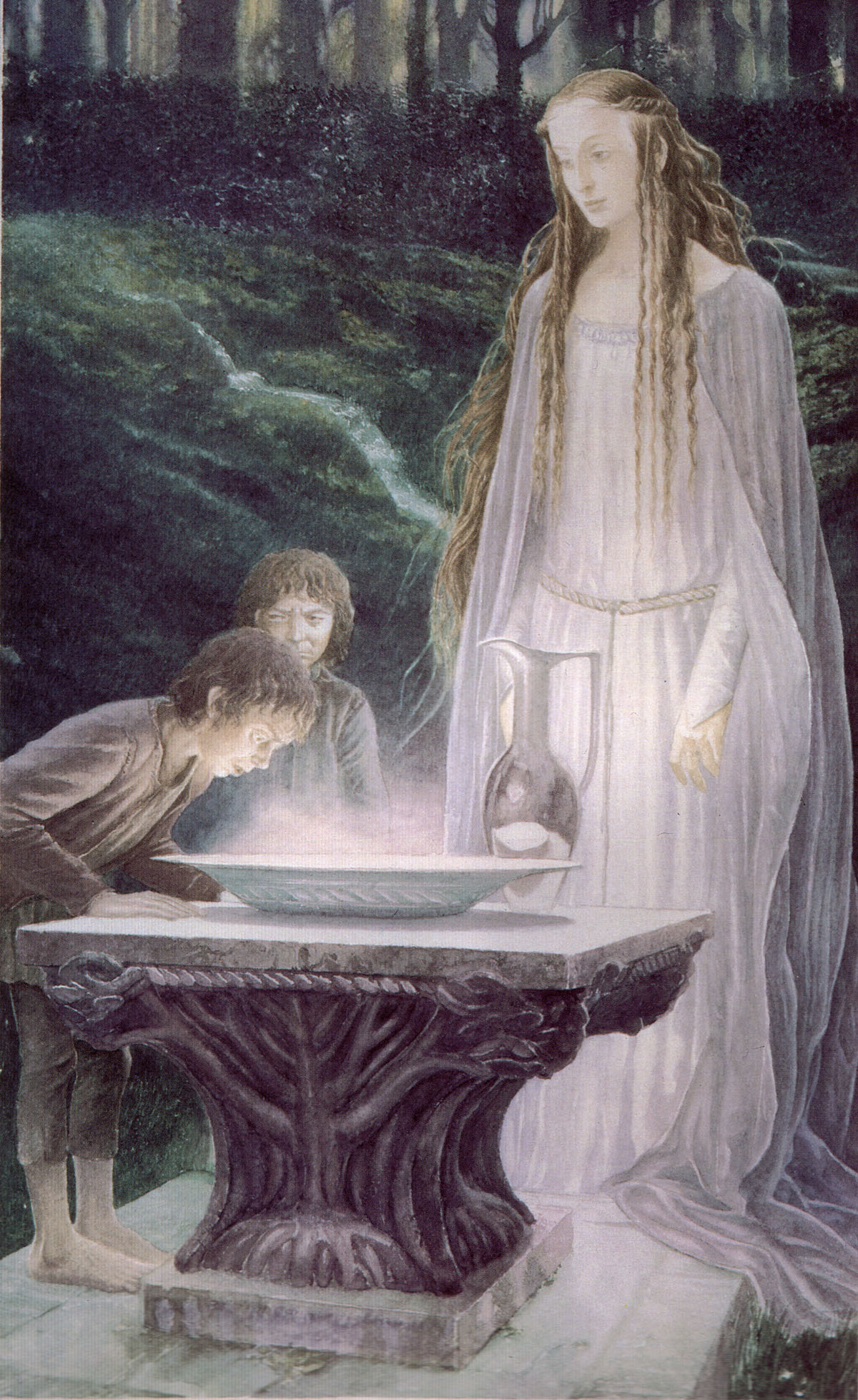
(Alan Lee)

It’s interesting to see the mirrors I’ve already mentioned and how they function in their stories.  “Snow White’s” queen employs hers as a surveillance device, in which the mirror encloses an omniscient spy and not her own reflection.  Alice’s looking glass is a barrier to another world and the fact that it’s a mirror which she must climb through suggests that, as mirrors invert things, so the world which she enters will be reversed, or at least topsey-turvey—definitely like stepping into an enigma.  Jonathan Harker’s  is a simple traveler’s shaving mirror, but stands in the middle of a mystery:  Dracula seems at first like the customer Jonathan has traveled to Transylvania to meet, businesslike, but hospitable and yet, for a nobleman living in a castle, he appears to have no servants and the castle is nearly ruined.  And then:  he has no reflection—what is Dracula?

Galadriel’s mirror, although it can repeat an image—

“Sam climbed up on the foot of the pedestal and leaned over the basin.  The water looked hard and dark.  Stars were reflected in it.”

has other properties—and, interestingly, can be controlled, to some extent, by Galadriel:

“ ‘Many things I can command the Mirror to reveal…and to some I can show what they desire to see.’ “

This has an ambiguous ring to it:  does she mean that she can make the Mirror simply reflect what people want to see, rather than what really may be seen?  If so, this seems in line with her earlier temptation/testing.  She goes on, however:

“ ‘But the Mirror will also show things unbidden, and those are often stranger and more profitable than things which we wish to behold.’”

This would then suggest that the Mirror may also have a mind of its own, beyond her control—“things unbidden”—and yet perhaps more useful—“profitable”. 

She then continues:

“ ‘What you will see, if you leave the Mirror free to work, I cannot tell.  For it shows things that were, and things that are, and things that yet may be.  But what it is that he sees, even the wisest cannot always tell.’ “

We notice right away that third part:  “things that yet may be”—and this important for what happens next.  Sam looks in, sees a little of the future which we know will happen:  “Frodo with a pale face lying fast asleep under a great dark cliff…himself going along a dim passage, and climbing an endless winding stair”—we can imagine that this is the crossing of the mountains into Mordor.  But then Sam sees the Shire and what we know will be Saruman/Sharkey’s planned industrialization—and ruin—of the Shire, with its “tall red chimney nearby” and here Sam almost fails the test, panicking and shouting “I must go home!”
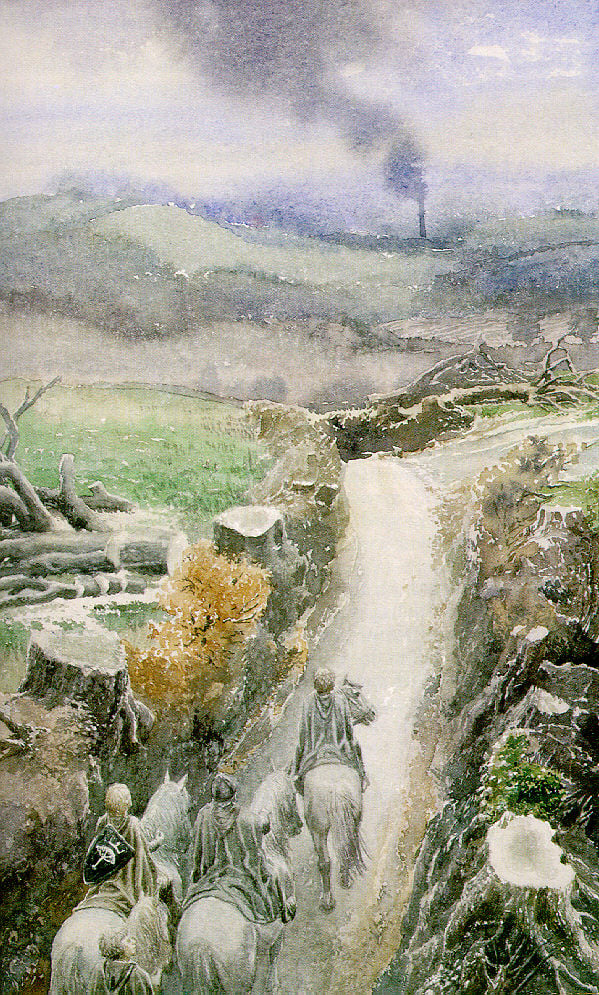
(Alan Lee)

Here, Galadriel intervenes, reminding Sam of something she has already told him and Frodo:

“ ‘Remember that the Mirror shows many things, and not all have yet to come to pass.’”

To which she adds an important caution, echoing also her earlier warning:

“ ‘But I will say this to you:  your Quest stands upon the edge of a knife.  Stray but a little and it will fail, to the ruin of all.  Yet hope remains while all the Company is true.’ ”

saying to Sam:

“ ‘Some never come to be, unless those that behold the visions turn aside from their path to prevent them.  The Mirror is dangerous as a guide to deeds.’ “

And, at this, Sam, though miserable, then passes the test:

“ ‘No, I’ll go home by the long road with Mr. Frodo, or not at all.’ “

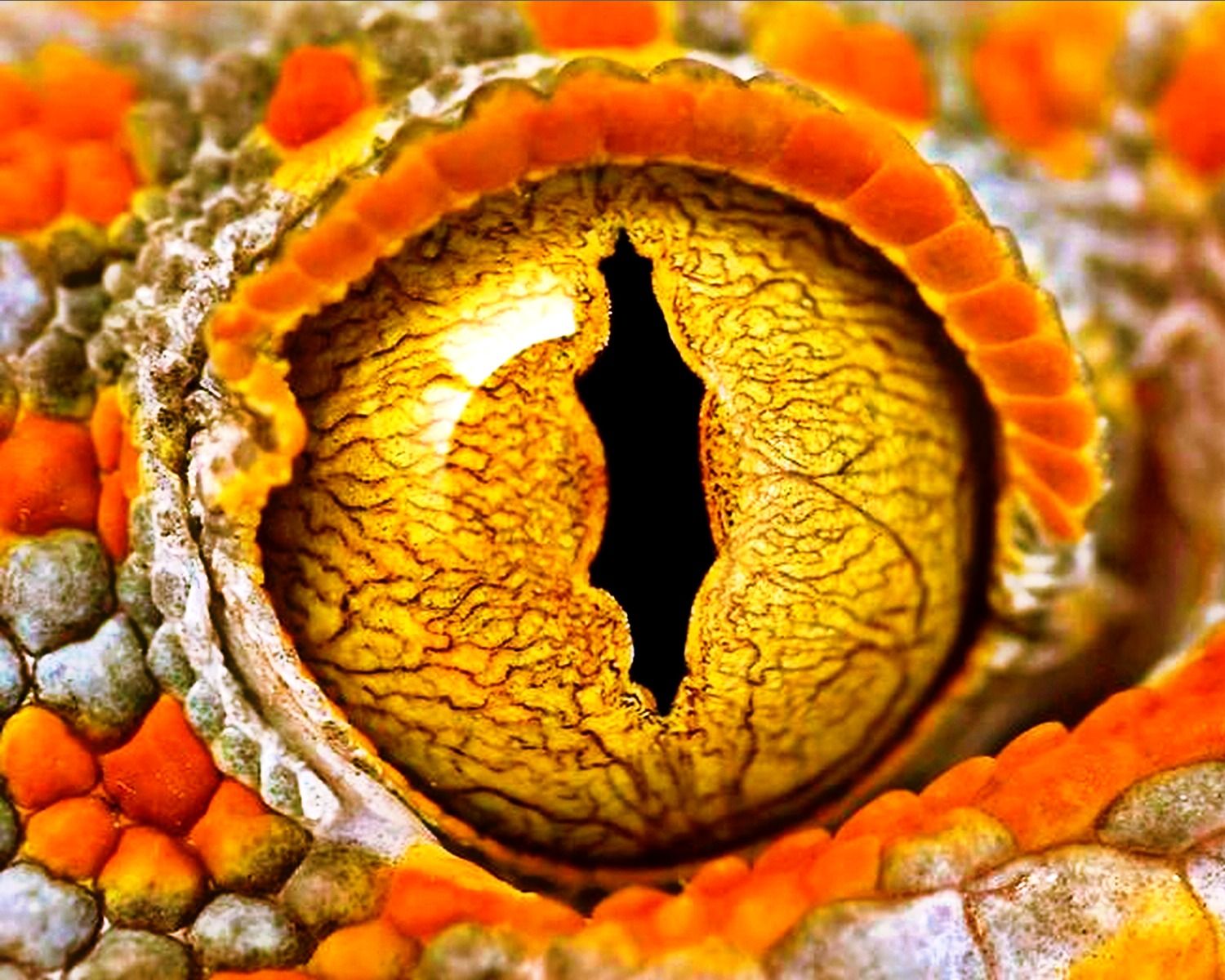
Frodo’s visions include Gandalf (although he believes that it might be Saruman), then sees what looks to be Sauron’s attack on Minas Tirith, but then something which might be the ship which takes him and others from the Grey Havens towards Valinor (“…and into the mist a small ship passed away, twinkling with lights.”) before his visions are replaced with

“…a single Eye that slowly grew, until it filled nearly all the Mirror.”
And it gets worse:

“The Mirror seemed to be growing hot and curls of steam were rising from the water.”

before Galadriel stops things by quietly saying, “Do not touch the water.”

With this interruption, however, the test, if, as it was for Sam, a test, is never completed, and so we don’t know if Frodo would have passed it.  But perhaps it is a warning:  should Frodo foolishly try to keep the Ring for himself, as he almost does before Gollum seizes it,

( Ted Nasmith)             

would he, unable to master it, be swallowed up into Sauron’s eye, or worse?

As always, thanks for reading.

Stay well,

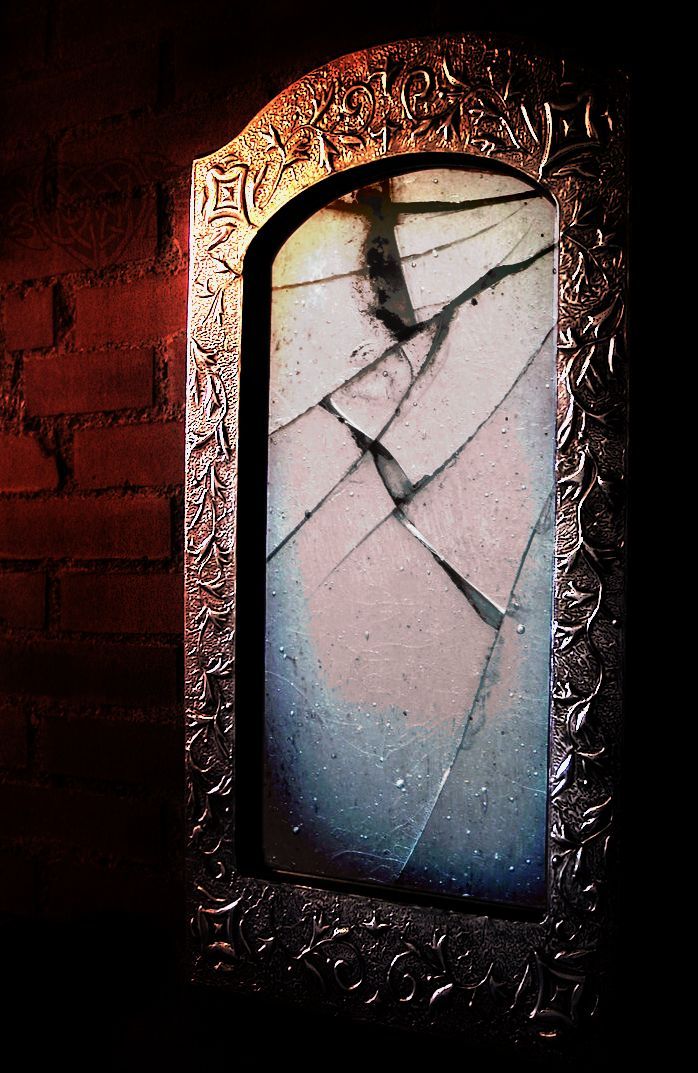
Beware of breaking mirrors,
And remember that, as always, there’s

MTCIDC,

O

(Not) Crossing Bridges

03 Wednesday Dec 2025

Posted by Ollamh in Uncategorized

≈ Leave a comment

Tags

Anduin, Boromir, bridges, Etruscans, Horatius, Lars Porsena, Lays of Ancient Rome, Osgiliath, Tarquinius Superbus, The Lord of the Rings, Tolkien

Welcome, dear readers, as always.

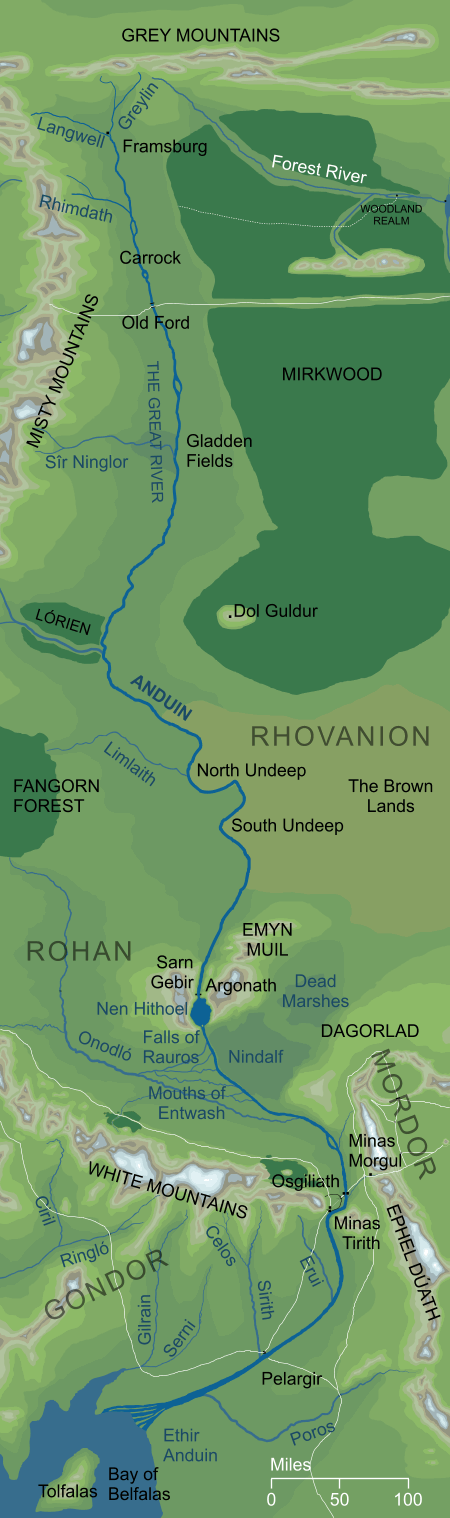
We’ve been traveling along the roads of Middle-earth in the last two postings, but we’ve taken a pause at Osgiliath,

(from the Encylopedia of Arda)

before our trip across the Anduin and beyond.

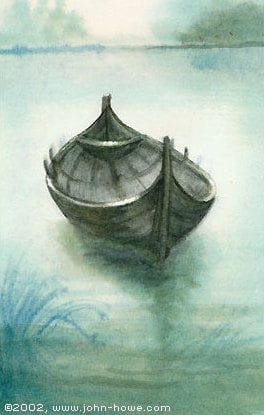
Frodo and Sam had crossed the Anduin by boat, much farther upstream,

(John Howe)

(Encyclopedia of Arda)

but the bridge here is broken—

and the real reason why it’s broken may lie, not in this Middle-earth, but in our own Middle-earth and far in the past, in the early history of Rome.

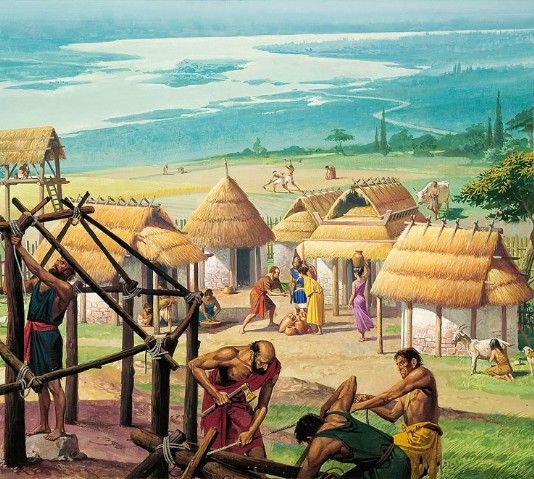
The earliest Italic settlers of the area had been farmers, who built communities on seven hills to the east of the Tiber River and farmed the land below.

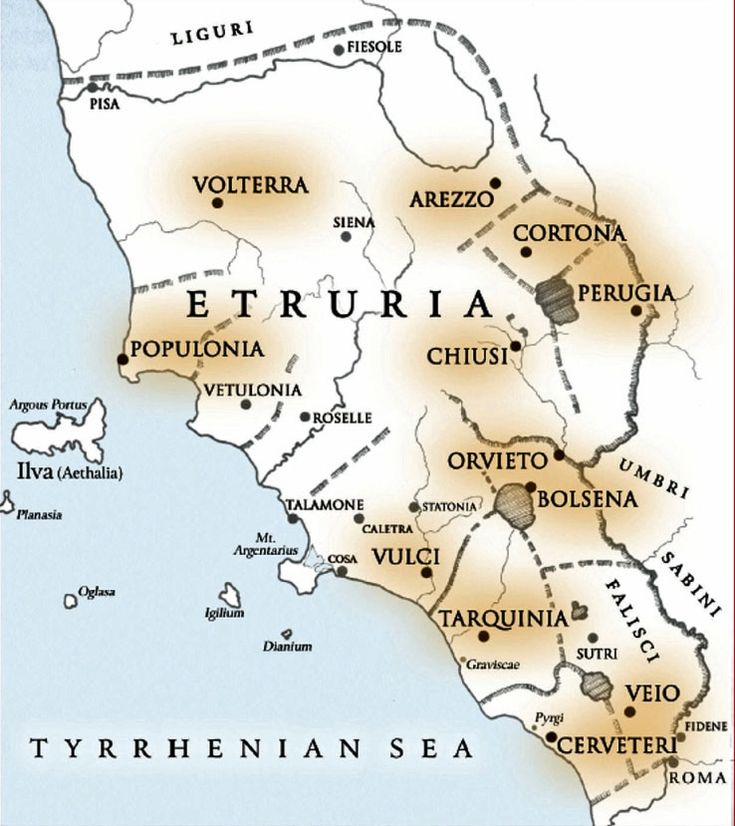
To their north was an older civilization, the Etruscans,

who were, culturally, a more sophisticated people.

They were also a more powerful military people

(Giuseppe Rava)

and eventually took over Rome for about a century (616-509BC).

Their last ruler of the city, Tarquinius Superbus (“Tarquinius the Arrogant”), was ejected, however, in 509BC, but did not leave quietly, going to the Etruscan king, Lars Porsena, in another Etruscan town, Clusium (Etruscan “Clevsin”),

for help.  Porsena marched on Rome—

(Peter Connolly)

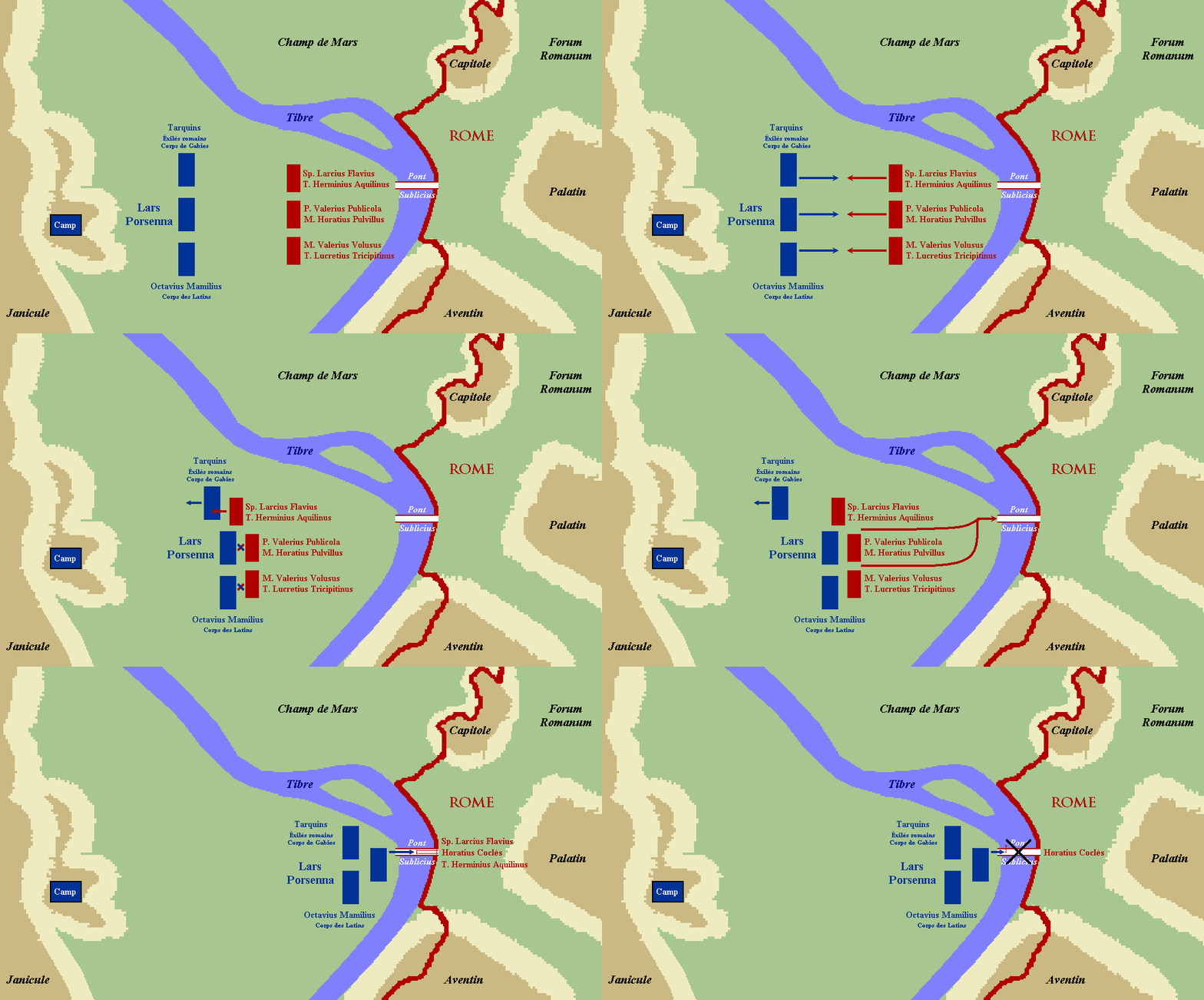
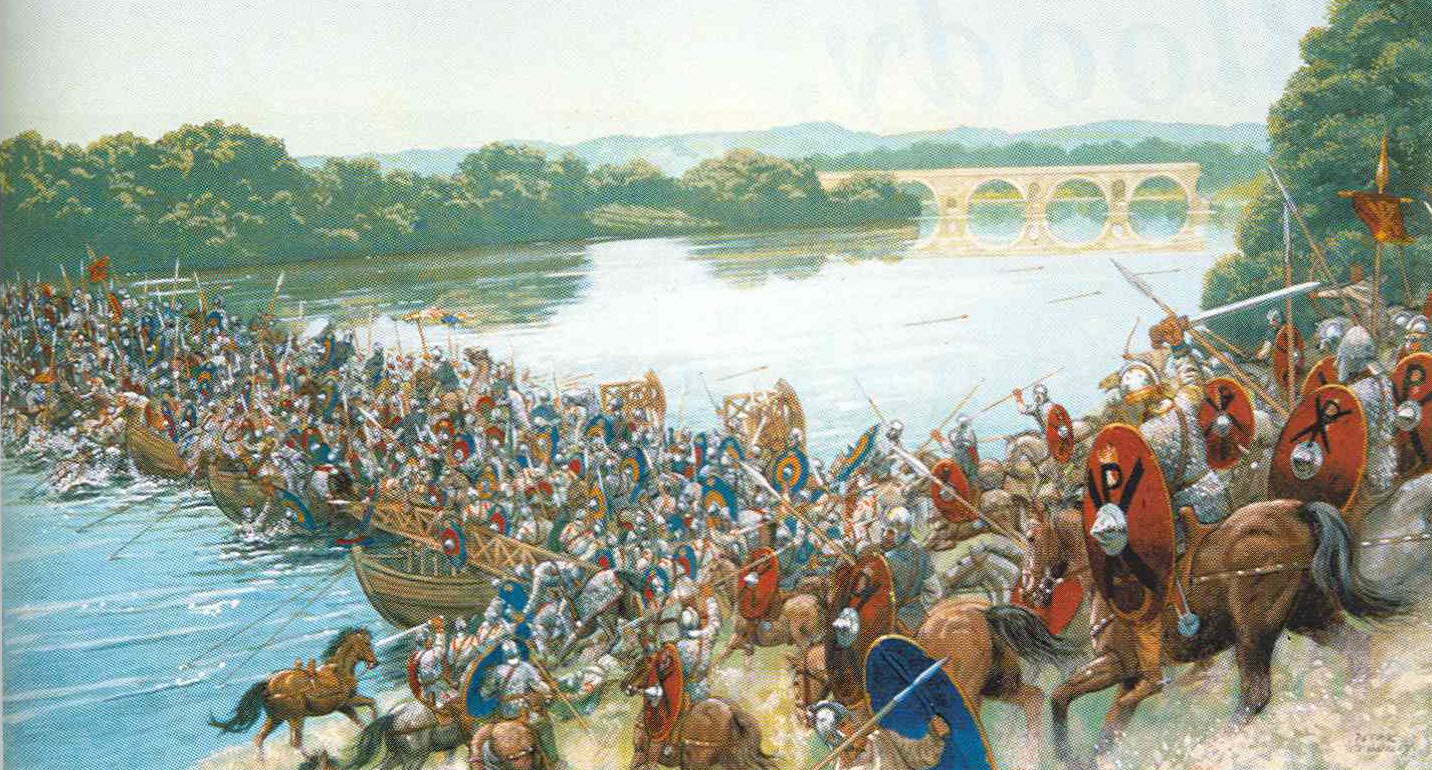
but, after this, ancient histories diverge—and so will we, as we pause once more at that bridge—the Pons Sublicius—the first bridge at the crossing of the Tiber.  As Lars Porsena moved against the city, the Roman militia came out to fight and were defeated.

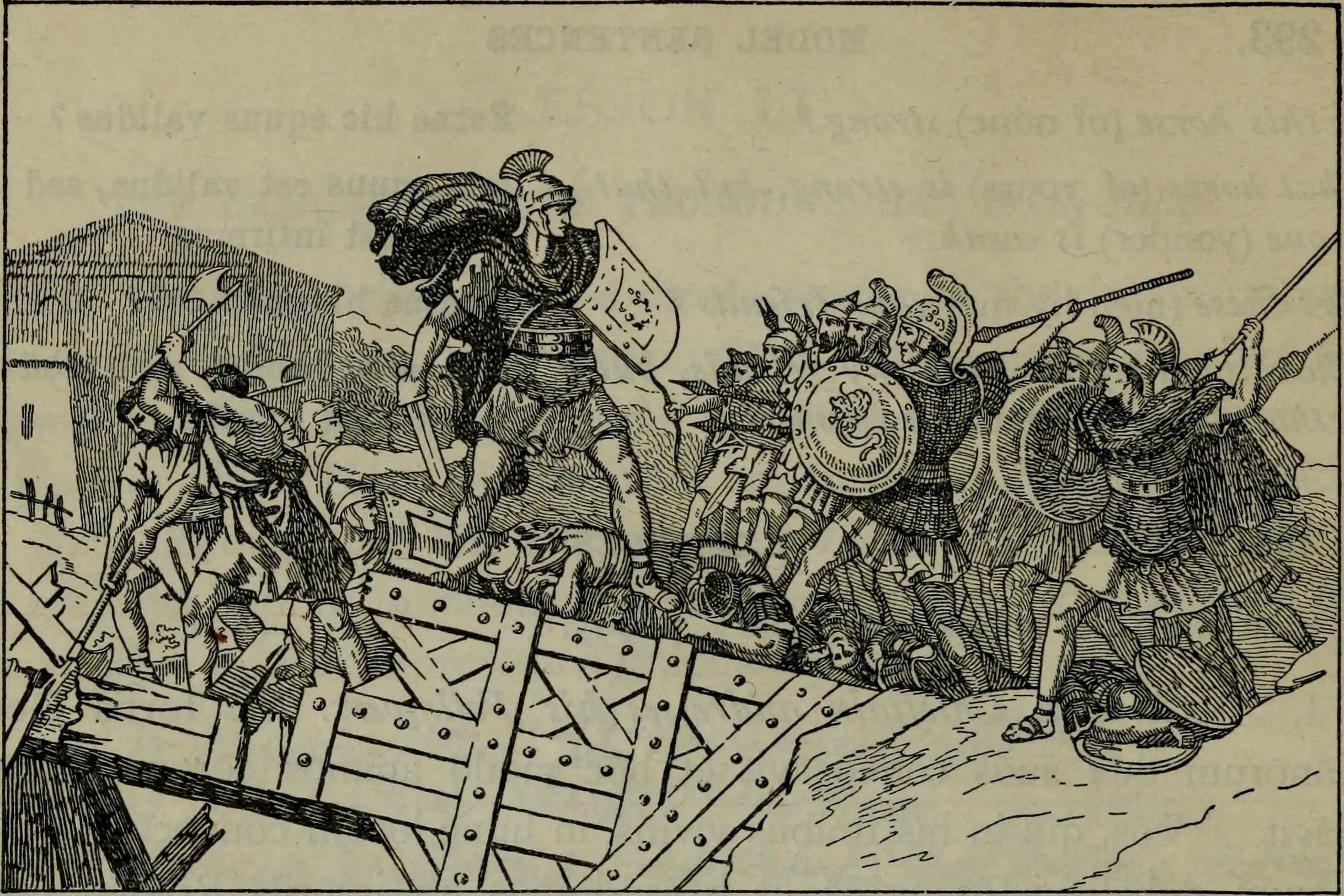
Their only chance to save Rome, they believed, was to break down the bridge and three Romans, led by a lower-rank officer, Horatius, held back the Etruscans with two higher-rank officers while that was done.

Under Etruscan pressure, the other two began to retreat, but Horatius stood his ground, even though wounded more than once, until he had word that the bridge had been broken.  Upon that news, he turned, leaped into the Tiber, and swam to the other bank.

(Richard Hook)

At least one of our sources, Titus Livius (59BC-17AD), is doubtful about all of this, especially because Horatius was said to have done his swimming in full armor, but it fits into a regular story-pattern for Romans, in which a Roman suffers bravely—all for the sake of Rome.  A favorite in this pattern was the story of Regulus, a Roman official, who, being allowed by his Carthaginian captors to return to Rome to deal with terms for a prisoner exchange, spoke against it in Rome, then returned to his captors to meet an unpleasant end.  (For more on Regulus see:  https://en.wikipedia.org/wiki/Marcus_Atilius_Regulus_(consul_267_BC) )

Long after Rome’s empire was history—and legends—Horatius’ story survived and, in Victorian England, had become a literary staple because of the poem “Horatius ”, the first chapter in Thomas Babington Macaulay’s  (1800-1859)

 Lays of Ancient Rome (1842).

This also became a schoolboy staple, a popular favorite for memorizing and reciting in a world and time in which public poetic recitation was common.  (Winston Churchill claimed that he had once won a school prize for doing so.  See:  https://en.wikipedia.org/wiki/Horatius_Cocles  You can have your own copy of the first edition of Macaulay to recite from here:  https://archive.org/details/macaulaylaysofancientrome/page/n7/mode/2up  )

As a Victorian schoolboy, Tolkien

would have had a double exposure to this story, then:  first, in his copy of Livy’s history of Rome, Ab Urbe Condita, and then in Macaulay—which is why, rereading this passage, in which Boromir details Gondor’s rearguard action against Mordor, I saw what may have been the ultimate source for Tolkien’s bridge:

“ ‘Only a remnant of our eastern force came back, destroying the last bridge that still stood amid the ruins of Osgiliath.

I was in the company that held the bridge, until it was cast down behind us.  Four only were saved by swimming:  my brother and myself and two others.’ “ (The Fellowship of the Ring, Book Two, Chapter 2, “The Council of Elrond”)

Thanks, as ever, for reading.  Next posting:  the third and last part of the little series on Middle-earth roads, where we’ll leap over the Anduin and move east.

Stay well,

Building bridges is always better than breaking them–just ask a Roman,

And remember that, as always, there’s

MTCIDC

O

On the Horns

16 Wednesday Jan 2019

Posted by Ollamh in J.R.R. Tolkien, Military History, Military History of Middle-earth, The Rohirrim

≈ 2 Comments

Tags

Boromir, buccinae, Cavalry charge, Chanson de Roland, Charlemagne, cornet, Easterlings, Eorl the Young, Gondor, Greek, horn, Meduseld, Militari, Rohan, Rohirrim, Roman, The Lord of the Rings, Theoden, Tolkien, trumpet, Trumpeter, Vegetius, war-horn

Welcome, dear readers, as always.

Our friend, Erik, once said that one of his very favorite passages from The Lord of the Rings began with this:  “And as if in answer there came from far away another note.  Horns, horns, horns.  In dark Mindolluin’s sides they dimly echoed.  Great horns of the North, wildly blowing.  Rohan had come at last.” (The Return of the King, Book Five, Chapter 4, “The Siege of Gondor”)

Of course this brings on the charge of the Rohirrim, one of our own favorite moments in the Jackson films.

image1rohirrim.jpg

And what is more exciting than a cavalry charge (as long as you don’t think too hard about the fate of the horses)?

image2awing.jpg

Those horns begin blowing because Theoden:

“…seized a great horn from Guthlaf his banner-bearer, and he blew such a blast upon it that it burst asunder.  And straightaway all the horns in the host were lifted up in music, and the blowing of the horns of Rohan in that hour was like a storm upon the plain and a thunder in the mountains.” (The Return of the King, Book Five, Chapter 5, “The Ride of the Rohirrim”)

A number of images immediately come into our minds when reading this.

First, when Gandalf, Aragorn, Legolas, and Gimli initially come to Edoras and enter Meduseld,

image2meduseldInger-Edelfeldt-8.jpg

(This is a particularly fine possible Meduseld by Inger Edelfeldt.)

they look up to see:

“Many woven cloths were hung upon the walls, and over their wide spaces marched figures of ancient legend, some dim with years, some darkling in the shade.  But upon one form the sunlight fell:  a young man upon a white horse.  He was blowing a great horn, and his yellow hair was flying in the wind.  The horse’s head was lifted, and its nostrils were wide and red as it neighed, smelling battle afar.  Foaming water, green and white, rushed and curled about its knees.

‘Behold Eorl the Young!’ said Aragorn.  ‘Thus he rode out of the North to the Battle of the Field of Celebrant.’”  (The Two Towers, Book Three, Chapter 6, “The King of the Golden Hall”)

image3eorl.jpg

Thus, we’re reminded of an earlier rescue, when Eorl brought the Rohirrim out of the north in TA2510 to aid Gondor in defeating a combined army of orcs and Easterlings.

Second, anyone interested in Western medieval literature would be reminded of the early French poem, the Chanson de Roland (c1000AD),

image4chanson.jpg

in which Roland, a young warrior and leader of the rear guard of Charlemagne’s army, refuses to blow his horn for reinforcements when his men are ambushed in a pass, saying that to do so would be cowardice.

image5rol.jpg

Rather than his horn exploding, Roland’s head does, from the exertion, but the broken horn makes us think of Boromir’s last stand, where he blows his horn, but no help comes until it’s too late.

image6boromir.jpg

All that we know of the horn which Theoden blew was that it was “great”—that is, big—but perhaps it looked like Boromir’s?

“On a baldric he worn a great horn tipped with silver that was now laid upon his knees.” (The Fellowship of the Ring, Book Two, Chapter 2, “The Council of Elrond”)  Here’s a medieval one from the British Museum.

image7oliphant.jpg

It should be remembered, of all of these horns, that they have a military use, both in Middle-earth and in our world, as a method of transferring commands from officers to soldiers, both in and out of battle, and what Theoden is actually doing is the musical equivalent of shouting CHARGE! to his 6000-man eored.  Nowhere is the military use of horns made clearer for earlier warfare than in the writing of the late Roman (4th c. AD) author, Vegetius.  In Book II of his De Re Militari (“Concerning Military Affairs”) he describes the use of such instruments:

“The music of the legion consists of trumpets, cornets and buccinae. The trumpet sounds the charge and the retreat. The cornets are used only to regulate the motions of the colors; the trumpets serve when the soldiers are ordered out to any work without the colors; but in time of action, the trumpets and cornets sound together. The classicum, which is a particular sound of the buccina or horn, is appropriated to the commander-in-chief and is used in the presence of the general, or at the execution of a soldier, as a mark of its being done by his authority. The ordinary guards and outposts are always mounted and relieved by the sound of trumpet, which also directs the motions of the soldiers on working parties and on field days. The cornets sound whenever the colors are to be struck or planted. These rules must be punctually observed in all exercises and reviews so that the soldiers may be ready to obey them in action without hesitation according to the general’s orders either to charge or halt, to pursue the enemy or to retire. F or reason will convince us that what is necessary to be performed in the heat of action should constantly be practiced in the leisure of peace.” (This is taken from a 1944 digest of the 1767 translation by John Clarke—if you would like to see the Latin original, here’s a LINK to a text.  The relevant passage is:  “XXII. Quid inter tubicines et cornicines et classicum intersit.”)

The three Latin terms translated as “trumpets, cornets and buccinae” are actually, “tubicines cornicines bucinatores”, meaning “players of tubae, players of cornua, players of buccinae”.   In this ancient relief, we can see, on the left, tuba-players, and, in the center, either players of cornu, or the buccina, as the instruments appear to be rather hard to distinguish in shape.

image8.jpg

And here’s a modern reconstruction, by Peter Connolly.

image9.jpg

We live in a world of such rapid electronic communication

image10radio.jpg

that it might be easy to forget that, for centuries, any order beyond the sound of a general’s voice had to be transferred by other means.  Like Greek trumpeters,

image11salpinx.jpg

or Roman

image12buccinator.jpg

or medieval mounted messengers (the Latin says “messengers of William”).

image13mtdmess.jpg

Drums might be used—

image14rendrumimage15drum

and the early 18th-century British general, the Duke of Marlborough even had his own foot-messenger squad, wearing distinctive clothing (one, in blue, with a jockey cap, is just to the left of the Duke in this tapestry).

image16dukemess.jpg

But what, we asked above, is more exciting than a cavalry charge (we once did a posting devoted specifically to them)—and what makes that more exciting than the trumpeter at the front, sounding the charge?

image17friedland4


Thanks, as always, for reading.

MTCIDC

CD

Sugar and Oliphaunts

08 Wednesday Nov 2017

Posted by Ollamh in Imaginary History, J.R.R. Tolkien, Literary History, Narrative Methods

≈ 1 Comment

Tags

Africa, Bag End, Bodleian Library, Boromir, Chanson de Roland, creative misreading, Elephants, Greenway, Harad, horn, Mumakil, Oliphaunt, Oliphaunts, Savanna, sugar cane, sugar loaf, Sunlands, Swanfleet, Swertings, Tharbad, Tolkien, tropical, Umbar, war-horn

Welcome, dear readers, as always.

In our last posting, through a piece of “creative misreading” we saw a hat on Bilbo’s hallway table as a sugar loaf

image2sugarloaf

and, before you knew it, we were thinking about where the sugar behind the cakes, seed cakes, and tarts in his pantry came from.

Sugar cane is a tropical plant

image3sugarcanefield

so, logically, we began to consider where, on the Middle-earth maps we have, tropical might be.

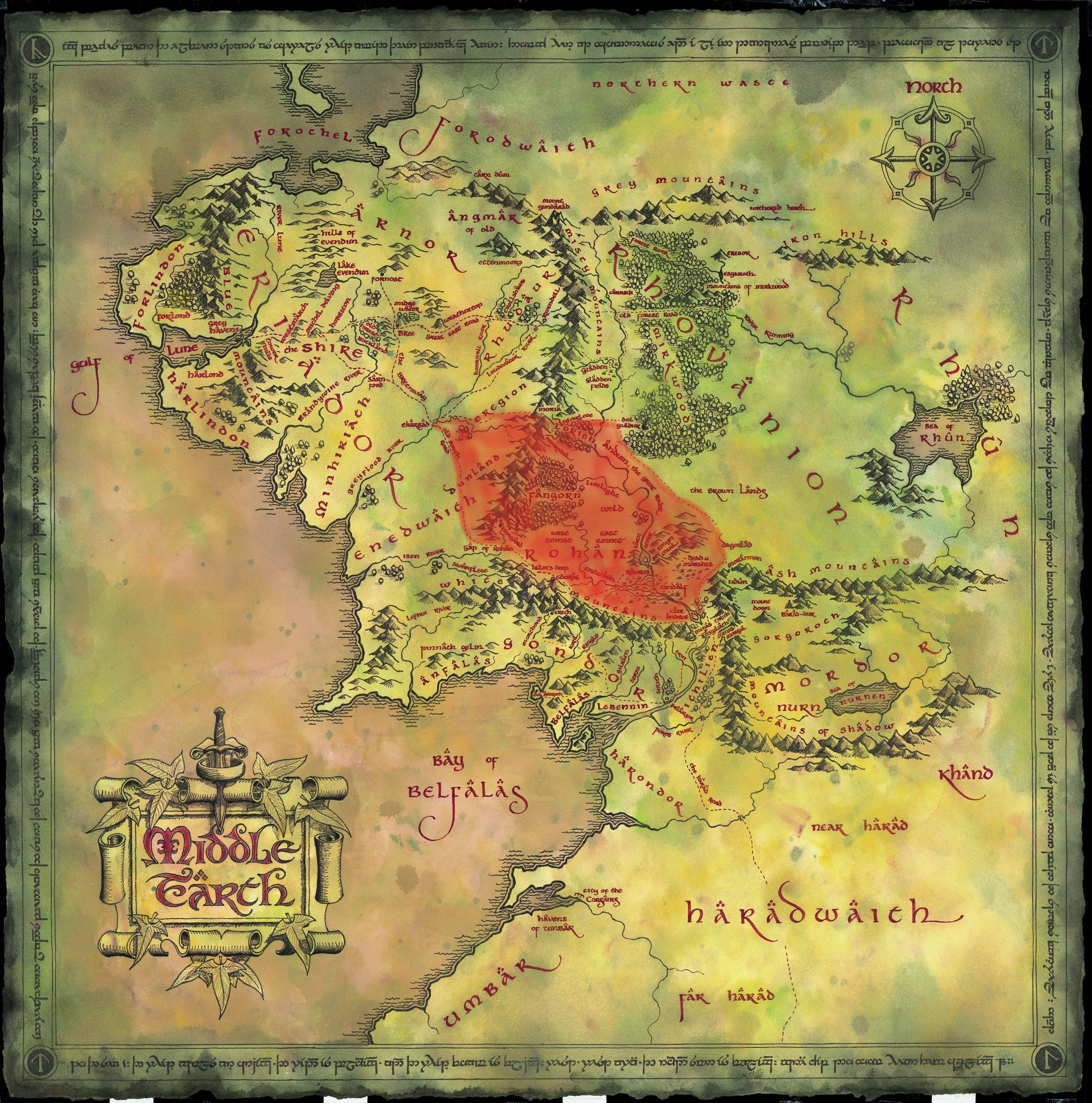
image4memap

In our world, that would be south, of course, and, looking as far south as we can go, we reach Harad, a name which actually means “south” in Sindarin.  It consists of two big regions, Near Harad and Far Harad.

As far as we can find, JRRT has left us no detailed geographic information about this region.  On page 413 of The War of the Ring, we are given the clue that, when the Corsairs of Umbar are driven back,

“all the enemy that were not slain or drowned were gone flying over the [?borders] into the desert that lies north of Harad.”

This would suggest that at least Near (as in “near to Gondor”, as we presume that our cartographers were Gondorians) Harad might be imagined as being like our world’s North Africa—

image5northafrica

with some fertile coastline, backed by the Sahara.  And we can’t resist including this view of the Sahara from space here.

image6saharafromspace

And, just as in our world, the whole south can’t be desert, since people from Harad are associated with elephants—or “oliphaunts”, as Sam says:

“But I’ve heard tales of the big folk down away in the Sunlands.  Swertings we call ‘em in our tales; and they ride on oliphaunts backs and all, and the oliphaunts throw rocks and trees at one another.” (The Two Towers, Book Four, Chapter 3, “The Black Gate is Closed”)

The Mûmak of Harad, by Ted Nasmith

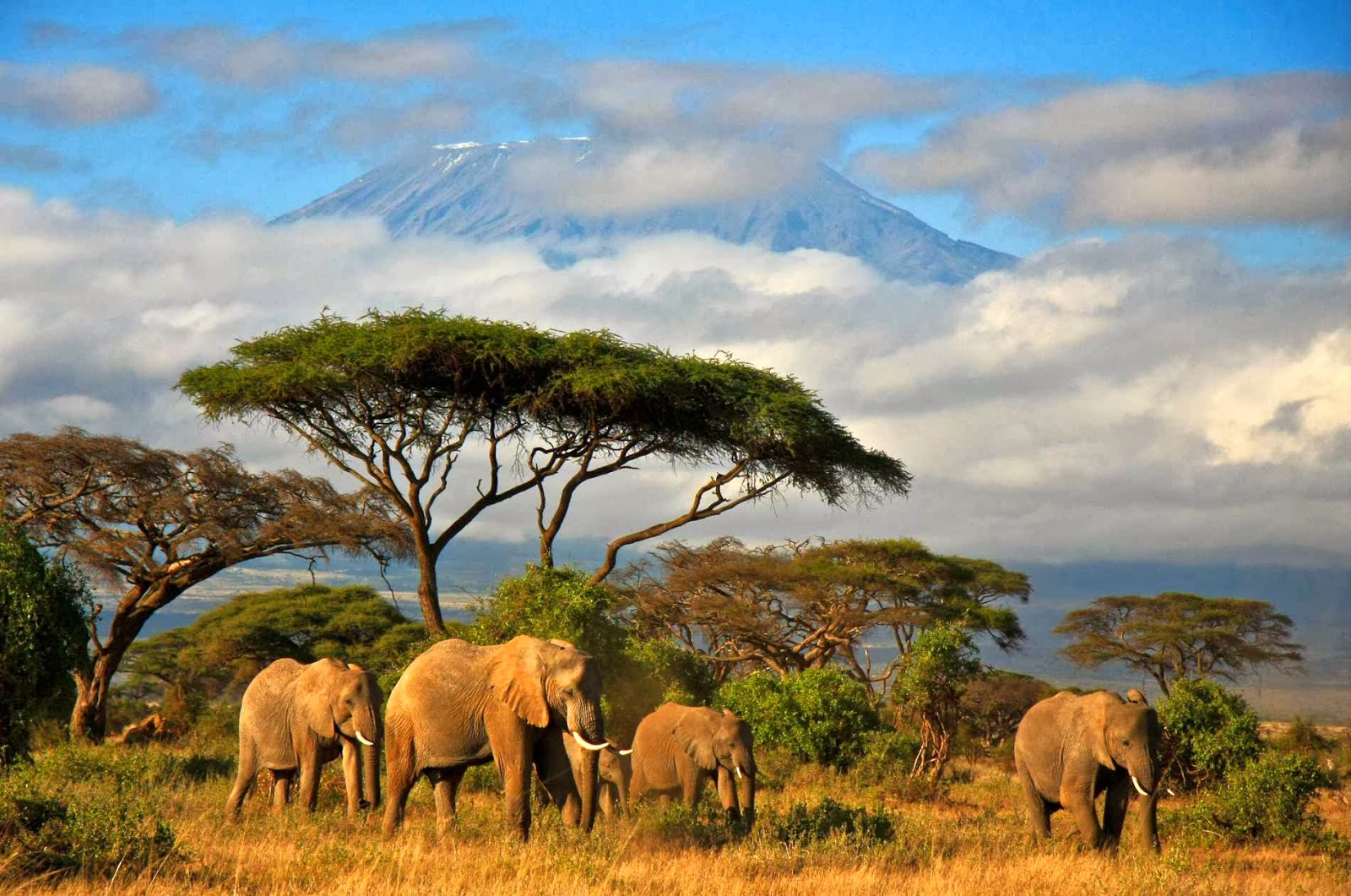
This would suggest more fertile land south of the northern desert, a savanna, or region of great, grassy plains.  Such an area forms one of two habitats for elephants in our Africa.

image8savanna

South of the African savanna lies the rain forest—the other African elephant habitat.

image9rainforestelephants

Sugar cane, a little research tells us, can grow in savanna lands

image10caneinsavanna

as well as in rain forest (which, in our world, is being destroyed to provide more space for growing it—here’s a LINK about that).  Thus, we imagine that this must be the point of origin for Bilbo’s sugar.  From its growing and processing point (for something about those things in our world, please see the previous posting), it might then be shipped to the city of Umbar and from there to Gondor.

As to how it reaches Bilbo, well, we know that there must have been some trade up and down the old North-South Road/Greenway, as Saruman has a supply of pipe-weed from the South Farthing, with “the Hornblower brandmarks on the barrels” (The Two Towers, Book Three, Chapter 9, “Flotsam and Jetsam”), which takes us as far as Isengard.  From Gondor to Isengard?  Packhorse up the Greenway to Bree?  Butterbur tells Frodo & Co that “”There’s a party that came up the Greenway from down South last night” (Fellowship of the Ring, Book One, Chapter 9, “At the Sign of the Prancing Pony”)—though he then says that “that was strange enough to begin with”.

As we said in our last, this is all based upon a “creative misreading”, so we admit that there are some gaps here and there–just as there is a gap in the North-South Road at the Swanfleet, where the great bridge at Tharbad is down, but that’s what we get with such a “creative misreading” of a hat!

Thanks, as ever, for reading.

MTCIDC

CD

PS

But another thought—not based upon a “misreading”, but rather upon The Lord of the Rings, so, at the posting’s end we can have at least something a little less speculative.

There is another medieval spelling of “oliphaunt”—“Olifant/oliphant”, with its own specific meaning:  a horn made from an elephant’s tusk, like this one, which is just over a thousand years old and is in the treasury of York Minster.

KIPPA MATTHEWS - COPYRIGHT NOTICE

image12york


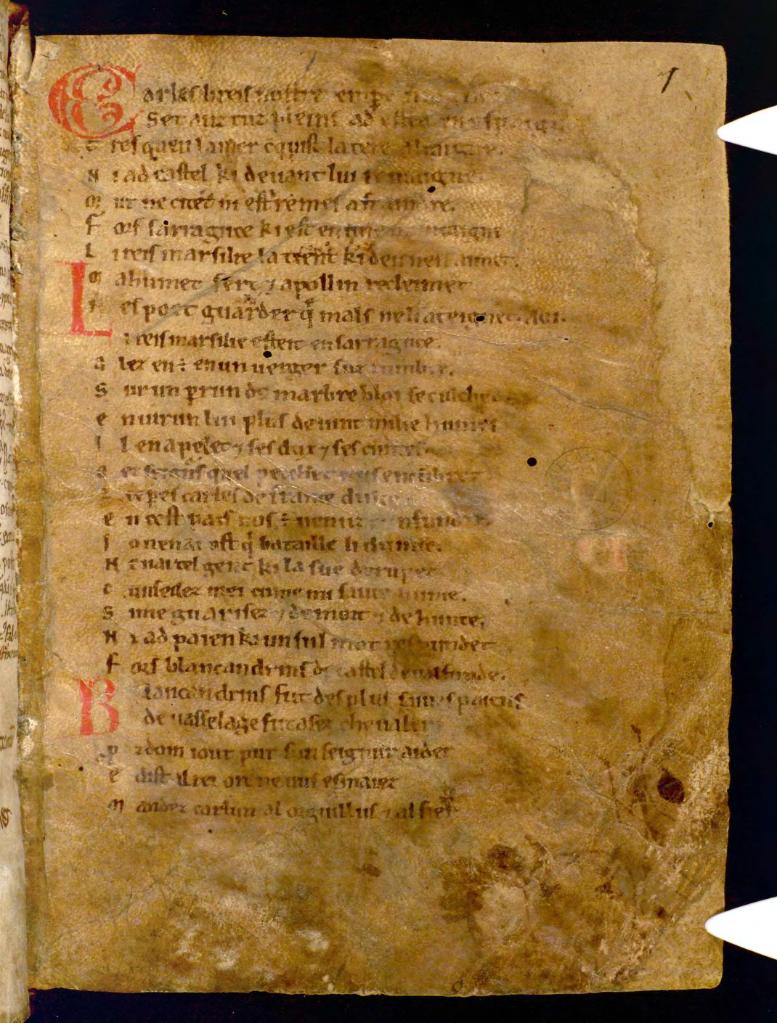
This is a drinking horn, but such horns could also be used for signaling, the most famous being that of Roland, the hero of the later-11th-century Old French epic poem, the Chanson de Roland. Here is a page from the oldest known ms, now in the Bodleian Library at Oxford.

image13chanson

(Here are links to two translations in English, one in prose, one in verse.)  If you don’t know the poem, its main action is a rear guard defense of a pass by a group of Carolingian soldiers commanded by Roland.  He has an olifant and can use it to call for help, but refuses to do so until the last moment because, in his view, asking for reinforcements would be cowardly.  As a consequence, the Carolingians, including Roland, do not survive the battle, as Roland blows the horn only at the last moment (and blows it so hard that he bursts his brains in the process—there would be those who might argue that someone who sacrifices his troops on a point of honor doesn’t have much in the way of brains to begin with!).

image14roland

Warriors and horn-blowing immediately make us think of Boromir.

Tolkien, Nasmith, painting, illustration, Lord of the Rings, Silmarillion, Hobbit, Middle-earth

His horn is just called a “war-horn” (The Fellowship of the Ring, Book Two, Chapter 3, “The Ring Goes South”), with no further description, but, as medieval horns in our world can be made of elephant tusk, why mightn’t Boromir’s be made of the equivalent, mumak tusk?

image16oliphant


Healing (II)

16 Wednesday Aug 2017

Posted by Ollamh in Heroes, J.R.R. Tolkien, Literary History, Narrative Methods

≈ Leave a comment

Tags

Akira Kurosawa, Aragorn, athelas, bleeding, Boromir, cinquefoil, Eowyn, Faramir, four humors, Greco-Roman, healers, herbal medicine, Hildebrandts, Japanese block prints, John Bradmore, Kingsfoil, Macbeth, Medieval medicine, Medieval Monastery, Merry, Morgul Knife, Nazgul, Prince Hal, Prince Imrahil, Pyre of Denethor, Rammas Echor, The Battle of the Pelennor Fields, The Grey Havens, The Houses of Healing, The Lord of the Rings, The Return of the King, Throne of Blood, Tolkien, Washizu, Westernesse, Witch-King of Angmar, wounding, Yoshitoshi, Yoshitoshi's Courageous Warriors

Welcome, dear readers, as ever.
Two postings ago, we were talking about woundings in The Lord of the Rings and thinking about the medical care there as compared with that available in what we always think of as the actual parallel medieval world. We had gotten as far as Boromir, who, we imagined, would have been beyond help, pierced as he was by multiple arrows.
image1boromir.jpg
(We had also said that Boromir’s wounding reminded us of the death of the Macbeth figure in Kurosawa’s Throne of Blood, 1957.
image2throne.jpg
To which we would add—just because we love Japanese block prints (ukiyo-e)—this figure from Yoshitoshi’s series Yoshitoshi’s Courageous Warriors—1883-1886—)
image3yoshi.jpg
[Here, by the way, are some great links—one to a massive collection of Yoshitoshi prints, the other is an excellent guide to the world of Japanese block prints in general—both highly recommended!]

http://yoshitoshi.net/

http://www.ukiyo-e.se/
The next wounding is that of Faramir.
After the fall of the Rammas Echor, the long wall which was meant to protect the far side of the Pelennor, Faramir was leading the rear guard, but:
“…there came flying a deadly dart, and Faramir, as he held at bay a mounted champion of Harad, had fallen to the earth.” (The Return of the King, Book Five, Chapter 4, “The Siege of Gondor”)
At this time, we are not told of how the arrow was removed (we later are told that Prince Imrahil did it on the battlefield), but, that which concerned John Bradmore about the wounded Prince Hal in our 1403, after he had suffered an arrow wound,
image4halwitharrow.jpg
now afflicted Faramir: infection.:
“During all this black day Faramir lay upon his bed in the chamber of the White Tower, wandering in a desperate fever…”
In our medieval world, medicine was based upon a combination of beliefs, some of which even dated back to the Greco-Roman world.
One major foundation block was the idea that the body was governed by four elements, called “humors”: black bile, yellow bile, phlegm, and blood.


image5humours.png
They determined personality and behavior, but, although they were natural to the body, they could be thrown out of balance and part of a medieval doctor’s job was to rebalance them.
image6meddocs.jpg
This rebalancing could include doses of all sorts of things—dangerous metals, like mercury, concoctions from various plants, some of which were helpful, some poisonous, and bleeding—based upon the idea that, by removing blood, you were helping rebalance the body’s natural humorous proportions.
image7bleeding.jpg
In Faramir’s case, a doctor might try a number of drugs based upon plants which were believed to bring fever down:
angelica
image8angelica.jpg
chamomile
image9chamomile.JPG
datura
image10datura.jpg
or coriander
image11coriander.jpg
In the text, however, although Pippin suggests that Gandalf be consulted, Denethor dismisses the suggestion and Faramir is left to burn—before almost being literally consumed by fire along with his mad father.
[And here we would suggest that the over-the-top scene of Denethor’s death in the film missed an important point. In the book, it is clear that what drove Denethor to try to set up a kind of Viking funeral for himself and his son was the palantir by which his mind was poisoned by a Sauron whose influence over him he fatally underestimated. And what a wonderfully spooky moment JRRT describes when the orb survives the fire which destroys the Steward:
“And it was said that ever after, if any man looked in that Stone, unless he had a great strength of will to turn it to other purpose, he saw only two aged hands withering in flame.” (The Return of the King, Book Five, Chapter 7, “The Pyre of Denethor”)]
We will return to Faramir, but, first, we want to look at two more woundings, both occurring almost in the same moment: when Eowyn and Merry face the chief of the Nazgul.
image12eowyn.jpg
In confronting the Witch King, Eowyn suffers what might seem a perfectly ordinary battle wound in a world of hand-to-hand combat such as this:
“Out of the wreck rose the Black Rider, tall and threatening, towering above her. With a cry of hatred that stung the very ears like venom he let fall his mace. Her shield was shivered in many pieces and her arm was broken; she stumbled to her knees.” (The Return of the King, Book Five, Chapter 6, “The Battle of the Pelennor Fields”)
image13merrynaz.jpg
Eowyn is saved from the Nazgul by Merry, who “had stabbed him from behind, shearing through the black mantle, and passing up beneath the hauberk had pierced the sinew in his mighty knee.”
Combined with Eowyn’s final blow at the wraith’s face, this destroyed what we presume was an undead being, but, in return, both Merry and Eowyn take an invisible wound, something which the medical people of Minas Tirith can only observe:
“But now their art and knowledge were baffled; for there were many sick of a malady that would not be healed; and they called it the Black Shadow, for it came from the Nazgul. And those who were stricken with it fell slowly into an ever deeper dream, and then passed into silence and a deadly cold, and so died. And it seemed to the tenders of the sick that on the Halfling and on the Lady of Rohan this malady lay heavily.” (The Return of the King, Book Five, Chapter 8, “The Houses of Healing”)
Eowyn and Merry (and Faramir) have been taken to “the Houses of Healing”, which, in our world, would be a hospital, something which, in our Middle Ages, would either have been part of a monastery/cloister, or were a private foundation, supported by charitable donations.
image14medhosp.jpg
Medical people there could certainly have set Eowyn’s broken arm, even sealing it in plaster to keep it immobile, but the Black Shadow would have been as difficult for them as for the healers in Minas Tirith. Comas were recognized in the Middle Ages, but there was little to be done: apparently, comatose people lose the swallowing function, which means that someone in that condition would die of dehydration, probably within a few days (speed of dehydration depends upon many factors, as well as the individual, but the longest we’ve seen is about 10 to 12 days).
To their credit, those in the Houses of Healing tried to do something by observation:
“Still at whiles as the morning wore away they [Eowyn and Merry] would speak, murmuring in their dreams; and the watchers listened to all they said, hoping perhaps to learn something that would help them to understand their hurts.”
But the Shadow spreads quickly as day fades:
“But soon they began to fall down into the darkness, and as the sun turned west a grey shadow crept over their faces.”
And there is the added difficult of Faramir, who “burned with a fever that would not abate.”
At this point, both medieval healers and those in Minas Tirith were stumped—until another factor was added. In fact, two.
Plants have been used since ancient times for medicine world-wide, so it should be no surprise that Middle-earth should have a parallel. In this instance, the plant is called “kingsfoil” or athelas. (The “foil” in the first name is—in English—based upon the Old French foil/foille, “leaf”, which comes, in turn, from a Latin word for leaf, folium—perhaps JRRT was inspired by the plant called “cinquefoil” = “fiveleaf”. Athelas is also a compound, based upon Sindarin athaya, “helpful” and lass, “leaf”.) [There’s a really useful posting on possible our world parallels for this herb and we provide the LINK here.]
When Aragorn tended to Frodo’s Morgul-knife wound earlier in The Lord of the Rings, we would have seen its use then:
“He threw the leaves into boiling water and bathed Frodo’s shoulder. The fragrance of the steam was refreshing, and those that were unhurt felt their minds calmed and cleared. The herb had also some power over the wound, for Frodo felt the pain and also the sense of frozen cold lessen in his side…” (The Fellowship of the Ring, Book One, Chapter 12, “Flight to the Ford”)
This is not all to the treatment, however. Just before he uses the herb, Aragorn appears to employ some sort of counter-spell to that which was on the knife:
“He sat down on the ground, and taking the dagger-hilt laid it on his knees, and he sang over it a slow song in a strange tongue. Then setting it aside, he turned to Frodo and in a soft tone spoke words the others could not catch.”
This pattern of speech and herb is now employed in the healing not only of Eowyn and Merry, but of Faramir, as well, and forms both a part of the movement towards the eventual defeat of Sauron and the return of light to Middle-earth, and of the confirmation of Aragorn as the rightful heir to the throne. As the herb-master, when called upon by Aragorn to produce the herb, recites:
“When the black breath blows
And death’s shadow grows
And all lights pass,
Come athelas! Come athelas!
Life to the dying
In the king’s hand lying!”
Previously, the herb-master says “it has no virtue that we know of, save perhaps to sweeten a fouled air, or to drive away some passing heaviness…old folk still use an infusion of the herb for headaches.” Now, however, Aragorn proceeds to use it three times in quick succession, along with something else, to bring back the three so sunk towards death:
“Now Aragorn knelt beside Faramir, and held a hand upon his brow. And those that watched felt that some great struggle was going on. For Aragorn’s face grew grey with weariness; and ever and anon he called the name of Faramir, but each time more faintly to their hearing, as if Aragorn himself was removed from them, and walked afar in some dark vale, calling for one that was lost.”
Moving to Eowyn, Aragorn uses the athelas again, but summons her, as well:
“Then, whether Aragorn had indeed some forgotten power of Westernesse, or whether it was but his words of the Lady Eowyn that wrought on them, as the sweet influence of the herb stole about the chamber it seemed to those who stood by that a keen wind blew through the window…”
image15aragheal.jpg
And a third time, with Merry: “I came in time, and I have called him back.”
We’ll end the second part of our discussion of woundings here—or almost. There is one more patient whom it appears even the king can’t heal:
“But I have been too deeply hurt, Sam.” Says Frodo. “I tried to save the Shire, and it has been saved, but not for me. It must often be so, Sam, when things are in danger; some one has to give them up, lose them, so that others may keep them.” (The Return of the King, Book 6, Chapter 9, “The Grey Havens”)
image16greyhavens.jpg
And yet, there is perhaps the promise of healing beyond Middle-earth, something which may even bear a faint suggestion of the scent of Athelas:
“And the ship went out into the High Sea and passed on into the West, until at last on a night of rain Frodo smelled a sweet fragrance on the air and heard the sound of singing that came over the water…the grey rain-curtain turned all to silver glass and was rolled back, and he beheld white shores and beyond them a far green country under a swift sunrise.”
Thanks, as ever, for reading.
MTCIDC
CD

Healings (1)

02 Wednesday Aug 2017

Posted by Ollamh in J.R.R. Tolkien, Literary History, Narrative Methods

≈ Leave a comment

Tags

18th Century Medicine, 19th Century Medicine, Akria Kurosawa, al-Zahrawi, Arab Medicine, arrows, Black Plague, Boromir, Charles Dickens, Elrond, Frodo, gask mask, Greco-Roman, Hans Janssen, Henry V, London, Louis Pasteur, malaria, miasma, Micrographia, Morgul Knife, Our Mutual Friend, Prince Hal, Robert Hooke, Sir Joseph Lister, Thames, The Lord of the Rings, Throne of Blood, Tolkien, Toshiro Mifune, Victorian disease, Zacharias Janssen

Welcome, as always, dear readers.
Not long ago, we had a posting about Frodo’s wound from a Morgul-knife and the extraction of an arrow from the skull of Prince Hal, the future Henry V.
image1morgul.jpg
image2halswound.jpg
This, in turn, has led us to think about the kinds of wounds we see among the major characters of The Lord of the Rings and their cures—and about their creator.
The first one wounded is, of course, Frodo. In his case, it’s not so much the original knife wound, but the aftermath—the point of the blade which, as Gandalf describes it, “was deeply buried, and it was working inwards.” (The Fellowship of the Ring, Book Two, Chapter 1, “Many Meetings”). This, then, was no ordinary fighting knife, but the equivalent of the injection of a kind of poison or even parasite—“They tried to pierce your heart with a Morgul-knife which remains in the wound.”
Treatment was surgical—“Then Elrond removed a splinter…”—just as in the case of the young Prince Hal. We have no idea what else Elrond might have done, but, in Hal’s case, the surgeon was extremely careful to prevent infection. Any good medieval doctor would have been well aware of the danger and would have recognized the symptoms, but, once infection would have set in, would have been at a loss as to how to prevent the consequences. If a limb had been affected, he would have amputated, hoping to have pinched off the infection.
image3amputation.png
As Hal’s was a head wound, well, all the doctor could have done was what he did—keep the wound clean until the healing was clearly going well.
The difficulty was, medieval doctors could be aware of infection and could even try various methods to prevent it, but they had no accurate idea of what it was and where it came from. In their world, infection was either a mystery (possibly divinely inflicted) or, in the case of infectious disease, caused by something which they called miasma, an ancient Greek word which means, in fact, “pollution” (often “ritual pollution”).
This miasma was believed to be caused by rotting matter and was to be found in the air—and, in a world of open sewers in towns,
image4astreet.jpg
the “bad air” (where the word “malaria” comes from), would have been everywhere, especially when plague hit and burial services were quickly overwhelmed.
image4medburial.jpg
Part of the problem lay in the reliance upon ancient, outdated medical ideas, derived from Greco-Roman sources. Part, however, lay with the lack of tools available.
The medieval doctor had only his naked eyes with which to observe and to diagnose illness. The microscope was the invention of two Dutchmen, father and son Zacharias and Hans Janssen, in the 1590s.
image5janssen.jpg
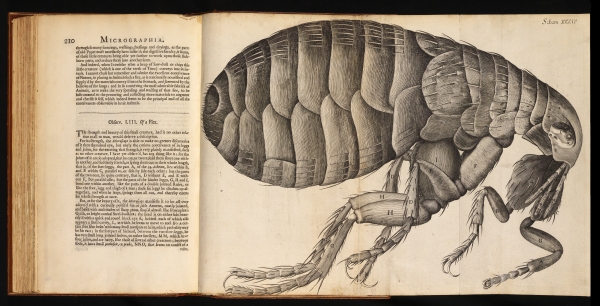
Just seeing what’s there wasn’t enough, however, although what could be seen was absolutely amazing to people who had no idea what existed in worlds beyond this one. In 1665, the English polymath, Robert Hooke (1635-1703), published Micrographia, with a series of engravings of things seen under magnification which must have astounded people.
image6micro.gif
Just look at this flea, for example.
image7flea.jpg
Ironically, in the gut of this flea could be the bacterium Yersinia Pestis,
image8yersinia.png
which is the basis of black plague—but everyone in 1665 knew that the plague was caused by miasma—which was still the theory for infectious diseases in Victorian days, as this cartoon shows. (Death is here depicted as one of the scavengers of the river, major characters in Charles Dickens’ last completed novel, Our Mutual Friend, 1864-65.)
image9thames.jpg
The Thames, was filled with sewage, chemicals, refuse, dead animals, the overflow of cattle markets, and anything else horrible one might imagine. Of course it stank—in the summer of 1858 in fact, the smell was so overpowering that Parliament adjourned and fled its handsome and nearly-new home. One imagines that this was as much in fear of what that smell might portend as disgust at the odor.
image10greatstink.jpg
It was only in the mid-19th century that the work of scientists like Louis Pasteur (1822-1895)
image11pasteur.jpg
began the process of retiring the miasma theory in favor of the theory still used in the early 21st century, the germ theory. This was not an overnight process: the medical profession was very cautious and some members clung to outdated beliefs long after they could see that the efforts of forward-looking surgeons like Sir Joseph Lister (1827-1912) drastically cut the number of deaths directly related to the dangers of surgery before his changes.
image12lister.jpg
Lister believed that, by sterilizing the operating room and the instruments with carbolic acid (we would call it “phenol”, a petroleum derivative), as well as aggressive handwashing and careful and frequent cleansing of wounds, lives could be saved—and they were.
image13listerphenol.jpg
That Prince Hal’s surgeon, lacking knowledge of germs, could still be as energetic as he was in keeping Hal’s horrible wound clean, must be remembered when we imagine that medieval doctors were nothing more than ignorant charlatans. Some, at least, were observant and creative, even as they struggled to save their patients from dangers understood from their outcome, rather than from their origins.
(And so, if you remember that the medieval medical community believed that “bad air” carried disease, that crow-like mask which can be seen on late illustrations of “plague doctors” isn’t silly: the “beak”, packed with what they believed were “healthy” herbs, was meant to act as a filter against that air.
image14apldr.JPG
In fact, that idea wasn’t so far from the idea of World War One gas masks, which also carried a filter to cleanse the air of the poisonous gases—real ones, this time—with which both sides sometimes tried to flood the enemy’s trenches.)
image14bgasmask.jpg
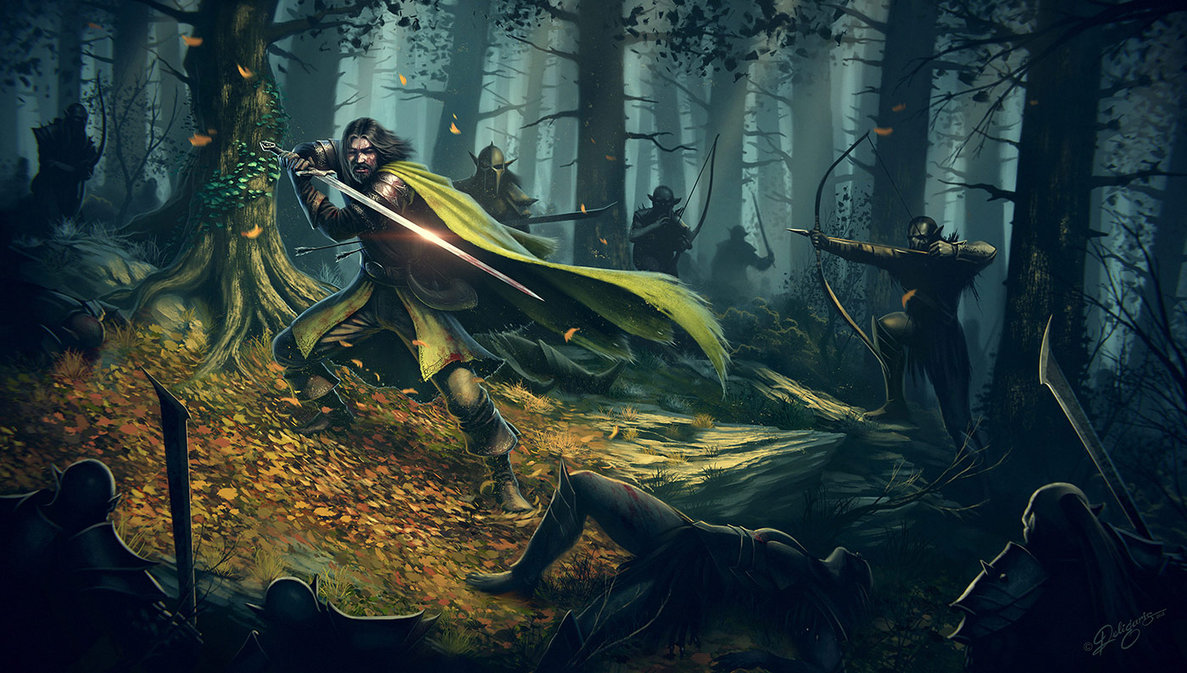
Prince Hal’s arrow reminds us of the second wounding in The Lord of the Rings, this one fatal: Boromir.
image14boromir.jpg
Unlike Prince Hal, there was no possibility of extraction: Boromir had been hit multiple times: “…Aragorn saw that he was pierced with many black-feathered arrows.” (The Two Towers,, Book One, Chapter 1, “The Departure of Boromir”) And Ted Nasmith’s illustration tells it all—just look how pale Boromir is—he’s dying from blood loss.
[This always reminds us of the death of Toshiro Mifune as the Macbeth figure in Kurosawa’s wonderful 1957 film, Throne of Blood.)
image15throneofblood.png
As in the case of infection, only so much could be done for the sufferer in the medieval world. Arrows could be extracted, but, if they were barbed,
image16barbedarrow.jpg
they caused more damage coming out than going in—although a brilliant Arab doctor, whom we’ve mentioned before, al-Zahrawi, had invented an “arrow spoon” for this very problem. (We once saw this demonstrated, but we currently have no illustration, unfortunately. In the near future, however, we’re going to have a feature on JRRT’s Haradrim/Corsairs of Umbar vs actual medieval Arabic culture, where we’ll include discussion of the brilliant intellectual life of the Arabic world from Spain to the Middle East.)
After Boromir’s death, our next injury would be not a physical, but a psychological (or magical?) one. Pippin, peeping into a palantir, has had an encounter with Sauron and it hasn’t been a pleasant one:
“Then suddenly he seemed to see me, and he laughed at me. It was cruel. It was like being stabbed with knives….Then he gloated over me. I felt I was falling to pieces.” (The Two Towers, Book Three, Chapter 11, “The Palantir”)
In response, Gandalf commands Pippin to look at him:
“Pippin looked up straight into his eyes. The wizard held his gaze for a moment in silence. Then his face grew gentler, and the shadow of a smile appeared. He laid his hand softly on Pippin’s head. ‘All right!’ he said. ‘Say no more! You have taken no harm.’ ”
Pippin has escaped, then, though Gandalf has said that it was a close call: “You have been saved, and all your friends too, mainly by good fortune, as it is called.”
Our next injury—that of Faramir—won’t be so easy… But that’s for next time!
Thanks, as always, for reading—in “Healings.2”, we’ll look at other wounds in The Lord of the Rings, then move on to another war and one of its millions of victims…

MTCIDC
CD

Bridges and Battles

04 Wednesday Jan 2017

Posted by Ollamh in Artists and Illustrators, Heroes, J.R.R. Tolkien, Literary History, Military History, Military History of Middle-earth, Narrative Methods

≈ Leave a comment

Tags

Anglo-Saxon, Arnhem, Belisarius, Boromir, bridges, Constantine I, Constantinople, David, Diocletian, Dionysius, Gros, Hal Foster, Harold Godwinson, Horace Vernet, Horatius, Horatius at the Bridge, Justinian, Livy, Marcus Aurelius, Maxentius, Maximianus, Milvian Bridge, Napoleon, Ostrogoths, Pass of Roncevalles, Pegasus Bridge, Pliny the Elder, Pons Sublicius, Prince Valiant, Ravenna, Remagen, River Adige, River Derwent, Roland, Salarian Bridge, San Vitale, Sherlock Holmes, Stamford Bridge, Tacitus, The Council of Elrond, The Lays of Ancient Rome, The Lord of the Rings, The Oath of the Horatii, Thomas Babington Macaulay, Tiber, Tolkien, vikings

Welcome, dear readers, to our first posting for 2017—and a Happy New Year.

In our last, we discussed water-crossings in The Lord of the Rings, but said that our next would be on a more specialized subject, something we thought to call “Battle Bridges”.

This was inspired by this quotation (it’s Boromir speaking, at the Council of Elrond):

“I was in the company that held the bridge, until it was cast down behind us. For only four were saved by swimming: my brother and myself and two others.” (The Fellowship of the Ring, Book 2, Chapter 2, “The Council of Elrond”)

Broken bridges and swimming soldiers made us think of a story told by a number of early historians, including Dionysius of Halicarnassus, Livy, Pliny the Elder, and Tacitus, in which three Roman officers stand as a rearguard at the first bridge over the river Tiber, the Pons Sublicius, and, when two are wounded, the third, Horatius, sends them off, telling them to have the bridge destroyed so that the enemy can’t pursue the defeated Roman army into Rome. When the bridge is gone, Horatius, in his armor and with his arms, leaps into the river and swims to the Roman shore to great acclaim.

1horatiusatbridge.jpg

In the nineteenth century, this story was turned into a poem (a very long ballad) by the historian Thomas Babington, Lord Macaulay (1800-1859),

2macaulay.jpg

entitled “Horatius at the Bridge” (from his 1842 collection, The Lays of Ancient Rome).

3lays1849ed.jpeg

Once upon a time, it was a standard assignment for schoolboys to memorize its approximately 600 lines and we wonder if this might once have been Tolkien’s task, which is why we have Boromir’s remark.

Once we embarked upon the subject of fights at bridges, we found, beginning with the late classical world, that there were lots more out there (our short mental list roared through time to take us as far as the seizing of Pegasus Bridge in the Normandy invasion and the subsequent bridges at Arnhem and Remagen). There was a difficulty, however: we began with an heroic action—one man or a handful against masses. What mostly came to mind was not Horatian one-man stands. Instead, they were only depicted as parts of larger military maneuvers to gain or block a crossing and individuals disappeared. Take, for example the famous battle at the Milvian Bridge, in 312AD, which led not only towards a reconstituted Roman world based upon the east, but also towards the eventual Christianization of the Roman world.

4milvian.jpg

In the civil wars which wracked the late Roman empire, after its division post-284AD by Diocletian,

4adiocletian.jpg

4bdiocletiansdivision.jpg

Constantine, the western Augustus (senior emperor)

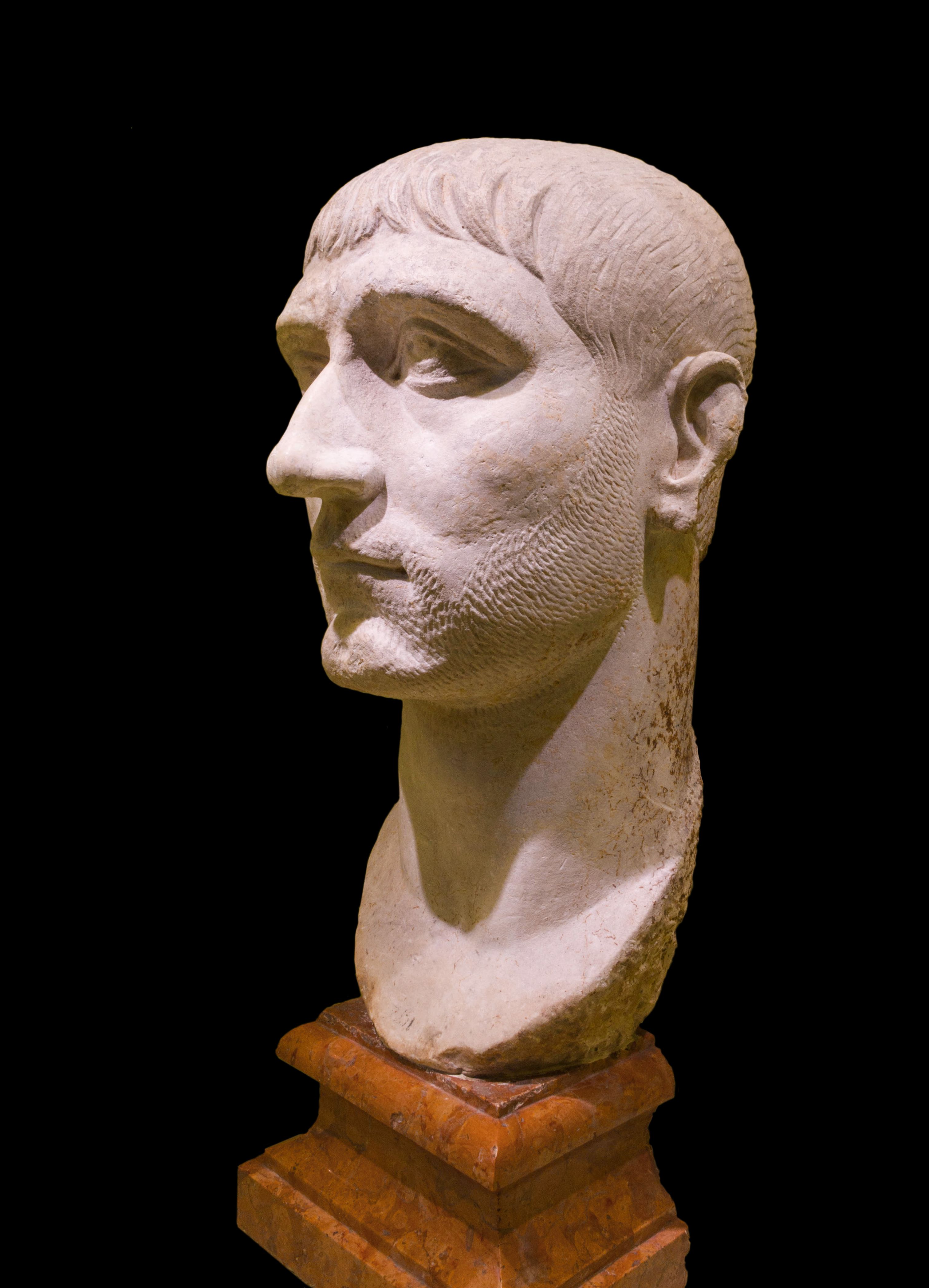
5Constantine-I-Face.jpg

defeated his rival, Maxentius (who was also his brother-in-law),

6maxentius.jpg

at a bridge outside Rome to become, in time, the sole emperor. Maxentius, who had control of Rome, had planned to block Constantine on the far side of the Tiber, keeping a pontoon bridge available for a retreat, if necessary, since it appears that the actual stone bridge was in the process of being dismantled.

(The Romans were extremely able at producing pontoon bridges—here’s a good illustration from the column of Marcus Aurelius—completed 193AD–)

When that retreat did become necessary, Maxentius was drowned in its midst, the bridge collapsed, and his troops who remained either died on the field or surrendered to Constantine.

4milvian.jpg

In time, Constantine, who believed that the empire’s main focus should actually be on the east, moved the capital to an old Greek colony, called Byzantium, but which he renamed “New Rome”—although it seems that everyone else called it Constantinople.

7constantinople.jpg

This would be the capital of the later Byzantine Empire, which, under the emperor Justinian,

8justinian.jpg

(He’s the one with the bowl of communion bread—the only labeled figure, Maximianus, was the bishop of Ravenna, where this mosaic stands in the church of San Vitale.)

would attempt to reconquer the portions of the old western empire which had fallen into the hands of Germanic invaders.

9germanicinvasions.jpg

Under Justinian’s general, Belisarius,

10belisarius.jpg

(this may or may not be a portrait—it’s a scholarly guess),

the Byzantines struggled for control of Rome against the Ostrogoths.

11ostrogoth.jpg

This struggle included a fight outside of Rome for control of the Salarian Bridge (537AD),

12salarianbridge.jpg

a fight which Belisarius lost, although, for a short time, Justinian’s world was enlarged, if not to the full size of the old empire, at least to include much of the western Mediterranean—quite an accomplishment for the later world of antiquity.

12ajustempire.jpg

And, speaking of late antiquity, if you regularly read our blog, you know that we have a special affection for the work of Hal Foster, who created the late-antique, early-medieval world of Prince Valiant. The combination of bridge and heroic fighting reminded us of one of our favorite illustrations and so we have to include this scene (published 19 June, 1938), in which Val faces a band of Viking raiders.

13valatbridge.jpg

This image, of course, brings us back to Horatius, the single warrior against the mass. As we’ve said, in the intervening centuries there are battles at bridges, but only as one element in larger campaigns and the heroic individual disappears into the ranks. We could think of one, somewhat later, figure, however. He appears, unfortunately nameless, in the other battle of the short reign of Harold Godwinson, at Stamford Bridge, 25 September, 1066. The Anglo-Saxon army raced north from London to oppose a Viking invasion, and defeated the Vikings on the near side of the bridge over the River Derwent, but, to complete their victory, the Anglo-Saxons needed to destroy the surviving force on the far side. in the way stood, in the middle of Stamford Bridge, a single Viking warrior, blocking their advance.

14stamfordbridge.jpg

The Anglo-Saxon Chronicle says that he killed 40 of the enemy before an Anglo-Saxon floated underneath the bridge and stabbed him from beneath with his spear, but, well, as much as we believe in heroic tales…

His stand, however, brings us back to Boromir and his final battle, in which he faces two waves of orcs before he is finally mortally wounded.

15boromirdeath.jpg

No bridge, but this still follows the theme of the brave man standing alone, with no possible help nearby.

16boromirhorn.jpg

(And, of course, Boromir and his horn are meant to remind any good reader of heroic material—particularly medieval—of Roland at the Pass of Roncevalles…)

17roland.jpg

We would leave this theme here, back where it began, with Boromir, except we can’t resist (we’re afraid, when it comes to adventure and heroics, that we appear to have little or no willpower at all!) one final image and the idea behind it. There is no end of discussion about Napoleon, which, we’re sure, would please him no end. For us, however, there is a side of him which is endlessly interesting and that is as a Romantic Figure—a view of himself which he worked very hard, at least early in his life, to promote. The late 18th-century very much looked back to the classical world and, we believe, it did so in part because it loved the dramatic gestures it saw as part of that world. We only have to point out paintings like David’s “The Oath of the Horatii”(those Horatii being the direct ancestor of the one in our post), with its operatic ensemble look, to illustrate this. (To us, this looks so much like the set-up for a stirring quartet, right out of Bellini or Meyerbeer.)

18horatii.jpg

So, during Bonaparte’s brilliant 1796-7 campaign in Italy, there was clearly a classical/Romantic moment. When the French were stalled by their Austrian opponents in crossing the River Adige, Napoleon, to encourage his troops, seized a regimental color and raced alone to the bridge, as Gros (who was actually at the battle) depicted him in his 1797 painting.

19grosarcola.jpg

Vernet, in his 1826 version, continues the heroic theme, but changes the focus a bit—Napoleon now has followers. (And you know, from its dash—and that’s Horace Vernet in general—who, according to Sherlock Holmes, may be a distant relation–that this is a favorite painting of ours.)

20vernetarcola.jpg

In fact, although Bonaparte did seize a color, he never made it to the bridge, either alone or in a crowd. His illustrators, however, influenced, no doubt, by the potential drama—and perhaps by a faint memory of Horatius?—depict a scene which should have happened, in their view of Napoleon as a Romantic Figure. What is most striking, however, is that, unlike Horatius—or Boromir—Bonaparte is not defending a bridge—he is attacking and his heroism comes from that gesture. This certainly fits in with Revolutionary ideology—France had been at war with much of the world since 1792—but it occurs to us that it may also suggest a shift in the approach to heroism. Horatius, given a bridge, is heroic, but passive. Give a bridge to Bonaparte and stand back (at least in iconography)! Is this the image of heroes in the Romantic world which was just coming into being?

But, as ever, we leave this to you, dear readers, to ponder, even as we thank you, as always, for reading.

MTCIDC

CD

One More River (2)

28 Wednesday Dec 2016

Posted by Ollamh in Heroes, Imaginary History, J.R.R. Tolkien, Literary History, Maps, Military History of Middle-earth, Narrative Methods

≈ 2 Comments

Tags

Amon Hen, Anduin, Bilbo, Blondin, Bombur, Boromir, Brandywine, bridges, Bruinen, Bucklebury Ferry, Celebrant, Dwarves, Elrond, Elves, Enchanted river, Esgaroth, Fangorn, ferry, flight to the ford, Frodo, Gandalf, Gondorians, Hoarwell, Hobbiton, Isen, Khazad-dum, Niagara Falls, Nimrodel, Old Forest, Old Man Willow, Orcs, Prince Valiant, Rivendell, Rivers, Rohirrim, Sam, Tharbad, The Hobbit, The Long Lake, The Lord of the Rings, Theodred, Tolkien, Tom Bombadil, Weathertop, Withywindle, Wraiths

Welcome, dear readers, as always. In our last post, we had turned our attention to water-crossings in The Hobbit. In this, we want to continue our study with The Lord of the Rings.

We were first prompted to look at such crossings by something Boromir said, almost in passing:

“Four hundred leagues I reckoned it, and it took me many months, for I lost my horse at Tharbad, at the fording of the Greyflood.” (The Fellowship of the Ring, Book 2, Chapter 8, “Farewell to Lorien”)

Tharbad had once been famous for its elaborate defenses and bridge, but, symbolic of so much of Middle-earth at the end of the Third Age, it had fallen into decay and was abandoned, the water of the Gwathlo, the Greyflood, spreading wide—an easy place to lose a horse—or a man.

And perhaps Boromir’s loss is also symbolic of the higher level of stress involved in crossing water in the later work. The most Bilbo and the dwarves had to deal with was a water of forgetfulness, whose effect wore off in a relatively short time. There is much worse to come.

The first crossing (after The Water in Hobbiton)

1hobbiton.jpg

has danger attached, but it’s a danger which pursues the hobbits at the Bucklebury ferry. Here, pursued by one—or more—wraiths,

2wraithatferry.jpg

they cross over by what is a kind of do-it-yourself ferry, where the ferry runs on a cable, which keeps it available and on course, while the passengers pole to add propulsion.

3cableferry.jpg

4ferry.jpg

There is a puzzle at their next crossing—because the hobbits don’t appear to have crossed at all! This is the River Withywindle, on whose bank the hobbits meet up with Old Man Willow (not as in the film, where he’s been pulled violently out of context and replanted, for no good reason we can see, in Fangorn’s forest).

5oldmanwillow.jpg

Until we began to study water-crossings, we had never really thought about what happens then. The hobbits come to the river, having become lost in the Old Forest. Pippin and Merry are swallowed by the tree. Tom Bombadil comes to the rescue: but how do they cross the Withywindle? We just couldn’t remember! So we went back to the text, saw Tom lead the four hobbits through the forest, where they almost lose him, then they hear: “Hop along, my little friends, up the Withywindle!” (The Fellowship of the Ring, Book 1, Chapter 6, “The Old Forest”)

And so they never actually ford across or are ferried across. Instead, they walk up its course to Tom’s house, which seems to be near the source.

6withywindlemap.jpg

The next crossing is many miles away—over the Barrow Downs, through Bree, past Weathertop, to the Last Bridge, over the Hoarwell. Although Aragorn is anxious that the Wraiths will have gotten there before them, they pass safely and keep moving southwards, towards Rivendell, until, near the ford over the Bruinen, the Nazgul catch up with them at last.

7bruinen.jpg

There is a bridge, of course, at Khazad-Dum, although, as far as we can tell, there is no water even in the depths far below it.

8khazaddum.jpg

Escaping from Moria, the Fellowship reaches two streams in a row and, as far as we know, none of the prominent illustrators has given us pictures, either of the tributary Nimrodel or the main river, the Celebrant, so we provide a rather generic picture to offer a rather general idea.

9nimrodel.jpg

10nimrodel.jpg

The Nimrodel is shallow enough to wade across, but the Celebrant is wider and deeper and the Elves provide a rather iffy method of transport: a single line of rope to balance on, making us imagine something like the famous Blondin crossing Niagara Falls in 1859—well, a little!

11blondin.jpg

The next crossing is almost inadvertent, or, at least happens sooner than expected: the Fellowship has been paddling down the Anduin, but, putting in at Amon Hen, things go disastrously wrong. Boromir tries to take the Ring, the orcs appear, Boromir is mortally wounded, and Merry and Pippin are carried off (in our edition—the 50th Anniversary, One Volume Edition—this takes all of 12 pages—quite a narrative feat for JRRT!), before Frodo (and Sam) cross the river to the east and story begins its major split.

12samandfrodo.jpg

[We might insert here, although, in The Lord of the Rings, it’s only a footnote that at the crossing of the Isen, during this time, Theodred, son of Theoden, is killed.]

12aTTTIsenFord2.jpg

After this, there is only one more crossing of any significance, but it’s not by the main characters: rather, it’s by the orcs, who use boats to assault and capture west Osgiliath, which is the subject of one of our earlier postings.

13orcsosgiliath.png

To which we would add the return crossing, days later, of the Forlorn Hope of Gondor and Rohan, on their way to challenge Sauron (and to distract him from Frodo and Sam).

14marchonmordor.jpg

To finish up this posting, we provide a chart below (clearly now one of a series, after the earlier one on doorways and passages) of the water-crossings found in the two books.

Crossing Characters Outcome Source
Tharbad Boromir Loses horse The Lord of the Rings
The Water Bilbo Joins Dwarves The Hobbit
 An unnamed river Bilbo, Dwarves, and Gandalf Lose baggage The Hobbit
Rivendell Bilbo Dwarves, and Gandalf Helped by Elves The Hobbit
Anduin Bilbo, Dwarves, and Gandalf Transported by eagles The Hobbit
Enchanted River Bilbo and Dwarves Bombur drugged The Hobbit
Underground river Bilbo and Dwarves Using barrels, Bilbo and Dwarves escape The Hobbit
The Long Lake Bilbo and Dwarves Gain help from Esgaroth The Hobbit
The Brandywine (Bucklebury Ferry) Frodo, Sam, Merry, Pippin Escape Wraith The Lord of the Rings
Withywindle Frodo, Sam, Merry, Pippin Reach Tom Bombadil’s house (never actually cross river) The Lord of the Rings
The Bruinen Frodo and Wraiths Elrond causes river surge, Nazgul driven off The Lord of the Rings
Khazad-Dum Balrog and Gandalf Gandalf defeats Balrog, but falls down with him The Lord of the Rings
Nimrodel/

Celebrant

Fellowship and Elves Fellowship brought into Lorien The Lord of the Rings
Anduin Frodo and Sam Set out on journey to the east The Lord of the Rings
Isen Rohirrim and Orcs Rohirrim driven back, Theodred, son of Theoden, killed The Lord of the Rings
Anduin Gondorians vs Orcs Gondorians driven back from West Ogsiliath The Lord of the Rings


This is our last posting for the year 2016 and we close the year with thanks to all who follow our blog or simply stop in for a visit. In 2017, we plan to continue our Tolkien travels, sometimes employing the Sortes Tolkienses, as well as to use Tolkien’s world to visit others, beginning with a posting on “Famous Bridge Battles”, from Boromir and Faramir jumping off one to escape the orcs, to Napoleon at Arcola, and beyond. Here’s a taste…

15princeval.jpg

We also plan to explore other worlds and perhaps to add a review section for books and films we think you might enjoy.

In the meantime, thanks, as ever, for reading. Happy New Year!

MTCIDC

CD

ps

What sad and surprising news! Princess Leia is no more– but no– Princess Leia will always be with us, just like the Force.

_87060782_starwarsap3

One More River (1)

21 Wednesday Dec 2016

Posted by Ollamh in Artists and Illustrators, Imaginary History, J.R.R. Tolkien, Maps, Narrative Methods

≈ Leave a comment

Tags

Alan Lee, Beorn, Bilbo, bog people, Bombur, Boromir, bridges, causeways, drowsiness, Dwarves, Esgaroth, Great East Road, Greyflood, Gwathlo, Hobbiton-across-the-water, Lethe, Middle-earth, Mirkwood, Rammas Echor, Rivendell, river-crossing puzzle, Roman Roads, Tharbad, The Atlas of Middle-Earth, The Hobbit, The Lord of the Rings, Tolkien, Tollund Man

Welcome, dear readers. Here we are again in Middle-earth, as so often we’ve been over the last couple of years, but, as we said in our last post, one reason why we revere JRRT and his work is that it’s so rich—it seems like one can open it to any page and there is something new to explore. In this post, we began with an odd little detail, just something said almost in passing by Boromir:

“A long and wearisome journey. Four hundred leagues I reckoned it, and it took me many months, for I lost my horse at Tharbad, at the fording of the Greyflood.” (The Fellowship of the Ring, Book 2, Chapter VIII, “Farewell to Lorien”)

Tharbad, we knew from the Companion, was once a river port on the Gwathlo, Boromir’s “Greyflood”. Here’s a description from the extremely helpful introductory section of the Companion called “The Maps of The Lord of the Rings”:

“…with long labour a port capable of receiving seagoing vessels had been made at Tharbad, and a fort raised there on great earthworks on both sides of the river, to guard the once famed Bridge of Tharbad” (lxv)

This “once-famed” bridge was clearly long-gone by the time, at the end of the Third Age, when Boromir reached the river it had once offered passage over, for all of the work done once upon a time, including long causeways—raised approach roads above boggy ground—here’s a Roman example from northern Spain with causeway and bridge—

1bridgewithcauseway.jpg

“But in the days of The Lord of the Rings the region had become ruinous and lapsed into its primitive state: a slow wide river running through a network of swamps, pools and eyots [little islands]: the haunt of hosts of swans and other water-birds.” (from a letter of 30 June, 1969, to Paul Bibire, quoted in Companion, 650)

JRRT appears to have left no description of the bridge itself, but we imagine it as looking rather like a Roman one (as JRRT could have seen pictures of surviving ones like this in Portugal

2ponte.jpg

or this in Rome.

3ponteadriano.JPG

Unlike much of the rest of the Roman world, no Roman bridge survives in Britain—only the remains of piers, ramps, and approaches–so we’re assuming that, if he were at all influenced by Roman architecture—and that’s an absolute assumption on our part, we admit, but certainly things like Hadrian’s Wall seem to have been an inspiration—see our earlier posting on the Rammas Echor—it was through photographs.)

This mention, however, sparked us to think about the crossing of bodies of water, both in The Hobbit and in The Lord of the Rings, just how many there were, and the kinds of events which happened at them.

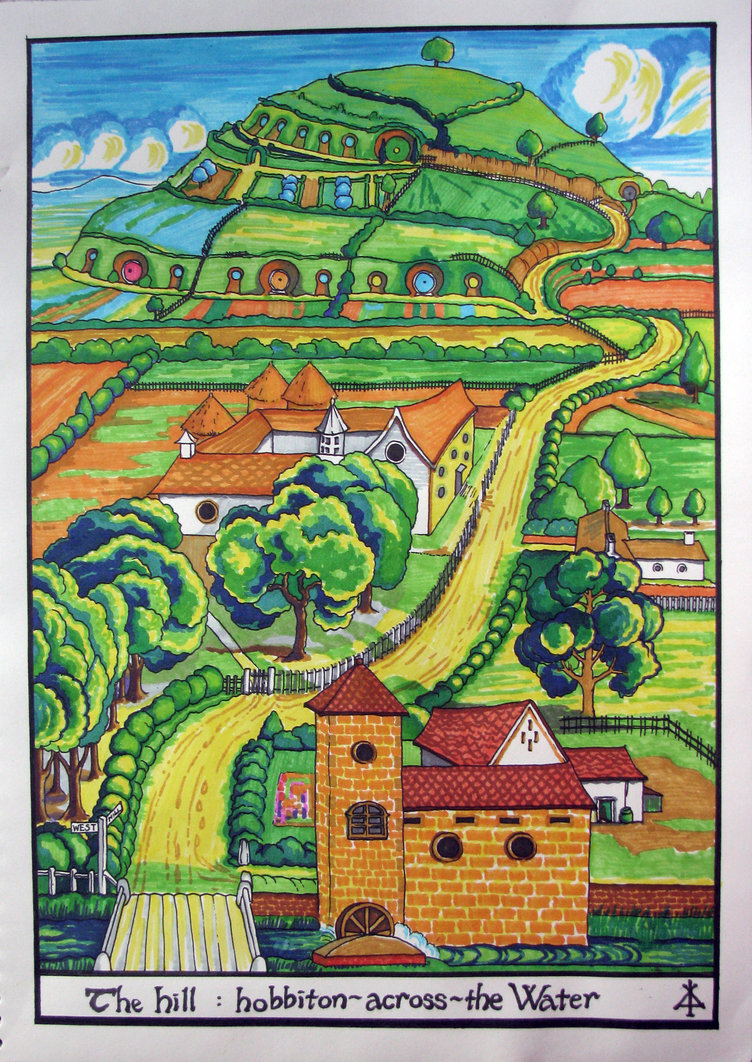
Bilbo’s Bag End, of course, is just down the road from The Water and its mill, as depicted by Tolkien himself.

4imghillandmill.jpg

When he sets off with the dwarves, however, there is little incident involved in running water at first. The party has to cross a river, “swollen with the rains, [which] came rushing down from the hills and mountains in the north.” (The Hobbit, Chapter 2, “Roast Mutton”) They cross this by “an ancient stone bridge” (perhaps like this one at Carrbridge, in Scotland?)

5imagecarbridge.jpeg

but, somehow, they can’t escape the river, as, during the night, “…one of the ponies took fright at nothing and bolted. He got into the river before they could catch him; and before they could get him out again, Fili and Kili were nearly drowned, and all the baggage that he carried was washed away off him.” (The Hobbit, Chapter 2, “Roast Mutton”). So far, when it comes to running water, for all that there was a bridge, it seems difficult for the dwarves to stay out of it.

Their second adventure with water is more successful, when they cross the bridge at Rivendell, which we have discussed in a posting on Rivendell architecture, so, for this one, we’ll simply add Tolkien’s illustration of Rivendell, plus a real favorite, Alan Lee’s of the bridge.

6imagerivendelljrrt.jpg

7imagerivendellbridgealanlee.jpg

Beyond Rivendell, it’s into the mountains (literally, when they are pulled into the world of the goblins by a secret door) and, when they come out, their next water barrier is surmounted for them when they’re rescued by eagles and flown to the other side of the northern Anduin.

8eaglerescue.jpg

If they had simply taken the Great East Road (as we presume Bilbo and Gandalf did on the way back), they would have found a ford where the road runs eastward into the Old Forest Road. (see Karen Wynn Fonstad, The Atlas of Middle-earth, 80-81, for a larger view).

9mistymtnsmap.gif

The real problem with a crossing comes at the next water course. They had plunged into Mirkwood

9ajrrtmirkwood.png

and come up across a stream (in fact, the Enchanted River, although they didn’t know it). During their leave-taking at Beorn’s, he had warned them about it:

“There is one stream there, I know, black and strong which crosses the path. That you should neither drink of, nor bathe in; for I have heard that it carries enchantment and a great drowsiness and forgetfulness.” (The Hobbit, Chapter 7, “Queer Lodgings”)

As people with a background in Greek and Roman mythology, we immediately thought of Lethe, the name of which comes from a Greek verb which means “to escape notice/be hidden—therefore, to forget”.

It was one of the rivers of the Underworld and, if you drank from it, you lost all memory of your past. In that part of classical religion which believed in reincarnation, it was one step on the way to returning to earth.

10imagelethe.jpg

Here in Mirkwood, however, the point is to avoid drinking, or even touching, it. The difficulty, of course, is that, if you can’t touch it, how do you get across it, especially when:

“There had been a bridge of wood across, but it had rotted and fallen leaving only the broken posts near the bank.” (The Hobbit, Chapter 8, “Flies and Spiders”)

Providentially, there is a boat drawn up on the opposite shore and we’ve always been reminded here of what is called a “river-crossing puzzle”. There are many variations, but the earliest currently known dates from the 9th century AD, and is found in Propositiones ad Acuendos Juvenes (maybe something like “Puzzles for Sharpening [the Minds of] Young Folk”—which makes it sound rather Victorian). We provide links here for: River crossing puzzle, Fox, goose and bag of beans puzzle, and Propositiones ad Acuendos Juvenes, for anyone interested to learn more.

11imagefoxgoose.jpg

In the case of the dwarves, the math goes awry when the largest of them, Bombur, accidentally falls into the water and becomes comatose.

12imageleebombur.jpg

(And this Alan Lee drawing oddly reminds us of “bog people”—that is, the bodies of people, the earliest being from 8000BC, a majority being Iron Age, found in peat bogs throughout northern Europe. Because of the conditions in bogs, some have been amazingly preserved, such as “Tollund Man”—here

13imagetollund.jpg

14imagetollund.jpg)

He eventually awakes, long before the party’s next river, which acts as a moat to the caves of the Elf king of Mirkwood.

15imagethranduilsgate.jpg

This has a bridge, across which, at various times, Thorin, the dwarves, and Bilbo (wearing the Ring) go.

It is the next bit of water, however, which bears the greater interest. This is the underground stream which comes up in the cave where the elves store empty wine barrels to return to the men of Esgaroth. And this, the dwarves and Bilbo don’t cross, but ride down, packed in (or perched on) those empty barrels.

16imagebarrelriding.jpg

This leads us to the last body of water: the Long Lake, on which Esgaroth stands. From here, the people of Lake Town convey them back north to a landing place from which they will start out for the Lonely Mountain and the climax of their quest.17imageesgaroth.jpg

18lonelymountain.jpg

And here we’ll end our quest for water-crossings for this posting, to be continued with one on The Lord of the Rings in our next—along with all of those extras which we can’t help adding, from medieval puzzles to peat bog people.

Thanks, as always, for reading!

MTCIDC

CD

ps

If you celebrate this time of year for any reason, may your celebration be a happy one! We mostly dream of toys…

19imagetoytownsoldiers.JPG

Bolts and Arrows

06 Wednesday Apr 2016

Posted by Ollamh in Films and Music, Heroes, J.R.R. Tolkien, Military History, Military History of Middle-earth, Narrative Methods, Uncategorized

≈ Leave a comment

Tags

Agincourt, anti-aircraft gun, ballista, Bard the Bowman, Battle of Crecy, Battle of Poitiers, Border Reivers, Boromir, crossbow, Crossbow Bunnies, English Longbowmen, harpoon, Hundred Years War, John Singer Sargent, latch, Maximus, N.C. Wyeth, Peter Jackson, Richard the Lionheart, Robert Louis Stevenson, Robin Hood, Roman d'Alexandre, Siege of Chalus, Smaug, Tangled, The Black Arrow, The Hobbit, The Lord of the Rings, The Mary Rose, Tolkien, Towton

In our review of the third Hobbit film, we questioned the use by Bard of something a little larger in the way of a missile than Tolkien had intended:

“Then Bard drew his bow-string to his ear. The dragon was circling back, flying low, and as he came the moon rose above the eastern shore and silvered his great wings.

‘Arrow!’ said the bowman. ‘Black Arrow! I have saved you to the last. You have never failed me and always I have recovered you. I had you from my father and he from of old. If ever you come from the forges of the true king under the Mountain, go now and speed well!’ ” (TH 307).

As Bard was firing this himself, we always envisioned him as an English longbowman.

englishlongbowman1330-15151.jpg

And this led us to think a bit about Tolkien’s possible sources, not only for Bard and his bow, but for that arrow–the real one, not the monster dart used in the film.

From any children’s history of England, Tolkien would have learned that longbowmen like the one shown above destroyed three brave French armies in the Hundred Years War, at Crecy (1346), Poitiers (1356), and Agincourt (1415).

hf54d67201.jpg

In the film, however, although Bard was depicted as an archer,

Bard-the-Bowman-bard-the-bowman-37670604-1920-1200.jpg

his weapon of choice looks like this.

bardwithharpoon.jpeg

This reminds us of either a Roman ballista

b0370394e429c42631f520182c155a34.jpg

or an anti-aircraft gun

strandgun01.jpg

or, most especially,  a harpoon gun.

WhaleHarpGun1.jpg

Especially when you look at this Bard’s arrow.

bard.jpg

Although we currently have no evidence for Tolkien’s sources, we can imagine that they might have included, among others, Robin Hood,

5616567327_fc899be2f1_b.jpg

the actions of actual Medieval archers like those at Agincourt or Towton (1461),

towton3.jpg

and a book, perhaps from boyhood, Robert Louis Stevenson’s The Black Arrow (1883/1888).  Stevenson (here in an 1880s portrait by John Singer Sargent)

rlsjss2.jpg

had originally published the story serially in a children’s magazine in 1883

ba1.jpg

before its publication in book form in 1888.

Blackarrowcoverscribners1888.jpg

The classic illustrations are by one of our all-time favorite illustrators, NC Wyeth, from 1917.

309642.jpg

We can’t resist showing you a few:

tumblr_l4istbR1JZ1qamjklo1_1280.jpgillus08.jpg09_blackarrow_alittlebeforedawn_wyeth.jpg

Although the bow is the weapon of choice of those who use the black arrow of the title (it’s employed for revenge), the hero  in fact, has a crossbow.

5616566731_49d251a1fc_b.jpg

The longbow requires years of training and great upper-body strength, leaving its mark on bowmen, as can be seen from this skeleton (and its reconstruction) brought up from the English warship, the Mary Rose,

sinking_3.jpg

which sank with most of its crew in 1545 and was brought up from the mud of the ocean floor in 1982.

130530121104-mary-rose-skeleton-horizontal-gallery.jpg

The crossbow is a mechanical weapon, which uses much less strength to draw

the_old_crossbow_archer_by_renum63-d8aaovo.jpg

and, in the more developed versions, even uses a crank to produce the necessary string tension.

8f106fadbe86ed34e5567bc7a90b89e2.jpg

(And, just as in the case of NC Wyeth illustrations, we can’t resist medieval manuscript illustrations. Look at this pair of crossbow… bunnies from a copy of the Roman d’ Alexandre, circa 1340.)

romandalexandrec1340.jpg

This makes it a less romantic weapon, but equally deadly:  Richard the Lionheart was killed with a bolt/quarrel (what one calls a crossbow arrow) at the siege of Chalus in 1199.

Richard1TombFntrvd.jpg

(This creates another aside–about the hand weapon used as late as the 16th century by the Border Reivers of the land between northern England and southern Scotland–called a “latch”, it was the weapon of choice for those who couldn’t afford early hand guns but wanted to fire easily from the saddle.

Reiver-on-Horse.jpg

The soldiers in Disney’s wonderful movie, Tangled, carry them–notice the off-hand side pouch with a handful of bolts  for one on Maximus’ saddle–)

maxtangled.jpg

But we would  like to conclude with one more use of that black arrow.  A flight of them kills Boromir in The Lord of the Rings.

boromirarrows1.jpg

boromirearrows.png

Just as we began by pointing to the text and the actual bow and arrow which kill Smaug, and not the harpoon of the film, so we would criticize this scene.  In our opinion, it is stretched beyond believability, as well as beyond the text, taking away something of Boromir’s valor in combat with dozens of the enemy, in which he is gradually overcome.

boromir_by_deligaris-d5po92u.jpg

This is just as true for the brief scene of Aragorn at Boromir’s death.  What was simple in the text, thus making it more moving–just Boromir’s confession and Aragorn’s comforting him–becomes a soppy scene in which Boromir swears loyalty and calls Aragorn “my brother”, a liberty Aragorn-the-king-t0-be, would hardly have welcomed.  In the theatrical world, this is called “milking the scene” and here, we think it curdled.

Thanks, as always, for reading.

MTCIDC,

CD

← Older posts

The Doubtful Sea Series Facebook Page

The Doubtful Sea Series Facebook Page

  • Ollamh

Categories

  • Artists and Illustrators
  • Economics in Middle-earth
  • Fairy Tales and Myths
  • Films and Music
  • Games
  • Heroes
  • Imaginary History
  • J.R.R. Tolkien
  • Language
  • Literary History
  • Maps
  • Medieval Russia
  • Military History
  • Military History of Middle-earth
  • Narnia
  • Narrative Methods
  • Poetry
  • Research
  • Star Wars
  • Terra Australis
  • The Rohirrim
  • Theatre and Performance
  • Tolkien
  • Uncategorized
  • Villains
  • Writing as Collaborators
Follow doubtfulsea on WordPress.com

Across the Doubtful Sea

Recent Postings

  • Through a glass… January 7, 2026
  • Heffalumps? December 31, 2025
  • We Three Kings December 24, 2025
  • A Moon disfigured December 17, 2025
  • On the Roads Again—Once More December 10, 2025
  • (Not) Crossing Bridges December 3, 2025
  • On the Road(s) Again—Again November 26, 2025
  • On the Road(s) Again November 19, 2025
  • To Bree (Part 2) November 12, 2025

Blog Statistics

  • 104,099 Views

Posting Archive

  • January 2026 (1)
  • December 2025 (5)
  • November 2025 (4)
  • October 2025 (5)
  • September 2025 (4)
  • August 2025 (4)
  • July 2025 (5)
  • June 2025 (4)
  • May 2025 (4)
  • April 2025 (5)
  • March 2025 (4)
  • February 2025 (4)
  • January 2025 (5)
  • December 2024 (4)
  • November 2024 (4)
  • October 2024 (5)
  • September 2024 (4)
  • August 2024 (4)
  • July 2024 (5)
  • June 2024 (4)
  • May 2024 (5)
  • April 2024 (4)
  • March 2024 (4)
  • February 2024 (4)
  • January 2024 (5)
  • December 2023 (4)
  • November 2023 (5)
  • October 2023 (4)
  • September 2023 (4)
  • August 2023 (5)
  • July 2023 (4)
  • June 2023 (4)
  • May 2023 (5)
  • April 2023 (4)
  • March 2023 (5)
  • February 2023 (4)
  • January 2023 (4)
  • December 2022 (4)
  • November 2022 (5)
  • October 2022 (4)
  • September 2022 (4)
  • August 2022 (5)
  • July 2022 (4)
  • June 2022 (5)
  • May 2022 (4)
  • April 2022 (4)
  • March 2022 (5)
  • February 2022 (4)
  • January 2022 (4)
  • December 2021 (5)
  • November 2021 (4)
  • October 2021 (4)
  • September 2021 (5)
  • August 2021 (4)
  • July 2021 (4)
  • June 2021 (5)
  • May 2021 (4)
  • April 2021 (4)
  • March 2021 (5)
  • February 2021 (4)
  • January 2021 (4)
  • December 2020 (5)
  • November 2020 (4)
  • October 2020 (4)
  • September 2020 (5)
  • August 2020 (4)
  • July 2020 (5)
  • June 2020 (4)
  • May 2020 (4)
  • April 2020 (5)
  • March 2020 (4)
  • February 2020 (4)
  • January 2020 (6)
  • December 2019 (4)
  • November 2019 (4)
  • October 2019 (5)
  • September 2019 (4)
  • August 2019 (4)
  • July 2019 (5)
  • June 2019 (4)
  • May 2019 (5)
  • April 2019 (4)
  • March 2019 (4)
  • February 2019 (4)
  • January 2019 (5)
  • December 2018 (4)
  • November 2018 (4)
  • October 2018 (5)
  • September 2018 (4)
  • August 2018 (5)
  • July 2018 (4)
  • June 2018 (4)
  • May 2018 (5)
  • April 2018 (4)
  • March 2018 (4)
  • February 2018 (4)
  • January 2018 (5)
  • December 2017 (4)
  • November 2017 (4)
  • October 2017 (4)
  • September 2017 (4)
  • August 2017 (5)
  • July 2017 (4)
  • June 2017 (4)
  • May 2017 (5)
  • April 2017 (4)
  • March 2017 (5)
  • February 2017 (4)
  • January 2017 (4)
  • December 2016 (4)
  • November 2016 (5)
  • October 2016 (6)
  • September 2016 (5)
  • August 2016 (5)
  • July 2016 (5)
  • June 2016 (5)
  • May 2016 (4)
  • April 2016 (4)
  • March 2016 (5)
  • February 2016 (4)
  • January 2016 (4)
  • December 2015 (5)
  • November 2015 (5)
  • October 2015 (4)
  • September 2015 (5)
  • August 2015 (4)
  • July 2015 (5)
  • June 2015 (5)
  • May 2015 (4)
  • April 2015 (3)
  • March 2015 (4)
  • February 2015 (4)
  • January 2015 (4)
  • December 2014 (5)
  • November 2014 (4)
  • October 2014 (6)
  • September 2014 (1)

Blog at WordPress.com.

  • Subscribe Subscribed
    • doubtfulsea
    • Join 78 other subscribers
    • Already have a WordPress.com account? Log in now.
    • doubtfulsea
    • Subscribe Subscribed
    • Sign up
    • Log in
    • Report this content
    • View site in Reader
    • Manage subscriptions
    • Collapse this bar
 

Loading Comments...