• About

doubtfulsea

~ adventure fantasy

Category Archives: J.R.R. Tolkien

See, the Conquering Hero?

09 Wednesday Oct 2019

Posted by Ollamh in Films and Music, Heroes, J.R.R. Tolkien, Narrative Methods

≈ Leave a comment

Tags

Battle of Culloden, Beethoven, celebrations, Crowning of Aragorn, endings, George Lucas, Haendel, Joshua, Judas Maccabaeus, oratorio, Return of the Jedi, Star Wars, The Empire Strikes Back, The Field of Cormallen, the Force, The Grey Havens, The Last Jedi, The Lord of the Rings, The Phantom Menace, The Red Book of Westmarch, The Return of the King, The Scouring of the Shire, Tolkien

Welcome, as ever, dear readers.

With Star Wars IX to appear in mid-December, completing the series, we’ve been going back through all of the previous episodes, from I (The Phantom Menace)

image1phantom.png

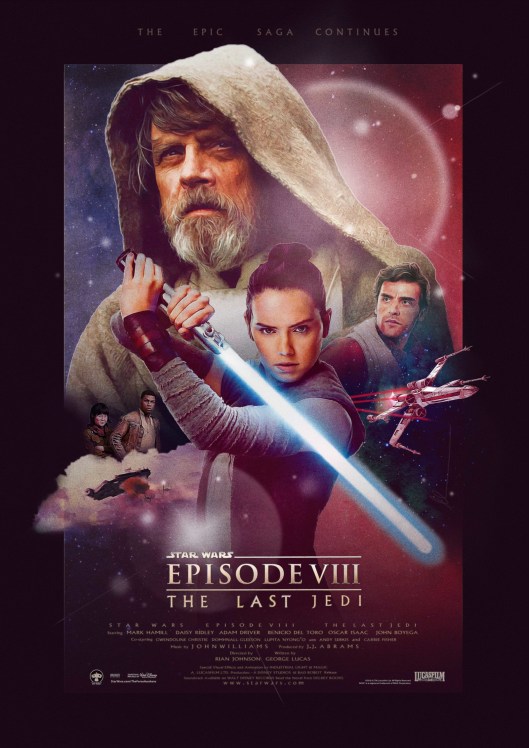
through VIII (The Last Jedi).

image2last.jpg

It’s a remarkable achievement and we’re very grateful to George Lucas,

image3gl.jpg

for bringing it so far, even if his strong sense of the story seems to have been abandoned after VI (Return of the Jedi).

Because there are now so many films (including all of the offshoots, like the animated features, as well as Rogue One and Solo), it’s sometimes hard to remember that, once upon a time, there was only Star Wars (only later A New Hope), with its triumphant conclusion—mass formations of troops, Princess Leia in an actual princess outfit, and medals all around.

image4sw1.jpg

The next film—now V (The Empire Strikes Back) had a much less secure ending, with Darth Vader and the Emperor appearing to win and Han Solo a prisoner, on his way to Jaba the Hutt,

image5ending5.jpg

but VI (The Return of the Jedi) is once more triumphant, both in its original ending, on the forest moon of Endor,

image6return.jpg

and in the later revised version, where we see galaxy-wide celebrations.
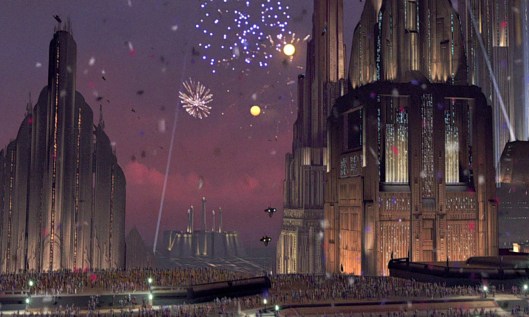
image7return.jpg

Among the other films, we’ve seen another celebration, on Naboo, at the end of I (The Phantom Menace),

image8phantom.jpg

a secret marriage in II (Attack of the Clones),
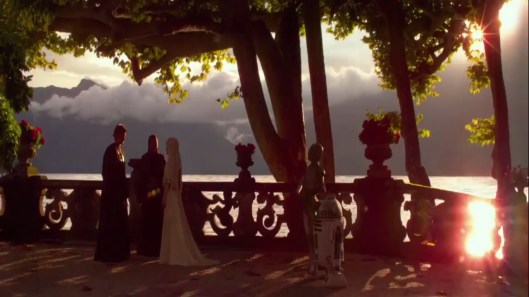
image9attack.jpg

and a complex web of plot, including the construction of the Death Star, the separation of the babies—Leia to Alderan, Luke to Tatooine—and the funeral of Padme in III (The Revenge of the Sith).
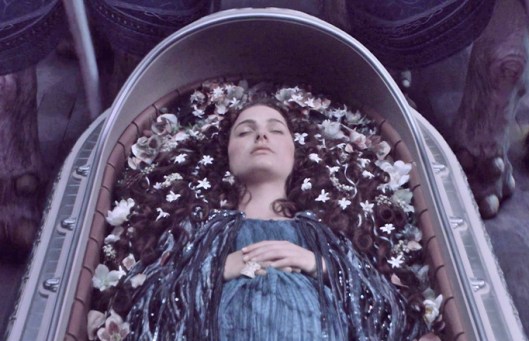
image10padme.jpg

VII (The Force Awakens) had a mysterious ending:  Rey having gone to what appears the far end of the galaxy to find—
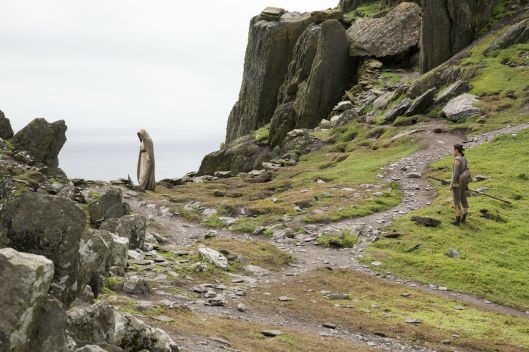
image11rey.jpg

while VIII (The Last Jedi) seemed vaguely hopeful, with an unnamed stable boy showing signs of having the Force within him, as Anakin did in I.
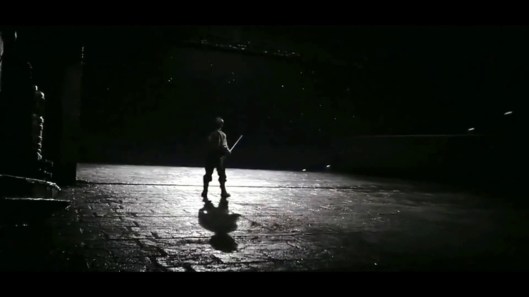
image12last.jpg

With such a build-up, we’ve been wondering how IX (The Rise of Skywalker) will end.  As it’s supposedly the final episode, we assume that it will not conclude up in the air, like V, but will it have a mass celebration, like I, IV, and VI?

Or will it, like III, have multiple endings?  As we’ve thought about it, you could really see that as the case with The Lord of the Rings.

First, like I, IV, and VI, there are celebrations:  of Frodo and Sam at the field of Cormallen, in The Return of the King, Book Six, Chapter 4, “The Field of Cormallen”.

image13afield.JPG

Then, in Chapter 5, “The Steward and the King”, we have the crowning of Aragorn
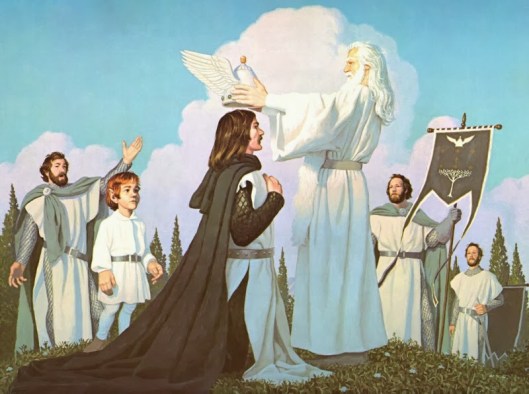
image13coronation.jpg

followed by the wedding of Arwen and Aragorn.

image14wedding.jpg

After that, we have the return of the hobbits to the Shire and the defeat and death of Saruman in Chapter 8, “The Scouring of the Shire”.  The Shire has been badly damaged by Saruman and his henchmen, however, so that, although they are gone, the healing will take many years.

image15adeath.jpg

And the story doesn’t conclude there.  Only a little time goes by and then there is another ending:  the trip to the Grey Havens and beyond in Chapter 9, “The Grey Havens”.

image16grey.jpg

And then the story finally ends—or does it?  We’ve seen in Star Wars VIII, when the stable boy seems to use the Force, though only for a moment,

image12last

the implication that perhaps the title, The Last Jedi, is more of a puzzle than it would first appear.  The very last line of The Lord of the Rings, spoken by Sam, is “Well, I’m back…”  and it’s true, as far as Sam won’t go off on another adventure.  Before this, however, Frodo has been busy writing:

“There was a big book with plain red leather covers; its tall pages were now almost filled.  At the beginning there were many leaves covered with Bilbo’s thin wavering hand, but most of it was written in Frodo’s firm flowing script.  It was divided into chapters but Chapter 80 was unfinished, and after that were some blank leaves…

‘Why, you have nearly finished it, Mr. Frodo!’ Sam exclaimed.  ‘Well, you have kept at it, I must say.’

‘I have quite finished, Sam,’ said Frodo.  ‘The last pages are for you.’”

But what does this imply?  We have no idea what Sam may have added, but the volume Frodo gave him was the origin of The Red Book of Westmarch, the basis not only for The Lord of the Rings, but for The Hobbit, as well.  Are we being told that writing about adventure is an adventure in itself, and almost as important?
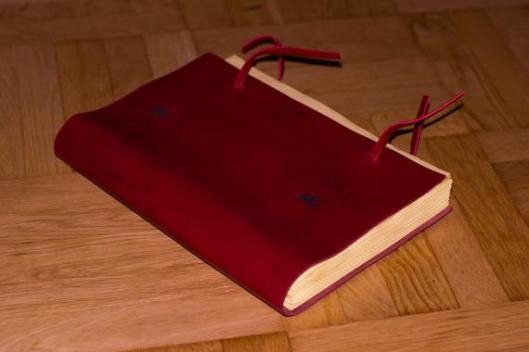
image17redbook.jpg

Thanks, as always, for reading.

MTCIDC, of course!

CD

ps

When we think of music in triumphs, the first piece which pops into our minds (after the Gungan march, of course) was one written by Haendel (1685-1759), “See, the Conquering Hero Comes”.

image18gfh


It was originally intended for his oratorio, Joshua (1747), but it fit his earlier piece, Judas Maccabaeus (1746) so well that he transferred it to the score of that oratorio.  Judas Maccabaeus was composed as a tribute to the second son of George II of England, William Augustus, the Duke of Cumberland,
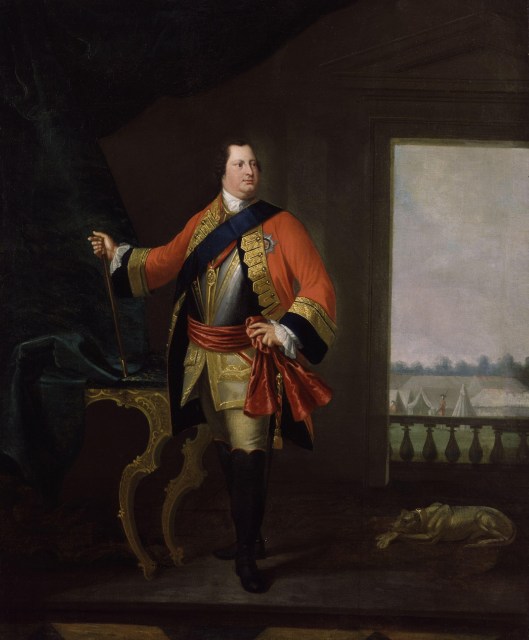
 

image19duke

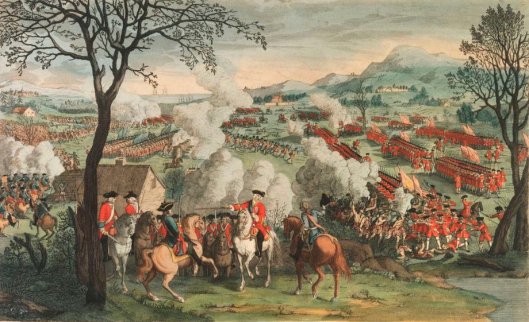
after he had decisively beaten the attempt to overthrow his father and replace him with the son of the former monarch, James II, at the battle of Culloden.

image20cull.jpg

Here’s a LINK to a stirring performance.

In 1796, the young Beethoven (1770-1827)
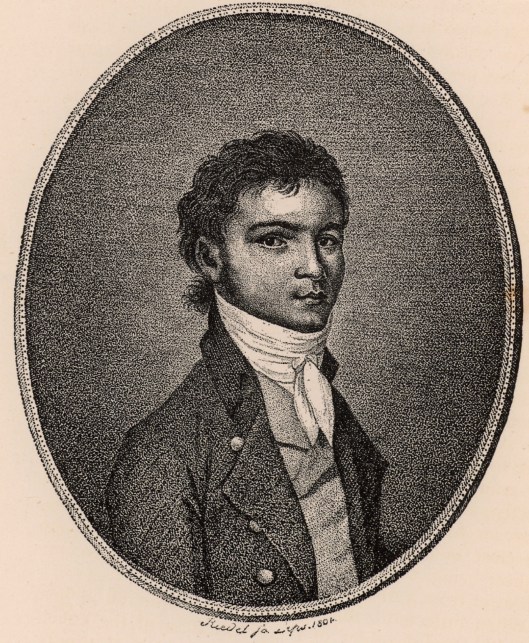
image21bvn.jpg

wrote a series of 12 variations on the theme for cello and fortepiano.  It’s a lot of fun to hear what Beethoven can do with Haendel’s tune, so we give you a LINK here.
Terrible as an Army with Banners

25 Wednesday Sep 2019

Posted by Ollamh in J.R.R. Tolkien, Military History, Military History of Middle-earth, The Rohirrim

≈ Leave a comment

Tags

banner, Captain Souter, color, Dol Amroth, ensign, Eye of Sauron, First Afghan War, flag, George Washington, Revolutionary War, Rohirrim, saltire, standard, The Lord of the Rings, The Song of Solomon, Tolkien, Trooping of the Colour, White Hand of Saruman, white horse of Hannover, White Tree of Gondor, WWI, WWII

Welcome, dear readers, as ever.

Our title comes from the Hebrew Bible, in the book entitled The Song of Solomon, Chapter 6, verses 4 and 10, where the speaker’s beloved’s beauty is likened to an army with banners.  Growing up, we always wondered about that word “terrible”.  We didn’t see why someone’s good looks could be frightening, but we could certainly see how an army with its flags could be scary.

image1ahussars


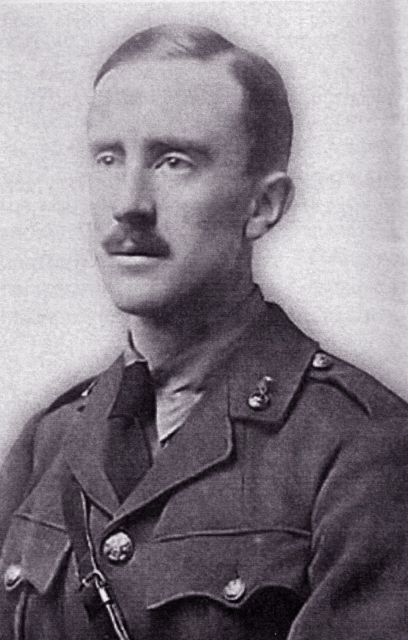
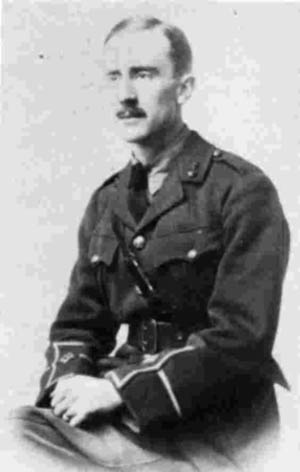
On the subject of banners, recently, we’ve been writing about 2nd Lieutenant JRR Tolkien.

image1jrrtlt.jpg

In an earlier posting, in fact, we mentioned that that rank of 2nd Lieutenant was a replacement for the earlier rank of “ensign”.  “Lieutenant” is just the English version of a French compound for “place-holder” (lieu + tenant), in this case meaning the person who will step into the captain’s shoes if necessary.  Instead of a compound with its implication of replacement, “ensign” is actually a job description.  An “ensign” is a flag (a “color”, if infantry, “standard”, if cavalry) and an “ensign” is also the person who carried it.

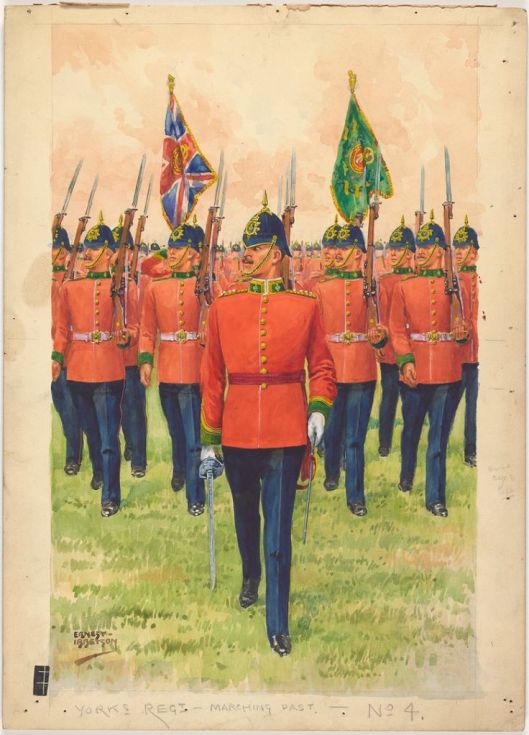
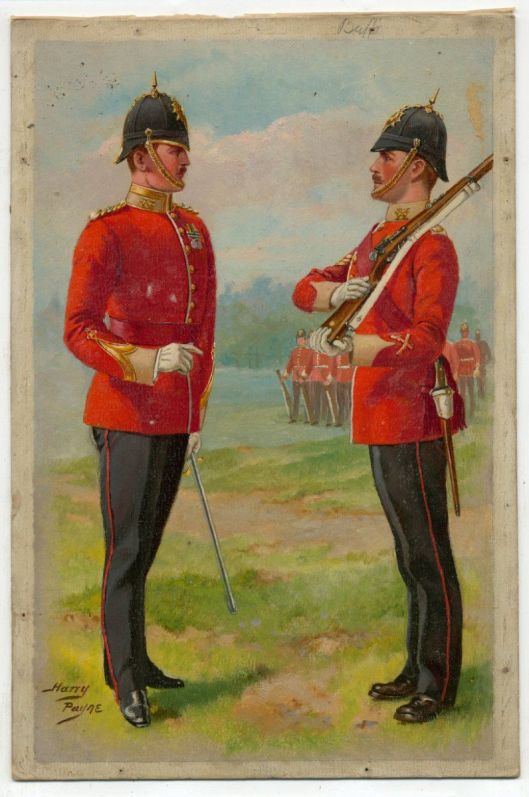
By 1916, when Tolkien became a 2nd Lieutenant, colors were no longer carried in battle, but only on parade, as this early-20th-century illustration demonstrates—

image2parade.jpg

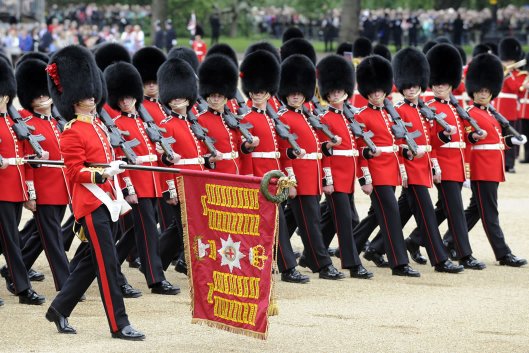
and is still the case for the famous “Trooping of the Colour” for the Queen of England’s birthday parade, where her splendid footguards march with one of their colo(u)rs.

image3trooping.jpg

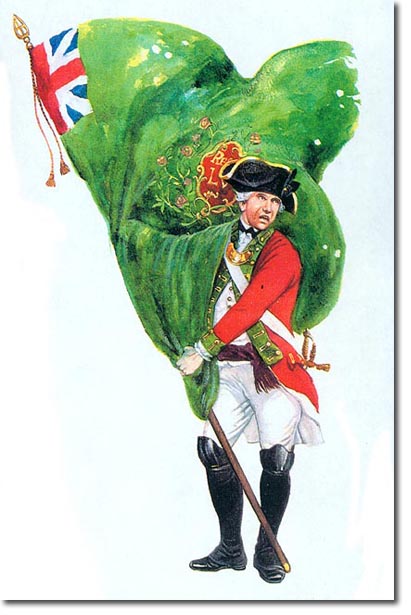
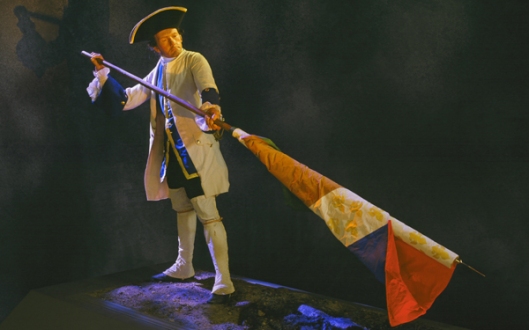
This is clearly all about show, now, but, once upon a time, colors—and their ensigns—had an important role in warfare.  Earlier colors were much bigger—in the 18th century, they were 6 feet by 6 feet square (1.82 metres by 1.82).

image4color.jpg

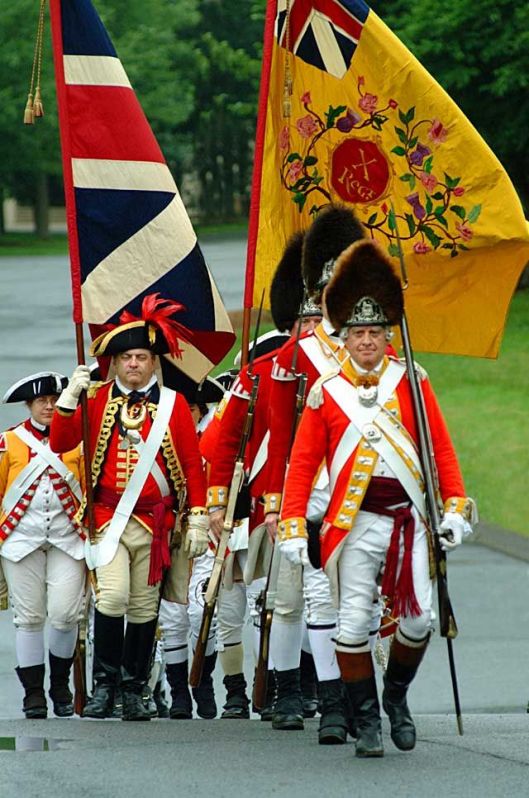
And here are some modern reenactors to help you to see just how big that really is.

image5color.jpg

The reasons for such a size (on a 9-foot pole, or “pike”—that’s 2.74m) are:

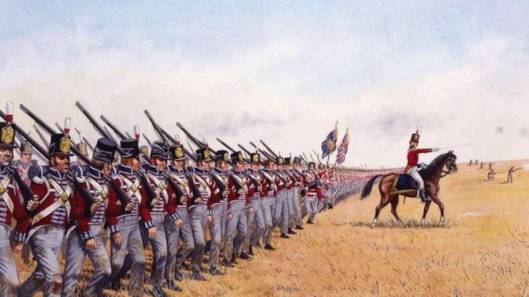
  1. units in earlier times (pre-late-19th-century, more or less) fought in long lines and, if you put the colors in the middle, everyone in a unit had a kind of fixed point to help them know where they—and their unit—were

image6nap.jpg

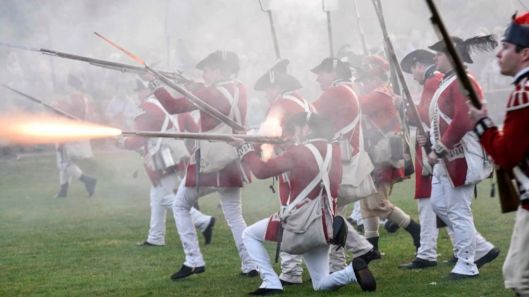
  1. as well, earlier firearms, which used black powder, put out enormous clouds of (white) smoke—

image7smoke.jpg

image8smoke.jpg

If colors were big and tall, they could still be made out in the midst of those clouds.

image9oconnor.jpg

They could also act as a rallying point.  When lines came apart and the order was Charge!  (Or when things were falling apart and the call was for Retreat!)

image10rally.jpg

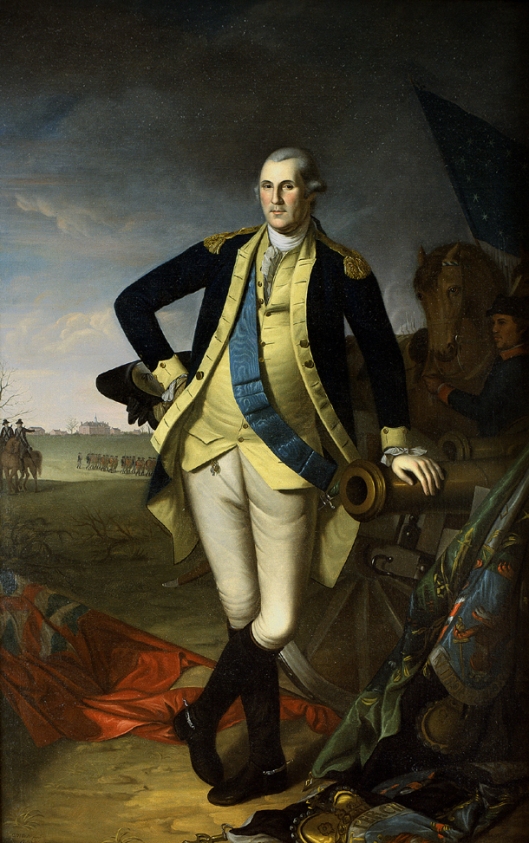
In time, colors came to be thought of as almost the physical representative of the spirit of a unit and being called upon to surrender them was looked upon as the worst disgrace.  This portrait of George Washington would have been thought particularly nasty by his British and German enemies because all around him are their colors, captured in two battles, Trenton and Princeton.  (His own headquarters flag—13 stars in a circle on a blue background—is in the upper right of the picture.)

image11gw.jpg

To escape surrendering their colors, soldiers would strip them from the poles/pikes and hide them in their clothes or, in real desperation, burn them, as the French did in 1760 when forced to surrender to the British at Montreal, in Canada (then New France).

image12burning.jpg

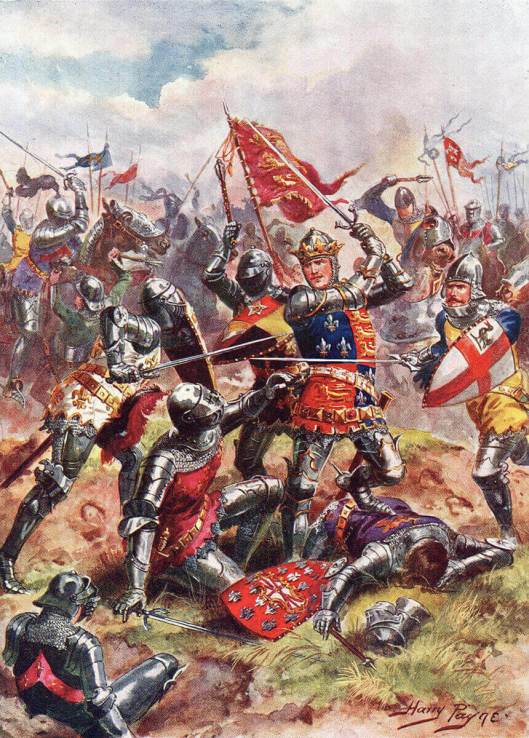
In earlier centuries, before gunpowder came to dominate battlefields, colors were already used as rallying points,

image13rally.jpg

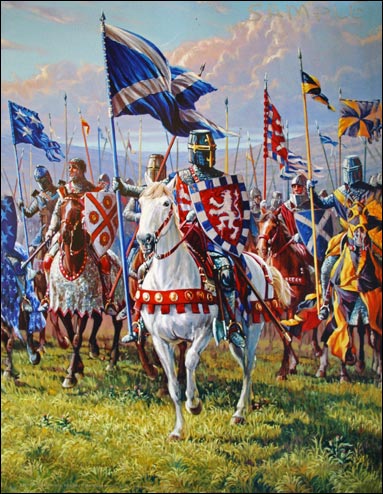
but also, in the days before uniforms, colors—big or little—indicated who was fighting.  If you saw a figure bearing a flag with a white, angled cross (a “saltire” in heraldic terms) on a blue field (background), for example, you knew that the King of Scotland was on the battlefield.

image14bruce.jpg

Thus, although 2nd Lieutenant Tolkien would no longer carry one of his unit’s colors into battle, as previous ensigns had, he would have known the importance of their role—and especially of the role of what they carried, which is why, for example, we see that, when it comes to battle in Middie-earth, nearly everyone seems to have a distinctive flag:

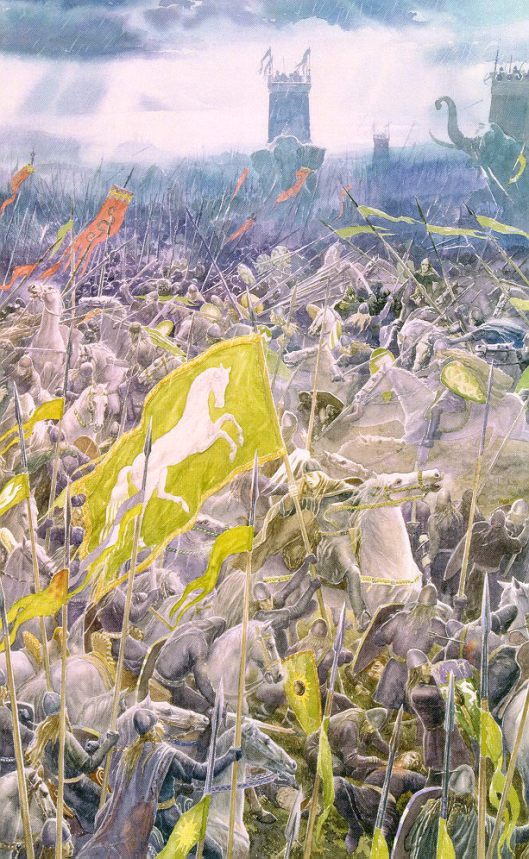
  1. the Rohirrim have their running horse

image15ro.jpg

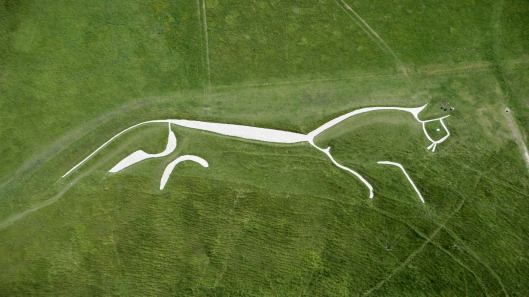
(which we think JRRT may have borrowed either from the chalk cutting known as the “White Horse of Uffington”

image16uff.jpg

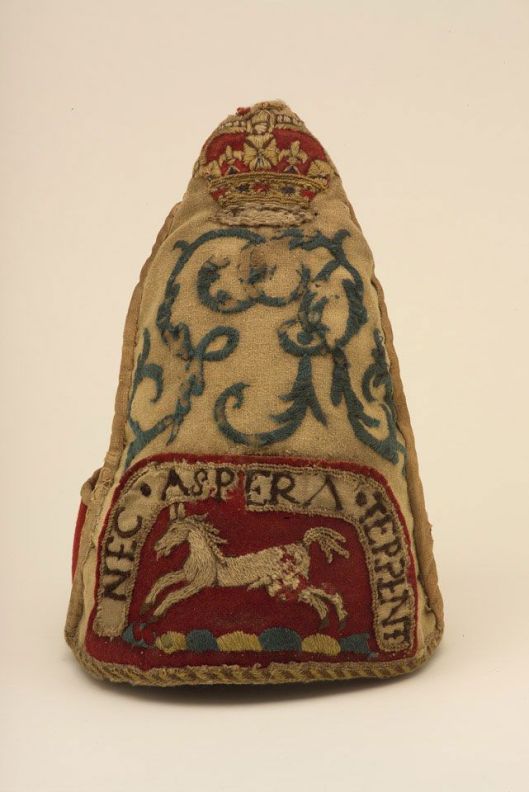
or possibly from an emblem long-related to the British monarchy, the white horse of Hannover—as we can see on this 18th-century grenadier cap).

image17gren.jpg

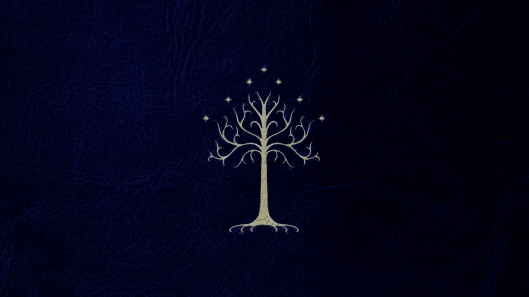
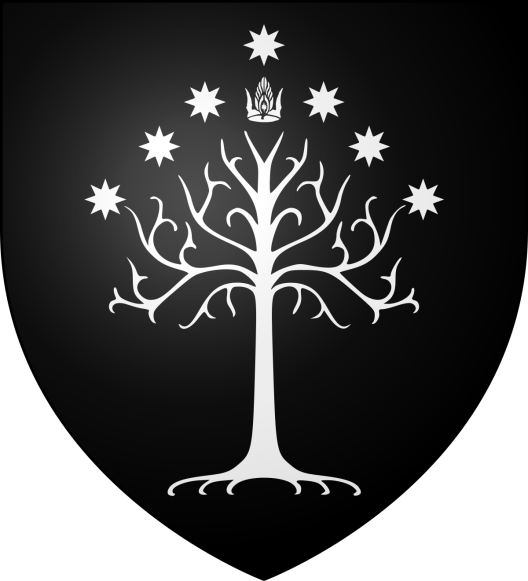
  1. Gondor has its tree and stars

image18gon.jpg

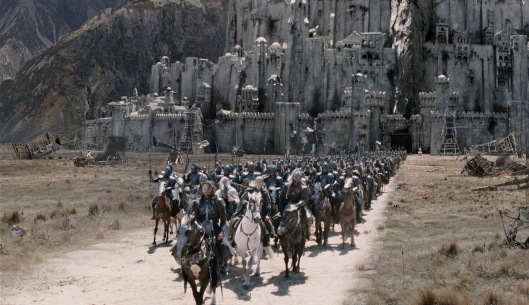
  1. and, when Aragorn marches out of Minas Tirith,


image19ara

it’s under his version of that banner–

image20a.png

which also boldly states his claim to be the rightful king—without actually coming out and saying it—compare the two banners–

  1. and the Prince of Dol Amroth has his flag, with “his token of the Ship and the Silver Swan” (The Return of the King, Book Five, Chapter 1, “Minas Tirith”).

image21dol.png

As for their opponents, we see Saruman’s white hand on armor,

image22arm.jpg

so we can presume, we think, that any banners carried would bear the same insignia and the same is true for Sauron’s orcs, which would have borne the lidless eye.

image23orc.gif

(We might also note that Southrons in the service of Mordor appear to carry red banners—as Gollum reports to Frodo and Sam in The Two Towers, Book Four, Chapter 3, “The Black Gate is Closed”.)

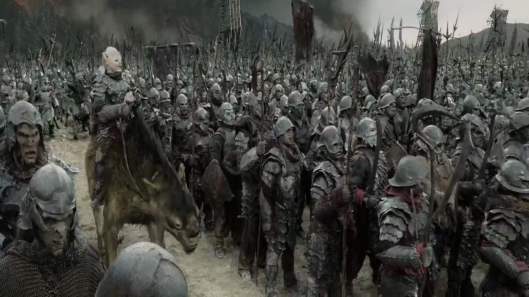
All of which made us wonder if Solomon would have been so eager to describe his beloved as he did if the army he saw looked like this?

image24orcs.png


As ever, thanks for reading and

MTCIDC


CD


ps

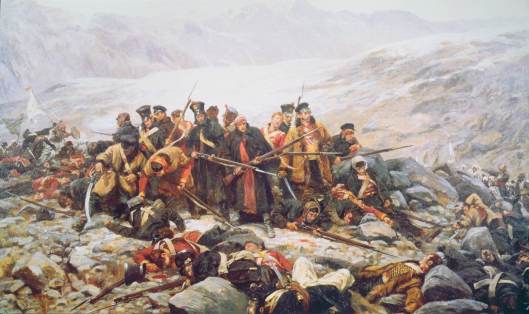
In an odd but fortunate use of a color, in 1842, during the First Afghan War, a Captain Souter was saved because he had hidden one of his regiment’s colors by wrapping it around his waist.  As the last members of his unit fell around him, his Afghan opponents saw what they believed to be a fancy waistcoat/vest and took him prisoner, hoping for a rich ransom.

image26gandamak.jpg

Shadowy

11 Wednesday Sep 2019

Posted by Ollamh in Fairy Tales and Myths, J.R.R. Tolkien, Literary History

≈ Leave a comment

Tags

A Child's Garden of Verses, Adelbert von Chamisso, Andrew Lang, Ausgabe des Fortunatus, Charles Perrault, Fortunatus' fortune-bag, Histoires ou Contes du Temps Passe, J.M. Barrie, Le Petit Poucet, Lord Dunsany, Peter Pan, Peter Schlemihl, Peter Schlemihls Wundersame Geschichte, Robert Louis Stevenson, seven-league boots, Shadow, Siglo de Oro, Sortes Tolkienses, The Charwoman's Shadow, The Grey Fairy Book, The Lord of the Rings, Tolkien

Welcome, dear readers, as always.

We were practicing our sortes tolkienses (one way of finding a topic—by simply slipping a finger into The Lord of the Rings and opening it at that page—it’s not 100% useful, but sometimes…) and came upon the title of Chapter 2 of Book One of The Fellowship of the Ring:  “The Shadow of the Past”.

In the context of the chapter, we see that that shadow is cast by the history of the Ring itself and also by its maker, Sauron.  That, in turn, set us off on thinking about literary shadows…

In 1885, Robert Louis Stevenson (1850-1894)

image1rls.jpg

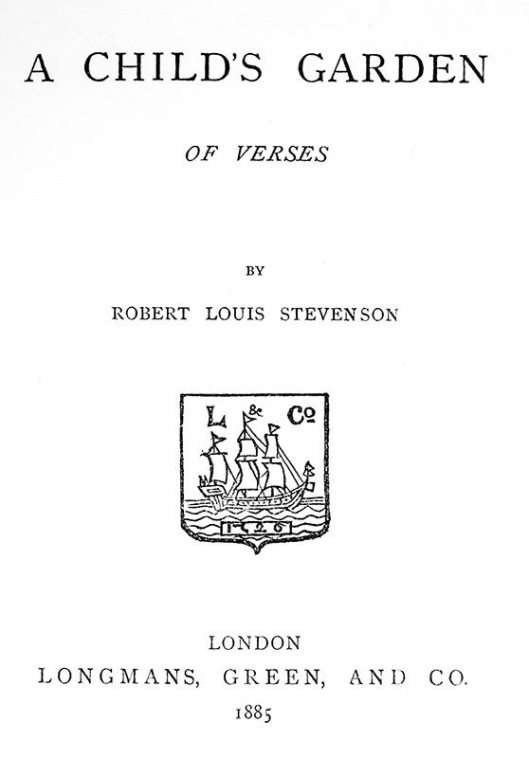
published a collection of poems.

image2achilds.jpg

Poem #19 (if you count the dedication, which is, in fact, a poem) begins:

“I have a little shadow that goes in and out with me,

And what can be the use of him is more than I can see.”

[If you would like your own copy of this volume, follow this LINK.]

In fact, in literature, its use is both visible—and invisible.

In psychology, the shadow is metaphorical, being used to symbolize an unconscious part of the personality.  [For more on this, see this LINK.]

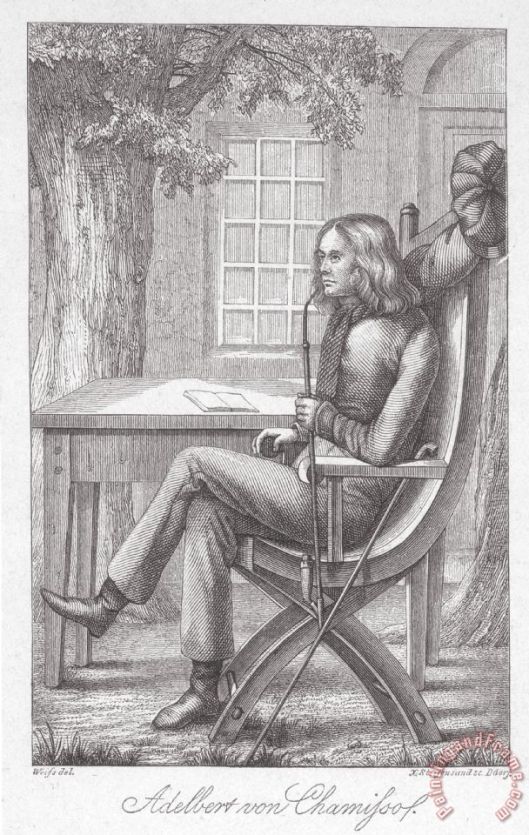
And, visibly—but also invisibly—the shadow as physical object can represent something more, as we find in perhaps the first modern literary use of the shadow in Adelbert von Chamisso’s (1781-1838)

image3avonc.jpg

novella (a short novel), Peter Schlemihls Wundersame Geschichte (1814), “Peter Schlemihl’s Amazing Story”.

image4ps.jpg

Here’s the first English translation, from 1824.

image5firsteng.jpg

In the story, the protagonist, Peter Schlemihl, meets a strange man, who can pull anything out of his pocket—and we mean anything.  As Schlemihl reports:

“If my mind was confused, nay terrified, with these proceedings, how was I overpowered when the next-breathed wish brought from his pocket three riding horses.  I tell you, three great and noble steeds, with saddles and appurtenances!  Imagine for a moment, I pray you, three saddled horses from the same pocket which had before produced a pocket-book, a telescope, an ornamented carpet twenty paces long and ten broad, a pleasure-tent of the same size, with bars and iron-work!”

(This is from the 3rd edition (1861) of that first English translation.)

Impressed, Schlemihl is quickly persuaded to make a trade.  The strange man offers him a magic purse, which he calls “Fortunatus’ fortune-bag”.  This object is based on an old story which seems to appear for the first time in 1509 as Ausgabe des Fortunatus (the “Edition/Issue of Fortunatus”?), in which Fortunatus (as you’ll probably guess, the name means “Lucky”) has both a wishing cap and this bag.  Here’s the title page of that first edition.

image6fort


[If you would like to read one version of the Fortunatus story, here is a link to it from Andrew Lang’s The Grey Fairy Book (1900).]

The purse will always produce ten gold coins when one puts a hand inside, guaranteeing a steady means of wealth for the owner.  In return for this, Schlemihl hands over–his shadow.

image7ps.jpg

This seems an odd trade, but having a magic bag which acts as an endless bank account is certainly no less strange.  Not to be too literal-minded, but beyond the idea that a shadow is a tradable item, it makes us wonder, however:  what could a shadow be made of that it can be removed and collected?

At the beginning of Peter Pan (1904), Peter has lost his shadow and Wendy reattaches it by sewing it on, as if it were simply mobile black cloth and perhaps this is how we might think about it as a physical object, at least for shadow stories.

image8asewing.jpg

Although he is pleased with the money, Schlemihl soon realizes the real price he has paid:  when people see that he has no shadow, they avoid him in anything from disgust to horror, which ruins his ability to live anywhere and even to marry the girl he wishes.  The shadow, then, is more than cloth:  it is part of a person’s identity.  If you cast no shadow, you are not quite human.  The real price of the shadow is even higher, however, as Schlemihl learns when the strange man (who is obviously Satan in human form) returns to offer a second bargain:  the Devil will return his shadow in return for his soul.

It’s clear that here Schlemihl has learned his lesson, refusing this offer several times and finally throwing away the “fortune-bag”.  Although he may believe that he is done with magic, magic is not yet done with him, however.  With some of the few coins remaining to him, by accident (or so it seems), he buys a pair of seven-league boots.  (A “league”, classically, is about three miles, so, when he puts them on, each step he takes is at least twenty-one miles.)

image8seven


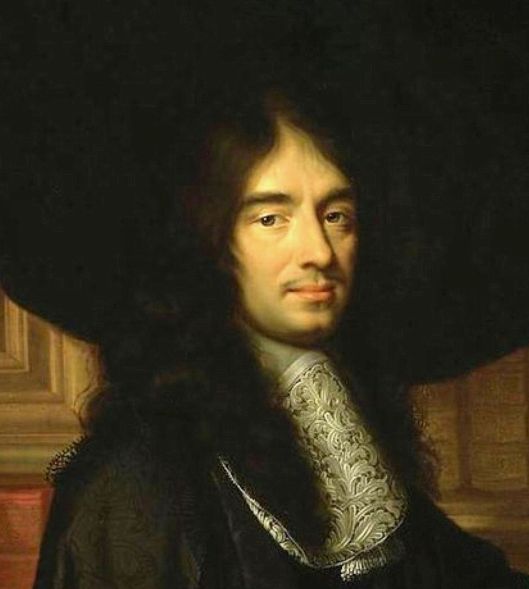
This element of the story, in turn, is also based on something in another older story, which appears in Charles Perrault’s (1628-1703)

image9perrault.jpg

1697 collection, Histoires ou Contes du Temps Passe,

image10histoires.jpg

“Le Petit Poucet” (maybe “Thumblet”?).  In this story, a character steals a pair of these boots from a pursuing ogre, allowing the thief to cover great distances with every stride.

[If you’d like to read this story, here’s a LINK from a 1901 translation.]

With these boots, Schlemihl never regains his shadow, but eventually gains a peaceful existence studying the natural world (which, in fact, von Chamisso did, as well, becoming a well-known naturalist later in life).

[Here’s a LINK to a translation of the story by Michael Haldane.]

More than a century later, the early modern fantasy writer, Lord Dunsany (1878-1957)

image11ld.jpg

reused the idea of buying or trading shadows in his 1926 novel, The Charwoman’s Shadow.

image12char.jpg

A charwoman, or, simply, “char” (“char” is the same as “chore”, meaning “a task”), in the UK means a kind of cleaning woman.

image13chars.jpg

When it comes to fantasies, the idea that this may be about the shadow not of a princess, or at least a lady in distress, but of an ordinary cleaning lady, is immediately intriguing, but the charwoman isn’t really the main character.  That’s Ramon, the son of an impoverished Spanish nobleman.

To earn money for his sister’s dowry, as well as to find a profession, Ramon apprentices himself to a wizard who deals, among other things, in shadows.  As payment for his learning, Ramon uses his shadow—but, just like Peter Schlemihl before him, quickly comes to regret it.  The charwoman works in the wizard’s house and, as Ramon slowly learns spells, he also learns her story and what has happened to her since she traded away her shadow long before.

In a moment of chivalry (the story takes place in Spain in what’s called the Siglo de Oro, the “Golden Century”—the early 16th to the later 17th centuries–when wealth from the New World made Spain a world power, as well as a leader in the arts), Ramon promises to rescue the Charwoman’s shadow for her.  In the house of a wizard, you can imagine that this won’t be easy, but, eventually, and through ingenuity, he does so, only to discover that—but you should really read the story for yourself.

[Unfortunately, as this book was published in 1926, it’s still under copyright here in the US, so we can’t offer our usual LINK, but we can offer you Peter and Wendy (1911), the novel version of Barrie’s 1904 play—LINK.]

In contrast to shadows which can be traded or lost, what’s interesting to us about Sauron’s shadow is that it’s no more than a suggestion of the appearance of its owner, who, although he casts that shadow over all of Middle-earth, never appears physically in the novel.  The Nazgul—shadowy figures themselves—represent him, but Sauron himself is never more than a shadow and, in fact, when he is eventually destroyed, it’s his shadow we see broken and swept away:

“And as the Captains gazed south to the Land of Mordor, it seemed to them that, black against the pall of cloud, there rose a huge shape of shadow, impenetrable, lightning-crowned, filling all the sky.  Enormous it reared above the world, and stretched out towards them a vast threatening hand, terrible but impotent:  for even as it leaned over them, a great wind took it, and it was all blown away, and passed; and then a hush fell.”  (The Return of the King, Book Six, Chapter 4, “The Field of Cormallen”)

That “little shadow”, then, certainly has more uses than the child in Stevenson’s poem will ever see.

Thanks, as ever, for reading.

MTCIDC

CD

Helm (2)

04 Wednesday Sep 2019

Posted by Ollamh in Films and Music, J.R.R. Tolkien, Military History, Military History of Middle-earth, The Rohirrim

≈ Leave a comment

Tags

Alan Lee, Anglo-Saxon, Bayeux Tapestry, Christian Schwager, Dernhelm, Eowyn, Frank Frazetta, great helm, Great War, helmets, Howard Pyle, John Howe, kettle helm, King Arthur, spangenhelm, Tolkien, vikings, WWI

As ever, dear readers, welcome.

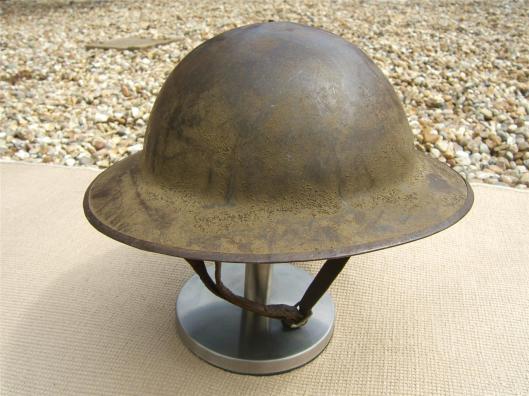
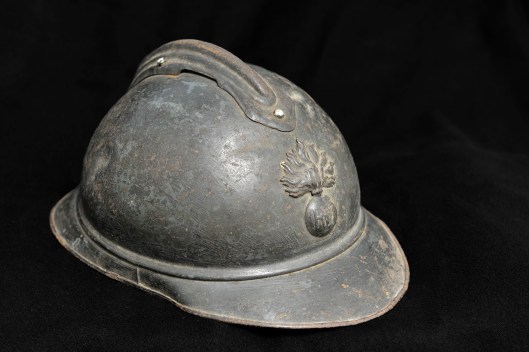
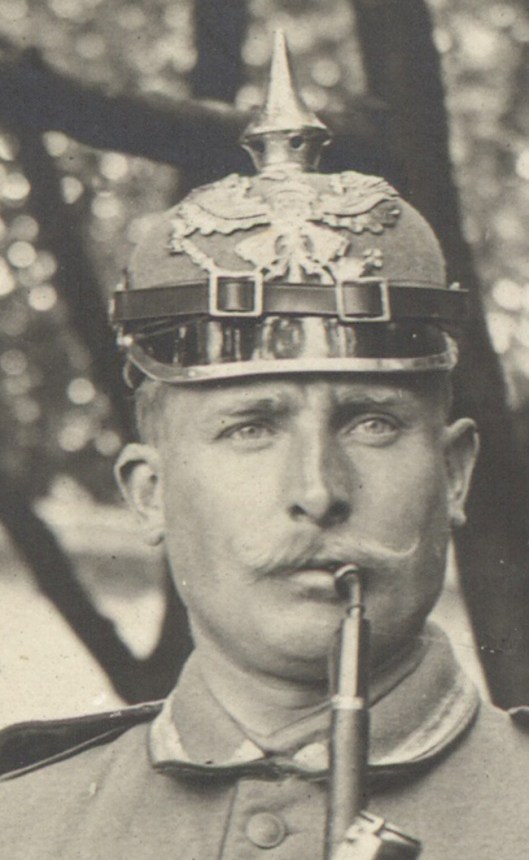
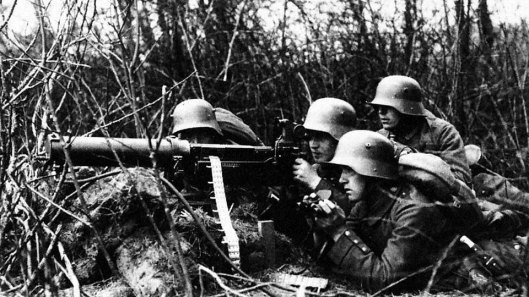
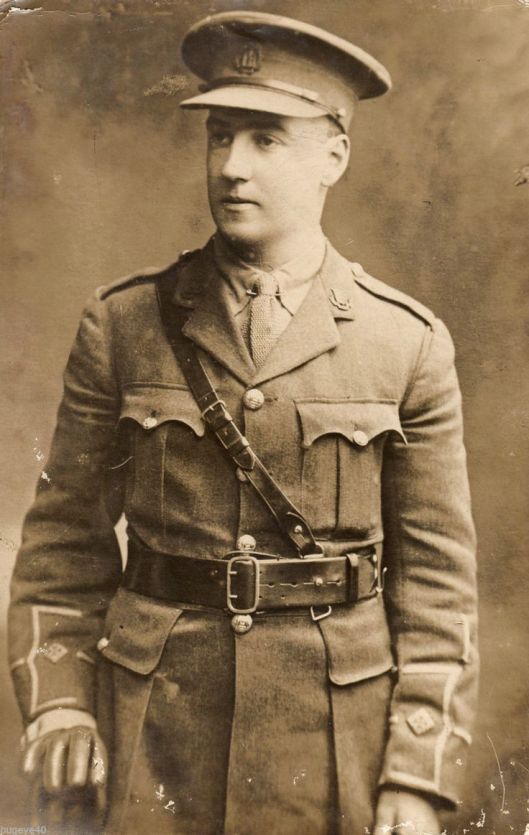
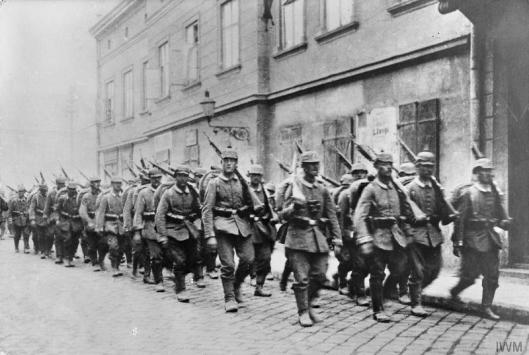
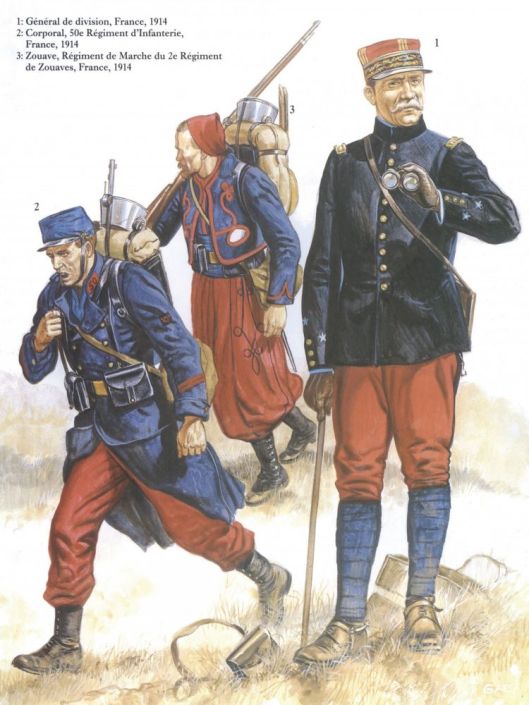
In our last, we focused upon the helmets worn by Tolkien and other European and US soldiers in the Great War, the French

image1adrian.jpg

the German,

image2coal.jpg

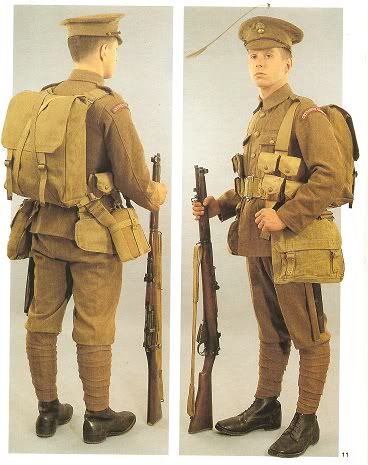
and the British (US troops eventually settled on the British pattern).

image3english.jpg

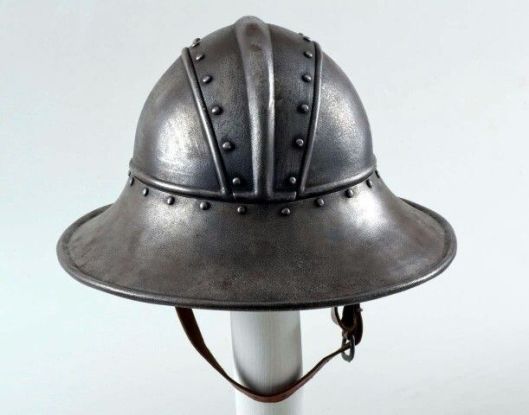
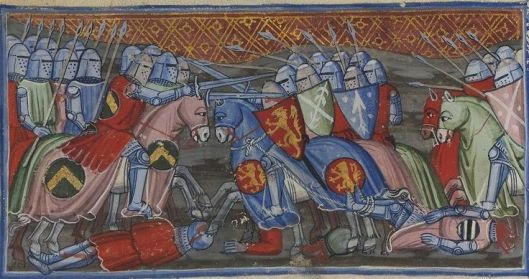
The British helmet, we said, has produced the common comment that it looks like it was inspired by the medieval “kettle helm” (the second image being from the 13th-century Maciejowski Bible—but these helmets were clearly so practical that they continued to be used well beyond that time).

image4kettle.jpg

image5kettle.jpg

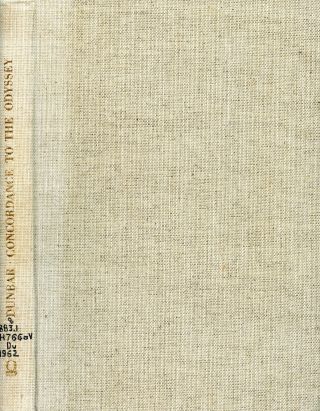
“inspired by medieval” is the way we commonly see JRRT’s Middle-earth, and it made us wonder about the kinds of helmets we would meet in The Lord of the Rings.  Unfortunately, if there were a concordance (that is, a book dedicated to listing all the times various words are used within a text, like this concordance for Homer’s Odyssey)

image6concordance.jpg

for Tolkien’s work, we are betting that perhaps the only word we would find there would be “helm”, which is generic, unless one adds “great”, which produces a more specific kind of head protection, looking like these, in use from the late 12th to the mid-14th centuries—

image7greathelm.jpg

image8ghelm.jpg

With only “helm” to go on, what clues might help us better to visualize what warriors are wearing?

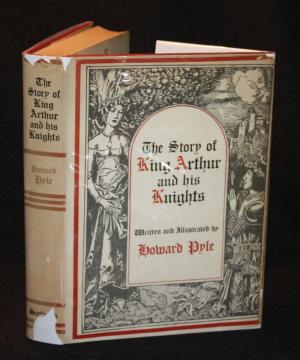
We’ve suggested before that one possible visual resource for JRRT’s images of medieval warfare was the work of the American illustrator, Howard Pyle (1853-1911), in books like The Story of King Arthur and His Knights (1903), which Tolkien could have read as a boy.

image9pyle.jpg

And here’s a well-known illustration—with a knight in a great helm, in fact.

image10pyle.jpg

But what did Pyle use for models?

In Pyle’s time, the collection and classification of armor was still at its very beginnings (the Metropolitan Museum of Art in New York only instituted an Arms and Armor Department in 1912, for example).  We can only assume, then, that he thought “knights = medieval” and so any armor might do.  (If Arthur were real—there’s been argument about this for many years—he would have lived centuries before the medieval period and so would have had neither knights nor the military equipment of later days anyway.  As myth, Arthur can live at any time, of course.  We think of Hal Foster’s Prince Valiant, where, at one moment, we’re facing Huns and, at the next moment, Vikings.)

If Pyle were one of JRRT’s sources, then, “helm” can easily stand for any kind of protective headgear made of metal and vaguely medieval.  We think that there is more to be said on this, however, and we’ll go into a bit more detail about helmets in The Lord of the Rings in the third part of this little series, but, for now, we want to concentrate on one helmet in particular.

Normally, one thinks of helmets as protection, but, in the novel, we see one also used as a disguise, as Eowyn becomes “Dernhelm” (Old English dirne, “hidden/secret” + helm “head covering/helmet”, so, something like “a helm which hides”?).

What kind of helmet, we asked ourselves, would Eowyn be wearing which would:

  1. keep her identity hidden
  2. blend in with the helmets of other Rohirrim?

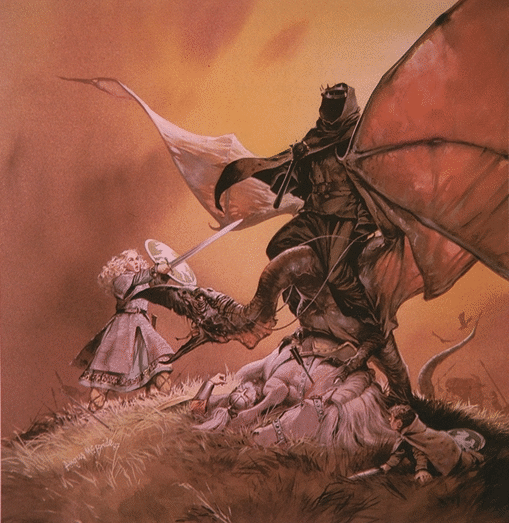
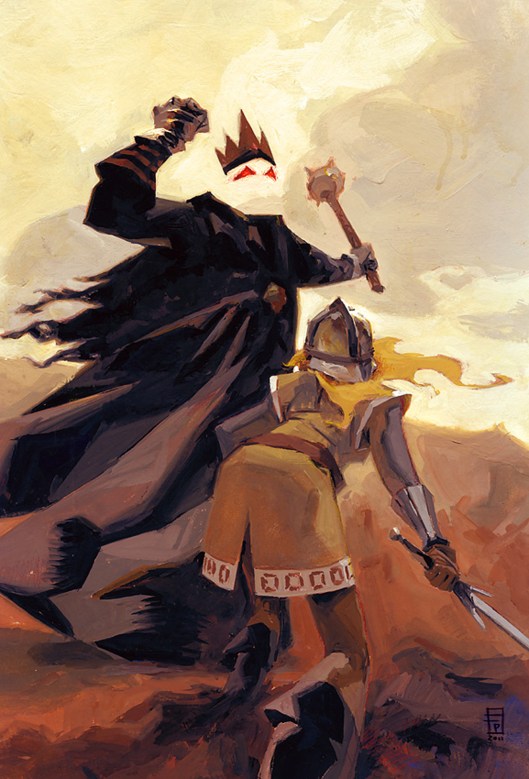
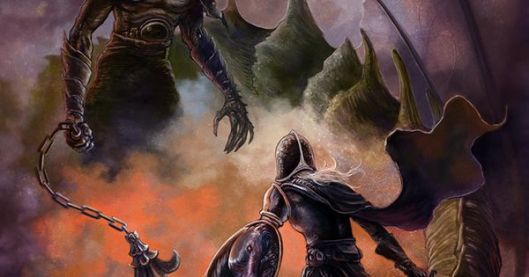
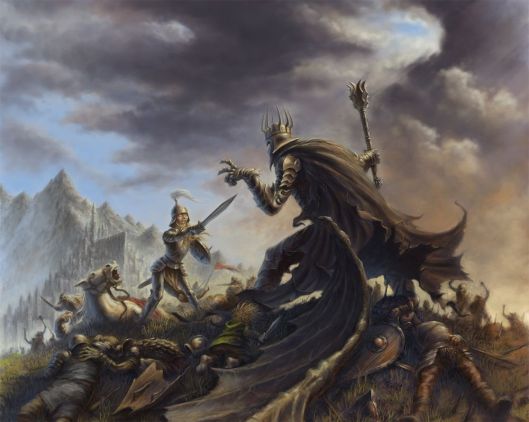
We began by looking at modern illustrations of Eowyn but, unfortunately, a cursory survey shows us that almost all modern illustrators appear to have chosen the same scene:  the moment when Eowyn has removed her helmet when facing the Witch King.

image11eowyn.gif

So far, we’ve found only a few artists who capture the previous moment:

  1. whose name so far has eluded us, but who shows a rear view of something which looks rather like a French Great War helmet.

image12helm.jpg

image13rear.jpg

  1. the second, another anonymous (to us), again shows Eowyn from behind, but with a style of helmet which appears to owe more to fantasy than to any medieval reality—

image14eo.jpg

and perhaps a little something to Monty Python and the Holy Grail.

image15monty.jpg

  1. the third is Christian Schwager, based in New Zealand.

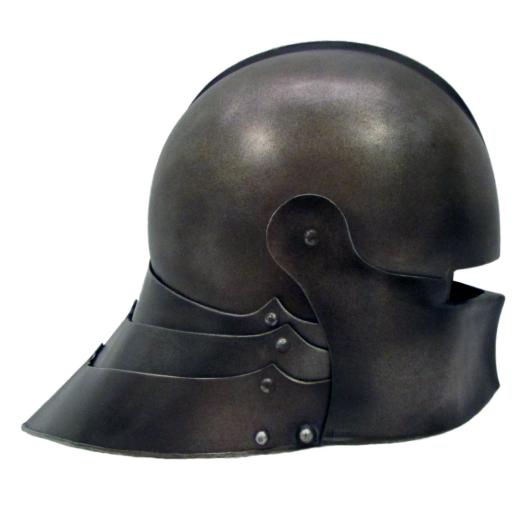
image16schwager.jpg Her armor is full plate, which, in our world, is later medieval.  As for the helmet, it somewhat resembles a visored sallet, but only vaguely.

image17sallet.jpg

And that plume and its placement strike us as problematic, at best.

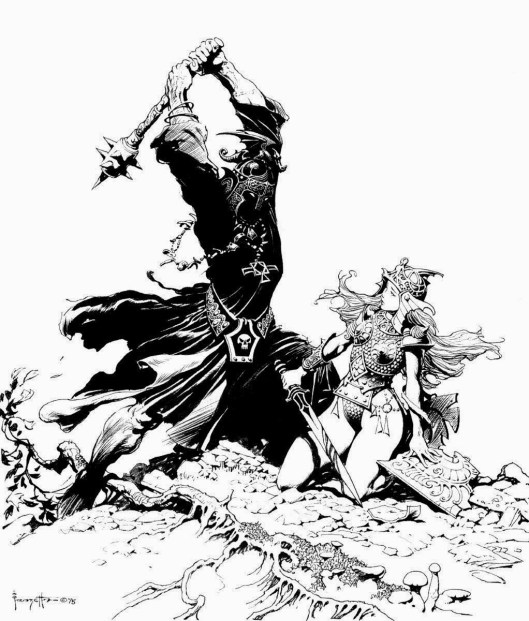
  1. the last is the well-known fantasy illustrator, Frank Frazetta, and although we enjoy some of his work, this illustration suggests to us that the artist doesn’t appear to have taken the scene–or Eowyn– seriously—or practically.

image18fraz.jpg

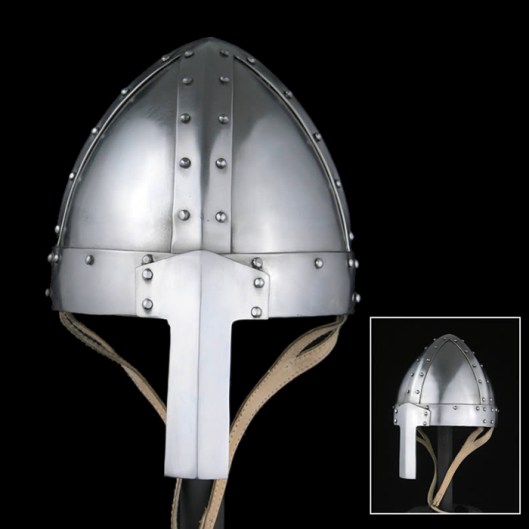
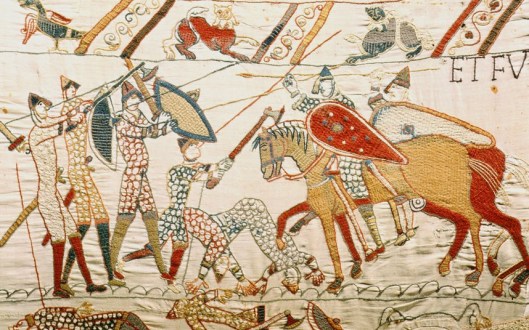
As we wrote in a post some time ago, the basis of the Rohirrim is Anglo-Saxon, men who wore long mail shirts and conical spangenhelm,

image19spangen.jpg

making them look very much like dismounted versions of their Norman opponents, both being shown in the following panel from the Bayeux Tapestry.

image20bayeux.jpg

A characteristic feature of the spangenhelm is that nasal—the bar which comes down to protect the wearer’s nose.

image21spang.jpg

Potentially, this and the helmet’s brim might shade the eyes and make the face less visible.

image22


So, with the need for disguise and blending-in being crucial, and only “helm” to go on in the text, we asked ourselves what did the two artists who acted as inspiration for Jackson’s films, Alan Lee and John Howe, choose to do? Here’s a picture of the battlefield confrontation by Lee—

image23lee


Eowyn is, as in the case  of other illustrators, here depicted as having removed her helmet, and, even under magnification, it’s difficult to make much out.  Howe, however, has given us a very detailed picture.

image24howe.jpg

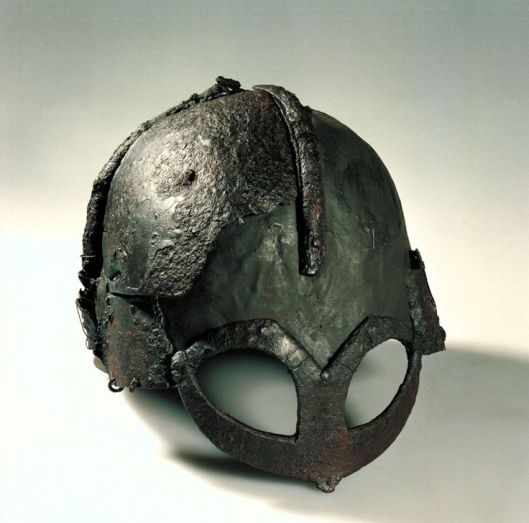
It’s clear, however, that, in choosing to emphasize the dirne in “Dernhelm”, he’s stepped away from the world of knights entirely and into a slightly older world, that of the Vikings, as his helmet more closely resembles the so-called “spectacle helmets”, of which a few examples survive from Viking burials, like this, reconstructed from a discovery at Gjermundbu, in Norway.  (For a very useful view of Viking helmets in general, follow this LINK.)

image25spec.jpg

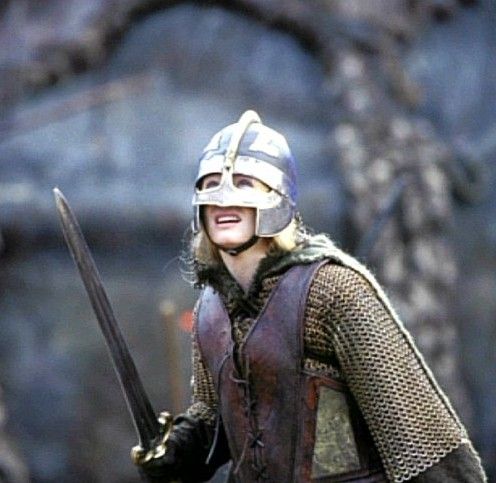
In turn, Jackson’s designers have followed Lee—

image26eo.jpg

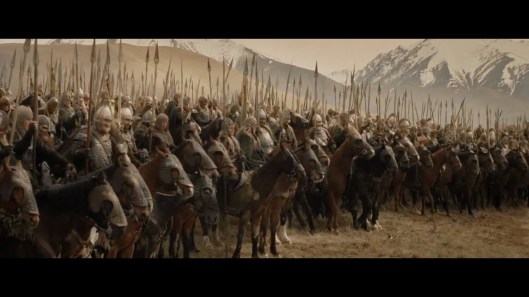
This certainly gives us the “hidden/secret” part of “Dernhelm”, but what about the idea of blending in?  Looking at a group shot of Rohirrim, we find a little surprise.

image27ro.jpg

Instead of looking like Anglo-Saxons, as depicted on the Bayeux Tapestry, Jackson’s Rohirrim look more like Vikings—and so Eowyn’s helmet blends right in (in fact, in this picture, you can see at least one other warrior with a spectacled helmet), almost as if her helmet and its secrecy requirement have been the basis for all of the warriors of Rohan.

There are lots of other helmets to pursue, however, which we’ll do in our next, so, with thanks to you, dear readers, for reading this, we’ll say

MTCIDC,

CD

Helm (but not deep)

28 Wednesday Aug 2019

Posted by Ollamh in J.R.R. Tolkien, Military History

≈ Leave a comment

Tags

British, Constantinople, French, Great War, Helmet, Julius Caesar, kepi, Medieval, Neo-Assyrians, pickelhalben, Plevna, Port Arthur, Prussians, Sebastien Le Prestre de Vauban, sieges, Tolkien, uniforms, WWI

Welcome once more, dear readers.

In our last, we talked about Tolkien as a very junior officer in 1916-17.

image1jrrt.jpg

We discussed much of the detail of his kit, including this very important item, first introduced to the British army on the Western Front in 1916.

image2brodie.jpg

The war had begun in 1914, however, and the British soldiers of 1914

image3dubfus.jpg

although they had shed their red coats for anything but parades,

image4redcoats.jpg

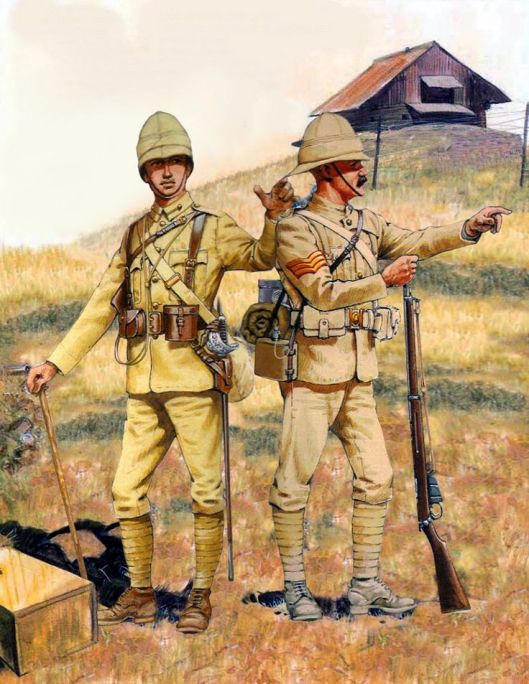
having learned in many colonial wars that khaki was more practical on campaign,

image5khaki.jpg

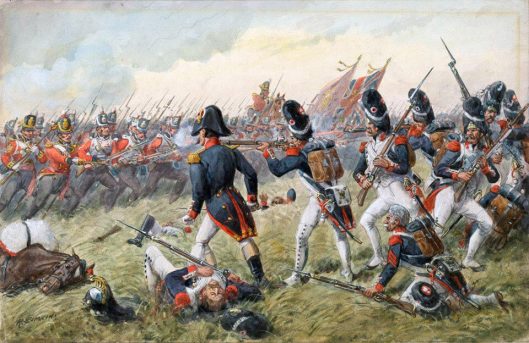
were still, at heart, ready for the kind of open-battlefield fighting which their ancestors had practiced at Waterloo, a century before.

image6waterloo.jpg

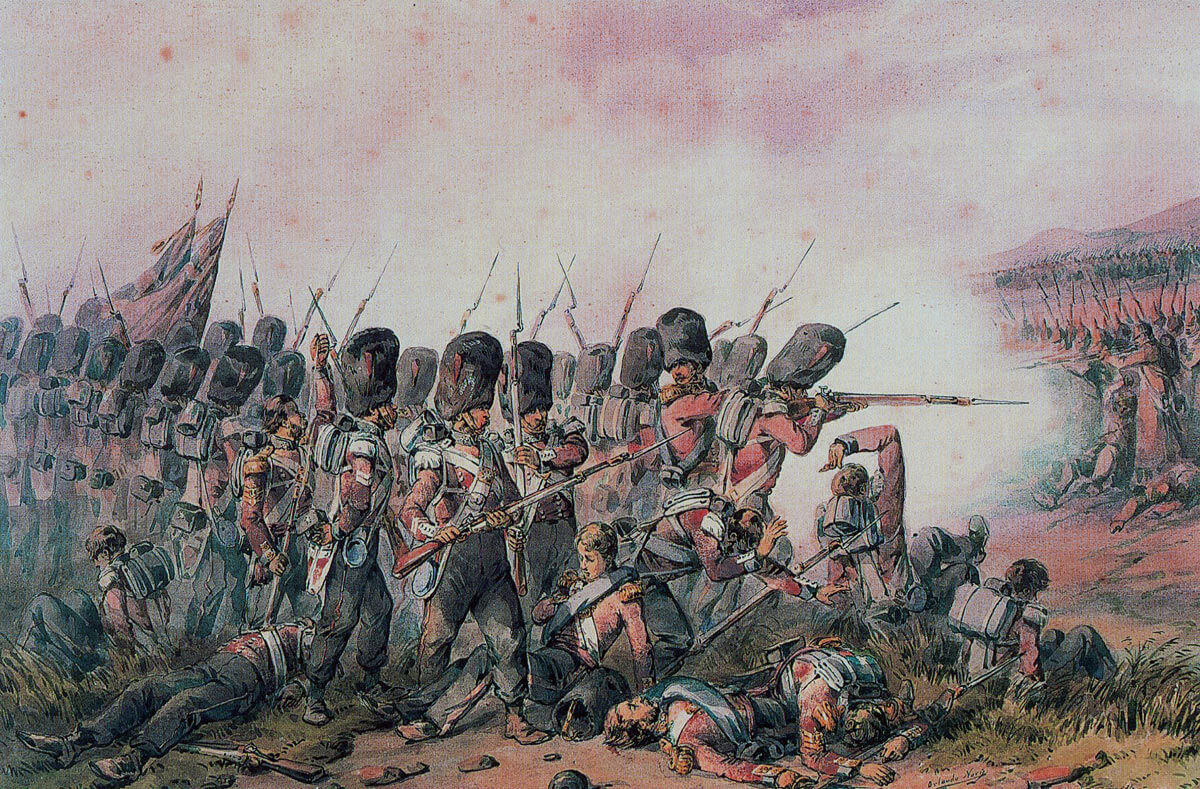
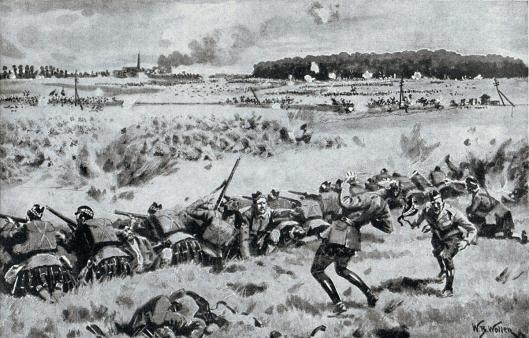
Infantry might not fight in long solid lines any longer,

Battle of The Alma

image7mons.jpg

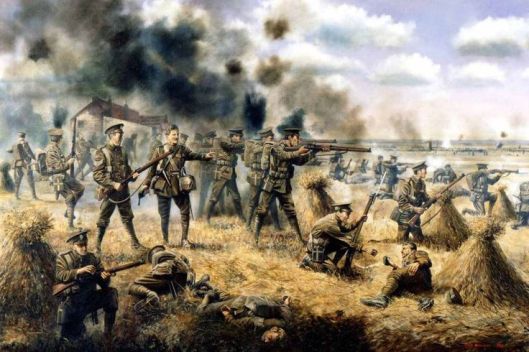
And might even seize upon temporary cover,

image8mons.jpg

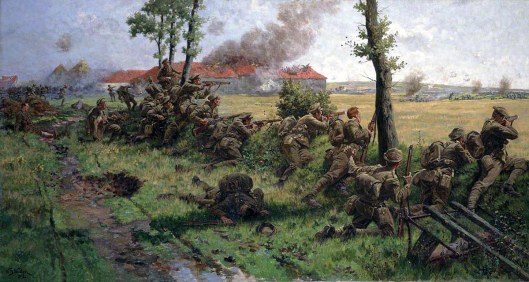
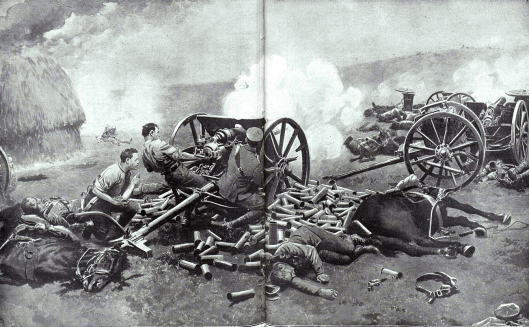
but battle would still be a sort of stand-up affair with artillery in support

image9arty.png

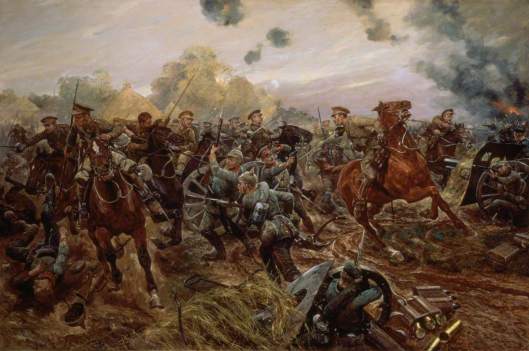
and cavalry ready to charge even enemy artillery,

image10cav.jpg


just as they had at Balaclava, 60 years before.

image11bala.jpg


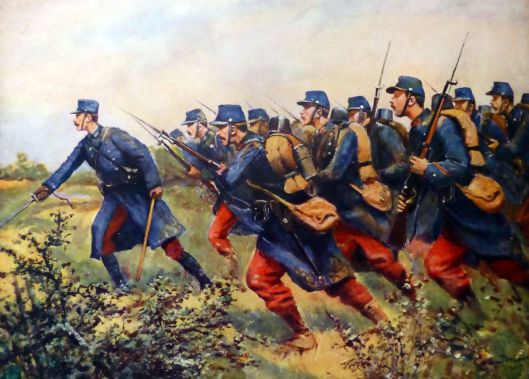
The British were not alone in imagining modern war as being like this.  Across the Channel, the French were still wearing the same red trousers they had first put on in the 1830s, while discussing attacks made solely with the bayonet.

image12french.jpg

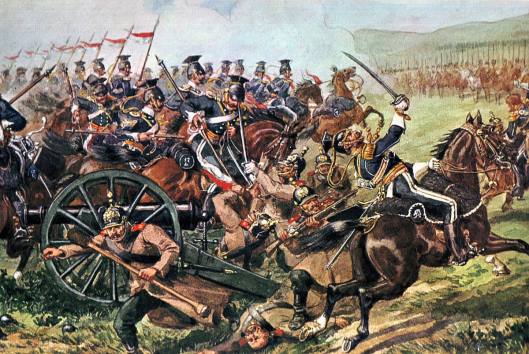
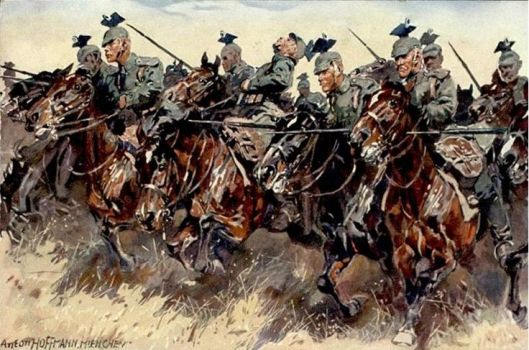
And the Germans, although more sensibly dressed in grey, could still see themselves as pounding across the battlefield like medieval knights, lances lowered.

image13uhlans.jpg

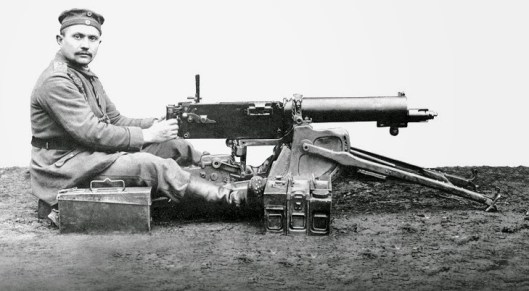
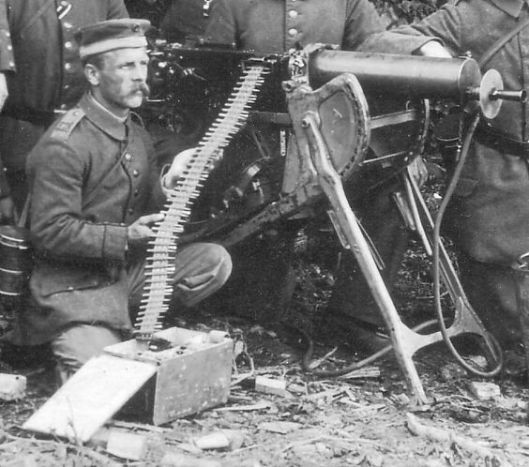
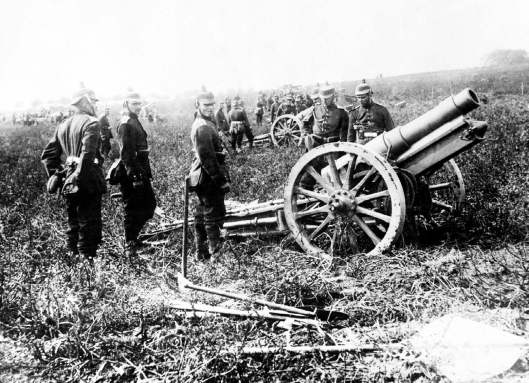
Unfortunately for such dreams, weapons technology in 1914 had far outstripped fashion and tradition, with machine guns having firing rates of as much as 600 rounds per minute

image14maxim.jpg

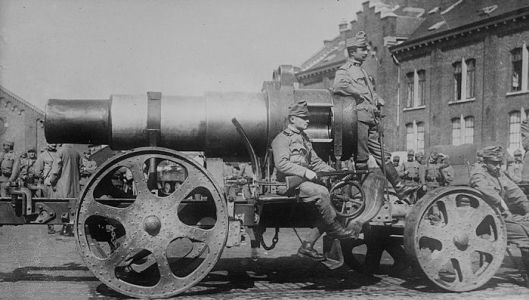
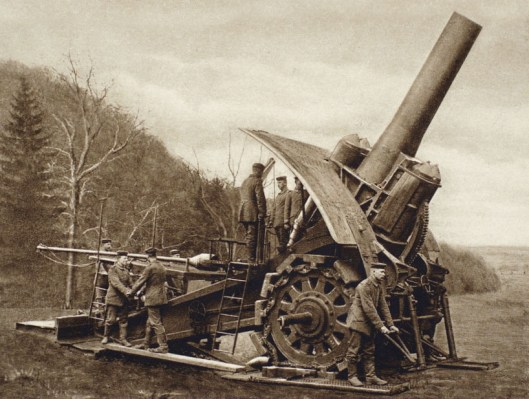
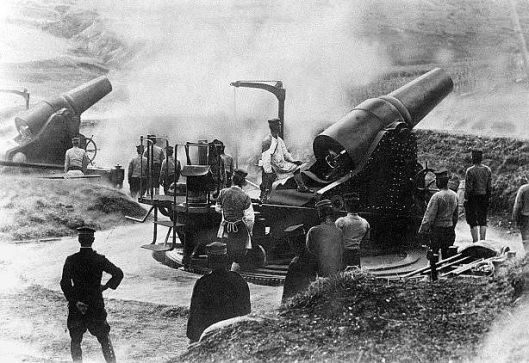
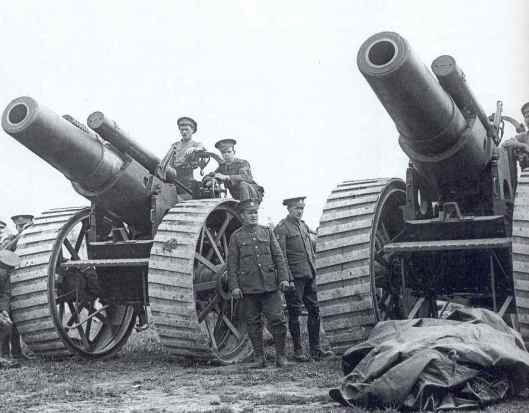
and increasingly heavy artillery.

image15skoda.jpg

image16bigb.jpg

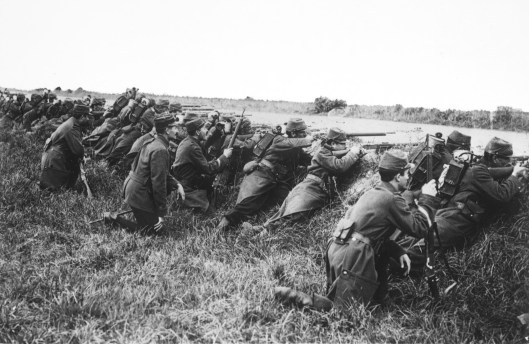
Soldiers on both sides, therefore, instinctively began to seek more shelter.

image17ditch.jpg

And more shelter.

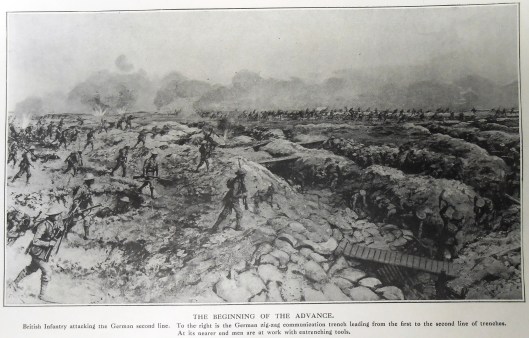
image18trench.jpg

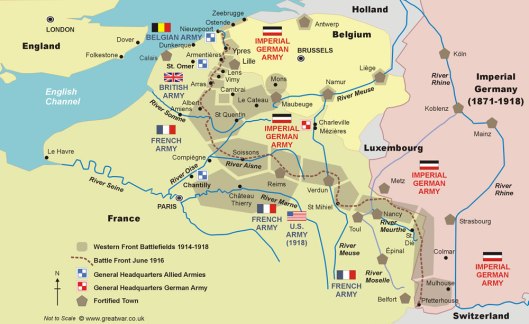
What happened next was a kind of military retrograde motion:  what was planned as open-field warfare turned into a giant, 500-mile-long siege.

image19map.jpg

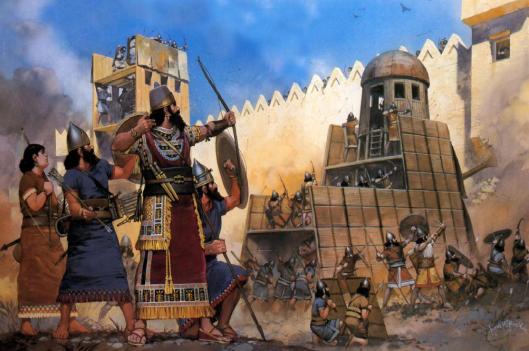
There had, of course, been sieges forever.  The ancient Neo-Assyrians were fierce proponents.

image20assyrians.jpg

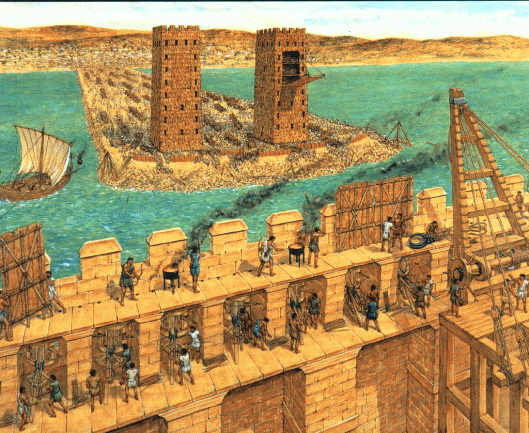
In 332bc, Alexander the Great, frustrated by the defiance of the city of Tyre, conducted a famous siege across open water to make the Tyrians submit.

image21tyre.gif

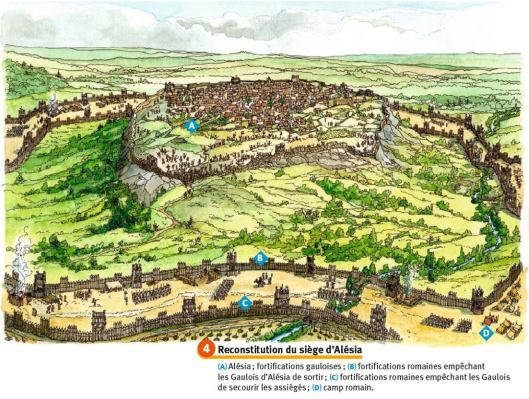
Julius Caesar had crushed Celtic power in Gaul in part by besieging their major settlement at Alesia in 52bc.

image22alesia.jpg

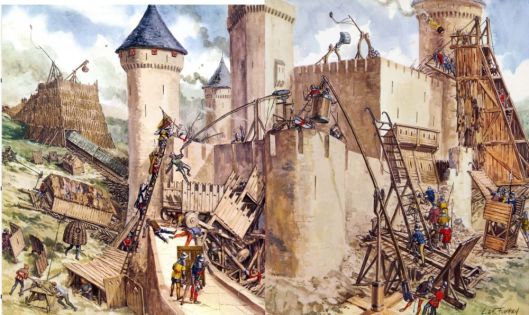
During the western Middle Ages, sieges were more common than pitched battles.

image23medsiege.jpg

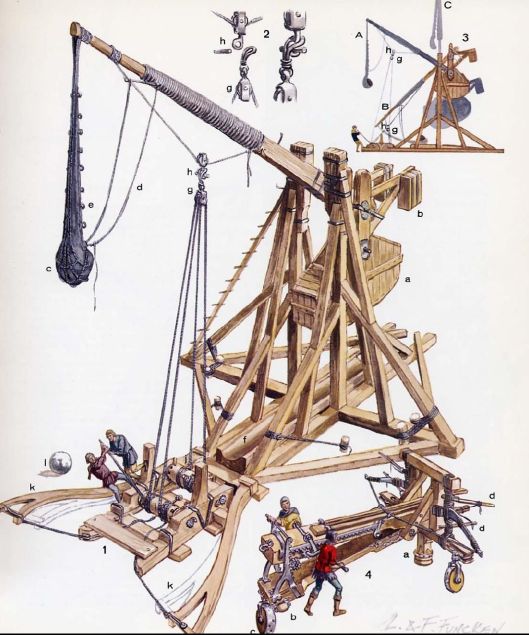
By the 14th century, however, big siege weapons, like the massive stone-throwing trebuchet,

image24trebuchet.jpg

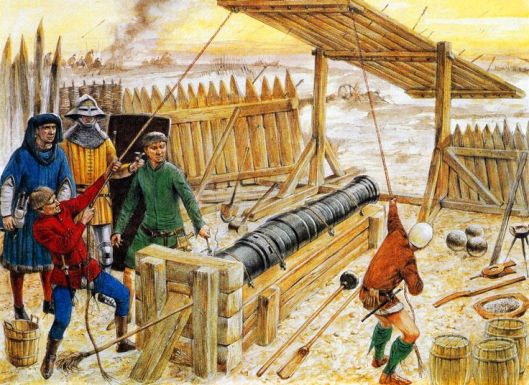
were fated to be replaced by a new and more effective weapon, the bombard, or cannon.

image25bombard.jpg

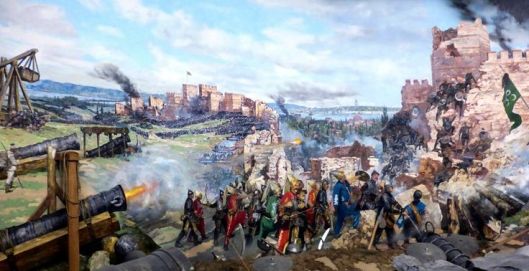
And, with the expansion of the use of artillery to pound enemy defenses, siege warfare became that much more deadly—as in the relatively short time (53 days) it took for the guns of Mehmet II to knock holes in the ancient but massive walls of Constantinople in 1453.

image26constant.jpg

Over time, the practice of siege craft became an art, as did that of fortification, and, for western armies, the theoretician was Louis XIV’s military engineer, Sebastien Le Prestre de Vauban (1633-1707).

image27vauban.jpg

Vauban designed fortresses to resist sieges, but he also said that every fortress could be taken in time and proved it by directing methodical attacks upon a number of them.  Step one was to gradually move trenches—and guns—closer and closer to the enemy fortress or town, attempting to make a hole in its walls.  Then, when the hole was judged big enough to provide entry into that town or fortress, infantry would be sent in to try to break through.

image28siege.jpg

Vauban’s method, with its lines of moving trenches and gun emplacements, became the standard and older soldiers in 1914 and those who read military history would have seen that method in the later 19th century, when the Prussians and their allies besieged Paris in late 1870,

image29paris.jpg

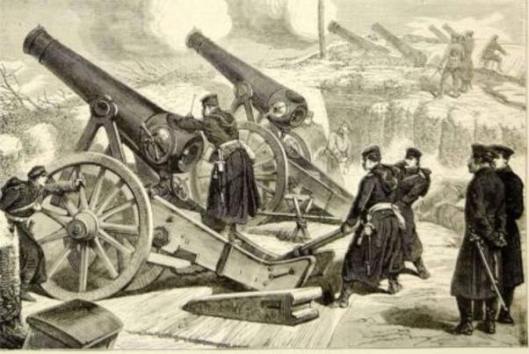
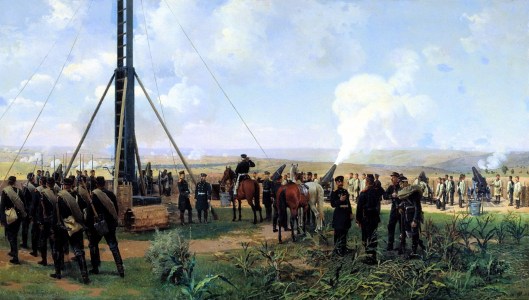
or when the Russians laid siege to the Turkish garrison of Plevna in 1877,

image30plevna.jpg

or, more recently, when the Japanese besieged the Russians at Port Arthur in 1904-5.

image31porta.jpg

Thus, there was a long tradition for such things for the armies of western Europe to follow in 1914, but the difference lay in those modern weapons, which made the life of besiegers—and, in this war, both sides were really besieging each other simultaneously—that much more dangerous.  If the basis of that tradition was bombardment followed by a successful infantry assault, then the generals of 1914 would follow that pattern.

image32bomb.jpg

image33assault.jpg

If the enemy used machine guns and heavy artillery to stop the attackers,

image34maxim.jpg

image35arty.jpg


it took some time before those generals realized that old-fashioned methods usually produced huge numbers of casualties

image36casualties.jpg

and little success.

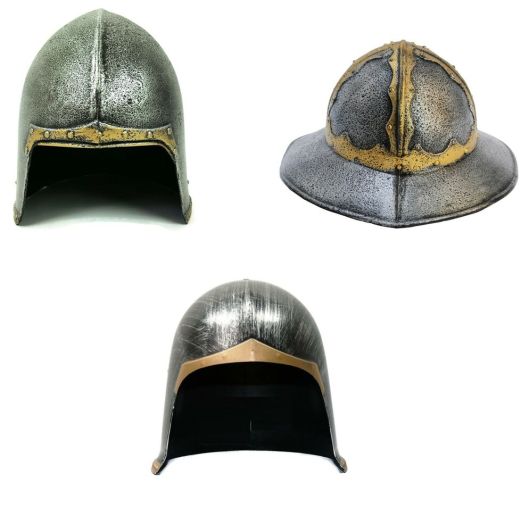
Change took time, but one element was to improve soldiers’ chances to survive in the trenches and that meant reviving something from the medieval world, the metal helmet.

image37medhelm.jpg

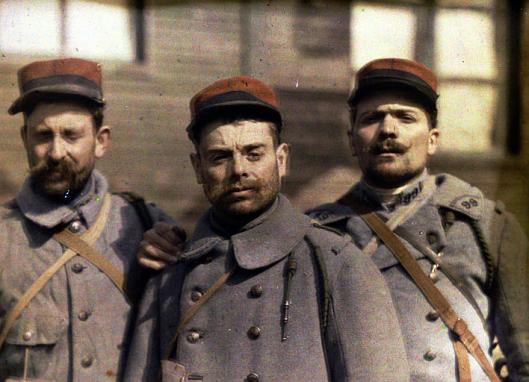
The French were the first to replace the soldiers’ kepi

image38kepi.jpg

with a metal helmet, in 1915.

image39adrian.jpg

(The kepi picture, by the way, isn’t colorized, but is an actual early color photograph, using what was called “autochrome”.)

The Germans replaced their leather helmets, called pickelhalben,

image40pickelhaube


with their own version of a steel helmet, in 1916.

image41stahl.jpg

Also, in 1916, the British replaced the service dress cap

image42sd.jpg

with the very piece of kit with which JRRT would have been equipped, and with which we began.

image43helm.jpg

Thanks, as ever, for reading

and

MTCIDC,

CD

Holding Place

21 Wednesday Aug 2019

Posted by Ollamh in Heroes, J.R.R. Tolkien, Military History

≈ Leave a comment

Tags

Bath star, colours, ensign, First Boer War, Great War, Laing's Neck, lieutenant, Maciejowski Bible, Mike Chappell, Officer Training Corps, OTC, Oxford, second lieutenant, the Lancashire Fusiliers, Tolkien, Uniform and Weapons Supply, West Yorkshire Regiment, white feather, WWI

Welcome, as ever, dear readers.

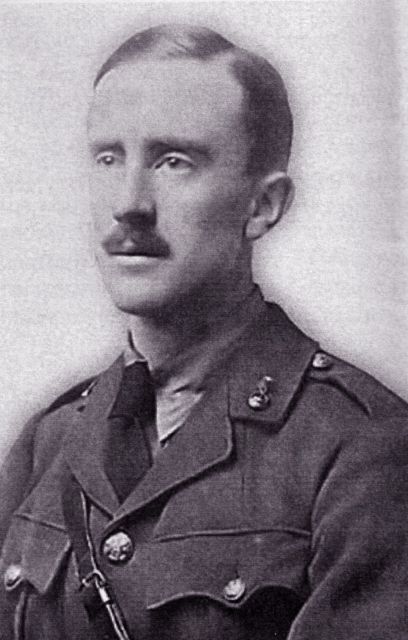
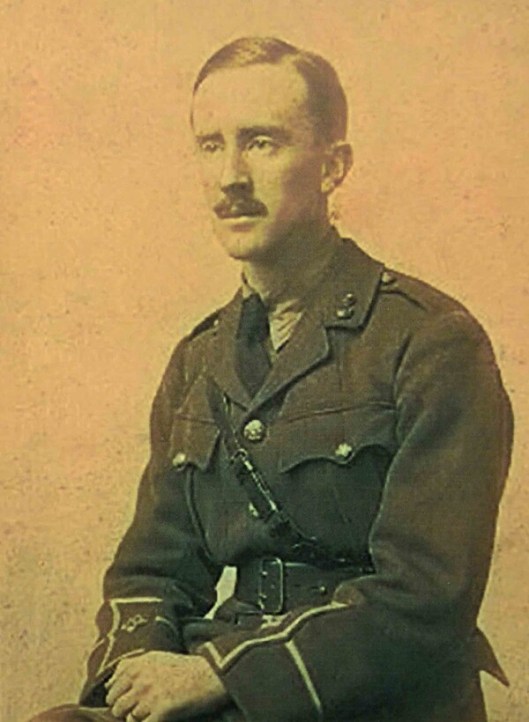
Our title is actually a translation of a French compound, lieutenant, which, by itself, is an adjective, but, if you add a definite (le) or indefinite (un) article, you have a noun—and a military rank, a rank which Tolkien held in 1916.  Anyone who knows anything about JRRT is aware of this and has probably seen this photo of a very serious young officer.  In this posting, we’d like to take a closer look at this photo and what it once represented—and, as you’ll see, there’s a great deal!

image1jrrtasofficer.jpg

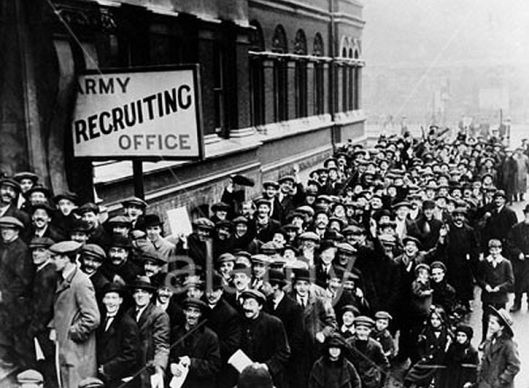
In 1914, JRRT had made a difficult decision:  to finish his degree and not to join up along with the passionate thousands who did

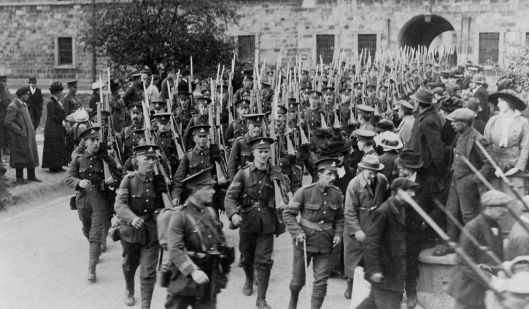
image2crowd.jpg

and, a young man still in civilian dress, to risk the public humiliation of having a young woman—or group of young women—come up to him in the street and offer him a white feather as a marker of his cowardice in not enlisting immediately.

image3whitefeather.png

While finishing, he had been a member of the OTC, the Officer Training Corps at Oxford,

image4badge.jpg

which had helped him to gain a (temporary—for the duration of the war) commission as a second lieutenant in the British Army in July, 1915.

image5jrrt2nd.jpg

The title of second lieutenant was relatively new in 1915, having only been introduced in 1877, as a permanent replacement for the much older title of “ensign” (“cornet” in the cavalry).  Originally, an ensign’s job had been to carry an ensign—that is, a flag—

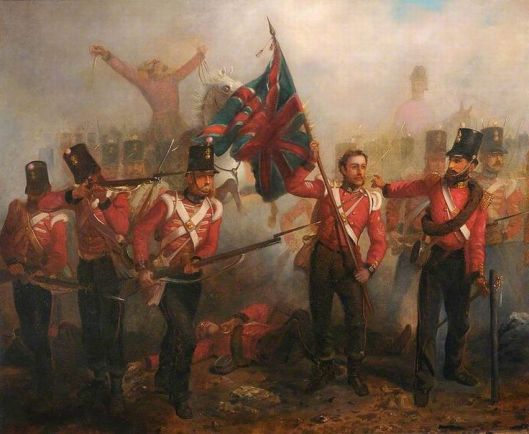
image6ensignecw.jpg

which could be a very hazardous job, as a flag (a “colour”, in the infantry, a “standard” in the cavalry), was not only a rallying point, but also the equivalent of a very large sign shouting “Shoot this one first!”

https://upload.wikimedia.org/wikipedia/commons/thumb/3/30/Sergeant_Luke_O%27Connor_Winning_the_Victoria_Cross_at_the_Battle_of_Alma.png/731px-Sergeant_Luke_O%27Connor_Winning_the_Victoria_Cross_at_the_Battle_of_Alma.png

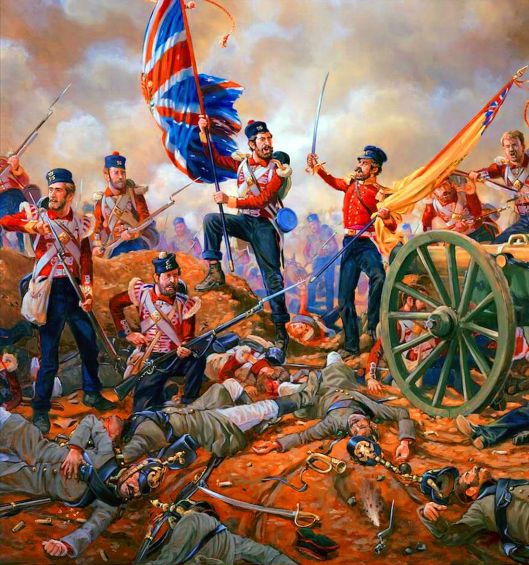
By 1915, British units hadn’t carried their colours into battle for about 35 years (the last known instance being at Laing’s Neck, during the First Boer War, in 1881),

https://i.pinimg.com/originals/82/3e/9d/823e9debc60fe348f17f914e1a0360d5.jpg

so a second lieutenant would be given other roles in the regiment to which he belonged, such as commanding a platoon, a smaller part of a larger company, or in JRRT’s case, being in charge of communications—a subject which we’ve discussed in a previous posting.

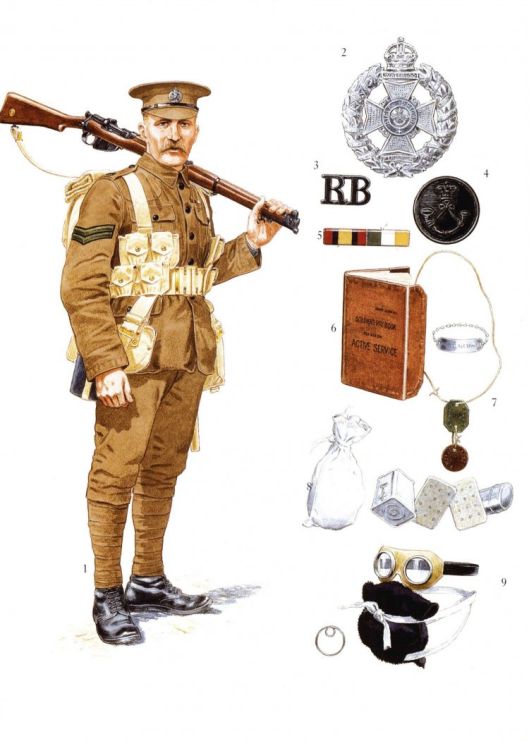
Although enlisted men were issued uniforms, equipment, and weapons,

image9tommy.jpg

(This wonderfully-detailed illustration is by Mike Chappell, one of our favorite modern illustrators of the British Army.)

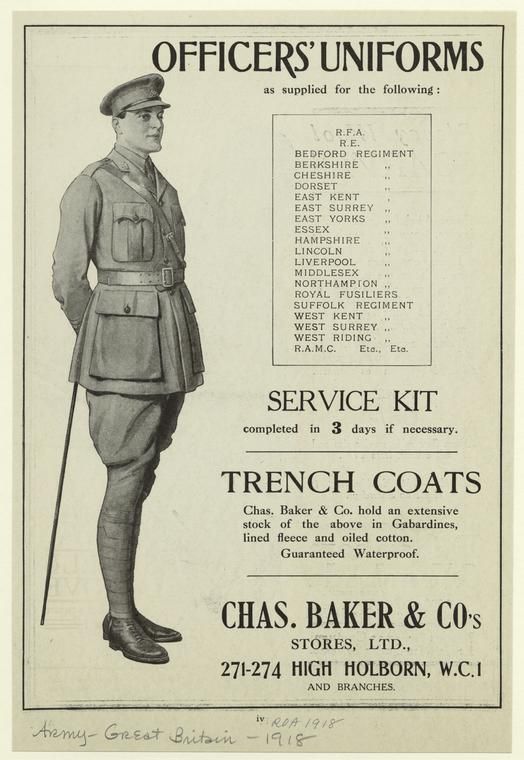
officers, as “gentlemen”, were expected to supply everything themselves.

image10tailor.jpg

This included not only uniform,

image11uniform.jpg

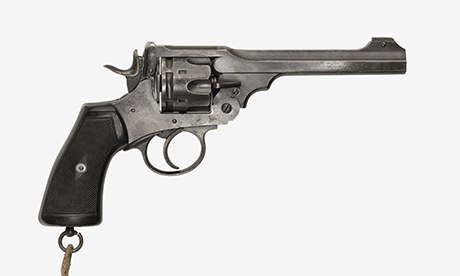
but revolver (this is JRRT’s actual .455 Webley, now in the Imperial War Museum collections)

image12revolver.jpg

and sword,

image13sword.JPG

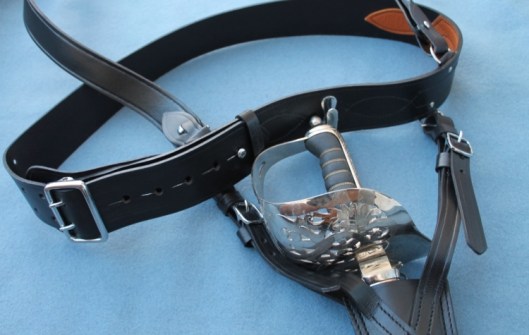
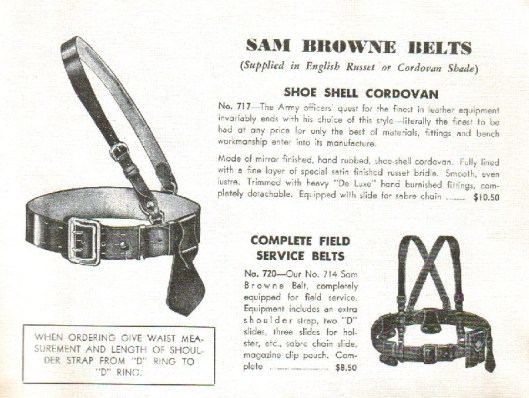
along with the belts on which to carry them,

image14sambrowne.jpg

plus all the other necessary items to join an army on campaign.

Taken altogether, it would have been very expensive for a new graduate, like JRRT, and so the government began issuing a stipend to help “temporary officers” (the Army sometimes had uglier terms for them) to kit themselves out like this.

image15ready.jpg

And we’ve forgotten one essential, by 1916, something no soldier in the front lines would ever have been without—and here’s why.

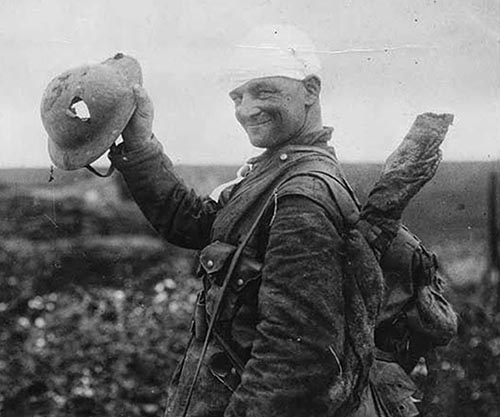
image16helmet.jpg

As people always interested in the medieval, we can say that we’ve seen this pattern before—here are examples from the 13th-century Maciejowski Bible,

image17bible.gif

where such a thing might have been called a “kettle helm”.

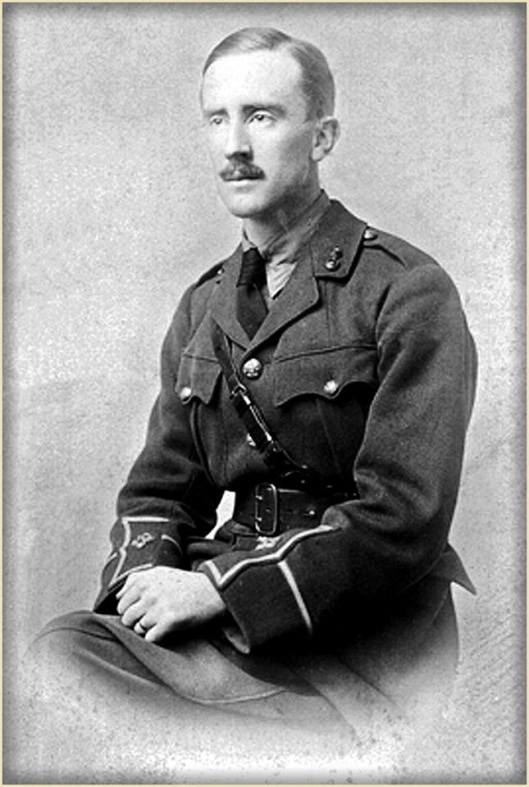
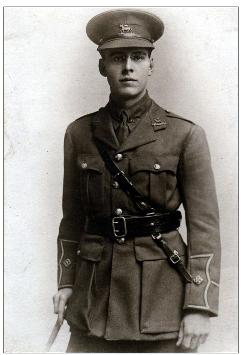
With all of the above in mind, let’s return for a moment to a larger version of that very familiar picture of JRRT in uniform.

image18jrrt.jpg

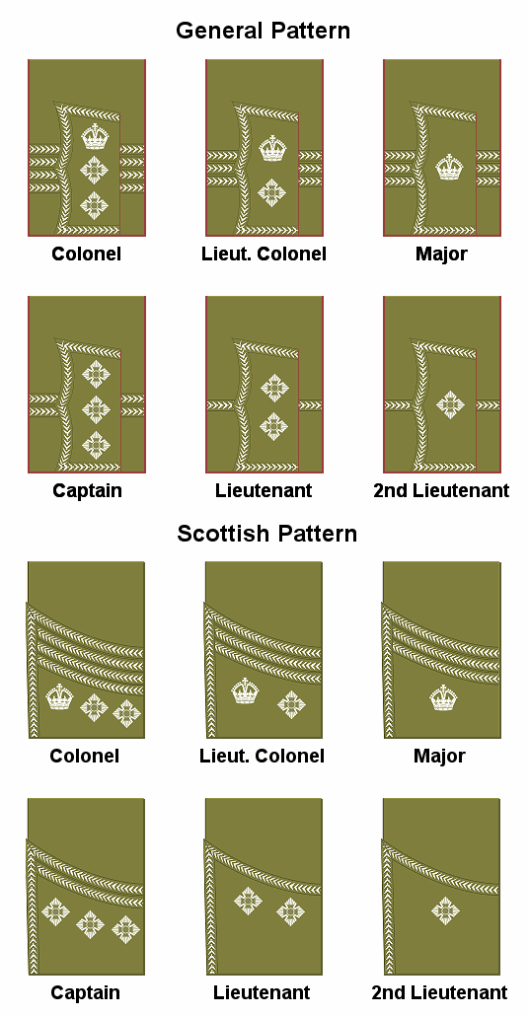
First off, you can see that, for this rather formal portrait, although he’s in uniform, he is wearing neither revolver nor sword, but he is wearing the distinctive belting (named after the general who invented the pattern a “Sam Browne”).  As well, if you look at his left cuff, you can see the mark of his second-lieutenancy, what soldiers commonly called a “pip”, but which formally was called a “Bath star”.  One of these on each cuff indicated the rank of second lieutenant.  When Tolkien was promoted, in January, 1918, to First Lieutenant, he would have added a second star.  Here’s a table of rank markers to help you.

image19table.png

If the image were as clear as that of this reenactor, we could see that his uniform bore more than his rank—older regiments, in particular, had special, distinctive markings

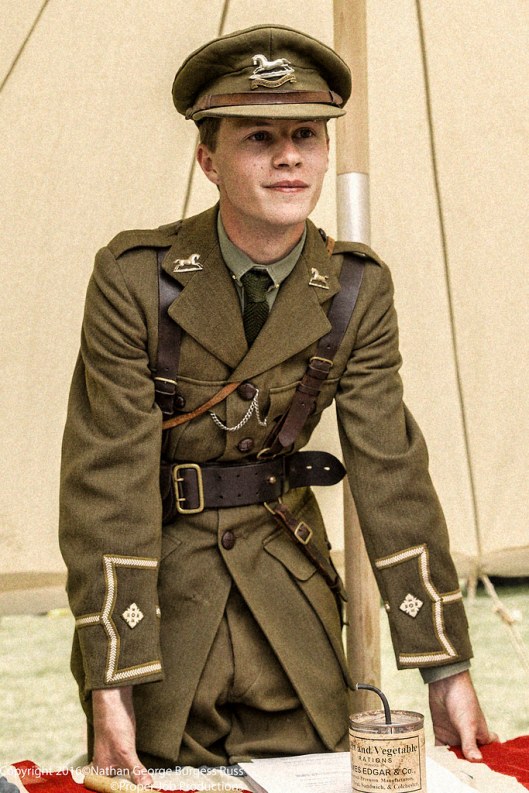
image20reenactor.jpg

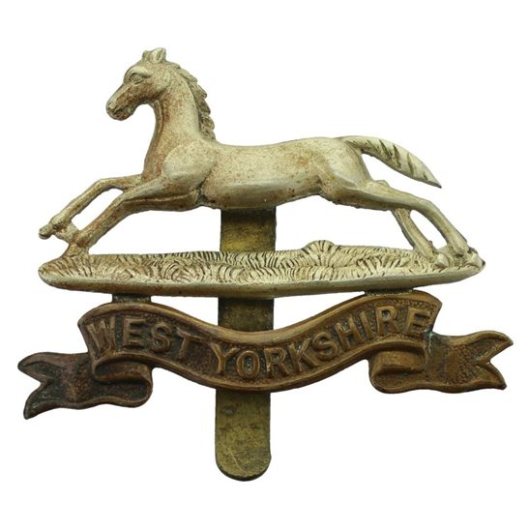
Note the badges on this reenactor’s cap and on his collar tabs.  These are the markings of the West Yorkshire Regiment.

image21westyorks.jpg

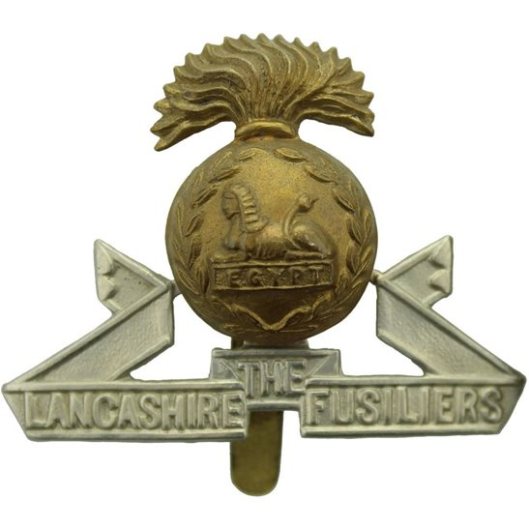
Tolkien belonged to the Lancashire Fusiliers, whose badge looked like this:

image22lancs.jpg

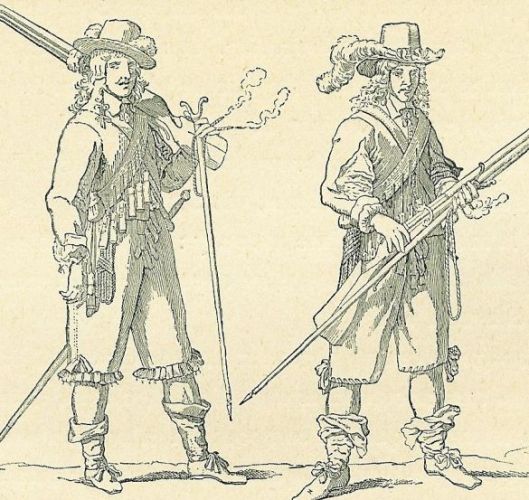
You’ll see that the outer layer is the image of a flaming bomb or grenade.  This was an old symbol for fusiliers in general in the British Army.  In the 17th-century, soldiers with firearms used mainly matchlock weapons.

image23amatchlock.jpg

This was fired by applying a piece of specially-prepared cord to gunpowder.  If you wanted a guard for your artillery or powder supply, burning cord was the last thing you would want so, instead, such guards were armed with much safer flintlock fusils—hence the term fusilier.

image23bflintlock.jpg

The Lancashire Fusiliers claimed such a unit as ancestors and, as one of the units which had served in the British force which had captured Egypt from the French in 1801 (as the 20th Foot—meaning “infantry regiment”),

image23egypt.jpg

they had been entitled to add “Egypt” to their regimental colours and to their badges.

image24colours.gif

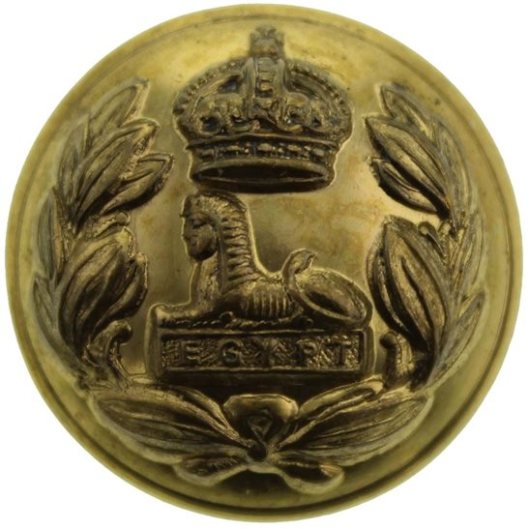
JRRT’s collar tabs and buttons would have been slightly different, displaying the sphinx inside a laurel wreath.

image25collar.jpg

image26button.jpg

Contemplating this carefully-combed and trimmed young man in his formal uniform,

image27jrrt.jpg

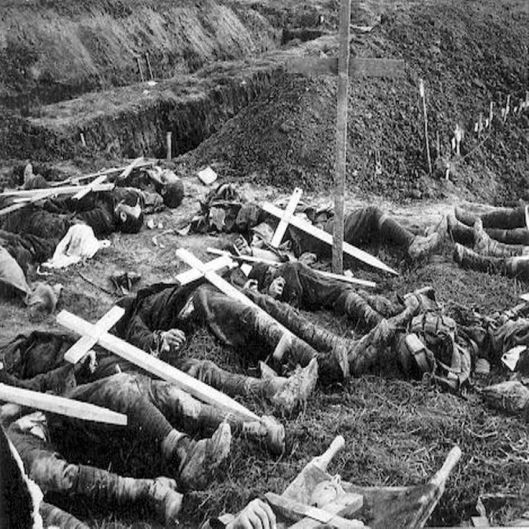
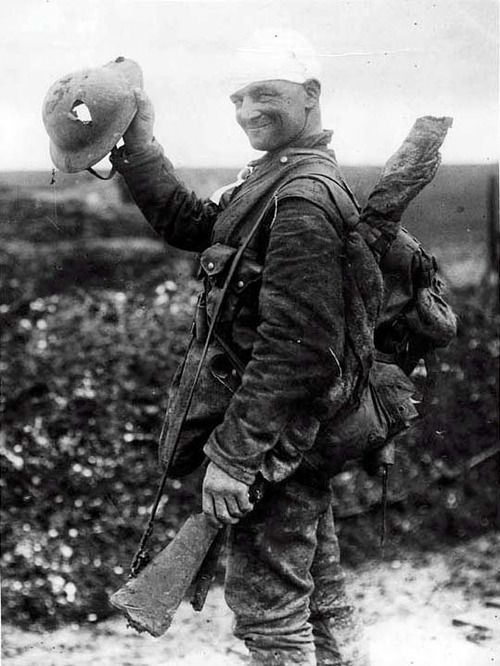
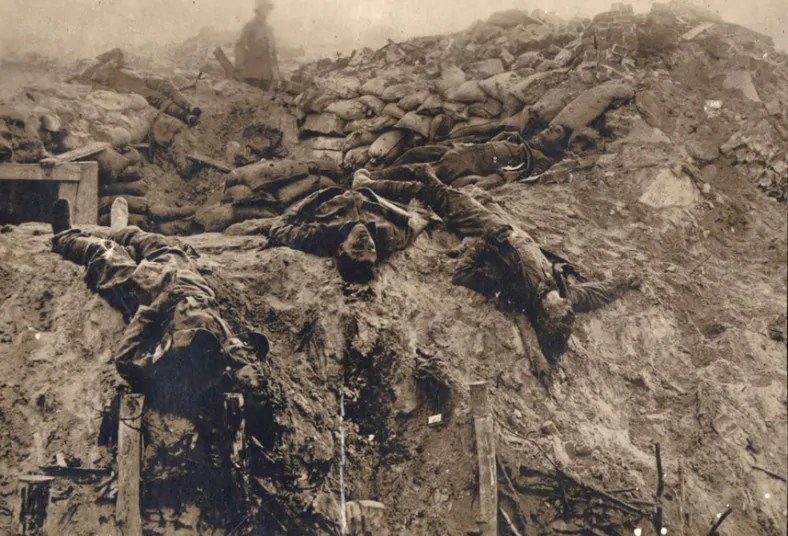
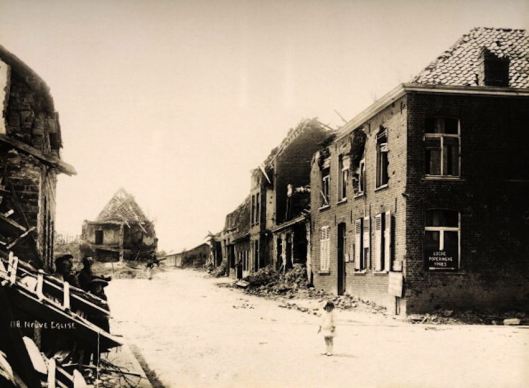
it might be difficult to imagine him as the man who, in time, could create Mordor and all within it—until you contrast it with images like these, the sorts of things which he would have seen daily in summer and early fall, 1916–

image28dead.jpgimage29village.jpgimage30ypres.jpg

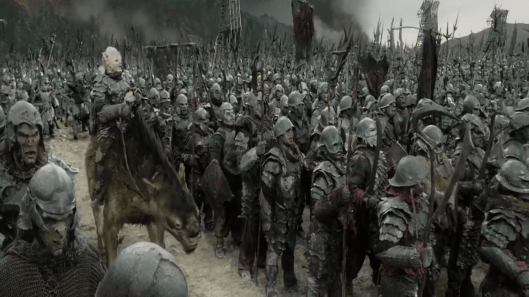
and, suddenly, orcs

image31orcs.png

are no surprise.


Thanks, as always, for reading and

MTCIDC


CD

ps

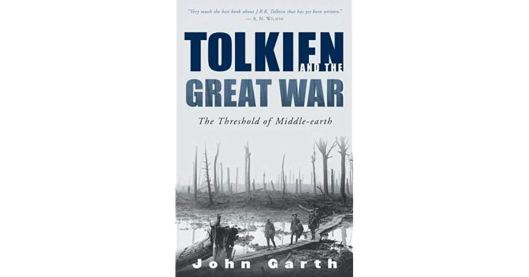
May we recommend to you this excellent book, if you would like to know more about Tolkien and his experiences, 1914-1918?

image32grtwar.jpg


Never That Willow

14 Wednesday Aug 2019

Posted by Ollamh in J.R.R. Tolkien, Literary History

≈ Leave a comment

Tags

Barrow-downs, Barrow-wights, Hamlet, humours, Melancholy, Old Man Willow, Ophelia, Othello, Robert Burton, The Lord of the Rings, The National Library of Scotland, Thomas D'Urfey, Timothy Bright, Tolkien, Tom Bombadil, William Shakespeare, Willow Tree

As always, dear readers, welcome.

In our last post, we had:

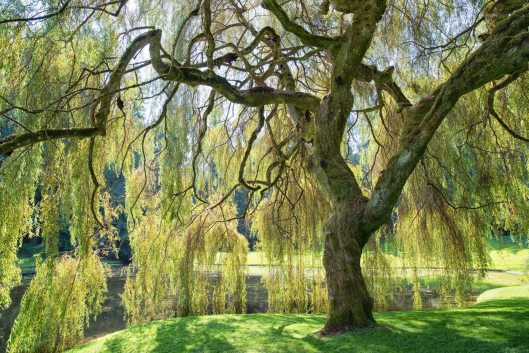
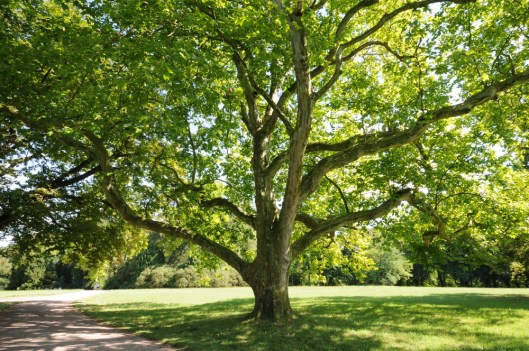
  1. begun with a willow tree

image1willow.jpg

  1. moved to the English Renaissance association between willows and melancholy

image2renmel.jpg

  1. and, in particular, the play Hamlet (1599-1601), in which a disturbed girl, Ophelia, falls from a willow into a stream and drowns

image3ophelia.jpg

  1. as well as Desdemona, in Shakespeare’s Othello (1604), who sings a song with “Willow” as a kind of lamenting chorus—just before she’s murdered by her jealous (and misled) husband.

image4desd.jpg

Melancholy comes from an imbalance of the humors, so medieval and Renaissance people thought, from those substances which control the body and its moods.

image5humors.png

Too much black bile and you might be plunged into a depression.

image6adepression.jpg

(Although his posture suggests that he’s grieving, this young man’s armor says that he’s involved in a medieval sport that certain Tudor noblemen still engaged in, jousting.  Perhaps he just lost?)

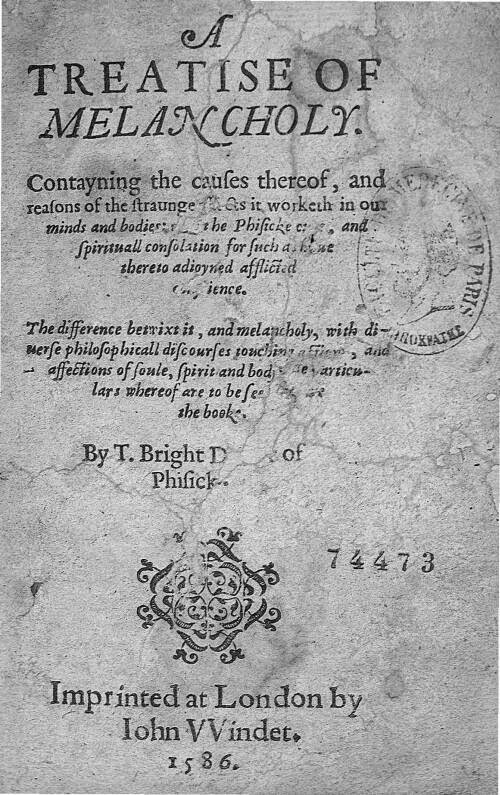
As this was considered a serious problem, English Renaissance authors created texts which analyzed the condition, like Timothy Bright, a physician, who published his treatise in 1586,

image6treatise.jpg

(if you’d like to see what was believed medically in 1586, here’s a LINK to the work.)

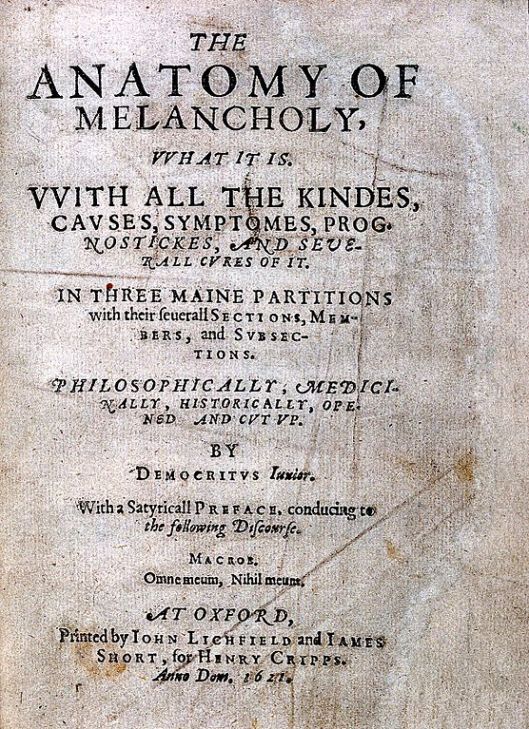
or Robert Burton, a philosopher, who published his in 1621.

image7burton.jpg

One way of dealing with that imbalance was by bleeding—the idea being that, since the humors influenced the blood, by opening up a blood vessel and letting some of the blood pour out it might act as a kind of safety valve.

image8bleeding.jpg

Another treatment was playing or listening to music.

image9lutenist.png

This therapeutic idea led to the title of one of the first great collections of Renaissance and post-Renaissance lyrics and tunes, Thomas D’Urfey’s, Wit and Mirthe, or Pills to Purge Melancholy (1698-1720).

image10wit.png

(The National Library of Scotland has a complete edition of all six volumes of this.  Here’s a LINK, so that you can download them for yourself.)

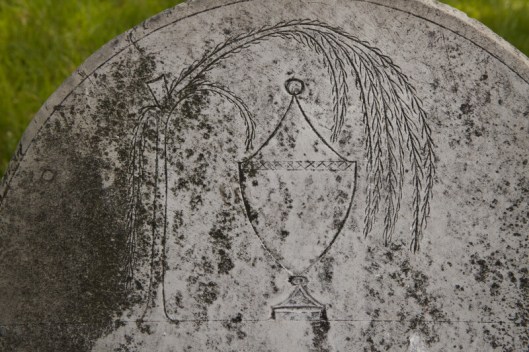
Melancholy and willows became even more bound together in the early 19th century, when the tree, along with other images, such as urns, was used as a symbol of mourning on tombstones.

image11tomb.jpg

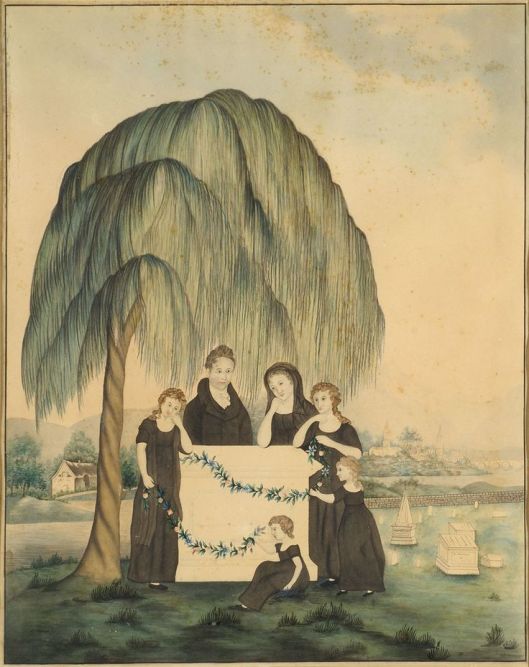
Willows, then, have moved from being associated with an Elizabethan ailment to an expression of grief at the death of a loved one, which could certainly bring on melancholy.

image12awillow.jpg

For us, willows have another association, however, but one which includes death–and the Elizabethan use of music as a cure.  In The Lord of the Rings, when Frodo and his friends try to cut through the Old Forest to escape the pursuing Nazgul,

image12naz.jpg

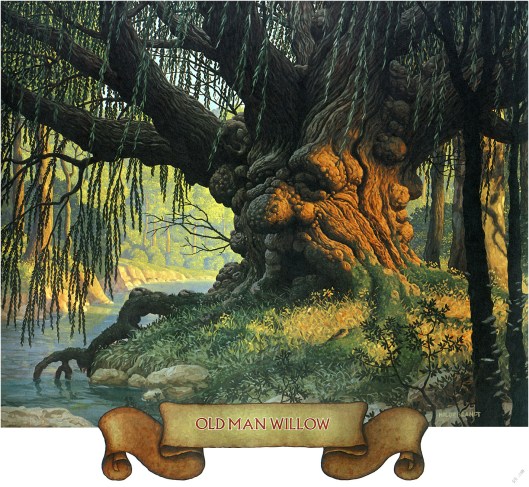
they are confused by the hostile wood and eventually brought to the bank of the Withywindle, where Old Man Willow

image13omw.png

sings a spell:

“They shut their eyes, and then it seemed that they could almost hear words, cool words, saying something about water and sleep.  They gave themselves up to the spell and fell fast asleep at the foot of the great grey willow.”  (The Fellowship of the Ring, Book One, Chapter 6, “The Old Forest”)

This was more than just a sleepy-spell, however, as the tree attempts to drown Frodo, swallows Pippin, and half-swallows Merry (his upper half).

When Sam and Frodo (whom Sam has rescued) threaten the tree with fire, it threatens to kill Merry and Pippin and it looks like a standoff until Frodo simply runs off, shouting for help, and the very odd figure of Tom Bombadil appears.

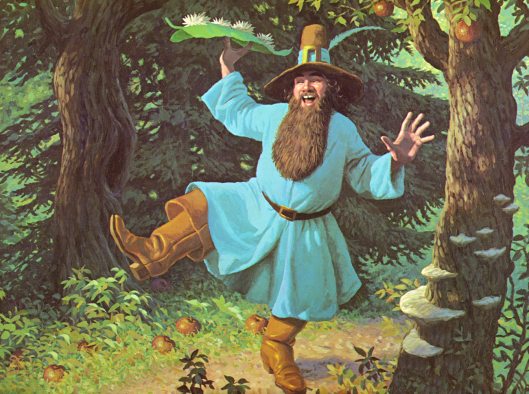
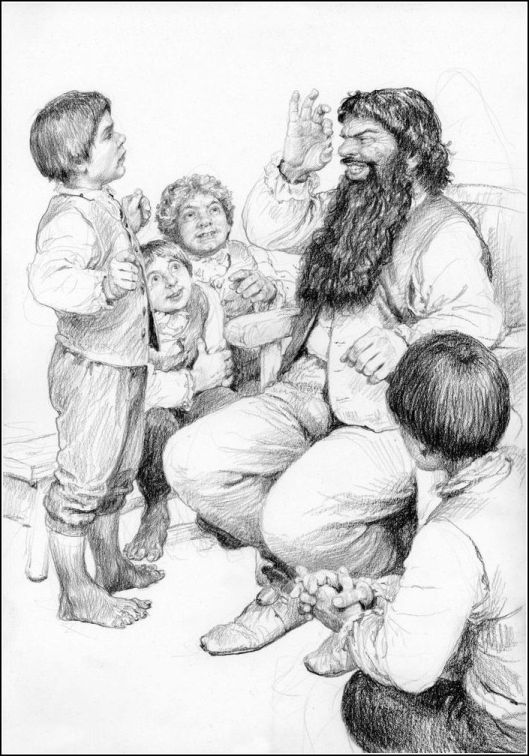
image14tb.jpg

He has a very distinctive look—

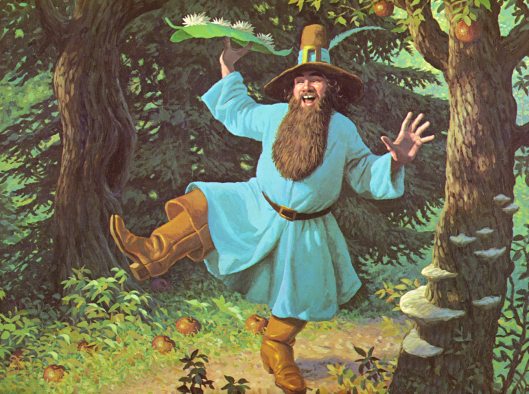
“there appeared above the reeds an old battered hat with a tall crown and a long blue feather stuck to the band…there came into view a man…stumping along with great yellow boots…He had a blue coat and a long brown beard; his eyes were blue and bright, and his face was red as a ripe apple, but creased into a hundred wrinkles of laughter.”

As well, he has distinctive speech and this is where music as cure reappears.  Commonly, Tom’s speech is either actual song or short declarative sentences, which fall into a metrical pattern reminiscent of song:

“What’s the matter here then?  Do you know who I am?  I’m Tom Bombadil.  Tell me what’s your trouble!”

DUM-tee-DUM-tee-DUM-DUM.  DUM-tee-DUM-tee-DUM-DUM.  DUM-DUM-DUM-tee-DUM.  DUM-tee-DUM-tee-DUM-DUM.

He shows no fear of the fearsome willow, breaking off one of its branches and smacking the tree with it while employing this characteristic chanting—

“You let them out again, Old Man Willow!…What be you a-thinking of?  You should not be waking.  Eat earth!  Dig deep!  Drink water!  Go to sleep!  Bombadil is talking!”

Who this figure is, is only ever explained in the vaguest way.  His companion, Goldberry,

image15goldberry.jpg

says of him simply, “Tom Bombadil is master.” (The Fellowship of the Ring, Book One, Chapter 7, “In the House of Tom Bombadil”)  And, when he receives the Ring from Frodo, even when he puts it on, it has no effect upon him.

image16ring.jpg

As a character in the book, he has proved awkward both for audio adapters and P Jackson and his writers, virtually all of whom have tended, over the years, simply to leave him out of their versions of the story.  This leaves a gap, of course, especially when it comes to Tom’s second rescue of the hobbits, from a barrow-wight (illustration by one of our favorite Tolkien artists, Ted Nasmith),

image17bw.jpg

not only because it’s a wonderfully spooky part of the story, but because Tom ransacks the barrow and gives the hobbits short swords “forged long years ago by Men of Westernesse:  they were foes of the Dark Lord, but they were overcome by the evil king of Carn Dum in the Land of Angmar”” (The Fellowship of the Ring, Book One, Chapter 8, “Fog on the Barrow-Downs”).   With one of these swords, because of where and when it’s from, Merry is able to wound the chief of the Nazgul who is, in fact, that evil king of Angmar mentioned by Tom Bombadil, allowing Eowyn to finish him off.

Tolkien himself was less than concrete in his explanation of Tom, writing to Naomi Mitchison in April, 1954:

“Tom Bombadil is not an important person—to the narrative.  I suppose he has some importance as a ‘comment’.  I mean, I do not really write like that:  he is just an invention (who first appeared in the Oxford Magazine about 1933 [1934]), and represents something that I feel important, though I would not be prepared to analyze the feeling precisely.” (Letters, 178)

Considering our theme of melancholy and, later, death, associated with willows, as well as the Elizabethan idea that music might cure or at least ameliorate that melancholy, our feeling is that Tom, in the first book of The Lord of the Rings, is a counterbalance, with his singing and chanting, to all of the darkness we’re gradually being shown.  As JRRT says in that same paragraph to Naomi Mitchison:

“I would not, however, have left him in, if he did not have some kind of function.  I might put it this way.  The story is cast in terms of a good side, and a bad side…”

Tom, then, in our view, is not only on the good side, but the antidote to the bad, twice, dealing not only with a living tree, but with a dead and murderous wight.  In both cases, he uses song, making him rather like an Elizabethan cure for the melancholy associated with willows—and, in the 19th-century, willows associated with death–brought to life.  It’s no wonder that, when Sauron is defeated and Middle-earth is beginning to heal, Gandalf tells the hobbits:

“…I am turning aside soon.  I am going to have a long talk with Bombadil:  such a talk as I have not had in all my time.” (The Return of the King, Book Six, Chapter 7, “Homeward Bound”)

For Gandalf, Tom is the humors back in balance.

As ever, thanks for reading and

MTCIDC

CD

ps

For another willow, you might try George Lucas’ fantasy film, Willow (1988).  It has a complicated plot, all about an abducted infant who will fulfill a prophecy, a valiant dwarf, white and black magic, and a rather ragged warrior.  Here’s the LINK for the first trailer (there’s a second, as well).

Although not quite, for us, of the same level as The Princess Bride, being perhaps more like Labyrinth or The Dark Crystal or Time Bandits, like all of those, it has its moments of fun.


Never a Willow

07 Wednesday Aug 2019

Posted by Ollamh in Fairy Tales and Myths, J.R.R. Tolkien, Literary History, Narrative Methods

≈ Leave a comment

Tags

Babylon, Baltimore Consort, Chludov Psaltery, Dennis Moore, Desdemona, Euphrates, Hamlet, Highwaymen, humours, Israelites, JE Millais, Melancholy, Monty Python, Old Man Willow, Ophelia, Othello, Robert Burton, The Anatomy of Melancholy, The Carman's Whistle, The Lord of the Rings, The Old Forest, Tigris, Tolkien, Tom Bombadil, William Shakespeare, Willow

As always, dear readers, welcome.

In our last posting, although we were talking about 18th-century highwaymen, somehow—we blame the “Dennis Moore” sketch—

image1dennismoore.jpg

we included mention of a willow.

image2willow.jpg


In Anglo-American culture, the willow has long suggested melancholy, perhaps being somehow linked with Psalm 137, which laments the fall of Jerusalem to the Babylonians in 586BC and the so-called “Babylonian captivity” of the Israelites?

“By the rivers of Babylon, there we sat down, yea, we wept, when we remembered Zion.

We hanged our harps upon the willows in the midst thereof.

For there they that carried us away captive required of us a song; and they that wasted us required of us mirth, saying, Sing us one of the songs of Zion.

How shall we sing the Lord’s song in a strange land?”

Under all of that heavy-handed Babylonian mockery is the simple fact that willows are water-lovers, so it would be natural that they would grow near the Euphrates and Tigris, the two major rivers of Babylon.

image3babylon.jpg

If the Israelites are no longer singing, we would guess that parking their harps on the willows would be as good a place as any.  Certainly medieval manuscript illustrators had no trouble envisioning it.  This is from the 9th-century Chludov Psaltery (a collection of psalms).

image4harps.jpg

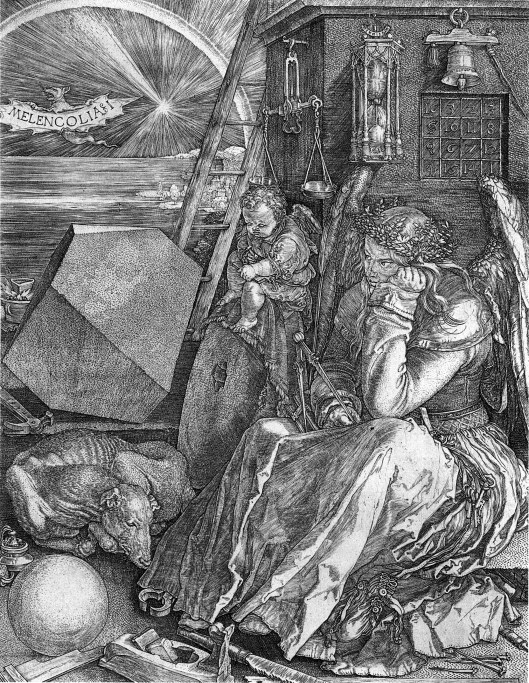
“Melancholy”, medieval/Renaissance people believed,

image5aaduerer.jpg

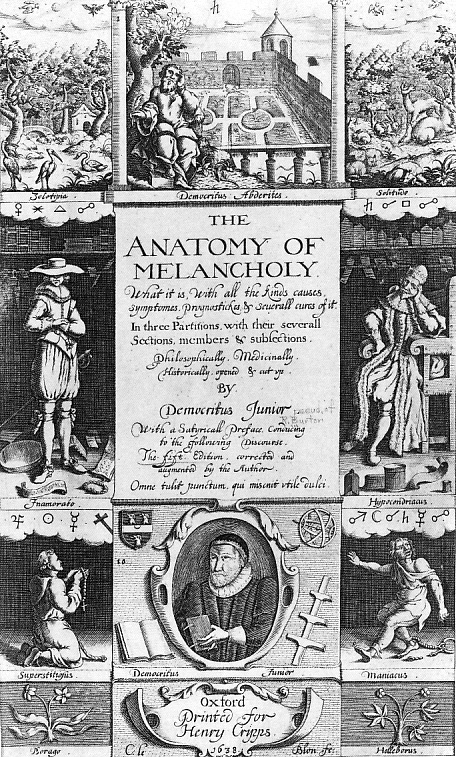
came from an imbalance of the four “humours” which ran the body and its emotions and people in Shakespeare’s day and beyond appear to have so suffered from it that they consulted a famous and popular text, Robert Burton’s The Anatomy of Melancholy, What it is: With all the Kinds, Causes, Symptomes, Prognostickes, and Several Cures of it. In Three Maine Partitions with their several Sections, Members, and Subsections. Philosophically, Medicinally, Historically, Opened and Cut Up.  That this was a pressing matter for the people of this age is clear from the length of the first edition of 1621—it’s nearly 900 pages—and later editions, which appeared within the next few years, were even longer.  This is the frontispiece of the 1638 edition–

image5amelancholy.jpg

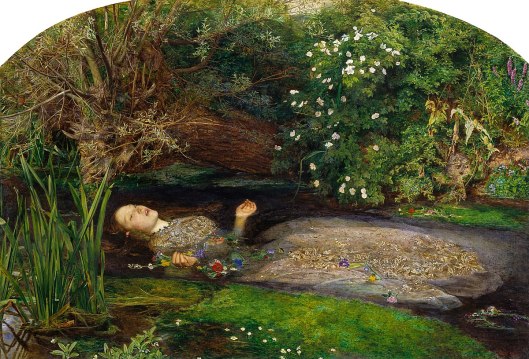
A common treatment for the problem (too much black bile in the system—the “melan-“ part is Greek for “black”—the “-choly” is the “choler”, or bile) was to listen to music, but clearly not all music was soothing, as we see in Shakespeare’s Hamlet (1599-1601) , where Hamlet’s girlfriend, Ophelia, goes mad and spends her time drifting around the castle singing bits of unhappy songs and handing out flowers with significant meanings.  As music can be involved with melancholy, so, as we said, can willows and the two come together when Ophelia trusts a willow–

“There is a willow grows aslant a brook,
That shows his hoar leaves in the glassy stream;
There with fantastic garlands did she come
Of crow-flowers, nettles, daisies, and long purples
That liberal shepherds give a grosser name,
But our cold maids do dead men’s fingers call them:
There, on the pendent boughs her coronet weeds
Clambering to hang, an envious sliver broke;
When down her weedy trophies and herself
Fell in the weeping brook. Her clothes spread wide;
And, mermaid-like, awhile they bore her up:
Which time she chanted snatches of old tunes;
As one incapable of her own distress,
Or like a creature native and indued
Unto that element: but long it could not be
Till that her garments, heavy with their drink,
Pull’d the poor wretch from her melodious lay
To muddy death.”  (Hamlet, Act IV, Sc 7)

image5ophelia.jpg

(This is a painting by JE Millais, 1851/2.  That “dead men’s fingers” should have been enough, we think!)

The melancholy continues in Shakspeare’s Othello (1604), Act IV, Scene 3, where the soon-to-be-murdered-by-the-title-character Desdemona sings a sad little song, beginning:

“The poor soul sat sighing by a sycamore tree,
Sing all a green willow;
Her hand on her bosom, her head on her knee,(45)
Sing willow, willow, willow.
The fresh streams ran by her, and murmur’d her moans;
Sing willow, willow, willow;
Her salt tears fell from her, and soften’d the stones”—

(It seems like this posting can’t escape including even more trees.  Sycamores are another water-loving tree,

image6sycamore.jpg

but the emphasis here is upon that willow and we’ll stick with it.)

Perhaps it’s the slumping shape, which might suggest despair, or at least grief, but the willow began to appear on tombstones here in the US at the beginning of the 19th century, sometimes by itself,

image7willow.JPG

sometimes shading other symbols of mourning, like an urn.

image8willow.jpg

It could appear in other funerary art, as well—as in pictures

image9art.jpg

and even as part of another funerary—and life—custom of the time, the giving/exchanging of locks of hair.  In this mourning brooch, one can see a willow made from such a lock.

image10hair.jpg

With such a grim history, it shouldn’t be surprising, then, that a willow familiar to readers of The Lord of the Rings might have a sinister purpose.

image11oldmanwillow.jpg

He’s not alone in being hostile foliage.  As Merry tells Frodo, Sam, and Pippin:

“But the Forest is queer.  Everything in it is very much more alive, more aware of what is going on, so to speak, than things are in the Shire.  And the trees do not like strangers.  They watch you.  They are usually content merely to watch you, as long as daylight lasts, and don’t do much.  Occasionally the most unfriendly ones may drop a branch, or stick a root out, or grasp at you with a long trailer.  But at night things can be most alarming…  (The Fellowship of the Ring, Book One, Chapter 6, “The Old Forest”)

Their journey through the Forest, intended to put some space between them and the danger of the Nazgul, provides its own dangers, as the place seems to move about of its own accord, confusing travelers—or worse:

“Suddenly Frodo himself felt sleep overwhelming him.  His head swam.  There now seemed hardly a sound in the air.  The flies had stopped buzzing.  Only a gentle noise on the edge of hearing, a soft fluttering as of a song half whispered, seemed to stir in the boughs above.  He lifted his heavy eyes and saw leaning over him a huge willow-tree, old and hoary.  Enormous it looked, its sprawling branches going up like reaching arms with many long-fingered hands, its knotted and twisted trunk gaping in wide fissures that creaked faintly as the boughs moved…”

We are a far cry from Monty Python here.  The willow then tries to drown Frodo, swallows Pippin completely, and the upper half of Merry, and, were it not for the appearance of perhaps the oddest character in The Lord of the Rings, it is difficult to imagine what would have happened next.
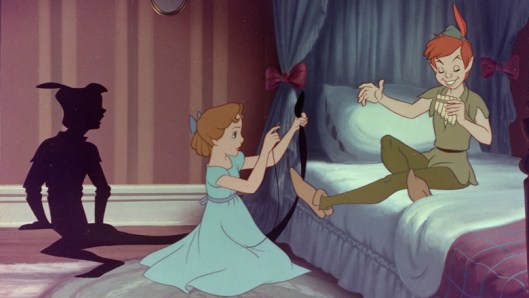
image12tbombadil.jpg

What will happen in our next posting, however, you will see next week (hint:  the posting is entitled, “Never This Willow”).  In the meantime,

Thanks, as always, for reading and

MTCIDC

CD

ps

To treat any melancholy you might feel from reading this posting, please see below for a very merry Elizabethan song ably performed by the Baltimore Consort.


And here’s a LINK to a set of lyrics c. 1590 so that you can follow along.  You’ll notice that it includes melancholy, trees, and music, all in one.


Pub Crawl

17 Wednesday Jul 2019

Posted by Ollamh in Economics in Middle-earth, J.R.R. Tolkien, Literary History

≈ Leave a comment

Tags

CS Lewis, Dorothy Sayers, Eagles, Green Dragon Inn, Hutchinson Family Singers, inn, pub, Smaug, The Eagle and Child, The Green Dragon, The Hobbit, The Inklings, The Ivy Bush, The King's Arms, The Lord of the Rings, The Mitre, The Prancing Pony, The Vulture of the Alps, The White Horse, Tolkien

As ever, dear readers, welcome.

After a very disturbing evening with a group of vengeful and determined dwarves,

image1banddwarves.jpg

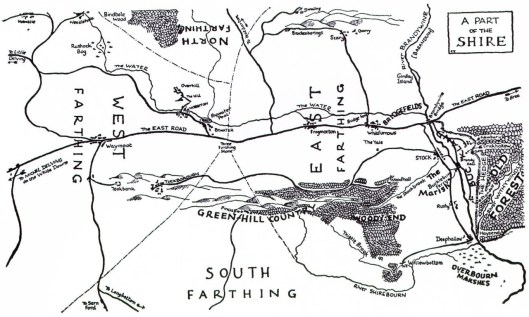
Bilbo wakes to a wreck of breakfast dishes and, soon after, the appearance of Gandalf, who prompts him to see that he has a note from Thorin (& Co.).  It makes an appointment for 11am that morning at the Green Dragon Inn, in Bywater.

image2bywatermap.jpg

With Gandalf harrying him, Bilbo barely makes it, but, a moment later, the journey eastward of The Hobbit begins.

It is ironic, of course, that a trip which focuses upon removing a dragon

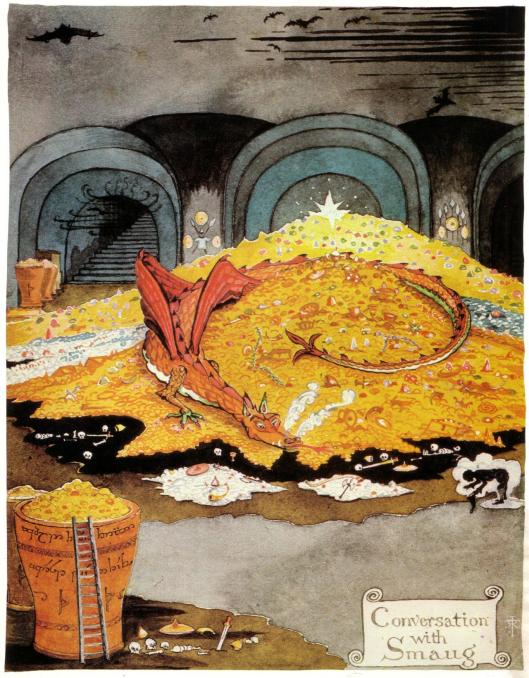
image3smaug.jpeg

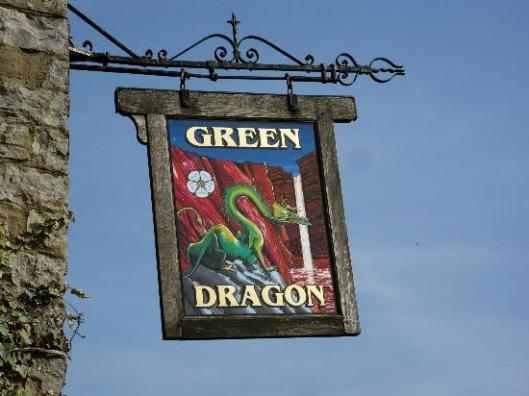
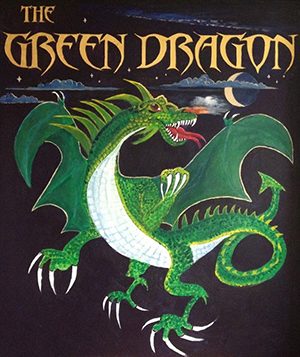
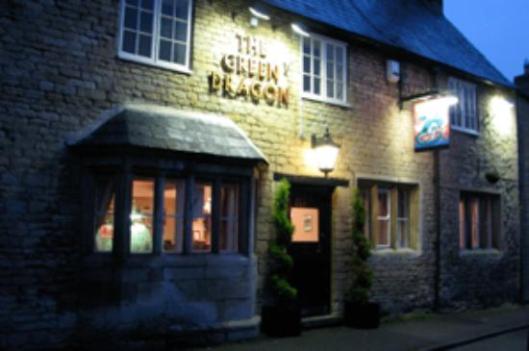
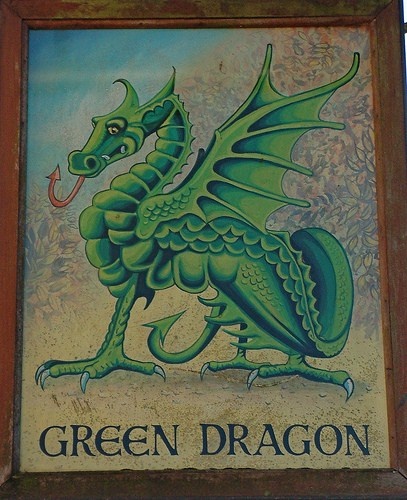
should commence with a place named after one, but, judging by the number of Green Dragon pubs in Britain one might find by googling right now, it may be nothing more than a common name—

image4pubsign.jpg

image5greendragsign.jpg

image6greendrag.jpg

image7greendrag.jpg

although, as Douglas Anderson points out in The Annotated Hobbit, 61, we know that JRRT had been interested in dragons, especially green ones, from childhood, as he wrote to WH Auden:

“I first tried to write a story when I was about seven.  It was about a dragon.  I remember nothing about it except a philological fact.  My mother said nothing about the dragon, but pointed out out one could not say ‘a green great dragon,’ but had to say, ‘a great green dragon.’  I wondered why, and still do.” (Letters, 214, 7 June, 1955)

The countryside east of the Shire and the story itself are empty of pubs (short for “public houses”, originally meaning simply a place open to the general public, but, in time, it came to mean a place licensed by the government to sell alcoholic beverages) after this, but, until we reach Bree, there are a certain number mentioned in The Lord of the Rings.  We meet the first, The Ivy Bush, in The Fellowship of the Ring, Book One, Chapter 1, “An Unexpected Party”, where we see a group of hobbits gossiping about Bilbo and Frodo.  In the next chapter,  “The Shadow of the Past”, The Green Dragon makes its second appearance in Tolkien when Sam Gamgee has a verbal tussle with Ted Sandyman on the subject of things seen and unseen, as well as on the sanity, or lack of it, of Bilbo and Frodo, there.

The Ivy Bush will only appear once more, linked with The Green Dragon, in the succeeding chapter, “Three Is Company”, but we will see The Green Dragon (mentioned by Sam in hopes that The Prancing Pony in Bree will measure up to it in Chapter 8, “Fog on the Barrow-Downs”) close to the end of The Lord of the Rings.  In The Return of the King, Book Six, Chapter 8, “The Scouring of the Shire”, it appears as an emblem of the endless ruin by Sharkey and gang of the old ways of the Shire:  “When they reached The Green Dragon, the last house on the Hobbiton side [of the Water], now lifeless and with broken windows…”

This is in great contrast to The Prancing Pony Sam worried about earlier

image8prancingpony.jpg

as we see it in The Fellowship of the Ring, Book One, Chapter 9, “At the Sign of the Prancing Pony”.  At first, the place seems menacing, especially to Sam, who:

“…stared up at the inn with its three storeys and many windows, and felt his heart sink.”

But then—

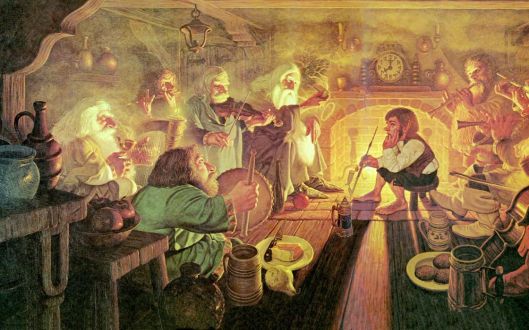
“As they [the hobbits] hesitated outside in the gloom, someone began singing a merry song inside, and many cheerful voices joined loudly in the chorus.  They listened to this encouraging sound for a moment and then got off their ponies.  The song ended and there was a burst of laughter and clapping.”

Pubs, and their upscale cousins, inns, would have been vital to people traveling before motels, hotels, and b&bs, as we can see in Book One of The Fellowship, and, for most of the rest of the novel, with the exceptions of Rivendell, Lorien, Edoras, and Minas Tirith, accommodation for the night would have meant a blanket on the ground.  For Tolkien and his friends in the writers’ group called The Inklings,

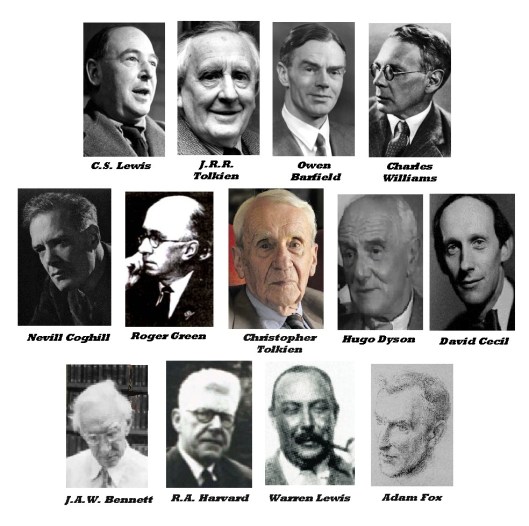
image9inklings.jpg

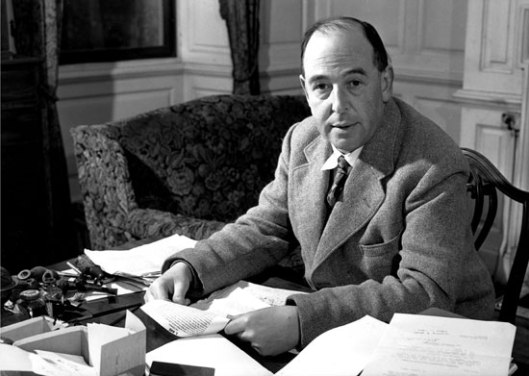
they were vital meeting points—not for the reading of new work, which appears to have been done in one member, C.S. Lewis’, rooms at Oxford,

image10csl.jpg

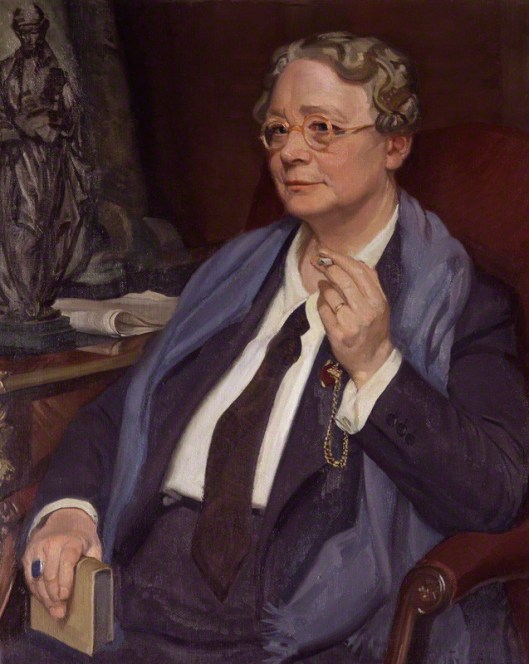
but for socializing and discussion, which was equally important for such a group of intelligent, educated, and highly-creative men.  (No women, alas!  One of our favorite mystery novelists and Dante-translator, Dorothy Sayers, 1893-1957, was friends with several members but, with the short-sightedness of the 1930s-50s, was never invited to join.)

image11dls.jpg

They met during the week not only at the best-known of their watering holes, the Eagle and Child,

image12bird.jpg

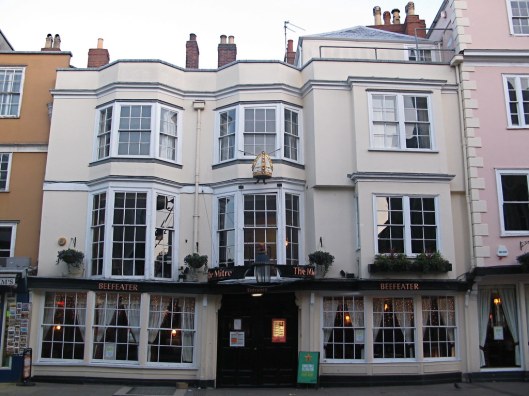
but at The Mitre,

image13mitre.jpg

The King’s Arms,

image14kingsarms.JPG

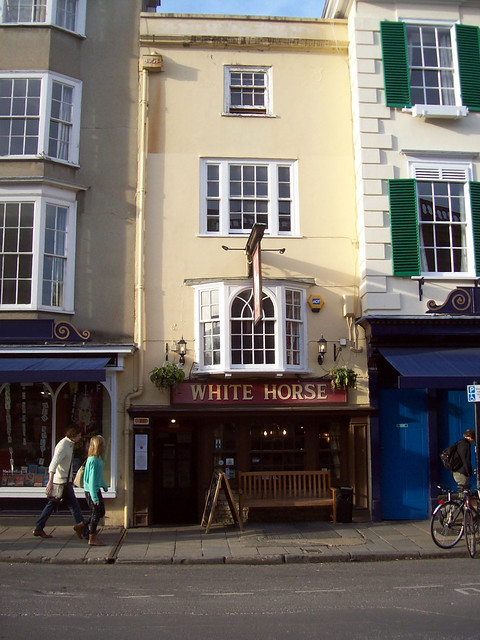
and at The White Horse.

image15whitehorse

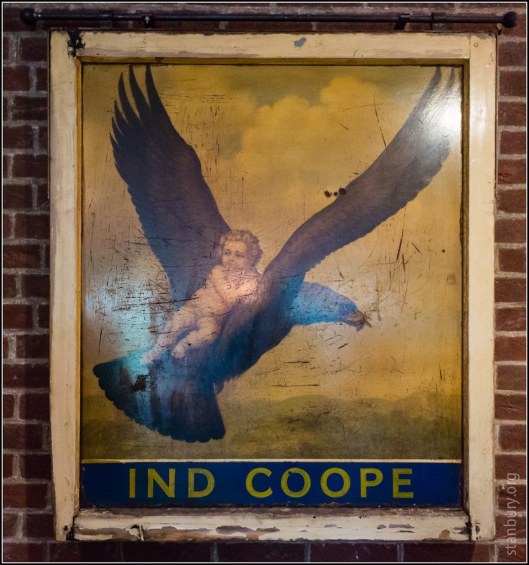
The one which caught our eye in particular is the first, which, as we said, is probably the one most closely associated with Tolkien and his friends.  Here’s its sign—

image16bird.jpg

The explanation of the pub’s name is, to us, a bit murky, supposedly coming from an element of the crest of the Stanley family which portrays an infant stolen by an eagle,

image17crest.jpg

but found alive and unharmed.  (Here’s a LINK so that you can judge for yourself.)

For ourselves, the idea of a child stolen by a raptor makes us think of a really awful 19th-century song, “The Vulture of the Alps”, a poem set to music about 1842 by a famous American vocal group of the 1840s-1870s, the Hutchinson Family Singers.  The title pretty much says it all.

image18hutch.jpg

If you’d like to know more, here’s a LINK.

When we think of eagles and Tolkien, however, we remember them as rescuers—of Gandalf, the dwarves, and Bilbo from the goblins and Wargs

image19rescue.jpg

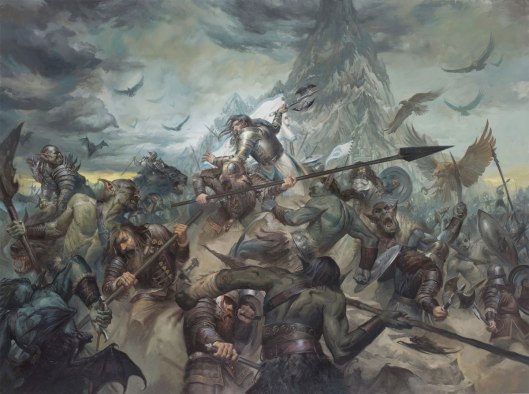
and as providers of air assault in The Hobbit.

image20battle.jpg

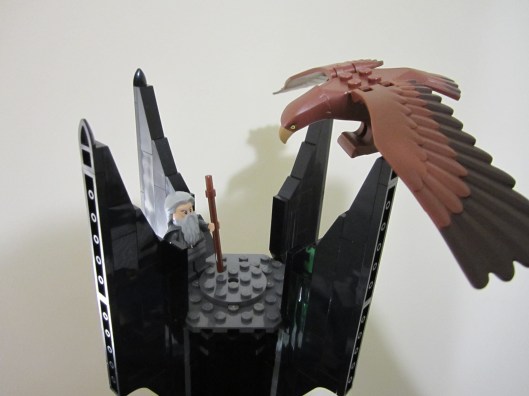
And, in The Lord of the Rings, rescuer of Gandalf from Saruman,

image21rescue


as allies of the West at the battle at the Morannon,

image22black.jpg

and as saviors of Frodo and Sam on Mt Doom.

image23savior.jpg

And it may be a crazy idea, but it makes us wonder—although Tolkien had abandoned The Hobbit unfinished in the early 1930s, he had picked it up again in 1936, just about the time the Inklings were meeting regularly (the first documented mention of them, apparently, is in a 1936 letter from CS Lewis to the novelist, Charles Williams, inviting him to join—see The Collected Letters of CS Lewis, Vol.2, 183—in a letter to William Luther White 9/11/67, JRRT dates the origins of the Inklings as “probably mid-thirties”—Letters, 387).  Could he have found his inspiration for these heroic birds and their habit of picking people up from the name of his pub?

As ever, thanks for reading.

MTCIDC

CD

ps

If you haven’t read CS Lewis’ wonderful essay, “On Three Ways of Writing for Children”, here’s a LINK.

pps

We have no illustration of Tolkien’s Green Dragon, but here’s a Tudor example from Wymondham in Norfolk which we think would do quite well.

image24green.jpg

Orc Logistics

10 Wednesday Jul 2019

Posted by Ollamh in Economics in Middle-earth, J.R.R. Tolkien, Military History, Military History of Middle-earth

≈ 1 Comment

Tags

American Civil War, BEF, Belgium, British Expeditionary Force, food and ammunition, French Army, German Army, Great War, guerilla, Helm's Deep, Horace Smith-Dorrien, Le Cateau, Marius, Marius' mules, Minas Tirith, Mons, Orcs, Paris, Romans, Schlieffen, Schlieffen Plan, The Lord of the Rings, Tolkien, Wagons, World War I

Welcome, as always, dear readers.

In August, 1914, as the German army was pushing through Belgium

image1germanarmy.jpg

in its attempt to sweep to the west of Paris and drive the French armies

image2french.jpg

eastwards towards the Germans waiting for them there (the so-called Schlieffen Plan),

image3schlieffen.jpg

they were met by the small (70,000 man) BEF, British Expeditionary Force,

image4tommy.jpg

a few miles north of the Franco-Belgian border, near the town of Mons, where the British fought a delaying action.

image5mons.jpg

The Germans were in such strength that the British were forced to pull back, retreating southward with the Germans pursuing so closely that the commander of one half of the British army (2nd Corps), Horace Smith-Dorrien,

image6hsd.jpg

decided that it was necessary to fight a second delaying action, at Le Cateau.

image7lecateau.jpg

A major reason to do so was not just that the German pursuit was so close, but that it was necessary to protect the trains.  This doesn’t mean the railways, but the endless lines of wagons

image8gswagon.jpg

which carried all the food and ammunition for the soldiers and stretched for miles behind them..

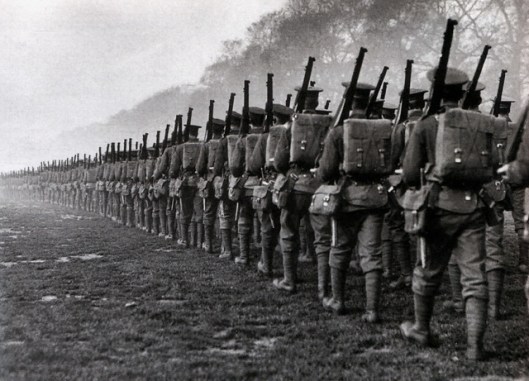
image9marching.jpg

It was also primarily horse-drawn and, on narrow roads, mostly unpaved, the trains moved very slowly, which was a major reason why armies in earlier centuries rarely ever campaigned during winter.

image10turenne.jpg

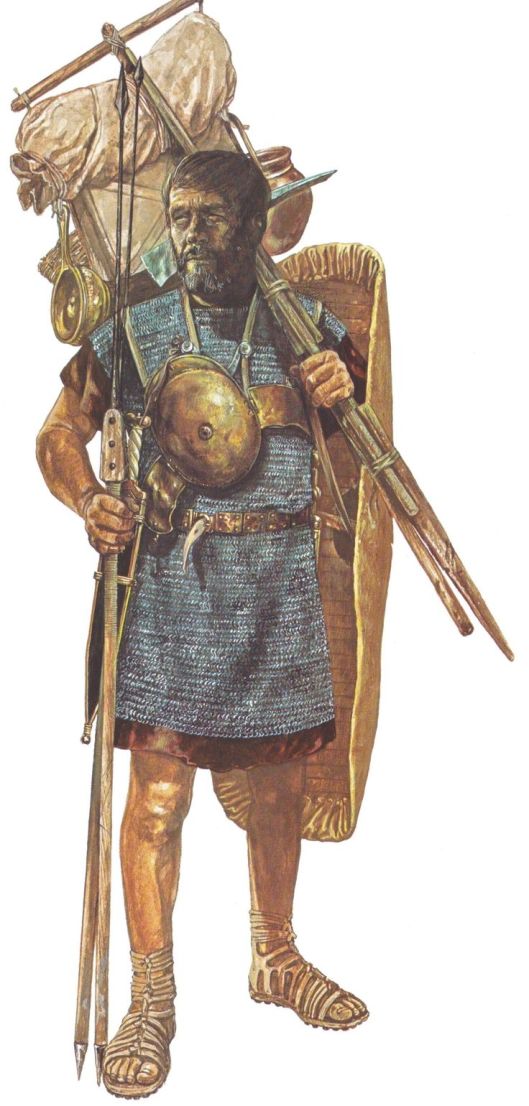
This was a problem, all the way back to the Romans.  In the 2nd century BC, the Roman general, Marius, in an attempt to do away with as much of a baggage train as he could,

image11romanwagon.JPG

ordered his men to carry as much of their equipment as possible, thus cutting down on baggage wagons and pack animals.  His men were less than pleased at being so loaded down and began to call themselves “Marius’ mules”.

image12mule.jpg

In the late 18th to early 19th century, when French revolutionary armies swelled beyond the ability to pay to supply them, the order was to travel lightly and to live off the land.  This may have reduced baggage—and even, perhaps, speeded up movement—but it made local people very hostile to the French and, in Spain, the response was to ambush the French whenever possible, which is where the word “guerilla” (originally meaning “little war”) comes from.

image13spguerillas.jpg

image14spguerillas.jpg

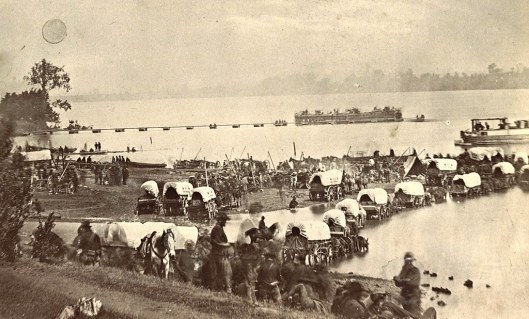
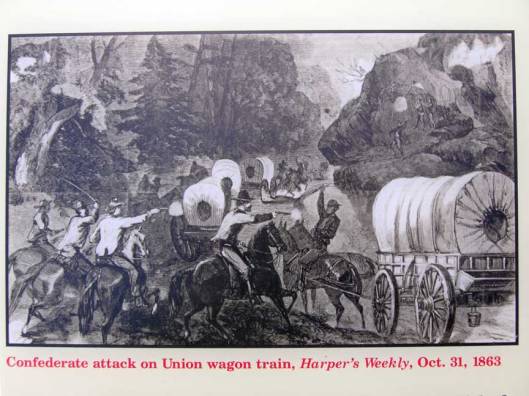
This could happen, particularly to Union supply trains,

image15wagons.jpg

during the American Civil War.

image16ambush.jpg

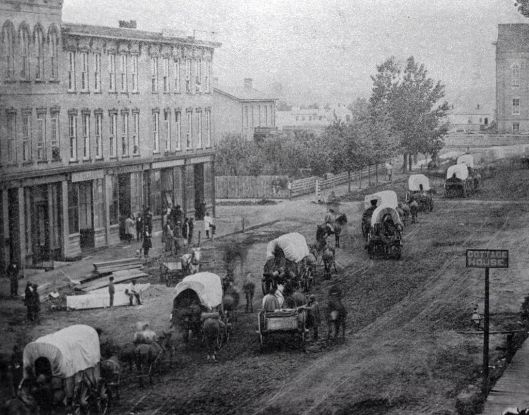
So, such trains were utterly necessary—if a large army had to cross miles of territory and perhaps fight on the way, they would need everything a train could carry.  At the same time, trains could be both vulnerable and thus draw off numbers of soldiers to protect them when such soldiers might be better employed on the battlefield, as well as cumbersome, because they were slow-moving, forcing armies to march at their speed (and in dry summer weather, the dust they raised could give away the direction of an army’s movements).
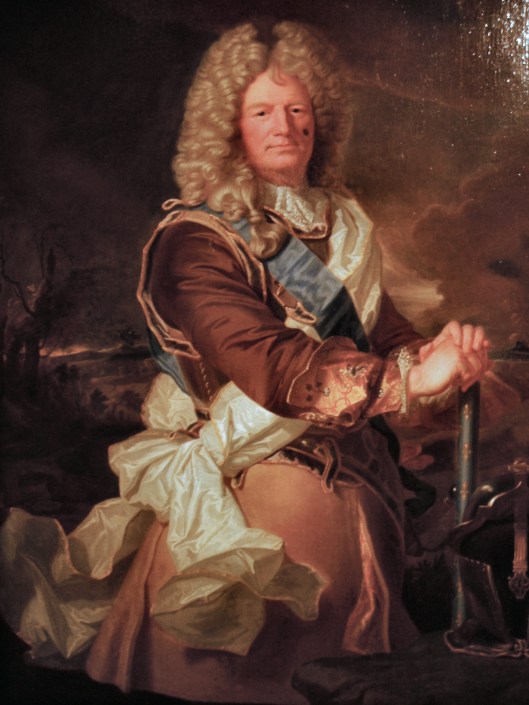
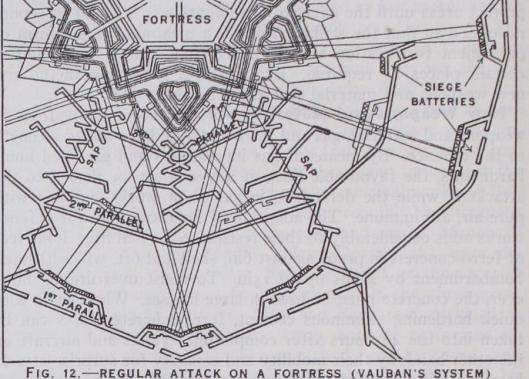
image17wagontrain.jpg

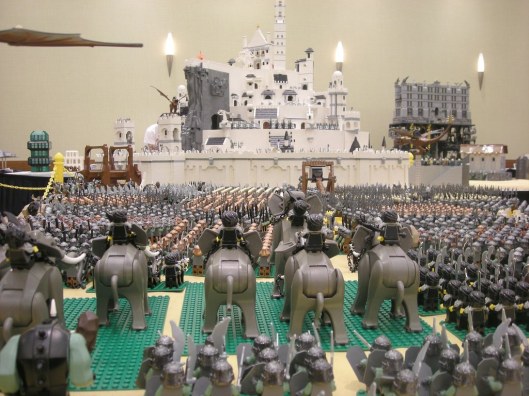
In The Lord of the Rings, we see two invasions:  that which attacks Helm’s Deep

image18helms.jpg

and that which attacks Minas Tirith.

image19mt.jpg

The mass of invaders is vividly described:

“For a staring moment the watchers on the walls saw all the space between them and Dike lit with white light:  it was boiling and crawling with black shapes, some squat and broad, some tall and grim, with high helms and sable shields.  Hundreds and hundreds more were pouring over the Dike and through the breach.”  (The Two Towers, Book Three, Chapter 7, “Helm’s Deep”)

“The numbers that had already passed over the River could not be guessed in the darkness, but when morning, or its dim shadow, stole over the plain, it was seen that even fear by night had scarcely over-counted them.  The plain was dark with their marching companies, and as far as eyes could strain in the mirk there sprouted, like a foul fungus-growth, all about the beleaguered city great camps of tents, blac or somber red.” (The Return of the King, Book Five, Chapter 4, “The Siege of Gondor”)

And yet there is no hint of what will supply them in their assaults and beyond.  We could argue, of course, that, as in so many things, JRRT is interested in the movement of his narrative and its effects:  masses of orcs are much more menacing than long lines of wagons, and we’re sure that this is actually the case, but there is another possibility.  The Great War began in Belgium as a war of movement, huge armies attempting to outflank and block each other like chess players.  For better or worse, those armies needed such baggage trains, as we’ve said.  By the time Tolkien had arrived at the Western Front, in mid-1916, the war had become static, as if both sides had dug trenches and were besieging each other.
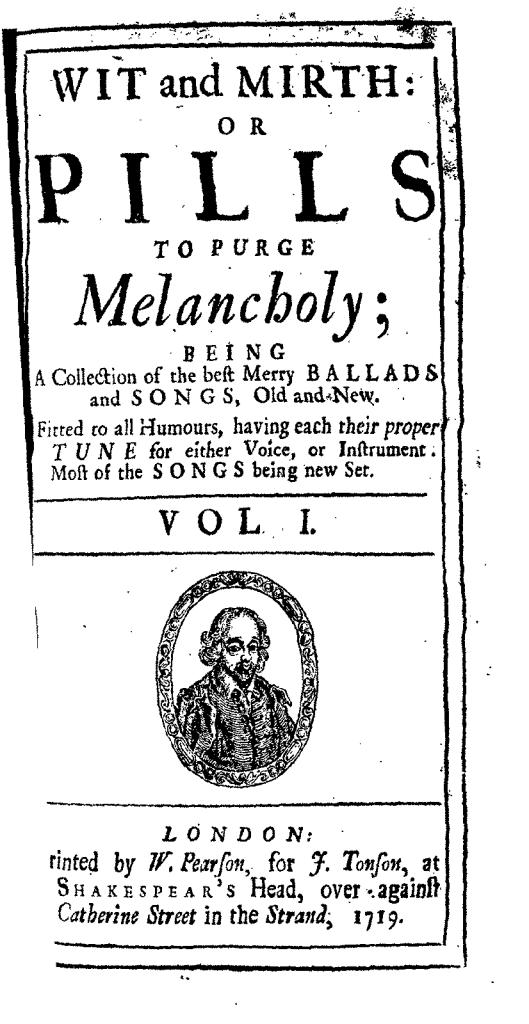
image20atrench.jpg

image20trench.jpg

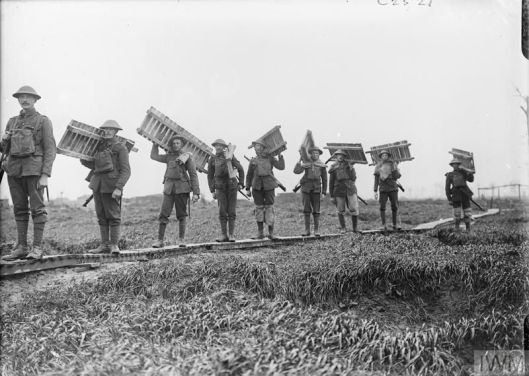
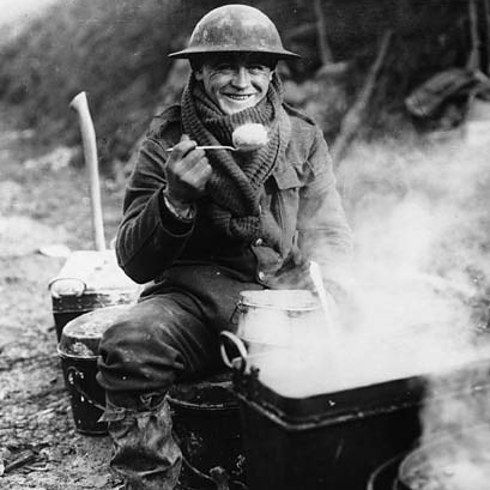
Supply was clearly still necessary, but it was a complex combination of ports and ships and railway lines and wagons and mules and even human mules, close to the front.

image21.jpg

In a way, the whole business of supply had begun to look like just that:  a business, like importing bananas from the Caribbean, having them arrive in London, then passing them on by train to cities and towns across Britain.

image22bananas.jpg

So, instead of being part of long marching columns,image23marching.jpg

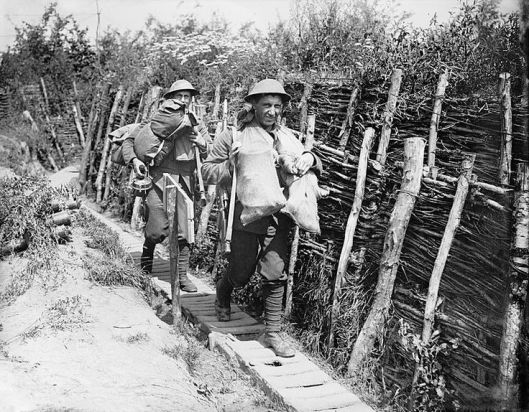
their even longer lines of wagons lagging behind, Second Lieutenant Tolkien would have seen long lines of men and animals, lugging endless boxes and cans and bundles—

image24carrying.jpg

image25carrying.jpg

necessary for war, but hardly dramatic, and so best left to the imagination of certain readers, those who can never see a battle without wondering, “When it’s time for lunch, who feeds all of those soldiers—or orcs (and never mind what certain people might eat)?”

image26lunch.jpg

As always, thanks for reading and

MTCIDC

CD

← Older posts
Newer posts →

The Doubtful Sea Series Facebook Page

The Doubtful Sea Series Facebook Page

  • Ollamh

Categories

  • Artists and Illustrators
  • Economics in Middle-earth
  • Fairy Tales and Myths
  • Films and Music
  • Games
  • Heroes
  • Imaginary History
  • J.R.R. Tolkien
  • Language
  • Literary History
  • Maps
  • Medieval Russia
  • Military History
  • Military History of Middle-earth
  • Narnia
  • Narrative Methods
  • Poetry
  • Research
  • Star Wars
  • Terra Australis
  • The Rohirrim
  • Theatre and Performance
  • Tolkien
  • Uncategorized
  • Villains
  • Writing as Collaborators
Follow doubtfulsea on WordPress.com

Across the Doubtful Sea

Recent Postings

  • Through a glass… January 7, 2026
  • Heffalumps? December 31, 2025
  • We Three Kings December 24, 2025
  • A Moon disfigured December 17, 2025
  • On the Roads Again—Once More December 10, 2025
  • (Not) Crossing Bridges December 3, 2025
  • On the Road(s) Again—Again November 26, 2025
  • On the Road(s) Again November 19, 2025
  • To Bree (Part 2) November 12, 2025

Blog Statistics

  • 104,103 Views

Posting Archive

  • January 2026 (1)
  • December 2025 (5)
  • November 2025 (4)
  • October 2025 (5)
  • September 2025 (4)
  • August 2025 (4)
  • July 2025 (5)
  • June 2025 (4)
  • May 2025 (4)
  • April 2025 (5)
  • March 2025 (4)
  • February 2025 (4)
  • January 2025 (5)
  • December 2024 (4)
  • November 2024 (4)
  • October 2024 (5)
  • September 2024 (4)
  • August 2024 (4)
  • July 2024 (5)
  • June 2024 (4)
  • May 2024 (5)
  • April 2024 (4)
  • March 2024 (4)
  • February 2024 (4)
  • January 2024 (5)
  • December 2023 (4)
  • November 2023 (5)
  • October 2023 (4)
  • September 2023 (4)
  • August 2023 (5)
  • July 2023 (4)
  • June 2023 (4)
  • May 2023 (5)
  • April 2023 (4)
  • March 2023 (5)
  • February 2023 (4)
  • January 2023 (4)
  • December 2022 (4)
  • November 2022 (5)
  • October 2022 (4)
  • September 2022 (4)
  • August 2022 (5)
  • July 2022 (4)
  • June 2022 (5)
  • May 2022 (4)
  • April 2022 (4)
  • March 2022 (5)
  • February 2022 (4)
  • January 2022 (4)
  • December 2021 (5)
  • November 2021 (4)
  • October 2021 (4)
  • September 2021 (5)
  • August 2021 (4)
  • July 2021 (4)
  • June 2021 (5)
  • May 2021 (4)
  • April 2021 (4)
  • March 2021 (5)
  • February 2021 (4)
  • January 2021 (4)
  • December 2020 (5)
  • November 2020 (4)
  • October 2020 (4)
  • September 2020 (5)
  • August 2020 (4)
  • July 2020 (5)
  • June 2020 (4)
  • May 2020 (4)
  • April 2020 (5)
  • March 2020 (4)
  • February 2020 (4)
  • January 2020 (6)
  • December 2019 (4)
  • November 2019 (4)
  • October 2019 (5)
  • September 2019 (4)
  • August 2019 (4)
  • July 2019 (5)
  • June 2019 (4)
  • May 2019 (5)
  • April 2019 (4)
  • March 2019 (4)
  • February 2019 (4)
  • January 2019 (5)
  • December 2018 (4)
  • November 2018 (4)
  • October 2018 (5)
  • September 2018 (4)
  • August 2018 (5)
  • July 2018 (4)
  • June 2018 (4)
  • May 2018 (5)
  • April 2018 (4)
  • March 2018 (4)
  • February 2018 (4)
  • January 2018 (5)
  • December 2017 (4)
  • November 2017 (4)
  • October 2017 (4)
  • September 2017 (4)
  • August 2017 (5)
  • July 2017 (4)
  • June 2017 (4)
  • May 2017 (5)
  • April 2017 (4)
  • March 2017 (5)
  • February 2017 (4)
  • January 2017 (4)
  • December 2016 (4)
  • November 2016 (5)
  • October 2016 (6)
  • September 2016 (5)
  • August 2016 (5)
  • July 2016 (5)
  • June 2016 (5)
  • May 2016 (4)
  • April 2016 (4)
  • March 2016 (5)
  • February 2016 (4)
  • January 2016 (4)
  • December 2015 (5)
  • November 2015 (5)
  • October 2015 (4)
  • September 2015 (5)
  • August 2015 (4)
  • July 2015 (5)
  • June 2015 (5)
  • May 2015 (4)
  • April 2015 (3)
  • March 2015 (4)
  • February 2015 (4)
  • January 2015 (4)
  • December 2014 (5)
  • November 2014 (4)
  • October 2014 (6)
  • September 2014 (1)

Blog at WordPress.com.

  • Subscribe Subscribed
    • doubtfulsea
    • Join 78 other subscribers
    • Already have a WordPress.com account? Log in now.
    • doubtfulsea
    • Subscribe Subscribed
    • Sign up
    • Log in
    • Report this content
    • View site in Reader
    • Manage subscriptions
    • Collapse this bar
 

Loading Comments...