• About

doubtfulsea

~ adventure fantasy

Tag Archives: Writing

It’s in Writing (1)

15 Wednesday Oct 2025

Posted by Ollamh in Uncategorized

≈ Leave a comment

Tags

augury, Belshazzar, class in the Shire, Daniel, Dwarves, Fantasy, Jerome, literacy in Middle-earth, reading, Rohirrim, Sam Gamgee, scribes, the handwriting on the wall, Tolkien, Writing

As always, dear readers, welcome.

Belshazzar, the king of the Babylonians, was having a lovely party—

“Baltassar rex fecit grande convivium optimatibus suis mille: et unusquisque secundum suam bibebat aetatem.”

“Belshazzar held a great banquet for a thousand of his elite and each one was drinking according to his time of life.”
But, wishing to up the fun, he decided to make the party a bit more lavish—

Praecepit ergo jam temulentus ut afferrentur vasa aurea et argentea, quae asportaverat Nabuchodonosor pater ejus de templo, quod fuit in Ierusalem, ut biberent in eis rex, et optimates ejus, uxoresque ejus, et concubinae.

“And so now, being drunk, he ordered that the golden and silver vessels which Nebuchadnezzar, his father, had carried away from the temple which had been in Jerusalem be brought in so that the king and his nobles and his wives and concubines might drink in them.”

[“fuit” here is the perfect form and might be translated “has been”, but that form can suggest a permanent state, the pluperfect, suggesting that there would be no more Jerusalem.]

and then things go very wrong–

“In eadem hora apparuerunt digiti, quasi manus hominis scribentis contra candelabrum in superficie parietis aulae regiae: et rex aspiciebat articulos manus scribentis.”

“In the same hour, there appeared fingers, like a man’s hand, opposite the lampstand, writing on the surface of the wall of the royal hall, and the king was staring at the joints of the hand writing.”
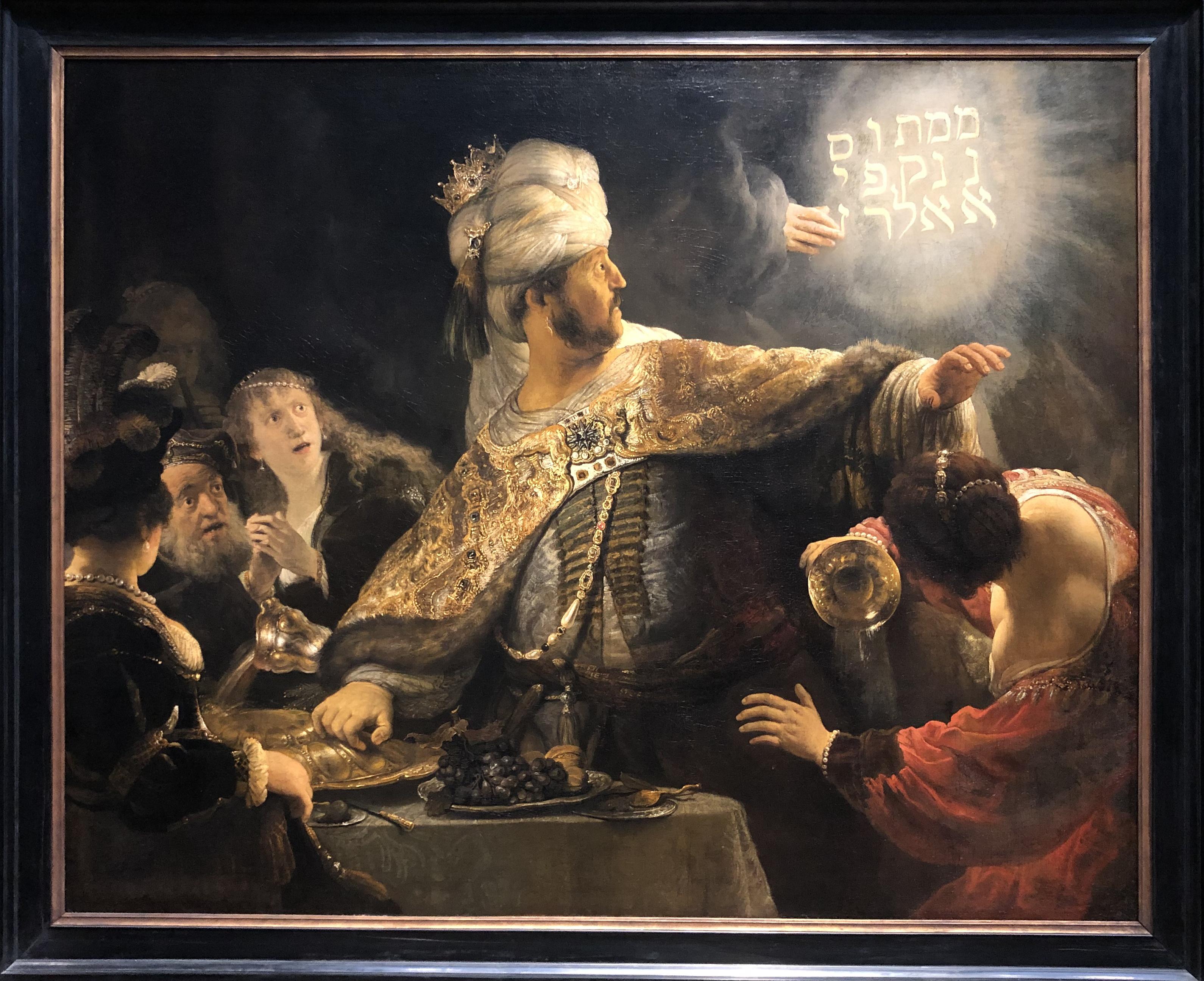
(Rembrandt—who clearly had no idea what the real Babylonian king would have worn, but settled for something right out of the visit of the Magi, which was undoubtedly good enough for his audience, who would have had no more idea than he did)

Needless to say, this was a bad omen, but one his own counselors couldn’t interpret, as the message was not in Babylonian.  His queen, however, recommended that a Jewish interpreter, Daniel, be summoned, who arrived and interpreted the writing, which may have included some rather fancy word-play, but which meant:  “You are not long on the throne and your kingdom is about to become the property of the Persians.”

(All Latin translations are mine from Section 5 of “The Book of Daniel”.  The Latin text is from Jerome’s 4th-century translation, which you can read, with an English translation, here:     https://vulgate.org/ot/daniel_5.htm  For more on the message, see:   https://www.christianitytoday.com/2024/11/andrew-wilson-spirited-life-daniel-writing-on-wall-babylon/   For more on the historic Belshazzar—an ironic name as far as the ancient Hebrews must have been concerned, as it means “[the god] Bel [aka Baal] protect the king” which the Book of Daniel indicates that he certainly didn’t!—see:  https://en.wikipedia.org/wiki/Belshazzar )

Behind this story lies not only the status of Daniel as prophet and interpreter, and the idea that the Hebrew God is not to be messed with, even by kings, but also, for this posting, the importance of writing—the omen isn’t, like so many others, based on the flight of birds or the liver of a sheep or the behavior of chickens,
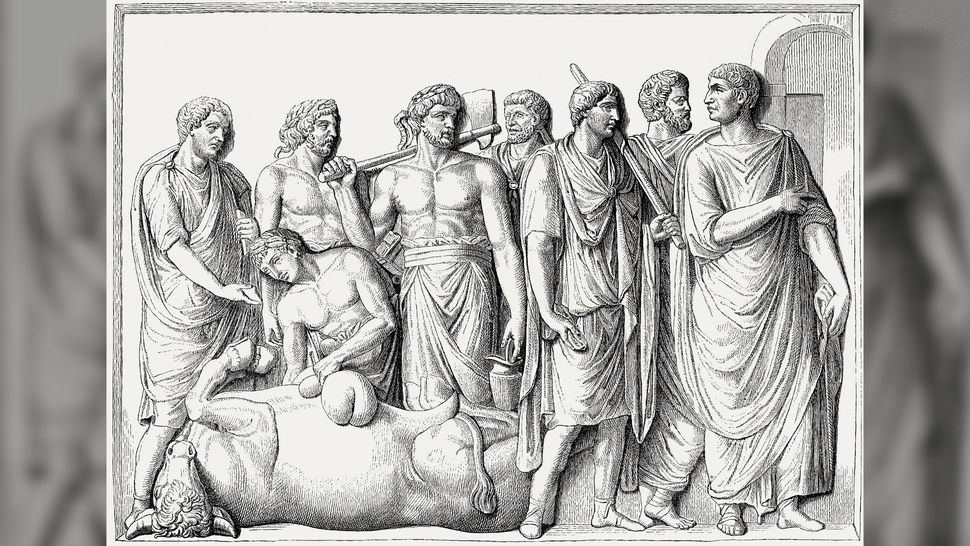
(for more on such practices see:  https://en.wikipedia.org/wiki/Augury )

all things which the ancient world would have thought significant–but on something handwritten (literally) on a palace wall.  This is clearly so unusual that its significance is immediately multiplied, and which, since Daniel can not only interpret it, but, to do so, he can read it, tells us something more about Daniel:   he is literate.

Because we in the modern West live in such a literate world ourselves, it’s sometimes hard to understand earlier worlds where literacy was not the norm.  Could Belshazzar read?  Probably not:  that was the job of technical people, scribes,
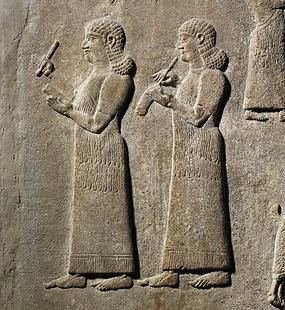
(These are actually Sumerians, but can stand in for Babylonian scribes, as the Babylonians used the writing system, cuneiform,

which the Sumerian scribes had invented.)

whom rulers could call upon when needed, as we see in ancient and medieval societies in general.  Literacy was a skill, like carpentry or masonry, and limited in the number of people who could practice it.  Could this have been true in Middle-earth, based as it is upon the medieval world of our Middle-earth, as well?

Gondor appears to have had a long tradition at least of extensive record-keeping, as we hear from Gandalf:

“And yet there lie in his hoards many records that few even of the lore-masters now can read, for their scripts and tongues have become dark to later men.” (The Fellowship of the Ring, Book Two, Chapter 2, “The Council of Elrond”)

As for the Rohirrim, I would guess that, although there may have been some literacy, much of their past—and possibly their present—was preserved in oral tradition, as Aragorn says of Meduseld:

“But to the Riders of the Mark it seems so long ago…that the raising of this house is but a memory of song.” (The Two Towers, Book Three, Chapter 6, “The King of the Golden Hall”)

And Theoden says to Aragorn:

“Will you ride with me then, son of Arathorn?  Maybe we shall cleave a road, or make an end as will be worth a song—if any be left to sing of us hereafter.”  (The Two Towers, Book Three, Chapter 7, “Helm’s Deep”)

In the Prologue to The Lord of the Rings, we are told that the Hobbits as a whole had had potential literacy for some time, in fact, from their days of moving westwards towards what would become the Shire:

“It was in these early days, doubtless, that the Hobbits learned their letters and began to write, after the manner of the Dunedain, who had in their turn long before learned the art from the Elves.”  (The Lord of the Rings, Prologue I, “Concerning Hobbits”)

As in the case of other medieval worlds, however, this was seemingly not general literacy, although rather than being the possession of a specialized class, as in Babylon or ancient Egypt,

it might, instead, have been a mark of class.

Consider Sam Gamgee.  His father is the gardener for Bilbo Baggins and Sam is his assistant.

(Robert Chronister)

From his position—and from the way he addresses his “betters” as “Mister”, while they address him by his first name—it’s clear that Sam and his father are not of the same social class as the Bagginses.   And so, when the Gaffer says:

“Mr. Bilbo has learned him his letters—meaning no harm, mark you, and I hope no harm will come of it.”  (The Fellowship of the Ring, Book One, Chapter 1, “A Long-Expected Party”)

This appears to be what we might call a mark of that class difference:  Bilbo, a ‘gentleman” can read, although, as we hear of no academies in the Shire, presumably through home-schooling, implying that there was at least one other person in his family’s household who could also read and who had taught him.  Considering the Gaffer’s potential uneasiness about it—why should there be harm in being able to read?—I think that we can imagine that the Gaffer himself could not—and himself was aware of the class distinction (Sam might get ideas “above his station”?).

And yet it’s to Sam that Frodo passes the book begun so long ago by Bilbo:

“ ‘Why, you have nearly finished it, Mr. Frodo!’ Sam exclaimed.  ‘Well, you have kept at it, I must say.’

‘I have quite finished, Sam,’ said Frodo.  ‘The last pages are for you.’ “ (The Return of the King, Book Six, Chapter 9, “The Grey Havens”)

Daniel’s literacy gives him the ability to read the Hebrew God’s warning to Belshazzar, establishing his importance in the story (which continues, as he becomes the confidant and friend of the new king, Darius.)

And here we see the real reason JRRT had given Sam literacy:  not that he might read Bilbo/Frodo’s efforts, but that he might write and therefore complete the story of The Lord of the Rings, and thus add one more element to his importance in the narrative.

In our next posting, however, we will examine another use of writing and reading—and a much less benign one.

Thanks, as always for reading.

Stay well,

Delight in the fact that you can read,

And remember that there’s always

MTCIDC

O

PS

As to evidence of general literacy in the Shire, we see, in “The Scouring of the Shire”, some public notices—a sign on the new gate on the bridge over the Brandywine (“No admittance between sundown and sunrise”) and an anonymous hobbit calls out “Can’t you read the notice?”  In the watch house just beyond we see:   “…on every wall there was a notice and list of Rules”. As far as I can tell, however, these are the only public signs we see in Middle-earth and seem to me more about Authority than literacy.   Just the fact that they’re there must have an effect upon cowed hobbits, even if they can’t read.

PPS

For completeness sake, although we have only bits and pieces of dwarvish, we can say that at least some dwarves were literate, evidence being the fragmentary account of the reworking of Moria which the Fellowship find in the Chamber of Records there,

as well as the inscription on Balin’s tomb. (for more on JRRT’s work on recreating that fragmentary record, the so-called Book of Mazarbul, see: “Aging Documents”, 31 July, 2024)

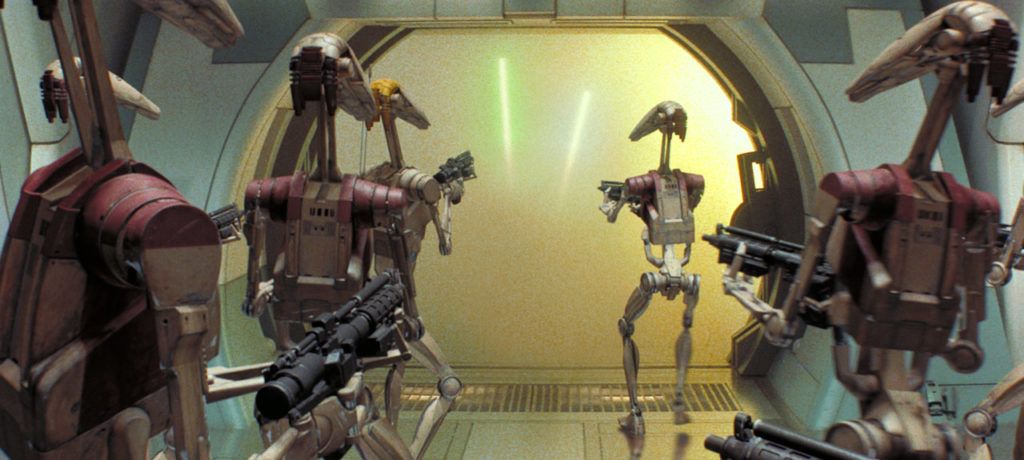
Dos Mackaneeks

26 Wednesday Jun 2024

Posted by Ollamh in Uncategorized

≈ Leave a comment

Tags

Fantasy, lord-of-the-rings, The Lord of the Rings, Tolkien, Writing

Welcome, as always, dear readers.

Star Wars:  the Phantom Menace

certainly begins with a bang:  a Jedi and his padawan, sent on a peace mission to the planet Naboo, are attacked by poisoned gas and droids

(reminding me at once of those lines from Weird Al Jankovic’s song:

“But their response, it didn’t thrill us

They locked the doors and tried to kill us”

If you don’t know “The Saga Begins”, you can watch it here:  https://www.youtube.com/watch?v=hEcjgJSqSRU )

but escape to the surface only to be almost squashed in an invasion of droid armor

before they rescue an unlikely helper (right out of Thompson’s Motif-Index of Folk-Literature B350-B390, “Grateful Animals”),

who takes them to an underwater city where they come before Boss Nass, who blames upperworlders for the invasion

and responds to their warning that, after they finish with the upperworlders, the invaders will be coming for those below the water:

“Dos mackaneeks no comen here.  Dey not know of usen.”

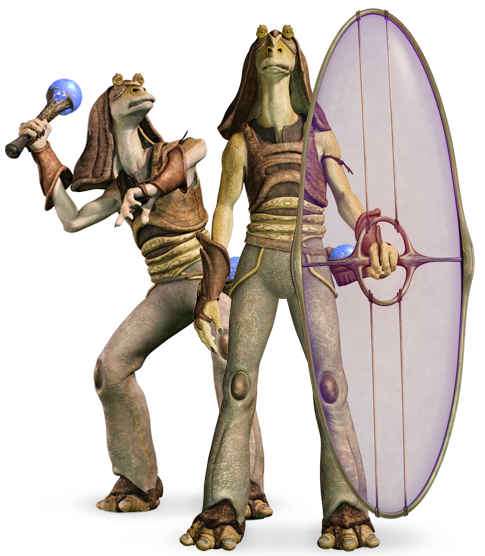
The Gungans (which is what these people call themselves) are sophisticated technologically enough to have an underwater city

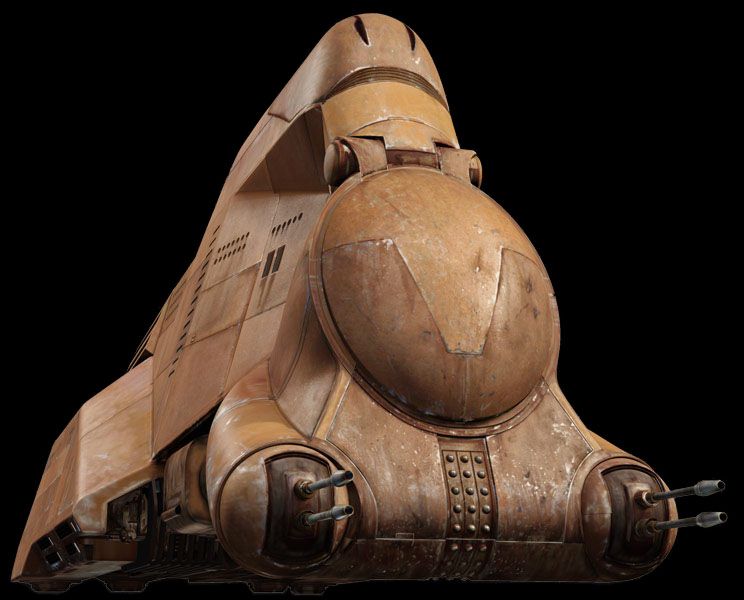
and self-propelled transport,

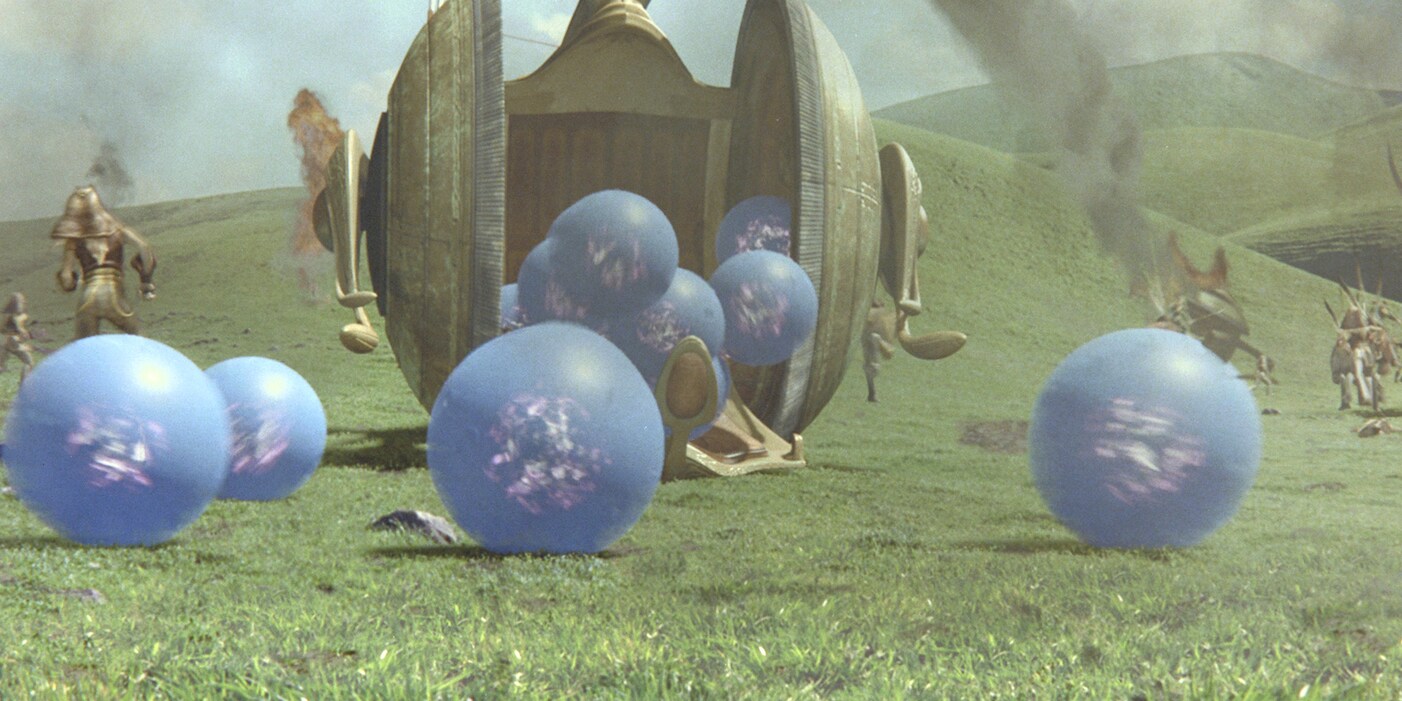
and they even can produce an energy shield,

but faced with the armament of the invading droid army—

and its hordes of infantry,

their use of energy balls (“boomas”)

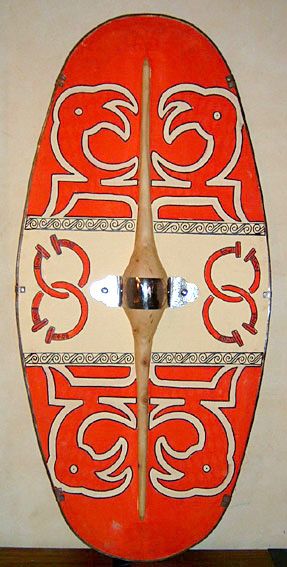
and shields

which bear a faint resemblance to Celtic shields in some clear material

show them to be really no match for the droids and their technology.  Only luck from the outside saves them.

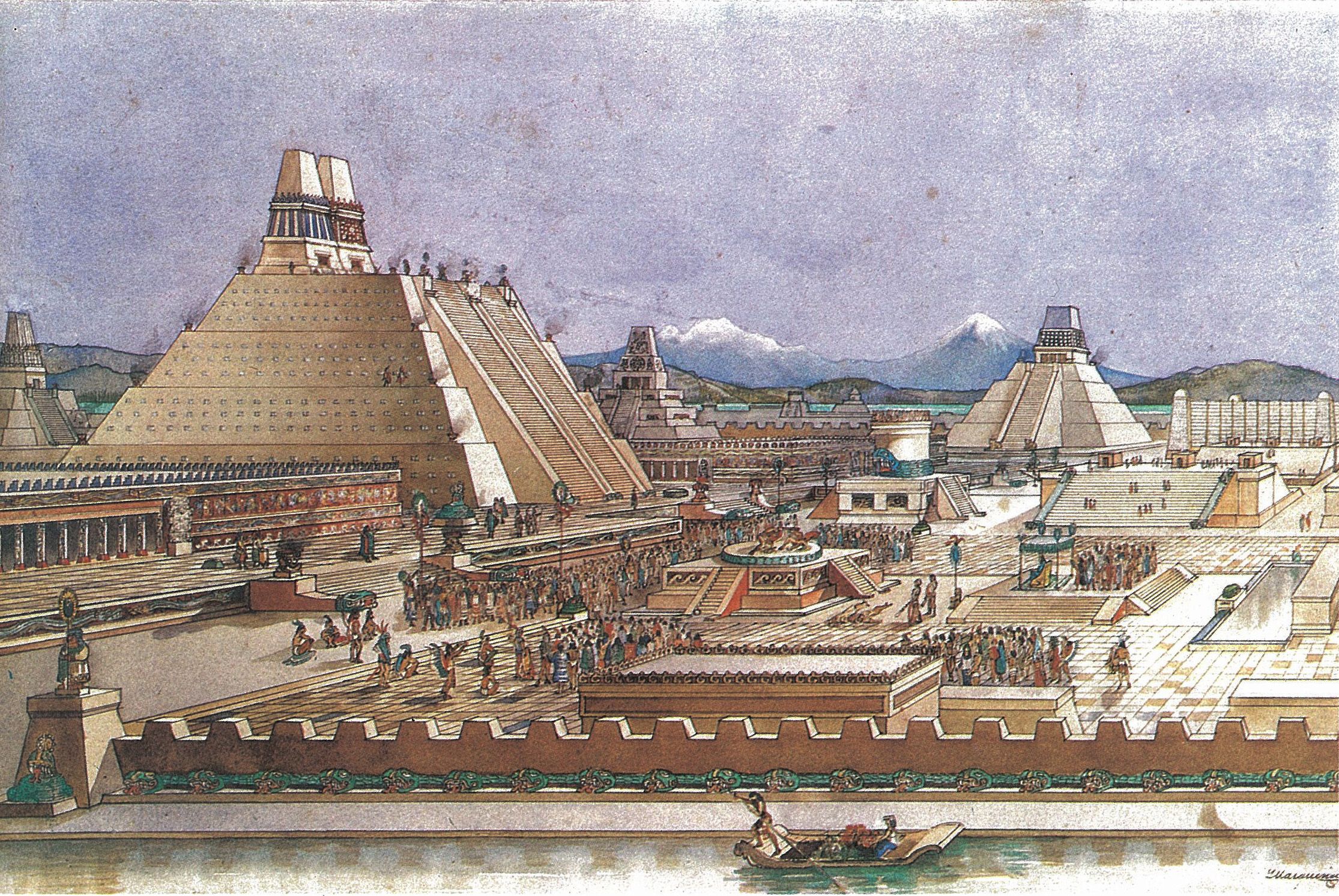
The Gungans are brave and their weapons can cause some damage, but it’s obvious that they’re outclassed technologically, which makes me think of the Aztecs, the center of whose capital, Tenochtitlan, built in the middle of a lake, was a series of sophisticated and elegant stone buildings (complete with an aqueduct),

but who, unfortunately for them, were a late Neolithic culture who, with no metal with which to work, made their weapons using volcanic glass, obsidian, which was sharp,

(this and the next by Angus McBride)

but no match for the conquistadores’ steel weapons, armor, and early firearms.

And this brings me to a “what if”.

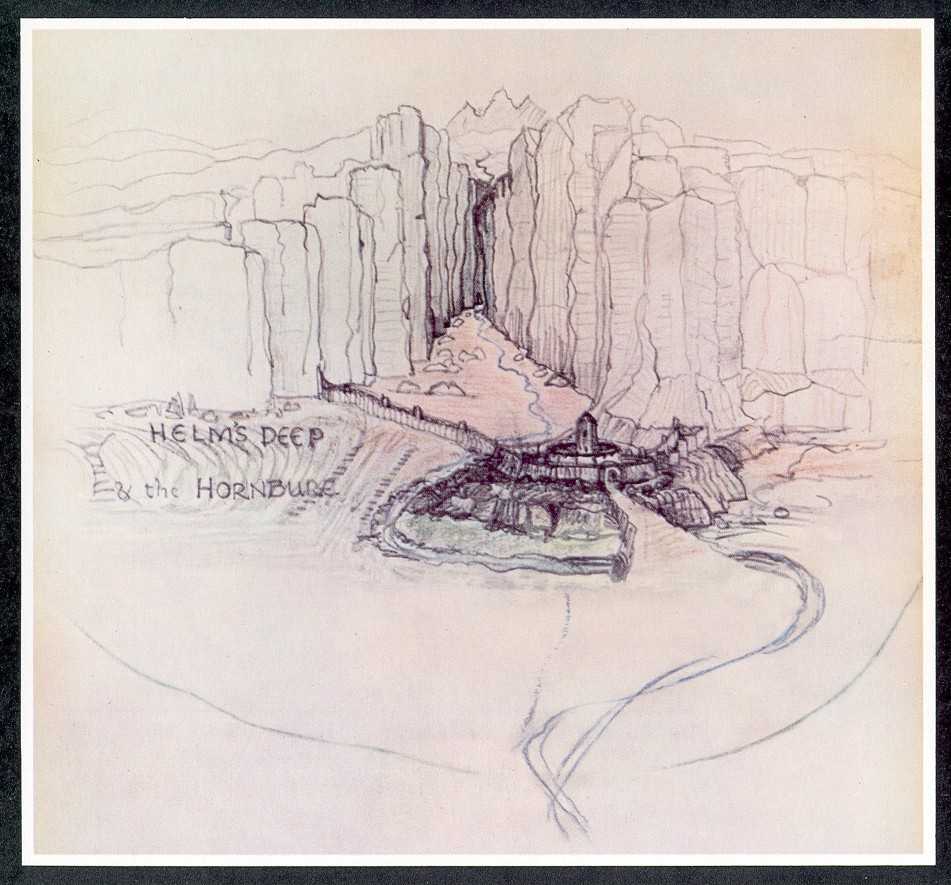
When Helm’s Deep is attacked,

(JRRT)

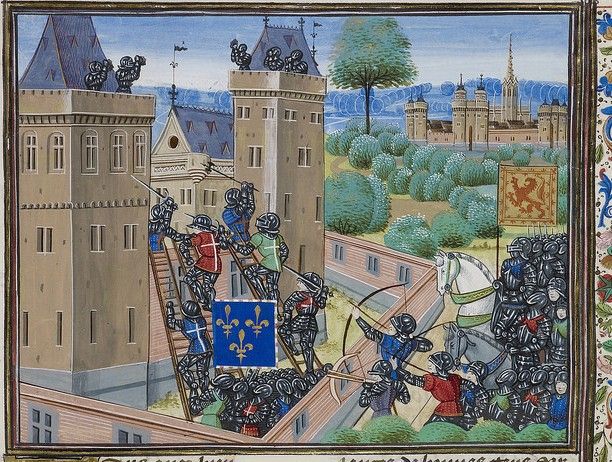
the orcs’ original method is perhaps the worst in the repertoire:  escalade—that is, putting ladders up against a wall, then climbing up them.  You can imagine why I call it the worst—

the attackers are visible all the way up the ladders and:

1. they can be pushed off

2. the ladders can be pushed off

3. people can whack you when you reach the top

4. people can shoot you on the way up

5. people can drop things on you on the way up

(In several historical assaults, ladders were found to be too short, adding an extra difficulty.)

Such attacks usually only succeed if:

1. they are a surprise  (this happened at the terrible siege of Badajoz in 1812—the French garrison was too focused in one direction and some of the British attackers climbed up the back of the fortress–)

2. the attackers can pin down enough of the defenders with archery/gunfire to allow the climbers to reach the top—and an attack can still fail if those at the top aren’t supported by others coming up behind them—Alexander the Great almost died when he was isolated after scaling an enemy wall (reinforcements overburdened the ladders and they broke—see Arrian The Anabasis of Alexander, Book VI, Sections 9-10—which you can read in translation here:  https://www.gutenberg.org/cache/epub/46976/pg46976-images.html#Page_329  )

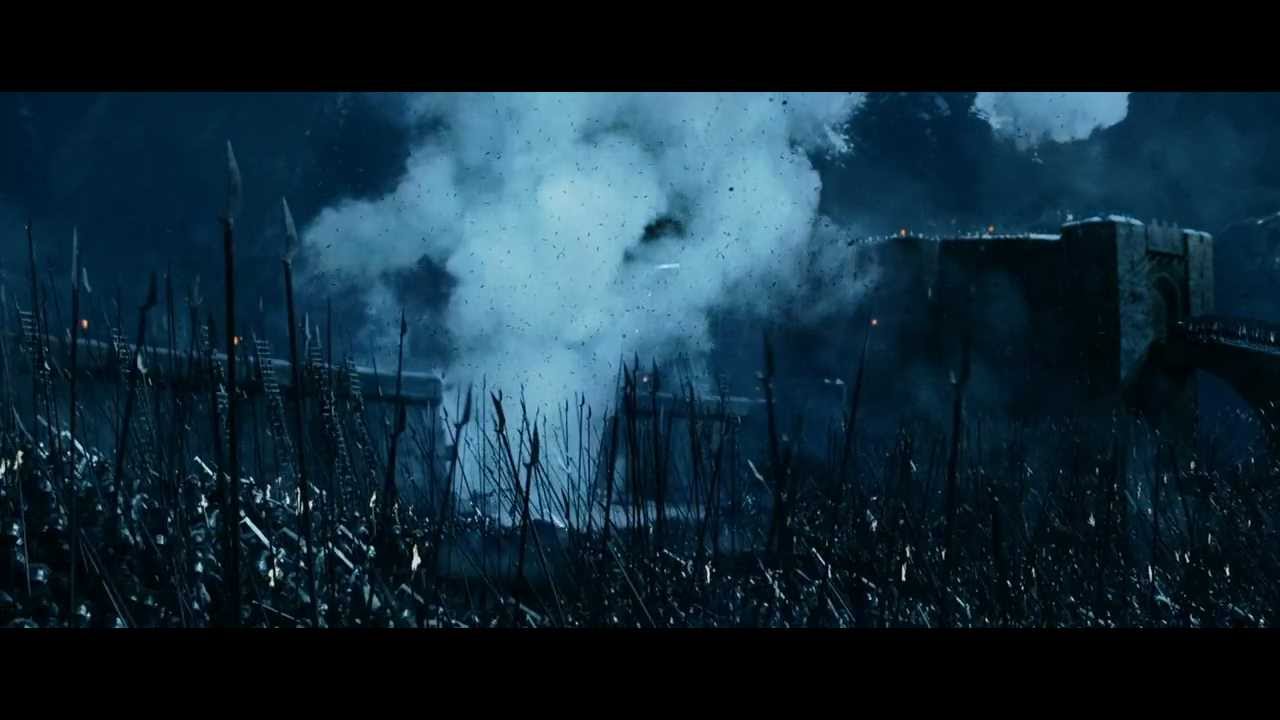
The orcs, however, are concealing a secret weapon—

“Even as they spoke there came a blare of trumpets.  Then there was a crash and a flash of flame and smoke.  The waters of the Deeping-stream poured out hissing and foaming:  they were choked no longer, a gaping hole was blasted in the wall.  A host of dark shapes poured in.

‘Devilry of Saruman!’ cried Aragorn.  ‘They have crept in the culvert again, while we talked, and they have lit the fire of Orthanc beneath our feet.’ “  (The Two Towers, Book Three, Chapter 7, “Helm’s Deep”)

And it’s not just Saruman’s “Devilry”—

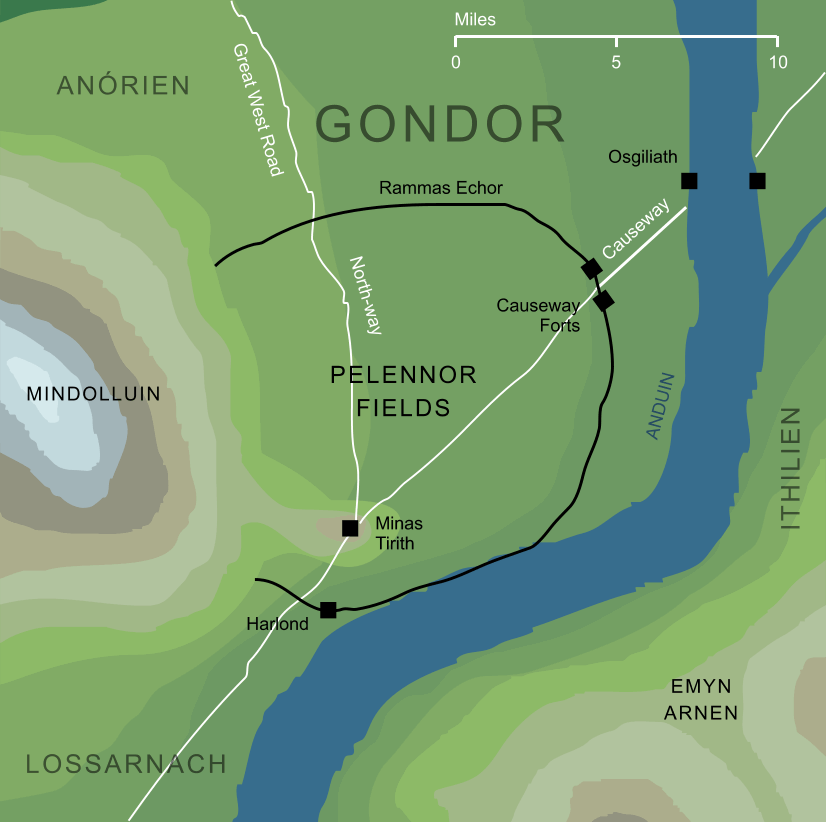
“The bells of day had scarcely rung out again, a mockery in the unlightened dark, when far away he saw fires spring up, across in the dim spaces where the walls of the Pelennor stood.  The watchmen cried aloud, and all men in the City stood to arms.  Now ever and anon there was a red flash, and slowly through the heavy air dull rumbles could be heard.

‘They have taken the wall!’ men cried.  ‘They are blasting breaches in it.  They are coming!’ “ (The Return of the King, Book Five, Chapter 4, “The Siege of Gondor”)

I think that we can assume that “the fire of Orthanc” is, in fact, gunpowder.

In our Western world, the first known mention of it was by Friar Roger Bacon in the mid-13th century,

and the first known depiction of a gunpowder weapon dates from the early 14th century.

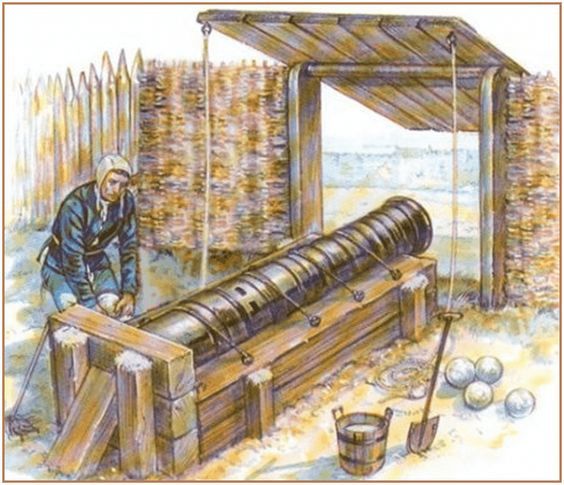
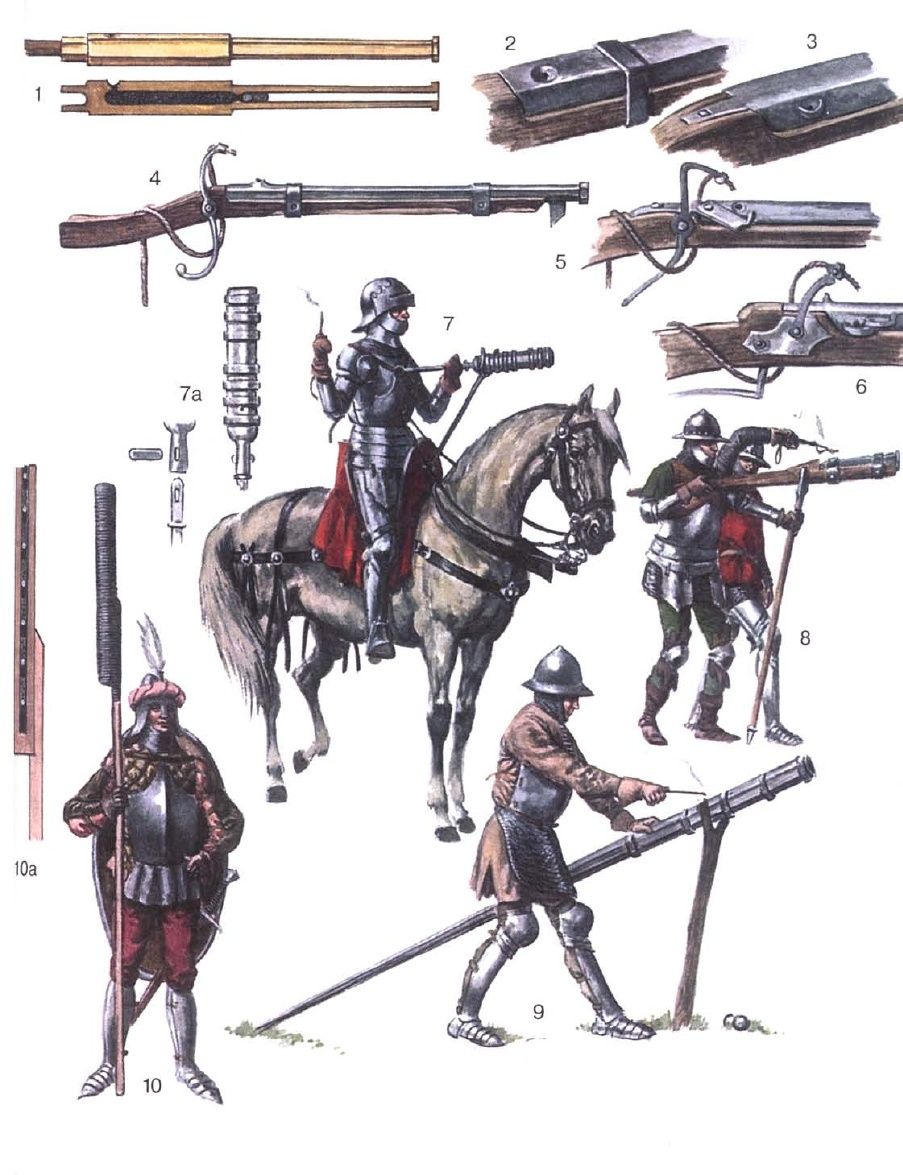
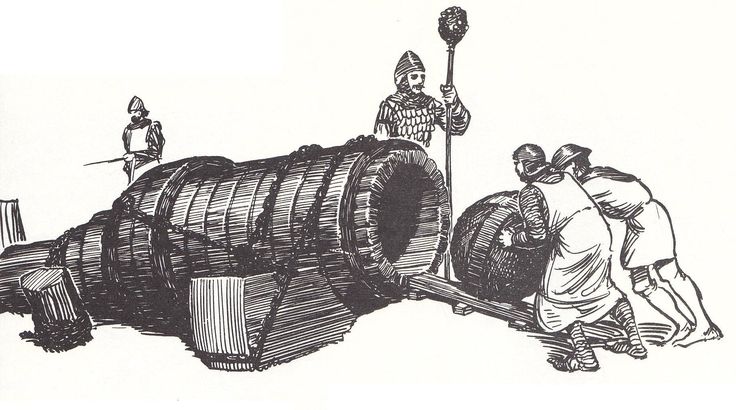
The only uses in The Lord of the Rings are for what would be called, in later times, “mines”.  In our Middle-earth, medieval technology further developed the use of gunpowder into bigger, deadlier forms—early cannon, called “bombards”

and miniaturized them as “handgonnes”.

(Liliane and Fred Funcken)

What if Saruman—and Sauron—had had time to develop their “fire of Orthanc”?

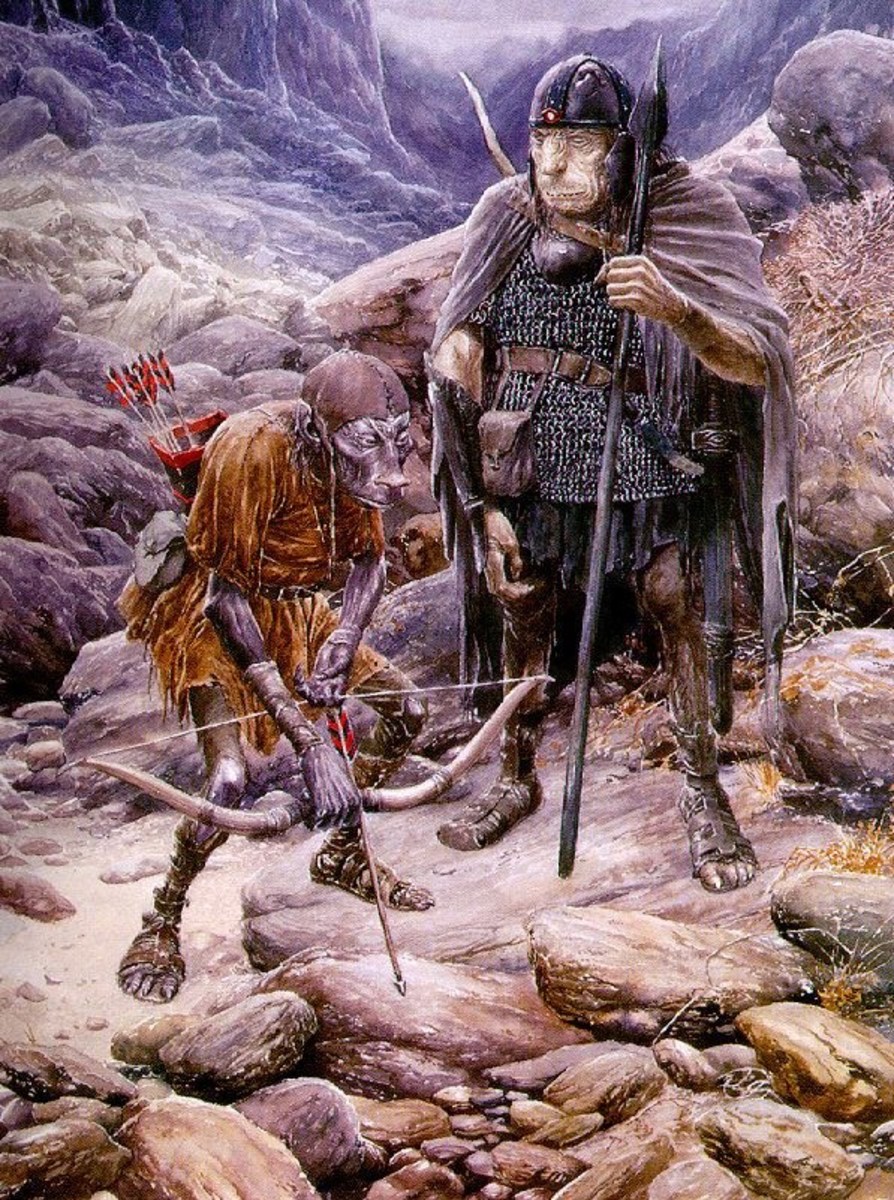
This is how we usually see orcs and their armament—all medieval—spears, swords, bows.

(Alan Lee)

Suppose, however, that there had been further armament.  Imagine orcs with handgonnes, for example.

And, instead of massive stone-throwers employed to break down the walls of Minas Tirith—also a medieval weapon—

giant bombards.

It was weapons like these, in 1453, which broke holes in the ancient walls of Constantinople,

allowing the Turkish besiegers to enter a place which only once before, in its 1000 year plus history, had been broken into.

And why stop there? 

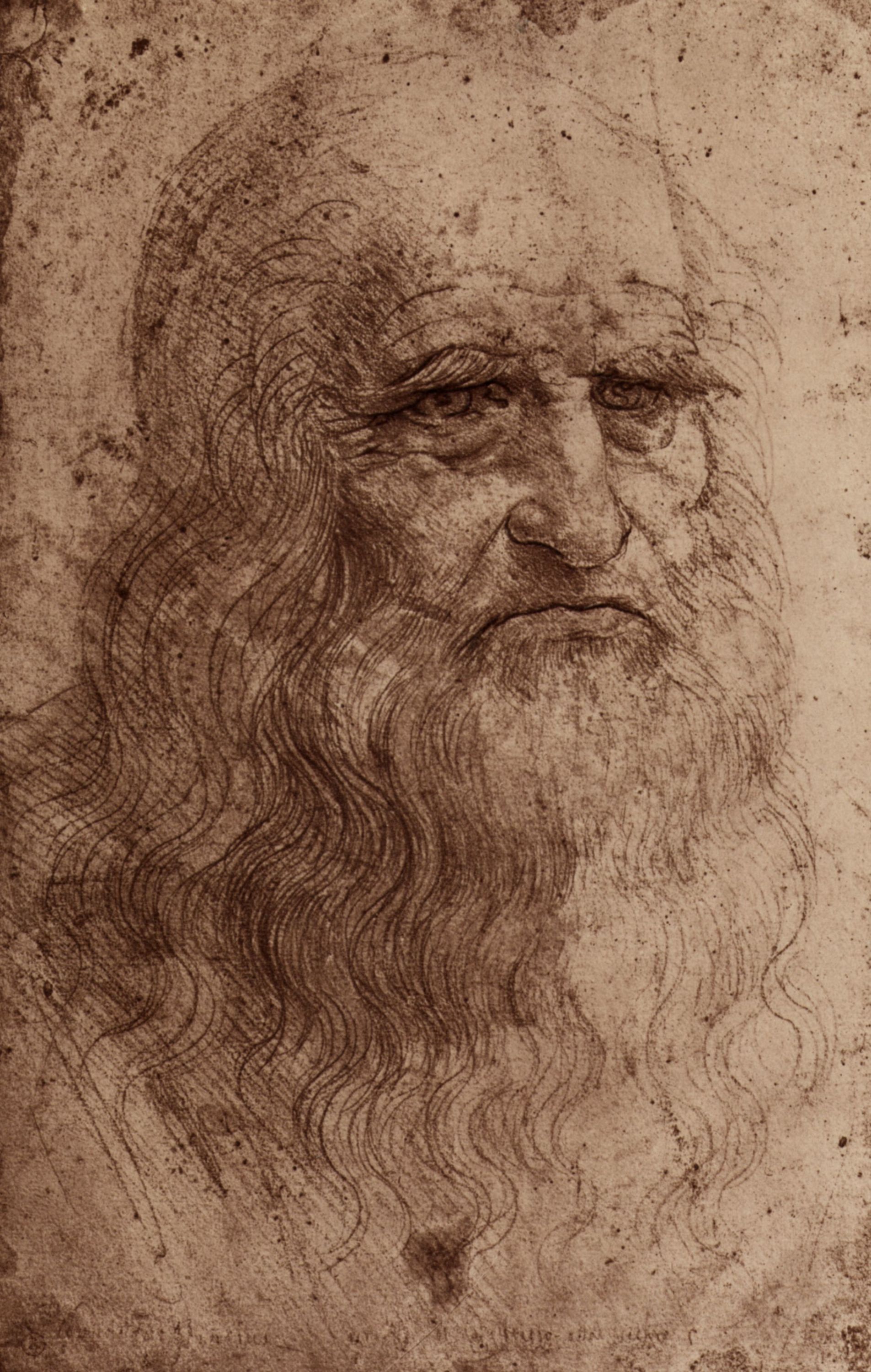
Leonardo da Vinci (1452-1519)

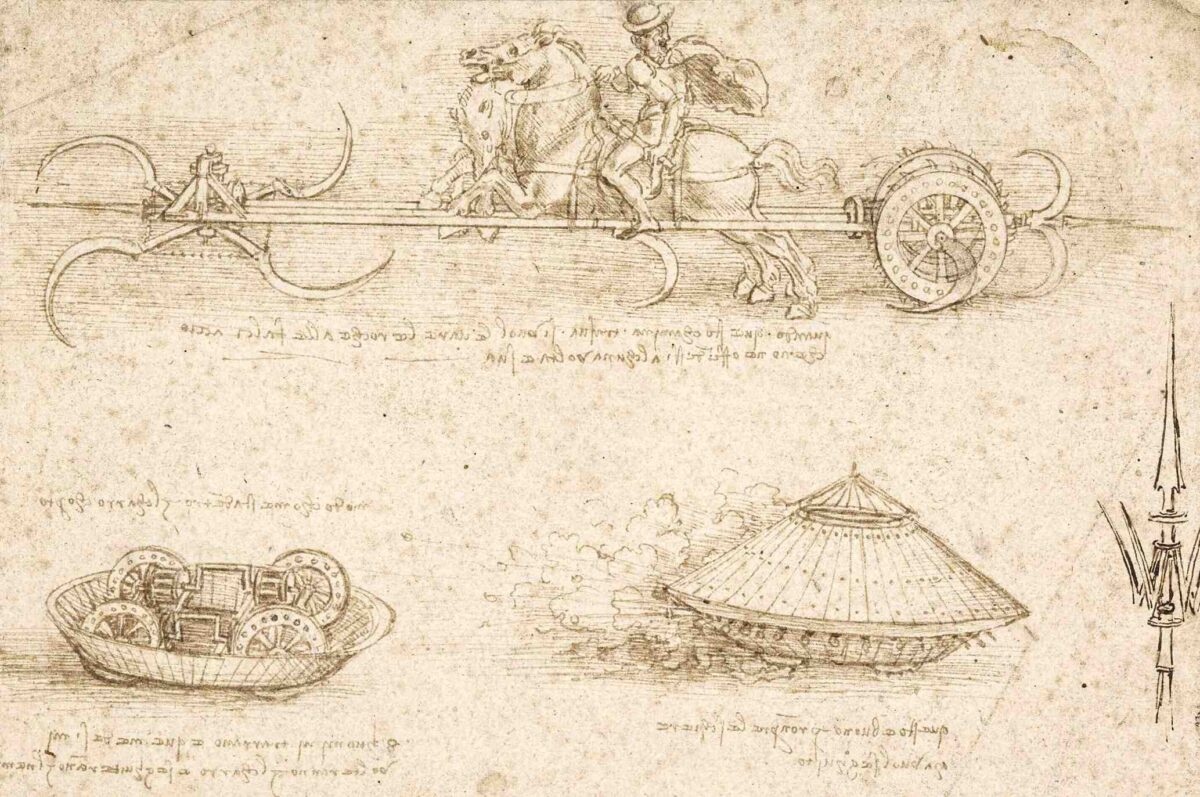
was born only the year before the fall of Constantinople, just at the very end of the Western Middle Ages.  In 1487, he sketched this—

which, in terms of much of its technology, was possible in 1487, although it would have been more than a little crowded inside with all of those guns, especially when they jerked backwards in the recoil which would have come with firing them.  Fortunately for the West, da Vinci doesn’t appear to have figured out a useful way of propelling his invention

and it was only in the early 20th century that the internal combustion engine could be employed to move such a metal monster.

Consider, however, if the opponents of the West in the later Third Age had developed what clearly they had begun.  Seeing such approaching, on foot or, worse, in an armored vehicle, what could Rohirrim or Gondorians have done beyond believing what Qui Gon had tried to warn Boss Nass about:

Dos Mackaneeks!

Thanks, as always, for reading.

Stay well,

Remember the places where tanks are vulnerable,

and remember, as well, that there’s always

MTCIDC

O

Soul Divided

19 Wednesday Jun 2024

Posted by Ollamh in Uncategorized

≈ Leave a comment

Tags

books, Fantasy, Harry Potter, Hogwarts, Writing

As always, dear readers, welcome.

Although I’ve never reread any but the first of them, I enjoyed the “Harry Potter” books when they were originally published, beginning in 1997.

My favorite was that first,

or, by its US title.

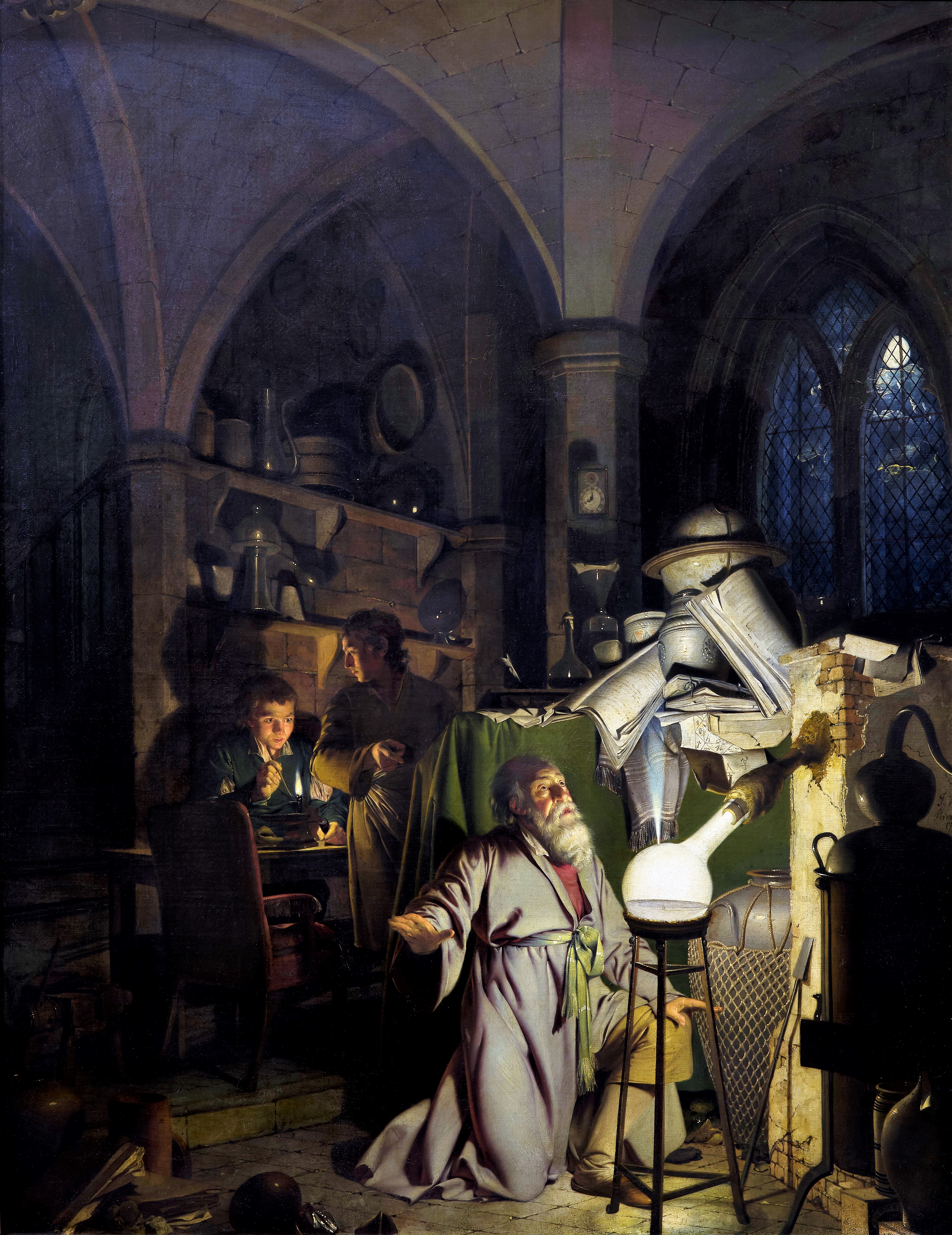
I prefer the original British title because it suggests something magical.  “Sorcerer’s Stone” was a make-shift replacement, with no resonance.  The “philosopher’s stone”, however, was a real (or at least hoped-for) thing, being thought of as a kind of alchemical tool which could turn substances into precious metals, and which seemed very appropriate for a book set mostly in a boarding school for witches and wizards.  (You can read more about it here:  https://en.wikipedia.org/wiki/Philosopher’s_stone   Illustrating the article is a wonderful painting by Joseph Wright of Derby, 1734-1797,

which, although entitled–in short form—the full title is practically a brief lecture–“The Alchymist, in Search of the Philosopher’s Stone…”, has always struck me as potentially being a very useful portrait of Merlin.  If you know T.H. White’s The Once and Future King, you might imagine that that’s the young Wart—aka Arthur—in the background.)

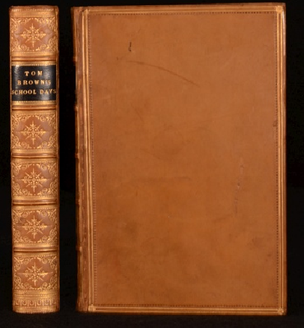
When the series continued, I wondered how far the author would take what was, initially, a clever takeoff on a literary type:  the school story, which dates at least as far back as Thomas Hughes’ 1857 Tom Brown’s School Days and which you can read here:  https://www.gutenberg.org/cache/epub/1480/pg1480-images.html

In fact, although the series progressed with the main protagonists continuing their magical education, it became increasingly entangled with the villain, Voldemort, and a world folktale, classified in the Aarne-Thompson-Uther Index as “The Giant (Ogre) who had no heart in his body” (ATU302).  In this story, of which at least 250 versions exist, the Giant (or his equivalent), to protect himself, removes his heart and conceals it where (he hopes) it cannot be found.   The protagonist (along with helpers) must find that location and destroy the heart—or at least use it as leverage.  (You can read the translation of a Norwegian version of it here, under the title “Cinder-Lad and His Six Brothers”:  https://archive.org/details/fairystoriesmych00shim/page/n7/mode/2up   And you can read more about the tale here:  https://en.wikipedia.org/wiki/The_Giant_Who_Had_No_Heart_in_His_Body )  In the Harry Potter books, it’s not one piece of his heart–here, his soul–but 7, all hidden in what are called “Horcruxes”, and it takes Harry and his friends (along with the headmaster, at one point) to locate and destroy the set, providing for a major plot element beginning with the second book Harry Potter and the Chamber of Secrets.  (For more, see: https://fortheloveofharry.com/list-of-horcruxes/  )

When all of the Horcruxes are gone, so is Voldemort and this brings to mind another complex story.

“The Enemy still lacks one thing to give him strength and knowledge to beat down all resistance, break the last defences, and cover all the lands in a second darkness.  He lacks the One Ring…

…the Nine he has gathered to himself; the Seven also, or else they are destroyed.  The Three are hidden still.  But that no longer troubles him.  He only needs the One; for he made that Ring himself, it is his, and he let a great part of his own former power pass into it, so that he could rule all the others.  If he recovers it, then he will command them all again, wherever they be, even the Three, and all that has been wrought with them will be laid bare, and he will be stronger than ever.”  (The Fellowship of the Ring, Book One, Chapter 2, “The Shadow of the Past”)

If this Ring is so crucial, it would be easy to wonder why Sauron hasn’t been more aggressive in finding it, but Gandalf answers that next:

“…He believed that the One had perished, that the Elves had destroyed it, as should have been done.  But he knows now that it has not perished, that it has been found.  So he is seeking it, seeking it, and all his thought is bent on it…”

In the Norwegian version of “The Giant (Ogre) who had no heart in his body”, the Giant’s heart was concealed in an egg and, when the egg was broken, “the giant burst to pieces”.

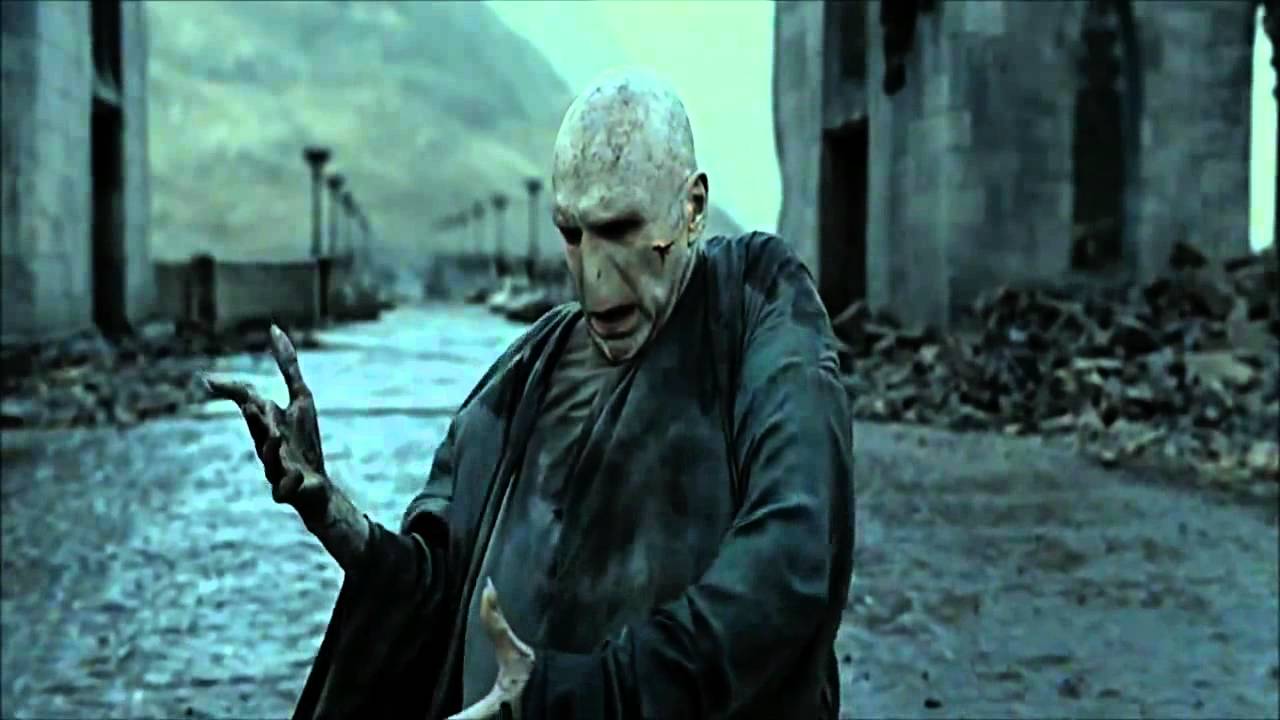
When the last Horcrux is gone, Voldemort seems to melt away,

rather like the demise of the Wicked Witch of the West when she is doused with water.

When the Ring is destroyed, the end is a bit more dramatic:

“And even as he spoke the earth rocked beneath their feet.  Then rising swiftly up, far above the Towers of the Black Gate, high above the mountains, a vast soaring darkness sprang into the sky, flickering with fire.  The earth groaned and quaked.  The Towers of the Teeth swayed, tottered, and fell down; the mighty rampart crumbled; the Black Gate was hurled in ruin; and from far away, now dim, now growing, now mounting to the clouds,  there came a drumming rumble, a roar, a long echoing roll of ruinous noise.

…And as the Captains gazed south to the Land of Mordor, it seemed to them that, black against the pall of cloud, there rose a huge shape of shadow, impenetrable, lightning-crowned, filling all the sky.  Enormous it reared above the world, and stretched out towards them a vast threatening hand, terrible but impotent:  for even as it leaned over them, a great wind took it, and it was all blown away, and passed; and then a hush fell.” (The Return of the King, Book Six, Chapter 4, “The Field of Cormallen”)

(An amazing illustration by Ted Nasmith)

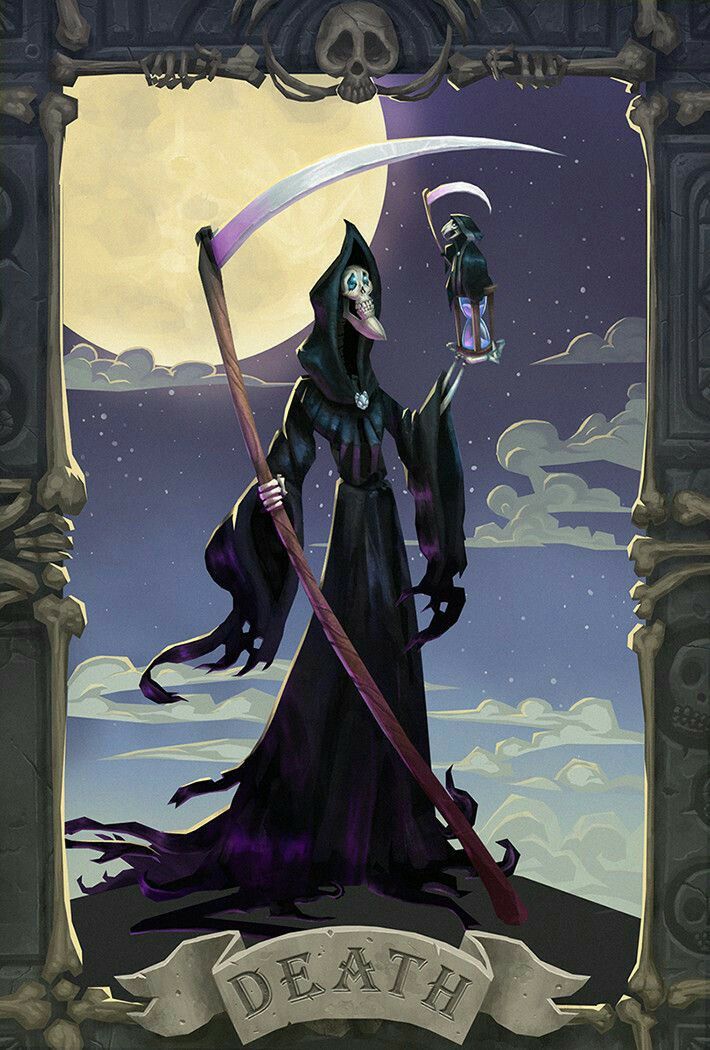
Somehow, in contrast, for all that his end brings a dramatic conclusion to the Harry Potter series, the melting of Voldemort seems more like the melting of Vole de Mort, in comparison.

(by Exifia at Deviant Art—I’m sorry that I can’t say more, but Deviant Art’s website appears to be unavailable at present)

Thanks, as ever, for reading.

Stay well,

When it comes to hiding things, see E.A. Poe, “The Purloined Letter” here:  https://poestories.com/read/purloined

And remember that, as always, there’s

MTCIDC

O

PS

Looking at Vole de Mort, I’m reminded of one of my (many) favorite Terry Pratchett characters,  The Death of Rats (“aka ‘The Grim Squeaker’ “).  Put a black robe on him and perhaps a resemblance?

(credited to Paul Southard)

For more, see:  https://wiki.lspace.org/Death_of_Rats

Metatextual

16 Wednesday Oct 2019

Posted by Ollamh in Heroes, J.R.R. Tolkien, Military History, Narrative Methods

≈ Leave a comment

Tags

Beowulf, Game of Thrones, Great War, Great War Posters, Metatextual, Propaganda Posters, Samwise Gamgee, Story, The Lord of the Rings, Tolkien, trench warfare, Writing, WWI

Welcome, dear readers, as always—and don’t be weirded-out by the hyperliterary title.  We’ve been thinking about an odd moment in The Lord of the Rings, a moment when two of the main characters seem to possess the ability, at least for that moment, to step away from the story, and to see themselves as characters, which is one way in which metatextuality, meaning “outside the text”, works.  (For a useful definition, see this LINK.)

It’s a passage in The Two Towers, Book Four, Chapter 8, “The Stairs of Cirith Ungol”.  Sam and Frodo are pausing before Gollum leads them through a passageway which will bring them into Mordor.  They have a meal, then talk about where they’re about to go and Sam says:

“…And we shouldn’t be here at all, if we’d known more about it before we started.  But I suppose it’s often that way.  The brave things in the old tales and songs, Mr. Frodo:  adventures, as I used to call them.  I used to think that they were things the wonderful folk of the stories went out and looked for, because they wanted them, because they were exciting and life was a bit dull, a kind of sport, as you might say.”

Because Tolkien was writing this after the Great War, we might imagine that, at one level, he’s reflecting upon the war fever which captured Great Britain in the early days of the conflict, with its recruiting posters and popular art depictions like these—

image1poster.jpgimage2poster.png

image3poster.jpg

image3a.jpgimage4acharge.jpg

and its masses of volunteers crowding recruitment offices.

image4recruit.jpg

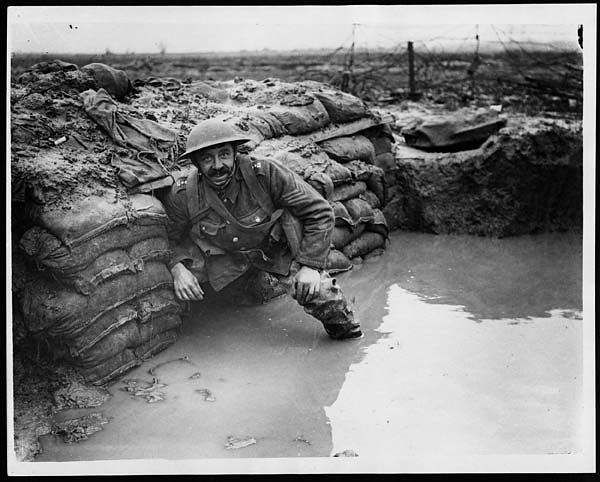
This was all before the grim reality of trench warfare

image5trench.jpg

and casualties beyond anyone’s pre-war comprehension

image6casualties.jpg

dampened that early enthusiasm, leading to a realistic cynicism mostly quietly expressed,

image7sword.png

although soldiers could sometimes express their opinion of the war vocally—see this LINK for some of that vocalizing.

What Sam says next seems to agree with this:

“But that’s not the way of it with the tales that really mattered, or the ones that stay in the mind.  Folk seem to have been just landed in them, usually—their paths were laid that way, as you put it.”

So, “adventures” now, to Sam, are no longer “a kind of sport” which “wonderful folk” seek out, but rather something which just happens to people—in fact, people like Sam and Frodo.  And, just like Sam and Frodo, “…I expect they had lots of chances, like us, of turning back, only they didn’t.”

The consequences of rejecting those chances are obvious:  “And if they had, we shouldn’t know, because they’d have been forgotten.  We hear about those as just went on…”

And Sam’s sense of the consequences of “just going on” is very realistic:  “—and not all to a good end, mind you; at least not to what folk inside a story and not outside it call a good end.  You know, coming home, and finding things all right, though not quite the same—like old Mr. Bilbo.  But those aren’t always the best tales to hear, though they may be the best tales to get landed in!”

So far, then, we might see this as the clear thinking of someone who believed in those 1914 posters and came to learn otherwise.  Sam continues, however, and here’s where that metatextuality comes in:

“I wonder what sort of tale we’ve fallen into?”

We know that Sam has long been fascinated by tales of elves and dragons.  As Gaffer Gamgee says:

“Crazy about stories of the old days, he is, and he listens to all of Mr. Bilbo’s tales.  Mr. Bilbo has learned him his letters…”  (The Fellowship of the Ring, Book One, Chapter 1, “A Long-Expected Party”)

The Gaffer’s last remark suggests that not only has Sam heard tales, but he may even have read them.  We think that it should be no surprise, then, that, when put into a situation far beyond the usual, Sam might believe that it’s not just daily life, but, in fact, a “tale”.  And so he asks, “…what sort…?”

To which Frodo replies:

“I wonder…But I don’t know.  And that’s the way of a real tale.  Take any one that you’re fond of.  You may know, or guess, what kind of tale it is, happy-ending or sad-ending, but the people in it don’t know.  And you don’t want them to.”

In Sam and Frodo’s case, they clearly don’t and can’t know, but, although they don’t know their fate (although we think that Frodo has an idea, saying “Our part will end later—or sooner.”), they both believe that they are in a tale, as Sam says:

“Still I wonder if we shall ever be put into songs or tales.  We’re in one, of course; but I mean put into words, you know, told by the fireside, or read out of a great big book with red and black letters, years and years afterwards.”

This is ironic, of course, as we know that this very story is drawn as Tolkien-as-editor says in the Prologue to The Lord of the Rings, from The Red Book of Westmarch (see “Note on the Shire Records”), a volume jointly written by Bilbo and Frodo and perhaps completed by Sam himself (see The Return of the King, Book Six, Chapter 9, “The Grey Havens”).

There is also, to our minds, as we said, something odd about this view of themselves and their situation.  In general, characters in epic stories—just as Frodo says—are unaware that they are in them.  Achilles never turns to Patroclus in the Iliad and asks, “I wonder how this epic will end?” nor does Beowulf spend time discussing just what sort of tale he and Wiglaf have gotten themselves into.   (You can see a touch of metatextuality in the Game of Thrones series, however, when one of its evilest characters, Ramsay Bolton, can say, “If you think this has a happy ending, you haven’t been paying attention.”)

Frodo takes the idea of their being characters one step farther when he then suggests indirectly that their story is actually in the hands of its readers:

“…We’re going on a bit too fast.  You and I, Sam, are still stuck in the worst places of the story, and it is all too likely that some will say at this point:  ‘Shut the book now, dad; we don’t want to read any more.’ “

As in his earlier remark, that “Our part will end later—or sooner”, we see that Frodo imagines that they’re already in such a bad place that a young audience will want to stop the story.

This then leads us to a question as odd to us as their view of themselves as already-fictional characters in a tale:   if dad listens and agrees, closing the book, what will happen to Frodo and Sam then?


Thanks, as ever, for reading and

MTCIDC

CD

Knowledge, Rule, Order

06 Wednesday Jan 2016

Posted by Ollamh in Fairy Tales and Myths, Imaginary History, J.R.R. Tolkien, Military History, Military History of Middle-earth, Narrative Methods

≈ 2 Comments

Tags

Adolf Hitler, Anduin, Benedict Cumberbatch, Benito Mussolini, British Government, Charlie Chaplin, dictatorships, England, Gandalf, George V, Germany, Gondor, gothic script, Government, History, India, Isengard, Kaiser Willhelm II, Lenin, Mehmed VI, Middle-earth, monarchs, Mordor, Nazis, newsreel, Numenor, Ottoman Empire, Oz, Peter Jackson, Queen Mary, Queen Victoria, Rohan, Saruman, Sauron, Scott, Smaug, Stalin, Stock Market Crash of 1929, Sultan, The Great Dictator, The Lord of the Rings, Tolkien, Treaty of Versailles, Valar, Victoria Louise, Weimar Republic, William Morris, Writing

Dear Readers,

Welcome, as always.

Have you ever wondered what Middle Earth would have been like if the Fourth Age had begun on a calendar written by Sauron?

That of the Third Age was hardly a democratic paradise: a king rules Rohan, a stand-in for king rules Gondor. Elrond and Celeborn/Galadriel behave and are treated like royalty and Thranduil, as we learn from The Hobbit, is the king of Mirkwood. The dwarves have hereditary rulers.   Only the outliers—communities like Bree and the Shire and the earlier inhabitants like Tom Bombadil and Fangorn—appear to be completely independent. (The Shire even has elections and a mayor, although the actual government, except for the shire reeves, appears to bemostly token—you wonder who’s running their seemingly-efficient postal service.)

This is not surprising, not only for an author born during the later years of Victoria,

queenvic.jpg

but also for someone powerfully influenced by the medievalist interests of everyone from Scott

Sir_William_Allan_-_Sir_Walter_Scott,_1771_-_1832._Novelist_and_poet_-_Google_Art_Project.jpg

to William Morris.

William_Morris_age_53.jpg

(We might add that the world of fairy tales, full of princes and princesses, queens and kings, was also a powerful influence at the time—and not only on story-tellers born in monarchies—after all, even Oz is ruled by a queen—

OzmaOz.jpg

Yet, after Smaug—who could better be a medieval fantasy villain (especially with the voice of the incomparable Benedict Cumberbatch attached)?

p8204516_n279079_cc_v4_aa.jpg

—something changed in Tolkien’s world. In fact, something changed in the whole outside world. With the end of World War One, monarchs toppled all over Europe and beyond, from:

Kaiser Wilhelm II of Germany

KAISER-WILHELM_2994889b.jpg

to Mehmed VI, last Sultan of the Ottoman Empire.

mehmed6.jpg

In place of the former, there appeared the always-troubled Weimar Republic, full of good intentions, but badly crippled, not only by the war which had sapped its manpower and resources, but by all kinds of social unrest and then by the Crash of 1929, which notoriously destroyed the value of its currency.

weimar currency.jpg

As early as 1919, there had been clashes among the forces of different ideologies—

CombatesEnBerlín19190903.jpg

And, amidst all of the unrest, there was a failed coup attempt in 1923 by the man in the overcoat in this picture.

Bundesarchiv_Bild_102-00344A,_München,_nach_Hitler-Ludendorff_Prozess.jpg

He, of course, was only following the footsteps of this man, who had pushed his way into power the year before—

March_on_Rome.jpg

to be followed, in turn, by the man on the left, from the mid-1920s.

stalinandfriends.jpg

That first man, having failed at obvious violence, tried again through more complicated means (although still employing violence, if it suited his purposes) and succeeded in 1933.

Hitler-Papen-First-Reichstag-1933.jpg

He was, so we are told, a riveting public speaker, but, if the newsreels we’ve seen are evidence, we guess you would have had to have been there.

hitlerspeaking.jpg

Some people thought the style exaggerated in the 1930s and caricatured it even then.

chaplin2.jpg

He had a definite social agenda, which he outlined at length and often, although concealing certain of the most horrible aspects. And he liked big words and big concepts, like:

einfolk.jpg

It would have been impossible for someone as intelligent and generally well-informed as Tolkien not to have been very much aware of this man and all of the other like men, busy oppressing as much of the world as they could. And this would have been especially true in a time when radio and film were changing how people received news—and how those interested in influencing others might shape what people saw. As early as 1911, the British government was using newsreel film to show the might and reach of its empire (2/5 of the globe was in their hands) when the king, George V, and his wife, Queen Mary, visited India.

Delhi_Durbar,_1911.jpg

Not to be outdone, Kaiser Wilhelm II encouraged a grand—and filmed–event in 1913, for the wedding of his daughter, Victoria Louise—and some of the film was even in color.

vlouisekaiser.jpg

The Marriage of Victoria Louise Color Film

It would be easy to imagine, then, that the weight of such public figures might have influenced Tolkien in his depiction of late-3rd-Age villains. We can see it in Saruman’s unsuccessful attempt to persuade Gandalf to join him:

“ ‘He drew himself up then and began to declaim, as if he were making a speech long rehearsed. ‘The Elder Days are gone. The Middle Days are passing. The Younger Days are beginning. The time of the Elves is over, but our time is at hand: the world of Men, which we must rule. But we must have power, power to order all things as we will, for that good which only the Wise can see.” (The Fellowship of the Ring, Chapter 2, “The Council of Elrond”)

Thus, unlike the script of Jackson’s version, there is no plan to wipe out men and replace them with orcs. Instead, men are to survive: to be ruled—perhaps under what definitely sounds like it should be a translation from something written in Fraktur—the fake Gothic script favored by the Nazis–

die-schöne-deutsche-Schrift-detail1.jpg

“ ‘We can bide our time,’” says Saruman, “ ‘we can keep our thoughts in our hearts, deploring maybe evils done by the way, but approving the high and ultimate purpose: Knowledge, Rule, Order; all the things that we have so far striven in vain to accomplish…’ ”

Such abstract, but somehow menacing, words sound like a translation of something from Hitler’s Germany: Kenntnisse, Herrschaft, Ordnung. They do not sound in the least like Gandalf’s goals, ever, and he, in fact, replies by implying that not only are they not really Saruman’s words, but that Saruman is foolish for believing them:

“ ‘Saruman,’ I said, ‘I have heard speeches of this kind before, but only in the mouths of emissaries sent from Mordor to deceive the ignorant.’ “

As really the words of Sauron, however, they give us an idea of what to expect in a world under his control. Knowledge would be for Sauron alone, we suppose, perhaps after regaining his lost ring? Certainly he wouldn’t share it with Saruman, whom, it will become clear, he never trusted. As for Rule and Order, the world would be a place full of rules and those watching that they be obeyed. And here we can remember Sharkey’s Shire, with its “by order of the Chief” signs—and its gangs of human enforcers. As well, we can think of its grey, industrial character, as we’ve discussed in a previous post, a universal Mordor, devoted to production. To this, we can add the Mouth of Sauron’s recitation of surrender conditions, delivered to the allies before the Morannon:

“ ‘These are the terms…The rabble of Gondor and its deluded allies shall withdraw at once beyond the Anduin, first taking oaths never again to assail Sauron the Great in arms, open or secret. All lands east of the Anduin shall be Sauron’s for ever, solely. West of the Anduin as far as the Gap of Rohan shall be tributary to Mordor, and men there shall bear no weapons, but shall have leave to govern their own affairs. But they shall help to rebuild Isengard which they have wantonly destroyed, and that shall be Sauron’s, and there his lieutenant shall dwell: not Saruman, but one more worthy of trust.’ “ (The Return of the King, Chapter 10, “The Black Gate Opens”)

In keeping with the influence of current events in this world, we might see this as being a parallel with the 1919 Versailles Treaty, in which Germany was to be forced to make huge territorial concessions, to disarm almost entirely, and to pay massive amounts in reparation to the victorious allies.

Treaty_of_Versailles,_English_version.jpg

The Treaty of Versailles– Wiki Article

Such terms as Sauron offers would also destroy Rohan as an ally and set up a permanent garrison between it and the north. We might also expect the restored Isengard to be a staging area for an assault upon Fangorn and the ents, to their ultimate destruction. As well, “west of the Anduin” is a very vague expression—does it include Gondor, as well as Rohan?

Religion in The Lord of the Rings has always been the subject of debate: how much or how little? Of what kind? Tolkien is quoted as saying that it was monotheistic, although, when attacked by the Mumak, Faramir’s men called on the (plural) Valar. There is no mention, in what is often extremely detailed landscape description, of any kind of temple or shrine, however. Nevertheless, we would like to conclude with an eerie thought about religion in this alternative Fourth Age. The Mouth of Sauron, aka, The Lieutenant of the Tower of Barad-dur, is described as:

“…a renegade, who came of the race of those that are named the Black Numenoreans; for they established their dwellings in Middle-earth during the years of Sauron’s domination, and they worshipped him, being enamoured of evil knowledge.”

Could we imagine that, in this other Fourth Age, a new and horrible religion might have appeared, one dedicated to the worship of Sauron—and to that Knowledge which Saruman finds so important? What do you think, dear readers?

As always, thanks for reading.

MTCIDC

CD

Terra (Increasingly) Cognita

30 Friday Jan 2015

Posted by Ollamh in Imaginary History, Military History, Narrative Methods, Terra Australis

≈ Leave a comment

Tags

Adventure, Book, Exploration, History, Research, Terra Australis, Writing

Dear Readers,

     Welcome, as always. Now that Across the Doubtful Sea is out in print on Amazon, we’ve turned our attention towards two projects:

  1. the “prequel”, Empire of the Isles
  2. editing and publishing the complete draft of the first book in a new series, Grey Goose and Gander, which is set in an imaginary medieval Russia. (Yes—it’s a distance from an alternate 18th-century Pacific, but we love Russian literature, both poetry and novels, and we especially love Russian fairy tales and that outstanding illustrator, Ivan Bilibin.) More on that series in future blogs!

     Among the main characters in Empire is Lucien de St. Valerien, the father of Antoine, from our first book and we follow his adventures in two periods: as a senior cadet 30 years or so before Across and then as a captain, 10 years before. The latter will lead right into Across and explain various things only hinted at in that volume in the series.

As his adventures take place in our imaginary Pacific (called “The Calm Sea”) and on our imaginary Terra Australis, we’ve been busy researching and inventing more geography. In doing so, we’re aware that we are violating a dictum which JRRT once set down about creating and mapping:

“If you’re going to have a complicated story you must work to a map; otherwise you’ll never make a map of it afterwards.”

That we are doing so clearly shows the larky beginnings of this project as well as our desire to allow the Muse to take the story (and the storytellers) where she will.

     Although we follow this ideal of inspiration, we would also agree with the Victorian English novelist, Anthony Trollope, who said of inspiration:

“To me it would not be more absurd if the shoemaker were to wait for inspiration, or the tallow-chandler for the divine moment of melting.” (A particularly apropos statement for a man with the goal of writing 10,000 words a day!)

In our case, however, we are using our research as a substitute Muse. And what particularly strikes us at the moment is the interesting clash of world views of early geographers on the subject of Terra Australis.

     As we’ve mentioned before, Terra Australis, as a concept, dates back at least to Aristotle in the 4th century BC and the concept of the need for a balance of continents. If there’s a big one on the north side of the earth (call it Terra Borealis), it would be necessary, for the equilibrium of the earth to have a second one on the south side (Terra Australis).

     The next step in the thinking, however, can diverge. There are those who imagined that such a place would resemble the continent on the northern side, having as many peoples and cultures. (This idea appears to be associated with Crates of Mallus, who lived in the 2nd century BC.) In our imaginary world, this is the standard belief, just as it was in the real pre-Captain Cook 18th century Europe. (The idea was contested, however, as it is in our books.)

     In our research, however, we’ve also happened upon a second view. This was popularized by a 5th-century AD scholar named Macrobius, who wrote a commentary on the last-century BC Roman author, Cicero’s, “Dream of Scipio”, itself the last part of Cicero’s longer philosophical work, De Re Publica.

     Cicero begins with the theory of more than one inhabited continent, but then shifts to describe an earth divided into five climate zones (reading from top to bottom: cold (and so uninhabitable), temperate, torrid (uninhabitable), temperate, and cold once more. This zonal view if followed by Macrobius and a number of the maps which appear in the earliest surviving manuscripts (which date from the period before 1100 AD) shows this very clearly.

macpre1100

     What impressed us about this idea was how it mixed what we know to be true in the real world—uninhabitable poles (as some of the maps say, terra nobis incognita frigida—“a frozen land unknown to us”)

droppedImage

with temperate regions. It then added, however, a central belt simply too hot for human existence. (Was this derived from early reports of the Sahara?).

     We’re still researching and creating, but our Terra Australis combines the two world views: we have a habitable southern continent, but one which is gradually falling under the control of a god—Atutlaluk—whose power is gradually turning Terra Australis into terra frigida—although it is gradually turning from incognita “unknown” to cognita “known” to us—and will be to you, in our next Across book, Empire of the Isles.

Thanks, as always, for reading.

MTCIDC

CD

PS

For a detailed and very interesting article on Macrobius and maps, see Alfred Hiatt, “The Map of Macrobius before 1100” available as a download at http://dx.org/10.1080/03085690701300626.

A Forward– at the End

14 Wednesday Jan 2015

Posted by Ollamh in Writing as Collaborators

≈ Leave a comment

Tags

Adventure, Book, Collaborating, Fantasy, Fiction, Formatting, History, Hodges, Publishing, Self Publishing, The Waterspout, Writing

Dear Readers,

Welcome, as always.

     The Kindle version of our first novel, Across the Doubtful Sea , has just appeared, and the paper version will be available, we believe, in just a couple of days.

     The whole experience, from beginning work in early June to now has been a wonderful one. Neither of us had ever collaborated on such a project before and it was a learning experience every day of our work together. We thought that, in this blog, we would discuss what appear to be the biggest areas of our project: creating together, research, cover design, expenses, making the actual (or virtual) book, and facing the reality that, at least at first, all of this was going to be, in the immortal words of MGM, Ars Gratia Artis. (Cue the lion.)

     First, we had to figure out how we were going to write together. There were models, of course—you could think immediately of people from the musical theatre tradition, from Gilbert and Sullivan to Rodgers and Hammerstein, for example. Or, in terms of novels, you might look to older authors from Erckmann-Chatrian to Nordhoff/Hall, or to all of those fantasy/science fiction couplings you can find on the shelves of your local bookstores.

     In our case, however, we didn’t model ourselves on anyone. Instead, as the plot progressed, one of us might do more of the actual writing, but every line was, ultimately, the work of both: ideas, editing, changes, inspiration—there was nothing the two of us didn’t do at some time and in some way together.

     This changed, however, when it came to the actual self-publishing. One of us, it turns out, has a wonderful (and newly- discovered) talent for the technical side—creating covers, the complex process of formatting the text—and has produced what we feel to be a beautiful and absolutely professional outside for our first book. (Perhaps books can be judged by their covers?) For this later stage of the process, that one of us was completely in charge—and the other looked on, admiringly.

     Research was an important element in our work and one of us kept busy figuring out just what we needed to know and acquiring it, from books on naval warfare to work on Inuit and Polynesian languages and cultures. We’ve discussed some of this in earlier blog postings, but there was much more and it created its own puzzle: this was to be a series of fantasy/adventure novels, after all, so how much would we actually depend upon actual history and how much would we create? As well, we wanted to avoid magic per se, which has always struck us as an easy out—and can look very much like an easy out, too! (JRRT was so right to allow Gandalf to show off his real powers so infrequently.)

     Once we were into a good working routine, we began to consider what our cover should look like. In our research, we had discovered the work of William Hodges, who was the main artist for Captain Cook’s second expedition (1772-1775). Considering elements in the plot (if you read Across, you’ll know at once what we mean), Hodges’ painting, commonly called “The Waterspout”, but actually entitled “A View of Cape Stephens in Cook’s Straits (New Zealand) with Waterspout”, fit perfectly.

 HMS 'Resolution' off Cape Stephens with waterspout, May 1773

     A quick internet search showed us that this painting was not in the public domain, but was the property of the National Maritime Museum, in London. This meant that we had to request permission to use it. We e-mailed the NMM, and with the friendly help of the Image Librarian there, Emma Lefley, we obtained permission.

     There was a contract, however, and a fee, which we gladly paid, but this brings up another step in the process: expenses. As new to all of this as we were, we hadn’t expected that publishing our first book would be free, but it was another step in our education to watch how the expenses could mount. Our internet research cost us nothing, of course. A certain number of the books—mostly on naval warfare—were already in one of our personal libraries, and we could have gradually acquired more through academic and public libraries, although some of the titles we used would have required ILL searching, but we decided to buy some, as we knew that we would need them for the entire series. (And we like building up our libraries anyhow.) The Hodges’ image was our first big expense, however.

     When we began to think about how we might encourage interest in our work, we decided upon a blog and a Facebook page, for starters. The Facebook page was free, but we needed a domain name (that’s “dot.com” )for our blog and there was another expense. (There are lots of other potential expenses with a blog—but we’ll save those for another post.)

     Our last big expense came when we had finished the book and we planning its on-line publication. To sell it effectively, it was necessary to have an ISBN—in fact, we needed two: one for the paper book and a second for the Kindle version. An ISBN is not cheap, but two obviously have been double if Bowker (the chief supplier of ISBNs) wasn’t running a deal: buy a ten-pack and the price for the individual ISBN goes down significantly. So we bought the pack—and have used two already.

     Then, when we felt that we were ready, we went to Create Space and began the process of turning hundreds of pages of manuscript of what we had decided was the final draft into a self-published book—and in two forms. One of us has already written an informative post on our Facebook page (The Doubtful Sea Series) about the challenges in doing this (a euphemism—but that collaborator was very patient—to say the least!—about the various problems which arose), so, perhaps it’s best just to say here to our readers: be prepared for snags!

     And there came at last the moment of truth: how much should we charge for this? And how much would we get in return? (That really was a secondary concern—honest!—but no novelist, at least since Nash turned out The Unfortunate Traveler, has written in the belief that there was no profit motive, at all, no, truly! in the process.) We were torn, of course: a lower price might mean more buyers; a higher price might bring higher profits. Then we hit those buttons at Create Space and received an education in expenses and royalties and realized that we were fortunate to be doing this as an experiment, and not as a new career. This is worth its own post, but, trust us for now when we say that, even if we sell 10,000 copies of Across the Doubtful Sea and even more of its sequels, we will not be banking in the Cayman Islands and thinking about that summer home in New Hampshire. (And now we understand why some of our favorite fantasy/sf novelists are so prolific: volume and more volume is the only way to make enough money to feel that you’re really earning something.)

     We said that every moment was a learning experience, however, and, truly, it has been—and every moment has been beyond price. Like people who teach themselves to repair their own cars, we’ve climbed into the engine of writing and publishing a book and have so much more appreciation not only for the creative process and the editing/publishing process, but for all the talent and heart which each of us has shown the other in producing the first in what we hope to be a long line of novels full of fantasy and adventure.

Thanks, as always, for reading.

MTCIDC

CD

It’s Out! On Kindle!

09 Friday Jan 2015

Posted by Ollamh in Writing as Collaborators

≈ Leave a comment

Tags

Adventure, Book, Collaborating, Exploration, Fantasy, Fiction, Formatting, French Navy, History, Kindle, Publishing, Research, Royal Navy, Self Publishing, South Pacific, Terra Australis, Writing

Dear Readers,

For us, a very short post.  Our first novel, Across the Doubtful Sea, has just appeared on Kindle.  As of early next week, the book form will be available on Amazon.com.  We hope you’ll be interested!  As of next week, we’ll have one of our regular essays here, but we just wanted our readers to know that, after all of this time giving you information about the book, the book will actually be available.

Now–on to the second in the series–Empire of the Isles!

As ever, thanks for reading.

MTCIDC

CD

Sequels and Prequels

05 Monday Jan 2015

Posted by Ollamh in Narrative Methods, Research, Terra Australis, Writing as Collaborators

≈ Leave a comment

Tags

Collaborating, Fantasy, Fiction, History, Writing

Dear Readers,

Welcome, as always!

As we put the finishing touches on Across the Doubtful Sea (we’ve just realized that we need to have a title on the spine for the print version—oh, and a bar code on the back–yep, the things we never thought about when we were reading someone else’s book), we’ve already begun work on the second in this series, entitled Empire of the Isles.

So, where are we going in this book? Logically, you might say that we should continue in chronological order, begin the second book where the first concluded. After all, at the end of the second book of The Fellowship of the Ring, JRRT didn’t double back into earlier times to the previous defeat of Sauron in which he lost finger and ring and gradually work up to Gollum, to Bilbo, to Frodo . Elements of the past of Middle Earth, of course, appear everywhere in the text, often in geographical features like barrows, the Greenway, and Weathertop, very much the way the past was always present in JRRT’s England in barrows and stone rings and Hadrian’s Wall and castles and the ruins of monasteries. For us, this is one of the book’s great attractions and strengths . The specific past of the ring itself appears in “The Shadow of the Past” (with its resonant title, suggesting not only that the past casts a shadow upon the present, but that, involved in all, is The Shadow—Sauron) and “The Council of Elrond”, chapter 3 of the first book and chapter 2 of the second.

But is that where we want to go?

And, the answer is, no. Instead, we’ve decided to go into the past, but not just in flashbacks or explanations. As we wrote Across, we found it necessary to make reference to earlier events, but this was always done in bits and pieces, where needed for the present narrative. (No spoiler alert here—although this makes an interesting challenge in essay-writing for us: how can we discuss that narrative without too much specificity? How can we inform but tantalize at the same time?) Suppose, however, that we wrote a second book whose plot was based entirely upon events which had happened before Across.

We knew from Across that our main male protagonist, Antoine de St. Valerien, was in the Calm Sea (our Pacific) in part in search of his father, Lucien de St. Valerien, who had disappeared there on an earlier mission. Instead of fragmentary glimpses of his father and his doings, as was the case in Across, why not make the whole next book about him?

As we have written in an earlier posting, a basic premise of our trilogy is that Terra Australis, the southernmost continent which explorers and cartographers and sometimes corporations and governments once believed existed , is, in fact, real. (For those of our readers who would like to know more about this idea, we recommend: William Eisler, The Furthest Shore: Images of Terra Australis from the Middle Ages to Captain Cook, David Fausett, Writing the New World: Imaginary Voyages and Utopias of the Great Southern Land, Glyndwr Williams, The Great South Sea: English Voyages and Encounters, 1570-1750, among many other interesting works.)   In our contemporary world, this is Antarctica, of course.

antarctic2_624x420

In this alternative world, however, it is not an endless sheet of ice which covers a land mass of rock, but rather the place which those earlier explorers and others believed it to be, a country with a mixed climate, fertile land, and growing seasons. In our imaginary world, however, things are changing, owing to the influence of the people who live at its center, the Atuk, and to their god, Atutlaluk, whose power lies in cold and whose chief followers can mobilize the elements of winter against their enemies. Opposed to the Atuk are the Matan’a’e amavi’o, a Polynesian people who have long inhabited a string of a dozen islands to the north and who have more recently colonized the western fringe of Terra Australis.

Much of this was already in place in Across, but now we could use this second novel to fill in so much more: the history of colonization, the beginnings of the war between the Matan’a’e amavi’o and the Atuk, more about the Atuk, who they are, where they come from, all as a background to the story of Lucien and the part he plays in the greater narrative of the struggle between these peoples.

As we write Empire of the Isles, we’ll do what we’ve done for Across and invite you into the literary equivalent of backstage, in hopes that you’ll enjoy knowing more about where it all comes from and how it all comes about.

Thanks, as always, for reading.

MTCIDC

CD

It’s All About Formatting

30 Tuesday Dec 2014

Posted by Ollamh in Writing as Collaborators

≈ Leave a comment

Tags

Adventure, Book, Collaborating, Fiction, Formatting, Publishing, Research, Self Publishing, Writing

Dear Readers,


In our previous posting, we spoke about delaying—but not belaying—publishing our final manuscript of Across the Doubtful Sea. We have certainly put a considerable amount of work into our writing, as it was, in part, a learning experience: what works in a collaboration, the topic of 18th century south seas exploration, and, for one of us, it was her first novel. As we are nearing the final publication of Across, we’ve reached yet another important step in the process: formatting.


Our project is an entirely self-published book, meaning that we are not only the authors, editors, and publicists, but designers and formatters of our own book, as well. If we had decided to publish our book traditionally, the formatting would have been done for us by a professional working for the publishing company. Of course, we could have paid a professional anyway, as there are several publishing services for authors who’d rather “keep their sanity”—and we’re glad that they’re there—but, in our case, we were up for the challenge, and prefer completing the entire book ourselves.


An advantage of being authors in this decade is the availability of information through the internet—we are already making use of this by publishing online, and reaching you, our readers, and sharing our research and behind-the-scenes work through our blog, Facebook page, and twitter. As this has been a learning experience for us, the first thing we thought to look to for formatting was how-to book formatting guides. CreateSpace.com, the self-publishing site of Amazon that we will be using to publish Across the Doubtful Sea, has an easy to understand formatting guide for those using their site.


This guide has been incredibly helpful in building a structure for our book—in fact, as important as the research, creating the story, and writing the words. Why? The design and formatting of our book are, in a sense, the equivalent of giving a body to a soul. A book such as ours should have a proper format—a proper physical appearance to match what we believe to be a beautiful story. We read a number of articles on book formatting—some seemed to challenge first-time formatters, with titles such as “The Problem with Amateur Book Interiors,” but all gave solid advice as to how to avoid the common less-than-professional look of an independently published book.


As with any exterior, we need to have a cover that will both attract attention and provide a small taste of the book. As often as it is said that a book should not be judged by its cover, a good cover makes all the difference in the book’s appearance. For Across the Doubtful Sea, we’ve chosen a somewhat dramatic painting by William Hodges, A View of Cape Stephens in Cook’s Straits New Zealand with Waterspout, 1776, with kind permission of the National Maritime Museum, Greenwich, London. The picturesque aesthetics of the painting already set a tone for what the story itself may look and feel like. In a way, the cover for the book is the face, with readable expressions that interpret what is on the inside.


Before we began, we took a quick look at formatting styles of books in the 18th century—the time period in which our story takes place—out of curiosity and to see what inspiration could be drawn from there. This also gave us the ability to pay particular attention to how a book is put together, rather than a printed manuscript directly from Microsoft word, as we are used to seeing. There are many styles of formatting, as well—for our book, we chose to include page numbers and the title at the top of each page.


Pagination for our book was when we realized how long our book really was, as a finalized, complete novel. Page numbering was the first real step in giving the manuscript physical form, along with the 52 chapters—we foolishly presumed earlier in the process that we might have stopped at 24, then 48, and then… And, as with any book with several chapters, it involves tedious, yet rewarding, work—we’re quite close to completing the project we began during the summer—but 52 chapters can promise that it won’t be a process to be rushed through. Meticulously following advice from the formatting guide, as well as the aforementioned articles about self-publishing, we placed after each chapter, and each chapter title was placed with the desired font and size. Correct margins also had to be set, keeping in mind that the pages would be bound as a book.


At this stage—even after reading through and editing the entire manuscript—there was a need for a final check on names and their continuity—after all, we invented or adapted languages for this book. Some things, even at this stage, had either been changed, or still needed to be—which is where we learned an important rule for the future—be careful when changing names! Because of words and terms used by the characters in Across, we’ve included a glossary of terms and names at the beginning. We want to take as much care in making sure that our readers understand words in the languages as we did in creating them.


Even now, there is still some work to do—polishing up, working on final font designs, and, then, dear readers, you will have the chance to take a look for yourselves.


Thank you, as always, for reading!


CD

← Older posts

The Doubtful Sea Series Facebook Page

The Doubtful Sea Series Facebook Page

  • Ollamh

Categories

  • Artists and Illustrators
  • Economics in Middle-earth
  • Fairy Tales and Myths
  • Films and Music
  • Games
  • Heroes
  • Imaginary History
  • J.R.R. Tolkien
  • Language
  • Literary History
  • Maps
  • Medieval Russia
  • Military History
  • Military History of Middle-earth
  • Narnia
  • Narrative Methods
  • Poetry
  • Research
  • Star Wars
  • Terra Australis
  • The Rohirrim
  • Theatre and Performance
  • Tolkien
  • Uncategorized
  • Villains
  • Writing as Collaborators
Follow doubtfulsea on WordPress.com

Across the Doubtful Sea

Recent Postings

  • Through a glass… January 7, 2026
  • Heffalumps? December 31, 2025
  • We Three Kings December 24, 2025
  • A Moon disfigured December 17, 2025
  • On the Roads Again—Once More December 10, 2025
  • (Not) Crossing Bridges December 3, 2025
  • On the Road(s) Again—Again November 26, 2025
  • On the Road(s) Again November 19, 2025
  • To Bree (Part 2) November 12, 2025

Blog Statistics

  • 104,101 Views

Posting Archive

  • January 2026 (1)
  • December 2025 (5)
  • November 2025 (4)
  • October 2025 (5)
  • September 2025 (4)
  • August 2025 (4)
  • July 2025 (5)
  • June 2025 (4)
  • May 2025 (4)
  • April 2025 (5)
  • March 2025 (4)
  • February 2025 (4)
  • January 2025 (5)
  • December 2024 (4)
  • November 2024 (4)
  • October 2024 (5)
  • September 2024 (4)
  • August 2024 (4)
  • July 2024 (5)
  • June 2024 (4)
  • May 2024 (5)
  • April 2024 (4)
  • March 2024 (4)
  • February 2024 (4)
  • January 2024 (5)
  • December 2023 (4)
  • November 2023 (5)
  • October 2023 (4)
  • September 2023 (4)
  • August 2023 (5)
  • July 2023 (4)
  • June 2023 (4)
  • May 2023 (5)
  • April 2023 (4)
  • March 2023 (5)
  • February 2023 (4)
  • January 2023 (4)
  • December 2022 (4)
  • November 2022 (5)
  • October 2022 (4)
  • September 2022 (4)
  • August 2022 (5)
  • July 2022 (4)
  • June 2022 (5)
  • May 2022 (4)
  • April 2022 (4)
  • March 2022 (5)
  • February 2022 (4)
  • January 2022 (4)
  • December 2021 (5)
  • November 2021 (4)
  • October 2021 (4)
  • September 2021 (5)
  • August 2021 (4)
  • July 2021 (4)
  • June 2021 (5)
  • May 2021 (4)
  • April 2021 (4)
  • March 2021 (5)
  • February 2021 (4)
  • January 2021 (4)
  • December 2020 (5)
  • November 2020 (4)
  • October 2020 (4)
  • September 2020 (5)
  • August 2020 (4)
  • July 2020 (5)
  • June 2020 (4)
  • May 2020 (4)
  • April 2020 (5)
  • March 2020 (4)
  • February 2020 (4)
  • January 2020 (6)
  • December 2019 (4)
  • November 2019 (4)
  • October 2019 (5)
  • September 2019 (4)
  • August 2019 (4)
  • July 2019 (5)
  • June 2019 (4)
  • May 2019 (5)
  • April 2019 (4)
  • March 2019 (4)
  • February 2019 (4)
  • January 2019 (5)
  • December 2018 (4)
  • November 2018 (4)
  • October 2018 (5)
  • September 2018 (4)
  • August 2018 (5)
  • July 2018 (4)
  • June 2018 (4)
  • May 2018 (5)
  • April 2018 (4)
  • March 2018 (4)
  • February 2018 (4)
  • January 2018 (5)
  • December 2017 (4)
  • November 2017 (4)
  • October 2017 (4)
  • September 2017 (4)
  • August 2017 (5)
  • July 2017 (4)
  • June 2017 (4)
  • May 2017 (5)
  • April 2017 (4)
  • March 2017 (5)
  • February 2017 (4)
  • January 2017 (4)
  • December 2016 (4)
  • November 2016 (5)
  • October 2016 (6)
  • September 2016 (5)
  • August 2016 (5)
  • July 2016 (5)
  • June 2016 (5)
  • May 2016 (4)
  • April 2016 (4)
  • March 2016 (5)
  • February 2016 (4)
  • January 2016 (4)
  • December 2015 (5)
  • November 2015 (5)
  • October 2015 (4)
  • September 2015 (5)
  • August 2015 (4)
  • July 2015 (5)
  • June 2015 (5)
  • May 2015 (4)
  • April 2015 (3)
  • March 2015 (4)
  • February 2015 (4)
  • January 2015 (4)
  • December 2014 (5)
  • November 2014 (4)
  • October 2014 (6)
  • September 2014 (1)

Blog at WordPress.com.

  • Subscribe Subscribed
    • doubtfulsea
    • Join 78 other subscribers
    • Already have a WordPress.com account? Log in now.
    • doubtfulsea
    • Subscribe Subscribed
    • Sign up
    • Log in
    • Report this content
    • View site in Reader
    • Manage subscriptions
    • Collapse this bar
 

Loading Comments...