• About

doubtfulsea

~ adventure fantasy

Tag Archives: Sauron

Hands Down

19 Wednesday Dec 2018

Posted by Ollamh in Films and Music, J.R.R. Tolkien, Military History of Middle-earth

≈ Leave a comment

Tags

1984, Argonath, Barad-Dur, Big Brother, Eye of Sauron, Galadriel, Saruman, Sauron, The Ten Commandments (1956), Theatrical gesture, Uruk-hai, White Hand

As always, dear readers, welcome.

Recently, we quoted the leader of the Uruk-hai, Ugluk:

“We are the fighting Uruk-hai!  We slew the great warrior.  We took the prisoners.  We are the servants of Saruman the Wise, the White Hand:  the Hand that gives us man’s-flesh to eat.”  (The Two Towers,  Book Three, Chapter 3, “The Uruk-hai”)

That White Hand is, of course, Saruman’s

image1saruman.jpg

special badge (in our contemporary world, we might say that it was his “logo”), which we see for the first time on the shield of a dead orc:

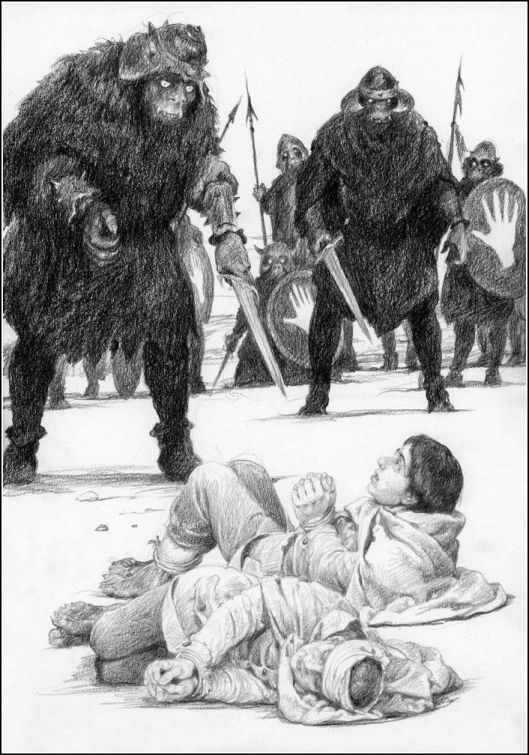
“There were four goblin-soldiers of greater stature, swart, slant-eyed, with thick legs and large hands.  They were armed with short broad-bladed swords, not with the curved scimitars usual with Orcs; and they had bows of yew, in length and shape like the bows of Men.  Upon their shields they bore a strange device:  a small white hand in the centre of a black field… (The Two Towers, Book Three, Chapter 1, “The Departure of Boromir”)

image2orcs.jpg

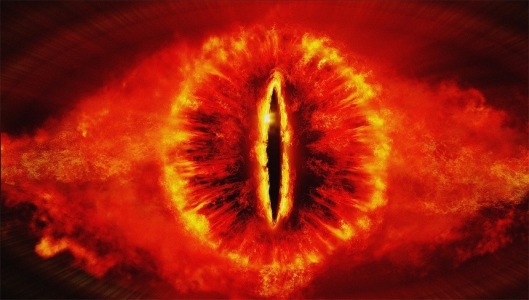
We can imagine why Sauron has that red eye

image3orc.gif

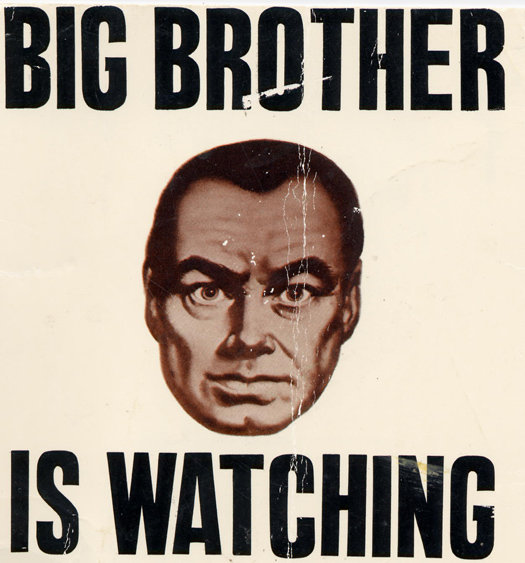
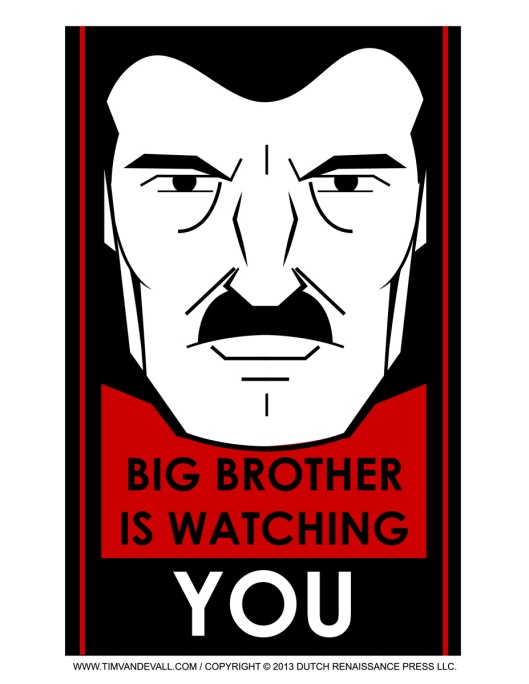
for his emblem—fiery to indicate Sauron’s turbulent nature (and perhaps relation to Satan—another fallen angel/Maia), plus unblinking, to show that, like Big Brother,

image4bbposter.jpg

he’s always watching—a fact rather broadly expressed in the Jackson films, where the eye has been turned into a searchlight—or, at best, a lighthouse beacon.  (And yes, this is a Barad-dur desk lamp.)

image5eye.jpg

But why does Saruman use a white hand?  And which direction should it face?  In the films, it seems to be applied upside down

image6orc.jpg

which, to us seems like the wrong way up—besides being more difficult to apply as face paint.  What is the meaning of the symbolic use of that hand?

This put us to thinking about hands in The Lord of the Rings in general.  We considered the Ring on and off various hands and even those who lost a finger wearing it, but these all seemed rather passive and, thinking of what Ugluk says, we imagine Saruman’s hand as active.  That being the case, the first prominent hand we could think of was that of the Barrow-wight:

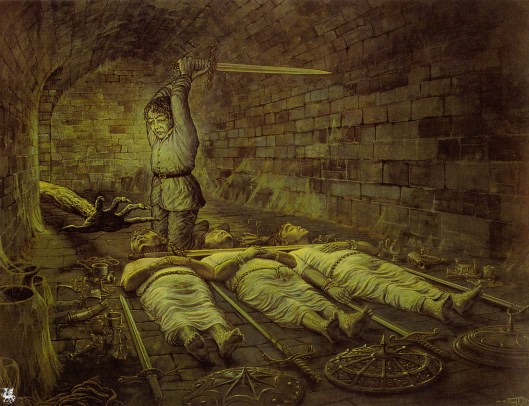
“[Frodo] heard behind his head a creaking and scraping sound.  Raising himself on one arm he looked, and saw now in the pale light that they were in a kind of passage which behind them turned a corner  Round the corner a long arm was groping, walking on its fingers towards Sam, who was lying nearest, and towards the hilt of the sword that lay upon him.” (The Fellowship of the Ring, Book One, Chapter 8, “Fog on the Barrow-downs”)

image7wight.jpg

This is certainly a menacing thing and reminds us of something from the 1956 film, The Ten Commandments, where to indicate the deaths of the first-born of Egypt (from the Book of Exodus, Chapter 11, in the Hebrew Bible), the film makers showed viewers this—

image8aten.jpg

a kind of spindly green hand, which can still creep us out as its function is to grasp things—in this case a sword which will be used to sacrifice the hobbits.

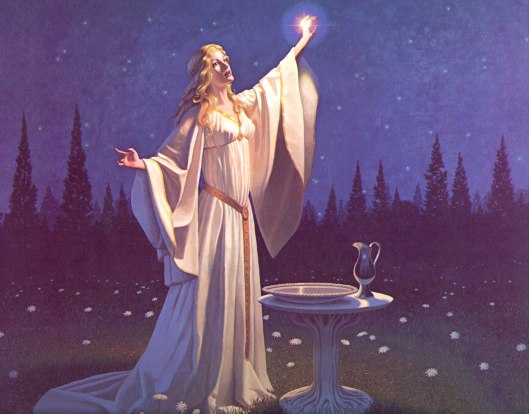
Our next hand—or hands–were those of Galadrielimage8galadriel.jpg

when she takes Frodo and Sam to her Mirror and tells them about the struggle with Sauron:

“She lifted up her white arms and spread out her hands towards the East in a gesture of rejection and denial.”  (The Fellowship of the Ring, Book Two, Chapter 7, “The Mirror of Galadriel”)

Long ago, we did a posting on that gesture, which comes right out of 19th-century rhetorical and theatrical practice.  As this plate illustrates, such gestures were stylized and memorized for their effect on the speaker’s platform, as well as the stage.

image9plate.jpg

We were reminded of our final hands by Galadriel’s gesture:  the Argonath,

image10argonath.jpg

described as:

“Upon great pedestals founded in the deep waters stood two great kings of stone:  still with blurred eyes and crannied brows they frowned upon the North.  The left hand of each was raised palm outwards in gesture of warning; in each right hand there was an axe…” (The Fellowship of the Ring, Book Two, Chapter 9, “The Great River”)

So far, we’ve seen hands which grasp, hands which reject, and hands which warn and perhaps we can imagine that all of these might be part of the message of Saruman’s white hand.  Saruman, in taking up the role of “Mini-Sauron”, has rejected the West he was sent to protect.  In his desire to build his own empire, he has allied himself with Sauron and made war on Rohan, attempting to grasp more and more territory while sacrificing his honor and purpose as one of the Maiar.  That he is not now what he seems to have been in the past should also be a warning of what he intends in the present and what, even maimed, he might be capable of in the future, as the Shire will learn when Saruman becomes Sharkey.

Is there more to this image?  We wouldn’t be surprised:  Sauron is intentionally kept off-stage, we believe to make him that much more menacing, so the real evil we see is, literally, in the hands of Saruman.

image11sar.jpg

Thanks, as ever, for reading.

MTCIDC

CD

Thrones or Dominions (2)

07 Wednesday Nov 2018

Posted by Ollamh in Economics in Middle-earth, Imaginary History, J.R.R. Tolkien, Maps, Military History, Military History of Middle-earth

≈ Leave a comment

Tags

1984, Adolf Hitler, Barad-Dur, Benito Mussolini, Big Brother, Denethor, dictatorships, Elf Kingdom, Eye of Sauron, Gondor, Maiar, map, Middle-earth, Minas Tirith, Mouth of Sauron, Nazgul, Ornthanc, Rohan, Saruman, Sauron, Steward of Gondor, The Lord of the Rings, Theoden, Tolkien, Uruk-hai

As always, dear readers, welcome.

In our last, we began to discuss what we called the governments of Middle-earth at the time of the War of the Ring, making a kind of Grand Tour using the plot movement of The Lord of the Rings to loosely shape our itinerary.  (And here we’re borrowing from a witty idea, on a site called brilliantmaps.com, where we found “If Frodo and Sam had Google Maps of Middle-earth”.)

image1memap.png

Our first stop was the Shire, where we proposed that this was a “government by the few”:  that is, an oligarchy, a certain number of old and established families controlling the state.  From there, we moved on to Bree, where there was so little information that our best guess was that it, too, was probably an oligarchy, some sort of loose-knit one among—or perhaps uniting—the four villages which made up the general area.

Next, we grouped together what we suggested were two Elf kingdoms, Rivendell and Lorien, where Elrond and Galadriel (along with the nearly-invisible Celeborn), clearly were in charge, although neither would claim the title of monarch.

At our next stop, Isengard, Saruman,

image2orthanc.jpg

who had begun as one of the five Maiar sent to oppose the annoyingly-persistent Sauron, had moved from being what Gandalf called “the chief of my order” (The Fellowship of the Ring, Book One, Chapter 2, “The Shadow of the Past”), to being a kind of dictator—but one in the shadow of Sauron, just as Mussolini (1883-1945), who, from 1922, had been a model for such figures,

image3march.jpg

had fallen, by the later 1930s, into being the shadow of another, more powerful, dictator.

image4mushit.jpg

Like Elrond and Galadriel, he carries no title, but his captain, Ugluk, calls him “the Wise, the White Hand:  the Hand that gives us man’s-flesh to eat”, which probably tells us more than we want to know about his rule. (The Two Towers, Book Three, Chapter 3, “The Uruk-hai”)

We believe that this shadow may have been created by Saruman’s growing arrogance (which Gandalf points out to Frodo in “The Shadow of the Past”) combined with his overconfidence in using a palantir he has found in Orthanc and which puts him into communication with Sauron—and Sauron’s ability to seduce.

image5palantir.jpg

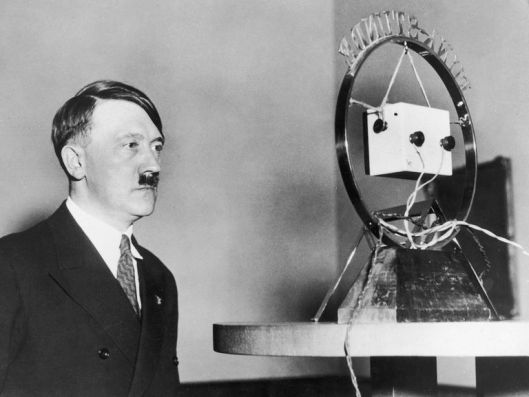
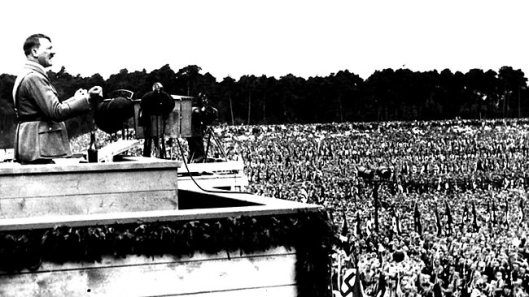
Sauron himself seems like the primal dictator, but a dictator before the 20th century, when dictators began to have a growing media world to employ to make themselves omnipresent in the lives of their citizens.

image6hitradio.jpg

image7hitmovie.jpg

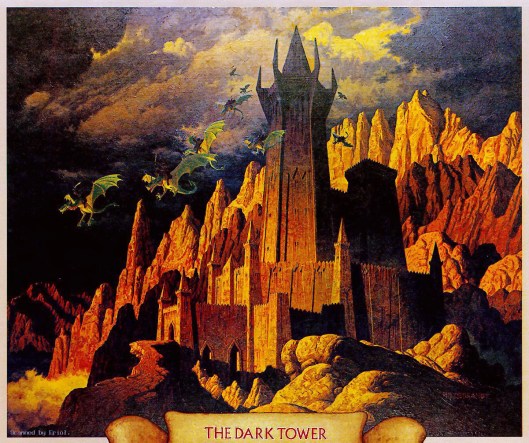
Instead, he’s  remote—sitting in the Barad dur, yet

image8baraddur.jpg

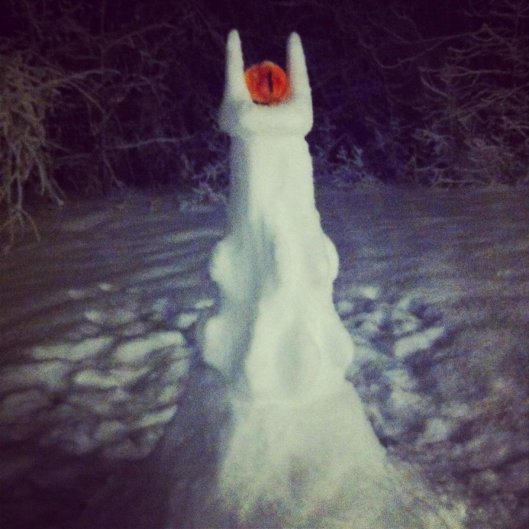
(and we can’t resist this image by “Rackthejipper”)

image9baradsnow.jpg

represented as being like 1984’s Big Brother, always watching.

image10bb.jpg

Or, as it is crudely represented in the Jackson films, literally a giant eye on a tower.

image11jack.jpg

When one thinks of modern dictators, however, one imagines them backed by huge bureaucracies, like the ministries in 1984:

“The Ministry of Truth–Minitrue, in Newspeak [Newspeak was the official

language of Oceania. For an account of its structure and etymology see

Appendix.]–was startlingly different from any other object in sight. It

was an enormous pyramidal structure of glittering white concrete, soaring

up, terrace after terrace, 300 metres into the air. From where Winston

stood it was just possible to read, picked out on its white face in

elegant lettering, the three slogans of the Party:


WAR IS PEACE

FREEDOM IS SLAVERY

IGNORANCE IS STRENGTH


The Ministry of Truth contained, it was said, three thousand rooms above

ground level, and corresponding ramifications below. Scattered about London

there were just three other buildings of similar appearance and size. So

completely did they dwarf the surrounding architecture that from the roof

of Victory Mansions you could see all four of them simultaneously. They

were the homes of the four Ministries between which the entire apparatus

of government was divided. The Ministry of Truth, which concerned itself

with news, entertainment, education, and the fine arts. The Ministry of

Peace, which concerned itself with war. The Ministry of Love, which

maintained law and order. And the Ministry of Plenty, which was responsible

for economic affairs. Their names, in Newspeak: Minitrue, Minipax, Miniluv,

and Miniplenty. (George Orwell, 1984, Chapter 1)


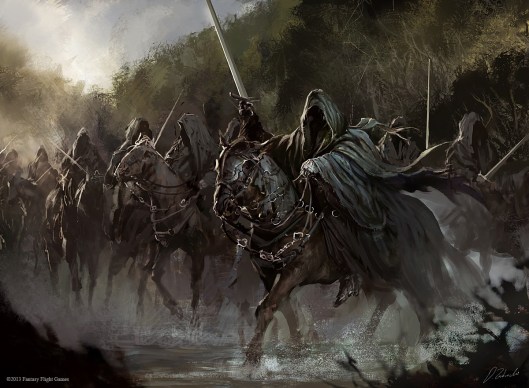
Instead, what we can see of Sauron’s government is much more medieval, beginning with the Nazgul, who were once human kings,

image12nazgul.jpg

who would be like the barons, the chief feudal deputies  of a king in a feudal world of the sort medieval England was and upon which much of Middle-earth, as we’ve suggested in many earlier postings, was based.  The chief of these was then the commander of Sauron’s main attack on Minas Tirith.

image13naz.jpg

To which we would add “the Voice of Sauron” (reminding us, of course, that he is only the spokesperson and Sauron would be presumed to have his eye on him, as well).  If you look for images of him, you will commonly find this:

image14jack.jpg

But, like certain other depictions in the Jackson films (that eye, for example), it is a very literal interpretation for someone JRRT described as:

“The rider was robed all in black, and black was his lofty helm; yet this was no Ringwraith but a living man…it is told that he was a renegade, who came of the race of those that are named the Black Numenoreans…” (The Return of the King, Book Five, Chapter 10, “The Black Gate Opens”)

Here’s an image possibility which comes a bit closer to the text, in our opinion.

image15lieutenant.jpg

From dictators, we make a final stop at two actual feudal  kings, the first, the ruler of Rohan, Theoden,

image16theoden.jpg

is clearly the descendant of earlier kings, as we are told in Appendix A, of The Lord of the Rings, “The Kings of the Mark”, where the line begins with Eorl the Young and continues for about five hundred years.

In the case of our other monarchy, Gondor, the kings who ruled for so many centuries (from SA3320 to TA 2050), have disappeared and, though the fiction is maintained that they will someday return, the actual ruler is their deputy, the Steward, and his role as lieutenant is symbolized literally by his position in the old throne room:

“At the far end, upon a dais [a kind of raised platform] of many steps was set a high throne under a canopy of marble shaped like a crowned helm; behind it was carved upon the wall and set with gems an image of a tree in flower.  But the throne was empty.  At the foot of the dais, upon the lowest step which was broad and deep, there was a stone chair, black and unadorned, and on it sat an old man gazing at his lap.”  (The Return of the King, Book Five, Chapter 1, “Minas Tirith)image17throne.jpg

At the same time, Denethor, and all of the previous Stewards, were kings in all but name, having ruled Gondor for twenty-five generations (see Appendix A, “The Stewards” for details).

So, in sum we have:

  1. 2 possible oligarchies (the Shire, Bree)
  2. 4 kingdoms (or at least sort of, in the case of the Elves—Rivendell, Lorien, plus Rohan and Gondor)
  3. 2 dictatorships (eastern Rohan, extending from Isengard, Mordor)

And, just when we were summarizing, the thought came to us:  what about the dwarves?  We can imagine that, considering Thorin’s family, there have been the equivalent of kings among the dwarves, but that’s a posting for another day!

Thanks, as ever, for reading.

MTCIDC

CD

Name, Rank, and…

10 Wednesday Oct 2018

Posted by Ollamh in J.R.R. Tolkien, Military History, Military History of Middle-earth

≈ Leave a comment

Tags

1984, Alan Lee, Eye of Sauron, Flodden, George Orwell, Great War, Heraldic Device, Mordor, Oceania, Orcs, Sauron, serial numbers, Serialized, Swan of Dol Amroth, the Lancashire Fusiliers, The Lord of the Rings, Tolkien, White Hand of Saruman, White Horse of Rohan, White Tree of Gondor, Winston Smith

As always, dear readers, welcome.

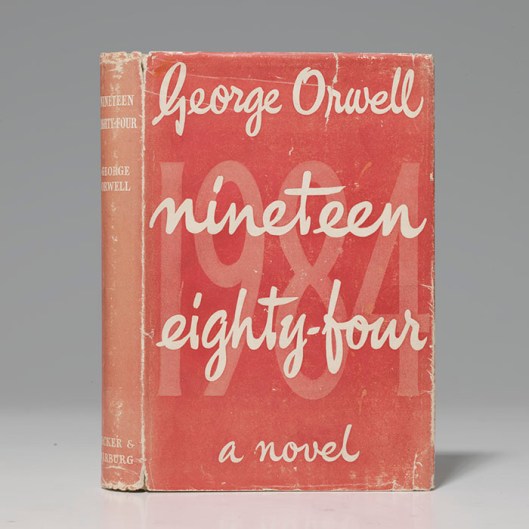
In George Orwell’s (1903-1950)

image1orwell

1949 horrific political novel 1984,

image2nineteen

the protagonist, Winston Smith, is attempting to do what are called “physical jerks”, meaning calisthenics, in front of a “telescreen”.  This is, in fact, a two-way device, but it’s impossible to know when, as you are watching it, it can be watching you, until:

‘Smith!’ screamed the shrewish voice from the telescreen. ‘6079 Smith W.!

Yes, YOU! Bend lower, please! You can do better than that. You’re not

trying. Lower, please! THAT’S better, comrade. Now stand at ease, the

whole squad, and watch me.’ (1984, Chapter 3)

And so we see just how militarized “Oceania”, Smith’s homeland, has become.  You are not a citizen, but a member of a “squad”, and your name has a serial number attached.

The same is true of Sauron’s Mordor, as Sam and Frodo overhear, desperately trying to conceal themselves behind a “brown and stunted bush”.  Two scouts appear:

“One was clad in ragged brown and was armed with a bow of horn; it was of a small breed, black-skinned, with wide and snuffling nostrils…The other was a big fighting-orc, like those of Shagrat’s company, bearing the token of the Eye.”

(Here’s Alan Lee’s illustration of the two, by the way.)


image3orcs

They are soon quarreling and, when the small one tries to escape, the larger fighting-orc shouts:

“You come back…or I’ll report you!”

To which the smaller replies:

“Who to?  Not to your precious Shagrat.  He won’t be captain any more.”

And the larger answers that with:

“I’ll give your name and number to the Nazgul.”  A threat which soon gets him killed.


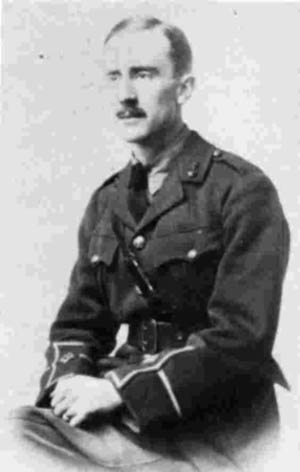
When we think about Tolkien in the Great War,

image4lt.jpg

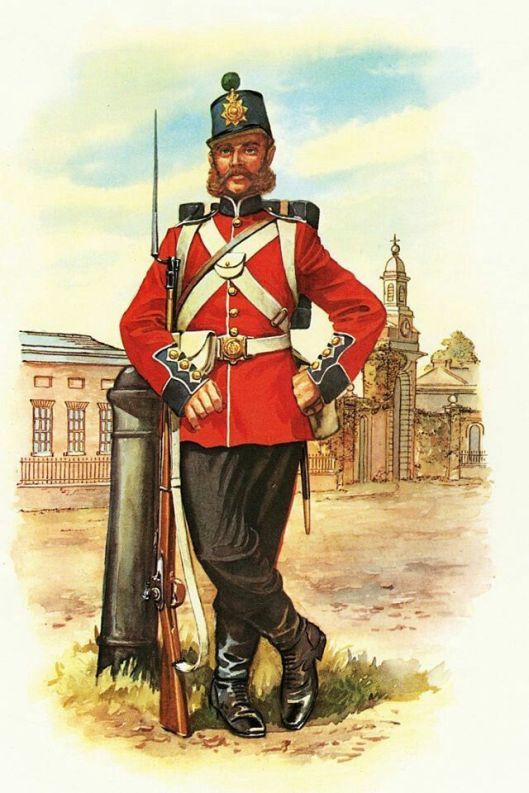
we can see at once where the idea of the “name and number” came from.  Although there had been attempts at serial numbers as far back as 1857,

image5eighteensixty

in 1881, units in the British Army adopted a regimental serial system.

image6eighteeneighties

Thus, in JRRT’s army, he would have seen a man in his battalion of his regiment (the Lancashire Fusiliers) identified as “189, Smith, W” (although officers like Tolkien were not issued such numbers).


image7nineteen


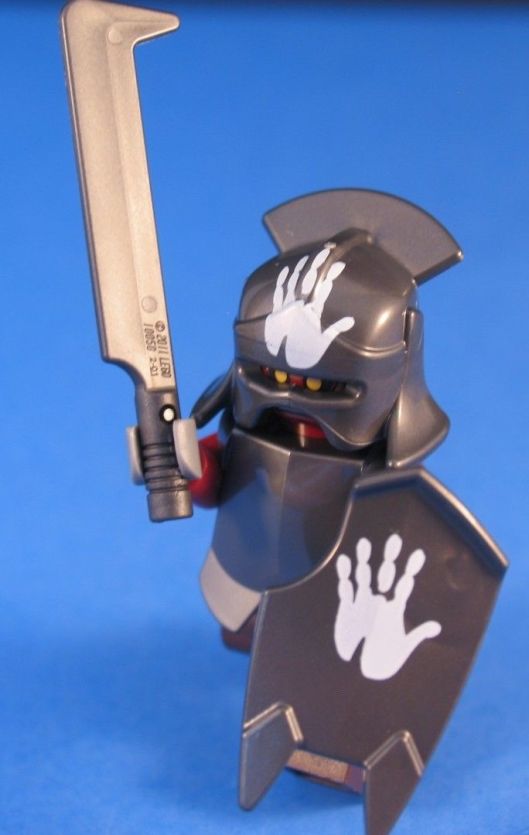
There is, of course, another identifying mark for the soldiers both of Sauron and Saruman, the heraldic device on helmets or shields, the red eye for Sauron, the white hand for Saruman

image8eye

image9hand

When we say “heraldic device”, we mean, as you can see, a decoration on cloth or metal, clothing, armor, and flags, which indicates, in some way, who the wearer is, or to whom he belongs.  On a medieval battlefield, before men wore uniforms, this would help those in charge to understand, at a glance, who was fighting whom.

image10flodden

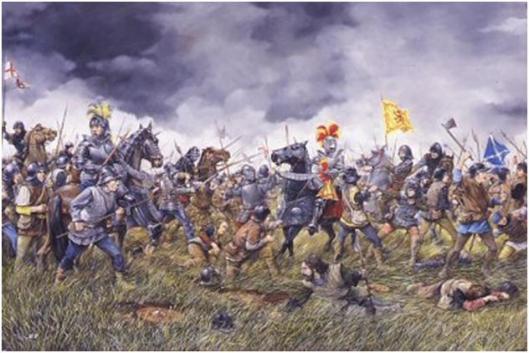
In this painting of the large and confused battle between English and Scots soldiers at Flodden (1513), a late-medieval, early-Renaissance struggle, you can see how confusing things could be, but some order could be made out of the English standard to the left, and two Scottish flags to the right, the far one being generic Scots, but the near one being the banner of the Scottish king himself, James IV.

Up close, the one of the heraldic badges of the Stanley family (on the English side), the claw, marks this archer.

image11stanley

The science of heraldry is large and complicated, but may be seen at its simplest  in The Lord of the Rings, not only among orcs, but also among the forces of the West—

the white horse of Rohan,

image12rohan

the swan and ship of Dol Amroth,

image13dolim

and the tree and seven stars of Gondor.

image14gondor


Where there is a strong contrast between the two sides, however, and we can only speculate as to JRRT’s intent, was the assignment of numbers to the orcs of Mordor  and not to the soldiers of the West a quiet comment on the facelessness of modern warfare, where a soldier is a number first, before he is ever a name and perhaps all men are reduced to orcs?

image15dead

Thanks, as ever, for reading.

MTCIDC

CD


A Power

25 Wednesday Apr 2018

Posted by Ollamh in J.R.R. Tolkien, Narrative Methods, Villains

≈ Leave a comment

Tags

Gandalf, Grima, Harry Potter, Isengard, Istari, Mini-Me, Mirkwood, Necromancer, Ornthanc, Palantir, power, Rings of Power, Rohan, Saruman, Sauron, The Council of Elrond, The Hobbit, The Lord of the Rings, Theoden, Tolkien, Voldemort, White Council, Wormtongue

Welcome, dear readers, as ever.

Some time ago, we did a post on Saruman as a “Mini-Me” version of Sauron

image1minime.jpg

but, since that time, one of us has used The Hobbit in a class.  Mirkwood

image2mirkwood.jpg

and the Necromancer

image3necromancer.jpg

came up and we began to think about him again, this time to consider his strategy:  how long has he been planning something and what might be the elements within that plan?

image4saruman.jpg

Although there is no hard evidence for just how long Saruman has been at work, it seems like his scheme has been under construction for at least 80 years.  We base that upon Gandalf’s description of the White Council’s meeting on the subject of Sauron and what to do when it’s discovered that he is in Dol Guldur, calling himself the Necromancer:

“Some, too, will remember also that Saruman dissuaded us from open deeds against him, and for long we watched him only.  Yet at last, as his shadow grew, Saruman yielded and the Council put forth its strength and drove the evil out of Mirkwood and that was in the very year of finding this Ring…”

(The Fellowship of the Ring, Book One, Chapter 2, “The Council of Elrond”)

Almost 80 years before the story of Bilbo and the Ring, then, it appears that one element in Saruman’s plot was shielding Sauron—a fact clearly not lost on Treebeard:

“He was chosen to be the head of the White Council, they say; but that did not turn out too well.  I wonder now if even then Saruman was not turning to evil ways.”

(The Two Towers, Book Three, Chapter 4, “Treebeard”)

From something Saruman says to Gandalf we might guess the obvious reason for helping Sauron to escape action by the White Council:

“A new Power is rising.  Against it the old allies and policies will not avail us at all.  There is no hope left in Elves and dying Numenor.  This then is one choice before you, before us.  We may join with that Power.  It would be wise, Gandalf.  There is hope that way.  Its victory is at hand; and there will be rich reward for those that aided it.”

(The Fellowship of the Ring, Book One, Chapter 2, “The Council of Elrond”)

But being a lackey to that Power is not quite his ultimate design, as we see:

“As the Power grows, its proved friends will also grow; and the Wise, such as you and I, may with patience come at last to direct its courses, to control it.  We can bide our time, we can keep our thoughts in our hearts, deploring maybe evils done by the way, but approving the high and ultimate purpose:  Knowledge, Rule, Order; all the things that we have so far striven in vain to accomplish…”

As is well-known, Saruman, as one of the Istari, was sent into Middle-earth as a counter to Sauron, not as an ally, and their purpose was:

“…coming in shapes weak and humble were bidden to advise and persuade Men and Elves to good and to seek to unite in love and understanding all those whom Sauron, should he come again, would endeavor to dominate and corrupt.”

(Unfinished Tales, 406)

Knowledge, yes, but Rule and Order?  Emphatically not!  But if that Power (and we note that even Saruman won’t just come out and say “Sauron” at this point, rather like the use of “He Who Must Not Be Named” in the Harry Potter books)

image5voldemort


can be used as a tool in Saruman’s hands—which may show us one element in his grand design.

First, however, it would seem that he needed a base.  As Treebeard tells Merry and Pippin:

“He gave up wandering about and minding the affairs of Men and Elves, some time ago—you would call it a very long time ago; and he settled down at Angrenost, or Isengard as the Men of Rohan call it.”

(The Two Towers, Book Three, Chapter 4, “Treebeard”)

image6orthanc


Saruman even then was already thinking of something, though the purpose was intentionally shrouded:

“There was a time when he was always walking about in my woods.  He was polite in those days, always asking my leave…and always eager to listen.  I told him many things that he would never have found out by himself; but he never repaid me in like kind.  I cannot remember that he ever told me anything.  And he got more like that; his face, as I remember it…became like windows in a stone wall:  windows with shutters inside.”

Although he was powerful, Saruman needed allies—or, rather, servants—and he wasn’t too particular who or what they were:

“He has taken up with foul folk, with the Orcs…Worse than that:  he has been doing something to them; something dangerous.  For these Isengarders are more like wicked Men.  It is a mark of evil things that came in the Great Darkness that they cannot abide the Sun; but Saruman’s Orcs can endure it, even if they hate it.  I wonder what he has done?  Are they Men he has ruined, or has he blended the races of Orcs and Men?  That would be a black evil!”

With the help of these servants, Saruman has turned his base into a factory and storehouse for his scheme, as Gandalf says:

“…it had once been green and fair, it was now filled with pits and forges.  Wolves and orcs were housed in Isengard, for Saruman was mustering a great force on his own account, in rivalry of Sauron and not in his service, yet.”

(The Fellowship of the Ring, Book One, Chapter 2, “The Council of Elrond”)

In fact, it would appear from what Saruman has told Gandalf, that he actually never intends to offer his service to Sauron.

From his base, he has been extending his own power into Rohan, in the south.  In his encounter with Aragon and his companions, Eomer says:

“But at this time our chief concern is with Saruman.  He has claimed lordship over all this land, and there has been war between us for many months.  He has taken Orcs into his service, and Wolf-riders, and evil Men, and he has closed the Gap against us, so that we are likely to be beset both east and west.”

(The Two Towers, Book Three, Chapter 2, “The Riders of Rohan”)

His attacks aren’t always military and Eomer hints at another possibility:

“His spies slip through every net, and his birds of ill omen are abroad in the sky.  I do not know how it will all end, and my heart misgives me; for it seems to me that his friends do not all dwell in Isengard.  But if you come to the king’s house, you shall see for yourself.”

We know that this is “fifth-column” work—Grima Worm-tongue, who has been slowly poisoning King Theoden with defeatism.

image7grima.png

And now we can see, in broad outline, what Saruman is up to:

  1. establish a base
  2. recruit an army
  3. build up an intelligence network (birds, spies, even wandering himself to pick up information)
  4. use your strength to expand power into the next land, Rohan
  5. at the same time undercut the King of Rohan’s ability to resist by subversive methods

So far, so good, as long as all that Saruman wants is to be the ruler of the land south of the Gap of Rohan and north of Gondor, but we’ve already seen that he’s more ambitious yet, suggesting to Gandalf that they—really he, as Gandalf knows—can take over that unnamed Power and use it for their—his– purposes, Knowledge, Rule, Order.  When he sees that Gandalf is unconvinced, Saruman lets slip the capstone of his scheme:

“Well, I see that this wise course does not commend itself to you…Not yet?  Not if some better way can be contrived?…And why not, Gandalf?  Why not?  The Ruling Ring?  It we could command that, then the Power would pass to us.”

And here is the real heart of Saruman’s design:  to obtain the One Ring.

He has been searching for it for a long time, even traveling to Minas Tirith to examine ancient records.

“In former days the members of my order had been well received there,” says Gandalf to the Council of Elrond, “but Saruman most of all.  Often he had been for long the guest of the Lords of the City.”

His purpose is now easy to guess.

Gandalf had been aware that Saruman had seemed to know a great deal about the Ring, even to its appearance, as Saruman had said to the White Council:

“The Nine, the Seven, and the Three had each their proper gem.  Not so the One.  It was round and unadorned, as it were one of the lesser rings; but the maker set marks upon it that the skilled, maybe, could still see and read.”

How had Saruman known that since, as Gandalf says, “What those marks were he had not said.  Who now would know?  The maker.  And Saruman?  But great though his lore may be, it must have a source.  What hand save Sauron’s ever held this thing, ere it was lost?  The hand of Isildur alone.”

Gandalf discovers the truth of this in the dusty records of Gondor:

“…there lies in Minas Tirith still, unread, I guess, by any save Saruman and myself since the kings failed, a scroll that Isildur made himself.”

And, with the discovery and reading of that scroll, Gandalf knows not only about much more about the Ring, but how Saruman knew about its appearance and now, in Orthanc, pressed by Saruman to join him, he understands the last element in Saruman’s design—and also why Saruman has summoned him:

“That is in truth why I brought you here.  For I have many eyes in my service, and I believe you know where this precious thing now lies.  Is it not so?  Or why do the Nine ask for the Shire, and what is your business there?”

So here, lacking only one element, the real element under all, is Saruman’s long plan—but lacking “this precious thing” (a telling phrase!), we will see how successful the rest will be.  Treebeard has said of him,

“He has a mind of metal and wheels; and he does not care for growing things, except as far as they serve him for the moment.”

What will happen when, without the Ring, Saruman will find that growing things, instead of serving him for the moment, might unseat him forever?

image8destruction.jpg

As always, thanks for reading!

MTCIDC

CD

Orcked

22 Wednesday Nov 2017

Posted by Ollamh in Economics in Middle-earth, Imaginary History, J.R.R. Tolkien, Literary History, Narrative Methods

≈ Leave a comment

Tags

Arthur Rackham, Bosch, Brueghel, counterfeit, creation, Elves, Ents, Fangorn, Goblins, John Bauer, mockery, Orcs, Saruman, Sauron, The Hobbit, The Lord of the Rings, Tolkien, Treebeard, trolls, US Treasury Department, Weimar Republic

Welcome, dear readers, as always.

In our last, we discussed less familiar characters in The Lord of the Rings, the Corsairs of Umbar, and what we imagine they could look like.

In this posting, we want to look at much more familiar characters, Orcs—but from the viewpoint of Fangorn.

image1treebeard.jpg

He says of them:

“Maybe you have heard of Trolls?  They are mighty strong.  But Trolls are only counterfeits, made by the Enemy in the Great Darkness, in mockery of Ents, as Orcs were of Elves.”  (The Two Towers, Book Three, Chapter 4, “Treebeard”)

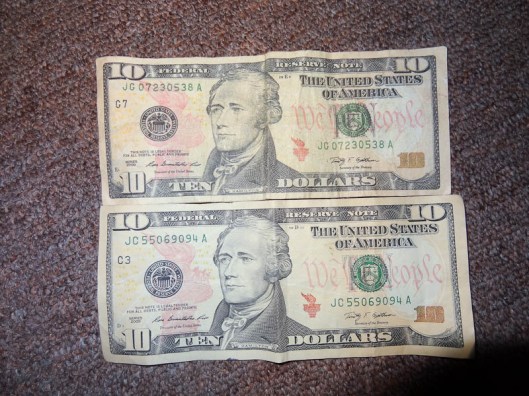
We’ve always been a bit puzzled by this.  “Counterfeit” makes us think, immediately, of counterfeit money.  Here are a pair of US 10-dollar bills:  can you tell the counterfeit (from Old French via a Latin compound, contra, “against” + facere, “make/do”—in Medieval Latin a contrafactio is a thing put against another, something in contrast, thus “imitation”)?

image2hamiltons.jpg

To be a successful counterfeit, normally, it’s necessary that the imitation be as close to the original as possible, as in the case of these two tens.  The US Treasury Department goes to a lot of time and expense to make counterfeiting as difficult as possible

image3anticounterfeit

but, if a counterfeiter is successful, he stands to make (in two senses) a lot of money.  He can also cause a great deal of financial damage, breeding distrust in a government’s ability to coin money and to stand behind it.  The more counterfeit money in the system, the more money the government has to back, which, in time, could lead to what is called hyperinflation and can bring a currency to collapse.  When a government does this itself it can cause havoc with a country’s economy, as happened in the Weimar Republic in 1921-1924.  At that time, for complex reasons having to do with paying off the German Empire’s war debts, the government began producing too much paper money and too rapidly.  This caused the money to lose value very quickly, rendering it almost worthless.

image4weimarmoney

It’s no wonder that the penalty for counterfeiting was usually the most severe possible.

image5tyburn

Treebeard’s use of the word “counterfeit”, then, would suggest that what Sauron was doing was trying to make nearly-exact copies of something, either Ents or Elves, in his creation of Trolls and Orcs.  So what do we find when we first see a description of Orcs?

“There were four goblin-soldiers of greater stature, swart, slant-eyed, with thick legs and large hands.”

(The Two Towers, Book Three, Chapter 1, “The Departure of Boromir”)

That’s not much to go on:

  1. “greater stature” would suggest that most Orcs were short
  2. “swart” means “dark-complexioned” (a term Sam uses to describe men from Harad, whom he calls “Swertings”—The Two Towers, Book Four, Chapter 3, “The Black Gate is Closed”)
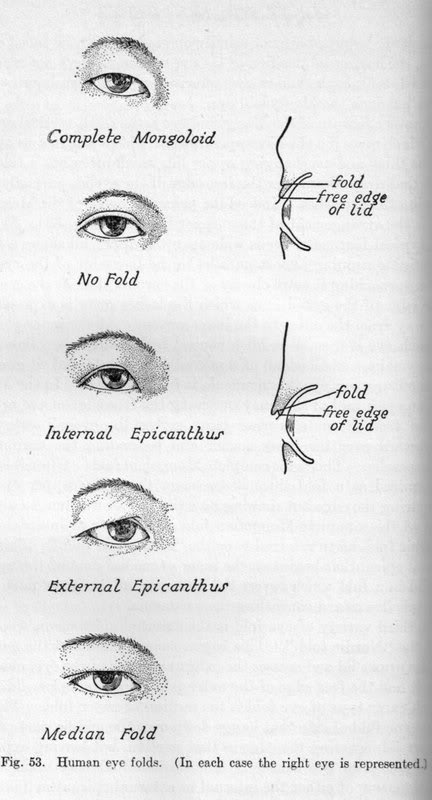
  3. “slant-eyed”—for contemporary people this is a tricky term, even a racial slur, but JRRT probably meant no more than that these Orcs had epicanthic folds to their eyelids, which is not uncommon among many of the world’s peoples.

image6epicanth

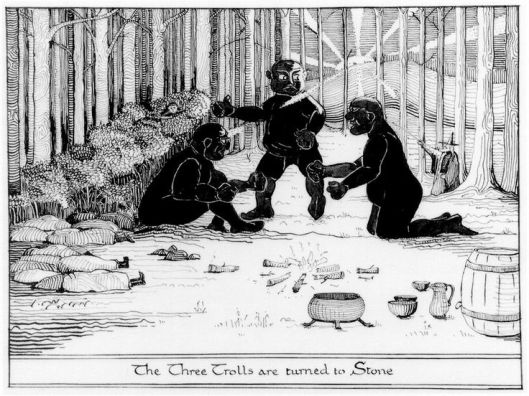
  1. “with thick legs and large hands” suggests very stocky builds—like the “Trolls turned to stone” in JRRT’s illustration of the scene in The Hobbit.

image7stonetrolls

This is a start, but will our next view help?  Pippin and Merry are the prisoners of the Orcs and Pippin is listening to a quarrel between those of Saruman and those of Sauron:

“In the twilight he saw a large black Orc, probably Ugluk, standing facing Grishnakh, a short crook-legged creature, very broad and with long arms that hung almost to the ground.” (The Two Towers, Book Three, Chapter 3. “The Uruk-hai”)

Counterfeit Elves?  Of course we know—also from Fangorn—that perhaps Saruman was up to something more, as Fangorn says of him:

“He has taken up with foul folk, with the Orcs.  Brm, hoom!  Worse than that:  he has been doing something to them; something dangerous.  For these Isengarders are more like wicked Men.  It is a mark of evil things that came in the Great Darkness that they cannot abide the Sun; but Saruman’s Orcs can endure it, even if they hate it.  I wonder what he has done?  Are they Men he has ruined, or has he blended the races of Orcs and Men?  That would be a black evil!” (The Two Towers, Book Three, Chapter 4, “Treebeard”)

This might account for the size of the Uruk-hai, as well as for their ability to endure daylight, but what about the crook-leggedness and “long arms that hung almost to the ground”?

Perhaps here we should remember the end of Fangorn’s description:  “…in mockery of Ents, as Orcs were of Elves.”

Hmm.  Trolls certainly don’t look much like Ents—

image8.jpg

image9leetreebeard.jpg

Is this the “mockery”?  It’s certainly not counterfeiting in the usual sense!
Should we understand the same for Orcs vs Elves?  Here are illustrations of Galadriel and Legolas (both by the Hildebrandts):

image10galadriel.jpg

image11legolas.jpg

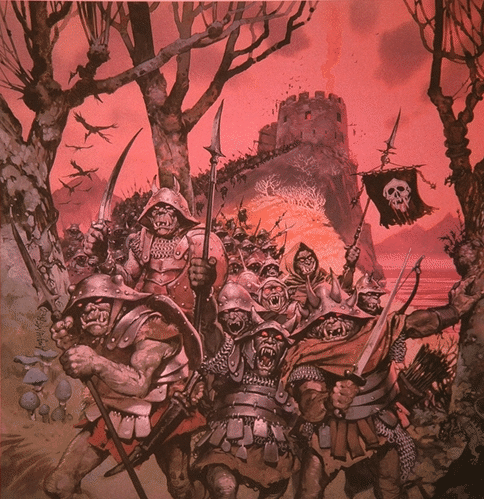
Set those against any modern artist’s view of Orcs and, again, it’s not counterfeiting, in the strictest sense, so we suppose that we have to assume “mockery”—but with the added assumption that Sauron had a very twisted sense of humor.  (There’s also that nasty half-suggestion of Fangorn’s that, since Saruman’s Orcs are behaving more like men, Saruman has been performing genetic experiments, something even Fangorn doesn’t want to think about.)

image12mcbride.gif

image13lee.jpg

image14howe.jpg

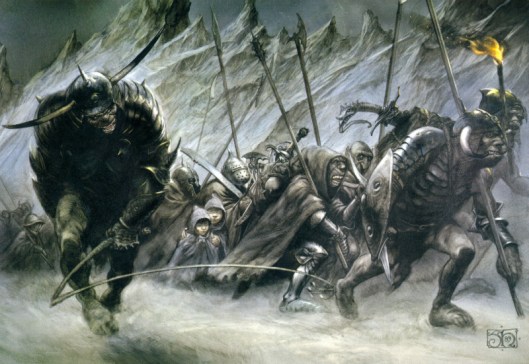
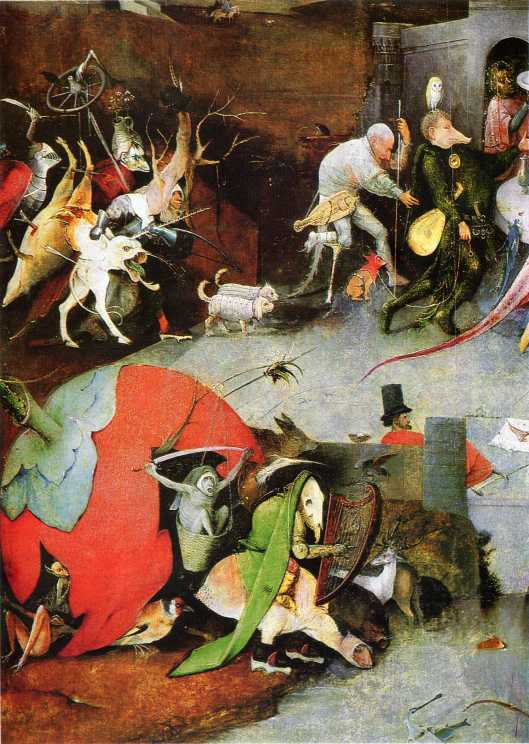
Looking at all of these illustrations, by the way, we were struck by where we’d seen creatures like this before.  Could it be in the works of those strange Flemish/Dutch painters like Brueghel and Bosch?

image15bosch.jpg

Or Arthur Rackham?

image16rackham.jpg

Or the early 20th-century Swedish painter, John Bauer, who, in his depiction of forests was an influence upon JRRT?

image17bauer.jpg

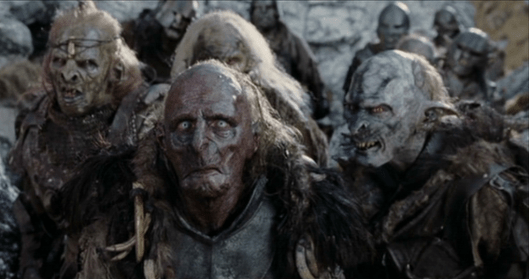
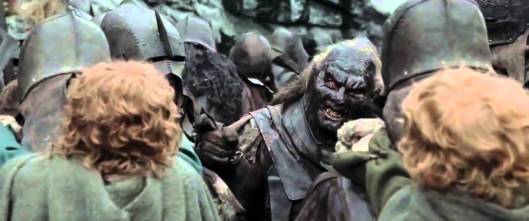
And, more recently, considering P. Jackson’s Orcs,

image18orcs.png

image19orcs.jpg

their skin color and general look:  is there a suggestion here of the so-called “Bog People” (about whom we wrote a posting some time ago)—a whole series of bodies, at least one dating from the 4th century bc

image20tollundman.jpg

who have been discovered buried in peat bogs (a great preservative) in northern Europe?

image21peatbog.jpg

And, in their color and oozy look–not to mention that they seem to move in scuttly groups–is there something cockroachy about them?

image22cockroaches.jpg

But, just as there is a place Fangorn doesn’t want to go, it’s true for us as well!

Thanks, as ever, for reading.

MTCIDC

CD

PS

You probably spotted this (we have very intelligent readers), but it’s the top 10-dollar bill which is the counterfeit.

PPS

It has also occurred to us that JRRT more than once discussed the fact that Sauron, as a lesser deity-figure, could never originate, only copy and “subcreate”—perhaps suggesting another reason for making “mockeries”:  his anger at his inability to do original work?

In the Future, Use the Past

13 Wednesday Sep 2017

Posted by Ollamh in Artists and Illustrators, Fairy Tales and Myths, Films and Music, Heroes, J.R.R. Tolkien, Literary History, Narrative Methods

≈ Leave a comment

Tags

A New Hope, A Princess of Mars, Ages of Middle-earth, Death Star, Edgar Rice Burroughs, Emperor Palpatine, Frank Schoonover, George Lucas, Hildebrandt, Mos Eisley, Oxford, Percival Lowell, Return of the Jedi, Sauron, science fiction, special effects, Star Wars, Stonehenge, Tatooine, The Empire Strikes Back, The History of Middle-earth, The Last Jedi, The Lord of the Rings, Tolkien, tower of St Michael

Welcome, as always, dear readers.

As The Last Jedi (Star Wars 8) approaches (and Star Wars Rebels, season 3 has appeared via the postman—season 4 premieres in mid-October—sadly the last season, as Disney has canceled season 5), we’ve been thinking about the original Star Wars of 1977.

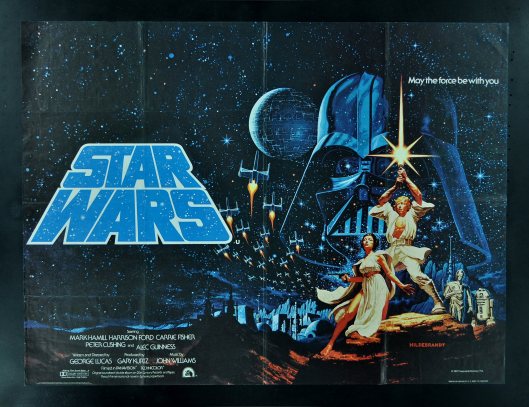
image1poster.jpg

This poster—the second ever Star Wars poster, in fact (used by 20th Century Fox in the UK)– is a great link to JRRT—as if we don’t seem to make such links every time we write!  It’s by two of our favorite Tolkien illustrators, the Hildebrandt brothers.  Here’s a picture of the surviving twin, Greg, with that very poster (his brother, Tim, died in 2006).

image2gh.png

(Clink here for a LINK to an interesting little piece from 2010 about the Hildebrandts and George Lucas.)

We believe, however that there may be a deeper link.

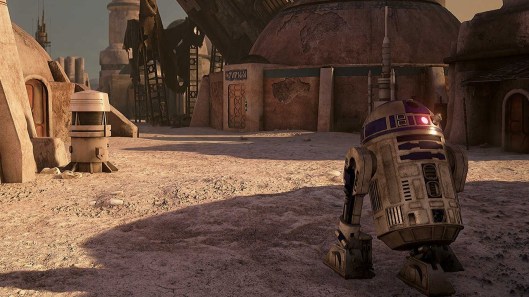
The original reviews (here’s a LINK to summaries of some of them) were a mixture, with some critics enthusiastic about what they saw and others (in our view the stodgier ones) calling the film things like “puerile”.  One element which was occasionally commented upon was the look of the picture—and not just the (for the time) dazzling special effects—but the fact that all the worlds depicted were lived-in, not shiny and new—well, almost.  Consider Mos Eisley, for example,

image3moseisley.jpg

which looks dusty and battered, suggesting the passage of time as well as the effects of the harsh desert climate of Tatooine.

Or the Jawa sandcrawler, old and clearly rusting–

image4jawasandcrawler.jpg

We said “almost” shiny and new because there’s one part of this galaxy with a different look:  the Death Star.

image5insidedeathstar.jpg

It looks like it’s dusted and waxed hourly, doesn’t it?  And the outside appears to be just as neat.

image6falconenteringdeathstar.jpg

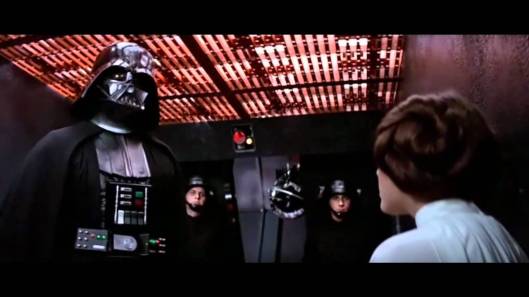
What does this say about the nature of those who inhabit it?  For us, thinking about the spotless Darth Vader,

image7vader.jpg

immediately suggests that the old proverb should be changed to “Cleanliness is next to Un-godliness”!  (Okay—we’re not the neatest and most organized people we know.)

It has been pointed out, more than once and beginning with the director himself, that George Lucas was influenced by Edgar Rice Burroughs’ John Carter series, beginning with A Princess of Mars (first published serially in The All-Story, February to July, 1912).

image8princess.jpg

(And here’s another connection—this cover and the illustrations for its first publication in book form, in 1917, were by Frank Schoonover, 1877-1972, who was the student of another of our favorite illustrators, Howard Pyle, whom we have occasionally mentioned in previous postings.  The convincing detail in this cover painting shows that, just like his teacher, Schoonover did his research—in his case, by very carefully going through the text and taking note of any technical information the author might have mentioned.)

In A Princess of Mars and subsequent books,  Mars has a civilization which is old and in decline (the inspiration for which, in turn, may have come from the work of the amateur astronomer, Percival Lowell, 1855-1916, whose telescopic observations of Mars had convinced him that the planet was—or had been—the home of a dying civilization which had constructed a vast network of canals to supply themselves with water from the polar ice caps—unfortunately, numerous NASA missions have found no evidence of the desperate Martians or their canals).   It would be easy, then, to say that Lucas was just following his source material, but we would suggest that there are two better explanations for showing wear.

The first comes from something Lucas is quoted as having said to his production designers:  “What is required for true credibility is a used future.” In Lucas’ view, then, the story’s believability comes in part from its look:  if things appeared not shiny, but worn, then viewers would be more likely to accept the narrative as somehow “true”, we presume because things in our world so often look used.

There is then, we think a further presumption:  if things look worn, then they have a past, which implies that the here-and-now of the story is a small part of bigger things and, certainly, just looking at the “crawl” at the beginning of the original Star Wars,

star-wars-crawl-163729.jpeg

which leads us to  our second explanation.  This one deals with something deeper, something which we would say might provide another possible link with JRRT and is, in fact, suggested by the titles of the first three Star Wars films made and even in their sequence:  A New Hope, The Empire Strikes Back, The Return of the Jedi.

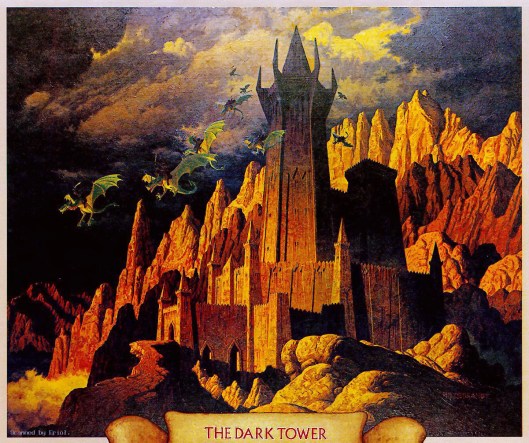
In two earlier postings, we talked about the condition of Middle-earth at the beginning of The Lord of the Rings, in which everything, from the trees to the houses of Minas Tirith, has grown old and weary—and even potentially hostile, in the case of the trees.  Part of this comes from the fact that Middle-earth is old:  one has only to turn to Appendix B, subtitled “The Tale of Years”, in The Lord of the Rings to see that, in the Second and Third Ages alone, nearly 6000 years have passed.   (In terms of our earth, that’s moving from the late Neolithic Era to modern times, 4000bc to 2017ad.)  This also emphasizes the age and depth of evil, as well as its power to corrupt in the present:  Sauron began to build Barad-dur c. SA1000—5000 years before the main narrative of The Lord of the Rings opens and, in the present, the world is crumbling.

Of course, JRRT lived surrounded by the past.  The oldest surviving building in his daily Oxford is the tower of St Michael at the North Gate, dating from 1040ad, nearly a thousand years before his time,

image9stmichaels.jpg

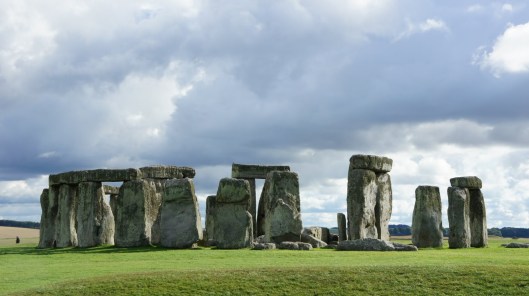
but Neolithic Stonehenge is only 58 miles (93km) southwest of the city and that’s 5000 years old, taking us back to the time when, in Middle-earth, Sauron had begun the Barad-dur.

image10stonehenge.JPG

image11baraddur.jpg

In contrast, Lucas was born in 1944 in Modesto, California, a town only founded in 1870, and grew up in a post-World War II world, where the key was “the future”.  It is a tribute, then, to his story-telling gift that he realized how useful in telling his story the past—even an imagined one—could be and it is interesting to see how he shares that understanding with JRRT and perhaps shares a goal, as well.

We’ve said that our second explanation may be seen in the titles of Lucas’ three films, so let’s consider them in comparison with the general shape of Tolkien’s work to see what that shared goal might be.   (In an interview, Lucas even described the three as being like a three-act play, suggesting the dramatic progress inherent in the movement from one to another.)

At the beginning of the first film, it is a dark time in the galaxy:  the repressive regime of the evil Emperor Palpatine dominates and resistance is confined to “The Rebel Alliance”, which has scraped together a fleet (and, presumably an army—we see elements in Rogue One, which takes place before this film) to resist, but seems to spend most of its time running and hiding.  The past is only implied, but the fact that there is an Empire and a resistance suggests much, just as the run-down condition of places like Tatooine might suggest both age and that the galaxy has become run-down because of that Empire.

image12palpatine.jpg

At the beginning of The Lord of the Rings, we find ourselves in a place with a long history, as we see from the many pages of the “Prologue”.  It has been a quiet place, but the world outside is becoming less so, with sinister forces growing, as Frodo hears from passing dwarves:

“They were troubled, and some spoke in whispers of the Enemy and of the Land of Mordor.” (The Fellowship of the Ring, Book One, Chapter 2, “The Shadow of the Past”)

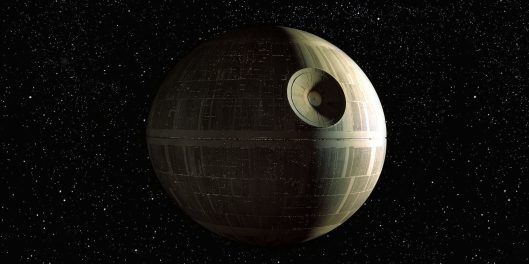
In time, readers are brought to see that the dwarves are grossly understating the case:  the Enemy is real, Sauron, and that he has not only huge armies, but the Nazgul and a would-be ally in his enemies’ camp, Saruman.  The same may be said for the Empire:  not only do they have huge fleets and armies, but they have the “ultimate weapon”, the Death Star.

image13deathstar.jpeg

We will learn, as well, that, for all his great age and might, Sauron has an Achilles’ heel:  to give the One Ring its power, he has had to pour most of his power into it.  Thus, if he regains the ring, he will be much more powerful than he is at present, but, should the ring be destroyed, Sauron will be virtually destroyed with it.  As this struggle has been going on in Middle-earth for thousands of years, the idea that Sauron is vulnerable could easily be termed “a new hope”, just as Luke, the son of the Enforcer of the Galaxy, Darth Vader/Anakin Skywalker, will provide a new hope for the Rebels (especially when we are told about “the Chosen One”—for whom he can be taken).

For a time, things do not go well for those opposed to Sauron:  he combines psychological/meteorological attacks with the march of huge armies, and even pirate raids on Gondor’s south coast. Gondor is overrun and Minas Tirith is assaulted.  This is clearly The Empire Strikes Back, just as the pursuit of the Rebel fleet to Hoth and the destruction of Echo Base disperses the Rebels and casts a shadow over the hope felt after the destruction of the Death Star.

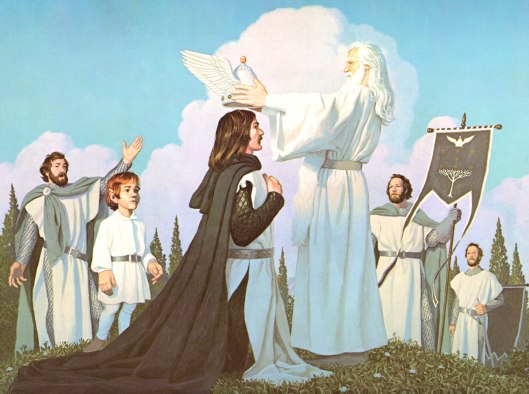
This is not the end, however, for the Rebels or for the good people of Middle-earth.  Not only is the Ring destroyed and Sauron disembodied, but this paves the way for The Return of the King, with all of the reflowering-to-come, as we have suggested in a previous posting.

image14crowning.jpg

And there is a strong echo in the title of Lucas’ third film, The Return of the Jedi, in which the Emperor is destroyed and balance brought back to the Force—and the galaxy.  (Of course, with Star Wars 7, we see that the happy ending is only temporary, but we have hopes that, by the conclusion of 9, there will come a final rebalancing and peace at last.)

image15return.jpg

Lucas’ acknowledges many sources but, so far, we have yet to locate a quotation from an interview or anywhere else in which he says, “Yes, I’ve read Tolkien closely and, indeed, there is a strong affinity between my work and his”, but we believe that we can suggest, at least, that he, like JRRT, is following the same path in creating a world in turmoil, a visibly-aging world.  Into this world, he places his protagonist who provides a new hope, faces the might of a not-easily-defeated enemy, but, by his bravery and determination, finally brings about the destruction of that enemy (interesting in both cases he does not do so himself—Gollum inadvertently destroys the ring, just as Anakin, not his son, kills the Emperor) and the promise of renewal in the return of the Jedi—and the King.

And what do you think, dear readers?

Thanks, as ever, for reading!

MTCIDC

CD

Oh, Come, Let Us Adore…

21 Wednesday Jun 2017

Posted by Ollamh in Imaginary History, J.R.R. Tolkien, Literary History, Military History, Military History of Middle-earth, Narrative Methods

≈ Leave a comment

Tags

1984, Adolf Hitler, altar, Ar-Pharazon, Armenelos, Artemis, Aulis, Avebury, Aztec, Benito Mussolini, Big Brother, France, Gallic Celts, George Orwell, Germany, Gondor, Greek temple, Hera, Herodotus, human sacrifice, Iphigenia, Melkor, Nazis, nemeton, Numenor, occupation, Olympia, Pantheon, Rome, sacrifice, Sauron, shrine, Soviet Union, Stalin, Stonehenge, Tenochtitlan, The Hobbit, The Lord of the Rings, The Silmarillion, The War of the Ring, Tolkien, Valar, World War II, worship

Welcome, as always, dear readers.

Some time ago, we posted a piece on what Sauron wanted out of the War of the Ring. Our evidence was this, spoken to Aragorn and Gandalf and the allied army which had marched to the Morannon as a distraction, by the Lieutenant of the Tower:

“The rabble of Gondor and its deluded allies shall withdraw at once beyond the Anduin, first taking oaths never again to assail Sauron the Great in arms, open or secret. All lands east of the Anduin shall be Sauron’s for ever, solely. West of the Anduin as far as the Misty Mountains and the Gap of Rohan shall be tributary to Mordor, and men there shall bear no weapons, but shall have leave to govern their own affairs. But they shall help to rebuild Isengard which they have wantonly destroyed, and that shall be Sauron’s, and there his lieutenant shall dwell: not Saruman, but one more worthy of trust.” (The Return of the King, Book Five, Chapter 10, “The Black Gate Opens”)

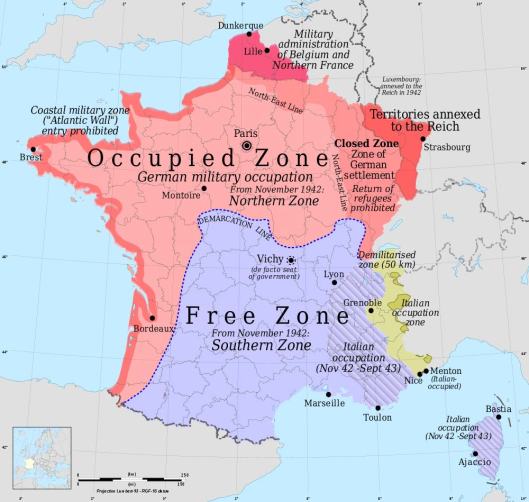
These are political conditions: Sauron is demanding territory, just as any conqueror in our world would. When France was occupied by the Nazis in 1940–something with which JRRT would have been quite familiar while writing The Lord of the Rings—here’s a map of what Hitler demanded—and got.

France-occupation

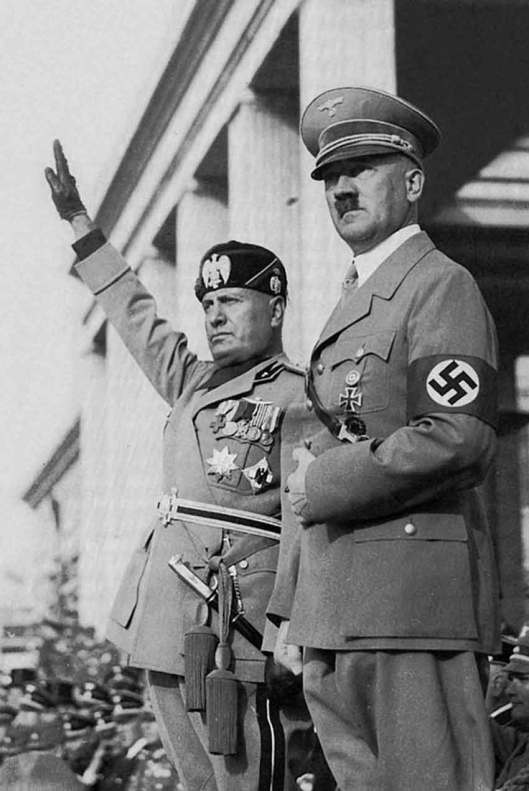
The last sentence of Sauron’s conditions even reminds us of the relationship between Hitler and Mussolini—although not how Mussolini would have viewed it.

Hitler-and-Mussolini

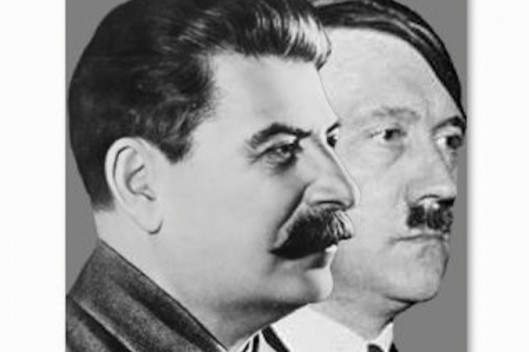
Hitler had another dictator-partner for a short time, however, Stalin, whom he distrusted even more than Mussolini.

STALIN-HITLER-2-676x450

And Stalin, unlike Sauron, won his war and swallowed all of central Europe, as well as eastern Germany.

post-war-soviet-influence

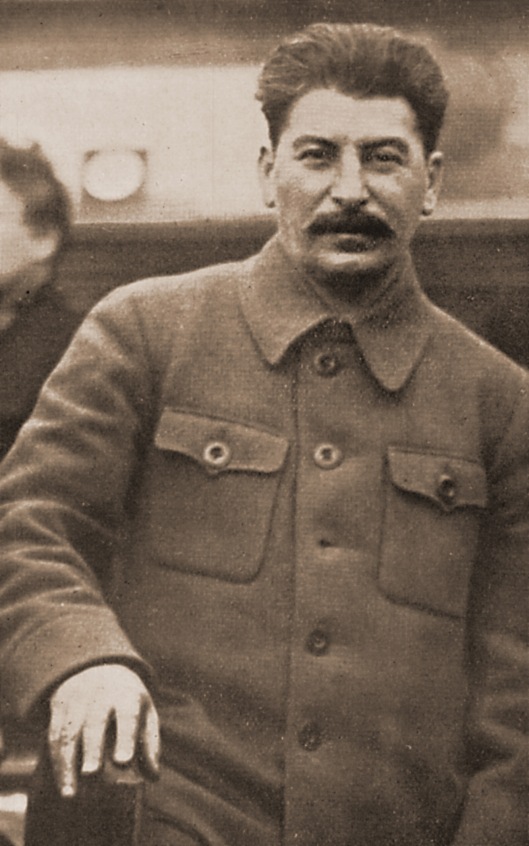
It’s clear that George Orwell had this dictator in mind when he was creating his “Big Brother”, in 1984, even to his physical description (from a poster—it appears that no one has actually seen Big Brother in the flesh): “an enormous face, more than a meter wide: the face of a man about forty-five, with a heavy black mustache and ruggedly handsome features…”

stalin

These posters were so constructed that, “It was one of those pictures…which are so contrived that the eyes follow you about when you move.”

Big-Brother-Is-Watching-You-Poster

In fact, as we think about the image, its slogan, “Big Brother is Watching” might be applied to the All-Seeing Eye.

sauron-eye

That all-seeing eye, however, has another meaning, we believe, and it has to do with a goal which the Lieutenant doesn’t mention, but JRRT does:

“Sauron desired to be a God-King, and was held to be this by his servants.  If he had been victorious he would have demanded divine honour from all the rational creatures and absolute temporal power over the whole world.” (Letters, 244)

Thus, like various gods through the history of the world, by showing himself not a full physical form, but only as an eye, we can imagine that Sauron was claiming divine omniscience.

This set us to thinking: there is virtually no trace of religion in the latter part of the Third Age and certainly no religious structures. What might Sauron build as a shrine—to himself? And, as a corollary, what would he demand for worship?

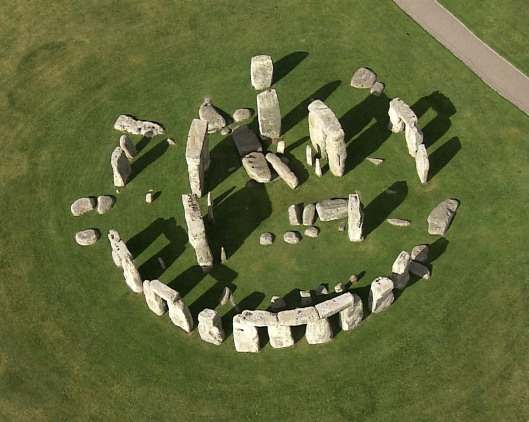
In Western Europe, some the earliest shrines were not actual buildings, but sites claimed to be somehow invested with divinity, such as groves of trees, something which the Gallic Celts called a nemeton, perhaps related to the Old Irish word nemed, meaning, according to the on-line OI/Middle Irish dictionary, “(small) sacred place”.

DollTorWest0801

It’s easy to see how this could lead to the idea of a stone circle (perhaps beginning with a ditch of the sort which could ring settlements?), like that at Avebury.

Avebury

Or its more concentrated version, Stonehenge.

stonehenge-copy1

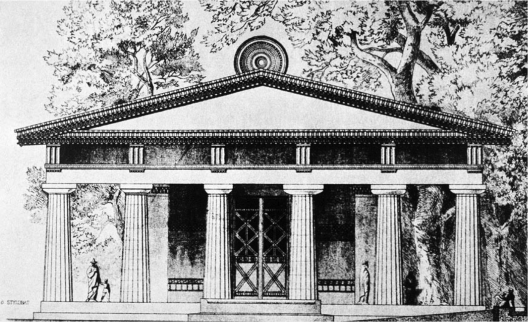
Another possibility might be to organize that grove into lines of pillars—using the trunks of the trees—and adding a roof—and you get a Greek temple.

templeofhera

Herodotus tells us that, in his time, this temple, devoted to Hera at Olympia, still had a couple of wooden columns, showing just how old it was. (There are also building elements, like pegs—all in stone in later time—which mirror earlier wooden construction.)

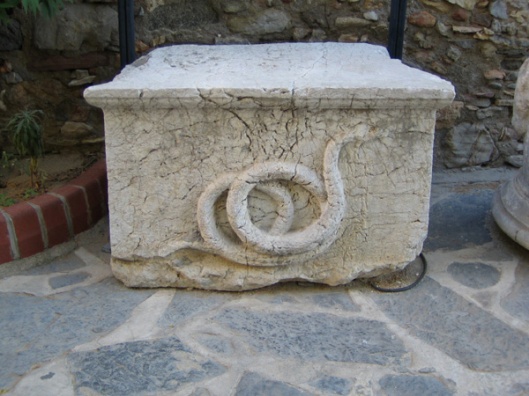
In the Greek world (and the Roman, as well), worship was done outside the building, at an altar in front.

snake-altar-from-mausoleum-of-halicarnassus-in-bodrum

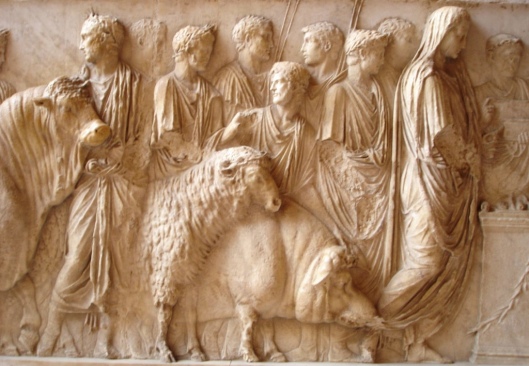
That worship would consist of prayers and sacrifices. As the majority of the gods were believed to live in a place above humans (Olympus—an actual mountain, but also, seemingly, an imaginary location in the sky), sacrifices were conveyed in smoke. These could be as simple as incense

elt200810220812093544851-142058F954A638F8693

or as complicated as the barbecue after a multiple animal-slaughter, like the Roman suovetaurilia (“pigsheepbullactivity”). (Guess who got to consume the actual meat?)

multipleanimalsacrifice

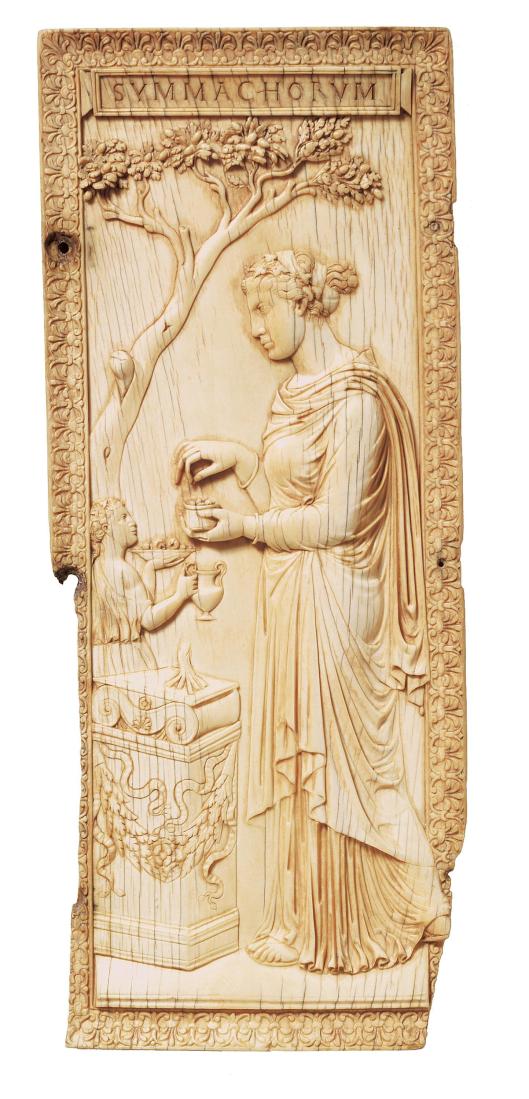
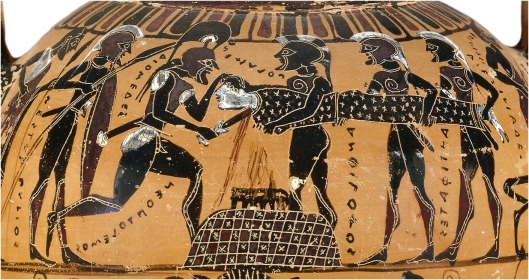
Classical people did not practice human sacrifice, considering it abominable, but it may have existed, at least in desperate circumstances in the far past, as has been preserved in the Greek story of Iphigenia, murdered at the altar of Artemis at Aulis to propitiate the goddess, who had blocked the Greeks from sailing to attack Troy.

Black-figured Tyrrhenian amphora (wine-jar) attributed to the Timiades Painter

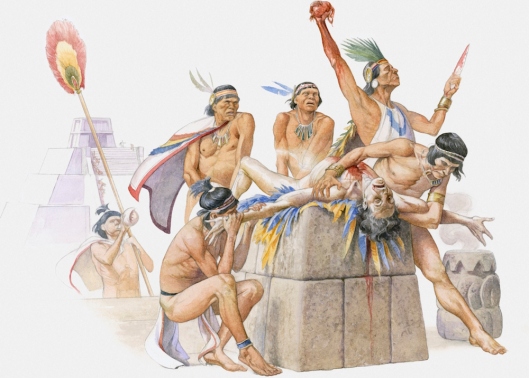
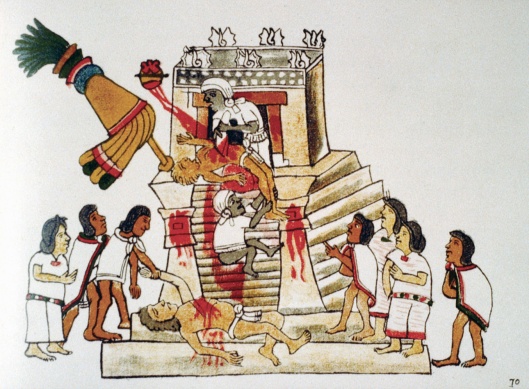
Of course, when it comes to wholesale, regular human sacrifice, we immediately think of Aztec devotion to their god, Huitzilopochtli, who was fed on the blood of human hearts at the top of his temple in the Aztec capital, Tenochtitlan.

huitzilopochtli

ThinkstockPhotos-98193978

sacrifice-2

And this brings us back to Sauron, his temple, his worship. Because there is so much wonderful material to work from in The Hobbit and The Lord of the Rings, in general, we confine ourselves to those and the Letters, but a little wider research gave us a clue—a horrible but not surprising clue—to answer our original question. In the Silmarillion, we found this:

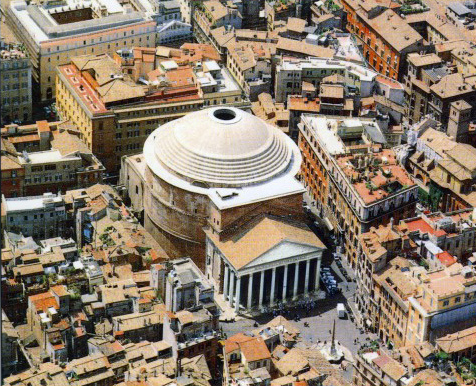
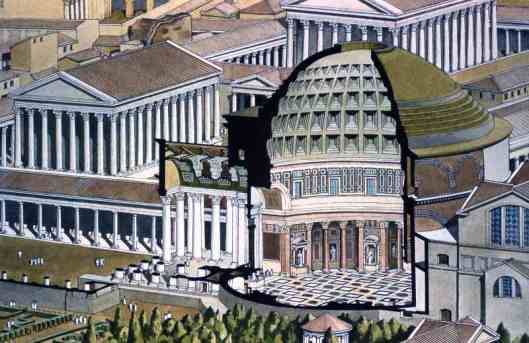
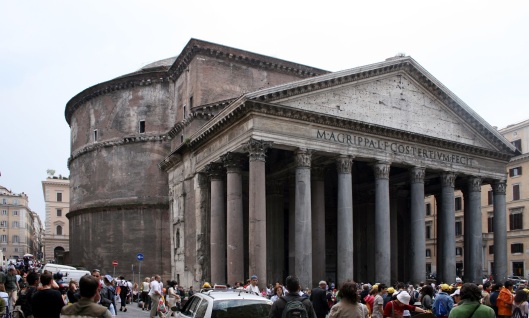
“But Sauron caused to be built upon the hill in the midst of the city of the Numenoreans, Armenelos the Golden, a mighty temple; and it was in the form of a circle at the base, and there the walls were fifty feet in thickness, and the width of the base was five hundred feet across the center, and the walls rose from the ground five hundred feet, and they were crowned with a mighty dome. And that dome was roofed all with silver, and rose glittering in the sun, so that the light of it could be seen afar off; but soon the light was darkened and the silver became black.” (The Silmarillion, “Akallabeth”, 273)

As people who are much involved with the Greco-Roman world, this description immediately brings to our minds the Pantheon, in Rome, whose dome was sheathed in copper, until that was stolen by the eastern emperor Constans II in 663AD, only to be stolen from him en route by Saracen pirates. It’s not 500 feet by 500 feet (152.4m.), of course, being only about 140 (42.67m.), but it’s certainly large and impressive—and circular, with a mighty dome.

aerial-view-pantheon

26.pantheon

Pantheon_Rome_(1)

But why did the “silver become black”? Do we have a bad feeling about this?
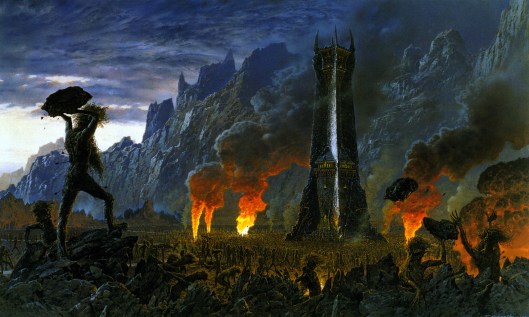
“For there was an altar of fire in the midst of the temple, and in the topmost of the dome there was a louver, whence there issued a great smoke…Thereafter the fire and smoke went up without ceasing; for the power of Sauron daily increased, and in that temple, with the spilling of blood and torment and great wickedness, men made sacrifice to Melkor that he should release them from Death. And most often from among the Faithful they chose their victims…”

Sauron, once Melkor’s servant, had gained great power over the Numenorean king, Ar-Pharazon, using it to persuade the king to attack the Valar—and thus bring about the destruction of Numenor. Sauron’s spirit survived that destruction, and perhaps his memory of Melkor’s temple and its worship would have, as well?

Thanks, as ever, for reading!

MTCIDC

CD

PS

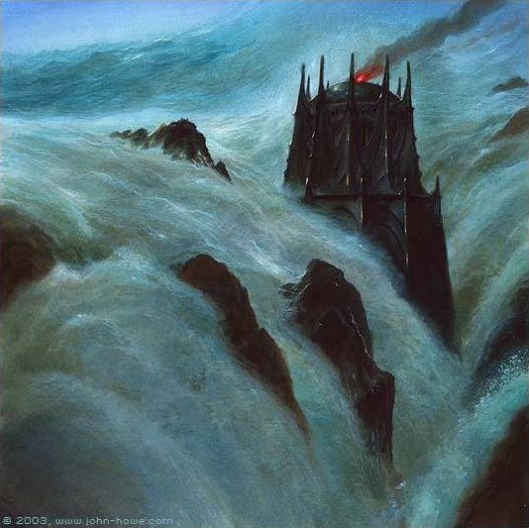
We can’t resist adding this wonderful John Howe impression of the drowning of the city of Armenelos…

John_Howe_-_The_Drowning_of_Numenor


Ugluk Was Here

14 Wednesday Dec 2016

Posted by Ollamh in Artists and Illustrators, J.R.R. Tolkien, Language, Literary History, Military History

≈ Leave a comment

Tags

Alan Lee, Alfred Waud, American Civil War, Angus McBride, Argonath, Belgium, Black Speech, cemeteries, Confederate, Egyptian monuments, First Virginia Cavalry, graffiti, Great War, Greek mercenaries, Greeks, Hildebrandt, John Howe, Journey to the Cross-roads, Kilroy, Kilroy was here, Literacy, Napoleon I, Orcs, Pompeii, quarry at Naours, Sauron, The Lord of the Rings, Tolkien, Union, Virginia, World War I, World War II

Welcome, dear readers, as always.

One of our reasons for holding Tolkien’s work in such high esteem is that it’s so rich: practicing Sortes Tolkienses (see our earlier posting on this), we find innumerable subjects to write about.

In this posting, our eye was caught by this:

“The brief glow feel upon a huge sitting figure, still and solemn as the great stone kings of Argonath. The years had gnawed it, and violent hands had maimed it. Its head was gone, and in its place was set in mockery a round rough-hewn stone, rudely painted by savage hands in the likeness of a grinning face with one large red eye in the midst of its forehead. Upon its knees and mighty chair, and all about the pedestal, were idle scrawls mixed with the foul symbols that the maggot-folk of Mordor used.” (The Two Towers, Book 4, Chapter 7, “Journey to the Cross-roads”)

crossroads.jpg

We had the feeling that we’d seen a statue something like this before—and we were curious whether JRRT had, too, and with a little mental rooting-around, we found this:

abusimbelengraving.jpg

It’s Egyptian (13th century BC), and has a head, but, not only is it monumental, and seated, but it has lots of “idle scrawls” on the bases and lower parts of its legs.

abusimbelgraffiti.jpg

What’s particularly interesting to us is that one piece of the graffiti is actually from some Greek mercenaries c. 600bc

hoplite1.jpg

main-qimg-9eddef3641e25892afa016888b808aa5-c.jpeg

As long as there has been a certain level of literacy, of course, there has been graffiti. The walls of ancient Pompeii (sealed in by the eruption of 79AD) are loaded with everything from election posters to the admiration of gladiators to personal insults.

gladiatorialstats.JPG

There’s so much, in fact, that this is our favorite:

antigraffiti.jpg

A translation of this might be: “I wonder/am in awe, wall, that, you, who are holding up so much boring writing, haven’t fallen down!”

Soldiers, in particular, seem prone to leaving messages behind—beginning with those 7th-c Greeks, but continuing throughout the centuries. When Napoleon I led an expedition to Egypt in 1798,

napegypt.jpg

his soldiers left their mark in more ways than one upon the landscape.

frenchinegyptgraf2.jpg

Recently discovered in a house in Virginia was a large collection of inscriptions from the soldiers, Union and Confederate, of the American Civil War.

Graffiti-House.jpg Graffiti House Wall and Chair.jpg unionsoldier.jpgAlfred R. Waudfirstva.jpg

(An irresistible footnote: the picture you see of the Confederate cavalry—actually the 1st Virginia—was made by one of the greatest Civil War artists, Alfred Waud (pronounced “woad”). He had been briefly detained by this unit and took the opportunity to sketch them from life. His sketch—with his notes—then went to his publisher in New York, who had a group of engravers ready to turn his sketch into a finished—and publishable—picture.1st-virginia-cavalry-halted-based-on-sketch-by-waud-harpers-sept-27-1862.jpg

For more on the process by which a sketch becomes a magazine illustration, see this link.)

Another recent discovery was a mass of inscriptions (something like 2000 of them) in an abandoned quarry at Naours, in northern France.

quarrynaours.jpg

6XYh68h5xHSK2-3026250-In_this_image_made_on_Feb_20_2015_showing_names_engraved_on_the_-a-32_1428320205858.jpg

These date from the Great War (World War I) and, in a sad way, parallel the epitaphs on the seemingly-endless graves in the seemingly endless military cemeteries in the same region and in southern Belgium.

greatwargraves1.jpg

Tyne Cot 3.jpg

And World War II brought us Kilroy, of the famous (and ubiquitous) “Kilroy was here”.

Engraving-of-Kilroy-on-the-WWII-Memorial-in-Washington-DC.jpg

American prankster soldiers doodled this everywhere they went.

kilroy-was-here-photo.jpg

We have written previously about literacy in Middle-earth: not uncommon among hobbits, it would seem, but much less so among the other peoples. As for orcs, be they Hildebrandt

captured_by_orcs.jpg

Mcbride,

mcba_orc.jpg

Howe

John Howe - Merry et Pippin prisonniers des orcs.jpg

Or Lee,

Alan Lee - Orcs (1).jpg

although the Black Speech was created for them and Sauron’s other creatures, we have no evidence (except for the Ring inscription) of any use of it as a writing tool by any of them.

Which leaves us free to imagine just what those “idle scrawls” might read like. How about:

LUGDUSH SMELLS LIKE MAN FLESH!

LAGDUF + MUZGASH = CLUELESS AND SHIRTLESS!

GORBAG LOVES SHELOB

SHAGRAT IS A SNAGA!

And, of course:

UGLUK WAS HERE

Thanks for reading! (And why not submit your own graffiti? We’d be glad to add them to our list!)

MTCIDC

CD

Further Thoughts

02 Wednesday Nov 2016

Posted by Ollamh in J.R.R. Tolkien, Literary History, Maps, Military History, Military History of Middle-earth, Uncategorized

≈ Leave a comment

Tags

Alexander of Macedon, Athenian Empire, Babylon, Cleopatra VII, Delian League, Mongol Empire, Mordor, Persians, Plataea, Ptolemy, Sauron, Tolkien, W.H. Auden

Welcome, dear readers, as ever.

It is one of the pleasures—perhaps we should say even blessings—of JRRT that there is such a richness available within his work—and within him—that no subject can ever be discussed to a perfect conclusion. In an earlier posting, we talked about Sauron and his demands, but, as we watch our current world and certain powers who are maneuvering to gain increasing control over land and sea, we have come back once more to wondering about what it is that Sauron has planned to do and what he will have if he succeeds.

In an unpublished reply to a review by W.H. Auden, JRRT wrote:

“The theatre of my tale is this earth, the one in which we now live, but the historical period is imaginary. The essentials of that abiding place are all there (at any rate for inhabitants of N.W. Europe), so naturally it feels familiar, even if a little glorified by the enchantment of distance in time.” (Letters, 239)

Thus, we can feel justified, we think, in looking at a would-be world conqueror from an actual historical period to see if we can better understand the fictional Sauron.

If we consider Alexander of Macedon,

Alexander_the_Great_mosaic.jpg

we see someone who began with a project which, in part, went back for a century and more before his own time: to take back the western shore of northern Asia Minor from its Persian overlords. This had been begun by the Delian League,

The Delian League - map.jpg

a group of Greek city-states who had been participants in the ultimate battle defeat of the invading Persians, at Plataea, in 479bc.

47948_PlateaBattleL.jpg

After he had defeated the southern Greeks at Chaeronea in 338bc with the aid of his son, Alexander, it had been Philip II of Macedon’s plan to do what the League had planned and take back Asia Minor from the Persian empire. Philip was murdered (by a “lone spearman”) in 336, but Alexander, took over the plan and, in 334, invaded the Persian empire and, within three years or so, had conquered it—

macedonianempirelarge.jpg

but then had kept moving eastward, besieging cities, winning battles, all the way into western India, where his army finally revolted and refused to go farther.

Alexander_troops_beg_to_return_home_from_India.jpg

He returned to his new capital, Babylon, to die there in 323bc.

the_death_of_alexander_the_great_after_the_painting_by_karl_von_piloty_1886

Because Alexander had no grown male heirs, his new empire fell apart very quickly, his chief generals seizing big chunks and defending them against other generals. We can presume, we think, that he hadn’t been planning to die young (he was born in 356), so we assume that he was out to do something permanent. His generals—the successful ones—founded dynasties, the longest-lived of them being that of Ptolemy,

Coin (Ptolemy I) (Alexandria 305-285 BC).jpg

who grabbed Egypt, and whose last descendant to rule was Cleopatra VII (yes, that Cleopatra), who committed suicide in 30bc.

Kleopatra-VII.-Altes-Museum-Berlin1.jpg

If Alexander was planning to do something similar, only on a larger scale, how do we understand it? What was all of that conquest for and why was it never enough?

Part of the explanation may lie in the analogy of the folk-tradition about sharks: that they have to keep moving to breathe. This is apparently not true (google Discovery.com/tv-shows/shark-week).

great-white-shark-swimming-blue.jpg.adapt.945.1.jpg

It’s a good image, however, of how an expanding kingdom has to work: the more land you have, the more people you have, the more people you have, the more food you need, therefore you need an increased food supply, which means either buying it or taking it from outside, or making the land itself produce more or simply acquiring more land—and the cycle begins again. This may have been what caused the rapid expansion of the Mongol empire in the 13th century ad, although, in their case, it may not have been expanding population so much as expanding flocks and herds which needed more pasture land.

TitleMongol2.jpg

We might see Sauron in the same light: he needed huge armies to conquer Middle-earth, his huge armies, both humans and orcs, would need feeding (even orcs ate, after all, although as to what they ate…) and therefore would have needed a huge amount of growing land to be fed from, and so on and so on. Certainly Mordor was not the place for gardens and grain fields.

gorgoroth.gif

JRRT says of Sauron:

“Sauron desired to be a God-King, and was held to be this by his servants; if he had been victorious he would have demanded divine honour from all rational creatures and absolute temporal power over the whole world.” (Letters 243-244)

And perhaps this offers another view of Alexander, in turn. As Sauron would have needed land to feed his armies, perhaps Alexander was intent upon collecting worshippers? Certainly he allowed rumors to circulate that he was at least semi-divine—as we see in this coin portrait, where he is portrayed with the horns of Zeus/Ammon, a combination Greek and Egyptian god.

alexaszeusammon.jpg

Alexander succeeded in gaining territory—although not so much as he wished—but died before founding the dynasty which might have given his kingdom stability. Sauron lost, not only his kingdom-in-the-making, but his corporeal form and the bulk of his power. JRRT has given us a hint as to one side of his plans—founding a religion with himself as the god, but perhaps Alexander has given us a clue as to another side, the need to support his means of conquest. In turn, Sauron may supply a clue to another side of Alexander’s plans: inserting himself into the religion of his Greek subjects, then expanding his cult throughout as much of the world as he could conquer.

Thanks, as ever, for reading.

MTCIDC

CD

Nought’s had, all’s spent

03 Wednesday Aug 2016

Posted by Ollamh in J.R.R. Tolkien, Literary History, Narrative Methods, Theatre and Performance, Villains

≈ Leave a comment

Tags

A Shadow of the Past, Birnam Wood, Eowyn, Fangorn Forest, Gandalf, Gondor, Isengard, Istari, King Duncan, Lady Macbeth, Macbeth, Macduff, Orthanc, Palantir, Saruman, Sauron, Shakespeare, The Lord of the Rings, The Weird Sisters, The Witch-King, Tolkien

4acce62d6b1154ae5fdb5272434de3be.jpg

In “The Shadow of the Past,” Gandalf, giving Frodo backstory of the Ring, makes a confession:

“I might perhaps have consulted Saruman the White, but something always held me back.”

“Who is he?” asked Frodo. “I have never heard of him before.”

“Maybe not,” answered Gandalf. “Hobbits are, or were, no concern of his. Yet he is great among the Wise. He is the chief of my order and the head of the Council. His knowledge is deep, but his pride had grown with it, and he takes ill any meddling. The lore of the Elven-rings, great and small, is his province. He has long studied it, seeking the lost secrets of their making; but when the Rings were debated in the Council, all that he would reveal  to us of his ring-lore told against my fears. So my doubt slept– but uneasily. Still I watched and I waited.” (The Lord of the Rings, The Fellowship of the Ring, Book 1, Chapter 2, “The Shadow of the Past”)

In terms of the spiritual life and safety of Middle-earth, Gandalf’s confession foreshadows much evil to come. Both Gandalf and Saruman are Istari, one of a group of five divine beings sent specifically to counteract the activities of Sauron.

istari.jpg

Gandalf suspects that “the chief of my order and the head of the Council” is false, and his suspicion will prove to be true, but what has happened to Saruman? Gandalf suggests that it has something to do with the ring, but, in fact, the ring is only emblematic of the real problem: the lure of control.

Here is Saruman attempting to seduce Gandalf into joining him:

“I said we, for we it may be, if you will join with me. A new Power is rising. Against it the old allies and policies will not avail us at all. There is no hope left in Elves or dying Numenor. This then is one choice before you, before us. We may join with that Power. It would be wise, Gandalf. There is hope that way. Its victory is at hand; and there will be rich reward for those that aided it. As the Power grows, its proved friends will also grow; and the Wise, such as you and I may with patience come at last to direct its courses, to control it.” (The Lord of the Rings, The Fellowship of the Ring, Book 2, Chapter 2, “The Council of Elrond”)

Instead of fulfilling his role as a counter-balance to Sauron, Saruman proposes first to control Sauron, and then even to become Sauron. As Saruman says, “Why not? The Ruling Ring? If we could command that, then the Power would pass to us.” (The Lord of the Rings, The Fellowship of the Ring, Book 2, Chapter 2, “The Council of Elrond”)  This use of the first person plural pronoun is not convincing:

“Saruman,” I said, standing away from him, “only one hand at a time can wield the One, and you know that well, so do not trouble to say we.” (The Lord of the Rings, The Fellowship of the Ring, Book 2, Chapter 2, “The Council of Elrond”)

But what is it which Saruman wants to do with that ring?

“We can bide our time, we can keep our thoughts in our hearts, deploring maybe evils done by the way, but approving the high and ultimate purpose:  Knowledge, Rule, Order; all the things that we have so far striven in vain to accomplish, hindered rather than helped by our weak or idle friends.  There need not be, there would not be, any real change in our designs, only in our means.”  (The Lord of the Rings, The Fellowship of the Ring, Book 2, Chapter 2, “The Council of Elrond”)

Knowledge, rule, order?  We immediately want to know, knowledge of what, and who is ruling whom, with what order?   And the answers are all the same:  Saruman’s knowledge,  Saruman’s rule, Saruman’s order.  But what has happened to Saruman to so turn him away from the purpose for which he was sent?

Saruman’s headquarters are at Orthanc, a tower set in a stone circle at Isengard.

orthanc.jpgOriginally, this had been the site of a Gondorian strongpoint, but, as Gondor waned, it fell into disuse until taken over by Saruman with the permission of the Steward of Gondor, Beren. When we think of wizards, we imagine them as wanderers, like Gandalf and Radagast, and even more so, the two Blue wizards who have wandered so far as to have disappeared almost entirely from the history of Middle-earth. Could the very fact that Saruman would want a permanent base have been a hint that his plans went beyond the directive he had received in Valinor?

And there is worse to come. Within Orthanc, Saruman has discovered a Palantir, a far-seeing stone of Numenor.

saruman_palantir.jpg

Who else might have one of these stones? Unfortunately, one of them is in the hands of Sauron.

palantir1.jpg

And the seduction of Gandalf began with the seduction of Saruman, as Gandalf says:

“Saruman…I have heard speeches of this kind before, but only in the mouths of emissaries sent from Mordor to deceive the ignorant.” (The Lord of the Rings, The Fellowship of the Ring, Book 2, Chapter 2, “The Council of Elrond”)

This figure for good being drawn away from the proper path reminded us of a similar situation in Shakespeare. Macbeth has been a successful general for Duncan, the king of Scotland. For his latest victory, he has been well-rewarded by the king, but just as in the case of Saruman, there is some part of him which wants more. Thus, when, after the battle, he and a companion meet three strange women on the edge of the battlefield, their prophetic words touch him in a place perhaps untouched before, but there.

MacbethAndBanquo-Witches

They first hail him by titles King Duncan has yet to give him–but will.  Then they hail him as King of Scotland itself, and his corruption begins.  It may have gone no farther than unquiet dreams had there not be a second element in his seduction:  his wife.

Ellen-Terry-as-Lady-Macbeth-by-John-Singer-Sargent-1889

It is she who completes what these three strange women began, not only nurturing Macbeth’s ambition, but even planning the murder of King Duncan.

Lady_Macbeth_CattermoleLike Saruman, Macbeth is overcome, gives in, murders Duncan, seizes power, but, also like Saruman, can not retain it and, interestingly, an element in his defeat closely resembles an element in Saruman’s defeat:  trees.

As his reign suffers resistance and becomes bloodier and more confused, Macbeth sees a series of apparitions, including one which reassures him–or so he thinks–that

“Be lion-mettled, proud, and take no care
Who chafes, who frets, or where conspirers are.
Macbeth shall never vanquished be until
Great Birnam Wood to high Dunsinane Hill
Shall come against him.” (Macbeth, 4.1.94-98)
But his enemies, to disguise their numbers and movements, camouflage themselves with foliage from Birnam Wood,
 Scan-100518-0011
Macbeth’s fortress is successfully taken, and Macbeth is killed in battle, his head taken by an avenging enemy, Macduff.
 macduff-wit-macbeth-head-jpg

Where Macbeth has had Birnam Wood, Saruman suffers from the Forest of Fangorn–

Tolkien, Nasmith, painting, illustration, Lord of the Rings, Silmarillion, Hobbit, Middle-earth

The Wrath of the Ents, by Ted Nasmith

(We would add one more Macbeth parallel for The Lord of the Rings.  Another seemingly reassuring apparition has told Macbeth that he can only be killed by a very special person:

“Be bloody, bold, and resolute. Laugh to scorn
The power of man, for none of woman born
Shall harm Macbeth.” (Macbeth, 4.1.81-83)
That person turns out to be Macduff, born from a Caesarian section.
Do we need to remind our readers of what Eowyn says in reply to the Witch-king’s “Hinder me?  Thou fool.  No living man may hinder me!”)
eowyn.nazgul

After the fall of Isengard, Saruman is imprisoned in his own tower.  During his imprisonment, he is deprived of the Palantir, but Sauron’s seduction has been thorough and, even when offered another chance, there will be nothing left for him in the future but being a petty spoiler and then the victim of his own slave, someone he had once seduced.

jwyatt-sarumande

Thanks, as always, for reading.

MTCIDC

CD

← Older posts
Newer posts →

The Doubtful Sea Series Facebook Page

The Doubtful Sea Series Facebook Page

  • Ollamh

Categories

  • Artists and Illustrators
  • Economics in Middle-earth
  • Fairy Tales and Myths
  • Films and Music
  • Games
  • Heroes
  • Imaginary History
  • J.R.R. Tolkien
  • Language
  • Literary History
  • Maps
  • Medieval Russia
  • Military History
  • Military History of Middle-earth
  • Narnia
  • Narrative Methods
  • Poetry
  • Research
  • Star Wars
  • Terra Australis
  • The Rohirrim
  • Theatre and Performance
  • Tolkien
  • Uncategorized
  • Villains
  • Writing as Collaborators
Follow doubtfulsea on WordPress.com

Across the Doubtful Sea

Recent Postings

  • Through a glass… January 7, 2026
  • Heffalumps? December 31, 2025
  • We Three Kings December 24, 2025
  • A Moon disfigured December 17, 2025
  • On the Roads Again—Once More December 10, 2025
  • (Not) Crossing Bridges December 3, 2025
  • On the Road(s) Again—Again November 26, 2025
  • On the Road(s) Again November 19, 2025
  • To Bree (Part 2) November 12, 2025

Blog Statistics

  • 104,128 Views

Posting Archive

  • January 2026 (1)
  • December 2025 (5)
  • November 2025 (4)
  • October 2025 (5)
  • September 2025 (4)
  • August 2025 (4)
  • July 2025 (5)
  • June 2025 (4)
  • May 2025 (4)
  • April 2025 (5)
  • March 2025 (4)
  • February 2025 (4)
  • January 2025 (5)
  • December 2024 (4)
  • November 2024 (4)
  • October 2024 (5)
  • September 2024 (4)
  • August 2024 (4)
  • July 2024 (5)
  • June 2024 (4)
  • May 2024 (5)
  • April 2024 (4)
  • March 2024 (4)
  • February 2024 (4)
  • January 2024 (5)
  • December 2023 (4)
  • November 2023 (5)
  • October 2023 (4)
  • September 2023 (4)
  • August 2023 (5)
  • July 2023 (4)
  • June 2023 (4)
  • May 2023 (5)
  • April 2023 (4)
  • March 2023 (5)
  • February 2023 (4)
  • January 2023 (4)
  • December 2022 (4)
  • November 2022 (5)
  • October 2022 (4)
  • September 2022 (4)
  • August 2022 (5)
  • July 2022 (4)
  • June 2022 (5)
  • May 2022 (4)
  • April 2022 (4)
  • March 2022 (5)
  • February 2022 (4)
  • January 2022 (4)
  • December 2021 (5)
  • November 2021 (4)
  • October 2021 (4)
  • September 2021 (5)
  • August 2021 (4)
  • July 2021 (4)
  • June 2021 (5)
  • May 2021 (4)
  • April 2021 (4)
  • March 2021 (5)
  • February 2021 (4)
  • January 2021 (4)
  • December 2020 (5)
  • November 2020 (4)
  • October 2020 (4)
  • September 2020 (5)
  • August 2020 (4)
  • July 2020 (5)
  • June 2020 (4)
  • May 2020 (4)
  • April 2020 (5)
  • March 2020 (4)
  • February 2020 (4)
  • January 2020 (6)
  • December 2019 (4)
  • November 2019 (4)
  • October 2019 (5)
  • September 2019 (4)
  • August 2019 (4)
  • July 2019 (5)
  • June 2019 (4)
  • May 2019 (5)
  • April 2019 (4)
  • March 2019 (4)
  • February 2019 (4)
  • January 2019 (5)
  • December 2018 (4)
  • November 2018 (4)
  • October 2018 (5)
  • September 2018 (4)
  • August 2018 (5)
  • July 2018 (4)
  • June 2018 (4)
  • May 2018 (5)
  • April 2018 (4)
  • March 2018 (4)
  • February 2018 (4)
  • January 2018 (5)
  • December 2017 (4)
  • November 2017 (4)
  • October 2017 (4)
  • September 2017 (4)
  • August 2017 (5)
  • July 2017 (4)
  • June 2017 (4)
  • May 2017 (5)
  • April 2017 (4)
  • March 2017 (5)
  • February 2017 (4)
  • January 2017 (4)
  • December 2016 (4)
  • November 2016 (5)
  • October 2016 (6)
  • September 2016 (5)
  • August 2016 (5)
  • July 2016 (5)
  • June 2016 (5)
  • May 2016 (4)
  • April 2016 (4)
  • March 2016 (5)
  • February 2016 (4)
  • January 2016 (4)
  • December 2015 (5)
  • November 2015 (5)
  • October 2015 (4)
  • September 2015 (5)
  • August 2015 (4)
  • July 2015 (5)
  • June 2015 (5)
  • May 2015 (4)
  • April 2015 (3)
  • March 2015 (4)
  • February 2015 (4)
  • January 2015 (4)
  • December 2014 (5)
  • November 2014 (4)
  • October 2014 (6)
  • September 2014 (1)

Blog at WordPress.com.

  • Subscribe Subscribed
    • doubtfulsea
    • Join 78 other subscribers
    • Already have a WordPress.com account? Log in now.
    • doubtfulsea
    • Subscribe Subscribed
    • Sign up
    • Log in
    • Report this content
    • View site in Reader
    • Manage subscriptions
    • Collapse this bar
 

Loading Comments...