• About

doubtfulsea

~ adventure fantasy

Tag Archives: Rohirrim

Charge!

01 Wednesday Aug 2018

Posted by Ollamh in Artists and Illustrators, Films and Music, J.R.R. Tolkien, Military History, Military History of Middle-earth, The Rohirrim

≈ Leave a comment

Tags

16th Lancers, Aliwal, Australian Light Horse, Australians, Balaclava, Beersheba, Cavalry, Charges, Great War, Light Brigade, Palestine, Rohirrim, Scots Greys, The Lighthorsemen, The Lord of the Rings, Tolkien, Turks, Warhorse, Waterloo

As always, dear readers, welcome.

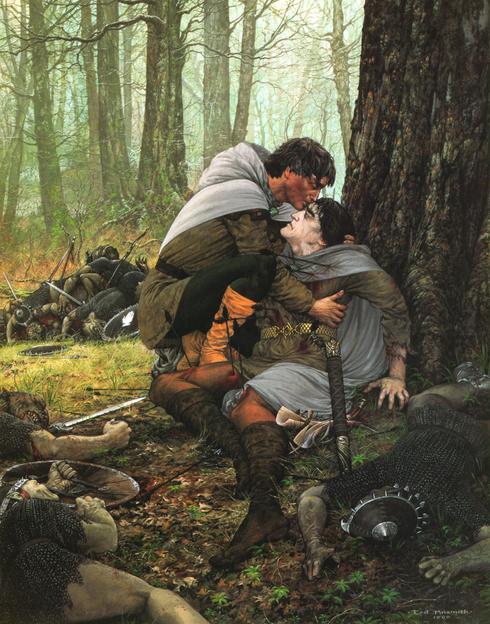
In an addition to an entry in Letters, the main portion of which has rather a murky history (see 217-218), but which the editor dates as “presumably written circa 1966”, Tolkien says that several features of The Lord of the Rings “still move me very powerfully”.  These features include being “most stirred by the sound of the horses of the Rohirrim at cockcrow”.

As this is one of our favorite parts of the book,


image1

we would absolutely agree, but, as is so often the case, both with JRRT and with ourselves, we wondered why.

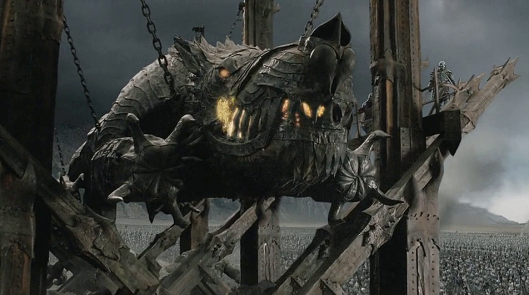
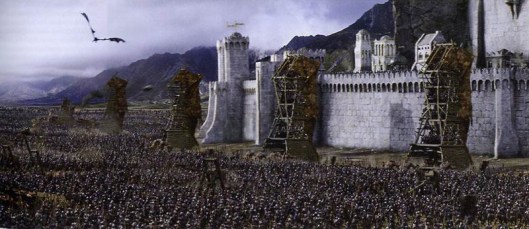
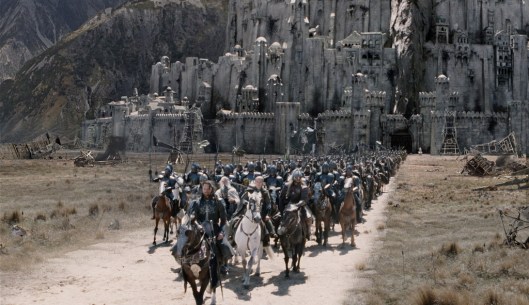
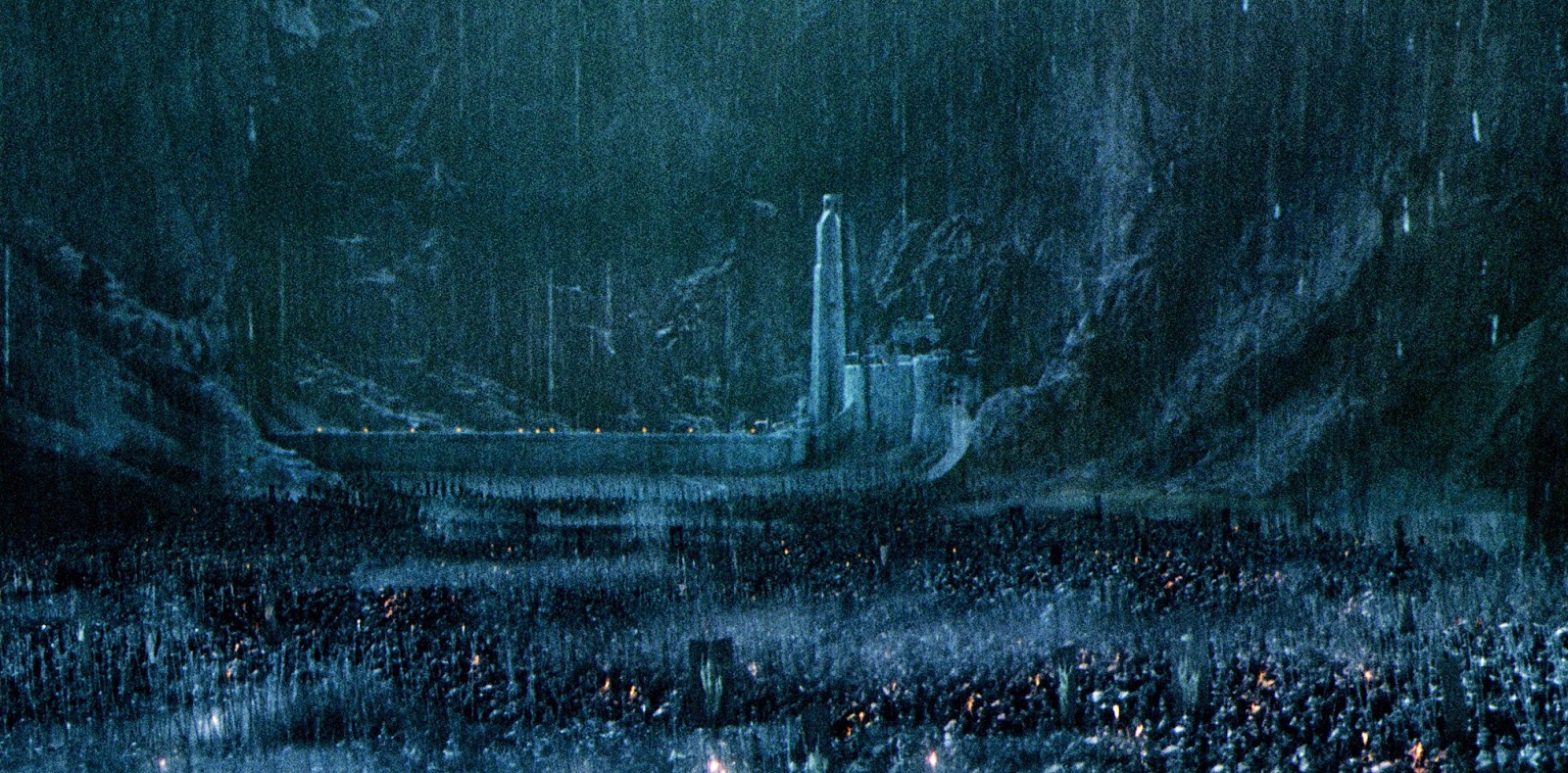
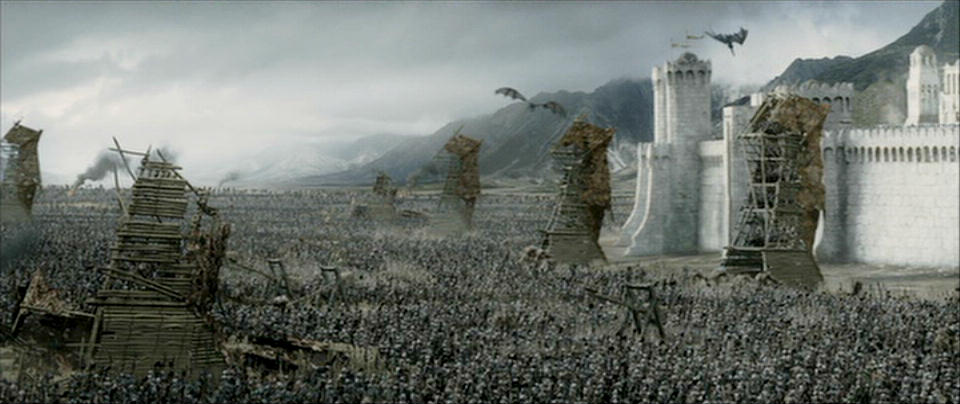
The easiest answer is that it’s a highly-dramatic moment:  the main gate of Minas Tirith is giving way under the blows of Grond, the orcs are about to pour in, and it looks like Aragorn and his companions won’t appear in time to save the situation.

image2grond.png

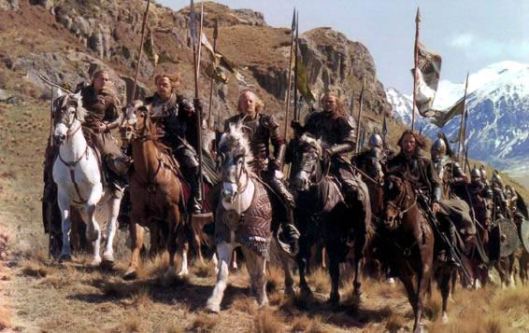
We have been following the Rohirrim, of course, from their muster to their march

image3roh.jpg

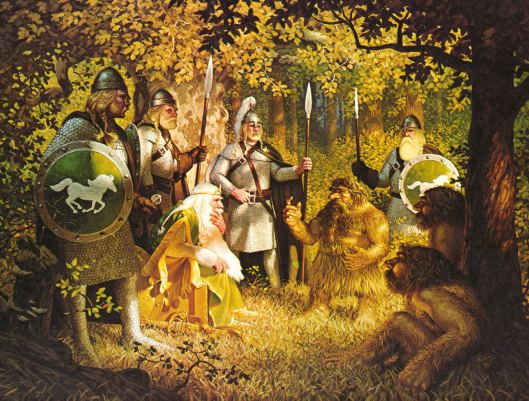
to their meeting with Ghan-buri-Ghan,

image4ghan.jpg

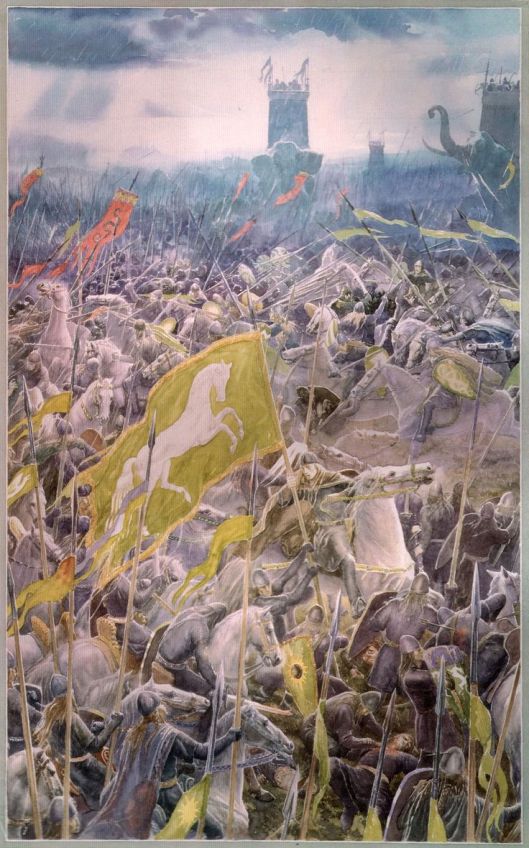
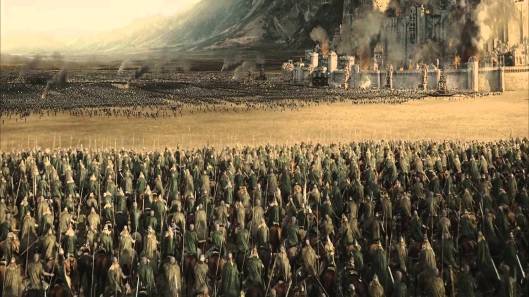
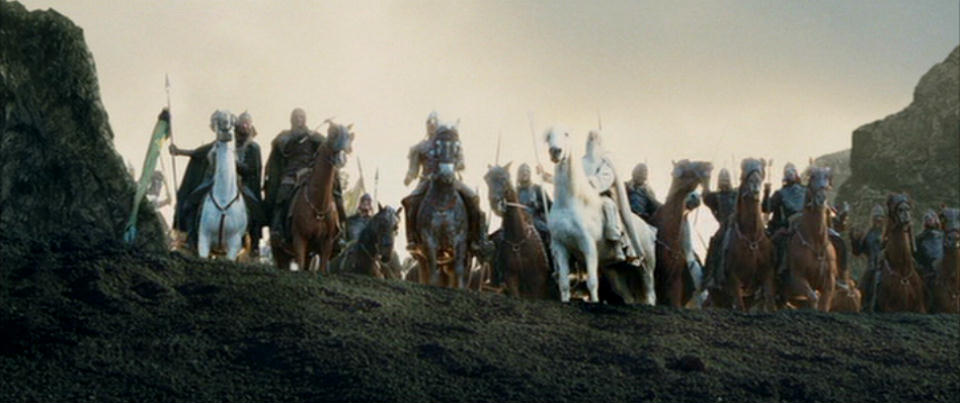
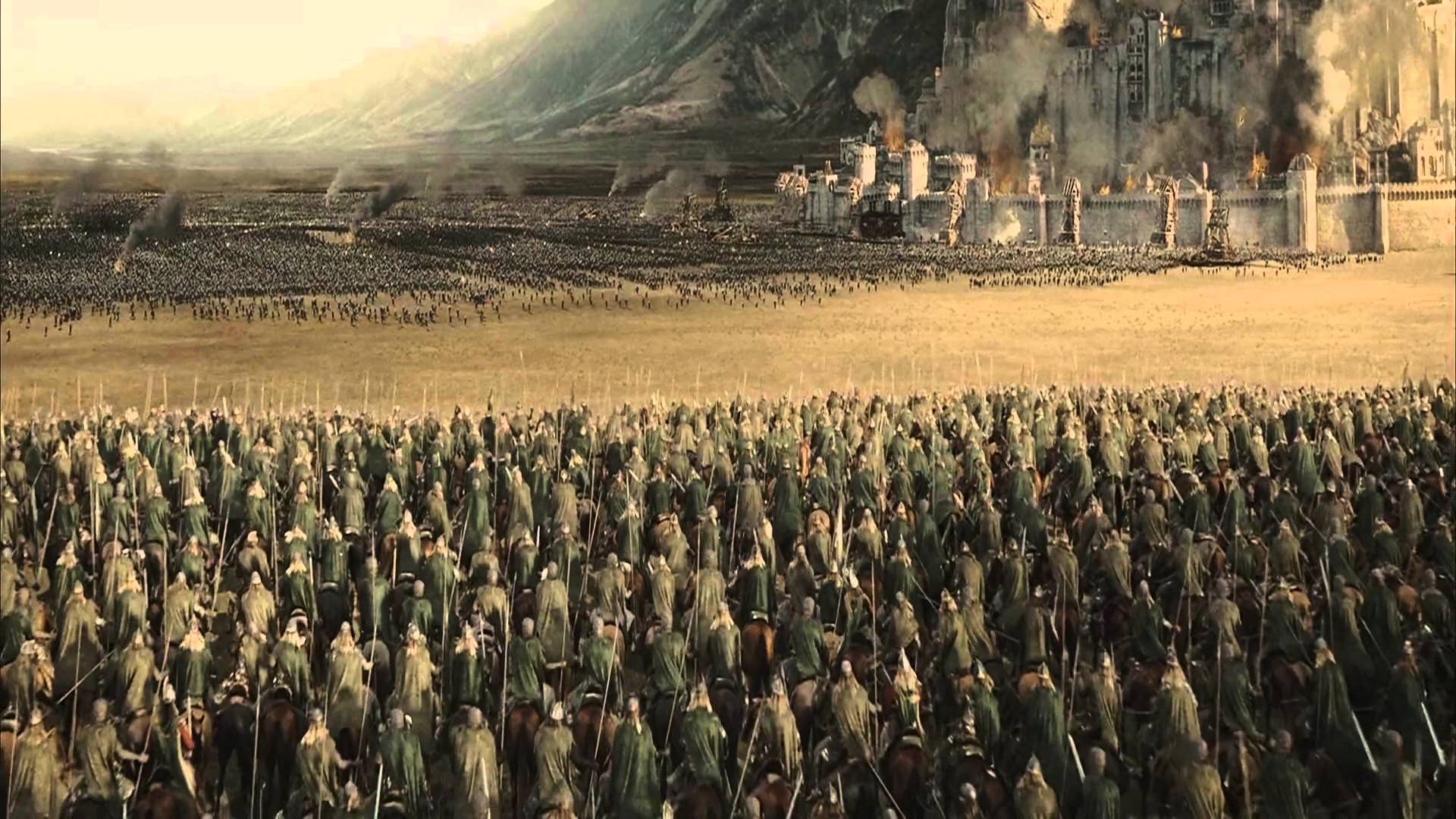
so the build is two-fold:  the attack, which is completely focused on breaking in, and the approach of the Rohirrim.  Thus, when it looks darkest, the charge is like sunlight breaking through heavy cloud.

image5charge.jpg

This is a beginning, we thought, to why, but could there have been another reason for JRRT?

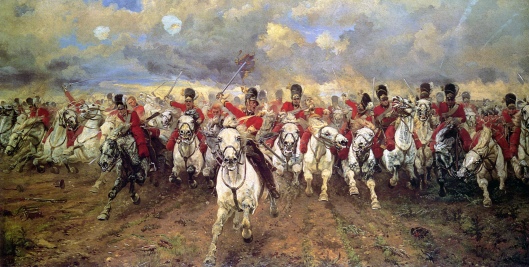
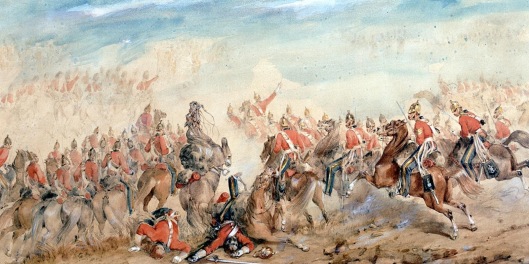
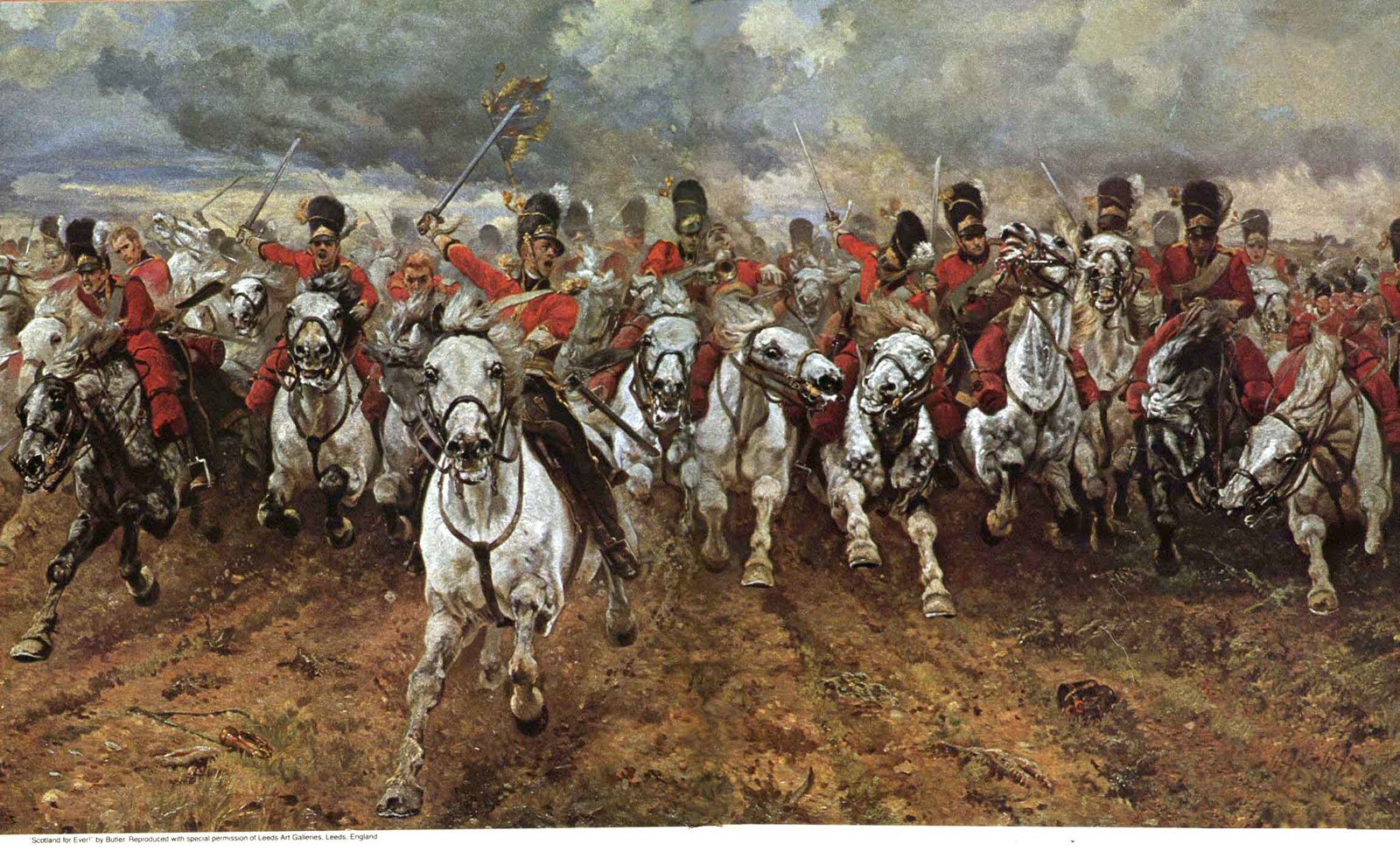
When Tolkien, growing up, thought of cavalry charges, he probably saw, in his mind’s eye, the glorious mounted attacks of Britain’s past, like the Scots Greys at Waterloo


image6scot

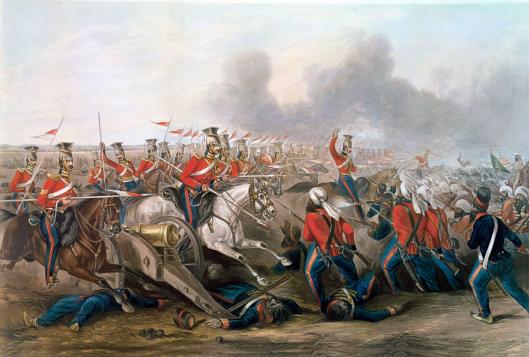
or the 16th Lancers at Aliwal

image7aliwal.jpg

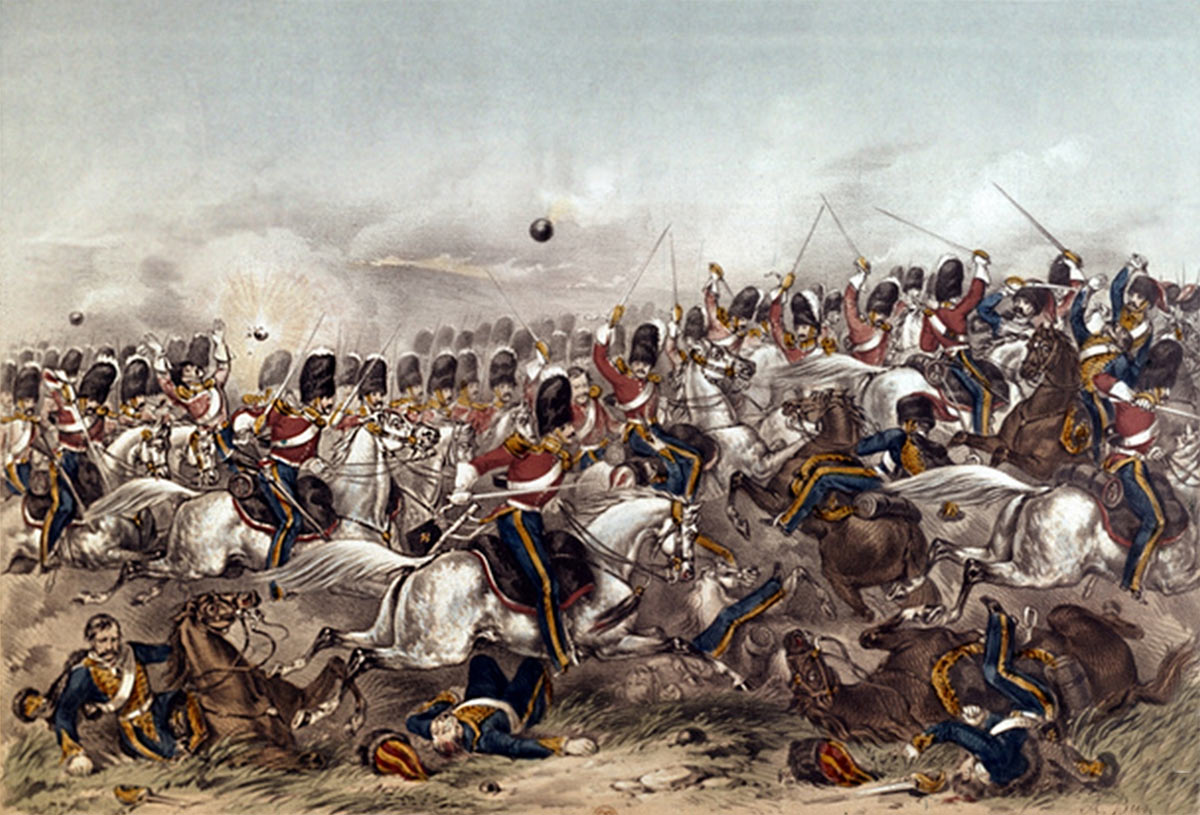
or the Light Brigade at Balaclava.

image8balaclava.jpg

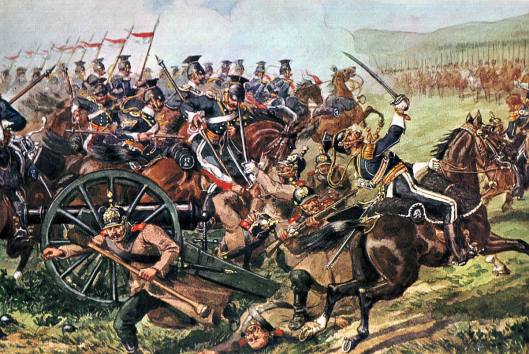
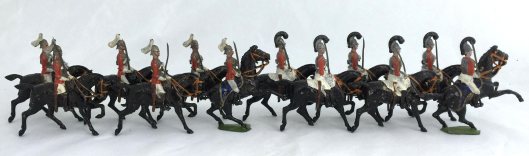
In all of these, soldiers in bright-colored coats waved swords and lancers and dashed fearlessly against the enemy.  Even his toy soldiers would have had that same devil-may-care look

image9britains.jpg

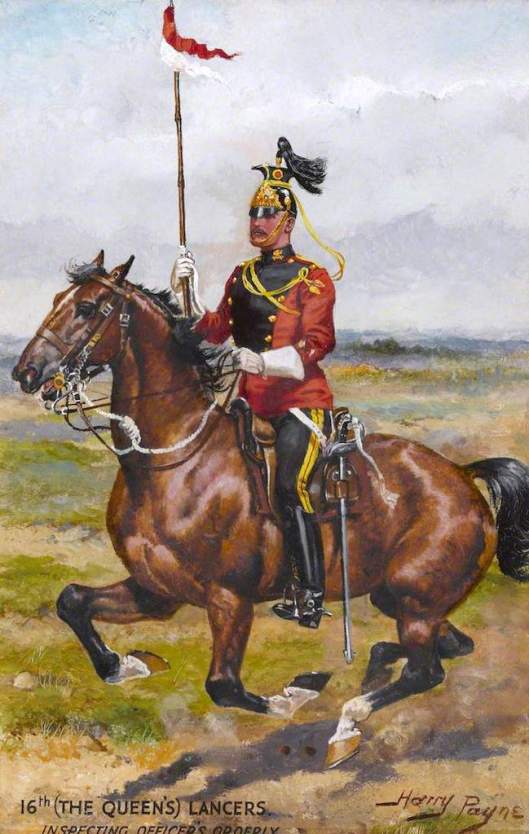
as did the real cavalry of his childhood,

image10aqueenslancers.jpg

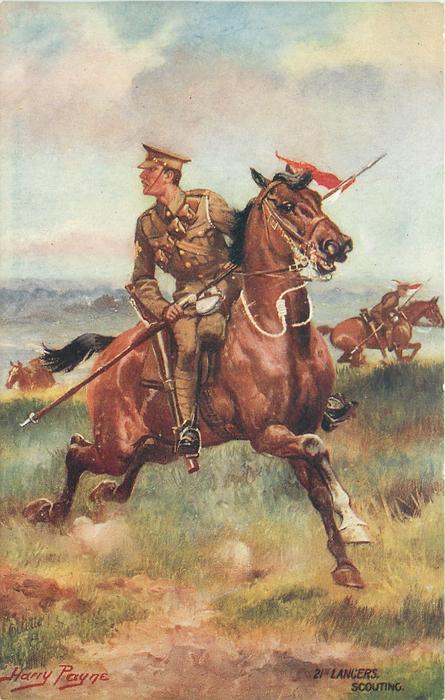
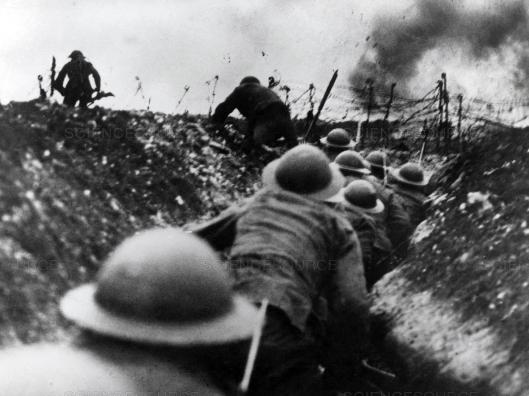
but, when 1914 and the Great War came, soldiers put away those bright colors and put on khaki.

image10twentyfirst.jpg

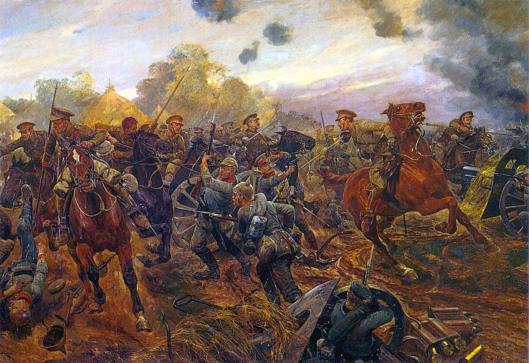
But did that wild courage have to be put away, as well?  In 1914, there were a few moments when even mud-colored mounted men had a moment of glory.

image11attack.jpg

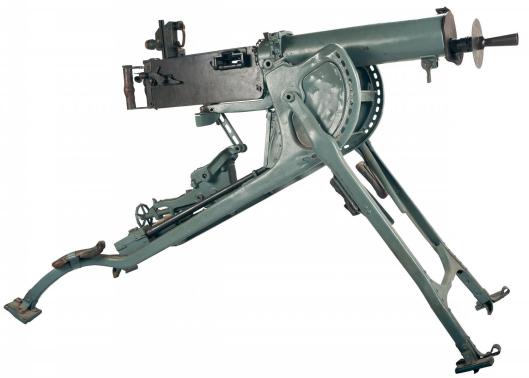
This wasn’t to last—at least on the Western Front and a major reason was this—

image12maxim.jpg

(Here’s a LINK to a clip from the film Warhorse, which shows the effect in rather a symbolic way, thank goodness!  We love horses and mourn their terrible losses through all of world history—they never asked to be part of human violence and, so often, their fate was to die because of it.  We also think that it’s just as well that the commander of this imaginary attack didn’t survive it—it’s absolutely inept, both in conception and its carrying-out and he would deserve to have been court-martialed.)

So, instead, those men dismounted and became infantry, fighting from hole in the ground to hole in the ground.

image13trench.jpg

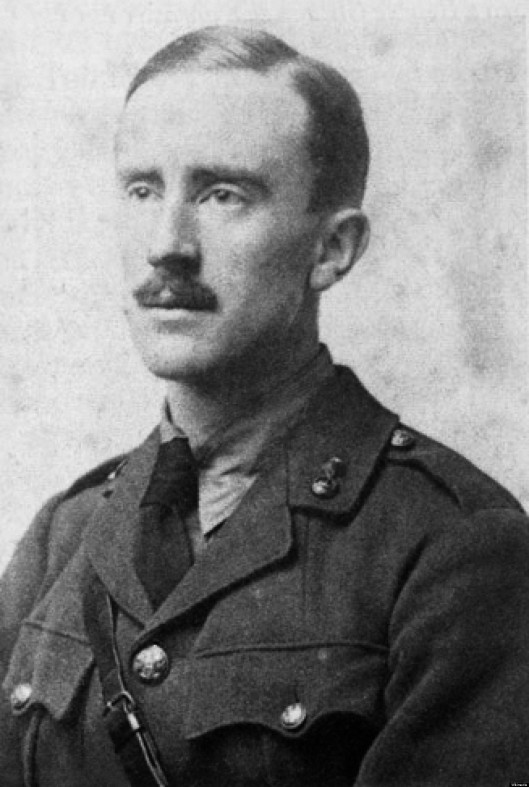
This was the world which JRRT

image14ajrrt.jpg

knew:  heavy guns, gas, and the rattle of machine guns, no place for wide double ranks of sabre-wavers.

image14charge.jpg

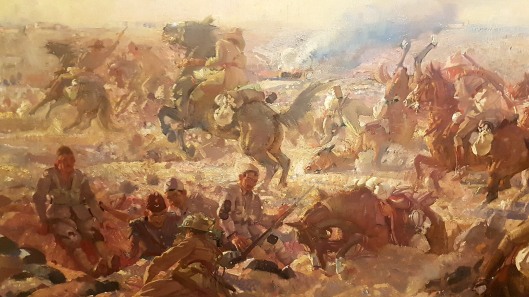
There was at least one bright moment, but not on the Western Front.  Instead, it was in far-off Palestine, where, on 31 October, 1917, Australians and their horses swept over a line of Turkish trenches  at Beersheba in a charge very reminiscent of the 19th -century world.

image15beersheba.jpg

Ironically, these were not cavalry at all, but Australian Light Horse—mounted infantry—who, lacking swords or sabres or lances, attacked using their long bayonets, instead.

image16alh.jpg

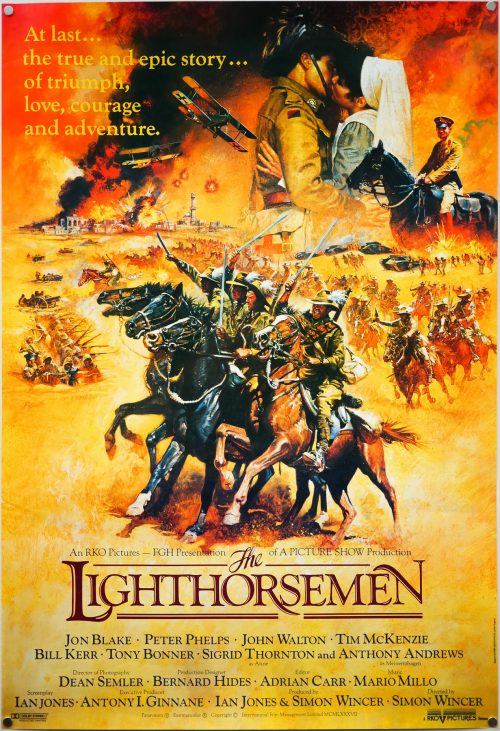
(You can see this charge reenacted wonderfully in the 1987 Australian movie, The Lighthorsemen, one of our very favorite films of the Great War.

image17poster.jpg

Here’s a LINK to the charge scene, before you see the whole film—but we recommend that you see that charge in context.)

On the whole, however, modern war had become one big, bloody ditch,

image18trench.jpg

and victory came in mud-color and mass industrial slaughter.  Perhaps it was a relief to imagine another world, where brave men in armor, mounted on flying horses, still had a place?

image19ro.jpg

As always, thanks for reading!

MTCIDC

CD

In a Pukel

09 Wednesday May 2018

Posted by Ollamh in Artists and Illustrators, Fairy Tales and Myths, J.R.R. Tolkien, Maps, Medieval Russia, Military History, Military History of Middle-earth, The Rohirrim

≈ Leave a comment

Tags

balbal, Carnac Stones, Cherna, Denis Gordeev, Druadan Forest, Dunharrow, Easter Island, Eored, Ghan-buri-Ghan, Gondor, menhirs, moai, Pukel-men, Rapa Nui, Rohan, Rohirrim, Stonewain Valley, Ted Nasmith, The Lord of the Rings, Tolkien, Unfinished Tales, Vsadniki, Woses

Welcome, dear readers, as ever.

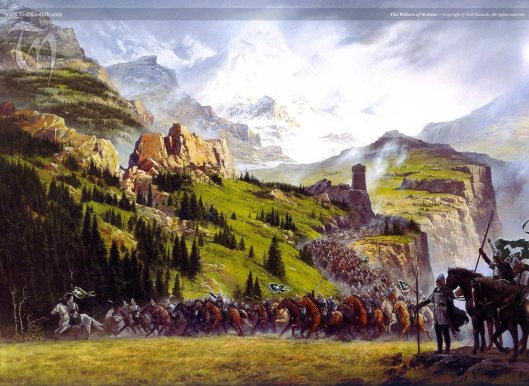
After their mustering and rapid journey to the aid of Gondor, the Rohirrim

image1rohirrim.jpg

have been stopped:

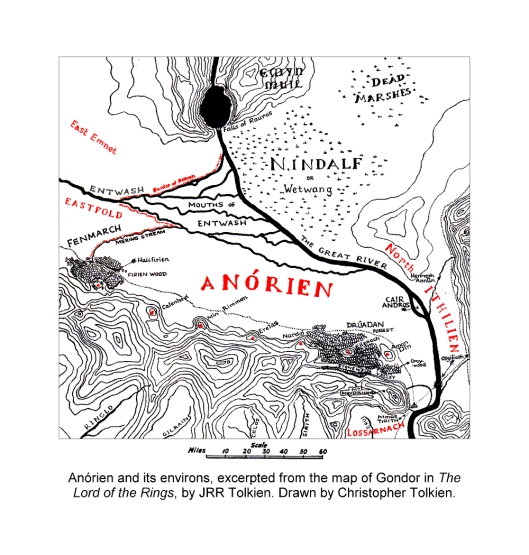
“Scouts had been sent ahead.  Some had not returned.  Others hastening back had reported that the road was held in force against them.  A host of the enemy was encamped upon it, three [4.8km]] miles west of Amon Din, and some strength of men was already thrusting along the road and was not more than three leagues [about 9 miles/14.5km] away.”  (The Return of the King, Book Five, Chapter 5, “The Ride of the Rohirrim”)

image2map.jpg

And so they are camped temporarily in the murk which has fallen over the West—a sign of Sauron on the move.

As they remain there, Merry gradually hears a sound like distant drums and, when Elfhelm, the Marshal of the eored [Rohirrim unit of horsemen] in which Merry and his mysterious companion, Dernhelm, are riding, stumbles over him, Merry asks if it’s the enemy:

“Are those their drums?”

Elfhelm replies:

“You hear the Woses, the Wild Men of the Woods…They still haunt Druadan Foest, it is said…But they have offered their services to Theoden.  Even now one of their headmen is being taken to the king.”

Merry follows Elfhelm and soon sees:

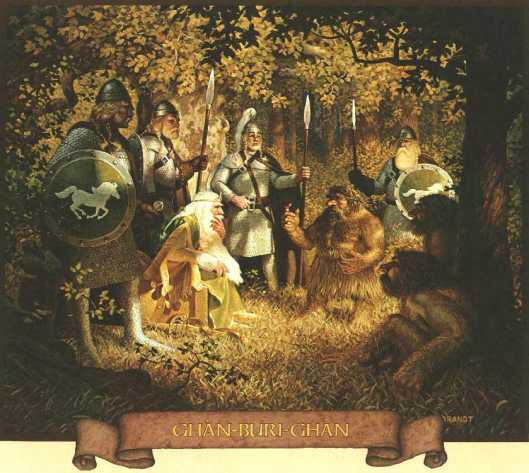
“A large lantern, covered above, was hanging from a bough and cast a pale circle of light below.  There sat Theoden and Eomer, and before them on the ground sat a strange squat shape of a man, gnarled as an old stone, and the hairs of his scanty beard straggled on his lumpy chin like dry moss.  He was short-legged and fat-armed, thick and stumpy, and clad only with grass about his waist.”

This, we find out, is Ghan-buri-Ghan, leader of the Wild Men, who, as Elfhelm has said, has come to offer his and his people’s aid to Theoden.

image3ghanburighan.jpg

(We note, by the way, that this Hildebrandt illustration has taken certain liberties with the scene as described in the book:  it appears to be daylight—no lantern—if Eomer is there, he isn’t seated, and there is more than one Wild Man–oh, and the Wild Man’s beard has suddenly sprouted.)

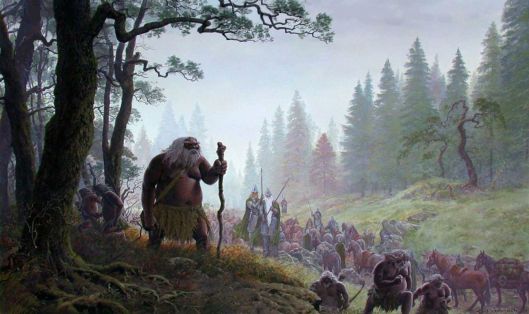
What Ghan-buri-Ghan offers Theoden is a long-forgotten road which would provide a way around the soldiers of Sauron who are blocking the direct route to Minas Tirith:   the path through the Stonewain Valley.

image4stonewainfalley.jpg

What caught our attention here was the connection Merry made between Ghan-buri-Ghan and something he’d encountered only recently:

“Merry felt that he had seen him before somewhere, and suddenly he remembered the Pukel-men of Dunharrow.  Here was one of those old images brought to life, or maybe a creature descended in true line through endless years from the models used by the forgotten craftsmen long ago.”

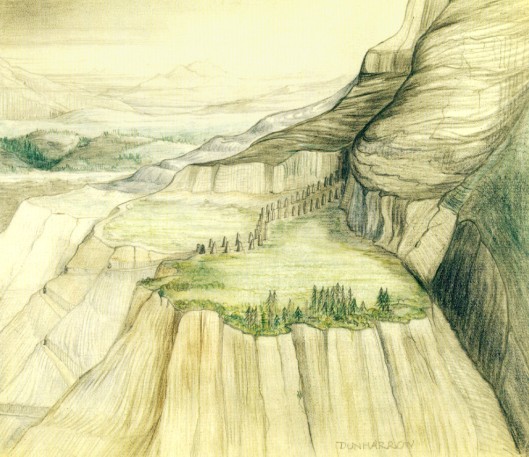
Dunharrow

image5dunharrowjrrt.jpg

was a mysterious place—

“…the work of long-forgotten men.  Their name was lost and no song or legend remembered it.  For what purpose they had made this place, as a town or secret temple or a tomb of kings, none in Rohan could say.  Here they labored in the Dark Years, before ever a ship came to the western shores, or Gondor of the Dunedain was built; and now they had vanished, and only the old Pukel-men were left, still sitting at the turnings of the road.

Merry stared at the lines of marching stones:  they were worn and black; some were leaning, some were fallen, some cracked or broken; they looked like rows of old and hungry teeth.” (The Return of the King, Book Five, Chapter 3, “The Muster of Rohan”)

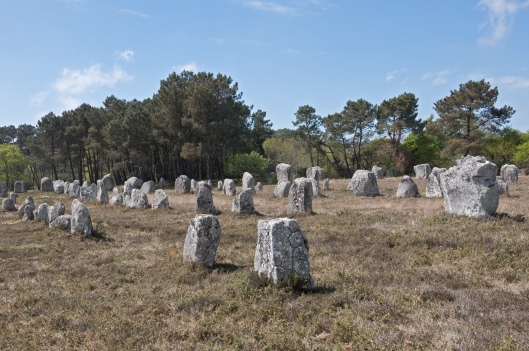
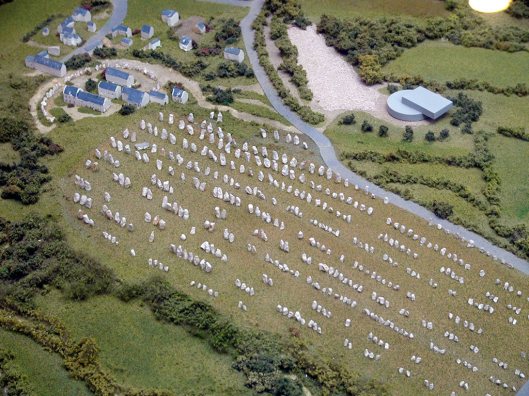
For a moment, this description reminded us of something one sees in Brittany, on the west coast of France, the so-called “Carnac Stones”, a vast field of Neolithic upright stones, now called menhirs (Breton for “long stone”) in long lines in and around the village of Carnac.

image6carnac1.jpg

image7carnacstones2.jpg

And, just as the use or meaning of Dunharrow is lost, so is that of the elaborate construction of the Carnac Stones.

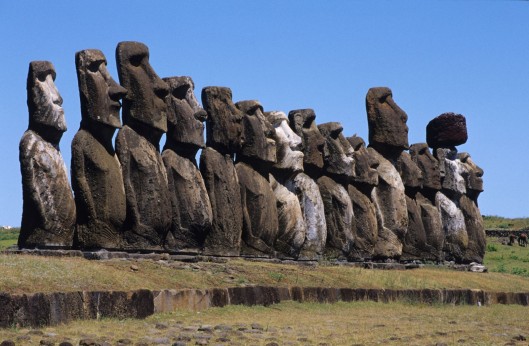
Once the Carnac Stones—and others like them, both in France and in Great Britain—came into our heads, we were whirled away to Rapa Nui (Easter Island) and all of those puzzling outsized heads on less-developed torsos, the moai.

image8moai.jpg

It was not the size or placement of those figures like “rows of old and hungry teeth” however, which made us think further about Ghan-buri-Ghan and his stony cousins, but how the figures were carved:

“At each turn of the road there were great standing stones that had been carved in the likeness of men, huge and clumsy-limbed, squatting cross-legged with their stumpy arms folded on fat bellies.  Some in the wearing of the years had lost all features save the dark holes of their eyes that still stared sadly at the passers-by.  The Riders hardly glanced at them.  The Pukel-men they called them, and heeded them little…”

As the Rohirrim are translated as speaking among themselves a sort of Tolkien-adapted Old English, so “pukel” appears to be derived from “pucel” = “goblin/demon”, which suggests perhaps a quasi-religious or magical use, but, if they once represented spirits, they are now spiritless, with no ability to frighten.  Rather, as the narrator tells us:

“…no power or terror was left in them; but Merry gazed at them with wonder and a feeling almost of pity, as they loomed up mournfully in the dusk.”

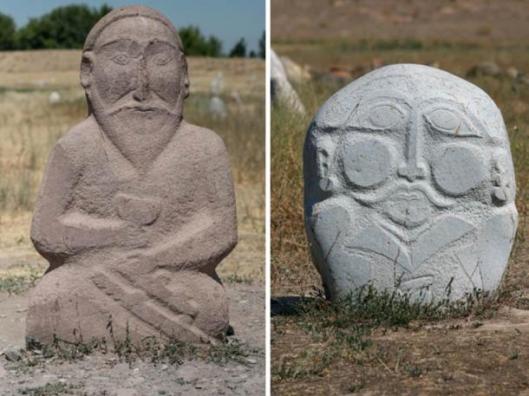
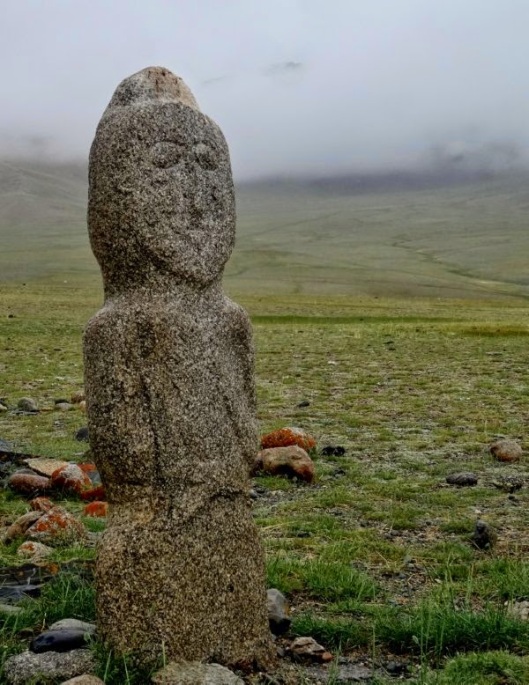
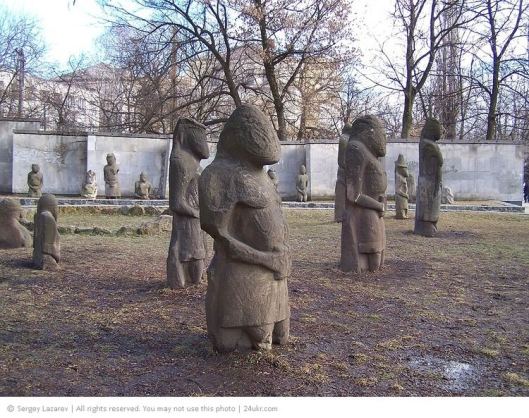
The narrator’s elaboration then reminded us of something else:  balbal.

image9balbal.jpg

image9bbalbal.jpg

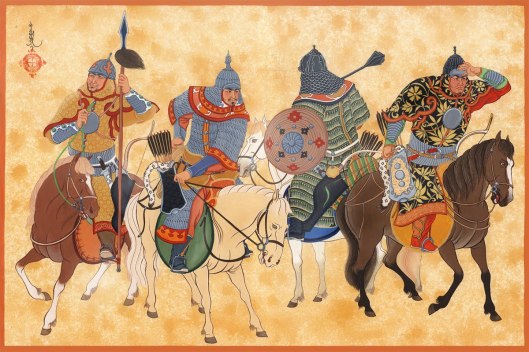
These are carved stone figures with a history probably as long as that of the Pukel-men.  They appear to be the product of Turkic peoples in Central Asia—with even older relatives, perhaps, to the west, as well.  Some may have been tomb guardians or monuments themselves—as with the Pukel-men, their origins and use/s are lost to us.  We ourselves have stolen them for use in our series of novels based in an imaginary medieval fairy tale Russia, called Cherna, “The Black Land”—but please don’t think “Mordor?”  In our case, the reason it’s named that is that it is steppe country with extremely fertile black soil.  So rich, especially as pasture-land, that it’s worth invading and fighting over, which is what the villains of our trilogy, the Vsadniki, modeled on the Mongols, do.

image10mongols.jpg

Unlike Pukel-men and menhirs and moai, however, there is no mystery about what the Vsadniki are up to with their stones:  every time they conquer a new land, they set such stones up at their new far-western border to say not only “what’s behind these is ours”, but also “and we’re looking at your lands next”.

image11balbal.jpeg

Thanks, as always, for reading.

MTCIDC

CD

ps

In the Tolkien volume Unfinished Tales, we find further connections between the Wild Men/Woses and carvings.  We use a paperback edition and this has somewhat different pagination from the hardbound, but, should you be interested, you can find it in either form in Part Four, I The Druedain.

pps

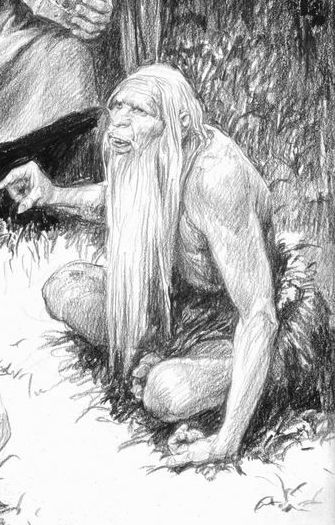
Here is a drawing of Ghan-buri-Ghan by Denis Gordeev, who has done a good deal of work illustrating a wide selection of JRRT’s fiction, rather as Ted Nasmith has, along with many other classics as well as modern fantasy fiction.

image11gbg.jpg

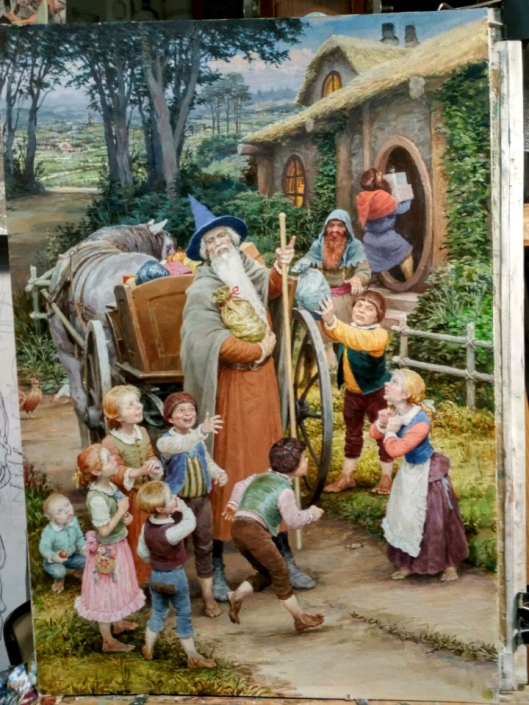
Gordeev has clearly been trained/trained himself in drawing as people did in that golden age of children’s writing and illustration, the 1880s to 1920s, and, once you get used to his very distinctive style, you may come to like it as we do.  Here’s Gandalf arriving in Hobbiton, fireworks and all, just to give you a taste.

image12gandalf.jpg

Weaving (Not Hugo)

31 Wednesday Jan 2018

Posted by Ollamh in Artists and Illustrators, Fairy Tales and Myths, J.R.R. Tolkien, Literary History, Military History, The Rohirrim

≈ Leave a comment

Tags

Anglo-Saxon, Battle of Hastings, Bayeux Cathedral, Bayeux Tapestry, Bishop of Bayeux, Edward the Confessor, Harold Godwinson, Lambert Leonard-Leforestier, Louvre, Musee Napoleon, Napoleon, Normans, Odo, Odo Earl of Kent, Old English Hexateuch, Rohan, Rohirrim, The Lord of the Rings, Tolkien, Tower of Babel, William Duke of Normandy, William the Conqueror

Welcome, dear readers, as ever.

In our last, we quoted JRRT on the subject of the Rohirrim:

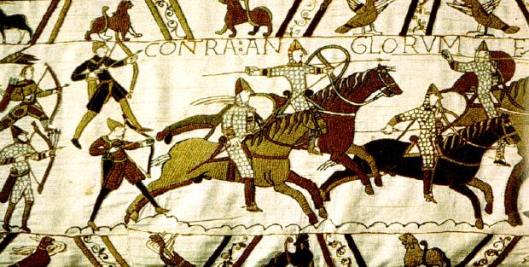
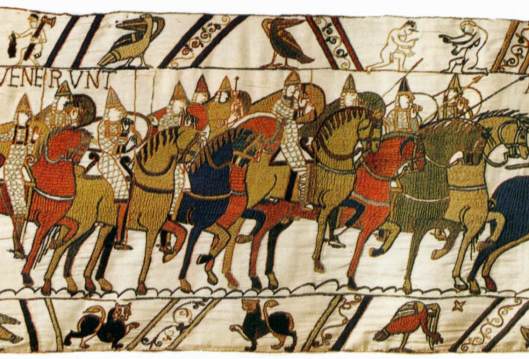
“The styles of the Bayeux Tapestry (made in England) fit them well enough, if one remembers that the kind of tennis-nets [the] soldiers seem to have on are only a clumsy conventional sign for chain-mail of small rings.”  (Letters, 281)

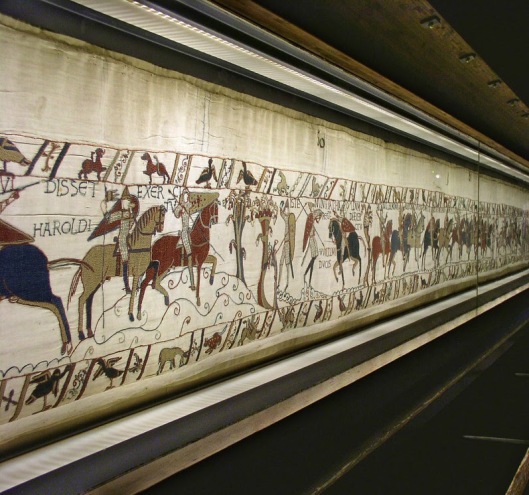
We’ve mentioned the so-called Bayeux Tapestry before and even shown an illustration or two, but we thought that it would be fun to delve a little deeper into the subject—beginning with its name and why Tolkien added “(made in England)” to his sentence.

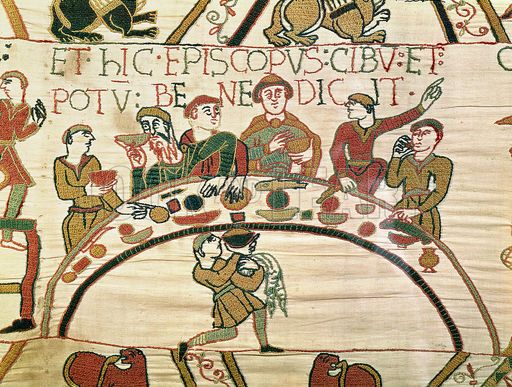
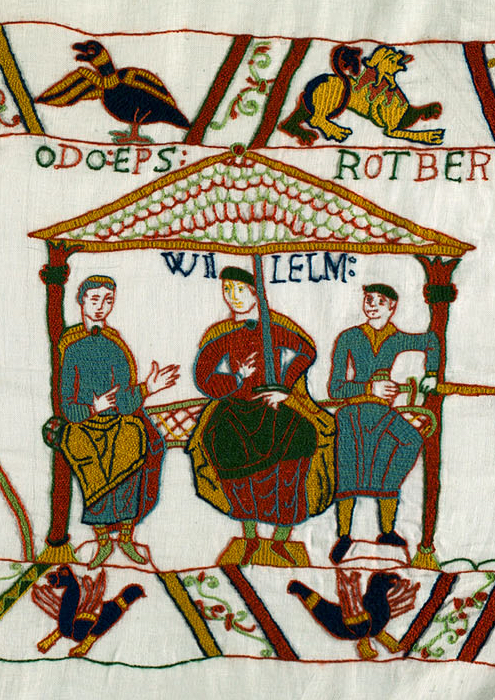
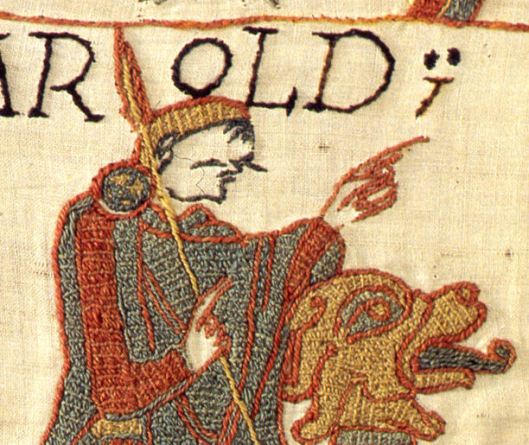
The first known reference to this approximately 230-foot-long (70.1 meters) by 20 inch high (.5m) piece of fabric dates from the latter part of the 15th century AD, from an inventory at Our Lady of Bayeux Cathedral—commonly known in English as Bayeux Cathedral—in 1476.  There has been much scholarly argument over its site of manufacture, but the evidence appears to us to identify the commissioner of the work as Odo, Bishop of Bayeux, and half-brother to William, Duke of Normandy (where Bayeux is situated), aka, “William the Conqueror”.  Odo is depicted and identified three times on the piece, twice in more peaceful settings—once blessing a meal,

image1odo.jpg

once sitting with William and his half-brother, Robert,

image2odo.jpeg

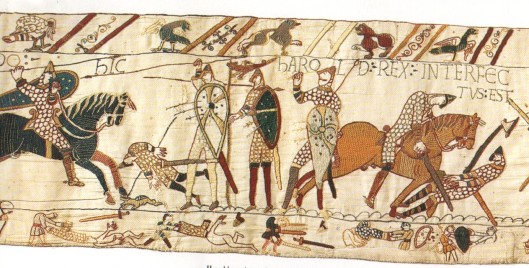
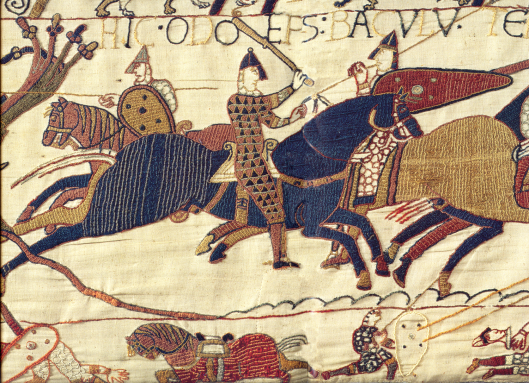
and once in a decidedly not peaceful setting, encouraging the troops at the Battle of Hastings, wearing a mail shirt and helmet and brandishing a club.  (The Latin inscription—called a titulus—says “Here Bishop Odo, holding a club, puts strength into the lads”.)

image3odo.png

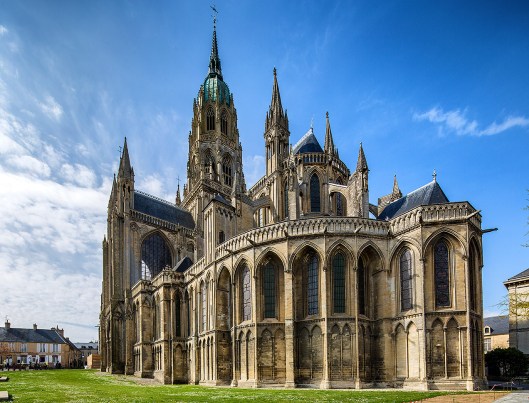
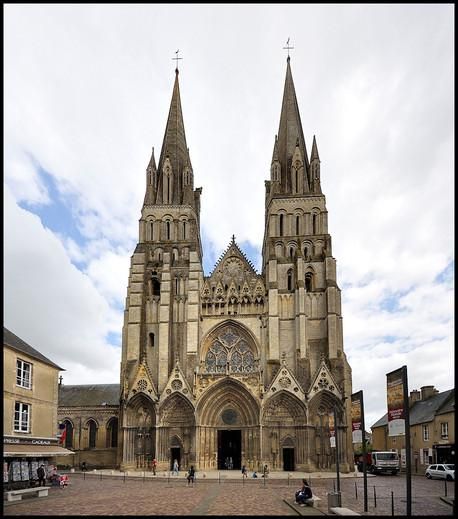
As well, several of the figures on the piece have been identified as vassals (feudal allies) of Odo.  Finally, Odo was not only the Bishop of Bayeux, but also instrumental in rebuilding the cathedral in which the artefact was first known to have been housed, Bayeux Cathedral (elements of which are buried inside this later Gothic version).

image4bayeux.jpg

It seems natural to us, then, that he, at one time William’s right-hand man, would have been responsible for the creation of the work.  (We might also add that the Norman victory made Odo Earl of Kent—one more reason for commissioning a work which shows that victory in detail.)

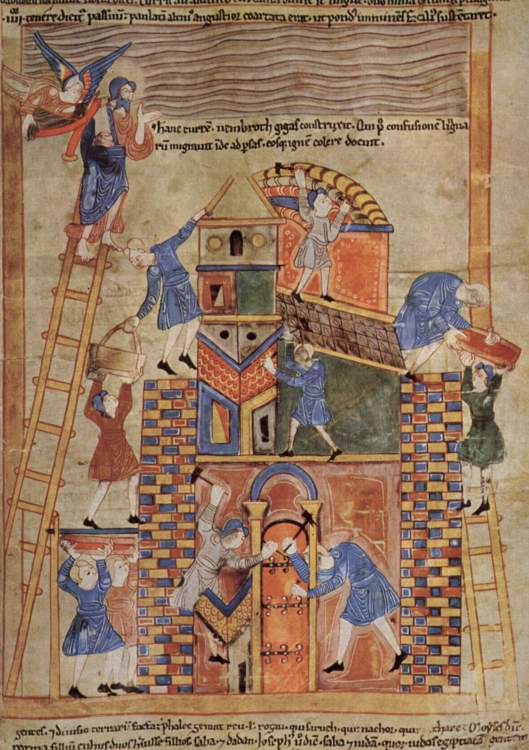
We said that there was argument as to where the work was made, but we, ourselves, would agree with JRRT and the idea that it was made in England for, among other reasons, the depiction of people and scenery on it remind us strongly of the Anglo-Saxon artistic tradition—especially embodied in the mid-11th-century manuscript of the “Old English Hexateuch”, with its 394 colored illustrations, which is to be found in the British Library (Cotton MS Claudius B. iv.).

image5babel.jpg

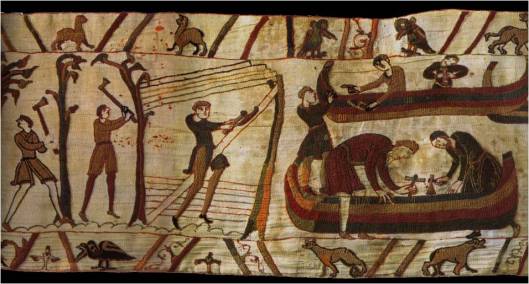
This is a depiction of the construction of the Tower of Babel.  Below is a picture of Normans building ships for their invasion of England from the Bayeux work.

image6ship.jpg

The Bayeux work is much sparer, but there’s that same interest in illustrating motion.

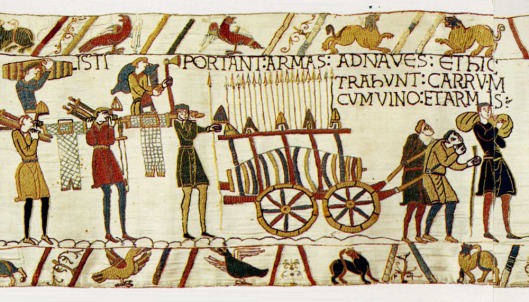
But, when we say that the Bayeux work is sparer, that is not to say that it lacks detail, as there are (at least) four visual levels throughout.  If we take just one scene at random

image7levels.jpg

and go from top to bottom we see:

  1. a narrow band of single figures—in this case, animals
  2. a broader band of action—in this case it’s Normans loading their equipment—and other things—for the attack on England (The titulus says: “These are carrying arms to the ships and here they are dragging a cart with wine and arms.”)
  3. the captions—tituli—for every scene
  4. a lower narrow band—again, here, animals, but there are other possibilities, as in this scene, where we see scavengers removing the arms and armor of the dead after the Battle of Hastings

image8scavengers.jpg

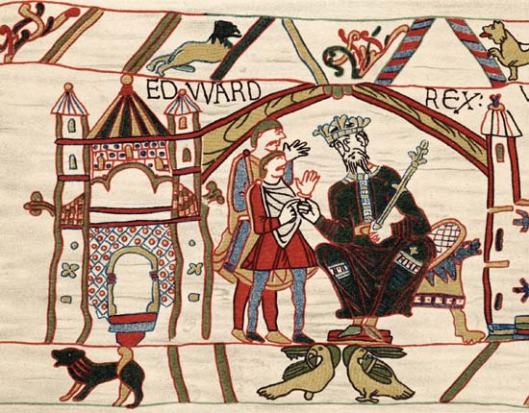
The images in the “Old English Hexateuch” illustrate individual Bible stories.  Those in the Bayeux work are scenes, all parts of a long historical narrative, which begins in 1064 (it is thought) with Edward the Confessor, the King of England,

image9eddie.jpg

sending the powerful nobleman, Harold Godwinson, on what appears (from subsequent panels) to be a mission to France.

The last scenes, at the far end, include the death of Harold on the battlefield of Hastings

image10deathofharold.jpg

and the flight of the English from the field, with Normans in hot pursuit in October, 1066.

image11flight.jpg

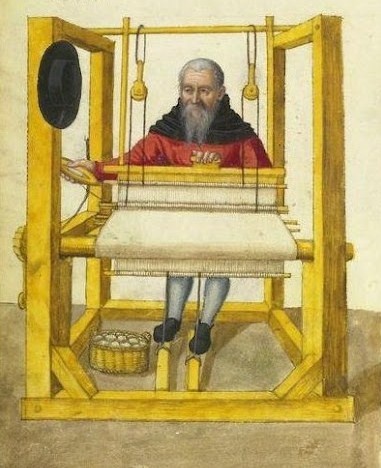
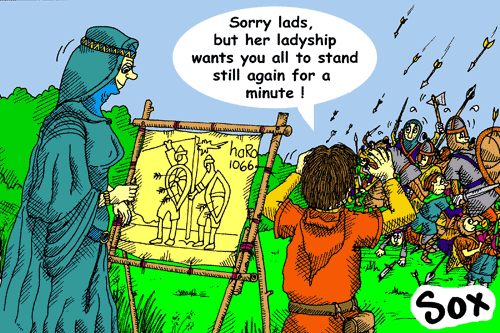
Throughout our discussion, we have avoided calling this work by its traditional name because, in fact, the “Bayeux Tapestry” is not a tapestry.  A tapestry is a solid piece of fabric, woven on a loom.

image12medloom.jpg

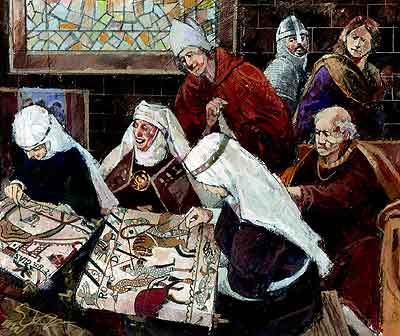
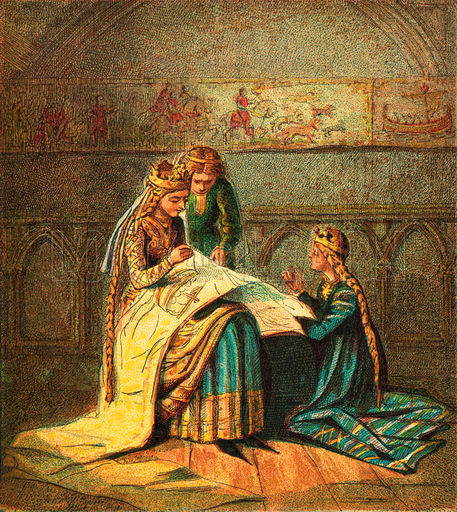
The Bayeux Tapestry is really the Bayeux Embroidery, in which various designs are stitched onto a cloth.

image13making.jpg

In this close-up, you can see how it’s done, with outlines giving the figures shape, as if they were drawn with a needle, then filled in.  (For more on this, and on the work in general, try this LINK.)

image14stitching.jpg

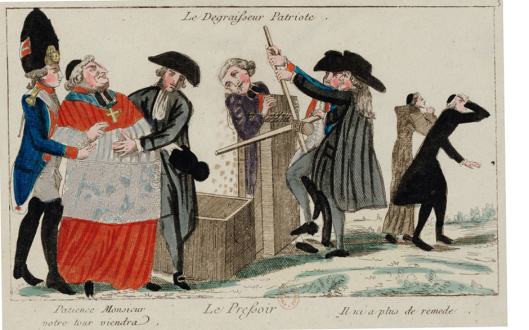
For its size and detail and historical importance, there’s no embroidery like it from early medieval England, and perhaps from Europe, but there was one moment when it almost disappeared for good.  During that period of the French Revolution when the Church (1% of the population which owned 10% of the land), was being nationalized (and plundered),

image15church.jpg

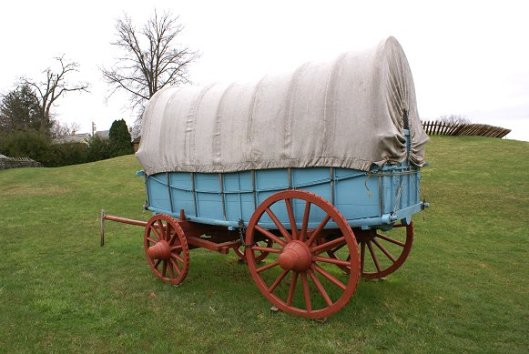
it was destined to be used for military wagon covers.

image16wagon.jpg

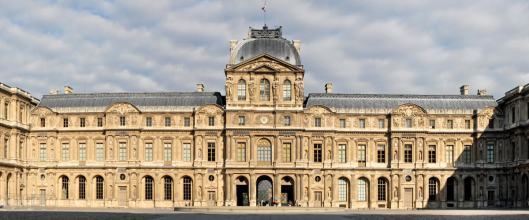
It was only saved at the last minute and shipped off to the Musee Napoleon (formerly—and subsequently—the Louvre).

image17louvre.jpg

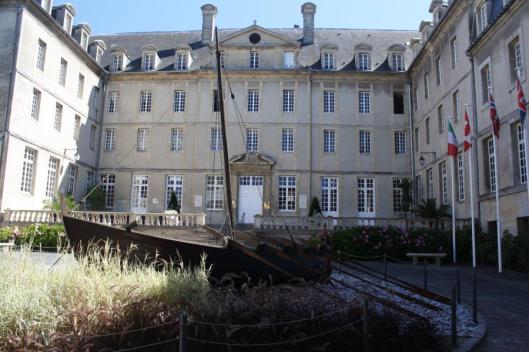
Eventually, it was returned to Bayeux where, today, it can be seen in a museum there, cleverly displayed in a way which allows the entire length to be viewed.

image18museum.jpg

image19display.jpg

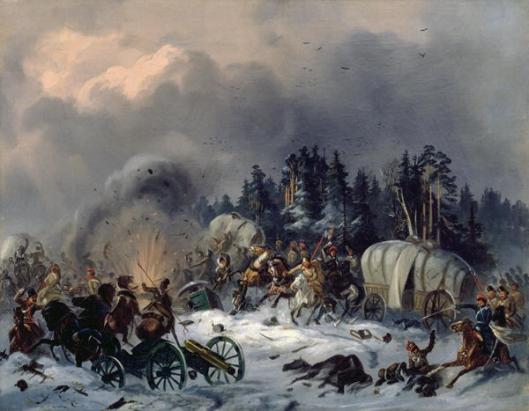
Without a member of Bayeux’ city council, Lambert Leonard-Leforestier, and his quick thinking, however, the last anyone might have seen of it would have been more like this—

image20wagon.jpg

destroyed on wagons lost in Napoleon’s disastrous retreat from Russia.

Thanks, as ever, for reading.

MTCIDC

CD

PS

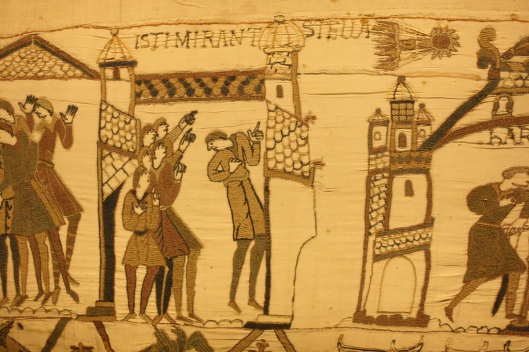
There is one more detail from the Bayeux Embroidery we’d like to mention.  If you’re a fan of Game of Thrones, you might remember a passing comet.  In fact, a passing comet—Halley’s Comet—appears on the Embroidery and, for people of the time, portended something big to come…

image21halleyscomet.jpg

For more on Halley’s comet, here’s a LINK.

What If…

31 Wednesday May 2017

Posted by Ollamh in Artists and Illustrators, J.R.R. Tolkien, Literary History, Maps, Military History, Military History of Middle-earth, Narrative Methods, Tolkien

≈ Leave a comment

Tags

Alamo, Andelkrag, Anduin, Caernarfon, Carcassonne, Duc de Berry, fortresses, Hal Foster, Harry Turtledove, Howard Pyle, Huns, Minas Tirith, moat, Mont Saint Michel, Mordor, Numenor, Peter Jackson, Portchester, Prince Valiant, Rohirrim, S.M. Stirling, Santa Anna, Segontium, Siege Warfare, Texas War for Independence, The Lord of the Rings, The Return of the King, Tiryns, Tolkien, Tower of Orthanc, Tres Riches Heures

Welcome, readers, as always.

If you are among our excellent regulars, you know that we’re fascinated by history (one of us has taught it for years). One subset of our interest is “what ifs”, two of our favorite scifi/fantasy authors being Harry Turtledove and S.M. Stirling, who have written numerous books exploring all sorts of alternative places and times.

In this posting, we’d like to try a “what if” ourselves: what would happen to Minas Tirith if the Rohirrim and Aragorn had failed to arrive?

Walls collapsing under a rain of boulders, soldiers fleeing from the defenses, the main gate broken in by a giant battering ram—

image1anazgan.jpg

how was this the place of which its creator had written:

“A strong citadel it was indeed, and not to be taken by a host of enemies, if there were any within that could hold weapons…” (The Return of the King, Book Five, Chapter 1, “Minas Tirith”)

In an earlier posting, we talked about Sauron’s attack on Minas Tirith

image1battackonmt.jpg

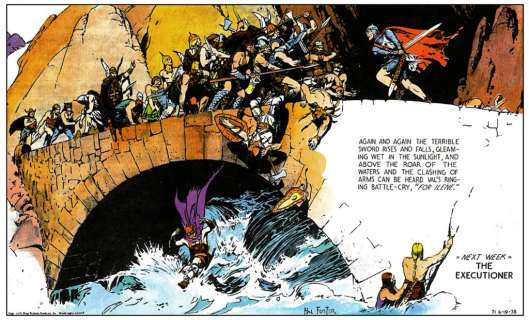
and even suggested that one inspiration might have been an episode of the comic strip Prince Valiant and the siege of Andelkrag by the Huns (published in May, 1939). (Footnote: there is a rumor that the writer/illustrator, Hal Foster, intended the Huns to equal the Nazis and therefore annoyed Hitler—a would-be Sauron to Saruman’s Mussolini, as we once also suggested?)

image1andelkrag.jpg

That castle is splendid, but not quite what one would have seen in the 5th century AD, when Attila led the Huns to invade central and western Europe. Andelkrag appears to be a very elaborate late-medieval castle, c.1400 or so, rather like the ones you might see in the Duc de Berry’s Tres Riches Heures (c.1412-16; 1440s; 1485-1489).

image2tresrichesheures.jpg

More likely, if Andelkrag had been a real fortress, it would have been a repurposed Roman army installation, like this at Caernarfon, called by the Romans, Segontium.

image3caernarfonsegontium.jpg

Such forts might then be converted into castles, as at Portchester

62790_8d3686244501897

but that would hardly have provided the gallant medieval look which Foster gave his comic strip and which, in turn, came from the illustrations of people like Howard Pyle (1853-1911), in the previous generation (and which, we have previously argued, had a strong influence on what JRRT imagined his Middle-earth to look like).

image5ahowpylephoebe.jpg

image6pyleillustration.JPG

We are told in one of the extra features in the extended film version of The Lord of the Rings that an inspiration for P. Jackson’s Minas Tirith

image5mt.jpg

was the ancient island fort/religious site of Mont Saint Michel, on the western coast of France.

image6mtstmich.jpg

image7mtstmichmap.jpg

As you can see from the photo and the map, this isn’t just a fort, however, but a little fortified town, reminding us that Minas Tirith isn’t a castle, but a walled city, like the restored medieval town of Carcassonne, in southern France.

image8carcassonne.jpg

Like Mont St. Michel, Minas Tirith is built up a slope.

jrrtsfirstmtdrawing.jpeg

(This, by the way, is Tolkien’s first sketch.)

But, unlike Mont St. Michel and Carcassonne, it has not one wall, but many:

“For the fashion of Minas Tirith was such that it was built on seven levels, each delved into the hill, and about each was set a wall, and in each wall was a gate.”

image12leemt.jpg

Because the city was built on a series of levels, this would mean that each wall would overlook the next lower one, so that the defenders on the upper wall could rain down missiles on attackers below.

poi_img_town_defences_1

This is an ancient practice. The Bronze Age Greek city of Tiryns (yes, there is a bit of a similarity in the name, isn’t there?) is so constructed, for example, that its entryway forces attackers to move to the left, thereby potentially exposing an unshielded side, as well as undergoing a barrage of arrows and rocks from those on the wall above.

Tiryns Reconstruction

tiryns-walls

In the case of Minas Tirith, there is an added obstacle:

“But the gates were not set in a line: the Great Gate in the City Wall was at the east point of the circuit, but the next faced half south, and the third half north, and so to and fro upwards; so that the paved way that climbed towards the Citadel turned this way and then that across the face of the hill.”

image13mtzigzag

Attackers, then, would not only be at the mercy of those above them, but would, should they break through one gate, be forced to zigzag back and forth as they fought their way upwards, taking more and more casualties as they advanced.
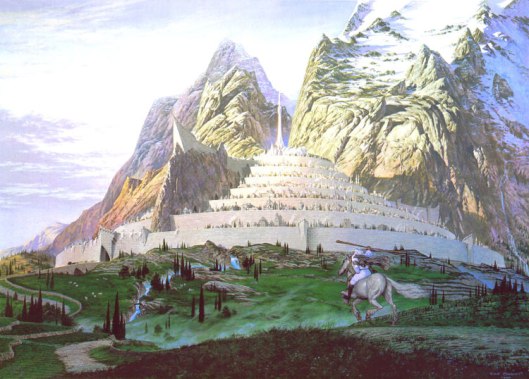
minas-tirith3

Added to this, at the lowest level, was the main wall:

“…of great height and marvellous thickness, built ere the power and craft of Numenor waned in exile; and its outward face was like to the Tower of Orthanc, hard and dark and smooth, unconquerable by steel or fire, unbreakable except by some convulsion that would rend the very earth on which it stood.” (The Return of the King, Book Five, Chapter 4, “The Siege of Gondor”)

Unlike so many fortresses—going back at least to Neolithic times—Minas Tirith had no moat. Not only does such a watery ditch slow down attackers by giving them one more puzzle to solve, but it also makes a standard siege practice, undermining, much more difficult. Basically, what undermining does is to hollow out an area underneath a wall and replace the original foundation with a flammable wooden one. Then the miners fill the hollow with burnables, torch them, and wait to see if the new wooden foundation collapses, bringing down the wall on top of it. You can see miners at work in this medieval manuscript illustration.

villanip214bottom.jpg

A wet moat would have forced the miners to dig much deeper, to avoid being flooded out.

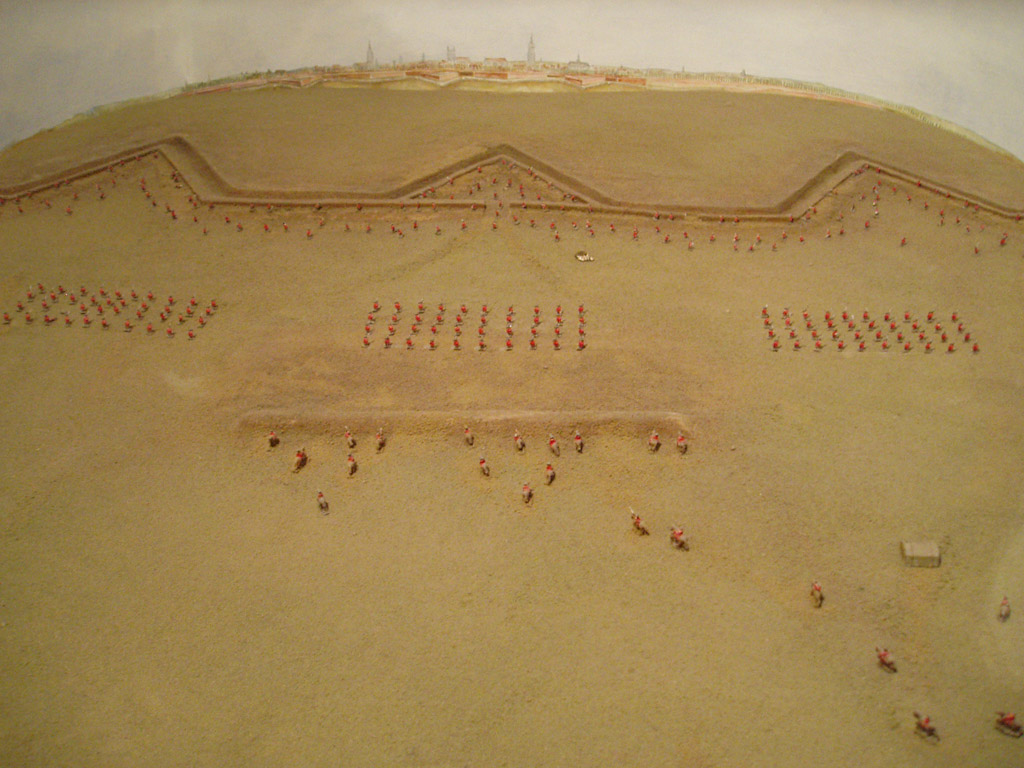
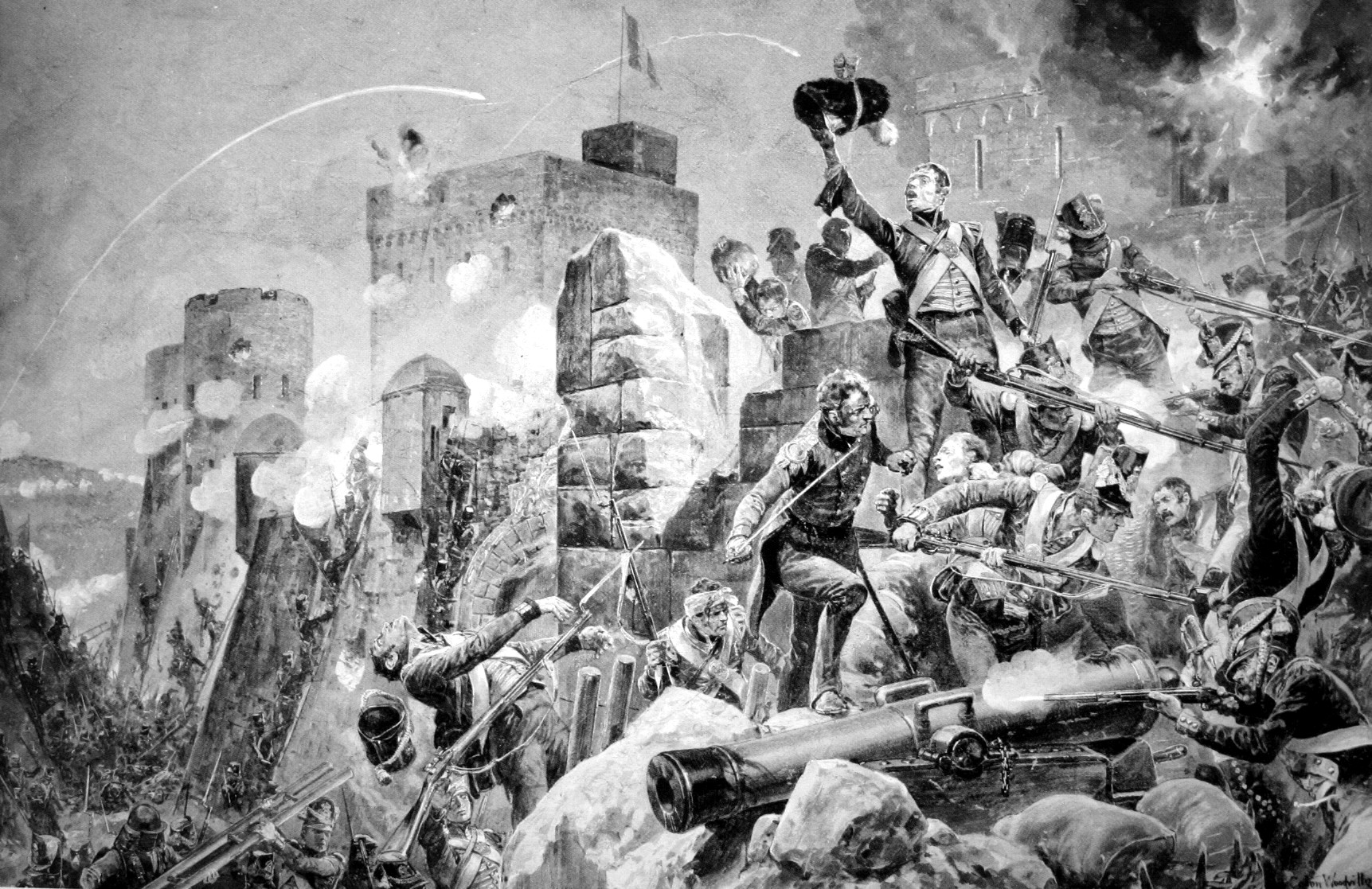
For Minas Tirith, the nearest water source for a wet moat would have been the Anduin, some miles away, but dry moats were useful as well. This diorama of the final attack by the British at the siege of Badajoz in 1812 shows how effective such a thing might be. Although the besiegers have managed, through prolonged bombardment, to create a breach in the main wall, they have to struggle through the deep dry moat to reach it—and took large numbers of casualties in doing so.

image18badajoz

Against all of these defenses, the head of the Nazgul, as Sauron’s general in the field, has the usual siege weapons: stone throwers, siege towers, even a massive battering ram. He also has a more subtle tool:

“But soon there were few left in Minas Tirith who had the heart to stand up and defy the hosts of Mordor. For yet another weapon, swifter than hunger, the Lord of the Dark Tower had: dread and despair.”

Even so, under the command of Gandalf, there was still resistance and we can imagine that that resistance would have persisted through all the circles, but the ultimate difficulty, which would have caused the fall of the city, had not the Rohirrim—and then Aragorn—come, was the lack of reserves.

Gondor was, at the time of the siege, in decline, as Pippin noticed when he and Gandalf arrived there:

“Yet it was in truth falling year by year into decay; and already it lacked half the men that could have dwelt at ease there.”

When reenforcements came from the south, they were “less than three thousands full told.”

When a city or castle is under siege, it needs not only a force to man its walls, but also a second force, to be sent quickly to any place where an enemy breakthrough is threatened. The force on the walls has two main jobs: 1. to keep the enemy at a distance with missile fire—or, failing that, to cut down the attacking force as it approaches the walls, trimming its numbers and thereby possibly demoralizing it; 2. to fend off the enemy if it actually manages to gain the walls. This illustration from the Prince Valiant Andelkrag siege provides a good image of this double job.

image19defenseofandelkrag

It might be possible, if the enemy made an assault upon a single point, to siphon off men from other parts of the defenses to act as a temporary second force, but, if the enemy attacks more than one place at the same time, this is not a safe thing to do. In the case of the assault on the first wall of Minas Tirith, the enemy commander seems to have had such numbers—and didn’t care in the least about his losses– that he could attack the entire wall:

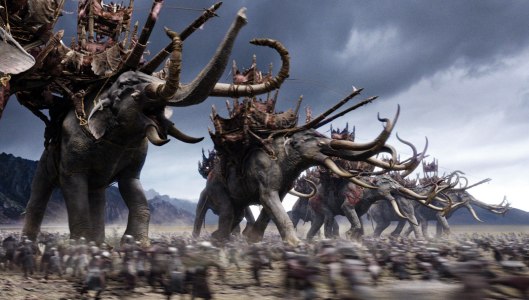
“Ever since the middle night the great assault had gone on. The drums rolled. To the north and to the south company upon company of the enemy pressed to the walls. There came great beasts, like moving houses in the red and fitful light, the mumakil of the Harad dragging through the lanes amid the fires huge towers and engines. Yet their Captain cared not greatly what they did or how many might be slain: their purpose was only to test the strength of the defence and to keep the men of Gondor busy in many places.”

The weakest place in any strong wall is a gate and that knowledge has guided Sauron’s Captain:

“It was against the Gate that he would throw his heaviest weight. Very strong it might be, wrought of steel and iron, and guarded with towers and bastions of indomitable stone, yet it was the key, the weakest point in all that high and impenetrable wall.”

Thus, with everyone pinned in position by a general assault, and there being no other possible reserve, once the gate is down—but then a cock crows and there are horns and, well, you know what happens next.

But, continuing our “what if”, we look to a different model, the Alamo, a ruined mission turned into a fortress in the so-called “Texas War for Independence” of 1835-36.
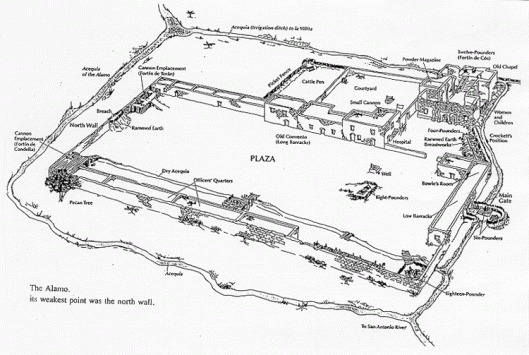
alamo-map-3

Within this mission, some 180plus defenders faced a Mexican army of several thousand, staving them off for a week-and-a-half before finally being overwhelmed by a series of nearly-simultaneous pre-dawn assaults from several directions at once.image21alamoassault

The survivors drew back, still fighting, and made a series of last stands in the rooms of the surviving mission buildings, dying almost to a man because the Mexican general, Santa Anna, had declared that there would be no mercy for any survivors. (There were a handful of prisoners, however, perhaps including the famous American frontiersman, Davy Crockett, but under Santa Anna’s direction, they were then murdered.)

In our grim “what if”, the survivors of the outer wall, led in retreat by Gandalf, are gradually driven back, like the Alamo defenders, until they reach the Citadel—and then—but, can we go on? Are the Rohirrim and Aragorn simply delayed and then appear? Are there eagle-rescues, as in The Hobbit?

image23eaglerescue.gif

What do you think, dear readers?

And thanks, as ever, for reading!

MTCIDC

CD

PS

We saw this Lego attack on Minas Tirith and it was just too wonderful not to include!

legominastirith.jpg

PPS

As we were finishing this, we happened upon a really great website–

https://middleeartharchitectures.wordpress.com/  –wonderful visuals!
One More River (2)

28 Wednesday Dec 2016

Posted by Ollamh in Heroes, Imaginary History, J.R.R. Tolkien, Literary History, Maps, Military History of Middle-earth, Narrative Methods

≈ 2 Comments

Tags

Amon Hen, Anduin, Bilbo, Blondin, Bombur, Boromir, Brandywine, bridges, Bruinen, Bucklebury Ferry, Celebrant, Dwarves, Elrond, Elves, Enchanted river, Esgaroth, Fangorn, ferry, flight to the ford, Frodo, Gandalf, Gondorians, Hoarwell, Hobbiton, Isen, Khazad-dum, Niagara Falls, Nimrodel, Old Forest, Old Man Willow, Orcs, Prince Valiant, Rivendell, Rivers, Rohirrim, Sam, Tharbad, The Hobbit, The Long Lake, The Lord of the Rings, Theodred, Tolkien, Tom Bombadil, Weathertop, Withywindle, Wraiths

Welcome, dear readers, as always. In our last post, we had turned our attention to water-crossings in The Hobbit. In this, we want to continue our study with The Lord of the Rings.

We were first prompted to look at such crossings by something Boromir said, almost in passing:

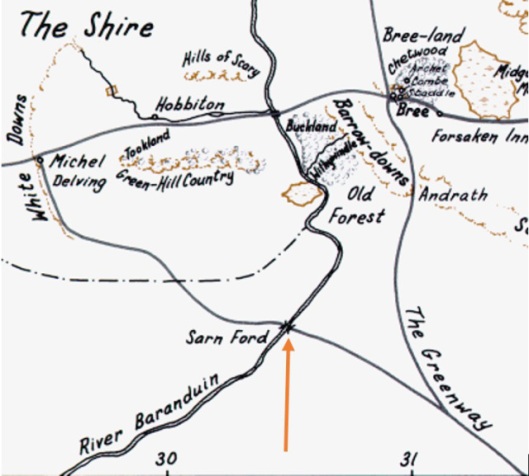
“Four hundred leagues I reckoned it, and it took me many months, for I lost my horse at Tharbad, at the fording of the Greyflood.” (The Fellowship of the Ring, Book 2, Chapter 8, “Farewell to Lorien”)

Tharbad had once been famous for its elaborate defenses and bridge, but, symbolic of so much of Middle-earth at the end of the Third Age, it had fallen into decay and was abandoned, the water of the Gwathlo, the Greyflood, spreading wide—an easy place to lose a horse—or a man.

And perhaps Boromir’s loss is also symbolic of the higher level of stress involved in crossing water in the later work. The most Bilbo and the dwarves had to deal with was a water of forgetfulness, whose effect wore off in a relatively short time. There is much worse to come.

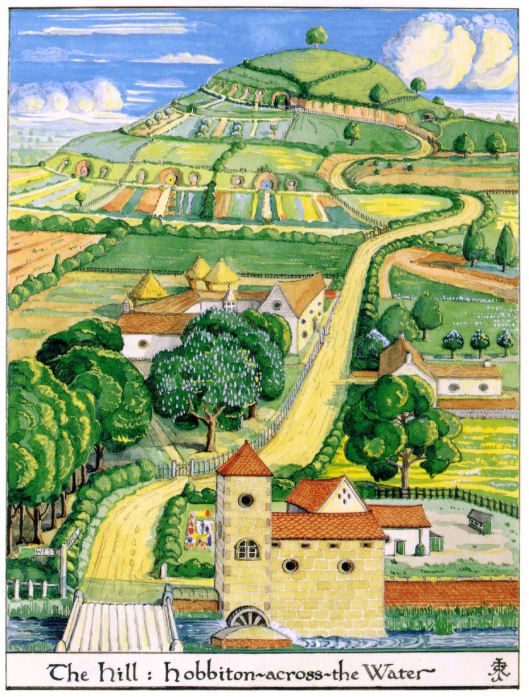
The first crossing (after The Water in Hobbiton)

1hobbiton.jpg

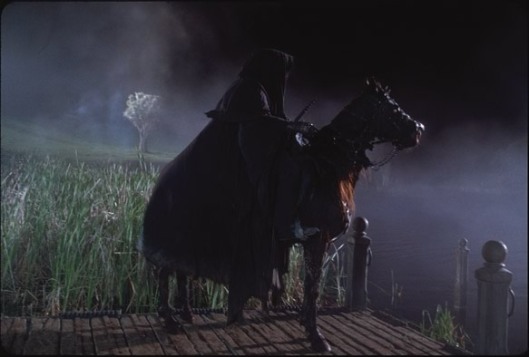
has danger attached, but it’s a danger which pursues the hobbits at the Bucklebury ferry. Here, pursued by one—or more—wraiths,

2wraithatferry.jpg

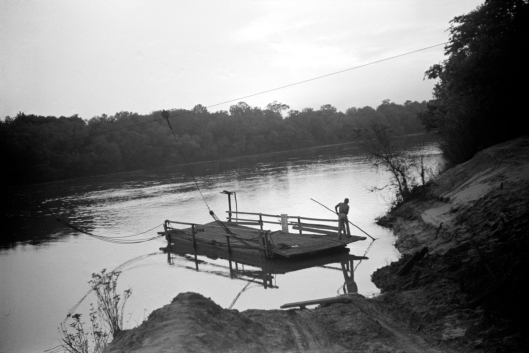
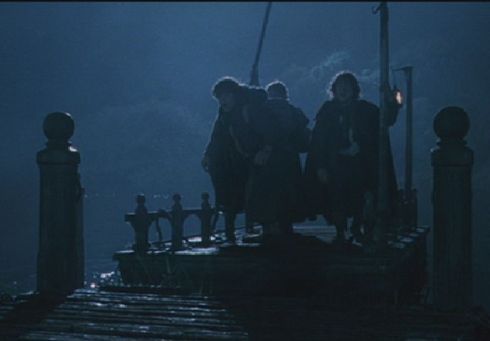
they cross over by what is a kind of do-it-yourself ferry, where the ferry runs on a cable, which keeps it available and on course, while the passengers pole to add propulsion.

3cableferry.jpg

4ferry.jpg

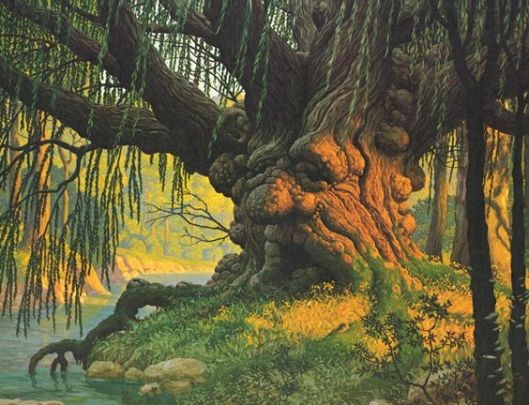
There is a puzzle at their next crossing—because the hobbits don’t appear to have crossed at all! This is the River Withywindle, on whose bank the hobbits meet up with Old Man Willow (not as in the film, where he’s been pulled violently out of context and replanted, for no good reason we can see, in Fangorn’s forest).

5oldmanwillow.jpg

Until we began to study water-crossings, we had never really thought about what happens then. The hobbits come to the river, having become lost in the Old Forest. Pippin and Merry are swallowed by the tree. Tom Bombadil comes to the rescue: but how do they cross the Withywindle? We just couldn’t remember! So we went back to the text, saw Tom lead the four hobbits through the forest, where they almost lose him, then they hear: “Hop along, my little friends, up the Withywindle!” (The Fellowship of the Ring, Book 1, Chapter 6, “The Old Forest”)

And so they never actually ford across or are ferried across. Instead, they walk up its course to Tom’s house, which seems to be near the source.

6withywindlemap.jpg

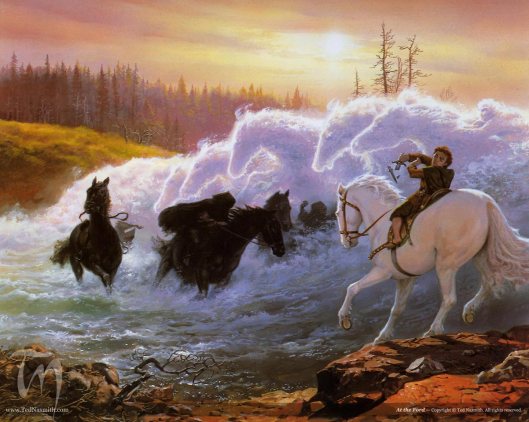
The next crossing is many miles away—over the Barrow Downs, through Bree, past Weathertop, to the Last Bridge, over the Hoarwell. Although Aragorn is anxious that the Wraiths will have gotten there before them, they pass safely and keep moving southwards, towards Rivendell, until, near the ford over the Bruinen, the Nazgul catch up with them at last.

7bruinen.jpg

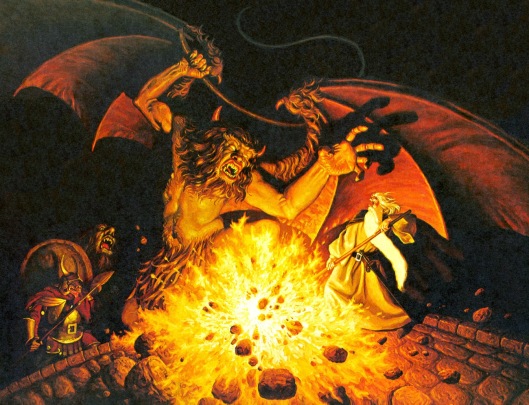
There is a bridge, of course, at Khazad-Dum, although, as far as we can tell, there is no water even in the depths far below it.

8khazaddum.jpg

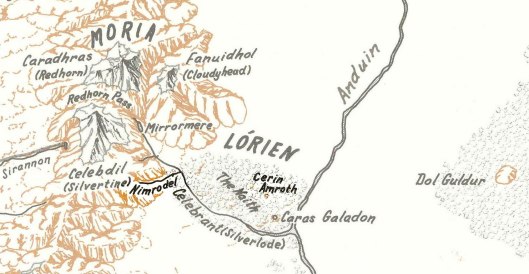
Escaping from Moria, the Fellowship reaches two streams in a row and, as far as we know, none of the prominent illustrators has given us pictures, either of the tributary Nimrodel or the main river, the Celebrant, so we provide a rather generic picture to offer a rather general idea.

9nimrodel.jpg

10nimrodel.jpg

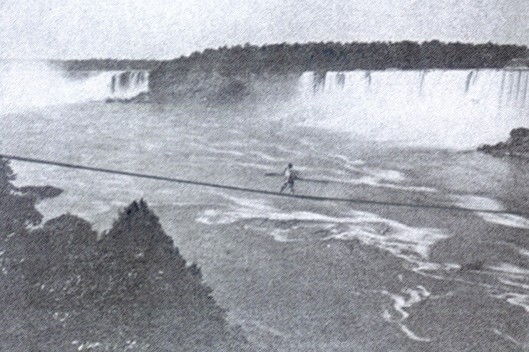
The Nimrodel is shallow enough to wade across, but the Celebrant is wider and deeper and the Elves provide a rather iffy method of transport: a single line of rope to balance on, making us imagine something like the famous Blondin crossing Niagara Falls in 1859—well, a little!

11blondin.jpg

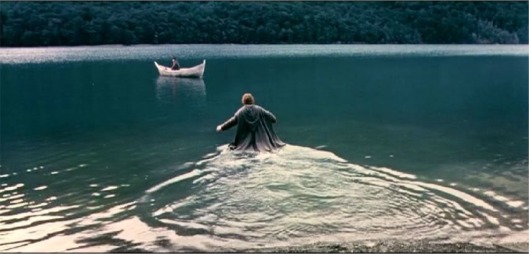
The next crossing is almost inadvertent, or, at least happens sooner than expected: the Fellowship has been paddling down the Anduin, but, putting in at Amon Hen, things go disastrously wrong. Boromir tries to take the Ring, the orcs appear, Boromir is mortally wounded, and Merry and Pippin are carried off (in our edition—the 50th Anniversary, One Volume Edition—this takes all of 12 pages—quite a narrative feat for JRRT!), before Frodo (and Sam) cross the river to the east and story begins its major split.

12samandfrodo.jpg

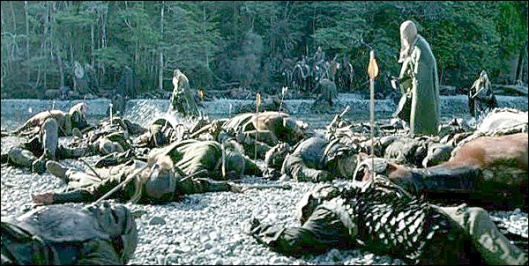
[We might insert here, although, in The Lord of the Rings, it’s only a footnote that at the crossing of the Isen, during this time, Theodred, son of Theoden, is killed.]

12aTTTIsenFord2.jpg

After this, there is only one more crossing of any significance, but it’s not by the main characters: rather, it’s by the orcs, who use boats to assault and capture west Osgiliath, which is the subject of one of our earlier postings.

13orcsosgiliath.png

To which we would add the return crossing, days later, of the Forlorn Hope of Gondor and Rohan, on their way to challenge Sauron (and to distract him from Frodo and Sam).

14marchonmordor.jpg

To finish up this posting, we provide a chart below (clearly now one of a series, after the earlier one on doorways and passages) of the water-crossings found in the two books.

Crossing Characters Outcome Source
Tharbad Boromir Loses horse The Lord of the Rings
The Water Bilbo Joins Dwarves The Hobbit
 An unnamed river Bilbo, Dwarves, and Gandalf Lose baggage The Hobbit
Rivendell Bilbo Dwarves, and Gandalf Helped by Elves The Hobbit
Anduin Bilbo, Dwarves, and Gandalf Transported by eagles The Hobbit
Enchanted River Bilbo and Dwarves Bombur drugged The Hobbit
Underground river Bilbo and Dwarves Using barrels, Bilbo and Dwarves escape The Hobbit
The Long Lake Bilbo and Dwarves Gain help from Esgaroth The Hobbit
The Brandywine (Bucklebury Ferry) Frodo, Sam, Merry, Pippin Escape Wraith The Lord of the Rings
Withywindle Frodo, Sam, Merry, Pippin Reach Tom Bombadil’s house (never actually cross river) The Lord of the Rings
The Bruinen Frodo and Wraiths Elrond causes river surge, Nazgul driven off The Lord of the Rings
Khazad-Dum Balrog and Gandalf Gandalf defeats Balrog, but falls down with him The Lord of the Rings
Nimrodel/

Celebrant

Fellowship and Elves Fellowship brought into Lorien The Lord of the Rings
Anduin Frodo and Sam Set out on journey to the east The Lord of the Rings
Isen Rohirrim and Orcs Rohirrim driven back, Theodred, son of Theoden, killed The Lord of the Rings
Anduin Gondorians vs Orcs Gondorians driven back from West Ogsiliath The Lord of the Rings


This is our last posting for the year 2016 and we close the year with thanks to all who follow our blog or simply stop in for a visit. In 2017, we plan to continue our Tolkien travels, sometimes employing the Sortes Tolkienses, as well as to use Tolkien’s world to visit others, beginning with a posting on “Famous Bridge Battles”, from Boromir and Faramir jumping off one to escape the orcs, to Napoleon at Arcola, and beyond. Here’s a taste…

15princeval.jpg

We also plan to explore other worlds and perhaps to add a review section for books and films we think you might enjoy.

In the meantime, thanks, as ever, for reading. Happy New Year!

MTCIDC

CD

ps

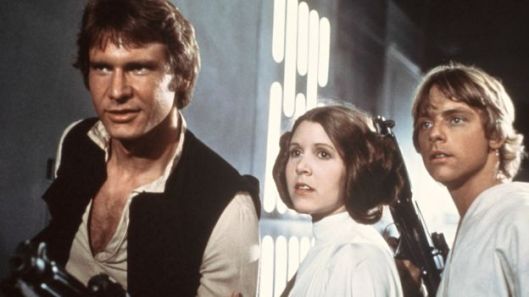
What sad and surprising news! Princess Leia is no more– but no– Princess Leia will always be with us, just like the Force.
_87060782_starwarsap3

“My subject is War, and the pity of War.”

13 Wednesday Apr 2016

Posted by Ollamh in Artists and Illustrators, Heroes, J.R.R. Tolkien, Military History, Military History of Middle-earth, The Rohirrim

≈ Leave a comment

Tags

Adventure, Alexander Gardner, Alfred Waud, Alonzo Chappel, American Civil War, Antietam, Battle of the Somme, Charge of the Rohirrim, Confederate, early photography, Felice Beato, First Virginia Cavalry, Fort Geroge, Matthew Brady, Mexican-American War, Minas Tirith, Pelennor, Peter Jackson, Rohirrim, Second Opium War, The Lord of the Rings, Tolkien

Welcome, dear readers, as always.

In this posting, we want to talk a little about a subject so often left out of heroic stories: the aftermath of battle.

In Chapter 10 of The Return of the King, what we might call the GEF—the Gondorian Expeditionary Force—sets off from Minas Tirith for the Morannon. It begins with this little army mustered on the Pelennor and we see events through the eyes of one left behind, Merry:

“At last the trumpets rang and the army began to move. Troop by troop, and company by company, they wheeled and went off eastward. And long after they had passed away out of sight down the great road to the Causeway, Merry stood there. The last glint of the morning sun on spear and helm twinkled and was lost, and still he remained with bowed head and heavy heart, feeling friendless and alone.”

Considering what these folk had endured in the previous days, and what they dreaded might happen in those to come, it’s hardly surprising that it’s not described as a joyous event. What is not described, however, is the landscape in which they gather and which they initially march through.

The Minas Tirith to which Gandalf rides with Pippin

gandalfpippin.jpg

has been attacked by a massive army.

minas-tirith.jpg

In an attempt to lift the siege, the Rohirrim have charged across the Pelennor,

rohirrimcharge.jpg

only to encounter the fierce Southrons and their mumakil.

mumakil.jpg

These are defeated, in turn, by Aragorn, his companions, and troops from South Gondor, as well as the surviving Rohirrim and a party from Gondor itself.

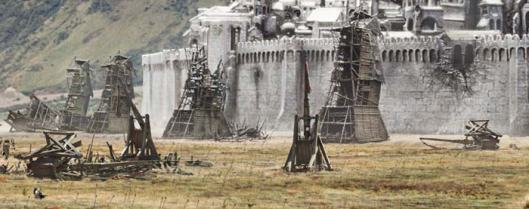
When the carnage is over and the invaders killed or driven off, the story, while touching on the burial of Snowmane, quickly moves back to the city. In real life, such destruction would have left behind a ghastly memorial, something only touched upon in the film of The Return of the King. As you can see in this still, all which seems to remain is the wreckage of the war machines.

551_2_Minas_Tirith_MPdtl.jpg


In fact, there would have been thousands of bodies, not only of men and orcs, but of horses and mumakil as well.

Such an aftermath has not been a popular subject for art, except in scenes where fallen heroes are lamented when found among the slain. (Think here of Boromir, surrounded by dead orcs, for example.)

boromir.jpg

That sense of war was changed, in our world, by the introduction of the camera to the battlefield, first, briefly, by Felice Beato, during the Second Opium War (1860)

beatonorthtakufort1860.jpg

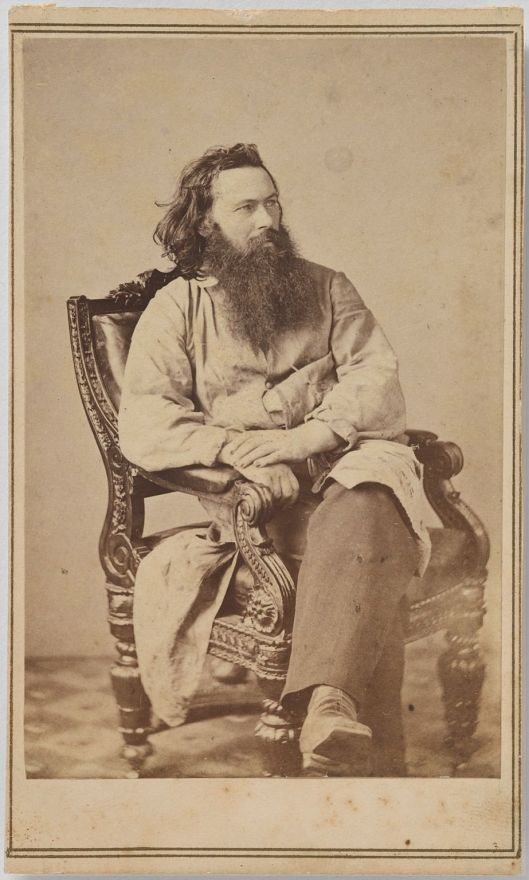
but in the US by Alexander Gardner, in the fall of 1862.

alexandergardner.jpg

Previous images of war had tended towards the glorious, full of bravery and flags, as in this engraving made from Alonzo Chappel’s painting of the taking of the Canadian Fort George in 1813—

alonzochappellftgeorge.jpg

Even if the depiction tended to be more realistic, it came heavily filtered. During the American Civil War, several northern newspapers and magazines sent artists into the field, who drew what they saw or at least heard about from those who had seen events. One of the best was the Englishman, Alfred Waud.

alfredwaud.jpg

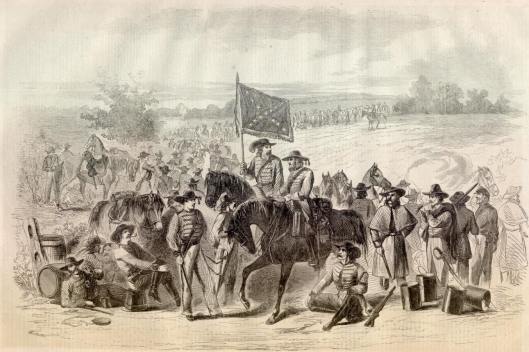
He drew from life, as in the picture of the First Virginia Cavalry, with whom he spent a brief time in late September, 1862. Here’s his original drawing, which he would have sent to his publisher, in New York.

the-first-virginia-cavalry-at-a-halt-alfred-r-waud.jpg

In New York, the drawing would have been turned into a woodblock print for ease of conversion to a magazine page.

1st-virginia-cavalry-halted-based-on-sketch-by-waud-harpers-sept-27-1862.jpg

And, thus, the reading public would have lost immediacy practically at the first step.


Photographs had been made in the US since the 1840s, and even some during the Mexican-American War of 1846-8, but they had been static pictures of soldiers off the battlefield.

wool-in-saltillo.jpg

In September, 1862, however, Gardner had been sent by his boss, Matthew Brady

Mathew-Brady.jpg

from the studio in Washington, DC, to the field of the recent battle of Antietam, which had been fought only two days before. Gardner came with his photographic wagon

brady'swhatsit.jpg

and ranged the battlefield. The battle was over, but the dead were still in place, where they had fallen, and soon he had a collection of images. Because there was already a tradition of photographing the dead (and, no, we’re not going to continue this practice here—just do google.images “photos of dead victorians” or the like and you can see this for yourself), it was probably not quite so horrifying as one might imagine, but those who saw the exhibit in Brady’s New York gallery

brady'snygallery.jpg

might have agreed with the New York Times review of 20 October, 1862, that “Mr. Brady has done something to bring home to us the terrible reality and earnestness of war.”

Gardner didn’t take the pictures he did out of a morbid interest, but because the cameras of the day were large and cumbersome

banner-civil-war-photography.jpg

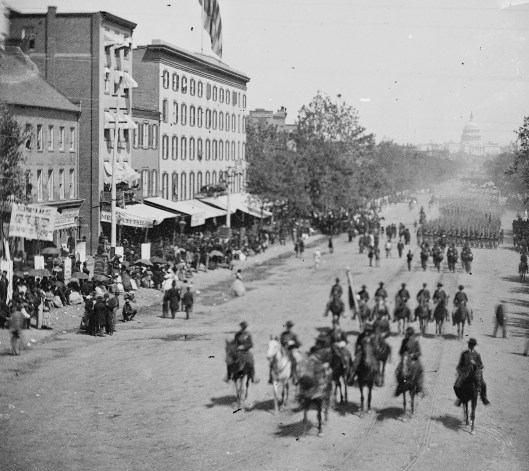
and the process necessary to make a picture took too long to capture motion (just look what happens when there is motion).

Grand Review of Army May 1865 02796u.jpg

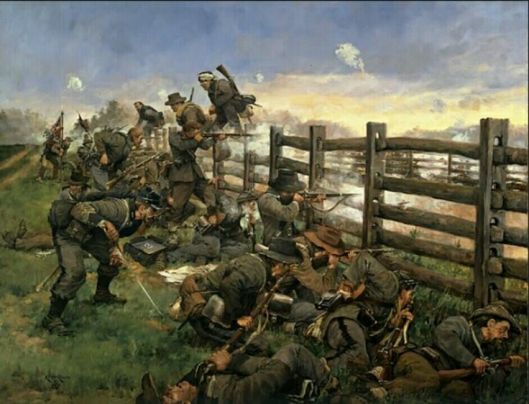
Thus, what one might see in a painting, even if it had attempted to depict reality, as in this Keith Rocco painting of a moment in the battle of Antietam when Confederates were fighting behind a fence on the Hagerstown Road,

keithroccohagerstownroad.jpg

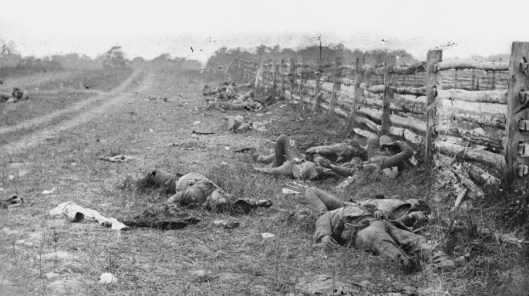
was impossible to capture. What Gardner could capture was the aftermath. And so he did.

hith-battle-of-antietam-E.jpeg


For us, who are modern Rohirrim, as far as horses are concerned, it’s just as well that he confined himself to humans. After Gettysburg, several other photographers included them—only a few photos, but representing anywhere from 3 to 5000 horses and mules who died during the three days of battle. (And, no, again, we won’t show you those—google.images will, but we’re not sure what’s harder to look at.)

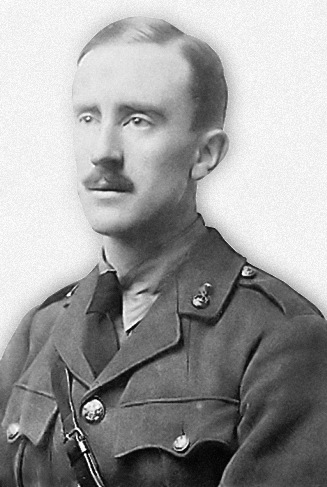
Lieutenant Tolkien

jrrtaslieut.jpg

would have seen such horrors every day during the battle of the Somme

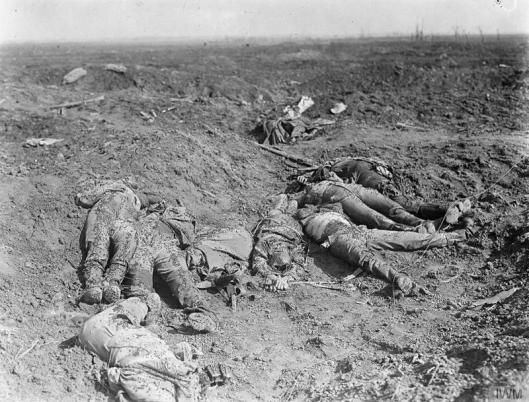
sommedead.jpg

and perhaps that’s why he moves so quickly from the battlefield to the city and healing. Perhaps it’s also why the view we are given of the GEF is through the eyes of a wounded survivor and, at this moment in the story, one full of foreboding at the thought of another battle. And it may be that Peter Jackson felt the same way.

West_To_Mordor.jpg

What do you think, dear readers?

Thanks, as always, for reading.

MTCIDC

CD


PS

Our title is taken from the work one of our favorite Great War poets, Wilfred Owen (1893-1918), who, having survived the entire war, was killed just before the armistice which halted the fighting.

wilfredowenaschild
wilfredowen

Feudal Array 1

20 Wednesday Jan 2016

Posted by Ollamh in Artists and Illustrators, Economics in Middle-earth, Fairy Tales and Myths, Imaginary History, J.R.R. Tolkien, Literary History, Military History, Military History of Middle-earth, Narrative Methods

≈ Leave a comment

Tags

Anglo-Saxon, Bayeux Tapestry, Embroidery, feudalism, Medieval, Middle-earth, Normandy, Peter Jackson, Rohirrim, tapestry, The Lord of the Rings, Tolkien

Welcome, as always, dear readers.

In this posting, we would like to continue what we began in “Behind the Rammas Echor”. In that posting, we talked about using the illustrations from medieval English psalters (the wonderful 14th-century Luttrell Psalter in particular) to try to visualize the feudal world suggested by certain aspects of Tolkien’s The Lord of the Rings.

In that posting, we said that feudalism could be broken down into two big categories, land and troops, and there we spent time looking at basic agricultural life, to imagine the look of the feudal world of Middle Earth.

Now we move on to troops. And, as much as we can, we would like to continue to use medieval images to help us.

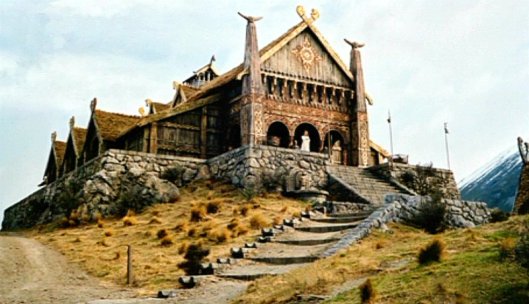
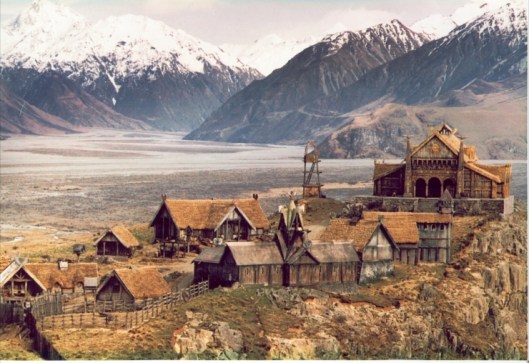
In previous posts, we’ve praised Jackson’s depiction of the Rohirrim, both the architecture and the people. Edoras and Meduseld within it just look right—and, when you watch the material on constructing them in the extended version box set, we can only be absolutely bowled over by the care taken there, for all that we have difficulties with certain other parts of the films, both in look and in the changes to the text.

Edoras-MtSunday.jpg

meduseld.jpg

rohirrimmassed.jpg

In one previous post, we suggested the kinds of models we both know and imagine Tolkien used to create the Rohirrim. These were primarily Anglo-Saxon, but combined with a horse people (which the Anglo-Saxons were not) of some sort, possibly Scythian (an Indo-European-speaking horse folk from north of the Black Sea).

ScythianCavalry.jpg

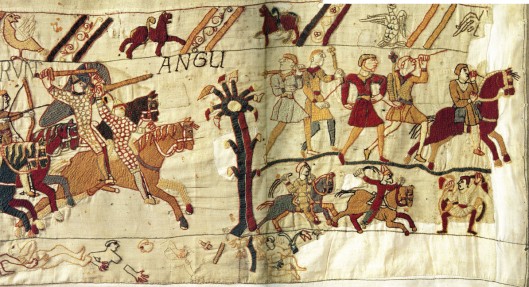
As we’ve thought more about it (one, for us, of the great pleasures of solid adventure literature, new and old—is that you not only want to think more about it, but, as you do, you find more in it), we began to imagine that Tolkien might have had another visual source, based upon another famous set of medieval illustrations, the Bayeux Tapestry.

This is a roll of linen, some 230 feet (that’s about 70 metres) long and 20 inches (50 centimetres) high, into which are woven three bands of designs. The center is a long (very long!) series of adjoining panels covered in human figures, which have been stitched on with various colored woolen threads. Above and below the central band are two narrower ones which combine abstract figures (commonly on the upper panel) with human activities (on the lower one). Across the top of the central band are a series of captions in very simple Latin, describing what is happening below.

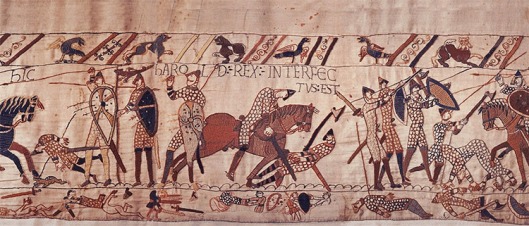
haroldkilled.jpg

The caption here reads: “Here Harold the king has been killed.”

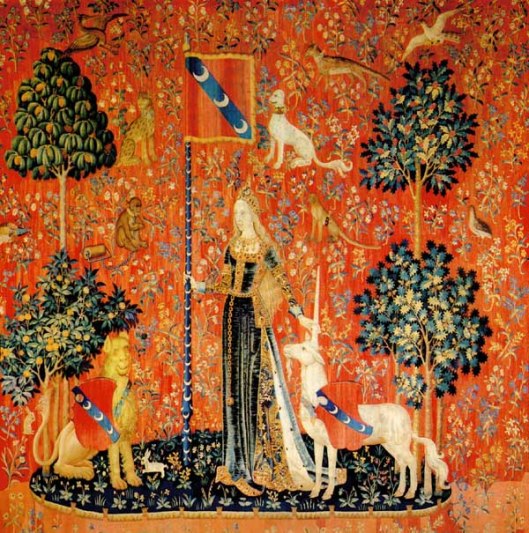
As it’s not through-woven, like this—

unicorn3.jpg

this isn’t really a tapestry, but an embroidery, in fact.

106604.gif

makingthebt.jpg

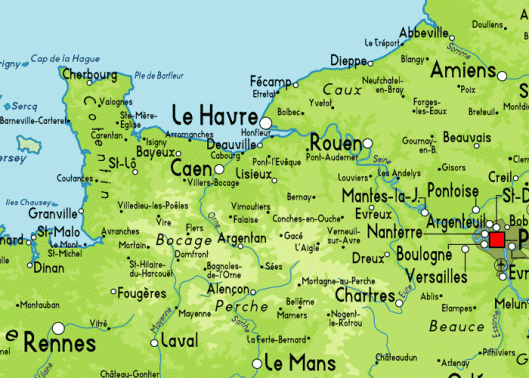
It’s linked to the cathedral at Bayeux, in Normandy, where it has been for at least 6 centuries. On the map, find Le Havre and look left and you’ll see Bayeux.

normandy_map_phys.gif

bayeux_cathedral.jpg

Where it really came from and who made it are two of those mysteries that it’s been fun to follow the scholarship of, but, as of 2015, there are lots of theories, some of them more convincing than others, but that’s all there are: theories. If you’d like to know more about them, go to: www.bayeux-tapestry.org.uk/whomadethetapestry.htm.

The tapestry is housed in an impressive museum in Bayeux, where its entire length is ingeniously displayed in a sort of wrap-around way.

The-Bayeux-Tapestry-Museum-1019.jpg

Bayeux-Tapestry-1_131941101594170.jpg

We’ve given you lots of facts, but the one thing we haven’t mentioned is the subject of such an immense work. It is, in fact, a lengthy piece of propaganda justifying the Norman invasion and conquest of England in 1066AD. We know, then, one definite thing about it: it certainly wasn’t embroidered for the Anglo-Saxons! (Although there is at least one theory that it was made by them.)
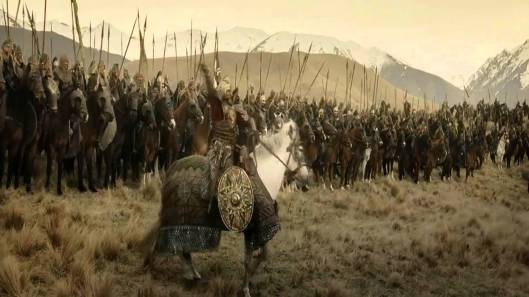
As much as we are interested in the subject, what has caught our attention now is the look—here are soldiers from the same period as the Anglo-Saxon model for the Rohirrim, after all, but, although archers are depicted on the Norman side, and a few infantry, the Normans are mainly shown as horsemen.

WebPage-ImageF.00070.jpeg

Here is our first sight of the Rohirrim in The Two Towers, Chapter 2, “The Riders of Rohan”:

“Their horses were of great stature, strong and clean-limbed; their grey coats glistened, their long tails flowed in the wind, their manes were braided on their proud necks. The Men that rode them matched them well: tall and long-limbed; their hair, flaxen-pale, flowed under their light helms, and streamed in long braids behind them; their faces were stern and keen. In their hands were tall spears of ash, painted shields were slung at their backs, long swords were at their belts, their burnished shirts of mail hung down upon their knees.”

05bayeux.jpg

Minus the grey horses and the braids, what do you think, dear readers?


As ever, thanks for reading.

CD

MTCIDC


PS

That MTC will be Feudal Array.2, in which we consider the other forces opposing Mordor…


Plot or Blot?

23 Wednesday Dec 2015

Posted by Ollamh in Fairy Tales and Myths, Films and Music, J.R.R. Tolkien, Narrative Methods, Uncategorized

≈ Leave a comment

Tags

Adventure, An Unexpected Journey, Eagles, Gandalf, Gwaihir, His Dark Materials, Iofur Rakinson, Isengard, Manwe, Middle-earth, Mirkwood, Moth, Ornthanc, Peter Jackson, Philip Pullman, Radagast, Rohirrim, Saruman, Svalbard, The Battle of the Five Armies, The Council of Elrond, The eagles are coming, The Fellowship of the Ring, The Golden Compass, The Hobbit, The Lord of the Rings, The Return of the King, Tolkien, Wizard

Dear Readers,

Welcome, as always.

This posting is about a puzzle. Recently, while visiting Orthanc to write about Saruman, we bumped into the problem of how Gandalf escaped from there. Our memory was a little unclear about this—we knew that Gwaihir swooped down to rescue him, but why was Gwaihir there in the first place?

Eagles had appeared twice before in our experience of Gandalf, first when they rescued him and his companions from the goblins and Wargs in Chapter 6 of The Hobbit, “Out of the Frying-Pan into the Fire”. Here, the Lord of the Eagles hears the commotion as the Wargs struggle to overcome Gandalf’s fire magic and, gathering up some of his people, flies down to investigate.

6a00d8341dd88553ef015436529d30970c-pi.jpg

Something similar happens at the Battle of the Five Armies, explained in Chapter 18, “The Return Journey”:

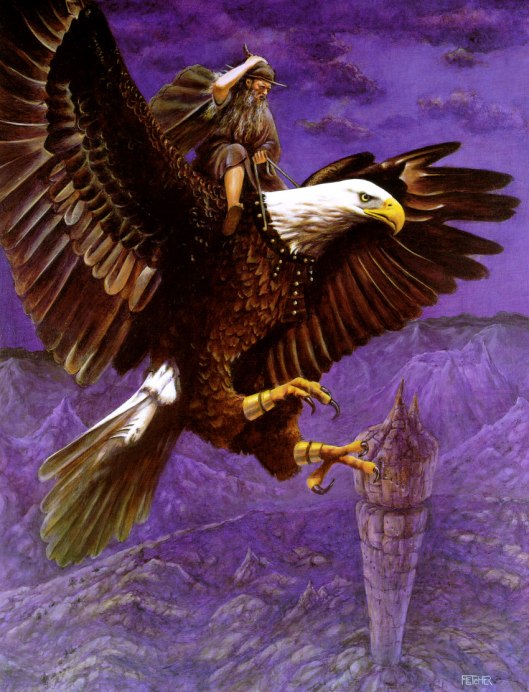
“The Eagles had long had suspicion of the goblins’ mustering; from their watchfulness the movements in the mountains could not be altogether hid.” Thus, they appear self-bid, but, as they are ancient creatures, first made by Manwe and given the role of watchers from the time of the First Age, it’s not surprising that they would act as they did.

Battle of the Five Armies_Final Complete.jpg

In Jackson’s An Unexpected Journey and, again, in his The Fellowship of the Ring, an eagle appears after Gandalf has had a heart-to-heart with a moth.

gandmothhob.pngGandalf+moth.png

With a moth? We asked ourselves. We scratched our heads and wondered: does JRRT use a moth? And, if so, where did the moth come from?

In fact, what really happens is a very neatly constructed piece of plotting on the part of the author, all of which is very nicely laid out in a couple of pages of “The Council of Elrond” during Gandalf’s long narrative.

  1. Gandalf meets Radagast—who is identified, among other talents, as one for whom “birds are especially his friends”—and who says that, if Gandalf needs help with the Black Riders, he needs to apply to Saruman immediately.
  2. In return, Gandalf says to Radagast, “We shall need your help, and the help of all things that will give it. Send out messages to all the beasts and birds that are your friends. Tell them to bring news of anything that bears on this matter to Saruman and Gandalf. Let messages be sent to Orthanc.”
  3. Gandalf goes to Orthanc and, rejecting Saruman’s offer, is imprisoned at its top.
  4. Then, that which was set up in 1 and 2 comes to fruition:

“That was the undoing of Saruman’s plot. For Radagast knew no reason why he should not do as I asked; and he rode away towards Mirkwood where he had many friends of old. And the Eagles of the Mountains went far and wide, and they saw many things…And they sent a messenger to bring these tidings to me.

So it was that when summer waned, there came a night of moon, and Gwaihir the Windlord, swiftest of the Great Eagles, came unlooked-for to Orthanc; and he found me standing on the pinnacle. Then I spoke to him and he bore me away, before Saruman was aware.”

escape.jpg

Although we have solved the puzzle of Gandalf’s escape, we have no answer to why this natural and even elegant piece of plotting wasn’t used in the film any more than we understand why Radagast is turned into the horrible, clownish figure he is in the Hobbit films, having been described in “The Council of Elrond” simply as “a worthy Wizard, a master of shapes and changes of hue; and he has much lore of herbs and beasts, and birds are especially his friends.” And someone who could never be corrupted by Saruman, which is really, we think, why Saruman calls him a fool.

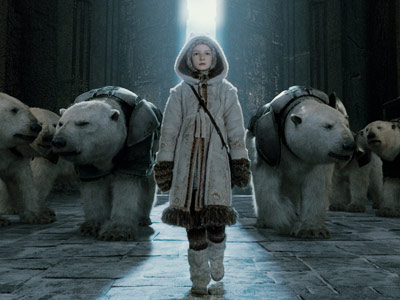
In an earlier posting, we suggested that Saruman, in his desire to ape Sauron, had created, in Isenguard, a mini-Mordor, just as Iofur Raknison, in Philip Pullman’s The Golden Compass, has turned Svalbard into a shabby ursine mockery of a human palace.

lyrasvalbard.jpg

We also suggested that the creators of the Tolkien-derived films, when they began to veer as far from the text as they appeared increasingly to do in the Hobbit films, had become a bit like Saruman themselves, and, like his master, “cannot make real new things of [their] own…” We hesitate to add this, but, could it be that, as in the case of the orcs, they “only ruined them and twisted them…”? (The Return of the King, “The Stairs of Cirith Ungol”). After all, instead of easy plot lines, we have moths, and, in place of worthy, incorruptible wizards, we have gross clowns.

We are reluctant to end on a negative note, however. After all, just as there are the Rohirrim in The Lord of the Rings films, there are those wonderful eagles at the end of An Unexpected Journey, so why not end with them?

taking-fan-theories-to-a-next-level-the-eagles-are-coming-434375.jpg

Thanks, as ever, for reading.

MTCIDC

CD

PS

If you don’t know Pullman’s His Dark Materials series, we very much recommend them—but with this proviso: in the first and second volumes (The Golden Compass, The Subtle Knife), Pullman’s antagonism towards organized religion is channeled into the “Magisterium”, a believable villainous organization in the world which he has so meticulously and powerfully created. In the third volume (The Amber Spyglass), we feel that that antagonism becomes all-too-apparent and it causes that volume—in our opinion—to lack the more human element and focus of the first two volumes. The first volume can certainly be read on its own and perhaps it says something about the trilogy as a whole that a planned project for filming all three books was eventually cut to a single film of the first book. We recommend this film, as well, but suggest that you read The Golden Compass before you see it.

Charge! The End?

14 Wednesday Oct 2015

Posted by Ollamh in Films and Music, J.R.R. Tolkien, Military History, Military History of Middle-earth

≈ Leave a comment

Tags

Adventure, Bataclava, Bigelow, British, British Heavy Brigade, Cavalry, Cawnpore, Charges, Chasseurs d'Afrique, Crimean War, French, Funckens, Gandalf, Helm's Deep, John Ford, Minas Tirith, Oliphaunts, Prussian, Remington, Rohirrim, Rossbach, Russian, Schreyvogel, seige, Stagecoach, surreneder, The Charge of the Light Brigade, The Lord of the Rings, Tolkien, Trostle Farm, Warhorse, Waterloo, Western, William Simpson

Dear Readers,

Welcome, as always.

In our last, we were discussing film music, where it comes from and what it does. This brought us, as always, it seems, back to JRRT. In that post, we talked about the “Shire theme”. In this, we want to talk not about a theme, but about a scene, one we have mentioned before, the charge of the Rohirrim and the attempted raising of the siege of Minas Tirith.

gondorattacked rohirrimformup

Although, strictly speaking, what is happening to Minas Tirith is simply a frontal assault, not a siege in the classic sense. Although, seen in this illustration (by the wonderful husband and wife team of the Funckens), they may look the same—

funckenssiegeupclose

in a formal siege, you surround a town/fortress

siegediggingin

call on the place to surrender

The-Entrance-Into-Belfort-Of-The-German-Commander-Bearing-The-Flag-Of-Truce-4th-November-1870-1884

use your heavy weapons to bombard the place

catapault42cm

Drive the defenders back from their outer works

William Simpson - The Attack on the Malakoff 1855

And then call upon the defenders to surrender—which, often they do (fewer Alamos than myth would tell you)

surrender4

But, if not, a final—usually costly—attackSiege_of_Badajoz,_by_Richard_Caton_Woodville_Jr

march6

and, potentially, the massacre of all—or at least all of the garrison–inside. (In Jackson’s LoTR, the Orcs are certainly not taking prisoners as they break into Minas Tirith).

The charge of the Rohirrim, though, brought to mind other charges, such as the charge of the Prussian cavalry against the French/Allied army at Rossbach, in 1757—

Schlacht_bei_Roßbach1

or the French and British cavalry charges at Waterloo, 1815—

cavwaterloo1 ChargeofthelightBrigade

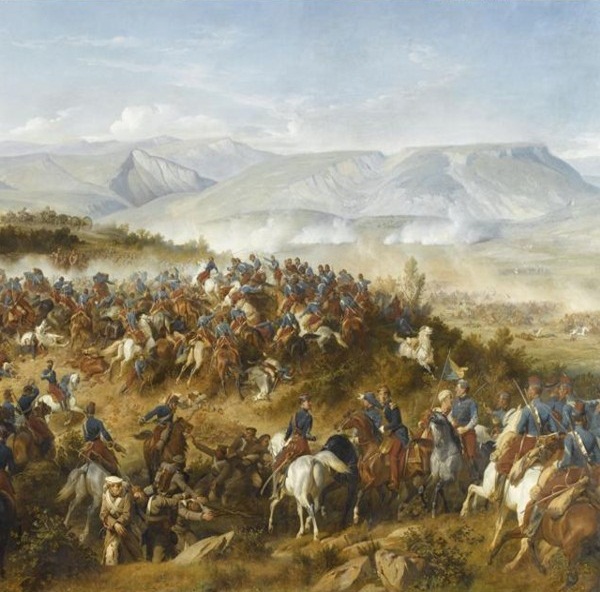
or those _other_ charges at the battle of Balaclava, 1854, that of the French 4th Chasseurs d’Afrique

Chasseurs_d'Afrique_à_Balaclava

or of the British Heavy Brigade, which drove the Russian cavalry from the British camp.

balaclava-scots-greys-1200

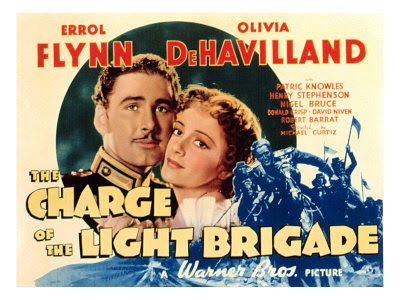
Those last two remind us, of course, of one of our favorite adventure movies, the 1936 The Charge of the Light Brigade

charge1

It is not so authentic in look as the 1968 movie of the same name,

Charge+of+the+Light+Brigade+movie+poster+2

and, in fact, the film states at its opening that it’s only loosely based on actual historical events (including not only the charge, but the 1857 massacre at Cawnpore—which, in reality, occurred some three years after the Crimean War battle). It also beefs up the Russian defense—adding non-existent earthworks, for instance. Here’s the movie’s view

1225664651_the-charge-of-the-light-brigade_00016

and here’s William Simpson’s near-contemporary illustration (Simpson arrived after the battle, but must have talked to survivors and certainly could have seen the terrain).

William_Simpson_-_Charge_of_the_light_cavalry_brigade,_25th_Oct._1854,_under_Major_General_the_Earl_of_Cardigan

All of these charges were directed at enemy forces on an open battlefield. The attack of the Rohirrim actually comes from a different scenario, one which is based upon a theme familiar to those who have seen American westerns: the arrival of the cavalry in the nick of time.

In this scenario, someone is trapped and surrounded—or at least persistently assaulted by a more numerous enemy—the classic is an attack upon circled wagons

frontier-wagon-circle

The crisis comes and it looks like those attacked are about to be overwhelmed

wagon-box-fight-1867-granger

but, at the last minute, help arrives—the cavalry, bugles sounding, guidons waving (although that illustrated in this vidcap is the 1885 pattern and the film from which this comes takes place in 1880—then again, the uniforms are a bit odd, too—here’s Remington’s and Schreyvogel’s more accurate views, as well) rides fearlessly to the rescue.

Stagecoach_216Pyxurz SCHREYVOGEL_Charles_Cavalry_Charge_1905_Wadsworth_Athenaeum_source_Sandstead_d2h_ remingtoncav

After sorting through more than 50 westerns, we believe that the movie from which our first image comes is probably the source of the modern idea of the arrival of the cavalry—see this clip from John Ford’s Stagecoach (1939)

CLIP

This happens twice, of course, in The Lord of the Rings, first at Helm’s deep, when Gandalf arrives—

helms-deep gandalfarrives

and again, as we began, at Minas Tirith. It’s interesting, however, to see that, in this second example, the cavalry rescue is not so successful, since there are those oliphaunts we discussed in an earlier posting—

mumakil_by_cg_warrior-d4muefu

In our world, it wasn’t giant oliphaunts who eventually defeated cavalry and drove them to the edges of the battlefield, where they lasted a little longer, but this

maximwarhorse

as you can see in this clip from Warhorse.

CLIP

And it’s for the best, really. It’s bad enough that we humans engage in violent actions without dragging the rest of the animal kingdom into it…

trostle-farm

(A few of the 80 horses lost by Bigelow’s 9th MA Battery at the Trostle Farm, 2 July, 1863—and, as a sad ps, 25 horses were killed or so badly injured that they were put down at the filming of the 1936 The Charge of the Light Brigade—this so shocked those in Congress that a law for the protection of animals in films was passed to prevent future harm).

Thanks, as always, for reading.

MTCIDC

CD

The Two Sieges

22 Wednesday Jul 2015

Posted by Ollamh in Heroes, J.R.R. Tolkien, Military History

≈ Leave a comment

Tags

Agincourt, Aragorn, English Longbowmen, Faramir, French Knights, Gondor, Grond, Hoth, Jan Sobieski, Lithuania, Minas Tirith, Mumakil, Nazgul, Orcs, Ottoman, Peter Jackson, Poland, Rammas Echor, Rohan, Rohirrim, Siege Towers, Stone Throwers, The Lord of the Rings, Tolkien, Vienna, Winged Hussars

Welcome, as always, dear readers!

In this posting, we’re going to make another suggestion about a model for something in Tolkien’s work.

If you read us regularly, you know that our favorite part of P. Jackson’s The Lord of the Rings is anything to do with the Rohirrim. When we rewatch favorite scenes, the charge against the Orcs outside Minas Tirith is always first on our list (and high on our general list of cavalry charges—more on those in a future posting).

First, we see that massive Orc army marching up to the walls. (In the book, this is more dramatic: the Orcs blow two holes in the Rammas Echor, outflank the defenders, and drive them into retreat, which is where Faramir is badly wounded by an arrow.)

minas-tirith

Then they begin to attack with stone-throwers,

siege1

siege towers,

lotr-siege-towers

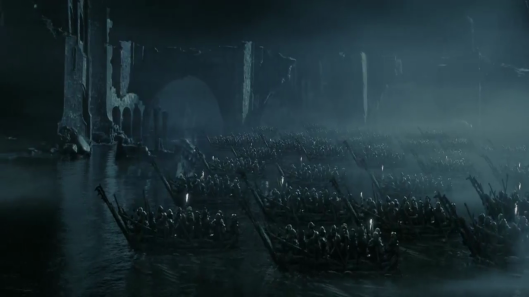
and, eventually a giant, flame-filled battering ram.

grond1

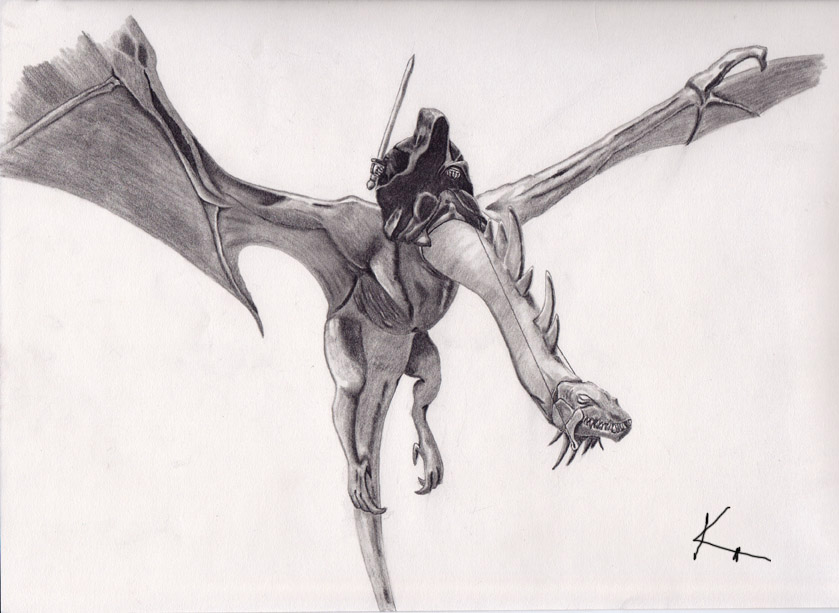
Things look increasingly desperate for Gondor as the Orcs press their attack, led by the Chief Nazgul.

witch_king_of_angmar_ii_by_dudeskindasketchy-d4d6uvd

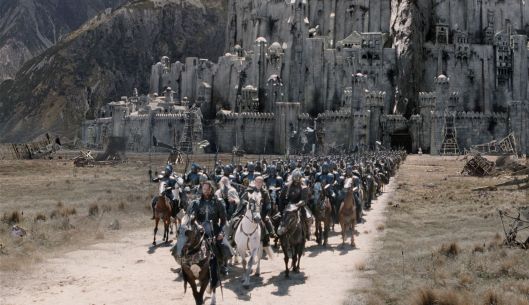
And that’s when the Rohirrim appear.

rohirrimabouttocharge

And move to strike the Orcs from behind.

Charge_rohirrim

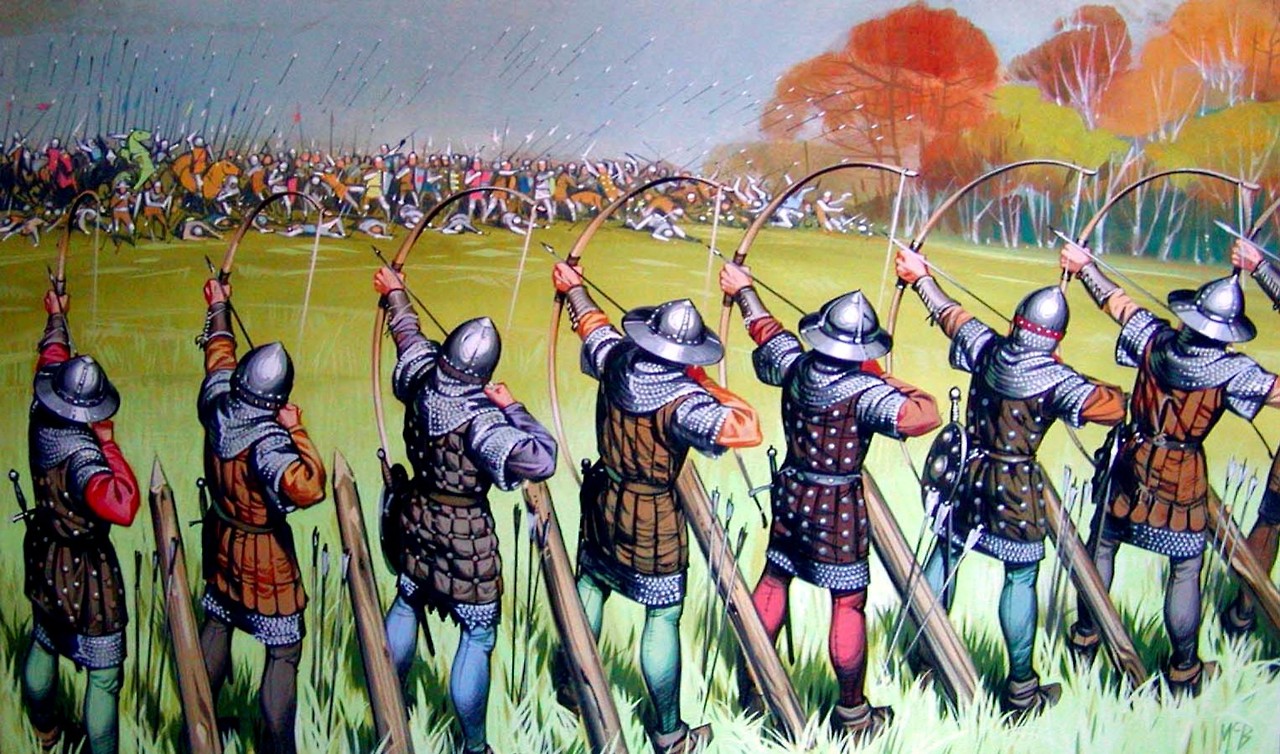
When the Orcs realize what’s happening, they try to stop the attack with bows.

archery

This immediately reminded us of the 1415 battle in which English longbowmen and their clever use defeated an army of brave French knights, Agincourt.

OLYMPUS DIGITAL CAMERA

Unlike Agincourt, however, arrows didn’t stop the Rohirrim, who sweep through the enemy—but are brought up short by the sight of a row of mumakil—giant war elephants—bearing down on them.

img-2845793-1-charge-1024x425

Seeing this scenario made us think of another attack by huge, lumbering things in a galaxy long ago and far away—

Battle_of_Hoth

The film goes on from there, including an attack by a ghost army, instead of by the actual forces brought from southern Gondor by Aragorn, but we want to back up a bit to the actual siege and another one which bears a strong resemblance to it.

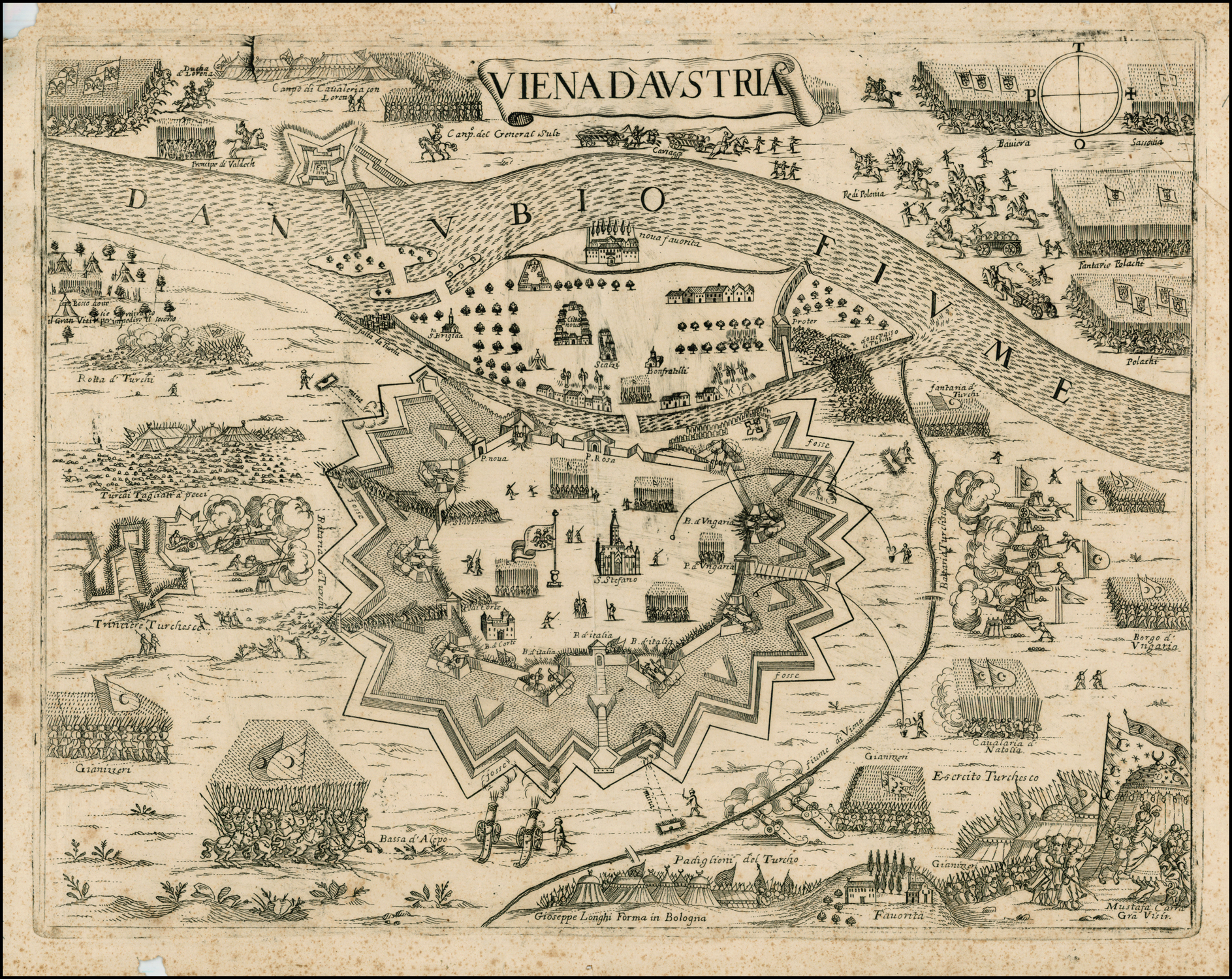
For centuries, the Ottoman Turks had been expanding their dominions.

Ottoman_Empire_Map_1359-1856

They had first reached Vienna in 1529,

Siegeofvienna1529

but had given up the siege. Now, however, in 1683, they were back.

Battle_of_Vienna_1683_map

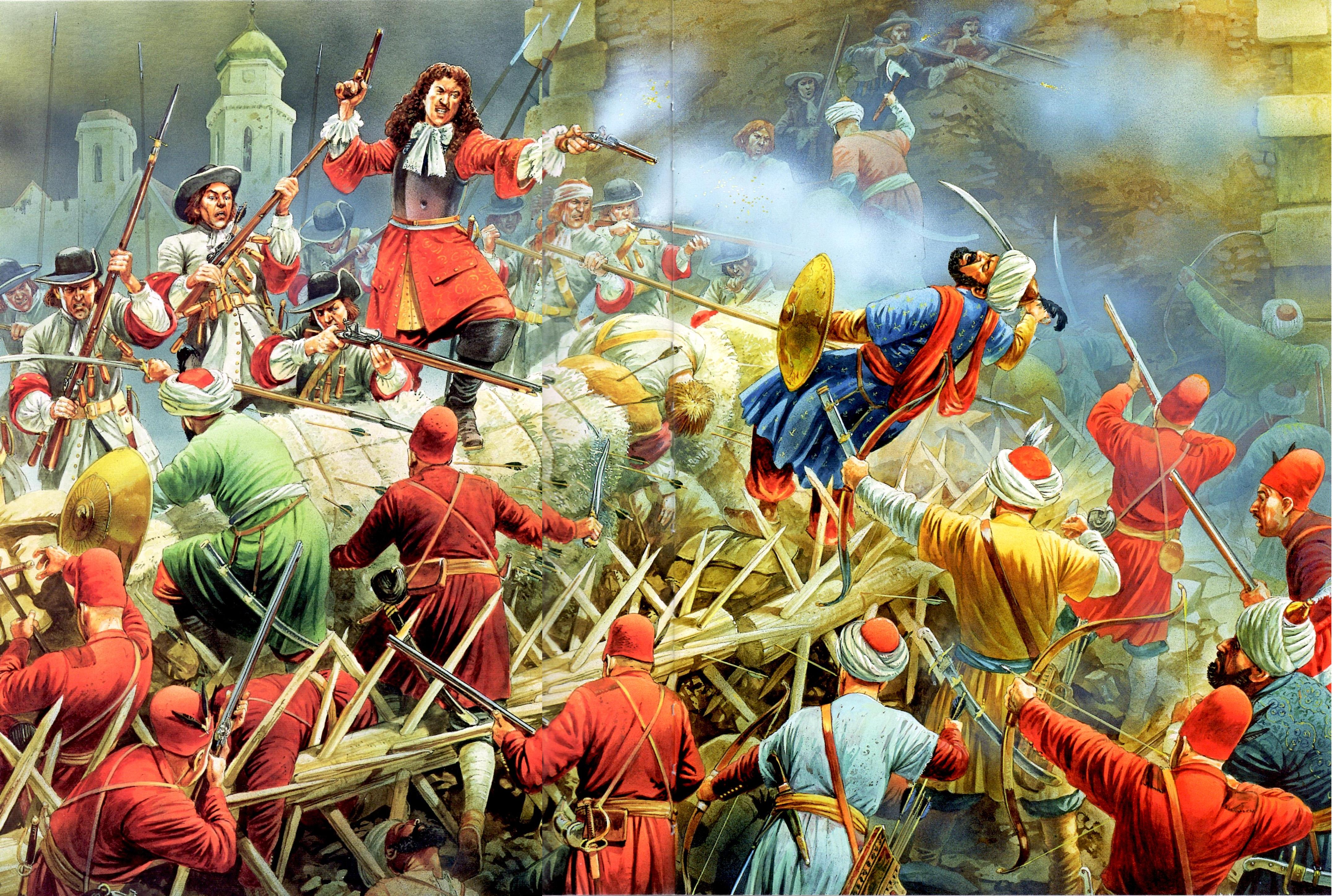
Their attacks against a dwindling number of defenders in a crumbling town

1-vienna-1683

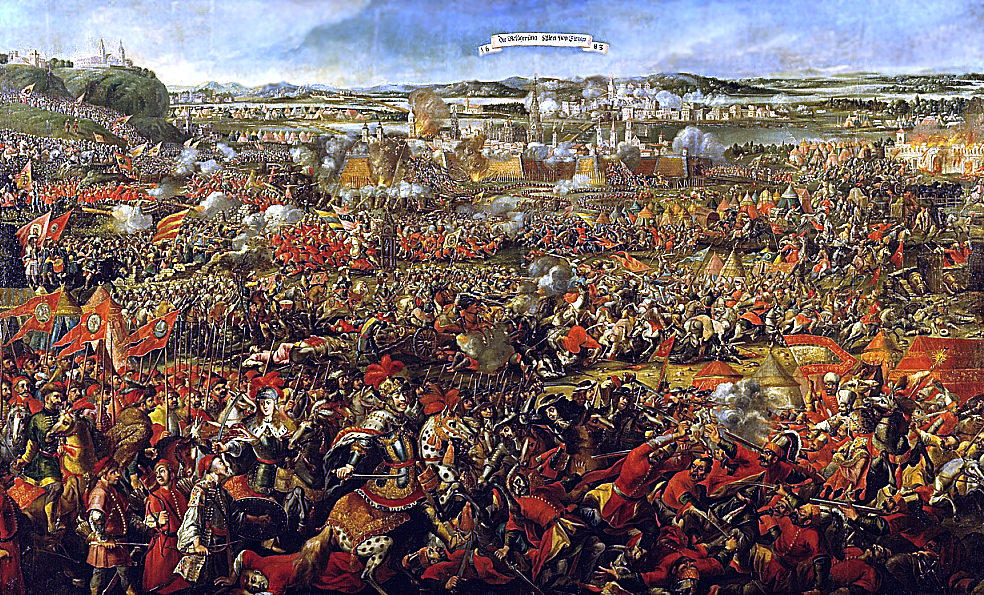
had brought them to the edge of conquest when an army of reenforcements, including cavalry from the army of the combined state of Lithuania/Poland, had appeared. Some of the cavalry were the famous Polish winged hussars.

Battle_of_Vienna_1

Just as the Rohirrim are led by their king, Theoden, so are the Poles led by their king Jan Sobieski—

bitwa-pod-wiedniem-obraz

The reenforcements, Poles in the lead, rush upon the Turks and drive them back through their camps and out of the siege entirely.

Atak_husarii

Battle_of_Vienna_1683_11

So similar, isn’t it? No giant war elephants, ghost armies, or Nazgul, but the basic elements of siege, relieving army with cavalry led by a king attacking an unprepared enemy, and chasing off the besiegers, is nearly identical.

Tolkien was an extremely well-read man, with a strong interest in history. Was the siege and relief of Vienna somewhere in the back of his mind when he began to plan the siege of Minas Tirith?

Thanks for reading!
MTCIDC

CD

← Older posts
Newer posts →

The Doubtful Sea Series Facebook Page

The Doubtful Sea Series Facebook Page

  • Ollamh

Categories

  • Artists and Illustrators
  • Economics in Middle-earth
  • Fairy Tales and Myths
  • Films and Music
  • Games
  • Heroes
  • Imaginary History
  • J.R.R. Tolkien
  • Language
  • Literary History
  • Maps
  • Medieval Russia
  • Military History
  • Military History of Middle-earth
  • Narnia
  • Narrative Methods
  • Poetry
  • Research
  • Star Wars
  • Terra Australis
  • The Rohirrim
  • Theatre and Performance
  • Tolkien
  • Uncategorized
  • Villains
  • Writing as Collaborators
Follow doubtfulsea on WordPress.com

Across the Doubtful Sea

Recent Postings

  • Through a glass… January 7, 2026
  • Heffalumps? December 31, 2025
  • We Three Kings December 24, 2025
  • A Moon disfigured December 17, 2025
  • On the Roads Again—Once More December 10, 2025
  • (Not) Crossing Bridges December 3, 2025
  • On the Road(s) Again—Again November 26, 2025
  • On the Road(s) Again November 19, 2025
  • To Bree (Part 2) November 12, 2025

Blog Statistics

  • 104,134 Views

Posting Archive

  • January 2026 (1)
  • December 2025 (5)
  • November 2025 (4)
  • October 2025 (5)
  • September 2025 (4)
  • August 2025 (4)
  • July 2025 (5)
  • June 2025 (4)
  • May 2025 (4)
  • April 2025 (5)
  • March 2025 (4)
  • February 2025 (4)
  • January 2025 (5)
  • December 2024 (4)
  • November 2024 (4)
  • October 2024 (5)
  • September 2024 (4)
  • August 2024 (4)
  • July 2024 (5)
  • June 2024 (4)
  • May 2024 (5)
  • April 2024 (4)
  • March 2024 (4)
  • February 2024 (4)
  • January 2024 (5)
  • December 2023 (4)
  • November 2023 (5)
  • October 2023 (4)
  • September 2023 (4)
  • August 2023 (5)
  • July 2023 (4)
  • June 2023 (4)
  • May 2023 (5)
  • April 2023 (4)
  • March 2023 (5)
  • February 2023 (4)
  • January 2023 (4)
  • December 2022 (4)
  • November 2022 (5)
  • October 2022 (4)
  • September 2022 (4)
  • August 2022 (5)
  • July 2022 (4)
  • June 2022 (5)
  • May 2022 (4)
  • April 2022 (4)
  • March 2022 (5)
  • February 2022 (4)
  • January 2022 (4)
  • December 2021 (5)
  • November 2021 (4)
  • October 2021 (4)
  • September 2021 (5)
  • August 2021 (4)
  • July 2021 (4)
  • June 2021 (5)
  • May 2021 (4)
  • April 2021 (4)
  • March 2021 (5)
  • February 2021 (4)
  • January 2021 (4)
  • December 2020 (5)
  • November 2020 (4)
  • October 2020 (4)
  • September 2020 (5)
  • August 2020 (4)
  • July 2020 (5)
  • June 2020 (4)
  • May 2020 (4)
  • April 2020 (5)
  • March 2020 (4)
  • February 2020 (4)
  • January 2020 (6)
  • December 2019 (4)
  • November 2019 (4)
  • October 2019 (5)
  • September 2019 (4)
  • August 2019 (4)
  • July 2019 (5)
  • June 2019 (4)
  • May 2019 (5)
  • April 2019 (4)
  • March 2019 (4)
  • February 2019 (4)
  • January 2019 (5)
  • December 2018 (4)
  • November 2018 (4)
  • October 2018 (5)
  • September 2018 (4)
  • August 2018 (5)
  • July 2018 (4)
  • June 2018 (4)
  • May 2018 (5)
  • April 2018 (4)
  • March 2018 (4)
  • February 2018 (4)
  • January 2018 (5)
  • December 2017 (4)
  • November 2017 (4)
  • October 2017 (4)
  • September 2017 (4)
  • August 2017 (5)
  • July 2017 (4)
  • June 2017 (4)
  • May 2017 (5)
  • April 2017 (4)
  • March 2017 (5)
  • February 2017 (4)
  • January 2017 (4)
  • December 2016 (4)
  • November 2016 (5)
  • October 2016 (6)
  • September 2016 (5)
  • August 2016 (5)
  • July 2016 (5)
  • June 2016 (5)
  • May 2016 (4)
  • April 2016 (4)
  • March 2016 (5)
  • February 2016 (4)
  • January 2016 (4)
  • December 2015 (5)
  • November 2015 (5)
  • October 2015 (4)
  • September 2015 (5)
  • August 2015 (4)
  • July 2015 (5)
  • June 2015 (5)
  • May 2015 (4)
  • April 2015 (3)
  • March 2015 (4)
  • February 2015 (4)
  • January 2015 (4)
  • December 2014 (5)
  • November 2014 (4)
  • October 2014 (6)
  • September 2014 (1)

Blog at WordPress.com.

  • Subscribe Subscribed
    • doubtfulsea
    • Join 78 other subscribers
    • Already have a WordPress.com account? Log in now.
    • doubtfulsea
    • Subscribe Subscribed
    • Sign up
    • Log in
    • Report this content
    • View site in Reader
    • Manage subscriptions
    • Collapse this bar
 

Loading Comments...