• About

doubtfulsea

~ adventure fantasy

Tag Archives: Goblins

Return to Horrors?

27 Wednesday Aug 2025

Posted by Ollamh in Uncategorized

≈ 1 Comment

Tags

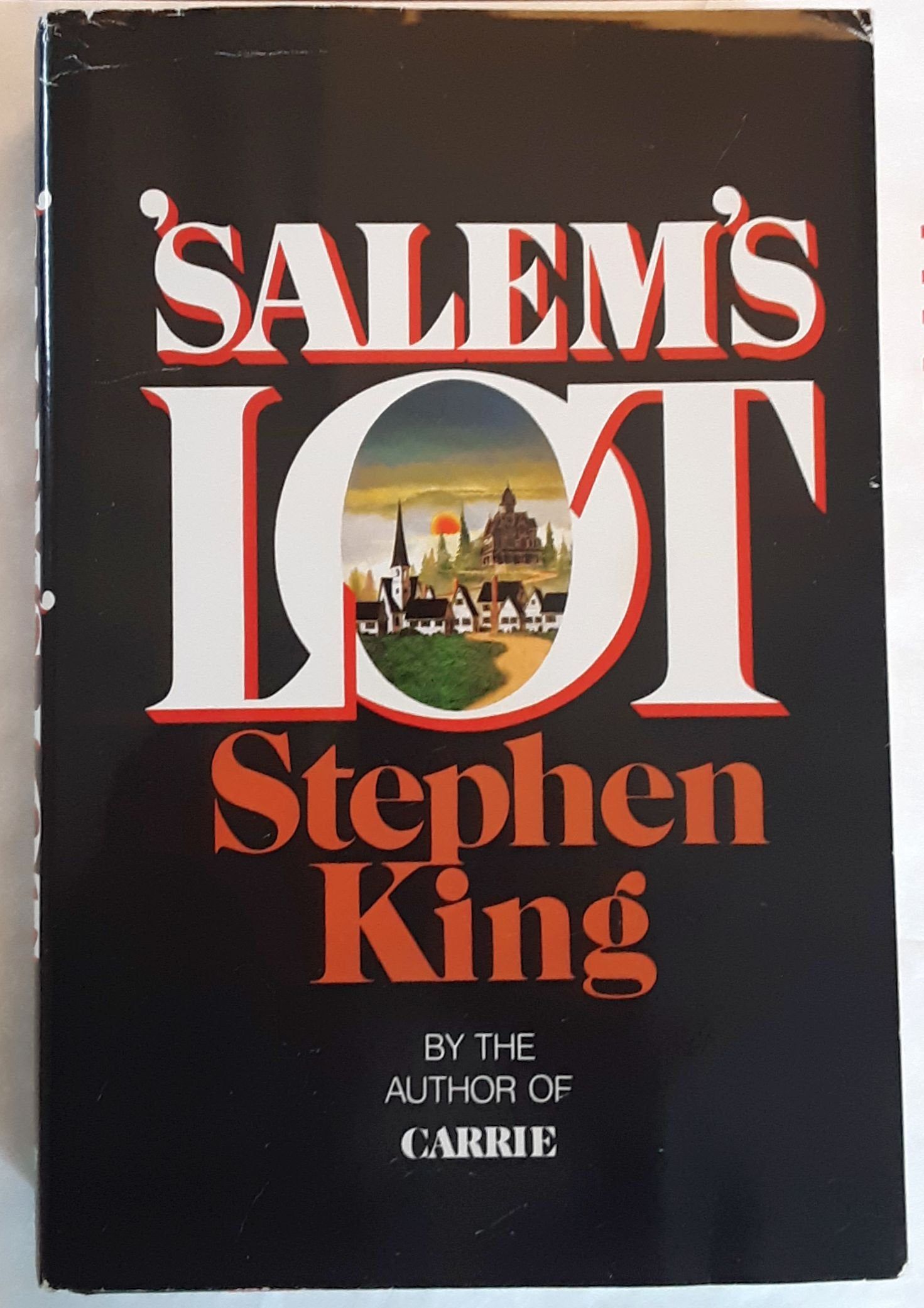
'Salem's Lot, Acrophobia, Arachnophobia, Billina, Claustrophobia, Coulrophobia, Dracula, ECT, Film, Goblins, Gump, Herpetophobia, jack-pumpkinhead, nome-king, Oz, Ozma of Oz, Return to Oz, Smaug, spiders, Stephen King, The Hobbit, The Marvelous Land of Oz, The Shining, Tik-Tok, Tolkien, trolls, Trypanophobia, Wheelers, wolves

Welcome, dear readers, as always.

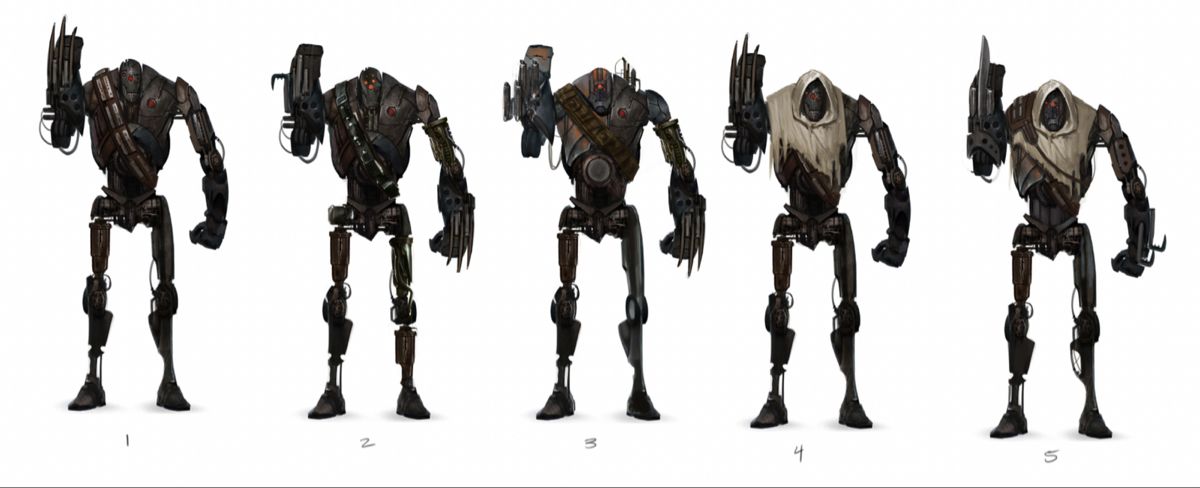
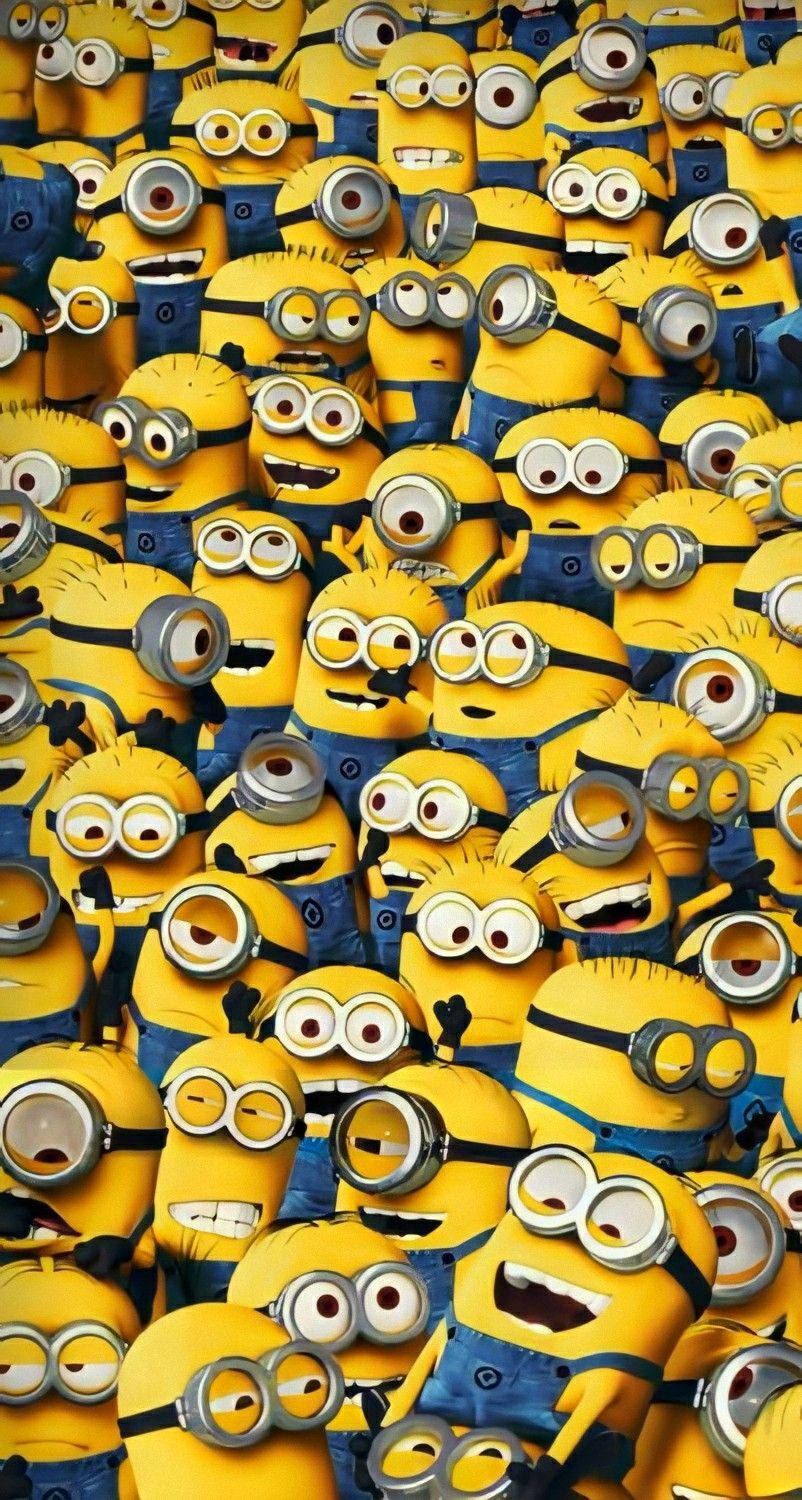
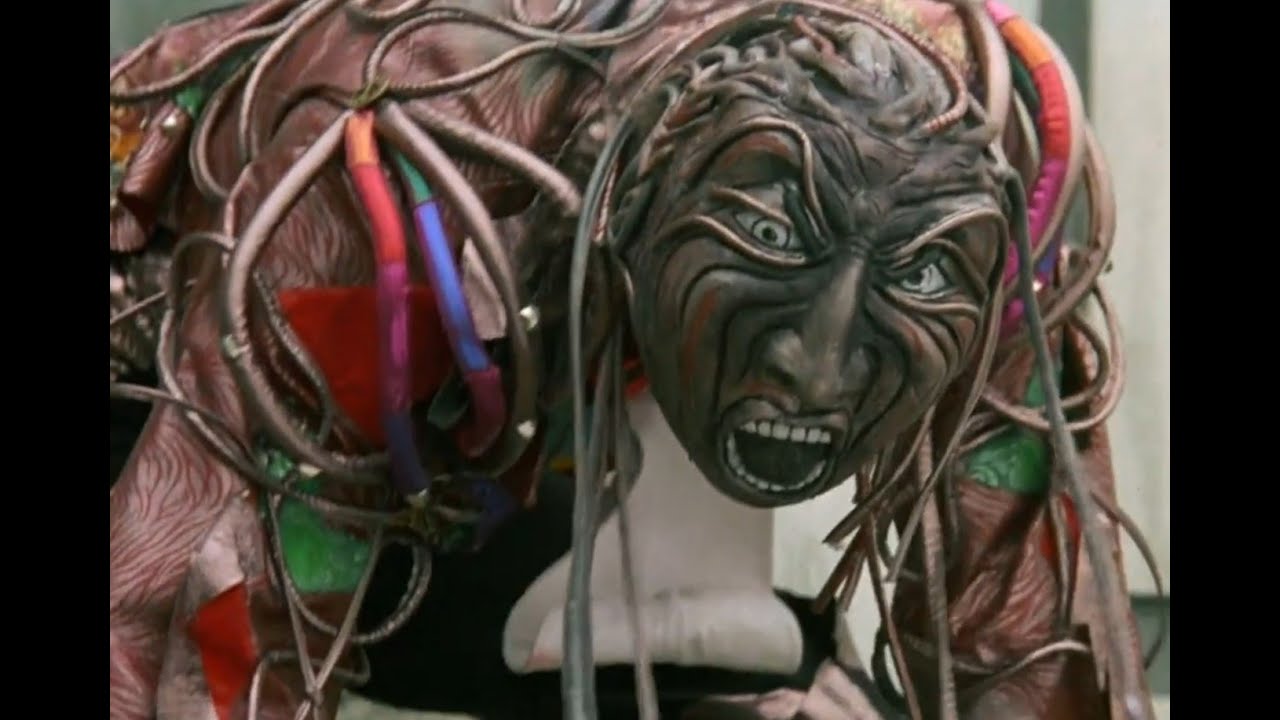
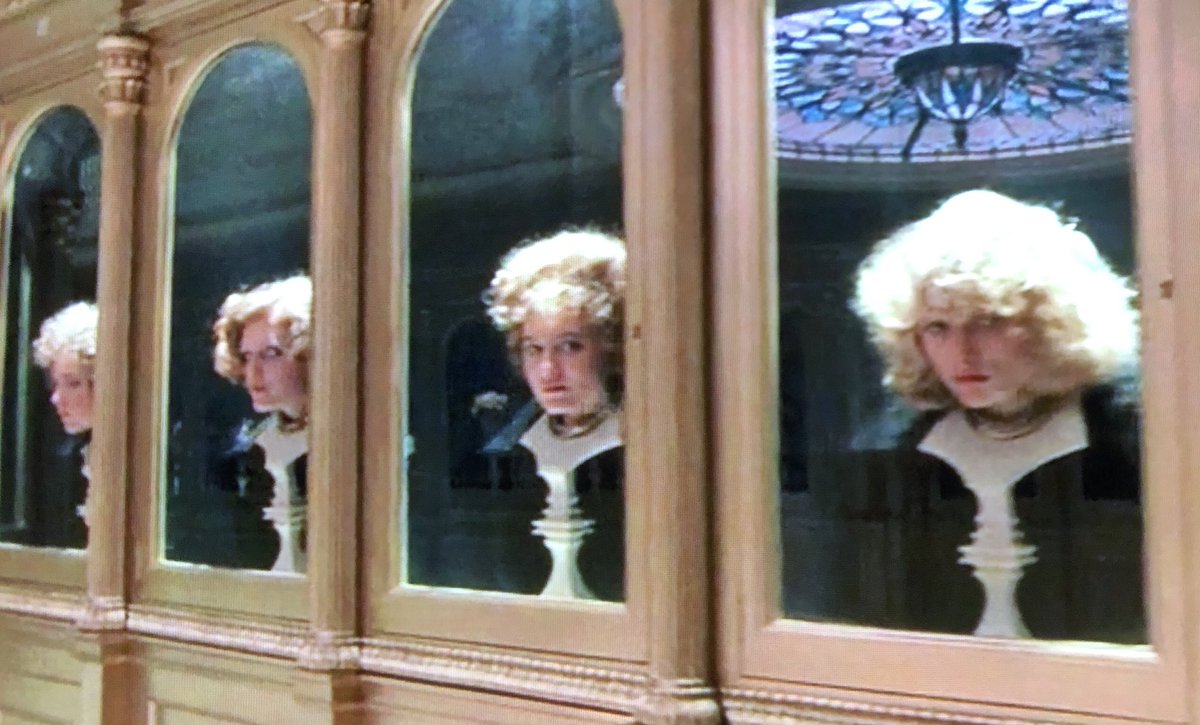
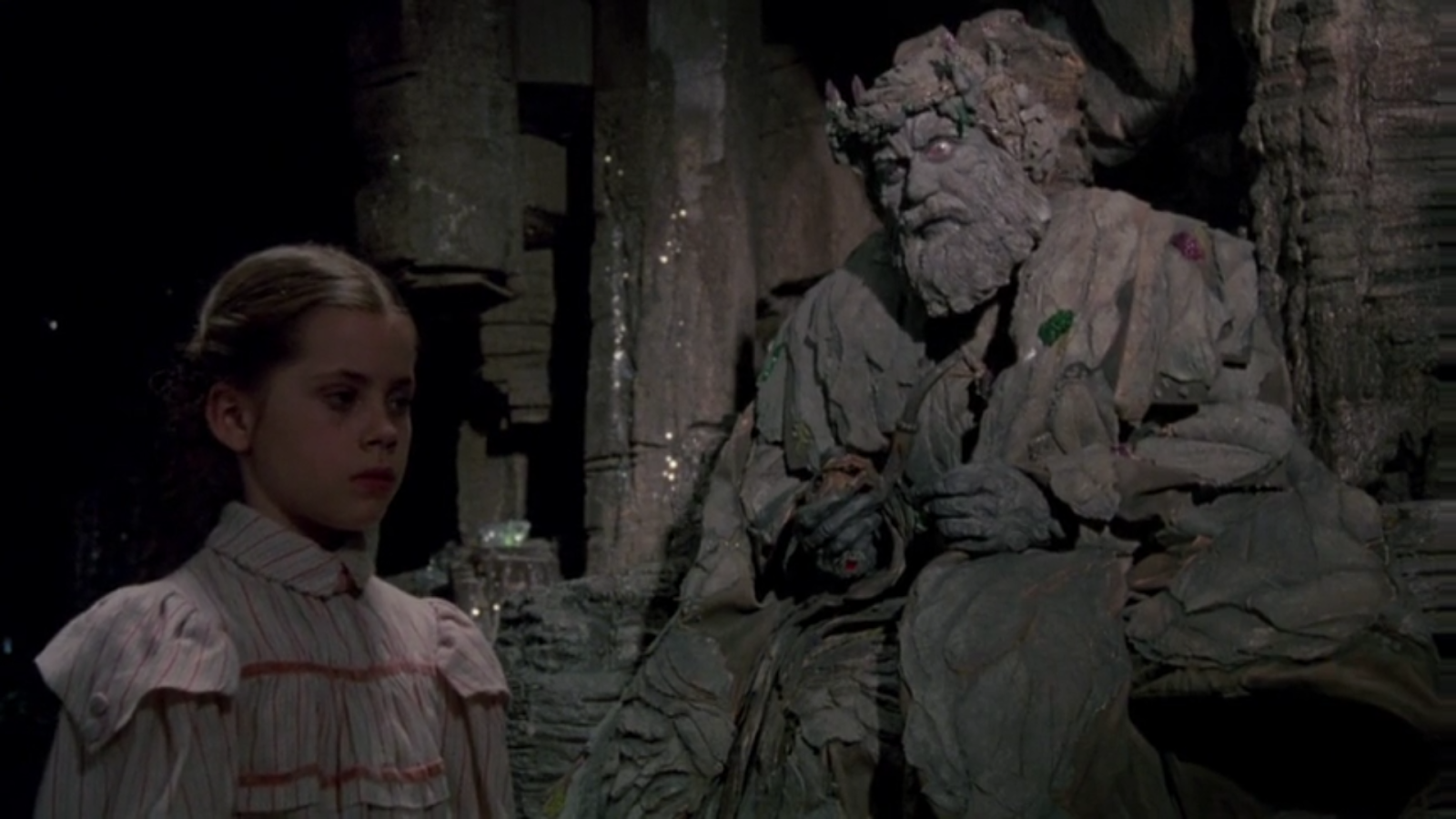
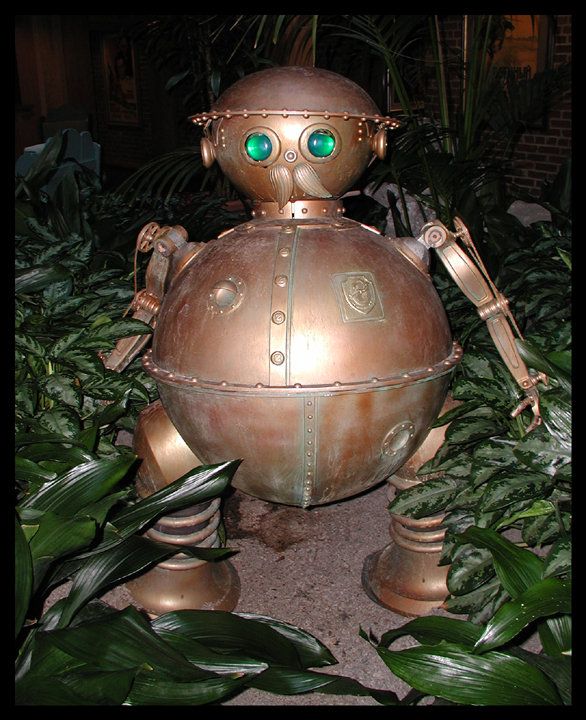
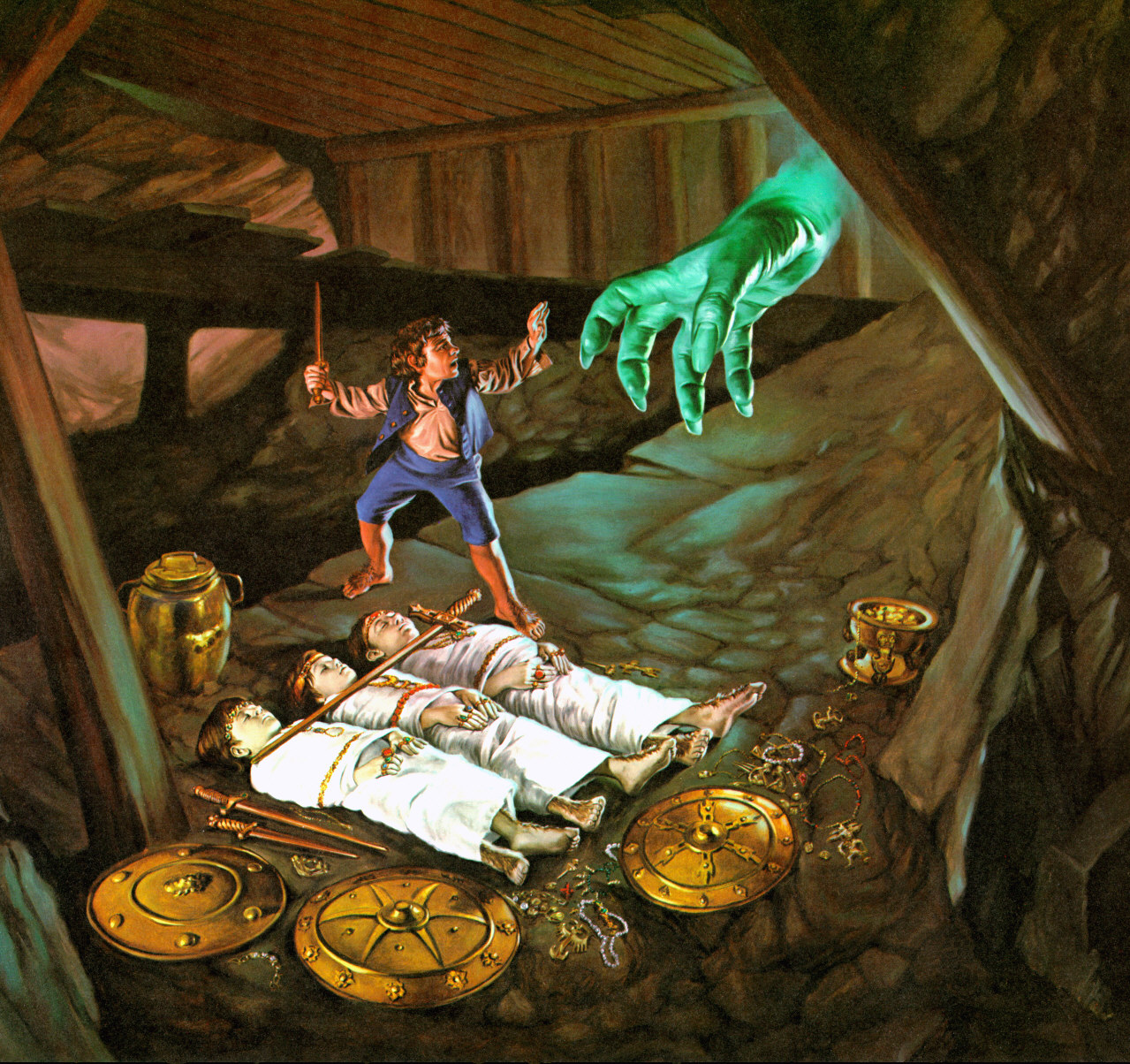
Does this picture make your hands sweat?  Can you barely look at it?

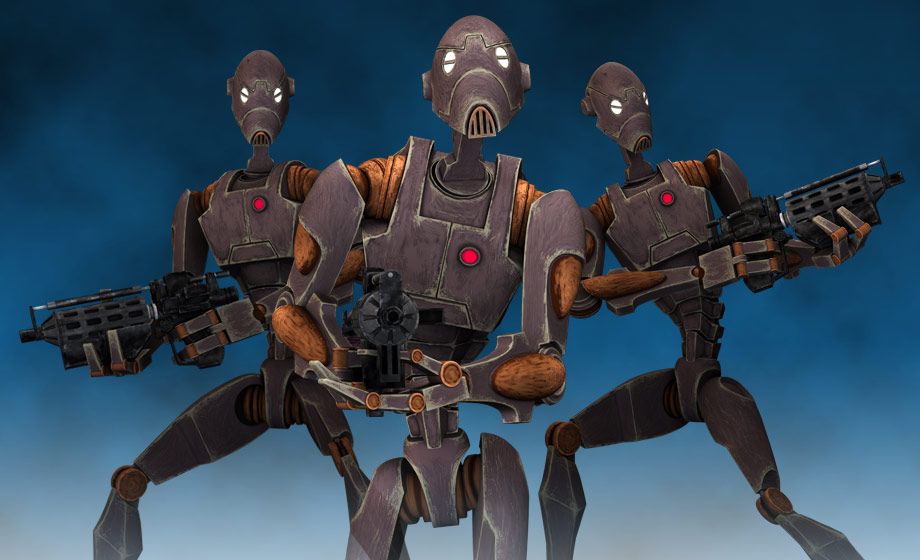
How about this one—

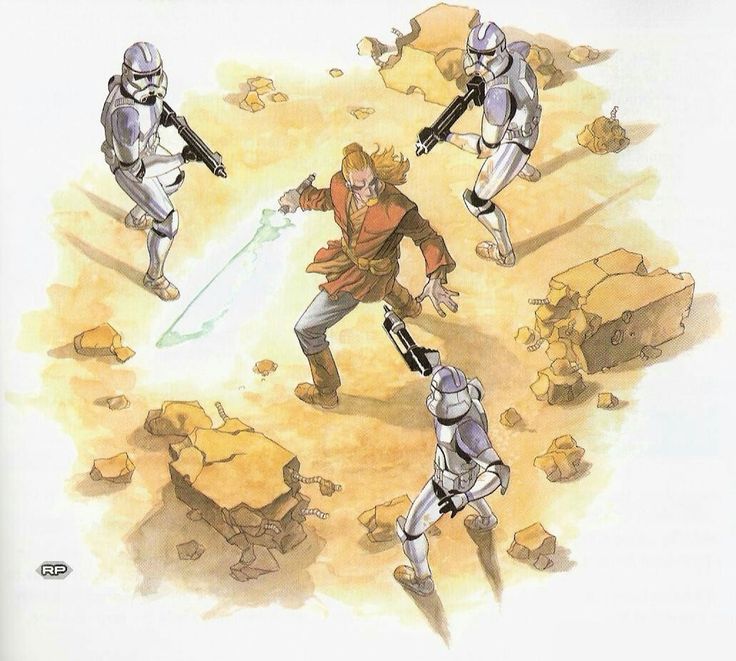
Or this one—

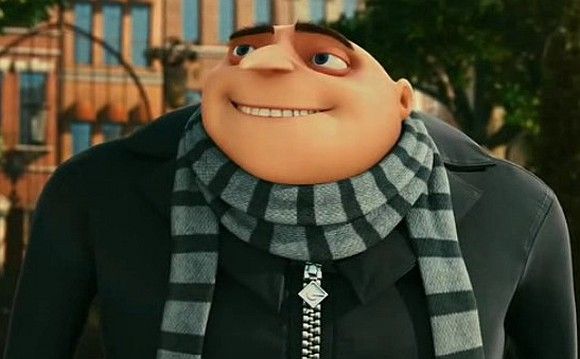
Or—

Or—

Or—horror of horrors!—

It’s possible that all of these might have an effect upon you and, in which case, I imagine that you’re reading this hiding under your bed.

Why all of this phobic display?  Because, back in June, I read an article from the BBC about the 40th anniversary of Disney’s Return to Oz entitled:

“ ‘It has the appeal of an actual horror’: How Return to Oz became one of the darkest children’s films ever made”

(You can read the article here:  https://www.bbc.com/culture/article/20250616-the-darkest-childrens-film-ever-made )

This is a film I own and have seen perhaps half-a-dozen times and I’ve never viewed it as the horror film which the article would suggest.  Granted, sensationalism sells the news, but, having read the article again, I’ve thought about how horror can be an element in a work—and a powerful one—without making the work as a whole into something like Bram Stoker’s Dracula.

(And, if you haven’t read it, I would certainly recommend it.  Here it is in the first US edition of 1897:   https://gutenberg.org/files/345/345-h/345-h.htm )

Think, for a moment, about The Hobbit.

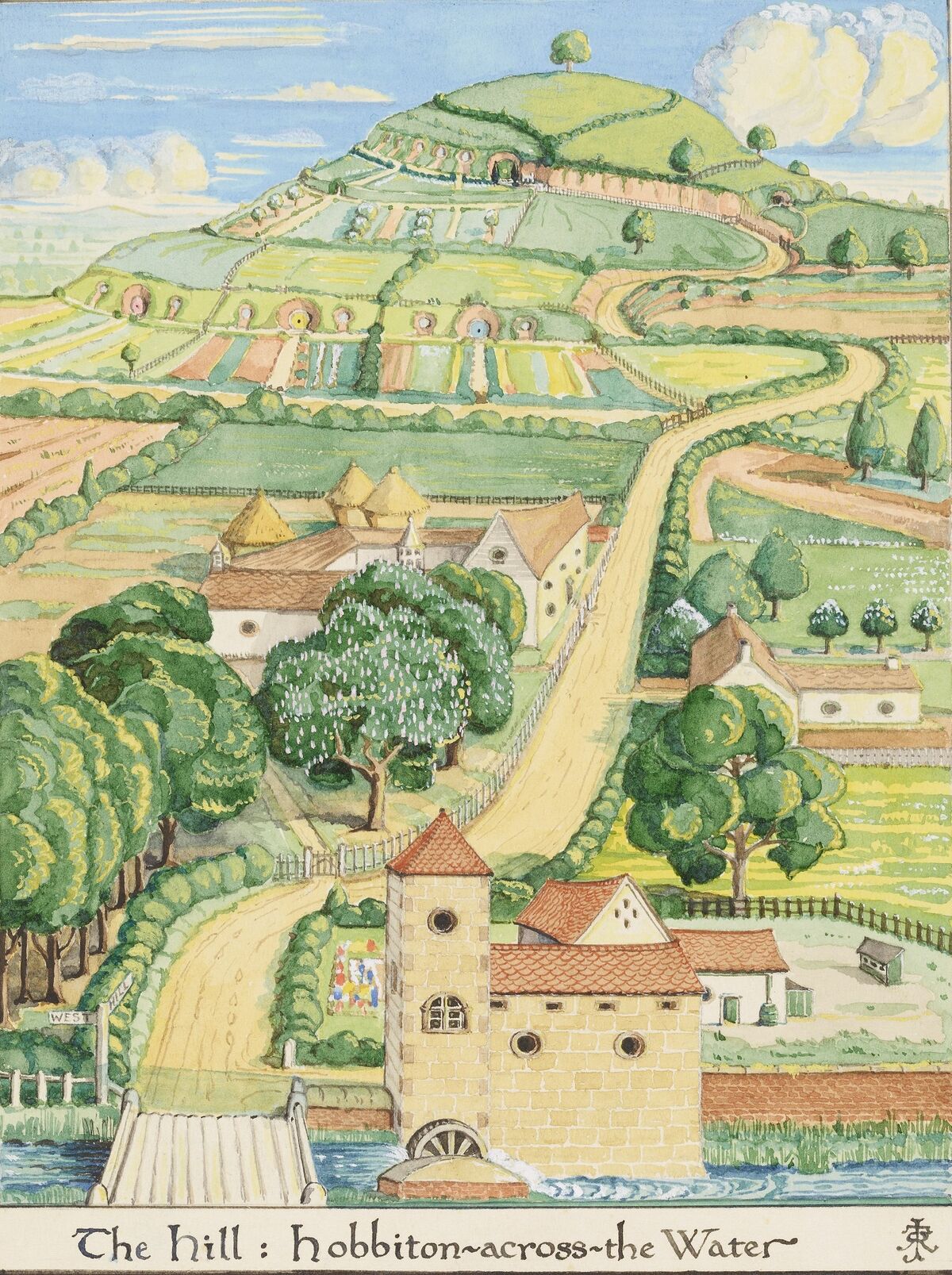
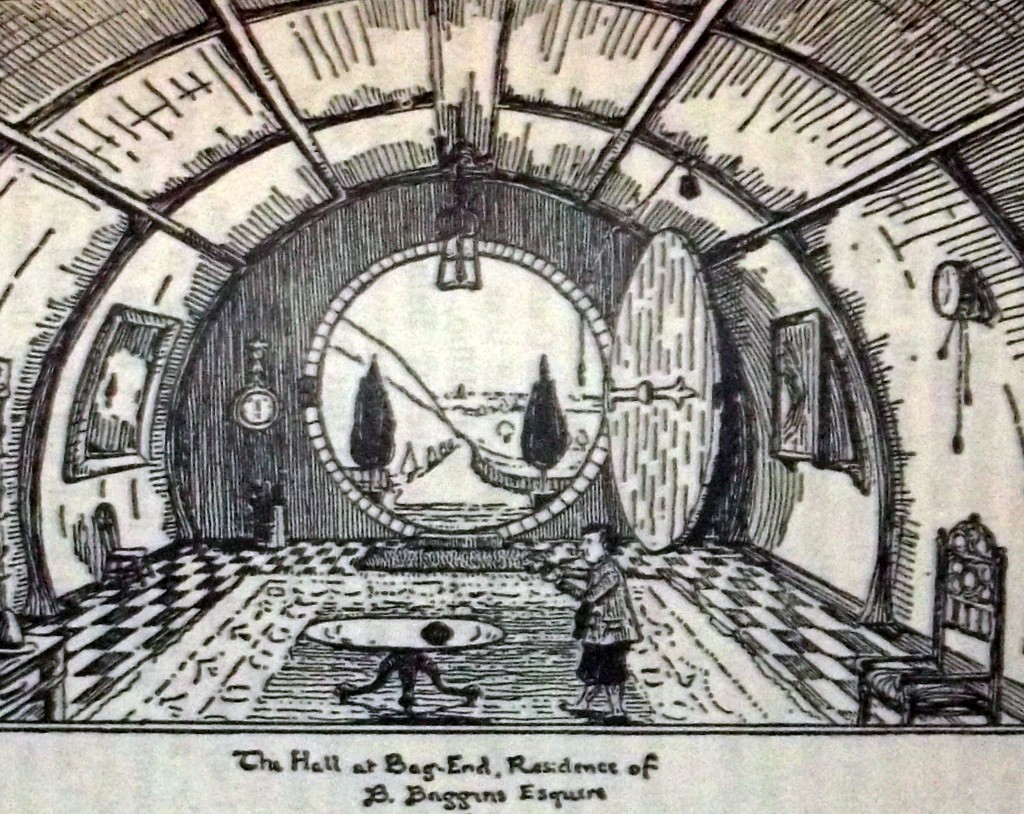
Here, we go from the safety of Hobbiton

(JRRT)

to a world where there are trolls,

(JRRT)

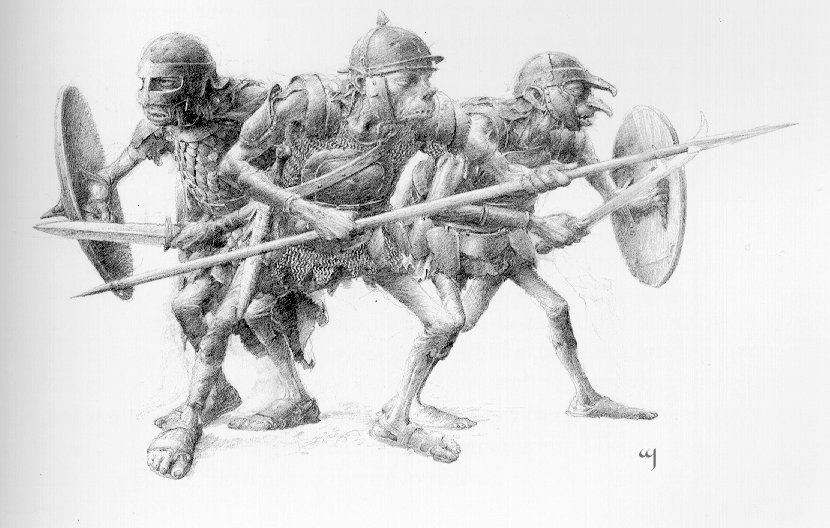
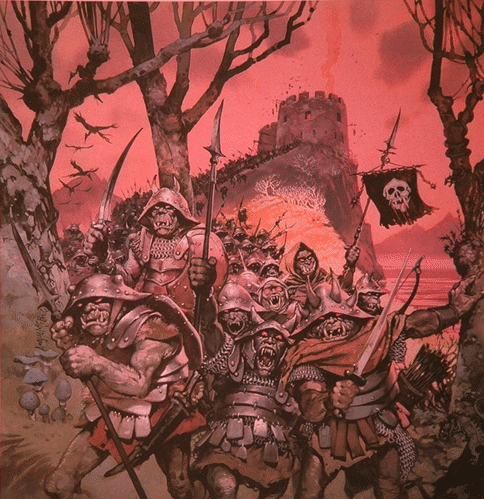
goblin-infested mountains,

(Alan Lee)

wolves in large packs,

(Tove Jansson)

giant spiders,

(John Tyler Christopher—you can see more of his work here:  https://johntylerchristopher.com/ )

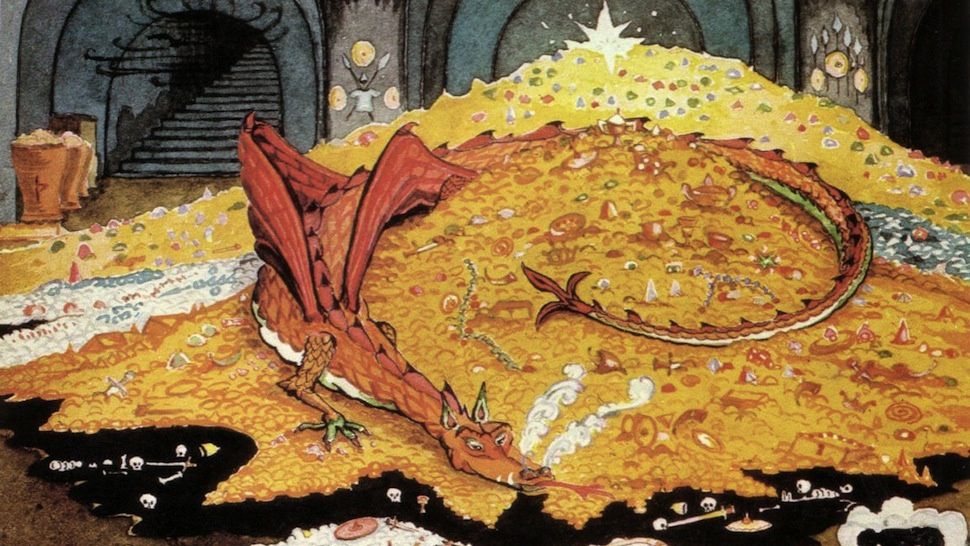
and, finally, an intelligent and vengeful dragon.

(JRRT)

But does the appearance of all these dangers make the book a horror novel, like one of Stephen King’s more forbidding works?

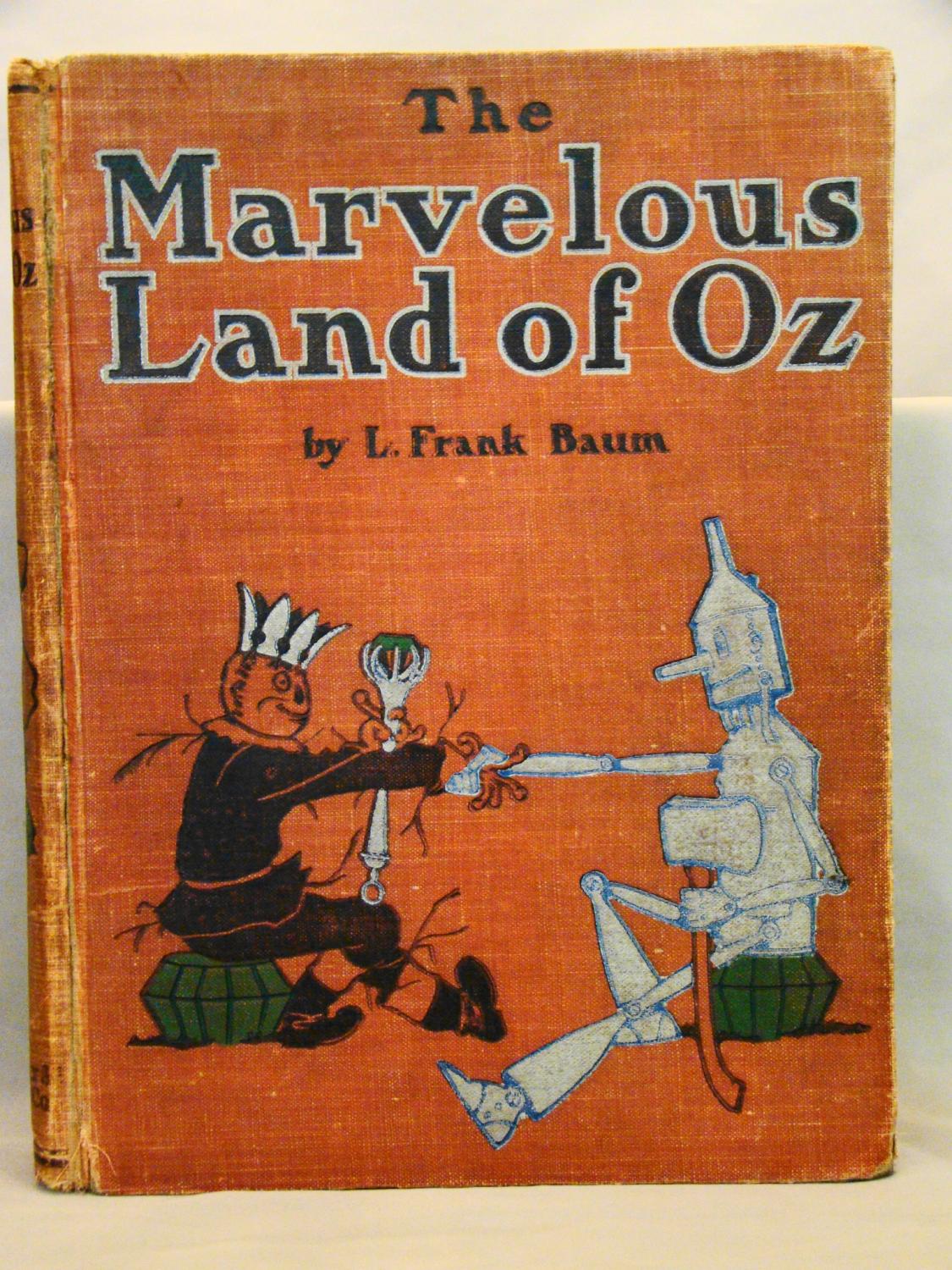
The article points to some potentially disturbing moments—and at least the first is certainly disturbing and, interestingly, is not in the two books upon which the film is based—The Marvelous Land of Oz, 1904,

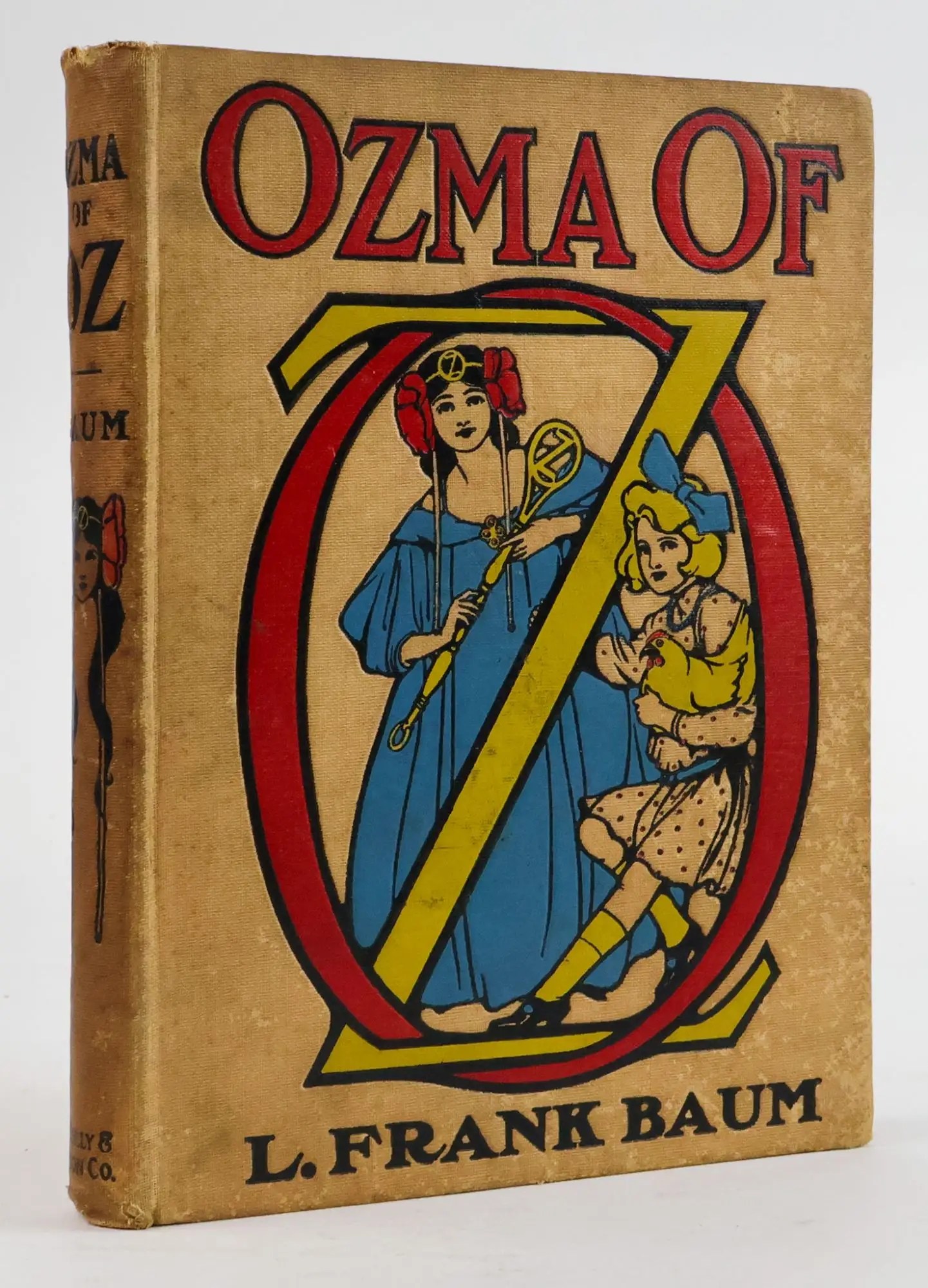
and Ozma of Oz, 1907.  (For more on the combination and the scriptwriters’ changes, see:  “Chickening In”, 12 February,  2025)

The Kansas of the 1939 film was as bleak as a 1930s sound stage could make it, in sepia, suggesting photos of the Dust Bowl of the Great Depression era—

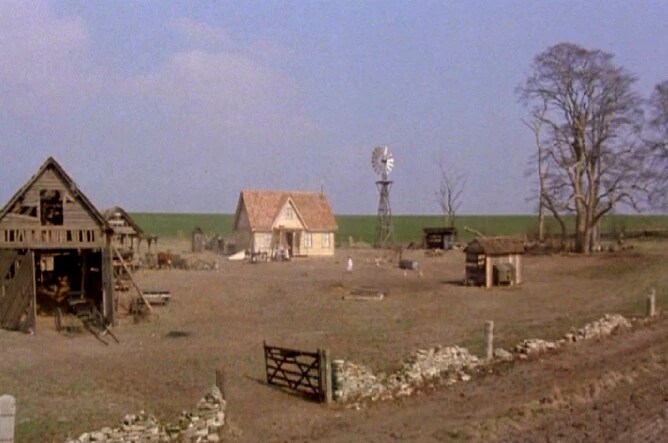
The 1985 movie showed us the real rolling hills of Kansas and the ruin of Uncle Henry and Aunt Em’s farm.

(This is at the end of the film, when the house has been rebuilt—early in the film, the house—which, of course, was ripped from Kansas and dropped on the Wicked Witch of the East—remains unfinished and Uncle Henry crippled from the twister.)

Dorothy, to Aunt Em, also seems somehow ruined, having reappeared after the tornado with stories about having been in a foreign land, Oz, but with no proof of it, and Em, having seen a newspaper ad for medical treatment by electricity, decides to take Dorothy to the clinic and its all-too-calm and rational Dr. Worley.

The treatment consists of running a powerful electrical current through Dorothy’s brain, (now called ECT—electroconvulsive therapy), which is supposed to erase Dorothy’s (supposedly false) memory of Oz. 

As the audience, with its own memories of Oz, from the 1939 film, the many books, or both, knows perfectly well that Oz is real, as is Dorothy’s memory of it, and, as the article points out:

“…the power of these scenes lies in the fact that they are trying to silence Dorothy, to obliterate her memories of Oz”

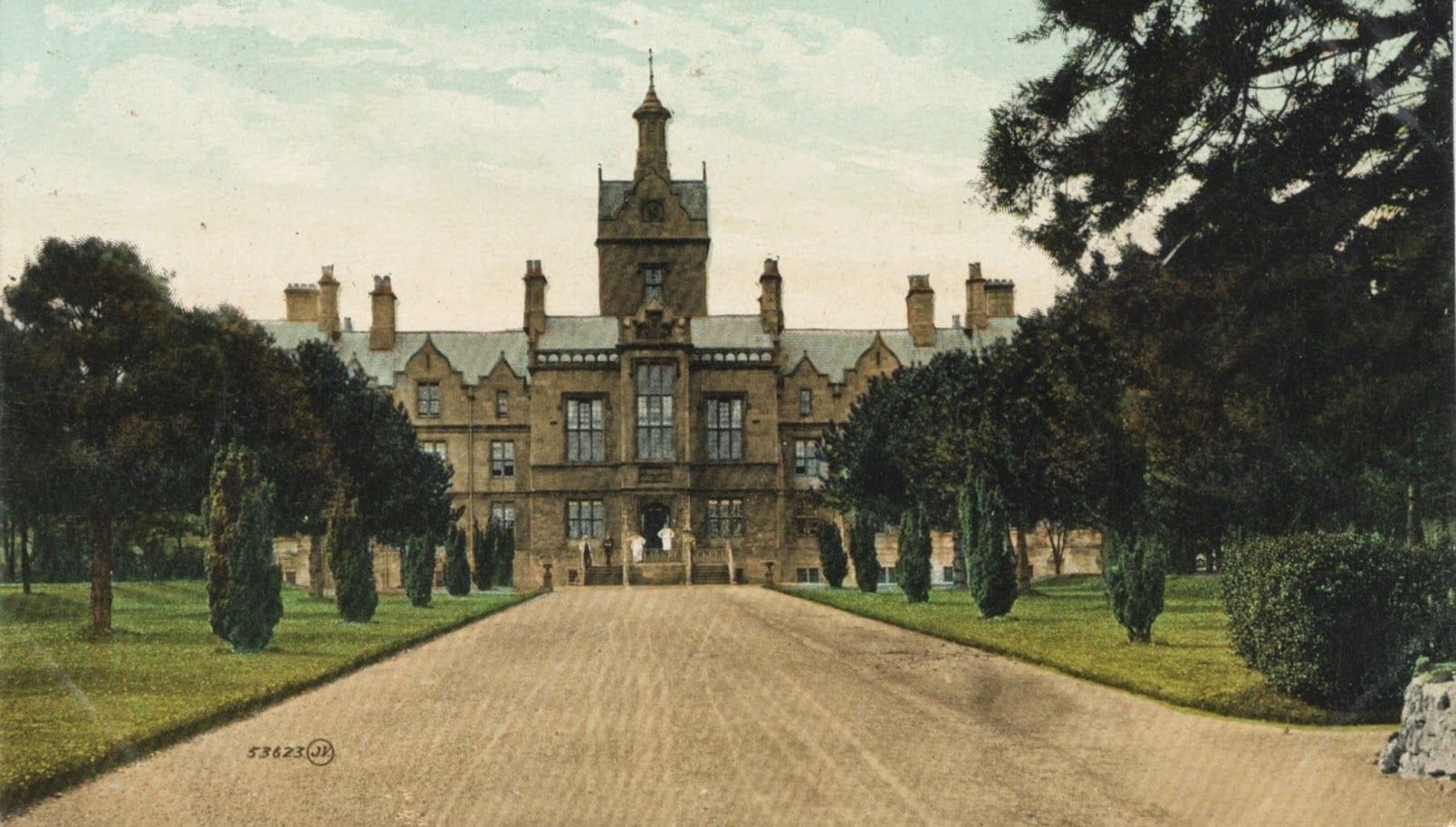
Dorothy escapes the clinic (one might really says “asylum”, as it has that grim look of Victorian asylums for the insane)

(A real Victorian asylum—and not the grimmest, there being some real competition here)

and turns up in Oz, once more, where the article mentions other potentially disturbing elements:

the destruction of Oz and its citizens petrified,

its ruins haunted by the Wheelers,

the minions of Princess Mombi, who collects heads and wears them for different occasions,

and then there is the Nome King, who is the current ruler of Oz,

and is the destroyer of the Emerald City, the overlord of Mombi, and has enchanted Dorothy’s former friends, the Scarecrow, the Tinman, and the Cowardly Lion, turning them into inanimate objects.

For the sake of sensationalism, it seems that the article leans heavily on these—as if, I suggested above, one could do the same for The Hobbit, but this leaves out the fact that, although Dorothy’s first allies in Oz have been neutralized, she finds others, just as Bilbo has dwarves, Gandalf, Elrond, the Eagles, and Beorn, not to mention Sting and the Ring.

These include the caustic hen, Billina, who arrives with her from Kansas,

“the Army of Oz”—Tik-Tok,

Jack Pumpkinhead,

and the Gump.

I teach story-telling on a regular basis and a dictum I use is “No fiction without friction” .  Just as trolls, goblins, wolves, Gollum, spiders, and Smaug provide the friction in The Hobbit, so the clinic and its smooth-talking doctor, the Wheelers, Princess Mombi, and the Nome King, provide it in Return to Oz.  These plot elements supply the problems which must be solved before the ultimate goal of the story can be achieved—coming home safely (and much better-off) for Bilbo, coming home and keeping her memories of Oz for Dorothy (guaranteed for her when she sees Ozma, rescued from the Nome King, in her mirror in Kansas).

Disturbing moments—in both—what’s that riddle contest with Gollum if nothing short of harrowing?—but is Return to Oz just this side of a horror movie?  As always, I suggest that you see it for yourself, but remember “no fiction without friction” before you rank it with The Shining.

Thanks, as ever, for reading.

Stay well,

Pick a bed with a reasonable clearance,

And remember that, as always, there’s

MTCIDC

O

Swords Drawn

02 Wednesday Jul 2025

Posted by Ollamh in Uncategorized

≈ Leave a comment

Tags

Anduril, arthur-hughes, bent-swords, Fafnir, George Macdonald, Glamdring, Goblins, great-goblin, Howard Pyle, King Edward's Horse, NC Wyeth, Orcrist, Scimitar, Sigurd, Sigurd Portal, swords, The Hobbit, Tolkien, William Morris

Welcome, dear readers, as always.

Every time I read or teach The Hobbit, I come to this passage:

“There in the shadows on a large flat stone sat a tremendous goblin with a huge head, and armed goblins were standing round him carrying the axes and the bent swords which they use.”  (The Hobbit, Chapter 4, “Over Hill and Under Hill”)

and I wonder: what does Tolkien mean by “bent swords”?

As a medievalist, and as someone who grew up in the world of illustrators like Howard Pyle (1853-1911)

and NC Wyeth (1882-1945),

as well as an avid reader of the stories of William Morris (1834-1896),

it’s not surprising that Tolkien’s works so often include swords, although perhaps the first sword he met may have been in Andrew Lang’s (1844-1912) The Red Fairy Book, 1890, where, in the last chapter, he would have found Sigurd and a, to us, strangely-familiar sword—

“ONCE upon a time there was a King in the North who had won many wars, but now he was old. Yet he took a new wife, and then another Prince, who wanted to have married her, came up against him with a great army. The old King went out and fought bravely, but at last his sword broke, and he was wounded and his men fled. But in the night, when the battle was over, his young wife came out and searched for him among the slain, and at last she found him, and asked whether he might be healed. But he said ‘ No,’ his luck was gone, his sword was broken, and he must die. And he told her that she would have a son, and that son would be a great warrior, and would avenge him on the other King, his enemy. And he bade her keep the broken pieces of the sword, to make a new sword for his son, and that blade should be called Gram.”  (“The Story of Sigurd”, 357  If you don’t have your own copy of Lang’s collection, here it is for you:  https://archive.org/details/redfairybook00langiala/redfairybook00langiala/mode/2up courtesy of the invaluable Internet Archive.  If  you don’t know this source, and you enjoy this blog, you should check it out.  It has the most remarkable things, even including a very good selection of silent films and film classics, like Kurosawa’s “The Seven Samurai”, 1954, which, for me—and for George Lucas—is a model for adventure films and you can see it here for free:  https://archive.org/details/seven-samurai-1954_202402 )

Yes, “the sword that was broken”—Anduril—and Sigurd has it reforged—and uses it to kill Fafnir, the dragon.

(This is from the “Sigurd Portal” of a  lost stave—wooden—church from Hylestad, in Norway, dating c1200AD.  Fortunately, the doorway carvings were saved and they show in detail the story of Sigurd.  Here’s where you can read more:  https://sites.pitt.edu/~dash/sigurddoor.html#location and here:  https://en.wikipedia.org/wiki/Hylestad_stave_church )

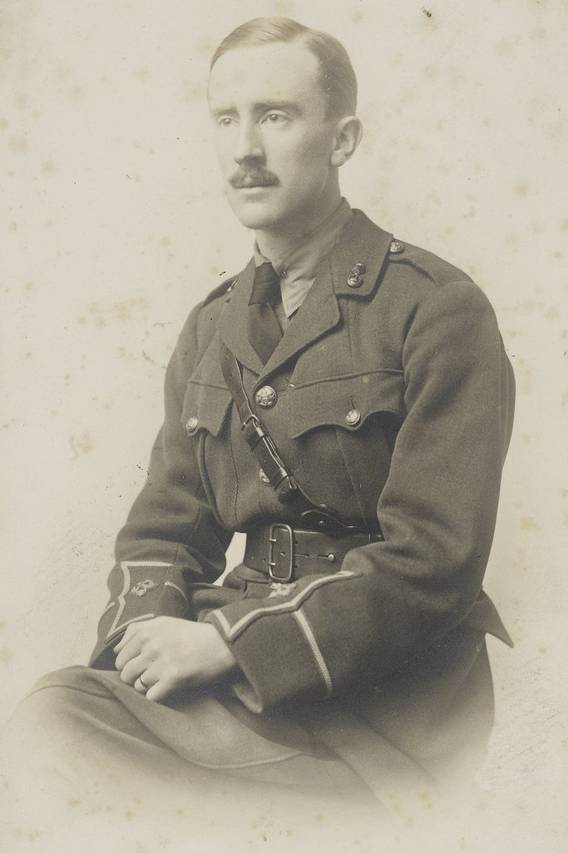
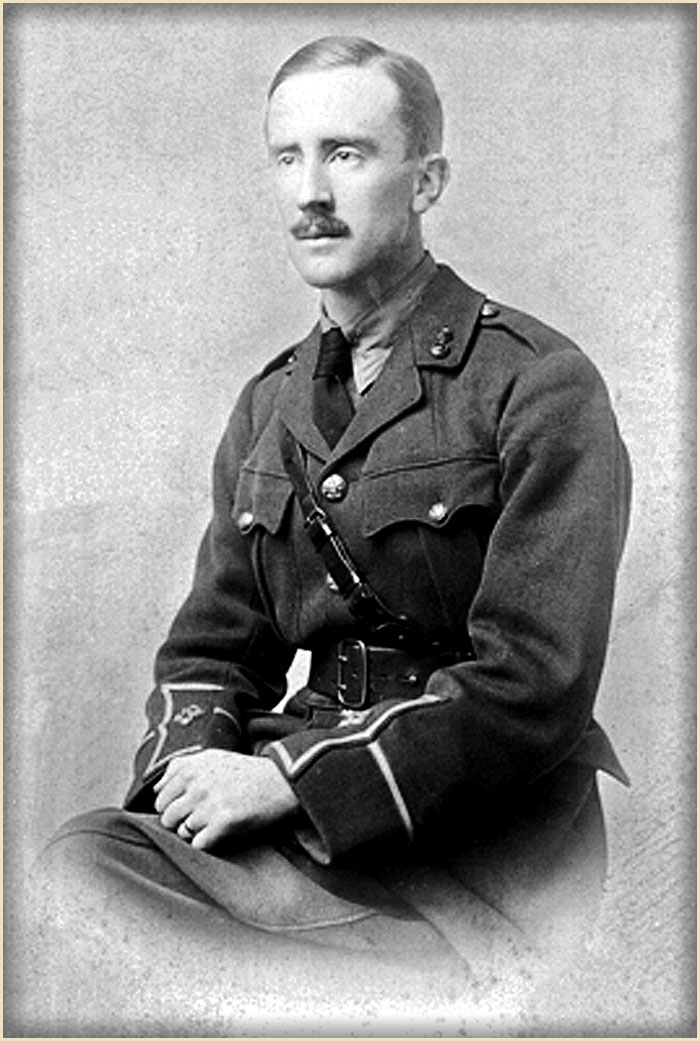
In his own life, Tolkien would have been personally familiar with swords.  When he was a member, briefly, of King Edward’s Horse,

in 1912, he would have been issued with this, the Pattern 1908 cavalry sword.

To me, it’s rather a strange weapon, seemingly designed only to stab,

whereas earlier cavalry blades might be used both to stab and to slash (very useful in chasing off enemy infantry)

Then, a new 2nd lieutenant in 1915,

JRRT would have had to buy himself the Pattern 1897 infantry officer’s sword

(as there were an increasing number of new officers from families who couldn’t afford it, there was a kind of subscription created to help such officers acquire a required piece of equipment.  For more on just what was required of officers, who had to provide their own kit, see Field Service Manual 1914, pages 16-18, here (and yes, again, it’s from the Internet Archive):  https://archive.org/details/fieldservicemanu00greauoft/page/n11/mode/2up )

These, as you can see, are straight-bladed swords, however.

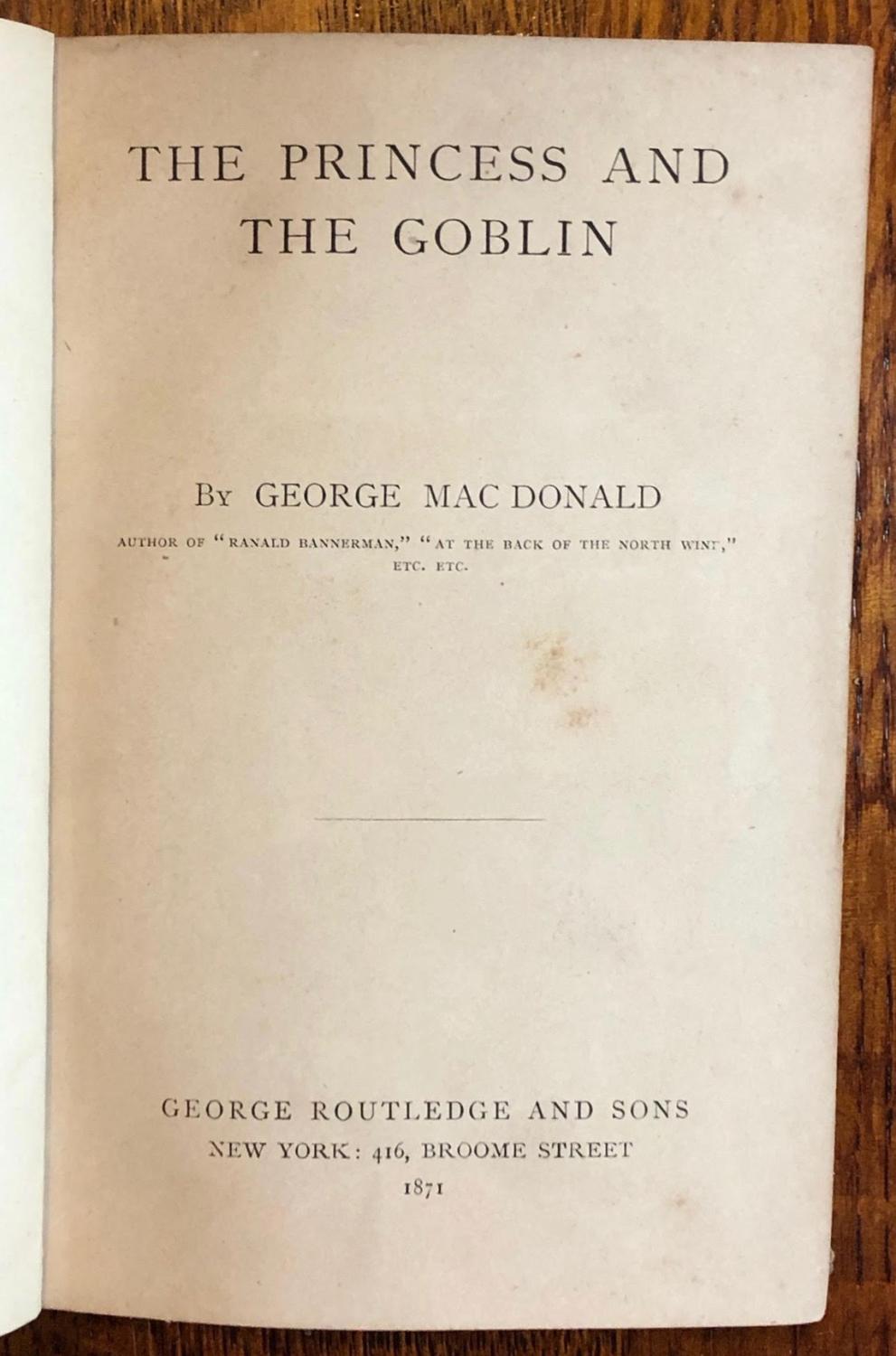
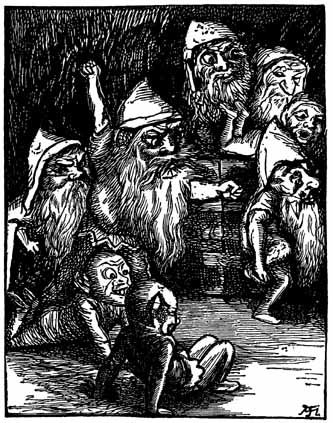
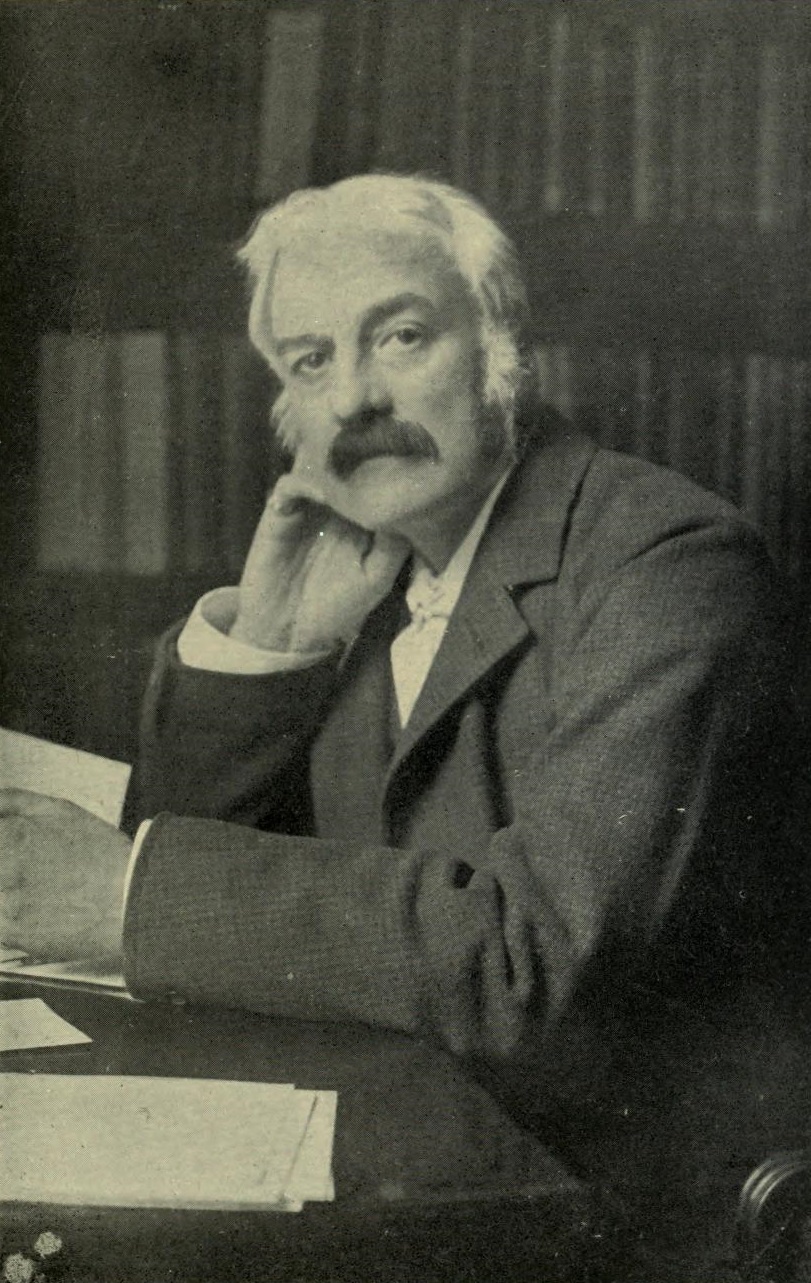
Tolkien’s earliest experience with goblins was probably with George MacDonald’s (1824-1905) The Princess and the Goblin (1871/2), and he likens his own later goblins/orcs to them (see Letters, 267, 279).

The illustrations are by Arthur Hughes (1832-1915) and, as far as I can see, there’s not a bent sword among them  (If you don’t know the story, here’s the text, but without its original illustrations, alas: https://www.gutenberg.org/cache/epub/708/pg708-images.html )

If we try some Tolkien goblin illustrators, we find Justin Gerard’s version of the scene with the Great Goblin, where there are a few pole arms off to the left, but the only sword must be Orcrist.

(Justin Gerard—you can see more of his work here:  https://www.artstation.com/justingerardillustration and here:  https://www.justingerard.com/the-art-of-justin-gerard )

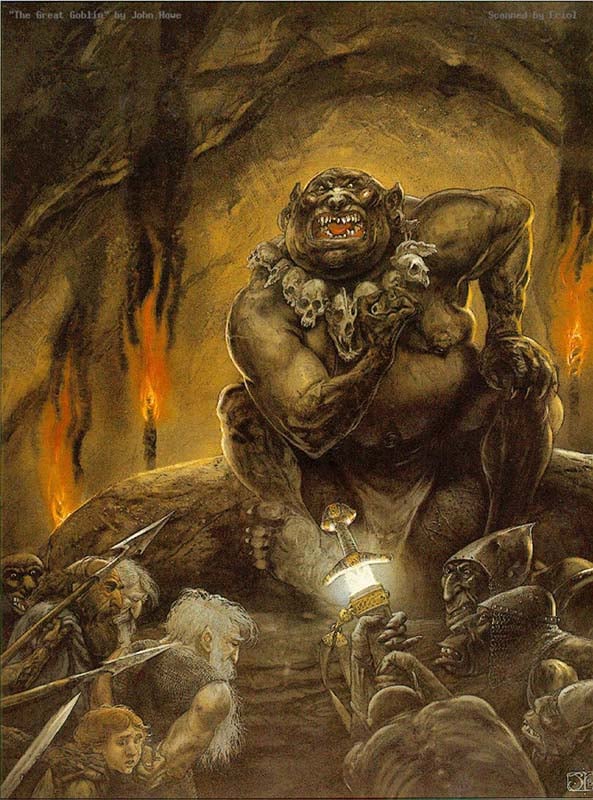
Here’s John Howe’s version of the scene—

with Orcrist peeking out of its scabbard and a straight sword and a couple of spears off to the left.

Then there’s Alan Lee’s, with the seemingly inevitable Orcrist, but with, just below it, perhaps a sabre—a curved sword

and we see this again in Lee’s depiction of Bilbo’s encounter with the goblin door guards.

In Michael Hague’s illustration for the escape from the Great Goblin’s throne room,

we see both Orcrist and Glamdring, along with one more seemingly curved sword.

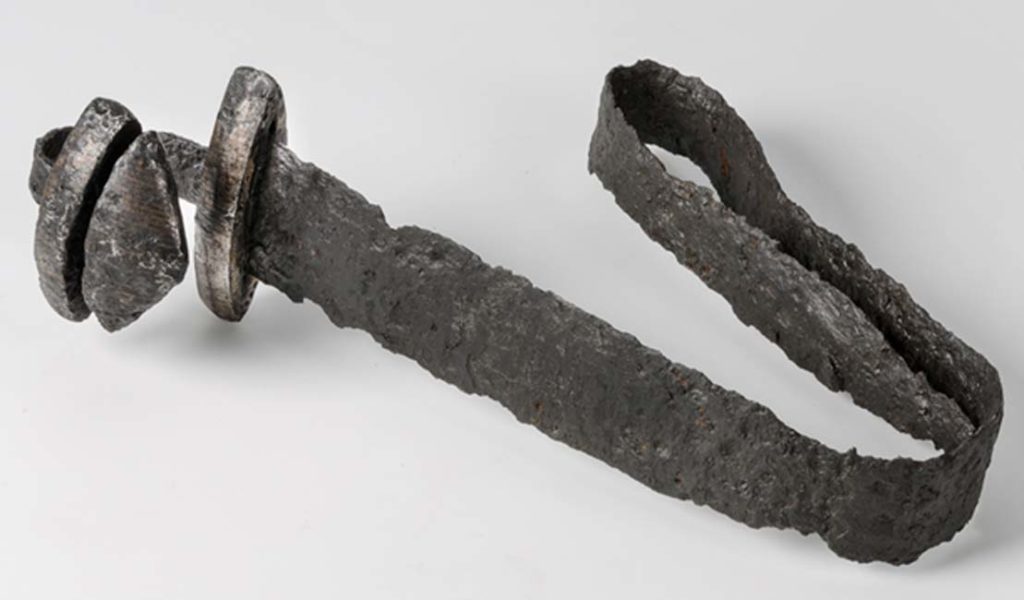
Are any of these, however, an example of a “bent sword”?  Archaeologists have discovered numerous ancient swords which appear to have been “sacrificed” by being bent–

but this is hardly what Tolkien meant.  Then there is what might be taken literally for a “bent sword”—

from Jackson’s The Lord of the Rings, but I must say, this looks pretty improbable as a sword—if you see how the grip is shaped, that spike at the end if pointing upwards:  what could it possibly be for?  In fact, when one sees a chart of swords from the films, I’m not sure about many of them as useful weapons—

Those to the left share patterns with swords from our Middle-earth, both those on the right look like they might be dramatic over a fireplace, but I’d question their use as practical weapons.

So what might this “bent sword” be?  Some of the swords in the illustrations above would suggest that their artists believed that, by “bent”, Tolkien meant “curved”.  One possibility:  we know that Tolkien had read or had read to him at least one of Andrew Lang’s fairy books (the Red Fairy Book, as mentioned above), but perhaps he had also seen Lang’s Arabian Nights Entertainments (1898) in which there are a number of illustrations with scimitars in them—

(Here’s a copy of the book for you:  https://archive.org/details/arabiannightsent00lang/page/n9/mode/2up )

Scimitars are curved and, barring silly ones like those in Disney’s Aladdin—which look more like something used for carving meat–

are both deadly and would seem very exotic, if not alien,

in contrast to very medieval swords like Orcrist and Glamdring.

I doubt that we’ll ever know exactly what JRRT had in mind, but, if I had to illustrate “armed goblins…carrying axes and the bent swords…” I might consider drawing—in both senses—such blades.

Stay well,

Avoid inviting caves, even if Stone Giants are playing dodge ball outside,

And remember that, as always, there’s

MTCIDC

O

PS

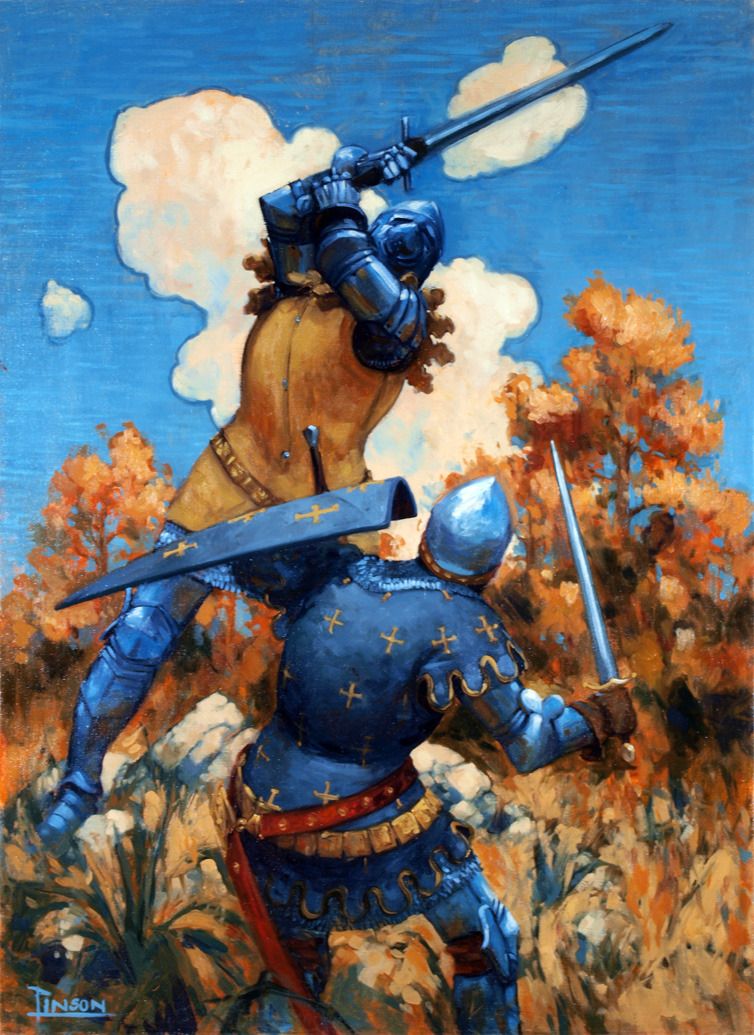
I’ve just discovered a contemporary illustrator who clearly enjoys the dramatic style of artists like Pyle and Wyeth, as well as French historical artists, like Meissonier (1815-1891).  This is Ugo Pinson (1987-) and here is a sample of his work.

He has illustrated book covers as well as several graphic novels and done illustrations for the “Witcher” series.  His sketches alone show his skill and talent.  You can see more samples here:  https://duckduckgo.com/?q=ugo+pinson&iar=images&iai=http%3A%2F%2Fbdzoom.com%2Fwp-content%2Fuploads%2F2016%2F07%2F13427953_10154226704759687_4371726455862878086_n.jpg 

Bacon and Eggs, Etc.

08 Wednesday Jan 2025

Posted by Ollamh in Uncategorized

≈ Leave a comment

Tags

bacon and eggs, being eaten, Eating, Fantasy, Goblins, Gollum, seed-cake, Smaug, snails, spiders, The Hobbit, Tolkien, Tolkien as hobbit, trolls

Dear readers, welcome, as always.

When Tolkien admitted that he was a hobbit, he defined them—and himself—in part in this way:

“…I like gardens, trees and unmechanized farmlands; I smoke a pipe, and like good plain food (unrefrigerated), but detest French cooking… “ (from a letter to Deborah Webster, 25 October, 1958, Letters, 411)

This follows, of course, his description in “Concerning Hobbits” in the Prologue to The Lord of the Rings:

“Their faces were as a rule good-natured rather than beautiful, broad, bright-eyed, red-cheeked, with mouths apt to laughter, and to eating and drinking.  And laugh they did, and eat, and drink, often and heartily, being fond of simple jests at all times, and of six meals a day (when they could get them).”

And this is an extension of the description in the first chapter, “An Unexpected Party”, of The Hobbit:

“[they] have long clever brown fingers, good-natured faces, and laugh deep fruity laughs (especially after dinner, which they have twice a day when they can get it).”

This propensity for the consumption of comestibles—and for the reporting of and description of eating and all that might go with it—is more, in The Hobbit, than simply a fond look at a foible, however.  In fact, it is a theme which seems, at times to dominate the book—and we see this practically on the first page of the novel, not only in that mention of multiple dinners, but even in the fact that hobbit laughs are “fruity”.

The opening setting itself announces the theme:  “Bilbo Baggins was standing at his door after breakfast…” and soon Bilbo is resisting Gandalf’s proposal of an adventure by saying “Nasty disturbing uncomfortable things!  Make you late for dinner!”  (The Hobbit, Chapter 1, “An Unexpected Party”)

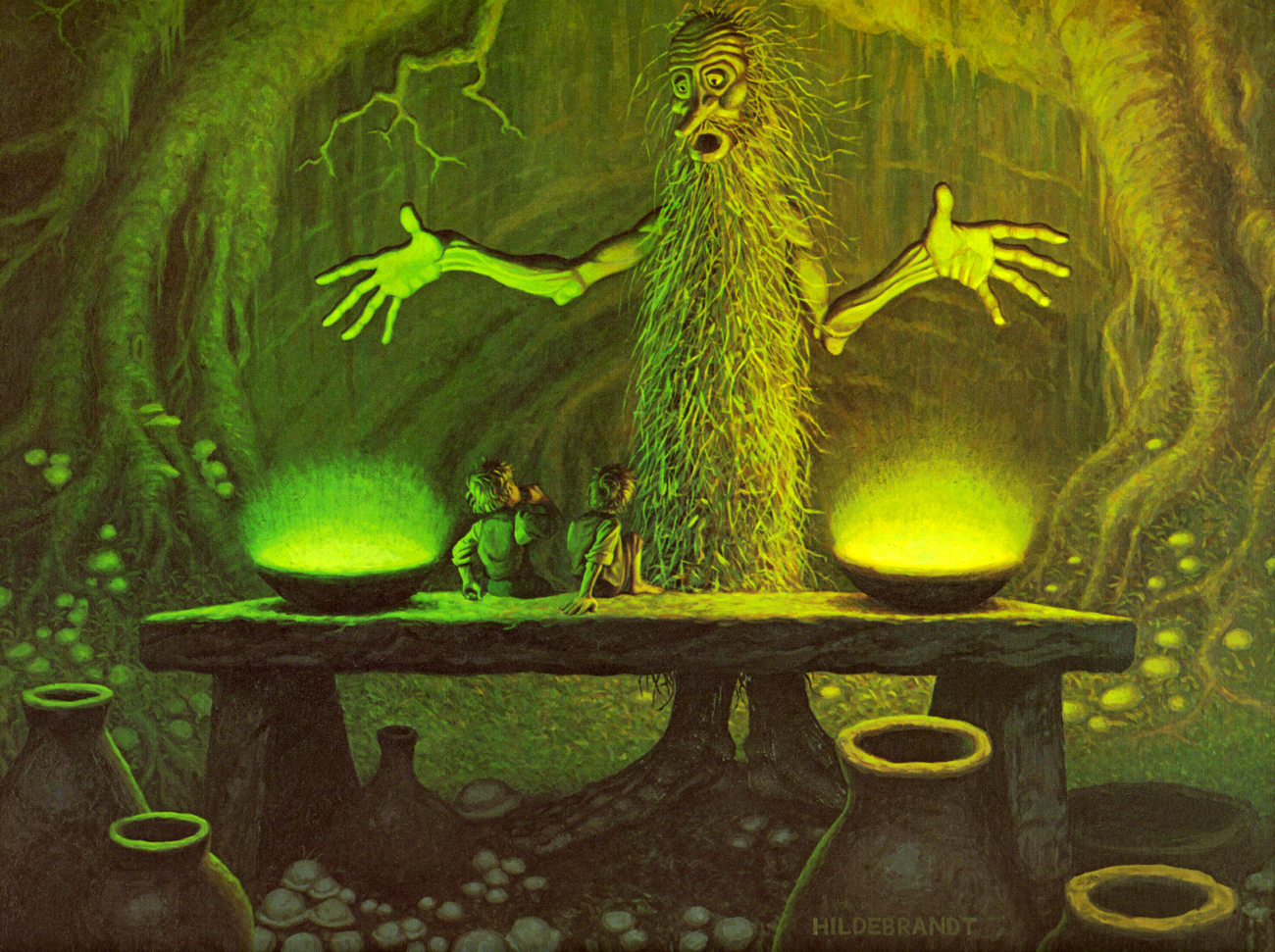
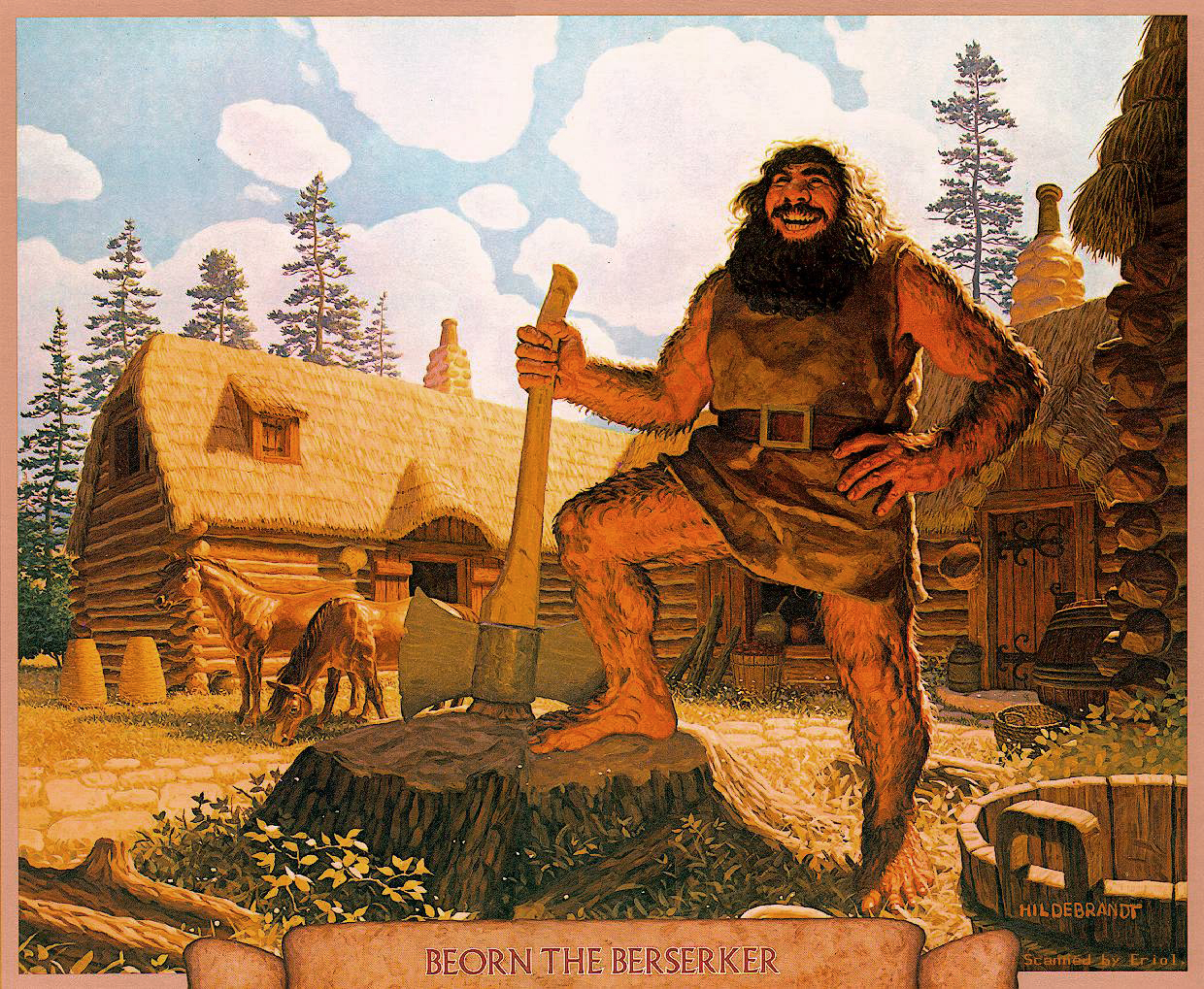
(the Hildebrandts)

There follows the rattled Bilbo’s invitation to Gandalf to come to tea (after which he consoles himself with “a cake or two and a drink of something”), and then the party from the chapter title, which includes not only a major depletion of Bilbo’s pantry (or pantries, as the narrator has already informed us that Bilbo’s house has “lots of these”), but even a kind of heroic catalogue of what’s called for and which Bilbo seems able to supply including:  tea, beer, seed-cake, coffee, scones, ale, porter, red wine, raspberry jam, apple-tart, mince-pies, cheese, pork-pie, salad, eggs, chicken, and pickles (and a single biscuit—that is, cookie, for Bilbo).

The chapter ends with one last burst of food-talk as Bilbo offers bed and breakfast to the dwarves (as a way of seeing them off) and Thorin orders breakfast as if Bilbo were running an inn:

“But I agree about bed and breakfast.  I like six eggs with my ham, when starting on a journey:  fried not poached, and mind you don’t break ‘em.”

(Eggs and ham—those eggs will appear again, but with bacon, when Bilbo, more than once, yearns for them.  This is from a rather mouth-watering website called “The English Kitchen”, which you can visit here:  https://www.theenglishkitchen.co/2020/04/proper-ham-eggs.html  And, as, when you search for a useful image of ham and eggs, you suddenly find yourself surrounded by images of Dr. Seuss’ wonderful Green Eggs and Ham, you can it read here:  https://ia601502.us.archive.org/20/items/green-eggs-and-ham_202211/GreenEggs%20Ham.pdf )

And Bilbo goes off the bed annoyed not only at Thorin, but at all of the other dwarves, who have made similar orders.

After that opening, it’s not surprising that Chapter 2 begins with a still-annoyed Bilbo, faced with a mountain of dirty dishes, the remains of a breakfast he didn’t fix, but, cleaning up, he enjoys his own first breakfast and is starting on a second one when Gandalf appears and Bilbo is suddenly off on the adventure which takes up the rest of the book.

Food soon appears again as one of their ponies “got into the river before they could catch him…and all the baggage that he carried was washed away off him.  Of course it was mostly food, and there was mighty little left for supper, and less for breakfast.”  (Chapter 2)

But then the eating theme takes a different and disturbing turn:  trolls

(JRRT)

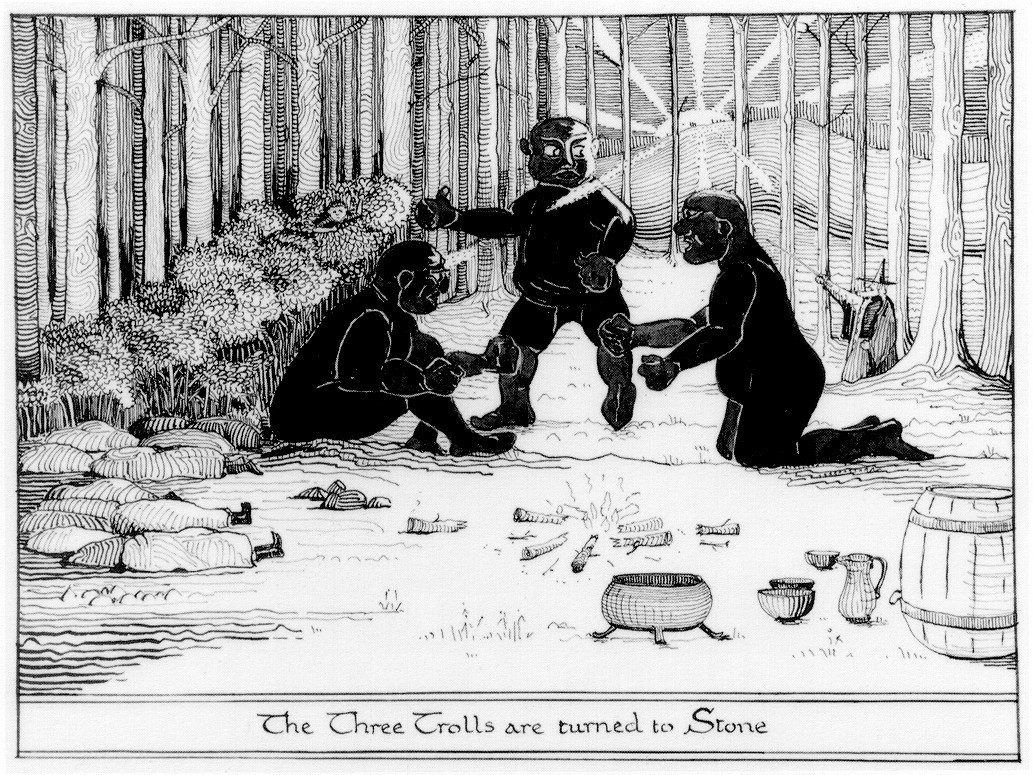
who, though currently munching mutton, have “…et a village and a half between yer, since we come down from the mountains” and soon, like amateur chefs on “The Great Goblin Bake Off”, are discussing how to prepare dwarf—will it be roasting?  boiling?  before the judge, one Gandalf, decides the argument by tricking them into being exposed to the sun and turned to stone.

(JRRT)

This is, in its way, a mirror to the original eating idea, in which the protagonists who do the consuming are at risk of becoming a potential article for consumption and we’ll see this repeated more than once with:

1. the goblins (Chapter 4):  “For goblins eat horses and ponies and donkeys (and other much more dreadful things), and they are always hungry.”

(Alan Lee)

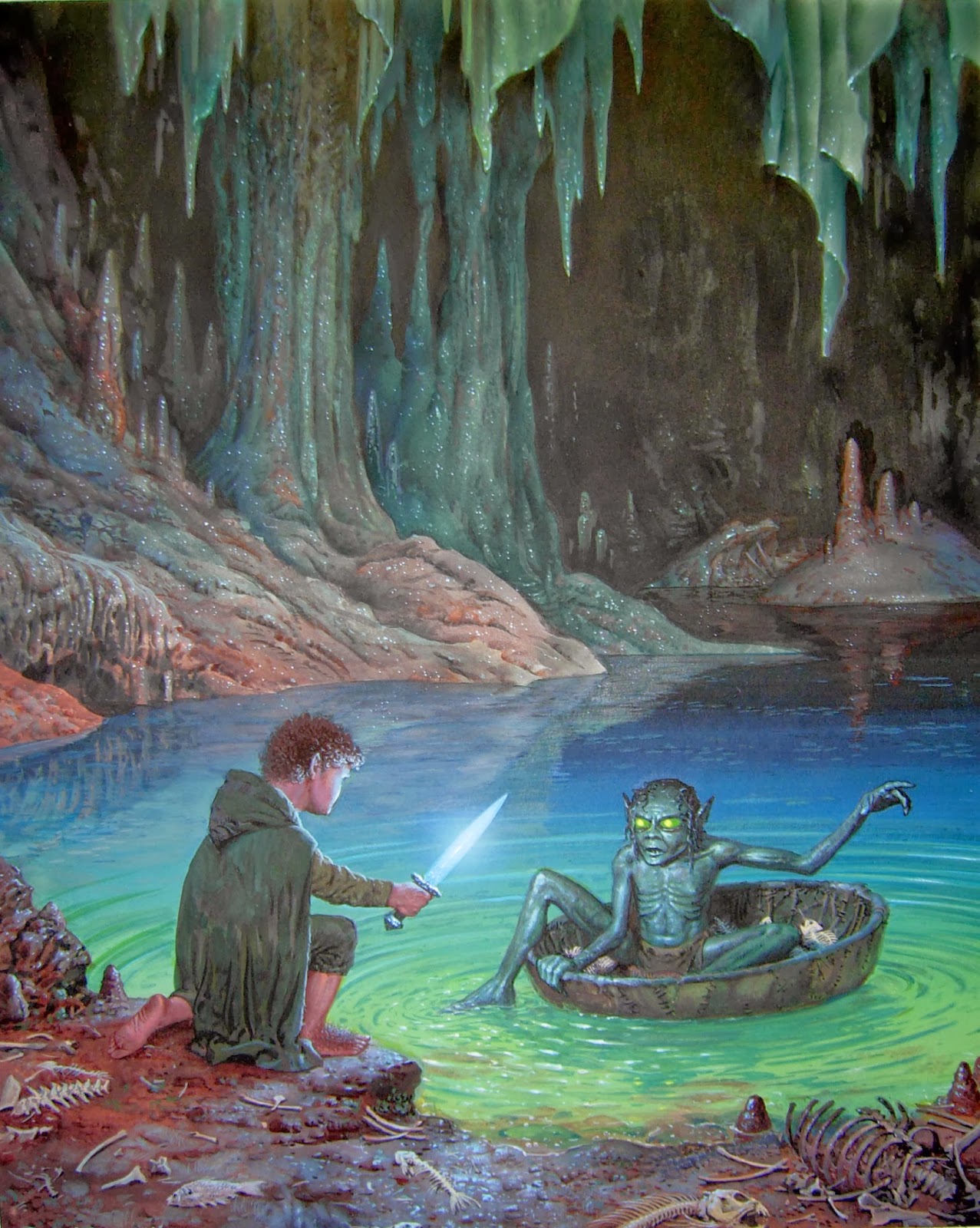
2. Gollum (Chapter 5):  “He was looking out of his pale lamp-eyes for blind fish, which he grabbed with his long fingers as quick as thinking.  Goblin he thought good, when he could get it…” and there’s the possibility that Bilbo might be on the menu—if he loses the riddle contest.

(Alan Lee)

3. the spiders (Chapter 8):  “  ‘What nasty thick skins they [the dwarves] have to be sure, but I’ll wager there is good juice inside.’ ‘Aye, they’ll make fine eating, when they’ve hung a bit…’ ”

(and another Alan Lee)

4. and, of course, Smaug (Chapter 12):  “ ‘Let me tell you I ate six ponies last night and I shall catch and eat all the others before long…I know the smell (and taste) of dwarf…Girion Lord of Dale is dead, and I have eaten his people like a wolf among sheep…’ “

(JRRT)

On the other side (the eating, not eaten), however, there are:

1. supper with the Rivendell elves (Chapter 3)

(JRRT)

2. rabbit, hare, and sheep with the eagles (Chapter 6)

(JRRT)

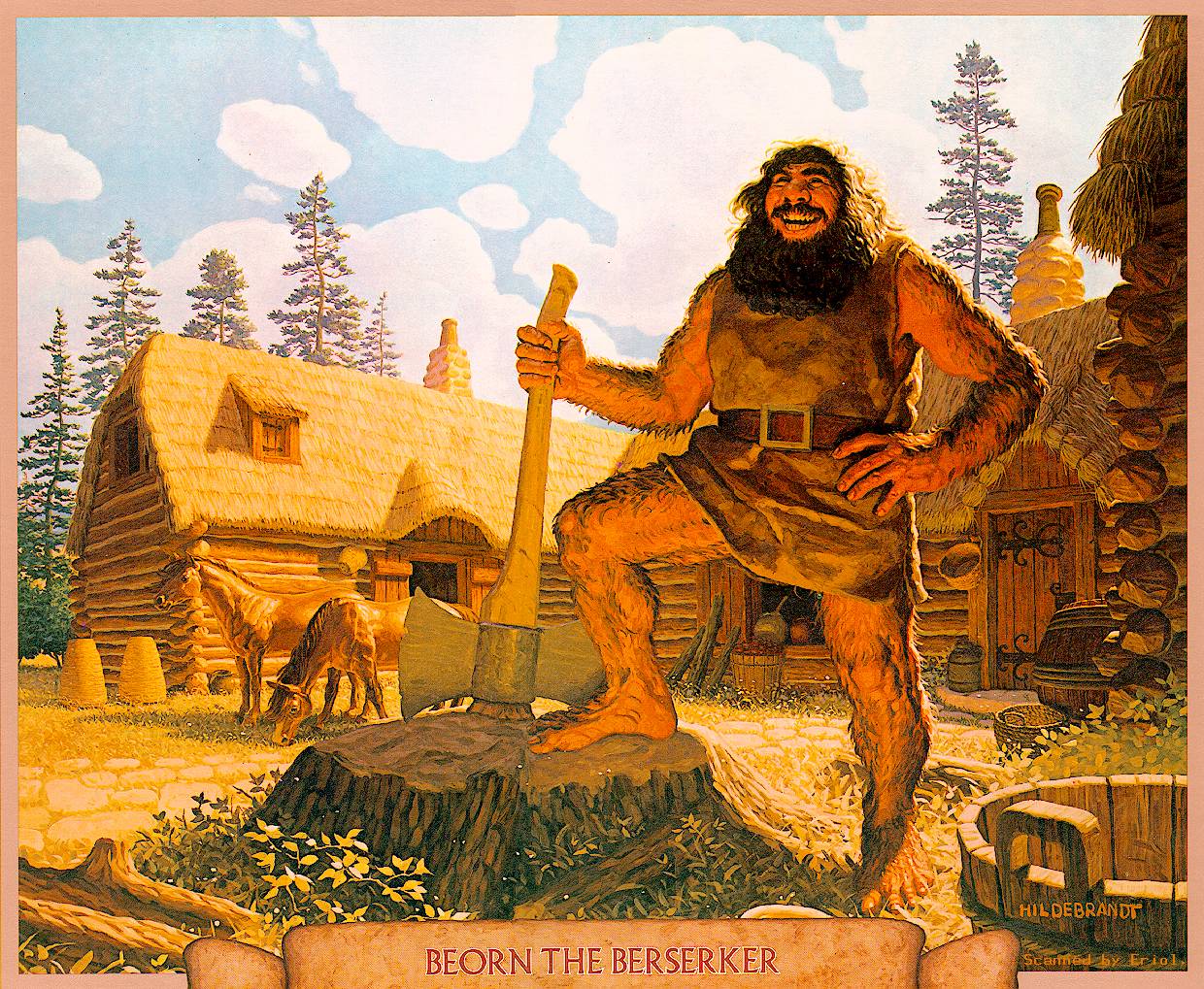
3. meals with Beorn (Chapter 7)

(Ted Nasmith)

4. starving in Mirkwood while being tantalized by elvish feasts (Chapter 8)

(another elf king, in an illustration by A.W. Bayes, 1831-1909)

5. prison rations in the dungeons of Thranduil, the king of the forest elves (Chapter 9)—as well as food stolen by Bilbo

(a generic dungeon as, so far, I haven’t discovered a useful illustration of the original situation)

6. feasts in Lake-town (Chapter 10)

(JRRT)

7. a gourmet diet of snails (Chapter 11)

(Alan Lee)

8. and even the threat of siege and starvation (Chapter 15)—

(Alan Lee)

Given that so much of the text is handed over to eating and drinking, it’s surprising that the conclusion of the story doesn’t have Gandalf returning (with Balin) to tea some years later—

(Alan Lee)

could it be that even that academic hobbit is finally full?

As always, thanks for reading.

Stay well,

One slice of cake should do, I think, don’t you? Or maybe two?

And remember that, as always, there’s

MTCIDC

O

Green and Quiet.1

05 Wednesday Sep 2018

Posted by Ollamh in Economics in Middle-earth, J.R.R. Tolkien, Literary History

≈ Leave a comment

Tags

Birmingham, Charles Dickens, Cottage industry, factories, Goblins, Hard Times, Hilary Tolkien, I Can't Find Brummagem, Industrial Revolution, Isengard, James Dobbs, John Ezard, Mabel Tolkien, Mills, Ornthanc, Sarehole, Sharkey, The Hobbit, The Scouring of the Shire, Tolkien, World War I

As always, dear readers, welcome.

We’ve always loved the lines

“By some curious chance one morning long ago in the quiet of the world, when there was less noise and more green…”

which open the paragraph in which Gandalf first appears in The Hobbit and the story actually begins.

For JRRT, green and quiet are the ideal, but things have clearly changed—as this sentence implies, now there is more noise and less quiet.  In our time—and even before Tolkien’s childhood in the late 19th century—the green and quiet were and are going thanks to the Industrial Revolution.  Or so we thought.  Reading Tolkien, however, we begin to believe that it’s goblins:

“Now goblins are cruel, wicked, and bad-hearted.  They make no beautiful things, but they make many clever ones.  They can tunnel and mine as well as any but the most skilled dwarves, when they take the trouble, though they are usually untidy and dirty.  Hammers, axes, swords, daggers, pickaxes, tongs, and also instruments of torture, they make very well, or get other people to do the work to make to their design, prisoners and slaves that have to work till they die for want of air and light.  It is not unlikely that they have invented some of the machines that have since troubled the world, especially the ingenious devices for killing large numbers of people at once, for wheels and engines and explosions always delighted them, and also not working with their own hands more than they could help; but in those days and those wild parts they had not advanced (as it is called) so far.”  (The Hobbit, Chapter Four, “Over Hill and Under Hill”)

In our last posting, we had linked this passage with the invention of poison gases by German scientists and their use first by German soldiers and then by the Allies in the Great War, but we would like to add to that idea that this may be in reality a larger indictment, of the Industrial Revolution and the effects it had had upon the English countryside.

This revolution had begun in the 18th century, in Britain, when the country was first becoming a major mercantile and colonial power and the demand for British goods—especially British wool and cloth—was growing.  A succession of inventions from the 1760s on had turned a (literal) “cottage industry” of clothing-making—

image1weaver.jpg

into something which produced thread and cloth on a massive scale in early factories.

image2powerlooms.jpg

These factories, often called “mills” because of their original use of waterpower,

image3waterpower.jpg

as was done in the small factories which, all the way back to Roman times, had ground grain into flour,

image4agrainmill.jpg

could also, in time, be run by steam power.

image4steammill.jpg

Mills of this sort soon became prototypes for factories built to mass-produce anything

image5factory.jpg

and soon the air around cities was thick with smoke and industrial waste.

image6pollution.jpg

With no laws to stop them, mill/factory owners bought up land, employed people (many of them ex-cottage workers thrown out of work by the very factories they now sought work in) in near-slave conditions—including children–and polluted water and air with no fear of punishment.  Here is Charles Dickens’ description of a town filled such places, from his 1854 novel, Hard Times:

“It was a town of red brick, or of brick that would have been red if the smoke and ashes had allowed it; but as matters stood, it was a town of unnatural red and black like the painted face of a savage. It was a town of machinery and tall chimneys, out of which interminable serpents of smoke trailed themselves for ever and ever, and never got uncoiled. It had a black canal in it, and a river that ran purple with ill-smelling dye, and vast piles of building full of windows where there was a rattling and a trembling all day long, and where the piston of the steam-engine worked monotonously up and down, like the head of an elephant in a state of melancholy madness. It contained several large streets all very like one another, and many small streets still more like one another, inhabited by people equally like one another, who all went in and out at the same hours, with the same sound upon the same pavements, to do the same work, and to whom every day was the same as yesterday and to-morrow, and every year the counterpart of the last and the next.”

Set this next to Gandalf’s description of what had happened to Isengard and you can see what we mean about goblins (here, Saruman and his orcs—but JRRT sometimes uses goblin and orc interchangeably) as what has destroyed the quiet and green:

“I looked on it and saw that, whereas it had once been green and fair, it was now filled with pits and forges…Over all his works a dark smoke hung and wrapped itself about the sides of Orthanc.”  (The Fellowship of the Ring, Book Two, Chapter 3, “The Council of Elrond”)

image7aisengard.jpg

In 1895, Tolkien’s mother, Mabel,

image7mabel.png

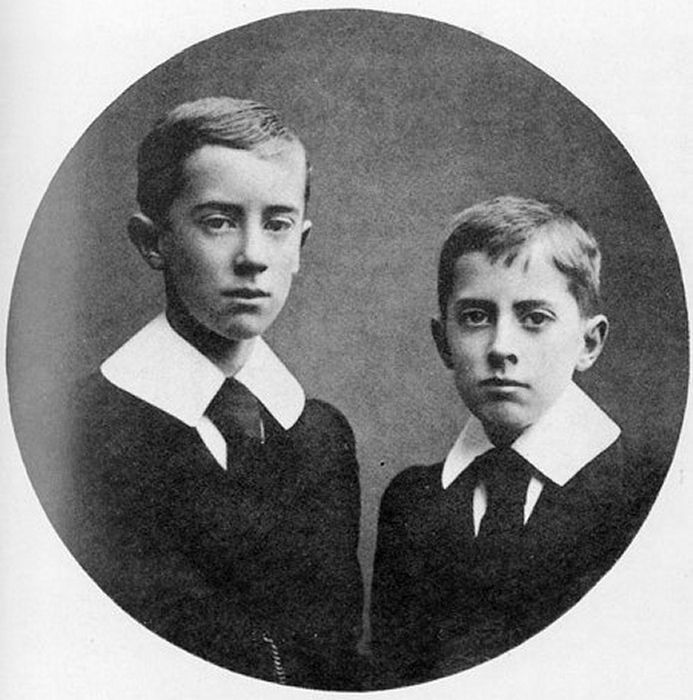
who had been living in South Africa with her husband, brought her two sons, JRRT and Hilary, to the Birmingham area of England for a visit to relatives.

image8.jpg

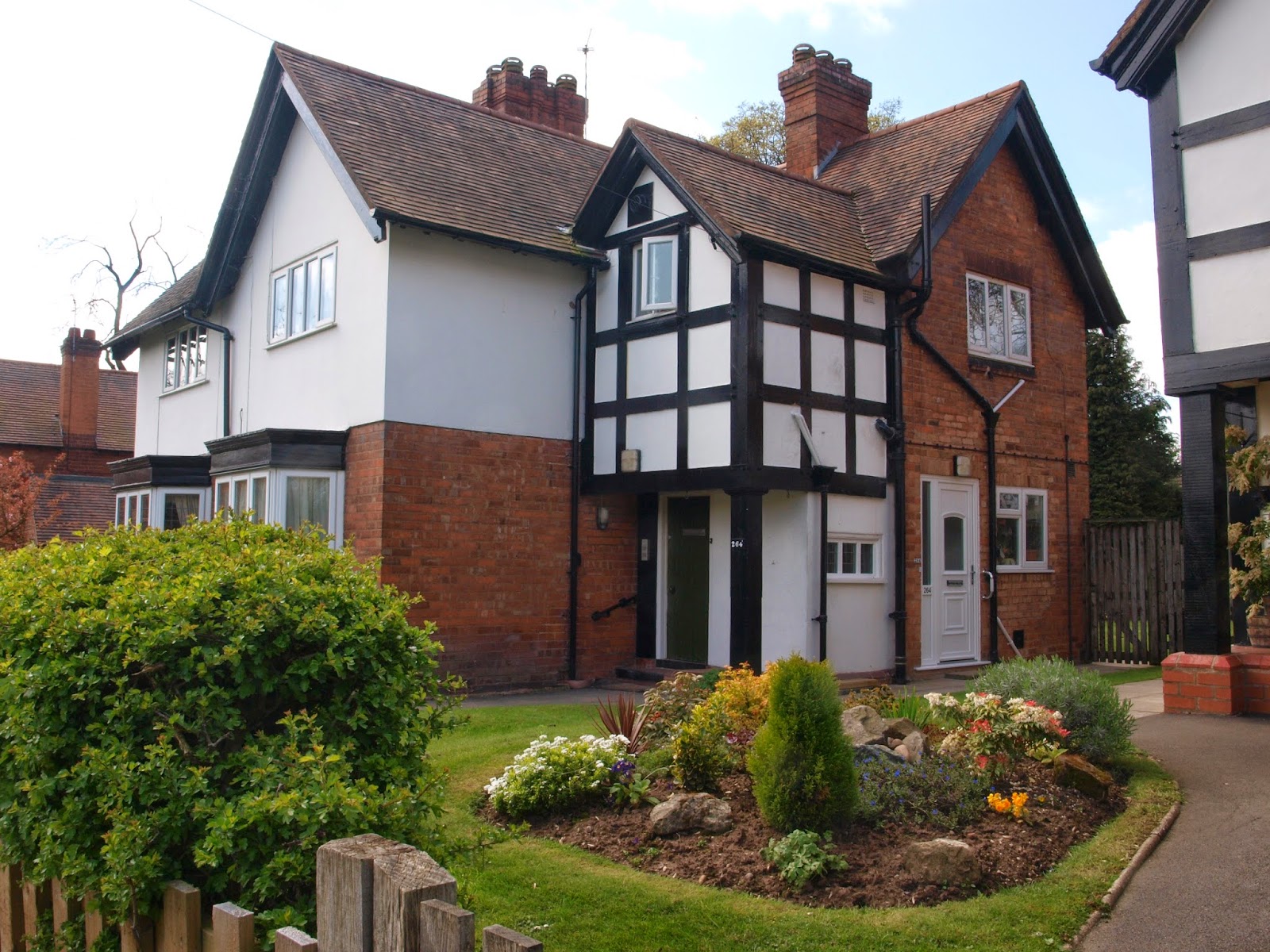
Unfortunately, while they were gone, Tolkien’s father died of rheumatic fever.  Mabel decided to stay in England and found a place for her sons and herself at Sarehole, southeast of Birmingham itself.

image9housesarehole.jpg

Birmingham was a booming product of that Industrial Revolution, which we’re sure is why Mabel chose a tiny village several miles away.

image10brum.jpg

Birmingham was also an ancient settlement, (here’s a LINK to a minitour of the medieval town) but had mushroomed, both in factories and population even at the beginning of the 19th century, as this verse from a music hall song from 1828 by James Dobbs depicts:

‘I remember one John Growse,
Who buckles made in Brummagem,
He built himself a country house,
To be out of the smoke of Brummagem
But though John’s country house stands still,
The town itself has walked up hill,
Now he lives beside a smoky mill,
In the middle of the streets of   Brummagem.”

(James Dobbs (1781-1837), “I Can’t Find Brummagem”.  Brummagem is an old local nickname for Birmingham.  Here’s a LINK so that you can see the whole song and its tune, which we know as “Duncan Grey”.  If you go to the link, you’ll notice we’ve made a few editorial additions, which we knew from another version of the song and which help the words to better fit the tune.)

And yet, although Sarehole had an old mill, it was not like those in Birmingham or even in Dickens,

image11mill.jpg

and, in later years, in fact, Tolkien saw the little village beyond it as a kind of paradise, as he said in an interview:

‘It was a kind of lost paradise,’ he said. ‘There was an old mill that really did grind corn with two millers, a great big pond with swans on it, a sandpit, a wonderful dell with flowers, a few old-fashioned village houses and, further away, a stream with another mill. I always knew it would go – and it did.’

(This is taken from an article by John Ezard in The Guardian for 28 December, 1991—here’s a LINK so that you can read all of it.)

This strong contrast between green and quiet and its opposites, as seen in Sarehole versus Birmingham, early in Tolkien’s life, and the two stages of Isengard, will appear again in the Shire as Saruman/Sharkey has planned.  The green and quiet is literally uprooted and even Sandyman’s old mill is a victim of the goblinesque work as Farmer Cotton says:

image12mill.jpg

“But since Sharkey came they don’t grind no more corn at all.  They’re always a-hammering and a-letting out a smoke and stench, and there’s no peace even at night in Hobbiton.  And they pour out filth a purpose; they’ve fouled all the lower Water, and it’s getting down into Brandywine.”

(The Return of the King,  Book Six, Chapter 8, “The Scouring of the Shire”)

image14shire.jpg

Those who work for Sharkey are men, but, as you can see, under his influence, they act very much like those destructive goblins with which we began.   For all that he rode in automobiles and trains and used telephones and typewriters, JRRT was never quite happy in the modern world and, considering that the goblins seemed always poised to ruin more green and produce more noise at the command of a modern-day Saruman, it’s perhaps not surprising.  It’s also not surprising, we would add, that his favorite creatures, trees, are the ones who destroy Saruman’s handiwork at Isengard and return it to a leafy park.

image15isen.jpg

Thanks, as ever, for reading.

MTCIDC

CD


ps

In our next, we want to talk about another aspect of quiet which had changed from Tolkien’s childhood and may be a reason why there are Rohirrim and why JRRT himself enlisted in the volunteer cavalry…

image16yeomanry.jpg

Gobs and Hobs.2

29 Wednesday Aug 2018

Posted by Ollamh in Artists and Illustrators, Fairy Tales and Myths, J.R.R. Tolkien, Language, Literary History

≈ Leave a comment

Tags

A Midsummer Night's Dream, Arthur Rackham, Christina Rossetti, Elf Child, Fairies, Fairy Tale, George Macdonald, Goblin Feet, Goblin Market, Goblins, Historia Ecclesiastica, Hobgoblin, James Whitcomb Riley, John Garth, John Singer Sargent, King Edward's Horse, Little Orphan Annie, Orderic Vitalis, Pat Walsh, Psalm 91, Robin Goodfellow, The Crowfield Curse, The Crowfield Demon, The Hob and the Deerman, The Hobbit, The Lord of the Rings, The Princess and the Goblin, Tolkien, Tolkien and the Great War, Tolkien at Exeter College

As always, dear Readers, welcome!

In our last, we were talking about JRRT’s 1915 poem, “Goblin Feet” its origins, original publication, and context.

In this, we want to think out loud a bit about the idea of goblins in general.

Although the poem was entitled “Goblin Feet”, Tolkien seemed not to focus so much on goblins—there are also other creatures from the Otherworld, including fairies and gnomes and even leprechauns (not to mention bats—called by their old country name “flitter-mice”—and beetles and coneys).

In this posting, however, we’re going to stick to goblins—well, and hobgoblins—but more about those later.

We first encountered goblins as very small children when a teacher read us a poem by the American poet, James Whitcomb Riley (1849-1916).
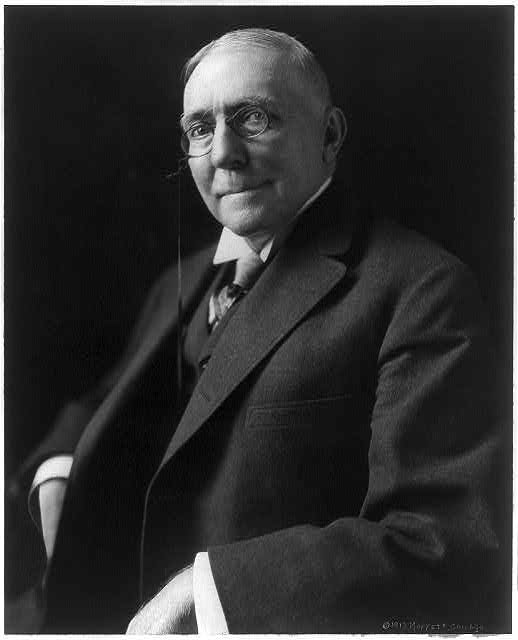
image1riley.jpg

(We can’t resist a second picture.  This is by one of our favorite late-19th-early-20th-c. American Painters, John Singer Sargent—1856-1925.)

image2riley.jpg

This poem, first entitled “Elf Child”, originally appeared in a newspaper in 1885.  After that, it was meant to be “Little Orphan Allie”, but, owing to a typsetter’s error, it gained its present title, which it’s had ever since.

Little Orphant Annie – Poem by James Whitcomb Riley

To all the little children: — The happy ones; and sad ones;
The sober and the silent ones; the boisterous and glad ones;
The good ones — Yes, the good ones, too; and all the lovely bad ones.

Little Orphant Annie’s come to our house to stay,
An’ wash the cups an’ saucers up, an’ brush the crumbs away,
An’ shoo the chickens off the porch, an’ dust the hearth, an’ sweep,
An’ make the fire, an’ bake the bread, an’ earn her board-an’-keep;
An’ all us other childern, when the supper-things is done,
We set around the kitchen fire an’ has the mostest fun
A-list’nin’ to the witch-tales ‘at Annie tells about,
An’ the Gobble-uns ‘ll git you
Ef you
Don’t
Watch
Out!

Wunst they wuz a little boy wouldn’t say his prayers,–
An’ when he went to bed at night, away up-stairs,
His Mammy heerd him holler, an’ his Daddy heerd him bawl,
An’ when they turn’t the kivvers down, he wuzn’t there at all!
An’ they seeked him in the rafter-room, an’ cubby-hole, an’ press,
An’ seeked him up the chimbly-flue, an’ ever’-wheres, I guess;
But all they ever found wuz jist his pants an’ roundabout:–
An’ the Gobble-uns ‘ll git you
Ef you
Don’t
Watch
Out!

An’ one time a little girl ‘ud allus laugh an’ grin,
An’ make fun of ever’ one, an’ all her blood-an’-kin;
An’ wunst, when they was ‘company,’ an’ ole folks wuz there,
She mocked ’em an’ shocked ’em, an’ said she didn’t care!
An’ jist as she kicked her heels, an’ turn’t to run an’ hide,
They wuz two great big Black Things a-standin’ by her side,
An’ they snatched her through the ceilin’ ‘fore she knowed what she’s about!
An’ the Gobble-uns ‘ll git you
Ef you
Don’t
Watch
Out!

An’ little Orphant Annie says, when the blaze is blue,
An’ the lamp-wick sputters, an’ the wind goes woo-oo!
An’ you hear the crickets quit, an’ the moon is gray,
An’ the lightnin’-bugs in dew is all squenched away,–
You better mind yer parunts, an’ yer teachurs fond an’ dear,
An’ churish them ‘as loves you, an’ dry the orphant’s tear,
An’ he’p the pore an’ needy ones ‘at clusters all about,
Er the Gobble-uns ‘ll git you
Ef you
Don’t
Watch
Out!

In some ways, this is a typical Victorian moral poem:  children better behave, or…  But, instead of being in “proper” English, it’s been told in the dialect of the US state of Indiana and this was something for which Riley was well-known, having written numbers of poems in the so-called “Hoosier” dialect.  (This includes what looks like a misprint for the proper spelling “orphan”.)

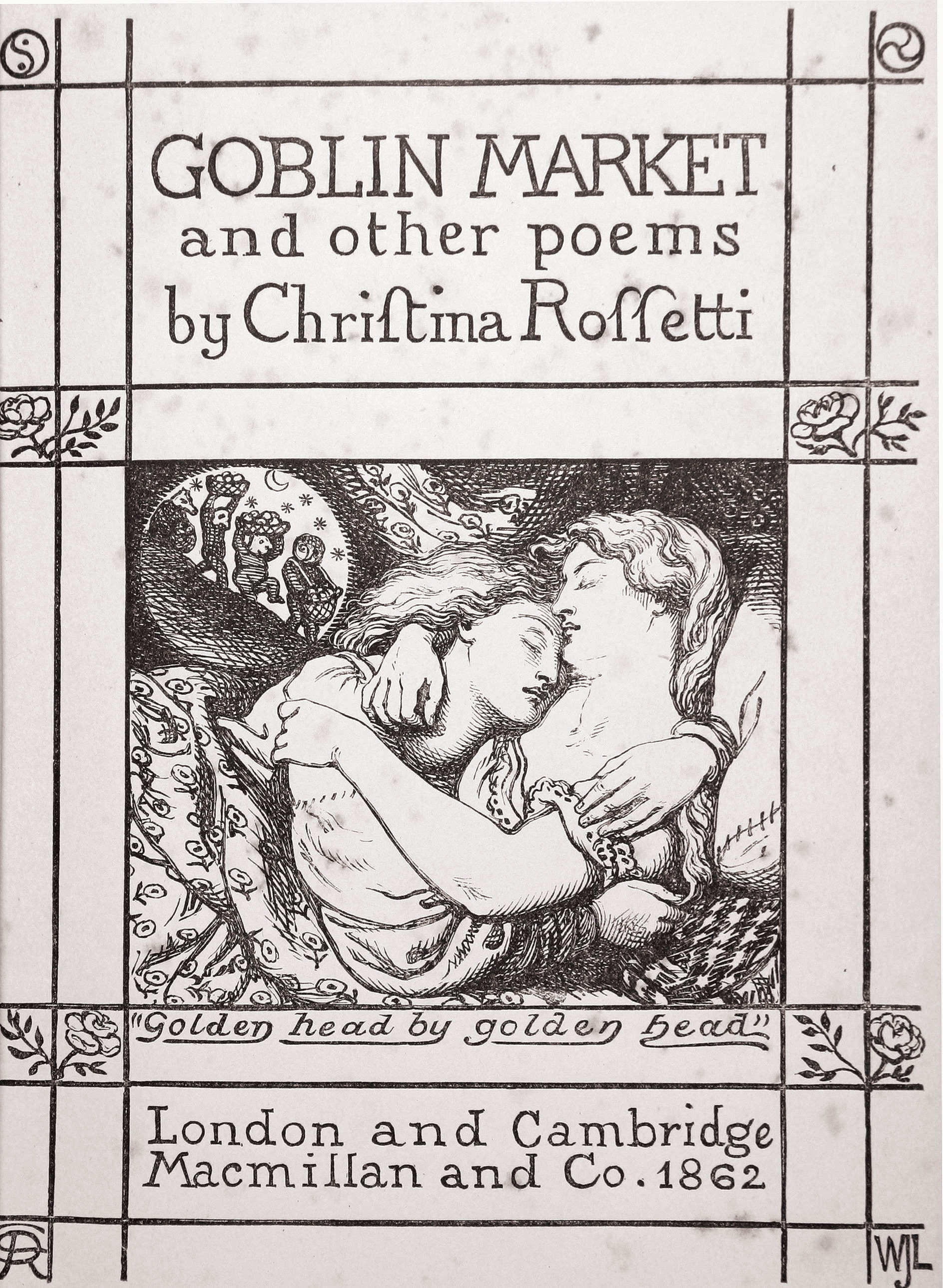
Our acquaintance with goblins has continued to be literary, from Christina Rossetti’s (1830-1894)
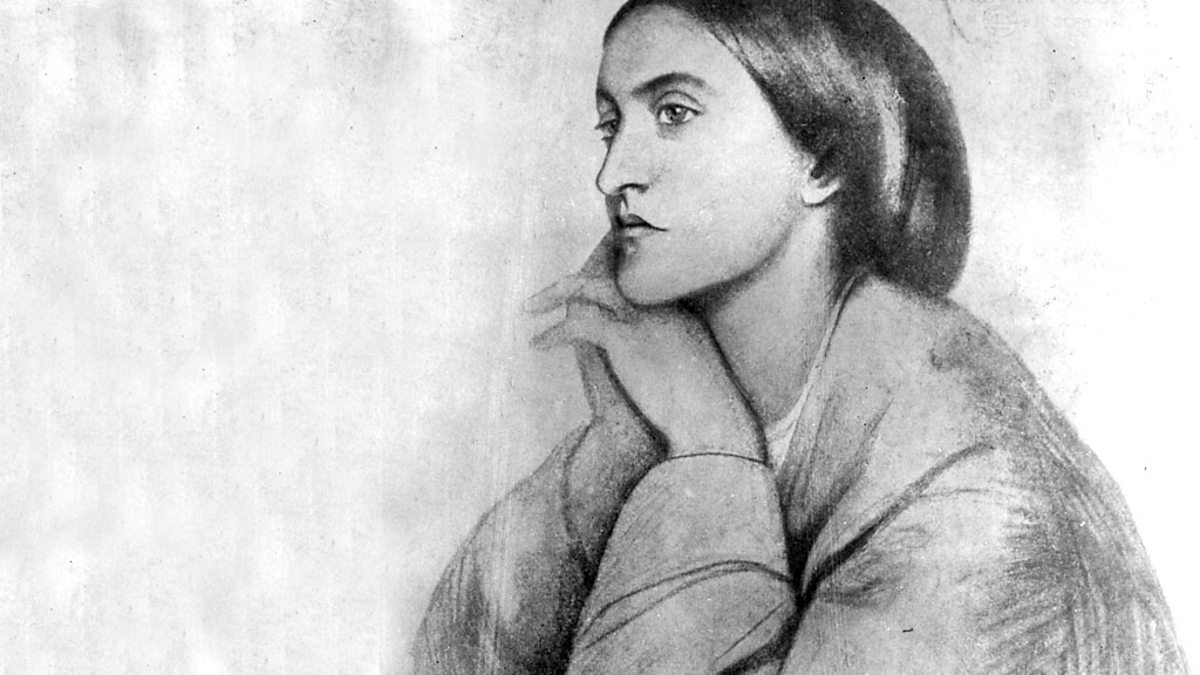
image3acr.jpg

Goblin Market (1862)

image3gobmark.jpg

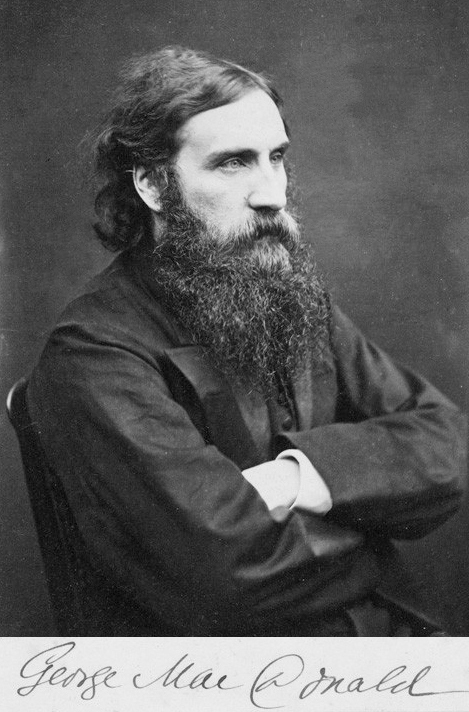
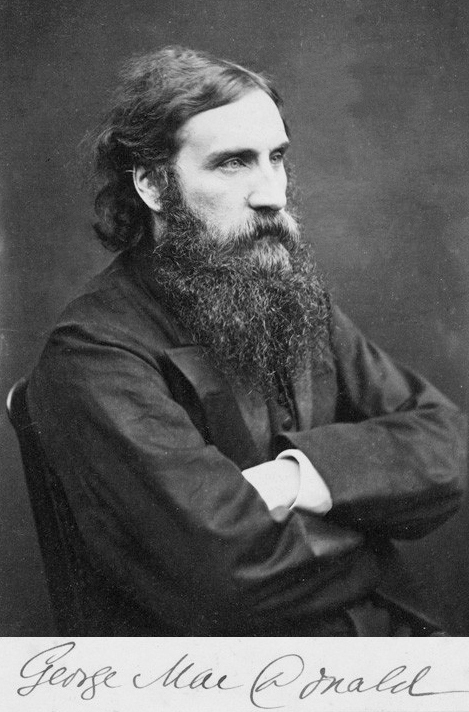
to George Macdonald’s (1824-1905)

image4gmacd.jpg

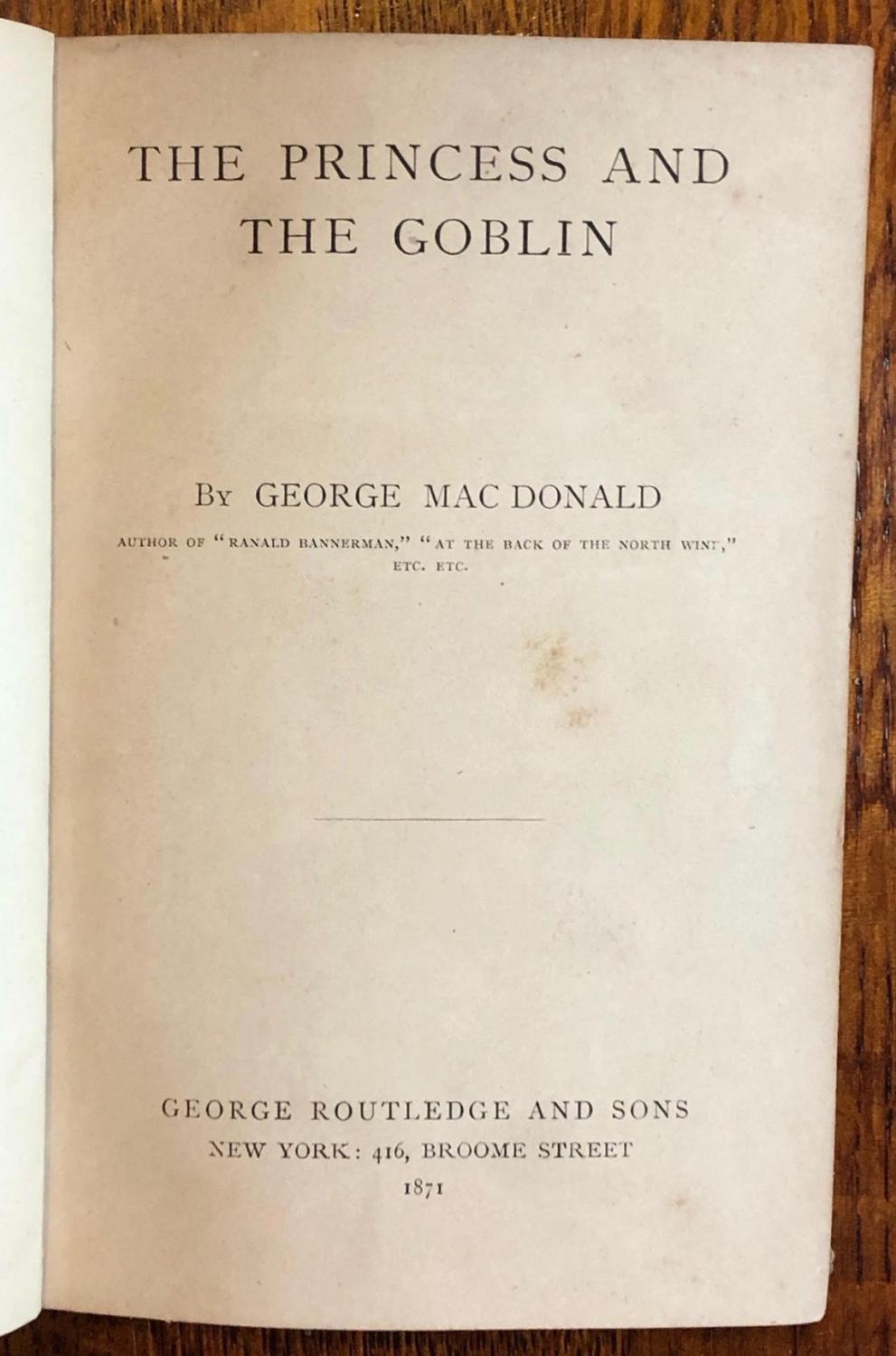
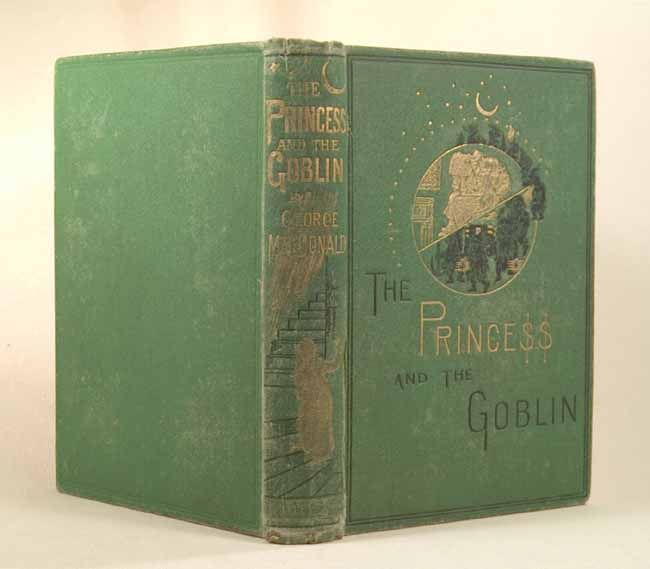
1872 fantasy novel, The Princess and the Goblin.

princessandgoblin1872.jpg

Our biggest—and longest—exposure, of course, was in The Hobbit (1937).

image6hob.jpg

Goblins turn up from the moment Bilbo and the dwarves fall into their hands in Chapter 4, “Over Hill and Under Hill” and we see them again in their pursuit of the party once they’ve escaped the goblin stronghold and finally at the Battle of the Five Armies.  At their first appearance, they are described as “great ugly-looking goblins” and, unlike the nimble-footed creatures of Tolkien’s 1915 poem, these have flat feet and flap them as they move.  They live in a monarchy, ruled (for the moment) by a king described as “a tremendous goblin with a huge head”.

So far, we might see that as traditional nightmarish beings, like the “great big Black Things” in stanza 3 of Riley’s poem, but JRRT does something further and very interesting with them.  This first novel was written in the 1930s, only twenty years after the Great War which had ruined much of western Europe and killed all but one of Tolkien’s oldest friends, and the emotional scar was still fresh, it seems.  He was too humane (and too wise) to blame Germany for what had happened, but it’s clear that he wouldn’t excuse the Industrial Revolution and the goblins become a stand-in for all the worse of it:

“Hammers, axes, swords, daggers, pickaxes, tongs, and also instruments of torture, they make very well, or get other people to make to their designs, prisoners and slaves that have to work till they die for want of air and light.  It is not unlikely that they invented some of the machines that have since troubled the world, especially the ingenious devices for killing large numbers of people at once, for wheels and engines and explosions always delighted them, and also not working with their own hands more than they could help; but in those days and those wild parts they had not advanced (so it is called) so far.”  (The Hobbit, Chapter 4, “Over Hill and Under Hill”)

The word “goblin” has a rather mysterious etymological history and, like so many early words, that history is a murky one, full of guesses and suggestions.  A little research produces the explanation that the word first seems to appear in Latin, in Orderic Vitalis’ (1075-c1142) Historia Ecclesiastica, Book 5, Chapter 7, in which, while reviewing the life of the early French saint, Taurinus, (lived c.400AD), Orderic mentions a demon whom the saint has vanquished, but which still haunted the area around the town of Evreux in Normandy, a demon the locals called “gobelinus”.

A century later, in the long Old French poem on the Third Crusade (1189-1192) of Ambroise of Normandy (who lived at the end of the 12th century), a noted figure in the actual history of the period, Balian d’ Ibelin, is referred to as being “more false than a gobelin” (L’Histoire de la Guerre Sainte, line 8710), with no explanation, suggesting that readers would be aware of what a gobelin was (and that he wasn’t trustworthy).

The word first appears in English in John Wycliffe’s translation of the Bible in the late 14th century, in Psalm 91, in which a God-fearing person will never be afraid of various things, including

“of a gobelyn goyng in derknisses”.

If 14th-century people knew what this creature was, we wonder whether it was still clear to people two centuries later—the older standard English translation (the so-called “King James Bible”, 1611) translates this as

“the pestilence that walks in darkness”

(which actually is close to the Hebrew original, as best as we can make out, as we don’t, unfortunately, read Hebrew—see this LINK to read for yourself.)

In the preface to the 1951 second edition of The Hobbit, Tolkien gives his own gloss, based upon the word he will employ almost entirely in The Lord of the Rings for such creatures:

“Orc is not an English word.  It occurs in one or two places but is usually translated goblin (or hobgoblin for the larger kinds).  Orc is the hobbits’ form of the name given at that time to these creatures…)

thus blending villains from 1937 with those readers would soon see in his new work, The Lord of the Rings (1954-1955).

“Hobgoblin” brings us to our conclusion, however.  As in the case of “goblin”, things get murky here, too, with some stating that, as “Hob” is an old nickname for “Robert” (compare “Hodge” as an old nickname for “Roger”), so a hobgoblin is related to “Robin Goodfellow”, (“Robin” being another nickname for “Robert”) aka the Puck we see in A Midsummer Night’s Dream (1595-96?).
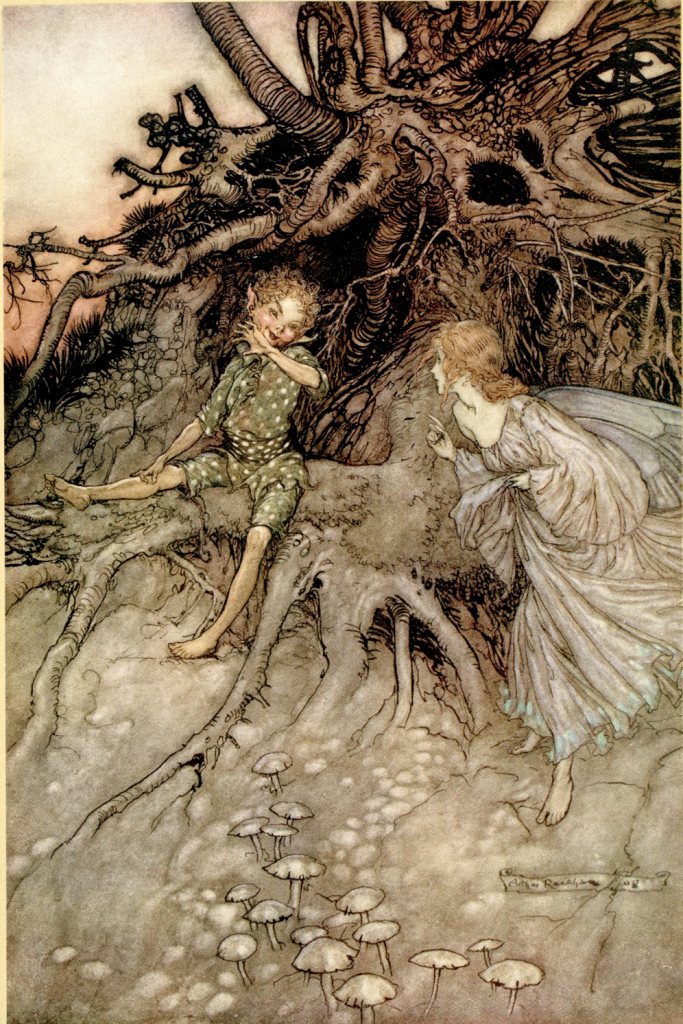
image7puck.jpg

(This image is from Arthur Rackham’s (1865-1939) 1933 version of the play.)
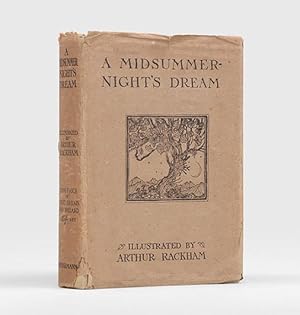
https://pictures.abebooks.com/BLAEU/md/md20625435733.jpg

Hobgoblins sometimes appear as prickly household helpers (rather like Dobby in the Harry Potter books), and those who want to associate the “hob” of “hobgoblin” with the “hob” (earlier “hubbe”), “the side of a fireplace” see that prefix as suggesting that “hobgoblins” might be a subset of “goblins” in general.

For us, however, a “hob” is a character in an on-going series we recommend to our readers.  These are novels set in and around a decaying medieval monastery in 1347 and the haunted world around it, written by Pat Walsh, an archaeologist/fantasy author.

image8pw.jpg

The first two in the series are The Crowfield Curse (2010) and The Crowfield Demon (2011)

image9crowc.jpg

image10crowd.jpg

In this series, the hero, Will, an orphan, discovers a wounded creature and brings it back to the monastery.  It’s a hob—and will be a major character as the series develops.  In 2014, Walsh began a new series with The Hob and the Deerman.

image11thehob.jpg

Walsh has promised a third book in the Crowfield series, Crowfield Rising, but it has yet to appear—unlike our next posting, which will appear (provided that there is no space alien invasion or implementation of Order 66 or Sauron producing a new ring), next week.

Till then, thanks, as ever, for reading.

MTCIDC

CD

PS

In our last, we mistakenly identified a photo of JRRT in a uniform which we thought belonged to a unit at his alma mater, King Edward’s School, as the caption with it said “1907”.   It seemed odd to us, however, because it had the look of a cavalry unit (the bandoleer across the chest was common during the period for cavalry and for artillerymen) and, for all that he writes admiringly of horses, we had no sense that he himself was ever a horseman.  This nagged at us until we did a little research and realized our mistake:  the uniform was for King Edward’s Horse, the equivalent of a national guard/volunteer unit raised before the Great War.  Tolkien was a member of this at the beginning of his Oxford career in 1911, but later resigned.  John Garth’s two really useful books, Tolkien at Exeter College and Tolkien and the Great War, set us straight.

image12keh.jpg

PPS

If you read us regularly, you know that we have a special love for early, silent film  While researching this posting, we learned that, in 1918, a film was made based upon “Little Orphant Annie” and that a copy of it has survived for us to see.  Here’s a poster and a still.

image13littleorphant.jpg

image14still.jpg


Middle-under-earth

04 Wednesday Apr 2018

Posted by Ollamh in Artists and Illustrators, Heroes, J.R.R. Tolkien, Literary History, Narrative Methods

≈ Leave a comment

Tags

Alan Lee, Andrew Lang, Barrow-downs, Beowulf, cyclops, Dragons, George Macdonald, Goblin Feet, Goblins, Great War, Grendel, Grendel's Mother, John Howe, monsters, Polyphemus, Sir Gawain and the Green Knight, Smaug, Storia Moria Castle, Tales of Troy and Greece, The Hobbit, The Lord of the Rings, The Princess and the Goblin, The Red Book of Animal Stories, The Red Fairy Book, Tolkien, trenches, tumulus

As always, dear readers, welcome!

One of us is currently teaching The Hobbit and, is always seems to be the case when we are teaching an old friend, we are struck by something new.  In this case, it’s the idea of “what lurks beneath” and where it might come from.

What occurred to us now was that, virtually every time there is trouble for Bilbo and the dwarves, it is strongly linked with caves and hollowed-out places:  trolls who came out of a cave (“Roast Mutton”), goblins who live in caves (“Over Hill and Under Hill”), Gollum (“Riddles in the Dark”), hostile elves (“Flies and Spiders” and “Barrels Out of Bond”), and, of course, Smaug (“On the Doorstep”, “Inside Information”, and “Not At Home”).  Only the wargs, the overgrown spiders, and the men of Lake-town in the Battle of the Five Armies have above-ground origins, as, after all, the other forces—goblins, elves, and even Iron Hills dwarves (we assume), have subterranean dwellings.

We knew that JRRT thought to become a classicist early in his academic career and we can imagine right away that one influence upon him for this underground menace would have been Polyphemus the Cyclops, who, after all, lives in a cave.

image1cyclops.jpg

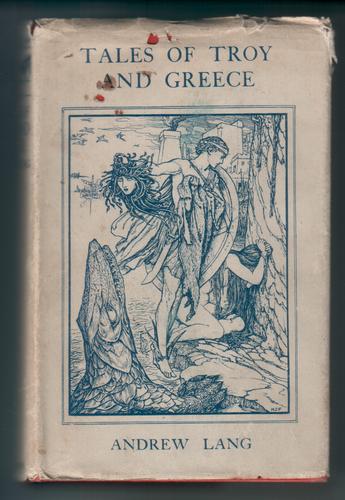
Before he read that part of Odysseus’ story in Greek, he might have seen it in Andrew Lang’s 1907 Tales of Troy and Greece—

image2alang.jpg

image3lang.jpg

Tolkien tells us that, as a child, he had read other Lang works and a story in one, The Red Fairy Book (1890), might even have influenced some Middle-earth geography, from “Storia Moria Castle”.

image4redfairybook.jpeg

image5leemoria.jpg

Another childhood favorite (although he appears to have changed his mind later in life) were the fantasy novels of George Macdonald

image6gmacd.jpg

and his The Princess and the Goblin (1872),

image7princess.jpg

as its title suggests, is full of goblins and their underground world.  These goblins are powerful, but have one fatal flaw—tender feet—which JRRT said that he never believed (see Letters, 178)—although Tolkien’s first published poem was entitled “Goblin Feet” (Oxford Poetry 1915).

Beyond possible childhood reading, there is his career focus, which includes two other potential underground influences.

First, there is Beowulf.  Grendel, the monster in this poem,

image8grendel.jpg

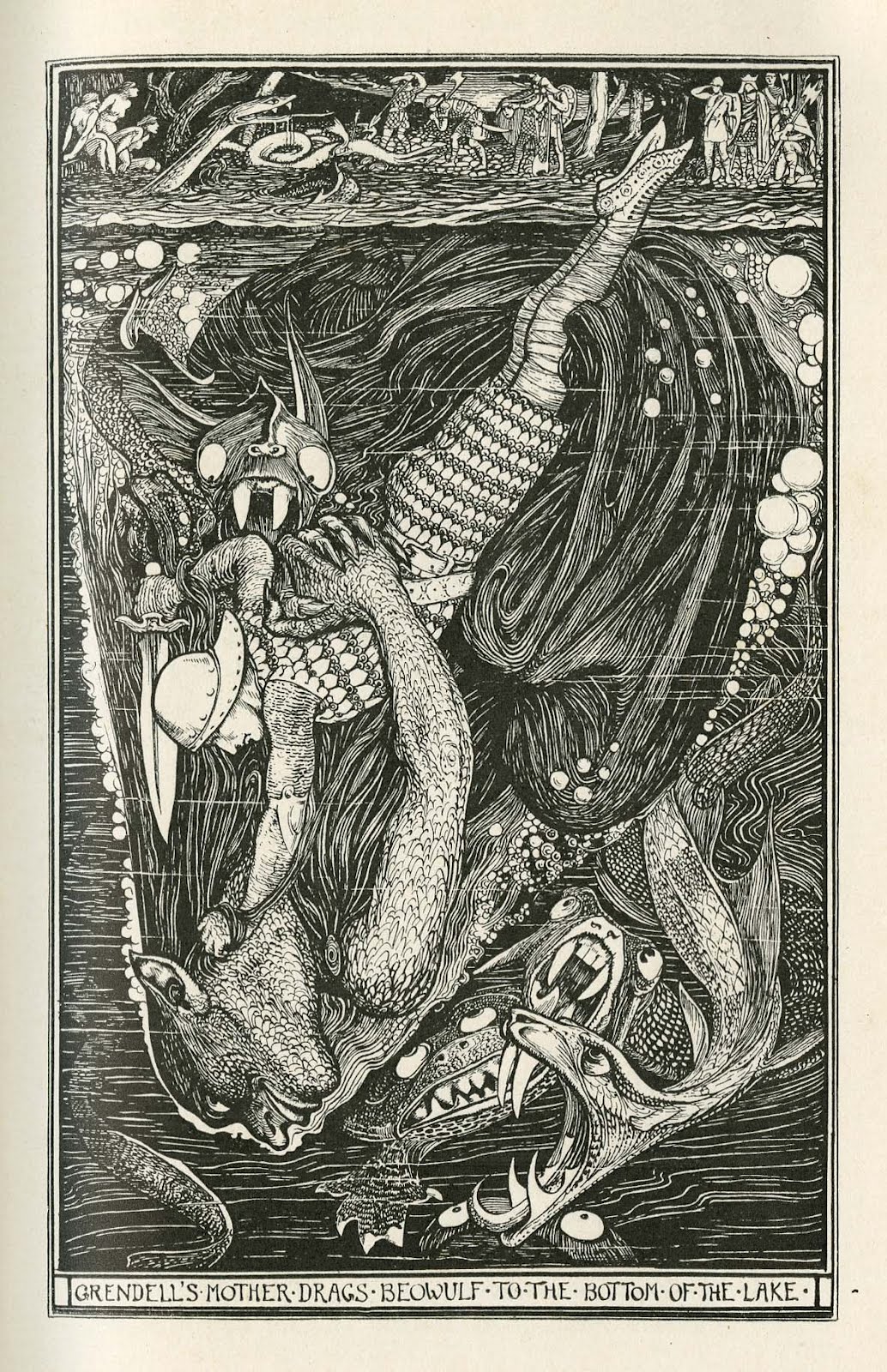
lives in a cave at the bottom of a pool with his mother and, in the second part of his monster-slaying, Beowulf has to dive into that pool to deal with her.image9beowulfandmama.jpg

This illustration comes from another Andrew Lang book, The Red Book of Animal Stories (1899).

image10redbook.jpg

(The picture of Grendel is by Brian Froud.  We found it on the website of K.T.Katzmann, I Write Monsters.  Here’s a LINK.)

Then, of course, there’s that dragon, against whom Beowulf fights and dies—and which is the direct ancestor of another famous and familiar dragon…

image11dragonandhoard.jpg

We are told that it lives in an abandoned tumulus—that is, an ancient grave mound, like this one.

image12tumulus.png

(This is, in fact, a famous Neolithic burial at Gavrinis, in Brittany.)

JRRT worked in Middle English, as well as Old English, and here we find one more possible source in his own edition (with E.V. Gordon) of the 14th-century poem Sir Gawain and the Green Knight.

image13tolkgord.JPG

The Green Knight who challenges King Arthur’s court to a mutual head-chopping contest, is said, in the fourth part of the poem,  to inhabit a “green chapel” and to appear out of a hole when Sir Gawain, who has accepted the challenge and cut off the Green Knight’s head, makes his appearance there to fulfill his half of the contest.

image14sirg.jpg

This chapel has sounded like a tumulus to generations of scholars and here’s John Howe’s 2003 illustration, complete with chapel as tumulus (not to mention a very large green man).

image15johnhowe.png

Tumuli also make their appearance, of course, in The Lord of the Rings, when Frodo and his party go astray on the Barrow Downs.

image16barrowwight.jpg

We can’t finish this posting without at least suggesting one more source, something even more personal than JRRT’s scholarly work:  his experiences in the Great War.

image17lt.jpg

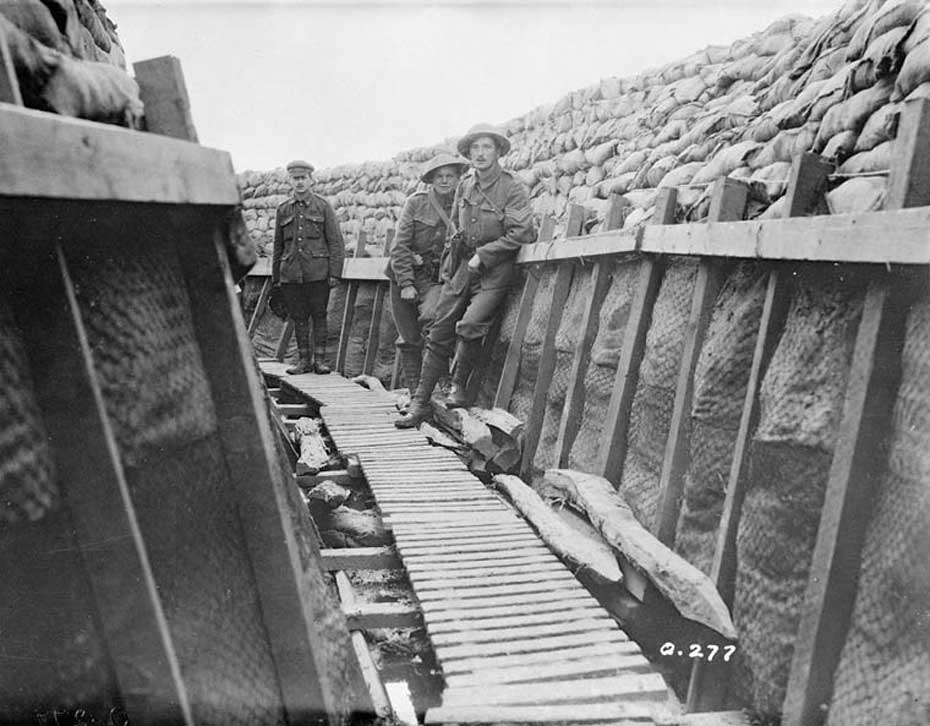
By the time Tolkien entered the service in France, the Western Front was, basically, a 500-mile trench, from Switzerland to the North Sea.

image18trenches.gif

Much of the entrenching was simply deep, reinforced ditching.

image19trenches.jpg

But some—particularly on the German side—could be elaborate, even built with stone or concrete, and set far enough into the ground as to be almost impervious to bombardment.

image21bunker.jpg

And we imagine that, with all of that earlier literary work in his mind, JRRT might have faced such defenses wondering whether what was inside them would be Germans

image22trenchclearing.jpg

or something much worse.

image23smaug.jpg

And did this haunt his later writing as much as the Great War haunted the minds of soldiers all over the world?

Thanks, as ever, for reading!

MTCIDC

CD

Orcked

22 Wednesday Nov 2017

Posted by Ollamh in Economics in Middle-earth, Imaginary History, J.R.R. Tolkien, Literary History, Narrative Methods

≈ Leave a comment

Tags

Arthur Rackham, Bosch, Brueghel, counterfeit, creation, Elves, Ents, Fangorn, Goblins, John Bauer, mockery, Orcs, Saruman, Sauron, The Hobbit, The Lord of the Rings, Tolkien, Treebeard, trolls, US Treasury Department, Weimar Republic

Welcome, dear readers, as always.

In our last, we discussed less familiar characters in The Lord of the Rings, the Corsairs of Umbar, and what we imagine they could look like.

In this posting, we want to look at much more familiar characters, Orcs—but from the viewpoint of Fangorn.

image1treebeard.jpg

He says of them:

“Maybe you have heard of Trolls?  They are mighty strong.  But Trolls are only counterfeits, made by the Enemy in the Great Darkness, in mockery of Ents, as Orcs were of Elves.”  (The Two Towers, Book Three, Chapter 4, “Treebeard”)

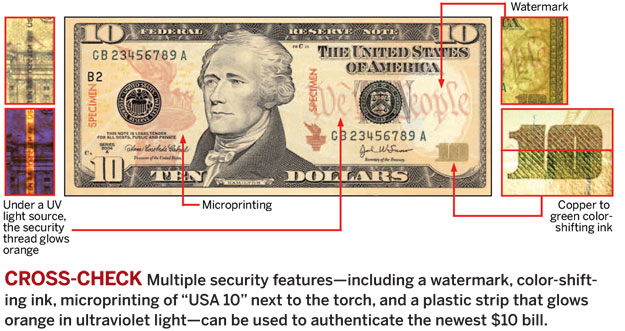
We’ve always been a bit puzzled by this.  “Counterfeit” makes us think, immediately, of counterfeit money.  Here are a pair of US 10-dollar bills:  can you tell the counterfeit (from Old French via a Latin compound, contra, “against” + facere, “make/do”—in Medieval Latin a contrafactio is a thing put against another, something in contrast, thus “imitation”)?

image2hamiltons.jpg

To be a successful counterfeit, normally, it’s necessary that the imitation be as close to the original as possible, as in the case of these two tens.  The US Treasury Department goes to a lot of time and expense to make counterfeiting as difficult as possible

image3anticounterfeit

but, if a counterfeiter is successful, he stands to make (in two senses) a lot of money.  He can also cause a great deal of financial damage, breeding distrust in a government’s ability to coin money and to stand behind it.  The more counterfeit money in the system, the more money the government has to back, which, in time, could lead to what is called hyperinflation and can bring a currency to collapse.  When a government does this itself it can cause havoc with a country’s economy, as happened in the Weimar Republic in 1921-1924.  At that time, for complex reasons having to do with paying off the German Empire’s war debts, the government began producing too much paper money and too rapidly.  This caused the money to lose value very quickly, rendering it almost worthless.

image4weimarmoney

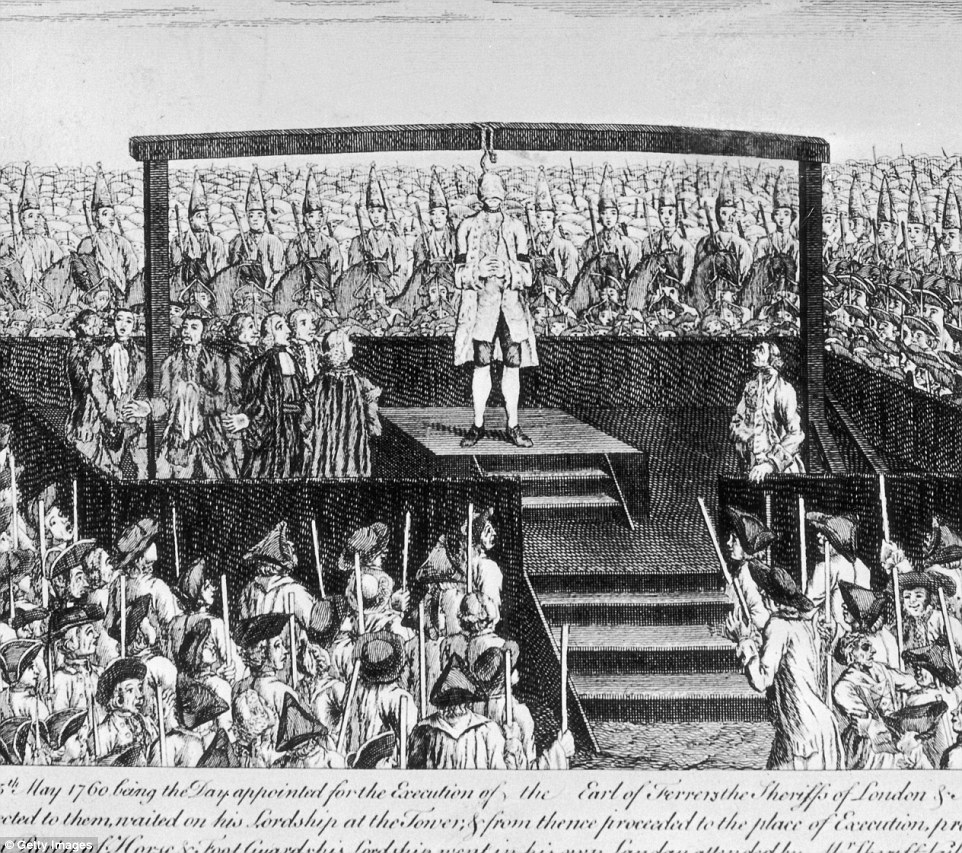
It’s no wonder that the penalty for counterfeiting was usually the most severe possible.

image5tyburn

Treebeard’s use of the word “counterfeit”, then, would suggest that what Sauron was doing was trying to make nearly-exact copies of something, either Ents or Elves, in his creation of Trolls and Orcs.  So what do we find when we first see a description of Orcs?

“There were four goblin-soldiers of greater stature, swart, slant-eyed, with thick legs and large hands.”

(The Two Towers, Book Three, Chapter 1, “The Departure of Boromir”)

That’s not much to go on:

  1. “greater stature” would suggest that most Orcs were short
  2. “swart” means “dark-complexioned” (a term Sam uses to describe men from Harad, whom he calls “Swertings”—The Two Towers, Book Four, Chapter 3, “The Black Gate is Closed”)
  3. “slant-eyed”—for contemporary people this is a tricky term, even a racial slur, but JRRT probably meant no more than that these Orcs had epicanthic folds to their eyelids, which is not uncommon among many of the world’s peoples.

image6epicanth

  1. “with thick legs and large hands” suggests very stocky builds—like the “Trolls turned to stone” in JRRT’s illustration of the scene in The Hobbit.

image7stonetrolls

This is a start, but will our next view help?  Pippin and Merry are the prisoners of the Orcs and Pippin is listening to a quarrel between those of Saruman and those of Sauron:

“In the twilight he saw a large black Orc, probably Ugluk, standing facing Grishnakh, a short crook-legged creature, very broad and with long arms that hung almost to the ground.” (The Two Towers, Book Three, Chapter 3. “The Uruk-hai”)

Counterfeit Elves?  Of course we know—also from Fangorn—that perhaps Saruman was up to something more, as Fangorn says of him:

“He has taken up with foul folk, with the Orcs.  Brm, hoom!  Worse than that:  he has been doing something to them; something dangerous.  For these Isengarders are more like wicked Men.  It is a mark of evil things that came in the Great Darkness that they cannot abide the Sun; but Saruman’s Orcs can endure it, even if they hate it.  I wonder what he has done?  Are they Men he has ruined, or has he blended the races of Orcs and Men?  That would be a black evil!” (The Two Towers, Book Three, Chapter 4, “Treebeard”)

This might account for the size of the Uruk-hai, as well as for their ability to endure daylight, but what about the crook-leggedness and “long arms that hung almost to the ground”?

Perhaps here we should remember the end of Fangorn’s description:  “…in mockery of Ents, as Orcs were of Elves.”

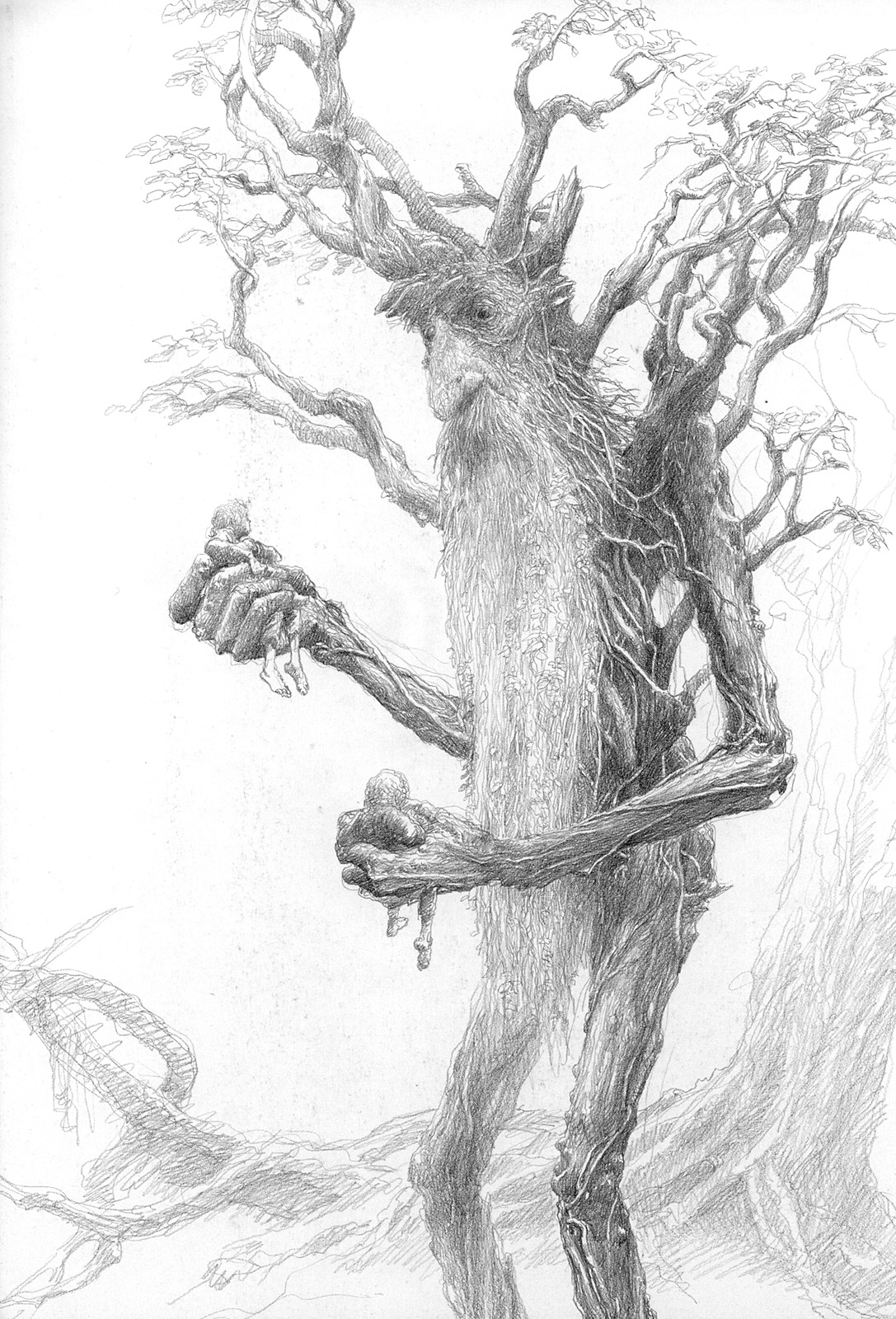
Hmm.  Trolls certainly don’t look much like Ents—

image8.jpg

image9leetreebeard.jpg

Is this the “mockery”?  It’s certainly not counterfeiting in the usual sense!

Should we understand the same for Orcs vs Elves?  Here are illustrations of Galadriel and Legolas (both by the Hildebrandts):

image10galadriel.jpg

image11legolas.jpg

Set those against any modern artist’s view of Orcs and, again, it’s not counterfeiting, in the strictest sense, so we suppose that we have to assume “mockery”—but with the added assumption that Sauron had a very twisted sense of humor.  (There’s also that nasty half-suggestion of Fangorn’s that, since Saruman’s Orcs are behaving more like men, Saruman has been performing genetic experiments, something even Fangorn doesn’t want to think about.)

image12mcbride.gif

image13lee.jpg

image14howe.jpg

Looking at all of these illustrations, by the way, we were struck by where we’d seen creatures like this before.  Could it be in the works of those strange Flemish/Dutch painters like Brueghel and Bosch?

image15bosch.jpg

Or Arthur Rackham?

image16rackham.jpg

Or the early 20th-century Swedish painter, John Bauer, who, in his depiction of forests was an influence upon JRRT?

image17bauer.jpg

And, more recently, considering P. Jackson’s Orcs,

image18orcs.png

image19orcs.jpg

their skin color and general look:  is there a suggestion here of the so-called “Bog People” (about whom we wrote a posting some time ago)—a whole series of bodies, at least one dating from the 4th century bc

image20tollundman.jpg

who have been discovered buried in peat bogs (a great preservative) in northern Europe?

image21peatbog.jpg

And, in their color and oozy look–not to mention that they seem to move in scuttly groups–is there something cockroachy about them?

image22cockroaches.jpg

But, just as there is a place Fangorn doesn’t want to go, it’s true for us as well!

Thanks, as ever, for reading.

MTCIDC

CD

PS

You probably spotted this (we have very intelligent readers), but it’s the top 10-dollar bill which is the counterfeit.

PPS

It has also occurred to us that JRRT more than once discussed the fact that Sauron, as a lesser deity-figure, could never originate, only copy and “subcreate”—perhaps suggesting another reason for making “mockeries”:  his anger at his inability to do original work?

Are You Sitting Down.1?

04 Wednesday Oct 2017

Posted by Ollamh in Imaginary History, J.R.R. Tolkien, Narrative Methods

≈ Leave a comment

Tags

19th Century, An Introduction to Old Norse, Bag End, Beorn, Charles Dodgson, E.V. Gordon, Edwardian, Elvenking, Furniture, Goblins, Hildebrandts, House, Iron Age Farmhouse, Lewis Carroll, Listen with Mother, Master of Laketown, Monty Python, Norse house, Sackville-Bagginses, The Hobbit, Through the Looking-Glass, Tolkien, Victorians

Welcome, dear readers, as always.

Several times, Monty Python skits included the pattern, “Are you sitting comfortably?  Then I’ll begin.”

image1a.jpg

It was clear, when we first heard it, that, like so much of Python material, it was one of those references which an audience in Britain in the early 1970s would have understood immediately and chuckled at, but it was only with the advent of the all-knowing Wikipedia that the reference came clear to us.  (Here’s a LINK, so that, if you don’t know it already, you, too, can be suitably enlightened.)

But it made us think—not everything does, we promise!—of Tolkien and what must sound like a very odd subject—furniture.

Furniture?

Consider Bilbo’s Bag End:

“The Door opened on to a tube-shape hall like a tunnel:  a very comfortable tunnel without smoke, with paneled walls, and floors tiled and carpeted, provided with polished chairs, and lots and lots of pegs for hats and coats…The tunnel wound on and on, going fairly but not quite straight into the side of the hill—The Hill, as all the people for many miles round called it—and many little round doors opened out of it, first on one side and then on another.  No going upstairs for the hobbit:  bedrooms, bathrooms, cellars, pantries (lots of these), wardrobes (he had whole rooms devoted to clothes), kitchens, dining-rooms, all on the same floor, and indeed on the same passage…” (The Annotated Hobbit, Chapter 1, “An Unexpected Party”)

Here is JRRT’s version of the entryway–with Bilbo—or is that JRRT himself?  There appears to be a strong resemblance…

image2a.jpg

image2bilbo.jpg

As the narrator tells us, “This hobbit was a very well-to-do hobbit…”, but, at the same time, we could easily see this description (ignoring the fact that it’s about a hole, albeit “not a nasty, dirty, wet hole…nor yet a dry, bare, sandy hole…it was a hobbit-hole, and that means comfort”) applied to the kinds of late-Victorian/Edwardian interiors with which Tolkien was familiar.

image3hall.jpg

People of this world—middle-class England—seem to have loved to live among piles of possessions—heavy furniture, thick carpets, heavy drapes, and knickknacks galore.

image4.jpg

(Oh–and swords, apparently.)

To us, this has a slightly claustrophobic effect—and we imagine that it may be why Alice in Through the Looking-Glass (1871) attempts to escape it–

image5lookingglasshere.jpg

only to find herself in a distorted version of the same room on the other side of the mirror.

image6lookingglassthere.jpg

[Here’s the actual mirror, from the childhood home of the real Alice, which is said to have inspired Charles Dodgson/Lewis Carroll to write a sequel to the first Alice book.]

image7alicemirror.jpg

What about other Middle-earth interiors, beginning in The Hobbit?

Surprisingly, there is really nothing before the Dwarves and Co. reach Beorn’s house.  There is no description of any inside in Rivendell and, beyond that, the only “indoors” we see before Beorn is the main cave of the goblins and the only “furniture” is this:

“There in the shadows on a large flat stone sat a tremendous goblin…”  (The Hobbit, Chapter 4. “Over Hill and Under Hill”)

image8goblinstone.jpg

Beorn’s house, as we see in Anderson’s The Annotated Hobbit (170-171), appears to be based upon an illustration to be found in E.V. Gordon’s An Introduction to Old Norse (1927) (with an older history yet—see Anderson, 171).

image9beornshall.jpg

The Hildebrandts saw Beorn’s house as rather like a giant log cabin,

image10aabeornshouse.jpg

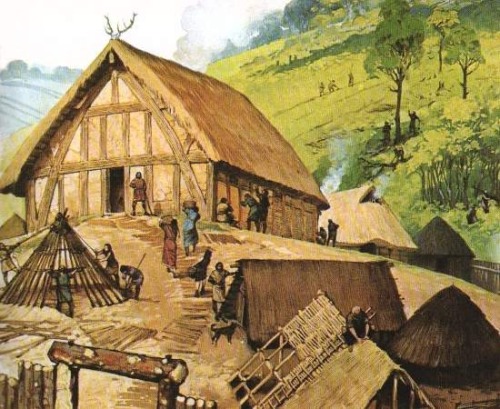
but we imagine the outside of Beorn’s house to look rather more like this view of an Iron Age farmhouse

image10bb.jpg

And here’s a reconstruction of a Norse house interior which is a little more “lived-in”, to give you the idea of what Beorn’s house might look like day-to-day (without the magic animals, unfortunately).

image10bvikinghall.jpg

As Tolkien’s illustration shows, however, this is hardly based upon a Victorian parlor!  As the narrator describes it (with magic animals as the kitchen staff):

“Quickly they got out boards and trestles from the side walls and set them up near the fire…Beside them a pony pushed two low-seated benches with wide rush-bottoms and little short thick legs for Gandalf and Thorin, while at the far end he put Beorn’s big black chair of the same sort…These were all the chairs he had in his hall…What did the rest sit on?…The other ponies came in rolling round drum-shaped sections of logs, smoothed and polished, and low enough even for Bilbo…” (The Hobbit, Chapter 7, “Queer Lodgings”)

Beyond Beorn’s house, there is mention that the Elvenking sat “on a chair of carven wood” (The Hobbit, Chapter 9, “Barrels Out of Bond”) and the Master of Laketown has a “great chair” (The Hobbit, Chapter 10, “A Warm Welcome”), but we have come deeper into the Middle-earth/medieval world, it seems, where furniture (at least in the narrator’s view) is sparse and we will only begin to see more abundance, at least in a general way, when we return to the Shire and the unwelcome event of the auction of Bilbo’s possessions on June 22nd:

“The legal bother, indeed, lasted for years…and in the end to save time Bilbo had to buy back quite a lot of his own furniture.” (The Hobbit, Chapter 19, “The Last Stage”)

“Furniture” is, unfortunately, a vague word, mentioned just previously in relation to the Sackville-Bagginses who were “busy measuring his [Bilbo’s] rooms to see if their own furniture would fit.”  We’ll have to make do here with our original idea of Bilbo the Middle-earth Victorian’s house,

image10vicparlor.jpg

but, in our next, we’ll have a look at households (and palaces) in The Lord of the Rings, to see what we may find (and we have a hunch the inventory will include a quantity of thrones…)

Thanks, as ever, for reading!

MTCIDC

CD

When One Door Closes (I)

09 Wednesday Nov 2016

Posted by Ollamh in J.R.R. Tolkien, Literary History, Narrative Methods

≈ Leave a comment

Tags

And Unexpected Party, Baggins, Beorn, Bilbo, Bilbo and Gollum, Chico Marx, doors, Dwarves, Gandalf, Goblins, Groucho Marx, hidden door, Hobbit door, Horse Feathers, Into the Fire, Lake Town, Lonely Mountain, Mirkwood, Out of the Frying-Pan, password, Smaug, speakeasy, Swordfish, The Hobbit, The Lord of the Rings, The Marx Brothers, Thranduil, Tolkien, Took, wargs

Welcome, dear readers, as always.

Recently, we’ve been thinking about Bilbo’s remark to Frodo:

“It’s a dangerous business, Frodo, going out your door.” (The Fellowship of the Ring, Book 1, Chapter 3, “Three is Company”)

What makes this true in Tolkien, we wondered? As an experiment, we began to list all of the significant doors in The Hobbit and The Lord of the Rings and what happened at each of them and we believed that we could see that they fell, roughly, into two categories: doors (and we include gates here) which are the approach to danger, as Bilbo says, and doors which at least seem to offer safety. There are so many, in fact, that we have decided to break them down (no pun intended) and, in this posting, we’ll examine those we found in The Hobbit.

Our first door is Bilbo’s own, in front of which he is sitting when Gandalf first appears

bilbogandalf.jpg

and which he dodges behind, to escape Gandalf—or so he thinks:

“With that the hobbit turned and scuttled inside his round green door, and shut it as quickly as he dared, not to seem rude.” (The Hobbit, Chapter 1, “An Unexpected Party”)

This door, of course, is hardly a barrier to Gandalf, who scratches a rune on it, turning it from what Bilbo hopes is a “no trespassing” sign to a “welcome” mat.

bilbosdoor.jpg

We then get a scene which reminds us of one in the Marx Brothers’ movie, Horsefeathers (1932)

horsefeatherposter.jpg

—or maybe it’s just an excuse on our part to bring up the Marx Brothers, who, in our opinion, are never brought up often enough. It’s a scene from the days of Prohibition, when hard liquor had been outlawed in the U.S. by an amendment to the Constitution (1920-1933). It was clearly a batty idea and, very soon, many people (some of whom must even have voted for the amendment), were looking for ways to skirt the federal law. One way to do so was to visit an illegal bar, called a “Speakeasy”, presumably because you could say what you wanted there, including criticizing a stupid law. These were secret places, with guards at the door and a need for passwords, so that people on the inside could detect attempts by the police to raid them. In the movie, Chico (pronounced “chick-o’’—as he was said to be an avid pursuer of girls)

chico.jpg

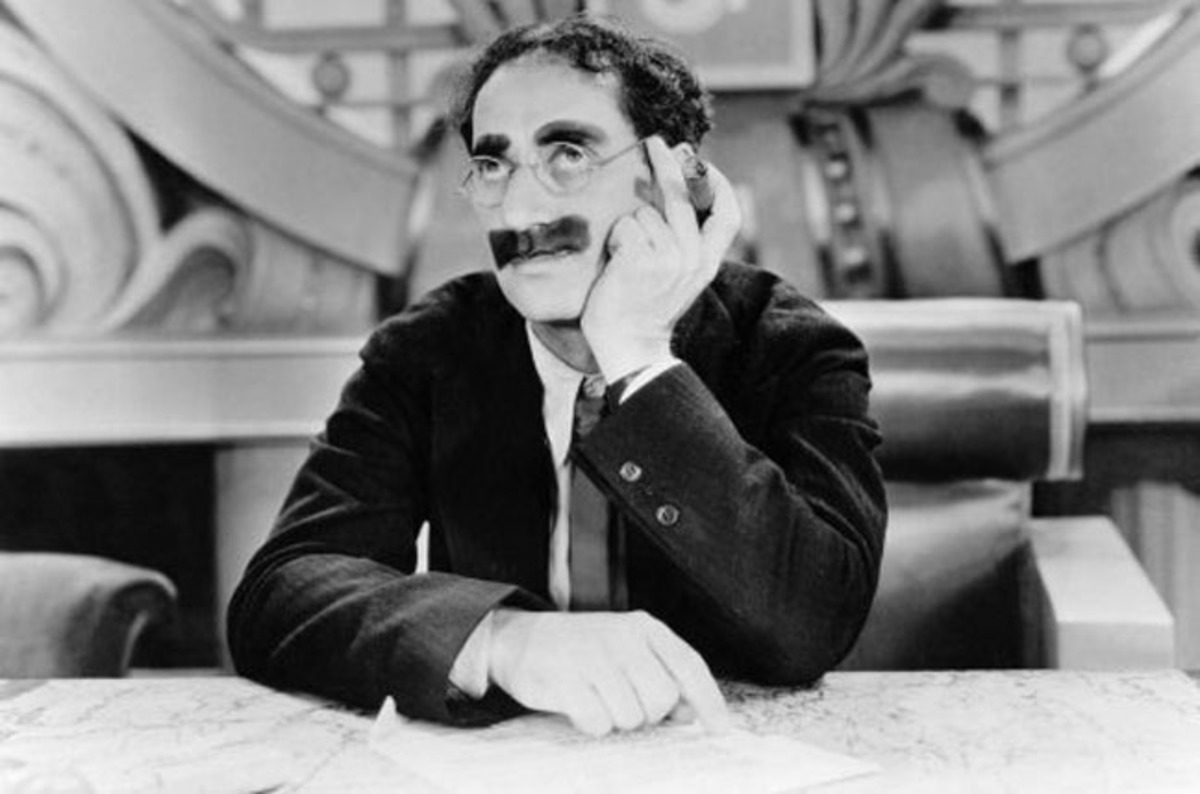
is the guard on the inside and Groucho

groucho_marx_in_duck_soup.jpg

is a potential customer.

speakeasy.jpg

As is typical with the Marx Brothers, the scheme collapses and they both end up on the outside of the door, but, before that happens, there is a lot of knocking and attempts (full of bad puns) to guess the proper password.

horsefeathersbothshutout.jpg

The door, then, is really only a prop, a site where Chico and Groucho can practice one-liners on each other and not much else (as if that matters with the Marx Brothers!). In the next door scene from The Hobbit, however, JRRT uses Bilbo’s door for larger purposes: to show Gandalf’s subtle understanding of Bilbo’s psychological make-up, as well as the beginning of his plan to turn Bilbo from a staid Baggins to a much freer Took, as Bilbo is forced to confront a gang of dwarves and their mission.

unexpected.jpg

Gandalf’s method, as readers will remember, was to send the dwarves to Bilbo’s door one or two at a time. Gandalf repeats this trick when he and the dwarves (and Bilbo, of course) take refuge at Beorn’s,

beorn.jpg

after their escape from the pursuing wargs and goblins.

warg_rest.jpg

Whereas we might say that the second door scene at Bilbo’s led to danger, this scene leads to safety, although only temporary security, as Bilbo and the dwarves must set out again, even if refreshed and refitted.

(Readers note: this second time has been replaced in the second Hobbit film with a scene which misses both the quiet comedy of the original and its use in the story as a way to provide us with a more rounded picture of Beorn, as well as JRRT’s use of a repeated folk motif perhaps to reinforce the fairy tale-like structure of what was originally an oral tale turned children’s book.)

The dwarves had encountered the goblins through a hidden door (clearly a “danger door”), outside of which they had taken shelter. They are made prisoner

goblinking.jpg

but Bilbo, being lost, finds the Ring, meets Gollum,

Bilbo and Gollum.JPG

and escapes by a door which certainly offers safety. (Although, as the title of the next chapter puts it, not for long, being “Out of the Frying-Pan, Into the Fire”.)

goblinsbackdoor.jpg

This, of course, not only leads us back to Beorn, but also on to Mirkwood and our next door, that of the Mirkwood Elves and their king, Thranduil (who does not ride an elk, as the movies would have it—and really silly-looking that is, in our opinion). This is one of a number of versions by JRRT himself.

palazzo di thranduil 2.jpg

Although this door leads to the dwarves’ imprisonment, the danger appears to be minimal. Thranduil threatens them, but, except for locking them up and putting them on short rations, he does them no harm. (And there is another backdoor escape—this time in barrels—one of JRRT’s own favorite illustrations—and ours, too).
barrel-riding.jpg

The barrels led us to the lake and to Lake Town (a colored version of another JRRT illustration),

Laketown4.jpg

through the gate of which the dwarves had to pass. A strong theme in so many of these entryways is that they are a form of challenge: those who would get in (or out) must deal with a guardian—Bilbo, goblins, elves–and Lake Town is no different. Here, there is a squad of lax gate guards, who are rather easily impressed when Thorin announces who he is and that he wants to see the Master. As the dwarves persuade the Lake Town people to supply their expedition, we would label this one of the doors to safety—the last thing we would say for the final two: the back door and the front gate of the Lonely Mountain.

136TheLonelyMountain.jpg

So far, we have had two front doors (Bilbo’s and Beorn’s), one hidden door (goblins), two sets of gates (elves, Lake Town), and two back doors (goblins and elves). Now we have a door with a spell cast upon it and the riddle of the spell acts as the guardian. It is, of course, the door most desired by the dwarves, but it’s hardly a door to safety as, at its bottom lies the reason they abandoned the mountain to begin with: Smaug.

bilbowithsmaug.jpg

The front gate is hardly better, as it soon becomes a defensive work for the dwarves as they prepare to fend off those who either try to seek recompense or are simply goblin attackers.

the-hobbit-the-battle-of-the-five-armies3.jpg

But wait—we’ve left out a final door, haven’t we? “the door where it began”—and, in front of it, Bilbo experiences one more trial:   finding that he’s been declared dead and his property is up for auction—and just when he believes he is “back again”. But there is a happy ending and The Hobbit itself ends with Bilbo, some years later, answering that same door

tolkien_drawing1.jpg

and entertaining Gandalf and Balin. (Although in the drawing above, Bilbo bears a certain resemblance to someone else…)

j_r_r_tolkien_-_smoking_pipe-700x1049.jpg

In our next post, we’ll continue by looking at doors and gates in The Lord of the Rings.

Thanks, as always, for reading!

MTCIDC

CD

Fairy Tale to Bill of Sale

19 Wednesday Aug 2015

Posted by Ollamh in Economics in Middle-earth, Fairy Tales and Myths, J.R.R. Tolkien

≈ Leave a comment

Tags

Alice in Wonderland, Baggins, Bilbo, Contract, Dragon, Dwarves, Economics, Elves, Fairy Tale, Fantasy, Goblins, Hoard, Laketown, Middle-earth, Mirkwood, Odysseus, On Fairy Stories, Smaug, The Hobbit, The Odyssey, Tolkien

Dear Readers,

Welcome, as always!

Recently, when we discussed the economics of Middle-earth, Tolkien told us that he was not entirely ignorant about such matters, saying “…the situations are so devised that economic likelihood is there and could be worked out”. LT, 296

So that’s what we’ve set out to do in this posting, working out something of those economics in a modest way.

The Hobbit, as everyone knows, began as a story for his children, set in a fairytale world of elves, goblins, dwarves, and a dragon—the sorts of things which, in Tolkien’s essay “On Fairy Stories”, are derived from fantasy, which is “a natural human activity. It certainly does not destroy or even insult Reason,” but enhances it, lest fantasy become mere “Morbid Delusion” (which, later in the essay, Tolkien links with a work like Alice in Wonderland).

But something begins to happen, even early on, when Bilbo signs a contract before setting out for his adventure—an odd start for a fairytale hero who, traditionally, has to prove himself.  The story proceeds for some time in fairy tale mode, but then, when the party loses everything in Mirkwood, it’s necessary for Bilbo and Company to resupply and here the story moves seriously from a fairytale world to capitalism, as the fairy tale quest evolves into a commercial venture.

To replace lost materiel, the company turns to the people of Laketown,

Laketown

who provide it–and clearly do so on speculation, since the Dwarves have nothing to offer but promises.

The fairytale then seems to resume.  The party reaches the mountain, gets in, the dragon wakes–but then things go very wrong, at least for the investors, as Smaug, easily putting together that two and two equal Laketown, sets off to destroy it and is destroyed himself, in the process.  And then the fairy tale comes apart completely in a potential war over economic resources and compensation for damage caused during the investment:  Laketowners versus Dwarves, which escalates when Elves stake a claim and then Dwarves come to reenforce Dwarves and then, just to keep things in flux, a goblin army arrives. One almost wonders whether the Eagles, when they arrived, have invested in Laketown bonds and are expecting to cash them in, with interest!

When all of this is resolved, we might think that we’ve returned to the fairy tale world once more:  Bilbo, with his share of the hoard, sets off for home, where happily ever after lies–or does it?

OdysseusSuitors

In The Odyssey, Odysseus comes home to find his house in the hands of suitors, and must deal with them with the help of a goddess—very much a folktale. Bilbo comes home to find that his house and goods have just been auctioned off, and has to retrieve his happy ending by buying back his own things. That initial contract seems to have haunted the story, even to this moment.

Fantasy for Tolkien was, “founded on the harsh recognition that things are so in the world as they appear under the sun”—one of those things was economics, something which Bilbo may have found almost as unavoidable as a vengeful dragon.

What do you think, dear readers?

As always, thank you for reading,

MTCIDC,

CD

The Doubtful Sea Series Facebook Page

The Doubtful Sea Series Facebook Page

  • Ollamh

Categories

  • Artists and Illustrators
  • Economics in Middle-earth
  • Fairy Tales and Myths
  • Films and Music
  • Games
  • Heroes
  • Imaginary History
  • J.R.R. Tolkien
  • Language
  • Literary History
  • Maps
  • Medieval Russia
  • Military History
  • Military History of Middle-earth
  • Narnia
  • Narrative Methods
  • Poetry
  • Research
  • Star Wars
  • Terra Australis
  • The Rohirrim
  • Theatre and Performance
  • Tolkien
  • Uncategorized
  • Villains
  • Writing as Collaborators
Follow doubtfulsea on WordPress.com

Across the Doubtful Sea

Recent Postings

  • On the Road(s) Again November 19, 2025
  • To Bree (Part 2) November 12, 2025
  • To Bree (Part 1) November 5, 2025
  • A Plague o’ Both—No, o’ All Your Houses! October 29, 2025
  • It’s in Writing (2:  I’st a Prologue, or a Poesie for a Ring?) October 22, 2025
  • It’s in Writing (1) October 15, 2025
  • King Trotter? October 8, 2025
  • The Voices in His Head  October 2, 2025
  • Plain and Grassy September 24, 2025

Blog Statistics

  • 101,717 Views

Posting Archive

  • November 2025 (3)
  • October 2025 (5)
  • September 2025 (4)
  • August 2025 (4)
  • July 2025 (5)
  • June 2025 (4)
  • May 2025 (4)
  • April 2025 (5)
  • March 2025 (4)
  • February 2025 (4)
  • January 2025 (5)
  • December 2024 (4)
  • November 2024 (4)
  • October 2024 (5)
  • September 2024 (4)
  • August 2024 (4)
  • July 2024 (5)
  • June 2024 (4)
  • May 2024 (5)
  • April 2024 (4)
  • March 2024 (4)
  • February 2024 (4)
  • January 2024 (5)
  • December 2023 (4)
  • November 2023 (5)
  • October 2023 (4)
  • September 2023 (4)
  • August 2023 (5)
  • July 2023 (4)
  • June 2023 (4)
  • May 2023 (5)
  • April 2023 (4)
  • March 2023 (5)
  • February 2023 (4)
  • January 2023 (4)
  • December 2022 (4)
  • November 2022 (5)
  • October 2022 (4)
  • September 2022 (4)
  • August 2022 (5)
  • July 2022 (4)
  • June 2022 (5)
  • May 2022 (4)
  • April 2022 (4)
  • March 2022 (5)
  • February 2022 (4)
  • January 2022 (4)
  • December 2021 (5)
  • November 2021 (4)
  • October 2021 (4)
  • September 2021 (5)
  • August 2021 (4)
  • July 2021 (4)
  • June 2021 (5)
  • May 2021 (4)
  • April 2021 (4)
  • March 2021 (5)
  • February 2021 (4)
  • January 2021 (4)
  • December 2020 (5)
  • November 2020 (4)
  • October 2020 (4)
  • September 2020 (5)
  • August 2020 (4)
  • July 2020 (5)
  • June 2020 (4)
  • May 2020 (4)
  • April 2020 (5)
  • March 2020 (4)
  • February 2020 (4)
  • January 2020 (6)
  • December 2019 (4)
  • November 2019 (4)
  • October 2019 (5)
  • September 2019 (4)
  • August 2019 (4)
  • July 2019 (5)
  • June 2019 (4)
  • May 2019 (5)
  • April 2019 (4)
  • March 2019 (4)
  • February 2019 (4)
  • January 2019 (5)
  • December 2018 (4)
  • November 2018 (4)
  • October 2018 (5)
  • September 2018 (4)
  • August 2018 (5)
  • July 2018 (4)
  • June 2018 (4)
  • May 2018 (5)
  • April 2018 (4)
  • March 2018 (4)
  • February 2018 (4)
  • January 2018 (5)
  • December 2017 (4)
  • November 2017 (4)
  • October 2017 (4)
  • September 2017 (4)
  • August 2017 (5)
  • July 2017 (4)
  • June 2017 (4)
  • May 2017 (5)
  • April 2017 (4)
  • March 2017 (5)
  • February 2017 (4)
  • January 2017 (4)
  • December 2016 (4)
  • November 2016 (5)
  • October 2016 (6)
  • September 2016 (5)
  • August 2016 (5)
  • July 2016 (5)
  • June 2016 (5)
  • May 2016 (4)
  • April 2016 (4)
  • March 2016 (5)
  • February 2016 (4)
  • January 2016 (4)
  • December 2015 (5)
  • November 2015 (5)
  • October 2015 (4)
  • September 2015 (5)
  • August 2015 (4)
  • July 2015 (5)
  • June 2015 (5)
  • May 2015 (4)
  • April 2015 (3)
  • March 2015 (4)
  • February 2015 (4)
  • January 2015 (4)
  • December 2014 (5)
  • November 2014 (4)
  • October 2014 (6)
  • September 2014 (1)

Blog at WordPress.com.

  • Subscribe Subscribed
    • doubtfulsea
    • Join 78 other subscribers
    • Already have a WordPress.com account? Log in now.
    • doubtfulsea
    • Subscribe Subscribed
    • Sign up
    • Log in
    • Report this content
    • View site in Reader
    • Manage subscriptions
    • Collapse this bar
 

Loading Comments...