• About

doubtfulsea

~ adventure fantasy

Category Archives: Military History

Shire Portrait (I)

01 Wednesday Feb 2017

Posted by Ollamh in Economics in Middle-earth, J.R.R. Tolkien, Literary History, Maps, Military History, Military History of Middle-earth, Narrative Methods

≈ 1 Comment

Tags

British Museum, culture, elections, farthing, feudalism, Government, Hobbitry-in-arms, Hobbits, Louvre, Maps, Mathom-house, Mayor, Michel Delving, Middle-earth, museums, police, Postmen, Sharkey, Shire, Shire-moot, Shire-muster, Shirriffs, Thain, The Hobbit, The Lord of the Rings, The Scouring of the Shire, thegn, Tolkien, vassal, Vatican, voting, White Downs, Witch-King of Angmar

Welcome, dear readers, as always.

In our last post (well, next-to-last–the last was on circuses), we talked about museums and Mathom-houses and, thinking that the Shire had a museum, made us wonder about what we might call “Shire culture” in general. What is it which makes the Shire the Shire?
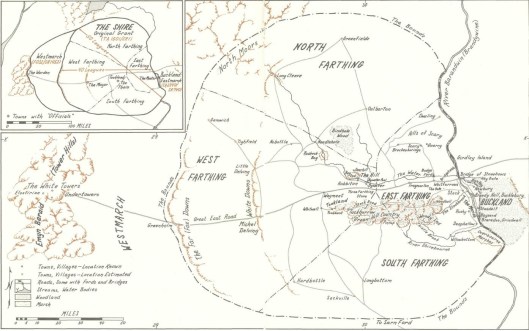
1theshire.jpg

To go about answering that, we tried to think of a model. Could we imagine ourselves doing a tourist brochure? A wiki article? And where would we begin?

Suppose, we thought, we begin with the outermost shell, rather as in our world: the government.

The first ten pages of the Prologue to The Lord of the Rings contain a good deal of information about hobbits and their homeland, with many other details to be gleaned from the main body of the text and the appendices and some from The Hobbit. There is undoubtedly more yet to be found in several of the subsidiary volumes, but we decided that, to make this a series of readable posts and not a small encyclopedia, we would stick to the two main works.

With all of that material to help us, all we needed was an entry point—and, almost immediately, we decided that we could begin where we left off, with that very museum, which originally attracted us because it stood out as something one would expect from a much more organized state, rather than from what, on the whole, appears to be such a rural and decentralized place.

After all, museums, as we have discussed, are a relatively recent invention in the west and public museums are even newer (the first state-sponsored museum in Britain, for example, only dates from the 1750s). Since our last posting, we’ve done a bit more research and, with one or two possible exceptions, it seems that public museums only begin to appear at all from the second half of the 17th century. (A quick and useful reference may be found at: https://museu.ms) Even so, such places have a good deal to say about a culture:

  1. that it values elements of its past, both historical and artistic, enough that it is willing to collect and preserve them
  2. that it believes that such elements should then be put upon public display (the why of that might include: to use for educational purposes—which assumes that the past has things to teach the present; to provide aesthetic pleasure; even to show the wealth and power of a state which has such a history and such artists)
  3. that it is willing to provide space, at the public expense, to house and display such things

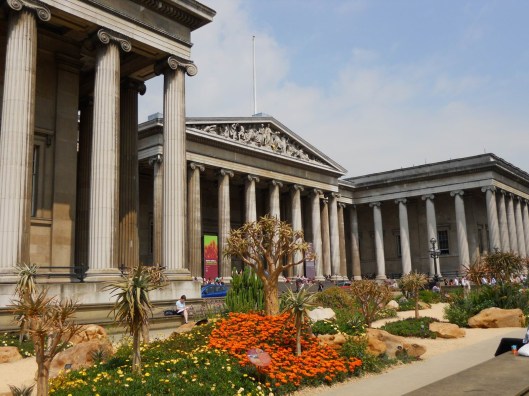
The Mathom-house is hardly, from JRRT’s description, the equivalent of the British Museum
1bm.jpg

or the Louvre

2louvre.jpg

or the Vatican

3vatican.jpg

or any of the other thousand wonderful museums around the world, big or small. And yet it is there and in the closest thing to a capital which the Shire has to offer, Michel Delving. It is only the closest thing because the Shire has almost no formal governing structure.

As the Prologue says:

“The Shire at this time had hardly any ‘government’. Families for the most part managed their own affairs…”

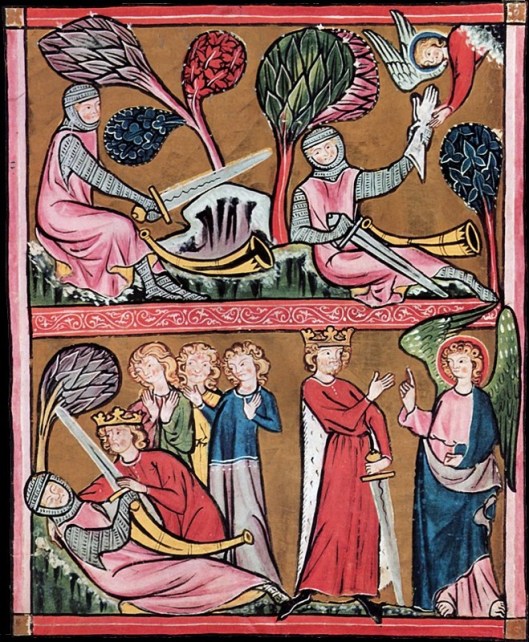
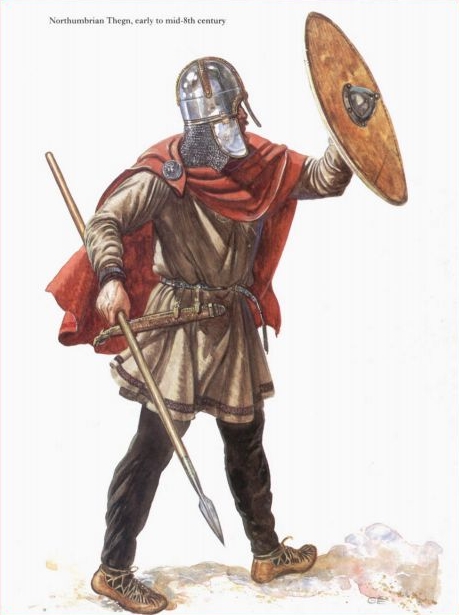
Originally, as the Prologue tells us, the Hobbits had moved into the land which would become the Shire with the permission of the high king of the North Kingdom, at Fornost. When the last king and his kingdom had fallen to the Witch King of Angmar, the Hobbits replaced him with a “Thain” (actually an Old English word for, among other things, a “vassal”—that is, one who acts as a subordinate—in a feudal system, this might imply that the person has received land from someone higher on the social scale in return for taxes and/or military service).  Here’s a thegn (Old English spelling) as a warrior.
5thegn.JPG

By the time of The Hobbit, this office had dwindled, but not quite disappeared:

“The Thain was the master of the Shire-moot, and captain of the Shire-muster and the Hobbitry-in-arms, but as muster and moot were only held in times of emergency, which no longer occurred, the Thainship had ceased to be more than a nominal dignity.”

In fact,

“The only real official in the Shire at this date was the Mayor of Michel Delving (or of the Shire), who was elected every seven years at the Free Fair on the White Downs at the Lithe, that is at Mid-summer. As mayor almost his only duty was to preside at banquets, given on the Shire-holidays, which occurred at frequent intervals. But the offices of Postmaster and First Shirriff were attached to the mayoralty, so that he managed both the Messenger Service and the Watch. These were the only Shire-services, and the Messengers were the most numerous, and much the busier of the two. By no means all Hobbits were lettered, but those who were wrote constantly to all their friends (and a selection of their relations) who lived further off than an afternoon’s walk.

The Shirriffs was the name that the Hobbits gave to their police, or the nearest equivalent that they possessed…they were in practice rather haywards than policemen, more concerned with the strayings of beasts than of people. There were in all the Shire only twelve of them, three in each Farthing, for Inside Work. A rather large body, varying at need, was employed to ‘beat the bounds’, and to see that Outsiders of any kind, great or small, did not make themselves a nuisance.”

This gives us the whole of the top level of Shire culture, the public face: a vestigial Thain (representative of the long-gone King), a figurehead Mayor, a postal service, and a tiny police force/border guard.

And how does any of these hold office?

The Thain, as we know, is hereditary.

The Mayor is, as quoted above, elected—although we have no idea of the process. Does one vote by town? By Farthing? Or is there simply a kind of country-wide method? We also have no idea of suffrage: who has the vote in the Shire? Is it general (England had general suffrage by the time JRRT was writing The Hobbit, all men over 21 by 1918, some women—householders over the age of 30—having been included in elections in 1918, women in general over 21 in 1928)? Or is it the older “only property-holders” method? Or are there “hereditary electors” who do the choosing? (As CD have just gone through an election here in the US, all of these questions, as you can imagine, are fresh in our minds!)

The “postmen” (our word) are, so far as we can tell, a mystery, both as to who they are or how they gain their employment.

Shirriffs appear to be volunteers, as we learn in “The Scouring of the Shire”, when Sam talks to Robin Smallburrow, who says “You know how I went for a Shirriff seven years ago, before any of this began.”

There being so little in the way of government, are there any public buildings except for the Mathom-house? If there are, we have yet to locate them. It’s striking that, when “Sharkey” takes over the Shire, he sets up a number of such places, but neither government buildings nor museums, instead, they are tokens of a police state: barracks and watch houses, dens reminding us of something which JRRT would have seen all too much of in newspapers and magazines, as well as newsreels as he worked on the early stages of The Lord of Rings:

4asentrybox.jpg

4schutzpo.jpg

(More on Sharkey and the takeover in a future posting!)

Considering that there is a small policing force, as well as a kind of postal institution, we looked for another government department: the Internal Revenue Service. After all, we pay for our police and used to pay for postage stamps, back in pre-internet days, and we pay for public museums, too: how does it work in the Shire? The simple answer is, we don’t know. In fact, we don’t really know much about how the economy works in general. And that will be the subject of our next posting.

Thanks, as always, for reading!

MTCIDC

CD
Bridges and Battles

04 Wednesday Jan 2017

Posted by Ollamh in Artists and Illustrators, Heroes, J.R.R. Tolkien, Literary History, Military History, Military History of Middle-earth, Narrative Methods

≈ Leave a comment

Tags

Anglo-Saxon, Arnhem, Belisarius, Boromir, bridges, Constantine I, Constantinople, David, Diocletian, Dionysius, Gros, Hal Foster, Harold Godwinson, Horace Vernet, Horatius, Horatius at the Bridge, Justinian, Livy, Marcus Aurelius, Maxentius, Maximianus, Milvian Bridge, Napoleon, Ostrogoths, Pass of Roncevalles, Pegasus Bridge, Pliny the Elder, Pons Sublicius, Prince Valiant, Ravenna, Remagen, River Adige, River Derwent, Roland, Salarian Bridge, San Vitale, Sherlock Holmes, Stamford Bridge, Tacitus, The Council of Elrond, The Lays of Ancient Rome, The Lord of the Rings, The Oath of the Horatii, Thomas Babington Macaulay, Tiber, Tolkien, vikings

Welcome, dear readers, to our first posting for 2017—and a Happy New Year.

In our last, we discussed water-crossings in The Lord of the Rings, but said that our next would be on a more specialized subject, something we thought to call “Battle Bridges”.

This was inspired by this quotation (it’s Boromir speaking, at the Council of Elrond):

“I was in the company that held the bridge, until it was cast down behind us. For only four were saved by swimming: my brother and myself and two others.” (The Fellowship of the Ring, Book 2, Chapter 2, “The Council of Elrond”)

Broken bridges and swimming soldiers made us think of a story told by a number of early historians, including Dionysius of Halicarnassus, Livy, Pliny the Elder, and Tacitus, in which three Roman officers stand as a rearguard at the first bridge over the river Tiber, the Pons Sublicius, and, when two are wounded, the third, Horatius, sends them off, telling them to have the bridge destroyed so that the enemy can’t pursue the defeated Roman army into Rome. When the bridge is gone, Horatius, in his armor and with his arms, leaps into the river and swims to the Roman shore to great acclaim.

1horatiusatbridge.jpg

In the nineteenth century, this story was turned into a poem (a very long ballad) by the historian Thomas Babington, Lord Macaulay (1800-1859),

2macaulay.jpg

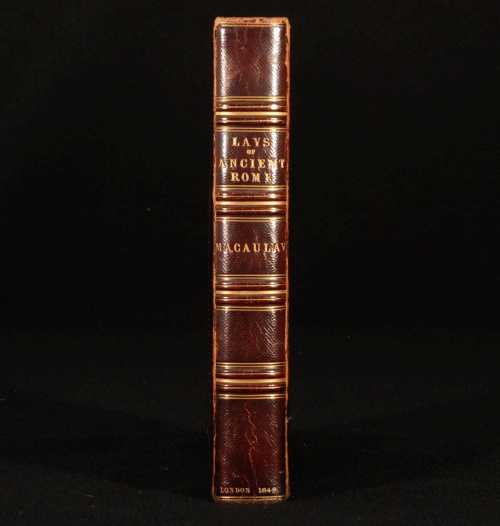
entitled “Horatius at the Bridge” (from his 1842 collection, The Lays of Ancient Rome).

3lays1849ed.jpeg

Once upon a time, it was a standard assignment for schoolboys to memorize its approximately 600 lines and we wonder if this might once have been Tolkien’s task, which is why we have Boromir’s remark.

Once we embarked upon the subject of fights at bridges, we found, beginning with the late classical world, that there were lots more out there (our short mental list roared through time to take us as far as the seizing of Pegasus Bridge in the Normandy invasion and the subsequent bridges at Arnhem and Remagen). There was a difficulty, however: we began with an heroic action—one man or a handful against masses. What mostly came to mind was not Horatian one-man stands. Instead, they were only depicted as parts of larger military maneuvers to gain or block a crossing and individuals disappeared. Take, for example the famous battle at the Milvian Bridge, in 312AD, which led not only towards a reconstituted Roman world based upon the east, but also towards the eventual Christianization of the Roman world.

4milvian.jpg

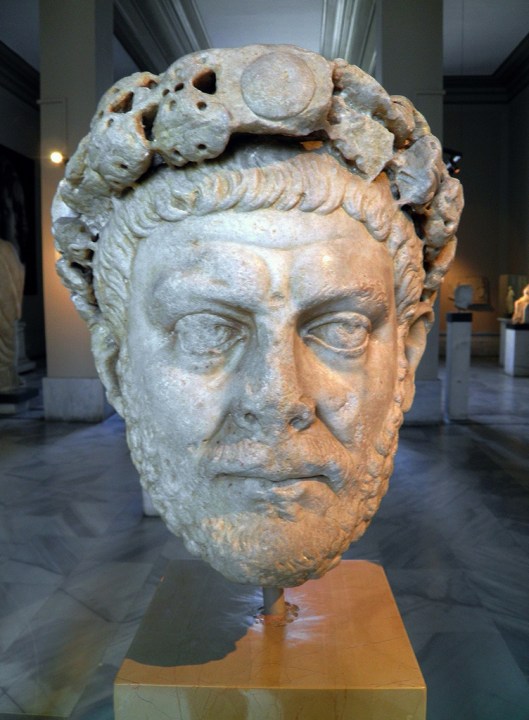
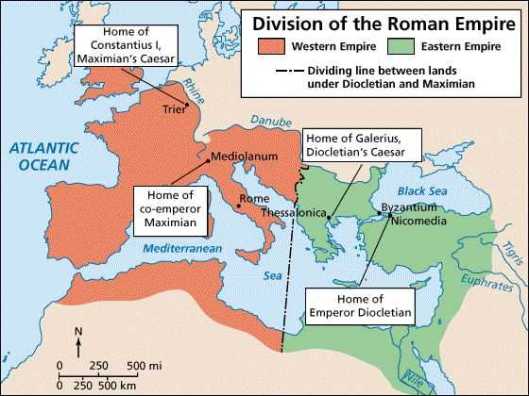
In the civil wars which wracked the late Roman empire, after its division post-284AD by Diocletian,

4adiocletian.jpg

4bdiocletiansdivision.jpg

Constantine, the western Augustus (senior emperor)

5Constantine-I-Face.jpg

defeated his rival, Maxentius (who was also his brother-in-law),

6maxentius.jpg

at a bridge outside Rome to become, in time, the sole emperor. Maxentius, who had control of Rome, had planned to block Constantine on the far side of the Tiber, keeping a pontoon bridge available for a retreat, if necessary, since it appears that the actual stone bridge was in the process of being dismantled.

(The Romans were extremely able at producing pontoon bridges—here’s a good illustration from the column of Marcus Aurelius—completed 193AD–)

When that retreat did become necessary, Maxentius was drowned in its midst, the bridge collapsed, and his troops who remained either died on the field or surrendered to Constantine.

4milvian.jpg

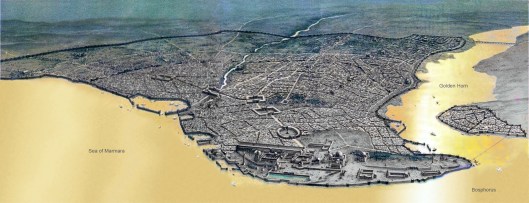
In time, Constantine, who believed that the empire’s main focus should actually be on the east, moved the capital to an old Greek colony, called Byzantium, but which he renamed “New Rome”—although it seems that everyone else called it Constantinople.

7constantinople.jpg

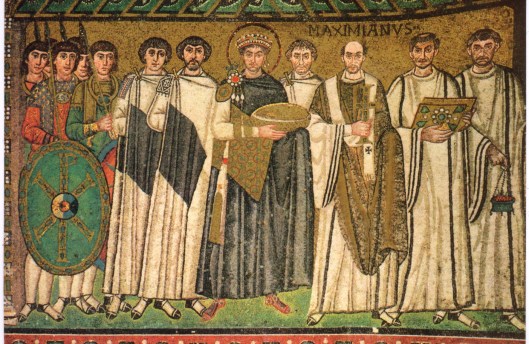
This would be the capital of the later Byzantine Empire, which, under the emperor Justinian,

8justinian.jpg

(He’s the one with the bowl of communion bread—the only labeled figure, Maximianus, was the bishop of Ravenna, where this mosaic stands in the church of San Vitale.)

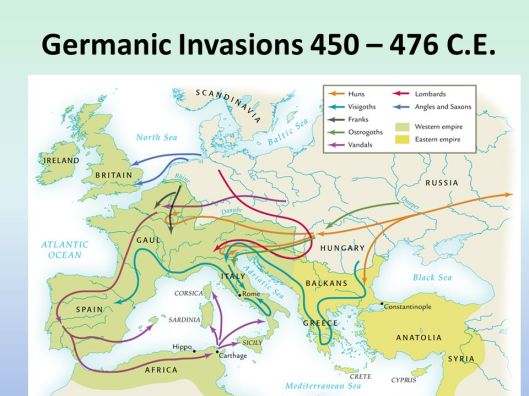
would attempt to reconquer the portions of the old western empire which had fallen into the hands of Germanic invaders.

9germanicinvasions.jpg

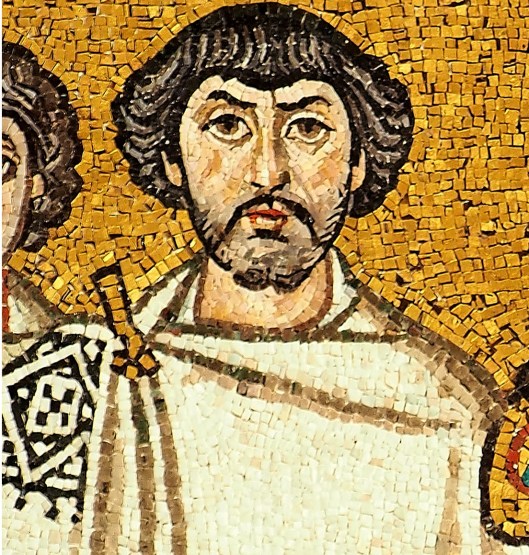
Under Justinian’s general, Belisarius,

10belisarius.jpg

(this may or may not be a portrait—it’s a scholarly guess),

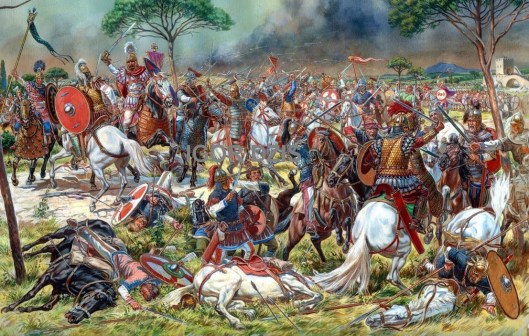
the Byzantines struggled for control of Rome against the Ostrogoths.

11ostrogoth.jpg

This struggle included a fight outside of Rome for control of the Salarian Bridge (537AD),

12salarianbridge.jpg

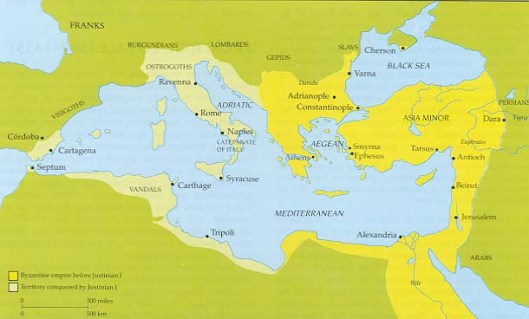
a fight which Belisarius lost, although, for a short time, Justinian’s world was enlarged, if not to the full size of the old empire, at least to include much of the western Mediterranean—quite an accomplishment for the later world of antiquity.

12ajustempire.jpg

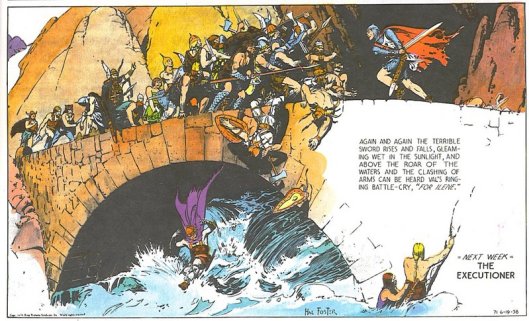
And, speaking of late antiquity, if you regularly read our blog, you know that we have a special affection for the work of Hal Foster, who created the late-antique, early-medieval world of Prince Valiant. The combination of bridge and heroic fighting reminded us of one of our favorite illustrations and so we have to include this scene (published 19 June, 1938), in which Val faces a band of Viking raiders.

13valatbridge.jpg

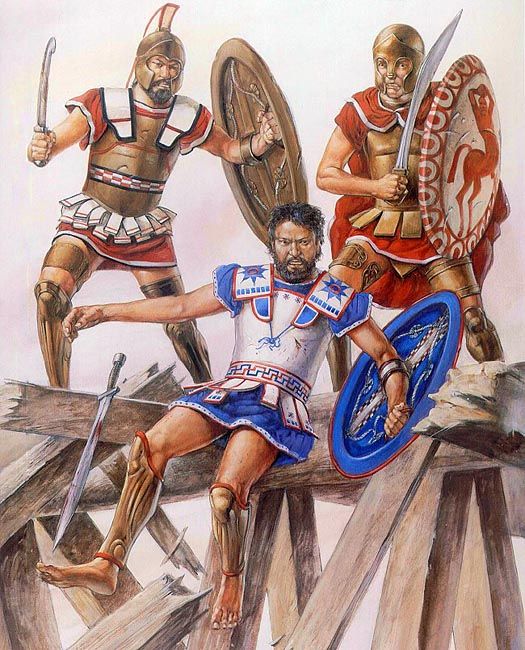
This image, of course, brings us back to Horatius, the single warrior against the mass. As we’ve said, in the intervening centuries there are battles at bridges, but only as one element in larger campaigns and the heroic individual disappears into the ranks. We could think of one, somewhat later, figure, however. He appears, unfortunately nameless, in the other battle of the short reign of Harold Godwinson, at Stamford Bridge, 25 September, 1066. The Anglo-Saxon army raced north from London to oppose a Viking invasion, and defeated the Vikings on the near side of the bridge over the River Derwent, but, to complete their victory, the Anglo-Saxons needed to destroy the surviving force on the far side. in the way stood, in the middle of Stamford Bridge, a single Viking warrior, blocking their advance.

14stamfordbridge.jpg

The Anglo-Saxon Chronicle says that he killed 40 of the enemy before an Anglo-Saxon floated underneath the bridge and stabbed him from beneath with his spear, but, well, as much as we believe in heroic tales…

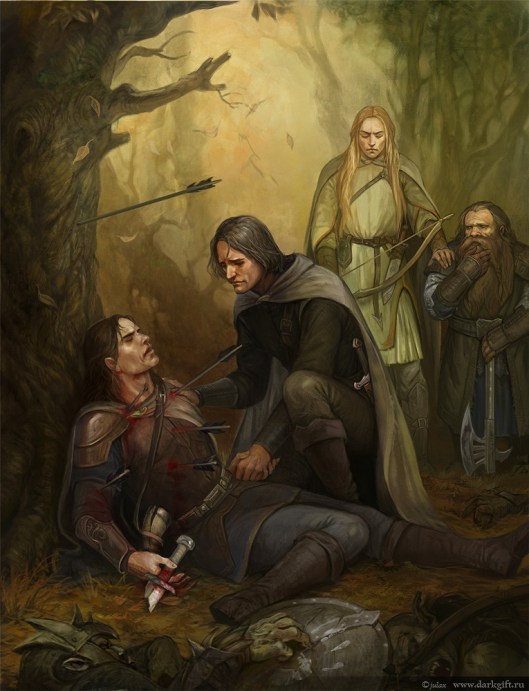
His stand, however, brings us back to Boromir and his final battle, in which he faces two waves of orcs before he is finally mortally wounded.

15boromirdeath.jpg

No bridge, but this still follows the theme of the brave man standing alone, with no possible help nearby.

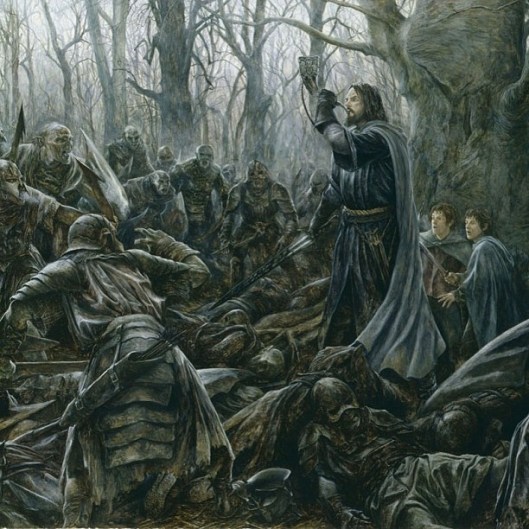
16boromirhorn.jpg

(And, of course, Boromir and his horn are meant to remind any good reader of heroic material—particularly medieval—of Roland at the Pass of Roncevalles…)

17roland.jpg

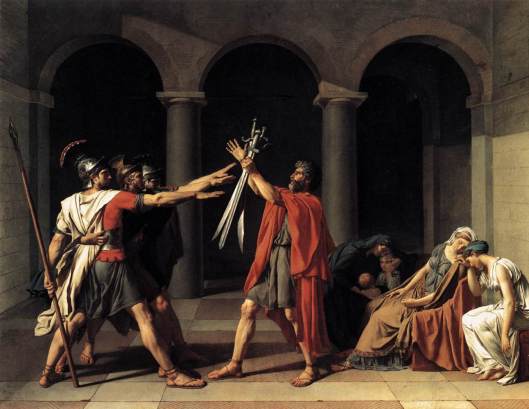
We would leave this theme here, back where it began, with Boromir, except we can’t resist (we’re afraid, when it comes to adventure and heroics, that we appear to have little or no willpower at all!) one final image and the idea behind it. There is no end of discussion about Napoleon, which, we’re sure, would please him no end. For us, however, there is a side of him which is endlessly interesting and that is as a Romantic Figure—a view of himself which he worked very hard, at least early in his life, to promote. The late 18th-century very much looked back to the classical world and, we believe, it did so in part because it loved the dramatic gestures it saw as part of that world. We only have to point out paintings like David’s “The Oath of the Horatii”(those Horatii being the direct ancestor of the one in our post), with its operatic ensemble look, to illustrate this. (To us, this looks so much like the set-up for a stirring quartet, right out of Bellini or Meyerbeer.)

18horatii.jpg

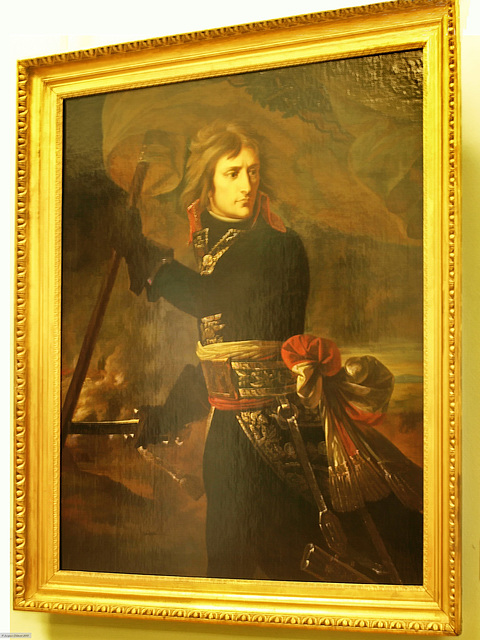
So, during Bonaparte’s brilliant 1796-7 campaign in Italy, there was clearly a classical/Romantic moment. When the French were stalled by their Austrian opponents in crossing the River Adige, Napoleon, to encourage his troops, seized a regimental color and raced alone to the bridge, as Gros (who was actually at the battle) depicted him in his 1797 painting.

19grosarcola.jpg

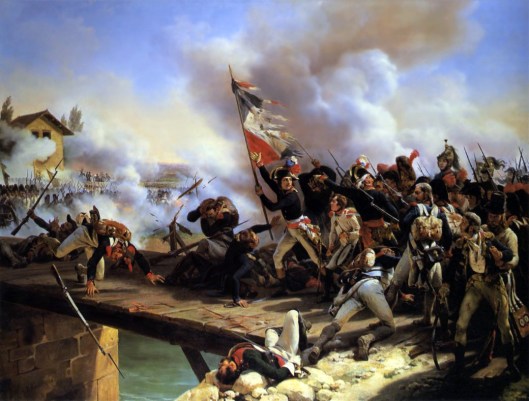
Vernet, in his 1826 version, continues the heroic theme, but changes the focus a bit—Napoleon now has followers. (And you know, from its dash—and that’s Horace Vernet in general—who, according to Sherlock Holmes, may be a distant relation–that this is a favorite painting of ours.)

20vernetarcola.jpg

In fact, although Bonaparte did seize a color, he never made it to the bridge, either alone or in a crowd. His illustrators, however, influenced, no doubt, by the potential drama—and perhaps by a faint memory of Horatius?—depict a scene which should have happened, in their view of Napoleon as a Romantic Figure. What is most striking, however, is that, unlike Horatius—or Boromir—Bonaparte is not defending a bridge—he is attacking and his heroism comes from that gesture. This certainly fits in with Revolutionary ideology—France had been at war with much of the world since 1792—but it occurs to us that it may also suggest a shift in the approach to heroism. Horatius, given a bridge, is heroic, but passive. Give a bridge to Bonaparte and stand back (at least in iconography)! Is this the image of heroes in the Romantic world which was just coming into being?

But, as ever, we leave this to you, dear readers, to ponder, even as we thank you, as always, for reading.

MTCIDC

CD

Ugluk Was Here

14 Wednesday Dec 2016

Posted by Ollamh in Artists and Illustrators, J.R.R. Tolkien, Language, Literary History, Military History

≈ Leave a comment

Tags

Alan Lee, Alfred Waud, American Civil War, Angus McBride, Argonath, Belgium, Black Speech, cemeteries, Confederate, Egyptian monuments, First Virginia Cavalry, graffiti, Great War, Greek mercenaries, Greeks, Hildebrandt, John Howe, Journey to the Cross-roads, Kilroy, Kilroy was here, Literacy, Napoleon I, Orcs, Pompeii, quarry at Naours, Sauron, The Lord of the Rings, Tolkien, Union, Virginia, World War I, World War II

Welcome, dear readers, as always.

One of our reasons for holding Tolkien’s work in such high esteem is that it’s so rich: practicing Sortes Tolkienses (see our earlier posting on this), we find innumerable subjects to write about.

In this posting, our eye was caught by this:

“The brief glow feel upon a huge sitting figure, still and solemn as the great stone kings of Argonath. The years had gnawed it, and violent hands had maimed it. Its head was gone, and in its place was set in mockery a round rough-hewn stone, rudely painted by savage hands in the likeness of a grinning face with one large red eye in the midst of its forehead. Upon its knees and mighty chair, and all about the pedestal, were idle scrawls mixed with the foul symbols that the maggot-folk of Mordor used.” (The Two Towers, Book 4, Chapter 7, “Journey to the Cross-roads”)

crossroads.jpg

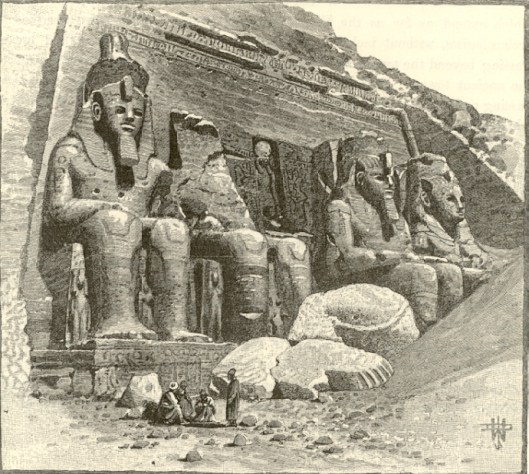
We had the feeling that we’d seen a statue something like this before—and we were curious whether JRRT had, too, and with a little mental rooting-around, we found this:

abusimbelengraving.jpg

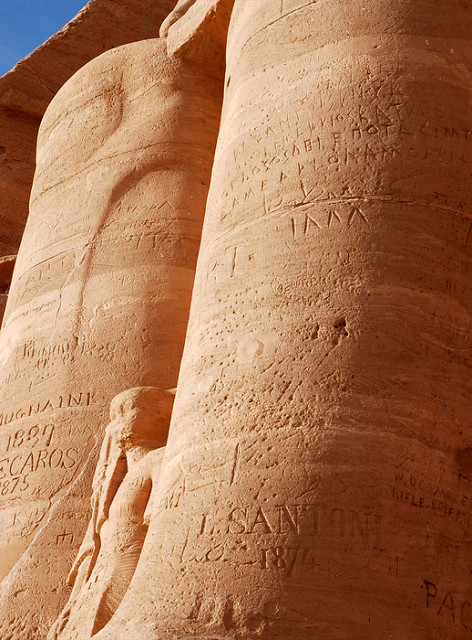
It’s Egyptian (13th century BC), and has a head, but, not only is it monumental, and seated, but it has lots of “idle scrawls” on the bases and lower parts of its legs.

abusimbelgraffiti.jpg

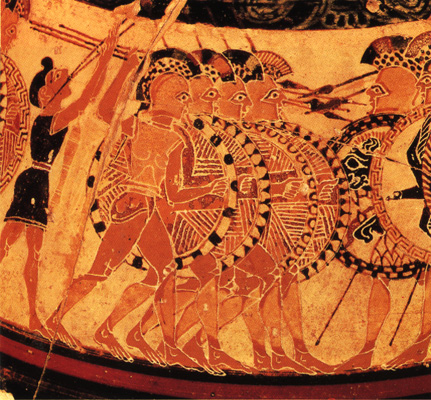
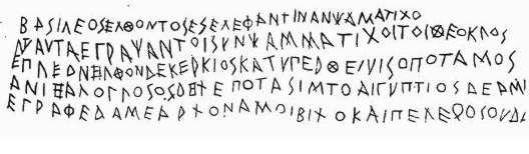
What’s particularly interesting to us is that one piece of the graffiti is actually from some Greek mercenaries c. 600bc

hoplite1.jpg

main-qimg-9eddef3641e25892afa016888b808aa5-c.jpeg

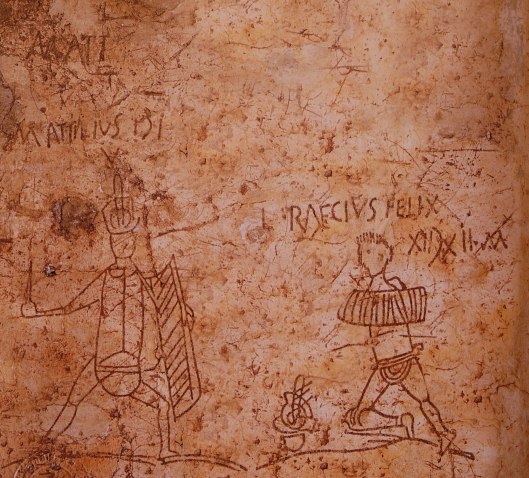
As long as there has been a certain level of literacy, of course, there has been graffiti. The walls of ancient Pompeii (sealed in by the eruption of 79AD) are loaded with everything from election posters to the admiration of gladiators to personal insults.

gladiatorialstats.JPG

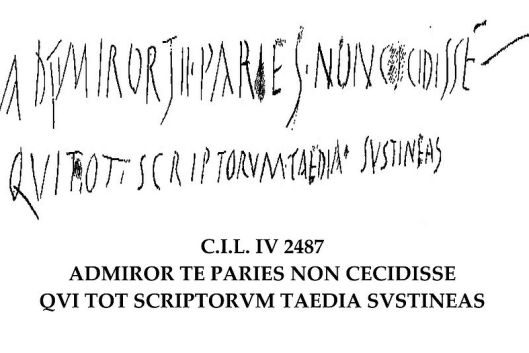
There’s so much, in fact, that this is our favorite:

antigraffiti.jpg

A translation of this might be: “I wonder/am in awe, wall, that, you, who are holding up so much boring writing, haven’t fallen down!”

Soldiers, in particular, seem prone to leaving messages behind—beginning with those 7th-c Greeks, but continuing throughout the centuries. When Napoleon I led an expedition to Egypt in 1798,

napegypt.jpg

his soldiers left their mark in more ways than one upon the landscape.

frenchinegyptgraf2.jpg

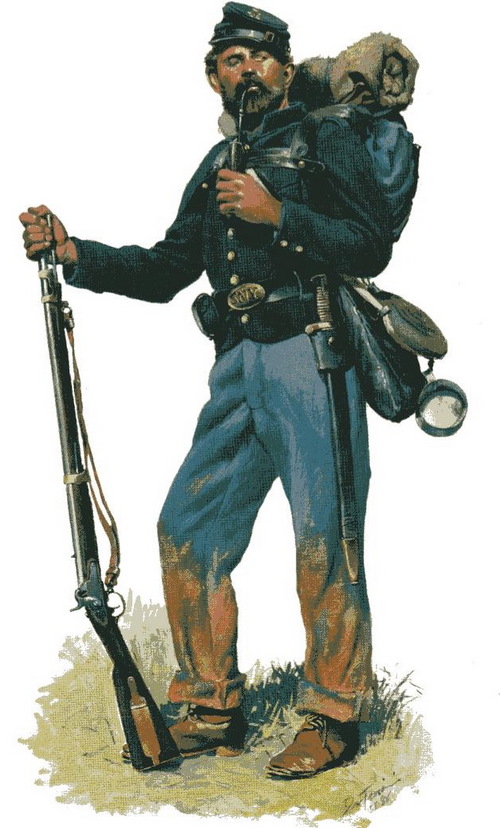
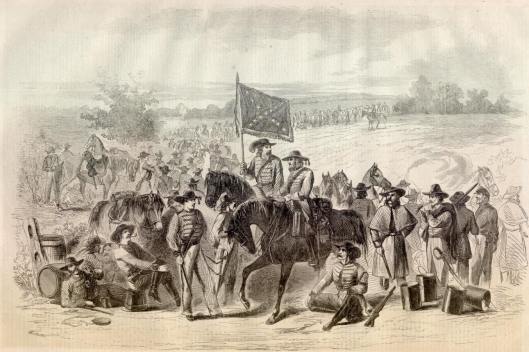
Recently discovered in a house in Virginia was a large collection of inscriptions from the soldiers, Union and Confederate, of the American Civil War.

Graffiti-House.jpg Graffiti House Wall and Chair.jpg unionsoldier.jpgAlfred R. Waudfirstva.jpg

(An irresistible footnote: the picture you see of the Confederate cavalry—actually the 1st Virginia—was made by one of the greatest Civil War artists, Alfred Waud (pronounced “woad”). He had been briefly detained by this unit and took the opportunity to sketch them from life. His sketch—with his notes—then went to his publisher in New York, who had a group of engravers ready to turn his sketch into a finished—and publishable—picture.1st-virginia-cavalry-halted-based-on-sketch-by-waud-harpers-sept-27-1862.jpg

For more on the process by which a sketch becomes a magazine illustration, see this link.)

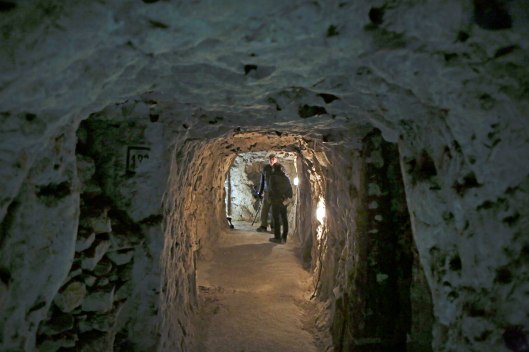
Another recent discovery was a mass of inscriptions (something like 2000 of them) in an abandoned quarry at Naours, in northern France.

quarrynaours.jpg

6XYh68h5xHSK2-3026250-In_this_image_made_on_Feb_20_2015_showing_names_engraved_on_the_-a-32_1428320205858.jpg

These date from the Great War (World War I) and, in a sad way, parallel the epitaphs on the seemingly-endless graves in the seemingly endless military cemeteries in the same region and in southern Belgium.

greatwargraves1.jpg

Tyne Cot 3.jpg

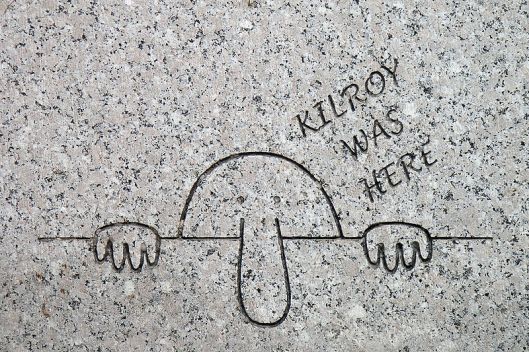
And World War II brought us Kilroy, of the famous (and ubiquitous) “Kilroy was here”.

Engraving-of-Kilroy-on-the-WWII-Memorial-in-Washington-DC.jpg

American prankster soldiers doodled this everywhere they went.

kilroy-was-here-photo.jpg

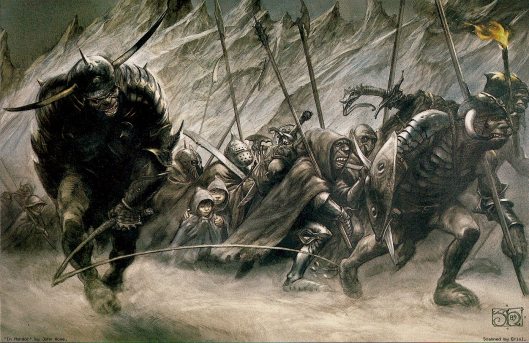
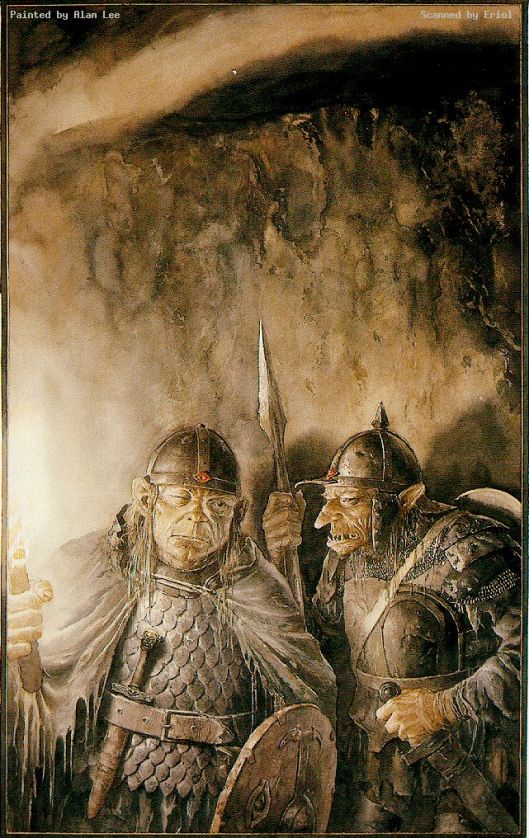
We have written previously about literacy in Middle-earth: not uncommon among hobbits, it would seem, but much less so among the other peoples. As for orcs, be they Hildebrandt

captured_by_orcs.jpg

Mcbride,

mcba_orc.jpg

Howe

John Howe - Merry et Pippin prisonniers des orcs.jpg

Or Lee,

Alan Lee - Orcs (1).jpg

although the Black Speech was created for them and Sauron’s other creatures, we have no evidence (except for the Ring inscription) of any use of it as a writing tool by any of them.

Which leaves us free to imagine just what those “idle scrawls” might read like. How about:

LUGDUSH SMELLS LIKE MAN FLESH!

LAGDUF + MUZGASH = CLUELESS AND SHIRTLESS!

GORBAG LOVES SHELOB

SHAGRAT IS A SNAGA!

And, of course:

UGLUK WAS HERE

Thanks for reading! (And why not submit your own graffiti? We’d be glad to add them to our list!)

MTCIDC

CD

Further Thoughts

02 Wednesday Nov 2016

Posted by Ollamh in J.R.R. Tolkien, Literary History, Maps, Military History, Military History of Middle-earth, Uncategorized

≈ Leave a comment

Tags

Alexander of Macedon, Athenian Empire, Babylon, Cleopatra VII, Delian League, Mongol Empire, Mordor, Persians, Plataea, Ptolemy, Sauron, Tolkien, W.H. Auden

Welcome, dear readers, as ever.

It is one of the pleasures—perhaps we should say even blessings—of JRRT that there is such a richness available within his work—and within him—that no subject can ever be discussed to a perfect conclusion. In an earlier posting, we talked about Sauron and his demands, but, as we watch our current world and certain powers who are maneuvering to gain increasing control over land and sea, we have come back once more to wondering about what it is that Sauron has planned to do and what he will have if he succeeds.

In an unpublished reply to a review by W.H. Auden, JRRT wrote:

“The theatre of my tale is this earth, the one in which we now live, but the historical period is imaginary. The essentials of that abiding place are all there (at any rate for inhabitants of N.W. Europe), so naturally it feels familiar, even if a little glorified by the enchantment of distance in time.” (Letters, 239)

Thus, we can feel justified, we think, in looking at a would-be world conqueror from an actual historical period to see if we can better understand the fictional Sauron.

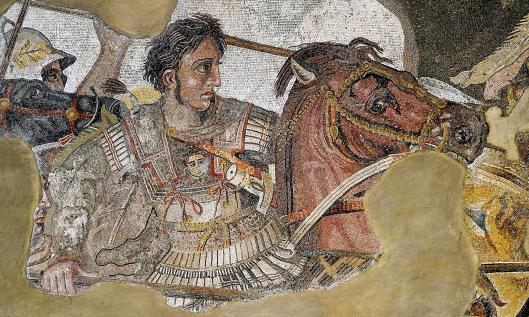
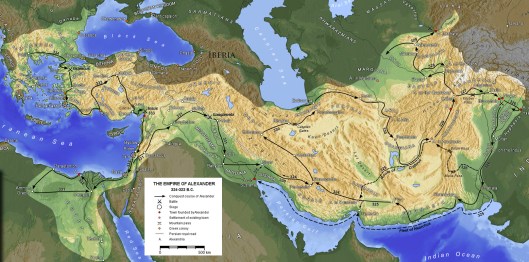
If we consider Alexander of Macedon,

Alexander_the_Great_mosaic.jpg

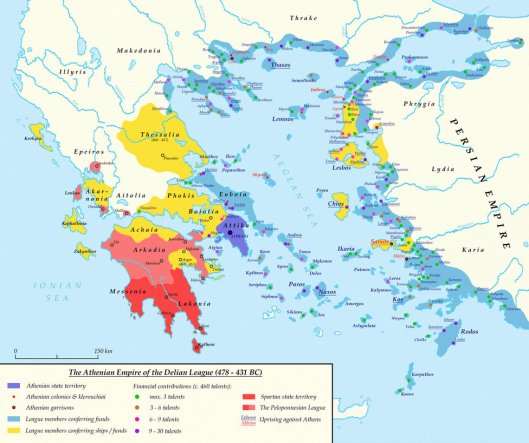
we see someone who began with a project which, in part, went back for a century and more before his own time: to take back the western shore of northern Asia Minor from its Persian overlords. This had been begun by the Delian League,

The Delian League - map.jpg

a group of Greek city-states who had been participants in the ultimate battle defeat of the invading Persians, at Plataea, in 479bc.

47948_PlateaBattleL.jpg

After he had defeated the southern Greeks at Chaeronea in 338bc with the aid of his son, Alexander, it had been Philip II of Macedon’s plan to do what the League had planned and take back Asia Minor from the Persian empire. Philip was murdered (by a “lone spearman”) in 336, but Alexander, took over the plan and, in 334, invaded the Persian empire and, within three years or so, had conquered it—

macedonianempirelarge.jpg

but then had kept moving eastward, besieging cities, winning battles, all the way into western India, where his army finally revolted and refused to go farther.

Alexander_troops_beg_to_return_home_from_India.jpg

He returned to his new capital, Babylon, to die there in 323bc.

the_death_of_alexander_the_great_after_the_painting_by_karl_von_piloty_1886

Because Alexander had no grown male heirs, his new empire fell apart very quickly, his chief generals seizing big chunks and defending them against other generals. We can presume, we think, that he hadn’t been planning to die young (he was born in 356), so we assume that he was out to do something permanent. His generals—the successful ones—founded dynasties, the longest-lived of them being that of Ptolemy,

Coin (Ptolemy I) (Alexandria 305-285 BC).jpg

who grabbed Egypt, and whose last descendant to rule was Cleopatra VII (yes, that Cleopatra), who committed suicide in 30bc.

Kleopatra-VII.-Altes-Museum-Berlin1.jpg

If Alexander was planning to do something similar, only on a larger scale, how do we understand it? What was all of that conquest for and why was it never enough?

Part of the explanation may lie in the analogy of the folk-tradition about sharks: that they have to keep moving to breathe. This is apparently not true (google Discovery.com/tv-shows/shark-week).

great-white-shark-swimming-blue.jpg.adapt.945.1.jpg

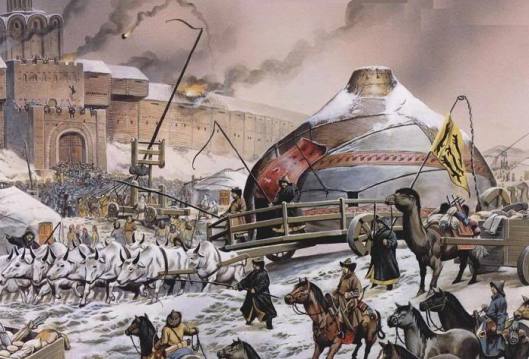
It’s a good image, however, of how an expanding kingdom has to work: the more land you have, the more people you have, the more people you have, the more food you need, therefore you need an increased food supply, which means either buying it or taking it from outside, or making the land itself produce more or simply acquiring more land—and the cycle begins again. This may have been what caused the rapid expansion of the Mongol empire in the 13th century ad, although, in their case, it may not have been expanding population so much as expanding flocks and herds which needed more pasture land.

TitleMongol2.jpg

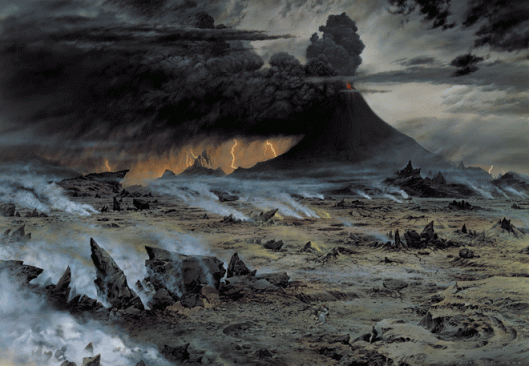
We might see Sauron in the same light: he needed huge armies to conquer Middle-earth, his huge armies, both humans and orcs, would need feeding (even orcs ate, after all, although as to what they ate…) and therefore would have needed a huge amount of growing land to be fed from, and so on and so on. Certainly Mordor was not the place for gardens and grain fields.

gorgoroth.gif

JRRT says of Sauron:

“Sauron desired to be a God-King, and was held to be this by his servants; if he had been victorious he would have demanded divine honour from all rational creatures and absolute temporal power over the whole world.” (Letters 243-244)

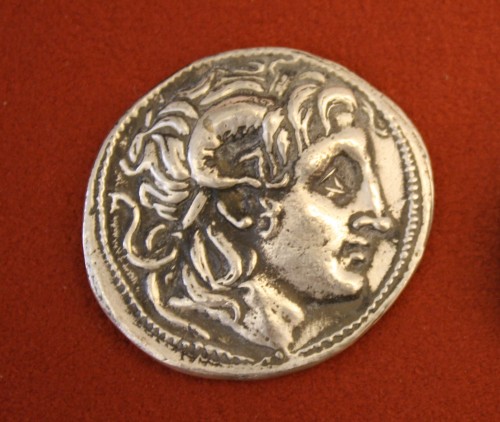
And perhaps this offers another view of Alexander, in turn. As Sauron would have needed land to feed his armies, perhaps Alexander was intent upon collecting worshippers? Certainly he allowed rumors to circulate that he was at least semi-divine—as we see in this coin portrait, where he is portrayed with the horns of Zeus/Ammon, a combination Greek and Egyptian god.

alexaszeusammon.jpg

Alexander succeeded in gaining territory—although not so much as he wished—but died before founding the dynasty which might have given his kingdom stability. Sauron lost, not only his kingdom-in-the-making, but his corporeal form and the bulk of his power. JRRT has given us a hint as to one side of his plans—founding a religion with himself as the god, but perhaps Alexander has given us a clue as to another side, the need to support his means of conquest. In turn, Sauron may supply a clue to another side of Alexander’s plans: inserting himself into the religion of his Greek subjects, then expanding his cult throughout as much of the world as he could conquer.

Thanks, as ever, for reading.

MTCIDC

CD

The Road (No Longer) Taken

21 Wednesday Sep 2016

Posted by Ollamh in J.R.R. Tolkien, Literary History, Maps, Military History, Narrative Methods

≈ Leave a comment

Tags

Adventure, Fornost, History, Isengard, Medieval, Middle-earth, Numenorean road, pack horses, Ridgeway, Roman bridges, Roman occupation of England, Roman Roads, Stonewain Valley, the Greenway, The Lord of the Rings, the North Road, The Salt Road, Tiber River, Tolkien, Via Salaria

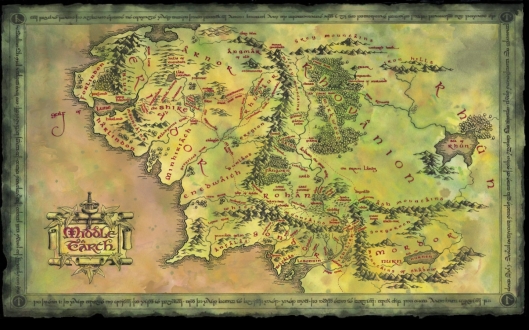
Dear Readers, welcome, as always. In this posting, we’ve been thinking about the subject of roads in Middle-earth and, in particular, the North Road, also called the Greenway.

middle-earth-map.jpg

This was the North-South Road, which ran, once upon a time, from Isengard to Fornost, described by Christopher Tolkien as “the great Numenorean road linking the Two Kingdoms, crossing the Isen at the Fords of Isen and the Greyflood at Tharbad and then on northwards to Fornost”. (Unfinished Tales, 314, n.32)

Mostly, the roads of Middle-earth seem to be what you’d expect in a text which is based upon the actual medieval world: dirt tracks.

medievalroad.jpg

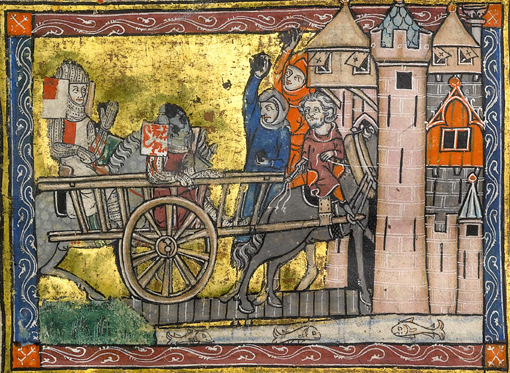
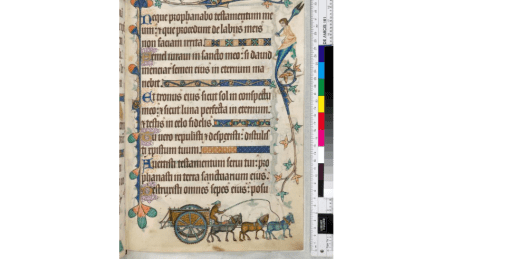
In the real English medieval world, most of these were not really for carts or carriages,

medievalcart.jpg

canvas.png

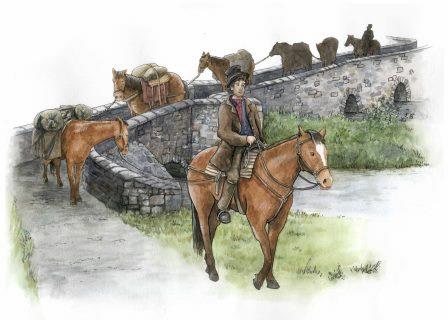
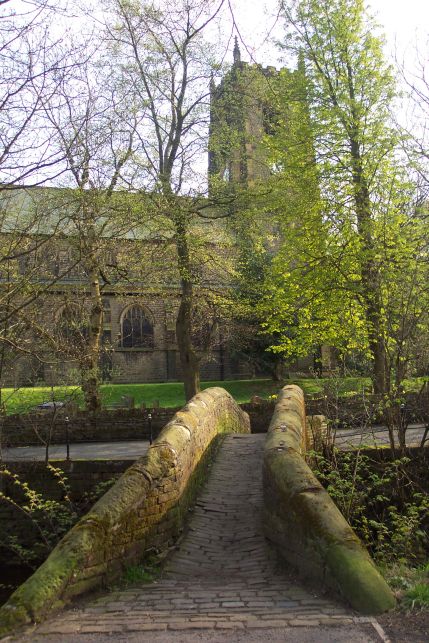
but rather for pack horses and their loads, which only required the narrowest of paths.

packhorsetrain1

The_Marsden_pack_horse_road,_Marsden_-_geograph.org.uk_-_826758

Bridge in Marsden, West Yorkshire

Bridge in Marsden, West Yorkshire

There had been simple pathways in Britain since earliest times, like the Ridgeway.

Ivinghoe Beacon seen looking north from The Ridgeway.

Ivinghoe Beacon seen looking north from The Ridgeway.

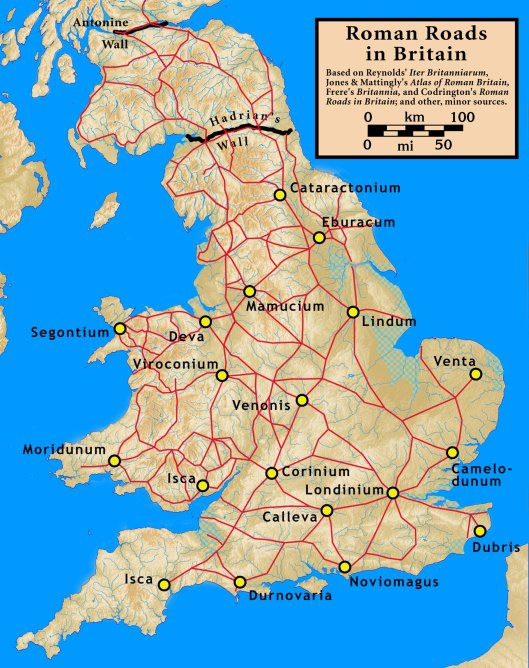
And yet there were still the remains of a different sort of road in Britain, those built under the Roman occupation of England, from 43 to 410AD.

Roman.Britain.roads

The Romans had begun their rise to power in Italy by controlling a road, the Via Salaria, which ran inland from the Mediterranean. A major purpose of this road (you can see it in its name, “The Salt Road”) was to further the salt trade.

The salt came from salt pans on the Mediterranean coast.

saltblocks

saltpans

The early Romans had been lucky (or wise) in founding their city at a major ford of the Tiber River, where the Via Salaria crossed it.

archaicrome

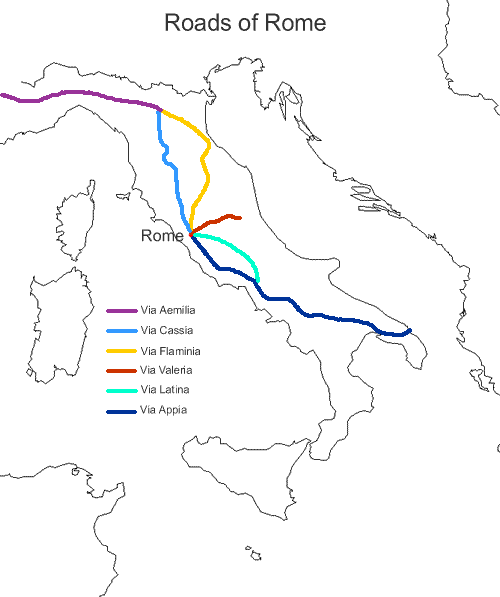
And out from Rome spread a network of roads.

roman-roads-italy-map

In time, the main roads were not simply dirt tracks, but very-carefully-constructed, well-laid-out stone-paved roadways.

Eli dis 2

These included sturdy bridges, as well, some of them still in place.

alcantara-bridge

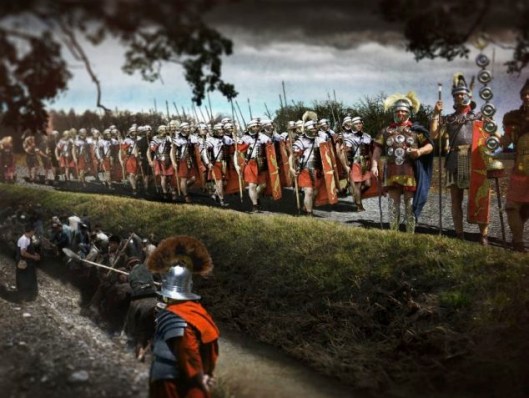
Over these roads marched Roman armies

romantroopsonroad

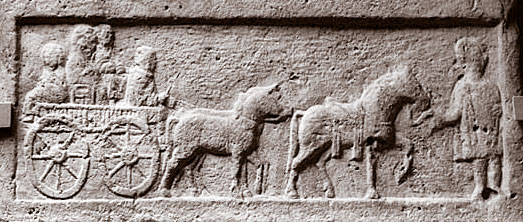
and Roman commerce, as well.

plaustrum2

Eventually, there were over 50,000 miles (80,500 km) of paved roads, as well as many miles more yet of unpaved.roman_empire_117_ad

As far as our current research goes, we have no actual proof that the Greenway was paved like Roman roads. One road for which there is a hint of evidence is that which runs through the Stonewain Valley:

“Through the gap the forgotten wain-road long ago had run down, back into the main horse-way from the City through Anorien; but now for many lives of men trees had had their way with it, and it had vanished, broken and buried under the leaves of uncounted years.” (The Return of the King, Book 5,   Chapter 5, “The Ride of the Rohirrim”)

A comparable illustration—with grass instead of trees and leaves—is this of a Roman road in Lancashire, in northeastern England.

Roman Road walk Lancashire

The idea of a road nearly abandoned and covered with grass—therefore “the Greenway”—seems to fit both this modern photo and JRRT’s idea, though, doesn’t it?

One of the spooky, but wonderful things about the ancient Roman world is that, for all that it’s been gone for 1500 years or more, there is so much of it still there for us, above ground and below—as it was for Tolkien. Thus, when we think about what was once one of the major thoroughfares of Middle-earth, we imagine that he, like us, saw a Roman road, decaying, but still useful.

Thanks, as always, for reading.

MTCIDC

CD

Last Mohican, First Novelist

07 Wednesday Sep 2016

Posted by Ollamh in Artists and Illustrators, Films and Music, Heroes, Literary History, Military History, Narrative Methods

≈ Leave a comment

Tags

Baron Dieskau, British, Carillon, Daguerre, Deerfield, Fenimore Cooper's Literary Offenses, Fort Duquesne, Fort Edward, Fort Niagara, Fort St. Frederic, Fort William Henry, French, French and Indian War, General Webb, James Fenimore Cooper, Lake Champlain, Lake George, Lake Ontario, Lt. Col. Munro, Mark Twain, Marquis de Montcalm, Matthew Brady, N.C. Wyeth, Native Americans, Oswego, St. Frederic, The Last of the Mohicans, Ticonderoga

Welcome, dear readers, as always.

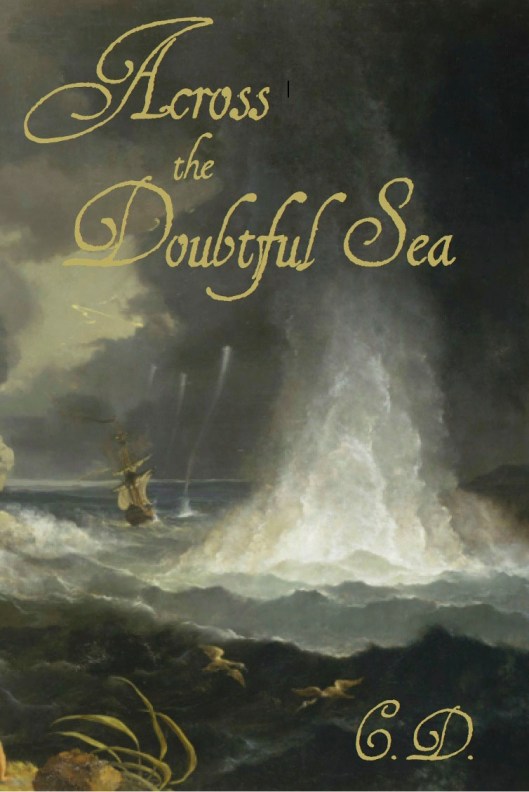
This is our 104th posting, making exactly 2 years of maintaining our blog, Doubtfulsea.com. When we began it, we had visited lots of other blogs, but we had no clear idea of what we wanted for ourselves. Our name came from our first novel, Across the Doubtful Sea, available from Amazon and Kindle, but we planned, from the beginning, to cover much more than the subject matter of our novel (among other things, French and English exploration of the Pacific in the 18th century, as well as Polynesian settlement). In consequence, during our two years, we have had postings on a variety of subjects, mostly about adventure/fantasy, often with an historical element, often with a focus upon the work of one of our favorite fantasy authors, JRR Tolkien.

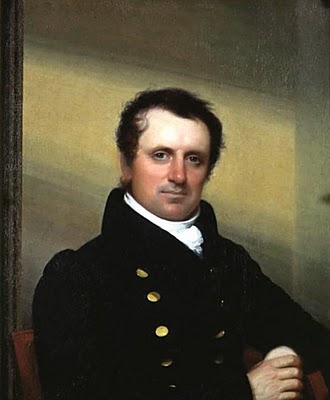
Now, in this last of our second year, we want to look at a person often viewed as the first important American novelist of the early 19th century, James Fenimore Cooper (1789-1851), and his most famous book, The Last of the Mohicans (1826).James-Fenimore-Cooper

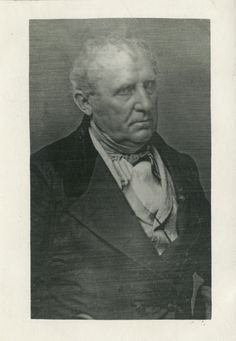
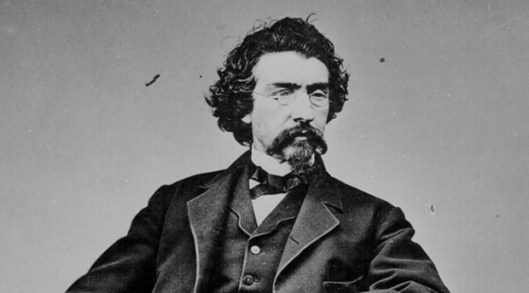
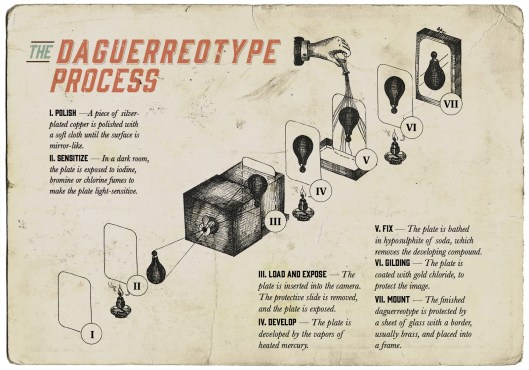
(A footnote: Cooper lived long enough that, the year before his death, he was the subject of an early photograph, using the Daguerre process, by Matthew Brady, 1822-1896, who, in a decade, would become the most famous photographer in the US because of his work documenting the American Civil War, 1861-1865.)

daguerreotypejfc

mathewbrady

DaguerreProcess4

Cooper had a long and very successful career as a novelist, beginning with a social novel, Precaution (1820), but his greatest fame came from his long series based upon US historical subjects and perhaps the most famous of all, that set in the world of the French and Indian War (1754-1763), and the book we want to focus upon,

French_and_indian_war_map_svg

The Last of the Mohicans.

lastofmofirsted

The subtitle, A Narrative of 1757, immediately suggests a specific event of the war, the siege and fall of the British Fort William Henry in August, 1757.

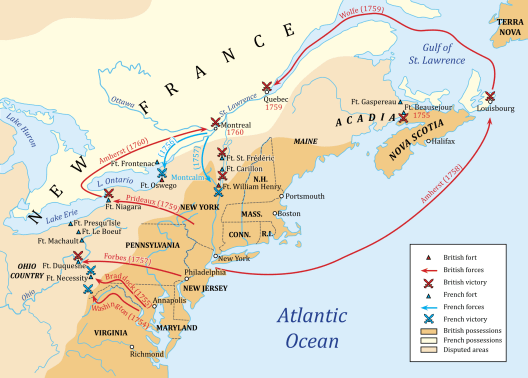
The fort had been built at the head of Lake George as a counterbalance to two French forts, Ticonderoga (called by the French, “Carillon”) and St. Frederic, on Lake Champlain, the lake to the north.

French_and_indian_war_map_svg

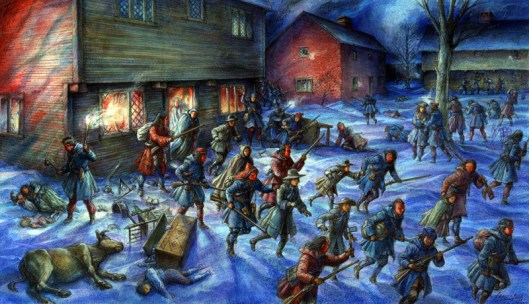
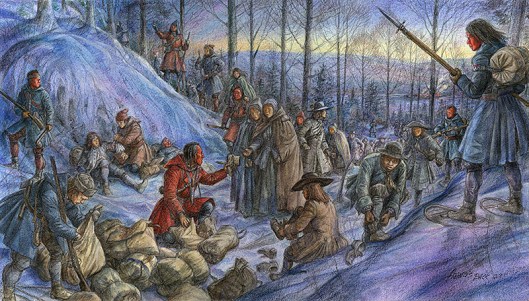
All of these forts—and more—were part of the competition between the British and French to control the northeastern part of North America. This struggle had begun in the later 17th century and had long been a proxy war in which colonial settlers and Native Americans had struggled across many miles of wilderness, raiding each other throughout the years. Here is one of the most famous raids, that of Deerfield in 1704.

deerfield1deerfield2deerfield3

In the early 1750s, the French had increased the potential tension by building a new series of forts in what is now western Pennsylvania and eastern Ohio, soon to be countered by British forts.

French_British_Forts_1753_1758

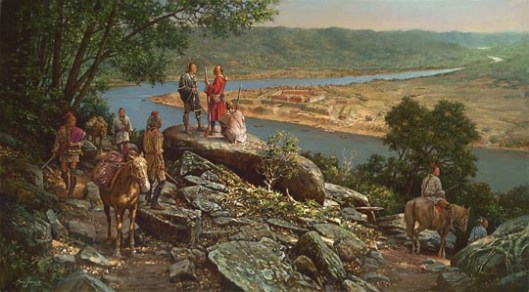
In 1755, as the war heated up, the English planned a three-pronged attack against Ft. Duquesne, Ft. Niagara, and Ft. St. Frederic (called “Crown Point” by the English).

French_and_indian_war_map_svg

duquesne

ftniagaraftstfrederic

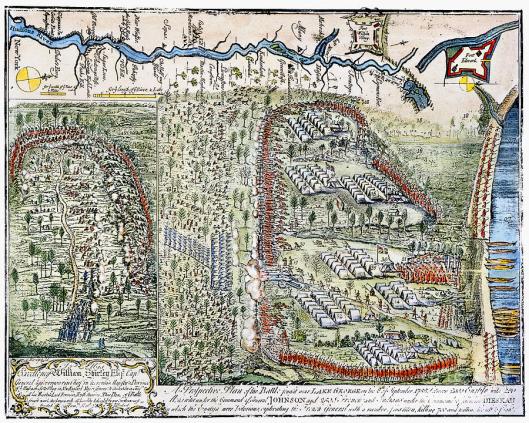
The advance against Ft. Duquesne was defeated, that against Niagara never took off, and that on St. Frederic was blocked by a French attack on the English (actually New England colonial) army at the head of Lake George.

1-battle-of-lake-george-1755-granger

This then became the site of Ft. William Henry.

Fort-William-Henry-Museum

Because the European population of New France was so small in contrast to that of the English colonies—about 70,000 versus more than a million—and because the royal government in Paris had little money to spend (or chose to spend) on the colony, the first two French military commanders, the Baron Dieskau (1701-1767) and the Marquis de Montcalm (1712-1759)

montcalm

chose an aggressive strategy, aiming to keep the British as far from the center of New France as possible. Although his men were eventually driven off and he was wounded and captured, Dieskau did halt the expedition against Ft. St. Frederic. The next year, 1756, Montcalm destroyed the English forts at Oswego, on the south shore of Lake Ontario, which could have served as staging areas for attacks east and west.

Lake_Ontario_map

Then, in 1757, he mounted the attack on Ft. William Henry which forms the background story for Cooper’s novel.

To do so, he stripped central New France of its regular troops and militia

Historex Card 862 French Infantry 1750 - 1760

and augmented them with Native Americans, for whom he felt no sympathy.

montcalmnatams

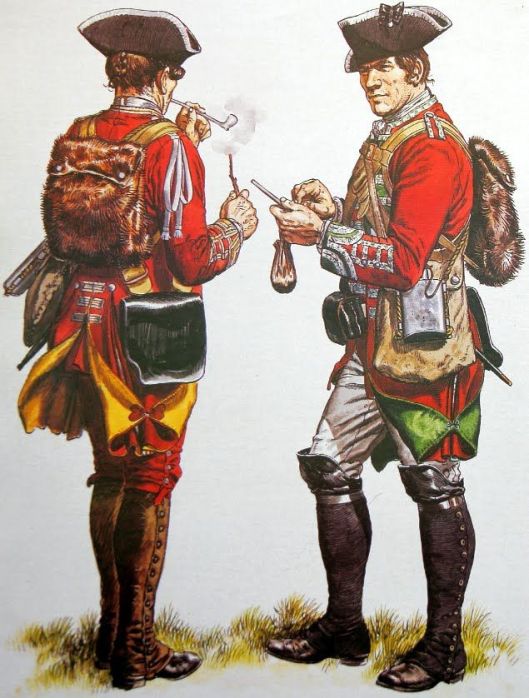
Against such a force, the English commander, Lt. Col. Munro, had a much smaller number of British regulars

brituniformsfiw

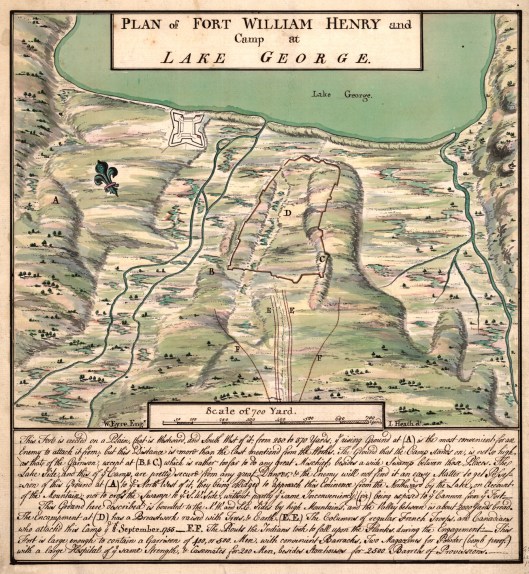
and colonial troops, based in the fort itself and in a nearby camp.

Plan_of_Fort_William_Henry_on_Lake_George

In the 18th century, besieging a town or a fort was a very formal endeavor. Forts and towns were constructed to resist attack, often having multiple walls, ditches, and outer forts, the walls being covered in earth to resist the destructive power of an enemy’s artillery.

fortress-cross-section

Before an attack, the attacker was required to send a messenger in, demanding surrender. In some cases, seeing overwhelming forces and having no promise of relief, a garrison surrendered.

surrender of detroit

To attack meant beginning with a series of trenches just outside the artillery range of the defenders, then, through zigzagging,06 Vauban's Siege Technique.pngto approach closer and closer until:

  1. the attacker’s artillery had knocked a big enough hole in the enemy’s walls that they were rapidly becoming defenseless

siege_image6

  1. there was the immediate danger of an assault

redoubt10

In the case of Ft. William Henry, there was only a dry ditch, then exposed timber walls.

Fort-William-Henry-Museum

The French summoned Munro to surrender, he refused, and the French began the siege.

frenchsiegeline

When the French guns had badly damaged the fort and there was no chance of help from General Webb, at Ft. Edward, to the south, Munro surrendered.

surrender of Ft. William Henry

Trouble then began when Montcalm’s Native Americans felt cheated of the plunder which they had expected and, when the paroled column of soldiers began to move southward, it was attacked by them. Montcalm and some of his officers intervened, but they were unable to do more than slow the plundering and killing before some 200 fell. (There has been a great deal of argument as to numbers—it appears, for example, that others had been carried away, either to be ransomed later, adopted into tribes, or ritually murdered, as was the custom among some Native American groups. For the best modern account, see Ian Steele, Betrayals, OUP, 1990.)

01french_lg

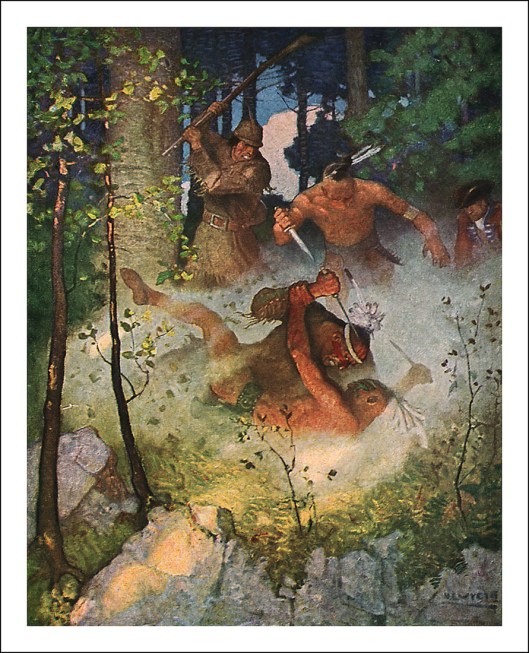
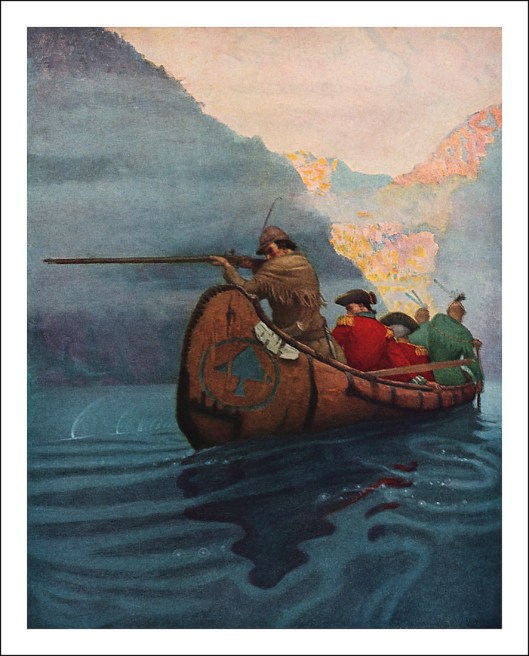
Cooper’s novel, an adventure/romance, uses the fort and siege as its center. Main characters move towards the fort, are in it at the time of the surrender, and are involved in the disaster after it. As might seem inevitable by now, our favorite edition is that illustrated by N. C. Wyeth in 1919.

51504

And here is a selection of the illustrations.

0_8f6d0_9b893fc5_orig0_8f6d2_797c6459_orig0_8f6d4_4ef48676_orig

the-last-of-the-mohicans-9781442481305.in02the-last-of-the-mohicans-9781442481305.in03titlepage

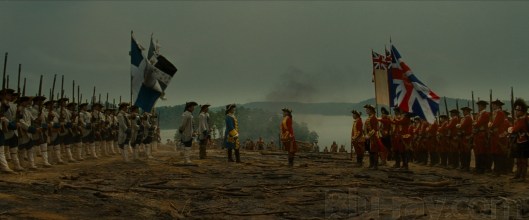
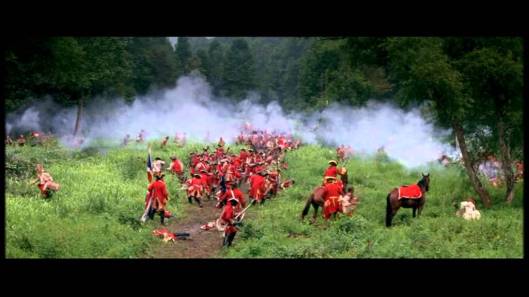
There have been numerous films made of the book, the earliest (at least US one) being a silent, dating from 1912. For us, the most colorful was the one which appeared in 1992, with Daniel Day Lewis as “Nathaniel Poe” (a slight change from the books’ Natty Bumpo). This version made many changes to the original story, including a love interest between Poe and one of Munro’s daughters, Cora, but, for us, it also had four rather spectacular scenes: the ambush of a company of redcoats in the forest by Native Americans,

ambushinforest

the French siege of Ft. William Henry,

frenchsiegeline

the British surrender,

surrender of Ft. William Henry

and the final “massacre”.

ambush2

And so we begin our third year of blogging with our next posting. We have, as always, lots of ideas for those postings, which we hope you will enjoy.

Thanks, as always, for reading!

MTCIDC

CD

PS

In 1895, Mark Twain published a comic critique of Cooper’s writing ticks. Entitled, “Fenimore Cooper’s Literary Offenses”, it can be read at http://twain.lib.virginia.edu/projects/rissetto/offense.html.

One for All…

24 Wednesday Aug 2016

Posted by Ollamh in Films and Music, Literary History, Military History, Narrative Methods

≈ Leave a comment

Tags

Alexandre Dumas, Aramis, Athos, battle of Fontenoy, Cardinal Richelieu, D'Artagnan, French Revolution, Garde Republicaine, Harpers Ferry, La Rochelle, Louis XIII, Louis XIV, Louis XV, Louis XVI, Louis XVIII, Musket, Musketeers, Porthos, Richard Lester, Royal Heralds, tabard, The Count of Monte Cristo, The Three Musketeers, Twenty Years After, Vicomte de Bragelonne

Dear Readers,

Welcome, as always.

In our last, we said that we were having a little holiday from the works of JRRT and we’re continuing that break in this posting, as well. After all, although we have a deep affection and admiration for them, we began this blog with the intention of focusing upon adventure in general.

In this, we want to look at musketeers—three, in fact, plus a fourth, who, although he lacks an official position in their company, has the heart of one.

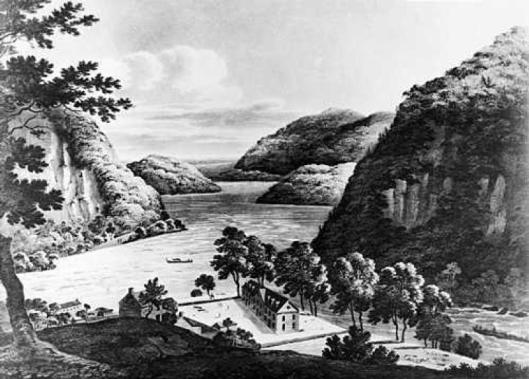
A musket is now a generic word for a pre-breech-loading long arm, like this one—

harpersferry1809

made at the Harpers Ferry arsenal in 1809.

harpersferryearly

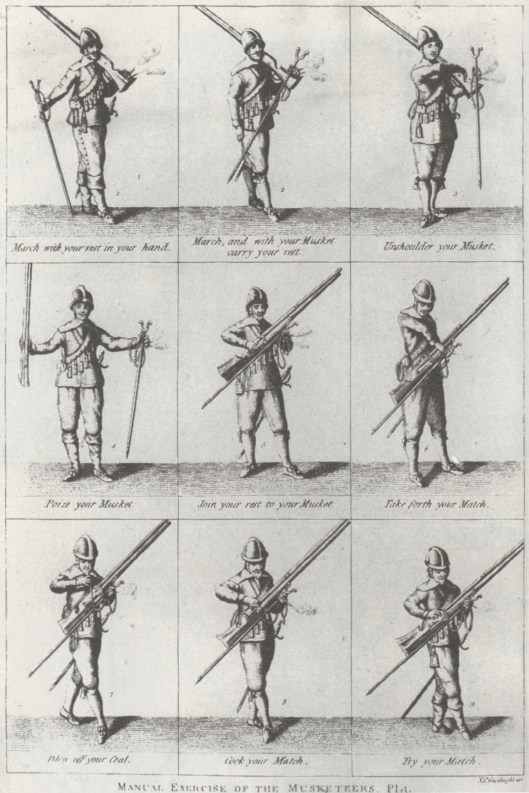
Once upon a time, however, a musket was a specific weapon, a heavier firearm which was supported on a wooden rest.

Musketeer

Such weapons were inaccurate at any distance and, in time, soldiers were gradually trained to load and fire in groups, to have more effect upon the enemy.

Manual_of_the_Musketeer,_17th_Century

military-musketeers-thirty-years-war-1618-1648-drawing-by-anton-hoffmann-bjn61w

Certain cavalry were issued lighter versions of such muskets and, in 1622, one company—later two—was formed as a bodyguard for the young Louis XIII.

0_Louis_XIII_en_costume_de_deuil_-_Frans_Pourbus_le_Jeune_(2)

At this time, the idea of uniforms was only beginning to appear and so these men would have worn whatever they wished (probably a fancier version of period civilian clothes—they were guarding the king, after all).

e7670396c9d2d92bdb277a8dd2fbfdc9

To identify them as belonging to the king’s household, however, they were issued with a kind of loose overgarment called a tabard, which we can still see today as worn by the Royal Heralds of Elizabeth II.

Pursuivant_tabardHeralds-at-the-Garter-Service-Julian-Calder-1024x681fae2a692a2dfd52e3931b64ed85bf5ab

One of these musketeers was named D’Artagnan (1611-1673)

invalides-mousquetaires-portrait-du-vrai-dartagnan-mais-aucune-preuve-dauthenticitc3a9

and, in 1700—27 years after his death at the siege of Maastricht in 1673—a well-known French author of the period, Courtilz de Sandras (1644-1712), published a semi-fictionalized “memoir” by D’Artagnan, supposedly based upon D’Artagnan’s papers.

Courtilz_Mémoires_titreWP

It depicted his adventures in a complex world of king and the man behind the king, Louis XIII and his prime minister, Cardinal Richelieu, and the court politics and foreign wars of the era.

Philippe_de_Champaigne_-_Louis_XIII_Crowned_by_Victory_(Siege_of_La_Rochelle,_1628)_-_WGA4712

index

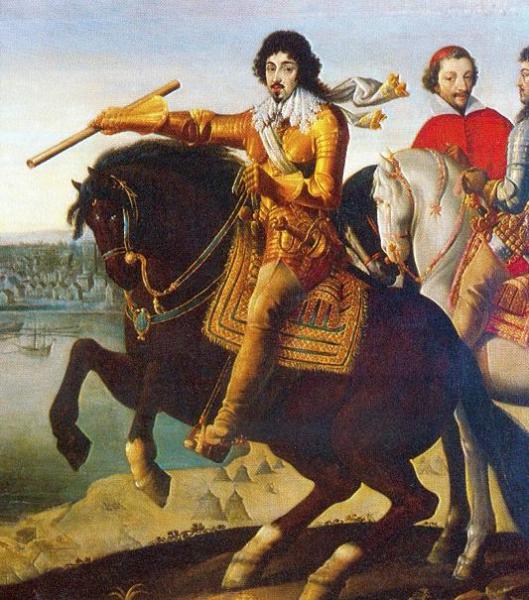
And, in this equestrian portrait, you can see the Cardinal literally behind the king.

Louis_XIII_Richelieu_devant_La_Rochelle

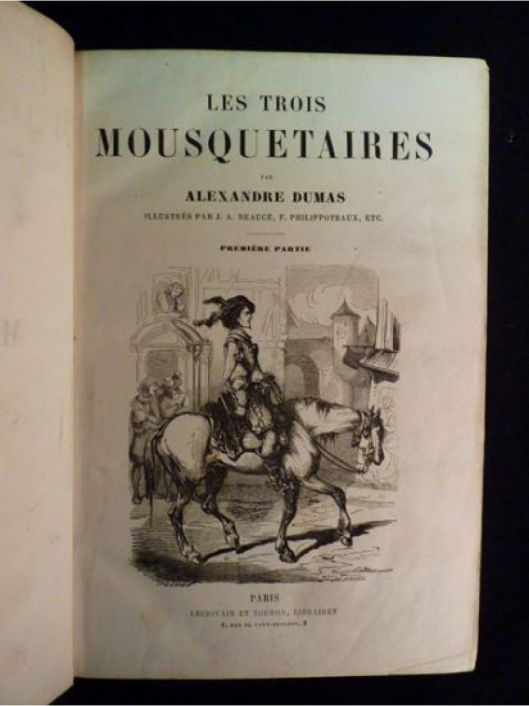
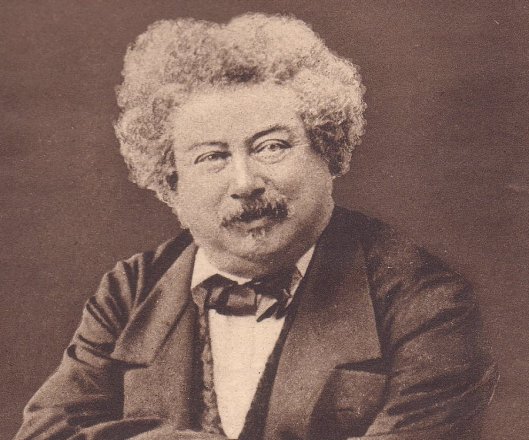
In 1844, there appeared a totally fictionalized account by Alexandre Dumas (1802-1870),

000101

The Three Musketeers,

h-1200-dumas_alexandre_les-trois-mousquetaires_1850_0_34725

which proved so successful that Dumas produced two sequels, Twenty Years After (1845), and The Vicomte de Bragelonne (1847). The success of the first book was such that, since its publication, well—just google “The Three Musketeers in film”! The story of a young man from an impoverished noble family coming to Paris and how, through luck and bravery, he becomes a musketeer, is clearly irresistible—certainly for us! (And Dumas had the gift to do this more than once—he is also the author of the equally-irresistible The Count of Monte Cristo—google that to see its history.)

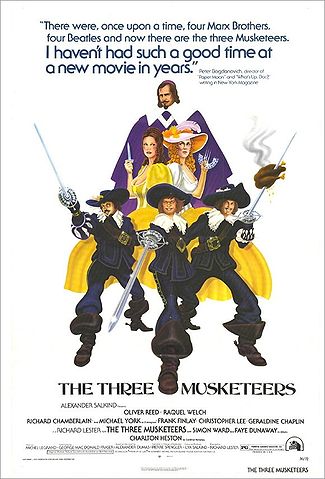
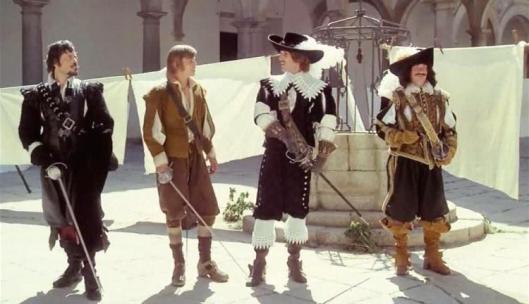
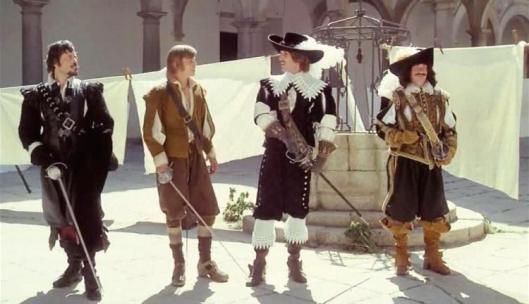
We have read various versions of this since childhood, from comic books to school texts in French, but, of all of the film versions, our favorite is the 2-part Richard Lester adaptation (script by one of our favorite historical novelists, George Macdonald Fraser—more about him in a future posting) of 1973-1974.

Three_Musketeers_1974

This is a version which keeps some of our favorite scenes—the duel in the convent courtyard, where D’Artagnan proves his courage to his new friends-to-be among the Musketeers, Athos, Porthos, and Aramis,

TheThreeMusketeers099

and the wager of the four friends to defend the bastion at the siege of La Rochelle while having breakfast there,

e988a9ce178db360466105fc18acd73d

but is, on the whole, a very light-hearted telling of the story (after all, Lester was famous for being the director of several earlier films starring the Beatles—the original idea even being that John, Paul, George, and Ringo were to be the Musketeers), set against a very grainy depiction of the world of the 1620s (which we find very convincing).

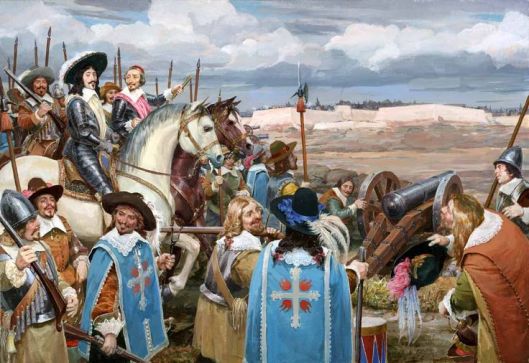
As for the real Musketeers, they had a long career as part of the King’s household guards, from the time of Louis XIII

68f4383f6ba85134f5c8c8b58a9d4613

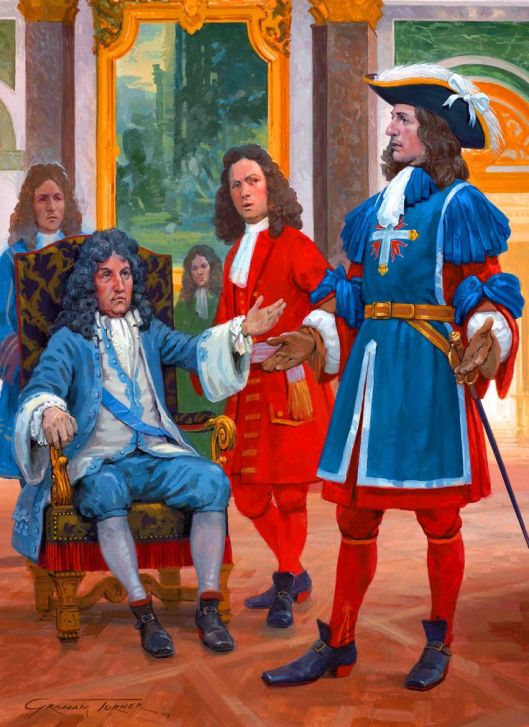
through that of Louis XIV

musketeerlouisxiv

through a famous charge at the battle of Fontenoy (1745) in the time of Louis XV.

15bba6ef186f1f2774c2be4c1f2761c2

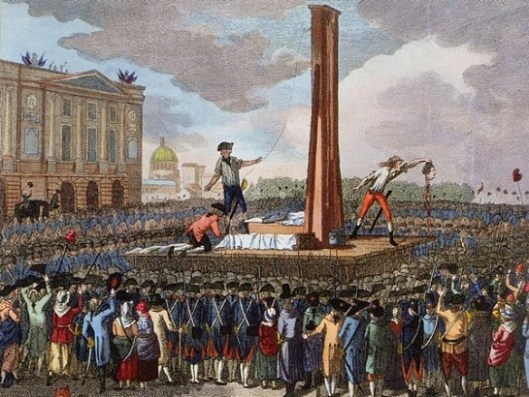
They were swept away at the time of the French Revolution, along with their master, Louis XVI,

executionlxvi

but restored in 1814 by his royal successor, Louis XVIII.

louisxviiimusket

In this new edition of the Musketeers, there appeared for a short time a recruit named Dumas,

Alexandre_Dumas_par_Achille_Devéria_(1829)

but, unlike his father (1762-1806), a famous general of the French revolutionary period,

generaldumas

he had another career waiting for him…

Thanks, as always, for reading.

MTCIDC

CD
PS

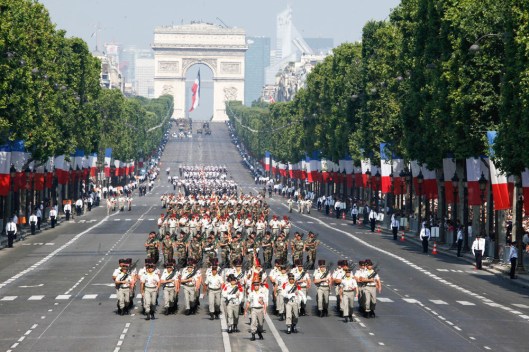
That last reincarnation of the Musketeers was a brief one: they were finally abolished in 1816. We can’t resist, in this ps, showing you a kind of descendant, however—at least in looking French and splendid. Here is the Garde republicaine in Paris. Its name tells you that, although monarchy might be dead in France, guards are certainly not.

la-musique-de-la-garde-republicaine


Jacobites

17 Wednesday Aug 2016

Posted by Ollamh in Artists and Illustrators, Literary History, Military History, Narrative Methods

≈ Leave a comment

Tags

Anne, Aughrim, Boyne, Catriona, Charles II, Culloden, Elizabeth II, Falkirk, George I, George II, Glenshiel, Highlanders, Jacobites, James II, James III, Kidnapped, Killiecrankie, Lowlanders, Mary and William, N.C. Wyeth, Prestonpans, Prince Charles, Requiem, Robert Louis Stevenson, Scotland, Sir Walter Scott, The Black Arrow, The Old Pretender, Treasure Island, Underwoods, War of Austrian Succession, Waverly, Young Folks

Dear Readers, welcome, as always.

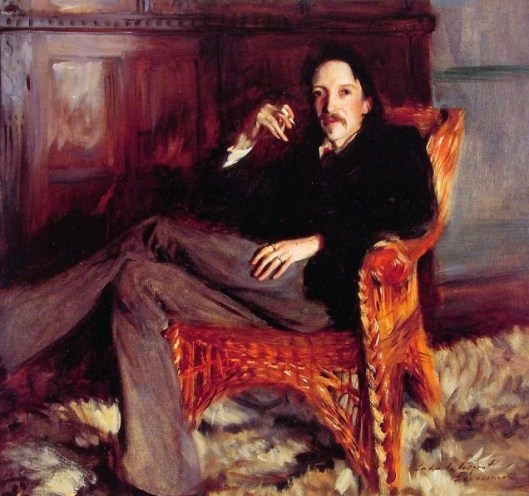
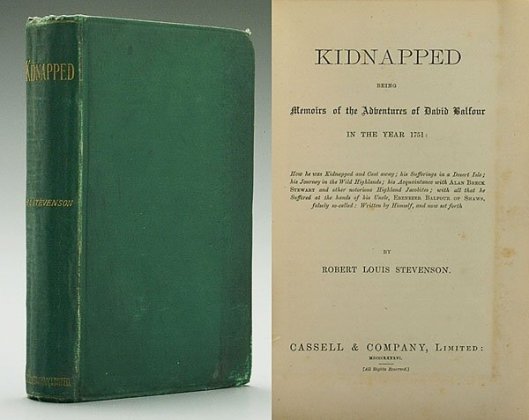
We’re taking a break from JRRT in this posting and looking at another favorite, Robert Louis Stevenson’s 1886 novel, Kidnapped,

rlsjss2kidnappedfirstedition

which was first serialized in what must have been a remarkable Victorian children’s magazine, Young Folks (1871-1897, with various titles), as it featured Stevenson’s Treasure Island (1881-1882) and The Black Arrow (1883), as well.

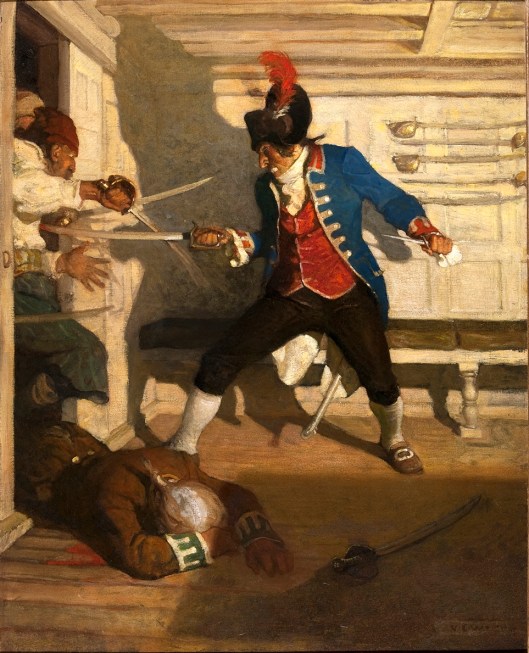
It has been published and republished numerous times since its original appearance (just google the title), but, if you read us regularly, you’ll already know our favorite edition is that published by Charles Scribner’s Sons in 1913 and illustrated by N. C. Wyeth (although we agree with the critics that his Treasure Island, 1911, is even better). Here are a few of the illustrations to give you an idea—these are much moodier than those for Treasure Island, we think.

Wyeth Kidnapped Siege of the Round-HouseWyeth Kidnapped Wreck of the CovenantOn_the_Island_of_Earraid_(N.C._Wyeth).kidnap212_kidnapped_wyeth_murderer

The actual title is based upon 18th-century models, where a great deal of the plot may be teasingly outlined beforehand. We won’t give it all to you, but it begins: Kidnapped Being the Memoirs of David Balfour in the Year 1751 How He Was Kidnapped and Cast Away; His Sufferings in a Desert Isle; His Journey in the Wild Highlands; His Acquaintance with Alan Breck Stewart and Other Notorious Highland Jacobites…

“Jacobites” if you are not acquainted with the term, means “followers of/those loyal to Jacob (that is, James)” and the Jacob/James story marks a turning point in the history of the British Isles.

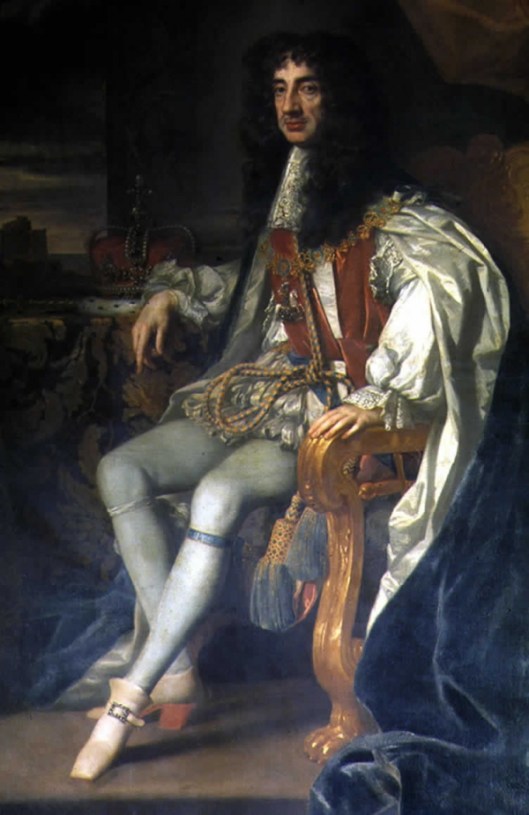
The story begins when Charles II of England dies in 1685 without leaving a legitimate heir.

charles-ii

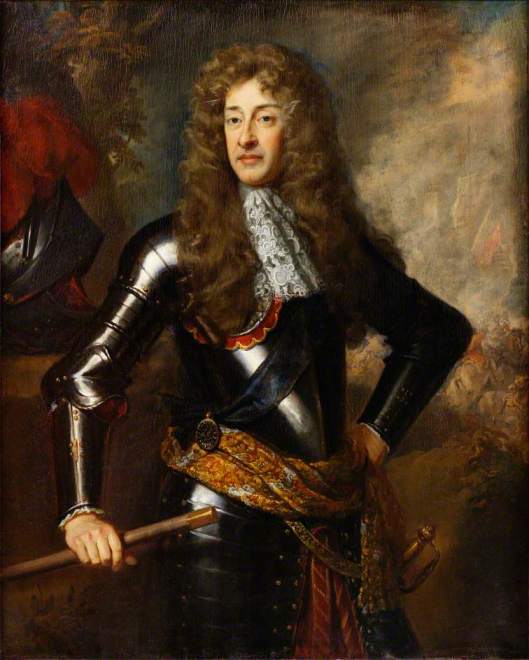
The throne then goes to his younger brother, James II.

(c) Government Art Collection; Supplied by The Public Catalogue Foundation

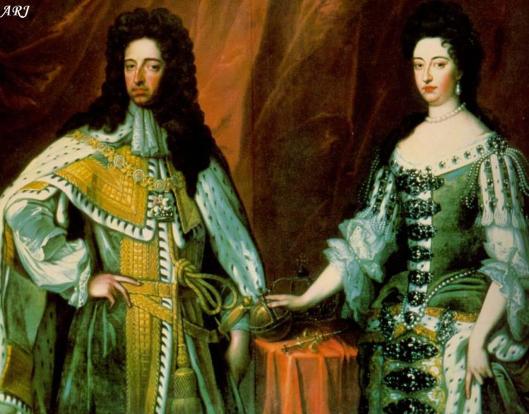
James was a very unpopular king, for some very complicated reasons, and he was driven from the throne in 1688 by a conspiracy which included members of Parliament, some of his army, and his daughter, Mary, as well as his son-in-law, William the Stadthoulder of the Netherlands.

1-william-mary

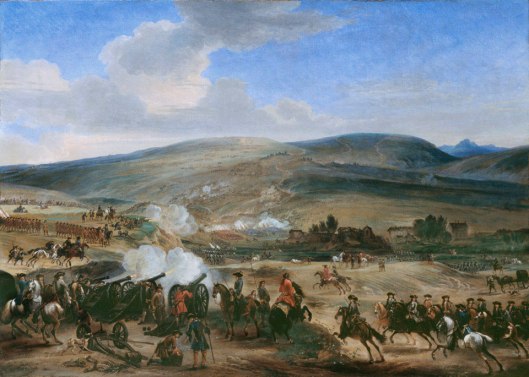
James didn’t go very easily and there was war in the British Isles from 1689 to 1692, with three major battles, Killiecrankie in Scotland (1689),

killie1

the Boyne, 1690,

boyne1690

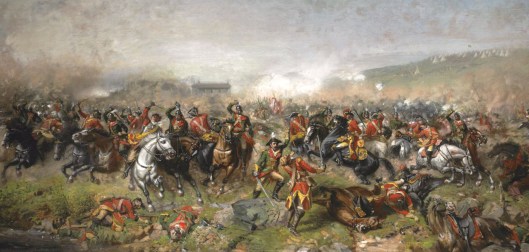
and Aughrim, 1691, both in Ireland.

John_Mulvany_-_The_Battle_of_Aughrim.1691

Although James II’s forces lost, that did not end the matter, however. James II died in exile in 1701, but his son, the potential James III (called by his enemies “The Old Pretender”, meaning “claimant to the throne”), continued the struggle, being involved in three major attempts at taking back the monarchy.

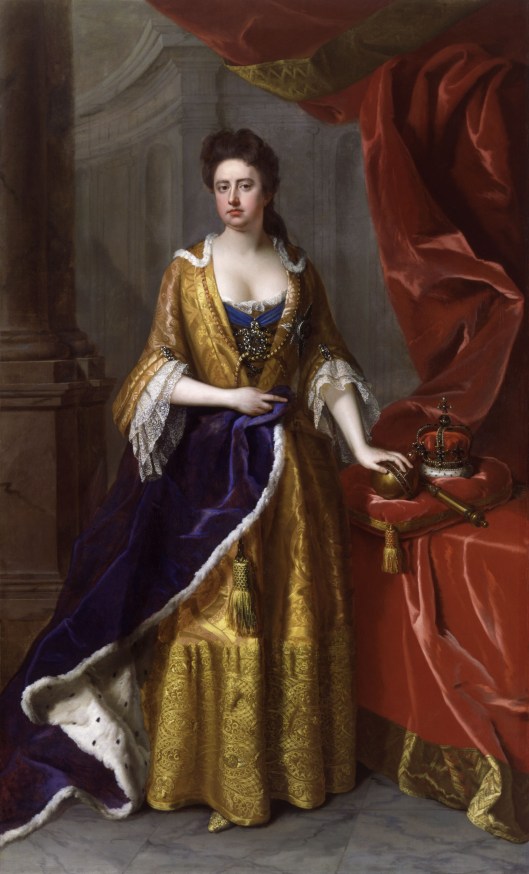
In the meantime, Mary and William had both died and Mary’s younger sister, Anne,

6187,Queen Anne,by Michael Dahl

who succeeded them, as well. To keep both religious and family continuity, it had been agreed that, since Anne had no surviving heirs, her second-cousin, George, the Elector of Hanover (a country in what is now western Germany) and his family would inherit the throne, which George did, in 1714, as George I of England.

King_George_I_by_Sir_Godfrey_Kneller,_Bt_(3)

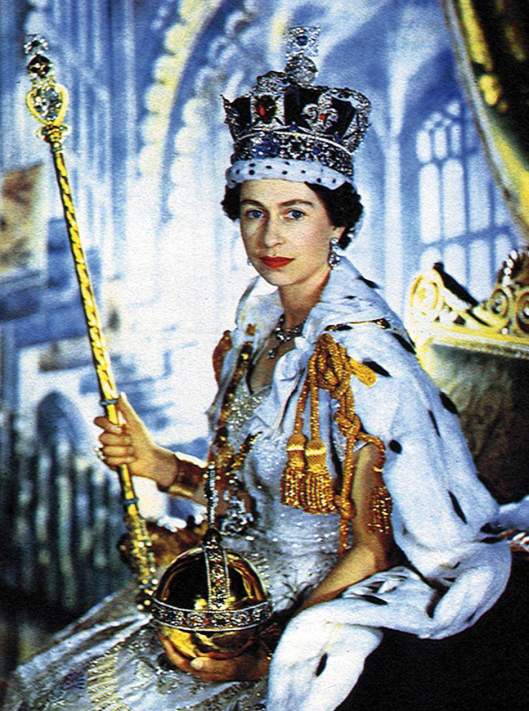
That continuity worked so well, in fact, that he is the direct ancestor of the present queen, Elizabeth II,

coronationpicofer2

article-2335617-1A1939BE000005DC-225_964x730

(We just couldn’t resist including this– even royalty don’t take reigning totally seriously, it seems!)

Not a year later, there was a plan to take the throne by invading Scotland, raising an army of Lowlanders and Highlanders alike, and marching on London. There was one inconclusive battle, at Sherriffmuir, in 1715,

Battle_of_Sheriffmuir

but, even with the arrival of James-the-possible-third,

Prince_James_Francis_Edward_Stuart_by_Anton_Raphael_Mengs

the whole thing fell apart. And something similar happened with the next attempt, in 1719. Modest Spanish support was not enough and the Jacobite army failed at Glenshiel

Glen_shiel

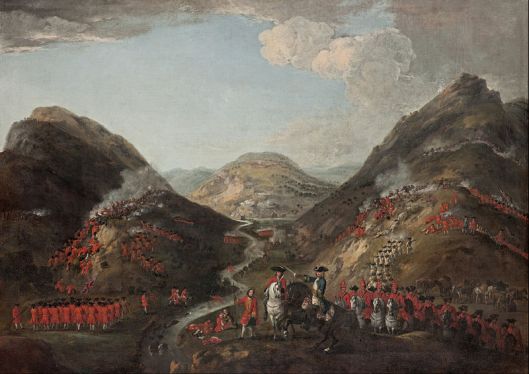
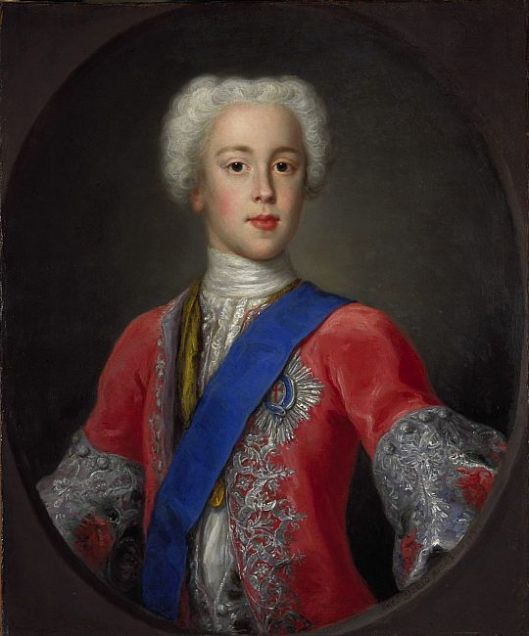
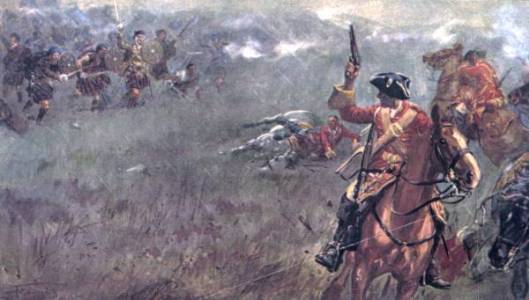
and things subsided into a cold war until 1745. During the intervening years, the struggle between Britain and France, begun in the days of Louis XIV (ruled 1661-1715) had intensified, with France supporting James II and his son as proxies. In 1745, the latest war, the so-called “War of the Austrian Succession”, had been going on since 1740. This was a much more complex pan-European war, but, with Britain and France backing different candidates for the throne, there was a good opportunity for a further attempt on the part of France to destabilize her old opponent. Thus, when it was proposed that the dashing young son of James, Prince Charles (1720-1788),

Young Charles Edward Stuart L_tcm4-563619

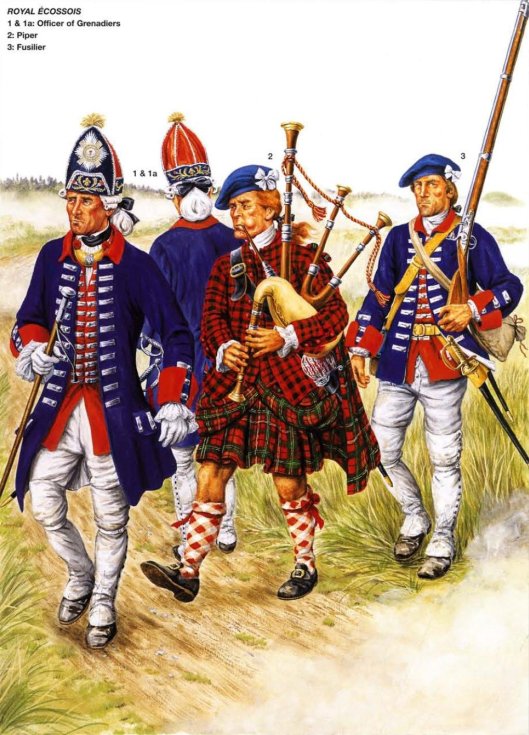
backed by a small French army

royalecossais

(with another waiting in the wings for an invasion of southern England), should land in Scotland and raise the country against the government of George II, the Old Pretender agreed.

King_George_II_by_Charles_Jervas

Unfortunately for their cause, this ended as the other attempts had, in failure—and this was the final failure. After one great victory, at Prestonpans in 1745,

prestonpansSurrender

and a smaller one at Falkirk, in early 1746,

falkirk1746

the plan failed at Culloden in April, 1746,

The_Battle_of_Culloden

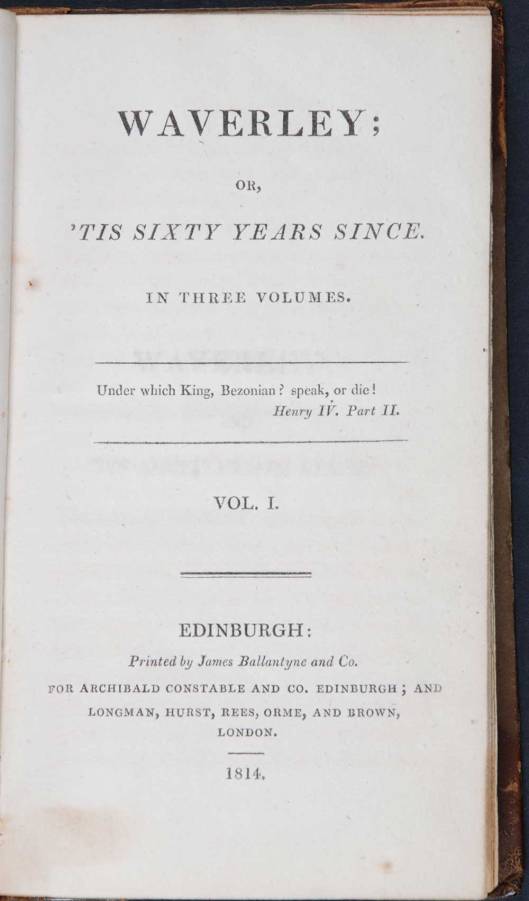
and this was the last grand attempt. As the inspiration for literature in the romantic period, however, it was extremely successful, beginning with Sir Walter Scott’s

Sir_William_Allan_-_Sir_Walter_Scott,_1771_-_1832._Novelist_and_poet_-_Google_Art_Project

Waverley, published anonymously in 1814.

waverleyfirsted

Regularly regarded as the first great historical novel, it was the beginning of great commercial success for Scott, as well as the beginning of a process which turned Scotland’s past into the basis of an entire cultural industry, of which Kidnapped (1886) and its sequel, Catriona (1893) formed a small, but prominent part and is still with us today in the US (and elsewhere) in Scottish festivals and bumperstickers.

scottishfestivalThank-God-Scottish-Sticker

Thanks, as always, for reading.

MTCIDC

CD
ps

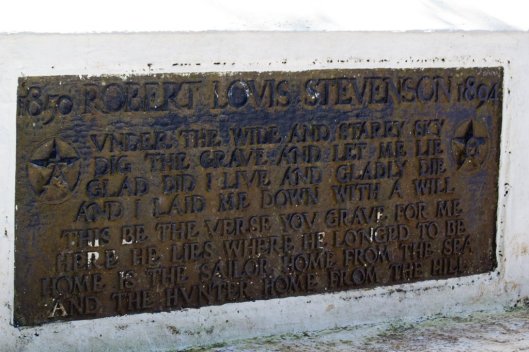
We can’t conclude without including Stevenson’s “Requiem” (from his collection Underwoods, 1887),

RLSrequiem1880

which we’ve always admired and which is on his tomb in Samoa, where he died of a cerebral hemorrhage in 1894.

rlstomb

Allons, enfants!

14 Thursday Jul 2016

Posted by Ollamh in Literary History, Military History

≈ Leave a comment

Tags

Across the Doubtful Sea, Alexandre Dumas, Bastille, Bastille Day, Bastille Day parade, Beau Geste, Bernard Cornwell, Brigadier Gerard, C.S. Forester, CD, Charles X, Conan Doyle, Cyrano de Bergerac, de Bougainville, Edmond Rostand, Eugene Leliepvre, French Foreign Legion, French Royal Navy, Hornblower, King's French Guard, Louis Philippe, Marquis de Montcalm, Napoleon, Place de la Bastille, Place Henri Galli, Sharpe, South Pacific, The Three Musketeers

Dear readers, chers lecteurs,

Welcome/bienvenue as always/comme toujours. This is a special extra posting for our faithful French readers, but really for all of our readers who love adventure and history—and that, as far as we can tell, is everyone who regularly reads us.

When we were thinking about this special Bastille Day extra, we wondered what we should write about.

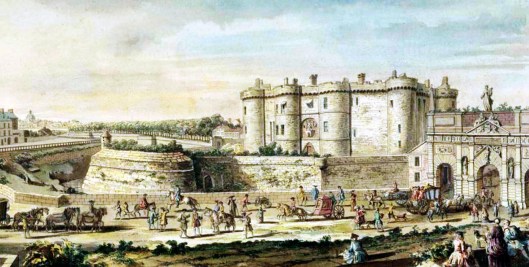
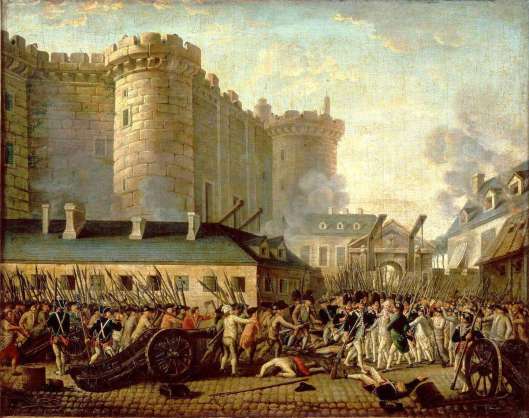
We could, of course, write about the original Bastille day, 14 July, 1789, when a crowd of brave and angry Parisians, aided by some members of the King’s French Guard, attacked the 14th-century fortress-turned-state-prison, and forced its surrender.

Bastille_1715

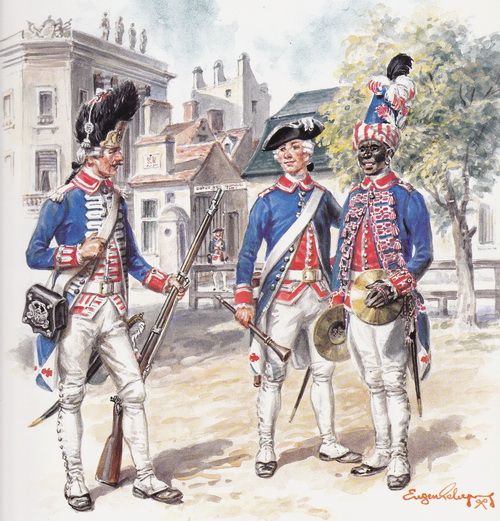
l'attaquesurlabastille(We can’t resist a visual footnote– you’ll notice the people to the right in dark blue with the fuzzy hats. These are members of a grenadier company of the French Guard. Here’s a larger and more modern illustration of these Guards by one of our favorite French military artists, Eugene Leliepvre.)

leliepvregardefrancaise

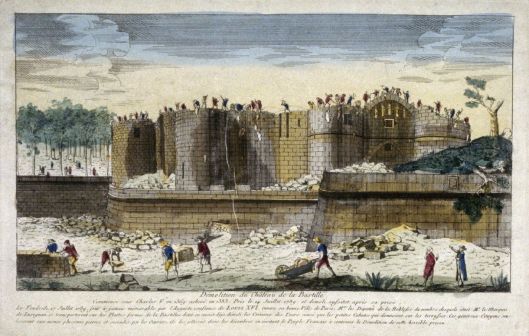
Not satisfied with capturing the place, the revolutionaries soon tore it down, and it’s now the Place de la Bastille, with a column, erected in 1840, commemorating the revolution of 1830, in which the last member of the Bourbon monarchy, Charles X, was overthrown and was replaced by his cousin, Louis Philippe.

demolitiondelabastille

Place_de_la_Bastille,_1878

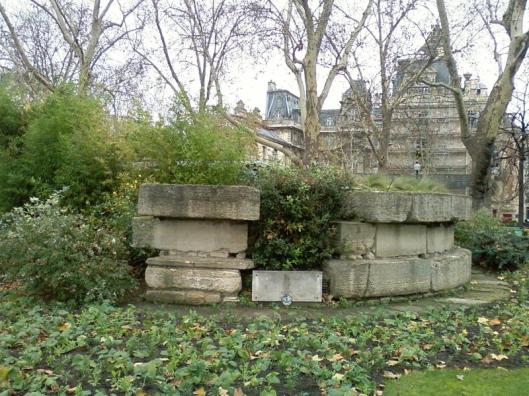
In 1899, a small section of one of the Bastille’s towers was discovered during metro excavations and is now on display in the Place Henri Galli, not far from its original site.

la-bastille1Paris4_SquareHenriGalli_VestigesBastille_Nov09

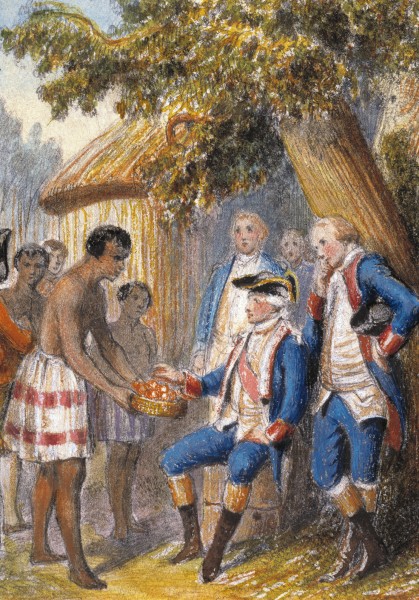
The Revolution which followed the fall of the Bastille brought on the era of Napoleon and, for those of us interested in adventure and who read English, at sea, C.S. Forester’s “Hornblower” series, among others, and, on land, Bernard Cornwell’s “Sharpe” series and, long before that, the “Brigadier Gerard” stories of Conan Doyle. Hornblower and others have appeared in some of our earlier postings, when we discussed sources for our first novel, Across the Doubtful Sea, set in an imaginary South Pacific in the 18th century,

Across Cover

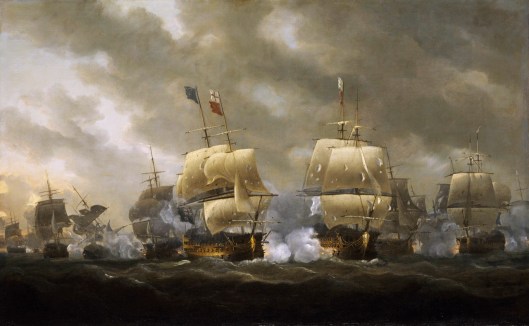
but we’ve never looked at Gerard or Sharpe. And we would be glad if our French readers would offer comparable books in French for this period (one of us grew up in a Francophile household and reads French). One reason why heroes in our first novel are members of the French Royal Navy is that the period from 1750 to 1800 is filled with adventure, both in exploration and in war, and that navy is constantly involved, something of which English readers have no knowledge.

img_9168

(Another color plate by Leliepvre.)

One has only to remember de Bougainville (1729-1811),

Louis_Antoine_de_Bougainville_-_Portrait_par_Jean-Pierre_Franquel

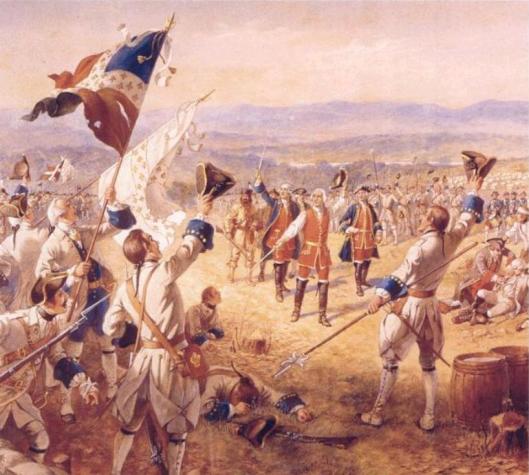
who began his career as an aide to the Marquis de Montcalm, the daring and resourceful commander of French regular forces in New France, 1756-1759.

The_Victory_of_Montcalms_Troops_at_Carillon_by_Henry_Alexander_Ogden

In the 1780s, however, he had become a naval commander, leading an exploratory expedition to the South Pacific.

51_Pacific_02-419x600

Throughout the later 17th and 18th centuries, the French Navy formed a large part of the French struggle for commercial supremacy across the world.

Quibcardinaux2

Or then again, as we’ve done once before, we could go back to the 17th century and write about Alexandre Dumas and his famous musketeers, who first appeared in The Three Musketeers (1844).

alexandre-dumas-3TheThreeMusketeers099

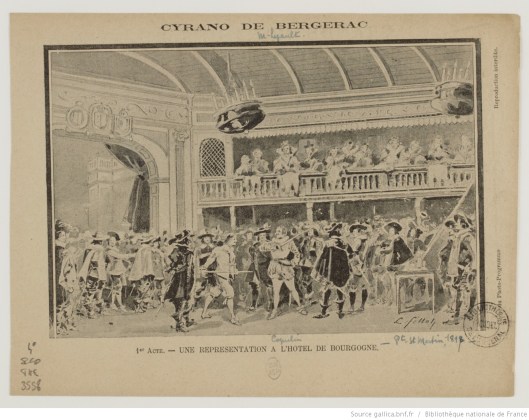
Or there is the wonderful play Cyrano de Bergerac (1897) by Edmond Rostand, set about 1640. We could easily write a posting about the amazing scene in the first act alone, where, at the Hotel de Bourgogne, Cyrano fights a duel and composes a ballade at the same time.

Edmond_Rostand_en_habit_vert_01

cyrano_acte1

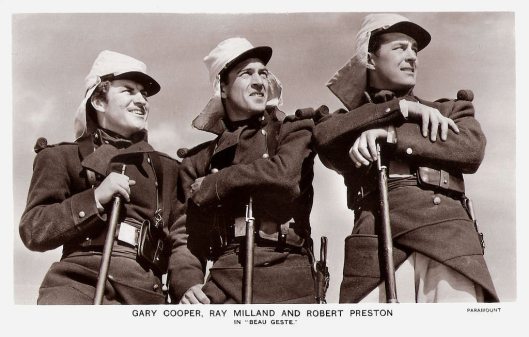
What else? Hmm. How about the French Foreign Legion of one of our favorite old adventure movies, Beau Geste (1939)?

beaugeste1939

And then a final then again, perhaps it’s best just to wish everyone a happy Bastille Day and end with some dramatic views from a previous parade…

defile114 Juillet 2013defile3

Merci, nos lecteurs/thanks, as ever, for reading.

MTCIDC

CD

Winter is Coming

29 Wednesday Jun 2016

Posted by Ollamh in Fairy Tales and Myths, J.R.R. Tolkien, Military History, Narnia, Narrative Methods, Villains

≈ 3 Comments

Tags

C.S. Lewis, Frozen, Game of Thrones, George R.R. Martin, Hadrian's Wall, Hans Christian Andersen, Kay, Middle-earth, Mile castle, Puddleglum, Queen Elsa, Rammas Echor, The Chronicles of Narnia, The Lion The Witch and the Wardrobe, The Lord of the Rings, The Night Watch, the Pevensies, The Snow Queen, The White Witch, Tolkien, Westeros, White Walkers, Winter is Coming

Dear Readers,

Welcome, as ever.

We were playing Sortes Tolkienses yesterday. That’s the game where we close our eyes, open The Lord of the Rings to any page, then put our finger on a line to see if we can write about it.

On page 1042 of our edition, our finger fell upon:

“…you may stay here till the Witch-king goes home. For in the summer his power wanes, but now his breath is deadly, and his cold arm is long.” (The Lord of the Rings, Appendix A)

The Witch-king? Oh, we thought—that Witch-king.

angmar.jpg

He has a very long history in Middle-earth, being “probably (like the Lieutenant of Barad-dur) of Numenorean descent” (from Hammond and Scull, The Lord of the Rings: A Reader’s Companion, 20, Note 5) and, in the quoted context rules Angmar

arnorangmar.jpg

with a command to destroy the northern Numenorean kingdom of Arnor.

What caught our attention, however, was that idea of a “cold arm”. This might be metaphorical—except for that “in summer his power wanes”, suggesting that, if he can’t control the weather, he can at least use it to his advantage.  And this set us thinking about stories in which winter was either controlled by someone or was, itself, the antagonist.

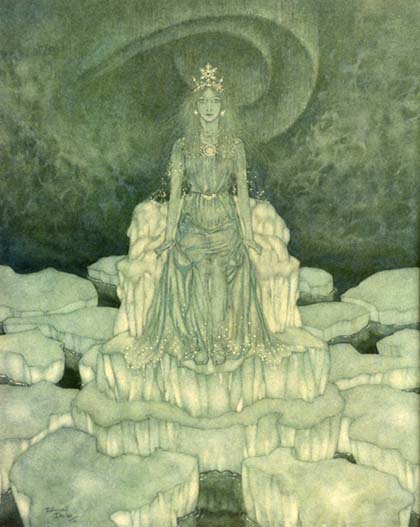
First, there is Hans Christian Andersen’s The Snow Queen (1845).   Although this shares a title with a 2013 Disney film, there is really nothing else to link them. The Disney film has, of course, the Princess Elsa, whose enchanted hands can turn the world into winter (perhaps like the Witch-king?).

69147-Elsa-The-Snow-Queen.jpg

elsasicepalace.jpg

Andersen’s long fairy tale (in seven parts, or “stories”, historier, in Danish) is about the abduction of a boy and his rescue by his friend, a girl. The boy is being held by the Snow Queen, who lives in a far-off palace made of snow, the windows and doors of icy wind, lit by the Northern Lights.

snowqueen.JPEG

northern-lights-large.jpg

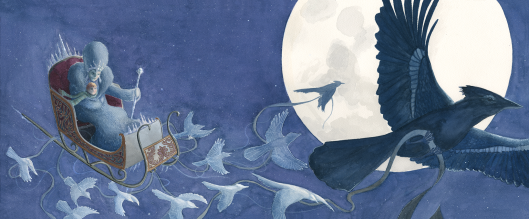
What particularly caught our attention here was the manner by which the boy, Kay, was stolen. He hitched his sled to the back of a sleigh, only to find that it was driven by the Snow Queen, who takes him under her robe.

lizbobzinsnowqueen.png

Liz Bobzin, “The Snow Queen and Kay”

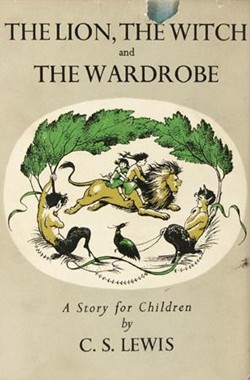
This took us to the White Witch of The Lion, the Witch and the Wardrobe (1950), the first of C.S. Lewis’ Narnia books.

TheLionWitchWardrobe(1stEd).jpg

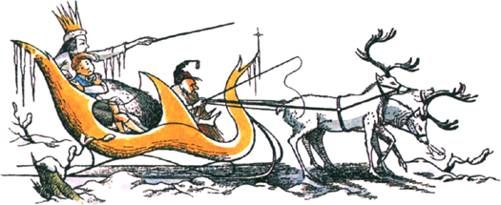
She picks up one of the Pevensie children, Edmund, in her sleigh and, while she doesn’t abduct him physically, she corrupts him by playing upon his greed and vanity.

bayneswhitewitch.jpg

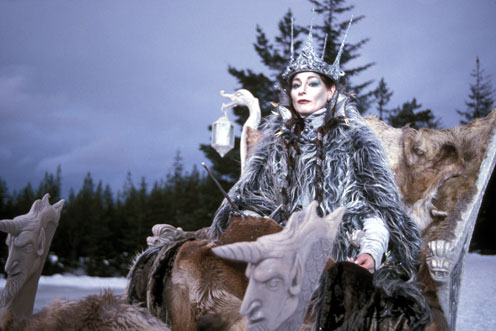
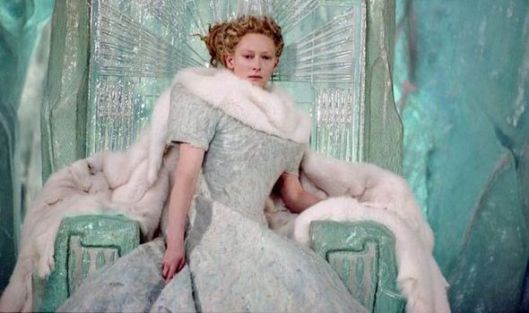
This is an illustration of the Witch from the original 1950 book, and here are two later interpretations—the first is from the 1988 BBC production

whitewitchbbc1.jpg

the second from the 2005 film.

tildaswinton.jpg

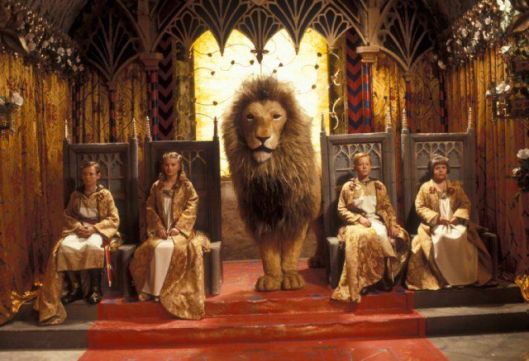
(We like both versions—we don’t mind the Steiff Aslan in the BBC production

bbcaslan.jpg

502613_l__13430.1384493387.1280.1280.jpg

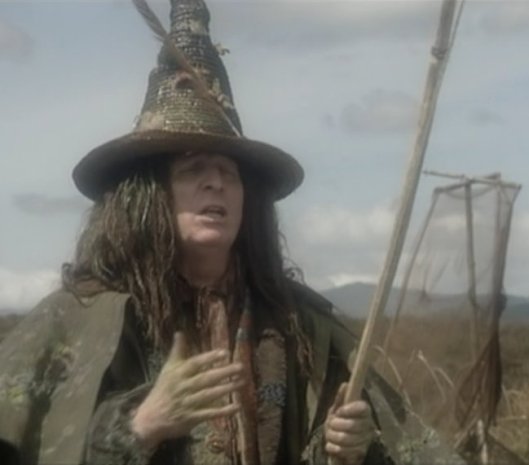
and who could ever be a better Puddleglum than Tom Baker, the fourth incarnation of Dr. Who, in the BBC The Silver Chair, 1990?

bakeraspuddleglum.jpg

We do worry a bit, however, about the changes made to the film versions of Prince Caspian, 2008, and The Voyage of the Dawn Treader, 2010. They’re not so drastic as those we’ve come to expect from P. Jackson’s writers, but, especially in Prince Caspian, there is a tendency to change things for what appear to be marketing reasons…)

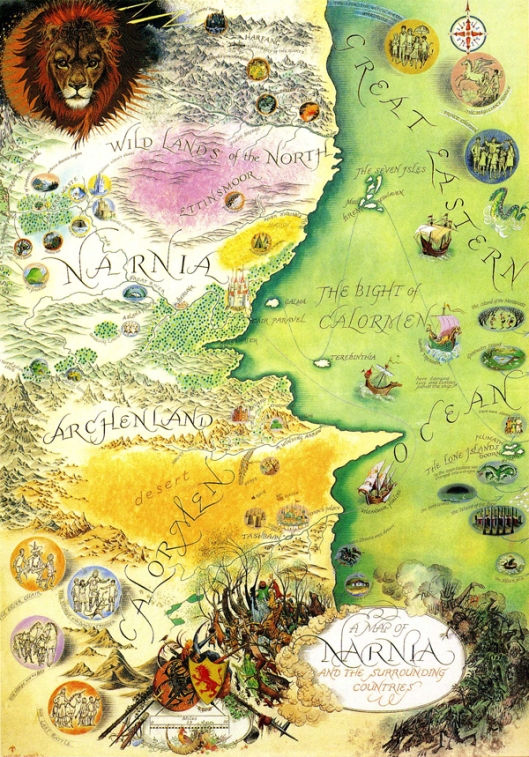
As in what appears to be the case of the Witch-king, the White Witch can control the weather and has imprisoned all of Narnia

baynesmapofnarnia.jpg

in snow and ice for a century—“always winter, never Christmas”.

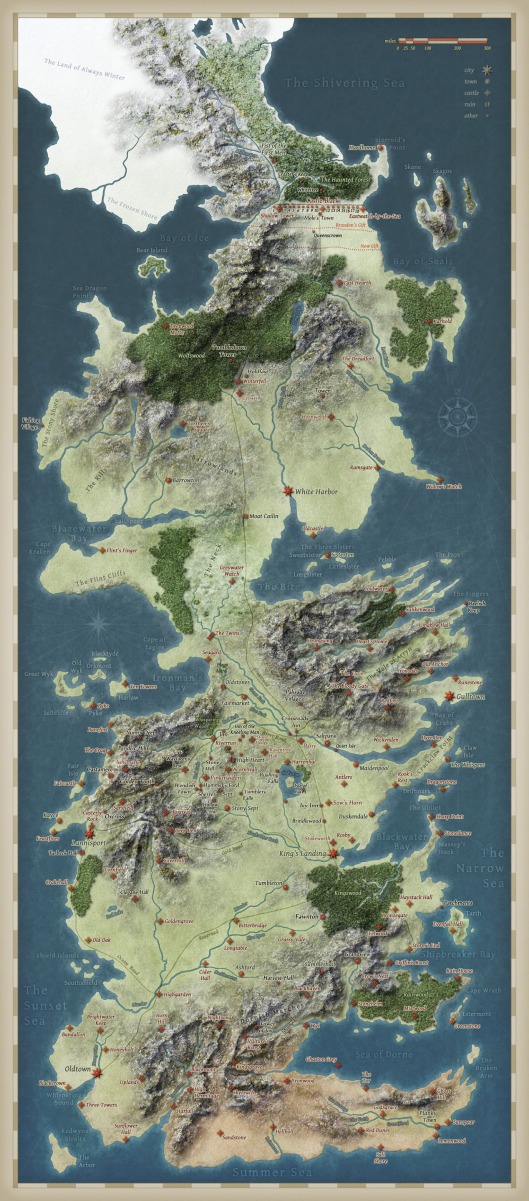
The idea of a world of winter then brought us to George R.R. Martin’s A Game of Thrones, both the novels and the impressive (and addicting) television series. In the world of Thrones, the large island of Westeros—

Map_of_westeros.jpg

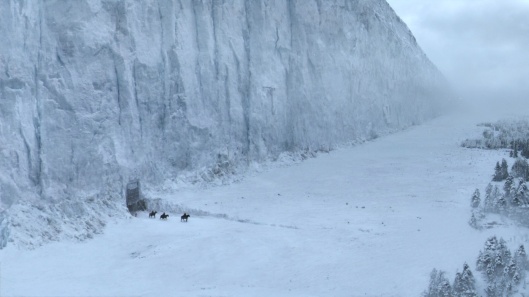
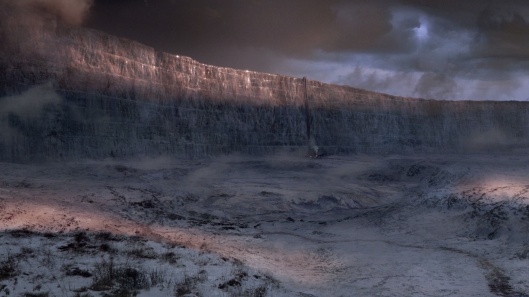
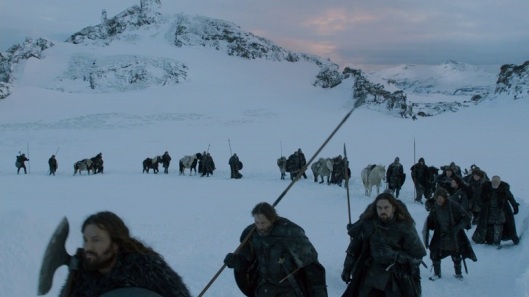
and the whole world, for that matter, has once suffered a winter which lasted for a generation and the fear of its return always casts a shadow over the present. During that time, the creatures known as the White Walkers appeared from the north, with armies of animated dead, and were only driven back at great cost. To prevent their return, the surviving humans built an immense wall, 700 feet high, 300 miles long, which effectively blocks entry to the lower two thirds of Westeros.

Thewallfromthenorth.jpg

The_Wall_from_the_south.jpg

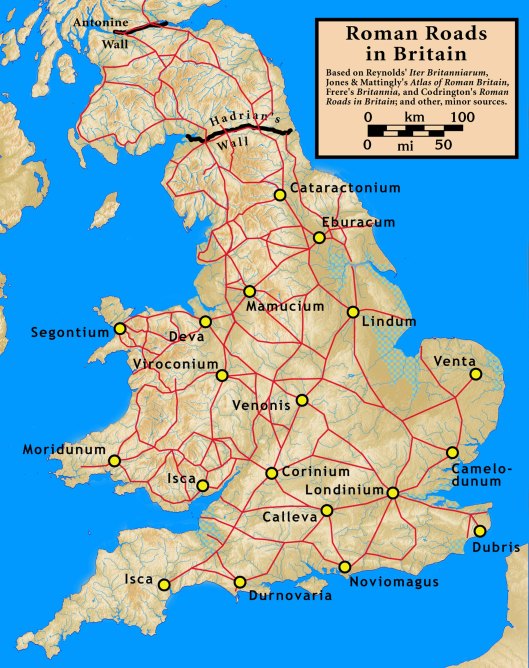
In an earlier posting, we discussed the Rammas Echor, the outer boundary wall which protects the Pelennor and Minas Tirith, and what we believe to be a major influence upon Tolkien’s idea, Hadrian’s Wall, which divides England from the lands to the north.

Roman.Britain.roads.jpg

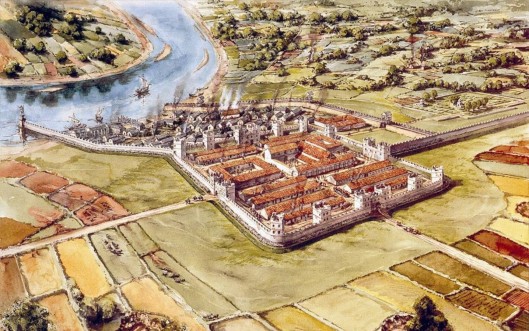
Unlike The Wall in Thrones, it is under a hundred miles long, was never more than 16 to 20 feet high, and was built of turf, timber, and stone, not solid ice. It was, however, a complex construction, with 17 forts behind it

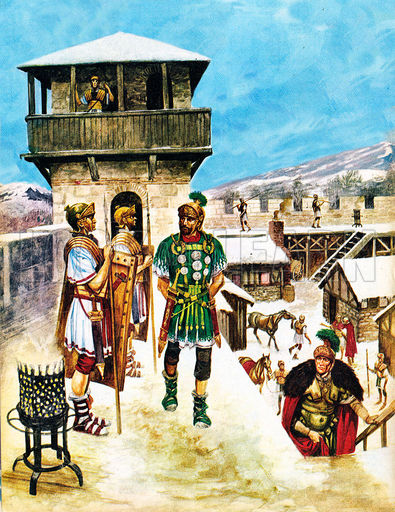
romanfortress.jpg

and a smaller fort (now called a “mile castle”) at the end of each mile,

milecastle.jpg

with small towers set in between the mile castles.

turretonhadrianswall.jpg

It was garrisoned with thousands of soldiers over its years of occupation (begun 122AD, finally abandoned in the 5th century).

romangarrison.jpg

In Thrones, this job has been taken on by The Night Watch, a rather haphazard collection of volunteers and conscripts.

nightwatch.jpg

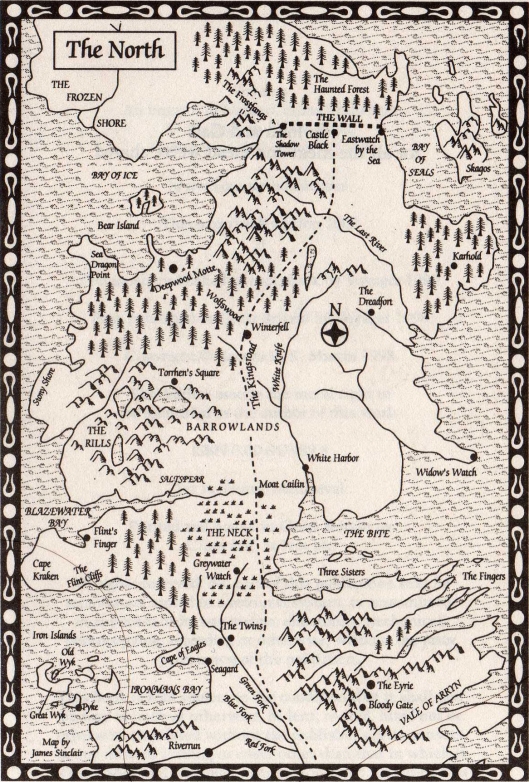
And, south of them, the lands of the Stark family, Wardens of the North, whose motto—a warning of the dreaded future—forms the title of this posting.

the_north_a_clash_of_kings.jpg

Thanks, as always, for reading.

MTCIDC

CD

← Older posts
Newer posts →

The Doubtful Sea Series Facebook Page

The Doubtful Sea Series Facebook Page

  • Ollamh

Categories

  • Artists and Illustrators
  • Economics in Middle-earth
  • Fairy Tales and Myths
  • Films and Music
  • Games
  • Heroes
  • Imaginary History
  • J.R.R. Tolkien
  • Language
  • Literary History
  • Maps
  • Medieval Russia
  • Military History
  • Military History of Middle-earth
  • Narnia
  • Narrative Methods
  • Poetry
  • Research
  • Star Wars
  • Terra Australis
  • The Rohirrim
  • Theatre and Performance
  • Tolkien
  • Uncategorized
  • Villains
  • Writing as Collaborators
Follow doubtfulsea on WordPress.com

Across the Doubtful Sea

Recent Postings

  • Towering January 28, 2026
  • Tolkien Among the Indians January 21, 2026
  • Thin and Stretched January 14, 2026
  • Through a glass… January 7, 2026
  • Heffalumps? December 31, 2025
  • We Three Kings December 24, 2025
  • A Moon disfigured December 17, 2025
  • On the Roads Again—Once More December 10, 2025
  • (Not) Crossing Bridges December 3, 2025
Blog Statistics

  • 105,553 Views

Posting Archive

  • January 2026 (4)
  • December 2025 (5)
  • November 2025 (4)
  • October 2025 (5)
  • September 2025 (4)
  • August 2025 (4)
  • July 2025 (5)
  • June 2025 (4)
  • May 2025 (4)
  • April 2025 (5)
  • March 2025 (4)
  • February 2025 (4)
  • January 2025 (5)
  • December 2024 (4)
  • November 2024 (4)
  • October 2024 (5)
  • September 2024 (4)
  • August 2024 (4)
  • July 2024 (5)
  • June 2024 (4)
  • May 2024 (5)
  • April 2024 (4)
  • March 2024 (4)
  • February 2024 (4)
  • January 2024 (5)
  • December 2023 (4)
  • November 2023 (5)
  • October 2023 (4)
  • September 2023 (4)
  • August 2023 (5)
  • July 2023 (4)
  • June 2023 (4)
  • May 2023 (5)
  • April 2023 (4)
  • March 2023 (5)
  • February 2023 (4)
  • January 2023 (4)
  • December 2022 (4)
  • November 2022 (5)
  • October 2022 (4)
  • September 2022 (4)
  • August 2022 (5)
  • July 2022 (4)
  • June 2022 (5)
  • May 2022 (4)
  • April 2022 (4)
  • March 2022 (5)
  • February 2022 (4)
  • January 2022 (4)
  • December 2021 (5)
  • November 2021 (4)
  • October 2021 (4)
  • September 2021 (5)
  • August 2021 (4)
  • July 2021 (4)
  • June 2021 (5)
  • May 2021 (4)
  • April 2021 (4)
  • March 2021 (5)
  • February 2021 (4)
  • January 2021 (4)
  • December 2020 (5)
  • November 2020 (4)
  • October 2020 (4)
  • September 2020 (5)
  • August 2020 (4)
  • July 2020 (5)
  • June 2020 (4)
  • May 2020 (4)
  • April 2020 (5)
  • March 2020 (4)
  • February 2020 (4)
  • January 2020 (6)
  • December 2019 (4)
  • November 2019 (4)
  • October 2019 (5)
  • September 2019 (4)
  • August 2019 (4)
  • July 2019 (5)
  • June 2019 (4)
  • May 2019 (5)
  • April 2019 (4)
  • March 2019 (4)
  • February 2019 (4)
  • January 2019 (5)
  • December 2018 (4)
  • November 2018 (4)
  • October 2018 (5)
  • September 2018 (4)
  • August 2018 (5)
  • July 2018 (4)
  • June 2018 (4)
  • May 2018 (5)
  • April 2018 (4)
  • March 2018 (4)
  • February 2018 (4)
  • January 2018 (5)
  • December 2017 (4)
  • November 2017 (4)
  • October 2017 (4)
  • September 2017 (4)
  • August 2017 (5)
  • July 2017 (4)
  • June 2017 (4)
  • May 2017 (5)
  • April 2017 (4)
  • March 2017 (5)
  • February 2017 (4)
  • January 2017 (4)
  • December 2016 (4)
  • November 2016 (5)
  • October 2016 (6)
  • September 2016 (5)
  • August 2016 (5)
  • July 2016 (5)
  • June 2016 (5)
  • May 2016 (4)
  • April 2016 (4)
  • March 2016 (5)
  • February 2016 (4)
  • January 2016 (4)
  • December 2015 (5)
  • November 2015 (5)
  • October 2015 (4)
  • September 2015 (5)
  • August 2015 (4)
  • July 2015 (5)
  • June 2015 (5)
  • May 2015 (4)
  • April 2015 (3)
  • March 2015 (4)
  • February 2015 (4)
  • January 2015 (4)
  • December 2014 (5)
  • November 2014 (4)
  • October 2014 (6)
  • September 2014 (1)

Blog at WordPress.com.

  • Subscribe Subscribed
    • doubtfulsea
    • Join 78 other subscribers
    • Already have a WordPress.com account? Log in now.
    • doubtfulsea
    • Subscribe Subscribed
    • Sign up
    • Log in
    • Report this content
    • View site in Reader
    • Manage subscriptions
    • Collapse this bar
 

Loading Comments...