• About

doubtfulsea

~ adventure fantasy

Category Archives: Economics in Middle-earth

Shire Portrait (I)

01 Wednesday Feb 2017

Posted by Ollamh in Economics in Middle-earth, J.R.R. Tolkien, Literary History, Maps, Military History, Military History of Middle-earth, Narrative Methods

≈ 1 Comment

Tags

British Museum, culture, elections, farthing, feudalism, Government, Hobbitry-in-arms, Hobbits, Louvre, Maps, Mathom-house, Mayor, Michel Delving, Middle-earth, museums, police, Postmen, Sharkey, Shire, Shire-moot, Shire-muster, Shirriffs, Thain, The Hobbit, The Lord of the Rings, The Scouring of the Shire, thegn, Tolkien, vassal, Vatican, voting, White Downs, Witch-King of Angmar

Welcome, dear readers, as always.

In our last post (well, next-to-last–the last was on circuses), we talked about museums and Mathom-houses and, thinking that the Shire had a museum, made us wonder about what we might call “Shire culture” in general. What is it which makes the Shire the Shire?
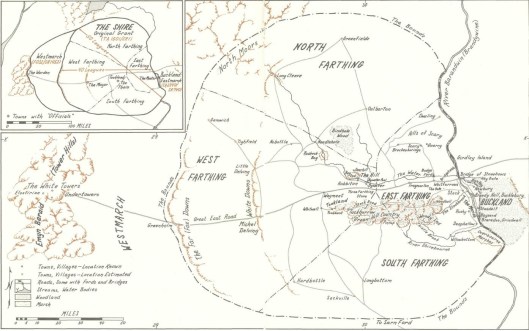
1theshire.jpg

To go about answering that, we tried to think of a model. Could we imagine ourselves doing a tourist brochure? A wiki article? And where would we begin?

Suppose, we thought, we begin with the outermost shell, rather as in our world: the government.

The first ten pages of the Prologue to The Lord of the Rings contain a good deal of information about hobbits and their homeland, with many other details to be gleaned from the main body of the text and the appendices and some from The Hobbit. There is undoubtedly more yet to be found in several of the subsidiary volumes, but we decided that, to make this a series of readable posts and not a small encyclopedia, we would stick to the two main works.

With all of that material to help us, all we needed was an entry point—and, almost immediately, we decided that we could begin where we left off, with that very museum, which originally attracted us because it stood out as something one would expect from a much more organized state, rather than from what, on the whole, appears to be such a rural and decentralized place.

After all, museums, as we have discussed, are a relatively recent invention in the west and public museums are even newer (the first state-sponsored museum in Britain, for example, only dates from the 1750s). Since our last posting, we’ve done a bit more research and, with one or two possible exceptions, it seems that public museums only begin to appear at all from the second half of the 17th century. (A quick and useful reference may be found at: https://museu.ms) Even so, such places have a good deal to say about a culture:

  1. that it values elements of its past, both historical and artistic, enough that it is willing to collect and preserve them
  2. that it believes that such elements should then be put upon public display (the why of that might include: to use for educational purposes—which assumes that the past has things to teach the present; to provide aesthetic pleasure; even to show the wealth and power of a state which has such a history and such artists)
  3. that it is willing to provide space, at the public expense, to house and display such things

The Mathom-house is hardly, from JRRT’s description, the equivalent of the British Museum
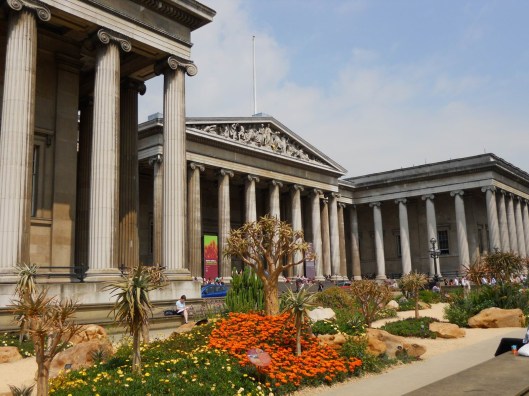
1bm.jpg

or the Louvre

2louvre.jpg

or the Vatican

3vatican.jpg

or any of the other thousand wonderful museums around the world, big or small. And yet it is there and in the closest thing to a capital which the Shire has to offer, Michel Delving. It is only the closest thing because the Shire has almost no formal governing structure.

As the Prologue says:

“The Shire at this time had hardly any ‘government’. Families for the most part managed their own affairs…”

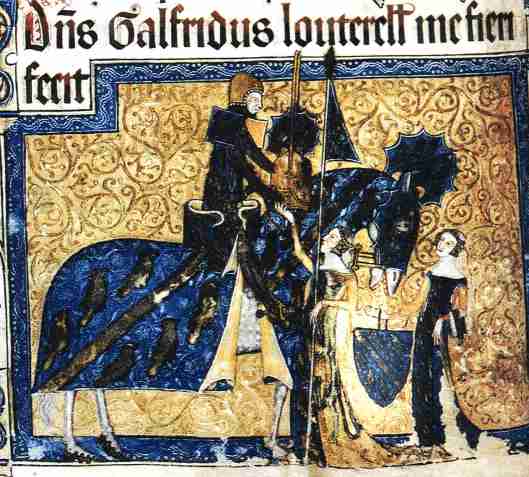
Originally, as the Prologue tells us, the Hobbits had moved into the land which would become the Shire with the permission of the high king of the North Kingdom, at Fornost. When the last king and his kingdom had fallen to the Witch King of Angmar, the Hobbits replaced him with a “Thain” (actually an Old English word for, among other things, a “vassal”—that is, one who acts as a subordinate—in a feudal system, this might imply that the person has received land from someone higher on the social scale in return for taxes and/or military service).  Here’s a thegn (Old English spelling) as a warrior.
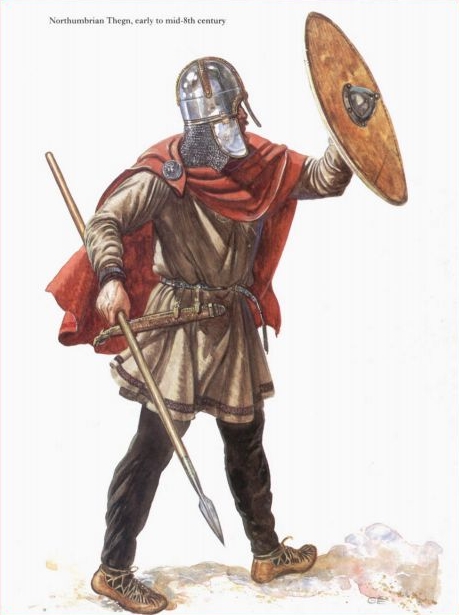
5thegn.JPG

By the time of The Hobbit, this office had dwindled, but not quite disappeared:

“The Thain was the master of the Shire-moot, and captain of the Shire-muster and the Hobbitry-in-arms, but as muster and moot were only held in times of emergency, which no longer occurred, the Thainship had ceased to be more than a nominal dignity.”

In fact,

“The only real official in the Shire at this date was the Mayor of Michel Delving (or of the Shire), who was elected every seven years at the Free Fair on the White Downs at the Lithe, that is at Mid-summer. As mayor almost his only duty was to preside at banquets, given on the Shire-holidays, which occurred at frequent intervals. But the offices of Postmaster and First Shirriff were attached to the mayoralty, so that he managed both the Messenger Service and the Watch. These were the only Shire-services, and the Messengers were the most numerous, and much the busier of the two. By no means all Hobbits were lettered, but those who were wrote constantly to all their friends (and a selection of their relations) who lived further off than an afternoon’s walk.

The Shirriffs was the name that the Hobbits gave to their police, or the nearest equivalent that they possessed…they were in practice rather haywards than policemen, more concerned with the strayings of beasts than of people. There were in all the Shire only twelve of them, three in each Farthing, for Inside Work. A rather large body, varying at need, was employed to ‘beat the bounds’, and to see that Outsiders of any kind, great or small, did not make themselves a nuisance.”

This gives us the whole of the top level of Shire culture, the public face: a vestigial Thain (representative of the long-gone King), a figurehead Mayor, a postal service, and a tiny police force/border guard.

And how does any of these hold office?

The Thain, as we know, is hereditary.

The Mayor is, as quoted above, elected—although we have no idea of the process. Does one vote by town? By Farthing? Or is there simply a kind of country-wide method? We also have no idea of suffrage: who has the vote in the Shire? Is it general (England had general suffrage by the time JRRT was writing The Hobbit, all men over 21 by 1918, some women—householders over the age of 30—having been included in elections in 1918, women in general over 21 in 1928)? Or is it the older “only property-holders” method? Or are there “hereditary electors” who do the choosing? (As CD have just gone through an election here in the US, all of these questions, as you can imagine, are fresh in our minds!)

The “postmen” (our word) are, so far as we can tell, a mystery, both as to who they are or how they gain their employment.

Shirriffs appear to be volunteers, as we learn in “The Scouring of the Shire”, when Sam talks to Robin Smallburrow, who says “You know how I went for a Shirriff seven years ago, before any of this began.”

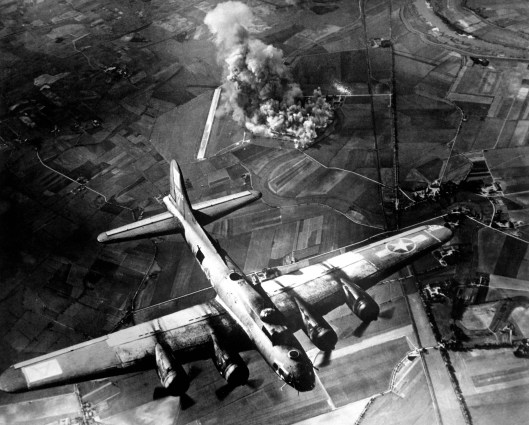
There being so little in the way of government, are there any public buildings except for the Mathom-house? If there are, we have yet to locate them. It’s striking that, when “Sharkey” takes over the Shire, he sets up a number of such places, but neither government buildings nor museums, instead, they are tokens of a police state: barracks and watch houses, dens reminding us of something which JRRT would have seen all too much of in newspapers and magazines, as well as newsreels as he worked on the early stages of The Lord of Rings:

4asentrybox.jpg

4schutzpo.jpg

(More on Sharkey and the takeover in a future posting!)

Considering that there is a small policing force, as well as a kind of postal institution, we looked for another government department: the Internal Revenue Service. After all, we pay for our police and used to pay for postage stamps, back in pre-internet days, and we pay for public museums, too: how does it work in the Shire? The simple answer is, we don’t know. In fact, we don’t really know much about how the economy works in general. And that will be the subject of our next posting.

Thanks, as always, for reading!

MTCIDC

CD

Mathoms and Fathoms

18 Wednesday Jan 2017

Posted by Ollamh in Economics in Middle-earth, Imaginary History, J.R.R. Tolkien, Literary History, Research, Uncategorized

≈ Leave a comment

Tags

Across the Doubtful Sea, alternate history, anachronisms, Anglo-Saxon, Bertil Thorvaldsen, cabinet of curiosities, Cicero, Elias Ashmole, Gaius Verres, Greeks, Hellenistic, hobbit measurement system, John Tradescant the Younger, Marquette University, mathom, Mathom-house, mathum, Muses, Oxford, Renaissance, Rochester, Romans, sculptor, Shire, Strong Museum of Play, The Lord of the Rings, Tolkien, Victorian Museum

Welcome, dear readers, as always.

A year or two ago, we were visiting the Strong Museum of Play in Rochester, New York, a wonderful place, filled with memorabilia of childhood, as well as up-to-date exhibits and generally just fun things to see and do. (Strong Museum website)

1Strong-back-exterior.jpg

Museums, as public display areas, are rather recent in western history.

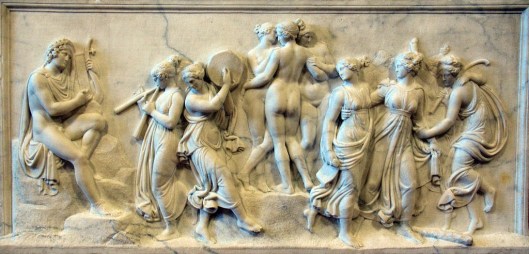
The name tells us that it was to be a place devoted to the inspirers of the arts, the ancient Greek Muses.

2a-thorvaldsonmuses.JPG

(This is not ancient, but a 19th-century imitation by Bertil Thorvaldsen, 1770-1844, one of the early Romantic period’s most famous sculptors.)

2bb-bertilthorvaldsen.JPG

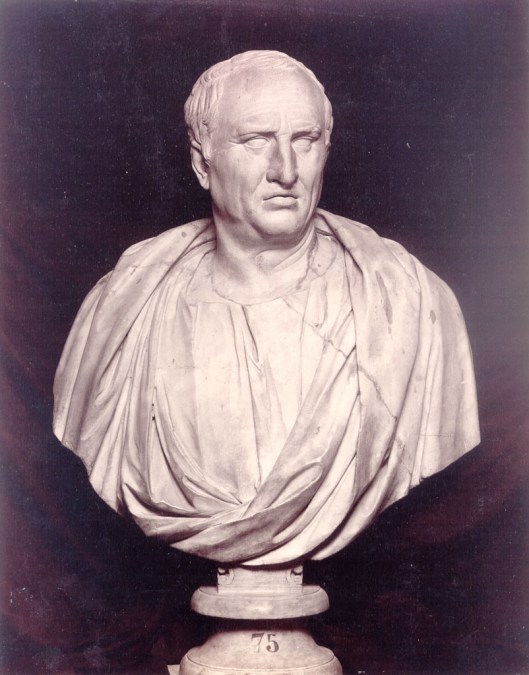
Greeks—later ones (in the period called “Hellenistic”)—and the Romans collected artistic things, but they were private collections—although Cicero

2bbcicero.jpg

in his orations attacking the corrupt ex-governor of Sicily, Gaius Verres, mentions that a predecessor had nobly allowed his art to be loaned out to decorate the public streets on festive occasions. (It is a horrible irony that Verres, who had fled Rome when it was clear that Cicero had demolished him and his reputation in his first speech, was eventually murdered in Massilia—present-day Marseilles–over a piece of sculpture.)

The first actual “museums” in modern times were Renaissance collections—often hodgepodge assemblies called things like “cabinet of curiosities”, but in England, by the 17th century, John Tradescant the Younger (1608-1662)

2b-jtradescantjr.jpg

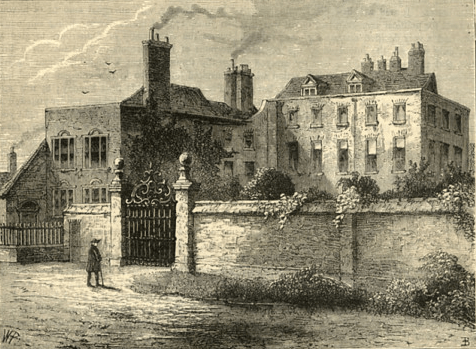
had built upon his father’s collection, which was held in the family house south of the Thames (called “The Ark”).

2ctradescanthouse.png

At his death, that collection passed to Elias Ashmole (1617-1692)

2dashmole.jpg

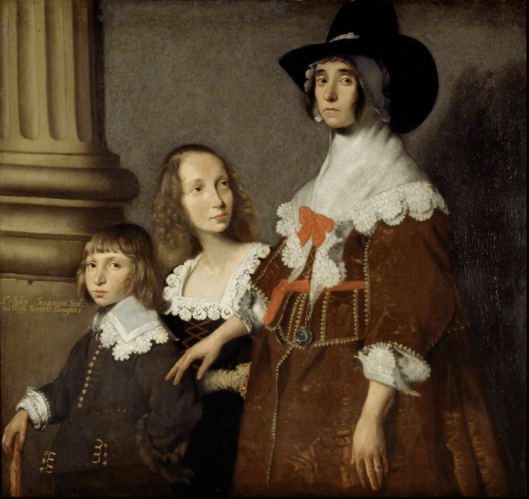
—and there’s a really strange story about how this happened and the consequences, including the very suspicious death of Tradescant’s second wife, Hester.

2ehestertrad.png

Ashmole bequeathed it to his alma mater, Oxford, on the condition that an appropriate building be constructed for it. That structure was built, in 1678-83, and may have been the first public museum in western Europe.

2eashmolean.JPG

There is, in fact, a museum in the Shire. In the Prologue to The Lord of the Rings, we are told of Bilbo that:

“…his coat of marvellous mail, the gift of the Dwarves from the Dragon-hoard, he lent to a museum, to the Michel Delving Mathom-house, in fact.”

(where Gandalf supposes it is “still gathering dust”—The Fellowship of the Ring, Book 2, Chapter 4, “A Journey in the Dark”).   Its name and function are described in the Prologue:

“The Mathom-house it was called; for anything that Hobbits had no immediate use for, but were unwilling to throw away, they called a mathom.”

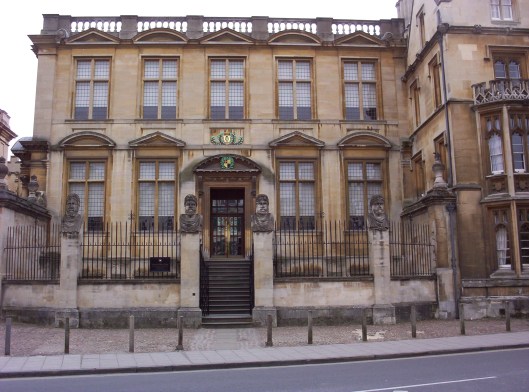
Such a description suggests something more like an old-fashioned Victorian museum,

4pittrivers.jpg

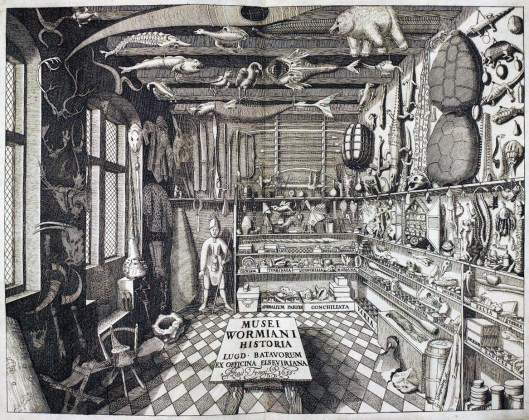
or even a “cabinet of curiosities” like Ole Worm’s 17th-century one.

5oleworm.jpg

We suspect that the Mathom-house is JRRT’s quiet joke on such older museums, which, even in his day, could be filled with dusty glass cases in which were a wide variety of objects, from fossils to rusty weapons found in the fields, all described on yellowing, hand-labeled cards. In the Hammond and Scull Companion, they suggest that the joke is even more complex, first quoting Tolkien “mathom is meant to recall ancient English mathm”, to which they add:

“Bosworth and Toller’s Anglo-Saxon Dictionary (1898) notes mathum ‘a precious or valuable thing (often refers to gifts)’. Thus Tolkien uses mathom ironically for things which are not treasured, only for where there was ‘no immediate use’ or which the Hobbits ‘were unwilling to throw away’.”

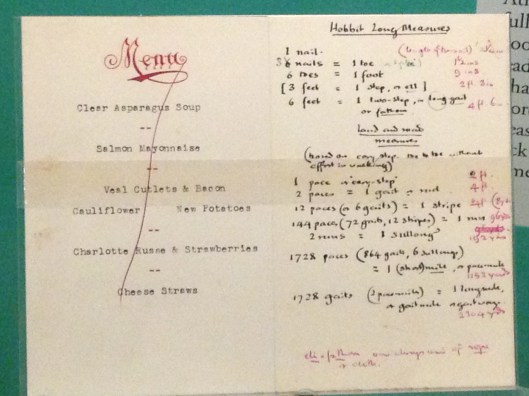
The Strong Museum, in contrast, is bright-colored and inviting, and, in a section dedicated to children’s authors, there is an entire display case devoted to JRRT, which included this. It’s a beautiful replica from the Marquette University Tolkien archive of a menu (the label gives the date “1937-1955”) on which JRRT has carefully written out the hobbit linear measurement system.

2jjrtmeasure.JPG

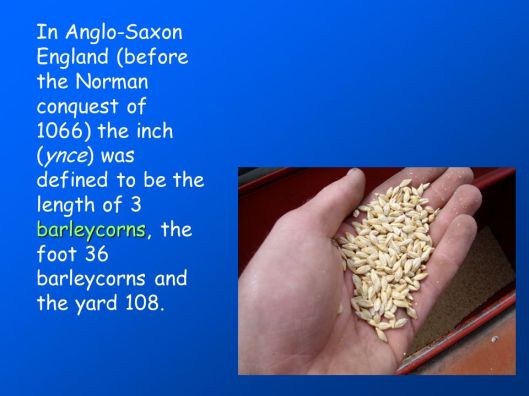
You can see that, unlike the rather abstract mechanism of the metric system, with its linear basis being a segment of the distance from the North Pole to the equator, Tolkien has used the Anglo-Saxon tradition, where the “foot” was actually originally based upon body parts, being divided into 4 palms or 12 thumbs (although there is another system based upon barley corns).

3barleycornmeasure.jpg

And, just to confirm this, to the right of his bold numbers, there are fainter numbers which indicate the English equivalents.

This system, as ingenious and carefully-worked out as it is, is never used, either in The Hobbit or in The Lord of the Rings. The measurements we can remember—this was done off the top of our heads—any reader who would like to supply more, please feel free!– actually being used are:

  1. leagues (about 3 miles per league is pretty standard = 4.8km)
  2. ells—30 make the coil of elven rope Sam takes from the boat in The Fellowship of the Ring, Book 2, Chapter 8, “Farewell to Lorien” (one ell = about 45 inches = 114 cm; 30 ells = about 112 feet = about 34 metres)
  3. inches–Sam, in The Return of the King, Book 6, Chapter 4, “The Field of Cormallen”, comments that Merry and Pippin are “three inches taller than you ought to be” (3 inches = 7.6cm)

Why spend so much time and effort on something which never went anywhere farther than a menu card in an archive, then?

It’s possible, of course, that this was written in a moment of boredom: although we don’t actually know the occasion, we can imagine that the menu was for a formal dinner to which JRRT had been obliged to go and he improved upon a dull moment with a little Middle-earth fun. Then again, the dating of the card, “1937-1955” places it between the publication of The Hobbit and that of The Lord of the Rings: was this something worked up to be employed in the latter, but simply never needed—or was it, once produced, abandoned as too obscure and hence the use of the (potentially) more familiar leagues, ells, and inches? Or, again, was this simply a product of the almost-obsessive side of JRRT, where so much was so painstakingly created in fine detail? Here is another item from the Strong Museum which displays that side. It is a working-out of the phases of the moon for The Lord of the Rings (sorry it’s a little blurry—this was taken through plexiglass with an i-phone).

6phases.JPG

In an early posting, we once wrote about achieving authenticity in a fantasy novel. Our first, Across the Doubtful Sea, which was set in an alternate 18th century, in France, in London, in South America, and in the South Pacific, required a great deal of research.

51qpin-2XcL.jpg

To prepare for it, we spent some time reading books on everything from 18th-century navies to South Pacific exploration (and even posted a partial bibliography).   Much of our research went into the finished book, but much never did. What we hoped, however, was that, by having so much background in our heads, that background would be reflected in our text. That meant, even if it were an alternate 18th-century, there wouldn’t be glaring anachronisms, on the one hand, but, on the other, that we would give our work a “feel” for the period which would be convincing to our readers and so increase both their engagement and their enjoyment. We would like to think that JRRT, when scribbling hobbit measures on a menu card, had had the same goals.

Thanks, as always, for reading.

MTCIDC

CD

ps

We’ve had the crazy idea to build our own imaginary Mathom-house for the works of JRRT and we’re having fun thinking what visitors would see hung from the walls or lying in the cases. Readers: what would you like to see on display?

The Return of the King (Ludd)

19 Wednesday Oct 2016

Posted by Ollamh in Economics in Middle-earth, J.R.R. Tolkien, Literary History

≈ Leave a comment

Tags

allegory, anarchy, Boer War, bombing, Cold War, factories, Hitler, Labour Movement, Luddites, Monty Python and the Holy Grail, power-stations, Royal Air Force, Saruman, Second World War, Stalin, The Great War, The Lord of the Rings, The Scouring of the Shire, Theyocracy, Tolkien

Dear Readers, welcome, as always.

JRRT always actively denied that his work was allegorical, that somehow, for example, he meant Sauron to stand for Hitler (and why not Stalin?) and the Ring was the atomic bomb. In a draft of a letter from April, 1959, he wrote:

“I have no didactic purpose, and no allegorical intent. (I do not like allegory properly so called: most readers appear to confuse it with significance or applicability…” (Letters, 297-298)

And yet—

Well, someone born in 1892, who lived through everything from the Boer War (1899-1902) to the Great War (1914-1918) to the Second World War (1939-1945) and into the middle of the Cold War, with all of the proxy wars and wars for independence during the 1940s to 1970s, could not help being somehow at least affected by such large and dreadful events, particularly a man as sensitive and thoughtful as JRRT, and as historically-minded. Like it or not, Tolkien was entangled in contemporary history.

One way that this has struck us recently is rereading Letters and coming across this:

“There is only one bright spot and that is the growing habit of disgruntled men of dynamiting factories and power-stations; I hope that, encouraged now as ‘patriotism’, may remain a habit! But it won’t do any good, if it is not universal.” (JRRT to Christopher, 29 Nov 1943, Letters, 64)

Looking at that date, it is clear that what he is referring to is, in fact, the Allied bombing campaigns against the Reich (and as his son was training in the RAF—Royal Air Force—at the time, perhaps some part of him was also dreading that Christopher might be part of future bombing runs. After all, a general consensus is that the RAF lost over 50,000 killed in its war against Germany. This is, of course, small in contrast to the 60,000 casualties incurred by the British Army on the first day of the Somme, 1 July, 1916, alone, but, with warfare having become much more mobile again in 1939-1945, these were significant losses.)

Here are, in fact, photos of the bombing of a German factory and a power station—the very sort of thing Tolkien is describing.

WAR & CONFLICT BOOK
ERA:  WORLD WAR II/WAR IN THE WEST/GERMANYCopy of RAF Blenheim V6391 After Bombing Goldenburg Power Station, Cologne

(Although, for the sake of our posting, we feel that it’s necessary to show illustrations like these, it’s hard for us to do so. In those smoke clouds are the lives of men, women, and children, with all of the loss and misery which war always brings. Yoda says, “Wars not make one great” and, when we think of the human cost, it’s hard for us to disagree. We only wish that all the violence in history was confined to adventure stories and that, in real life, people got along and there was no need ever for such awful behavior against fellow human beings.)

But why does Tolkien describe current events in such an odd way, in which the pilots of the British and US Air Forces are “disgruntled men” and their bombing raids are depicted as “the growing habit…of dynamiting factories and power-stations”? We would say that it’s because he is, in a way, turning current history around and looking at the past through it metaphorically.

The letter begins:

“My political opinions lean more and more to Anarchy (philosophically understood, meaning abolition of control not whiskered men with bombs…” (Letters, 63)

Anarchy, being about resistance to organized state control, has a very long history, both east and west. What JRRT is alluding to here is, rather, the late-19th, early 20th-century cartoon version of it—

bomb-throwing-cartoon

The real anarchists were deadly (pun intended) serious people, whose goal it was to criticize what they saw as the increasingly-intrusive top-down rule of the state and to suggest (and sometimes fight for) alternatives based upon loose associations of equals. If you know Monty Python’s Holy Grail, you’ll remember the scene in which King Arthur confronts someone who sounds at least like a Marxist, if not a full-fledged anarchist. (King Arthur and the Annoying Peasant from “Monty Python and the Holy Grail”) A central portion of the text includes this:

“WOMAN: I didn’t know we had a king. I thought that we were an autonomous collective.”

DENNIS: You’re fooling yourself. We’re living in a dictatorship…A self-perpetuating autocracy in which the working classes…”

Tolkien goes on to complain of what he believed was the growth and increasing facelessness of government, what he called the “Theyocracy” (63), but it’s clear from the later remark quoted above that what particularly disturbed him was the way in which he believed the state was involved in the ongoing Industrial Revolution, hence the focus upon “dynamiting factories and power-stations”.

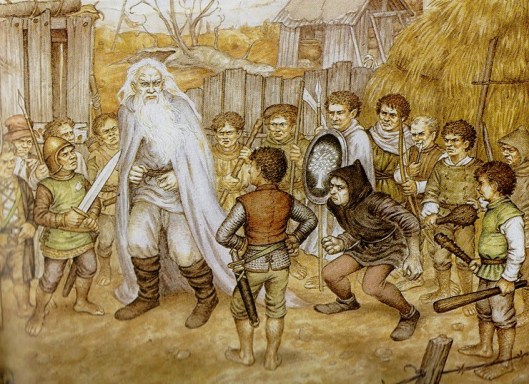
JRRT’s objections to the ruination, as he saw it, of the world of his childhood run through all of his writings, but what we always think of first is its proxy version in “The Scouring of the Shire”, with its Saruman/Sharkey boss and everything from the wanton destruction of trees and the collectivization of the population to the building of what appear to be proto-factories.

scouring_the_shire.ingeredelfeldt

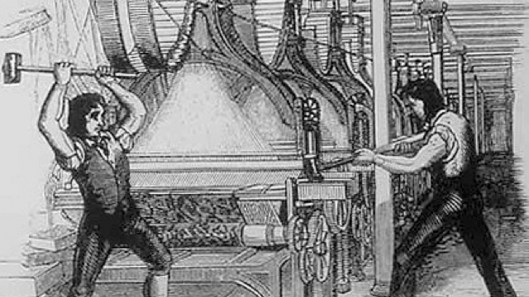
And his reaction reminds us immediately of an earlier reaction to industrialization, not for aesthetic or political reasons, but for economic, that movement in early 19th-century England called “the Luddites”. The name comes from, well, there are a number of explanations, none of them being particularly believable. We know, however, that it was a secret movement of very loosely-organized groups of cloth workers, but not one large body with complex plans to overthrow the system. Perhaps as a mockery of the perception that they were such a large body, they, over time, created a mysterious “General Ludd” or even “King Ludd” to suggest that that body not only existed, but had a sinister leader.

Luddite

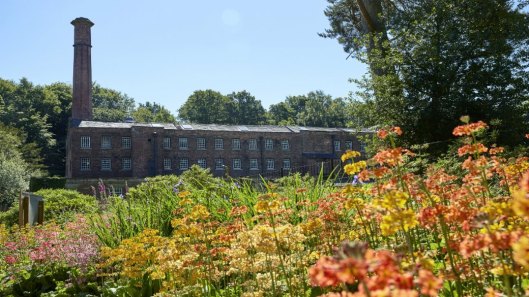
The Luddites were made up of various segments of the traditional cloth-making industries who saw their livelihoods—and even their relative freedom—being destroyed by the introduction of large, water-powered mills filled with machinery which could do their jobs not only faster, but, as machines have no need for rest, also at a production level no human could ever match. Even if the workers kept to their trades, then, the mills and their output would simply swamp them.

quarrybanktextile-mill-cotton-1834-granger

This was also the time of the beginning of the Labo(u)r Movement in Britain and the government (not surprisingly, considering where the economic influences upon it might come from) had already begun to try to block it with the Combination Acts of 1799 and 1800, which placed severe penalties on workers attempting to form unions, or “combinations”.

When people tried simply to hold peaceful public meetings, the local authorities felt so threatened that they turned soldiers on the demonstrators, as here in Manchester, in August, 1819. 11 demonstrators were killed and several hundred were injured.

peterloo1

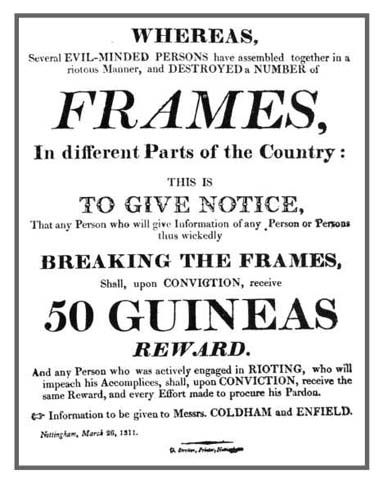
So much for peaceful demonstrations. The Luddites, seeing the attitude of the government, began to attack the mills and warehouses, as these posters show—

Radcliffe Arson Reward Poster, 21st March 1812 copyOates Wood Smithson & Dickinson Carr reward poster, 25th March 1812Cttee to Supress Outrages reward poster copyawsomne

as well as the machines themselves.

luddites1

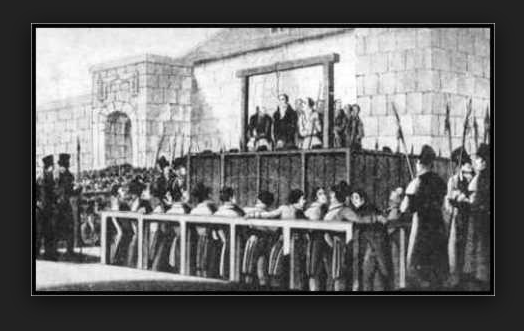
Faced with the government, its laws, and its enforcement—which could even mean executing people, as was done at York in 1813—

executionofludditesatyork1813

the Luddites were a short-lived movement and had disappeared by about 1816.

Their idea about turning back the effects of the Industrial Revolution by violent means—at least in fantasy—however, clearly was still available, at least to JRRT in 1943.

Thanks, as always, for reading.

MTCIDC

CD

Bilbo’s Shopping List

12 Wednesday Oct 2016

Posted by Ollamh in Economics in Middle-earth, Imaginary History, J.R.R. Tolkien, Narrative Methods

≈ Leave a comment

Tags

ale, An Unexpected Party, anachronism, apple-tart, barley fields, biscuit, cheese, coffee, cold chicken, eggs, food, hop garden, Isengard, Longbottom Leaf, mince-pies, pickles, pork-pie, porter, raspberry jam, red wine, salad, scones, seed cake, Tea, The Green Dragon, The Lord of the Rings, The Shire, Tolkien, Tomatoes, vineyard, Wensleydale, wheat fields

Dear Readers, welcome as always.

We were having tea the other day when an earlier—and much more elaborate—tea came to mind and we began to consider the economics (as you’ve seen us do in earlier postings on other elements of Middle-earth) of Bilbo’s larder, about which Bilbo remarks that Gandalf, “Seems to know as much about the inside…as I do myself!” (The Hobbit, Chapter 1, “An Unexpected Party”—and a footnote here. “Party”, in older British and American English, can also mean “person”, so JRRT is having fun with party = “event” and party = “person”—or, to Bilbo’s astonishment and dismay, “persons”–both meanings unexpected. We might add that that title may have yet another meaning for the future in that Bilbo, because of that party/event, becomes, in time, a party/person who he would never expect himself to be.)

Here’s the list of what Gandalf and the Dwarves demand of Bilbo:

Drinks:

tea,

yunnan-tea-brick.jpg

coffee,

coffee

ale,

english-style-dark-mildale

porter,

porter

and red wine

red wine

Food:

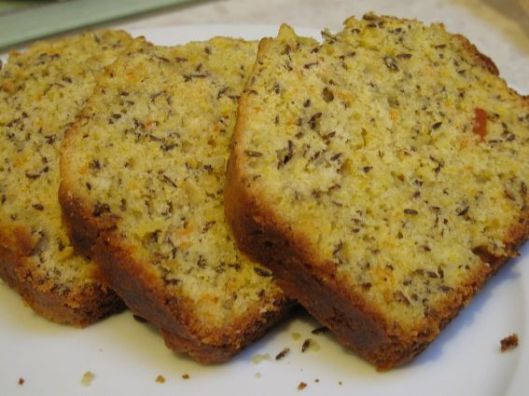
seed cake,

Caraway_seed_cake

scones,

recipe_irish_scone_1

raspberry jam,

raspberryjam

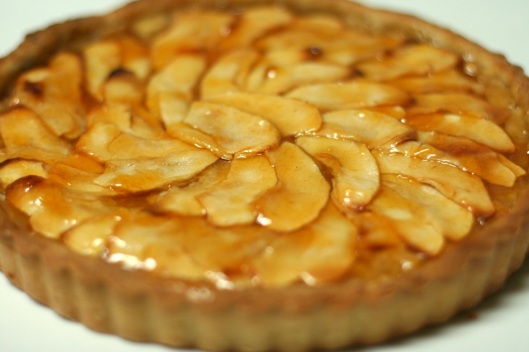
apple-tart,

appletart

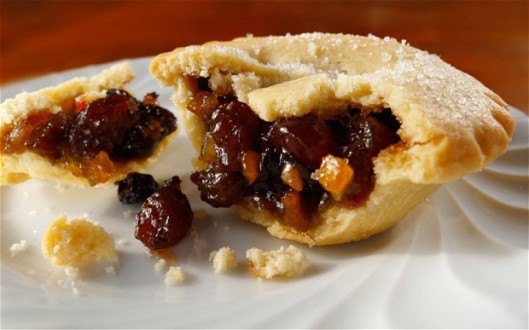
mince-pies,

mince-pie_2739967b

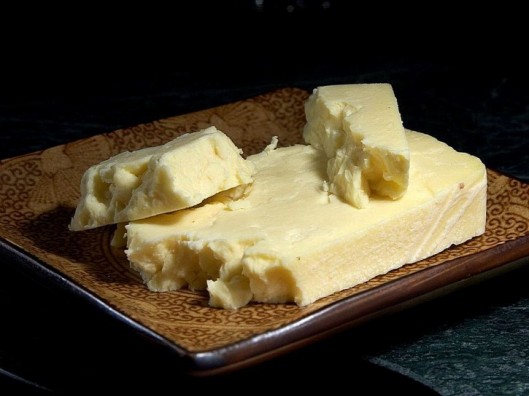
cheese, (Wallace and Gromit’s favorite, Wensleydale)

544494-eat-wensleydale-cheese-on-its-own

pork-pie,

Pork-Pie

salad,

early-spring-salad-beets-celeriac-fennel-21

eggs,

hardboiledegg

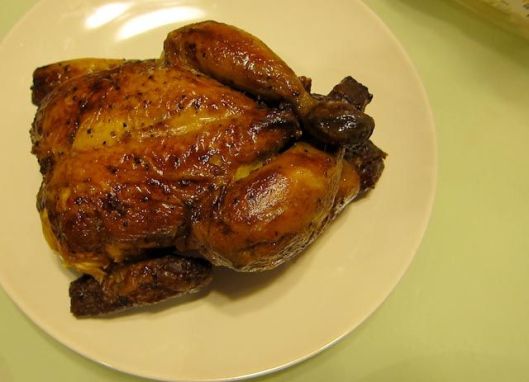
chicken,

coldroastchicken

[tomatoes—more about these in a moment],

red-tomato-meteorite

pickles,

iStock_000013582794Large_cucumber_pickles

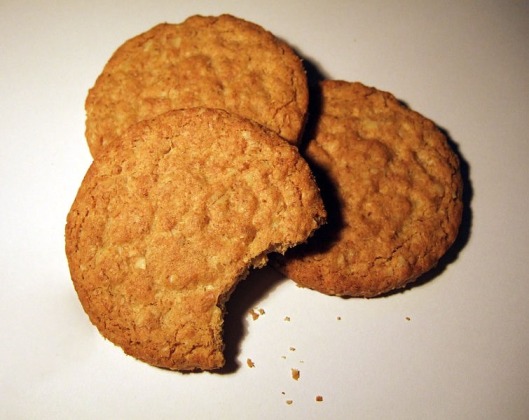
[biscuit—i.e., cookie, in the US—which Bilbo nibbles, while looking on]

hobnob

We know there are farms in the Shire—think of Farmer Cotton (who, in contrast to the completely anachronistic corn in P. Jackson’s film, actually grows turnips—see The Fellowship of the Ring, Book 1, Chapter 4, “A Short Cut to Mushrooms”), but Bilbo certainly doesn’t farm, although he appears to have a vegetable garden (something “old Holman”, then Hamfast (“Gaffer”) Gamgee, looks after—see The Fellowship of the Ring, Book 1, Chapter 1, “A Long-Expected Party”). He might grow raspberry bushes, the makings of a salad (although, since it’s April, there won’t be such an extensive set of possibilities for the ingredients as later in the spring and early summer), and cucumber for pickles there, but there are a number of items which would require both wide fields and animal husbandry.

For example, the cake of seed cake, as well as scones, the tart, the pie of mince-pie and the pie of pork-pie (not to mention what mostly makes a biscuit/cookie) would all require flour—which would mean having wheat fields.

Wheat-field-at-the-sunset

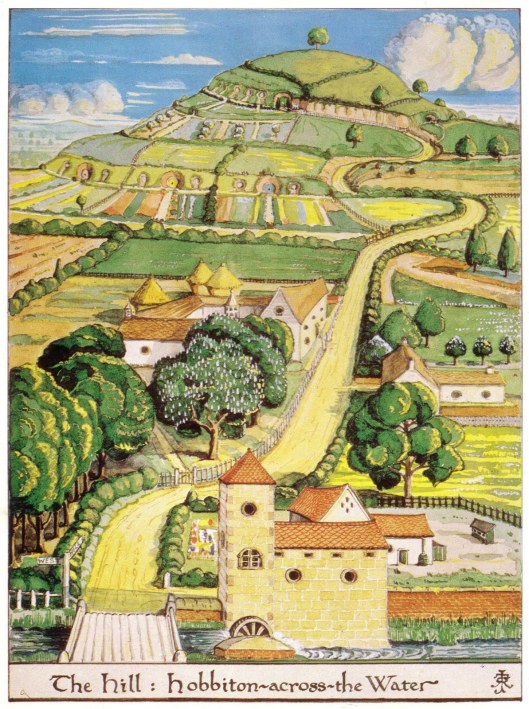
There is a mill for grinding corn (UK for the US “wheat”)—Tolkien depicts it, as well as mentioning it. (If you look closely at the land in front of The Hill, you can also see what are clearly both plowed fields and, a little closer to the mill, haystacks.)

millfieldsbehind

The apple of apple-tart would, of course, require apples—which require apple trees, something Bilbo doesn’t seem to have. He also has no chickens for meat or eggs, goats/sheep/cows for cheese, or pigs for pork-pie. Add to this no hop garden

hop

or barley fields

barleyfield

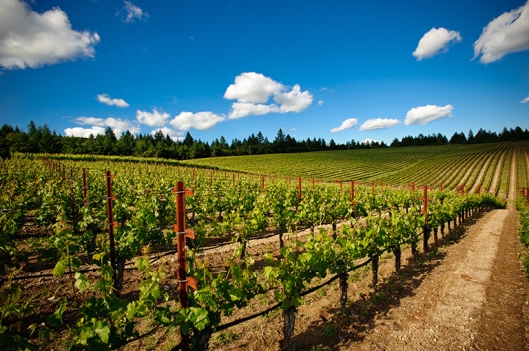
to provide the materials for ale or porter, not to mention a vineyard for that red wine which Gandalf has asked for.

Vineyard_BBS_1515_768px

That being the case, we are left to wonder where such things come from. Initially, they come from the storerooms (“larders”), of which Bilbo appears to have several. Certain things could be stored for lengths of time there: dry tea and coffee beans, ale, porter, and wine, in bottles or barrels (both exist in Middle-earth). Flour could be kept in containers and things like raspberry jam and pickles could be preserved in jars. Meats could be dried or salted, but Gandalf says, “Bring out the cold chicken and pickles,” meaning that the chicken has been freshly killed and cooked.

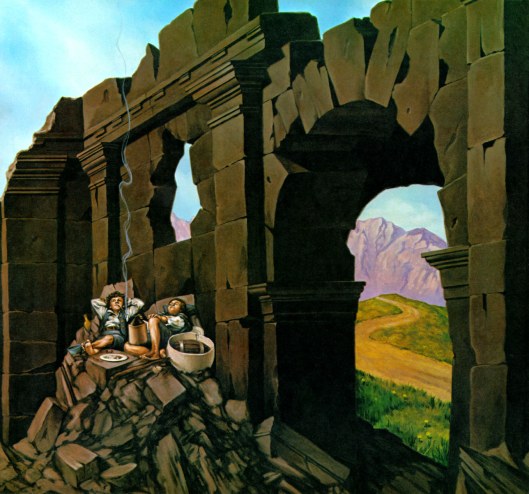
Beyond storage in Bag End, we must assume that anything more complex than raspberries or pickles (or taters, we’re reminded by Sam) has been bought and brought from somewhere else—the same places, we imagine, which supply The Ivy Bush and The Green Dragon, for example. Someone, for instance, makes, barrels, sells, and ships the beer Merry and Pippin consume in the ruins of Isengard and someone grows, dries, sells, and ships the Longbottom Leaf which they smoke.

merryandpippinisengard

All such commerce is complicated, requiring not only growers, but makers of containers, and shippers. Who are these hobbits? And add to this, are there markets? Shops of any sort? And where are they? Bilbo loses buttons escaping from the goblins under the Misty Mountains. Who made them? Where? How did Bilbo get them? (And, for an even bigger—and maybe really more obvious–question: who makes the parchment and ink for Bilbo to keep diaries? Who binds the eventual books?)

As we come to the end of this posting, we want to turn back to something we mentioned much earlier. In the 1937 The Hobbit, Gandalf asked for cold chicken—and tomatoes. In the 1966 Ballentine edition, these tomatoes have been replaced with pickles. We presume that Tolkien, keeping to his idea of The Shire—and Middle-earth in general—being medieval-ish, the New World tomato was out of place. It is interesting, however, to see that Bilbo serves the dwarves both tea and coffee. If by “tea”, Chinese tea is meant, we are left with another anachronism, as we are with coffee, tea have been introduced to Britain in the mid-17th century and coffee at more or less the same time.

And then there’s the problem of taters…

As always, thanks for reading!

MTCIDC

CD

His Letters

25 Wednesday May 2016

Posted by Ollamh in Economics in Middle-earth, J.R.R. Tolkien, Literary History

≈ 1 Comment

Tags

1930s England, A Long-Expected Party, Bellerophon, Governor of the King's Posts, Henry VIII, London, mail coach, Orality, Penny Black, pillar box, Pony Express, Postal Service, Postmen, Rowland Hill, Royal Mail, semata lugra, Shire, Shirriffs, Sir Brian Tuke, stamps, The Illiad, The Lord of the Rings, Tolkien

(For Aunt Cathy—she knows why.)

“Mr. Bilbo has learned him his letters—meaning no harm, mark you, and I hope no harm will come of it.” Gaffer Gamgee, The Fellowship of the Ring, Ch.1, A Long-Expected Party


Welcome, as always, dear readers.

We’ve written a little before about aspects of literacy in Middle-earth and we will probably do so again, since the idea of reading and writing in what is, basically, an heroic world interests us very much.

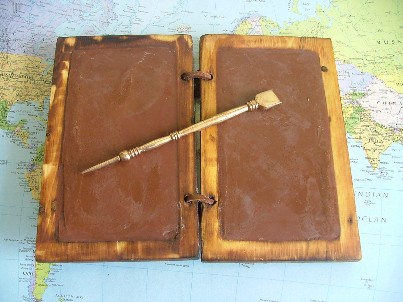
Ordinarily—with a few exceptions (South Slavic pjesme, “songs” sometimes have examples)—we don’t think of writing as being an important feature of heroic stories, but our interest in such things began some years ago with an odd little reference in The Iliad. In all of the story (or in Homer in general for that matter), this is the only mention of what appears to be writing. We say “appears” because the actual writing is called semata lugra, not, in fact, a clear reference to writing, but often translated as something like “baneful signs”. We won’t get into the long, complex controversy over orality and literacy in Homer (although we have strong opinions on the subject) here, but rather point to what these semata were supposed to do. They were inscribed on tablets.

writingtablets1.jpgwritingtablets2.JPG

The tablets were sealed and given to a carrier—in this case, the hero Bellerophon—

NAMA_Epinetron_Bellérophon.jpg

to take with him to the person who would open the tablets, read them, and then—have him killed! That certainly makes those semata lugra. The fact that the tablets were closed suggests that, whatever those “signs” were, the sender thought that the carrier would be able to read them, too, giving us a wider picture of the use of such signs, whatever they might actually be.

But now we come to the Shire, and to a world which is domestic, long before some of its inhabitants become heroic.

At the beginning of The Hobbit, Bilbo is enjoying a pipe in the morning air when a very disturbing figure appears.

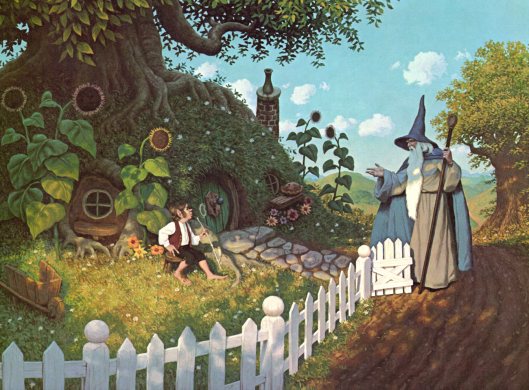
gandalfvisitsbilbo.jpg

His mocking words are soon too much for the Hobbit, who “Then…took out his morning letters, and began to read, pretending to take no more notice of the old man.” (The Hobbit, Ch.1, An Unexpected Party)

As we were once intrigued by the semata lugra, we are now interested in these letters. Douglas Anderson, in his note (15) to this sentence in The Annotated Hobbit supplies the information that “In England in the 1930s there were at least two mail deliveries per day—hence the distinction of morning letters.” (39) If the Shire is like 1930s England, which it sometimes appears to be, even as Tolkien denies that “There is no special reference to England in the ‘Shire’—except of course that of an Englishman brought up in an ‘almost rural’ village of Warwickshire on the edge of the prosperous bourgeoisie of Birmingham…” (draft of a letter to Michael Straight, “probably January or February 1956”, Letters, 235), then Bilbo is in the enviable position of one who is in the care of The Royal Mail—or, in this case, its Shire equivalent. Or is he?

The Royal Mail as a branch of government took off in the time of Henry VIII, with the appointment of Sir Brian Tuke (respell that and where in the Shire might you find him?) as Master of the Posts (1512), then Governor of the King’s Posts (1517).

Holbein,_Hans_-_Sir_Brian_Tuke.jpgmasterkingspost1512.jpg

Much, if not most of the correspondence of that period was literally royal—the government’s business, not private correspondence, but, over time, this gradually changed until, by the late 18th century, postmen had an official uniform

bellman2.JPG

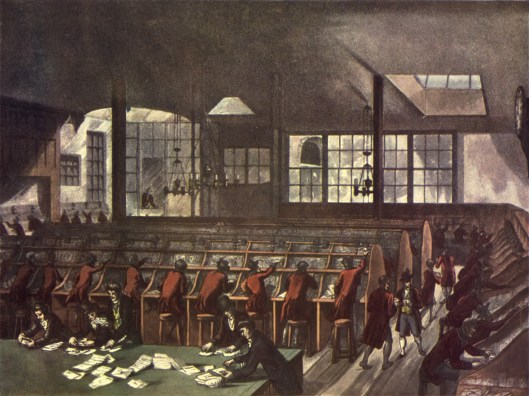
and there were places were letters were received and sorted.

lombardstreetpo1809.jpg

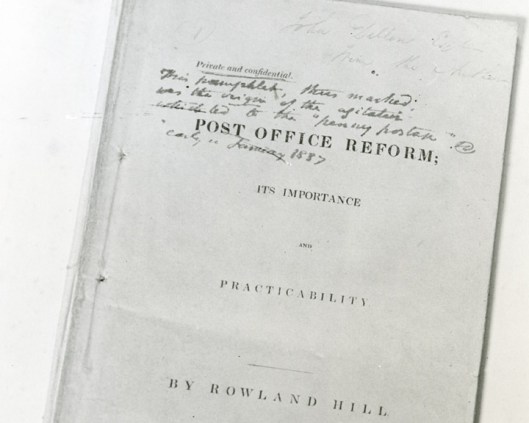
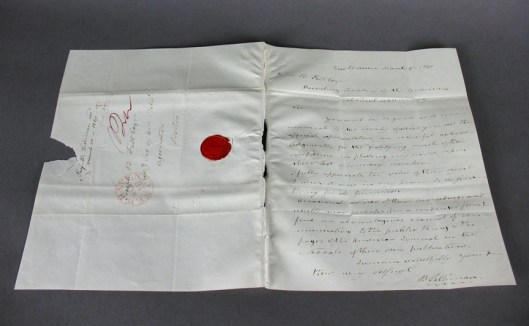
There were problems of corruption in the system, as well as a basic difficulty: the sender didn’t pay for the letter—the receiver did. Thus, there was no assurance that the service would be paid for, beyond whatever government subsidies were allowed to it. All of this began to change in 1837, however, with this privately-printed and circulated pamphlet

Post118_1837_1.jpg

by the education (and, in time more general) reformer, Rowland Hill.

Rowland_Hill_photo_crop.jpg


He proposed to reverse the process: the sender would pay and there would be strict regulation of the charge (and, for ordinary letters a very low charge at that). Initially, the idea was to use an already franked (that is, with a mark showing that it had been paid for) form on which one might write a message, fold it, and send it.

mulready1.jpg


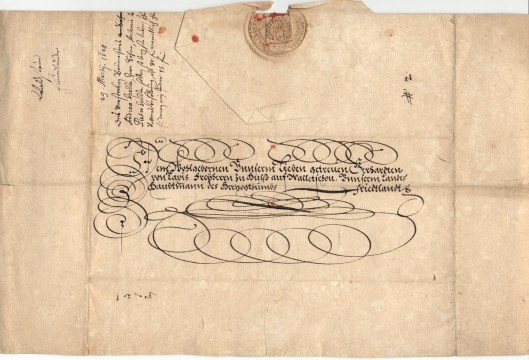
This was not a new idea and had been used since the 17th century, at least.

WallensteinBriefSiegel.jpg

Hill quickly followed this with the idea of a stamp which could be readily attached to a letter—commonly a sheet which, once written upon, could then be folded into its own container.

historicalletter-01.jpg

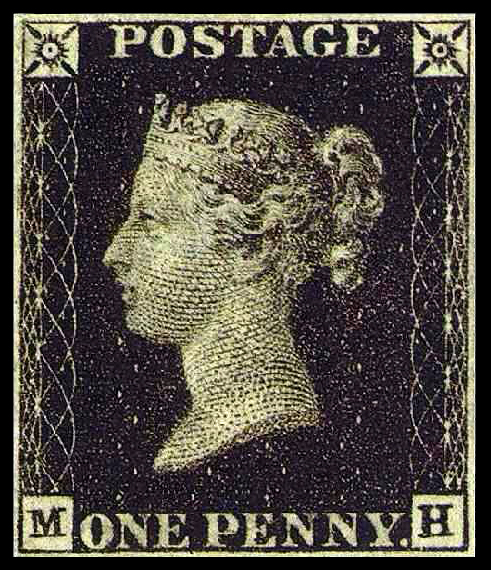
This could also be attached as we do, to a pre-made envelope, into which the folded letter might be placed. This was the first modern stamp, the so-called “Penny Black”.

Penny_black.jpg

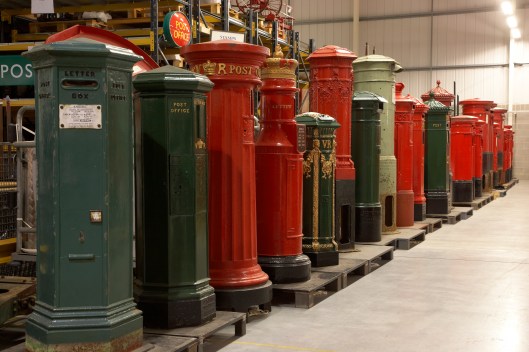
After 1853, there were even special public mail boxes into which you might place your letters for collection.

letterbox.jpg

Delivery in big cities like London would, by the late 19th-century, begin at 7:30 in the morning and go to 7:30 in the evening, so that you could write a note to a friend across the city, drop it into a pillar box (mailbox to people in the US) at 7:30 am

pillarbox_line1.jpg


and expect a reply sometime during the same day.

Behind all of this was an increasingly-complex government backed by a well-established bicameral legislature, with an increasingly-large tax base. But what of the Shire?

The government of the Shire seems to be sketchy, at best. Tolkien gives us the total picture on in the Prologue to The Lord of the Rings.

“The only real official in the Shire at this date was the Mayor of Michel Delving (or of the Shire), who was elected every seven years…As mayor almost his only duty was to preside at banquets…But the offices of Postmaster and First Shirriff were attached to the mayoralty, so that he managed both the Messenger Service and the Watch. These were the only Shire-services, and the Messengers were the most numerous, and much the busier of the two. By no means were all Hobbits lettered, but those who were wrote constantly to all their friends (and a selection of their relations) who lived further off than an afternoon’s walk.

The Shirriffs was the name that the Hobbits gave to their police…There were in the Shire only twelve of them, three in each Farthing, for Inside Work.”

So, in contrast to the elaborate workings of the Royal Mail, we are left with a series of questions: if there is a Postmaster—and clearly there is a post—how does it work? Is it all on foot? Is there the equivalent of the Pony Express? Nob, at the Prancing Pony, is called a “slow-coach”—were there once mail coaches, as in England?

The-Cambridge-Telegraph-a-mail-coach-about-to-depart-English.jpg


(Is this the only mention of such carriages in all The Lord of the Rings and The Hobbit? There are certainly wagons—there was even an invasion of “the Wainriders” once upon a time—see Appendix A of The Lord of the Rings.)

How were letters collected? Distributed? Is there a central post office, perhaps in Michel Delving, the closest thing to a capital in the Shire? And, of course, how was it all paid for? In an earlier posting, we talked a little about coinage in Middle-earth and we tried to imagine what Gondorian currency might have looked like—can we imagine Shire postage stamps?

When you read the following, think of your own postal service and join us in wondering about all of the above:

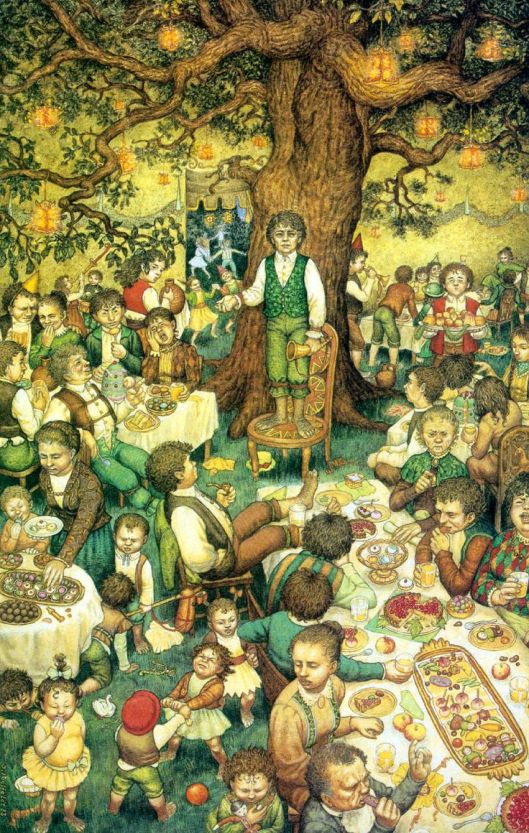
“Before long the invitations began pouring out, and the Hobbiton post-office was blocked, and the Bywater post-office was snowed under, and voluntary assistant postmen were called for…” The Fellowship of the Ring, Ch.1, A Long-Expected Party

ingeredelfeldt.jpg

Thanks, as ever, for reading.

MTCIDC

CD
The Fall of Two Cities?

09 Wednesday Mar 2016

Posted by Ollamh in Economics in Middle-earth, Imaginary History, J.R.R. Tolkien, Language, Maps, Military History, Military History of Middle-earth, Narrative Methods

≈ Leave a comment

Tags

Agincourt, Anadoluhisari, Anatolia, Asia Minor, Bayezid I, Bosphorus, Byzantium, Constantine I, Constantinople, Crecy, English Civil Wars, Eowyn, Gondor, map, Mehmet II, Minas Tirith, motte and bailey, Newark, Normans, Osgiliath, Ottoman Empire, Poitiers, Rumelihisari, siege, The Lord of the Rings, Tolkien, Witch-King of Angmar

Dear Readers,

Welcome, as always. A little while ago, we talked about the “siege of Gondor”, which really wasn’t a siege in the formal sense, at all, but rather an assault. (We suspect that JRRT liked the sound of “siege” and so used it, not caring if it were strictly accurate or not.) In this posting, we want to look at a real siege and examine what might be parallels with events in Middle Earth.

Before we do, we want to take a moment to talk about the word “siege”. It comes into English through Old French asegier, which comes from Latin ad + sedeo > adsideo, adsidere , literally, “to sit down at”. The northern French who passed the word on to England must have liked to say what’s called a y-glide when certain consonants came before e, so, though it was spelled asegier, it would have been said “ah-see-YED-jier”. And that’s why English today has what can be a confusing spelling. (In our experience, lots of native speakers have trouble distinguishing between the ie of “siege” and the ei of “seize”). The stress on the word in English would have been away from the initial a, and so that would have disappeared from the word as it moved from being a borrowing.

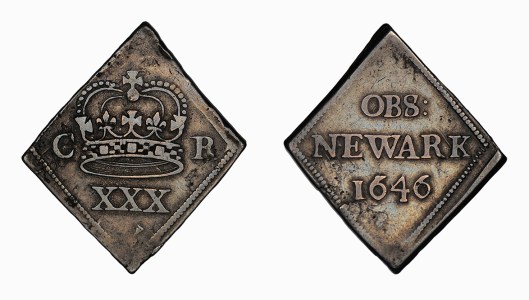
[As what we think is a cool footnote, Latin also has the verb obsideo “to sit down right before=to besiege” and we can see that used in English in the word “obsession”, with the idea that something bothers you so much that it’s like you’re being besieged by it. You can also see it on this wonderful bit of 17th-c. English history.

obsidionalmoney.jpg

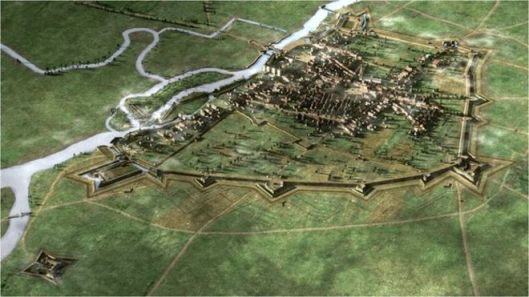
Although it doesn’t look like a modern coin, this is a form which used to be called “half-a-crown”—that is, 30 pennies (that’s what those three xses mean), or two shillings, sixpence.   This coin was struck in the town of Newark-upon-Trent, when it was besieged during the English Civil Wars (1642-1651).

_82601862_newark-1646map.jpg

And that’s where obsideo comes in. The back (the “reverse” in coin language—the front is called the “obverse”) says:

OBS: Newark (with a date, either 1645 or 1646, depending on when the coin was struck)

OBS = Obsessa Newark = “Newark Besieged”

There were a lot of coin-substitutes struck by various besieged towns, but, apparently, those from Newark are the most numerous.]

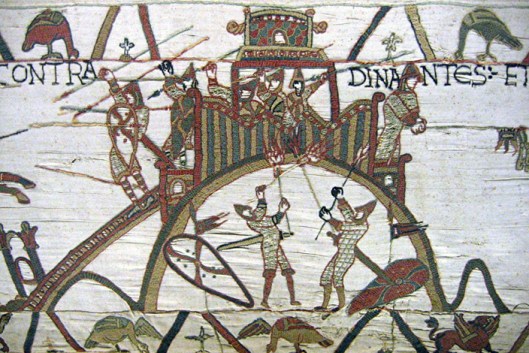
In the medieval western military world, sieges were more common, it seems, than pitched battles. As castles and towns were focal points for the possession and control of land—think of the hundreds of early castles, called “motte and bailey”, which the Normans built all across England in the first years after their conquest–it’s not surprising that they would have been a focus of attack.

motteandbailey.jpg Tapisserie_motte_dinan 704.jpg

As well, we can imagine that, ultimately, they would have been cheaper, in terms of the most irreplaceable manpower, sparing the highly-trained, hard-to-replace, knights and men-at-arms.

knights.jpg

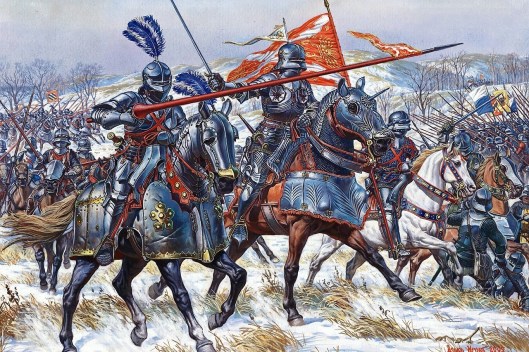
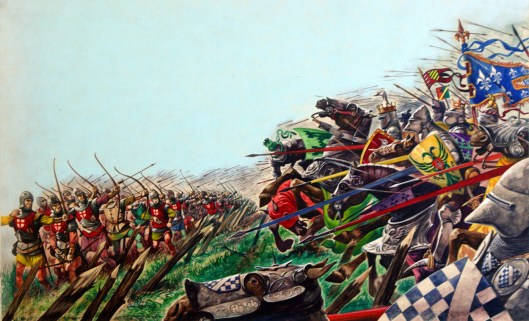
Battles like Crecy (1346), Poitiers (1356), and Agincourt (1415), cost the French dearly as their brave knights threw themselves at their English opponents, whose longbows shot them and their horses down.

agincourt.jpg

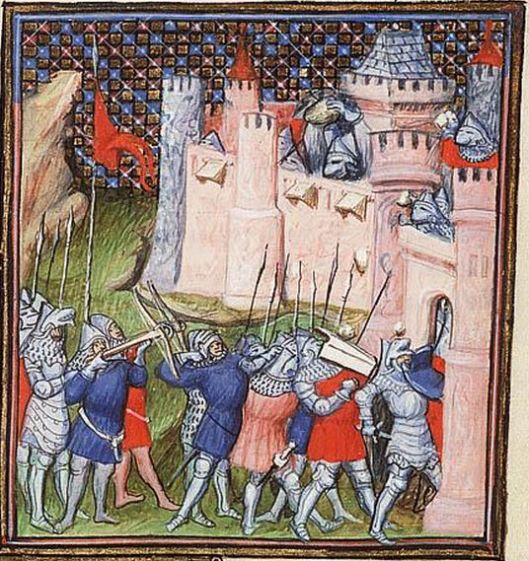
In a siege, although there was the occasional combat, including the exploitation of a break in the enemy’s defenses,

Edward-III-takes-Poix-Castle.jpg

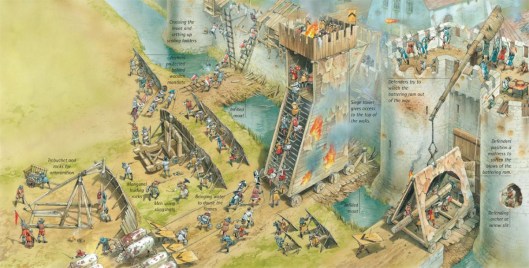
most of a siege would be spent in using machinery of various sorts to aid you in breaking down the walls—and the resistance of the defenders, as well.

castles-and-knights-2-with-labels.jpg

This brings us to the real, historical siege we want to examine: Constantinople, 1453.

Bizansist_touchup.jpg

Constantinople had begun life as a Greek colony, called Byzantium, on the European side of the narrow passageway between the Black Sea and the northeastern Mediterranean.

byzempmap.gif

It had been refounded and greatly expanded by the Roman emperor, Constantine I, to be a new capital in the east.

Constantine-I-Face.jpg

Although it was supposed to be called “New Rome”, everyone in the east called it after its refounder, and so it was “Constantinople”, becoming the capital of an eastern empire which we call “Byzantine”. Even with setbacks and a number of unsuccessful attacks over the centuries, it was, for a long time, a very wealthy and powerful city.

1-reconstruccion-de-bizancio.jpg

But even the wealthiest and most powerful cities will fade—especially when faced with ambitious enemies. Constantinople had had a number of those, but, finally, in its last years, perhaps its most ambitious and most powerful arose in Asia Minor: that of the Ottoman Turks. As you can see from this map, its beginnings were modest: one Turkic-speaking group among many.

Anatolian_Beyliks_in_1300.png

This was a period of instability, however. The Ottoman leaders quickly took advantage of that instability to grab power and territory, so that, by 1400, they had spread beyond the shrinking Byzantine world, into the Balkans, and, soon, Constantinople was surrounded.

trebizond1400

This surrounding took place in an increasingly-methodical way. In 1393-4, the ruler of the Ottomans, the sultan Bayezid I

bayezit1.jpg


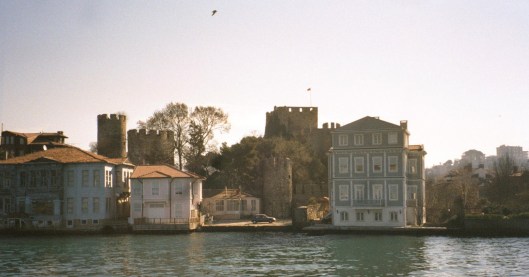
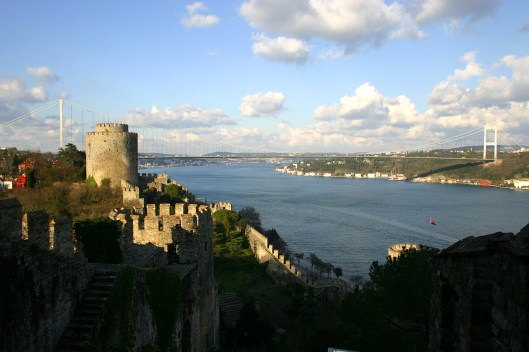
built a small fortress on the Asia Minor side of the Bosphorus, the name for the northern stretch of the passage which led from the Black Sea to the Mediterranean. It was called Anadoluhisari, “the Anatolian fort”.

Anadoluhisari.jpg


You can see from the map that this was the beginning of setting up a choke point upstream from Constantinople.

mapwithanadoluhisari.gif

In 1451-2, the sultan Mehmet II finished the job with the Rumelihisari just opposite, on the European side (and that’s what its name means, “the Roman—that is, European—fort”).

Rumeli_hisari.jpg

Guns were mounted

muslim_rocket_technology_06.jpg

and any help which might have come from the Black Sea was blocked.

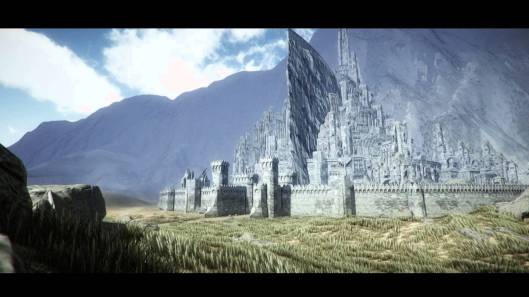
And here we want to take a minute to look at our imaginary city and its danger—because we see some easy parallels here. First, of course, the Ottoman empire was an eastern threat—so was Mordor. Mordor had taken the east bank of the Anduin, just as the Ottomans had taken the Asian side of the Bosphorus. And, in the capture of the European side and the building of Rumelihisari, we might see the taking of Osgiliath and the west bank of the Anduin. Then there is the massive city of Minas Tirith and the attack upon it.

mt.jpg 2381576-zmordorforcesk7.jpg

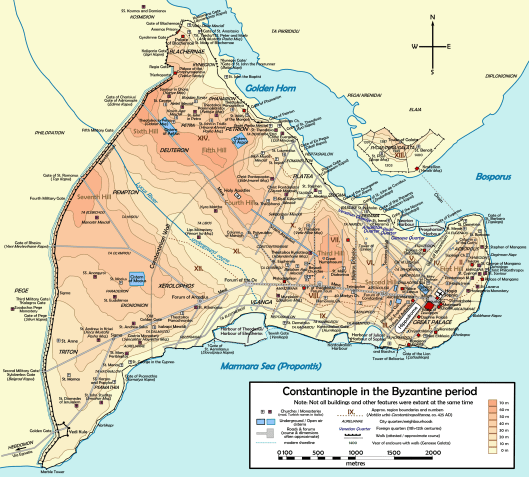
Constantinople was also a massive city.

Byzantine_Constantinople-en.png

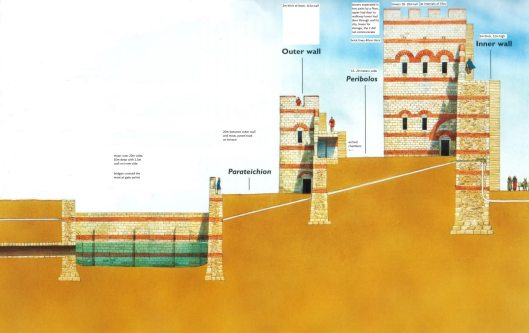
It was, basically, on a triangular piece of land, with two sides protected by water. The original Greek town had had a wall, but it was long gone and almost all of Constantine’s land wall had long disappeared, as well. The latest walls are called the Theodosian, after their originator, the emperor Theodosius II (408-450AD), but the walls included bits of the Constantinian walls and many repairs, over the centuries. The main land defenses included three lines of wall and a moat.

2rh67o0.jpg

This sounds very impressive until one considers two things: first, is there a garrison big enough to defend what are, in fact, a number of miles of wall? And, second, although the walls have withstood previous attacks, including one made by the Ottomans in 1422AD, how will they stand up to the threat of modern artillery?

At the height of its power and prosperity, it is estimated that Constantinople had had a population of anywhere from 500,000 to 750,000 (although scholars argue over this). At the time of the final siege, the population had fallen to as low as 40,000. Thus, large parts of the city were empty—just like Minas Tirith:

“Pippin gazed in growing wonder at the great stone city…Yet it was in truth falling year by year into decay; and already it lacked half the men that could have dwelt at ease there.” (The Return of the King, Book 5, Chapter 1, “Minas Tirith”)

The garrison of Constantinople was perhaps about 9,000, in all, which meant that they were very thinly stretched. We don’t know just how many troops were in Minas Tirith. Some reinforcements had come from South Gondor, as we noted in an earlier posting, but only a few thousand and the defenders were powerfully outnumbered, just as those of Constantinople were, when the forces of Mordor began to arrive. The Ottoman army is thought to have had between 50,000 and 80,000 men, but just how many Orcs and others marched down the causeway from Osgiliath isn’t known–they are just a horde—something which the Jackson film shows very well.

maxresdefault

Then the assault begins, the Orcs having giant stone throwers, siege towers, and, finally, a giant, fire-breathing ram, Grond.

Grond_arrives.png

If you’ve been following our postings (and we hope you have!), then you know that we’ve discussed the use of what appears to be gunpowder, both at Helm’s Deep and at the Rammas Echor. The Orcs who attack the walls of Minas Tirith don’t appear to have such a weapon, but, unfortunately for the defenders of Constantinople in 1453, the Turks do, in the form of plentiful modern artillery.

Illustration-of-angus-mcbride-showing-the-ottoman-cannon-basilica-during-the-siege-of-constantinople-in-1453-ad.jpg

Attacks wear down the small garrison and huge, stone-throwing weapons knock down the walls, so that, finally the city falls, on 29 May, 1453.

84087026.jpg

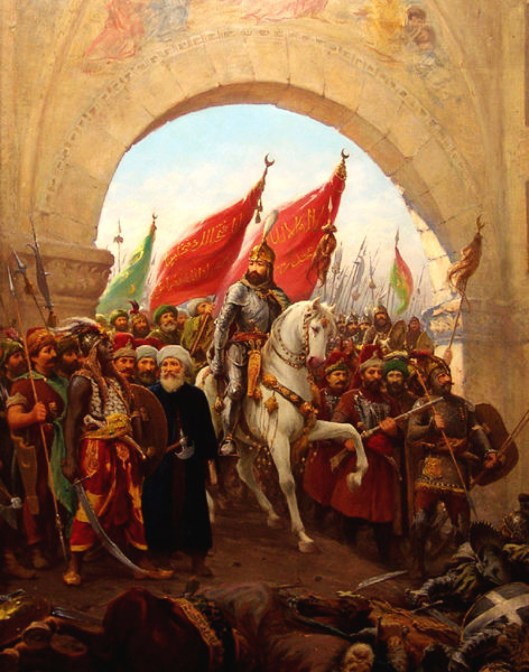
Its conqueror, Mehmet II, rides in—

mehmet2enteringconstantinople.jpg

which is something the witch king of Angmar never gets to do, perishing instead, at the hands of Eowyn and Merry.

Eowyn.jpg


And there the parallels end, as does our posting. Did JRRT have the fall of Constantinople somewhere in the back of his mind? What do you think?

Thanks, as always, for reading.

MTCIDC

CD
Fourth Age—Big Bang Theory

17 Wednesday Feb 2016

Posted by Ollamh in Economics in Middle-earth, Heroes, Imaginary History, J.R.R. Tolkien, Literary History, Military History, Military History of Middle-earth, Narrative Methods

≈ Leave a comment

Tags

American Civil War, Battle of Crecy, Battle of the Somme, cannon, Siege Warfare, The Lord of the Rings, The War of the Ring, Tolkien, World War I

Welcome, dear readers, as always!

In this posting, we are going to do something a little different:  speculate.  It’s about a possible military development in the years after the War of the Ring and, if you have enjoyed our past postings on military issues in Middle Earth, we hope that you will enjoy this one.

Our inspiration for this posting came from two sources:  The Lord of the Rings and the history of the later western Middle Ages and it began like this–

The-Two-Towers-Explosion-helms-deep-2.jpg

“Even as they spoke there came a blare of trumpets.  Then there was a crash and a flash of flame and smoke. The waters of the Deeping-stream poured out hissing and foaming:  they were choked no longer, a gaping hole was blasted in the wall.  A host of dark shapes poured in.” (The Two Towers, Chapter 7, “Helm’s Deep”)

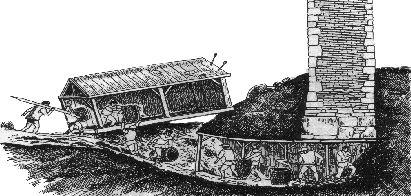
Aragorn calls this “the fire of Orthanc”, but I think that we can guess that it was an explosive device and our immediate thought was the use of mines over the centuries of siege warfare.  Originally, the idea was to undermine an enemy’s wall by digging a tunnel below it.   The next step was either to use the finished tunnel as a passageway into an inner courtyard or, alternatively, to prop up the wall, fill the area below with flammable materials, torch the materials, then clear out to watch the section of wall tumble down when the fire burn away the props before charging in.

mining1.gif

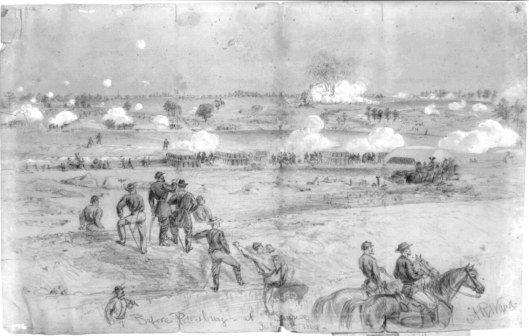
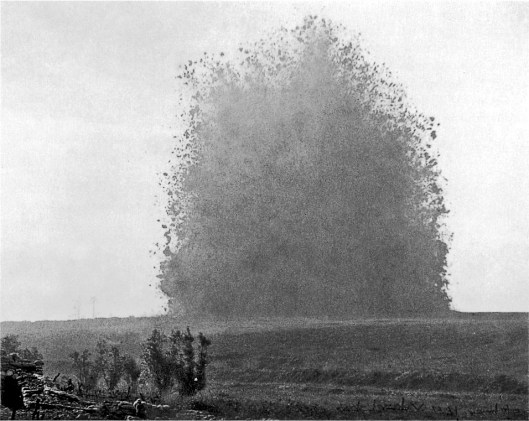
Once gunpowder was available, this technique could be improved upon by tunneling under a wall, planting a large stock of explosives, setting a very long fuse, clearing out, then watching it blow a large hole in the enemy’s fortification.

Two of the most spectacular such mines in our experience are during the American Civil War, at Petersburg, on 30 July, 1864—

Waud-Petersburg-Crater.jpeg

and the first day of the Somme, 1 July, 1916, in World War 1—

Hawthorn_Ridge_mine_1_July_1916.jpg

Sauron’s orcs appear to use the same technique when facing the protective wall around Gondor, the Rammas Echor:

“The bells of day had scarcely rung out again, a mockery of the unlightened dark, when far away he saw fires spring up, across the dim spaces where the walls of the Pelennor stood.  The watchmen cried aloud, and all men in the City stood to arms.  Now ever and anon there was a red flash, and slowly through the heavy air dull rumbles could be heard.” (The Return of the King, Chapter 4, “The Siege of Gondor”)

As we thought about the future, we considered what had happened in our Middle Ages.  Although gunpowder had been mentioned in the mid-13th century, our first illustration of a weapon based upon it dates from about 1327.

EarlyCannonDeNobilitatibusSapientiiEtPrudentiisRegumManuscriptWalterdeMilemete1326.jpg

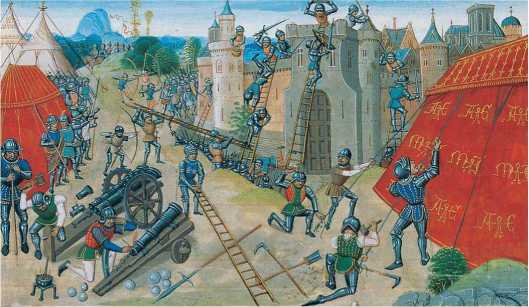
By the mid-14th century, there appear to have been cannon of some sort used against the Scots in 1327 and at the Battle of Crecy (1346) against the French and, by the early 15th c. they are becoming a regular feature of battles and sieges.

medievalsiege.jpg

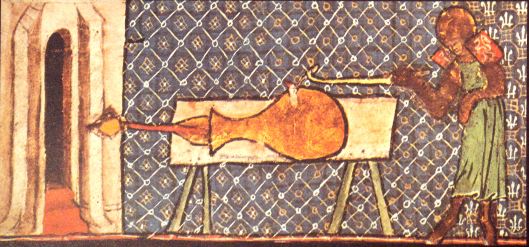
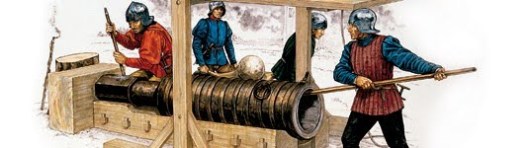
Very early cannon were very simple, being a tube of any length fastened to a wooden bed of some sort.

FortMedeival.jpg

The tubes were made of long bars of iron hammered together and then secured with a series of iron rings.

25_slash_57.JPG

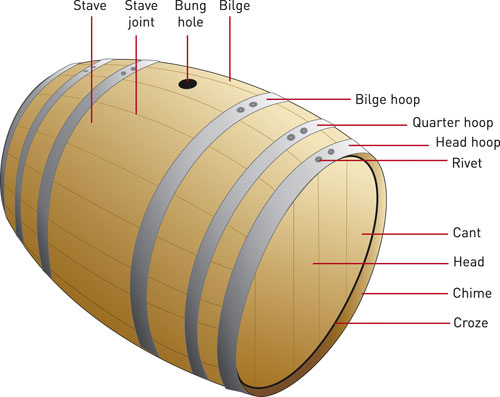
The technology for this looks like it came from barrel-making:  long staves of wood pressed together, then wrapped with iron bands

winebarrelanatomy.jpg

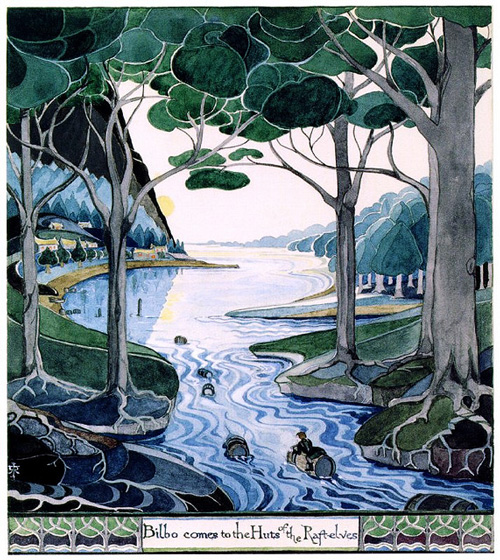
When we think of barrels in Middle Earth, what better evidence do we have than this, one of our favorite JRRT illustrations from The Hobbit?

barrel-riding.jpg

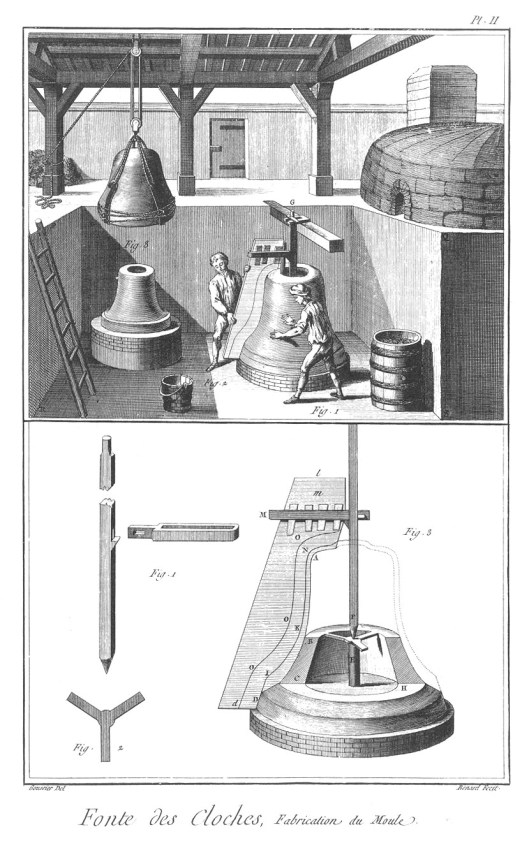
A well-known technical skill in the Middle Ages was that of casting church bells:  making molds, pouring in metal, letting it cool, and producing sometimes quite large ones.

bellfounding.jpeg

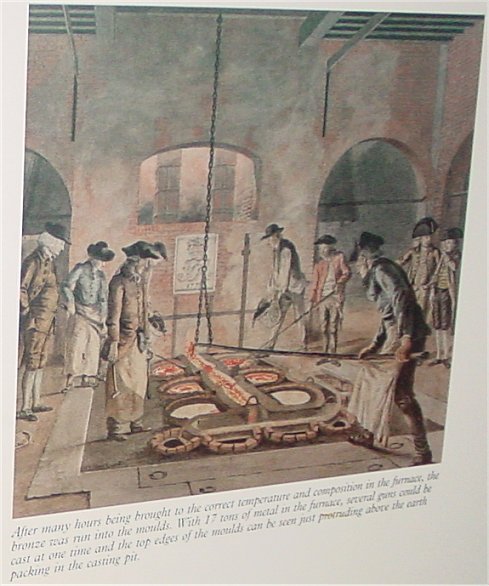
This led to making cannon the same way.

foundry-church-cannon-casting.jpg

Sometimes, early cannon were so large that they were cast at the site of their first use, as large bells occasionally were.  For the Ottoman siege of Constantinople in 1453, this was said to be true.

Illustration-of-angus-mcbride-showing-the-ottoman-cannon-basilica-during-the-siege-of-constantinople-in-1453-ad.jpg

You’ll notice here, by the way, that this isn’t an iron gun, but a bronze one.  After the first iron guns, gun-founders had begun experimenting with bronze and for several centuries, until all guns would be made out of steel, there was discussion among both gunners and military theoreticians over the value of each metal.

As for Middle Earth, well, we know that there were barrels and the ability to cast large (going by medieval bells) objects in metal.  Now the speculation begins.  Suppose, when Saruman was defeated and later left Orthanc, he had left behind his papers (he doesn’t appear to have anything like them when he is met on the road by Gandalf and the others in “Many Partings”).  In those papers would have been the recipe for gunpowder.  Sometime after Isengard had been taken over by the allies, those papers had come to Minas Tirith and someone, remembering what he had heard about the attack on Helm’s Deep, went through them, found that recipe, and, just as in medieval Europe, soon these began to appear—

medgun.jpg

What do you think, dear readers?

Thanks, as always, for reading.

MTCIDC

CD

Feudal Array 2

27 Wednesday Jan 2016

Posted by Ollamh in Economics in Middle-earth, Fairy Tales and Myths, Imaginary History, J.R.R. Tolkien, Literary History, Military History, Military History of Middle-earth

≈ Leave a comment

Tags

14th century, 15th century, Adventure, Agincourt, Anglo-Saxon, armor, Bayeux Tapestry, feudalism, Fyrd, Gerry Embleton, Huscarl, Luttrell Psalter, Middle-earth, N.C. Wyeth, tapestry, The Lord of the Rings, Tolkien

Welcome, as always.

In this posting, we want to conclude what has turned out to be a kind of mini-series on Feudalism in Middle Earth. Two postings ago, we used the 14th-century Luttrell Psalter to illustrate what working the plowland behind the Rammas Echor might have looked like. In our last, we used the Bayeux Tapestry to offer another possible visual influence on Tolkien’s depiction of the Rohirrim: the conquering Normans. In this final posting, we will look at the forces of Rohan’s ally, Gondor and will use a number of sources, both medieval and modern.

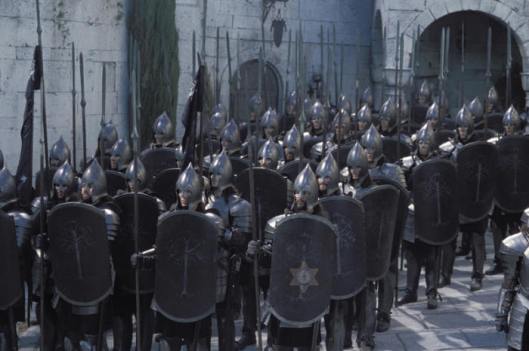
In the Jackson movies, there is a kind of regularity, from Osgiliath to Minas Tirith in what we are shown.

gondorians.jpg

This is not surprising if the cue for costuming has come primarily from one description:

“The Guards of the gate were robed in black, and their helms were of strange shape, high-crowned, with long cheek-guards close-fitting to the face, and above the cheek-guards were set the white wings of sea-birds; but the helms gleamed with a flame of silver, for they were indeed wrought of mithril, heirlooms from the glory of old days. Upon the black surcoats were embroidered in white a tree blossoming like snow beneath a silver crown and many-pointed stars. This was the livery of the heirs of Elendil, and none wore it now in all Gondor, save the Guards of the Citadel before the Court of the Fountain where the White Tree once had grown.” (The Return of the King, Chapter 1, “Minas Tirith”)

We have no wish to criticize—in this respect, at least—the creators of the films for taking what might appear to be an easy out: uniformity being cheaper than individuality, since it’s clear that, when it came to dramatic effects in the films in general, the old theatrical advertising line, “No Expense Was Spared To…” is really true. Instead, we want employ our former method of consulting medieval manuscripts, as well as another passage from the same chapter, to offer another possible view, one which might have influenced the author in his depiction of the defenders of Gondor.

We’ll begin with the passage:

“Leading the line there came walking a big thick-limbed horse, and on it sat a man of wide shoulders and huge girth, but old and grey-bearded, yet mail-clad and black-helmed and bearing a long heavy spear. Behind him marched proudly a dusty line of men, well-armed and bearing great battle-axes; grim-faced they were and shorter and somewhat swarthier than any men that Pippin had yet seen in Gondor…

And so the companies came…The men of Ringlo Vale…from the uplands of Morthond…five hundred bowmen…From the Anfalas…a long line of men of many sorts, hunters and herdsmen and men of little villages, scantily equipped save for the household of Golasgil their lord. From Lamedon, a few grim hillmen…Fisher-folk of the Ethir…Hirluin the Fair…with three hundreds of gallant green-clad men. Imrahil…with gilded banners bearing his token of the Ship and the Silver Swan, and a company of knights in full harness riding grey horses; and behind them seven hundreds of men at arms, tall as lords, grey-eyed, dark-haired, singing as they came.”

There is actually not a lot of detail here, but there are a few hints. First off, there are those “great battle-axes”.   Here are two images from the Bayeux Tapestry of the Anglo-Saxon king, Harold’s, bodyguards, his huscarl, armed with their characteristic long-handled axes.

axemen_bayeux.jpg

And here is a modern reconstruction.

huscarl4.jpg

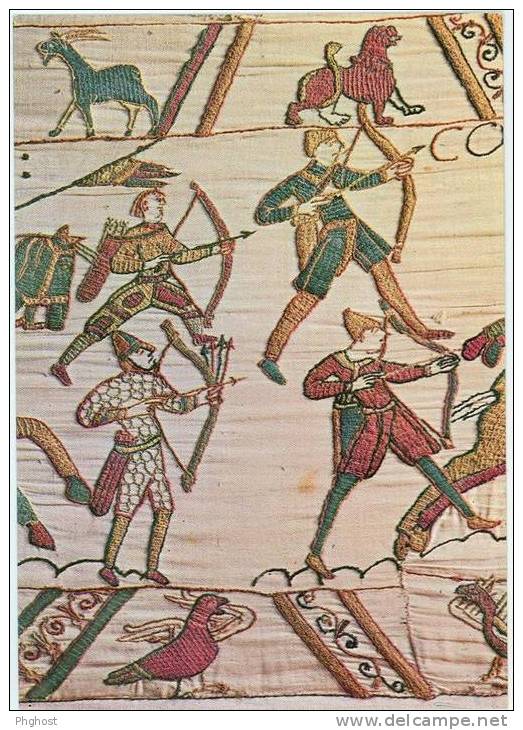
Next, we have those five hundred bowmen from Morthond. The Tapestry can provide a useful image of those,

archers2.jpg

but perhaps what JRRT really was thinking of were the famous longbowmen of Crecy and Poitiers and Agincourt, whose skill and courage knocked down whole waves of equally brave French knights. Here are a pair of modern images by the brilliant historical illustrator, Gerry Embleton, himself a medieval reenactor.

EnglishLongbowman1330-15151
longbowman2

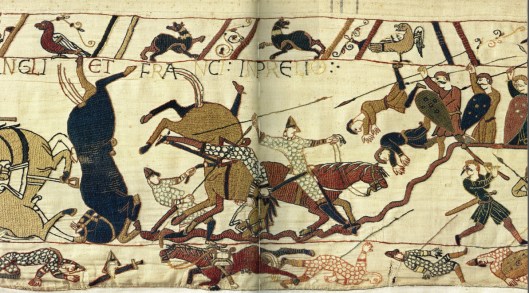
Besides the huscarl, King Harold’s army was made up of the fyrd, a kind of militia drawn from the freemen of the countryside, who had to provide their own weapons and equipment and were only required to serve for limited periods—they would have been farmers, most of them, after all, and couldn’t be off the farm for too long without threatening their own livelihoods. Perhaps these could suggest that “long line of men of many sorts”. Here’s an image from the Tapestry of what appears to be the fyrd fending off a mounted Norman attack. You’ll notice the lack of defensive armor.

fyrd3.jpg

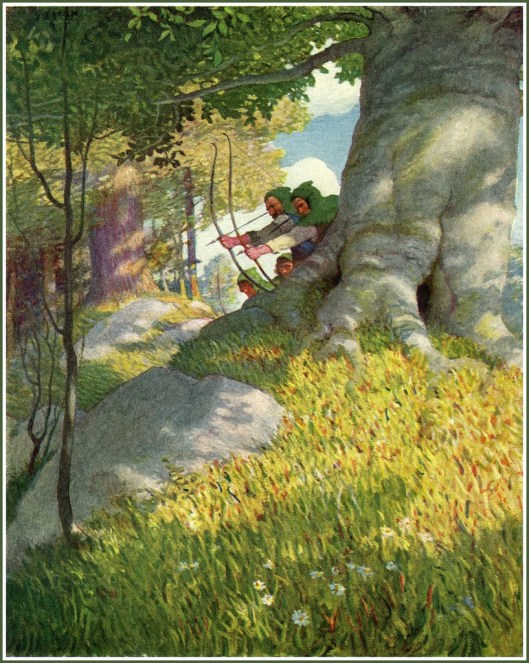
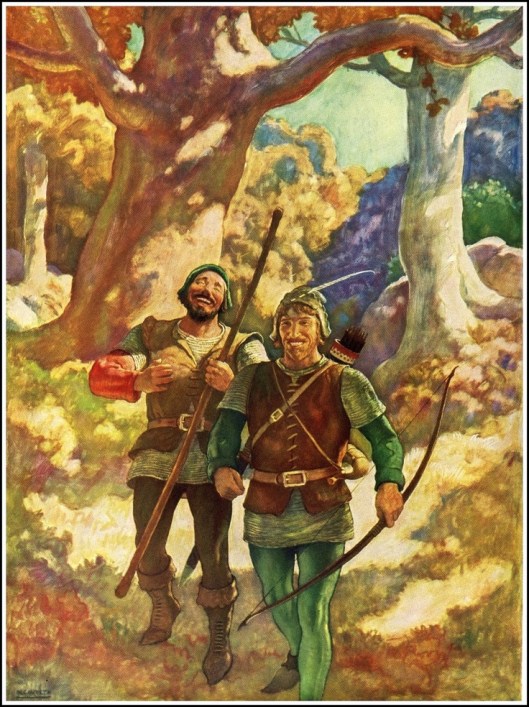
“gallant, green-clad men” is rather vague, but, suddenly, all we could see is Robin Hood and his Merry Men. And so we can’t resist including some of our favorite N.C. Wyeth illustrations.

rhood1rhood2

And these could easily provide the model for the rangers in South Ithilien, couldn’t they?

faramir.jpg

Last, there is that “company of knights in full harness”. This presents a real problem. Knights from which period? The armor available at the time of the Bayeux Tapestry in the mid-11th century

fyrd3.jpg

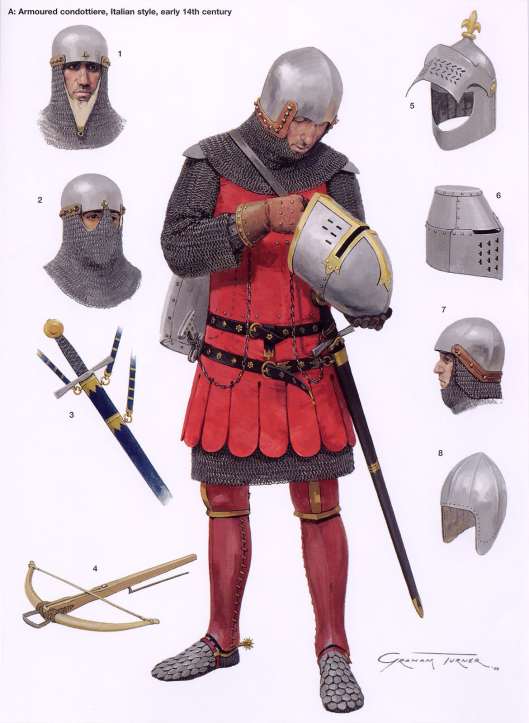
and which, we suggested in our last, might be good for the Rohirrim, was very different from that of later times. Here’s the armor of the days of Sir Geoffrey Luttrell,

Sir_Geoffrey_from_LPsalter.jpg

in the early 14th century—

early14thcarmor.jpg

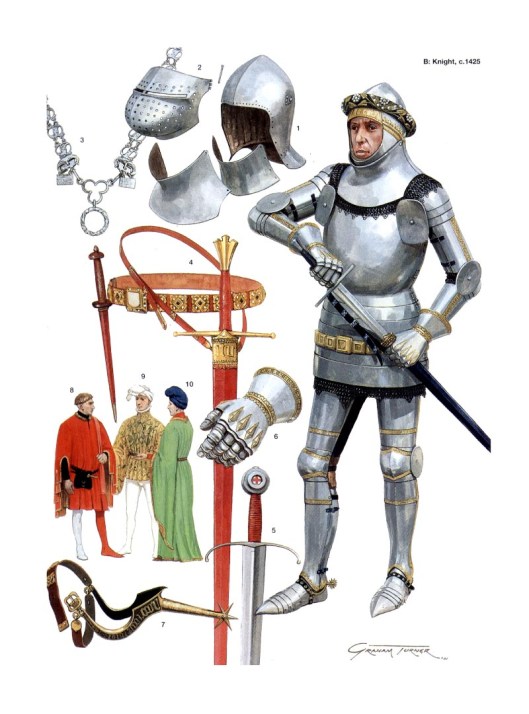
and here’s what the English archers would have faced as worn by their valiant French opponents at Agincourt, in 1415.

early15thcarmor.jpg

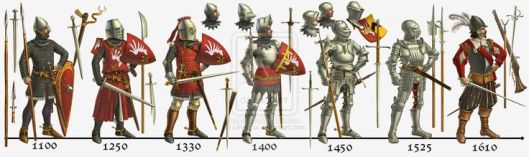
This handy chart can give you a diachronic (through-time) view of changes in medieval armor.

02e1c306489f565ee38b56e417ba5ff0.jpg

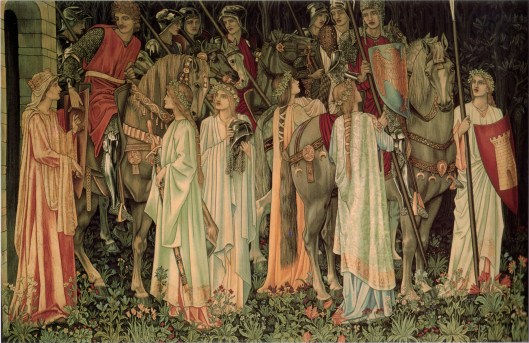
If we look at something produced through the workshop of William Morris, that strong influence upon JRRT, we find this group of knights from a set of tapestries produced in the 1890s.

Holy_Grail_Tapestry_-The_Arming_and_Departure_of_the_Kniights.jpg

The armor is pretty vague (the systematic study of the history of armor was still in its childhood then—if you’re interested in the early days, google Sir Samuel Rush Meyrick to learn about its first great scholar), but one of the helmets—the one to the far left in the background, looks like a visored sallet, which could date what we see in the tapestry to the later 15th century.

Sallet_helmet,_Southern_Germany,_1480-1490_-_Higgins_Armory_Museum_-_DSC05461.JPG

(Sharp-eyed readers who are Star Wars fans—we are—will recognize this general pattern from the technical people on the Death Star—

deathstarcrewmen.png

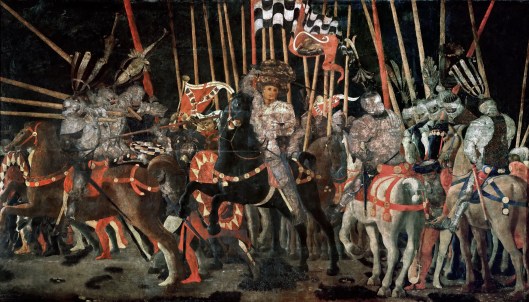
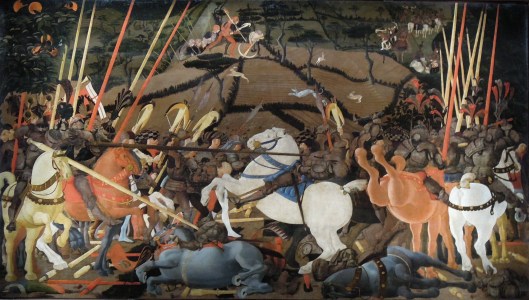
We might add that Morris and his friends were strongly influenced by pre-Renaissance and early Renaissance painters, so perhaps this picture, one of a set of 3 by Paolo Uccello from the middle of the 15th century, might also provide a possible model (and we’re glad to show you the whole set because we think that they’re just magical).

Öèôðîâàÿ ðåïðîäóêöèÿ íàõîäèòñÿ â èíòåðíåò-ìóçåå Gallerix.ru

Uccello_Battle_of_San_Romano_Uffizi


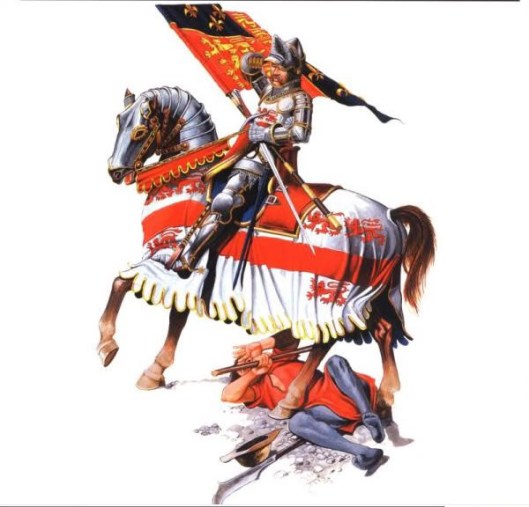
Taken all together, these produce a very different image from the films, don’t they? Much more individual, often much less well-equipped, more actual medieval, as we would imagine the author had had in mind. So—contrast this


with this:

ArmiesOfAgincourt.jpg

Which do you prefer, dear readers?

Thanks, as always, for reading.

MTCIDC

CD

 

Feudal Array 1

20 Wednesday Jan 2016

Posted by Ollamh in Artists and Illustrators, Economics in Middle-earth, Fairy Tales and Myths, Imaginary History, J.R.R. Tolkien, Literary History, Military History, Military History of Middle-earth, Narrative Methods

≈ Leave a comment

Tags

Anglo-Saxon, Bayeux Tapestry, Embroidery, feudalism, Medieval, Middle-earth, Normandy, Peter Jackson, Rohirrim, tapestry, The Lord of the Rings, Tolkien

Welcome, as always, dear readers.

In this posting, we would like to continue what we began in “Behind the Rammas Echor”. In that posting, we talked about using the illustrations from medieval English psalters (the wonderful 14th-century Luttrell Psalter in particular) to try to visualize the feudal world suggested by certain aspects of Tolkien’s The Lord of the Rings.

In that posting, we said that feudalism could be broken down into two big categories, land and troops, and there we spent time looking at basic agricultural life, to imagine the look of the feudal world of Middle Earth.

Now we move on to troops. And, as much as we can, we would like to continue to use medieval images to help us.

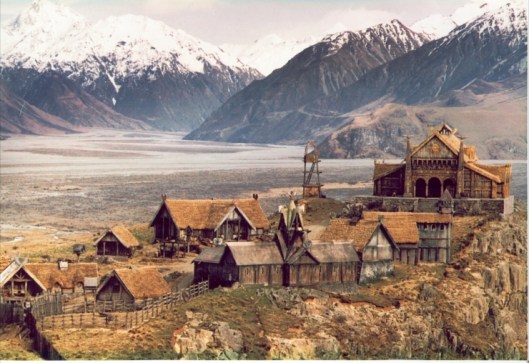
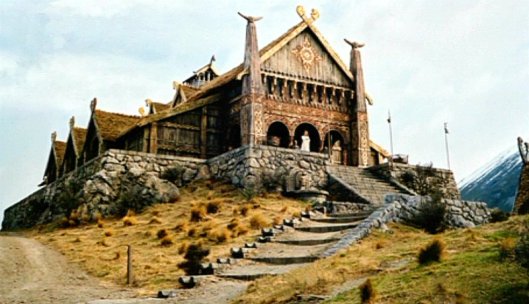
In previous posts, we’ve praised Jackson’s depiction of the Rohirrim, both the architecture and the people. Edoras and Meduseld within it just look right—and, when you watch the material on constructing them in the extended version box set, we can only be absolutely bowled over by the care taken there, for all that we have difficulties with certain other parts of the films, both in look and in the changes to the text.

Edoras-MtSunday.jpg

meduseld.jpg

rohirrimmassed.jpg

In one previous post, we suggested the kinds of models we both know and imagine Tolkien used to create the Rohirrim. These were primarily Anglo-Saxon, but combined with a horse people (which the Anglo-Saxons were not) of some sort, possibly Scythian (an Indo-European-speaking horse folk from north of the Black Sea).

ScythianCavalry.jpg

As we’ve thought more about it (one, for us, of the great pleasures of solid adventure literature, new and old—is that you not only want to think more about it, but, as you do, you find more in it), we began to imagine that Tolkien might have had another visual source, based upon another famous set of medieval illustrations, the Bayeux Tapestry.

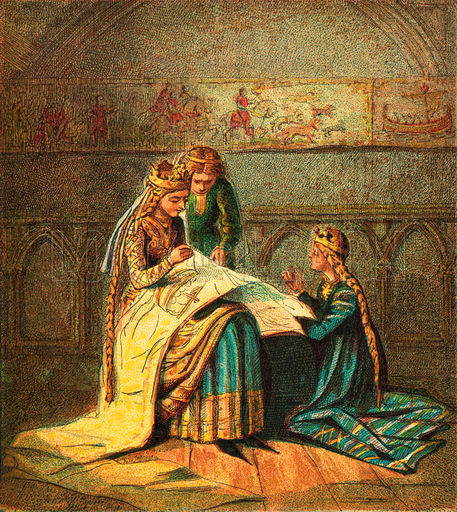
This is a roll of linen, some 230 feet (that’s about 70 metres) long and 20 inches (50 centimetres) high, into which are woven three bands of designs. The center is a long (very long!) series of adjoining panels covered in human figures, which have been stitched on with various colored woolen threads. Above and below the central band are two narrower ones which combine abstract figures (commonly on the upper panel) with human activities (on the lower one). Across the top of the central band are a series of captions in very simple Latin, describing what is happening below.

haroldkilled.jpg

The caption here reads: “Here Harold the king has been killed.”

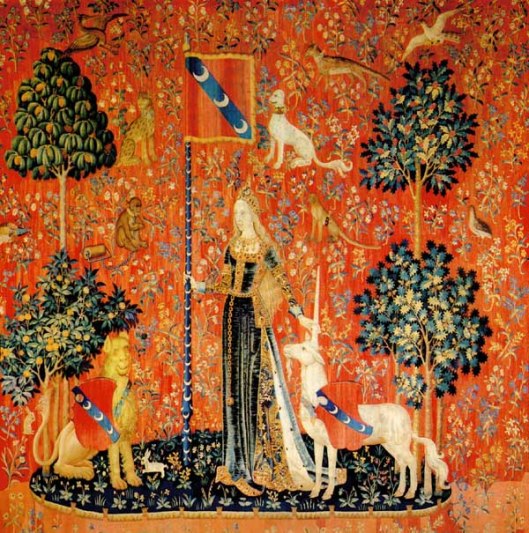
As it’s not through-woven, like this—

unicorn3.jpg

this isn’t really a tapestry, but an embroidery, in fact.

106604.gif

makingthebt.jpg

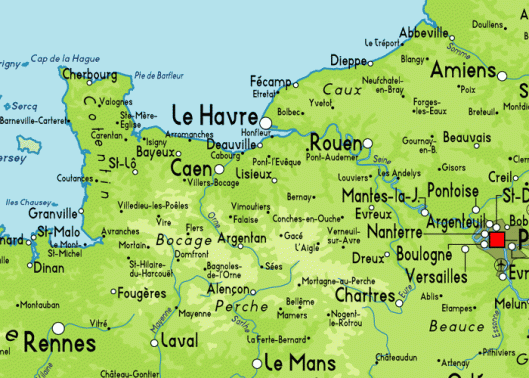
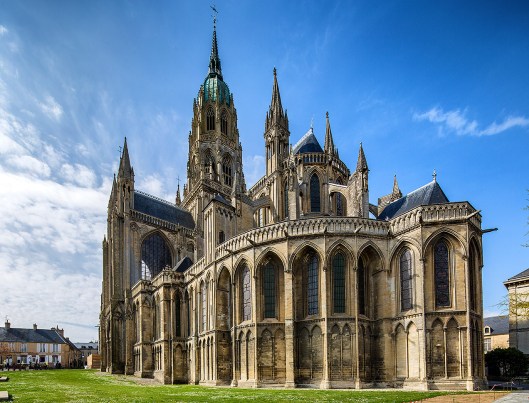
It’s linked to the cathedral at Bayeux, in Normandy, where it has been for at least 6 centuries. On the map, find Le Havre and look left and you’ll see Bayeux.

normandy_map_phys.gif

bayeux_cathedral.jpg

Where it really came from and who made it are two of those mysteries that it’s been fun to follow the scholarship of, but, as of 2015, there are lots of theories, some of them more convincing than others, but that’s all there are: theories. If you’d like to know more about them, go to: www.bayeux-tapestry.org.uk/whomadethetapestry.htm.

The tapestry is housed in an impressive museum in Bayeux, where its entire length is ingeniously displayed in a sort of wrap-around way.

The-Bayeux-Tapestry-Museum-1019.jpg

Bayeux-Tapestry-1_131941101594170.jpg

We’ve given you lots of facts, but the one thing we haven’t mentioned is the subject of such an immense work. It is, in fact, a lengthy piece of propaganda justifying the Norman invasion and conquest of England in 1066AD. We know, then, one definite thing about it: it certainly wasn’t embroidered for the Anglo-Saxons! (Although there is at least one theory that it was made by them.)

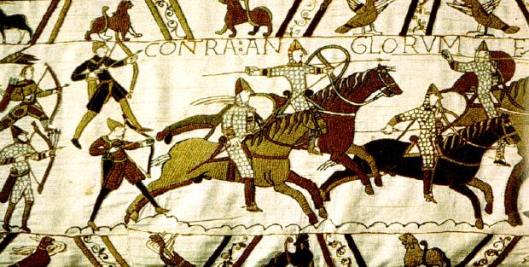
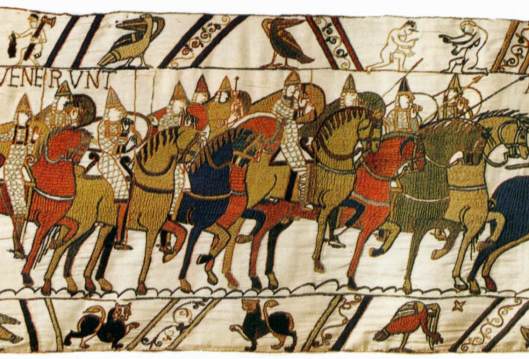
As much as we are interested in the subject, what has caught our attention now is the look—here are soldiers from the same period as the Anglo-Saxon model for the Rohirrim, after all, but, although archers are depicted on the Norman side, and a few infantry, the Normans are mainly shown as horsemen.

WebPage-ImageF.00070.jpeg

Here is our first sight of the Rohirrim in The Two Towers, Chapter 2, “The Riders of Rohan”:

“Their horses were of great stature, strong and clean-limbed; their grey coats glistened, their long tails flowed in the wind, their manes were braided on their proud necks. The Men that rode them matched them well: tall and long-limbed; their hair, flaxen-pale, flowed under their light helms, and streamed in long braids behind them; their faces were stern and keen. In their hands were tall spears of ash, painted shields were slung at their backs, long swords were at their belts, their burnished shirts of mail hung down upon their knees.”

05bayeux.jpg

Minus the grey horses and the braids, what do you think, dear readers?


As ever, thanks for reading.

CD

MTCIDC


PS

That MTC will be Feudal Array.2, in which we consider the other forces opposing Mordor…


Feudal-Earth?

13 Wednesday Jan 2016

Posted by Ollamh in Artists and Illustrators, Economics in Middle-earth, Fairy Tales and Myths, J.R.R. Tolkien, Literary History, Military History, Military History of Middle-earth, Narrative Methods

≈ 2 Comments

Tags

Bayeux Tapestry, feudalism, Gondor, Medieval, Prince Valiant, The Lord of the Rings, Tolkien

Welcome, dear readers, as always!

In this posting, we want to think out loud about something which has puzzled us for some time. Regular readers must know by this time that, along with literature of various times and places, we’re also very much interested in world history, from its human beginnings all the way up to the present. As those of you who have read past postings know, we have sometimes tried to apply our interest (and, we hope our knowledge) to the works of one of our favorite fantasy authors, JRR Tolkien. In our last posting, for example, we have spent a little time considering the 20th-century world of dictators and how they might have influenced JRRT’s depiction of Sauron and his plans.

In this posting, we want to look at something we’ve touched upon some time in the past, the economic/social structure of Middle Earth (or Middle-earth as it sometimes seems to appear). After all, kingdoms don’t just magically appear and survive: or, in Middle Earth, do they? For fun, we wondered what we might find in The Lord of the Rings which would remind us of our own Middle Ages.

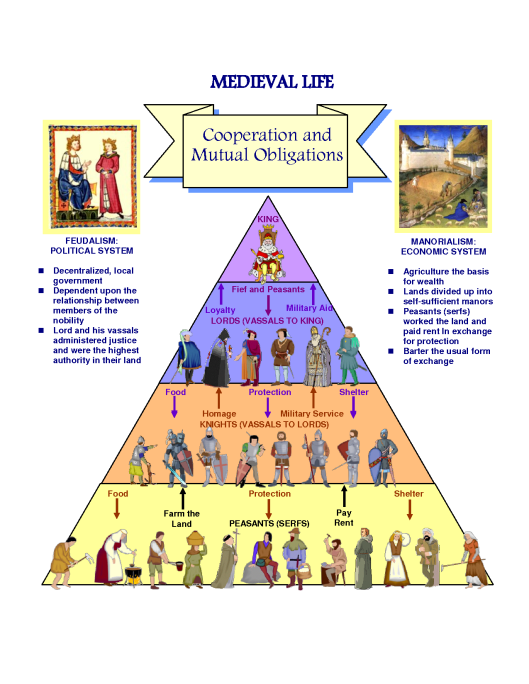
In our world, particularly in western Europe , this is the period which appears physically similar to the end of the Third Age (minus Elves, etc), and, in this period, we find a social/economic structure called feudalism. There has been a great deal of scholarly discussion as to where the base word, feud comes from, but the structure is pretty basic and goes like this (with apologies to all actual medievalists for the gross simplification):

feudalsystemchart.png

At base, it’s all about two things: land and soldiers.

At the top—the very top—is God, who owns everything. He chooses a king (this comes down to us under the heading of “the divine right of kings” and is similar to “the mandate of heaven” in Chinese history). The king then claims that, because of his position as the Chosen One, he owns all of the land in the country. This land, however, he divides, keeping some for himself, but giving large portions to his chief nobles (the Church also owns a large chunk, but, as religion is rather subterranean in Middle Earth, we’ll leave it at that). They, in turn, divide it among lesser nobles (family members and/or those loyal to them), who, in turn, divide it among the lowest level of nobility (often knights). The simplest parcel is a manor and a knight may hold just one or more than one and this is true all the way up the chain.

4186733_orig.jpg

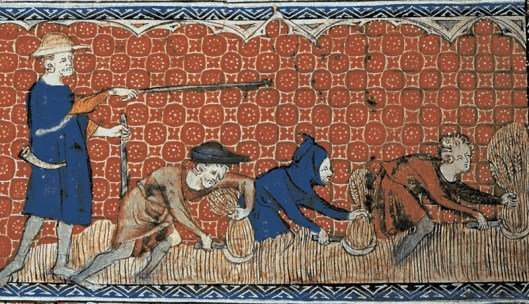
Each manor, in turn, has various grades of inhabitants, from freeholders, who own land but pay taxes on it, to peasants who are free, but are landless and have to work for others, and serfs, who are nothing more than slaves and considered part of the property. Even freemen might still owe an obligation in the form of labor to the lord of the manor.

Reeve_and_Serfs.jpg

In return for a manor or for many manors, the nobles at every level owed the king military service.

Sir_Geoffrey_from_LPsalter.jpg

This was necessary, since, with the exception of a certain number of household troops or bodyguards, kings couldn’t afford to keep standing armies on their own.

When we began wondering if we could find traces of feudalism in Middle Earth, we thought first about titles. As we said, there are kings, so could we add to them “sirs”, “knights”, “lords”, and such? The densest patch of those would seem to be in The Return of the King, Chapter 1, “Minas Tirith”. Almost at the end of the chapter, Pippin and Beregond’s son, Bergil, watch reinforcements march into the city. Here we can list leaders, almost every one seeming to be a major landowner, judging by the number of his military followers, and all but one called “lord” : Forlong, Dervorin (“son of their lord”), Golasgil, and last and most feudal-like, Imrahil, Prince of Dol Amroth, who comes with “a company of knights in full harness”.

This last reminded us of an earlier posting, when we wondered whether JRRT had ever seen the Prince Valiant comic strip, which occasionally had scenes like this:

Prince-Valiant-10-2-38.jpg


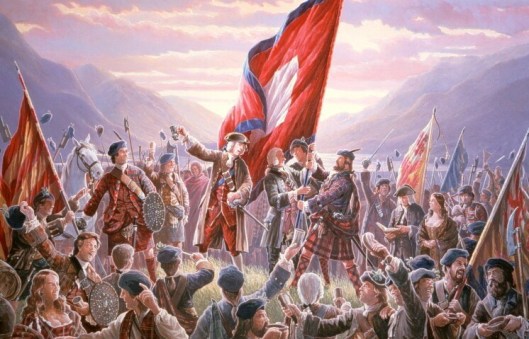
Our other thought was this sounded rather like a combination of men entering the Alamo and a gathering of the clans.

raising-the-standard-at-glenfinnan-1745-jacobite-rebellion.jpg

To gain a portion of land, all levels of nobles swore oaths of loyalty (called fealty, from Latin fidelitas, through Old French, the legal language of England after the Norman conquest) to those who gave them that land and that oath was commonly done publically and was legally binding.

There were different ways of confirming the earnestness of the person swearing. An altar or saint’s reliquary might be used, as seems to be the case from this scene on the “Bayeaux Tapestry”, in which Harold swears a sacramentum (a “sacred oath”, so Norman propaganda would afterwards claim) to be the vassal (sworn man) of Duke William of Normandy.

Bayeux_Tapestry_scene23_Harold_sacramentum_fecit_Willelmo_duci.jpg


Oaths might take the form of the receiver placing his hands between those of the giver and swearing.

1274514-miniature-depicting-a-knight-receiving-his-sword-from-the-king-guillaume-dorange.jpeg


An extremely useful site (www.dragonbear.com) provides a number of examples of the oath, which, while varying greatly through time and place, can be encapsulated in this version, from “The Laws of Alfred, Guthrum, and Edward the Elder”:

“Thus shall a man swear fealty oaths.

By the Lord, before whom this relic is holy, I will be to ____ faithful and true, and love all that he loves, and shun all that he shuns, according to God’s law, and according to the world’s principles, and never, by will nor by force, by word nor by work, do ought of what is loathful to him; on condition that he keep me as I am willing to deserve, and all that fulfil that our agreement was, when I to him submitted and chose his will.”

Compare this with Pippin’s oath to Denethor, after Pippin offers his sword to him:

“Here do I swear fealty and service to Gondor, and to the Lord and Steward of the realm, to speak and to be silent, to do and to let be, to come and to go, in need or plenty, in peace or war, in living or dying, from this hour henceforth, until my lord release me, or death take me, or the world end. So say I, Peregrin son of Paladin of the Shire of the Halflings.” (The Return of the King, Chapter 1, “Minas Tirith”)

There is no transfer of land involved here, but certainly there is military service.

JRRT, for all of the amazing detail which he put into Middle Earth, was content, it would seem, to leave it at that: there are kings to whom oaths are sworn, and that idea comes from feudal oaths. There are knights and lords—who else would be in charge of this quasi-medieval world (except, of course, among the non-men—elves, dwarves, and hobbits)? At the same time, this is a huge and wonderfully entertaining adventure, not a disguised treatise on the economic and social substructure of a mirror of the western Middle Ages, as interesting as, if anyone, Tolkien, could have made even that. It is fun, however, to spend a moment imagining what, given another ten years and several more drafts, Middle Earth might have looked like… As always, we ask: what do you think?

Thanks, as always, for reading.

MTCIDC

CD

← Older posts
Newer posts →

The Doubtful Sea Series Facebook Page

The Doubtful Sea Series Facebook Page

  • Ollamh

Categories

  • Artists and Illustrators
  • Economics in Middle-earth
  • Fairy Tales and Myths
  • Films and Music
  • Games
  • Heroes
  • Imaginary History
  • J.R.R. Tolkien
  • Language
  • Literary History
  • Maps
  • Medieval Russia
  • Military History
  • Military History of Middle-earth
  • Narnia
  • Narrative Methods
  • Poetry
  • Research
  • Star Wars
  • Terra Australis
  • The Rohirrim
  • Theatre and Performance
  • Tolkien
  • Uncategorized
  • Villains
  • Writing as Collaborators
Follow doubtfulsea on WordPress.com

Across the Doubtful Sea

Recent Postings

  • Through a glass… January 7, 2026
  • Heffalumps? December 31, 2025
  • We Three Kings December 24, 2025
  • A Moon disfigured December 17, 2025
  • On the Roads Again—Once More December 10, 2025
  • (Not) Crossing Bridges December 3, 2025
  • On the Road(s) Again—Again November 26, 2025
  • On the Road(s) Again November 19, 2025
  • To Bree (Part 2) November 12, 2025

Blog Statistics

  • 104,109 Views

Posting Archive

  • January 2026 (1)
  • December 2025 (5)
  • November 2025 (4)
  • October 2025 (5)
  • September 2025 (4)
  • August 2025 (4)
  • July 2025 (5)
  • June 2025 (4)
  • May 2025 (4)
  • April 2025 (5)
  • March 2025 (4)
  • February 2025 (4)
  • January 2025 (5)
  • December 2024 (4)
  • November 2024 (4)
  • October 2024 (5)
  • September 2024 (4)
  • August 2024 (4)
  • July 2024 (5)
  • June 2024 (4)
  • May 2024 (5)
  • April 2024 (4)
  • March 2024 (4)
  • February 2024 (4)
  • January 2024 (5)
  • December 2023 (4)
  • November 2023 (5)
  • October 2023 (4)
  • September 2023 (4)
  • August 2023 (5)
  • July 2023 (4)
  • June 2023 (4)
  • May 2023 (5)
  • April 2023 (4)
  • March 2023 (5)
  • February 2023 (4)
  • January 2023 (4)
  • December 2022 (4)
  • November 2022 (5)
  • October 2022 (4)
  • September 2022 (4)
  • August 2022 (5)
  • July 2022 (4)
  • June 2022 (5)
  • May 2022 (4)
  • April 2022 (4)
  • March 2022 (5)
  • February 2022 (4)
  • January 2022 (4)
  • December 2021 (5)
  • November 2021 (4)
  • October 2021 (4)
  • September 2021 (5)
  • August 2021 (4)
  • July 2021 (4)
  • June 2021 (5)
  • May 2021 (4)
  • April 2021 (4)
  • March 2021 (5)
  • February 2021 (4)
  • January 2021 (4)
  • December 2020 (5)
  • November 2020 (4)
  • October 2020 (4)
  • September 2020 (5)
  • August 2020 (4)
  • July 2020 (5)
  • June 2020 (4)
  • May 2020 (4)
  • April 2020 (5)
  • March 2020 (4)
  • February 2020 (4)
  • January 2020 (6)
  • December 2019 (4)
  • November 2019 (4)
  • October 2019 (5)
  • September 2019 (4)
  • August 2019 (4)
  • July 2019 (5)
  • June 2019 (4)
  • May 2019 (5)
  • April 2019 (4)
  • March 2019 (4)
  • February 2019 (4)
  • January 2019 (5)
  • December 2018 (4)
  • November 2018 (4)
  • October 2018 (5)
  • September 2018 (4)
  • August 2018 (5)
  • July 2018 (4)
  • June 2018 (4)
  • May 2018 (5)
  • April 2018 (4)
  • March 2018 (4)
  • February 2018 (4)
  • January 2018 (5)
  • December 2017 (4)
  • November 2017 (4)
  • October 2017 (4)
  • September 2017 (4)
  • August 2017 (5)
  • July 2017 (4)
  • June 2017 (4)
  • May 2017 (5)
  • April 2017 (4)
  • March 2017 (5)
  • February 2017 (4)
  • January 2017 (4)
  • December 2016 (4)
  • November 2016 (5)
  • October 2016 (6)
  • September 2016 (5)
  • August 2016 (5)
  • July 2016 (5)
  • June 2016 (5)
  • May 2016 (4)
  • April 2016 (4)
  • March 2016 (5)
  • February 2016 (4)
  • January 2016 (4)
  • December 2015 (5)
  • November 2015 (5)
  • October 2015 (4)
  • September 2015 (5)
  • August 2015 (4)
  • July 2015 (5)
  • June 2015 (5)
  • May 2015 (4)
  • April 2015 (3)
  • March 2015 (4)
  • February 2015 (4)
  • January 2015 (4)
  • December 2014 (5)
  • November 2014 (4)
  • October 2014 (6)
  • September 2014 (1)

Blog at WordPress.com.

  • Subscribe Subscribed
    • doubtfulsea
    • Join 78 other subscribers
    • Already have a WordPress.com account? Log in now.
    • doubtfulsea
    • Subscribe Subscribed
    • Sign up
    • Log in
    • Report this content
    • View site in Reader
    • Manage subscriptions
    • Collapse this bar
 

Loading Comments...