• About

doubtfulsea

~ adventure fantasy

Tag Archives: The Lord of the Rings

Contraption

27 Wednesday Dec 2017

Posted by Ollamh in Economics in Middle-earth, J.R.R. Tolkien, Narrative Methods

≈ Leave a comment

Tags

Bag End, Barbegal, Birmingham, Caillebotte, contraptions, haymows, Hobbiton, machines, mill, plowing, reaping, Roman bread, Sandyman's Mill, Sarehole, Sarehole Mill, Saruman, sowing, The Lord of the Rings, The Shire, Tolkien, water mill, wheels, winnowing

Welcome, as always, dear readers.

Although we think we might have another post or two on things in Bilbo’s hall, we thought it would be fun to take a break and look elsewhere in Middle-earth.

In a posting long ago now, we looked at Saruman and his attempt to ruin the Shire.  Cutting down trees was certainly part of his plan, as Farmer Cotton tells the hobbits:  “They cut down trees and let ‘em lie” (The Return of the King, Book Six, Chapter 8)  There was much worse, however, as he continues:

“Take Sandyman’s mill now.  Pimple knocked it down, almost as soon as he came to Bag End.  Then he brought in a lot o’ dirty-looking men to build a bigger one and fill it full o’ wheels and outlandish contraptions.”

“Wheels” made us think of two things:

  1. Fangorn’s description of Saruman himself: “He has a mind of metal and wheels” (The Two Towers, Book Three, Chapter 4, “Treebeard”)
  2. and, secondly, just what level of technology Middle-earth actually has

JRRT himself wrote of Hobbits, in the Prologue to The Lord of the Rings:

“They do not and did not understand or like machines more complicated than a forge-bellows, a water-mill, or a hand-loom, though they were skilful with tools.”

As far as authentic depictions, we have one, by Tolkien himself, in this picture of Hobbiton.

image1hobbitonmill.jpg

Presumably, that’s the Sandyman mill in the foreground.  You can see in the left middleground what appear to be hay stacks (also called “haymows”) which rather resemble these from a painting by Caillebotte (whose work appeared in our posting on umbrellas) and are where the material saved from the growing/reaping cycle is stored.

image2haystackscaillebotte.jpg

The whole process for what eventually gets to the mill begins with plowing the land and sowing the seed (and keeping off the birds, if possible).
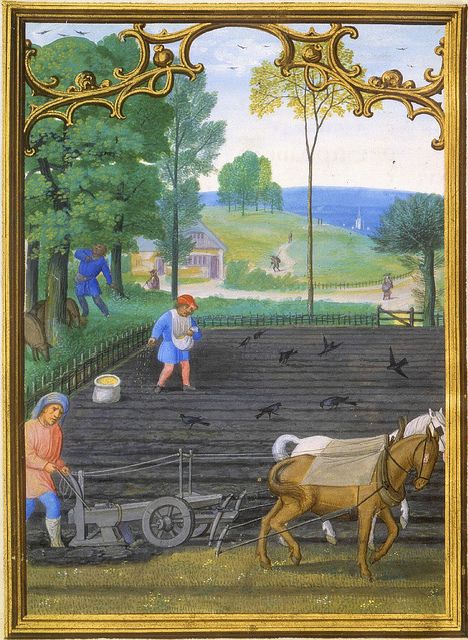
image3plowing.jpg

Then, when the grain is ripe, it is reaped and stacked.

image4reapingstacking.jpg

At this point, the grain is still on the stalk and needs to be detached.  This is done by flailing it.

image5flailing.jpg

At that point, however, it’s still in its beard

image6wheatinbeard.jpg

and the kernels of wheat need to be shaken free by the process called winnowing.  This can be done by a number of methods, but the easiest includes using the air currents to help remove the hull (the chaff—and, if you know the expression “to separate the wheat from the chaff”, now you also know where it comes from).

image7winnowing.jpg

Now, when you finally have the pure grain, the next step is to grind it to a powder.  The most ancient method (still used for crushing grain in some parts of the world) is this—

image8quernstone.jpg

But the Romans sped this up with a kind of early machine, both slave-driven and animal-propelled—

image9slave.jpg

image10animal.jpg

The flour (pretty coarse and gritty, we understand—which wore down people’s teeth) was then mixed with water and baked

image11bakingprocess.jpg

and sold as this.image12.jpg

(This is real Roman bread—abandoned in an oven when Vesuvius exploded and found many centuries later, still in the oven.)  Some bakers liked to label their bread, as you can see, with a special name stamp.

image13breadstamp.jpg

In time, some clever Roman got the idea that there might be a more efficient method than slaves and animals and harnessed water as a power source and even occasionally harnessed it more than once, as here, at Barbegal, in southern France.

image14multiplemill.jpg

This technology does not appear to have been lost along with so much else of the Roman world and continued to be used in later centuries.

image15irishmill.jpg

As you can see from this illustration, the basic idea is simple:  the water is channeled to pour over the paddles of the wheel, thus turning it.  The turning motion is then conveyed through a series of gears until it spins the upper stone of the two millstones, thus grinding the grain.

image16romanmill.jpg

There are several types of wheel:  overshot, breast, undershot, and pitchback.
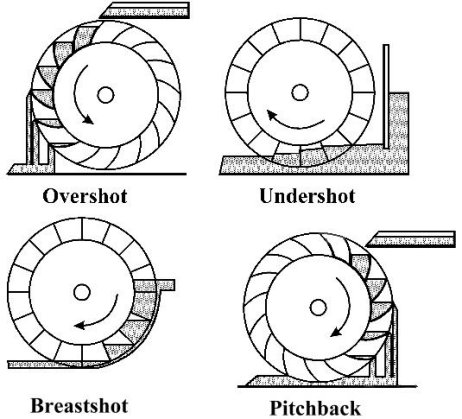
image17typesofwheel.jpg

Our research suggests that the overshot is the most powerful—but, as you can see in JRRT’s illustration, the Hobbiton mill is of the undershot variety.

image18hobbiton.jpg

Tolkien’s model for this is assumed to have been the Sarehole Mill, in the village of Sarehole, south of Birmingham, where his mother took him and his brother to live, for about 4 years in the late 1890s, in this house.

image19tolkienhouse.jpg

From its front door, he could look across and see this mill—here’s a 1905 postcard of the mill.

image20sareholemill1905.jpg

After a certain amount of searching, we still can’t tell what kind of wheel Sarehole had in Tolkien’s day, but there are certainly some other strong differences visible between it and the Hobbiton mill.  First, of course, there’s that chimney on Sarehole, which was installed in 1852 as part of the addition of a steam engine to the mill’s older water-driven system.  (Is this one of the “outlandish contraptions” Farmer Cotton complains about?)  But perhaps this suggested the tower on the left of the Hobbiton mill?  Second, and a little stranger, might be those round windows—although we might see these as a quiet joke:  just as an older Hobbit hole, like Bag End, had such windows, so it might be fitting for a Hobbit mill to have them, too?

Thanks, as ever, for reading.

MTCIDC

CD

ps

Here’s a LINK, by the way, to a 1966 interview with JRRT about his early years in Sarehole.

Throwing Shade

20 Wednesday Dec 2017

Posted by Ollamh in Artists and Illustrators, J.R.R. Tolkien, Narrative Methods

≈ Leave a comment

Tags

A Day: Paris In the Rain, Adelard Took, Assyrians, Bag End, Bilbo Baggins, bowler hat, ceramic chariot, China, city gent, CS Lewis, elephant, Emperor Ch'in Shihuang, Greeks, Gustave Caillebotte, Jean Marius, John Howe, Jonas Hanway, Lobelia Sackville-Baggins, Marchesa Elena Grimaldi, Mary Poppins, Monty Python, Palais Galleria, Persians, Romans, Sharkey, The Hobbit, The Lord of the Rings, The Ministry of Silly Walks, Tolkien, umbrella, umbrella stand, Un Jour: Paris sous la Pluie, van Dyck

Welcome, dear readers, as always and, if you’re in the US, we hope you’ve had a happy and not over-stuffed Thanksgiving.

Just when we think we’ve exhausted a topic, we return and, well, here we are.

image1entryway.png

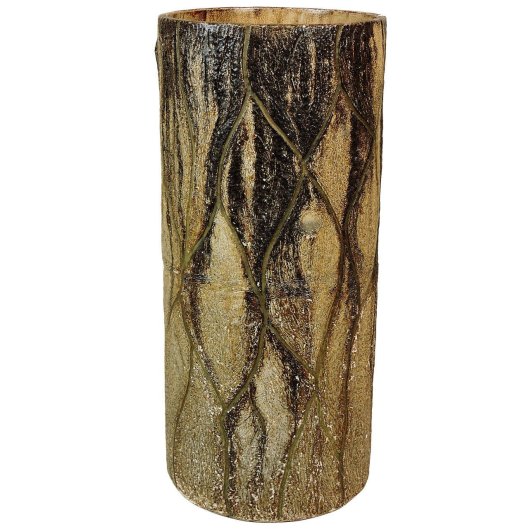
Just to the left of the door and below what we now see as a barometer, there’s a tall tube-like structure, something once common—we wouldn’t be surprised if there was one in every house in which JRRT ever lived:  an umbrella stand.image2aumbrellastand.jpeg

As a child, one of us was fascinated by having once seen an umbrella stand made out of an elephant’s lower leg and foot—or at least the skin.

image2belephant.jpg

The couple we’ve seen are all identified as “Victorian”, so, as we are very fond of pachyderms, we hope that such a use is now long in the past!

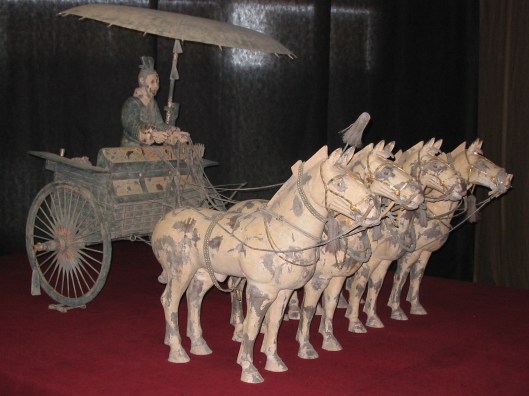
Umbrellas, at least as sunshades, appear to have been around since at least before 200BC in China, as this ceramic chariot—with large umbrella—from part of the tomb complex of the Emperor Ch’in Shihuang demonstrates.

image2chin.jpeg

The Assyrians had them.

image3ashurbanipal.jpg

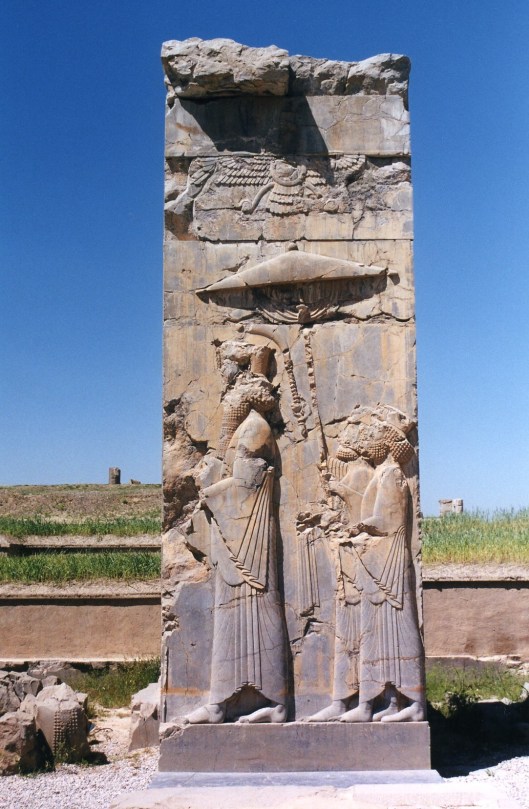
The Persians had them.

image4darius.jpg


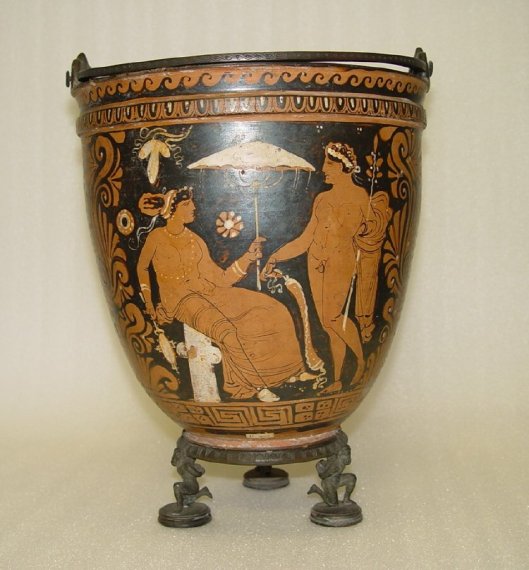
The Greeks had them.

image5greek.jpg

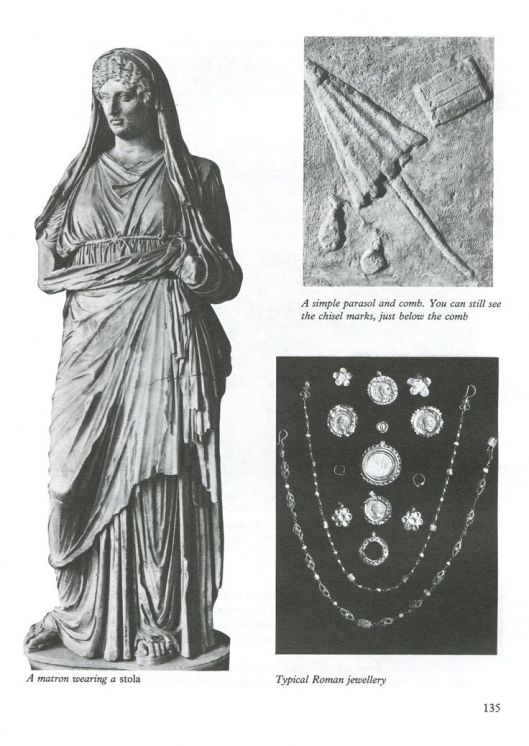
As did the Romans.

image6aroman.jpg

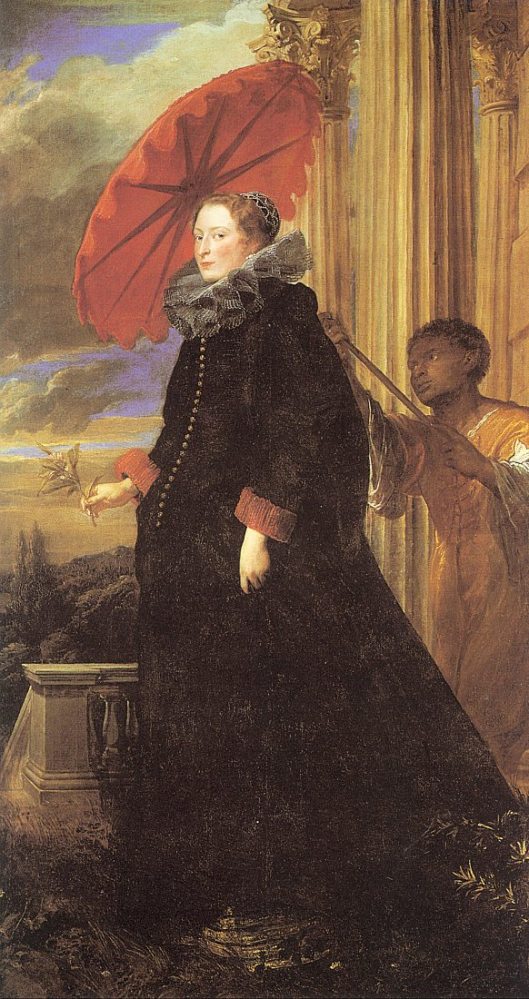
And so on for centuries, although it seems that the first modern references to them in England date from the early 17th century and appear, by the latter part of the century and into the 18th as part of “ladies’ apparel”, used as much for sun as rain as this 1623 portrait by van Dyck of the Marchesa Elena Grimaldi shows us.

image6elenagrimaldi.jpg

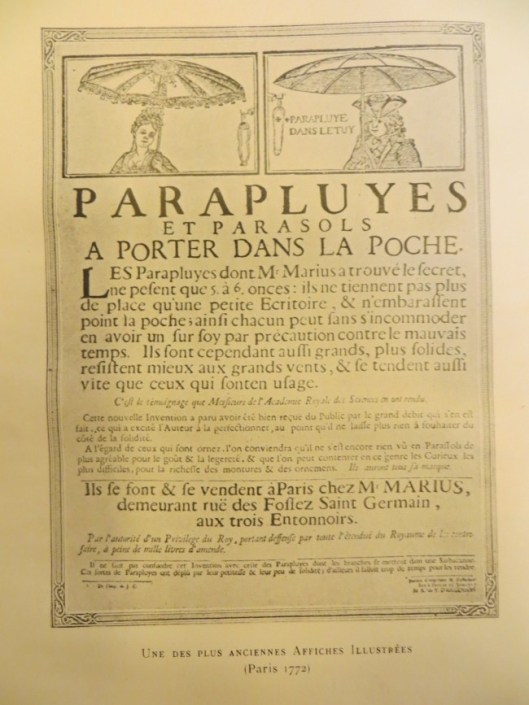
A center for the manufacture of umbrellas was Paris, and the inventor of the modern collapsible model may have been Jean Marius, who received a 5-year monopoly on his invention in 1710.  Here is a later (1772) advertisement for his business

image7mariusadvert.jpg

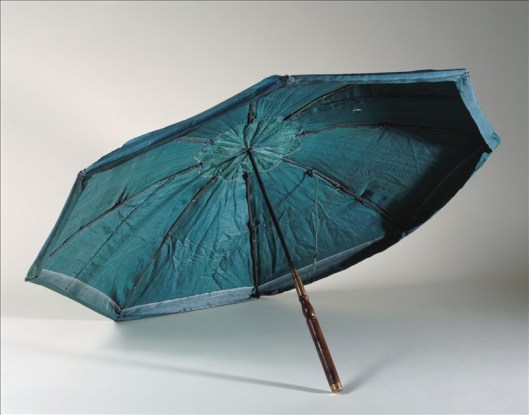
and here is a model, identified by the Palais Galleria in Paris as post-1715 because it has no Marius markings.

image8post1715.jpg

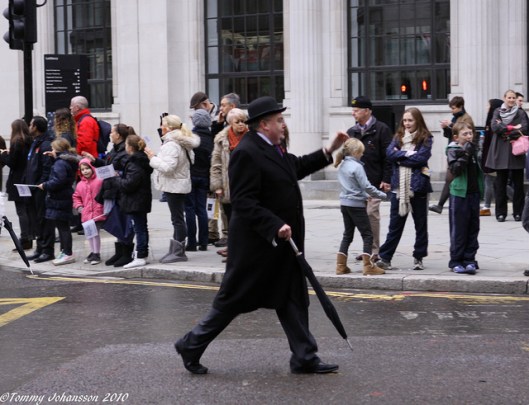
If there was a prejudice against men carrying them, being a combination of the association with “feminine things” and perhaps also a long-standing prejudice against the French, how did that so change that, by the 20th century, the umbrella, along with the bowler hat, became the marks of the “city gent” in London,

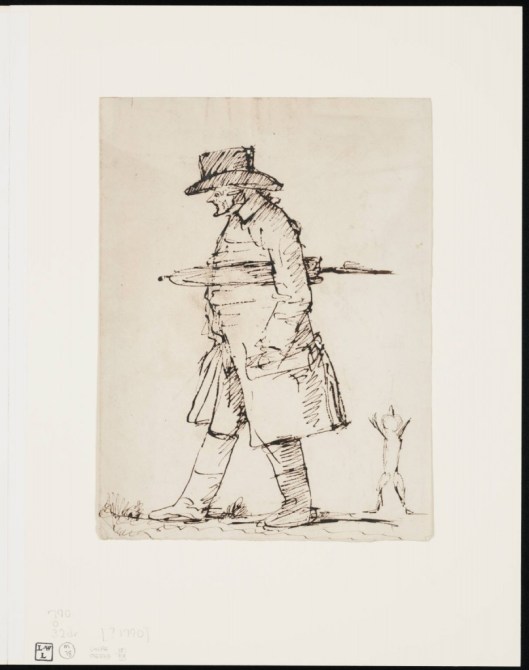
image9acitygent.jpg

caricatured in the 20th century by Monty Python in skits like “The Ministry of Silly Walks”?

image9minister.jpg

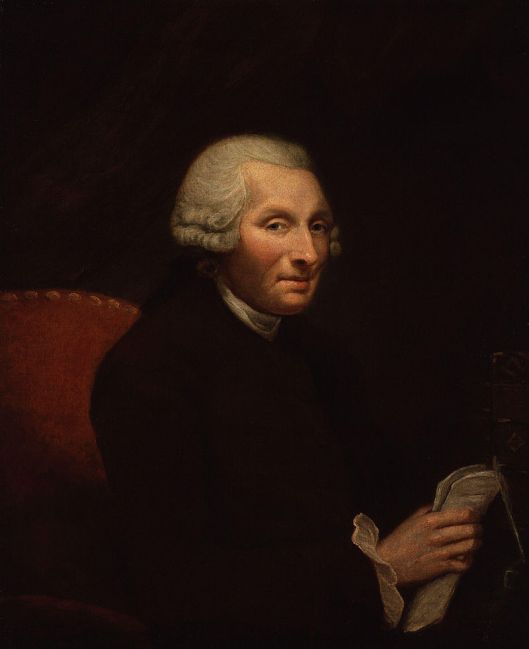
This change is said to stem from the behavior of one rather eccentric man, Jonas Hanway

image10jonashanway.jpg

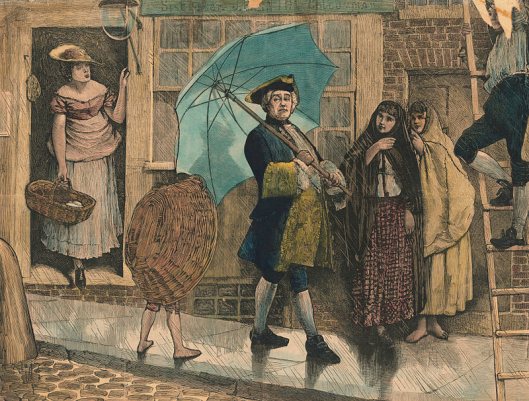
who, sometime in the 1750s, began to appear on London streets carrying an open umbrella.

image11hanwaywithbrolly.jpg

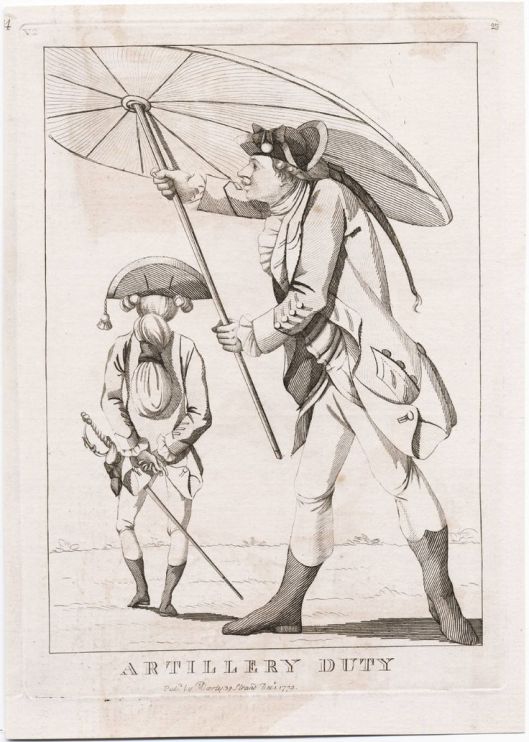
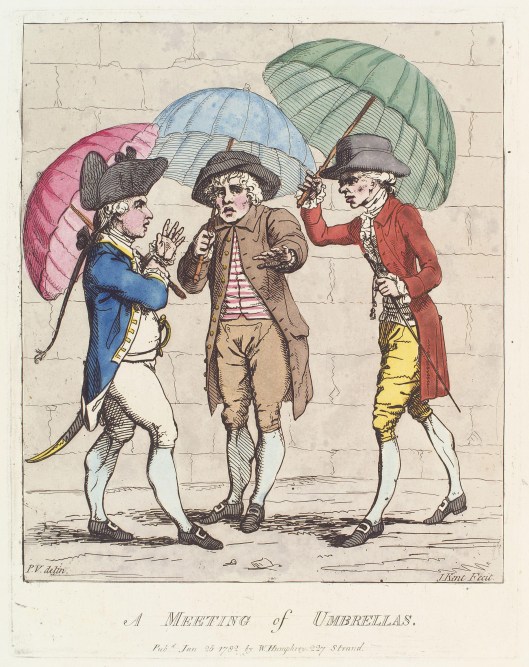
As you, sharp-eyed reader, can tell from our verbs and constructions like “seems”, “appears” and “is said to”, this, like other items of fashion and its changes, hasn’t the firmest of scholarly foundations, but, considering how many illustrations (often mocking cartoons) begin to appear by the 1770s, something happened to alter men’s behavior. Just look at these three, from 1772, 1782, and 1790.

image12seventeenseventrytwo.jpg

image13seventeeneightytwo.jpg

image14seventeenninety.jpg

All of this is very interesting, you may ask, but what does it have to do with Bilbo, or with JRRT?  There are, in fact, a couple of references in The Lord of the Rings to umbrellas.  First, there is one of Bilbo’s mocking gifts:

“For Adelard Took, for his very own, from Bilbo; on an umbrella.  Adelard had carried off many unlabeled ones”.  (The Fellowship of the Ring, Book One, Chapter 1, “A Long-Expected Party”)

Then there are two to Lobelia Sackville-Baggins.  The first is suggestive of her suspicious behavior at the near-auction of Bilbo’s property at the end of The Hobbit (you’ll remember that some spoons never reappeared):

“He [Bilbo] escorted her [Lobelia] firmly off the premises, after he had relieved her of several small (but rather valuable) articles that had somehow fallen inside her umbrella.” (The Fellowship of the Ring, Book One, Chapter 1, “A Long-Expected Party”)

The second reference is actually rather pathetic.  Once “Sharkey” and his thugs take over the Shire, they evict Lobelia from Bag End and, because she resists, they drag her off to the Lockholes, as young Tom Cotton tells Merry and the others:

“She comes down the lane with her old umbrella…”

When told that “Sharkey” gave the order for her eviction (and the building of sheds at Bag End):

“ ‘I’ll give you Sharkey, you dirty thieving ruffians!’ says she, and ups with her umbrella and goes for the leader, near twice her size.” (The Return of the King, Book Six, Chapter 8, “The Scouring of the Shire”)

Here’s a little illustration of a defiant Lobelia by John Howe.

image15lobelia.jpg

By the later 19th century, men with umbrellas seem quite common—even to the point of providing material for social commentary in the public press—

image16umbrellatypes.jpg

But, in the 20th century, we who love children’s literature see them in a completely different way, either as a mode of transportation

image17mpoppins.jpg

or as part of the origin of a favorite story, when CS Lewis, at 16, had a recurring image of “a Faun carrying an umbrella and parcels in a snowy wood” (from It All Began with/as a Picture). (We’ve seen the title cited both ways.)

image18tumnusandlucy.jpg

But we want to end this posting not with literature, but with pure art.  There are lots of paintings from the 18th and 19th centuries with umbrellas, but here is what may be our favorite, by Gustave Caillebotte (1848-1894).  Although he is grouped with the Impressionists, this painting in particular shows the artist’s interest in the hard-edged world of early photography (“Un Jour:  Paris sous la Pluie”—“A Day:  Paris In the Rain”)

image19caillebotte.jpg

Stay dry, dear readers, and thanks, as ever for reading!

MTCIDC

CD

Pop!

13 Wednesday Dec 2017

Posted by Ollamh in J.R.R. Tolkien, Military History, Military History of Middle-earth, Narrative Methods

≈ Leave a comment

Tags

anachronism, Bag End, gun, gunpowder, hand gonne, Helm's Deep, pop-gun, Professor Moriarity, Reichenbach Falls, Rosenbach Library, Sherlock Holmes, Sir Arthur Conan Doyle, The Adventure of the Empty House, The Hobbit, The Hound of the Baskervilles, The Lord of the Rings, Tolkien, Trev's Air Gun Scrapbook

Welcome, as always, dear reader.

The anachronisms in the 1937 Hobbit are well known:  “cold chicken and tomatoes”, “like the whistle of an engine coming out of a tunnel”, etc.  We ourselves have contributed to the commentary in several past postings and here we are again.

This time, we were caught by something Gandalf says to Bilbo in Chapter 1:

“It is not like you, Bilbo, to keep friends waiting on the mat, and then open the door like a pop-gun” (The Hobbit, Chapter 1, “An Unexpected Party”)

So, “pop-gun”?

Just previously, Bilbo was described as pulling open “the door with a jerk” (and in tumble 4 dwarves), which suggests what the pop-gun sounds like, as well as how sudden the motion.

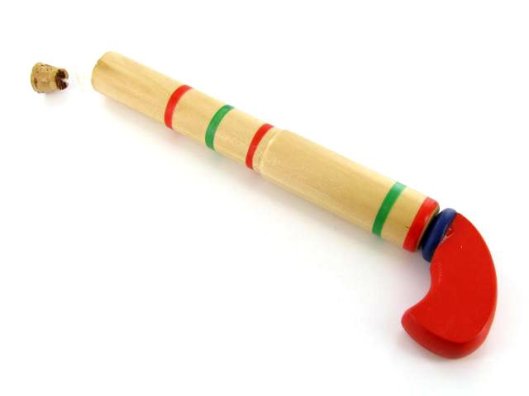
How is that sound made?  Here’s an example of such a gun.

image1popgun.jpg

As you can see, it’s just a tube.  Inside is a kind of plunger—a rod with a flattened end which faces towards the muzzle (the opening at the left).  You pull back the rod and it draws air into the barrel.  If you stick a cork in the muzzle, so that it makes a seal, when the rod is pushed up the barrel, the flattened rod end pushes the air in front of it, compressing it.  The compressed air then forces out the cork, which shoots out with a POP!

For all that it uses air to propel the cork, this is, as its name implies, a kind of gun.  Although there may be gunpowder in Middle-earth (see our earlier posting on the use of explosives at Helm’s Deep and the gate area of the Rammas Echor), it seems to be employed as the equivalent of dynamite,

image2helmsdeep.jpg

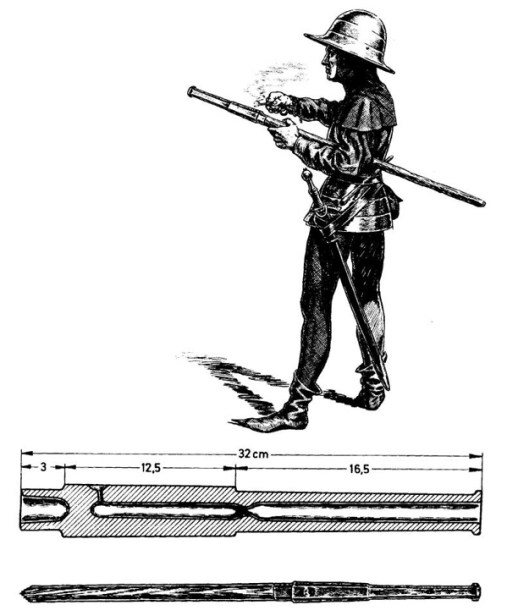
and never as the propulsive force in what medieval people in our world called a “hand gonne”.

image3handgonne.jpg

image4handgonne.jpg

And thus it falls into that category of anachronisms.  The idea of air guns, however, makes us think of the Daisy Air Rifle one of us had as a child.

image5daisy.jpg

The air was pulled in when the lever underneath the trigger was pulled down and then pushed back, to make it ready to fire.  The illustration fires bbs, but ours was more peaceful, firing cork balls.

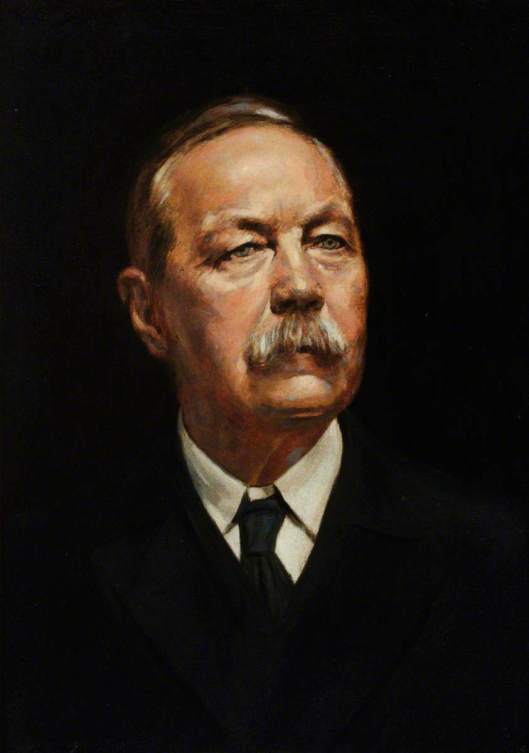
But a very unpeaceful version appears in Sir Arthur Conan Doyle’s

image6conandoyle.jpg

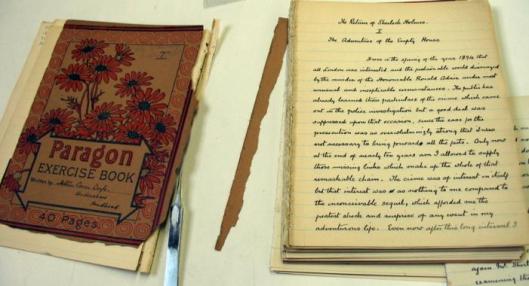
“The Adventure of the Empty House” (1903).  Here’s the first page of the manuscript, housed at the Rosenbach Library, in Philadelphia.  (And here’s a LINK to their excellent on-line magazine.)

image7ms.jpg

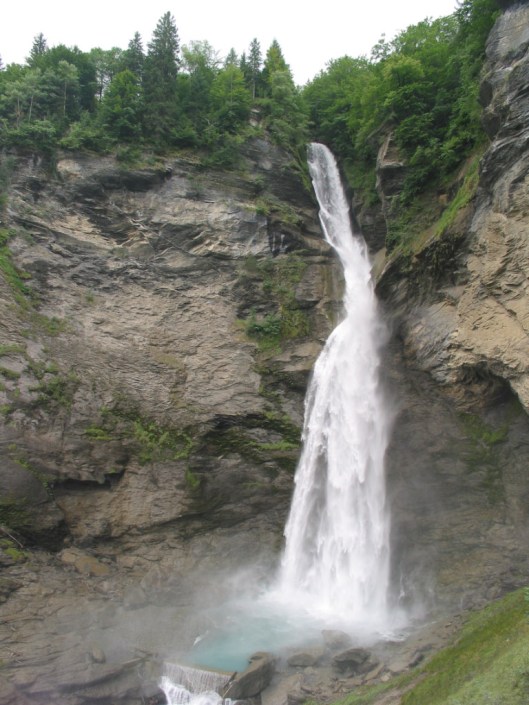
Sherlock Holmes had disappeared after his combat with Professor Moriarity at the Reichenbach Falls

image8reichenbach.jpeg

in Switzerland in 1891 (although the story in which this happens was published in The Strand Magazine in December, 1893).

image9moriarityholmes.jpg

For financial reasons, Conan Doyle brought Holmes back—first in the novel, The Hound of the Baskervilles in 1901,

image10hound.jpg

but this story was supposed to have taken place in 1889, two years before Holmes’ disappearance.  It was only with “The Adventure of the Empty House” that Holmes reappeared in contemporary London.  Here, it was revealed that Holmes had not fallen to his death with Moriarity, but had survived and had lived in disguise for some years, traveling the world and avoiding the vengeance of Moriarity’s men and, in particular, his chief lieutenant, Colonel Sebastian Moran, who had actually seen Holmes escape the clutches (literally) of Moriarity and had tried unsuccessfully to kill him with a fall of rock.

Back in London, Holmes appears to Watson and enlists his aid in trapping Moran, which Holmes does by placing a wax bust of himself in outline in the window of 221B Baker Street as a lure.  Holmes and Watson then wait across the street in an empty house (hence the title of the story), Holmes thinking that Moran will try to assassinate him from the street.  Instead, Moran climbs to the very room where the two are concealed and, opening a window, uses an air rifle to attempt to kill Holmes—before he’s tackled by the pair and subdued, with the aid of several policemen summoned from hiding nearby.

image11moranbroughtdown.jpg

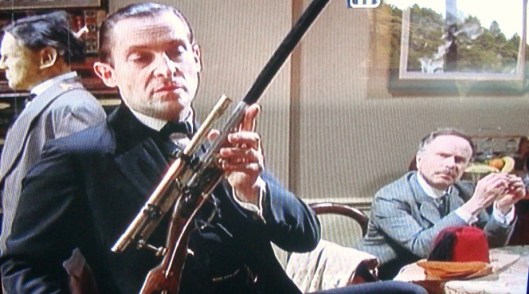
Moran, Holmes explains, was thought to be the best shot in India, where he had been stationed for some years, so it’s not surprising that he would attempt the long-distance murder of Holmes, but why an air gun?  (This is from the Granada television series of the 1980s, with the brilliant Jeremy Brett as Holmes.)

image12airgun.JPG

Air guns had first begun to appear in the 16th century, but, by the later 19th century could be either a toy, or a useful weapon for snipers, mainly because of its propulsion method.  Until the 1890s, the main propellant was gunpowder which, when fired, produced a loud bang and a cloud of white smoke.

image13martinihenry.jpg

Imagine, instead, a weapon which made much less noise—or a noise very unlike a gun’s BANG! (Conan Doyle has Watson describe the sound as “a strange loud whiz”)– and no smoke at all.  Perfect for a nighttime assassination, as Colonel Moran has planned it, never realizing that Holmes is well aware of his plan and foils it neatly (as Holmes almost always does).

In the 21st century, smokeless powder is the norm and air guns are now used for target shooting (including an Olympic event), and pop-guns?  Still for sale—just google “toy pop guns” at Amazon.com

image14popgun.jpg

or E-Bay and see what you find—something Bilbo never could!

Thanks, as ever, for reading.

MTCIDC

CD

Ps

If you’d like to know more about air guns, here’s a LINK for a great source, “Trev’s Air Gun Scrapbook”.

Floored

06 Wednesday Dec 2017

Posted by Ollamh in Artists and Illustrators, J.R.R. Tolkien, Narrative Methods

≈ Leave a comment

Tags

Bag End, Baggins, carpet, classical altars, Cosmati, English Ham House, Erasmus, Felicity Irons, floors, Gamgee, John Howe, Lady Chapel, paneling, parquetry, rush door mat, Shire, social levels, stone block, swags, The Hobbit, The Lord of the Rings, tile, Tolkien, Took, Typha, Versailles, Westminster Abbey

Welcome, dear readers, once more to our blog.  In this installment, we are returning to our inspection of Bilbo’s entryway.

image1entryway.jpg

So far, we’ve examined the barometer, the clock, the umbrella stand, and that hat in the left foreground—intentionally misread as a sugar loaf.  Now we want to examine the floor, which looks to be a pretty complicated place, asking ourselves, as we always do, where does this come from and how much of the medieval—so often the foundation of Middle-earth—does it contain?

The Shire clearly has social levels.  Bilbo, Frodo, and Merry and Pippin (contrary to P Jackson—who violated JRRT’s wishes on the subject of the latter two), for example, all speak (in translation, of course)  what is called “Received Standard English”.  In contrast, Sam, the Gaffer, and the Cottons speak what would appear to be a rural dialect and Sam even thinks of Frodo as “Mister Frodo” and even “Master”.   We do not know where these class distinctions came from, but we know of Bilbo that:

  1. he is called “a very well-to-do hobbit “ at the very beginning of The Hobbit (The Hobbit, Chapter 1, “An Unexpected Party”)
  2. he has distinguished forebears in the Tooks—his mother was “the famous Belladonna Took, one of the three remarkable daughters of the Old Took” (The Hobbit, Chapter 1, “An Unexpected Party”)
  3. he lives in an extensive, rambling burrow: “a very comfortable tunnel without smoke, with panelled walls, and floors tiled and carpeted…The tunnel wound on and on, going fairly but not quite straight into the side of the hill…bedrooms, bathrooms, cellars, pantries (lots of these), wardrobes (he had whole rooms devoted to clothes), kitchens, dining-rooms, all were on the same floor, and indeed on the same passage.” (The Hobbit, Chapter 1, “An Unexpected Party”)

And the entryway certainly shows some elements of a wealthier lifestyle, with its paneled (US spelling) walls—but we intend to devote a later posting to the walls and support structure of Bag End, so let’s turn to what is said next:  “floors tiled and carpeted”.  Looking at JRRT’s drawing, we can see both—and more.

image1entryway

Before we had gone back to this passage, we were a little puzzled as to the basic floor.  As you can see in Tolkien’s illustration, it’s in a checkered pattern and, at first, we wondered if this might be an example of what’s called “parquetry”.  In this method of flooring, different strips or blocks of wood are laid into designs of all sorts.  Here are a couple of fancy examples from the 17th-century English Ham House.

image3hamhouse.jpg

image4hamhouse.jpg

image5parquetry.jpg

Parquetry appears to have been developed in France, as an alternative to marble floors (much less weight to support by the floor beams and equally pretty, we’d guess).  Here’s an example from Louis XIV’s Versailles.

image6versailles.jpg

But the description in The Hobbit says “floors tiled”– here’s an exterior tile pattern from Ham house.

image7exteriortile.jpg

and an indoor one.

image8interiortile.jpg

So, although Bilbo appears well enough off to afford parquetry, there is no mention of it in JRRT’s description and it is a decorative detail from the 17th century and beyond, which rather goes against our usual “Middle-earth is (more or less) medieval” idea.  The text of The Hobbit clinches the fact that it’s tile, of course, but the tile we then see in JRRT’s illustration strikes us as even plainer than the late-19th, early 20th century hallway tile we’ve seen, as in this restoration picture, and with which Tolkien would have been familiar on a daily basis.

image9edwardianrestoration.jpg

Medieval tiles, in fact, can be even more elaborate, first appearing in England in the 13th century, mainly in ecclesiastical buildings.  Here’s one from the Lady Chapel (completed in 1373) in York Minster.

York-Lady-ChapellIV.jpg

Much medieval tiling has disappeared over the centuries and here’s a useful link which explains why.  And to see an amazing example of such work, here’s a link to the restored Cosmati paving in Westminster Abbey.

image12cosmati floor.jpg

Over this tile, Tolkien has laid a carpet (as his description has said, the floors are “carpeted”).

image12hall.jpg

It’s faint, but what one can make out appears to be a solid-colored center with what appear to be wreaths and what are called “swags”—long chains made to imitate garlands of ribbons, fruit, and flowers used to decorate classical altars.

image13swag.jpg

image14romanaltar.jpg

So far, we haven’t located anything which closely resembles the carpet at Bag End, but here’s an 18th-century French example to provide a kind of general idea.image13french.jpg

There are two more items on the floor, both just below the door.

image17hall.jpg

The first looks to be perhaps a stone block, used as a sill. (Our illustration is actually of a mistake—the central block here has fallen out of position, but it gives you the idea of such a block in use.)

image18doorsill.jpg

The other item appears to us to be a rush door mat (dog—“Bo”–optional).

SONY DSC


Rushes (genus Typha) grow all over the world and can be used, it seems, for almost anything.  Here’s the English rush weaver, Felicity Irons, busy harvesting.

image20firons.jpg

Rushes, however, bring us back to the subject of English medieval flooring.  Our research suggests that the houses of farmers and lower-level townspeople would have been of natural substances, like clay pressed to make a hard surface.  Richer people would have had wooden or even, in a few cases, tile floors (more such floors after the commercial business took off in the 15th/16th centuries).  Carpets appear to be much later (most weaving was hung on walls, to keep down drafts, it seems).  Our sources for what people laid on top of their floors are very sketchy and some modern writers have depended upon a quotation from the Dutch scholar, Erasmus (1469-1536),

image21erasmus.jpg

who visited England and spent some years there around 1500.  He tells us that the English covered their floors with rushes, but that they only added more to the top, without cleaning out the lower levels, which became full of refuse and caused bad smells (which to a person of Erasmus’ time represented the danger of “miasma”—bad air which could cause disease—something believed as scientifically true even throughout the first half of the 19th century).  Some modern commentators have questioned this, proposing the difficulty of moving about on a weedy floor in a long gown, as women and, in time, men, wore during the later Middle Ages.  At least one of those questioners even suggests that rushes meant rush mats—see above.

Bilbo’s hall has only one of these, meant, from its position, to be used as a modern would, as a doormat.

Taken altogether, we would suggest that Bilbo’s floor, just like his clock and barometer and umbrella stand, would appear to belong not to the medieval world which lies underneath Middle-earth, but rather to the late 19th-20th century world of the author.  And we’re not alone in our opinion.  Here’s John Howe’s version of that hallway—compare it with JRRT’s and see what’s been erased.

image22howe.jpg

image23jrrthall.jpgAnd here’s the film version–

image24film.jpg

There are more differences, too–for fun, see how many you can find.

And thanks, as always, for reading!

MTCIDC

CD

Orcked

22 Wednesday Nov 2017

Posted by Ollamh in Economics in Middle-earth, Imaginary History, J.R.R. Tolkien, Literary History, Narrative Methods

≈ Leave a comment

Tags

Arthur Rackham, Bosch, Brueghel, counterfeit, creation, Elves, Ents, Fangorn, Goblins, John Bauer, mockery, Orcs, Saruman, Sauron, The Hobbit, The Lord of the Rings, Tolkien, Treebeard, trolls, US Treasury Department, Weimar Republic

Welcome, dear readers, as always.

In our last, we discussed less familiar characters in The Lord of the Rings, the Corsairs of Umbar, and what we imagine they could look like.

In this posting, we want to look at much more familiar characters, Orcs—but from the viewpoint of Fangorn.

image1treebeard.jpg

He says of them:

“Maybe you have heard of Trolls?  They are mighty strong.  But Trolls are only counterfeits, made by the Enemy in the Great Darkness, in mockery of Ents, as Orcs were of Elves.”  (The Two Towers, Book Three, Chapter 4, “Treebeard”)

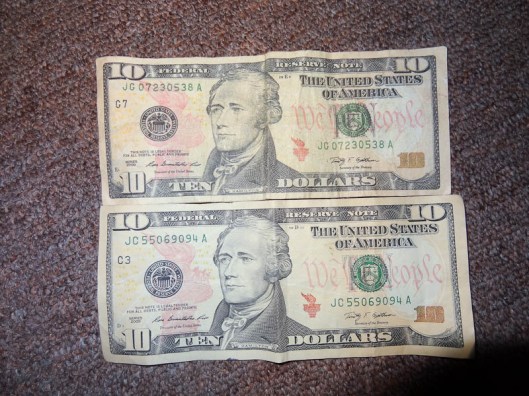
We’ve always been a bit puzzled by this.  “Counterfeit” makes us think, immediately, of counterfeit money.  Here are a pair of US 10-dollar bills:  can you tell the counterfeit (from Old French via a Latin compound, contra, “against” + facere, “make/do”—in Medieval Latin a contrafactio is a thing put against another, something in contrast, thus “imitation”)?

image2hamiltons.jpg

To be a successful counterfeit, normally, it’s necessary that the imitation be as close to the original as possible, as in the case of these two tens.  The US Treasury Department goes to a lot of time and expense to make counterfeiting as difficult as possible

image3anticounterfeit

but, if a counterfeiter is successful, he stands to make (in two senses) a lot of money.  He can also cause a great deal of financial damage, breeding distrust in a government’s ability to coin money and to stand behind it.  The more counterfeit money in the system, the more money the government has to back, which, in time, could lead to what is called hyperinflation and can bring a currency to collapse.  When a government does this itself it can cause havoc with a country’s economy, as happened in the Weimar Republic in 1921-1924.  At that time, for complex reasons having to do with paying off the German Empire’s war debts, the government began producing too much paper money and too rapidly.  This caused the money to lose value very quickly, rendering it almost worthless.

image4weimarmoney

It’s no wonder that the penalty for counterfeiting was usually the most severe possible.

image5tyburn

Treebeard’s use of the word “counterfeit”, then, would suggest that what Sauron was doing was trying to make nearly-exact copies of something, either Ents or Elves, in his creation of Trolls and Orcs.  So what do we find when we first see a description of Orcs?

“There were four goblin-soldiers of greater stature, swart, slant-eyed, with thick legs and large hands.”

(The Two Towers, Book Three, Chapter 1, “The Departure of Boromir”)

That’s not much to go on:

  1. “greater stature” would suggest that most Orcs were short
  2. “swart” means “dark-complexioned” (a term Sam uses to describe men from Harad, whom he calls “Swertings”—The Two Towers, Book Four, Chapter 3, “The Black Gate is Closed”)
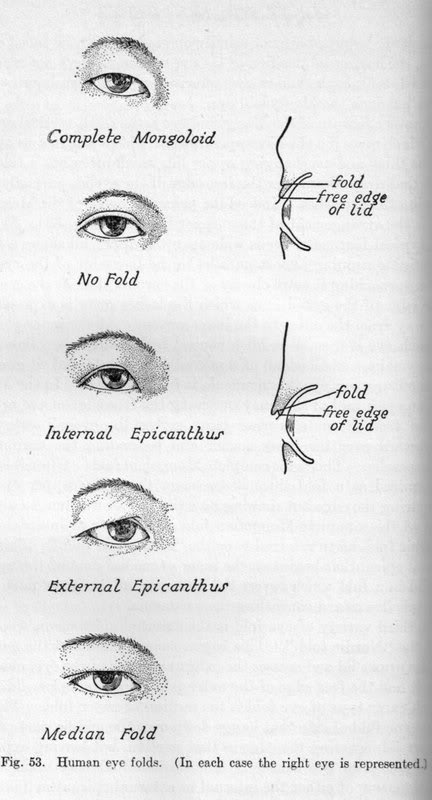
  3. “slant-eyed”—for contemporary people this is a tricky term, even a racial slur, but JRRT probably meant no more than that these Orcs had epicanthic folds to their eyelids, which is not uncommon among many of the world’s peoples.

image6epicanth

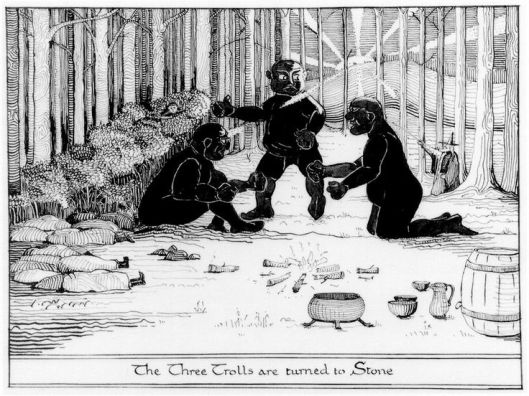
  1. “with thick legs and large hands” suggests very stocky builds—like the “Trolls turned to stone” in JRRT’s illustration of the scene in The Hobbit.

image7stonetrolls

This is a start, but will our next view help?  Pippin and Merry are the prisoners of the Orcs and Pippin is listening to a quarrel between those of Saruman and those of Sauron:

“In the twilight he saw a large black Orc, probably Ugluk, standing facing Grishnakh, a short crook-legged creature, very broad and with long arms that hung almost to the ground.” (The Two Towers, Book Three, Chapter 3. “The Uruk-hai”)

Counterfeit Elves?  Of course we know—also from Fangorn—that perhaps Saruman was up to something more, as Fangorn says of him:

“He has taken up with foul folk, with the Orcs.  Brm, hoom!  Worse than that:  he has been doing something to them; something dangerous.  For these Isengarders are more like wicked Men.  It is a mark of evil things that came in the Great Darkness that they cannot abide the Sun; but Saruman’s Orcs can endure it, even if they hate it.  I wonder what he has done?  Are they Men he has ruined, or has he blended the races of Orcs and Men?  That would be a black evil!” (The Two Towers, Book Three, Chapter 4, “Treebeard”)

This might account for the size of the Uruk-hai, as well as for their ability to endure daylight, but what about the crook-leggedness and “long arms that hung almost to the ground”?

Perhaps here we should remember the end of Fangorn’s description:  “…in mockery of Ents, as Orcs were of Elves.”

Hmm.  Trolls certainly don’t look much like Ents—

image8.jpg

image9leetreebeard.jpg

Is this the “mockery”?  It’s certainly not counterfeiting in the usual sense!

Should we understand the same for Orcs vs Elves?  Here are illustrations of Galadriel and Legolas (both by the Hildebrandts):

image10galadriel.jpg

image11legolas.jpg

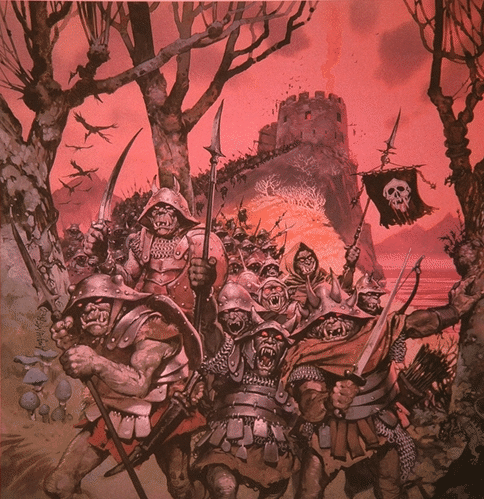
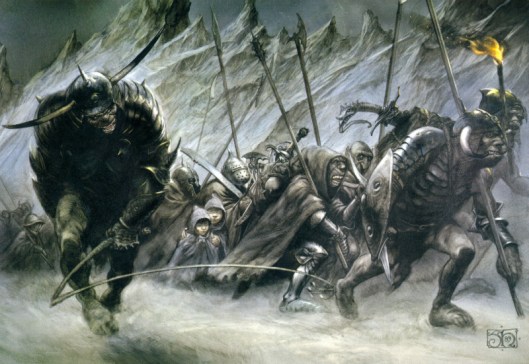
Set those against any modern artist’s view of Orcs and, again, it’s not counterfeiting, in the strictest sense, so we suppose that we have to assume “mockery”—but with the added assumption that Sauron had a very twisted sense of humor.  (There’s also that nasty half-suggestion of Fangorn’s that, since Saruman’s Orcs are behaving more like men, Saruman has been performing genetic experiments, something even Fangorn doesn’t want to think about.)

image12mcbride.gif

image13lee.jpg

image14howe.jpg

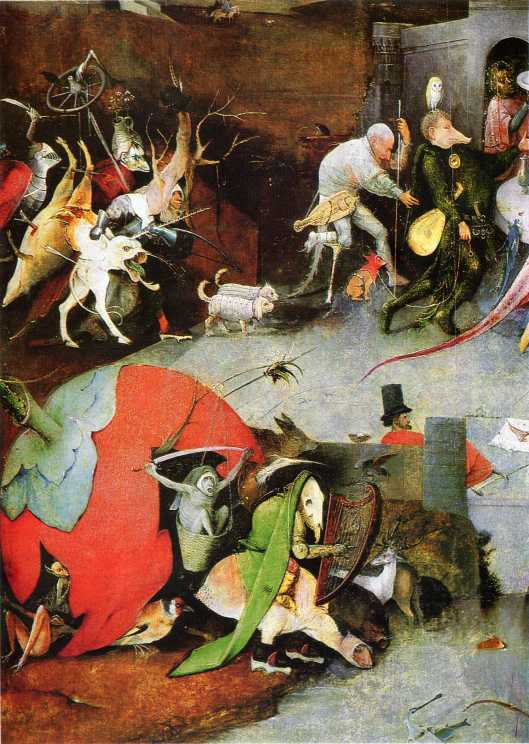
Looking at all of these illustrations, by the way, we were struck by where we’d seen creatures like this before.  Could it be in the works of those strange Flemish/Dutch painters like Brueghel and Bosch?

image15bosch.jpg

Or Arthur Rackham?

image16rackham.jpg

Or the early 20th-century Swedish painter, John Bauer, who, in his depiction of forests was an influence upon JRRT?

image17bauer.jpg

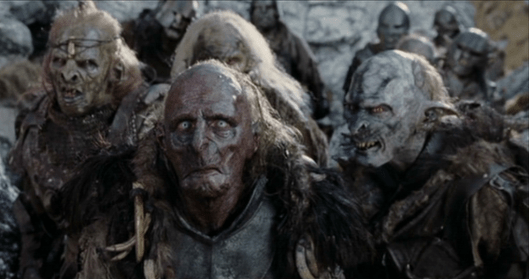
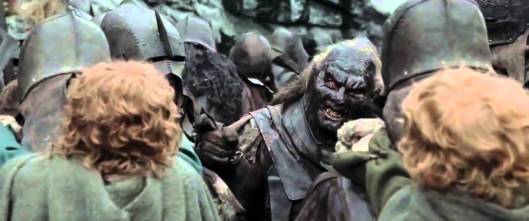
And, more recently, considering P. Jackson’s Orcs,

image18orcs.png

image19orcs.jpg

their skin color and general look:  is there a suggestion here of the so-called “Bog People” (about whom we wrote a posting some time ago)—a whole series of bodies, at least one dating from the 4th century bc

image20tollundman.jpg

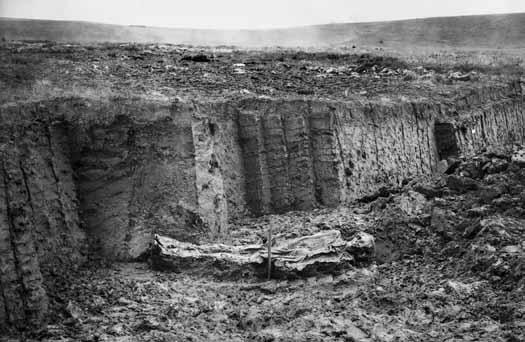
who have been discovered buried in peat bogs (a great preservative) in northern Europe?

image21peatbog.jpg

And, in their color and oozy look–not to mention that they seem to move in scuttly groups–is there something cockroachy about them?

image22cockroaches.jpg

But, just as there is a place Fangorn doesn’t want to go, it’s true for us as well!

Thanks, as ever, for reading.

MTCIDC

CD

PS

You probably spotted this (we have very intelligent readers), but it’s the top 10-dollar bill which is the counterfeit.

PPS

It has also occurred to us that JRRT more than once discussed the fact that Sauron, as a lesser deity-figure, could never originate, only copy and “subcreate”—perhaps suggesting another reason for making “mockeries”:  his anger at his inability to do original work?

A Pirate’s Life…

15 Wednesday Nov 2017

Posted by Ollamh in Imaginary History, J.R.R. Tolkien, Literary History, Maps, Military History, Military History of Middle-earth, Narrative Methods, Villains

≈ 1 Comment

Tags

Abd el-Ouahed ben Messaoud ben Mohammed Anoun, Algiers, Anduin, Barbary Coast, buccaneer, corsair barbary, Corsairs, draught, dromon, dromunds, galley, Harad, Haradrim, Harlond, Helm's Deep, Legatus Regis Barbariae, Pelennor, Pirates, Ramas Echor, Southrons, The Lord of the Rings, Tolkien, Turkish galley, Umbar, US Navy WW2 fighter

Welcome, dear readers, as always.

In a previous posting, we mentioned the Corsairs of Umbar.

If you google “corsair” in images, the first thing which appears is this:

image1corsair.jpg

It’s a US Navy WW2 fighter—but hardly what was sweeping to attack the south coast of Gondor in Sauron’s massive campaign.

Change that to “corsair pirate” and you see things like

image2piratecostume

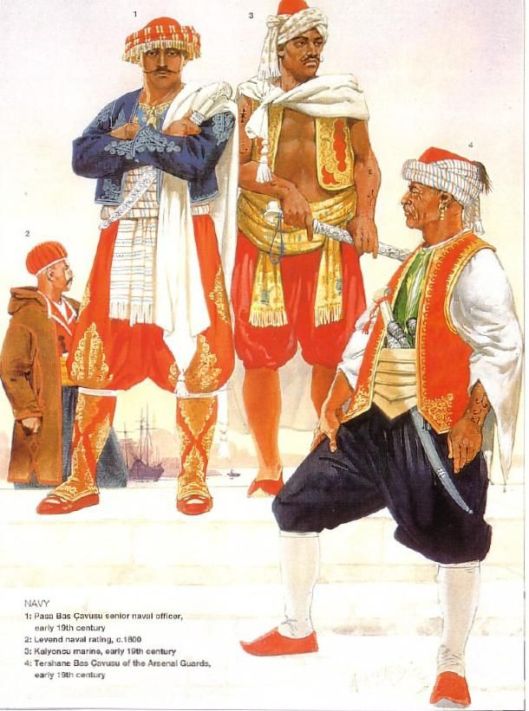
which is definitely a bit better, but he looks so 18th-century.  As we have discussed in many of our postings, Middle-earth is Middle Ages (more or less), even if it mixes High Medieval (things like the plate armor of the Prince of Dol Amroth) with Anglo-Saxon (the Rohirrim).  So “corsair pirate” is too late in time.  Another word (with a much-discussed origin) for “pirate” is “buccaneer”, so, how about “corsair buccaneer”?

image3trailer

Ooops!  Okay—clearly that doesn’t work!

So what will—and what are we really looking for?  Well, what do these corsairs look like according to JRRT?

They have black sails:

For Anduin, from the bend at the Harlond, so flowed that[,]from the City[,] men could look down it lengthwise for some leagues, and the far-sighted could see any ships that approached.  And looking thither they cried in dismay; for black against the glittering stream they beheld a fleet borne up on the wind:  dromunds, and ships of great draught with many oars, and with black sails bellying in the breeze.

‘The Corsairs of Umbar!’ men shouted.  (The Return of the King, Book Five, Chapter 6, “The Battle of the Pelennor Fields”)

Anything more?

In The Lord of the Rings, unfortunately not.

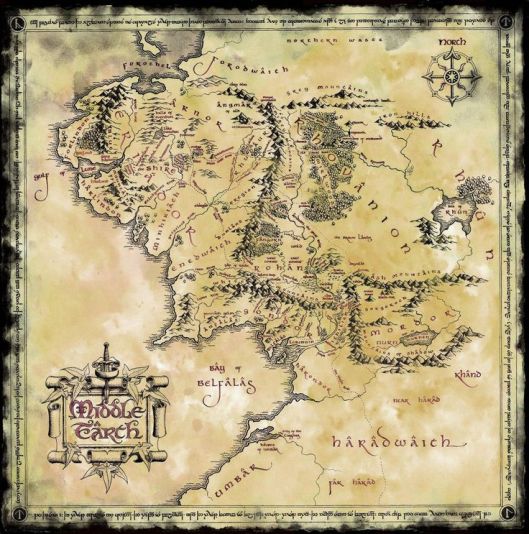
Umbar is in Harad,

image5.jpg

however, and there is a little about the Haradrim.  Our first view of them is Sam’s:

Then suddenly straight over the rim of their sheltering bank, a man fell, crashing through the slender trees, nearly on top of them.  He came to rest in the fern a few feet away, face downward, green arrow-feathers sticking from his neck below a golden collar.  His scarlet robes were tattered, his corselet of overlapping brazen plates was rent and hewn, his black plaits of hair braided with gold were drenched with blood.  His brown hand still clutched the hilt of a broken sword. (The Two Towers, Book Four, Chapter 4, “Of Herbs and Stewed Rabbit”)

Other details?

Just before Sam speaks, Gollum has reported seeing:

‘Dark faces.  We have not seen Men like these before, no, Smeagol has not.  They are fierce.  They have black eyes, and long black hair, and gold rings in their ears; yes, lots of beautiful gold.  And some have red paint on their cheeks, and red cloaks; and their flags are red, and the tips of their spears; and they have found shields, yellow and black with big spikes.  Not nice; very cruel wicked Men they look.  Almost as bad as Orcs, and much bigger.’ (The Two Towers, Book Four, Chapter 3, “The Black Gate is Closed.”)

“cruel and tall” (The Return of the King, Book Five, Chapter 4, “The Siege of Gondor”)

They have cavalry and they are armed with scimitars. (The Return of the King, Book Five, Chapter 6, “The Battle of the Pelennor Fields”)

These would seem to be people from Near Harad (that is, near to Gondor).  The men to the south of them differ:

“…Southrons [men from Near Harad] in scarlet and out of Far Harad black men like half-trolls with white eyes and red tongues.” (The Return of the King, Book Five, Chapter 6, “The Battle of the Pelennor Fields”)

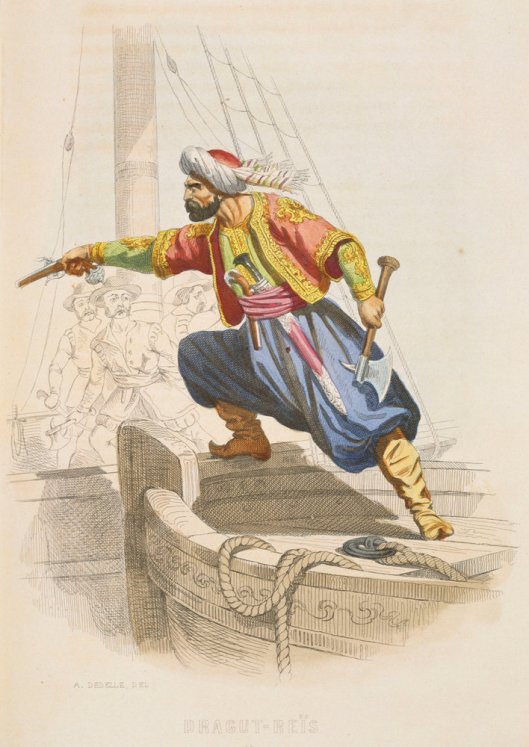
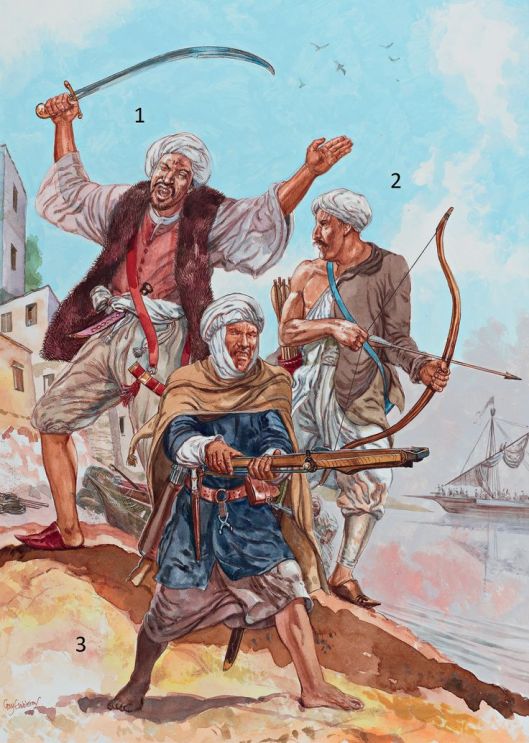
But all of this to us suggested a model from our own world (as always):  the Barbary Pirates.  So how about the search terms “corsair barbary”?

image4barbarycorsair.jpg

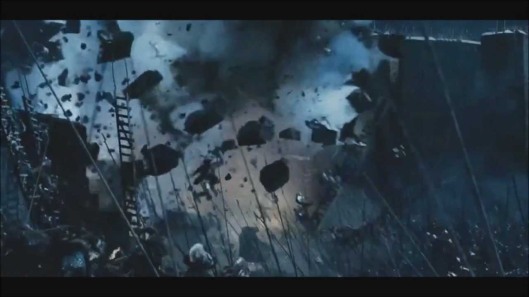
Ah.  That’s a bit more like it, we think.  He has to lose his gunpowder weapons, though—the only gunpowder in Middle-earth appears to be something in the hands of Saruman and Sauron’s orcs, as we see at Helm’s Deep

image6ahelmsdeep.jpg

and the wall of the Pelennor, the Ramas Echor.

We would imagine those corsairs, then, as looking like the infamous “Barbary Pirates”.

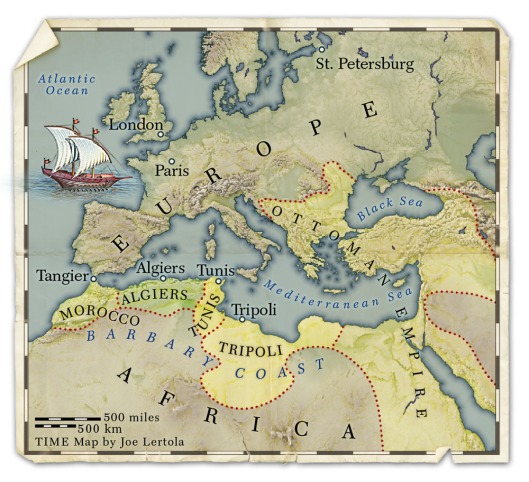
They certainly fill the bill geographically—they’re southern (at least in relation to JRRT’s England)–their hangouts being on the coast of North Africa

image6barbarycoast.jpg

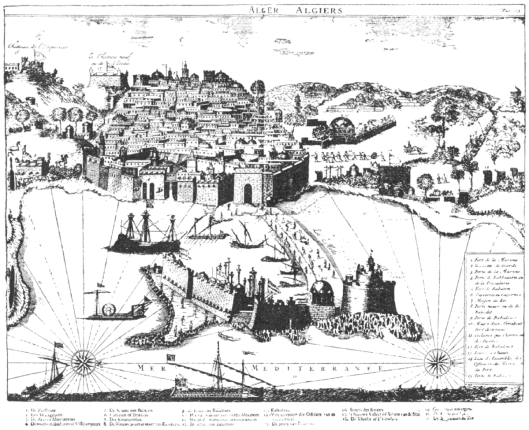
and, if you wanted a big port city, as Umbar was supposed to be, here’s Algiers.

image7algiers.png

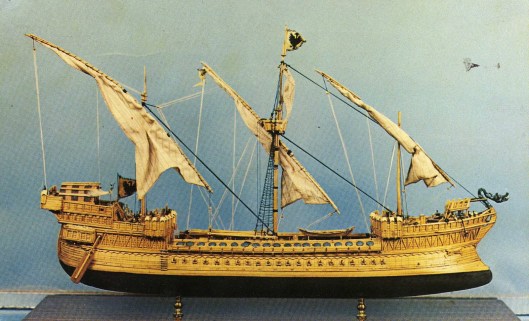
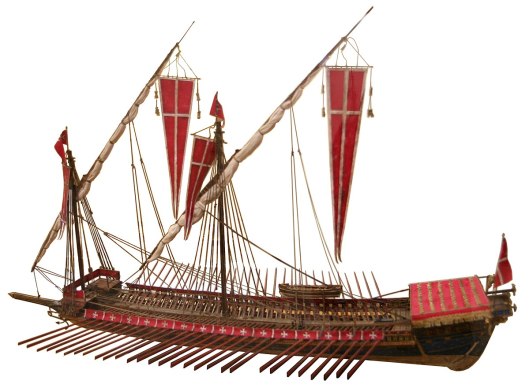
What about ships—that is, “dromunds and ships of great draught with many oars”?

“Dromund” is a medieval form of the Byzantine Greek dromon, literally a “runner”—a word you’d recognize from the English word “hippodrome”—the “place where horses run”.  This was the common larger Byzantine warship.

image8dromon.jpg

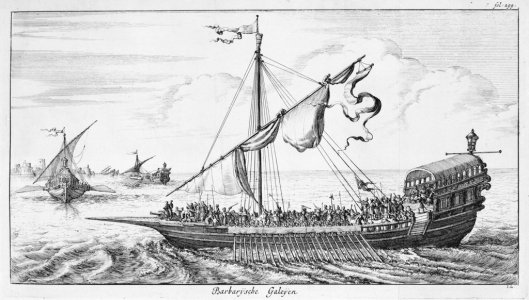
Here’s a Renaissance-era engraving of a Turkish galley.

image9barbarygalley.jpeg

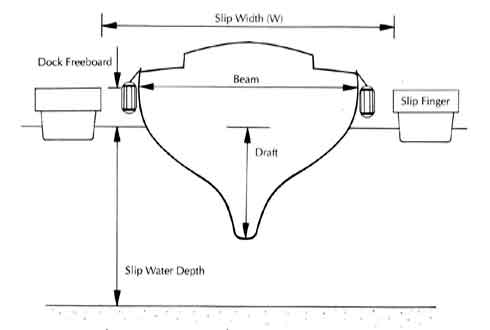
There’s a difficulty with “ships of great draft with many oars”, however.  Draught (also spelled “draft”) is the distance between the waterline and the bottom of the keel, as in this diagram.

image10draft.jpg

Ships with many oars are, commonly, galleys,

image11medgalley.jpg

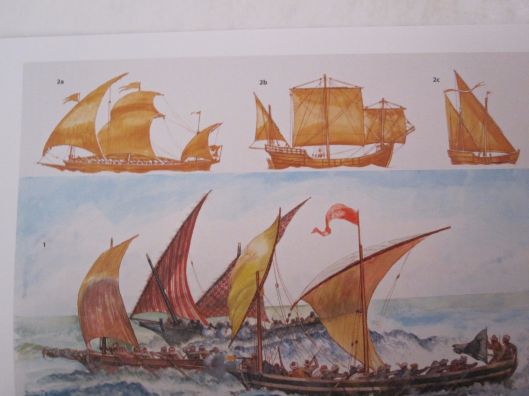
and galleys commonly have a shallow draft—both to allow for maneuver in shallow waters and to allow for the oars to do their job most efficiently.  So, we presume that all of the Corsairs’ vessels were actually galleys of various sizes.

image12galleys.jpg

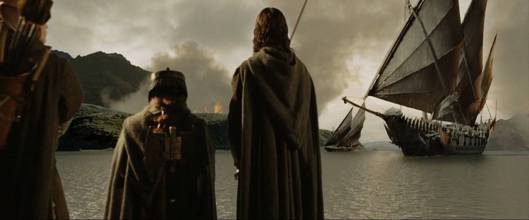
Jackson’s Corsair ships have something of the look of JRRT’s description, but his

image13ajacksonships.jpg

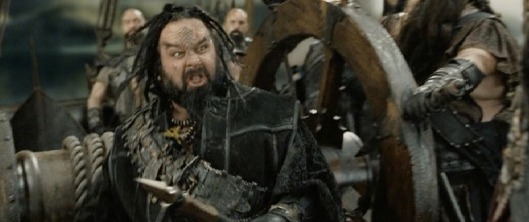
depiction of the Corsairs, unlike that of Rohan and the Rohirrim, is not even close to the little we have learned so far from the text.

image13jackson.jpg

The Barbary Pirates, to us, not only match point of origin and vessels, but are much more exotic and colorful, whereas those in the film look to us more like dingy Vikings.

image14pirates.jpg

image15pirates.jpg

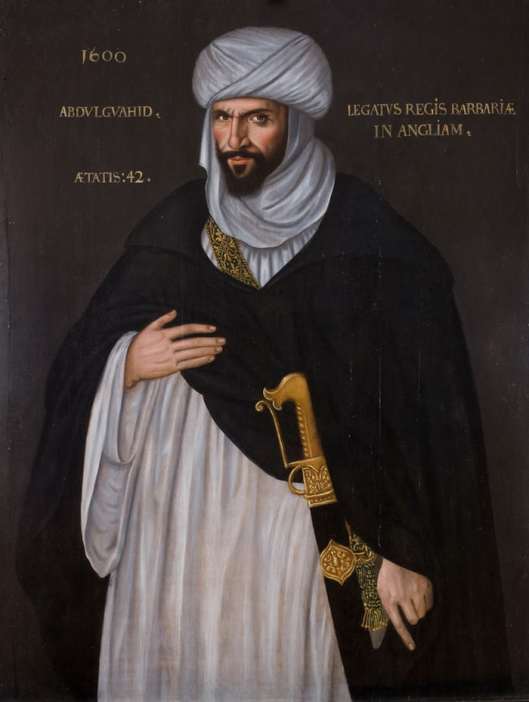
And here’s a portrait

image16moroccanambassador.jpg

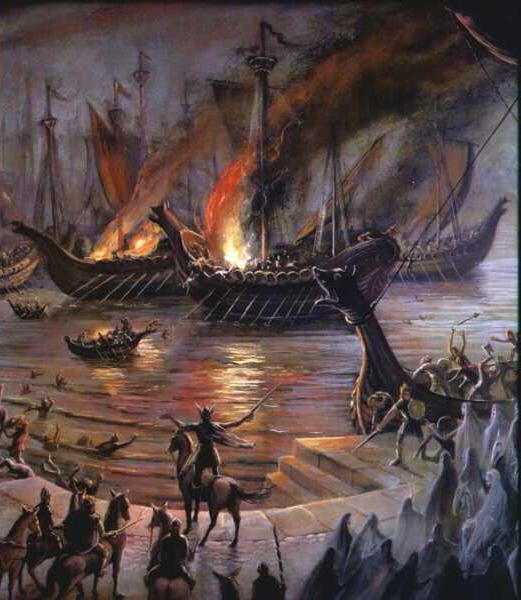
of the Moroccan ambassador to the court of Queen Elizabeth I (notice that, in the caption he’s called Legatus Regis Barbariae, “deputy of the King of Barbary”—a splendid figure with a splendid name:  Abd el-Ouahed ben Messaoud ben Mohammed Anoun—imagine him facing Aragorn from the deck of a galley—we think that the Oath-breakers would have had little fear for him, even as they overwhelmed him and his crew.

image17corsairs.jpg

So, as always, we ask you, readers, what do you think?

And thanks, as always, for reading.

MTCIDC

CD

PS

Just a thought, but, if Sauron, as one of the Maiar, was virtually immortal and had the kind of power which is displayed in the forging of the Ring, why did he need vast fortresses and armies and fleets?  Something to think about in a future posting!

Peace! Count the Clock!

25 Wednesday Oct 2017

Posted by Ollamh in J.R.R. Tolkien, Literary History, Narrative Methods

≈ Leave a comment

Tags

ABC Alphabetical Railway Giude, Agatha Christie, anachronism, Bag End, Bradshaw's Railway Companion, clocks, Egyptian, feudalism, Gros Horloge, hour glases, Liverpool and Manchester Railway, Macbeth, Medieval, Normandy, Pope Sylvester II, railways, Rouen, Salisbury Cathedral clock, Shakespeare, sundial, The Lord of the Rings, Tolkien, Wapping tunnel, water clocks, Wells Cathedral

Welcome, as always, dear readers.

In our last, we puzzled over something in the entryway to Bag End.

image1bagend.png

It’s that thing to the left of the door.   It looks rather like a clock (which is what we thought before examining it more closely), but it is, in fact, a barometer—and a very puzzling thing for Bilbo to have, as we suggested.

On the right hand wall, however, there is another puzzling object:  an actual clock.

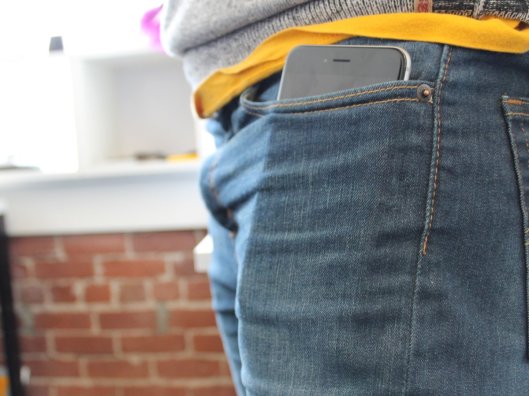
In our world, of course, this is no puzzle at all, clocks being so common.  In fact, our major way of indicating time in English is to say, “It’s 11 o’clock”, where “o’clock” is a contracted form of “of the clock”.  Even if, like many in our world, you get your time from your phone, you’ll still say this, won’t you?

image2cell.png

This has been the case since the 16th century, as we can see in Shakespeare’s plays—including moments when characters who live in times before clocks still talk about them, as in Macbeth, Act II, Scene 4, where Macbeth’s cousin, Ross, says to an Old Man, “By th’clock ‘tis day”, when the historical Macbeth lived in the 11th century AD, perhaps 200 and more years before clocks began to appear in western Europe.

Although we’ve seen it regularly cited that Pope Sylvester II

image3sylvester2.jpg

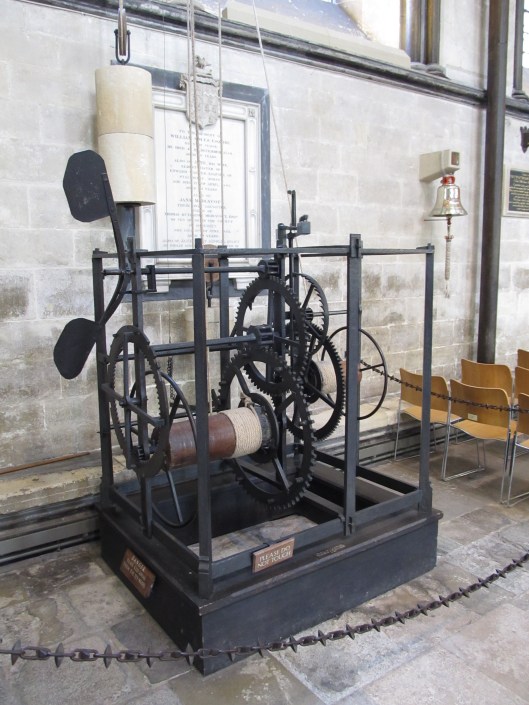
invented the first mechanical clock in the 990s AD, we have yet to see anything in the way of concrete evidence that this is so.  Rather, we see the first clocks to have appeared in the later 14th century, including the Salisbury Cathedral clock, which perhaps dates from 1386.

image4salisbury

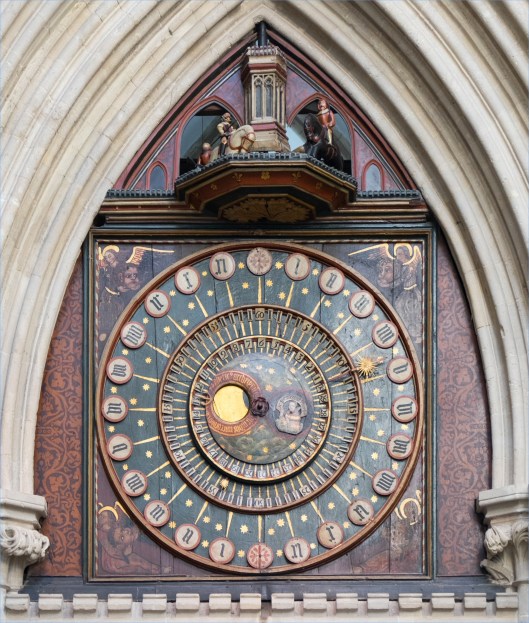
Likewise there is the clock of Wells Cathedral, tentatively dated to about the same time

image5wells.jpg

or the Gros Horloge in Rouen, in Normandy, whose internal workings date from 1389.


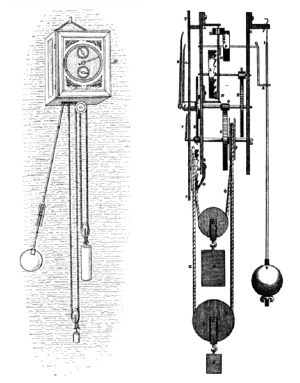
And the pendulum clock—which is what is visible on the right hand wall of Bag End—is an even later invention, credited to the Dutch scientist of the mid-17th century, Christian Huygens.

image7pendulumimage8huygens


Long before such devices, people marked time by such things as hour glasses (possibly medieval? Lots of discussion about this, but there is documentation that medieval ships’ captains began to use them)

image9hourglass.jpg

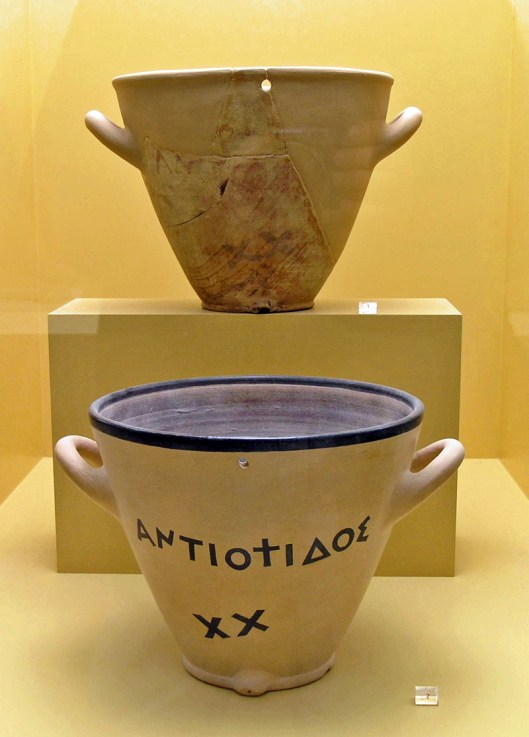
and water clocks (used in Athenian court rooms to control speeches—when citations of established law were read in court, the order was to “stop the clock”, as reading law as evidence clearly wasn’t considered to be part of a speech)

image10clepsydra.jpg

and even put the sun to work, using its moving shadow to tell the time.  (This is the earliest sundial we’ve seen—it’s Egyptian, from the 13th century BC)

image11egyptsundial.jpg

(And just a linguistic footnote on “telling time” as a sort of pun.  On the one hand, we read time off a device—and, if asked, aloud—so that we are “telling—that is reciting—the time”.  At the same time, an older usage of the verb “to tell” was “to count”.  This is preserved in the “teller” in a bank, by someone “telling” a rosary, and by “tolling” a bell.  It can also be seen in other Germanic languages, like Danish, which has the verb “taelle”, “to count”, and German, “zaehlen”.  So, when you “tell” time, you’re both deciphering the information from a device—possibly aloud—and doing so by counting.)

All of which leads us back to Bilbo’s clock, on a wall in the Shire.

As far as we can tell, at the end of the Third Age, the Shire was primarily a non-feudal medieval agricultural world.

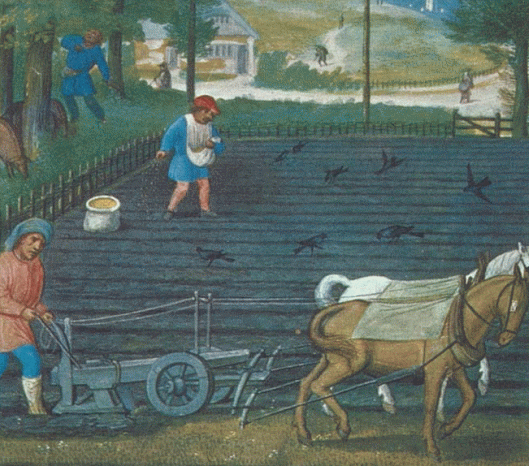
image12medievalplowing.gif

Such worlds are, considering how much the sun is involved in growing things like grain,

image13medreaping.jpg

governed by daylight, which is, on the whole, easy to mark and measure.  (A difficulty for sundials, of course, is that the sun changes position throughout the year and the hours of daylight can vary greatly.  Perhaps this is why there is a famous sundial motto:  “Horas non numero nisi serenas”—“I count only the fair—that is, sunny—hours”.)

image14sundial.jpg

So why is there a pendulum clock on that wall?

A partial answer might be the same as that for the barometer:  JRRT is recreating something from his own past, or even from his present—the big dial looks later to us than the 1890s.  Just as in the case of that reference to Bilbo shrieking “like the whistle of an engine coming out of a tunnel” (The Hobbit, Chapter One, “An Unexpected Party”), it mirrors Tolkien’s own world—a world in which railways in Britain were a major influence on changes in marking time.

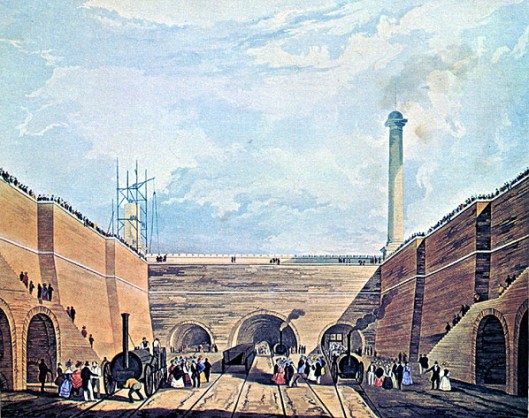
Railways had begun to appear in 1830, with the Liverpool and Manchester Railway.

image15earliestrr.jpg

(And here, by the way, is an engineering marvel of the time—the 1.25-mile long Wapping tunnel, dug to allow the railway’s passage into Liverpool and the first such tunnel to be constructed under a city.  Seeing this 1831 illustration, it’s easy to imagine what kind of shriek Bilbo must have made!)

image16wappingtunnel.jpg

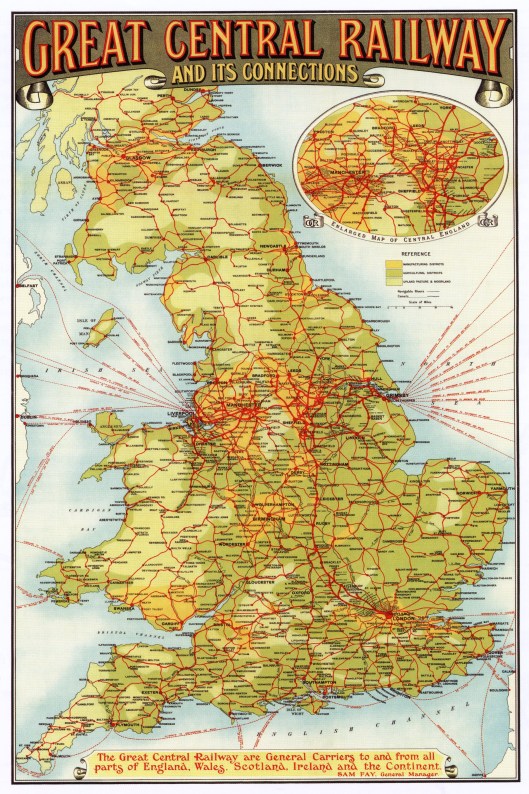
By 1840, building and traffic had increased dramatically and, as the rail lines stretched across England, an awkwardness appeared:  there was no uniform time standard.  Towns close to each other might share the same time, but those between London and Liverpool, say, had their own methods of marking time and so attempting to produce a dependable schedule for a train’s journey was nearly an impossibility along the 178 miles (287km) between the two cities.

image17railwaymap.jpg

Those in charge of the early railways quickly saw the difficulty and began, as early as 1840, to standardize the measurement of time along their routes.  By the late 1850s, standardization had been mainly achieved—although it was only in the 1880s that the government stepped in to complete the progress.

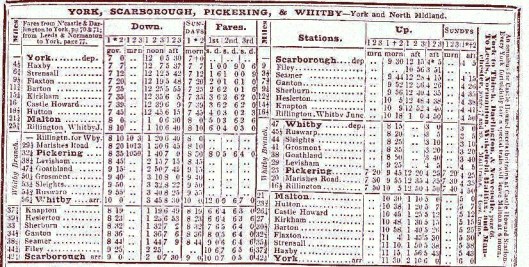
This regularizing of time produced, on the one hand, standard railway timetable books, like Bradshaw’s Railway Companion

image18abradshaw.jpg


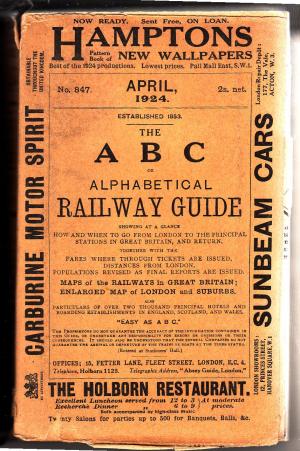
(first published in 1839 and often consulted by Watson and Holmes on their extra-London adventures) and The ABC Alphabetical Railway Guide

image18rrguide1924.jpg


(first published in 1853 and the basis of Agatha Christie’s 1936 novel, The ABC Murders).  On the other hand, it also produced standardized time in general, eventually going global, something which the industrial revolution increasingly demanded as part of its production cycle and now so deeply ingrained that virtually everything we do is influenced by it and we even incorporate it into our bodies, either tying it to our wrists

image19earlywatch.jpg

or wear it as part of our clothing.

image20cellinpocket.jpg

Work, school, even fun (movies begin on time schedules, television is one long schedule, as well as certain elements of the internet—although the internet does offer the subversive possibility of doing things “on your own time”), all of it moves to the measured tick of time.   In 1937, the year after Agatha Christie’s novel based upon railway timetables was published, JRRT would have felt it, from his lecture schedule to the evening radio broadcasts of the BBC.

Almost as if it were a gathering force of the MODERN WORLD, then, the measurement and standardization of time has crept up, from the later medieval world on.  We can see that Shakespeare was influenced by it—in Julius Caesar (1599?), Act II, the jumpy Brutus and Cassius listen to the sound of a clock striking three—in a world where there would be no clocks to strike for almost 1400 years (but providing us with the title of this post).  Is it any wonder, then, that clocks could have slipped into Middle-earth?  And, besides, they do have a use for Bilbo—how else could he shout to the dwarves as he left them, “If ever you are passing my way…don’t wait to knock!  Tea is at four…” (The Hobbit, Chapter Eighteen, “The Return Journey”)?

Thanks, as ever, for reading.

MTCIDC

CD

About That PS

18 Wednesday Oct 2017

Posted by Ollamh in J.R.R. Tolkien, Narrative Methods

≈ Leave a comment

Tags

anachronism, Bag End, banjo clock, barometer, clocks, Edwardian, Evangelista Torricelli, Hobbiton, Lucien Vidie, Middle-earth, Oxford, railway, The Hobbit, The Lord of the Rings, Tolkien, Victorian

Welcome, as always, dear readers.

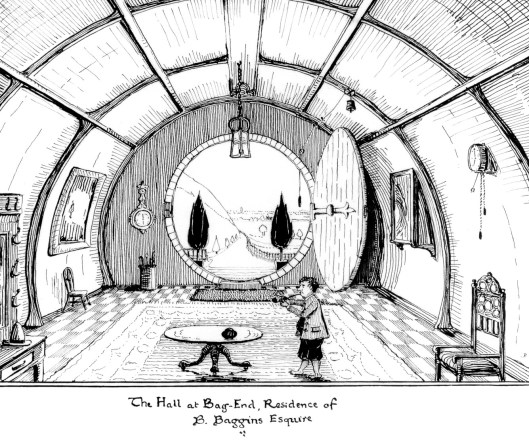
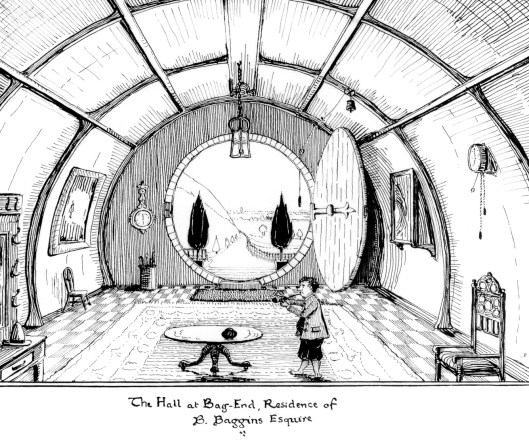
In a PS to our last posting, we showed this illustration

image1bagend.jpg

and asked you if you saw something peculiar about it.

In fact, there are two peculiar things about it.  Look to the left of the door.  What is that?   At first, we were inclined to imagine that it was a clock of a style known as a “banjo clock”.

image2banjoclock.jpg

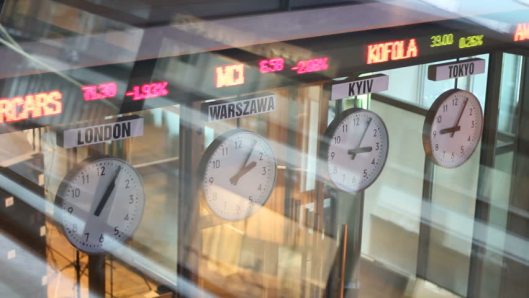
But there was also a clock on the right hand wall, and, unless Bag End was like a stock exchange, with clocks showing various times around the world,

image3stockclocks.jpg

(image the one on the left being “Shire Time”, while the one on the right is “Mordor Time”!)

why would Bilbo have two clocks?

There’s also the technical problem:  banjo clocks—maybe all clocks?—which have pendulums need to use gravity to help in their swing.  If the object on Bilbo’s wall is a clock, it’s upside down and therefore—

and so, after lots of searching to see if we could match it somehow, we were scratching our collective heads when we realized that it wasn’t a clock at all, but a barometer—and a distinctively Victorian one, which fits in with our suggestion in a recent posting that JRRT was using his memories of his Victorian/Edwardian childhood as the basis of Bag End.

image4vicbar.jpg

So, what’s a barometer and why might Bilbo have one?

The simplest answer to the first of those is that a barometer measures atmospheric pressure.  That measurement, in turn, can tell you about changes in weather:  low pressure, it’s more likely to rain, high pressure, not.  Here’s a basic chart to explain.

image5airpressure.jpg

One odd thing about Bilbo’s is that, commonly, barometers are combined with thermometers in patterns of the sort you see on the Bag End wall, whereas this one appears to be by itself.

image6bar.jpg

The really odd thing, however, is that he has one to begin with.  The first barometers date from the 1640s, being an offshoot of trying to understand the concept of a vacuum.

image7aboutvacuums.png

It was only in the 1840s that someone (Lucien Vidie) postulated that air pressure changes—measurable by this device– could signal weather changes.  For Bilbo to have such a thing in a Middle-earth which appears to be almost entirely devoid both of science as we understand it and of mechanical technology, is a puzzle at best.   Who made it?  How did he obtain it?  And last—and hardest—what did he do with it?
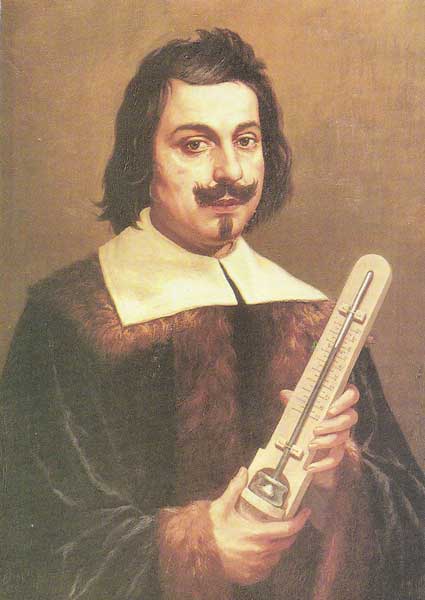
Of course, as we have discussed in past postings, there are whole areas of knowledge about Middle-earth about which we have little or no information and it’s been fun for us to try to reconstruct things using parallels from our own world, combined with the little we do know.  That first barometer was, we presume, handmade by Evangelista Torricelli (1608-1647).

image7atorricelli.jpg


It appears to have been, basically, a long glass tube, attached to a piece of wood by white metal fittings.  The hobbits have glass windows, so the art of glass-blowing exists in their world.  The wood and metal could be used in many other settings.  Once the concept was understood, it would be easy to see someone taking already available techniques and materials and creating the object.

But who made it?  When it came to ingenuity in craft, JRRT suggests the dwarves—with the men of Dale as fellow-workers or perhaps as middlemen.  As Thorin says of the past:

“Altogether those were good days for us, and the poorest of us had money to spend and to lend, and leisure to make beautiful things just for the fun of it, not to speak of the most marvelous and magical toys, the like of which is not to be found in the world now-a-days…the toy market of Dale was the wonder of the North.” (The Hobbit, Chapter One, “An Unexpected Party”)

How did Bilbo acquire it?  He had come to be known in Hobbiton as unlike other hobbits—his mother, after all, was the famous Belladonna Took (for her history—or, rather, her mystery–see The Hobbit, Chapter 1) and, after his travels, “he took to writing poetry and visiting elves”.  Perhaps the barometer came from one of his trips?  Or had it been sent to him?

If we take the preparations for the famous joint-birthday-party at the opening of The Lord of the Rings as a clue, there must have been at least a small degree of commerce between the Shire and the dwarves of the Lonely Mountain and the rebuilt town of Dale:

“On this occasion the presents were unusually good…There were toys the like of which they had never seen before, all beautiful and some obviously magical.  Many of them had indeed been ordered a year before, and had come all the way from the Mountain and from Dale, and were of real dwarf-make.” (The Fellowship of the Ring, Book One, Chapter 1, “A Long-Expected Party).

But then there is that third question:  what did he do with it?  As far as we can currently determine from The Hobbit and The Lord of the Rings, neither Bilbo nor Frodo nor even Gandalf ever mentions a barometric reading, or is concerned that the pressure is dropping.

So what are we to make of this?

For all that JRRT was increasingly careful about this, there a few anachronisms in his work.  In The Hobbit, there is the well-known one of Bilbo’s reaction to Thorin’s explanation of the dangers of future burglary:

“At may never return he began to feel a shriek coming up inside, and very soon it burst out like the whistle of an engine coming out of a tunnel.” (The Hobbit, Chapter One, “An Unexpected Party”)

Although JRRT himself considered changing this for the 1966 revision, Douglas Anderson, in The Annotated Hobbit, 47-48, argues that this doesn’t have to be an anachronism at all:

“…for Tolkien as narrator was telling this story to his children in the early 1930s, and they lived in a world where railway trains were a very important feature of life.”

In fact, built in 1844, the first railway station in Oxford was almost a century old when The Hobbit was published in 1937.

image8grandpointstation.JPG

(And we can’t resist this quotation from Jackson’s Oxford Journal for 15 June, 1844, which describes the arrival of the first train as “one of those rampageous, dragonnading fire-devils”.  Clearly, dragons and railroads have a long history together!)

So, is this just a slip on JRRT’s part?  Perhaps he had a barometer in his past, next to a door, and, in his urge to fill up the wall space of Bag End, he simply filled in what he already knew?  We can only shrug—and, in our next, wonder about that clock on the wall to the right:  what’s it doing in Middle-earth?

Thanks, as ever, for reading.

MTCIDC

CD

Are You Sitting Down?.2 (Some Thrones, but No Games)

11 Wednesday Oct 2017

Posted by Ollamh in Economics in Middle-earth, J.R.R. Tolkien, Literary History, Narrative Methods

≈ Leave a comment

Tags

A Game of Thrones, Bag End, basins, Bree, British monarchs, Buckland, canopy, cart, Cirith Ungol, Coronation Chair, Coronation Throne, Crick Hollow, Edoras, Edward I, Edward VII, Edward VIII, Edwardian, Elizabeth II, Elrond's house, Furniture, George V, George VI, Gondor, high table, Iron Throne of Westros, Lia Fail, Lothlorien, Medieval, Middle-earth, Minas Tirith, monopodium, Moot Hill, parlor, pubs, Rivendell, Rohan, Shire, Stone of Scone, Tara Ireland, The Hobbit, The Lord of the Rings, The Prancing Pony, the Stone of Destiny, throne, Tolkien, Tom Bombadil, UK pubs, Victorian Bedroom, Victorians, washstand

Welcome, dear readers, as always.

In our last, we were talking about furniture in Middle-earth—in that post our subject was The Hobbit.  We continue with The Lord of the Rings and conclude with one specialized piece of furniture.

We begin where we began last time, with Bag End.

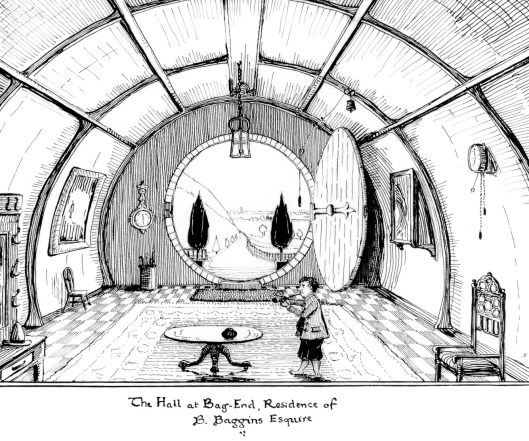
image1bagend.jpg

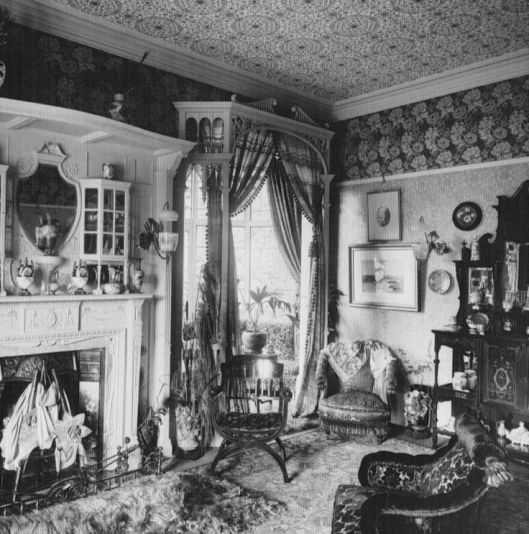
With all of its rooms and the stuff in them, we suggested then that what JRRT was really doing was depicting the kind of overcrowded place later Victorians and Edwardians—the people with whom he, born 1893, would have grown up around—would have preferred.

image2vicparlor.jpg

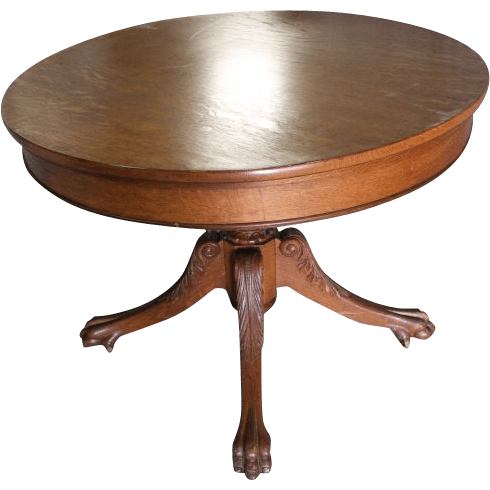
[Note, by the way, the table in the middle of the entryway in Tolkien’s picture of Bag end, and compare it with this “monopodium” table with claw feet, which could be seen in such a parlor.]

image3monopodium.png

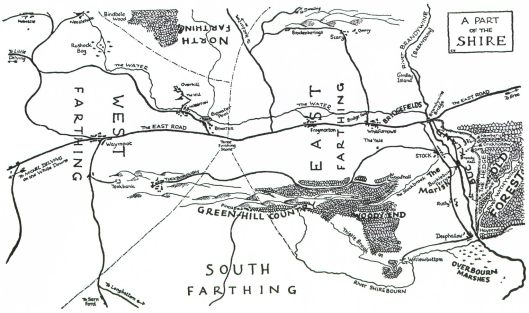
Once the three Hobbits leave Bag End for their journey to Crick Hollow,

image4shiremap.jpg

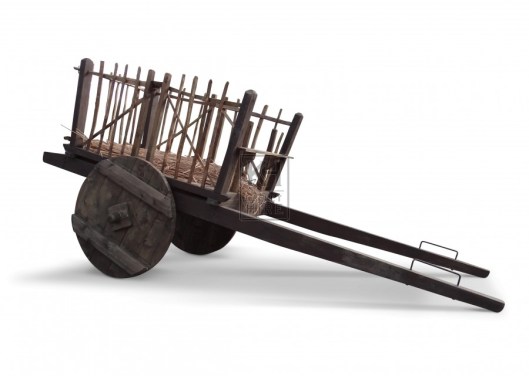
having sent “two covered carts…to Buckland, conveying the goods and furniture…” (and the next day sending off another) (The Fellowship of the Ring, Book One, Chapter 3, “Three is Company), they will spend a great deal of time walking (and paddling and riding), but will enter few buildings.  Here, by the way, is a cart—we imagine “covered” simply means that a blanket of some tough coarse fabric, like canvas, (called a “tilt”) would have been pulled over the load.

image5cart.jpg

Our chances of getting much furniture detail are not high, then, but let’s see what we find.

Beyond Buckland, the first indoors for the hobbits is Tom Bombadil’s house.  As the hobbits enter, they are in:

“…a long low room, filled with the light of lamps swinging from the beams in the roof; and on the table of dark polished wood stood many candles, tall and yellow, burning brightly.

In a chair, at the far side of the room facing the outer door, sat a woman…” (The Fellowship of the Ring, Book One, Chapter 7, “In the House of Tom Bombadil”)

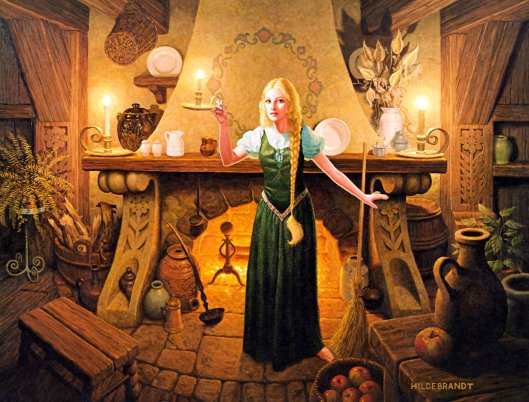
image6agoldberry.jpg

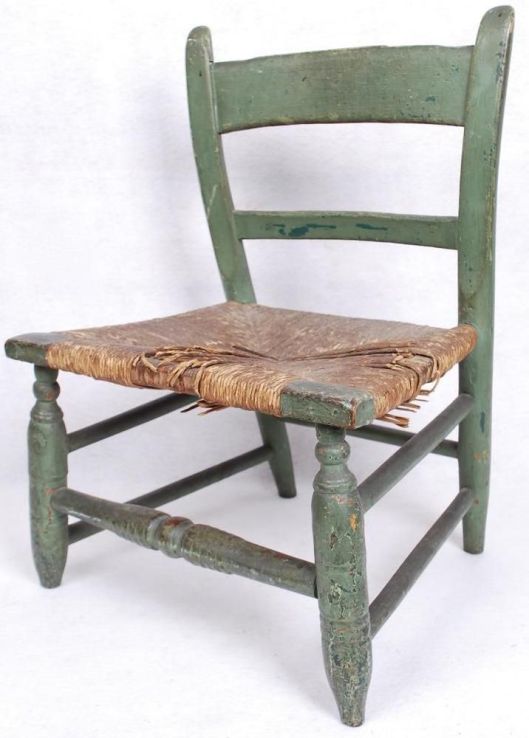
The hobbits are given “low rush-seated chairs”.

image6rushseatchair.jpg

And, shortly, are shown their bedroom:

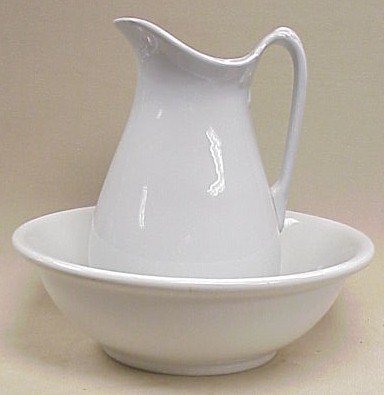
“They came to a low room with a sloping roof…There were four deep mattresses…laid on the floor along one side.  Against the opposite wall was a long bench laden with wide earthenware basins, and beside it stood brown ewers filled with water…”

Not much to go on here.  We’ll presume that the bench is wooden and plain, and the basins and ewers (a big pitcher—ultimately from Latin aquarius, “having to do with water”) are of the kind one would have seen in a Victorian bedroom, when indoor bathrooms were still only a wish—or were only in the homes of the extremely wealthy.

image7ewer.jpg

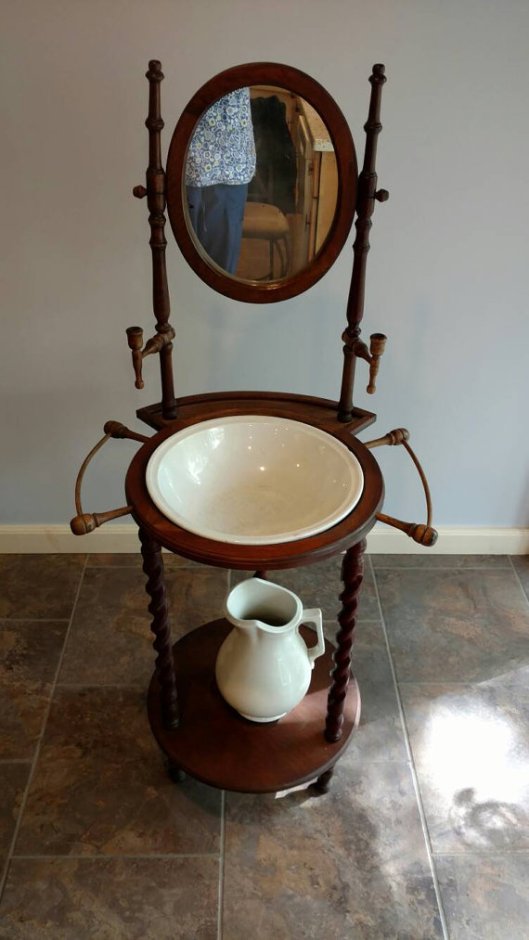
[Victorians, by the way, could have specialized places for such pitcher/basin combinations.  They’re called “washstands” and here’s a simple but functional one.]

image8awashstand.jpg

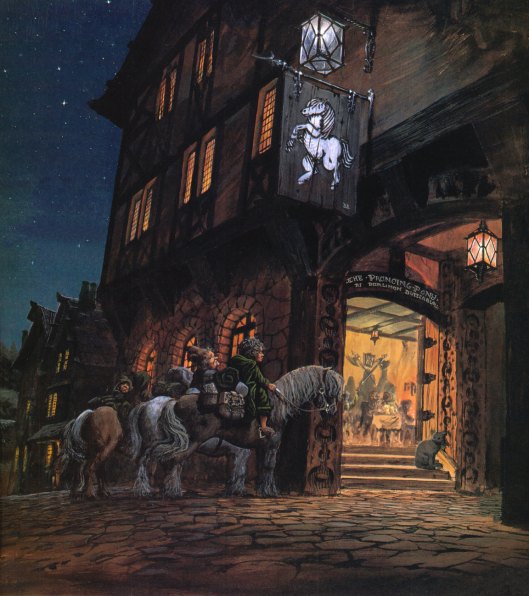
Next on their journey (we won’t count the barrow—although the Wight does mention a “stony bed”) is the Prancing Pony.

image8prancingponey.jpg

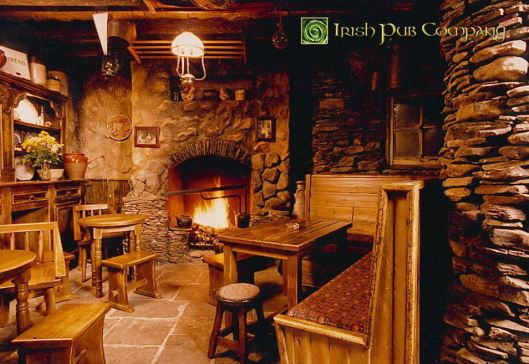
Again—what we have is functional.  The hobbits are initially led to what the landlord, Barliman Butterbur, calls “a nice little parlour” where “There was a bit of bright fire burning on the hearth, and in front of it were some low and comfortable chairs” and “a round table, already spread with a white cloth”. (The Fellowship of the Ring, Book One, Chapter 9, “At the Sign of the Prancing Pony”)

This sounds like a small, private room, found in some UK pubs, and called a “snug” (etymology unclear—but used to mean “comfy” as early as the 1620s).  Here’s one, in fact, from an Irish pub.  (We don’t advertise—this was simply the image which fit best with both our impression and the book.  And “fit best” does a double duty here, as “snug” can also mean “fitting tightly”.)

image9snug.jpg

The same will be true of the bedroom the hobbits don’t use—and just as well!—plain and nondescript.

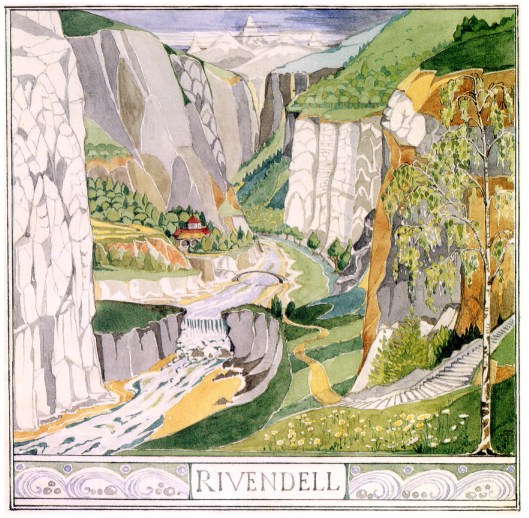
So when, if ever, are we given something with more detail?  If not in Bree, perhaps in Rivendell?

image10rivendell.jpg

Frodo comes to in a generic bed, but the “hall of Elrond’s house” is a bit more promising:

“Elrond, as was his custom, sat in a great chair at the end of a long table upon a dais…In the middle of the table there was a chair under a canopy…” The Fellowship of the Ring, Book Two, Chapter 1, “Many Meetings”)

A “dais” is a raised platform.  If you’re a Harry Potter fan, you’ll remember it at “High Table” (as it’s called in English schools), where the students of the four different colleges meet to dine and the faculty sit on such a platform.

image11hightable.jpg

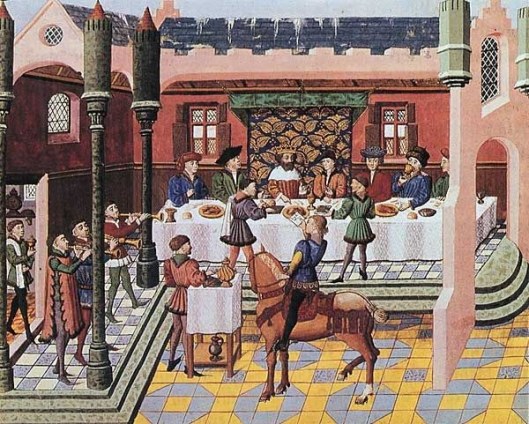
This is a left-over medieval custom, when royalty/nobles sat on a kind of stage, above the lesser folk, for formal meals.

image12feast.jpg

(Oh—and don’t ask about the horse—but it wasn’t required.  Horse and rider do appear at a banquet, of course, in the 14th-century poem “Sir Gawain and the Green Knight”—which JRRT once edited.)

image13agawaingreen.jpg

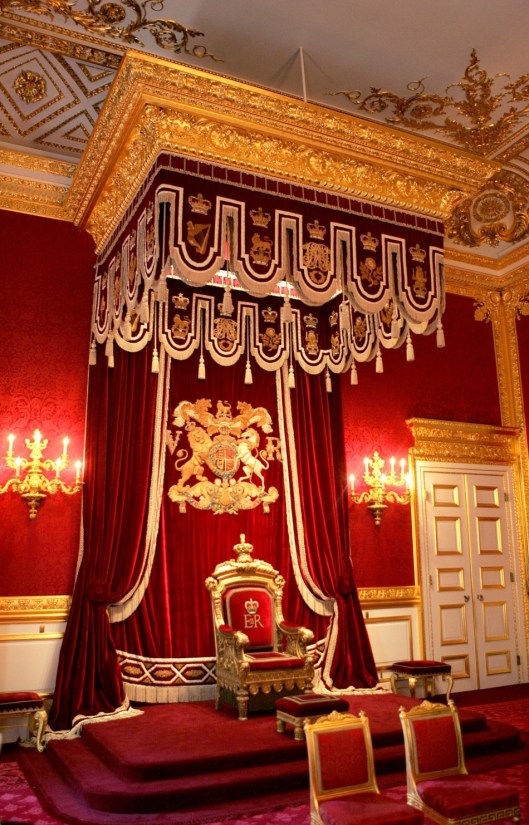
And that “chair under a canopy” reminds us of thrones with canopies, like this at the Palace of St. James, in London.

image13thronecanopy.jpg

Which brings us to the subject of thrones, in general.  After Rivendell, indoors will consist of Lothlorien

image14lorien.jpg

for the fellowship, then nothing for Sam and Frodo till Faramir’s cave hide-out and, beyond, the Tower of Cirith Ungol

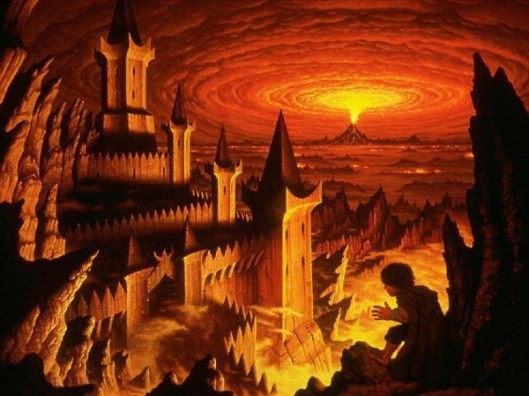
image15towercirithungol.jpg

Hardly places to find any furniture beyond the functional!

For the others, we have Edoras

image16edoras.jpg

and Minas Tirith.

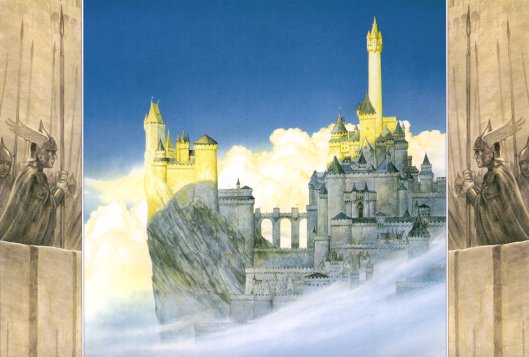
image17minastirith.jpg

And here we want to conclude by discussing a similar piece of furnishing in each—those thrones.

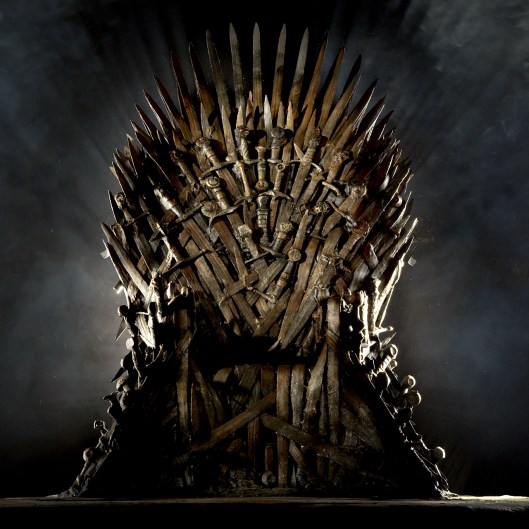
These days, when we say or write “thrones”, well, what comes immediately?  A Game of Thrones and the Iron Throne of Westeros.

image18ironthrone.jpg

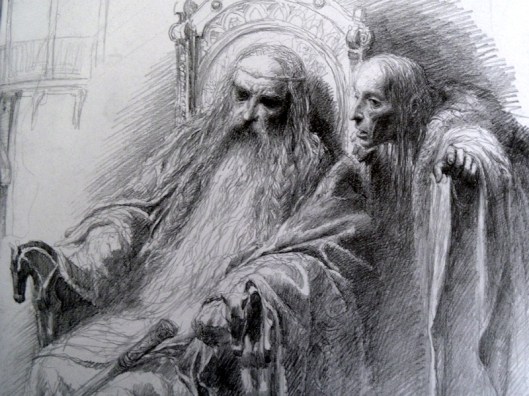
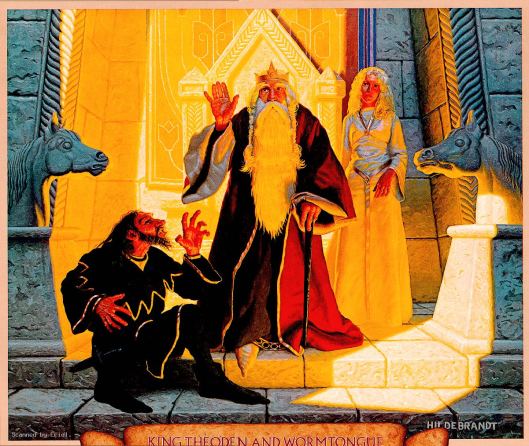
The thrones of Rohan and Gondor are a bit less complicated.

Theoden’s is described simply as “a great gilded chair” on a “dais with three steps”.  (The Two Towers, Book Three, Chapter 6, “The King of the Golden Hall”).

Here’s Allen Lee’s interpretation

image19alee.jpeg

and here is the Hildebrandts’.

image19bhild.jpg

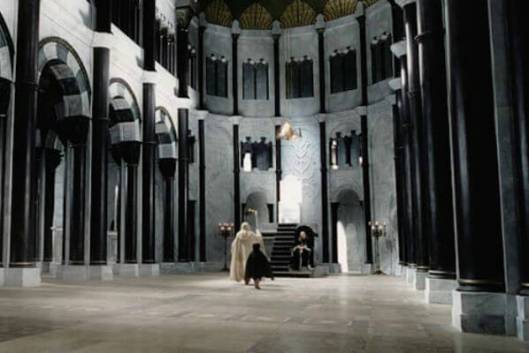
The throne of Gondor is just a tiny bit more elaborate:

“At the far end upon a dais of many steps was set a high throne under a canopy of marble shaped like a crowned helm…” (The Return of the King, Book Five, Chapter 1, “Minas Tirith”)

Here’s an image from the film.

image19cthroneroom.jpg

But wait—there’s no one on it.  Let’s look lower:

“At the foot of the dais, upon the lowest step which was broad and deep, there was a stone chair, black and unadorned, and on it sat an old man gazing at his lap.”image19ddenethor.jpg

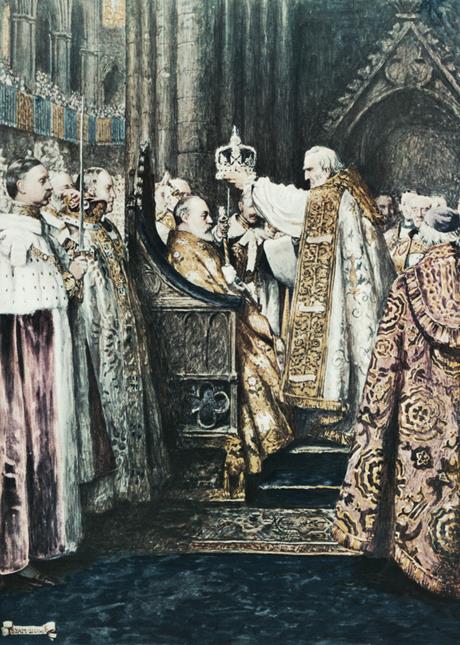
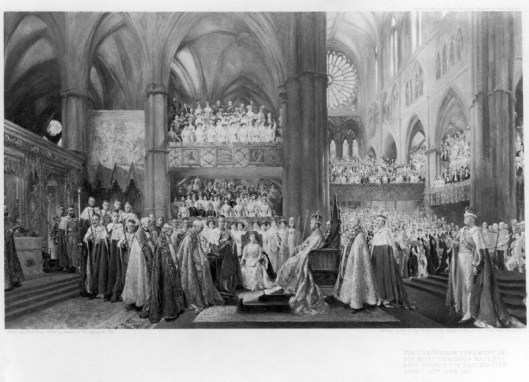
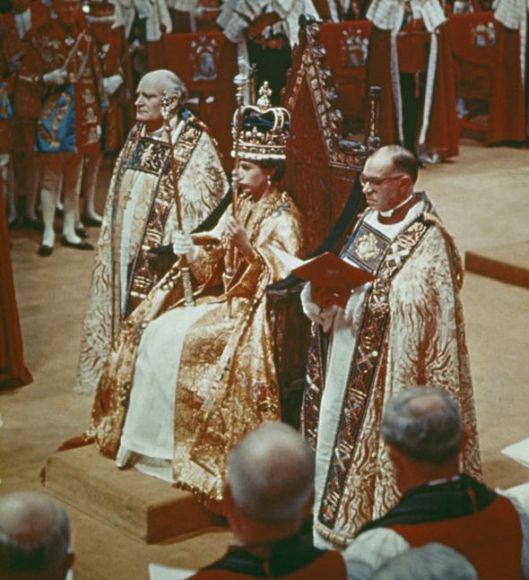
During his lifetime, JRRT would have seen the coronation of five British monarchs:

Edward VII

image19ed7.jpeg

George V

image20geo5.jpg

Edward VIII

image21ed8.jpg

George VI

image22ageo6.jpg

and the current monarch, Elizabeth II.

image22liz2.jpg

You’ll notice that, in every case, the throne is the same.

image23throne.jpg

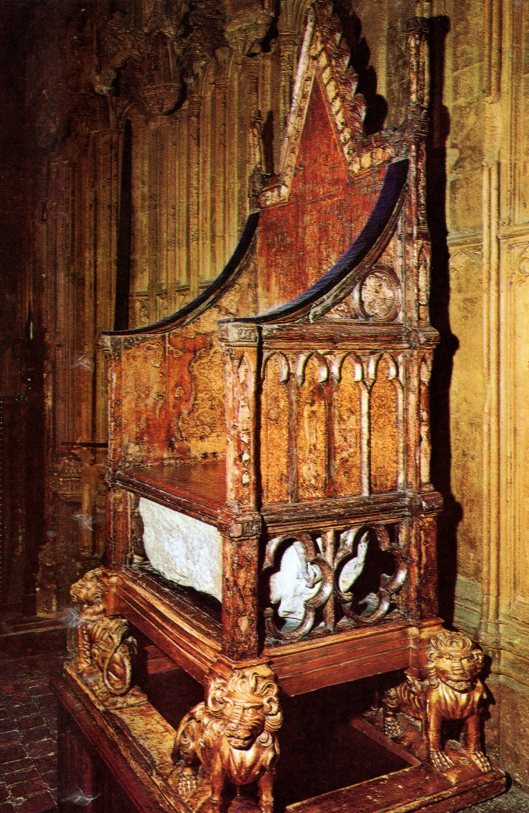
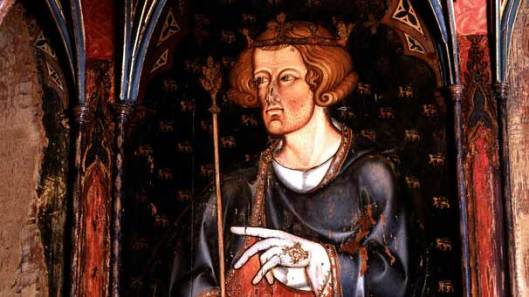
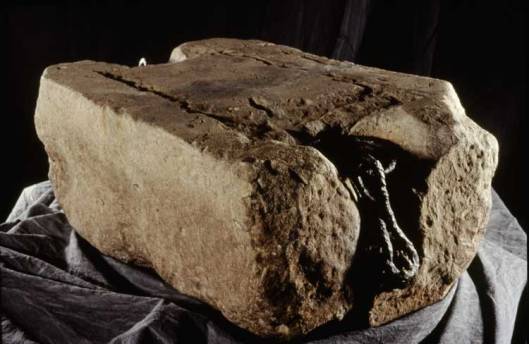
This is the so-called “Coronation Chair”, built between 1297 and 1300 and used since for crowning English monarchs.  It was especially commissioned so that it could hold the “Stone of Scone” (pronounced “skoon”—not like the pastry).  This was an ancient piece of Scottish royal history which Edward I,

image24ed1.jpg

in an effort to control Scotland, had stolen from its place on Moot Hill, near the Abbey of Scone.

image25sconeabbey.jpg

Supposedly, it was a stone used in the crowning of Scottish kings back to the time of the first one, or that it was even older, having been lugged from Tara, in Ireland, where, under the name “Lia Fail”, “the Stone of Destiny” it was used in coronation ceremonies there.  Its purpose was confirmation:  tradition had it that, when the true king bestrode it (a great old verb form), it gave a great shout.

image26liafail.jpg

As far as we know, no shouting has been reported, over the centuries—perhaps because it’s being used for English kings and therefore the stone is holding its tongue till it’s taken back to wear it belongs?

What do you think, dear readers?

Thanks, as ever, for reading.

MTCIDC

CD

PS

And did you notice something(s) out of place in JRRT’s drawing of Bag End?  We’ll talk about it in our next…

image1bagend


The Nazgul Brothers?

27 Wednesday Sep 2017

Posted by Ollamh in J.R.R. Tolkien, Military History, Military History of Middle-earth, Narrative Methods

≈ Leave a comment

Tags

aircraft, anti-aircraft gun, Aviation, Bellerophon, bombers, British Army, dogfights, Dragons, early airships, flight, flying machines, Great War, harpies, Hermes, machine gun, manoeuvres, military intelligence, Nazgul, Paris, Pegasus, Schlieffen Plan of 1914, Sir Douglas Haig, Sir James Grierson, The Blitz, The Lord of the Rings, Tolkien, trench fever, trenches, Wraiths, Wright Brothers, WWI Trenches

Welcome, dear readers, as ever.

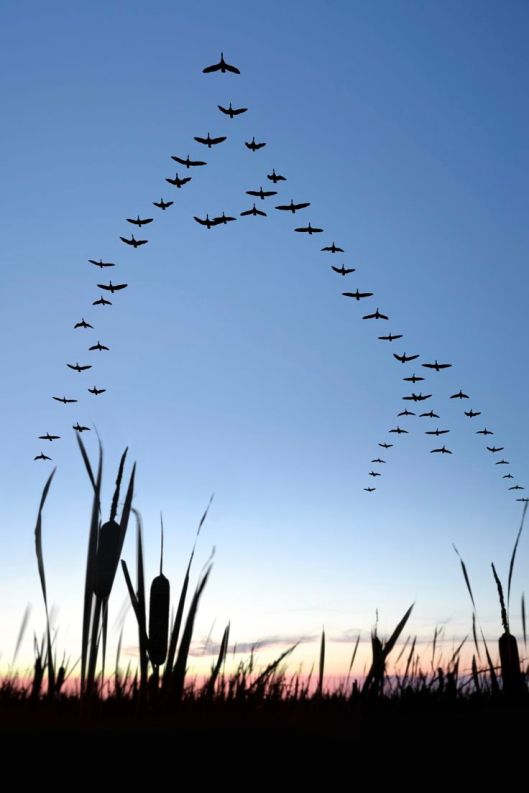
Imagine a world where there were no airports, no contrails, no roar of engines, no small silver objects crossing the skies, the sound of their flight trailed behind them.  The only flying things would be birds and those in different seasons, some permanent, some migratory (or used to be—where we live in North America the Canada Geese, whose great chevrons across our skies used to be powerful signs of winter to come or spring soon to appear, now squat here year round).

image1geese.jpg

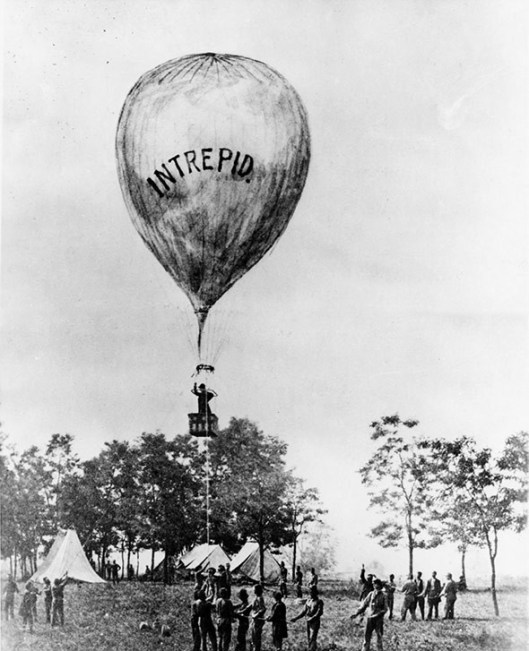
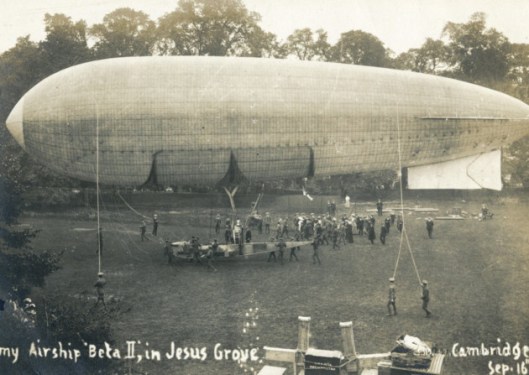
This would have been England in 1892, the year JRRT was born.  There were early airships—basically big balloons of various sorts, but they were primarily stationary and used for (limited) military intelligence.

image2intrepid.jpeg

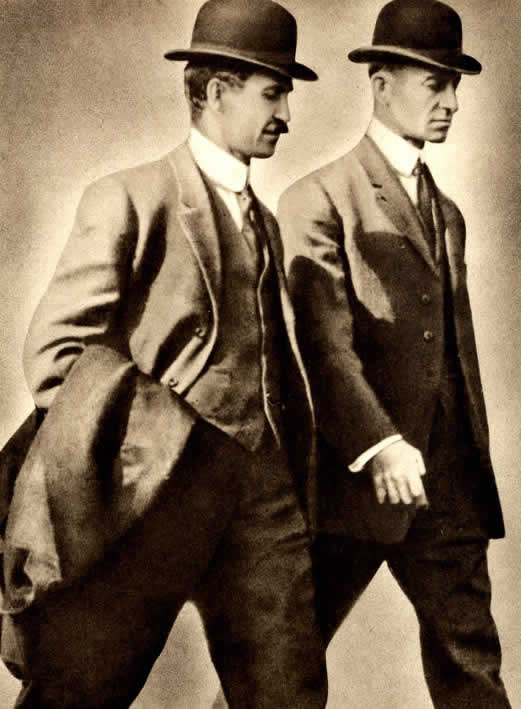
Then came the Wright brothers

image3wrights.jpg

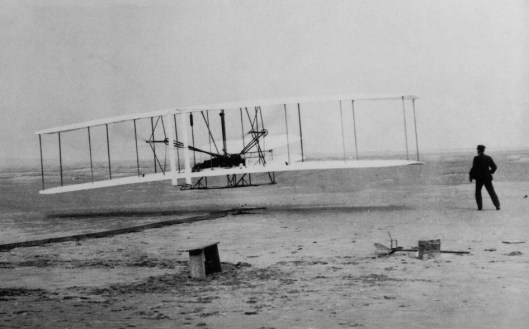
who, in December, 1903, produced the first engine-propelled, manned flight in their enlarged kite.

image4kittyhawk.jpg

Thereafter, flight would, literally, take off, but the Wrights, who were idealistically inclined, believed that such an invention would actually end war by making it too terrible.

The British army thought differently, however, and there were soon aerial observation units attached to military formations.  In fact, Sir James Grierson

image5grierson.jpg

tactically outfoxed his rival, Sir Douglas Haig,

image6haig.jpg

not only by his skillful use of aircraft for observation, but also by his keen understanding of how to conceal his own movements from Haig’s aircraft

image7airship.jpg

in the army manoeuvres of 1912.

image8manoeuvres.jpg


The Great War, when it came, two years later, would then be the proving ground for all sorts of aerial experimentation.

First, it was just observation.

image9be2.jpg

A British aviator, flying north of the army, first spotted the massive German columns which were designed to outflank the British and French armies and capture Paris in the Schlieffen Plan of 1914.

image10schlieffenplan.gif

Because observation was their task, the earliest aircraft were unarmed, but this changed and soon there was aerial combat, the so-called “dog fights”, the popular images being “knights of the sky” who jousted with manoeuvres and machine guns, rather than with lances, maces, and swords.

image11joust.jpeg

image12dogfight.jpg

Next came the use of aircraft to disrupt enemy formations and their movements, bombing and strafing, sometimes as part of major attacks, the whole idea being to dominate the sky over the enemy’s trenches, while protecting your own.

image13dogfightingovertrenches.jpg

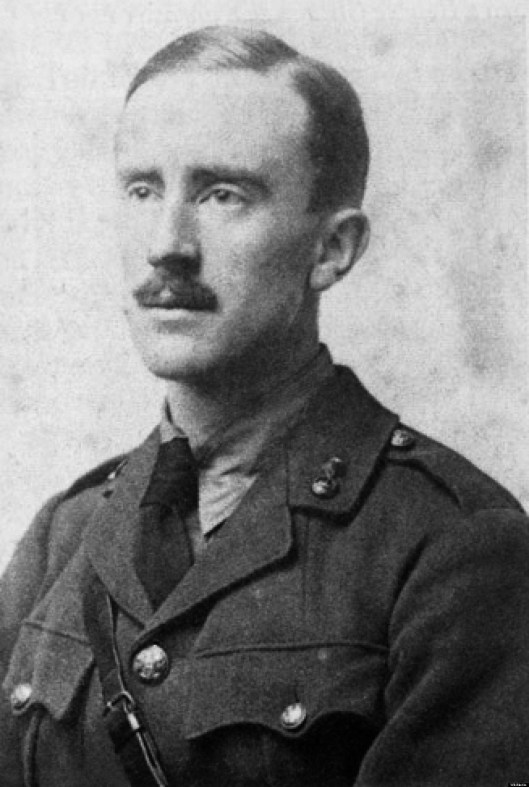
And this is where we imagine 2nd Lieutenant JRR Tolkien

image14jrrt.jpg

in the summer of 1916, standing in such a trench,

image15atrench.jpg

looking up, and thinking…

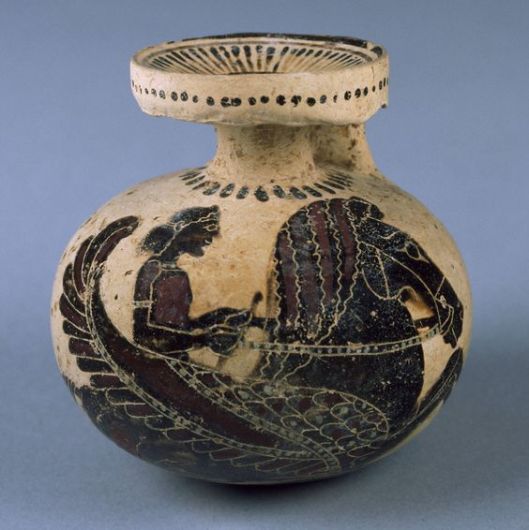
We can also imagine him imagining—not seeing flying machines, but something much earlier.  After all, with his education, background, and interests, it would have been difficult not to think of classical harpies

image15harpies.jpg

or Hermes

image16hermes.jpg

or Bellerophon, mounted on Pegasus.

image17bellerophon.jpg

And, with his Norse passion, there would also, of course, be dragons…

image18smaug.jpg

And, perhaps a combination:  a Bellerophon mounted on a miniature dragon?

image19nazgul.jpg

In the world of the trenches, there were two defences against aircraft:  friendly aircraft in the air

image20dogfight.jpg

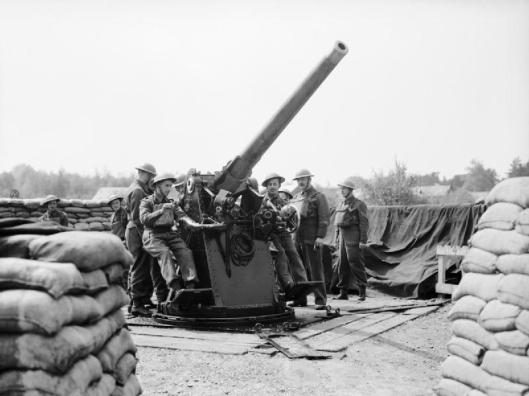
and anti-aircraft guns on the ground.

image21aagun.jpg

But the war ended fairly quickly for the scholarly lieutenant, laid low by a more primitive enemy than Industrial Age Germans with bombs:  lice.

image22lice.jpg

JRRT became sick with what was then called “trench fever”, an illness conveyed, like typhus, by the bite of the tiny insects who colonized the clothing and bodies of soldiers in every dugout in Europe.  Wracked with recurring fevers, headaches, and complete exhaustion, among other complaints, men ill with trench fever were brought to base hospitals and, if sick enough, were sent home, as there was no cure, to recover as best they could.  Tolkien spent the rest of the war in the hospital or in garrison in England and thus escaped the last and perhaps worst years of the war in the trenches.

At home, he became Professor Tolkien, taught his classes, fathered four children, and then a second war came, one in which the primitive air war of the first war was intensified by more sophisticated aircraft, more powerful explosives, and plans to bomb Britain into ruin and submission in what was called “The Blitz”.

image23blitz.jpg


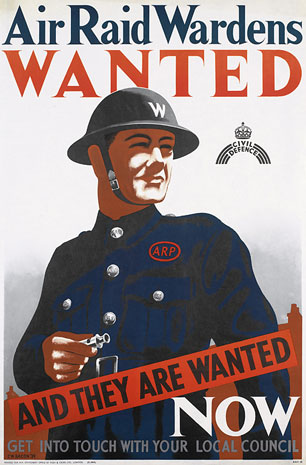
JRRT went back into service, this time as an air raid warden, even as two of his sons were more directly involved in the war.

image24airraidwarden.jpg

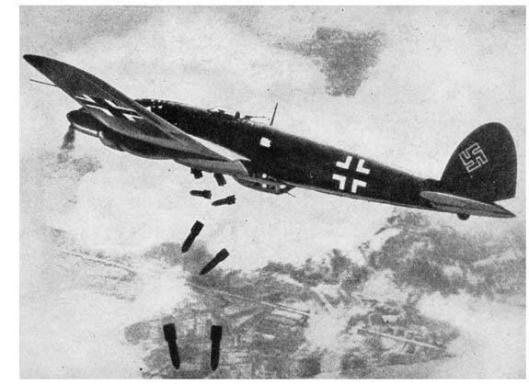
Night after night, the bombers came,

image25bomber.jpg

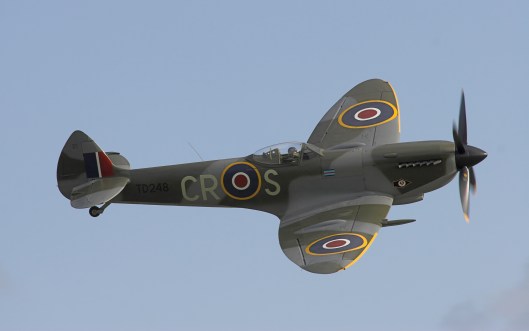
to be met with the same weapons as the previous war:  aircraft,

image26spit.jpg

anti-aircraft guns

image27aagun.jpg

and, because the enemy began to attack at night,

searchlights.

image28searchlight.jpg

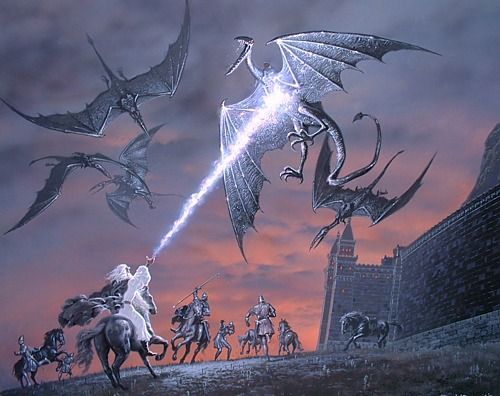
And this brings us back to our imaginings.  Working on The Lord of the Rings, staring into the night sky, listening for enemy bombers, would Tolkien have thought of danger to Middle-earth in the form of flying things, not machines but terrible figures mounted on even more loathsome creatures—and what could be done about them?  Magic, perhaps?

image29gandalf.jpg

Thanks, as always, for reading!

MTCIDC

CD

← Older posts
Newer posts →

The Doubtful Sea Series Facebook Page

The Doubtful Sea Series Facebook Page

  • Ollamh

Categories

  • Artists and Illustrators
  • Economics in Middle-earth
  • Fairy Tales and Myths
  • Films and Music
  • Games
  • Heroes
  • Imaginary History
  • J.R.R. Tolkien
  • Language
  • Literary History
  • Maps
  • Medieval Russia
  • Military History
  • Military History of Middle-earth
  • Narnia
  • Narrative Methods
  • Poetry
  • Research
  • Star Wars
  • Terra Australis
  • The Rohirrim
  • Theatre and Performance
  • Tolkien
  • Uncategorized
  • Villains
  • Writing as Collaborators
Follow doubtfulsea on WordPress.com

Across the Doubtful Sea

Recent Postings

  • Crowing and Raven March 18, 2026
  • The Damage of Dragons March 11, 2026
  • Encouragement March 4, 2026
  • Eavesdropping February 25, 2026
  • Do You Speak Villain? (Part 3) February 18, 2026
  • Do You Speak Villain? (2) February 11, 2026
  • Do You Speak Villain? (Part 1) February 4, 2026
  • Towering January 28, 2026
  • Tolkien Among the Indians January 21, 2026

Blog Statistics

  • 109,232 Views

Posting Archive

  • March 2026 (3)
  • February 2026 (4)
  • January 2026 (4)
  • December 2025 (5)
  • November 2025 (4)
  • October 2025 (5)
  • September 2025 (4)
  • August 2025 (4)
  • July 2025 (5)
  • June 2025 (4)
  • May 2025 (4)
  • April 2025 (5)
  • March 2025 (4)
  • February 2025 (4)
  • January 2025 (5)
  • December 2024 (4)
  • November 2024 (4)
  • October 2024 (5)
  • September 2024 (4)
  • August 2024 (4)
  • July 2024 (5)
  • June 2024 (4)
  • May 2024 (5)
  • April 2024 (4)
  • March 2024 (4)
  • February 2024 (4)
  • January 2024 (5)
  • December 2023 (4)
  • November 2023 (5)
  • October 2023 (4)
  • September 2023 (4)
  • August 2023 (5)
  • July 2023 (4)
  • June 2023 (4)
  • May 2023 (5)
  • April 2023 (4)
  • March 2023 (5)
  • February 2023 (4)
  • January 2023 (4)
  • December 2022 (4)
  • November 2022 (5)
  • October 2022 (4)
  • September 2022 (4)
  • August 2022 (5)
  • July 2022 (4)
  • June 2022 (5)
  • May 2022 (4)
  • April 2022 (4)
  • March 2022 (5)
  • February 2022 (4)
  • January 2022 (4)
  • December 2021 (5)
  • November 2021 (4)
  • October 2021 (4)
  • September 2021 (5)
  • August 2021 (4)
  • July 2021 (4)
  • June 2021 (5)
  • May 2021 (4)
  • April 2021 (4)
  • March 2021 (5)
  • February 2021 (4)
  • January 2021 (4)
  • December 2020 (5)
  • November 2020 (4)
  • October 2020 (4)
  • September 2020 (5)
  • August 2020 (4)
  • July 2020 (5)
  • June 2020 (4)
  • May 2020 (4)
  • April 2020 (5)
  • March 2020 (4)
  • February 2020 (4)
  • January 2020 (6)
  • December 2019 (4)
  • November 2019 (4)
  • October 2019 (5)
  • September 2019 (4)
  • August 2019 (4)
  • July 2019 (5)
  • June 2019 (4)
  • May 2019 (5)
  • April 2019 (4)
  • March 2019 (4)
  • February 2019 (4)
  • January 2019 (5)
  • December 2018 (4)
  • November 2018 (4)
  • October 2018 (5)
  • September 2018 (4)
  • August 2018 (5)
  • July 2018 (4)
  • June 2018 (4)
  • May 2018 (5)
  • April 2018 (4)
  • March 2018 (4)
  • February 2018 (4)
  • January 2018 (5)
  • December 2017 (4)
  • November 2017 (4)
  • October 2017 (4)
  • September 2017 (4)
  • August 2017 (5)
  • July 2017 (4)
  • June 2017 (4)
  • May 2017 (5)
  • April 2017 (4)
  • March 2017 (5)
  • February 2017 (4)
  • January 2017 (4)
  • December 2016 (4)
  • November 2016 (5)
  • October 2016 (6)
  • September 2016 (5)
  • August 2016 (5)
  • July 2016 (5)
  • June 2016 (5)
  • May 2016 (4)
  • April 2016 (4)
  • March 2016 (5)
  • February 2016 (4)
  • January 2016 (4)
  • December 2015 (5)
  • November 2015 (5)
  • October 2015 (4)
  • September 2015 (5)
  • August 2015 (4)
  • July 2015 (5)
  • June 2015 (5)
  • May 2015 (4)
  • April 2015 (3)
  • March 2015 (4)
  • February 2015 (4)
  • January 2015 (4)
  • December 2014 (5)
  • November 2014 (4)
  • October 2014 (6)
  • September 2014 (1)

Blog at WordPress.com.

  • Subscribe Subscribed
    • doubtfulsea
    • Join 78 other subscribers
    • Already have a WordPress.com account? Log in now.
    • doubtfulsea
    • Subscribe Subscribed
    • Sign up
    • Log in
    • Report this content
    • View site in Reader
    • Manage subscriptions
    • Collapse this bar
 

Loading Comments...