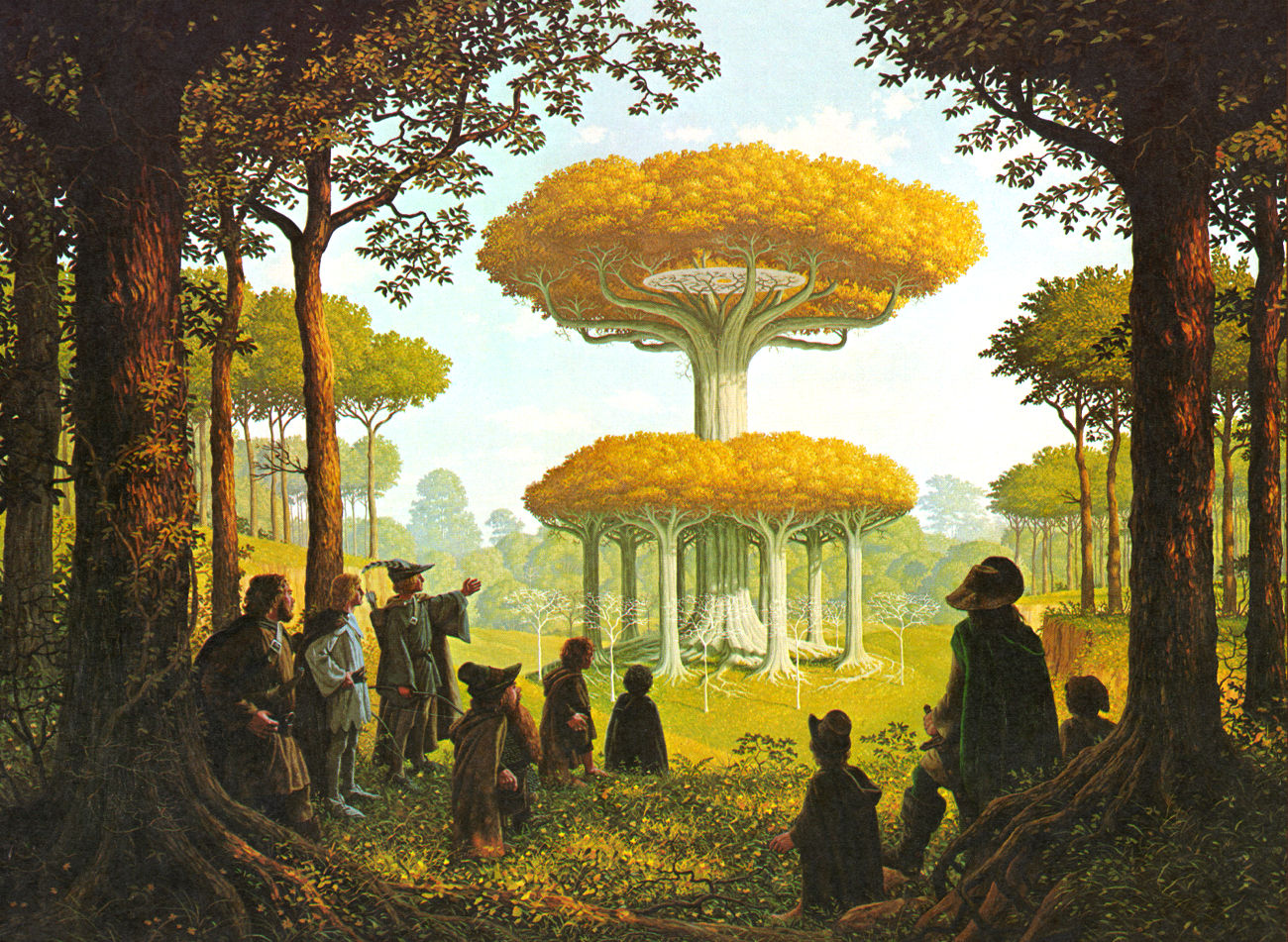
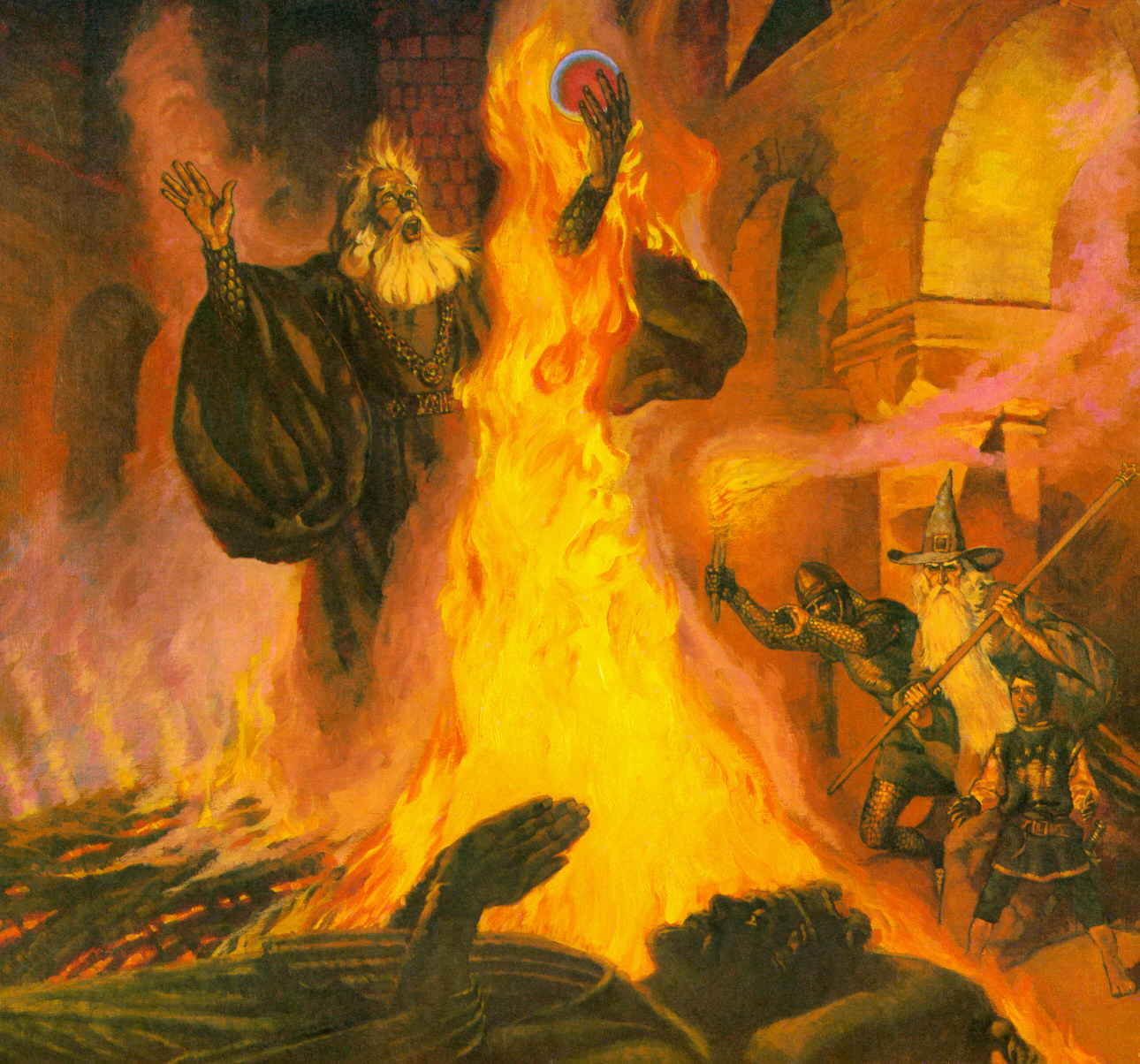
• About

doubtfulsea

~ adventure fantasy

Tag Archives: Snow White

Through a glass…

07 Wednesday Jan 2026

Posted by Ollamh in Uncategorized

≈ Leave a comment

Tags

2nd Corinthians, Apostle Paul, Boromir, Dracula, Fantasy, Frodo, lotr, Mirror of Galadriel, mirrors, Sam, Sauron, Snow White, Through the Looking Glass, Through the Looking-Glass, Tolkien

Dear readers, as always, welcome.

When I was small, I was puzzled about this line:

“Now we see through a glass, darkly…”

which comes from the apostle, Paul’s, first letter to the Corinthians (Chapter 13, Verse 12).

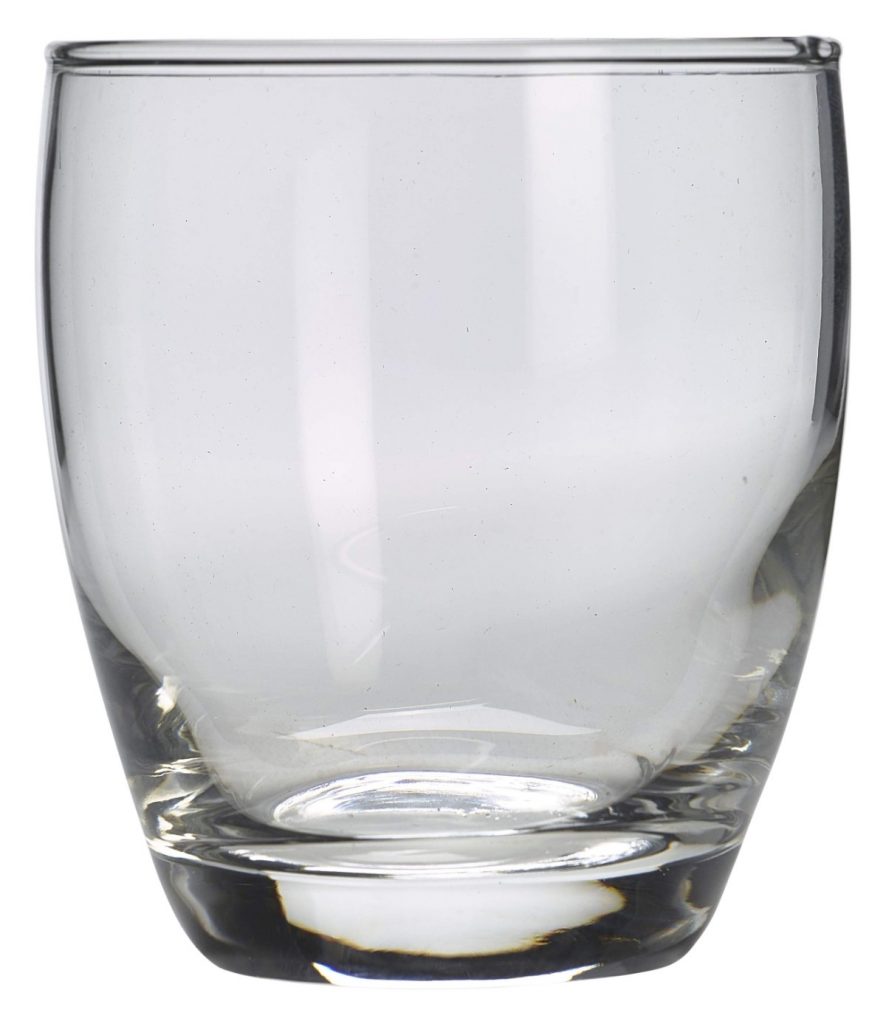
I knew about glasses—I drank from them—
and I looked through them—
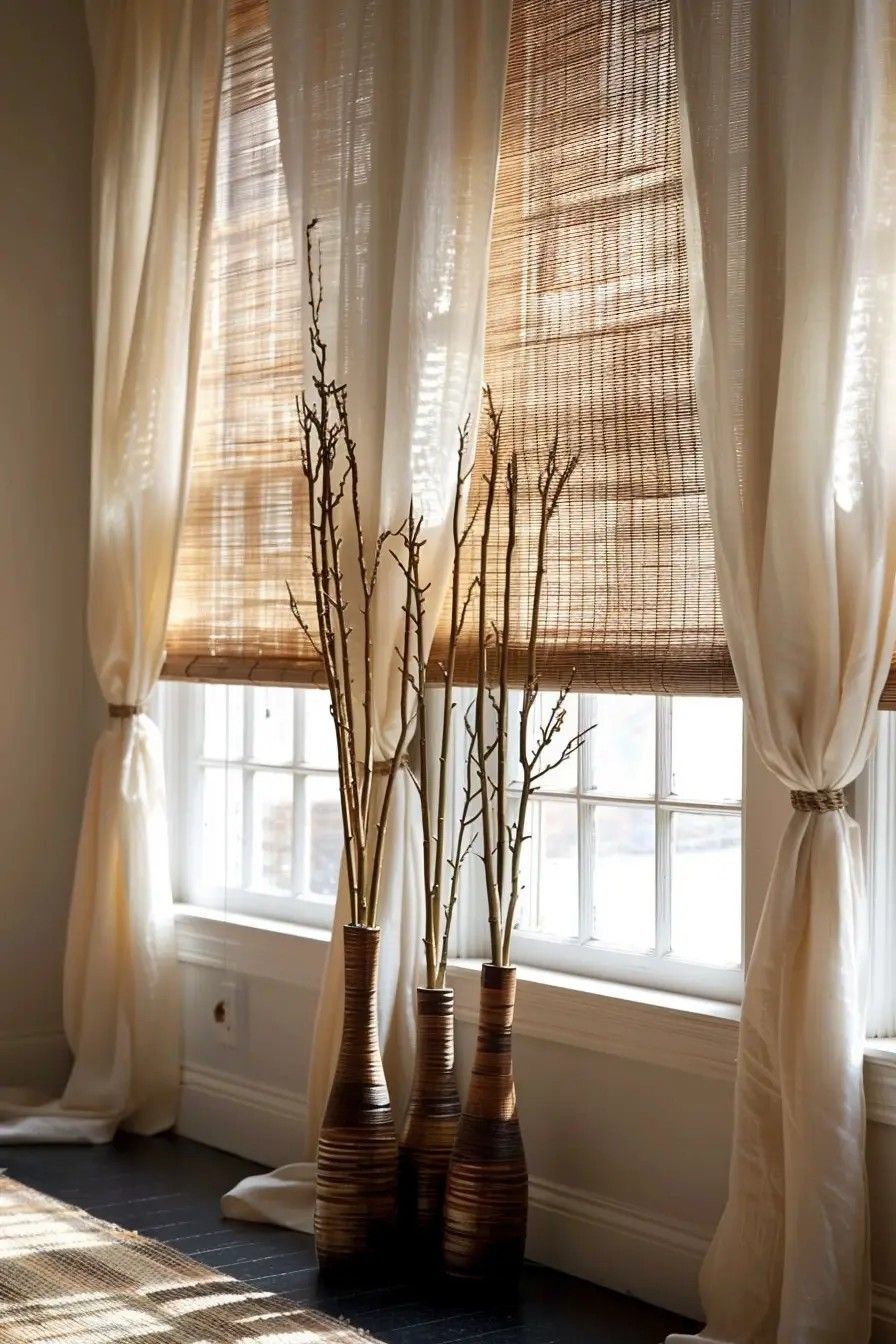
and all I could think of was that maybe the glass was dirty.

It was only as a grownup that I found out that “glass” was Jacobean shorthand (from the “King James Bible” of 1611) for “looking glass” as we can see in Jerome’s (c.342-420AD) Latin translation

“videmus nunc per speculum in enigmate”

of the Greek

“βλέπομεν γὰρ ἄρτι δι’ ἐσόπτρου ἐν αἰνίγματι,”

in which “speculum”, “mirror”, is his version of the Greek εἴσοπτρον (eisoptron), “mirror”. 

Here’s what the Jacobean translators might have thought of as a “glass”,
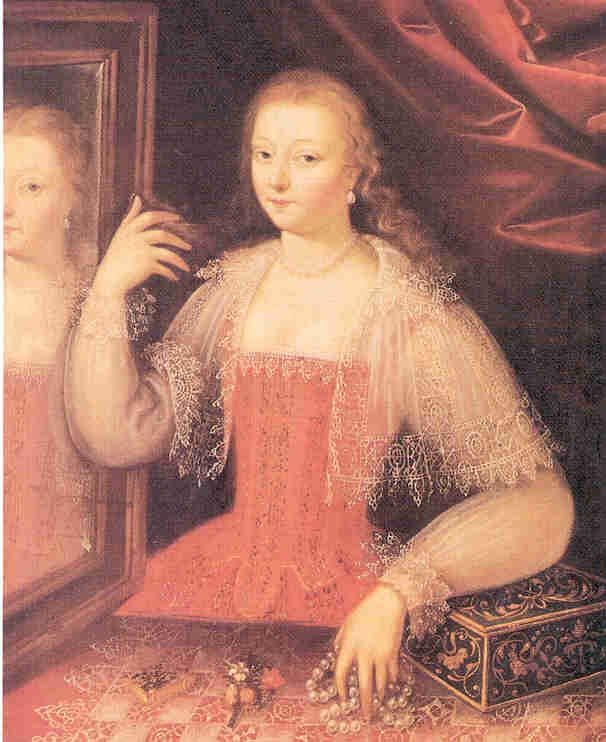
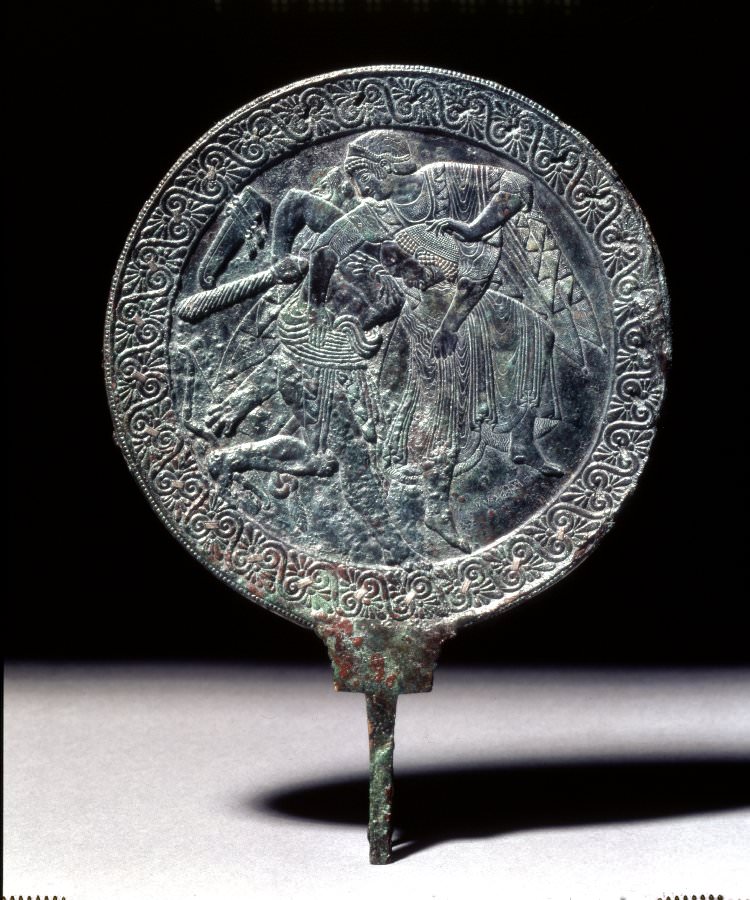
but Paul would have imagined something more like this—
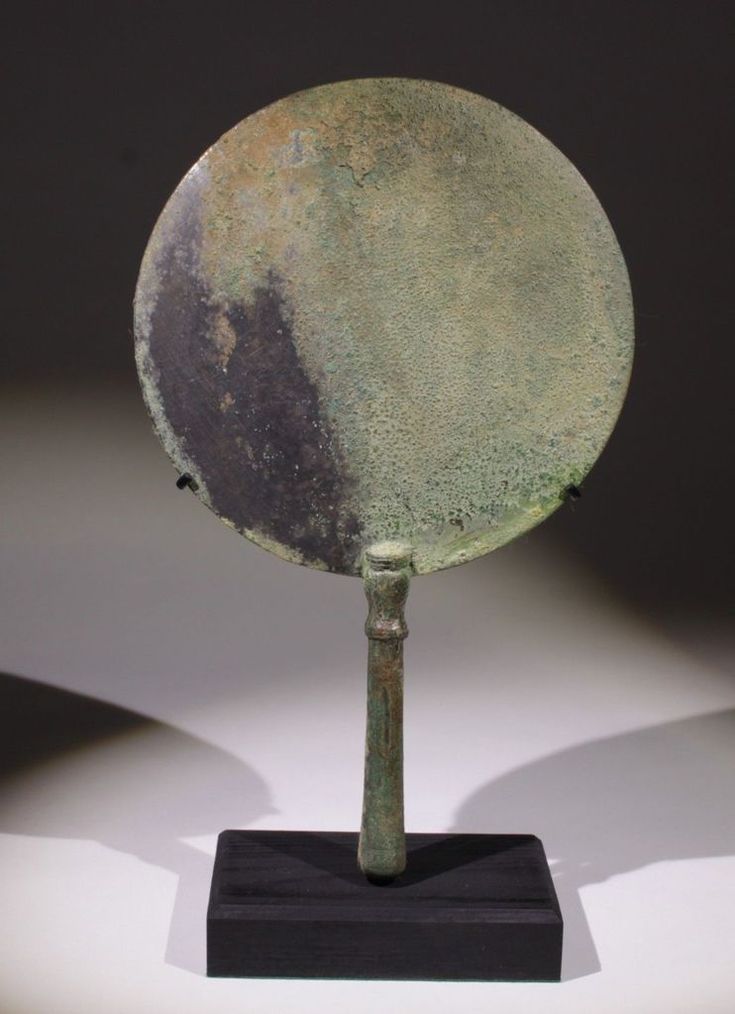
which would have been made of highly-polished metal, commonly bronze, so it’s easier to imagine that “darkly”, if the metal became tarnished.

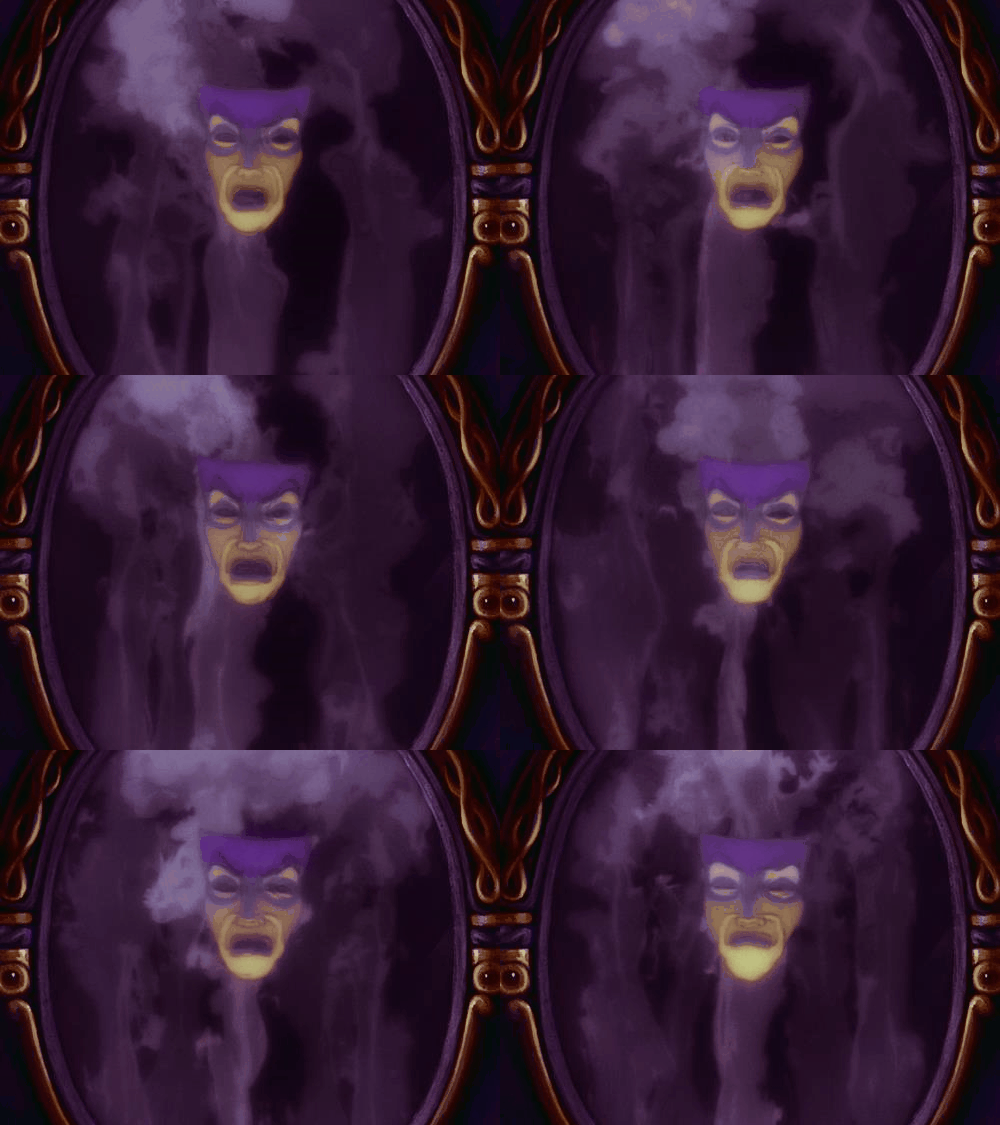
But that translation of “in enigmate” or the original ἐν αἰνίγματι, might make the mirror even darker, as it comes from αἴνιγμα, which means “riddle” and this isn’t surprising as I, at least, have always found mirrors a little odd—spooky, even—and I’m hardly alone in this—think of the wicked, vain queen in “Snow White”, with her magic mirror—

(from Disney’s 1937 “Snow White”)

or Alice’s adventures in a mirror world—

( You can read a first edition, with the original Tenniel illustrations here:    https://dn710100.ca.archive.org/0/items/throughlooking00carr/throughlooking00carr.pdf  )

or that moment in Chapter 2 of Dracula where Jonathan Harker, in Dracula’s castle, has an unnerving experience—

“I only slept a few hours when I went to bed, and feeling that I could not sleep any more, got up. I had hung my shaving glass by the window, and was just beginning to shave. Suddenly I felt a hand on my shoulder, and heard the Count’s voice saying to me, “Good-morning.” I started, for it amazed me that I had not seen him, since the reflection of the glass covered the whole room behind me. In starting I had cut myself slightly, but did not notice it at the moment. Having answered the Count’s salutation, I turned to the glass again to see how I had been mistaken. This time there could be no error, for the man was close to me, and I could see him over my shoulder. But there was no reflection of him in the mirror! The whole room behind me was displayed; but there was no sign of a man in it, except myself.”  (You can read this—and the whole book—in a first edition here:  https://gutenberg.org/files/345/345-h/345-h.htm#chap02 )

So, what about another mirror, but one not made of bronze, or silvered metal behind glass, like more modern versions—but more like a miniature reflecting pool–
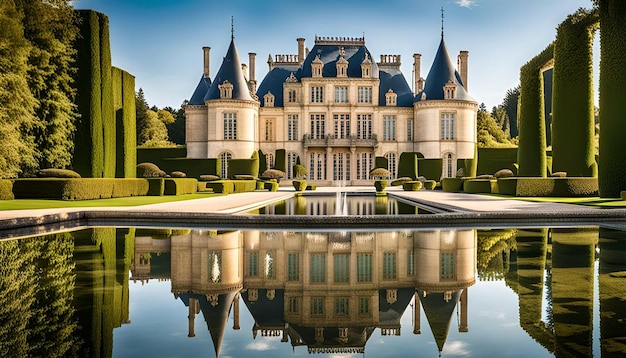
the mirror of Galadriel?
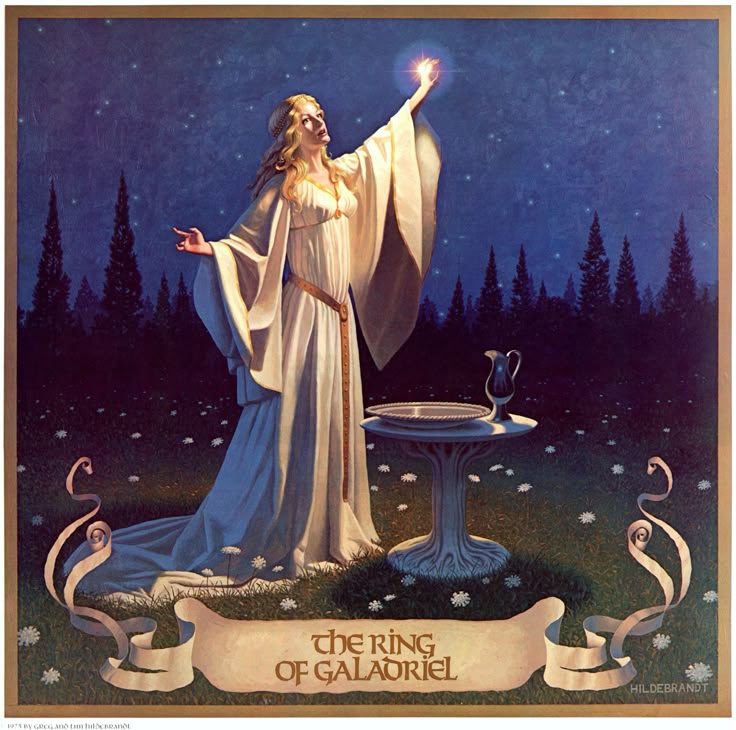
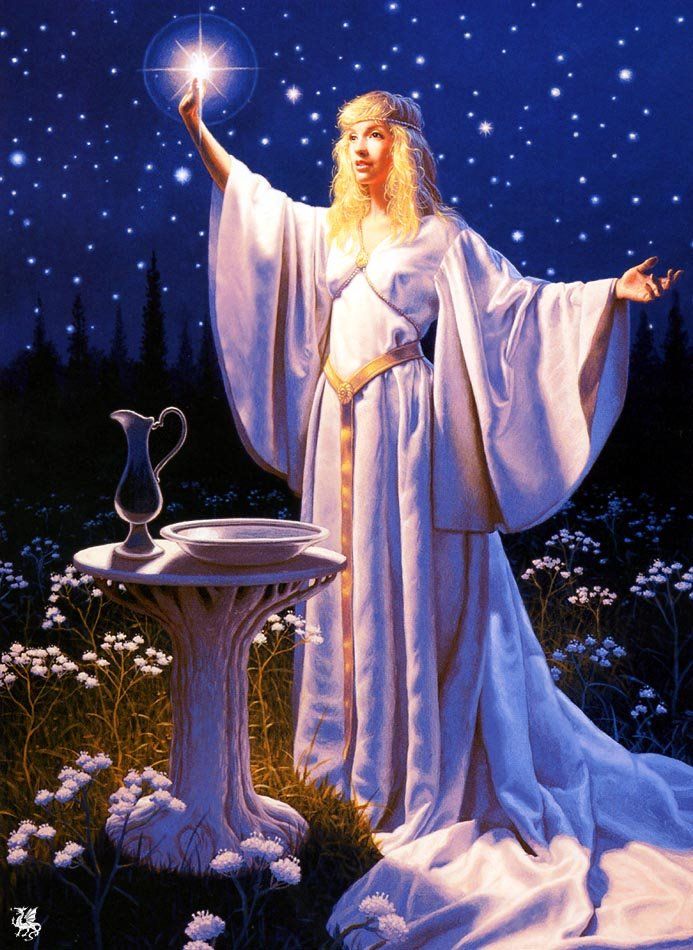
(Greg Hildebrandt)

I’ve written a little about this before  (see:   “Mirror, Mirror”, 9 December, 2015 ), but I’ve come back to this chapter with—I hope—further thoughts.  Why is it there at all?  One reason might be that, after their harrowing adventure in Moria, the Fellowship—and the readers—need a breather and, though they could continue on foot, having already come hundreds of miles that way, perhaps this is a way to vary their travels by adding water and that’s something  with which the elves can and do aid them —

“ ‘I see that you do not yet know what to do,’ said Celeborn.  ‘It is not my part to choose for you; but I will help you as I may.  There are some among you who can handle boats:  Legolas, whose folk know the swift Forest River; and Boromir of Gondor; and Aragorn the traveller.’ “ (The Fellowship of the Ring, Book Two, Chapter 8, “Farewell to Lorien”)

I would add that Lorien, Galadriel’s home, although it seems to be a place of refuge for the Fellowship,is also clearly a place for testing—and not all of that testing appears friendly, at least at first, and the deepest test for the two most important for the fate of the Ring lies in that mirror.

The testing begins, however, when Galadriel says:

“But I will say this to you:  your Quest stands upon the edge of a knife.  Stray but a little and it will fail, to the ruin of all.”

And then she continues:

“Yet hope remains while all the Company is true.”

And, having said this—

“And with that word she held them with her eyes, and in silence looked searchingly at each of them in turn.  None save Legolas and Aragorn could long endure her glance:  Sam quickly blushed and hung his head.”  (The Fellowship of the Ring, Book Two, Chapter 7, “The Mirror of Galadriel”)

Beyond her glance lies, we’re told, a kind of temptation—as Sam reveals:

“ ‘If you want to know, I felt as if I hadn’t got nothing on, and I didn’t like it.  She seemed to be looking inside me and asking me what I would do if she gave me the chance of flying back home to the Shire to a nice little hole with—with a bit of garden of my own.’ “

And, although almost none of the Fellowship reveals what he was offered, there was the same approach:

“All of them, it seemed, had fared alike:  each had felt that he was offered a choice between a shadow full of fear that lay ahead, and something that he greatly desired:  clear before his mind it lay, and to get it he had only to turn aside from the road and leave the Quest and the war against Sauron to others.”

Boromir’s experience might suggest that the test was even more revealing—and perhaps damning—than simply being allowed to leave the Quest, as Gimli says, “ ‘And it seemed to me, too…that my choice would remain secret and known only to myself.’ “  While Boromir explains:

“ ‘To me it seemed exceedingly strange…but almost I should have said that she was tempting us, and offering what she pretended to have the power to give.  It need not be said that I refused to listen.  The Men of Minas Tirith are true to their word.’ “

the narrator reveals the potentially damning part—remembering what Boromir later tried to do:

“But what he thought that the Lady had offered him Boromir did not tell.”

Did she offer him the Ring?

And now we come to the second test, a more selective one, as only Frodo and Sam are involved.
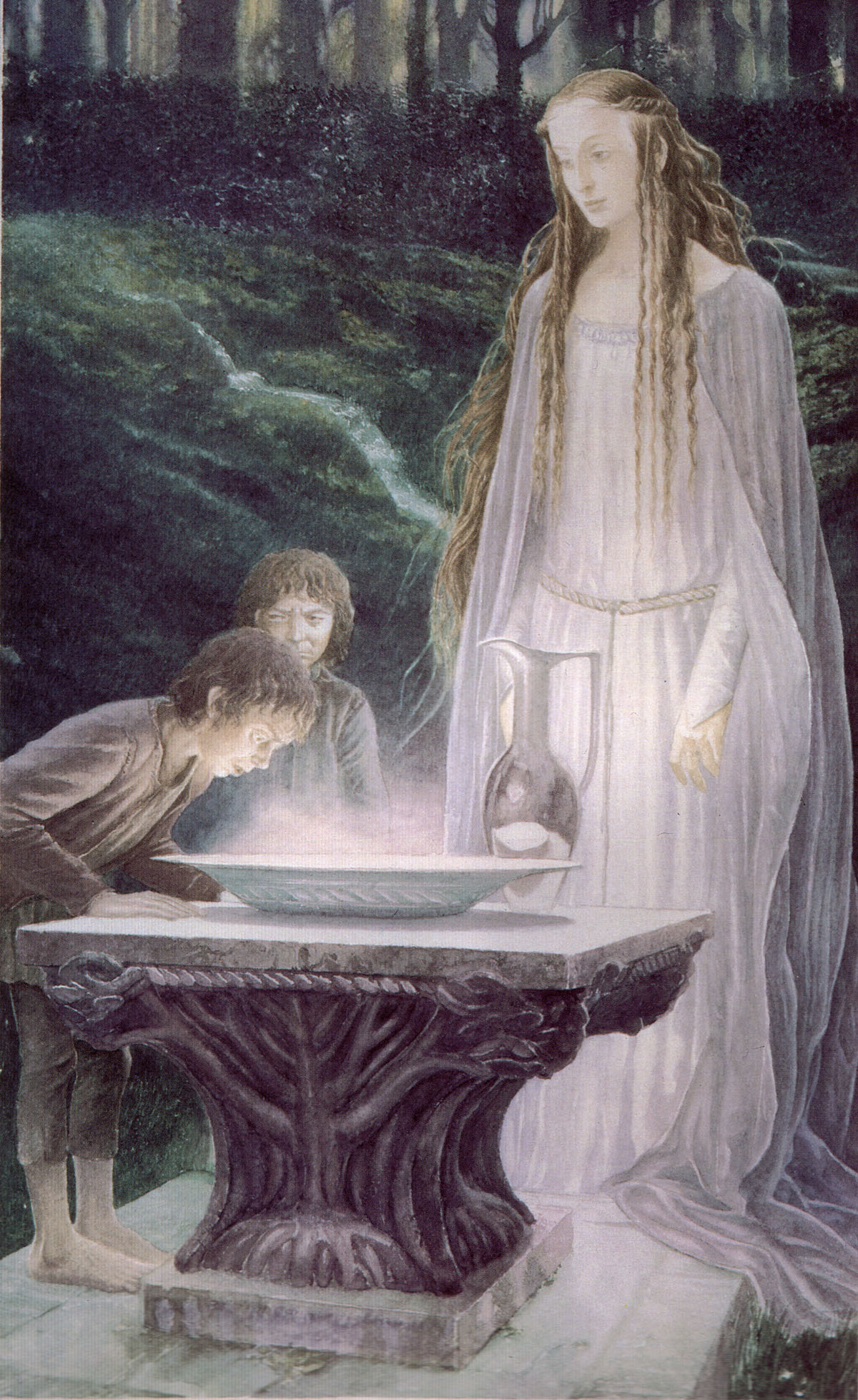
(Alan Lee)

It’s interesting to see the mirrors I’ve already mentioned and how they function in their stories.  “Snow White’s” queen employs hers as a surveillance device, in which the mirror encloses an omniscient spy and not her own reflection.  Alice’s looking glass is a barrier to another world and the fact that it’s a mirror which she must climb through suggests that, as mirrors invert things, so the world which she enters will be reversed, or at least topsey-turvey—definitely like stepping into an enigma.  Jonathan Harker’s  is a simple traveler’s shaving mirror, but stands in the middle of a mystery:  Dracula seems at first like the customer Jonathan has traveled to Transylvania to meet, businesslike, but hospitable and yet, for a nobleman living in a castle, he appears to have no servants and the castle is nearly ruined.  And then:  he has no reflection—what is Dracula?

Galadriel’s mirror, although it can repeat an image—

“Sam climbed up on the foot of the pedestal and leaned over the basin.  The water looked hard and dark.  Stars were reflected in it.”

has other properties—and, interestingly, can be controlled, to some extent, by Galadriel:

“ ‘Many things I can command the Mirror to reveal…and to some I can show what they desire to see.’ “

This has an ambiguous ring to it:  does she mean that she can make the Mirror simply reflect what people want to see, rather than what really may be seen?  If so, this seems in line with her earlier temptation/testing.  She goes on, however:

“ ‘But the Mirror will also show things unbidden, and those are often stranger and more profitable than things which we wish to behold.’”

This would then suggest that the Mirror may also have a mind of its own, beyond her control—“things unbidden”—and yet perhaps more useful—“profitable”. 

She then continues:

“ ‘What you will see, if you leave the Mirror free to work, I cannot tell.  For it shows things that were, and things that are, and things that yet may be.  But what it is that he sees, even the wisest cannot always tell.’ “

We notice right away that third part:  “things that yet may be”—and this important for what happens next.  Sam looks in, sees a little of the future which we know will happen:  “Frodo with a pale face lying fast asleep under a great dark cliff…himself going along a dim passage, and climbing an endless winding stair”—we can imagine that this is the crossing of the mountains into Mordor.  But then Sam sees the Shire and what we know will be Saruman/Sharkey’s planned industrialization—and ruin—of the Shire, with its “tall red chimney nearby” and here Sam almost fails the test, panicking and shouting “I must go home!”
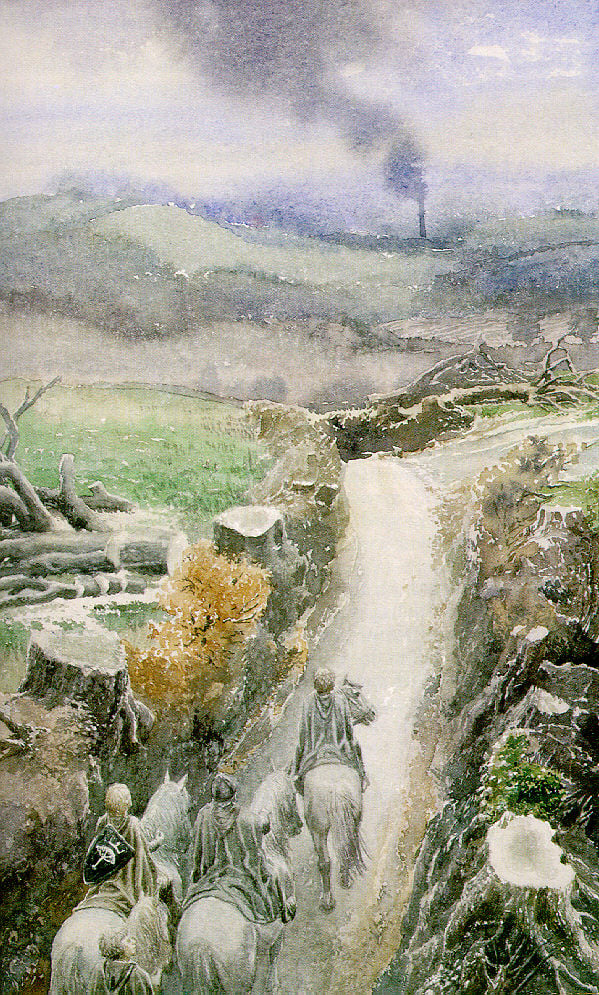
(Alan Lee)

Here, Galadriel intervenes, reminding Sam of something she has already told him and Frodo:

“ ‘Remember that the Mirror shows many things, and not all have yet to come to pass.’”

To which she adds an important caution, echoing also her earlier warning:

“ ‘But I will say this to you:  your Quest stands upon the edge of a knife.  Stray but a little and it will fail, to the ruin of all.  Yet hope remains while all the Company is true.’ ”

saying to Sam:

“ ‘Some never come to be, unless those that behold the visions turn aside from their path to prevent them.  The Mirror is dangerous as a guide to deeds.’ “

And, at this, Sam, though miserable, then passes the test:

“ ‘No, I’ll go home by the long road with Mr. Frodo, or not at all.’ “

Frodo’s visions include Gandalf (although he believes that it might be Saruman), then sees what looks to be Sauron’s attack on Minas Tirith, but then something which might be the ship which takes him and others from the Grey Havens towards Valinor (“…and into the mist a small ship passed away, twinkling with lights.”) before his visions are replaced with

“…a single Eye that slowly grew, until it filled nearly all the Mirror.”
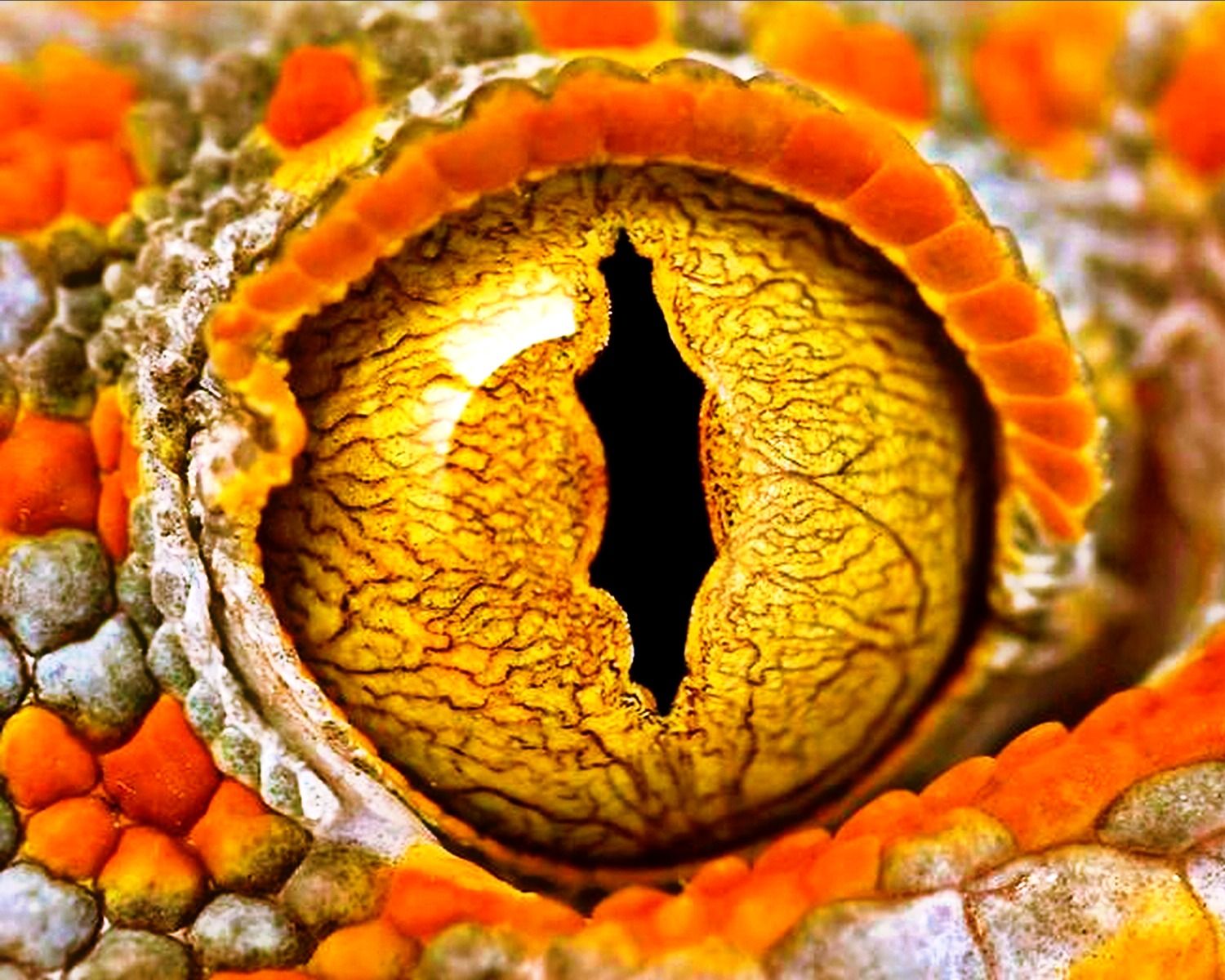
And it gets worse:

“The Mirror seemed to be growing hot and curls of steam were rising from the water.”

before Galadriel stops things by quietly saying, “Do not touch the water.”

With this interruption, however, the test, if, as it was for Sam, a test, is never completed, and so we don’t know if Frodo would have passed it.  But perhaps it is a warning:  should Frodo foolishly try to keep the Ring for himself, as he almost does before Gollum seizes it,

( Ted Nasmith)             

would he, unable to master it, be swallowed up into Sauron’s eye, or worse?

As always, thanks for reading.

Stay well,

Beware of breaking mirrors,
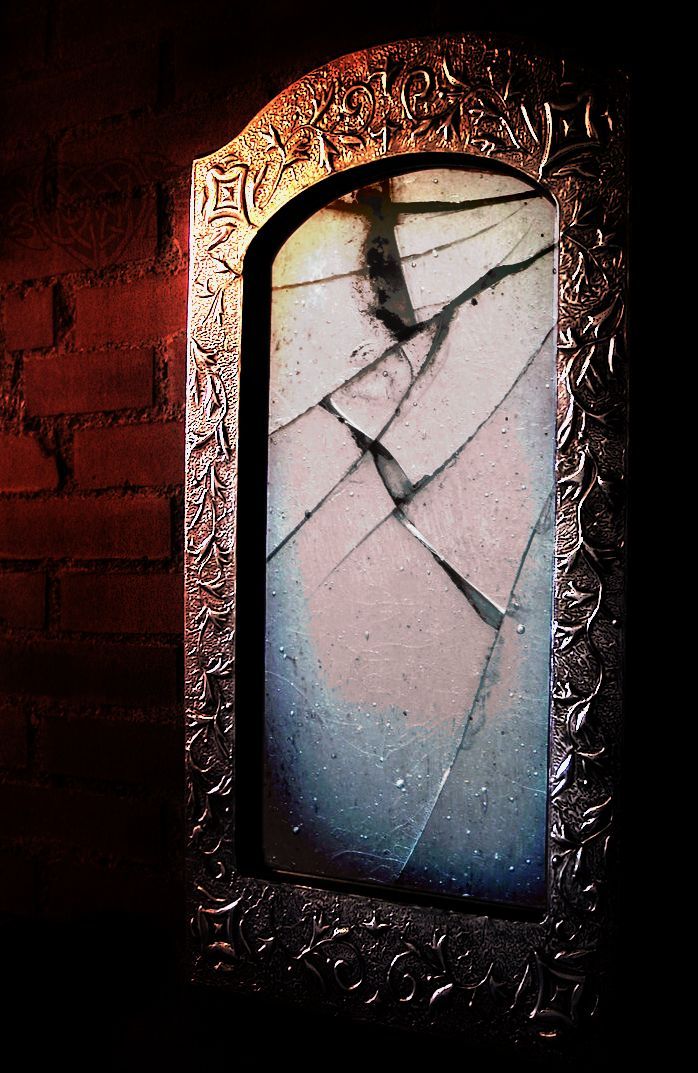
And remember that, as always, there’s

MTCIDC,

O

Mirror Image

03 Wednesday Jan 2018

Posted by Ollamh in Imaginary History, J.R.R. Tolkien, Narrative Methods

≈ Leave a comment

Tags

ancient mirrors, Bag End, chiaroscuro, Claude Debussy, Egyptians, Etruscans, Georges de la Tour, Greeks, hall stand, Headington, Magic mirror, Maurice Ravel, Medieval, Miroirs, mirror, North Oxford, Parmigianino, Portrait of the Money-Lender and His Wife, Quentin Matsys, Reflections in the Water, Reflets dans L'eau, Renaissance, Romans, Snow White, The Lord of the Rings, Tolkien, Victorian

Welcome, as ever, dear readers.

In English, we have the expression “upon reflection”, meaning something like “I’ve looked back at something and have considered (or reconsidered)”.  When we look at the word “reflection”, we see its Latin origin, re “back/again” and flection, from the verb flecto, flectere, flexi, flexum “to bend/turn/bow” (we show all four of what are called the “principal parts” of the verb so that you can see where words like “flexible”—and, together with that re—“reflex” come from) and can imagine that, originally, it was almost a physical act—as if a person were believed literally to have turned back to a thought, event, action, to think about it again.

But that made us wonder about a reflection in a different sense—when an image is repeated, in water, say.

image1blockprint.jpg

(And here we provide a YouTube LINK for a beautiful piece of music “Reflets dans L’eau”—“Reflections in the Water” by Claude Debussy—1862-1918, from the set entitled, Images, Book One—1905.)

Or in a mirror.

image2gdelatour.jpg

(This haunting painting is by Georges de la Tour, 1593-1652—known for his chiaroscuro—shadow-versus-light effects—style.)

Fancifully, we might ask: does a “reflection” in this sense suggest that the image in the mirror was turning back to look at the viewer?  More realistically, we might say that the image is bent/turned back upon the viewer—but we also wonder if the Latin word from which our word mirror comes might give a certain flavor of the uncanny about it.  Miror, mirari, miratus sum in Latin means “to wonder/be amazed at something” (Put the Latin preposition ad– on the front of this and you’re looking at English “admire”—originally “to wonder at something”—our modern sense of this has lost something of the wide-eyed nature implied in the original, but that’s how language works—sharp things, like knives, become dull with use.  In Spanish, for example, mirar comes to mean “to look at/watch/observe”.)

Certainly, folktales and folk customs once preserved something eerie about mirrors.  Think of the wicked queen’s magic mirror in Snow White.

image3snowwhitemirror.png

If you know the Disney version of Snow White, you probably expected us to show this image.

image4mirror.jpg

But this so creeped us out as children that it was not our first choice!

In various western European countries, looking into a mirror on New Year’s Eve (lots of extra things to do:  while combing hair, eating an apple, taking a bath first so that the mirror is steamy) will show you the image of your intended spouse.  And breaking a mirror can mean seven years of bad luck.

image5brokenmirror.jpg

For Egyptians,

image6egyptianmirrors.jpg

Greeks,

image7greekmirror.jpg

Etruscans,

image8etruscan.jpg

Romans,

image9roman.jpg

and western Medieval people, as well,

image10med.jpg

mirrors were not very breakable, however, being commonly made of a piece of polished bronze (although there were attempts, apparently, from late classical times on to do something with glass and a metal backing).  Artists in the classical world, rarely missing a chance to do something more, used the backs of mirrors as surfaces for decoration, as well.  Here’s a very interesting Etruscan mirror back, including an inscription (it’s the story of Icarus and Daedalus).

image11ic.jpg

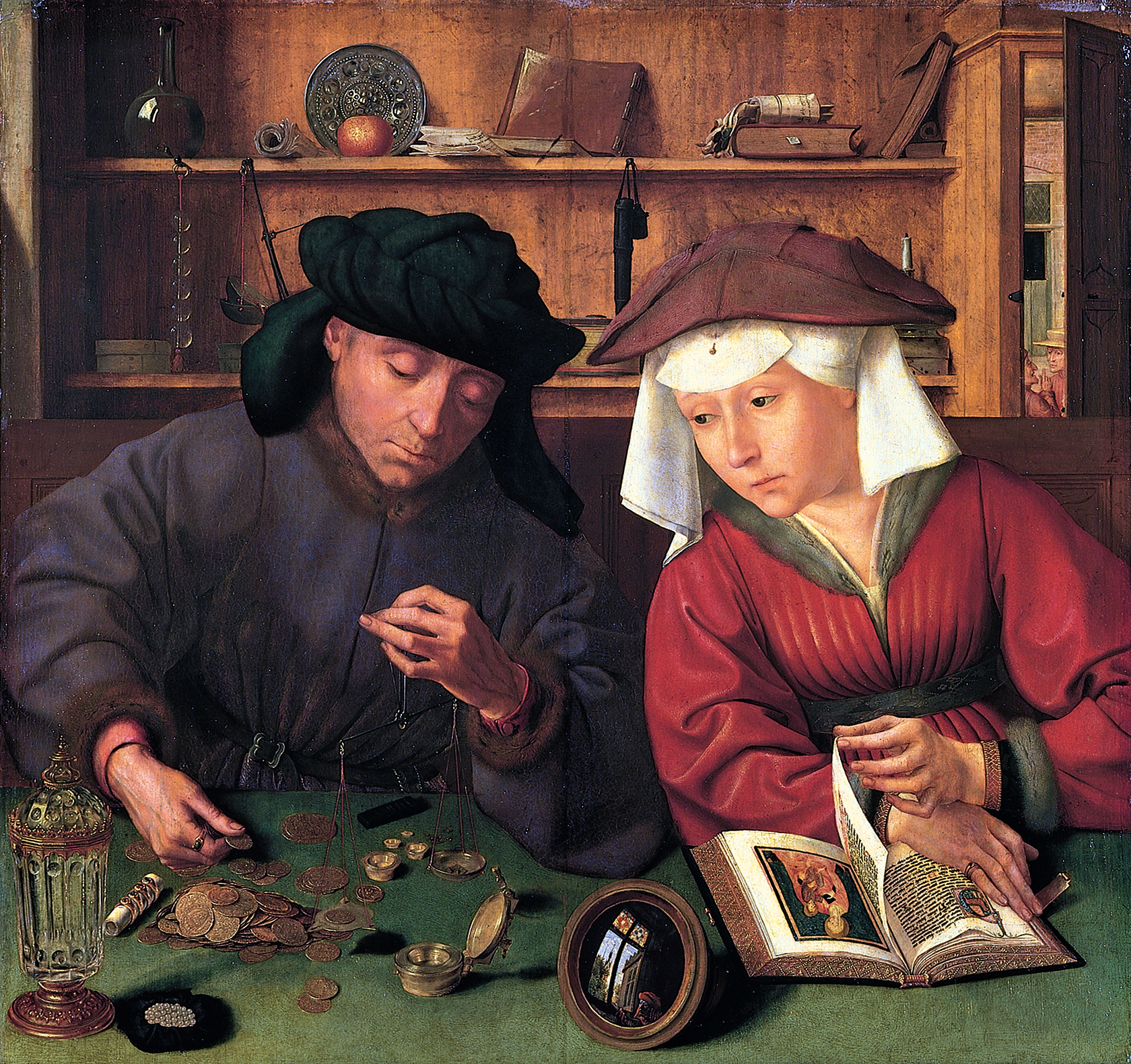
Mirrors with a silvered back and glass cover, the direct ancestors of modern mirrors, appeared during the Renaissance.

image12money.jpg

This is a little joke—a self-portrait of the painter—which has been included in Quentin Matsys’ (1466-1530) painting “Portrait of the Money-Lender and His Wife” (1514).

image13moneylender.jpg

(And, speaking of Renaissance paintings with mirrors, we couldn’t resist including this famous little painting by Parmigianino (1503-1540), a self-portrait painted on a mirror-shaped convex panel.)

image14parma.jpg


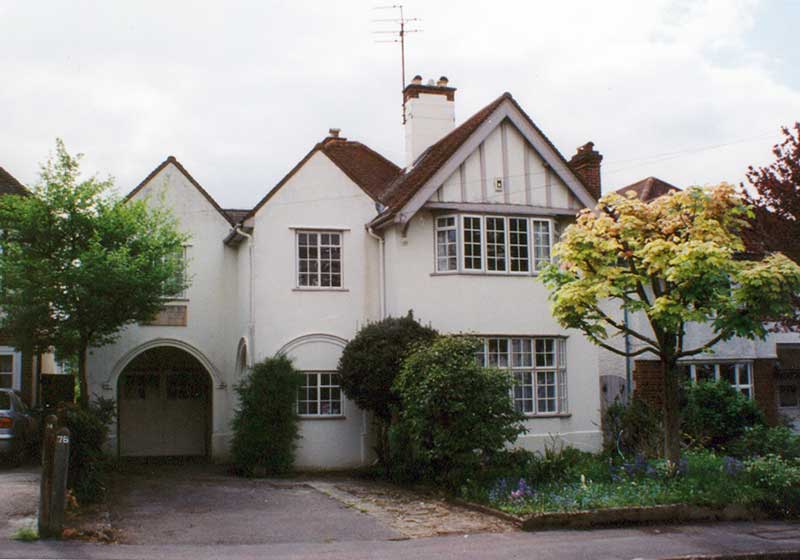
If silver-backed, glass-covered mirrors only appeared in the Renaissance, however, what can we say about this object on the left house wall in this picture?

image15bilbo.png

We can tell it’s meant to be a mirror as, looking closely, you can just make out the reflection of a tree which is outside to the right of the open door on its surface.  And is that another mirror, on the piece of furniture in the foreground on the left?  If so, it fits the kind of thing called a “hall stand” which one might see in a later-Victorian house—like this piece from the 1870s.

image16hallstand.jpg

This makes us wonder once again:  how much of this entryway depicts a Middle-earth based not upon the Middle Ages, but upon the memory of houses JRRT grew up in or perhaps furnishings from his own homes in North Oxford or Headington as an adult?

image17northox.jpg

image18head.jpg

But we’ll save what appears to be a Gothic Revival chair there on the right for another day…

In the meantime, thanks, as ever, for reading!

MTCIDC

CD

PS

We would like to take a moment and turn to the west to thank the Valar for the full recovery of our dear friend and fellow Tolkien enthusiast, EMH, from a serious operation.  Get even well-er soon!

Caspar_David_Friedrich_-_Woman_before_the_Rising_Sun_(Woman_before_the_Setting_Sun)_-_WGA08253.jpg

PPS

If you enjoyed the Debussy in the link above, perhaps you might also enjoy Maurice Ravel’s (1875-1937) Miroirs (1906)—here’s a LINK.

Into Those Woods

17 Wednesday May 2017

Posted by Ollamh in Fairy Tales and Myths, J.R.R. Tolkien, Literary History, Narrative Methods

≈ Leave a comment

Tags

A Midsummer Night's Dream, Athens, Burnham Wood, Caspar David Friedrich, Circe, Der Blonde Eckbert, Edmund Burke, Fangorn, forest, Gespensterwald, Grimm Brothers, Haensel and Gretel, Horace Walpole, Into the Woods, Ithilien, Jacob Grimm, John Bauer, John Walter Bratton, Lorien, Ludwig Tieck, Macbeth, Mirkwood, Misty Mountains, N.C. Wyeth, Nienhagen, Odysseus, Old Forest, Philosophical Inquiry Into the Origin of Our Ideas, Robert Frost, Robin Hood, Romanticism, Sir Walter Scott, Snow White, Steven Sondheim, Straparola, Teddy Bears' Picnic, The Castle of Otranto, The Fire Swamp, The Hobbit, The Lord of the Rings, The Princess Bride, Tolkien, Treebeard, Waldeinsamkeit, Waverly, Wilhelm Grimm, Woses

Welcome, dear readers, as always.

There is an early-twentieth-century American popular song called “Teddy Bears’ Picnic”, by John Walter Bratton. This was first published, in 1907, as “The Teddy Bears Picnic: A Characteristic Two-Step”,

image1tbears.jpeg

but in 1932, it acquired both its current title and lyrics, beginning,

“If you go down to the woods today,

You’re sure of a big surprise…”

Here’s a link, if you’d like to read more. And here’s a link to the first recording of the version with its lyrics, from 1932. WARNING: it has a catchy little tune!

This song came to us because we’ve been thinking about forests and their frequency and importance in The Hobbit and The Lord of the Rings.

Woods have always been spooky places in folktales. Think of Haensel and Gretel, for example,

image2handg.jpg

or Snow White,

image3snowwhite.jpg

or even the story of Odysseus and Circe, as Circe’s house is set deep in a forest.

image3acirce.jpg

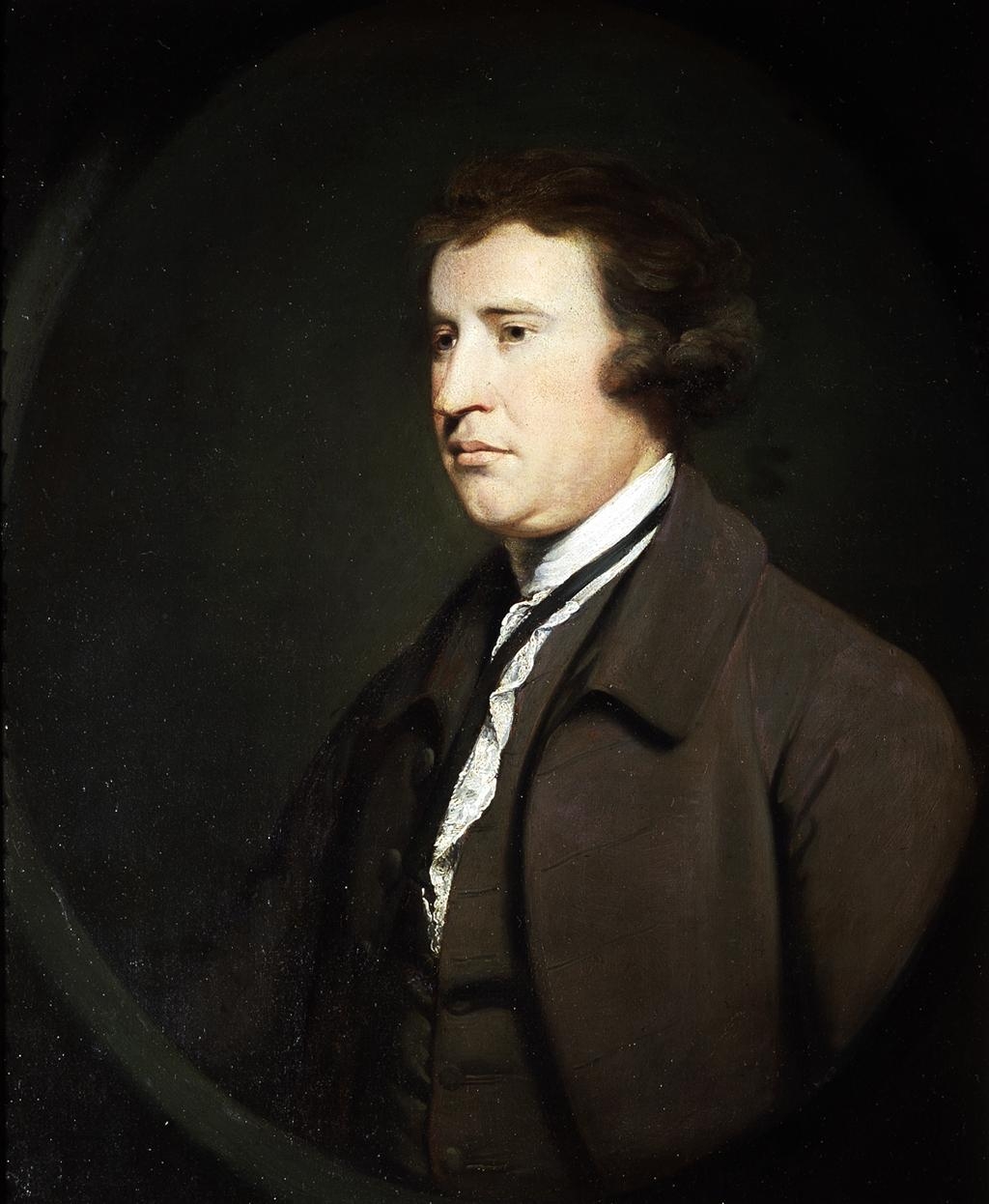
Among our interests is Romanticism–both in itself because it’s in Romanticism that modern adventure stories really take off (for the supernatural, think Horace Walpole, The Castle of Otranto, 1764; for historical, Sir Walter Scott, Waverly, 1814). The early Romantics were fascinated by the forest, both as a place of beauty and of fear. This is not surprising, for several reasons. First, they were influenced by the writings of Edmund Burke (1729-1797),

image4burke.jpg

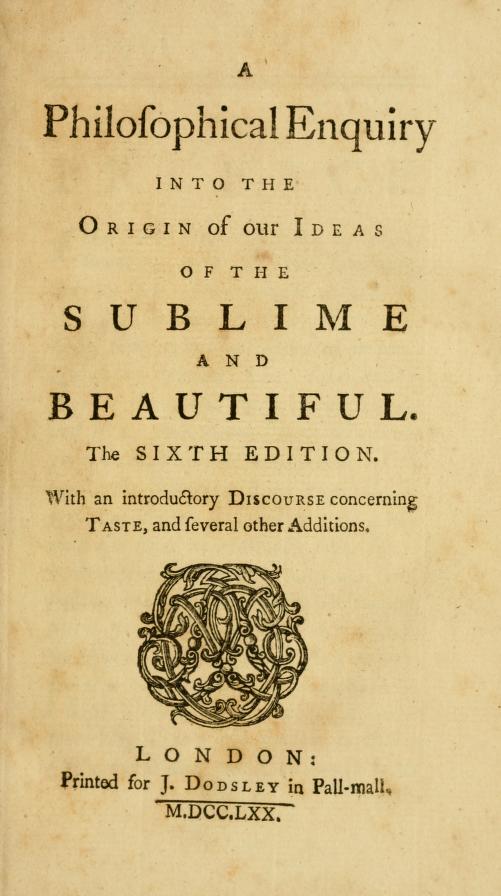
who published a famous essay, “Philosophical Inquiry Into the Origin of Our Ideas of the Sublime and Beautiful” in 1757 (this is a 1770s reprint).

image5inquiry.jpg

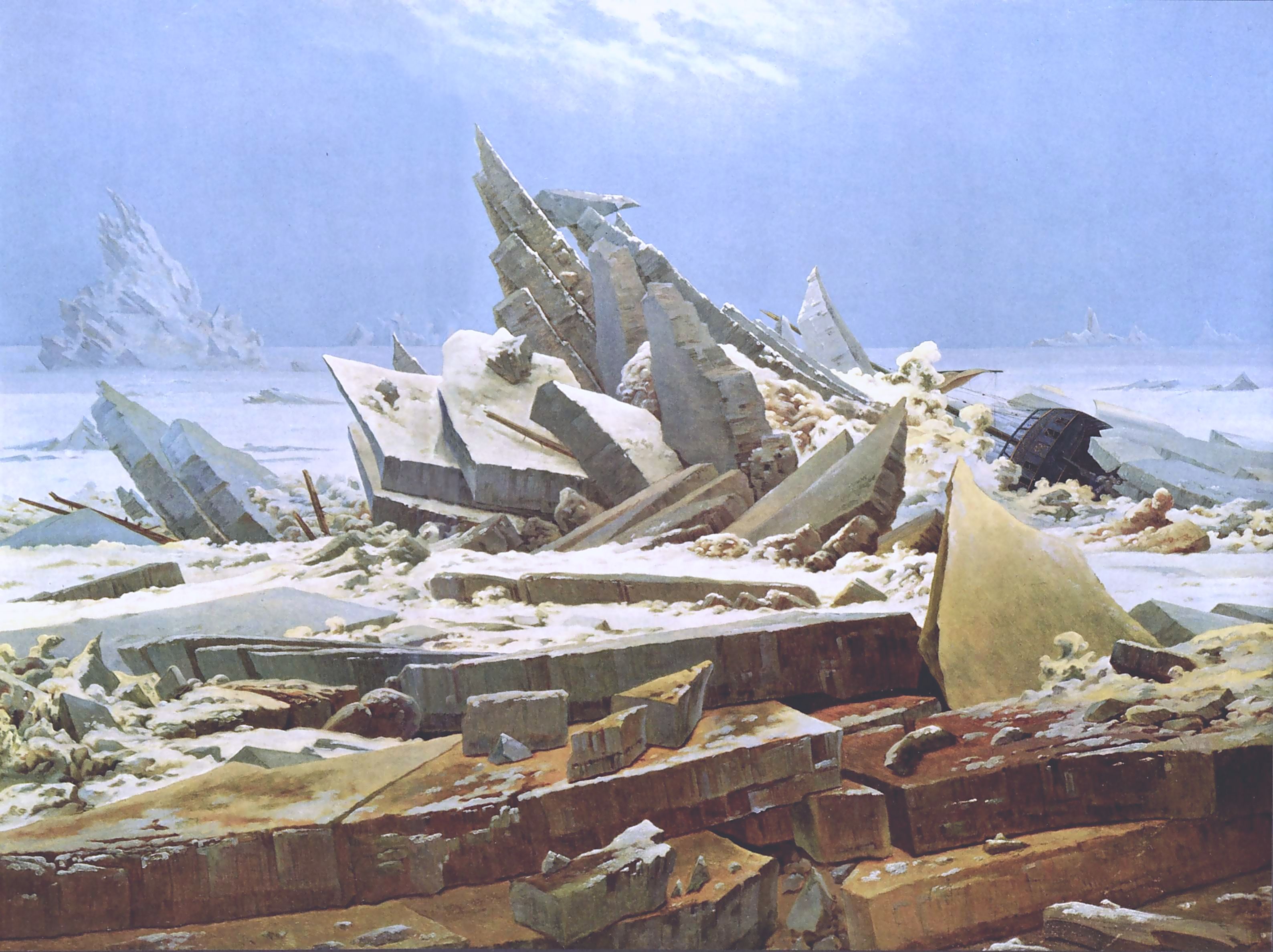
Burke was interested in human reactions to things which, basically, are either awe-inspiring (how about this?)

image6eismeer.jpg

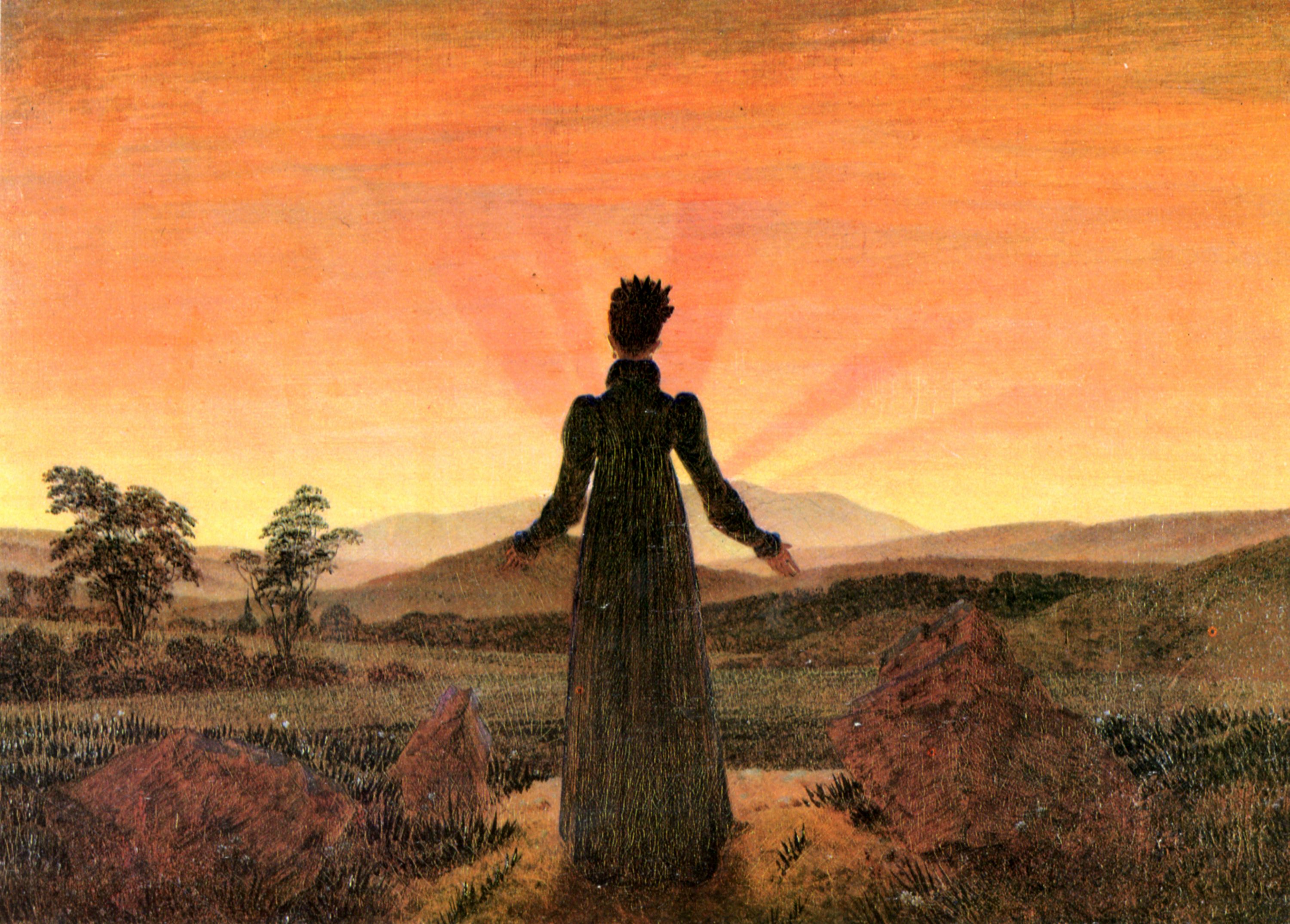
or beautiful

image7beautiful.jpg

Awe-inspiring (to which may even be added a little terror– you, sharp-eyed readers have probably already noticed that there are the remains of a crushed ship in the ice in the first picture) is a sort of opposite of the beautiful– we say “sort of” because they can be related, which is why we chose two pictures by the same artist– our favorite early Romantic artist, in fact, Caspar David Friedrich (1774-1840).

image8cdf.jpg

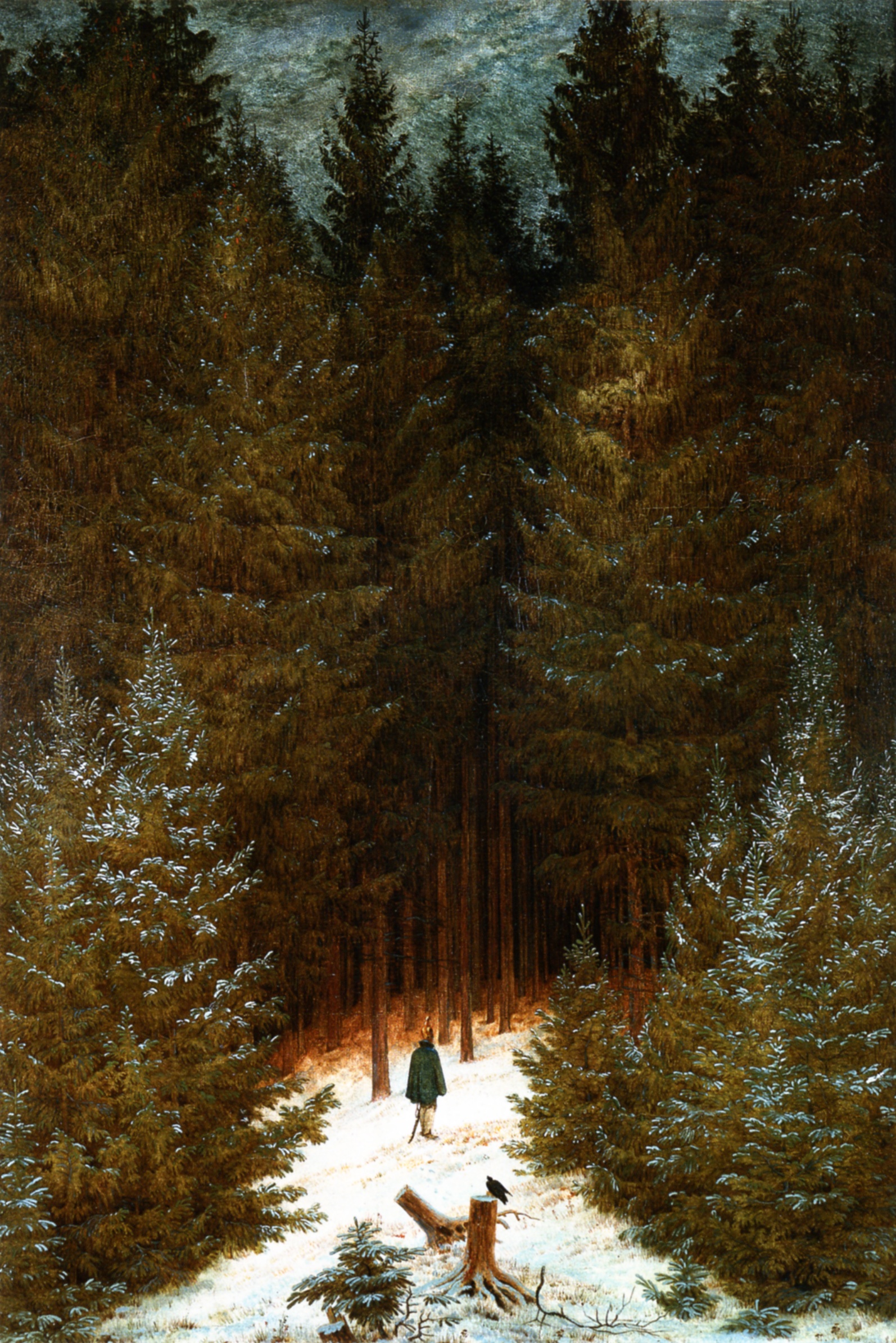
This brings us to this Friedrich painting:

image9chass.jpg

There are lots of his paintings in which we are standing behind someone who is looking off into the distance– as in the one we chose for “the beautiful”. As you can see in the above, here we have a man contemplating a path into a snowy wood. (Which reminds us of a poem by the American poet Robert Frost, 1874-1963, and we can’t resist adding it here, just for the pleasure of it:)

Stopping by Woods on a Snowy Evening

Whose woods these are I think I know.
His house is in the village though;
He will not see me stopping here
To watch his woods fill up with snow.
My little horse must think it queer
To stop without a farmhouse near
Between the woods and frozen lake
The darkest evening of the year.
He gives his harness bells a shake
To ask if there is some mistake.
The only other sound’s the sweep
Of easy wind and downy flake.
The woods are lovely, dark and deep,
But I have promises to keep,
And miles to go before I sleep,
And miles to go before I sleep.

There is menace here (note the crow on the stump in the foreground…), and yet it’s beautiful. And tempting– and that’s part of the sublime, as well.

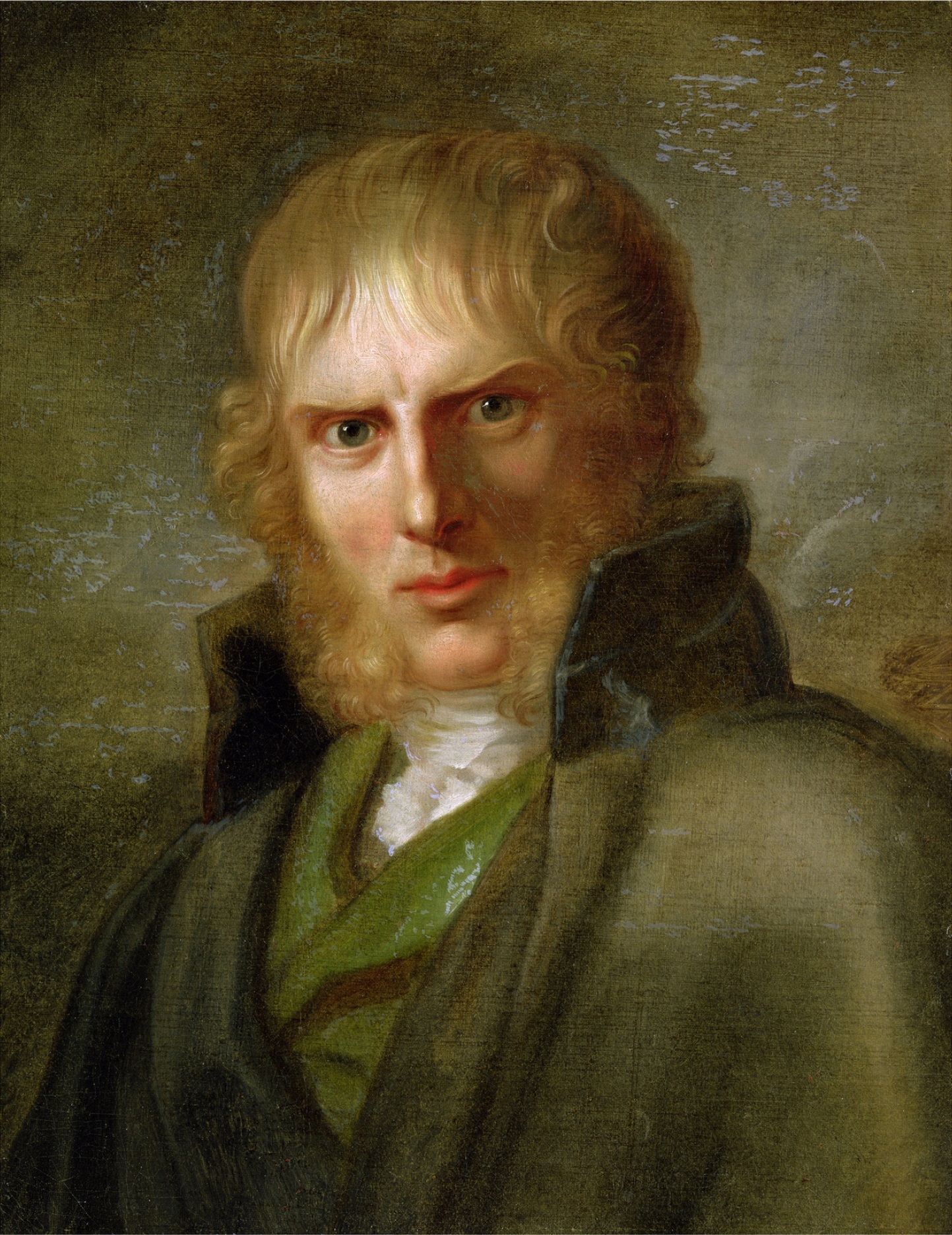
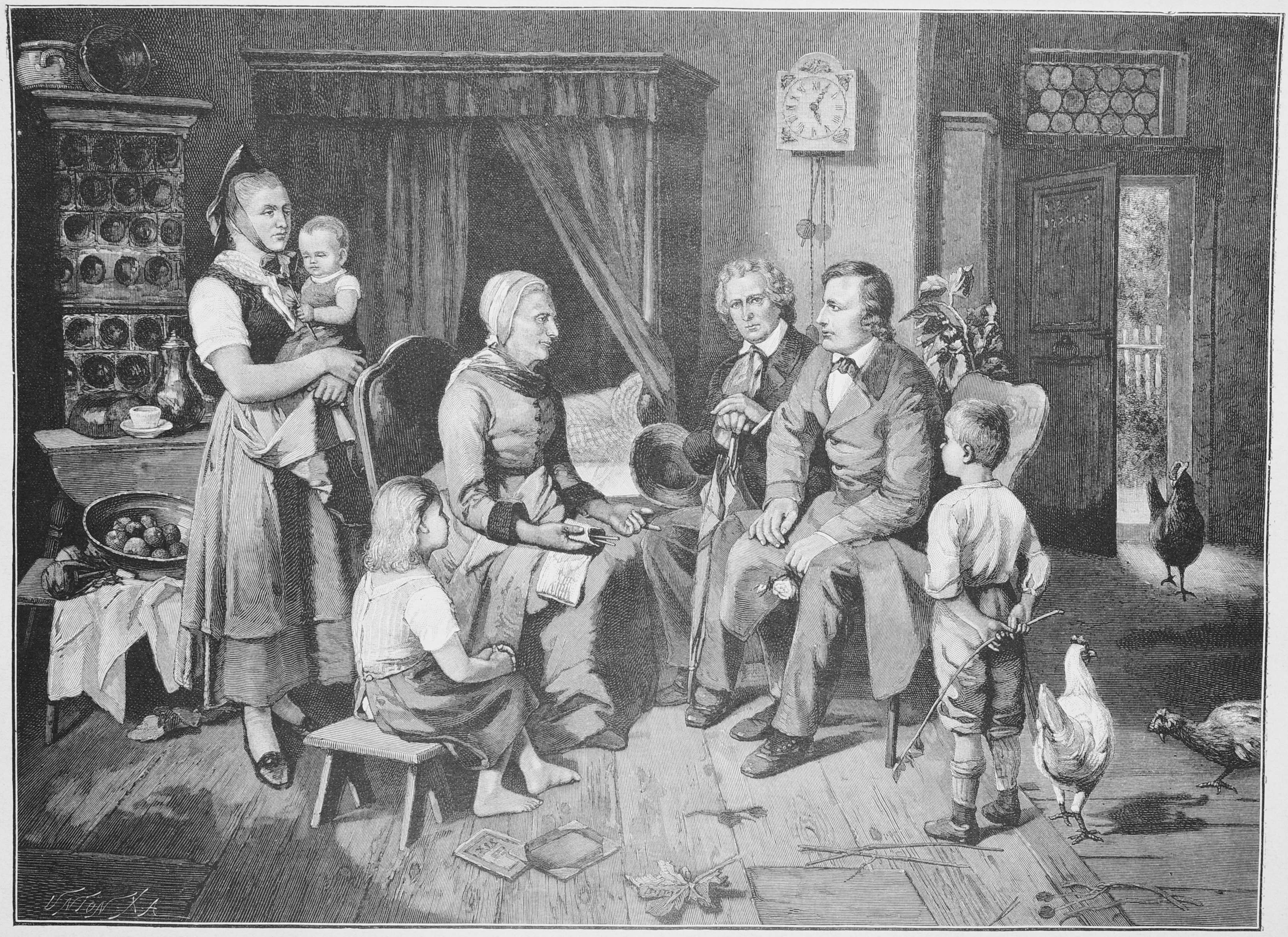
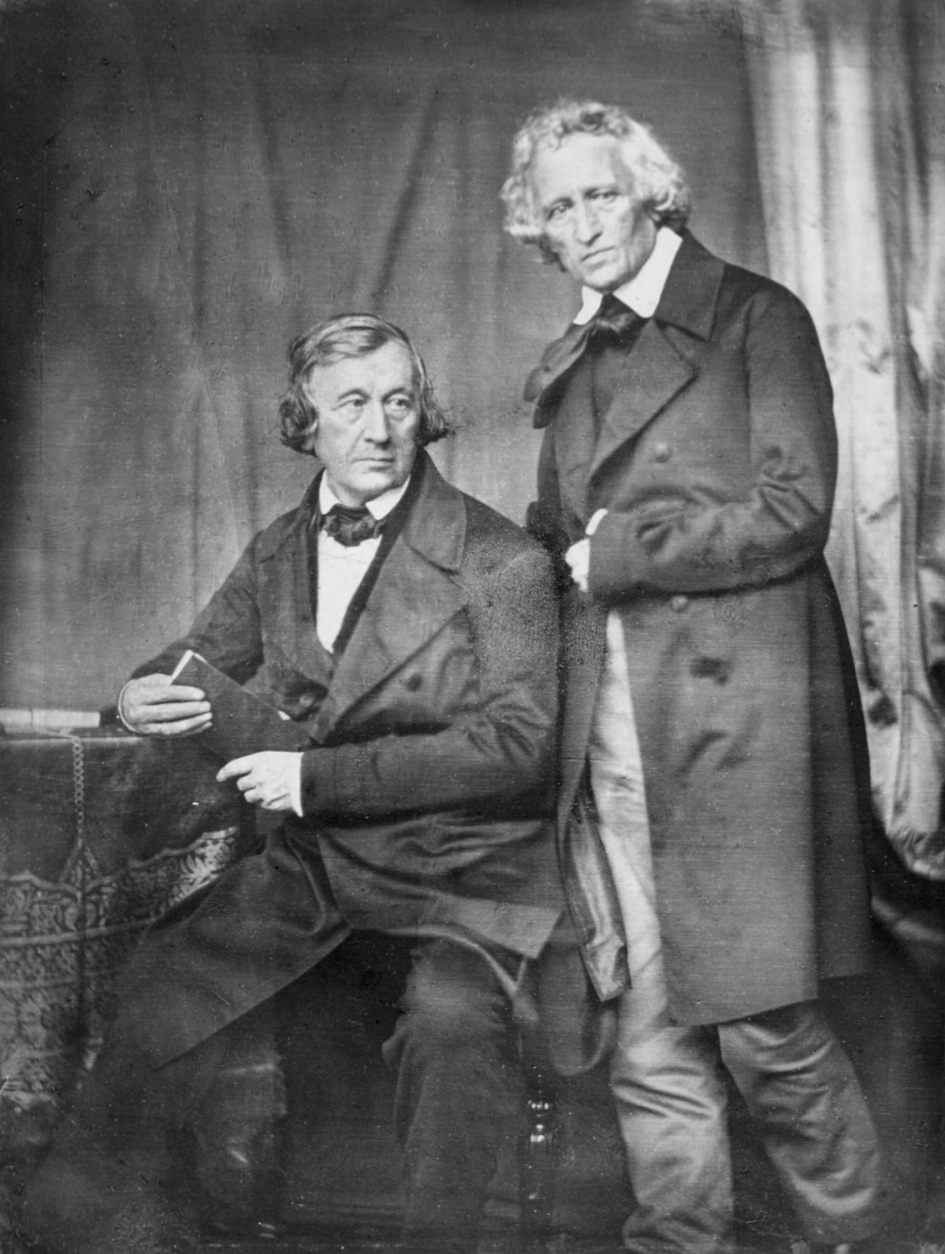
Besides their interest in Burke, the early Romantics were also deeply interested in folktales. People had been collecting and publishing such things in early modern Europe since at least Straparola in the 16th century, but, from the Romantics, we have the work of these two men, highly-intelligent brother-scholars, the Grimms, Jacob (1785-1863) and Wilhelm (1786-1859), whose work, either in itself on in adaptation, is known throughout the whole western world.

image10grimms.jpg

The story of Haensel and Gretel comes from them, in fact (as does Snow White). Because of a famous short story by Ludwig Tieck (1773-1853),

image11tieck.jpg

“Der Blonde Eckbert” (maybe “Fair-haired Eckbert” in English?), there is a word in German for this fascination for the woods, Waldeinsamkeit, meaning something like “The Sense of Being Alone in the Forest”. Like “sublime”, this word has a wide range of feeling to it, including that sense of aloneness/being alone/loneliness/ mixed with the pleasure of being alone in the forest. In the story, the word is contained in a little poem sung by a strange bird, which begins:

“Waldeinsamkeit

Die mich erfreut

So morgen wie heut

In ewger Zeit

O wie mich freut

Waldeinsamkeit.”

“Aloneness in the forest–

That delights me,

As today so tomorrow

In eternal time

Oh how it delights me

Aloneness in the forest!”

In the case of JRRT, however, although he was well known to be quite passionate in his love for trees, forests in his work do not always appear to be places for pleasure. (And how can we not be reminded of that moment in the film, The Princess Bride, when the hero and heroine are at the edge of the Fire Swamp, a kind of haunted wood,

image12fireswamp.jpg

and the hero, Westley, says, “It’s not that bad. I’m not saying that I’d like to build a summer home here, but the trees are actually quite lovely”– and only a moment later the heroine, Buttercup, is attacked by a spurt of flame from the ground itself?)

Out first wood in The Hobbit is the one into which several of the dwarves disappear, captured by three rather dimwitted trolls.

image12atrolls.jpg

When we look at this and at other JRRT illustrations, we are reminded of the world of the Swedish illustrator, John Bauer (1882-1918), some of whose fairy tale forests bear a certain strong similarity in their regularity.

image12bbaueer.jpg

image13bauer.jpg

What’s surprising is that, in northern Europe, there actually appear to be stands of wood which actually look very like this. Here’s Nienhagen, in northern Germany.

image14nienhagen.jpg

It’s a beechwood (one of JRRT’s favorite trees and ours, too– remember this big beech from N.C. Wyeth’s Robin Hood illustrations?

image15robin.jpg

Nienhagen has another name, however, Gespensterwald, “Ghostwood”, and, seeing this next picture and comparing it to Bauer’s paintings, we imagine that you’d agree with us that this is an appropriate nickname.

image16gespensterwald.jpg

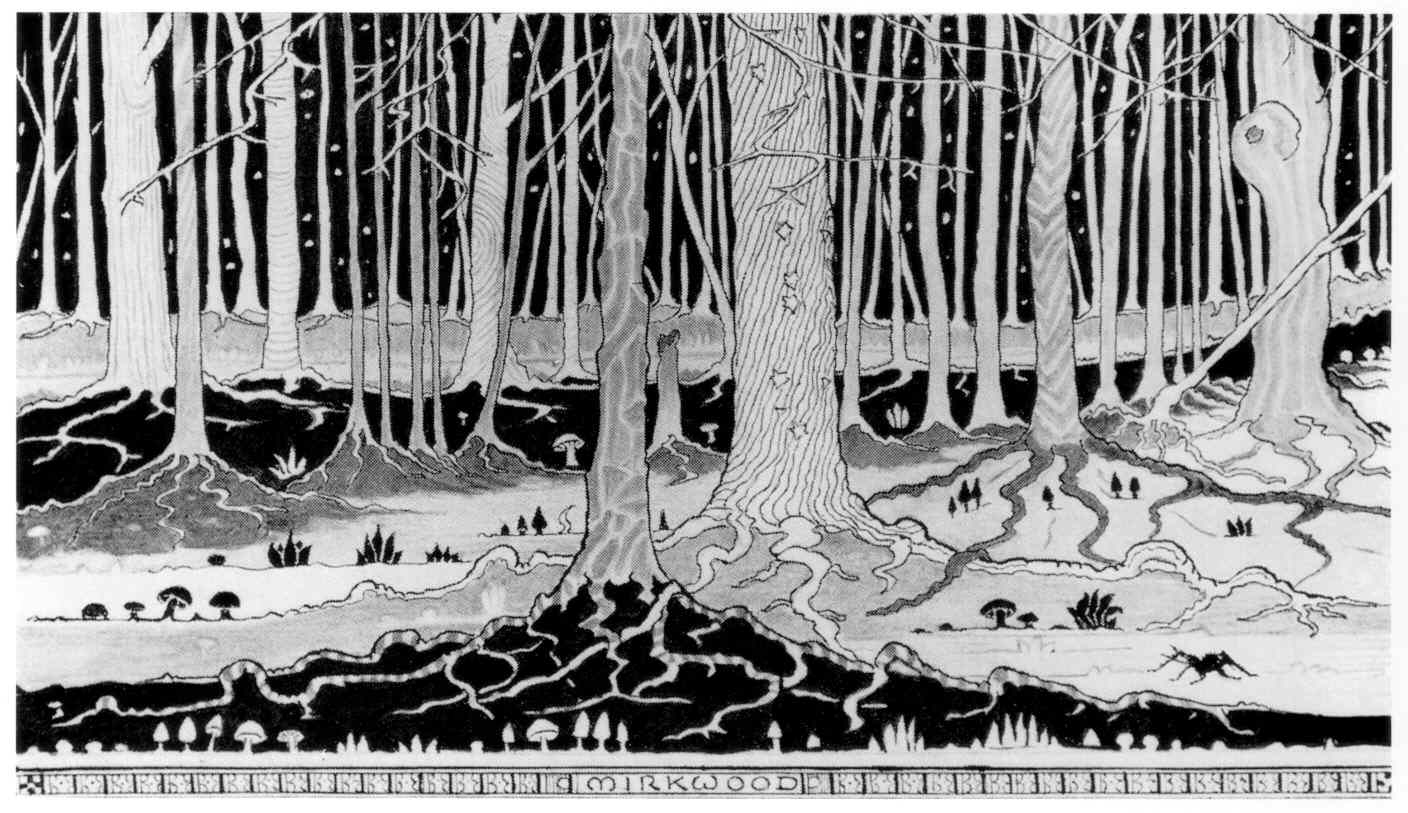
Across the Misty Mountains, we come to Mirkwood, with its disappearing Elves, sleepy stream, and giant spiders– hardly an inviting place.

image17mirkwood.jpg

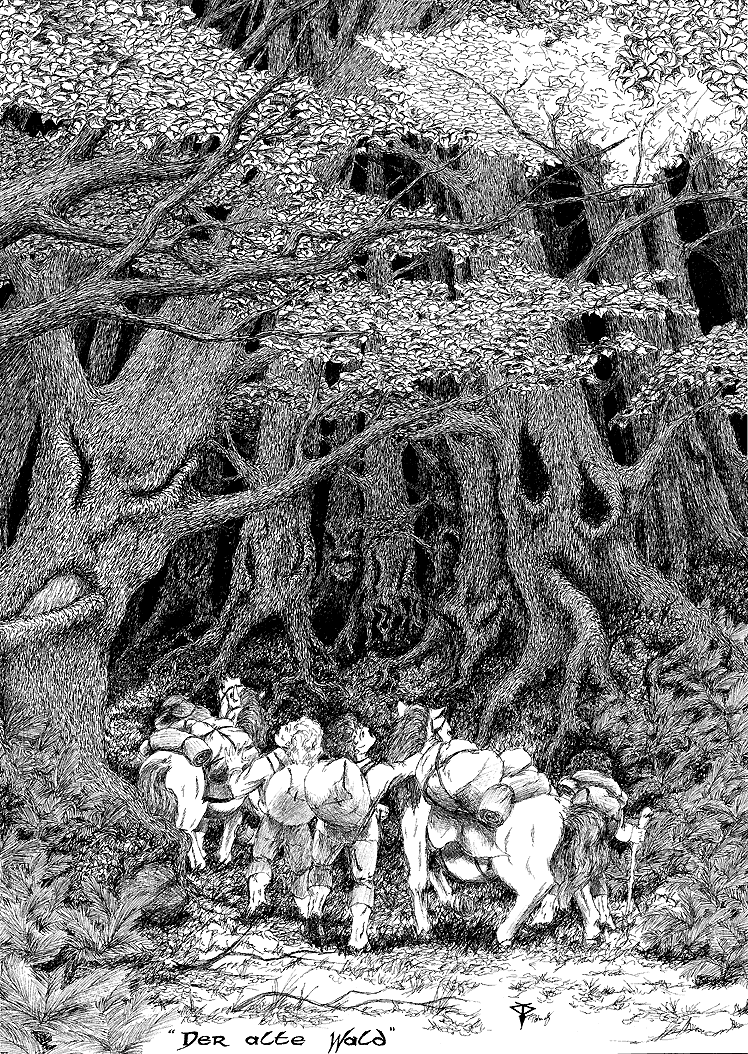
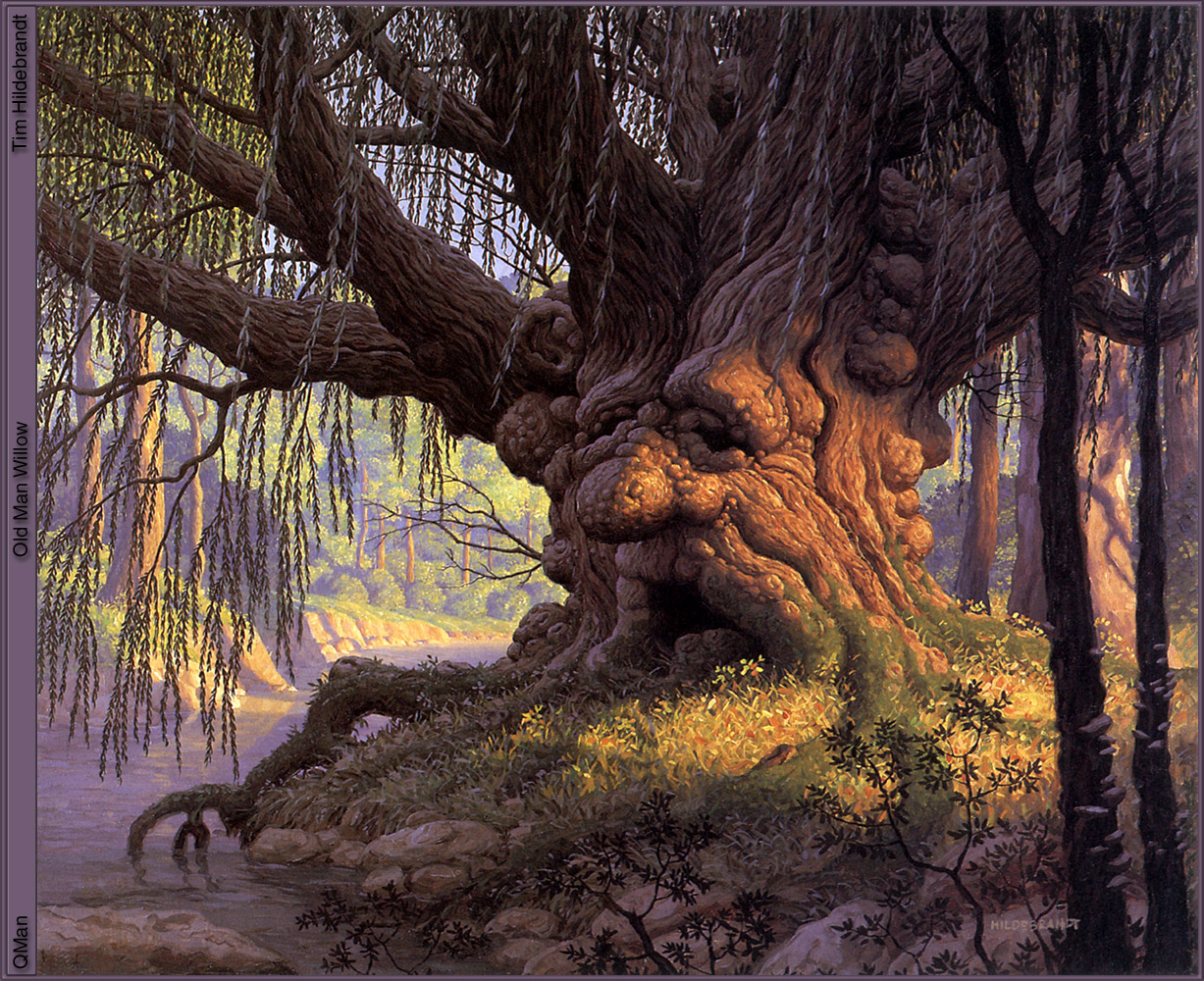
The forests of The Lord of the Rings are a bit mixed. There is the Old Forest, which is so hostile that is has to be kept off with cutting, burning, and a hedge and, in its depths, there is Old Man Willow, who almost swallows several unwary hobbits.

image18oldforest.gif

image19oldmanwillow.jpg

Then there is Lorien, a place of safety and healing for the Fellowship.

image20lorien.jpg

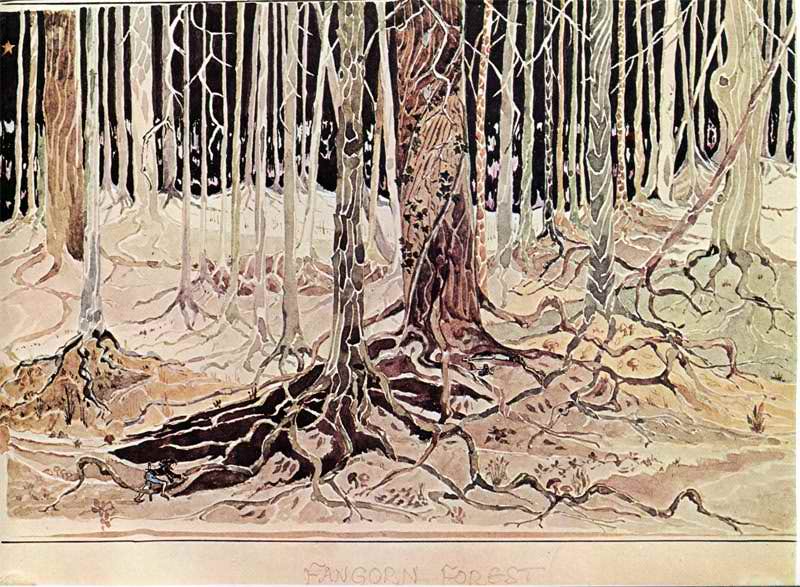
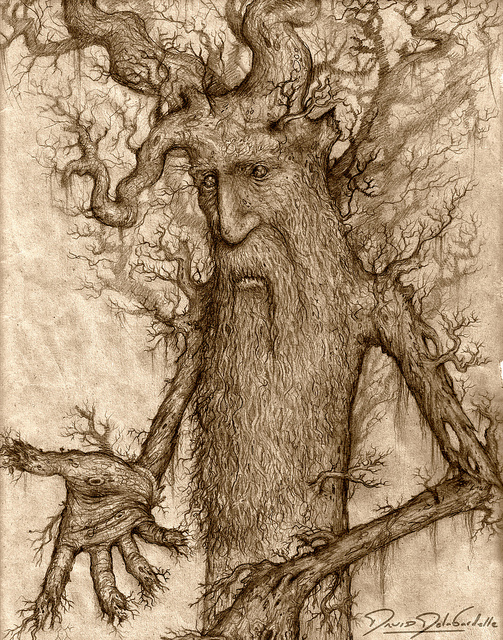
And, last, there is Fangorn, with its Ents, especially the thoughtful and ultimately sympathetic Treebeard.

image21fangorn.jpg

image22treebeard.jpg

These are principal woods– there are also the woodlands of South Ithilien, there Faramir

image23faramir.jpg

image23woses.jpg

and his rangers lurk, as well as the unnamed wood where the Woses live, but it’s the people there who are the focus of the story, not the forests.

This sense of a wood being dangerous goes far beyond fairy tales and even JRRT, of course. Shakespeare has several puzzling forests– as in the wood outside Athens in A Midsummer Night’s Dream

image25mnd.JPG

or the traveling Burnham Wood in Macbeth

image26burnham.jpg

And there is even the wonderful Steven Sondheim musical, Into the Woods (1986), in which going into the woods has a magical/metaphorical side.

image27intothewoods.jpg

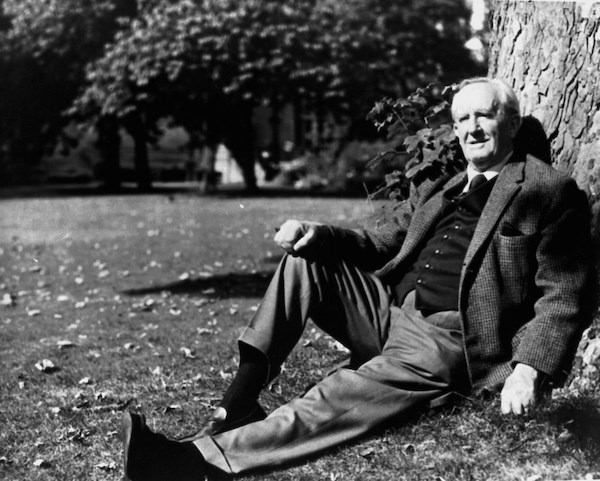
But we’ll leave you where we started– with JRRT– and a single tree…

image28jrrt.jpg

Thanks, as always, for reading.

MTCIDC,

CD

Smoke and Mirror?

16 Wednesday Dec 2015

Posted by Ollamh in Fairy Tales and Myths, Films and Music, J.R.R. Tolkien, Narrative Methods, Villains

≈ Leave a comment

Tags

"Slave of the Mirror", acting, actor, Adventure, Aladdin, classical drama, classics, clowns, comedy, Commedia dell'Arte, Disney, drama, Evil Stepmother, Fiction, Galadriel, Genie, Hellenistic, histrio, Jumanji, Magic, Magic mirror, masks, Middle-earth, Moroni Olsen, persona, pretending, Snow White, The Lord of the Rings, theatre, Tolkien, tragedy

Dear Readers,

Welcome, as always.

In our last posting, we thought about Galadriel’s mirror.

galadriel.jpg

We began with the mirror in Disney’s 1937 Snow White, and it occurred to us that we have no backstory for this. Where did it come from? How did it know anything? And, perhaps more important for the story, why did the stepmother believe it?

Magic_Mirror_SnowWhite.jpg

We know how wary we would have been– that Snow White mirror freaked us out as children.

girmagicmirror.gif

Reconsidering it, we thought it was partially that smoke. But it was also that face. There was a real face behind that mirror, that of the actor Moroni Olsen (1889-1954).

There is also a history behind that face, which appears to be based upon the conventional mask of tragedy, which is often seen paired with that of comedy.

comedy_and_tragedy_masks_symbols_plays_hd-wallpaper-1888436.jpg

These masks might have come down to us most recently through the Italian Commedia dell’Arte, in which all the comic characters were masked.

commdance.jpg

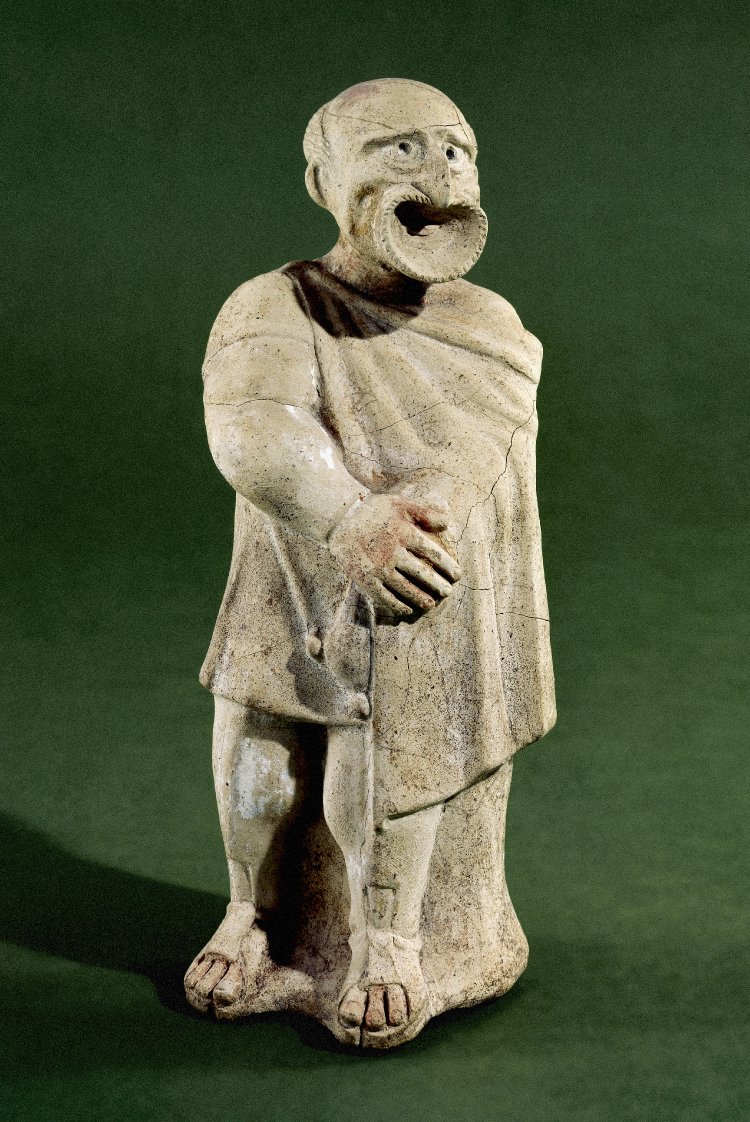
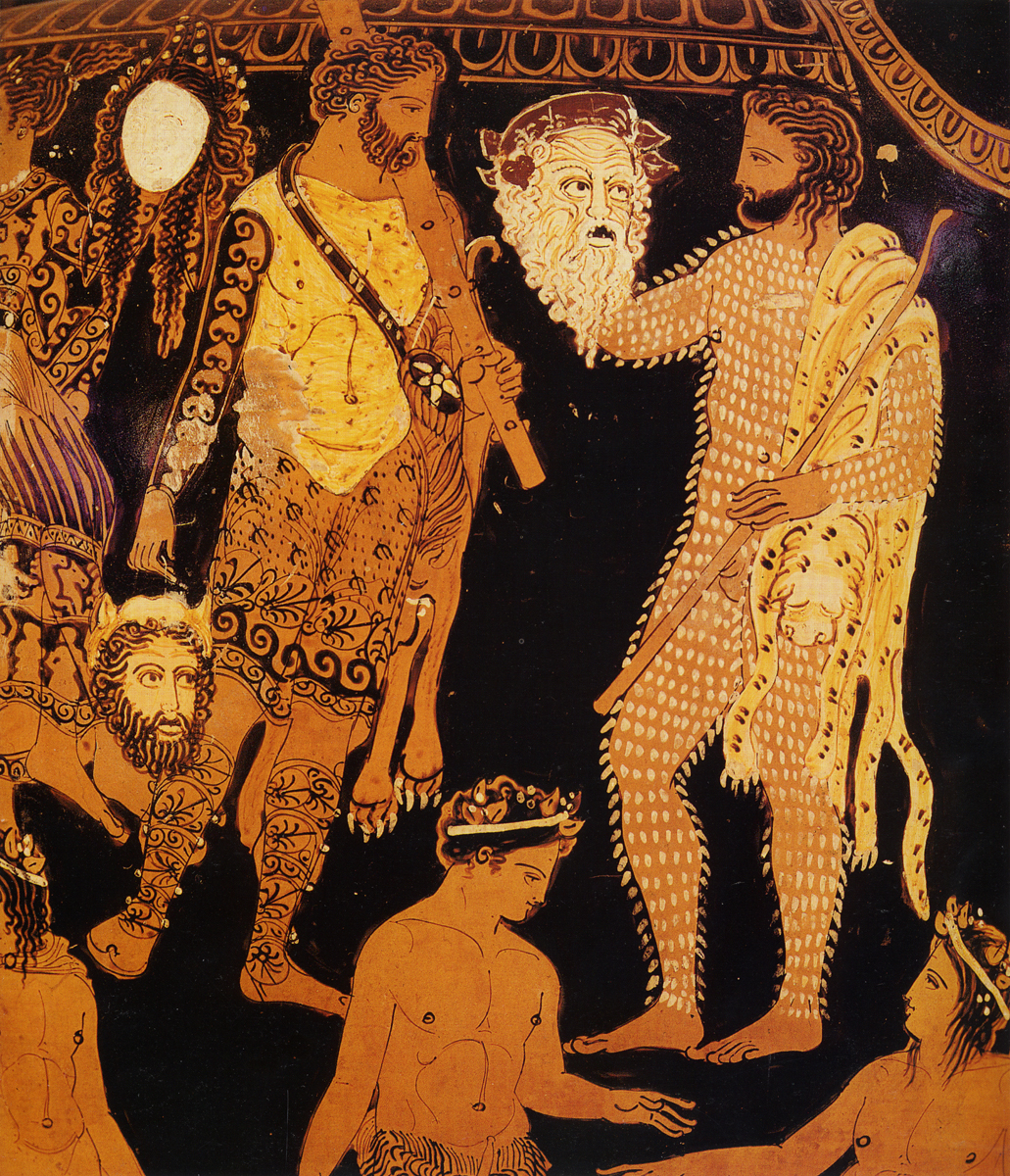
The masks are much older, however, coming to us from ancient classical drama. The masks we usually see are later Roman versions,

Tragic_comic_masks_-_roman_mosaic.jpgof which there are seemingly many surviving in several media. Older yet are the Greek masks, the images of which survive in many fewer images, mostly on pots.
greekactorswithmasks.jpg

These Greeks masks suggest that the original idea was to make lifelike, if stylized, representations. Later ones– Hellenistic and Roman– are often much more distorted-looking, and it has been suggested that the masks were shaped as the equivalent of megaphones and resonators, and certainly the later ones at least suggest that possibility.

Sousse_mosaic_theatre_masks.JPG

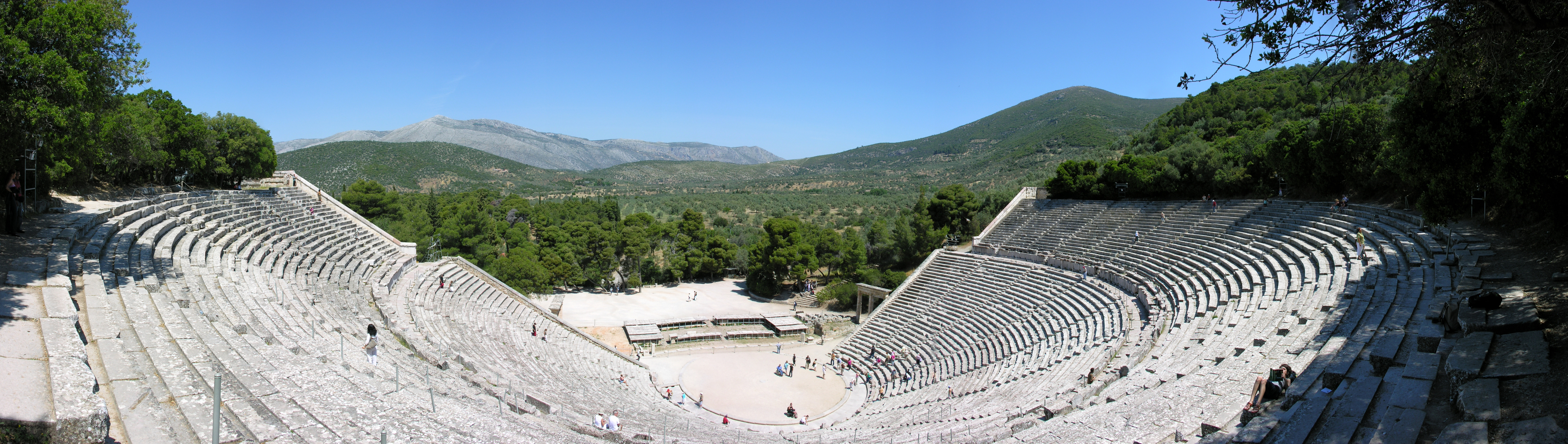
Certainly, theatres got bigger and more complex after having begun as simple hillsides.

2007-05-10_Epidauros,_Greece_5.jpg

But we wonder as well about Romans, and earlier non-dramatic uses of masks, perhaps for religious purposes?

The Romans got at least some of their religion from their neighbors to the north, the Etruscans. They may have gotten some elements of their drama from them, as well. A Roman word for actor, histrio, they believed was an Etruscan word, as was the word for mask, persona.

images.jpg

In their religion, the Romans practiced ancestor worship and used images of their ancestors as part of their ceremonies, perhaps even using masks to impersonate them.

13224081013_185a96cbd9_o_d.jpg

And there’s that word persona again, and perhaps that’s what masks are all about: impersonation, pretending to be someone you aren’t.

So, what’s spooky about that mask?

Magic_Mirror_SnowWhite.jpg

First, there are those empty eyes. Then, there’s that expression, if not fixed, at least limited.

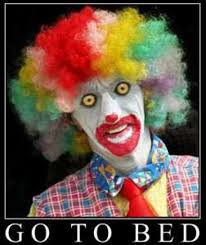
This makes us think about clowns.

images-1.jpg

We were frightened by clowns as children– maybe still are.

tvi061ab_wide-185b74c3460d303bcf13ff50d8db7d58e194c07c-s900-c85.jpgWhy are they so scary? Well, for one thing, the clothing is bright and festive, but the face is dead-white and corpse-like, therefore giving a mixed signal of merriment and death at the same time. Perhaps these contradictions should have made the stepmother less trusting (it certainly made us less trusting as children).

After all, this is an empty face– not even eyes behind it.

Magic_Mirror_SnowWhite.jpg

Why should it be telling the truth any more than a clown?

In the Disney movie, the face is referred to as the “slave of the mirror” and we can imagine that this was an attempt indirectly to suggest why the stepmother trusted the mirror. Presumably, it was like Aladdin’s genie–

genie_aladdinlamp.png

in control, at least temporarily, of its possessor– it’s a slave, after all.

Roman comedy, however, and Greek comedy before it, is full of tricky slaves out for their own profit…

AN00448728_001_l.jpg

What might it be like, we wonder, if the mirror, although saying “Madame Queen”, was actually stage managing the whole thing for his own sinister purposes? After all, the Snow White story always ends with the death of the stepmother. Does her death free the mirror?

Or, as was once the custom, does a palace servant cover the mirror after the stepmother’s death, and, like Jumanji,

images-2.jpg

must it lie on the wall, waiting for its next victim?

Thanks, as always, for reading.

MTCIDC,

CD

Mirror, Mirror

09 Wednesday Dec 2015

Posted by Ollamh in Fairy Tales and Myths, J.R.R. Tolkien, Narrative Methods

≈ Leave a comment

Tags

A Christmas Carol, Denethor, Dickens, Disney, Evil Stepmother, Fates, Fiction, Folktale, Frodo, Galadriel, Gandalf, Gondor, Grimm Brothers, Istari, Kinder und Hausmaerchen, Lothlorien, Magic mirror, Maiar, Middle-earth, mirror, Mordor, Muses, Norns, Norse Mythology, Numenor, Ornthanc, Palantir, Saruman, Sauron, Schneewittchen, Scrooge, scrying stone, Snow White, Story, The Lord of the Rings, The Theogony, Tolkien, Urtharbrunnr, Valar, Yggdrasil

Dear Readers,

Welcome, as always.

This is the second of two postings which, as we said in our last, was originally just one. That earlier draft linked the Palantiri with Galadriel’s mirror, but, on reconsideration, we believed—at least at first–that, in fact, they weren’t so close as we thought and so we separated them.

In our last, we discussed the Palantiri and what might have been a possible inspiration for them. In this posting, we propose to look a little more closely at Galadriel’s mirror (but we promise not to touch the water).

When we speak of mirrors—and, in this case, magic ones—the first one which pops into our mind is from childhood—the mirror in Snow White and the particularly creepy mirror in the 1937 Disney animated film.

girmagicmirror.gif

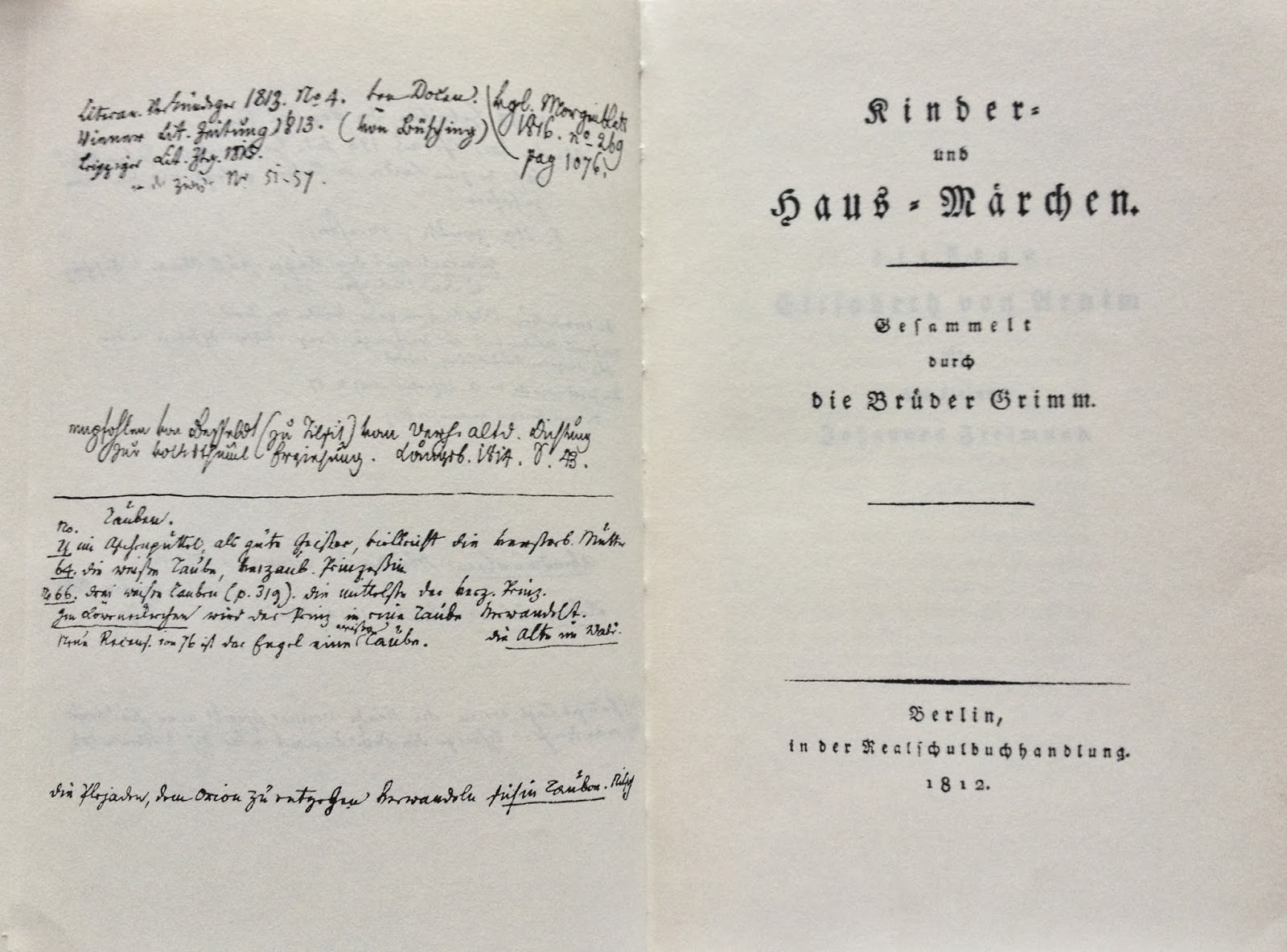
In the original Schneewittchen, first published in the Grimm brothers’ Kinder und Hausmaerchen in the original edition of 1812,

grimm_bruder_1847_klein.jpg firstedkundh.JPG

the mirror belongs to Snow White’s stepmother, of whom the story says (in our translation):

“She was a very beautiful woman, but she was proud and arrogant and couldn’t allow that anyone would surpass her in beauty.”

She monitored her position by means of that mirror:

“She had a wonderful mirror. When she stepped before it and looked at herself within it, she said:

Little mirror, little mirror, on the wall,

Who is the most beautiful in the whole land?

The mirror answered thus:

Madame Queen, you are the most beautiful in the land.”

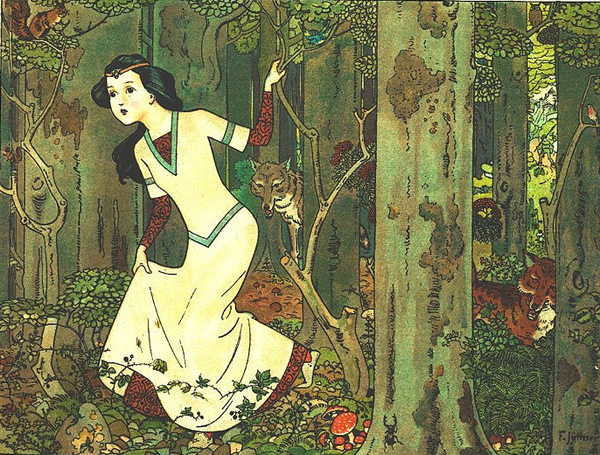
Franz_Jüttner_Schneewittchen_1.jpg

This makes us wonder about the stepmother. Was she like so many of the people we see around us every day (and not “everyday”, which is a compound adjective, meaning “commonly” as in “everyday usage does not necessarily equal correct usage in language”), compulsively fiddling with their electronic devices? How often did she go to that mirror and ask that question? As it was attached to the wall, she wasn’t carrying it in her back pocket, so, can we picture her making excuses to the king, to the prime minister, to her ladies in waiting, just so that she could go back to visit it? The text only says that she did—it’s a folktale, after all, and therefore old and so before current addictions were available, but she seems so obsessed—and familiar.

But then comes the day when the answer is:

“Madame Queen, you’re the most beautiful here,

But Snow White is a thousand times more beautiful than you.”

And the story goes on from there to places we don’t intend to follow.  It is interesting, however, that the mirror itself appears to do the talking, not a visible spirit within it, as in the Disney movie, and there is a certain logic to this. After all, normally, a mirror is only a reflecting device: it shows the person who is looking into it, as we see the stepmother doing. Then again, having someone—or something—looking out when you look in raises all sorts of interesting questions: who is it? Where is it? How does it know what it knows and how to speak? Does it have limits?

We might imagine, from her single, repeated question that the woman does. She never, for example, asks “Was there anyone as beautiful before me?” or “Will I always be the most beautiful?” She seems trapped in the moment and, without a greater context, the mirror’s last reply will be that much more shocking.

In contrast, Galadriel’s mirror, is neither on a wall, nor portable. In fact, it’s not really a mirror in the conventional sense at all.

“With water from the stream Galadriel filled the basin to the brim, and breathed on it, and when the water was still again she spoke. ‘Here is the Mirror of Galadriel,’ she said. ‘I have brought you here so that you may look in it, if you will.’ “ (The Fellowship of the Ring, Book 2, “The Mirror of Galadriel”)

64b97a1e010e45710323b25705b62626.jpg

When Frodo asks what might be seen therein, Galadriel replies:

‘Many things I can command the Mirror to reveal,’ she answered, ‘and to some I can show what they desire to see. But the Mirror will also show things unbidden, and those are often stranger and more profitable than things which we wish to behold. What you will see if you leave the Mirror free to work, I cannot tell. For it shows things that were, and things that are, and things that yet may be. But which is it that he sees, even the wisest cannot always tell.’ (The Fellowship of the Ring, Book 2, “The Mirror of Galadriel”)

There appear to be several possible influences here. In the ancient Greek poem, The Theogony, the Muses are described as knowing past, present, and future (Theogony 380), as they choose the shepherd, Hesiod, to become a poet.

Muses_sarcophagus_Louvre_MR880.jpg

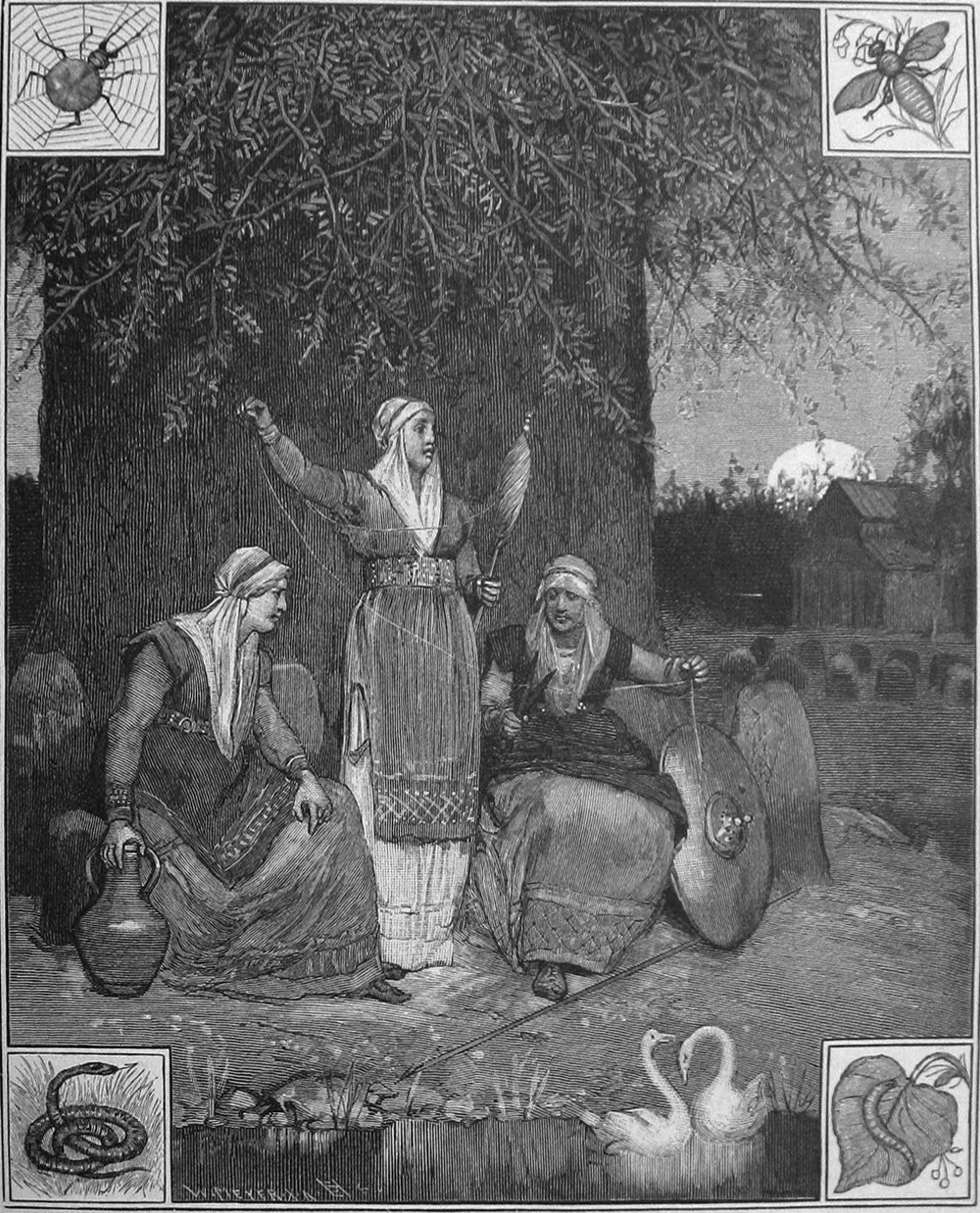
Others have suggested that an influence upon the author here was the Urtharbrunnr, the well of fate, as it may be translated, from Norse mythology, which lies at the foot of the tree called Yggdrasil. Here the Norns, or Fates in Norse tradition, sit to do their work.

Nornorna_vid_Urdarbrunnen.jpg

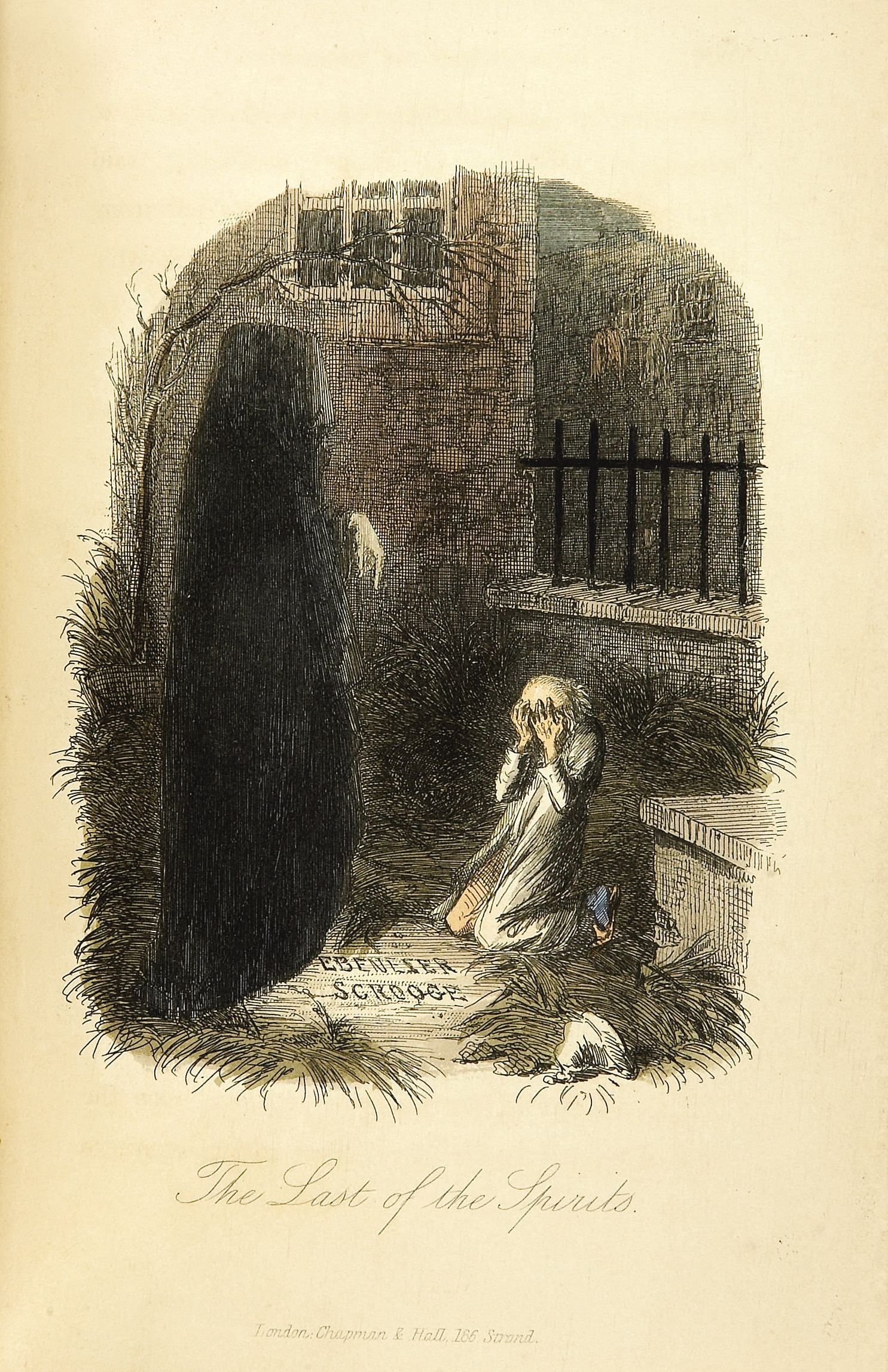
Another possibility yet might be the three Christmases who visit Ebenezer Scrooge in Charles Dickens’ A Christmas Carol and an advantage to pointing to them is that Christmas Yet to Come, although mute, shows Scrooge what turn out to be only “things that yet may be”, as Scrooge, by his change in behavior, diverts fate.

The_Last_of_the_Spirits-John_Leech,_1843.jpg

That sense of potentiality about the future is clearly a very important feature of Galadriel’s Mirror. Lorien is not only a haven from Orcish pursuit,

Lothlorien.jpg

but also a testing ground, where the surviving members of the Fellowship are probed by the Lady of the Wood, even as she herself is inadvertently tested when Frodo offers her the Ring. Sam may suffer the most from this, being shown what appears to be the destruction of the Shire and the destitution of his own grandfather.

ruinedshire.png

And yet, as Galadriel says,

‘But the Mirror will also show things unbidden, and those are often stranger and more profitable than things which we wish to behold.’ (The Fellowship of the Ring, Book 2, “The Mirror of Galadriel”)

What Sam sees shakes him for a moment to the point of stepping back from the basin, saying (almost shouting, as the sentence ends with an exclamation point), “I must go home!” (The Fellowship of the Ring, Book 2, “The Mirror of Galadriel”) He recovers immediately, however, resolving, “ ‘No, I’ll go home by the long road with Mr. Frodo, or not at all.’” And thus he, like Galadriel, passes the test and perhaps that’s what the odd word “profitable” means in her explanation. Sam is confronted with what must have been that which he subconsciously dreaded most, but his new resolution ultimately proves the salvation of Middle Earth, on the one hand, and the healing of the Shire by means of Galadriel’s gift of a little Lorien, on the other. And, considering that Sam first appears in the story as an eaves-dropping gardener and hardly a giant elf-warrior, that other adjective, “stranger” may be appropriate, too.

So far, the Mirror has nothing in common with a Palantir, which was clearly designed not as a “scrying stone”, but as a communication device. And yet there is Galadriel’s remark,

“ ‘Many things I can command the Mirror to reveal,’ she answered, ‘and to some I can show what they desire to see.’ “

This strikes us as an ambiguous statement—and probably meant to be. Does Galadriel mean:

  1. people come to ask her, for example, to see their future—implication being that she shows them that, and nothing more
  2. people come, ask, and she shows them what they want to see—implication being that what they see is not necessarily what is real?

When Frodo looks into Mirror, he sees the very last thing he would want to see, however:

“But suddenly the Mirror went altogether dark, as dark as if a hole had opened in the world of sight, and Frodo looked into emptiness. In the black abyss there appeared a single Eye that slowly grew, until it filled nearly all the mirror. So terrible was it that Frodo stood rooted, unable to cry out or to withdraw his gaze. The Eye was rimmed with fire, but was itself glazed, yellow as a cat’s, watchful and intent, and the black slit of its pupil opened on a pit, a window into nothing.” (The Fellowship of the Ring, Book 2, “The Mirror of Galadriel”)

eye-o-sauron-03.jpeg

This is especially true in that:

“Then the Eye began to rove, searching this way and that; and Frodo knew with certainty and horror that among the many things that it sought he himself was one.” (The Fellowship of the Ring, Book 2, “The Mirror of Galadriel”)

This is clearly not the past or the future, as Frodo sees it, but the all-too-realistic present. And this is not just a present to be viewed. Like the figure in the mirror in the old Disney Snow White, this is someone who would respond directly to what he sees, if he could. And Frodo is aware of this:

“But he also knew that it could not see him—not yet, not unless he willed it.” (The Fellowship of the Ring, Book 2, “The Mirror of Galadriel”)

Does the Mirror have more potential, then? Can it be used as a communication device, like a Palantir? If it can combine the functions of “magic mirror” and Palantir, might the Palantir be able to combine functions, as well?

Certainly Sauron does something which ruins Denethor’s ability to resist Sauron’s view of the future to the point where he attempts to commit flaming suicide along with his one surviving son, having abandoned his city to its fate.

pyre.jpg

Denethor, though, is just a human, and rather a vain one, at that.

How would Sauron do the same with one of the Maiar, those beings sent by the Valar to protect Middle Earth from the danger which Sauron represents? Certainly we know that Sauron has communicated with Saruman through the Palantir.

palantir.jpg

There may be a clue in Gandalf’s reply to Saruman, just before he is held captive in Orthanc:

“I have heard speeches of this kind before, but only in the mouths of emissaries sent from Mordor to deceive the ignorant.” (The Fellowship of the Ring, Book 2, “The Council of Elrond”)

What Gandalf is responding to is:

“A new Power is rising. Against it the old allies and policies will not avail us at all. There is no hope left in Elves or dying Numenor. This then is one choice before you, before us. We may join with that Power. It would be wise, Gandalf. There is hope that way. Its victory is at hand; and there will be rich reward for those that aided it. As the Power grows, its proved friends will also grow; and the Wise, such as you and I, may with patience come at last to direct its courses, to control it. We can bide our time, we can keep our thoughts in our hearts, deploring maybe evils done by the way, but approving the high and ultimate purpose: Knowledge, Rule, Order; all the things that we have so far striven in vain to accomplish,,hindered rather than helped by our weak or idle friends. There need not be, there would not be, any real change in our designs, only in our means.” (The Fellowship of the Ring, Book 1, “The Council of Elrond”)

“Knowledge, Rule, Order”? It’s no wonder that Gandalf replies as he does. Such words sound more like the slogan of a totalitarian state—exactly what Mordor has become under its lidless-eyed master–than those of one of the Istari.

And how did Saruman come to have such a distorted vision of the future? Just as Denethor, bitter over his son’s death and the loss to Gandalf—he thinks—of his younger son, has been shown what must have been an increasingly-bleak picture of Gondor and its fate, so can we imagine that Sauron, sensing a latent arrogance and desire for power in Saruman, has given Saruman the second possible understanding of Galadriel’s statement. He has shown Saruman what Saruman secretly wishes for and, in doing so, he cunningly paints for Saruman, who is just wise enough to know that he will never be Sauron, a picture of an alliance which will grant him his wish. Why does Saruman, who is himself an extremely powerful figure, fall for this? Perhaps he’s like Snow White’s stepmother and limited to one question: “Little globe, little globe, who is the (second most) powerful in Middle Earth?”

What do you think, dear readers?

Thanks, as always, for reading.

MTCIDC

CD

The Doubtful Sea Series Facebook Page

The Doubtful Sea Series Facebook Page

  • Ollamh

Categories

  • Artists and Illustrators
  • Economics in Middle-earth
  • Fairy Tales and Myths
  • Films and Music
  • Games
  • Heroes
  • Imaginary History
  • J.R.R. Tolkien
  • Language
  • Literary History
  • Maps
  • Medieval Russia
  • Military History
  • Military History of Middle-earth
  • Narnia
  • Narrative Methods
  • Poetry
  • Research
  • Star Wars
  • Terra Australis
  • The Rohirrim
  • Theatre and Performance
  • Tolkien
  • Uncategorized
  • Villains
  • Writing as Collaborators
Follow doubtfulsea on WordPress.com

Across the Doubtful Sea

Recent Postings

  • Through a glass… January 7, 2026
  • Heffalumps? December 31, 2025
  • We Three Kings December 24, 2025
  • A Moon disfigured December 17, 2025
  • On the Roads Again—Once More December 10, 2025
  • (Not) Crossing Bridges December 3, 2025
  • On the Road(s) Again—Again November 26, 2025
  • On the Road(s) Again November 19, 2025
  • To Bree (Part 2) November 12, 2025

Blog Statistics

  • 104,099 Views

Posting Archive

  • January 2026 (1)
  • December 2025 (5)
  • November 2025 (4)
  • October 2025 (5)
  • September 2025 (4)
  • August 2025 (4)
  • July 2025 (5)
  • June 2025 (4)
  • May 2025 (4)
  • April 2025 (5)
  • March 2025 (4)
  • February 2025 (4)
  • January 2025 (5)
  • December 2024 (4)
  • November 2024 (4)
  • October 2024 (5)
  • September 2024 (4)
  • August 2024 (4)
  • July 2024 (5)
  • June 2024 (4)
  • May 2024 (5)
  • April 2024 (4)
  • March 2024 (4)
  • February 2024 (4)
  • January 2024 (5)
  • December 2023 (4)
  • November 2023 (5)
  • October 2023 (4)
  • September 2023 (4)
  • August 2023 (5)
  • July 2023 (4)
  • June 2023 (4)
  • May 2023 (5)
  • April 2023 (4)
  • March 2023 (5)
  • February 2023 (4)
  • January 2023 (4)
  • December 2022 (4)
  • November 2022 (5)
  • October 2022 (4)
  • September 2022 (4)
  • August 2022 (5)
  • July 2022 (4)
  • June 2022 (5)
  • May 2022 (4)
  • April 2022 (4)
  • March 2022 (5)
  • February 2022 (4)
  • January 2022 (4)
  • December 2021 (5)
  • November 2021 (4)
  • October 2021 (4)
  • September 2021 (5)
  • August 2021 (4)
  • July 2021 (4)
  • June 2021 (5)
  • May 2021 (4)
  • April 2021 (4)
  • March 2021 (5)
  • February 2021 (4)
  • January 2021 (4)
  • December 2020 (5)
  • November 2020 (4)
  • October 2020 (4)
  • September 2020 (5)
  • August 2020 (4)
  • July 2020 (5)
  • June 2020 (4)
  • May 2020 (4)
  • April 2020 (5)
  • March 2020 (4)
  • February 2020 (4)
  • January 2020 (6)
  • December 2019 (4)
  • November 2019 (4)
  • October 2019 (5)
  • September 2019 (4)
  • August 2019 (4)
  • July 2019 (5)
  • June 2019 (4)
  • May 2019 (5)
  • April 2019 (4)
  • March 2019 (4)
  • February 2019 (4)
  • January 2019 (5)
  • December 2018 (4)
  • November 2018 (4)
  • October 2018 (5)
  • September 2018 (4)
  • August 2018 (5)
  • July 2018 (4)
  • June 2018 (4)
  • May 2018 (5)
  • April 2018 (4)
  • March 2018 (4)
  • February 2018 (4)
  • January 2018 (5)
  • December 2017 (4)
  • November 2017 (4)
  • October 2017 (4)
  • September 2017 (4)
  • August 2017 (5)
  • July 2017 (4)
  • June 2017 (4)
  • May 2017 (5)
  • April 2017 (4)
  • March 2017 (5)
  • February 2017 (4)
  • January 2017 (4)
  • December 2016 (4)
  • November 2016 (5)
  • October 2016 (6)
  • September 2016 (5)
  • August 2016 (5)
  • July 2016 (5)
  • June 2016 (5)
  • May 2016 (4)
  • April 2016 (4)
  • March 2016 (5)
  • February 2016 (4)
  • January 2016 (4)
  • December 2015 (5)
  • November 2015 (5)
  • October 2015 (4)
  • September 2015 (5)
  • August 2015 (4)
  • July 2015 (5)
  • June 2015 (5)
  • May 2015 (4)
  • April 2015 (3)
  • March 2015 (4)
  • February 2015 (4)
  • January 2015 (4)
  • December 2014 (5)
  • November 2014 (4)
  • October 2014 (6)
  • September 2014 (1)

Blog at WordPress.com.

  • Subscribe Subscribed
    • doubtfulsea
    • Join 78 other subscribers
    • Already have a WordPress.com account? Log in now.
    • doubtfulsea
    • Subscribe Subscribed
    • Sign up
    • Log in
    • Report this content
    • View site in Reader
    • Manage subscriptions
    • Collapse this bar
 

Loading Comments...