• About

doubtfulsea

~ adventure fantasy

Tag Archives: Edoras

On the Road(s) Again—Again

26 Wednesday Nov 2025

Posted by Ollamh in Uncategorized

≈ Leave a comment

Tags

Edoras, Fords of Isen, Ghan Buri Ghan, Helm's Deep, Isengard, Osgiliath, Rammas Echor, Rocky Road to Dublin, Stephen Dedalus, Stonewain Valley, Tharbad, Ulysses

Welcome, dear readers, as always.

“While in the merry month of May, from me home I started
Left the girls of Tuam so sad and broken hearted
Saluted father dear, kissed me darling mother
Drank a pint of beer, me grief and tears to smother

Then off to reap the corn, leave where I was born
Cut a stout black thorn to banish ghosts and goblins
Bought a pair of brogues rattling o’er the bogs
And fright’ning all the dogs on the rocky road to Dublin”

Another road song—this time an Irish one—and we’ll be continuing, in this posting, to follow the roads of Middle-earth, rocky and otherwise.

(This is a very catchy song and you can read the whole lyric here:  https://www.azlyrics.com/lyrics/dubliners/rockyroadtodublin.html   (although you’ll notice a couple of small discrepancies between the written lyric and the sung one) before you listen to Liam Clancy and Tommy Makem performing it here: https://www.youtube.com/watch?v=Vb2Xw424W0M&list=RDVb2Xw424W0M&start_radio=1  For something about the history of the song, see:  https://en.wikipedia.org/wiki/Rocky_Road_to_Dublin )

We had stopped our exploration at the ruined bridge at Tharbad—
(the so-called Ponte Rotto (“Ruined Bridge”) in Rome—actually the Pons Aemilius—here’s a very interesting article about it and other bridges in Rome:   https://www.througheternity.com/en/blog/hidden-sights/rome-most-beautiful-historic-bridges.html  )    

Tharbad had once been a Numenorean city, with an impressive bridge which spanned the River Gwathlo (“Greyflood”), but

“A considerable garrison of soldiers, mariners and engineers had been kept there until the seventeenth century of the Third Age.  But from then onwards the region fell quickly into decay; and long before the time of The Lord of the Rings had gone back into wild fenlands.  When Boromir made his great journey from Gondor to Rivendell…the North-South Road no longer existed except for the crumbling remains of the causeways, by which a hazardous approach to Tharbad might be achieved, only to find ruins on dwindling mounds, and a dangerous ford formed by the ruins of the bridge…” (JRRT/Christopher Tolkien, Unfinished Tales, 277)

I wonder whether, when thinking of ruins, Tolkien had in mind the towns of southern Belgium destroyed by German shelling in the Great War, such as Ypres, which he would have walked through in 1916–

The road south from Tharbad, then, we can presume, was more like the Greenway farther north—grassgrown and abandoned.

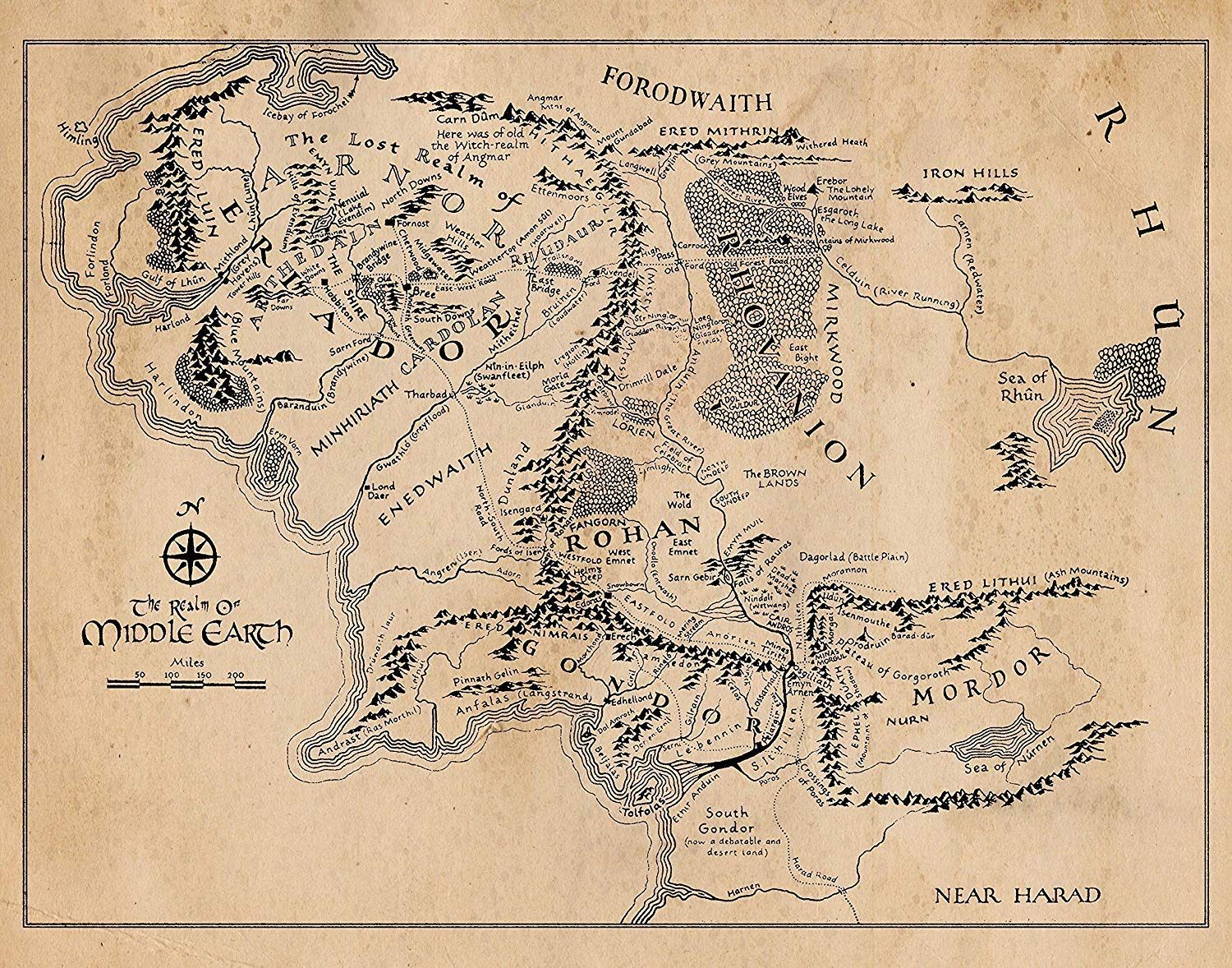
Using our map, we can see that the old road traveled through the Gap of Rohan,
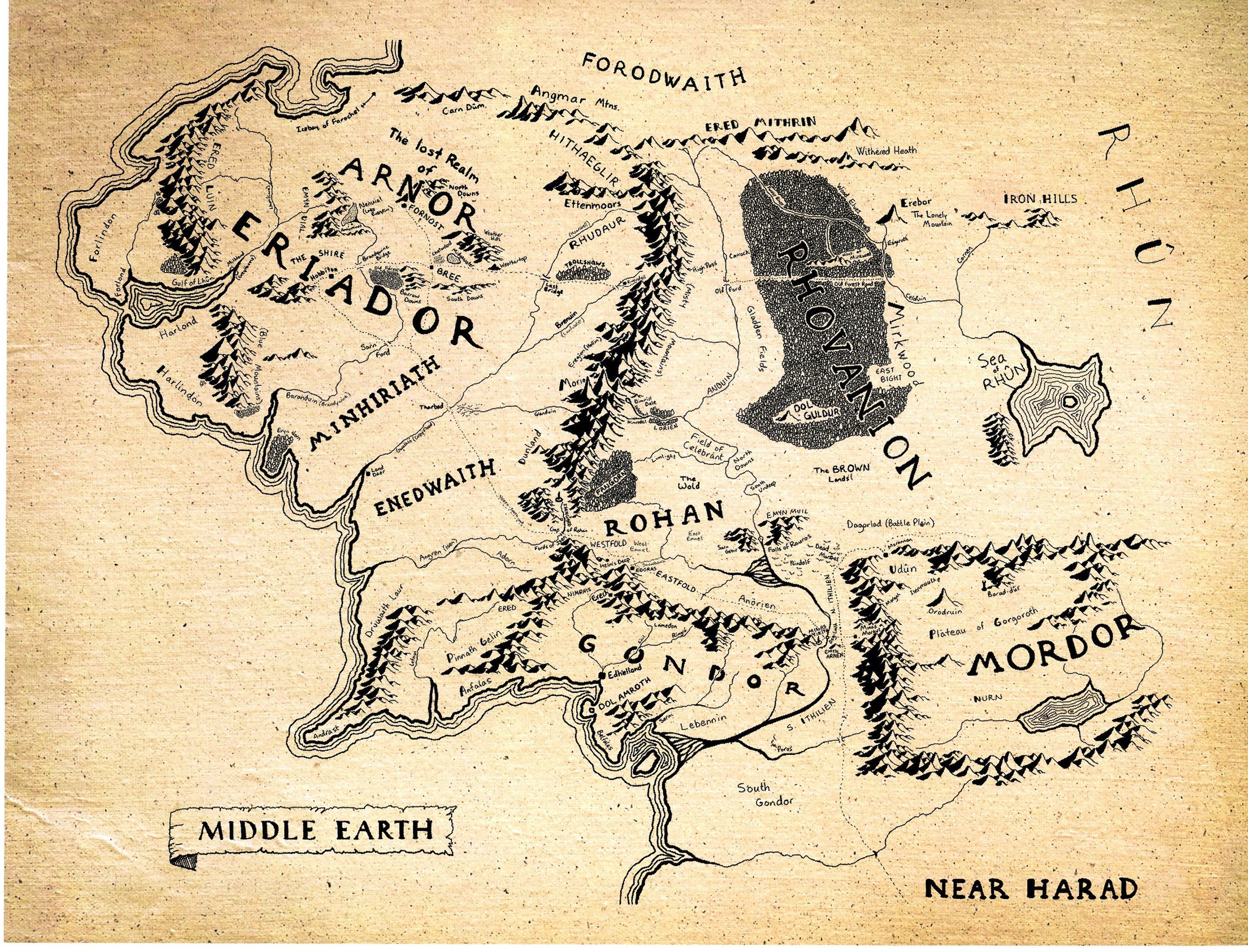
(both this and the map above are derived, ultimately, from the Tolkiens’ map, but I haven’t seen this credited to anyone)

with Isengard off to its left,

(the Hildebrandts)

and, farther on, Helm’s Deep to its right,
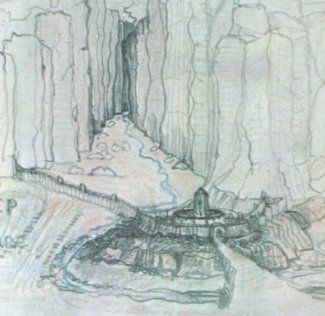
(JRRT)

although I doubt that either was visible from the road, Isengard in particular being up the valley of the Isen.

JRRT has left us a useful description of the Fords of the Isen—

“There the river was broad and shallow, passing in two arms about a large eyot [from Old English, igeoth, “small island”], over a stony shelf covered with stones and pebbles brought down from the north.”  (Unfinished Tales, 372—there is a long and detailed account here, 372-390, including the heroic death of Theodred, son of Theoden.  This fills in the period when members of the Fellowship come to the defense of Helm’s Deep and Gandalf is abroad, looking for aid, while Merry and Pippin are rallying the Ents.)

Down from Helm’s Deep would also be Edoras,

(Alan Lee—notice, by the way, that the usual image of the wall of Edoras isn’t the spindly palisade shown in the films, but a solid stone wall, of the sort JRRT must have meant when he wrote:  “Following the winding way up the green shoulders of the hills, they came at last to the wide wind-swept walls and the gates of Edoras.”  (The Two Towers, Book Three, Chapter 6, “The King of the Golden Hall”)

and the road to Gondor and Minas Tirith.

(Ted Nasmith)

But we should pause here—as a hidden road will appear to our right—indicated to the Rohirrim in their ride south to the rescue of Minas Tirith by Ghan Buri Ghan, chief of the Woses (aka Wild Men—descendants  of pre-Numorean settlers of Gondor).

(Hildebrandts)

(This is taken from a large and elegant map which you can see here:  https://i.pinimg.com/originals/70/bc/b6/70bcb6ccc3a0ed5068d6ce15fb5a09a4.jpg )

As he describes it:

“ ‘Road is forgotten, but not by Wild Men.  Over hill and behind hill it lies under grass and tree, there behind Rimmon and down to Din, and back at the end to Horse-men’s road…Way is wide for four horses in Stonewain Valley yonder…but narrow at beginning and at end.  Wild Man could walk from here to Din between sunrise and noon.’ ”  (The Return of the King, Book Five, Chapter 5, “The Ride of the Rohirrim”)

And the narrator continues:

“It was late in the afternoon when the leaders came to wide grey thickets stretching beyond the eastward side of Amon Din, and masking a great gap in the line of hills that from Nardol to Din ran east and west.  Through the gap the forgotten wain-road long ago had run down, back into the main horse-way from the City through Anorien; but now for many lives of men trees had had their way with it, and it had vanished, broken and buried under the leaves of uncounted years.” (The Return of the King, Book Five, Chapter 5, “The Ride of the Rohirrim”)

A “wain” is a wagon

(This is the center of John Constable’s “The Hay Wain”, 1824, but it can give you an idea of what JRRT had in mind—picture this loaded with building stone instead of hay.)

and it’s clear that what we’re seeing here is an old quarry road, which led from stone quarries down to Minas Tirith, to build its walls.

But, speaking of walls, we’re about to come up against one:  the Rammas Echor, or great circuit of wall that surrounded the Pelennor:
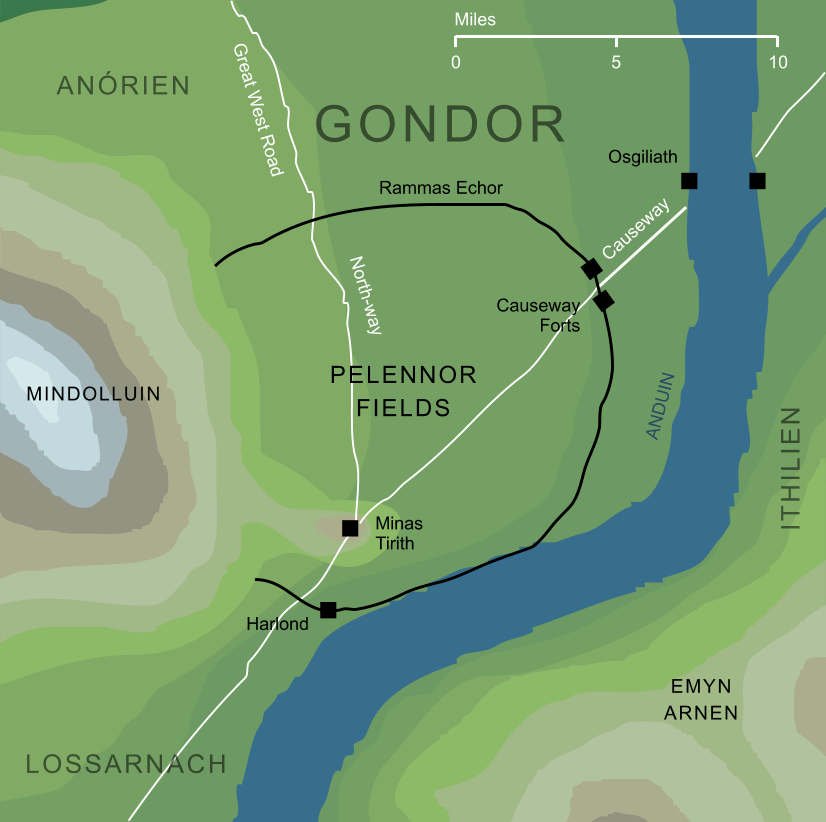
(from the Encyclopedia of Arda site)

“Many tall men heavily cloaked stood beside him, and behind them in the mist loomed a wall of stone.  Partly ruinous it seemed, but already before the night was passed the sound of hurried labour could be heard.”

As you can see from the map, this was a very long wall (“For ten leagues or more it ran from the mountains’ feet and so back again…” —   a standard for a league is about 3 miles, so the wall is about 30 miles—about 48km–long) , and I’ve always imagined it as looking rather like Hadrian’s Wall in northern England, some 80+ miles long (about 129km), as it appeared when finished.
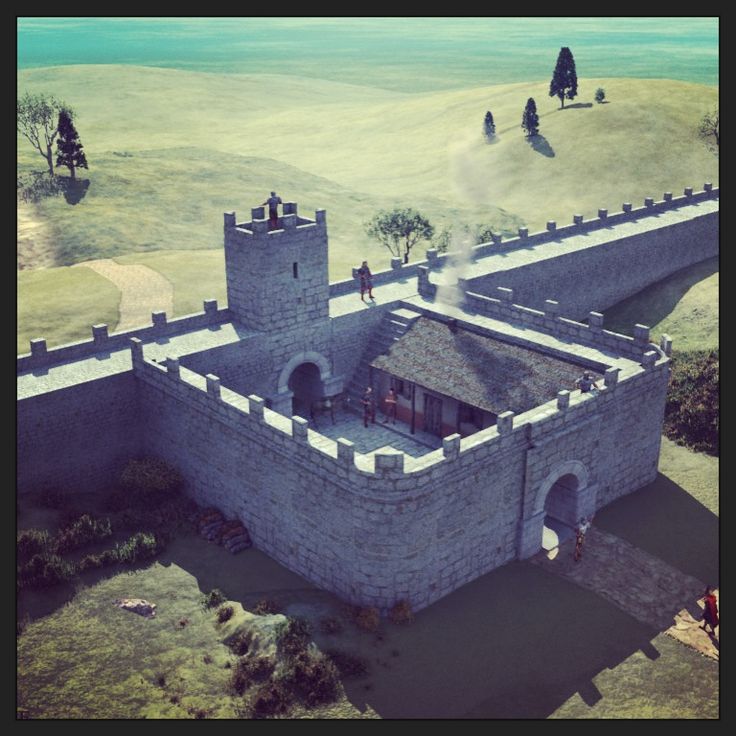
There were larger gates in the area called the Causeway Forts, but there were clearly single, smaller gates as in the image above, as the text tells us:  “…and the men made way for Shadowfax, and he passed through a narrow gate in the wall.” (The Return of the King, Book Five, Chapter 1, “Minas Tirith”)

I suppose that we could circle around the wall, and then we’d have to get onto the causeway—that’s a kind of elevated road—

(This is the stone causeway leading to St.Michael’s Mount, in Cornwall, southwest England, with the tide coming in—or going out.  You can read about St.Michael’s Mount here:  https://en.wikipedia.org/wiki/St_Michael%27s_Mount )

which leads to the ruined city of Osgiliath

where, alas, the bridges are broken (“And are not the bridges of Osgiliath broken down and all the landings held now by the Enemy?”  (The Fellowship of the Ring, Book Two, Chapter 8, “Farewell to Lorien “)

(Norris Rahming, 1886-1959)

and where we’ll stop for today, but pause at the site of one of those bridges in our next.

As ever, thanks for reading.

Stay well,

In James Joyce’s Ulysses, one of the main characters, Stephen Dedalus, calls a pier
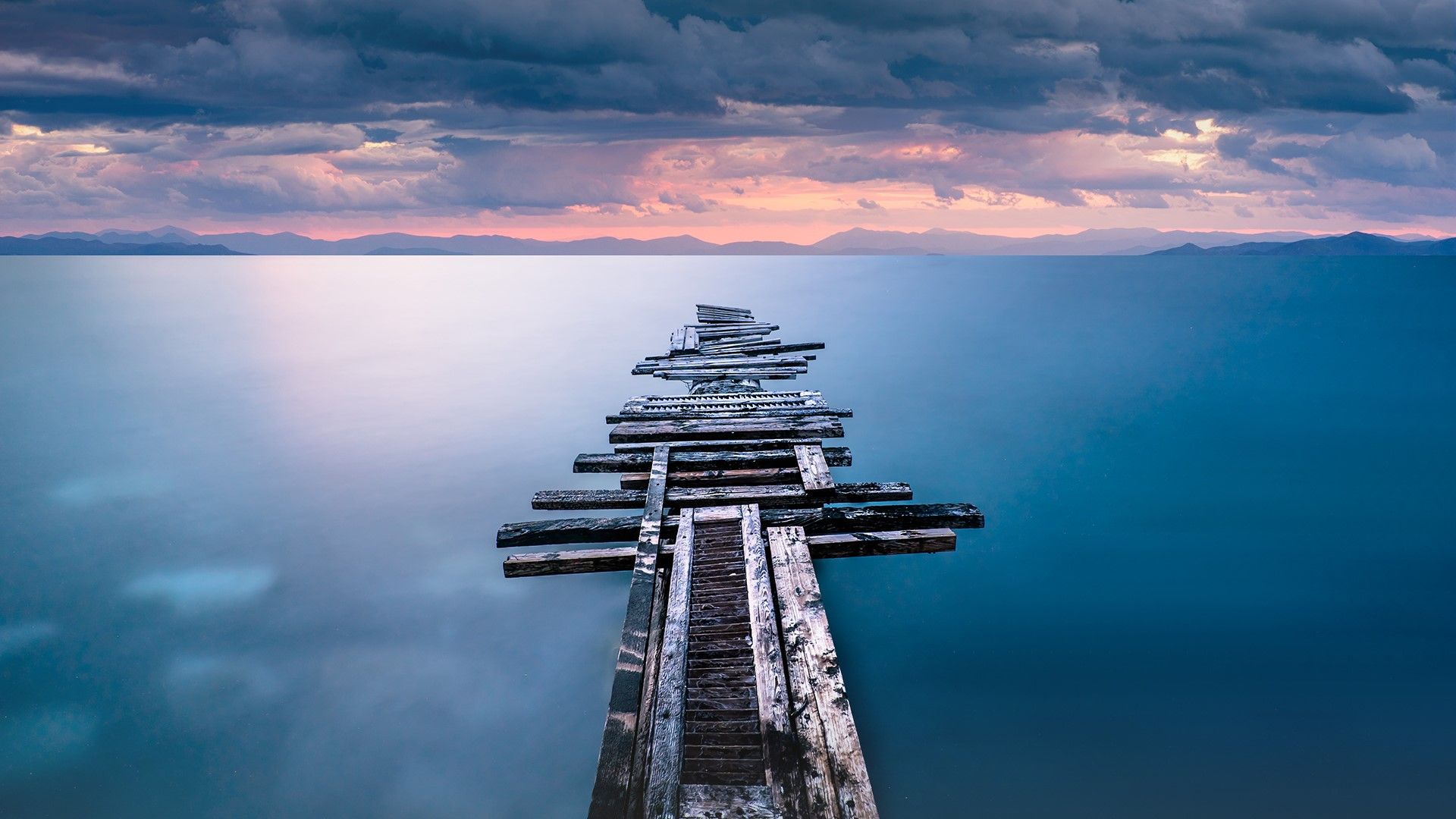
a “disappointed bridge”—would you agree?

And remember that, as always, there’s

MTCIDC

O

Who Goes There? (4)

05 Wednesday Dec 2018

Posted by Ollamh in J.R.R. Tolkien, Military History of Middle-earth, Narrative Methods, The Rohirrim

≈ Leave a comment

Tags

Cirith Ungol, doorwarden, Edoras, Faramir, Gorbag and Shagrat, guards, Hama, Heorot, Ingold, Isengard, Ithilien, Meduseld, Merry and Pippin, Minas Tirith, N.C. Wyeth, Orcs, Rammas Echor, Rangers, Robin Hood, The Lord of the Rings, Tolkien, White Tree of Gondor

Welcome, dear readers, as ever.

This post will complete our series on watchmen, sentries, and patrols in The Lord of the Rings and how confrontations with such figures may change the action.

In our last, we’d gotten as far as Edoras and, within, Meduseld, with Hama, its doorwarden.

image1heorot.jpg

(This is actually from John Howe’s painting of Heorot, the mead hall in Beowulf, but, as Meduseld is meant to mean “mead hall” in Rohirric—the language of Rohan—we figure that we can justify the substitution.)

From Edoras, we’ll follow Gandalf and Pippin to Minas Tirith,

image2gand.jpg

passing through the Rammas Echor, the old barrier wall protecting the fields of the Pelennor, where Gandalf talks  with Ingold, who appears to be in charge of repairing a section of that wall fallen into disrepair.  (See The Return of the King, Book Five, Chapter 1, “Minas Tirith”)  We don’t have a illustration of this—although we think that it would make a good one—so, as we think of the Rammas Echor as a cousin of Hadrian’s wall, here’s an illustration of that wall under construction, just to give the idea.

image3hadwall.jpg

But we said we will follow Gandalf and Pippin.  First, we have to double back to Isengard, where the Ents have wreaked justifiable havoc.

image4isen.jpg

(A T Nasmith we’ve used before)

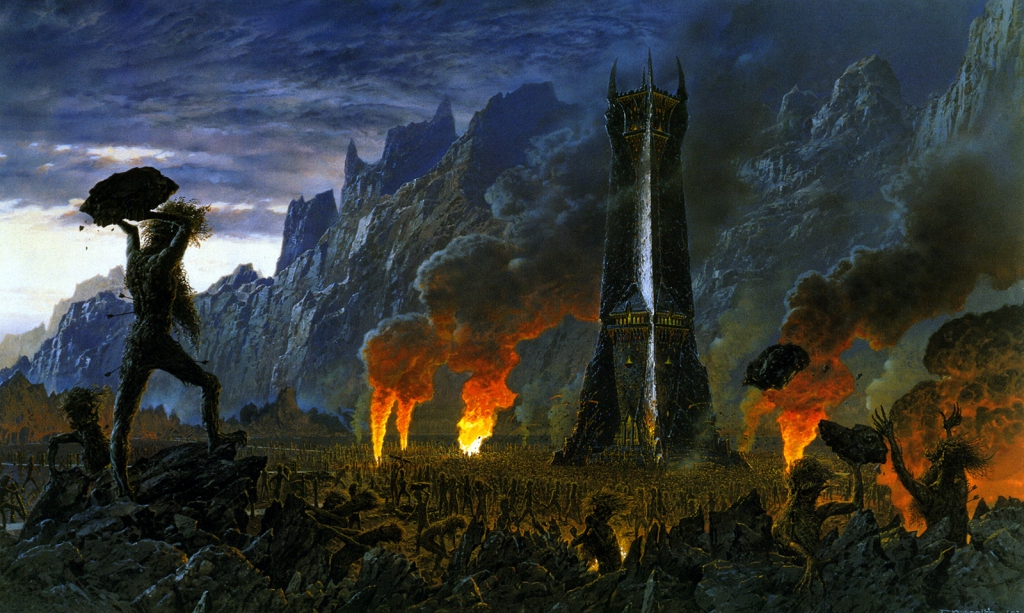
When Gandalf and crowd come to call upon Saruman, they meet with very different doorwardens from Hama:

“The king and all his company sat silent on their horses, marvelling, perceiving that the power of Saruman was overthrown; but how they could not guess.  And now they turned their eyes towards the archway and the ruined gates.  There they saw close beside them a great rubble heap; and suddenly they were aware of two small figures lying on it at their ease, grey-clad, hardly to be seen among the stones.  There were bottles and bowls and platters laid beside them, as if they had just eaten well, and now rested from their labour.  One seemed asleep, the other, with crossed legs and arms behind his head, leaned back against a broken rock and sent from his mouth long wisps and little rings of thin blue smoke.”  (The Two Towers, Book Three, Chapter 8, “The Road to Isengard”)

image5mandp.jpg

It’s Merry and Pippin, of course, and, for Aragorn, Legolas, and Gimli, after their long, grim march across northern Rohan in search of their missing companions, only to have Eomer suggest that they’ve been killed with the orcs, this is certainly a change of mood, as well as a change of plot—not only are the two restored, but Pippin will help to rescue Faramir from his mad father and Merry will save Eowyn from the Nazgul.

Now, however, having picked up Pippin, we’ll continue on to Minas Tirith,

image6minas.jpg

where, at the approach of Shadowfax:

“So Gandalf and Peregrin rode to the Great Gate of the Men of Gondor at the rising of the sun, and its iron doors rolled back before them…Then men fell back before the command of his voice…” (The Return of the King, Book 5, Chapter 1, “Minas Tirith”)

Passing up through the seven levels of the city, they dismounted at the gate of the Citadel, where:

“The Guards of the gate were robed in black, and their helms were of strange shape, high-crowned, with long cheek-guards close-fitting to the face, and above the cheek-guards were set the white wings of sea-birds; but the helms gleamed with a flame of silver, for they were indeed wrought of mithril, heirlooms from the glory of old days.  Upon the black surcoats were embroidered in white a tree blossoming like snow beneath a silver crown and many-pointed stars.”

This was an image surprisingly difficult to find.  Here’s a depiction (sort of) from the Jackson films.

image7gd.jpg

The helmet might be right, but the black surcoat is missing—here’s Pippin, also from the films, wearing one.

image8pip.jpg

We add to this an image by a Russian illustrator, Denis Gordeev.  Here, the helmet may not be quite what we’d expect, but the rest of the ensemble works.

image9pip.jpg

It says much for Gandalf’s influence in Minas Tirith that neither does Ingold, at the Rammas Echor, challenge him, nor the guards at the main gate of Minas Tirith, nor those at the Citadel—as Ingold says:

“Yea, truly we know you, Mithrandir…and you know the pass-words of the Seven Gates and are free to go forward.”

Our next sentries, are not so easily passed however, as Frodo and Sam discover, when:

“Four tall Men stood there.  Two had spears in their hands with broad bright heads.  Two had great bows, almost of their own height, and great quivers of long green-feathered arrows.  All had swords at their sides, and were clad in green and brown of varied hues, as if the better to walk unseen in the glades of Ithilien.  Green gauntlets covered their hands, and their faces were hooded and masked with green, except for their eyes, which were very keen and bright.” (The Two Towers, Book Four, Chapter 4, “Of Herbs and Stewed Rabbit”)

image10rangers.jpg

Their outfits immediately made us think of NC Wyeth’s Robin Hood and his men

image11rhood.jpg

from Wyeth’s 1917 Robin-hood.

image12rhood.jpg

Their leader, Faramir, questions Frodo and Sam closely before letting them go—and this meeting gives Faramir news of the end of Boromir, a view of Boromir’s character from Frodo, as well as providing us with a view of Faramir, who says of the Ring:

“I would not take this thing, if it lay by the highway.  Not were Minas Tirith falling in ruin and I alone could save her, so, using the weapon of the Dark Lord for her good and my glory.  No, I do not wish for such triumphs, Frodo son of Drogo.”  (The Two Towers, Book Four,  Chapter 5, “The Window on the West”)

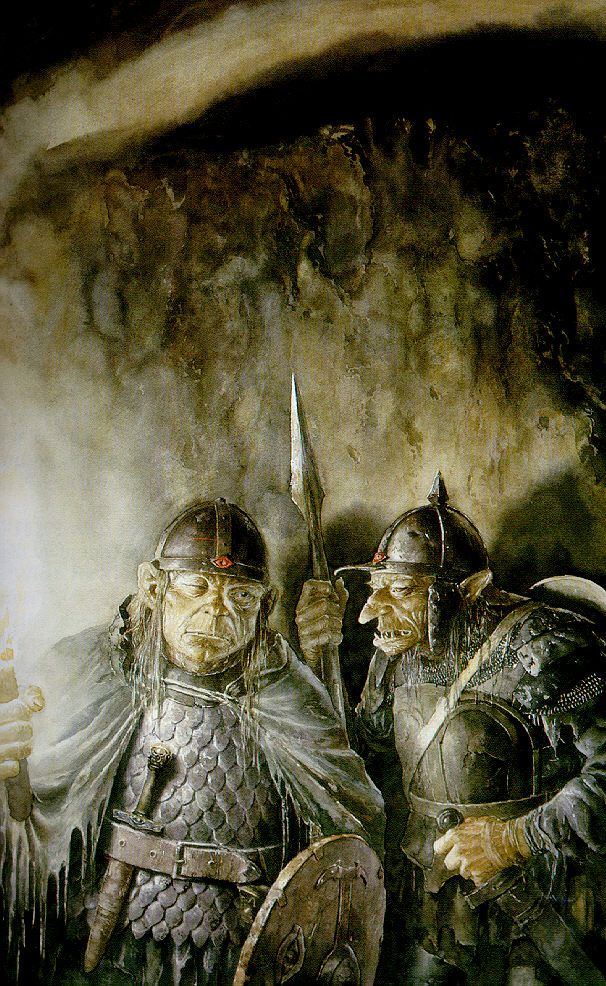
Once he knows their purpose, Faramir lets them go—to much worse sentries.  First, there are orc patrols, like those of Shagrat and Gorbag.

Image13:  shag and bagimage13shagnbag.jpg

There is no conversation here between hobbits and orcs, but we certainly gain a better view of orc loyalty, as one orc leader, Gorbag, says to another, Shagrat:

“What d’you say? –if we get a chance, you and me’ll slip off and set up somewhere on our own with a few trusty lads, somewhere where there’s good loot nice and handy, and no big bosses.” (The Two Towers, Book Four, Chapter 10, “The Choices of Master Samwise”)

Then there are the Watchers at the Tower of Cirith Ungol:

“They were like great figures seated upon thrones.  Each had three joined bodies, and three heads facing outward, and inward, and across the gateway.  The heads had vulture-faces, and on their great knees were laid clawlike hands.  They seemed to be carved out of huge blocks of stone, immovable, and yet they were aware:  some dreadful spirit of evil vigilance abode in them.  They knew an enemy.  Visible or invisible none could pass unheeded…” (The Return of the King, Book Six, Chapter 1, “The Tower of Cirith Ungol”)

image14watchers.jpg

And here are the last sentries and perhaps a last sign for Frodo and Sam before their terrible and near-fatal trip across Mordor that there is still power for good in a world grown dark.  Having rescued Frodo from his orcish imprisonment, Sam and Frodo have come up against the Watchers, who seem to block their way until:

“ ‘Gilthoniel, A Elbereth!’ Sam cried…

‘Aiya elenion ancalima!’ cried Frodo once again behind him.

The will of the Watchers was broken with a suddenness like the snapping of a cord, and Frodo and Sam stumbled forward. “

There are no more sentries, although the two hobbits will be passed by a small search party and will then be swept up into an orc marching company before being on their own on the way to Mount Doom, where we will leave them and this set of postings.

As always, thanks for reading and

MTCIDC

CD

Are You Sitting Down?.2 (Some Thrones, but No Games)

11 Wednesday Oct 2017

Posted by Ollamh in Economics in Middle-earth, J.R.R. Tolkien, Literary History, Narrative Methods

≈ Leave a comment

Tags

A Game of Thrones, Bag End, basins, Bree, British monarchs, Buckland, canopy, cart, Cirith Ungol, Coronation Chair, Coronation Throne, Crick Hollow, Edoras, Edward I, Edward VII, Edward VIII, Edwardian, Elizabeth II, Elrond's house, Furniture, George V, George VI, Gondor, high table, Iron Throne of Westros, Lia Fail, Lothlorien, Medieval, Middle-earth, Minas Tirith, monopodium, Moot Hill, parlor, pubs, Rivendell, Rohan, Shire, Stone of Scone, Tara Ireland, The Hobbit, The Lord of the Rings, The Prancing Pony, the Stone of Destiny, throne, Tolkien, Tom Bombadil, UK pubs, Victorian Bedroom, Victorians, washstand

Welcome, dear readers, as always.

In our last, we were talking about furniture in Middle-earth—in that post our subject was The Hobbit.  We continue with The Lord of the Rings and conclude with one specialized piece of furniture.

We begin where we began last time, with Bag End.

image1bagend.jpg

With all of its rooms and the stuff in them, we suggested then that what JRRT was really doing was depicting the kind of overcrowded place later Victorians and Edwardians—the people with whom he, born 1893, would have grown up around—would have preferred.

image2vicparlor.jpg

[Note, by the way, the table in the middle of the entryway in Tolkien’s picture of Bag end, and compare it with this “monopodium” table with claw feet, which could be seen in such a parlor.]

image3monopodium.png

Once the three Hobbits leave Bag End for their journey to Crick Hollow,

image4shiremap.jpg

having sent “two covered carts…to Buckland, conveying the goods and furniture…” (and the next day sending off another) (The Fellowship of the Ring, Book One, Chapter 3, “Three is Company), they will spend a great deal of time walking (and paddling and riding), but will enter few buildings.  Here, by the way, is a cart—we imagine “covered” simply means that a blanket of some tough coarse fabric, like canvas, (called a “tilt”) would have been pulled over the load.

image5cart.jpg

Our chances of getting much furniture detail are not high, then, but let’s see what we find.

Beyond Buckland, the first indoors for the hobbits is Tom Bombadil’s house.  As the hobbits enter, they are in:

“…a long low room, filled with the light of lamps swinging from the beams in the roof; and on the table of dark polished wood stood many candles, tall and yellow, burning brightly.

In a chair, at the far side of the room facing the outer door, sat a woman…” (The Fellowship of the Ring, Book One, Chapter 7, “In the House of Tom Bombadil”)

image6agoldberry.jpg

The hobbits are given “low rush-seated chairs”.

image6rushseatchair.jpg

And, shortly, are shown their bedroom:

“They came to a low room with a sloping roof…There were four deep mattresses…laid on the floor along one side.  Against the opposite wall was a long bench laden with wide earthenware basins, and beside it stood brown ewers filled with water…”

Not much to go on here.  We’ll presume that the bench is wooden and plain, and the basins and ewers (a big pitcher—ultimately from Latin aquarius, “having to do with water”) are of the kind one would have seen in a Victorian bedroom, when indoor bathrooms were still only a wish—or were only in the homes of the extremely wealthy.

image7ewer.jpg

[Victorians, by the way, could have specialized places for such pitcher/basin combinations.  They’re called “washstands” and here’s a simple but functional one.]

image8awashstand.jpg

Next on their journey (we won’t count the barrow—although the Wight does mention a “stony bed”) is the Prancing Pony.

image8prancingponey.jpg

Again—what we have is functional.  The hobbits are initially led to what the landlord, Barliman Butterbur, calls “a nice little parlour” where “There was a bit of bright fire burning on the hearth, and in front of it were some low and comfortable chairs” and “a round table, already spread with a white cloth”. (The Fellowship of the Ring, Book One, Chapter 9, “At the Sign of the Prancing Pony”)

This sounds like a small, private room, found in some UK pubs, and called a “snug” (etymology unclear—but used to mean “comfy” as early as the 1620s).  Here’s one, in fact, from an Irish pub.  (We don’t advertise—this was simply the image which fit best with both our impression and the book.  And “fit best” does a double duty here, as “snug” can also mean “fitting tightly”.)

image9snug.jpg

The same will be true of the bedroom the hobbits don’t use—and just as well!—plain and nondescript.

So when, if ever, are we given something with more detail?  If not in Bree, perhaps in Rivendell?

image10rivendell.jpg

Frodo comes to in a generic bed, but the “hall of Elrond’s house” is a bit more promising:

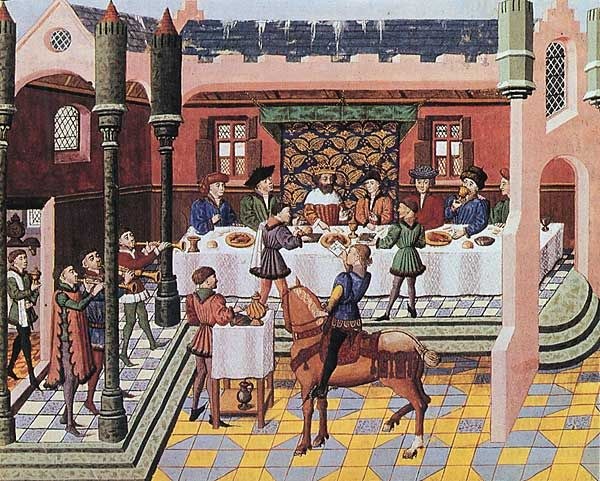
“Elrond, as was his custom, sat in a great chair at the end of a long table upon a dais…In the middle of the table there was a chair under a canopy…” The Fellowship of the Ring, Book Two, Chapter 1, “Many Meetings”)

A “dais” is a raised platform.  If you’re a Harry Potter fan, you’ll remember it at “High Table” (as it’s called in English schools), where the students of the four different colleges meet to dine and the faculty sit on such a platform.

image11hightable.jpg

This is a left-over medieval custom, when royalty/nobles sat on a kind of stage, above the lesser folk, for formal meals.

image12feast.jpg

(Oh—and don’t ask about the horse—but it wasn’t required.  Horse and rider do appear at a banquet, of course, in the 14th-century poem “Sir Gawain and the Green Knight”—which JRRT once edited.)

image13agawaingreen.jpg

And that “chair under a canopy” reminds us of thrones with canopies, like this at the Palace of St. James, in London.

image13thronecanopy.jpg

Which brings us to the subject of thrones, in general.  After Rivendell, indoors will consist of Lothlorien

image14lorien.jpg

for the fellowship, then nothing for Sam and Frodo till Faramir’s cave hide-out and, beyond, the Tower of Cirith Ungol

image15towercirithungol.jpg

Hardly places to find any furniture beyond the functional!

For the others, we have Edoras

image16edoras.jpg

and Minas Tirith.

image17minastirith.jpg

And here we want to conclude by discussing a similar piece of furnishing in each—those thrones.

These days, when we say or write “thrones”, well, what comes immediately?  A Game of Thrones and the Iron Throne of Westeros.

image18ironthrone.jpg

The thrones of Rohan and Gondor are a bit less complicated.

Theoden’s is described simply as “a great gilded chair” on a “dais with three steps”.  (The Two Towers, Book Three, Chapter 6, “The King of the Golden Hall”).

Here’s Allen Lee’s interpretation

image19alee.jpeg

and here is the Hildebrandts’.

image19bhild.jpg

The throne of Gondor is just a tiny bit more elaborate:

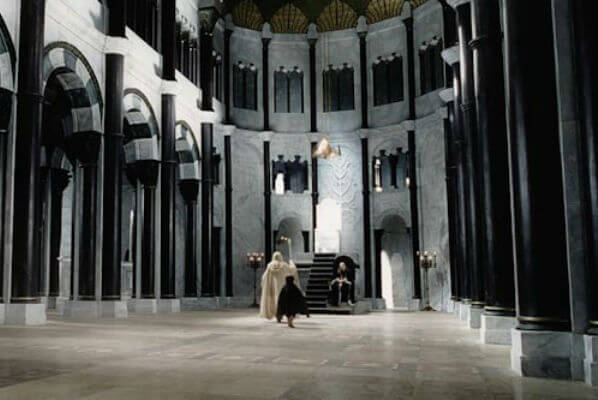
“At the far end upon a dais of many steps was set a high throne under a canopy of marble shaped like a crowned helm…” (The Return of the King, Book Five, Chapter 1, “Minas Tirith”)

Here’s an image from the film.

image19cthroneroom.jpg

But wait—there’s no one on it.  Let’s look lower:

“At the foot of the dais, upon the lowest step which was broad and deep, there was a stone chair, black and unadorned, and on it sat an old man gazing at his lap.”image19ddenethor.jpg

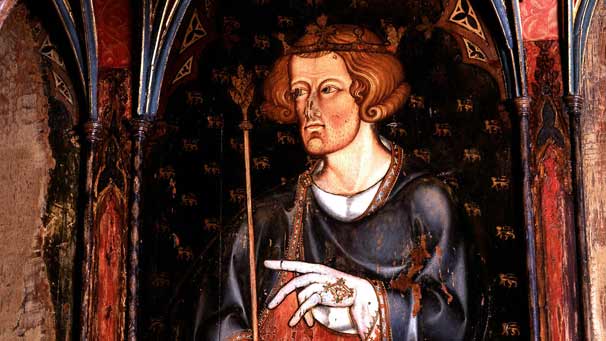
During his lifetime, JRRT would have seen the coronation of five British monarchs:

Edward VII

image19ed7.jpeg

George V

image20geo5.jpg

Edward VIII

image21ed8.jpg

George VI

image22ageo6.jpg

and the current monarch, Elizabeth II.

image22liz2.jpg

You’ll notice that, in every case, the throne is the same.

image23throne.jpg

This is the so-called “Coronation Chair”, built between 1297 and 1300 and used since for crowning English monarchs.  It was especially commissioned so that it could hold the “Stone of Scone” (pronounced “skoon”—not like the pastry).  This was an ancient piece of Scottish royal history which Edward I,

image24ed1.jpg

in an effort to control Scotland, had stolen from its place on Moot Hill, near the Abbey of Scone.

image25sconeabbey.jpg

Supposedly, it was a stone used in the crowning of Scottish kings back to the time of the first one, or that it was even older, having been lugged from Tara, in Ireland, where, under the name “Lia Fail”, “the Stone of Destiny” it was used in coronation ceremonies there.  Its purpose was confirmation:  tradition had it that, when the true king bestrode it (a great old verb form), it gave a great shout.

image26liafail.jpg

As far as we know, no shouting has been reported, over the centuries—perhaps because it’s being used for English kings and therefore the stone is holding its tongue till it’s taken back to wear it belongs?

What do you think, dear readers?

Thanks, as ever, for reading.

MTCIDC

CD

PS

And did you notice something(s) out of place in JRRT’s drawing of Bag End?  We’ll talk about it in our next…

image1bagend


When One Door Closes.3

23 Wednesday Nov 2016

Posted by Ollamh in J.R.R. Tolkien, Language, Literary History, Narrative Methods

≈ Leave a comment

Tags

Common Tongue, doors, Doorward, Edoras, Elvish, Fangorn Forest, Gandalf, Gondor, Hama, Helm's Deep, Isengard, John Ruskin, Meduseld, Minas Tirith, Moria, passages, Paths of the Dead, The Hobbit, The King of the Golden Hall, The King of the Golden River, The Lord of the Rings, Tolkien, Witch-King of Angmar

Welcome, dear readers, to the third part of our series on doors and entryways in JRRT’s The Hobbit and The Lord of the Rings.

We began, several postings ago, by writing that we were intrigued by Bilbo’s statement to Frodo: “It’s a dangerous business, Frodo, going out your door.” (The Fellowship of the Ring, Book 1, Chapter 3, “Three is Company”)

It made us want to look at doors (to which we quickly added entryways of all sorts) in Tolkien and, in doing so, we’ve come up with a very crude classification system, in which there were two kinds of doors, those which seemed to promise safety and those through which you might be in danger. And a major component of such places seems to be a challenge, and a challenger of some sort.

At the end of our second posting, we had come to the breaking up of the Fellowship and now we want to continue, having a look at what could be seen as good examples of what we mean along the way.

Because of the major split in the story, we decided to follow Aragorn, Gimli, and Legolas first.

The first part of their adventure takes place across open country or in Fangorn Forest. It’s only when they, with Gandalf, arrive at Edoras that we see the pattern fall into place.

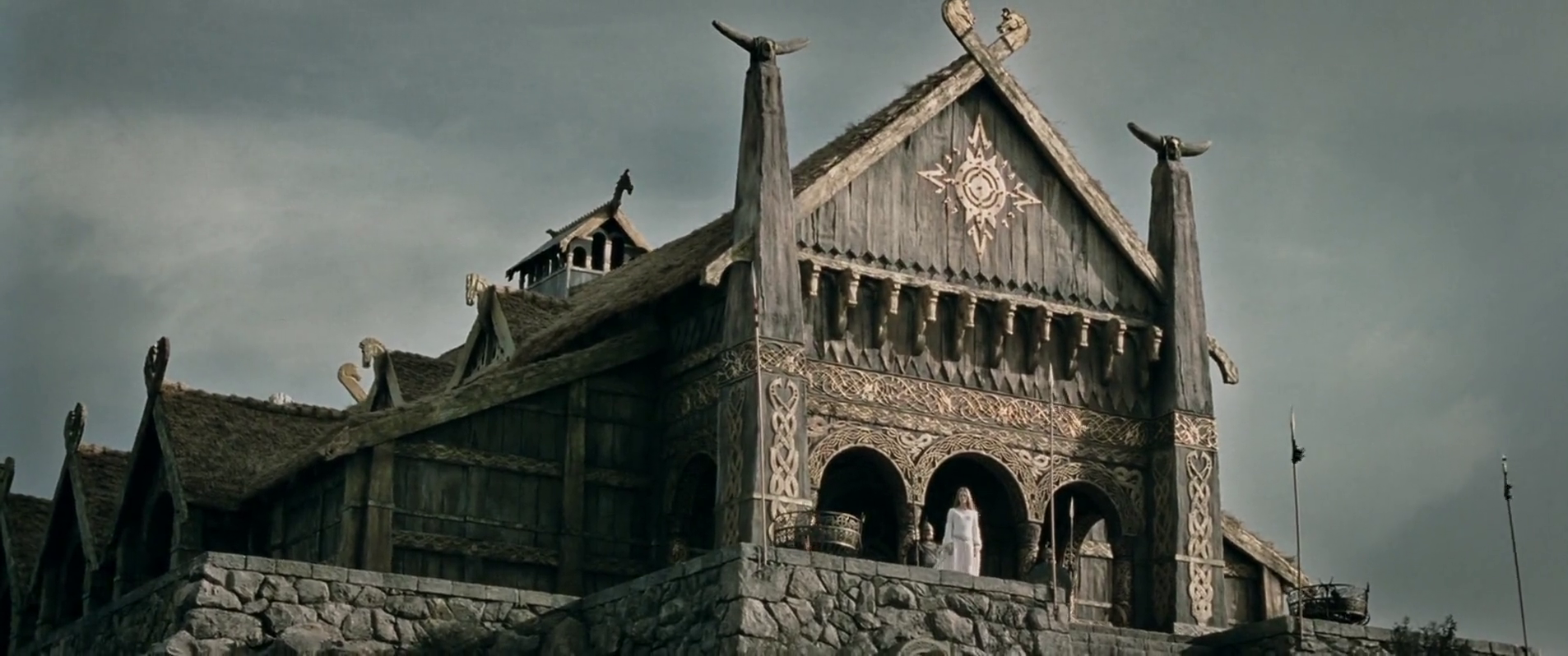
But here we wondered if we should add an extra subcategory, linguistic challenge. We’ve already seen the western gates of Moria and the need to read Elvish and to know the word for friend, and now we have the gates of Edoras

Edoras.jpg

and a suspicious guard of Rohirrim:

“There sat many men in bright mail, who sprang at once to their feet and barred the way with spears. ‘Stay, strangers here unknown!’ they cried in the tongue of the Riddermark.” (The Two Towers, Book 3, Chapter 6, “The King of the Golden Hall”)

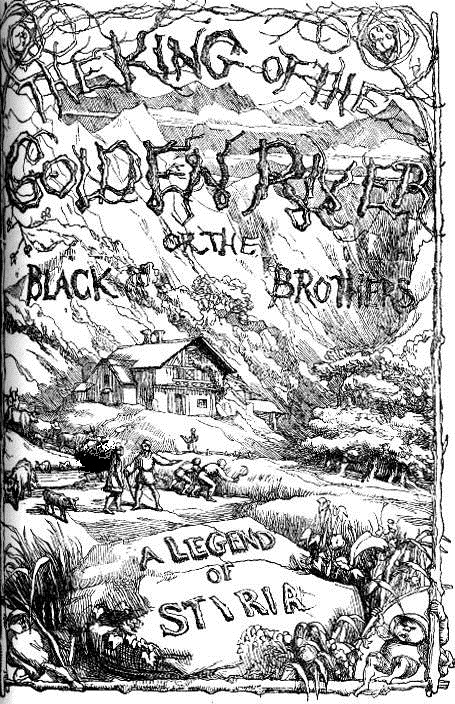
[We wonder, by the way, if the chapter’s title owes something to John Ruskin’s 1841/51 fairy tale “The King of the Golden River”, in which a major figure has been changed through evil magic, but is freed and eventually helps the underdog hero…]

King_of_the_Golden_River_-_Title_page.jpg

As he was (eventually) up to the challenge of the gate of Moria, so is Gandalf up to this and challenges them in return:

“ ‘Well do I understand your speech,’ he answered in the same language; ‘yet few strangers do so. Why then do you not speak in the Common Tongue, as is the custom in the West, if you wish to be answered?’ “

After a little parleying in this manner, Gandalf and his companions are allowed to enter and sent up to Meduseld, where there is a second challenger, the Doorward Hama.

Golden_Hall_of_Meduseld.png

meduseld.jpg

Here, after a brief repetition of the previous language challenge, things relax: “Then one of the guards stepped forward and spoke in the Common Speech.” After a tussle about leaving weapons behind (and Gandalf escapes this with his staff), they are permitted into the hall and the scene continues.

After the battle of Helm’s Deep, Denethor, Gandalf, and the rest of the company ride to Isengard, only to find there:

“…ruined gates. There they saw close beside them a great rubble-heap; and suddenly they were aware of two small figures lying on it at their ease, grey-clad, hardly to be seen among the stones. There were bottles and bowls and platters laid beside them…” (The Two Towers, Book 3, Chapter 8, “The Road to Isengard”)

merryandpippinatisengarde.jpg

It’s Merry and Pippin, of course, who describe themselves as “doorwardens”, just as Hama was at Meduseld. The difference is, instead of barring the door and challenging those who would enter, they are welcoming and comical in their lordly self-indulgence. This seems to turn the pattern on its head, and, although it’s the only time such a thing appears, we believe that it is an example of another subcategory, that of parody. It has the elements of other occasions, but, here, the door is a ruin and the guards seem slightly tipsy, rather than menacing, as well as very glad to see those who come to their ward.

In contrast to this merriness, there is stony silence at the next door:   The Paths of the Dead.

EntrancePathsDead-port.jpg

The challenge seems to be in the very air itself:

“And so they came at last deep into the glen; and there stood a sheer wall of rock, and in the wall the Dark Door gaped before them like the mouth of night. Signs and figures were carved above its wide arch too dim to read, and fear flowed from it like a grey vapour.” (The Return of the King, Book 5, Chapter 2, “The Passing of the Grey Company”)

It is Aragorn who accepts the challenge and leads the group through what, in the film, is a kind of funhouse of skulls and greenish figures,

dead.jpg

But, to us readers, what we think is much more disturbing is that there is no more than a restless murmur, which we hear through the dauntless, but quivering Gimli—

“…but if the Company halted, there seemed an endless whisper of voices all about him, a murmur of words in no tongue he had ever heard before.”

And, at the end of their passage, it is Aragorn who is the challenger—not to block those murmurers, but to invite them:

“ ‘Keep your hoards and your secrets hidden in the Accursed Years! Speed only we ask. Let us pass, and then come! I summon you to the Stone of Erech!’ “

We can see in this multiple ends: first, it fits the pattern of confrontations at doors (all feel the sense of Something There and must rise to the challenge, conquering their fear); second, it provides a route for Aragorn’s strategy: to gain supernatural allies on the way to natural ones along the southern seacoast; third, it underlines Aragorn’s right to the kingship: only he has the knowledge and authority to call up the long-dead for his purposes.

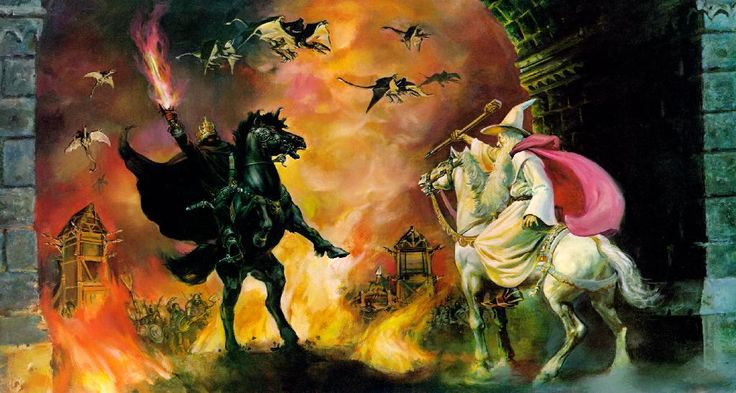
Our last challenge of this posting is at what is perhaps the most dramatic moment in the attack upon Minas Tirith. Grond the ram has, with the aid of the Lord of the Nazgul, burst open the great gate and the Wraith is about to enter when he encounters:

“…Gandalf upon Shadowfax…

‘You cannot enter here,’ said Gandalf, and the huge shadow halted. ‘Go back to the abyss prepared for you! Fall into the nothingness that awaits you and your Master. Go!’ ” (The Return of the King, Book 5, Chapter 4, “The Siege of Gondor”)

gandalfgate2.jpg

But—then? We admit it—we shamelessly want a cliffhanger here. And so we’ll stop—till our next, in which we’ll finish the story—we promise!—and provide a breakdown of all of the doors and entryways in a chart, as well.

Thanks, as always, for reading—and we’re sorry that we gave in to temptation, but, as novelists ourselves, we couldn’t resist!

MTCIDC

CD

Tobago to Lothlorien 2

26 Wednesday Oct 2016

Posted by Ollamh in Heroes, J.R.R. Tolkien, Uncategorized

≈ Leave a comment

Tags

Anduin, Barad-Dur, Bree, Caras Galadhon, Cirith Ungol, defense, Edoras, fortification, Galadriel, Helm's Deep, Hildebrandts, John Howe, Lothlorien, Minas Tirith, Morannon, Nenya, Offa's Dyke, Rhodes, Robinson Crusoe, stockades, Swiss Family Robinson, The Lord of the Rings, Tolkien, tree house

Welcome, dear readers, as always. As you can see from the title, this is a continuation of our previous post.

In that previous posting, we began with the novel, Robinson Crusoe (1719),

Robinson_Crusoe_1719_1st_edition.jpg

crusoewyeth.jpg

then on to Swiss Family Robinson (1812),

52062_swiss_rob_md.gif

being especially interested in the stockade of the former

0_8a62b_11562dfa_orig

and the tree house of the latter.

swiss-family-robinson

The connection here was the tree house and Lothlorien, where the elves lived high up in the trees.

lothlorien.jpg

At least, that’s where we began. As we looked more seriously at the architecture of Lothlorien, however, we began to wonder, in a world in which darkness had gradually spread, how it protected itself. After all, Robinson Crusoe, afraid of the cannibals he had seen, had walled himself in. Part of it was the power of Galadriel herself, as she implies to Frodo:

“But do not think that only by singing amid the trees, nor even by the slender arrows of elven-bows, is this land of Lothlorien maintained and defended against its Enemy.” (The Fellowship of the Ring, Book 2, Chapter 7, “The Mirror of Galadriel”)

But was there anything more besides singing, arrows, and Nenya, the Ring of Adamant?

5d7d8ba33f058c6756ab6feed6ca5033.jpg

Far to the south, Minas Tirith had seven concentric (more or less) walls,

minastirithjhowe.jpg

and its opponents across the Anduin had the Morannon

morannonhildebrandt.jpg

and Cirith Ungol

cirithungolhildebrandt.jpg

sam_at_cirith_ungol.jpg

and even the Barad Dur.

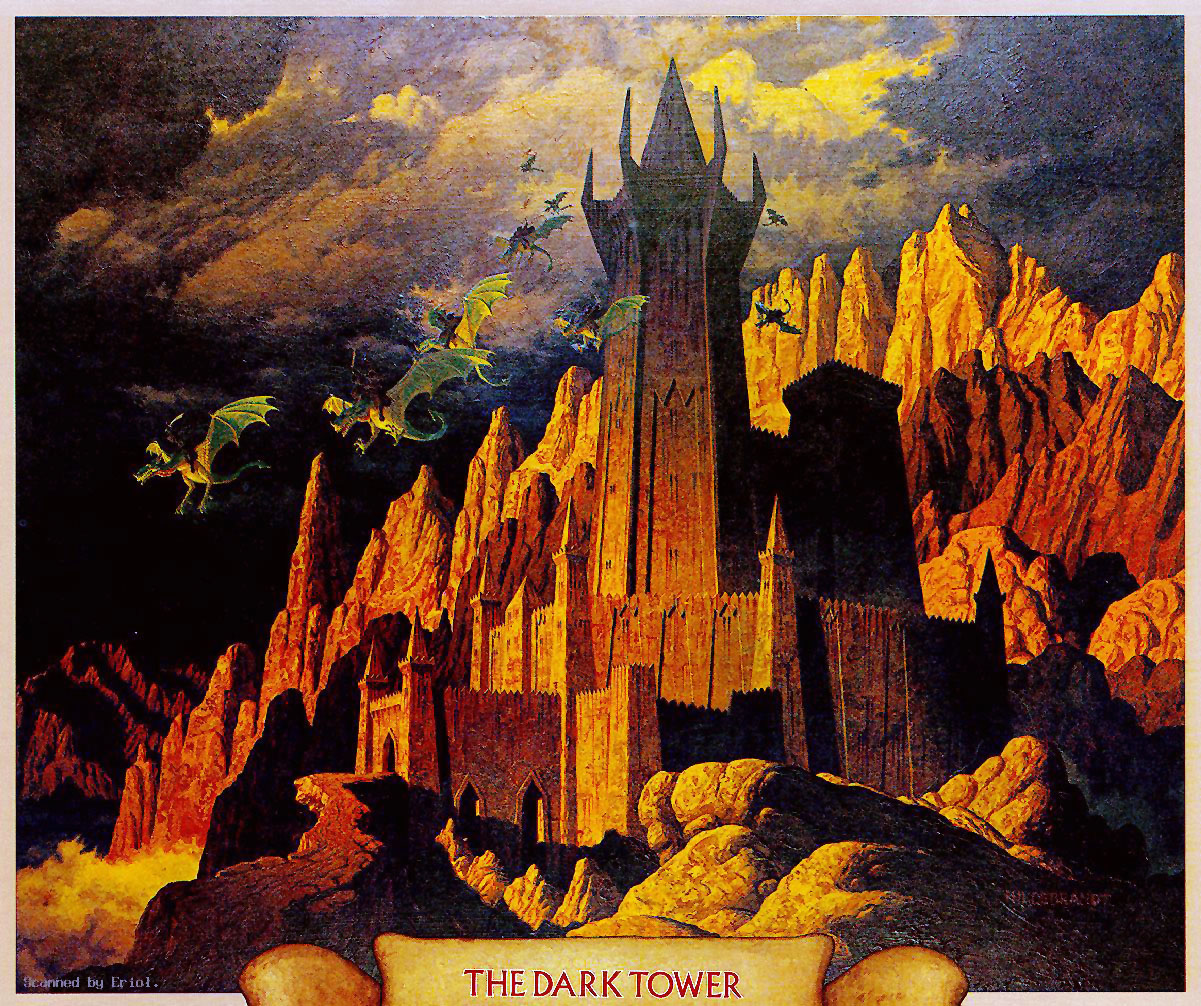
HidebrandtTolkienDarkTower.jpg

It is not so clear about Edoras. There is mention that “A dike [that is, a ditch/moat] and mighty wall and thorny fence encircle it”, along with the phrase “wide wind-swept walls and gates” (The Two Towers, Book 3, Chapter 6, “The King of the Golden Hall”), but little else. And you can see that lack of information reflected in the rather scanty look in the Jackson films—

LOTR_twoTowers_edoras_03_940.jpg

Helm’s Deep, is, of course, a different matter—we show you versions by the Hildebrandts and by John Howe

helmsdeephildebrandt.jpg

33171_the_lord_of_the_rings.jpg

Lothlorien is, in fact, not a single site, like any of the above. This map

LothlorienMap.jpg

gives you an idea of its complexity. There is the outer forest, with its camouflaged guard flets in trees, seemingly along its borders, and then the actual center, the city of Caras Galadhon. Here’s JRRT’s description of that center:

“There was a wide treeless space before them, running in a great circle and bending away on either hand. Beyond it was a deep fosse lost in soft shadow, but the grass upon its brink was green, as if it glowed still in memory of the sun that had gone. Upon the further side there rose to a great height a green wall encircling a green hill thronged with mallorn-trees taller than any they had yet seen in all the land.” (The Fellowship of the Ring, Book 2, Chapter 7, “The Mirror of Galadriel”)

We are then told that there is a bridge, on the southern side, which crosses to “the great gates of the city; they faced south-west, set between the ends of the encircling wall that here overlapped, and they were tall and strong, and hung with many lamps.”

A fosse (from the Latin verb, fodio, fodere, fodi, fossum, “to dig”) means that there was a moat—in this case, it would appear to be a dry moat, like this one at the city of Rhodes.

moatrhodes.jpg

(Those stone balls, by the way, are left over from the Turkish artillery and stone-throwers which pounded the walls of Rhodes in 1522–when we have another posting–soon–on the attack on Minas Tirith, we’ll say more about that.)

That “green wall”, however, is a bit of a puzzle. Is it a wall of green stone of some sort? Or is it a “thorny fence”, like that which surrounds Edoras? There are two similar defenses, or at least boundaries, in LOTR. First, there is the border between Buckland and the Old Forest:

“Their land was originally unprotected from the East; but on that side they had built a hedge: the High Hay. It had been planted many generations ago, and it was now thick and tall…” (The Fellowship of the Ring, Book 1, Chapter 5, “A Conspiracy Unmasked”)

The second such construction appears at Bree (which sounds much like Edoras):

“On that side, running in more than half a circle from the hill and back to it, there was a deep dike with a thick hedge on the inner side.” (The Fellowship of the Ring, Book 1, Chapter 9, “At the Sign of the Prancing Pony”)

So what is the green wall?  English hedges can be very dense things, often to mark off fields, as in this photo of Offa’s Dyke–and you can see the fosse/ditch/moat here, as well.

offasdyke2.png

In at least one previous entry, we discussed Offa’s Dike, a (possibly) 8th-century-AD ditch and earthen wall between England and Wales.

664p.jpg

Can we imagine the palisading of this reconstruction replaced with a thorny hedge? Here’s a long shot of Offa’s Dike with a bit of hedging visible.

as_offas_dyke.jpg

When we consider the general look of Caras Galadhon, it is of something organic: the elves loved the trees and, instead of cutting them down, as the hobbits had done outside the High Hay, they climbed up into them. Might we then see that their physical barrier against their enemies was of the same green and growing material as were their dwellings?

What do you think, dear readers?

Thanks, as ever, for reading,

MTCIDC

CD

Of Boats and Boromir

18 Wednesday Nov 2015

Posted by Ollamh in Fairy Tales and Myths, J.R.R. Tolkien, Narrative Methods, Poetry, Uncategorized

≈ Leave a comment

Tags

Abbotsford, Anduin, Aragorn, boat, Boromir, burial, Camelot, Edoras, Eglinton Tournament, Falls of Rauros, Gimli, Gondor, Gyeongju, Henryk Siemiradski, Hero-Worship and the Heroic in History, Horace Walpole, Ibn Fadlan, Ibn Fadlan and the Rusiyyah, Idylls of the King, Ivanhoe, Journal of Islamic and Arabic Studies, King Arthur, Korea, Legolas, medievalism, neo-medievalist, On Heroes, poetry, pre-Romantics, Prose Edda, Pugin, Rohan, Romanticism, Ship burial, Silla, Sir Frank Dicksee, Sir Lancelot, Sir Walter Scott, Snorri Sturluson, Snorro, St. George's chapel, Story, Strawberry Hill, Sutton Hoo, Tennyson, The Departure of Boromir, The Hero as Divinity. Odin. Paganism: Scandinavian Mythology, The Lady of Shalott, The Lord of the Rings, The Vikings (1958), Thomas Carlyle, Tolkien, vaults, Victorian, viking burial, vikings, Westminster, Windsor

Dear Reader,

Welcome, as always.

In this posting, we want to take something we mentioned in our last about Tolkien having read Tennyson. This is our guess—but in the late Victorian world into which JRRT was born, he must have been inescapable.

We _could_ say that medievalism was in the air then, brought in by Romanticism—and even before, by pre-Romantics, like Horace Walpole, with his mock-castle at Strawberry Hill (1749-76).

walpole2964-correctionS

Strawberry_Hill_House_from_garden_in_2012_after_restoration]

There were lots of early neo-medievalist things—some of Sir Walter Scott’s novels, like Ivanhoe (1820)—not to mention his mock-castle, at Abbotsford.

OLYMPUS DIGITAL CAMERA

Abbotsford_house

the absolutely wonderful and crazy Eglinton Tournament of 1839 (we may have to have a posting about this)

A_view_of_the_lists._Eglinton_Tournament1839

the medieval-revival architecture of Pugin

augustuspugin

stgilescheadle184046

before Tennyson began publishing Idylls of the King in 1859, with its poems about King Arthur and his court.

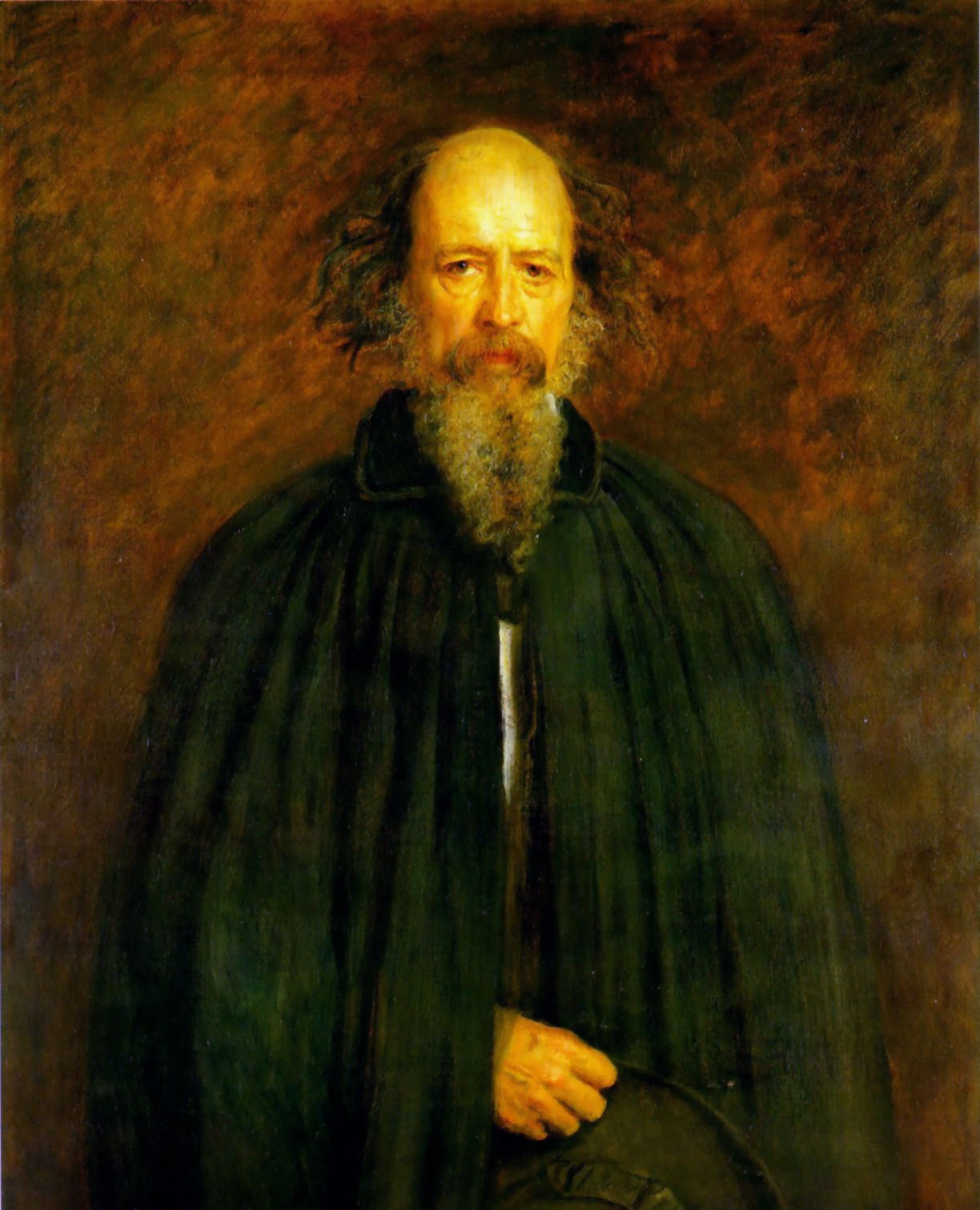
John_everett_millais_portrait_of_lord_alfred_tennyson

idylls1859

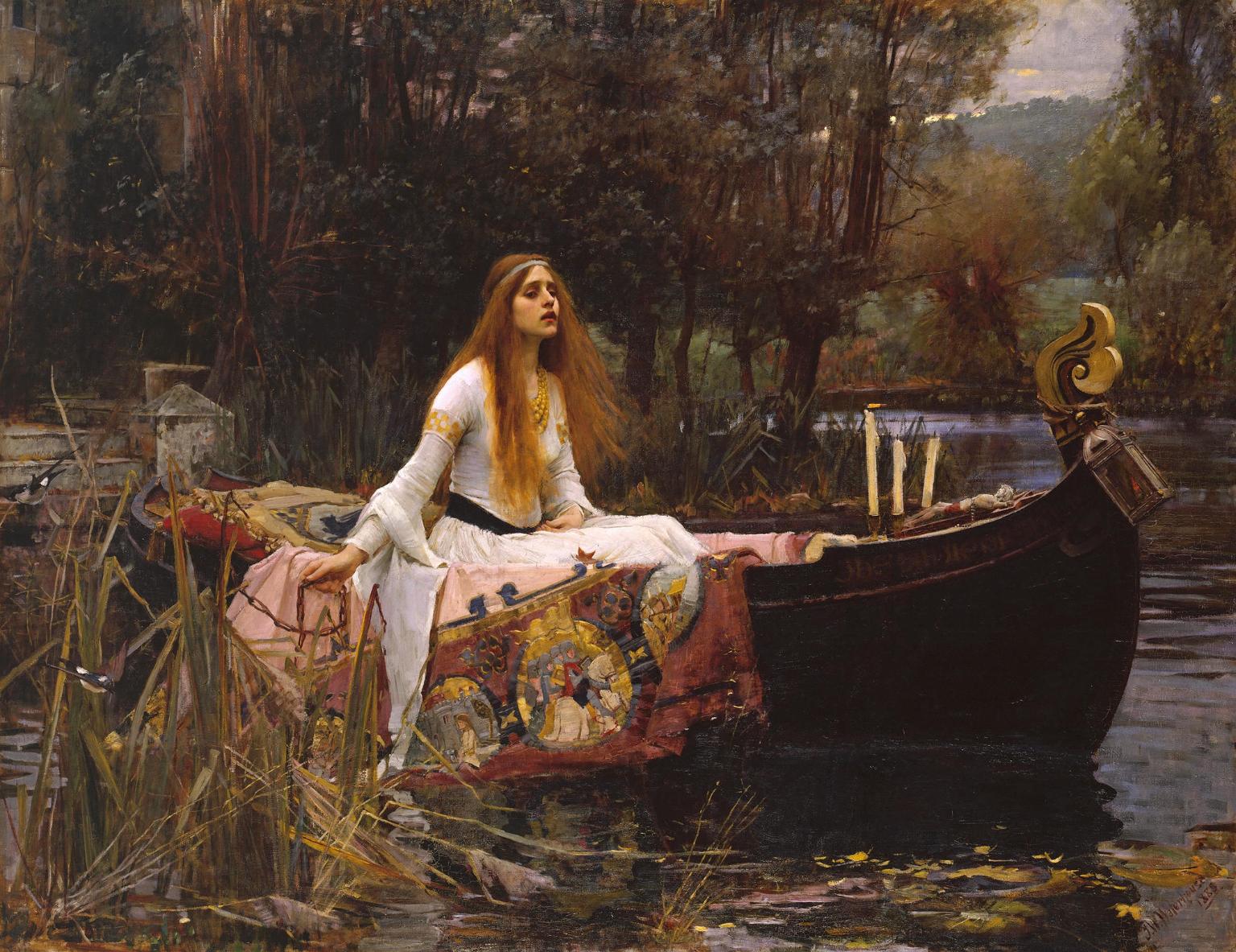
Even before Idylls, Tennyson had been interested in writing about King Arthur’s world, producing the poem “The Lady of Shalott” in his Poems (1833, revised version 1842), in this poem, a lady under a curse sees, from her tower, Sir Lancelot riding by, and falls in love with him without ever meeting him. What happens next was what brought us to write this posting.

Because it reminded us of Boromir.

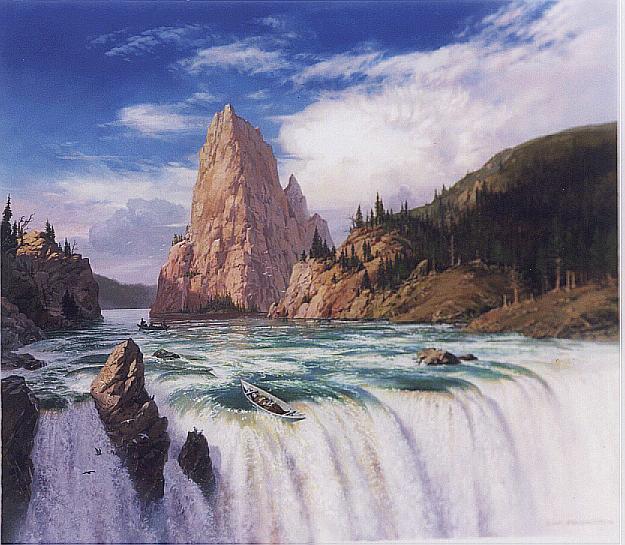
At the beginning of The Two Towers, Aragorn finds the dying Gondorian sitting, with his back against a tree, and, scattered around him, and “Many Orcs lay slain, piled all about him and at his feet.” (The Two Towers, Chapter 1, “The Departure of Boromir”) When Legolas and Gimli join Aragorn, they decide upon a hasty, but they hope, appropriate burial.

“ ‘Then let us lay him in a boat with his weapons, and the weapons of his vanquished foes,’ said Aragorn. ‘We will send him to the Falls of Rauros and give him to the Anduin. The River of Gondor will take care at least that no evil creature dishonours his bones.’” (The Two Towers, Chapter 1, “The Departure of Boromir”)

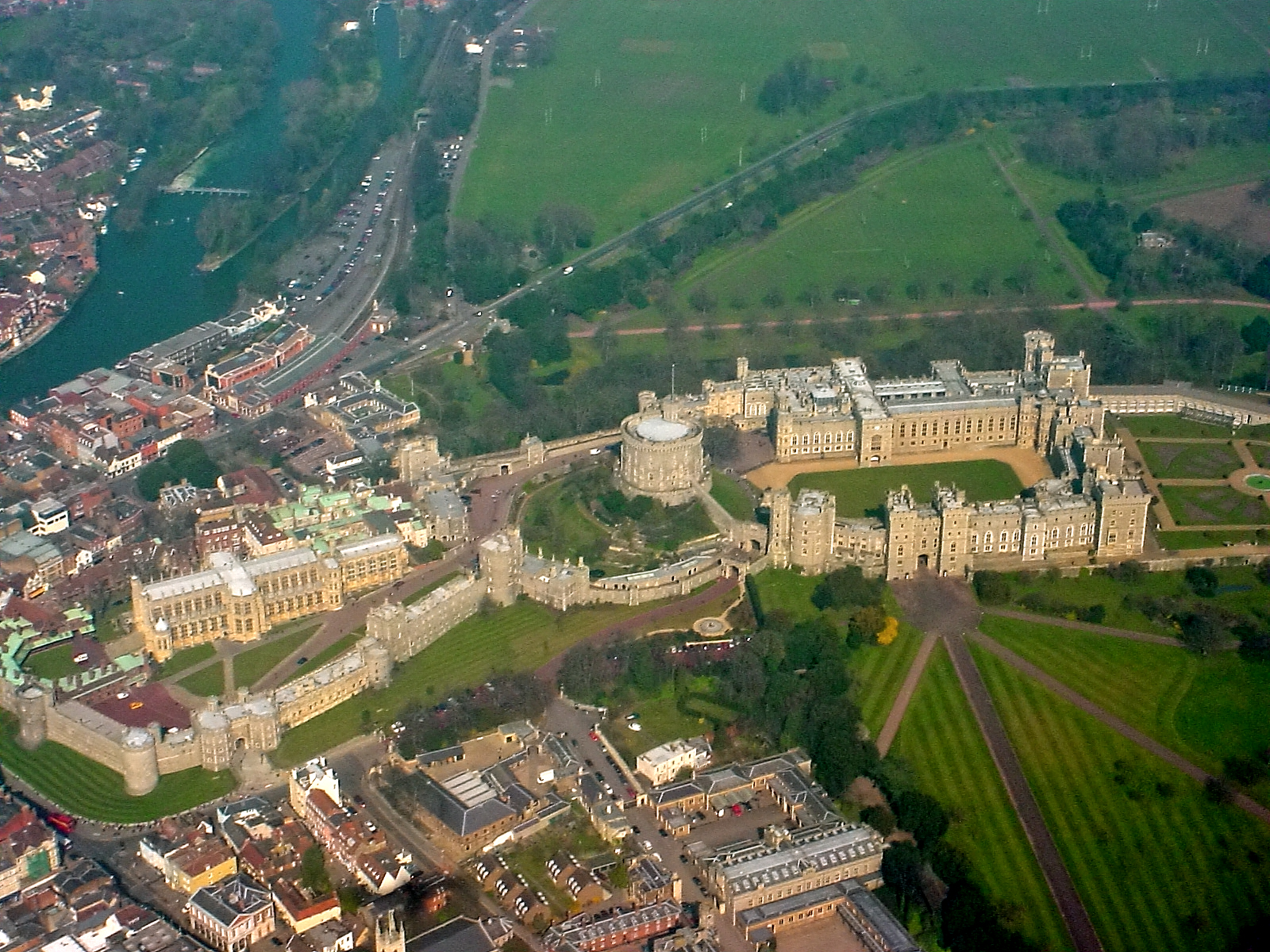
In other burial scenes of important people in The Lord of the Rings, we see that the Kings and Stewards of Gondor are laid to rest in special vaults, rather like medieval and later English kings buried either in St. George’s chapel at Windsor or in Westminster Abbey.

tombofthestewards

Windsor_Castle_from_the_air

Westminster_Abbey_-_Thomas_Hosmer_Shepherd

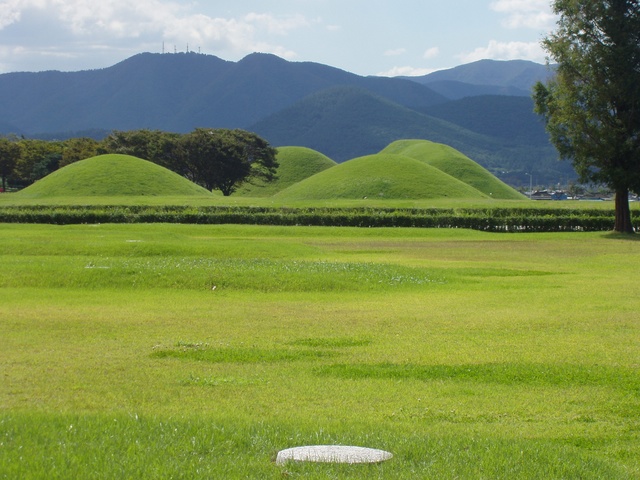
The Kings of Rohan lie beneath a series of mounds just before Edoras,

simbelmyne_mounds

like those of the Silla kings of Korea at Gyeongju (57BC-935AD).

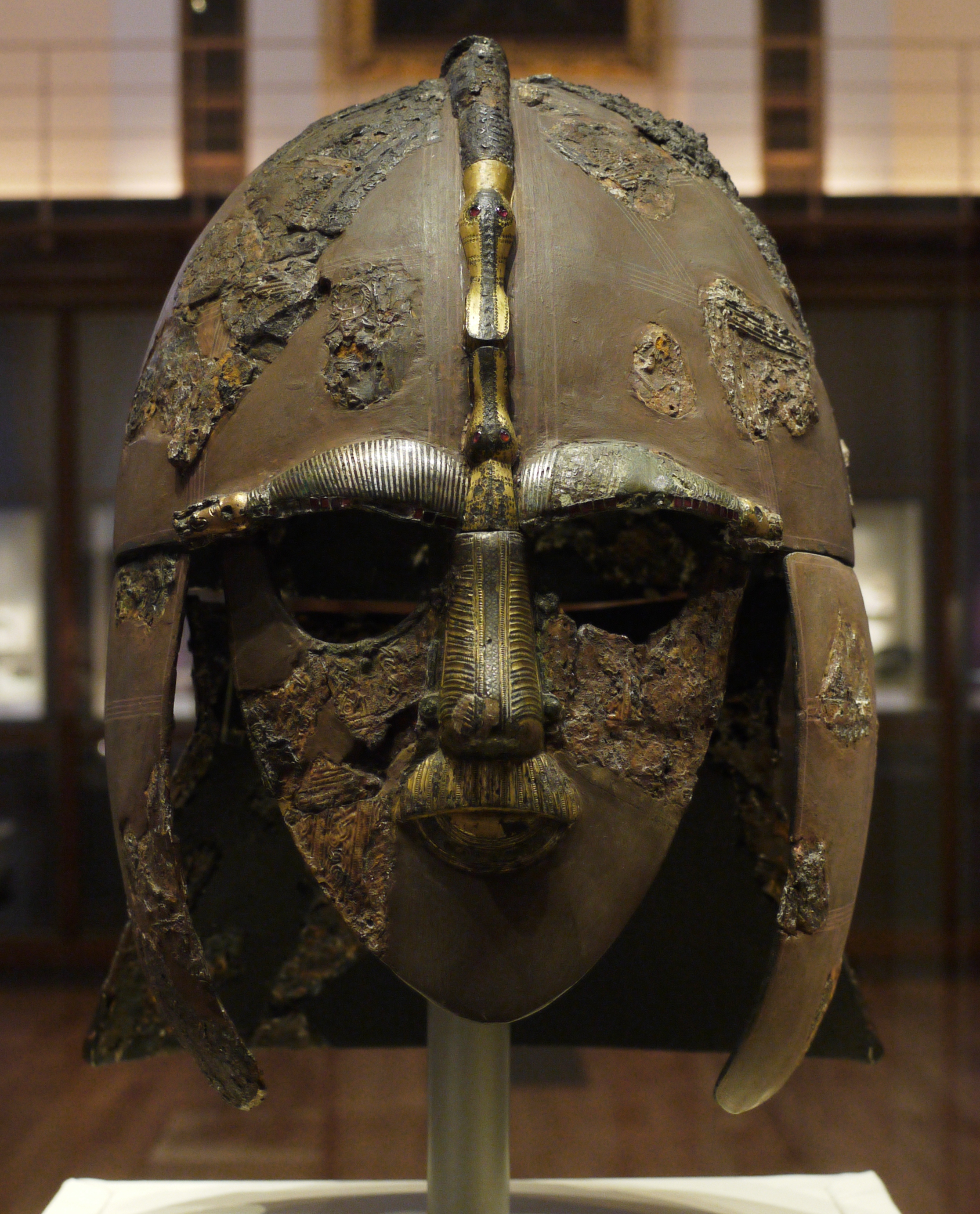
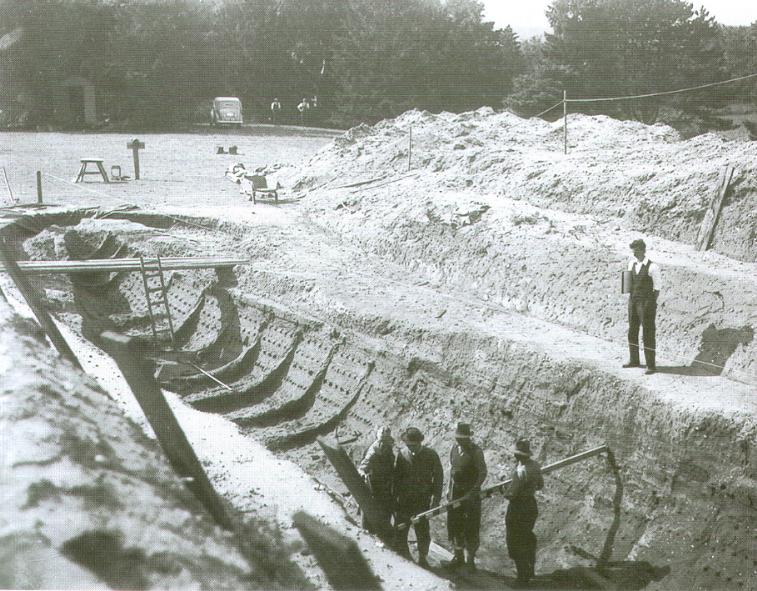
Or like the sort of ship burials of which Tolkien must have read in the newspapers of 1939, the famous Sutton Hoo grave.

ship

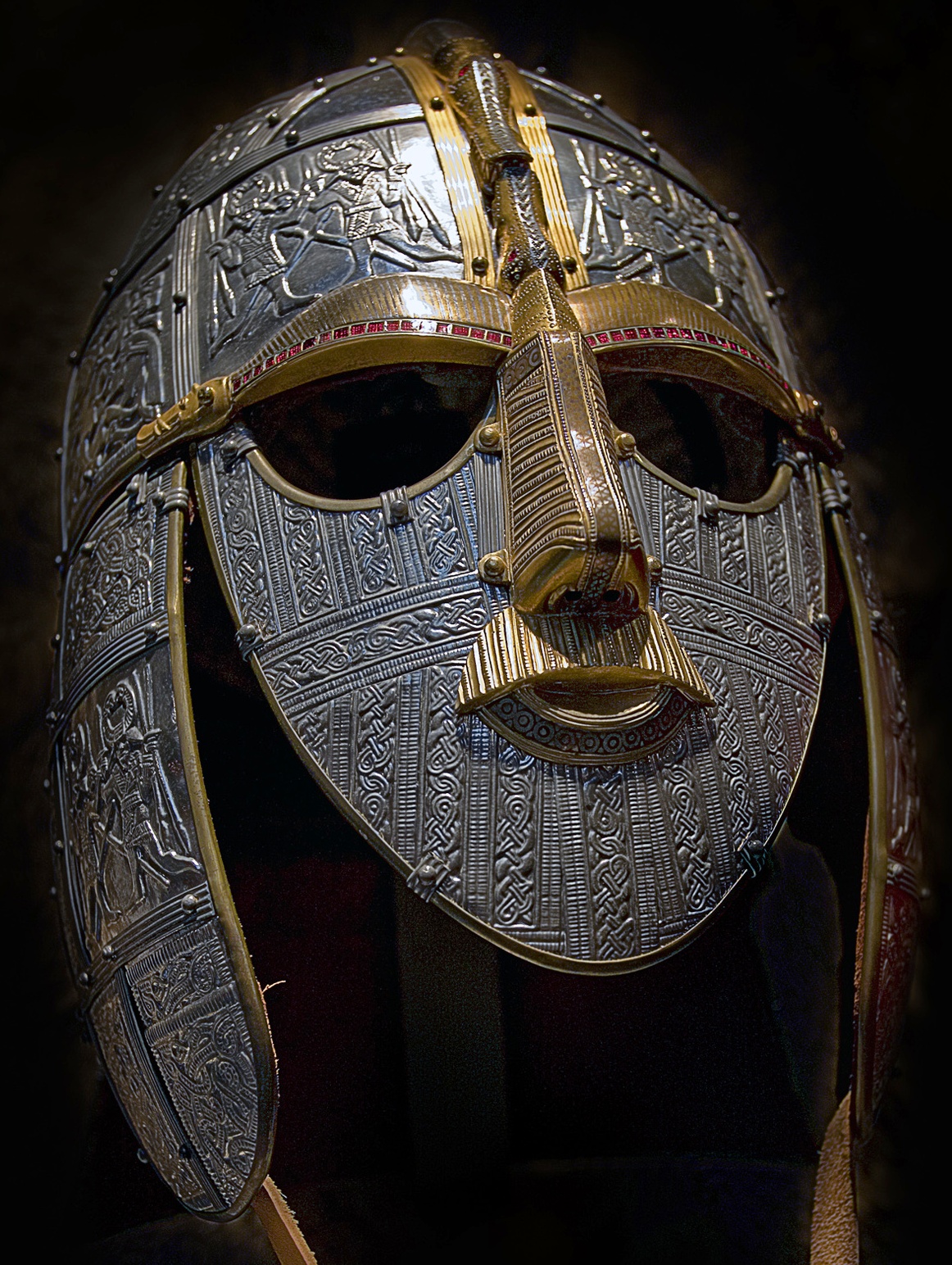
From which came treasures like this helmet (with its reconstruction).

Sutton_hoo_helmet_room_1_no_flashbrightness_ajusted

Sutton_Hoo_helmet_reconstructed

A number of ship burials of northern European upper class people survive, all more or less in the same pattern: the ship is dragged to a spot where it is filled with the deceased, occasionally accompanied by others and even animals, and grave goods of a high quality, then a mound is built over it. The deceased may have been cremated beforehand, but not necessarily. There is a well-known description of this process by an Arab traveler, Ibn Fadlan. (for a translation of this with copious annotations, see James E. Montgomery, “Ibn Fadlan and the Rusiyyah”, Journal of Islamic and Arabic Studies 3, 2000—available on-line by googling “Ibn Fadlan and the Rusiyyah”)

Here’s an 1883 reconstruction of one part of that process by the Polish painter Henryk Siemiradski.

Funeral_of_ruthenian_noble_by_Siemiradzki

In contrast, the image of the deceased being placed in such a ship, the ship being launched, and then torched, would appear to be a Hollywood popularization, perhaps originating with the 1958 movie, The Vikings, of something rare (or at least difficult to document).

vikingsposter

At the conclusion of this film, a major character is given this treatment.

Vikiing Funeral - The Vikings burning ship

(That the Victorians were aware of this alternative can be seen in this 1893 painting by Sir Frank Dicksee.

dicksee1

Dicksee had based this painting not on a scholarly source, but upon a lecture by Thomas Carlyle, “The Hero as Divinity. Odin. Paganism: Scandinavian Mythology”, which he would have found in Carlyle’s On Heroes, Hero-Worship, and the Heroic in History. Carlyle very loosely cites “Snorro” for his description of such an event, by which he means Snorri Sturluson, author of the Prose Edda)

But this brings up back to “The Departure of Boromir”—and to Tennyson.

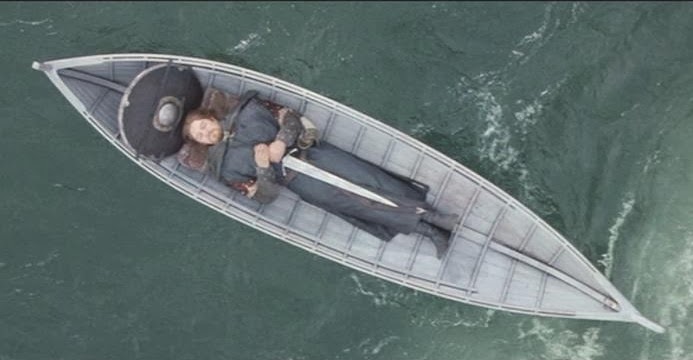
In “The Departure of Boromir”, as we have seen, Boromir is placed into one of the Elven boats.

(FOTR) Boromir Dead in Boat

The three companions tow the boat as close to the Falls of Rauros as they can, then cast it loose to be carried over the Falls.

boromir_funerals

The companions, of course, are pressed for time: Frodo and Sam have gone one direction, Merry and Pippin have been carried off in another and there isn’t time, they feel, to bury Boromir or to build a cairn over him. As they have boats and there is the river below them, the method chosen seems a natural one, but we wondered if the author didn’t have Tennyson’s model in his mind, as well.

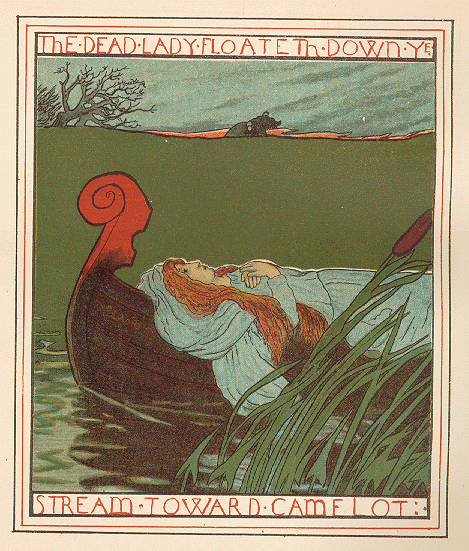
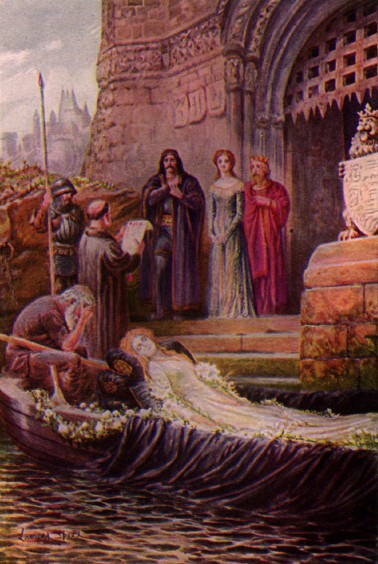
In “The Lady of Shalott”, after seeing Lancelot through her window (or in a reflection in the 1842 version of the poem), the Lady places herself in a small boat, with note in hand, and dies on her way down the river on the way to Camelot, apparently of a broken heart (as the backstory, appearing as early as the 13th century, tells us).

The Lady of Shalott 1888 by John William Waterhouse 1849-1917

robertson-the-lady-of-shalott

Not only would the poem (which has a rather catchy rhythm) have been readily available, but there were a number of paintings and engravings illustrating the story, practically from the time of the 1842 version.

Lady_of_Shalott_edmo lady1 lady2

lady9


lady10


lady13


lady14

lady15

This is not so dramatic as going over the falls and her death is pale in comparison to multiple arrow wounds, but there is that rhythm, the image of the body in the boat going downstream, and the popularity of the poet—plus the numerous illustrations. We’ll include a link to the poem so you can judge for yourself: was this a possible influence on JRRT?

Thanks, as always, for reading.

MTCIDC

CD

Where From the Rohirrim?

10 Wednesday Jun 2015

Posted by Ollamh in Heroes, J.R.R. Tolkien, Military History, Military History of Middle-earth, Narrative Methods, The Rohirrim

≈ 1 Comment

Tags

Amazons, Anglo-Saxon, Bayeux Tapestry, Burial mounds, Cavalry, Charge of the Light Brigade, descendants, Edoras, Eotheod, Horse people, Indo-European, Kurgan, language, Middle-earth, Normans, Rohan, Rohirric, Rohirrim, Scythians, The Lord of the Rings, The Mark, Tolkien, Tom Shippey

Dear Readers, welcome!

In this post, we want to think out loud a bit about the Rohirrim.

ghan Rohirrim-by-Angus-McBride-kacik-rohanskiej-adoracji-36841491-473-477 maxresdefault

Everyone knows where their language is from, as Tolkien says in a letter to “one Mr. Rang”:

“…’Anglo-Saxon’…is the sole field in which to look for the origins and meaning of words and names belonging to the speech of the Mark.” LT 381

And yet they are horse people (their own name for themselves, in fact, is Eotheod, “horse people”), which the Angles and Saxons who went to make up the Anglo-Saxons, were not.   Tolkien was well aware of this difference, saying in Appendix F of The Lord of the Rings:

“…this linguistic procedure does not imply that the Rohirrim closely resembled the ancient English otherwise, in culture or art, in weapons or modes of warfare, except in a general way due to their circumstances…” L1136

Tom Shippey, in The Road to Middle Earth, suggests that

“The Rohirrim are nothing if not cavalry. By contrast the Anglo-Saxons’ reluctance to have anything militarily to do with horses is notorious…How then can Anglo-Saxons and Rohirrim ever, culturally, be equated? A part of the answer is that the Rohirrim are not to be equated with the Anglo-Saxons of history, but with those of poetry, or legend.” (112)

Or, could there have been other models?

Tolkien may have been suggesting one when, in a letter to Rhona Beare of 14 October, 1958:

“The Rohirrim were not ‘mediaeval’ in our sense. The styles of the Bayeux Taptestry (made in England) fit them well enough, if one remembers that the kind of tennis-nets [the] soldiers seem to have on are only a clumsy conventional sign for chain-mail of small rings.” Ltr 280-281.

The Bayeux Tapestry depicts both Normans and their allies, on the one hand, and the Anglo-Saxons, on the other, but Tolkien doesn’t appear to distinguish between them. The Normans themselves are mounted, the Anglo-Saxons on foot, as was their custom (they did use horses to move rapidly from place to place, as in the race north to Stamford Bridge and then back south to face the Normans).

5191623_orig

Here, to the left, we see those mounted Normans and, to the right, the Anglo-Saxons behind their shield wall. The “tennis-nets” are clearly visible and would actually have looked like this:

huscarl

In this further illustration, by the way, it’s easy to see the consequences of having the shield wall crumble: men on horseback can have a significant advantage when their opponents lose cohesion.

34small-1000

This, however, is only their look . What about those horses and an entire culture based around them?

For a clue, we look to another element in the culture of the Rohirrim, the use of burial mounds. Here they are at Edoras.

Simbelmyne_Mounds

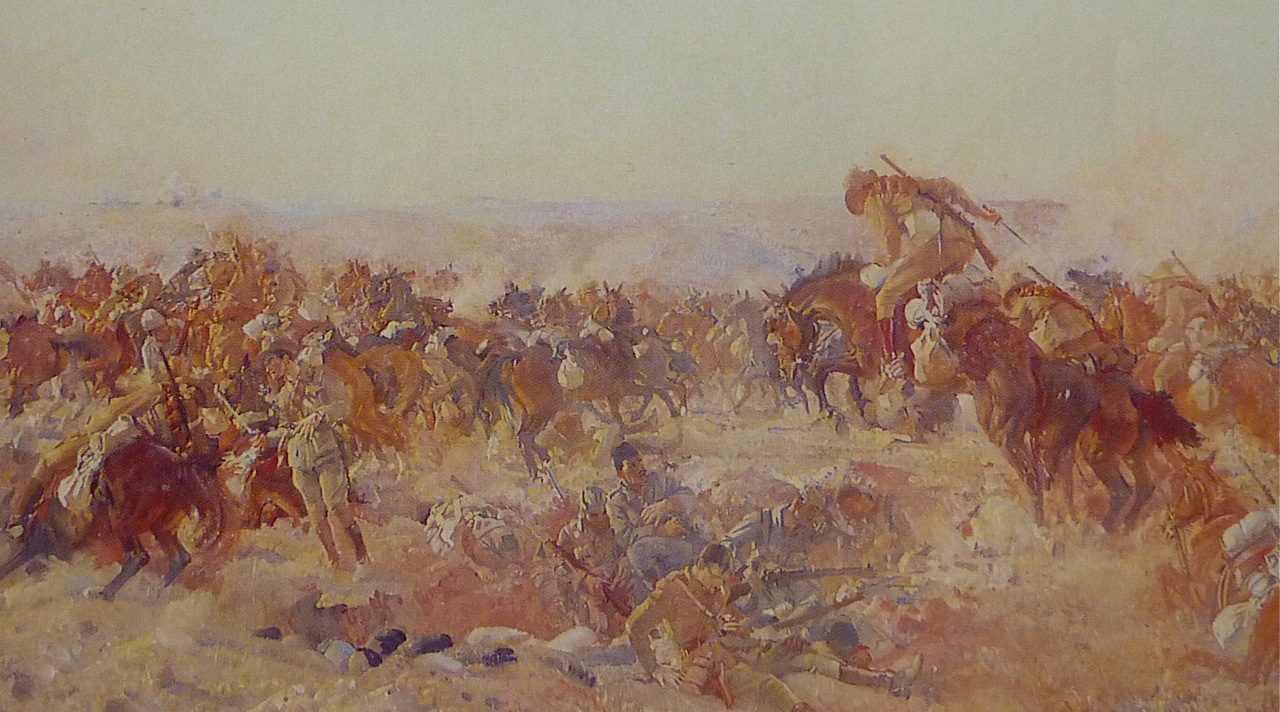
(We can’t resist, by the way, saying that our absolute favorite part of the Jackson movies is anything to do with the Rohirrim—to us, absolutely inspired and we see the depiction of the charge of the Rohirrim against the army besieging Minas Tirith as being right up there with the Charge of the Light Brigade at Balaclava in 1854 and the charge of the Australian Light Horse at Beersheba in 1917–

Rohancharge

(c) National Trust, Tredegar House; Supplied by The Public Catalogue Foundation

beersheba lambert

One might say, in reply, that there are Anglo-Saxon mounds—like the famous Sutton Hoo ship burial.

c52a1bf535

But that leaves us where we started, in the land of foot soldiers.

huscarl1

So, let’s go farther afield, to the north of the Black Sea.  

WRLH034-H

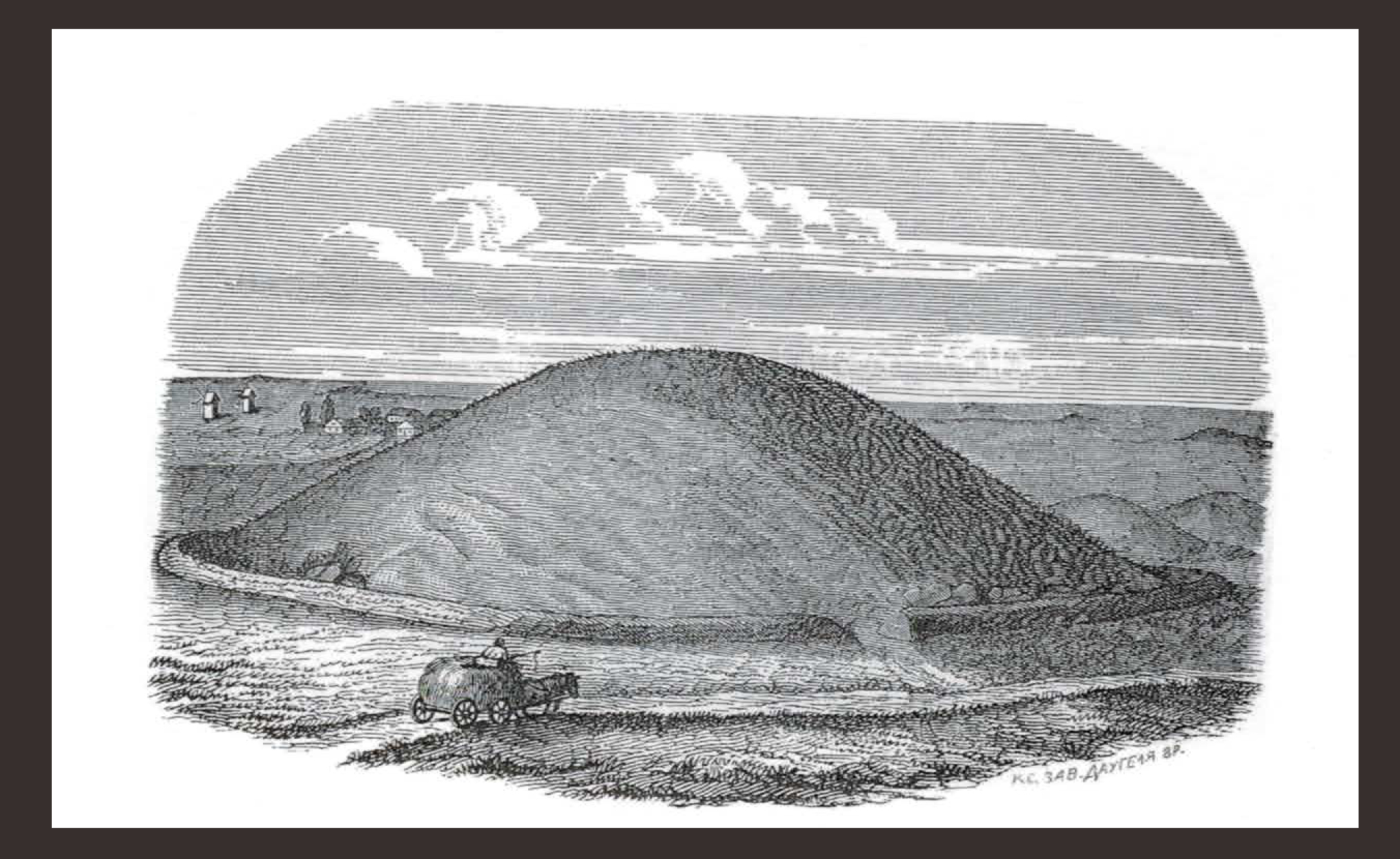
Here, we see the so-called “Kurgan Culture”, with its burial mounds

02161200-1 02161200

[This, by the way, is not to be confused with The Kurgan from the first Highlander movie

The Kurgan]

movie-villain-kurgan

These were a people who:

  1. are believed by many linguists (and some archeologists) to be the direct ancestors of the Indo-Europeans who gradually invaded Asia Minor and western Europe (including, eventually, the Anglo-Saxons) as well as moving east, to India and beyond
  2. buried their dead (at least what appear to be the high status ones) in mounds
  3. were a horse culture

And, in fact, were seemingly the forerunners of the Scythians, a later well-known Indo-European horse people

Scythia Rod-Scythian-Horseback

angus-mcbride-scythia-1

And the Scythians, in turn, may have been the model for those mythical horse folk, the Amazons.

72303amazon

In the 19th century, when the idea of Indo-Europeans began to circulate, there was a preference for a northern European origin (a theory no longer held), but the idea of an eastern home was also circulating and we would suggest that Tolkien would have known about this, as well as, from his early classical training, Scythians and Amazons, their actual and mythical descendants.

Imagine, then, that what we see in the Rohirrim is, in fact, an interesting mixture of people sprung from an earlier people (as Tolkien tells us, the Rohirrim were descended from the Edain of the First Age—see LOTR, Appendix F 1129), both in our world and in Middle Earth, who based their culture upon horses, and bury their dead in mounds, combined with people who may also bury their dead in mounds, who speak a version of Anglo-Saxon and who dress like the Normans and Anglo-Saxons of the 11th century AD.

What do you think, dear readers?

Thanks for reading, as always.

MTCIDC

CD

The Doubtful Sea Series Facebook Page

The Doubtful Sea Series Facebook Page

  • Ollamh

Categories

  • Artists and Illustrators
  • Economics in Middle-earth
  • Fairy Tales and Myths
  • Films and Music
  • Games
  • Heroes
  • Imaginary History
  • J.R.R. Tolkien
  • Language
  • Literary History
  • Maps
  • Medieval Russia
  • Military History
  • Military History of Middle-earth
  • Narnia
  • Narrative Methods
  • Poetry
  • Research
  • Star Wars
  • Terra Australis
  • The Rohirrim
  • Theatre and Performance
  • Tolkien
  • Uncategorized
  • Villains
  • Writing as Collaborators
Follow doubtfulsea on WordPress.com

Across the Doubtful Sea

Recent Postings

  • A Moon disfigured December 17, 2025
  • On the Roads Again—Once More December 10, 2025
  • (Not) Crossing Bridges December 3, 2025
  • On the Road(s) Again—Again November 26, 2025
  • On the Road(s) Again November 19, 2025
  • To Bree (Part 2) November 12, 2025
  • To Bree (Part 1) November 5, 2025
  • A Plague o’ Both—No, o’ All Your Houses! October 29, 2025
  • It’s in Writing (2:  I’st a Prologue, or a Poesie for a Ring?) October 22, 2025

Blog Statistics

  • 103,201 Views

Posting Archive

  • December 2025 (3)
  • November 2025 (4)
  • October 2025 (5)
  • September 2025 (4)
  • August 2025 (4)
  • July 2025 (5)
  • June 2025 (4)
  • May 2025 (4)
  • April 2025 (5)
  • March 2025 (4)
  • February 2025 (4)
  • January 2025 (5)
  • December 2024 (4)
  • November 2024 (4)
  • October 2024 (5)
  • September 2024 (4)
  • August 2024 (4)
  • July 2024 (5)
  • June 2024 (4)
  • May 2024 (5)
  • April 2024 (4)
  • March 2024 (4)
  • February 2024 (4)
  • January 2024 (5)
  • December 2023 (4)
  • November 2023 (5)
  • October 2023 (4)
  • September 2023 (4)
  • August 2023 (5)
  • July 2023 (4)
  • June 2023 (4)
  • May 2023 (5)
  • April 2023 (4)
  • March 2023 (5)
  • February 2023 (4)
  • January 2023 (4)
  • December 2022 (4)
  • November 2022 (5)
  • October 2022 (4)
  • September 2022 (4)
  • August 2022 (5)
  • July 2022 (4)
  • June 2022 (5)
  • May 2022 (4)
  • April 2022 (4)
  • March 2022 (5)
  • February 2022 (4)
  • January 2022 (4)
  • December 2021 (5)
  • November 2021 (4)
  • October 2021 (4)
  • September 2021 (5)
  • August 2021 (4)
  • July 2021 (4)
  • June 2021 (5)
  • May 2021 (4)
  • April 2021 (4)
  • March 2021 (5)
  • February 2021 (4)
  • January 2021 (4)
  • December 2020 (5)
  • November 2020 (4)
  • October 2020 (4)
  • September 2020 (5)
  • August 2020 (4)
  • July 2020 (5)
  • June 2020 (4)
  • May 2020 (4)
  • April 2020 (5)
  • March 2020 (4)
  • February 2020 (4)
  • January 2020 (6)
  • December 2019 (4)
  • November 2019 (4)
  • October 2019 (5)
  • September 2019 (4)
  • August 2019 (4)
  • July 2019 (5)
  • June 2019 (4)
  • May 2019 (5)
  • April 2019 (4)
  • March 2019 (4)
  • February 2019 (4)
  • January 2019 (5)
  • December 2018 (4)
  • November 2018 (4)
  • October 2018 (5)
  • September 2018 (4)
  • August 2018 (5)
  • July 2018 (4)
  • June 2018 (4)
  • May 2018 (5)
  • April 2018 (4)
  • March 2018 (4)
  • February 2018 (4)
  • January 2018 (5)
  • December 2017 (4)
  • November 2017 (4)
  • October 2017 (4)
  • September 2017 (4)
  • August 2017 (5)
  • July 2017 (4)
  • June 2017 (4)
  • May 2017 (5)
  • April 2017 (4)
  • March 2017 (5)
  • February 2017 (4)
  • January 2017 (4)
  • December 2016 (4)
  • November 2016 (5)
  • October 2016 (6)
  • September 2016 (5)
  • August 2016 (5)
  • July 2016 (5)
  • June 2016 (5)
  • May 2016 (4)
  • April 2016 (4)
  • March 2016 (5)
  • February 2016 (4)
  • January 2016 (4)
  • December 2015 (5)
  • November 2015 (5)
  • October 2015 (4)
  • September 2015 (5)
  • August 2015 (4)
  • July 2015 (5)
  • June 2015 (5)
  • May 2015 (4)
  • April 2015 (3)
  • March 2015 (4)
  • February 2015 (4)
  • January 2015 (4)
  • December 2014 (5)
  • November 2014 (4)
  • October 2014 (6)
  • September 2014 (1)

Blog at WordPress.com.

  • Subscribe Subscribed
    • doubtfulsea
    • Join 78 other subscribers
    • Already have a WordPress.com account? Log in now.
    • doubtfulsea
    • Subscribe Subscribed
    • Sign up
    • Log in
    • Report this content
    • View site in Reader
    • Manage subscriptions
    • Collapse this bar
 

Loading Comments...