• About

doubtfulsea

~ adventure fantasy

Category Archives: Military History of Middle-earth

“A kind of proud, venerable, but increasingly impotent Byzantium”

01 Wednesday Jun 2016

Posted by Ollamh in Artists and Illustrators, J.R.R. Tolkien, Literary History, Maps, Military History, Military History of Middle-earth, Narrative Methods

≈ Leave a comment

Tags

Adventure, Byzantine Empire, Byzantium, Constantinople, Gondor, Justinian, Megara, Mehmet II, Milton Waldman, Minas Arnor, Minas Tirith, Mont Saint Michel, Ottoman Empire, Ted Nasmith, The Lord of the Rings, The Tower of Guard, Theodosian walls, Theodosius, Tolkien

Welcome, as always, dear readers.

The title of this posting is taken from a very long letter (10,000 words), written to Milton Waldman probably in 1951 (Letters No.131, 157). Waldman represented the English publisher, Collins, which had expressed an interest in The Lord of the Rings and The Silmarillion when Allen & Unwin had been hesitant. Determined to justify the simultaneous publication of both, Tolkien wrote in great detail about the general narrative, with an emphasis upon the religious aspects.

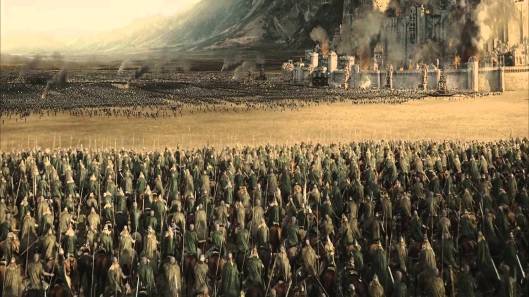
In the process, he likened Gondor to the Byzantine empire, a comparison which immediately attracted our attention. We ourselves had suggested in an earlier posting that the attack on its capital, Minas Tirith, had been like the siege of the Byzantine capital, Constantinople.
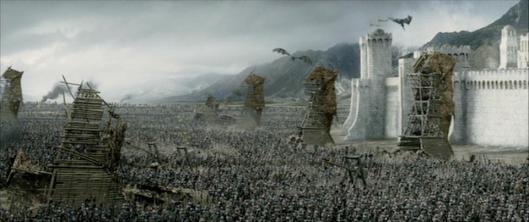
attackongondor.jpg

8da792d4aac58fe51f8ddf1aefa36048.jpg

What was JRRT thinking of when he likened the two?

First, they both were—or had been—large kingdoms—in the case of Byzantium, an empire, really, as these maps demonstrate.
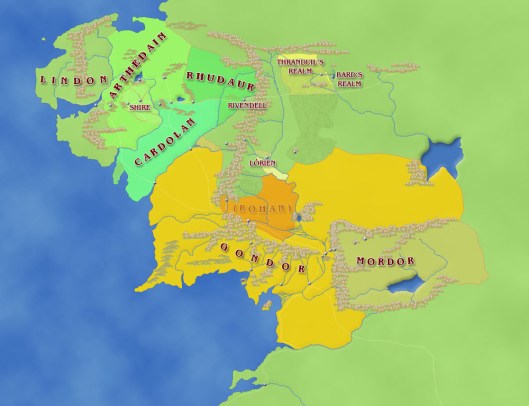
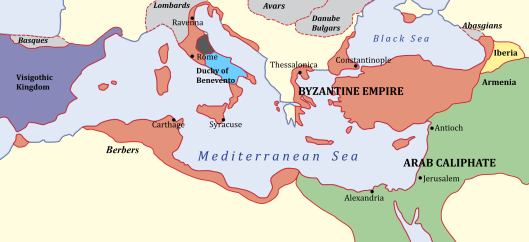
gondor1050height.jpg

2000px-Byzantiumby650AD.svg.png

Their capitals were both of great age. Minas Tirith, “The Tower of Guard”, had been built originally as Minas Anor, “Tower of the Sun” in SA 3320 by Anarion, the younger son of Elendil, but only became the capital of Gondor in TA1640, after Osgiliath had been devastated by a plague. If we add its time in the Second Age (121 years) to the whole of the Third Age (3021 years), we reach a total of 3142 years at the defeat of Sauron. (For comparison, we might look at Athens, whose continuous habitation began before 3000BC, giving it a more-than-5000-year history.)

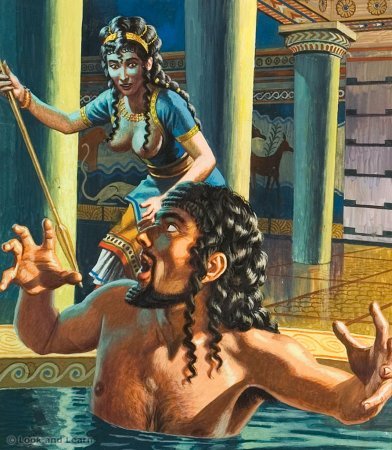
Constantinople, is old, by anyone’s standards, having been founded in 667BC as a Greek colony (there’s a bit of argument over the dating of this, which is typical of such things), and is still inhabited (and an absolutely amazing place!), but a bit younger than Minas Tirith at the time of The Lord of the Rings by some 500 years or so.

Third, there is the matter of the elaborate construction of these capitals.

“For the fashion of Minas Tirith was such that it was built on seven levels, each delved into the hill, and about each was set a wall, and in each wall was a gate. But the gates were not set in a line: the Great Gate in the City Wall was at the east point of the circuit, but the next faced half south, and the third half north, and so to and fro upwards; so that the paved way that climbed towards the Citadel turned first this way and then that across the face of the hill. And each time that it passed the line of the Great Gate it went through an arched tunnel, piercing a vast pier of rock whose huge out-thrust bulk divided in two all of the circles of the City save the first. For partly in the primeval shaping of the hill, partly by the mighty craft and labour of old, there stood up from the rear of the wide court behind the Gate a towering bastion of stone, its edge sharp as a ship-keel facing east. Up it rose, even to the level of the topmost circle, and there was crowned with a battlement; so that those in the Citadel might, like mariners in a monstrous ship, look from its peak sheer down upon the Gate seven hundred feet below.”

The Lord of the Rings, Book 5, Chapter 1, “Minas Tirith”

Here’s one of our favorite paintings (by Ted Nasmith—one of our favorite Tolkien artists).
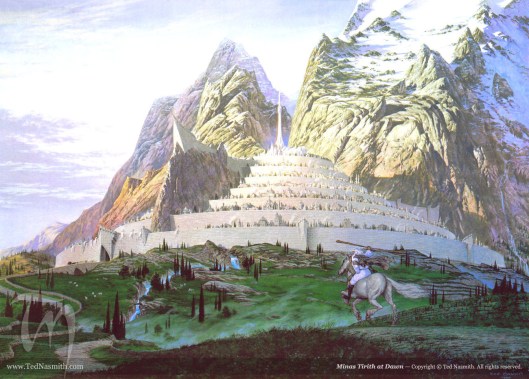
TN-Minas_Tirith_at_Dawn.jpgnaismith.jpg

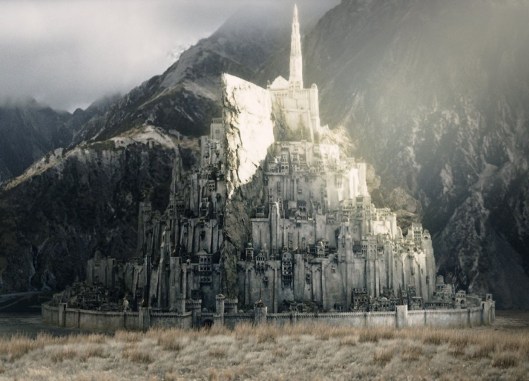
And here’s the film.

ROTK-Minas-Tirith.jpg

The designers have said that they were influenced by the look of Mont Saint Michel, a medieval monastery just off the coast of Normandy in France.

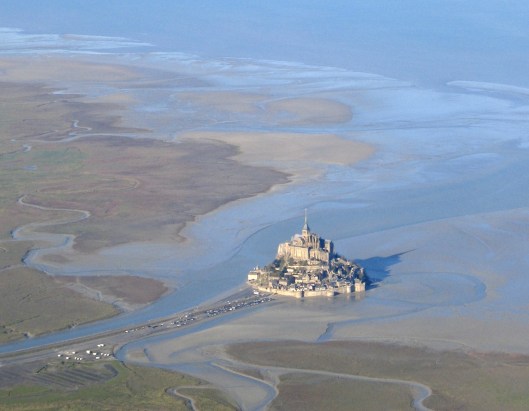
Mont_St_Michel_3,_Brittany,_France_-_July_2011.jpg

MtStMichel_avion.jpg

The complex nature of the place is captured in this diagram.

minas-tirith-diagram.0.jpg

Byzantium (or, Constantinople, its later name) began its life, as we said, as a colony of the Greek mainland city of Megara. In the 4th century AD, the Roman emperor Constantine I, the last survivor in a long civil war, chose the site for his new capital. As much of the weight, both of commerce and defense, lay in the eastern part of the Roman world by this time, he chose very wisely: his new city was placed to control trade with the rich Black Sea region and to provide a strategic jumping-off point for dealing with invaders and emerging kingdoms in Asia Minor.
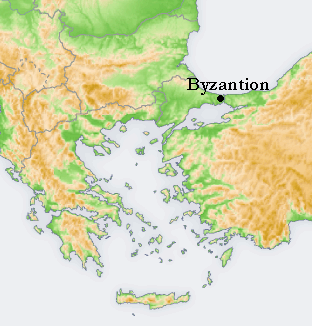
Locator_map_Byzantion.PNG

The position was also well-chosen for defense, being at the end of a peninsula—the main strategy then being its walling-off from the mainland.

constantin.jpg

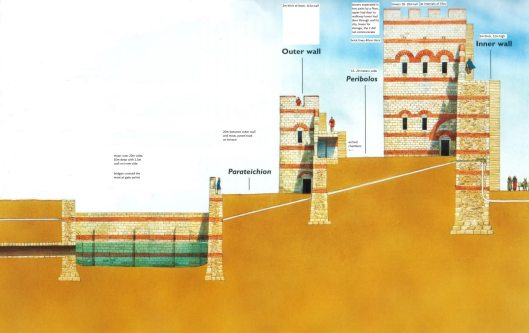
There is, of course, a big difference here between the 7 levels and 7 gates of Minas Tirith and the two walls—the older inner 4th-century one of Constantine and the slightly-later (early 5th century) walls of Theodosius II. Nevertheless, those later walls were well-constructed, in two successive lines, with a moat on the outside.

Theodosian Walls.jpg

The Theodosian walls were about a mile-and-half from the older, Constantine wall, encompassing a population which, at its height, may have been over 400,000 in number. By the time of its fall to the Ottoman army in 1453, that number had dropped to perhaps only 50,000, which reflected the gradual shrinking of the empire from its greatest size, in the 6th century

Byzantine-empire.6thc.gif

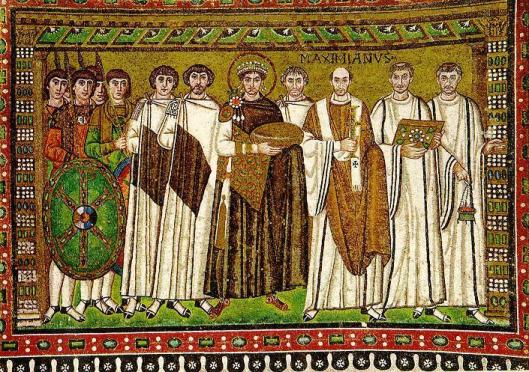
under the emperor Justinian

justinian.jpg

when it encompassed the majority of the Mediterranean basin, to its last, worn-out phase in the early 15th century, when it controlled a few scattered outposts, but mainly the area directly around the capital.

constantinople-world-map.jpg

This shrinking of the empire and of its population proved disastrous for the capital. When the Ottoman army, under Mehmet II, arrived outside the walls in the spring of 1453, the imperial government could only provide 7000 defenders, 2000 of whom were foreigners, to defend about 3 and ½ miles of wall (that’s 5 ½ km). Against them were anywhere from 50 to 80,000 attackers, who brought with them (or cast on the spot), massive artillery pieces and, after a 53-day siege, broke into the city and put an end to an empire which had lasted for over 1100 years.
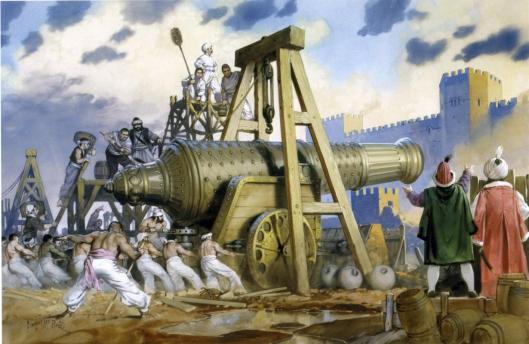
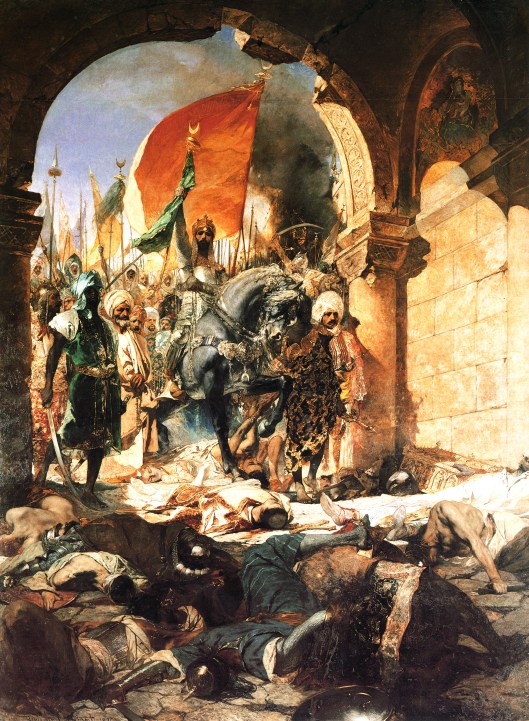
Illustration-of-angus-mcbride-showing-the-ottoman-cannon-basilica-during-the-siege-of-constantinople-in-1453-ad.jpg

Benjamin-Constant-The_Entry_of_Mahomet_II_into_Constantinople-1876.jpg

And this is the last sad similarity with Gondor and its capital, as we see through Pippin’s eyes:

“Pippin gazed in growing wonder at the great stone city, vaster and more splendid than anything that he had dreamed of, greater and stronger than Isengard, and far more beautiful. Yet is was in truth falling year by year into decay, and already it lacked half the men that could have dwelt at ease there. In every street they passed some great house or court over whose doors and arched gates were carved many fair letters of strange and ancient shapes: names Pippin guessed of great men and kindreds that had once dwelt there; and yet now they were silent, and no footsteps rang on their wide pavements, nor voice was heard in their halls, nor any face looked out from door or empty window.”

The Lord of the Rings, Book 5, Chapter 1, “Minas Tirith”

And, just as in the case of Constantinople, the capital of Gondor was hard-pressed to defend itself. Luckily for it, however, there was an uncrowned king with a ghostly army, a brave reinforcement of southern yeomen, a mass of wild horsemen from the north, a wizard, and the fulfillment of an ancient prophecy about a witch king to aid it in its hour of need…

Thanks, as always, for reading.

MTCIDC

CD

Rear Guard

18 Wednesday May 2016

Posted by Ollamh in Films and Music, J.R.R. Tolkien, Literary History, Maps, Military History, Military History of Middle-earth, Narrative Methods

≈ 1 Comment

Tags

66th Regiment, British Infantry, Denethor, Faramir, Gary Zaboly, Le Cateau, Maiwand, Nazgul, Osgiliath, Pelennor, Peter Jackson, Rammas Echor, Richard Caton Woodville, the Alamo, The Lord of the Rings, The Return of the King, The Siege of Gondor, Tolkien

Welcome, dear readers, as always.

In a previous posting, we rolled our eyes verbally at a moment in P. Jackson’s The Return of the King in which Faramir, according to the script, was required to mount a double-rank cavalry charge against the west bank of Osgiliath.

gondorianerritt-cb182208.jpg

To us, this was a clumsy attempt to convey the clash between Faramir and his father Denethor, derived from material in The Lord of the Rings, Book 5, Chapter IV, “The Siege of Gondor”, principally from this:

“ ‘Much must be risked in war,’ said Denethor. ‘Cair Andros is manned, and no more can be sent so far. But I will not yield the River and the Pelennor unfought—not if there is a captain here who has still the courage to do his lord’s will.’

Then all were silent. But at length Faramir said: ‘I do not oppose your will, sire. Since you are robbed of Boromir, I will go and do what I can in his stead—if you command it.’

‘I do so,’ said Denethor.

‘Then farewell!’ said Faramir. ‘But if I should return, think better of me!’

‘That depends on the manner of your return,’ said Denethor.

Gandalf it was that last spoke to Faramir ere he rode east. ‘Do you throw your life away rashly or in bitterness,’ he said. ‘You will be needed here, for other things than war. Your father loves you, Faramir, and will remember it ere the end. Farewell!’ “

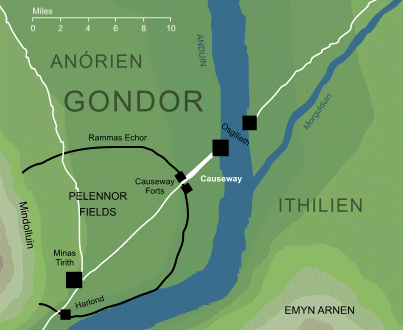
In the text, Faramir then goes to Osgiliath, having “taken with him such strength of men as were willing to go or could be spared.” The tone here is hardly encouraging and, the following day, “The passage of Anduin was won by the Enemy. Faramir was retreating to the wall of the Pelennor, rallying his men to the Causeway Forts; but he was ten times outnumbered.”

In an earlier posting, we have discussed the Rammas Echor, the wall which enclosed the farmland outside the walls of Minas Tirith.

causeway.gif

We have also discussed the use by both Saruman and Sauron of what appears to be an early form of explosive—seen here in the following description of the fall of the Rammas:

“The bells of day had scarcely rung out again, a mockery in the unlightened dark, when far away he [Pippin] saw fires spring up, across in the dim spaces where the walls of the Pelennor stood. ..Now ever and anon there was a red flash, and slowly through the heavy air dull rumbles could be heard.

‘They have taken the wall!’ men cried. ‘They are blasting breeches in it. They are coming!’ “

Outnumbered and, with the fall of the wall in different locations, outflanked, the best that Faramir can do is to fall back towards Minas Tirith, as Gandalf says, “Yet he is resolved to stay with the rearguard, lest the retreat over the Pelennor become a rout. He may, perhaps, hold his men together long enough, but I doubt it.”

Unlike the silly—there’s really no other word for it—charge of P. Jackson—Faramir is a professional soldier, after all, much loved by his soldiers—we see what JRRT, having been a soldier himself, would have known was the military solution: a fighting retreat, led by a brave and capable leader.

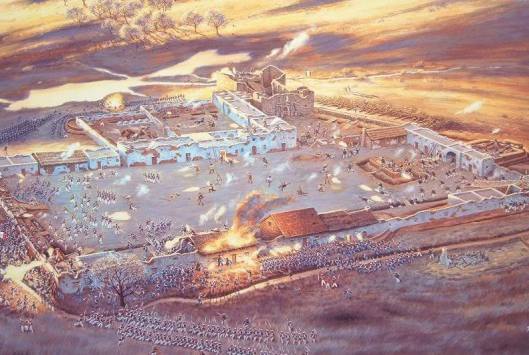
His task had been an impossible one to begin with and, properly understood and depicted on the screen, would not only have been powerful dramatically, but much more believable. It was an impossible task, however, against the odds of ten to one. (For a comparison, we offer the siege and fall of the Alamo, late February-early March, 1836. The garrison numbered about 180, the besiegers eventually approximately 3000. In the final assault, before dawn on 6 March, 1836, the four assaulting columns had about 1200 men, offering odds of roughly 6 to 1 and the entire garrison died, along with somewhere between 400 and 600 of the attackers.)

ALAMO_FORTRESS.jpg

(This is the work of the amazing Gary Zaboly– as an historical illustrator, he can’t be recommended highly enough. Much of his work concerns the 18th century, especially the 1740s and 50s, but he also has done some wonderful depictions of warfare in the American southwest in the 1830s and 40s.)

There are lots of examples of fighting retreats and we’ve picked two: a failure (Maiwand, Second Afghan War, 1880) and Le Cateau (The Great War, 1914).

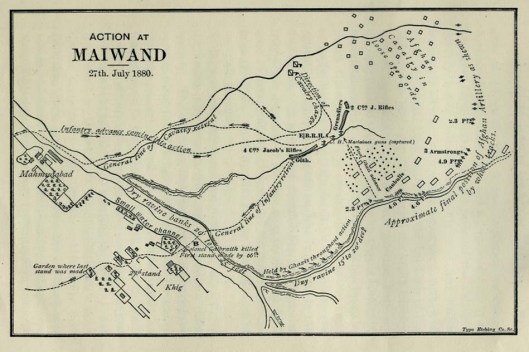
At Maiwand, 27 July, 1880, a British-Indian brigade of 3 infantry units plus two cavalry units and a battery (6 guns) of horse artillery, anywhere from 1500 to 2000 soldiers, faced perhaps 12,000 Afghans with 6 batteries of guns.

Action_at_Maiwand_map.jpg

Basically, the British were outflanked and their left-hand units began to buckle under the pressure of the attacks and the number of attackers which they had to face. As they gave way, the right hand end of the line began to move backwards, feeling increasingly in danger of being surrounded, just as Faramir’s men must have.

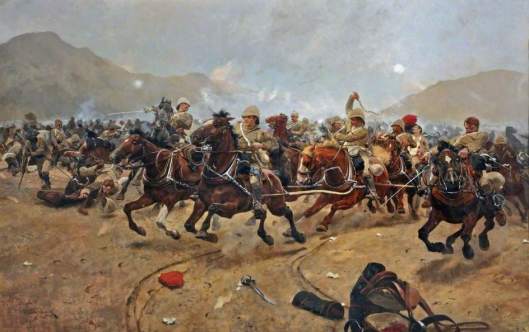
As the infantry retreated, the artillerymen used their guns to buy time for a general withdrawal, ending by losing a section (2 guns) to the enemy. There’s a famous painting of the withdrawal of the remaining guns by the late-Victorian artist, Richard Caton Woodville.

woodvillesavingtheguns.jpg

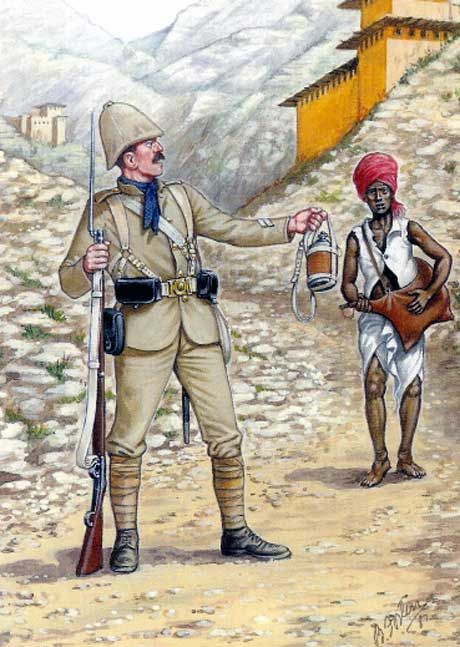
At the end of the withdrawal from the battle, a small group of British soldiers of the 66th Regiment took shelter inside an enclosure in a nearby village and fought it out to the end.

66thfootmaiwand.jpg

maiwand-66th.jpeg

Gandalf’s worry had been that Faramir couldn’t hold his men together and you can see here what happens when organized units come apart—they are defeated piecemeal, “in detail” is the military expression.

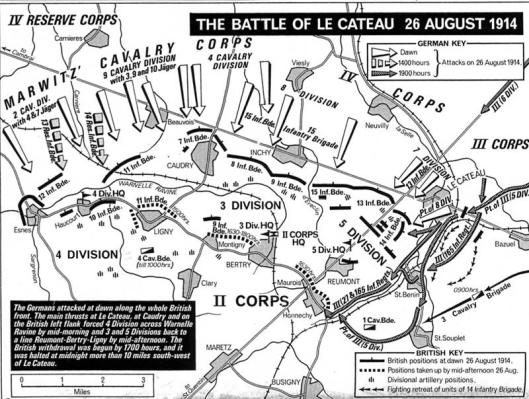
In contrast to this, we offer an action from Tolkien’s own time, the battle at Le Cateau, fought on 26 August, 1914. The British Expeditionary Force, facing superior numbers and in danger of being outflanked, particularly to the west, was engaged in a long retreat. Miraculously, unit cohesion was mostly maintained, although communications were often poor, causing confusion and, in one case, even in losing a unit, never notified of withdrawal.

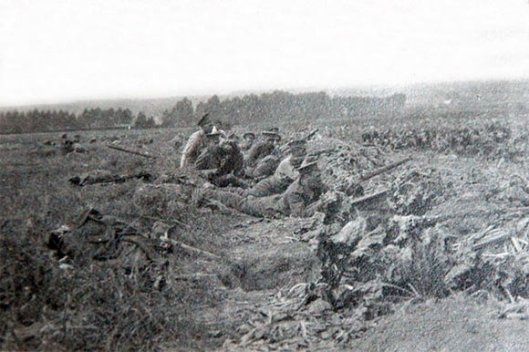
The British Army was divided into two larger groupings, First and Second Corps, and it was Second Corps which turned to face its pursuers. During a long morning, the British, in hastily-dug trenches, fended off superior numbers of German infantry.

1st-east-lancs-regiment-s.jpg

LeCateauMAP1.jpg

Having lost heavily, but having given the enemy similar punishment, the British slowed German pursuit and were able to withdraw without being as closely pursued as they had been.

The difference here is in exactly what Gandalf was worried about. At Maiwand, the brigade fell apart and could easily be swept away by the enemy. At Le Cateau, although it was hardly a perfect affair, the British kept enough cohesion not only to withstand and defeat heavy attacks, but then to retreat in units, without ever collapsing into a fleeing mob.

What happens in that struggle in the fields behind the Rammas Echor is, in fact, a mixture of the two retreats described above. We see “Small bands of weary and often wounded men…some were running wildly as if pursued.” Then, “…less than a mile from the City, a more ordered mass of men came into view, marching not running, still holding together.” And then “Out of the gloom behind a small company of horsemen galloped, all that was left of the rearguard.”

So, it looks like Faramir had succeeded in maintaining that sense of order and purpose which is vital for a fighting retreat. It was not to last, however, as a mass of enemy horsemen on the causeway behind, as well as several Nazgul from above, threw all into confusion—which was stemmed, in turn, by the arrival of a rescue party, led by the Prince of Dol Amroth and accompanied by Gandalf arrived to drive back the attackers.

gandalf_to_the_rescue___speed_paint4_by_myworld1-d7wjv97.png

In that flurry, Faramir is struck by an arrow and has to be rescued and brought into the City, badly wounded.

Looking back, it is a very different scene from that preposterous cavalry charge, isn’t it? As our readers are probably also experienced watchers of the films, we wonder: which do you prefer, Jackson/writers or the author?

Thanks, as always, for reading.

MTCIDC

CD
“My subject is War, and the pity of War.”

13 Wednesday Apr 2016

Posted by Ollamh in Artists and Illustrators, Heroes, J.R.R. Tolkien, Military History, Military History of Middle-earth, The Rohirrim

≈ Leave a comment

Tags

Adventure, Alexander Gardner, Alfred Waud, Alonzo Chappel, American Civil War, Antietam, Battle of the Somme, Charge of the Rohirrim, Confederate, early photography, Felice Beato, First Virginia Cavalry, Fort Geroge, Matthew Brady, Mexican-American War, Minas Tirith, Pelennor, Peter Jackson, Rohirrim, Second Opium War, The Lord of the Rings, Tolkien

Welcome, dear readers, as always.

In this posting, we want to talk a little about a subject so often left out of heroic stories: the aftermath of battle.

In Chapter 10 of The Return of the King, what we might call the GEF—the Gondorian Expeditionary Force—sets off from Minas Tirith for the Morannon. It begins with this little army mustered on the Pelennor and we see events through the eyes of one left behind, Merry:

“At last the trumpets rang and the army began to move. Troop by troop, and company by company, they wheeled and went off eastward. And long after they had passed away out of sight down the great road to the Causeway, Merry stood there. The last glint of the morning sun on spear and helm twinkled and was lost, and still he remained with bowed head and heavy heart, feeling friendless and alone.”

Considering what these folk had endured in the previous days, and what they dreaded might happen in those to come, it’s hardly surprising that it’s not described as a joyous event. What is not described, however, is the landscape in which they gather and which they initially march through.

The Minas Tirith to which Gandalf rides with Pippin

gandalfpippin.jpg

has been attacked by a massive army.

minas-tirith.jpg

In an attempt to lift the siege, the Rohirrim have charged across the Pelennor,

rohirrimcharge.jpg

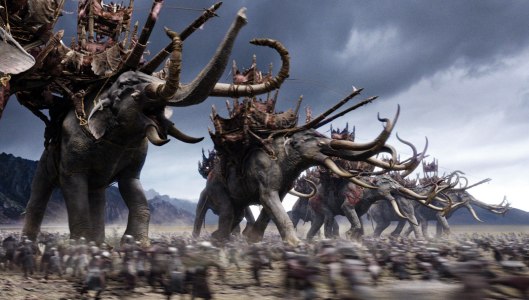
only to encounter the fierce Southrons and their mumakil.

mumakil.jpg

These are defeated, in turn, by Aragorn, his companions, and troops from South Gondor, as well as the surviving Rohirrim and a party from Gondor itself.

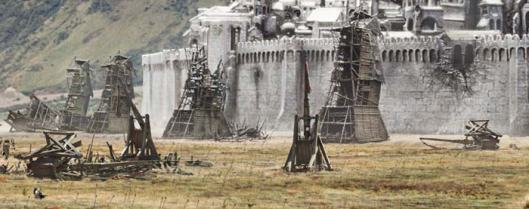
When the carnage is over and the invaders killed or driven off, the story, while touching on the burial of Snowmane, quickly moves back to the city. In real life, such destruction would have left behind a ghastly memorial, something only touched upon in the film of The Return of the King. As you can see in this still, all which seems to remain is the wreckage of the war machines.

551_2_Minas_Tirith_MPdtl.jpg


In fact, there would have been thousands of bodies, not only of men and orcs, but of horses and mumakil as well.

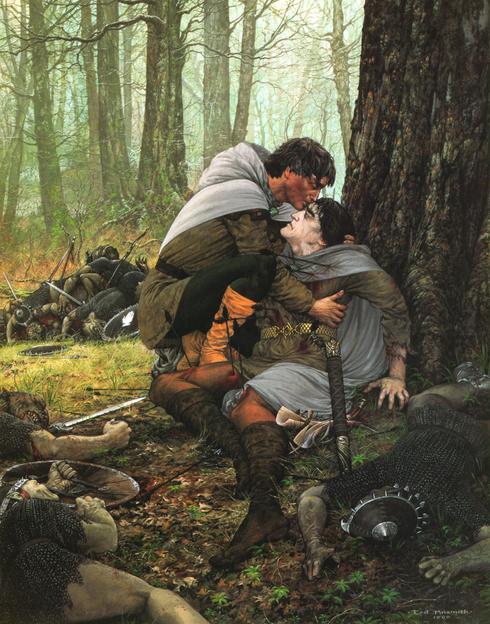
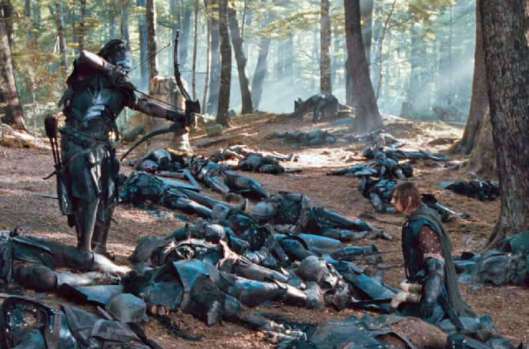
Such an aftermath has not been a popular subject for art, except in scenes where fallen heroes are lamented when found among the slain. (Think here of Boromir, surrounded by dead orcs, for example.)

boromir.jpg

That sense of war was changed, in our world, by the introduction of the camera to the battlefield, first, briefly, by Felice Beato, during the Second Opium War (1860)

beatonorthtakufort1860.jpg

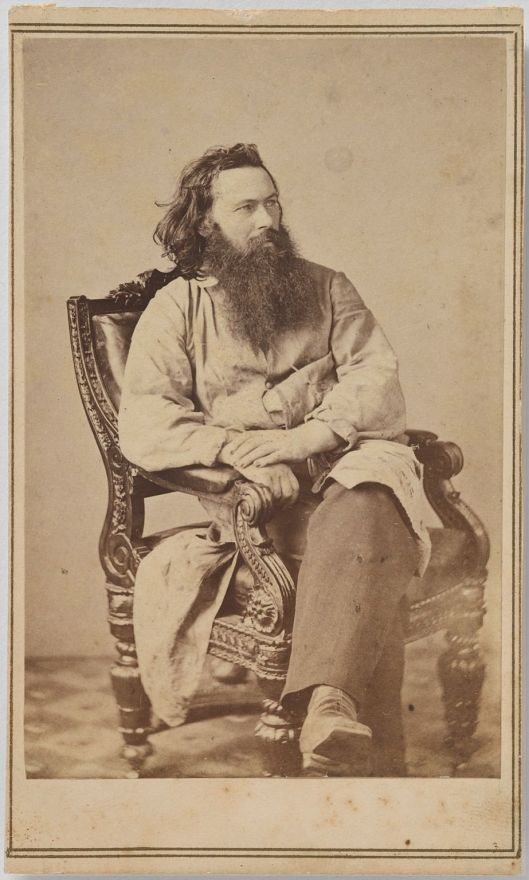
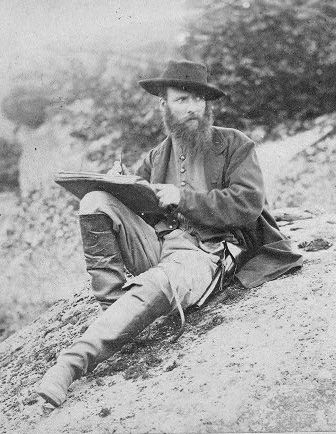
but in the US by Alexander Gardner, in the fall of 1862.

alexandergardner.jpg

Previous images of war had tended towards the glorious, full of bravery and flags, as in this engraving made from Alonzo Chappel’s painting of the taking of the Canadian Fort George in 1813—

alonzochappellftgeorge.jpg

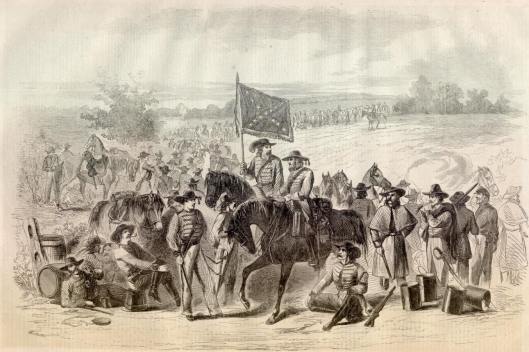
Even if the depiction tended to be more realistic, it came heavily filtered. During the American Civil War, several northern newspapers and magazines sent artists into the field, who drew what they saw or at least heard about from those who had seen events. One of the best was the Englishman, Alfred Waud.

alfredwaud.jpg

He drew from life, as in the picture of the First Virginia Cavalry, with whom he spent a brief time in late September, 1862. Here’s his original drawing, which he would have sent to his publisher, in New York.

the-first-virginia-cavalry-at-a-halt-alfred-r-waud.jpg

In New York, the drawing would have been turned into a woodblock print for ease of conversion to a magazine page.

1st-virginia-cavalry-halted-based-on-sketch-by-waud-harpers-sept-27-1862.jpg

And, thus, the reading public would have lost immediacy practically at the first step.


Photographs had been made in the US since the 1840s, and even some during the Mexican-American War of 1846-8, but they had been static pictures of soldiers off the battlefield.

wool-in-saltillo.jpg

In September, 1862, however, Gardner had been sent by his boss, Matthew Brady

Mathew-Brady.jpg

from the studio in Washington, DC, to the field of the recent battle of Antietam, which had been fought only two days before. Gardner came with his photographic wagon

brady'swhatsit.jpg

and ranged the battlefield. The battle was over, but the dead were still in place, where they had fallen, and soon he had a collection of images. Because there was already a tradition of photographing the dead (and, no, we’re not going to continue this practice here—just do google.images “photos of dead victorians” or the like and you can see this for yourself), it was probably not quite so horrifying as one might imagine, but those who saw the exhibit in Brady’s New York gallery

brady'snygallery.jpg

might have agreed with the New York Times review of 20 October, 1862, that “Mr. Brady has done something to bring home to us the terrible reality and earnestness of war.”

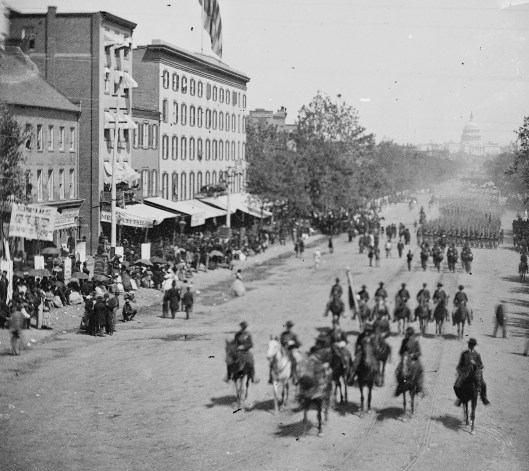
Gardner didn’t take the pictures he did out of a morbid interest, but because the cameras of the day were large and cumbersome

banner-civil-war-photography.jpg

and the process necessary to make a picture took too long to capture motion (just look what happens when there is motion).

Grand Review of Army May 1865 02796u.jpg

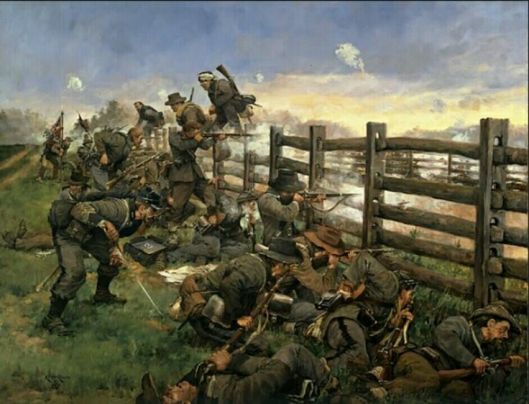
Thus, what one might see in a painting, even if it had attempted to depict reality, as in this Keith Rocco painting of a moment in the battle of Antietam when Confederates were fighting behind a fence on the Hagerstown Road,

keithroccohagerstownroad.jpg

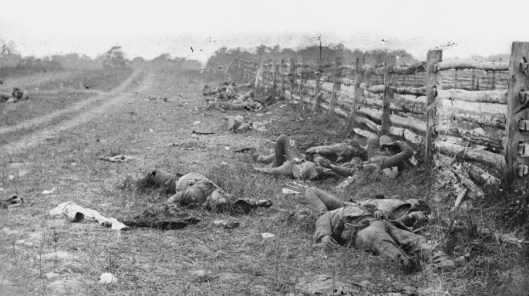
was impossible to capture. What Gardner could capture was the aftermath. And so he did.

hith-battle-of-antietam-E.jpeg


For us, who are modern Rohirrim, as far as horses are concerned, it’s just as well that he confined himself to humans. After Gettysburg, several other photographers included them—only a few photos, but representing anywhere from 3 to 5000 horses and mules who died during the three days of battle. (And, no, again, we won’t show you those—google.images will, but we’re not sure what’s harder to look at.)

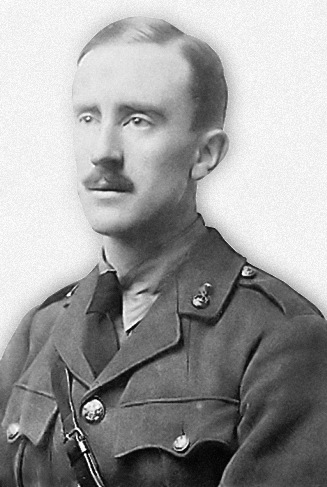
Lieutenant Tolkien

jrrtaslieut.jpg

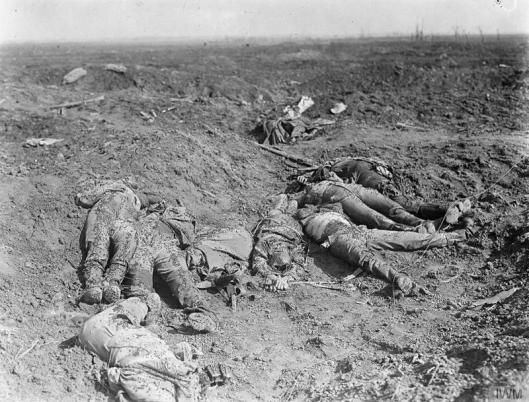
would have seen such horrors every day during the battle of the Somme

sommedead.jpg

and perhaps that’s why he moves so quickly from the battlefield to the city and healing. Perhaps it’s also why the view we are given of the GEF is through the eyes of a wounded survivor and, at this moment in the story, one full of foreboding at the thought of another battle. And it may be that Peter Jackson felt the same way.

West_To_Mordor.jpg

What do you think, dear readers?

Thanks, as always, for reading.

MTCIDC

CD
 

PS

Our title is taken from the work one of our favorite Great War poets, Wilfred Owen (1893-1918), who, having survived the entire war, was killed just before the armistice which halted the fighting.

wilfredowenaschild
wilfredowen

Bolts and Arrows

06 Wednesday Apr 2016

Posted by Ollamh in Films and Music, Heroes, J.R.R. Tolkien, Military History, Military History of Middle-earth, Narrative Methods, Uncategorized

≈ Leave a comment

Tags

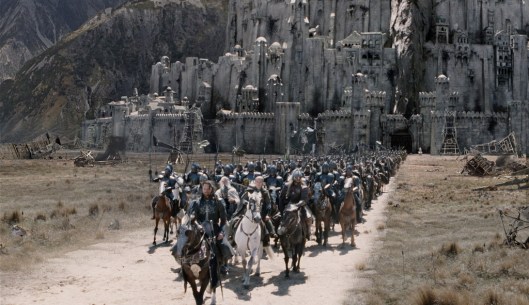
Agincourt, anti-aircraft gun, ballista, Bard the Bowman, Battle of Crecy, Battle of Poitiers, Border Reivers, Boromir, crossbow, Crossbow Bunnies, English Longbowmen, harpoon, Hundred Years War, John Singer Sargent, latch, Maximus, N.C. Wyeth, Peter Jackson, Richard the Lionheart, Robert Louis Stevenson, Robin Hood, Roman d'Alexandre, Siege of Chalus, Smaug, Tangled, The Black Arrow, The Hobbit, The Lord of the Rings, The Mary Rose, Tolkien, Towton

In our review of the third Hobbit film, we questioned the use by Bard of something a little larger in the way of a missile than Tolkien had intended:

“Then Bard drew his bow-string to his ear. The dragon was circling back, flying low, and as he came the moon rose above the eastern shore and silvered his great wings.

‘Arrow!’ said the bowman. ‘Black Arrow! I have saved you to the last. You have never failed me and always I have recovered you. I had you from my father and he from of old. If ever you come from the forges of the true king under the Mountain, go now and speed well!’ ” (TH 307).

As Bard was firing this himself, we always envisioned him as an English longbowman.

englishlongbowman1330-15151.jpg

And this led us to think a bit about Tolkien’s possible sources, not only for Bard and his bow, but for that arrow–the real one, not the monster dart used in the film.

From any children’s history of England, Tolkien would have learned that longbowmen like the one shown above destroyed three brave French armies in the Hundred Years War, at Crecy (1346), Poitiers (1356), and Agincourt (1415).

hf54d67201.jpg

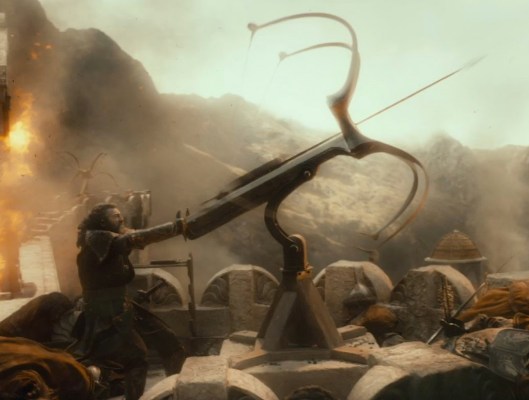
In the film, however, although Bard was depicted as an archer,

Bard-the-Bowman-bard-the-bowman-37670604-1920-1200.jpg

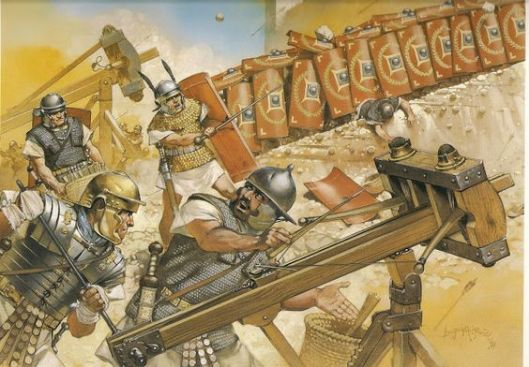
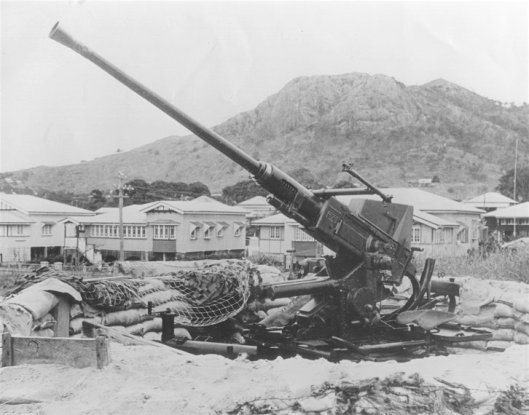
his weapon of choice looks like this.

bardwithharpoon.jpeg

This reminds us of either a Roman ballista

b0370394e429c42631f520182c155a34.jpg

or an anti-aircraft gun

strandgun01.jpg

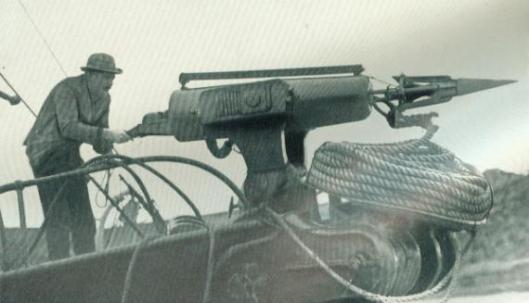
or, most especially,  a harpoon gun.

WhaleHarpGun1.jpg

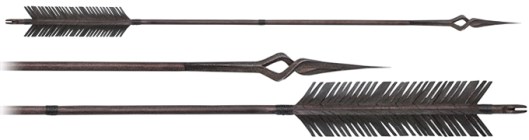
Especially when you look at this Bard’s arrow.

bard.jpg

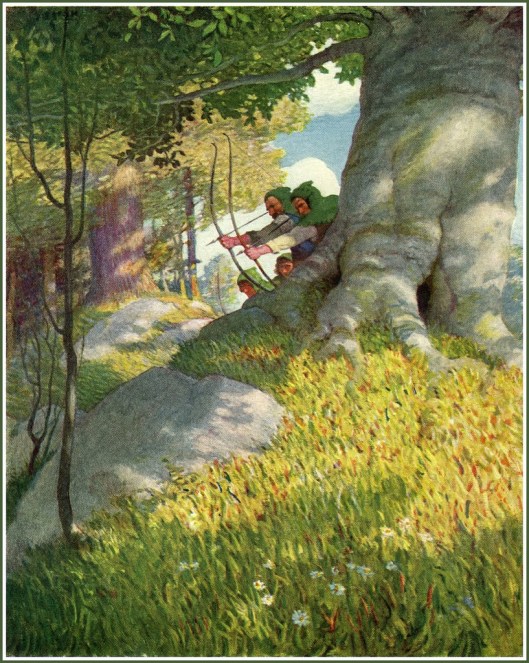
Although we currently have no evidence for Tolkien’s sources, we can imagine that they might have included, among others, Robin Hood,

5616567327_fc899be2f1_b.jpg

the actions of actual Medieval archers like those at Agincourt or Towton (1461),

towton3.jpg

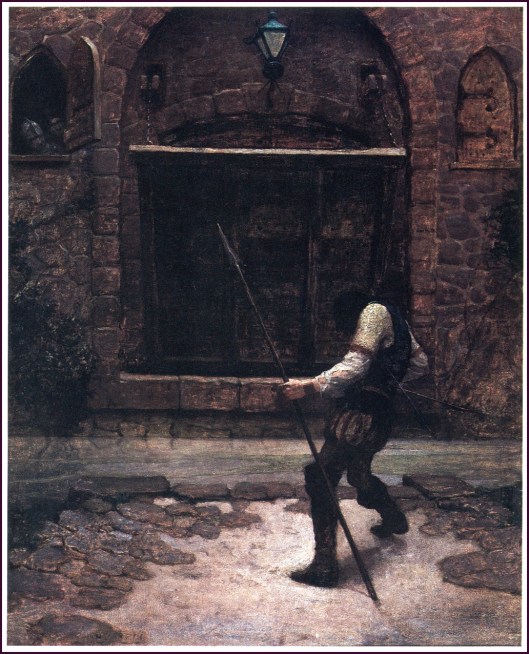
and a book, perhaps from boyhood, Robert Louis Stevenson’s The Black Arrow (1883/1888).  Stevenson (here in an 1880s portrait by John Singer Sargent)

rlsjss2.jpg

had originally published the story serially in a children’s magazine in 1883

ba1.jpg

before its publication in book form in 1888.

Blackarrowcoverscribners1888.jpg

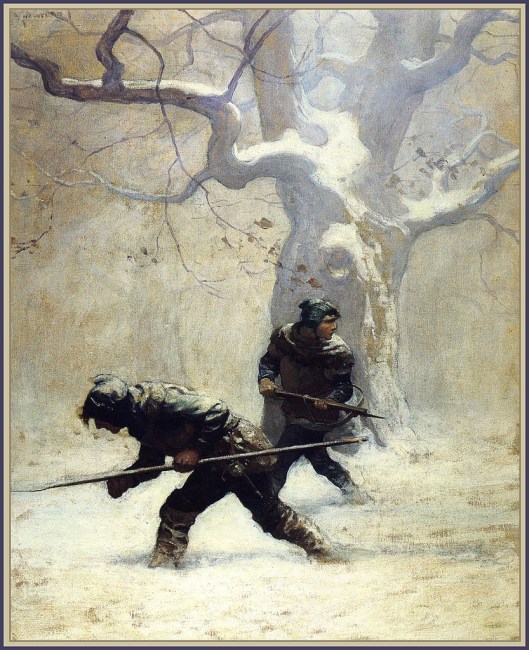
The classic illustrations are by one of our all-time favorite illustrators, NC Wyeth, from 1917.

309642.jpg

We can’t resist showing you a few:

tumblr_l4istbR1JZ1qamjklo1_1280.jpgillus08.jpg09_blackarrow_alittlebeforedawn_wyeth.jpg

Although the bow is the weapon of choice of those who use the black arrow of the title (it’s employed for revenge), the hero  in fact, has a crossbow.

5616566731_49d251a1fc_b.jpg

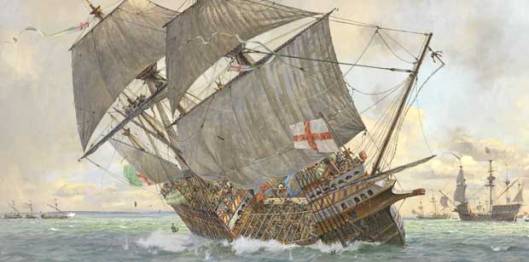
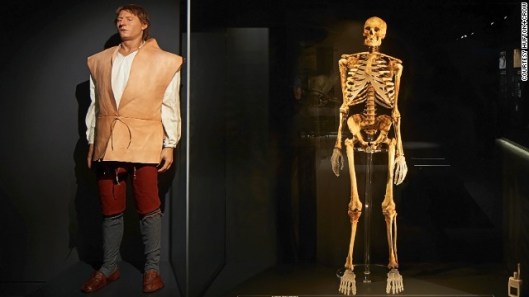
The longbow requires years of training and great upper-body strength, leaving its mark on bowmen, as can be seen from this skeleton (and its reconstruction) brought up from the English warship, the Mary Rose,

sinking_3.jpg

which sank with most of its crew in 1545 and was brought up from the mud of the ocean floor in 1982.

130530121104-mary-rose-skeleton-horizontal-gallery.jpg

The crossbow is a mechanical weapon, which uses much less strength to draw

the_old_crossbow_archer_by_renum63-d8aaovo.jpg

and, in the more developed versions, even uses a crank to produce the necessary string tension.

8f106fadbe86ed34e5567bc7a90b89e2.jpg

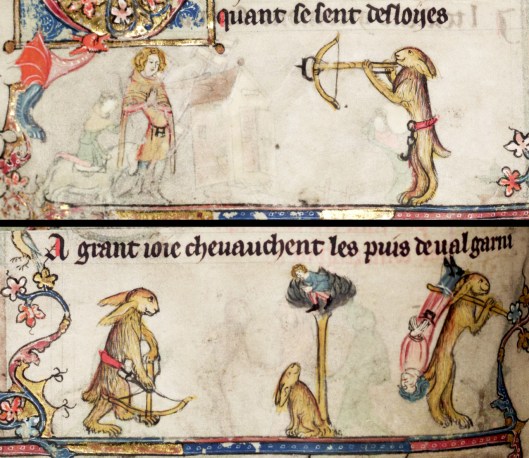
(And, just as in the case of NC Wyeth illustrations, we can’t resist medieval manuscript illustrations. Look at this pair of crossbow… bunnies from a copy of the Roman d’ Alexandre, circa 1340.)

romandalexandrec1340.jpg

This makes it a less romantic weapon, but equally deadly:  Richard the Lionheart was killed with a bolt/quarrel (what one calls a crossbow arrow) at the siege of Chalus in 1199.

Richard1TombFntrvd.jpg

(This creates another aside–about the hand weapon used as late as the 16th century by the Border Reivers of the land between northern England and southern Scotland–called a “latch”, it was the weapon of choice for those who couldn’t afford early hand guns but wanted to fire easily from the saddle.

Reiver-on-Horse.jpg

The soldiers in Disney’s wonderful movie, Tangled, carry them–notice the off-hand side pouch with a handful of bolts  for one on Maximus’ saddle–)

maxtangled.jpg

But we would  like to conclude with one more use of that black arrow.  A flight of them kills Boromir in The Lord of the Rings.

boromirarrows1.jpg

boromirearrows.png

Just as we began by pointing to the text and the actual bow and arrow which kill Smaug, and not the harpoon of the film, so we would criticize this scene.  In our opinion, it is stretched beyond believability, as well as beyond the text, taking away something of Boromir’s valor in combat with dozens of the enemy, in which he is gradually overcome.

boromir_by_deligaris-d5po92u.jpg

This is just as true for the brief scene of Aragorn at Boromir’s death.  What was simple in the text, thus making it more moving–just Boromir’s confession and Aragorn’s comforting him–becomes a soppy scene in which Boromir swears loyalty and calls Aragorn “my brother”, a liberty Aragorn-the-king-t0-be, would hardly have welcomed.  In the theatrical world, this is called “milking the scene” and here, we think it curdled.

Thanks, as always, for reading.

MTCIDC,

CD

Herald-ry in Middle Earth

30 Wednesday Mar 2016

Posted by Ollamh in Fairy Tales and Myths, Imaginary History, J.R.R. Tolkien, Literary History, Military History, Military History of Middle-earth, Narrative Methods

≈ 2 Comments

Tags

Achilles, armour, Battle of Bannockburn, Eurybates, flailing and winnowing, Heraldry, Heralds, Hermes, kerykeion, Lakedaimonia, lambda, Medieval, Mouth of Sauron, Robert de Septvans, Robert the Bruce, Roger de Trumpington, Sir Henry de Bohun, Spartans, tabard, Talthybius, The Black Gate, The Illiad, The Lord of the Rings, Tolkien, White Tree of Gondor

Welcome, as always, dear readers.

There is a moment in the film of The Return of the King which has always puzzled us. The Lieutenant of the Tower of Barad-dur has appeared outside the Morannon with taunts and with what appears to be disconcerting news about Frodo.

mouth-of-sauron-1.jpg

In response, Aragorn kills him. Even if you had never seen a movie with knights in it so that you would know that this was a herald or messenger of some sort and that there are rules about such people, there are modern parallels—flags of truce, even the silent protection offered to diplomats—to make you think that this was hardly proper behavior for a king.

If we look at this scene in the chapter entitled “The Black Gate Opens”, we see that this is another of those disturbing—and seemingly arbitrary—changes made by the script writers, showing once more their disregard—or lack of proper understanding—of the author and his wishes.

“Aragorn said naught in answer, but he took the other’s eye and held it, and for a moment they strove thus; but soon, though Aragorn did not stir nor move hand to weapon, the other quailed and gave back as if menaced with a blow. ‘I am a herald and ambassador, and may not be assailed!’ he cried.”

There is a parallel in this, when we are told that Aragorn has used the Palantir and wrestled with Sauron.

“ ‘It was a bitter struggle, and the weariness is slow to pass. I spoke no word to him, and in the end I wrenched the Stone to my own will…Now in the very hour of his great designs the heir of Isildur and the Sword are revealed; for I showed the blade re-forged to him. He is not so mighty yet that he is above fear; nay, doubt ever gnaws him.’ ” (The Return of the King, Book 5, chapter 2, “The Passing of the Grey Company”)

(This is misportrayed in the extended version of the film. For some reason, in return for being shown Anduril, Sauron shows Aragorn a lifeless—perhaps just napping? “she looks like she’s only sleeping!”—Arwen—which, as is so often the case with the clumsy script writers, completely misses the real point of the scene in the book.)

In both of these scenes, what the author clearly meant to show was that Aragorn’s power, now that he has chosen to reveal it, comes from within and is so great that it needs neither words nor violence to assert itself—more signs that he is the true returning king.

Thus, harming a herald, in fact, shows him as the very opposite: not only violent, but, instead of restoring and preserving—his proper task as king—he violates custom.

We note, by the way, that, in the book, he looks to be following custom. Under the direction of Gandalf, the army which marches to challenge Sauron formally declares its ownership of Ithilien with trumpet blasts

Black Trumpeterearly16thc.jpg

and its own heralds.

What is a herald, anyway? The Mouth of Sauron claims to be one and even claims immunity because of it—why?

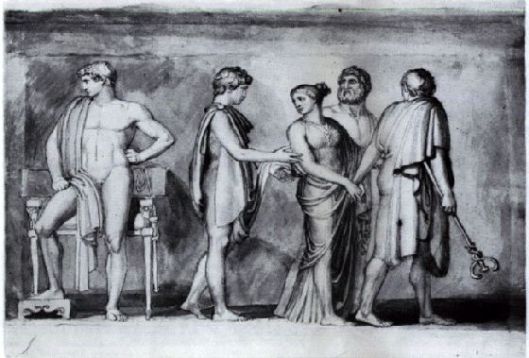
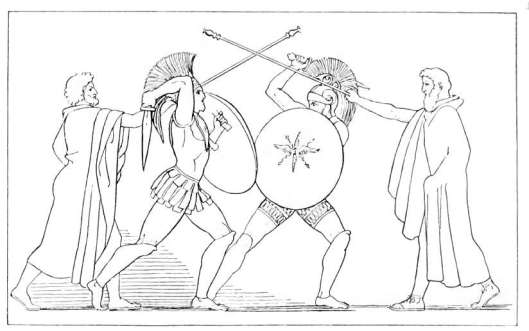
In fact, heralds, in the western world, have an ancient lineage, first appearing in literature in The Iliad, where they act both as messengers

flaxman_Briseis_achil.jpg

and as referees.

hector-and-ajax-fighting.jpg

You’ll notice, in the first of these two pictures, that the two heralds, Talthybius and Eurybates, have the badge of a herald: a special curved wand, called a kerykeion. Hermes carries one, to indicate that he is the patron god of heralds (and therefore their protector).

0408b5884a2ff2a3c2ad0b51ffde7a13.jpg

At some point in their early history, the convention appeared that heralds were considered, in their role as messengers, to be somehow neutral and therefore were not to be harmed. (It’s not clear, however, during their first appearance, in Iliad 1, that this was so then—or at least when dealing with Achilles–but perhaps that’s just Achilles, who is not necessarily always the most balanced individual.)

Heralds in the western medieval world continued with these functions, but added another.

We have a little evidence that some ancient Greek warriors and states may have used specific designs as badges. Spartan shields, for example, sometimes carried a lambda—a tentlike shape which stands for the sound of L in English and was short for “Lakedaimonia”, which is where Sparta was located.

spartanshield.png

A much more elaborate system of designs gradually developed during the Middle Ages, in part because of the increasingly-elaborate armor, which, from a long shirt of chain mail, came to cover the whole knight, making him, potentially unidentifiable.

normanhorseman.jpg

late12thcknight.jpgEnglish_Knight_13thc.jpg

So, both to make himself distinguishable on the battlefield and probably because it was macho, and therefore sexy, a knight would devise a distinctive design for his shield, possibly his clothing, and maybe even his horse, as well.

Knight14thcmid.png

This could be pretty spectacular—just look at Robert the Bruce, king of Scotland in the early 14th century.

heraldic-robert-the-bruce.jpg

[A footnote here– at the site of the Battle of Bannockburn, there is a famous equestrian statue of the Bruce in which the head and facial features have been reconstructed from the Bruce’s actual skull.

bruce-9.jpg

images.jpg

Just before this same battle, the Bruce had shown his knightly skills by splitting, with his battle axe, the helmet and head of the English knight, Sir Henry de Bohun.]

robert-de-bruce-kills-bohun-l.jpg

Sometimes these designs could include puns on their owners’ names. Here’s Roger de Trumpington, with trumpets.

sirrogerdetrumpington.jpg

And Robert de Septvans (Septvans = “seven (winnowing) fans”).

sirrbtde7.jpg

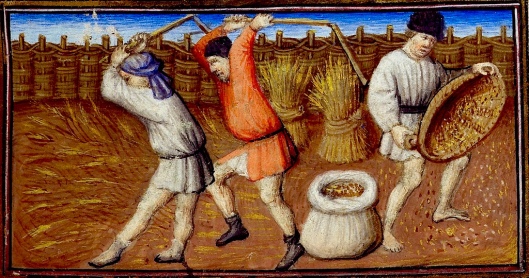
The fan here looks actually like a basket, but was used for helping the wind to carry off the outer husk of the grain ear, a process called winnowing. (To the left is the previous process, flailing, where the beard of grain is being broken off the stalk before it is winnowed.)

threshingwinnowing.jpg

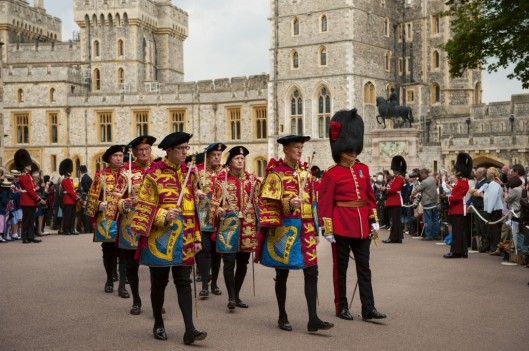
As the number and complexity of patterns on armor developed, it appears that specialists took over the job of identifying them and keeping track of them, the heralds. And, from their name, we get our general name for the designs used on armor and clothing, heraldry. Because they worked in the world of heraldry, they decorated themselves, as well, and, in England, still do.

Heralds-at-the-Garter-Service-Julian-Calder-1024x681.jpg

Thus, we can imagine that, when Aragorn, Gandalf, and their companions reached the crossroads in Ithilien,

crossroads.jpg

after the trumpets sounded, heralds wearing a special coat, called a tabard,

Pursuivant_tabard.jpg

which would have been embroidered with the tree and seven stars,

Flag_of_the_Reunited_Kingdom_of_Arnor_and_Gondor.png

would have stepped forward and reclaimed the land for the king. Specially marked, they would have been very visible, and as the lieutenant of the tower tells us, protected by custom from harm. So why is Aragorn, the one man capable of returning order to Middle Earth, scripted to kill one? What do you think?

Thanks, as ever, for reading!

MTCIDC

CD

ps

And now you know what the White Rabbit is wearing and is supposed to be doing in Alice

De_Alice's_Abenteuer_im_Wunderland_Carroll_pic_37.jpg


Beacons or Wills of the Wisp?

16 Wednesday Mar 2016

Posted by Ollamh in Imaginary History, J.R.R. Tolkien, Literary History, Military History, Military History of Middle-earth, Narrative Methods

≈ 2 Comments

Tags

Adventure, Agamemnon, Beacons, British Royal Government, Byzantines, film changes, Lays of Ancient Rome, Minas Tirith, Mulan, Peter Jackson, Spanish Armada, The Great Wall, The Lord of the Rings, Thomas Babington Macaulay, Tolkien

Dear Readers,

Welcome, as always. We begin this posting with something which puzzled us when we last read The Lord of the Rings.

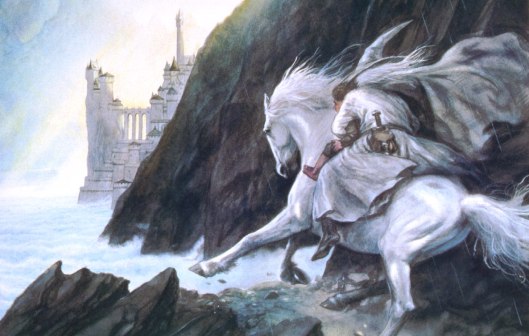
Gandalf and Pippin are on their nonstop ride to Minas Tirith.

gandalfpippin.jpg

Then—

“There was silence again for a while. Then, ‘What is that? Cried Pippin suddenly, clutching at Gandalf’s cloak. ‘Look! Fire, red fire! Are there dragons in this land? Look, there is another!’

For an answer Gandalf cried aloud to his horse. ‘On, Shadowfax! We must hasten. Time is short. See the beacons of Gondor are alight, called for aid. War is kindled. See, there is the fire on Amon Din, and flame on Eilenach; and there they go speeding west: Nardol, Erelas, Min-Rimmon, Calenhad, and the Halifirien on the borders of Rohan.’ ” (The Return of the King, Chapter 1, “Minas Tirith”)

beaconsofgondor.gif

Beacons as a means of rapid communication occurs often, both in western literature and in history.

In Aeschylus’ Agamemnon (458BC), for example, Clytemnestra has a famous (and rather lengthy) speech in which she describes the beacons which alert Mycenae that Troy has been captured—alerting her to begin her plot to kill her husband and take over with her BF, Aegisthus.

clytaga.jpg

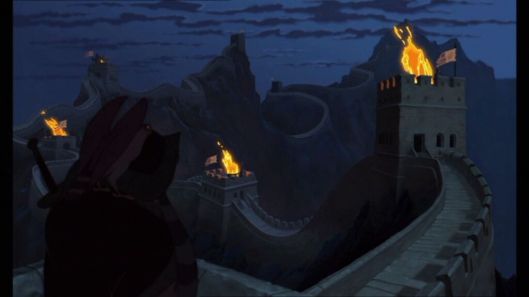
The towers along the Great Wall in China were used as beacon stations, as in Mulan.

mulan-wall-of-china


In the 9th century AD, the Byzantines had developed a system of beacons to warn them of invasion by their neighbors to the east.

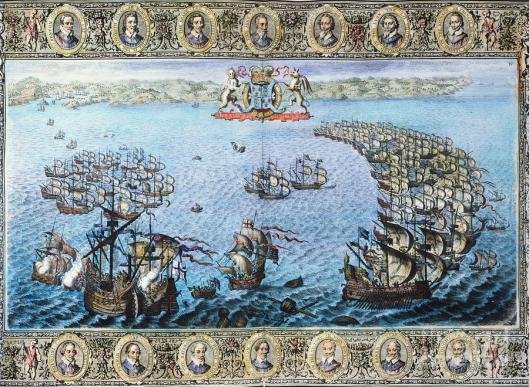
If you read the Tolkien sites, you see a fair amount more on beacons, in particular, those set up by the British royal government along the southern shore of England in the 1580s to act as an early warning system to alert the country to the Spanish armada.


spanisharmada.jpg

Tolkien would have known the story of these either from studying English history in his early schooling, or from reading “The Armada”, a well-known poem by Thomas Babington Macaulay first published in his Lays of Ancient Rome (1842).

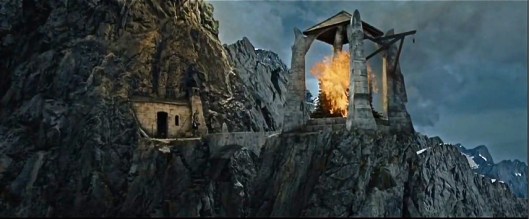
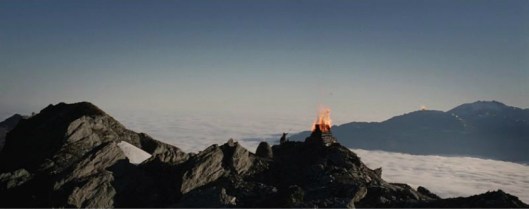
In Jackson’s The Return of the King, Denethor has been stubborn about not lighting the beacons to alert Rohan that Gondor has need of it. Pippin climbs up the outside of the rock face where the beacon is and, while the guards are distracted, he lights the beacon which, in turn, sets off the whole series.

mtbeacon.jpg

beaconsgondor.jpg

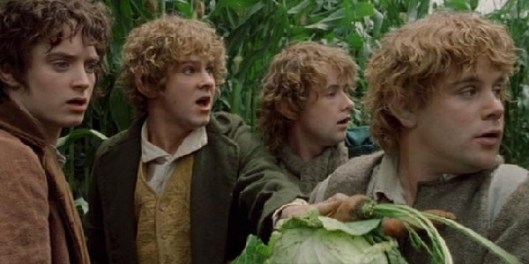
This is not the first or last time one sees changes made in the story—what, for example, are Merry and Pippin doing in a cornfield (that is, a field of maize—do we know that maize even grows in Middle Earth) when Pippin has actually been with Frodo and Sam from the time they left Hobbiton?

05_corn.jpg

In past postings, we have sometimes commented upon the changes made to the story by the scriptwriters—especially the changes to The Hobbit, which have done so much to take the story away from the author’s intent entirely, to the point where, in the third film, Bilbo, the main character, is reduced to something like Third Spear-Carrier from the Left, when the story becomes something like The Tragical Historie of Thorin, Sometime King Under the Mountain. When questioned about this, the scriptwriters, in general, have always made the same reply: “film is different from print” (although, in interviews, they sometimes become more aggressive, once even suggesting that those who disagree with their approach don’t understand the books).

In this posting, however, we intend to follow a different path, trying to understand why the change was made and how it might or might not benefit the narrative.

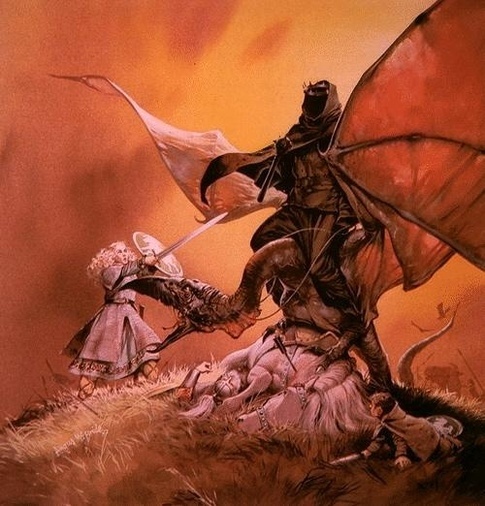
To a degree, the film has followed its source, in that Gandalf has taken Pippin with him on the ride to Minas Tirith, but Pippin’s role, from that point on in the book, becomes more that of observer than active participant. This is in contrast to Merry, who rides into the battle on the Pelennor and helps Eowyn destroy the Chief Nazgul.

eowynnazgul.jpg

We can imagine, then, that the scriptwriters, who have brought the two Hobbits so far, have decided to give Pippin another moment of action, as a kind of balance: if Merry fights a Nazgul, Pippin can do a little rock-climbing and alert the Rohirrim.

If you, readers, don’t know it, there is very useful area on the site www.theonering.com, called “Film Changes”. This particular change does not appear there, one presumes because, as the site says, their text was based upon a scripts still in the midst of production, but the structure of the area is very useful. It provides a summary title for each change, then there is this:

Film:

Book:

Pro:

Con:

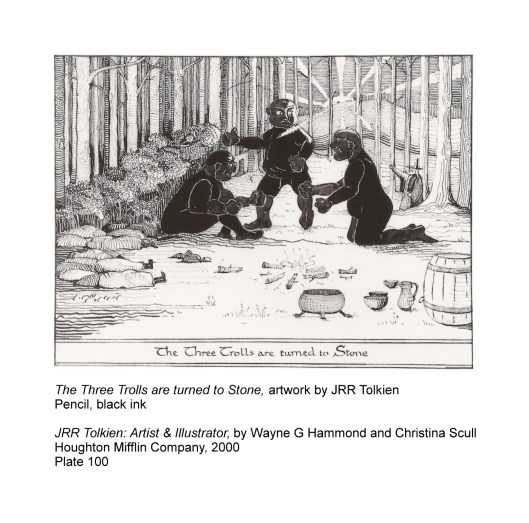
It’s interesting to see how more-or-less neutral in tone this is. The writer shows the contrasts, suggests why the change, and then explains why this is not necessarily a change for the better, but there is none of the hostility we sometimes see on-line, one way or the other, and, if you’re a regular reader of blogs and websites, we’re sure you’ve seen that hostility. It’s one of the least attractive, but widespread features of the internet and it’s a pity that certain of these commentators couldn’t be delayed till dawn would overtake them and send them the way of Tom, Bert, and William in The Hobbit!

img__Art-The_Three_Trolls_are_Turned_to_Stone,_by_JRRT.jpg

[Tolkien’s trees, by the way, always remind us of the work of the Danish illustrator, Kay Nielsen (1886-1957), which we presume JRRT had seen–at least his illustrations for East of the Sun, West of the Moon (1914).

kaynielsen.jpg

We have already provided you with the first two sections: the film has Pippin touch off a beacon after reaching Minas Tirith; in the book, Pippin sees the beacons alight, one after the other, as he and Gandalf ride towards Minas Tirith.

We presume that the Pro would be something like:

  1. provides a balance between the two Hobbits who are so closely linked throughout the story
  2. adds to the drama and underlines Denethor’s less-than-full-commitment—as depicted in the films—to defending Gondor to the end
  3. adds a bit of visual spectacle, seeing the beacons light up, one after another

And the Con?

  1. not in the original—and, as we always wonder, how far can you change things before you forfeit your claim that it’s “JRR Tolkien’s The Lord of the Rings” you’ve filmed?
  2. Denethor is actually much more active and aggressive in his stance in the original, not being willing to give up anything without a fight until the near-fatal wounding of Faramir (and a late-night séance with the palantir)—the beacons have already been lit because he’s attempting to gather all of the forces he can to defend Gondor
  3. in fact, the beacons are not on snowy mountain peaks in the original, but on reachable hilltops, just as are the sites for the beacons used to alert southern England of the approach of the Spanish armada in 1588, as in this fine photo by David Bellamy.

Thorncombe_Beacon_02.jpg

So, it might be a striking visual effect, but, as in #1, this isn’t quite what JRRT had in mind.

What do you think, dear readers? A justifiable change?

Thanks, as always, for reading.

MTCIDC

CD
 

The Fall of Two Cities?

09 Wednesday Mar 2016

Posted by Ollamh in Economics in Middle-earth, Imaginary History, J.R.R. Tolkien, Language, Maps, Military History, Military History of Middle-earth, Narrative Methods

≈ Leave a comment

Tags

Agincourt, Anadoluhisari, Anatolia, Asia Minor, Bayezid I, Bosphorus, Byzantium, Constantine I, Constantinople, Crecy, English Civil Wars, Eowyn, Gondor, map, Mehmet II, Minas Tirith, motte and bailey, Newark, Normans, Osgiliath, Ottoman Empire, Poitiers, Rumelihisari, siege, The Lord of the Rings, Tolkien, Witch-King of Angmar

Dear Readers,

Welcome, as always. A little while ago, we talked about the “siege of Gondor”, which really wasn’t a siege in the formal sense, at all, but rather an assault. (We suspect that JRRT liked the sound of “siege” and so used it, not caring if it were strictly accurate or not.) In this posting, we want to look at a real siege and examine what might be parallels with events in Middle Earth.

Before we do, we want to take a moment to talk about the word “siege”. It comes into English through Old French asegier, which comes from Latin ad + sedeo > adsideo, adsidere , literally, “to sit down at”. The northern French who passed the word on to England must have liked to say what’s called a y-glide when certain consonants came before e, so, though it was spelled asegier, it would have been said “ah-see-YED-jier”. And that’s why English today has what can be a confusing spelling. (In our experience, lots of native speakers have trouble distinguishing between the ie of “siege” and the ei of “seize”). The stress on the word in English would have been away from the initial a, and so that would have disappeared from the word as it moved from being a borrowing.

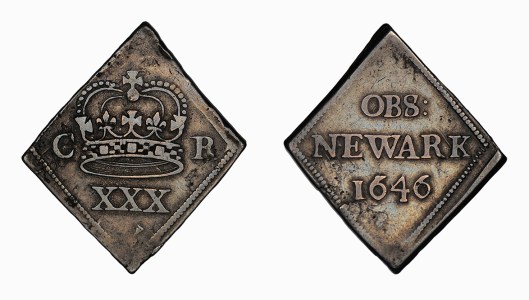
[As what we think is a cool footnote, Latin also has the verb obsideo “to sit down right before=to besiege” and we can see that used in English in the word “obsession”, with the idea that something bothers you so much that it’s like you’re being besieged by it. You can also see it on this wonderful bit of 17th-c. English history.

obsidionalmoney.jpg

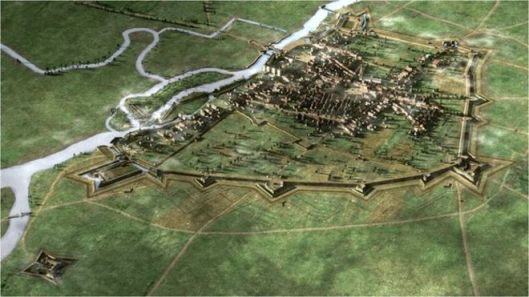
Although it doesn’t look like a modern coin, this is a form which used to be called “half-a-crown”—that is, 30 pennies (that’s what those three xses mean), or two shillings, sixpence.   This coin was struck in the town of Newark-upon-Trent, when it was besieged during the English Civil Wars (1642-1651).

_82601862_newark-1646map.jpg

And that’s where obsideo comes in. The back (the “reverse” in coin language—the front is called the “obverse”) says:

OBS: Newark (with a date, either 1645 or 1646, depending on when the coin was struck)

OBS = Obsessa Newark = “Newark Besieged”

There were a lot of coin-substitutes struck by various besieged towns, but, apparently, those from Newark are the most numerous.]

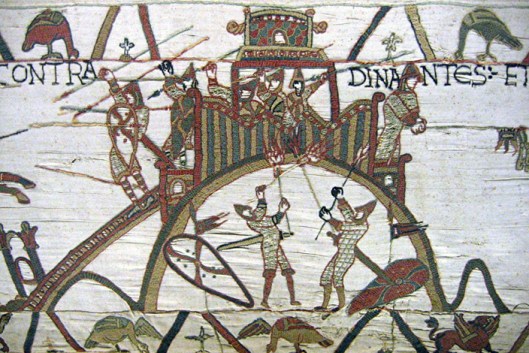
In the medieval western military world, sieges were more common, it seems, than pitched battles. As castles and towns were focal points for the possession and control of land—think of the hundreds of early castles, called “motte and bailey”, which the Normans built all across England in the first years after their conquest–it’s not surprising that they would have been a focus of attack.

motteandbailey.jpg Tapisserie_motte_dinan 704.jpg

As well, we can imagine that, ultimately, they would have been cheaper, in terms of the most irreplaceable manpower, sparing the highly-trained, hard-to-replace, knights and men-at-arms.

knights.jpg

Battles like Crecy (1346), Poitiers (1356), and Agincourt (1415), cost the French dearly as their brave knights threw themselves at their English opponents, whose longbows shot them and their horses down.

agincourt.jpg

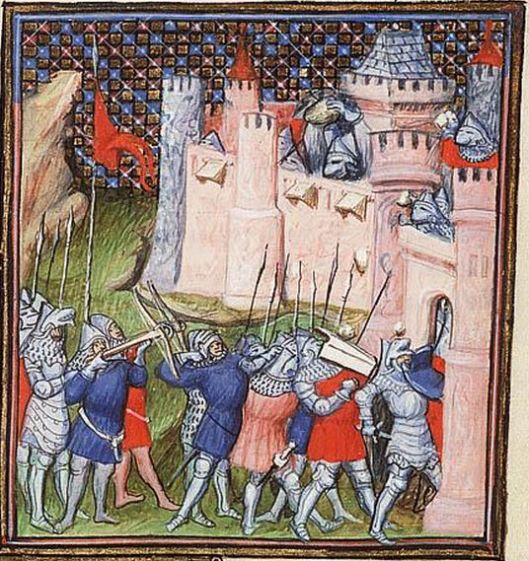
In a siege, although there was the occasional combat, including the exploitation of a break in the enemy’s defenses,

Edward-III-takes-Poix-Castle.jpg

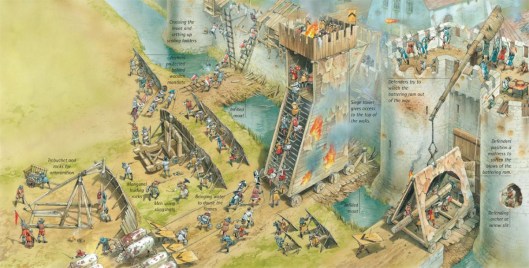
most of a siege would be spent in using machinery of various sorts to aid you in breaking down the walls—and the resistance of the defenders, as well.

castles-and-knights-2-with-labels.jpg

This brings us to the real, historical siege we want to examine: Constantinople, 1453.

Bizansist_touchup.jpg

Constantinople had begun life as a Greek colony, called Byzantium, on the European side of the narrow passageway between the Black Sea and the northeastern Mediterranean.

byzempmap.gif

It had been refounded and greatly expanded by the Roman emperor, Constantine I, to be a new capital in the east.

Constantine-I-Face.jpg

Although it was supposed to be called “New Rome”, everyone in the east called it after its refounder, and so it was “Constantinople”, becoming the capital of an eastern empire which we call “Byzantine”. Even with setbacks and a number of unsuccessful attacks over the centuries, it was, for a long time, a very wealthy and powerful city.

1-reconstruccion-de-bizancio.jpg

But even the wealthiest and most powerful cities will fade—especially when faced with ambitious enemies. Constantinople had had a number of those, but, finally, in its last years, perhaps its most ambitious and most powerful arose in Asia Minor: that of the Ottoman Turks. As you can see from this map, its beginnings were modest: one Turkic-speaking group among many.

Anatolian_Beyliks_in_1300.png

This was a period of instability, however. The Ottoman leaders quickly took advantage of that instability to grab power and territory, so that, by 1400, they had spread beyond the shrinking Byzantine world, into the Balkans, and, soon, Constantinople was surrounded.

trebizond1400

This surrounding took place in an increasingly-methodical way. In 1393-4, the ruler of the Ottomans, the sultan Bayezid I

bayezit1.jpg


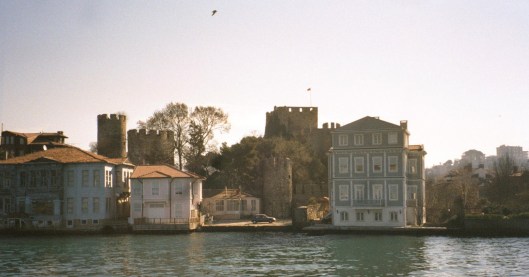
built a small fortress on the Asia Minor side of the Bosphorus, the name for the northern stretch of the passage which led from the Black Sea to the Mediterranean. It was called Anadoluhisari, “the Anatolian fort”.

Anadoluhisari.jpg


You can see from the map that this was the beginning of setting up a choke point upstream from Constantinople.

mapwithanadoluhisari.gif

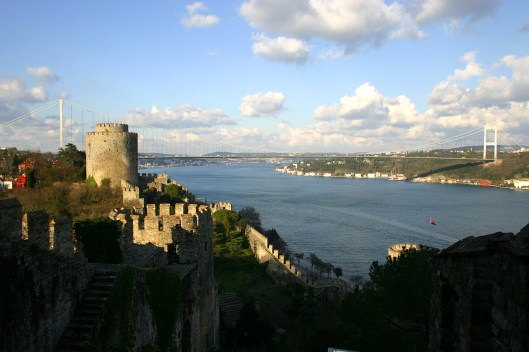
In 1451-2, the sultan Mehmet II finished the job with the Rumelihisari just opposite, on the European side (and that’s what its name means, “the Roman—that is, European—fort”).

Rumeli_hisari.jpg

Guns were mounted

muslim_rocket_technology_06.jpg

and any help which might have come from the Black Sea was blocked.

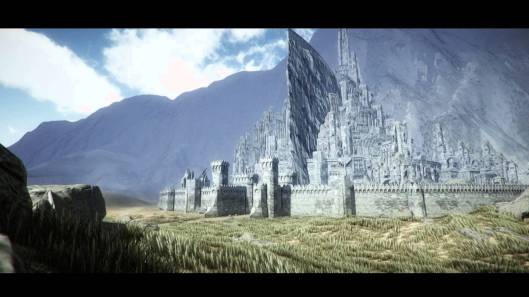
And here we want to take a minute to look at our imaginary city and its danger—because we see some easy parallels here. First, of course, the Ottoman empire was an eastern threat—so was Mordor. Mordor had taken the east bank of the Anduin, just as the Ottomans had taken the Asian side of the Bosphorus. And, in the capture of the European side and the building of Rumelihisari, we might see the taking of Osgiliath and the west bank of the Anduin. Then there is the massive city of Minas Tirith and the attack upon it.

mt.jpg 2381576-zmordorforcesk7.jpg

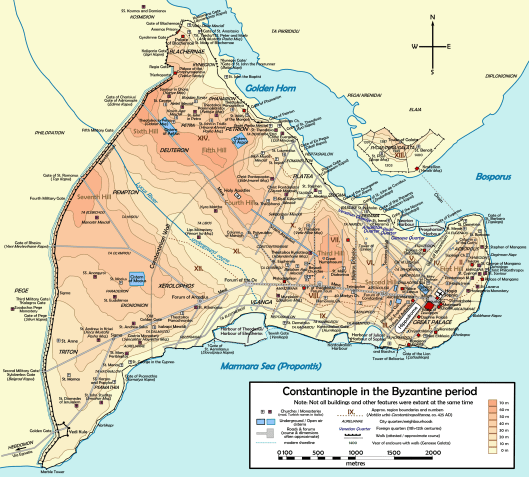
Constantinople was also a massive city.

Byzantine_Constantinople-en.png

It was, basically, on a triangular piece of land, with two sides protected by water. The original Greek town had had a wall, but it was long gone and almost all of Constantine’s land wall had long disappeared, as well. The latest walls are called the Theodosian, after their originator, the emperor Theodosius II (408-450AD), but the walls included bits of the Constantinian walls and many repairs, over the centuries. The main land defenses included three lines of wall and a moat.

2rh67o0.jpg

This sounds very impressive until one considers two things: first, is there a garrison big enough to defend what are, in fact, a number of miles of wall? And, second, although the walls have withstood previous attacks, including one made by the Ottomans in 1422AD, how will they stand up to the threat of modern artillery?

At the height of its power and prosperity, it is estimated that Constantinople had had a population of anywhere from 500,000 to 750,000 (although scholars argue over this). At the time of the final siege, the population had fallen to as low as 40,000. Thus, large parts of the city were empty—just like Minas Tirith:

“Pippin gazed in growing wonder at the great stone city…Yet it was in truth falling year by year into decay; and already it lacked half the men that could have dwelt at ease there.” (The Return of the King, Book 5, Chapter 1, “Minas Tirith”)

The garrison of Constantinople was perhaps about 9,000, in all, which meant that they were very thinly stretched. We don’t know just how many troops were in Minas Tirith. Some reinforcements had come from South Gondor, as we noted in an earlier posting, but only a few thousand and the defenders were powerfully outnumbered, just as those of Constantinople were, when the forces of Mordor began to arrive. The Ottoman army is thought to have had between 50,000 and 80,000 men, but just how many Orcs and others marched down the causeway from Osgiliath isn’t known–they are just a horde—something which the Jackson film shows very well.

maxresdefault

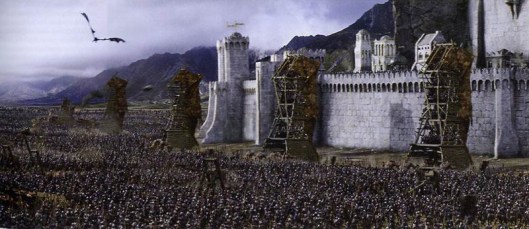
Then the assault begins, the Orcs having giant stone throwers, siege towers, and, finally, a giant, fire-breathing ram, Grond.

Grond_arrives.png

If you’ve been following our postings (and we hope you have!), then you know that we’ve discussed the use of what appears to be gunpowder, both at Helm’s Deep and at the Rammas Echor. The Orcs who attack the walls of Minas Tirith don’t appear to have such a weapon, but, unfortunately for the defenders of Constantinople in 1453, the Turks do, in the form of plentiful modern artillery.

Illustration-of-angus-mcbride-showing-the-ottoman-cannon-basilica-during-the-siege-of-constantinople-in-1453-ad.jpg

Attacks wear down the small garrison and huge, stone-throwing weapons knock down the walls, so that, finally the city falls, on 29 May, 1453.

84087026.jpg

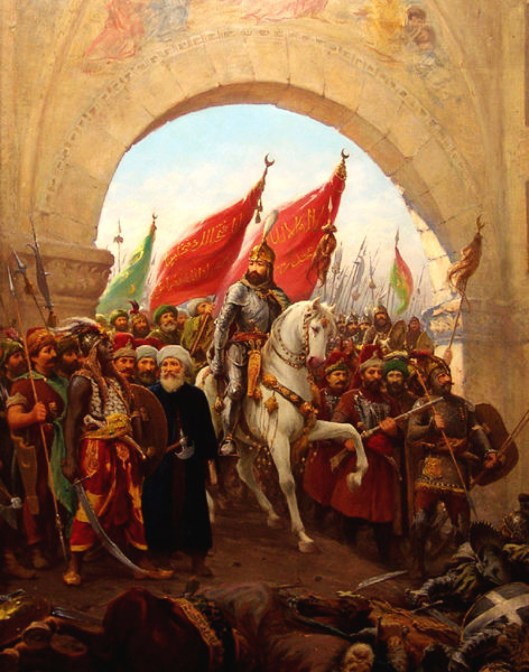
Its conqueror, Mehmet II, rides in—

mehmet2enteringconstantinople.jpg

which is something the witch king of Angmar never gets to do, perishing instead, at the hands of Eowyn and Merry.

Eowyn.jpg


And there the parallels end, as does our posting. Did JRRT have the fall of Constantinople somewhere in the back of his mind? What do you think?

Thanks, as always, for reading.

MTCIDC

CD
A Pirate’s Life

24 Wednesday Feb 2016

Posted by Ollamh in Artists and Illustrators, Imaginary History, J.R.R. Tolkien, Literary History, Military History, Military History of Middle-earth, Villains

≈ Leave a comment

Tags

Barbary Coast, Captain Blood, Captain Hook, Corsairs, Errol Flynn, Gilbert and Sullivan, Howard Pyle, Jack Sparrow, Jolly Roger, mariners, Napoleonic Wars, Narnia, Peter Jackson, Pirates, Scharb, shipbuilding, Tamora Pierce, The Black Pearl, The Lord of the Rings, Tolkien, Tortall, Treasure Island, Umbar, USS Philadelphia, xebec

“Oh, a pirate’s life is a wonderful life,

A-rovin’ over the sea,

Give me a career as a buccaneer

It’s the life of a pirate for me…”

Wallace/Penner, Peter Pan (1953)


Dear readers, welcome, as ever.

Being clever, you can tell immediately where this posting is going to go. Yep, the corsairs of Umbar.

A corsair is another word for pirate. And, when we think “pirate”, first there’s the late-19th-early-20th-century work of Howard Pyle.

Pyle_pirate_handsome.jpg


And the silly pirates from Gilbert and Sullivan’s The Pirates of Penzance.

piratesofpenzance.jpg


And Long John Silver, from Treasure Island.

longjohnsilver.jpg


And then there is Captain Hook and the Jolly Roger.

TigerLilyandHook.jpg


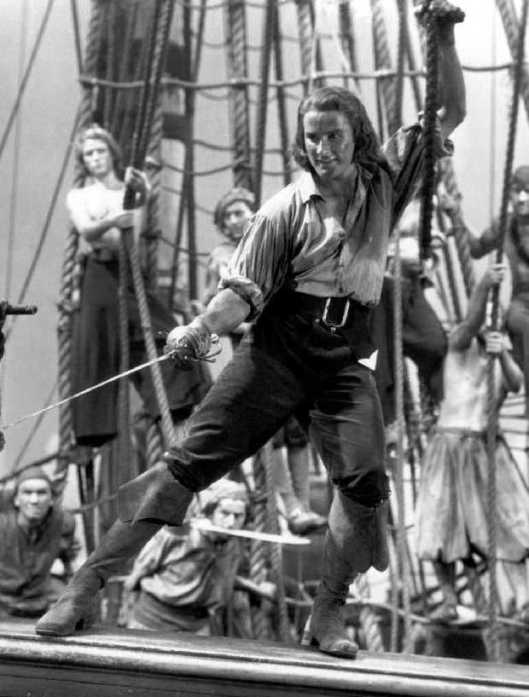
And Errol Flynn in the 1935 movie, Captain Blood.

1023_captblood.jpg


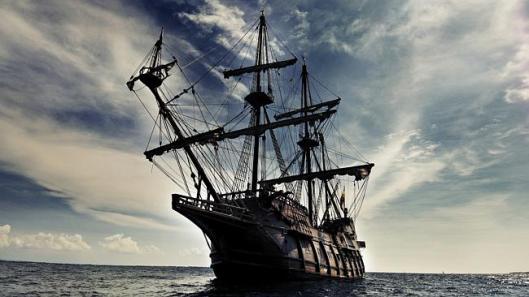
And who could forget Jack Sparrow and The Black Pearl?

Captain-Jack-captain-jack-sparrow-14117613-1242-900.jpg

blackpearl.jpg

We think that Tolkien has something rather different in mind, however. Let’s start with a little history.

Umbar’s past in relation to Gondor is summed up by Damrod in “Of Herbs and Stewed Rabbit”:

“ ‘Aye, curse the Southrons!’ said Damrod. ‘Tis said that there were dealing of old between Gondor and the kingdoms of the Harad to the Far South; though there was never friendship. In those days our bounds were away south beyond the mouths of Anduin, and Umbar, the nearest of their realms, acknowledged our sway. But that is long since. ‘Tis many lives of Men since any passed to and fro . Now of late we have learned that the Enemy has been among them, and they are gone over to Him, or back to Him—they were ever ready to his Will—“ (The Two Towers, Book 4, Chapter 4,“Of Herbs and Stewed Rabbit”)

Damrod’s mistrust is confirmed by what Beregond says to Pippin in “Minas Tirith”:

“…There is a great fleet drawing near to the mouths of Anduin, manned by the corsairs of Umbar in the South. They have long ceased to fear the might of Gondor, and they have allied them with the Enemy, and now make a heavy stroke in his cause. For this attack will draw off much of the help that we looked to have from Lebennin and Belfalas, where folk are hardy and numerous.” (The Return of the King, Chapter 1, “Minas Tirith”)

As Damrod has said, Umbar is to the far south.

map-of-gondor-and-neighbors2.jpg

Here is a view of it as imagined by the Czech artist, Scharb.

thecityofumbar.jpg

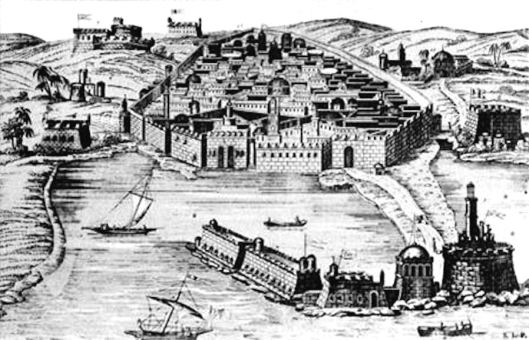
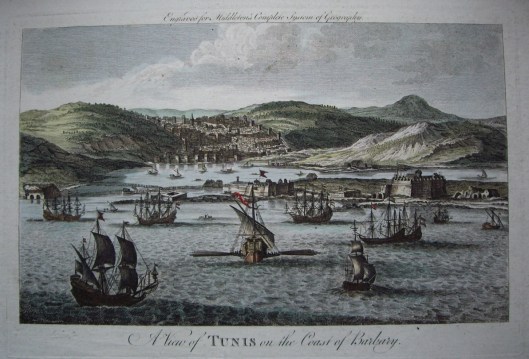
To us, this resembles cities along the southern Mediterranean coast, especially as seen in old engravings of the Barbary Coast.

Old_algiers_16th_century.jpg

Take, for example, this copperplate of Tunis, from 1778.

tunisengraving.JPG


There are all kinds of ships depicted here, from three-masters to a galley, in the center, to a small xebec, to the far right.

The galley seemed once to be the characteristic ship of the pirates of the Barbary Coast, coming from earlier Turkish galleys.

Galley1500ca.jpg


What the Czech artist appears to have picked up upon, however, is something from P. Jackson’s third The Lord of the Rings film, in which the xebec

Xebec L80 - 01.jpg_0_1024x769.jpg


is the model for the corsairs’ vessels.

corsairMastSails.jpg


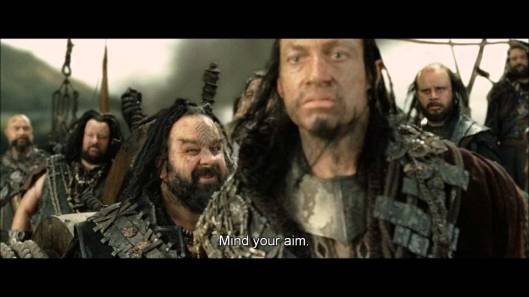
Jackson’s corsairs look like this (including Jackson himself, mugging to the left).

jacksonandcorsairs.jpg

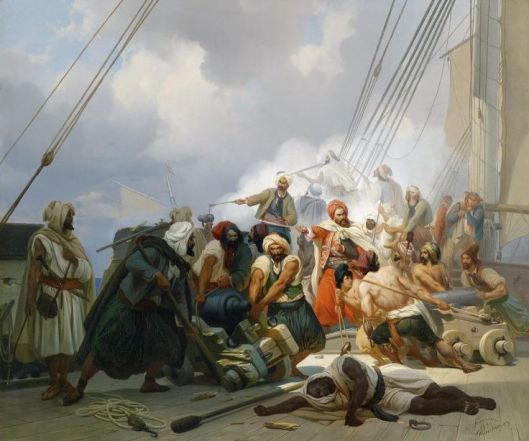
The crews of actual Barbary ships probably looked more like this:

21c27fb9a0a7cdf4d123d6e12bcbbd83.jpg

This makes perfect sense, as these are North Africans, and very tough people, as European mariners came to know. Their swift, daring ships attacked any vessel which might bring them profit.

barbary-pirate-galleon.jpg

The young United States first paid them tribute to keep them away from US ships.

tribute.jpg

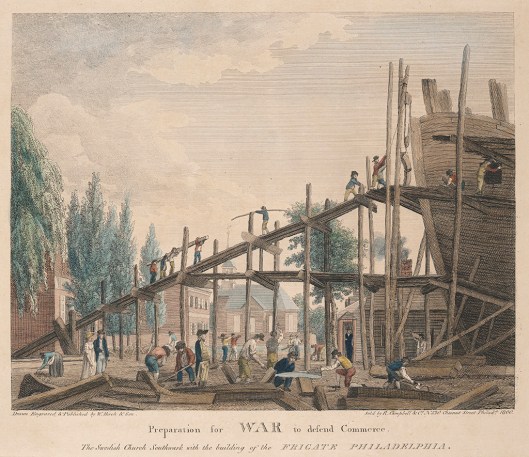
But, as the government somewhere found the money, it began a shipbuilding program to provide the country with its first national navy.

buildingthephiladelphia.jpg

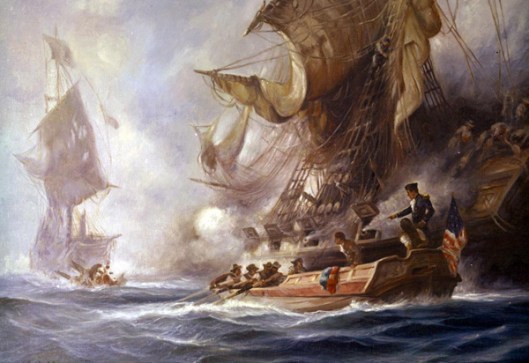
This particular ship was the ill-fated USS Philadelphia, which ran aground and was captured by the pirates.

philly.jpg

captureofthephiladelphia.jpg

It was destroyed, however,

destructionofthephiladelphia.jpg

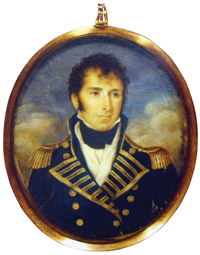
in a daring raid by Stephen Decatur, seen in this miniature.

stephendecatur.jpg

The United States fought two wars against the Barbary pirates, 1801-5 and 1815, doing a great deal of damage to the pirates.

USS-Enterprise-barbary-war.jpg

Ultimately, however, it was a combination of governments and navies, including the US, the British, and the Dutch, which put a stop to piracy in the southern Mediterranean after the end of the Napoleonic Wars in 1815.

Decatur_Boarding_the_Tripolitan_Gunboat.jpg

So, like Scharb, we took the idea from JRRT that Umbar was in the far south and, influenced by our experience, not only of the Barbary pirates, but of Narnia and the country called Calormen

Baynes-Map_of_Narnia.jpg

and of Tamora Pierce’s “Tortall” with its Carthaki southland,

Tortall_1.gif

we imagined the corsairs to look like this.

barbarypirates.jpg

So, dear readers, what do you think?

Thanks, as always, for reading.

MTCIDC

CD
 

Fourth Age—Big Bang Theory

17 Wednesday Feb 2016

Posted by Ollamh in Economics in Middle-earth, Heroes, Imaginary History, J.R.R. Tolkien, Literary History, Military History, Military History of Middle-earth, Narrative Methods

≈ Leave a comment

Tags

American Civil War, Battle of Crecy, Battle of the Somme, cannon, Siege Warfare, The Lord of the Rings, The War of the Ring, Tolkien, World War I

Welcome, dear readers, as always!

In this posting, we are going to do something a little different:  speculate.  It’s about a possible military development in the years after the War of the Ring and, if you have enjoyed our past postings on military issues in Middle Earth, we hope that you will enjoy this one.

Our inspiration for this posting came from two sources:  The Lord of the Rings and the history of the later western Middle Ages and it began like this–

The-Two-Towers-Explosion-helms-deep-2.jpg

“Even as they spoke there came a blare of trumpets.  Then there was a crash and a flash of flame and smoke. The waters of the Deeping-stream poured out hissing and foaming:  they were choked no longer, a gaping hole was blasted in the wall.  A host of dark shapes poured in.” (The Two Towers, Chapter 7, “Helm’s Deep”)

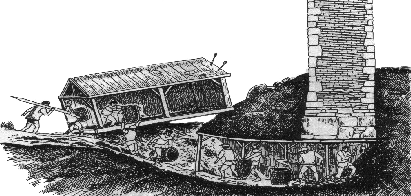
Aragorn calls this “the fire of Orthanc”, but I think that we can guess that it was an explosive device and our immediate thought was the use of mines over the centuries of siege warfare.  Originally, the idea was to undermine an enemy’s wall by digging a tunnel below it.   The next step was either to use the finished tunnel as a passageway into an inner courtyard or, alternatively, to prop up the wall, fill the area below with flammable materials, torch the materials, then clear out to watch the section of wall tumble down when the fire burn away the props before charging in.

mining1.gif

Once gunpowder was available, this technique could be improved upon by tunneling under a wall, planting a large stock of explosives, setting a very long fuse, clearing out, then watching it blow a large hole in the enemy’s fortification.

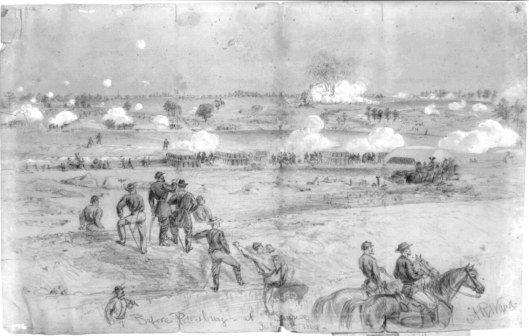
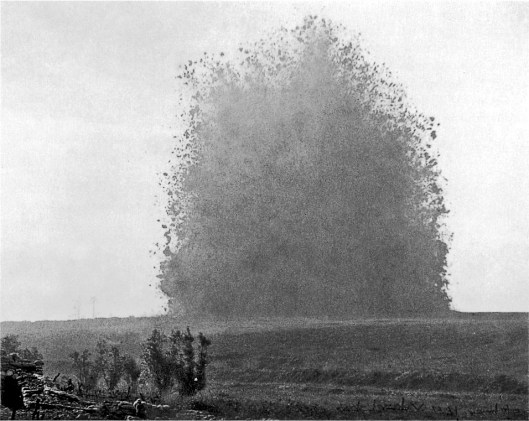
Two of the most spectacular such mines in our experience are during the American Civil War, at Petersburg, on 30 July, 1864—

Waud-Petersburg-Crater.jpeg

and the first day of the Somme, 1 July, 1916, in World War 1—

Hawthorn_Ridge_mine_1_July_1916.jpg

Sauron’s orcs appear to use the same technique when facing the protective wall around Gondor, the Rammas Echor:

“The bells of day had scarcely rung out again, a mockery of the unlightened dark, when far away he saw fires spring up, across the dim spaces where the walls of the Pelennor stood.  The watchmen cried aloud, and all men in the City stood to arms.  Now ever and anon there was a red flash, and slowly through the heavy air dull rumbles could be heard.” (The Return of the King, Chapter 4, “The Siege of Gondor”)

As we thought about the future, we considered what had happened in our Middle Ages.  Although gunpowder had been mentioned in the mid-13th century, our first illustration of a weapon based upon it dates from about 1327.

EarlyCannonDeNobilitatibusSapientiiEtPrudentiisRegumManuscriptWalterdeMilemete1326.jpg

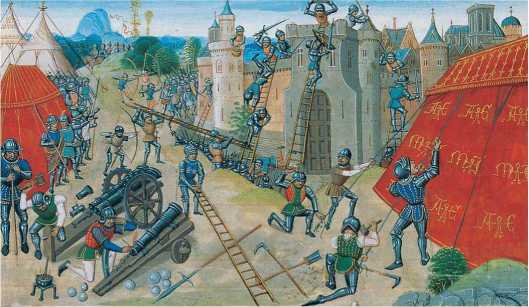
By the mid-14th century, there appear to have been cannon of some sort used against the Scots in 1327 and at the Battle of Crecy (1346) against the French and, by the early 15th c. they are becoming a regular feature of battles and sieges.

medievalsiege.jpg

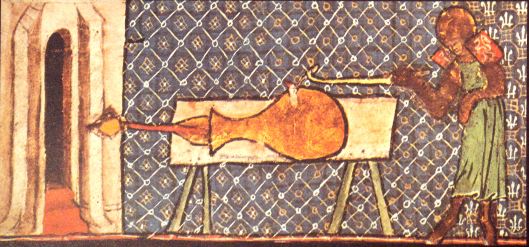
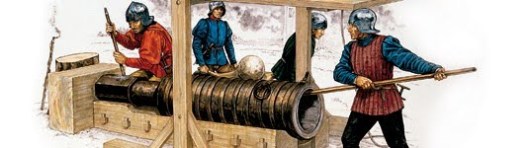
Very early cannon were very simple, being a tube of any length fastened to a wooden bed of some sort.

FortMedeival.jpg

The tubes were made of long bars of iron hammered together and then secured with a series of iron rings.

25_slash_57.JPG

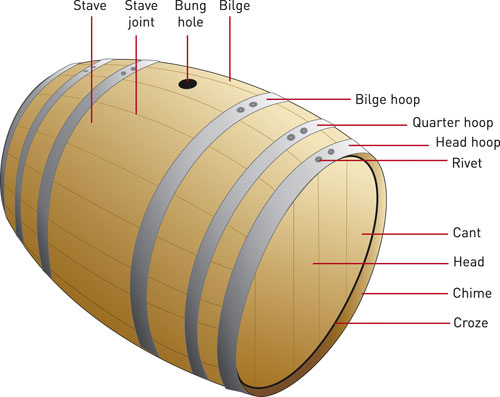
The technology for this looks like it came from barrel-making:  long staves of wood pressed together, then wrapped with iron bands

winebarrelanatomy.jpg

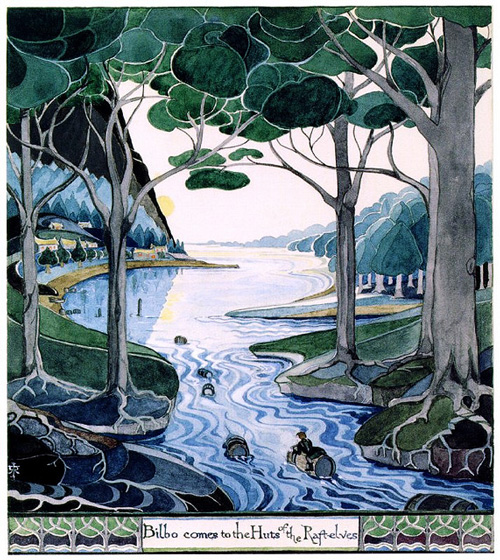
When we think of barrels in Middle Earth, what better evidence do we have than this, one of our favorite JRRT illustrations from The Hobbit?

barrel-riding.jpg

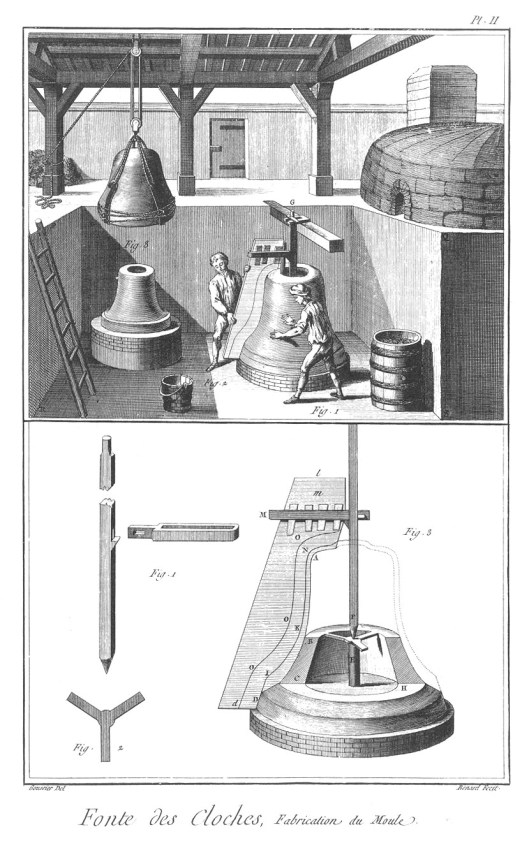
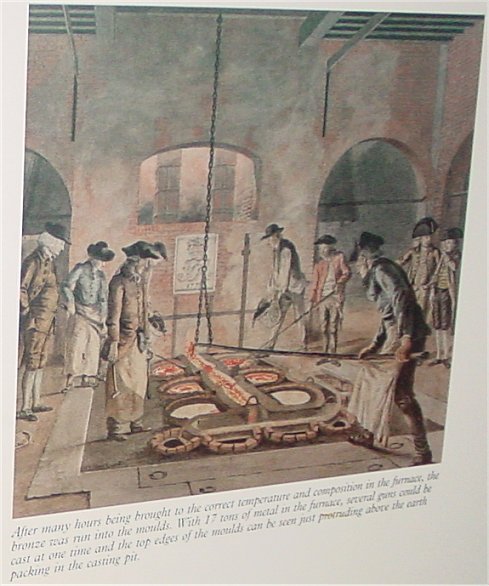
A well-known technical skill in the Middle Ages was that of casting church bells:  making molds, pouring in metal, letting it cool, and producing sometimes quite large ones.

bellfounding.jpeg

This led to making cannon the same way.

foundry-church-cannon-casting.jpg

Sometimes, early cannon were so large that they were cast at the site of their first use, as large bells occasionally were.  For the Ottoman siege of Constantinople in 1453, this was said to be true.

Illustration-of-angus-mcbride-showing-the-ottoman-cannon-basilica-during-the-siege-of-constantinople-in-1453-ad.jpg

You’ll notice here, by the way, that this isn’t an iron gun, but a bronze one.  After the first iron guns, gun-founders had begun experimenting with bronze and for several centuries, until all guns would be made out of steel, there was discussion among both gunners and military theoreticians over the value of each metal.

As for Middle Earth, well, we know that there were barrels and the ability to cast large (going by medieval bells) objects in metal.  Now the speculation begins.  Suppose, when Saruman was defeated and later left Orthanc, he had left behind his papers (he doesn’t appear to have anything like them when he is met on the road by Gandalf and the others in “Many Partings”).  In those papers would have been the recipe for gunpowder.  Sometime after Isengard had been taken over by the allies, those papers had come to Minas Tirith and someone, remembering what he had heard about the attack on Helm’s Deep, went through them, found that recipe, and, just as in medieval Europe, soon these began to appear—

medgun.jpg

What do you think, dear readers?

Thanks, as always, for reading.

MTCIDC

CD

Feudal Array 2

27 Wednesday Jan 2016

Posted by Ollamh in Economics in Middle-earth, Fairy Tales and Myths, Imaginary History, J.R.R. Tolkien, Literary History, Military History, Military History of Middle-earth

≈ Leave a comment

Tags

14th century, 15th century, Adventure, Agincourt, Anglo-Saxon, armor, Bayeux Tapestry, feudalism, Fyrd, Gerry Embleton, Huscarl, Luttrell Psalter, Middle-earth, N.C. Wyeth, tapestry, The Lord of the Rings, Tolkien

Welcome, as always.

In this posting, we want to conclude what has turned out to be a kind of mini-series on Feudalism in Middle Earth. Two postings ago, we used the 14th-century Luttrell Psalter to illustrate what working the plowland behind the Rammas Echor might have looked like. In our last, we used the Bayeux Tapestry to offer another possible visual influence on Tolkien’s depiction of the Rohirrim: the conquering Normans. In this final posting, we will look at the forces of Rohan’s ally, Gondor and will use a number of sources, both medieval and modern.

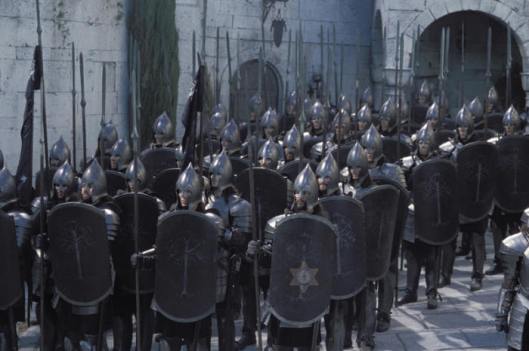
In the Jackson movies, there is a kind of regularity, from Osgiliath to Minas Tirith in what we are shown.

gondorians.jpg

This is not surprising if the cue for costuming has come primarily from one description:

“The Guards of the gate were robed in black, and their helms were of strange shape, high-crowned, with long cheek-guards close-fitting to the face, and above the cheek-guards were set the white wings of sea-birds; but the helms gleamed with a flame of silver, for they were indeed wrought of mithril, heirlooms from the glory of old days. Upon the black surcoats were embroidered in white a tree blossoming like snow beneath a silver crown and many-pointed stars. This was the livery of the heirs of Elendil, and none wore it now in all Gondor, save the Guards of the Citadel before the Court of the Fountain where the White Tree once had grown.” (The Return of the King, Chapter 1, “Minas Tirith”)

We have no wish to criticize—in this respect, at least—the creators of the films for taking what might appear to be an easy out: uniformity being cheaper than individuality, since it’s clear that, when it came to dramatic effects in the films in general, the old theatrical advertising line, “No Expense Was Spared To…” is really true. Instead, we want employ our former method of consulting medieval manuscripts, as well as another passage from the same chapter, to offer another possible view, one which might have influenced the author in his depiction of the defenders of Gondor.

We’ll begin with the passage:

“Leading the line there came walking a big thick-limbed horse, and on it sat a man of wide shoulders and huge girth, but old and grey-bearded, yet mail-clad and black-helmed and bearing a long heavy spear. Behind him marched proudly a dusty line of men, well-armed and bearing great battle-axes; grim-faced they were and shorter and somewhat swarthier than any men that Pippin had yet seen in Gondor…

And so the companies came…The men of Ringlo Vale…from the uplands of Morthond…five hundred bowmen…From the Anfalas…a long line of men of many sorts, hunters and herdsmen and men of little villages, scantily equipped save for the household of Golasgil their lord. From Lamedon, a few grim hillmen…Fisher-folk of the Ethir…Hirluin the Fair…with three hundreds of gallant green-clad men. Imrahil…with gilded banners bearing his token of the Ship and the Silver Swan, and a company of knights in full harness riding grey horses; and behind them seven hundreds of men at arms, tall as lords, grey-eyed, dark-haired, singing as they came.”

There is actually not a lot of detail here, but there are a few hints. First off, there are those “great battle-axes”.   Here are two images from the Bayeux Tapestry of the Anglo-Saxon king, Harold’s, bodyguards, his huscarl, armed with their characteristic long-handled axes.

axemen_bayeux.jpg

And here is a modern reconstruction.

huscarl4.jpg

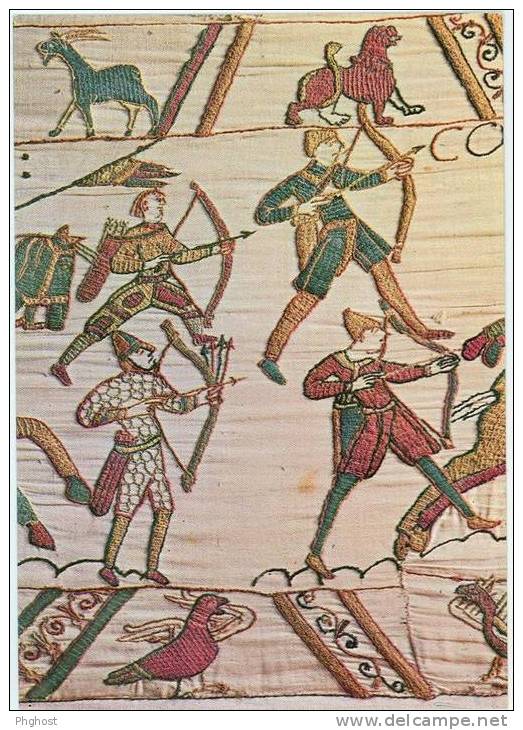
Next, we have those five hundred bowmen from Morthond. The Tapestry can provide a useful image of those,

archers2.jpg

but perhaps what JRRT really was thinking of were the famous longbowmen of Crecy and Poitiers and Agincourt, whose skill and courage knocked down whole waves of equally brave French knights. Here are a pair of modern images by the brilliant historical illustrator, Gerry Embleton, himself a medieval reenactor.

EnglishLongbowman1330-15151
longbowman2

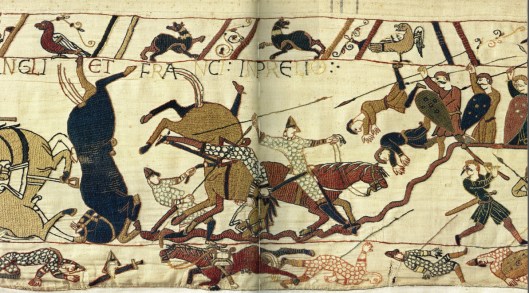
Besides the huscarl, King Harold’s army was made up of the fyrd, a kind of militia drawn from the freemen of the countryside, who had to provide their own weapons and equipment and were only required to serve for limited periods—they would have been farmers, most of them, after all, and couldn’t be off the farm for too long without threatening their own livelihoods. Perhaps these could suggest that “long line of men of many sorts”. Here’s an image from the Tapestry of what appears to be the fyrd fending off a mounted Norman attack. You’ll notice the lack of defensive armor.

fyrd3.jpg

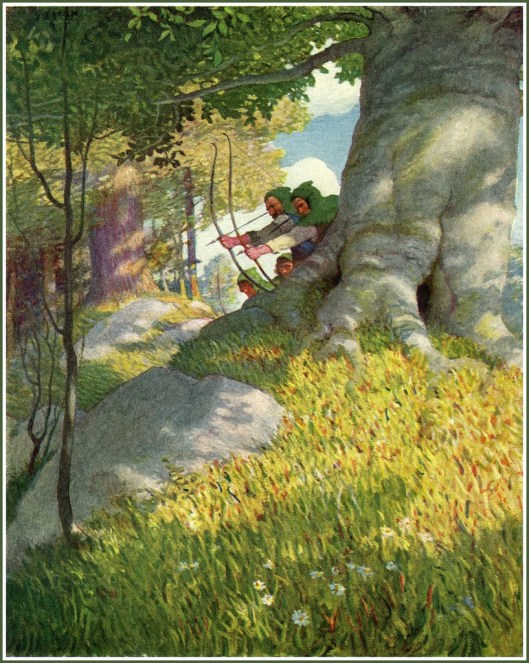
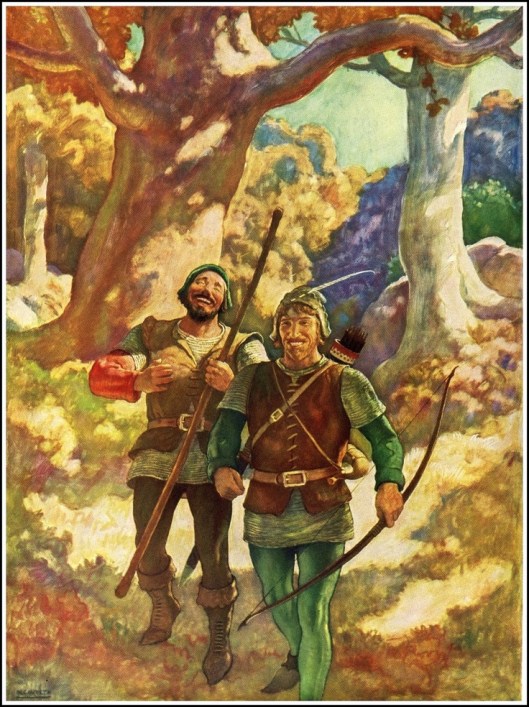
“gallant, green-clad men” is rather vague, but, suddenly, all we could see is Robin Hood and his Merry Men. And so we can’t resist including some of our favorite N.C. Wyeth illustrations.

rhood1rhood2

And these could easily provide the model for the rangers in South Ithilien, couldn’t they?

faramir.jpg

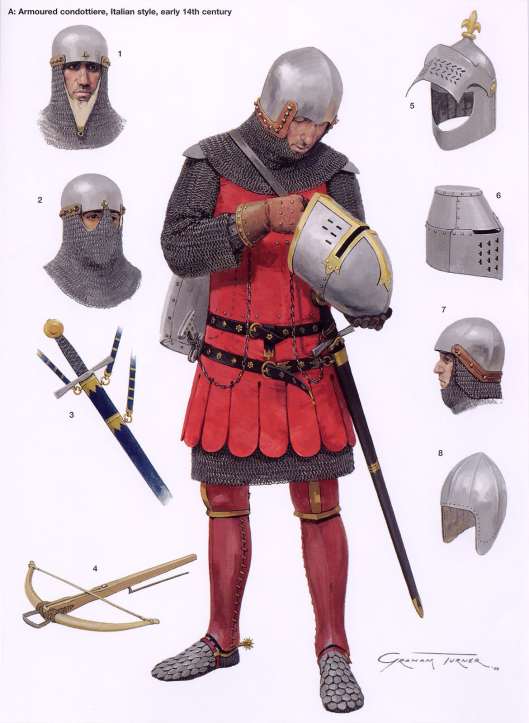
Last, there is that “company of knights in full harness”. This presents a real problem. Knights from which period? The armor available at the time of the Bayeux Tapestry in the mid-11th century

fyrd3.jpg

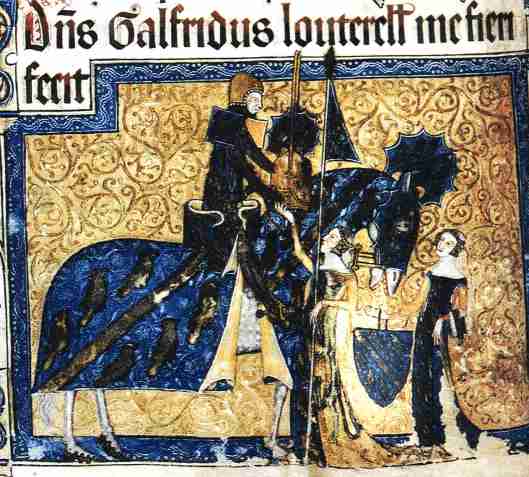
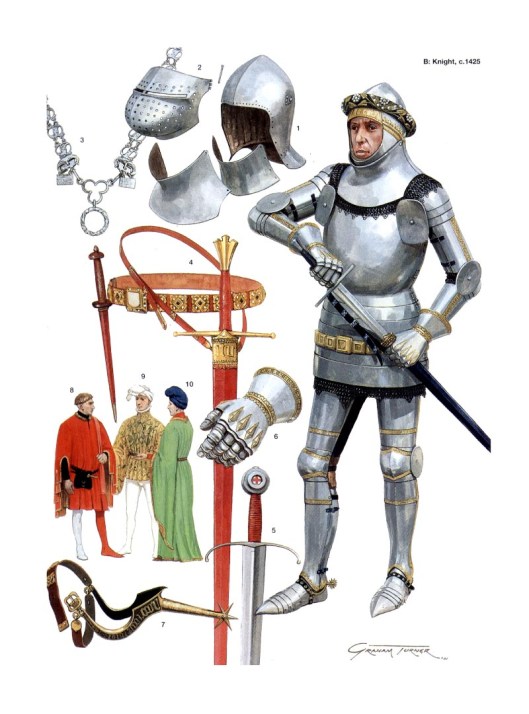
and which, we suggested in our last, might be good for the Rohirrim, was very different from that of later times. Here’s the armor of the days of Sir Geoffrey Luttrell,

Sir_Geoffrey_from_LPsalter.jpg

in the early 14th century—

early14thcarmor.jpg

and here’s what the English archers would have faced as worn by their valiant French opponents at Agincourt, in 1415.

early15thcarmor.jpg

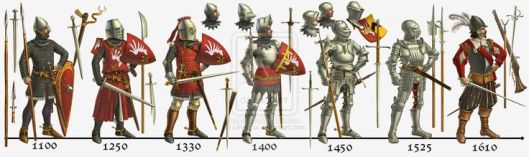
This handy chart can give you a diachronic (through-time) view of changes in medieval armor.

02e1c306489f565ee38b56e417ba5ff0.jpg

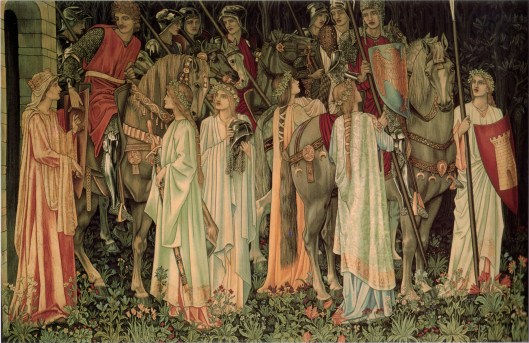
If we look at something produced through the workshop of William Morris, that strong influence upon JRRT, we find this group of knights from a set of tapestries produced in the 1890s.

Holy_Grail_Tapestry_-The_Arming_and_Departure_of_the_Kniights.jpg

The armor is pretty vague (the systematic study of the history of armor was still in its childhood then—if you’re interested in the early days, google Sir Samuel Rush Meyrick to learn about its first great scholar), but one of the helmets—the one to the far left in the background, looks like a visored sallet, which could date what we see in the tapestry to the later 15th century.

Sallet_helmet,_Southern_Germany,_1480-1490_-_Higgins_Armory_Museum_-_DSC05461.JPG

(Sharp-eyed readers who are Star Wars fans—we are—will recognize this general pattern from the technical people on the Death Star—

deathstarcrewmen.png

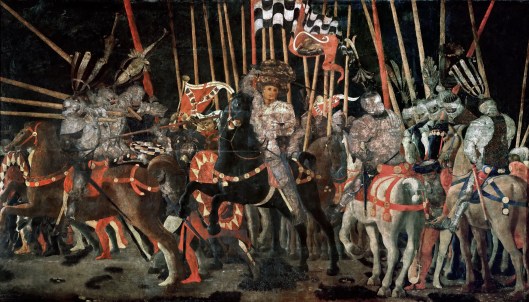
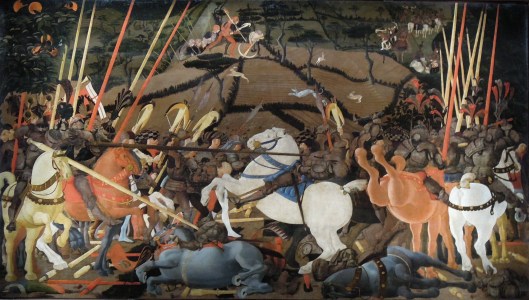
We might add that Morris and his friends were strongly influenced by pre-Renaissance and early Renaissance painters, so perhaps this picture, one of a set of 3 by Paolo Uccello from the middle of the 15th century, might also provide a possible model (and we’re glad to show you the whole set because we think that they’re just magical).

Öèôðîâàÿ ðåïðîäóêöèÿ íàõîäèòñÿ â èíòåðíåò-ìóçåå Gallerix.ru

Uccello_Battle_of_San_Romano_Uffizi


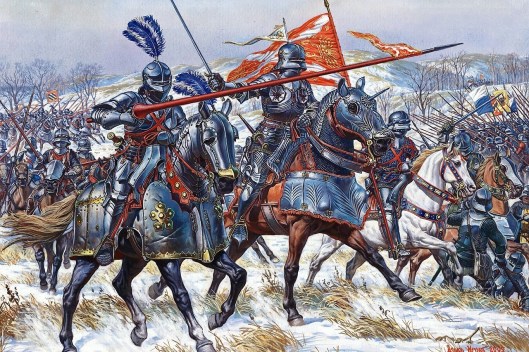
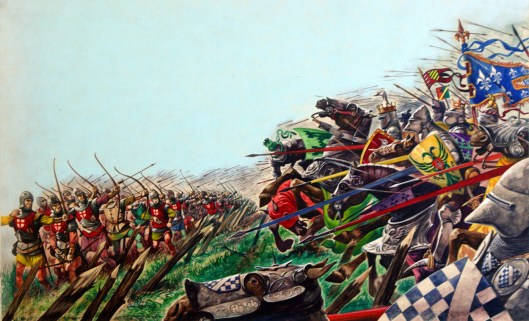
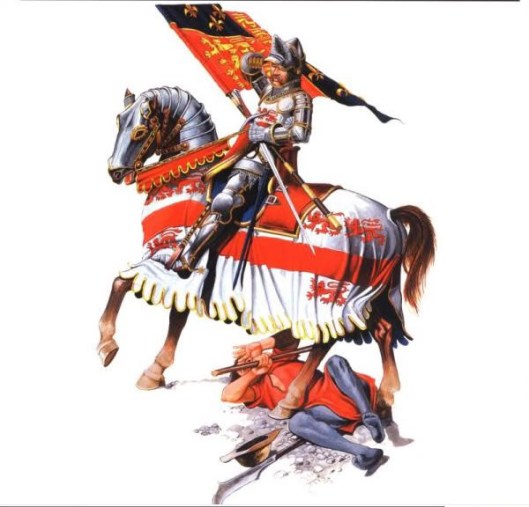
Taken all together, these produce a very different image from the films, don’t they? Much more individual, often much less well-equipped, more actual medieval, as we would imagine the author had had in mind. So—contrast this


with this:

ArmiesOfAgincourt.jpg

Which do you prefer, dear readers?

Thanks, as always, for reading.

MTCIDC

CD
 

← Older posts
Newer posts →

The Doubtful Sea Series Facebook Page

The Doubtful Sea Series Facebook Page

  • Ollamh

Categories

  • Artists and Illustrators
  • Economics in Middle-earth
  • Fairy Tales and Myths
  • Films and Music
  • Games
  • Heroes
  • Imaginary History
  • J.R.R. Tolkien
  • Language
  • Literary History
  • Maps
  • Medieval Russia
  • Military History
  • Military History of Middle-earth
  • Narnia
  • Narrative Methods
  • Poetry
  • Research
  • Star Wars
  • Terra Australis
  • The Rohirrim
  • Theatre and Performance
  • Tolkien
  • Uncategorized
  • Villains
  • Writing as Collaborators
Follow doubtfulsea on WordPress.com

Across the Doubtful Sea

Recent Postings

  • Do You Speak Villain? (Part 3) February 18, 2026
  • Do You Speak Villain? (2) February 11, 2026
  • Do You Speak Villain? (Part 1) February 4, 2026
  • Towering January 28, 2026
  • Tolkien Among the Indians January 21, 2026
  • Thin and Stretched January 14, 2026
  • Through a glass… January 7, 2026
  • Heffalumps? December 31, 2025
  • We Three Kings December 24, 2025

Blog Statistics

  • 107,649 Views

Posting Archive

  • February 2026 (3)
  • January 2026 (4)
  • December 2025 (5)
  • November 2025 (4)
  • October 2025 (5)
  • September 2025 (4)
  • August 2025 (4)
  • July 2025 (5)
  • June 2025 (4)
  • May 2025 (4)
  • April 2025 (5)
  • March 2025 (4)
  • February 2025 (4)
  • January 2025 (5)
  • December 2024 (4)
  • November 2024 (4)
  • October 2024 (5)
  • September 2024 (4)
  • August 2024 (4)
  • July 2024 (5)
  • June 2024 (4)
  • May 2024 (5)
  • April 2024 (4)
  • March 2024 (4)
  • February 2024 (4)
  • January 2024 (5)
  • December 2023 (4)
  • November 2023 (5)
  • October 2023 (4)
  • September 2023 (4)
  • August 2023 (5)
  • July 2023 (4)
  • June 2023 (4)
  • May 2023 (5)
  • April 2023 (4)
  • March 2023 (5)
  • February 2023 (4)
  • January 2023 (4)
  • December 2022 (4)
  • November 2022 (5)
  • October 2022 (4)
  • September 2022 (4)
  • August 2022 (5)
  • July 2022 (4)
  • June 2022 (5)
  • May 2022 (4)
  • April 2022 (4)
  • March 2022 (5)
  • February 2022 (4)
  • January 2022 (4)
  • December 2021 (5)
  • November 2021 (4)
  • October 2021 (4)
  • September 2021 (5)
  • August 2021 (4)
  • July 2021 (4)
  • June 2021 (5)
  • May 2021 (4)
  • April 2021 (4)
  • March 2021 (5)
  • February 2021 (4)
  • January 2021 (4)
  • December 2020 (5)
  • November 2020 (4)
  • October 2020 (4)
  • September 2020 (5)
  • August 2020 (4)
  • July 2020 (5)
  • June 2020 (4)
  • May 2020 (4)
  • April 2020 (5)
  • March 2020 (4)
  • February 2020 (4)
  • January 2020 (6)
  • December 2019 (4)
  • November 2019 (4)
  • October 2019 (5)
  • September 2019 (4)
  • August 2019 (4)
  • July 2019 (5)
  • June 2019 (4)
  • May 2019 (5)
  • April 2019 (4)
  • March 2019 (4)
  • February 2019 (4)
  • January 2019 (5)
  • December 2018 (4)
  • November 2018 (4)
  • October 2018 (5)
  • September 2018 (4)
  • August 2018 (5)
  • July 2018 (4)
  • June 2018 (4)
  • May 2018 (5)
  • April 2018 (4)
  • March 2018 (4)
  • February 2018 (4)
  • January 2018 (5)
  • December 2017 (4)
  • November 2017 (4)
  • October 2017 (4)
  • September 2017 (4)
  • August 2017 (5)
  • July 2017 (4)
  • June 2017 (4)
  • May 2017 (5)
  • April 2017 (4)
  • March 2017 (5)
  • February 2017 (4)
  • January 2017 (4)
  • December 2016 (4)
  • November 2016 (5)
  • October 2016 (6)
  • September 2016 (5)
  • August 2016 (5)
  • July 2016 (5)
  • June 2016 (5)
  • May 2016 (4)
  • April 2016 (4)
  • March 2016 (5)
  • February 2016 (4)
  • January 2016 (4)
  • December 2015 (5)
  • November 2015 (5)
  • October 2015 (4)
  • September 2015 (5)
  • August 2015 (4)
  • July 2015 (5)
  • June 2015 (5)
  • May 2015 (4)
  • April 2015 (3)
  • March 2015 (4)
  • February 2015 (4)
  • January 2015 (4)
  • December 2014 (5)
  • November 2014 (4)
  • October 2014 (6)
  • September 2014 (1)

Blog at WordPress.com.

  • Subscribe Subscribed
    • doubtfulsea
    • Join 78 other subscribers
    • Already have a WordPress.com account? Log in now.
    • doubtfulsea
    • Subscribe Subscribed
    • Sign up
    • Log in
    • Report this content
    • View site in Reader
    • Manage subscriptions
    • Collapse this bar
 

Loading Comments...