• About

doubtfulsea

~ adventure fantasy

Category Archives: Heroes

In the Future, Use the Past

13 Wednesday Sep 2017

Posted by Ollamh in Artists and Illustrators, Fairy Tales and Myths, Films and Music, Heroes, J.R.R. Tolkien, Literary History, Narrative Methods

≈ Leave a comment

Tags

A New Hope, A Princess of Mars, Ages of Middle-earth, Death Star, Edgar Rice Burroughs, Emperor Palpatine, Frank Schoonover, George Lucas, Hildebrandt, Mos Eisley, Oxford, Percival Lowell, Return of the Jedi, Sauron, science fiction, special effects, Star Wars, Stonehenge, Tatooine, The Empire Strikes Back, The History of Middle-earth, The Last Jedi, The Lord of the Rings, Tolkien, tower of St Michael

Welcome, as always, dear readers.

As The Last Jedi (Star Wars 8) approaches (and Star Wars Rebels, season 3 has appeared via the postman—season 4 premieres in mid-October—sadly the last season, as Disney has canceled season 5), we’ve been thinking about the original Star Wars of 1977.
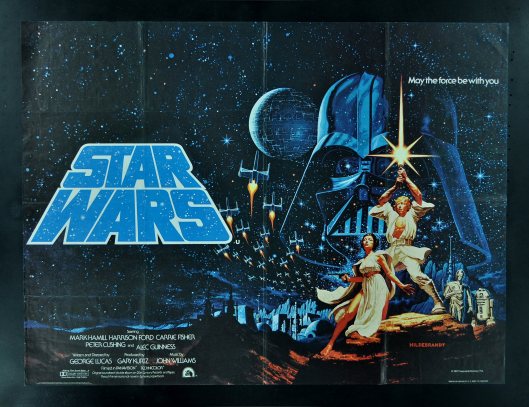
image1poster.jpg

This poster—the second ever Star Wars poster, in fact (used by 20th Century Fox in the UK)– is a great link to JRRT—as if we don’t seem to make such links every time we write!  It’s by two of our favorite Tolkien illustrators, the Hildebrandt brothers.  Here’s a picture of the surviving twin, Greg, with that very poster (his brother, Tim, died in 2006).

image2gh.png

(Clink here for a LINK to an interesting little piece from 2010 about the Hildebrandts and George Lucas.)

We believe, however that there may be a deeper link.

The original reviews (here’s a LINK to summaries of some of them) were a mixture, with some critics enthusiastic about what they saw and others (in our view the stodgier ones) calling the film things like “puerile”.  One element which was occasionally commented upon was the look of the picture—and not just the (for the time) dazzling special effects—but the fact that all the worlds depicted were lived-in, not shiny and new—well, almost.  Consider Mos Eisley, for example,
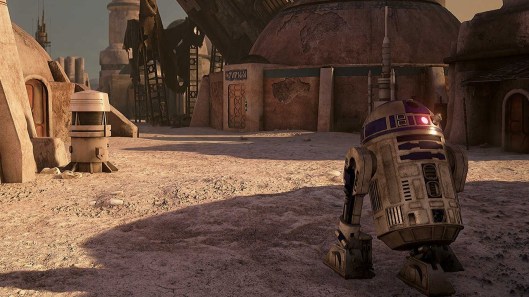
image3moseisley.jpg

which looks dusty and battered, suggesting the passage of time as well as the effects of the harsh desert climate of Tatooine.

Or the Jawa sandcrawler, old and clearly rusting–

image4jawasandcrawler.jpg

We said “almost” shiny and new because there’s one part of this galaxy with a different look:  the Death Star.

image5insidedeathstar.jpg

It looks like it’s dusted and waxed hourly, doesn’t it?  And the outside appears to be just as neat.

image6falconenteringdeathstar.jpg

What does this say about the nature of those who inhabit it?  For us, thinking about the spotless Darth Vader,
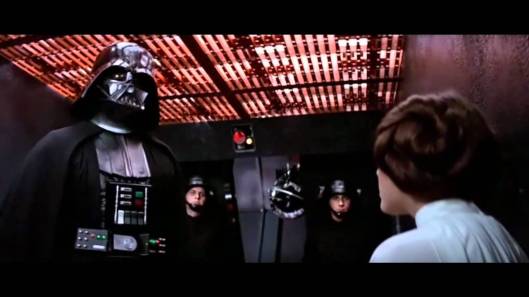
image7vader.jpg

immediately suggests that the old proverb should be changed to “Cleanliness is next to Un-godliness”!  (Okay—we’re not the neatest and most organized people we know.)

It has been pointed out, more than once and beginning with the director himself, that George Lucas was influenced by Edgar Rice Burroughs’ John Carter series, beginning with A Princess of Mars (first published serially in The All-Story, February to July, 1912).

image8princess.jpg

(And here’s another connection—this cover and the illustrations for its first publication in book form, in 1917, were by Frank Schoonover, 1877-1972, who was the student of another of our favorite illustrators, Howard Pyle, whom we have occasionally mentioned in previous postings.  The convincing detail in this cover painting shows that, just like his teacher, Schoonover did his research—in his case, by very carefully going through the text and taking note of any technical information the author might have mentioned.)

In A Princess of Mars and subsequent books,  Mars has a civilization which is old and in decline (the inspiration for which, in turn, may have come from the work of the amateur astronomer, Percival Lowell, 1855-1916, whose telescopic observations of Mars had convinced him that the planet was—or had been—the home of a dying civilization which had constructed a vast network of canals to supply themselves with water from the polar ice caps—unfortunately, numerous NASA missions have found no evidence of the desperate Martians or their canals).   It would be easy, then, to say that Lucas was just following his source material, but we would suggest that there are two better explanations for showing wear.

The first comes from something Lucas is quoted as having said to his production designers:  “What is required for true credibility is a used future.” In Lucas’ view, then, the story’s believability comes in part from its look:  if things appeared not shiny, but worn, then viewers would be more likely to accept the narrative as somehow “true”, we presume because things in our world so often look used.

There is then, we think a further presumption:  if things look worn, then they have a past, which implies that the here-and-now of the story is a small part of bigger things and, certainly, just looking at the “crawl” at the beginning of the original Star Wars,

star-wars-crawl-163729.jpeg

which leads us to  our second explanation.  This one deals with something deeper, something which we would say might provide another possible link with JRRT and is, in fact, suggested by the titles of the first three Star Wars films made and even in their sequence:  A New Hope, The Empire Strikes Back, The Return of the Jedi.

In two earlier postings, we talked about the condition of Middle-earth at the beginning of The Lord of the Rings, in which everything, from the trees to the houses of Minas Tirith, has grown old and weary—and even potentially hostile, in the case of the trees.  Part of this comes from the fact that Middle-earth is old:  one has only to turn to Appendix B, subtitled “The Tale of Years”, in The Lord of the Rings to see that, in the Second and Third Ages alone, nearly 6000 years have passed.   (In terms of our earth, that’s moving from the late Neolithic Era to modern times, 4000bc to 2017ad.)  This also emphasizes the age and depth of evil, as well as its power to corrupt in the present:  Sauron began to build Barad-dur c. SA1000—5000 years before the main narrative of The Lord of the Rings opens and, in the present, the world is crumbling.

Of course, JRRT lived surrounded by the past.  The oldest surviving building in his daily Oxford is the tower of St Michael at the North Gate, dating from 1040ad, nearly a thousand years before his time,

image9stmichaels.jpg

but Neolithic Stonehenge is only 58 miles (93km) southwest of the city and that’s 5000 years old, taking us back to the time when, in Middle-earth, Sauron had begun the Barad-dur.
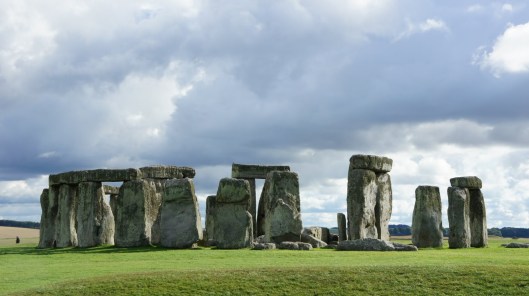
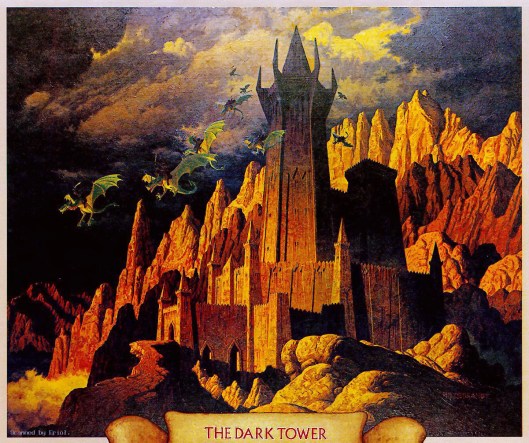
image10stonehenge.JPG

image11baraddur.jpg

In contrast, Lucas was born in 1944 in Modesto, California, a town only founded in 1870, and grew up in a post-World War II world, where the key was “the future”.  It is a tribute, then, to his story-telling gift that he realized how useful in telling his story the past—even an imagined one—could be and it is interesting to see how he shares that understanding with JRRT and perhaps shares a goal, as well.

We’ve said that our second explanation may be seen in the titles of Lucas’ three films, so let’s consider them in comparison with the general shape of Tolkien’s work to see what that shared goal might be.   (In an interview, Lucas even described the three as being like a three-act play, suggesting the dramatic progress inherent in the movement from one to another.)

At the beginning of the first film, it is a dark time in the galaxy:  the repressive regime of the evil Emperor Palpatine dominates and resistance is confined to “The Rebel Alliance”, which has scraped together a fleet (and, presumably an army—we see elements in Rogue One, which takes place before this film) to resist, but seems to spend most of its time running and hiding.  The past is only implied, but the fact that there is an Empire and a resistance suggests much, just as the run-down condition of places like Tatooine might suggest both age and that the galaxy has become run-down because of that Empire.

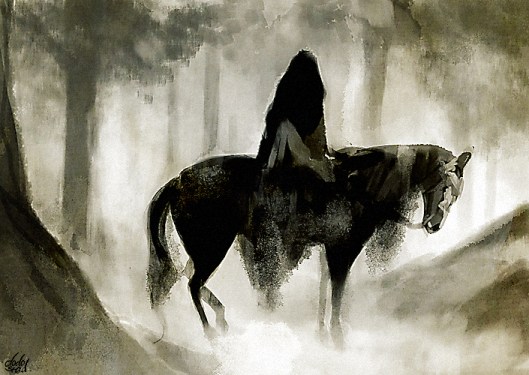
image12palpatine.jpg

At the beginning of The Lord of the Rings, we find ourselves in a place with a long history, as we see from the many pages of the “Prologue”.  It has been a quiet place, but the world outside is becoming less so, with sinister forces growing, as Frodo hears from passing dwarves:

“They were troubled, and some spoke in whispers of the Enemy and of the Land of Mordor.” (The Fellowship of the Ring, Book One, Chapter 2, “The Shadow of the Past”)

In time, readers are brought to see that the dwarves are grossly understating the case:  the Enemy is real, Sauron, and that he has not only huge armies, but the Nazgul and a would-be ally in his enemies’ camp, Saruman.  The same may be said for the Empire:  not only do they have huge fleets and armies, but they have the “ultimate weapon”, the Death Star.
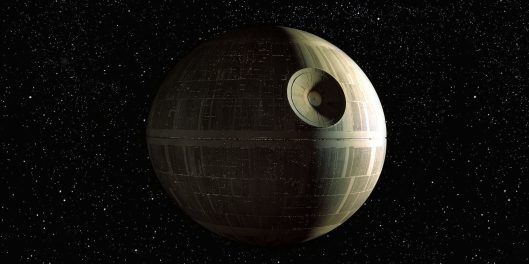
image13deathstar.jpeg

We will learn, as well, that, for all his great age and might, Sauron has an Achilles’ heel:  to give the One Ring its power, he has had to pour most of his power into it.  Thus, if he regains the ring, he will be much more powerful than he is at present, but, should the ring be destroyed, Sauron will be virtually destroyed with it.  As this struggle has been going on in Middle-earth for thousands of years, the idea that Sauron is vulnerable could easily be termed “a new hope”, just as Luke, the son of the Enforcer of the Galaxy, Darth Vader/Anakin Skywalker, will provide a new hope for the Rebels (especially when we are told about “the Chosen One”—for whom he can be taken).

For a time, things do not go well for those opposed to Sauron:  he combines psychological/meteorological attacks with the march of huge armies, and even pirate raids on Gondor’s south coast. Gondor is overrun and Minas Tirith is assaulted.  This is clearly The Empire Strikes Back, just as the pursuit of the Rebel fleet to Hoth and the destruction of Echo Base disperses the Rebels and casts a shadow over the hope felt after the destruction of the Death Star.

This is not the end, however, for the Rebels or for the good people of Middle-earth.  Not only is the Ring destroyed and Sauron disembodied, but this paves the way for The Return of the King, with all of the reflowering-to-come, as we have suggested in a previous posting.
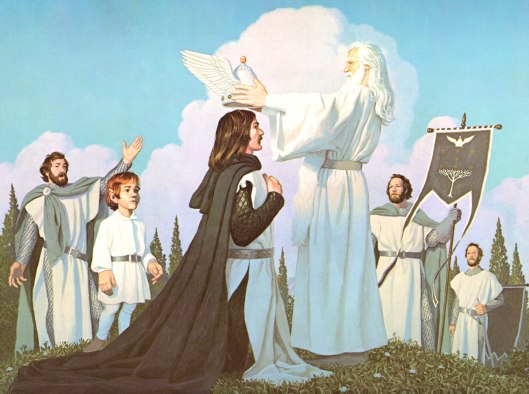
image14crowning.jpg

And there is a strong echo in the title of Lucas’ third film, The Return of the Jedi, in which the Emperor is destroyed and balance brought back to the Force—and the galaxy.  (Of course, with Star Wars 7, we see that the happy ending is only temporary, but we have hopes that, by the conclusion of 9, there will come a final rebalancing and peace at last.)

image15return.jpg

Lucas’ acknowledges many sources but, so far, we have yet to locate a quotation from an interview or anywhere else in which he says, “Yes, I’ve read Tolkien closely and, indeed, there is a strong affinity between my work and his”, but we believe that we can suggest, at least, that he, like JRRT, is following the same path in creating a world in turmoil, a visibly-aging world.  Into this world, he places his protagonist who provides a new hope, faces the might of a not-easily-defeated enemy, but, by his bravery and determination, finally brings about the destruction of that enemy (interesting in both cases he does not do so himself—Gollum inadvertently destroys the ring, just as Anakin, not his son, kills the Emperor) and the promise of renewal in the return of the Jedi—and the King.

And what do you think, dear readers?

Thanks, as ever, for reading!

MTCIDC

CD

In Bad Hands

30 Wednesday Aug 2017

Posted by Ollamh in Heroes, J.R.R. Tolkien, Literary History, Maps, Military History, Narrative Methods

≈ Leave a comment

Tags

CBS Television News, Denethor, Dunkirk, Early newspapers, early radio, Ecthelion, fake news, Gandalf, Henry IV, Isengard, Lifestyle Magazine, Minas Tirith, Nazi, Nazi Propaganda, news, newspaper, Orthanc, Osgiliath, Palantir, propaganda leaflet, Relation, rumors, Saruman, Shakespeare, texting while driving, The Detroit News, The Illustrated London News, The White Tower, Tolkien

Welcome, dear readers, as ever.
Not so long ago, news came to most people through one—very undependable–source: rumor and gossip. As Shakespeare’s Rumor (depicted as “all painted with tongues” in a stage direction), who appears at the beginning of Henry IV, Part 2, Prologue, 1-5, describes herself:
“Open your ears, for which of you will stop
The vent of hearing when loud Rumour speaks?
I, from the orient to the drooping west,
Making the wind my post-horse, still unfold
The acts commenced on this ball of earth.”
At almost the same time as this play was written and first performed (1596-99), the first printed Western newspaper appeared, the Relation, in Strasbourg in 1605.
image1a1609newspaper.jpg
For the next 300-and-some years, newspapers were then the accepted conveyor of popular information about local, national, and world events. Until 1842, these could only convey that information in words, but, in that year, the first illustrated newspaper appeared, The Illustrated London News.
image1billustratedlondonnews.jpg
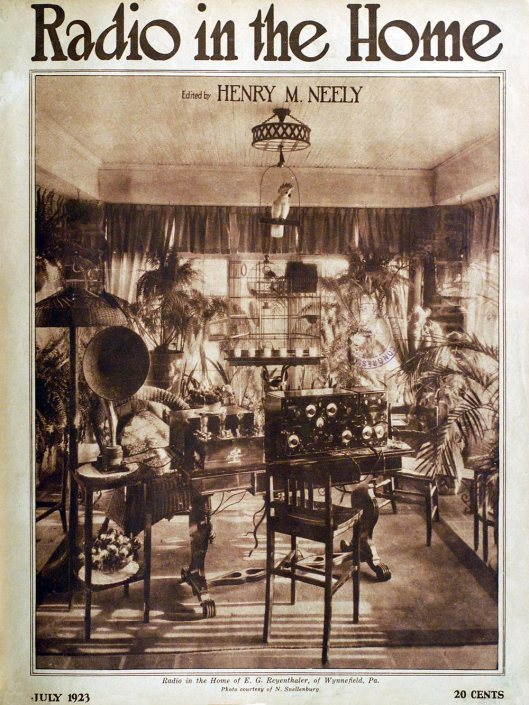
And soon other newspapers followed, opening a wider world of information to the reading public. In under a century, however, news appeared in a new form of technology entirely: the first news broadcast by radio believed to have been on August 31, 1920, by a set owned—perhaps not surprisingly by a newspaper— The Detroit News. Considering what radios looked like in the early 1920s, we doubt that many people heard it (this is an image from Lifestyle Magazine from 1923).
image1cearlyradio1923.jpg
Radios soon improved, however, so that, along with newspapers, people could tune in to hear news, news sometimes more up-to-date than even the newspapers could supply. And then came television. Experiments had been made with television broadcasting as early as 1940, but steady broadcasting really only began in 1948, with CBS Television News.
And then the internet appeared, so that, today, more people are believed to get their news from some form of electronic means than any other (or so electronic means tell us). Practically anywhere you go in our world, you see people staring at screens (not always reading the news, of course—with the universe of apps, people can be doing almost anything imaginable), many of them so portable that you can watch people doing it while walking
image1walktext.jpg
eating,
image2eattext.jpg
even while driving (which, frankly, terrifies us!).
image3textdrive.jpg
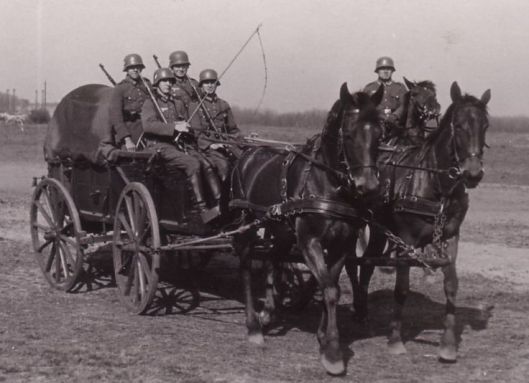
There is a problem with news, however, in every era. Shakespeare’s Rumor may have been pushed to one side by later technological innovations, but, in the form of so-called “fake news”, it’s still with us. And, in fact, faked news—news distorted—or even manufactured—has become a standard feature in newer technology. One has only to think about Nazi propaganda (certainly not the first, but perhaps, for us, the most extensive and most vivid), where—just as one example out of thousands—the mostly horse-powered German army of 1940
image4awehrmacht.jpg
was publicly depicted as streamlined and gasoline-powered (or, even more high-tech, diesel-powered).
image4bwehrmachttruck.jpg
Some time ago, we talked about literacy in Middle-earth. There was no printed material, of course, and literacy appears to have been limited (we only have to mention Gaffer Gamgee saying of Sam, “Mr. Bilbo has learned him his letters—meaning no harm, mark you, and I hope no harm will come of it.” to imagine that not only was it limited, but there might even be a certain suspicion attached to it.)
And what news there was came by the oldest of methods:
“There were rumours of strange things happening in the world outside; and as Gandalf had not at that time appeared or sent any message for several years, Frodo gathered all the news he could. Elves, who seldom walked in the Shire, could now be seen passing westward through the woods in the evening, passing and not returning; but they were leaving Middle-earth and were no longer concerned with its troubles. There were, however, dwarves on the road in unusual numbers. The ancient East-West Road ran through the Shire to its end at the Grey Havens, and dwarves had always used it on their way to their mines in the Blue Mountains. They were the hobbits’ chief source of news from distant parts—if they wanted any: as a rule dwarves said little and hobbits asked no more. But now Frodo often met strange dwarves of far countries, seeking refuge in the West. They were troubled, and some spoke in whispers of the Enemy and of the Land of Mordor.” (The Fellowship of the Ring, Book One, Chapter 2, “The Shadow of the Past”)
(See also the scene in The Green Dragon a little later in the chapter, where there is discussion, all based on hearsay, about Shire and extra-Shire events, between Sam and Ted Sandyman.)
For two people in Middle-earth, however, news came by a method in a strange way like that of the internet: the palantir, and that news which they received was not to their advantage. Made “from beyond Westernesse, from Eldamar. The Noldor made them…” Gandalf tells Pippin. (The Two Towers, Book Three, Chapter 11, “The Palantir”)

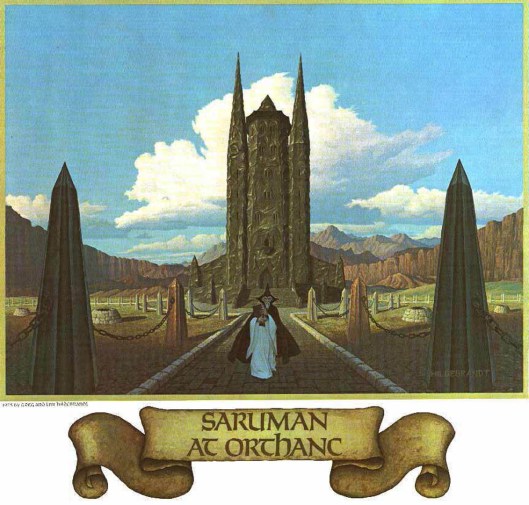
The palantiri were made “to see far off, and to converse in thought with one another.” Although there were seven, one, that at Osgiliath, was the master: “each palantir replied to each, but all those in Gondor were ever open to the view of Osgiliath.” Saruman had one of the others
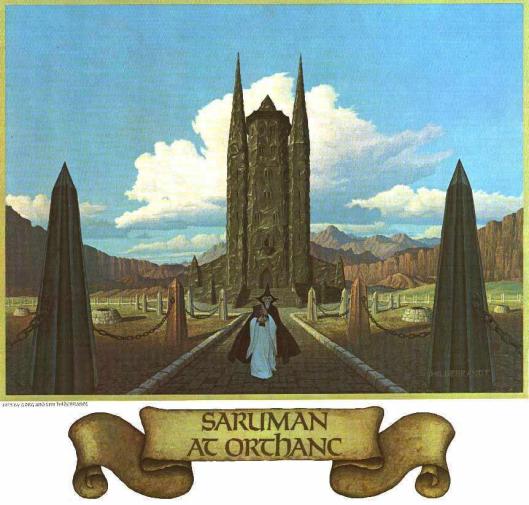
image4saruman.jpg
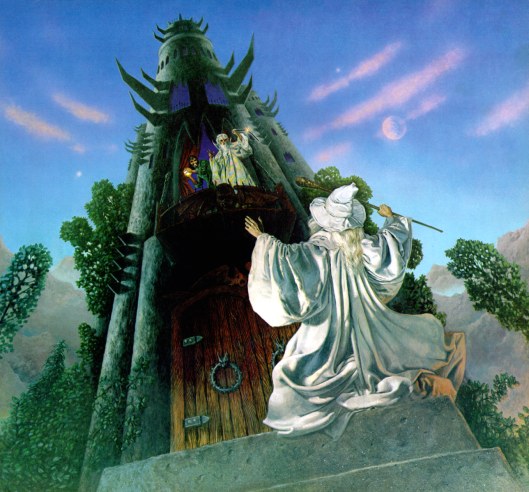
—the one under discussion in this chapter, after Pippin had almost come to disaster from looking in it—which Grima flung off Orthanc
image5sarumanorthanc.jpg
in what, although unexplained, must have been an attempt to brain Gandalf.
image6gandalforthanc.jpg
Unfortunately for Saruman, what he presumably thought would benefit his quest for what he speciously tells Gandalf is “Knowledge, Rule, Order; all the things that we have so far striven in vain to accomplish…” (The Fellowship of the Ring, Book Two, Chapter 2, “The Council of Elrond”), becomes a snare, as it seems that the master stone of Osgiliath has fallen into Sauron’s hands and “Easy it is now to guess how quickly the roving eye of Saruman was trapped and held; and how ever since he has been persuaded from afar, and daunted when persuasion would not serve.” (The Two Towers, Book 3, Chapter 11, “The Palantir”)
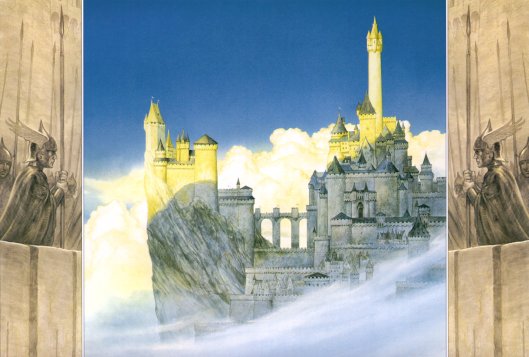
There is another surviving stone, however, and, though it doesn’t turn its possessor into an unwilling ally of Sauron, its propaganda—faked news—does terrible damage, all the same. In the White Tower of Ecthelion in Minas Tirith,
image7awhitetower.jpg
Denethor
image7denethor.jpg
holds a palantir and he, too, is caught, as Gandalf surmises:
“…I fear that as the peril in his realm grew he looked in the Stone and was deceived: far too often, I guess, since Boromir departed. He was too great to be subdued to the will of the Dark Power, he saw nonetheless only those things which that Power permitted him to see. The knowledge which he obtained was, doubtless, often of service to him; yet the vision of the great might of Mordor that was shown to him fed the despair of his heart until it overthrew his mind.” (The Return of the King, Book Five, Chapter 7, “The Pyre of Denethor”)
This overthrow, brought on by Sauron’s propaganda, results in Denethor accusing Gandalf of plotting “to rule in my stead, to stand behind every throne, north, south, or west” as well as delivering what clearly sounds like the “speech long rehearsed” Gandalf has long ago said that Saruman delivered to him in Orthanc:
“For a little space you may triumph on the field, for a day. But against the Power that now arises there is no victory. To this City only the first finger of its hand has yet been stretched. All the East is moving. And even now the wind of thy hope cheats thee and wafts up the Anduin a fleet with black sails. The West has failed. It is time for all to depart who would not be slaves.”
“to depart” quickly seems a euphemism for something much more radical as Denethor:
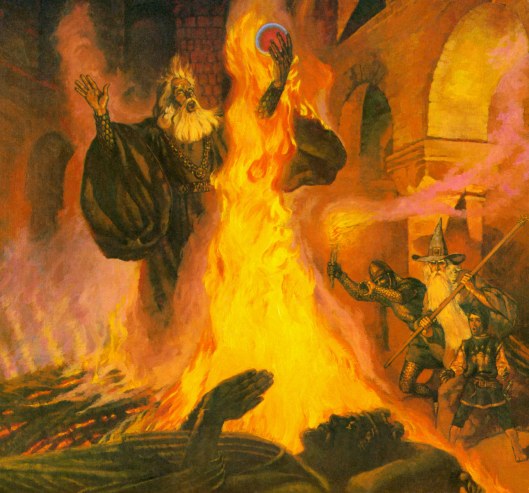
“leaped upon the table, and standing there wreathed in fire and smoke he took up the staff of his stewardship that lay at his feet and broke it on his knee. Casting the pieces into the blaze he bowed and laid himself on the table, clasping the palantir with both hands upon his breast.”
image8denethorontable.jpg
Here, we thought of all of those people we see who seemingly can never put down their phones—even in death Denethor still grips the very thing which has brought about his destruction.
image9textdrive.jpg
Was JRRT sending us, here in the future, a warning: beware of your source of news—and sometimes let go of what brings it to you? We can only add his description of Denethor’s palantir when it was retrieved from the pyre:
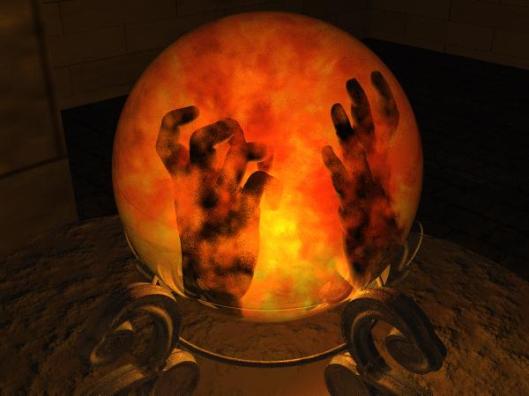
“And it was said that ever after, if any man looked in that Stone, unless he had a great strength of will to turn it to other purpose, he saw only two aged hands withering into flame.”
image10dshands.jpg
Thanks, as always, for reading!
MTCIDC
CD
PS
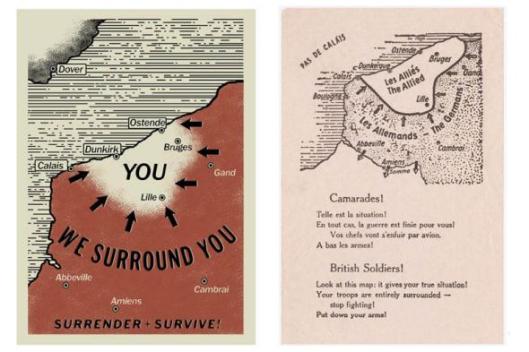
The new film, Dunkirk, opens with a British soldier catching a German propaganda leaflet based upon an actual one. Below on the left is the movie version, on the right the original. (Notice, by the way, that, in the one on the right, the English is not quite parallel to the French, including the line, “Your commanders (chefs) are going to flee by airplane.”) If Middle-earth had had a print culture, it’s easy to see such a leaflet being dropped by Nazgul over Minas Tirith!
image11leaflet.jpg

Healing (II)

16 Wednesday Aug 2017

Posted by Ollamh in Heroes, J.R.R. Tolkien, Literary History, Narrative Methods

≈ Leave a comment

Tags

Akira Kurosawa, Aragorn, athelas, bleeding, Boromir, cinquefoil, Eowyn, Faramir, four humors, Greco-Roman, healers, herbal medicine, Hildebrandts, Japanese block prints, John Bradmore, Kingsfoil, Macbeth, Medieval medicine, Medieval Monastery, Merry, Morgul Knife, Nazgul, Prince Hal, Prince Imrahil, Pyre of Denethor, Rammas Echor, The Battle of the Pelennor Fields, The Grey Havens, The Houses of Healing, The Lord of the Rings, The Return of the King, Throne of Blood, Tolkien, Washizu, Westernesse, Witch-King of Angmar, wounding, Yoshitoshi, Yoshitoshi's Courageous Warriors

Welcome, dear readers, as ever.
Two postings ago, we were talking about woundings in The Lord of the Rings and thinking about the medical care there as compared with that available in what we always think of as the actual parallel medieval world. We had gotten as far as Boromir, who, we imagined, would have been beyond help, pierced as he was by multiple arrows.
image1boromir.jpg
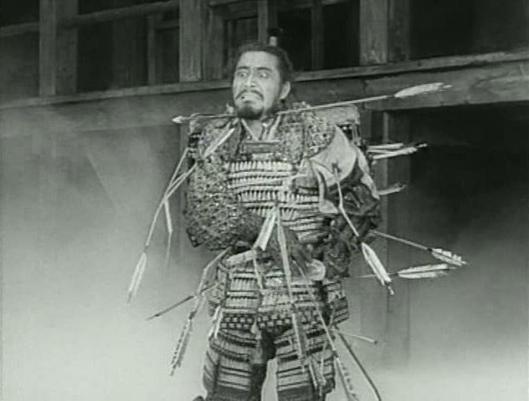
(We had also said that Boromir’s wounding reminded us of the death of the Macbeth figure in Kurosawa’s Throne of Blood, 1957.
image2throne.jpg
To which we would add—just because we love Japanese block prints (ukiyo-e)—this figure from Yoshitoshi’s series Yoshitoshi’s Courageous Warriors—1883-1886—)
image3yoshi.jpg
[Here, by the way, are some great links—one to a massive collection of Yoshitoshi prints, the other is an excellent guide to the world of Japanese block prints in general—both highly recommended!]

http://yoshitoshi.net/

http://www.ukiyo-e.se/
The next wounding is that of Faramir.
After the fall of the Rammas Echor, the long wall which was meant to protect the far side of the Pelennor, Faramir was leading the rear guard, but:
“…there came flying a deadly dart, and Faramir, as he held at bay a mounted champion of Harad, had fallen to the earth.” (The Return of the King, Book Five, Chapter 4, “The Siege of Gondor”)
At this time, we are not told of how the arrow was removed (we later are told that Prince Imrahil did it on the battlefield), but, that which concerned John Bradmore about the wounded Prince Hal in our 1403, after he had suffered an arrow wound,
image4halwitharrow.jpg
now afflicted Faramir: infection.:
“During all this black day Faramir lay upon his bed in the chamber of the White Tower, wandering in a desperate fever…”
In our medieval world, medicine was based upon a combination of beliefs, some of which even dated back to the Greco-Roman world.
One major foundation block was the idea that the body was governed by four elements, called “humors”: black bile, yellow bile, phlegm, and blood.


image5humours.png
They determined personality and behavior, but, although they were natural to the body, they could be thrown out of balance and part of a medieval doctor’s job was to rebalance them.
image6meddocs.jpg
This rebalancing could include doses of all sorts of things—dangerous metals, like mercury, concoctions from various plants, some of which were helpful, some poisonous, and bleeding—based upon the idea that, by removing blood, you were helping rebalance the body’s natural humorous proportions.
image7bleeding.jpg
In Faramir’s case, a doctor might try a number of drugs based upon plants which were believed to bring fever down:
angelica
image8angelica.jpg
chamomile
image9chamomile.JPG
datura
image10datura.jpg
or coriander
image11coriander.jpg
In the text, however, although Pippin suggests that Gandalf be consulted, Denethor dismisses the suggestion and Faramir is left to burn—before almost being literally consumed by fire along with his mad father.
[And here we would suggest that the over-the-top scene of Denethor’s death in the film missed an important point. In the book, it is clear that what drove Denethor to try to set up a kind of Viking funeral for himself and his son was the palantir by which his mind was poisoned by a Sauron whose influence over him he fatally underestimated. And what a wonderfully spooky moment JRRT describes when the orb survives the fire which destroys the Steward:
“And it was said that ever after, if any man looked in that Stone, unless he had a great strength of will to turn it to other purpose, he saw only two aged hands withering in flame.” (The Return of the King, Book Five, Chapter 7, “The Pyre of Denethor”)]
We will return to Faramir, but, first, we want to look at two more woundings, both occurring almost in the same moment: when Eowyn and Merry face the chief of the Nazgul.
image12eowyn.jpg
In confronting the Witch King, Eowyn suffers what might seem a perfectly ordinary battle wound in a world of hand-to-hand combat such as this:
“Out of the wreck rose the Black Rider, tall and threatening, towering above her. With a cry of hatred that stung the very ears like venom he let fall his mace. Her shield was shivered in many pieces and her arm was broken; she stumbled to her knees.” (The Return of the King, Book Five, Chapter 6, “The Battle of the Pelennor Fields”)
image13merrynaz.jpg
Eowyn is saved from the Nazgul by Merry, who “had stabbed him from behind, shearing through the black mantle, and passing up beneath the hauberk had pierced the sinew in his mighty knee.”
Combined with Eowyn’s final blow at the wraith’s face, this destroyed what we presume was an undead being, but, in return, both Merry and Eowyn take an invisible wound, something which the medical people of Minas Tirith can only observe:
“But now their art and knowledge were baffled; for there were many sick of a malady that would not be healed; and they called it the Black Shadow, for it came from the Nazgul. And those who were stricken with it fell slowly into an ever deeper dream, and then passed into silence and a deadly cold, and so died. And it seemed to the tenders of the sick that on the Halfling and on the Lady of Rohan this malady lay heavily.” (The Return of the King, Book Five, Chapter 8, “The Houses of Healing”)
Eowyn and Merry (and Faramir) have been taken to “the Houses of Healing”, which, in our world, would be a hospital, something which, in our Middle Ages, would either have been part of a monastery/cloister, or were a private foundation, supported by charitable donations.
image14medhosp.jpg
Medical people there could certainly have set Eowyn’s broken arm, even sealing it in plaster to keep it immobile, but the Black Shadow would have been as difficult for them as for the healers in Minas Tirith. Comas were recognized in the Middle Ages, but there was little to be done: apparently, comatose people lose the swallowing function, which means that someone in that condition would die of dehydration, probably within a few days (speed of dehydration depends upon many factors, as well as the individual, but the longest we’ve seen is about 10 to 12 days).
To their credit, those in the Houses of Healing tried to do something by observation:
“Still at whiles as the morning wore away they [Eowyn and Merry] would speak, murmuring in their dreams; and the watchers listened to all they said, hoping perhaps to learn something that would help them to understand their hurts.”
But the Shadow spreads quickly as day fades:
“But soon they began to fall down into the darkness, and as the sun turned west a grey shadow crept over their faces.”
And there is the added difficult of Faramir, who “burned with a fever that would not abate.”
At this point, both medieval healers and those in Minas Tirith were stumped—until another factor was added. In fact, two.
Plants have been used since ancient times for medicine world-wide, so it should be no surprise that Middle-earth should have a parallel. In this instance, the plant is called “kingsfoil” or athelas. (The “foil” in the first name is—in English—based upon the Old French foil/foille, “leaf”, which comes, in turn, from a Latin word for leaf, folium—perhaps JRRT was inspired by the plant called “cinquefoil” = “fiveleaf”. Athelas is also a compound, based upon Sindarin athaya, “helpful” and lass, “leaf”.) [There’s a really useful posting on possible our world parallels for this herb and we provide the LINK here.]
When Aragorn tended to Frodo’s Morgul-knife wound earlier in The Lord of the Rings, we would have seen its use then:
“He threw the leaves into boiling water and bathed Frodo’s shoulder. The fragrance of the steam was refreshing, and those that were unhurt felt their minds calmed and cleared. The herb had also some power over the wound, for Frodo felt the pain and also the sense of frozen cold lessen in his side…” (The Fellowship of the Ring, Book One, Chapter 12, “Flight to the Ford”)
This is not all to the treatment, however. Just before he uses the herb, Aragorn appears to employ some sort of counter-spell to that which was on the knife:
“He sat down on the ground, and taking the dagger-hilt laid it on his knees, and he sang over it a slow song in a strange tongue. Then setting it aside, he turned to Frodo and in a soft tone spoke words the others could not catch.”
This pattern of speech and herb is now employed in the healing not only of Eowyn and Merry, but of Faramir, as well, and forms both a part of the movement towards the eventual defeat of Sauron and the return of light to Middle-earth, and of the confirmation of Aragorn as the rightful heir to the throne. As the herb-master, when called upon by Aragorn to produce the herb, recites:
“When the black breath blows
And death’s shadow grows
And all lights pass,
Come athelas! Come athelas!
Life to the dying
In the king’s hand lying!”
Previously, the herb-master says “it has no virtue that we know of, save perhaps to sweeten a fouled air, or to drive away some passing heaviness…old folk still use an infusion of the herb for headaches.” Now, however, Aragorn proceeds to use it three times in quick succession, along with something else, to bring back the three so sunk towards death:
“Now Aragorn knelt beside Faramir, and held a hand upon his brow. And those that watched felt that some great struggle was going on. For Aragorn’s face grew grey with weariness; and ever and anon he called the name of Faramir, but each time more faintly to their hearing, as if Aragorn himself was removed from them, and walked afar in some dark vale, calling for one that was lost.”
Moving to Eowyn, Aragorn uses the athelas again, but summons her, as well:
“Then, whether Aragorn had indeed some forgotten power of Westernesse, or whether it was but his words of the Lady Eowyn that wrought on them, as the sweet influence of the herb stole about the chamber it seemed to those who stood by that a keen wind blew through the window…”
image15aragheal.jpg
And a third time, with Merry: “I came in time, and I have called him back.”
We’ll end the second part of our discussion of woundings here—or almost. There is one more patient whom it appears even the king can’t heal:
“But I have been too deeply hurt, Sam.” Says Frodo. “I tried to save the Shire, and it has been saved, but not for me. It must often be so, Sam, when things are in danger; some one has to give them up, lose them, so that others may keep them.” (The Return of the King, Book 6, Chapter 9, “The Grey Havens”)
image16greyhavens.jpg
And yet, there is perhaps the promise of healing beyond Middle-earth, something which may even bear a faint suggestion of the scent of Athelas:
“And the ship went out into the High Sea and passed on into the West, until at last on a night of rain Frodo smelled a sweet fragrance on the air and heard the sound of singing that came over the water…the grey rain-curtain turned all to silver glass and was rolled back, and he beheld white shores and beyond them a far green country under a swift sunrise.”
Thanks, as ever, for reading.
MTCIDC
CD

Prizes

26 Wednesday Jul 2017

Posted by Ollamh in Fairy Tales and Myths, Heroes, Imaginary History, Literary History, Narrative Methods

≈ Leave a comment

Tags

A Tale of Two Cities, Achilles, Admetus, Alcestis, Ancient Greece, Aphrodite, Archery, Atalanta, Baroness Orczy, chariots, Charles Dickens, Constantinople, contests, footrace, French Revolution, Greek, Heracles, Hippomenes, Icarius, Jacques-Louis David, King Oenomaus, King of Pherae, Lord Leighton Frederick, Odysseus, Olympia, Pelops, Penelope, The Death of Marat, The Odyssey, The Scarlet Pimpernel, Trojan War, Zeus

Welcome, as always, dear readers.
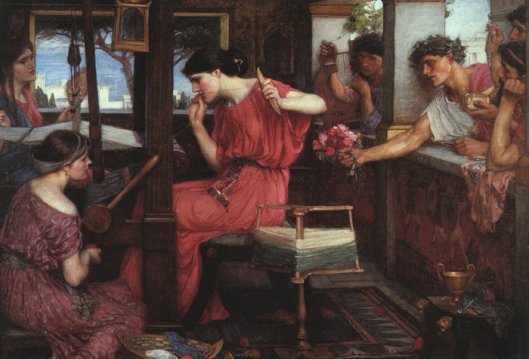
In our last posting, our second about archers, we talked about the archery contest which Penelope
image1penelope.jpg
arranged, as a way of finally ridding her house of a gang of mooching suitors. It was, in reality, a two-part contest:
1. the contestants were required to string Odysseus’ bow
2. then fire an arrow through—but the story as told in the Odyssey is a little confusing here—through a series of axe heads? Through the rings on the axe heads? Through rings on the shafts of the axes? The following illustrations will show you that there are all sorts of possibilities!
image2contest.jpg

image3contest.jpg

image4contest.jpg

image5contest.JPG
Odysseus, disguised as an old beggar, is the only one who can string the bow and fire it,
image6wyethody.jpg
and then goes on to begin picking off Penelope’s obnoxious suitors with it.
image7suitors.jpg
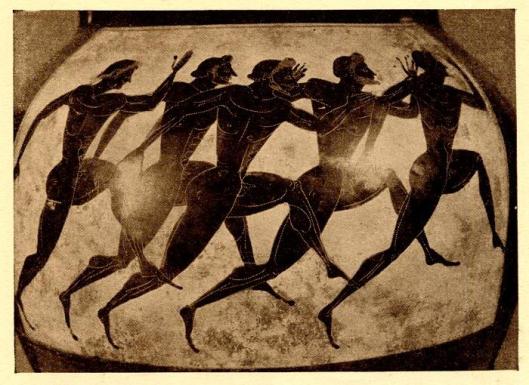
Prizes and women seem to be a not-uncommon theme in Greek mythology. When we were discussing Penelope and the archery contest, we also mentioned that there was an ancient story that Odysseus had actually won Penelope from her father, Icarius, in a footrace.
In general, Odysseus was regarded in Greece as neither a bowman nor a runner, but as the supreme trickster (he even has his own adjective, in fact polumetis, which we might translate “multiplotter”) but he is recorded in Book 23 of the Iliad as a runner, when he competes (and wins) in a footrace as part of the funeral games for Achilles’ beloved companion, Patroclus.
image9jldavid.jpg
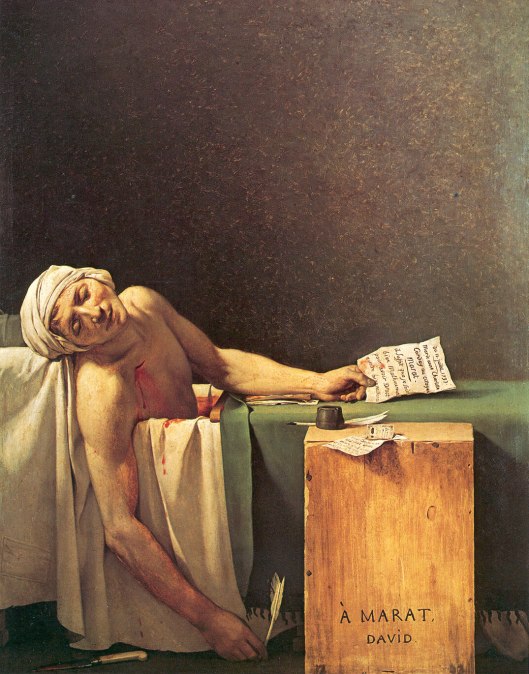
(This amazing piece, from 1778, is by the “painter of the French Revolution”, Jacques-Louis David, 1748-1825. In his earlier career, David had painted grand, florid things like this, often with a classical theme. When the Revolution came, David became an enthusiast, as well as one of its visual recorders, his most dramatic painting being “The Death of Marat”, commemorating the assassination of Jean-Paul Marat, a major revolutionary, killed in his bath in 1793.
10amarat.jpg
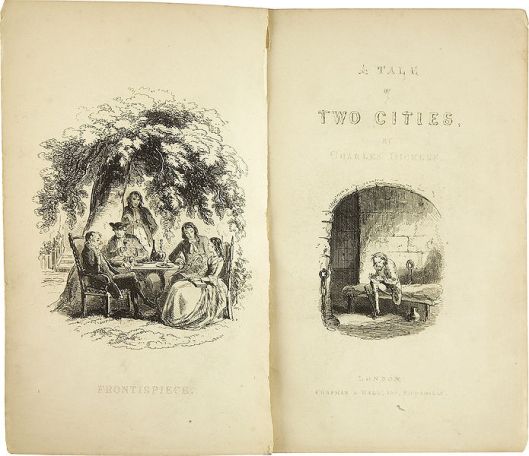
The era of the French Revolution has been a favorite of ours for years, probably originally because we grew up with Charles Dickens’ A Tale of Two Cities, 1859,
image10tale.jpg
and the Baroness Orczy’s The Scarlet Pimpernel, 1903-05.
image11spimp1908.jpg
We plan to write about the Pimpernel in a later posting—he’s a very important figure for 20th-century images of heroes with double-identities, being, it would seem, the original.)
It is worth wondering whether, in the choice of the bow and the archery contest, Penelope was actually indicating that she already knew the identity of the beggar. Certainly it put a deadly weapon into the hands of someone who immediately used it to rid her of the suitors. If that’s true, then offering herself as a prize was not a kind of passive surrender, but the beginning of an attack on the occupiers. This would give us a Penelope who was the very opposite of the girl offered as a prize in her father’s footrace. But that footrace reminded us of an earlier one, in which the prize stated the terms—and then enforced them.
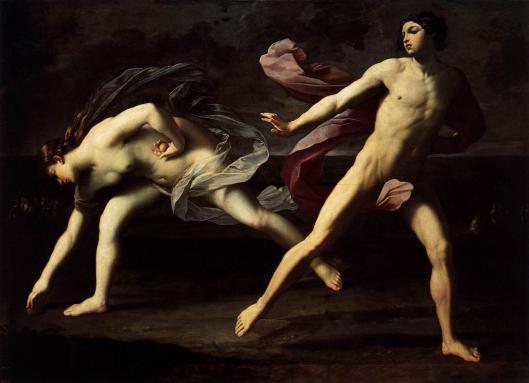
Several generations before the Trojan War, Atalanta was a princess and huntress,
image12atalanta.jpg
who was pressed by her father to marry. She agreed—but only on the condition that a suitor would have to join in a footrace with her and, if she beat him, she would kill him. A number of suitors tried and failed and paid the price before Hippomenes, brighter than the rest, knowing that he couldn’t outrace her, outthought her, praying to Aphrodite for help. The goddess gave him three golden apples and, as the two raced and Hippomenes was being outrun, he tossed one of the apples to the side. Atalanta was distracted and thus slowed until, after the third apple, Hippomenes won the race—and Atalanta.
image13renirace.jpg
The pattern of winning brides by races is repeated not only on foot, however. In another pre-Trojan-War story, King Oenomaus took fright from a prophecy that he would be killed by his son-in-law. When suitors came for his daughter, Hippodamia, he demanded that they join him in a chariot contest: they would race, but it was more a race for life than a sport, as, if Oenomaus caught up with the suitor, he would kill him.
So far, Oenomaus had managed to polish off eighteen suitors before Pelops, son of King Tantalus, appeared. Like Hippomenes, he was not the most scrupulous of competitors. (In one version of the story, Oenomaus displayed the heads of the unsuccessful suitors on the pillars of his palace—this might have proved a strong incentive to cheat!) In Pelops’ case, he persuaded Oenomaus’ charioteer to replace the bronze lynchpins (the pins which hold the chariot wheels on the axles) with ones made of wax and, in the (literal) heat of the contest, they melted and Oenomaus was dragged to his death. (And so the death-by-son-in-law prophecy came true!) Pelops then betrayed and murdered the charioteer, who, dying, put a curse upon Pelops and his descendants.
image14oenomaus.png
Supposedly, the chariot race which formed a central part of the Olympic games in later centuries
image15chariotrace.jpg
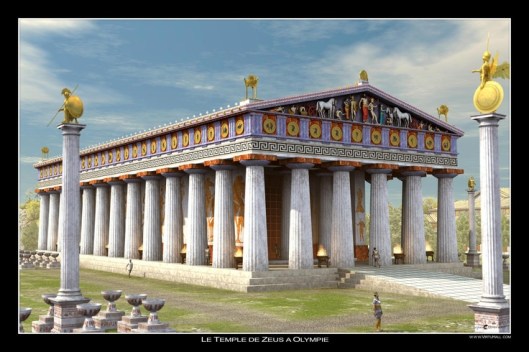
was either in commemoration of the death of Oenomaus or a celebration of the victory of Pelops. In fact, we have, on the eastern pediment (that’s the big triangular bit just below the roof) of the temple of Zeus at Olympia
image16templezeus.jpg
the main characters in the story depicted.
image17pediment.jpg
This was a very grand temple and contained one of the Seven Wonders of the Ancient World, a giant seated statue of Zeus, made of ivory and gold.
image18zeus.jpg
The statue didn’t survive the eastern Roman government’s attacks on pre-Christian culture, however, either being destroyed in a fire in the temple in 426AD, or in a fire at the eastern capital of Constantinople in 475AD.
In fact, the temple at Olympia itself was badly damaged in that fire of 426 and its whole structure was tumbled in earthquakes in 551 and 552AD, its columns collapsing onto the ground into lines of column drums like piles of stacked coins.
image19astackedcoins.jpg
image20tempzeus.jpg
Seeing that fallen building, we wonder whether Oenomaus’ charioteer’s curse extended to the site of the famous (and deadly) race!
To all of this mayhem around women as prizes at athletic events, we would add one happy occasion. Among the stories about Heracles, there was that of his wrestling match with death. This was not done to win a prize for himself, but to rescue Alcestis, the heroic wife of Admetus, King of Pherae, who had given her life to save her husband. (In fact, Admetus had won Alcestis in a challenge—but that’s a story for another posting!) Having brought her back, Heracles, to tease Admetus, says, truthfully, that Alcestis was a woman he had won in a contest—but neglects to say with whom he’d wrestled!
image21heraclesanddeath.jpg
(This, by the way, is a painting by Frederick, Lord Leighton, 1830-1896, who built much of his reputation on his reconstructions of the Greek classical and mythological world. We plan a future posting on him and on other classical myth-painters—among whom, in fact, was David, whom we mentioned above.)
Thanks, as ever, for reading.
MTCIDC
CD

A Longer Stretch

19 Wednesday Jul 2017

Posted by Ollamh in Fairy Tales and Myths, Heroes, Imaginary History, J.R.R. Tolkien, Literary History, Narrative Methods

≈ Leave a comment

Tags

Achilles, Angelica Kauffmann, Athena, Bard the Bowman, Circe, cyclops, Dora Wheeler, English Longbowmen, Errol Flynn, Greek, Henry VIII, Heracles, His Dark Materials, John William Waterhouse, Laertes, Lord Asriel, N.C. Wyeth, Odysseus, Paris, Patroclus, Penelope, Philip Pullman, Philoctetes, Portsmouth, Priam, Robin Hood, Sparta, Stelmaria, Telemachus, The Amber Spyglass, The Golden Compass, The Illiad, The Mary Rose, The Odyssey, The Subtle Knife, Tolkien, Troy

Welcome, dear readers, as always.
In our last posting, our central focus was upon Bard the Bowman and what he might have looked like.
image1bardjeffchang.jpg
As we do so often, we tried to use something from the history of our world to help us to flesh out JRRT’s description. In this case, we looked at Henry VIII’s battleship (a carrack, in the vocabulary of the period), the Mary Rose, which sank during a naval battle with the French on 19 July, 1545.
image2amrsinks.jpg
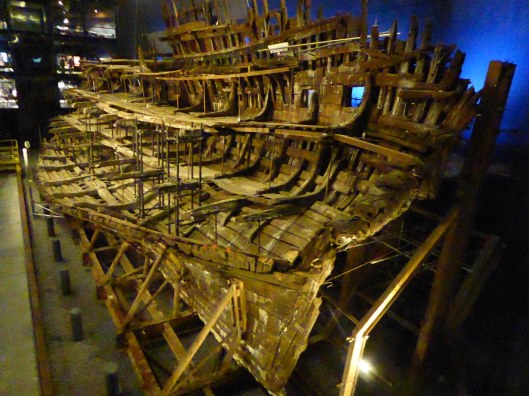
The ship was raised in 1982 (you can see the large surviving section of the hull in the Mary Rose museum, in Portsmouth, England).
image3amr.jpg
It was full of artifacts—and of crew.
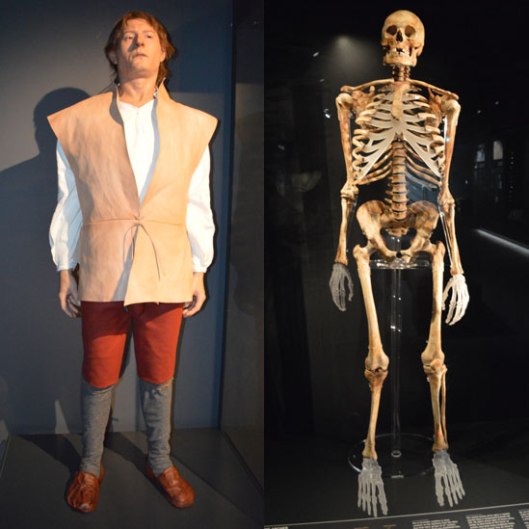
Because she sank so suddenly—and in the middle of a battle—almost none of the crew of 400 and more escaped. One of those trapped was this man.
image3mrarcher.jpg
His was among the roughly 90 skeletons well-enough preserved to allow for forensic exploration. That exploration, and the subsequent brilliant reconstruction, brought back to life a man about 6 feet (182cm) tall, with a powerfully-developed upper body. His build, certain characteristic marks of stress, and the fact that over 130 longbows and several thousand arrows were found in the wreck, led the archaeologists to see this man as an archer. We, in turn, then used him as the body-model for Bard.
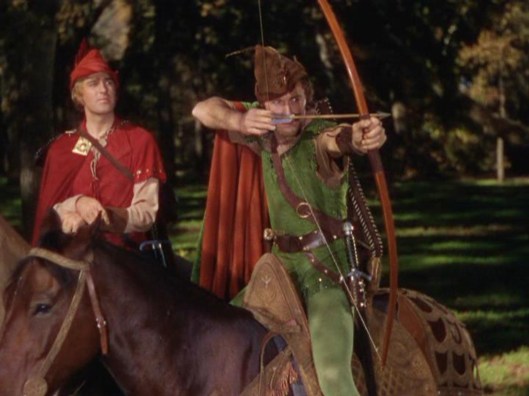
But “bowman/archer” to us, who are crazy for adventure, immediately brought back Robin Hood, first in what we believe to be his best 20th-century incarnation, Erroll Flynn,
image3eflynrhood.jpg
in the classic 1938 film.
image4poster.jpg
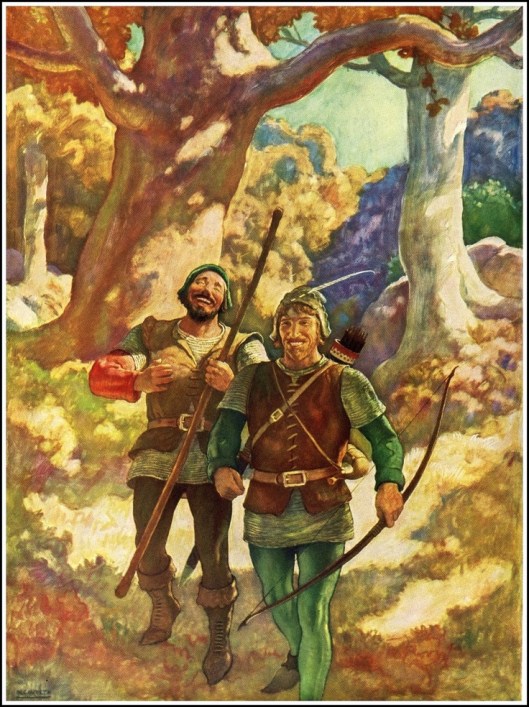
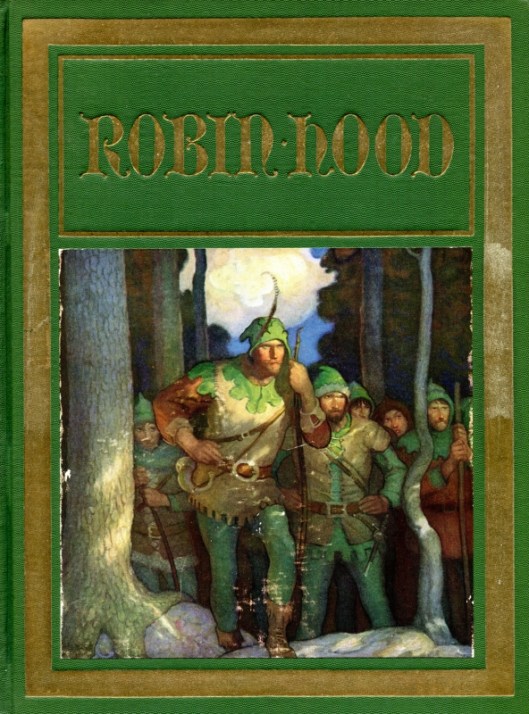
To which we would add N.C. Wyeth’s illustrations
image5wyeth.jpg
for the 1917 Robin Hood.
image6bookcover.jpg
Thinking about bowmen in adventure stories then took us back to the first big adventure story in western literature, the Odyssey, and its hero, Odysseus, who has two associations with bows, but who, oddly enough, is never depicted as an archer, but rather as a trickster, who uses his brains to escape everything from a one-eyed giant
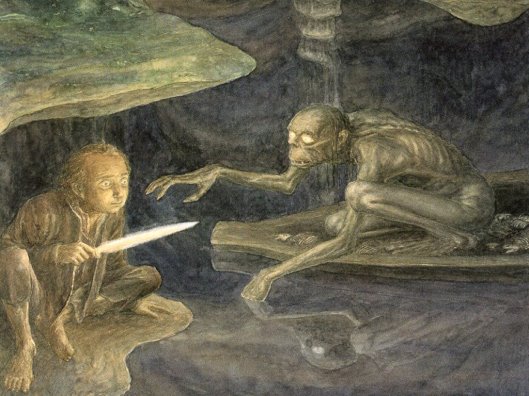
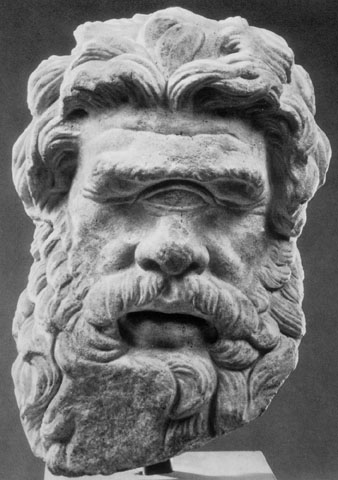
image7.jpg
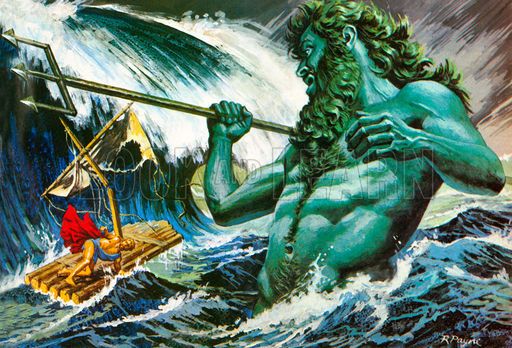
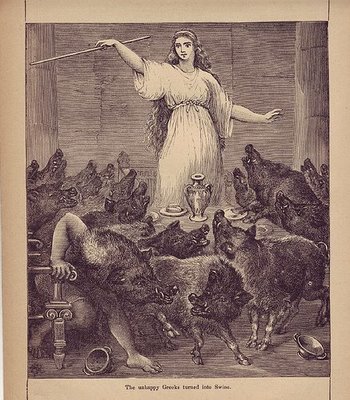
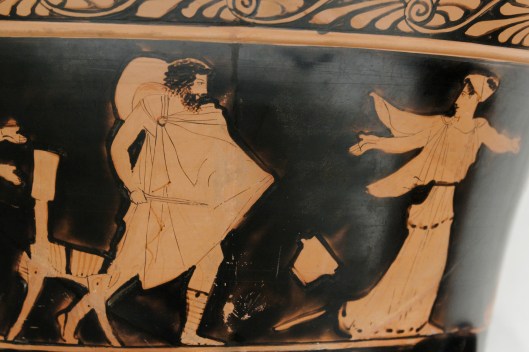
to an enchantress, Circe, who has already turned a good number of his crewmen into ham-on-the-hoof.
image8herccirce.jpg
One of our favorite illustrations of Circe is by John William Waterhouse, which he worked on from 1911 to 1915.

image9jwwaterhousecirce.jpg

The leopards in this version of the painting (in another, apparently, they are bears) reminded us of the snow leopard which is Lord Asriel’s demon, Stelmaria,
image10goldcomposter.jpg
in Philip Pullman’s trilogy
image13pullman.jpg
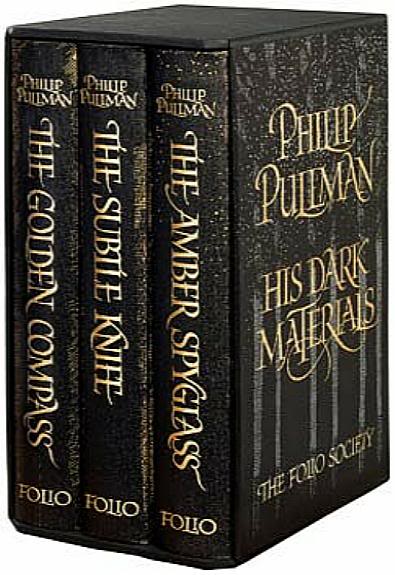
His Dark Materials, the three books being The Golden Compass (in the British edition, Northern Lights), 1995, The Subtle Knife, 1997, and The Amber Spyglass, 2000.
image12hisdarkmaterials.jpg
These are remarkable books—full of vivid characters and places-other-than-here-and-now, and we have read and reread them since they first appeared. If you haven’t read them, we would add only one proviso: there is a strong anti-religious theme throughout and some devout readers might have difficulty with Pullman’s views. If you are willing to imagine that this is a critique of beliefs in other worlds than our own, however, we would unqualifiably recommend them. (Our favorite characters are Lyra, the fierce and fearless heroine, and Iorek Byrnison, a panserbjorn, or armored bear. There is a film version, released in 2007, based upon The Golden Compass, which we enjoy, although it has simplified and changed certain elements in the original story.)
image14aposter.jpg
But back to Odysseus the archer…
In the story of Troy, the famous archer is Paris, the son of Priam, the king of Troy, who uses his skill to kill Achilles, the most famous and powerful hero on the Greek side (in this pot illustration, almost by accident!).
image14parisshootsachilles.jpg
Paris, according to some accounts (there are a number of them and they can differ in all sorts of details), is then killed by Philoctetes, who has inherited Heracles’ bow. A prophecy lies behind that bow: it seems that it is a necessary element in the conquest of Troy.
image15hercger.jpg
When Heracles is suffering from a poisoned shirt, and builds a pyre to cremate himself
image16herconpyre.jpg
it is Philoctetes who is willing to light it and, in return, he receives Heracles’ bow. On the way to Troy, however, Philoctetes is bitten by a snake and left behind on an island.
image17philoct.jpg
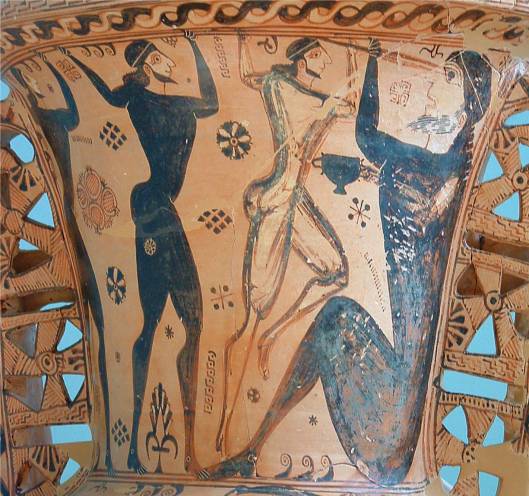
In some versions of the story (including Sophocles’ play), Odysseus acts as the main agent for, initially, bringing the bow to Troy, and then for bringing Philoctetes himself. So far, that is Odysseus’ only connection with archery. He is depicted as clever—being part of a successful scouting expedition in which a Trojan ally is killed and possibly the creator of the wooden horse—but, otherwise, his main accomplishments lie in beating up a trouble-maker at a public meeting and, at the funeral games which Achilles holds at the end of the Iliad for his companion, Patroclus, winning a footrace.
This footrace, however, leads us from Troy westward, as well as backward in time.
For all that there are these two huge things called the Iliad and the Odyssey, they are not all of the Troy story. They themselves are just collections of smaller stories stitched onto a plot outline. In the case of the Iliad, that outline is very basic: a. Achilles leaves war; b. Greeks substitute other warriors for Achilles; c. Achilles returns to war. The Odyssey is actually even more basic: man tries to find a way to sail home from Troy. Along with these, there are fragments from other parts of the tradition and lots of separate tales which often act as back-stories, probably invented when the popularity of the Troy tale in general caused a demand for singers to supply more material—the ancient equivalent of fan fiction!
One of these back-stories explains why Odysseus wins at the funeral games: he must already have been a famous foot racer, as he wins his bride, Penelope, from her father, the king of Sparta, in a footrace.
image20footrace.jpg
Not long after that, having gotten Penelope pregnant, he is off to Troy and won’t return for twenty years.
In the meantime, Penelope gives birth to a son, Telemachus, who grows up fatherless and in a household increasingly besieged by young men who claim that Odysseus must be dead and demand that Penelope must marry again.
image19jwwpenelope.jpg
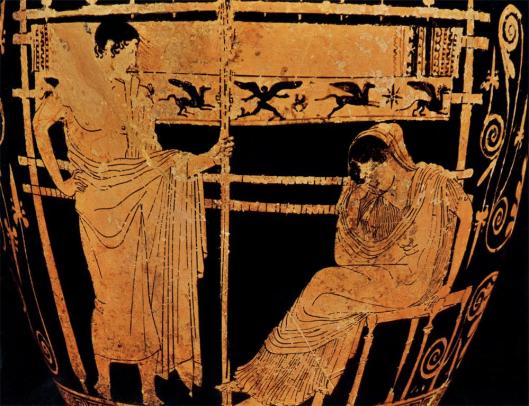
To delay being forced to accept one of these obnoxious toads, Penelope (our favorite in the story, along with Athena) claims that, before she can choose, she has to finish a shroud she is weaving for Odysseus’ father, Laertes. (That’s Telemachus, on the left.)
image20aapenandtel.jpg
In fact, although she weaves by day, she un-weaves by night and continues to do so for three years before one of her maids tells the suitors what’s going on.
image20penrav.jpg
(This is a remarkable piece of work designed by the painter/designer, Dora Wheeler, 1856-1940.
image21dorawheeler.jpg
It is not a painting, but, in fact, an embroidery—silk stitched into silk cloth—and a remarkable artifact—and, unfortunately, the only surviving one of its kind.)
In year 19, Odysseus comes home—disguised by Athena as an old beggar, to keep him safe until he can plot his revenge and gather allies. In the meantime, Penelope (who, to us, is as quick-witted as her wandering husband) announces an archery contest, the winner to—win her. Besides the trickiness of the target (having something to do with shooting through axes—scholars have argued over just how that works for years), there is the bow: it has such a pull that only her husband, she says, has ever been able to string it.
image22penelopebowangelicakauffmann.jpg
(This illustration is by another wonderful woman artist, Angelica Kauffmann, 1741-1807. Here’s a self-portrait.)
image23.jpg
Needless to say, the suitors are unable to do it, but that dirty old beggarman can—and does—and then, with a little help from Telemachus and a servant or two—not to mention Athena—proceeds to slaughter the suitors and clean house.
image25connolly.jpg
image26deathofsuitors.jpg
So, remembering the Mary Rose archer (as well as Bard), can we now imagine Odysseus’ build? And, for that matter, Robin Hood’s?
image27rharchcontest.jpg
Thanks, as ever, for reading!
MTCIDC
CD

A Long Stretch

12 Wednesday Jul 2017

Posted by Ollamh in Heroes, J.R.R. Tolkien, Literary History, Military History, Military History of Middle-earth

≈ Leave a comment

Tags

Agincourt, Archery, arrow bag, arrows, Bard the Bowman, Battle of Poitiers, Casula Mellita, Crecy, Edinburgh, English Longbowmen, Esgaroth, Greco-Roman, gunpowder, harpoon, Hundred Years War, Laketown, longbows, Medieval-Renaissance, Napoleonic Wars, Naval Warfare, Pinkie Cleugh, Roman, sailing, Smaug, The Hobbit, The Mary Rose, Tolkien

Welcome, as always, dear readers.

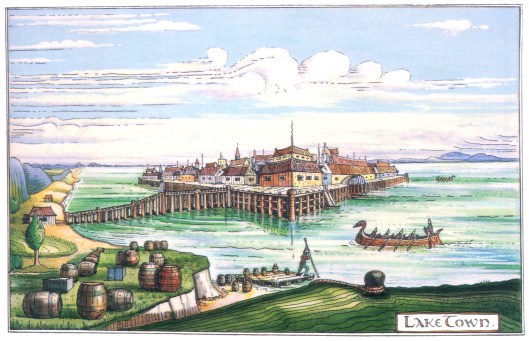
In the past, we had a posting on Bard the bowman

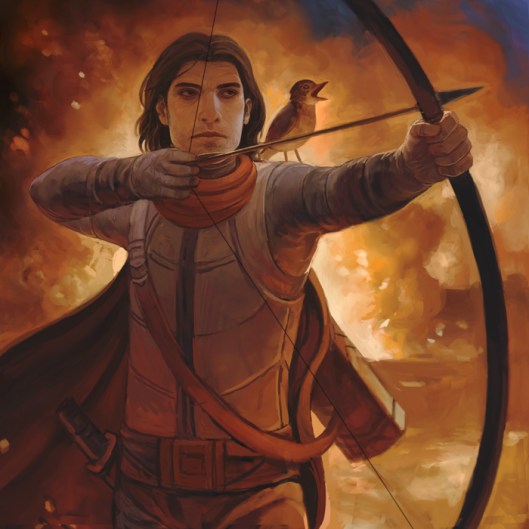
image1jeffchanbard.jpg

who rescued Esgaroth (Laketown)

image2esgaroth.jpg

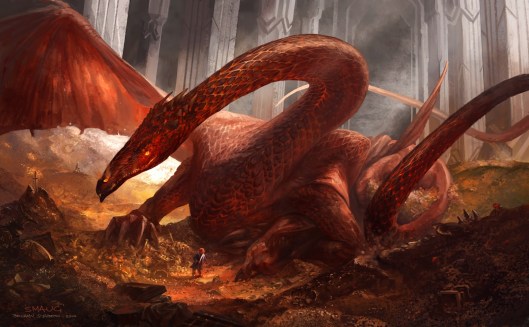
from the attack by Smaug.

image3smaug.jpg

(We especially like this Jeff Chan Bard not only because Bard is depicted as he is in the book, as an archer, but also because it includes the thrush who tells him where he is to strike.)

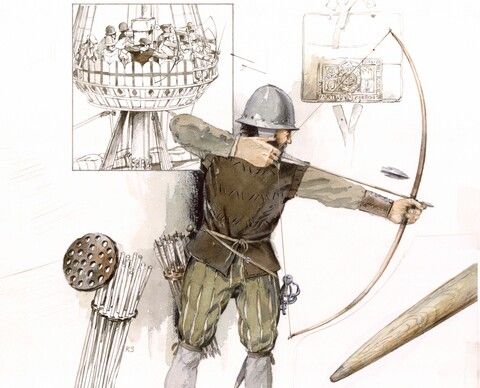
In that previous posting, we suggested that JRRT pictured Bard as looking and acting like one of the English longbowmen of the Hundred Years War

image4longbowman.jpg

rather than as a harpooner, as in the film.

image5bard.jpg

image6aharpoongun.jpg

Since that posting, we did a second which included bowmen, just a few weeks ago, about Mogul-knife and arrow wound, and now we would like to add a third.

As we’ve mentioned before, one of us is preparing a new university course to be taught in the autumn on the history of warfare.  As you can imagine, this is a big subject, but, in the process of shaping it, we want to include a week on developments in naval warfare over the centuries.  So far, we’ve divided it into several parts:

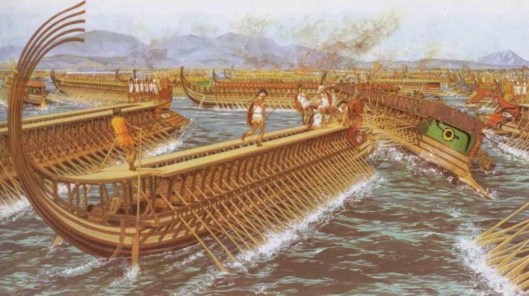
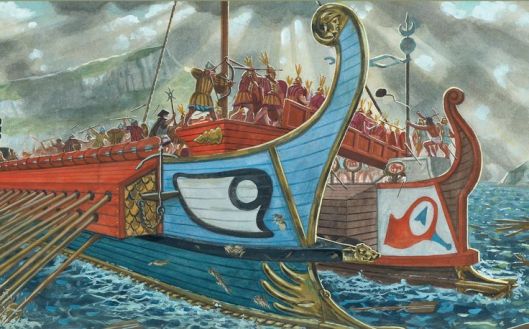
a. Greco-Roman

image6agrknavbat.jpg

image6romannavbat.jpg

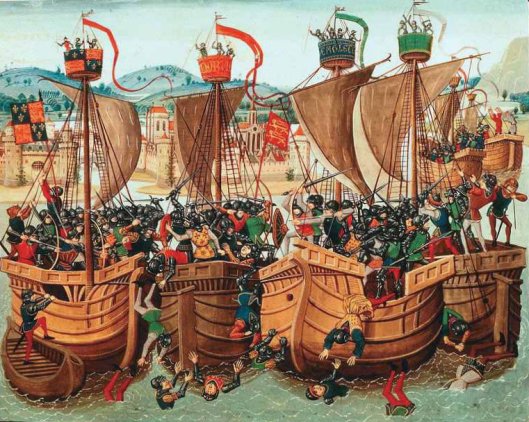
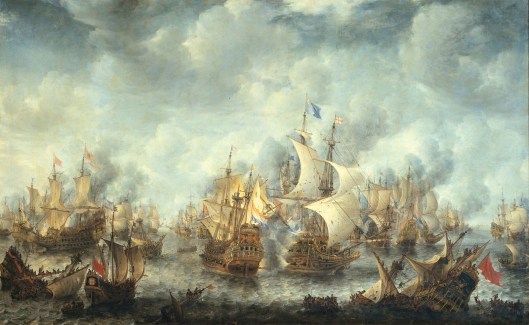
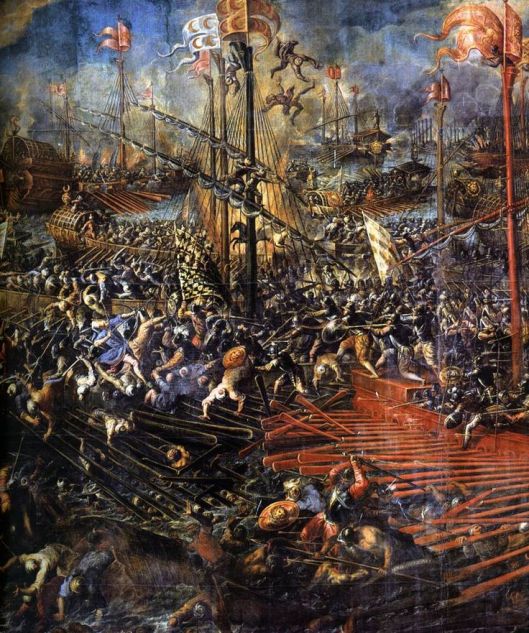
b. medieval-renaissance

image7sluys.jpg

image8lepanto.jpg

c. the age of sail

image9glorious.jpg

d. ironclads

image10monitor.jpg

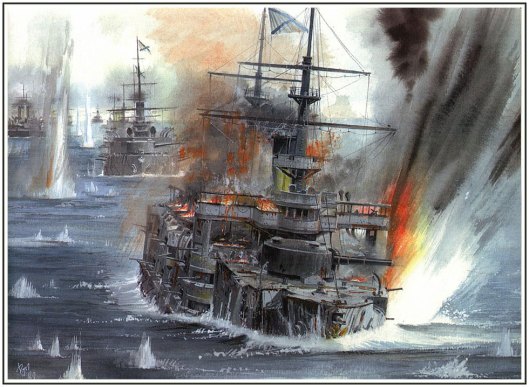
e. dreadnoughts

image11tsushima.jpg

While working on the Medieval/Renaissance section, we were reminded of what might be the most famous Renaissance shipwreck:  the sinking of The Mary Rose, 19 July, 1545.

image12mrsinks.jpg

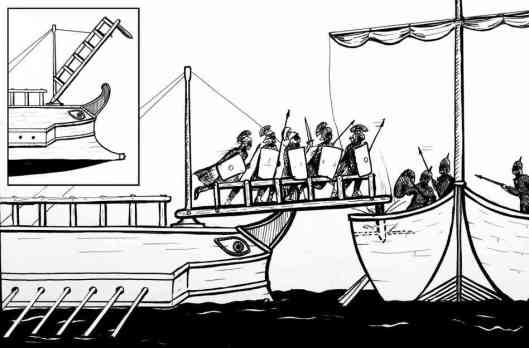
Medieval naval battles had been primarily infantry battles transferred to the sea, as had been Roman practice.  That practice was a story in itself—the traditional Roman explanation was that they were land-fighters and so had invented a device, called a “corvus”–that’s “crow” in English—probably because the point at the enemy’s end was a bit like a pecking beak.  This was a kind of gangplank which, dropped onto the enemy’s ship, stuck in place and allowed Roman marines to rush across and deal with their opposite numbers.

image13corvus.jpg

image14medbat.jpg

Things began to change with the invention of cannon in western Europe.  (The history of gunpowder in the Far East is its own subject—and one we urge those interested to have a look at.  Here’s a LINK to get you started.)  Used first on land perhaps by the 13th century, the first recorded use of cannon on a ship dates from 1338 (and here’s a LINK to naval artillery, in case you want to know more).

With cannon, you could stand off from an enemy ship and—your choice—cripple it by destroying its sails and rigging—or sink it with holes below the waterline.

image15renbat.jpg

Boarding, as the Romans had, was still a possibility, of course, and provided the extra benefit, if the boarding was successful, of allowing for the acquisition of an extra ship.  This could be added to your fleet or sold and the profits shared among the sailors—or, actually, if we go by Napoleonic British standards, the profits went to everybody at the top, including admirals who weren’t even present at the capture, with a teeny amount remaining for the seamen who’d actually taken the prize.

image16renbat1.jpg

To do that boarding, Romans—and medievals—had loaded their ships with soldiers, and the Mary Rose was no exception, its surviving records suggesting that there were about 200 soldiers in a crew of approximately 400-450.

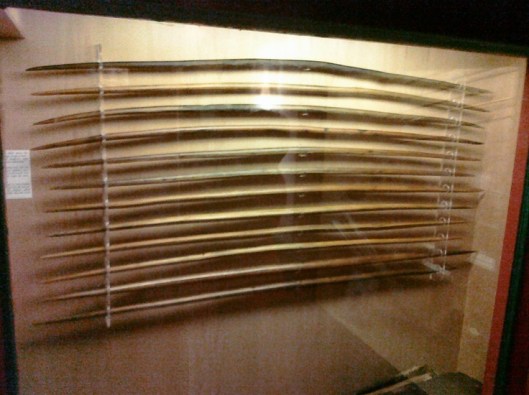
As a number of longbows have been recovered from the wreck,

image17mrlongbows.jpg

this would suggest that many of those soldiers were archers.

These, along with the artillery (and perhaps a small number of arquebuses?  To our current knowledge, none has been recovered from the ship, but, certainly, by 1545, they were in common use—at the battle of Pinkie Cleugh, east of Edinburgh, in 1547, the English army had several hundred German mercenary arquebusiers),

image18grmarq.jpg

would have supplied the missile weapons of the ship.

image19mrbowman.jpg

Not only were large numbers of artifacts discovered in the Mary Rose, but the skeletons of perhaps half its crew and about 90 of those were intact enough to warrant further study.  For our purpose, one, in particular is very interesting.

image20mrarcher.jpg

Discovered in the hold, he was a large man for his time, about 6 feet (about 183cm).  As well as revealing that he would have had a powerful build, his skeleton displayed repetitive stress injuries to his upper body.  There is discussion as to the pull-weight (how much muscle power it takes) of the longbow of the medieval/Renaissance period, estimates ranging from 90 to about 150 pounds (we’re sorry that we can’t readily convert this, as it isn’t pounds of weight, but pounds of force—the general idea is that it would have taken huge muscle power in either case), but, for a bow as tall as a bowman, this would have demanded great muscular strength—which would then have, over time, put huge stress upon an archer’s body.  This has then led archaeologists to suggest that he was a bowman.

And this brings us back to Bard, the actual archer, and a suggestion as to what he might have looked like.

JRRT only says:

“But there was still a company of archers that held their ground among the burning houses.  Their captain was Bard, grim-voiced and grim-faced…Now he shot with a great yew bow, till all his arrows but one were spent.”  (The Hobbit, Chapter 14, “Fire and Water”)

“a great yew bow” makes us think of the English bowmen we’ve mentioned before, and those we believe were in Tolkien’s mind, the victors at the battles of Crecy (1346), Poitiers (1356), and Agincourt (1415).

image21agincourt.jpg

To produce archers who could pull such powerful bows (and fire up to 10 arrows a minute, as we’ve mentioned in a previous posting), English archers began training as boys and continued throughout the years—as athletes of the bow, they had to keep in shape.  Such training and exercise would then have produced men like that discovered on the Mary Rose—big-shouldered, strong-armed—and given to the subsequent damage inflicted on the body by archery wear-and-tear.

So, might we then see Bard as not only “grim-voiced and grim-faced”, but “broad-shouldered and imposing”?  To which we can add this from The Hobbit:

“In the very midst of their talk, a tall figure stepped from the shadows.  He was drenched with water, his black hair hung wet over his face and shoulders, and a fierce light was in his eyes.”  (Chapter 14, “Fire and Water”)

All of which gives us:  “tall, black-haired, fierce, grim-voiced and grim-faced”—and, at our suggestion, “broad-shouldered and imposing”—a worthy portrait of Bard the Dragon-slayer.

Thanks, as ever, for reading!

MTCIDC

CD
PS

It’s not known what our Mary Rose archer was doing in the hold at the time the ship went down, but perhaps he was seeking to transfer extra ammunition to the main deck?  That ammunition would probably have been in the form of coarse linen bags carrying 24 arrows each—here’s a modern reconstruction

image22arrowbag.jpg

and here’s the LINK to the site from which it comes.  This belongs to an amazing woman whose website is full of her life on the edge of the Great Plains, in Kansas, USA—home of Dorothy of the OZ books, of course– as well as her photos of things like the reconstructed bag in the photo above.  Below is a picture of the Kansas tall grass prairie.

image23kansas.jpg

And Then the Dragon Came

14 Wednesday Jun 2017

Posted by Ollamh in Artists and Illustrators, Fairy Tales and Myths, Heroes, Imaginary History, J.R.R. Tolkien, Literary History, Narrative Methods, Villains

≈ Leave a comment

Tags

A.A. Milne, Apollonius, Arthur Rackham, Beowulf, Chrysophylax, Cressida Cowell, Dragons, Drawn From Life, Drawn From Memory, Dream Days, E.H. Shepard, Edwardian, Farmer Giles of Ham, How to Train Your Dragon, Kenneth Grahame, Maxfield Parrish, Nine Dragons, Now We Are Six, Octavian, Prince Valiant, Renaissance, Sir Gawain, Smaug, St. George and the Dragon, The Argonautica, The Hobbit, The House at Pooh Corners, The Reluctant Dragon, The Wind in the Willows, Tolkien, Victorian, Walt Disney, Western Medieval, When We Were Very Young, Winnie the Pooh

Welcome, dear readers, as always.
One of us is in the midst of creating a course for the fall term. It’s called “Handling Monsters: A Handbook” and several of those monsters are dragons—the “Sleepless Serpent/Dragon” of the ancient Greek literary epic by Apollonius, The Argonautica,
image1sleepless.jpg
the dragon which Beowulf fights,
image2beowulf.jpg
(when small, we always imagined this as looking like the one which Sir Gawain, Prince Valiant’s master, fights)
image3sirgawaine.jpg
Smaug,
image4smaug.jpg
and Toothless, from How to Train Your Dragon (by Cressida Cowell—there’s also a movie by that name, which is fun—great flying scenes–but it’s so different from the book that it really should have another title!)
image5hiccup.jpg
We must confess that we’ve never been big saurian fans, either dinosaurs or dragons, but, as monsters go, they have their uses. Saying that, however, we do have to add that we’ve always loved the “Nine Dragons” scroll, a 13th-century Chinese painting…
image6nine.png
[And here’s a LINK to a site at the Center for the Art of East Asia which you can see the whole scroll—well worth the visit—and revisit, if you’re like us and love Chinese painting.]
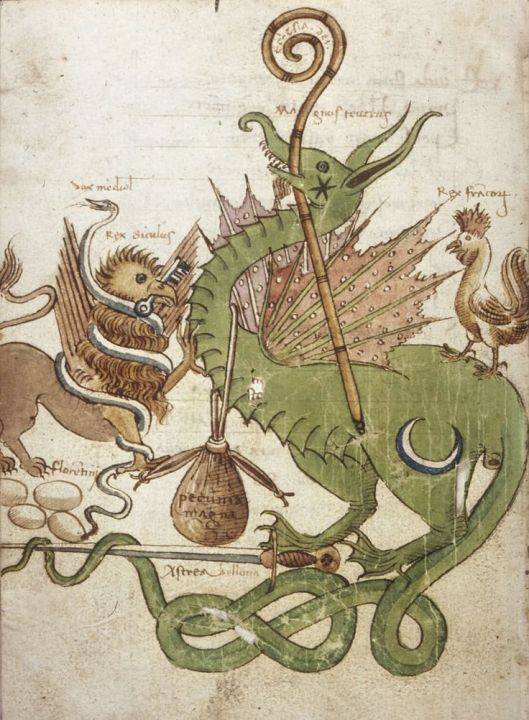
While putting together this course, we’ve been spending some time gathering dragon images. Sometimes, they seem pretty fantastic—painters with wild imaginations—
image7meddragon.jpg
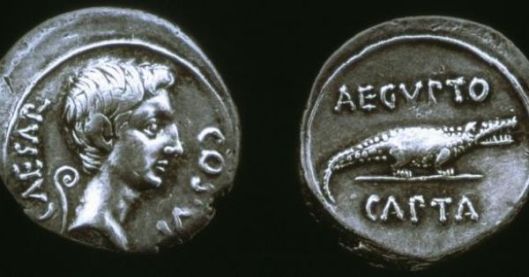
And sometimes they look like someone once saw a crocodile.
image8stg.jpg
[Perhaps on an old coin? For example, Octavian—the Emperor Augustus-to-be—after the defeat of Antonius and Cleopatra, issued this coin, which reads “Egypt Taken”,

image9aegypta.jpg
suggesting that, when a Roman thought of Egypt, it wasn’t the pyramids which came to mind, but a scaly, many-toothed amphibian!]
And the image before the coin reminds us that, in Western medieval/early Renaissance art, a major source of dragon pictures is religious, being depictions of St. George and his dragon-slaying.
image10stg1.jpg

image11stgeo2.jpg
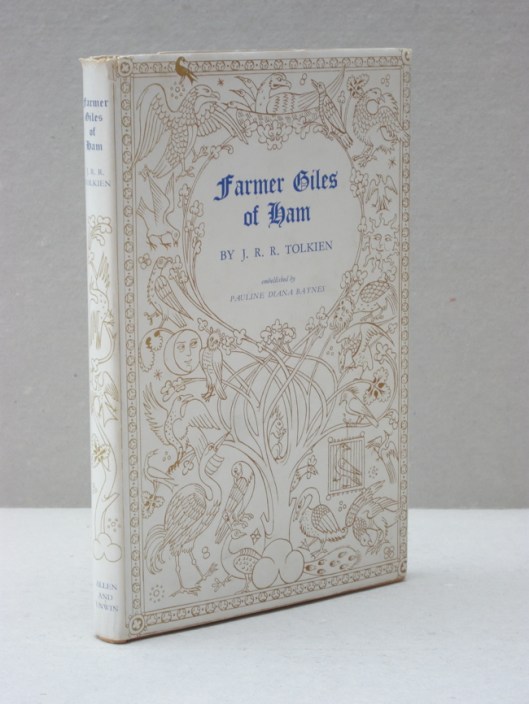
We’ve mentioned JRRT and Smaug, but that it only his first dragon story. There is another, Farmer Giles of Ham, written in 1937 and published in 1949.
image12farmergiles.jpg
If you haven’t read it, we recommend it as a look at JRRT at play, more Hobbit than Lord of the Rings. The story is about a very practical, but hardly adventurous farmer, Giles, who, after chasing off a giant from his village, is given the job of dealing with an invading dragon, Chrysophylax (maybe something like “Watchman of the Gold”).
image13xryso.jpg
Although the dragon is tricksy, Giles eventually overcomes him with a combination of shrewdness and a famous sword, Caudimordax (“Tailbiter”). In the process, he becomes not only wealthy, but also founds his own kingdom-within-a-kingdom. As well, though JRRT, more than once in his letters, lets us know that he is not an enthusiast for democracy, he provides a very critical view of monarchy and its pretensions. (This may also explain why, although those in the Shire may refer to “the king” and “the rules”, which presumably came with that monarch, their own local form of government is more familial than bureaucratic.)
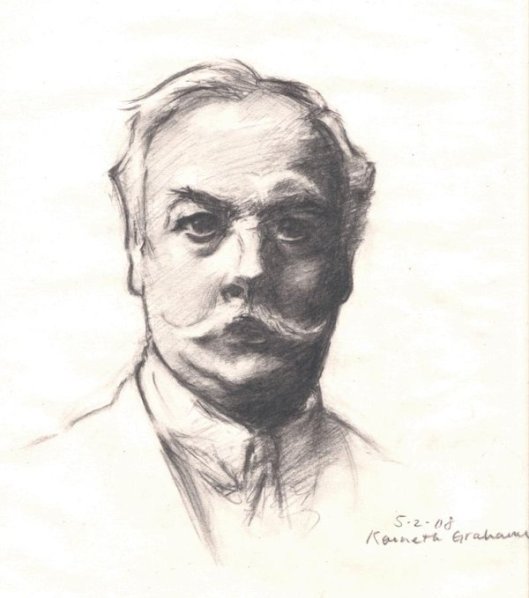
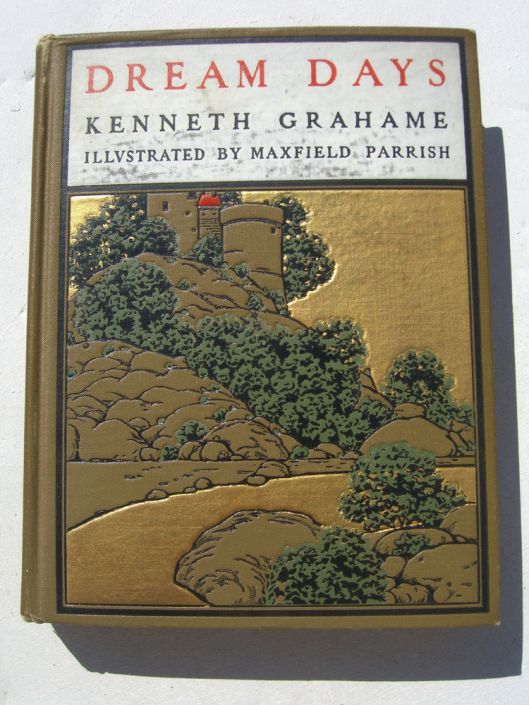
Chrysophylax is chatty, rather like Smaug, but there is a much lighter touch here, and Chrysophylax reminds us of our favorite dragon after Tolkien’s, the unnamed dragon in Kenneth Grahame’s
image14kgrahame.jpg
short story, “The Reluctant Dragon”, from his 1898 collection, Dream Days.
image15dreamdays.jpg
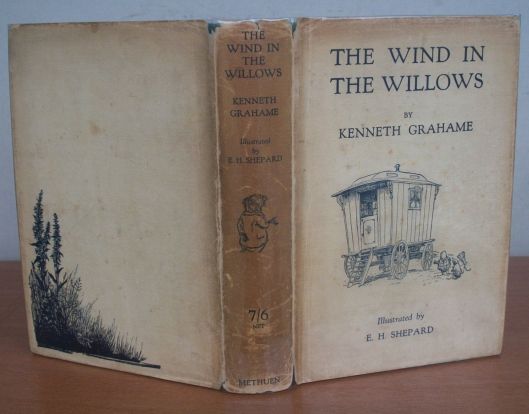
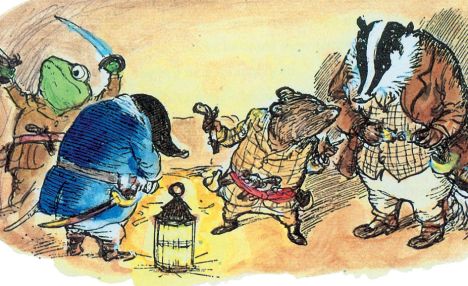
If you recognize Grahame’s name, you probably know it from his 1908 novel, The Wind in the Willows, with its well-known characters, Toad, Rat, Mole, and Badger—not to mention the wicked weasels!–
image16wiw1sted.jpg
image17wiwcharacters.jpg
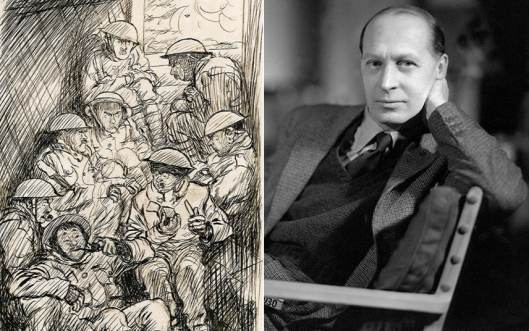
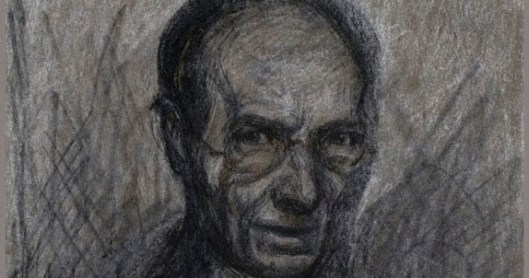
first illustrated by E.H. Shepard
image18ehshepard.jpg
whom you may also know as the illustrator of A.A. Milne’s Winnie the Pooh, The House at Pooh Corners, When We Were Very Young, and Now We are Six.
image19wthepfirst.jpg
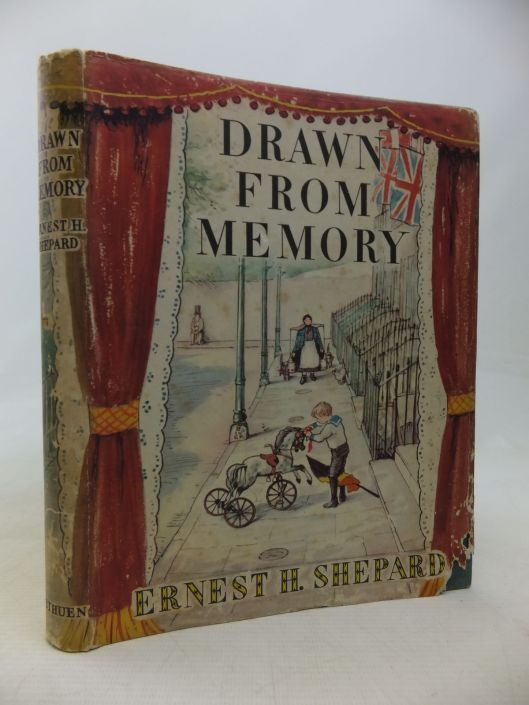
[Shepard also wrote two volumes of autobiography—which he illustrated, of course—Drawn from Memory (1957) and Drawn from Life (1961)
image19drawnfrommem.JPG

image20drawnfromlife.JPG
and, for a picture of a growing up in the later Victorian world, beautifully written and illustrated, we very much recommend both.]
[And a second footnote here: Arthur Rackham—one of our favorite late-19th-early-20th-century illustrators– also illustrated The Wind in the Willows,
image22rackham.jpg

image23wiwrack.jpg
his last project before his death in 1939. It was published a year later, in 1940.]
The title gives away a great deal of the plot of Grahame’s “The Reluctant Dragon”. Instead of being a murderous hoarder, like Beowulf’s dragon, or Smaug, this is dragon-as-pacifist, (as depicted by his original illustrator, Maxfield Parrish):
image24fearless.jpg
not in the least interested in plundering and burning, but rather in viewing sunsets and living a peaceful existence—until St. George appears. As to what happens next, we’re not going to issue a spoiler alert here, but rather provide links to three works by Grahame: two collections of stories and essays, The Golden Age (1895), Dream Days (1898), and The Wind in the Willows (1908), inviting you to read for yourself and to enjoy Grahame’s elegant Edwardian prose and gentle approach.
With thanks, dear readers, for…reading.
MTCIDC
CD

PS
Walt Disney studios made cartoons of “The Reluctant Dragon” (1941) and “The Wind in the Willows” (1949), which are currently available in Disney collections. They both stray rather far from the original stories, but are fun in themselves (and Eric Blore’s voice is perfect for “the handsome and popular Toad”).
PPS
One of us has written what we might immodestly call a very good short story based upon Arthur Rackham’s last days and his determination to finish his illustrations to The Wind in the Willows before his death and we plan to publish it here next week as a kind of “Summer Holidays Extra”. We hope you’ll enjoy it.


Accuracy? Well, Yes, But…

07 Wednesday Jun 2017

Posted by Ollamh in Artists and Illustrators, Heroes, J.R.R. Tolkien, Literary History, Military History, Narrative Methods, The Rohirrim

≈ Leave a comment

Tags

American Civil War, American Revolution, Concord, Don Troiani, Germantown, grenadiers, H. Charles McBarron, Harper's Monthly, Howard Pyle, Illustration, John Trumbull, Joseph Warren, King Arthur, Lexington, Pirates, Richard Simkin, The Battle of Bunker Hill, The Battle of Nashville, The Lord of the Rings, The Rohirrim, The Salem Wolf, Tolkien

Welcome, dear readers, as always.

Today’s post takes us to the question of what we like and why and how such likes may push us—who, we realize, are a little stiff on the subject of accuracy—to accept things which, if our feelings weren’t engaged, we would briskly reject.

We begin by looking at a painting by one of our favorite late Victorian/Edwardian illustrators, Howard Pyle (1853-1911).

image1hp.jpg

If you’re a regular reader (and we hope you are—or will be!), you’ll have seen his work on our pages any number of times, from his King Arthur illustrations (and here’s a LINK to a free 1922 reprint at the Internet Archive)

image2ka.jpg

to his pirates (and here’s a LINK to a later—c.1921—collection of Pyle’s pictures and writings on pirates at Internet Archive).

image3hppirates.jpg

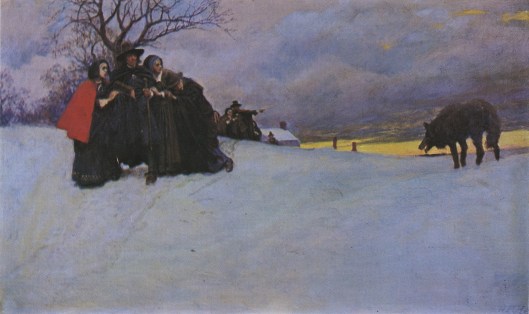
Pyle also wrote and illustrated original fiction—just look at this haunting picture from a short story, “The Salem Wolf”, which was published in the December, 1909, issue of Harper’s Monthly Magazine.

image4salemwolf.jpg

(And here’s a LINK to the story at Internet Archive)

Pyle also painted stand-alone historical pictures, such as this of “The Battle of Nashville” (1907).

MN 60

And we’re lucky to have a photograph of the artist at work on this very picture.

image6hppainting

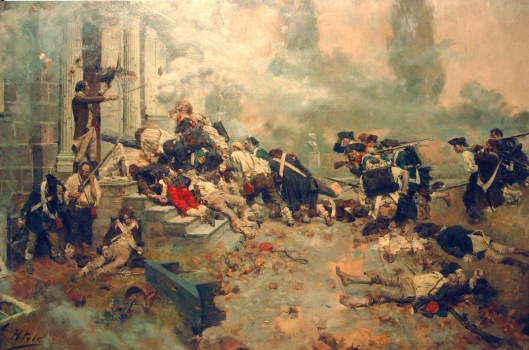
Besides American Civil War pictures, Pyle painted several based upon incidents of the American Revolution, such as this, of the assault on the Chew House, at the Battle of Germantown (4 October, 1777).

image7pylegermantown

Another of his pictures of the Revolution is the subject of this post, “The Battle of Bunker Hill” (1897).

image8pylebunkerhill

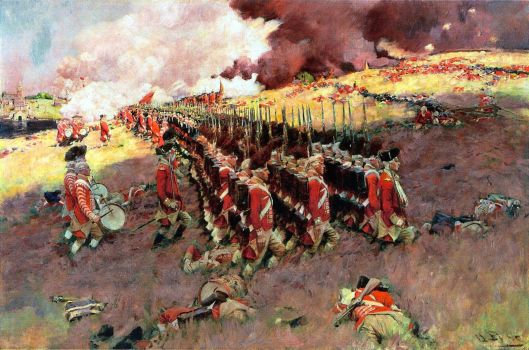
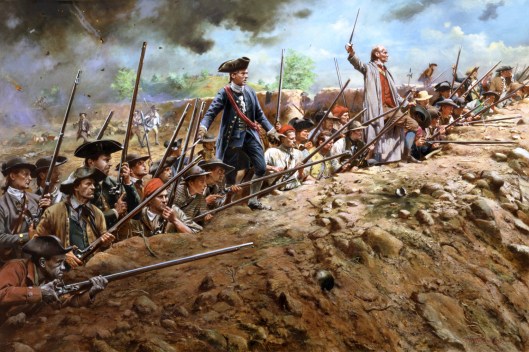
We’re not sure when one of us first saw this picture—childhood, we’d guess—but we were immediately bowled over by it. It’s the adventure of it: those long ranks of redcoats stoically marching up the hill, drums beating behind. It’s not a sanitized picture—just look up the hill and all around you can see the wreck of the earlier British attacks—but its emphasis is upon the courage it must take to do what those soldiers did.

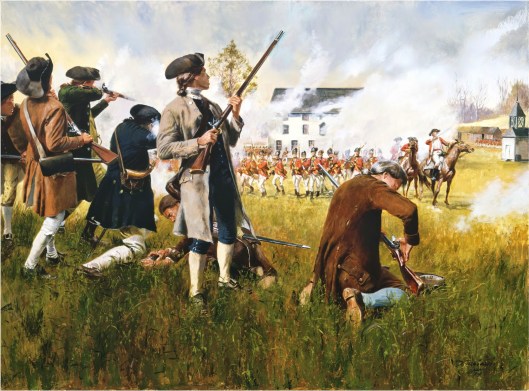
This was, in fact, the third battle of the American Revolution. The war had begun in mid-April, 1775, when a raiding party of British troops, ordered to disrupt local preparations for defense, fought two skirmishes with local militia, at Lexington

image9lexington.jpg

and Concord,

image10concord.jpg

two rural settlements some twenty miles or so west of Boston.

When the British withdrew into Boston itself, those locals, who had grown in numbers to about 15,000, drawn from all over New England, blockaded the town and there was a period of stalemate, while both sides were reinforced. When it was clear that the locals had seized a nearby hill and were planning to plant artillery there which would then be capable of bombarding Boston, the British were forced to move. Their choice was to attack that hill, which was named “Breed’s Hill” but, through an historical mix-up, the battle was named for the hill to its rear, “Bunker Hill”.

image11bunkerhill.jpg

Initially, the British plan was to have part of its force make a feint—a fake attack—against the main part of the hill, where the locals had built an open-backed fortification, called a redoubt, while the real attack was to push through the weaker local left and curve around to hit the locals from the rear.

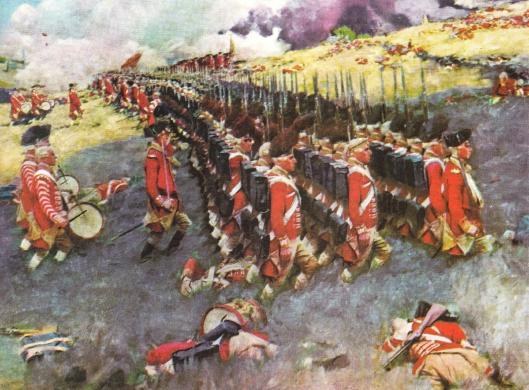
By underestimating the defense, the British soon suffered over a thousand casualties to the local 450. As the assaults were driven back, the British plan changed and the main attack was to be uphill, straight at the redoubt and this is what is depicted in Pyle’s painting, specifically the advance of the 52nd Foot (“Foot” is 18th-century shorthand for “regiment of infantry”).

image12hpbunkerhill.jpg

This is not the first well-known painting of the battle, however. In the first third of the 19th century, John Trumbull (1756-1843), a prominent American artist, painted several versions of a work entitled, “The Death of General Warren at the Battle of Bunker’s Hill, June 17, 1775”.

image13trumbullbunkerhill.jpg

This picture belongs to what we might call both the “heroic school” and the “portrait school”, the former because of a certain flashy quality (look at the way the wind seems to be whipping everything—and where are those flames on the right coming from?), the latter because, not only is the local officer, Joseph Warren depicted, but so are a number of other figures—two of the British generals, two British majors, and a number of more minor participants.

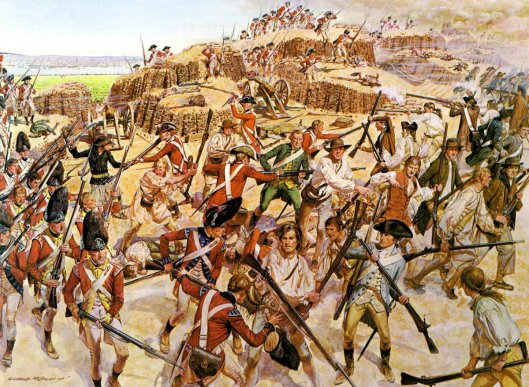
Bunker Hill remained—and remains—a popular subject for historical painters, most of them depicting events from the local side. Here is one version, by the distinguished 20th-century American military artist, H. Charles McBarron (1902-1992).

image14mcbarron.jpg

And here are two by one of our favorite contemporary American Civil War artists, Don Troiani (1949-).

image15troi.jpg

image16troi.jpg

All pictures are not from the viewpoint of the colonists, however. The late-Victorian/Edwardian British military artist, Richard Simkin (1850-1926), gave us this view.

image17simkin.jpg

Of all of these images, the Trumbull has drawn upon his memory and upon his sketchbooks, too, we bet, to give a general impression of the look of the soldiers, but, although he was part of the colonial force besieging Boston, he only saw the battle through a telescope. McBarron was a collector of uniforms and equipment, as is Troiani, and their works are painstakingly accurate. Simkin, although he, too, was a collector, came from an earlier time, just at the beginning of serious research on weapons and uniforms of the past, and, therefore, certain elements in his picture—the plumes and cords on his men’s bearskins and those packs (left behind in Boston, in reality), for instance—are not correct. Even so, his picture is far more accurate than Pyle’s, which is full of mistakes, in everything from the uniforms and equipment to those grenadiers (those guys in the fuzzy hats in the center), who shouldn’t be there at all, having been detached to form part of the right wing assault force.

And yet the Pyle is still our favorite depiction of the battle. Why? Because it feels right: it’s a 19th-century image of courage and discipline, and appeals to our romantic souls, even though there are casualties strewn about, which, to us, only serves to emphasize the bravery and stick-to-it-iveness of those solid infantry.

And this is where JRRT comes in. We’ve said before: our favorite part of P. Jackson’s films is anything to do with the Rohirrim.

image18rohirrim.jpg

The fact that, in the books, they live in wide, grassy plains (unavailable in New Zealand) and that their capital, Edoras, does not have “a dike and mighty wall and thorny fence” in the films, along with any other details it would be easy to extract from The Lord of the Rings, doesn’t matter to us in the least. The depiction in the films feels right and we’re content with that, even when there are other parts of the films where we have other reactions. Simple (and perhaps surprising to us) as that.

So, dear readers, do you have similar reactions? And to what? We’d love to hear!

And thanks, as always, for reading.

MTCIDC

CD

Finding a Voice

10 Wednesday May 2017

Posted by Ollamh in Heroes, J.R.R. Tolkien, Literary History, Military History, Narrative Methods

≈ Leave a comment

Tags

Abraham Lincoln, Abraham Lincoln Vampire Slayer, American Civil War, Daniel Day Lewis, early photography, Edward Everett, Gettysburg, Gettysburg Address, National Cemetery, Saruman, Smaug, spell-casting, Steven Spielberg Lincoln, The Battle Cry of Peace, The Blue and the Gray, The Hobbit, The Lord of the Rings, The Voice of Saruman, Tolkien, voices

Welcome, dear readers, as always.

Recently, it has been thought that a new picture of Abraham Lincoln

Lincoln-CGerman-1861.jpg

at Gettysburg, on November 19, 1863 has been discovered. Lincoln had been invited as one of the speakers for the dedication of a new National Cemetery to honor the Union dead from the battle fought at Gettysburg on 1-3 July, 1863.

Battle of Gettysburg - Cyclorama - Paul Philippoteaux SAM_1322.JPG

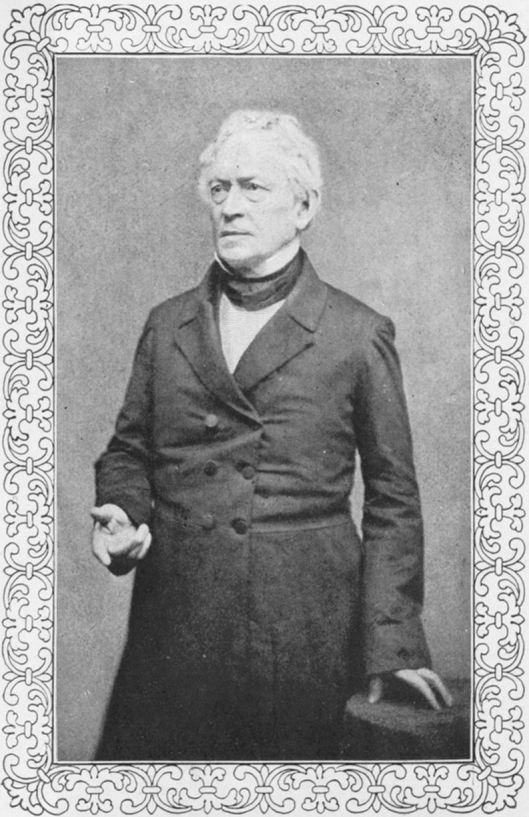
The main speaker, and the one everyone was waiting for, was the famous orator, Edward Everett,

Edward_Everett.jpg

whose speech is now totally forgotten (here’s a link to it—it’s worth reading as a specimen of mid-19th-century American oratory—something Everett was famous for), but, to say that Lincoln’s speech has survived is, for Americans—and for anyone who loves good rhetoric, for that matter–an understatement.

nicolaycopy.jpg

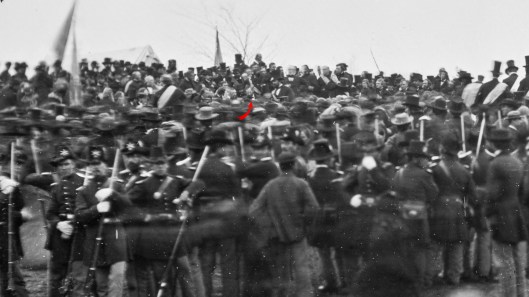
Up until recently, there was one definite photograph of Lincoln on the occasion.

Crowd_of_citizens,_soldiers,_and_etc._with_Lincoln_at_Gettysburg._-_NARA_-_529085_-crop.jpg

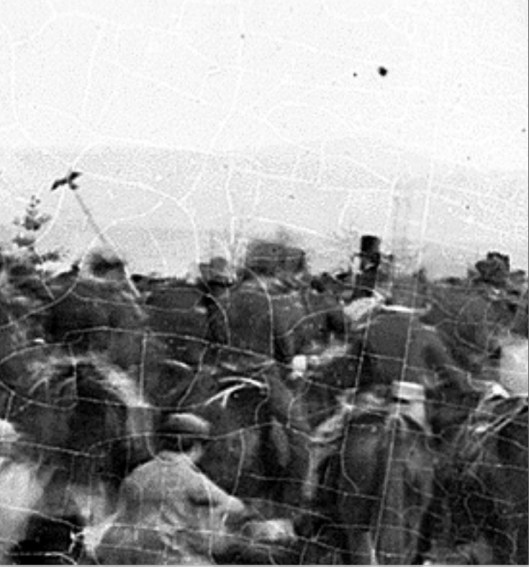
(There is a second picture, supposedly of Lincoln on horseback, but it’s been pointed out that the figure appears to be wearing epaulettes,

image5a1notabe.jpg

image5aepaulettes.jpg

And, if so, is therefore more likely to be one of the military dignitaries at the ceremony.)

This new photo, which seems pretty convincing to us, now gives us two illustrations of one of the most famous moments of Lincoln’s presidency.

o-LINCOLN-570.jpg

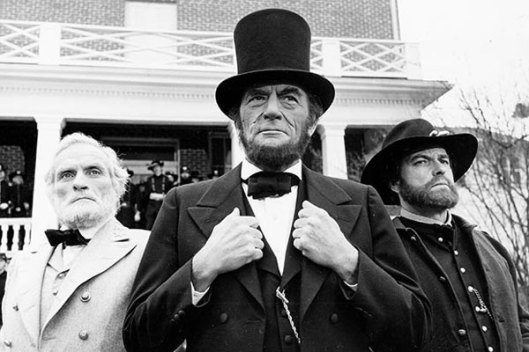
There are a number of films about Lincoln, at least since the 1915 The Battle Cry of Peace, with Lincoln portrayed by numerous American actors, some of them famous, such as Gregory Peck, from the television series The Blue and the Gray (1982)

Gregory-Peck-Lincoln.jpg

with the most recent being two films from 2012, the improbable Abraham Lincoln Vampire Hunter

abraham_lincoln_vampire_hunter_ver3.jpg

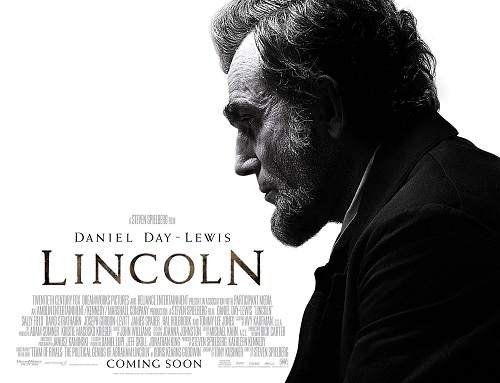
and Steven Spielberg’s Lincoln

LINCOLN-landscape-poster.jpg

starring Daniel Day Lewis.

Lewis, an actor famous for his strenuous preparations for every role he’s ever played, was sometimes criticized in reviews for his light voice, the impression being that such a deep, thoughtful man should have had a voice to match. In fact, contemporary accounts of Lincoln tell us that his voice was higher—a tenor rather than a baritone—and that his accent was a rural one, mirroring his boyhood years on the Indiana/Kentucky border (his sometimes somewhat phonetic spelling helps here to reconstruct this).

Thus, though his self-presentation—especially his voice–might have seemed to some (especially those who hated him—one of his main generals even referring to him as “the original gorilla”) less than impressive, his words, at least in written form, have endured.

This made us think of the opposite, from JRRT, characters whose words might not matter much, but the way in which they were delivered was persuasive—or almost.

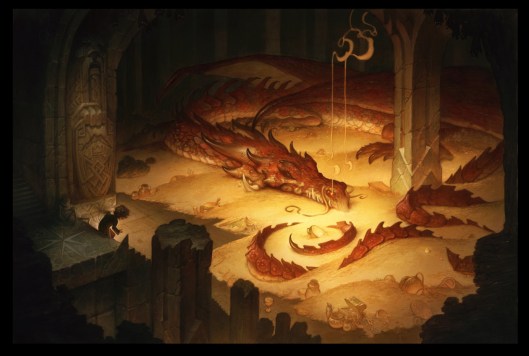
We began with Smaug.

bilbo and smaug.jpg

As we said in our last, Smaug’s voice has a danger for Bilbo in it:

“Whenever Smaug’s roving eye, seeking for him in the shadows, flashed across him, he trembled, and an unaccountable desire seized hold of him to rush out and reveal himself and tell all the truth to Smaug. In fact he was in grievous danger of coming under the dragon-spell.” (The Hobbit, Chapter 12, “Inside Information”)

This dragon-spell has a persuasive power to it.   It’s never explained, but it seems to embody the idea that the tone can bring out the worst in someone:

“Now a nasty suspicion began to grow in his mind—had the dwarves forgotten this important point too, or were they laughing in their sleeves at him all the time? That is the effect that dragon-talk has on the inexperienced. Bilbo of course ought to have been on his guard; but Smaug had rather an overwhelming personality.”

Perhaps this is what gives the “dragon-spell” its power: that it somehow embodies the personality of the spell-caster. As Smaug is evil and corrupt and suspicious, so his spell can cause others to have corrupt and suspicious thoughts, as Bilbo does.

We see this same effect on the inexperienced when Gandalf, the companions, and Theoden visit the defeated Saruman at Orthanc

obra-tolkien-mano-hildebrandt-ilustradores-fa-L-q4g6J8.jpeg

in the chapter named, appropriately, “The Voice of Saruman”:

“Suddenly another voice spoke, low and melodious, its very sound an enchantment. Those who listened unwarily to that voice could seldom report the words that they heard; and if they did, they wondered, for little power remained in them. Mostly they remembered only that it was a delight to hear the voice speaking, all that it said seemed wise and reasonable, and desire awoke in them by swift agreement to seem wise themselves. When others spoke they seemed harsh and uncouth by contrast; and if they gainsaid the voice, anger was kindled in the hearts of those under the spell.” (The Two Towers, Book Three, Chapter 10, “The Voice of Saruman”)

When Gandalf first meets Saruman in Orthanc, Saruman’s “robes, which had seemed white, were not so, but were woven of all colours, and if he moved they shimmered and changed hue so that the eye was bewildered.” (The Fellowship of the Ring, Book Two, Chapter 2, “The Council of Elrond”)

It may be, then, that the power of Saruman’s voice is in the same shimmer—he appears to be not just one, but many and therefore both momentarily persuasive, as well as ultimately insubstantial, since “those who listened unwarily to that voice could seldom report the words that they heard”. It’s clear, however, that, like the voice of Smaug, the spell within the voice was, potentially, horribly persuasive:

“For some the spell lasted only while the voice spoke to them, and when it spoke to another they smiled, as men do who see through a juggler’s trick while others gape at it. For many the sound of the voice alone was enough to hold them enthralled; but for those whom it conquered the spell endured when they were far away, and ever they heard that soft voice whispering and urging them.”

And yet—although

“..none were unmoved; none rejected its pleas and its commands without an effort of mind and will, so long as its master had control of it.”

There are those of the party on this visit to Orthanc who are not taken in at all. Gimli appears to be unaffected, saying, “The words of this wizard stand on their heads”, and Eomer calls Saruman “an old liar with honey on his forked tongue”. Theoden even breaks the spell, although he is said to speak “thickly and with effort.” At such resistance, Saruman shows both a degree of control and a losing of it, cajoling and calling names alternately, until “Gandalf laughed.” And “The fantasy vanished like a puff of smoke.”

Knowing Saruman’s eventual end, murdered by another whose tongue was persuasive enough to keep Theoden a prisoner once upon a time,

leegrima.jpg

can we see the beginning of that end here? Once the “fantasy” created by Saruman’s voice is broken by Gandalf’s gentle mockery, what is left for him after his grand plans to be (at least) Sauron’s ally but “some mischief still in a small mean way”? (The Return of the King, Book Six, Chapter 6, “Many Partings”)

And, at the end of that mischief, Grima only escapes Saruman and his voice through murder—and his own quick death, following.

Gandalf’s laughter suggests that the source of escape from Saruman’s voice may be detachment: if one can step away from the sound, that sound loses its (literal) charm. It may take effort—as it does for Theoden—but, once away, whatever magic was in the voice vanishes into the smoke it really was.   As well, obvious resistance seems always to shake Saruman’s control and that flattering tongue, which can say, on the one hand,

“Theoden Lord of the Mark of Rohan..declared by your noble devices, and still more by the fair countenance of the House of Eorl. O worthy son of Thengel the Thrice-renowned!”

But, when thwarted, can cry:

“Dotard! What is the house of Eorl but a thatched barn where brigands drink in the reek, and their brats roll on the floor among the dogs?” (The Two Towers, Book Three, Chapter 10, “The Voice of Saruman”)

It is striking that, in neither case, are his words to be trusted, any more than his voice—and here we can return to Abraham Lincoln, whose voice may not have impressed, but whose words continue to be remembered.

z235445.jpg

Thanks, as always, for reading.

MTCIDC

CD

Just a Nobuddy

03 Wednesday May 2017

Posted by Ollamh in Artists and Illustrators, Fairy Tales and Myths, Heroes, Imaginary History, J.R.R. Tolkien, Literary History, Narrative Methods

≈ Leave a comment

Tags

akaletes, Athena, Bilbo, Circe, cyclops, face culture, Greek, Homer, kleos, Odysseus, Outis, Polyphemus, Poseidon, Riddles in the Dark, Smaug, Telemachus, The Hobbit, The Lord of the Rings, The Odyssey, Tolkien, true name

Welcome once more, dear readers.

“Who are you and where do you come from, may I ask?”

inquires Smaug. (The Hobbit, Chapter 12, “Inside Information”)

image1smaug.jpg

Earlier in The Hobbit, when asked this indirectly by Gollum, Bilbo had replied directly: “I am Mr.

image2bilbogollumlee.jpg

Bilbo Baggins…” (The Hobbit, Chapter 5, “Riddles in the Dark”)

This had led him into a deadly game of riddles, but now Bilbo seems more wary—which is just as well, as the narrator tells us when Bilbo answers Smaug’s question indirectly:

“This of course is the way to talk to dragons, if you don’t want to reveal your proper name (which is wise), and don’t want to infuriate them by a flat refusal (which is also very wise).” (The Hobbit, Chapter 12, “Inside Information”)

Bilbo’s answer to Smaug’s question about his identity is a series of what we might call “What Have I Got In My Pocket?” names—riddling titles which, just like that absent-minded remark, only Bilbo can understand:

“I am the clue-finder, the web-cutter, the stinging fly. I was chosen for the lucky number…I am he that buries his friends alive and drowns them and draws them alive again from the water. ..I am the friend of bears and the guest of eagles. I am Ringwinner and Luckwearer; and I am Barrel-rider.” (The Hobbit, Chapter 12, “Inside Information”)

All of these titles are references to events earlier in the story, of course, although a number of them, like “Ringwinner”, also sound like Norse or Old English kennings—that is, poetic names for often ordinary things, like “whale road” for “sea” and “wave’s horse” for “ship” or “sky candle” for “sun”. One which is close to Bilbo’s “Ringwinner“ is “ring-giver”, a kenning for a “lord”. Because they refer to personal experiences, Bilbo—and we readers—must assume that they would mean nothing to Smaug—or almost—

“Ha! Ha! You admit the ‘us’?” laughed Smaug. “Why not say ‘us fourteen’ and be done with it, Mr. Lucky Number?”

A lucky guess? (And interesting that, in Middle-earth, there are such things as “lucky numbers”—we wonder how many more examples of “lucky” vs “unlucky” things we might find?)

The narrator had said that not revealing your proper name is wise and the consequence of Bilbo’s mistake in telling Gollum that he is “Mr. Bilbo Baggins” will appear many years later, in the form of sinister visitors to the Shire, offering money for the location of “Baggins”.

image3nazgul.jpg

There can be physical danger, then, in properly identifying yourself.

There may be another reason for not doing so and it could entail physical danger not for the protagonist in the story, but a surprise threat for the antagonist.

When Odysseus and his men visit the cave of the Cyclops, Polyphemus,

image4cyclops.jpg

and are trapped there, Odysseus, when asked by Polyphemus, gives a false name: Outis (OO-tis), meaning “No one/nobody” in Greek. His subsequent action would suggest that the reason why he does so is that—as he says himself—he has a reputation (for cleverness) which reaches to the heavens. By providing a false name, he intends to put the Cyclops off his guard before defeating him, which he does by:

  1. getting him drunk

image5cydrink.jpg

  1. blinding him

image6blinding.jpg

  1. slipping himself and his men out of Polyphemus’ cave under the bellies of the Cyclops’ sheep.

image7sheepslip.jpg

Having succeeded, however, Odysseus seems to change his plan—and mind—completely, shouting, as his ship takes him away, his name and address, even as the Cyclops hurls huge rocks at the ship and his men beg him to stop.

image8cyrocking.jpg

In the mind of an Homeric hero, however, Odysseus has no choice.

A major element in the life of such heroes is something called “kleos” (KLAY-oss)—which is somewhat difficult to translate. In the heroic world it means something like “personal name within the larger framework of a family and its reputation”—and that’s only the beginning. Kleos is almost a kind of inheritable object and includes such elements as:

  1. divine/semi-divine parents/ancestors
  2. divine patrons
  3. father’s reputation
  4. own reputation, which includes
  5. famous battles/campaigns participated in
  6. famous enemies killed (and spoils taken)
  7. plunder from cities sacked (includes not only goods, but women)

And #4 could be something to be said for parent or ancestor, as well. Your father or grandfather might have been known as “Sacker of Cities” and this adds to the general kleos.

It’s also possible to lose kleos—divinities pick and choose whom they will help, for example, and, just because your father was the client of a god, doesn’t mean that you will be. It is a definitely positive sign for Odysseus’ family’s continued kleos, for example, when, in Odyssey Books 2 and 3, Athena, disguised as the human Mentor, appears and offers Odysseus’ son, Telemachus, advice.

The Homeric world is a so-called “face” culture. In such a culture, everything is public. In fact, the word kleos comes from the verb kalo (kah-LO), meaning to “to summon/call by name”, that name being, in the case of a warrior, not only your name but where you stand in your family’s reputation, its kleos.

Thus, it’s important, when a warrior defeats a powerful enemy, not only should the enemy warrior know who beat him, but all the bystanders, should there be any, as well.

image9warrior.jpg

For Odysseus, then, using a false name might give him an initial advantage over Polyphemus, but his victory is only complete and he can only claim kleos when he reveals to the Cyclops who has defeated him. This will lead to terrible subsequent consequences for Odysseus. Polyphemus’ father is Poseidon, god of the seas

image10pos.jpg

and he will make things very difficult for Odysseus later in the Odyssey,

image11pos.jpg

but, in the world of kleos, Odysseus has no choice but to reveal himself to gain the credit necessary for maintaining it.

Another reason for concealing your name has to do with magic. In many of the world’s older traditional cultures, people might have several names, either in succession, or public versus private. Behind the public versus private stands the idea that you are your name—that is, all that is you is embodied in your name. If someone knows that name, that person can use that name against you, either to curse you—and, using your real name, that curse might stick to it—or to summon you for magical purposes. Once your true name is called, a sorcerer can make you obey, even against your will.

In Odyssey 10, Odysseus and his men land on an island which is the home of the enchantress, Circe.

image12circe.jpg

She has the power to shift the shapes of men into those of animals and vice versa, as a scouting party from Odysseus’ ship soon finds out. She gives them a drink with some sort of magic drugs mixed in and, with a wave of her staff, turns them into pigs (although they retain their human minds).

image13enchant.jpg

She then tries this on Odysseus, but, in his case, it doesn’t work, much to her surprise, and he, drawing his sword, quickly forces her surrender.

image14defeat.jpg

There is no direct explanation for the failure of her magic in Book 10, but there is, in fact, a clue in the word she uses for Odysseus in her frustration. She calls him “akaletes” (ah-KAH-leh-tehs)—which means “unsummonable/uncallable by name” and is from the same root as kleos and kalo. The implication here is that, for her magic to work, she needs a name—something we might presume Odysseus’ piggy companions must have foolishly given her. That he is unsummonable suggests that he has given her a false name and therefore her magic hasn’t worked.

And is this perhaps the real reason why it was wise that Bilbo didn’t identify himself directly to Smaug?

image15smaug

After all, Smaug, unlike the agents of Sauron, wasn’t likely to roam the countryside, offering gold in return for information about the whereabouts of a certain “Baggins”. He does, however, appear to have a certain persuasive magic:

“Bilbo was now beginning to feel really uncomfortable. Whenever Smaug’s roving eye, seeking for him in the shadows, flashed across him, he trembled, and an unaccountable desire seized hold of him to rush out and reveal himself and tell all the truth to Smaug. In fact he was in grievous danger of coming under the dragon-spell.” (The Hobbit, Chapter 12, “Inside Information”)

That magic seems to lie in his words and tone—Bilbo, listening, is said to be in peril of “dragon-talk”—and we want to talk more about such magical persuasion in our next posting…

Thanks, as ever, for reading!

MTCIDC

CD

← Older posts
Newer posts →

The Doubtful Sea Series Facebook Page

The Doubtful Sea Series Facebook Page

  • Ollamh

Categories

  • Artists and Illustrators
  • Economics in Middle-earth
  • Fairy Tales and Myths
  • Films and Music
  • Games
  • Heroes
  • Imaginary History
  • J.R.R. Tolkien
  • Language
  • Literary History
  • Maps
  • Medieval Russia
  • Military History
  • Military History of Middle-earth
  • Narnia
  • Narrative Methods
  • Poetry
  • Research
  • Star Wars
  • Terra Australis
  • The Rohirrim
  • Theatre and Performance
  • Tolkien
  • Uncategorized
  • Villains
  • Writing as Collaborators
Follow doubtfulsea on WordPress.com

Across the Doubtful Sea

Recent Postings

  • Towering January 28, 2026
  • Tolkien Among the Indians January 21, 2026
  • Thin and Stretched January 14, 2026
  • Through a glass… January 7, 2026
  • Heffalumps? December 31, 2025
  • We Three Kings December 24, 2025
  • A Moon disfigured December 17, 2025
  • On the Roads Again—Once More December 10, 2025
  • (Not) Crossing Bridges December 3, 2025

Blog Statistics

  • 105,540 Views

Posting Archive

  • January 2026 (4)
  • December 2025 (5)
  • November 2025 (4)
  • October 2025 (5)
  • September 2025 (4)
  • August 2025 (4)
  • July 2025 (5)
  • June 2025 (4)
  • May 2025 (4)
  • April 2025 (5)
  • March 2025 (4)
  • February 2025 (4)
  • January 2025 (5)
  • December 2024 (4)
  • November 2024 (4)
  • October 2024 (5)
  • September 2024 (4)
  • August 2024 (4)
  • July 2024 (5)
  • June 2024 (4)
  • May 2024 (5)
  • April 2024 (4)
  • March 2024 (4)
  • February 2024 (4)
  • January 2024 (5)
  • December 2023 (4)
  • November 2023 (5)
  • October 2023 (4)
  • September 2023 (4)
  • August 2023 (5)
  • July 2023 (4)
  • June 2023 (4)
  • May 2023 (5)
  • April 2023 (4)
  • March 2023 (5)
  • February 2023 (4)
  • January 2023 (4)
  • December 2022 (4)
  • November 2022 (5)
  • October 2022 (4)
  • September 2022 (4)
  • August 2022 (5)
  • July 2022 (4)
  • June 2022 (5)
  • May 2022 (4)
  • April 2022 (4)
  • March 2022 (5)
  • February 2022 (4)
  • January 2022 (4)
  • December 2021 (5)
  • November 2021 (4)
  • October 2021 (4)
  • September 2021 (5)
  • August 2021 (4)
  • July 2021 (4)
  • June 2021 (5)
  • May 2021 (4)
  • April 2021 (4)
  • March 2021 (5)
  • February 2021 (4)
  • January 2021 (4)
  • December 2020 (5)
  • November 2020 (4)
  • October 2020 (4)
  • September 2020 (5)
  • August 2020 (4)
  • July 2020 (5)
  • June 2020 (4)
  • May 2020 (4)
  • April 2020 (5)
  • March 2020 (4)
  • February 2020 (4)
  • January 2020 (6)
  • December 2019 (4)
  • November 2019 (4)
  • October 2019 (5)
  • September 2019 (4)
  • August 2019 (4)
  • July 2019 (5)
  • June 2019 (4)
  • May 2019 (5)
  • April 2019 (4)
  • March 2019 (4)
  • February 2019 (4)
  • January 2019 (5)
  • December 2018 (4)
  • November 2018 (4)
  • October 2018 (5)
  • September 2018 (4)
  • August 2018 (5)
  • July 2018 (4)
  • June 2018 (4)
  • May 2018 (5)
  • April 2018 (4)
  • March 2018 (4)
  • February 2018 (4)
  • January 2018 (5)
  • December 2017 (4)
  • November 2017 (4)
  • October 2017 (4)
  • September 2017 (4)
  • August 2017 (5)
  • July 2017 (4)
  • June 2017 (4)
  • May 2017 (5)
  • April 2017 (4)
  • March 2017 (5)
  • February 2017 (4)
  • January 2017 (4)
  • December 2016 (4)
  • November 2016 (5)
  • October 2016 (6)
  • September 2016 (5)
  • August 2016 (5)
  • July 2016 (5)
  • June 2016 (5)
  • May 2016 (4)
  • April 2016 (4)
  • March 2016 (5)
  • February 2016 (4)
  • January 2016 (4)
  • December 2015 (5)
  • November 2015 (5)
  • October 2015 (4)
  • September 2015 (5)
  • August 2015 (4)
  • July 2015 (5)
  • June 2015 (5)
  • May 2015 (4)
  • April 2015 (3)
  • March 2015 (4)
  • February 2015 (4)
  • January 2015 (4)
  • December 2014 (5)
  • November 2014 (4)
  • October 2014 (6)
  • September 2014 (1)

Blog at WordPress.com.

  • Subscribe Subscribed
    • doubtfulsea
    • Join 78 other subscribers
    • Already have a WordPress.com account? Log in now.
    • doubtfulsea
    • Subscribe Subscribed
    • Sign up
    • Log in
    • Report this content
    • View site in Reader
    • Manage subscriptions
    • Collapse this bar
 

Loading Comments...