• About

doubtfulsea

~ adventure fantasy

Author Archives: Ollamh

JRRT: Editorial Comment

22 Wednesday Apr 2015

Posted by Ollamh in J.R.R. Tolkien, Narrative Methods

≈ 2 Comments

Tags

Andrew Lang, de Montesquieu, Hawthorne, Hobbit, Persian Letters, The Lord of the Rings, The Scarlet Letter, Tolkien, William Morris

Dear Readers,

Welcome, as always. We had intended to go on with our discussion of villains, which looks like it will form a series, but we were distracted for a moment by the following– so more on villains to come. 

“This book is largely concerned with Hobbits, and from its pages, a reader may discover much of their character and a little of their history. Further information will also be found in the selection from The Red Book of Westmarch, that has already been published, under the title of The Hobbit.” 

So begins The Lord of the Rings, a novel. But a novel which pretends not to be a novel at all, but, rather, an edited version of a true history of someplace and sometime else: Middle-earth, the Third Age.

It’s hardly a new ploy, to pretend to be only presenting something already written by others. Often, it’s done to deflect attention from the sensitive matter within the novel: de Montesquieu’s criticism of France in Persian Letters or Hawthorne’s use of the theme of adultery in The Scarlet Letter. 

The adventures in The Lord of the Rings, or, for that matter, The Hobbit, are hardly controversial, however, so why go through this pretense, we wondered?

As we thought about and discussed this, we came up with a whole series of possible reasons– and none of them necessarily excludes any of the others. 

First, and perhaps most obvious, was that being an editor and translator formed a major part of what JRRT did in his academic life. What would seem more natural? 

Second, he lived in the academic world of Oxford, among academic friends, who formed a large part of his initial readership, and who themselves could be editors and translators. 

Third, based in part on one and two above, it fits into Tolkien’s and the Inklings’ desire to produce more of what they liked to read: an adventure, but in the guise of a “scholarly” work, yet one wholly invented.

Fourth, unlike real scholarly work, this one was not bound– and never would be– by the limits of available knowledge. There is only one Beowulf manuscript, after all. Because the only bounds placed upon the “research” for The Hobbit and The Lord of the Rings were the limits of the author’s imagination, this material was, potentially, endless, and every point within could be infinitely expanded, as we see in the twelve volume edited by Christopher Tolkien. One might imagine that JRRT, frustrated at how little Old English verse there was, felt enormously freed– and, should there be criticism, well, at one level at least, he had no need to respond, not being the author. 

This leads, in turn, to a less comfortable idea: suppose JRRT wasn’t completely at ease with his own creation. After all, he was a professor who was spending a great deal of his time and energy fabricating a fictional world rather than doing research and writing about literary/linguistic activities in the actual world of academia. Could this have been a kind of subconscious defense– I am doing scholarship– see? 

And then there’s reason five, which one might see as informing, at some level, all of the others. JRRT had been drawn, from childhood, towards stories from Lang’s Fairy Books through the prose and poetry of William Morris. He was also an active literary scholar. By playing editor and creating a second scholarly shell around the primary adventure, he could neatly combine the two halves of his life into one and, in the process, produce works which please reader and scholar alike– and combined. 

As always, we ask for your opinion. 

Thanks for reading!

MTCIDC,

CD

Villainous Thoughts 1

16 Thursday Apr 2015

Posted by Ollamh in Narrative Methods, Villains

≈ Leave a comment

Tags

Cruella de Vil, Ebenezer Balfour, Gollum, Jafar, Prince John, Robin Hood, Sauron, Sheriff of Nottingham, Villains

Dear Readers,

Welcome! 

     Is an adventure possible without a villain? Not an “antagonist”—that’s for serious essays on subjects like “the nature of evil”—but someone tall and devious, like Jafar

 Jafar

or stumpy and seedy like Uncle Ebenezer in Kidnapped

 kidnapped-balfour-and-uncle

or skinny and smoky, like Cruella de Vil.

 cruella__s_coat_by_justin_mctwisp-d4tqil3 

Whatever the figure, on the one hand, he/she provides the kind of friction which can set a story in motion and keep it there. On the other, villains can add a certain stature to a story. When the villain is an oaf, the story is in danger of being, or becoming, oafish. The Hobbit with only the stone trolls,

 lee09

for example, would quickly become something out of Monty Python’s gumbies, at best.

 gumbies

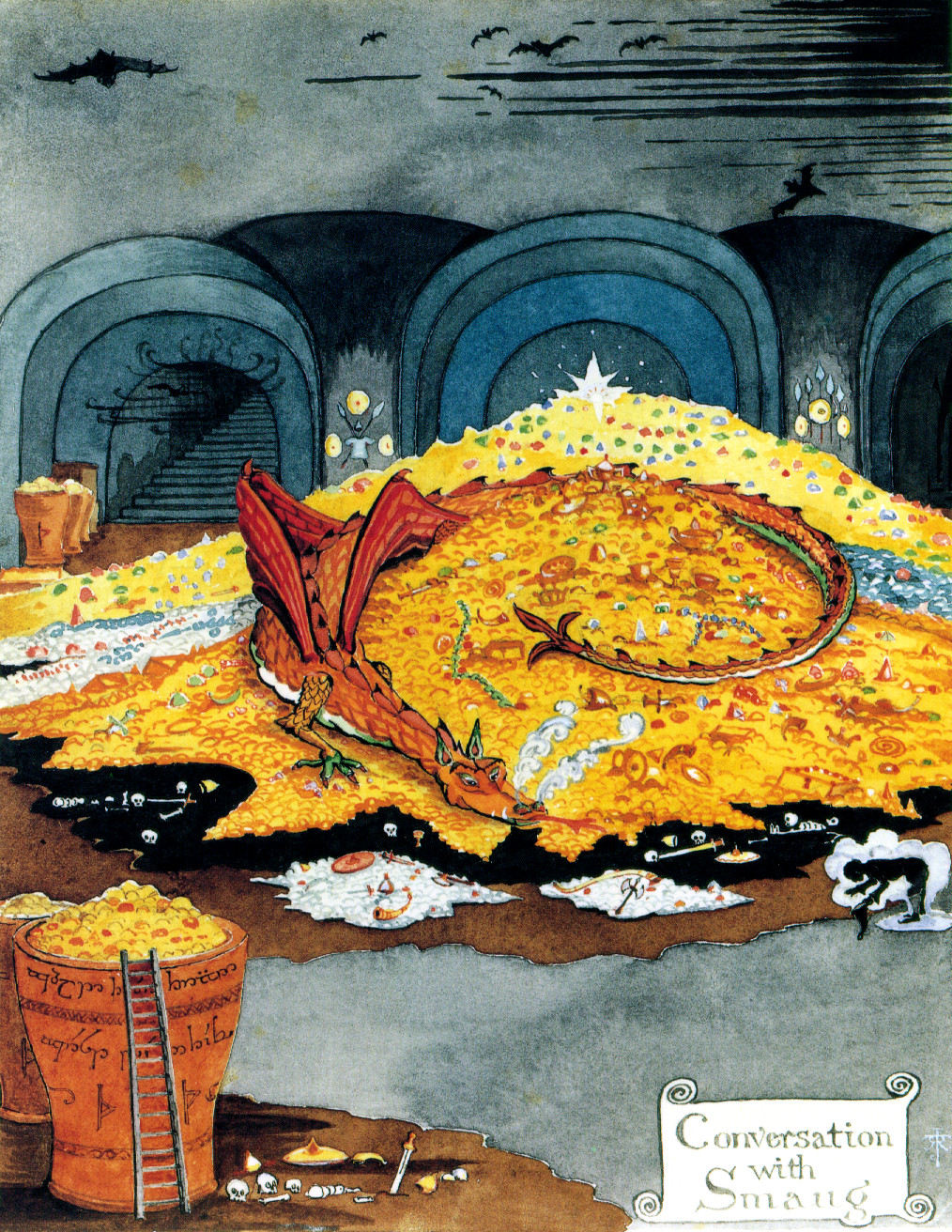
An ancient and smooth-talking dragon makes the story bigger and gives it more weight.

 hildebrandtSmaug

(To see how a quiet and amiable dragon affects a story, see Kenneth Grahame’s “The Reluctant Dragon” from Dream Days (1898—available for free at Gutenberg)

 Reluctant%20Dragon%201

An elegant villain can make a story more elegant, as Captain Hook would insist.

 CaptHook-PP

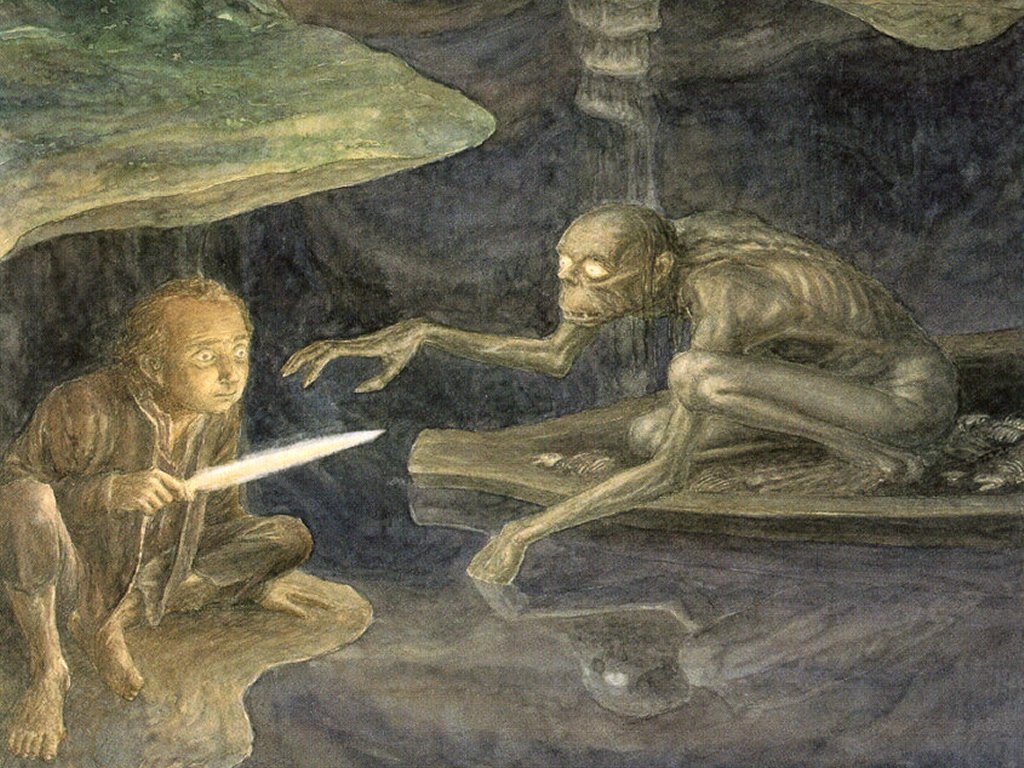
As a way of testing this premise, imagine a Lord of the Rings in which the main villain is Gollum. It might be entertaining, but how much smaller the drama than that which we see as grand, in part because of the size and menace of the villain.

 illustration-d-Alan-Lee-The-Hobbit-

(A note: while we have shown you the various villains we’ve mentioned so far, when it comes to Sauron, we’re stuck. We know that he is embodied in some form and that he was once “comely” (that is, good to look at) and he was of a size to fight Gil-Galad & Co., but, otherwise, it’s hard to know quite what to show: certainly not the searchlight from the Jackson films. His and his writers’ difficulty is obvious: how do you make what, in the books, is more a kind of watching, brooding evil feeling than a form (with the exception of that eye) into something visible?   We don’t believe, however, that their choice was successful, but, in fact, diminished the menace. We intend to discuss further the idea of “the invisible villain”, however, in a further part of this series.)

     What adds to the power of a villain is a certain primal nature: this is someone driven to be who he/she is because of what she/he wants—and the converse is true: what he/she wants can define who he/she is. What is Cruella, for instance, apart from her lust for a fur coat made from Dalmatians?

     In the case of Robin Hood, even if we had never heard him say a word, we would know what Prince John wants—that word “Prince” might serve as giveaway. He wants to be King John.

Adventures-of-Robin-Hood-02 

It perfectly suits his ambitions that his brother, Richard, the real king of England, is being held for ransom in Austria. It’s even an opportunity to look pious—you’re rescuing your brother with that huge sum of money—when, in reality, you’re simply increasing your own revenues. And your chief collector (in the tradition), the Sheriff of Nottingham, is thus nothing but a function in the story of John: the actual hand in the people’s purse, but he’s doing it for the sake of his master.

(Here’s the Sheriff—both images from the classic Errol Flynn 1938 The Adventures of Robin Hood.)

09-melville-coopersheriff 

As long as Richard doesn’t return, there will be John (and his—quite literal—extension, the Sheriff). And thus he is what we might call an open-ended villain, someone who can be employed again and again to apply the friction. This fits perfectly with his role in the Robin Hood stories as, unlike a novel, with its elaborate built-in sense and need of resolution brought about by the author, the original Robin Hood stories were folktales and folksongs—brief, their initial goal a short narrative from set-up to resolution. Villains here could be reused, their resolution not necessarily requiring their complete destruction. This can also have the side benefit of allowing singers/tellers to give villains a sense of depth from the number of experiences (usually very bad ones!) with the hero they have. The urge towards development of this sort, both for villain and hero, might, in fact, be a reason for A Gest of Robyn Hode, a collection of Robin Hood stories roughly made into one long tale and printed somewhere between 1492 and 1534. (For more, see the useful Wiki site.)

A-Gest-of-Robin-Hood

     The opposite of a character like Prince John would be what we might call a terminal villain. He/she appears and the story’s action begins. With his/her disappearance, the story, effectively, ends, even if there’s a coda: once Darth Vader/Anakin tosses the Emperor over the railing, what’s left but funerals, ghostly reunions, and fireworks? And, even if you clone the Emperor for a rematch, the original has been eliminated and his complex and long-developing relationship with his star pupil, Vader, has been resolved.

     This is, of course, only the beginning of our discussion of villains. Next, we want to ask, faintly echoing Freud, “What do villains want?”

Thanks, as ever, for reading and, as always, we welcome questions and comments!

MTCIDC

CD

A (Self)-portrait of the Artist?

03 Friday Apr 2015

Posted by Ollamh in Artists and Illustrators

≈ Leave a comment

Tags

Adventure, Doubloon, Howard Pyle, Illustration, N.C. Wyeth, Pirates, Self-portrait, Spanish Galleon

Dear Readers, 

We intend to continue our discussion of narrative in Tolkien in our next, but heavy with the baskets of jelly beans and peeps we’ve consumed pre-Easter, we thought we’d daydream with you a little this week. Our focus in this blog is a picture we have displayed once before. It is by N.C. Wyeth and was the cover of the March 1922 issue of the Ladies’ Home Journal. 

3923894215_20aa1d139f_o

Remembering all of N.C. Wyeth’s pictures of pirates, like this one:

1911_ncwyeth_treasureisland

we could certainly see this as one of that thematic family– a Spanish galleon being attacked by tiny pirate longboats.

hIDxztR

Here’s a cutaway of one such galleon by the wonderfully talented Stephen Biesty. And here is what they are attacking the ship for (and who wouldn’t?):

DOUBLOONS

It’s clearly a very powerful image: the boy daydreaming of adventure on the high seas. What interests us, however, beyond the evocative nature of the image, is to take a closer look at what the boy has in front of him, and to realize that the book is opened not to a picture, but to print. Thus, what so stirs the boy’s imagination is not a an illustration by, say, Wyeth’s teacher, Howard Pyle,

Unknown-1 

but the written text which such a picture would have accompanied during that golden era of book illustration, just at the end of the 19th and beginning of 20th centuries. And something else strikes us: is this a self-portrait of Wyeth himself as a boy, stirred, as we know he was, by stories of adventure? Compare these two pictures (the one on the right is the earliest picture we could find of Wyeth– dated 1903, so he’s about 21). 

3923894215_20aa1d139f_o NC_Wyeth_ca1903-1904

If it really is a retro self-portrait, then we have an extra level of narrative:

1. a boy, lost in the written word of an adventure story, day-dreaming of pirates

2. not just any boy, but Wyeth the painter–could we be looking at Wyeth depicting that moment when he decided that he would like to illustrate such stories himself?

What do you think, dear readers?  The only thing we could wish was that there was a companion picture, in which a girl of 1922 was reading the same book and having the same daydream!

Happy Easter!

MTCIDC

And thanks, as always, for reading,

CD

Sites and Vision

25 Wednesday Mar 2015

Posted by Ollamh in J.R.R. Tolkien, Military History, Military History of Middle-earth, Narrative Methods

≈ Leave a comment

Tags

Battle of Loos, John Garth, Morannon, Shell Holes, The Great War, Tolkien, World War I

Dear Readers,

Although we said in our last that we were going to pursue further the subject of that post, recently, we’ve been readers of John Garth’s Tolkien and the Great War (2003—he has a new book we’re about to order– Tolkien at Exeter College. If this interests you, you should also check out his impressive website at http://www.johngarth.co.uk) and, thinking about JRRT’s time in the trenches brought us to the Morannon:

“Upon the west of Mordor marched the gloomy range of Ephel Duath, the Mountains of Shadow, and upon the north the broke peaks and barren ridges of Ered Lithui, grey as ash. But as these ranges approached one another, being indeed parts of one great wall about the mournful plains of Lithlad and of Gorgoroth, and the bitter inland sea of Nurnen amidmost, they swung out long arms northward; and between these arms there was a deep defile. This was Cirith Gorgor, the Haunted Pass, the entrance to the land of the Enemy. High cliffs lowered upon either side, and thrust forward from its mouth were two sheer hills, black-boned and bare. Upon them stood the Teeth of Mordor, two towers strong and tall…Stony-faced they were, with dark window-holes staring north and east and west, and each window was full of sleepless eyes.”

Although JRRT didn’t come to the Western Front until after the battle of Loos in September-October, 1915, that description reminded us of this:

loostourheader

This is the so-called “Tower Bridge” (actually the top structure of mine elevators), the most striking landmark of the long-drawn-out struggle by the British to push the Germans back from their defensive line. It was common for British soldiers to name local French and Belgian features after things from home. Hence, this

3643461875_39de460a0b

reminded them of this:

DSC_0015

The battlefield, however, also has more features similar to JRRT’s description of this bleak and ashy world in the artificial tailings (refuse heaps) from the coal mines which dotted the region.

15-blog-12

And, in the midst of this are Sam, Frodo, and Gollum:

“…lay now peering over the edge of a rocky hollow beneath the outstretched shadow of the northernmost buttress of Ephel Duath.”

Bomb-Hole

The area between British and German lines were pockmarked with holes blown in the earth by artillery shells,

French_Railway_Gun_27627u 

10x_dj2015_si-93-1530_live_jpg__600x0_q85_upscale

sometimes thousands of them, and soldiers advancing would use them as temporary shelters. 

121

which could then be used as the basis of new trench systems. 

140606135336-21-wwi-main-timeline-0606-restricted-horizontal-large-gallery

And, between those trench systems, was the area called “No Man’s Land “, in which whole villages and even forests could disappear into nothing but cellar holes and stumps:

damagefranceww1

HvAy67I

which look rather like the devastation described at the crossroads

“Presently, not far ahead, looming up like a black wall, they saw a belt of trees.  As they drew nearer they became aware that these were of vast size, very ancient it seemed, and still towering high, though their tops were gaunt and broken, as if tempest and lightning-blast had swept across them, but had failed to kill them or to shake their fathomless roots.”

JRRT strenuously objected to the idea that he was literally converting his thoughts and feelings and experiences in the two World Wars into Middle Earth prose, but he did say something about what he had seen:

“Personally I do not think that either war (and of course not the atomic bomb) had any influence upon either the plot or the manner of its unfolding.  Perhaps in landscape.  The Dead Marshes and the approaches to the Morannon owe something to Northern France after the Battle of the Somme…”

How could an intelligent, observant young man could live among such scenes and absorb them without finding some use for them—perhaps even as a kind of exorcism of the horrors he would rather not remember?

As ever, thanks for reading!

MTCIDC

Where is Adventure?

20 Friday Mar 2015

Posted by Ollamh in Fairy Tales and Myths, J.R.R. Tolkien, Narrative Methods

≈ Leave a comment

Tags

Adventure, Landscape, Sam and Frodo, Story, The Hobbit, The Lord of the Rings, Tolkien

Dear Readers,

Welcome, as always!

In this post, we want to consider the idea of adventure. Usually, we think of this as an event or series of events, things which happen. This is certainly the way Bilbo sees it in the first chapter of The Hobbit, when Gandalf appears and all Bilbo thinks he wants to do is to sit, smoke, and read his mail, saying to the wizard: “nasty, disturbing uncomfortable things. Make you late for dinner! I can’t think what anybody sees in them!”

But what does Bilbo really know of adventure?

Imagine (and what a wonderful word that is), that you live down the hill from Bilbo, in the Shire in the quiet time, long after the wolves had come over the frozen Brandywine and some time before the Black Riders appear. This is a contented backwater of Middle-Earth and Bilbo mirrors this in his strong anti-adventure reactions.

With the world seemingly so safe and day-to-day (not that there aren’t the usual human–or hobbit–tussles—think of the Sackville-Baggins and their plans and jealousies) is there anything to suggest—beyond the idea that they are “nasty, disturbing uncomfortable things”–what real knowledge of adventure might exist in the Shire?

Sam suggests, in the second chapter of The Lord of the Rings, that at least he has some understanding beyond a vague sense that adventure is nasty when he says, “I heard a deal that I didn’t rightly understand, about an enemy, and rings, and Mr. Bilbo, sir, and dragons and a fiery mountain, and—and Elves, sir. I listened because I couldn’t help myself, if you know what I mean. Lor bless me, sir, but I do love tales of that sort. And I believe them too…”

Adventure, to Sam, then, isn’t a thing, but a story, and a believable one, too. It’s a story which he and Frodo talk about much later in the narrative, when they are about to encounter the treachery of Smeagol, Shelob, and the terrible march into Mordor and Sam has now realized that he and his master are in a story, too.

“The brave things in the old tales and songs, Mr. Frodo” Sam says, in one of the most profound moments for us in all of Tolkien, “adventures I used to call them. I used to think that they were things the wonderful folk of the stories went out and looked for, because they wanted them, because they were exciting and life was a bit dull, a kind of sport, as you might say.”

So now we see a kind of equation, which (beginning with Bilbo) might read:

(Nasty, disturbing) thing = adventure = story (Sam’s addition)

But Sam, the second half of his first name now being truer than he knows, continues his definition:

“But that’s not the way of it with the tales that really mattered, or the ones that stay in the mind. Folk seem to have been just landed in them, usually—their paths were laid that way, as you put it. But I expect they had lots of chances, like us, of turning back, only they didn’t.”

And here, with words and expressions like “paths” and “turning back” we can add another step to our equation:

(Nasty, disturbing) thing = adventure = story = going somewhere

There are, of course, folk and fairy tales where adventure comes to the protagonist, but it seems to us that when we began to run through the big stories, stories like the Odyssey, the Ramayana, and Beowulf, the narrative is mostly laid outside the world of home—Odysseus is coming home, but the bulk of the story takes place otherwhere, Rama and his wife and brother are in the forest, far from the palace when their adventure begins, and Beowulf has come from southern Sweden to Denmark to help King Hrothgar with a pest-control problem. And there are, of course, Frodo and Sam, who have traveled, mostly on foot, all the way from home in that safe-seeming Shire.

So, imagine that adventure can mean Somewhere Else, and that that place needs to be traveled through (or at least traveled to) for it to be an adventure, and for it to make the transition from adventure to story. For Sam, the choice to travel to and through adventure seems all-important. As he says of those who turn back:

“And if they had, we shouldn’t know, because they’d have been forgotten. We hear about those as just went on—and not all to a good end, mind you; at least, not to folk inside a story and not outside it call a good end. You know, coming home, and finding things alright, though not quite the same—like old Mr. Bilbo. But those aren’t always the best tales to hear, though they may be the best tales to get landed in.”

These, then, are the possible consequences of going to (and through) Somewhere Else: on the one hand, you may come back and, if you do, you may find things have changed, but are survivable, as Bilbo does when he returns to find himself considered dead and his house and goods up for auction. On the other hand, you may not come back—and yet may still be part of “the tales that really mattered, or the ones that stay in the mind.”

There is, of course, a paradox here: by Sam’s definition, it’s only by not turning back that one is in an adventure and a successful story, but a successful story (meaning, to Sam, a memorable one) may not ultimately be a successful adventure: what’s good for the listener/reader may not be good for those traveling to or in Somewhere Else.

Somewhere Else, itself, can be like any place in fiction: seas, mountains, forests, Middle Earth has them all and much of the story is about the simple act of marching along those many long miles, where the only quality necessary for heroic behavior seems to be persistence and, for Sam, and for us as readers, this becomes an heroic quality in itself—the ability to keep going, no matter what, a quality which is tested to the extreme degree in that last trek through the worst landscape of all, Mordor, half volcanic wilderness, half industrial wasteland. The landscape almost becomes another character here, a geographic Sauron who opposes those who would destroy his ring and through it, him. This, in turn, presents us with the idea that, just as characters good and bad give a story life, so do surroundings and the more complex the surroundings, might we see the greater the power of that life to make the story one that “stays in the mind”?

We’ll end this here, but, at the same time, we’ll add a “teaser” for our next. Sam and Frodo talk about adventures from the viewpoint of people who have read or heard them, all the while being inside an adventure themselves, as they—Sam in particular—acknowledge:

“Still, I wonder if we shall ever be put into songs or tales. We’re in one, of course; but I mean: put into words, you know, told by the fireside, or read out of a great big book with red and black letters, years and years afterwards.”

And yet there is an authorial fiction here: when they talk about being in a story, they mean that, through all the consequences of the Ring, their lives have been significantly altered and they have been “landed” in the current narrative. We know that they are, in fact, completely fictitious characters literally put into the story and that it only exists because the author has chosen to locate them there. All around them is a narrative which they cannot hear, as well as a listener whom they cannot see but who sees them and records every word and act, and this is just as true for Homer as it is for Tolkien. If Sam and Frodo went to Mount Doom without that listener, but didn’t return to set down what happened, as we’re told they did, what story would there be, even though they didn’t turn back and therefore should have been part of a story that “stays in the mind”?

More on that next time.

Thanks as ever for reading!

MTCIDC

CD

From Master to Pupil

13 Friday Mar 2015

Posted by Ollamh in Artists and Illustrators

≈ 1 Comment

Tags

Howard Pyle, Kidnapped, King Arthur, N.C. Wyeth, Robin Hood, Treasure Island

Dear Readers, 

Welcome, as always! 

Last time, we looked at some works by Howard Pyle, the great 19th-century illustrator and painter. Today, we want to look at the work of one of his most prominent students, N.C. Wyeth.

To give you an idea of what captivates us, we could just show you this:

3923894215_20aa1d139f_o

This sums it all up: the way in which reading allows you to step into imagination as if it were a country. It also suggests a certain propensity for romanic daydreaming on the part of certain people!

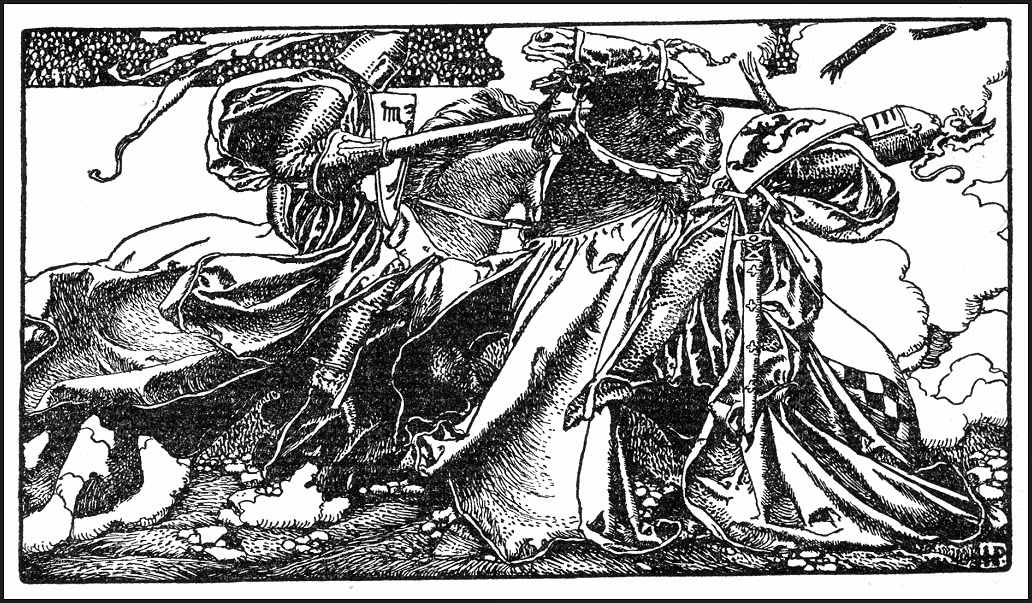
Here is an easy example of the difference between master and pupil. This is a Howard Pyle from his version of King Arthur. It’s beautifully detailed with a somewhat hard edge to it.

Mounted Knight By Howard Pyle

And here is a work by his pupil from his King Arthur:

the-green-knight-preparing-to-battle-sir-beaumains

There is an almost dream-like cloudy quality to his work. In fact, that dream can even seem something like a nightmare in this Wyeth illustration from Kidnapped. 

On_the_Island_of_Earraid_(N.C._Wyeth)

We’ve read that there are those who have criticized such works as “melodramatic”, but we think that that misses the point– they aren’t melodramatic, they are simply dramatic. 

blind-pew

But, for us, it truly is the case of picture = words x 1000. And so, we’ll content ourselves with showing you a few more of our favorite pictures.

OLYMPUS DIGITAL CAMERA WyethRoundhouseWEB NCW-canoe-artwork nc-wyeth-giant1

5021b2a38af7ba9f082937ac220f7080.jpg

6f9f00b5837bfc1918bfd798f1812039

75aa91cf5c7a93afcab8b7208039eb78

This last one, for us, may be as suggestive as the first one. We can feel ourselves deep in the beechwood behind the next tree, our bows creaking with the strain, waiting for the Sheriff of Nottingham. 

And, for this time, we invite you, dear readers, to join us there. 

Thanks, as always, for reading,

MTCIDC,

CD

Pyle of Pirates

06 Friday Mar 2015

Posted by Ollamh in Artists and Illustrators, Military History, Research, Writing as Collaborators

≈ Leave a comment

Tags

Bunker Hill, Howard Pyle, Illustrating History, Jack Sparrow, Pirates

Dear Readers,

Welcome!

In recent posts, we’ve talked about the wonderful Russian fairy/folktale illustrators of the late 19th, early 20th centuries.  We thought it might be fun, as we work on the sequel to Across the Doubtful Sea (Empire of the Isles) while editing The Good King’s Daughter for our second series, to continue the conversation by looking at other illustrators, beginning with two Americans, teacher and pupil Howard Pyle and N.C. Wyeth.

We begin, however, with a familiar contemporary image:

Unknown-3

We think it goes without saying who this is, don’t you?  He’s a wonderful actor, but, for someone who’s supposed to be dressed as a mid-18th-century sailor, he owes more to Howard Pyle, who, as has been pointed out more than once before, has exerted a strong influence upon Hollywood’s view of such people, than to actual 18th-century sailor’s dress.

Pirates were, in fact, sailors with, shall we say, non-mercantile goals.  They were workmen and wore very practical workmen’s clothes, like those in the following 18th-century illustrations.

ce4bd96ef59565cdd6aea174068137e1

siftingthepast_men-loading-a-boat-with-barrels_scott_ siftingthepast_a-ships-boat_scott_340264-bounty-mutiny

(This is, in fact, a contemporary illustration of the casting adrift of the notorious Captain Bligh, a British naval officer, although you see him only in his shirtsleeves here, rather than in his blue officer’s coat. His men, however, did not wear uniforms at this period, and, as you can see, would have looked like any other sailor.)

Okay, it might be argued, he’s “Captain” Jack Sparrow–what about officers?  Here’s a Hogarth painting of a more-or-less mid-century civilian captain.

article-2333382-1A0D5458000005DC-29_964x745

As the illustration shows, he simply wears ordinary clothing– no uniform.

Now, here are a few Pyle pictures.

12c250252BC0-3351Z

Pyle_pirates_treasfight

pyle-pirates-composition009

Typical Pyle touches: the bandanas and the huge sashes, not to be seen in period illustrations.

One might argue that Pyle lacked readily-available visual sources:  someone in the 1890s certainly didn’t have Google Images. It has been said, that, like Detaille in France, Pyle collected period uniforms, etc., and sometimes dressed up students in them,  but, one has only to look at his illustration of Bunker Hill, to make you wonder what he actually collected.

pyle-bunker-hill

There are numerous errors here, from the cut of the coats, to the lace on the breast, to the packs and that’s only the beginning.  The study of the history of uniforms was, of course, only in its infancy in this period and even serious military artists, like H.A. Ogden, could go very wrong.

And yet, there are also Pyle illustrations like these, in which he seems to have gotten things– at least, non-piratical things–right.

bal108969OldCaptain150.280

In these, you see a depiction of 18th century sailors which looks much more like those in actual period illustrations.

So what was Pyle up to? Let’s look at a much more modern depiction of Bunker Hill, by the American military artist, H. Charles McBarron.

bunker hill

McBarron was a member of the Company of Military Historians and Collectors. He was well-known not only as a skilled artist, but as a thorough researcher, and the owner of an extensive collection of militaria of the past. What you see in this picture (minus the graphic depiction of violence) would have been as accurate a depiction of the event as anyone might imagine.

Suppose, however, you were attempting to picture this event in dramatic terms from the British side. You would want long lines of red-coated, determined men, marching steadily uphill through their own casualties, as in Pyle’s illustration.

pyle-bunker-hill

Imagine, then, that even if you had much more visual information about pirates than Pyle may have had, but you wanted people to see pirates painted broadly and dramatically, what better than flowing headscarves, and big, blood-red sashes?

And this is why people in the past–and we in the present– love Pyle. Strict accuracy certainly has its place, but we’re perfectly willing to let it walk the plank in favor of romantic strokes and bold depictions.

Unknown-10

And, as always, we ask you readers, what do you think?

Next, Pyle’s pupil, N.C. Wyeth.

Thanks for reading,

MTCIDC,

CD

Magic or Growth?

25 Wednesday Feb 2015

Posted by Ollamh in Fairy Tales and Myths, J.R.R. Tolkien, Narrative Methods

≈ Leave a comment

Tags

Gandalf, Heracles, Magic, Tolkien

Dear Readers, 

Welcome! 

As we write the Across series, and the series we’re calling Grey Goose, we think about magic. It’s a tricky business, and we’re reminded of what happened to Apollonius of Rhodes in his Argonautica. The Argonautica is, basically, the story of how Jason assembled a group of heroes and went to find and bring back to Greece the golden fleece. In Apollonius’ time, it was already an old story. Because he was working with traditional material, then, and clearly felt obliged to do so, Apollonius included of all the heroes traditionally said to have been on the Argo. At the same time, this left him with a dilemma: one of those heroes was Heracles. Imagine having such a powerful figure on the ship– was there any need for anybody else? The thought obviously occurred to Apollonius, because he removed Heracles as quickly as he could. 

The thought must also have occurred to JRRT when he was writing The Hobbit. After all, he had a wizard along on the trip to the Lonely Mountain. We presume that the focus of the book is upon Bilbo, however, and his spiritual growth from Baggins to Took, as he is challenged again and again to go beyond what he thinks he knows about himself. With a wizard along, just like Heracles in the Argonautica, what chance is there for Bilbo ever to prove himself? And so, where do we see Gandalf actually do anything magical? He can show the way with a lighted staff, and he can set fire to pinecones, but, for most of the book, he either simply travels along, or he has simply disappeared.

And so, we come to our books. In Across the Doubtful Sea, we have, on the one side, people with strong religious beliefs, the Matan’a’e Amavi’o– the people of the goddess, Matan’a’e. Although they have the power of their goddess and their other gods, they are forced to rely almost entirely on themselves because we feel it is important that our protagonists prove themselves with only minimal divine help. Thus, we follow in the path of JRRT here. 

The principal antagonists, however, are a different matter. These are the Atuk, whose god gives his principal followers tremendous magical powers, but powers which are limited to the forces of winter (rather like the White Witch in The Lion, the Witch, and the Wardrobe). Thus, they can be fought, in a sense, just the way Aslan fights the White Witch with the opposite of cold, heat. 

As our series continues, we will have more to say on the subject of magic and gods. 

Thank you, as always, for reading!

MTCIDC,

CD

More Russian Favorites

10 Tuesday Feb 2015

Posted by Ollamh in Artists and Illustrators, Fairy Tales and Myths, Medieval Russia

≈ Leave a comment

Tags

Adventure, Epic, Fairytale Illustrators, Fantasy, Heroic, Medieval, Russia, Song

Dear Reader,

Welcome, as always.

We are very visual people. A picture in a museum, an illustration in a book, something in a film, will always catch our eye and sometimes inspire our writing.

This was certainly the case in our first book, Across the Doubtful Sea, where the drawings and paintings from the three Cook expeditions to the South Seas (1768-1779) filled us with a combination of wonder and curiosity. Although they were sometimes strongly influenced by period ideas of the sublime, here were images as close to historical photos as we would ever see.

Hodges,_Resolution_and_Adventure_in_Matavai_Bay

In the case of our second book, The Good King’s Daughter, however, because it was set in a world based loosely upon the medieval Russia of fairy tales, we looked to other sources, particularly those later-19th and 20th-century Russian artists who illustrated moments from the Russian heroic songs (byliny) and from the fairy and folktales themselves.

In our last, we showed you a few images from the work of perhaps the most famous (outside Russia, at least) illustrator, Ivan Bilibin (1876-1942). Pictures like “The Island of Buyan” (1905):

Ivanbilibin

In this posting, we would add two more artists, Victor Vasnetsov (1848-1926—not to be confused with his equally-talented brother, Apollinary 1856-1923) and the more recent Nikolai Kochergin (1897-1974).

As you can see from the pictures below, Vasnetsov can move from the grandly (and grimly) heroic world of the byliny and its bogatyr (epic hero) to a more fanciful world of fairy tales like The Firebird (but still rather grim and grand).

1898_Vasnetsov_Bogatyrs_anagoria Igorsvyat Vasnetsov_samolet Viktor%20Vasnetsov-526879

hero

a-knight-at-the-crossroads-1878

Kochergin strikes us as more like Bilibin—brightly-colored, folk-influenced.

4f463a868cf7b31a66ad1c87e00 9f97a52394ba8269194a869df52 berendei-palace nicolai-kochergin_the-wooden-eagle

tumblr_mxjgrquVKF1rz5qxqo1_500

nicolai-kochergin_seven-simeons-seven-workers

tumblr_ndw64pRZCk1rgcyvso2_500

What inspires us in these pictures? To a degree, it’s what attracts us to the fairy/folktales: the strange scenes (even when you know the story), the swirl of color, that suggestion of a complex world of patterns from a different time and place, one in which there were yagas and firebirds and heroes who could be helped by wise animals.

And you, reader, do these pictures inspire you?

Thanks for reading!

MTCIDC

CD

PS

If you would like to know more about Russian heroic song—and for free—you might try:

Hapgood, Isabel Florence, The Epic Songs of Russia (1916)

Harrison, Marion Chilton, Byliny Book: Hero Tales of Russia (1915)

at archive.org. They are clearly older books, but, for those on a budget, they can provide a starting place into a rich world worth visiting.

Tracking

09 Monday Feb 2015

Posted by Ollamh in Imaginary History, J.R.R. Tolkien, Maps, Narrative Methods, Research

≈ Leave a comment

Tags

Adventure, Book, Exploration, Fantasy, Fiction, History, Maps, Tolkien

Dear Readers,

While working on Across the Doubtful Sea, the Doubtful Sea series, and a forthcoming series that takes place in an alternate medieval Russia, we discovered for ourselves what our friend J.R.R. Tolkien worked on meticulously during the course of his work—the importance of maps in a story, whether they are real, fictional, or a mixture of both, in the case of our work. “If you’re going to have a story,” he said, “you must work a map; otherwise, you’ll never have a map of it afterwards.”

This became apparent when we were working on Across, using previously drawn maps of the theoretical Terra Australis: 

image1 Finaeus_antart

To give us a sense of where our characters and we were (and still are) going. 

When we began talking about the geography of our alternative Russia, we began to ask ourselves, first, how do you make a map in relation to a story? It was a start to look over the shoulder of JRRT, and to see what was done before us. From there, we go on to ask, what is it that made Middle-earth Middle-earth? It’s clear that Tolkien took a considerable amount of time and care to chart out his elaborate fictional world, from Bilbo’s own maps of the Shire and the world beyond.

imgE1 

Some were detailed enough to follow the day-by-day travels of the Fellowship, while others were used to record specific moments in time, both historically and geographically.

In his letters, Tolkien often addressed the subject of his maps. Much of his enthusiasm in creating maps for his worlds had to do with the pleasure of doing so, and the satisfaction of building the physical structure of such an elaborate story. He was, however, sometimes overwhelmed by them—perhaps as if the more landscape he made, the more he had to carry—and said to his publisher that it was a matter of a “lack of skill combined with being harried” (Tolkien, letter 141). He was fortunate to have, in this aspect of his work, collaboration not unlike ours—his son, Christopher, was a talented cartographer, and after discussing the landscapes with his father, would draw the intricate world in accordance with Bilbo and Frodo’s adventures.

middle_earth_map

Tolkien, by creating the maps first, created a landscape which seems to exist not only before the story, but is bigger than the story. When Frodo travels eastwards, for example, there is more of the Shire and beyond than that which he actually travels over. In our case, it was rather like someone laying track while driving a train over it. The tracklayer decides where the train will go, but, looking back, can see a landscape left behind as it moves on. In this way, the story and its landscape are written as they progress, and a narrative railroad is left behind on which readers may ride. And so, unlike Tolkien, by constructing a map this way, we appear to be providing primarily a view from the track itself. If there’s more landscape, we can only know it from the map we’ve constructed afterwards.

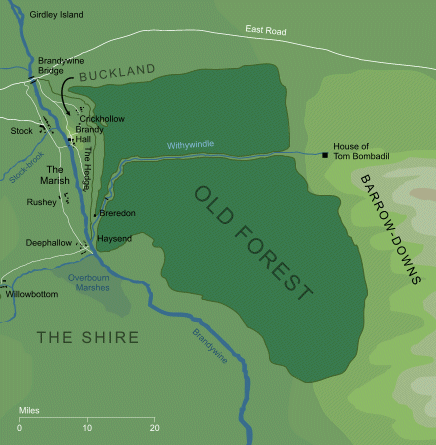
oldforest 

With the previously-drawn map, we can see the journey, in contrast, from a bird’s eye view.

shire_map

But this leaves us with a question: is it best to construct a bird’s eye view first, then to lay the track, or to lay track and then to look back?

This brings us to a second question: by either method, how does one make a fictional map credible?

MTCIDC,

CD
PS

For an example of simultaneous train-driving and track-laying, see Wallace and Gromit, The Wrong Trousers.

← Older posts
Newer posts →

The Doubtful Sea Series Facebook Page

The Doubtful Sea Series Facebook Page

  • Ollamh

Categories

  • Artists and Illustrators
  • Economics in Middle-earth
  • Fairy Tales and Myths
  • Films and Music
  • Games
  • Heroes
  • Imaginary History
  • J.R.R. Tolkien
  • Language
  • Literary History
  • Maps
  • Medieval Russia
  • Military History
  • Military History of Middle-earth
  • Narnia
  • Narrative Methods
  • Poetry
  • Research
  • Star Wars
  • Terra Australis
  • The Rohirrim
  • Theatre and Performance
  • Tolkien
  • Uncategorized
  • Villains
  • Writing as Collaborators
Follow doubtfulsea on WordPress.com

Across the Doubtful Sea

Recent Postings

  • Planting April 29, 2026
  • Subterranean April 22, 2026
  • Serendipity? April 15, 2026
  • Serendipity April 8, 2026
  • Verisimilitude April 1, 2026
  • Goblins and Goblin March 25, 2026
  • Crowing and Raven March 18, 2026
  • The Damage of Dragons March 11, 2026
  • Encouragement March 4, 2026

Blog Statistics

  • 112,375 Views

Posting Archive

  • April 2026 (5)
  • March 2026 (4)
  • February 2026 (4)
  • January 2026 (4)
  • December 2025 (5)
  • November 2025 (4)
  • October 2025 (5)
  • September 2025 (4)
  • August 2025 (4)
  • July 2025 (5)
  • June 2025 (4)
  • May 2025 (4)
  • April 2025 (5)
  • March 2025 (4)
  • February 2025 (4)
  • January 2025 (5)
  • December 2024 (4)
  • November 2024 (4)
  • October 2024 (5)
  • September 2024 (4)
  • August 2024 (4)
  • July 2024 (5)
  • June 2024 (4)
  • May 2024 (5)
  • April 2024 (4)
  • March 2024 (4)
  • February 2024 (4)
  • January 2024 (5)
  • December 2023 (4)
  • November 2023 (5)
  • October 2023 (4)
  • September 2023 (4)
  • August 2023 (5)
  • July 2023 (4)
  • June 2023 (4)
  • May 2023 (5)
  • April 2023 (4)
  • March 2023 (5)
  • February 2023 (4)
  • January 2023 (4)
  • December 2022 (4)
  • November 2022 (5)
  • October 2022 (4)
  • September 2022 (4)
  • August 2022 (5)
  • July 2022 (4)
  • June 2022 (5)
  • May 2022 (4)
  • April 2022 (4)
  • March 2022 (5)
  • February 2022 (4)
  • January 2022 (4)
  • December 2021 (5)
  • November 2021 (4)
  • October 2021 (4)
  • September 2021 (5)
  • August 2021 (4)
  • July 2021 (4)
  • June 2021 (5)
  • May 2021 (4)
  • April 2021 (4)
  • March 2021 (5)
  • February 2021 (4)
  • January 2021 (4)
  • December 2020 (5)
  • November 2020 (4)
  • October 2020 (4)
  • September 2020 (5)
  • August 2020 (4)
  • July 2020 (5)
  • June 2020 (4)
  • May 2020 (4)
  • April 2020 (5)
  • March 2020 (4)
  • February 2020 (4)
  • January 2020 (6)
  • December 2019 (4)
  • November 2019 (4)
  • October 2019 (5)
  • September 2019 (4)
  • August 2019 (4)
  • July 2019 (5)
  • June 2019 (4)
  • May 2019 (5)
  • April 2019 (4)
  • March 2019 (4)
  • February 2019 (4)
  • January 2019 (5)
  • December 2018 (4)
  • November 2018 (4)
  • October 2018 (5)
  • September 2018 (4)
  • August 2018 (5)
  • July 2018 (4)
  • June 2018 (4)
  • May 2018 (5)
  • April 2018 (4)
  • March 2018 (4)
  • February 2018 (4)
  • January 2018 (5)
  • December 2017 (4)
  • November 2017 (4)
  • October 2017 (4)
  • September 2017 (4)
  • August 2017 (5)
  • July 2017 (4)
  • June 2017 (4)
  • May 2017 (5)
  • April 2017 (4)
  • March 2017 (5)
  • February 2017 (4)
  • January 2017 (4)
  • December 2016 (4)
  • November 2016 (5)
  • October 2016 (6)
  • September 2016 (5)
  • August 2016 (5)
  • July 2016 (5)
  • June 2016 (5)
  • May 2016 (4)
  • April 2016 (4)
  • March 2016 (5)
  • February 2016 (4)
  • January 2016 (4)
  • December 2015 (5)
  • November 2015 (5)
  • October 2015 (4)
  • September 2015 (5)
  • August 2015 (4)
  • July 2015 (5)
  • June 2015 (5)
  • May 2015 (4)
  • April 2015 (3)
  • March 2015 (4)
  • February 2015 (4)
  • January 2015 (4)
  • December 2014 (5)
  • November 2014 (4)
  • October 2014 (6)
  • September 2014 (1)

Blog at WordPress.com.

  • Subscribe Subscribed
    • doubtfulsea
    • Join 75 other subscribers
    • Already have a WordPress.com account? Log in now.
    • doubtfulsea
    • Subscribe Subscribed
    • Sign up
    • Log in
    • Report this content
    • View site in Reader
    • Manage subscriptions
    • Collapse this bar

Loading Comments...