• About

doubtfulsea

~ adventure fantasy

Tag Archives: Gandalf

It’s in Writing (2:  I’st a Prologue, or a Poesie for a Ring?)

22 Wednesday Oct 2025

Posted by Ollamh in Uncategorized

≈ Leave a comment

Tags

Belshazzar, Bilbo, Daniel, Darius, Frodo, Gandalf, inscription, Isildur, Kilroy, Literacy, Orcs, posy ring, Sam Gamgee, Sauron, Shakespeare, The Black Speech, The Ring

As always, dear readers, welcome.

The first part of this posting began as far from Middle-earth and its history as possible:  the Biblical lands of our Middle-earth and the story of the ancient prophet, Daniel and specifically the event which gained Daniel his position in the court first of Belshazzar, the Babylonian king, and then in that of his conqueror/successor, Darius the Persian.  Uniquely for early prophecy, Belshazzar hadn’t been warned that he would be deposed by any of the accepted means—the reading of the flight of birds

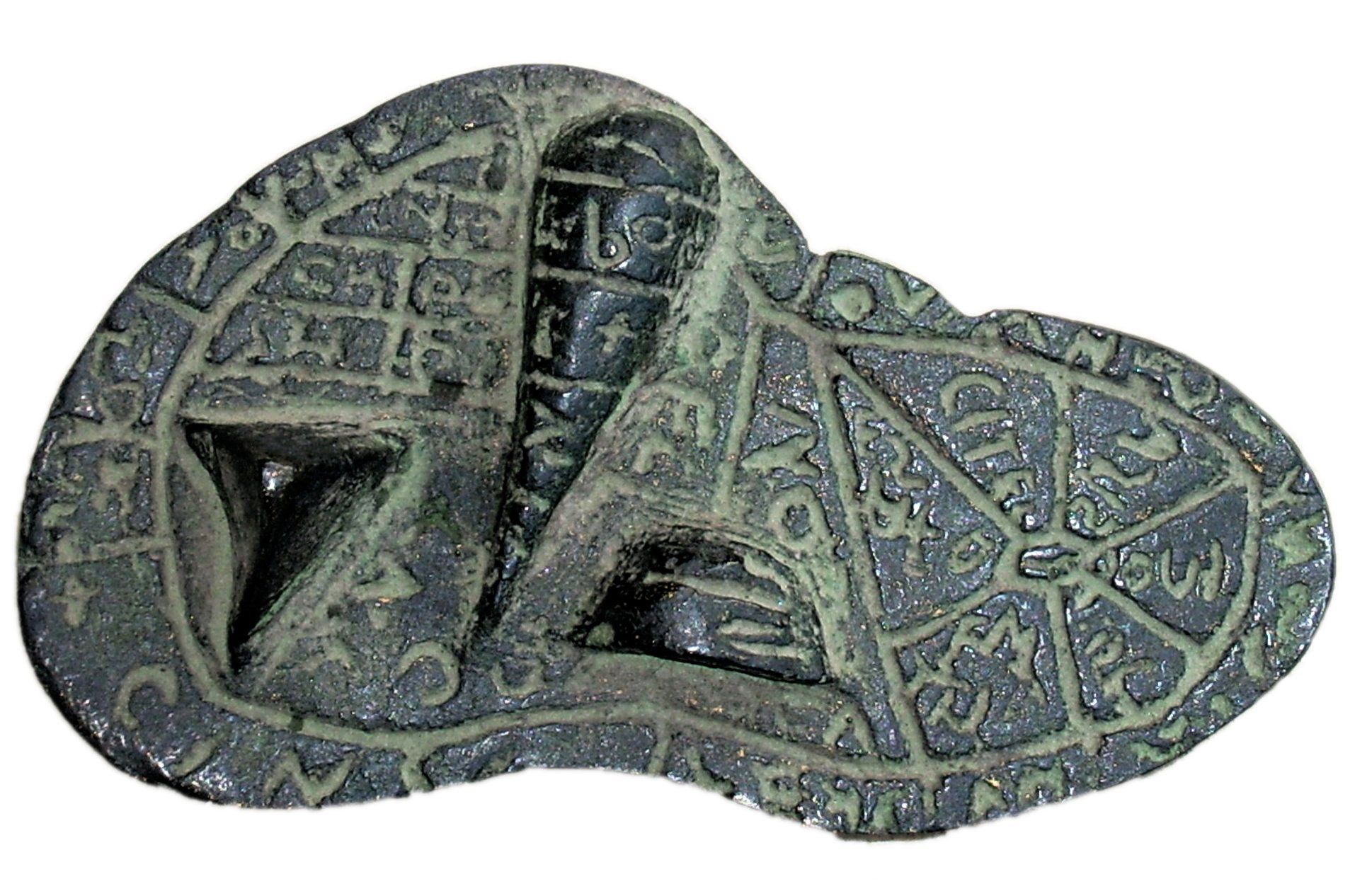
or the reading of animal intestines, for example,

(This is a bit of Etruscology, being a bronze model of a sheep’s liver believed to be used as a guide to interpreting what an Etruscan priest might find on an actual sheep’s liver.  For more, see:  https://en.wikipedia.org/wiki/Haruspex )

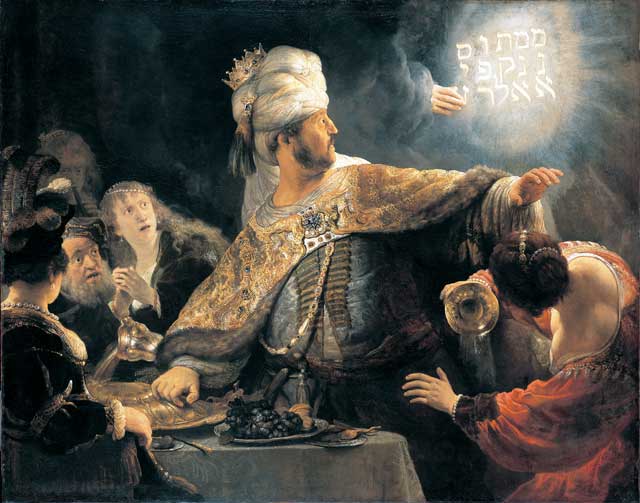
but by a message written by a detached hand on an interior wall of his palace.

(Rembrandt—as I said in the first part of this posting, having no idea of what real Babylonians looked like, the artist went for the Magi look)

When Belshazzar’s own scribes and prophets could make nothing of it, Daniel was brought in as a consultant and delivered the grim message that the words—which were potentially chillingly ambiguous—signalled not only the end of Belshazzar’s reign, but of his kingdom.  (For more on this, see:  https://www.christianitytoday.com/2024/11/andrew-wilson-spirited-life-daniel-writing-on-wall-babylon/   For a wonderful 12th-century version of the story and a little on Daniel’s experience in the court of Darius, see:  https://www.youtube.com/watch?v=Djf0DFkH7mA&list=RDDjf0DFkH7mA&start_radio=1 )

In that posting, I suggested that Daniel’s story not only confirmed his role as prophet, but, for the posting, that he was literate, which would have marked him out in a world in which literacy was a specialized skill, like being a boatwright.

(This is from one of my favorite medieval mosaics, the story of Noah and the Ark from the cathedral of Monreale in Palermo—for more see:  https://www.christianiconography.info/sicily/noahBuildsArkMonreale.html )

This, in turn, had led to considering literacy in Middle-earth, chiefly among hobbits, and, in particular, the literacy of one rather unlikely hobbit, Sam Gamgee.

(Robert Chronister)

For more on this, see that earlier posting, “It’s in Writing (1)” 15 October, 2025, but my conclusion, based upon the final chapter of The Lord of the Rings, “The Grey Havens”, was that, as the story of Daniel makes Daniel literate in order to elevate him to a level of prophetic importance, so JRRT makes Sam literate in order to allow him to be the author who will complete the story of the Ring.  

That posting briefly examined hobbits and even suggested some evidence of literacy among dwarves, but it was never meant to be a full inventory of mentions of literacy in Middle-earth—although I think that that would be a very interesting project and well worth doing—and one thing it omitted entirely was any mention of literacy in Mordor. 

Did Orcs read and write, for example?

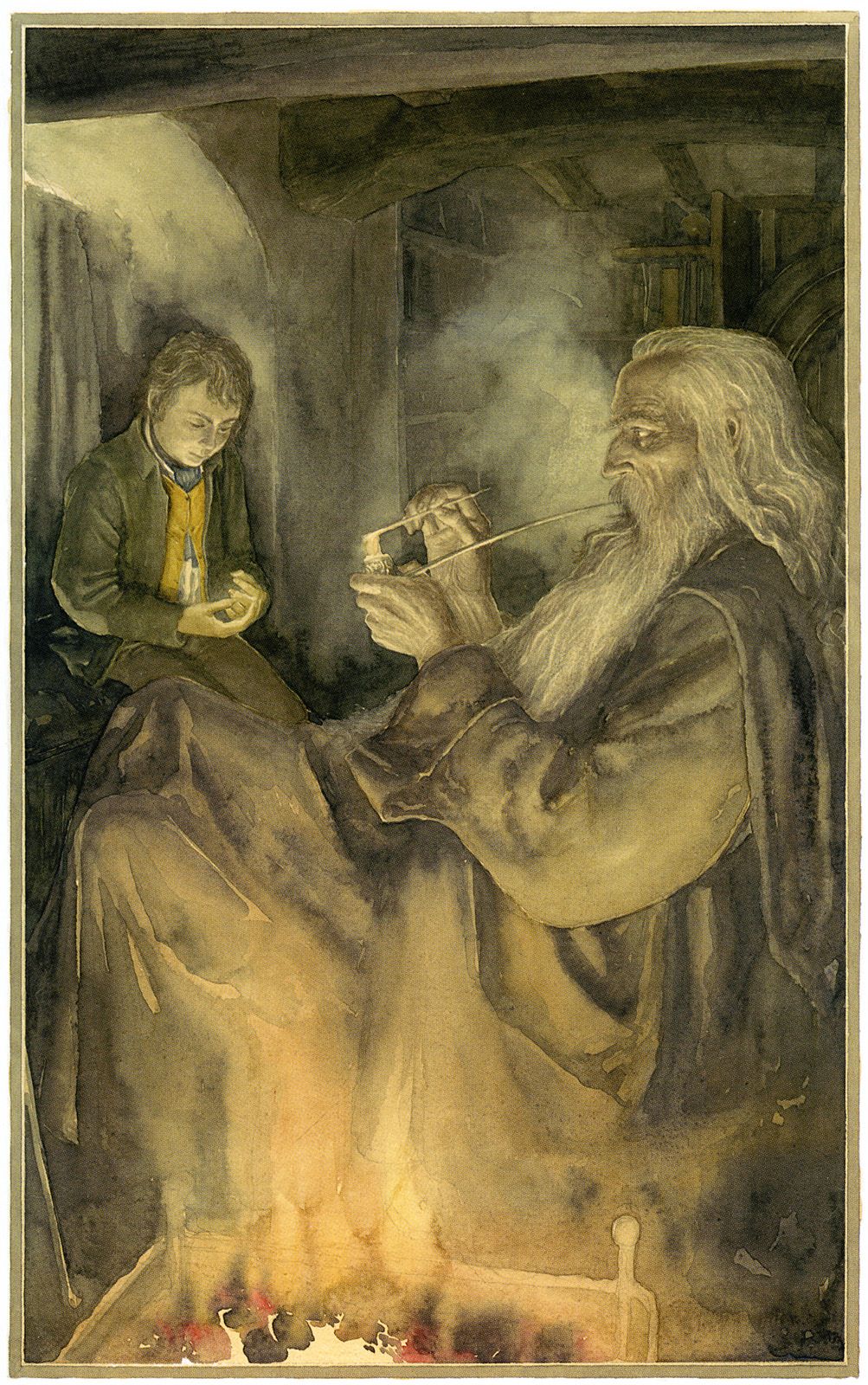
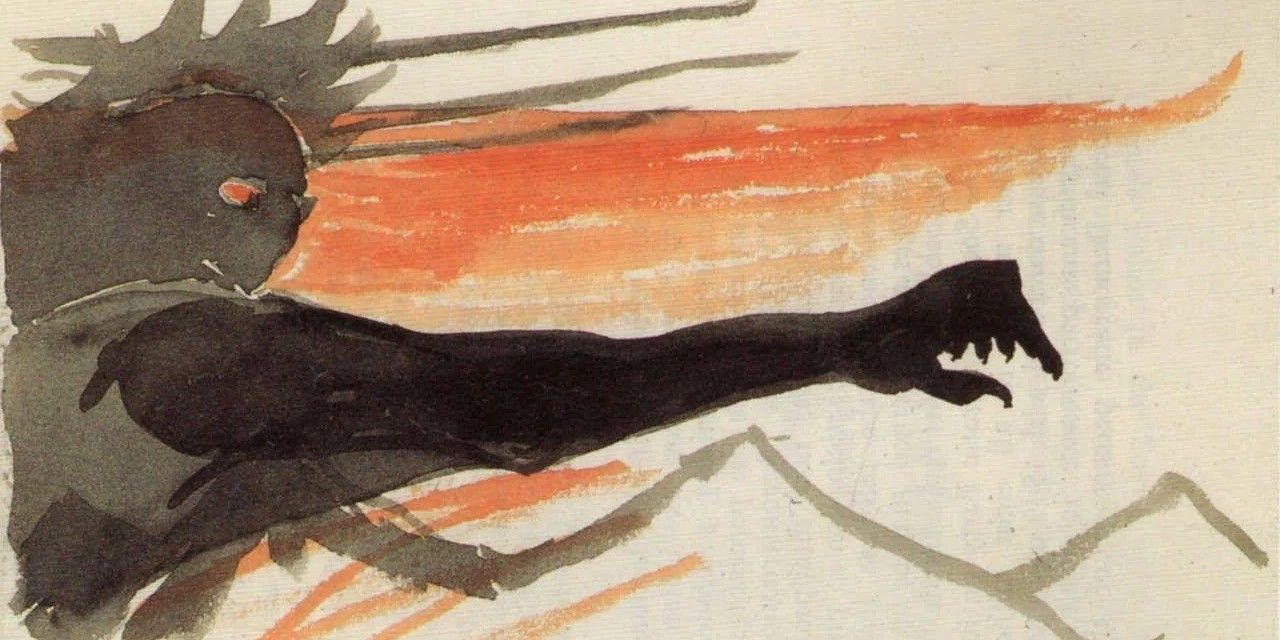
(Alan Lee)

Considering the conversation of people like Ugluk and Grishnakh, it would seem that they were mainly oral, as much of their and other talk is based upon what they hear, rather than read. (“ ‘What are they wanted for?’ asked several voices.  ‘Why alive?  Do they give good sport?’ ‘No!  I heard that one of them has got something, something that’s wanted for the war…”  The Two Towers, Book Three, Chapter 3, “The Uruk-hai”—for more on Orcs and gossip, among other things, see “Scuttlebutt”, 27 October, 2021)

And yet there’s this:

“The brief glow fell upon a huge sitting figure, still and solemn like the great stone kings of Argonath.  The years had gnawed it, and violent hands had maimed it..Upon its knees were idle scrawls mixed with the foul symbols that the maggot-folk of Mordor used.”  (The Two Towers, Book Four, Chapter 7, Journey to the Cross-roads”)

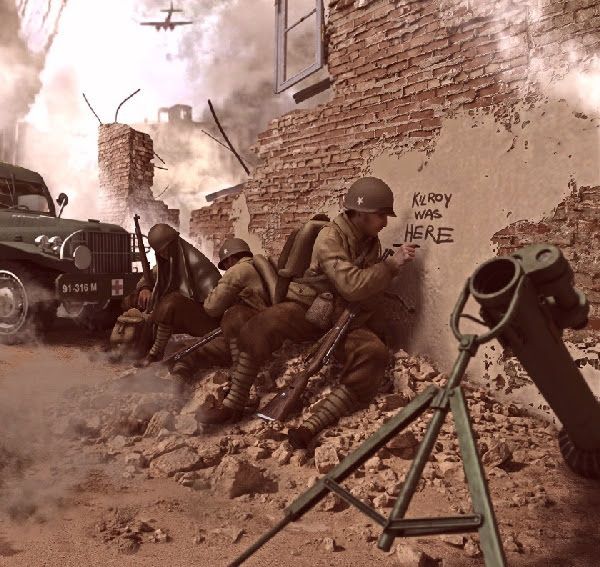
The “maggot-folk of Mordor” must certainly be the Orcs and “idle scrawls” suggests graffiti, like the World War 2-era favorite–

(For more on orcs and graffiti, see “Ugluk was Here”, 14 December, 2016—for more on Kilroy see:  https://en.wikipedia.org/wiki/Kilroy_was_here )

So what did they write in?  Pippin, while a prisoner of the Orcs, notices that they seem to speak different languages—or at least dialects—but employ the Common Speech to understand each other:

“To Pippin’s surprise he found that much of the talk was intelligible; many of the Orcs were using ordinary language.  Apparently the members of two or three quite different tribes were present, and they could not understand one another’s orc-speech.”  (The Two Towers, Book Three, Chapter 3, “The Uruk-hai”)

Can we presume, then, that the “idle scrawls” were in the writing system called the Tengwar, as “[its letters] had spread over much of the same area as that in which the Common Speech was known” (The Lord of the Rings, Appendix E, II, “Writing”)?  Or possibly the runic Cirith, as “[it] became known to many peoples, to Men and Dwarves, and even to Orcs, all of whom altered it to suit their purposes and according to their skill or lack of it.”

But what about the Black Speech?

“It is said that the Black Speech was devised by Sauron in the Dark Years, and that he had desired to make it the language of all those that served him…”

however—

“…after the first overthrow of Sauron this language in its ancient form was forgotten by all but the Nazgul.  When Sauron arose again, it became once more the language of Barad-dur and of the captains of Mordor.”

It was the formal language of the top of the chain of command, then, but, as JRRT had written earlier of Sauron’s first attempt to make it the official language, “he failed in that purpose” and the Orcs picked and chose what they found useful and nothing more.  (See The Lord of the Rings, Appendix F, “Of the Other Races”)

Save for what might be the Black Speech in a curse (“Ugluk u bagronk sha pushdug Saruman-glob bubhosh skai”, says one menacing Orc to Pippin– The Two Towers, Book Three, Chapter 3, “The Uruk-hai”), when we hear it, it’s Gandalf, reciting what he read when he “set the golden thing in the fire a while” (The Fellowship of the Ring, Book Two, Chapter 2, “The Council of Elrond”). 

And this brings us back to reading and writing.  Why was there writing on that particular ring? 

Not being a party to its maker’s mind, this is only my guess, but I think that it may have had several possible purposes.

First—and this seems the most obvious—comes from something Gandalf says, repeating a remark made by Saruman:

“ ‘The Nine, the Seven, and the Three…had each their proper gem.  Not so the One.  It was round and unadorned, as it were one of the lesser rings; but its maker set marks upon it that the skilled, maybe, could still see and read.”  (The Fellowship of the Ring, Book Two, Chapter 2, “The Council of Elrond”). 

Thus, Sauron had written on it to distinguish it from the other rings—and this writing was seemingly to be seen only by Sauron, as Isildur suggests:

“It was hot when I first took it, hot as a glede [a hot coal], and my hand was scorched, so that I doubt if ever again I shall be free of the pain of it.  Yet even as I write it is cooled, and it seemeth to shrink, though it loseth neither its beauty nor its shape.  Already the writing upon it, which at first was as clear as red flames, fadeth and is only barely to be read.”

Isildur’s explanation for this fading was:

“The Ring misseth, maybe, the heat of Sauron’s hand, which was black and yet burned like fire.” (The Fellowship of the Ring, Book Two, Chapter 2, “The Council of Elrond”). 

The second purpose, then, might be that The Ring mirrored, in a way, its master, the inscription legible to him because it took its heat from his hand and, with that removed, it cooled, eventually, into silence.  Isildur had guessed that heat might revive it (“…maybe were the gold made hot again, the writing would be refreshed”) but it was Gandalf, having read Isildur’s suggestion, who did, by placing it into an environment like to its original.  That it would lose that inscription if the Ring were removed from its owner’s hand might also suggest a third purpose, which lies in what the writing actually said:

“One Ring to rule them all, One Ring to find them,

One Ring to bring them all and in the darkness bind them.”  (The Fellowship of the Ring, Book One, Chapter 2, “The Shadow of the Past”)

Although Gandalf says that this formed part of “a verse long known in Elven-lore”, the Ring itself was meant to be the master ring:

“He only needs the One; for he made that Ring himself, it is his, and he let a great part of his own former power pass into it, so that he could rule all the others.”

Thus, though it may have been part of a “verse long known in Elven-lore”, it sounds to me like a kind of spell Sauron would have chanted as he made the Ring, not only putting “a great part of his own former power” into it, but binding the lesser rings to it, as the words written on the Ring may have eventually been part of later tradition, but, logically, must have been his words long before they became part of that tradition.

These might have been Sauron’s purposes, but they also serve the narrative.  As Bilbo’s ring, passed down traumatically to Frodo, is “round and unadorned”, Gandalf has to have some way to prove to himself and to Frodo that this ring is the Ring.

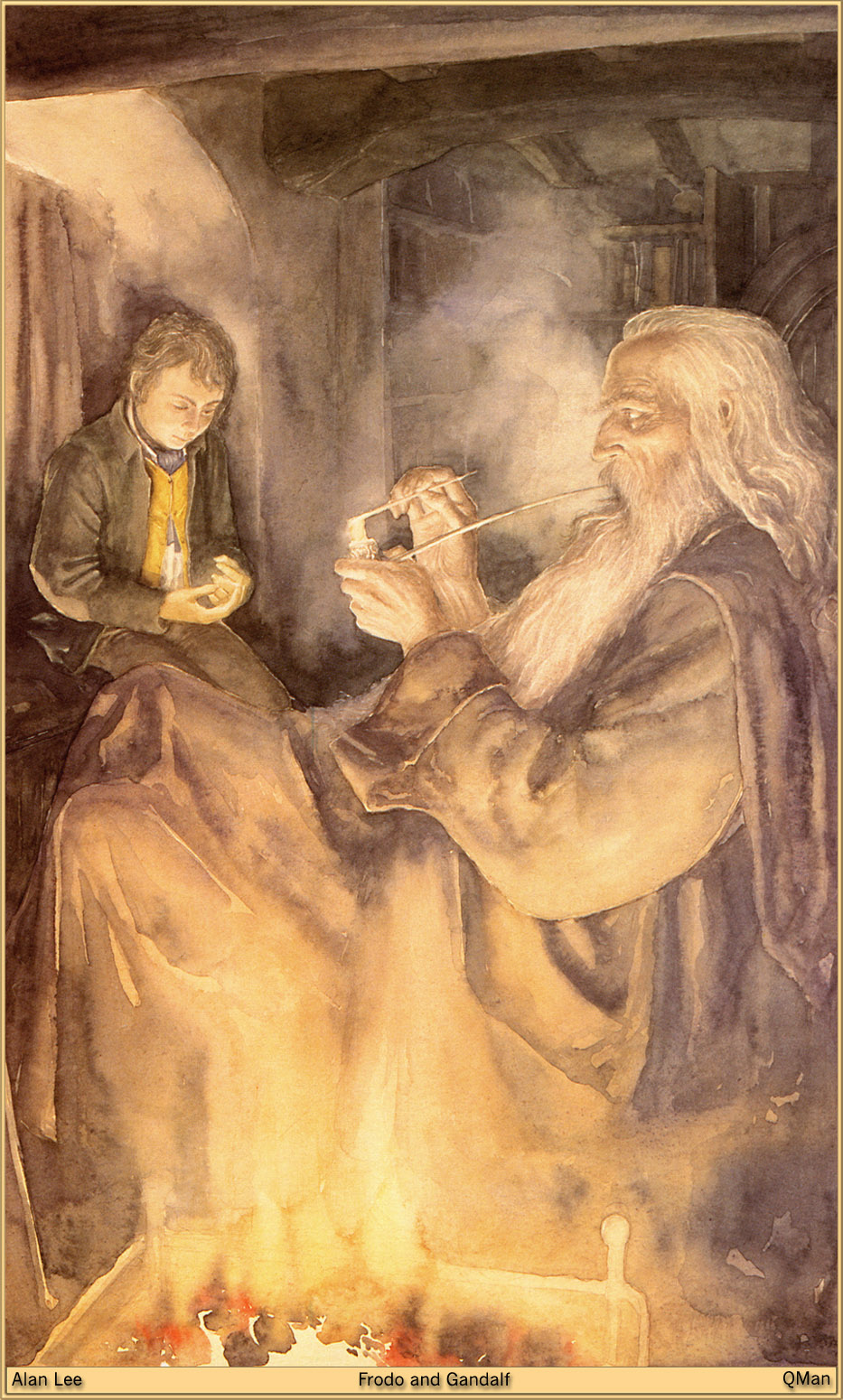
(Alan Lee)

When Gandalf begins explaining to Frodo in detail about it and about Bilbo’s connection to it, he first mentions that

“A mortal…who keeps one of the Great Rings, does not die, but he does not grow or obtain more life, he merely continues, until at last every minute is a weariness.”

and Bilbo, says Gandalf, “…was getting restless and uneasy.  Thin and Stretched, he said.”

He speaks further about his worries about Bilbo and then tells Frodo that “There is a last test to make”, meaning in his confirmation that this is the Ring.

That last test takes place when, reluctantly, Frodo hands the Ring to Gandalf, and Gandalf throws it into the fire on Frodo’s hearth, where, when Frodo picks it up, he spots “fine lines, finer than the finest pen-strokes, running along the ring, outside and inside:  lines of fire that seemed to form the letters of a flowing script” and that script says:

“Ash nazg burbatuluk, ash nasz gimbatul, ash nazg thrakatuk agh burzum-ishi krimpatul.”

“One Ring to rule them all, One Ring to find them, One Ring to bring them all and in the Darkness bind them.”  (translation by Gandalf—earlier quotations from The Fellowship of the Ring, Book One, Chapter 2, “The Shadow of the Past”, the Black Speech from Book Two, Chapter 2, “The Council of Elrond”  For more on the Black Speech, see:  https://en.wikipedia.org/wiki/Black_Speech )

For Gandalf, that inscription is the final element in his understanding of just what, long ago, Bilbo picked up in the tunnels under the Misty Mountains.  He explains that it’s “only two lines of a verse long known in Elven-lore”, but those two lines are apparently all that’s necessary.

But where might the idea for an inscription have come to JRRT from originally?  I have no proof, but, as a medievalist, Tolkien might have been aware of what we find in medieval bling and is later picked up in Hamlet.

If you, like me, are a Shakespeare fan, you may recognize the subtitle of this posting as a sharp little remark by Hamlet in Act III, Scene 2 (you can read it here in the First Quarto of 1603:      https://internetshakespeare.uvic.ca/doc/Ham_Q1/complete/index.html ).  Hamlet is making fun of a very brief prologue before The Murder of Gonzago, the “play within a play” (renamed “The Mousetrap” by Hamlet) by which he hopes to force his uncle, Claudius, to reveal his guilt in the death of Hamlet’s father, but it’s the second half of that line, “a Poesie for a Ring” which provides an answer to my question.

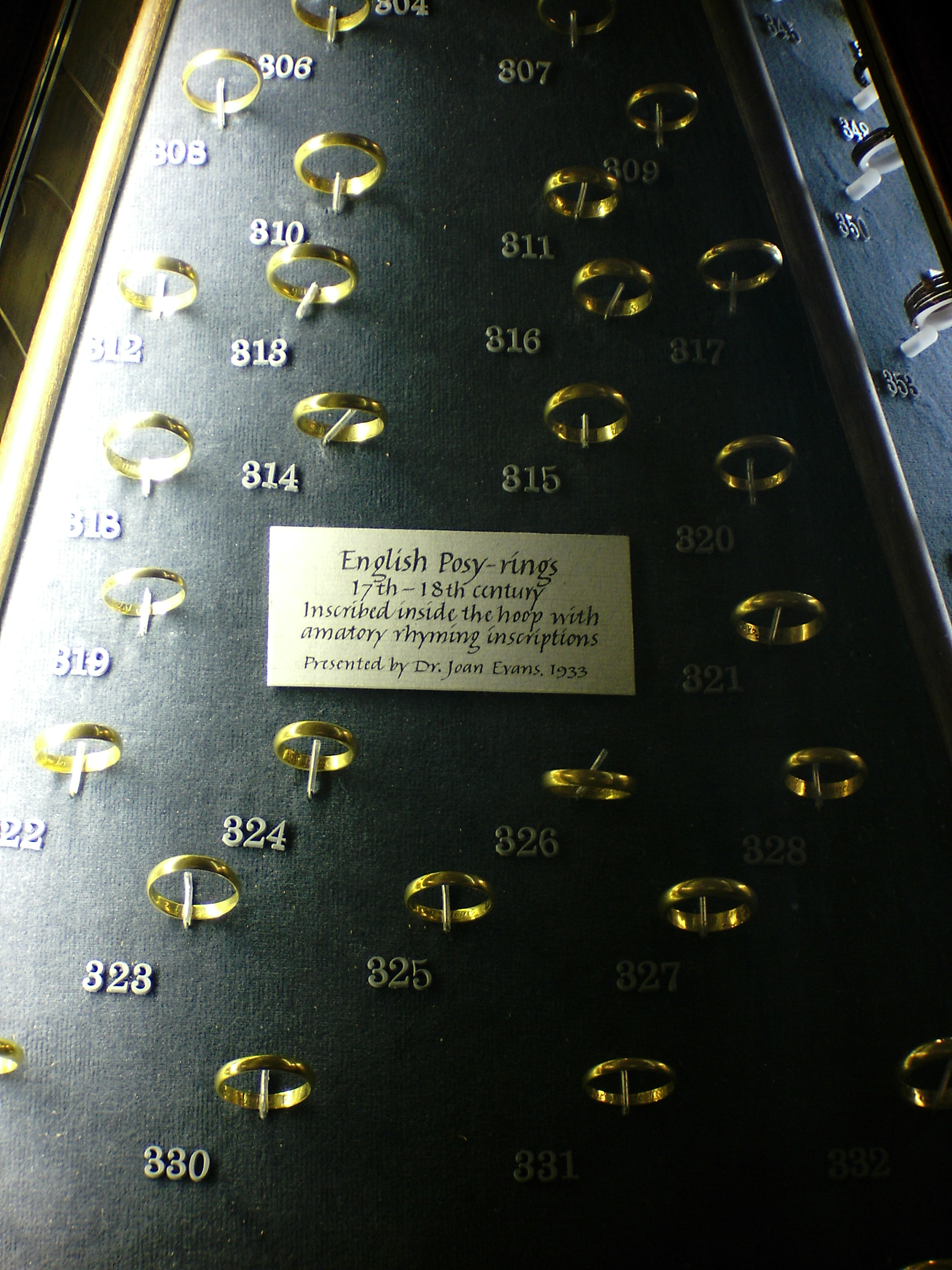
What Hamlet is suggesting is that the prologue is as clumsy as the poetry found within a ring (although occasionally on the outside) usually given by one lover to another in the late medieval era at least into the 18th century, like this one—

where inside is written “When this you see, remember me.”

(For more, see:  https://web.archive.org/web/20080611125813/http://www.wartski.com/Posy%20ring%20messages.htm )

Often called “posy rings” (a contracted form of “poesie”, as in the Shakespeare quotation), there are hundreds of surviving examples—here are only a small number from the Ashmolean Museum in Oxford—

The texts vary, from what appears confident–“In thee my choice I do rejoice”—to the less so:  “I live in Hope”, but the general purpose of these little gifts is clear, if less sinister than Sauron’s.  They are meant to remind someone that someone else is thinking of them.  The difference, however, is that, if there’s one thing you wouldn’t want, it would be to have the Eye of Sauron looking in your direction.

Thanks, as always, for reading.

Stay well,

Consider what Orcs might write on their rings,

(Alan Lee)

And remember that, as ever, there’s

MTCIDC

O

PS

For a little more on posy rings, see the monograph by John Evans, “Posy-Rings” (1892) at https://ia800704.us.archive.org/5/items/PosyRingsEvans/evans-j-posy-1892-00011597.pdf

Runing Things

13 Wednesday Aug 2025

Posted by Ollamh in J.R.R. Tolkien, Language, Tolkien

≈ Leave a comment

Tags

Anglo-Frisian Runes, Balin, Bryggen, divination, Fireworks, Futhark, Futhorc, Gandalf, Harys Dalvi, Kylver Stone, Moria, Robwords, runes, Tacitus, The Lord of the Rings, Thror's Map, Tolkien, Vimose comb

Welcome, as ever, dear readers.

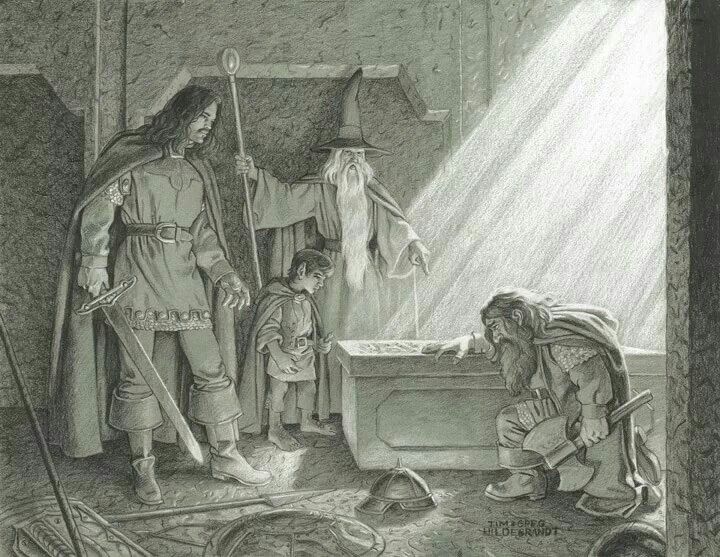
It is a grim moment, in The Lord of the Rings when the company, making its way through the complexity of Moria in near-darkness, save for Gandalf’s staff, reaches this—

“Their feet disturbed a deep dust upon the floor, and stumbled among things lying in the doorway whose shapes they could not at first make out.  The chamber was lit by a wide shaft high in the further eastern wall; it slanted upwards and, far above, a small square patch of blue sky could be seen.  The light of the shaft fell directly on a table in the middle of the room:  a single oblong block, about two feet high, upon which was laid a great slab of white stone.

(the Hildebrandts)

‘It looks like a tomb,’ muttered Frodo, and bent forwards with a curious sense of foreboding, to look more closely at it.  Gandalf came quickly to his side.  On the slab runes were deeply graven:

‘These are Daeron’s Runes, such as were used of old in Moria,’ said Gandalf.  ‘Here it is written in the tongues of Men and Dwarves:

BALIN SON OF FUNDIN

LORD OF MORIA ‘.”  (The Lord of the Rings, Book Two, Chapter 4, “A Journey in the Dark”)

Even if you’re not an expert in early western writing systems, you’ve probably encountered runes before.  They appear to be a Germanic invention, with their first known outside mention thought to be in P. Cornelius Tacitus’ (c.56-c.120 AD) essay on some northern tribes, Germania, where this passage is cited.

“[10] Auspicia sortesque ut qui maxime observant: sortium consuetudo simplex. Virgam frugiferae arbori decisam in surculos amputant eosque notis quibusdam discretos super candidam vestem temere ac fortuito spargunt. Mox, si publice consultetur, sacerdos civitatis, sin privatim, ipse pater familiae, precatus deos caelumque suspiciens ter singulos tollit, sublatos secundum impressam ante notam interpretatur.”

“[the Germans] pay very close attention to auspices and lot-drawing:  the practice of lot-drawing is simple.  They split a branch cut from a fruit tree into splinters and scatter those, marked out with certain signs, on a white robe casually and randomly.  Then a priest of the settlement, if it may be the public consulting of an oracle, but if private, the father of a family himself, having prayed to the gods and raising his eyes to the sky, draws three [splinters] one at a time [and] interprets those drawn according to the mark stamped upon [them] previously.”

(Tactius, Germania, Section 10—my translation.  If you’d like to read the whole text, here’s a useful Victorian translation:  https://archive.org/details/tacitusagricolag00taciiala/page/62/mode/2up )

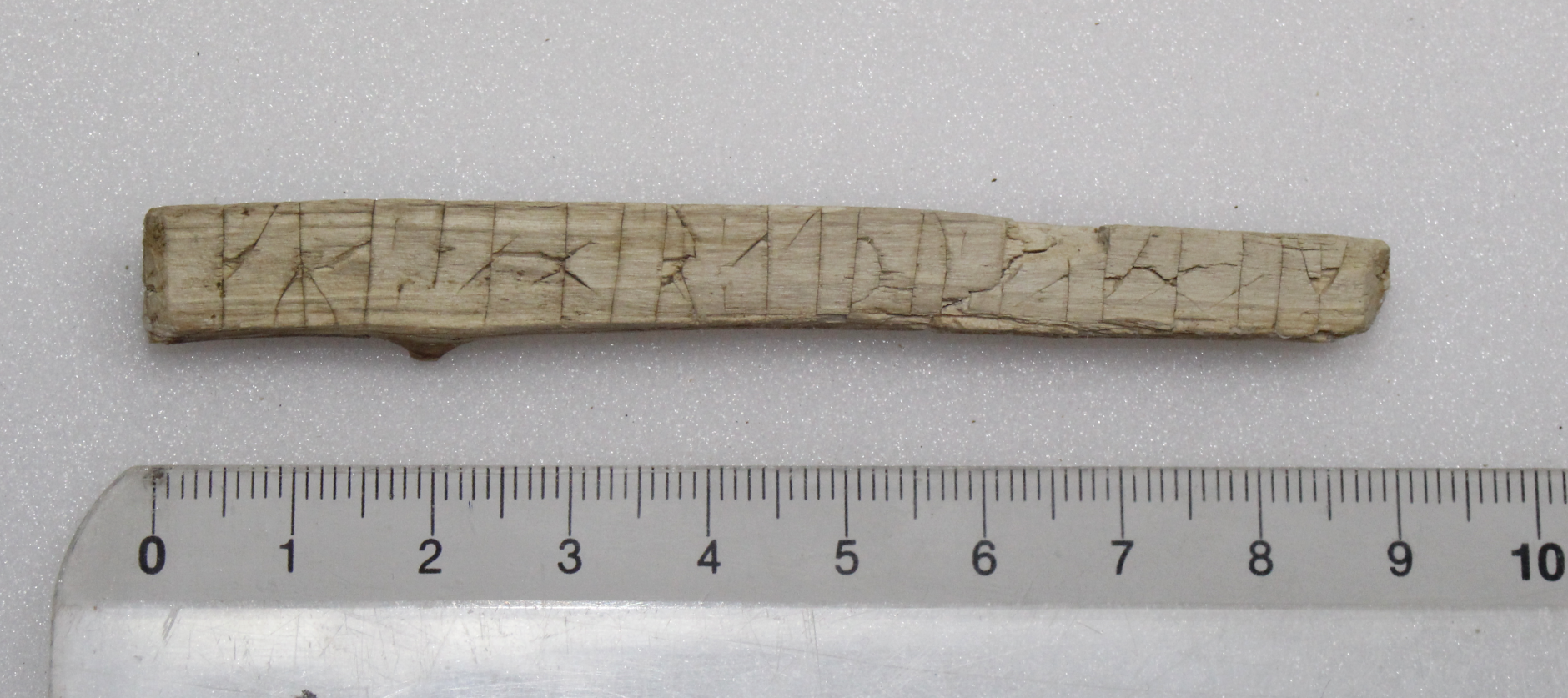
We don’t know where Tacitus got his information from, but he lived at about the same time as one of the earliest currently-known runic inscriptions, the “Vimose comb”, dated to about 160AD,

(There seem to be two guesses at to what the inscription says—transliterated, it appears to read “harja”, meaning either the obvious “comb” or the less obvious “warrior”.  For more on this and other early rune-marked artifacts, see:  https://en.wikipedia.org/wiki/Vimose_inscriptions and https://en.natmus.dk/historical-knowledge/denmark/prehistoric-period-until-1050-ad/the-early-iron-age/the-weapon-deposit-from-vimose/the-offerings-in-vimose/   Until they sold out, you could even get a bone replica of the comb here:  https://norseimports.com/products/vimose-comb )

so the notae, “marks”, he mentioned could, indeed, be early runes.

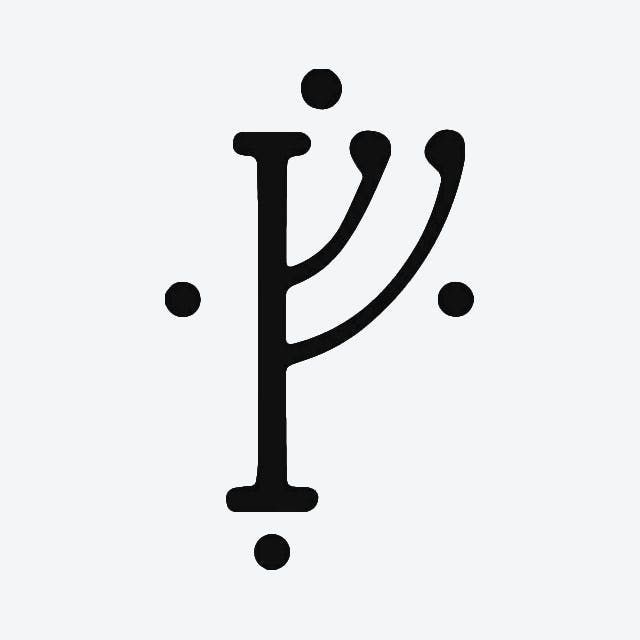
We’ve seen runes three times before in the book, each time related to Gandalf and the first letter of his name in runes–

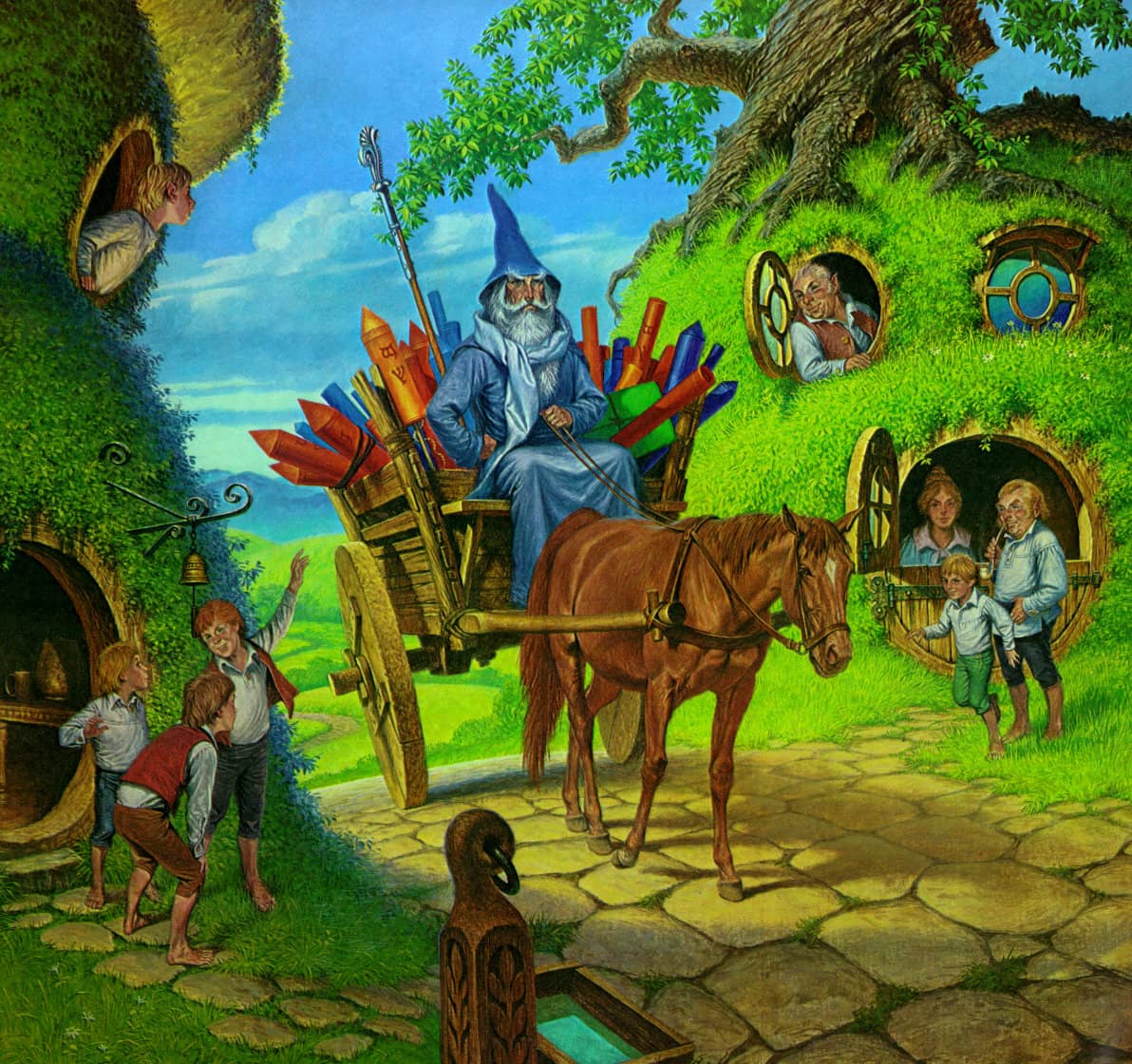
The first is a jolly appearance:

(Darrell K. Sweet, who died, unfortunately, in 2011, but you can see his archived website here:  https://web.archive.org/web/20110131141507/http://www.sweetartwork.com/DKSmainPage.html and read a little more about this very talented illustrator here:  https://en.wikipedia.org/wiki/Darrell_K._Sweet And I couldn’t resist adding this knowledgeable appreciation of his work:  https://blackgate.com/2022/04/17/an-adventure-to-be-had-a-journey-through-the-art-of-darrell-k-sweet/ )

“At the end of the second week in September a cart came in through Bywater from the direction of Brandywine Bridge in broad daylight.  An old man was driving it all alone…It had a cargo of fireworks…At Bilbo’s front door the old man began to unload:  there were great bundles of fireworks of all sorts and shapes, each labeled with a large red G [runic letter] and the elf-rune [see the image above].” (The Fellowship of the Ring, Book One, Chapter 1, “A Long-Expected Party”)

The second is not, being Gandalf’s much-delayed letter to Frodo, still at the Prancing Pony in Bree, instead of being delivered 3 months before to the Shire, meant to alert Frodo to the possibility that he won’t meet them, with some consolation that Strider might appear. (The Fellowship of the Ring, Book One, Chapter 10, “Strider”)

(the Hildebrandts)

And the third is only guessed at as seeming to be a sign from Gandalf on Weathertop:

“ ‘The stroke on the left might be a G-rune with thin branches,’ said Strider.  ‘It might be a sign left by Gandalf, though one cannot be sure…I should say…that they stood for G3, and were a sign that Gandalf was here on October the third:  that is three days ago now.  It would also show that he was in a hurry and danger was at hand, so he had no time or did not dare to write anything longer or plainer.  If that is so, we must be wary.’ “ (The Fellowship of the Ring, Book One, Chapter 11, “A Knife in the Dark”)

(John Howe)

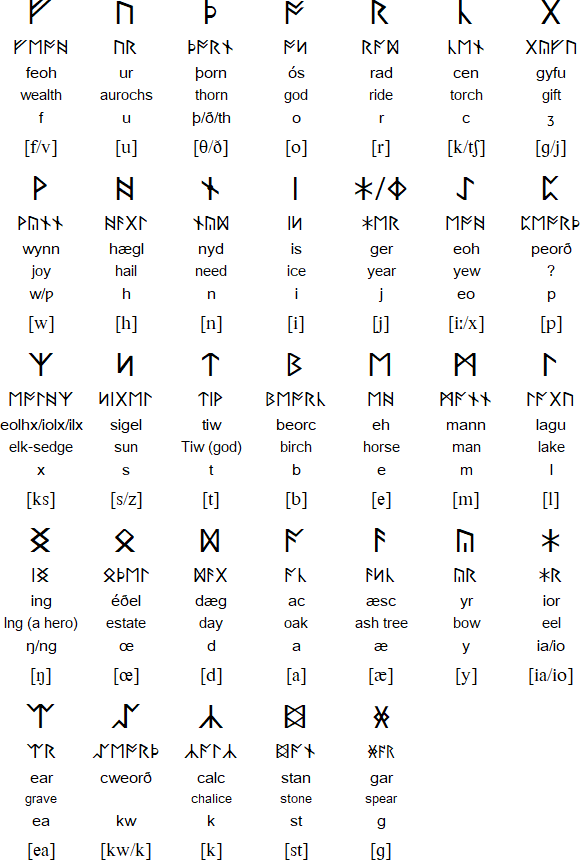
In our Middle-earth, there are several iterations of runes, with the melodious (modern) names of “Futhark”(Elder and Younger) and “Futhorc”, which get those names, as the word “alphabet” does, from putting together a collection of the first letters of the series in a standard order.  Here’s the Elder Futhark—

It’s easy to see why the letters might be shaped as they were, appearing to be relatively easy to inscribe on things with a knife.  (Or a chisel for the stone inscriptions?)

(a 12th-century AD inscription on wood from Bryggen in Norway—one of 670 inscriptions on wood or bone found at the site since 1955—for more see:  https://en.wikipedia.org/wiki/Bryggen_inscriptions  and https://en.wikipedia.org/wiki/Bryggen One of the many amazing things about this second piece is that it underlines just how sophisticated trade could be in northern Europe in the Middle Ages.)

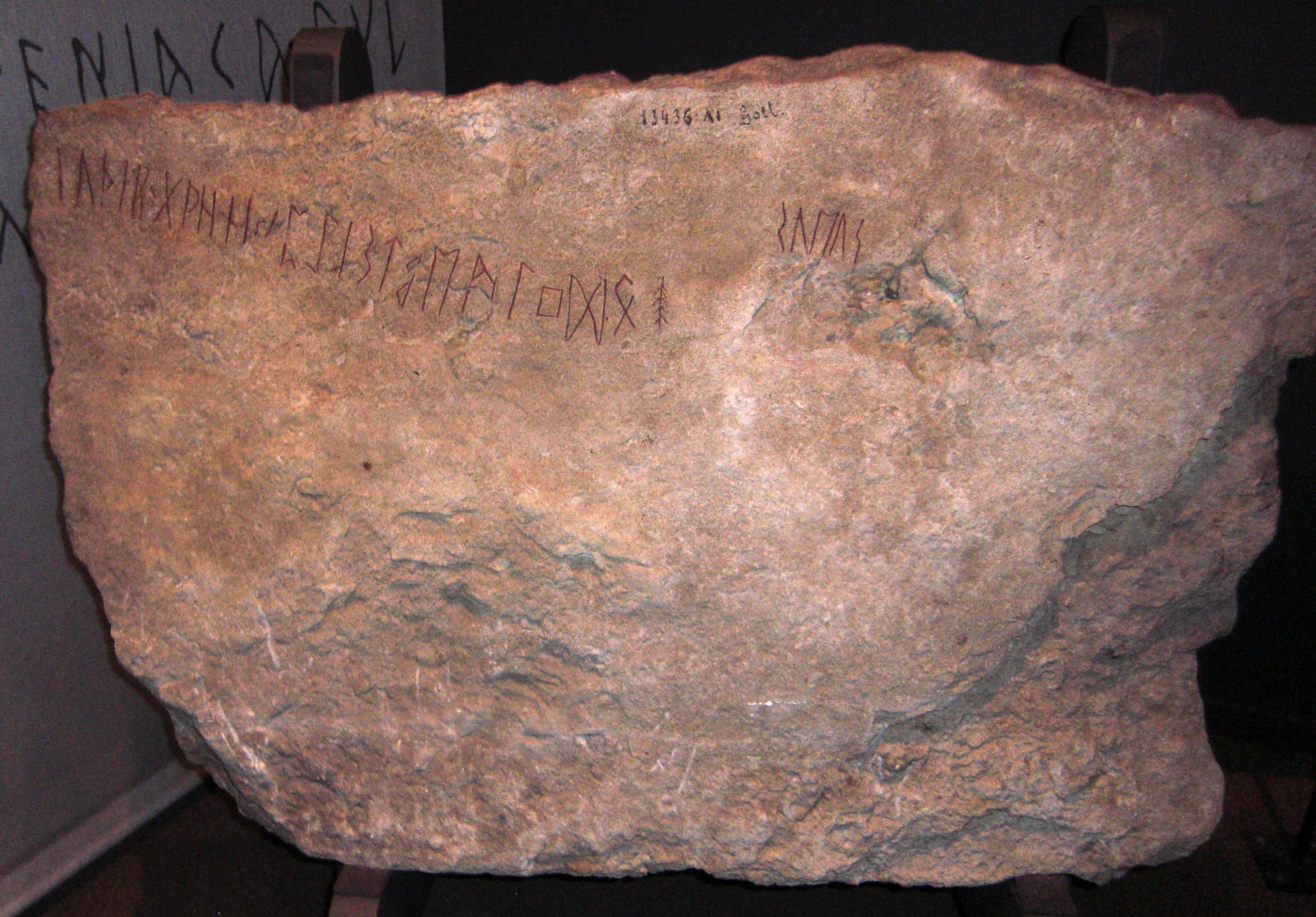
(This is the Kylver Stone from Gotland, Sweden, c.400AD, which lists the Elder Futhark letters.  For more, see:  https://en.wikipedia.org/wiki/Kylver_Stone and you can see from the translation of the runes where “Futhark” came from. )

Tolkien’s own runes, as he tells us, are derived from what are sometimes called the “Anglo-Saxon” or “Anglo-Frisian” Futhorc:

“There is the matter of the Runes.  Those used by Thorin and Co., for special purposes, were comprised of an alphabet of thirty-two letters (full list on application), similar to, but not identical, with the runes of Anglo-Saxon inscriptions.”  (letter to the editor of The Observer, published there 20 February, 1938, Letters, 42)

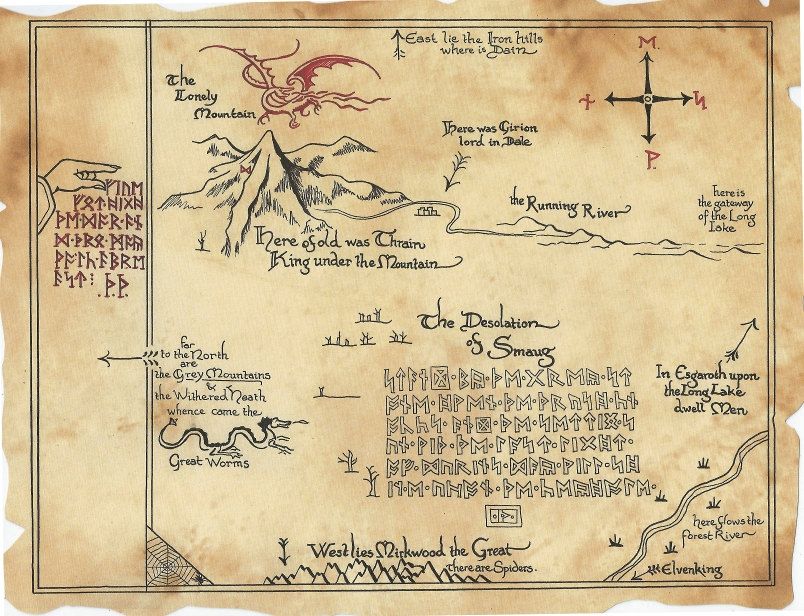
We can then imagine that this is what must appear as the “moon letters” on Thror’s map—


And this brings me to my final point.

In my last, in connection with the conlang (constructed language) toki pona, I mentioned the internet site Robwords, one of my favorite places for information and discussion about languages, primarily English, German, and French, but with some surprises (see last week’s “Simple Words” for more).

(This is Rob Watts, of Robwords)

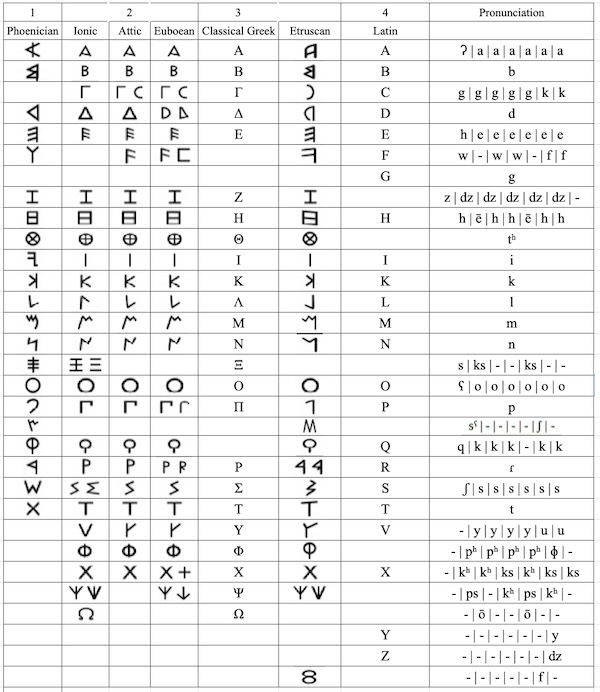
One of those surprises was toki pona, but, in another, Rob made the suggestion that the Roman alphabet, in which I’m writing this posting, was rotten for the English language, being adapted from the Greek alphabet (in turn adapted from the Phoenician alphabet) via the Etruscan alphabet,

and lacking letters for certain common English sounds like “th” and “sh” and “ng”.

In his playful way, he suggested that we’d be better off with the runic system, and specifically that Anglo-Saxon version, aka Futhorc.

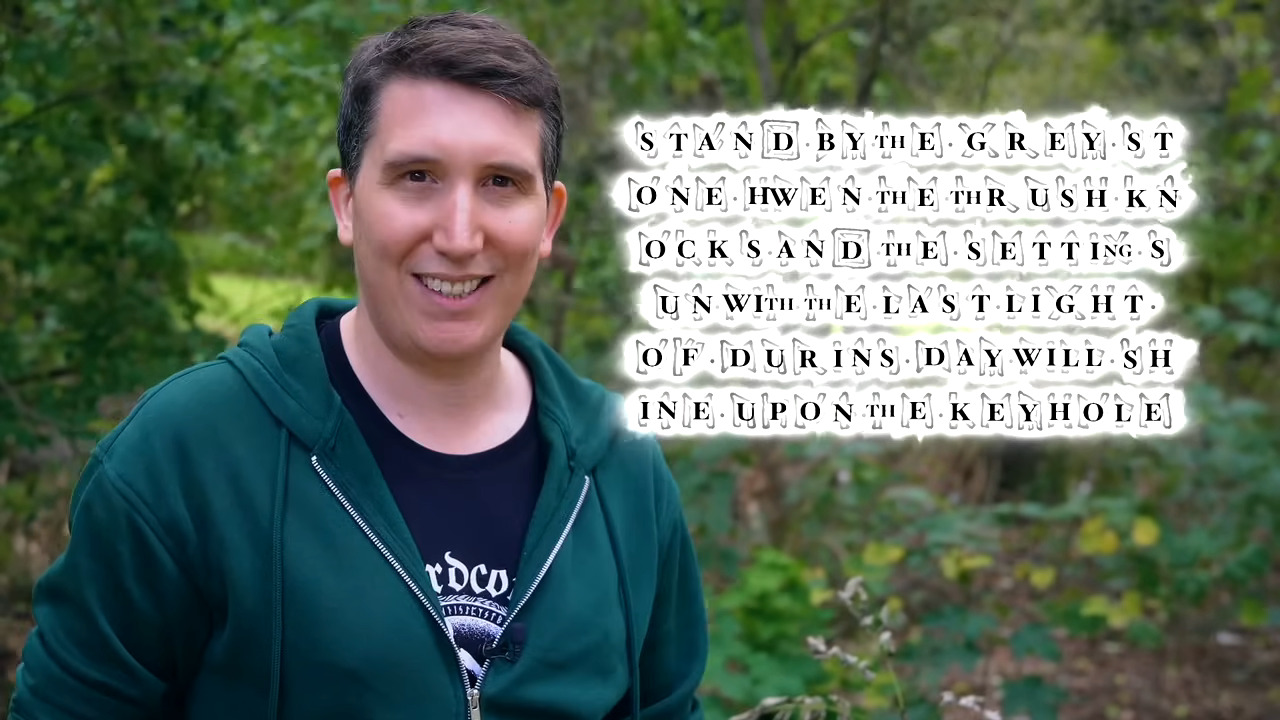
 To prove his point, he cites something familiar to Tolkien readers—

and then proceeds to translate it, showing that it’s not in the language of the dwarves, as one might expect from a dwarvish map, but English (or, if you prefer, “the Common Speech”).

Watch the video, then, and see if you agree with Rob: https://www.youtube.com/watch?v=4npuVmGxXuk

And, if you’d like to try your hand at using the runes, here’s something to help—it’s a link to Harys Dalvi’s Old English runic keyboard:  https://www.harysdalvi.com/futhorc/  Harys Dalvi’s website is full of really interesting language and computer stuff and just plain fun:  https://www.harysdalvi.com/

Thanks, as always, for reading,

(ᚦᚫᛝᚳᛋ᛫ᚫᛋ᛫ᚫᛚᚹᛠᛋ᛫ᚠᚪᚱ᛫ᚱᛁᛁᛞᛁᛝ)

Stay well,

(ᛥᛠ᛫ᚹᛖᛚ)

Try runisizing today,

(ᛏᚱᚫᛁ᛫ᚱᚢᚾᛁᛋᛁᛋᛁᛝ᛫ᛏᚣᛞᛠ)

And remember that, as always, there’s

ᛗᚪᚱ᛫ᛏᚣ᛫ᚳᚢᛗ᛫ᛁᚾ᛫ᛞᚣ᛫ᚳᚣᚱᛋ

O

PS

At “wikiHow” there’s a pronunciation guide and a rather New Age interpretation of the Elder Futhark’s runes.  It’s fun, but, as it sits to the left of such “How” guides as “telekinesis”, and “reading palms”, I myself would stick to the pronunciations!  https://www.wikihow.com/Elder-Futhark-Runes 

PPS

And how could I resist listing this:  https://runicstudies.org/ the website for the American Association for Runic Studies?  If you get hooked on runes—and I think that that would be quite easy to do, especially after playing on Harys’ website—this site has links in all directions.

Starre-crost

25 Wednesday Jun 2025

Posted by Ollamh in Uncategorized

≈ Leave a comment

Tags

Beowulf, Bilbo, Cirdan, Dorothy, Fantasy, Gandalf, Herakles, Kansas, King Arthur, lotr, Mulan, Narya, Rings of Power, Superman, The Grey Havens, The Hobbit, The Rings of Power, Tolkien, tornado, Valar

As always, dear readers, welcome.

In adventure stories, heroes—and heroines– seem to appear in all sorts of ways.

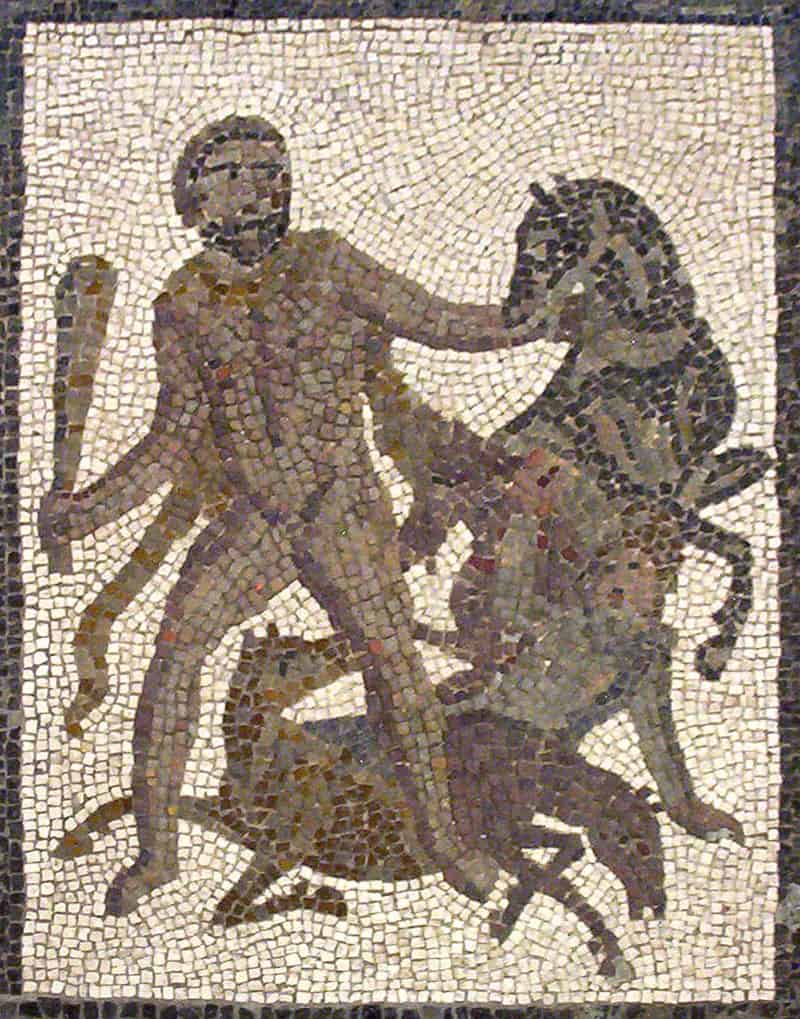
Sometimes, it seems that they are just born for adventure, like Herakles, who,

although apparently the offspring of two mortals, Alkmene and Amphitryon, was actually the son of Zeus.

Others belong to noble families, where heroism is expected of them, like Beowulf, nephew of the king of the Geats.

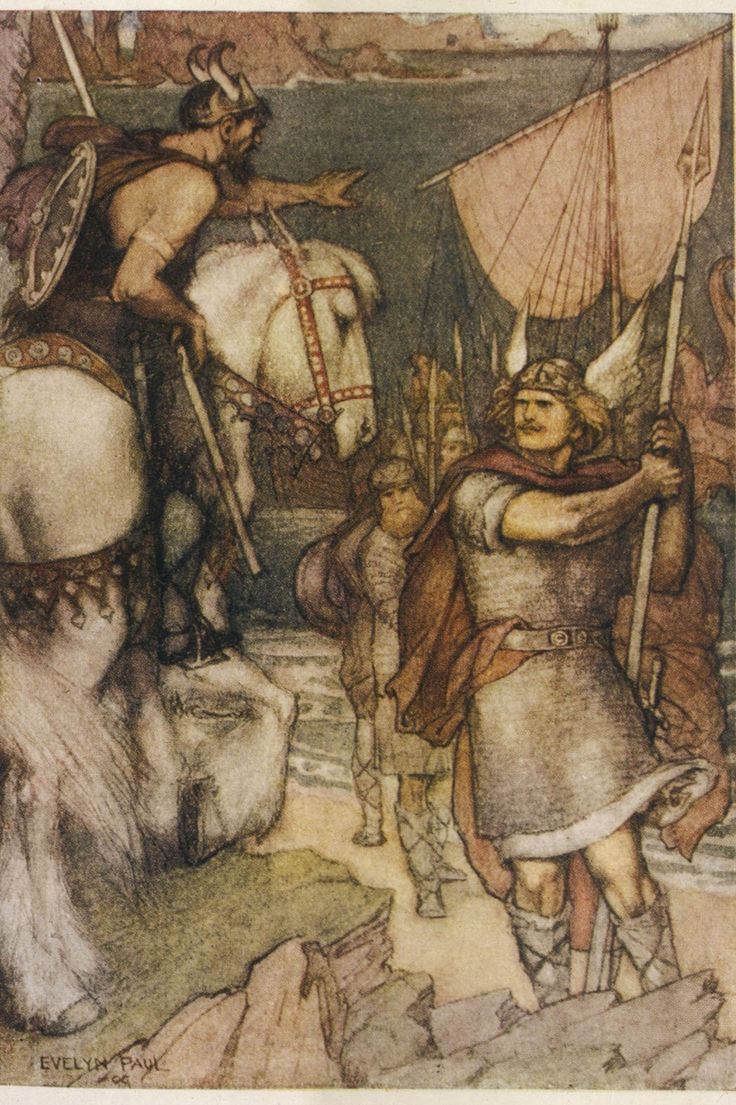
(Here, meeting the Danish coastguard—but we just can’t escape those Wagnerian winged helmets, can we?)

Then there is Mulan, who, pretending to be a man, replaces her father in the army and serves valiantly for twelve years.

(As you can see from the label, this comes from a site called “Chinese Posters.net”—and it’s quite a site:  5100 propaganda posters from the Chinese past.  Here’s the address:  https://chineseposters.net/ For more on the original but probably fictional Mulan, see:  https://www.worldhistory.org/article/1596/mulan-the-legend-through-history/ and https://mulanbook.com/pages/northern-wei/ballad-of-mulan/ and https://en.m.wikisource.org/wiki/Translation:Ballad_of_Mulan –two versions of the early “Ballad of Mulan)

A common motif is that of the apparent good-for-nothing—or at least for not much—who turns out to be of heroic material.  I immediately think of King Arthur, who is, basically, a servant until he fetches that sword from the stone/anvil.

Heroes and heroines, then, can be anything from a demigod to a nobleman to a good girl who loves her father to a good-for-nothing who is more than he seems, and set out on adventures or, as in the case of Arthur, adventure finds them.

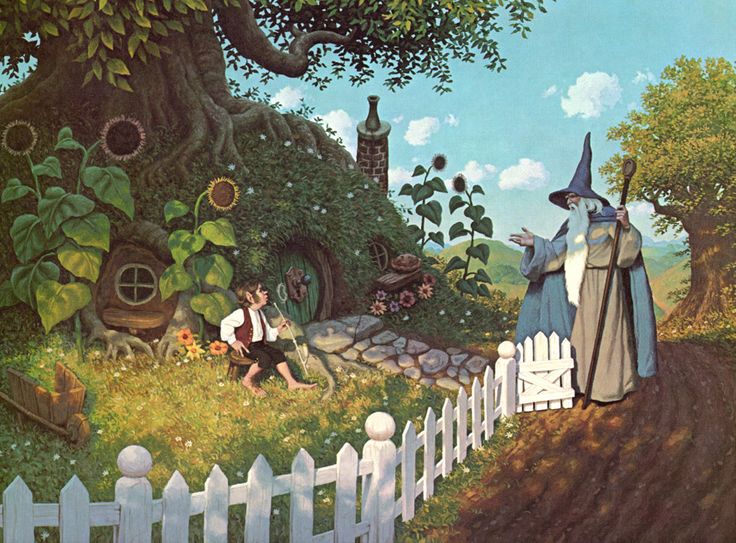
Ordinary—or seemingly ordinary—people can also be pulled into adventures, as Bilbo is.

(the Hildebrandts)

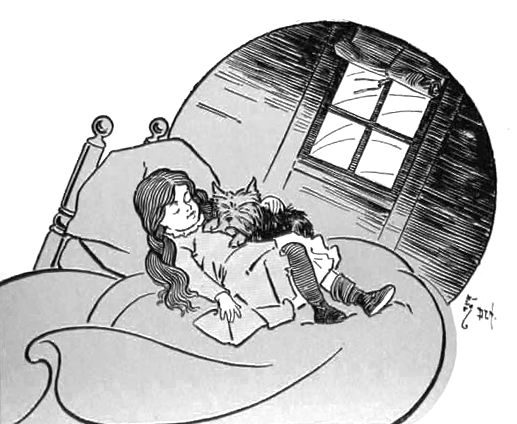
Then there are people who are literally dropped into adventures,

(WW Denslow)

sometimes beginning those adventures in a very dramatic—and ultimately decisive—way.

Dorothy, of course, has been whirled by a tornado from Kansas to Oz,

(from the 1939 film)

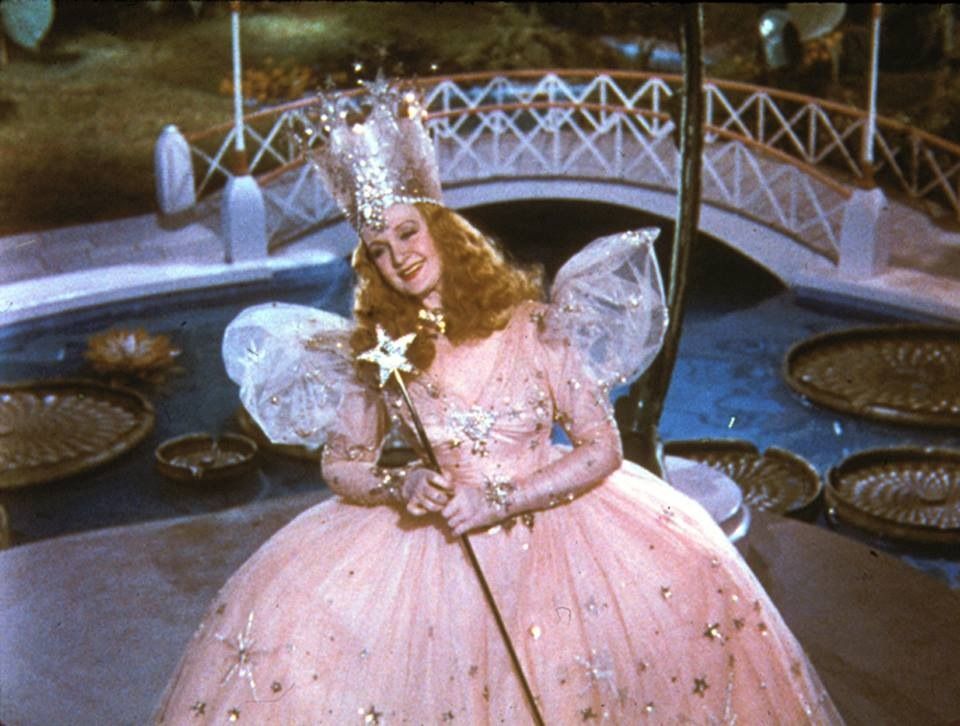
but, when she arrives in Oz in the film, Glinda, the Good Witch of the North

(also from the film)

sings:

“Come out, come out, wherever you are and meet the young lady

Who fell from a star.

She fell from the sky, she fell very far and Kansas, she says,

Is the name of that star.”

Not true, of course, of Dorothy, (although Kansas has its beauties, no doubt), but it is true of another hero, Superman,

who had been shipped in a rocket by his parents from the dying planet, Krypton, and discovered in a field by Ma and Pa Kent, who would become his foster parents.

If you read this blog regularly, you know that I don’t find negative reviews which are nothing but hatchet jobs

at all helpful and, in my own reviews, I try to understand what it is that the creators attempted to do and react to that, being aware, of course, that I do have my own perspective on things.  I also buy DVDs of everything I can, so that I can watch things more than once before I review. 

I’ve now seen “Rings of Power”, both seasons,

only once, so I’m not going to attempt to review the whole two seasons here.  Certainly there have been some very impressive visuals and some very good acting.  I’m not sure how I feel about the two as a whole—some of the plot I found rather confusing and I’m not sure how I feel about proto-hobbits with Irish accents, although the idea of using proto-hobbits was, I thought, pretty ingenious—but I want to end this posting by talking about Gandalf.

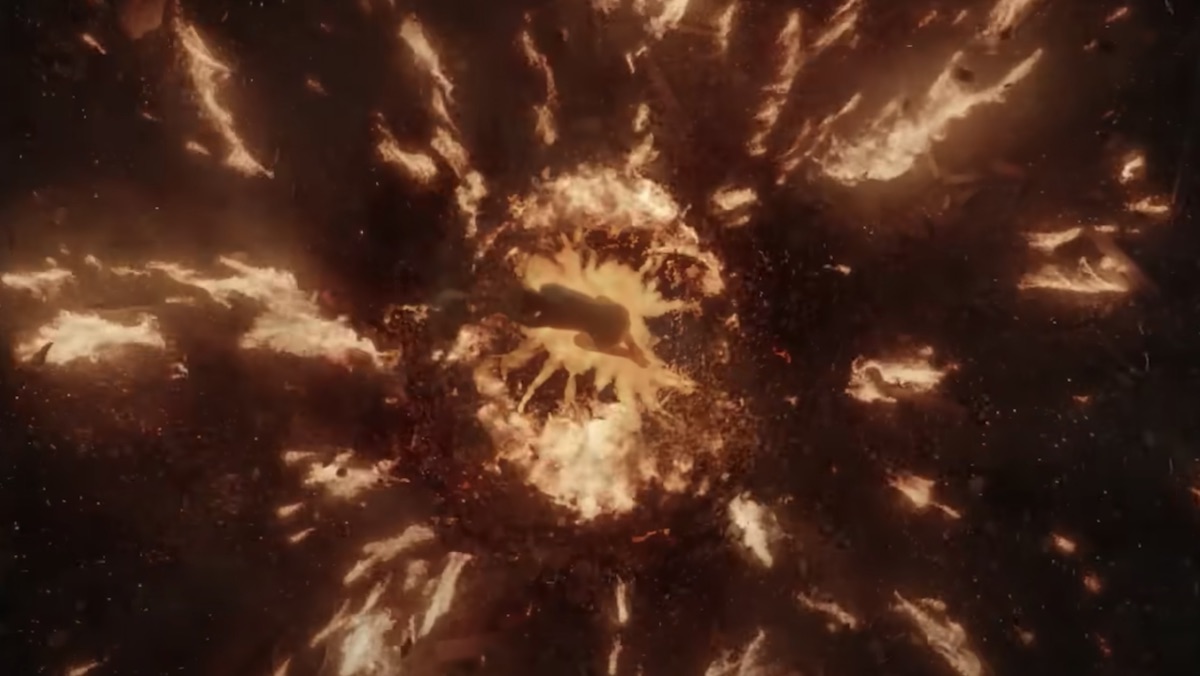
He first appears—like Dorothy in Oz, but even more so like the baby Superman, in a dramatic fashion, having been conveyed in which appears to be a kind of meteor which roars across the sky and slams into the earth, leaving a fiery crater.

(Thank goodness that, whoever sent him, dressed him in underpants so that he wouldn’t embarrass himself or us when he stood up.)

At first, he seems stricken and quite clueless, not even really having language at first, although certainly having great powers, and it takes two seasons for him to begin to understand himself and what he’s been sent to do and I suspect that this stricken quality comes from a hint in Christopher/JRR Tolkien’s Unfinished Tales, where, under “The Istari” we find:

“For it is said indeed that being embodied the Istari had need to learn much anew by slow experience…” (Unfinished Tales, 407)

I understand that the creators of the series were somewhat hampered in their work—should they want to be as faithful as possible to Tolkien—because they were restricted in their sources, being confined, in this case, to The Lord of the Rings and its appendices.  And, at first glance, the appearance in Middle-earth of the Istari does seem rather vague.

In Appendix B, “The Third Age”, of The Lord of the Rings, we read:

“When maybe a thousand years had passed, and the first shadow had fallen on Greenwood the Great, the Istari or Wizards appeared in Middle-earth.  It was afterwards said that they came out of the Far West and were messengers sent to contest the power of Sauron, and to unite all those who had the will to resist him…” 

No meteors are mentioned, but no other means of transport, either, yet turn the page and we then read:

“Gil-galad before he died gave his ring to Elrond; Cirdan later surrendered his to Mithrandir (aka Gandalf).  For Cirdan saw further and deeper than any other in Middle-earth, and he welcomed Mithrandir at the Grey Havens, knowing whence he came and wither he would return.”  

If you know The Lord of the Rings, you know that the Grey Havens is a seaport on the west coast of Middle-earth:  it’s where Gandalf and others, including Frodo, depart for the Uttermost West—that is, Valinor.

(Ted Nasmith and a gorgeous view)

In fact, it was the Valar who had sent the Istari in the first place, as we know from Unfinished Tales, 406:

“For with the consent of Eru they sent members of their own high order, but clad in bodies as of Men, real and not feigned…”

And thus, from the source to which I’m informed the creators were confined, they would have learned that the Istari had sailed to Middle-earth, not been shot across the sky like Dorothy or Superman.  Why make such a change, especially as, because Cirdan recognizes Gandalf’s worth, he gives him one of the original Elvish rings, Narya, which turns up on his hand in the subsequent The Lord of the Rings?

The title of this posting is a quotation from Shakespeare, from the prologue to “An EXCELLENT conceited Tragedie OF Romeo and Juliet” (as the First Quarto title page reads) in which the Prologue says of the protagonists:  “A paire of starre-crost Louers tooke their life”. 

The creators of The Rings of Power, even with evidence available to them, have veered away from that evidence with no explanation as to why they have made such a choice.  What else may they have chosen to change and how might that affect JRRT’s view of the earlier history of Middle-earth, as well as ours?

As I begin my second viewing of The Rings of Power, then, I’ll be curious to see if another Shakespeare quotation, this from “The Tragedie of Julius Caesar”, Act 1, Scene 1, when Cassius, the leader of the plot against Julius Caesar, is trying to persuade Brutus to join him, may apply to the creators and their work:

“The fault (deere Brutus) is not in our Starres,

But in our Selues…”

Thanks, as always, for reading.

Stay well,

Think about what Cassius is telling us about horoscopes,

And remember that, as always, there’s

MTCIDC

O
By Ear (3)

21 Wednesday May 2025

Posted by Ollamh in Uncategorized

≈ Leave a comment

Tags

Brutus, cassius, ears, Fantasy, Gandalf, Hamlet, henbane, Julius Caesar, lotr, Marcus Antonius, Orthanc, Palantir, poison, Saruman, Sauron, Shakespeare, Tolkien

Welcome, dear readers, as always.

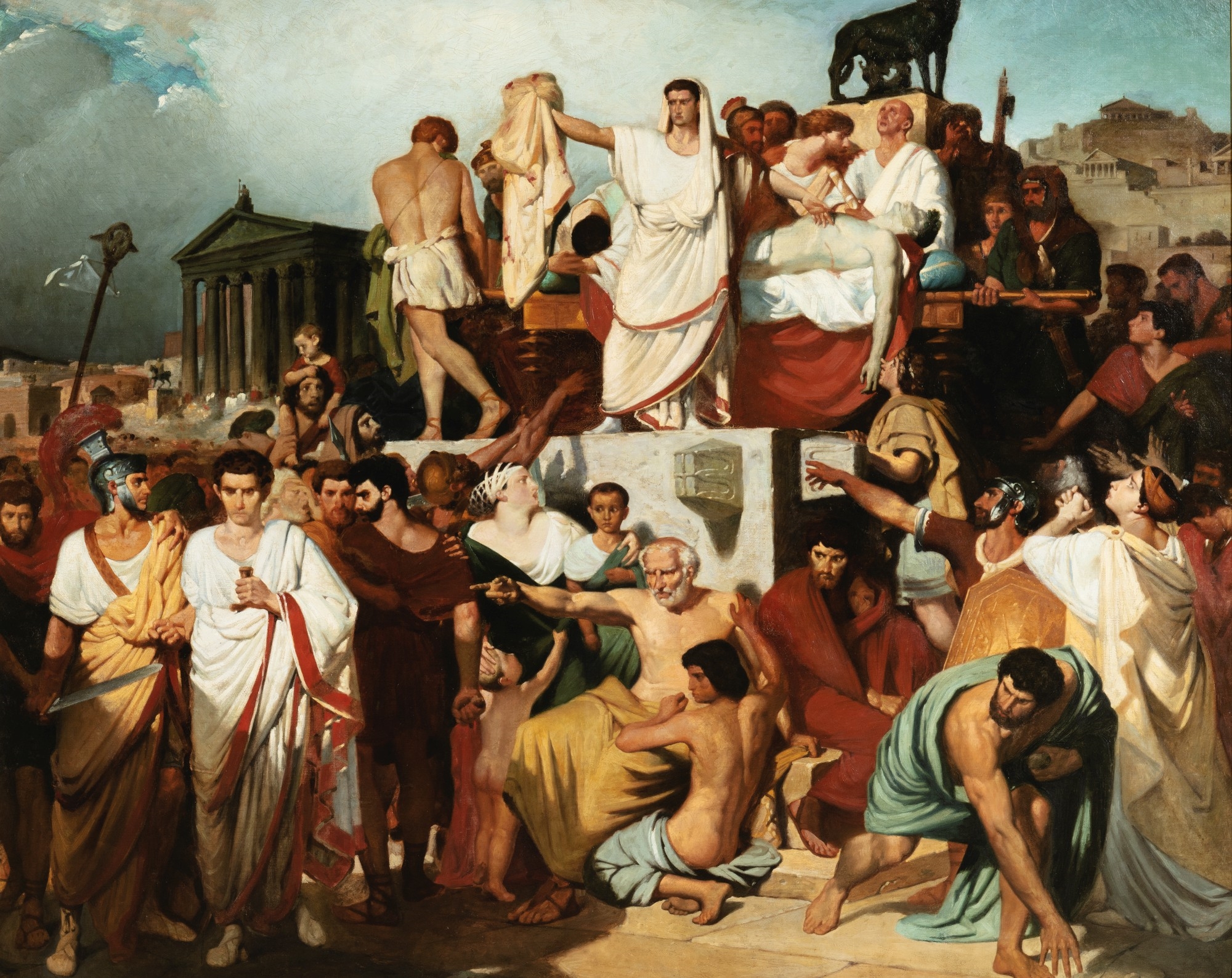
In the closing of the second part of this little series, I quoted Marcus Antonius in his funeral oration upon Julius Caesar in Shakespeare’s play of the same name.

It is a masterpiece, both in its design and in its deception:  saying one thing for the assassins, led by Brutus, to hear, and, on the other, poisoning the common people against the assassins, originally seen as liberators of the Republic.  You probably remember its opening:

“Friends, Romans, Countrymen, lend me your ears:

I come to bury Caesar, not to praise him:

The euill that men do, liues after them,

The good is oft enterred with their bones,

So let it be with Caesar. The Noble Brutus,

Hath told you Caesar was Ambitious:

If it were so, it was a greeuous Fault,

And greeuously hath Caesar answer’d it.

Heere, vnder leaue of Brutus, and the rest

(For Brutus is an Honourable man,

So are they all; all Honourable men)

Come I to speake in Caesars Funerall.”

(Julius Caesar, Act III, Scene 2, from the First Folio, 1623, in the original spelling.  You can see it at my favorite site for the plays:  https://internetshakespeare.uvic.ca/doc/JC_F1/scene/3.2/index.html )

Speech with a deceptive goal is a theme of this series, as, in the first part, were poison–and ears.

In the scene in Shakespeare’s play, Marcus Antonius plays a dangerous game.  In order to be able to speak, he has made a deal with the assassins of Caesar not to say anything inflammatory against them, and so we see those words “Honourable men” repeated, as if Antonius is going to praise them—while only burying Caesar, as he says—just the sort of thing which we can imagine the assassins wanted to hear.  And yet, as he continues, “Honourable men” gradually becomes ironic and, by the end of his speech, he controls the mob and it’s clear that the assassins are no longer considered liberators, but murderers, Antonius having successfully poisoned those lent ears against the very men who foolishly gave him leave to speak.

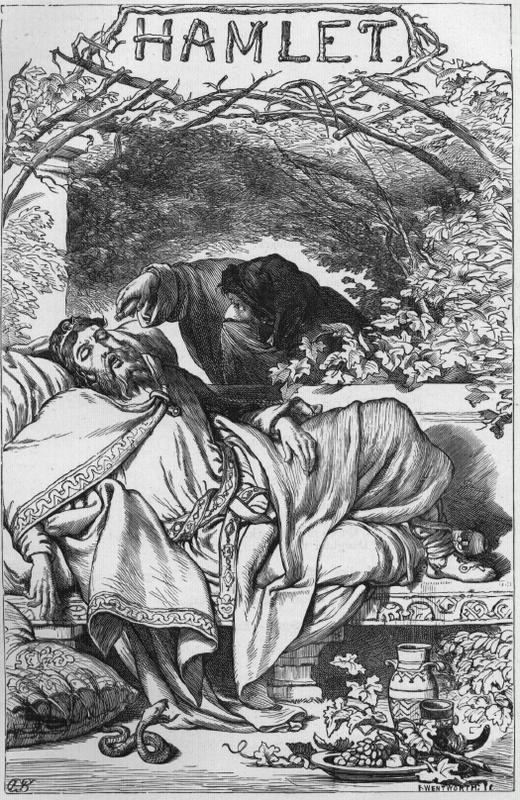
We began the series with poison—and Shakespeare:  literal poison (possibly henbane)

which, as Hamlet’s ghostly father tells Hamlet, had been administered to him through his ear by his own brother, Claudius, while he was napping in his garden

But, as we progressed, we moved from that chemical murder to a different kind of destruction, spiritual, in the case of Saruman in the second installment, and now, in the third and final installment, we move to the instrument of that poisoning, include a second poisoning victim, and find the mind behind it all and that mind’s method of persuasion, which, I would suggest, must be very like Antonius’ initial remarks, seeming to praise the assassins, but, just like his, with another motive underneath.

(JRRT)

When Saruman, failing to succeed with Theoden, has turned to Gandalf, Gandalf has alluded to his previous visit with Saruman, saying:

“What have you to say that you did not say at our last meeting?…Or, perhaps, you have things to unsay?”  (The Two Towers, Book Three, Chapter 10, “The Voice of Saruman”)

That last meeting had ended with Gandalf’s imprisonment in the tower of Orthanc,

(the Hildebrandts)

but, before that, Saruman had tried to persuade Gandalf to become an ally, and not only of Saruman, but of someone else, his speech including these words:

“We can bide our time, we can keep our thoughts in our hearts, deploring evils done by the way, but approving the high and ultimate purpose:  Knowledge, Rule, Order; all the things we have so far striven in vain to accomplish…”  (The Fellowship of the Ring, Book Two, Chapter 2, “The Council of Elrond”)

Gandalf’s reply then suggests that what Saruman is saying is not really his own argument:

“ ‘I have heard speeches of this kind before, but only in the mouths of emissaries sent from Mordor to deceive the ignorant.’ “

What is it in those words which betrays their original authorship?

In the draft of a letter to Peter Hastings, Tolkien wrote:

“Sauron was of course not ‘evil’ in origin.  He was a ‘spirit’ corrupted by the Prime Dark Lord…Morgoth.  …at the beginning of the Second Age he was still beautiful to look at, or could still assume a beautiful visible shape—and was not indeed wholly evil, not unless all ‘reformers’ who want to hurry up with ‘reconstruction’ and ‘reorganization’ are wholly evil, even before pride and the lust to exert their will eat them up.”  (draft of a letter to Peter Hastings, September, 1954, Letters, 284)

What Gandalf is actually hearing then is the thinking of Sauron and his “high and ultimate purpose”, but wrapped in words which will sound familiar to Saruman and appeal to his increasing arrogance—those words “high and ultimate purpose” echo Saruman’s depiction later in the story of just who the Istari are:

“Are we not both members of a high and ancient order, most excellent in Middle-earth?”  (The Two Towers, Book Three, Chapter 10, “The Voice of Saruman”)

That “order” was not sent to Middle-earth for “Knowledge, Rule, Order”, however, as this entry in the Appendices to The Lord of the Rings tells us:

“When maybe a thousand years had passed, and the first shadow had fallen on Greenwood the Great, the Istari, or Wizards appeared in Middle-earth.  It was afterwards said that they came out of the Far West and were messengers sent to contest the power of Sauron, and to unite all those who had the will to resist him; but they were forbidden to match his power with power, or to seek to dominate Elves or Men by force and fear.”  (The Lord of the Rings, Appendix B: “The Third Age”)

Marcus Antonius has spoken indirectly to the assassins and directly to the mob, both through their ears, but Sauron’s words have reached Saruman through this—

(the Hildebrandts)

which we know that Saruman has had as it is flung through the doorway of Orthanc by Grima and almost brains Gandalf—

“With a cry Saruman fell back and crawled away.  At that moment a heavy shining thing came hurtling down from above.  It glanced off the iron rail, even as Saruman left it, passing close to Gandalf’s head, it smote the stair on which he stood.”

I never think of a palantir without thinking of another device used for conning unsuspecting victims—

Staring into the ball might have a kind of hypnotic effect, but it clearly also has the effect of focusing the will of another upon the victim—as Pippin found out to his grief:

“In a low hesitating voice Pippin began again, and his words grew clearer and stronger.  ‘I saw a dark sky, and tall battlements…And tiny stars.  It seemed very far away and long ago, yet hard and clear…Then he came.  He did not speak so that I could hear words.  He just looked and I understood…He said:  “Who are you?’  I still did not answer, but it hurt me horribly; and he pressed me, so I said:  ‘A hobbit.’  Then suddenly he seemed to see me, and he laughed at me.  It was cruel.  It was like being stabbed with knives…Then he gloated over me.  I felt I was falling to pieces.’ “  (The Two Towers, Book Three, Chapter 11, “The Palantir”)

This isn’t Sauron’s only use of such a device for his poisoning—another palantir lies in Minas Tirith and it’s clear from its possessor, Denethor’s, speech how Sauron has reached him:

“Do I not know thee, Mithrandir?  Thy hope is to rule in my stead, to stand behind every throne, north, south, or west.  I have read thy mind and its policies…So!  With the left hand thou wouldst use me for a little while as a shield against Mordor, and with the right bring up this Ranger of the North to supplant me.”

And here we see how Sauron has distorted the original Istari goals, which Tolkien had described to Naomi Mitchison:

“They were thought to be Emissaries (in the terms of this tale from the Far West beyond the Sea), and their proper function, maintained by Gandalf and perverted by Saruman, was to encourage and bring out the native powers of the Enemies of Sauron.”  (letter to Naomi Mitchison, 25 April, 1954, Letters 269-270)

Denethor is correct in understanding that Gandalf—and supposedly all of the Istari—are meant to stand behind thrones—but to encourage their possessors to oppose Sauron, not to gain power for themselves, as Saruman deceived himself into thinking.  Denethor has not read Gandalf’s mind, but Sauron has definitely read Denethor’s—when Gandalf asks him what he wants, he replies:

“ ‘I would have things as they were in all the days of my life…and in the days of my longfathers before me:  to be the Lord of this City in peace, and leave my chair to a son after me, who would be his own master and no wizard’s pupil.”

The Stewards are not the kings of Gondor.  Although they have ruled for centuries, they are merely the lieutenants of the Numenorean kings, holding Gondor until a rightful king should appear, but it’s clear that Denethor has forgotten that, seeming to assume that he is the king—something surely in which Sauron has encouraged him .  And we see here another sore point:  Faramir.

In the midst of a complex scene in which Faramir reports that he had met Frodo, Denethor turns to him sharply:

“Your bearing is lowly in my presence, yet it is long since you turned from your own way at my counsel.  See, you have spoken skillfully, as ever; but I, have I not seen your eyes fixed on Mithrandir, seeking whether you said well or too much?  He has long had your heart in his keeping.”  (The Return of the King, Book Five, Chapter 4, “The Siege of Gondor”)

So Sauron has spotted two weak points in Denethor:  a mistaken idea about his role in the governing of Gondor and his jealous attitude towards his younger son.  This almost leads to Faramir’s death by burning and certainly does his father’s.

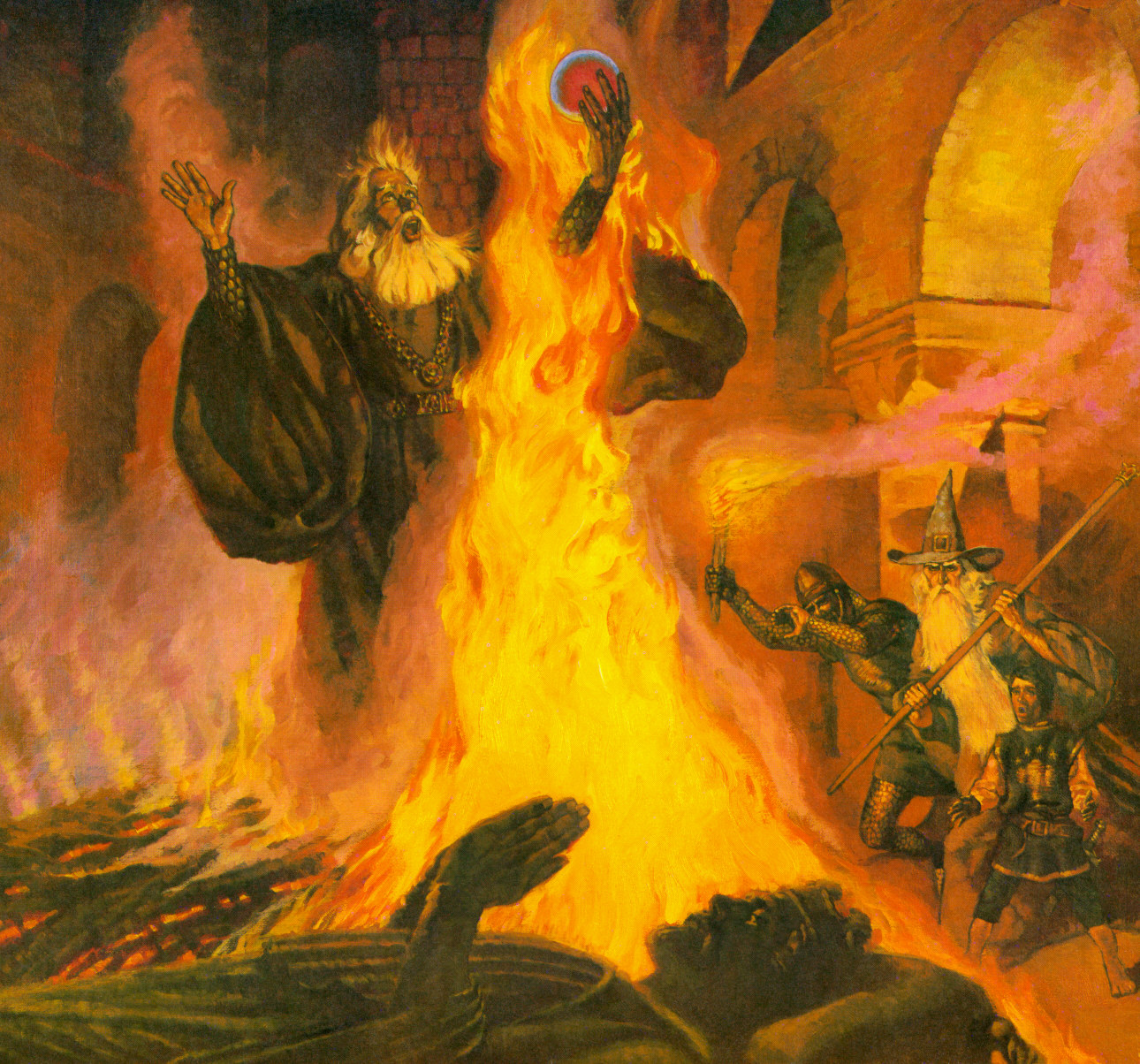
(Robert Chronister—about whom I have so far found nothing, although it’s clear that he’s illustrated more than one scene from The Lord of the Rings.)

Marcus Antonius, one of Julius Caesar’s right-hand men, has tricked Caesar’s assassins into letting him speak,

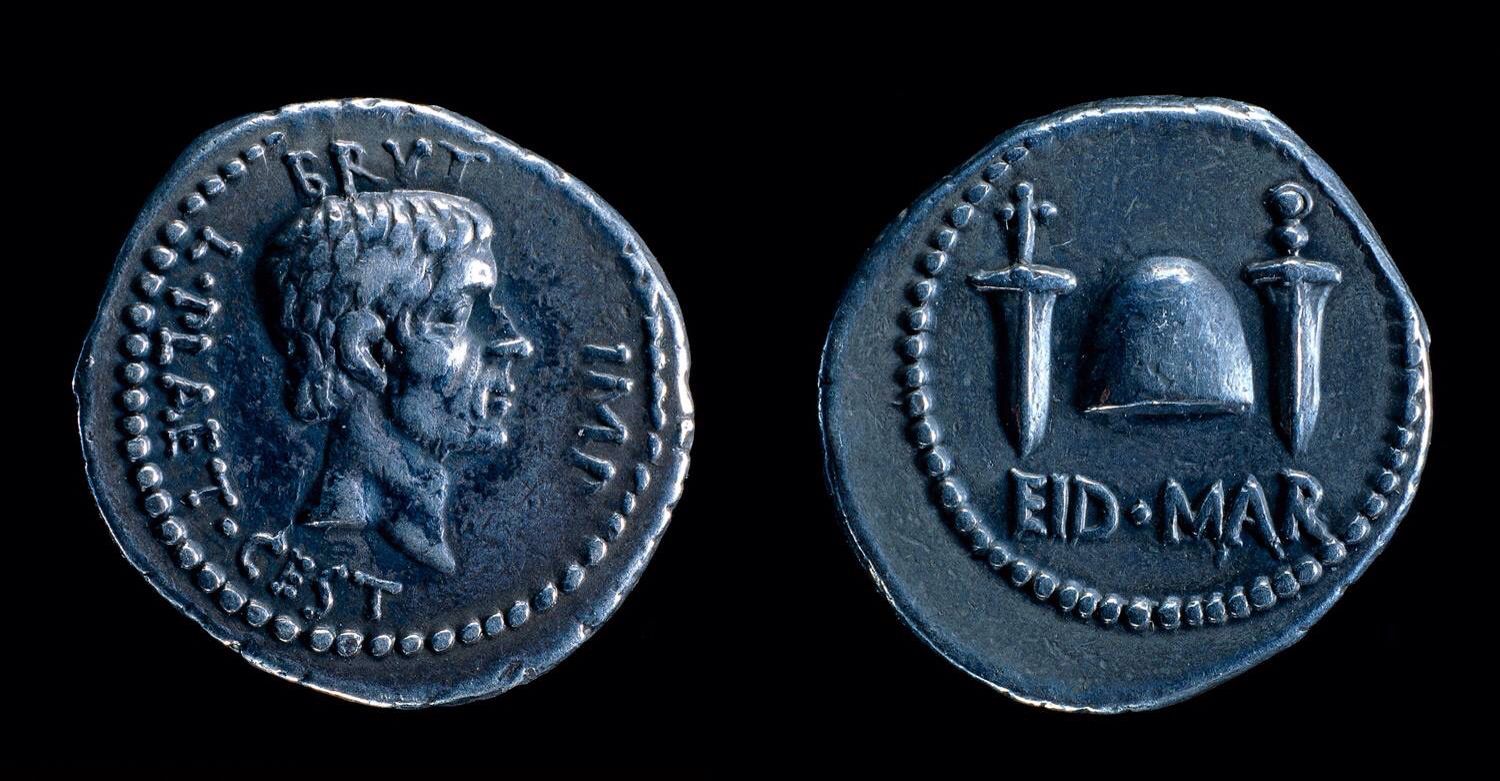
initially using language which they want to hear, but, just below the surface, and increasingly, as he proceeds, his word choice turns the mob listening to those same words into a force which will help to drive the assassins from Rome and, eventually, in the case of two of the main assassins, Brutus,

(This is a very famous coin pattern.  On the obverse—the “heads”—we see what we presume is an image of Brutus, with the caption “Brut[us]” and his assertion that he has the state’s authority:  “Imp[erator]”, along with the name of the mint master, “L[ucius] Plaet[orius] Cest[ianus]”.  On the reverse—the “tails”—we see a shorthand version of the claim of the assassins:  “Eid[ibus] Mar[tis]”—“on the ides of March”, plus two Roman “pugiones”—military daggers—bracketing a “liberty cap”—used in the ceremony of freeing a slave—hence:  “On the Ides of March, I/we, by the use of these daggers, freed Rome from its slavery (to Caesar)” )

and Cassius,

(Unfortunately, we have no definite image of Cassius—this is a coin minted on his authority by his deputy, Marcus Servilius.  The obverse has an image of “Libertas”, along with an abbreviated form of his name, “C[aius] Cassi[us]”, and that claim to have the authority of the state:  “Imp[erator]”.  The reverse has the name of his lieutenant, “M[arcus] Servilius”, his deputy rank “Leg[atus]” and what’s called an “aplustre”, which is the decorative stern of a Roman warship, thought to commemorate Cassius’ defeat of the navy of Rhodes.)

to defeat and suicide—Marcus Antonius’ ear-poison working very effectively.

For Middle-earth, there is a happier ending.  The real goal of sending the Istari succeeds, even with the treachery of Saruman, brought about through the poison introduced and spread by Sauron through the palantiri, which affects Denethor, as well, teaching us that toxicity is just as deadly in word as it is in deed.

Thanks, as always, for reading.

Stay well,

Lend no one your ears unless you’re clear what he/she wants,

And remember that, as ever, there’s

MTCIDC

O
By Ear (2)

14 Wednesday May 2025

Posted by Ollamh in Uncategorized

≈ Leave a comment

Tags

Fantasy, Gandalf, Hamlet, Istari, Orthanc, Palantir, poison, Saruman, Sauron, Shakespeare, Theoden, Tolkien

Welcome, dear readers, as always.

In Part 1 of this posting, I began talking about ear poisons, beginning with the actual poisoning of Hamlet’s father by Hamlet’s uncle, Claudius, who, according to Hamlet’s father’s ghost:

“Sleeping within my orchard,

My custom always of the afternoon,

Upon my secure hour, thy uncle stole

With juice of cursèd hebona in a vial,

And in the porches of my ears did pour

The lep’rous distilment…” (Hamlet, Act 1, Scene 5)

But there are poisons just as potent which come in the form of poisonous words, as we began to see in Saruman’s attempts to win over Theoden,

(Francesco Amadio)

and, failing that, with Gandalf:

“Gandalf stirred, and looked up.  ‘What have you to say that you did not say at our last meeting?’ he asked.  ‘Or, perhaps, you have things to unsay?’ “

In their last meeting, Gandalf became Saruman’s prisoner in Orthanc—

(the Hildebrandts)

but the words which Saruman employed then were revealing, as Gandalf says, having listened to Saruman’s plea:

“A new Power is rising…We may join with that Power.  It would be wise, Gandalf.  There is hope that way.  Its victory is at hand; and there will be rich reward for those that aid it.  As the Power grows, its proved friends will also grow; and the Wise, such as you and I, may with patience come at last to direct its courses, to control it.  We can bide our time, we can keep our thoughts in our hearts, deploring maybe evils done by the way, but approving the high and ultimate purpose:  Knowledge, Rule, Order; all the things that we have so far striven in vain to accomplish, hindered rather than helped by our weak or idle friends.  There need not be, there would not be, any real change in our designs, only in our means.”  (The Fellowship of the Ring, Book Two, Chapter 2, “The Counsel of Elrond”)

When attempting to win over Theoden, Saruman had chosen words which suggested how much Saruman honored and respected him, defending himself from his own aggressive actions by saying that, if he had used violence against Rohan, so had Rohan used violence in the past, and now, together, he and Theoden could make peace—and therefore avoid what Saruman calls “the ruin that draws nigh inevitably”, even implying a bond between them, changing his former address from “you” to “we” and “our”—

“Shall we make our counsels together against evil days, and repair our injuries with such good will that our estates shall both come to fairer flower than ever before?”

When that hadn’t worked, Saruman had turned to Gandalf, at whom he had sneered only moments before, saying now that Gandalf had “a noble mind and eyes that look both deep and far”—in other words, attempting the same flattery which had failed with Theoden.  And he tried the same kind of shift from “you” to “we” here:

“I fear that in my eagerness to persuade you, I lost patience.  And indeed I regret it.  For I bore you no ill-will; and even now I bear none, though you return to me in the company of the violent and the ignorant.  How should I?  Are we not both members of a high and ancient order, most excellent in Middle-earth?”

That word “order” reminds us of something which Gandalf had said to Frodo long before about Saruman:

“He is the chief of my order and the head of the Council…The lore of the Elven-rings, great and small, is his province.”

(Alan Lee)

And yet:

“I might perhaps have consulted [him], but something always held me back.” (The Fellowship of the Ring, Book One, Chapter 2, “The Shadow of the Past”)

Gandalf has, then, long had doubts about Saruman, even though Saruman was head of that “order”. 

But what, actually, was that “order”?

“When maybe a thousand years had passed, and the first shadow had fallen on Greenwood the Great, the Istari, or Wizards appeared in Middle-earth.  It was afterwards said that they came out of the Far West and were messengers sent to contest the power of Sauron, and to unite all those who had the will to resist him; but they were forbidden to match his power with power, or to seek to dominate Elves or Men by force and fear.”  (The Lord of the Rings, Appendix B: “The Third Age”)

Recall, then, what Saruman has so far done:

1. he has turned Isengard into a miniature version of Mordor, ravaging the surrounding landscape

2. roused the Dunlendings to attack Rohan

3. created his own army of orcs—and perhaps done something worse to them than simply create them, if Treebeard’s thoughts are true (“Worse than that:  he has been doing something to them; something dangerous…For these Isengarders are more like wicked men.”  The Two Towers, Book Three, Chapter 4, “Treebeard”)

4. attacked Rohan and, in the process, Theoden’s son, Theodred, has been killed

5. not to mention that, when Gandalf has resisted his proposals, Saruman has imprisoned him

And so, how believable could anything Saruman says be?  And yet he persists:

“Our friendship would profit us both alike.  Much we could still accomplish together, to heal the disorders of the world.  Let us understand one another, and dismiss from thought these lesser folk!  Let them wait on our decisions!  For the common good I am willing to redress the past, and to receive you.  Will you not consult with me?  Will you not come up?”

In other words, of everything which Saruman, as one of the Istari, has been sent to do, he has done the opposite—and persists, even when he has failed in his plans and is now a prisoner in his own domain.

(Carl Lundgren–you can read about him here: https://en.wikipedia.org/wiki/Carl_Lundgren_(illustrator) )

Yet his tone, for the moment, still has the remains of its ability to charm:

“So great was the power that Saruman exerted in this last effort that none that stood within hearing were unmoved.  But now the spell was wholly different.  They heard the gentle remonstrance of a kindly king with an erring but much-loved minister.  But they were shut out, listening at a door to words not meant for them…”

Until—

“Then Gandalf laughed.  The fantasy vanished like a puff of smoke.”

And what follows reveals not only why Gandalf declines the offer, but who Gandalf believes lies behind all of those empty words about “heal[ing] the disorders of the world” and “the common good” and, earlier, “knowledge, rule, order”—poisonous words when coming from the mouth of Saruman:

“I keep a clearer memory of your arguments, [says Gandalf] and deeds, than you suppose.  When last I visited you, you were the jailor of Mordor, and there I was to be sent.”

Saruman’s reaction is predictable:  each time he finds that his magic tones do not lull the listener, he falls into a rage, but, this time, there is something else mixed with it:

“A shadow passed over Saruman’s face; then it went deadly white.  Before he could conceal it, they saw through the mask the anguish of a mind in doubt, loathing to stay and dreading to leave its refuge.  For a second he hesitated, and no one breathed.  Then he spoke, and his voice was shrill and cold.  Pride and hate were conquering him.”

Pride and hate, but there is something more, as Gandalf warns him:

“ ‘Reasons for leaving you can see from your windows…

(Ted Nasmith)

Others will occur to your thought.  Your servants are destroyed and scattered; your neighbors you have made your enemies; and you have cheated your new master, or tried to do so.  When his eye turns hither, it will be the red eye of wrath.’ “

Gandalf snaps Saruman’s staff and, as if on-cue:

“With a cry Saruman fell back and crawled away.  At that moment a heavy shining thing came hurtling down from above.  It glanced off the iron rail, even as Saruman left it, passing close to Gandalf’s head, it smote the stair on which he stood.”

What this can be and how it figures in all of this poison will appear in the final part of this short series—

(the Hildebrandts)

As ever, thanks for reading.

Stay well,

Remember what Marcus Antonius says to the mob in Shakespeare’s Julius Caesar, “The evil that men do lives after them…” when he is supposedly only burying Caesar, not praising him…

And remember, as well, that there’s

MTCIDC,

O

By Ear (1)

07 Wednesday May 2025

Posted by Ollamh in Uncategorized

≈ Leave a comment

Tags

Claudius, ear, Fantasy, Gandalf, Grima, Hamlet, henbane, lotr, Palantir, poison, Saruman, Theoden, Tolkien

Welcome, dear readers, as always.

No matter how often I read or see the play, I’m always struck by how multifacted Hamlet is—a revenge tragedy, a murder mystery, a psychological study, a ghost story, all in one (and probably more than this list besides).  Tolkien was not a big fan of reading Shakespeare, but, seeing a performance in 1944, he wrote to his son, Christopher:   “Plain news is on the airgraph [a form of letter photographed onto microfilm, shipped, then printed out at its destination—called “V-Mail” in the US—a useful background:  https://rarehistoricalphotos.com/v-mail-photos/ ]; but the only event worth of talk was the performance of Hamlet which I had been to just before I wrote last.  I was full of it then…It was a very good performance, with a young rather fierce Hamlet; it was played fast without cuts; and it came out as a very exciting play.” (letter to Christopher Tolkien, 28 July, 1944, Letters, 126)

That ghost story is the explanation for the murder mystery, the victim being Hamlet’s father, Hamlet Senior, and the murderer being his brother, Claudius, the ghost telling Hamlet:

“Sleeping within my orchard,

My custom always of the afternoon,

Upon my secure hour, thy uncle stole

With juice of cursèd hebona in a vial,

And in the porches of my ears did pour

The lep’rous distillment, whose effect

Holds such an enmity with blood of man

That swift as quicksilver it courses through

The natural gates and alleys of the body,

And with a sudden vigor it doth possess

And curd like eager droppings into milk

The thin and wholesome blood; so did it mine,

And a most instant tetter barked about

Most lazarlike with vile and loathsome crust

All my smooth body.”  (Hamlet, Act 1, Scene 5 from the 2nd Quarto, 1604—this is from my go-to Shakespeare internet site, which you can visit here:  https://internetshakespeare.uvic.ca/doc/Ham_Q2/scene/index.html )

“Hebona” has been argued about for years, some scholars, seeing what appears to be a linguistic similarity with “henbane”,

have suggested that, as the poison, and, seeing its effects, I’m not surprised:

“As a result of this distinct chemical and pharmacological profile, overdoses can result not only in delirium, but also severe anticholinergic syndrome, coma, respiratory paralysis, and death.” (see:  https://en.wikipedia.org/wiki/Toxidrome#Anticholinergic for lots more distressing symptoms on the way to the end—although some of the above description doesn’t appear to be present in such poisoning—“tetter” means a kind of skin eruption, which is why Hamlet Sr. uses“lazarlike”, meaning “leprous”.  For more on other possible poisons, see:  https://en.wikipedia.org/wiki/Hebenon And for more on Shakespeare’s drugs, see:  https://www.bbc.com/future/article/20140416-do-shakespeares-poisons-work ) 

One can see why Uncle Claudius uses the method he does:  he’s assuming that, if all the poison is absorbed, there will be no outside traces, which is why Hamlet Senior says, “’Tis given out that, sleeping in my orchard/A serpent stung me” (although, given the usual nature of bites, one might have thought that someone would have checked for a snake bite wound, suggesting that Claudius was already prepared with a quick explanation for what had happened to his brother—“it is given out” sounds like palace propaganda, doesn’t it?).

Hamlet’s father is poisoned through the ear with an actual toxic substance, whatever it was, and that supposedly left no trace of the crime, but, in Tolkien’s own work, we see another ear poison, which also leaves no obvious physical trace, being administered by this—

(the Hildebrandts)

but which is just as deadly—spiritually.

We know from Gandalf (and the chapter title) that Saruman has an unusual weapon:

“ ‘What’s the danger?’ asked Pippin.  ‘Will he shoot at us, and pour fire out of the windows; or can he put a spell on us from a distance?’

‘The last is most likely, if you ride to his door with a light heart,’ said Gandalf…. ‘And Saruman has powers you do not guess:  Beware of his voice!’ “  (The Two Towers, Book Three, Chapter 10, “The Voice of Saruman”)

We then see that voice in operation:

“ ‘But come now,’ said the soft voice.  ‘Two at least of you I know by name.  Gandalf I know too well to have much hope that he seeks help or counsel here.  But you, Theoden Lord of the Mark of Rohan, are declared by your noble devices, and still more by the fair countenance of the House of Eorl.  O worthy son of Thengel the Thrice-renowned!  Why have you not come before, and as a friend?  Much have I desired to see you, mightiest king of western lands, and especially in these latter years, to save you from the unwise and evil counsels that beset you!  Is it yet too late?  Despite the injuries that have been done to me, in which the men of Rohan, alas! have had some part, still I would save you, and deliver you from the ruin that draws nigh inevitably, if you ride upon this road which you have taken.  Indeed I alone can aid you now.’ “

The effect of this upon the Rohirrim is just what Saruman must have hoped for—and it underlines his method of address:

“The Riders stirred at first, murmuring with approval of the words of Saruman; and then they too were silent, as men spell-bound.  It seemed to them that Gandalf had never spoken so fair and fittingly to their lord.  Rough and proud now seemed all his dealings with Theoden.  And over their hearts crept a shadow, the fear of a great danger:  the end of the Mark in a darkness to which Gandalf was driving them, while Saruman stood beside a door of escape, holding it half open so that a ray of light came through…” 

Saruman has, by:

1. addressing Theoden in a stately way, almost overdoing it with his “Lord”, “noble”, “fair”, “worthy”, “mightiest”, suggesting that he has only the greatest respect for him

2. mentioning the defeat of his ravaging army and the destruction of his mini-Mordor as if they were “wrongs” done to him, rather than the treasonous behavior they actually represented

3. threatening doom awaiting the Mark

4. offering himself as the only savior,

turns himself from the Sauron he aspires to be into the gentle, admiring friend, who, though he has been harmed, is still willing to be that friend—and, in fact, the only friend for Theoden.  And, as the Rohirrim are meant to understand, this is all designed to be in contrast to Gandalf, that false savior.

(It’s clear that Saruman has been working to undercut Gandalf’s position in Rohan for some time previously:  see Theoden’s original greeting to Gandalf—prompted—and poisoned—by Grima in The Two Towers, Book Three, Chapter 6, “The King of the Golden Hall”.)

(Alan Lee)

Eomer, seeing Theoden silent, hesitating, tries to intervene, only to have that Voice—angered, but quickly controlled, turn everything rightly said against him into the “you do it, too” argument:

“ ‘But my lord of Rohan, am I to be called a murderer, because valiant men have fallen in battle?  If you go to war, needlessly, for I did not desire it, then men will be slain.  But if I am a murderer on that account, then all the House of Eorl is stained with murder; for they have fought many wars, and assailed many who defied them.’ “

It’s not just Saruman’s voice that one should be wary of–he is so skilled in deception—or so he thinks–that he can try to use such a cheap argument, then turn it around into what is intended to sound like a reasonable proposal:

“ ‘Yet with some they have afterwards made peace, none the worse for being politic.  I say, Theoden King:  shall we have peace and friendship, you and I?  It is ours to command.’ “

And notice how it’s now not “you”, but “we” and “ours”—any attack is being turned into “being politic” and not “you do it, too”, but “we all do it sometimes” and then we make peace and everything is fine.

Theoden’s response is not what Saruman expected, although, because Theoden had remained silent, we can imagine that Saruman was smiling quietly to himself in admiration of his own powers:

“ ‘We will have peace,’ said Theoden at last thickly and with an effort…’Yes, we will have peace,’ he said, now in a clear voice, ‘we will have peace, when you and all your works have perished—and the works of your dark master to whom you would deliver us.  You are a liar, Saruman, and a corrupter of men’s hearts…When you hang from a gibbet at your own window for the sport of your own crows, I will have peace with you and Orthanc…Turn elsewhither.  But I fear your voice has lost its charm.”

(Ted Nasmith—another side of this excellent artist)

The magic of that voice still lingers for a moment:

“The Riders gazed up at Theoden like men startled out of dream.  Harsh as an old raven’s their master’s voice sounded in their ears after the music of Saruman.”

But there is then a change in that music:

“But Saruman for a while was beside himself with wrath.  He leaned over the rail as if he would simite the King with his staff.  To some suddenly it seemed that they saw a snake coiling itself to strike.”

And Saruman becomes even more serpentine:

“ ‘Gibbets and crows!’ he hissed and they shuddered at the hideous change.’ “

Thwarted, we see him basically reverse his address to Theoden.  Where before Theoden was “Lord”, “noble”, “fair”, “worthy”, “mightiest”, now he is “dotard” and his “noble”, “fair” family becomes “the house of Eorl…but a thatched barn where brigands drink in the reek, and their brats roll on the floor among the dogs”.

He isn’t quite finished, however—

“ ‘But you, Gandalf!  For you at least I am grieved, feeling for your shame.  How comes it that you can endure such company?  For you are proud, Gandalf—and not without reason, having a noble mind and eyes that look both deep and far.  Even now will you not listen to my counsel?’ “

Theoden’s eventual reply was bitter—and biting—but Gandalf’s reaction is of a different sort altogether—though it still has a sting:

“Gandalf stirred, and looked up.  ‘What have you to say that you did not say at our last meeting?’ he asked.  ‘Or, perhaps, you have things to unsay?’ “

That last meeting saw Gandalf Saruman’s prisoner on the top of Orthanc–

(the Hildebrandts)

but what was it which Saruman said, how was it put, and what or who might lie behind it, will be the subject of Part 2 of this posting.

Thanks for reading, as always.

Stay well,

Remember that line from another Shakespeare play, “All that glisters is not gold”,

And also remember that, as always, there’s

MTCIDC

O
Treating

26 Wednesday Mar 2025

Posted by Ollamh in Uncategorized

≈ Leave a comment

Tags

diplomatic language, Gandalf, lotr, Mouth of Sauron, Tolkien

Welcome, dear readers, as always.

It’s a grim moment, late in The Lord of the Rings.  Although Sauron’s forces have failed in their attempt to take Minas Tirith,

(John Howe)

they are still active and numerous, but concealed behind the barrier of the Ephel Duath, the “Mountains of Shadow”, to the east, in Mordor.

(a much-redrawn map, beginning with JRRT. For more details, see: https://tolkiengateway.net/w/index.php?title=Map_of_Rohan,_Gondor,_and_Mordor&section=2 )

Gondor’s pretend embassy rides out, hoping to keep Sauron’s eye upon them.

(from the Jackson film)

As they approach the Black Gate,

(the Hildebrandts)

they ride through the effects of the Industrial Revolution which JRRT so disliked:

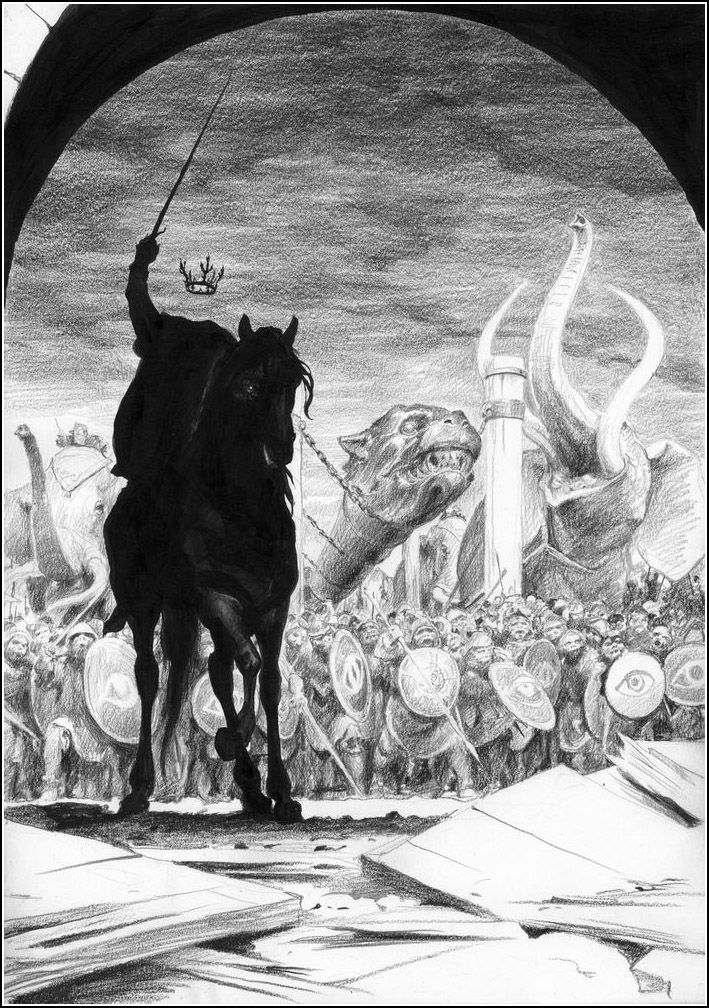
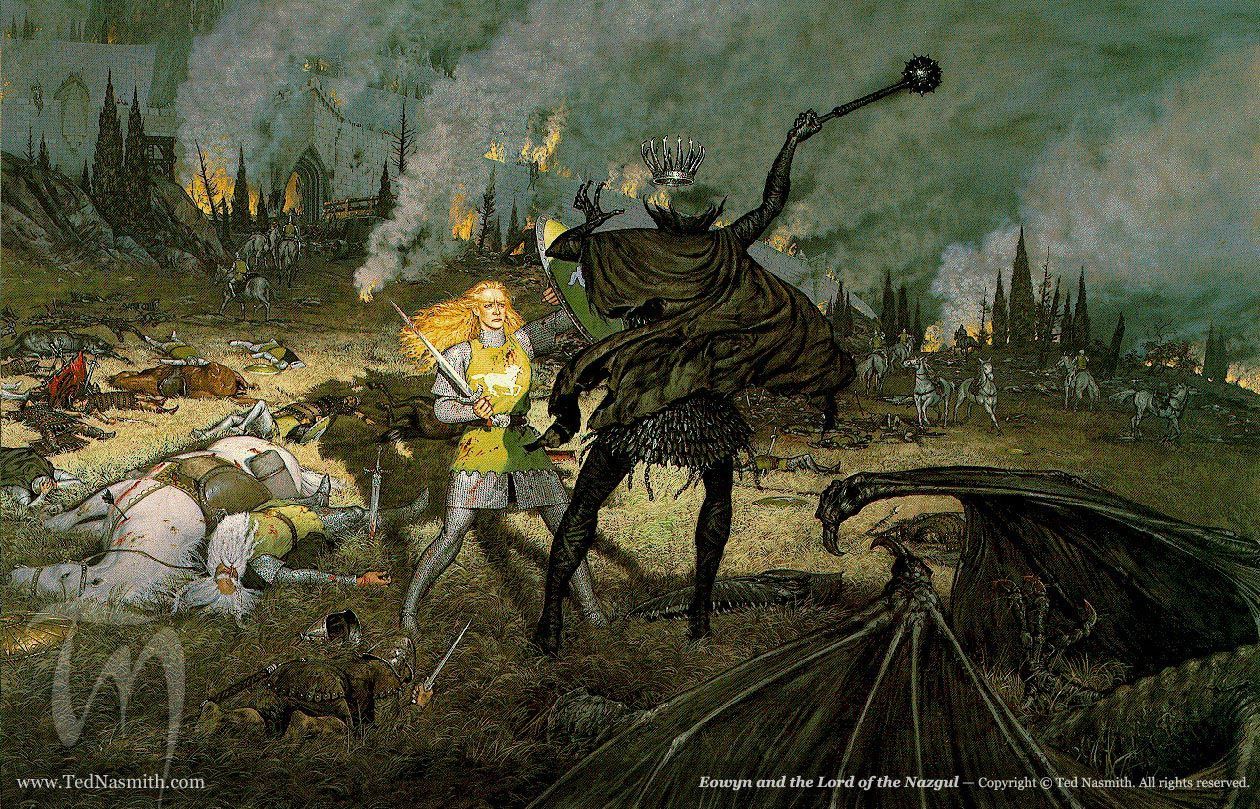
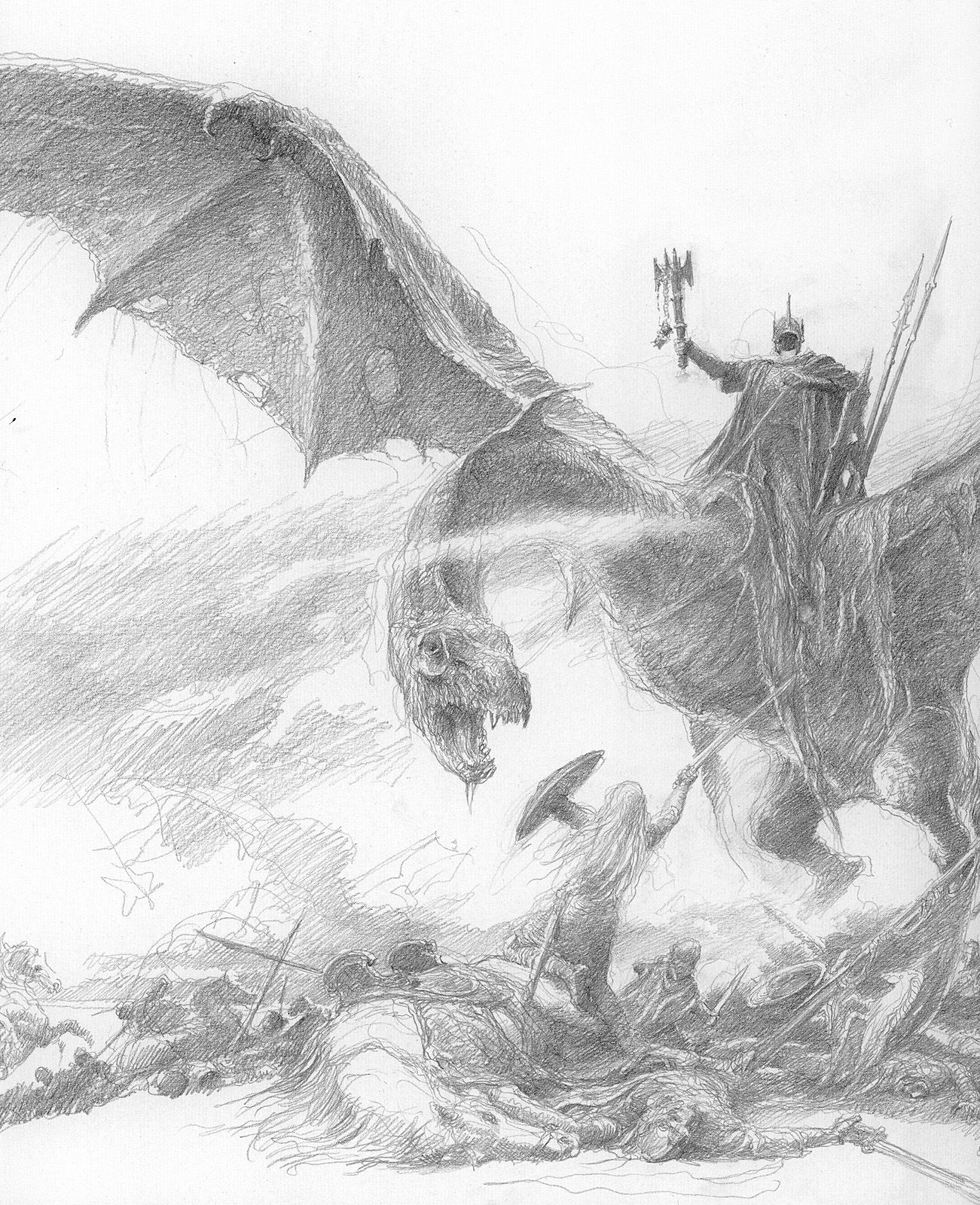
“North amid their noisome pits lay the first of the great heaps and hills of slag and broken rock and blasted earth, the vomit of the maggot-folk of Mordor…”  (The Return of the King, Book Five, Chapter 10, “The Black Gate Opens”)

If we hadn’t known previously about Tolkien’s opinion of such, language choices like “vomit” and “maggot-folk”, would have told us all we needed to know and, in this posting, I want to talk a little about a particular form of language, that of diplomacy, in the scene which follows.

The embassy waits before the Black Gate in “a great mire of reeking mud and foul-smelling pools”  until, in a carefully-prepared entry, Sauron’s emissary appears:

“There came a long rolling of great drums like thunder in the mountains, and then the braying of horns that shook the very stones and stunned men’s ears.  And thereupon the door of the Black Gate [that is to say a wicket gate:  a smaller gate within a larger one, like this—

although clearly larger than this one] was thrown open with a great clang, and out of it there came an embassy from the Dark Tower.

At its head there rode a tall and evil shape…”

(Douglas Beekman—you can read more about this extremely productive sf/fantasy illustrator here:  https://www.askart.com/artist/Doug_L_Beekman/122294/Doug_L_Beekman.aspx )

The emissary—“the Mouth of Sauron”—speaks first and we see already the approach he takes:

“Is there anyone in this rout with authority to treat with me?”

Already he has turned representatives of Gondor into nothing more than an armed mob—a “rout”.

He continues:

“Or indeed with wit to understand me?”

Not only a mob, then, but a stupid one.

Then, turning to Aragorn—

“It needs more to make a king than a piece of Elvish glass, or a rabble such as this.  Why, any brigand of the hills can show as good a following.”

And you can see the general idea—

1. this isn’t an army, but a collection of nobodies—and a small one, at that

2. they are nothing but oafs

3. their leader is nothing more than a bandit chief who has appointed himself king

Gandalf then upbraids him:

“It is also the custom for ambassadors to use less insolence.  But no one has threatened you.”

To which the Mouth replies:

“So…Then thou arr the spokesman, old graybeard?  Have we not heard of thee at whiles, and of thy wanderings, ever hatching plots and mischief at a safe distance?”

First, there’s the implication that Gandalf is a doddering old man, then that he’s a plotter and of no certain abode, and then that he’s a coward.  It’s also important to notice the linguistic difference in his and Gandalf’s speech.  Unlike certain other Indo-European languages, including German, French and Italian, Modern English has abandoned the second person singular of verbs—no “thou/thy/thee”.  It’s “you” for everything.  The use of the second person singular is still preserved in those other languages and, at least in traditional French, is reserved for speaking to children, pets, loved ones, and close friends, (and, in older days, servants), there even being verbs, tutoyer, “to use thou” and vouvoyer, “ to use you”, to indicate which you might employ.  When uncertain, a person might ask, “On peut tutoyer?”—“Can we use thou?”  The advantage it provides, as we can see here, is that, whereas Gandalf is being polite, or at least neutral, the Mouth of Sauron is being  intentionally insulting—the old expression being “too familiar”—or at least downgrading Gandalf from an equal to someone of lower status, or even a child, which goes along with his earlier question as to whether anyone had the understanding (“wit”) to have a discussion with him.

The Mouth then shows Frodo’s gear, taken from him in Minas Morgul, and Pippin, recognizing it, “sprang forward with a cry of grief”, even as Gandalf tries to stop him, which gives the Mouth another opportunity:

“So you have yet another of these imps with you!…What use you find in them I cannot guess; but to send them as spies into Mordor is beyond even your accustomed folly.  Still, I thank him, for it is plain that this brat at least has seen these tokens before, and it would be vain for you to deny them now.”

Not content with downgrading the Gondorians, Aragorn, and Gandalf, hobbits are now either “imps”—that is, small demons, as in “imps of Satan” in our Middle-earth, or children, “brats”.  He then goes on to call the Shire “the little rat-land” as he builds what he claims the so-far successful resistance to Sauron actually is:

“Dwarf-coat, elf-cloak, blade of the downfallen West, and spy from the little rat-land of the Shire—nay, do not start!  We know it well—here are the marks of a conspiracy.”

Now we see where all of this is leading:  to Sauron’s terms—which are not about a cease-fire or a deal between equals, but simply a form of surrender:

“The rabble of Gondor and its deluded allies shall withdraw at once beyond the Anduin, first taking oaths never again to assail Sauron the Great in arms, open or secret.”

This repeats the Mouth’s earlier characterizing of the emissaries from Gondor as a mob—and the suggestion that they are nothing more than a group of plotters against Sauron’s (legitimate) authority.

“All lands east of the Anduin shall be Sauron’s for ever solely.”

His earlier struggles with the West had led to his defeat and loss of control of those lands, so here Sauron is attempting to guarantee that they stay in his hands this time.

“West of the Anduin as far as the Misty Mountains and the Gap of Rohan shall be tributaries to Mordor, and men there shall bear no weapons, but shall have leave to govern their affairs.”

Here we see the Rohirrim being:

a. disarmed

b. forced to pay tribute

“But they shall help to rebuild Isengard which they have wantonly destroyed…”

“wantonly” suggests, of course, that it was done without purpose—and, remembering what Saruman was actually up to, this is actually laughable, but it’s also a piece with the general tone:  we are the legitimate authorities, you have plotted against us and rebelled and with no good reason.

And then we see what the Mouth has in mind for himself:

“…and that shall be Sauron’s and there his lieutenant shall dwell:  not Saruman, but one more worthy of trust.”

(“Looking in the Messenger’s eyes they read his thought:  He was to be that lieutenant, and gather all that remained of the West under his sway; he would be their tyrant and they his slaves.”)

So far, all of this has been demands on Sauron’s part, but what will he give in return?

“It seemed then to Gandalf, intent, watching him as a man engaged in fencing with a deadly foe, that for the taking of a breath, the Messenger was at a loss; yet swiftly he laughed again,

‘Do not bandy words in your insolence with the Mouth of Sauron!…Surety you crave!  Sauron gives none.  If you sue for his clemency, you must first do his bidding.  These are his terms.  Take them or leave them.’ “

Putting all of this together, we see that, unlike the “custom of ambassadors” of Gandalf, this is a carefully-planned verbal attack, first denigrating the other side’s position for negotiating, then suggesting that, unlike an opposing state, the Gondorians are nothing more than illegimate plotters, then making a series of demands for which they are offered nothing in return except possible “clemency”.  

This, then, is not a treaty—none is offered—but the treatment of rebellious slaves and well deserves Gandalf’s rebuke which, you’ll notice, returns some of the Mouth’s medicine to him, even if not using “thou”:

“But as for your terms, we reject them utterly.  Get you gone, for your embassy is over and death is near to you.  We did not come here to waste words in treating with Sauron, faithless and accursed; still less with one of his slaves.  Begone!”

Is the Mouth’s reaction surprising, then?

“Then the Messenger of Mordor laughed no more.  His face was twisted with amazement and anger to the likeness of some wild beast that, as it crouches on its prey, is smitten on the muzzle with a stinging rod.  [How appropriate for the Mouth!]  Rage filled him and his mouth slavered, and shapeless sounds of fury came strangling from his throat.  But he looked at the fell faces of the Captains and their deadly eyes, and fear overcame his wrath.  He gave a great cry, and turned, leaped upon his steed, and with his company galloped madly back to Cirith Gorgor.”

A fitting end—wordless, he flees—undoubtedly with Gandlaf’s last words in his ears:  “…slave.  Begone!”

Thanks, as always, for reading.

Stay well,

Avoid evil emissaries with their own agendas,

And remember that, as always, there’s

MTCIDC

O

Into the Fire

19 Wednesday Feb 2025

Posted by Ollamh in Uncategorized

≈ Leave a comment

Tags

Aetius, Attila, Chalons, Denethor, Faramir, Gandalf, lotr, Middle-earth, Palantir, Pippin, Saruman, Sauron, Tolkien

As ever, welcome, dear readers.

I’ve always admired the way in which JRRT shows the slow descent of Denethor into darkness, from someone who rules Gondor

(Denis Gordeev)

as if he were its rightful king, accepting Pippin’s offer of allegiance,

(Douglas Beekman—a prolific sci-fi fantasy illustrator.  You can see numbers of his illustrations here:  https://www.isfdb.org/cgi-bin/ea.cgi?23068  This catalogue if from the Internet Speculative Fiction Data Base, a wonderfully rich site if you have an interest in sci-fi.)

to the pensive and grieving father,

(an Alan Lee sketch)

to the desperate madman of his last scene—

(artist? so far, I can’t locate one)

But that last scene has always impressed me as Tolkien at his dramatic best.

It begins with the setting:

“There Pippin, staring uneasily around him, saw that he was in a wide vaulted chamber, draped as it were with the great shadows that the little lantern threw upon its shrouded walls.  And dimly to be seen were many rows of tables, carved of marble; and upon each table lay a sleeping form, hands folded, head pillowed upon stone.  But one table near at hand stood broad and bare.  Upon it at a sign from Denethor they laid Faramir and his father side by side, and covered them with one covering, and stood then with bowed heads as if mourners beside a bed of death.”

I think that we can imagine that JRRT’s image here is based upon any number of medieval English churches, with their tombs, usually along the walls, or,

more grandly,  the basilica of St Denis, in a northern suburb of Paris,

of which he might have seen a photo.  (As I haven’t found a reference that he had actually visited the place.)

What happens next, however, has a different model—or, rather, perhaps two. 

After having himself and Faramir placed on that empty table, Denethor then makes the terrible command:

“ ‘Here we will wait,’ he said.  ‘But send not for the embalmers.  Bring us wood quick to burn, and lay it all about us, and beneath; and pour oil upon it.  And when I bid you thrust in a torch.’ “ (all of the above from The Return of the King, Book Five, Chapter 4, “The Siege of Gondor”)

What’s going on here?   When Gandalf, summoned by Pippin attempts to stop this, Gandalf says to Denethor:

“ ‘Authority is not given to you, Steward of Gondor, to order the hour of your death,’…And only the heathen kings, under the domination of the Dark Power, did thus, slaying themselves in pride and despair, murdering their kin to ease their own death.’”  (The Return of the King, Book Five, Chapter 7, “The Pyre of Denethor”)

“Heathen”, from Old English haethen, came into English with the meaning “non-believer (in Christianity)” and seems, at first, rather an odd word for Gandalf to have employed, as Tolkien has written himself that “…the ‘Third Age’ was not a Christian world.” (letter to the Houghton Mifflin Co., 30 June, 1955, Letters, 319)

I wonder, however, whether JRRT was remembering something from early medieval history, which he might have read in conjunction with his early avid study of Gothic (which almost ruined his academic career—see his letter to Christopher of 2 January, 1969 (Letters, 558).

It’s in the account by the 6th-century Gothic historian, Jordanes, of the Battle of the Catalaunian Plains (also known as the Battle of Chalons), between Roman and their Germanic allies, including Visigoths, led by the Roman general, Aetius, and an invading army of Huns and their subject peoples, led by Attila, a battle fought on 20 June, 451.

(by Peter Dennis, one of my favorite contemporary military artists)

The battle was very much a back-and-forth affair, but late in it, the Huns had been driven back to their camp and Attila, usually the soul of confidence, was troubled–and this is where Jordanes’ description comes in:

Fertur autem desperatis rebus praedictum regem adhuc et suppraemo magnanimem equinis sellis construxisse pyram seseque, si adversarii inrumperent, flammis inicere voluisse, ne aut aliquis eius vulnere laetaretur aut in potestate hostium tantarum gentium dominus perveniret.  (Jordanes, De Origine Actibusque Getarum, XL, 213—my translation)

“It is said, moreover, that things were [so] despaired of, that the king [that is, Attila] still supremely brave,  commanded at this point that [they] build a pyre from horse saddles and, should the enemy break in [to his camp], he wished to throw himself into the flames lest either anyone take joy in wounding [him] or lest he, the master of so many peoples come into the power of the enemy.”

None of Attila’s kin is involved in this potential self-immolation, but certainly the pride is there and even despair (as in that “desperatis rebus”) which Gandalf mentions.

But, as I said earlier, there might be another model—and perhaps an even darker one.  Notice that

“But one table near at hand stood broad and bare.”

What immediately came to mind was that it resembled an altar—not a Christian one, but something from a different world, in which the symbolic sacrifice of the Christian religion was a real sacrifice—

(artist unknown)

I thought of this because of something which Tolkien had written about Sauron, who has become the prisoner of the Numenorean king Tar-Calion:

“…and seduces the king and most of the lords and people with his lies.  He denies the existence of God, saying that the One is a mere invention of the jealous Valar of the West, the oracle of their own wishes.  The chief of the gods is he that dwells in the Void, who will conquer in the end, and in the void make endless realms for his servants…

A new religion, and worship of the Dark, with its temple under Sauron arises.  The Faithful are persecuted and sacrificed.”  (letter to Milton Waldman, late 9n 1951, Letters, 216)

Why, we might ask, is Denethor so prepared to make a fiery end to himself and his son?

“ ‘Come!’ said Gandalf.  ‘We are needed.  There is much that you can yet do.’

Then suddenly Denethor laughed.  He stood up tall and proud again, and stepping swiftly back to the table he lifted from it the pillow on which his head had lain.  Then coming to the doorway he drew aside the covering, and lo!  he had between his hands a palantir.  And as he held it up, it seemed to those that looked on that the globe began to glow with an inner flame, so that the lean face of the Lord was lit as with a red fire, and it seemed cut out of hard stone, sharp with black shadows, noble, proud, and terrible.  His eyes glittered.

‘Pride and despair!’ he cried.  ‘Didst thou think that the eyes of the White Tower were blind?  Nay, I have seen more than thou knowest, Grey Fool.  For thy hope is but ignorance.  Go then and labour in healing!  Go forth and fight!  Vanity….The West has failed.  It is time for all to depart who would not be slaves.”

And the answer is in that palantir.  As it had earlier corrupted Saruman,

(the Hildebrandts)

and nearly driven Pippin mad with only one look into it, so it has shown Denethor exactly what Sauron had wanted him to see and, deluded, we might imagine that, in his action, he was not only destroying the current ruler of Gondor and his son, but was also acting like the Numenoreans who were his ancestors, making a sacrifice which Sauron had once demanded of them.

And, although Faramir is rescued, Denethor:

“…leaped upon the table, and standing wreathed in fire and smoke he took up the staff of his stewardship that lay at his feet and broke it on his knee.  Casting the pieces into the blaze he bowed and laid himself on the table, clasping the palantir with both hands upon his breast.  And it was said that ever after, if any man looked in that Stone, unless he had a great strength of will to turn it to other purpose, he saw only two aged hands withering in flame.”

And so Sauron had his sacrifice.

Thanks, as ever, for reading.

Stay well,

And remember that, as always, there’s

MTCIDC

O

Speak Friend, or, Open, Sez Me

22 Wednesday May 2024

Posted by Ollamh in Uncategorized

≈ Leave a comment

Tags

books, Fantasy, Gandalf, The Hobbit

As always, welcome, dear readers.

Occasionally, I return to something I’ve already written about, but, this time around, hope to see in a new, or at least newish, light.  The subject of today’s posting first appeared back in “Do What I Say, Not What I Speak”, 13 June, 2018, but, since then, I began my campaign to read all of The Arabian Nights and am now in the second volume of the Penguin edition (for the first volume, see “Arabian Nights for Days”, 31 January, 2024).

I’ve known some of the stories in this vast collection since childhood, but the first two stories I heard as a child are actually so-called “orphan tales”, being stories which appear to have no early manuscript tradition, first appearing in Antoine Galland’s (1646-1715)

Les Mille et Une Nuits (1704-1717).

and from there into the first edition in English, the anonymous so-called “Grub Street Edition” of 1706-1721.

(This is an image from the earliest edition I can locate—as you can see, it’s from 1781.  Only two copies of the first edition are known to exist, one in the Bodleian Library at Oxford, the other in the rare books collection of Princeton University and clearly they don’t get out much.)

There has been much discussion as to the actual origins of “Aladdin”

and “Ali Baba and the Forty Thieves”–

in particular, that, although they contain standard folktale motifs, they are actually the work of a Syrian storyteller named Antun Yusuf Hanna Diyab (c.1668-post-1763) and were added by Galland to his translation without attribution.  (For more, see:  https://en.wikipedia.org/wiki/Hanna_Diyab ) 

Whatever is the truth of this, these were the stories I carried in my head for years before I came back to them when commencing my “Arabian Nights” reading campaign. 

When I was small, they were actually quite scary—the magician who pretends to be Aladdin’s long-lost uncle and who only wants to use him long enough to obtain the lamp, then would let him die in the cave where the lamp was kept, and the merciless thieves, who once they found their cave with its secret password was compromised, cut up Ali Baba’s brother who had discovered the secret but, who, forgetting the password, was trapped until the thieves returned, were among the creepier parts of my childhood, and, as may always be the case with creepy things, not easily forgotten.

At the same time, I was always puzzled by the opening to “Ali Baba”:

“IN a town in Persia there dwelt two brothers, one named Cassim,

the other Ali Baba. Cassim was married to a rich wife and lived

in plenty, while Ali Baba had to maintain his wife and children by

cutting wood in a neighbouring forest and selling it in the town.

One day, when Ali Baba was in the forest, he saw a troop of men

on horseback, coming towards him in a cloud of dust. He was

afraid they were robbers, and climbed into a tree for safety.  When

they came up to him and dismounted, he counted forty of them.

They unbridled their horses and tied them to trees. The finest man

among them, whom Ali Baba took to be their captain, went a little

way among some bushes, and said: ‘ Open, Sesame!’ so plainly that

Ali Baba heard him. A door opened in the rocks, and having made

the troop go in, he followed them, and the door shut again of itself.”

Why would a door obey a password?  And why that word, which I knew was a kind of seed.

(For more—much more—see:  https://en.wikipedia.org/wiki/Sesame#Allergy )

This sat somewhere in my memory until I read:

“But close under the cliff there stood, still strong and living, two tall trees, larger than any trees of holly that Frodo had ever seen or imagined…

(JRRT)

‘Well, here we are at last!’ said Gandalf.  ‘Here the Elven-way from Hollin ended.  Holly was the token of the people of that land, and they planted it here to mark the end of their domain; for the West-door was made chiefly for their use in their traffic with the Lords of Moria.’ …

…they turned to watch Gandalf.  He appeared to have done nothing.  He was standing between the two trees gazing at the blank wall of the cliff, as if he would bore a hole into it…

 ‘Dwarf-doors are not made to be seen when shut,’ said Gimli.  ‘They are invisible, and their own makers cannot find them or open them, if their secret is forgotten.’

‘But this Door was not made to be a secret known only to Dwarves,’ said Gandalf…’Unless things are altogether changed, eyes that know what to look for may discover the signs.’

He walked forward to the wall.  Right between the shadow of the trees there was a smooth space, and over this he passed his hands to and fro, muttering words under his breath.  Then he stepped back.

‘Look!’ he said.  ‘Can you see anything now?’

…Then slowly on the surface, where the wizard’s hands had passed, faint lines appeared, like slender veins of silver running in the stone…

At the top, as high as Gandalf could reach, was an arch of interlacing letters of an Elvish character.

(Ted Nasmith)

Below, though the threads were in places blurred or broken, the outline could be seen…

(JRRT)

‘What does the writing say?’ asked Frodo…

‘…They say only:  The Doors of Durin, Lord of Moria.  Speak, friend, and enter.’

‘What does it mean…?’ asked Merry.

‘That is plain enough,’ said Gimli.  ‘If you are a friend, speak the password, and the doors will open, and you can enter.’ “  (The Fellowship of the Ring, Book Two, Chapter 4, “A Journey in the Dark”)

We know from various clues, like the story title “Storia Moria Castle”, that Tolkien had read—or been read to—from Andrew Lang’s (1844-1912) The Red Fairy Book, 1890,

but, interestingly, “Aladdin” and “Ali Baba” both appear in Lang’s previous The Blue Fairy Book, 1889,

from which both the “Ali Baba” quotation and illustration above, come.  Could Tolkien have been read to from, or read, “Ali Baba” there?  Certainly we see that door, and the need for the password.  But what about that password?

In The Fellowship of the Ring, Gandalf tells us that “ ‘I will tell you that these doors open outwards.  From the inside you may thrust them open with your hands.  From the outside nothing will move them save the spell of command.  They cannot be forced inwards.’   Try as he might, however, Gandalf can’t come up with that word—until he realizes that he’s made a slight mistranslation: 

“ ‘The opening word was inscribed on the archway all the time!  The translation should have been Say “Friend’ and enter.  I had only to speak the Elvish word for friend and the doors opened.’ “

To a linguist with a fine ear, like JRRT’s, the distinction, in English, between the verb “to speak”, as in “to speak a language”, and “to say”, as in “to say the right thing”, can be subtle—in this case, almost too subtle—as Gandalf says:

“ ‘Quite simple.  Too simple for a learned lore-master in these suspicious days.’ “

With the problem solved, the doors swing open—but where they’re about to go is, ultimately, worse than Ali Baba’s thieves’ treasure cave, even as I’m reminded of what happens to Ali Baba’s jealous brother.  Obtaining the password, he easily enters the cave, but, when he tries to leave, he confuses “sesame” with other grains, is trapped, and eventually dismembered by the returning thieves.  (Think Balrog and “Drums in the Dark”…)

And, though “Friend”, says Gandalf, is quite simple, and, adding, “Those were happier times” in which such a pleasant password was all that was necessary,  I’m still puzzled about “sesame” and, in both cases, I wonder about those doors—who or what was doing the opening?  Then again, when I post this,  I’ll need a password and, when I employ it, the site will pop open—who or what is doing the opening there?

Thanks, as always, for reading.

Stay well,

When it comes to locks, I prefer a good, sturdy key,

And remember that, as always, there’s

MTCIDC

O

PS

In case you want to read the two fairy books—and I hope you do—here they are:

The Blue Fairy Book 

https://archive.org/details/bluefairybook00langiala/page/n7/mode/2up

The Red Fairy Book

https://archive.org/details/cu31924084424013/page/n9/mode/2up

Gun Control?

08 Wednesday May 2019

Posted by Ollamh in J.R.R. Tolkien, Military History

≈ Leave a comment

Tags

anachronism, Dettingen, Fireworks, Gandalf, George Frederich Haendel, gunpowder, guns, Helm's Deep, kettle drums, King George II, Millemete Manuscript, petard, Rammas Echor, The Hobbit, The Lord of the Rings, The War of Austrian Succession, Tolkien

Welcome, dear readers, as always—and with our apology if you googled “gun control” and are a bit puzzled as to what has turned up (this often happens with us, making us wonder how googling images of “Saruman” suddenly produces a picture of sardines).

It’s our last posting which got us into this.  We had spotted another anachronism in The Hobbit (clarinets) and had written about it, but then, as a teaser, had concluded with another, referring to Beorn’s joining the Battle of the Five Armies:  “The roar of his voice was like drums and guns…” (Chapter 18, “The Return Journey”)

“Guns” had, of course, stood out.  Some time ago, we had written about Saruman’s use of some sort of explosive at Helm’s Deep

image1hd.jpg

as well as the destruction by a similar force of portions of the causeway forts of the Rammas Echor, of which no one has seemingly produced an illustration.

image2rammas.gif

Whatever this force was, it only seems to be used in siegework, suggesting things like a petard

image3petard.jpg

an explosive device used to blow holes in gates and doors.

Guns, however, do not appear in any form in Tolkien’s world—except here.  Of course, when one thinks about it, there isn’t much of a step from using a blast to destroy a door to funneling that force to propel a missile—as we first see in the Millemete Manuscript of 1326-1327.

image4millemete.jpg

This doesn’t appear to be portable, but the basic object is simply a tube on a stick, easy to make, easy to carry

image5handgonne


and certainly late medieval people had them and employed them,

image6handgonnes.jpg

so, presumably, they might have appeared in Middle-earth (we once wrote a “what-if” posting on the subject).  Why not?  As JRRT introduced explosives, that seems to provide an opening, but we wonder if he had seen all too often and all too clearly the effect of thousands upon thousands of gunpowder weapons on real people in 1916 and, somehow, the idea of lances and swords seemed more appealing—or, at least, more “heroic”.

image7dead.jpg

image8knights.jpg

But the quotation was “like drums and guns”.

As we pointed out in our last, drums certainly appear in The Lord of the Rings—there is that disturbing reference to “drums, drums in the deep” in The Fellowship of the Ring, Book Two, Chapter 5, “The Bridge of Khazad-dum”, for example.  But what about “the roar of his voice was like drums and guns”?

When we thought about this, we asked ourselves, what would this actually sound like?  A possible answer appeared from 1749.

In 1749, George II of England

image9george2.jpg

had been one of the winners of what would become known as “The War of the Austrian Succession” (1740-1748).

image10geo2.jpg

He was definitely in a party mood, so he decided to throw a giant fireworks celebration in London.  To provide the soundtrack, he commissioned George Frederick Haendel (say that “HEN-del”, not as people commonly mispronounce it, “HAHN-del”) (1685-1759).

image11gfh.jpg

George was the last English king actually to see battle, at Dettingen, in 1743,

image12dettingen.jpgimage13dettingen.jpg

and wasn’t interested in anything sweet and soft, with lots of violins.

image14violinist.jpg

Instead, he wanted bangs and booms, starting with kettle drums.

image15kettledrums.jpg

Then he hired someone to design a giant framework for the fireworks,

image16frame.jpg

and threw in 101 cannon, just to make sure that it wasn’t too quiet.

image17guns.jpg

And, on the evening of 27 April, 1749, perhaps as many as 12,000 people (London had perhaps between 600,000 and 700,000 people in 1750) stood around the Green Park to watch.

image18fireworks.jpg

Here’s a LINK, if you’d like to hear the music (you’ll have to supply your own cannon and fireworks).

But fireworks brings us back to Tolkien, doesn’t it?  When Gandalf first appears to Bilbo in the first chapter of The Hobbit,

image19bilgan.jpg

it seems that almost all that Bilbo knows about Gandalf is his fireworks:

“Not the man that used to make such particularly excellent fireworks!  I remember those!  Old Took used to have them on Midsummer’s Eve.  Splendid!  They used to go up like great lilies and snapdragons and laburnums of fire and hang in the twilight all evening!”  (Chapter One, “An Unexpected Party”)

And, when Gandalf reappears in the Shire, to celebrate Bilbo and Frodo’s joint birthday, what does he bring?

image20gandalf.jpg

Thanks, as ever, for reading (and listening).

MTCIDC

CD

← Older posts

The Doubtful Sea Series Facebook Page

The Doubtful Sea Series Facebook Page

  • Ollamh

Categories

  • Artists and Illustrators
  • Economics in Middle-earth
  • Fairy Tales and Myths
  • Films and Music
  • Games
  • Heroes
  • Imaginary History
  • J.R.R. Tolkien
  • Language
  • Literary History
  • Maps
  • Medieval Russia
  • Military History
  • Military History of Middle-earth
  • Narnia
  • Narrative Methods
  • Poetry
  • Research
  • Star Wars
  • Terra Australis
  • The Rohirrim
  • Theatre and Performance
  • Tolkien
  • Uncategorized
  • Villains
  • Writing as Collaborators
Follow doubtfulsea on WordPress.com

Across the Doubtful Sea

Recent Postings

  • Heffalumps? December 31, 2025
  • We Three Kings December 24, 2025
  • A Moon disfigured December 17, 2025
  • On the Roads Again—Once More December 10, 2025
  • (Not) Crossing Bridges December 3, 2025
  • On the Road(s) Again—Again November 26, 2025
  • On the Road(s) Again November 19, 2025
  • To Bree (Part 2) November 12, 2025
  • To Bree (Part 1) November 5, 2025

Blog Statistics

  • 103,987 Views

Posting Archive

  • December 2025 (5)
  • November 2025 (4)
  • October 2025 (5)
  • September 2025 (4)
  • August 2025 (4)
  • July 2025 (5)
  • June 2025 (4)
  • May 2025 (4)
  • April 2025 (5)
  • March 2025 (4)
  • February 2025 (4)
  • January 2025 (5)
  • December 2024 (4)
  • November 2024 (4)
  • October 2024 (5)
  • September 2024 (4)
  • August 2024 (4)
  • July 2024 (5)
  • June 2024 (4)
  • May 2024 (5)
  • April 2024 (4)
  • March 2024 (4)
  • February 2024 (4)
  • January 2024 (5)
  • December 2023 (4)
  • November 2023 (5)
  • October 2023 (4)
  • September 2023 (4)
  • August 2023 (5)
  • July 2023 (4)
  • June 2023 (4)
  • May 2023 (5)
  • April 2023 (4)
  • March 2023 (5)
  • February 2023 (4)
  • January 2023 (4)
  • December 2022 (4)
  • November 2022 (5)
  • October 2022 (4)
  • September 2022 (4)
  • August 2022 (5)
  • July 2022 (4)
  • June 2022 (5)
  • May 2022 (4)
  • April 2022 (4)
  • March 2022 (5)
  • February 2022 (4)
  • January 2022 (4)
  • December 2021 (5)
  • November 2021 (4)
  • October 2021 (4)
  • September 2021 (5)
  • August 2021 (4)
  • July 2021 (4)
  • June 2021 (5)
  • May 2021 (4)
  • April 2021 (4)
  • March 2021 (5)
  • February 2021 (4)
  • January 2021 (4)
  • December 2020 (5)
  • November 2020 (4)
  • October 2020 (4)
  • September 2020 (5)
  • August 2020 (4)
  • July 2020 (5)
  • June 2020 (4)
  • May 2020 (4)
  • April 2020 (5)
  • March 2020 (4)
  • February 2020 (4)
  • January 2020 (6)
  • December 2019 (4)
  • November 2019 (4)
  • October 2019 (5)
  • September 2019 (4)
  • August 2019 (4)
  • July 2019 (5)
  • June 2019 (4)
  • May 2019 (5)
  • April 2019 (4)
  • March 2019 (4)
  • February 2019 (4)
  • January 2019 (5)
  • December 2018 (4)
  • November 2018 (4)
  • October 2018 (5)
  • September 2018 (4)
  • August 2018 (5)
  • July 2018 (4)
  • June 2018 (4)
  • May 2018 (5)
  • April 2018 (4)
  • March 2018 (4)
  • February 2018 (4)
  • January 2018 (5)
  • December 2017 (4)
  • November 2017 (4)
  • October 2017 (4)
  • September 2017 (4)
  • August 2017 (5)
  • July 2017 (4)
  • June 2017 (4)
  • May 2017 (5)
  • April 2017 (4)
  • March 2017 (5)
  • February 2017 (4)
  • January 2017 (4)
  • December 2016 (4)
  • November 2016 (5)
  • October 2016 (6)
  • September 2016 (5)
  • August 2016 (5)
  • July 2016 (5)
  • June 2016 (5)
  • May 2016 (4)
  • April 2016 (4)
  • March 2016 (5)
  • February 2016 (4)
  • January 2016 (4)
  • December 2015 (5)
  • November 2015 (5)
  • October 2015 (4)
  • September 2015 (5)
  • August 2015 (4)
  • July 2015 (5)
  • June 2015 (5)
  • May 2015 (4)
  • April 2015 (3)
  • March 2015 (4)
  • February 2015 (4)
  • January 2015 (4)
  • December 2014 (5)
  • November 2014 (4)
  • October 2014 (6)
  • September 2014 (1)

Blog at WordPress.com.

  • Subscribe Subscribed
    • doubtfulsea
    • Join 78 other subscribers
    • Already have a WordPress.com account? Log in now.
    • doubtfulsea
    • Subscribe Subscribed
    • Sign up
    • Log in
    • Report this content
    • View site in Reader
    • Manage subscriptions
    • Collapse this bar
 

Loading Comments...