• About

doubtfulsea

~ adventure fantasy

Category Archives: Military History

In Bad Hands

30 Wednesday Aug 2017

Posted by Ollamh in Heroes, J.R.R. Tolkien, Literary History, Maps, Military History, Narrative Methods

≈ Leave a comment

Tags

CBS Television News, Denethor, Dunkirk, Early newspapers, early radio, Ecthelion, fake news, Gandalf, Henry IV, Isengard, Lifestyle Magazine, Minas Tirith, Nazi, Nazi Propaganda, news, newspaper, Orthanc, Osgiliath, Palantir, propaganda leaflet, Relation, rumors, Saruman, Shakespeare, texting while driving, The Detroit News, The Illustrated London News, The White Tower, Tolkien

Welcome, dear readers, as ever.
Not so long ago, news came to most people through one—very undependable–source: rumor and gossip. As Shakespeare’s Rumor (depicted as “all painted with tongues” in a stage direction), who appears at the beginning of Henry IV, Part 2, Prologue, 1-5, describes herself:
“Open your ears, for which of you will stop
The vent of hearing when loud Rumour speaks?
I, from the orient to the drooping west,
Making the wind my post-horse, still unfold
The acts commenced on this ball of earth.”
At almost the same time as this play was written and first performed (1596-99), the first printed Western newspaper appeared, the Relation, in Strasbourg in 1605.
image1a1609newspaper.jpg
For the next 300-and-some years, newspapers were then the accepted conveyor of popular information about local, national, and world events. Until 1842, these could only convey that information in words, but, in that year, the first illustrated newspaper appeared, The Illustrated London News.
image1billustratedlondonnews.jpg
And soon other newspapers followed, opening a wider world of information to the reading public. In under a century, however, news appeared in a new form of technology entirely: the first news broadcast by radio believed to have been on August 31, 1920, by a set owned—perhaps not surprisingly by a newspaper— The Detroit News. Considering what radios looked like in the early 1920s, we doubt that many people heard it (this is an image from Lifestyle Magazine from 1923).
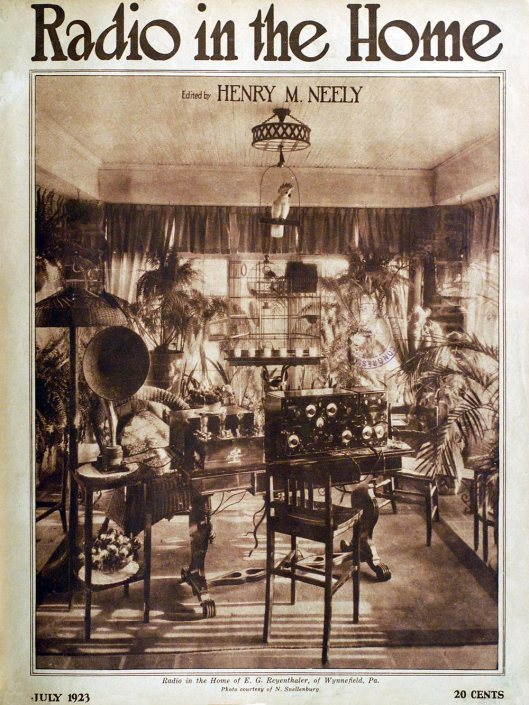
image1cearlyradio1923.jpg
Radios soon improved, however, so that, along with newspapers, people could tune in to hear news, news sometimes more up-to-date than even the newspapers could supply. And then came television. Experiments had been made with television broadcasting as early as 1940, but steady broadcasting really only began in 1948, with CBS Television News.
And then the internet appeared, so that, today, more people are believed to get their news from some form of electronic means than any other (or so electronic means tell us). Practically anywhere you go in our world, you see people staring at screens (not always reading the news, of course—with the universe of apps, people can be doing almost anything imaginable), many of them so portable that you can watch people doing it while walking
image1walktext.jpg
eating,
image2eattext.jpg
even while driving (which, frankly, terrifies us!).

image3textdrive.jpg
There is a problem with news, however, in every era. Shakespeare’s Rumor may have been pushed to one side by later technological innovations, but, in the form of so-called “fake news”, it’s still with us. And, in fact, faked news—news distorted—or even manufactured—has become a standard feature in newer technology. One has only to think about Nazi propaganda (certainly not the first, but perhaps, for us, the most extensive and most vivid), where—just as one example out of thousands—the mostly horse-powered German army of 1940
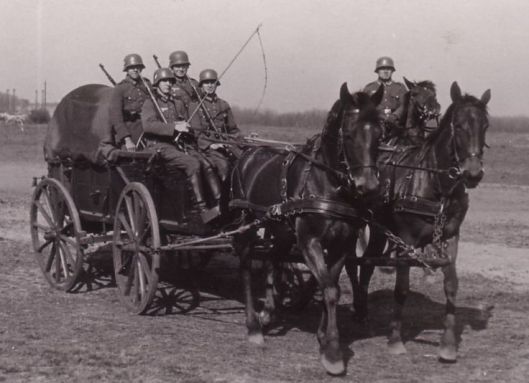
image4awehrmacht.jpg
was publicly depicted as streamlined and gasoline-powered (or, even more high-tech, diesel-powered).
image4bwehrmachttruck.jpg
Some time ago, we talked about literacy in Middle-earth. There was no printed material, of course, and literacy appears to have been limited (we only have to mention Gaffer Gamgee saying of Sam, “Mr. Bilbo has learned him his letters—meaning no harm, mark you, and I hope no harm will come of it.” to imagine that not only was it limited, but there might even be a certain suspicion attached to it.)
And what news there was came by the oldest of methods:
“There were rumours of strange things happening in the world outside; and as Gandalf had not at that time appeared or sent any message for several years, Frodo gathered all the news he could. Elves, who seldom walked in the Shire, could now be seen passing westward through the woods in the evening, passing and not returning; but they were leaving Middle-earth and were no longer concerned with its troubles. There were, however, dwarves on the road in unusual numbers. The ancient East-West Road ran through the Shire to its end at the Grey Havens, and dwarves had always used it on their way to their mines in the Blue Mountains. They were the hobbits’ chief source of news from distant parts—if they wanted any: as a rule dwarves said little and hobbits asked no more. But now Frodo often met strange dwarves of far countries, seeking refuge in the West. They were troubled, and some spoke in whispers of the Enemy and of the Land of Mordor.” (The Fellowship of the Ring, Book One, Chapter 2, “The Shadow of the Past”)
(See also the scene in The Green Dragon a little later in the chapter, where there is discussion, all based on hearsay, about Shire and extra-Shire events, between Sam and Ted Sandyman.)
For two people in Middle-earth, however, news came by a method in a strange way like that of the internet: the palantir, and that news which they received was not to their advantage. Made “from beyond Westernesse, from Eldamar. The Noldor made them…” Gandalf tells Pippin. (The Two Towers, Book Three, Chapter 11, “The Palantir”)

The palantiri were made “to see far off, and to converse in thought with one another.” Although there were seven, one, that at Osgiliath, was the master: “each palantir replied to each, but all those in Gondor were ever open to the view of Osgiliath.” Saruman had one of the others
image4saruman.jpg
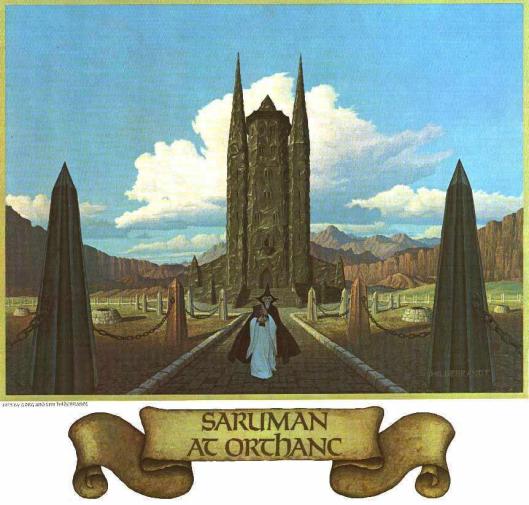
—the one under discussion in this chapter, after Pippin had almost come to disaster from looking in it—which Grima flung off Orthanc
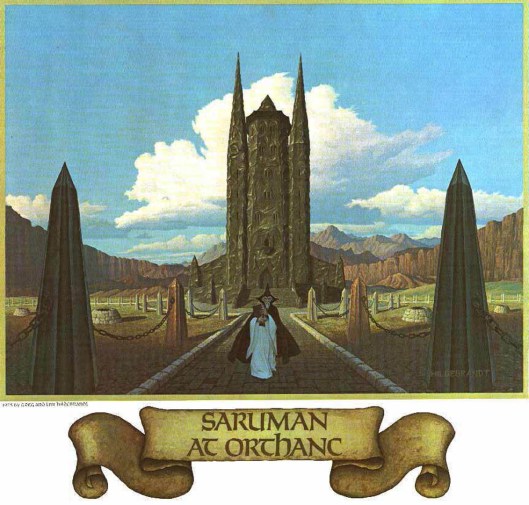
image5sarumanorthanc.jpg
in what, although unexplained, must have been an attempt to brain Gandalf.
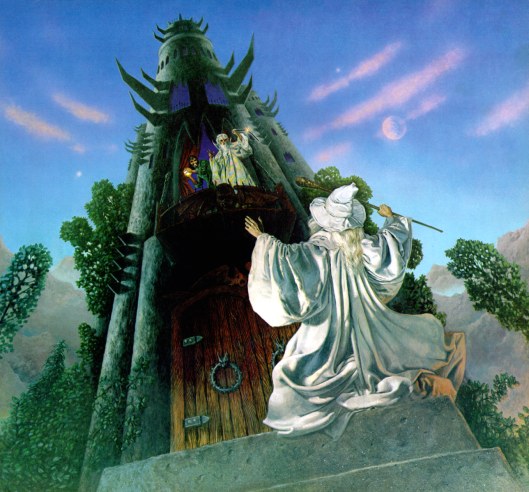
image6gandalforthanc.jpg
Unfortunately for Saruman, what he presumably thought would benefit his quest for what he speciously tells Gandalf is “Knowledge, Rule, Order; all the things that we have so far striven in vain to accomplish…” (The Fellowship of the Ring, Book Two, Chapter 2, “The Council of Elrond”), becomes a snare, as it seems that the master stone of Osgiliath has fallen into Sauron’s hands and “Easy it is now to guess how quickly the roving eye of Saruman was trapped and held; and how ever since he has been persuaded from afar, and daunted when persuasion would not serve.” (The Two Towers, Book 3, Chapter 11, “The Palantir”)
There is another surviving stone, however, and, though it doesn’t turn its possessor into an unwilling ally of Sauron, its propaganda—faked news—does terrible damage, all the same. In the White Tower of Ecthelion in Minas Tirith,
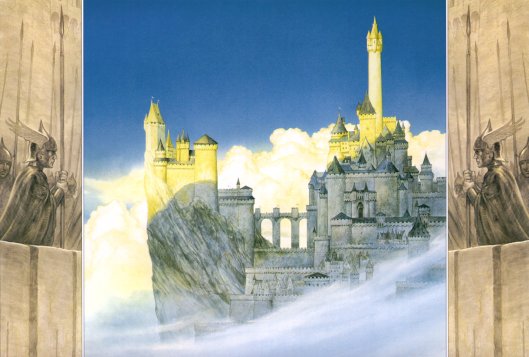
image7awhitetower.jpg
Denethor
image7denethor.jpg
holds a palantir and he, too, is caught, as Gandalf surmises:
“…I fear that as the peril in his realm grew he looked in the Stone and was deceived: far too often, I guess, since Boromir departed. He was too great to be subdued to the will of the Dark Power, he saw nonetheless only those things which that Power permitted him to see. The knowledge which he obtained was, doubtless, often of service to him; yet the vision of the great might of Mordor that was shown to him fed the despair of his heart until it overthrew his mind.” (The Return of the King, Book Five, Chapter 7, “The Pyre of Denethor”)
This overthrow, brought on by Sauron’s propaganda, results in Denethor accusing Gandalf of plotting “to rule in my stead, to stand behind every throne, north, south, or west” as well as delivering what clearly sounds like the “speech long rehearsed” Gandalf has long ago said that Saruman delivered to him in Orthanc:
“For a little space you may triumph on the field, for a day. But against the Power that now arises there is no victory. To this City only the first finger of its hand has yet been stretched. All the East is moving. And even now the wind of thy hope cheats thee and wafts up the Anduin a fleet with black sails. The West has failed. It is time for all to depart who would not be slaves.”
“to depart” quickly seems a euphemism for something much more radical as Denethor:
“leaped upon the table, and standing there wreathed in fire and smoke he took up the staff of his stewardship that lay at his feet and broke it on his knee. Casting the pieces into the blaze he bowed and laid himself on the table, clasping the palantir with both hands upon his breast.”
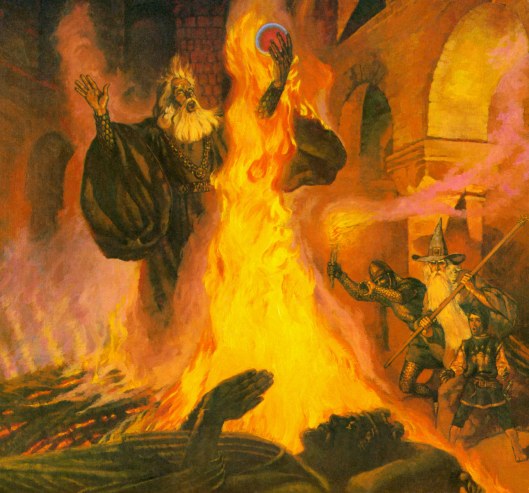
image8denethorontable.jpg
Here, we thought of all of those people we see who seemingly can never put down their phones—even in death Denethor still grips the very thing which has brought about his destruction.

image9textdrive.jpg
Was JRRT sending us, here in the future, a warning: beware of your source of news—and sometimes let go of what brings it to you? We can only add his description of Denethor’s palantir when it was retrieved from the pyre:
“And it was said that ever after, if any man looked in that Stone, unless he had a great strength of will to turn it to other purpose, he saw only two aged hands withering into flame.”
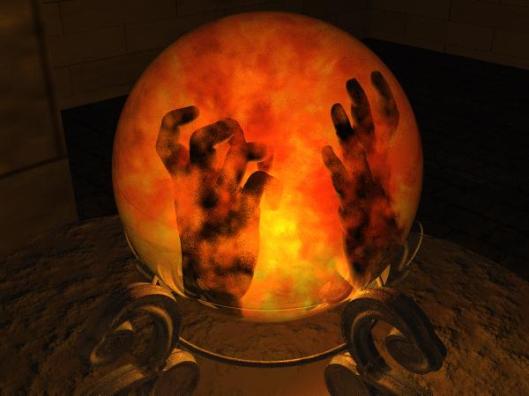
image10dshands.jpg
Thanks, as always, for reading!
MTCIDC
CD
PS
The new film, Dunkirk, opens with a British soldier catching a German propaganda leaflet based upon an actual one. Below on the left is the movie version, on the right the original. (Notice, by the way, that, in the one on the right, the English is not quite parallel to the French, including the line, “Your commanders (chefs) are going to flee by airplane.”) If Middle-earth had had a print culture, it’s easy to see such a leaflet being dropped by Nazgul over Minas Tirith!
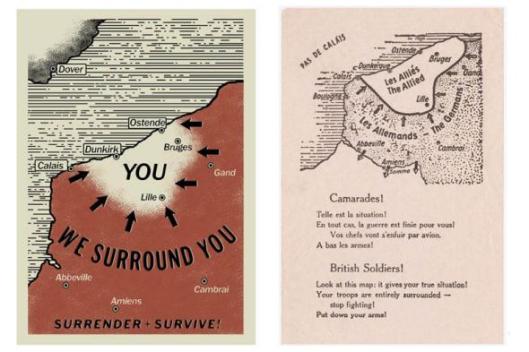
image11leaflet.jpg

A Long Stretch

12 Wednesday Jul 2017

Posted by Ollamh in Heroes, J.R.R. Tolkien, Literary History, Military History, Military History of Middle-earth

≈ Leave a comment

Tags

Agincourt, Archery, arrow bag, arrows, Bard the Bowman, Battle of Poitiers, Casula Mellita, Crecy, Edinburgh, English Longbowmen, Esgaroth, Greco-Roman, gunpowder, harpoon, Hundred Years War, Laketown, longbows, Medieval-Renaissance, Napoleonic Wars, Naval Warfare, Pinkie Cleugh, Roman, sailing, Smaug, The Hobbit, The Mary Rose, Tolkien

Welcome, as always, dear readers.

In the past, we had a posting on Bard the bowman

image1jeffchanbard.jpg

who rescued Esgaroth (Laketown)

image2esgaroth.jpg

from the attack by Smaug.

image3smaug.jpg

(We especially like this Jeff Chan Bard not only because Bard is depicted as he is in the book, as an archer, but also because it includes the thrush who tells him where he is to strike.)

In that previous posting, we suggested that JRRT pictured Bard as looking and acting like one of the English longbowmen of the Hundred Years War

image4longbowman.jpg

rather than as a harpooner, as in the film.

image5bard.jpg

image6aharpoongun.jpg

Since that posting, we did a second which included bowmen, just a few weeks ago, about Mogul-knife and arrow wound, and now we would like to add a third.

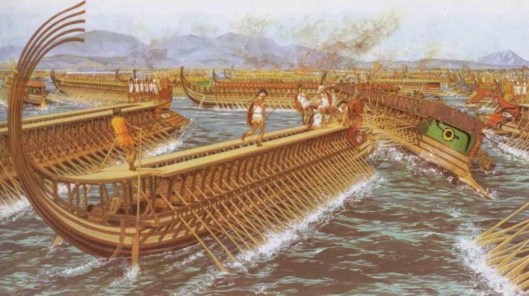
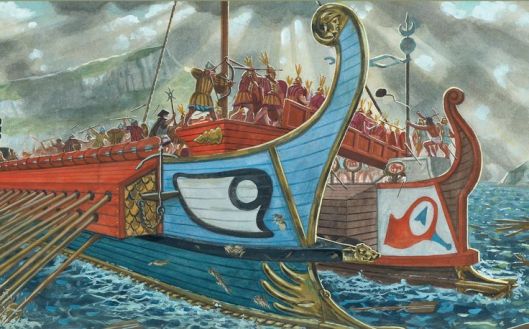
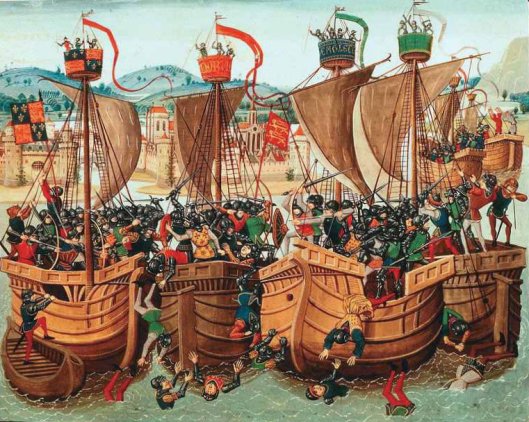
As we’ve mentioned before, one of us is preparing a new university course to be taught in the autumn on the history of warfare.  As you can imagine, this is a big subject, but, in the process of shaping it, we want to include a week on developments in naval warfare over the centuries.  So far, we’ve divided it into several parts:

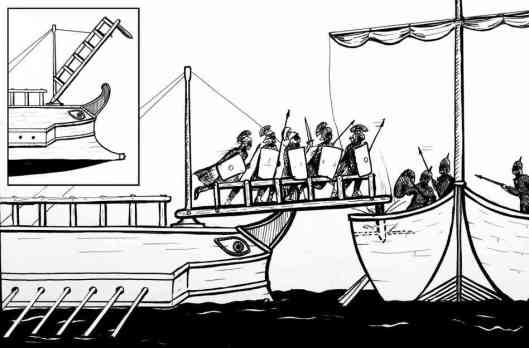
a. Greco-Roman

image6agrknavbat.jpg

image6romannavbat.jpg

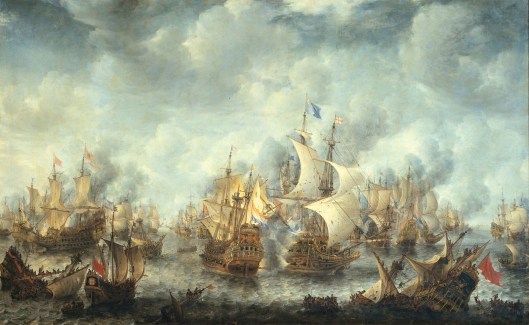
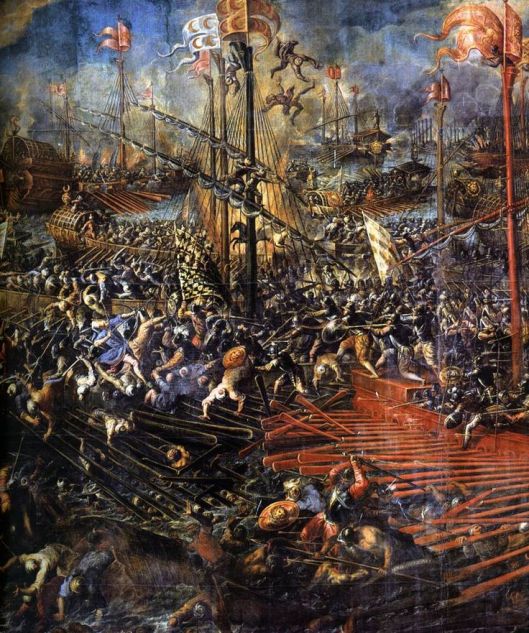
b. medieval-renaissance

image7sluys.jpg

image8lepanto.jpg

c. the age of sail

image9glorious.jpg

d. ironclads

image10monitor.jpg

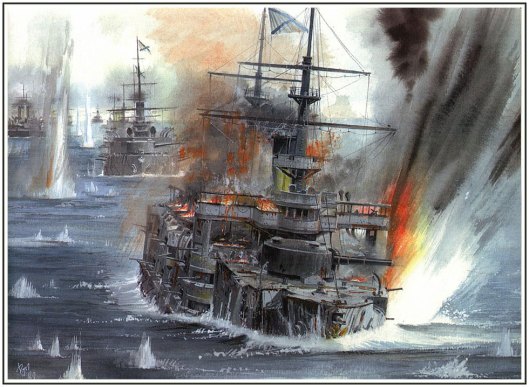
e. dreadnoughts

image11tsushima.jpg

While working on the Medieval/Renaissance section, we were reminded of what might be the most famous Renaissance shipwreck:  the sinking of The Mary Rose, 19 July, 1545.

image12mrsinks.jpg

Medieval naval battles had been primarily infantry battles transferred to the sea, as had been Roman practice.  That practice was a story in itself—the traditional Roman explanation was that they were land-fighters and so had invented a device, called a “corvus”–that’s “crow” in English—probably because the point at the enemy’s end was a bit like a pecking beak.  This was a kind of gangplank which, dropped onto the enemy’s ship, stuck in place and allowed Roman marines to rush across and deal with their opposite numbers.

image13corvus.jpg

image14medbat.jpg

Things began to change with the invention of cannon in western Europe.  (The history of gunpowder in the Far East is its own subject—and one we urge those interested to have a look at.  Here’s a LINK to get you started.)  Used first on land perhaps by the 13th century, the first recorded use of cannon on a ship dates from 1338 (and here’s a LINK to naval artillery, in case you want to know more).

With cannon, you could stand off from an enemy ship and—your choice—cripple it by destroying its sails and rigging—or sink it with holes below the waterline.

image15renbat.jpg

Boarding, as the Romans had, was still a possibility, of course, and provided the extra benefit, if the boarding was successful, of allowing for the acquisition of an extra ship.  This could be added to your fleet or sold and the profits shared among the sailors—or, actually, if we go by Napoleonic British standards, the profits went to everybody at the top, including admirals who weren’t even present at the capture, with a teeny amount remaining for the seamen who’d actually taken the prize.

image16renbat1.jpg

To do that boarding, Romans—and medievals—had loaded their ships with soldiers, and the Mary Rose was no exception, its surviving records suggesting that there were about 200 soldiers in a crew of approximately 400-450.

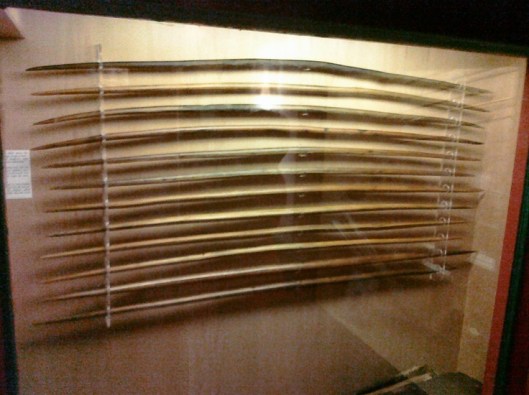
As a number of longbows have been recovered from the wreck,

image17mrlongbows.jpg

this would suggest that many of those soldiers were archers.

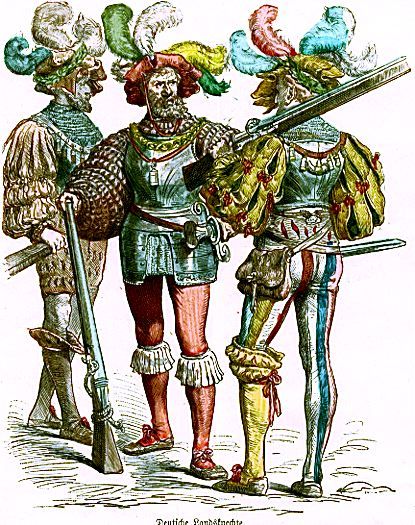
These, along with the artillery (and perhaps a small number of arquebuses?  To our current knowledge, none has been recovered from the ship, but, certainly, by 1545, they were in common use—at the battle of Pinkie Cleugh, east of Edinburgh, in 1547, the English army had several hundred German mercenary arquebusiers),

image18grmarq.jpg

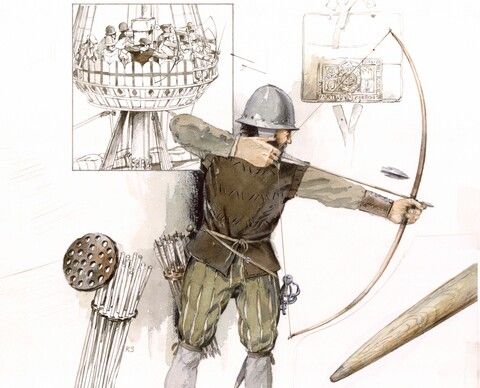
would have supplied the missile weapons of the ship.

image19mrbowman.jpg

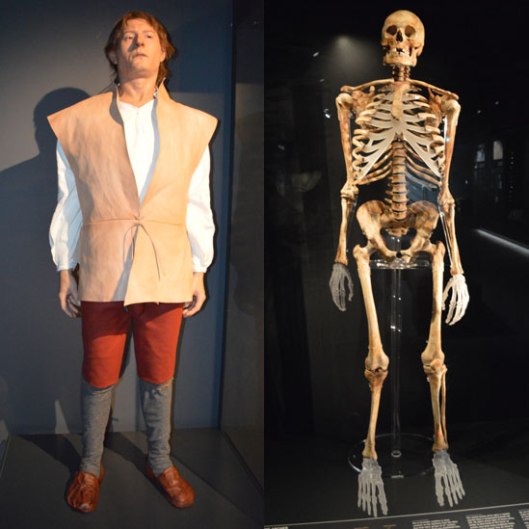
Not only were large numbers of artifacts discovered in the Mary Rose, but the skeletons of perhaps half its crew and about 90 of those were intact enough to warrant further study.  For our purpose, one, in particular is very interesting.

image20mrarcher.jpg

Discovered in the hold, he was a large man for his time, about 6 feet (about 183cm).  As well as revealing that he would have had a powerful build, his skeleton displayed repetitive stress injuries to his upper body.  There is discussion as to the pull-weight (how much muscle power it takes) of the longbow of the medieval/Renaissance period, estimates ranging from 90 to about 150 pounds (we’re sorry that we can’t readily convert this, as it isn’t pounds of weight, but pounds of force—the general idea is that it would have taken huge muscle power in either case), but, for a bow as tall as a bowman, this would have demanded great muscular strength—which would then have, over time, put huge stress upon an archer’s body.  This has then led archaeologists to suggest that he was a bowman.

And this brings us back to Bard, the actual archer, and a suggestion as to what he might have looked like.

JRRT only says:

“But there was still a company of archers that held their ground among the burning houses.  Their captain was Bard, grim-voiced and grim-faced…Now he shot with a great yew bow, till all his arrows but one were spent.”  (The Hobbit, Chapter 14, “Fire and Water”)

“a great yew bow” makes us think of the English bowmen we’ve mentioned before, and those we believe were in Tolkien’s mind, the victors at the battles of Crecy (1346), Poitiers (1356), and Agincourt (1415).

image21agincourt.jpg

To produce archers who could pull such powerful bows (and fire up to 10 arrows a minute, as we’ve mentioned in a previous posting), English archers began training as boys and continued throughout the years—as athletes of the bow, they had to keep in shape.  Such training and exercise would then have produced men like that discovered on the Mary Rose—big-shouldered, strong-armed—and given to the subsequent damage inflicted on the body by archery wear-and-tear.

So, might we then see Bard as not only “grim-voiced and grim-faced”, but “broad-shouldered and imposing”?  To which we can add this from The Hobbit:

“In the very midst of their talk, a tall figure stepped from the shadows.  He was drenched with water, his black hair hung wet over his face and shoulders, and a fierce light was in his eyes.”  (Chapter 14, “Fire and Water”)

All of which gives us:  “tall, black-haired, fierce, grim-voiced and grim-faced”—and, at our suggestion, “broad-shouldered and imposing”—a worthy portrait of Bard the Dragon-slayer.

Thanks, as ever, for reading!
MTCIDC

CD

PS

It’s not known what our Mary Rose archer was doing in the hold at the time the ship went down, but perhaps he was seeking to transfer extra ammunition to the main deck?  That ammunition would probably have been in the form of coarse linen bags carrying 24 arrows each—here’s a modern reconstruction

image22arrowbag.jpg

and here’s the LINK to the site from which it comes.  This belongs to an amazing woman whose website is full of her life on the edge of the Great Plains, in Kansas, USA—home of Dorothy of the OZ books, of course– as well as her photos of things like the reconstructed bag in the photo above.  Below is a picture of the Kansas tall grass prairie.

image23kansas.jpg

Oh, Come, Let Us Adore…

21 Wednesday Jun 2017

Posted by Ollamh in Imaginary History, J.R.R. Tolkien, Literary History, Military History, Military History of Middle-earth, Narrative Methods

≈ Leave a comment

Tags

1984, Adolf Hitler, altar, Ar-Pharazon, Armenelos, Artemis, Aulis, Avebury, Aztec, Benito Mussolini, Big Brother, France, Gallic Celts, George Orwell, Germany, Gondor, Greek temple, Hera, Herodotus, human sacrifice, Iphigenia, Melkor, Nazis, nemeton, Numenor, occupation, Olympia, Pantheon, Rome, sacrifice, Sauron, shrine, Soviet Union, Stalin, Stonehenge, Tenochtitlan, The Hobbit, The Lord of the Rings, The Silmarillion, The War of the Ring, Tolkien, Valar, World War II, worship

Welcome, as always, dear readers.

Some time ago, we posted a piece on what Sauron wanted out of the War of the Ring. Our evidence was this, spoken to Aragorn and Gandalf and the allied army which had marched to the Morannon as a distraction, by the Lieutenant of the Tower:

“The rabble of Gondor and its deluded allies shall withdraw at once beyond the Anduin, first taking oaths never again to assail Sauron the Great in arms, open or secret. All lands east of the Anduin shall be Sauron’s for ever, solely. West of the Anduin as far as the Misty Mountains and the Gap of Rohan shall be tributary to Mordor, and men there shall bear no weapons, but shall have leave to govern their own affairs. But they shall help to rebuild Isengard which they have wantonly destroyed, and that shall be Sauron’s, and there his lieutenant shall dwell: not Saruman, but one more worthy of trust.” (The Return of the King, Book Five, Chapter 10, “The Black Gate Opens”)

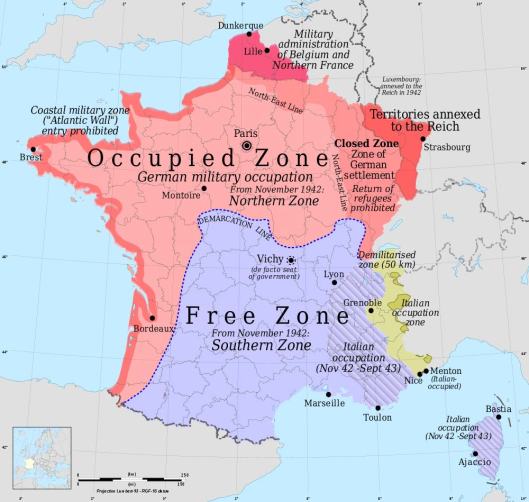
These are political conditions: Sauron is demanding territory, just as any conqueror in our world would. When France was occupied by the Nazis in 1940–something with which JRRT would have been quite familiar while writing The Lord of the Rings—here’s a map of what Hitler demanded—and got.

France-occupation

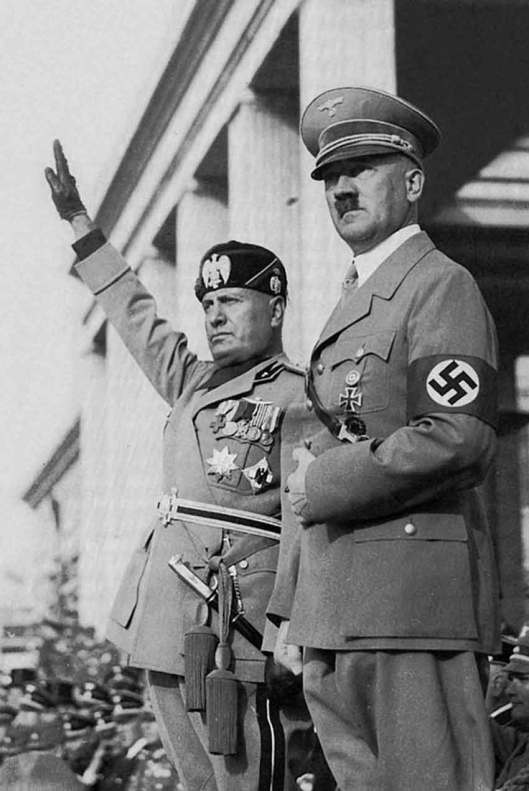
The last sentence of Sauron’s conditions even reminds us of the relationship between Hitler and Mussolini—although not how Mussolini would have viewed it.

Hitler-and-Mussolini

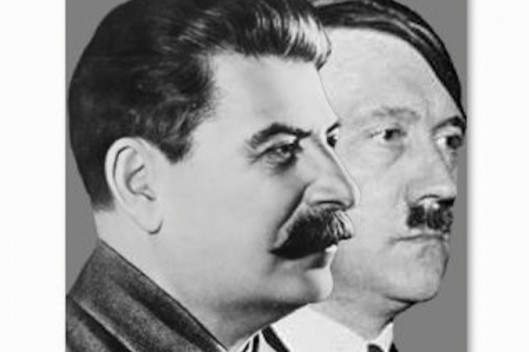
Hitler had another dictator-partner for a short time, however, Stalin, whom he distrusted even more than Mussolini.

STALIN-HITLER-2-676x450

And Stalin, unlike Sauron, won his war and swallowed all of central Europe, as well as eastern Germany.

post-war-soviet-influence

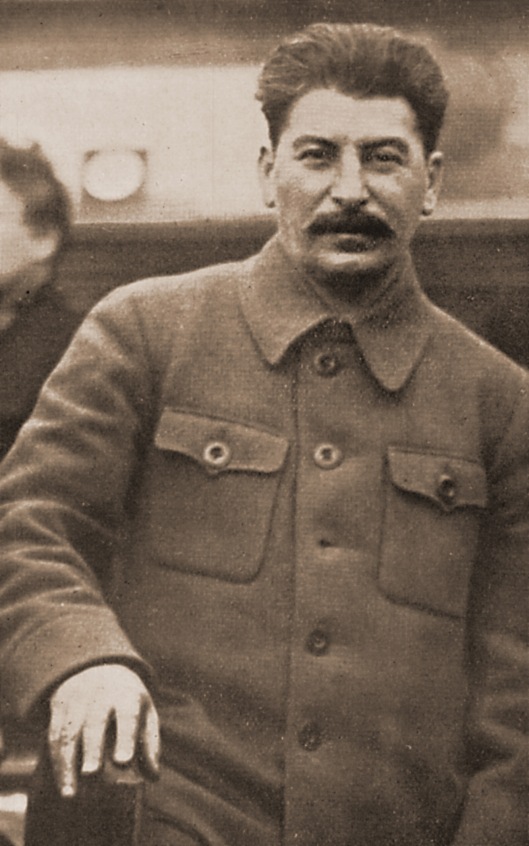
It’s clear that George Orwell had this dictator in mind when he was creating his “Big Brother”, in 1984, even to his physical description (from a poster—it appears that no one has actually seen Big Brother in the flesh): “an enormous face, more than a meter wide: the face of a man about forty-five, with a heavy black mustache and ruggedly handsome features…”

stalin

These posters were so constructed that, “It was one of those pictures…which are so contrived that the eyes follow you about when you move.”

Big-Brother-Is-Watching-You-Poster

In fact, as we think about the image, its slogan, “Big Brother is Watching” might be applied to the All-Seeing Eye.

sauron-eye

That all-seeing eye, however, has another meaning, we believe, and it has to do with a goal which the Lieutenant doesn’t mention, but JRRT does:

“Sauron desired to be a God-King, and was held to be this by his servants.  If he had been victorious he would have demanded divine honour from all the rational creatures and absolute temporal power over the whole world.” (Letters, 244)

Thus, like various gods through the history of the world, by showing himself not a full physical form, but only as an eye, we can imagine that Sauron was claiming divine omniscience.

This set us to thinking: there is virtually no trace of religion in the latter part of the Third Age and certainly no religious structures. What might Sauron build as a shrine—to himself? And, as a corollary, what would he demand for worship?

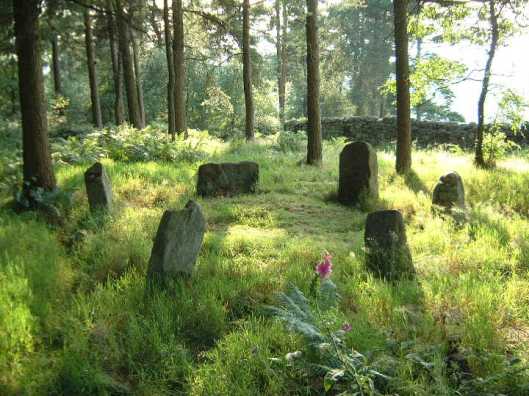
In Western Europe, some the earliest shrines were not actual buildings, but sites claimed to be somehow invested with divinity, such as groves of trees, something which the Gallic Celts called a nemeton, perhaps related to the Old Irish word nemed, meaning, according to the on-line OI/Middle Irish dictionary, “(small) sacred place”.

DollTorWest0801

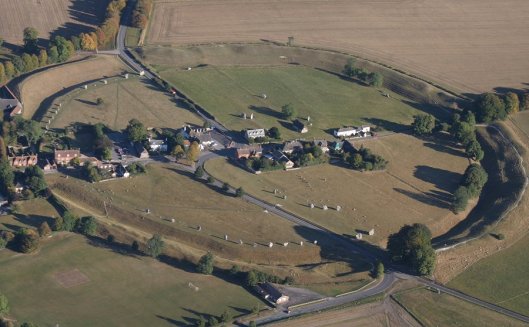
It’s easy to see how this could lead to the idea of a stone circle (perhaps beginning with a ditch of the sort which could ring settlements?), like that at Avebury.

Avebury

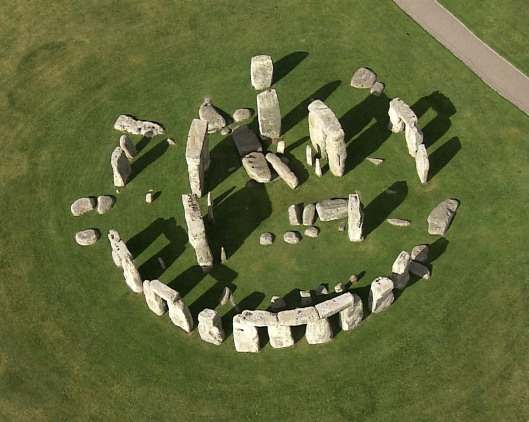
Or its more concentrated version, Stonehenge.

stonehenge-copy1

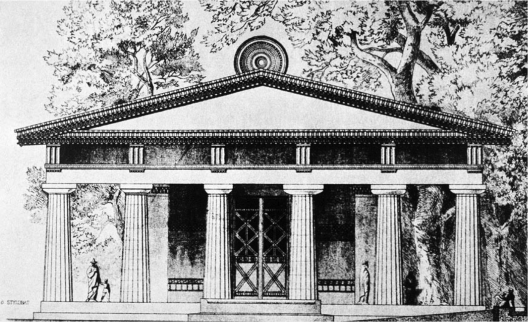
Another possibility might be to organize that grove into lines of pillars—using the trunks of the trees—and adding a roof—and you get a Greek temple.

templeofhera

Herodotus tells us that, in his time, this temple, devoted to Hera at Olympia, still had a couple of wooden columns, showing just how old it was. (There are also building elements, like pegs—all in stone in later time—which mirror earlier wooden construction.)

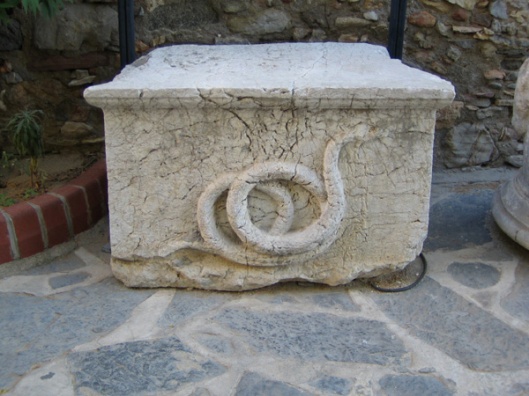
In the Greek world (and the Roman, as well), worship was done outside the building, at an altar in front.

snake-altar-from-mausoleum-of-halicarnassus-in-bodrum

That worship would consist of prayers and sacrifices. As the majority of the gods were believed to live in a place above humans (Olympus—an actual mountain, but also, seemingly, an imaginary location in the sky), sacrifices were conveyed in smoke. These could be as simple as incense

elt200810220812093544851-142058F954A638F8693

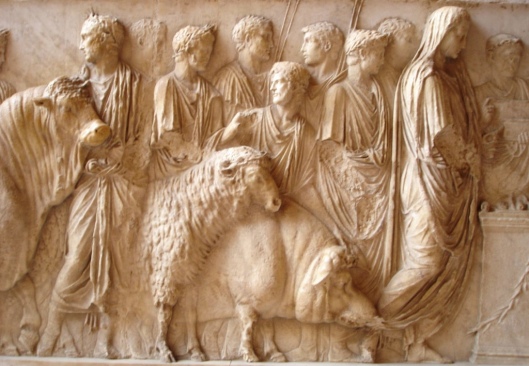
or as complicated as the barbecue after a multiple animal-slaughter, like the Roman suovetaurilia (“pigsheepbullactivity”). (Guess who got to consume the actual meat?)

multipleanimalsacrifice

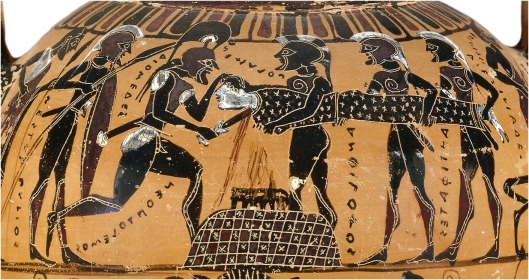
Classical people did not practice human sacrifice, considering it abominable, but it may have existed, at least in desperate circumstances in the far past, as has been preserved in the Greek story of Iphigenia, murdered at the altar of Artemis at Aulis to propitiate the goddess, who had blocked the Greeks from sailing to attack Troy.

Black-figured Tyrrhenian amphora (wine-jar) attributed to the Timiades Painter

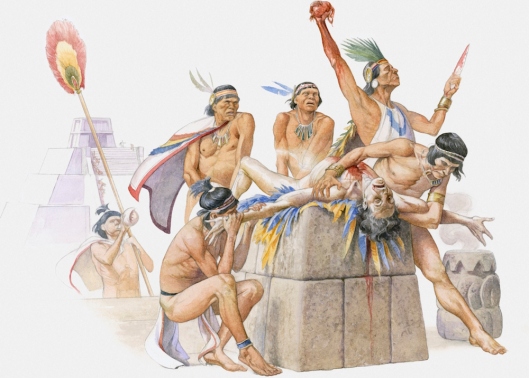
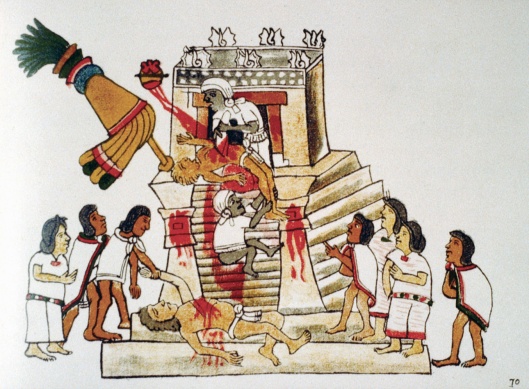
Of course, when it comes to wholesale, regular human sacrifice, we immediately think of Aztec devotion to their god, Huitzilopochtli, who was fed on the blood of human hearts at the top of his temple in the Aztec capital, Tenochtitlan.

huitzilopochtli

ThinkstockPhotos-98193978

sacrifice-2

And this brings us back to Sauron, his temple, his worship. Because there is so much wonderful material to work from in The Hobbit and The Lord of the Rings, in general, we confine ourselves to those and the Letters, but a little wider research gave us a clue—a horrible but not surprising clue—to answer our original question. In the Silmarillion, we found this:

“But Sauron caused to be built upon the hill in the midst of the city of the Numenoreans, Armenelos the Golden, a mighty temple; and it was in the form of a circle at the base, and there the walls were fifty feet in thickness, and the width of the base was five hundred feet across the center, and the walls rose from the ground five hundred feet, and they were crowned with a mighty dome. And that dome was roofed all with silver, and rose glittering in the sun, so that the light of it could be seen afar off; but soon the light was darkened and the silver became black.” (The Silmarillion, “Akallabeth”, 273)

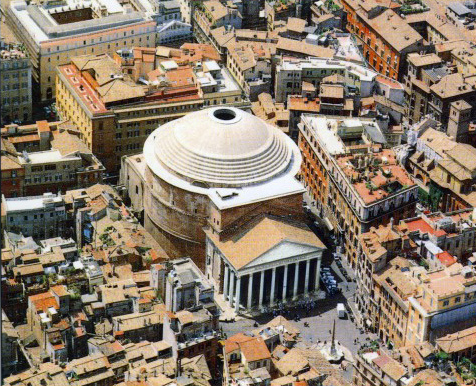
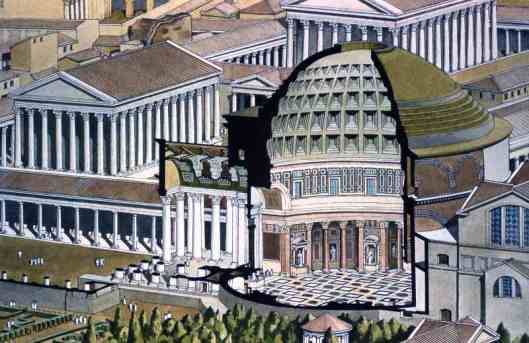
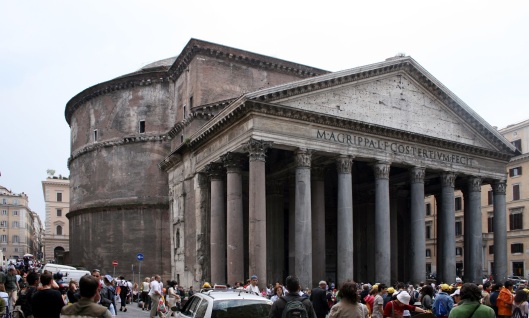
As people who are much involved with the Greco-Roman world, this description immediately brings to our minds the Pantheon, in Rome, whose dome was sheathed in copper, until that was stolen by the eastern emperor Constans II in 663AD, only to be stolen from him en route by Saracen pirates. It’s not 500 feet by 500 feet (152.4m.), of course, being only about 140 (42.67m.), but it’s certainly large and impressive—and circular, with a mighty dome.

aerial-view-pantheon

26.pantheon

Pantheon_Rome_(1)

But why did the “silver become black”? Do we have a bad feeling about this?

“For there was an altar of fire in the midst of the temple, and in the topmost of the dome there was a louver, whence there issued a great smoke…Thereafter the fire and smoke went up without ceasing; for the power of Sauron daily increased, and in that temple, with the spilling of blood and torment and great wickedness, men made sacrifice to Melkor that he should release them from Death. And most often from among the Faithful they chose their victims…”

Sauron, once Melkor’s servant, had gained great power over the Numenorean king, Ar-Pharazon, using it to persuade the king to attack the Valar—and thus bring about the destruction of Numenor. Sauron’s spirit survived that destruction, and perhaps his memory of Melkor’s temple and its worship would have, as well?

Thanks, as ever, for reading!
MTCIDC

CD

PS

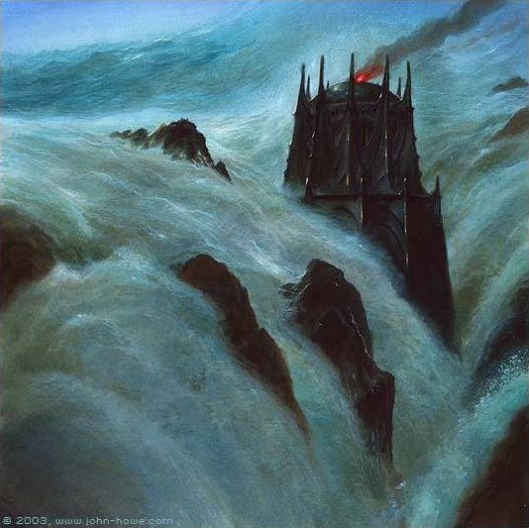
We can’t resist adding this wonderful John Howe impression of the drowning of the city of Armenelos…

John_Howe_-_The_Drowning_of_Numenor


Accuracy? Well, Yes, But…

07 Wednesday Jun 2017

Posted by Ollamh in Artists and Illustrators, Heroes, J.R.R. Tolkien, Literary History, Military History, Narrative Methods, The Rohirrim

≈ Leave a comment

Tags

American Civil War, American Revolution, Concord, Don Troiani, Germantown, grenadiers, H. Charles McBarron, Harper's Monthly, Howard Pyle, Illustration, John Trumbull, Joseph Warren, King Arthur, Lexington, Pirates, Richard Simkin, The Battle of Bunker Hill, The Battle of Nashville, The Lord of the Rings, The Rohirrim, The Salem Wolf, Tolkien

Welcome, dear readers, as always.

Today’s post takes us to the question of what we like and why and how such likes may push us—who, we realize, are a little stiff on the subject of accuracy—to accept things which, if our feelings weren’t engaged, we would briskly reject.

We begin by looking at a painting by one of our favorite late Victorian/Edwardian illustrators, Howard Pyle (1853-1911).

image1hp.jpg

If you’re a regular reader (and we hope you are—or will be!), you’ll have seen his work on our pages any number of times, from his King Arthur illustrations (and here’s a LINK to a free 1922 reprint at the Internet Archive)

image2ka.jpg

to his pirates (and here’s a LINK to a later—c.1921—collection of Pyle’s pictures and writings on pirates at Internet Archive).

image3hppirates.jpg

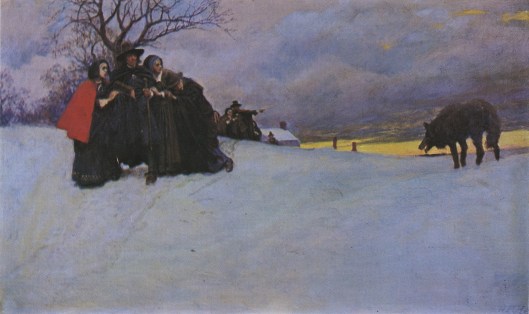
Pyle also wrote and illustrated original fiction—just look at this haunting picture from a short story, “The Salem Wolf”, which was published in the December, 1909, issue of Harper’s Monthly Magazine.

image4salemwolf.jpg

(And here’s a LINK to the story at Internet Archive)

Pyle also painted stand-alone historical pictures, such as this of “The Battle of Nashville” (1907).

MN 60

And we’re lucky to have a photograph of the artist at work on this very picture.

image6hppainting

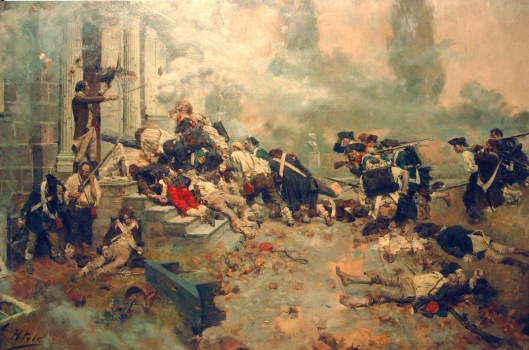
Besides American Civil War pictures, Pyle painted several based upon incidents of the American Revolution, such as this, of the assault on the Chew House, at the Battle of Germantown (4 October, 1777).

image7pylegermantown

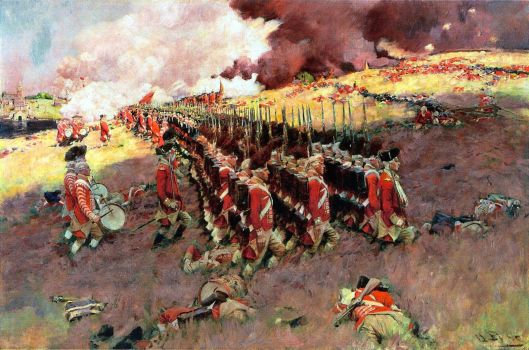
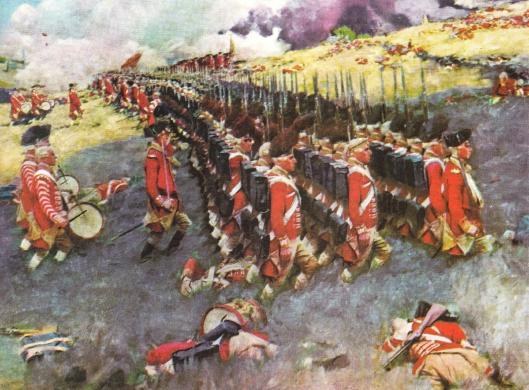
Another of his pictures of the Revolution is the subject of this post, “The Battle of Bunker Hill” (1897).

image8pylebunkerhill

We’re not sure when one of us first saw this picture—childhood, we’d guess—but we were immediately bowled over by it. It’s the adventure of it: those long ranks of redcoats stoically marching up the hill, drums beating behind. It’s not a sanitized picture—just look up the hill and all around you can see the wreck of the earlier British attacks—but its emphasis is upon the courage it must take to do what those soldiers did.

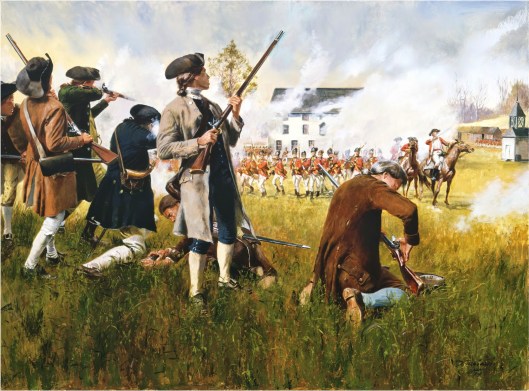
This was, in fact, the third battle of the American Revolution. The war had begun in mid-April, 1775, when a raiding party of British troops, ordered to disrupt local preparations for defense, fought two skirmishes with local militia, at Lexington

image9lexington.jpg

and Concord,

image10concord.jpg

two rural settlements some twenty miles or so west of Boston.

When the British withdrew into Boston itself, those locals, who had grown in numbers to about 15,000, drawn from all over New England, blockaded the town and there was a period of stalemate, while both sides were reinforced. When it was clear that the locals had seized a nearby hill and were planning to plant artillery there which would then be capable of bombarding Boston, the British were forced to move. Their choice was to attack that hill, which was named “Breed’s Hill” but, through an historical mix-up, the battle was named for the hill to its rear, “Bunker Hill”.

image11bunkerhill.jpg

Initially, the British plan was to have part of its force make a feint—a fake attack—against the main part of the hill, where the locals had built an open-backed fortification, called a redoubt, while the real attack was to push through the weaker local left and curve around to hit the locals from the rear.

By underestimating the defense, the British soon suffered over a thousand casualties to the local 450. As the assaults were driven back, the British plan changed and the main attack was to be uphill, straight at the redoubt and this is what is depicted in Pyle’s painting, specifically the advance of the 52nd Foot (“Foot” is 18th-century shorthand for “regiment of infantry”).

image12hpbunkerhill.jpg

This is not the first well-known painting of the battle, however. In the first third of the 19th century, John Trumbull (1756-1843), a prominent American artist, painted several versions of a work entitled, “The Death of General Warren at the Battle of Bunker’s Hill, June 17, 1775”.

image13trumbullbunkerhill.jpg

This picture belongs to what we might call both the “heroic school” and the “portrait school”, the former because of a certain flashy quality (look at the way the wind seems to be whipping everything—and where are those flames on the right coming from?), the latter because, not only is the local officer, Joseph Warren depicted, but so are a number of other figures—two of the British generals, two British majors, and a number of more minor participants.

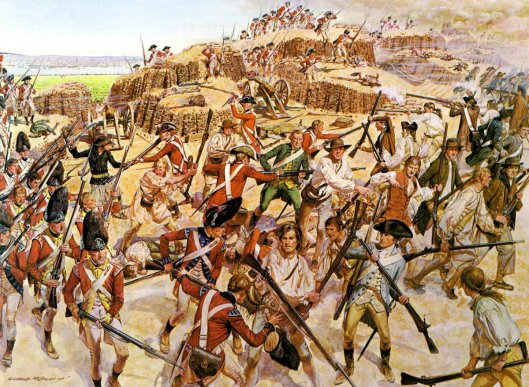
Bunker Hill remained—and remains—a popular subject for historical painters, most of them depicting events from the local side. Here is one version, by the distinguished 20th-century American military artist, H. Charles McBarron (1902-1992).

image14mcbarron.jpg

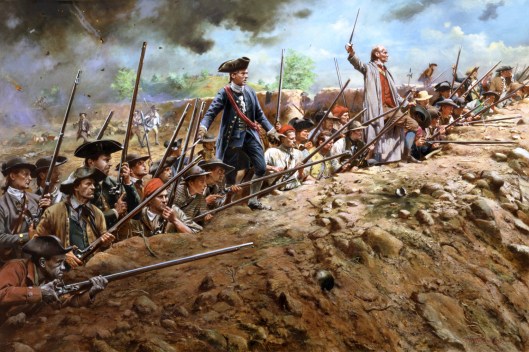
And here are two by one of our favorite contemporary American Civil War artists, Don Troiani (1949-).

image15troi.jpg

image16troi.jpg

All pictures are not from the viewpoint of the colonists, however. The late-Victorian/Edwardian British military artist, Richard Simkin (1850-1926), gave us this view.

image17simkin.jpg

Of all of these images, the Trumbull has drawn upon his memory and upon his sketchbooks, too, we bet, to give a general impression of the look of the soldiers, but, although he was part of the colonial force besieging Boston, he only saw the battle through a telescope. McBarron was a collector of uniforms and equipment, as is Troiani, and their works are painstakingly accurate. Simkin, although he, too, was a collector, came from an earlier time, just at the beginning of serious research on weapons and uniforms of the past, and, therefore, certain elements in his picture—the plumes and cords on his men’s bearskins and those packs (left behind in Boston, in reality), for instance—are not correct. Even so, his picture is far more accurate than Pyle’s, which is full of mistakes, in everything from the uniforms and equipment to those grenadiers (those guys in the fuzzy hats in the center), who shouldn’t be there at all, having been detached to form part of the right wing assault force.

And yet the Pyle is still our favorite depiction of the battle. Why? Because it feels right: it’s a 19th-century image of courage and discipline, and appeals to our romantic souls, even though there are casualties strewn about, which, to us, only serves to emphasize the bravery and stick-to-it-iveness of those solid infantry.

And this is where JRRT comes in. We’ve said before: our favorite part of P. Jackson’s films is anything to do with the Rohirrim.

image18rohirrim.jpg

The fact that, in the books, they live in wide, grassy plains (unavailable in New Zealand) and that their capital, Edoras, does not have “a dike and mighty wall and thorny fence” in the films, along with any other details it would be easy to extract from The Lord of the Rings, doesn’t matter to us in the least. The depiction in the films feels right and we’re content with that, even when there are other parts of the films where we have other reactions. Simple (and perhaps surprising to us) as that.

So, dear readers, do you have similar reactions? And to what? We’d love to hear!

And thanks, as always, for reading.

MTCIDC

CD

What If…

31 Wednesday May 2017

Posted by Ollamh in Artists and Illustrators, J.R.R. Tolkien, Literary History, Maps, Military History, Military History of Middle-earth, Narrative Methods, Tolkien

≈ Leave a comment

Tags

Alamo, Andelkrag, Anduin, Caernarfon, Carcassonne, Duc de Berry, fortresses, Hal Foster, Harry Turtledove, Howard Pyle, Huns, Minas Tirith, moat, Mont Saint Michel, Mordor, Numenor, Peter Jackson, Portchester, Prince Valiant, Rohirrim, S.M. Stirling, Santa Anna, Segontium, Siege Warfare, Texas War for Independence, The Lord of the Rings, The Return of the King, Tiryns, Tolkien, Tower of Orthanc, Tres Riches Heures

Welcome, readers, as always.

If you are among our excellent regulars, you know that we’re fascinated by history (one of us has taught it for years). One subset of our interest is “what ifs”, two of our favorite scifi/fantasy authors being Harry Turtledove and S.M. Stirling, who have written numerous books exploring all sorts of alternative places and times.

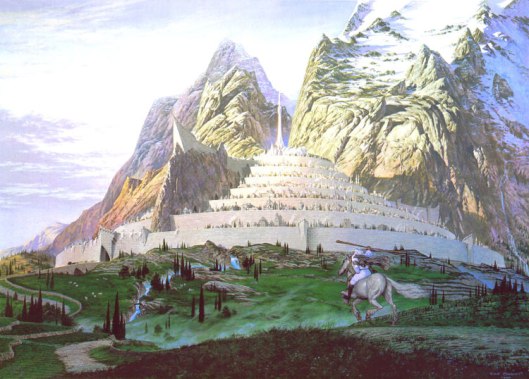
In this posting, we’d like to try a “what if” ourselves: what would happen to Minas Tirith if the Rohirrim and Aragorn had failed to arrive?

Walls collapsing under a rain of boulders, soldiers fleeing from the defenses, the main gate broken in by a giant battering ram—

image1anazgan.jpg

how was this the place of which its creator had written:

“A strong citadel it was indeed, and not to be taken by a host of enemies, if there were any within that could hold weapons…” (The Return of the King, Book Five, Chapter 1, “Minas Tirith”)

In an earlier posting, we talked about Sauron’s attack on Minas Tirith

image1battackonmt.jpg

and even suggested that one inspiration might have been an episode of the comic strip Prince Valiant and the siege of Andelkrag by the Huns (published in May, 1939). (Footnote: there is a rumor that the writer/illustrator, Hal Foster, intended the Huns to equal the Nazis and therefore annoyed Hitler—a would-be Sauron to Saruman’s Mussolini, as we once also suggested?)

image1andelkrag.jpg

That castle is splendid, but not quite what one would have seen in the 5th century AD, when Attila led the Huns to invade central and western Europe. Andelkrag appears to be a very elaborate late-medieval castle, c.1400 or so, rather like the ones you might see in the Duc de Berry’s Tres Riches Heures (c.1412-16; 1440s; 1485-1489).

image2tresrichesheures.jpg

More likely, if Andelkrag had been a real fortress, it would have been a repurposed Roman army installation, like this at Caernarfon, called by the Romans, Segontium.

image3caernarfonsegontium.jpg

Such forts might then be converted into castles, as at Portchester

62790_8d3686244501897

but that would hardly have provided the gallant medieval look which Foster gave his comic strip and which, in turn, came from the illustrations of people like Howard Pyle (1853-1911), in the previous generation (and which, we have previously argued, had a strong influence on what JRRT imagined his Middle-earth to look like).

image5ahowpylephoebe.jpg

image6pyleillustration.JPG

We are told in one of the extra features in the extended film version of The Lord of the Rings that an inspiration for P. Jackson’s Minas Tirith

image5mt.jpg

was the ancient island fort/religious site of Mont Saint Michel, on the western coast of France.

image6mtstmich.jpg

image7mtstmichmap.jpg

As you can see from the photo and the map, this isn’t just a fort, however, but a little fortified town, reminding us that Minas Tirith isn’t a castle, but a walled city, like the restored medieval town of Carcassonne, in southern France.

image8carcassonne.jpg

Like Mont St. Michel, Minas Tirith is built up a slope.

jrrtsfirstmtdrawing.jpeg

(This, by the way, is Tolkien’s first sketch.)

But, unlike Mont St. Michel and Carcassonne, it has not one wall, but many:

“For the fashion of Minas Tirith was such that it was built on seven levels, each delved into the hill, and about each was set a wall, and in each wall was a gate.”

image12leemt.jpg

Because the city was built on a series of levels, this would mean that each wall would overlook the next lower one, so that the defenders on the upper wall could rain down missiles on attackers below.

poi_img_town_defences_1

This is an ancient practice. The Bronze Age Greek city of Tiryns (yes, there is a bit of a similarity in the name, isn’t there?) is so constructed, for example, that its entryway forces attackers to move to the left, thereby potentially exposing an unshielded side, as well as undergoing a barrage of arrows and rocks from those on the wall above.

Tiryns Reconstruction

tiryns-walls

In the case of Minas Tirith, there is an added obstacle:

“But the gates were not set in a line: the Great Gate in the City Wall was at the east point of the circuit, but the next faced half south, and the third half north, and so to and fro upwards; so that the paved way that climbed towards the Citadel turned this way and then that across the face of the hill.”

image13mtzigzag

Attackers, then, would not only be at the mercy of those above them, but would, should they break through one gate, be forced to zigzag back and forth as they fought their way upwards, taking more and more casualties as they advanced.

minas-tirith3

Added to this, at the lowest level, was the main wall:

“…of great height and marvellous thickness, built ere the power and craft of Numenor waned in exile; and its outward face was like to the Tower of Orthanc, hard and dark and smooth, unconquerable by steel or fire, unbreakable except by some convulsion that would rend the very earth on which it stood.” (The Return of the King, Book Five, Chapter 4, “The Siege of Gondor”)

Unlike so many fortresses—going back at least to Neolithic times—Minas Tirith had no moat. Not only does such a watery ditch slow down attackers by giving them one more puzzle to solve, but it also makes a standard siege practice, undermining, much more difficult. Basically, what undermining does is to hollow out an area underneath a wall and replace the original foundation with a flammable wooden one. Then the miners fill the hollow with burnables, torch them, and wait to see if the new wooden foundation collapses, bringing down the wall on top of it. You can see miners at work in this medieval manuscript illustration.

villanip214bottom.jpg

A wet moat would have forced the miners to dig much deeper, to avoid being flooded out.

For Minas Tirith, the nearest water source for a wet moat would have been the Anduin, some miles away, but dry moats were useful as well. This diorama of the final attack by the British at the siege of Badajoz in 1812 shows how effective such a thing might be. Although the besiegers have managed, through prolonged bombardment, to create a breach in the main wall, they have to struggle through the deep dry moat to reach it—and took large numbers of casualties in doing so.

image18badajoz

Against all of these defenses, the head of the Nazgul, as Sauron’s general in the field, has the usual siege weapons: stone throwers, siege towers, even a massive battering ram. He also has a more subtle tool:

“But soon there were few left in Minas Tirith who had the heart to stand up and defy the hosts of Mordor. For yet another weapon, swifter than hunger, the Lord of the Dark Tower had: dread and despair.”

Even so, under the command of Gandalf, there was still resistance and we can imagine that that resistance would have persisted through all the circles, but the ultimate difficulty, which would have caused the fall of the city, had not the Rohirrim—and then Aragorn—come, was the lack of reserves.

Gondor was, at the time of the siege, in decline, as Pippin noticed when he and Gandalf arrived there:

“Yet it was in truth falling year by year into decay; and already it lacked half the men that could have dwelt at ease there.”

When reenforcements came from the south, they were “less than three thousands full told.”

When a city or castle is under siege, it needs not only a force to man its walls, but also a second force, to be sent quickly to any place where an enemy breakthrough is threatened. The force on the walls has two main jobs: 1. to keep the enemy at a distance with missile fire—or, failing that, to cut down the attacking force as it approaches the walls, trimming its numbers and thereby possibly demoralizing it; 2. to fend off the enemy if it actually manages to gain the walls. This illustration from the Prince Valiant Andelkrag siege provides a good image of this double job.

image19defenseofandelkrag

It might be possible, if the enemy made an assault upon a single point, to siphon off men from other parts of the defenses to act as a temporary second force, but, if the enemy attacks more than one place at the same time, this is not a safe thing to do. In the case of the assault on the first wall of Minas Tirith, the enemy commander seems to have had such numbers—and didn’t care in the least about his losses– that he could attack the entire wall:

“Ever since the middle night the great assault had gone on. The drums rolled. To the north and to the south company upon company of the enemy pressed to the walls. There came great beasts, like moving houses in the red and fitful light, the mumakil of the Harad dragging through the lanes amid the fires huge towers and engines. Yet their Captain cared not greatly what they did or how many might be slain: their purpose was only to test the strength of the defence and to keep the men of Gondor busy in many places.”

The weakest place in any strong wall is a gate and that knowledge has guided Sauron’s Captain:

“It was against the Gate that he would throw his heaviest weight. Very strong it might be, wrought of steel and iron, and guarded with towers and bastions of indomitable stone, yet it was the key, the weakest point in all that high and impenetrable wall.”

Thus, with everyone pinned in position by a general assault, and there being no other possible reserve, once the gate is down—but then a cock crows and there are horns and, well, you know what happens next.

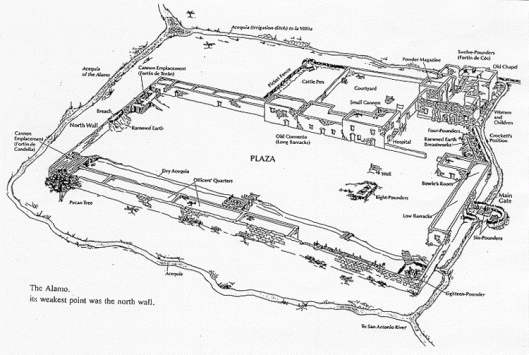
But, continuing our “what if”, we look to a different model, the Alamo, a ruined mission turned into a fortress in the so-called “Texas War for Independence” of 1835-36.

alamo-map-3

Within this mission, some 180plus defenders faced a Mexican army of several thousand, staving them off for a week-and-a-half before finally being overwhelmed by a series of nearly-simultaneous pre-dawn assaults from several directions at once.image21alamoassault

The survivors drew back, still fighting, and made a series of last stands in the rooms of the surviving mission buildings, dying almost to a man because the Mexican general, Santa Anna, had declared that there would be no mercy for any survivors. (There were a handful of prisoners, however, perhaps including the famous American frontiersman, Davy Crockett, but under Santa Anna’s direction, they were then murdered.)

In our grim “what if”, the survivors of the outer wall, led in retreat by Gandalf, are gradually driven back, like the Alamo defenders, until they reach the Citadel—and then—but, can we go on? Are the Rohirrim and Aragorn simply delayed and then appear? Are there eagle-rescues, as in The Hobbit?

image23eaglerescue.gif

What do you think, dear readers?

And thanks, as ever, for reading!

MTCIDC

CD

PS

We saw this Lego attack on Minas Tirith and it was just too wonderful not to include!

legominastirith.jpg

PPS

As we were finishing this, we happened upon a really great website–

https://middleeartharchitectures.wordpress.com/  –wonderful visuals!

Finding a Voice

10 Wednesday May 2017

Posted by Ollamh in Heroes, J.R.R. Tolkien, Literary History, Military History, Narrative Methods

≈ Leave a comment

Tags

Abraham Lincoln, Abraham Lincoln Vampire Slayer, American Civil War, Daniel Day Lewis, early photography, Edward Everett, Gettysburg, Gettysburg Address, National Cemetery, Saruman, Smaug, spell-casting, Steven Spielberg Lincoln, The Battle Cry of Peace, The Blue and the Gray, The Hobbit, The Lord of the Rings, The Voice of Saruman, Tolkien, voices

Welcome, dear readers, as always.

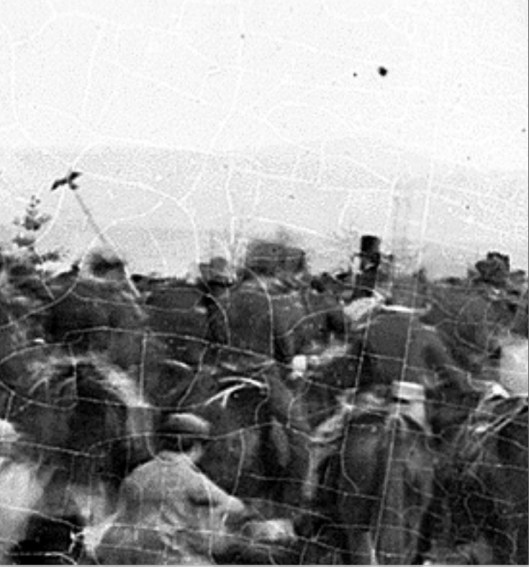
Recently, it has been thought that a new picture of Abraham Lincoln

Lincoln-CGerman-1861.jpg

at Gettysburg, on November 19, 1863 has been discovered. Lincoln had been invited as one of the speakers for the dedication of a new National Cemetery to honor the Union dead from the battle fought at Gettysburg on 1-3 July, 1863.

Battle of Gettysburg - Cyclorama - Paul Philippoteaux SAM_1322.JPG

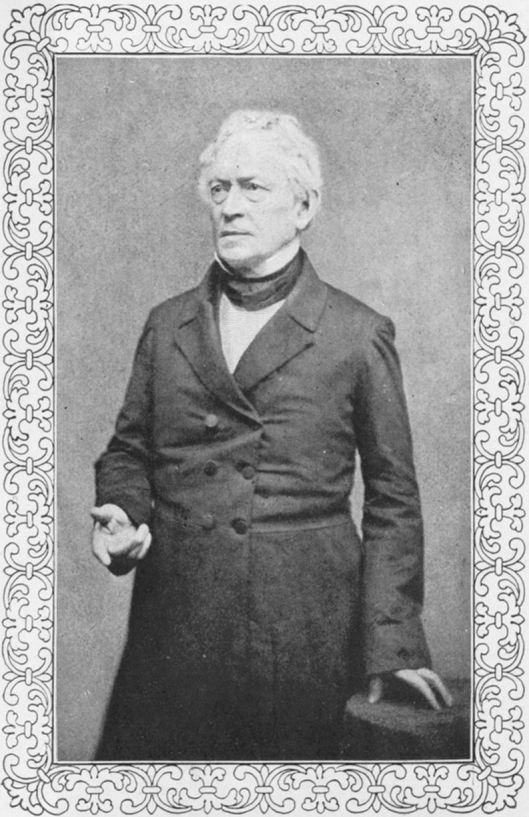
The main speaker, and the one everyone was waiting for, was the famous orator, Edward Everett,

Edward_Everett.jpg

whose speech is now totally forgotten (here’s a link to it—it’s worth reading as a specimen of mid-19th-century American oratory—something Everett was famous for), but, to say that Lincoln’s speech has survived is, for Americans—and for anyone who loves good rhetoric, for that matter–an understatement.

nicolaycopy.jpg

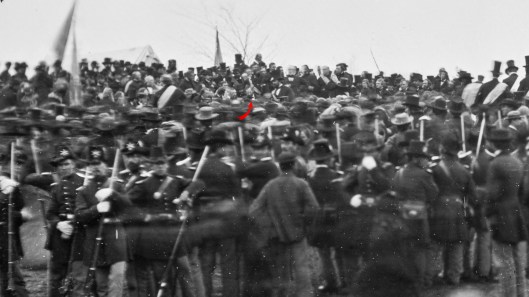
Up until recently, there was one definite photograph of Lincoln on the occasion.

Crowd_of_citizens,_soldiers,_and_etc._with_Lincoln_at_Gettysburg._-_NARA_-_529085_-crop.jpg

(There is a second picture, supposedly of Lincoln on horseback, but it’s been pointed out that the figure appears to be wearing epaulettes,

image5a1notabe.jpg

image5aepaulettes.jpg

And, if so, is therefore more likely to be one of the military dignitaries at the ceremony.)

This new photo, which seems pretty convincing to us, now gives us two illustrations of one of the most famous moments of Lincoln’s presidency.

o-LINCOLN-570.jpg

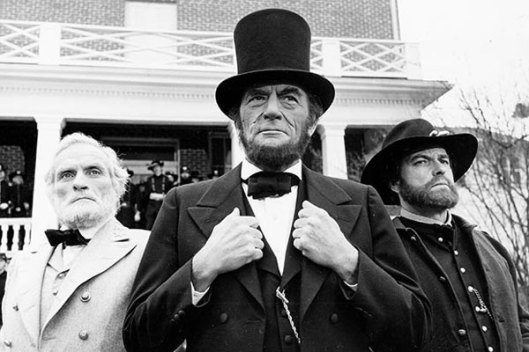
There are a number of films about Lincoln, at least since the 1915 The Battle Cry of Peace, with Lincoln portrayed by numerous American actors, some of them famous, such as Gregory Peck, from the television series The Blue and the Gray (1982)

Gregory-Peck-Lincoln.jpg

with the most recent being two films from 2012, the improbable Abraham Lincoln Vampire Hunter

abraham_lincoln_vampire_hunter_ver3.jpg

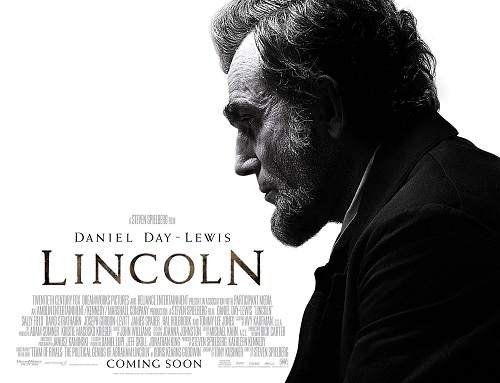
and Steven Spielberg’s Lincoln

LINCOLN-landscape-poster.jpg

starring Daniel Day Lewis.

Lewis, an actor famous for his strenuous preparations for every role he’s ever played, was sometimes criticized in reviews for his light voice, the impression being that such a deep, thoughtful man should have had a voice to match. In fact, contemporary accounts of Lincoln tell us that his voice was higher—a tenor rather than a baritone—and that his accent was a rural one, mirroring his boyhood years on the Indiana/Kentucky border (his sometimes somewhat phonetic spelling helps here to reconstruct this).

Thus, though his self-presentation—especially his voice–might have seemed to some (especially those who hated him—one of his main generals even referring to him as “the original gorilla”) less than impressive, his words, at least in written form, have endured.

This made us think of the opposite, from JRRT, characters whose words might not matter much, but the way in which they were delivered was persuasive—or almost.

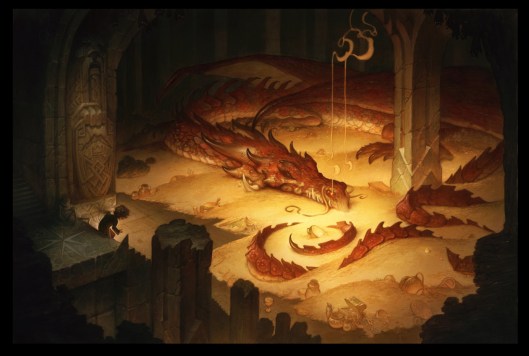
We began with Smaug.

bilbo and smaug.jpg

As we said in our last, Smaug’s voice has a danger for Bilbo in it:

“Whenever Smaug’s roving eye, seeking for him in the shadows, flashed across him, he trembled, and an unaccountable desire seized hold of him to rush out and reveal himself and tell all the truth to Smaug. In fact he was in grievous danger of coming under the dragon-spell.” (The Hobbit, Chapter 12, “Inside Information”)

This dragon-spell has a persuasive power to it.   It’s never explained, but it seems to embody the idea that the tone can bring out the worst in someone:

“Now a nasty suspicion began to grow in his mind—had the dwarves forgotten this important point too, or were they laughing in their sleeves at him all the time? That is the effect that dragon-talk has on the inexperienced. Bilbo of course ought to have been on his guard; but Smaug had rather an overwhelming personality.”

Perhaps this is what gives the “dragon-spell” its power: that it somehow embodies the personality of the spell-caster. As Smaug is evil and corrupt and suspicious, so his spell can cause others to have corrupt and suspicious thoughts, as Bilbo does.

We see this same effect on the inexperienced when Gandalf, the companions, and Theoden visit the defeated Saruman at Orthanc

obra-tolkien-mano-hildebrandt-ilustradores-fa-L-q4g6J8.jpeg

in the chapter named, appropriately, “The Voice of Saruman”:

“Suddenly another voice spoke, low and melodious, its very sound an enchantment. Those who listened unwarily to that voice could seldom report the words that they heard; and if they did, they wondered, for little power remained in them. Mostly they remembered only that it was a delight to hear the voice speaking, all that it said seemed wise and reasonable, and desire awoke in them by swift agreement to seem wise themselves. When others spoke they seemed harsh and uncouth by contrast; and if they gainsaid the voice, anger was kindled in the hearts of those under the spell.” (The Two Towers, Book Three, Chapter 10, “The Voice of Saruman”)

When Gandalf first meets Saruman in Orthanc, Saruman’s “robes, which had seemed white, were not so, but were woven of all colours, and if he moved they shimmered and changed hue so that the eye was bewildered.” (The Fellowship of the Ring, Book Two, Chapter 2, “The Council of Elrond”)

It may be, then, that the power of Saruman’s voice is in the same shimmer—he appears to be not just one, but many and therefore both momentarily persuasive, as well as ultimately insubstantial, since “those who listened unwarily to that voice could seldom report the words that they heard”. It’s clear, however, that, like the voice of Smaug, the spell within the voice was, potentially, horribly persuasive:

“For some the spell lasted only while the voice spoke to them, and when it spoke to another they smiled, as men do who see through a juggler’s trick while others gape at it. For many the sound of the voice alone was enough to hold them enthralled; but for those whom it conquered the spell endured when they were far away, and ever they heard that soft voice whispering and urging them.”

And yet—although

“..none were unmoved; none rejected its pleas and its commands without an effort of mind and will, so long as its master had control of it.”

There are those of the party on this visit to Orthanc who are not taken in at all. Gimli appears to be unaffected, saying, “The words of this wizard stand on their heads”, and Eomer calls Saruman “an old liar with honey on his forked tongue”. Theoden even breaks the spell, although he is said to speak “thickly and with effort.” At such resistance, Saruman shows both a degree of control and a losing of it, cajoling and calling names alternately, until “Gandalf laughed.” And “The fantasy vanished like a puff of smoke.”

Knowing Saruman’s eventual end, murdered by another whose tongue was persuasive enough to keep Theoden a prisoner once upon a time,

leegrima.jpg

can we see the beginning of that end here? Once the “fantasy” created by Saruman’s voice is broken by Gandalf’s gentle mockery, what is left for him after his grand plans to be (at least) Sauron’s ally but “some mischief still in a small mean way”? (The Return of the King, Book Six, Chapter 6, “Many Partings”)

And, at the end of that mischief, Grima only escapes Saruman and his voice through murder—and his own quick death, following.

Gandalf’s laughter suggests that the source of escape from Saruman’s voice may be detachment: if one can step away from the sound, that sound loses its (literal) charm. It may take effort—as it does for Theoden—but, once away, whatever magic was in the voice vanishes into the smoke it really was.   As well, obvious resistance seems always to shake Saruman’s control and that flattering tongue, which can say, on the one hand,

“Theoden Lord of the Mark of Rohan..declared by your noble devices, and still more by the fair countenance of the House of Eorl. O worthy son of Thengel the Thrice-renowned!”

But, when thwarted, can cry:

“Dotard! What is the house of Eorl but a thatched barn where brigands drink in the reek, and their brats roll on the floor among the dogs?” (The Two Towers, Book Three, Chapter 10, “The Voice of Saruman”)

It is striking that, in neither case, are his words to be trusted, any more than his voice—and here we can return to Abraham Lincoln, whose voice may not have impressed, but whose words continue to be remembered.

z235445.jpg

Thanks, as always, for reading.

MTCIDC

CD

Bordering (.2: Blackmail, Battle, and Song)

05 Wednesday Apr 2017

Posted by Ollamh in Literary History, Maps, Military History

≈ Leave a comment

Tags

A Gest of Robyn Hode, Angus McBride, Ballads, Border Reivers, Carlisle Castle, Child Ballad, Connacht, Cuchulain, Cuchulain of Muirthemne, England, Ewan McColl, Faroe Islands, Francis James Child, Irish Iron Age, Johnnie of Breadisley, Kinmont Willie Armstrong, Loeg, Marches, Medb, Peggy Seeger, ring dance, Robin Hood, Scotland, Scott of Buccleuch, Sheriff of Nottingham, Sherwood Forest, skiparin, Tain Bo Cualnge, The Cattle Raid of Cooley, The English and Scottish Popular Ballads, The Tale of MacDatho's Pig, Ulster, West March of the Shire

Welcome, dear readers, as ever.

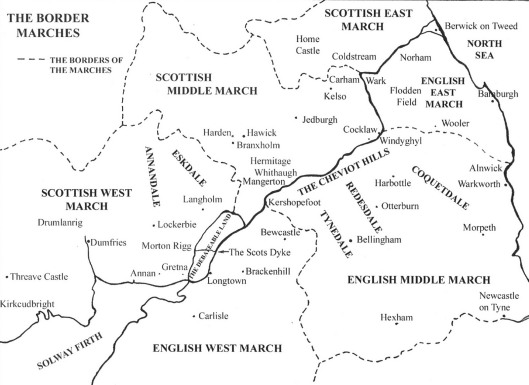
This is a continuation of our last, on borders. In that post, we began with the West March of the Shire, then talked about the idea of marches—militarized border areas—and wardens—overseers of such. Our focus was upon the border between Scotland and England and, in particular, in the very troubled 16th century.

image1bordermap.JPG

The danger, in this world, was from reivers,

image2borderreivers.jpg

a kind of border bandit, but a more complex figure than, for example, Robin Hood.

image3robinhoodwyeth.jpg

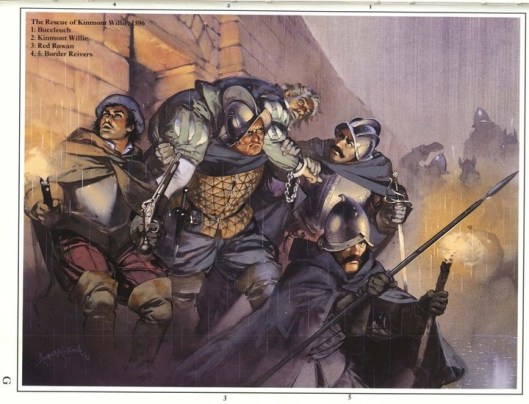
In the Marches of Scotland and England, unlike Robin vs the Sheriff of Nottingham in Sherwood, who the heroes and villains were wasn’t always clear. England and Scotland were often at war throughout the later Middle Ages and into the Renaissance and, when not openly at war, continued to skirmish with each other. War and skirmishing brought financial problems to both sides—raids could ruin a farm or even a village on either side of the border– and there was also a certain level of vendetta—families always being bound to avenge a murdered kinsman—or rescue a living one, as we see here Scott of Buccleuch (said something like “buk-LOO”) rescuing Kinmont Willie Armstrong from imprisonment by the English in Carlisle Castle in 1596. Willie had been taken prisoner illegally during a “truce day” and Scott was the official representing Scotland on that day—so, as we said, the differences between heroes and villains aren’t always so obvious in this twilight world.

image4kinmontw.jpg

One thing reivers have in common with R. Hood, however, is that both are the subject of legends and songs. One of the first collections of those songs is A Gest of Robyn Hode, printed between 1492 and 1534.

image5gest.jpg

A common form of song is the ballad. For those not familiar with the form, a ballad is a narrative poem commonly in couplets (2 rhymed lines—sometimes with a refrain—a line repeated throughout the poem—after each couplet) or in quatrains (4 lines, often rhyming on the 2nd and 4th line).

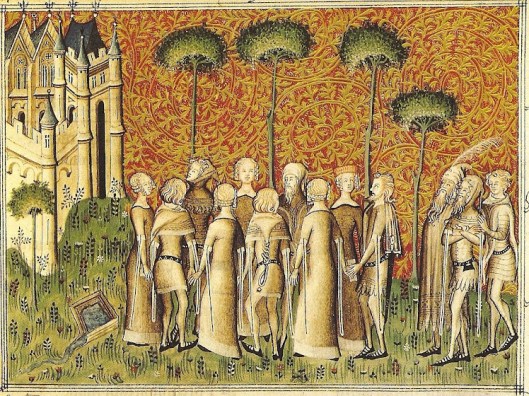
From the word, which appears to be related to the Romance language ballare/bailar/ballet, “to dance/a dance”, we might imagine that, originally, it was a song to which one danced and there are medieval illustrations of such—

image6carol.jpg

This appears to be a ring dance and, in fact, resembles the ring dance and song of the Faroe Islands, where there is a central figure, a skiparin, (“captain”—just like English “skipper”) who sings a verse and all of the dancers join in on the chorus of kvaedi, or ballads.

imaage7ringdance.jpg

The circle on such a dance/song can expand to the point where it looks more like a snake dance—as this link from a recent performance shows.

An easy example of the quatrain form of ballad might be the opening of “Johnnie of Breadisley” (Child 114):

Johnny rose on a May mornin’,

Called for water to wash his hands,

Saying loose to me my twa grey dogs

Wha’ lie bound in iron chains.

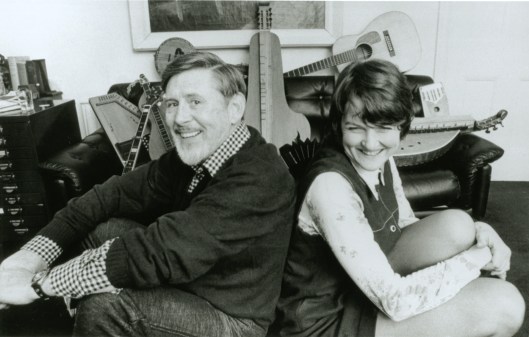
We did this from memory, it being one of the first ballads we memorized years ago. If it’s compared with the standard ballad text—that’s from Francis J. Child’s The English and Scottish Popular Ballads (1882-1898), we’re sure you’ll find that, without even knowing it, we’ve made little changes, turning it into a variant—which always happens when songs are learned by ear. (You can also see that rhyme can be very loose—sometimes only assonance, but it’s clearly less important than telling the story.) Our version came from one sung by the famous Scots folk singer/composer, Ewan McColl, shown here with Peggy Seeger, his equally-famous wife and fellow artist.

image8mccoll.jpg

You can hear his version on YouTube here.

Child

image9child

was a professor at Harvard who spent most of his adult scholarly life searching out traditional ballads and a version of his massive collection—305 ballads, with many variants—is available (based upon early editions) at the wonderful Sacred Texts. (If you are interested in adventure/fantasy/mythology and you don’t know this site, spend some time browsing it—you will be impressed.)

The border between Scotland and England wasn’t the only place in the UK which spawned heroic stories, however. During the Irish Iron Age, two of Ireland’s five provinces, Ulster and Connacht, were imagined to be constantly at war and raids across the border formed the basis or background of all kinds of tales, the most elaborate being the Tain Bo Cualnge (Tahn Boh KOO-al-nyeh)—“The Cattle Raid of Cooley”. In this story—a kind of prose epic, with occasional short verse inserts—Medb (Mi-YEDTH), the queen of Connacht, has decided that she must have a famous bull, owned by someone in Ulster. At the time, the warriors of Ulster are under a geis (gesh), a kind of magical prohibition, which keeps them from defending the province, which leaves only one—their best, in fact—the 17-year-old Cuchulain (Koo-HOO-lun), with his charioteer, Loeg (loig) to delay the Connachtmen. Here’s a rather over-the-top illustration by one of our favorite military artists, Angus McBride, of the pair rocketing towards the enemy.

image10cc.jpg

If you would like to read a translation of the Tain, here’s a link to a really useful website, which juxtaposes the Old Irish and English (and includes, as a bonus, another great story—and the first one we read in Old Irish—the Tale of MacDatho’s Pig). If you would like to read more Old Irish Stories about Ulster and Connacht, there is Lady Gregory’s Cuchulain of Muirthemne (1902). It’s available at Sacred Texts. (And a note here: Old Irish literature has a very plain-spoken way of talking about body functions, among other things, and early translators, like Lady Gregory, quietly removed or softened such things. On the whole, however, the basic stories are there—and they’re free!)

Among those stories, we find a very different idea about otherworlds—not the fairly-strict western classical one that there is a clearly-marked border between this world and the next, but something looser and therefore spookier and we want to talk about this in our next (and mention a favorite YA author and his treatment of the subject, as well).

Thanks, as always, for reading.

MTCIDC

CD

Bordering (.1: The Landscape)

29 Wednesday Mar 2017

Posted by Ollamh in Economics in Middle-earth, J.R.R. Tolkien, Literary History, Maps, Military History, Military History of Middle-earth, Narrative Methods

≈ 2 Comments

Tags

Anglo-Scots border, Black Middens Bastle, blackmail, Border Marches, Border Reivers, Border Wardens, Charlemagne, Debatable Lands, Emyn Beraid, Fairbairns, Hadrian's Wall, Hermitage Castle, hot trod, John Philip Sousa, Marca Hispanica, Marches, Monty Python, Offa's Dyke, Robert Carey, Scots Dike, Smailholm Tower, Ted Nasmith, The Liberty Bell, The Lord of the Rings, The Shire, Tolkien, Tower Hills, West March

Welcome once more, dear readers.

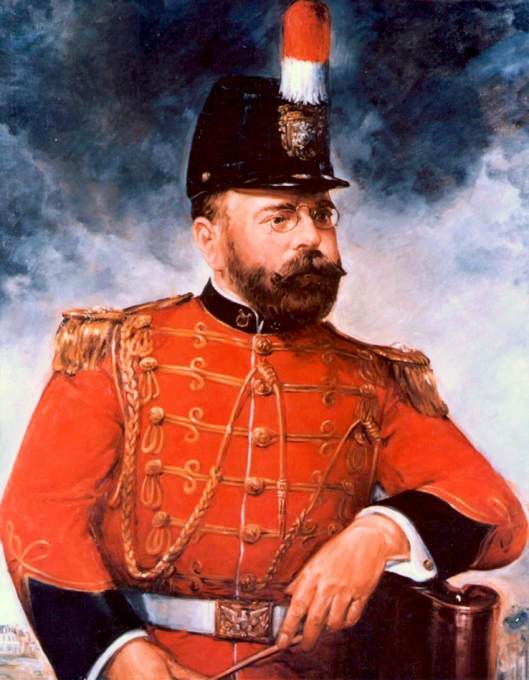
In this posting, we want to return to a recent one about “marches”—that is, not pieces for military bands (although we are partial to those of John Philip Sousa—1854-1932–

image1jpsousa.jpg

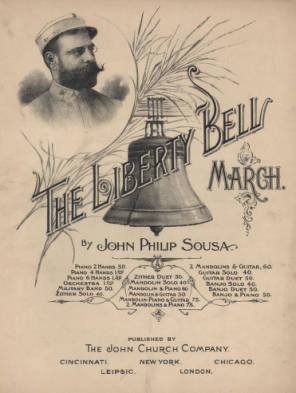
especially “The Liberty Bell”—1893—

digital.gonzaga.edu.jpeg

mostly because it was used by Monty Python. We provide a link here for what might have been its first recording, by the “Edison Grand Concert Band” in 1896. Watch out for the big foot!)

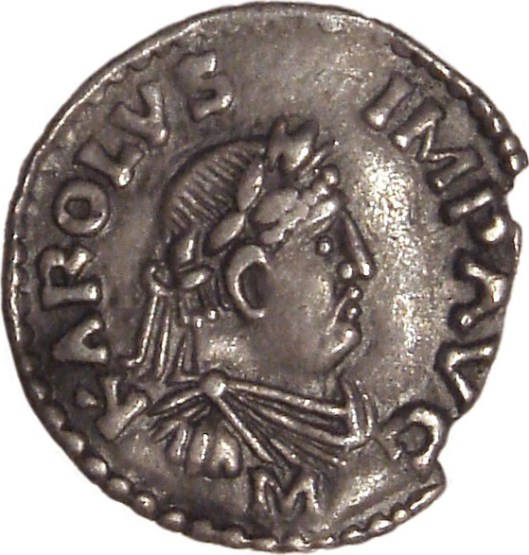
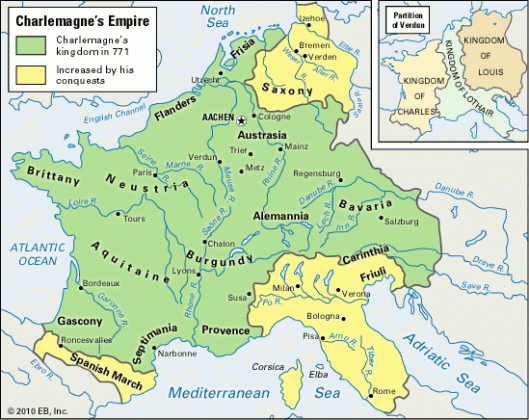
but border areas, usually sensitive ones, which might have been militarized, like that at the southern edge of Charlemagne’s empire.

Charlemagne_denier_Mayence_812_814.jpg

charlemagnesempire.gif

This, the Marca Hispanica, existed as a buffer state between the Moorish Caliphate to its south and the Holy Roman Empire to the north.

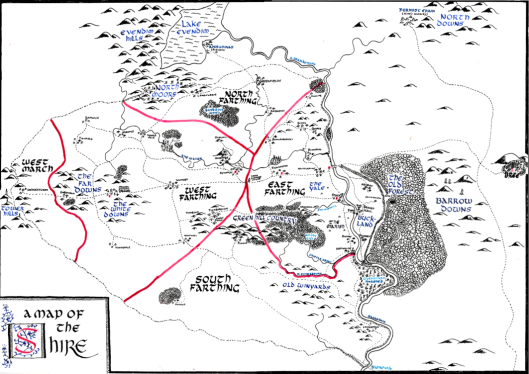
In contrast, we have the West March, to the west of the Shire, as we’ve discussed before.

map_of_the_shire_by_astrogator87-d8h3y1k.png

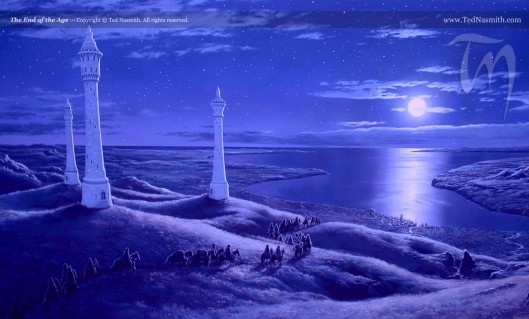
At its far western edge are the Tower Hills (here illustrated by one of our favorite Tolkien artists, Ted Nasmith)

nasmith_elben-meer.jpg

on which are perched three white towers, described in the Prologue to The Lord of the Rings:

“Three Elf-towers of immemorial age were still to be seen on the Tower Hills beyond the western marches. They shone far off in the moonlight. The tallest was furthest away, standing alone upon a green mound. The Hobbits of the Westfarthing said that one could see the Sea from the top of that tower; but no Hobbit had ever been known to climb it.” (Gandalf adds to this that there was a palantir, Elendil’s Stone, located there—The Two Towers, Book Three, Chapter 11, “The Palantir”.)

The difference is, those towers don’t seem defensive and the West March is not a military zone—although it is the site of Hobbit-expansion, as Appendix B tells us:

“1452 The Westmarch, from the Far Downs to the Tower Hills (Emyn Beraid) is added to the Shire by the gift of the King. Many hobbits remove to it.

1462 …the Thain makes Fastred Warden of Westmarch. Fastred and Elanor make their dwelling at Undertowers on the Tower Hills, where their descendants, the Fairbairns of the Towers, dwelt for many generations.”

Talk of marches and wardens and towers, however, immediately brought to mind for us something from our world (doesn’t it always?).

This is the border area between England and Scotland, an area of conflict for several centuries, but culminating in the struggles of the 16th century.

BorderMarches9.jpg

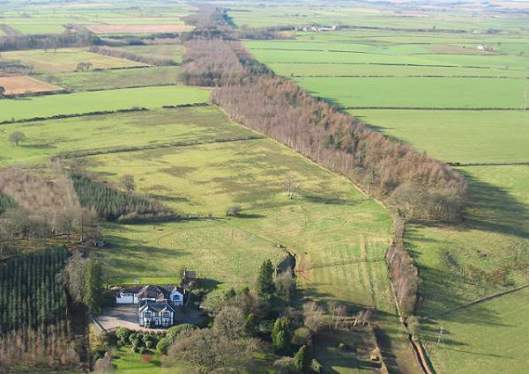
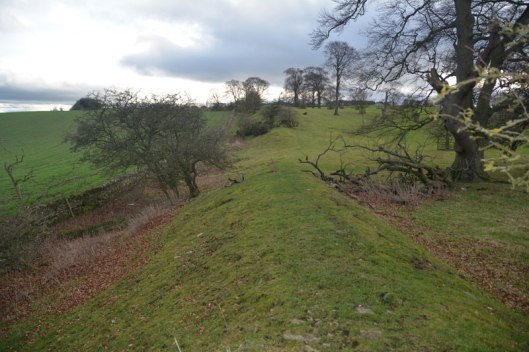
The border area had been divided, on both sides, into three marches, with a subset for that area on the southwest side called the “Debatable Lands”, because both England and Scotland claimed it. In 1552, the decision was mutually made to put up an earthen barrier, the so-called “Scots Dike”, to split it.

scotsdike.jpg

19thFebruary2017ScotsDykeOlliverBankDSC_1238.jpg

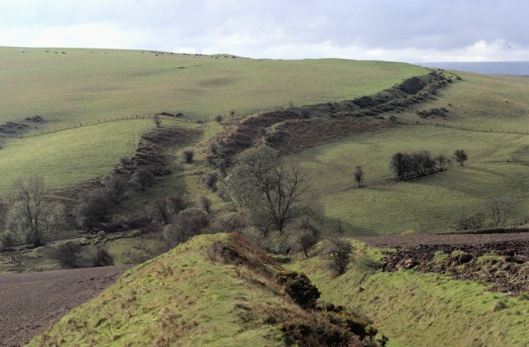
Unlike Hadrian’s Wall, farther to the south, with its system of walls and towers and gates and little forts and big army camps, this was never an elaborate military structure, or even like Offa’s Dike between England and Wales,

as_offas_dyke.jpg

but simply a boundary marker in low-lying land (and only 3.5 miles long– 5.6km).

When it came to the border towards the east, and the center of the region and beyond, however, the land rises into the characteristic twisty hills with long, narrow valleys.

14.PennineWay-CNN2NJ-1680x1050

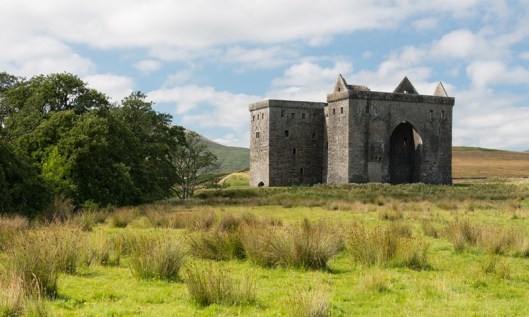
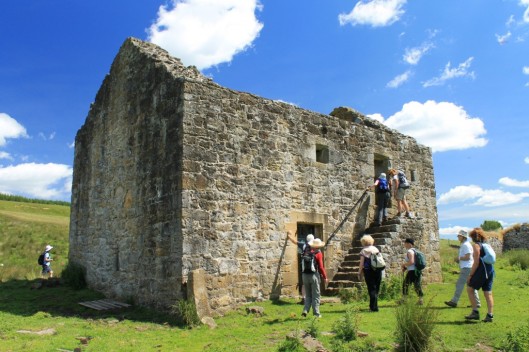
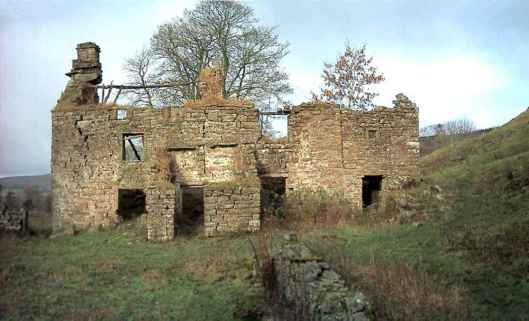
In this wild world, there are no long walls, of stone, wood, or earth to protect anyone, but castles, towers, and fortified farmhouses called bastles (possibly from the same root as “Bastille”?). Here we see Hermitage Castle, Smailholm Tower, and Black Middens Bastle.

dp_hc270814014

Smailholm-tower1

Black-Middens-Bastle-1024x683.jpg

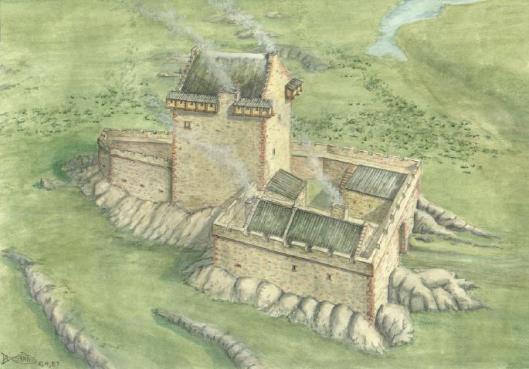
Although we see these now as gaunt ruins, we should always imagine them—as in this reconstruction of Smailholm—as living spaces, as well as refuges in an often lawless land.

smailholm.jpg

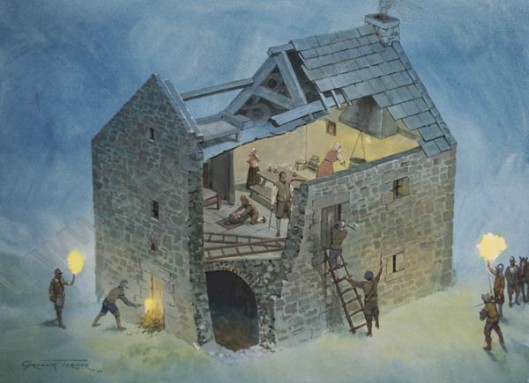
One has only to see the thick walls of a bastle and, originally, no door at ground level (stairs appear to be a later convenience for a more peaceable time), to imagine the danger from reivers, raiders from either side of the Anglo-Scots border and sometimes, as there was a certain amount of intermarriage, from both.

reiversatwork.gif

loveladybastle2.jpg

As can be seen in this reconstruction, these walls might be all that would stand between the inhabitants and destitution or even death, should the reivers come raiding.

large_orig_reivers_g_bastle_attack.jpg

There was also the possibility of buying them off, by paying them blackmail, a word whose origin is contested, but whose purpose is clear: protection money. If you paid them, in coin or cattle, you were safe—at least until the price went up.

Curbing such behavior was the job of the Border Wardens, there being six, one for each March on each side of the border. Theirs was a difficult job: too much territory, too few men, and too few resources to back them up. Wonderfully, one of these Wardens, Robert Carey, has left us a memoir, which is available on-line: memoirsrobertca00orregoog.

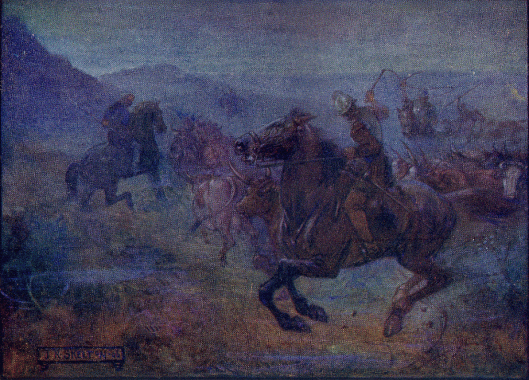
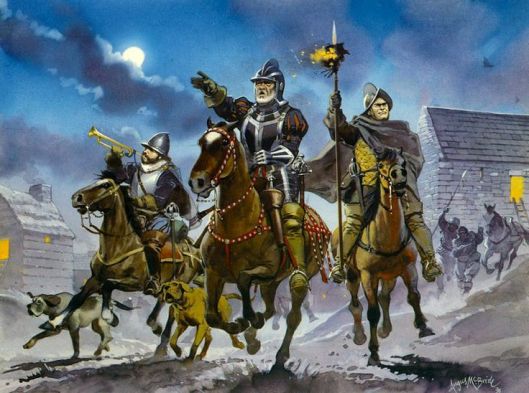
If you were attacked and you survived, you might send word to the Warden or one of his officers, who could organize a posse to pursue the raiders. By law, all able-bodied locals were supposed to turn out to help when the organizer—Warden or officer—rode by with trumpeter and a rider who carried a flaming bit of peat on his “staff” (local word for “lance”).

e7c88732c6aa3165565c64cf094a182c.jpg

This was called the “hot trod” and, under its conditions, the pursuers were allowed to cross the border. Such occasions could be very dangerous, however, as those raiders would be chased back across their own territory, giving them the chance to delay or destroy those in pursuit in an ambush on familiar ground.

We were originally drawn to this part of the world and of Anglo-Scottish history because of our interest in the musical literature of the region, the so-called “border ballads”, and, in our next, “Bordering (.2 Blackmail, Battle, and Song”) we’ll talk a bit about them—and perhaps a bit more about borders and heroic behavior, as well.

Thanks as ever, for reading!

MTCIDC

CD

Shire Portrait (5b): Hostile Takeover

15 Wednesday Mar 2017

Posted by Ollamh in Economics in Middle-earth, Imaginary History, J.R.R. Tolkien, Military History, Military History of Middle-earth, Narrative Methods, Villains

≈ Leave a comment

Tags

Baggins, Chief, Der Fuehrer, Gestapo, Hitler, Lotho, SA, Sackville-Bagginses, Saruman, Sharkey, Shire, Shirriffs, Southfarthing, The Hobbit, The Lord of the Rings, The Scouring of the Shire, Tolkien

Welcome, dear readers, to the second part of our last (for the moment?) posting on the Shire. This is actually a two-part posting and is devoted to the takeover of the Shire by “Sharkey” and his followers and how it might have happened, based upon evidence from the texts of The Hobbit and The Lord of the Rings.

We decided upon a two-part posting because we saw the takeover as a two-step process. Initially, we believe that Saruman looked for someone within the Shire to act as his agent there and, as a local agent, both to foment the kind of discontent which would provoke a demand for change, and to act as the leader of that change.

Because the Shire had so little government and most problems were dealt with within families, we wondered if that discontent wouldn’t begin as something Shire-wide, but be found within one or more families, instead.

With this in mind, we immediately thought of the Sackville-Bagginses. From the final chapter of The Hobbit, it was clear that the S-Bs (as they’re called) had grievances against their cousins, the Bagginses, mostly because they wanted Bag End and its contents.

How this led to leaguing with Saruman is not explained, but merely suggested, by Pippin, who says, of reported disturbance in the Southfarthing:

“ ‘Whatever it is…Lotho will be at the bottom of it:   you can be sure of that.” The Return of the King, Book Six, Chapter 7, “Homeward Bound”

This is then confirmed when the hobbits reach the bridge over the Brandywine and one of the hobbit guards (Hob Hayward), mentions “the Chief…up at Bag End.”

Frodo, who has sold his house at Bag End (see The Fellowship of the Ring, Book One, Chapter 3, “Three is Company”) to the S-Bs, immediately asks Hob, “ ‘Chief? Chief? Do you mean Mr. Lotho?’ said Frodo.” The Return of the King, Book Six, Chapter 8, “The Scouring of the Shire”

Otho and Lobelia had been Bilbo’s enemies long ago, but, whereas Lobelia is still alive, Otho is long dead and Lotho (and yes, the word “loathe” must lie just below the surface here, though this is probably not his name in the Common Tongue, just as Pippin’s name isn’t Pippin), his son, has somehow become not the Mayor of the Shire (who is actually Will Whitfoot), but the much vaguer (and more menacing) “the Chief”. (We also note that “Mr. Lotho” is a courtesy title and one for established land-owners, really, and not for Lotho.)

The family theme is underlined when Hob replies that “we have to say ‘the Chief’ nowadays” and Frodo says, in turn:

“ ‘Do you indeed!’ said Frodo. ‘Well, I am glad he has dropped the Baggins at any rate. But it is evidently high time that the family dealt with him and put him in his place.’ ”

If Frodo’s remark suggests the familial aspect of justice in the Shire, the reply of an anonymous hobbit to it suggests the second or external step of the takeover:

“A hush fell on the hobbits beyond the gate. ‘It won’t do no good talking that way,’ said one. ‘He’ll get to hear of it. And if you make so much noise, you’ll wake the Chief’s Big Man.’ ”

As JRRT began The Lord of the Rings in 1937, just four years after the Nazis took control of Germany, “The Chief” surely has echoes of “Der Fuehrer”, which simply means “The Leader”.

adolf-hitler-34.jpg

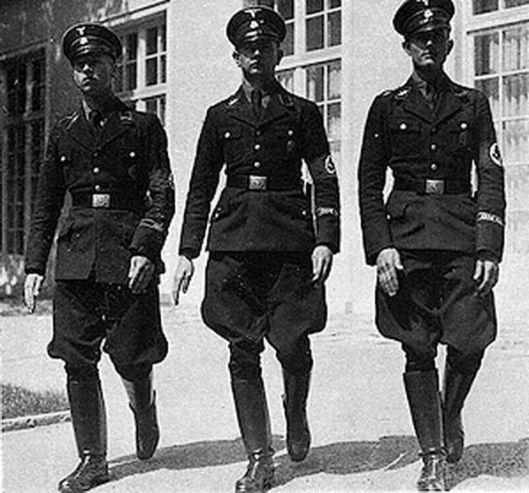
In which case, should we associate the threat of “the Chief’s Big Man” with everything from the SA

0001.jpg

to the Gestapo?

0e24494b5019c1007e9214e03d77c2d8.jpg

Merry, at least, certainly makes a connection with something which Butterbur had said earlier:

“It all comes of those newcomers and gangrels that began coming up the Greenway last year, as you may remember; but more came later. Some were just poor bodies running away from trouble; but most were bad men, full o’ thievery and mischief.” The Return of the King, Book Six, Chapter 7, “Homeward Bound”

Answering the anonymous voice, Merry says:

“If you mean that your precious Chief has been hiring ruffians out of the wild, then we’ve not come back too soon!”

When the Big Man appears, Merry’s conclusion is confirmed: it’s Bill Ferny, who, Butterbur believes, who had been involved in a minor battle in Bree, in which five hobbits had been killed:

“ ‘And Harry Goatleaf that used to be on the West-gate, and that Bill Ferny, they came in on the strangers’ side, and they’ve gone off with them; and it’s my belief they let them in. On the night of the fight I mean.’ “

If some of these “Big Men” were criminal drifters from the east, almost randomly recruited, there were others who were sent.

“ ‘It all began with Pimple, as we call him,’ said Farmer Cotton; ‘and it began as soon as you’d gone off, Mr. Frodo.   He’d funny ideas, had Pimple. Seems he wanted to own everything himself, and then order other folk about. It soon came out that he already did own a sight more than was good for him; and he was always grabbing more, though where he got the money was a mystery: mills and malt-houses and inns, and farms, and leaf-plantations. He’d already bought Sandyman’s mill before he came to Bag End, seemingly.

Of course he started with a lot of property in the Southfarthing which he had from his dad; and it seems he’d been selling a lot o’ the best leaf, and sending it away quietly for a year or two. But at the end o’ last year he began sending away loads of stuff, not only leaf. Things began to get short, and winter coming on, too.   Folk got angry, but he had an answer. A lot of Men, ruffians mostly, came with great wagons, some to carry off the goods south-away, and others to stay. And more came. And before we knew where we were they were planted here and there all over the Shire, and were felling trees and digging and building themselves sheds and houses just as they liked…”

There is a bit more to add to this. The “Big Men” were not alone. As in our own historical world of Nazi occupiers, there were those willing to collaborate, as Robin Smallburrow tells Sam:

“There’s hundreds of Shirriffs all told, and they want more, with all these new rules. Most of them are in it against their will, but not all. Even in the Shire there are some as like minding other folk’s business and talking big. And there’s worse than that: there’s a few as do spy-work for the Chief and his Men.”

With Farmer Cotton’s narrative, however, the two steps come together: the local was, indeed, as Pippin has suspected, Lotho. The external was a combination of opportunists, like Bill Ferny, and agents dispatched from an unnamed southern source, but we know that it was “Sharkey” who sent them, just as we know that “Sharkey” was Saruman, who was still capable of mischief—but not “in a small mean way”.

Thanks, as always, for reading.

MTCIDC

CD

Shire Portrait (3b)

22 Wednesday Feb 2017

Posted by Ollamh in Economics in Middle-earth, Imaginary History, J.R.R. Tolkien, Literary History, Military History, Military History of Middle-earth, Narrative Methods

≈ Leave a comment

Tags

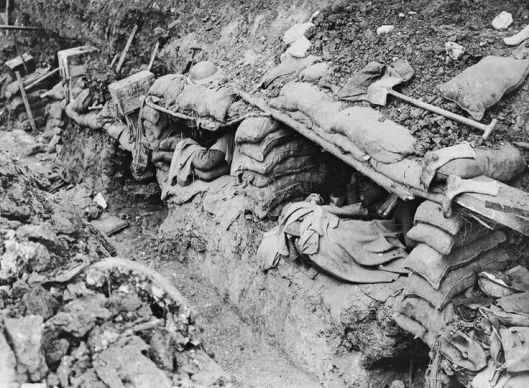
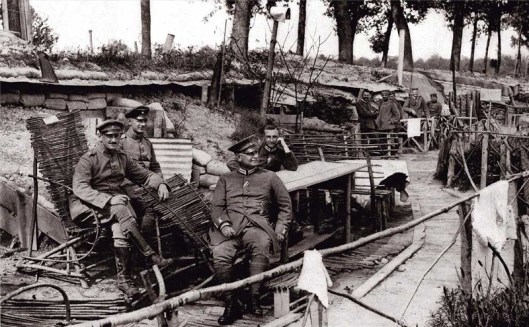
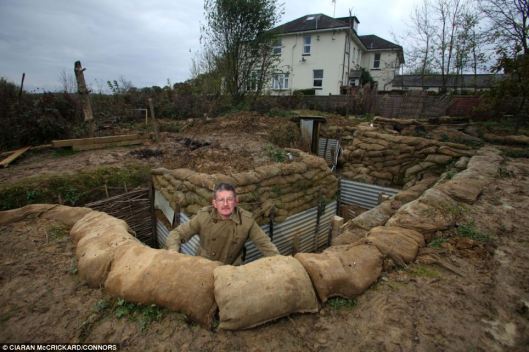
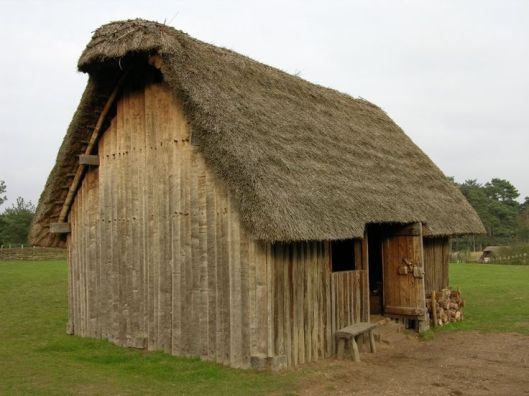
24Hr Trench, Andrew Robertshaw, architecture, Birmingham, Brandywine, crop rotation, Diamond Jubilee, dugouts, Dunedain, feudal system, German lawn chairs, Hornblotton, Inns, Laura Ingalls Wilder, Lavenham, manor, Marish, Medieval, Queen Elizabeth II, Queen Victoria, Sarehole, Sarehole's mill, Somerset, Suffolk, The Hobbit, The Lord of the Rings, The Shire, Tolkien, village, Western Front, WWI Trenches

Welcome, dear readers, as always.

In this post, we’re continuing our series on the Shire. So far, we’ve looked at its government and organization (1), its economy (2), and its geography (3a). Now we want to look at Shire architecture.

Our initial inspiration for this was from a line in a letter from JRRT to Allen & Unwin, 12/12/55. Speaking of the Shire, he says: “It is in fact more or less a Warwickshire village about the period of the Diamond Jubilee… (Letters, 230)

The “Diamond Jubilee” was the 60th anniversary of the reign of Queen Victoria (she came to the throne in 1837–Queen Elizabeth II celebrated her Diamond Jubilee just five years ago).

1vic.jpg

The Jubilee was a huge celebration, bringing in people from all over Britain’s empire, who converged on London in the summer of 1897.

2adiam2bdiam2cdiam

JRRT was born in 1892 and had been brought to England in 1895, for a visit which became permanent when his father died back in South Africa. He and his brother

3atolkandbro.jpg

lived with their mother for a time in the village of Sarehole, just south of the huge industrial city of Birmingham. Sarehole’s mill

3sareholemill.jpg

still stands. It has been said that this mill is the model for the one by The Water in The Hobbit, as drawn by JRRT.

4hob.jpg

Thus, when we think about Shire architecture, we can have a double picture:

  1. bits of description in JRRT’s works
  2. actual late Victorian rural villages of the sort in which Tolkien spent part of his childhood

If we begin with historical villages, there isn’t anything to see in the actual Sarehole, except for the mill, which, though built upon the site of a mill which can be dated to 1542, is a building from 1771, just before the industrial revolution, an event with which Tolkien certainly had problems. If we look at other such villages, however, we can get a general picture. Basing our image upon a schematic medieval village plan, we find a double line of houses strung out along a single road.

5medvil.JPG

Spreading back from the houses are the fields, as villages in this world were self-sustaining. You can see these in JRRT’s illustration of the mill and the Hill. You’ll notice that these are in strips. In the feudal world, they illustrated both the use of crop rotation (different plants in different fields, with some fields allowed to rest), plus fields of the lord of the manor, which the tenants were obliged to tend. In Tolkien’s Shire, as there is no feudal system, we presume the stripping is for rotation.

4hob

Missing, however, from Hobbiton, would be two features you can see in the medieval illustration: a manor house and a church.

In the feudalism mentioned above, this ideal village is part of the social/governmental system in which it is attached to the smallest unit of that system, the manor.

8feudal.jpg

As the chart explains, in the early medieval world, land was power and kings used their claim to control their lands (supposedly given to them by God) as a way to control the state in general.   They deeded certain sections of land to their nobles, in return for taxes and military service. Those nobles, in turn, deeded out land to lesser nobles, all the way down to individual knights, who might hold no more than one parcel, or manor, with its house, church, and village of freemen (literally, free men, who could own land but paid taxes to the lord for it), peasants (who were also free, but held no land), and serfs (who were landless as well as being the property of the local lord).

Although Tolkien once described the Shire as “granted as a fief” (Letters, 158) and “half republic half aristocracy” (Letters, 241), it is not a feudal property and therefore lacks those marks of that system, those manor houses.

As well, it is also missing churches, or, for that matter, any form of religious shrine. A real English medieval village, depending on its size and wealth, could have had a very modest building, such as this at Hornblotton, in Somerset.

9hornblotton.jpg

Or, if your village had become a prosperous town, like Lavenham, in Suffolk, you could even have a mini-cathedral. (Lavenham’s money had come from the international trade in woolen cloth.)

110lavenham.jpg

Although Tolkien insisted that there was a monotheistic underlay to Middle-earth in the Third Age, he also says of the folk of the Shire: “I do not think Hobbits practiced any form of worship or prayer (unless through exceptional contact with Elves).” (Letters, 193)

Without manors and churches, the Shire consists of private dwellings and inns. Inns seem to be like their parallels in our medieval world.

11medinn.jpg

And, of course, there are the inns of the Shire and the Prancing Pony in Bree.

12prancingpony.jpg

Private houses, including farms, however, fall into two categories: traditional hobbit (that is, built into hillsides) and what we might call outside-influence houses. As Tolkien says in the Prologue to The Lord of the Rings:

“All Hobbits had originally lived in holes in the ground, or so they believed…Actually in the Shire of Bilbo’s days it was, as a rule, only the richest and the poorest Hobbits that maintained the old custom. The poorest went on living in burrows of the most primitive kind…while the well-to-do still constructed more luxurious versions of the simple diggings of old…in the hilly regions and the older villages, such as Hobbiton and Tuckborough, or in the chief township of the Shire, Michel Delving on the White Downs, there were now many houses of wood, brick, or stone…Hobbits had long accustomed to build sheds and workshops…

The habit of building farmhouses and barns was said to have begun among the inhabitants of the Marish down by the Brandywine.

It is probable that the craft of building, as many other crafts beside, was derived from the Dunedain. But the Hobbits may have learned it direct from the Elves… “

Our Tolkien illustration of The Hill

12hob.jpg

shows us both styles. In the background, burrows; in the foreground, outside-influence houses. The traditional style reminds us of something from US western history: the use of “dugouts” as (at least temporary) dwellings as settlers moved west across the plains.

13sodhouse.jpg

As fans of the Laura Ingalls Wilder books will remember, her family lived in one of these along the banks of Plum Creek in the 1870s.

14sod.jpg

15littlehouse.jpg

On a more sinister note, we’ve always wondered whether JRRT’s inspiration for hobbit holes may have come from his time on the Western Front, where, from late 1914, soldiers had burrowed into the earth to protect themselves from enemy attack and from the increasingly inclement weather. The shelters could be simply cutouts in the earth

15dugout.jpg

or very elaborate cottages. The Germans were especially admired for their creativity in building the more elaborate ones.

16gmandugout.jpg

We can’t mention the Great War and trenches without also mentioning the brilliant Andrew Robertshaw, the English military historian, who actually reconstructed sixty feet of a trench line in his backyard.

17androb.jpg

He shares his experience in doing this in his book, 24Hr Trench.

511PnAeovzL._SX342_BO1,204,203,200_.jpg

Continuing our medieval parallel, we imagine the outside-influence houses to look something like these:

medhouse1medhouse2

19medhousea.jpg

And, for outbuildings, there are a few surviving medieval barns, like this one:

19medbarn.jpg

whose roofs are often held up by the most beautiful woodwork, always reminding us of cathedrals, on the one hand, and sailing ships on the other.

20medbarn.JPG

Imagine that this is what Farmer Cotton’s farm might have looked like.

And, with this image, we conclude this posting. In our next, we’re going to move to the edge of the Shire, to discuss marches—geographical ones, that is.

Thanks, as ever, for reading!

MTCIDC

CD

← Older posts
Newer posts →

The Doubtful Sea Series Facebook Page

The Doubtful Sea Series Facebook Page

  • Ollamh

Categories

  • Artists and Illustrators
  • Economics in Middle-earth
  • Fairy Tales and Myths
  • Films and Music
  • Games
  • Heroes
  • Imaginary History
  • J.R.R. Tolkien
  • Language
  • Literary History
  • Maps
  • Medieval Russia
  • Military History
  • Military History of Middle-earth
  • Narnia
  • Narrative Methods
  • Poetry
  • Research
  • Star Wars
  • Terra Australis
  • The Rohirrim
  • Theatre and Performance
  • Tolkien
  • Uncategorized
  • Villains
  • Writing as Collaborators
Follow doubtfulsea on WordPress.com

Across the Doubtful Sea

Recent Postings

  • Towering January 28, 2026
  • Tolkien Among the Indians January 21, 2026
  • Thin and Stretched January 14, 2026
  • Through a glass… January 7, 2026
  • Heffalumps? December 31, 2025
  • We Three Kings December 24, 2025
  • A Moon disfigured December 17, 2025
  • On the Roads Again—Once More December 10, 2025
  • (Not) Crossing Bridges December 3, 2025

Blog Statistics

  • 105,551 Views

Posting Archive

  • January 2026 (4)
  • December 2025 (5)
  • November 2025 (4)
  • October 2025 (5)
  • September 2025 (4)
  • August 2025 (4)
  • July 2025 (5)
  • June 2025 (4)
  • May 2025 (4)
  • April 2025 (5)
  • March 2025 (4)
  • February 2025 (4)
  • January 2025 (5)
  • December 2024 (4)
  • November 2024 (4)
  • October 2024 (5)
  • September 2024 (4)
  • August 2024 (4)
  • July 2024 (5)
  • June 2024 (4)
  • May 2024 (5)
  • April 2024 (4)
  • March 2024 (4)
  • February 2024 (4)
  • January 2024 (5)
  • December 2023 (4)
  • November 2023 (5)
  • October 2023 (4)
  • September 2023 (4)
  • August 2023 (5)
  • July 2023 (4)
  • June 2023 (4)
  • May 2023 (5)
  • April 2023 (4)
  • March 2023 (5)
  • February 2023 (4)
  • January 2023 (4)
  • December 2022 (4)
  • November 2022 (5)
  • October 2022 (4)
  • September 2022 (4)
  • August 2022 (5)
  • July 2022 (4)
  • June 2022 (5)
  • May 2022 (4)
  • April 2022 (4)
  • March 2022 (5)
  • February 2022 (4)
  • January 2022 (4)
  • December 2021 (5)
  • November 2021 (4)
  • October 2021 (4)
  • September 2021 (5)
  • August 2021 (4)
  • July 2021 (4)
  • June 2021 (5)
  • May 2021 (4)
  • April 2021 (4)
  • March 2021 (5)
  • February 2021 (4)
  • January 2021 (4)
  • December 2020 (5)
  • November 2020 (4)
  • October 2020 (4)
  • September 2020 (5)
  • August 2020 (4)
  • July 2020 (5)
  • June 2020 (4)
  • May 2020 (4)
  • April 2020 (5)
  • March 2020 (4)
  • February 2020 (4)
  • January 2020 (6)
  • December 2019 (4)
  • November 2019 (4)
  • October 2019 (5)
  • September 2019 (4)
  • August 2019 (4)
  • July 2019 (5)
  • June 2019 (4)
  • May 2019 (5)
  • April 2019 (4)
  • March 2019 (4)
  • February 2019 (4)
  • January 2019 (5)
  • December 2018 (4)
  • November 2018 (4)
  • October 2018 (5)
  • September 2018 (4)
  • August 2018 (5)
  • July 2018 (4)
  • June 2018 (4)
  • May 2018 (5)
  • April 2018 (4)
  • March 2018 (4)
  • February 2018 (4)
  • January 2018 (5)
  • December 2017 (4)
  • November 2017 (4)
  • October 2017 (4)
  • September 2017 (4)
  • August 2017 (5)
  • July 2017 (4)
  • June 2017 (4)
  • May 2017 (5)
  • April 2017 (4)
  • March 2017 (5)
  • February 2017 (4)
  • January 2017 (4)
  • December 2016 (4)
  • November 2016 (5)
  • October 2016 (6)
  • September 2016 (5)
  • August 2016 (5)
  • July 2016 (5)
  • June 2016 (5)
  • May 2016 (4)
  • April 2016 (4)
  • March 2016 (5)
  • February 2016 (4)
  • January 2016 (4)
  • December 2015 (5)
  • November 2015 (5)
  • October 2015 (4)
  • September 2015 (5)
  • August 2015 (4)
  • July 2015 (5)
  • June 2015 (5)
  • May 2015 (4)
  • April 2015 (3)
  • March 2015 (4)
  • February 2015 (4)
  • January 2015 (4)
  • December 2014 (5)
  • November 2014 (4)
  • October 2014 (6)
  • September 2014 (1)

Blog at WordPress.com.

  • Subscribe Subscribed
    • doubtfulsea
    • Join 78 other subscribers
    • Already have a WordPress.com account? Log in now.
    • doubtfulsea
    • Subscribe Subscribed
    • Sign up
    • Log in
    • Report this content
    • View site in Reader
    • Manage subscriptions
    • Collapse this bar
 

Loading Comments...